




JEE Main 2021 July 27 Shift 1 Question Paper is available here with solutions PDF and detailed solutions for every question. NTA conducted the first shift on July 27, 2021, from 9:00 AM to 12:00 PM. The JEE Main 2021 Paper 1 (B.E./B.Tech) question paper includes the following:
- 90 questions in a 3-hour CBT Mode: 30 each from Mathematics, Physics and Chemistry (75 to be attempted)
- Section A: 20 multiple choice questions (MCQs) per subject, all compulsory, 4 marks each
- Section B: 10 numerical value questions per subject, any 5 to be attempted, 4 marks each
- Marking: +4 for a correct answer, -1 for an incorrect MCQ, 0 for an unattempted question; no negative marking for numerical value questions
- Maximum marks: 300 (100 per subject)
JEE Main 2021 July 27 Shift 1 Question Paper with Solution PDF
| NTA Official PDF | CD PDF | CD PDF with Solutions |
|---|---|---|
| Download official PDF 5.79 MB | Download Collegedunia PDF 1.06 MB | Download solutions PDF 1.00 MB |
Also Check:
JEE Main 2021 July 27 Shift 1 Questions with Solutions
Mathematics - Section A (Q1 - Q20)
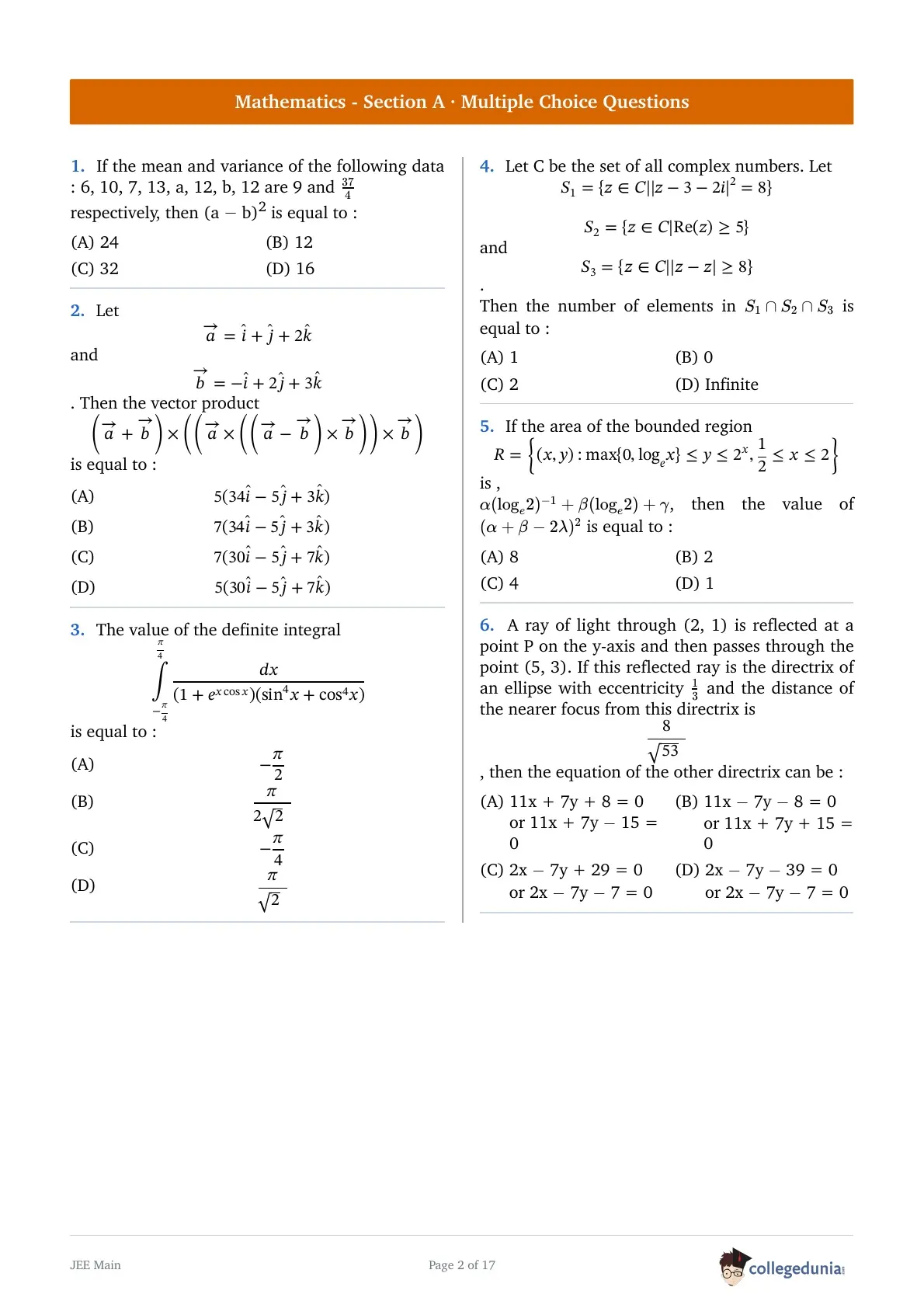
If the mean and variance of the following data : 6, 10, 7, 13, a, 12, b, 12 are 9 and \(\frac{37}{4}\) respectively, then \((a-b)^2\) is equal to :
Let \(\vec{a} = \hat{i}+\hat{j}+2\hat{k}\) and \(\vec{b} = -\hat{i}+2\hat{j}+3\hat{k}\). Then the vector product \((\vec{a}+\vec{b}) \times ((\vec{a} \times ((\vec{a}-\vec{b}) \times \vec{b})) \times \vec{b})\) is equal to :
The value of the definite integral \(\int_{-\pi/4}^{\pi/4} \frac{dx}{(1+e^{x\cos x})(\sin^4 x + \cos^4 x)}\) is equal to :
Let C be the set of all complex numbers. Let \(S_1 = \{z \in C : |z-3-2i|^2 = 8\}\), \(S_2 = \{z \in C : \text{Re}(z) \ge 5\}\) and \(S_3 = \{z \in C : |z - \bar{z}| \ge 8\}\). Then the number of elements in \(S_1 \cap S_2 \cap S_3\) is equal to :
If the area of the bounded region \(R = \left\{(x, y) : \max\{0, \log_e x\} \le y \le 2^x, \frac{1}{2} \le x \le 2\right\}\) is, \(\alpha(\log_e 2)^{-1} + \beta(\log_e 2) + \gamma\), then the value of \((\alpha + \beta - 2\gamma)^2\) is equal to :
A ray of light through (2, 1) is reflected at a point P on the y-axis and then passes through the point (5, 3). If this reflected ray is the directrix of an ellipse with eccentricity \(\frac{1}{3}\) and the distance of the nearer focus from this directrix is \(\frac{8}{\sqrt{53}}\), then the equation of the other directrix can be :
If the coefficients of \(x^7\) in \(\left(x^2 + \frac{1}{bx}\right)^{11}\) and \(x^{-7}\) in \(\left(x - \frac{1}{bx^2}\right)^{11}\), \(b \neq 0\), are equal, then the value of b is equal to :
If \(\sin\theta + \cos\theta = \frac{1}{2}\), then \(16(\sin(2\theta) + \cos(4\theta) + \sin(6\theta))\) is equal to :
Let \(A=\begin{bmatrix}1&2\\-1&4\end{bmatrix}\). If \(A^{-1}=\alpha I+\beta A,\ \alpha,\beta\in\mathbb{R}\), \(I\) is a \(2\times2\) identity matrix then \(4(\alpha-\beta)\) is equal to :
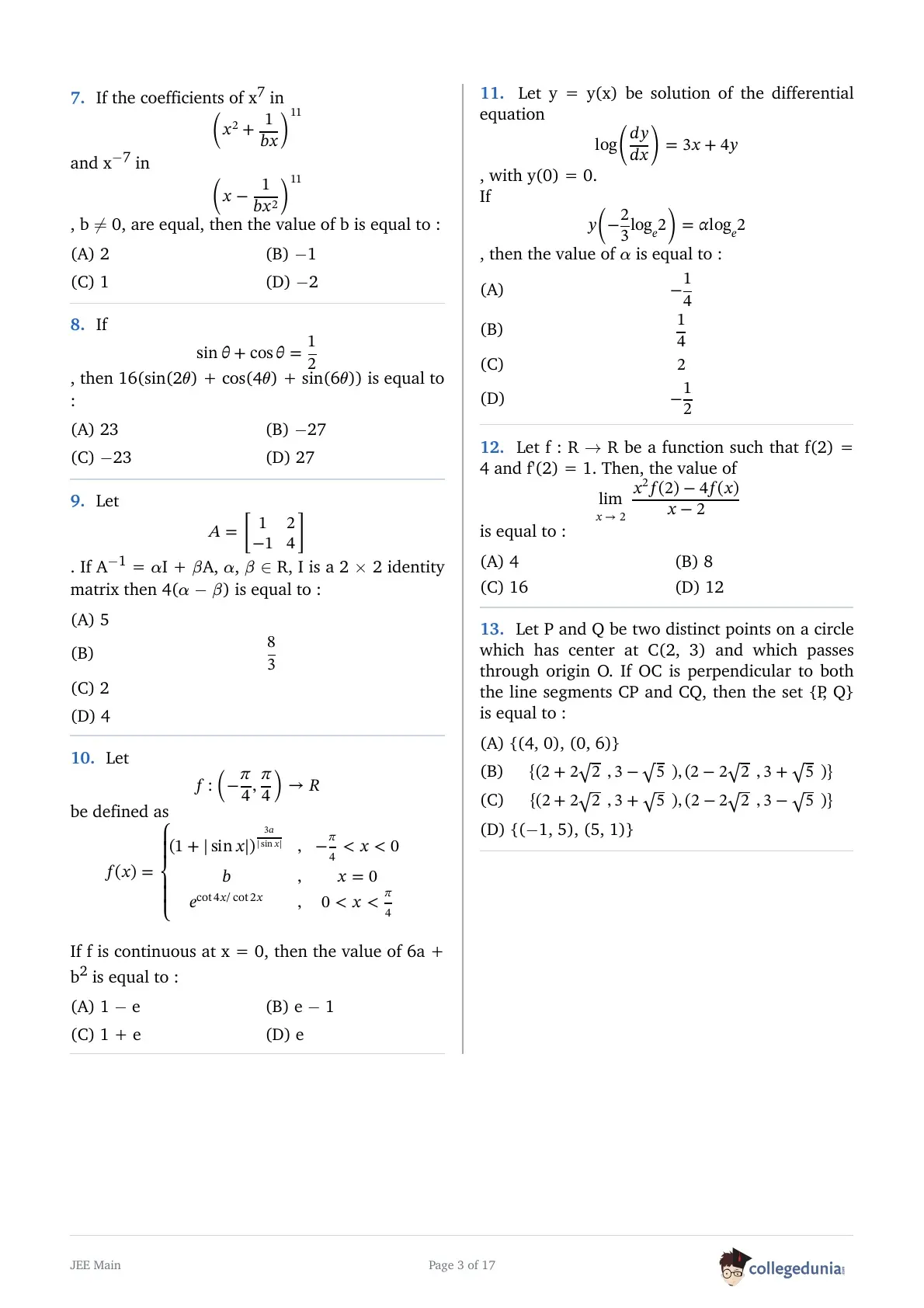
Let \(f:(-\frac{\pi}{4}, \frac{\pi}{4}) \rightarrow R\) be defined as 
If f is continuous at \(x=0\), then the value of \(6a+b^2\) is equal to :
Let \(y=y(x)\) be solution of the differential equation \(\log_e\left(\frac{dy}{dx}\right) = 3x+4y\), with \(y(0)=0\). If \(y\left(-\frac{2}{3}\log_e 2\right) = \alpha \log_e 2\), then the value of \(\alpha\) is equal to :
Let \(f:R \rightarrow R\) be a function such that \(f(2)=4\) and \(f'(2)=1\). Then, the value of \(\lim_{x\to 2}\frac{x^2f(2) - 4f(x)}{x-2}\) is equal to :
Let P and Q be two distinct points on a circle which has center at C(2, 3) and which passes through origin O. If OC is perpendicular to both the line segments CP and CQ, then the set\{P, Q\} is equal to :
Let \(\alpha, \beta\) be two roots of the equation \(x^2 + (20)^{1/4}x + (5)^{1/2} = 0\). Then \(\alpha^8 + \beta^8\) is equal to :
The probability that a randomly selected 2-digit number belongs to the set \(\{n \in N : (2^n - 2) \text{ is a multiple of } 3\}\) is equal to :
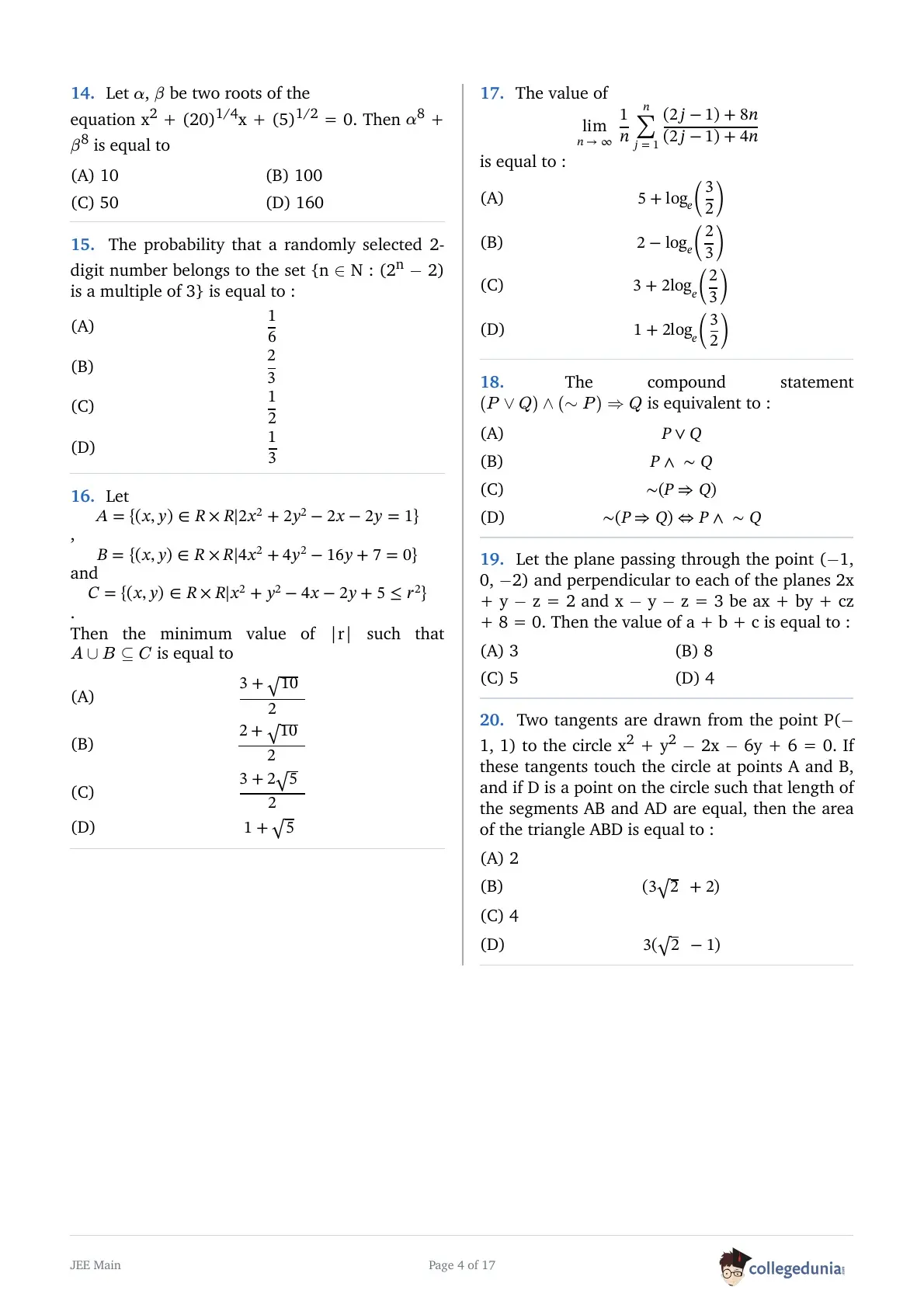
Let
A = \(\{(x, y) \in R \times R | 2x^2 + 2y^2 - 2x - 2y = 1\}\),
B = \(\{(x, y) \in R \times R | 4x^2 + 4y^2 - 16y + 7 = 0\}\) and
C = \(\{(x, y) \in R \times R | x^2 + y^2 - 4x - 2y + 5 \le r^2\}\).
Then the minimum value of \(|r|\) such that \(A \cup B \subseteq C\) is
The value of \(\lim_{n \to \infty} \frac{1}{n}\sum_{j=1}^{n}\frac{(2j-1)+8n}{(2j-1)+4n}\) is equal to :
The compound statement \((P \lor Q) \land (\sim P) \Rightarrow Q\) is equivalent to :
Let the plane passing through the point (-1, 0, -2) and perpendicular to each of the planes \(2x+y-z=2\) and \(x-y-z=3\) be \(ax+by+cz+8=0\). Then the value of \(a+b+c\) is equal to :
Two tangents are drawn from the point P(-1, 1) to the circle \(x^2 + y^2 - 2x - 6y + 6 = 0\). If these tangents touch the circle at points A and B, and if D is a point on the circle such that length of the segments AB and AD are equal, then the area of the triangle ABD is equal to :
Mathematics - Section B (Q21 - Q30)
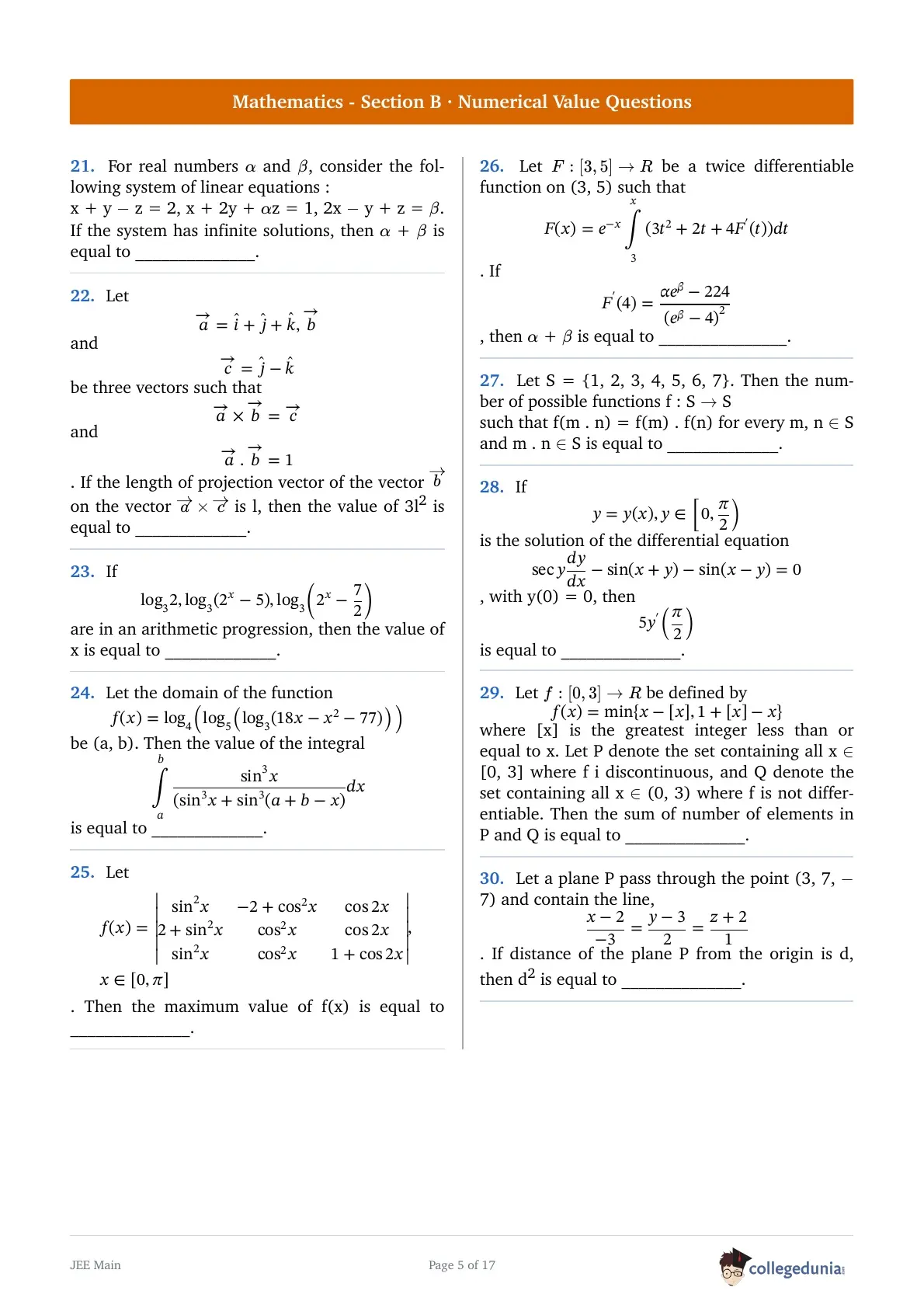
For real numbers \(\alpha\) and \(\beta\), consider the following system of linear equations:
\(x+y-z=2\)
\(x+2y+\alpha z = 1\)
\(2x-y+z = \beta\)
If the system has infinite solutions, then \(\alpha+\beta\) is equal to _________.
Let \(\vec{a}=\hat{i}+\hat{j}+\hat{k}\), \(\vec{b}\) and \(\vec{c}=\hat{j}-\hat{k}\) be three vectors such that \(\vec{a} \times \vec{b} = \vec{c}\) and \(\vec{a} \cdot \vec{b} = 1\). If the length of projection vector of the vector \(\vec{b}\) on the vector \(\vec{a} \times \vec{c}\) is \(l\), then the value of \(3l^2\) is equal to _________.
If \(\log_3 2, \log_3(2^x-5), \log_3(2^x-\frac{7}{2})\) are in an arithmetic progression, then the value of x is equal to _________.
Let the domain of the function \(f(x) = \log_4(\log_5(\log_3(18x-x^2-77)))\) be \((a, b)\). Then the value of the integral \(\int_a^b \frac{\sin^3 x}{\sin^3 x + \sin^3(a+b-x)} dx\) is equal to _________.
Let \(f(x)=\begin{vmatrix}\sin^2x&-2+\cos^2x&\cos2x\\2+\sin^2x&\cos^2x&\cos2x\\\sin^2x&\cos^2x&1+\cos2x\end{vmatrix},\ x\in[0,\pi]\). Then the maximum value of \(f(x)\) is equal to ______________.
Let F : [3, 5] \(\rightarrow\) R be a twice differentiable function on (3, 5) such that
\(F(x) = e^{-x} \int_3^x (3t^2 + 2t + 4F'(t))dt\).
If \(F'(4) = \frac{\alpha e^\beta - 224}{(e^\beta-4)^2}\), then \(\alpha+\beta\) is equal to _________.
Let S = 1, 2, 3, 4, 5, 6, 7. Then the number of possible functions \(f: S \rightarrow S\) such that \(f(m \cdot n) = f(m) \cdot f(n)\) for every \(m, n \in S\) and \(m \cdot n \in S\) is equal to _________.
If \(y=y(x)\), \(y \in [0, \pi/2)\) is the solution of the differential equation \(\sec y \frac{dy}{dx} - \sin(x+y) - \sin(x-y) = 0\), with \(y(0)=0\), then \(5y'(\pi/2)\) is equal to _________.
Let \(f:[0, 3] \rightarrow R\) be defined by \(f(x) = \min\{x-[x], 1+[x]-x\}\) where \([x]\) is the greatest integer less than or equal to x. Let P denote the set containing all \(x \in [0, 3]\) where f is discontinuous, and Q denote the set containing all \(x \in [0, 3]\) where f is not differentiable. Then the sum of number of elements in P and Q is equal to _________.
Let a plane P pass through the point (3, 7, -7) and contain the line, \(\frac{x-2}{-3} = \frac{y-3}{2} = \frac{z+2}{1}\). If distance of the plane P from the origin is d, then \(d^2\) is equal to _________.
Physics - Section A (Q31 - Q50)
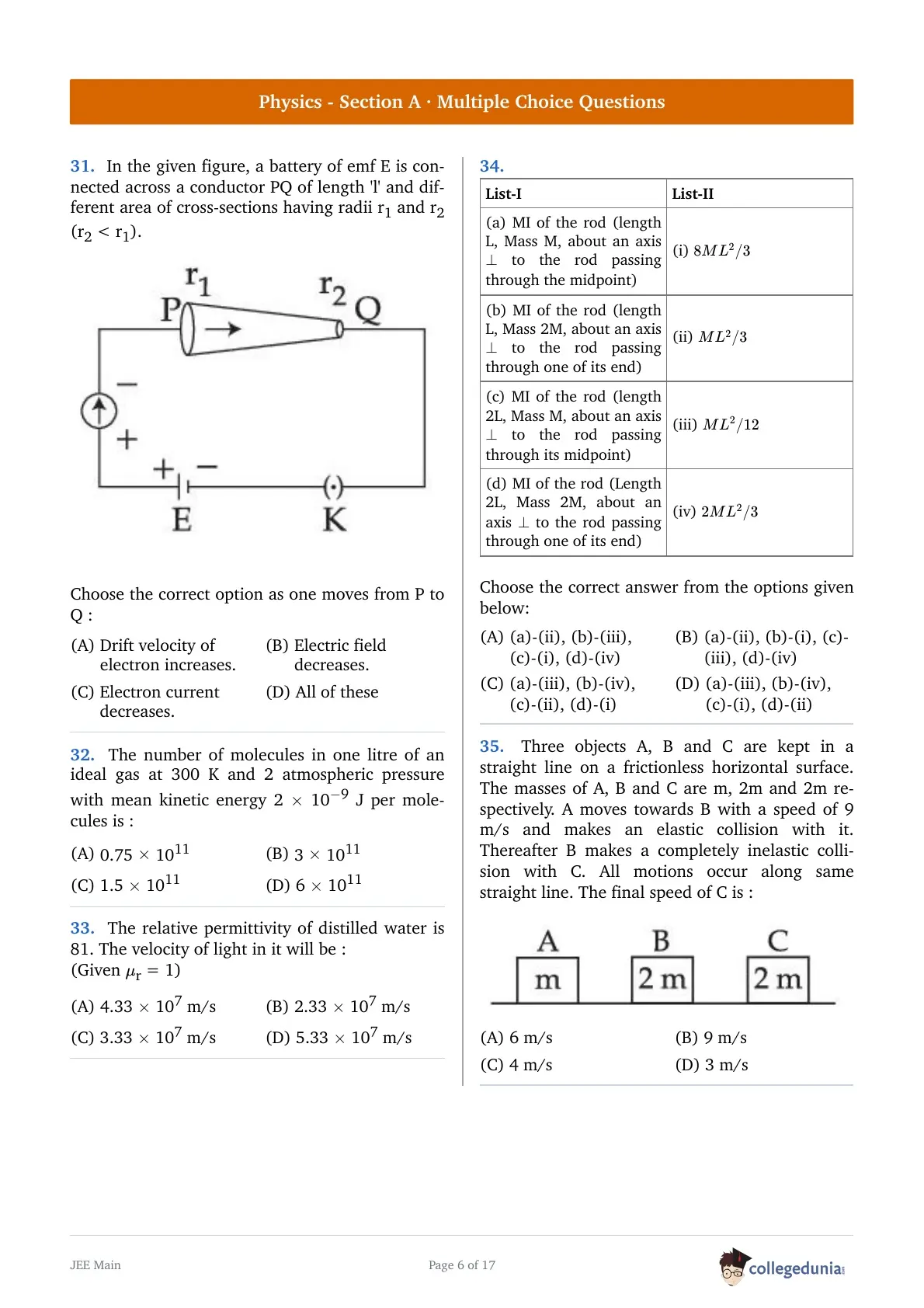
In the given figure, a battery of emf E is connected across a conductor PQ of length 'l' and different area of cross-sections having radii \(r_1\) and \(r_2 (r_2<r_1)\). Choose the correct option as one moves from P to Q : 
The number of molecules in one litre of an ideal gas at 300 K and 2 atmospheric pressure with mean kinetic energy \(2 \times 10^{-9}\) J per molecule is :
The relative permittivity of distilled water is 81. The velocity of light in it will be : (Given \(\mu_r = 1\))
| List-I | List-II |
| (a) MI of the rod (length L, Mass M, about an axis \(\perp\) to the rod passing through the midpoint) | (i) \(8ML^2/3\) |
| (b) MI of the rod (length L, Mass 2M, about an axis \(\perp\) to the rod passing through one of its end) | (ii) \(ML^2/3\) |
| (c) MI of the rod (length 2L, Mass M, about an axis \(\perp\) to the rod passing through its midpoint) | (iii) \(ML^2/12\) |
| (d) MI of the rod (Length 2L, Mass 2M, about an axis \(\perp\) to the rod passing through one of its end) | (iv) \(2ML^2/3\) |
Three objects A, B and C are kept in a straight line on a frictionless horizontal surface. The masses of A, B and C are m, 2m and 2m respectively. A moves towards B with a speed of 9 m/s and makes an elastic collision with it. Thereafter B makes a completely inelastic collision with C. All motions occur along same straight line. The final speed of C is : 
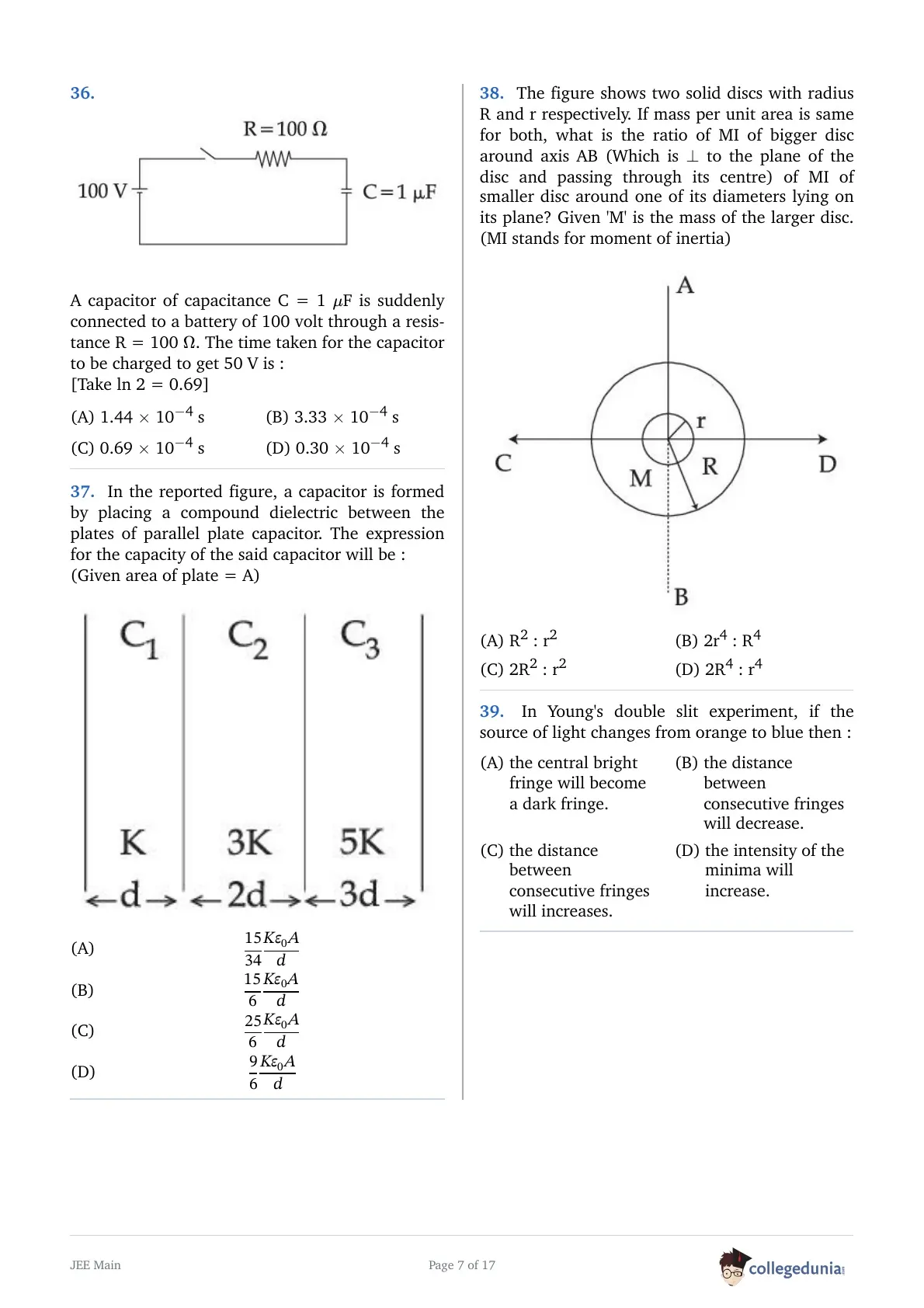
A capacitor of capacitance C=1 \(\mu\)F is suddenly connected to a battery of 100 volt through a resistor R = 100 \(\Omega\). The time taken for the capacitor to be charged to get 50 V is: [Take ln 2 = 0.69] 
In the reported figure, a capacitor is formed by placing a compound dielectric between the plates of parallel plate capacitor. The expression for the capacity of the said capacitor will be : (Given area of plate = A) 
The figure shows two solid discs with radius R and r respectively. If mass per unit area is same for both, what is the ratio of MI of bigger disc around axis AB (which is \(\perp\) to the plane of the disc and passing through its centre) to MI of smaller disc around one of its diameters lying on its plane ? Given 'M' is the mass of the larger disc. (MI stands for moment of inertia) 
In Young's double slit experiment, if the source of light changes from orange to blue then:
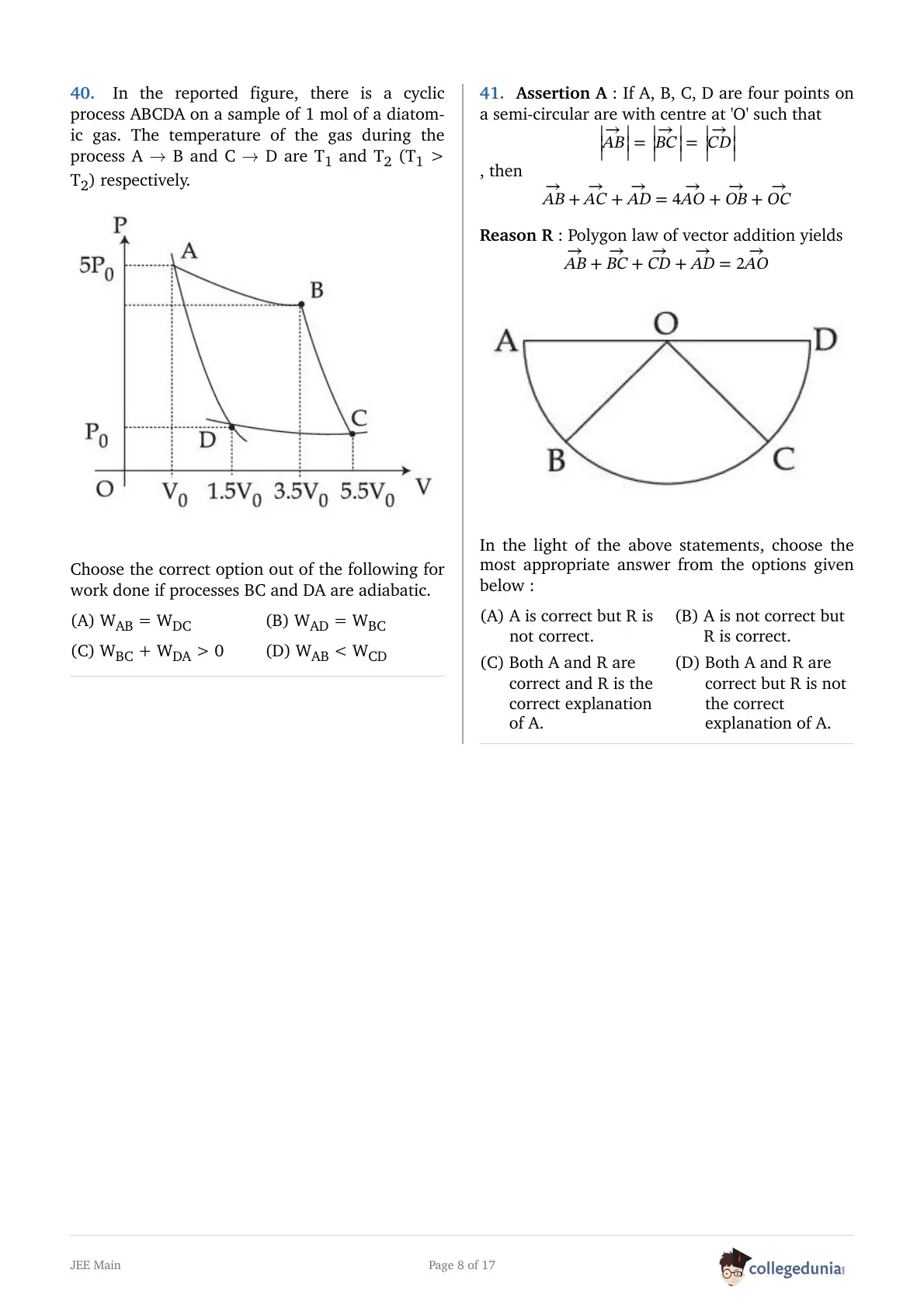
In the reported figure, there is a cyclic process ABCDA on a sample of 1 mol of a diatomic gas. The temperature of the gas during the process A \(\rightarrow\) B and C \(\rightarrow\) D are \(T_1\) and \(T_2\) (\(T_1>T_2\)) respectively. Choose the correct option out of the following for work done if processes BC and DA are adiabatic. 
Assertion A : If A, B, C, D are four points on a semi-circular arc with centre at 'O' such that \(|\vec{AB}| = |\vec{BC}| = |\vec{CD}|\), then \(\vec{AB} + \vec{AC} + \vec{AD} = 4\vec{AO} + \vec{OB} + \vec{OC}\)
Reason R : Polygon law of vector addition yields \(\vec{AB} + \vec{BC} + \vec{CD} = \vec{AD} = 2\vec{AO}\) 
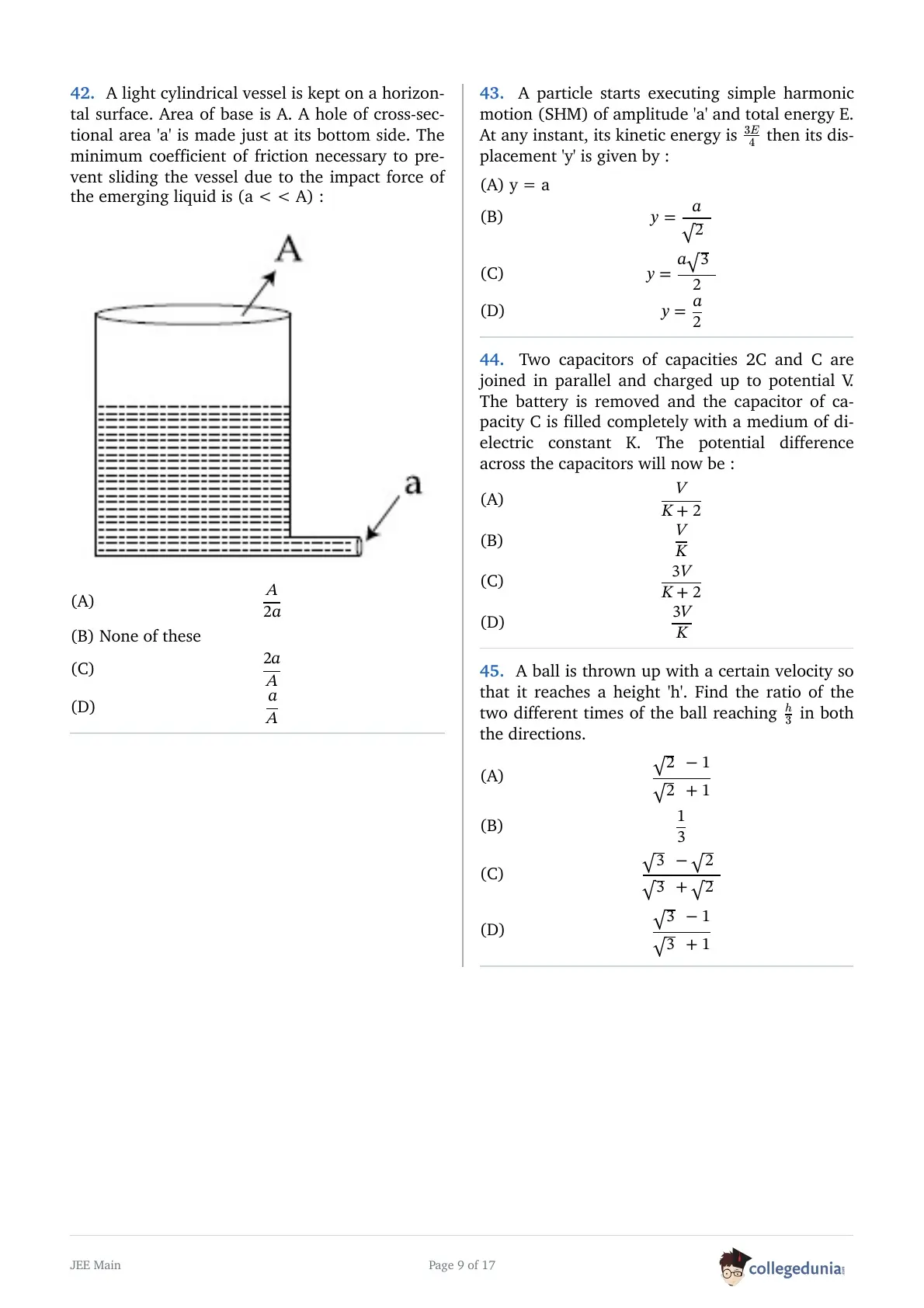
A light cylindrical vessel is kept on a horizontal surface. Area of base is A. A hole of cross-sectional area 'a' is made just at its bottom side. The minimum coefficient of friction necessary to prevent sliding the vessel due to the impact force of the emerging liquid is (a << A) : 
A particle starts executing simple harmonic motion (SHM) of amplitude 'a' and total energy E. At any instant, its kinetic energy is \(\frac{3E}{4}\) then its displacement 'y' is given by :
Two capacitors of capacities 2C and C are joined in parallel and charged up to potential V. The battery is removed and the capacitor of capacity C is filled completely with a medium of dielectric constant K. The potential difference across the capacitors will now be :
A ball is thrown up with a certain velocity so that it reaches a height 'h'. Find the ratio of the two different times of the ball reaching \(\frac{h}{3}\) in both the directions.
A 0.07 H inductor and a 12 \(\Omega\) resistor are connected in series to a 220 V, 50 Hz ac source. The approximate current in the circuit and the phase angle between current and source voltage are respectively. [Take \(\pi\) as 22/7]
Two identical tennis balls each having mass 'm' and charge 'q' are suspended from a fixed point by threads of length 'l'. What is the equilibrium separation when each thread makes a small angle '\(\theta\)' with the vertical ?
Assertion A : If in five complete rotations of the circular scale, the distance travelled on main scale is 5 mm and there are 50 total divisions on circular scale, then least count is 0.001 cm.
Reason R : Least Count = \(\frac{\text{Pitch}}{\text{Total divisions on circular scale}}\)
If 'f' denotes the ratio of the number of nuclei decayed Nd to the number of nuclei at t=0 N0 then for a collection of radioactive nuclei, the rate of change of 'f' with respect to time is given as: [\(\lambda\) is the radioactive decay constant]
A body takes 4 min. to cool from 61\(^\circ\)C to 59\(^\circ\)C. If the temperature of the surroundings is 30\(^\circ\)C, the time taken by the body to cool from 51\(^\circ\)C to 49\(^\circ\)C is :
Physics - Section B (Q51 - Q60)
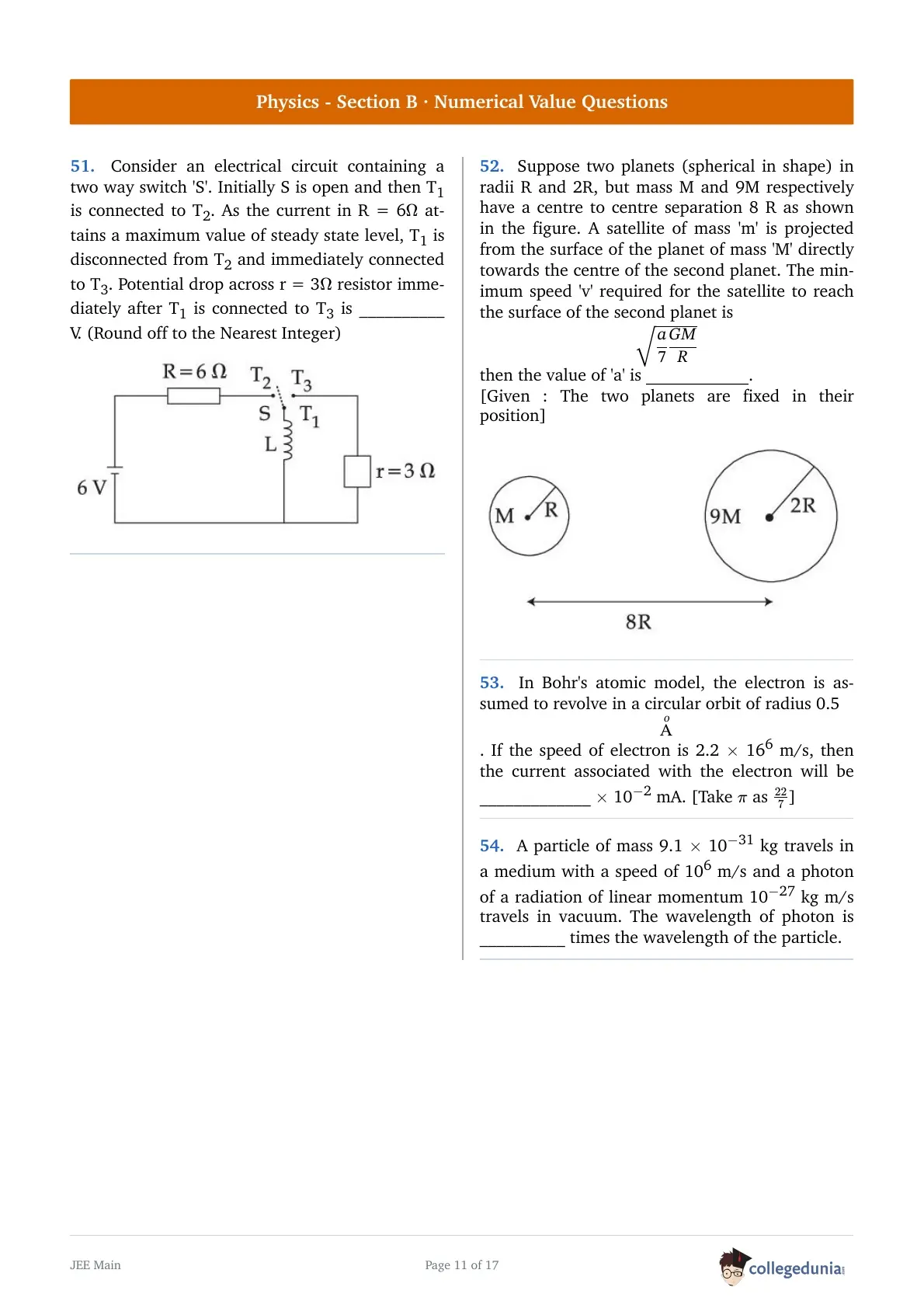
Consider an electrical circuit containing a two way switch 'S'. Initially S is open and then \(T_1\) is connected to \(T_2\). As the current in R = 6 \(\Omega\) attains a maximum value of steady state level, \(T_1\) is disconnected from \(T_2\) and immediately connected to \(T_3\). Potential drop across r = 3 \(\Omega\) resistor immediately after \(T_1\) is connected to \(T_3\) is _________ V. (Round off to the Nearest Integer) 
Suppose two planets (spherical in shape) of radii R and 2 R, but mass M and 9 M respectively have a centre to centre separation 8 R as shown in the figure. A satellite of mass 'm' is projected from the surface of the planet of mass 'M' directly towards the centre of the second planet. The minimum speed 'v' required for the satellite to reach the surface of the second planet is \(\sqrt{\frac{aGM}{7R}}\) then the value of 'a' is _________. [Given : The two planets are fixed in their position] 
In Bohr's atomic model, the electron is assumed to revolve in a circular orbit of radius 0.5 Å. If the speed of the electron is \(2.2 \times 10^6\) m/s, then the current associated with the electron will be _________ \(\times 10^{-2}\) mA. [Take \(\pi\) as 22/7]
A particle of mass \(9.1 \times 10^{-31}\) kg travels in a medium with a speed of \(10^6\) m/s and a photon of a radiation of linear momentum \(10^{-27}\) kg m/s travels in vacuum. The wavelength of photon is _________ times the wavelength of the particle.
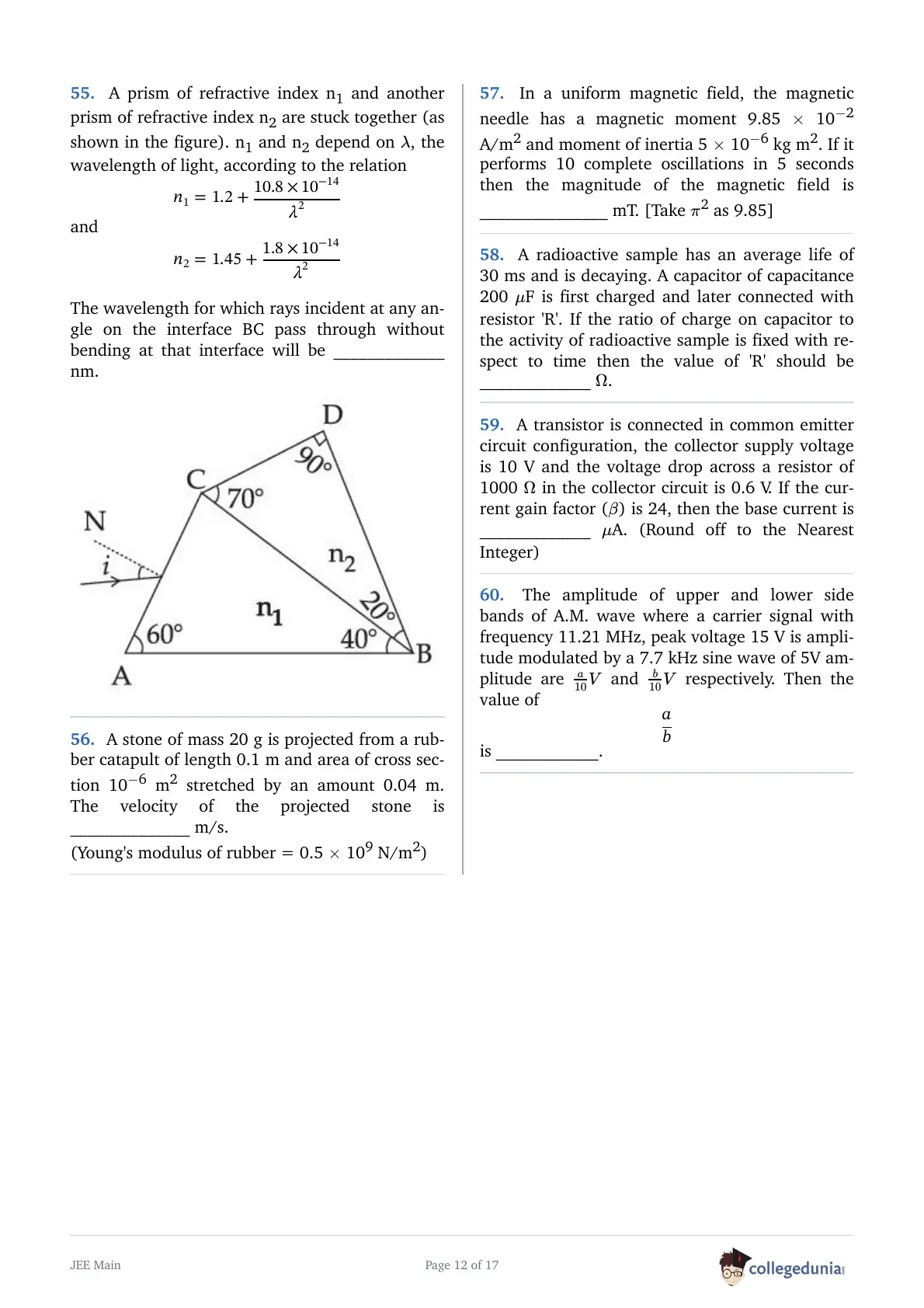
A prism of refractive index \(n_1\) and another prism of refractive index \(n_2\) are stuck together (as shown in the figure). \(n_1\) and \(n_2\) depend on \(\lambda\), the wavelength of light, according to the relation \(n_1 = 1.2 + \frac{10.8 \times 10^{-14}}{\lambda^2}\) and \(n_2 = 1.45 + \frac{1.8 \times 10^{-14}}{\lambda^2}\). The wavelength for which rays incident at any angle on the interface BC pass through without bending at that interface will be _________ nm. 
A stone of mass 20 g is projected from a rubber catapult of length 0.1 m and area of cross section \(10^{-6}\) m\(^2\) stretched by an amount 0.04 m. The velocity of the projected stone is _________ m/s. (Young's modulus of rubber = \(0.5 \times 10^9\) N/m\(^2\))
In a uniform magnetic field, the magnetic needle has a magnetic moment \(9.85 \times 10^{-2}\) A/m\(^2\) and moment of inertia \(5 \times 10^{-6}\) kg m\(^2\). If it performs 10 complete oscillations in 5 seconds then the magnitude of the magnetic field is _________ mT. [Take \(\pi^2\) as 9.85]
A radioactive sample has an average life of 30 ms and is decaying. A capacitor of capacitance 200 \(\mu\)F is first charged and later connected with resistor 'R'. If the ratio of charge on capacitor to the activity of radioactive sample is fixed with respect to time then the value of 'R' should be _________ \(\Omega\).
A transistor is connected in common emitter circuit configuration, the collector supply voltage is 10 V and the voltage drop across a resistor of 1000 \(\Omega\) in the collector circuit is 0.6 V. If the current gain factor (\(\beta\)) is 24, then the base current is _________ \(\mu\)A. (Round off to the Nearest Integer)
The amplitude of upper and lower side bands of A.M. wave where a carrier signal with frequency 11.21 MHz, peak voltage 15 V is amplitude modulated by a 7.7 kHz sine wave of 5 V amplitude are \(\frac{a}{10}\)V and \(\frac{b}{10}\)V respectively. Then the value of \(\frac{a}{b}\) is _________.
Chemistry - Section A (Q61 - Q80)
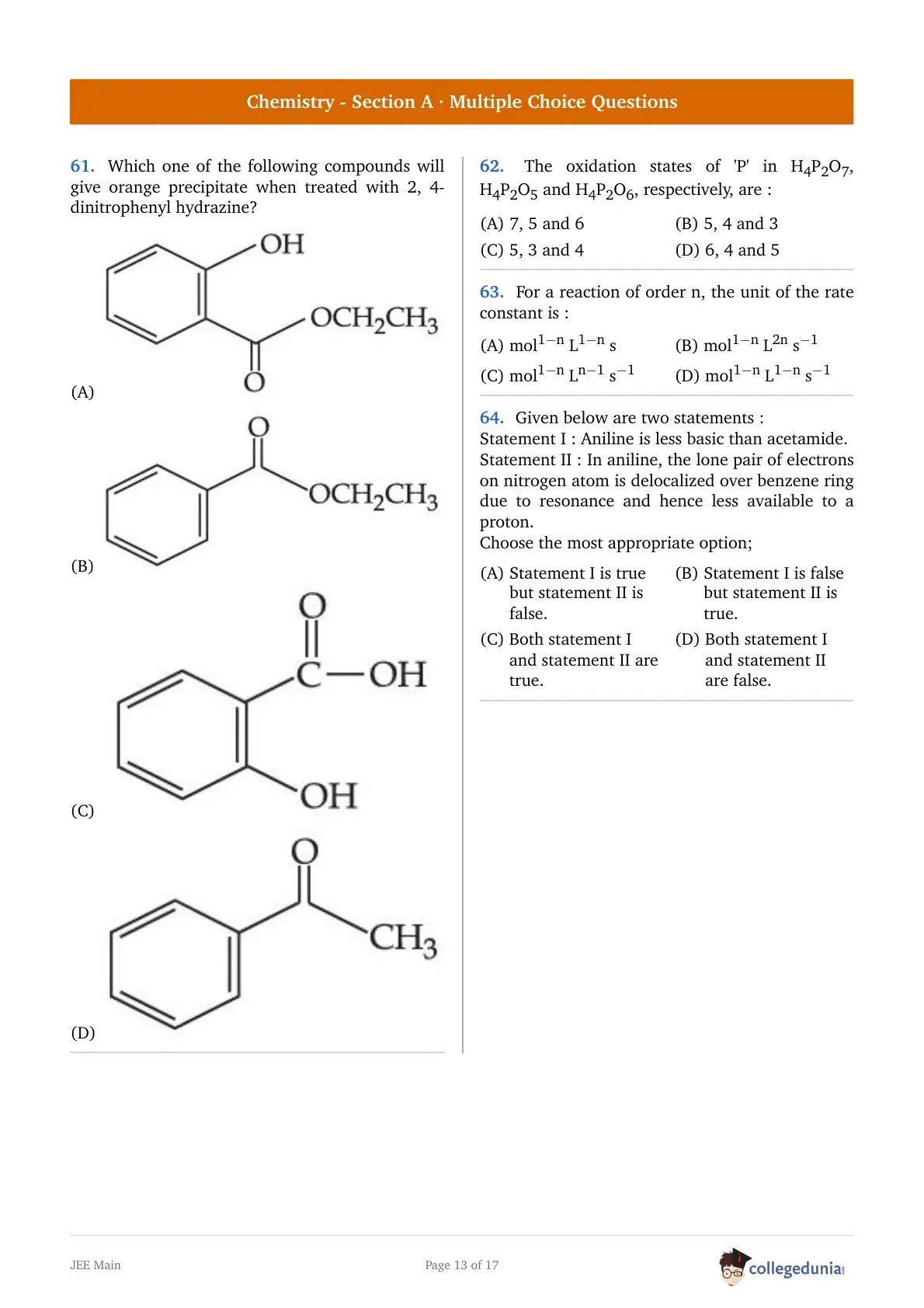
Which one of the following compounds will give orange precipitate when treated with 2,4-dinitrophenyl hydrazine ? 

The oxidation states of 'P' in \(H_4P_2O_7\), \(H_4P_2O_5\) and \(H_4P_2O_6\), respectively, are :
For a reaction of order n, the unit of the rate constant is :
Given below are two statements:
Statement I : Aniline is less basic than acetamide.
Statement II : In aniline, the lone pair of electrons on nitrogen atom is delocalised over benzene ring due to resonance and hence less available to a proton.
Choose the most appropriate option :
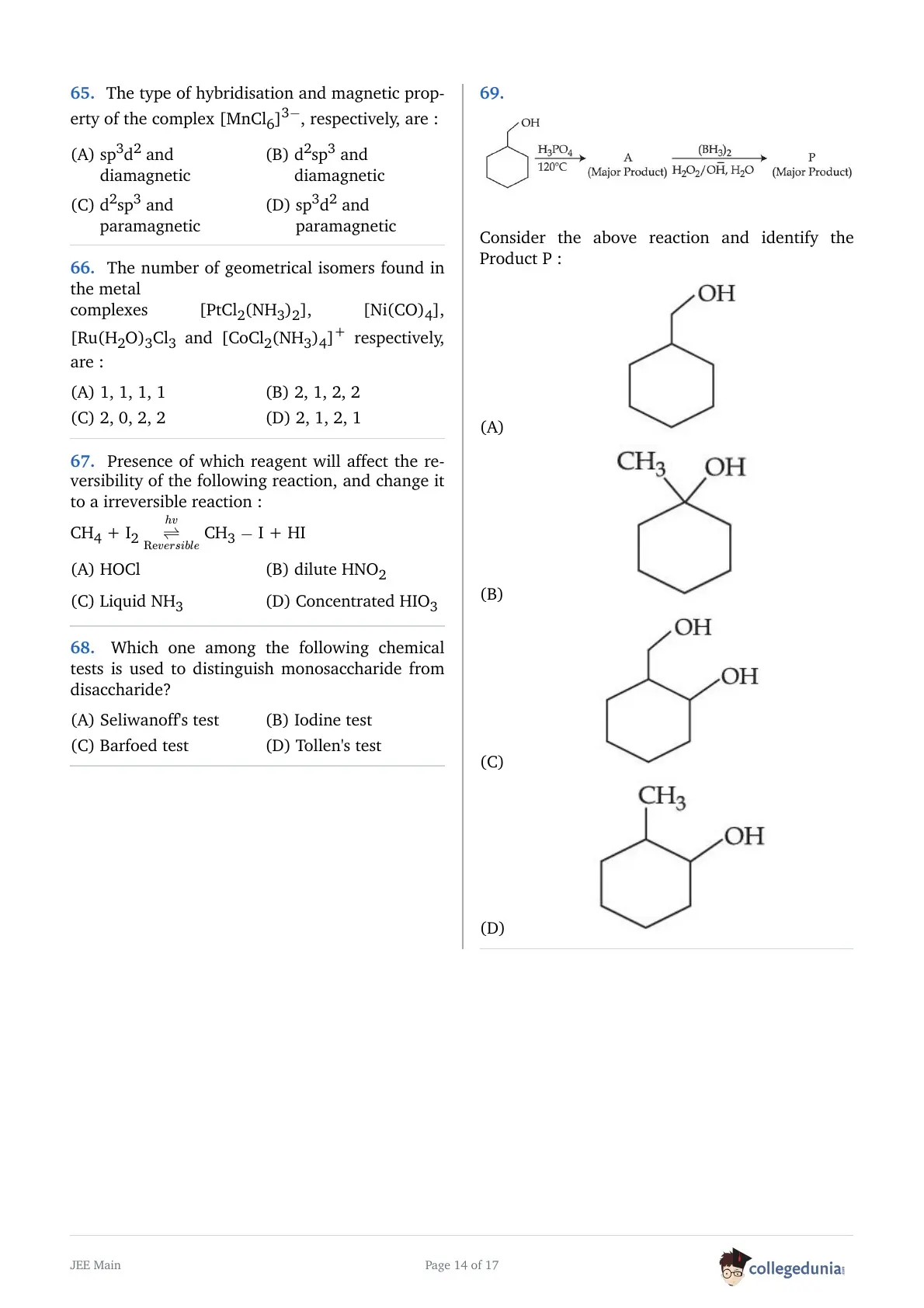
The type of hybridisation and magnetic property of the complex \([MnCl_6]^{3-}\), respectively, are :
The number of geometrical isomers found in the metal complexes \([PtCl_2(NH_3)_2]\), \([Ni(CO)_4]\), \([Ru(H_2O)_3Cl_3]\) and \([CoCl_2(NH_3)_4]^+\) respectively, are :
Presence of which reagent will affect the reversibility of the following reaction, and change it to a irreversible reaction:
\(CH_4 + I_2 \rightleftharpoons CH_3-I + HI\)
Which one among the following chemical tests is used to distinguish monosaccharide from disaccharide ?

Consider the above reaction and identify the Product P :
- (1)
![]()
- (2)
![]()
- (3)
![]()
- (4)
![]()


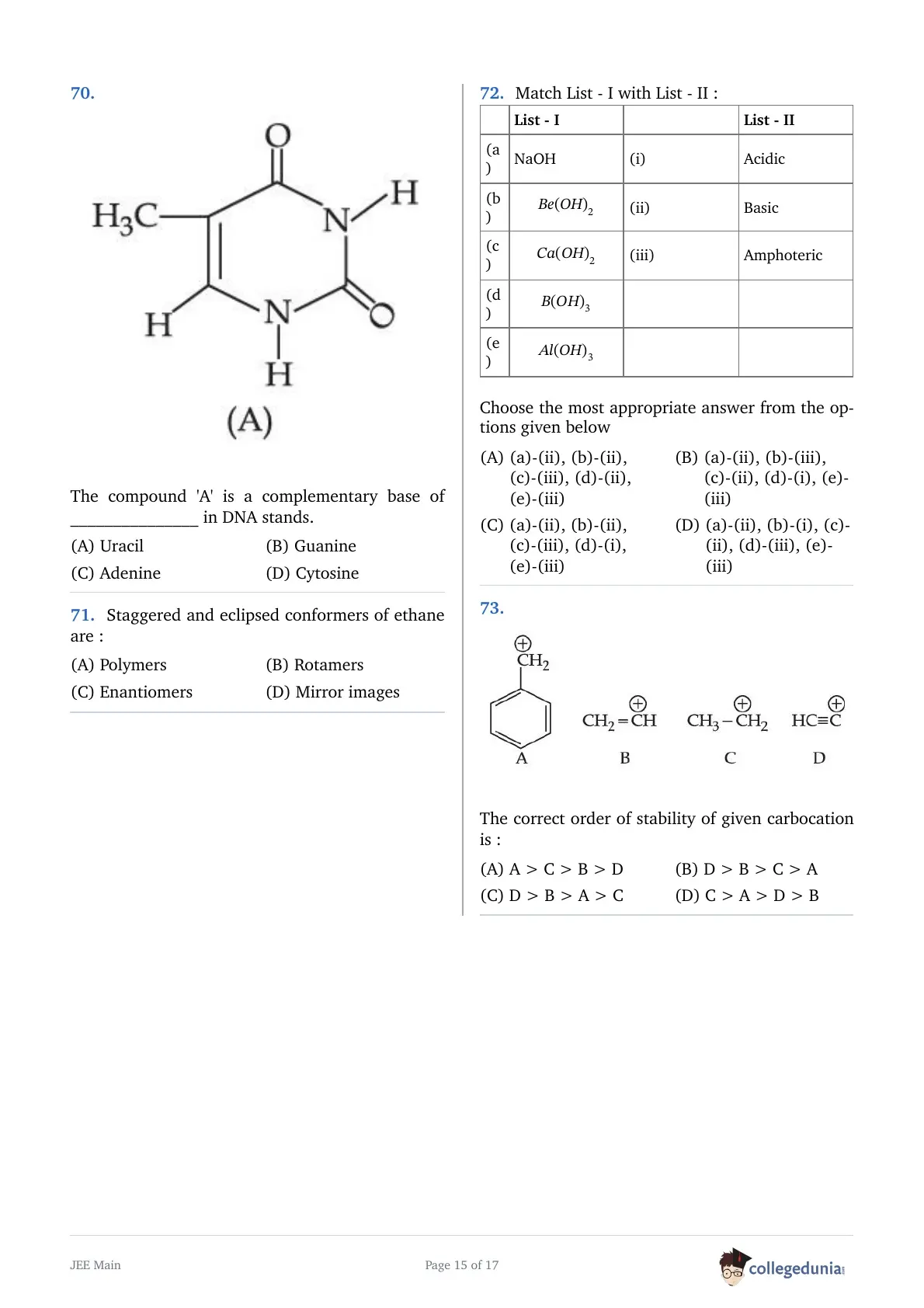
The compound 'A' is a complementary base of _________ in DNA strands. 
Staggered and eclipsed conformers of ethane are :
Match List - I with List - II : 
Choose the most appropriate answer from the options given
The correct order of stability of given carbocations is : 
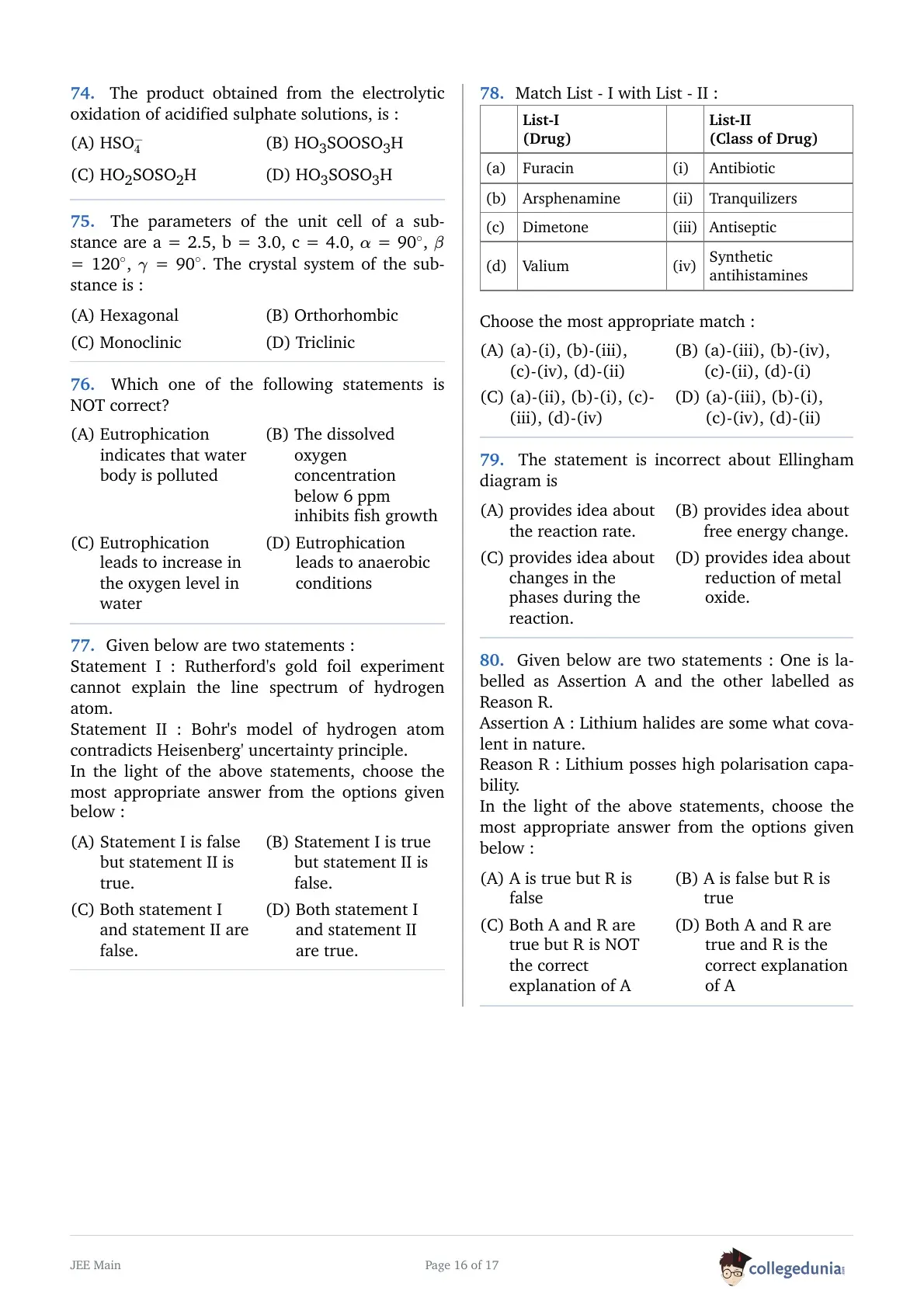
The product obtained from the electrolytic oxidation of acidified sulphate solutions, is :
The parameters of the unit cell of a substance are a = 2.5, b = 3.0, c = 4.0, \(\alpha=90^\circ, \beta=120^\circ, \gamma=90^\circ\). The crystal system of the substance is :
Which one of the following statements is NOT correct ?
Given below are two statements:
Statement I : Rutherford's gold foil experiment cannot explain the line spectrum of hydrogen atom.
Statement II : Bohr's model of hydrogen atom contradicts Heisenberg's uncertainty principle.
In the light of the above statements, choose the most appropriate answer from the options given below:
| List-I (Drug) | List-II (Class of Drug) | ||
| (a) | Furacin | (i) | Antibiotic |
| (b) | Arsphenamine | (ii) | Tranquilizers |
| (c) | Dimetone | (iii) | Antiseptic |
| (d) | Valium | (iv) | Synthetic antihistamines |
The statement that is INCORRECT about Ellingham diagram is :
Given below are two statements: one is labelled as Assertion A and the other is labelled as Reason R.
Assertion A : Lithium halides are some what covalent in nature.
Reason R : Lithium possess high polarisation capability.
In the light of the above statements, choose the most appropriate answer from the options given below :
Chemistry - Section B (Q81 - Q90)
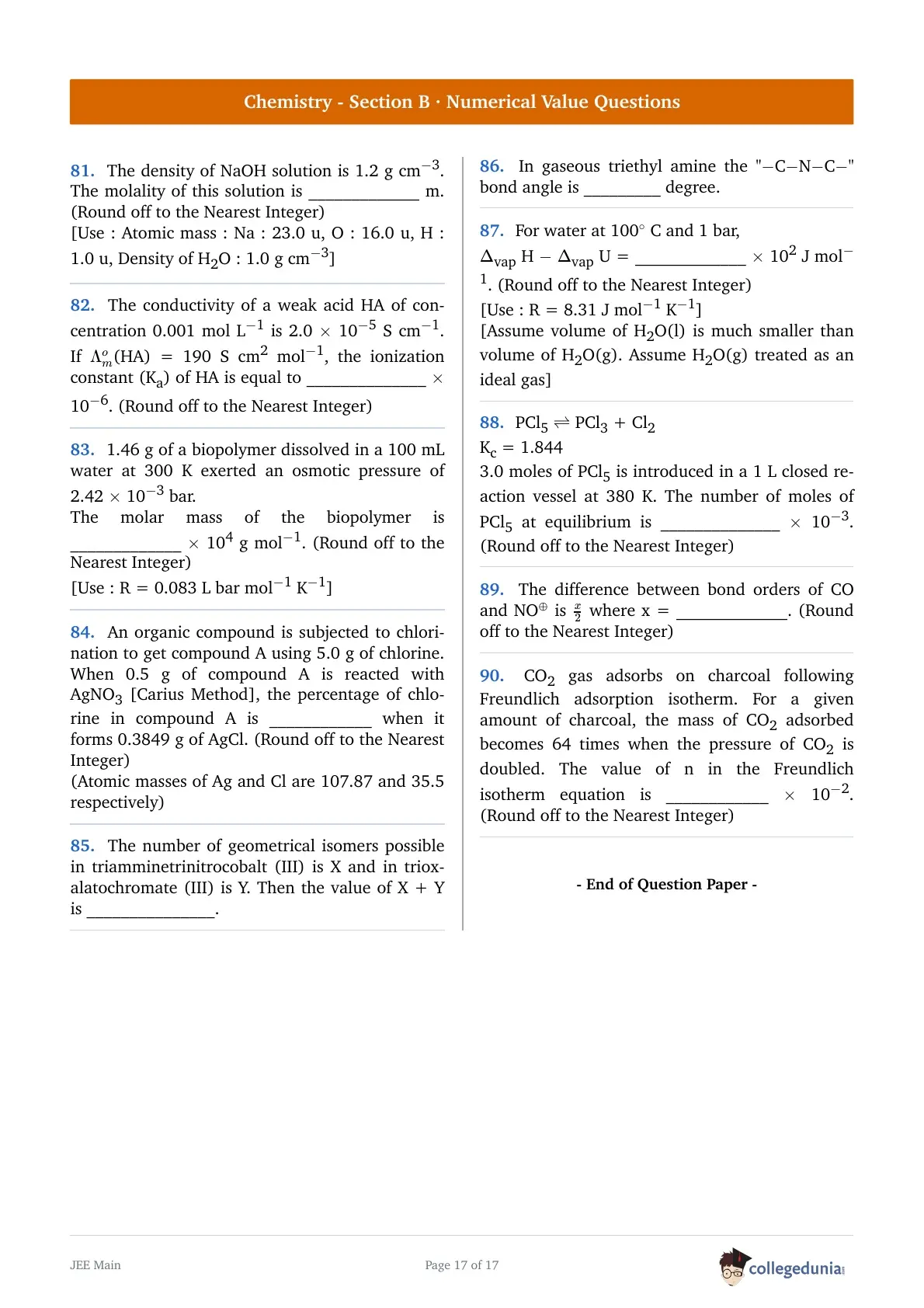
The density of NaOH solution is 1.2 g cm\(^{-3}\). The molality of this solution is ________ m. (Round off to the Nearest Integer)
[Use : Atomic masses : Na:23.0 u O:16.0 u H:1.0 u, Density of H\(_2\)O : 1.0 g cm\(^{-3}\)]
The conductivity of a weak acid HA of concentration 0.001 mol L\(^{-1}\) is \(2.0 \times 10^{-5}\) S cm\(^{-1}\). If \(\Lambda_m^\circ(HA) = 190\) S cm\(^2\) mol\(^{-1}\), the ionization constant (K\(_a\)) of HA is equal to _________ \(\times 10^{-6}\). (Round off to the Nearest Integer)
1.46 g of a biopolymer dissolved in a 100 mL water at 300 K exerted an osmotic pressure of \(2.42 \times 10^{-3}\) bar. The molar mass of the biopolymer is _________ \(\times 10^4\) g mol\(^{-1}\). (Round off to the Nearest Integer)
[Use : R = 0.083 L bar mol\(^{-1}\) K\(^{-1}\)]
An organic compound is subjected to chlorination to get compound A using 5.0 g of chlorine. When 0.5 g of compound A is reacted with AgNO\(_3\) [Carius Method], the percentage of chlorine in compound A is _________ when it forms 0.3849 g of AgCl. (Round off to the Nearest Integer)
(Atomic masses of Ag and Cl are 107.87 and 35.5 respectively)
The number of geometrical isomers possible in triamminetrinitrocobalt(III) is X and in trioxalatochromate(III) is Y. Then the value of X+Y is _________.
In gaseous triethyl amine the "-C-N-C-" bond angle is _________ degree.
For water at 100\(^\circ\)C and 1 bar,  (Round off to the Nearest Integer)
[Use : R=8.31 J mol\(^{-1}\) K\(^{-1}\)]
[Assume volume of H\(\_2\)O(l) is much smaller than volume of H\(\_2\)O(g). Assume H\(\_2\)O(g) can be treated as an ideal gas]
\(PCl_5 \rightleftharpoons PCl_3 + Cl_2 K_c = 1.844\)
3.0 moles of \(PCl_5\) is introduced in a 1 L closed reaction vessel at 380 K. The number of moles of \(PCl_5\) at equilibrium is _________ \(\times 10^{-3}\). (Round off to the Nearest Integer)
The difference between bond orders of CO and NO\(^\oplus\) is \(\frac{x}{2}\) where x = _________. (Round off to the Nearest Integer)
\(CO_2\) gas adsorbs on charcoal following Freundlich adsorption isotherm. For a given amount of charcoal, the mass of \(CO_2\) adsorbed becomes 64 times when the pressure of \(CO_2\) is doubled. The value of n in the Freundlich isotherm equation is _________ \(\times 10^{-2}\). (Round off to the Nearest Integer)
JEE Main 2021 Exam Pattern and Marking Scheme
| Particulars | Details |
|---|---|
| Exam Mode | Online (Computer-Based Test) |
| Paper | B.E./B.Tech (Paper 1) |
| Duration | 3 hours (180 minutes) |
| Type of Questions | Multiple Choice Questions (MCQs) + Numerical Value Questions |
| Subjects | Mathematics, Physics, Chemistry |
| Total Questions | 90 questions (75 to be attempted) |
| Total Marks | 300 marks |
| Marking Scheme | +4 for correct answer & -1 for incorrect MCQ; no negative marking for Numerical Value Questions |
JEE Main 2021 July 27 Shift 1 Difficulty Level
JEE Main 2021 B.E./B.Tech Question Paper - July 27, 2021- Forenoon Session was considered to be of average difficulty by the exam takers and coaching institutions. The weightage of the class XII JEE Main Syllabus, with 55 Questions included from it, was more in the exam than the class XI syllabus, which had just 35 Questions included from it. In terms of difficulty, the Physics section was the most difficult section of the exam, followed by Chemistry and Mathematics, in descending order.
JEE Main 2021 B.E./B.Tech Question Paper July 27 (FN): Paper Analysis
JEE Main 2021 B.E./B.Tech Paper on July 27 Forenoon Session was conducted between 9.00 AM to 12.00 Noon, the unit wise paper analysis is as follows:
| Subject | Topic (Number of Questions in the Paper) | Related Links |
|---|---|---|
| Physics | Electrodynamics (10) | JEE Main Physics Syllabus |
| Heat and Thermodynamics (3) | ||
| Mechanics (11) | ||
| Modern Physics (2) | ||
| Optics (3) | ||
| SHM and Waves (1) | ||
| Chemistry | Inorganic Chemistry I (4) | JEE Main Chemistry Syllabus |
| Inorganic Chemistry II (3) | ||
| Organic Chemistry I (2) | ||
| Organic Chemistry II (12) | ||
| Physical Chemistry I (5) | ||
| Physical Chemistry II (4) | ||
| Mathematics | Binomial Theorem (1) | JEE Main Mathematics Syllabus |
| Complex Numbers (1) | ||
| Coordinate Geometry (3) | ||
| Differential Calculus (4) | ||
| Integral Calculus (6) | ||
| Mathematics Reasoning (1) | ||
| Permutation and Combination (2) | ||
| Sequence and Series (1) | ||
| Vector and 3D (3) | ||
| Statistics (1) | ||
| Probability (2) | ||
| Quadratic Equations (1) | ||
| Trigonometry (3) | ||
| Matrix and Determinants (2) |



Comments