




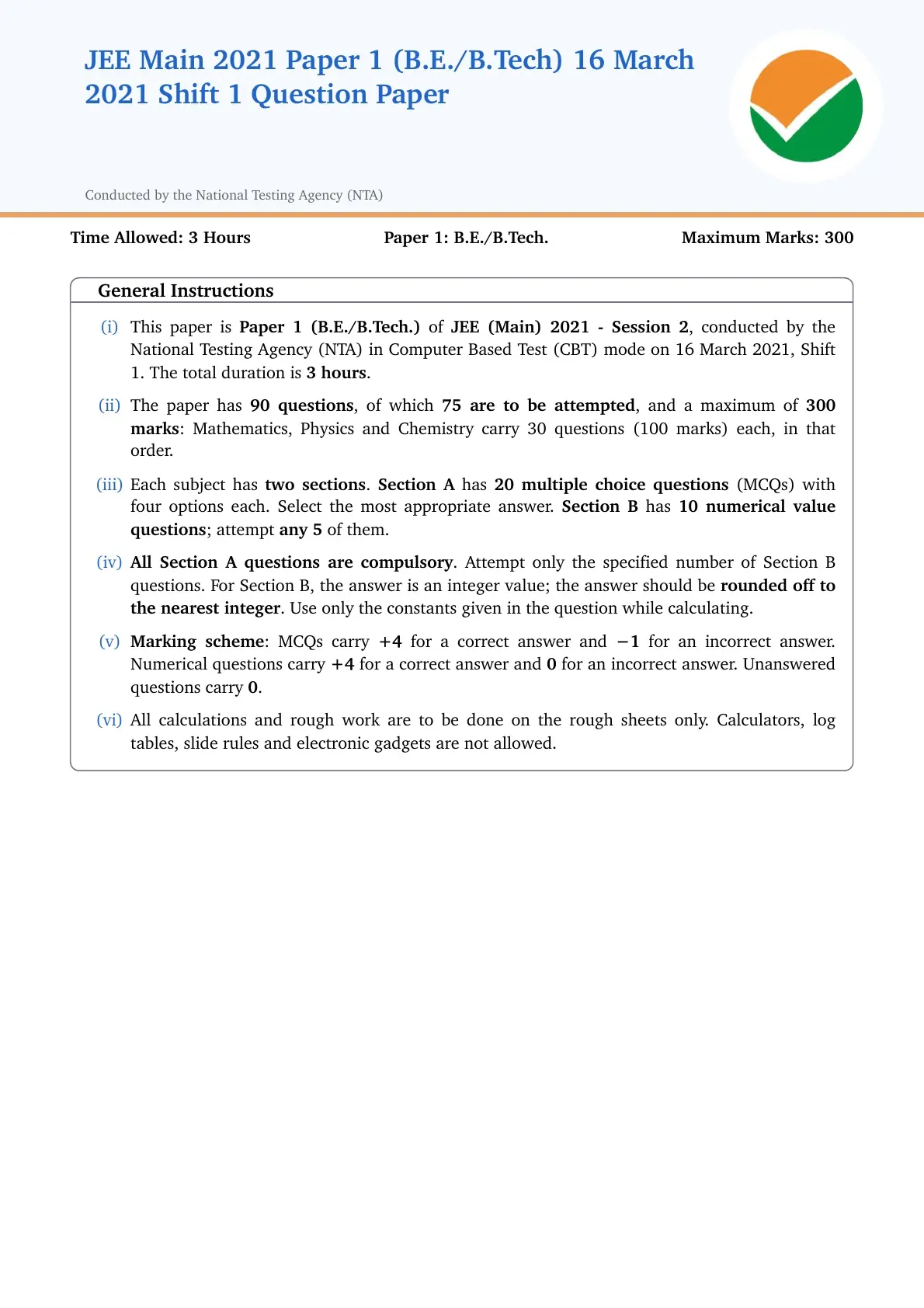
JEE Main 2021 March 16 Shift 1 Question Paper is available here with solutions PDF and detailed solutions for every question. NTA conducted the first shift on March 16, 2021, from 9:00 AM to 12:00 PM. The JEE Main 2021 Paper 1 (B.E./B.Tech) question paper includes the following:
- 90 questions in a 3-hour CBT Mode: 30 each from Mathematics, Physics and Chemistry (75 to be attempted)
- Section A: 20 multiple choice questions (MCQs) per subject, all compulsory, 4 marks each
- Section B: 10 numerical value questions per subject, any 5 to be attempted, 4 marks each
- Marking: +4 for a correct answer, -1 for an incorrect MCQ, 0 for an unattempted question; no negative marking for numerical value questions
- Maximum marks: 300 (100 per subject)
JEE Main 2021 March 16 Shift 1 Question Paper with Solution PDF
| NTA Official PDF | CD PDF | CD PDF with Solutions |
|---|---|---|
| Download official PDF 6.12 MB | Download Collegedunia PDF 1.08 MB | Download solutions PDF 1.39 MB |
Also Check:
JEE Main 2021 March 16 Shift 1 Questions with Solutions
Mathematics - Section A (Q1 - Q20)
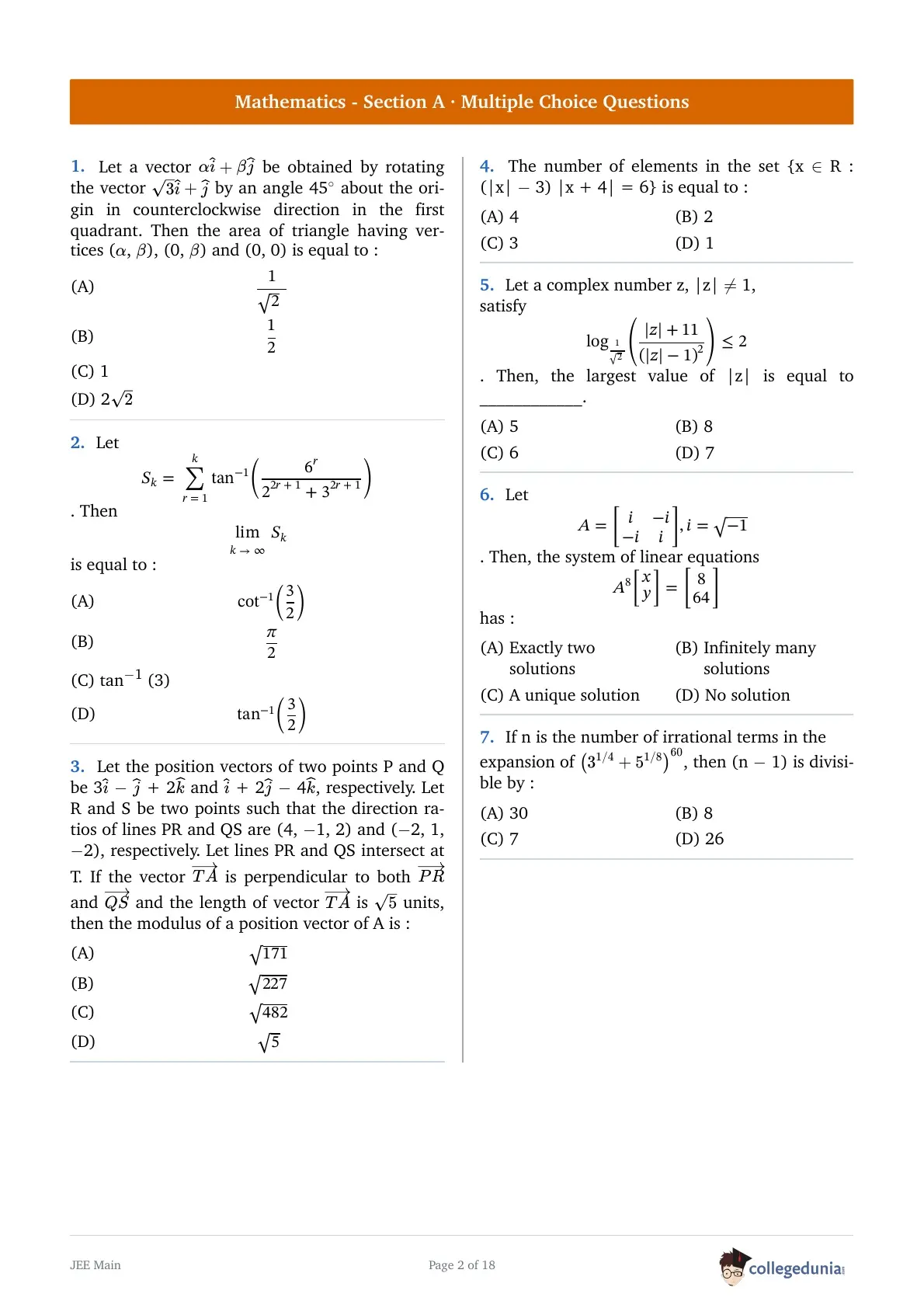
Let a vector \(\alpha\hat{i}+\beta\hat{j}\) be obtained by rotating the vector \(\sqrt{3}\,\hat{i}+\hat{j}\) by an angle \(45^\circ\) about the origin in counterclockwise direction in the first quadrant. Then the area of triangle having vertices \((\alpha, \beta)\), \((0, \beta)\) and \((0, 0)\) is equal to :
Let \(S_k=\sum_{r=1}^{k}\tan^{-1}\left(\frac{6^r}{2^{2r+1}+3^{2r+1}}\right)\). Then \(\lim_{k\to\infty}S_k\) is equal to :
Let O be the origin and the position vector of the point P be \(\hat i-2\hat j+3\hat k\). If the position vectors of the points A, B and C are \(-2\hat i+\hat j-3\hat k,2\hat i+4\hat j-2\hat k\) and \(-4\hat i+2\hat j-\hat k\) respectively then the projection of the vector \(\overrightarrow{OP}\) on a vector perpendicular to the vectors \(\overrightarrow{ AB}\) and \(\overrightarrow {AC}\) is
The number of elements in the set \(\{x\in\mathbb{R}:(|x|-3)\,|x+4|=6\}\) is equal to :
Let a complex number \(z\), \(|z|\neq1\), satisfy \(\log_{\frac{1}{\sqrt2}}\left(\frac{|z|+11}{(|z|-1)^2}\right)\le2\). Then, the largest value of \(|z|\) is equal to ____________.
Let \(A=\begin{bmatrix} i & -i\\ -i & i\end{bmatrix},\ i=\sqrt{-1}\). Then, the system of linear equations \(A^8\begin{bmatrix}x\\y\end{bmatrix}=\begin{bmatrix}8\\64\end{bmatrix}\) has :
If \(n\) is the number of irrational terms in the expansion of \(\left(3^{1/4}+5^{1/8}\right)^{60}\), then \((n-1)\) is divisible by :
The locus of the midpoints of the chord of the circle, \(x^2+y^2=25\) which is tangent to the hyperbola, \(\frac{x^2}{9}-\frac{y^2}{16}=1\) is :
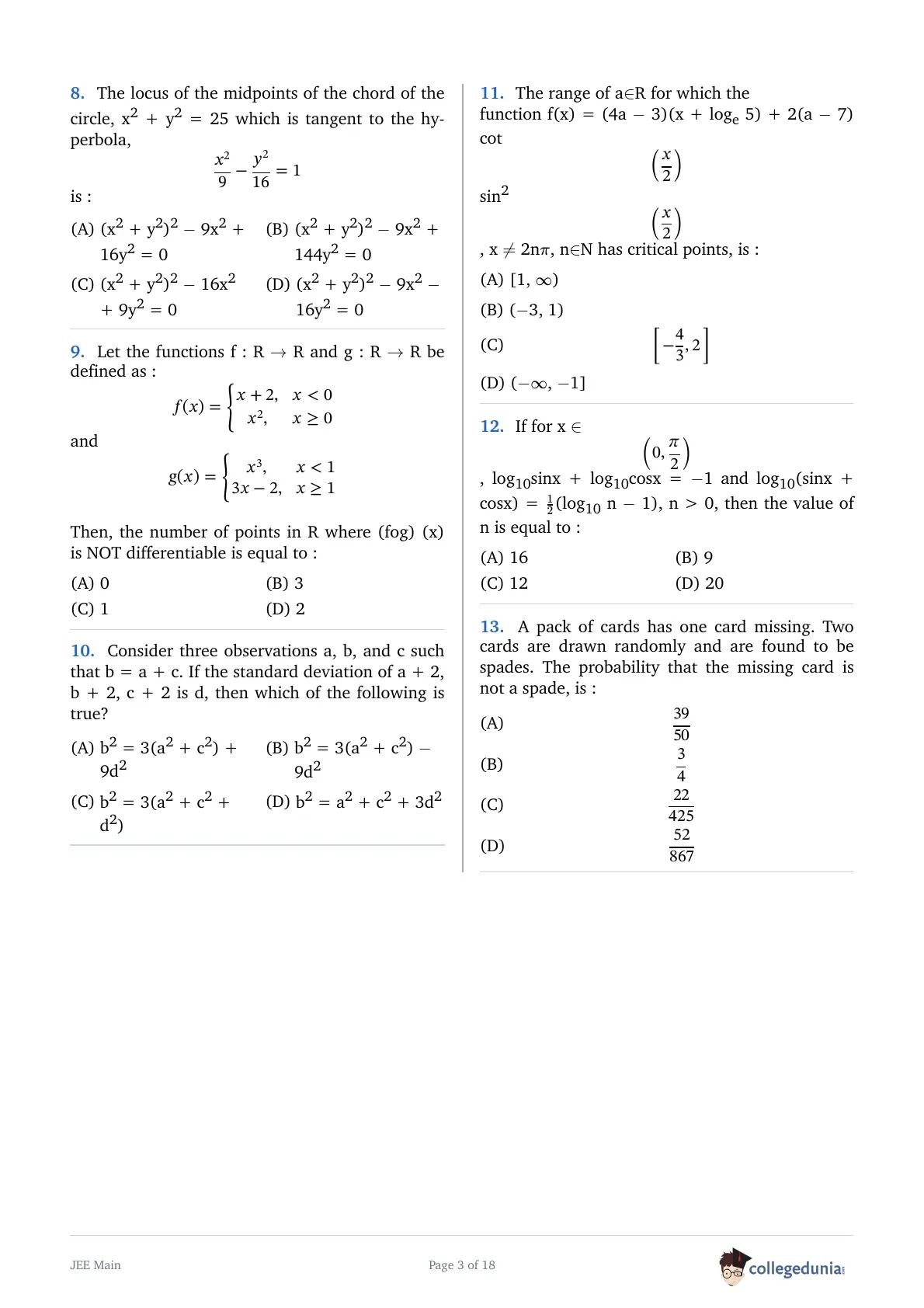
Let the functions \(f:\mathbb R\to\mathbb R\) and \(g:\mathbb R\to\mathbb R\) be defined as :
\(f(x)=\begin{cases}x+2, & x<0\\ x^2, & x\ge0\end{cases}\) and
\(g(x)=\begin{cases}x^3, & x<1\\ 3x-2, & x\ge1\end{cases}\)
Then, the number of points in \(\mathbb R\) where \((f\circ g)(x)\) is NOT differentiable is equal to :
Consider three observations a, b, and c such that \(b=a+c\). If the standard deviation of \(a+2,\ b+2,\ c+2\) is \(d\), then which of the following is true?
The range of \(a\in\mathbb R\) for which the function \(f(x)=(4a-3)(x+\log_e5)+2(a-7)\cot\left(\frac{x}{2}\right)\sin^2\left(\frac{x}{2}\right)\), \(x\ne2n\pi,\ n\in N\) has critical points, is :
If for \(x\in\left(0,\frac{\pi}{2}\right)\), \(\log_{10}\sin x+\log_{10}\cos x=-1\) and \(\log_{10}(\sin x+\cos x)=\frac12(\log_{10}n-1)\), \(n>0\), then the value of \(n\) is equal to :
A pack of cards has one card missing. Two cards are drawn randomly and are found to be spades. The probability that the missing card is not a spade, is :
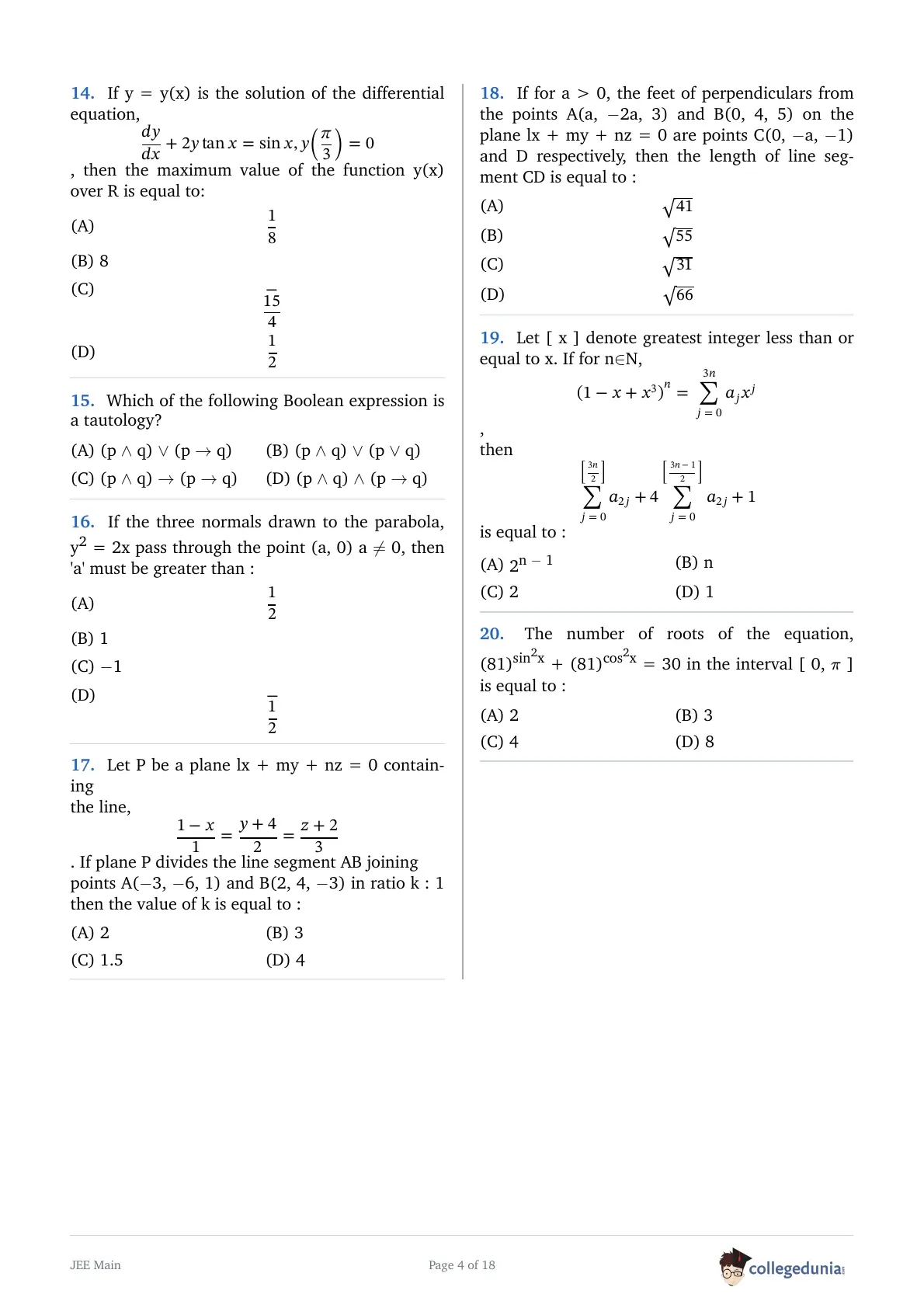
If \(y=y(x)\) is the solution of the differential equation, \(\frac{dy}{dx}+2y\tan x=\sin x,\ y\left(\frac{\pi}{3}\right)=0\), then the maximum value of the function \(y(x)\) over \(\mathbb R\) is equal to:
Which of the following Boolean expression is a tautology?
If the three normals drawn to the parabola, \(y^2=2x\) pass through the point \((a,0)\) \(a\ne0\), then 'a' must be greater than :
Let P be a plane \(lx + my + nz = 0\) containing the line, \(\frac{1-x}{1} = \frac{y+4}{2} = \frac{z+2}{3}\). If plane P divides the line segment AB joining points A(\(-3, -6, 1\)) and B(\(2, 4, -3\)) in ratio k : 1 then the value of k is equal to :
If for \(a \gt 0\), the feet of perpendiculars from the points A(\(a, -2a, 3\)) and B(\(0, 4, 5\)) on the plane \(lx + my + nz = 0\) are points C(\(0, -a, -1\)) and D respectively, then the length of line segment CD is equal to :
Let [ x ] denote greatest integer less than or equal to x. If for \(n \in N\), \((1 - x + x^3)^n = \sum\limits_{j=0}^{3n} a_j x^j\), then \(\sum\limits_{j=0}^{\left[\frac{3n}{2}\right]} a_{2j} + 4 \sum\limits_{j=0}^{\left[\frac{3n-1}{2}\right]} a_{2j+1}\) is equal to :
The number of roots of the equation, \((81)^{\sin^2 x} + (81)^{\cos^2 x} = 30\) in the interval \([\,0, \pi\,]\) is equal to :
Mathematics - Section B (Q21 - Q30)
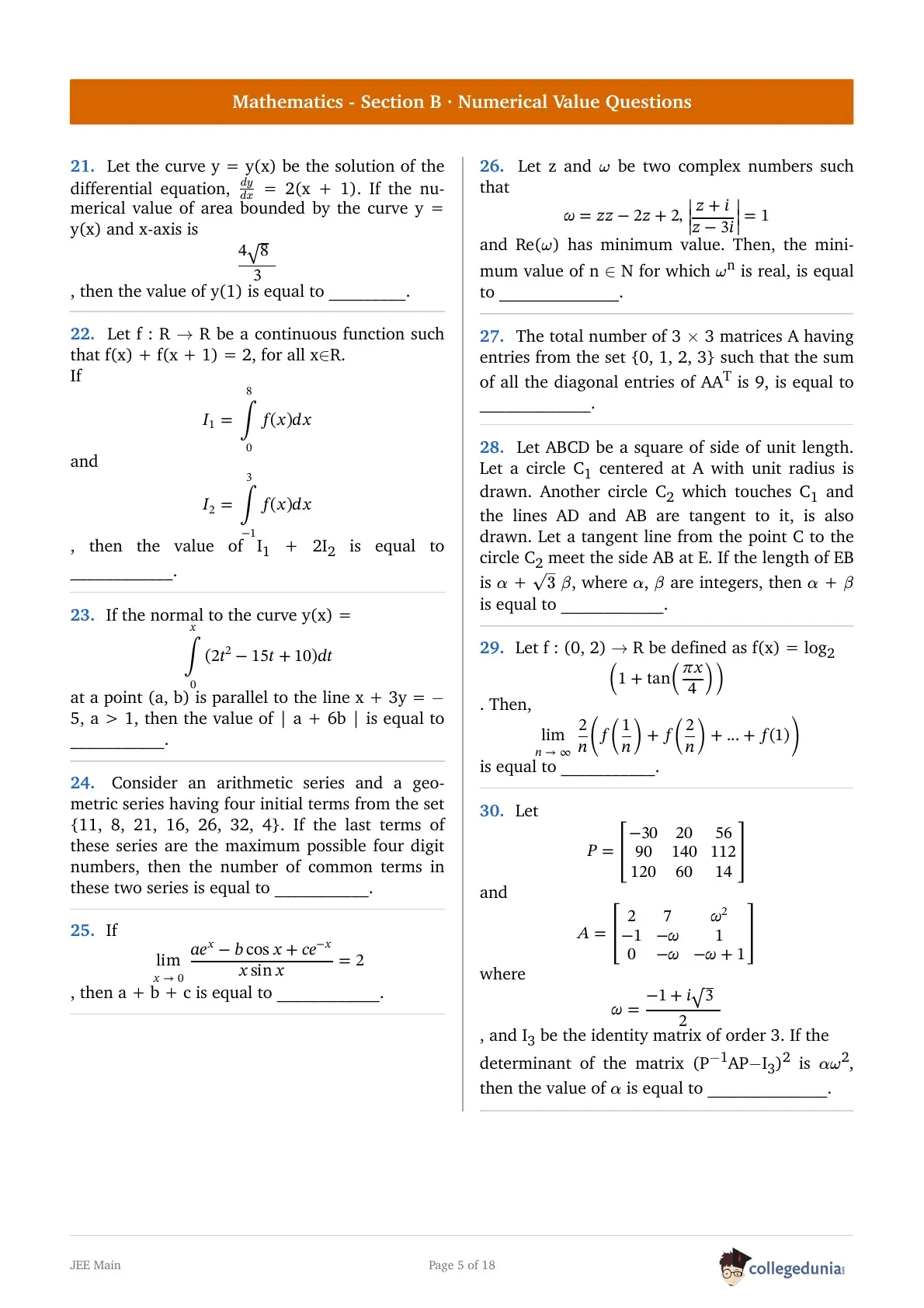
Let the curve \(y = y(x)\) be the solution of the differential equation, \(\frac{dy}{dx} = 2(x+1)\). If the numerical value of area bounded by the curve \(y = y(x)\) and x-axis is \(\frac{4\sqrt8}{3}\), then the value of \(y(1)\) is equal to ____________.
Let \(f : R \to R\) be a continuous function such that \(f(x) + f(x+1) = 2\), for all \(x \in R\). If \(I_1 = \int\limits_0^8 f(x)dx\) and \(I_2 = \int\limits_{-1}^3 f(x)dx\), then the value of \(I_1 + 2I_2\) is equal to ____________.
If the normal to the curve \(y(x) = \int\limits_0^x (2t^2 - 15t + 10)dt\) at a point \((a, b)\) is parallel to the line \(x + 3y = -5\), \(a \gt 1\), then the value of \(|\,a + 6b\,|\) is equal to ____________.
Consider an arithmetic series and a geometric series having four initial terms from the set \(\{11, 8, 21, 16, 26, 32, 4\}\). If the last terms of these series are the maximum possible four digit numbers, then the number of common terms in these two series is equal to ____________.
If \(\lim\limits_{x \to 0} \frac{a e^x - b\cos x + c e^{-x}}{x \sin x} = 2\), then \(a + b + c\) is equal to ____________.
Let z and \(\omega\) be two complex numbers such that \(\omega = z\overline{z} - 2z + 2\), \(\left|\frac{z+i}{z-3i}\right| = 1\) and Re(\(\omega\)) has minimum value. Then, the minimum value of \(n \in N\) for which \(\omega^n\) is real, is equal to ____________.
Let A be a 3 × 3 matrix having entries from the set {–1, 0, 1}. The number of all such matrices A having sum of all the entries equal to 5, is ______.
Let ABCD be a square of side of unit length. Let a circle \(C_1\) centered at A with unit radius is drawn. Another circle \(C_2\) which touches \(C_1\) and the lines AD and AB are tangent to it, is also drawn. Let a tangent line from the point C to the circle \(C_2\) meet the side AB at E. If the length of EB is \(\alpha + \sqrt3\,\beta\), where \(\alpha, \beta\) are integers, then \(\alpha + \beta\) is equal to ____________.
Let \(f : (0, 2) \to R\) be defined as \(f(x) = \log_2\left(1 + \tan\left(\frac{\pi x}{4}\right)\right)\). Then, \(\lim\limits_{n \to \infty} \frac{2}{n}\left(f\left(\frac1n\right) + f\left(\frac2n\right) + \dots + f(1)\right)\) is equal to ____________.
Let \(P = \begin{bmatrix} -30 \& 20 \& 56 \\ 90 \& 140 \& 112 \\ 120 \& 60 \& 14 \end{bmatrix}\) and \(A = \begin{bmatrix} 2 \& 7 \& \omega^2 \\ -1 \& -\omega \& 1 \\ 0 \& -\omega \& -\omega + 1 \end{bmatrix}\) where \(\omega = \frac{-1 + i\sqrt3}{2}\), and \(I_3\) be the identity matrix of order 3. If the determinant of the matrix \((P^{-1}AP - I_3)^2\) is \(\alpha\omega^2\), then the value of \(\alpha\) is equal to ____________.
Physics - Section A (Q31 - Q50)
The pressure acting on a submarine is \(3 \times 10^5\) Pa at a certain depth. If the depth is doubled, the percentage increase in the pressure acting on the submarine would be :
(Assume that atmospheric pressure is \(1 \times 10^5\) Pa density of water is \(10^3\) kg m-3, g = 10 ms-2)
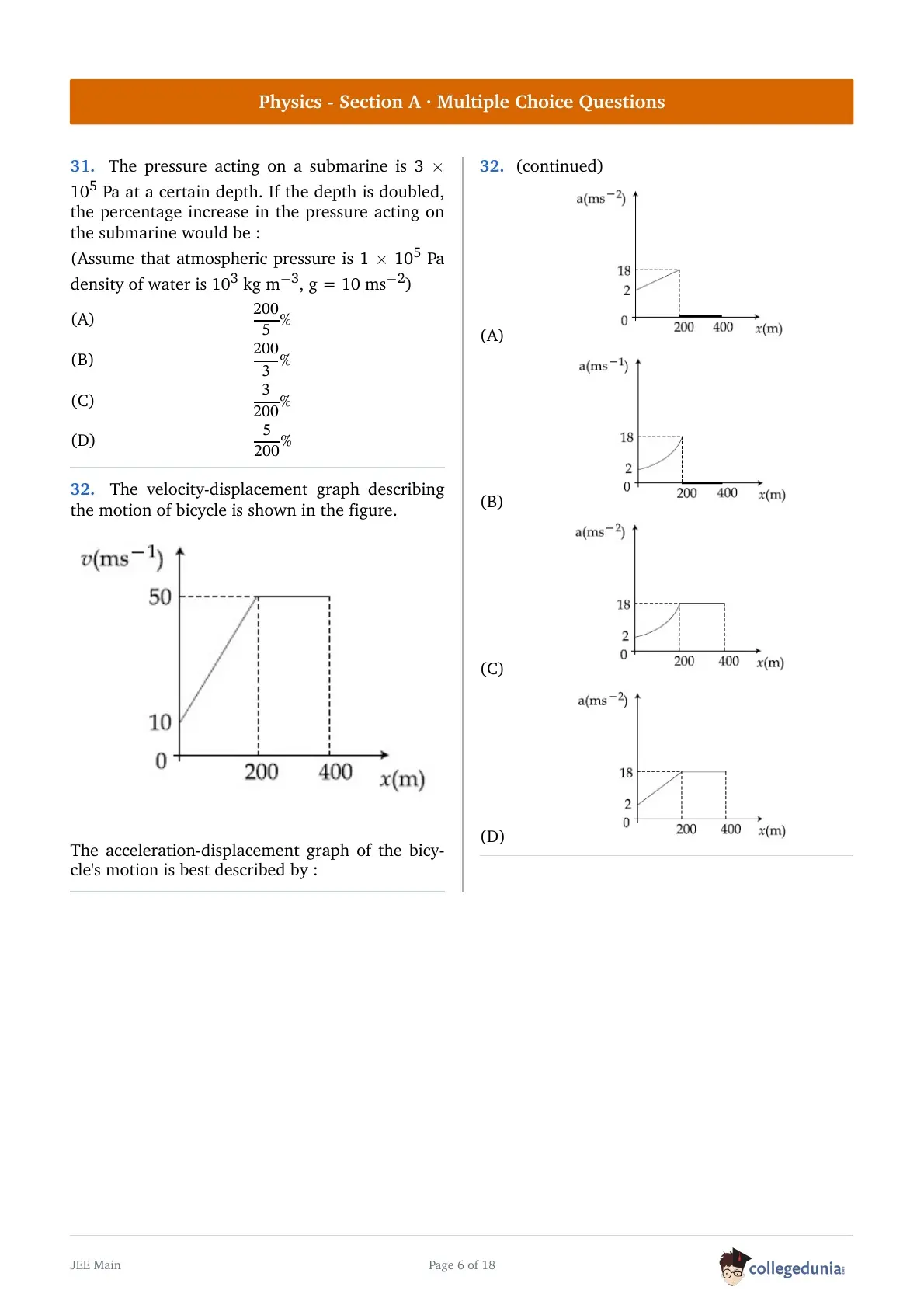
The velocity-displacement graph describing the motion of bicycle is shown in the figure.
The acceleration-displacement graph of the bicycle's motion is best described by :
- (1)
![]()
- (2)
![]()
- (3)
![]()
- (4)
![]()


A block of mass m slides down the plane inclined at angle \(30\degree\) with an acceleration \(\frac{g}{4}\). The value of the coefficient of kinetic friction will be:
A block of 200 g mass moves with a uniform speed in a horizontal circular groove, with vertical side walls of radius 20 cm. If the block takes 40 s to complete one round, the normal force by the side walls of the groove is :
Time period of a simple pendulum in a stationary lift is ‘T’. If the lift accelerates with \(\frac{g}{6}\) vertically upwards then the time period will be (Where g = acceleration due to gravity)
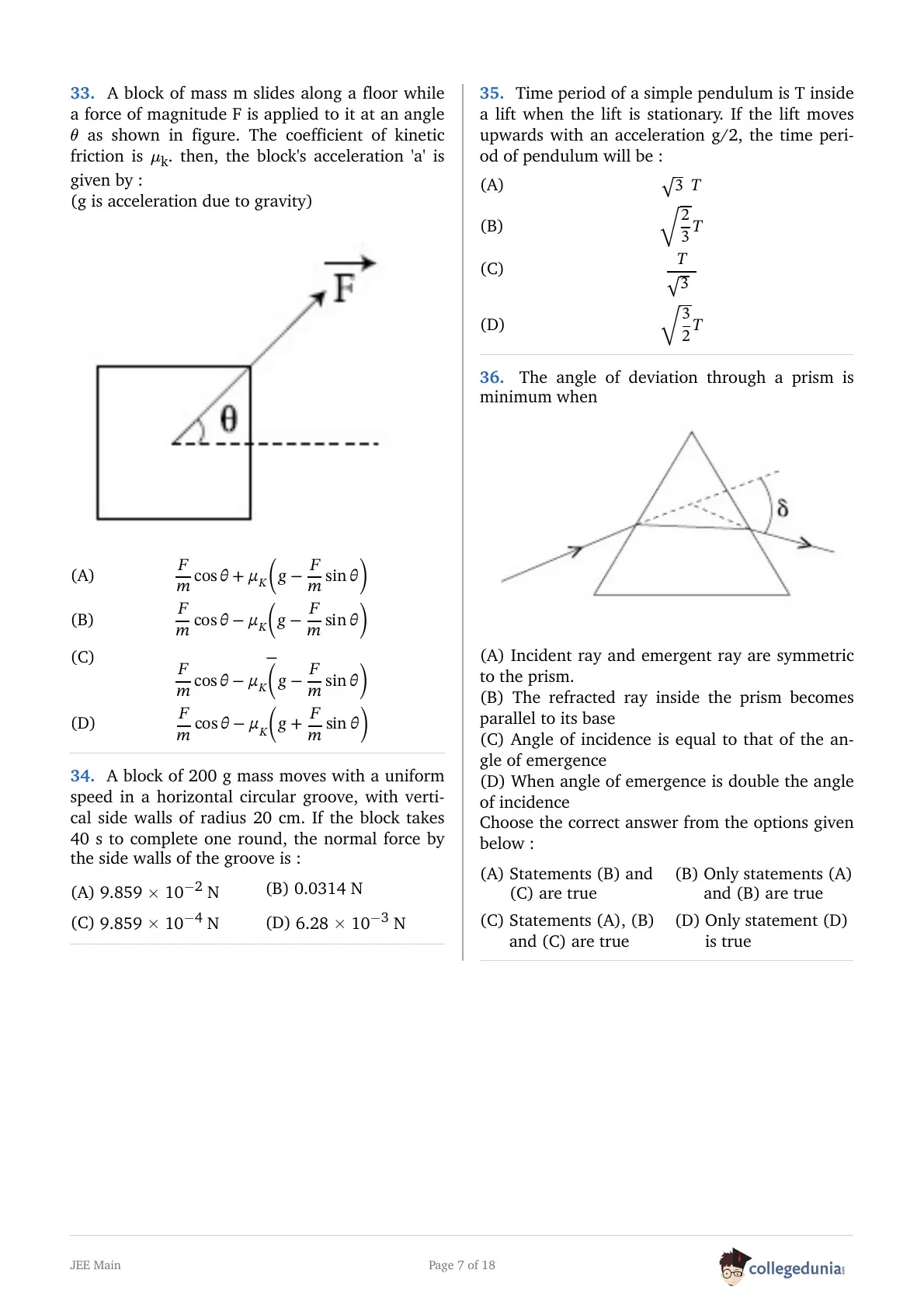
The angle of deviation through a prism is minimum when
(A) Incident ray and emergent ray are symmetric to the prism.
(B) The refracted ray inside the prism becomes parallel to its base
(C) Angle of incidence is equal to that of the angle of emergence
(D) When angle of emergence is double the angle of incidence
Choose the correct answer from the options given below :
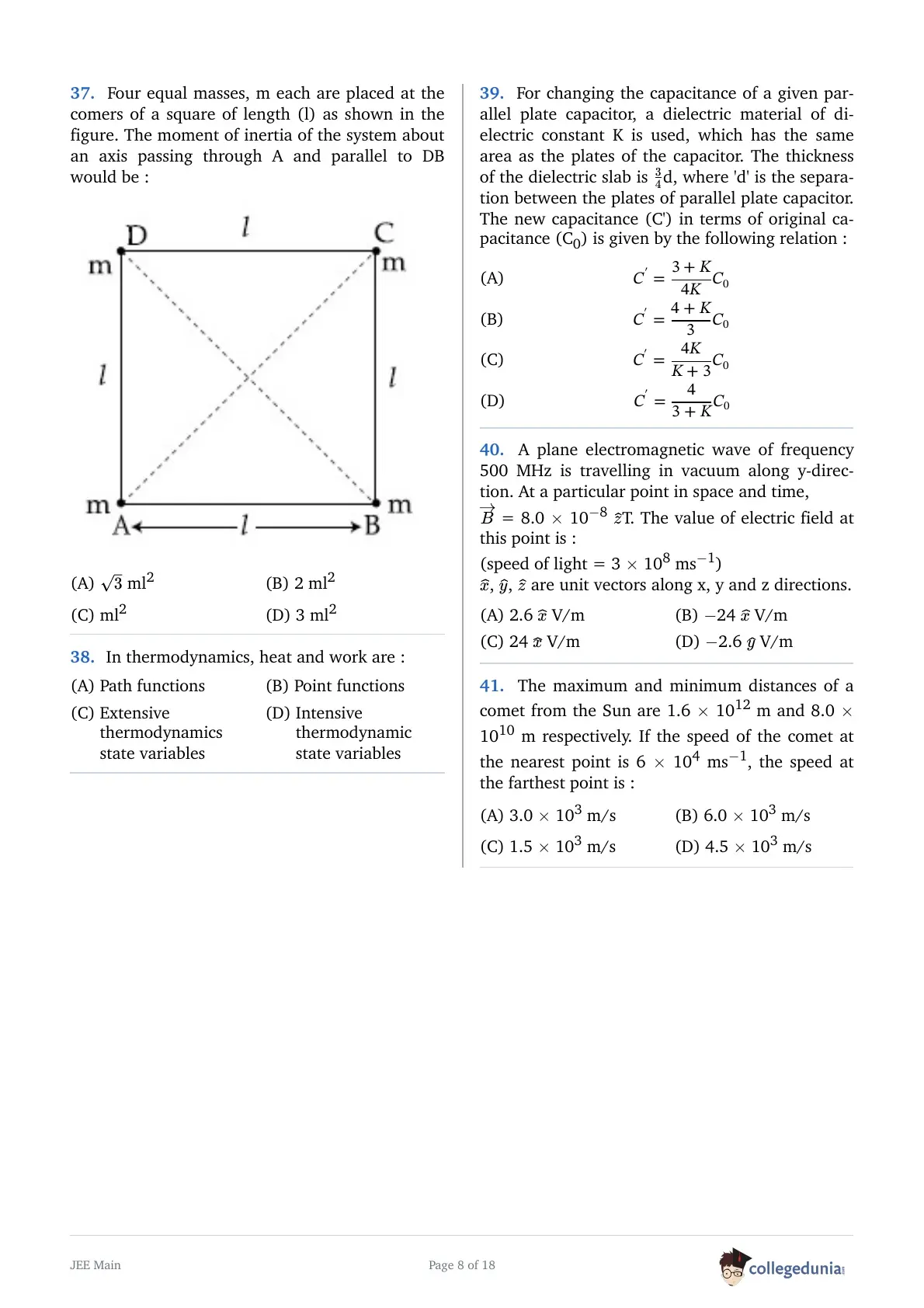
Four equal masses, m each are placed at the comers of a square of length (\(l\)) as shown in the figure. The moment of inertia of the system about an axis passing through A and parallel to DB would be :
In thermodynamics, heat and work are :
For changing the capacitance of a given parallel plate capacitor, a dielectric material of dielectric constant K is used, which has the same area as the plates of the capacitor. The thickness of the dielectric slab is \(\frac{3}{4}d\), where 'd' is the separation between the plates of parallel plate capacitor. The new capacitance (C') in terms of original capacitance (\(C_0\)) is given by the following relation :
A plane electromagnetic wave of frequency 35 MHz travels in free space along the X-direction. At a particular point (in space and time), \( \vec{E} = 9.6 \hat{j} \, \text{V/m} \). The value of the magnetic field at this point is:
The maximum and minimum distances of a comet from the Sun are \(1.6 \times 10^{12}\) m and \(8.0 \times 10^{10}\) m respectively. If the speed of the comet at the nearest point is \(6 \times 10^{4}\ \text{ms}^{-1}\), the speed at the farthest point is :
A conducting wire of length '\(l\)', area of cross-section A and electric resistivity \(\rho\) is connected between the terminals of a battery. A potential difference V is developed between its ends, causing an electric current.
If the length of the wire of the same material is doubled and the area of cross-section is halved, the resultant current would be :
For an electromagnetic wave travelling in free space, the relation between average energy densities due to electric (\(U_e\)) and magnetic (\(U_m\)) fields is :
The stopping potential in the context of photoelectric effect depends on the following property of incident electromagnetic radiation :
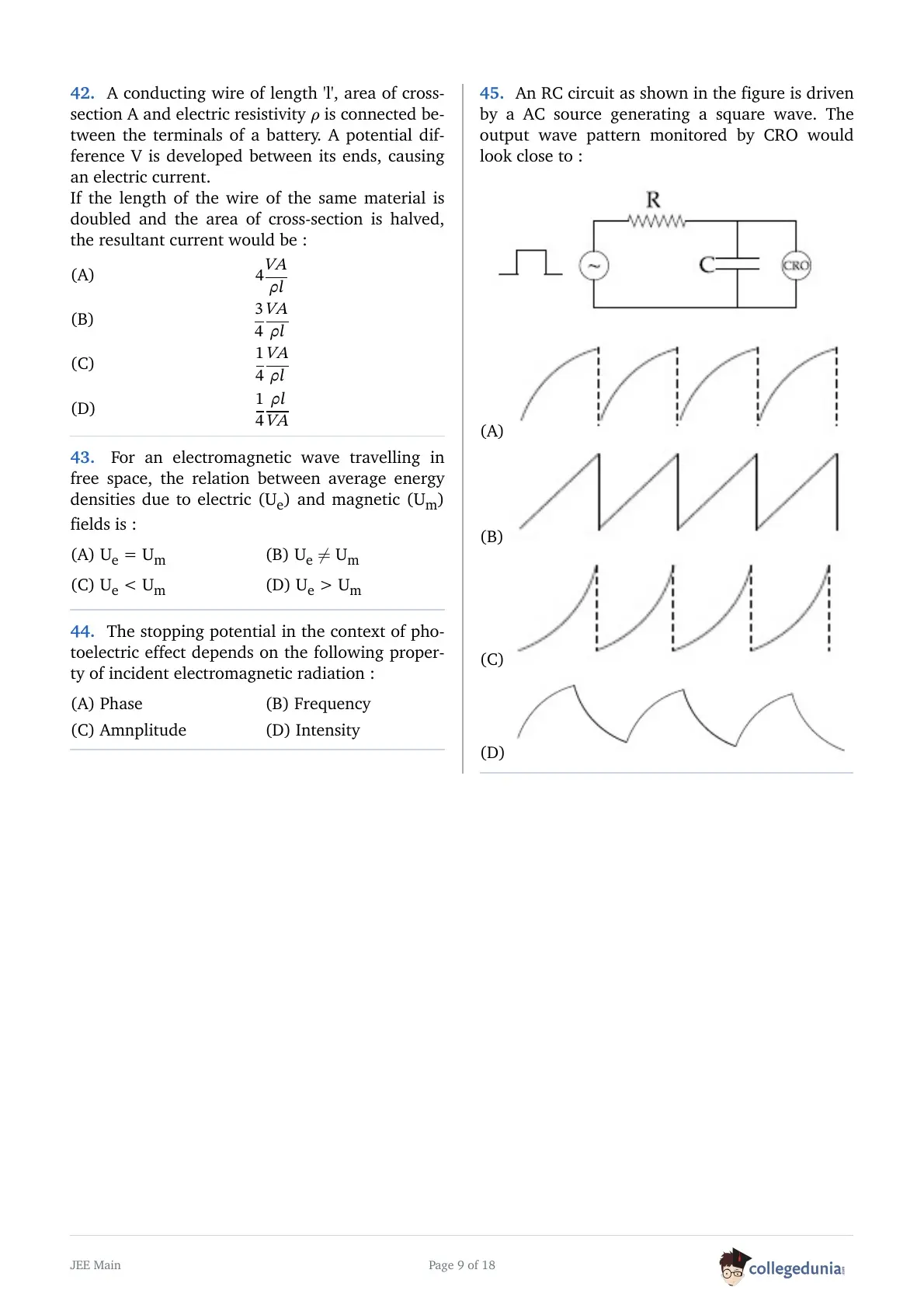
An RC circuit as shown in the figure is driven by a AC source generating a square wave. The output wave pattern monitored by CRO would look close to :
- (1)
![]()
- (2)
![]()
- (3)
![]()
- (4)
![]()


One main scale division of a vernier callipers is 'a' cm and \(n^{\text{th}}\) division of the vernier scale coincide with \((n - 1)^{\text{th}}\) division of the main scale. The least count of the callipers in mm is :
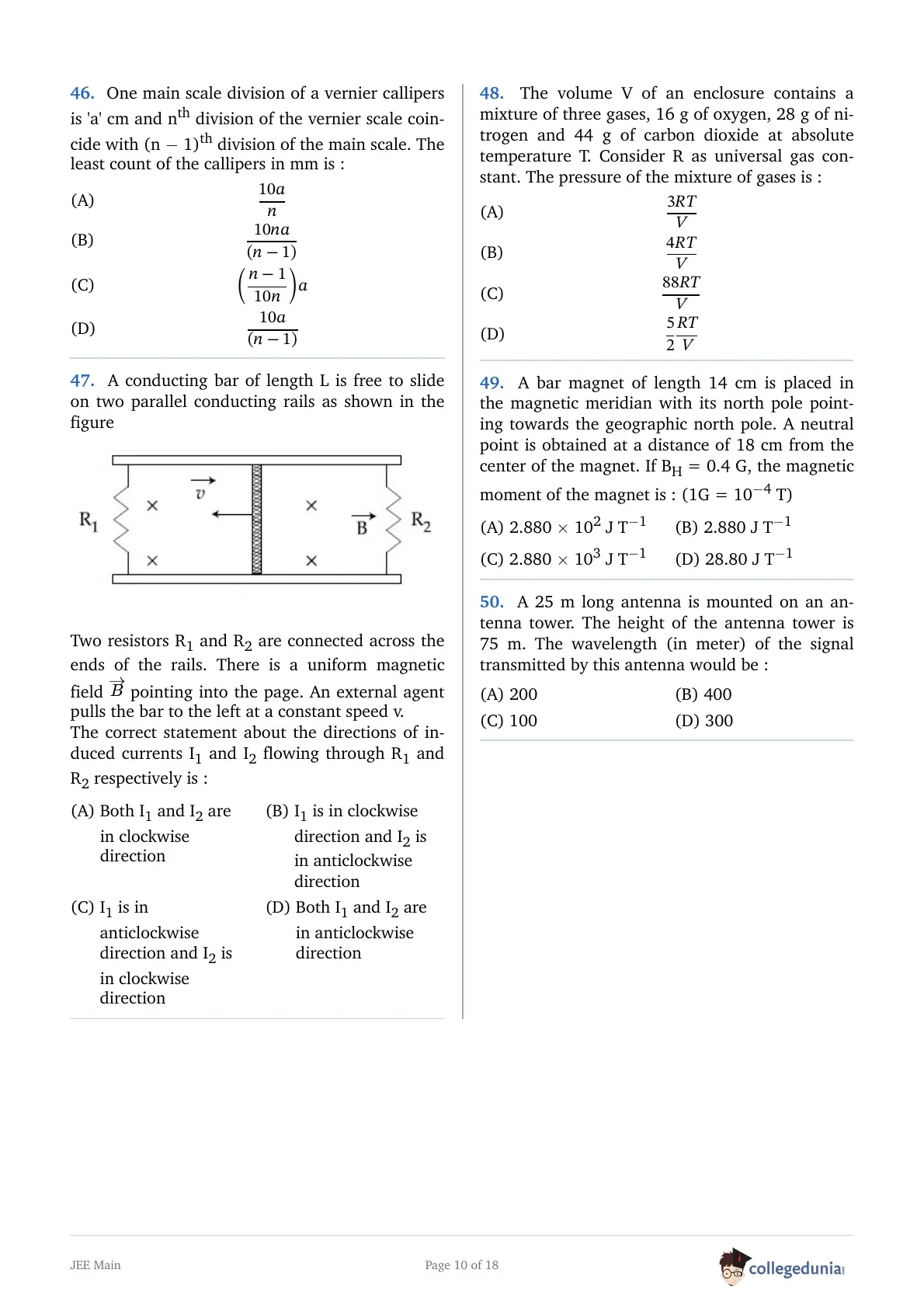
A conducting bar of length L is free to slide on two parallel conducting rails as shown in the figure
Two resistors R1 and R2 are connected across the ends of the rails. There is a uniform magnetic field \(\vec{B}\) pointing into the page. An external agent pulls the bar to the left at a constant speed v.
The correct statement about the directions of induced currents I1 and I2 flowing through R1 and R2 respectively is :
A mixture of carbon dioxide and oxygen has volume 8310 cm³, temperature 300 K, pressure 100 kPa and mass 13.2 g. The number of moles of carbon dioxide and oxygen gases in the mixture respectively are _______.
A bar magnet of length 14 cm is placed in the magnetic meridian with its north pole pointing towards the geographic north pole. A neutral point is obtained at a distance of 18 cm from the center of the magnet. If BH = 0.4 G, the magnetic moment of the magnet is : (\(1\,\text{G} = 10^{-4}\) T)
A 25 m long antenna is mounted on an antenna tower. The height of the antenna tower is 75 m. The wavelength (in meter) of the signal transmitted by this antenna would be :
Physics - Section B (Q51 - Q60)
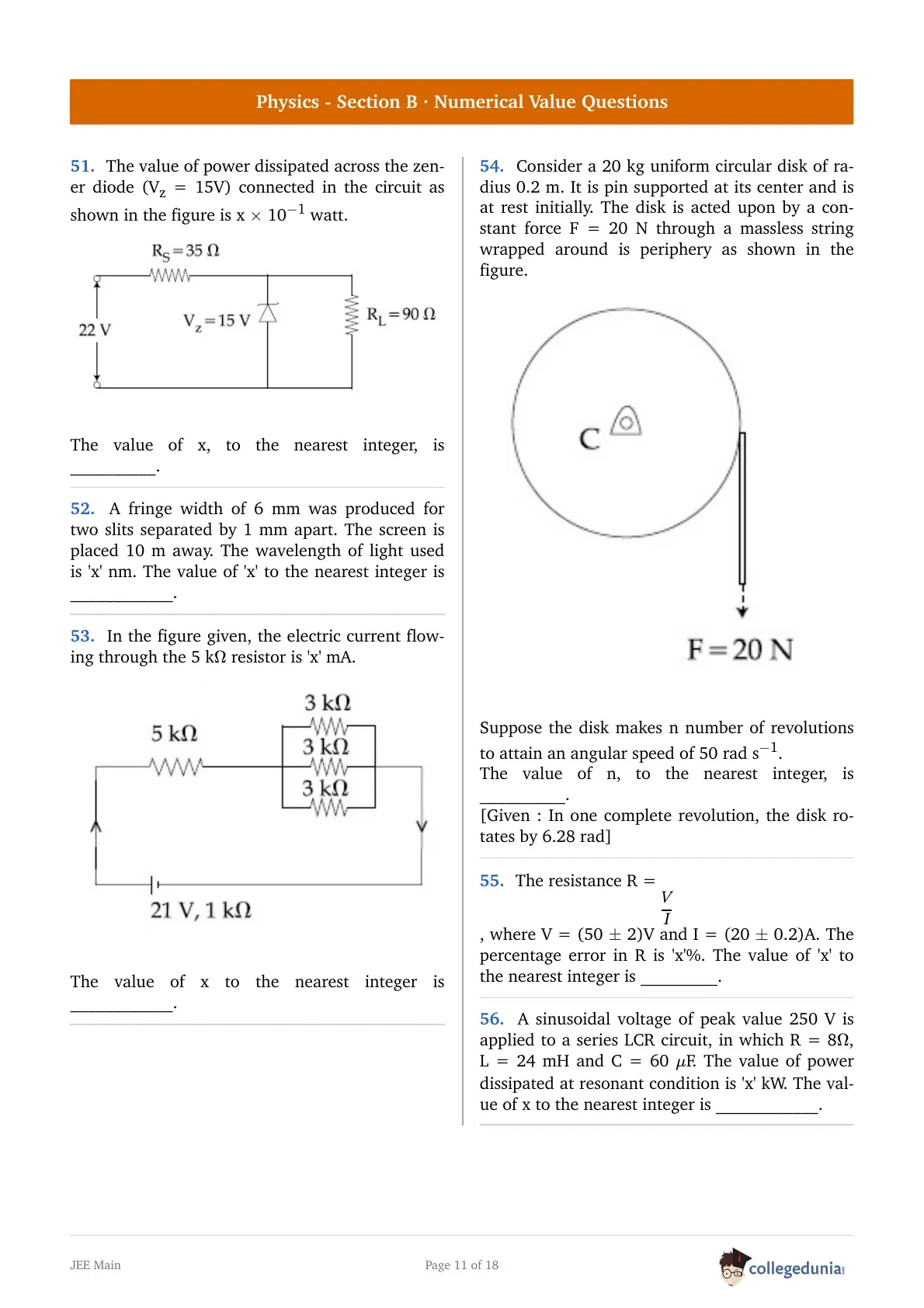
The value of power dissipated across the zener diode (Vz = 15V) connected in the circuit as shown in the figure is x \(\times\) 10-1 watt.
The value of x, to the nearest integer, is __________.
A fringe width of 6 mm was produced for two slits separated by 1 mm apart. The screen is placed 10 m away. The wavelength of light used is 'x' nm. The value of 'x' to the nearest integer is ____________.
In the figure given, the electric current flowing through the 5 \(\mathrm{k\Omega}\) resistor is 'x' mA.
The value of x to the nearest integer is ____________.
Consider a 20 kg uniform circular disk of radius 0.2 m. It is pin supported at its center and is at rest initially. The disk is acted upon by a constant force F = 20 N through a massless string wrapped around is periphery as shown in the figure.
Suppose the disk makes n number of revolutions to attain an angular speed of 50 rad s-1.
The value of n, to the nearest integer, is __________.
[Given : In one complete revolution, the disk rotates by 6.28 rad]
The resistance \(R = \frac{V}{I}\), where V = \((50 \pm 2)\) V and I = \((20 \pm 0.2)\) A. The percentage error in R is 'x'%. The value of 'x' to the nearest integer is _________.
A sinusoidal voltage of peak value 250 V is applied to a series LCR circuit, in which R = 8 \(\Omega\), L = 24 mH and C = 60 \(\mu\)F. The value of power dissipated at resonant condition is 'x' kW. The value of x to the nearest integer is ____________.
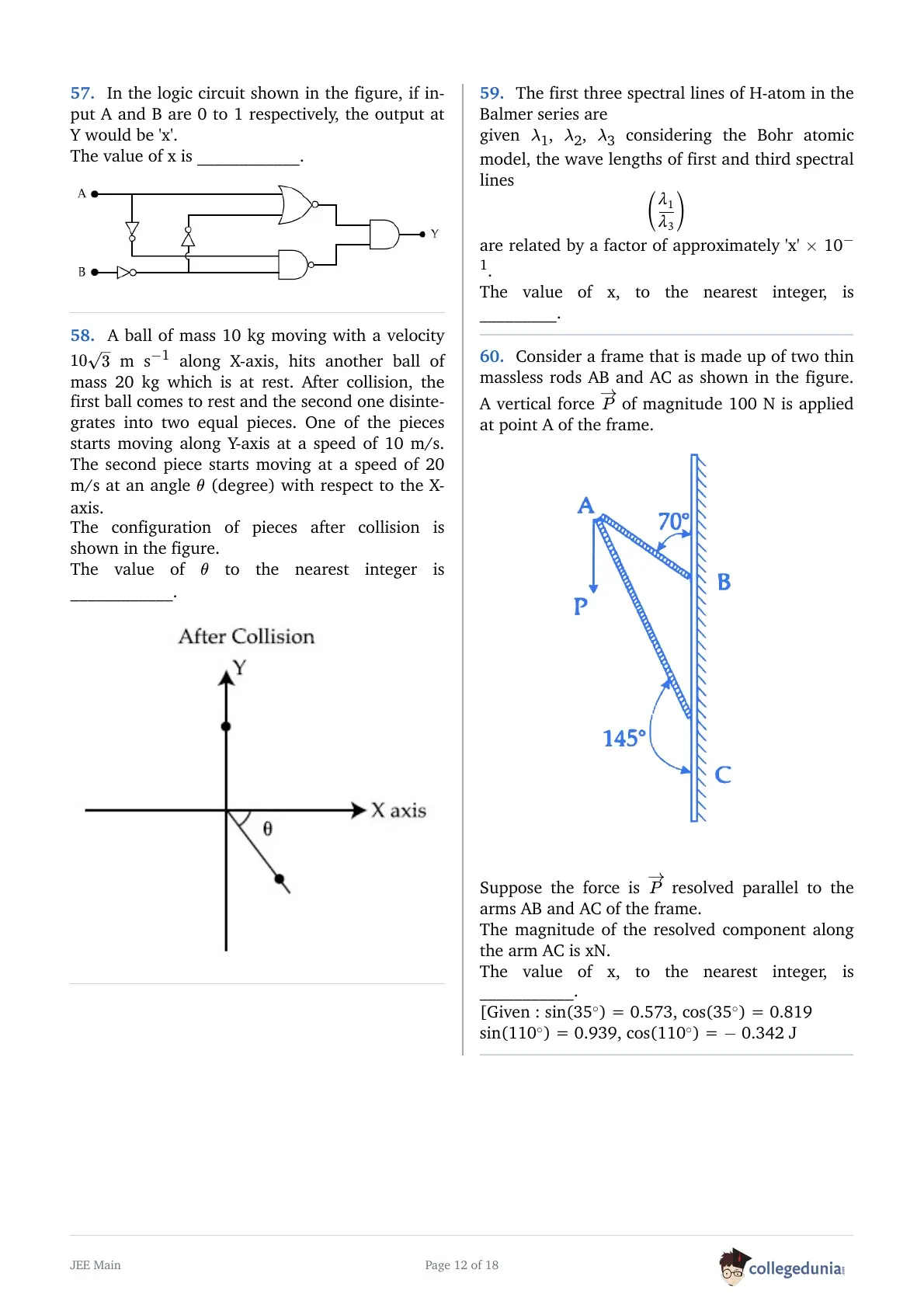
In the logic circuit shown in the figure, if input A and B are 0 to 1 respectively, the output at Y would be 'x'.
The value of x is ____________.
A ball of mass 10 kg moving with a velocity \(10\sqrt{3}\ \mathrm{m\,s^{-1}}\) along X-axis, hits another ball of mass 20 kg which is at rest. After collision, the first ball comes to rest and the second one disintegrates into two equal pieces. One of the pieces starts moving along Y-axis at a speed of 10 m/s. The second piece starts moving at a speed of 20 m/s at an angle \(\theta\) (degree) with respect to the X-axis.
The configuration of pieces after collision is shown in the figure.
The value of \(\theta\) to the nearest integer is ____________.
The ratio of the wavelength of spectral lines \( H_\alpha \) and \( H_\beta \) in the Balmer series is \( \frac{x}{20} \). The value of \( x \) is _______.
Consider a frame that is made up of two thin massless rods AB and AC as shown in the figure. A vertical force \(\vec{P}\) of magnitude 100 N is applied at point A of the frame.
Suppose the force \(\vec{P}\) is resolved parallel to the arms AB and AC of the frame.
The magnitude of the resolved component along the arm AC is x N.
The value of x, to the nearest integer, is ___________.
[Given : \(\sin(35^\circ) = 0.573\), \(\cos(35^\circ) = 0.819\), \(\sin(110^\circ) = 0.939\), \(\cos(110^\circ) = -0.342\)]
Chemistry - Section A (Q61 - Q80)


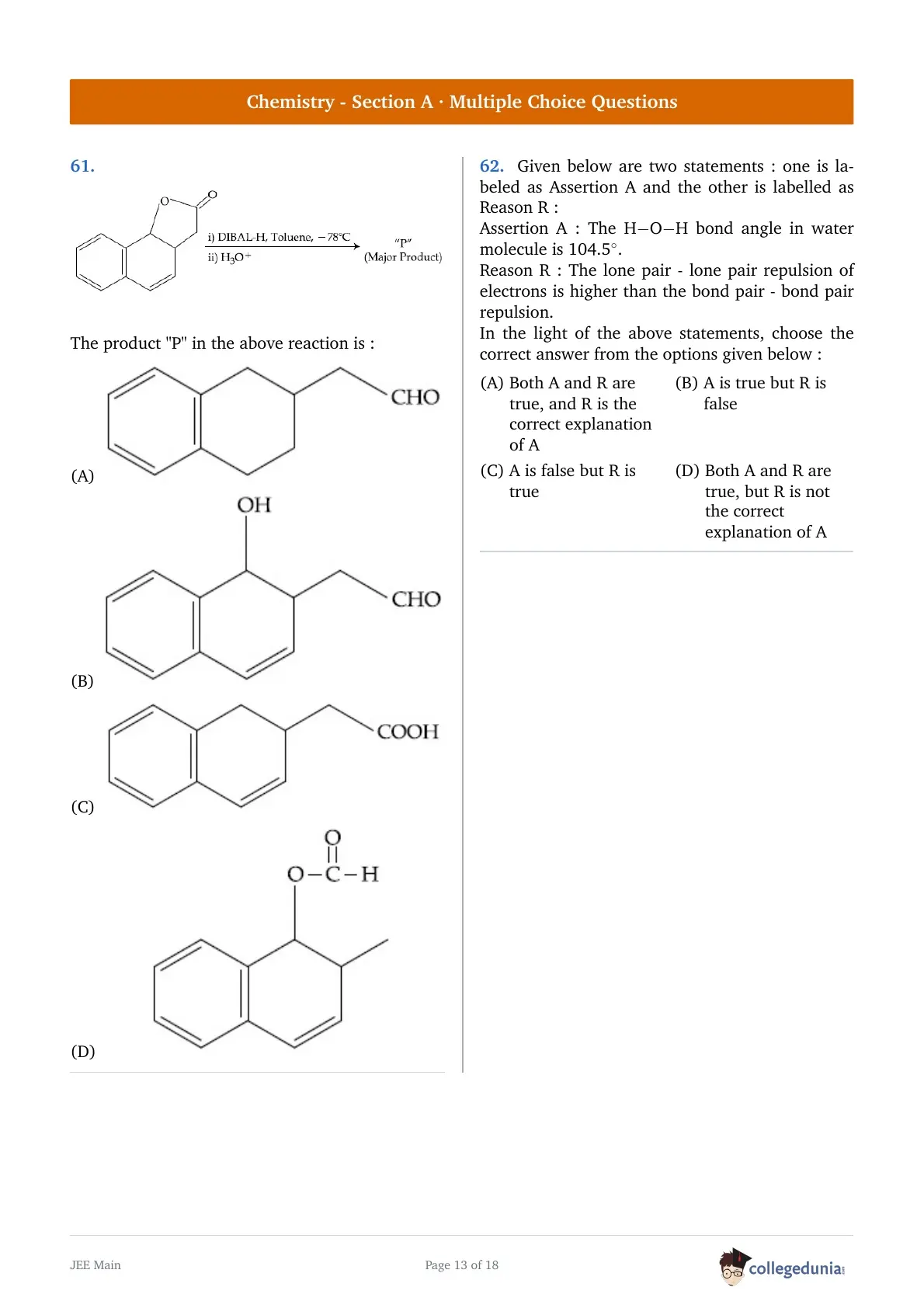
Given below are two statements : one is labeled as Assertion A and the other is labelled as Reason R :
Assertion A : The H\(-\)O\(-\)H bond angle in water molecule is \(104.5^\circ\).
Reason R : The lone pair - lone pair repulsion of electrons is higher than the bond pair - bond pair repulsion.
In the light of the above statements, choose the correct answer from the options given below :

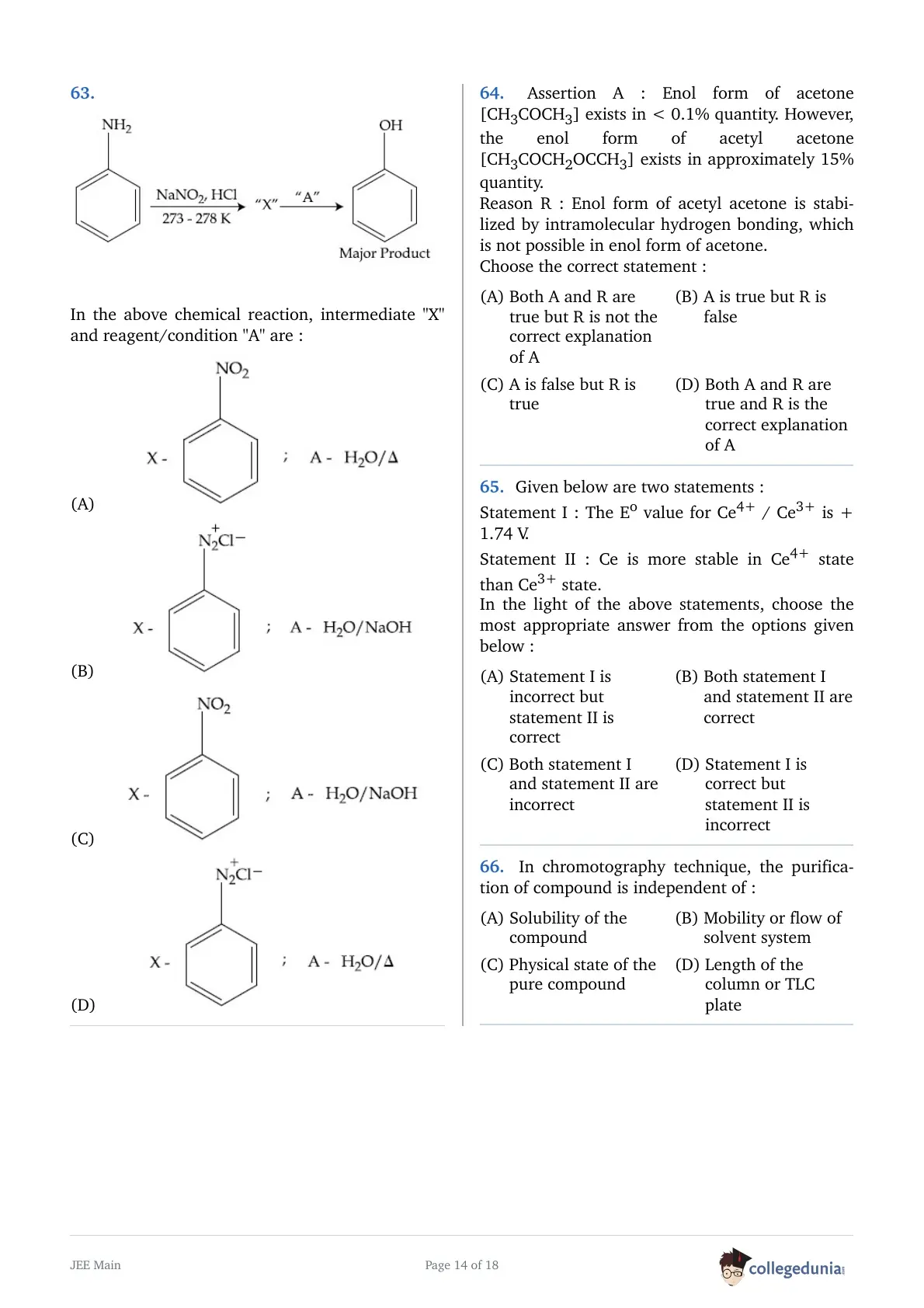
In the above chemical reaction, intermediate "X" and reagent/condition "A" are :
- (1)
![]()
- (2)
![]()
- (3)
![]()
- (4)
![]()


Assertion A : Enol form of acetone \([\mathrm{CH_3COCH_3}]\) exists in < 0.1% quantity. However, the enol form of acetyl acetone \([\mathrm{CH_3COCH_2OCCH_3}]\) exists in approximately 15% quantity.
Reason R : Enol form of acetyl acetone is stabilized by intramolecular hydrogen bonding, which is not possible in enol form of acetone.
Choose the correct statement :
Given below are two statements :
Statement I : The Eo value for Ce4+ / Ce3+ is + 1.74 V.
Statement II : Ce is more stable in Ce4+ state than Ce3+ state.
In the light of the above statements, choose the most appropriate answer from the options given below :
In chromotography technique, the purification of compound is independent of :
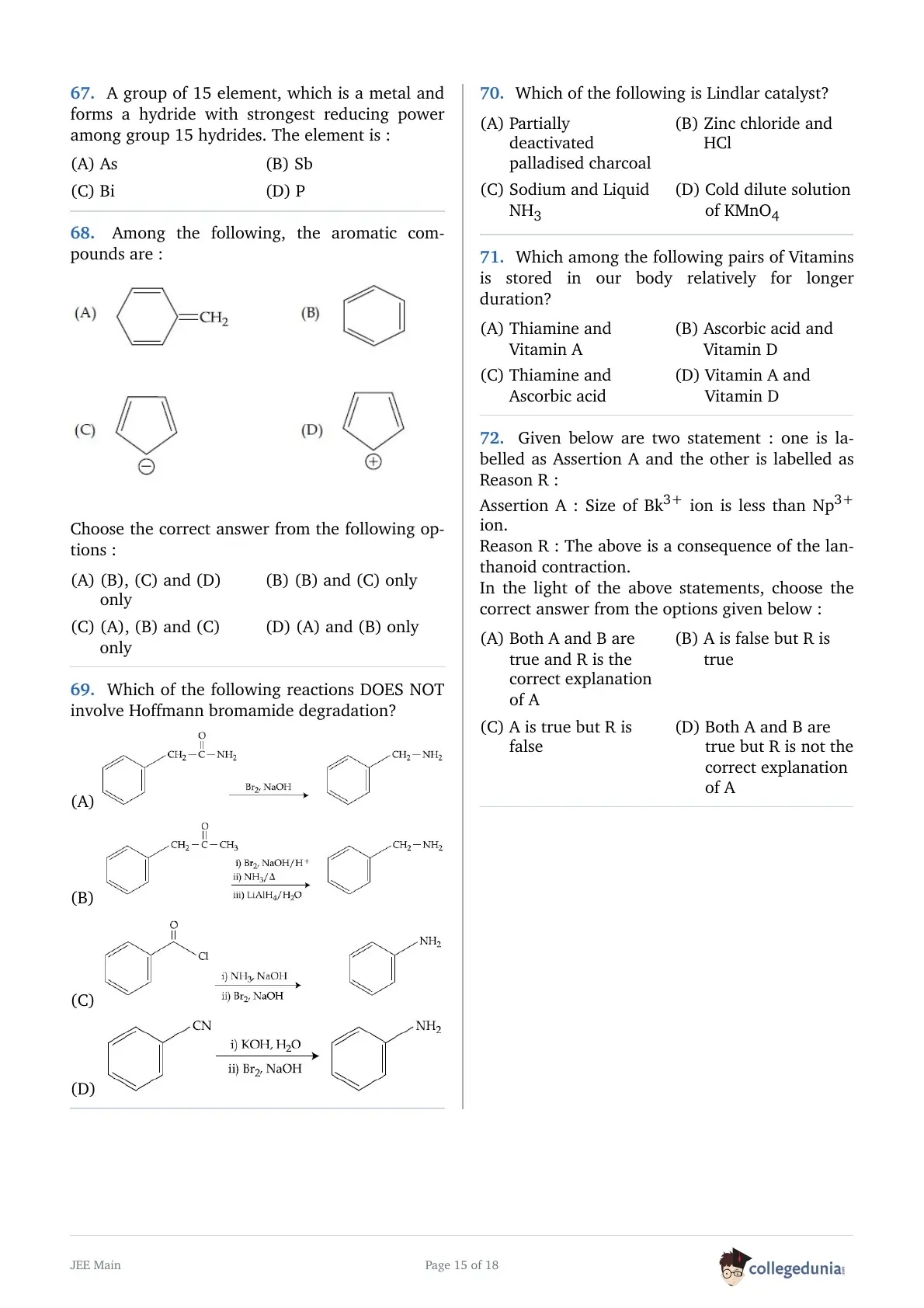
A group 15 element forms \( d\pi - d\pi \) bond with transition metals. It also forms a hydride, which is the strongest base among the hydrides of other group members that form \( d\pi - d\pi \) bonds. The atomic number of the element is ________________________.
Among the following, the aromatic compounds are :
Choose the correct answer from the following options :
Which of the following reactions DOES NOT involve Hoffmann bromamide degradation?
- (1)
![]()
- (2)
![]()
- (3)
![]()
- (4)
![]()


Which of the following is Lindlar catalyst?
Which among the following pairs of Vitamins is stored in our body relatively for longer duration?
Given below are two statement : one is labelled as Assertion A and the other is labelled as Reason R :
Assertion A : Size of Bk\(^{3+}\) ion is less than Np\(^{3+}\) ion.
Reason R : The above is a consequence of the lanthanoid contraction.
In the light of the above statements, choose the correct answer from the options given below :

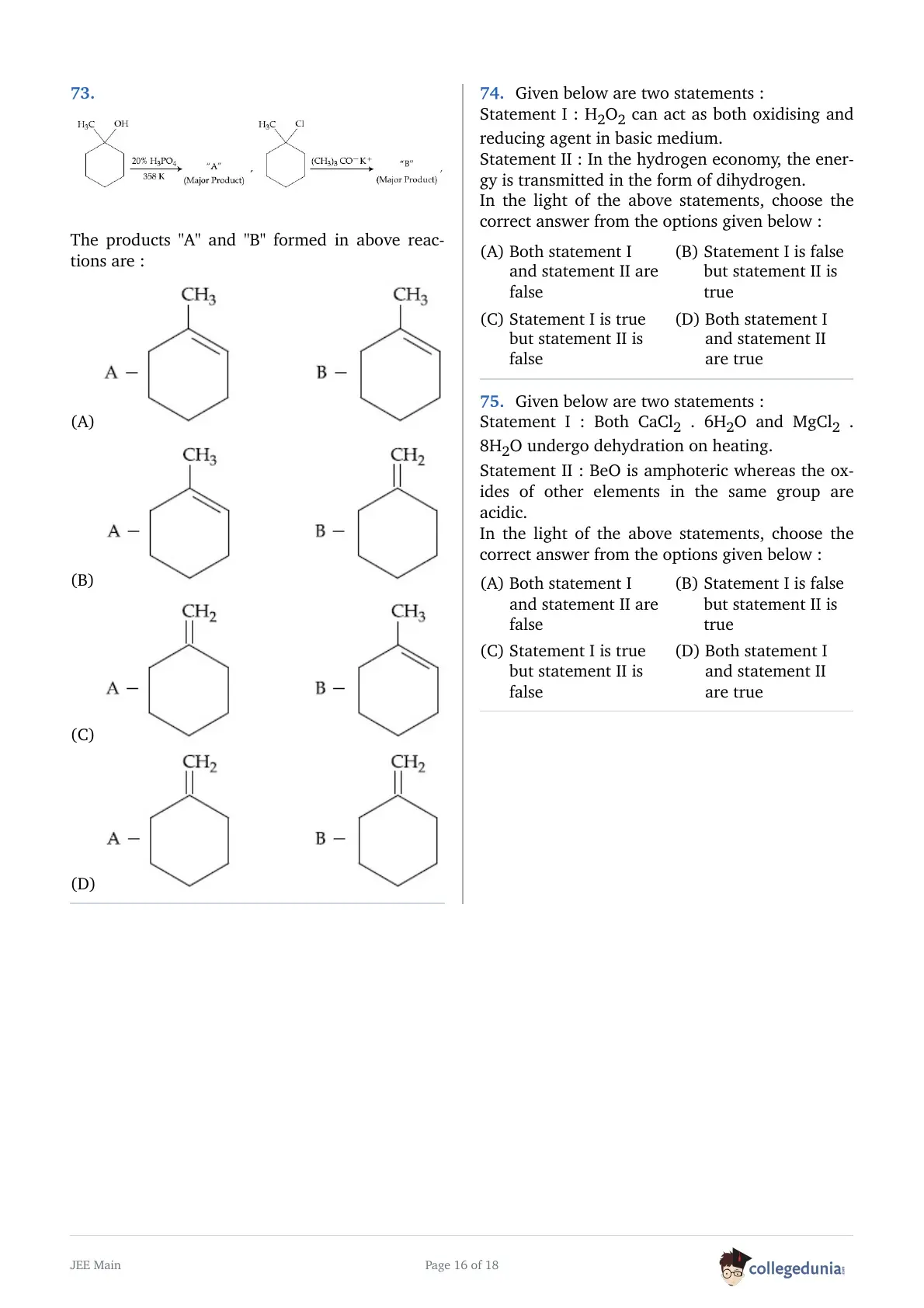
The products "A" and "B" formed in above reactions are :
- (1)
![]()
- (2)
![]()
- (3)
![]()
- (4)
![]()


Given below are two statements :
Statement I : H\(_2\)O\(_2\) can act as both oxidising and reducing agent in basic medium.
Statement II : In the hydrogen economy, the energy is transmitted in the form of dihydrogen.
In the light of the above statements, choose the correct answer from the options given below :
Given below are two statements :
Statement I : Both CaCl\(_2\) . 6H\(_2\)O and MgCl\(_2\) . 8H\(_2\)O undergo dehydration on heating.
Statement II : BeO is amphoteric whereas the oxides of other elements in the same group are acidic.
In the light of the above statements, choose the correct answer from the options given below :
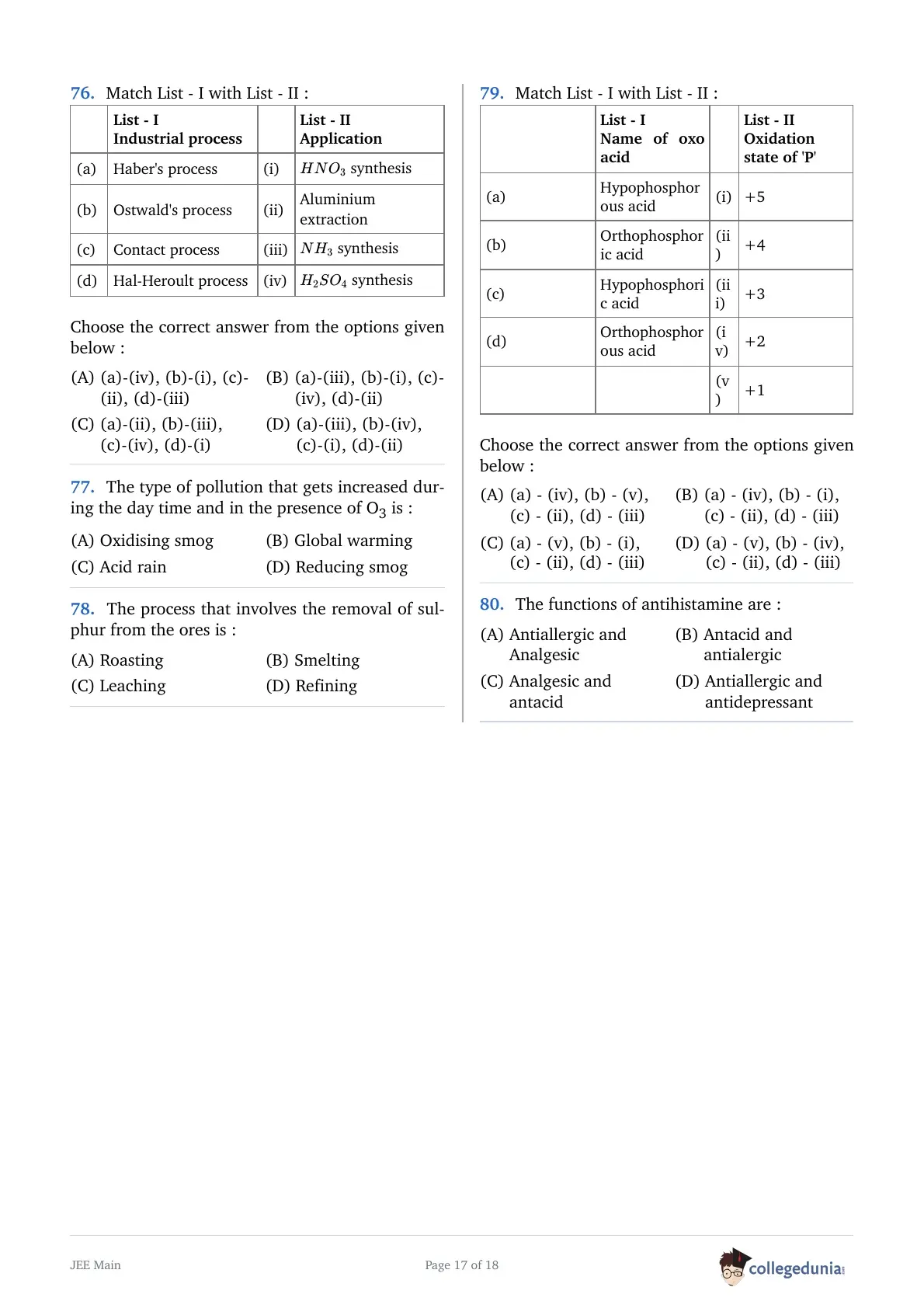
| List - I Industrial process | List - II Application | ||
| (a) | Haber's process | (i) | \(\mathrm{HNO_3}\) synthesis |
| (b) | Ostwald's process | (ii) | Aluminium extraction |
| (c) | Contact process | (iii) | \(\mathrm{NH_3}\) synthesis |
| (d) | Hal-Heroult process | (iv) | \(\mathrm{H_2SO_4}\) synthesis |
Choose the correct answer from the options given below :
The type of pollution that gets increased during the day time and in the presence of O\(_3\) is :
The process that involves the removal of sulphur from the ores is :
| List - I Name of oxo acid | List - II Oxidation state of 'P' | ||
| (a) | Hypophosphorous acid | (i) | +5 |
| (b) | Orthophosphoric acid | (ii) | +4 |
| (c) | Hypophosphoric acid | (iii) | +3 |
| (d) | Orthophosphorous acid | (iv) | +2 |
| (v) | +1 |
Choose the correct answer from the options given below :
The functions of antihistamine are :
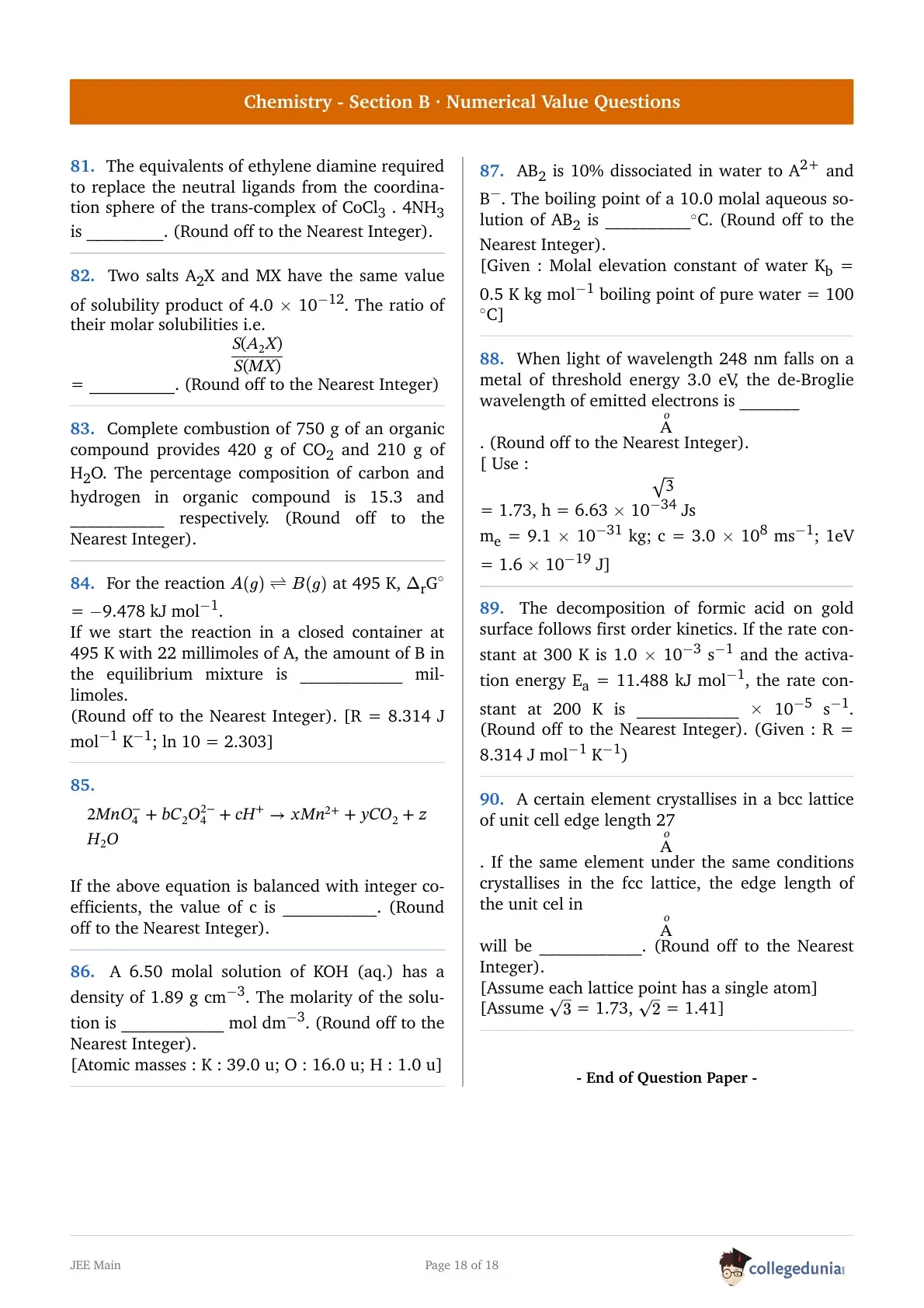
Chemistry - Section B (Q81 - Q90)
The equivalents of ethylene diamine required to replace the neutral ligands from the coordination sphere of the trans-complex of CoCl\(_3\) . 4NH\(_3\) is _________. (Round off to the Nearest Integer).
Two salts A\(_2\)X and MX have the same value of solubility product of 4.0 \(\times\) 10\(^{-12}\). The ratio of their molar solubilities i.e. \(\frac{S(A_2X)}{S(MX)}\) = __________. (Round off to the Nearest Integer)
On complete combustion 0.30 g of an organic compound gave 0.20 g of carbon dioxide and 0.10 g of water. The percentage of carbon in the given organic compound is ______. (Nearest Integer)
For the reaction \(A(g) \rightleftharpoons B(g)\) at 495 K, \(\Delta_rG^\circ = -9.478\) kJ mol\(^{-1}\).
If we start the reaction in a closed container at 495 K with 22 millimoles of A, the amount of B in the equilibrium mixture is ____________ millimoles.
(Round off to the Nearest Integer). [R = 8.314 J mol\(^{-1}\) K\(^{-1}\); ln 10 = 2.303]
\(2\mathrm{MnO_4^{-}} + b\,\mathrm{C_2O_4^{2-}} + c\,\mathrm{H^{+}} \rightarrow x\,\mathrm{Mn^{2+}} + y\,\mathrm{CO_2} + z\,\mathrm{H_2O}\)
If the above equation is balanced with integer coefficients, the value of c is ___________. (Round off to the Nearest Integer).
A 6.50 molal solution of KOH (aq.) has a density of 1.89 g cm-3. The molarity of the solution is ____________ mol dm-3. (Round off to the Nearest Integer).
[Atomic masses : K : 39.0 u; O : 16.0 u; H : 1.0 u]
AB2 is 10% dissociated in water to A2+ and B-. The boiling point of a 10.0 molal aqueous solution of AB2 is __________\(^\circ\)C. (Round off to the Nearest Integer).
[Given : Molal elevation constant of water Kb = 0.5 K kg mol-1 boiling point of pure water = 100\(^\circ\)C]
When light of wavelength 248 nm falls on a metal of threshold energy 3.0 eV, the de-Broglie wavelength of emitted electrons is _______ \(\mathring{\mathrm{A}}\). (Round off to the Nearest Integer).
[ Use : \(\sqrt{3}\) = 1.73, h = 6.63 \(\times\) 10-34 Js
me = 9.1 \(\times\) 10-31 kg; c = 3.0 \(\times\) 108 ms-1; 1eV = 1.6 \(\times\) 10-19 J]
The decomposition of formic acid on gold surface follows first order kinetics. If the rate constant at 300 K is 1.0 \(\times\) 10-3 s-1 and the activation energy Ea = 11.488 kJ mol-1, the rate constant at 200 K is ____________ \(\times\) 10-5 s-1. (Round off to the Nearest Integer). (Given : R = 8.314 J mol-1 K-1)
A certain element crystallises in a bcc lattice of unit cell edge length 27 \(\mathring{\mathrm{A}}\). If the same element under the same conditions crystallises in the fcc lattice, the edge length of the unit cel in \(\mathring{\mathrm{A}}\) will be ____________. (Round off to the Nearest Integer).
[Assume each lattice point has a single atom]
[Assume \(\sqrt{3}\) = 1.73, \(\sqrt{2}\) = 1.41]
JEE Main 2021 Exam Pattern and Marking Scheme
| Particulars | Details |
|---|---|
| Exam Mode | Online (Computer-Based Test) |
| Paper | B.E./B.Tech (Paper 1) |
| Duration | 3 hours (180 minutes) |
| Type of Questions | Multiple Choice Questions (MCQs) + Numerical Value Questions |
| Subjects | Mathematics, Physics, Chemistry |
| Total Questions | 90 questions (75 to be attempted) |
| Total Marks | 300 marks |
| Marking Scheme | +4 for correct answer & -1 for incorrect MCQ; no negative marking for Numerical Value Questions |
JEE Main 2021 March 16 Shift 1 Difficulty Level
JEE Main 2021 B.E./B.Tech Question Paper - March 16, 2021- forenoon session was moderate in terms of difficulty. The paper was also said to be well balanced in terms of the difficulty levels of the three sections. As per JEE Main Exam Pattern, a total of 30 questions were asked from each section. Each section contained 10 numerical value-based questions (NATs), out of which 5 questions had to be attempted by the candidate.
JEE Main 2021 B.E./B.Tech Question Paper March 16 (FN): Paper Analysis
JEE Main 2021 B.E./B.Tech March 16 Forenoon Session was conducted from 9.00 AM to 12.00 Noon and was reported to be of average difficulty level.
| Subjects | Sectional Analysis | Related Links |
|---|---|---|
| Mathematics |
|
JEE Main Mathematics Syllabus |
| Physics |
|
JEE Main Physics Syllabus |
| Chemistry |
|
JEE Main Chemistry Syllabus |



Comments