




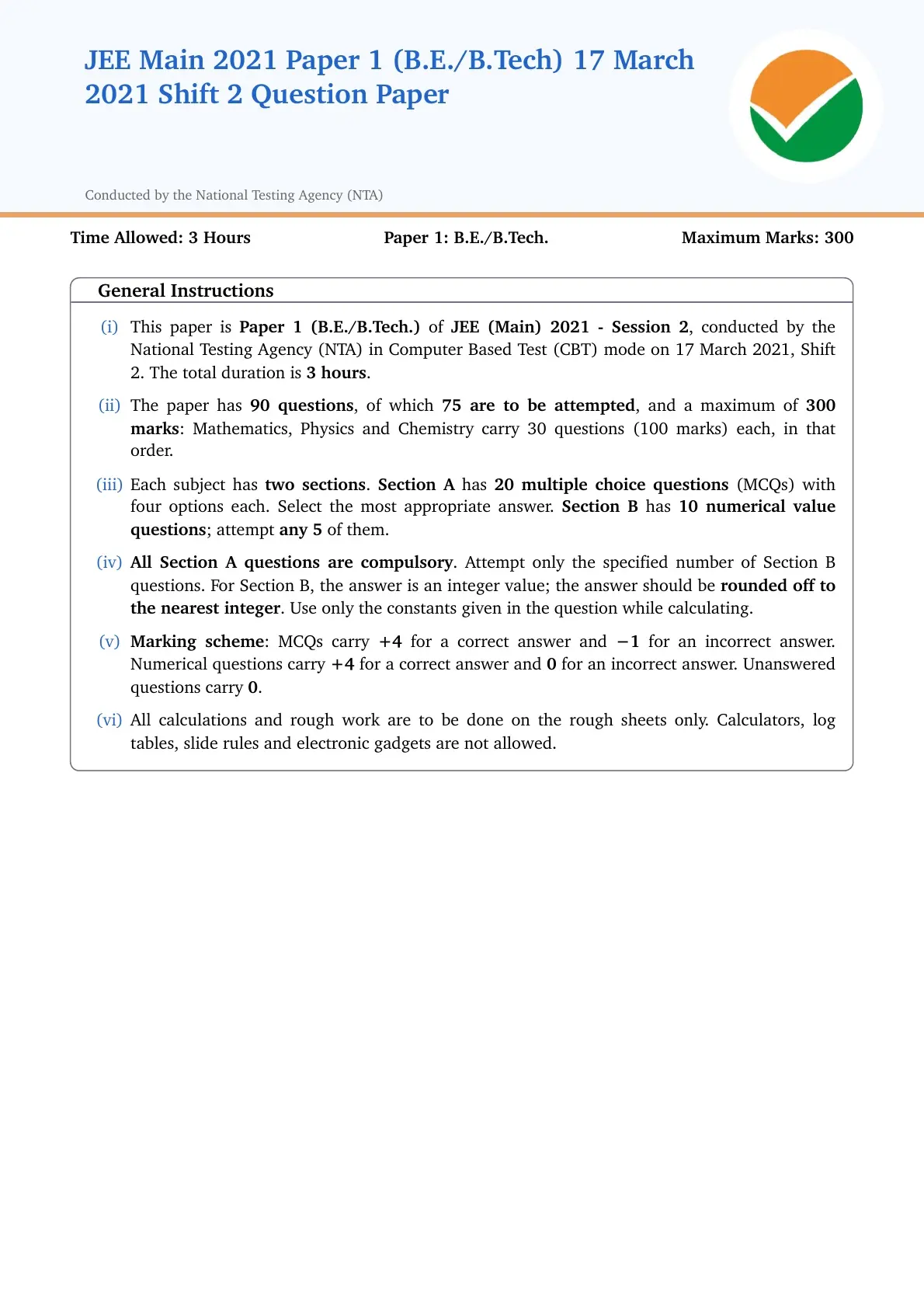
JEE Main 2021 March 17 Shift 2 Question Paper is available here with solutions PDF and detailed solutions for every question. NTA conducted the second shift on March 17, 2021, from 3:00 PM to 6:00 PM. The JEE Main 2021 Paper 1 (B.E./B.Tech) question paper includes the following:
- 90 questions in a 3-hour CBT Mode: 30 each from Mathematics, Physics and Chemistry (75 to be attempted)
- Section A: 20 multiple choice questions (MCQs) per subject, all compulsory, 4 marks each
- Section B: 10 numerical value questions per subject, any 5 to be attempted, 4 marks each
- Marking: +4 for a correct answer, -1 for an incorrect MCQ, 0 for an unattempted question; no negative marking for numerical value questions
- Maximum marks: 300 (100 per subject)
JEE Main 2021 March 17 Shift 2 Question Paper with Solution PDF
| NTA Official PDF | CD PDF | CD PDF with Solutions |
|---|---|---|
| Download official PDF 5.52 MB | Download Collegedunia PDF 1.03 MB | Download solutions PDF 1.00 MB |
Also Check:
JEE Main 2021 March 17 Shift 2 Questions with Solutions
Mathematics - Section A (Q1 - Q20)
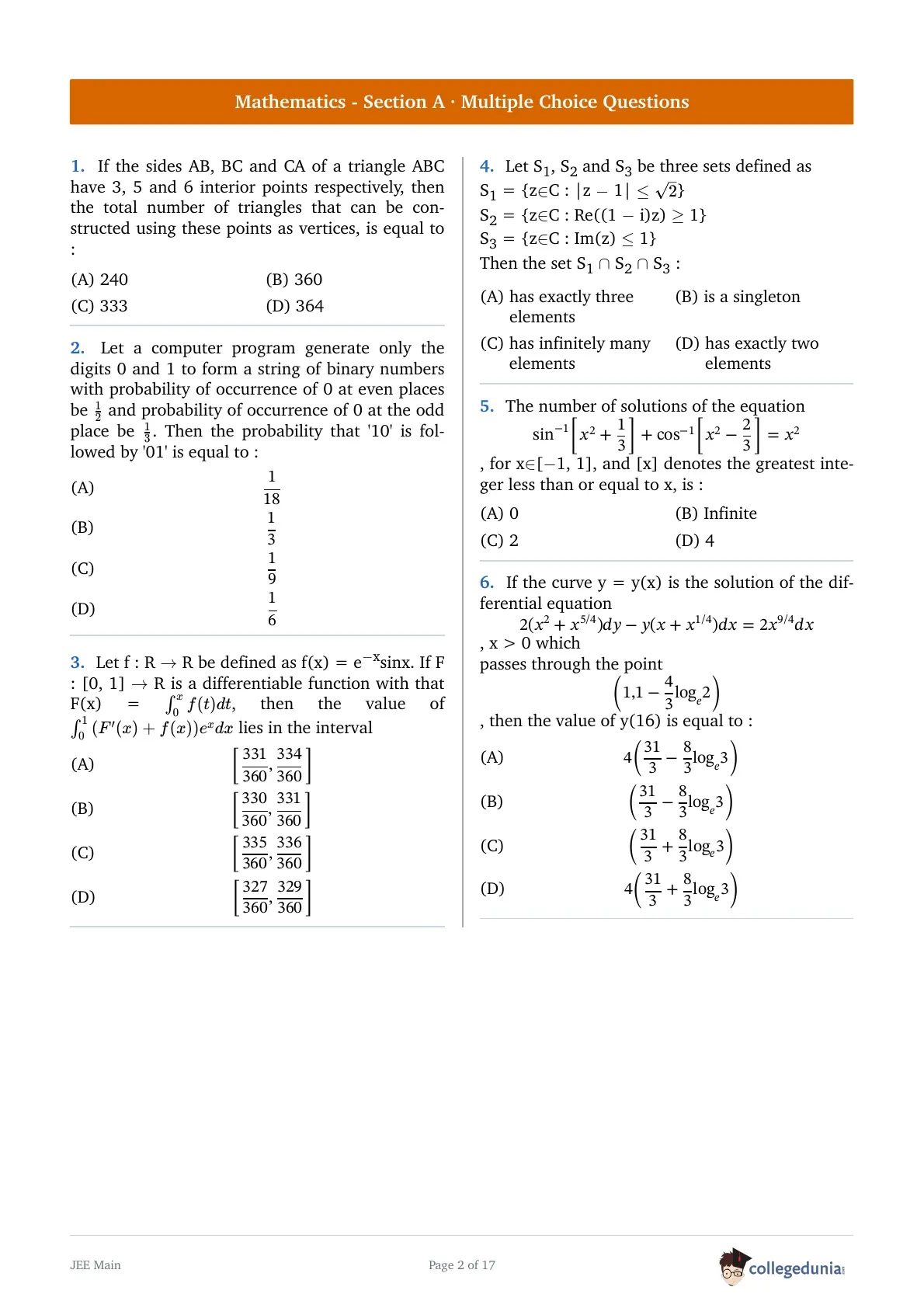
On the sides \(AB, BC, CA\) of a \(\Delta ABC, 3, 4, 5\) distinct points (excluding vertices \(A, B, C\)) are respectively chosen. The number of triangles that can be constructed using these chosen points as vertices a re :
Let a computer program generate only the digits 0 and 1 to form a string of binary numbers with probability of occurrence of 0 at even places be \(\frac{1}{2}\) and probability of occurrence of 0 at the odd place be \(\frac{1}{3}\). Then the probability that '10' is followed by '01' is equal to :
Let \(f : \mathbb{R}\to\mathbb{R}\) be defined as \(f(x)=e^{-x}\sin x\). If \(F:[0,1]\to\mathbb{R}\) is a differentiable function with that \(F(x)=\int_0^x f(t)\,dt\), then the value of \(\int_0^1 \left(F'(x)+f(x)\right)e^{x}\,dx\) lies in the interval
Let \(S_1, S_2\) and \(S_3\) be three sets defined as
\(S_1=\{z\in\mathbb{C} : |z-1|\le\sqrt{2}\}\)
\(S_2=\{z\in\mathbb{C} : \mathrm{Re}((1-i)z)\ge 1\}\)
\(S_3=\{z\in\mathbb{C} : \mathrm{Im}(z)\le 1\}\)
Then the set \(S_1\cap S_2\cap S_3\) :
The number of solutions of the equation
\(\sin^{-1}\left[x^2+\frac{1}{3}\right]+\cos^{-1}\left[x^2-\frac{2}{3}\right]=x^2\), for \(x\in[-1,1]\), and \([x]\) denotes the greatest integer less than or equal to \(x\), is :
If the curve \(y=y(x)\) is the solution of the differential equation
\(2(x^2+x^{5/4})\,dy-y(x+x^{1/4})\,dx=2x^{9/4}\,dx\), \(x\gt 0\) which
passes through the point \(\left(1,\,1-\frac{4}{3}\log_e 2\right)\), then the value of \(y(16)\) is equal to :
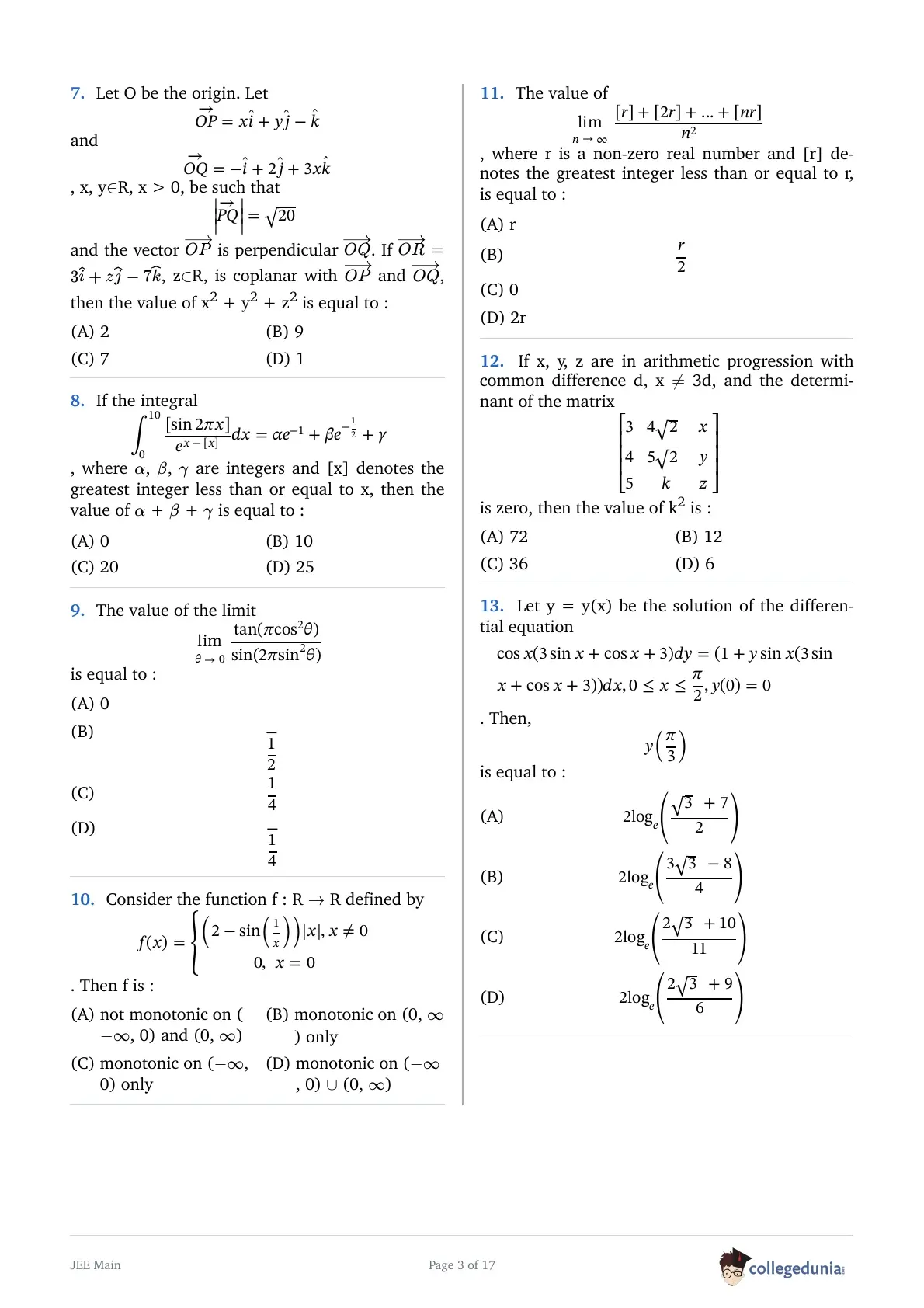
Let O be the origin. Let
\(\overrightarrow{OP}=x\hat{i}+y\hat{j}-\hat{k}\) and \(\overrightarrow{OQ}=-\hat{i}+2\hat{j}+3x\hat{k}\), \(x,y\in\mathbb{R}\), \(x\gt 0\), be such that \(\left|\overrightarrow{PQ}\right|=\sqrt{20}\) and the vector \(\overrightarrow{OP}\) is perpendicular to \(\overrightarrow{OQ}\). If \(\overrightarrow{OR}=3\hat{i}+z\hat{j}-7\hat{k}\), \(z\in\mathbb{R}\), is coplanar with \(\overrightarrow{OP}\) and \(\overrightarrow{OQ}\), then the value of \(x^2+y^2+z^2\) is equal to :
If the integral
\(\int_0^{10}\frac{[\sin 2\pi x]}{e^{x-[x]}}\,dx=\alpha e^{-1}+\beta e^{-\frac{1}{2}}+\gamma\)
, where \(\alpha,\beta,\gamma\) are integers and \([x]\) denotes the greatest integer less than or equal to \(x\), then the value of \(\alpha+\beta+\gamma\) is equal to :
The value of the limit
\(\lim_{\theta\to 0}\frac{\tan(\pi\cos^2\theta)}{\sin(2\pi\sin^2\theta)}\)
is equal to :
Consider the function \(f:\mathbb{R}\to\mathbb{R}\) defined by
\(f(x)=\begin{cases}\left(2-\sin\left(\frac{1}{x}\right)\right)|x|, & x\ne 0\\ 0, & x=0\end{cases}\)
. Then \(f\) is :
The value of
\(\lim_{n\to\infty}\frac{[r]+[2r]+\dots+[nr]}{n^2}\)
, where \(r\) is a non-zero real number and \([r]\) denotes the greatest integer less than or equal to \(r\), is equal to :
If \(x,y,z\) are in arithmetic progression with common difference \(d\), \(x\ne 3d\), and the determinant of the matrix
\(\begin{bmatrix}3&4\sqrt{2}&x\\4&5\sqrt{2}&y\\5&k&z\end{bmatrix}\)
is zero, then the value of \(k^2\) is :
Let \(y=y(x)\) be the solution of the differential equation
\(\cos x\,(3\sin x+\cos x+3)\,dy=\left(1+y\sin x\,(3\sin x+\cos x+3)\right)dx,\ 0\le x\le\frac{\pi}{2},\ y(0)=0\)
. Then,
\(y\left(\frac{\pi}{3}\right)\)
is equal to :
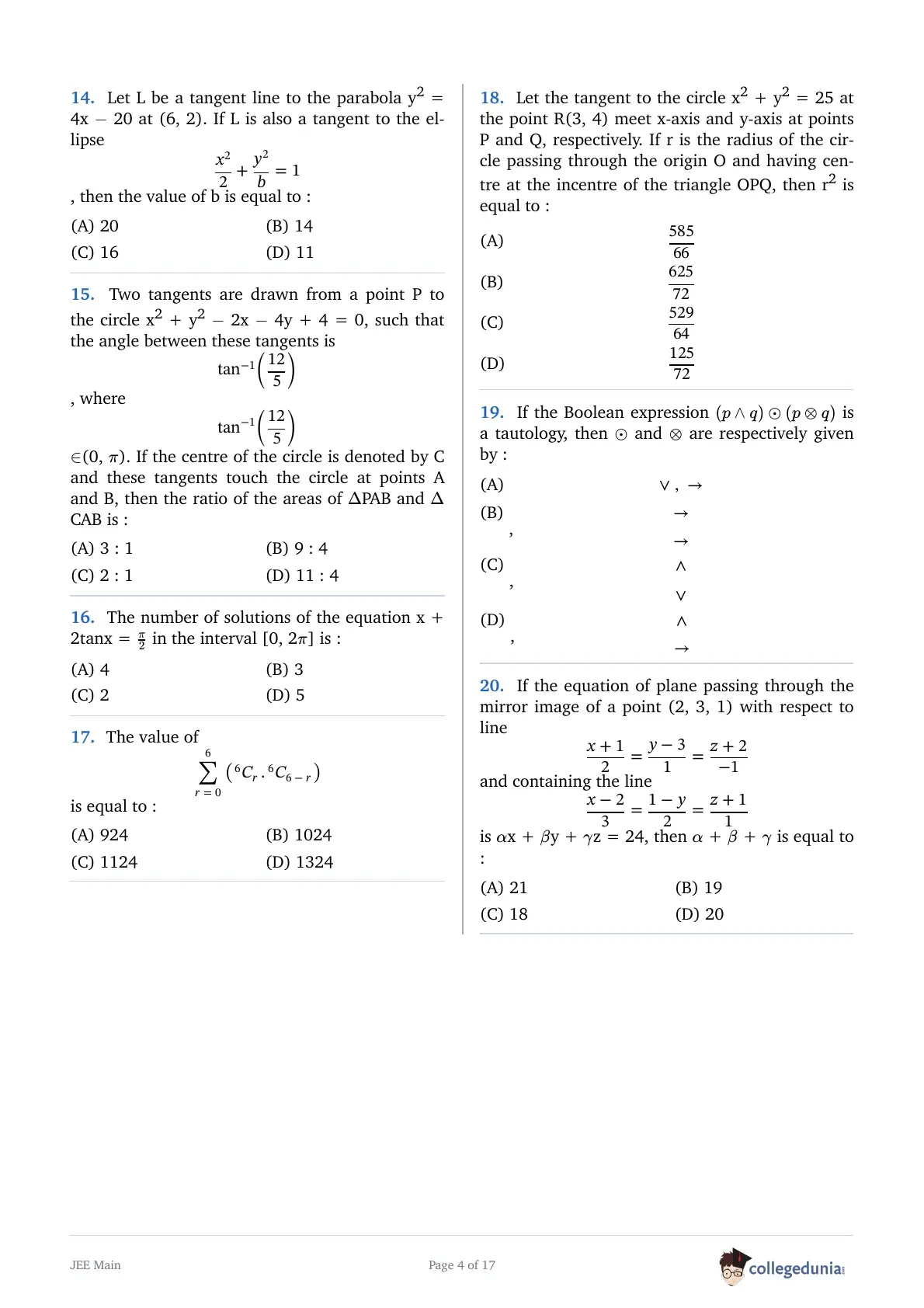
Let \(L\) be a tangent line to the parabola \(y^2=4x-20\) at \((6,2)\). If \(L\) is also a tangent to the ellipse
\(\frac{x^2}{2}+\frac{y^2}{b}=1\)
, then the value of \(b\) is equal to :
Two tangents are drawn from a point \(P\) to the circle \(x^2+y^2-2x-4y+4=0\), such that the angle between these tangents is
\(\tan^{-1}\left(\frac{12}{5}\right)\)
, where
\(\tan^{-1}\left(\frac{12}{5}\right)\in(0,\pi)\)
. If the centre of the circle is denoted by \(C\) and these tangents touch the circle at points \(A\) and \(B\), then the ratio of the areas of \(\Delta PAB\) and \(\Delta CAB\) is :
The number of solutions of the equation \(\sin 2x - 2\cos x + 4\sin x = 4\) in the interval \([0, 5\pi]\) is :
The value of
\(\sum_{r=0}^{6}\left({}^{6}C_r\cdot{}^{6}C_{6-r}\right)\)
is equal to :
Let the tangent to the circle \(x^2 + y^2 = 25\) at the point \(R(3, 4)\) meet x-axis and y-axis at points \(P\) and \(Q\), respectively. If \(r\) is the radius of the circle passing through the origin \(O\) and having centre at the incentre of the triangle \(OPQ\), then \(r^2\) is equal to :
If the Boolean expression \((p \wedge q) \odot (p \otimes q)\) is a tautology, then \(\odot\) and \(\otimes\) are respectively given by :
If the equation of plane passing through the mirror image of a point \((2, 3, 1)\) with respect to line
\(\frac{x+1}{2} = \frac{y-3}{1} = \frac{z+2}{-1}\)
and containing the line
\(\frac{x-2}{3} = \frac{1-y}{2} = \frac{z+1}{1}\)
is \(\alpha x + \beta y + \gamma z = 24\), then \(\alpha + \beta + \gamma\) is equal to :
Mathematics - Section B (Q21 - Q30)
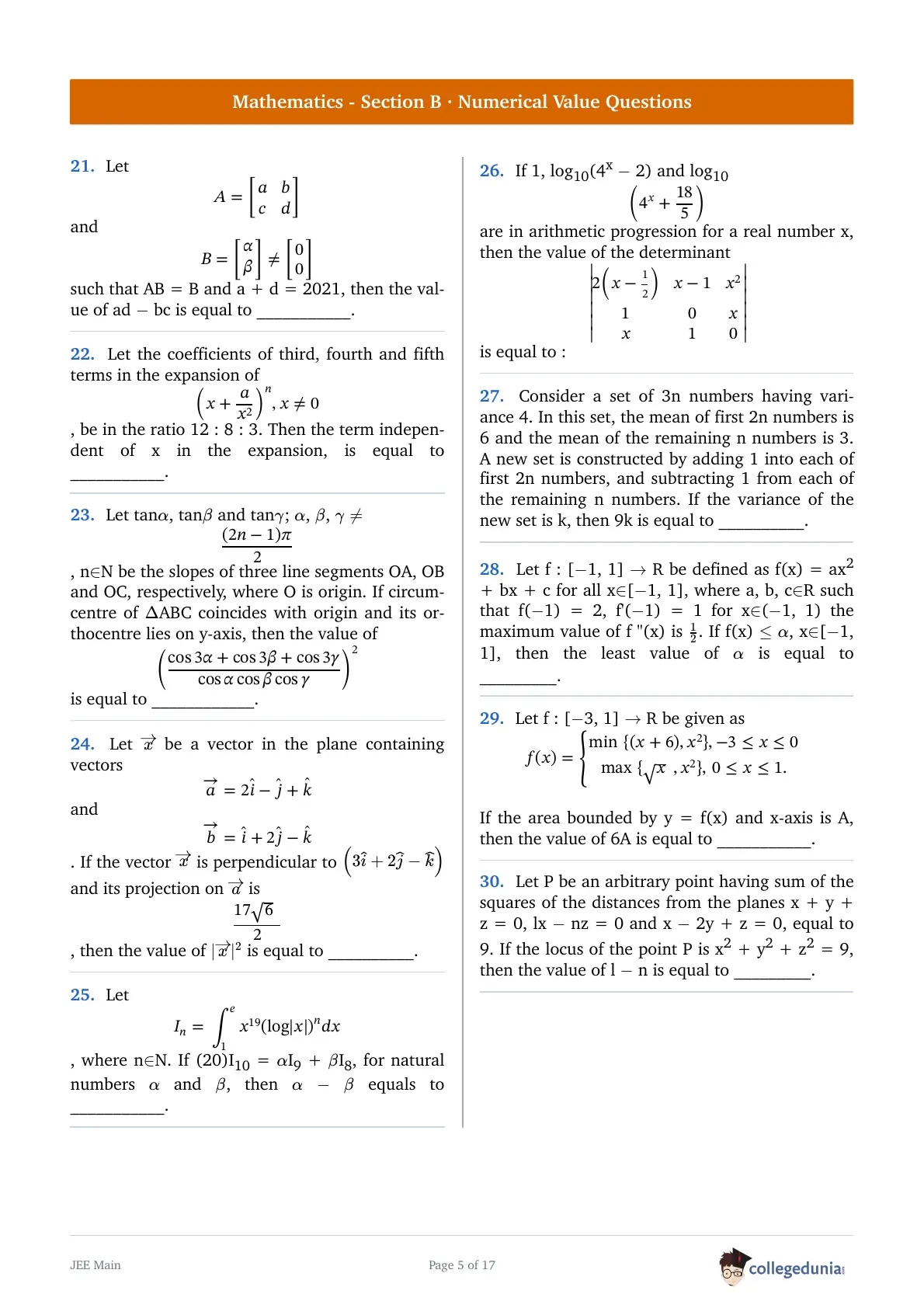
Let
\(A = \begin{bmatrix} a & b \\ c & d \end{bmatrix}\)
and
\(B = \begin{bmatrix} \alpha \\ \beta \end{bmatrix} \ne \begin{bmatrix} 0 \\ 0 \end{bmatrix}\)
such that \(AB = B\) and \(a + d = 2021\), then the value of \(ad - bc\) is equal to ___________.
Let the coefficients of third, fourth and fifth terms in the expansion of
\(\left(x + \frac{a}{x^2}\right)^n,\ x \ne 0\)
be in the ratio 12 : 8 : 3. Then the term independent of x in the expansion, is equal to ___________.
Let \(\tan\alpha\), \(\tan\beta\) and \(\tan\gamma\); \(\alpha, \beta, \gamma \ne \frac{(2n-1)\pi}{2}\), \(n \in N\) be the slopes of three line segments OA, OB and OC, respectively, where O is origin. If circumcentre of \(\Delta ABC\) coincides with origin and its orthocentre lies on y-axis, then the value of
\(\left(\frac{\cos 3\alpha + \cos 3\beta + \cos 3\gamma}{\cos\alpha\cos\beta\cos\gamma}\right)^2\)
is equal to ____________.
Let \(\vec{x}\) be a vector in the plane containing vectors
\(\vec{a} = 2\hat{i} - \hat{j} + \hat{k}\)
and
\(\vec{b} = \hat{i} + 2\hat{j} - \hat{k}\).
If the vector \(\vec{x}\) is perpendicular to \(\left(3\hat{i} + 2\hat{j} - \hat{k}\right)\) and its projection on \(\vec{a}\) is \(\frac{17\sqrt{6}}{2}\), then the value of \(|\vec{x}|^2\) is equal to __________.
Let
\(I_n = \int_1^e x^{19}(\log|x|)^n\,dx\)
where \(n \in N\). If \((20)I_{10} = \alpha I_9 + \beta I_8\), for natural numbers \(\alpha\) and \(\beta\), then \(\alpha - \beta\) equals to ___________.
If 1, \(\log_{10}(4^x - 2)\) and \(\log_{10}\left(4^x + \frac{18}{5}\right)\) are in arithmetic progression for a real number x, then the value of the determinant
\(\begin{vmatrix} 2\left(x - \frac12\right) & x - 1 & x^2 \\ 1 & 0 & x \\ x & 1 & 0 \end{vmatrix}\)
is equal to ___________.
Consider a set of \(3n\) numbers having variance 4. In this set, the mean of first \(2n\) numbers is 6 and the mean of the remaining \(n\) numbers is 3. A new set is constructed by adding 1 into each of first \(2n\) numbers, and subtracting 1 from each of the remaining \(n\) numbers. If the variance of the new set is \(k\), then \(9k\) is equal to __________.
Let \(f : [-1, 1] \to R\) be defined as \(f(x) = ax^2 + bx + c\) for all \(x \in [-1, 1]\), where \(a, b, c \in R\) such that \(f(-1) = 2\), \(f'(-1) = 1\) for \(x \in (-1, 1)\) the maximum value of \(f''(x)\) is \(\frac12\). If \(f(x) \le \alpha\), \(x \in [-1, 1]\), then the least value of \(\alpha\) is equal to _________.
Let \(f : [-3, 1] \to R\) be given as
\(f(x) = \begin{cases} \min\{(x + 6), x^2\}, & -3 \le x \le 0 \\ \max\{\sqrt{x}, x^2\}, & 0 \le x \le 1. \end{cases}\)
If the area bounded by \(y = f(x)\) and x-axis is A, then the value of \(6A\) is equal to ___________.
A point \(P\) moves so that the sum of squares of its distances from the points \((1,2)\) and \((-2,1)\) is \(14\). Let \(f(x, y)=0\) be the locus of \(P\), which intersects the \(x\)-axis at the points \(A , B\) and the \(y\)-axis at the point \(C, D\). Then the area of the quadrilateral \(ACBD\) is equal to
Physics - Section A (Q31 - Q50)
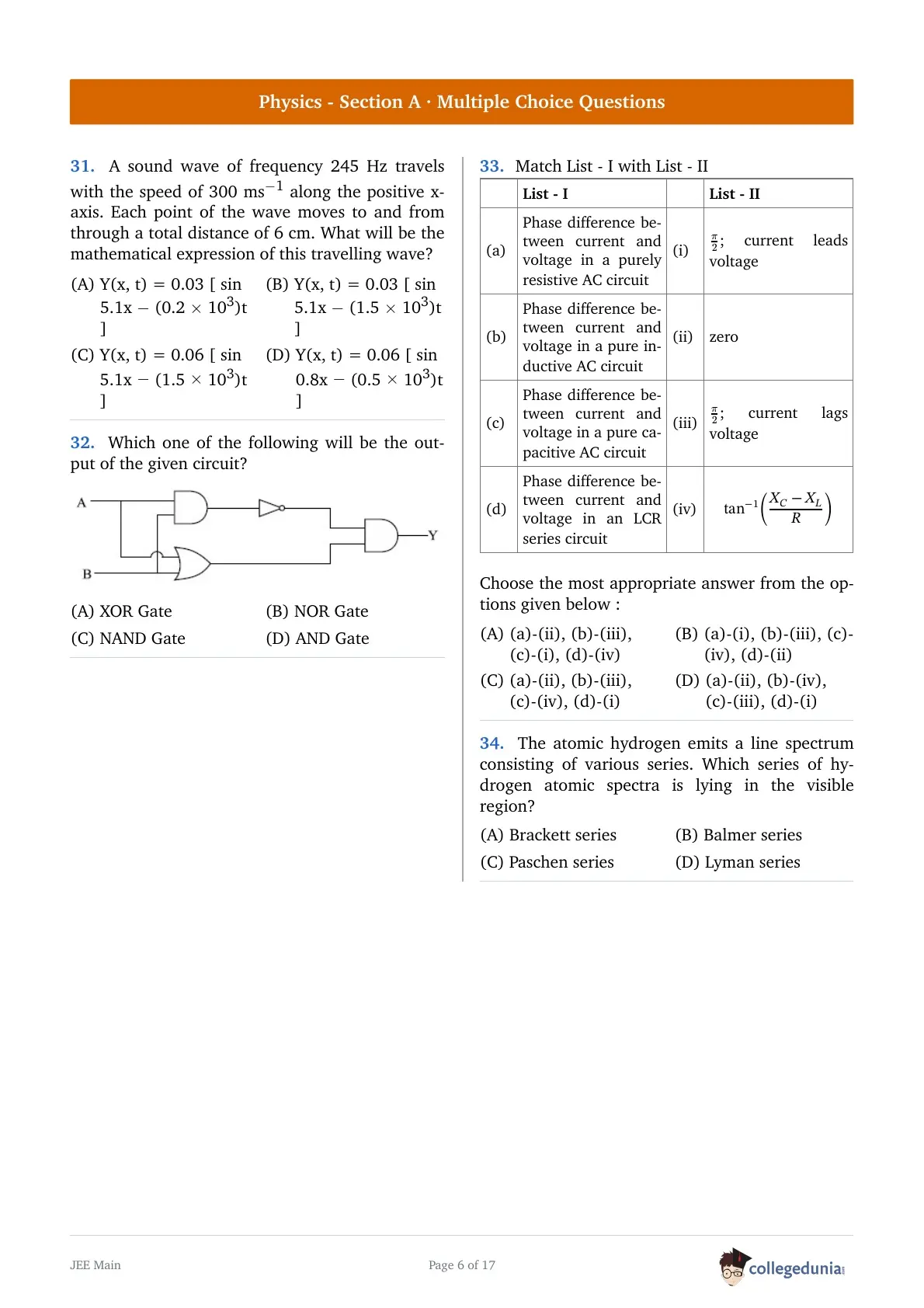
A sound wave of frequency 245 Hz travels with the speed of 300 ms-1 along the positive x-axis. Each point of the wave moves to and from through a total distance of 6 cm. What will be the mathematical expression of this travelling wave?
Which one of the following will be the output of the given circuit?
| List - I | List - II | ||
| (a) | Phase difference between current and voltage in a purely resistive AC circuit | (i) | \(\frac{\pi}{2}\); current leads voltage |
| (b) | Phase difference between current and voltage in a pure inductive AC circuit | (ii) | zero |
| (c) | Phase difference between current and voltage in a pure capacitive AC circuit | (iii) | \(\frac{\pi}{2}\); current lags voltage |
| (d) | Phase difference between current and voltage in an LCR series circuit | (iv) | \(\tan^{-1}\left(\frac{X_C - X_L}{R}\right)\) |
Choose the most appropriate answer from the options given below :
The atomic hydrogen emits a line spectrum consisting of various series. Which series of hydrogen atomic spectra is lying in the visible region?
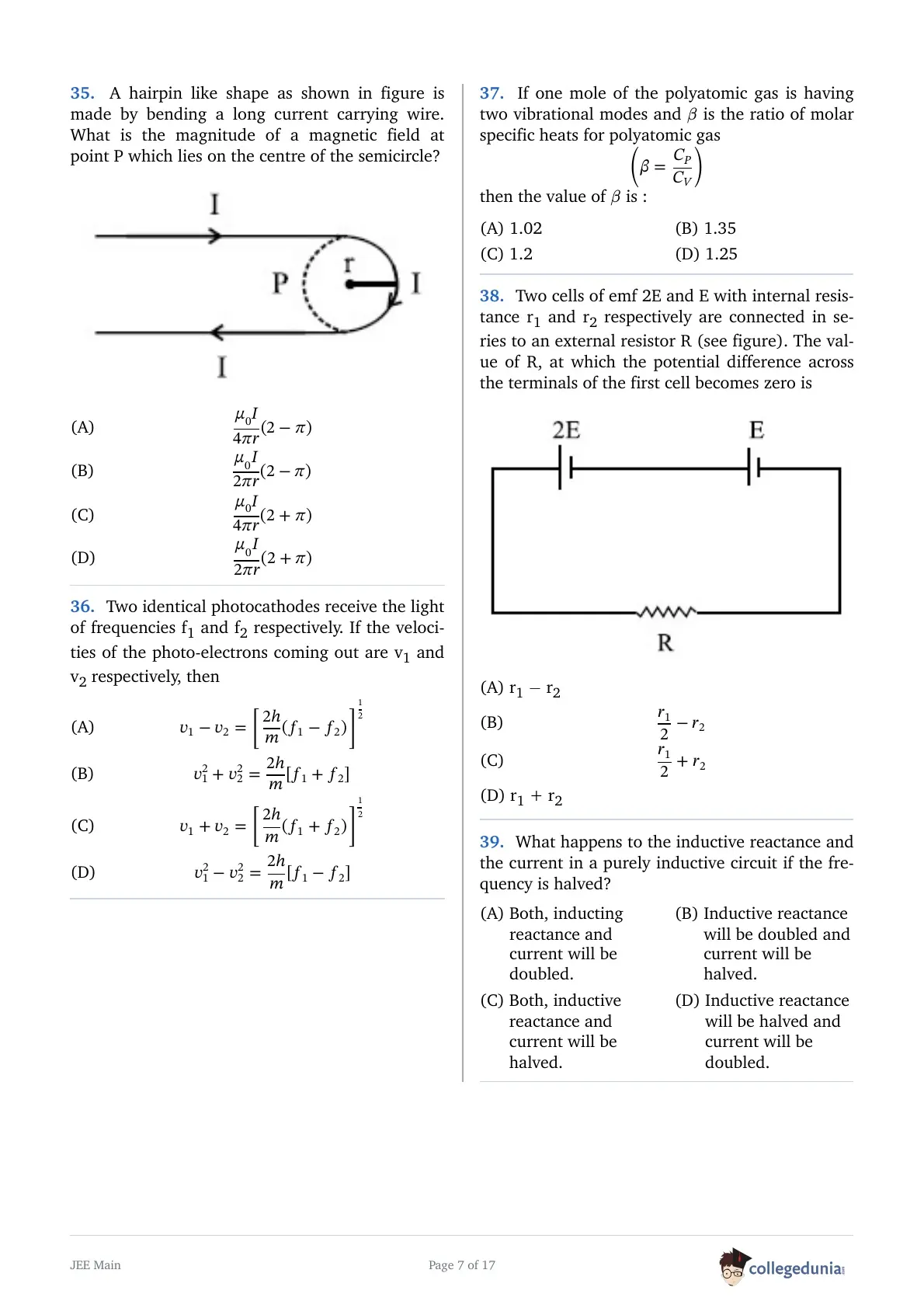
A hairpin like shape as shown in figure is made by bending a long current carrying wire. What is the magnitude of a magnetic field at point P which lies on the centre of the semicircle?
Two identical photocathodes receive the light of frequencies f1 and f2 respectively. If the velocities of the photo-electrons coming out are v1 and v2 respectively, then
If one mole of the polyatomic gas is having two vibrational modes and \(\beta\) is the ratio of molar specific heats for polyatomic gas \(\left(\beta = \frac{C_P}{C_V}\right)\) then the value of \(\beta\) is :
Two cells of same emf but different internal resistances r1 and r2 are connected in series with a resistance R. The value of resistance R, for which the potential difference across second cell is zero, is
What happens to the inductive reactance and the current in a purely inductive circuit if the frequency is halved?
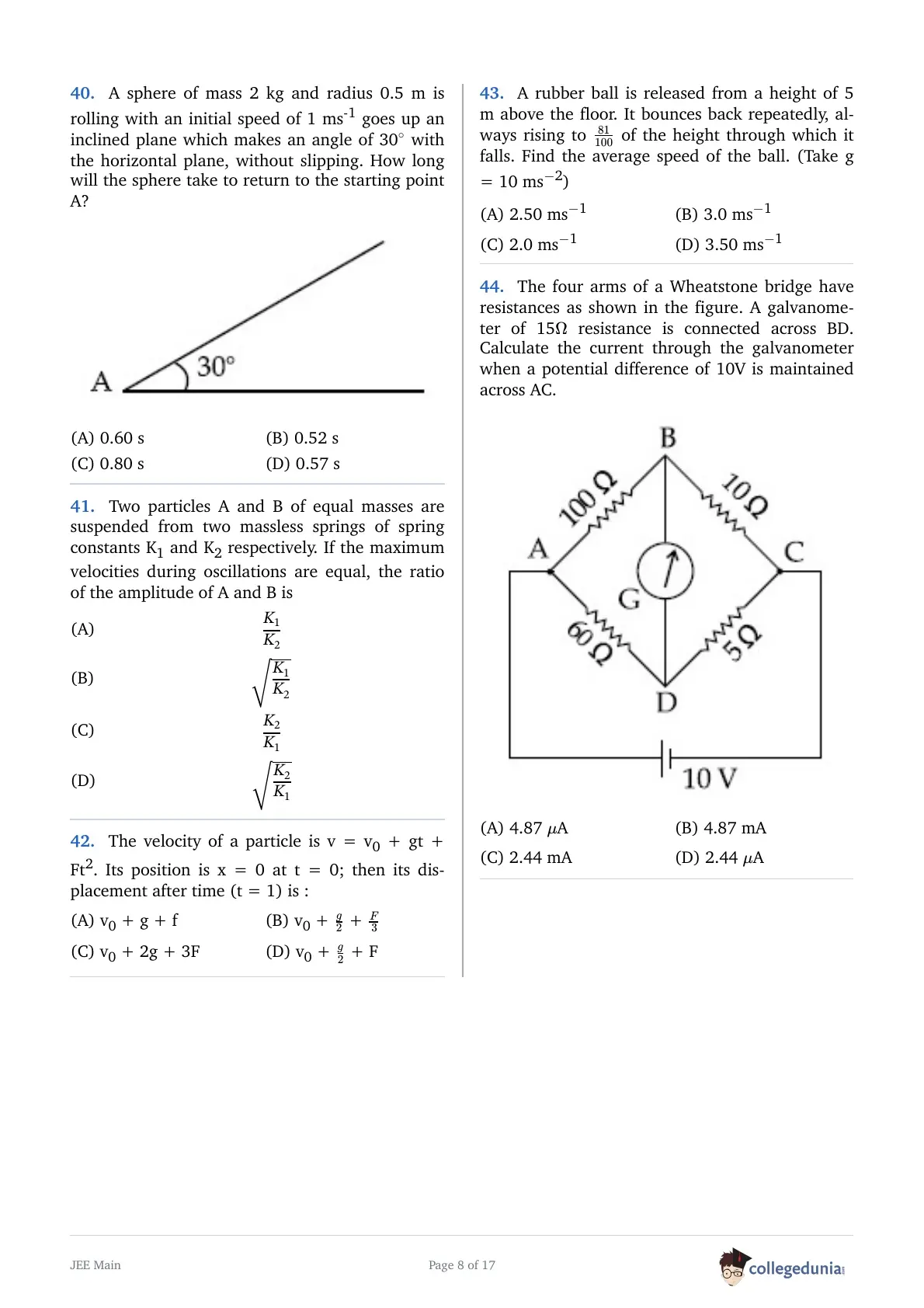
A sphere of mass 2 kg and radius 0.5 m is rolling with an initial speed of 1 ms-1 goes up an inclined plane which makes an angle of 30° with the horizontal plane, without slipping. How long will the sphere take to return to the starting point A?
Two particles and of equal masses are suspended from two massless springs of spring constants and respectively. If the maximum velocities, during oscillations, are equal, the ratio of amplitudes of and is:
The velocity of a particle is v = v0 + gt + Ft2. Its position is x = 0 at t = 0; then its displacement after time (t = 1) is :
A rubber ball is released from a height of 5 m above the floor. It bounces back repeatedly, always rising to \(\frac{81}{100}\) of the height through which it falls. Find the average speed of the ball. (Take g = 10 ms-2)
The four arms of a Wheatstone bridge have resistances as shown in the figure. A galvanometer of \(15\ \Omega\) resistance is connected across BD. Calculate the current through the galvanometer when a potential difference of 10V is maintained across AC.
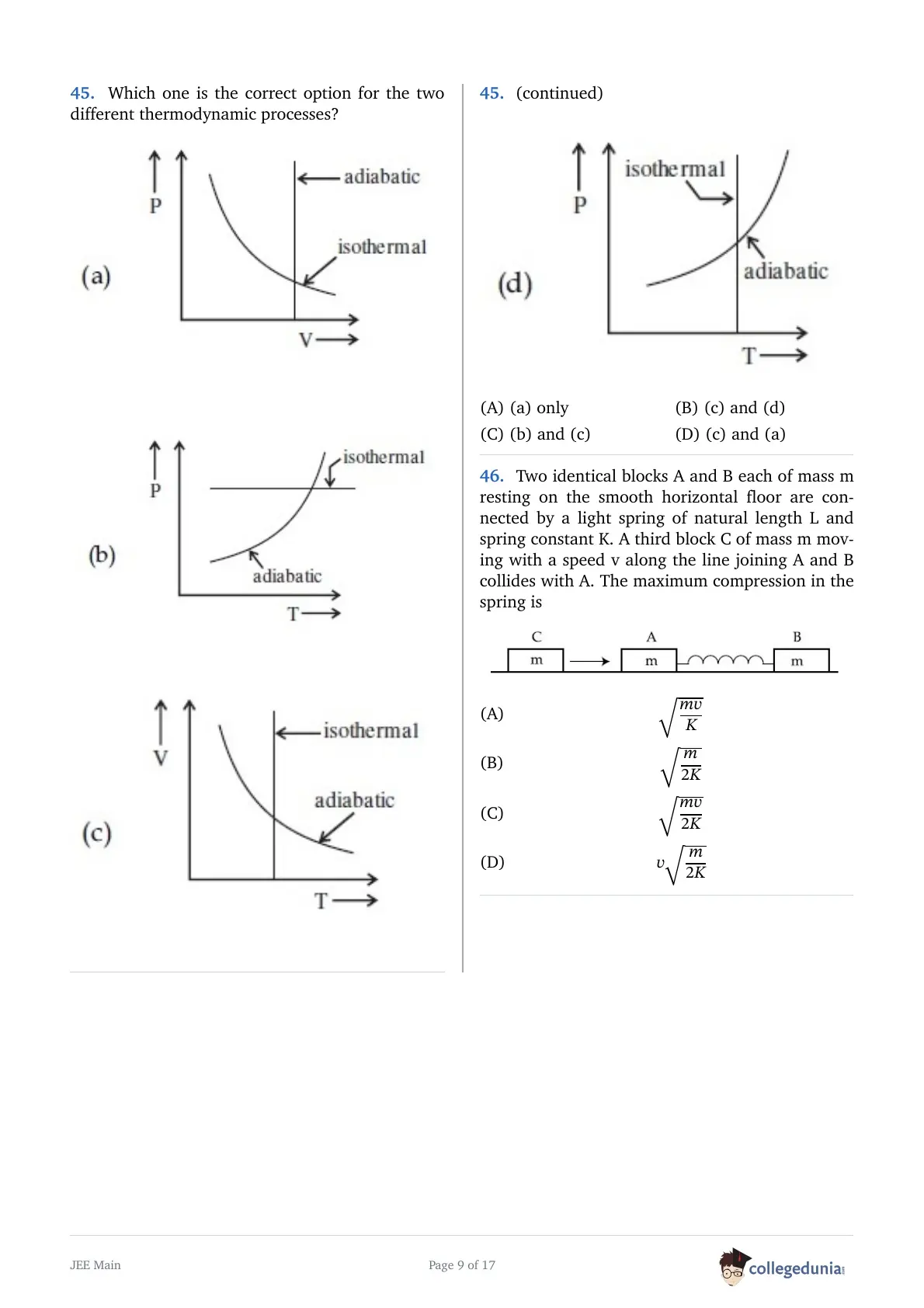
Which one is the correct option for the two different thermodynamic processes?
Two identical blocks A and B each of mass m resting on the smooth horizontal floor are connected by a light spring of natural length L and spring constant K. A third block C of mass m moving with a speed v along the line joining A and B collides with A. The maximum compression in the spring is
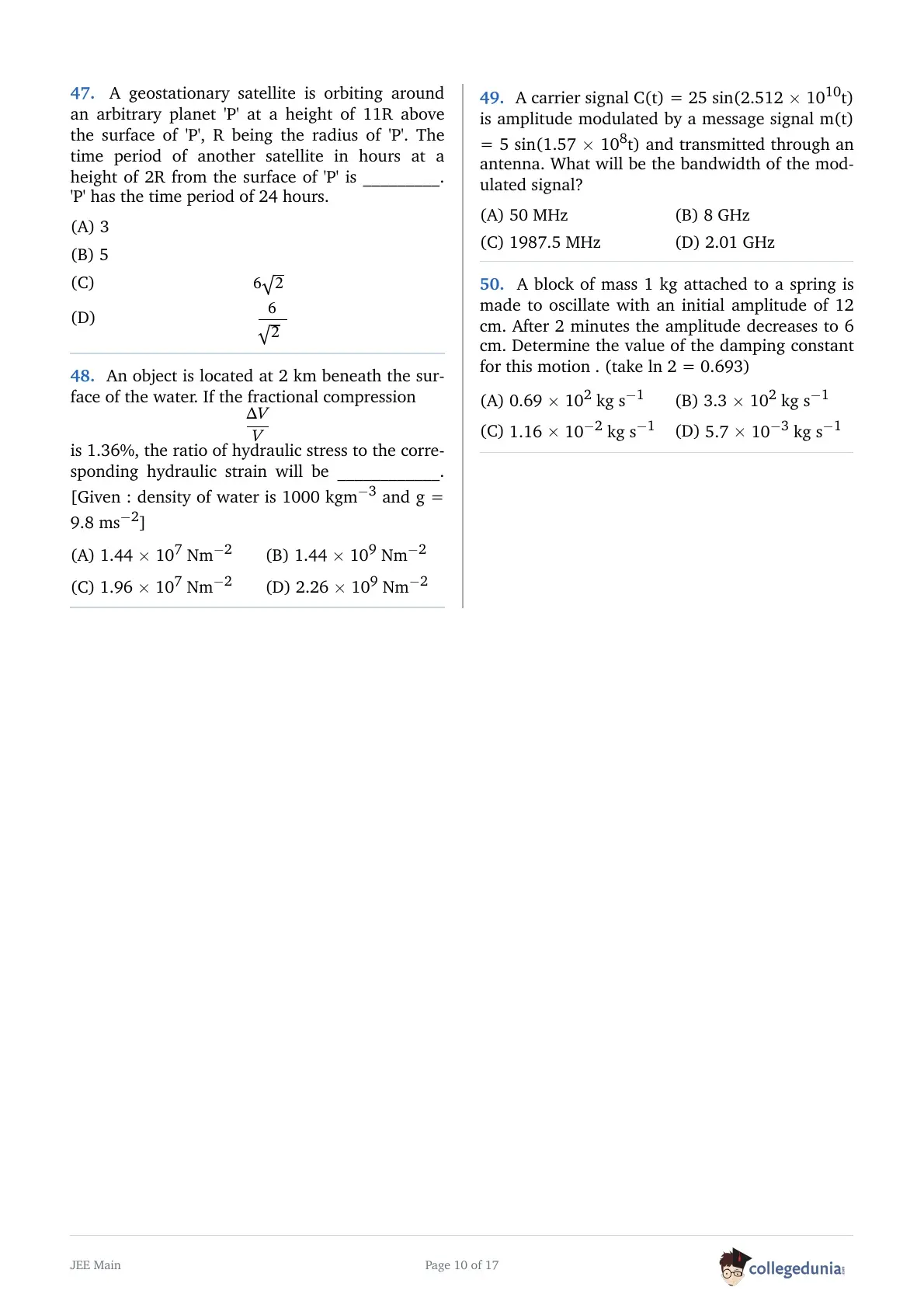
A geostationary satellite is orbiting around an arbitrary planet 'P' at a height of 11R above the surface of 'P', R being the radius of 'P'. The time period of another satellite in hours at a height of 2R from the surface of 'P' is _________. 'P' has the time period of 24 hours.
An object is located at 2 km beneath the surface of the water. If the fractional compression \(\frac{\Delta V}{V}\) is 1.36%, the ratio of hydraulic stress to the corresponding hydraulic strain will be ____________. [Given : density of water is 1000 kgm-3 and g = 9.8 ms-2]
A carrier signal C(t) = 25 sin(2.512 × 10¹⁰t) is amplitude modulated by a message signal m(t) = 5 sin(1.57 × 10⁸t) and transmitted through an antenna. What will be the bandwidth of the modulated signal?
A block of mass 1 kg attached to a spring is made to oscillate with an initial amplitude of 12 cm. After 2 minutes the amplitude decreases to 6 cm. Determine the value of the damping constant for this motion . (take ln 2 = 0.693)
Physics - Section B (Q51 - Q60)
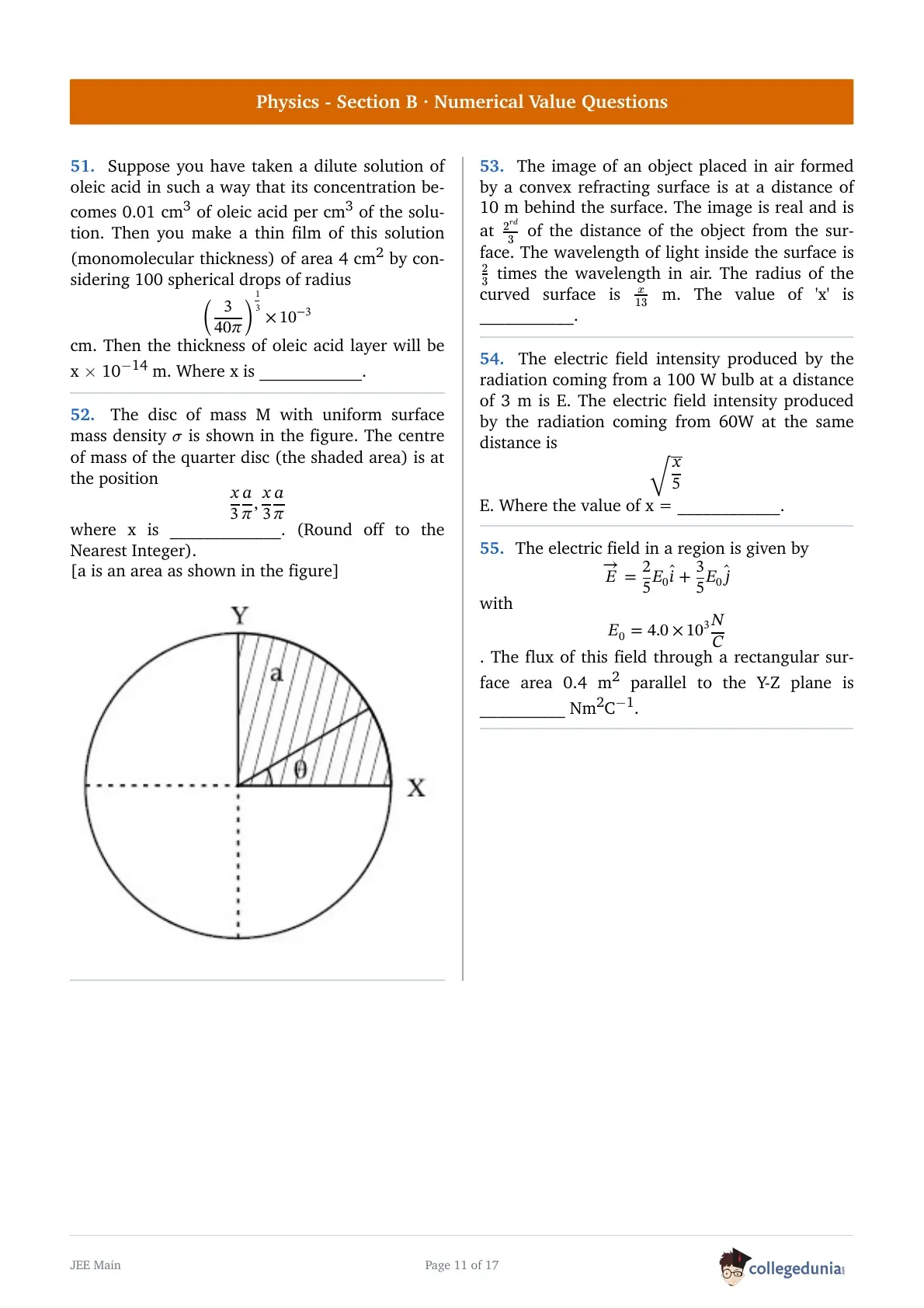
Suppose you have taken a dilute solution of oleic acid in such a way that its concentration becomes 0.01 cm3 of oleic acid per cm3 of the solution. Then you make a thin film of this solution (monomolecular thickness) of area 4 cm2 by considering 100 spherical drops of radius \(\left(\frac{3}{40\pi}\right)^{\frac{1}{3}}\times 10^{-3}\) cm. Then the thickness of oleic acid layer will be \(x\times 10^{-14}\) m. Where x is ____________.
The disc of mass M with uniform surface mass density \(\sigma\) is shown in the figure. The centre of mass of the quarter disc (the shaded area) is at the position \(\frac{xa}{3\pi},\ \frac{xa}{3\pi}\) where x is ____________. (Round off to the Nearest Integer).
[a is an area as shown in the figure]
The image of an object placed in air formed by a convex refracting surface is at a distance of 10 m behind the surface. The image is real and is at \(\frac{2^{rd}}{3}\) of the distance of the object from the surface. The wavelength of light inside the surface is \(\frac{2}{3}\) times the wavelength in air. The radius of the curved surface is \(\frac{x}{13}\) m. The value of 'x' is ____________.
The electric field intensity produced by the radiation coming from a 100 W bulb at a distance of 3 m is E. The electric field intensity produced by the radiation coming from 60W at the same distance is \(\sqrt{\frac{x}{5}}\) E. Where the value of x = ____________.
The electric field in a region is given by \( \vec{E} = (2\hat{i} + 4\hat{j} + 6\hat{k}) \times 10^3 \, N/C \). The flux of the field through a rectangular surface parallel to x-z plane is \( 6.0 \, Nm^2C^{-1} \). The area of the surface is ____ \( cm^2 \).
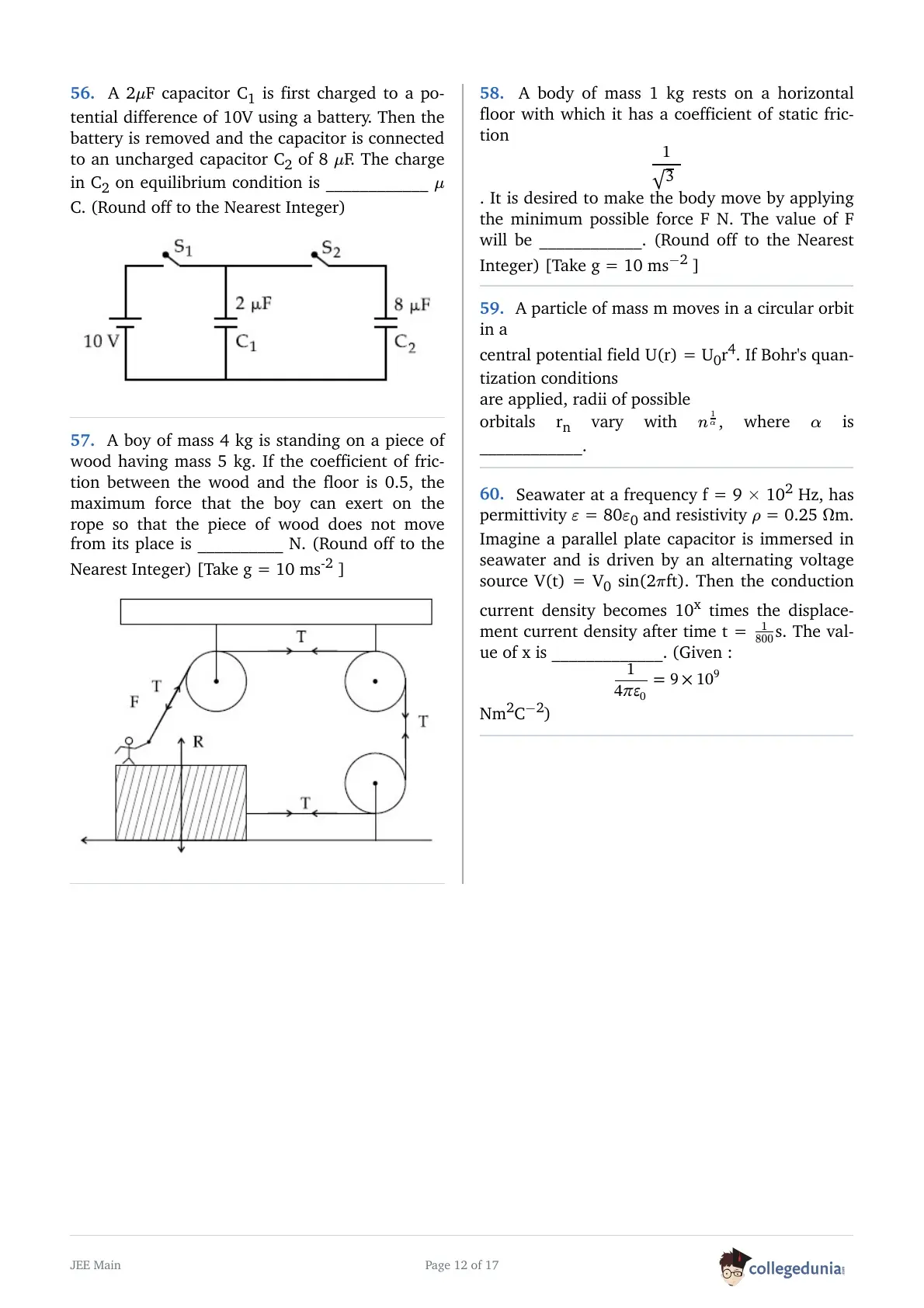
A 2\(\mu\)F capacitor C1 is first charged to a potential difference of 10V using a battery. Then the battery is removed and the capacitor is connected to an uncharged capacitor C2 of 8 \(\mu\)F. The charge in C2 on equilibrium condition is ____________ \(\mu\)C. (Round off to the Nearest Integer)
A boy of mass 4 kg is standing on a piece of wood having mass 5 kg. If the coefficient of friction between the wood and the floor is 0.5, the maximum force that the boy can exert on the rope so that the piece of wood does not move from its place is __________ N. (Round off to the Nearest Integer) [Take g = 10 \(\mathrm{ms^{-2}}\) ]
A body of mass 1 kg rests on a horizontal floor with which it has a coefficient of static friction \(\frac{1}{\sqrt{3}}\). It is desired to make the body move by applying the minimum possible force F N. The value of F will be ____________. (Round off to the Nearest Integer) [Take g = 10 \(\mathrm{ms^{-2}}\) ]
A test particle is moving in a circular orbit in the gravitational field produced by a mass density \(\rho(r) = \frac{K}{r^2}\). Identify the correct relation between the radius \(R\) of the particle's orbit and it's period \(T\) :
An electromagnetic wave of frequency 100 MHz propagates through a medium of conductivity, \(\sigma = 10\) mho/m. The ratio of maximum conduction current density to maximum displacement current density is _________.
\(\left[ \text{Take } \frac{1}{4\pi\epsilon_0} = 9 \times 10^9 \text{ Nm}^2/\text{C}^2 \right]\)
Chemistry - Section A (Q61 - Q80)
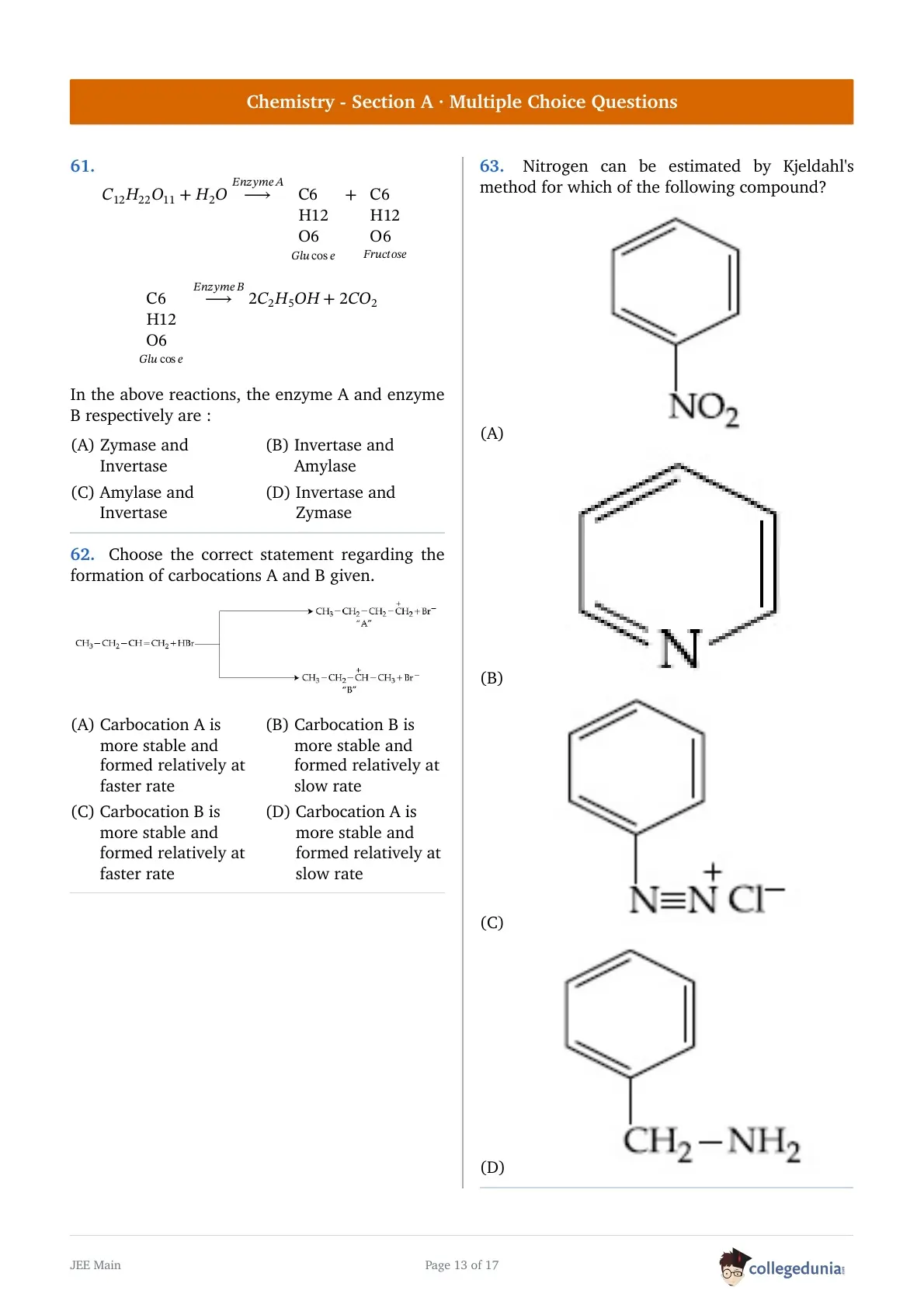
\(\mathrm{C_{12}H_{22}O_{11}+H_2O\ \xrightarrow{\text{Enzyme A}}\ \underset{\text{Glucose}}{C_6H_{12}O_6}+\underset{\text{Fructose}}{C_6H_{12}O_6}}\)
\(\mathrm{\underset{\text{Glucose}}{C_6H_{12}O_6}\ \xrightarrow{\text{Enzyme B}}\ 2C_2H_5OH+2CO_2}\)
In the above reactions, the enzyme A and enzyme B respectively are :
Choose the correct statement regarding the formation of carbocations A and B given.
Nitrogen can be estimated by Kjeldahl's method for which of the following compound?
- (1)
![]()
- (2)
![]()
- (3)
![]()
- (4)
![]()


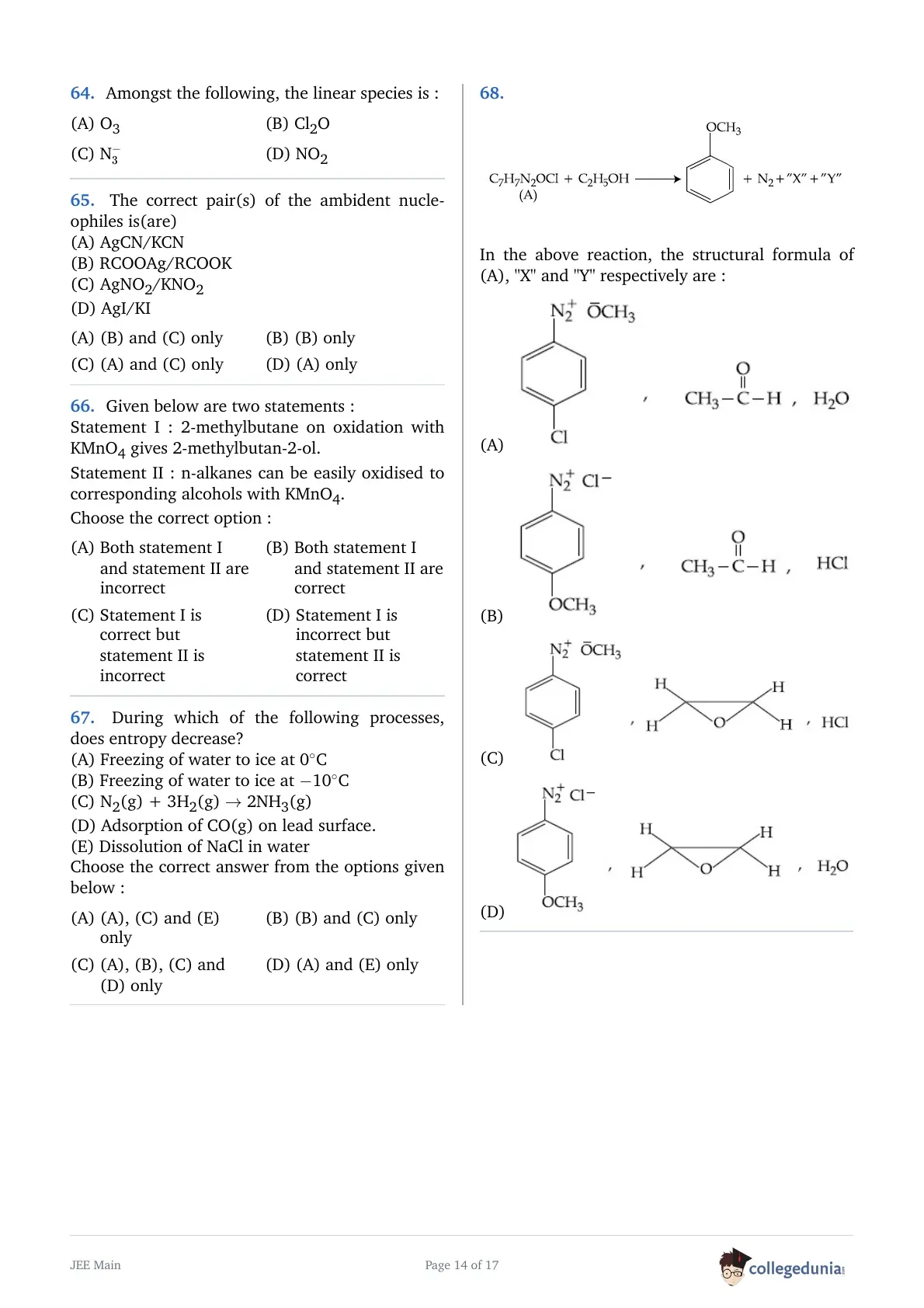
Amongst the following, the linear species is :
The correct pair(s) of the ambident nucleophiles is(are)
(A) \(\mathrm{AgCN/KCN}\)
(B) \(\mathrm{RCOOAg/RCOOK}\)
(C) \(\mathrm{AgNO_2/KNO_2}\)
(D) \(\mathrm{AgI/KI}\)
Given below are two statements :
Statement I : 2-methylbutane on oxidation with \(\mathrm{KMnO_4}\) gives 2-methylbutan-2-ol.
Statement II : n-alkanes can be easily oxidised to corresponding alcohols with \(\mathrm{KMnO_4}\).
Choose the correct option :
During which of the following processes, does entropy decrease?
(A) Freezing of water to ice at \(0^\circ\mathrm{C}\)
(B) Freezing of water to ice at \(-10^\circ\mathrm{C}\)
(C) \(\mathrm{N_2(g)+3H_2(g)\to2NH_3(g)}\)
(D) Adsorption of CO(g) on lead surface.
(E) Dissolution of NaCl in water
Choose the correct answer from the options given below :

In the above reaction, the structural formula of (A), "X" and "Y" respectively are :
- (1)
![]()
- (2)
![]()
- (3)
![]()
- (4)
![]()


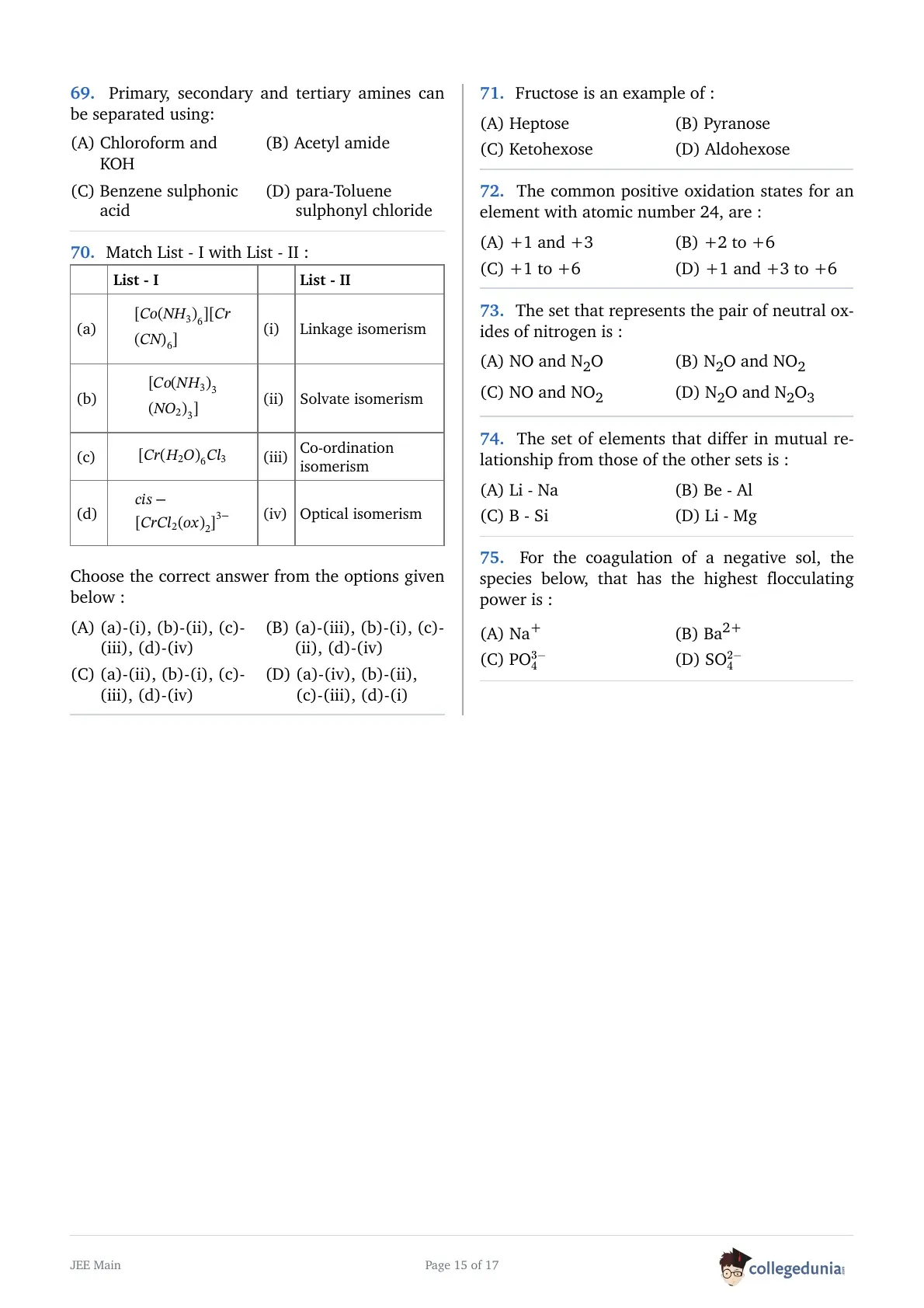
Primary, secondary and tertiary amines can be separated using:
| List - I | List - II | ||
| (a) | \([\mathrm{Co(NH_3)_6}][\mathrm{Cr(CN)_6}]\) | (i) | Linkage isomerism |
| (b) | \([\mathrm{Co(NH_3)_3(NO_2)_3}]\) | (ii) | Solvate isomerism |
| (c) | \([\mathrm{Cr(H_2O)_6}]\mathrm{Cl_3}\) | (iii) | Co-ordination isomerism |
| (d) | \(cis-[\mathrm{CrCl_2(ox)_2}]^{3-}\) | (iv) | Optical isomerism |
Choose the correct answer from the options given below :
Fructose is an example of :
The common positive oxidation states for an element with atomic number 24, are :
The set that represents the pair of neutral oxides of nitrogen is :
The set of elements that differ in mutual relationship from those of the other sets is :
For the coagulation of a negative sol, the species below, that has the highest flocculating power is :
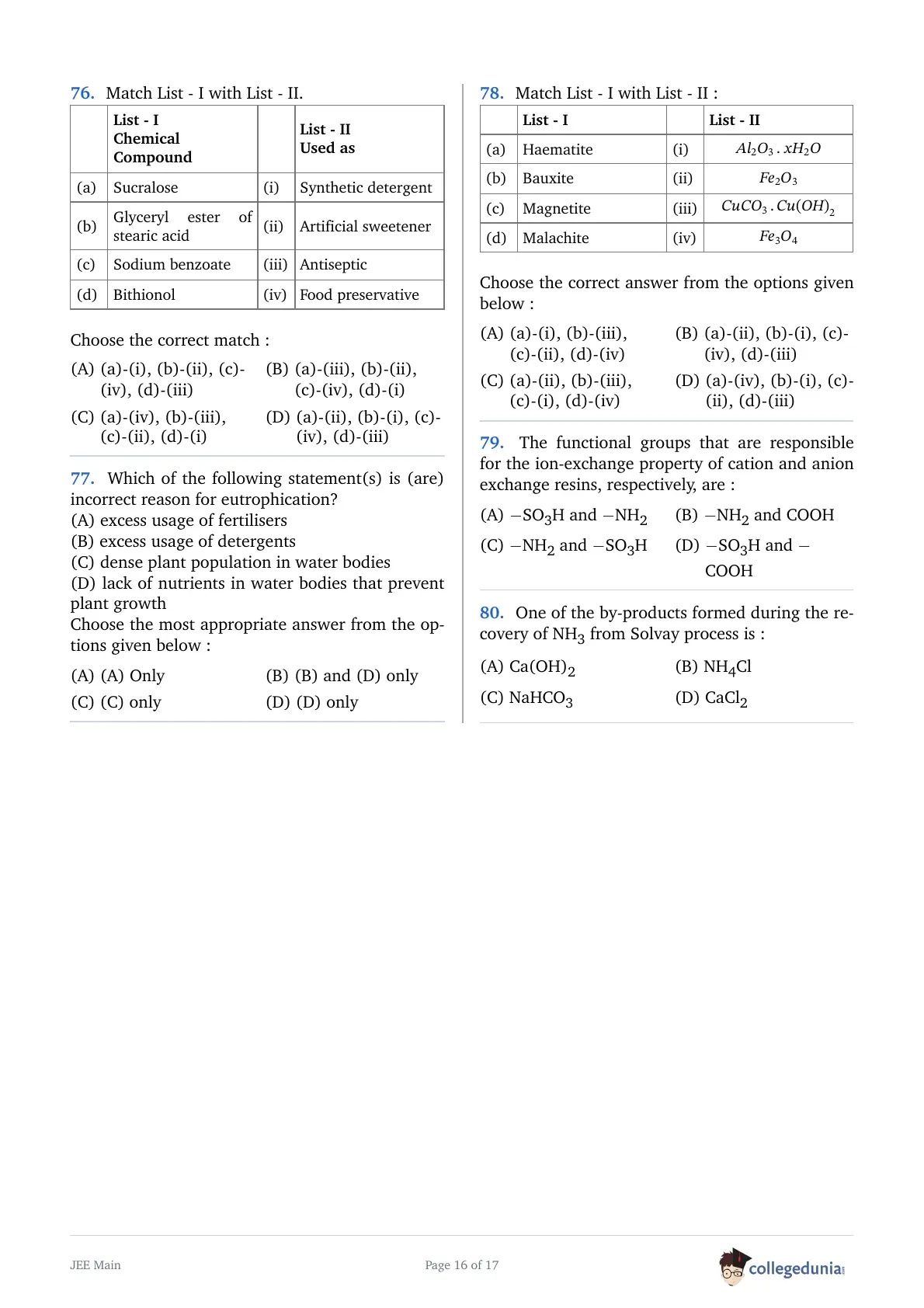
| List - I Chemical Compound | List - II Used as | ||
| (a) | Sucralose | (i) | Synthetic detergent |
| (b) | Glyceryl ester of stearic acid | (ii) | Artificial sweetener |
| (c) | Sodium benzoate | (iii) | Antiseptic |
| (d) | Bithionol | (iv) | Food preservative |
Choose the correct match :
Which of the following relations are correct?
(A) \(ΔU=q+pΔV\)
(B) \(ΔG=ΔH−TΔS\)
(C) \(ΔS=\frac{𝑞_{𝑟𝑒𝑣}}{𝑇}\)
(D) \(ΔH=ΔU−ΔnRT\)
Choose the most appropriate answer from the options given below:
| List - I | List - II | ||
| (a) | Haematite | (i) | \(Al_2O_3\cdot xH_2O\) |
| (b) | Bauxite | (ii) | \(Fe_2O_3\) |
| (c) | Magnetite | (iii) | \(CuCO_3\cdot Cu(OH)_2\) |
| (d) | Malachite | (iv) | \(Fe_3O_4\) |
Choose the correct answer from the options given below :
The functional groups that are responsible for the ion-exchange property of cation and anion exchange resins, respectively, are :
One of the by-products formed during the recovery of \(\mathrm{NH_3}\) from Solvay process is :
Chemistry - Section B (Q81 - Q90)
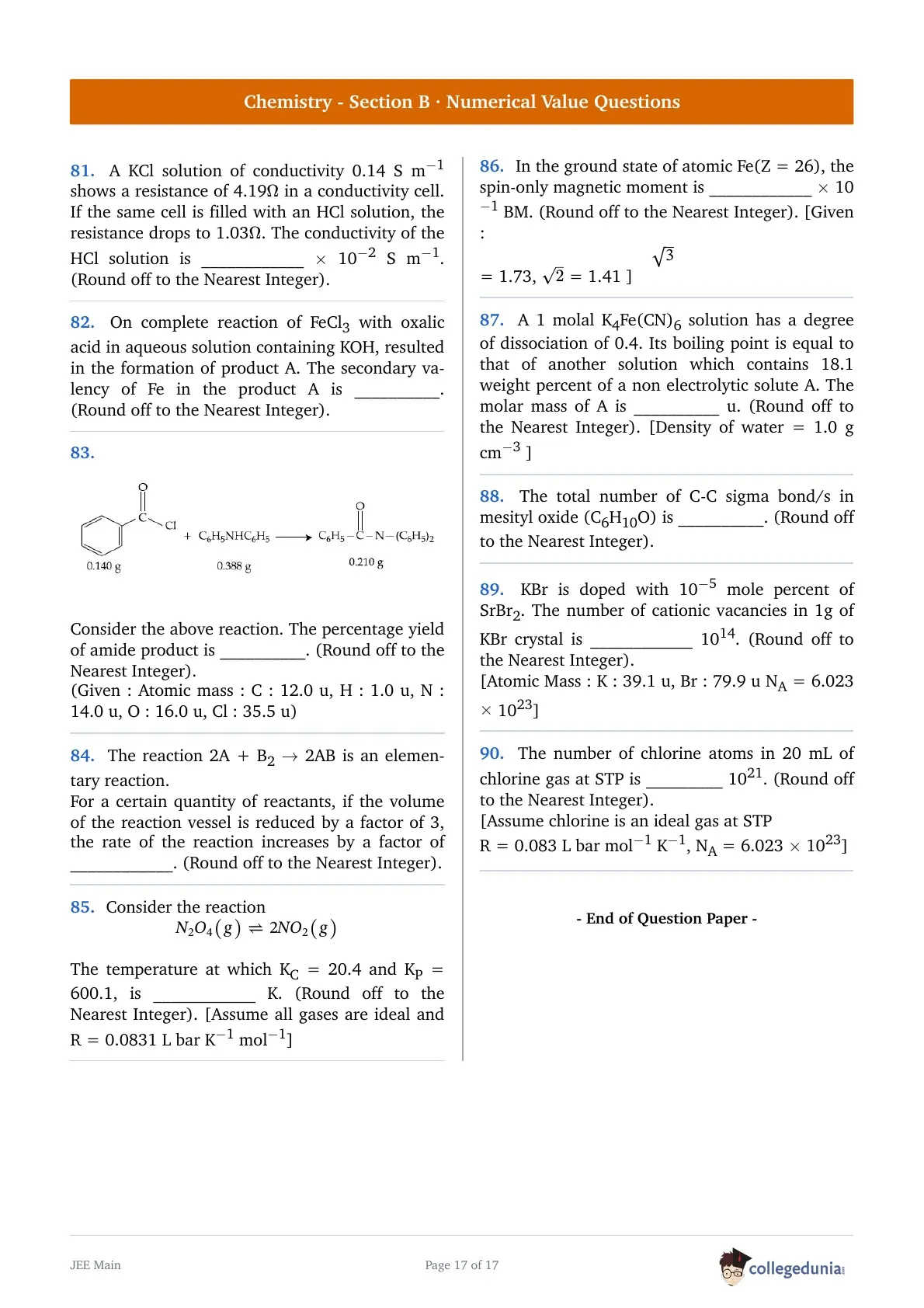
A KCl solution of conductivity \(0.14\ \mathrm{S\ m^{-1}}\) shows a resistance of \(4.19\ \Omega\) in a conductivity cell. If the same cell is filled with an HCl solution, the resistance drops to \(1.03\ \Omega\). The conductivity of the HCl solution is ____________ \(\times 10^{-2}\ \mathrm{S\ m^{-1}}\). (Round off to the Nearest Integer).
On complete reaction of \(\mathrm{FeCl_3}\) with oxalic acid in aqueous solution containing KOH, resulted in the formation of product A. The secondary valency of Fe in the product A is __________. (Round off to the Nearest Integer).

Consider the above reaction. The percentage yield of amide product is __________. (Round off to the Nearest Integer).
(Given : Atomic mass : C : 12.0 u, H : 1.0 u, N : 14.0 u, O : 16.0 u, Cl : 35.5 u)
Consider an elementary reaction: \[ A(g) + B(g) \rightarrow C(g) + D(g) \] If the volume of the reaction mixture is suddenly reduced to \( \frac{1}{3} \) of its initial volume, the reaction rate will become \( x \) times of the original reaction rate. The value of \( x \) is:
Consider the reaction
\(\mathrm{N_2O_4(g)} \rightleftharpoons 2\mathrm{NO_2(g)}\)
The temperature at which \(K_C = 20.4\) and \(K_P = 600.1\), is ____________ K. (Round off to the Nearest Integer). [Assume all gases are ideal and \(R = 0.0831\ \mathrm{L\ bar\ K^{-1}\ mol^{-1}}\)]
Spin only magnetic moment (\( \mu \)s) of \( {K_3}[Fe{(CN)_6}] \) is ____________ B.M.
(Nearest integer)
A 1 molal \(\mathrm{K_4Fe(CN)_6}\) solution has a degree of dissociation of 0.4. Its boiling point is equal to that of another solution which contains 18.1 weight percent of a non electrolytic solute A. The molar mass of A is __________ u. (Round off to the Nearest Integer). [Density of water = 1.0 g cm\(-3\) ]
The total number of C-C sigma bond/s in mesityl oxide (\(\mathrm{C_6H_{10}O}\)) is __________. (Round off to the Nearest Integer).
KBr is doped with \(10^{-5}\) mole percent of \(\mathrm{SrBr_2}\). The number of cationic vacancies in 1g of KBr crystal is ____________ \(10^{14}\). (Round off to the Nearest Integer).
[Atomic Mass : K : 39.1 u, Br : 79.9 u \(N_A = 6.023 \times 10^{23}\)]
The number of chlorine atoms in 20 mL of chlorine gas at STP is _________ \(10^{21}\). (Round off to the Nearest Integer).
[Assume chlorine is an ideal gas at STP
R = 0.083 L bar mol\(-1\) K\(-1\), \(N_A = 6.023 \times 10^{23}\)]
JEE Main 2021 Exam Pattern and Marking Scheme
| Particulars | Details |
|---|---|
| Exam Mode | Online (Computer-Based Test) |
| Paper | B.E./B.Tech (Paper 1) |
| Duration | 3 hours (180 minutes) |
| Type of Questions | Multiple Choice Questions (MCQs) + Numerical Value Questions |
| Subjects | Mathematics, Physics, Chemistry |
| Total Questions | 90 questions (75 to be attempted) |
| Total Marks | 300 marks |
| Marking Scheme | +4 for correct answer & -1 for incorrect MCQ; no negative marking for Numerical Value Questions |
JEE Main 2021 March 17 Shift 2 Difficulty Level
JEE Main 2021 B.E./B.Tech Question Paper- March 17, 2021- Afternoon Session was rated to be relatively easy than the first shift paper by the applicants. The distribution of class XII syllabus questions and Class XI JEE Main Syllabus was roughly equal with 46 Questions asked from the former and 44 asked from the latter. Physics and Chemistry both sections were rated to be on easy difficulty level, while Mathematics section was rated to be of moderate difficulty.
JEE Main 2021 B.E./B.Tech Question Paper March 17 (Afternoon Session): Weightage of Topics
JEE Main 2021 B.E./B.Tech Question Paper March 17 (Afternoon Session) was conducted between 3.00 PM to 6.00 PM. The high weighting topics for each section were as follows:
- Mathematics: Section had high weightage assigned to Differential Calculus (24%), Integral Calculus (20%), and Coordinate Geometry (15%). The number of questions from the class XII syllabus was significantly higher.
- Physics: The high weighting topics were - Mechanics (33%), Electrodynamics (23%), and Modern Physics (17%)
- Chemistry: The high weighting topics were - Organic Chemistry II (23%), Inorganic Chemistry I (20%), Physical Chemistry II (20%), Inorganic Chemistry II (17%)
For detailed JEE Main Question Paper Analysis, visit- JEE Main Question Paper Analysis



Comments