




JEE Main 2021 March 18 Shift 2 Question Paper is available here with solutions PDF and detailed solutions for every question. NTA conducted the second shift on March 18, 2021, from 3:00 PM to 6:00 PM. The JEE Main 2021 Paper 1 (B.E./B.Tech) question paper includes the following:
- 90 questions in a 3-hour CBT Mode: 30 each from Mathematics, Physics and Chemistry (75 to be attempted)
- Section A: 20 multiple choice questions (MCQs) per subject, all compulsory, 4 marks each
- Section B: 10 numerical value questions per subject, any 5 to be attempted, 4 marks each
- Marking: +4 for a correct answer, -1 for an incorrect MCQ, 0 for an unattempted question; no negative marking for numerical value questions
- Maximum marks: 300 (100 per subject)
JEE Main 2021 March 18 Shift 2 Question Paper with Solution PDF
| NTA Official PDF | CD PDF | CD PDF with Solutions |
|---|---|---|
| Download official PDF 5.11 MB | Download Collegedunia PDF 0.89 MB | Download solutions PDF 1.19 MB |
Also Check:
JEE Main 2021 March 18 Shift 2 Questions with Solutions
Mathematics - Section A (Q1 - Q20)
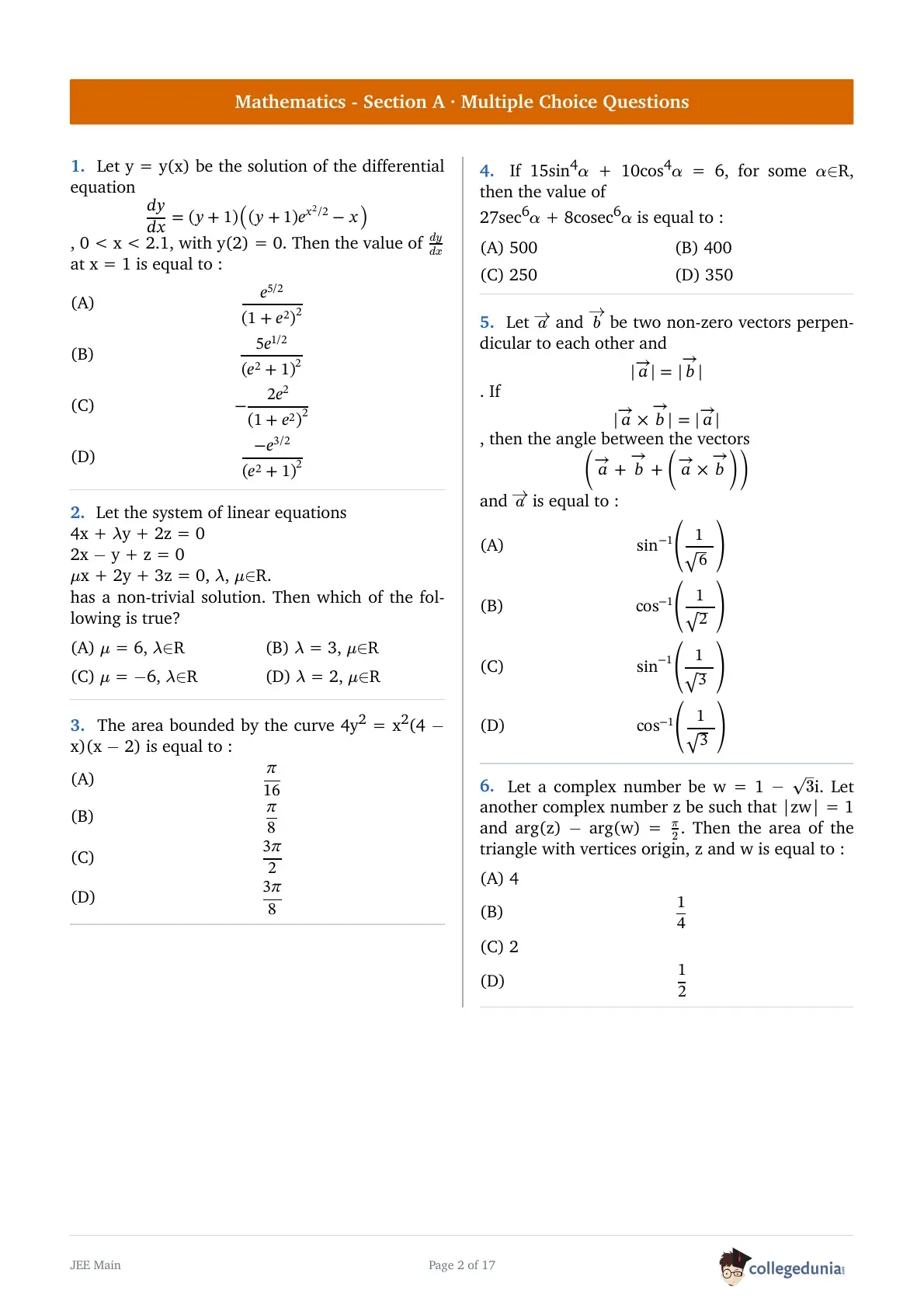
Let y = y(x) be the solution of the differential equation dy/dx = (y + 1) ((y + 1)e^{x²/2 - x} - 1), 0<x<2.1, with y(2) = 0. Then the value of dy/dx at x=1 is equal to :
Let the system of linear equations 4x + λy + 2z = 0 ; 2x - y + z = 0 ; μx + 2y + 3z = 0, λ, μ ∈ R has a non-trivial solution. Then which of the following is true ?
The area bounded by the curve 4y² = x²(4 - x)(x - 2) is equal to :
If 15 sin⁴ α + 10 cos⁴ α = 6, for some α ∈ R, then the value of 27 sec⁶ α + 8 cosec⁶ α is equal to :
Let a and b be two non-zero vectors perpendicular to each other and |a| = |b|. If |a × b| = |a|, then the angle between the vectors (a + b + (a × b)) and a is equal to :
Let a complex number be w = 1 - √3 i. Let another complex number z be such that |z w| = 1 and arg(z) - arg(w) = π/2. Then the area of the triangle with vertices origin, z and w is equal to :
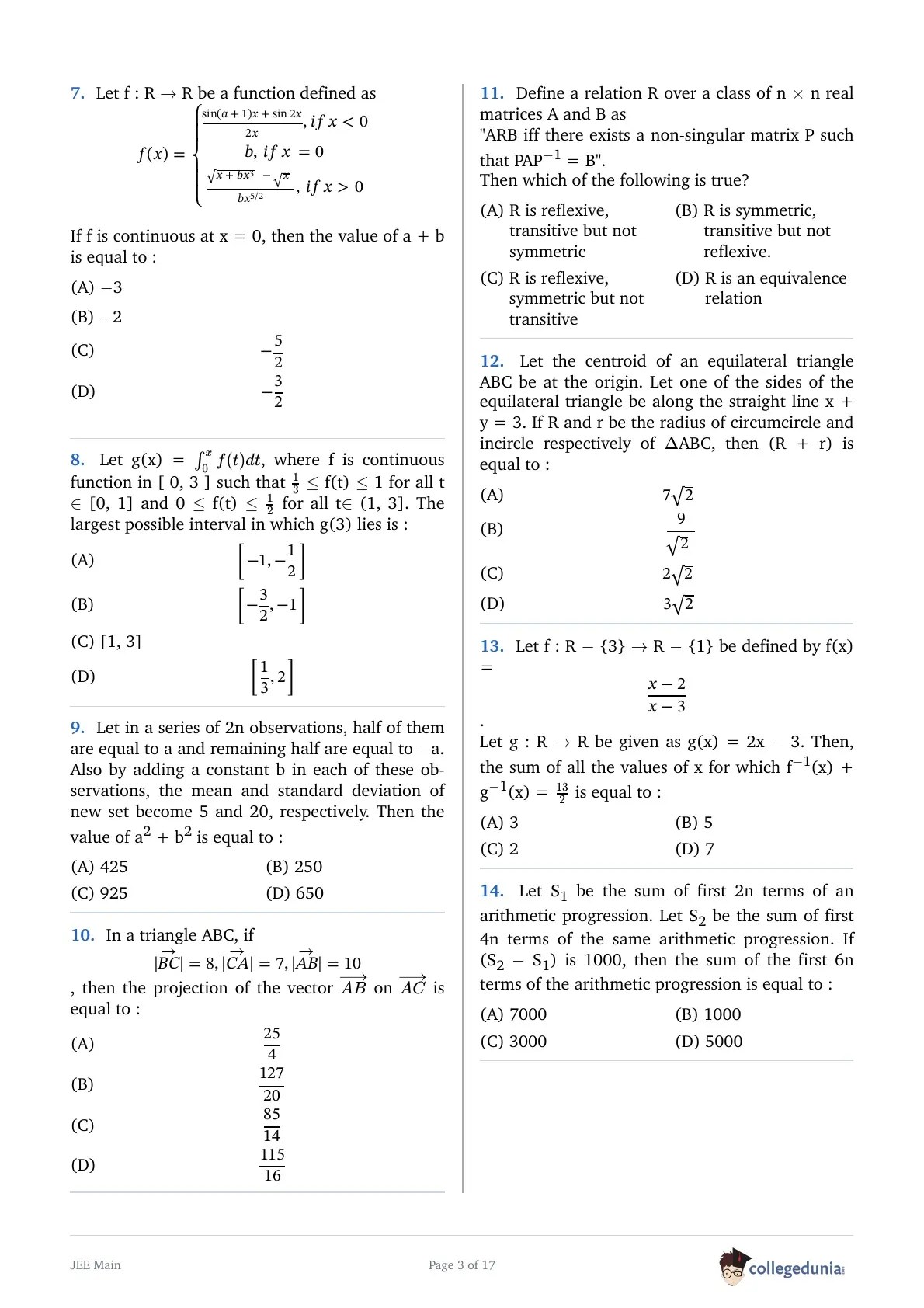
Let \( f : \mathbb{R} \to \mathbb{R} \) be a function defined as \[ f(x) = \begin{cases} \dfrac{\sin\!\big((a+1)x\big) + \sin 2x}{2x}, & \text{if } x < 0, \\[6pt] b, & \text{if } x = 0, \\[6pt] \dfrac{\sqrt{x + b x^3} - \sqrt{x}}{b\, x^{5/2}}, & \text{if } x > 0. \end{cases} \] If \( f \) is continuous at \( x = 0 \), then the value of \( a + b \) is equal to :
Let g(x) = ∫₀ˣ f(t) dt, where f is continuous function in [0, 3] such that 1/3 ≤ f(t) ≤ 1 for all t ∈ [0, 1] and 0 ≤ f(t) ≤ 1/2 for all t ∈ (1, 3]. The largest possible interval in which g(3) lies is :
Let in a series of 2n observations, half of them are equal to a and remaining half are equal to -a. Also by adding a constant b in each of these observations, the mean and standard deviation of new set become 5 and 20, respectively. Then the value of a² + b² is equal to :
In a triangle ABC, if |BC| = 8, |CA| = 7, |AB| = 10, then the projection of the vector AB on AC is equal to :
Define a relation R over a class of n × n real matrices A and B as "ARB iff there exists a non-singular matrix P such that P A P⁻¹ = B". Then which of the following is true ?
Let the centroid of an equilateral triangle ABC be at the origin. Let one of the sides of the equilateral triangle be along the straight line x+y=3. If R and r be the radius of circumcircle and incircle respectively of ΔABC, then (R + r) is equal to :
Let f : R - {3} → R - {1} be defined by f(x) = (x - 2)/(x - 3). Let g : R → R be given as g(x) = 2x - 3. Then, the sum of all the values of x for which f⁻¹(x) + g⁻¹(x) = 13/2 is equal to.
Let S1 be the sum of first 2n terms of an arithmetic progression. Let S2 be the sum of first 4n terms of the same arithmetic progression. If (S2 - S1) is 1000, then the sum of the first 6n terms of the arithmetic progression is equal to :
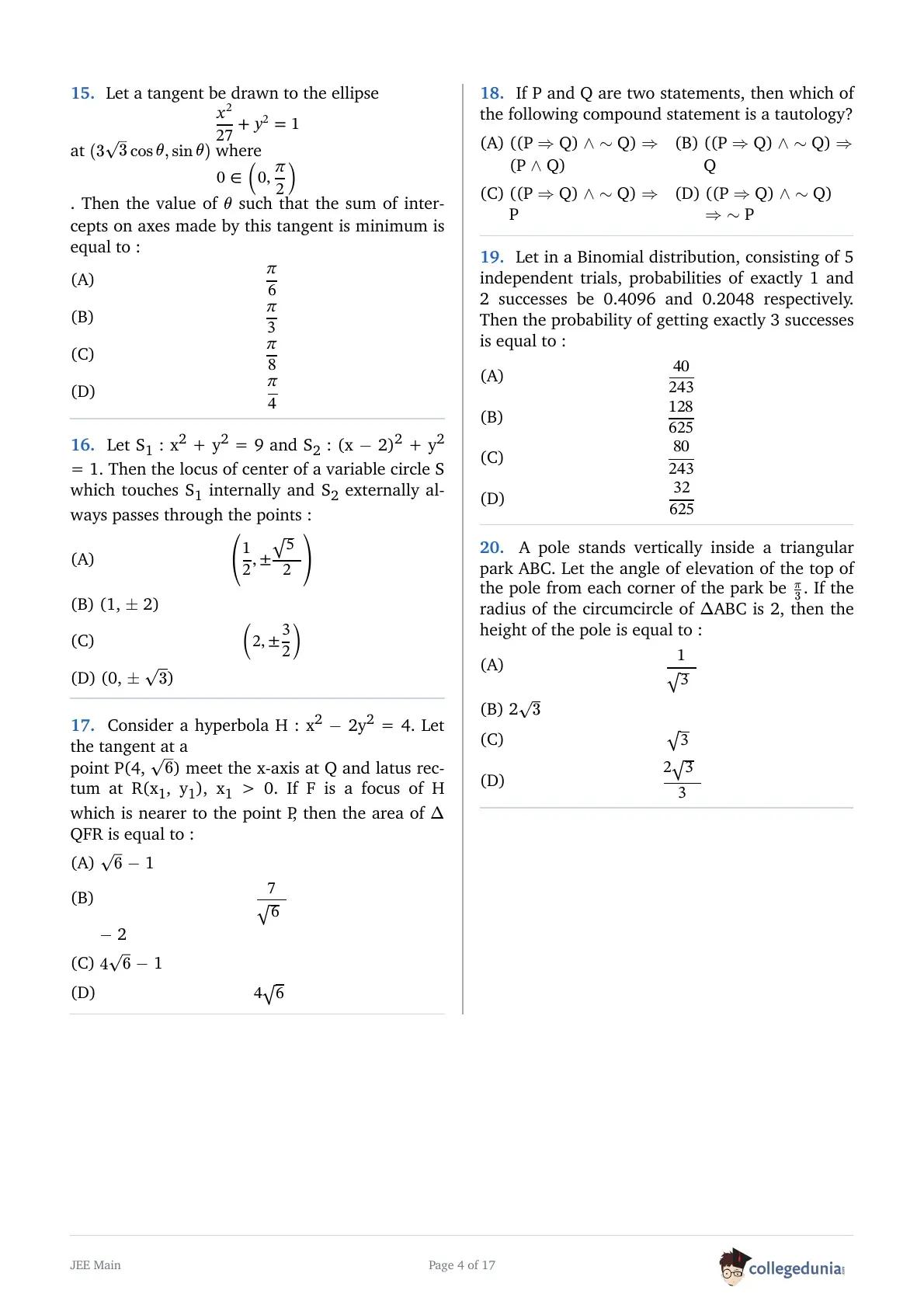
Let a tangent be drawn to the ellipse x²/27 + y² = 1 at (3\(\sqrt{3}\) cosθ, sinθ) where θ ∈ (0, π/2). Then the value of θ such that the sum of intercepts on axes made by this tangent is minimum is equal to :
Let S1 : x² + y² = 9 and S2 : (x - 2)² + y² = 1. Then the locus of center of a variable circle S which touches S1 internally and S2 externally always passes through the points :
Consider a hyperbola H: x² - 2y² = 4. Let the tangent at a point P(4, √6) meet the x-axis at Q and latus rectum at R(x₁, y₁), x₁>0. If F is a focus of H which is nearer to the point P, then the area of ΔQFR is equal to :
If P and Q are two statements, then which of the following compound statement is a tautology ?
Let in a Binomial distribution, consisting of 5 independent trials, probabilities of exactly 1 and 2 successes be 0.4096 and 0.2048 respectively. Then the probability of getting exactly 3 successes is equal to :
A pole stands vertically inside a triangular park ABC. Let the angle of elevation of the top of the pole from each corner of the park be π/3. If the radius of the circumcircle of ΔABC is 2, then the height of the pole is equal to :
Mathematics - Section B (Q21 - Q30)
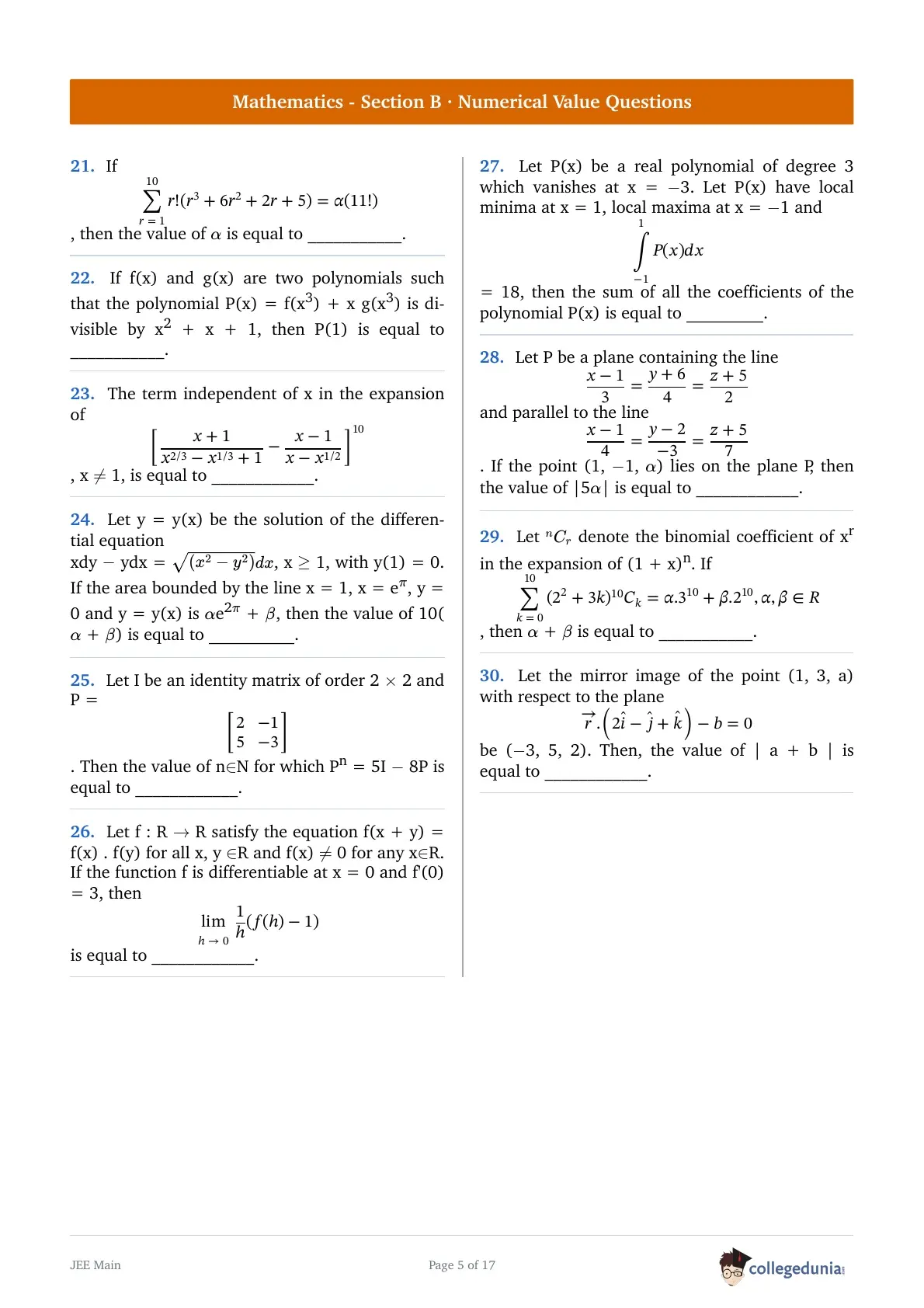
If ∑_{r=1}^{10} r! (r³ + 6r² + 2r + 5) = α (11!), then the value of α is equal to ________.
If f(x) and g(x) are two polynomials such that the polynomial P(x) = f(x³) + x · g(x³) is divisible by x² + x + 1, then P(1) is equal to ________.
The term independent of x in the expansion of [ (x + 1)/(x^{2/3} - x^{1/3} + 1) - (x - 1)/(x - x^{1/2}) ]¹⁰, x ≠ 1, is equal to ________.
Let y=y(x) be the solution of the differential equation x dy - y dx = √(x² - y²) dx, x ≥ 1, with y(1) = 0. If the area bounded by the line x=1, x=e^{π}, y=0 and y=y(x) is α e^{2π} + β, then the value of 10(α + β) is equal to ________.
Let I be an identity matrix of order 2 × 2 and P = [2 -1; 5 -3]. Then the value of n ∈ N for which Pⁿ = 5I - 8P is equal to ________.
Let f: R → R satisfy the equation f(x + y) = f(x) · f(y) for all x, y ∈ R and f(x) ≠ 0 for any x ∈ R. If the function f is differentiable at x=0 and f'(0)=3, then lim_{h → 0} (1/h) (f(h) - 1) is equal to ________.
Let P(x) be a real polynomial of degree 3 which vanishes at x = -3. Let P(x) have local minima at x = 1, local maxima at x = -1 and ∫_{-1}^{1} P(x) dx = 18, then the sum of all the coefficients of the polynomial P(x) is equal to ________.
Let P be a plane containing the line (x-1)/3 = (y+6)/4 = (z+5)/2 and parallel to the line (x-3)/4 = (y-2)/(-3) = (z+5)/7. If the point (1, -1, α) lies on the plane P, then the value of |α| is equal to ________.
Let n C_r denote the binomial coefficient of x^r in the expansion of (1 + x)^n. If ∑_{k=0}^{10} (2² + 3k) n C_k = α 3^{10} + β 2^{10}, α, β ∈ R, then α + β is equal to ________.
Let the mirror image of the point (1, 3, a) with respect to the plane r · (2 i - j + k) - b = 0 be (-3, 5, 2). Then, the value of |a + b| is equal to ________.
Physics - Section A (Q31 - Q50)
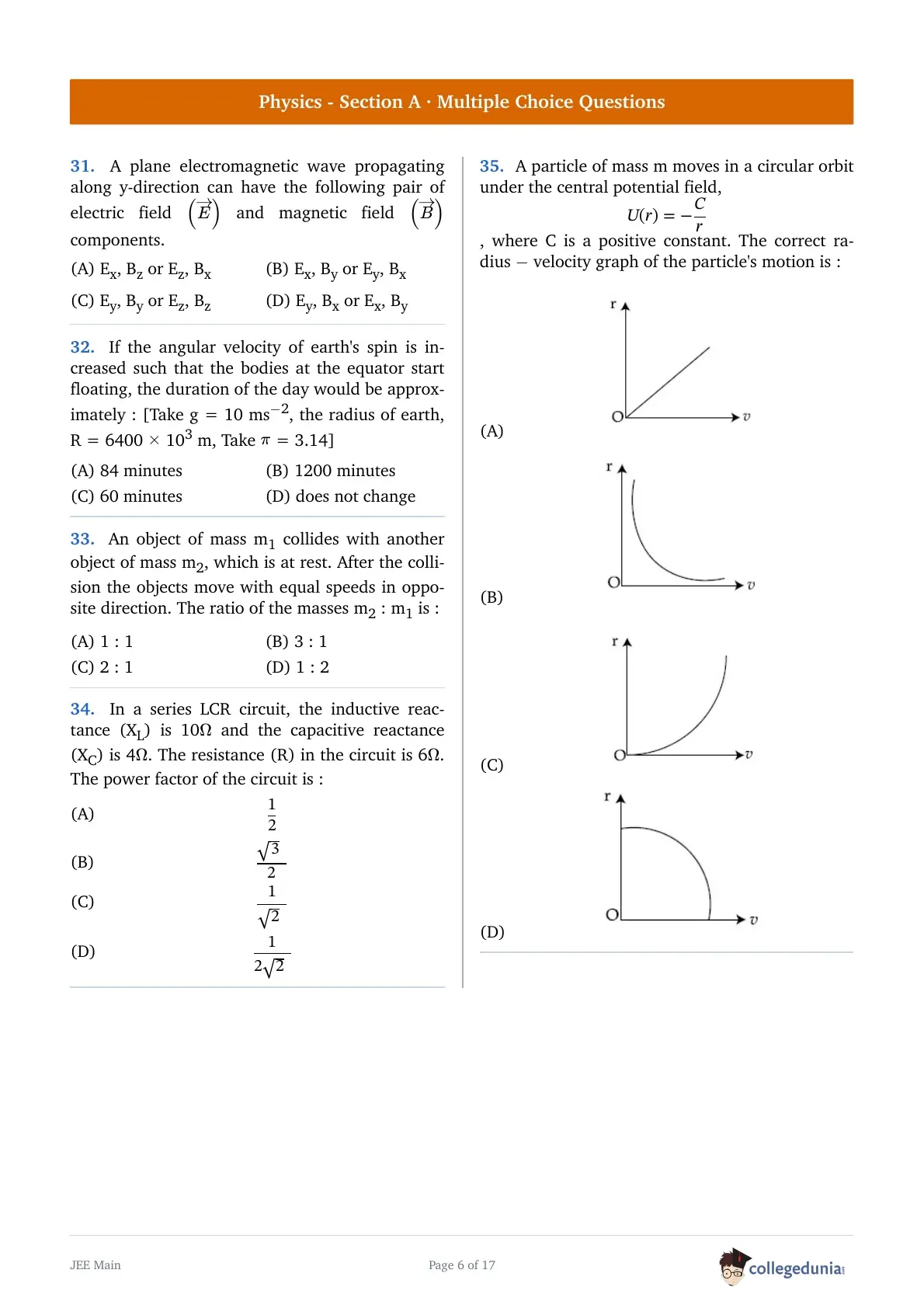
A plane electromagnetic wave propagating along y-direction can have the following pair of electric field (\(\vec{E}\)) and magnetic field (\(\vec{B}\)) components:
If the angular velocity of earth's spin is increased such that the bodies at the equator start floating, the duration of the day would be approximately: [Take \(g = 10\) ms⁻², \(R = 6400 \times 10^3\) m, \(\pi = 3.14\)]
An object of mass \(m_1\) collides with another object of mass \(m_2\), which is at rest. After the collision the objects move with equal speeds in opposite direction. The ratio of the masses \(m_2 : m_1\) is:
In a series LCR circuit, the inductive reactance (\(X_L\)) is 10 \(\Omega\) and the capacitive reactance (\(X_C\)) is 4 \(\Omega\). The resistance (R) in the circuit is 6 \(\Omega\). The power factor of the circuit is:
A particle of mass \(m\) moves in a circular orbit under the central potential field, \(U(r) = -\frac{C}{r}\), where \(C\) is a positive constant. The correct radius – velocity graph of the particle's motion is: 
The angular momentum of a planet of mass \(M\) moving around the sun in an elliptical orbit is \(\vec{L}\). The magnitude of the areal velocity of the planet is:
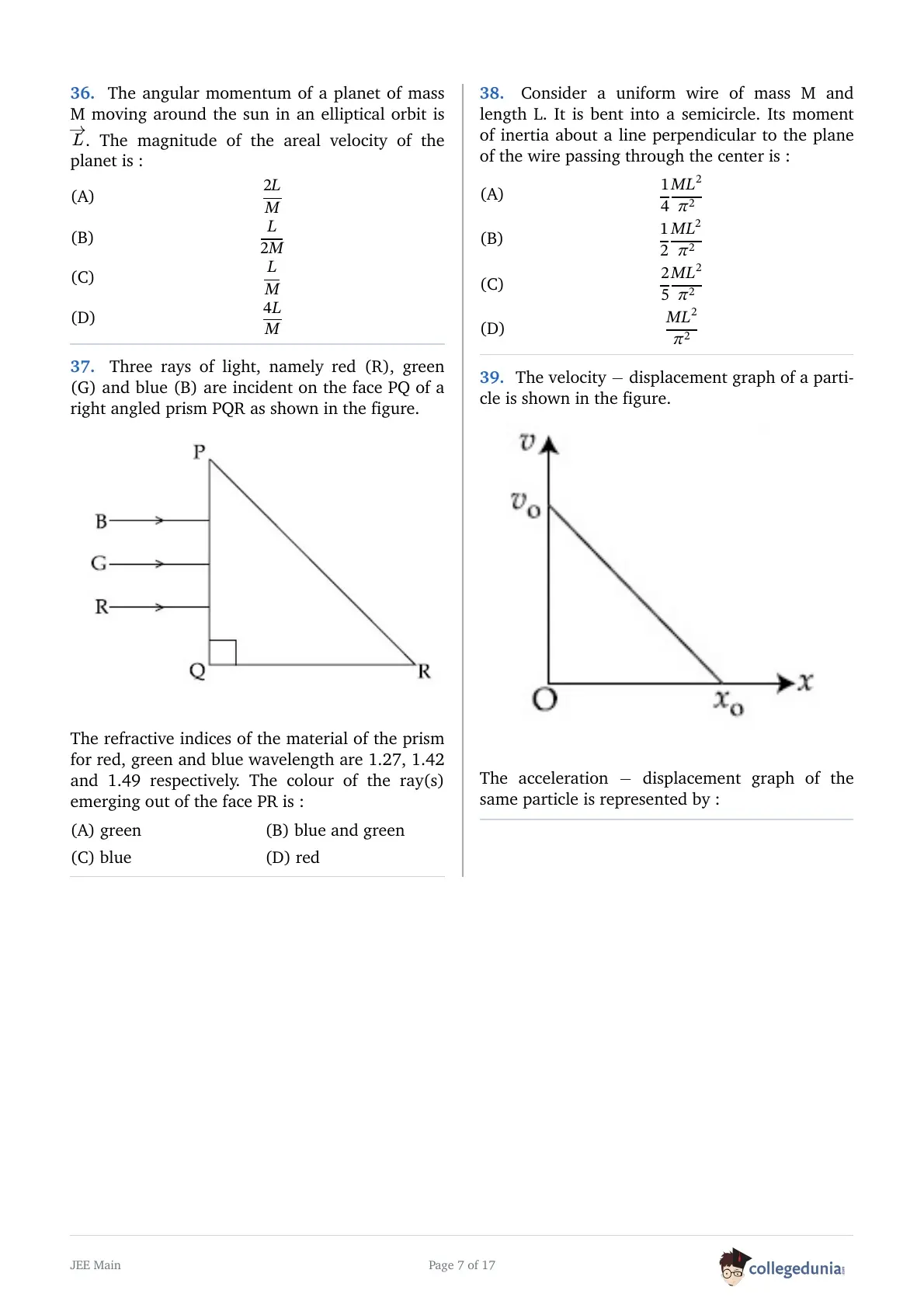
Three rays (R, G, B) are incident on PQ... Refractive indices are 1.27, 1.42 and 1.49. The colour of the ray(s) emerging out of the face PR is: 
Consider a uniform wire of mass \(M\) and length \(L\). It is bent into a semicircle. Its moment of inertia about a line perpendicular to the plane of the wire passing through the centre is:
The velocity - displacement graph of a particle is shown in the figure.
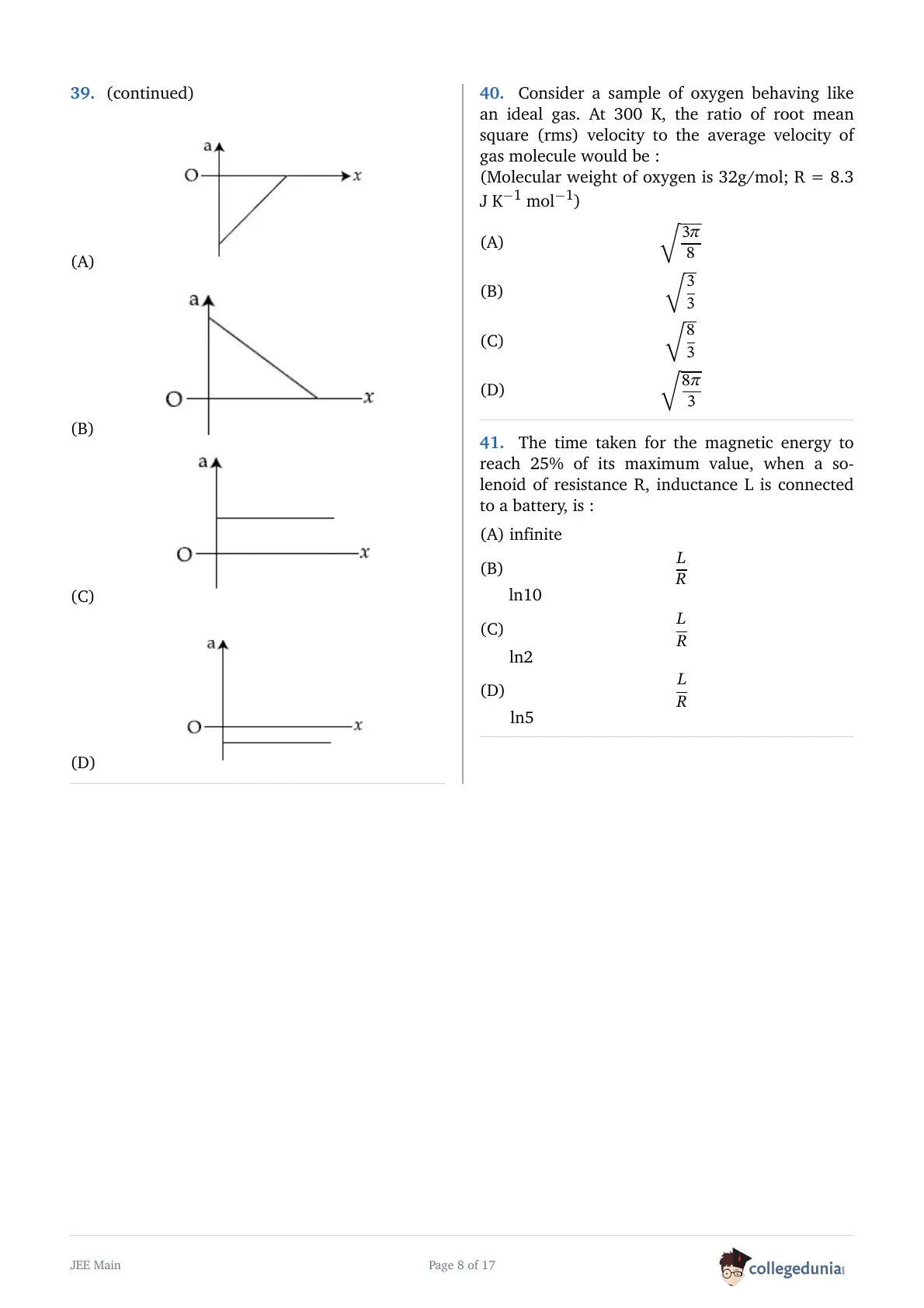
The acceleration - displacement graph of the same particle is represented by: 
Consider a sample of oxygen behaving like an ideal gas. At 300 K, the ratio of root mean square (rms) velocity to the average velocity of gas molecule would be: (Molecular weight of oxygen is 32 g/mol; R = 8.3 J K⁻¹ mol⁻¹)
The time taken for the magnetic energy to reach 25% of its maximum value in an LR circuit is:
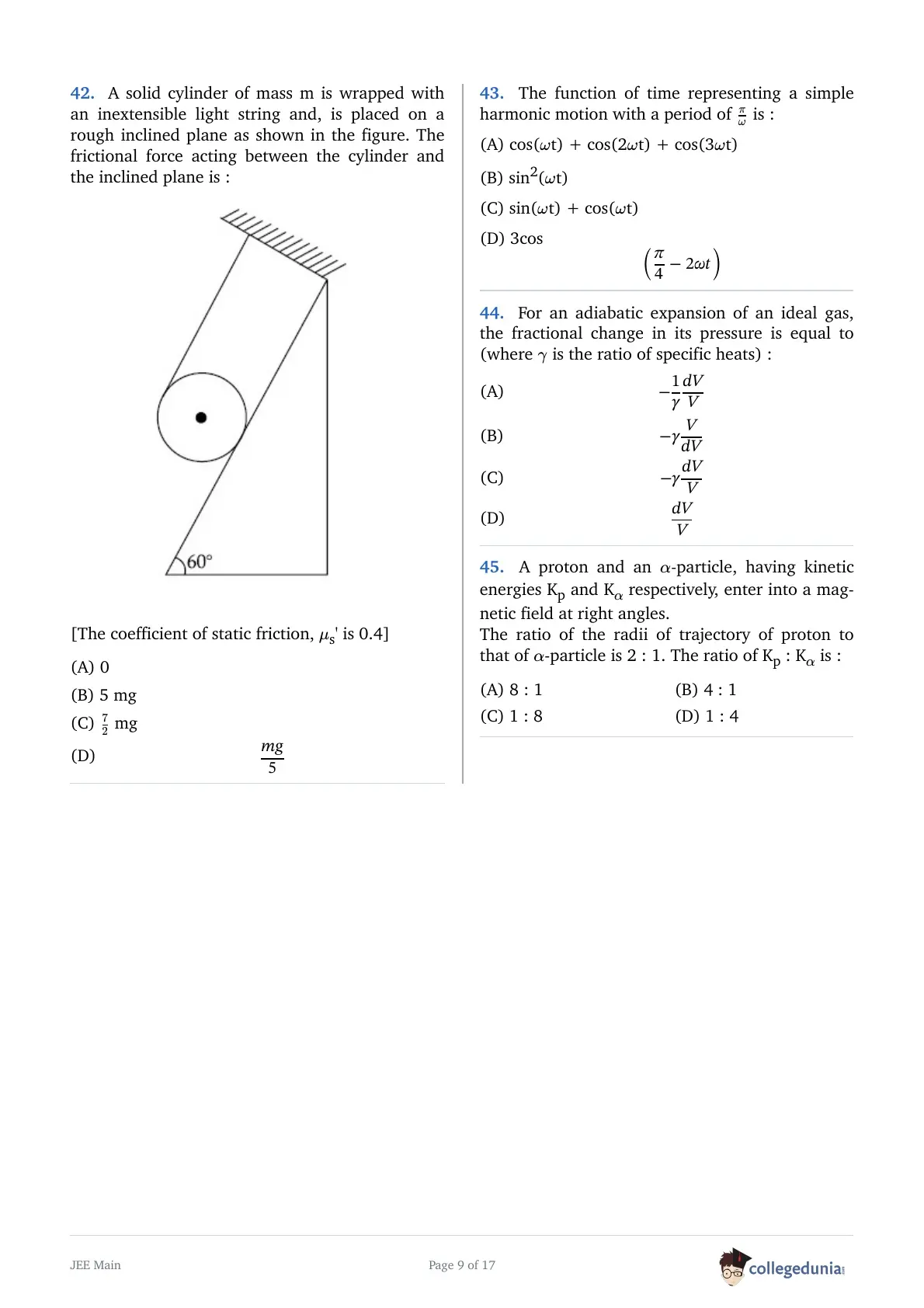
A solid cylinder of mass \(m\) is wrapped with an inextensible light string and is placed on a rough inclined plane as shown in the figure. The frictional force acting between the cylinder and the inclined plane is: [The coefficient of static friction, \(\mu_s\), is 0.4] (Figure: Cylinder on 60° incline with string wrapped parallel to the incline) 
The function of time representing a simple harmonic motion with a period of \(\frac{\pi}{\omega}\) is:
For an adiabatic expansion of an ideal gas, the fractional change in its pressure is equal to (where \(\gamma\) is the ratio of specific heats):
A proton and an \(\alpha\)-particle enter into a magnetic field at right angles. The ratio of the radii of trajectory of proton to that of \(\alpha\)-particle is 2 : 1. The ratio of \(K_p : K_{\alpha}\) is:
An ideal gas in a cylinder is separated by a piston in such a way that the entropy of one part is \(S_1\) and that of the other part is \(S_2\). Given that \(S_1>S_2\). If the piston is removed then the total entropy of the system will be:
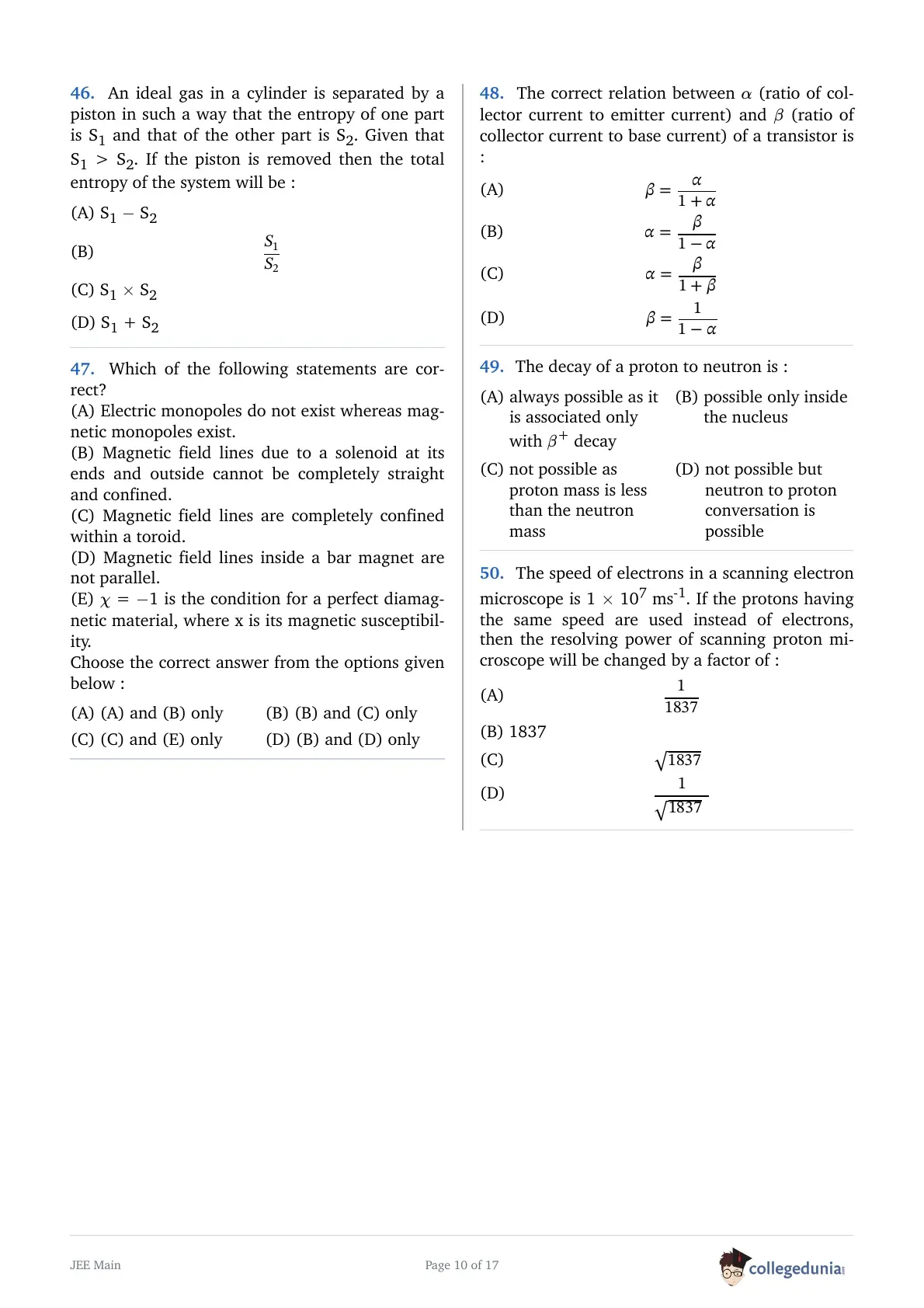
Which of the following statements are correct?
(A) Electric monopoles do not exist whereas magnetic monopoles exist.
(B) Magnetic field lines due to a solenoid at its ends and outside cannot be completely straight and confined.
(C) Magnetic field lines are completely confined within a toroid.
(D) Magnetic field lines inside a bar magnet are not parallel.
(E) χ = -1 is the condition for a perfect diamagnetic material, where χ is its magnetic susceptibility.
Choose the correct answer from the options given below:
The correct relation between \(\alpha\) (ratio of \(I_C\) to \(I_E\)) and \(\beta\) (ratio of \(I_C\) to \(I_B\)) of a transistor is:
The decay of a proton to neutron is:
The speed of electrons in a scanning electron microscope is \(1 \times 10^7\) ms⁻¹. If the protons having the same speed are used instead of electrons, then the resolving power of scanning proton microscope will be changed by a factor of:
Physics - Section B (Q51 - Q60)
Two wires of same length and thickness having specific resistances 6 \(\Omega\) cm and 3 \(\Omega\) cm respectively are connected in parallel. The effective resistivity is \(\rho \Omega\) cm. The value of \(\rho\), to the nearest integer, is __________.
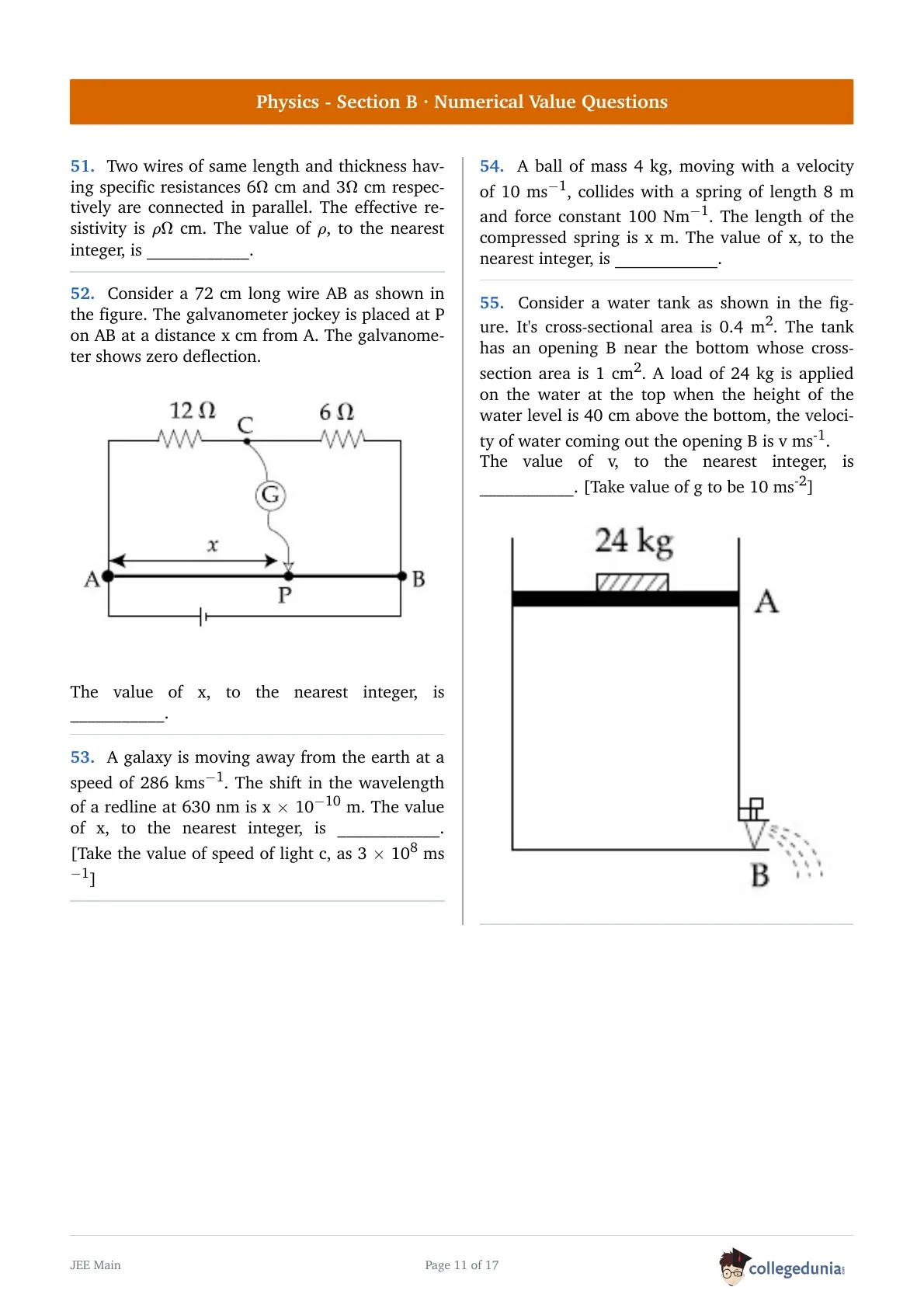
Consider a 72 cm long wire AB as shown in the figure. The galvanometer jockey is placed at P on AB at a distance x cm from A. The galvanometer shows zero deflection. The value of x, to the nearest integer, is ________. 
A galaxy is moving away from the earth at a speed of 286 kms\(^{-1}\). The shift in the wavelength of a redline at 630 nm is x \(\times 10^{-10}\) m. The value of x, to the nearest integer, is ________. [Take the value of speed of light c, as 3 \(\times 10^8\) ms\(^{-1}\)]
A ball of mass 4 kg, moving with a velocity of 10 ms\(^{-1}\), collides with a spring of length 8 m and force constant 100 Nm\(^{-1}\). The length of the compressed spring is x m. The value of x, to the nearest integer, is __________.
Consider a water tank as shown in the figure. It's cross-sectional area is 0.4 m². The tank has an opening B near the bottom whose cross-section area is 1 cm². A load of 24 kg is applied on the water at the top when the height of the water level is 40 cm above the bottom, the velocity of water coming out the opening B is v ms\(^{-1}\). The value of v, to the nearest integer, is ________. [Take value of g to be 10 ms\(^{-2}\)] 
The radius of a sphere is measured to be (7.50 ± 0.85) cm. Suppose the percentage error in its volume is x. The value of x, to the nearest integer, is __________.
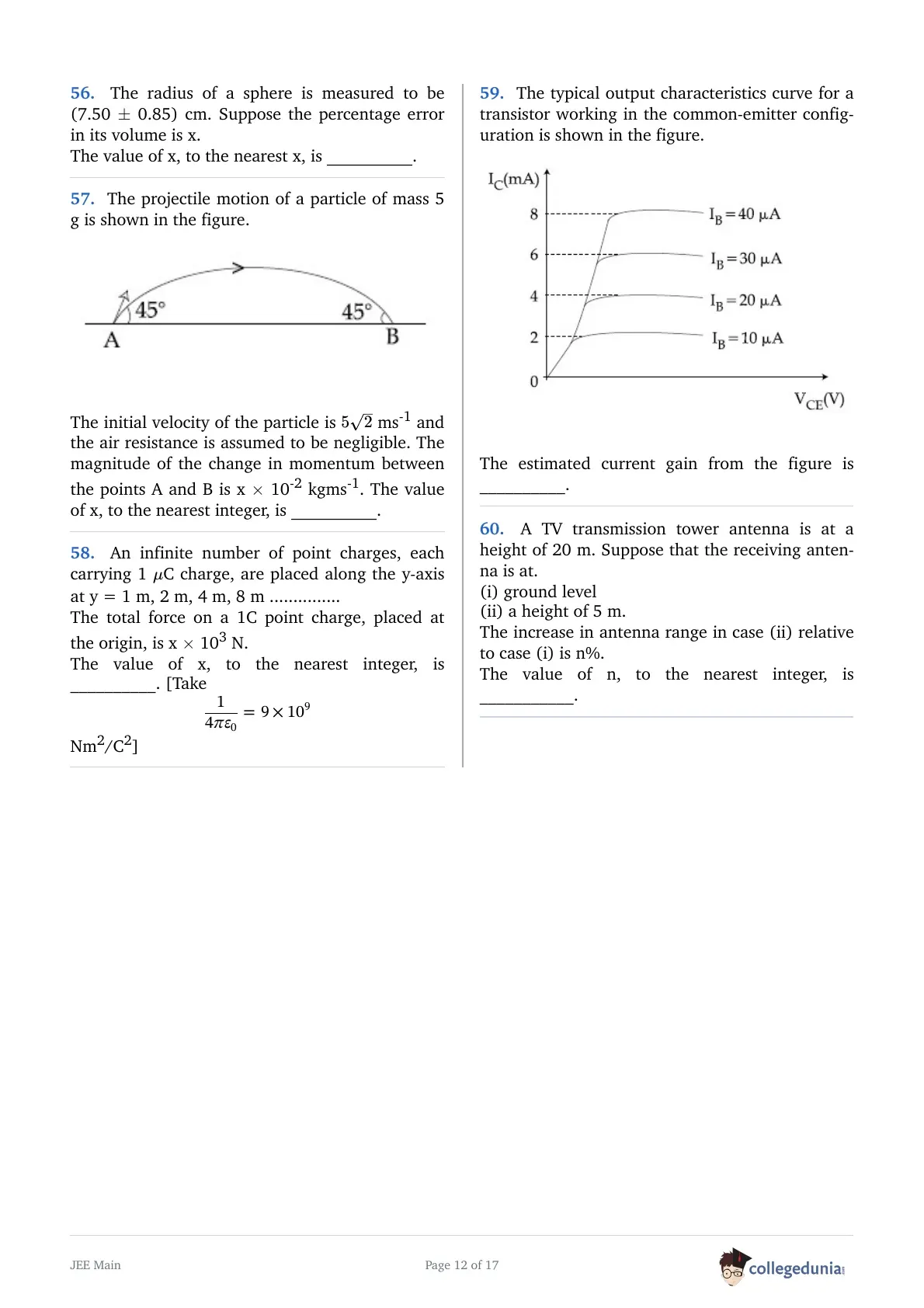
The projectile motion of a particle of mass 5 g is shown in the figure.
The initial velocity of the particle is \(5\sqrt{2}\) ms\(^{-1}\) and the air resistance is assumed to be negligible. The magnitude of the change in momentum between the points A and B is x \(\times 10^{-2}\) kgms\(^{-1}\). The value of x, to the nearest integer, is ________.
An infinite number of point charges, each carrying 1 µC charge, are placed along the y-axis at y = 1 m, 2 m, 4 m, 8 m ............ . The total force on a 1 C point charge, placed at the origin, is x \(\times 10^3\) N. The value of x, to the nearest integer, is ________. [Take \(\frac{1}{4\pi\epsilon_0} = 9 \times 10^9\) Nm²/C²]
The typical output characteristics curve for a transistor working in the common-emitter configuration is shown in the figure. The estimated current gain from the figure is ________. 
A TV transmission tower antenna is at a height of 20 m. Suppose that the receiving antenna is at. (i) ground level (ii) a height of 5 m. The increase in antenna range in case (ii) relative to case (i) is n%. The value of n, to the nearest integer, is __________.
Chemistry - Section A (Q61 - Q80)
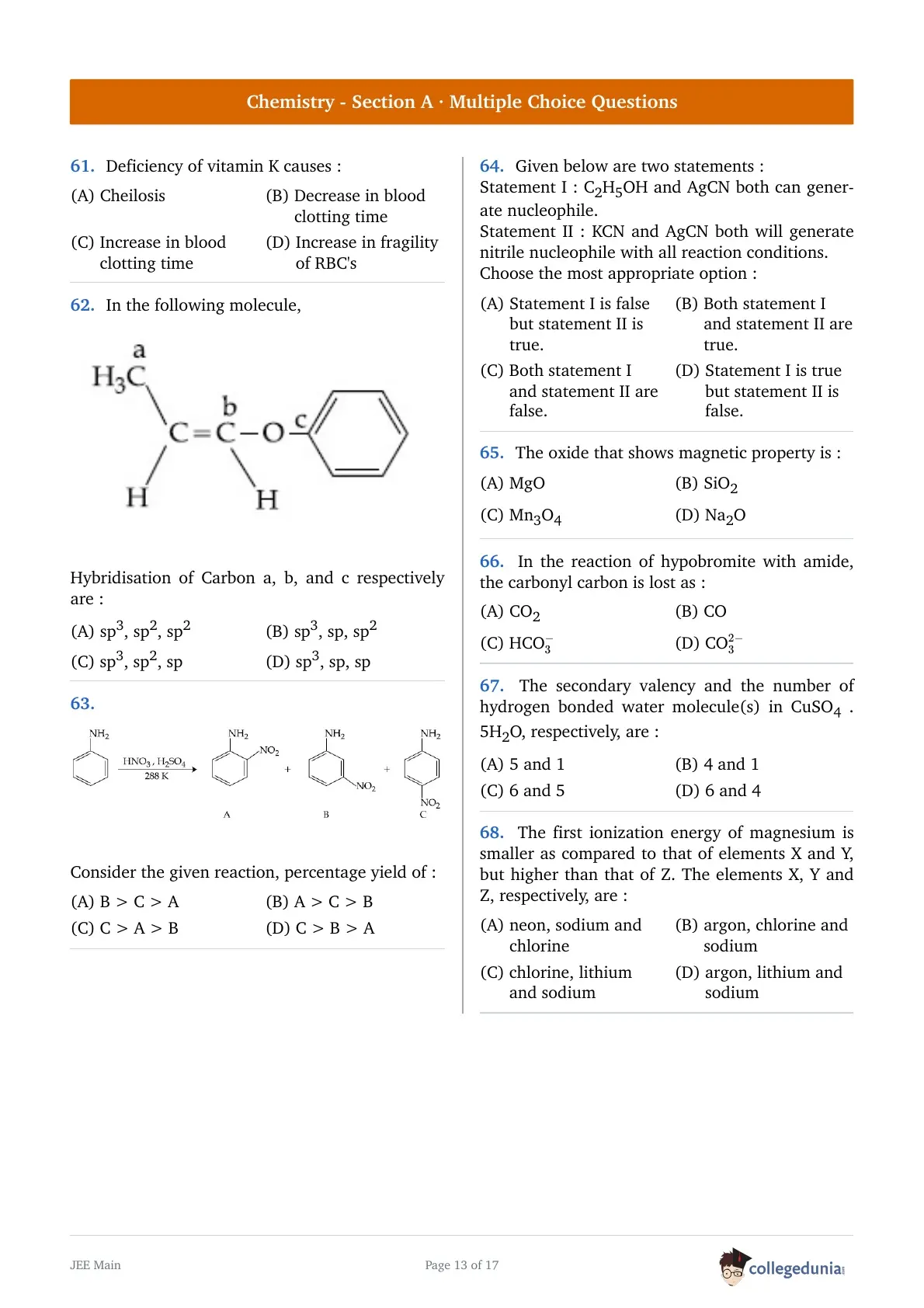
Deficiency of vitamin K causes :
In the following molecule,
Hybridisation of Carbon a, b and c respectively are :
Consider the given reaction, percentage yield of : 
Given below are two statements : Statement I : C₂H₅OH and AgCN both can generate nucleophile. Statement II : KCN and AgCN both will generate nitrile nucleophile with all reaction conditions. Choose the most appropriate option :
The oxide that shows magnetic property is :
In the reaction of hypobromite with amide, the carbonyl carbon is lost as :
The secondary valency and the number of hydrogen bonded water molecule(s) in CuSO₄·5H₂O, respectively, are :
The first ionization energy of magnesium is smaller as compared to that of elements X and Y, but higher than that of Z. The elements X, Y and Z, respectively, are :
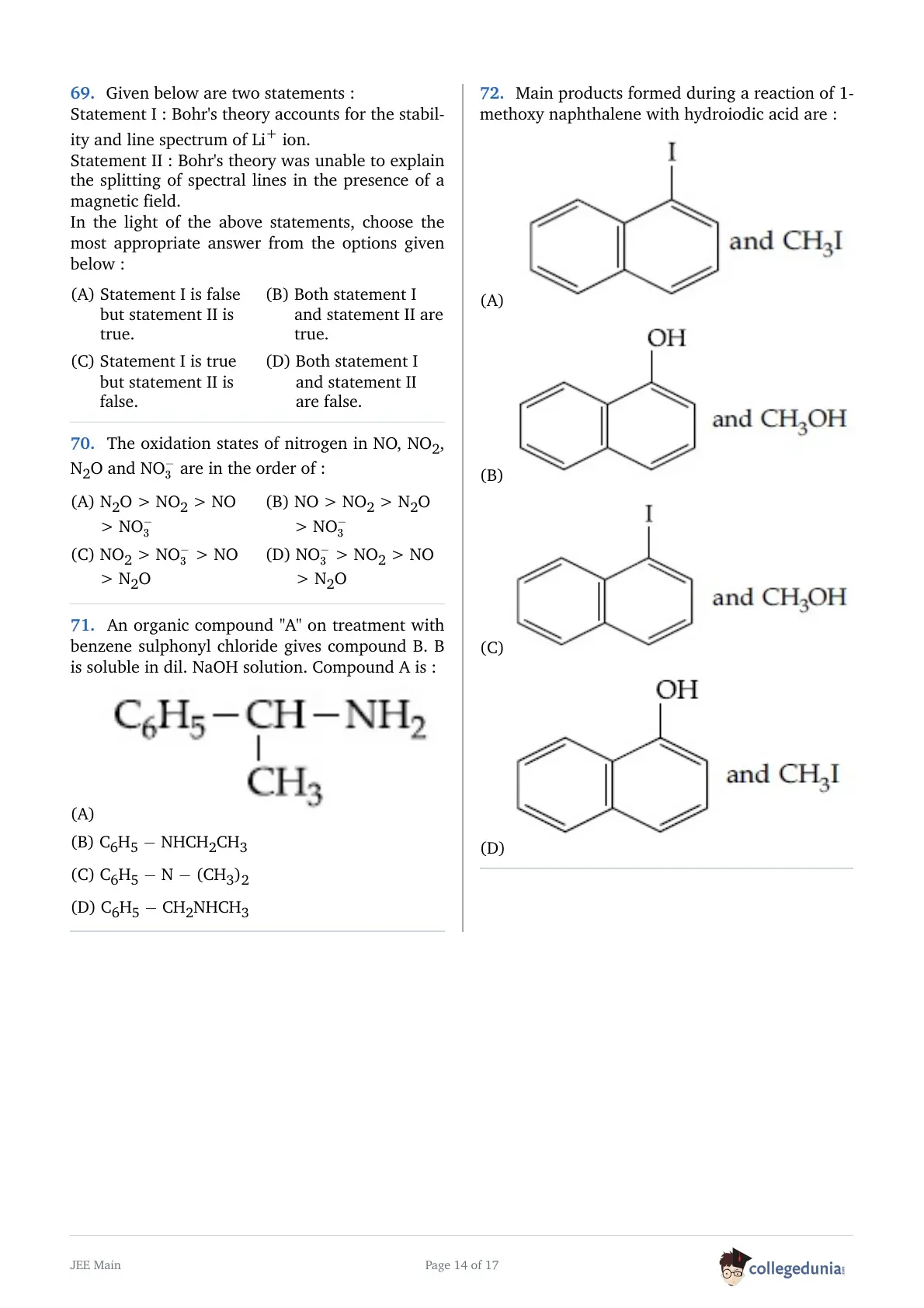
Given below are two statements : Statement I : Bohr's theory accounts for the stability and line spectrum of Li⁺ ion. Statement II : Bohr's theory was unable to explain the splitting of spectral lines in the presence of a magnetic field. In the light of the above statements, choose the most appropriate answer from the options given below :
The oxidation states of nitrogen in NO, NO₂, N₂O and NO₃⁻ are in the order of :
An organic compound "A" on treatment with benzene sulphonyl chloride gives compound B. B is soluble in dil. NaOH solution. Compound A is :
Main Products formed during a reaction of 1-methoxy naphthalene with hydroiodic acid are :
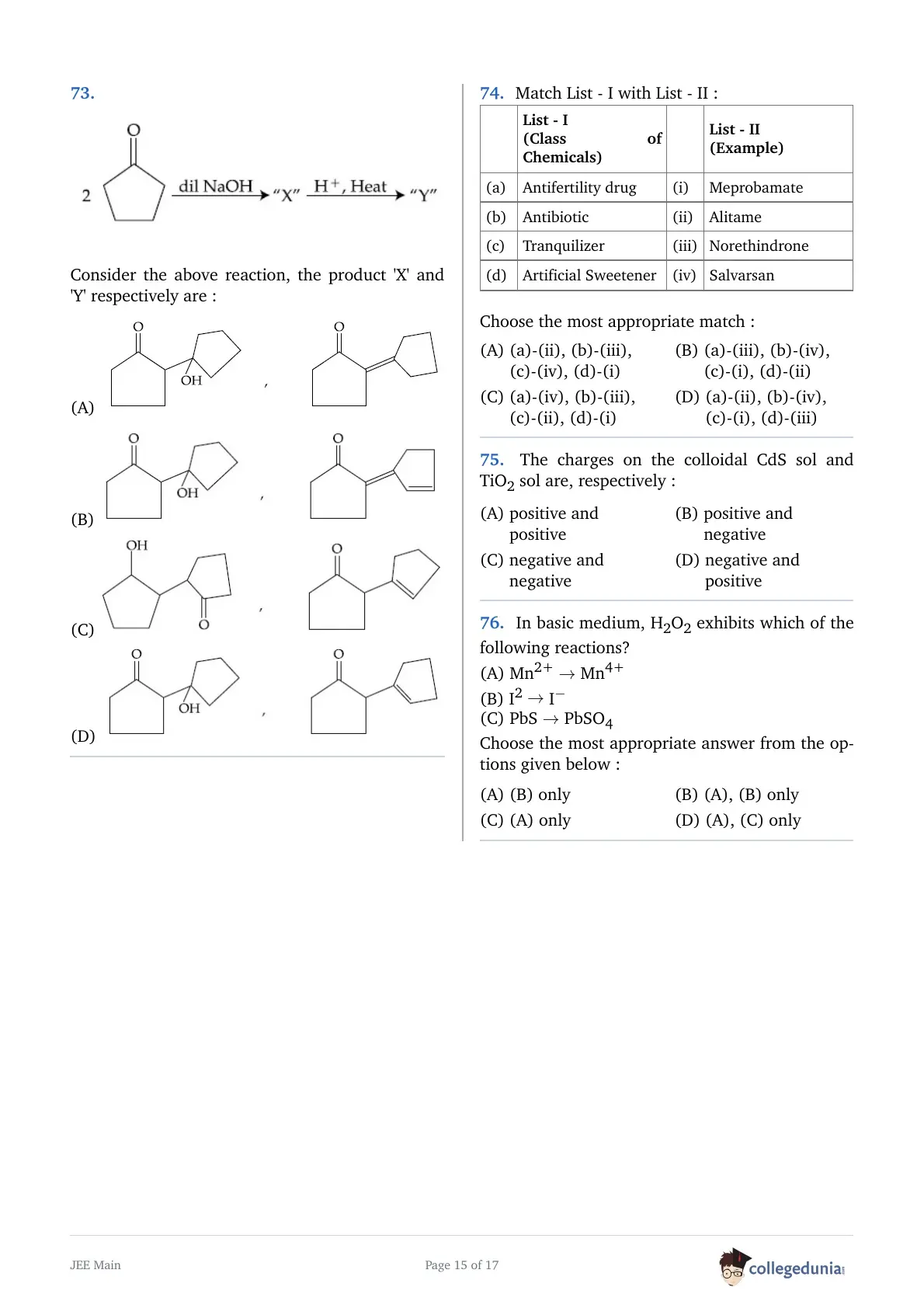
Consider the above reaction, the product 'X' and 'Y' respectively are 
Match List - I with List - II :
List - I (a) Antifertility drug (b) Antibiotic (c) Tranquilizer (d) Artificial Sweetener
List - II (i) Meprobamate (ii) Alitame (iii) Norethindrone (iv) Salvarsan Choose the most appropriate match :
The charges on the colloidal CdS sol and TiO₂ sol are, respectively :
In basic medium, H₂O₂ exhibits which of the following reactions ? (A) Mn²⁺ → Mn⁴⁺ (B) I₂ → I⁻ (C) PbS → PbSO₄ Choose the most appropriate answer from the options given below :
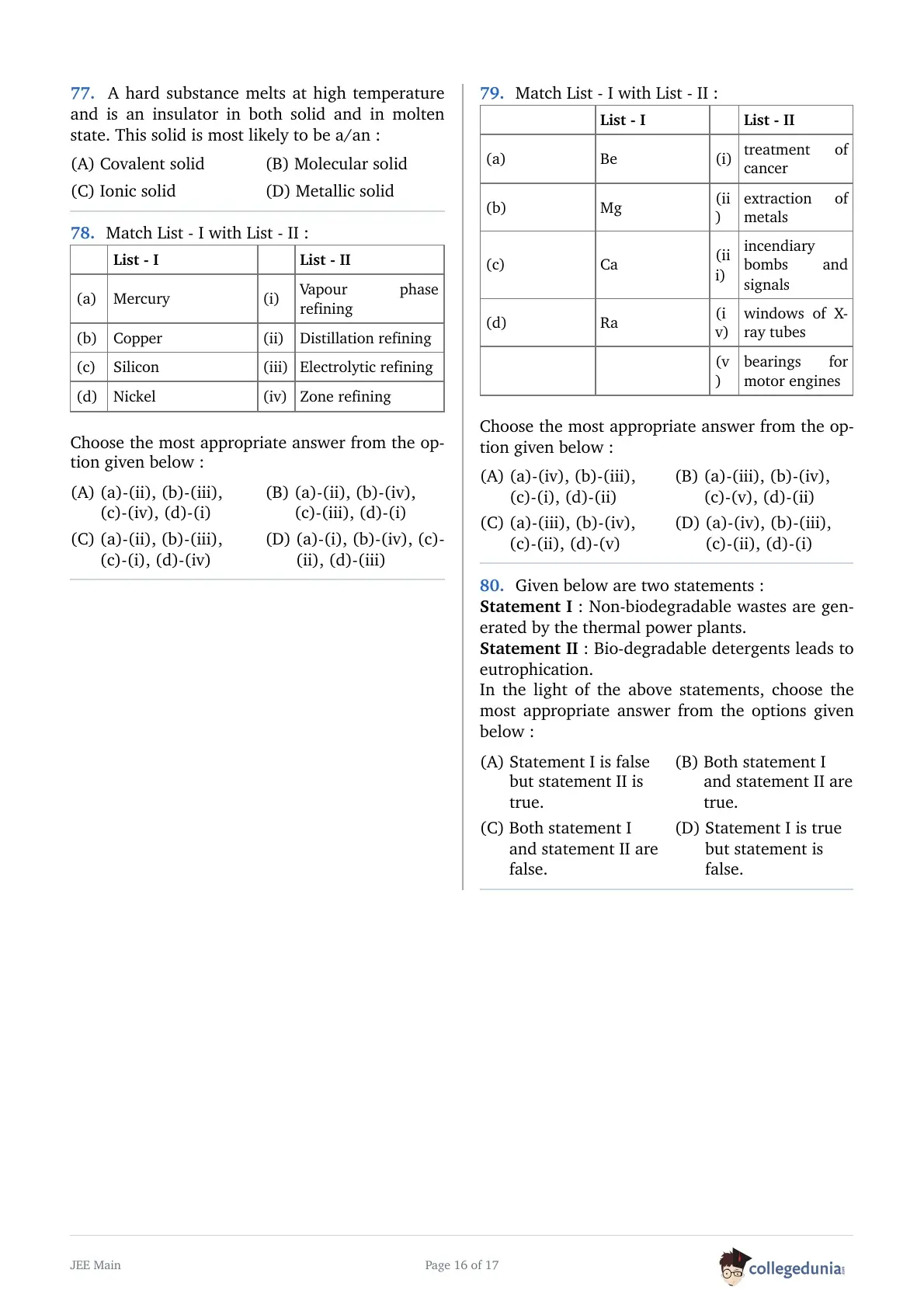
A hard substance melts at high temperature and is an insulator in both solid and in molten state. This solid is most likely to be a/an :
Match List - I with List - II :
List - I (a) Mercury (b) Copper (c) Silicon (d) Nickel
List - II (i) Vapour phase refining (ii) Distillation Refining (iii) Electrolytic Refining (iv) Zone Refining Choose the most appropriate answer from the option given below :
Match List - I with List - II : List - I (a) Be (b) Mg (c) Ca (d) Ra List - II (i) treatment of cancer (ii) extraction of metals (iii) incendiary bombs and signals (iv) windows of X-ray tubes (v) bearings for motor engines. Choose the most appropriate answer from the option given below :
Given below are two statements : Statement I : Non-biodegradable wastes are generated by the thermal power plants. Statement II : Bio-degradable detergents lead to eutrophication. In the light of the above statements, choose the most appropriate answer from the options given below :
Chemistry - Section B (Q81 - Q90)
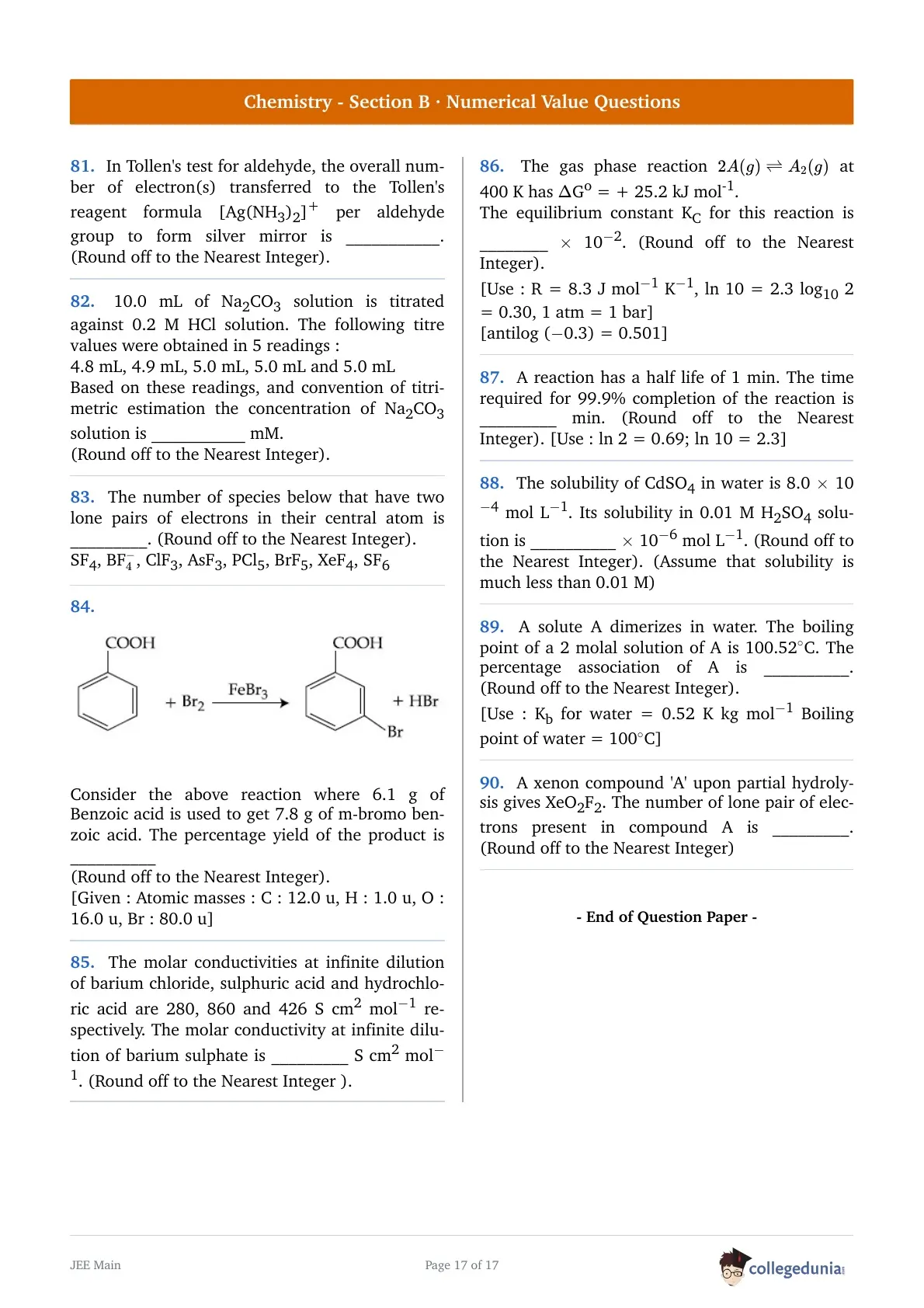
In Tollen's test for aldehyde, the overall number of electron(s) transferred to the Tollen's reagent formula [Ag(NH₃)₂]⁺ per aldehyde group to form silver mirror is __________. (Round off to the Nearest Integer).
10.0 mL of Na₂CO₃ solution is titrated against 0.2 M HCl solution. The following titre values were obtained in 5 readings: 4.8 mL, 4.9 mL, 5.0 mL, 5.0 mL and 5.0 mL. Based on these readings, and convention of titrimetric estimation the concentration of Na₂CO₃ solution is ________ mM. (Round off to the Nearest Integer).
The number of species below that have two lone pairs of electrons in their central atom is _________. (Round off to the Nearest Integer). SF₄, BF₄⁻, ClF₃, AsF₃, PCl₅, BrF₅, XeF₄, SF₆
Consider the above reaction where 6.1 g of Benzoic acid is used to get 7.8 g of m-bromo benzoic acid. The percentage yield of the product is _________. (Round off to the Nearest Integer). [Given : Atomic masses : C : 12.0 u, H : 1.0 u, O : 16.0 u, Br : 80.0 u] 
The molar conductivities at infinite dilution of barium chloride, sulphuric acid and hydrochloric acid are 280, 860 and 426 S cm² mol⁻¹ respectively. The molar conductivity at infinite dilution of barium sulphate is ________ S cm² mol⁻¹. (Round off to the Nearest Integer).
The gas phase reaction 2A(g) ⇌ A₂(g) at 400 K has ΔG° = +25.2 kJ mol⁻¹. The equilibrium constant K_p for this reaction is _________ × 10^{-2}. (Round off to the Nearest Integer). [Use : R = 8.3 J mol⁻¹ K⁻¹, ln 10 = 2.3, log₁₀ 2 = 0.30, 1 atm = 1 bar, antilog (-0.3) = 0.501]
A reaction has a half life of 1 min. The time required for 99.9% completion of the reaction is ________ min. (Round off to the Nearest Integer). [Use : ln 2 = 0.69; ln 10 = 2.3]
The solubility of CdSO₄ in water is 8.0 × 10^{-4} mol L^{-1}. Its solubility in 0.01 M H₂SO₄ solution is ________ × 10^{-6} mol L^{-1}. (Round off to the Nearest Integer). (Assume that solubility is much less than 0.01 M)
A solute A dimerizes in water. The boiling point of a 2 molal solution of A is 100.52°C. The percentage association of A is _________. (Round off to the Nearest Integer). [Use : K_b for water = 0.52 K kg mol⁻¹, Boiling point of water = 100°C]
A xenon compound 'A' upon partial hydrolysis gives XeO₂F₂. The number of lone pair of electrons present in compound A is _________. (Round off to the Nearest Integer)
JEE Main 2021 Exam Pattern and Marking Scheme
| Particulars | Details |
|---|---|
| Exam Mode | Online (Computer-Based Test) |
| Paper | B.E./B.Tech (Paper 1) |
| Duration | 3 hours (180 minutes) |
| Type of Questions | Multiple Choice Questions (MCQs) + Numerical Value Questions |
| Subjects | Mathematics, Physics, Chemistry |
| Total Questions | 90 questions (75 to be attempted) |
| Total Marks | 300 marks |
| Marking Scheme | +4 for correct answer & -1 for incorrect MCQ; no negative marking for Numerical Value Questions |
JEE Main 2021 March 18 Shift 2 Difficulty Level
JEE Main 2021 B.E./B.Tech Question Paper- March 18, 2021- Afternoon Session was moderately easy as per the coaching institutes. The distribution of class XII questions and Class XI questions was roughly equal, with 44 Questions asked from the class XI syllabus and 46 from the class XII JEE Main Syllabus. As usual, the Mathematics section was the toughest section of the paper followed by Chemistry and Physics.
JEE Main 2021 B.E./B.Tech Question Paper March 18 (Afternoon Session): Weightage of Topics
JEE Main 2021 B.E./B.Tech Question Paper March 18 (Afternoon Session) was conducted between 3.00 PM to 6.00 PM. The high weighting topics for each section were as follows:
| Subject | Topic | Marks in the Paper (including NATs) |
|---|---|---|
| Physics | Current Electricity, Electromagnetic Field | 16 (8 marks each) |
| Thermodynamics | 12 | |
| Rigid Body Dynamics, Gravitation, Error in measurement | 16 (8 marks each) | |
| Electromagnetic Waves and Communication | 8 | |
| Wave Optics | 8 | |
| SHM Waves | 8 | |
| Chemistry | Periodic Table and Periodicity in properties | 8 |
| Alkyl Halide, Alcohol and Ether | 8 | |
| Amines | 12 | |
| Carbonyl Compounds | 8 | |
| Mathematics | Binomial theorem | 8 |
| Coordinate Geometry | 12 | |
| Integral Calculus | 16 | |
| Differential Calculus | 20 | |
| Trigonometry | 16 |



Comments