




JEE Main 2021 September 1 Shift 2 Question Paper is available here with solutions PDF and detailed solutions for every question. NTA conducted the second shift on September 1, 2021, from 3:00 PM to 6:00 PM. The JEE Main 2021 Paper 1 (B.E./B.Tech) question paper includes the following:
- 90 questions in a 3-hour CBT Mode: 30 each from Mathematics, Physics and Chemistry (75 to be attempted)
- Section A: 20 multiple choice questions (MCQs) per subject, all compulsory, 4 marks each
- Section B: 10 numerical value questions per subject, any 5 to be attempted, 4 marks each
- Marking: +4 for a correct answer, -1 for an incorrect MCQ, 0 for an unattempted question; no negative marking for numerical value questions
- Maximum marks: 300 (100 per subject)
JEE Main 2021 September 1 Shift 2 Question Paper with Solution PDF
| NTA Official PDF | CD PDF | CD PDF with Solutions |
|---|---|---|
| Download official PDF 5.18 MB | Download Collegedunia PDF 1.12 MB | Download solutions PDF 1.80 MB |
Also Check:
JEE Main 2021 September 1 Shift 2 Questions with Solutions
Mathematics - Section A (Q1 - Q20)
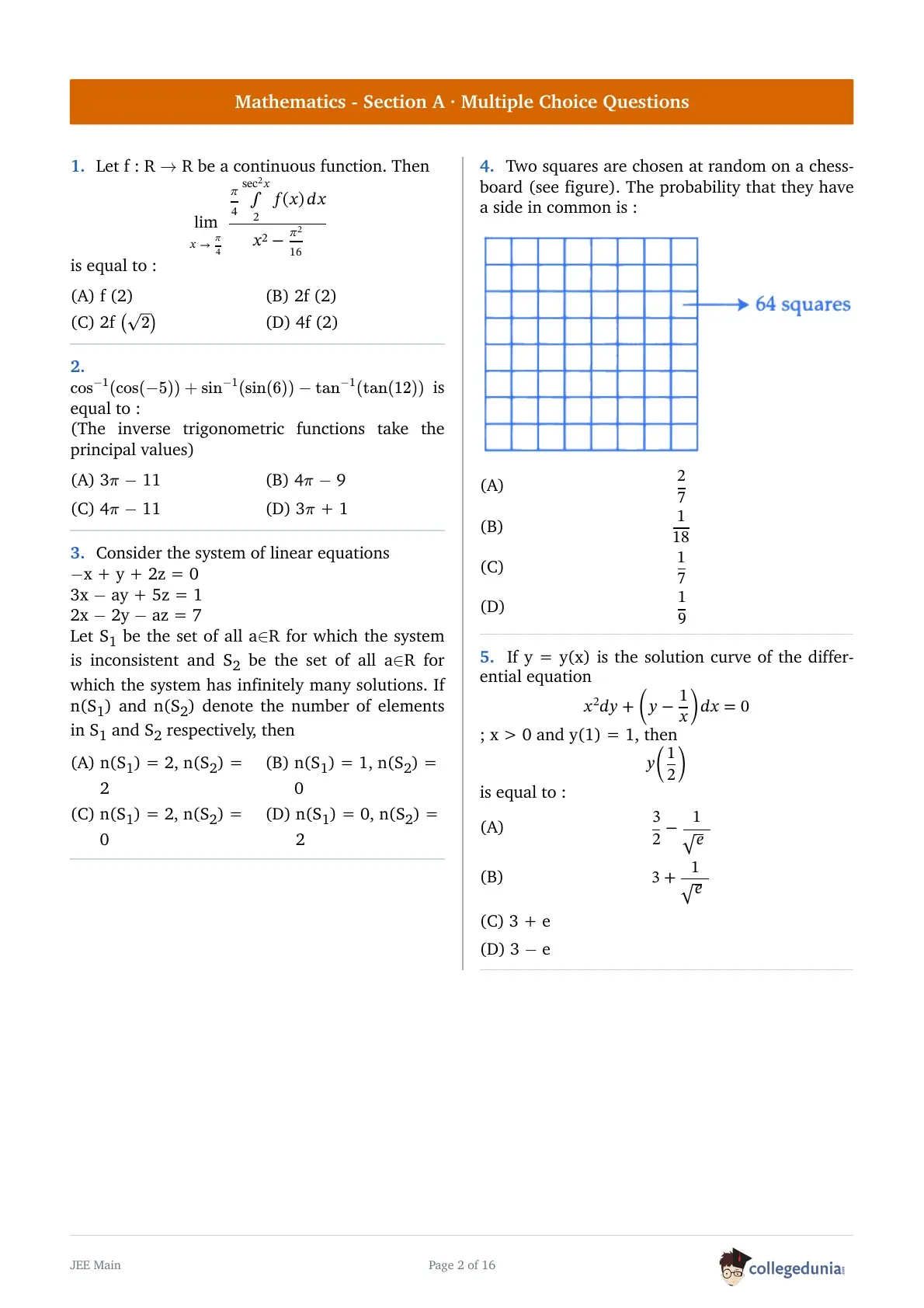
Let \(f : \mathbb{R} \to \mathbb{R}\) be a continuous function. Then
\(\displaystyle \lim_{x \to \frac{\pi}{4}} \frac{\frac{\pi}{4}\int_{2}^{\sec^2 x} f(x)\,dx}{x^2 - \frac{\pi^2}{16}}\)
is equal to :
\(\cos^{-1}(\cos(-5)) + \sin^{-1}(\sin(6)) - \tan^{-1}(\tan(12))\) is equal to :
(The inverse trigonometric functions take the principal values)
Consider the system of linear equations
\(-x + y + 2z = 0\)
\(3x - ay + 5z = 1\)
\(2x - 2y - az = 7\)
Let \(S_1\) be the set of all \(a \in \mathbb{R}\) for which the system is inconsistent and \(S_2\) be the set of all \(a \in \mathbb{R}\) for which the system has infinitely many solutions. If \(n(S_1)\) and \(n(S_2)\) denote the number of elements in \(S_1\) and \(S_2\) respectively, then
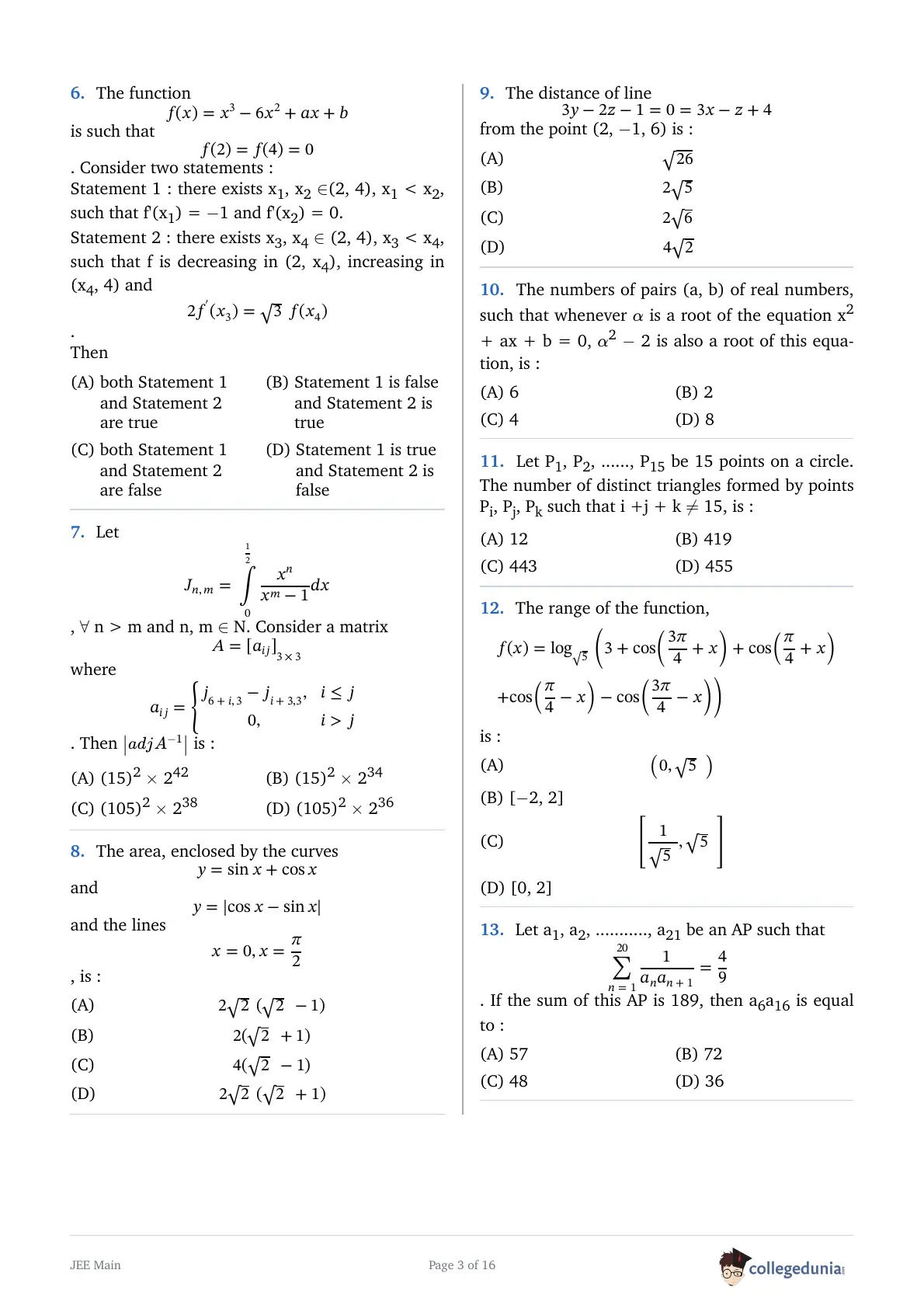
A board has 16 squares as shown in the figure. Out of these 16 squares, two squares are chosen at random. The probability that they have no side in common is:
If \(y=y(x)\) is the solution curve of the differential equation
\(x^2\,dy + \left(y - \frac{1}{x}\right)dx = 0\)
; \(x \gt 0\) and \(y(1)=1\), then \(y\left(\frac{1}{2}\right)\) is equal to :
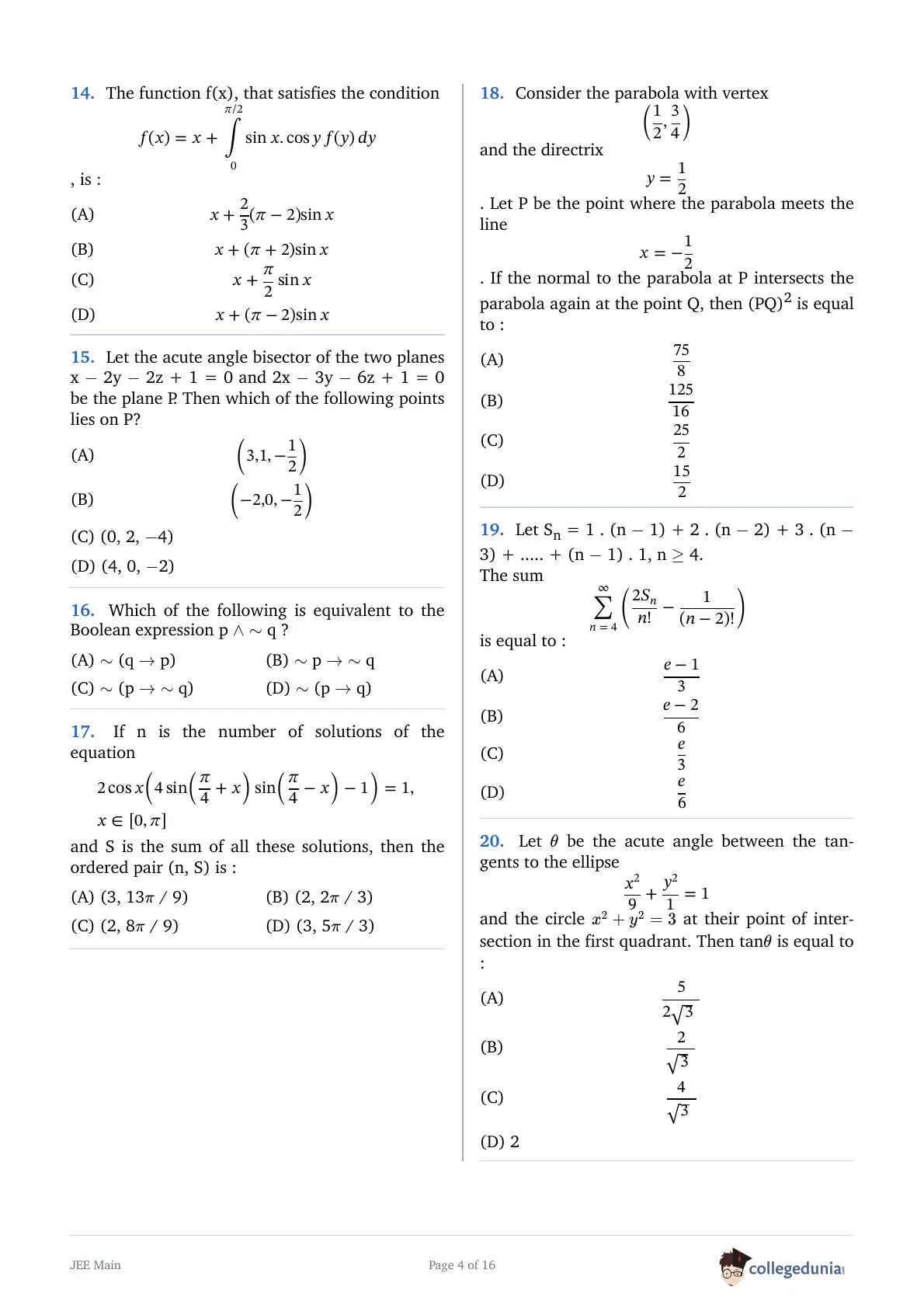
The function \(f(x)=x^3-6x^2+ax+b\) is such that \(f(2)=f(4)=0\). Consider two statements :
Statement 1 : there exists \(x_1, x_2\in(2,4)\), \(x_1 \lt x_2\), such that \(f'(x_1)=-1\) and \(f'(x_2)=0\).
Statement 2 : there exists \(x_3, x_4\in(2,4)\), \(x_3 \lt x_4\), such that \(f\) is decreasing in \((2,x_4)\), increasing in \((x_4,4)\) and \(2f'(x_3)=\sqrt{3}\,f(x_4)\).
Then
Let \(J_{n,m}=\int_0^{\frac12}\frac{x^n}{x^m-1}\,dx\), \(\forall\ n \gt m\) and \(n,m\in\mathbb{N}\). Consider a matrix \(A=[a_{ij}]_{3\times3}\) where \(a_{ij}=\begin{cases}J_{6+i,3}-J_{i+3,3}, & i\le j\\ 0, & i \gt j\end{cases}\). Then \(\left|\operatorname{adj}A^{-1}\right|\) is :
The area, enclosed by the curves \(y=\sin x+\cos x\) and \(y=|\cos x-\sin x|\) and the lines \(x=0,\ x=\frac{\pi}{2}\), is :
The distance of line \(3y-2z-1=0=3x-z+4\) from the point \((2,-1,6)\) is :
The numbers of pairs \((a,b)\) of real numbers, such that whenever \(\alpha\) is a root of the equation \(x^2+ax+b=0\), \(\alpha^2-2\) is also a root of this equation, is :
Let \(P_1,P_2,\ldots\ldots,P_{15}\) be 15 points on a circle. The number of distinct triangles formed by points \(P_i,P_j,P_k\) such that \(i+j+k\ne15\), is :
The range of the function,
\(f(x)=\log_{\sqrt5}\left(3+\cos\left(\frac{3\pi}{4}+x\right)+\cos\left(\frac{\pi}{4}+x\right)+\cos\left(\frac{\pi}{4}-x\right)-\cos\left(\frac{3\pi}{4}-x\right)\right)\)
is :
Let \(a_1,a_2,\ldots\ldots\ldots,a_{21}\) be an AP such that \(\sum_{n=1}^{20}\frac{1}{a_na_{n+1}}=\frac49\). If the sum of this AP is 189, then \(a_6a_{16}\) is equal to :
The function \(f(x)\), that satisfies the condition \(f(x)=x+\int_0^{\pi/2}\sin x\cdot\cos y\,f(y)\,dy\), is :
Let the acute angle bisector of the two planes \(x-2y-2z+1=0\) and \(2x-3y-6z+1=0\) be the plane \(P\). Then which of the following points lies on \(P\)?
Which of the following is equivalent to the Boolean expression \(p\wedge\sim q\) ?
If n is the number of solutions of the equation
\(2\cos x\left(4\sin\left(\frac{\pi}{4}+x\right)\sin\left(\frac{\pi}{4}-x\right)-1\right)=1,\; x\in[0,\pi]\)
and S is the sum of all these solutions, then the ordered pair (n, S) is :
Consider the parabola with vertex \(\left(\frac{1}{2},\frac{3}{4}\right)\) and the directrix \(y=\frac{1}{2}\). Let P be the point where the parabola meets the line \(x=-\frac{1}{2}\). If the normal to the parabola at P intersects the parabola again at the point Q, then \((PQ)^2\) is equal to :
Let \(S_n=1\cdot(n-1)+2\cdot(n-2)+3\cdot(n-3)+\ldots+(n-1)\cdot 1,\ n\ge 4\).
The sum \(\sum_{n=4}^{\infty}\left(\frac{2S_n}{n!}-\frac{1}{(n-2)!}\right)\) is equal to :
Let \(\theta\) be the acute angle between the tangents to the ellipse \(\frac{x^2}{9}+\frac{y^2}{1}=1\) and the circle \(x^2+y^2=3\) at their point of intersection in the first quadrant. Then \(\tan\theta\) is equal to :
Mathematics - Section B (Q21 - Q30)
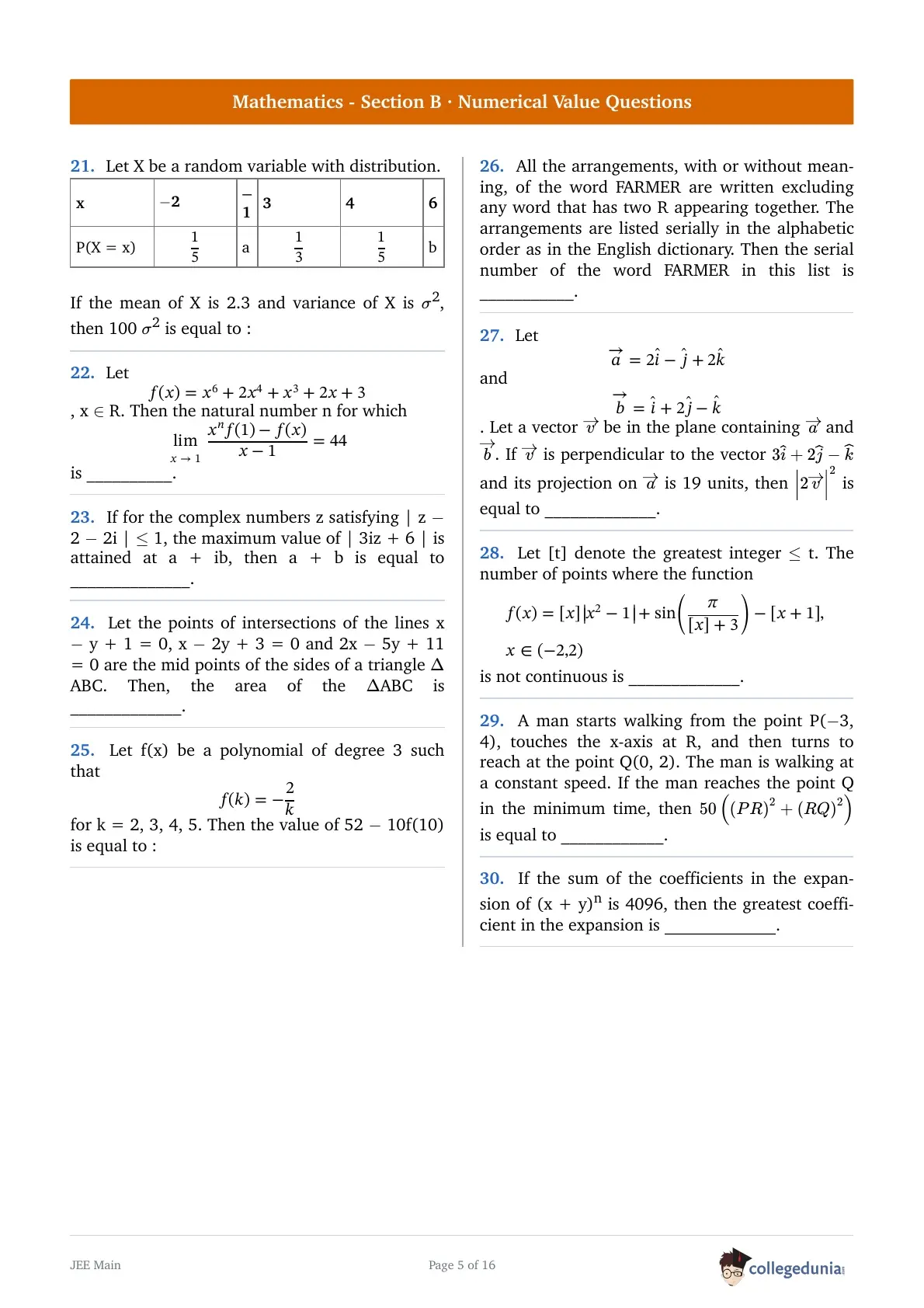
| x | \(-2\) | \(-1\) | 3 | 4 | 6 |
| P(X = x) | \(\frac15\) | a | \(\frac13\) | \(\frac15\) | b |
Let \(f(x)=x^6+2x^4+x^3+2x+3,\ x\in R\). Then the natural number n for which \(\lim_{x\to1}\frac{x^nf(1)-f(x)}{x-1}=44\) is __________.
If for the complex numbers z satisfying \(|z-2-2i|\le1\), the maximum value of \(|3iz+6|\) is attained at \(a+ib\), then \(a+b\) is equal to ______________.
Let the points of intersections of the lines \(x-y+1=0\), \(x-2y+3=0\) and \(2x-5y+11=0\) are the mid points of the sides of a triangle \(\Delta ABC\). Then, the area of the \(\Delta ABC\) is ______________.
Let f(x) be a polynomial of degree 3 such that \(f(k)=-\frac{2}{k}\) for k = 2, 3, 4, 5. Then the value of \(52-10f(10)\) is equal to :
All the arrangements, with or without meaning, of the word FARMER are written excluding any word that has two R appearing together. The arrangements are listed serially in the alphabetic order as in the English dictionary. Then the serial number of the word FARMER in this list is ___________.
Let \(\vec{a}=2\hat{i}-\hat{j}+2\hat{k}\) and \(\vec{b}=\hat{i}+2\hat{j}-\hat{k}\). Let a vector \(\vec{v}\) be in the plane containing \(\vec{a}\) and \(\vec{b}\). If \(\vec{v}\) is perpendicular to the vector \(3\hat{i}+2\hat{j}-\hat{k}\) and its projection on \(\vec{a}\) is 19 units, then \(\left|2\vec{v}\right|^2\) is equal to ______________.
Let [t] denote the greatest integer \(\le t\). The number of points where the function \(f(x)=[x]\left|x^2-1\right|+\sin\left(\frac{\pi}{[x]+3}\right)-[x+1],\ x\in(-2,2)\) is not continuous is _____________.
A man starts walking from the point P(\(-3\), 4), touches the x-axis at R, and then turns to reach at the point Q(0, 2). The man is walking at a constant speed. If the man reaches the point Q in the minimum time, then \(50\left((PR)^2+(RQ)^2\right)\) is equal to ____________.
If the sum of the coefficients in the expansion of \((x+y)^n\) is 4096, then the greatest coefficient in the expansion is _____________.
Physics - Section A (Q31 - Q50)
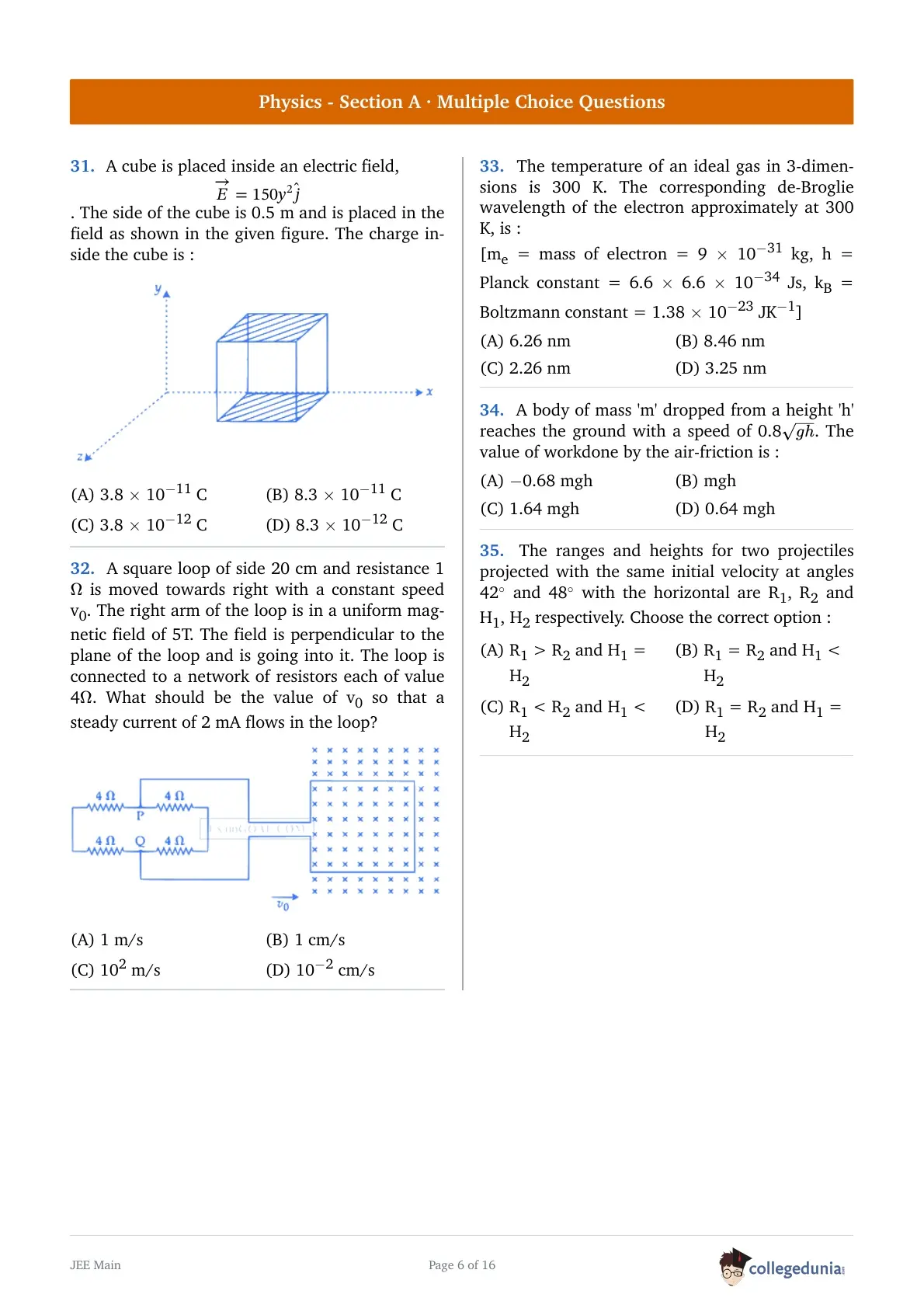
A cube is placed inside an electric field, \(\vec{E}=150y^2\hat{j}\). The side of the cube is 0.5 m and is placed in the field as shown in the given figure. The charge inside the cube is :
A square loop of side 20 cm and resistance \(1\,\Omega\) is moved towards right with a constant speed \(v_0\). The right arm of the loop is in a uniform magnetic field of 5 T. The field is perpendicular to the plane of the loop and is going into it. The loop is connected to a network of resistors each of value \(4\,\Omega\). What should be the value of \(v_0\) so that a steady current of 2 mA flows in the loop?
The de Broglie wavelength of an oxygen molecule at 27°C is x × \(10^{-12}\) m. The value of x is (take Planck's constant=6.63 × \(10^{-34}\) J/s, Boltzmann constant=1.38 × \(10^{-23}\) J/K, mass of oxygen molecule = 5.31 × \(10^{-26}\) kg)
A body of mass 'm' dropped from a height 'h' reaches the ground with a speed of \(0.8\sqrt{gh}\). The value of workdone by the air-friction is :
The ranges and heights for two projectiles projected with the same initial velocity at angles \(42^\circ\) and \(48^\circ\) with the horizontal are \(R_1, R_2\) and \(H_1, H_2\) respectively. Choose the correct option :
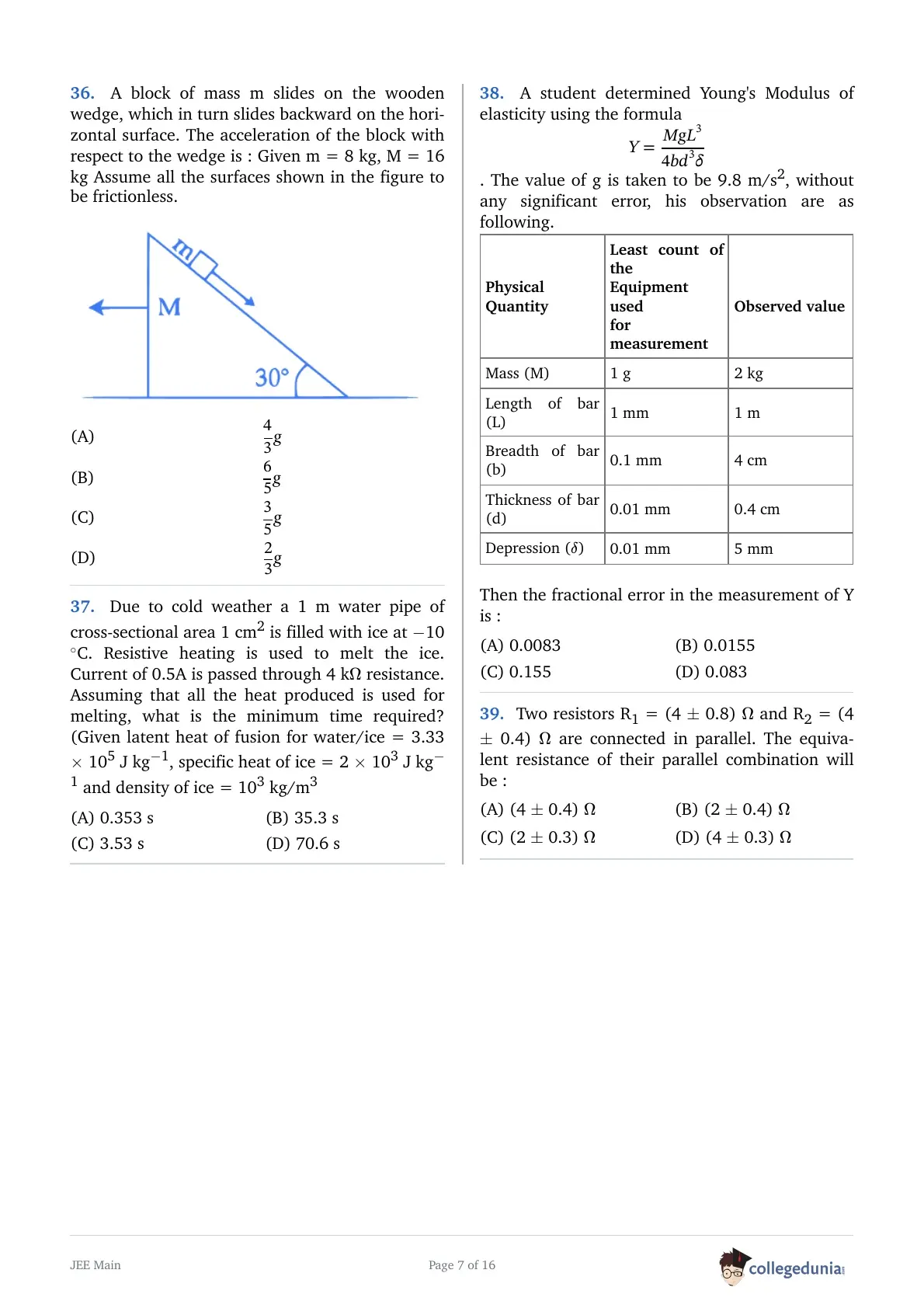
a block of mass m slides on the wooden wedge which in turn slides backward on the horizontal surface. The acceleration of the block with respect to the wedge is:
[ Given m= 8kg, M=16kg ]
[Assume all the surfaces shown in the figure to be frictionless]

A copper block of mass 5.0 kg is heated to a temperature of 500°C and is placed on a large ice block. What is the maximum amount of ice that can melt?
[Specific heat of copper 0.39 J g–1 °C–1 and latent heat of fusion of water : 335 J g–1]
| Physical Quantity | Least count of the Equipment used for measurement | Observed value |
| Mass (M) | 1 g | 2 kg |
| Length of bar (L) | 1 mm | 1 m |
| Breadth of bar (b) | 0.1 mm | 4 cm |
| Thickness of bar (d) | 0.01 mm | 0.4 cm |
| Depression (\(\delta\)) | 0.01 mm | 5 mm |
Two resistors \(R_1 = (4 \pm 0.8)\,\Omega\) and \(R_2 = (4 \pm 0.4)\,\Omega\) are connected in parallel. The equivalent resistance of their parallel combination will be :
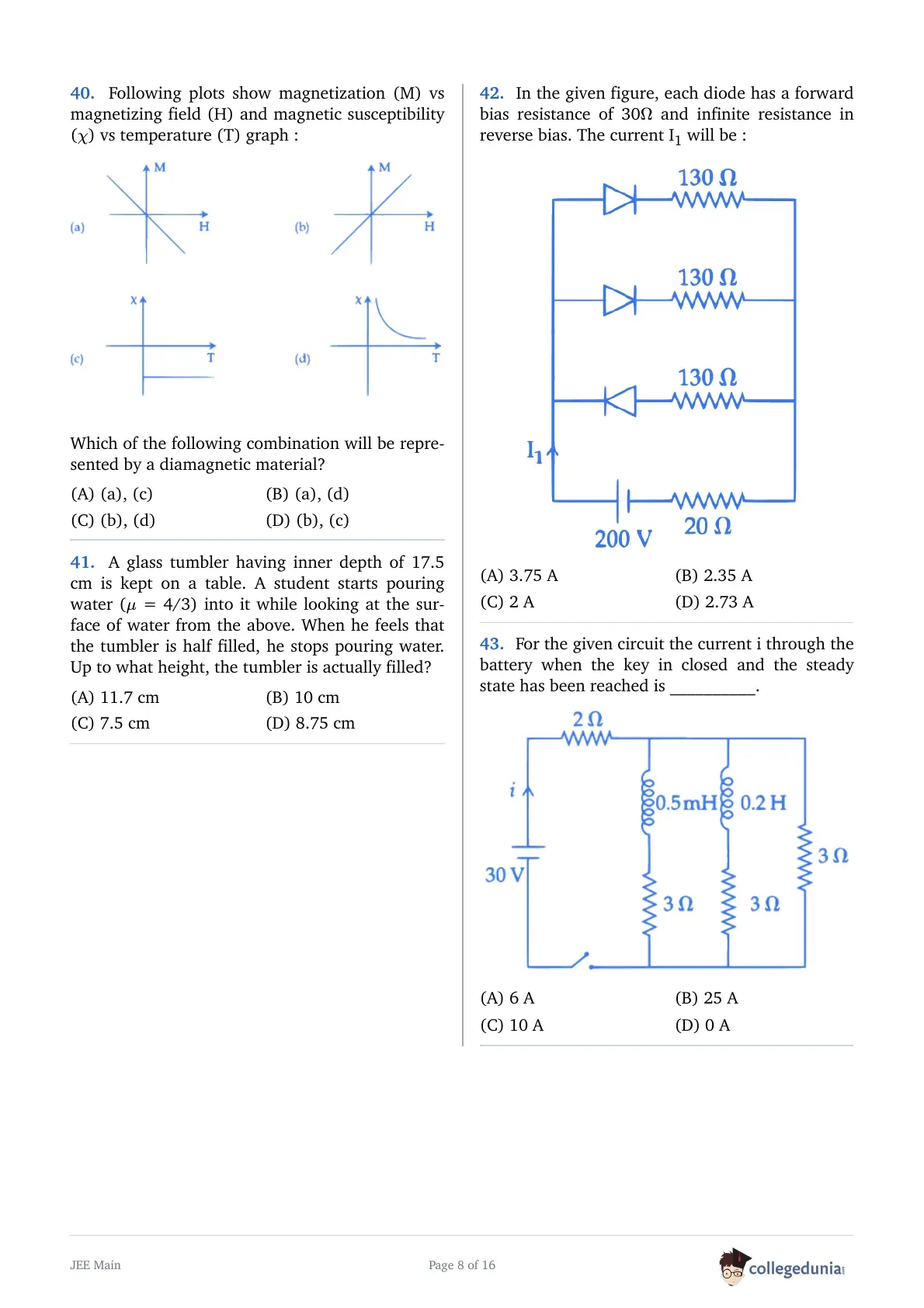
Following plots show magnetization (M) vs magnetizing field (H) and magnetic susceptibility (\(\chi\)) vs temperature (T) graph :
Which of the following combination will be represented by a diamagnetic material?
A glass tumbler having inner depth of 17.5 cm is kept on a table. A student starts pouring water (\(\mu = 4/3\)) into it while looking at the surface of water from the above. When he feels that the tumbler is half filled, he stops pouring water. Up to what height, the tumbler is actually filled?
In the given figure, each diode has a forward bias resistance of \(30\,\Omega\) and infinite resistance in reverse bias. The current \(I_1\) will be :
For the given circuit the current i through the battery when the key in closed and the steady state has been reached is __________.
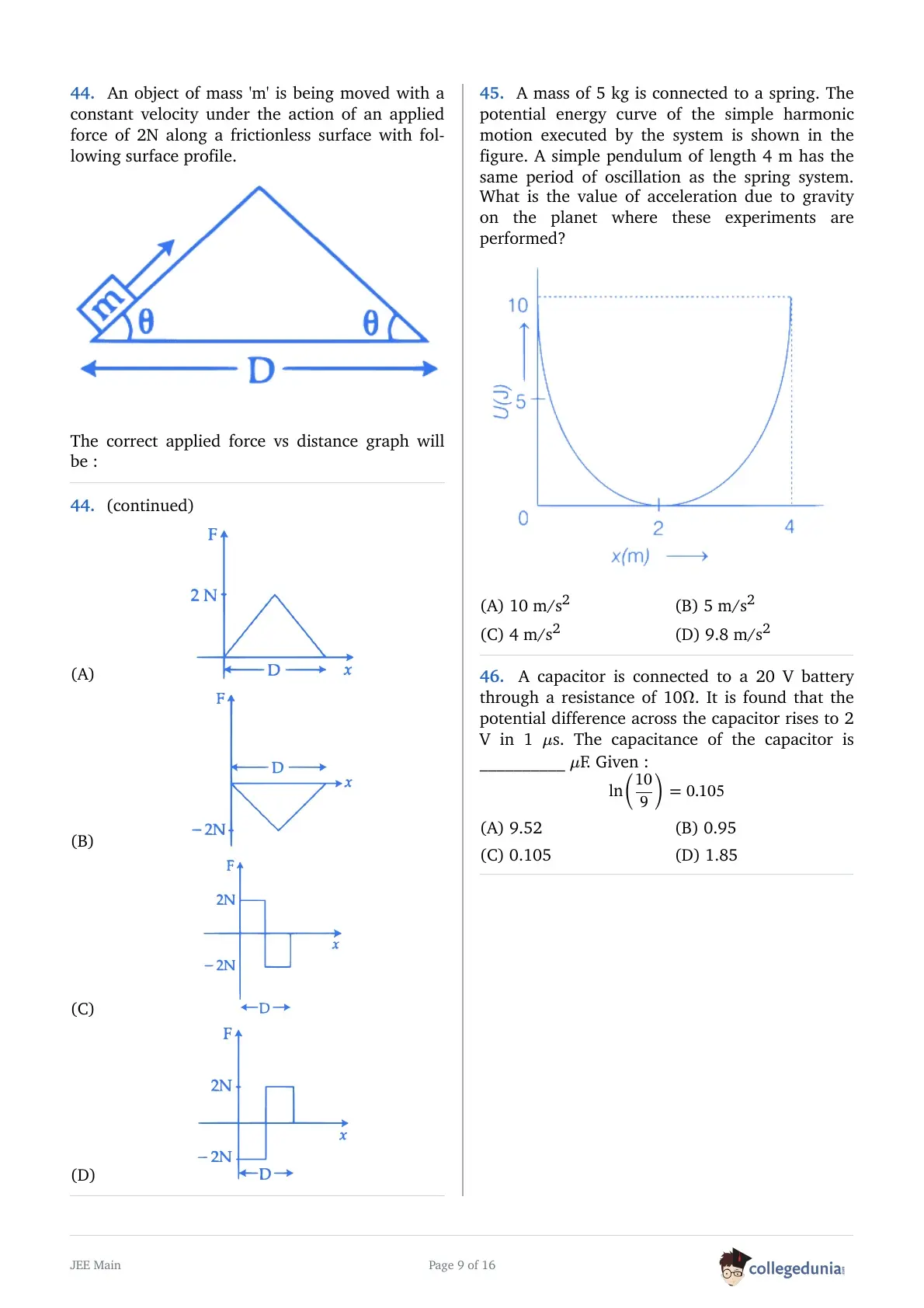
An object of mass 'm' is being moved with a constant velocity under the action of an applied force of 2 N along a frictionless surface with following surface profile.
The correct applied force vs distance graph will be :
- (1)
![]()
- (2)
![]()
- (3)
![]()
- (4)
![]()


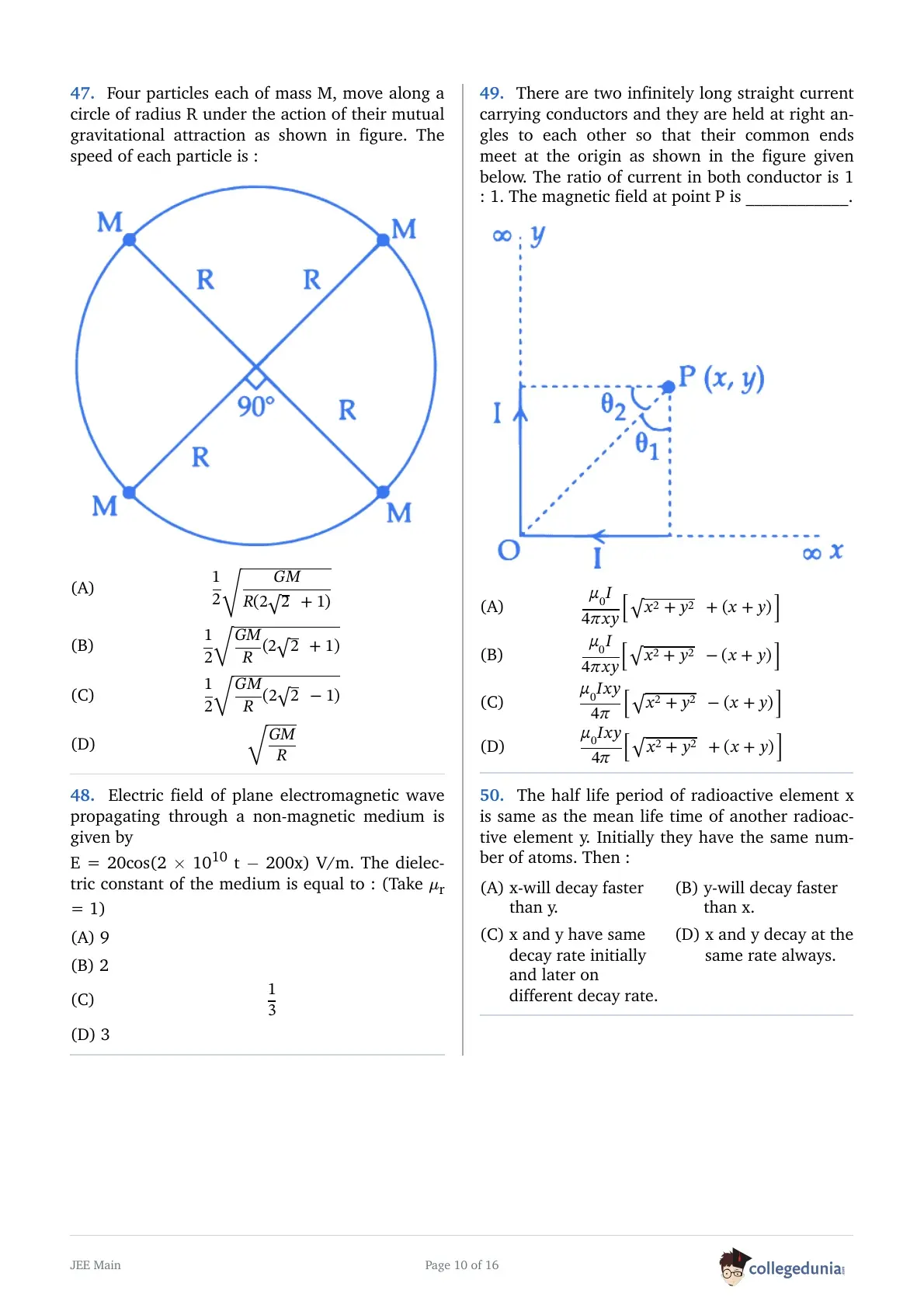
A mass of 5 kg is connected to a spring. The potential energy curve of the simple harmonic motion executed by the system is shown in the figure. A simple pendulum of length 4 m has the same period of oscillation as the spring system. What is the value of acceleration due to gravity on the planet where these experiments are performed?
A capacitor is connected to a 20 V battery through a resistance of \(10\,\Omega\). It is found that the potential difference across the capacitor rises to 2 V in \(1\,\mu\)s. The capacitance of the capacitor is __________ \(\mu\)F. Given : \(\ln\left(\frac{10}{9}\right) = 0.105\)
Four particles, each of mass M and equidistant from each other, move along a circle of radius R under the action of their mutual gravitational attraction, the speed of each particle is
Electric field of plane electromagnetic wave propagating through a non-magnetic medium is given by \(E = 20\cos(2\times10^{10}\,t - 200\,x)\) V/m. The dielectric constant of the medium is equal to : (Take \(\mu_r = 1\))
There are two infinitely long straight current carrying conductors and they are held at right angles to each other so that their common ends meet at the origin as shown in the figure given below. The ratio of current in both conductor is 1 : 1. The magnetic field at point P is ____________.
The half-life of a radioactive element A is the same as the mean-life of another radioactive element B. Initially both substances have the same number of atoms, then :
Physics - Section B (Q51 - Q60)
The temperature of 3.00 mol of an ideal diatomic gas is increased by \(40.0^\circ\)C without changing the pressure of the gas. The molecules in the gas rotate but do not oscillate. If the ratio of change in internal energy of the gas to the amount of workdone by the gas is \(\frac{x}{10}\). Then the value of x (round off to the nearest integer) is ___________. (Given R = 8.31 J mol-1 K-1)
The width of one of the two slits in a Young's double slit experiment is three times the other slit. If the amplitude of the light coming from a slit is proportional to the slit-width, the ratio of minimum to maximum intensity in the interference pattern is \(x : 4\) where \(x\) is ____________.
Two satellites revolve around a planet in coplanar circular orbits in anticlockwise direction. Their period of revolutions are 1 hour and 8 hours respectively. The radius of the orbit of nearer satellite is \(2 \times 10^{3}\) km. The angular speed of the farther satellite as observed from the nearer satellite at the instant when both the satellites are closest is
\(\dfrac{\pi}{x}\ \mathrm{rad\,h^{-1}}\)
where \(x\) is ____________.
When a body slides down from rest along a smooth inclined plane making an angle of \(30^\circ\) with the horizontal, it takes time \(T\). When the same body slides down from the rest along a rough inclined plane making the same angle and through the same distance, it takes time \(\alpha T\), where \(\alpha\) is a constant greater than 1. The co-efficient of friction between the body and the rough plane is
\(\dfrac{1}{\sqrt{x}}\left(\dfrac{\alpha^2-1}{\alpha^2}\right)\)
where \(x\) = ____________.
The average translational kinetic energy of \(\mathrm{N_2}\) gas molecules at ............. \({}^\circ\mathrm{C}\) becomes equal to the K.E. of an electron accelerated from rest through a potential difference of 0.1 volt. (Given \(k_B = 1.38\times10^{-23}\) J/K) (Fill the nearest integer).
A uniform heating wire of resistance \(36\ \Omega\) is connected across a potential difference of 240 V. The wire is then cut into half and potential difference of 240 V is applied across each half separately. The ratio of power dissipation in first case to the total power dissipation in the second case would be \(1 : x\), where \(x\) is ____________.
A steel rod with \(y = 2.0\times10^{11}\ \mathrm{Nm^{-2}}\) and \(\alpha = 10^{-5}\ {}^\circ\mathrm{C^{-1}}\) of length 4 m and area of cross-section \(10\ \mathrm{cm^2}\) is heated from \(0^\circ\mathrm{C}\) to \(400^\circ\mathrm{C}\) without being allowed to extend. The tension produced in the rod is \(x\times10^5\) N where the value of \(x\) is ____________.
A 2 kg steel rod of length 0.6 m is clamped on a table vertically at its lower end and is free to rotate in vertical plane. The upper end is pushed so that the rod falls under gravity, ignoring the friction due to clamping at its lower end, the speed of the free end of rod when it passes through its lowest position is ____________ \(\mathrm{ms^{-1}}\). (Take \(g = 10\ \mathrm{ms^{-2}}\))
An engine is attached to a wagon through a shock absorber of length 1.5 m. The system with a total mass of 40,000 kg is moving with a speed of \(72\ \mathrm{kmh^{-1}}\) when the brakes are applied to bring it to rest. In the process of the system being brought to rest, the spring of the shock absorber gets compressed by 1.0 m. If 90% of energy of the wagon is lost due to friction, the spring constant is ____________ \(\times\,10^5\) N/m.
A carrier wave of amplitude 15 V modulated by a sinusoidal base band signal of amplitude 3 V. The ratio of maximum amplitude to minimum amplitude in an amplitude modulated wave is
Chemistry - Section A (Q61 - Q80)
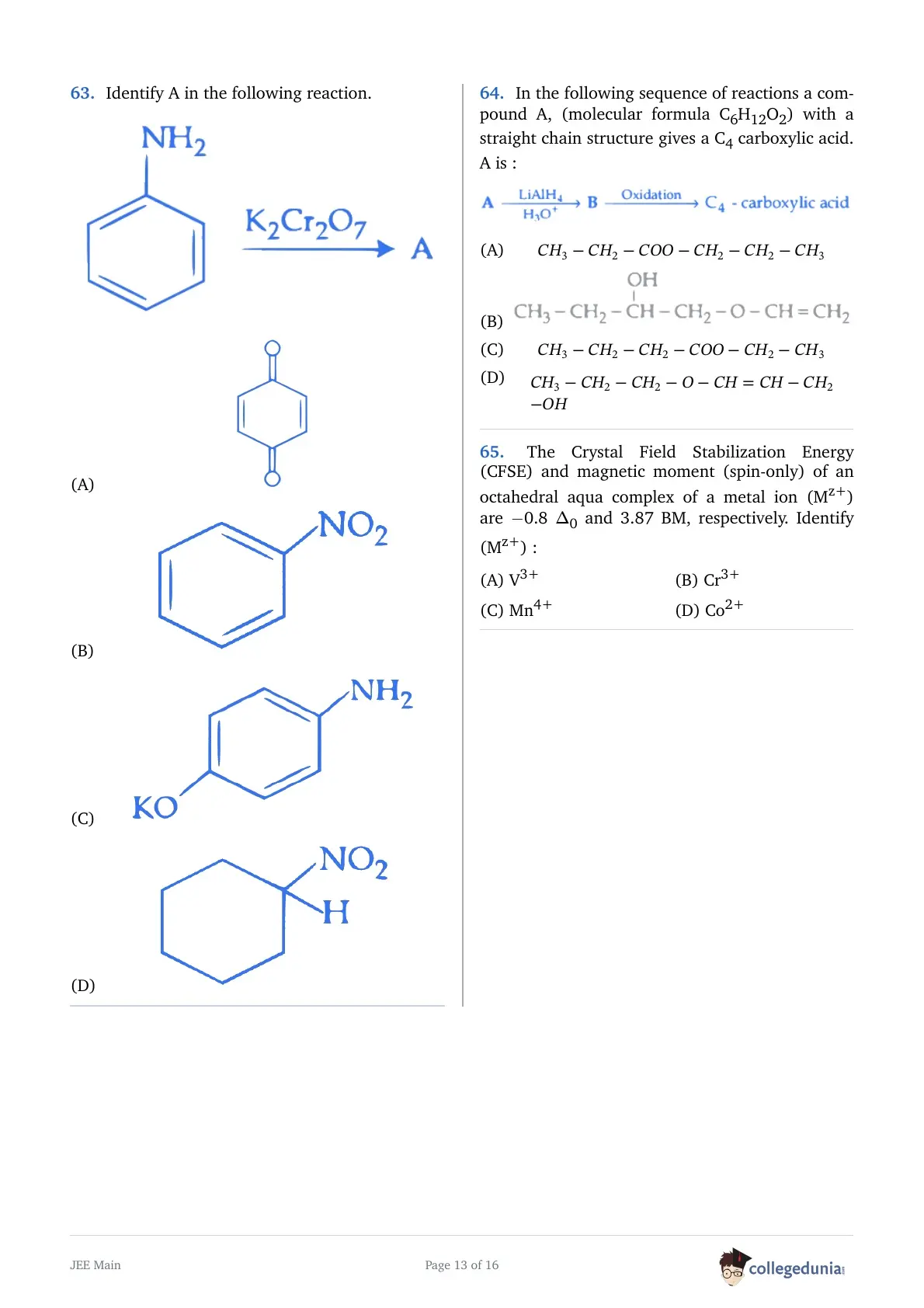
Experimentally reducing a functional group cannot be done by which one of the following reagents?
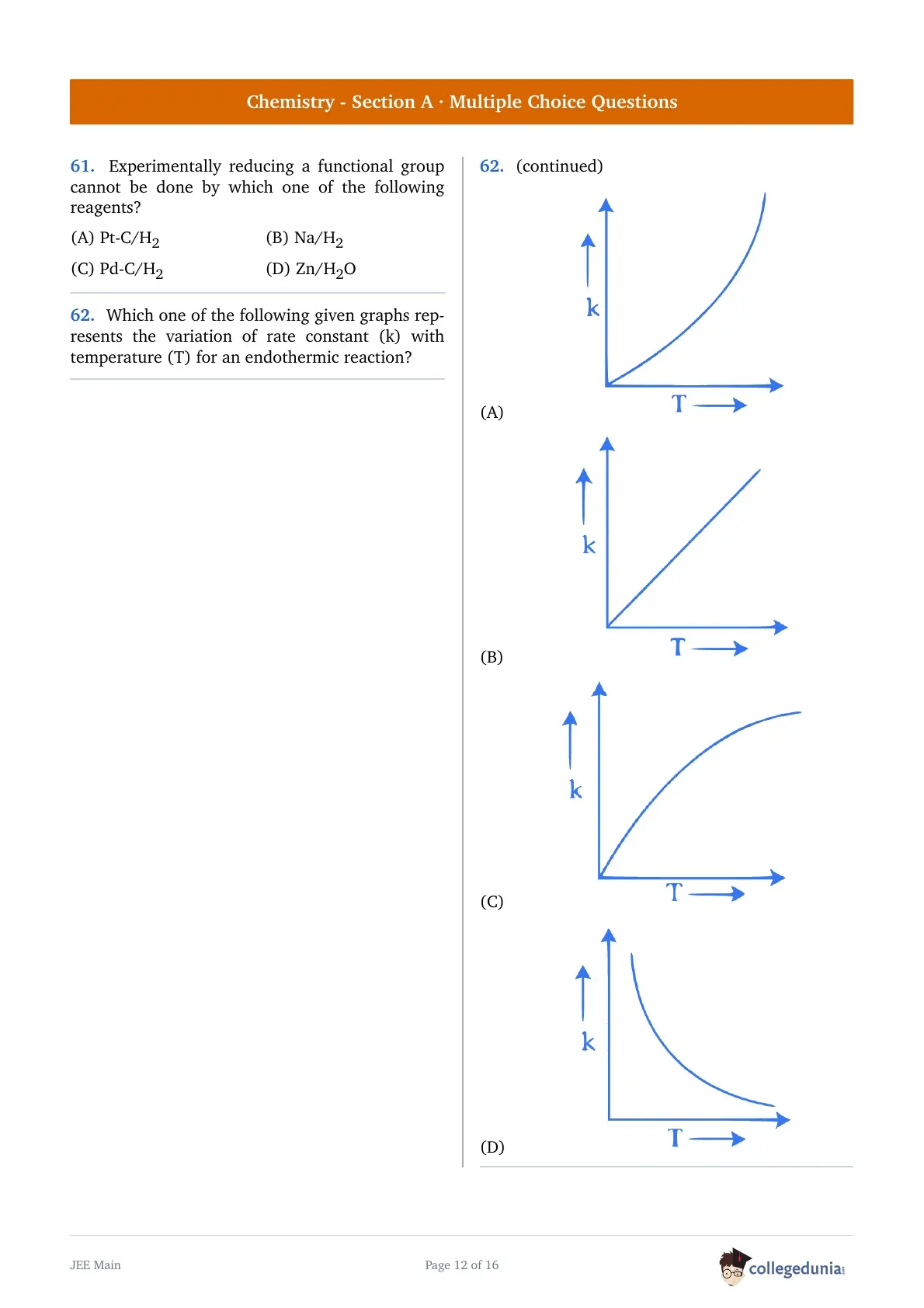
Which one of the following given graphs represents the variation of rate constant (k) with temperature (T) for an endothermic reaction?
- (1)
![]()
- (2)
![]()
- (3)
![]()
- (4)
![]()


In the following sequence of reactions a compound A, (molecular formula \(\mathrm{C_6H_{12}O_2}\)) with a straight chain structure gives a \(\mathrm{C_4}\) carboxylic acid. A is :
\(\mathrm{A}\ \xrightarrow[\mathrm{H_3O^+}]{\mathrm{LiAlH_4}}\ \mathrm{B}\ \xrightarrow{\text{Oxidation}}\ \mathrm{C_4}\text{-carboxylic acid}\)
- (1) \(\mathrm{CH_3-CH_2-COO-CH_2-CH_2-CH_3}\)
- (2)
![]()
- (3) \(\mathrm{CH_3-CH_2-CH_2-COO-CH_2-CH_3}\)
- (4) \(\mathrm{CH_3-CH_2-CH_2-O-CH=CH-CH_2-OH}\)

The Crystal Field Stabilization Energy (CFSE) and magnetic moment (spin-only) of an octahedral aqua complex of a metal ion (\(\mathrm{M^{z+}}\)) are \(-0.8\,\Delta_0\) and 3.87 BM, respectively. Identify (\(\mathrm{M^{z+}}\)) :
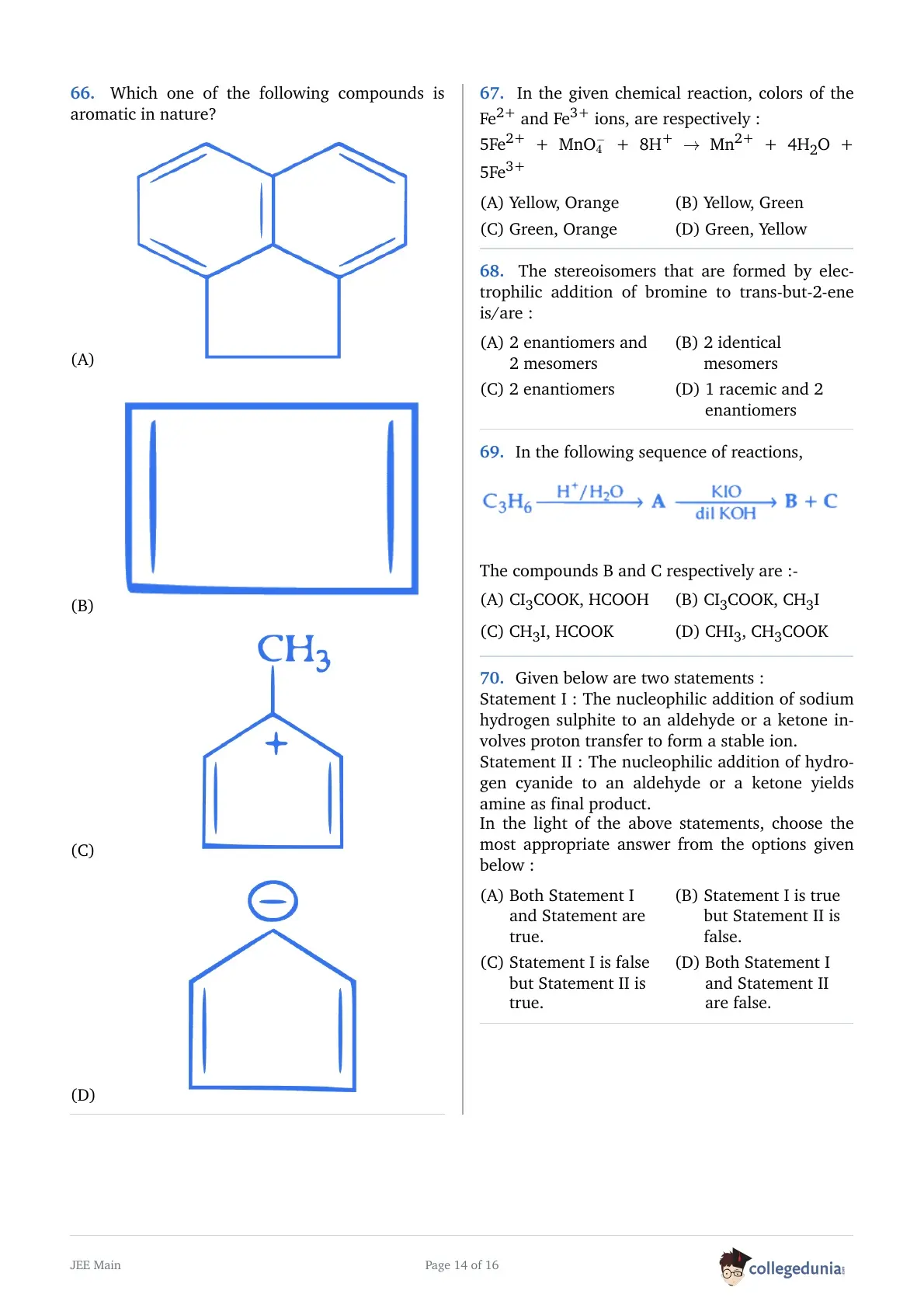
Which one of the following compounds is aromatic in nature?
- (1)
![]()
- (2)
![]()
- (3)
![]()
- (4)
![]()


In the given chemical reaction, colors of the \(\mathrm{Fe^{2+}}\) and \(\mathrm{Fe^{3+}}\) ions, are respectively :
\(5\mathrm{Fe^{2+}} + \mathrm{MnO_4^-} + 8\mathrm{H^+} \rightarrow \mathrm{Mn^{2+}} + 4\mathrm{H_2O} + 5\mathrm{Fe^{3+}}\)
The stereoisomers that are formed by electrophilic addition of bromine to trans-but-2-ene is/are :
In the following sequence of reactions, \(\mathrm{C_3H_6 \xrightarrow{H^+/H_2O} A \xrightarrow[\text{dil KOH}]{KIO} B + C}\)
The compounds B and C respectively are :-
Given below are two statements :
Statement I : The nucleophilic addition of sodium hydrogen sulphite to an aldehyde or a ketone involves proton transfer to form a stable ion.
Statement II : The nucleophilic addition of hydrogen cyanide to an aldehyde or a ketone yields amine as final product.
In the light of the above statements, choose the most appropriate answer from the options given below :
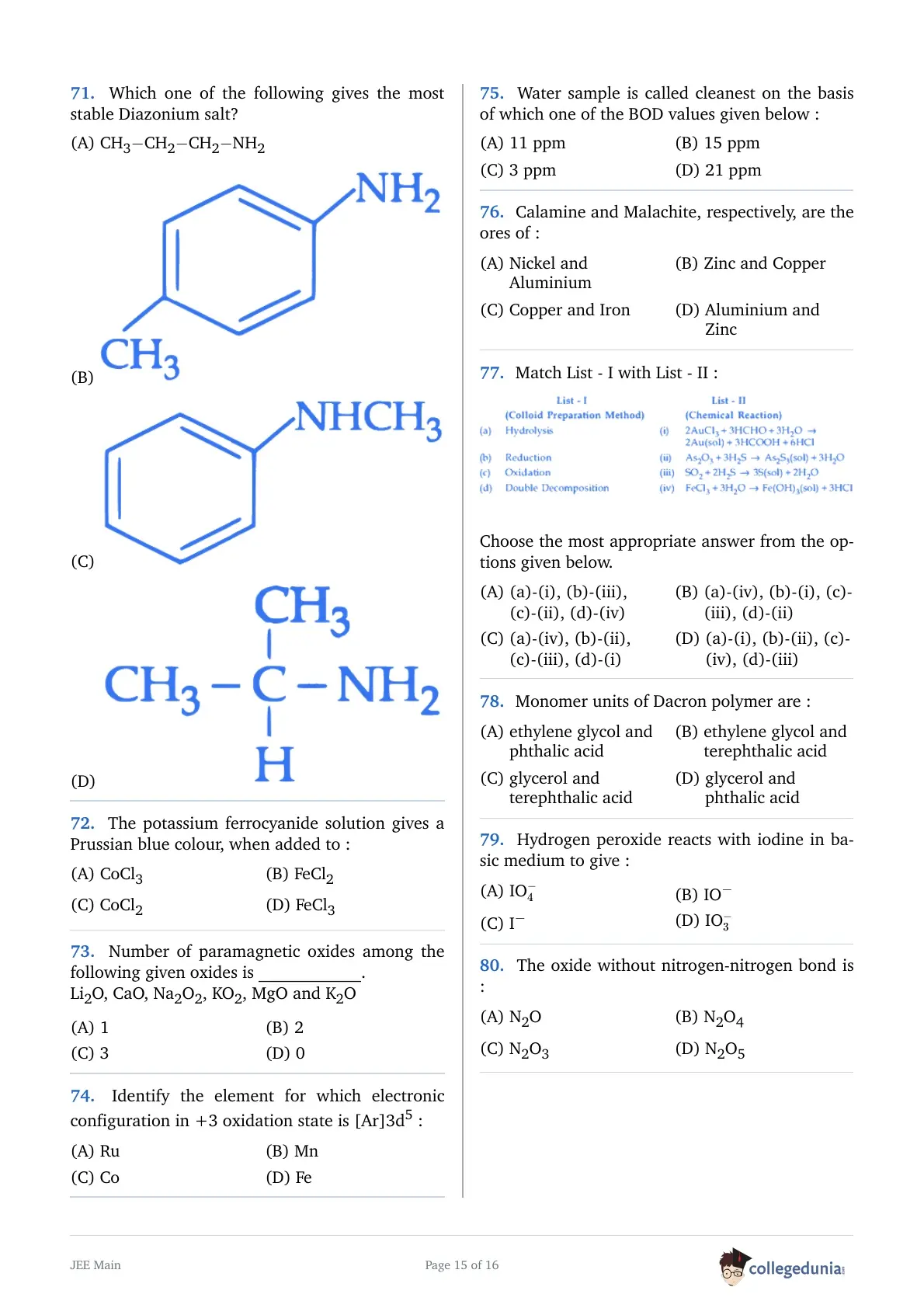
Which one of the following gives the most stable Diazonium salt?
- (1) \(\mathrm{CH_3{-}CH_2{-}CH_2{-}NH_2}\)
- (2)
![]()
- (3)
![]()
- (4)
![]()


The potassium ferrocyanide solution gives a Prussian blue colour, when added to :
Number of paramagnetic oxides among the following given oxides is ____________.
\(\mathrm{Li_2O}\), \(\mathrm{CaO}\), \(\mathrm{Na_2O_2}\), \(\mathrm{KO_2}\), \(\mathrm{MgO}\) and \(\mathrm{K_2O}\)
The element with which of the following outer electron configuration may exhibit the largest number of oxidation states in its compounds :
The measured BOD values for four different water samples (A-D) are as follows:
A = 3 ppm; B = 18 ppm; C = 21 ppm; D = 4 ppm;. The water samples which can be called as highly polluted with organic wastes, are
Calamine and Malachite, respectively, are the ores of :
| List - I (Colloid Preparation Method) | List - II (Chemical Reaction) | ||
| (a) | Hydrolysis | (i) | \(\mathrm{2AuCl_3 + 3HCHO + 3H_2O \to 2Au(sol) + 3HCOOH + 6HCl}\) |
| (b) | Reduction | (ii) | \(\mathrm{As_2O_3 + 3H_2S \to As_2S_3(sol) + 3H_2O}\) |
| (c) | Oxidation | (iii) | \(\mathrm{SO_2 + 2H_2S \to 3S(sol) + 2H_2O}\) |
| (d) | Double Decomposition | (iv) | \(\mathrm{FeCl_3 + 3H_2O \to Fe(OH)_3(sol) + 3HCl}\) |
Choose the most appropriate answer from the options given below.
Monomer units of Dacron polymer are :
Hydrogen peroxide reacts with iodine in basic medium to give :
The oxide without nitrogen-nitrogen bond is :
Chemistry - Section B (Q81 - Q90)
What is the molar solubility of \(Al(OH)_3\) in \(0.2\, M\, NaOH\) solution ? Given that, solubility product of \(Al(OH)_3 = 2.4 \times 10^{-24}\) :
Consider the reaction} \[ 2\text{H}_2\text{S (g)} + 3\text{O}_2\text{(g)} \rightarrow 2\text{H}_2\text{O (l)} + 2\text{SO}_2\text{(g)} \] The magnitude of enthalpy change for the reaction in kJ mol\(^{-1}\) is _______ (Nearest integer).
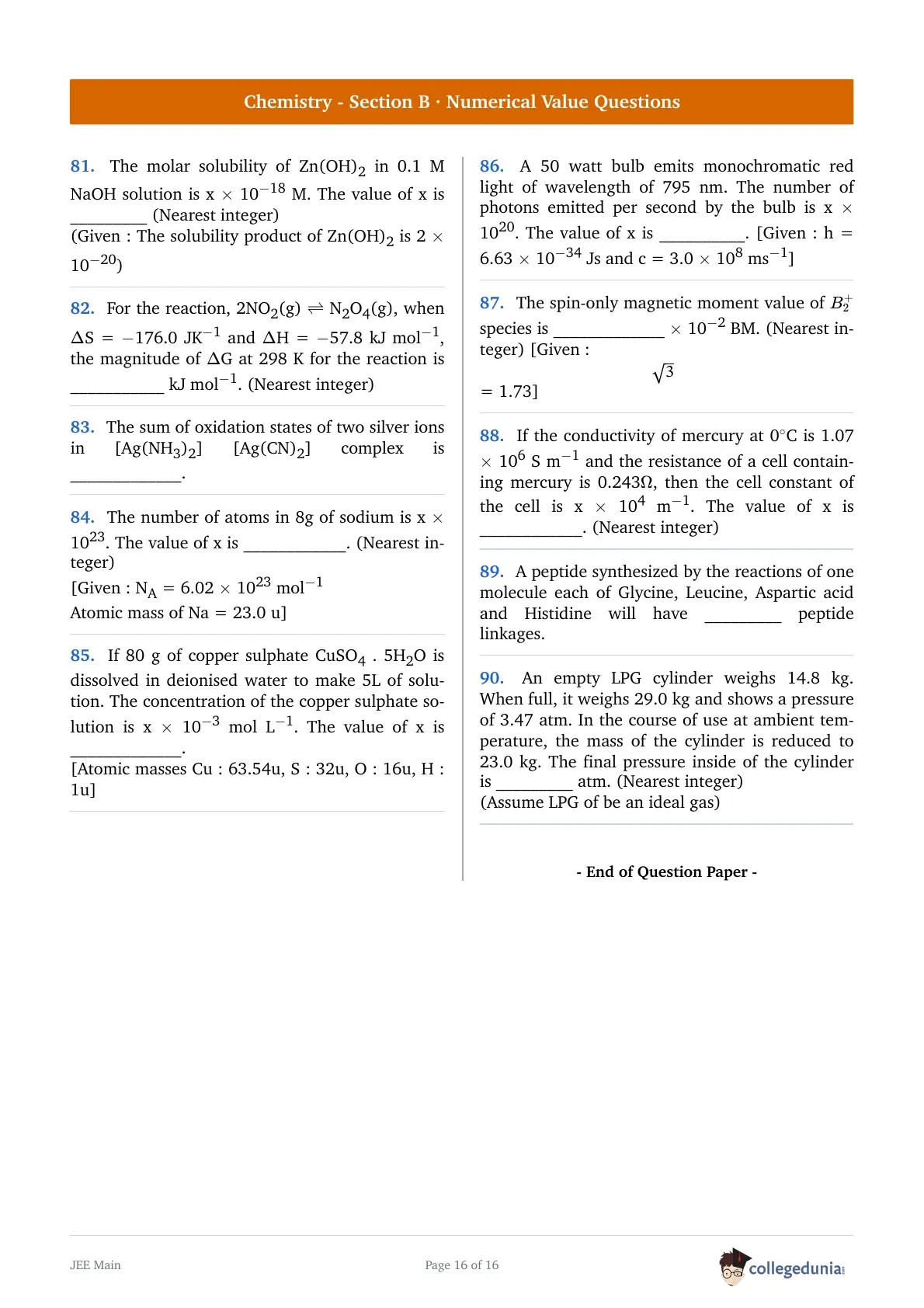
The sum of oxidation states of two silver ions in \(\mathrm{[Ag(NH_3)_2][Ag(CN)_2]}\) complex is _____________.
The number of atoms in 8g of sodium is x \(\times\) 10\(^{23}\). The value of x is ____________. (Nearest integer)
[Given : \(N_A = 6.02 \times 10^{23}\ \mathrm{mol^{-1}}\)
Atomic mass of Na = 23.0 u]
If 80 g of copper sulphate \(\mathrm{CuSO_4 \cdot 5H_2O}\) is dissolved in deionised water to make 5L of solution. The concentration of the copper sulphate solution is x \(\times\) 10\(^{-3}\) mol L\(^{-1}\). The value of x is _____________.
[Atomic masses Cu : 63.54u, S : 32u, O : 16u, H : 1u]
A 50 watt bulb emits monochromatic red light of wavelength of 795 nm. The number of photons emitted per second by the bulb is x \(\times\) 10\(^{20}\). The value of x is __________. [Given : h = 6.63 \(\times\) 10\(^{-34}\) Js and c = 3.0 \(\times\) 10\(^8\) ms\(^{-1}\)]
The spin-only magnetic moment value of \(\mathrm{B_2^+}\) species is _____________ \(\times 10^{-2}\) BM. (Nearest integer)
[Given : \(\sqrt{3} = 1.73\)]
If the conductivity of mercury at \(0^\circ\mathrm{C}\) is \(1.07 \times 10^{6}\ \mathrm{S\,m^{-1}}\) and the resistance of a cell containing mercury is \(0.243\ \Omega\), then the cell constant of the cell is \(x \times 10^{4}\ \mathrm{m^{-1}}\). The value of x is ____________. (Nearest integer)
A short peptide on complete hydrolysis produces 3 moles of glycine (G), two moles of leucine \(( L )\) and two moles of valine \(( V )\) per mole of peptide The number of peptide linkages in it are ______
An empty LPG cylinder weighs 14.8 kg. When full, it weighs 29.0 kg and shows a pressure of 3.47 atm. In the course of use at ambient temperature, the mass of the cylinder is reduced to 23.0 kg. The final pressure inside of the cylinder is _________ atm. (Nearest integer)
(Assume LPG of be an ideal gas)
JEE Main 2021 Exam Pattern and Marking Scheme
| Particulars | Details |
|---|---|
| Exam Mode | Online (Computer-Based Test) |
| Paper | B.E./B.Tech (Paper 1) |
| Duration | 3 hours (180 minutes) |
| Type of Questions | Multiple Choice Questions (MCQs) + Numerical Value Questions |
| Subjects | Mathematics, Physics, Chemistry |
| Total Questions | 90 questions (75 to be attempted) |
| Total Marks | 300 marks |
| Marking Scheme | +4 for correct answer & -1 for incorrect MCQ; no negative marking for Numerical Value Questions |
JEE Main 2021 September 1 Shift 2 Difficulty Level
JEE Main September 1, 2021 Afternoon paper was rated to be of average difficulty by the test takers. It is to be remembered that no Forenoon session was conducted on September 1, 2021. Following JEE Exam Pattern of the previous sessions, candidates were required to answer 25 questions in total out of the 30 Questions in each section of the paper. While 20 MCQs were mandatory to be attempted in each section, a choice of attempting any 5 NAT type questions from the 10 NAT Questions was given to the candidate. Overall, a candidate has to attempt 75 questions in total out of the 90 Questions present in the paper across the three sections.
JEE Main 2021 B.E./B.Tech Question Paper September 1 (FN): Difficulty Level
JEE Main September 1, 2021 Afternoon (Shift 2) paper was conducted from 3.00 PM to 6.00 PM. The difficulty level of the paper was as follows
Mathematics
- Mathematics was the toughest section of the paper since the questions were time-consuming and lengthy.
- The dominant units in the paper were - Calculus, Integral Calculus, Coordinate Geometry, and Quadratic Equations. Check JEE Main Mathematics Syllabus
Physics
- The Physics section was moderate in difficulty.
- The majority of the questions were framed from Mechanics, Current Electricity, Semiconductors, and Electromagnetism. Check JEE Main Physics syllabus
Chemistry
- Chemistry was the easiest of the three sections and included mostly direct formula-based or equation-based questions.
- Equal weightage was given to Organic Chemistry (I and II) and Inorganic Chemistry (I and II) in the paper.The questions from Physical Chemistry were fewer. Check JEE Main Chemistry Syllabus



Comments