




JEE Main 2021 February 24 Shift 1 Question Paper is available here with solutions PDF and detailed solutions for every question. NTA conducted the first shift on February 24, 2021, from 9:00 AM to 12:00 PM. The JEE Main 2021 Paper 1 (B.E./B.Tech) question paper includes the following:
- 90 questions in a 3-hour CBT Mode: 30 each from Mathematics, Physics and Chemistry (75 to be attempted)
- Section A: 20 multiple choice questions (MCQs) per subject, all compulsory, 4 marks each
- Section B: 10 numerical value questions per subject, any 5 to be attempted, 4 marks each
- Marking: +4 for a correct answer, -1 for an incorrect MCQ, 0 for an unattempted question; no negative marking for numerical value questions
- Maximum marks: 300 (100 per subject)
JEE Main 2021 February 24 Shift 1 Question Paper with Solution PDF
| NTA Official PDF | CD PDF | CD PDF with Solutions |
|---|---|---|
| Download official PDF 5.34 MB | Download Collegedunia PDF 1.05 MB | Download solutions PDF 1.12 MB |
Also Check:
JEE Main 2021 February 24 Shift 1 Questions with Solutions
Mathematics - Section A (Q1 - Q20)
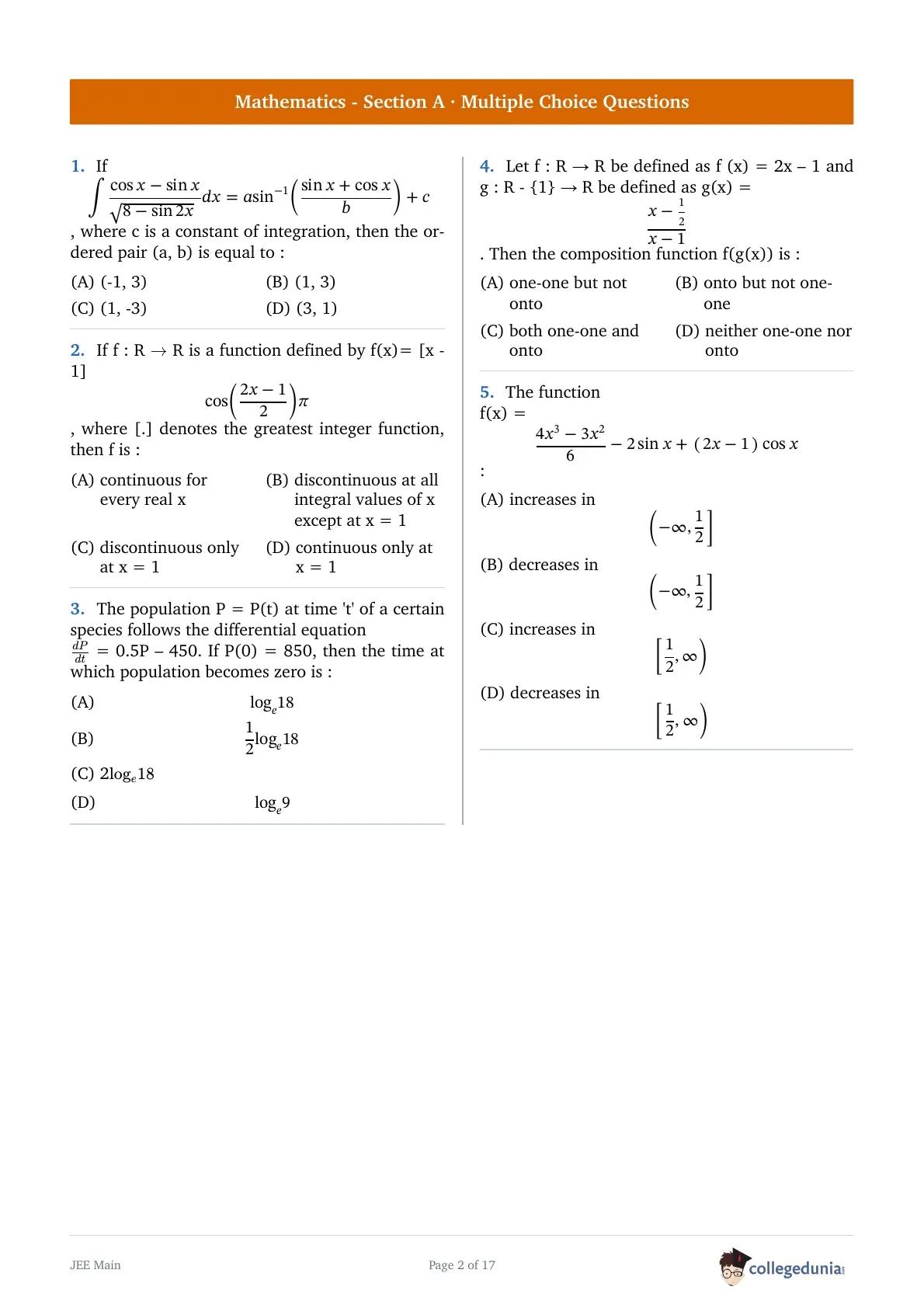
If \(\int \frac{\cos x - \sin x}{\sqrt{8 - \sin 2x}}\,dx = a\sin^{-1}\left(\frac{\sin x + \cos x}{b}\right) + c\), where c is a constant of integration, then the ordered pair (a, b) is equal to :
If \( f(x) = [x - 1]\cos\!\left( \frac{2x - 1}{2}\pi \right) \), then \( f \) is :
The population \(P = P(t)\) at time 't' of a certain species follows the differential equation \(\frac{dP}{dt} = 0.5P - 450\). If \(P(0) = 850\), then the time at which population becomes zero is :
Let \( f : \mathbb{R} \to \mathbb{R} \) be defined as \( f(x) = 2x - 1 \) and \( g : \mathbb{R} \setminus \{1\} \to \mathbb{R} \) be defined as \( g(x) = \dfrac{x - \frac{1}{2}}{x - 1} \). Then the composition function \( f(g(x)) \) is :
The function \( f(x) = \dfrac{4x^3 - 3x^2}{6} - 2 \sin x + (2x - 1)\cos x \) :
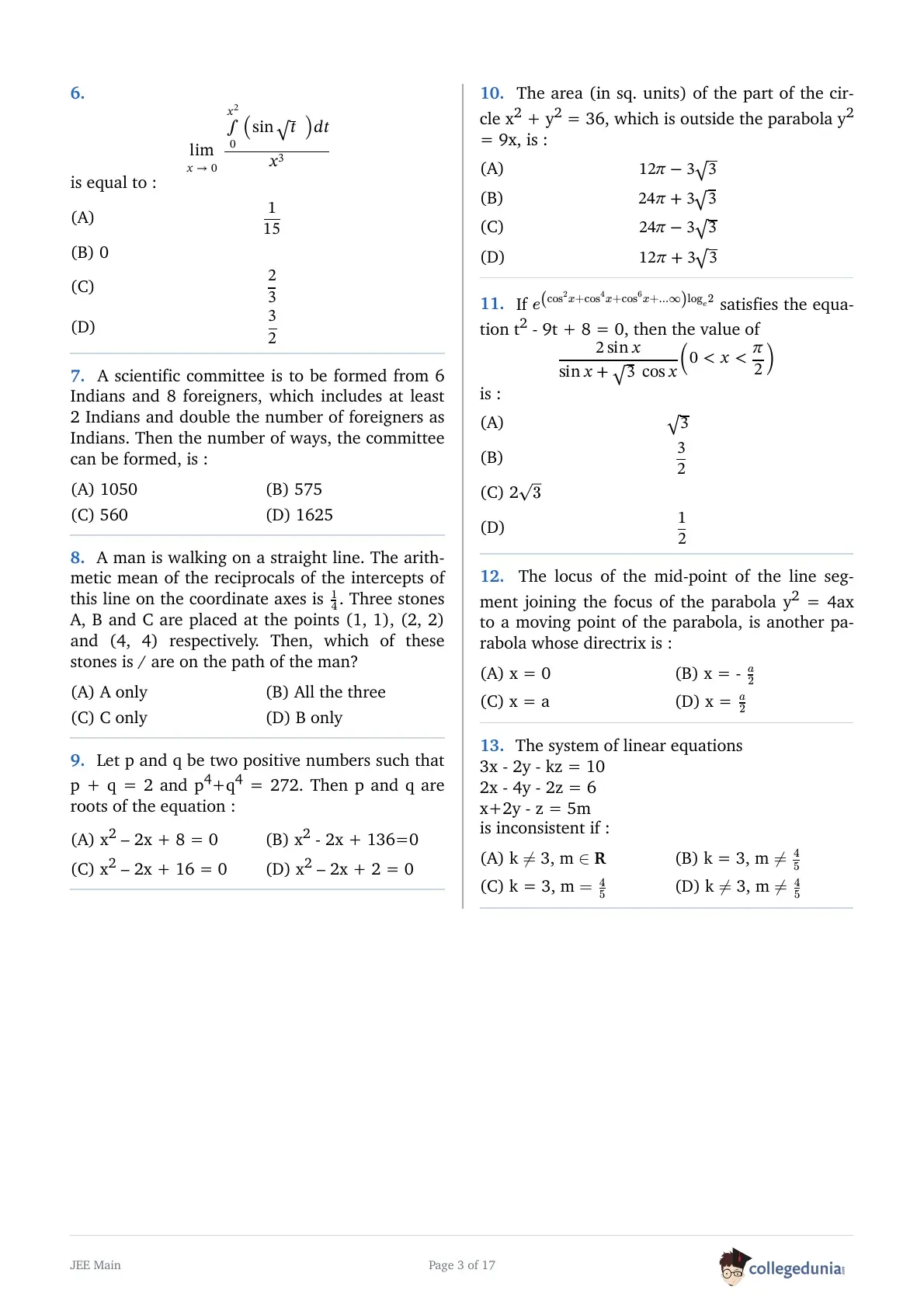
\( \displaystyle \lim_{x \to 0} \frac{\int_{0}^{x^2} \sin(\sqrt{t}) \, dt}{x^3} \) is equal to :
A scientific committee is to be formed from 6 Indians and 8 foreigners, which includes at least 2 Indians and double the number of foreigners as Indians. Then the number of ways is :
A man is walking on a straight line. The arithmetic mean of the reciprocals of the intercepts of this line on the coordinate axes is \(\frac{1}{4}\). Three stones A, B and C are placed at the points (1, 1), (2, 2) and (4, 4) respectively. Then which of these stones is/are on the path of the man ?
Let \( p \) and \( q \) be two positive numbers such that \( p + q = 2 \) and \( p^4 + q^4 = 272 \). Then \( p \) and \( q \) are roots of the equation :
The area (in sq. units) of the part of the circle \(x^2 + y^2 = 36\), which is outside the parabola \(y^2 = 9x\), is :
If \(e^{(\cos^2 x + \cos^4 x + \cos^6 x + .......) \log_e 2}\) satisfies \(t^2 - 9t + 8 = 0\), then find \(\frac{2 \sin x}{\sin x + \sqrt{3} \cos x}\) for \(0<x<\pi/2\) :
The locus of the mid-point of the line segment joining the focus of the parabola \(y^2 = 4ax\) to a moving point of the parabola, is another parabola whose directrix is :
The system of linear equations 3x - 2y - kz = 10, 2x - 4y - 2z = 6, x + 2y - z = 5m is inconsistent if :
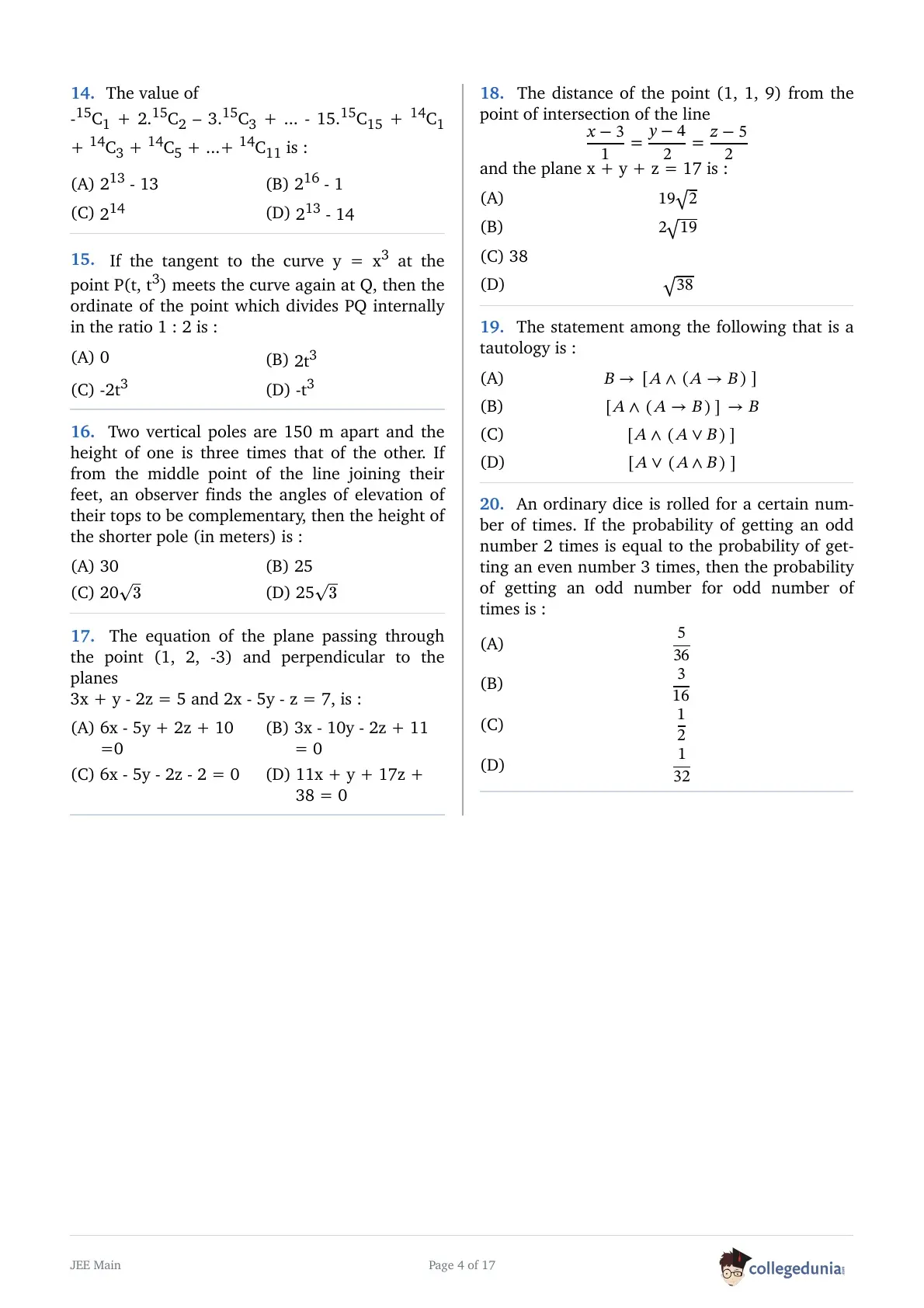
The value of \(-{ }^{15} C _{1}+2 .{ }^{15} C _{2}-3 .{ }^{15} C _{3}+\ldots \) \(-15 .{ }^{15} C _{15}+{ }^{14} C _{1}+{ }^{14} C _{3}+{ }^{14} C _{5}+\ldots .+{ }^{14} C _{11}\) is
The tangent to the curve \(y = x^3\) at the point \(P(t, t^3)\) meets the curve again at Q, then the ordinate of the point which divides PQ internally in the ratio 1:2 is :
Two vertical poles are 150 m apart and the height of one is three times that of the other. If from the middle point of the line joining their feet, an observer finds the angles of elevation of their tops to be complementary, then the height of the shorter pole (in meters) is :
The equation of the plane passing through the point (1, 2, -3) and perpendicular to the planes \(3x + y - 2z = 5\) and \(2x - 5y - z = 7\), is :
The distance of the point (1, 1, 9) from the point of intersection of the line \(\frac{x-3}{1} = \frac{y-4}{2} = \frac{z-5}{2}\) and the plane \(x + y + z = 17\) is :
The statement among the following that is a tautology is :
An ordinary dice is rolled for a certain number of times. If the probability of getting an odd number 2 times is equal to the probability of getting an even number 3 times, then the probability of getting an odd number for odd number of times is :
Mathematics - Section B (Q21 - Q30)
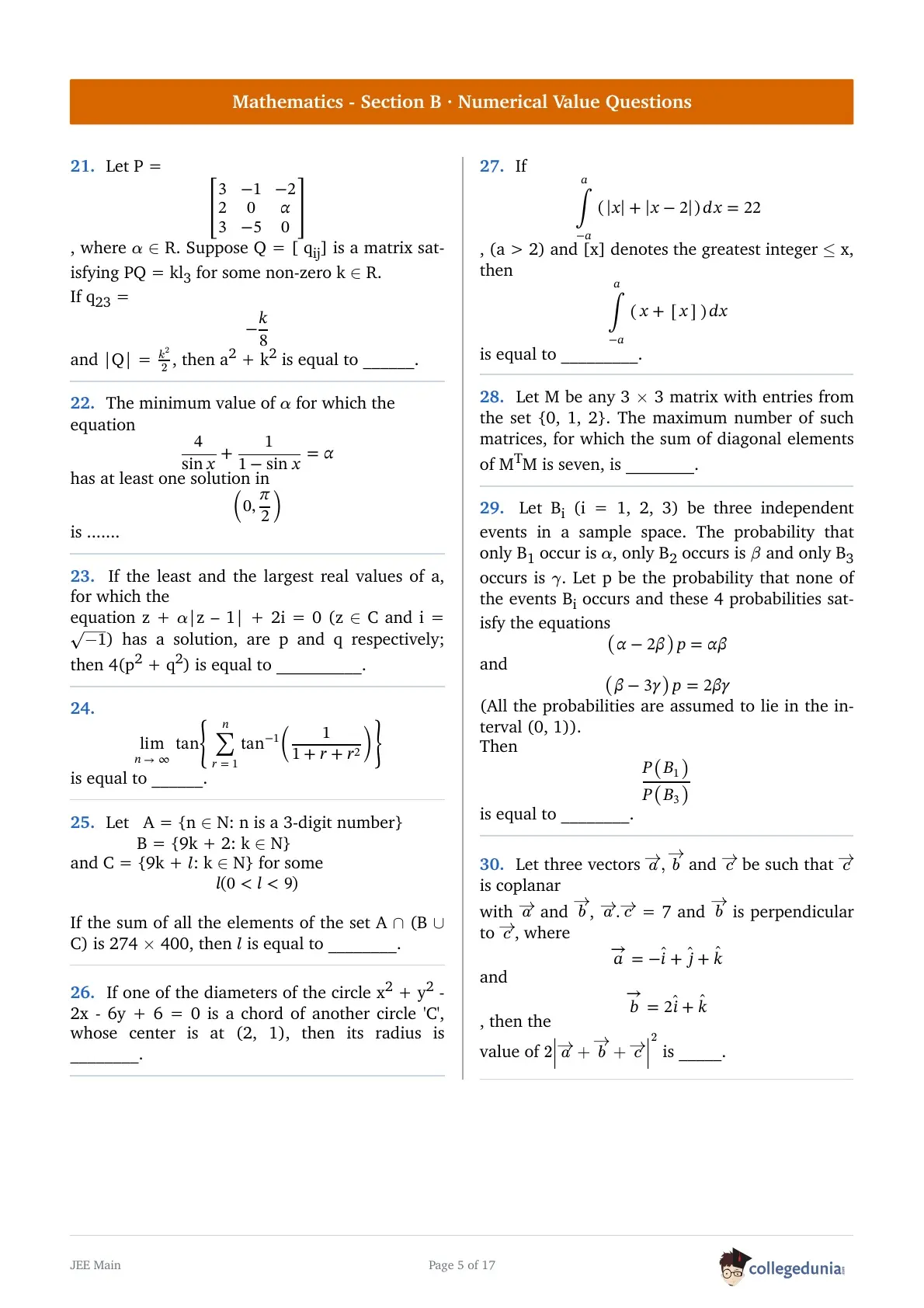
Let \( P = \begin{bmatrix} 3 & -1 & -2 \\ 2 & 0 & \alpha \\ 3 & -5 & 0 \end{bmatrix} \), where \( \alpha \in \mathbb{R} \). Suppose \( Q = [q_{ij}] \) is a matrix satisfying \( PQ = k I_3 \) for some non-zero \( k \in \mathbb{R} \). If \( q_{23} = -\dfrac{k}{8} \) and \( |Q| = \dfrac{k^3}{2} \), then \( \alpha^2 + k^2 \) is equal to __________.
The minimum value of \(\alpha\) for which the equation \(\frac{4}{\sin x} + \frac{1}{1 - \sin x} = \alpha\) has at least one solution in \((0, \frac{\pi}{2})\) is ____________
If the least and the largest real values of \(\alpha\), for which the equation \(|z| + \alpha(z - 1) + 2i = 0\) (\(z \in C\) and \(i = \sqrt{-1}\)) has a solution, are \(p\) and \(q\) respectively; then \(4(p^2 + q^2)\) is equal to _________
\(\lim_{n \to \infty} \tan \left\{ \sum_{r=1}^{n} \tan^{-1} \left( \frac{1}{1 + r + r^2} \right) \right\}\) is equal to __________.
Let \(A = \{n \in N : n \text{ is a 3-digit number}\}\), \(B = \{9k + 2 : k \in N\}\) and \(C = \{9k + l : k \in N\}\) for some \(l\) (0<l<9) If the sum of all the elements of the set \(A \cap (B \cup C)\) is \(274 \times 400\), then \(l\) is equal to __________
If one of the diameters of the circle \(x^2 + y^2 - 2x - 6y + 6 = 0\) is a chord of another circle 'C', whose center is at (2, 1), then its radius is ________
If \(\int_{-a}^{a} (|x| + |x-2|) dx = 22, (a>2)\) and \([x]\) denotes the greatest integer \(\le x\), then \(\int_{a}^{-a} (x + [x]) dx\) is equal to ______
Let \(M\) be any \(3\times3\) matrix with entries from the set {0, 1, 2}. The maximum number of such matrices, for which the sum of diagonal elements of \(M^T M\) is seven, is __________.
Let \(B_i\) (\(i=1, 2, 3\)) be three independent events in a sample space. The probability that only \(B_1\) occurs is \(\alpha\), only \(B_2\) occurs is \(\beta\) and only \(B_3\) occurs is \(\gamma\). Let \(p\) be the probability that none of the events \(B_i\) occurs and these 4 probabilities satisfy the equations \((\alpha - 2\beta) p = \alpha\beta\) and \((\beta - 3\gamma) p = 2\beta\gamma\) (All the probabilities are assumed to lie in the interval (0, 1)). Then \(\frac{P(B_1)}{P(B_3)}\) is equal to __________.
Let three vectors \(\vec{a}, \vec{b}\) and \(\vec{c}\) be such that \(\vec{c}\) is coplanar with \(\vec{a}\) and \(\vec{b}, \vec{a} \cdot \vec{c} = 7\) and \(\vec{b}\) is perpendicular to \(\vec{c}\), where \(\vec{a} = -\hat{i} + \hat{j} + \hat{k}\) and \(\vec{b} = 2\hat{i} + \hat{k}\), then the value of \(|2\vec{a} + \vec{b} + \vec{c}|^2\) is __________
Physics - Section A (Q31 - Q50)
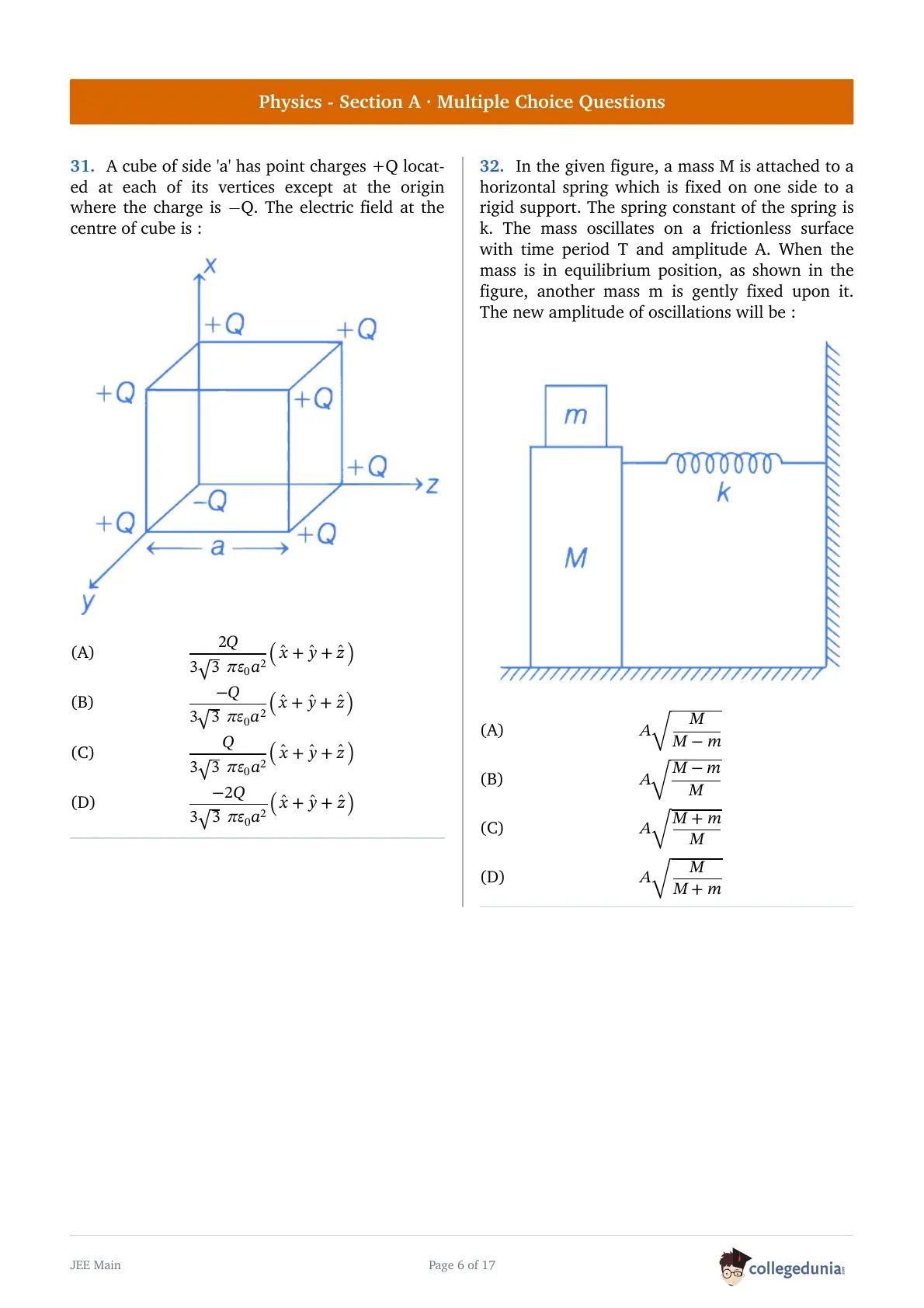
A cube of side 'a' has point charges +Q located at each of its vertices except at the origin where the charge is -Q. The electric field at the centre of cube is : 
In the given figure, a mass \(M\) is attached to a horizontal spring which is fixed on one side to a rigid support. The spring constant of the spring is \(k\). The mass oscillates on a frictionless surface with the time period \(T\) and amplitude \(A\). When the mass is in an equilibrium position, as shown in the figure, another mass \(m\) is gently fixed upon it. The new amplitude of oscillation will be : 
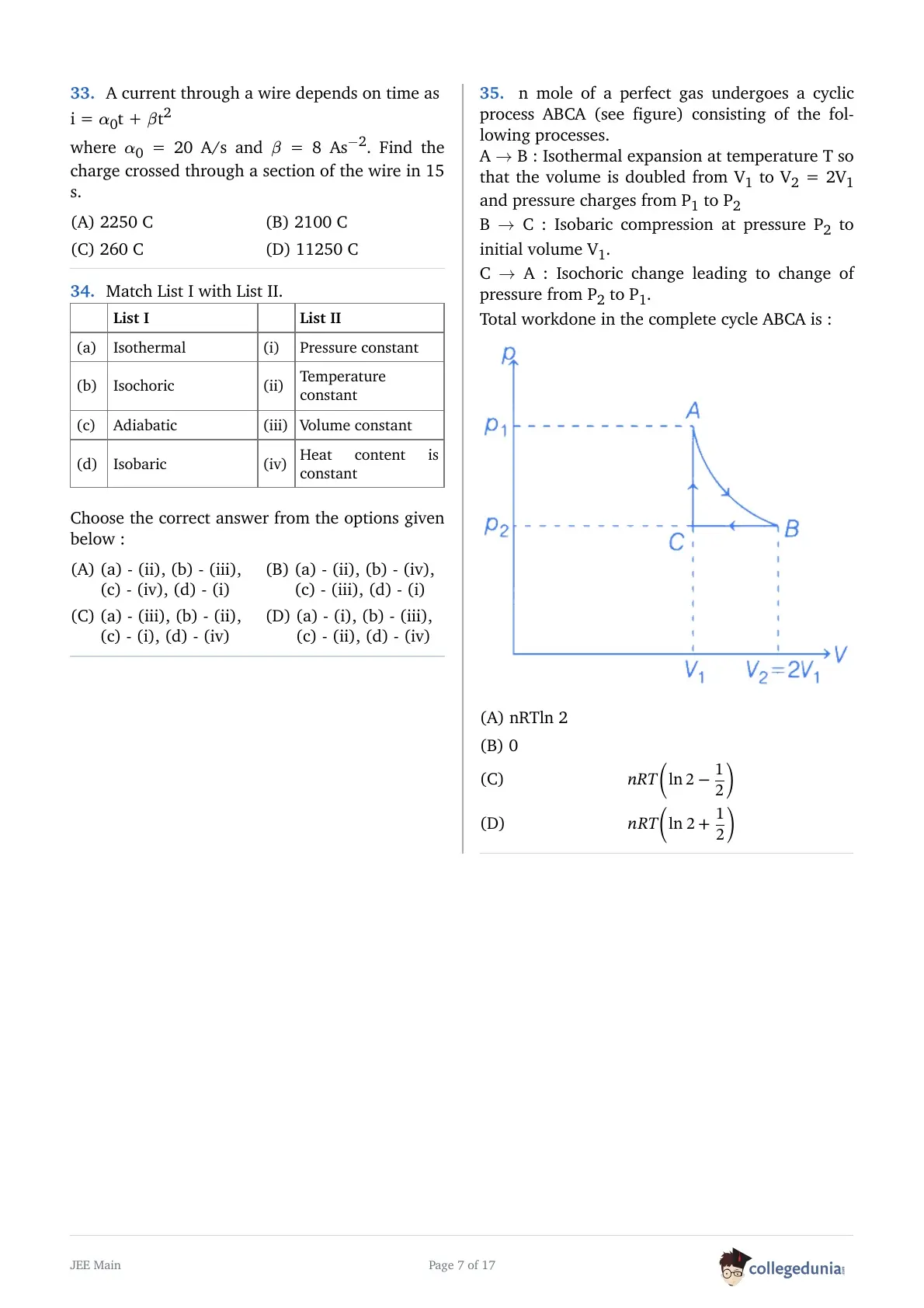
A current through a wire depends on time as \(i = \alpha_0 t + \beta t^2\) where \(\alpha_0 = 20 \text{ A/s}\) and \(\beta = 8 \text{ As}^{-2}\). Find the charge crossed through a section of the wire in 15 s.
Match List I with List II.
List I: (a) Isothermal (b) Isochoric (c) Adiabatic (d) Isobaric.
List II: (i) Pressure constant (ii) Temperature constant (iii) Volume constant (iv) Heat content constant.
A perfect gas undergoes a cyclic process ABCA. A→B: Isothermal expansion (\(V_1 \to 2V_1\)). B→C: Isobaric compression to \(V_1\). C→A: Isochoric change to \(P_1\). Total work done is :
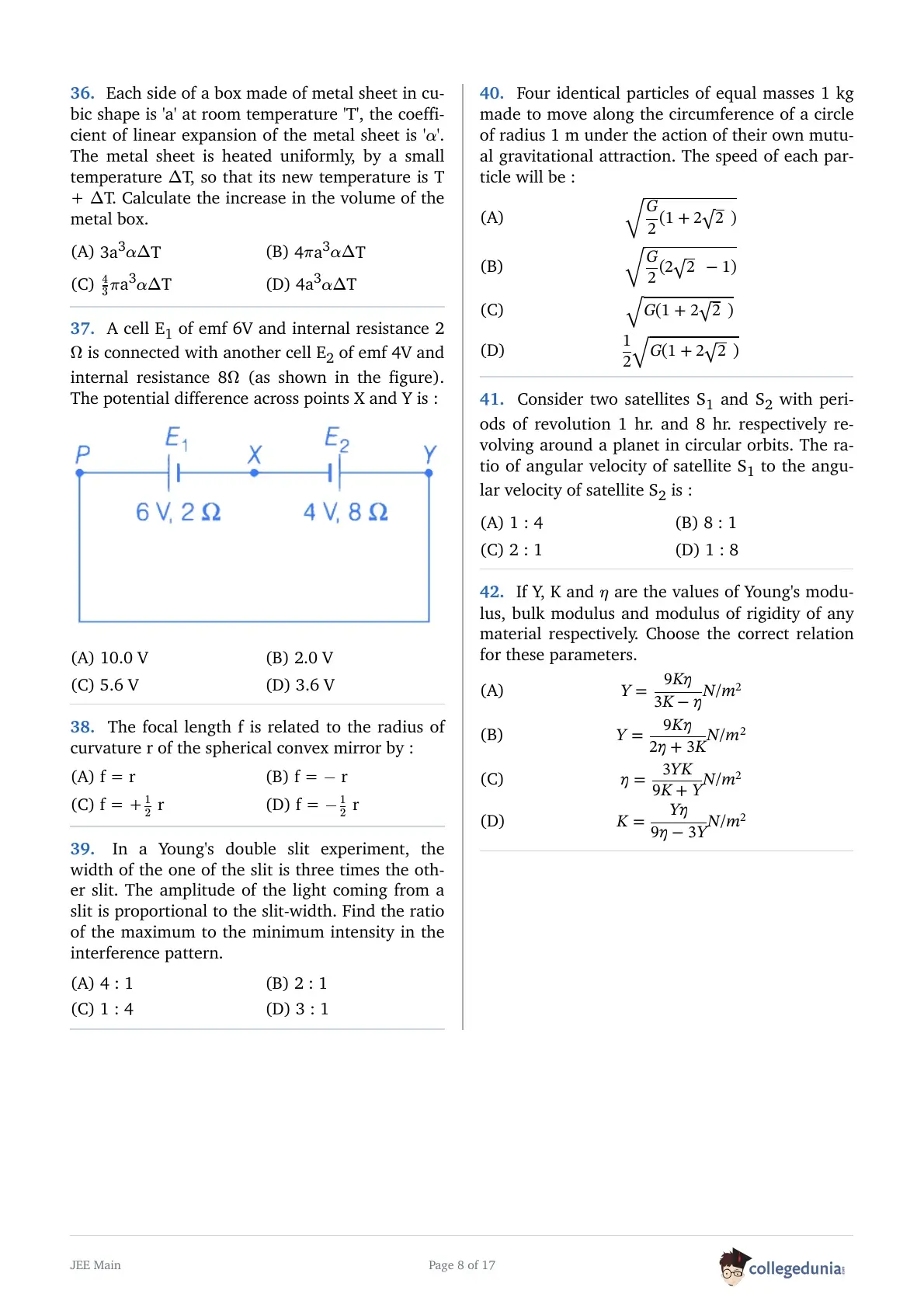
Each side of a box made of metal sheet in cubic shape is 'a' at room temperature 'T', the coefficient of linear expansion of the metal sheet is 'α'. The metal sheet is heated uniformly, by a small temperature ΔT, so that its new temperature is T + ΔT. Calculate the increase in the volume of the metal box.
A cell \(E_1\) of emf 6 V and internal resistance 2 Ω is connected with another cell \(E_2\) of emf 4 V and internal resistance 8 Ω (as shown in the figure). The potential difference across points X and Y is : 
The focal length \(f\) is related to the radius of curvature \(r\) of the spherical convex mirror by :
In a YDSE, width of one slit is three times the other. Amplitude is proportional to slit-width. Find the ratio \(I_{max}/I_{min}\).
Four identical particles of equal masses 1 kg made to move along the circumference of a circle of radius 1 m under the action of their own mutual gravitational attraction. The speed of each particle will be :
Consider two satellites \(S_1\) and \(S_2\) with periods of revolution 1 hr. and 8 hr. respectively revolving around a planet in circular orbits. The ratio of angular velocity of satellite \(S_1\) to the angular velocity of satellite \(S_2\) is :
If Y, K and η are the values of Young's modulus, bulk modulus and modulus of rigidity of any material respectively. Choose the correct relation for these parameters.
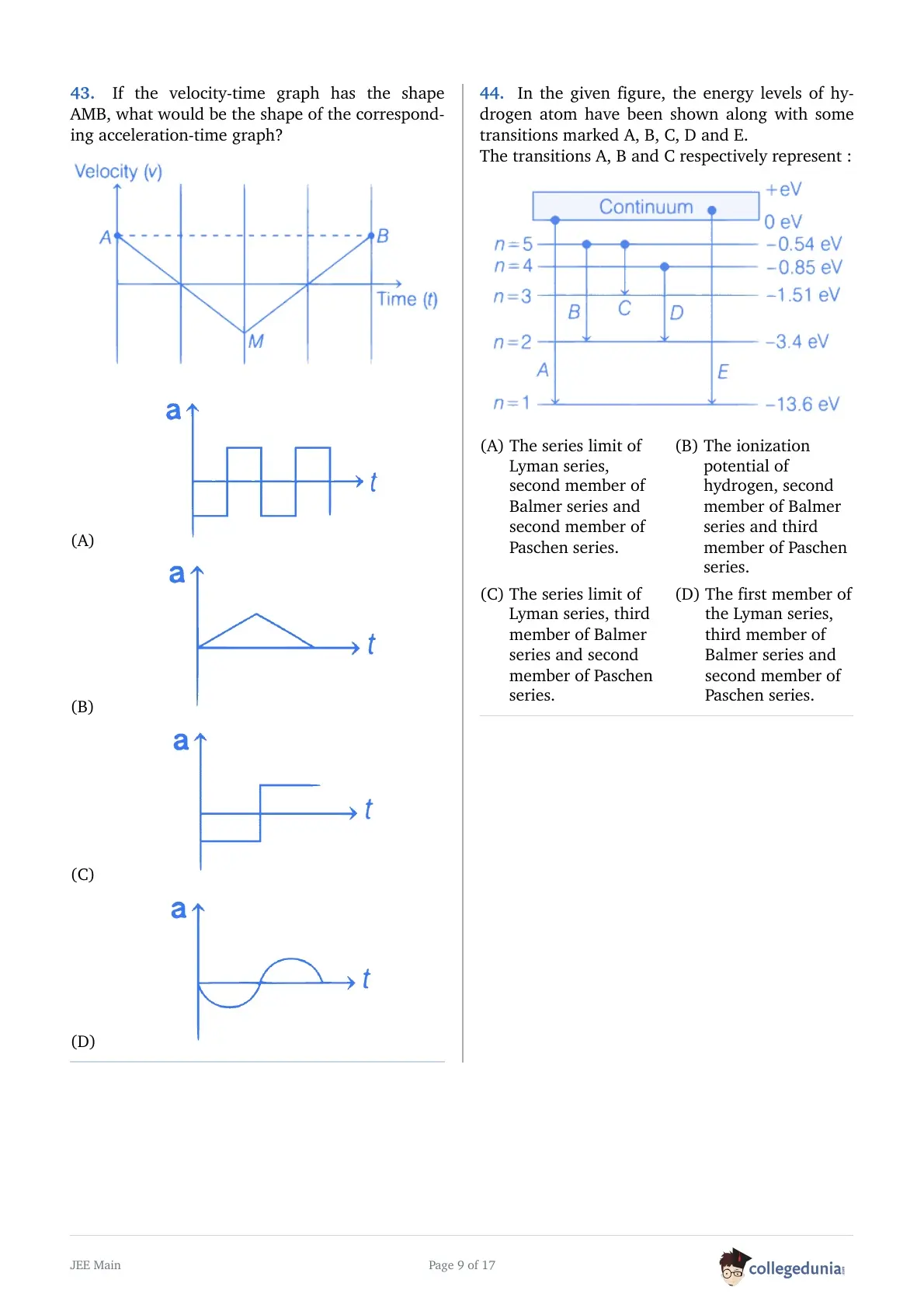
If the velocity-time graph has the shape AMB, what would be the shape of the corresponding acceleration-time graph ?
- (1)
![]()
- (2)
![]()
- (3)
![]()
- (4)
![]()


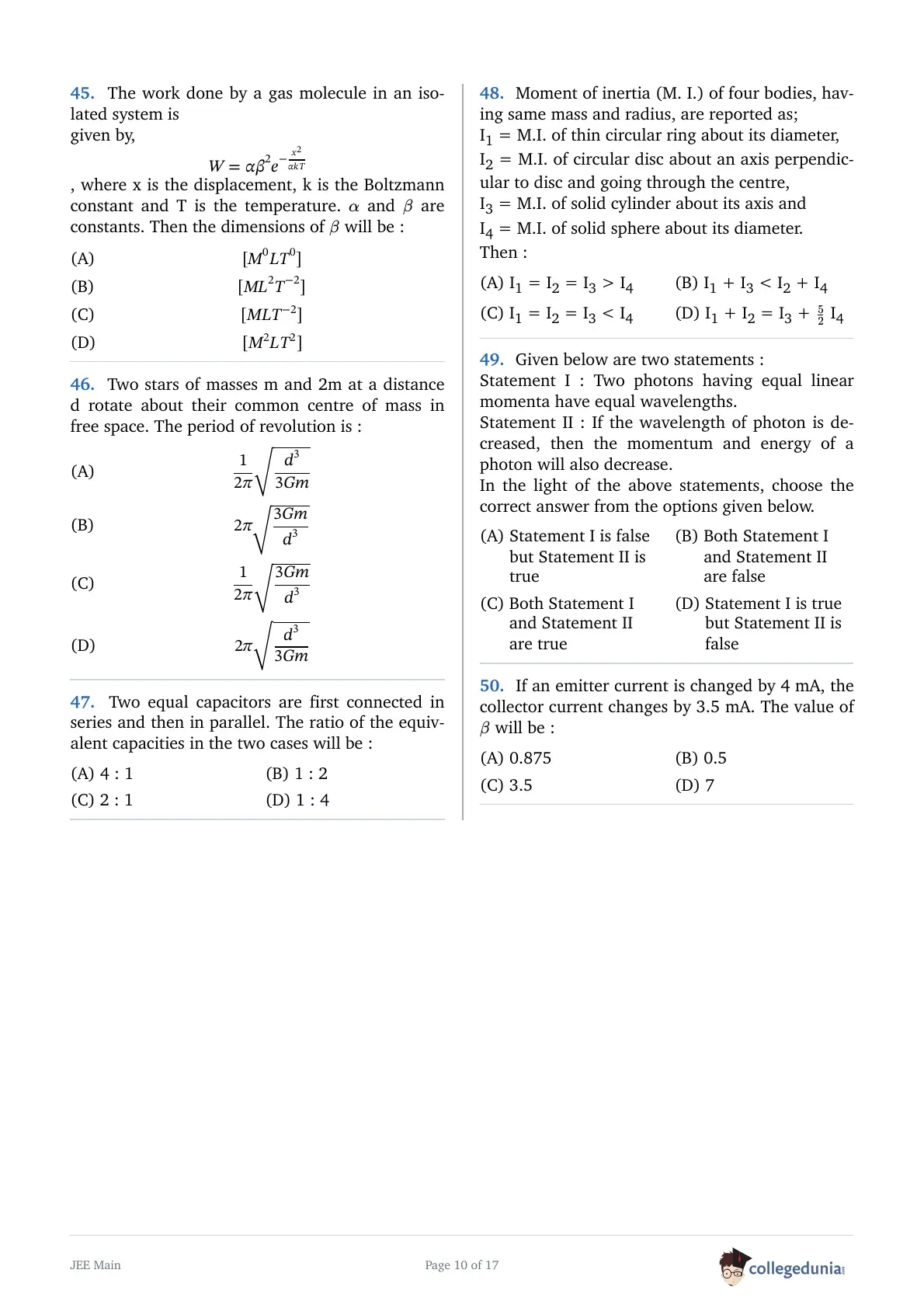
In the given figure, the energy levels of hydrogen atom have been shown along with some transitions marked \(A , B , C , D\) and \(E\). The transitions \(A, B\) and \(C\) respectively represent :
The work done by a gas molecule in an isolated system is given by, \(W = \alpha \beta^2 e^{-\frac{x^2}{akT}}\), where \(x\) is the displacement, \(k\) is the Boltzmann constant and \(T\) is the temperature. \(\alpha\) and \(\beta\) are constants. Then the dimensions of \(\beta\) will be :
Two stars of masses \(m\) and \(2m\) at a distance \(d\) rotate about their common centre of mass in free space. The period of revolution is :
Two equal capacitors are first connected in series and then in parallel. The ratio of the equivalent capacities in the two cases will be :
Moment of inertia (M.I.) of four bodies, having same mass and radius, are reported as ; \(I_1\) = M.I. of thin circular ring about its diameter, \(I_2\) = M.I. of circular disc about an axis perpendicular to disc and going through the centre, \(I_3\) = M.I. of solid cylinder about its axis and \(I_4\) = M.I. of solid sphere about its diameter. Then :
Given below are two statements : Two photons having equal linear momenta have equal wavelengths. If the wavelength of photon is decreased, then the momentum and energy of a photon will also decrease. In the light of the above statements, choose the correct answer from the options given below.
If an emitter current is changed by 4 mA, the collector current changes by 3.5 mA. The value of β will be :
Physics - Section B (Q51 - Q60)
An unpolarized light beam is incident on the polarizer of a polarization experiment and the intensity of light beam emerging from the analyzer is measured as 100 Lumens. Now, if the analyzer is rotated around the horizontal axis (direction of light) by 30° in clockwise direction, the intensity of emerging light will be ________ Lumens.
A ball with a speed of 9 m/s collides with another identical ball at rest. After the collision, the direction of each ball makes an angle of 30° with the original direction. The ratio of velocities of the balls after collision is x : y, where x is _________
An electromagnetic wave of frequency 5 GHz, is travelling in a medium whose relative electric permittivity and relative magnetic permeability both are 2. Its velocity in this medium is ________ × 10⁷ m/s.
A hydraulic press can lift 100 kg when a mass 'm' is placed on the smaller piston. It can lift _________ kg when the diameter of the larger piston is increased by 4 times and that of the smaller piston is decreased by 4 times keeping the same mass 'm' on the smaller piston.
An inclined plane is bent in such a way that the vertical cross-section is given by \(y = x^2 / 4\). If the upper surface is rough with \(\mu = 0.5\), the maximum height in cm at which a stationary block will not slip downward is _________ cm.
A common transistor radio set requires 12 V (D.C.). The D.C. source is constructed using a transformer and a rectifier circuit operated at 220 V (A.C.). The number of turns of secondary coil are 24, then the number of turns of primary are _________. (Assume ideal transformer)
The coefficient of static friction between a wooden block of mass 0.5 kg and a vertical rough wall is 0.2. The magnitude of horizontal force that should be applied on the block to keep it adhere to the wall will be _________ N. [ g = 10 ms⁻² ]
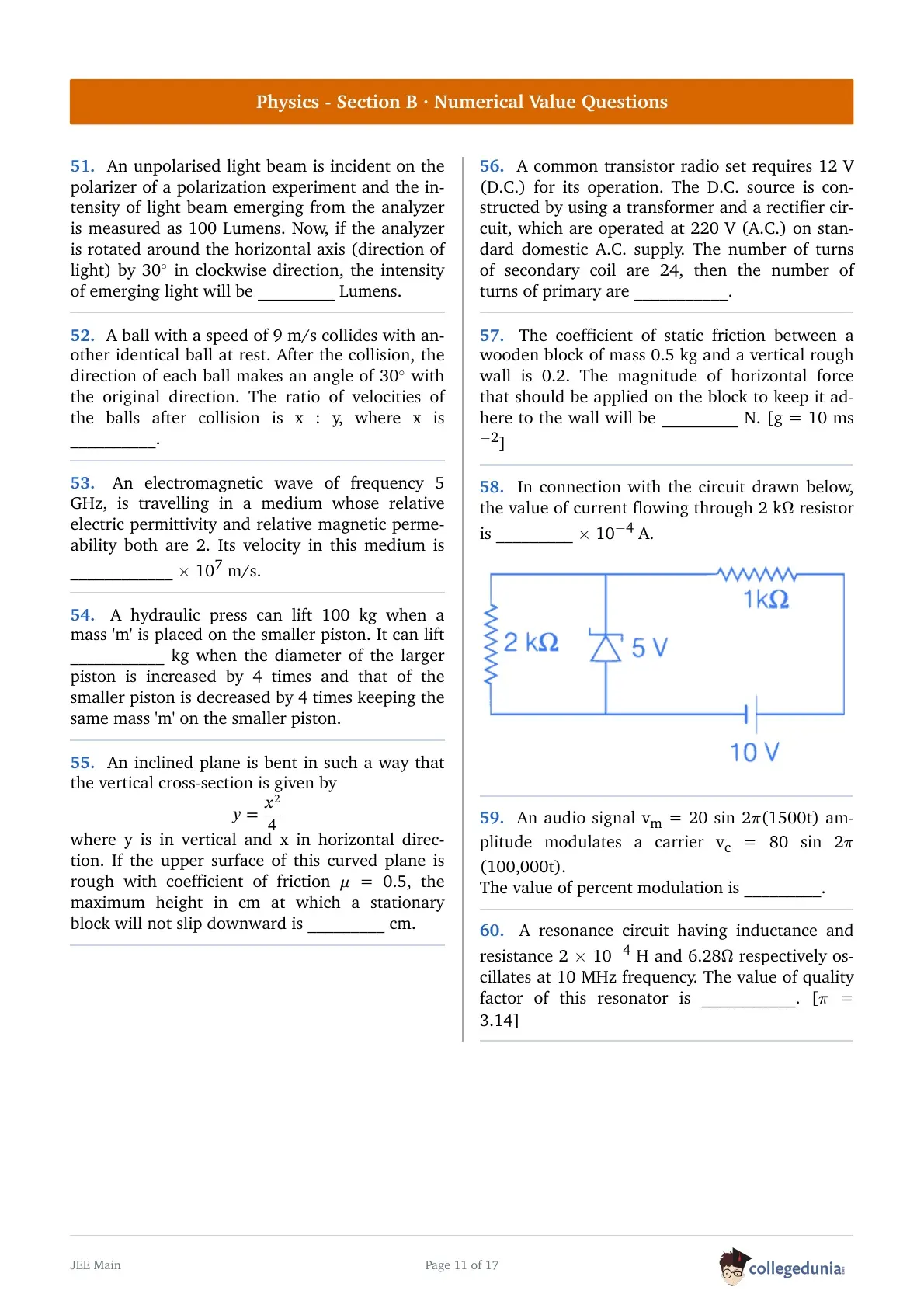
In connection with the circuit drawn below (assuming a Zener diode circuit with \(V_z=10V\), \(R_s=500\Omega\), \(R_L=2k\Omega\), \(V_{in}=15V\)), the value of current flowing through 2 kΩ resistor is _________ × 10⁻⁴ A. 
An audio signal \(v_m = 20 \sin 2\pi(1500t)\) amplitude modulates a carrier \(v_c = 80 \sin 2\pi(100,000t)\). The value of percent modulation is ________
A resonance circuit having inductance and resistance \(2 \times 10^{-4}\) H and \(6.28\) Ω respectively oscillates at 10 MHz frequency. The value of quality factor of this resonator is __________.
Chemistry - Section A (Q61 - Q80)
The electrode potential of \( \mathrm{M^{2+}/M} \) of 3d-series elements shows positive value for :
Which of the following reagent is used for the following reaction ? \(CH_3CH_2CH_3 \to CH_3CH_2CHO\)
Which of the following are isostructural pairs? A. \(SO _{4}^{2-}\) and \(CrO _{4}^{2-}\) B. \(SiCl _{4}\) and \(TiCl _{4}\) C. \(NH _{3}\) and \(NO _{3}^{-}\) D. \(BCl _{3}\) and \(BrCl _{3}\) \(BCl _{3}\) and \(BrCl _{3}\)
Consider the elements Mg, Al, S, P and Si, the correct increasing order of their first ionization enthalpy is :
Out of the following, which type of interaction is responsible for the stabilisation of \(\alpha\) -helix structure of proteins?
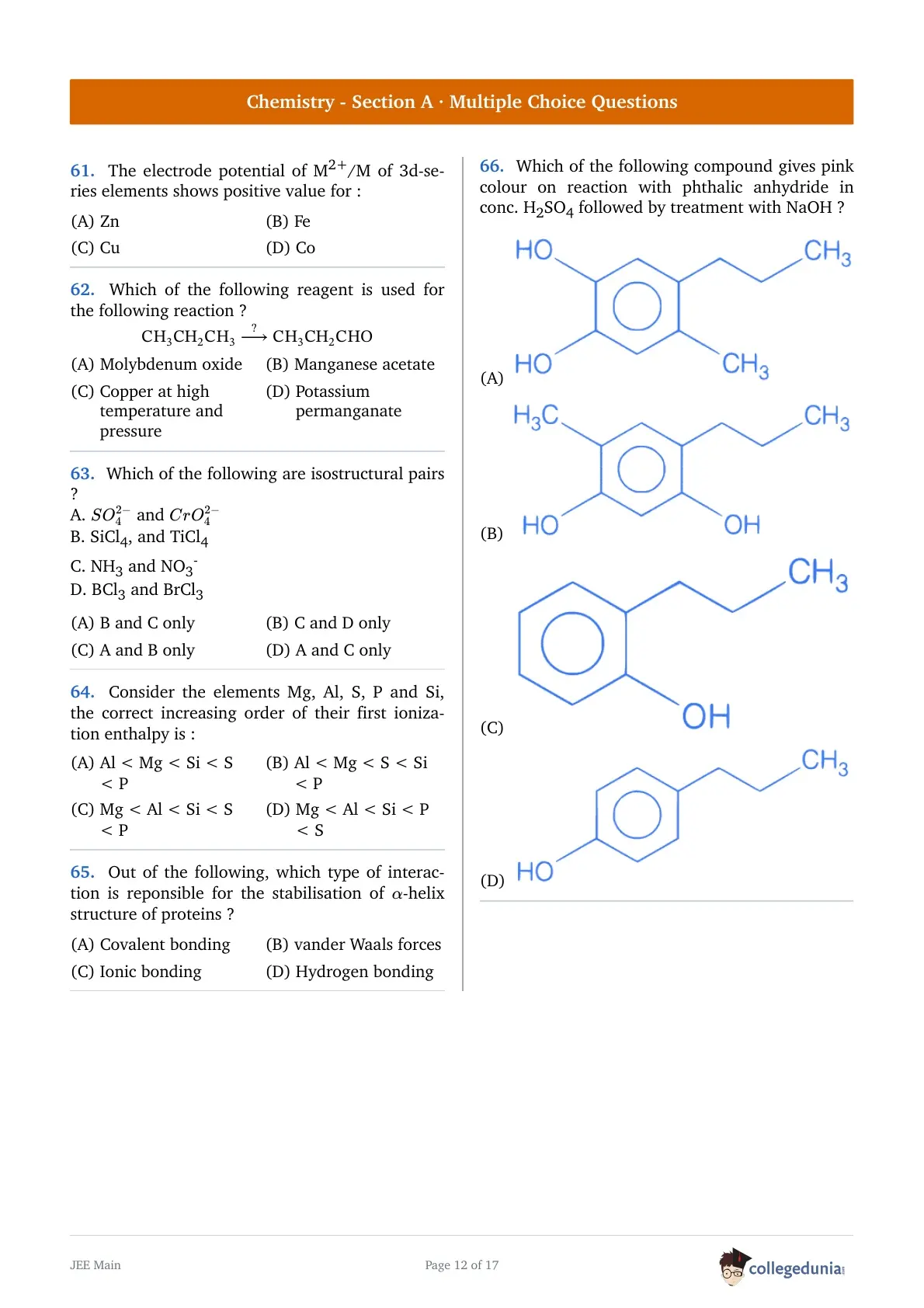
Which of the following compound gives pink colour on reaction with phthalic anhydride in conc. \( \mathrm{H_2SO_4} \) followed by treatment with \( \mathrm{NaOH} \) ? 
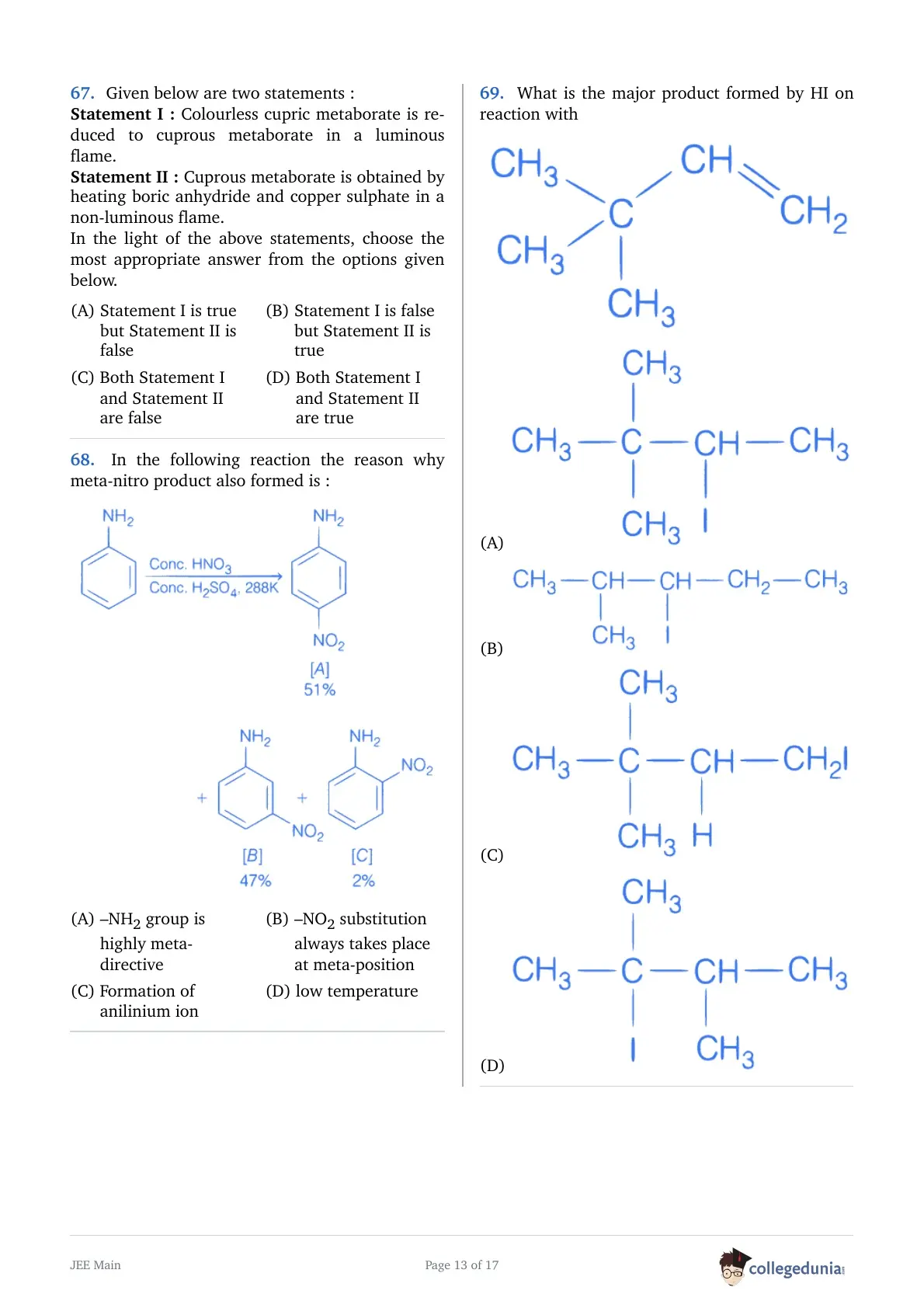
Given below are two statements : Statement I : Colourless cupric metaborate is reduced to cuprous metaborate in a luminous flame. Statement II : Cuprous metaborate is obtained by heating boric anhydride and copper sulphate in a non-luminous flame. In the light of the above statements, choose the most appropriate answer from the options given below.
In the following reaction the reason why meta-nitro product also formed is : 
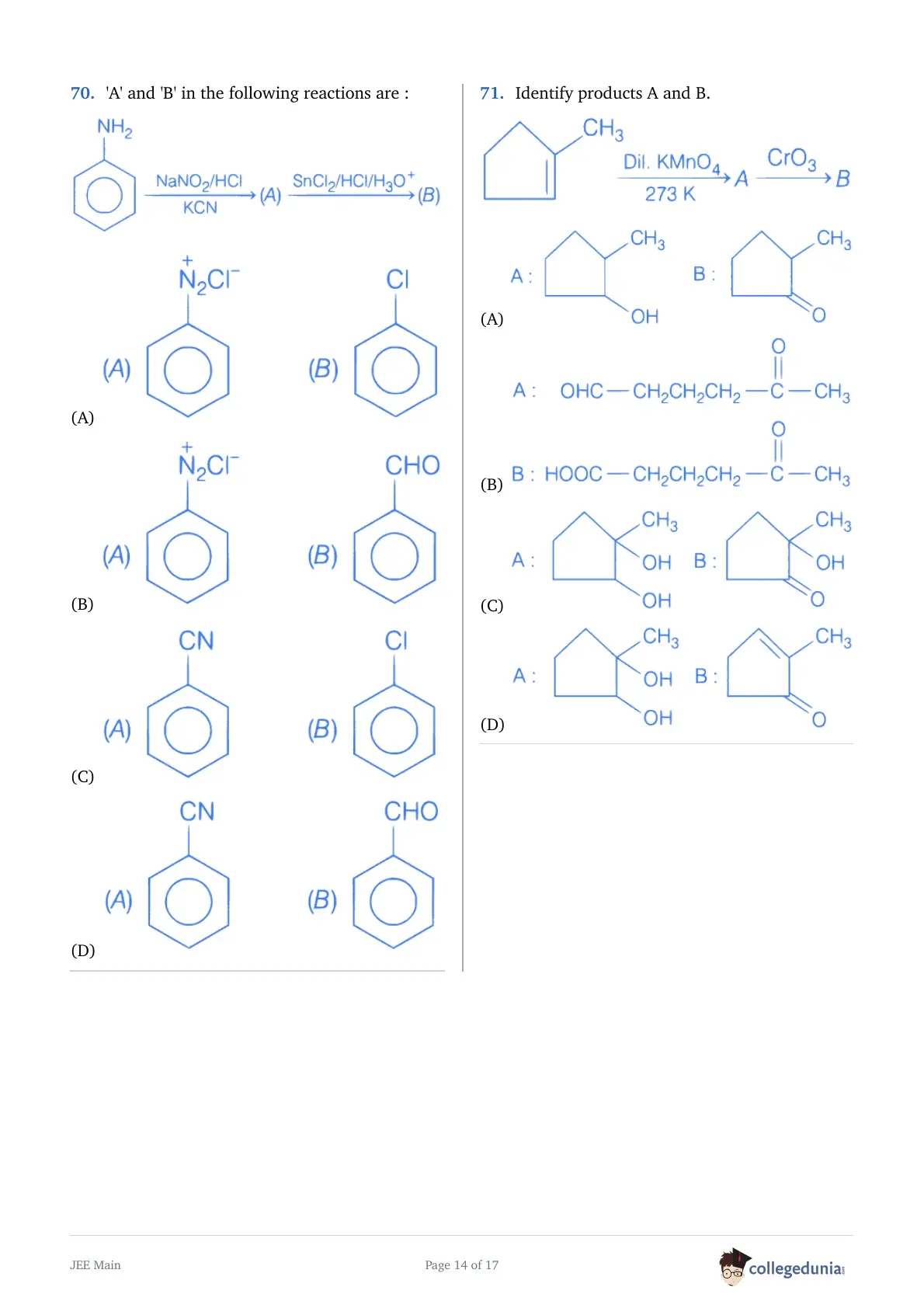
What is the major product formed by HI reaction with


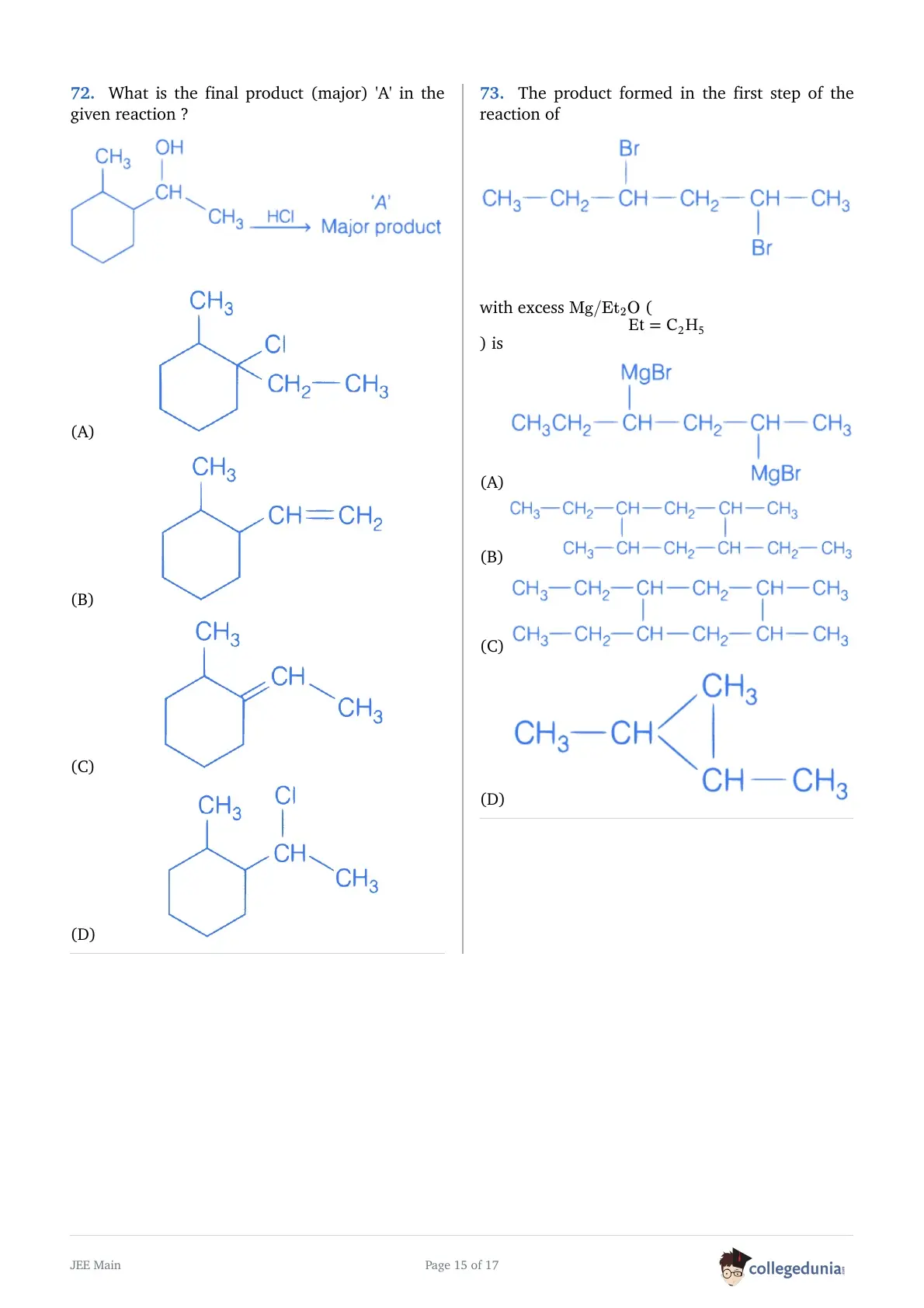
What is the final product (major) 'A' in the given reaction ? \(CH_3 - CH = CH - CH_3 \xrightarrow{HCl} A\) 

The product formed in the first step of the reaction of \(CH_3 - CH_2 - CH(Br) - CH_2 - CH(Br) - CH_3\) with excess \(Mg/Et_2O\) is : 
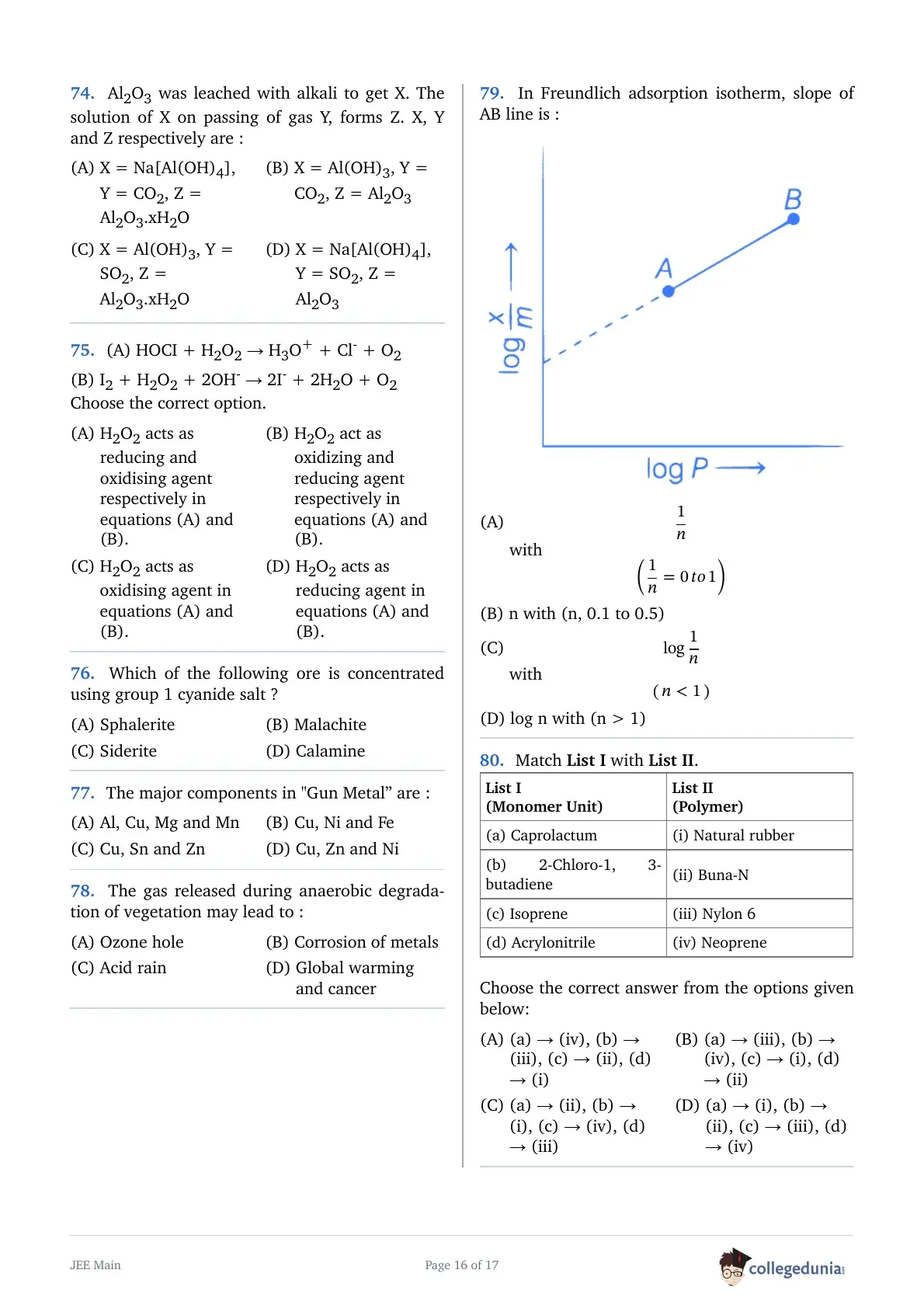
\( \mathrm{Al_2O_3} \) was leached with alkali to get \( X \). The solution of \( X \), on passing the gas \( Y \), forms \( Z \). \( X, Y \) and \( Z \) respectively are :
(A) \( \mathrm{HOCl + H_2O_2 \rightarrow H_3O^+ + Cl^- + O_2} \) |
(B) \( \mathrm{I_2 + H_2O_2 + 2OH^- \rightarrow 2I^- + 2H_2O + O_2} \).
Choose the correct option.
Which of the following ore is concentrated using group 1 cyanide salt ?
The major components in “Gun Metal” are :
The gas released during anaerobic degradation of vegetation may lead to :
In Freundlich adsorption isotherm, slope of AB line is : 
Match List I with List II.
List I: (a) Caprolactum (b) 2-Chloro-1,3-butadiene (c) Isoprene (d) Acrylonitrile.
List II: (i) Natural rubber (ii) Buna-N (iii) Nylon 6 (iv) Neoprene.
Chemistry - Section B (Q81 - Q90)
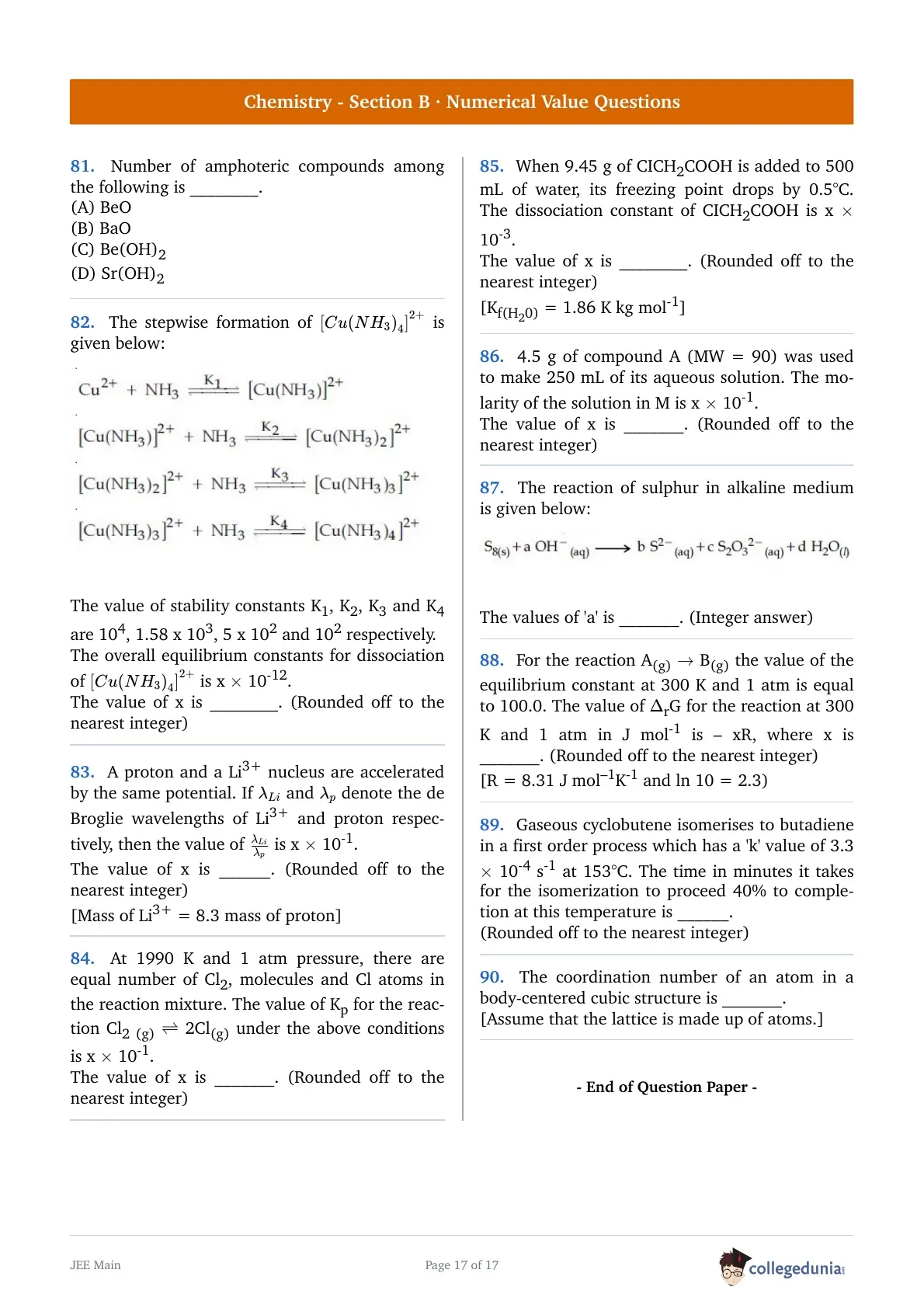
Number of amphoteric compounds among the following is _______. (A) BeO (B) BaO (C) \(Be(OH)_2\) (D) \(Sr(OH)_2\)
The stepwise formation of \([Cu(NH_3)_4]^{2+}\) is given. The value of stability constants \(K_1, K_2, K_3\) and \(K_4\) are \(10^4, 1.58 \times 10^3, 5 \times 10^2\) and \(10^2\) respectively. The overall equilibrium constant for dissociation of \([Cu(NH_3)_4]^{2+}\) is \(x \times 10^{-12}\). The value of \(x\) is __________. (Rounded off to the nearest integer)
A proton and a \(Li^{3+}\) nucleus are accelerated by the same potential. If \(\lambda_{Li}\) and \(\lambda_p\) denote the de Broglie wavelengths of \(Li^{3+}\) and proton respectively, then the value of \(\lambda_{Li} / \lambda_p\) is \(x \times 10^{-1}\). The value of \(x\) is __________. (Rounded off to the nearest integer) [Mass of \(Li^{3+}\) = 8.3 mass of proton]
At 1990 K and 1 atm pressure, there are equal number of \(Cl_2\) molecules and \(Cl\) atoms in the reaction mixture. The value of \(K_p\) for the reaction \(Cl_2(g) \rightleftharpoons 2Cl(g)\) under the above conditions is \(x \times 10^{-1}\). The value of \(x\) is __________. (Rounded off to the nearest integer)
When 9.45 g of \(ClCH_2COOH\) is added to 500 mL of water, its freezing point drops by 0.5°C. The dissociation constant of \(ClCH_2COOH\) is \(x \times 10^{-3}\). The value of \(x\) is __________. (Rounded off to the nearest integer) [\(K_f(H_2O)=1.86\) K kg mol\(^{-1}\)]
4.5 g of compound A (MW = 90) was used to make 250 mL of its aqueous solution. The molarity of the solution in M is \(x \times 10^{-1}\). The value of \(x\) is __________. (Rounded off to the nearest integer)
The reaction of sulphur in alkaline medium is given below: \(S_8(s) + a OH^-(aq) \to b S^{2-}(aq) + c S_2O_3^{2-}(aq) + d H_2O(l)\) The value of 'a' is __________. (Integer answer)
For the reaction \(A_{(g)} \rightleftharpoons B_{(g)}\), the value of the equilibrium constant at 300 K and 1 atm is equal to 100.0. The value of \(\Delta_r G^\circ\) for the reaction at 300 K and 1 atm in J mol\(^{-1}\) is \(-xR\), where \(x\) is __________. (Rounded off to the nearest integer) [R=8.31 J mol\(^{-1}K^{-1}\) and \(\ln 10=2.3\)]
Gaseous cyclobutene isomerizes to butadiene in a first order process which has a 'k' value of \(3.3 \times 10^{-4} s^{-1}\) at 153°C. The time in minutes it takes for the isomerization to proceed 40% to completion at this temperature is __________. (Rounded off to the nearest integer)
The coordination number of an atom in a body-centered cubic structure is _________. [Assume that the lattice is made up of atoms.]
JEE Main 2021 Exam Pattern and Marking Scheme
| Particulars | Details |
|---|---|
| Exam Mode | Online (Computer-Based Test) |
| Paper | B.E./B.Tech (Paper 1) |
| Duration | 3 hours (180 minutes) |
| Type of Questions | Multiple Choice Questions (MCQs) + Numerical Value Questions |
| Subjects | Mathematics, Physics, Chemistry |
| Total Questions | 90 questions (75 to be attempted) |
| Total Marks | 300 marks |
| Marking Scheme | +4 for correct answer & -1 for incorrect MCQ; no negative marking for Numerical Value Questions |
JEE Main 2021 February 24 Shift 1 Difficulty Level
JEE Main 2021 B.E./B.Tech Question Paper - February 24, 2021- forenoon Session was rated moderate in terms of overall difficulty by students and experts. The paper was also said to be well balanced in terms of the difficulty levels of the three sections. As per the revised JEE Main Exam Pattern, a total of 30 questions were asked from each section, with 25 questions to be attempted by the candidate in the section.
JEE Main 2021 B.E./B.Tech Question Paper February 24 (FN): Paper Analysis
JEE Main 2021 B.E./B.Tech February 24 Forenoon Paper was conducted from 9.00 AM to 12.00 Noon and was reported to be of moderate difficulty level.
- As usual, Mathematics was the toughest section of the exam, with the questions on Integrals and Algebra being lengthy.
- Dominant units in Mathematics were – Differential Calculus (20%), Integral Calculus (20%), Coordinate Geometry (12%), and Vector & 3D (12%)
- The Physics section was comparatively easier than the other sections. Although the number of calculations-based questions was more than the theory-based ones, they were mostly short and involved one or other variations of the direct formula.
- The dominant units in Physics were Mechanics (37%) and Modern Physics (24%).
- The Chemistry section was surprising in terms of difficulty. Upsetting the trends predicted by JEE Main Previous Year Paper Analysis, the Chemistry section was the second most difficult section of the paper.
- In the Chemistry Section, dominant units were as – Organic Chemistry II (30%), Physical Chemistry I (20%), and Physical Chemistry II (18%)
- Around 48 questions were asked from the class XII syllabus in the paper, and around 42 were asked from the class XI syllabus.



Comments