




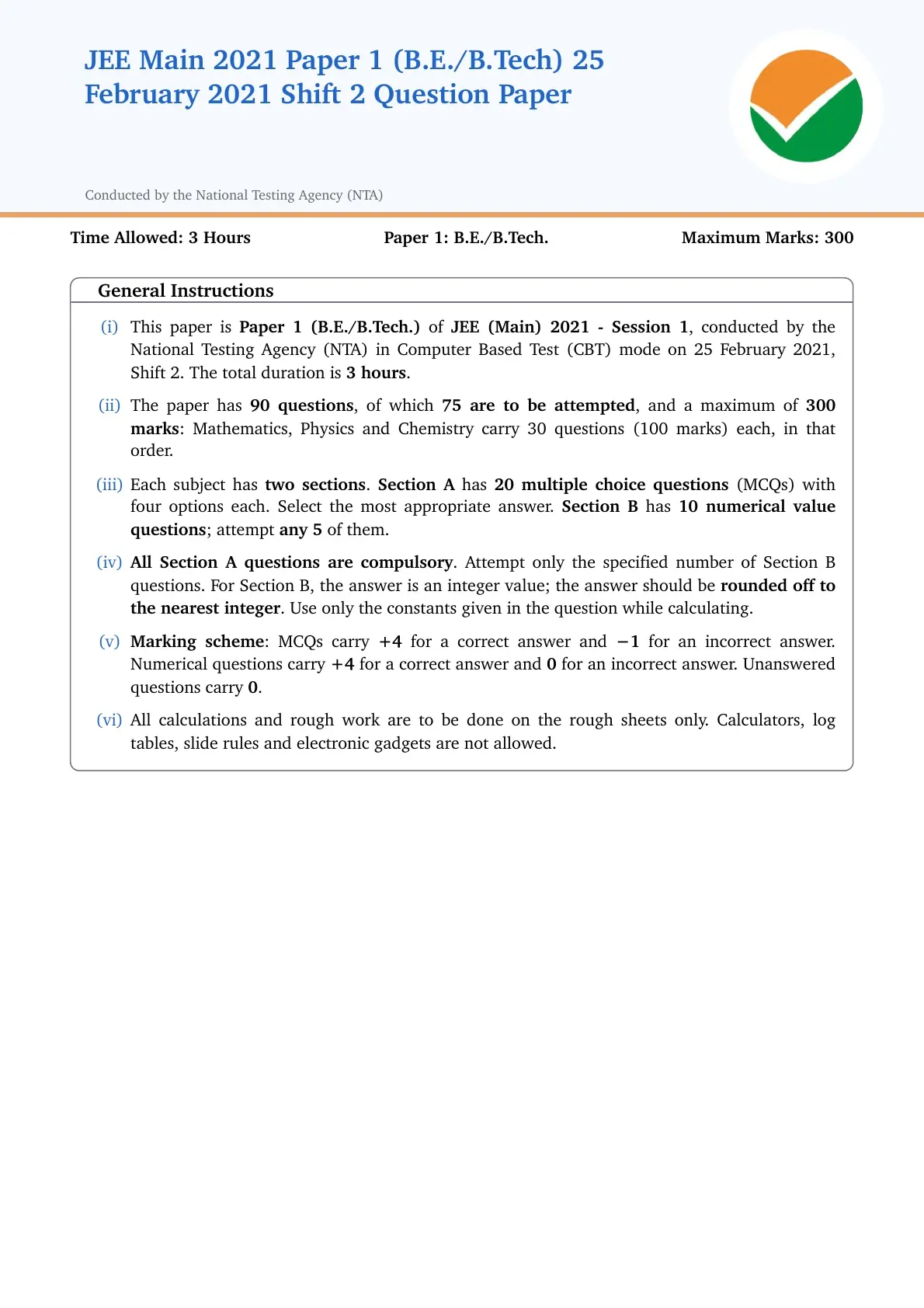
JEE Main 2021 February 25 Shift 2 Question Paper is available here with solutions PDF and detailed solutions for every question. NTA conducted the second shift on February 25, 2021, from 3:00 PM to 6:00 PM. The JEE Main 2021 Paper 1 (B.E./B.Tech) question paper includes the following:
- 90 questions in a 3-hour CBT Mode: 30 each from Mathematics, Physics and Chemistry (75 to be attempted)
- Section A: 20 multiple choice questions (MCQs) per subject, all compulsory, 4 marks each
- Section B: 10 numerical value questions per subject, any 5 to be attempted, 4 marks each
- Marking: +4 for a correct answer, -1 for an incorrect MCQ, 0 for an unattempted question; no negative marking for numerical value questions
- Maximum marks: 300 (100 per subject)
JEE Main 2021 February 25 Shift 2 Question Paper with Solution PDF
| NTA Official PDF | CD PDF | CD PDF with Solutions |
|---|---|---|
| Download official PDF 5.61 MB | Download Collegedunia PDF 1.00 MB | Download solutions PDF 1.29 MB |
Also Check:
JEE Main 2021 February 25 Shift 2 Questions with Solutions
Mathematics - Section A (Q1 - Q20)
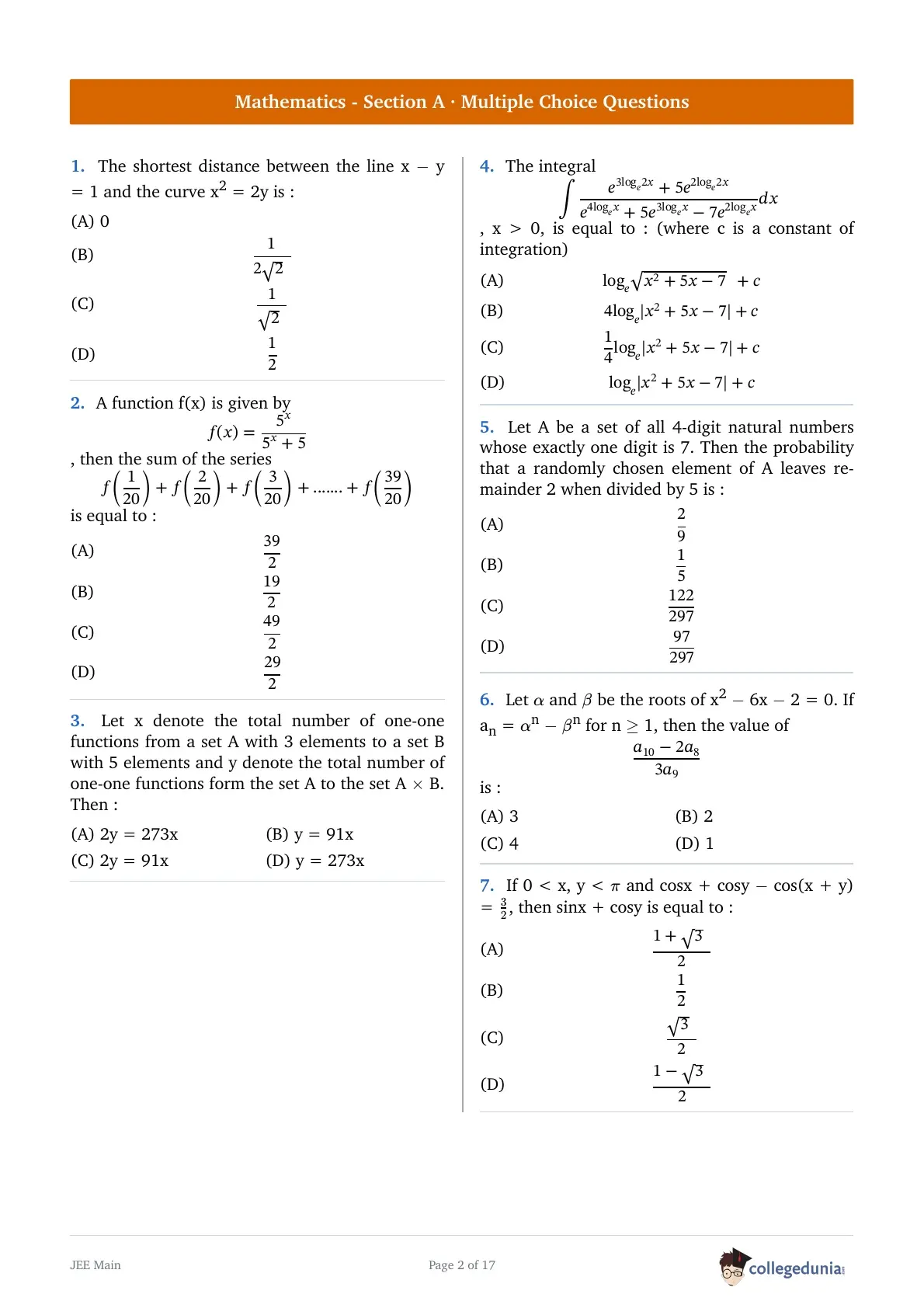
The shortest distance between the line \(x-y=1\) and the curve \(x^2 = 2y\) is:
A function f(x) is given by f(x) = \(\frac{5^x}{5^x + 5}\), then the sum of the series \(f(\frac{1}{20}) + f(\frac{2}{20}) + \dots + f(\frac{39}{20})\) is equal to:
Let x denote the total number of one-one functions from a set A with 3 elements to a set B with 5 elements and y denote the total number of one-one functions from the set A to the set A \(\times\) B. Then :
The integral \(\int \frac{e^{3\log_e{2x}} + 5e^{2\log_e{2x}}}{e^{4\log_e{x}} + 5e^{3\log_e{x}} - 7e^{2\log_e{x}}} \,dx\), x>0, is equal to: (where c is a constant of integration)
Let A be a set of all 4-digit natural numbers whose exactly one digit is 7. Then the probability that a randomly chosen element of A leaves remainder 2 when divided by 5 is :
Let \(\alpha\) and \(\beta\) be the roots of \(x^2 - 6x - 2 = 0\). If \(a_n = \alpha^n - \beta^n\) for \(n \ge 1\), then the value of \(\frac{a_{10} - 2a_8}{3a_9}\) is:
if 0<x, y<\(\pi\) and cosx+cosy-cos(x y)=\(\frac{3}{2}\),Then sin x+cos y=?
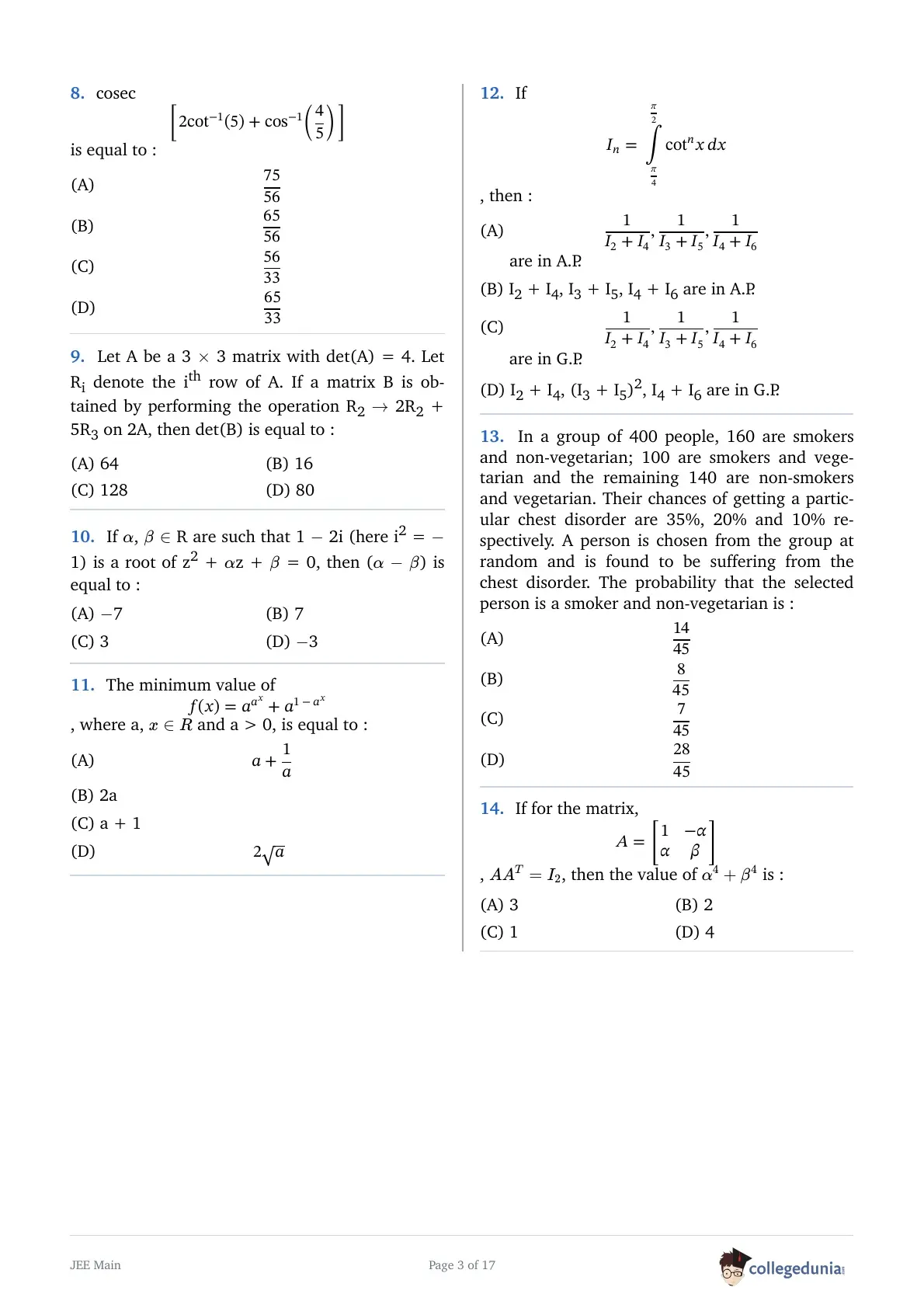
cosec[2cot\(^{-1}\)(5) + cos\(^{-1}\)(\(\frac{4}{5}\))] is equal to :
Let A be a 3\(\times\)3 matrix with det(A)=4. Let R\(_i\) denote the i\(^{th}\) row of A. If a matrix B is obtained by performing the operation R\(_2\) \(\rightarrow\) 2R\(_2\)+5R\(_3\) on 2A, then det(B) is equal to:
If \(\alpha, \beta \in R\) are such that 1\(-\)2i (here \(i^2\)=\(-\)1) is a root of z\(^2\)+\(\alpha\)z+\(\beta\)=0, then (\(\alpha-\beta\)) is equal to:
The minimum value of f(x) = \(a^{a^x} + a^{1-a^x}\), where a, x \(\in\) R and a>0, is equal to :
If I\(_n\) = \(\int_{\pi/4}^{\pi/2} \cot^n x \,dx\), then :
In a group of 400 people, 160 are smokers and non-vegetarian; 100 are smokers and vegetarian and the remaining 140 are non-smokers and vegetarian. Their chances of getting a particular chest disorder are 35%, 20% and 10% respectively. A person is chosen from the group at random and is found to be suffering from the chest disorder. The probability that the selected person is a smoker and non-vegetarian is:
If for the matrix, A = \( A = \begin{bmatrix} 1 & -\alpha \\ \alpha & \beta \end{bmatrix} \), and \( A A^T = I_2 \), then the value of \( \alpha^4 + \beta^4 \) is :
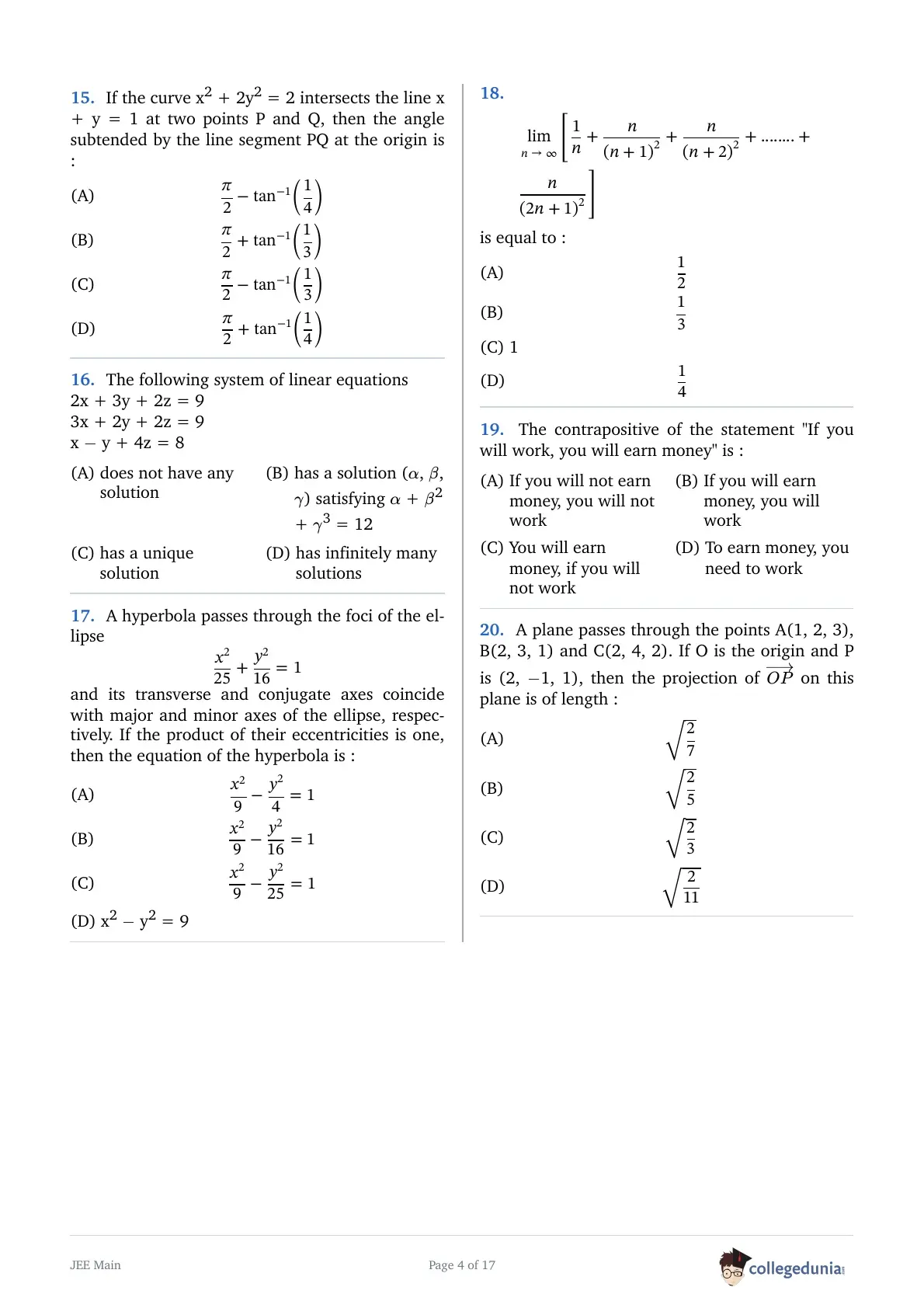
If the curve \(x^2+2y^2 = 2\) intersects the line \(x+y=1\) at two points P and Q, then the angle subtended by the line segment PQ at the origin is :
The following system of linear equations
2x + 3y + 2z = 9
3x + 2y + 2z = 9
x - y + 4z = 8
A hyperbola passes through the foci of the ellipse \(\frac{x^2}{25} + \frac{y^2}{16} = 1\) and its transverse and conjugate axes coincide with major and minor axes of the ellipse, respectively. If the product of their eccentricities is one, then the equation of the hyperbola is:
\(\lim_{n\to\infty} [\frac{1}{n} + \frac{n}{(n+1)^2} + \frac{n}{(n+2)^2} + \dots + \frac{n}{(2n-1)^2}]\) is equal to :
The contrapositive of the statement "If you will work, you will earn money" is:
A plane passes through the points A(1, 2, 3), B(2, 3, 1) and C(2, 4, 2). If O is the origin and P is (2, -1, 1), then the projection of \(\vec{OP}\) on this plane is of length :
Mathematics - Section B (Q21 - Q30)
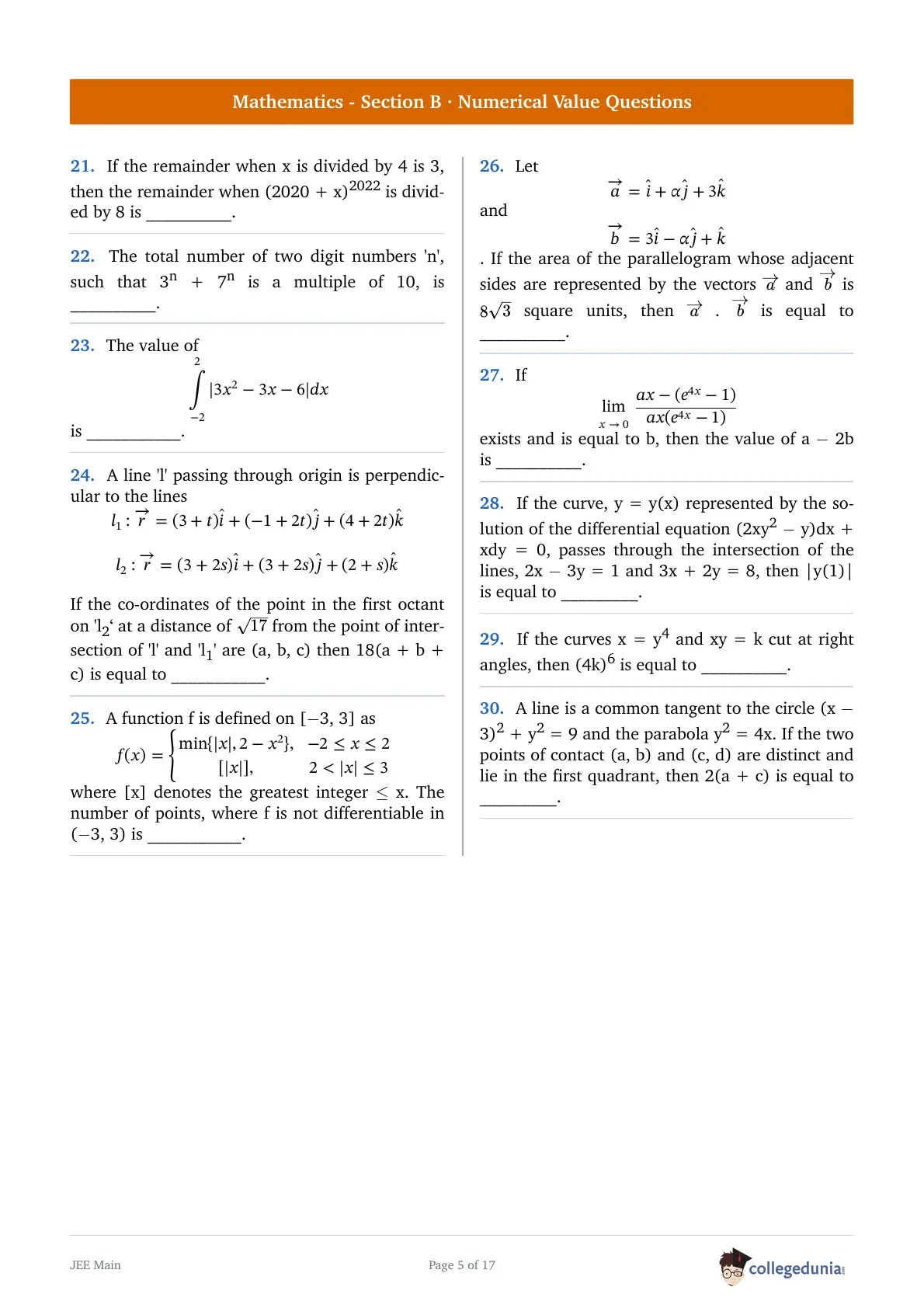
If the remainder when x is divided by 4 is 3, then the remainder when \((2020+x)^{2022}\) is divided by 8 is ________ .
The total number of two digit numbers 'n', such that \(3^n + 7^n\) is a multiple of 10, is ________ .
The value of \(\int_{-2}^{2} |3x^2-3x-6| \,dx\) is ________ .
A line 'l' passing through origin is perpendicular to the lines
\(l_1: \vec{r} = (3+t)\hat{i} + (-1+2t)\hat{j} + (4+2t)\hat{k}\)
\(l_2: \vec{r} = (3+2s)\hat{i} + (3+2s)\hat{j} + (2+s)\hat{k}\)
If the co-ordinates of the point in the first octant on \(l_2\) at a distance of \(\sqrt{17}\) from the point of intersection of 'l' and '\(l_1\)' are (a, b, c), then 18(a+b+c) is equal to ________ .
A function \( f \) is defined on \([-3, 3]\) as \( f(x) = \begin{cases} \min\{|x|, 2-x^2\}, & -2 \le x \le 2 \\ |x|, & 2 < |x| \le 3 \end{cases} \), where \( [x] \) denotes the greatest integer \( \le x \). The number of points, where \( f \) is not differentiable in \((-3, 3)\) is ________ .
Let \(\vec{a} = \hat{i} + \alpha\hat{j} + 3\hat{k}\) and \(\vec{b} = 3\hat{i} - \alpha\hat{j} + \hat{k}\). If the area of the parallelogram whose adjacent sides are represented by the vectors \(\vec{a}\) and \(\vec{b}\) is 8\(\sqrt{3}\) square units, then \(\vec{a} \cdot \vec{b}\) is equal to ________ .
If lim\(_{x\to 0} \frac{ax - (e^{4x}-1)}{ax(e^{4x}-1)}\) exists and is equal to b, then the value of a\(-\)2b is ________ .
If the curve, y=y(x) represented by the solution of the differential equation \((2xy^2-y)dx+xdy=0\), passes through the intersection of the lines, 2x\(-\)3y=1 and 3x+2y=8, then \(|y(1)|\) is equal to ________ .
If the curves \(x=y^4\) and \(xy=k\) cut at right angles, then \((4k)^6\) is equal to ________ .
A line is a common tangent to the circle \((x-3)^2+y^2=9\) and the parabola \(y^2=4x\). If the two points of contact (a, b) and (c, d) are distinct and lie in the first quadrant, then 2(a+c) is equal to ________ .
Physics - Section A (Q31 - Q50)
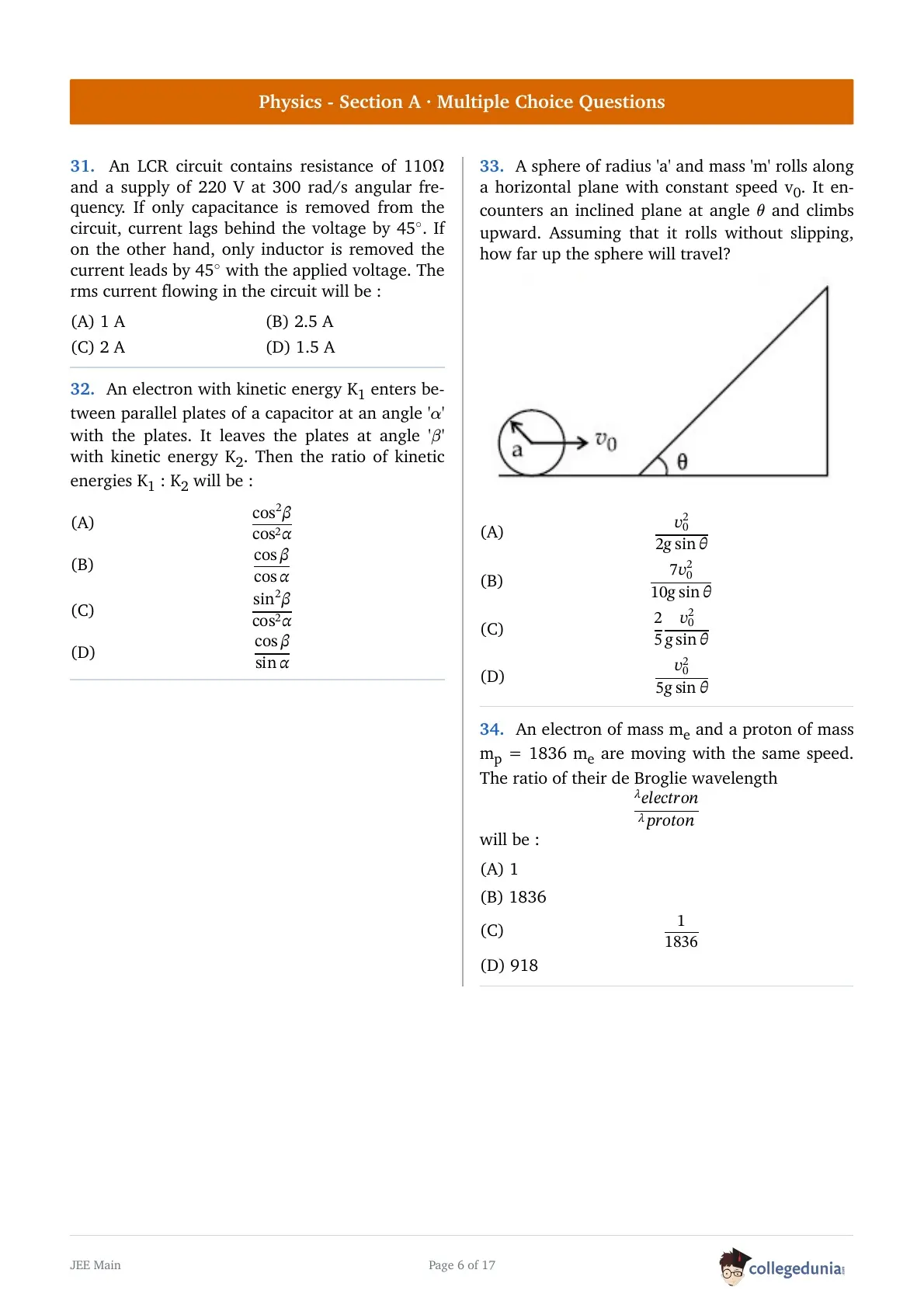
An LCR circuit contains resistance of 110 \(\Omega\) and a supply of 220 V at 300 rad/s angular frequency. If only capacitance is removed from the circuit, current lags behind the voltage by 45°. If on the other hand, only inductor is removed the current leads by 45° with the applied voltage. The rms current flowing in the circuit will be:
An electron with kinetic energy \(K_1\) enters between parallel plates of a capacitor at an angle '\(\alpha\)' with the plates. It leaves the plates at angle '\(\beta\)' with kinetic energy \(K_2\). Then the ratio of kinetic energies \(K_1 : K_2\) will be:
A sphere of radius 'a' and mass 'm' rolls along a horizontal plane with constant speed \(v_0\). It encounters an inclined plane at angle \(\theta\) and climbs upward. Assuming that it rolls without slipping, how far up the sphere will travel? 
An electron of mass \(m_e\) and a proton of mass \(m_p = 1836 m_e\) are moving with the same speed. The ratio of their de Broglie wavelength \(\frac{\lambda_{electron}}{\lambda_{proton}}\) will be:
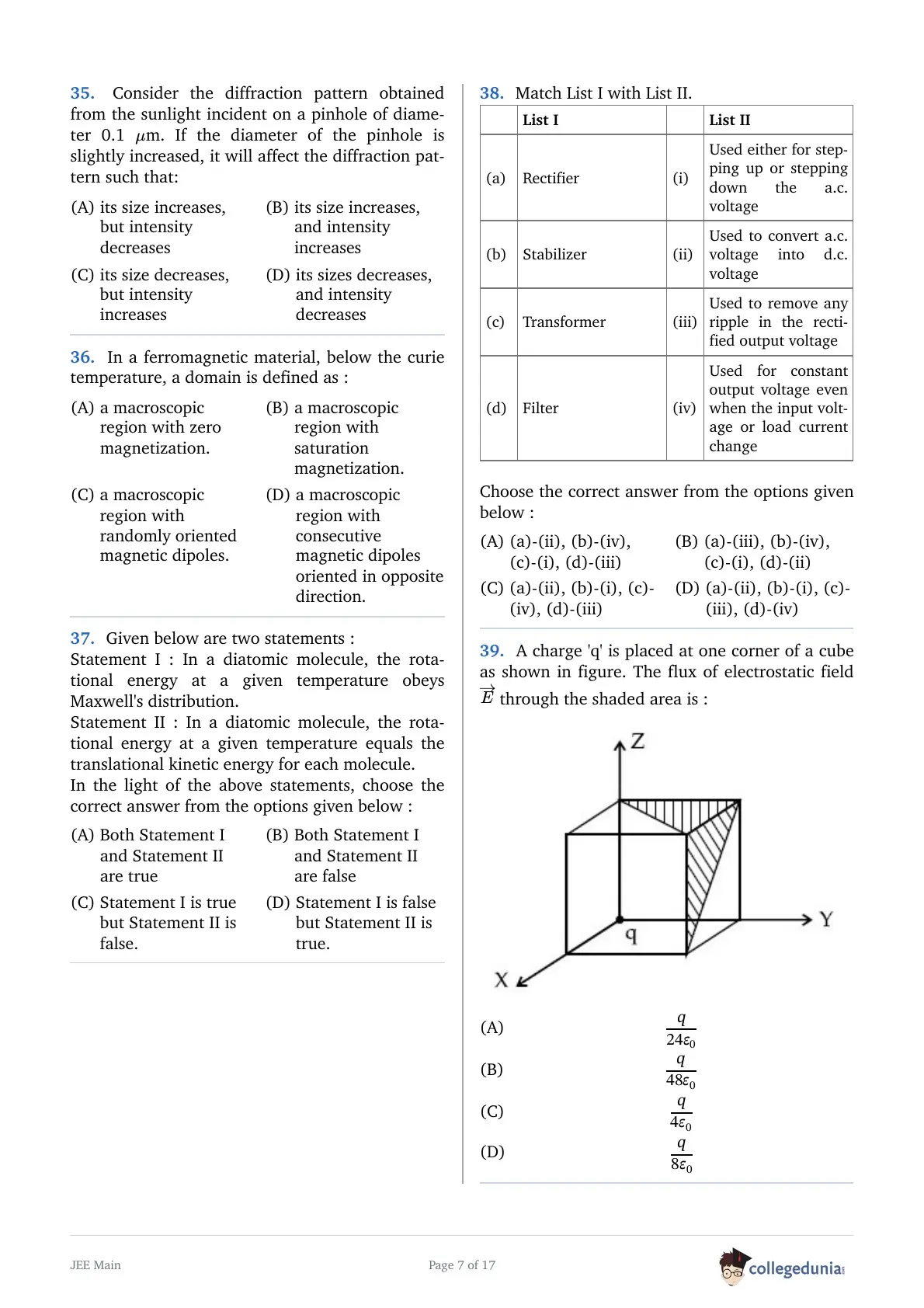
Consider the diffraction pattern obtained from the sunlight incident on a pinhole of diameter 0.1 \(\mu\)m. If the diameter of the pinhole is slightly increased, it will affect the diffraction pattern such that:
In a ferromagnetic material, below the curie temperature, a domain is defined as:
Given below are two statements:
Statement I: In a diatomic molecule, the rotational energy at a given temperature obeys Maxwell's distribution.
Statement II: In a diatomic molecule, the rotational energy at a given temperature equals the translational kinetic energy for each molecule.
| List I | List II | ||
| (a) | Rectifier | (i) | Used either for stepping up or stepping down the a.c. voltage |
| (b) | Stabilizer | (ii) | Used to convert a.c. voltage into d.c. voltage |
| (c) | Transformer | (iii) | Used to remove any ripple in the rectified output voltage |
| (d) | Filter | (iv) | Used for constant output voltage even when the input voltage or load current change |
Choose the correct answer from the options given below :
A charge 'q' is placed at one corner of a cube as shown in figure. The flux of electrostatic field \(\vec{E}\) through the shaded area is: 
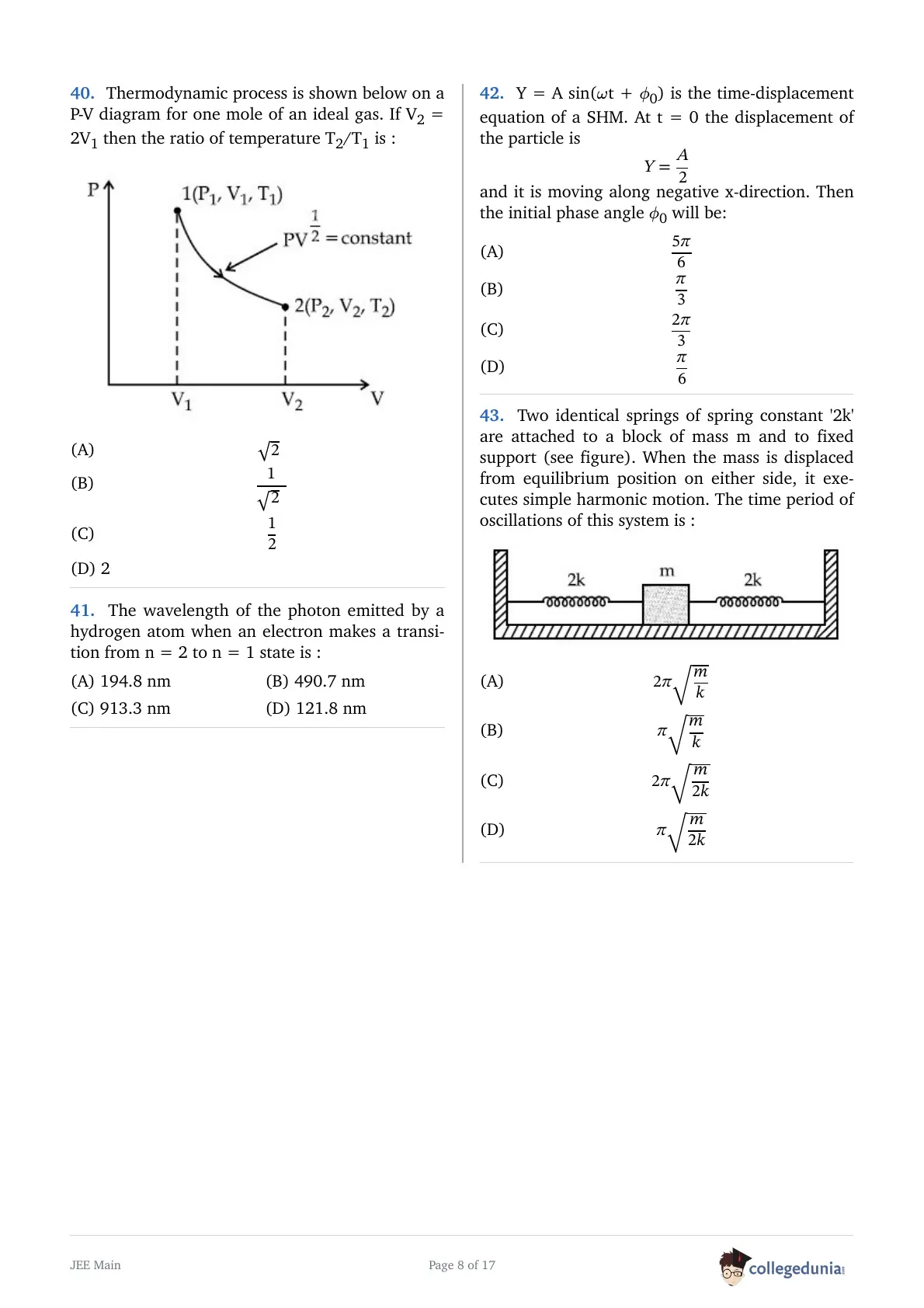
Thermodynamic process is shown below on a P-V diagram for one mole of an ideal gas. If \(V_2=2V_1\) then the ratio of temperature \(T_2/T_1\) is: The process is \(PV^{1/2}\) = constant. 
The wavelength of the photon emitted by a hydrogen atom when an electron makes a transition from n=2 to n=1 state is:
Y = A sin(\(\omega\)t+\(\phi_0\)) is the time-displacement equation of a SHM. At t = 0 the displacement of the particle is Y = \(\frac{A}{2}\) and it is moving along negative x-direction. Then the initial phase angle \(\phi_0\) will be:
Two identical springs of spring constant '2k' are attached to a block of mass m and to fixed support (see figure). When the mass is displaced from equilibrium position on either side, it executes simple harmonic motion. The time period of oscillations of this system is: 
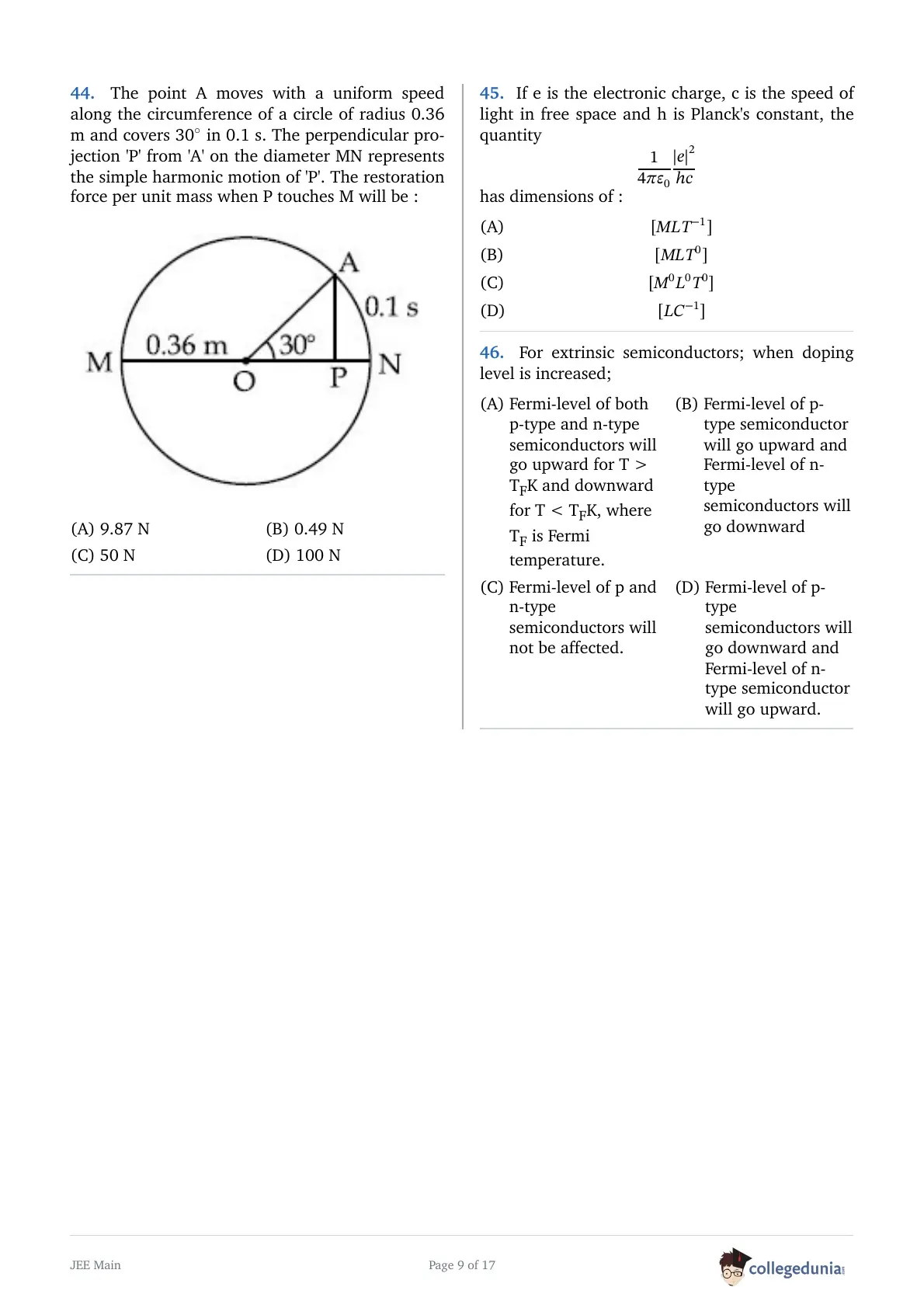
The point A moves with a uniform speed along the circumference of a circle of radius 0.36 m and covers 30° in 0.1 s. The perpendicular projection 'P' from 'A' on the diameter MN represents the simple harmonic motion of 'P'. The restoration force per unit mass when P touches M will be: 
If e is the electronic charge, c is the speed of light in free space and h is Planck's constant, the quantity \(\frac{1}{4\pi\epsilon_0}\frac{e^2}{hc}\) has dimensions of:
For extrinsic semiconductors; when doping level is increased;


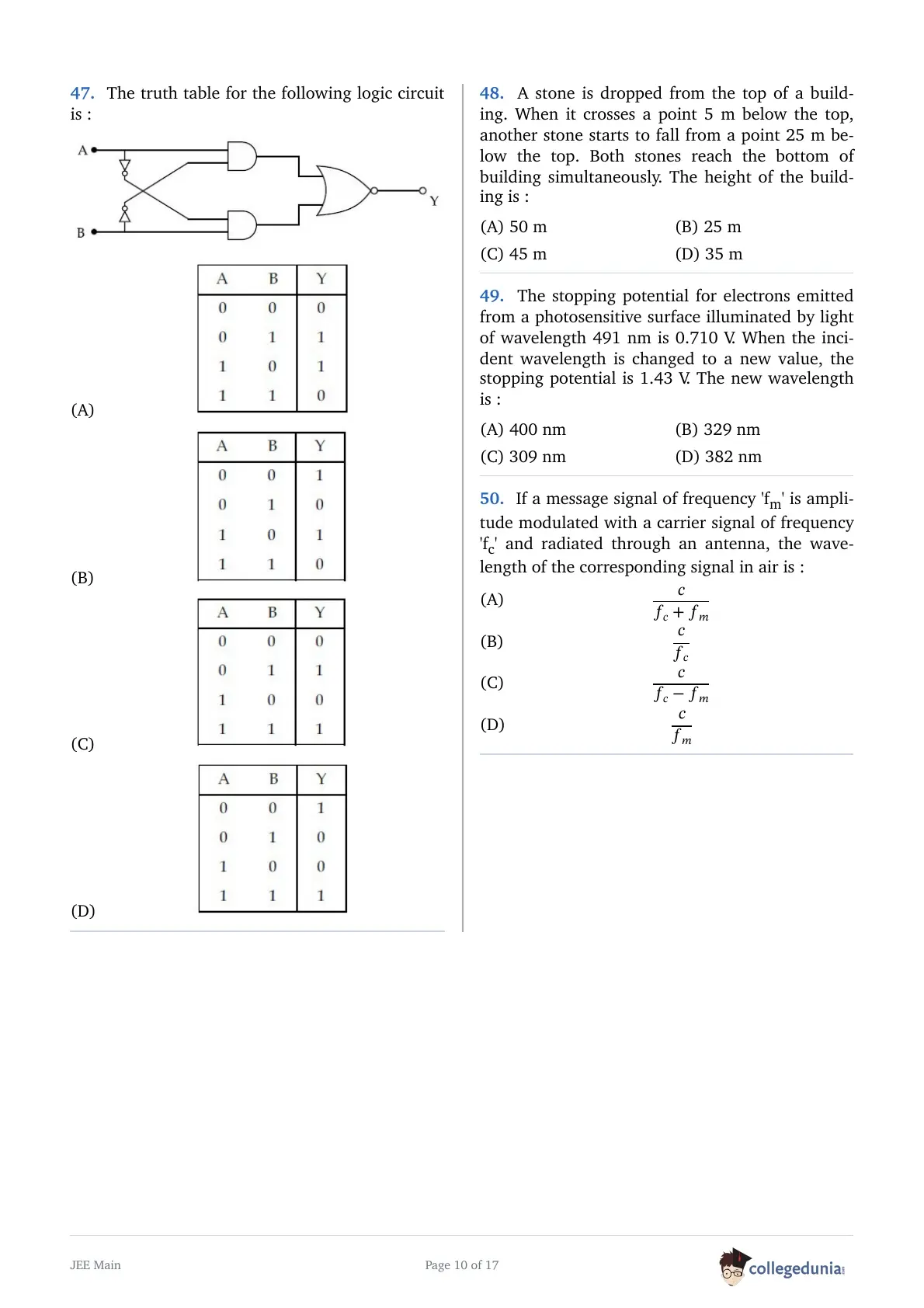
A stone is dropped from the top of a building. When it crosses a point 5 m below the top, another stone starts to fall from a point 25 m below the top. Both stones reach the bottom simultaneously. The height of the building is:
The stopping potential for electrons emitted from a photosensitive surface illuminated by light of wavelength 491 nm is 0.710 V. When the incident wavelength is changed to a new value, the stopping potential is 1.43 V. The new wavelength is:
If a message signal of frequency '\(f_m\)' is amplitude modulated with a carrier signal of frequency '\(f_c\)' and radiated through an antenna, the wavelength of the corresponding signal in air is:
Physics - Section B (Q51 - Q60)
If \(\vec{P} \times \vec{Q} = \vec{Q} \times \vec{P}\), the angle between \(\vec{P}\) and \(\vec{Q}\) is \(\theta\) (0°<\(\theta\)<360°). The value of '\(\theta\)' will be ________°.
The percentage increase in the speed of transverse waves produced in a stretched string if the tension is increased by 4 percent , will be ________ .
The initial velocity \(v_i\) required to project a body vertically upward from the surface of the earth to reach a height of 10R, where R is the radius of the earth, may be described in terms of escape velocity \(v_e\) such that \(v_i = \sqrt{\frac{x}{11}} v_e\). The value of x will be ________ .
The peak electric field produced by the radiation coming from the 8 W bulb at a distance of 10 m is \(\frac{x}{10} \sqrt{\frac{\mu_0 c}{\pi}} \frac{V}{m}\). The efficiency of the bulb is 10% and it is a point source. The value of x is ________ .
Two identical conducting spheres with negligible volume have 2.1 nC and –0.1 nC charges, respectively. They are brought into contact and then separated by a distance of 0.5 m. The electrostatic force acting between the spheres is ________ \(\times\) 10⁻⁹ N. [Given : \(4\pi\epsilon_0 = \frac{1}{9 \times 10^9}\) SI unit]
The wavelength of an X-ray beam is 10 Å. The mass of a fictitious particle having the same energy as that of the X-ray photons is \(\frac{x}{3}h\) kg. The value of x is ________ . (h=Planck's constant)
Two small spheres each of mass 10 mg are suspended from a point by threads 0.5 m long. They are equally charged and repel each other to a distance of 0.20 m. The charge on each of the sphere is \(\frac{a}{21} \times 10^{-8} C\).
The value of 'a' will be ______. [Given g = 10 ms–2]
Two particles having masses 4 g and 16 g respectively are moving with equal kinetic energies. The ratio of the magnitudes of their linear momentum is n : 2. The value of n will be ________ .
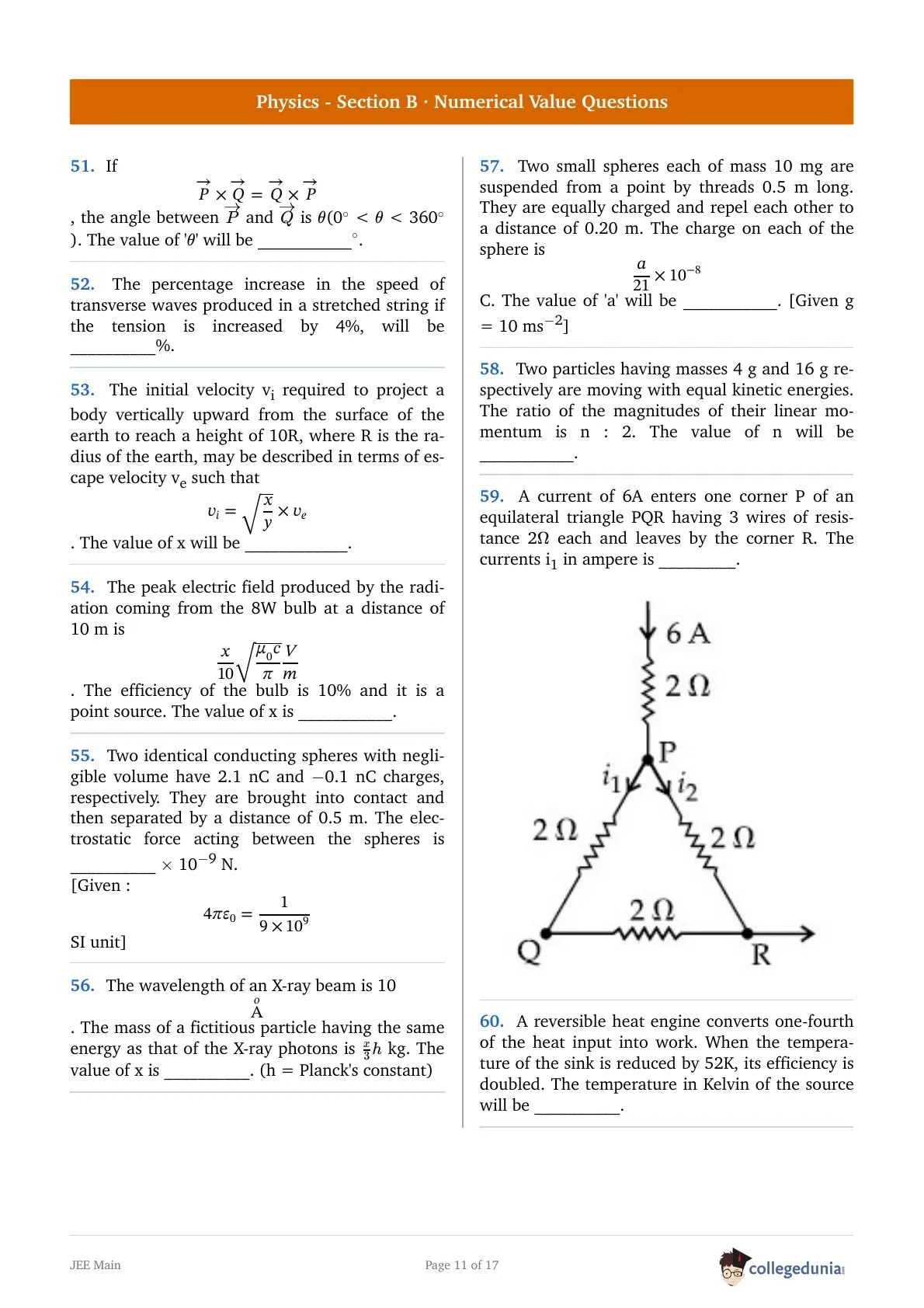
A current of 6 A enters one corner P of an equilateral triangle PQR having 3 wires of resistance 2 \(\Omega\) each and leaves by the corner R. The currents \(i_1\) in ampere is ________ . 
A reversible heat engine converts one-fourth of the heat input into work. When the temperature of the sink is reduced by 52 K, its efficiency is doubled. The temperature in Kelvin of the source will be ________ .
Chemistry - Section A (Q61 - Q80)
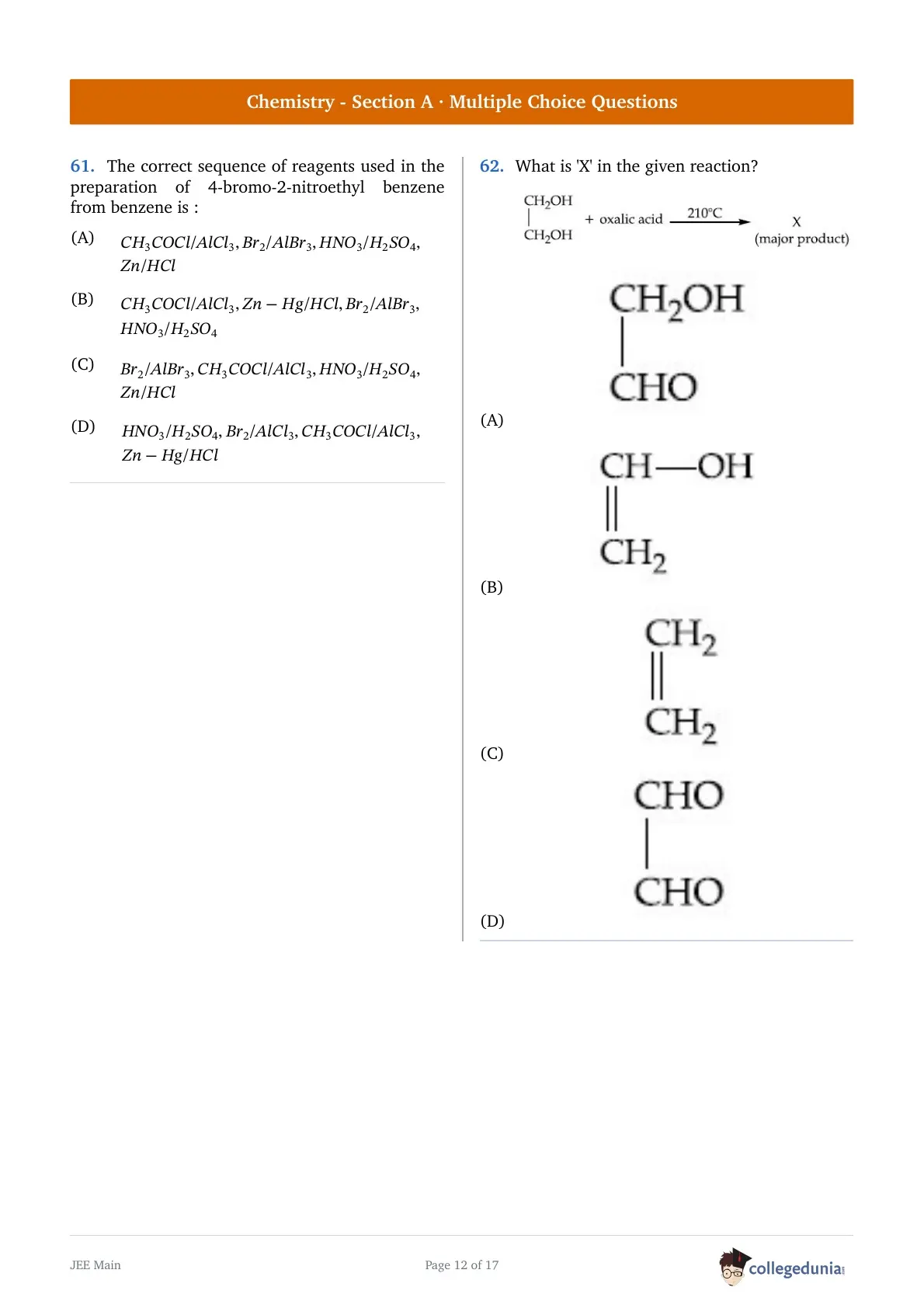
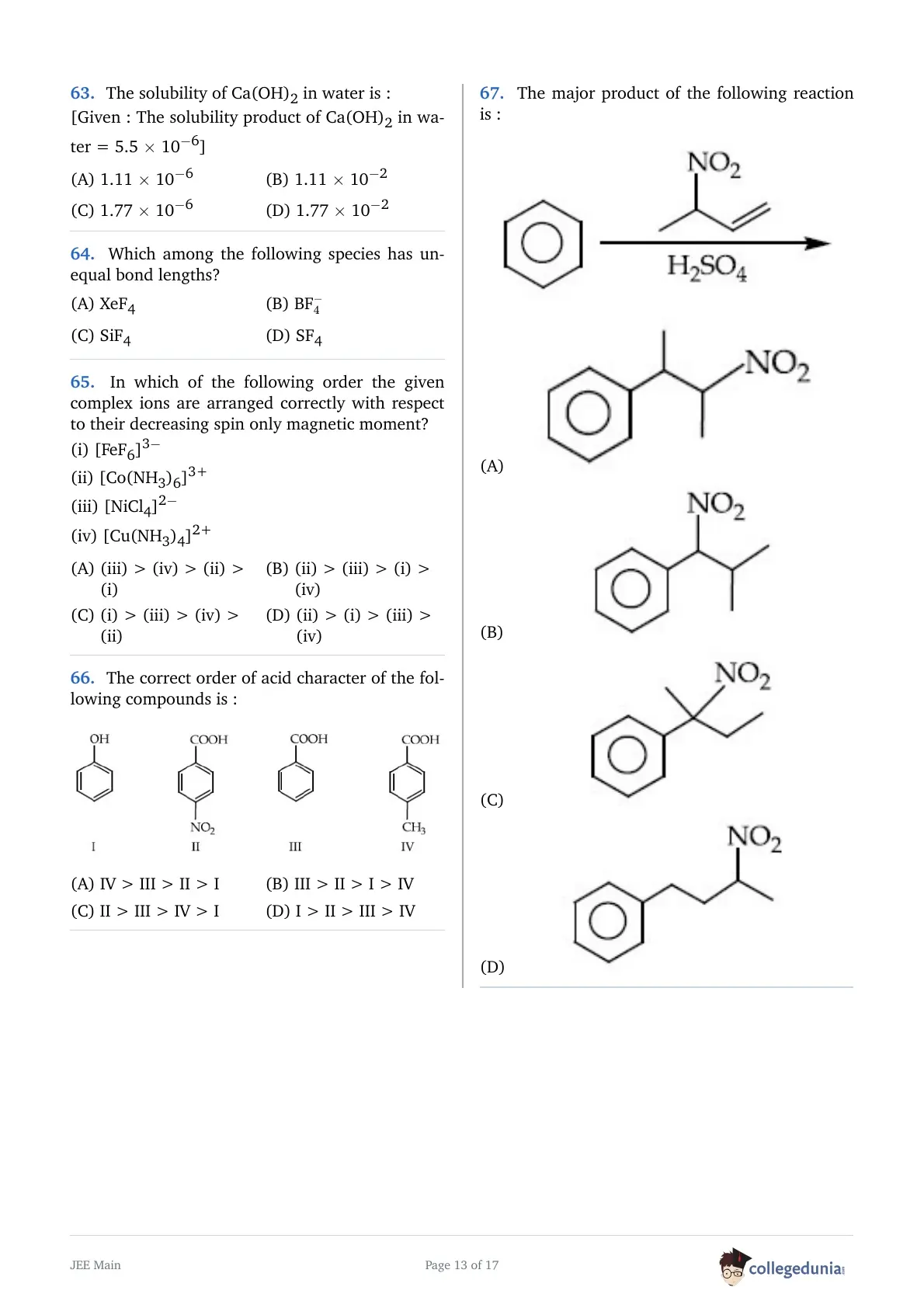
The correct sequence of reagents used in the preparation of 4-bromo-2-nitroethylbenzene from benzene is:


The solubility of Ca(OH)\(_2\) in water is:
[Given: The solubility product of Ca(OH)\(_2\) in water = 5.5 \(\times\) 10⁻⁶]
Which among the following species has unequal bond lengths?
In which of the following order the given complex ions are arranged correctly with respect to their decreasing spin only magnetic moment?
(i) [FeF\(_6\)]\(^{3-}\) (ii) [Co(NH\(_3\))\(_6\)]\(^{3+}\) (iii) [NiCl\(_4\)]\(^{2-}\) (iv) [Cu(NH\(_3\))\(_4\)]\(^{2+}\)
The correct order of acid character of the following compounds is :
I: Phenol, II: p-Nitrobenzoic acid, III: Benzoic acid, IV: p-Toluic acid 


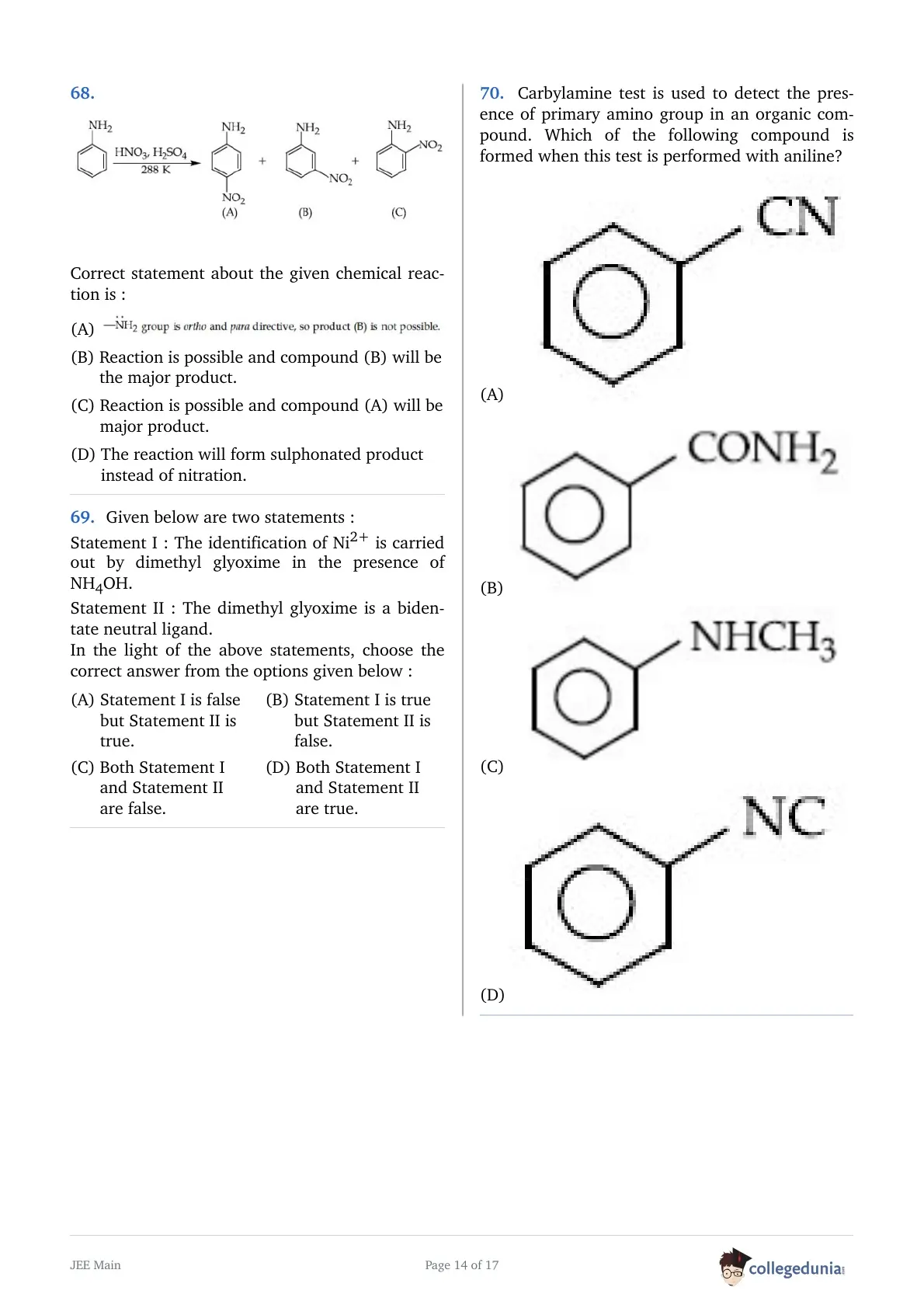
Correct statement about the given chemical reaction is : 
Given below are two statements:
Statement I: The identification of Ni\(^{2+}\) is carried out by dimethyl glyoxime in the presence of NH\(_4\)OH.
Statement II: The dimethyl glyoxime is a bidentate neutral ligand.
Carbylamine test is used to detect the presence of primary amino group in an organic compound. Which of the following compound is formed when this test is performed with aniline ?
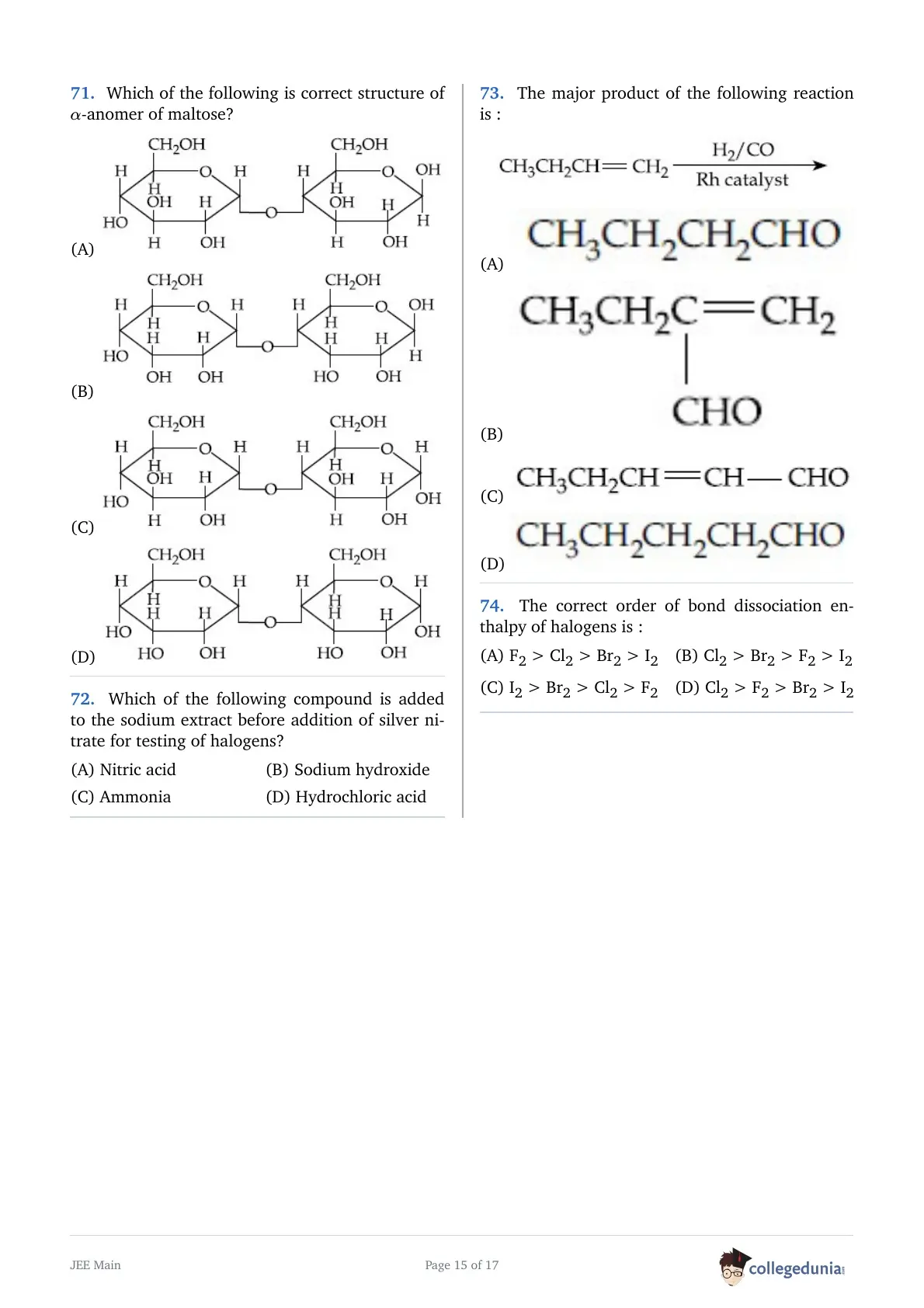
Which of the following is correct structure of \(\alpha\)-anomer of maltose? 
Which of the following compound is added to the sodium extract before addition of silver nitrate for testing of halogens?


The correct order of bond dissociation enthalpy of halogens is :
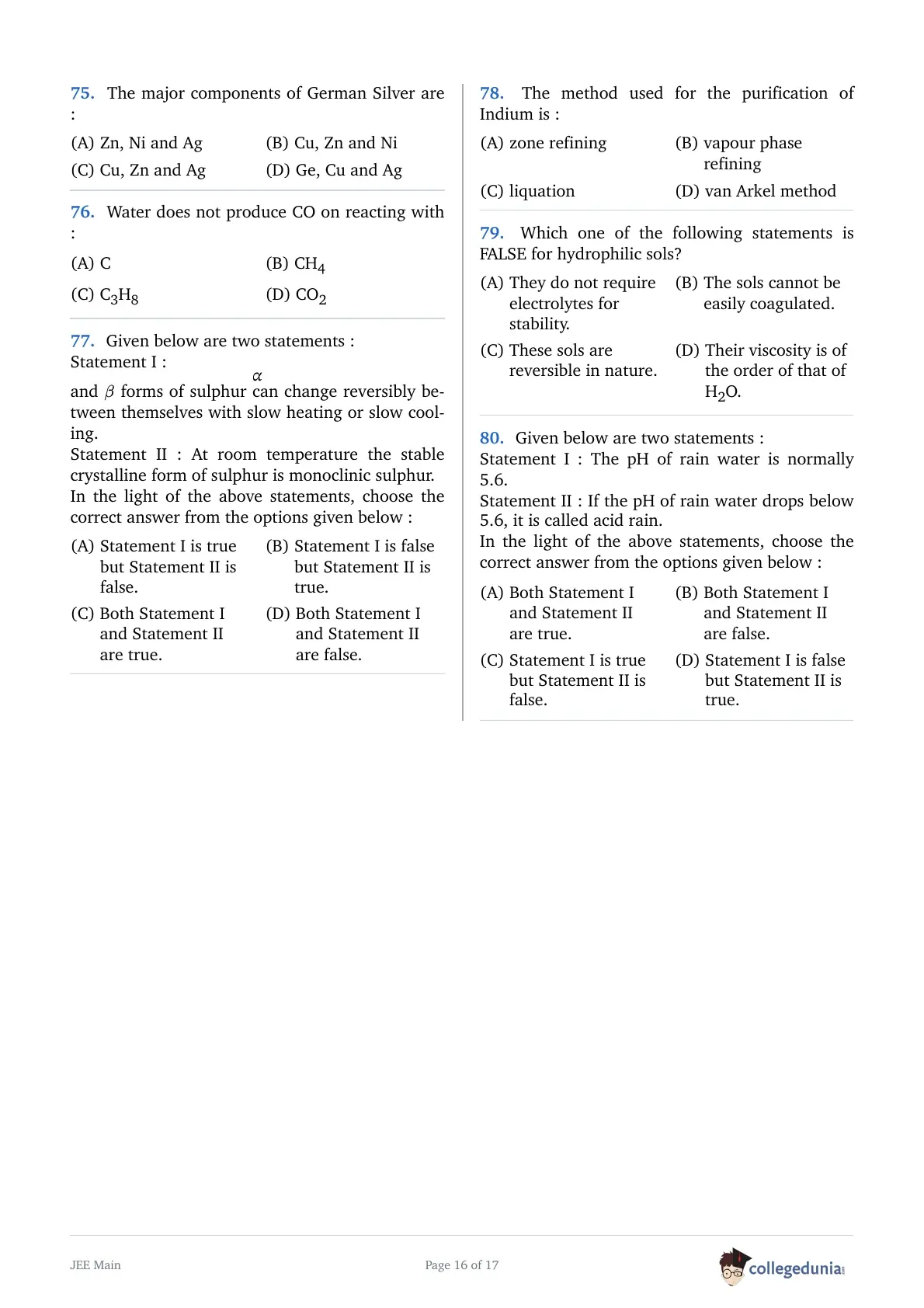
The major components of German Silver are :
Water does not produce CO on reacting with:
Given below are two statements:
Statement I: \(\alpha\) and \(\beta\) forms of sulphur can change reversibly between themselves with slow heating or slow cooling.
Statement II: At room temperature the stable crystalline form of sulphur is monoclinic sulphur.
The method used for the purification of Indium is:
Which one of the following statements is FALSE for hydrophilic sols?
Given below are two statements:
Statement I: The pH of rain water is normally ~5.6.
Statement II: If the pH of rain water drops below 5.6, it is called acid rain.
Chemistry - Section B (Q81 - Q90)
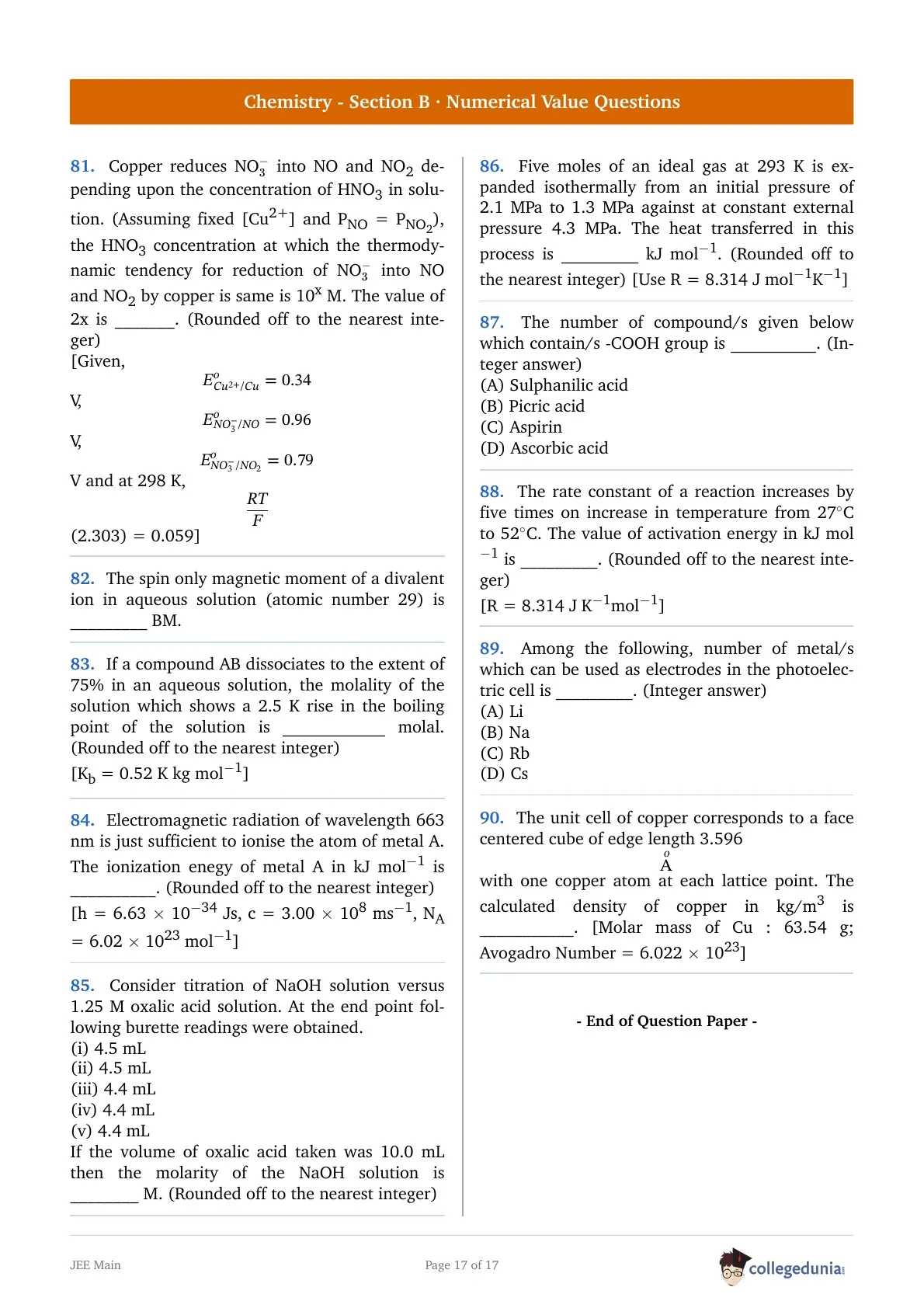
Copper reduces NO\(_3^-\) into NO and NO\(_2\) depending upon the concentration of HNO\(_3\) in solution. (Assuming fixed [Cu\(^{2+}\)] and \(P_{NO}=P_{NO_2}\)), the HNO\(_3\) concentration at which the thermodynamic tendency for reduction of NO\(_3^-\) into NO and NO\(_2\) by copper is same is \(10^x\) M. The value of 2x is ________. (Rounded-off to the nearest integer)
[Given, E\(^\circ_{Cu^{2+}/Cu}\)=0.34 V, E\(^\circ_{NO_3^-/NO}\)=0.96 V, E\(^\circ_{NO_3^-/NO_2}\)=0.79 V and at 298 K, \(\frac{RT}{F}\)(2.303)=0.059]
The spin only magnetic moment of a divalent ion in aqueous solution (atomic number 29) is ________ BM.
If a compound AB dissociates to the extent of 75% in an aqueous solution, the molality of the solution which shows a 2.5 K rise in the boiling point of the solution is ________ molal. (Rounded-off to the nearest integer) [K\(_b\)=0.52 K kg mol⁻¹]
Electromagnetic radiation of wavelength 663 nm is just sufficient to ionise the atom of metal A. The ionization energy of metal A in kJ mol⁻¹ is ________ . (Rounded-off to the nearest integer) [h=6.63\(\times\)10⁻³⁴ Js, c=3.00\(\times\)10⁸ ms⁻¹, N\(_A\)=6.02\(\times\)10²³ mol⁻¹]
Consider titration of NaOH solution versus 1.25 M oxalic acid solution. At the end point following burette readings were obtained. (i) 4.5 mL, (ii) 4.5 mL, (iii) 4.4 mL, (iv) 4.4 mL, (v) 4.4 mL. If the volume of oxalic acid taken was 10.0 mL then the molarity of the NaOH solution is _______ M. (Rounded-off to the nearest integer)
Five moles of an ideal gas at 293 K is expanded isothermally from an initial pressure of 2.1 MPa to 1.3 MPa against at constant external pressure 4.3 MPa. The heat transferred in this process is ________ kJ mol⁻¹. (Rounded-off to the nearest integer) [Use R=8.314 J mol⁻¹K⁻¹]
The number of compound/s given below which contain/s —COOH group is ________ . (Integer answer)
(A) Sulphanilic acid (B) Picric acid (C) Aspirin (D) Ascorbic acid
The rate constant of a reaction increases by five times on increase in temperature from 27°C to 52°C. The value of activation energy in kJ mol⁻¹ is ________. (Rounded-off to the nearest integer) [R=8.314 JK⁻¹ mol⁻¹]
Among the following, number of metal/s which can be used as electrodes in the photoelectric cell is ________ . (Integer answer)
(A) Li (B) Na (C) Rb (D) Cs
The unit cell of copper corresponds to a face centered cube of edge length 3.596 Å with one copper atom at each lattice point. The calculated density of copper in kg/m³ is ________ . [Molar mass of Cu: 63.54 g; Avogadro Number=6.022\(\times\)10²³]
JEE Main 2021 Exam Pattern and Marking Scheme
| Particulars | Details |
|---|---|
| Exam Mode | Online (Computer-Based Test) |
| Paper | B.E./B.Tech (Paper 1) |
| Duration | 3 hours (180 minutes) |
| Type of Questions | Multiple Choice Questions (MCQs) + Numerical Value Questions |
| Subjects | Mathematics, Physics, Chemistry |
| Total Questions | 90 questions (75 to be attempted) |
| Total Marks | 300 marks |
| Marking Scheme | +4 for correct answer & -1 for incorrect MCQ; no negative marking for Numerical Value Questions |
JEE Main 2021 February 25 Shift 2 Difficulty Level
JEE Main 2021 B.E./B.Tech Question Paper- February 25, 2021- Afternoon Session was rated by the applicants to be of moderate difficulty. Questions from the Class XII syllabus dominated a large part of the paper, with only a few questions based on the class XI syllabus. Few questions were more or less the same as given in NCERT books of the respective subjects.
JEE Main 2021 B.E./B.Tech Question Paper February 25 (Afternoon Session): Paper Analysis
JEE Main 2021 B.E./B.Tech February 25 (Afternoon Session) was conducted between 3.00 PM to 6.00 PM. The difficulty level of the paper was moderate.
- A total of 51 Questions were asked from the class XII syllabus and 39 Questions were asked from the class XI syllabus. Check JEE Main Syllabus
- Mathematics section had high weightage assigned to Differential Calculus, Integral Calculus, and Coordinate Geometry. The number of questions from the class XII syllabus was significantly higher in this section.
- Questions in the section were of moderate difficulty, except for a few lengthy and complex questions from Integral Calculus and Probability.
- Physics section had a large number of questions from Electrodynamics, Modern Physics, Simple Harmonic Motion, and Waves. Most of the questions were of moderate difficulty, however, few highly complex questions were asked from Electrodynamics.
- Chemistry section was dominated by questions from Organic Chemistry topics. The number of questions based on the class XII syllabus was significantly higher in this section too.
- The Questions in the Chemistry section were of easy to moderate difficulty.
For detailed JEE Main Question Paper Analysis, visit: JEE Main Question Paper Analysis



Comments