




JEE Main 2021 February 26 Shift 1 Question Paper is available here with solutions PDF and detailed solutions for every question. NTA conducted the first shift on February 26, 2021, from 9:00 AM to 12:00 PM. The JEE Main 2021 Paper 1 (B.E./B.Tech) question paper includes the following:
- 90 questions in a 3-hour CBT Mode: 30 each from Mathematics, Physics and Chemistry (75 to be attempted)
- Section A: 20 multiple choice questions (MCQs) per subject, all compulsory, 4 marks each
- Section B: 10 numerical value questions per subject, any 5 to be attempted, 4 marks each
- Marking: +4 for a correct answer, -1 for an incorrect MCQ, 0 for an unattempted question; no negative marking for numerical value questions
- Maximum marks: 300 (100 per subject)
JEE Main 2021 February 26 Shift 1 Question Paper with Solution PDF
| NTA Official PDF | CD PDF | CD PDF with Solutions |
|---|---|---|
| Download official PDF 5.31 MB | Download Collegedunia PDF 0.99 MB | Download solutions PDF 1.00 MB |
Also Check:
JEE Main 2021 February 26 Shift 1 Questions with Solutions
Mathematics - Section A (Q1 - Q20)
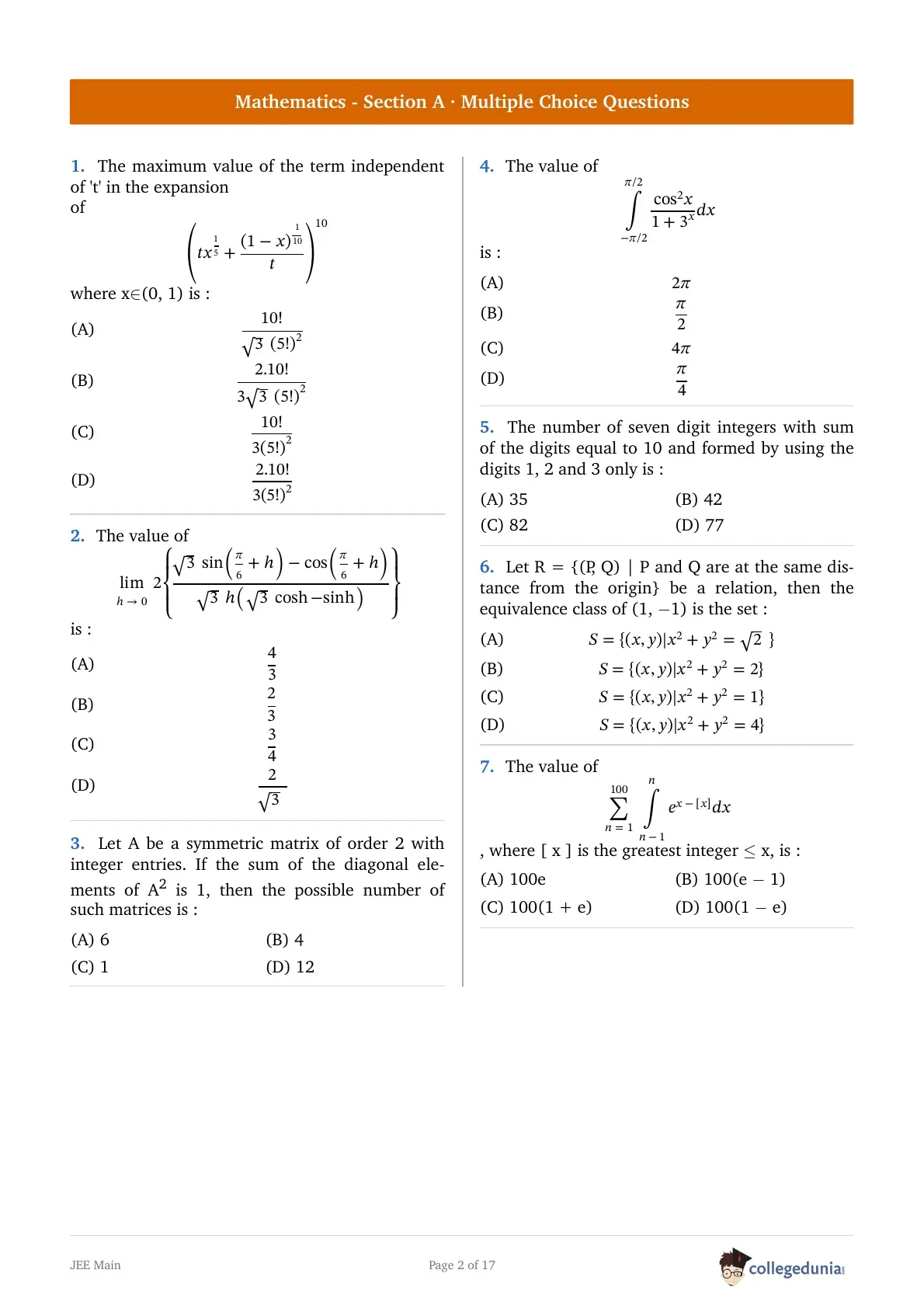
If the maximum value of the term independent of t in the expansion of (t2x\(^{\frac{1}{5}}\)+\(\frac{(1−x)^{\frac{1}{10}}}{t}\)),x≥0 is K, then 8 K is equal to__________.
The value of
\(\displaystyle\lim_{h\to 0}\, 2\left\{\frac{\sqrt{3}\sin\left(\frac{\pi}{6}+h\right)-\cos\left(\frac{\pi}{6}+h\right)}{\sqrt{3}\,h\left(\sqrt{3}\cos h-\sin h\right)}\right\}\)
is :
Let A be a matrix of order 2 × 2, whose entries are from the set {0, 1, 3, 4, 5}. If the sum of all the entries of A is a prime number p, \(2 < p < 8\), then the number of such matrices A is ___________.
The value of
\(\displaystyle\int_{-\pi/2}^{\pi/2}\frac{\cos^2 x}{1+3^x}\,dx\)
is :
The number of seven digit integers with sum of the digits equal to 10 and formed by using the digits 1, 2 and 3 only is :
Let \(R =\{( P , Q ) | P\) and \(Q\) are at the same distance from the origin \(\}\) be a relation, then the equivalence class of (1,-1) is the set:
The value of
\(\displaystyle\sum_{n=1}^{100}\int_{n-1}^{n}e^{x-[x]}\,dx\)
, where [ x ] is the greatest integer \(\le\) x, is :
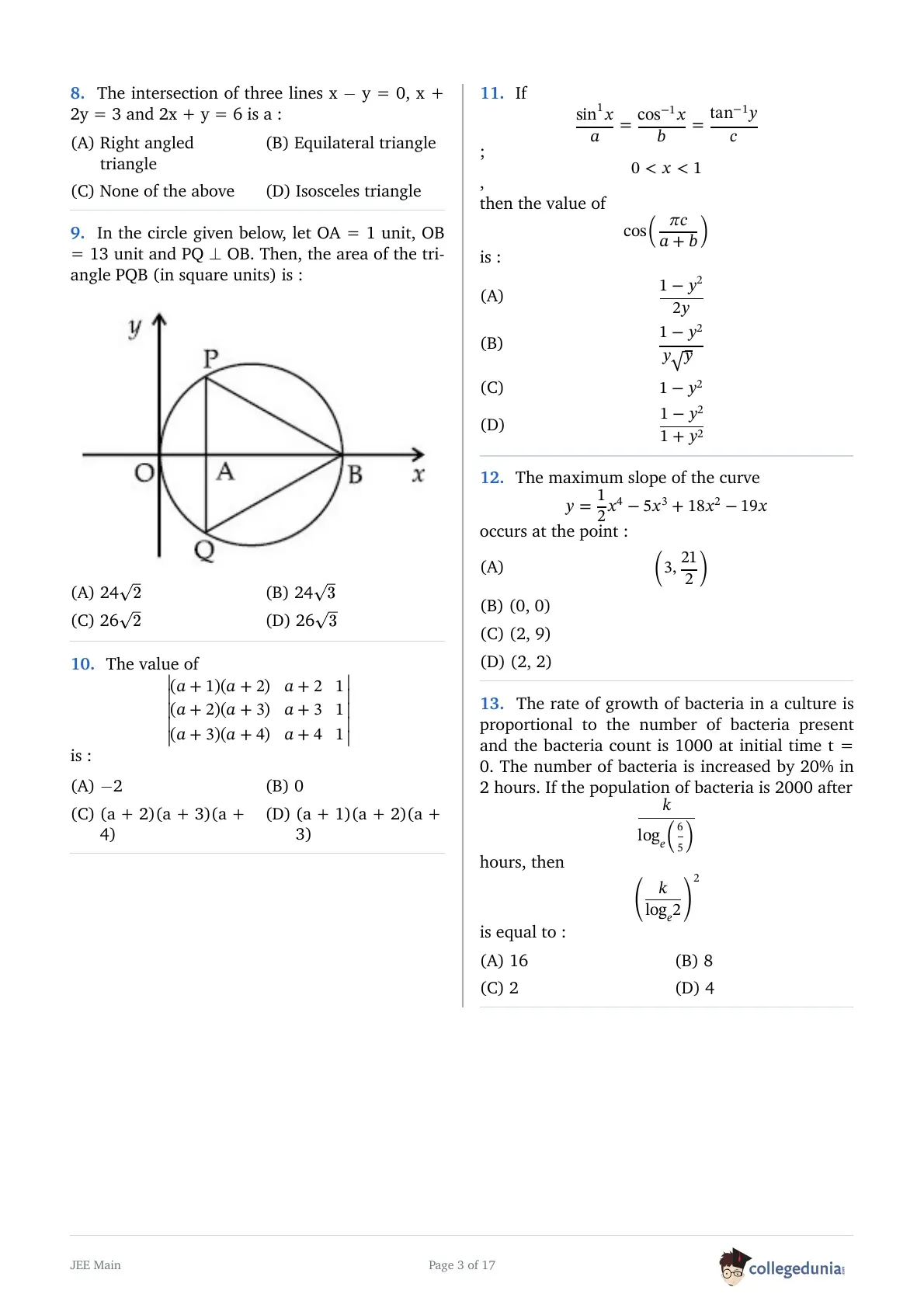
The intersection of three lines \(x-y=0\), \(x+2y=3\) and \(2x+y=6\) is a :
In the circle given below, let OA = 1 unit, OB = 13 unit and PQ \(\perp\) OB. Then, the area of the triangle PQB (in square units) is :
The value of
\(\begin{vmatrix}(a+1)(a+2) & a+2 & 1\\ (a+2)(a+3) & a+3 & 1\\ (a+3)(a+4) & a+4 & 1\end{vmatrix}\)
is :
If
\(\displaystyle\frac{\sin^{-1}x}{a}=\frac{\cos^{-1}x}{b}=\frac{\tan^{-1}y}{c}\)
;
\(0\lt x\lt1\)
, then the value of
\(\cos\left(\frac{\pi c}{a+b}\right)\)
is :
The maximum slope of the curve
\(y=\frac{1}{2}x^4-5x^3+18x^2-19x\)
occurs at the point :
The rate of growth of bacteria in a culture is proportional to the number of bacteria present and the bacteria count is 1000 at initial time t = 0. The number of bacteria is increased by 20% in 2 hours. If the population of bacteria is 2000 after
\(\displaystyle\frac{k}{\log_e\left(\frac{6}{5}\right)}\)
hours, then
\(\displaystyle\left(\frac{k}{\log_e2}\right)^2\)
is equal to :
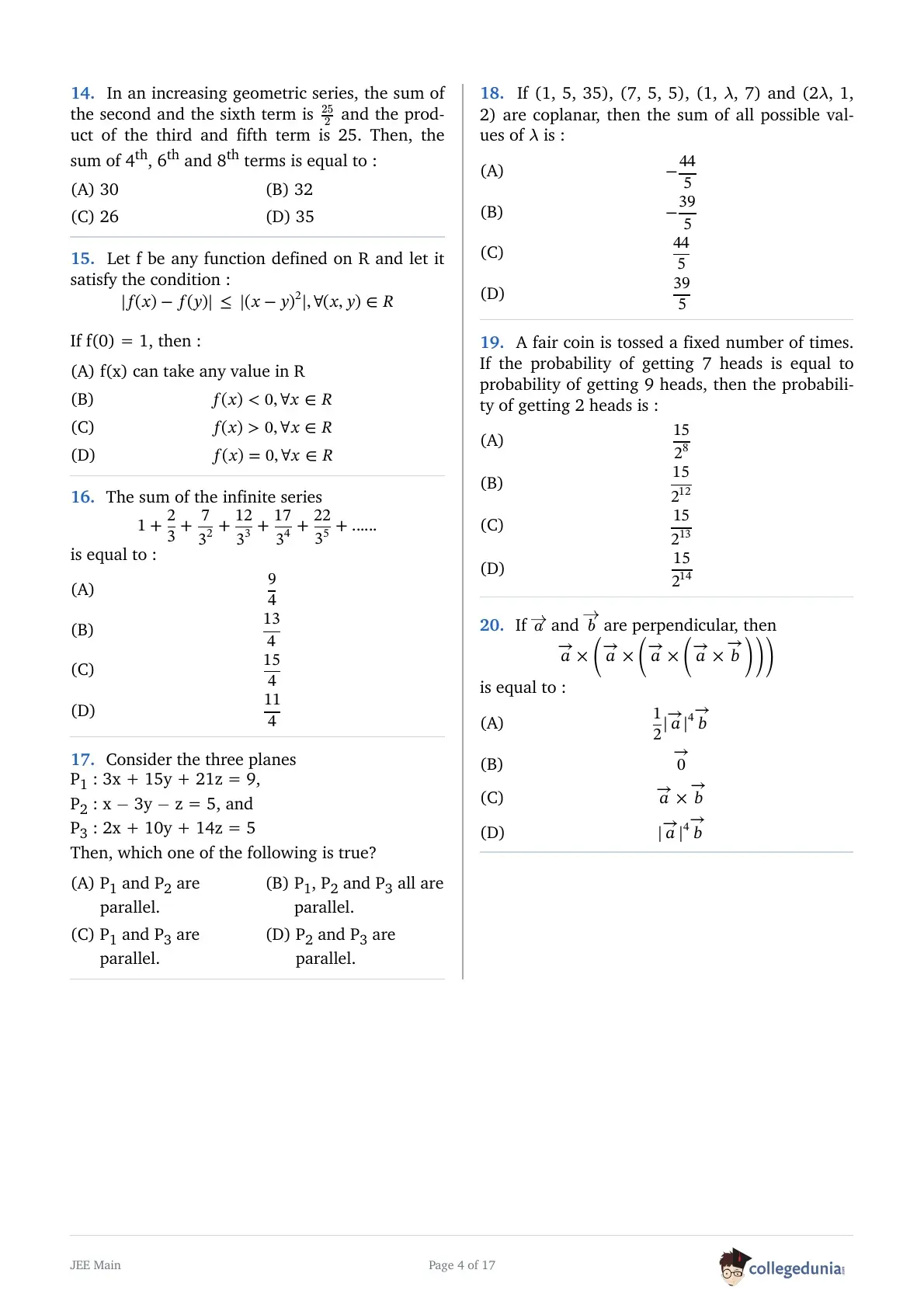
In an increasing geometric progression of positive terms, the sum of the second and sixth terms is \[ \frac{70}{3} \] and the product of the third and fifth terms is 49. Then the sum of the \(4^\text{th}, 6^\text{th}\), and \(8^\text{th}\) terms is:
Let f be any function defined on R and let it satisfy the condition :
\(|f(x)-f(y)|\le|(x-y)^2|,\ \forall(x,y)\in R\)
If f(0) = 1, then :
The sum of the infinite series
\(1+\frac{2}{3}+\frac{7}{3^2}+\frac{12}{3^3}+\frac{17}{3^4}+\frac{22}{3^5}+\ldots\ldots\)
is equal to :
Consider the three planes
\(P_1: 3x+15y+21z=9\),
\(P_2: x-3y-z=5\), and
\(P_3: 2x+10y+14z=5\)
Then, which one of the following is true?
If \((1,5,35)\), \((7,5,5)\), \((1,\lambda,7)\) and \((2\lambda,1,2)\) are coplanar, then the sum of all possible values of \(\lambda\) is :
Let a biased coin be tossed 5 times. If the probability of getting 4 heads is equal to the probability of getting 5 heads, then the probability of getting atmost two heads is
If \(\vec{a}\) and \(\vec{b}\) are perpendicular, then
\(\vec{a}\times\left(\vec{a}\times\left(\vec{a}\times\left(\vec{a}\times\vec{b}\right)\right)\right)\)
is equal to :
Mathematics - Section B (Q21 - Q30)
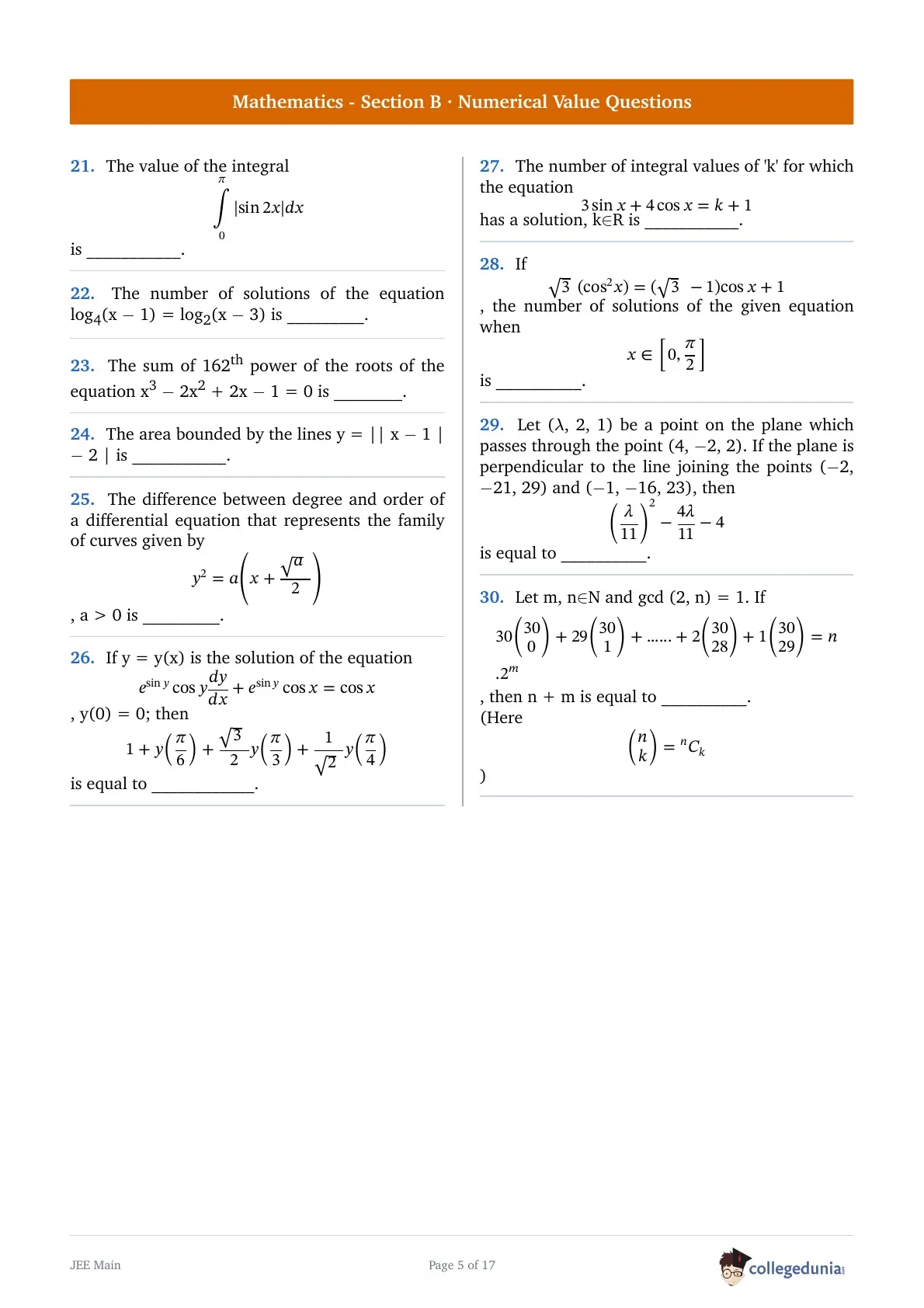
The value of the integral \(\int_0^{\pi} |\sin 2x|\,dx\) is ___________.
The number of solutions of the equation \(\log_4(x-1)=\log_2(x-3)\) is _________.
The sum of \(162^{th}\) power of the roots of the equation \(x^3-2x^2+2x-1=0\) is ________.
The area bounded by the lines \(y=\big|\,|x-1|-2\,\big|\) is ___________.
The difference between degree and order of a differential equation that represents the family of curves given by \(y^2=a\left(x+\frac{\sqrt{a}}{2}\right)\), \(a\gt0\) is _________.
If \(y=y(x)\) is the solution of the equation
\(e^{\sin y}\cos y\,\frac{dy}{dx}+e^{\sin y}\cos x=\cos x\), \(y(0)=0\); then
\(1+y\left(\frac{\pi}{6}\right)+\frac{\sqrt3}{2}\,y\left(\frac{\pi}{3}\right)+\frac{1}{\sqrt2}\,y\left(\frac{\pi}{4}\right)\) is equal to ____________.
The number of integral values of 'k' for which the equation \(3\sin x+4\cos x=k+1\) has a solution, \(k\in\mathbb{R}\) is ___________.
If \(\sqrt3\,(\cos^2x)=(\sqrt3-1)\cos x+1\), the number of solutions of the given equation when \(x\in\left[0,\frac{\pi}{2}\right]\) is __________.
Let \(P\) be the plane, passing through the point \((1,-1,-5)\) and perpendicular to the line joining the points \((4,1,-3)\) and \((2,4,3)\). Then the distance of \(P\) from the point \((3,-2,2)\) is
Let \(m,n\in\mathbb{N}\) and \(\gcd(2,n)=1\). If \(30\binom{30}{0}+29\binom{30}{1}+\cdots+2\binom{30}{28}+1\binom{30}{29}=n\cdot2^m\), then \(n+m\) is equal to __________.
(Here \(\binom{n}{k}={}^nC_k\))
Physics - Section A (Q31 - Q50)
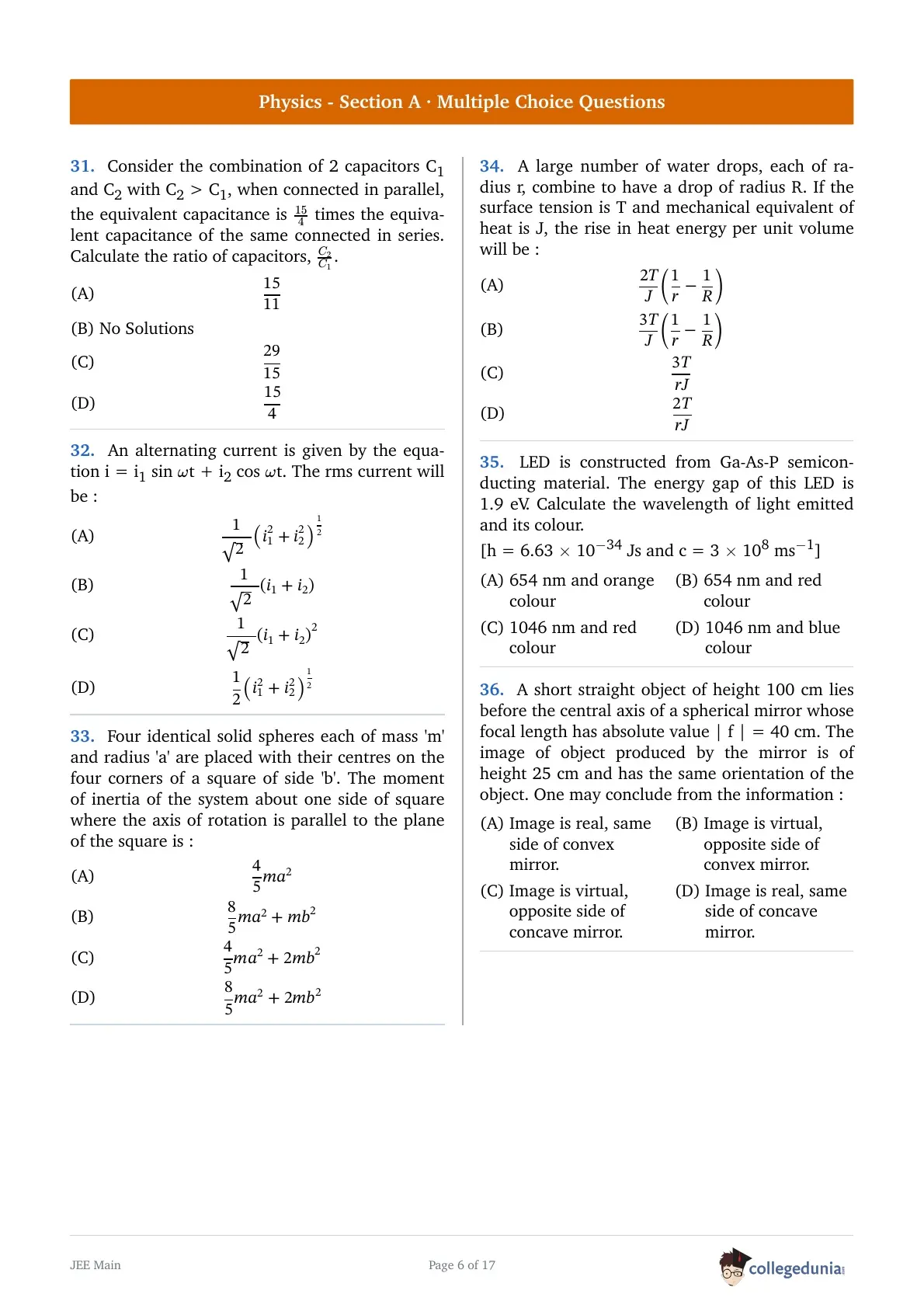
Consider the combination of 2 capacitors \(C_1\) and \(C_2\) with \(C_2\gt C_1\), when connected in parallel, the equivalent capacitance is \(\frac{15}{4}\) times the equivalent capacitance of the same connected in series. Calculate the ratio of capacitors, \(\frac{C_2}{C_1}\).
An alternating current is given by \[ I = I_A \sin \omega t + I_B \cos \omega t. \] The r.m.s. current will be:
Four identical solid spheres each of mass 'm' and radius 'a' are placed with their centres on the four corners of a square of side 'b'. The moment of inertia of the system about one side of square where the axis of rotation is parallel to the plane of the square is :
A large number of water drops, each of radius r, combine to have a drop of radius R. If the surface tension is T and mechanical equivalent of heat is J, the rise in heat energy per unit volume will be :
LED is constructed from Ga-As-P semiconducting material. The energy gap of this LED is 1.9 eV. Calculate the wavelength of light emitted and its colour.
[\(h=6.63\times10^{-34}\) Js and \(c=3\times10^{8}\) ms\(^{-1}\)]
A short linear object of length b lies along the axis of a concave mirror of focal length at a distance from the pole of the mirror. The size of the image is approximately equal to:
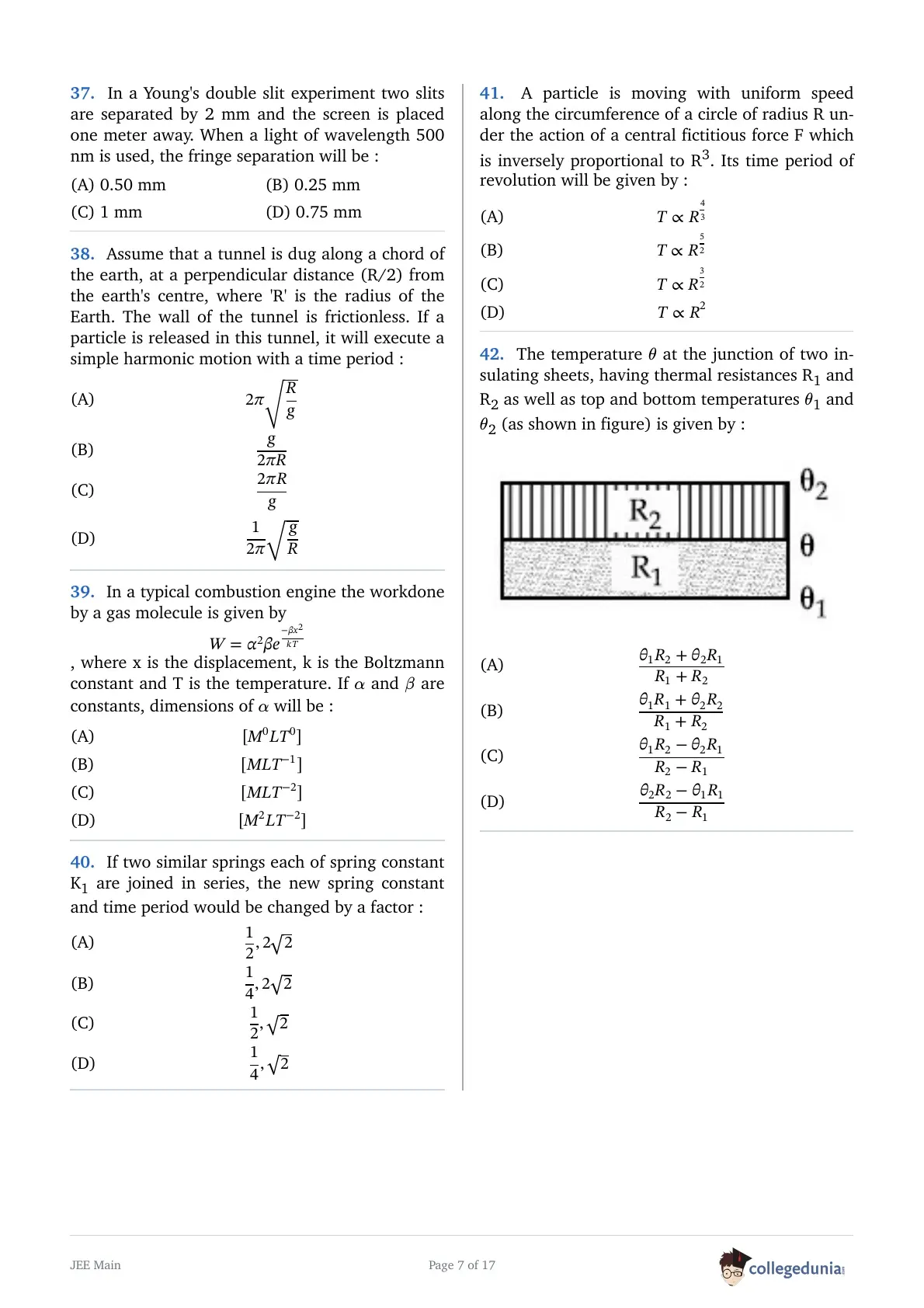
In a Young's double slit experiment two slits are separated by 2 mm and the screen is placed one meter away. When a light of wavelength 500 nm is used, the fringe separation will be :
Assume that a tunnel is dug along a chord of the earth, at a perpendicular distance (R/2) from the earth's centre, where 'R' is the radius of the Earth. The wall of the tunnel is frictionless. If a particle is released in this tunnel, it will execute a simple harmonic motion with a time period :
An expression of energy density is given by
\(u = \frac{α}{β} sin (\frac{αx}{kt})\)
, where α, β are constants, x is displacement, k is Boltzmann constant and t is the temperature. The dimensions of β will be
If two similar springs each of spring constant \(K_1\) are joined in series, the new spring constant and time period would be changed by a factor :
A particle is moving with a uniform speed in a circular orbit of radius \(R \) in a central force inversely proportional to the nth power of \(R\). If the period of rotation of the particle is \(T\) then -
The temperature \(\theta\) at the junction of two insulating sheets, having thermal resistances \(R_1\) and \(R_2\) as well as top and bottom temperatures \(\theta_1\) and \(\theta_2\) (as shown in figure) is given by :
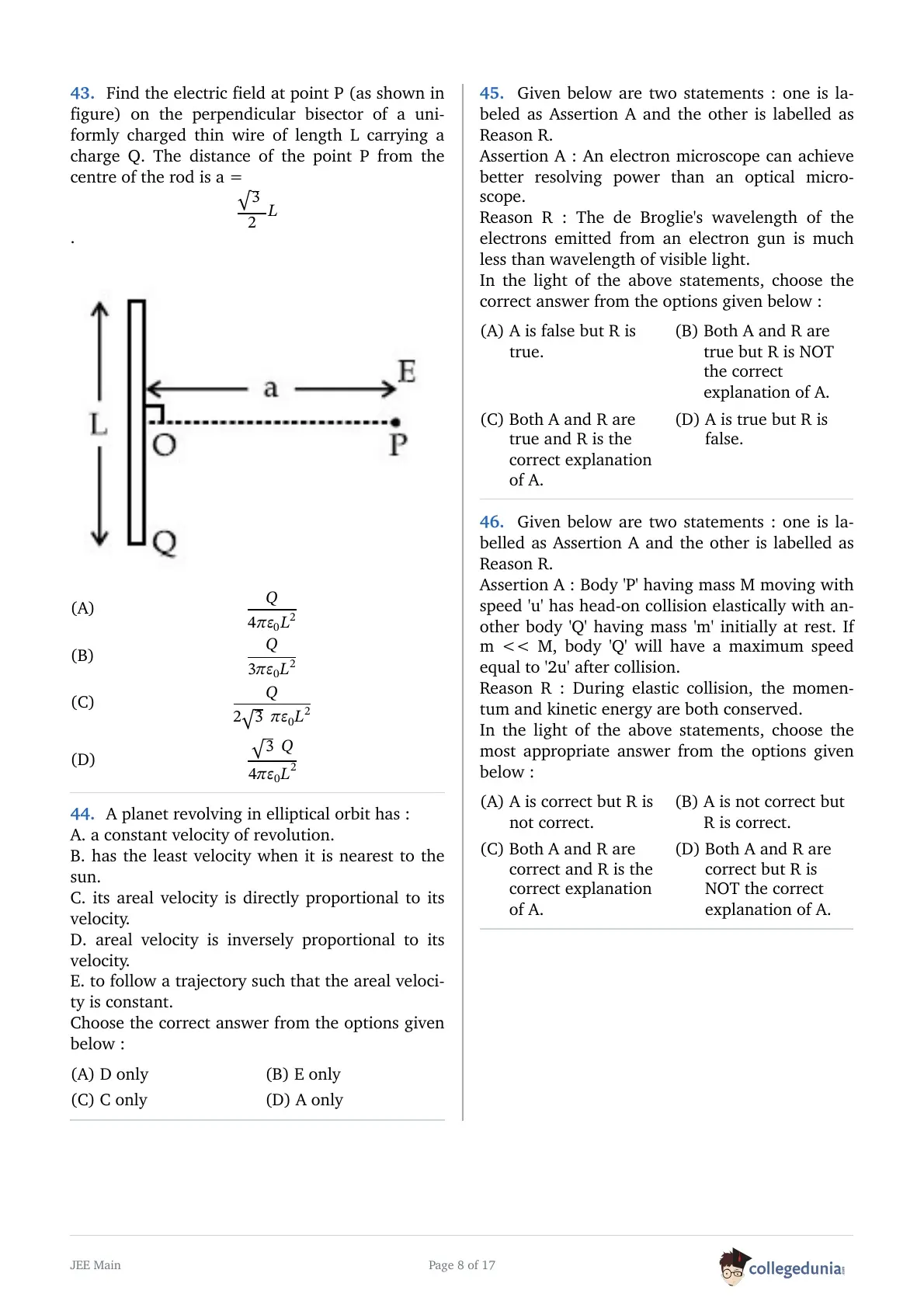
Find the electric field at point P (as shown in figure) on the perpendicular bisector of a uniformly charged thin wire of length L carrying a charge Q. The distance of the point P from the centre of the rod is \(a = \frac{\sqrt{3}}{2}L\).
A planet revolving in elliptical orbit has :
A. a constant velocity of revolution.
B. has the least velocity when it is nearest to the sun.
C. its areal velocity is directly proportional to its velocity.
D. areal velocity is inversely proportional to its velocity.
E. to follow a trajectory such that the areal velocity is constant.
Choose the correct answer from the options given below :
Given below are two statements : one is labeled as Assertion A and the other is labelled as Reason R.
Assertion A : An electron microscope can achieve better resolving power than an optical microscope.
Reason R : The de Broglie's wavelength of the electrons emitted from an electron gun is much less than wavelength of visible light.
In the light of the above statements, choose the correct answer from the options given below :
Given below are two statements : one is labelled as Assertion A and the other is labelled as Reason R.
Assertion A : Body 'P' having mass M moving with speed 'u' has head-on collision elastically with another body 'Q' having mass 'm' initially at rest. If m << M, body 'Q' will have a maximum speed equal to '2u' after collision.
Reason R : During elastic collision, the momentum and kinetic energy are both conserved.
In the light of the above statements, choose the most appropriate answer from the options given below :
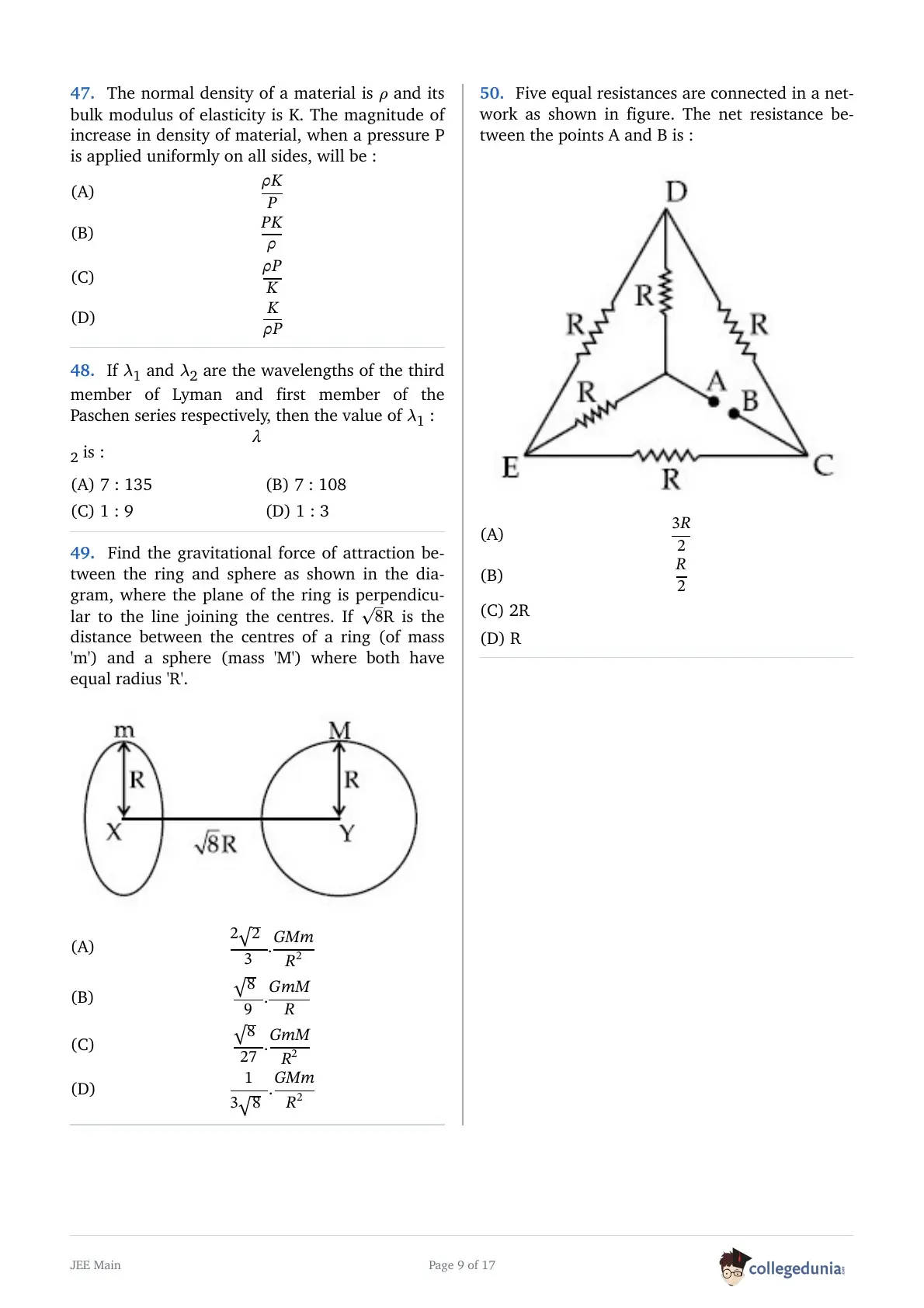
The normal density of a material is \(\rho\) and its bulk modulus of elasticity is K. The magnitude of increase in density of material, when a pressure P is applied uniformly on all sides, will be :
If the wavelength of the first member of the Lyman series of hydrogen is \( \lambda \). The wavelength of the second member will be:
A solid sphere and a ring have equal masses and equal radius of gyration. If the sphere is rotating about its diameter and ring about an axis passing through and perpendicular to its plane, then the ratio of radius is \(\sqrt{\frac{x}{2} }\) then find the value of x.
Five equal resistances are connected in a network as shown in figure. The net resistance between the points A and B is :
Physics - Section B (Q51 - Q60)
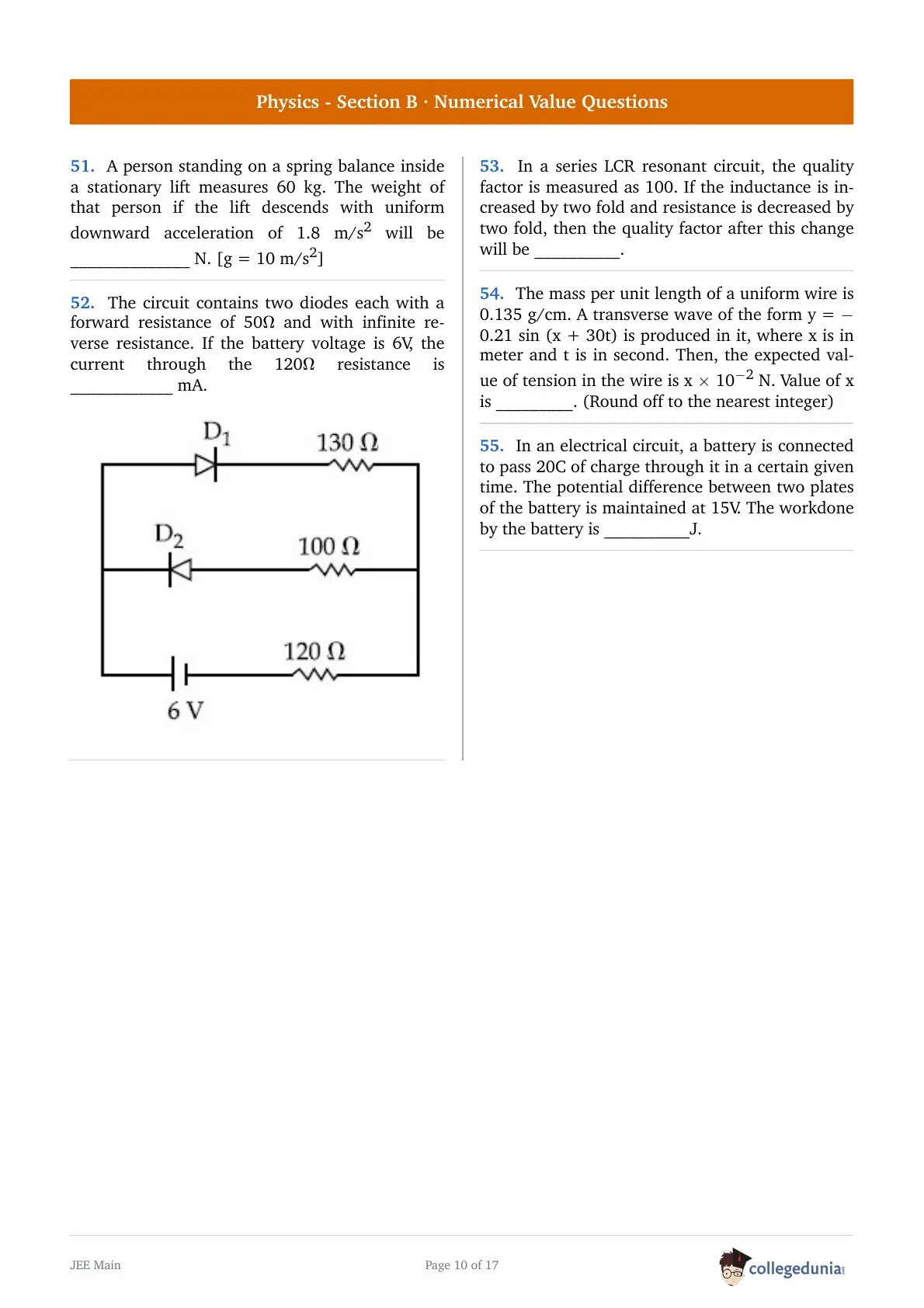
A person standing on a spring balance inside a stationary lift measures 60 kg. The weight of that person if the lift descends with uniform downward acceleration of 1.8 m/s2 will be ______________ N. [g = 10 m/s2]
Figure shows a circuit in which three identical diodes are used. Each diode has forward resistance of \(20 \,\Omega\) and infinite backward resistance. Resistors \(R_{1}=R_{2}=R_{3}=50\,\Omega\). Battery voltage is \(6\, V\). The current through \(R_3\) is:
In a series LCR resonant circuit, the quality factor is measured as 100. If the inductance is increased by two fold and resistance is decreased by two fold, then the quality factor after this change will be __________.
The mass per unit length of a uniform wire is 0.135 g/cm. A transverse wave of the form \(y = -0.21\sin(x+30t)\) is produced in it, where x is in meter and t is in second. Then, the expected value of tension in the wire is \(x\times10^{-2}\) N. Value of x is _________. (Round off to the nearest integer)
In an electrical circuit, a battery is connected to pass 20C of charge through it in a certain given time. The potential difference between two plates of the battery is maintained at 15V. The workdone by the battery is __________J.
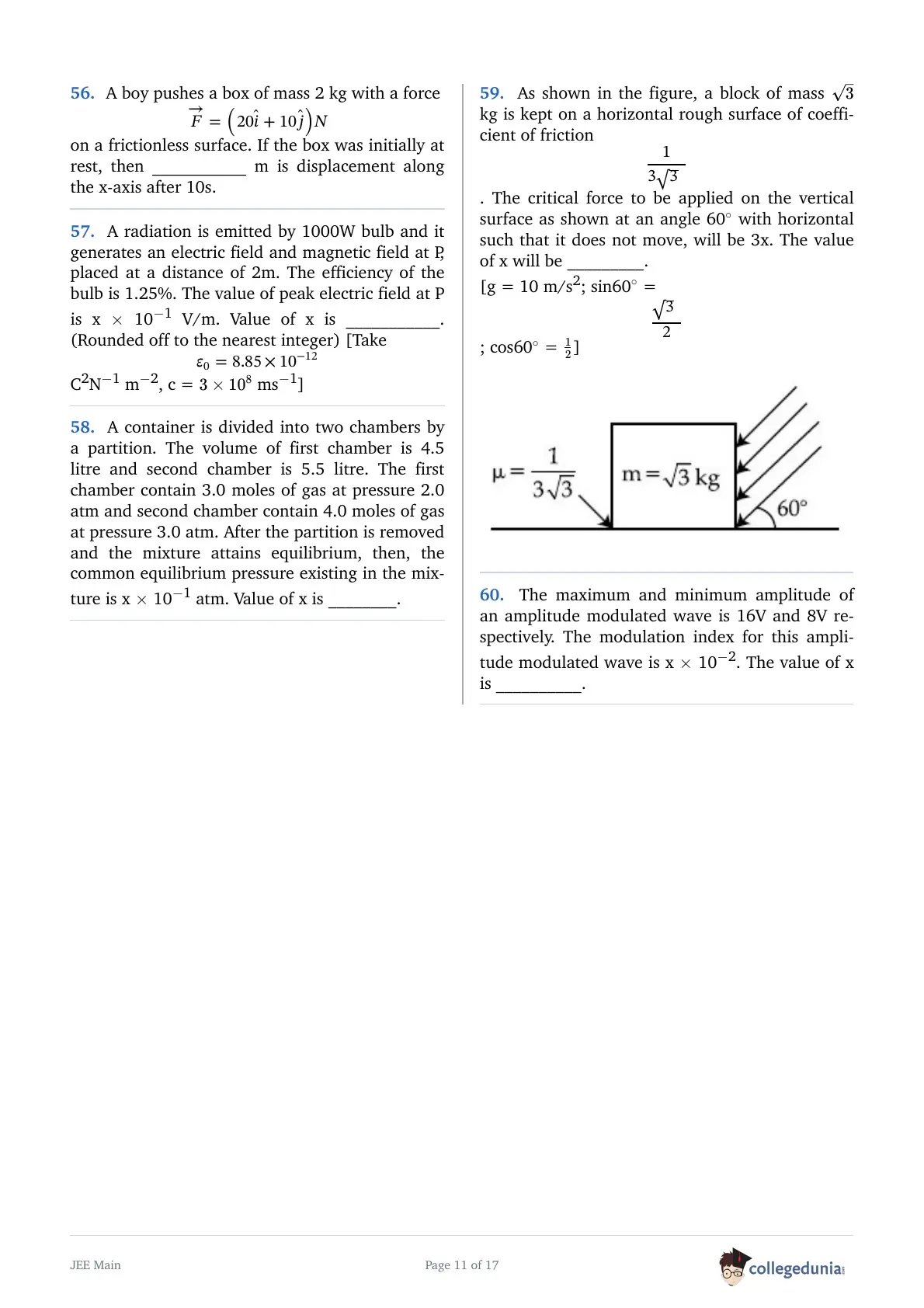
A boy pushes a box of mass 2 kg with a force \(\vec{F} = (20\hat{i}+10\hat{j})\) N on a frictionless surface. If the box was initially at rest, then ___________ m is displacement along the x-axis after 10s.
A radiation is emitted by 1000W bulb and it generates an electric field and magnetic field at P, placed at a distance of 2m. The efficiency of the bulb is 1.25%. The value of peak electric field at P is \(x\times10^{-1}\) V/m. Value of x is ___________. (Rounded off to the nearest integer) [Take \(\varepsilon_0 = 8.85\times10^{-12}\) C2N-1m-2, \(c = 3\times10^{8}\) ms-1]
A container is divided into two chambers by a partition. The volume of first chamber is 4.5 litre and second chamber is 5.5 litre. The first chamber contain 3.0 moles of gas at pressure 2.0 atm and second chamber contain 4.0 moles of gas at pressure 3.0 atm. After the partition is removed and the mixture attains equilibrium, then, the common equilibrium pressure existing in the mixture is \(x\times10^{-1}\) atm. Value of x is ________.
As shown in the figure a block of mass \(10\, kg\) lying on a horizontal surface is pulled by a force \(F\)acting at an angle \(30^{\circ}\), with horizontal For \(\mu_{ s }=0.25\), the block will just start to move for the value of \(F\) : [Given g=10ms-2]

The maximum and minimum amplitude of an amplitude modulated wave is \(16\,\mathrm{V}\) and \(8\,\mathrm{V}\) respectively. The modulation index for this amplitude modulated wave is \(x \times 10^{-2}\). The value of \(x\) is __________.
Chemistry - Section A (Q61 - Q80)


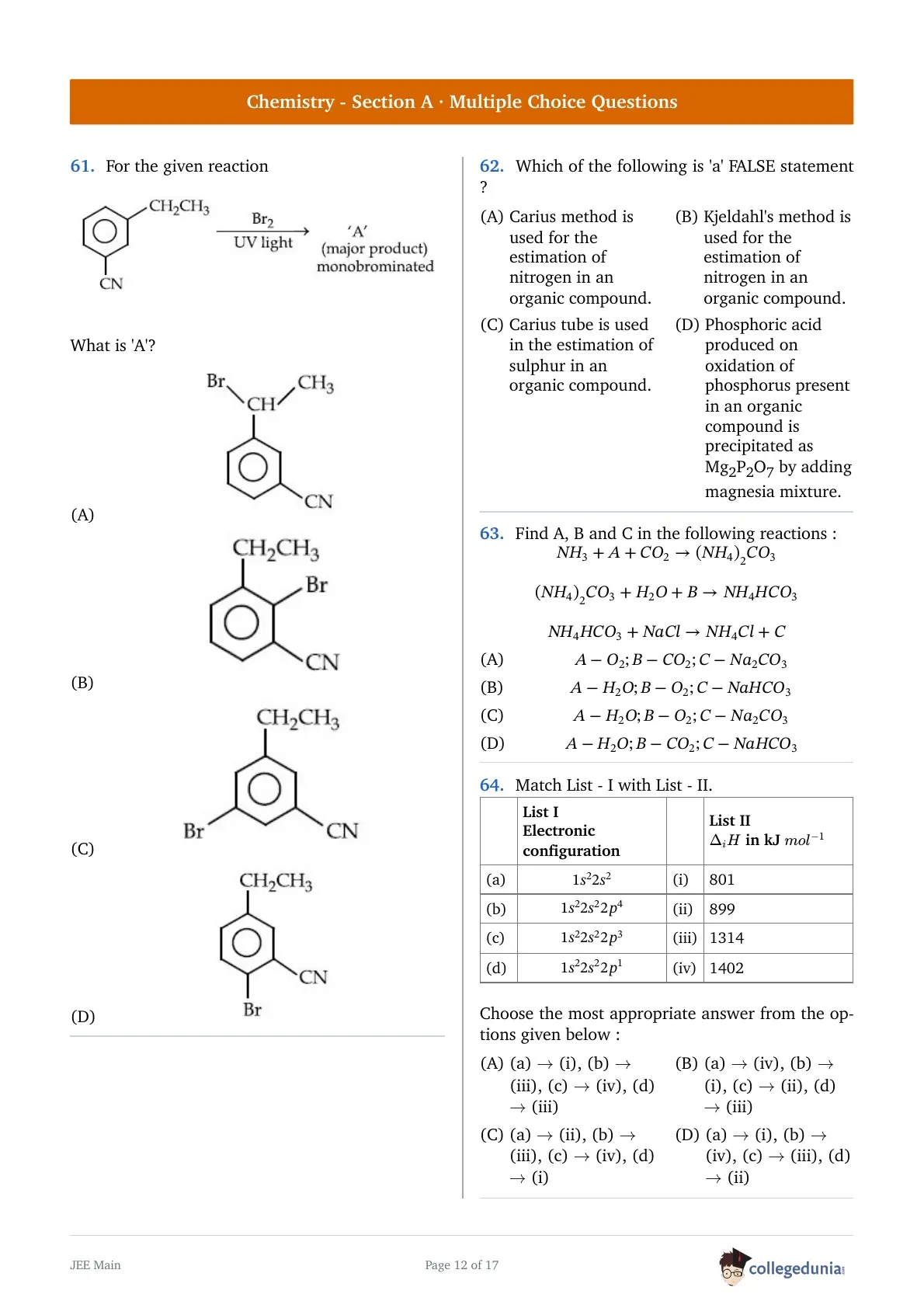
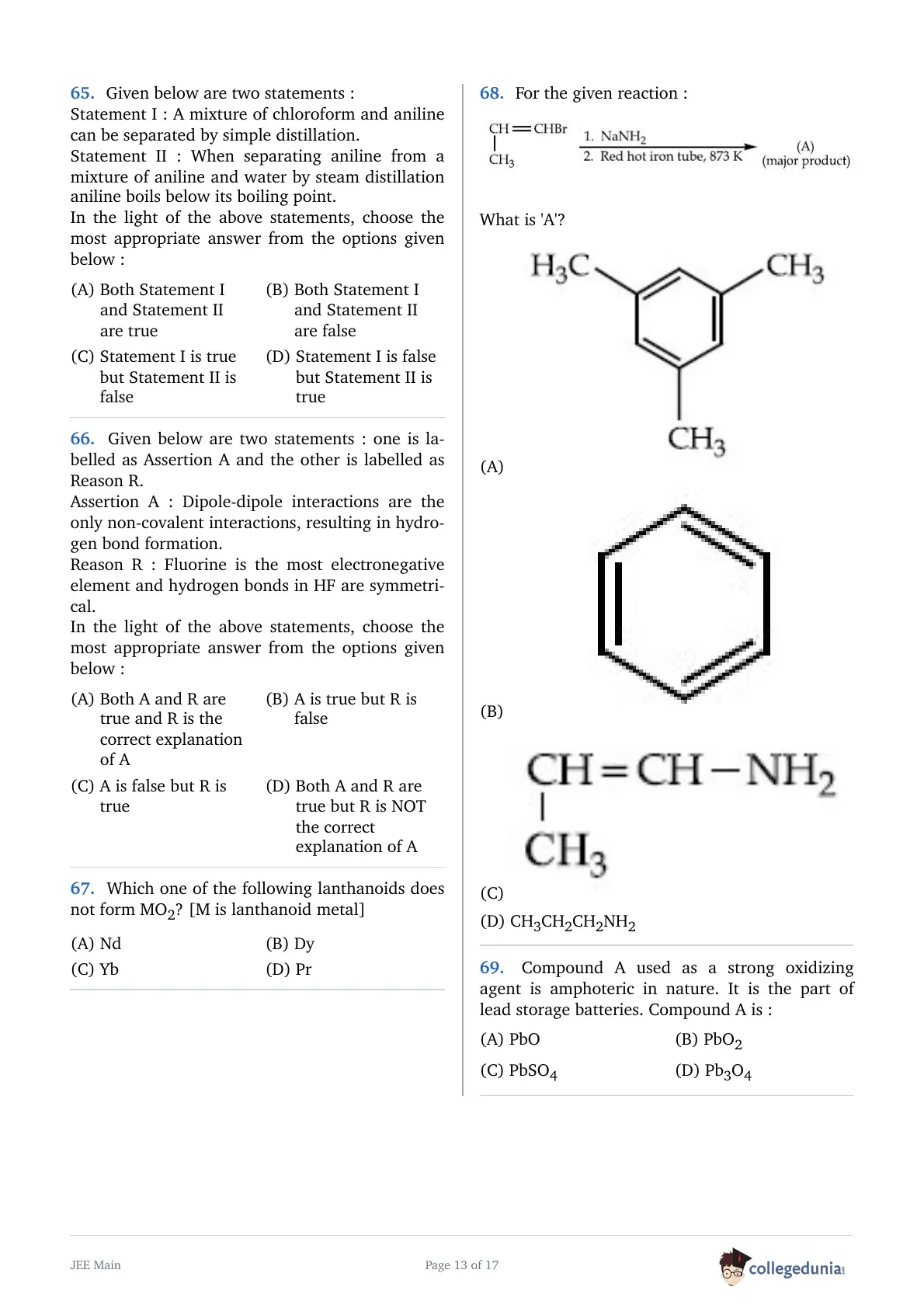
Which of the following is 'a' FALSE statement ?
Find A, B and C in the following reactions :
\(\mathrm{NH_3}+A+\mathrm{CO_2}\rightarrow(\mathrm{NH_4})_2\mathrm{CO_3}\)
\((\mathrm{NH_4})_2\mathrm{CO_3}+\mathrm{H_2O}+B\rightarrow\mathrm{NH_4HCO_3}\)
\(\mathrm{NH_4HCO_3}+\mathrm{NaCl}\rightarrow\mathrm{NH_4Cl}+C\)
| List-I (Element) | List-II (Electronic Configuration) |
|---|---|
| A. N | I. [Ar] 3d10 4s2 4p5 |
| B. S | II. [Ne] 3s2 3p4 |
| C. Br | III. [He] 2s2 2p3 |
| D. Kr | IV. [Ar] 3d10 4s2 4p6 |
Choose the correct answer from the options given below:
Given below are two statements :
Statement I : A mixture of chloroform and aniline can be separated by simple distillation.
Statement II : When separating aniline from a mixture of aniline and water by steam distillation aniline boils below its boiling point.
In the light of the above statements, choose the most appropriate answer from the options given below :
Given below are two statements : one is labelled as Assertion A and the other is labelled as Reason R.
Assertion A : Dipole-dipole interactions are the only non-covalent interactions, resulting in hydrogen bond formation.
Reason R : Fluorine is the most electronegative element and hydrogen bonds in HF are symmetrical.
In the light of the above statements, choose the most appropriate answer from the options given below :
Which one of the following lanthanoids does not form \(\mathrm{MO_2}\)? [M is lanthanoid metal]
For the given reaction :
What is 'A'?
- (1)
![]()
- (2)
![]()
- (3)
![]()
- (4) \(\mathrm{CH_3CH_2CH_2NH_2}\)


Compound A used as a strong oxidizing agent is amphoteric in nature. It is the part of lead storage batteries. Compound A is :
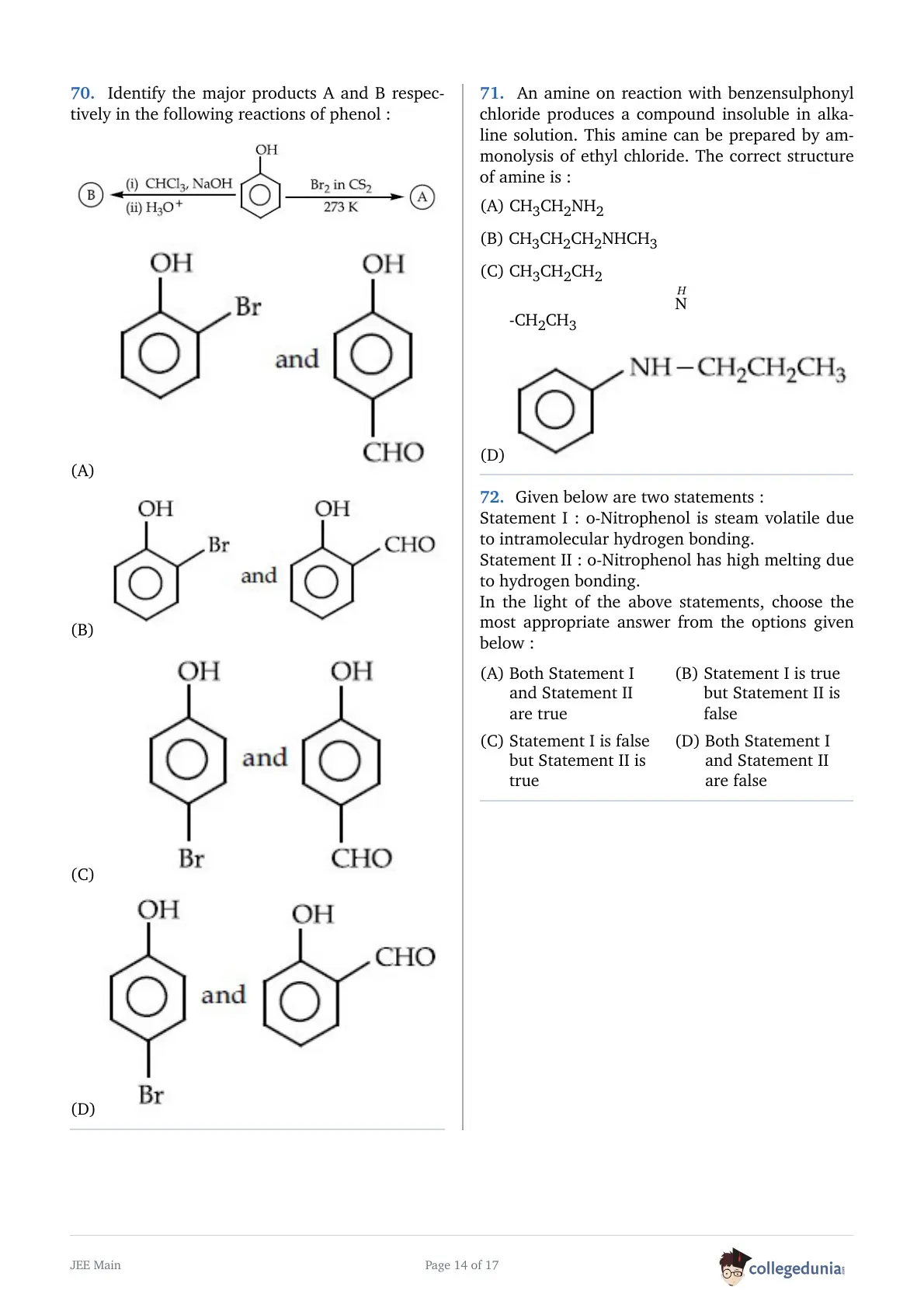
Identify the major products A and B respectively in the following reactions of phenol :
- (1)
![]()
- (2)
![]()
- (3)
![]()
- (4)
![]()


An amine on reaction with benzensulphonyl chloride produces a compound insoluble in alkaline solution. This amine can be prepared by ammonolysis of ethyl chloride. The correct structure of amine is :
- (1) \(\mathrm{CH_3CH_2NH_2}\)
- (2) \(\mathrm{CH_3CH_2CH_2NHCH_3}\)
- (3) \(\mathrm{CH_3CH_2CH_2-NH-CH_2CH_3}\)
- (4)
![]()

Given below are two statements :
Statement I : o-Nitrophenol is steam volatile due to intramolecular hydrogen bonding.
Statement II : o-Nitrophenol has high melting due to hydrogen bonding.
In the light of the above statements, choose the most appropriate answer from the options given below :
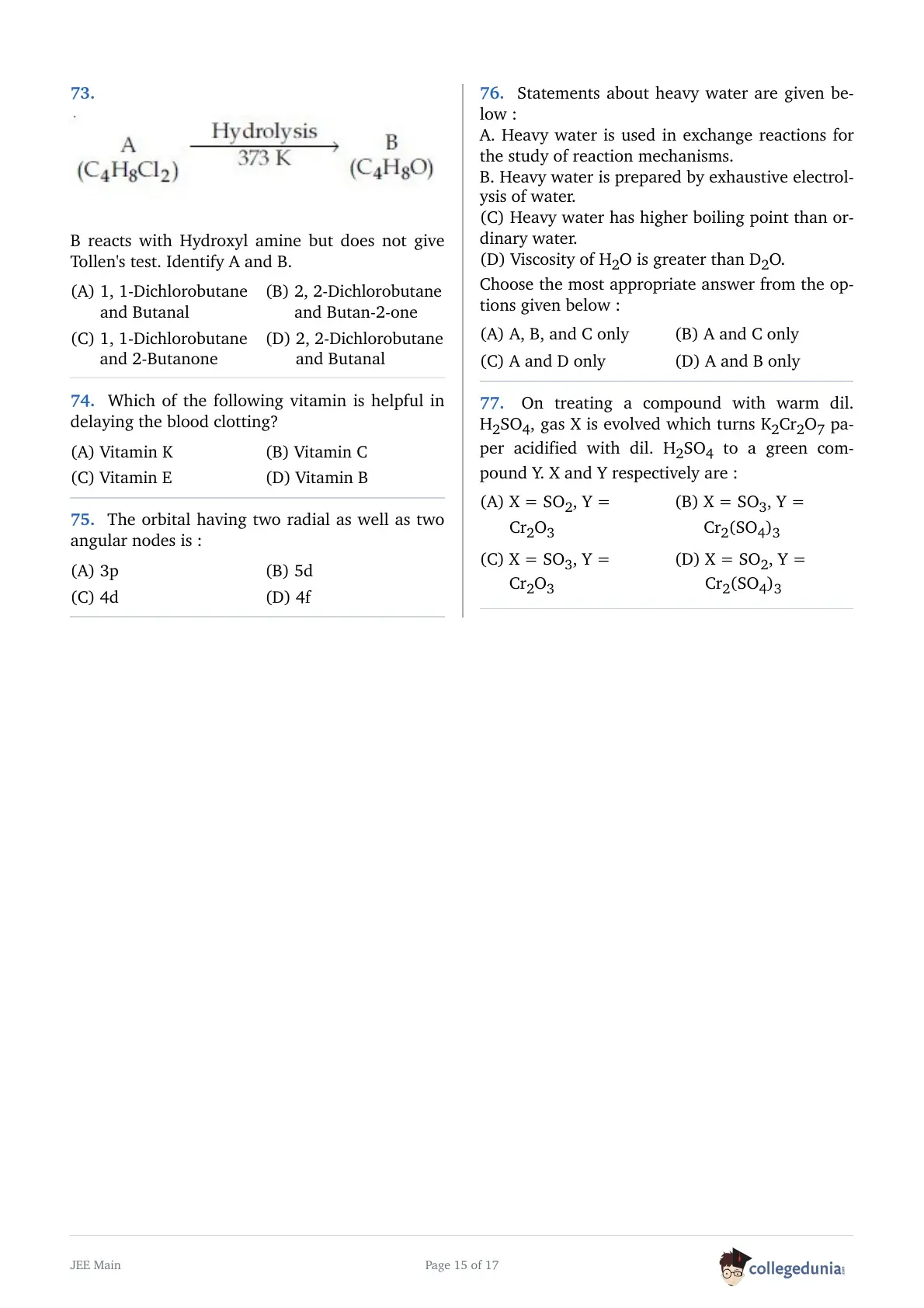
\(\underset{(\mathrm{C_4H_8Cl_2})}{A}\ \xrightarrow[373\ \mathrm{K}]{\text{Hydrolysis}}\ \underset{(\mathrm{C_4H_8O})}{B}\)
B reacts with Hydroxyl amine but does not give Tollen's test. Identify A and B.
Which of the following vitamin is helpful in delaying the blood clotting?
The orbital having two radial as well as two angular nodes is :
Statements about heavy water are given below A. Heavy water is used in exchange reactions for the study of reaction mechanisms B. Heavy water is prepared by exhaustive electrolysis of water C. Heavy water has higher boiling point than ordinary water D. Viscosity of \(H _{2} O\) is greater than \(D _{2} O\)
On treating a compound with warm dil. \(\mathrm{H_2SO_4}\), gas X is evolved which turns \(\mathrm{K_2Cr_2O_7}\) paper acidified with dil. \(\mathrm{H_2SO_4}\) to a green compound Y. X and Y respectively are :


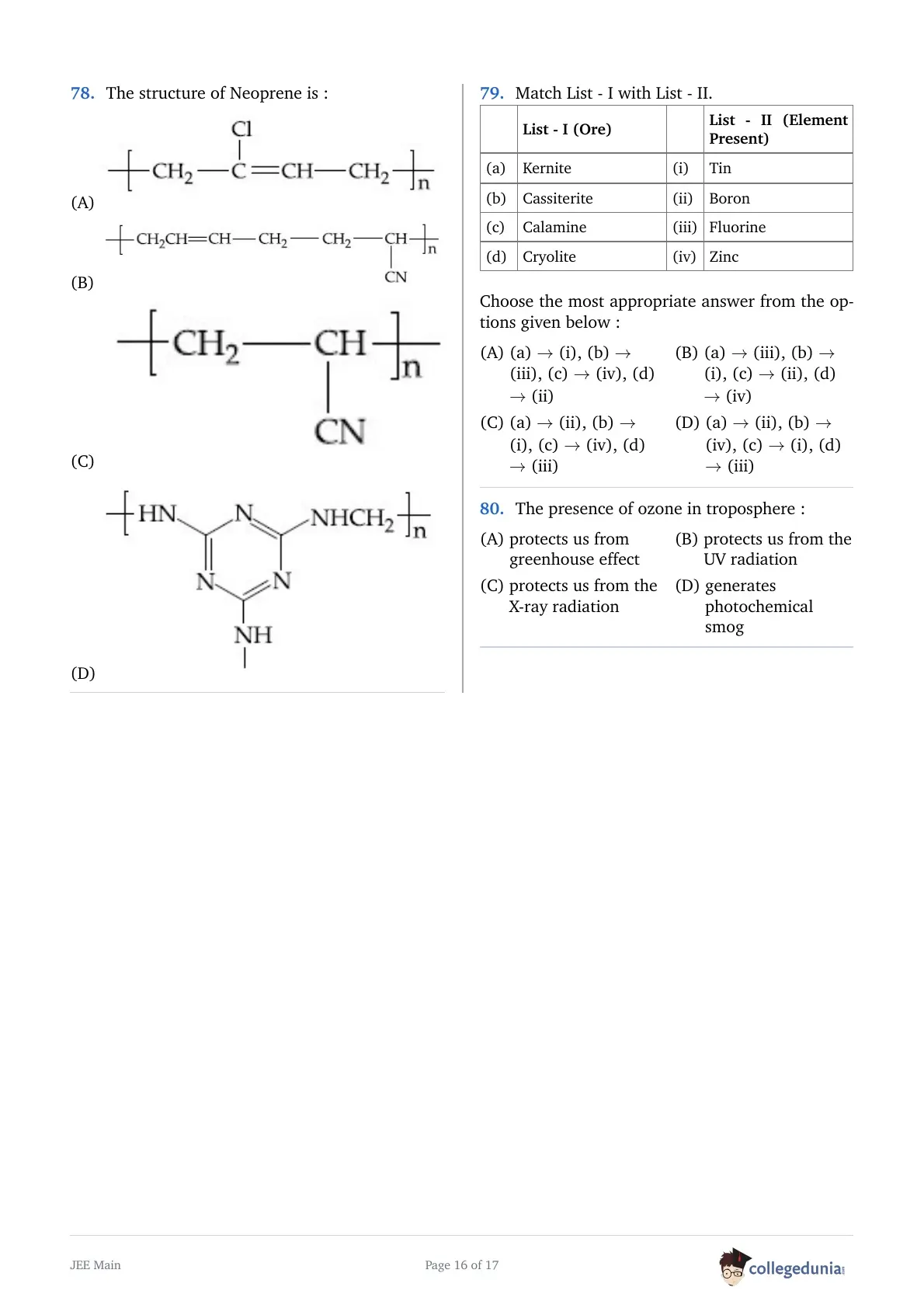
| List - I (Ore) | List - II (Element Present) | ||
| (a) | Kernite | (i) | Tin |
| (b) | Cassiterite | (ii) | Boron |
| (c) | Calamine | (iii) | Fluorine |
| (d) | Cryolite | (iv) | Zinc |
Choose the most appropriate answer from the options given below :
The presence of ozone in troposphere :
Chemistry - Section B (Q81 - Q90)
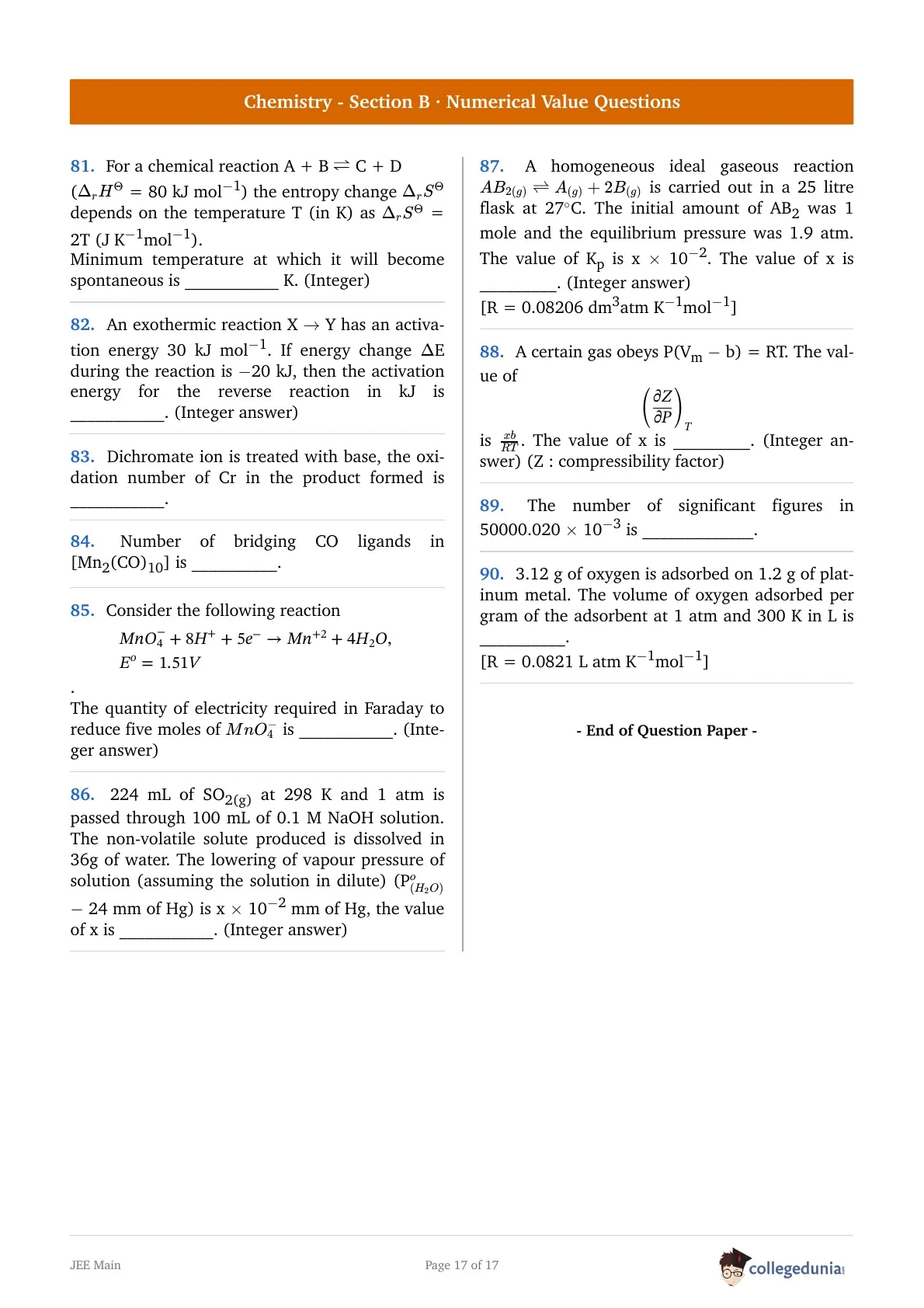
For a chemical reaction \(\mathrm{A + B \rightleftharpoons C + D}\)
(\(\Delta_r H^\Theta = 80\ \mathrm{kJ\ mol^{-1}}\)) the entropy change \(\Delta_r S^\Theta\) depends on the temperature T (in K) as \(\Delta_r S^\Theta = 2T\ (\mathrm{J\ K^{-1}\ mol^{-1}})\).
Minimum temperature at which it will become spontaneous is ___________ K. (Integer)
The reaction \(\mathrm{X} \to \mathrm{Y}\) is an exothermic reaction. Activation energy of the reaction for X into Y is 150 kJ mol-1. Enthalpy of reaction is 135 kJ mol-1. The activation energy for the reverse reaction, \(\mathrm{Y} \to \mathrm{X}\) will be :
Dichromate ion is treated with base, the oxidation number of Cr in the product formed is ___________.
Number of bridging CO ligands in \(\mathrm{[Mn_2(CO)_{10}]}\) is __________.
Consider the following reaction
\(\mathrm{MnO_4^- + 8H^+ + 5e^- \to Mn^{2+} + 4H_2O},\ E^\circ = 1.51\ \mathrm{V}\).
The quantity of electricity required in Faraday to reduce five moles of \(\mathrm{MnO_4^-}\) is ___________. (Integer answer)
224 mL of \(\mathrm{SO_{2(g)}}\) at 298 K and 1 atm is passed through 100 mL of 0.1 M NaOH solution. The non-volatile solute produced is dissolved in 36g of water. The lowering of vapour pressure of solution (assuming the solution in dilute) (\(\mathrm{P^o_{(H_2O)}}\) - 24 mm of Hg) is x \(\times\) \(10^{-2}\) mm of Hg, the value of x is ___________. (Integer answer)
A homogeneous ideal gaseous reaction \(\mathrm{AB_{2(g)} \rightleftharpoons A_{(g)} + 2B_{(g)}}\) is carried out in a 25 litre flask at \(27^\circ\mathrm{C}\). The initial amount of \(\mathrm{AB_2}\) was 1 mole and the equilibrium pressure was 1.9 atm. The value of \(\mathrm{K_p}\) is x \(\times\) \(10^{-2}\). The value of x is _________. (Integer answer)
[R = 0.08206 \(\mathrm{dm^3\ atm\ K^{-1}\ mol^{-1}}\)]
A certain gas obeys \(\mathrm{P(V_m - b) = RT}\). The value of \(\left(\dfrac{\partial Z}{\partial P}\right)_T\) is \(\dfrac{xb}{RT}\). The value of x is _________. (Integer answer) (Z : compressibility factor)
The number of significant figures in \(50000.020 \times 10^{-3}\) is _____________.
3.12 g of oxygen is adsorbed on 1.2 g of platinum metal. The volume of oxygen adsorbed per gram of the adsorbent at 1 atm and 300 K in L is __________.
[R = 0.0821 L atm \(\mathrm{K^{-1}\ mol^{-1}}\)]
JEE Main 2021 Exam Pattern and Marking Scheme
| Particulars | Details |
|---|---|
| Exam Mode | Online (Computer-Based Test) |
| Paper | B.E./B.Tech (Paper 1) |
| Duration | 3 hours (180 minutes) |
| Type of Questions | Multiple Choice Questions (MCQs) + Numerical Value Questions |
| Subjects | Mathematics, Physics, Chemistry |
| Total Questions | 90 questions (75 to be attempted) |
| Total Marks | 300 marks |
| Marking Scheme | +4 for correct answer & -1 for incorrect MCQ; no negative marking for Numerical Value Questions |
JEE Main 2021 February 26 Shift 1 Difficulty Level
JEE Main 2021 B.E./B.Tech Question Paper - February 26, 2021- Forenoon Session has been rated to be of a moderate level of difficulty by the students and coaching institutes alike. The question paper included an almost equal number of questions from the class 11th and class 12th syllabus.
JEE Main 2021 B.E./B.Tech Question Paper February 26 (FN): Difficulty Level
JEE Main 2021 B.E./B.Tech Paper n February 26 Forenoon Session was conducted between 9.00 AM to 12.00 Noon, and was reported as moderate in terms of overall difficulty level.
- Mathematics was the toughest section of the exam, followed by Physics, while the Chemistry section was the easiest of all three sections.
- Particularly questions based on Coordinate Geometry, Calculus, and Vector 3D were significantly difficult. Check JEE Main Mathematics Syllabus
- In Physics Section, the questions based on Electrostatics, and Electromagnetic Induction were a little bit tougher than the rest of the questions in the section. Check JEE Main Physics Syllabus
- In Chemistry questions based upon Chemical Bonding and Molecular Structure, were found to be more difficult than the rest of the questions in the section. Check JEE Main Chemistry Syllabus
- The paper has a roughly equal number of questions from the class 11th and class 12th syllabus.



Comments