




JEE Main 2022 June 25 Shift 2 Question Paper is available here with solutions PDF and detailed solutions for every question. NTA conducted the second shift on June 25, 2022, from 3:00 PM to 6:00 PM. The JEE Main 2022 Paper 1 (B.E./B.Tech) question paper includes the following:
- 90 questions in a 3-hour CBT Mode: 30 each from Mathematics, Physics and Chemistry (75 to be attempted)
- Section A: 20 multiple choice questions (MCQs) per subject, all compulsory, 4 marks each
- Section B: 10 numerical value questions per subject, any 5 to be attempted, 4 marks each
- Marking: +4 for a correct answer, -1 for an incorrect answer, 0 for an unattempted question
- Maximum marks: 300 (100 per subject)
JEE Main 2022 June 25 Shift 2 Question Paper with Solution PDF
| NTA Official PDF | CD PDF | CD PDF with Solutions |
|---|---|---|
| Download official PDF 4.53 MB | Download Collegedunia PDF 0.98 MB | Download solutions PDF 0.92 MB |
Also Check:
JEE Main 2022 June 25 Shift 2 Questions with Solutions
Mathematics - Section A (Q1 - Q20)
Choose the correct answer:
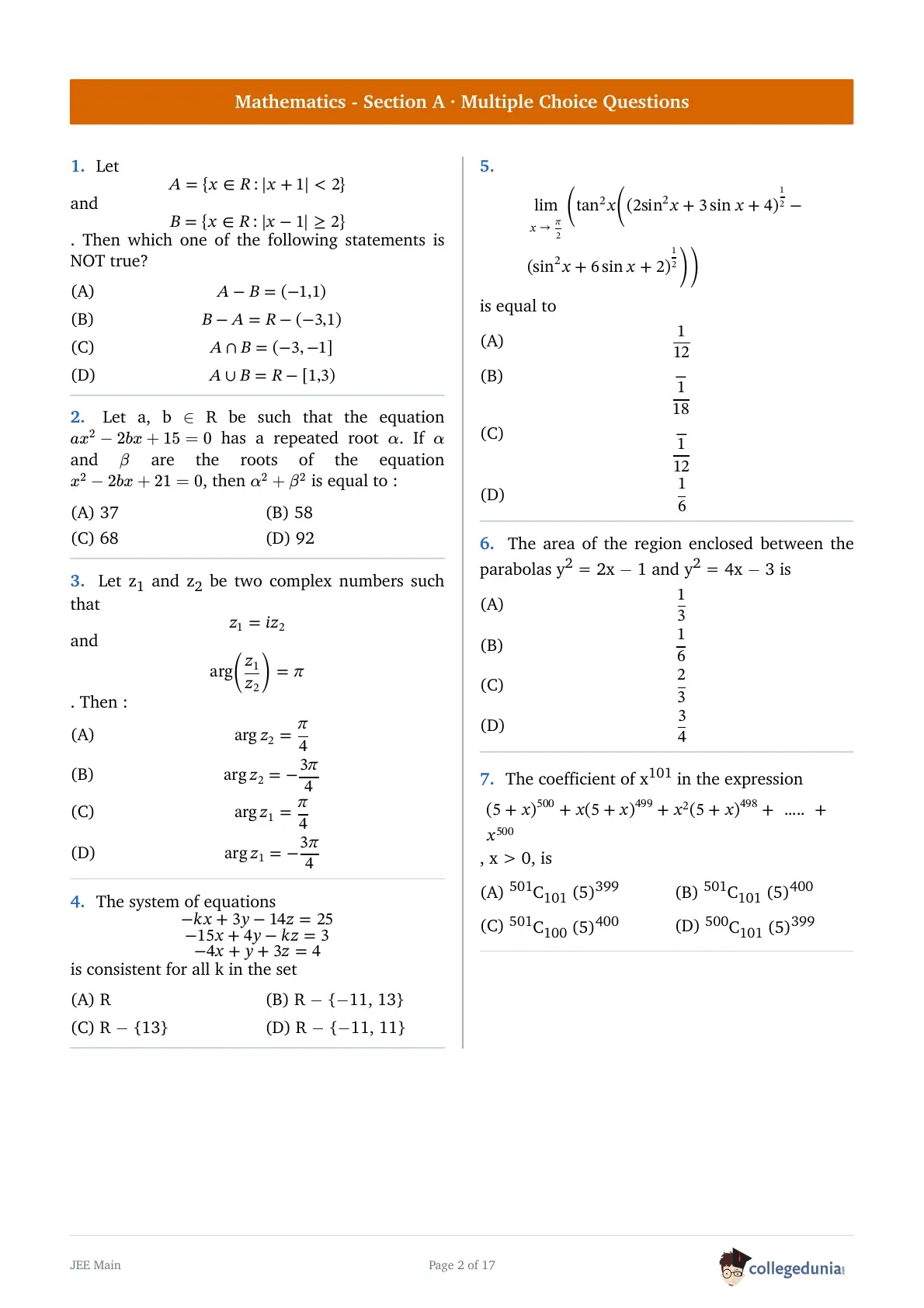
1. Let A = {x ∈ R : | x + 1 | < 2} and B = {x ∈ R : | x – 1| ≥ 2}. Then which one of the following statements is NOT true?
Let a, b ∈ R be such that the equation ax2 – 2bx + 15 = 0 has a repeated root α. If α and β are the roots of the equation x2 – 2bx + 21 = 0, then α2 + β2 is equal to
Let z1 and z2 be two complex numbers such that
\(z_1=iz_2 \,and \,arg(\frac{z_1}{z_2})=π.\)
The system of equations
–kx + 3y – 14z = 25
–15x + 4y – kz = 3
–4x + y + 3z = 4
is consistent for all k in the set
\(lim(x→\frac{x}{2}) tan^2x((2sin^2x+3sinx+4)^{\frac{1}{2}}-(sin^2x+6sinx+2)^{\frac{1}{2}}\) is equal to.
The area of the region enclosed between the parabolas y2 = 2x – 1 and y2 = 4x – 3 is
The coefficient of x101 in the expression (5 + x)500 + x(5 + x)499 + x2(5 + x)498 + ……+ x500, x > 0, is
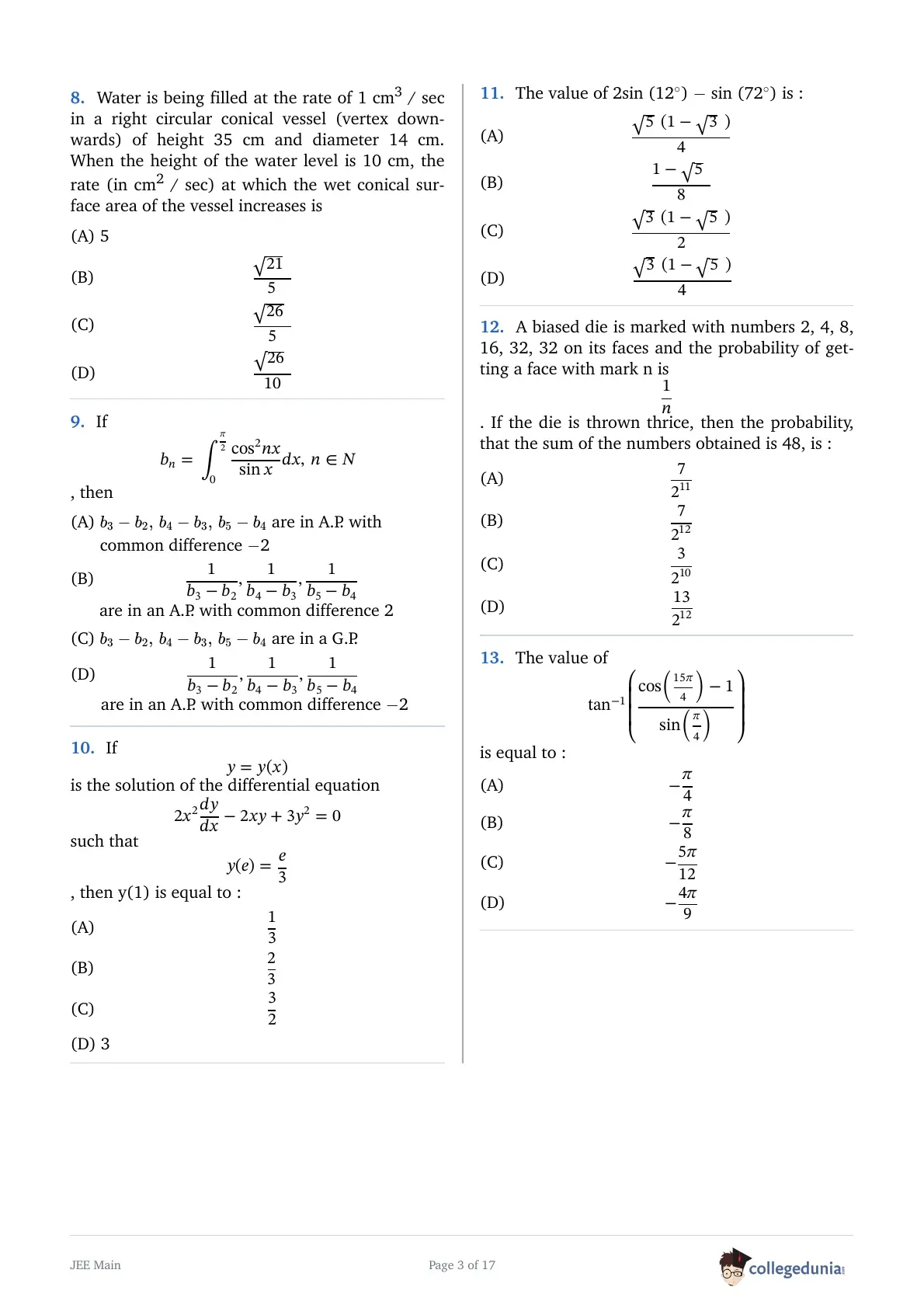
Water is being filled at the rate of 1 cm3/sec in a right circular conical vessel (vertex downwards) of height 35 cm and diameter 14 cm. When the height of the water level is 10 cm, the rate (in cm2/sec) at which the wet conical surface area of the vessel increase, is
If \(b_n= ∫_0^{\frac{π}{2}} \frac{cos^2nx}{sinx }dx, n∈N,\) Then
If y = y(x) is the solution of the differential equation
\(2x^2\frac{dy}{dx}-2xy+3y^2=0\) such that \(y(e)=\frac{e}{3},\)
then y(1) is equal to
The value of 2 sin(12°) – sin(72°) is
A biased die is marked with numbers 2, 4, 8, 16, 32, 32 on its faces and the probability of getting a face with mark n is \(\frac1{n}\). If the die is thrown thrice, then the probability, that the sum of the numbers obtained is 48 is:
The value of \( tan^{-1}(\frac{cos\frac{15}{4}-1}{sin(\frac{π}{4})} )\) is equal to:
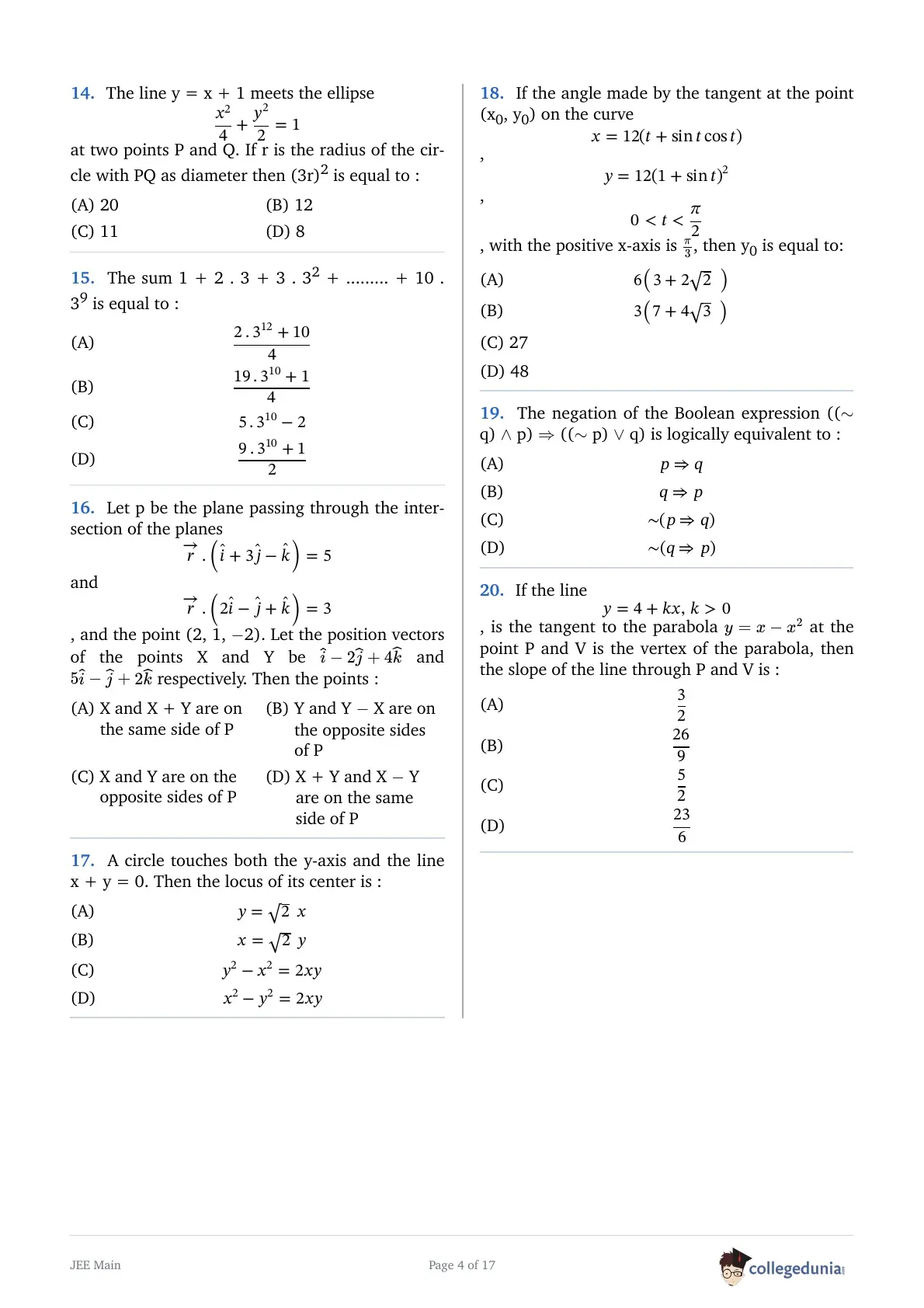
The line y = x + 1 meets the ellipse \(\frac{x^2}{4}+\frac{y^2}{2}=1\) at two points P and Q. If r is the radius of the circle with PQ as diameter then (3r)2 is equal to
The sum 1 + 2 ⋅ 3 + 3 ⋅ 32 + …. + 10 ⋅ 39 is equal to
Let P be the plane passing through the intersection of the planes
r→.(i+3k−k)=5 and r→ .(2i−j+k)=3,
and the point (2, 1, –2). Let the position vectors of the points X and Y be
i−2j+4k and 5i−j+2k
respectively. Then the points
A circle touches both the y-axis and the line x + y = 0. Then the locus of its center is
If the angle made by the tangent at the point (x0, y0) on the curve x = 12(t + sin t cos t),
\(y=12(1+sint)^2,0<t<\frac{π}{2}, \)
with the positive x-axis is π/3, then y0 is equal to
The negation of the Boolean expression ((~ q) ∧ p) ⇒ ((~ p) ∨ q) is logically equivalent to:
If the line y = 4 + kx, k > 0, is the tangent to the parabola y = x – x2 at the point P and V is the vertex of the parabola, then the slope of the line through P and V is:
Mathematics - Section B (Q21 - Q30)
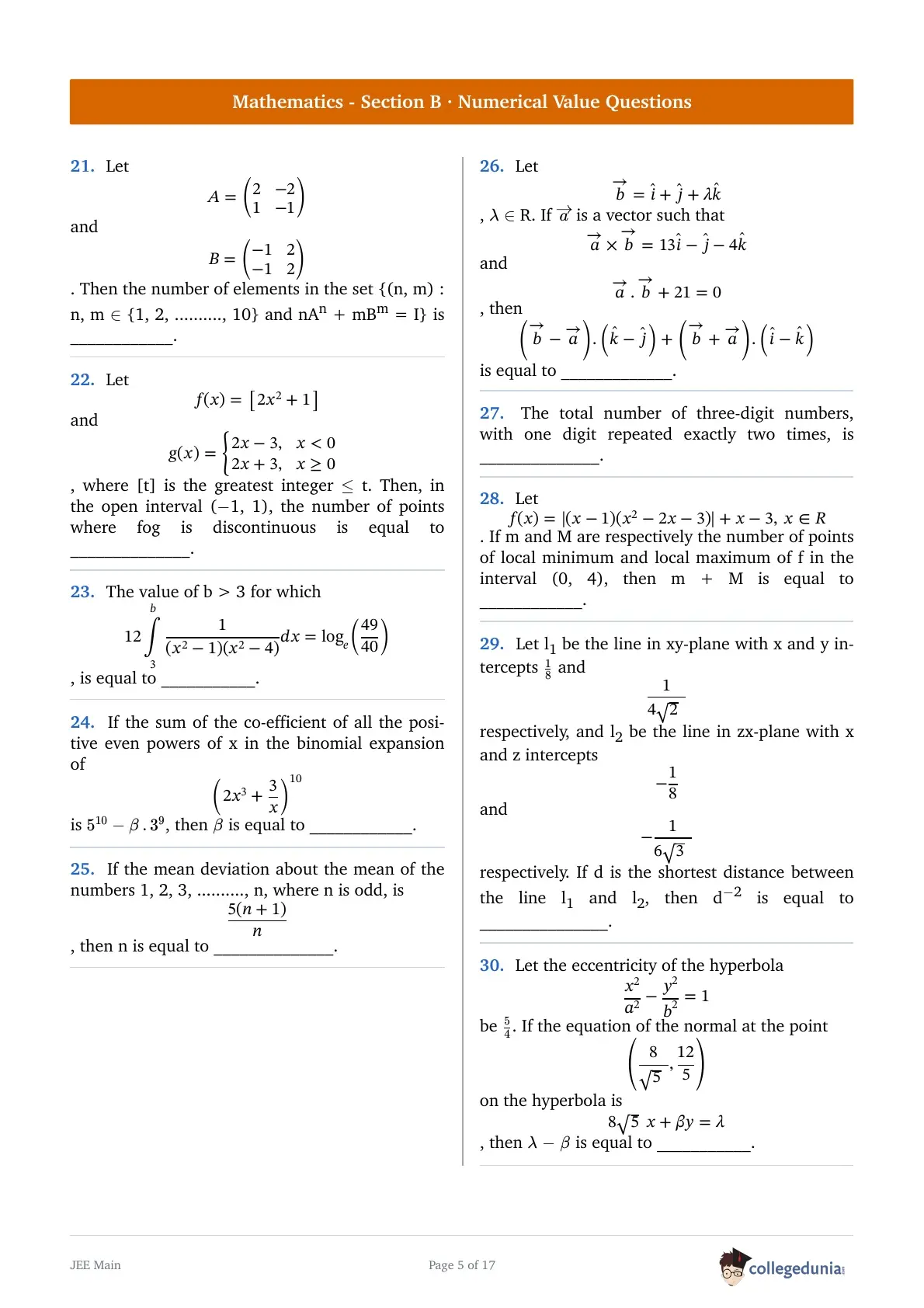
 Then the number of elements in the set {(n, m) : n, m ∈ { 1, 2….., 10} and nAn + mBm = I} is _______.
Let f(x) = [2x2 + 1] and \(g(x)=\left\{\begin{matrix} 2x-3,\,x<0&\\2x+3, x≥0 &\end{matrix}\right.\)where [t] is the greatest integer ≤ t. Then, in the open interval (–1, 1), the number of points where fog is discontinuous is equal to _______.
The value of b > 3 for which \(12∫_3^b \frac{1}{(x^2-1)(x^2-4)}dx=log_e(\frac{40}{40}) \) is equal to.
If the sum of the co-efficients of all the positive even powers of x in the binomial expansion of \((2x^3+\frac{3}{x})^{10} \) is 510 – β·39, the β is equal to ____.
If the mean deviation about the mean of the numbers 1, 2, 3, …. n, where n is odd, is \(\frac{5(n + 1)}{n}\), then n is equal to ______.
Let \(→{b}=^i+^j+λ k\) , λ ∈ R. If vector a is a vector such that → a×→ b= 13^i −^j−4^k and→ a.→ b+ 21 =0, then (→ b − → a) . ( → k − ^ j ) + ( → b + → a ) . ( ^ i − ^ k ) is equal to
The total number of three-digit numbers, with one digit repeated exactly two times, is ______.
Let f(x) = |(x – 1)(x2 – 2x – 3)| + x – 3, x ∈ R. If m and M are, respectively the number of points of local minimum and local maximum of f in the interval (0, 4), then m + M is equal to
Let l1 be the line in xy-plane with x and y intercepts ⅛ and \(\frac{1}{4√2} \) respectively and l2 be the line in zx-plane with x and z intercepts -⅛ and \(−\frac{1}{6√3}\) respectively. If d is the shortest distance between the line l1 and l2, then d–2 is equal to ______.
Let the eccentricity of the hyperbola \(\frac{x^2}{a^2}-\frac{y^2}{b^2}=1\) be \(\frac{5}{4}\). If the equation of the normal at the point \((\frac{8}{√5}, \frac{12}{5})\) on the hyperbola is 8√5 x + β y = λ, then λ – β is equal to ____.
Physics - Section A (Q31 - Q50)
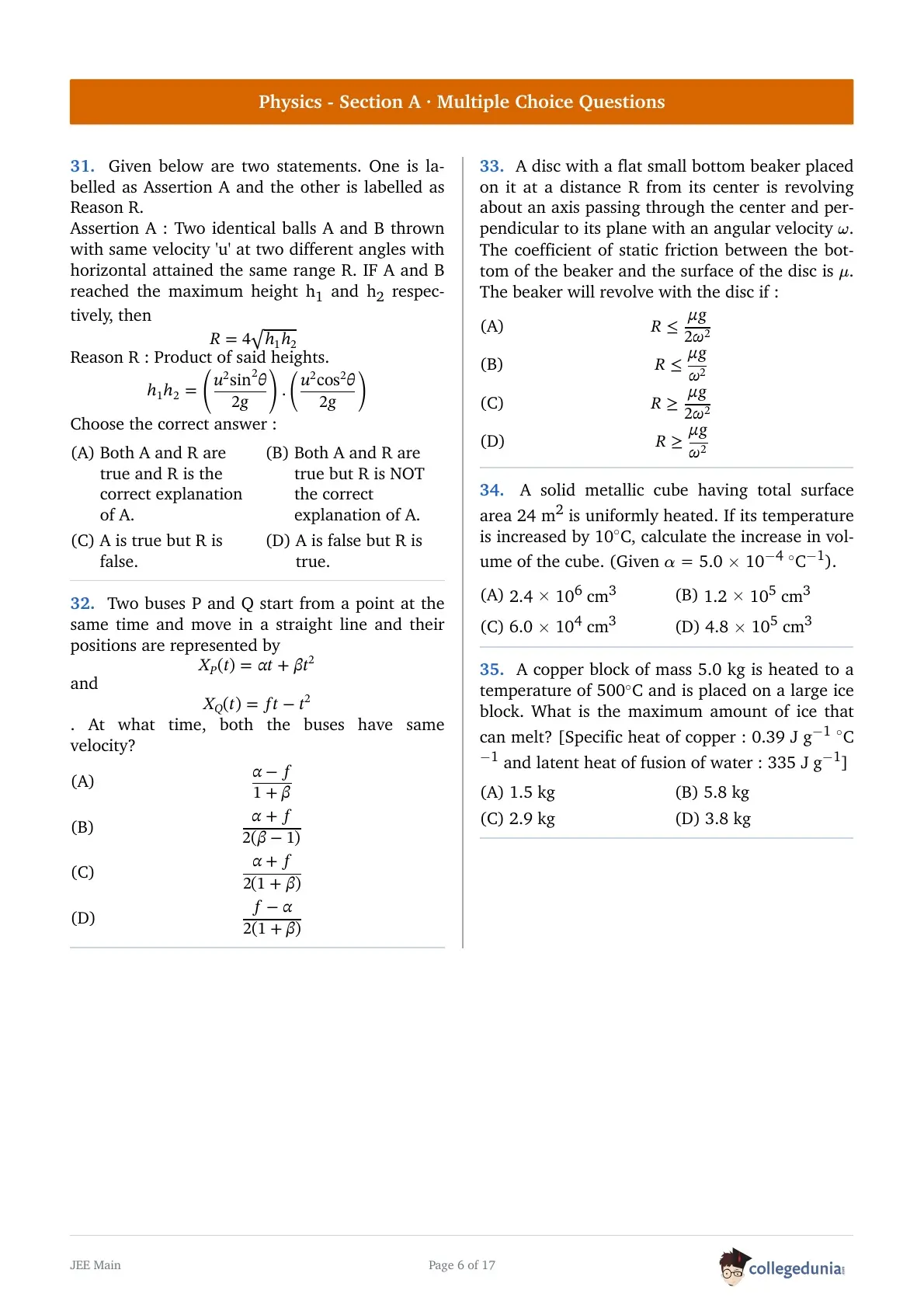
Given below are two statements. One is labelled as Assertion A and the other is labelled as Reason R.
Assertion A: Two identical balls A and B thrown with same velocity ’u’ at two different angles with horizontal attained the same range R. If A and B reached the maximum height h1 and h2 respectively, then
\(R=\sqrt{4ℎ1ℎ2}.\)
Reason R: Product of said heights.
\(h_1h_2=(\frac{u^2sin^2θ}{2g}).(\frac{u^2cos^2θ}{2g})\)
Two buses P and Q start from a point at the same time and move in a straight line and their positions are represented by XP(t) = αt + βt2 and XQ(t) = ft – t2. At what time, both the buses have same velocity?
A disc with a flat small bottom beaker placed on it at a distance R from its center is revolving about an axis passing through the center and perpendicular to its plane with an angular velocity ω. The coefficient of static friction between the bottom of the beaker and the surface of the disc is μ. The beaker will revolve with the disc if :
A solid metallic cube having total surface area 24 m2 is uniformly heated. If its temperature is increased by 10°C, calculate the increase in volume of the cube.
(Given α = 5.0 × 10⁻⁴ °C–1).
A copper block of mass 5.0 kg is heated to a temperature of 500°C and is placed on a large ice block. What is the maximum amount of ice that can melt?
[Specific heat of copper 0.39 J g–1 °C–1 and latent heat of fusion of water : 335 J g–1]
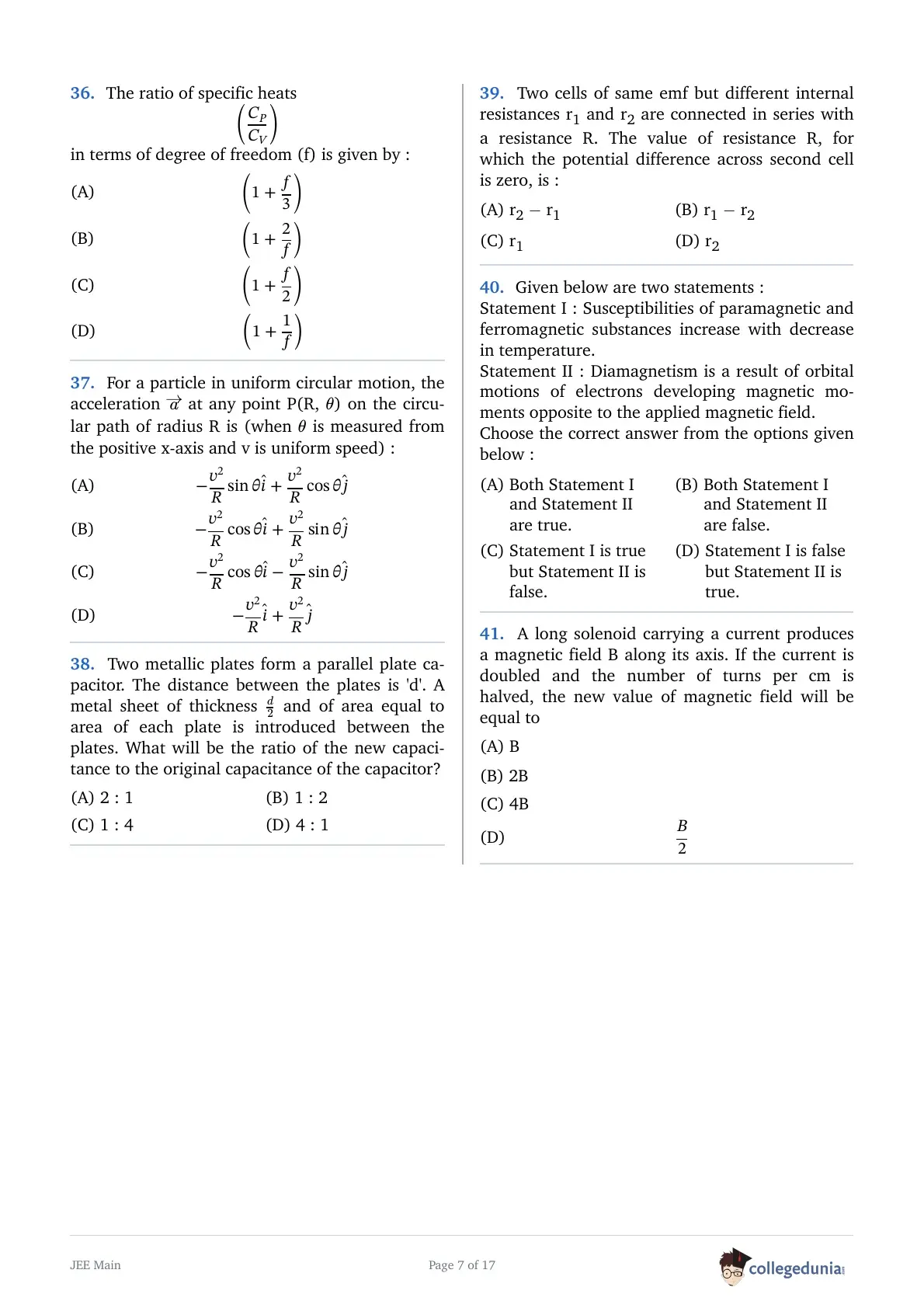
The ratio of specific heats
\((\frac{c_p}{c_v}) \)
in terms of degree of freedom (f) is given by:
For a particle in uniform circular motion, the acceleration a at any point P(R, θ) on the circular path of radius R is (when θ is measured from the positive x-axis and v is uniform speed):
Two metallic plates form a parallel plate capacitor. The distance between the plates is ‘d’. A metal sheet of thickness d/2 and of area equal to area of each plate is introduced between the plates. What will be the ratio of the new capacitance to the original capacitance of the capacitor?
Two cells of same emf but different internal resistances r1 and r2 are connected in series with a resistance R. The value of resistance R, for which the potential difference across second cell is zero, is
Given below are two statements:
Statement-I : Susceptibilities of paramagnetic and ferromagnetic substances increase with decrease in temperature.
Statement-II : Diamagnetism is a result of orbital motions of electrons developing magnetic moments opposite to the applied magnetic field.
Choose the correct answer from the options given below:-
A long solenoid carrying a current produces a magnetic field B along its axis. If the current is doubled and the number of turns per cm is halved, the new value of magnetic field will be equal to
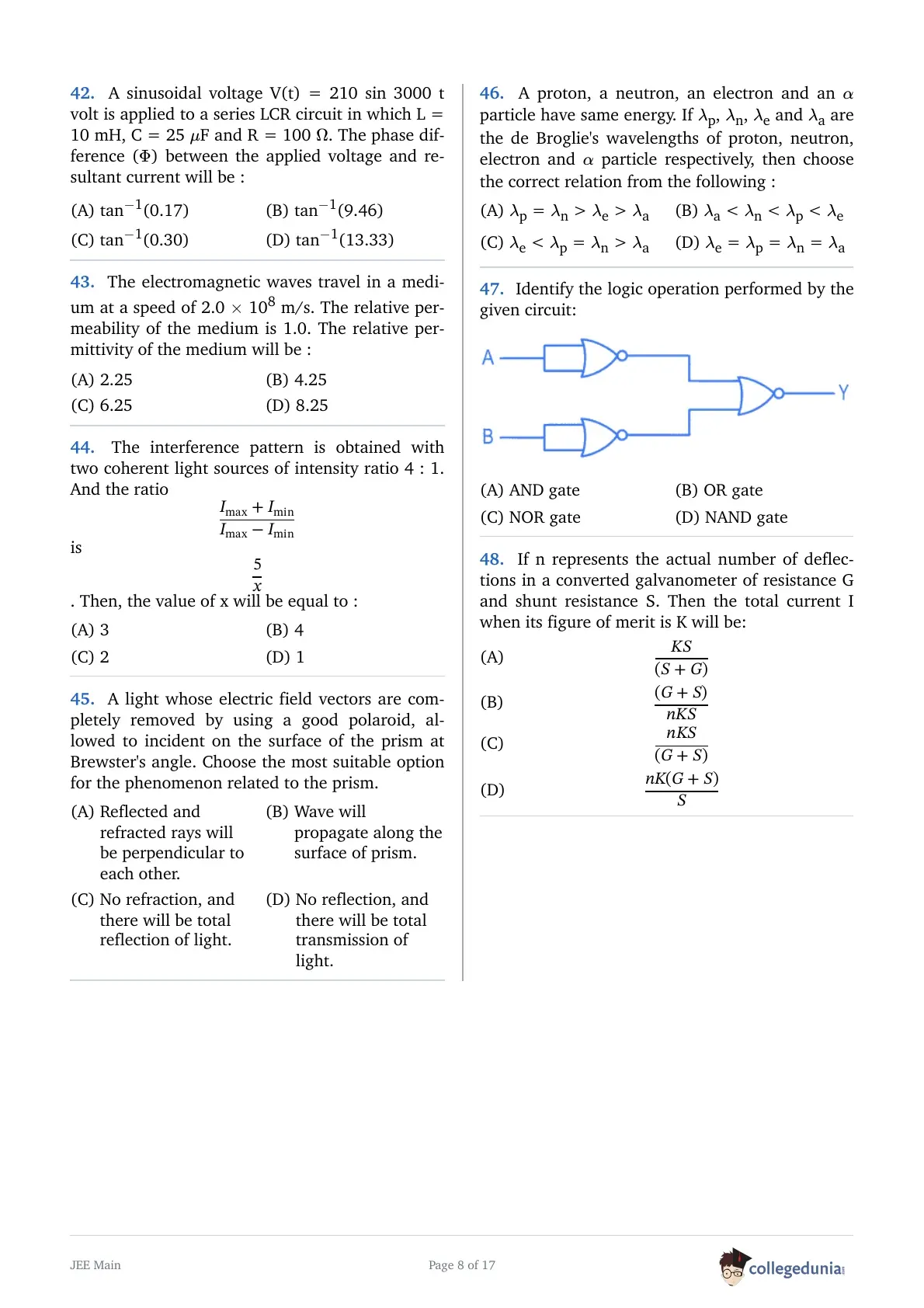
A sinusoidal voltage V(t) = 210 sin 3000 t volt is applied to a series LCR circuit in which L = 10 mH, C = 25 μF and R = 100 Ω. The phase difference (Φ) between the applied voltage and resultant current will be:
The electromagnetic waves travel in a medium at a speed of 2.0 × 10⁸ m/s. The relative permeability of the medium is 1.0. The relative permittivity of the medium will be
The interference pattern is obtained with two coherent light sources of intensity ratio 4 : 1. And the ratio
\(\frac{l_{max}+l_{min}}{l_{max}-l_{min} }\)
is 5/x. Then, the value of x will be equal to:
A light whose electric field vectors are completely removed by using a good polaroid, allowed to incident on the surface of the prism at Brewster's angle. Choose the most suitable option for the phenomenon related to the prism.
A proton, a neutron, an electron and an α-particle have same energy. If λp, λn, λe and λα are the de Broglie’s wavelengths of proton, neutron, electron and α particle respectively, then choose the correct relation from the following:
The logic performed by the circuit shown in the figure is equivalent to:
If n represents the actual number of deflections in a converted galvanometer of resistance G and shunt resistance S. Then the total current I when its figure of merit is K will be
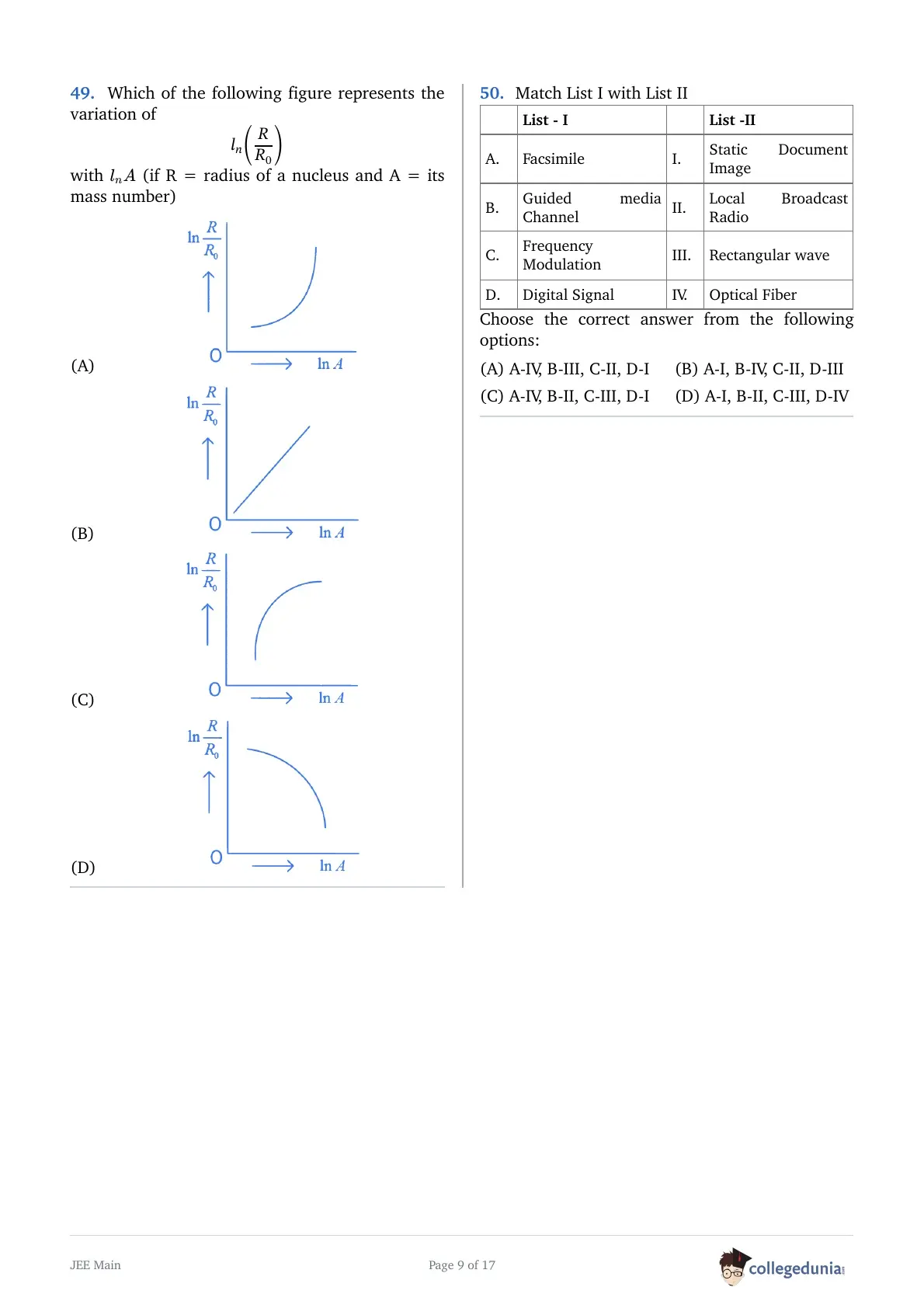
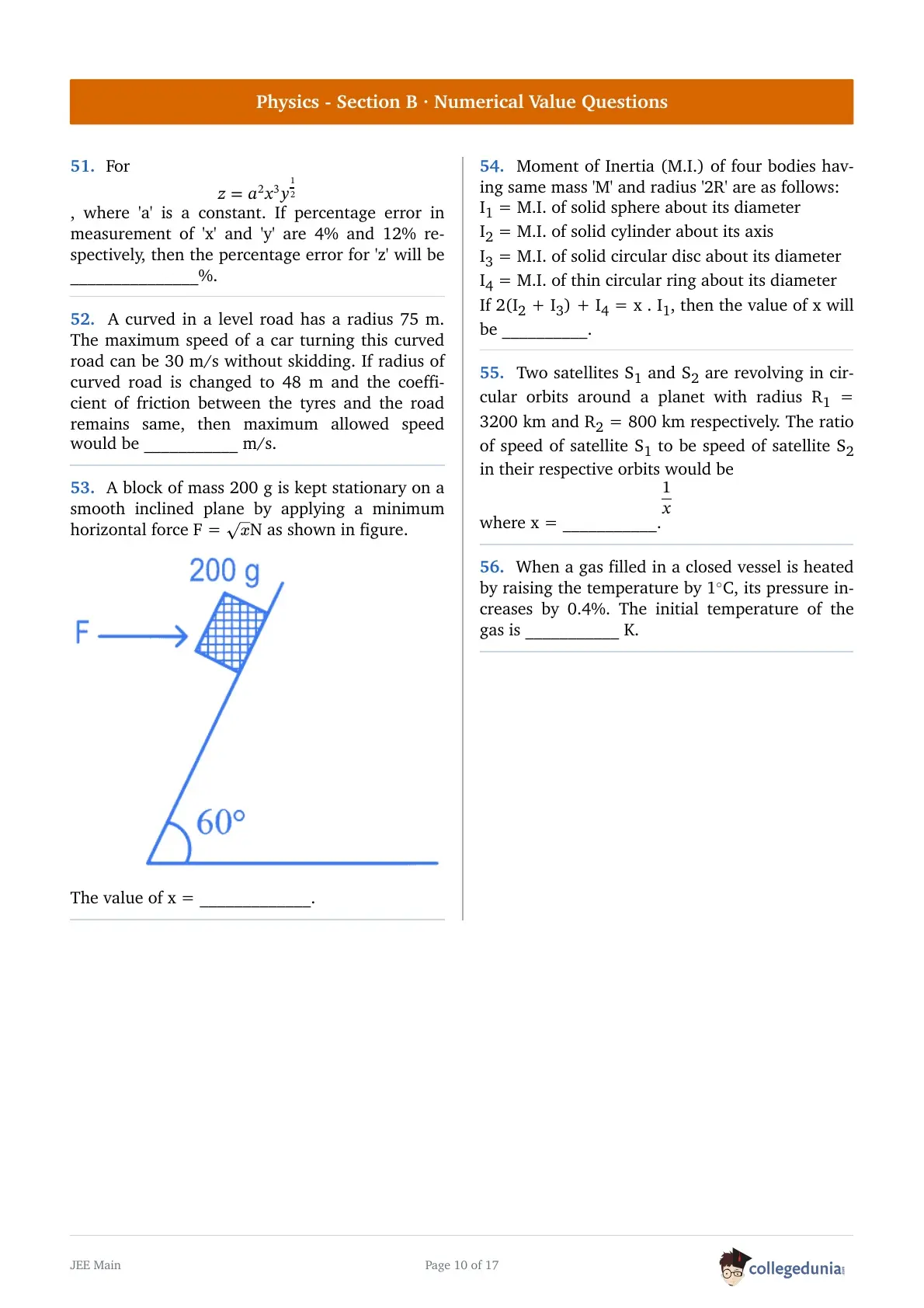
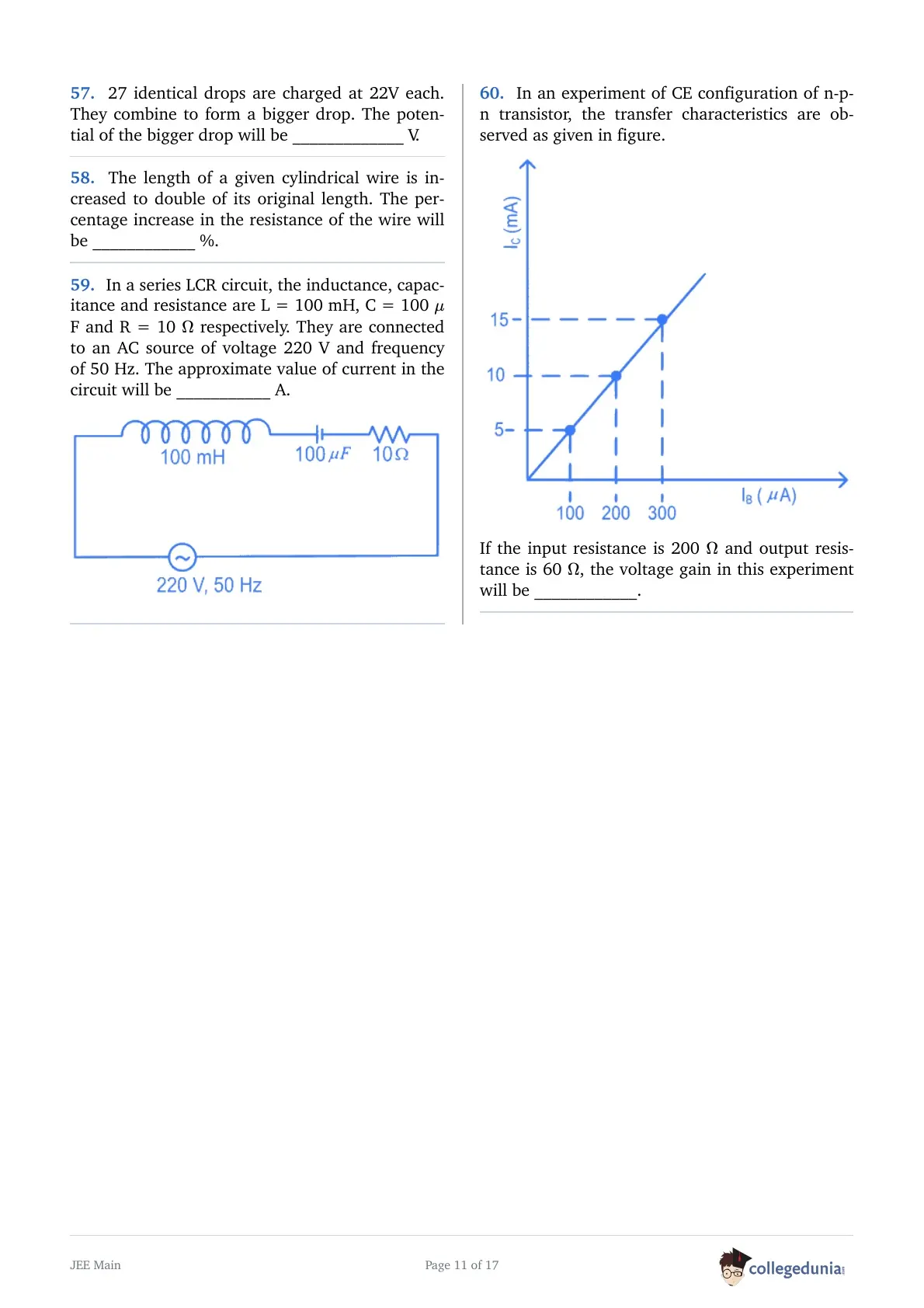
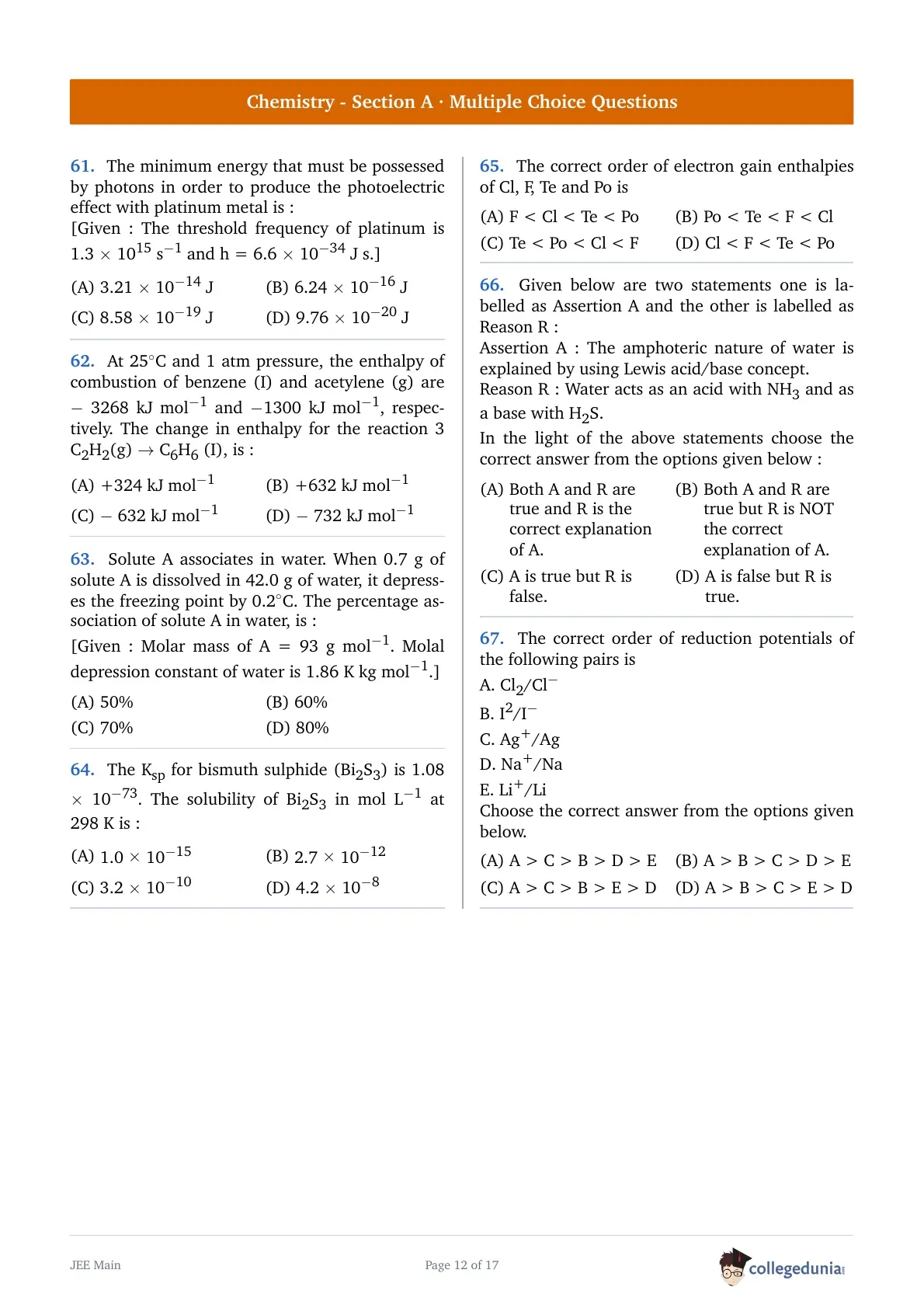
Which of the following figure represents the variation of \(ln (\frac{R}{R_0})\) with \(ln\ A\)?
(if \(R\) = radius of a nucleus and \(A\) = its mass number)
- (1)
![Which of the following figure represents the variation of in (R/R0) with ln A?]()
- (2)
![Which of the following figure represents the variation of in (R/R0) with ln A?]()
- (3)
![Which of the following figure represents the variation of in (R/R0) with ln A?]()
- (4)
![Which of the following figure represents the variation of in (R/R0) with ln A?]()


Match List I with List II
| List I | List II | ||
| A | Facsimile | I | Static Document Image |
| B | Guided media Channel | II | Local Broadcast Radio |
| C | Frequency Modulation | III | Rectangular wave |
| D | Digital Single | IV | Optical Fiber |
Physics - Section B (Q51 - Q60)
For
\(z=a^2x^3y^{\frac{1}{2}}\)
where ‘a‘ is a constant. If percentage error in measurement of ‘x‘ and ‘y’ are 4% and 12%, respectively, then the percentage error for ‘z‘ will be ____ %.
A curved in a level road has a radius 75 m. The maximum speed of a car turning this curved road can be 30 m/s without skidding. If radius of curved road is changed to 48 m and the coefficient of friction between the tyres and the road remains same, then maximum allowed speed would be ______ m/s.

Moment of Inertia (M.I.) of four bodies having same mass ‘M‘ and radius ‘2R‘ are as follows:
I1 = M.I. of solid sphere about its diameter
I2 = M.I. of solid cylinder about its axis
I3 = M.I. of solid circular disc about its diameter.
I4 = M.I. of thin circular ring about its diameter
If 2(I2 + I3) + I4 = x⋅ I1 then the value of x will be ______.
Two satellites S1 and S2 are revolving in circular orbits around a planet with radius R1 = 3200 km and R2 = 800 km respectively. The ratio of speed of satellite S1 to the speed of satellite S2 in their respective orbits would be 1/x where x =
When a gas filled in a closed vessel is heated by raising the temperature by 1ºC, its pressure increases by 0.4%. The initial temperature of the gas is _____ K.
identical drops are charged at 22 V each. They combine to form a bigger drop. The potential of the bigger drop will be ______ V.
The length of a given cylindrical wire is increased to double of its original length. The percentage increase in the resistance of the wire will be ______%.
In a series LCR circuit, the inductance, capacitance and resistance are L = 100 mH, C = 100 μF and R = 10 Ω respectively. They are connected to an AC source of voltage 220 V and frequency of 50 Hz. The approximate value of current in the circuit will be ______ A.

In an experiment of CE configuration of n–p–n transistor, the transfer characteristics are observed as given in figure.

If the input resistance is 200 Ω and output resistance is 60 Ω, the voltage gain in this experiment will be______.
Chemistry - Section A (Q61 - Q80)
Choose the correct answer :
1. The minimum energy that must be possessed by photons in order to produce the photoelectric effect with platinum metal is
[Given The threshold frequency of platinum is 1.3 × 10¹⁵ s–1 and h = 6.6 × 10⁻³⁴ Js.]
At 25°C and 1 atm pressure, the enthalpy of combustion of benzene (I) and acetylene (g) are –3268 kJ mol–1 and –1300 kJ mol–1, respectively. The change in enthalpy for the reaction 3C2H2(g) → C6H6(I), is
Solute A associates in water. When 0.7 g of solute A is dissolved in 42.0 gof water, it depresses the freezing point by 0.2°C. The percentage association of solute A in water is :
[Given : Molar mass of A = 93 g mol–1. Molal depression constant of water is 1.86 K kg mol–1.]
The Ksp for bismuth sulphide (Bi2S3) is 1.08 × 10–73. The solubility of Bi2S3 in mol L–1 at 298 K is
The correct order of electron gain enthalpies of Cl, F, Te and Po is
Given below are two statements one is labelled as Assertion A and the other is labelled as Reason R:
Assertion A: The amphoteric nature of water is explained by using Lewis acid/base concept
Reason R: Water acts as an acid with NH3 and as a base with H2S.
In the light of the above statements choose the correct answer from the options given below:
The correct order of reduction potentials of the following pairs is
(A)\( \frac{Cl_2}{Cl^–}\)
(B)\( \frac{I_2}{I^–}\)
(C) \(\frac{Ag^+}{Ag}\)
(D) \(\frac{Na^+}{Na}\)
(E) \(\frac{Li^+}{ Li}\)
Choose the correct answer from the options given below:
The metal ion (in gaseous state) with lowest spin-only magnetic moment value is
Given below are two statements: one is labelled as Assertion A and the other is labelled as Reason R.
Assertion A: A mixture contains benzoic acid and naphthalene. The pure benzoic acid can be separated out by the use of benzene.
Reason R: Benzoic acid is soluble in hot water.
In the light of the above statements, choose the most appropriate answer from the options given below.
During halogen test, sodium fusion extract is boiled with concentrated HNO3 to
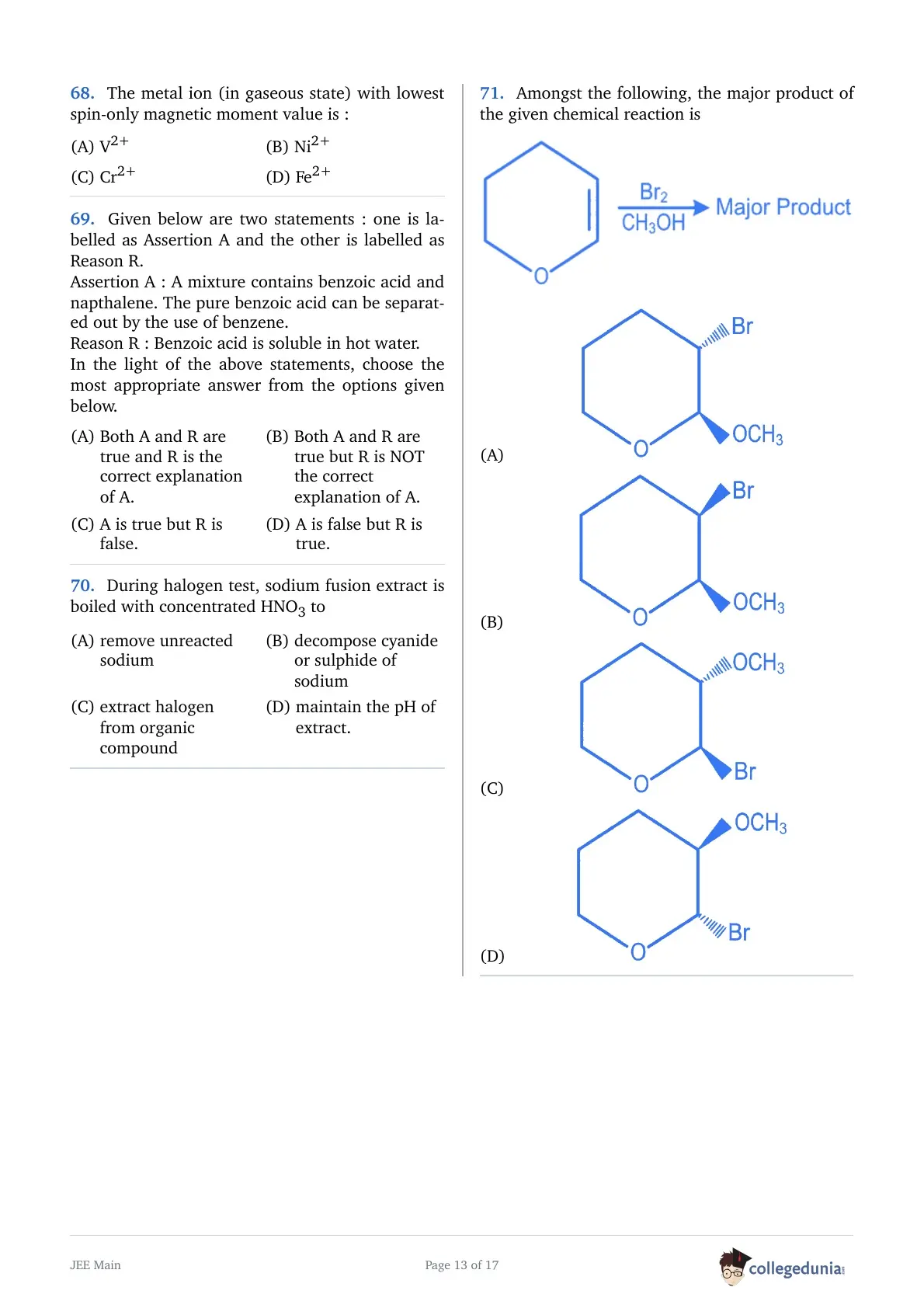
Amongst the following, the major product of the given chemical reaction is

- (1)
![]()
- (2)
![]()
- (3)
![]()
- (4)
![]()


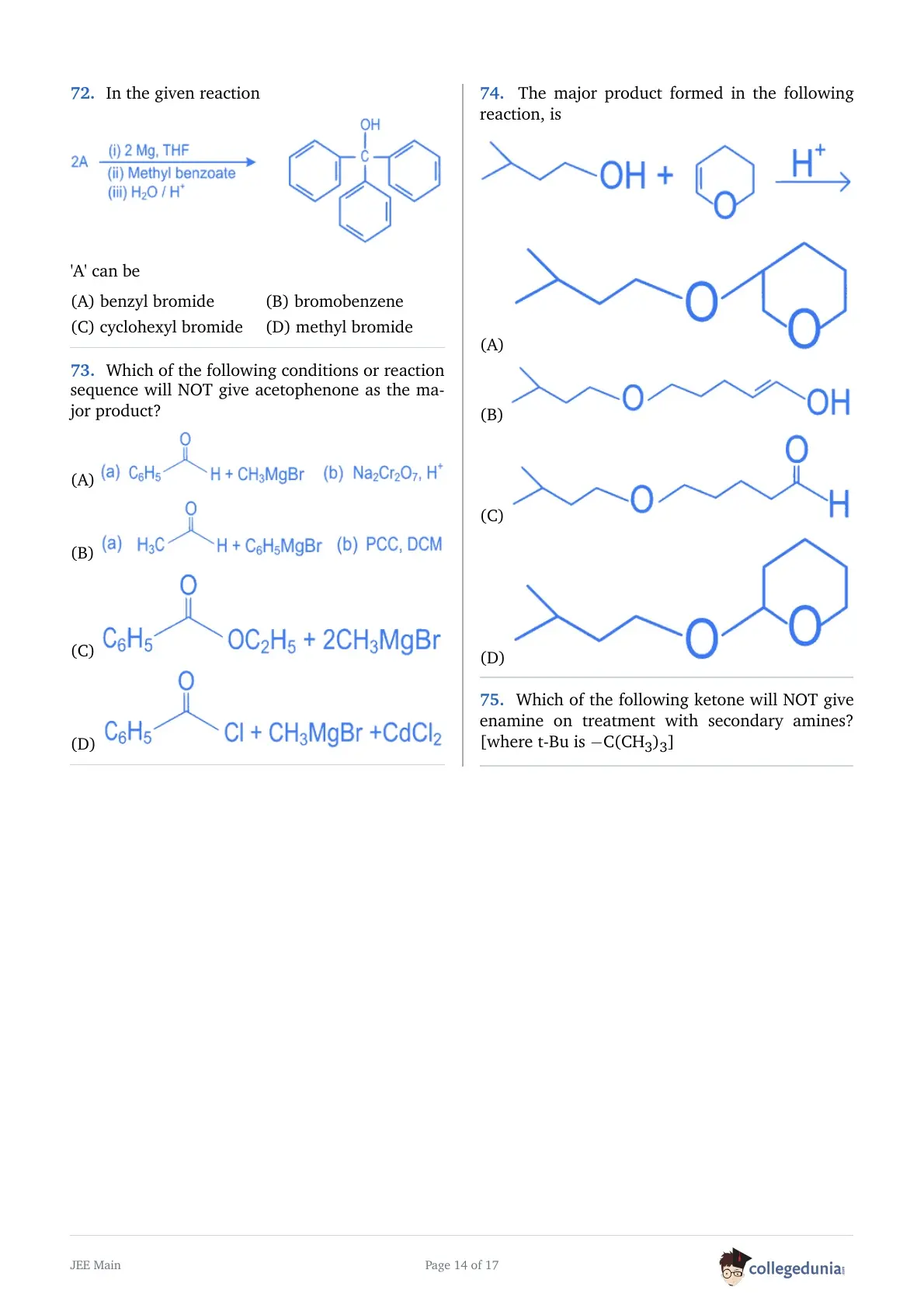
In the given reaction

‘A’ can be
Which of the following conditions or reaction sequence will NOT give acetophenone as the major product?
- (1)
![Which reaction sequence will not give acetophenone]()
- (2)
![Which reaction sequence will not give acetophenone]()
- (3)
![Which reaction sequence will not give acetophenone]()
- (4)
![Which reaction sequence will not give acetophenone]()


The major product formed in the following reaction is : 
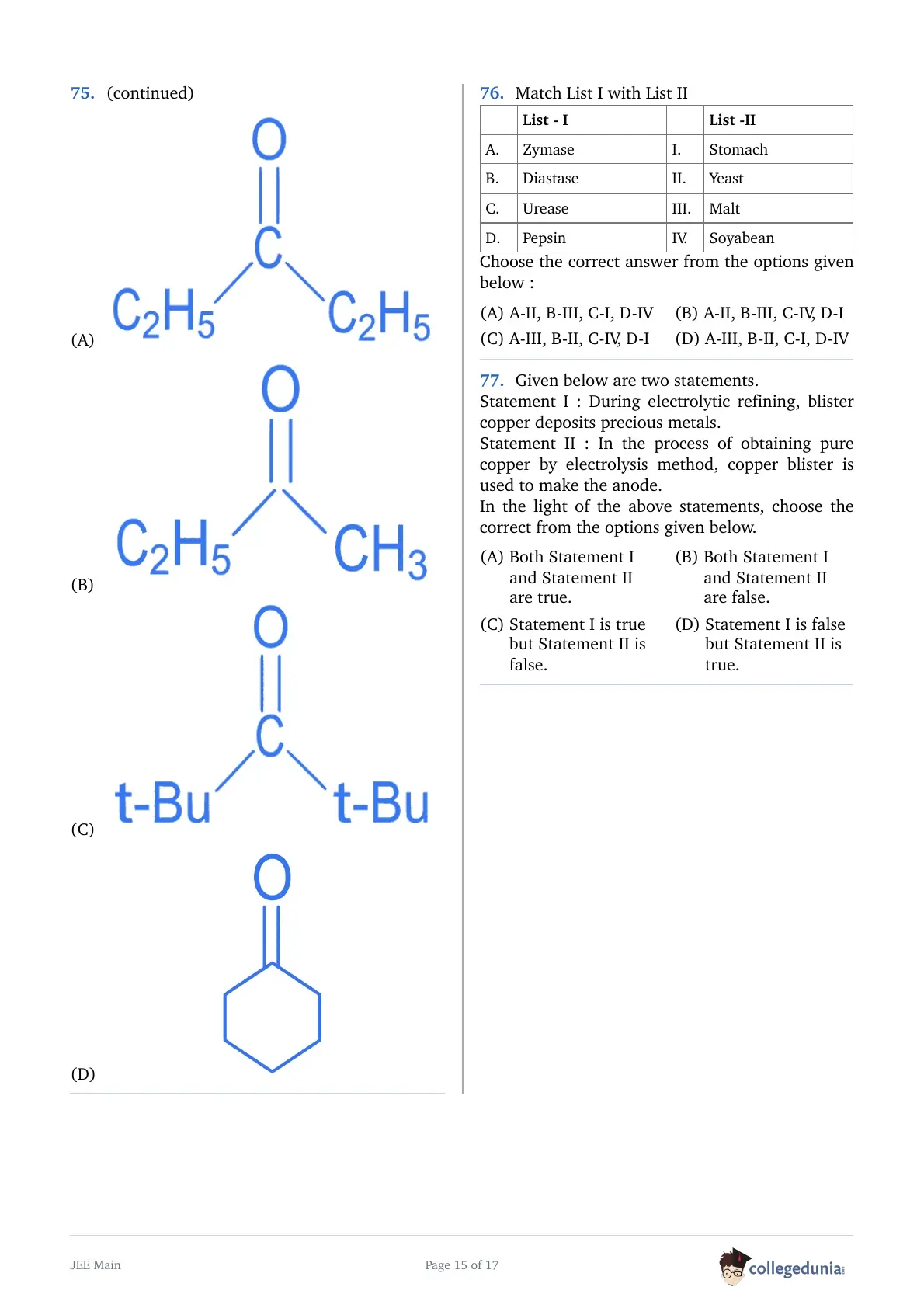
Which of the following ketone will NOT give enamine on treatment with secondary amines? [where t-Bu is –C(CH3)3]
- (1)
![Which of the following ketone will NOT give enamine on treatment with secondary amines]()
- (2)
![Which of the following ketone will NOT give enamine on treatment with secondary amines]()
- (3)
![Which of the following ketone will NOT give enamine on treatment with secondary amines]()
- (4)
![Which of the following ketone will NOT give enamine on treatment with secondary amines]()


Match List I with List II.
| List I | List II | ||
| A | Zymase | I | Stomach |
| B | Diastase | II | Yeast |
| C | Urease | III | Malt |
| D | Pepsin | IV | Soyabean |
Choose the correct answer from the options given below.
Given below are two statements.
Statement-I: During electrolytic refining, blister copper deposits precious metals.
Statement-II: In the process of obtaining pure copper by electrolysis method, copper blister is used to make the anode.
In the light of the above statements, choose the correct answer from the options given below.
The number of bridged oxygen atoms present in compound B formed from the following reactions is
\(PB(NO_3)^2→(673 K)→A+PBO+O_2A→(Dimerise)B.\)
Given below are two statements: one is labelled as Assertion A and the other is labelled as Reason R.
Assertion A: Polluted water may have a value of BOD of the order of 17 ppm.
Reason R: BOD is a measure of oxygen required to oxidise both the bio-degradable and non-biodegradable organic material in water.
In the light of the above statements, choose the most appropriate answer from the options given below.
An antiseptic Dettol is a mixture of two compounds ‘A’ and ‘B’ where A has 6π electrons and B has 2π electrons. What is ‘B’?
Chemistry - Section B (Q81 - Q90)
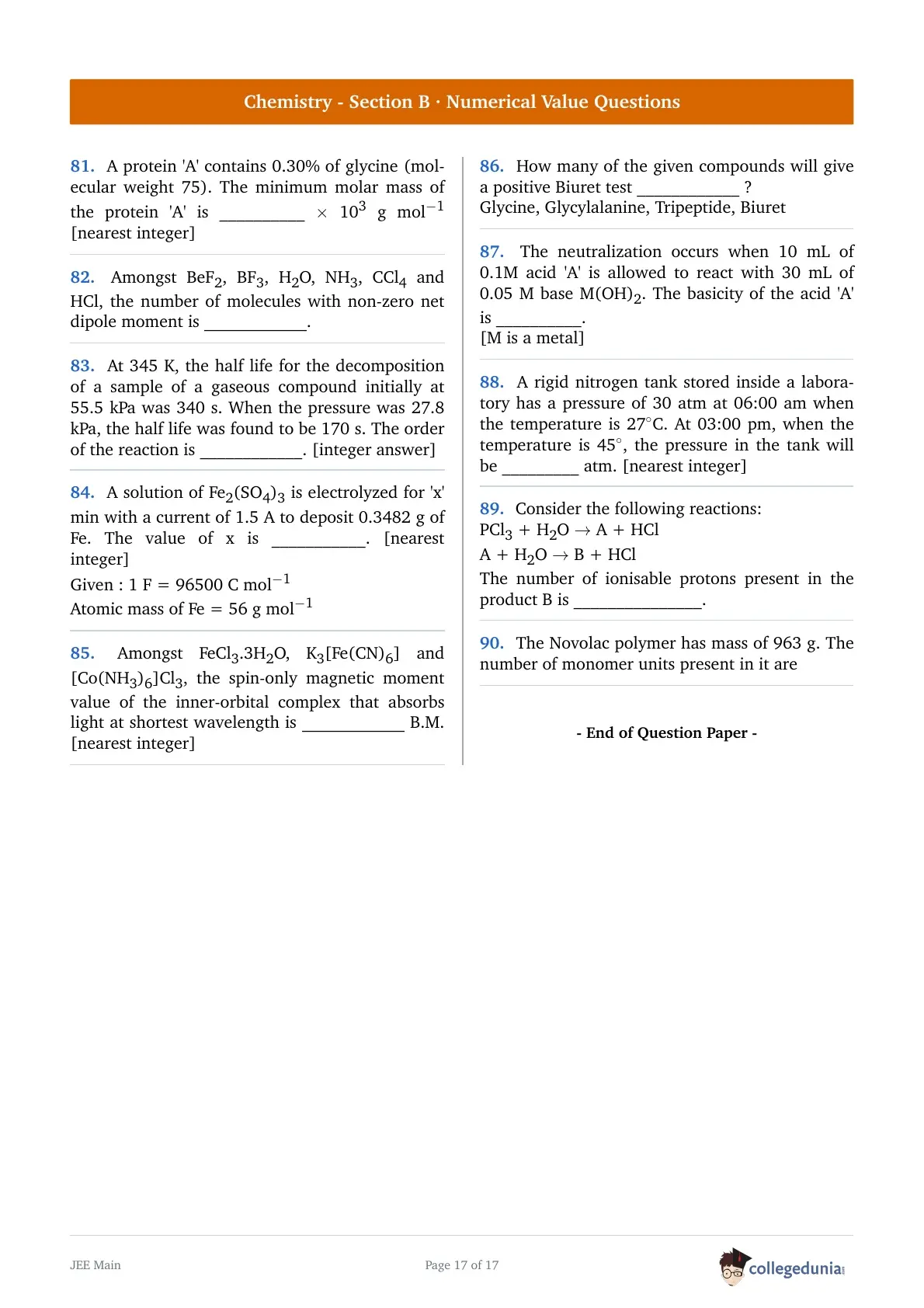
A protein ‘A’ contains 0.30% of glycine (molecular weight 75). The minimum molar mass of the protein ‘A’ is _______ × 103 g mol–1 [nearest integer]
Amongst BeF2, BF3, H2O, NH3, CCl4 and HCl, the number of molecules with non-zero net dipole moment is ______.
At 345 K, the half life for the decomposition of a sample of a gaseous compound initially at 55.5 kPa was 340 s. When the pressure was 27.8 kPa, the half life was found to be 170 s. The order of the reaction is ________. [integer answer]
A solution of Fe2(SO4)3 is electrolyzed for ‘x’ min with a current of 1.5 A to deposit 0.3482 g of Fe. The value of x is _______. [nearest integer]
Given : 1 F = 96500 C mol–1.
Atomic mass of Fe = 56 g mol–1
Amongst FeCl3.3H2O, K3[Fe(CN)6)] and [Co(NH3)6]Cl3, the spin-only magnetic moment value of the inner-orbital complex that absorbs light at shortest wavelength is_______B.M. [nearest integer]
How many of the given compounds will give a positive Biuret test_________? Glycine, Glycylalanine, Tripeptide, Biuret.
The neutralization occurs when 10 mL of 0.1M acid ‘A’ is allowed to react with 30 mL of 0.05 M base M(OH)2. The basicity of the acid ‘A’ is____[M is a metal]
A rigid nitrogen tank stored inside a laboratory has a pressure of 30 atm at 06:00 am when the temperature is 27°C. At 03:00 pm, when the temperature is 45°C, the pressure in the tank will be _______ atm. [nearest integer]
Consider the following reactions.
\(PCl_3+H_2→A+HCL\)
\(A+H_2o→B+HCL\)
The number of ionisable protons present in the product B is
The Novolac polymer has mass of 963 g. The number of monomer units present in it are
JEE Main 2022 Exam Pattern and Marking Scheme
| Particulars | Details |
|---|---|
| Exam Mode | Online (Computer-Based Test) |
| Paper | B.E./B.Tech (Paper 1) |
| Duration | 3 hours (180 minutes) |
| Type of Questions | Multiple Choice Questions (MCQs) + Numerical Value Questions |
| Subjects | Mathematics, Physics, Chemistry |
| Total Questions | 90 questions (75 to be attempted) |
| Total Marks | 300 marks |
| Marking Scheme | +4 for correct answer & -1 for incorrect MCQ and Numerical Value-based Questions |
JEE Main 2022 June 25 Shift 2 Difficulty Level
As per the students’ initial reaction, JEE Main 2022 Question Paper for June 25- Shift 2 was reported as moderate. The Mathematics section in JEE Main 2022 June 25- Shift 2 Question Paper was reported as difficult, Physics as easy to moderate and Chemistry as easy to moderate.
JEE Main 2022 June 25 Shift 2 Subject-wise Memory-Based Solutions PDF
| Subject | Memory-Based Solutions PDF |
|---|---|
| Physics | Download PDF |
| Chemistry | Download PDF |
| Mathematics | Download PDF |
JEE Main 2022 B.E/ B. Tech Other Question Paper with Answer Key PDFs
JEE Main 2022 aspirants can practice and check their exam prep level by attempting the other session question papers as well. The table below shows JEE Main 2022 Question Paper with Answer Key and Solution PDFs for other sessions for Phase 1.
Also Check:



Comments