




JEE Main 2022 June 26 Shift 1 Question Paper is available here with solutions PDF and detailed solutions for every question. NTA conducted the first shift on June 26, 2022, from 9:00 AM to 12:00 PM. The JEE Main 2022 Paper 1 (B.E./B.Tech) question paper includes the following:
- 90 questions in a 3-hour CBT Mode: 30 each from Mathematics, Physics and Chemistry (75 to be attempted)
- Section A: 20 multiple choice questions (MCQs) per subject, all compulsory, 4 marks each
- Section B: 10 numerical value questions per subject, any 5 to be attempted, 4 marks each
- Marking: +4 for a correct answer, -1 for an incorrect answer, 0 for an unattempted question
- Maximum marks: 300 (100 per subject)
JEE Main 2022 June 26 Shift 1 Question Paper with Solution PDF
| NTA Official PDF | CD PDF | CD PDF with Solutions |
|---|---|---|
| Download official PDF 4.97 MB | Download Collegedunia PDF 1.10 MB | Download solutions PDF 2.18 MB |
Also Check:
JEE Main 2022 June 26 Shift 1 Questions with Solutions
Mathematics - Section A (Q1 - Q20)
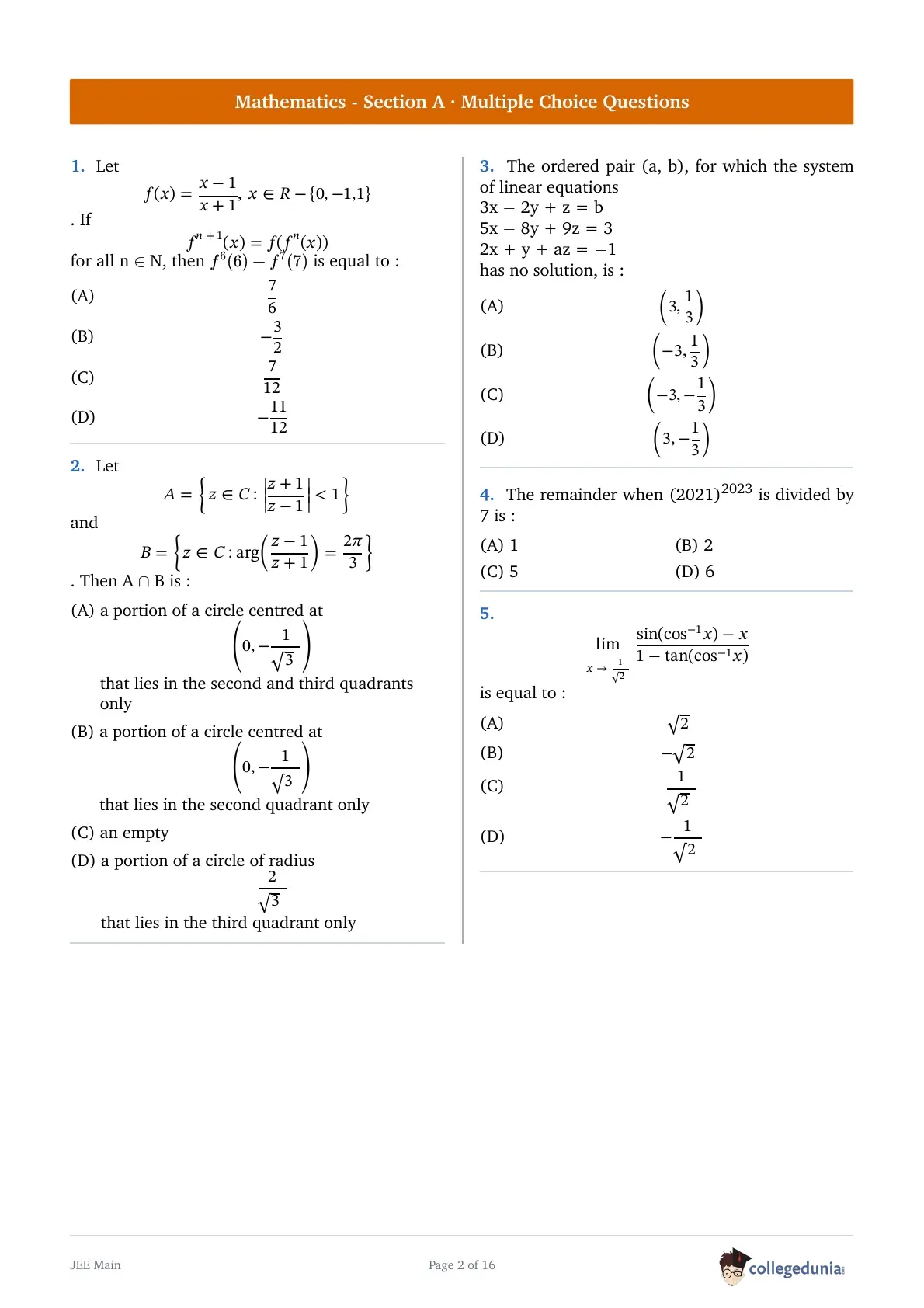
Let
\(f(x)=\frac{x−1}{x+1},x∈R− \left\{0,−1,1\right\}\)
If ƒn+1(x) = ƒ(ƒn(x)) for all n∈N, then ƒ6(6) + ƒ7(7) is equal to :
Let
\(A = \{z \in \mathbb{C} : |\frac{z+1}{z-1}| < 1\}\)
and
\(B = \{z \in \mathbb{C} : \text{arg}(\frac{z-1}{z+1}) = \frac{2\pi}{3}\}\)
Then \(A∩B\) is :
The ordered pair (a, b), for which the system of linear equations
3x – 2y + z = b
5x – 8y + 9z = 3
2x + y + az = –1
has no solution, is :
The remainder when (2021)2023 is divided by 7 is
\(\lim_{{x \to \frac{1}{\sqrt{2}}}} \frac{\sin(\cos^{-1}(x)) - x}{1 - \tan(\cos^{-1}(x))}\)
is equal to :
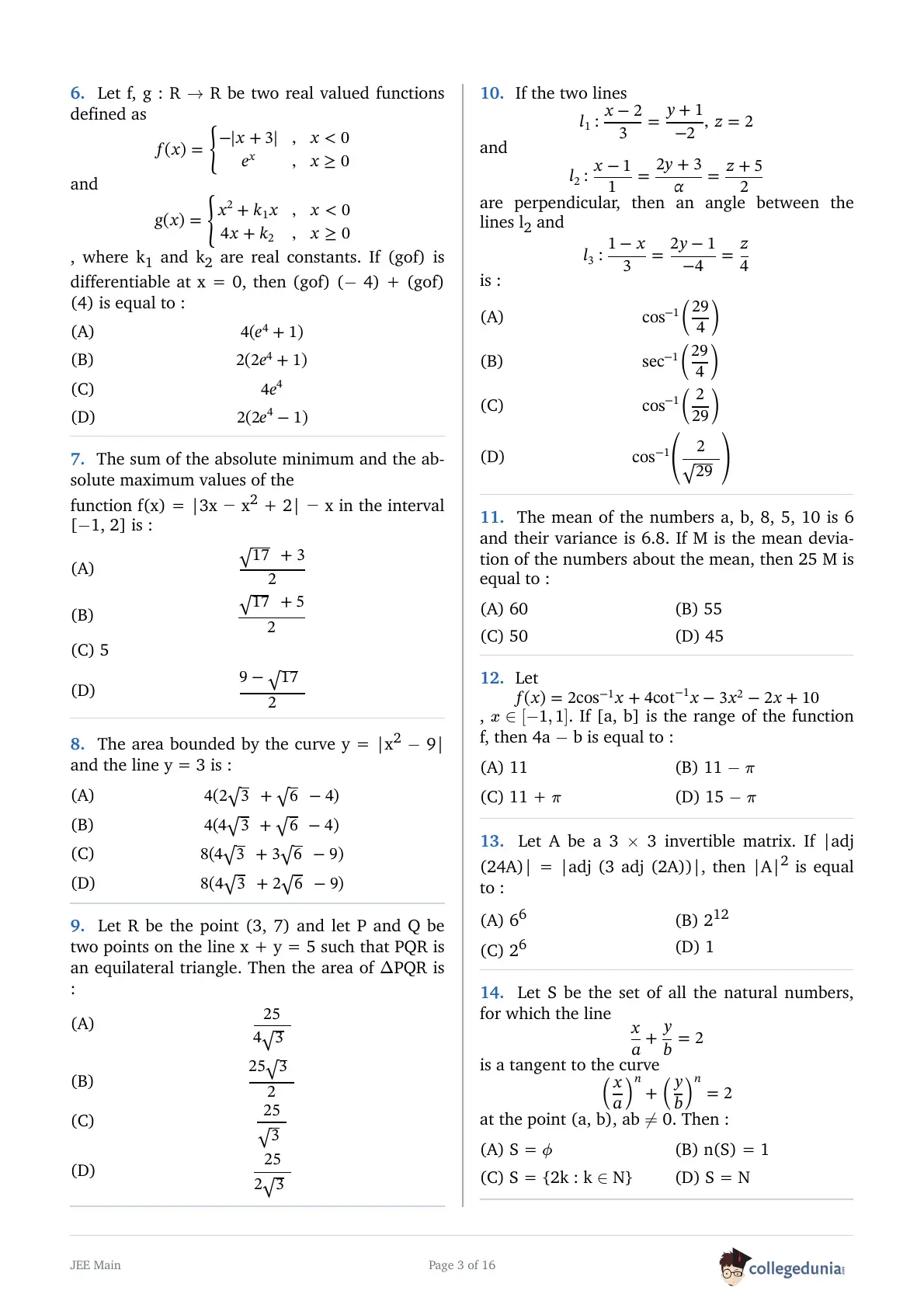
g :R→R be two real valued functions defined as
\(f(x) = \begin{cases} -|x + 3| & x < 0 \\ e^x, & x \geq 0 \end{cases}\)
and
\(g(x) = \begin{cases} x^2 + k_1x ,& x < 0 \\ 4x + k_2 ,& x \geq 0 \end{cases}\)
where k1 and k2 are real constants. If (goƒ) is differentiable at x = 0, then (goƒ) (–4) + (goƒ) (4) is
equal to:
The sum of the absolute minimum and the absolute maximum values of the function ƒ(x) = |3x – x2 + 2| – x in the interval [–1, 2] is
The area bounded by the curve
\(y=|x^2−9| \)
and the line y = 3 is
Let R be the point (3, 7) and let P and Q be two points on the line x + y = 5 such that PQR is an equilateral triangle, Then the area of ΔPQR is
If the two lines
\(l1:\frac{(x−2)}{3}=\frac{(y+1)}{−2},z=2 \)
and
\( l2:\frac{(x−1)}{1}=\frac{(2y+3)}{α}=\frac{(z+5)}{2} \)
are perpendicular, then an angle between the lines l2 and
\(l3:\frac{(1−x)}{3}=\frac{(2y−1)}{−4}=\frac{z}{4} \)
is
The mean of the numbers a, b, 8, 5, 10 is 6 and their variance is 6.8. If M is the mean deviation of the numbers about the mean, then 25 M is equal to:
Let
\(f(x)=2cos^{−1}x+4cot^{−1}x−3x^2−2x+10,X∈[−1,1]\)
If [a, b] is the range of the function, f then 4a – b is equal to :
Let A be a 3 × 3 invertible matrix. If |adj (24A)| = |adj (3 adj (2A))|, then |A|2 is equal to :
Let S be the set of all the natural numbers, for which the line
\(\frac{x}{a}+\frac{y}{b}=2 \)
is a tangent to the curve
\((\frac{x}{a})^n+(\frac{y}{b})^n=2 \)
at the point (a, b), ab ≠ 0. Then :
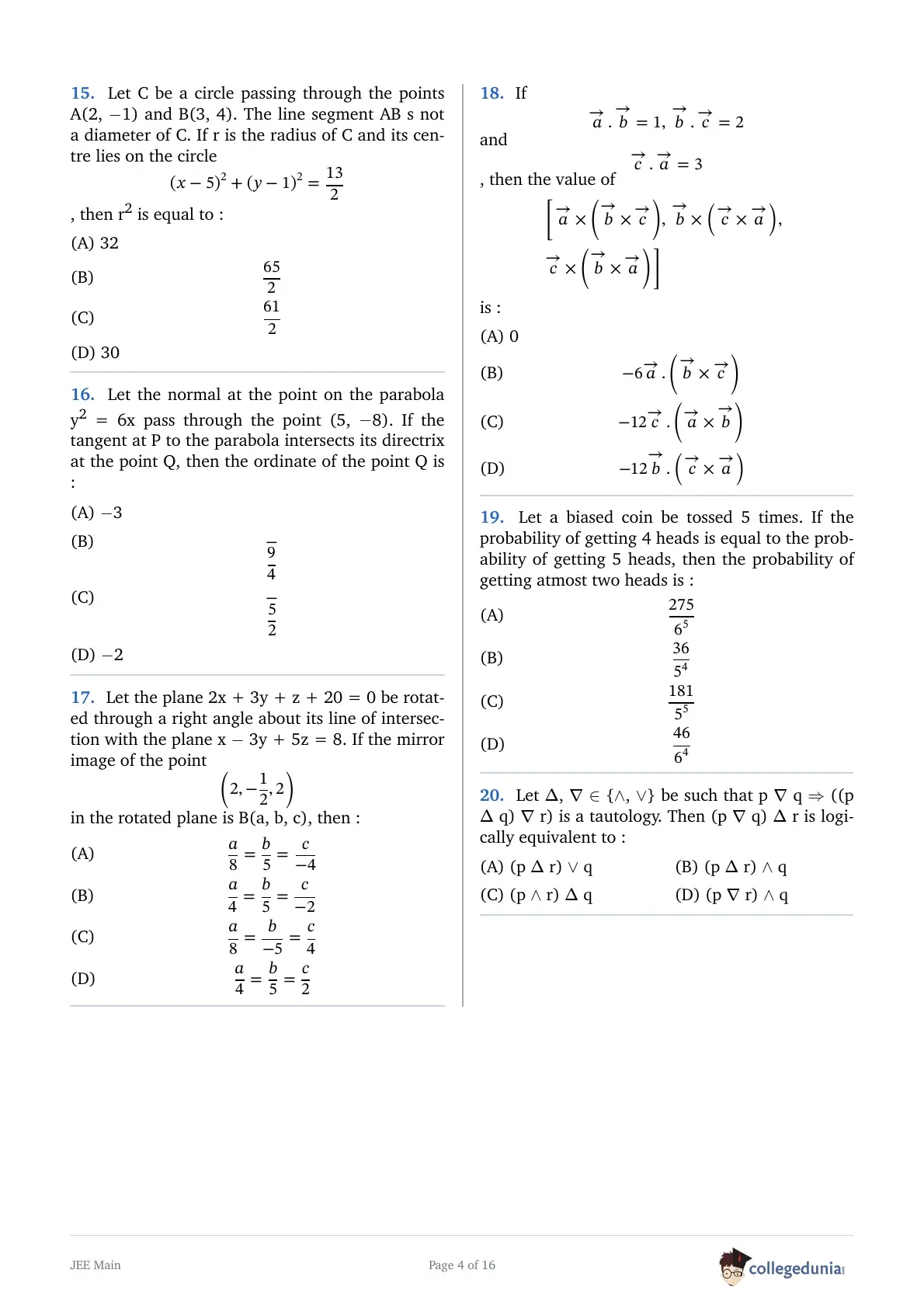
Let C be a circle passing through the points A(2, –1) and B (3, 4). The line segment AB is not a diameter of C. If r is the radius of C and its centre lies on the circle
\((x−5)^2+(y−1)^2=\frac{13}{2}\)
then r2 is equal to
Let the normal at the point P on the parabola y2 = 6x pass through the point (5, –8). If the tangent at P to the parabola intersects its directrix at the point Q, then the ordinate of the point Q is
Let the plane 2x + 3y + z + 20 = 0 be rotated through a right angle about its line of intersection with the plane x – 3y + 5z = 8. If the mirror image of the point
\((2,−\frac{1}{2},2) \)
in the rotated plane is B( a, b, c),then
If \(\vec{a}⋅\vec{b}=1,\vec{b}⋅\vec{c}=2 and\) \(\vec{c}⋅\vec{a}=3,\)
then the value of
[\([\vec{a}×(\vec{b}×\vec{c}),\vec{b}×(\vec{c}×\vec{a}),\vec{c}×(\vec{b}×\vec{a})]\)
is
Let a biased coin be tossed 5 times. If the probability of getting 4 heads is equal to the probability of getting 5 heads, then the probability of getting atmost two heads is
Let\( Δ,▽∈{∧,∨} \)
be such that \(p▽q⇒((pΔq)▽r) \)
is a tautology. Then \((p▽q)Δr \)
is logically equivalent to:
Mathematics - Section B (Q21 - Q30)
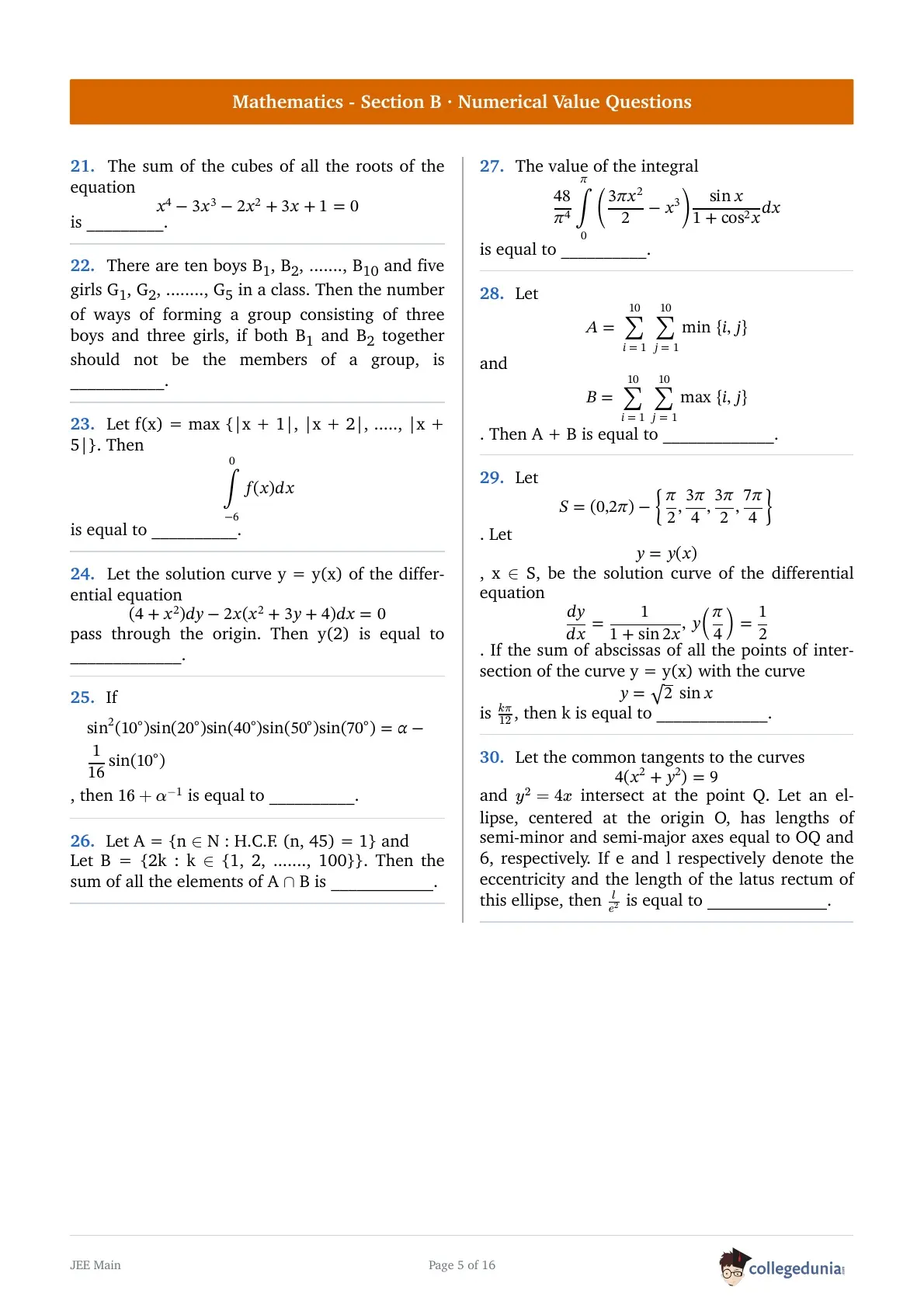
The sum of the cubes of all the roots of the equation x4 – 3x3 –2x2 + 3x +1 = 0 is
There are ten boys B1, B2, …, B10 and five girls G1, G2,…, G5 in a class. Then the number of ways of forming a group consisting of three boys and three girls, if both B1 and B2 together should not be the members of a group, is ________
Let
\(f(x)=max\left\{|x+1|,|x+2|,……,|x+5|\right\} \)
Then \(\int_{-6}^{0} f(x) \, dx\)
is equal to_______
Let the solution curve y = y(x) of the differential equation (4 + x2)dy – 2x(x2 + 3y + 4)dx = 0 pass through the origin. Then y(2) is equal to _______.
If sin2(10°)sin(20°)sin(40°)sin(50°)sin(70°)
\(=α−\frac{1}{16}sin(10^∘),\)
then 16 + α–1 is equal to _______
Let A = {n∈N : H.C.F. (n, 45) = 1} and
Let B = {2k :k∈ {1, 2, …,100}}. Then the sum of all the elements of \(A∩B\) is ___________
The value of the integral
\(\frac{48}{\pi^4} \int_{0}^{\pi}(\frac{3\pi x^2}{2} - x^3) \frac{ \sin(x)}{1 + \cos^2x} \, dx\)
is equal to ________
Let \(A = \sum_{i=1}^{10} \sum_{j=1}^{10} \min(i, j)\)
and
\(B = \sum_{i=1}^{10} \sum_{j=1}^{10} \max(i, j)\)
Then A + B is equal to___________.
Let
\(S = (0, 2\pi) - \left\{\frac{\pi}{2}, \frac{3\pi}{4}, \frac{3\pi}{2}, \frac{7\pi}{4}\right\}\)
. Let y = y(x), x∈S, be the solution curve of the differential equation
\(\frac{dy}{dx}=\frac{1}{1+sin2x},y(\frac{π}{4})=\frac{1}{2}\)
.If the sum of abscissas of all the points of intersection of the curve y = y(x) with the curve
\(y=\sqrt2sinx\) is \(\frac{kπ}{12}\),
then k is equal to _________.
Let the common tangents to the curves 4(x2 + y2) = 9 and y2 = 4x intersect at the point Q. Let an ellipse, centered at the origin O, has lengths of semi-minor and semi-major axes equal to OQ and 6, respectively. If e and I respectively denote the eccentricity and the length of the latus rectum of this ellipse, then
\(\frac{1}{e^2}\) is equal to
Physics - Section A (Q31 - Q50)
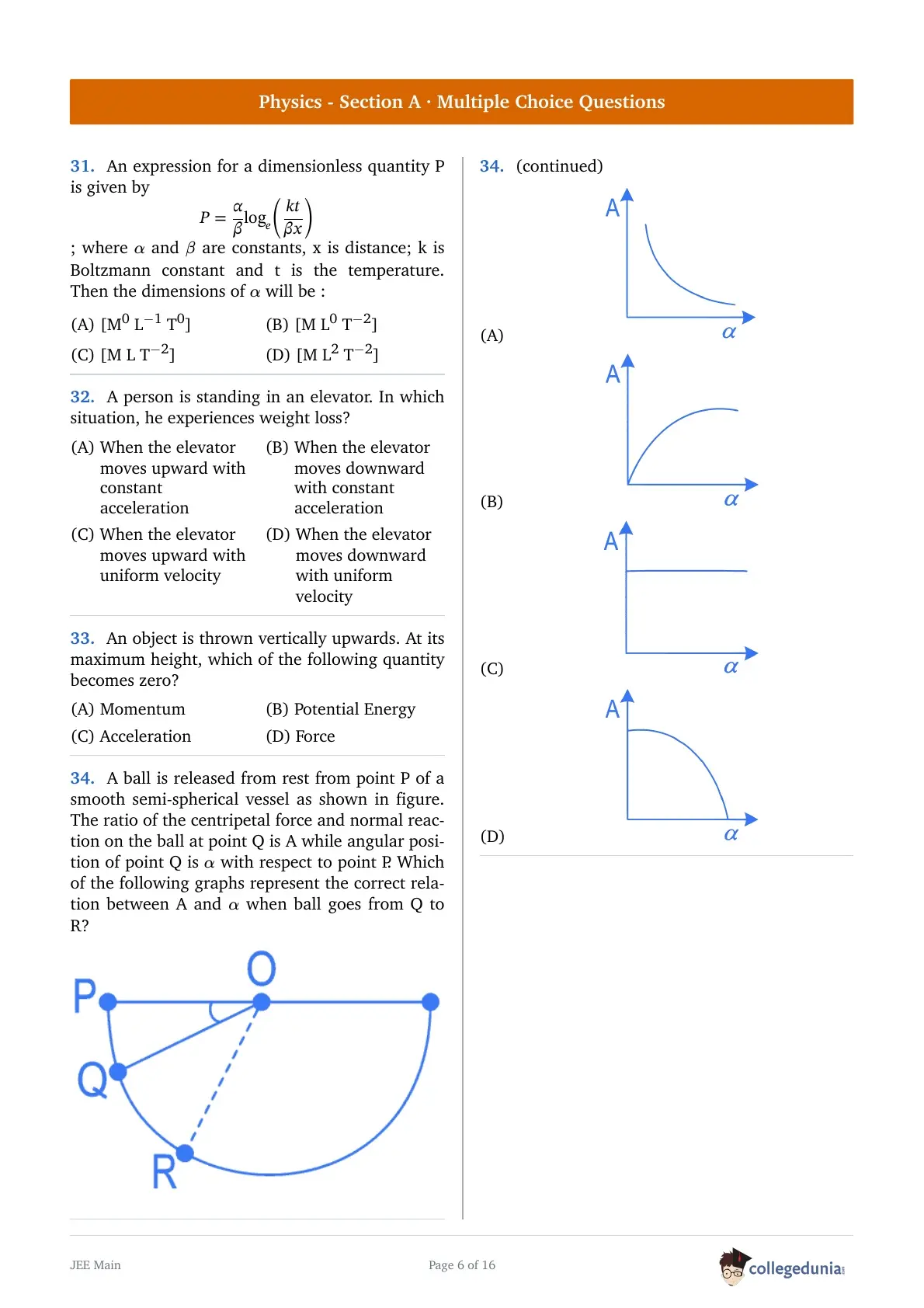
An expression for a dimensionless quantity P is given by \(P=\frac{α}{β} log_e(\frac{kt}{βx})\); where α and β are constants, x is distance; k is Boltzmann constant and t is the temperature. Then the dimensions of α will be
A person is standing in an elevator. In which situation, he experiences weight loss?
An object is thrown vertically upwards. At its maximum height, which of the following quantity becomes zero?
A ball is released from rest from point P of a smooth semi-spherical vessel as shown in figure. The ratio of the centripetal force and normal reaction on the ball at point Q is A while angular position of point Q is α with respect to point P. Which of the following graphs represent the correct relation between A and α when ball goes from Q to R?
- (1)
![A ball is released from rest from point P of a smooth semi-spherical vessel]()
- (2)
![A ball is released from rest from point P of a smooth semi-spherical vessel]()
- (3)
![A ball is released from rest from point P of a smooth semi-spherical vessel]()
- (4)
![A ball is released from rest from point P of a smooth semi-spherical vessel]()


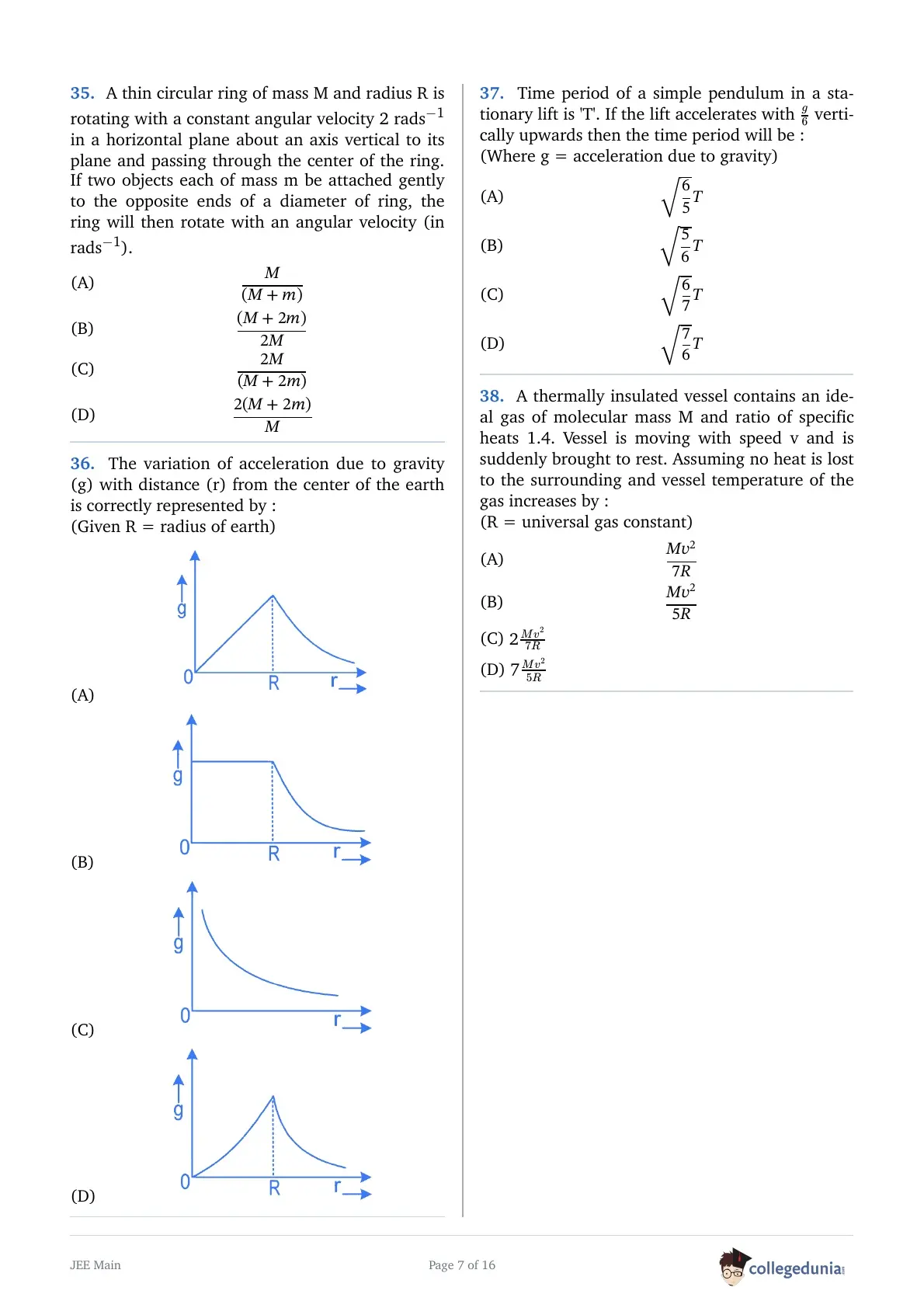
A thin circular ring of mass M and radius R is rotating with a constant angular velocity 2 rad s–1 in a horizontal plane about an axis vertical to its plane and passing through the center of the ring. If two objects each of mass m be attached gently to the opposite ends of a diameter of ring, the ring will then rotate with an angular velocity (in rad s–1)
The variation of acceleration due to gravity (g) with distance (r) from the center of the earth is correctly represented by
(Given R = radius of earth)
- (1)
![acceleration due to gravity]()
- (2)
![acceleration due to gravity]()
- (3)
![acceleration due to gravity]()
- (4)
![acceleration due to gravity]()


Time period of a simple pendulum in a stationary lift is ‘T’. If the lift accelerates with \(\frac{g}{6}\) vertically upwards then the time period will be (Where g = acceleration due to gravity)
A thermally insulated vessel contains an ideal gas of molecular mass M and ratio of specific heats 1.4. Vessel is moving with speed ν and is suddenly brought to rest. Assuming no heat is lost to the surrounding and vessel temperature of the gas increases by(R = universal gas constant
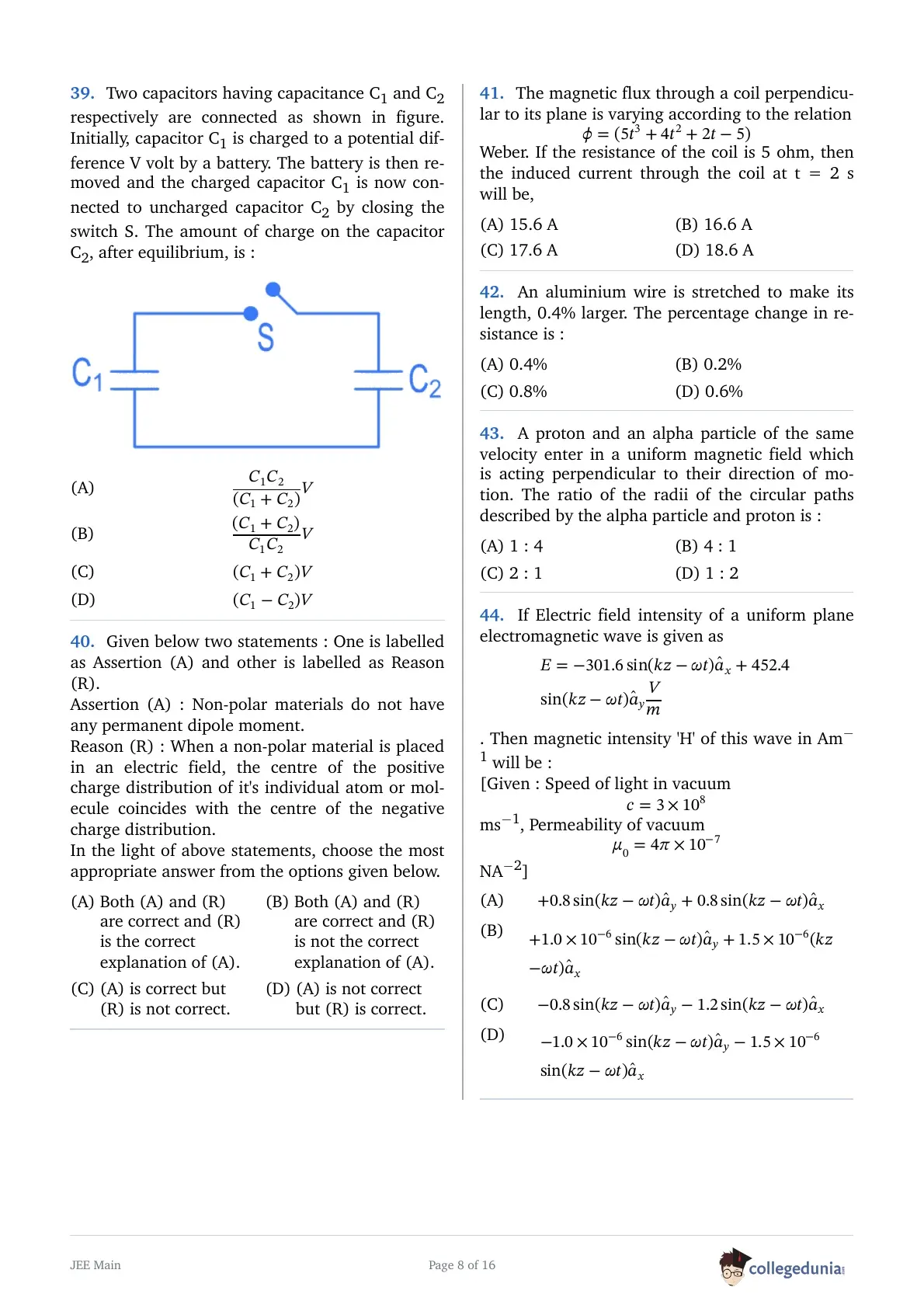
Two capacitors having capacitance C1 and C2 respectively are connected as shown in figure. Initially, capacitor C1 is charged to a potential difference V volt by a battery. The battery is then removed and the charged capacitor C1 is now connected to uncharged capacitor C2 by closing the switch S. The amount of charge on the capacitor C2, after equilibrium, is
Given below two statements: One is labelled as Assertion (A) and other is labelled as Reason (R).
Assertion (A) : Non-polar materials do not have any permanent dipole moment.
Reason (R) :When a non-polar material is placed in an electric field, the centre of the positive charge distribution of it’s individual atom or molecule coincides with the centre of the negative charge distribution.
In the light of above statements, choose the most appropriate answer from the options given below.
The magnetic flux through a coil perpendicular to its plane is varying according to the relation \(\varphi = 5t^3 + 4t^2 + 2t - 5\) Weber. If the resistance of the coil is 5 ohm, then the induced current through the coil at t = 2 s will be,
An aluminium wire is stretched to make its length, 0.4% larger. The percentage change in resistance is
A proton and an alpha particle of the same velocity enter in a uniform magnetic field which is acting perpendicular to their direction of motion. The ratio of the radii of the circular paths described by the alpha particle and proton is
If electric field intensity of a uniform plane electromagnetic wave is given as
\(E = -301.6 \sin(kz - \omega t) \hat{a}_x + 452.4 \sin(k\omega - \omega t) \hat{a}_y \, \frac{V}{m}\)
Then, magnetic intensity ‘H’ of this wave in Am–1 will be :
[Given : Speed of light in vacuum c = 3 × 10⁸ms–1, Permeability of vacuum \(\mu_0 = 4\pi \times 10^{-7}\) NA–2]
In free space, an electromagnetic wave of 3 GHz frequency strikes over the edge of an object of size \(\frac{\lambda}{100}\), where λ is the wavelength of the wave in free space. The phenomenon, which happens there will be
An electron with speed υ and a photon with speed c have the same de-Broglie wavelength. If the kinetic energy and momentum of electron are Ee and pe and that of photon are Eph and pph respectively. Which of the following is correct?
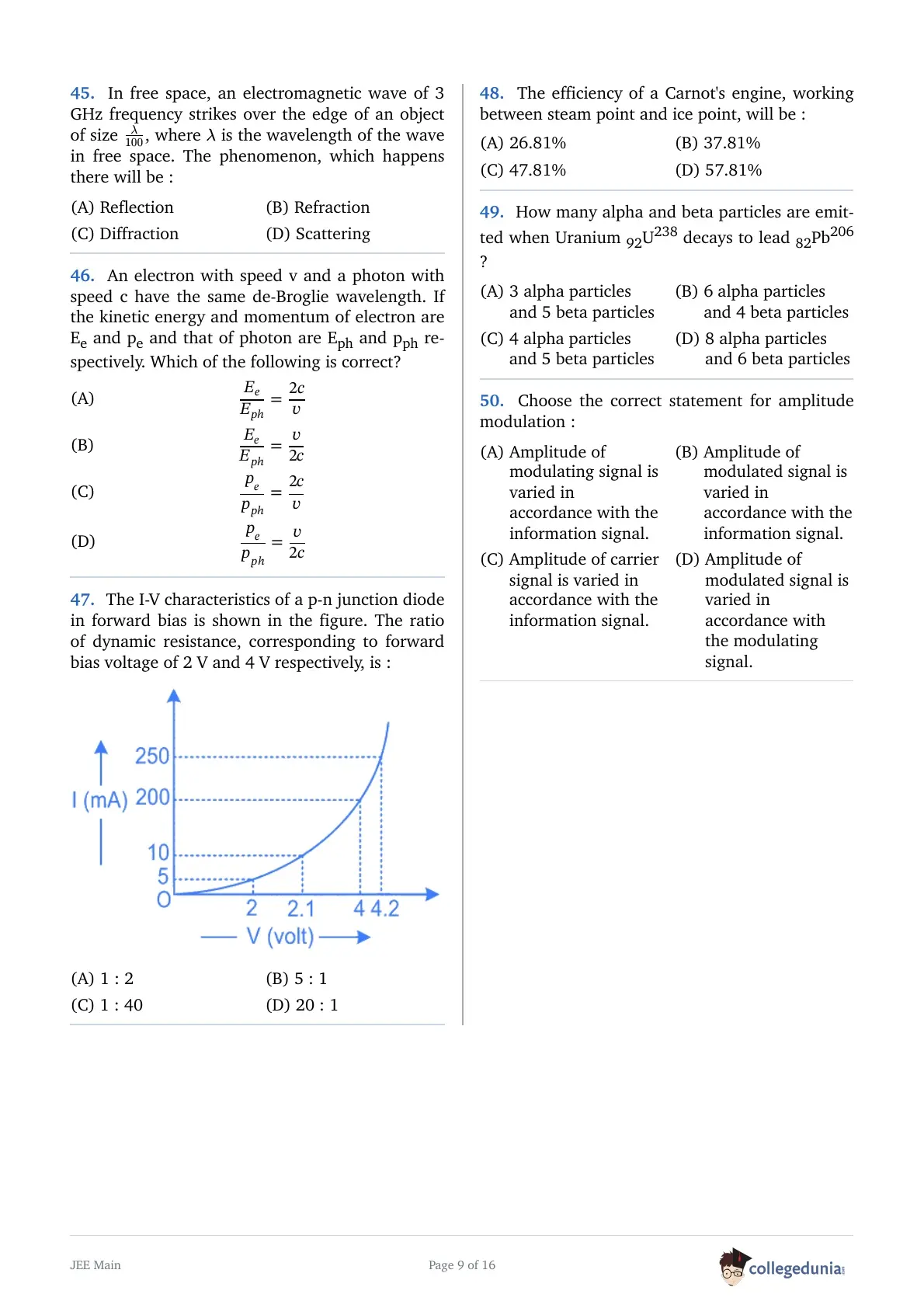
The I–V characteristics of a p-n junction diode in forward bias is shown in the figure. The ratio of dynamic resistance, corresponding to forward bias voltage of 2 V and 4 V respectively, is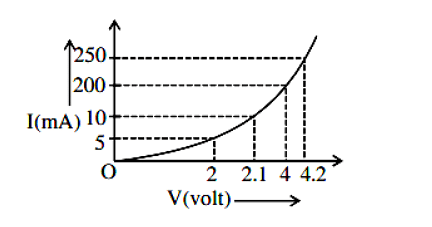
The efficiency of a Carnot’s engine, working between steam point and ice point, will be
How many alpha and beta particles are emitted when Uranium 92U238 decays to lead 82Pb206
Choose the correct statement for amplitude modulation :
Physics - Section B (Q51 - Q60)
A fighter jet is flying horizontally at a certain altitude with a speed of 200 ms–1. When it passes directly overhead an anti-aircraft gun, a bullet is fired from the gun, at an angle θ with the horizontal, to hit the jet. If the bullet speed is 400 m/s, the value of θ will be ____°
A ball of mass 0.5 kg is dropped from the height of 10 m. The height, at which the magnitude of velocity becomes equal to the magnitude of acceleration due to gravity, is ___ m.
[Use g = 10 m/s2]
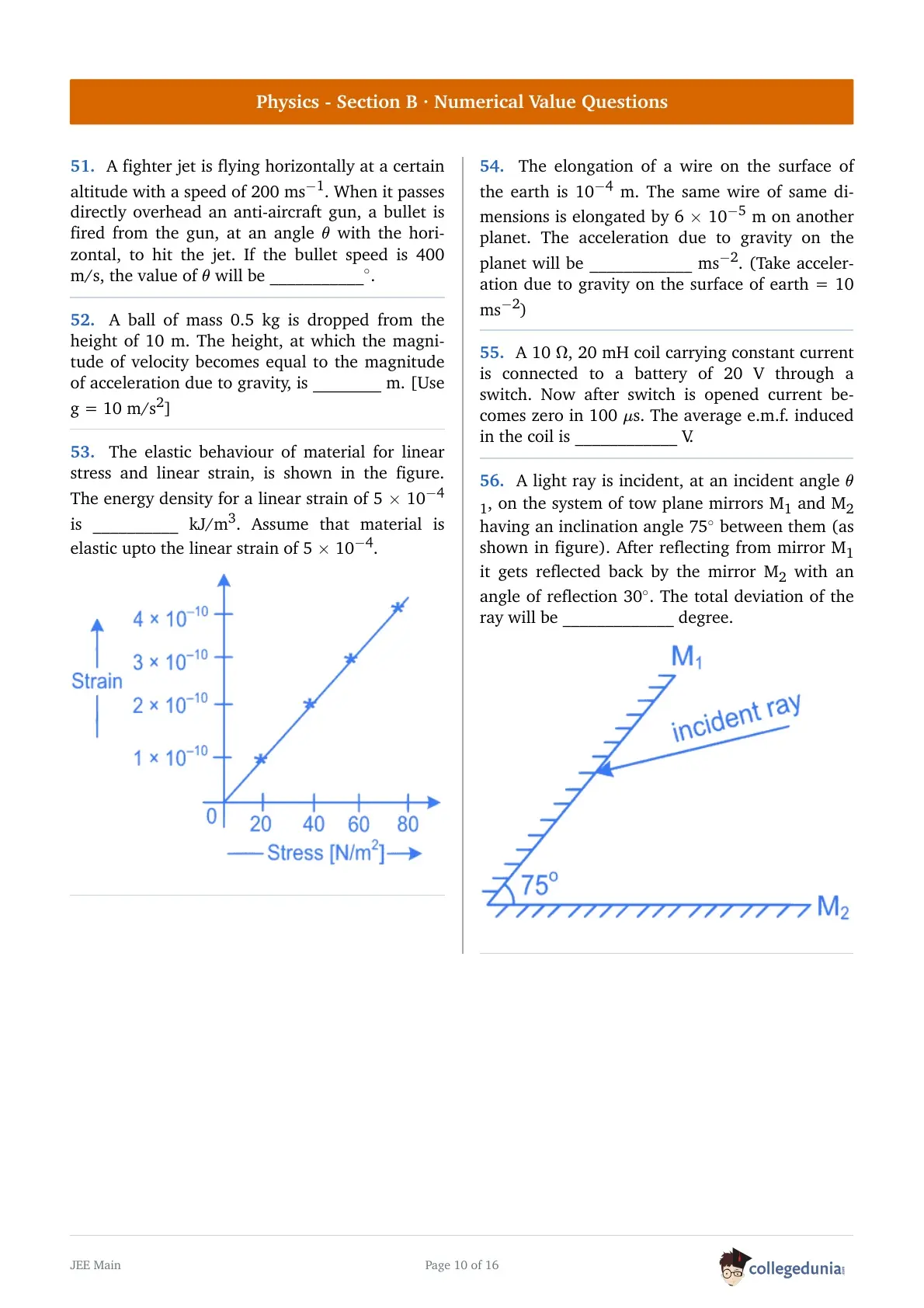
The elastic behavior of material for linear stress and linear strain, is shown in the figure. The energy density for a linear strain of 5×10⁻⁴ is ____ kJ/m3. Assume that material is elastic up to the linear strain of 5×10⁻⁴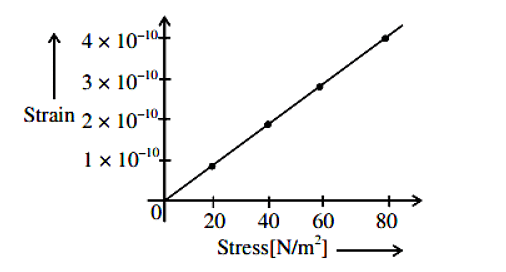
The elongation of a wire on the surface of the earth is 10–4m. The same wire of same dimensions is elongated by 6 × 10⁻⁵m on another planet. The acceleration due to gravity on the planet will be ___ ms–2. (Take acceleration due to gravity on the surface of earth = 10 ms–2)
A 10 Ω, 20 mH coil carrying constant current is connected to a battery of 20 V through a switch. Now after switch is opened current becomes zero in 100 μs. The average e.m.f. induced in the coil is ____V
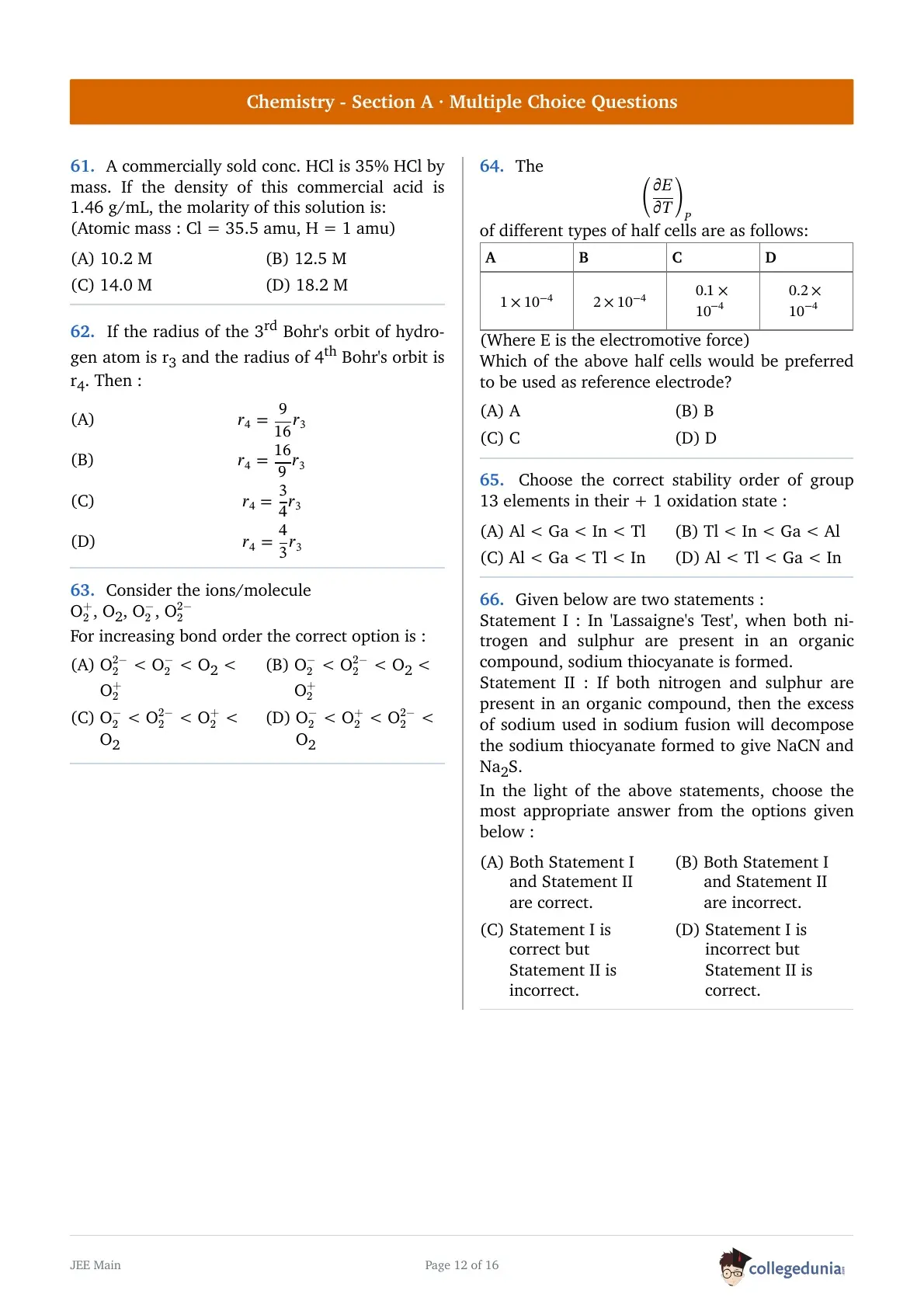
A light ray is incident at an incident angle θ1 on the system of two plane mirrors M1 and M2 having an inclination angle 75° between them (as shown in figure).
After reflecting from mirror M1 it gets reflected back by the mirror M2 with an angle of reflection 30°. The total deviation of the ray will be ________ degree.
In a vernier callipers, each cm on the main scale is divided into 20 equal parts. If tenth vernier scale division coincides with nineth main scale division. Then the value of vernier constant will be____ ×10–2 mm
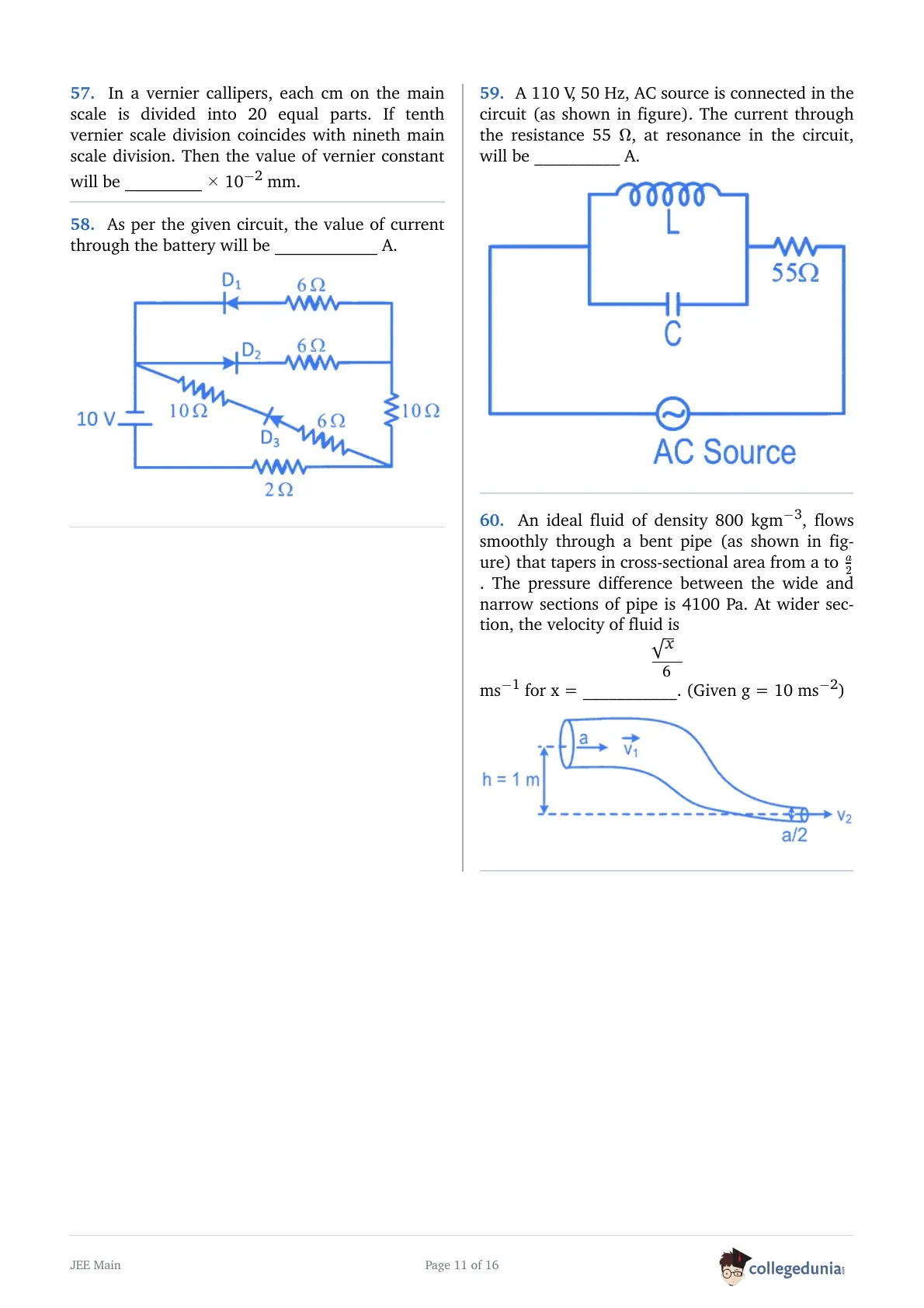
As per the given circuit, the value of current through the battery will be ______ A
A 110 V,50 Hz,AC source is connected in the circuit (as shown in figure). 
The current through the resistance 55Ω, at resonance in the circuit, will be _______ A
An ideal fluid of density 800kgm–3, flows smoothly through a bent pipe (as shown in figure) that tapers in cross-sectional area from a to \(\frac{a}{2}\). The pressure difference between the wide and narrow sections of pipe is 4100 Pa. At wider section, the velocity of fluid is\(\frac{\sqrt{x}}{6}\) ms1 for x=_______. (Given g=10 ms-2)
Chemistry - Section A (Q61 - Q80)
A commercially sold conc. HCl is 35% HCl by mass. If the density of this commercial acid is 1.46 g/mL, the molarity of this solution is :
(Atomic mass : Cl = 35.5 amu, H = 1 amu)
If the radius of the 3rd Bohr’s orbit of hydrogen atom is r3 and the radius of 4th Bohr’s orbit is r4. Then
Consider the ions/molecules \(O^{2+}, O_2, O_2^-, O_2^{2-}\)For increasing bond order the correct option is
| A | B | C | D |
|---|---|---|---|
| 1 × 10⁻⁴ | 2 × 10⁻⁴ | 0.1 × 10⁻⁴ | 0.2 × 10⁻⁴ |
(Where E is the electromotive force)
Which of the above half cells would be preferred to be used as reference electrode?
Choose the correct stability order of group 13 elements in their +1 oxidation state
Given below are two statements:
Statement I: In ‘Lassaigne’s Test’, when both nitrogen and sulphur are present in an organic compound, sodium thiocyanate is formed.
Statement II: If both nitrogen and sulphur are present in an organic compound, then the excess of
sodium used in sodium fusion will decompose the sodium thiocyanate formed to give NaCN and Na2S.
In the light of the above statements, choose the most appropriate answer from the options given below:
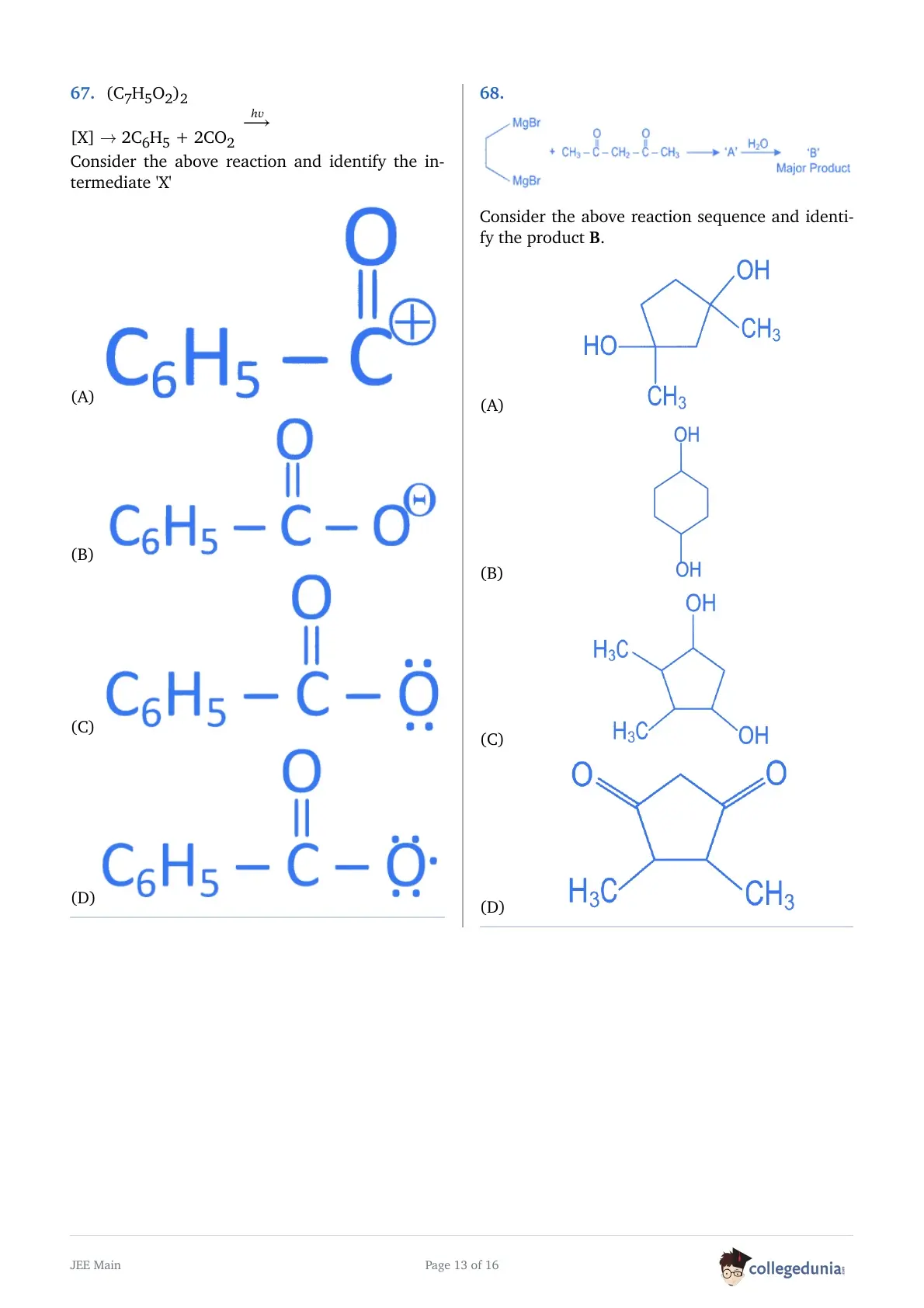
\((C_7H_5O_2)_2\stackrel{ℎv}{→} [X]→2C_6H_5+2CO_2\)
Consider the above reaction and identify the intermediate ‘X’
- (1)
![]()
- (2)
![]()
- (3)
![]()
- (4)
![]()


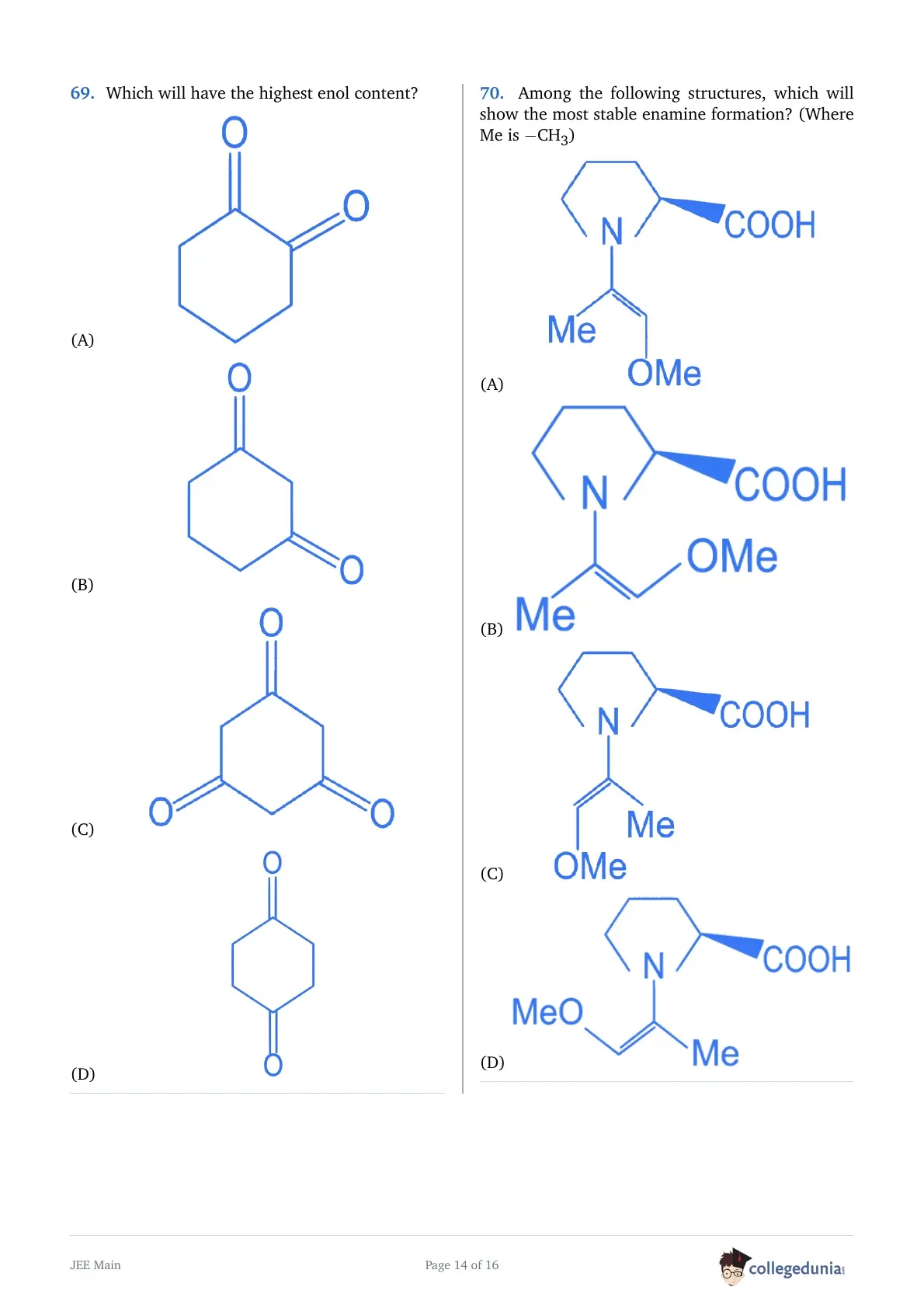
Consider the above reaction sequence and identify the product B.
- (1)
![]()
- (2)
![]()
- (3)
![]()
- (4)
![]()


Among the following structures, which will show the most stable enamine formation?
(Where Me is –CH3)
- (1)
![]()
- (2)
![]()
- (3)
![]()
- (4)
![]()


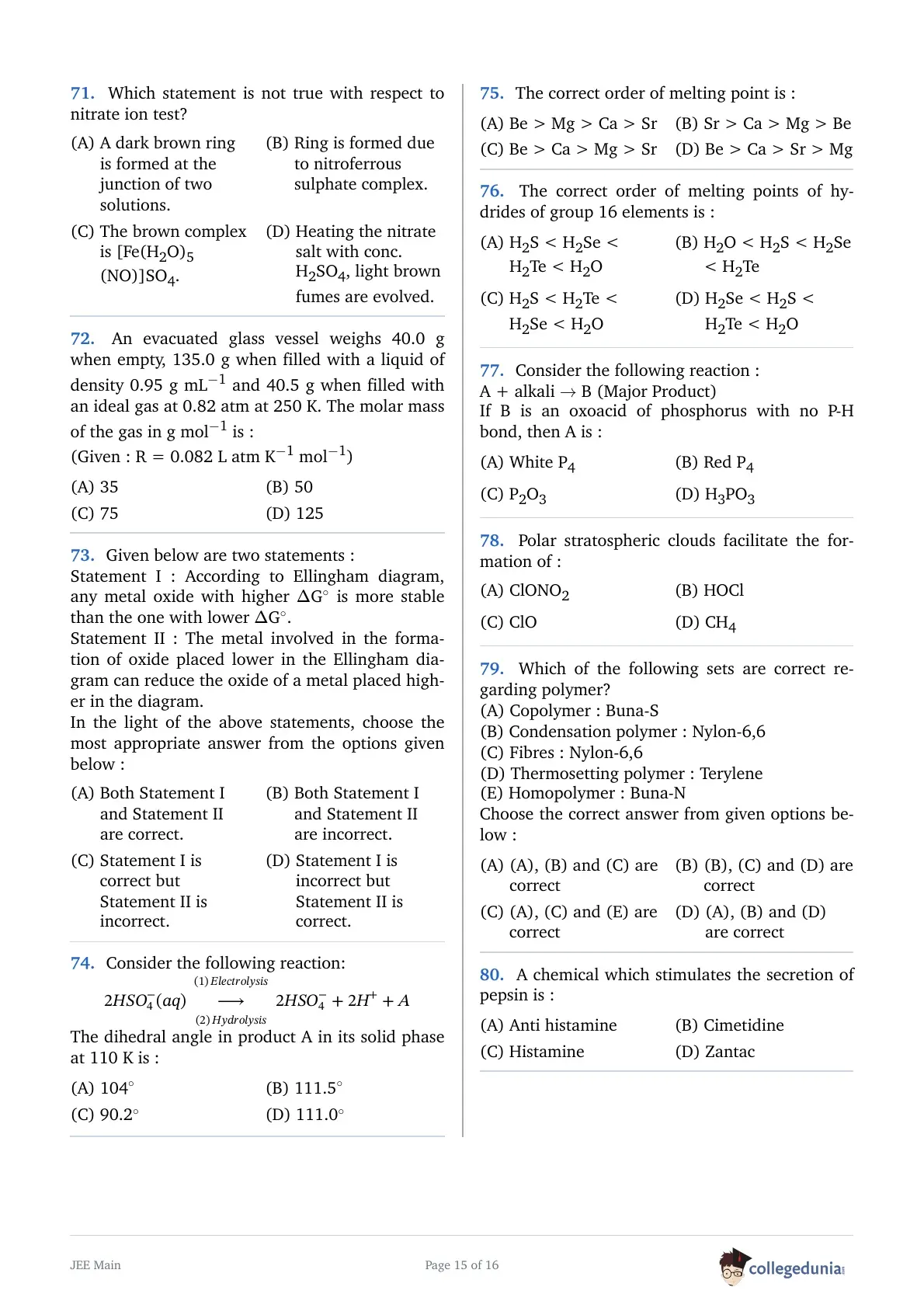
Which statement is not true with respect to nitrate ion test?
An evacuated glass vessel weighs 40.0 g when empty, 135.0 g when filled with a liquid of density 0.95 g mL–1 and 40.5 g when filled with an ideal gas at 0.82 atm at 250 K. The molar mass of the gas in g mol–1 is: (Given : R = 0.082 L atm K–1 mol–1)
Given below are two statements:
Statement I : According to the Ellingham diagram, any metal oxide with higher ΔG° is more stable than the one with lower ΔG°.
Statement II :The metal involved in the formation of oxide placed lower in the Ellingham diagram can reduce the oxide of a metal placed higher in the diagram.
In the light of the above statements, choose the most appropriate answer from the options given below
Consider the following reaction:
\({2HSO_4^ −}_{(aq)}\xrightarrow[(2)Hydrolysis]{(1)Electrolysis} 2HSO_4^− + 2H^+ + A\)
The dihedral angle in product A in its solid phase at 110 K is :
The correct order of melting point is
The correct order of melting points of hydrides of group 16 elements is:
Consider the following reaction:
A + alkali → B (Major Product)
If B is an oxoacid of phosphorus with no P-H bond, then A is
Polar stratospheric clouds facilitate the formation of:
- Copolymer : Buna-S
- Condensation polymer : Nylon-6,6
- Fibres : Nylon-6,6
- Thermosetting polymer : Terylene
- Homopolymer : Buna-N
A chemical which stimulates the secretion of pepsin is
Chemistry - Section B (Q81 - Q90)
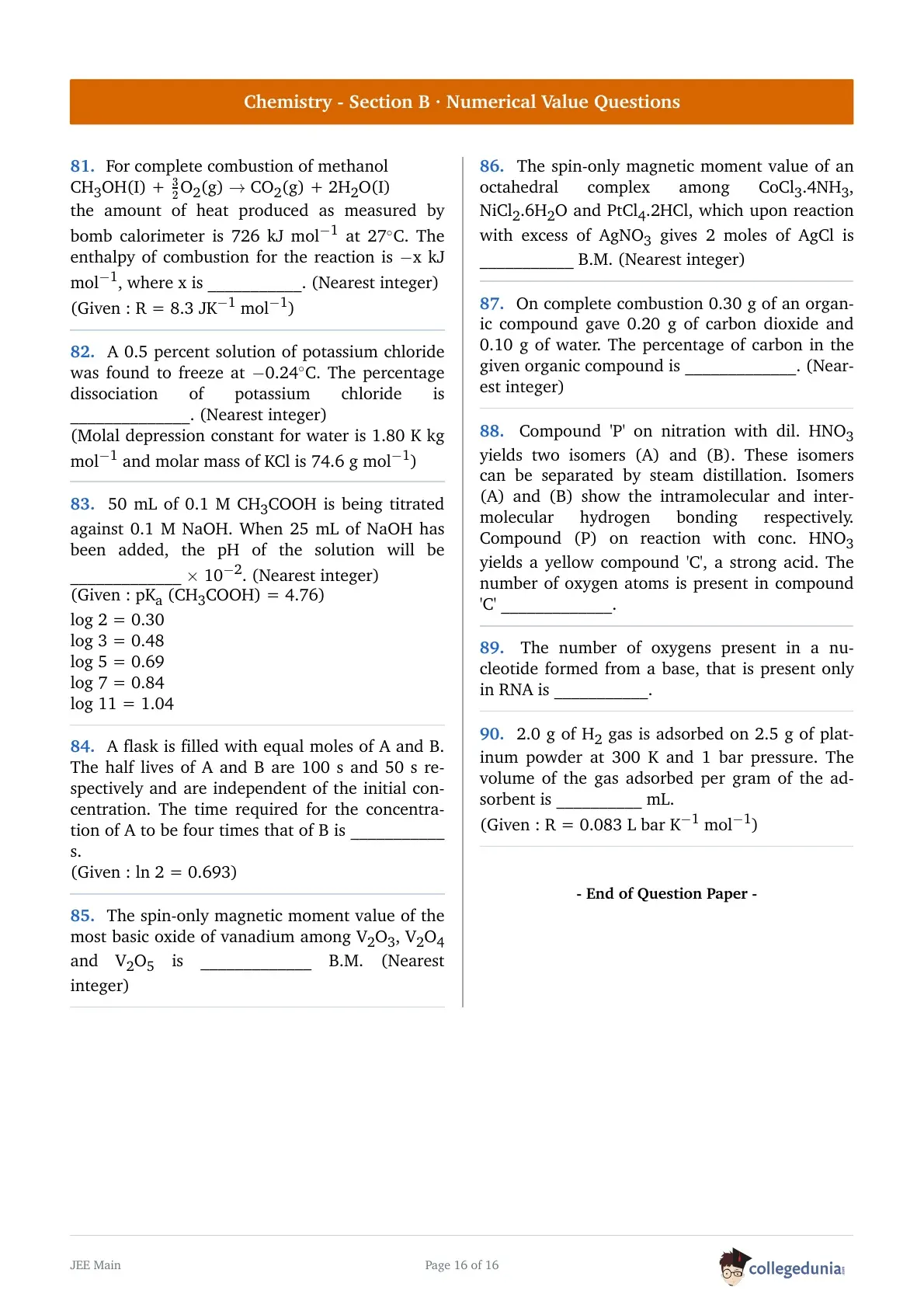
For complete combustion of methanol
\( CH_3OH(I)+\frac 32O_2(g)→CO_2(g)+2H_2O(I)\)
the amount of heat produced as measured by bomb calorimeter is \(726\) kJ mol–1 at \(27°C\). The enthalpy of combustion for the reaction is \(x \ kJ mol^{–1}\), where \(x\) is ______ . (Nearest integer)
(Given: \(R= 8.3 \ JK^{–1}mol^{–1}\))
A 0.5 percent solution of potassium chloride was found to freeze at –0.24°C. The percentage dissociation of potassium chloride is ______. (Nearest integer)
(Molal depression constant for water is 1.80 K kg mol–1 and
molar mass of KCl is 74.6 g mol–1)
50 mL of 0.1 M CH3COOH is being titrated against 0.1 M NaOH. When 25 mL of NaOH has been added, the pH of the solution will be ____ × 10–2. (Nearest integer)
(Given : pKa (CH3COOH) = 4.76)
log 2 = 0.30
log 3 = 0.48
log 5 = 0.69
log 7 = 0.84
log 11 = 1.04
A flask is filled with equal moles of A and B. The half lives of A and B are 100 s and 50 s respectively and are independent of the initial concentration. The time required for the concentration of A to be four times that of B is ________s.
(Given : In 2 = 0.693)
The spin-only magnetic moment value of the most basic oxide of vanadium among \(V_2O_3, V_2O_4\) and \(V_2O_5\) is ______B.M. (Nearest integer)
The spin-only magnetic moment value of an octahedral complex among \(CoCl_3⋅4NH_3\), \(NiCl_2⋅6H_2O\) and \(PtCl_4⋅2HCl\), which upon reaction with excess of \(AgNO_3\) gives 2 moles of \(AgCl\) is _____ B.M. (Nearest Integer)
On complete combustion 0.30 g of an organic compound gave 0.20 g of carbon dioxide and 0.10 g of water. The percentage of carbon in the given organic compound is ______. (Nearest Integer)
Compound ‘P’ on nitration with dil. HNO3 yields two isomers (A) and (B) show the intramolecular and intermolecular hydrogen bonding respectively. Compound (P) on reaction with conc. HNO3 yields a yellow compound ‘C’, a strong acid. The number of oxygen atoms is present in compound ‘C’ _____
The number of oxygens present in a nucleotide formed from a base, that is present only in RNA is ________.
2.0 g of H2 gas is adsorbed on 2.5 g of platinum powder at 300 K and 1 bar pressure. The volume of the gas adsorbed per gram of the adsorbent is _____ mL.
(Given : R= 0.083 L bar K–1 mol–1)
JEE Main 2022 Exam Pattern and Marking Scheme
| Particulars | Details |
|---|---|
| Exam Mode | Online (Computer-Based Test) |
| Paper | B.E./B.Tech (Paper 1) |
| Duration | 3 hours (180 minutes) |
| Type of Questions | Multiple Choice Questions (MCQs) + Numerical Value Questions |
| Subjects | Mathematics, Physics, Chemistry |
| Total Questions | 90 questions (75 to be attempted) |
| Total Marks | 300 marks |
| Marking Scheme | +4 for correct answer & -1 for incorrect MCQ and Numerical Value-based Questions |
JEE Main 2022 June 26 Shift 1 Difficulty Level
As per the students’ initial reaction, JEE Main 2022 Question Paper for June 26- Shift 1 was reported as moderate. The Mathematics section in JEE Main 2022 June 26- Shift 1 Question Paper was reported as difficult, Physics as moderate and Chemistry as easy.
JEE Main 2022 June 26 Shift 1 Subject-wise Memory-Based Solutions PDF
| Subject | Memory-Based Solutions PDF |
|---|---|
| Physics | Download PDF |
| Chemistry | Download PDF |
| Mathematics | Download PDF |
JEE Main 2022 B.E/ B. Tech Other Question Paper with Answer Key PDFs
JEE Main 2022 aspirants can practice and check their exam prep level by attempting the other session question papers as well. The table below shows JEE Main 2022 Question Paper with Answer Key and Solution PDFs for other sessions for Phase 1.
Also Check:



Comments