




JEE Main 2022 June 27 Shift 1 Question Paper is available here with solutions PDF and detailed solutions for every question. NTA conducted the first shift on June 27, 2022, from 9:00 AM to 12:00 PM. The JEE Main 2022 Paper 1 (B.E./B.Tech) question paper includes the following:
- 90 questions in a 3-hour CBT Mode: 30 each from Mathematics, Physics and Chemistry (75 to be attempted)
- Section A: 20 multiple choice questions (MCQs) per subject, all compulsory, 4 marks each
- Section B: 10 numerical value questions per subject, any 5 to be attempted, 4 marks each
- Marking: +4 for a correct answer, -1 for an incorrect answer, 0 for an unattempted question
- Maximum marks: 300 (100 per subject)
JEE Main 2022 June 27 Shift 1 Question Paper with Solution PDF
| NTA Official PDF | CD PDF | CD PDF with Solutions |
|---|---|---|
| Download official PDF 4.71 MB | Download Collegedunia PDF 0.99 MB | Download solutions PDF 1.23 MB |
Also Check:
JEE Main 2022 June 27 Shift 1 Questions with Solutions
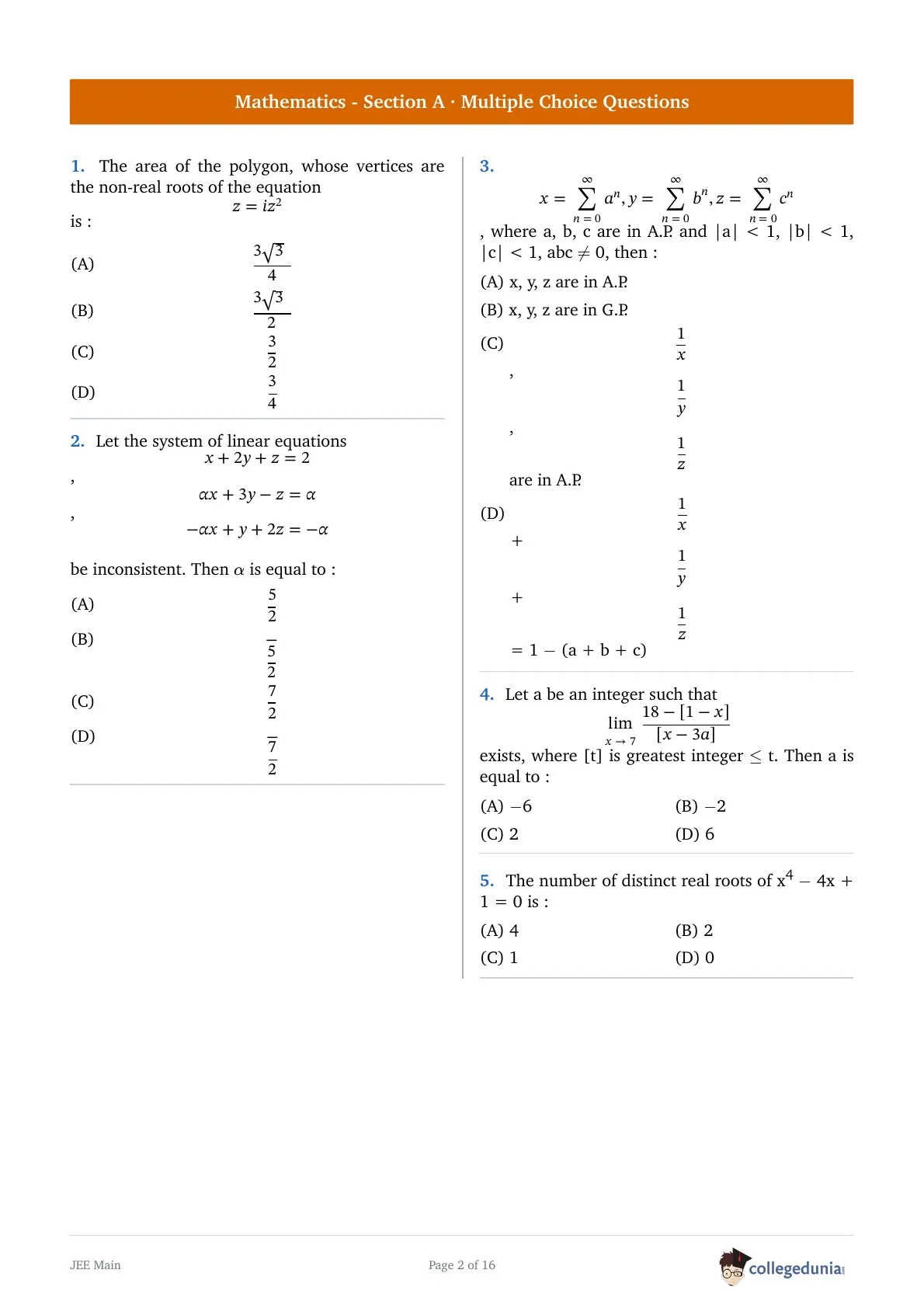
Mathematics - Section A (Q1 - Q20)
The area of the polygon, whose vertices are the non-real roots of the equation \(\bar z = iz^2\) is
Let the system of linear equations \[ x + 2y + z = 2, \quad \alpha x + 3y - z = \alpha, \quad -\alpha x + y + 2z = -\alpha \] be inconsistent. Then \(\alpha\) is equal to:
If \(x=∑_{n=0}^∞a^n,y=∑_{n=0}^∞b^n,z=∑_{n=0}^∞c^n\), where a, b, c are in A.P. and |a| < 1, |b| < 1, |c| < 1, abc≠ 0, then :
Let a be an integer such that \(lim _{x→7} \frac{18−[1−x]}{[x−3a]}\) exists, where [t] is greatest integer \(≤ t\). Then \(a\) is equal to :
The number of distinct real roots of \(x^4 – 4x + 1 = 0\) is :
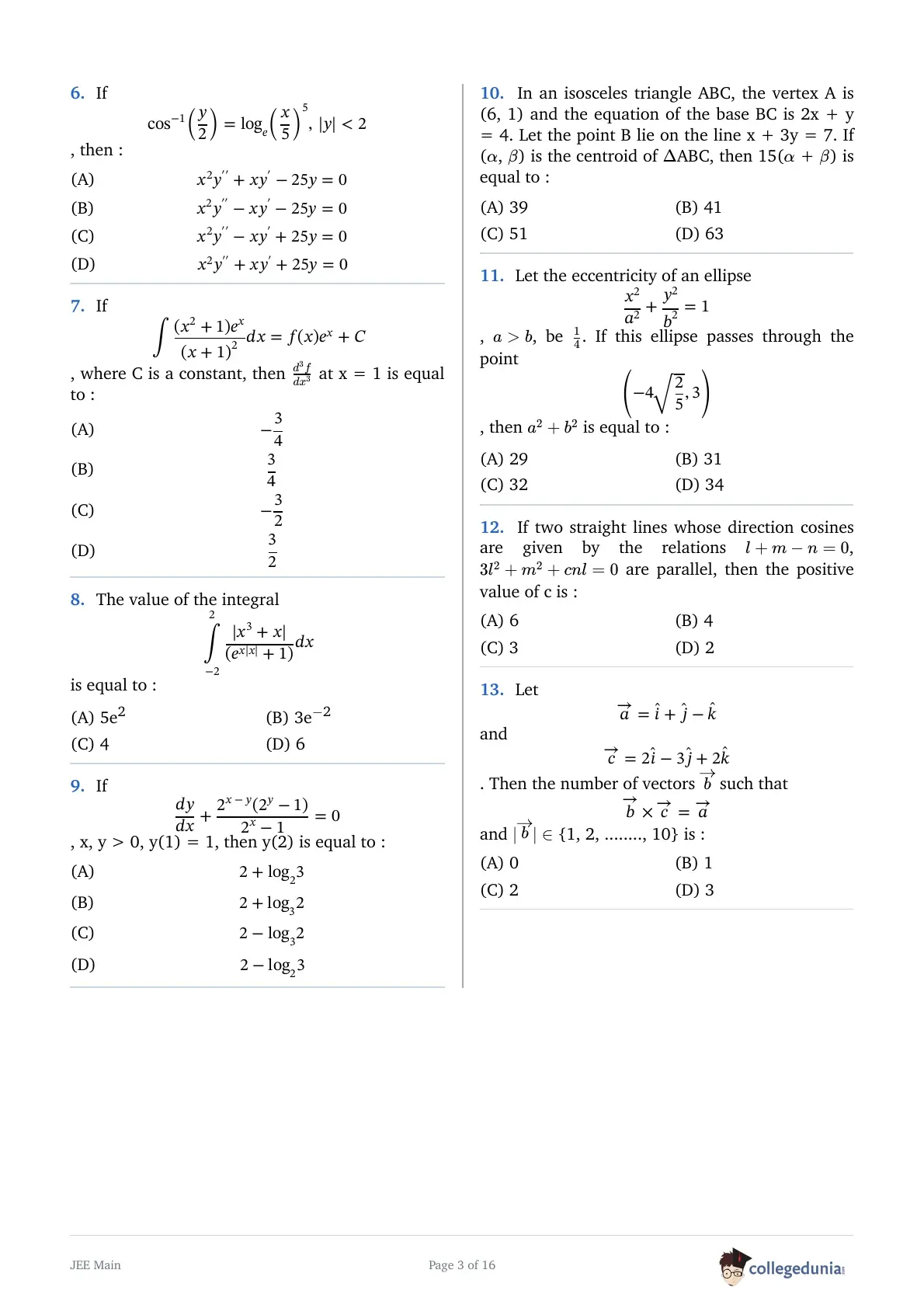
If \(cos^{-1}(\frac{y}{2})=log_e(\frac{x}{5})^5, |y| < 2\) then:
if \(∫ \frac{(x^2+1)e^x}{(x+1)^2}dx = ƒ(x)e^x+C\) where \(C\) is a constant, then \(\frac{d^3ƒ}{dx^3}\) at \(x = 1\) is equal to :
The value of the integral \(∫^2_{-2}\frac{ |x^3+x|}{(e^x|x|+1)}dx\) is equal to:
If \(\frac{dy}{dx} + \frac{2x-y(2^y-1)}{2x-1} = 0, x,y > 0,y(1) = 1\), then \(y(2)\) is equal to:
In an isosceles triangle ABC, the vertex A is \((6, 1)\) and the equation of the base BC is \(2x + y = 4\). Let the point B lie on the line \(x + 3y = 7\). If \((α, β)\) is the centroid of ΔABC, then \(15(α + β)\) is equal to :
Let the eccentricity of an ellipse \(\frac {x^2}{a^2}+\frac {y^2}{b^2}=1\), \(a>b\), be \(\frac 14\). If this ellipse passes through the point \((−4\sqrt {\frac 25},3)\), then \(a^2 + b^2\) is equal to :
If two straight lines whose direction cosines are given by the relations \(l + m – n = 0\), \(3l^2 + m^2 + cnl = 0\) are parallel, then the positive value of \(c\) is :
Let \(\vec a=\hat i+\hat j−\hat k\) and \(\vec c=2\hat i−3\hat j+2\hat k\). Then the number of vectors \(\vec b\) such that \(\vec b×\vec c=\vec a\) and \(|\vec b|∈{1,2,…,10}\) is :
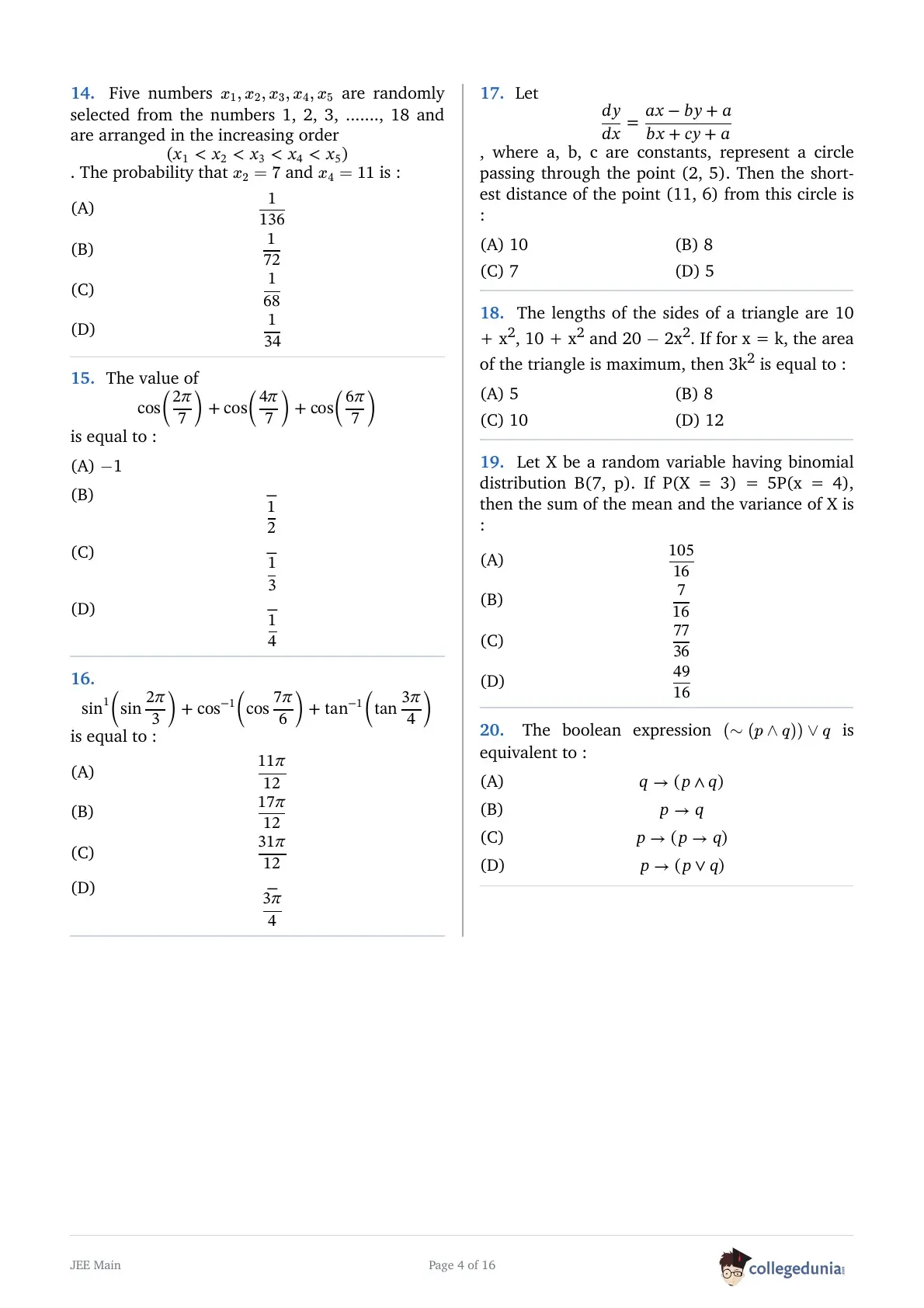
Five numbers, \(x_1, x_2, x_3, x_4, x_5\) are randomly selected from the numbers \(1, 2, 3\),….., \(18\) and are arranged in the increasing order \((x_1<x_2<x_3<x_4<x_5)\). The probability that \(x_2 = 7\) and \(x_4 = 11\) is:
The value of \(cos(\frac{2π}{7})+cos(\frac{4π}{7})+cos(\frac{6π}{7})\) is equal to:
\(sin^{-1}\bigg(sin\frac{2π}{3}\bigg)+cos^{-1}\bigg(cos\frac{7π}{6}\bigg)+tan^{-1}\bigg(tan\frac{3π}{4}\bigg)\) is equal to:
Let \(\frac{dy}{dx} = \frac{ax-by+a}{bx+cy+a}\), where a, b, c are constants, represent a circle passing through the point (2, 5). Then the shortest distance of the point (11, 6) from this circle is
The lengths of the sides of a triangle are 10 + x2, 10 + x2 and 20 – 2x2. If for x = k, the area of the triangle is maximum, then 3k2 is equal to :
Let \(X\) be a random variable having binomial distribution \(B(7, p)\). If \(P(X = 3) = 5P(X = 4)\), then the sum of the mean and the variance of \(X\) is:
The boolean expression (~(p ∧q)) ∨q is equivalent to:
Mathematics - Section B (Q21 - Q30)
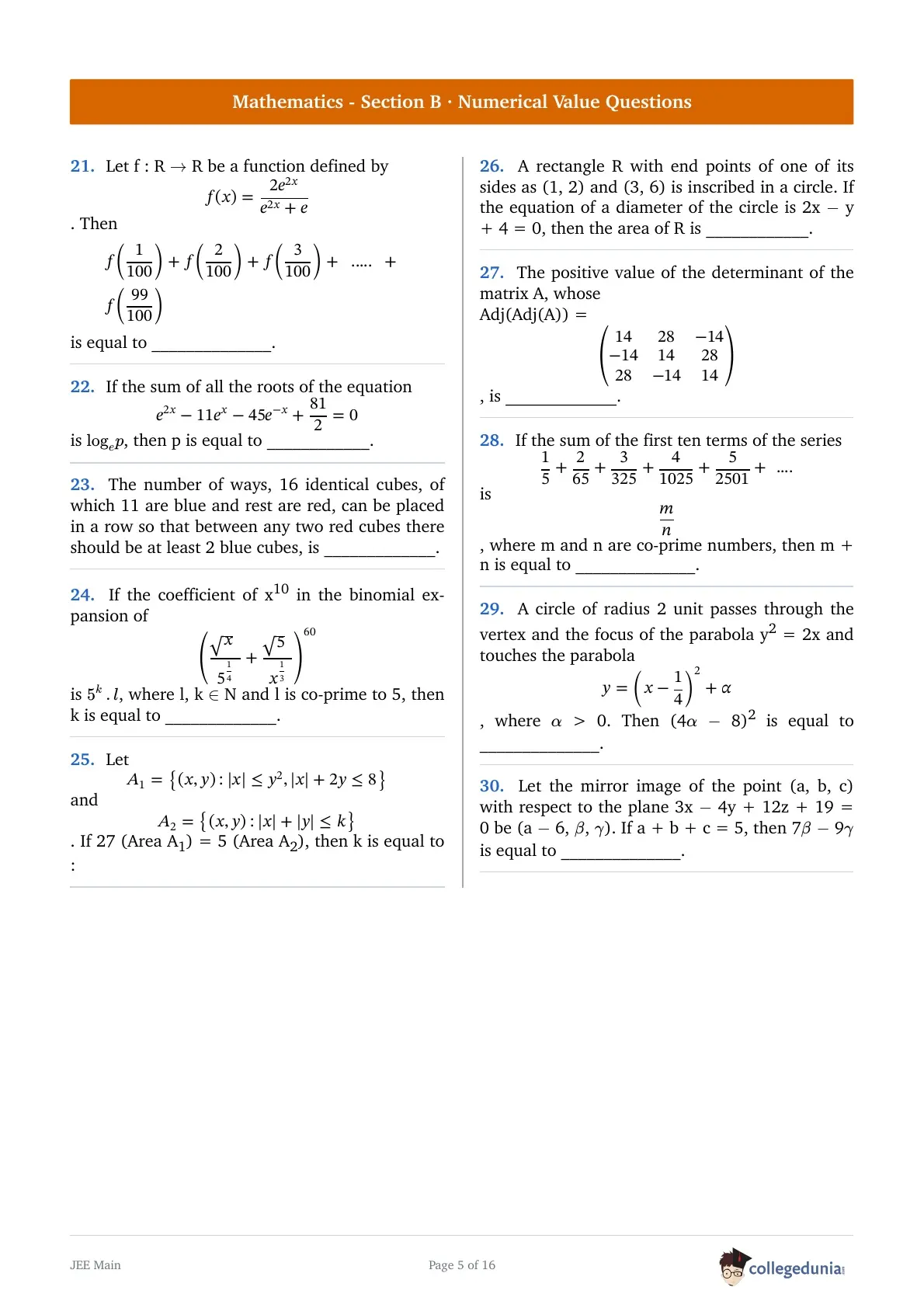
Let ƒ :R→R be a function defined by
\(f(x) = \frac{2e^{2x}}{e^{2x} + e^x}\)
Then \(f\left(\frac{1}{100}\right) + f\left(\frac{2}{100}\right) + f\left(\frac{3}{100}\right) + \ldots + f\left(\frac{99}{100}\right)\)
is equal to ________.
If the sum of all the roots of the equation \(e^{2x} - 11e^x - 45e^{-x} + \frac{81}{2} = 0\)
is logeP, then p is equal to _____.
The number of ways, 16 identical cubes, of which 11 are blue and rest are red, can be placed in a row so that between any two red cubes there should be at least 2 blue cubes, is _________.
If the coefficient of x10 in the binomial expansion of
\(\left(\frac{\sqrt{x}}{5^{\frac{1}{4}}} + \frac{\sqrt{5}}{x^{\frac{1}{3}}}\right)^{60}\)
is 5k.l, where l, k∈N and l is co-prime to 5, then k is equal to ___________.
Let
\(A1 = {(x,y):|x| <= y^2,|x|+2y≤8} \)
and
\(A2 = {(x,y) : |x| +|y|≤k}. \)
If 27(Area A1) = 5(Area A2), then k is equal to :
A rectangle R with end points of one of its sides as (1, 2) and (3, 6) is inscribed in a circle. If the equation of a diameter of the circle is 2x – y + 4 = 0, then the area of R is ________.
The positive value of the determinant of the matrix A, whose
\(\text{Adj}(\text{Adj}(A)) = \begin{bmatrix} 14 & 28 & -14 \\ -14 & 14 & 28 \\ 28 & -14 & 14 \end{bmatrix}\)
is ___.
If the sum of the first ten terms of the series
\(\frac{1}{5} + \frac{2}{65} + \frac{3}{325} + \frac{4}{1025} + \frac{5}{2501}\)+… is \(\frac{m}{n}\),
where m and n are co-prime numbers, then m + n is equal to __________.
A circle of radius 2 unit passes through the vertex and the focus of the parabola y2 = 2x and touches the parabola \(y=\left (x−\frac{1}{4}\right)^2+α,\) where \(α > 0\). Then \((4α – 8)^2\) is equal to ___________.
Let the mirror image of the point (a, b, c) with respect to the plane 3x – 4y + 12z + 19 = 0 be (a – 6, β, γ). If a + b + c = 5, then 7β – 9γ is equal to __________.
Physics - Section A (Q31 - Q50)
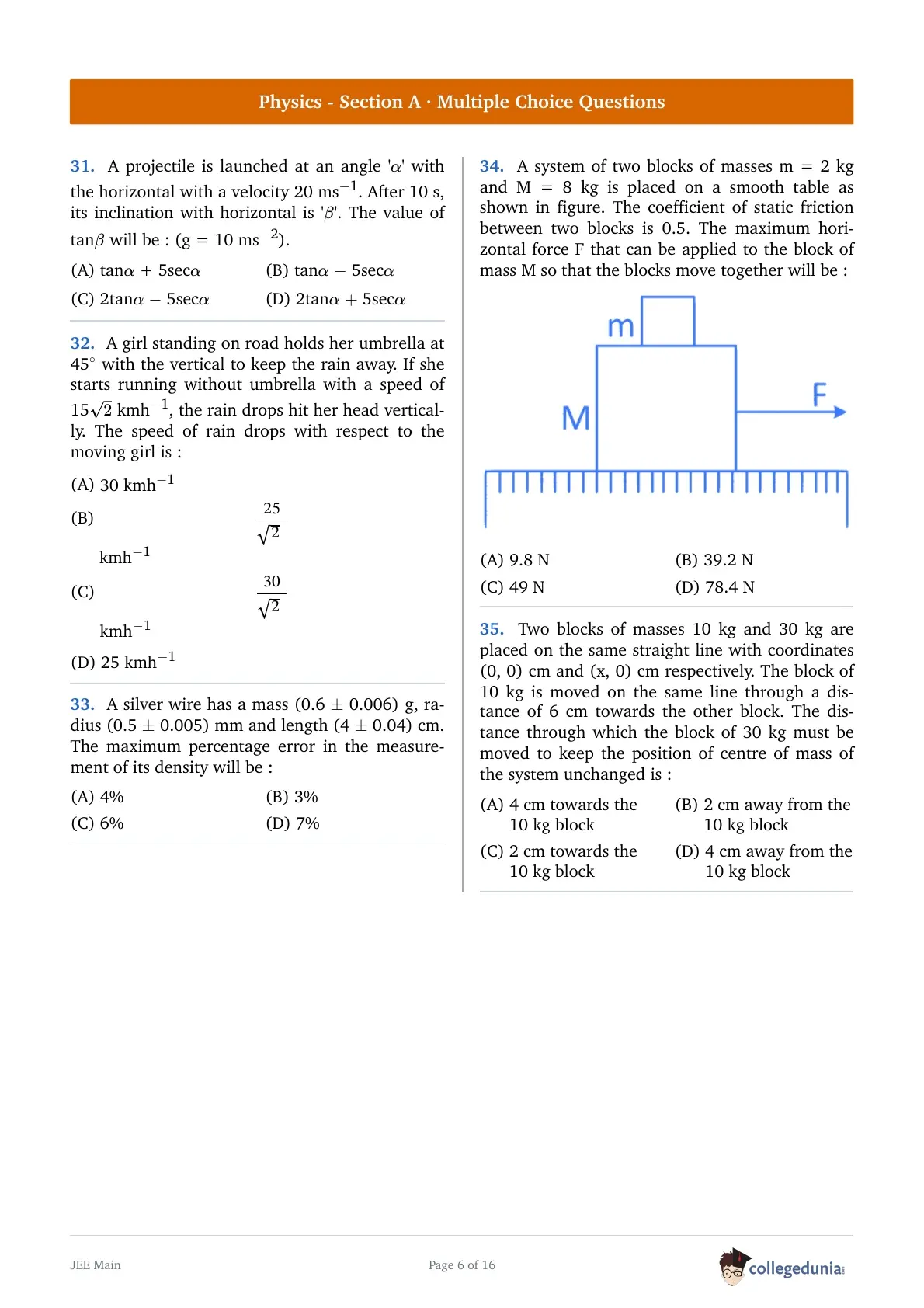
A projectile is launched at an angle ‘α’ with the horizontal with a velocity \(20\) \(ms^{–1}\). After \(1 0\) \(s\), its inclination with horizontal is ‘β’. The value of tanβ will be (\(g\) = \(10\) \(ms^{–2}\)).
A girl standing on road holds her umbrella at 45° with the vertical to keep the rain away. If she starts running without umbrella with a speed of \(15\sqrt2\) \(kmh^{–1}\), the rain drops hit herhead vertically. The speed of rain drops with respect to the moving girl is
A silver wire has a mass \((0.6 \overset{+}{-} 0.006)\) g, radius \((0.5 \overset{+}{-} 0.005)\) mm and length \((4 \overset{+}{-} 0.04)\) cm. The maximum percentage error in the measurement of its density will be
A system of two blocks of masses m = 2 kg and M = 8 kg is placed on a smooth table as shown in the figure. The coefficient of static friction between two blocks is 0.5. The maximum horizontal force F that can be applied to the block of mass M so that the blocks move together will be
Two blocks of masses 10 kg and 30 kg are placed on the same straight line with coordinates(0, 0) cm and (x, 0) cm respectively. The block of 10 kg is moved on the same line through a distance of 6 cm towards the other block. The distance through which the block of 30 kg must be moved to keep the position of Centre of mass of the system unchanged is
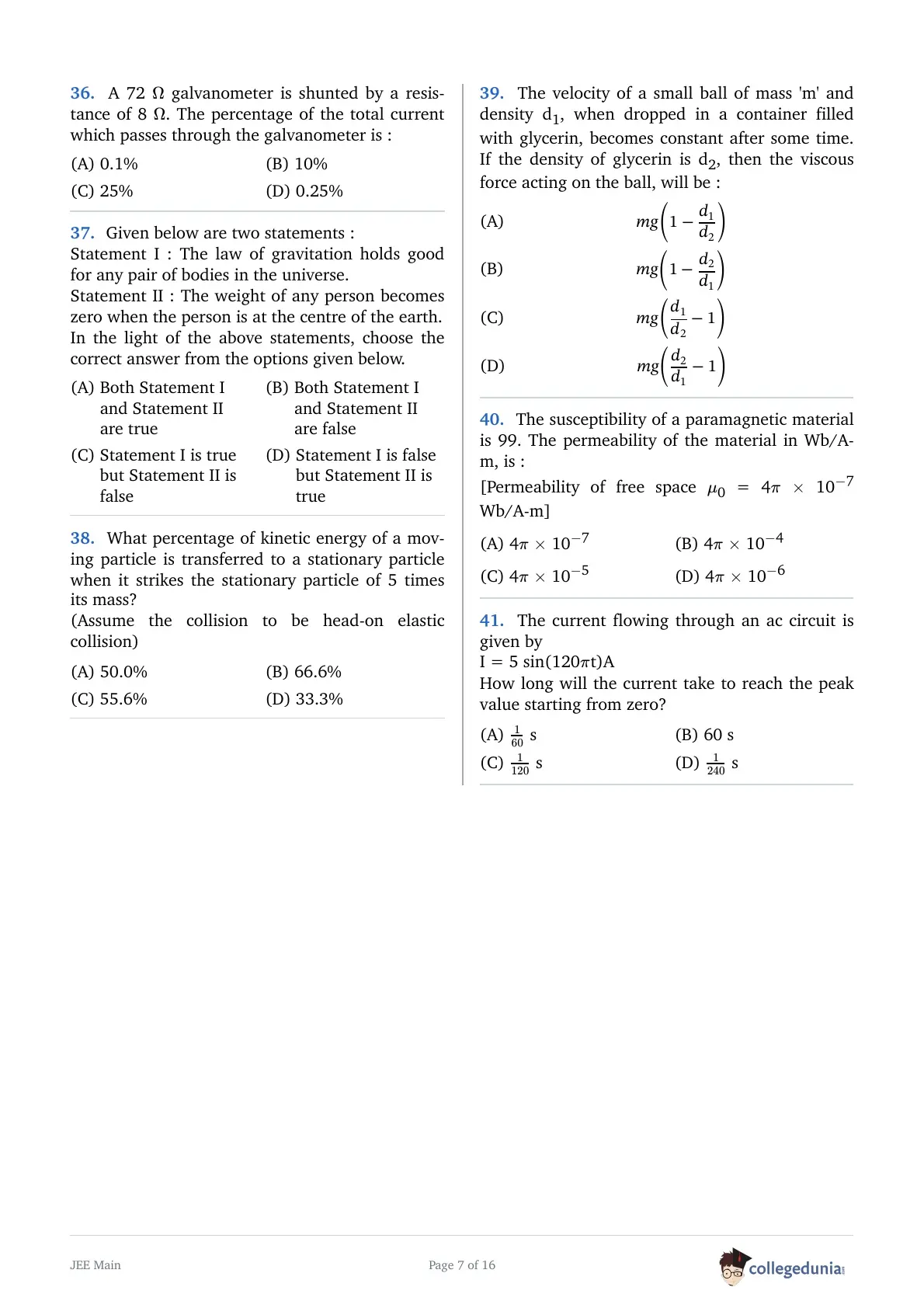
A \(72\) Ω galvanometer is shunted by a resistance of \(8\) Ω. The percentage of the total current which passes through the galvanometer is
Given below are two statements.
Statement-I: The law of gravitation holds good for any pair of bodies in the universe.
Statement-II: The weight of any person becomes zero when the person is at the centre of the earth.
In the light of the above statements, choose the correct answer from the options given below
What percentage of kinetic energy of a moving particle is transferred to a stationary particle when it strikes the stationary particle of 5 times its mass? (Assume the collision to be head-on elastic collision)
The velocity of a small ball of mass ‘m’ and density \(d_1\), when dropped in a container filled with glycerin, becomes constant after some time. If the density of glycerin is \(d_2\), then the viscous force acting on the ball, will be
The susceptibility of a paramagnetic material is \(99\). The permeability of the material in Wb/A-m, is
[Permeability of free space \(μ_0\) = \(4π × 10^{–7}\) Wb/A-m]
The current flowing through an ac circuit is given by \(I = 5 \;sin\;(120πt)\;A\). How long will the current take to reach the peak value starting from zero?
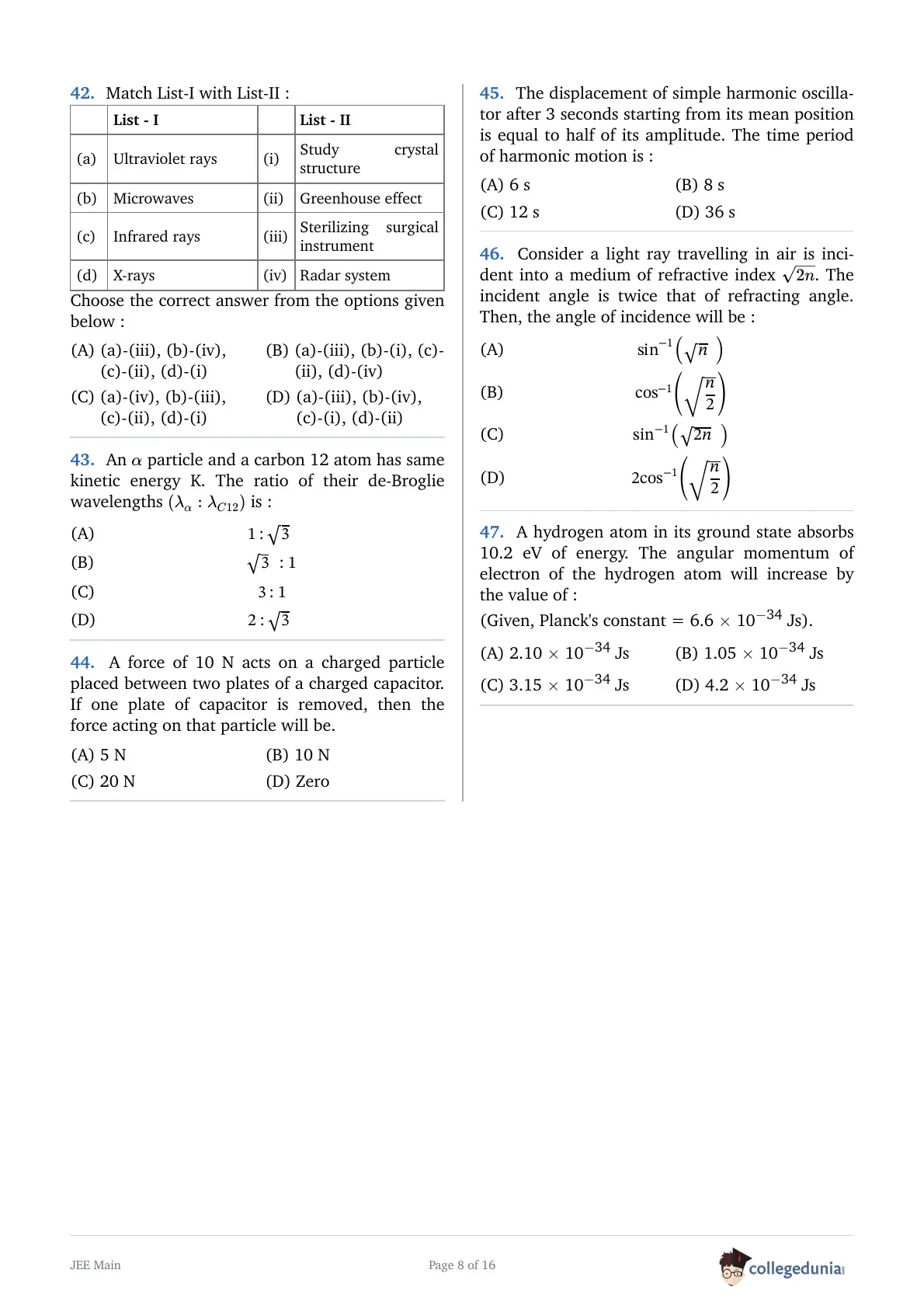
| Lis I | List II | ||
|---|---|---|---|
| a. | Ultraviolet rays | i. | Study crystal structure |
| b. | Microwaves | ii. | Greenhouse effect |
| c. | Infrared waves | iii. | Sterilizing surgical instrument |
| d. | X-rays | iv | Radar system |
Choose the correct answer from the options given below :
An α particle and a carbon 12 atom has same kinetic energy K. The ratio of their de-Broglie wavelengths \((λ_α :λ_{C_{12}})\) is :
A force of 10 N acts on a charged particle placed between two plates of a charged capacitor. If one plate of capacitor is removed, then the force acting on that particle will be
The displacement of simple harmonic oscillator after 3 seconds starting from its mean position is equal to half of its amplitude. The time period of harmonic motion is :
Consider a light ray travelling in air is incident into a medium of refractive index √2n The incident angle is twice that of refracting angle. Then, the angle of incidence will be:
A hydrogen atom in its ground state absorbs 10.2 eV of energy. The angular momentum of electron of the hydrogen atom will increase by the value of: (Given, Planck’s constant = \(6.6 × 10^{–34}\) Js).
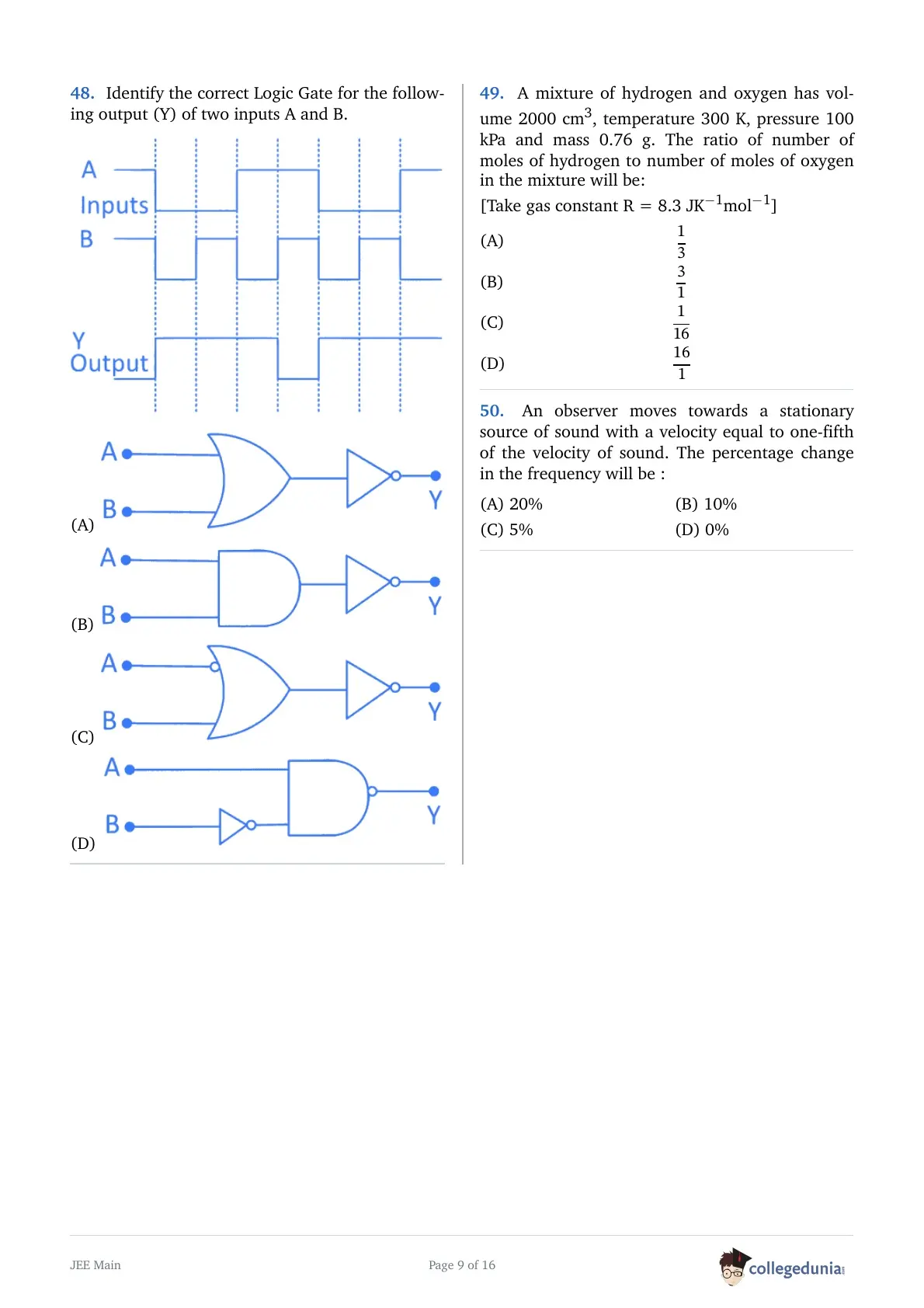
Identify the correct Logic Gate for the following output (Y) of two inputs A and B.
- (1)
![Option A]()
- (2)
![Option B]()
- (3)
![Option C]()
- (4)
![Option D]()


A mixture of hydrogen and oxygen has volume 2000 \(cm^3\), temperature 300 K, pressure 100 kPa and mass 0.76 g. The ratio of number of moles of hydrogen to number of moles of oxygen in the mixture will be:[Take gas constant R = 8.3 \(JK^{–1}\) \(mol^{–1}\)]
An observer moves towards a stationary source of sound with a velocity equal to one-fifth of the velocity of sound. The percentage change in the frequency will be:
Physics - Section B (Q51 - Q60)
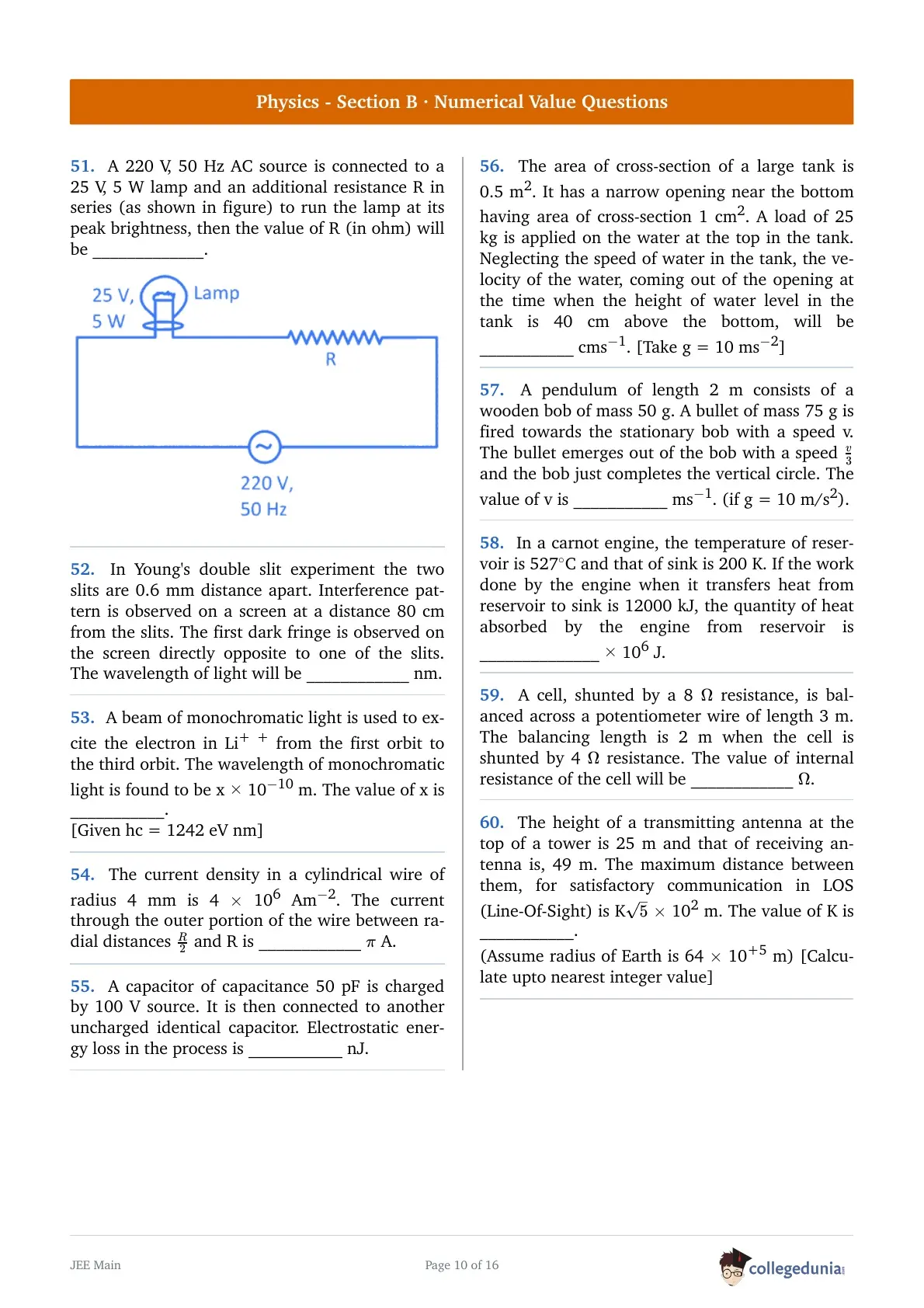
A 220 V, 50 Hz AC source is connected to a 25 V, 5 W lamp and an additional resistance R in series (as shown in figure) to run the lamp at its peak brightness, then the value of R (in ohm) will be _____ .
In young’s double slit experiment the two slits are 0.6 mm distance apart. Interference pattern is observed on a screen at a distance 80 cm from the slits. The first dark fringe is observed on the screen directly opposite to one of the slits. The wavelength of light will be _____ nm.
A beam of monochromatic light is used to excite the electron in \(Li^{++}\) from the first orbit to the third orbit. The wavelength of monochromatic light is found to be \(x × 10^{–10}\) m. The value of \(x\) is _____ .[Given \(hc = 1242\) eV nm]
The current density in a cylindrical wire of radius 4 mm is \(4×10^6\ Am^{–2}\). The current through the outer portion of the wire between radial distances \(\frac R2\) and \(R\) is _____ \(\pi\) A.
A capacitor of capacitance \(50pF\) is charged by \(100 V\) source. It is then connected to another uncharged identical capacitor. Electrostatic energy loss in the process is _____ nJ.
The area of cross-section of a large tank is \(0.5\ m^2\). It has a narrow opening near the bottom having area of cross-section \(1\ cm^2\). A load of \(25\ kg \) is applied on the water at the top in the tank. Neglecting the speed of water in the tank, the velocity of the water, coming out of the opening at the time when the height of water level in the tank is \(40\ cm\) above the bottom, will be ______ \(cms^{–1}\). [Take \(g=10\ ms^{–2}\)]
A pendulum of length \(2\ m\) consists of a wooden bob of mass \(50\ g\). A bullet of mass \(75\ g\) is fired towards the stationary bob with a speed v. The bullet emerges out of the bob with a speed \(\frac v3\) and the bob just completes the vertical circle. The value of v is _______ \(ms^{–1}\). (if \(g=10\ m/s^2\)).
In a carnot engine, the temperature of reservoir is 527°C and that of sink is 200 K. If the work done by the engine when it transfers heat from reservoir to sink is 12000 kJ, the quantity of heat absorbed by the engine from reservoir is _____ \(× 10^6\) J.
A cell, shunted by a 8 Ω resistance, is balanced across a potentiometer wire of length 3 m. The balancing length is 2 m when the cell is shunted by 4 Ω resistance. The value of internal resistance of the cell will be _____ Ω.
The height of a transmitting antenna at the top of a tower is 25 m and that of receiving antenna is, 49 m. The maximum distance between them, for satisfactory communication in LOS (Line-Of-Sight) is \(K\sqrt5\times10^2\ m\). The value of K is ______ .
(Assume radius of Earth is \(64×10^5\ m\))
[Calculate upto nearest integer value]
Chemistry - Section A (Q61 - Q80)
Given below are two statements : one is labelled as Assertion (A) and the other is labelled as Reason (R).
Assertion (A) : At 10°C, the density of a 5 M solution of KCl [atomic masses of K & Cl are 39 & 35.5 g \(mol^{–1}\) respectively], is ‘x’ g \(ml^{–1}\). The solution is cooled to –21°C. The molality of the solution will remain unchanged.
Reason (R) : The molality of a solution does not change with temperature as mass remains unaffected with temperature.
In the light of the above statements, choose the correct answer from the options given below.
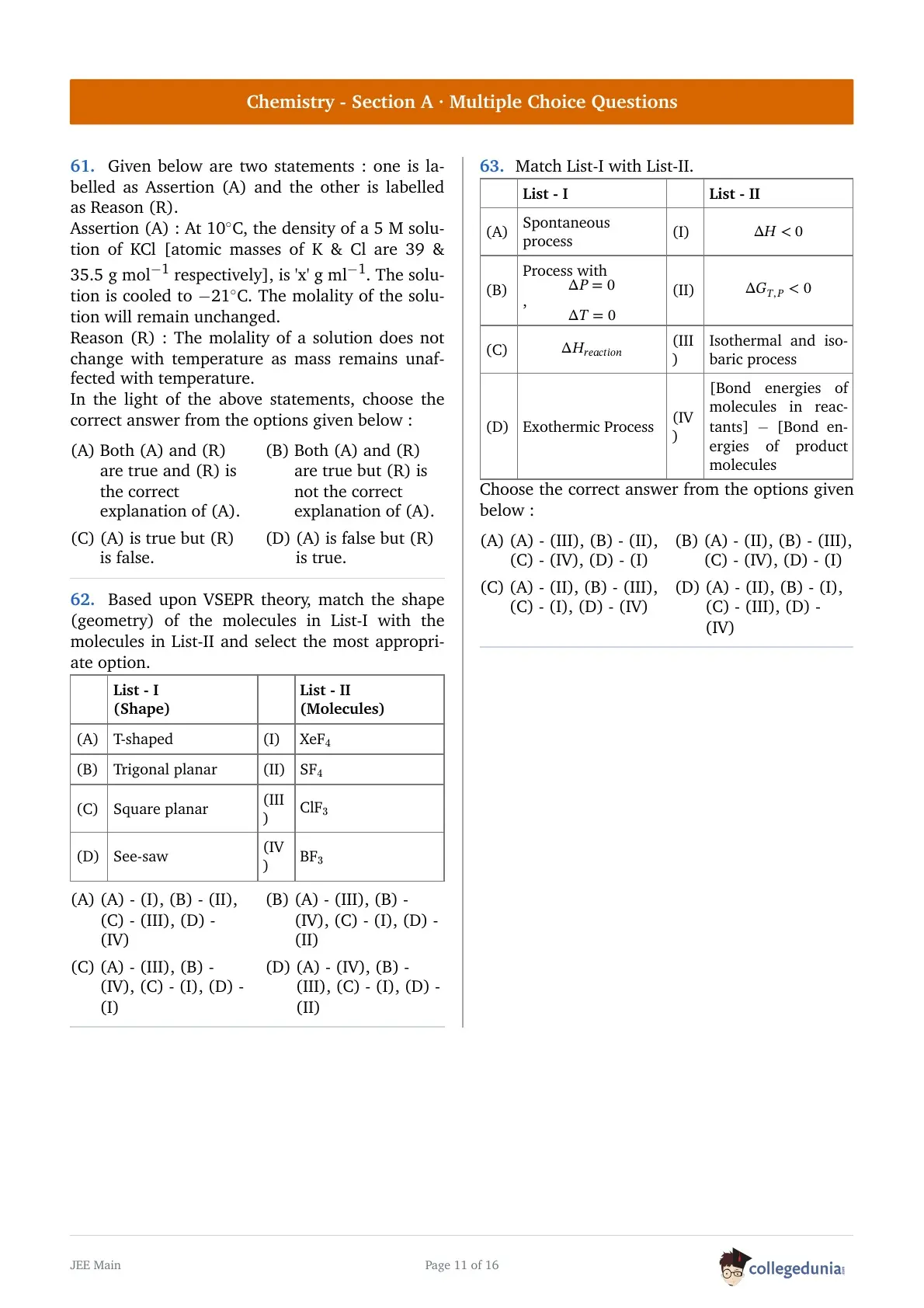
Based upon VSEPR theory, match the shape (geometry) of the molecules in List-I with the molecules in
List-II and select the most appropriate option.
List-I List-II
(Shape) (Molecules)
(A) T-shaped (I) XeF4
(B) Trigonal planar (II) SF4
(C) Square planar (III) CIF3
(D) See-saw (IV) BF3
Match List-I with List-II
List-I
(A) Spontaneous process
(B) Process with \(ΔP = 0\), \(ΔT = 0\)
(C) \(ΔH_{reaction}\)
(D) Exothermic Process
List-II
(I) \(ΔH < 0\)
(II) \(ΔG_{T,P} < 0\)
(III) Isothermal and isobaric process
(IV) [Bond energies of molecules in reactants] – [Bond energies of product molecules]
Choose the correct answer from the options given below :
Given below are two statements : one is labelled as Assertion (A) and the other is labelled as Reason (R).
Assertion (A) : The ionic radii of \(O^{2–}\) and \(Mg^{2+}\) are same.
Reason (R) : Both \(O^{2–}\) and \(Mg^{2+}\) are isoelectronic species.
In the light of the above statements, choose the correct answer from the options given below.
Which of the following will have maximum stabilization due to crystal field?
‘A’ and ‘B’ respectively are: \(A\xrightarrow[(2)Zn-H_2O]{(1)O_3}\)
\(Ethane-1, 2-dicarbaldehyde + Glyoxal/Oxaldehyde\)
\(B \xrightarrow[(2)Zn-H_2O]{(1)O_3} 5 - oxohexanal\)
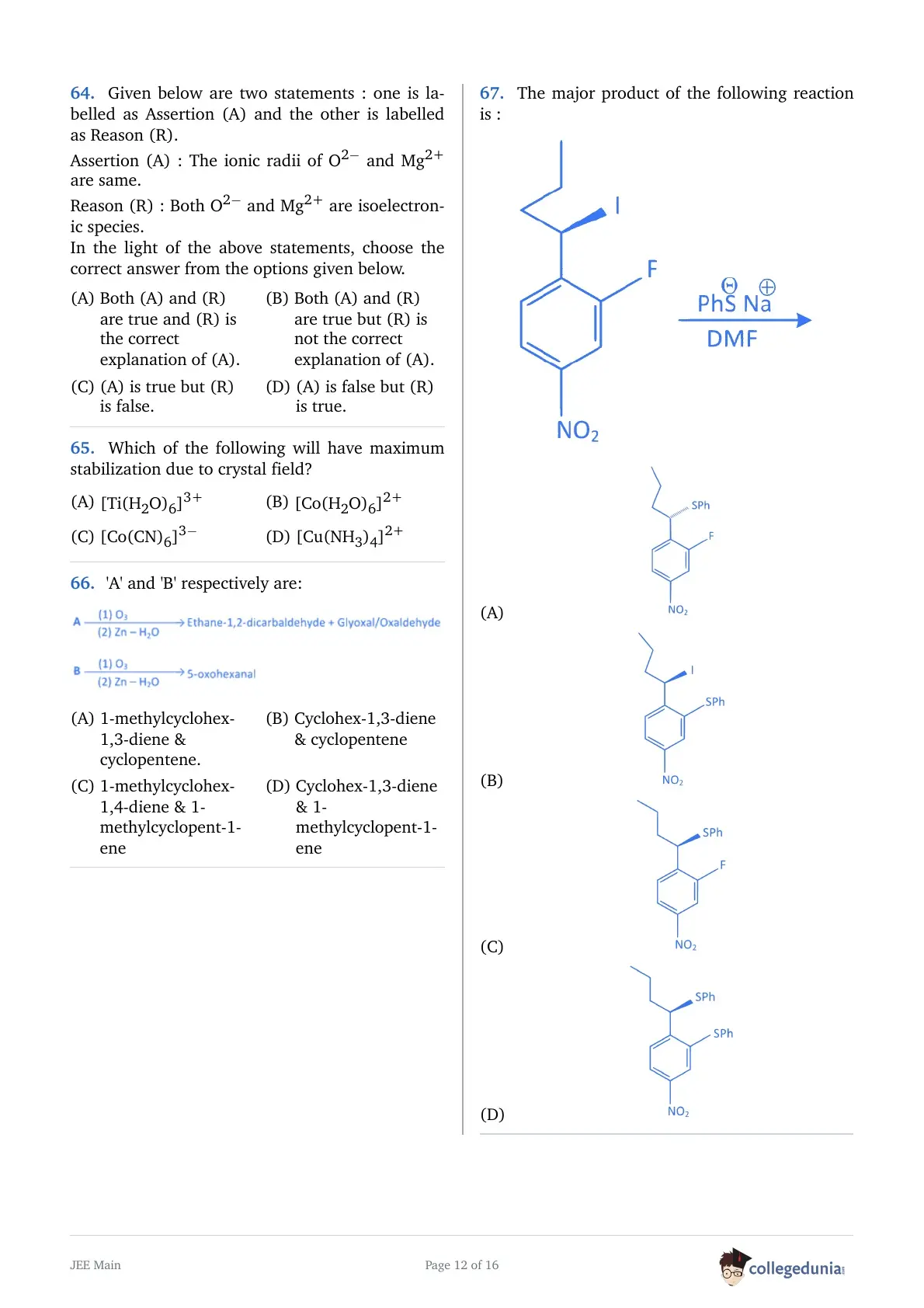
The major product of the following reaction is :
\(\mathrm{PhS^{\ominus}\ Na^{\oplus}}\) in DMF
- (1)
![]()
- (2)
![]()
- (3)
![]()
- (4)
![]()


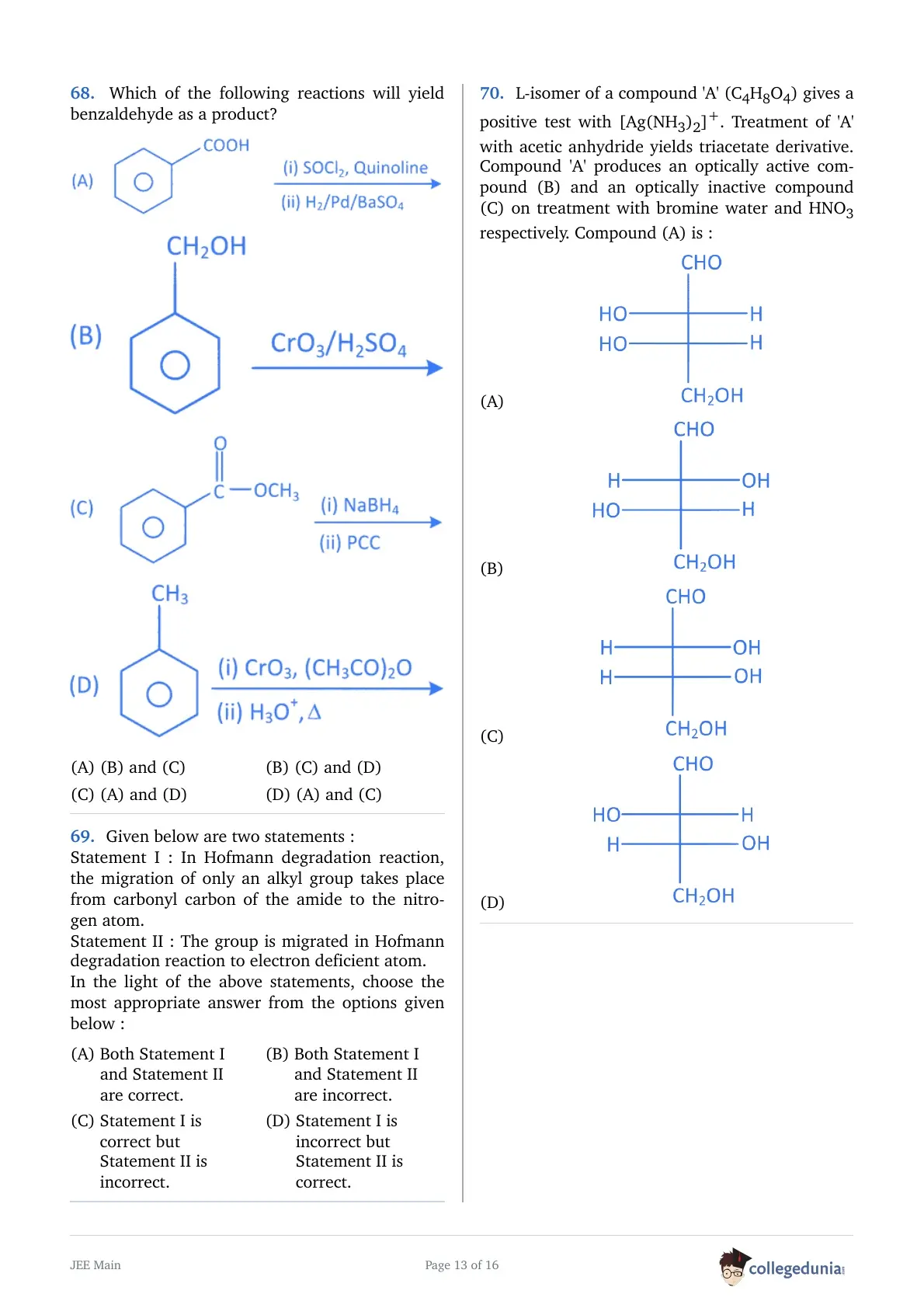
Which of the following reactions will yield benzaldehyde as a product?
Given below are two statements:
Statement-I : In Hofmann degradation reaction, the migration of only an alkyl group takes place from carbonyl carbon of the amide to the nitrogen atom.
Statement-II : The group is migrated in Hofmann degradation reaction to electron deficient atom.
In the light of the above statements, choose the most appropriate answer from the options given below:
L-isomer of a compound ‘A’ \((C_4H_8O_4)\) gives a positive test with \([Ag(NH_3)^2]^+\). Treatment of ‘A’ with acetic anhydride yields triacetate derivative. Compound ‘A’ produces an optically active compound (B) and an optically inactive compound (C) on treatment with bromine water and \(HNO_3\) respectively. Compound (A) is:
- (1)
![Option a]()
- (2)
![Option b]()
- (3)
![Option c]()
- (4)
![Option d]()


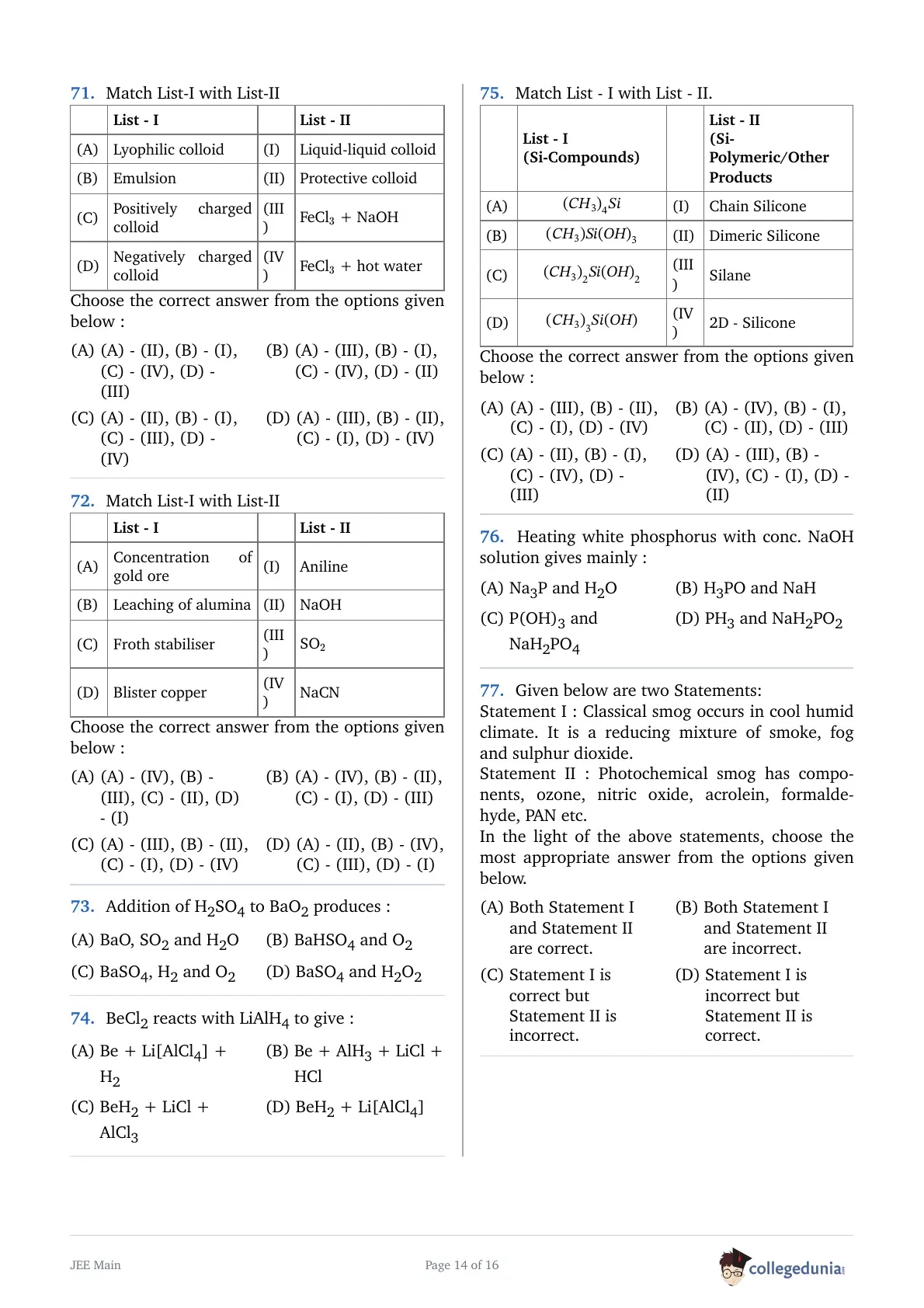
| List I | List II | ||
|---|---|---|---|
| A. | Lyophilic colloid | i | Liquid-liquid colloid |
| B. | Emulsion | ii | Protective colloid |
| C. | Positively charged | iii | \(FeCl_3 + NaOH\) |
| D. | Negatively charged | iv | \(FeCl_3 + hot\; water\) |
Choose the correct answer from the options given below :
| List I | List II | ||
|---|---|---|---|
| A. | Concentration of | i | Aniline |
| B. | Leaching of alumina | ii | NaOH |
| C. | Froth stabilizer | iii | \(SO_2\) |
| D. | Blister copper | iv | NaCN |
Choose the correct answer from the options given below.
Addition of \(H_2SO_4\) to \(BaO_2\) produces:
\(BeCl_2\) reacts with \(LiAlH_4\) to give:
| (Si-Compounds) | (Si-Polymeric/other Products) | ||
|---|---|---|---|
| A. | \((CH_3)_4Si\) | i | Chain Silicone |
| B. | \((CH_3)Si(OH)_3\) | ii | Dimeric Silicone |
| C. | \((CH_3)_2Si(OH)_2\) | iii | Silane |
| D. | \((CH_3)_3Si(OH)\) | iv | 2D-Silicone |
Choose the correct answer from the options given below:
Heating white phosphorus with conc. \(NaOH\) solution gives mainly:
Given below are two Statements:
Statement I: Classical smog occurs in cool humid climate. It is a reducing mixture of smoke, fog and sulphur dioxide.
Statement II: Photochemical smog has components, ozone, nitric oxide, acrolein, formaldehyde, PAN etc.
In the light of the above statements, choose the most appropriate answer from the options given below.
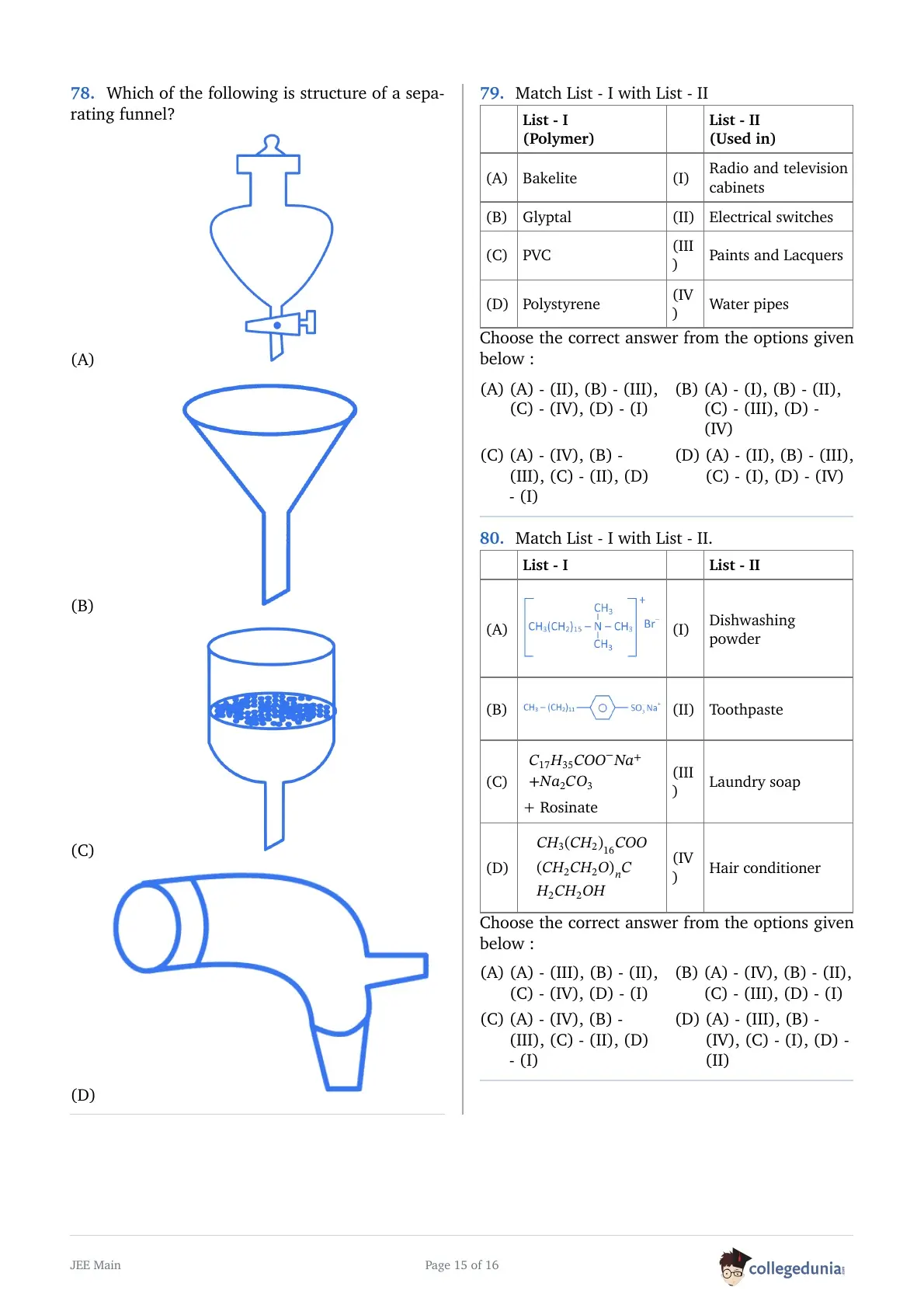
Which of the following is structure of a separating funnel?
- (1)
![Which of the following is structure of a separating funnel?]()
- (2)
![Which of the following is structure of a separating funnel?]()
- (3)
![Which of the following is structure of a separating funnel?]()
- (4)
![Which of the following is structure of a separating funnel?]()


| (Polymer) | (Used in) | ||
|---|---|---|---|
| A. | Bakelite | i | Radio and television cabinets |
| B. | Glyptal | ii | Electrical switches |
| C. | PVC | iii | Paints and Lacqures |
| D. | Polystyrene | iv | Water pipes |
Choose the correct answer from the options given below:
| List i | List II | ||
|---|---|---|---|
| A. |  | i | Dishwashing power |
| B. |  | ii | Toothpaste |
| C. | \(C_{17}H_{35}COO^–Na^++Na_2CO_3+Rosinate\) | iii | Laundry soap |
| D. | \(CH_3(CH_2)_{16}COO(CH_2CH_2O)CH_2CH_2OH\) | iv | Hair conditional |
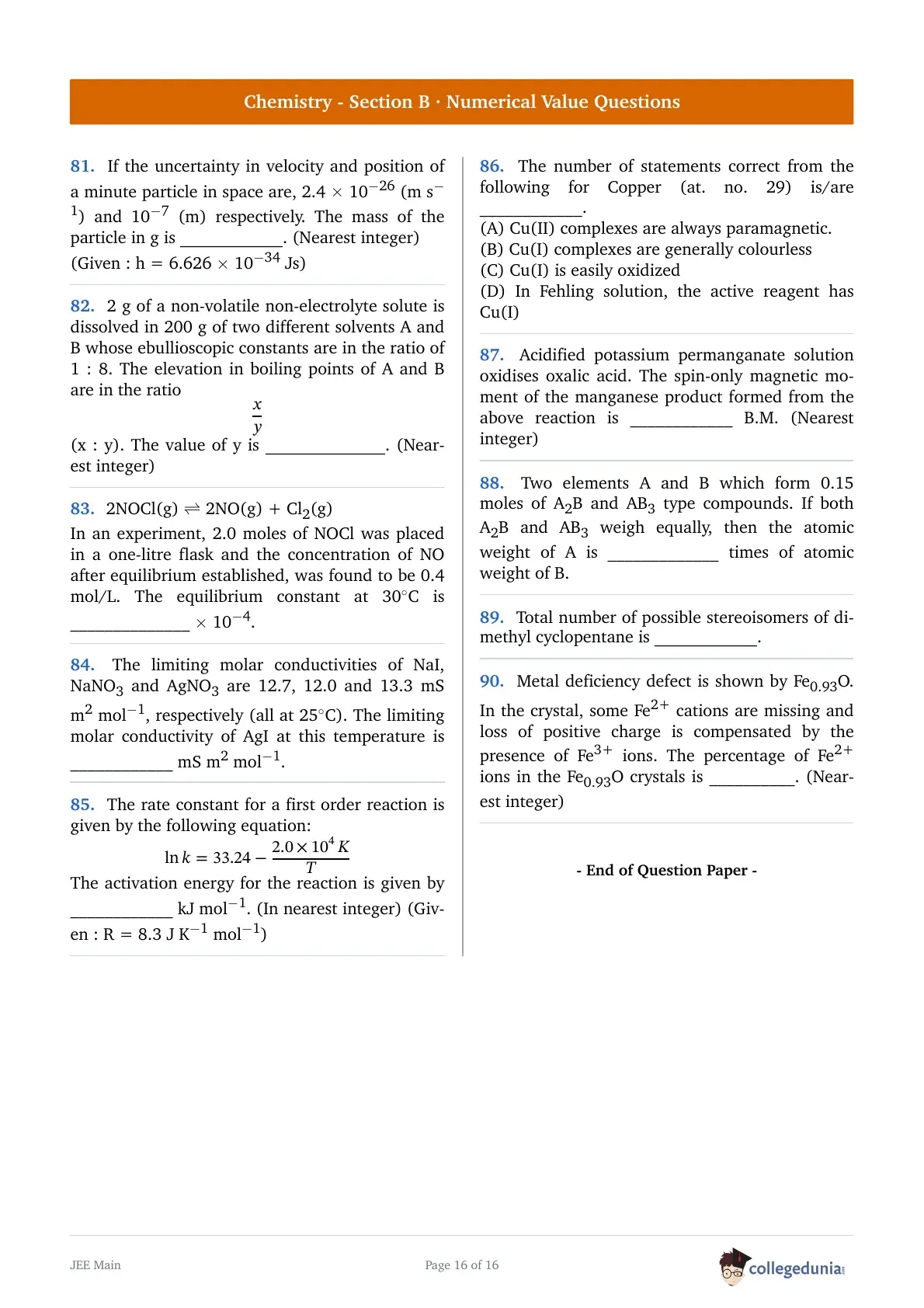
Chemistry - Section B (Q81 - Q90)
If the uncertainty in velocity and position of a minute particle in space are, \(2.4 × 10^{–26}\) \((m s^{–1)}\) and \(10^{–7} (m)\), respectively. The mass of the particle in g is _____ . (Nearest integer)
(Given : \(h = 6.626 × 10^{–34} Js\))
\(2\ g\) of a non-volatile non-electrolyte solute is dissolved in \(200\ g\) of two different solvents A and B whose ebullioscopic constants are in the ratio of \(1:8\). The elevation in boiling points of A and B are in the ratio \(\frac xy\ (x : y)\). The value of \(y\) is ______ . (Nearest Integer)
\(2NOCl(g) ⇌ 2NO(g) + Cl_2(g)\)
In an experiment, \(2.0\) moles of \(NOCl\) was placed in a one-litre flask and the concentration of \(NO\) after equilibrium established, was found to be \(0.4\) mol/ L. The equilibrium constant at \(30°C\) is ____ \(×10^{–4}\).
The limiting molar conductivities of \(NaI\), \(NaNO_3\) and \(AgNO_3\) are \(12.7\), \(12.0\) and \(13.3\) mS m2 mol–1, respectively (all at 25°C). The limiting molar conductivity of \(AgI\) at this temperature is ____ mS m2 mol–1.
The rate constant for a first order reaction is given by the following equation :
\(ln\ k=33.24−\frac {2.0×10^4\ K}{T}\)
The activation energy for the reaction is given by ______ \(kJ mol^{–1}\). (In nearest integer)
(Given : \(R = 8.3 JK^{–1} mol^{–1}\))
The number of statement(s) correct from the following for Copper (at. no. 29) is/are ______.
- Cu(II) complexes are always paramagnetic
- Cu(I) complexes are generally colourless
- Cu(I) is easily oxidized
- In Fehling solution, the active reagent has Cu(I)
Acidified potassium permanganate solution oxidises oxalic acid. The spin-only magnetic moment of the manganese product formed from the above reaction is ______ B.M. (Nearest Integer)
Two elements \(A\) and \(B\) which form \(0.15\) moles of \(A_2B\) and \(AB_3\) type compounds. If both \(A_2B\) and \(AB_3\) weigh equally, then the atomic weight of \(A\) is _____ times of atomic weight of \(B\).
Total number of possible stereoisomers of dimethyl cyclopentane is _______.
Metal deficiency defect is shown by \(Fe_{0.93}O\). In the crystal, some \(Fe^{2+}\) cations are missing and loss of positive charge is compensated by the presence of \(Fe^{3+}\) ions. The percentage of \(Fe^{2+}\) ions in the \(Fe_{0.93}O\) crystals is ______ . (Nearest integer)
JEE Main 2022 Exam Pattern and Marking Scheme
| Particulars | Details |
|---|---|
| Exam Mode | Online (Computer-Based Test) |
| Paper | B.E./B.Tech (Paper 1) |
| Duration | 3 hours (180 minutes) |
| Type of Questions | Multiple Choice Questions (MCQs) + Numerical Value Questions |
| Subjects | Mathematics, Physics, Chemistry |
| Total Questions | 90 questions (75 to be attempted) |
| Total Marks | 300 marks |
| Marking Scheme | +4 for correct answer & -1 for incorrect MCQ and Numerical Value-based Questions |
JEE Main 2022 June 27 Shift 1 Difficulty Level
As per the students’ initial reaction, JEE Main 2022 Question Paper for June 27- Shift 1 was reported as moderate. The Mathematics section in JEE Main 2022 June 27- Shift 1 Question Paper was reported as moderate and lengthy, Physics as moderate and Chemistry as easy.
JEE Main 2022 June 27 Shift 1 Subject-wise Memory-Based Solutions PDF
| Subject | Memory-Based Solutions PDF |
|---|---|
| Physics | Download PDF |
| Chemistry | Download PDF |
| Mathematics | Download PDF |
JEE Main 2022 B.E/ B. Tech Other Question Paper with Answer Key PDFs
JEE Main 2022 aspirants can practice and check their exam prep level by attempting the other session question papers as well. The table below shows JEE Main 2022 Question Paper with Answer Key and Solution PDFs for other sessions for Phase 1.
Also Check:



Comments