




JEE Main 2022 June 27 Shift 2 Question Paper is available here with solutions PDF and detailed solutions for every question. NTA conducted the second shift on June 27, 2022, from 3:00 PM to 6:00 PM. The JEE Main 2022 Paper 1 (B.E./B.Tech) question paper includes the following:
- 90 questions in a 3-hour CBT Mode: 30 each from Mathematics, Physics and Chemistry (75 to be attempted)
- Section A: 20 multiple choice questions (MCQs) per subject, all compulsory, 4 marks each
- Section B: 10 numerical value questions per subject, any 5 to be attempted, 4 marks each
- Marking: +4 for a correct answer, -1 for an incorrect answer, 0 for an unattempted question
- Maximum marks: 300 (100 per subject)
JEE Main 2022 June 27 Shift 2 Question Paper with Solution PDF
| NTA Official PDF | CD PDF | CD PDF with Solutions |
|---|---|---|
| Download official PDF 5.18 MB | Download Collegedunia PDF 1.10 MB | Download solutions PDF 1.84 MB |
Also Check:
JEE Main 2022 June 27 Shift 2 Questions with Solutions
Mathematics - Section A (Q1 - Q20)
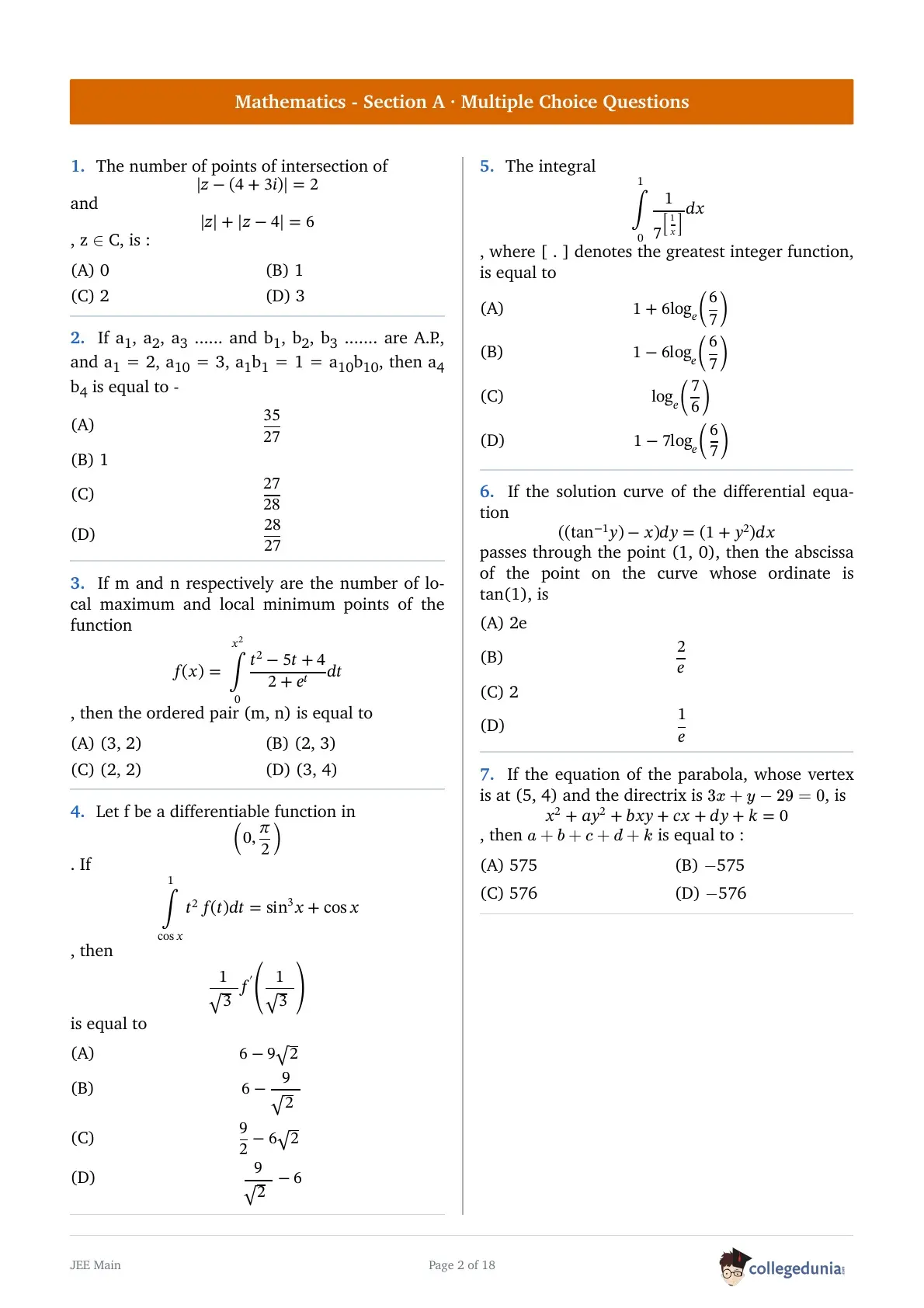
The number of points of intersection of \(|z - (4 + 3i)| = 2\) and \(|z| + |z - 4| = 6\), \(z \in \mathbb{C}\), is
If \(a_1, a_2, a_3\) ….. and \(b_1, b_2, b_3\) ….. are A.P., and \(a_1 = 2, a_{10} = 3, a_1b_1 = 1 = a_{10}b_{10}\), then \(a_4b_4\) is equal to
If m and n respectively are the number of local maximum and local minimum points of the function
\(f(x)=∫_0 ^{x^2} \frac{t^2–5t+4}{2+et}dt\), then the ordered pair (m, n) is equal to
Let f be a differentiable function in \((0, \frac{π}{2})\). If \(∫_{cosx} ^1 t^2f(t)dt=sin^3x+cosx\), then \(\frac{1}{\sqrt3}f'(\frac{1}{\sqrt3})\) is equal to
The integral \(∫_0^ 1 \frac{ 1}{7^{[\frac{1}{z}}]}dx\) where [⋅] denotes the greatest integer function, is equal to
If the solution curve of the differential equation \(((tan−1y)−x)dy=(1+y^2)dx\) passes through the point \((1, 0)\), then the abscissa of the point on the curve whose ordinate is \(tan(1)\), is
If the equation of the parabola, whose vertex is at \((5, 4)\) and the directrix is \(3x + y – 29 = 0\), is \(x^2 + ay^2 + bxy + cx + dy + k = 0\), then \(a + b + c + d + k\) is equal to
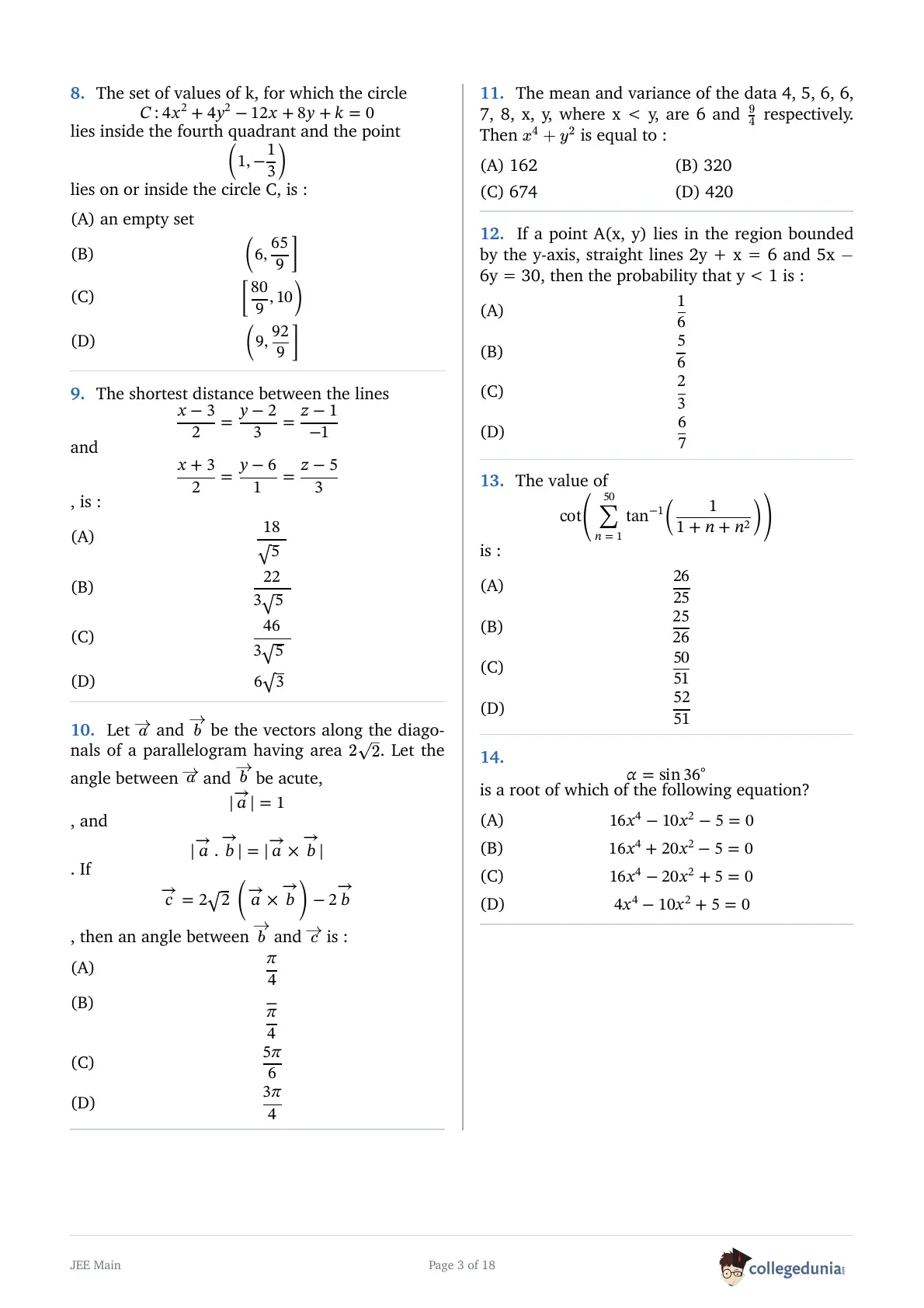
The set of values of \(k\), for which the circle \(C : 4x^2 + 4y^2 – 12x + 8y + k = 0\) lies inside the fourth quadrant and the point \(\bigg(1, -\frac{1}{3}\bigg)\) lies on or inside the circle \(C\), is
The shortest distance between the lines \(\frac{x−3}{2}=\frac{y−2}{3}=\frac{z−1}{−1}\) and \(\frac{x+3}{2}=\frac{y-6}{1}=\frac{z−5}{3}\) is
Let \(\overrightarrow a\) and \(\overrightarrow b\) be the vectors along the diagonals of a parallelogram having area \(2\sqrt2\). Let the angle between \(\overrightarrow a\) and \(\overrightarrow b\) be acute,\( |\overrightarrow a|=1\), and \(|\overrightarrow a⋅\overrightarrow b|=|\overrightarrow a×\overrightarrow b|\) If \(\overrightarrow c=2\sqrt2(\overrightarrow a×\overrightarrow b→)−2\overrightarrow b\) then an angle between\( \overrightarrow b\) and \(\overrightarrow c\) is
The mean and variance of the data \(4, 5, 6, 6, 7, 8, x, y\), where \(x<y\), are \(6\) and \(\frac{9}{4}\), respectively. Then \(x^4+y^2\) is equal to
If a point \(A(x, y)\) lies in the region bounded by the \(y\)-axis, straight lines \(2y + x = 6\) and \(5x – 6y = 30\), then the probability that \(y < 1\) is
The value of \(\cot\left(\sum_{n=1}^{50} \tan^{-1}\left(\frac{1}{1+n+n^2}\right)\right)\) is
\(\alpha = \sin 36^\circ\) is a root of which of the following equation?
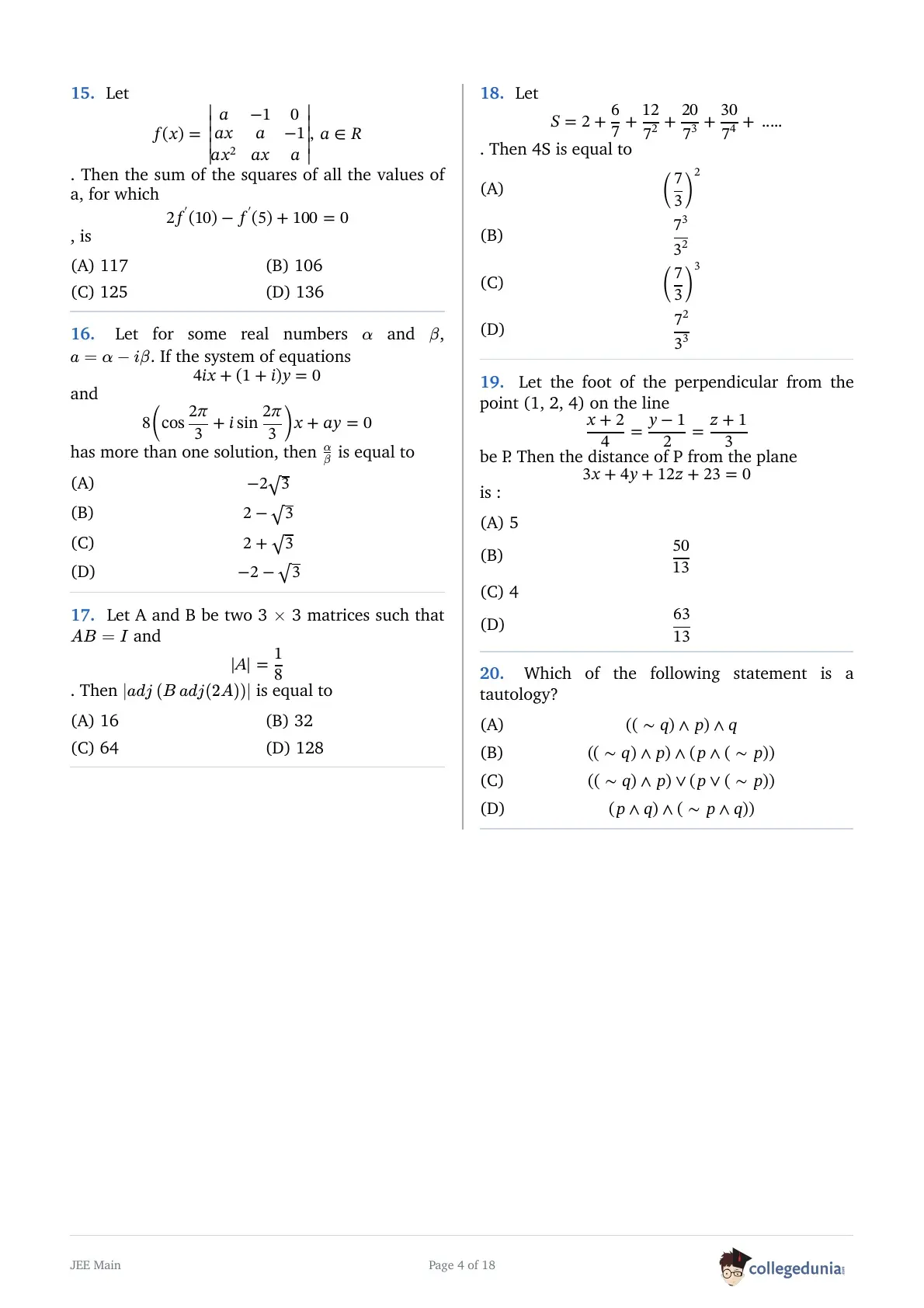
Let
\(f(x) = \begin{vmatrix} a & -1 & 0\\ ax & a & -1\\ ax^2 & ax & a \end{vmatrix}\)
a ∈ R. Then the sum of the square of all the values of a, for which 2f′(10) –f′(5) + 100 = 0, is
Let for some real numbers \(α\) and \(β\), \(a = α – iβ\). If the system of equations \(4ix + (1 + i) y = 0\) and \(8\bigg(cosx\frac{2π}{3}+i\;sin\frac{2π}{3}\bigg)x+\bar ay=0 \)has more than one solution, then \(\frac{α}{β}\) is equal to
Let A and B be two \(3 × 3\) matrices such that AB = I and |A| =\(\frac{1}{8}\). Then |adj (B adj(2A))| is equal to
Let \(S=2+\frac{6}{7}+\frac{12}{7 ^2}+\frac{20}{7 ^3}+\frac{30}{7 ^4}+…\) Then \(4S\) is equal to
Let the foot of the perpendicular from the point \((1, 2, 4)\) on the line \(\frac{x+2}{4}=\frac{y−1}{2}=\frac{z+1}{3}\) be \(P\), Then the distance of \(P\) from the plane \(3x+4y+12z+23=0\) is
Which of the following statement is a tautology?
Mathematics - Section B (Q21 - Q30)
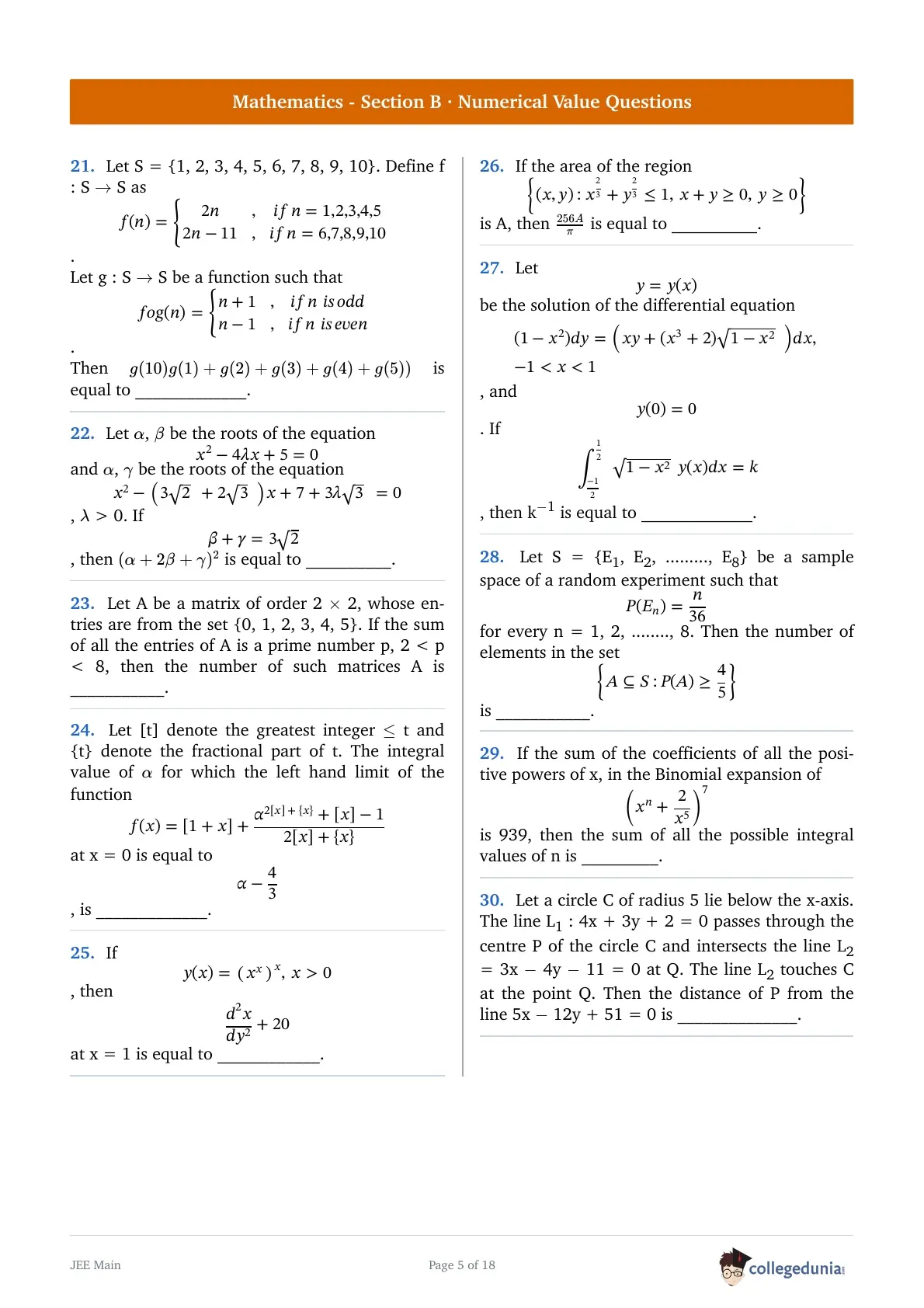
Let \(S = \{1, 2, 3, 4, 5, 6, 7, 8, 9, 10\}\). Define \(f : S → S\) as
\(f(n) = \begin{cases} 2n, & \text{if } n \in \{1,2,3,4,5\} \\ 2n-11, & \text{if } n \in \{6,7,8,9,10\} \end{cases}\)
Let \(g : S → S\) be a function such that.
\((f \circ g)(n) = \begin{cases} n + 1, & \text{if } n \text{ is odd} \\ n - 1, & \text{if } n \text{ is even} \end{cases}\)
Then \(g(10) \cdot (g(1) + g(2) + g(3) + g(4) + g(5))\) is equal to __________.
Let \(\alpha, \beta\) be the roots of the equation \(x^2 - 4\lambda x + 5 = 0\) and α, γ be the roots of the equation \(x^2 - (3\sqrt{2} + 2\sqrt{3})x + 7 + 3\lambda\sqrt{3} = 0\). If \(\beta + \gamma = 3\sqrt{2}\) then \((\alpha + 2\beta + \gamma)^2\) is equal to _______.
Let A be a matrix of order 2 × 2, whose entries are from the set {0, 1, 3, 4, 5}. If the sum of all the entries of A is a prime number p, \(2 < p < 8\), then the number of such matrices A is ___________.
Let [t] denote the greatest integer ≤ t and {t} denote the fractional part of t. The integral value of α for which the left-hand limit of the function \(f(x) = \left\lfloor 1 + x \right\rfloor + \frac{\alpha^{2\left\lfloor x \right\rfloor + \left\{ x \right\}} + \left\lfloor x \right\rfloor - 1}{2\left\lfloor x \right\rfloor + \left\{ x \right\}} \) at x=0 is equal to \(\alpha -\frac{4}{3}\), is
If \(y(x) = (x^x)^x, \quad x > 0\), then \(\frac{d^2x}{dy^2} + 20\) at \(x = 1\) is equal to __________.
If the area of the region \(\{(x, y) : x^{2/3} + y^{2/3} \leq 1, x + y \geq 0, y \geq 0\}\) is A, then \(\frac{(256 A)}{\pi} \)is equal to_______.
Let \(y = y(x)\) be the solution of the differential equation \((1 - x^2) \, dy = (xy + (x^3 + 2) \sqrt{1 - x^2}) \, dx \quad -1 < x < 1\), and \(y(0) = 0.\) If \(\int_{-\frac{1}{2}}^{\frac{1}{2}} \sqrt{1 - x^2} \, y(x) \, dx = k\) then \(k^{−1}\) is equal to_______.
Let S = {E1, E2, ……………., E8} be a sample space of a random experiment such that \(P(E_n) = \frac{n}{36}\) for every n = 1, 2, ………, 8. Then the number of elements in the set\(\{ A \subseteq S : P(A) \geq \frac{4}{5} \}\) is_________.
If the sum of the coefficients of all the positive powers of x, in the Binomial expansion of \(\left(x^n+\frac{2}{x^5}\right)^7\) is 939, then the sum of all the possible integral values of n is ____________.
Let a circle C of radius 5 lie below the x-axis. The line L1 : 4x + 3y + 2 = 0 passes through the centre P of the circle C and intersects the line L2 : 3x – 4y – 11 = 0 at Q. The line L2 touches C at the point Q. Then the distance of P from the line 5x – 12y + 51 = 0 is _____
Physics - Section A (Q31 - Q50)
The SI unit of a physical quantity is pascal-second. The dimensional formula of this quantity will be
The distance of the Sun from Earth is \(1.5 × 10^{11}\) \(m\), and its angular diameter is \((2000)\) \(s\) when observed from the earth. The diameter of the Sun will be :
When a ball is dropped into a lake from a height 4.9 m above the water level, it hits the water with a velocity v and then sinks to the bottom with the constant velocity v. It reaches the bottom of the lake 4.0 s after it is dropped. The approximate depth of the lake is :
One end of a massless spring of spring constant k and natural length \(l_0\) is fixed while the other end is connected to a small object of mass \(m\) lying on a frictionless table. The spring remains horizontal on the table. If the object is made to rotate at an angular velocity \(ω\) about an axis passing through fixed end, then the elongation of the spring will be :
A stone tied to a string of length \(L\) is whirled in a vertical circle with the other end of the string at the centre. At a certain instant of time, the stone is at its lowest position and has a speed \(u\). The magnitude of change in its velocity, as it reaches a position where the string is horizontal, is \(\sqrt{x(u^2−gL)}\). The value of \(x\) is
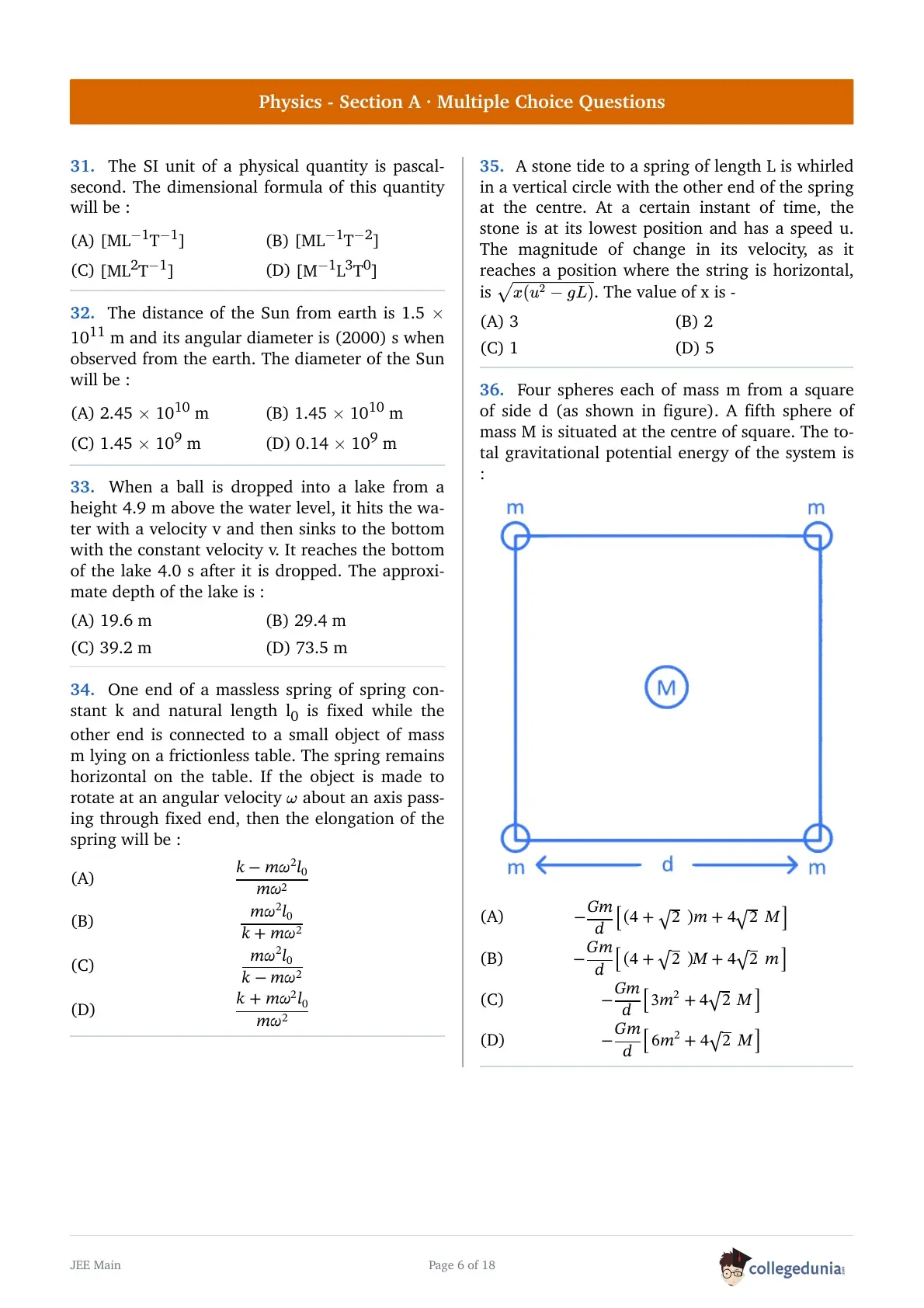
Four spheres each of mass m form a square of side d (as shown in figure). A fifth sphere of mass M is situated at the centre of square. The total gravitational potential energy of the system is:
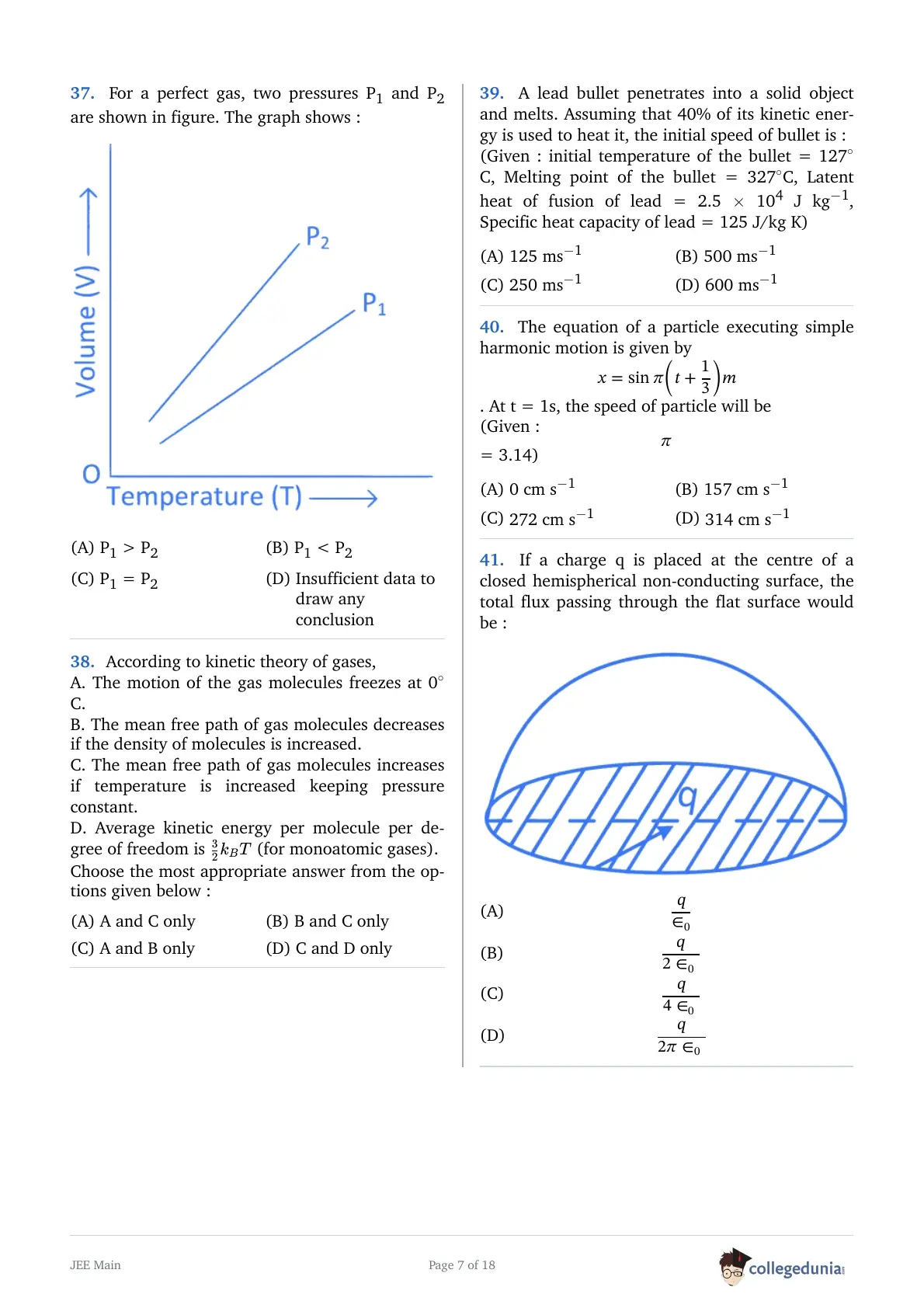
For a perfect gas, two pressures \(P_1\) and \(P_2\) are shown in the figure. The graph shows:
According to kinetic theory of gases,
A. The motion of the gas molecules freezes at 0°C
B. The mean free path of gas molecules decreases if the density of molecules is increased.
C. The mean free path of gas molecules increases if temperature is increased keeping pressure constant.
D. Average kinetic energy per molecule per degree of freedom is \(\frac{3}{2}k_BT\) (for monoatomic gases).
Choose the most appropriate answer from the options given below:
A lead bullet penetrates into a solid object and melts. Assuming that 40% of its kinetic energy is used to heat it, the initial speed of bullet is: (Given initial temperature of the bullet = 127°C), Melting point of the bullet = 327°C, Latent heat of fusion of lead = \(2.5 × 10^4 J kg^{–1}\) Specific heat capacity of lead = 125 J/kg K)
The equation of a particle executing simple harmonic motion is given by \(x=sin\;π\bigg(t+\frac{1}{3}\bigg)m\). At \(t = 1s\), the speed of the particle will be
If a charge q is placed at the centre of a closed hemispherical non-conducting surface, the total flux passing through the flat surface would be:
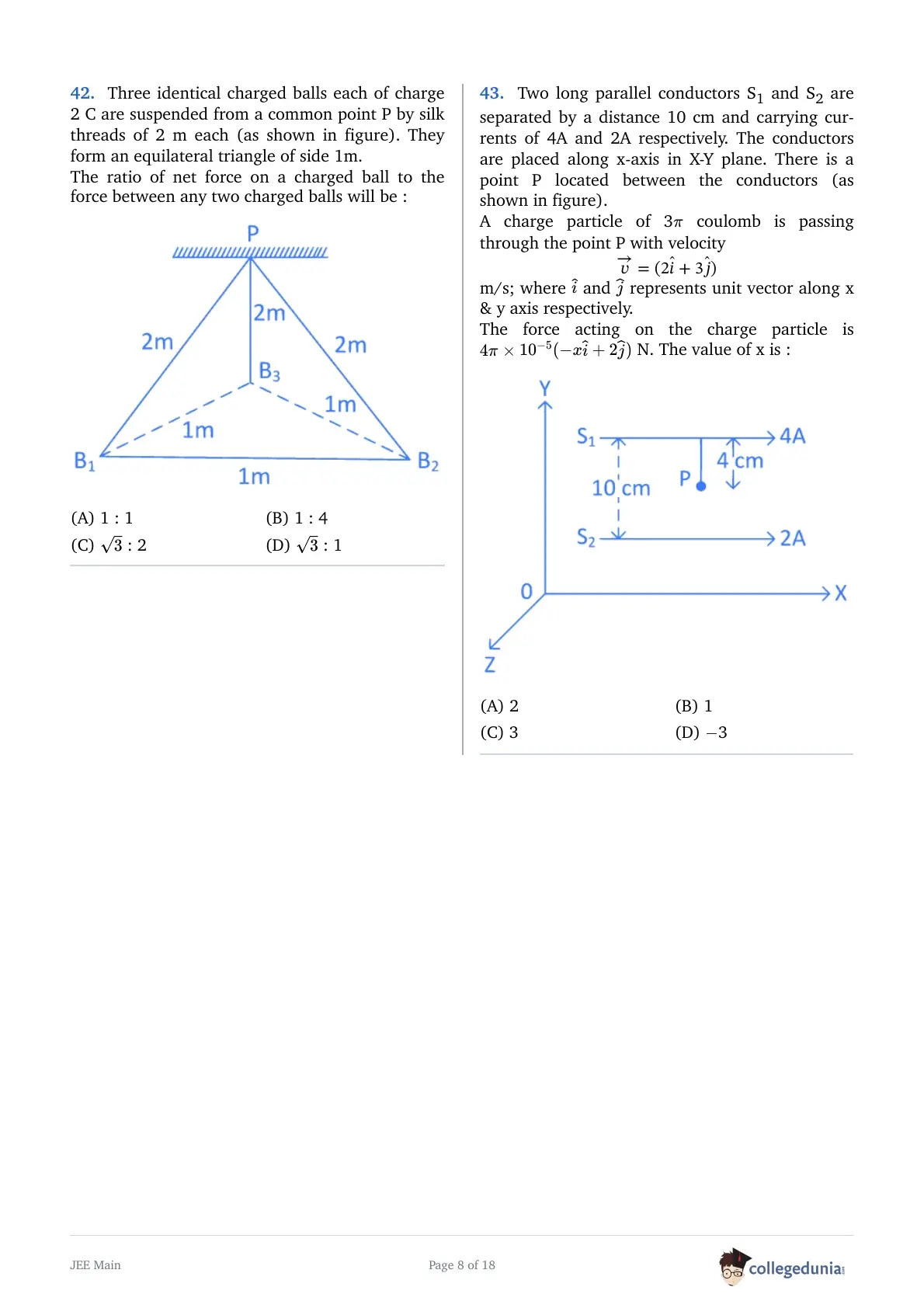
Three identical charged balls each of charge \(2\) \(C\) are suspended from a common point \(P\) by silk threads of \(2\) \(m\) each (as shown in figure). They form an equilateral triangle of side \(1\) \(m\). The ratio of net force on a charged ball to the force between any two charged balls will be:
Two long parallel conductors \(S_1\) and \(S_2\) are separated by a distance \(10\) cm and carrying currents of \(4\) A and \(2\) A respectively. The conductors are placed along x-axis in X–Y plane. There is a point P located between the conductors (as shown in figure). A charge particle of \(3π\) coulomb is passing through the point P with velocity \(\overrightarrow v=(2\hat i+3\hat j)\) m/s; where \(\hat i\) and \(\hat j\) represents unit vector along x & y axis respectively. The force acting on the charge particle is \(4π×10^{−5}(−x\hat i+2\hat j)N\). The value of x is:
If L, C and R are the self-inductance, capacitance and resistance, respectively, which of the following does not have the dimension of time?
Given below are two statements:
Statement I: A time varying electric field is a source of changing magnetic field and vice-versa. Thus a disturbance in electric or magnetic field creates EM waves.
Statement II: In a material medium, the EM wave travels with speed
\(V=\frac{1}{\sqrt{µ0ε0}}\) In the light of the above statements, choose the correct answer from the options given below.
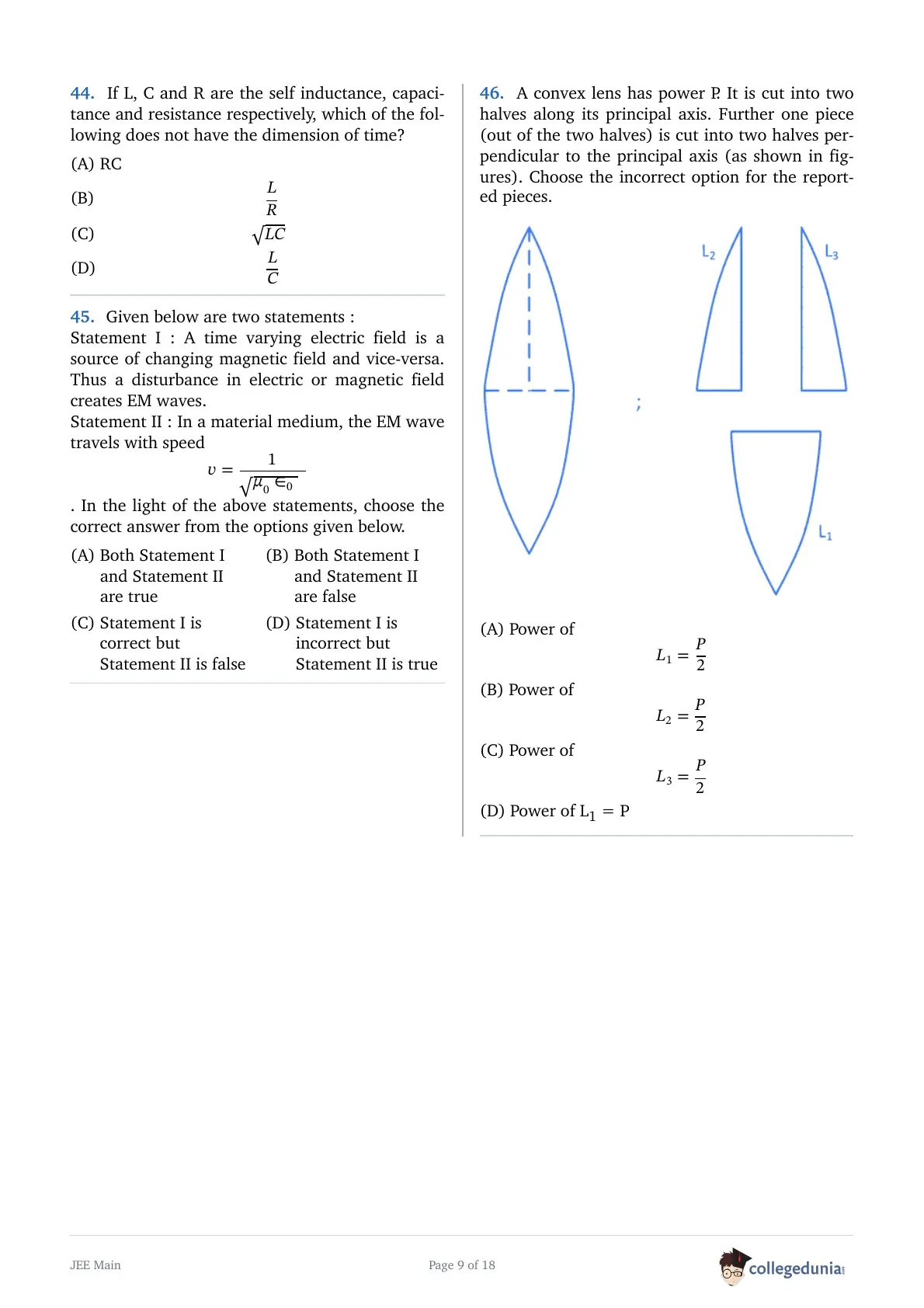
A convex lens has power P. It is cut into two halves along its principal axis. Further one piece (out of the two halves) is cut into two halves perpendicular to the principal axis . Choose the incorrect option for the reported pieces.
If a wave gets refracted into a denser medium, then which of the following is true?
Given below are two statements:
Statement I: In hydrogen atom, the frequency of radiation emitted when an electron jumps from lower energy orbit \((E_1)\) to higher energy orbit \((E_2)\), is given as \(hf = E_1 – E_2.\)
Statement II: The jumping of electron from higher energy orbit \((E_2)\) to lower energy orbit \((E_1)\) is associated with frequency of radiation given as
\(f=\frac{(E_2−E_1)}{h}\) This condition is Bohr’s frequency condition.
In the light of the above statements, choose the correct answer from the options given below:
For a transistor to act as a switch, it must be operated in
We do not transmit low frequency signal to long distance because-
(a) The size of the antenna should be comparable to signal wavelength which is unreal solution for a signal of longer wavelength
(b) Effective power radiated by a long wavelength baseband signal would be high
(c) We want to avoid mixing up signals transmitted by different transmitter simultaneously
(d) Low frequency signal can be sent to long distances by superimposing with a high frequency wave as well
Therefore, the most suitable option will be
Physics - Section B (Q51 - Q60)
A mass of \(10\) kg is suspended vertically by a rope of length \(5\) m from the roof. A force of \(30\) N is applied at the middle point of rope in horizontal direction. The angle made by upper half of the rope with vertical is \(θ\) = \(tan^{–1} (x × 10^{–1})\). The value of \(x\) is _______.(Given, \(g = 10\; m/s^2\))
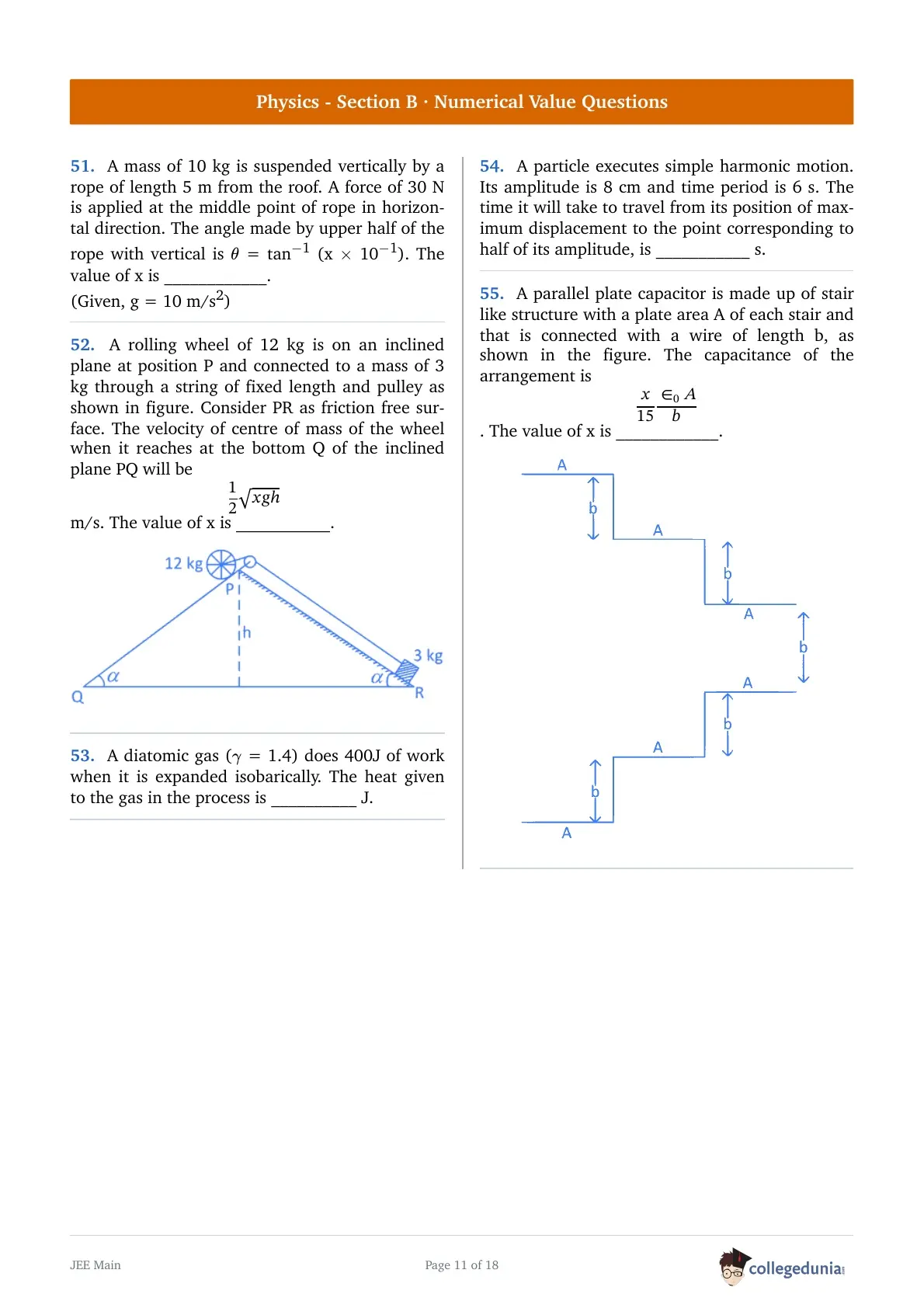
A rolling wheel of \(12\) kg is on an inclined plane at position P and connected to a mass of \(3\) kg through a string of fixed length and pulley as shown in figure. Consider PR as friction free surface.
The velocity of centre of mass of the wheel when it reaches at the bottom Q of the inclined plane PQ will be \(\frac{1}{2}\sqrt{ xgh}\) \(m/s\). The value of x is _________.
A diatomic gas\( (γ = 1.4)\) does \(400\) \(J\) of work when it is expanded isobarically. The heat given to the gas in the process is ________ \(J\).
A particle executes simple harmonic motion. Its amplitude is 8 cm and time period is 6s. The time it will take to travel from its position of maximum displacement to the point corresponding to half of its amplitude, is _________s.
A parallel plate capacitor is made up of stair like structure with a plate area A of each stair and that is connected with a wire of length b, as shown in the figure. The capacitance of the arrangement is \(\frac{x}{15} \frac{ε_0A}{b}\), the value of \(x\) is ______?
The current density in a cylindrical wire of radius \(r = 4.0\) mm is \(1.0 \times 10^6\) \(A/m^2\). The current through the outer portion of the wire between radial distances \(\frac{r}{2}\) and \(r\) is \(xπ\) \(A\); where \(x\) is _________.
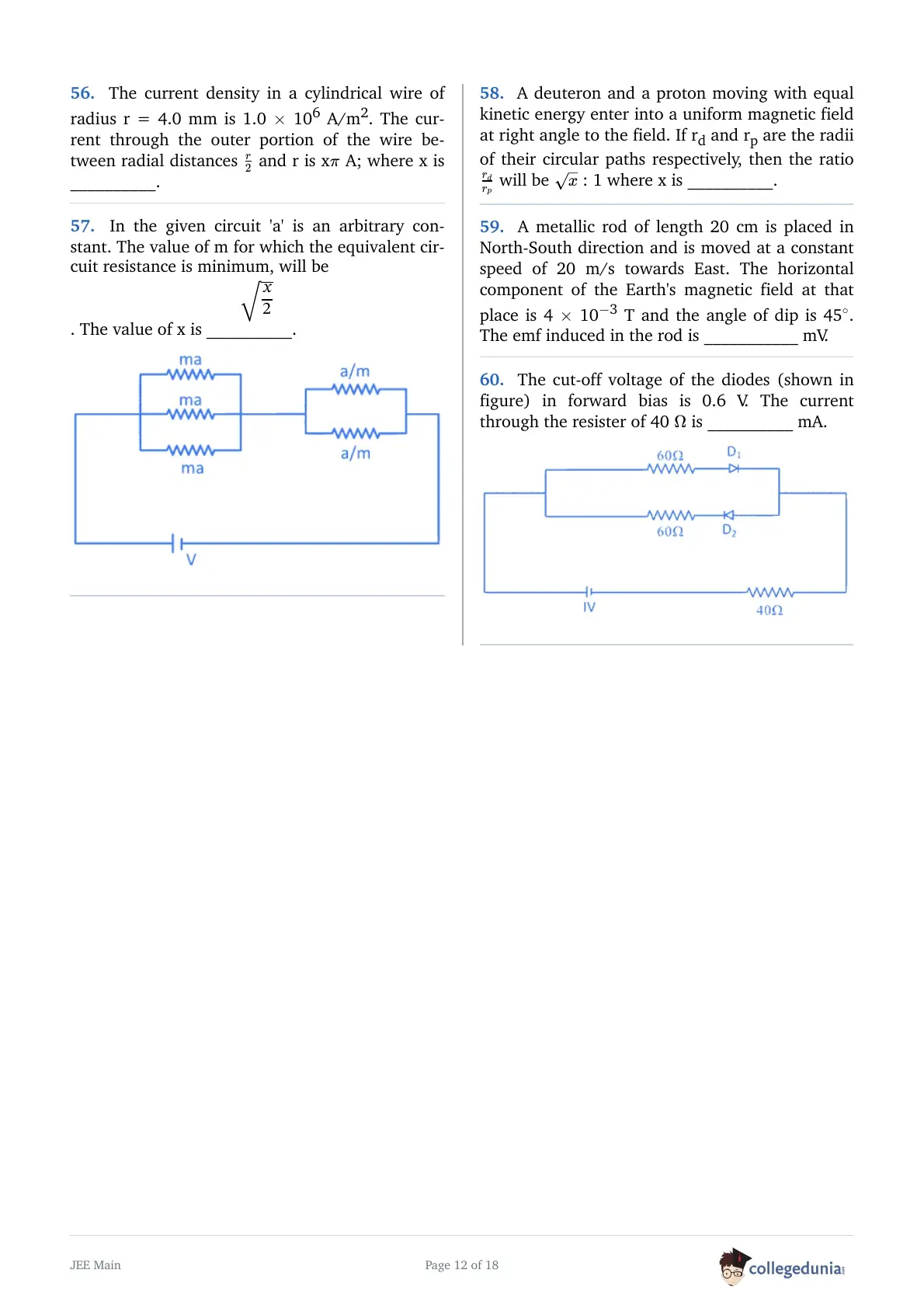
In the given circuit ‘a‘ is an arbitrary constant. The value of m for which the equivalent circuit resistance is minimum, will be \(\frac{\sqrt x}{2}\).The value of x is________.
A deuteron and a proton moving with equal kinetic energy enter into a uniform magnetic field at right angle to the field. If \(r_d\) and \(r_p\) are the radii of their circular paths respectively, then the ratio \(\frac{r_d}{r_p}\) will be \(\sqrt x:1\) where \(x\) is__________
A metallic rod of length \(20\) cm is placed in North-South direction and is moved at a constant speed of 20 m/s towards East. The horizontal component of the Earth’s magnetic field at that place is \(4 × 10^{–3}\) T and the angle of dip is \(45º\). The emf induced in the rod is __________mV.
The cut-off voltage of the diodes (shown in figure) in forward bias is \(0.6\; V\). The current through the resistor of \(40\) \(Ω\) is____ mA.
Chemistry - Section A (Q61 - Q80)
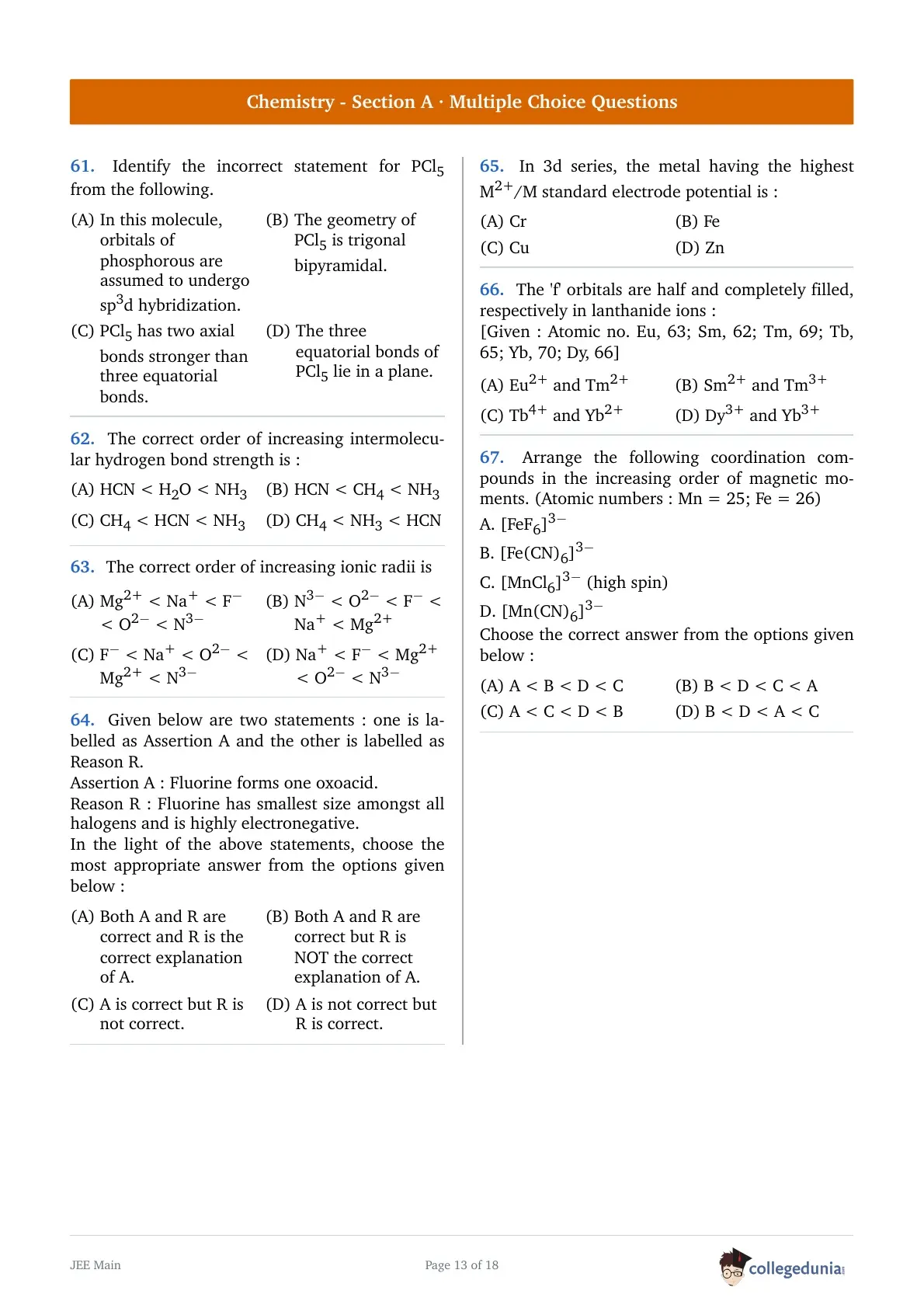
Identify the incorrect statement for \(PCl_5\) from the following.
The correct order of increasing intermolecular hydrogen bond strength is
The correct order of increasing ionic radii is
Given below are two statements: one is labelled as Assertion A and the other is labelled as Reason R.
Assertion A: Fluorine forms one oxoacid.
Reason R: Fluorine has smallest size amongst all halogens and is highly electronegative.
In the light of the above statements, choose the most appropriate answer from the option given below.
In \(3d\) series, the metal having the highest \(M^{2+}/M\) standard electrode potential is
The ′f′ orbitals are half and completely filled, respectively in lanthanide ions
[Given: Atomic no. Eu, 63; Sm, 62; Tm, 69; Tb, 65; Yb, 70; Dy, 66]
Arrange the following coordination compounds in the increasing order of magnetic moments. (Atomic numbers: \(Mn = 25; Fe = 26\))
(1) \([FeF_6]^{3–}\)
(2) \([Fe(CN)_6]^{3–}\)
(3) \([MnCl_6]^{3–}\) (high spin)
(4) \([Mn(CN)_6]^{3–}\)


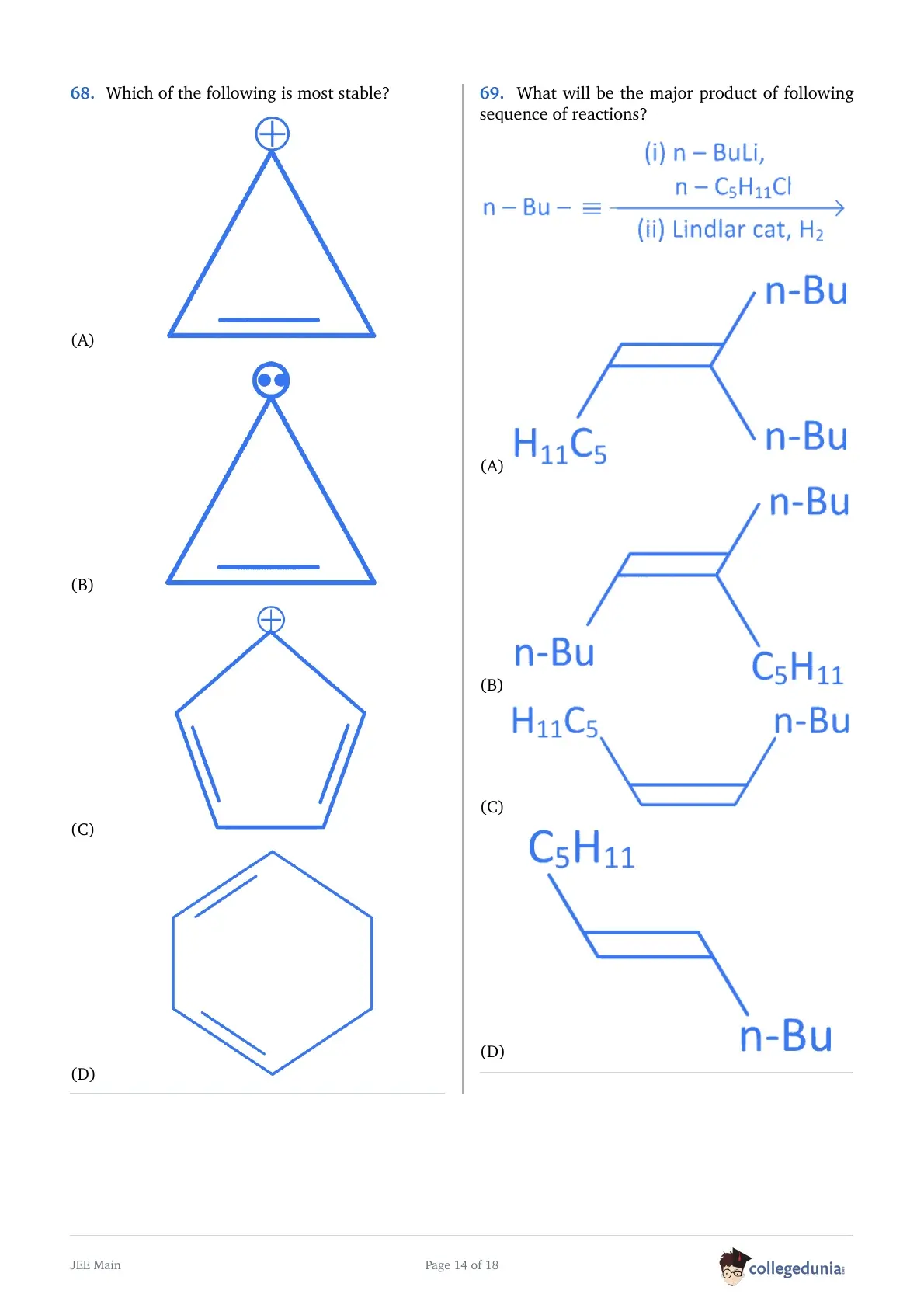
What will be the major product of the following sequence of reactions?
\(n−Bu−≡ \xrightarrow[{(ii)Lindlar catalyst, H_2}]{(i)n-BuLi,n-C_5H_{11}Cl}\)
- (1)
![sequence of reactions]()
- (2)
![sequence of reactions]()
- (3)
![sequence of reactions]()
- (4)
![sequence of reactions]()


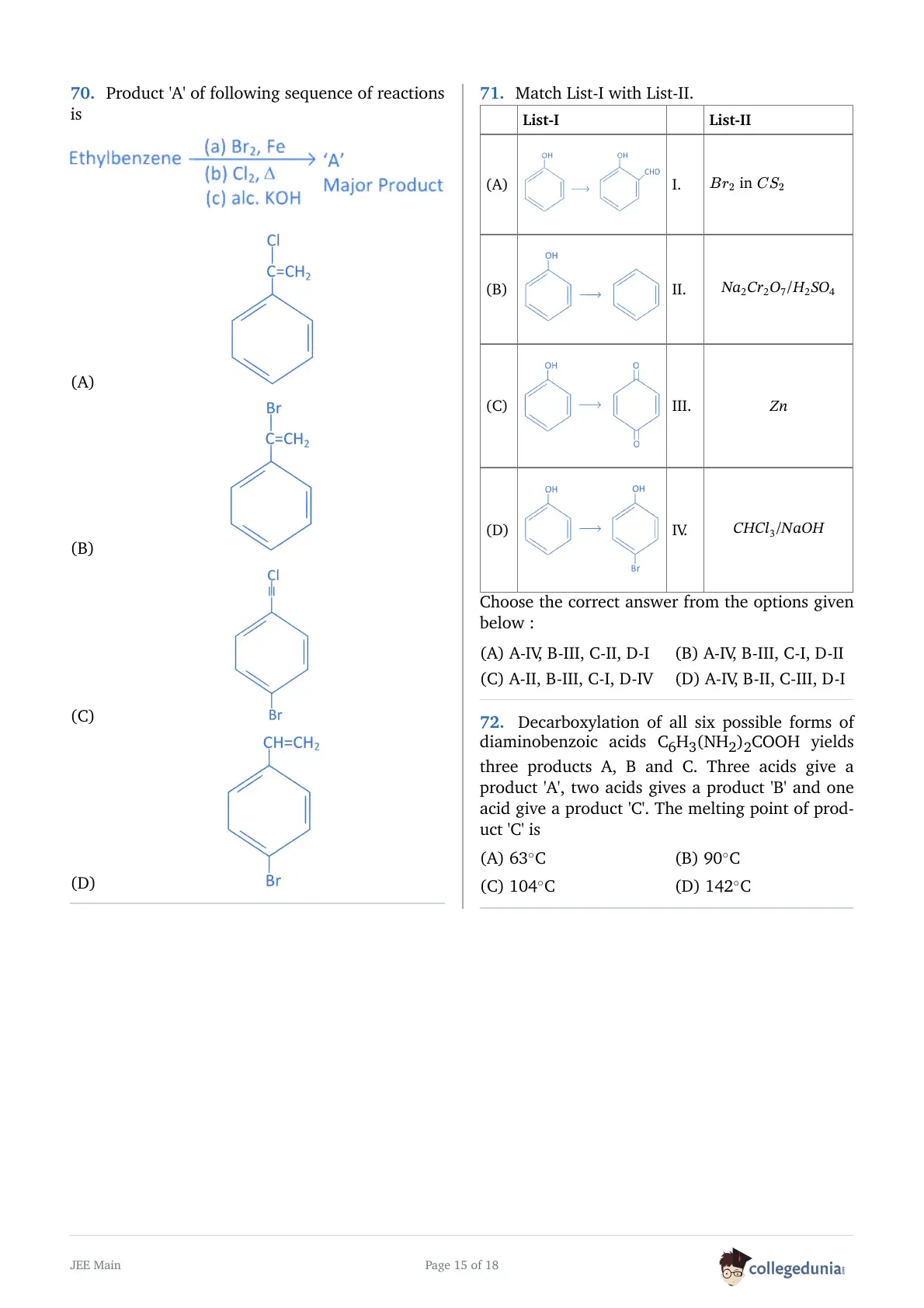
Product ‘A’ of the following sequence of reactions is
\(Ethylbenzene \xrightarrow[{(b)Cl_2,Δ;(c) alc.KOH}]{ (a)Br_2,Fe }\)‘ \(\; \;\; \;\;A′\\major Product\)
- (1)
![sequence of reactions is]()
- (2)
![sequence of reactions is]()
- (3)
![sequence of reactions is]()
- (4)
![sequence of reactions is]()


| List-I | List-II | ||
| A. |  | I. | Br2 in CS2 |
| B. |  | II. | Na2CR2O7/H2SO4 |
| C. |  | III. | Zn |
| D. |  | IV. | CHCl3/NaOH |
Choose the correct answer from the options given below:
Decarboxylation of all six possible forms of diaminobenzoic acid \(C_6H_3(NH_2)2COOH\) yields three products A, B and C. Three acids give a product ‘A’, two acids give a product ‘B’ and one acid gives a product ‘C’. The melting point of product ‘C’ is
Given below are two statements :
Statement I: Maltose has two\(α-D-glucose\) units linked at \(C_1\) and \(C_4\) and is a reducing sugar.
Statement II: Maltose has two monosaccharides :
\(α-D-glucose\) and \(β-D-glucose\) linked at \(C_1\) and \(C_6\) and it is a non-reducing sugar.
In the light of the above statements, choose the correct answer from the options given below.
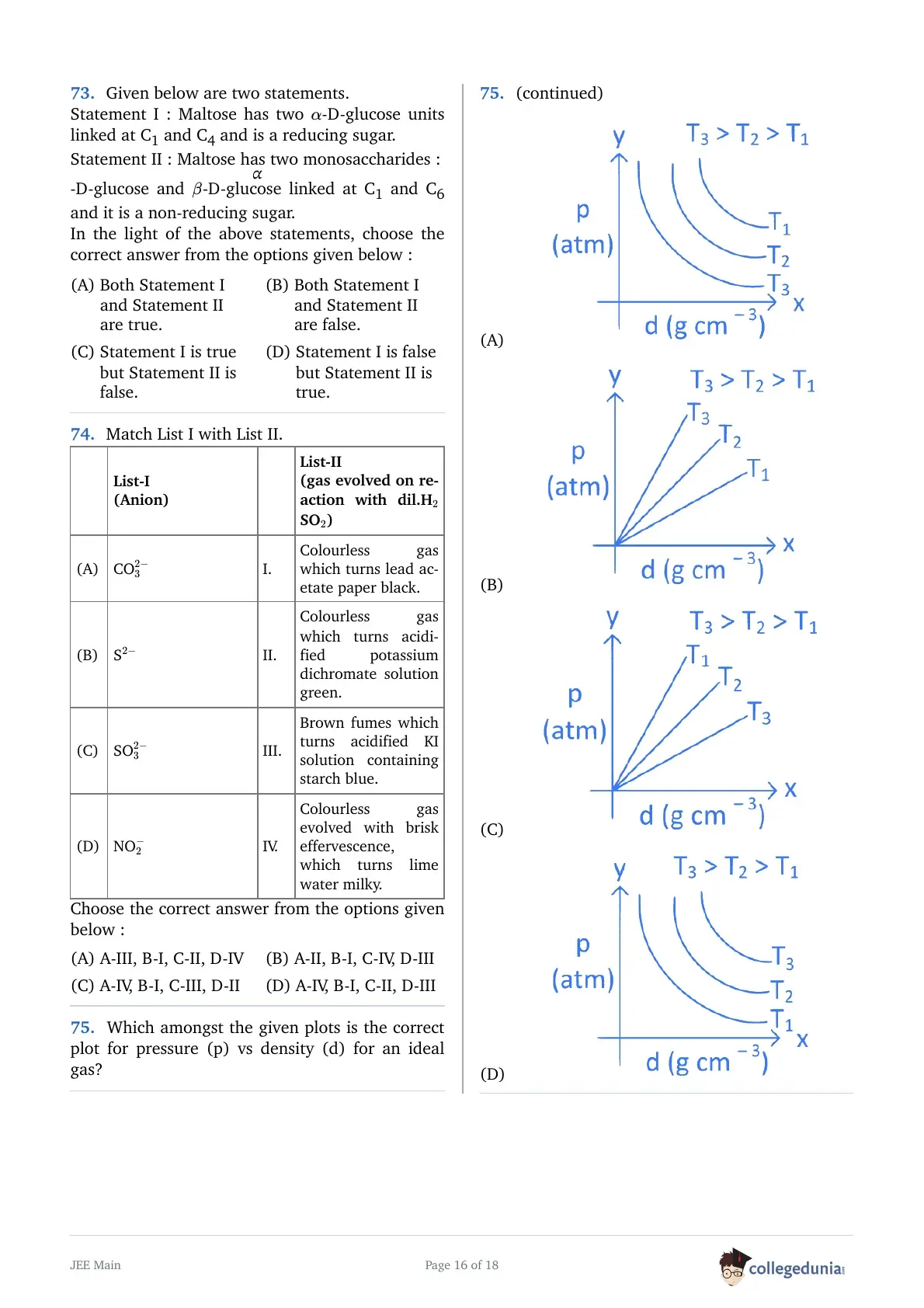
| List I (Anion) | List II (gas evolved on reaction with dil \(H_2SO_4\)) | ||
|---|---|---|---|
| A. | \(CO_3^{ 2−}\) | I. | Colourless gas which turns lead acetate paper black. |
| B. | \(S^{2–}\) | II. | Colourless gas which turns acidified potassium dichromate solution green |
| C. | \(SO_3^{ 2−}\) | III. | Brown fumes which turns acidified KI solution containing starch blue. |
| D. | \(NO_2^{−}\) | IV. | Colourless gas evolved with brisk effervescence, which turns lime water milky. |
Which amongst the given plots is the correct plot for pressure \((p)\) vs density \((d)\) for an ideal gas?
- (1)
![plot for pressure (p) vs density (d) for an ideal gas]()
- (2)
![plot for pressure (p) vs density (d) for an ideal gas]()
- (3)
![plot for pressure (p) vs density (d) for an ideal gas]()
- (4)
![plot for pressure (p) vs density (d) for an ideal gas]()


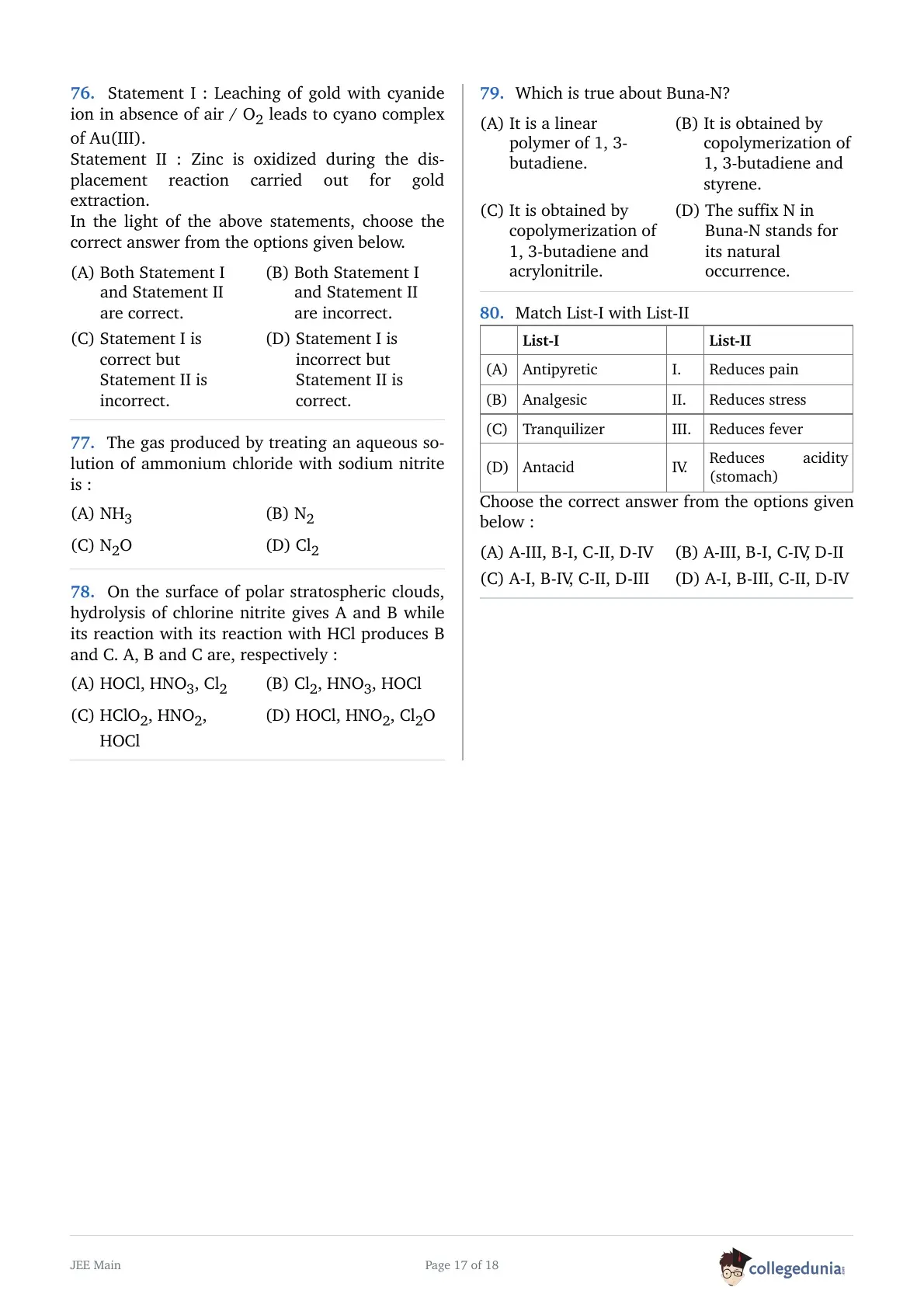
Statement-I : Leaching of gold with cyanide ion in absence of air/O2 leads to cyano complex of Au(III).
Statement-II : Zinc is oxidized during the displacement reaction carried out for gold extraction.
In the light of the above statements, choose the correct answer from the options given below.
The gas produced by treating an aqueous solution of ammonium chloride with sodium nitrite is
On the surface of polar stratospheric clouds, hydrolysis of chlorine nitrate gives A and B while its reaction with HCl produces B and C. A, B and C are, respectively
Which is true about Buna-N?
| List I | List II | ||
|---|---|---|---|
| A. | Antipyretic | I. | Reduces pain |
| B. | Analgesic | II. | Reduces stress |
| C. | Tranquilizer | III. | Reduces fever |
| D. | Antacid | IV. | Reduces acidity (stomach) |
Chemistry - Section B (Q81 - Q90)
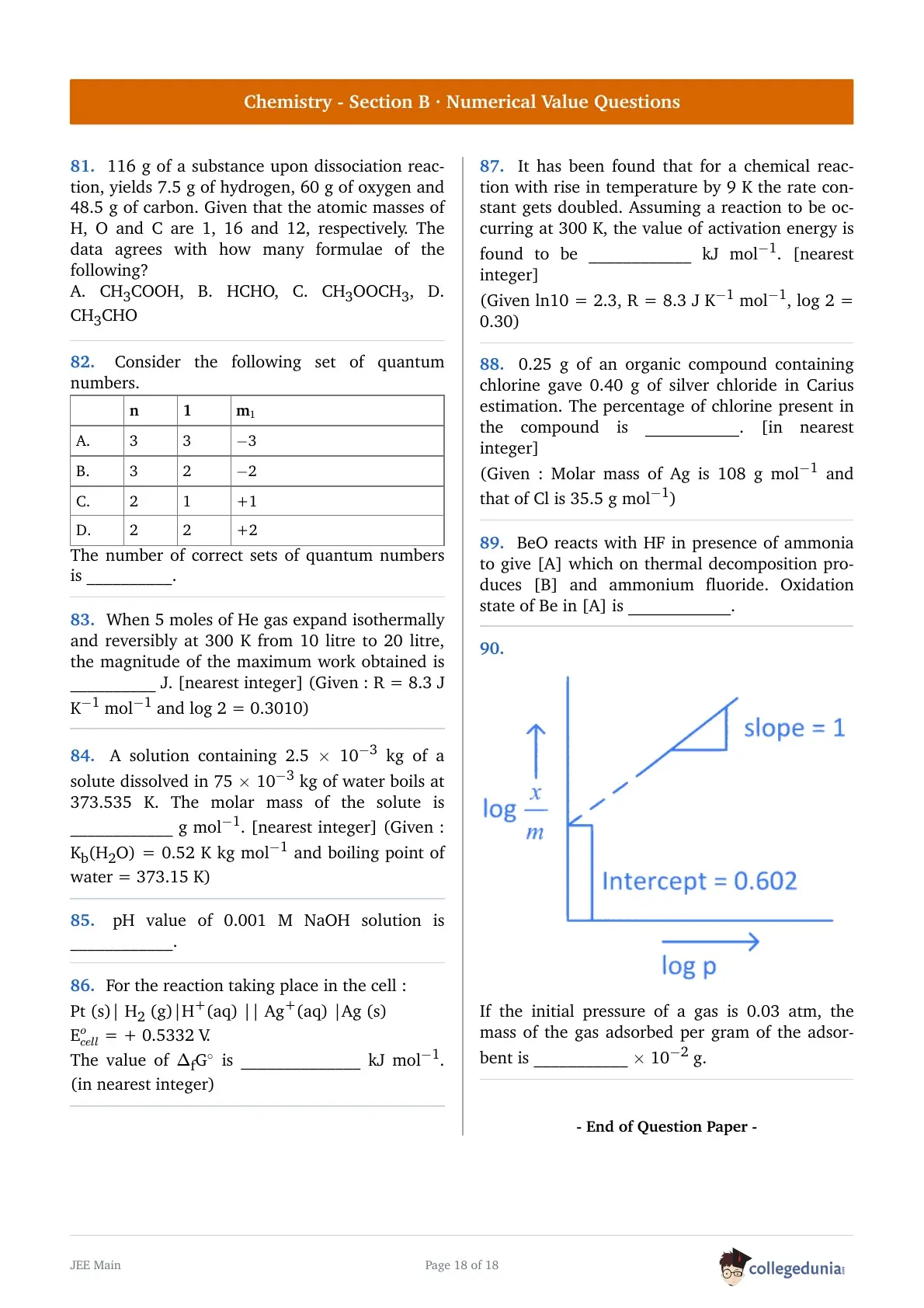
116 g of a substance upon dissociation reaction, yields 7.5 g of hydrogen, 60 g of oxygen and 48.5 g of carbon. Given that the atomic masses of H, O and C are 1, 16 and 12, respectively. The data agrees with how many formulae of the following? _______
A. \(CH_3COOH\)
B. \(HCHO\)
C. \(CH_3OOCH_3\)
D. \(CH_3CHO\)
Consider the following set of quantum numbers.
\(n \,|\, m_|\)
A. 3 3 –3
B. 3 2 –2
C. 2 1 +1
D. 2 2 +2
The number of correct sets of quantum numbers is _____.
When 5 moles of He gas expand isothermally and reversibly at 300 K from 10 litre to 20 litre, the magnitude of the maximum work obtained is _____ J. [nearest integer] (Given : R = 8.3 J K–1 mol–1 and log 2 = 0.3010)
A solution containing 2.5 × 10⁻³ kg of a solute dissolved in 75 × 10–3 kg of water boils at 373.535 K. The molar mass of the solute is _____ g mol–1. [nearest integer] (Given : Kb(H2O) = 0.52 K kg mol–1 and boiling point of water = 373.15 K)
pH value of 0.001 M NaOH solution is _______.
For the reaction taking place in the cell:
Pt(s) | H2(g) | H+ (q) || Ag+(aq) | Ag(s),
Eocell = + 0.5332 V.
The value of ΔfGo is _____kJ mol–1 [in nearest integer]
It has been found that for a chemical reaction with rise in temperature by 9 K the rate constant gets doubled. Assuming a reaction to be occurring at 300 K, the value of activation energy is found to be _________kJ mol–1. [nearest integer] (Given ln10 = 2.3, R = 8.3 J K–1 mol–1, log 2 = 0.30)
0.25 g of an organic compound containing chlorine gave 0.40 g of silver chloride in Carius estimation. The percentage of chlorine present in the compound is ______. [in nearest integer]
(Given : Molar mass of \(Ag\) is 108 g mol–1 and that of \(Cl\) is 35.5 g mol–1
\(BeO\) reacts with \(HF\) in presence of ammonia to give \([A]\) which on thermal decomposition produces \([B]\) and ammonium fluoride. Oxidation state of Be in \([A]\) is _______

If the initial pressure of a gas 0.03 atm, the mass of the gas absorbed per gram of the adsorbent is ____× 10–2g
JEE Main 2022 Exam Pattern and Marking Scheme
| Particulars | Details |
|---|---|
| Exam Mode | Online (Computer-Based Test) |
| Paper | B.E./B.Tech (Paper 1) |
| Duration | 3 hours (180 minutes) |
| Type of Questions | Multiple Choice Questions (MCQs) + Numerical Value Questions |
| Subjects | Mathematics, Physics, Chemistry |
| Total Questions | 90 questions (75 to be attempted) |
| Total Marks | 300 marks |
| Marking Scheme | +4 for correct answer & -1 for incorrect MCQ and Numerical Value-based Questions |
JEE Main 2022 June 27 Shift 2 Difficulty Level
As per the students’ initial reaction, JEE Main 2022 Question Paper for June 27- Shift 2 was reported as moderate. The Mathematics section in JEE Main 2022 June 27- Shift 2 Question Paper was reported as difficult, Physics as moderate and Chemistry as easy.
JEE Main 2022 June 27 Shift 2 Subject-wise Memory-Based Solutions PDF
| Subject | Memory-Based Solutions PDF |
|---|---|
| Physics | Download PDF |
| Chemistry | Download PDF |
| Mathematics | Download PDF |
JEE Main 2022 B.E/ B. Tech Other Question Paper with Answer Key PDFs
JEE Main 2022 aspirants can practice and check their exam prep level by attempting the other session question papers as well. The table below shows JEE Main 2022 Question Paper with Answer Key and Solution PDFs for other sessions for Phase 1.
Also Check:



Comments