




JEE Main 2022 June 29 Shift 2 Question Paper is available here with solutions PDF and detailed solutions for every question. NTA conducted the second shift on June 29, 2022, from 3:00 PM to 6:00 PM. The JEE Main 2022 Paper 1 (B.E./B.Tech) question paper includes the following:
- 90 questions in a 3-hour CBT Mode: 30 each from Mathematics, Physics and Chemistry (75 to be attempted)
- Section A: 20 multiple choice questions (MCQs) per subject, all compulsory, 4 marks each
- Section B: 10 numerical value questions per subject, any 5 to be attempted, 4 marks each
- Marking: +4 for a correct answer, -1 for an incorrect answer, 0 for an unattempted question
- Maximum marks: 300 (100 per subject)
JEE Main 2022 June 29 Shift 2 Question Paper with Solution PDF
| NTA Official PDF | CD PDF | CD PDF with Solutions |
|---|---|---|
| Download official PDF 4.62 MB | Download Collegedunia PDF 0.89 MB | Download solutions PDF 0.87 MB |
Also Check:
JEE Main 2022 June 29 Shift 2 Questions with Solutions
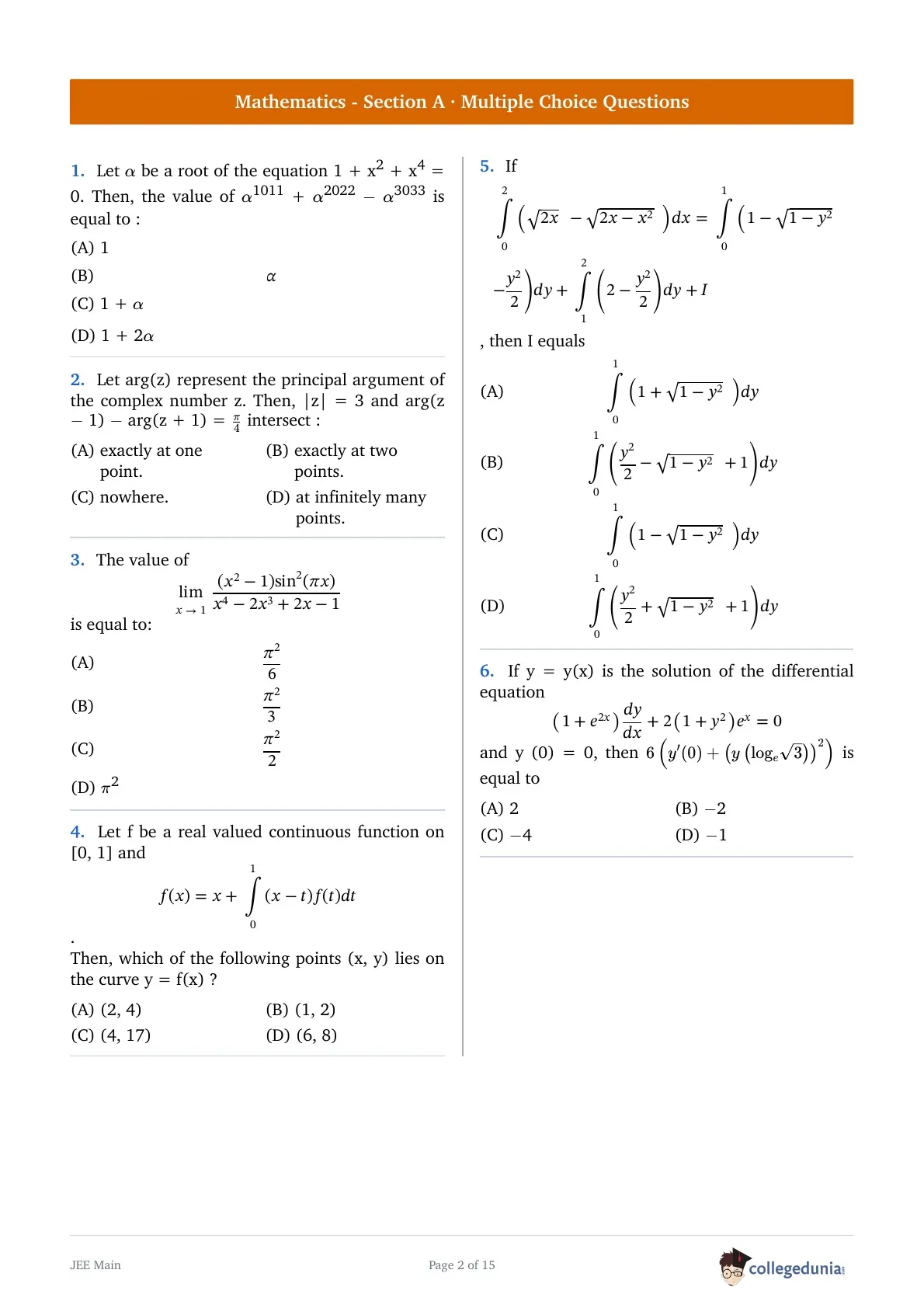
Mathematics - Section A (Q1 - Q20)
Let α be a root of the equation 1 + x2 + x4 = 0. Then the value of α1011 + α2022 – α3033 is equal to
Let arg(z) represent the principal argument of the complex number z. Then, |z| = 3 and arg(z – 1) – arg(z + 1) = π/4 intersect
The value of
\(\lim_{{x \to 1}} \frac{{(x^2 - 1) \sin^2(\pi x)}}{{x^4 - 2x^3 + 2x - 1}}\)
is equal to
Let f be a real valued continuous function on [0, 1] and
\(f(x) = x + \int_{0}^{1} (x - t) f(t) \,dt\)
Then, which of the following points (x, y) lies on the curve y = f(x)?
If
\(\int_{0}^{2} (\sqrt{2x} - \sqrt{2x - x^2}) \,dx = \int_{0}^{1} \left(1 - \sqrt{1 - y^2} - \frac{y^2}{2}\right) \,dy + \int_{1}^{2} (2 - \frac{y^2}{2}) \,dy + I\)
then I equal is
If y = y (x) is the solution of the differential equation
\((1 + e^{2x})\frac{dy}{dx} + 2(1 + y^2)e^x = 0\)
and y(0) = 0, then
\(6 \left( y'(0) + \left( \log_e\left(\sqrt{3}\right) \right)^2 \right)\)
is equal to
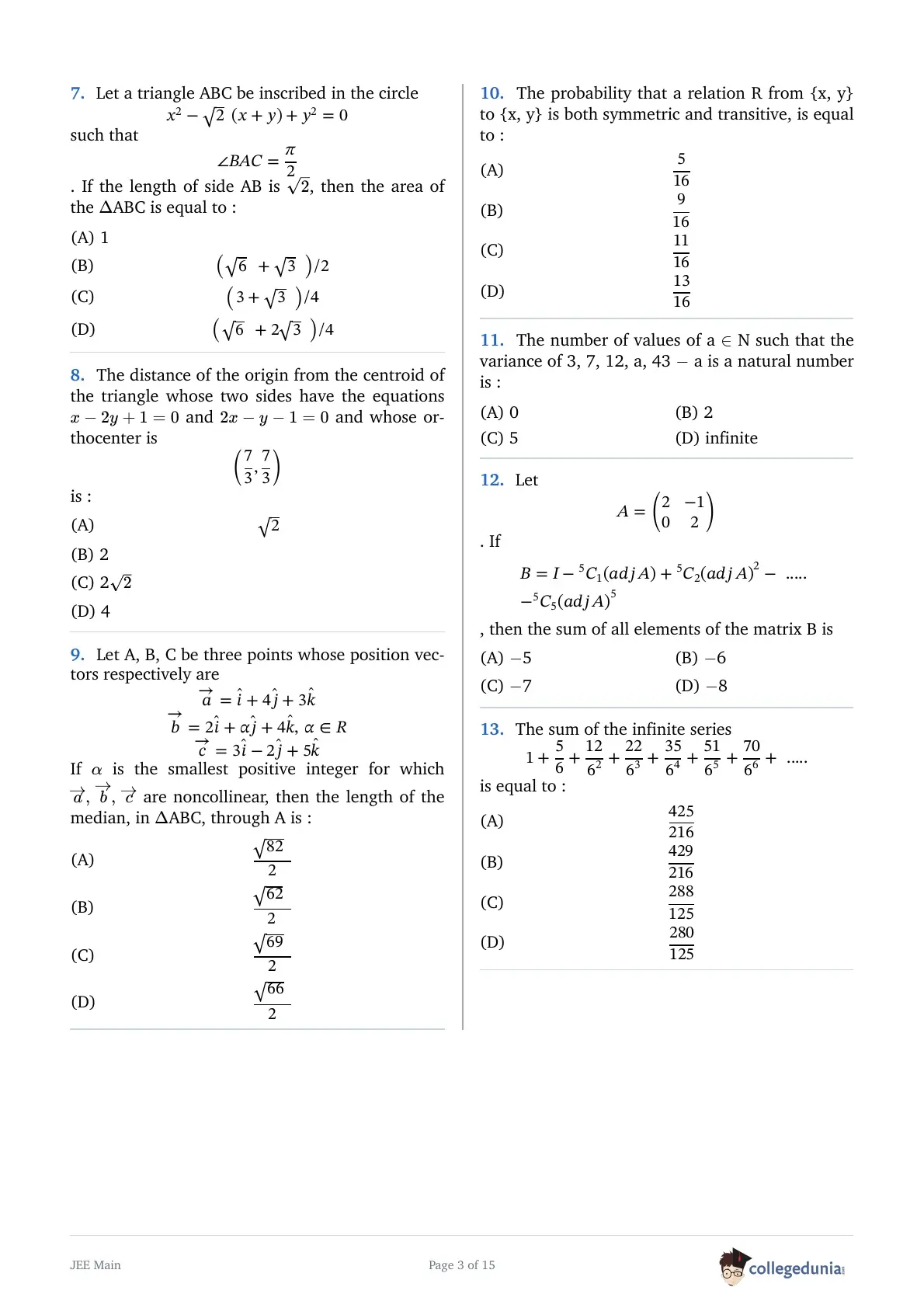
Let a triangle ABC be inscribed in the circle
\(x² - \sqrt2(x+y)+y² = 0\)
such that ∠BAC= π/2. If the length of side AB is √2, then the area of the ΔABC is equal to :
The distance of the origin from the centroid of the triangle whose two sides have the equations
x – 2y + 1 = 0 and 2x – y – 1 = 0 and whose orthocenter is (7/3, 7/3) is :
Let A, B, C be three points whose position vectors respectively are
\(\vec{a} = \hat{i} + 4\hat{j} + 3\hat{k}\)
\(\vec{b} = 2\hat{i} + α\hat{j} + 4\hat{k}, α ∈ R\)
\(\vec{c} = 3\hat{i} - 2\hat{j} + 5\hat{k}\)
If α is the smallest positive integer for which\(\vec{a},\vec{b},\vec{c}\)
are non collinear, then the length of the median, in ΔABC, through A is:
The probability that a relation R from {x, y} to {x, y} is both symmetric and transitive, is equal to
The number of values of a ∈ N such that the variance of 3, 7, 12, a, 43 – a is a natural number is :
Let
A=\(\begin{bmatrix} 2 & -1 \\ 0 & 2 \end{bmatrix}\)
If B = I – 5C1(adjA) + 5C2(adjA)2 – …. – 5C5(adjA)5, then the sum of all elements of the matrix B is
The sum of the infinite series
\(1 + \frac{5}{6} + \frac{12}{6^2} + \frac{22}{6^3} + \frac{35}{6^4} +\frac{51}{6^5} + \frac{70}{6^6}+…..\)
is equal to
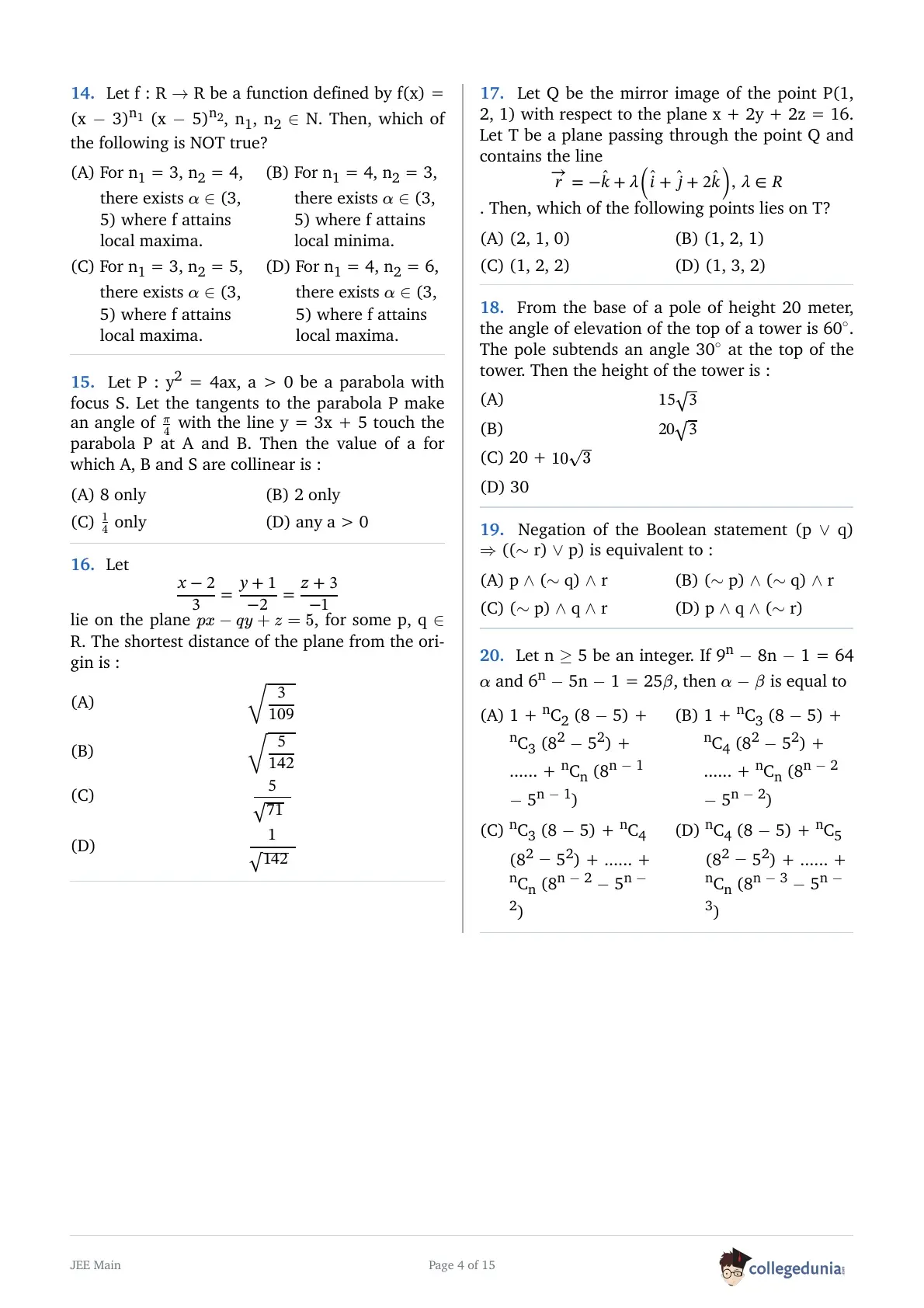
Let f : R → R be a function defined by:
\(ƒ(x) = (x-3)^{n_1} (x-5)^{n_2} , n_1, n_2 ∈ N\)
Then, which of the following is NOT true?
Let P : y2 = 4ax, a > 0 be a parabola with focus S. Let the tangents to the parabola P make an angle of π/4 with the line y = 3x + 5 touch the parabola P at A and B. Then the value of a for which A, B and S are collinear is
Let
\(\frac{x-2}{3} = \frac{y+1}{-2} = \frac{z+3}{-1}\)
lie on the plane px – qy + z = 5, for some p, q ∈ ℝ. The shortest distance of the plane from the origin is :
Let Q be the mirror image of the point P(1, 2, 1) with respect to the plane x + 2y + 2z = 16. Let T be a plane passing through the point Q and contains the line
\(\vec{r}=−\hat{k}+λ(\hat{i}+\hat{j}+2\hat{k}), λ ∈ R.\)
Then, which of the following points lies on T?
From the base of a pole of height 20 meter, the angle of elevation of the top of a tower is 60°. The pole subtends an angle 30° at the top of the tower. Then the height of the tower is :
Negation of the Boolean statement (p ∨ q) ⇒ ((~ r) ∨ p) is equivalent to
Let n ≥ 5 be an integer. If 9n – 8n – 1 = 64α and 6n – 5n – 1 = 25β, then α – β is equal to
Mathematics - Section B (Q21 - Q30)
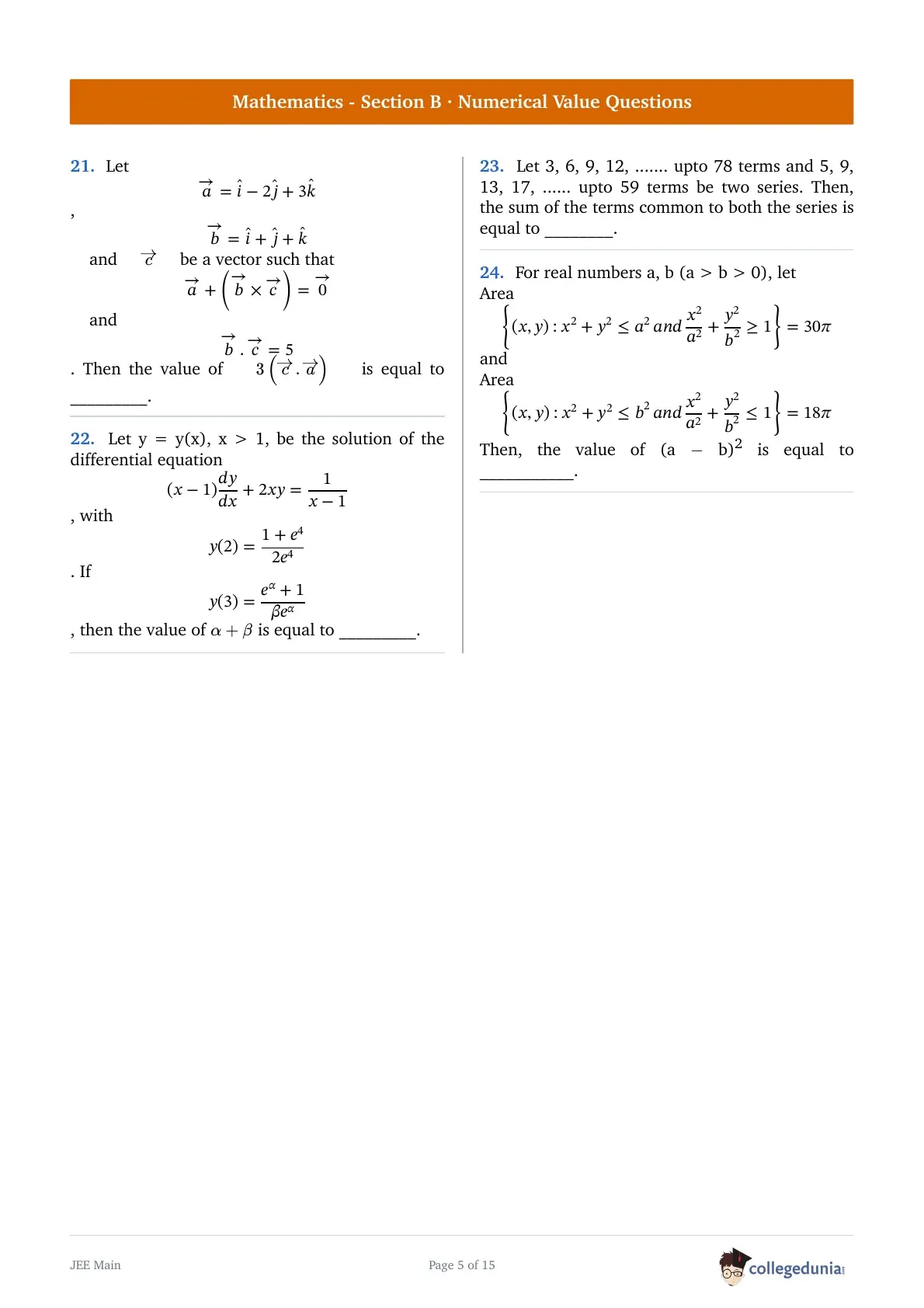
Let
\(\vec{a}=\hat{i} - 2\hat{j} + 3\hat{k}, \vec{b}=\hat{i} - \hat{j} + \hat{k} \) and \(\vec{c}\)
be a vector such that
\(\vec{a} + (\vec{b}×\vec{c}) = \vec{0}\) and \(\vec{b}.\vec{c} = 5.\)
Then the value of 3(\(\vec{c}.\vec{a}\)) is equal to
Let y = y(x), x > 1, be the solution of the differential equation
\((x-1)\frac{dy}{dx} + 2xy = \frac{1}{x-1}\)with \(y(2) = \frac{1+e^4}{2e^4}\). If \(y(3) = \frac{e^α + 1}{βe^α}\) ,
then the value of α + β is equal to ____.
Let 3, 6, 9, 12, … upto 78 terms and 5, 9, 13, 17, … upto 59 terms be two series. Then, the sum of terms common to both the series is equal to _____.
For real number a, b (a > b > 0), let
\(\text{{Area}} \left\{ (x, y) : x^2 + y^2 \leq a^2 \text{{ and }} \frac{x^2}{a^2} + \frac{y^2}{b^2} \geq 1 \right\} = 30\pi\)
and
\(\text{{Area}} \left\{ (x, y) : x^2 + y^2 \geq b^2 \text{{ and }} \frac{x^2}{a^2} + \frac{y^2}{b^2} \leq 1 \right\} = 18\pi\)
Then the value of (a – b)2 is equal to _____.
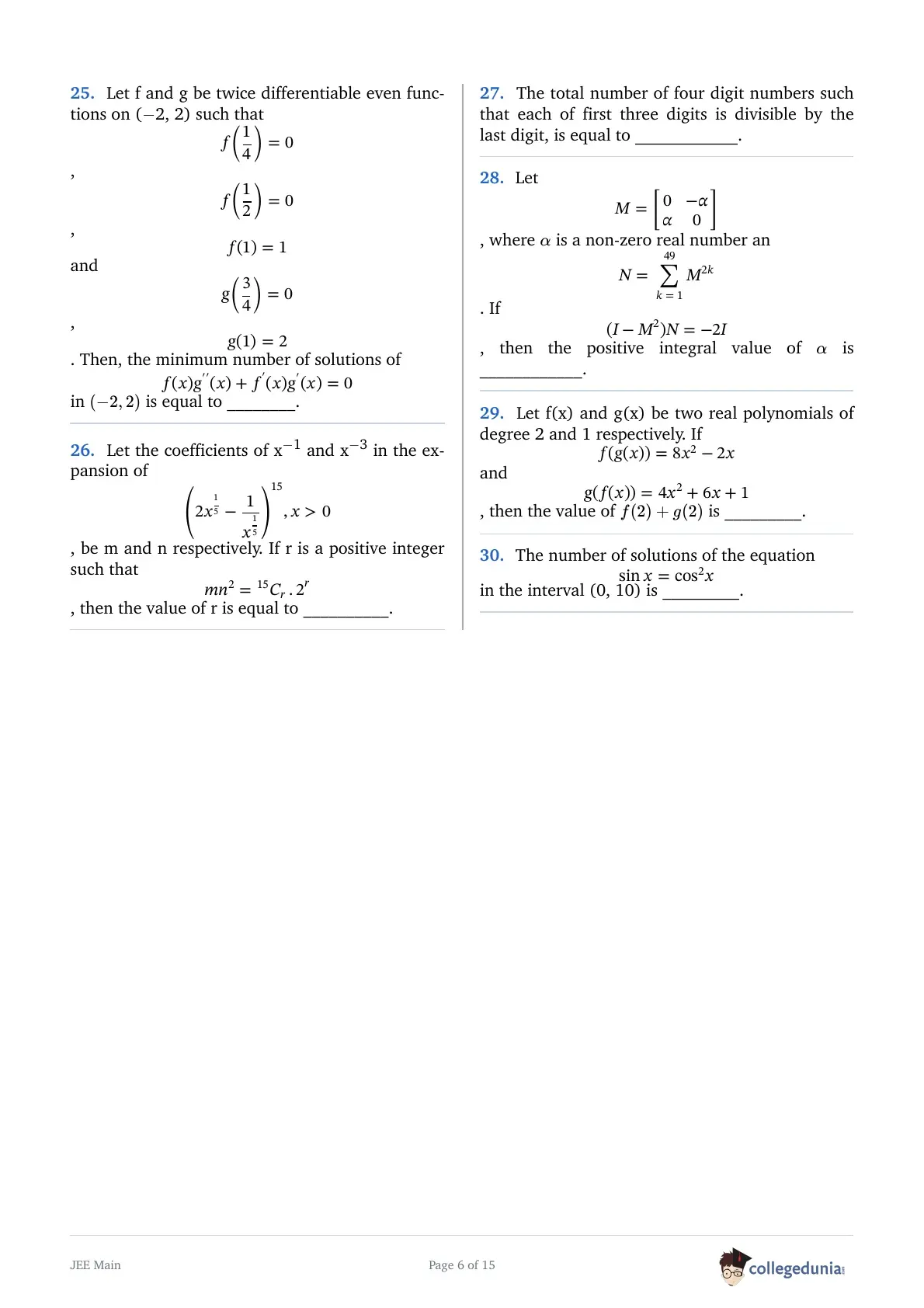
Let f and g be twice differentiable even functions on (–2, 2) such that
\(ƒ(\frac{1}{4})=0, ƒ(\frac{1}{2})=0, ƒ(1) =1\) and \(g(\frac{3}{4}) = 0 , g(1)=2\)
.Then, the minimum number of solutions of f(x)g′′(x) + f′(x)g′(x) = 0 in (–2, 2) is equal to_____.
Let the coefficients of x–1 and x–3 in the expansion of
\((2x^{\frac{1}{5}} - \frac{1}{x^{\frac{1}{5}}} )^{15} , x > 0\)be m and n respectively. If r is a positive integer such that
\(mn² = ^{15}C_r.2^r\)
then the value of r is equal to ______.
The total number of four digit numbers such that each of first three digits is divisible by the last digit, is equal to _______.
Let
\(M = \begin{bmatrix} 0 & -\alpha \\ \alpha & 0 \\ \end{bmatrix}\)
where α is a non-zero real number an
\(N = \sum\limits_{k=1}^{49} M^{2k}. \) If \((I - M^2)N = -2I\)
then the positive integral value of α is ____ .
Let f(x) and g(x) be two real polynomials of degree 2 and 1 respectively. If f(g(x)) = 8x2 – 2x and g(f(x)) = 4x2 + 6x + 1, then the value of f(2) + g(2) is ____________ .
The number of solutions of the equation sin x = cos2 x in the interval (0, 10) is _____.
Physics - Section A (Q31 - Q50)
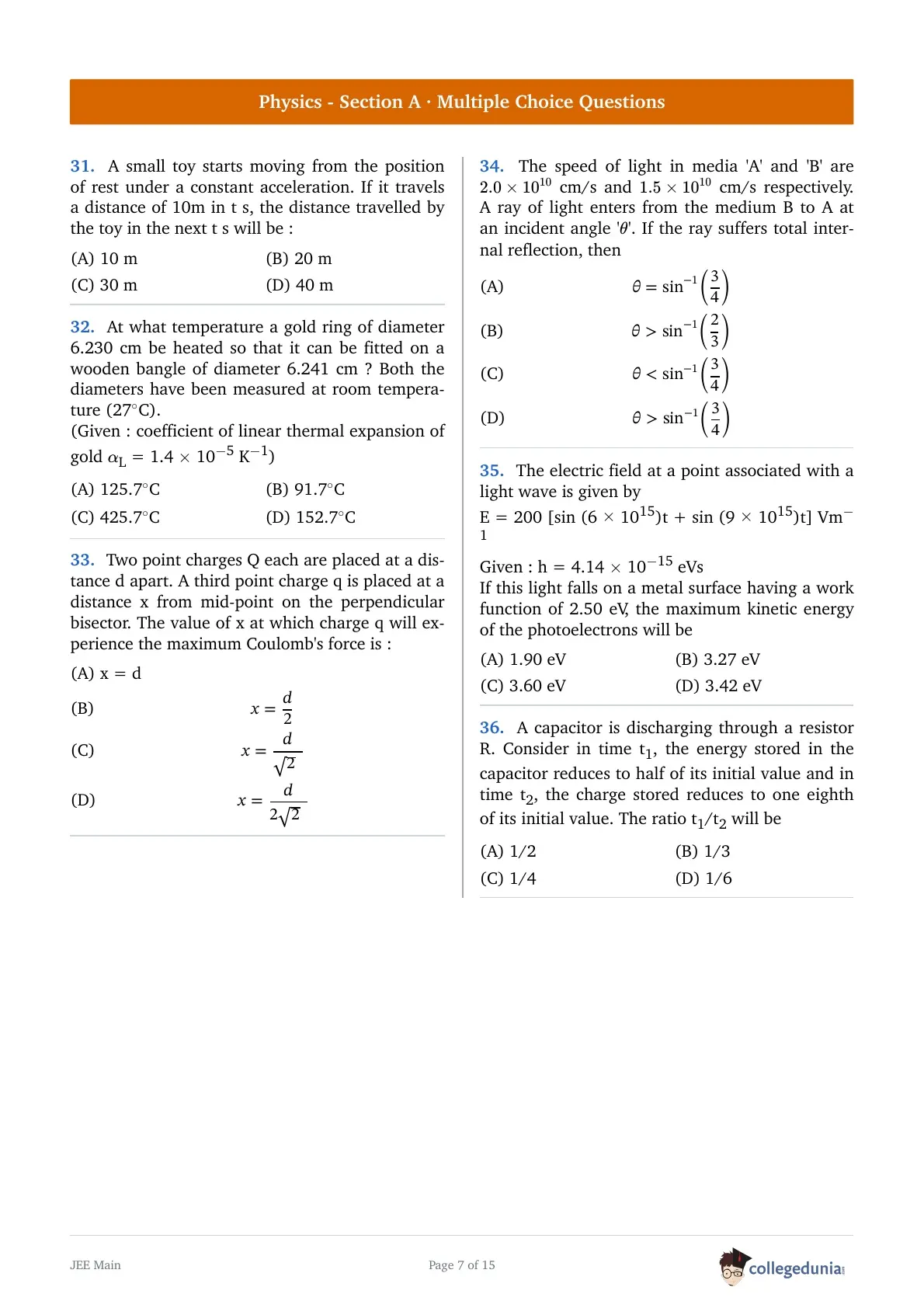
A small toy starts moving from the position of rest under a constant acceleration. If it travels a distance of 10 m in t s, the distance travelled by the toy in the next t s will be :
At what temperature a gold ring of diameter 6.230 cm be heated so that it can be fitted on a wooden bangle of diameter 6.241 cm? Both the diameters have been measured at room temperature (27°C).
(Given: coefficient of linear thermal expansion of gold αL = 1.4 × 10⁻⁵ K–1)
Two point charges Q each are placed at a distance d apart. A third point charge q is placed at a distance x from mid-point on the perpendicular bisector. The value of x at which charge q will experience the maximum Coulombs force is :
The speed of light in media ‘A’ and ‘B’ are 2.0 × 1010 cm/s and 1.5 × 1010 cm/s respectively. A ray of light enters from the medium B to A at an incident angle ‘θ’. If the ray suffers total internal reflection, then
The electric field at a point associated with a light wave is given by
E = 200[sin(6 × 10¹⁵)t + sin(9 × 10¹⁵)t] Vm–1
Given : h = 4.14 × 10⁻¹⁵ eVs
If this light falls on a metal surface having a work function of 2.50 eV, the maximum kinetic energy of the photoelectrons will be
A capacitor is discharging through a resistor R. Consider in time t1, the energy stored in the capacitor reduces to half of its initial value and in time t2, the charge stored reduces to one eighth of its initial value. The ratio t1/t2 will be
Starting with the same initial conditions, an ideal gas expands from volume V1 to V2 in three different ways. The work done by the gas is W1 if the process is purely isothermal, W2, if the process is purely adiabatic and W3 if the process is purely isobaric. Then, choose the correct option.
Two long current carrying conductors are placed parallel to each other at a distance of 8 cm between them. The magnitude of magnetic field produced at mid-point between the two conductors due to current flowing in them is 30 μT. The equal current flowing in the two conductors is:
The time period of a satellite revolving around earth in a given orbit is 7 hours. If the radius of orbit is increased to three times its previous value, then approximate new time period of the satellite will be
The motion of a simple pendulum executing S.H.M. is represented by the following equation. y = A sin(πt + φ), where time is measured in second. The length of pendulum is
A vessel contains 16 g of hydrogen and 128 g of oxygen at standard temperature and pressure. The volume of the vessel in cm3 is:
Given below are two statements:
Statement I: The electric force changes the speed of the charged particle and hence changes its kinetic energy; whereas the magnetic force does not change the kinetic energy of the charged particle.
Statement II: The electric force accelerates the positively charged particle perpendicular to the direction of electric field. The magnetic force accelerates the moving charged particle along the direction of magnetic field.
In the light of the above statements, choose the most appropriate answer from the options given below:
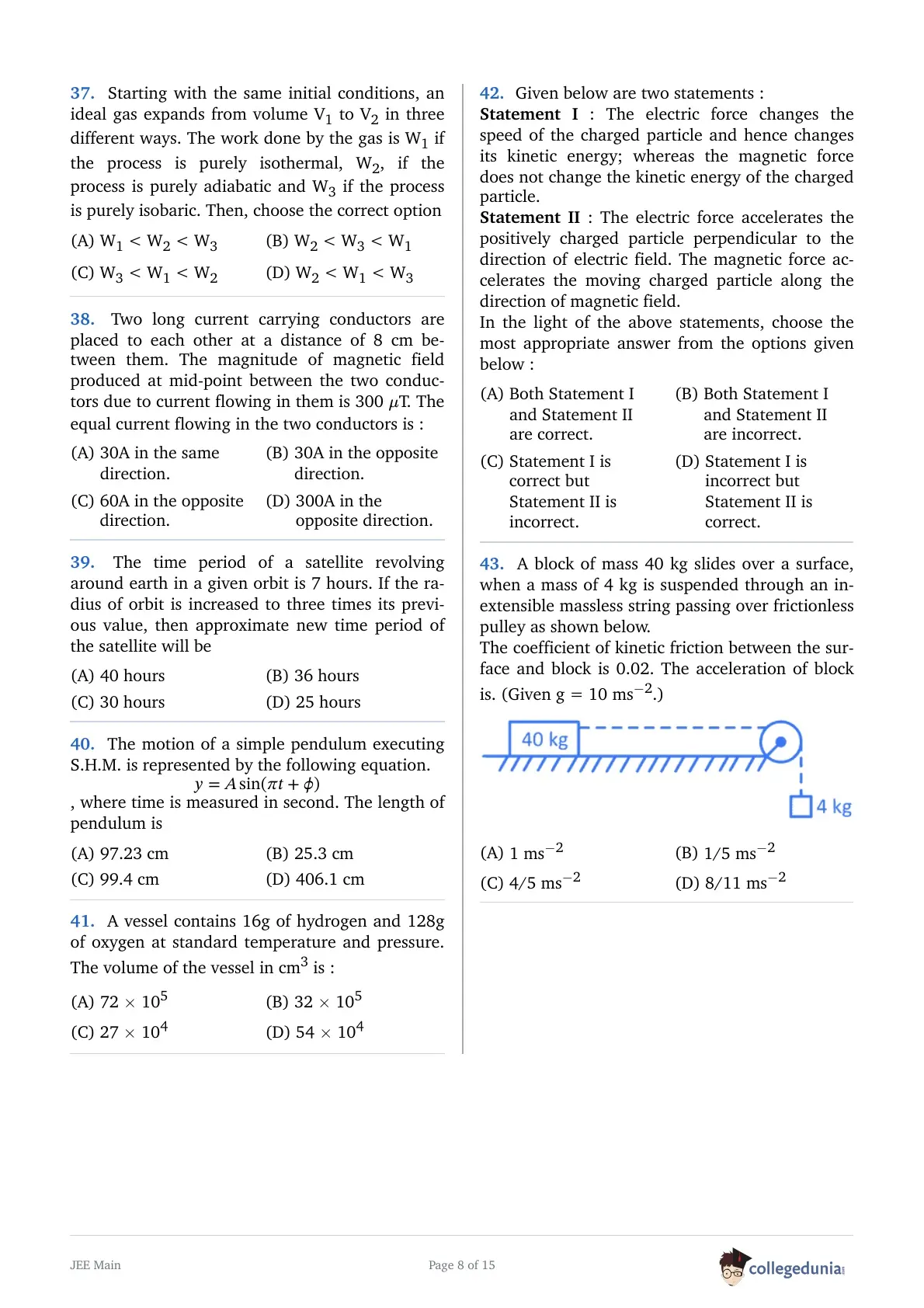
A block of mass 40 kg slides over a surface, when a mass of 4 kg is suspended through an inextensible massless string passing over a frictionless pulley as shown below.
The coefficient of kinetic friction between the surface and block is 0.02. The acceleration of the block is (Given g = 10 ms–2)
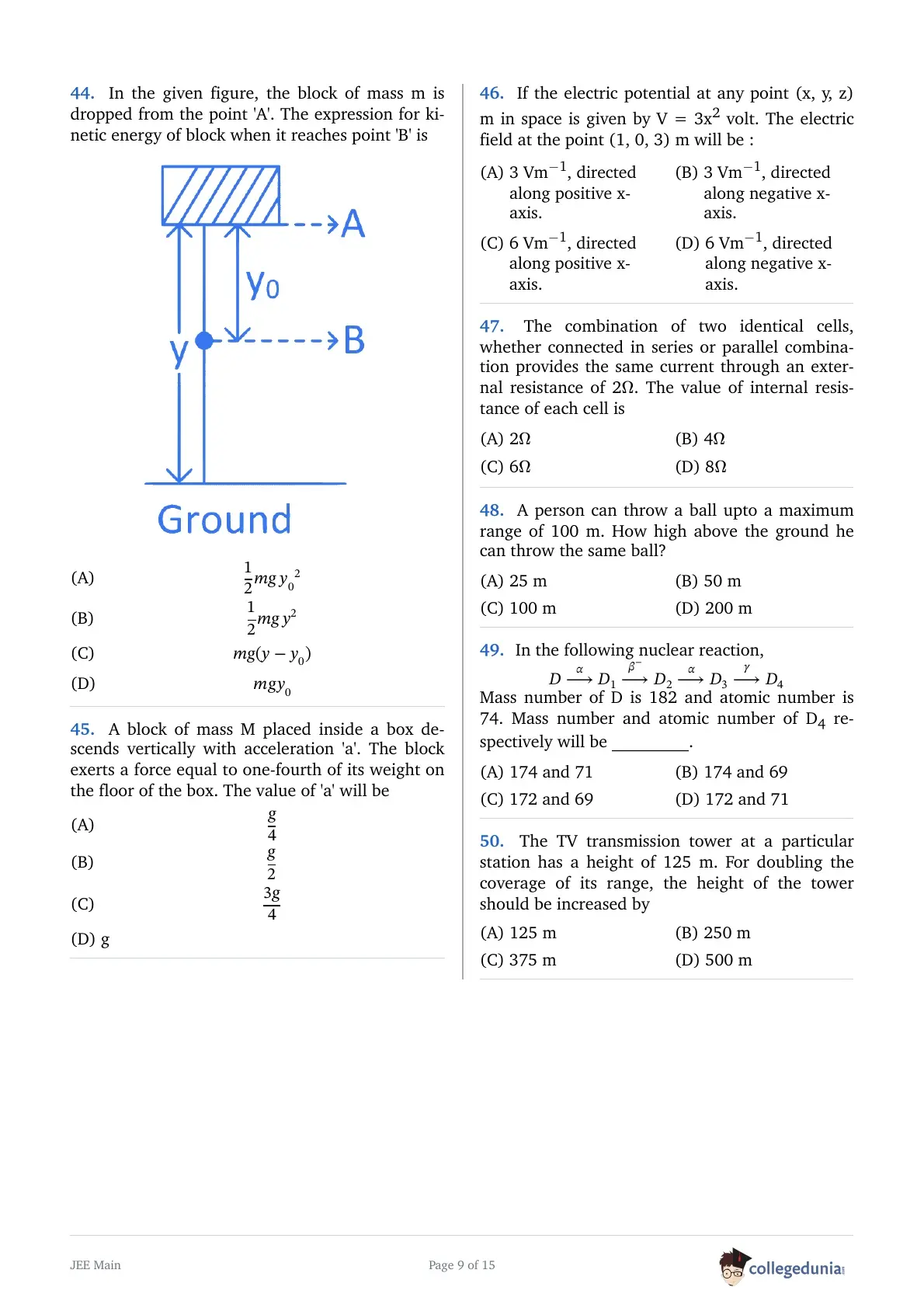
In the given figure, the block of mass m is dropped from the point ‘A’. The expression for kinetic energy of block when it reaches point ‘B’ is

A block of mass M placed inside a box descends vertically with acceleration ‘a’.The block exerts a force equal to one-fourth of its weight on the floor of the box.
The value of ‘a’ will be
If the electric potential at any point (x, y, z)m in space is given by V = 3x2 volt. The electric field at the point (1, 0, 3)m will be
The combination of two identical cells, whether connected in series or parallel combination provides the same current through an external resistance of 2 Ω. The value of internal resistance of each cell is
A person can throw a ball upto a maximum range of 100 m. How high above the ground he can throw the same ball?
In the following nuclear reaction,
\(D \stackrel{α}{⟶} D1 \stackrel{β^-}{⟶} D2 \stackrel{α}{⟶} D3 \stackrel{γ}{⟶} D4\)
Mass number of D is 182 and atomic number is 74. Mass number and atomic number
of D4, respectively, will be _____.
The TV transmission tower at a particular station has a height of 125 m. For doubling the coverage of its range, the height of the tower should be increased by
Physics - Section B (Q51 - Q60)
The vernier constant of Vernier callipers is 0.1 mm and it has zero error of (–0.05) cm. While measuring diameter of a sphere, the main scale reading is 1.7 cm and coinciding vernier division is 5. The corrected diameter will be ________× 10–2 cm.
A small spherical ball of radius 0.1 mm and density 104 kg m–3 falls freely under gravity through a distance h before entering a tank of water. If, after entering the water the velocity of ball does not change and it continue to fall with same constant velocity inside water, then the value of h will be ______ m.
(Given g = 10 ms–2, viscosity of water = 1.0 × 10⁻⁵ N-sm–2).
In an experiment to determine the velocity of sound in air at room temperature using a resonance tube, the first resonance is observed when the air column has a length of 20.0 cm for a tuning fork of frequency 400 Hz is used. The velocity of the sound at room temperature is 336 ms–1. The third resonance is observed when the air column has a length of ______ cm.
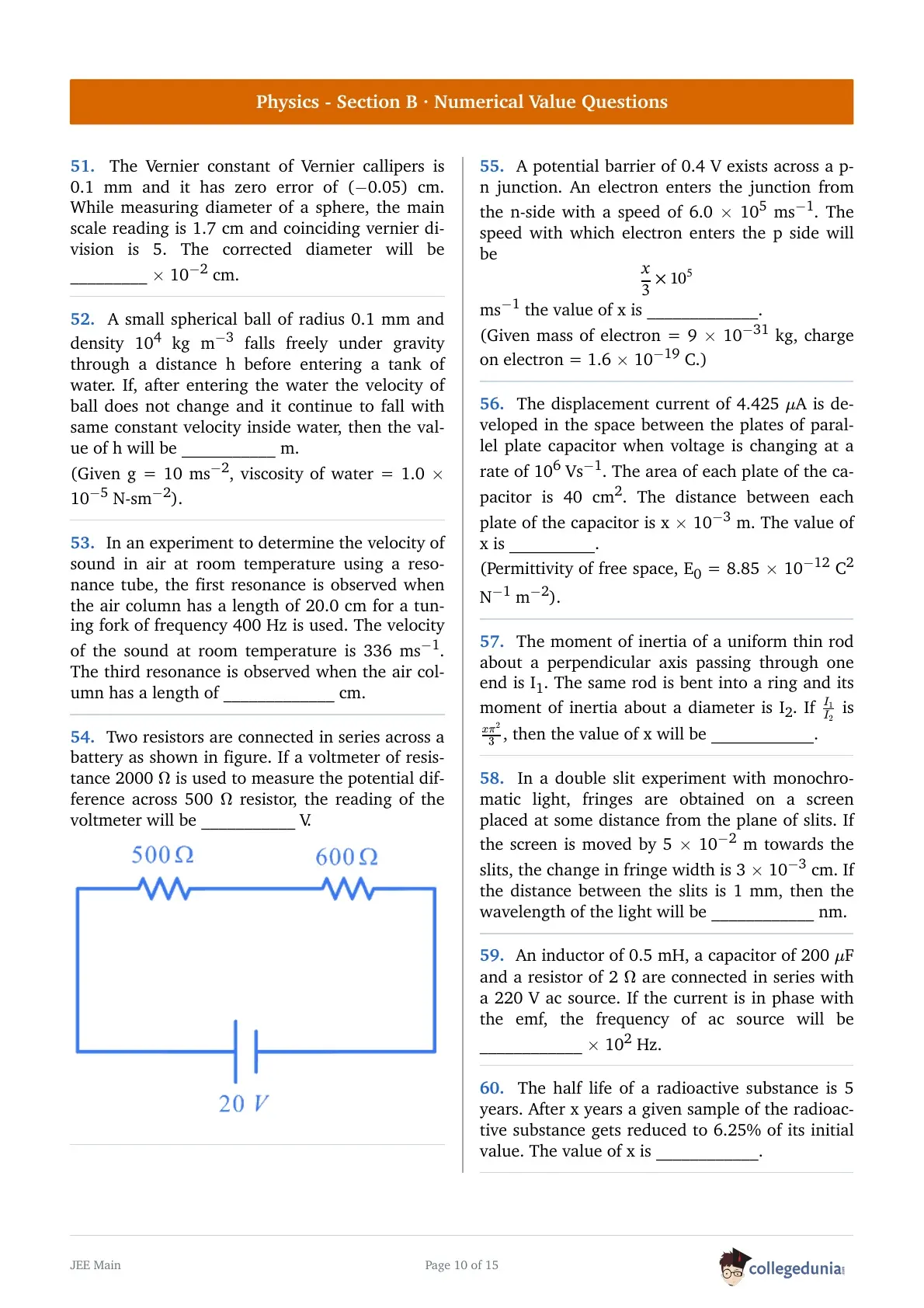
Two resistors are connected in series across a battery as shown in figure. If a voltmeter of resistance 2000 Ω is used to measure the potential difference across 500 Ω resistor, the reading of the voltmeter will be _____ V.

A potential barrier of 0.4 V exists across a p-n junction. An electron enters the junction from the n-side with a speed of 6.0 × 10⁵ ms–1. The speed with which electrons enters the p side will be
\(\frac{x}{3} × 10^5\) ms-1
the value of x is _________.
(Give mass of electron = 9 × 10–31 kg, charge on electron = 1.6 × 10⁻¹⁹ C)
The displacement current of 4.425 μA is developed in the space between the plates of parallel plate capacitor when voltage is changing at a rate of 106 Vs–1. The area of each plate of the capacitor is 40 cm2. The distance between each plate of the capacitor x × 10–3 m. The value of x is,
(Permittivity of free space, E0 = 8.85 × 10⁻¹² C2 N–1 m–2)
The moment of inertia of a uniform thin rod about a perpendicular axis passing through one end is I1. The same rod is bent into a ring and its moment of inertia about a diameter is I2. If
\(\frac{I_1}{I_2}\) is \(\frac{xπ²}{3}\)
then the value of x will be ______.
In a double slit experiment with monochromatic light, fringes are obtained on a screen placed at some distance from the plane of slits. If the screen is moved by 5 × 10⁻² m towards the slits, the change in fringe width is 3 × 10⁻³ cm. If the distance between the slits is 1 mm, then the wavelength of the light will be _______ nm.
An inductor of 0.5 mH, a capacitor of 200 μF and a resistor of 2 Ω are connected in series with a 220 V ac source. If the current is in phase with the emf, the frequency of ac source will be ______ × 102 Hz
The half life of a radioactive substance is 5 years. After x years, a given sample of the radioactive substance gets reduced to 6.25% of its initial value. The value of x is ______.
Chemistry - Section A (Q61 - Q80)
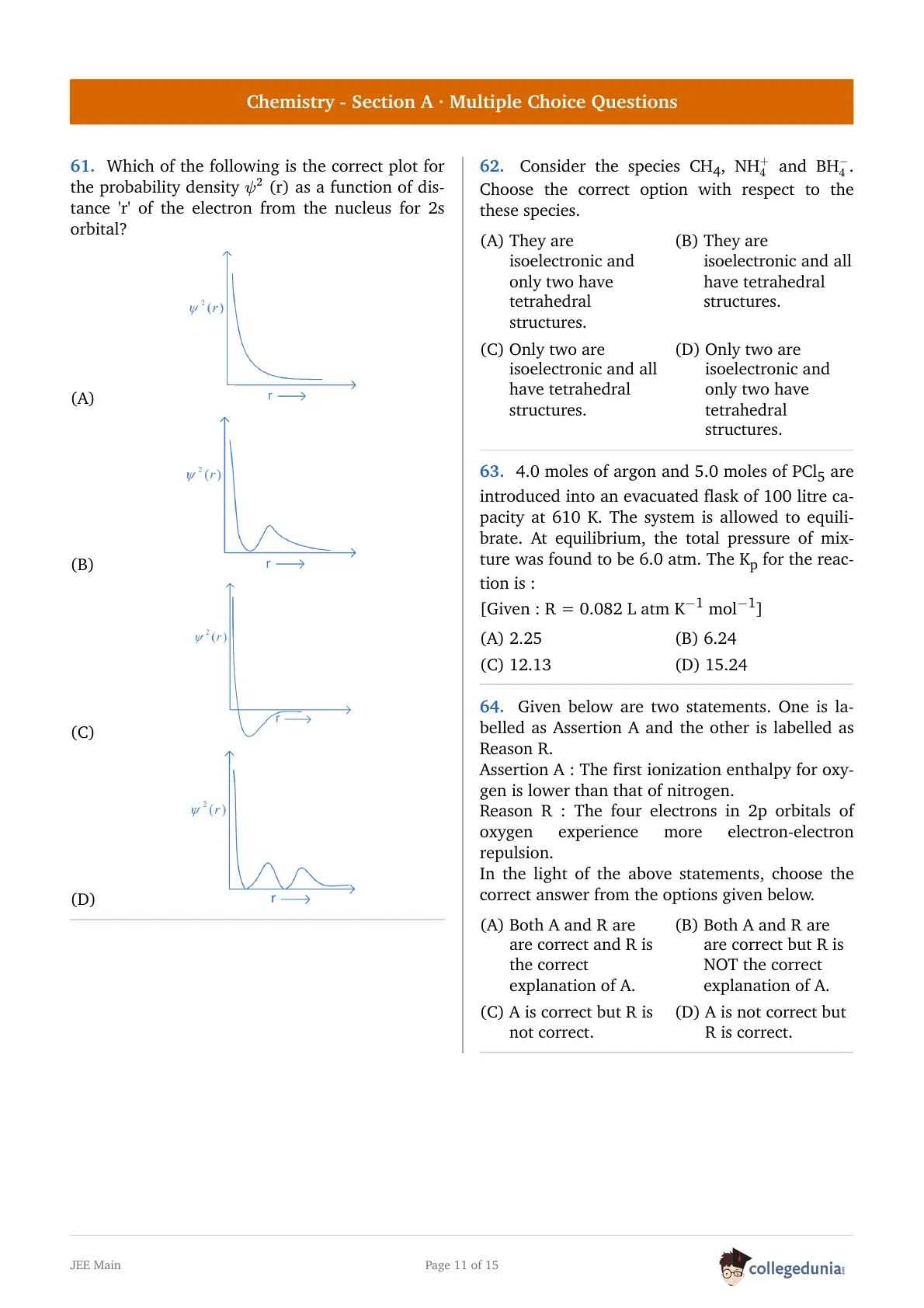
Which of the following is the correct plot for the probability density ψ2(r) as a function of distance ‘r’ of the electron from the nucleus for 2s orbital?
- (1)
![Which of the following is the correct plot for the probability density]()
- (2)
![Which of the following is the correct plot for the probability density]()
- (3)
![Which of the following is the correct plot for the probability density]()
- (4)
![Which of the following is the correct plot for the probability density]()


Consider the species
\(CH_4,NH_{4}^+ and BH_{4}^−.\)
Choose the correct option with respect to these species.
4.0 moles of argon and 5.0 moles of PCl5 are introduced into an evacuated flask of 100 litre capacity at 610 K. The system is allowed to equilibrate. At equilibrium, the total pressure of mixture was found to be 6.0 atm. The Kp for the reaction is
[Given : R = 0.082 L atm K–1 mol–1 ]
Given below are two statements. One is labelled as Assertion A and the other is labelled as Reason R.
Assertion A: The first ionization enthalpy for oxygen is lower than that of nitrogen.
Reason R: The four electrons in 2p orbitals of oxygen experience more electron-electron repulsion.
In the light of the above statements, choose the correct answer from the options given below.
Given below are two statements.
Statement-I: In CuSO4.5H2O, Cu-O bonds are present.
Statement-II: In CuSO4.5H2O, ligands coordinating with Cu(II) ion are O-and S-based ligands.
In the light of the above statements, choose the correct answer from the options given below:
Number of lone pair(s) of electrons on central atom and the shape of BrF3 molecule respectively, are
Sulphur dioxide is one of the components of polluted air. SO2 is also a major contributor to acid rain. The correct and complete reaction to represent acid rain caused by SO2 is


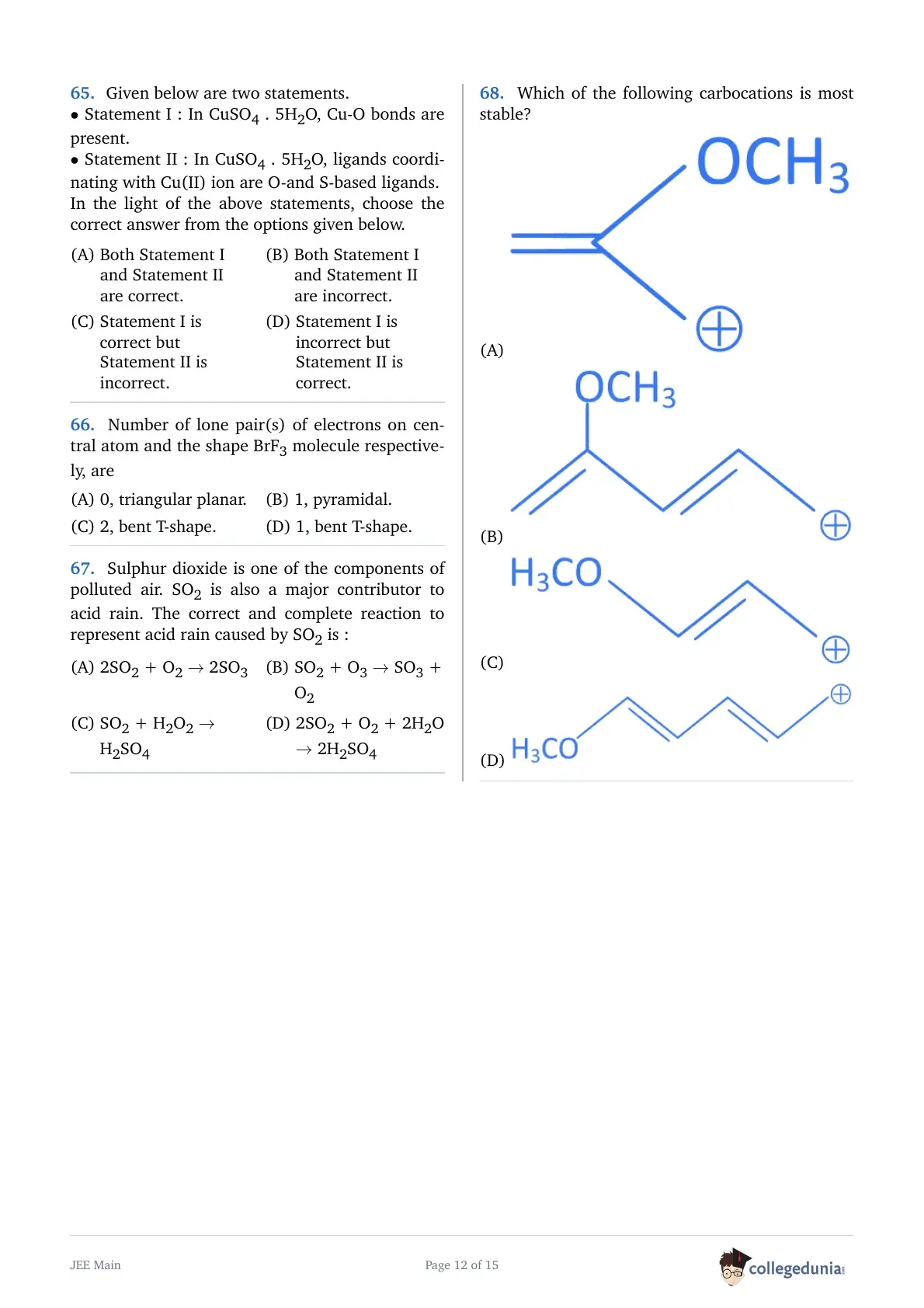
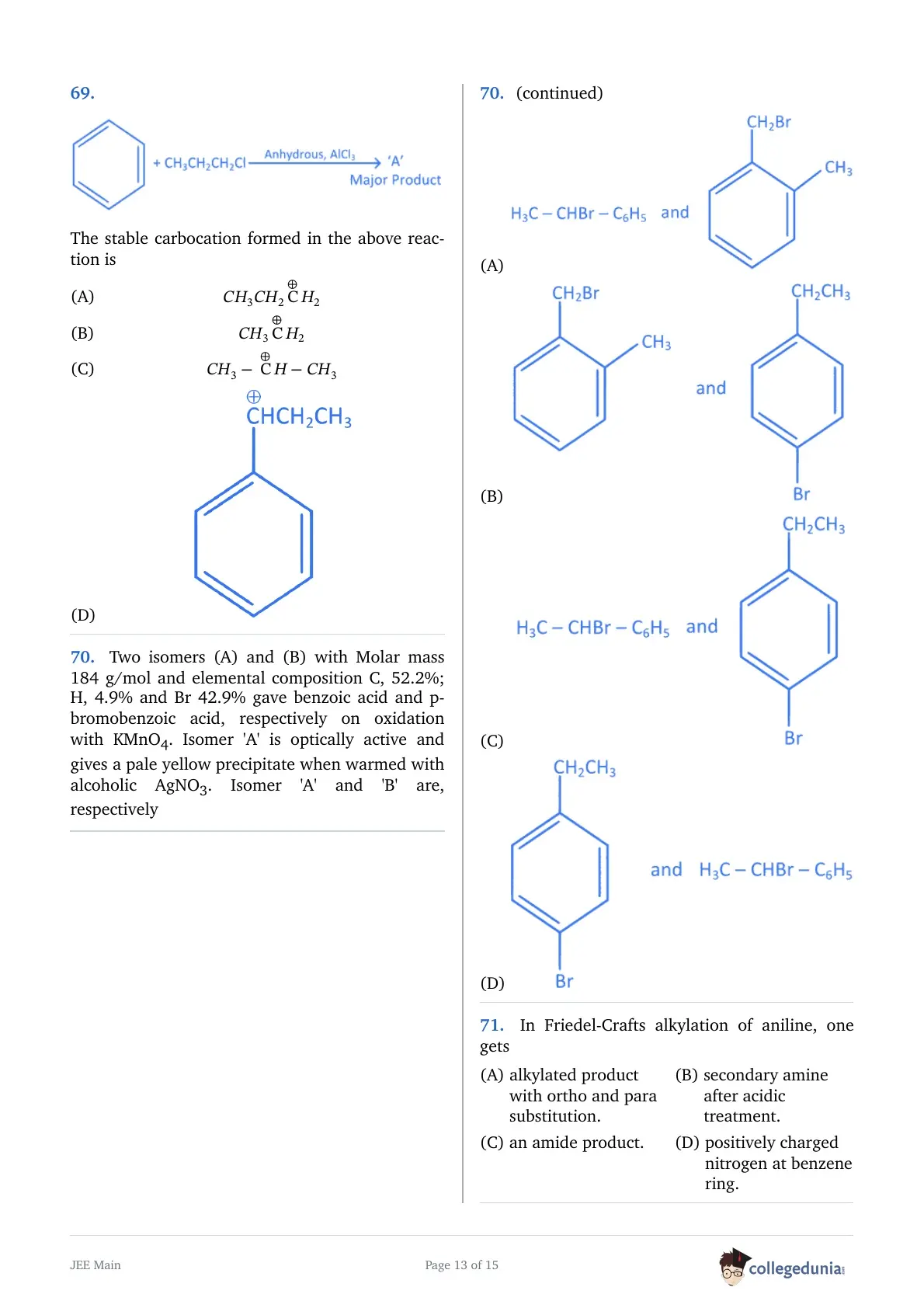
The stable carbocation formed in the above reaction is
- (1)
![]()
- (2)
![]()
- (3)
![]()
- (4)
![]()


Two isomers (A) and (B) with Molar mass 184 g/mol and elemental composition C, 52.2%; H, 4.9 % and Br 42.9% gave benzoic acid and p-bromobenzoic acid, respectively on oxidation with KMnO4. Isomer ‘A’ is optically active and gives a pale yellow precipitate when warmed with alcoholic AgNO3. Isomers ‘A’ and ‘B’ are, respectively.
- (1)
![]()
- (2)
![]()
- (3)
![]()
- (4)
![]()


In Friedel-Crafts alkylation of aniline, one gets
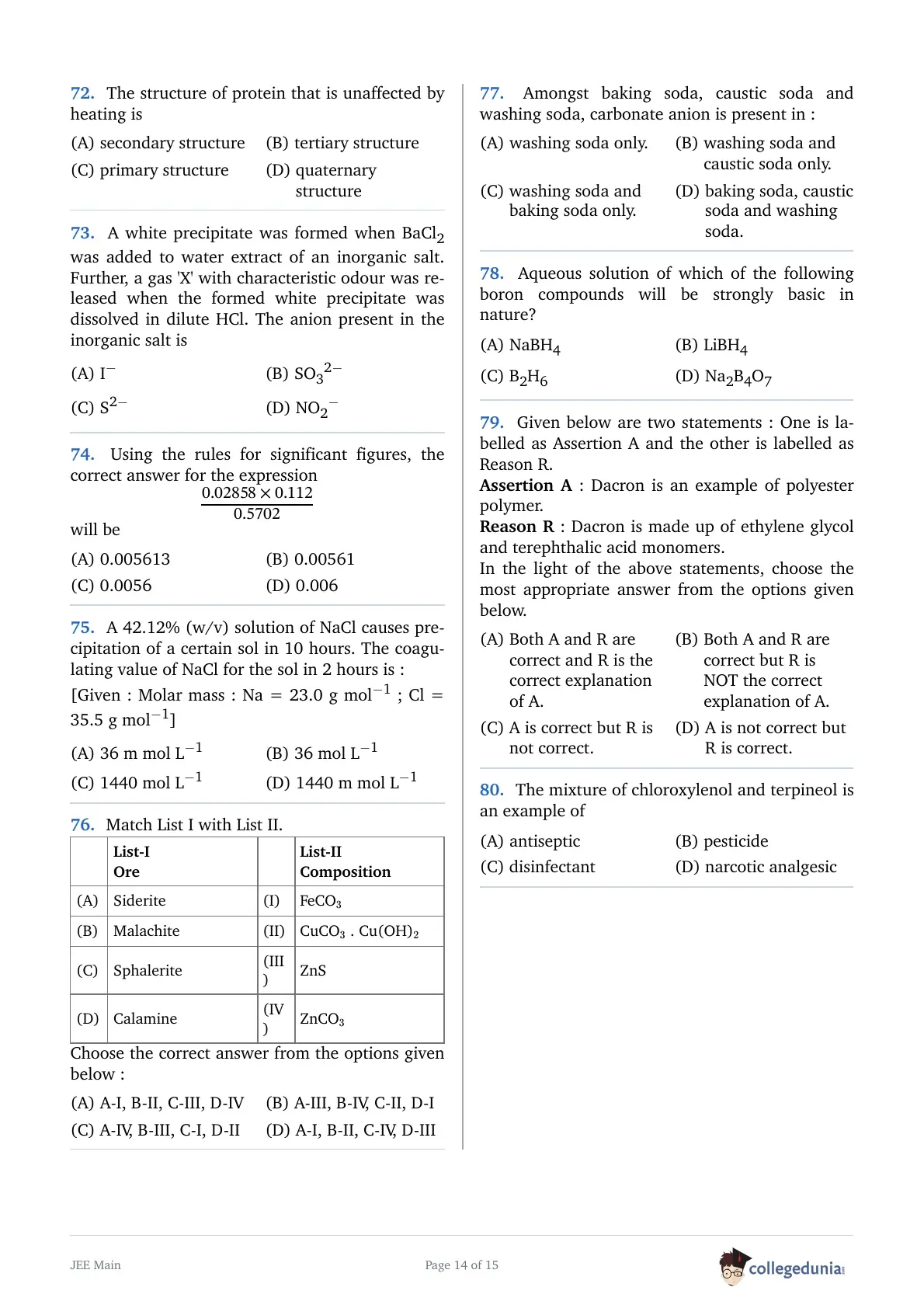
The structure of protein that is unaffected by heating is
A white precipitate was formed when BaCl2 was added to water extract of an inorganic salt. Further, a gas ‘X’ with characteristic odour was released when the formed white precipitate was dissolved in dilute HCl. The anion present in the inorganic salt is
Using the rules for significant figures, the correct answer for the expression
\(\frac{0.02858 × 0.112}{ 0.5702}\)
will be
A 42.12% (w, v) solution of NaCl causes precipitation of a certain sol in 10 hours. The coagulating value of NaCl for the sol is
[Given : Molar mass : Na = 23.0 g mol–1; Cl = 35.5 g mol–1]
Match List-I with List-II
| List-I Ore | List-II Composition | ||
| A. | Siderite | I. | FeCO3 |
| B. | Malachite | II. | CuCO3. Cu(OH)2 |
| C. | Sphalerite | III. | ZnS |
| D. | Calamine | IV. | ZnCO3 |
Choose the correct answer from the options given below:
Amongst baking soda, caustic soda and washing soda, carbonate anion is present in
Aqueous solution of which of the following boron compounds will be strongly basic in nature?
Given below are two statements : one is labelled as Assertion A and the other is labelled as Reason R.
Assertion A : Dacron is an example of polyester polymer.
Reason R : Dacron is made up of ethylene glycol and terephthalic acid monomers.
In the light of the above statements, choose the most appropriate answer from the options given below.
The mixture of chloroxylenol and terpineol is an example of
Chemistry - Section B (Q81 - Q90)
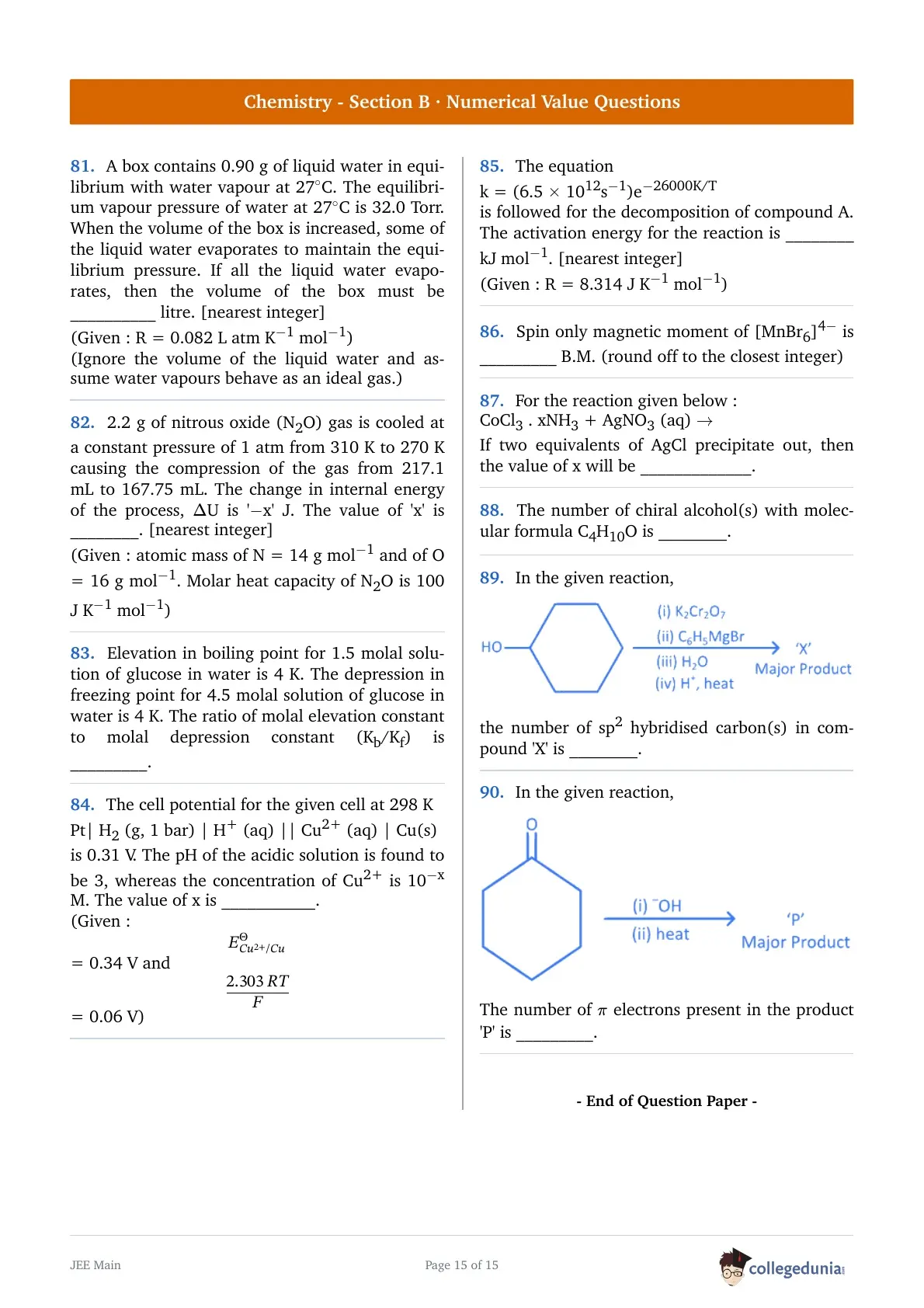
A box contains 0.90 g of liquid water in equilibrium with water vapour at 27°C. The equilibrium vapour pressure of water at 27°C is 32.0 Torr. When the volume of the box is increased, some of the liquid water evaporates to maintain the equilibrium pressure.
If all the liquid water evaporates, then the volume of the box must be ______ litre. [nearest integer]
(Given : R = 0.082 L atm K–1 mol–1] (Ignore the volume of the liquid water and assume water vapours behave as an ideal gas.)
2.2 g of nitrous oxide (N2O) gas is cooled at a constant pressure of 1 atm from 310 K to 270 K causing the compression of the gas from 217.1 mL to 167.75 mL. The change in internal energy of the process, ΔU is ‘–x’ J. The value of ‘x’ is ____. [nearest integer]
(Given : atomic mass of N = 14 g mol–1 and of O = 16 g mol–1
Molar heat capacity of N2O is 100 J K–1 mol–1)
Elevation in boiling point for 1.5 molal solution of glucose in water is 4 K. The depression in freezing point for 4.5 molal solution of glucose in water is 4 K. The ratio of molal elevation constant to molal depression constant (Kb/Kf) is ___.
The cell potential for the given cell at 298 K \(\text{Pt} | \text{H}_2 \text{(g, 1 bar)} | \text{H}^+ \text{(aq)} || \text{Cu}^{2+} \text{(aq)} | \text{Cu(s)}\) is 0.31 V. The pH of the acidic solution is found to be 3, whereas the concentration of Cu2+ is 10–x M. The value of x is _____.
(Given : \(E^{Θ}_{Cu^{2+}/Cu}\) = 0.34 V and \(\frac{2.303RT}{F}\) = 0.06 V)
The equation k = (6.5 × 10¹²s–1)e–26000K/T is followed for the decomposition of compound A. The activation energy for the reaction is ______ kJ mol–1. [nearest integer]
(Given : R = 8.314 J K–1 mol–1]
Spin only magnetic moment of [MnBr6]4– is _____B.M. [round off to the closest integer]
For the reaction given below:
\(CoCl_3.xNH_3 + AgNO_3 (aq) →\)
If two equivalents of AgCl precipitate out, then the value of x will be____.
The number of chiral alcohol(s) with molecular formula C4H10O is ____.
In the given reaction

the number of sp2 hybridised carbon(s) in compound ‘X’ is _____.
In the given reaction,

The number of π electrons present in the product ‘P’ is_____.
JEE Main 2022 Exam Pattern and Marking Scheme
| Particulars | Details |
|---|---|
| Exam Mode | Online (Computer-Based Test) |
| Paper | B.E./B.Tech (Paper 1) |
| Duration | 3 hours (180 minutes) |
| Type of Questions | Multiple Choice Questions (MCQs) + Numerical Value Questions |
| Subjects | Mathematics, Physics, Chemistry |
| Total Questions | 90 questions (75 to be attempted) |
| Total Marks | 300 marks |
| Marking Scheme | +4 for correct answer & -1 for incorrect MCQ and Numerical Value-based Questions |
JEE Main 2022 June 29 Shift 2 Difficulty Level
As per the students’ initial reaction, JEE Main 2022 Question Paper for June 29- Shift 2 was reported as moderate. The Mathematics section in JEE Main 2022 June 29- Shift 2 Question Paper was reported as difficult and lengthy, Physics as moderate and Chemistry as easy.
JEE Main 2022 June 29 Shift 2 Subject-wise Memory-Based Solutions PDF
| Subject | Memory-Based Solutions PDF |
|---|---|
| Physics | Download PDF |
| Chemistry | Download PDF |
| Mathematics | Download PDF |
JEE Main 2022 B.E/ B. Tech Other Question Paper with Answer Key PDFs
JEE Main 2022 aspirants can practice and check their exam prep level by attempting the other session question papers as well. The table below shows JEE Main 2022 Question Paper with Answer Key and Solution PDFs for other sessions for Phase 1.
Also Check:



Comments