




JEE Main 2022 July 25 Shift 2 Question Paper is available here with solutions PDF and detailed solutions for every question. NTA conducted the second shift on July 25, 2022, from 3:00 PM to 6:00 PM. The JEE Main 2022 Paper 1 (B.E./B.Tech) question paper includes the following:
- 90 questions in a 3-hour CBT Mode: 30 each from Mathematics, Physics and Chemistry (75 to be attempted)
- Section A: 20 multiple choice questions (MCQs) per subject, all compulsory, 4 marks each
- Section B: 10 numerical value questions per subject, any 5 to be attempted, 4 marks each
- Marking: +4 for a correct answer, -1 for an incorrect answer, 0 for an unattempted question
- Maximum marks: 300 (100 per subject)
JEE Main 2022 July 25 Shift 2 Question Paper with Solution PDF
| NTA Official PDF | CD PDF | CD PDF with Solutions |
|---|---|---|
| Download official PDF 4.17 MB | Download Collegedunia PDF 0.92 MB | Download solutions PDF 0.81 MB |
Also Check:
JEE Main 2022 July 25 Shift 2 Questions with Solutions
Mathematics - Section A (Q1 - Q20)
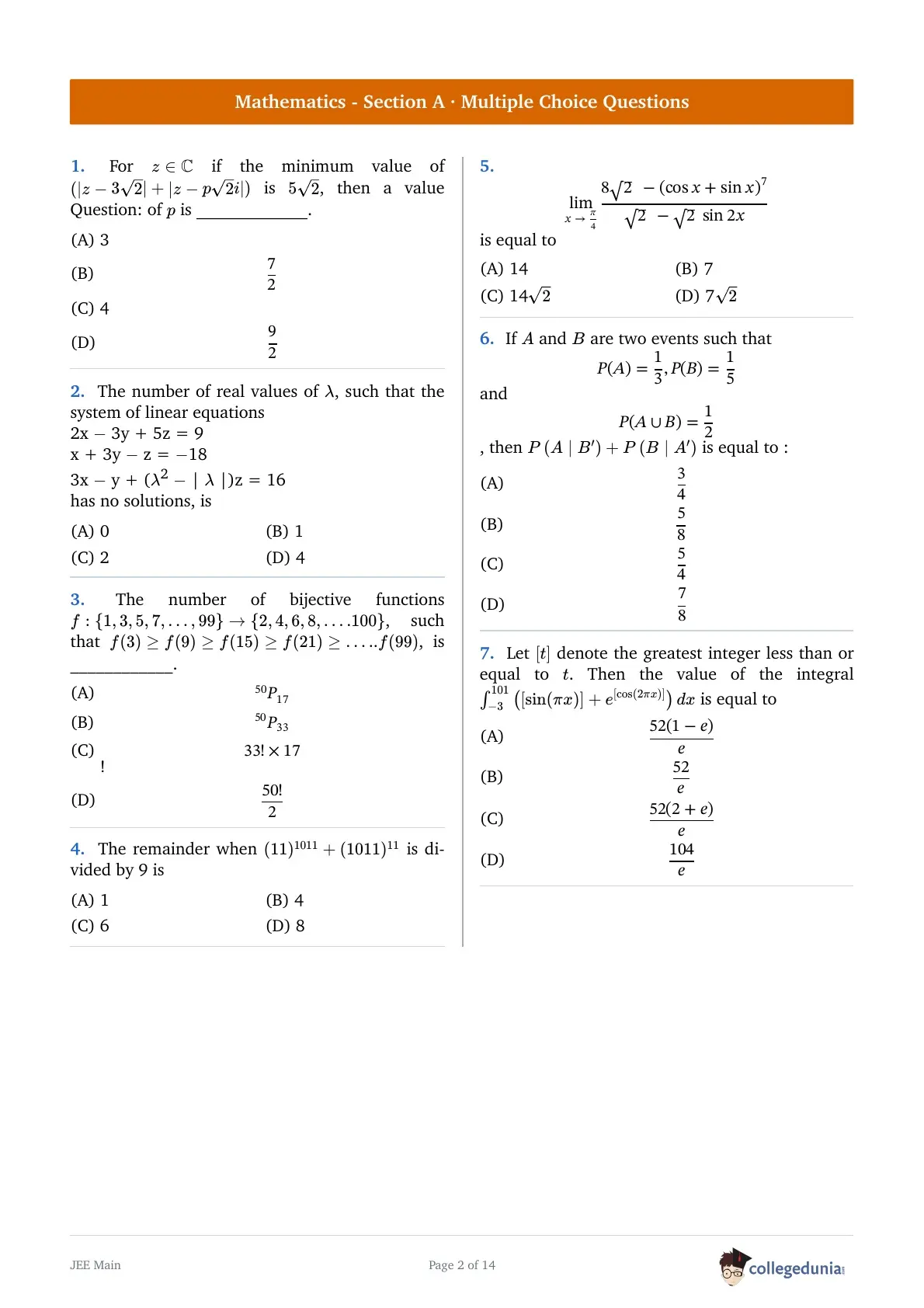
For \(z \in C\) if the minimum value of \((| z -3 \sqrt{2}|+| z - p \sqrt{2} i |)\) is \(5 \sqrt{2}\), then a value of \(p\) is ______
The number of real values \(\lambda\), such that the system of linear equations \(2 x-3 y+5 z=9 \) \( x+3 y-z=-18 \) \( 3 x-y+\left(\lambda^2-|\lambda|\right) z=16\) has no solution, is :-
The number of bijective functions \(f :\{1,3,5\), \(7, \ldots \ldots 99\} \rightarrow\{2,4,6,8, \ldots \ldots , 100\}\), such that \(f (3) \geq f (9) \geq f (15) \geq f (21) \geq \ldots f (99), \) is _____
The remainder when \((11)^{1011}+(1011)^{11}\) is divided by \(9\) is
\(\lim_{x\rightarrow \frac{\pi}{4}}\) 8\(\sqrt2\)−(cosx+sinx)\(^{\frac{7}{\sqrt2}}\)−\(\sqrt2\)sin2x is equal to
If A and B are two events such that \(P(A)=\frac1{3},P(B)=\frac1{5}\) and \(P(A∪B)=\frac1{2}\) then \(P(\frac{A}{B'}) + P(\frac{B}{A'})\) is equal to
Let \([t]\) denote the greatest integer less than or equal to t Then the value of the integral \(\int\limits_{-3}^{101}\left([\sin (\pi x)]+e^{[\cos (2 \pi x)]}\right) d x\) is equal to
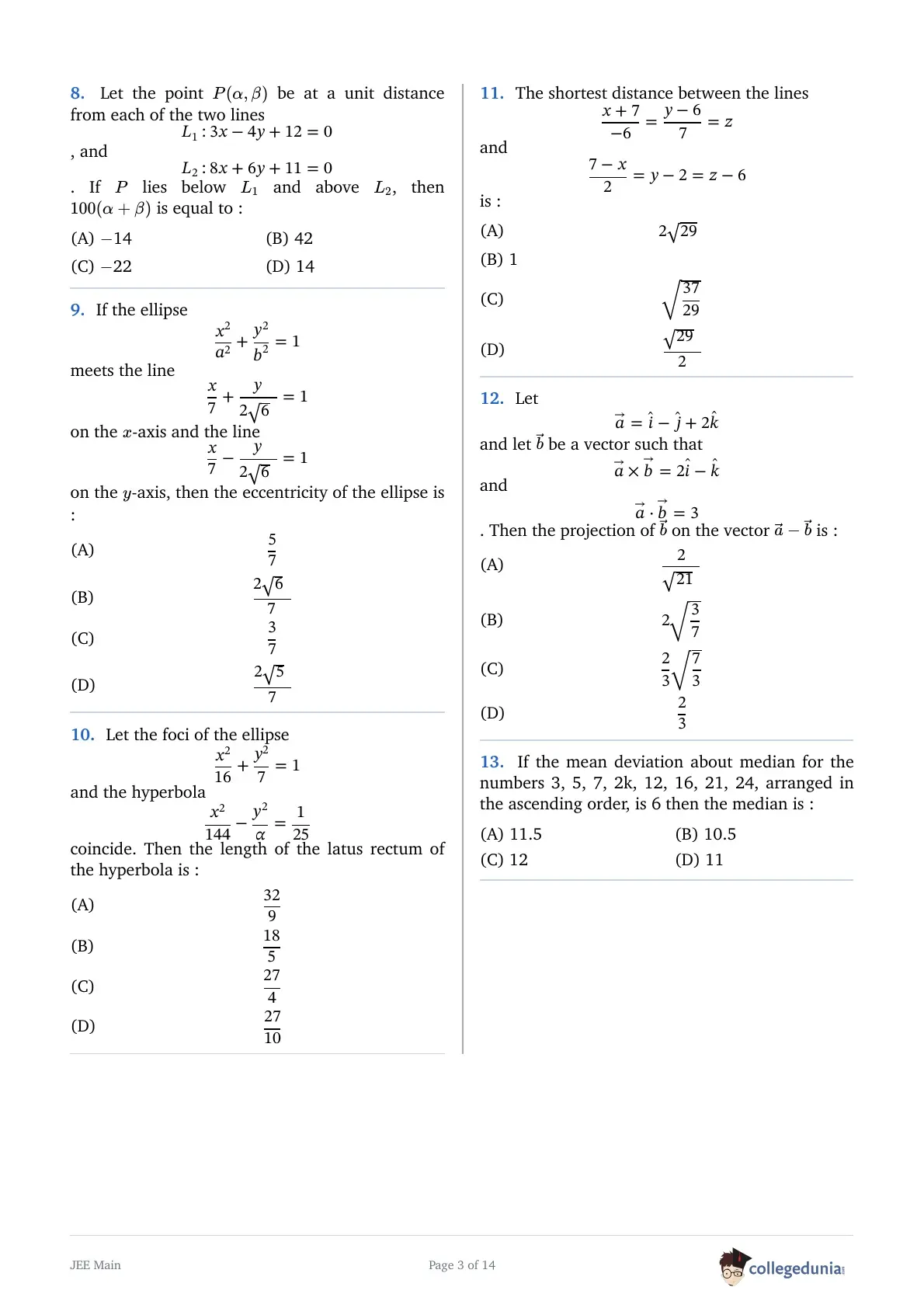
Let the point \(P(\alpha, \beta)\) be at a unit distance from each of the two lines \(L _1: 3 x -4 y +12=0\), and \(L _2: 8 x +6 y +11=0\) If \(P\) lies below \(L _1\) and above \(L _2\), then \(100(\alpha+\beta)\) is equal to
If the ellipse \(\frac{x^2}{a^2}+\frac{y^2}{b^2}=1\) meets the line \(\frac{x}{7}+\frac{y}{2 \sqrt{6}}=1\) on the \(x\)-axis and the line \(\frac{x}{7}-\frac{y}{2 \sqrt{6}}=1\) on the \(y\)-axis, then the eccentricity of the ellipse is
Let the foci of the ellipse \(\frac{x^2}{16}+\frac{y^2}{7}=1\) and the hyperbola \(\frac{x^2}{144}-\frac{y^2}{\alpha}=\frac{1}{25}\) coincide Then the length of the latus rectum of the hyperbola is:-
The shortest distance between the lines \(\frac{x+7}{-6}=\frac{y-6}{7}=z\) and \(\frac{7-x}{2}=y-2=z-6\) is
Let \(\overset{→}a = \hat{i}- \hat{J}+2\hat{K}\) and \(\overset{→}b\) be a vector such that \(\overset{→}a×\overset{→}b=2\hat{i}−\hat{k} \) and \(\overset{→}a⋅\overset{→}b=3\). Then the projection of \(\overset{→}b\) on the vector \(\overset{→}a-\overset{→}b\) is :
If the mean deviation about median for the number \(3,5,7,2 k , 12,16,21,24\) arranged in the ascending order, is 6 then the median is
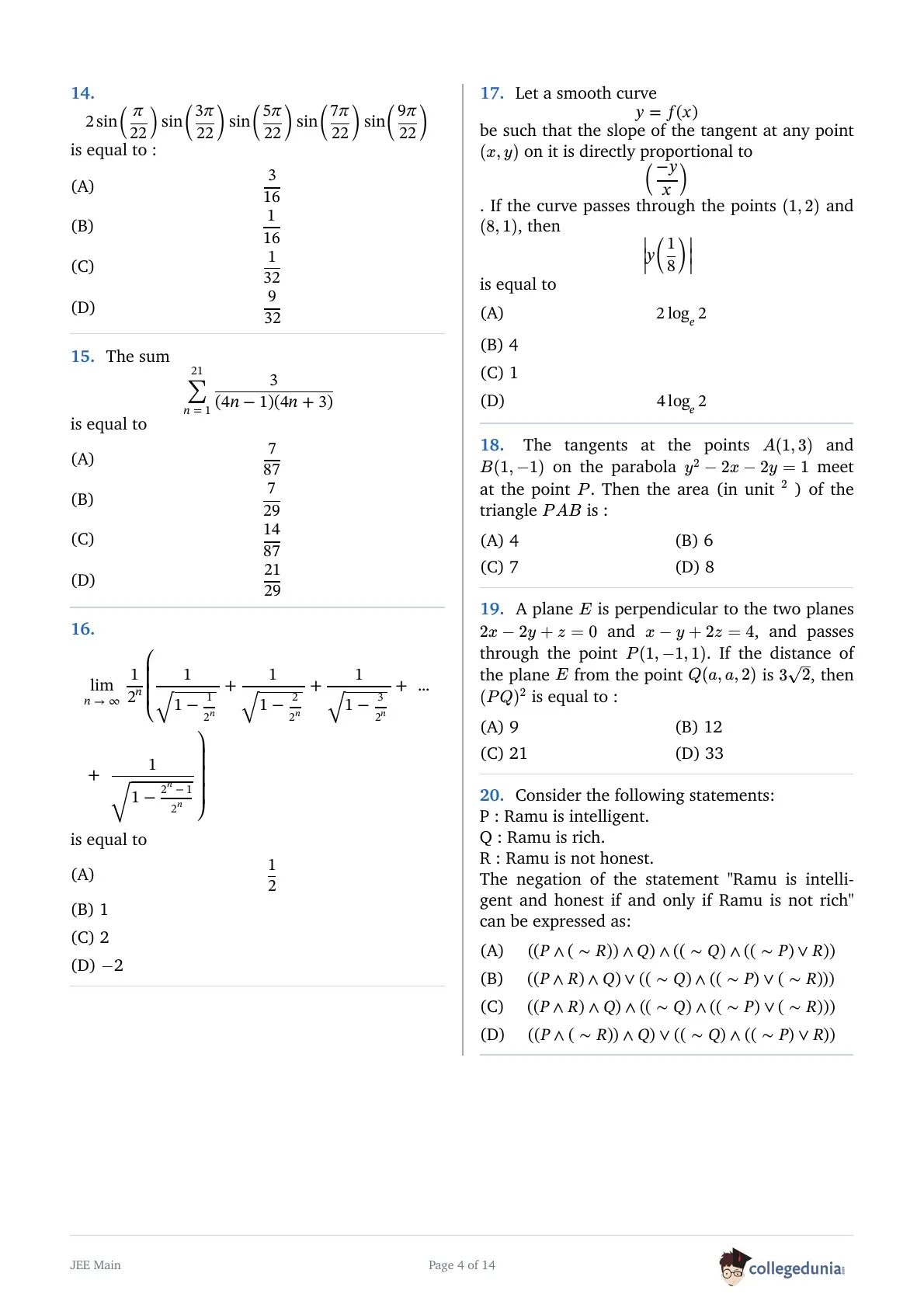
2sin(\(\frac{\pi}{22}\))sin(\(\frac{3\pi}{22}\))sin(\(\frac{5\pi}{22}\))sin(\(\frac{7\pi}{22}\))sin(\(\frac{9\pi}{22}\)) is equal to
The sum \(\displaystyle\sum_{n=1}^{21} \frac{3}{(4 n-1)(4 n+3)}\) is equal to
\(lim_{n→∞} \frac1{2^n}(\frac1{\sqrt{1-1/2^n}} +\frac1{\sqrt{1-\frac2{2^n}}}+\frac1{\sqrt{1-\frac3{2^n}}}+...+\frac1{\sqrt{1-\frac{2^n-1}{2^n}}})\) is equal to
Let a smooth curve \(y=f(x)\) be such that the slope of the tangent at any point \((x, y)\) on it is directly proportional to \(\left(\frac{-y}{x}\right)\) If the curve passes through the point \((1,2)\) and \((8,1)\), then \(\left|y\left(\frac{1}{8}\right)\right|\) is equal to
The tangents at the point \(A (1,3)\) and \(B (1,-1)\) on the parabola \(y^2-2 x-2 y=1\) meet at the point \(P\) Then the area (in unit \(^2\) ) of \(\triangle PAB\) is :-
A plane \(E\) is perpendicular to the two planes \(2 x-2 y+z=0\) and \(x-y+2 z=4\), and passes through the point \(P (1,-1,1)\) If the distance of the plane \(E\) from the point \(Q(a, a, 2)\) is \(3 \sqrt{2}\), then \(( PQ )^2\) is equal to
Consider the following statements : \(P\) : Ramu is intelligent \(Q: \) Ramu is rich \(R\) : Ramu is not honest The negation of the statement "Ramu is intelligent and honest if and only if Ramu is not rich" can be expressed as :
Mathematics - Section B (Q21 - Q30)
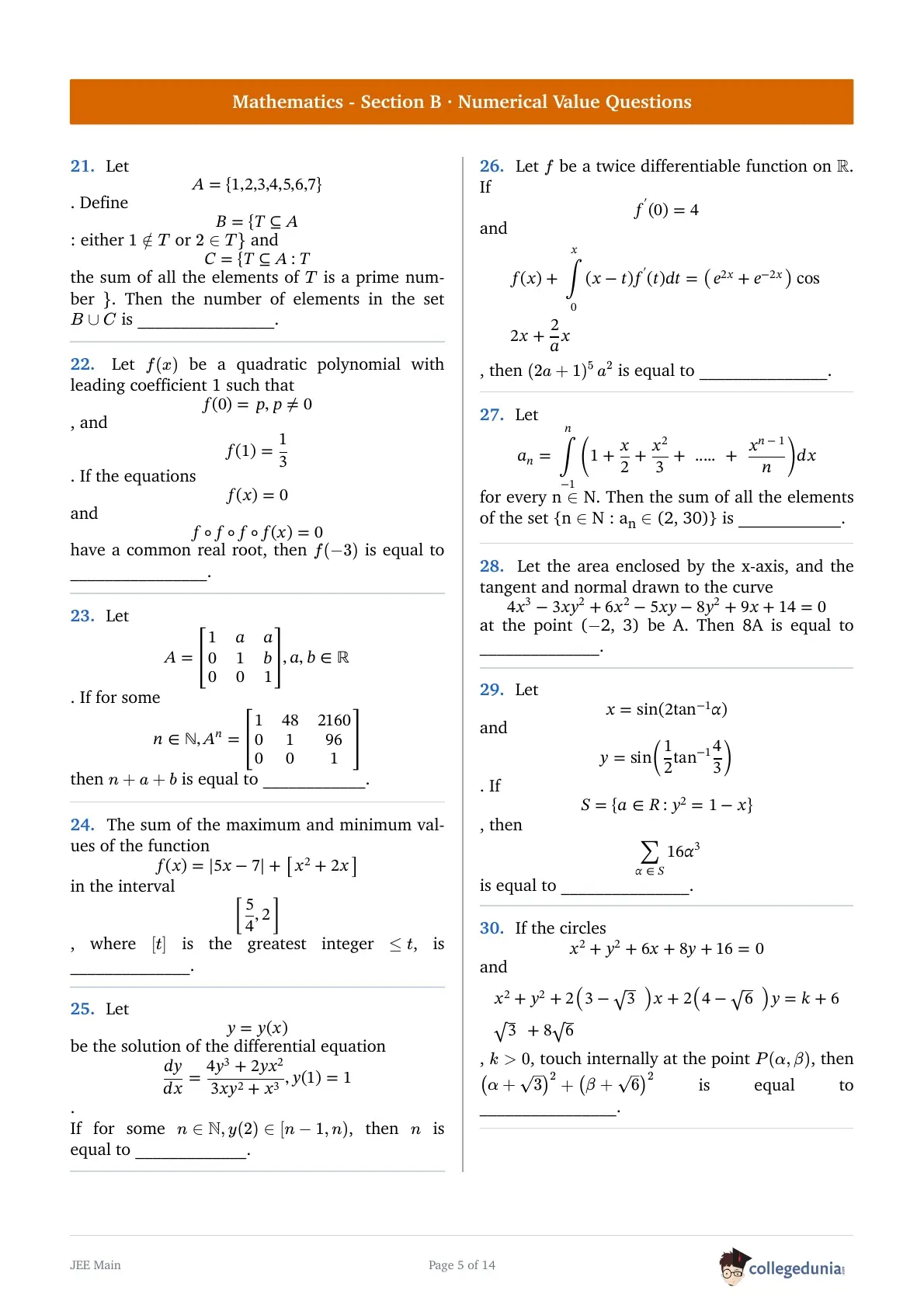
Let \(A :\{1,2,3,4,5,6,7\}\). Define \(B=\{T \subseteq A\) : either \(1 \notin T\) or \(2 \in T \}\) and \(C = \{T _{\subseteq} A : T\) the sum of all the elements of \(T\) is a prime number \(\}\). Then the number of elements in the set \(B \cup C\) is _______ .
Let \(f(x)\) be a quadratic polynomial with leading coefficient 1 such that \(f(0) = p, p≠0\) and \(f(1)=\frac{1}{3}\). If the equation \(f(x) = 0\) and \(fofofof(x) = 0\) have a common real root, then \(f(–3)\) is equal to.......................
Let \(A = \begin{bmatrix} 1 & a & a \\ 0 & 1 & b \\ 0 & 0 & 1\end{bmatrix}, a , b \in R\).
If for some \(n \in N , A ^{ n }=\begin{bmatrix}1 & 48 & 2160 \\ 0 & 1 & 96 \\ 0 & 0 & 1\end{bmatrix}\)
then \(n + a + b\) is equal to _________.
The sum of the maximum and minimum values of the function |5x-7|+[x2+2x] is the interval \(\left[\frac{5}{4}, 2\right]\), where \([t]\) is the greatest integer \(\leq t\) is ______
Let \(y=y(x)\) be the solution of the differential equation \(\frac{d y}{d x}=\frac{4 y^3+2 y x^2}{3 x y^2+x^3}, y(1)=1\) If for some \(n \in N , y (2) \in[ n -1, n )\), then \(n\) is equal to ______
Let \(f\) be a twice differentiable function on \(R\).
If \(f ^{\prime}(0)=4\) and \(f(x)+\int\limits_0^x(x-t) f^{\prime}(t) d t=\left(e^{2 x}+e^{-2 x}\right) \cos 2 x+\frac{2}{a} x,\)
then \((2 a+1)^5 a^2\) is equal to ______.
Let \(a _{ n }=\int\limits_{-1}^{ n }\left(1+\frac{ x }{2}+\frac{ x ^2}{2}+\frac{ x ^3}{3}+\ldots \ldots +\frac{ x ^{ n -1}}{ n }\right) dx\) for \(n \in N\) Then the sum of all the elements of the set \(\left\{ n \in N : a _{ n } \in(2,30)\right\}\) is ______
Let the area enclosed by the \(x\)-axis, and the tangent and normal drawn to the curve \(4 x^3-3 x y^2+6 x^2-5 x y-8 y^2+9 x+14=0\) at the point \((-2,3)\) be \(A\). Then \(8 A\) is equal to ______
Let \(x=\sin \left(2 \tan ^{-1} \alpha\right)\) and \(y=\sin \left(\frac{1}{2} \tan ^{-1} \frac{4}{3}\right)\) If \(S =\left\{\alpha \in R : y ^2=1- x \right\}\), then \(\displaystyle\sum_{\alpha \in S } 16 \alpha^3\) is equal to ______
If the circles \(x^2+y^2+6 x+8 y+16=0\) and \(x^2+y^2+2(3-\sqrt{3}) x+x+2(4-\sqrt{6}) y\) \(= k +6 \sqrt{3}+8 \sqrt{6}, k >0\) touch internally at the point \(P(\alpha, \beta)\), then \((\alpha+\sqrt{3})^2+(\beta+\sqrt{6})^2\) is equal to _______
Physics - Section A (Q31 - Q50)
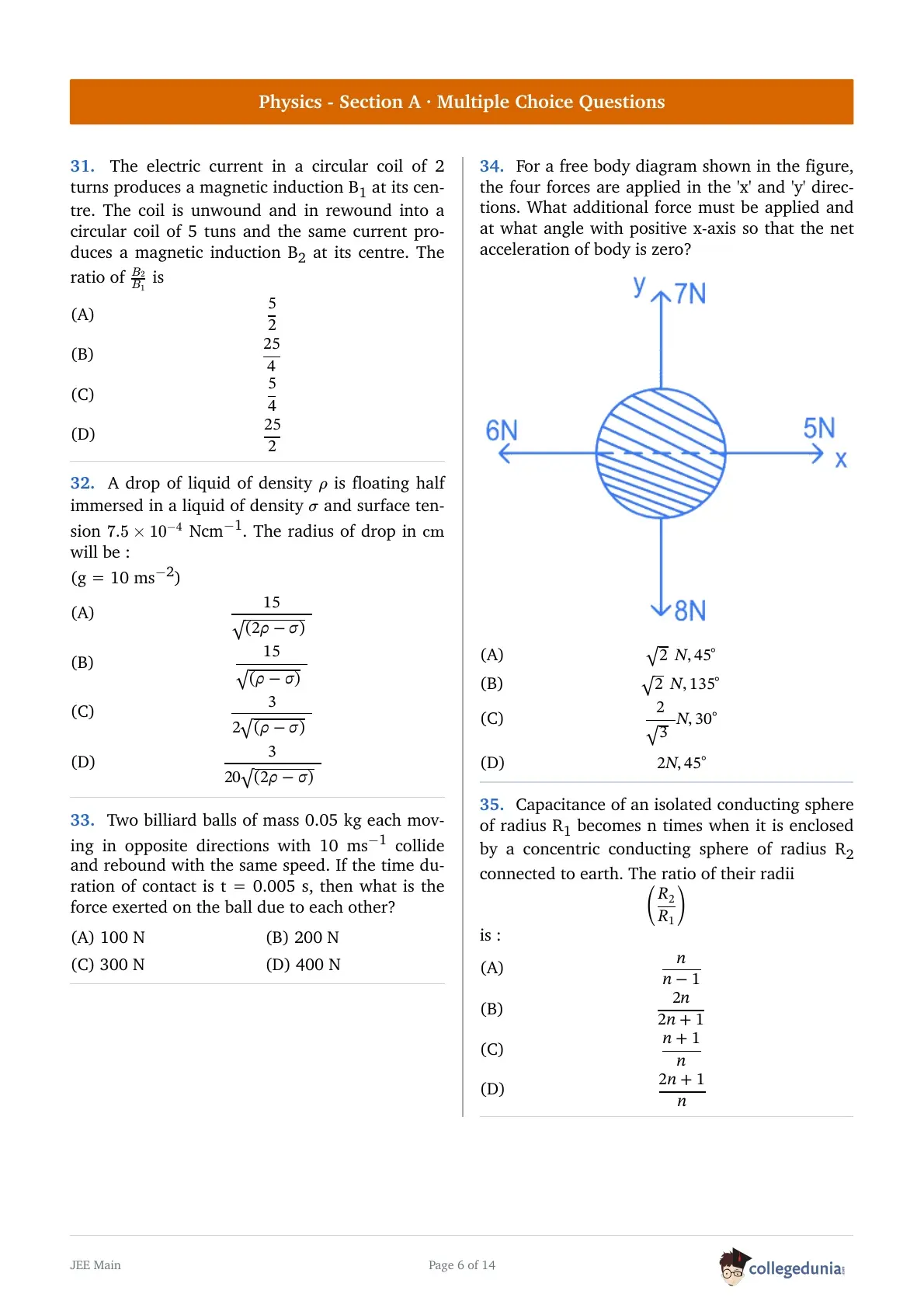
The electric current in a circular coil of 2 turns produces a magnetic induction \(B _1\) at its centre The coil is unwound and is rewound into a circular coil of 5 turns and the same current produces a magnetic induction \(B _2\) at its centre The ratio of \(\frac{ B _2}{ B _1}\) is :
A drop of liquid of density ρ is floating half immersed in a liquid of density σ and surface tension 7.5×10⁻⁴ Ncm−1. The radius of drop in cm will be : ( Take : g=10 m/s2)
Two billiard balls of mass \(005\, kg\) each moving in opposite directions with \(10 \, ms ^{-1}\) collide and rebound with the same speed If the time duration of contact is \(t =0005 \, s\), then what is the force exerted on the ball due to each other?
For a free body diagram shown in the figure, the four forces are applied in the ' \(x\) ' and ' \(y\) ' directions What additional force must be applied and at what angle with positive \(x\)-axis so that the net acceleration of body is zero?

Capacitance of an isolated conducting sphere of radius \(R_1\) becomes \(n\) times when it is enclosed by a concentric conducting sphere of radius \(R_2\) connected to earth The ratio of their radii \(\left(\frac{ R _2}{ R _1}\right)\) is:
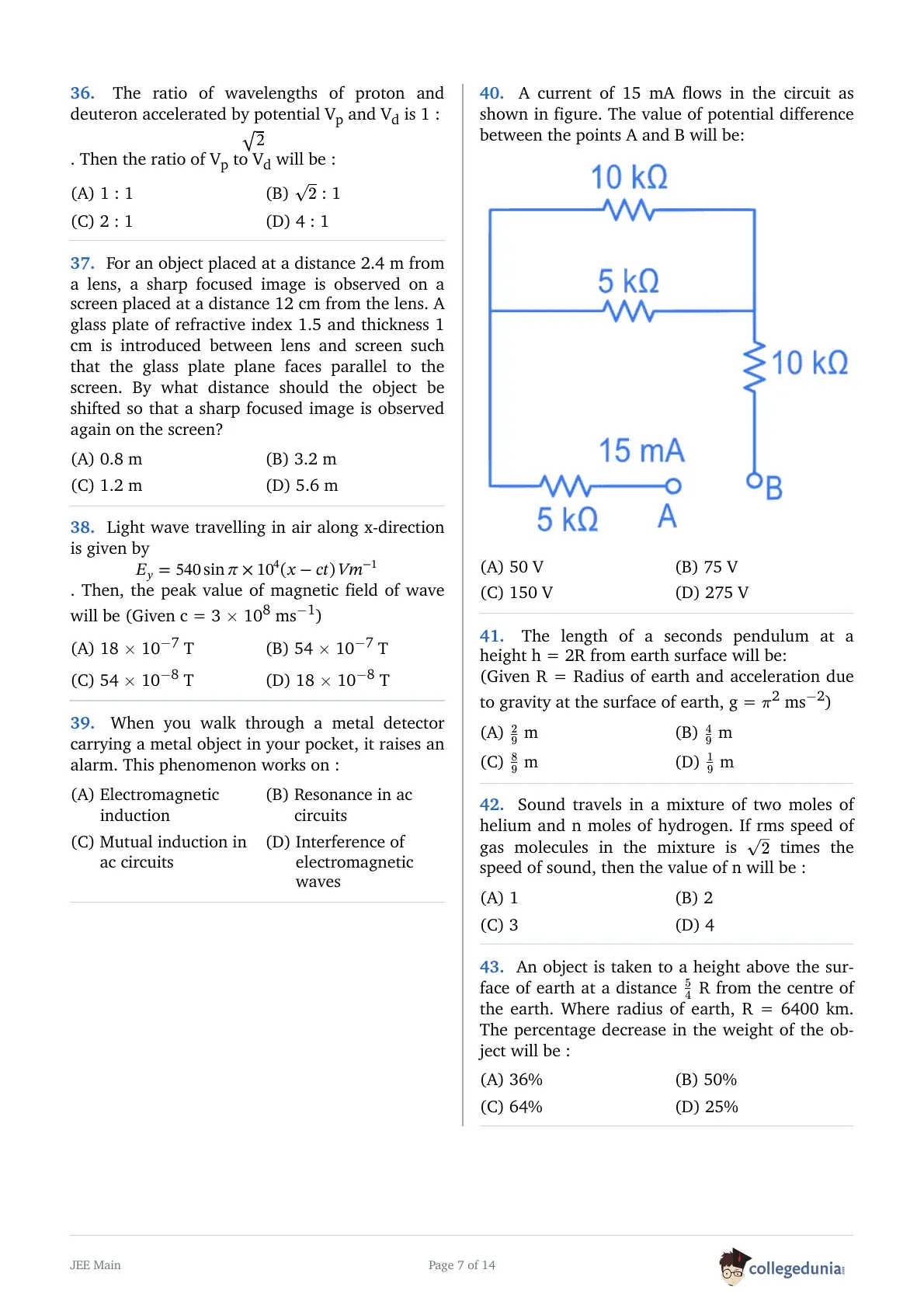
The ratio of wavelengths of proton and deuteron accelerated by potential \(V_p\) and \(V_d\) is \(1: \sqrt{2}\) Then, the ratio of \(V_p\) to \(V_d\) will be
For an object placed at a distance \(24\, m\) from a lens, a sharp focused image is observed on a screen placed at a distance \(12\, cm\) from the lens A glass plate of refractive index \(15\) and thickness \(1 \,cm\) is introduced between lens and screen such that the glass plate plane faces parallel to the screen By what distance should the object be shifted so that a sharp focused image is observed again on the screen?
Light wave travelling in air along \(x\)-direction is given by \(E_y=540 \sin \pi \times 10^4(x-c t) Vm ^{-1}\) Then, the peak value of magnetic field of wave will be (Given \(c =3 \times 10^8 ms ^{-1}\) )
When you walk through a metal detectorcarrying a metal object in your pocket, itraises an alarm This phenomenon works on
A current of \(15 \,mA\) flows in the circuit asshown in figure The value of potentialdifference between the points \(A\) and \(B\) will be
The length of a seconds pendulum at a height h=2R from earth surface will be :
(Given : R= Radius of earth and acceleration due to gravity at the surface of earth g=π2ms−2)
Sound travels in a mixture of two moles of helium and \(n\) moles of hydrogen If rms speed of gas molecules in the mixture is \(\sqrt{2}\) times the speed of sound, then the value of \(n\) will be
An object is taken to a height above the surface of earth at a distance \(\frac{5}{4} R\) from the centre of the earth Where radius of earth, \(R =6400 km\) The percentage decrease in the weight of the object will be
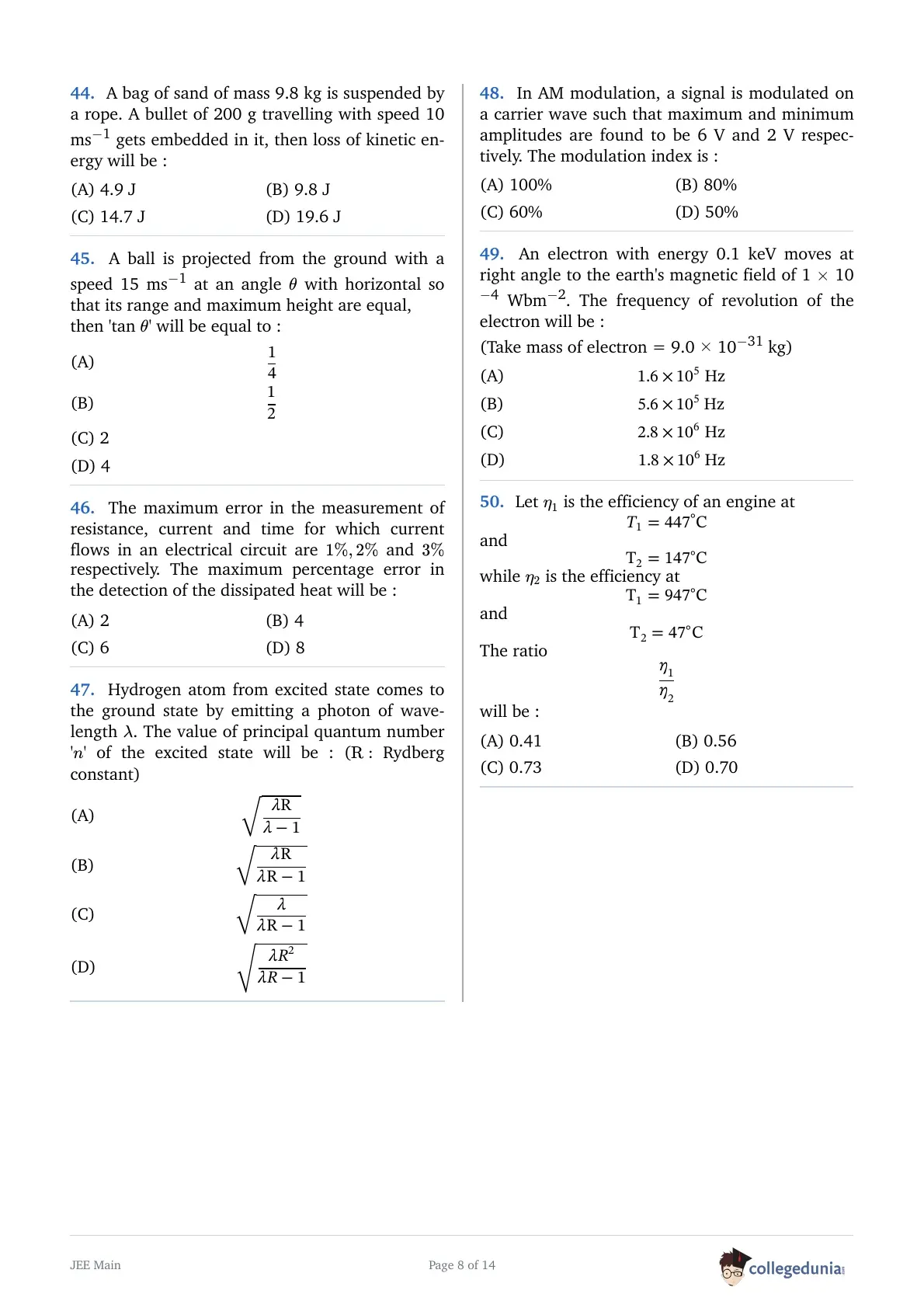
A bag of sand of mass \(98\, kg\) is suspended by a rope A bullet of \(200\, g\) travelling with speed \(10\, ms ^{-1}\) gets embedded in it, then loss of kinetic energy will be
A ball is projected from the ground with a speed 15 ms1 at an angle θ with horizontal so that its range and maximum height are equal, then ‘tan θ’ will be equal to
The maximum error in the measurement of resistance, current and time for which current flows in an electrical circuit are 1%, 2% and 3% respectively. The maximum percentage error in the detection of the dissipated heat will be
Hydrogen atom from excited state comes to the ground by emitting a photon of wavelength \(\lambda\) The value of principal quantum number 'n' of the excited state will be :(R : Rydberg constant)
In AM modulation, a signal is modulated on a carrier wave such that maximum and minimum amplitude are found to be \(6 V\) and \(2 V\) respectively The modulation index is
An electron with energy \(01\, keV\) moves at right angle to the earth's magnetic field of \(1 \times 10^{-4} Wbm ^{-2}\) The frequency of revolution of the electron will be (Take mass of electron \(=90 \times 10^{-31} kg\) )
Let \(\eta_1\) is the efficiency of an engine at \(T _1=447^{\circ} C\) and \(T _2=147^{\circ} C\) while \(\eta_2\) is the efficiency at \(T _1=947^{\circ} C\) and \(T _2=47^{\circ} C\) The ratio \(\frac{\eta_1}{\eta_2}\) will be :
Physics - Section B (Q51 - Q60)
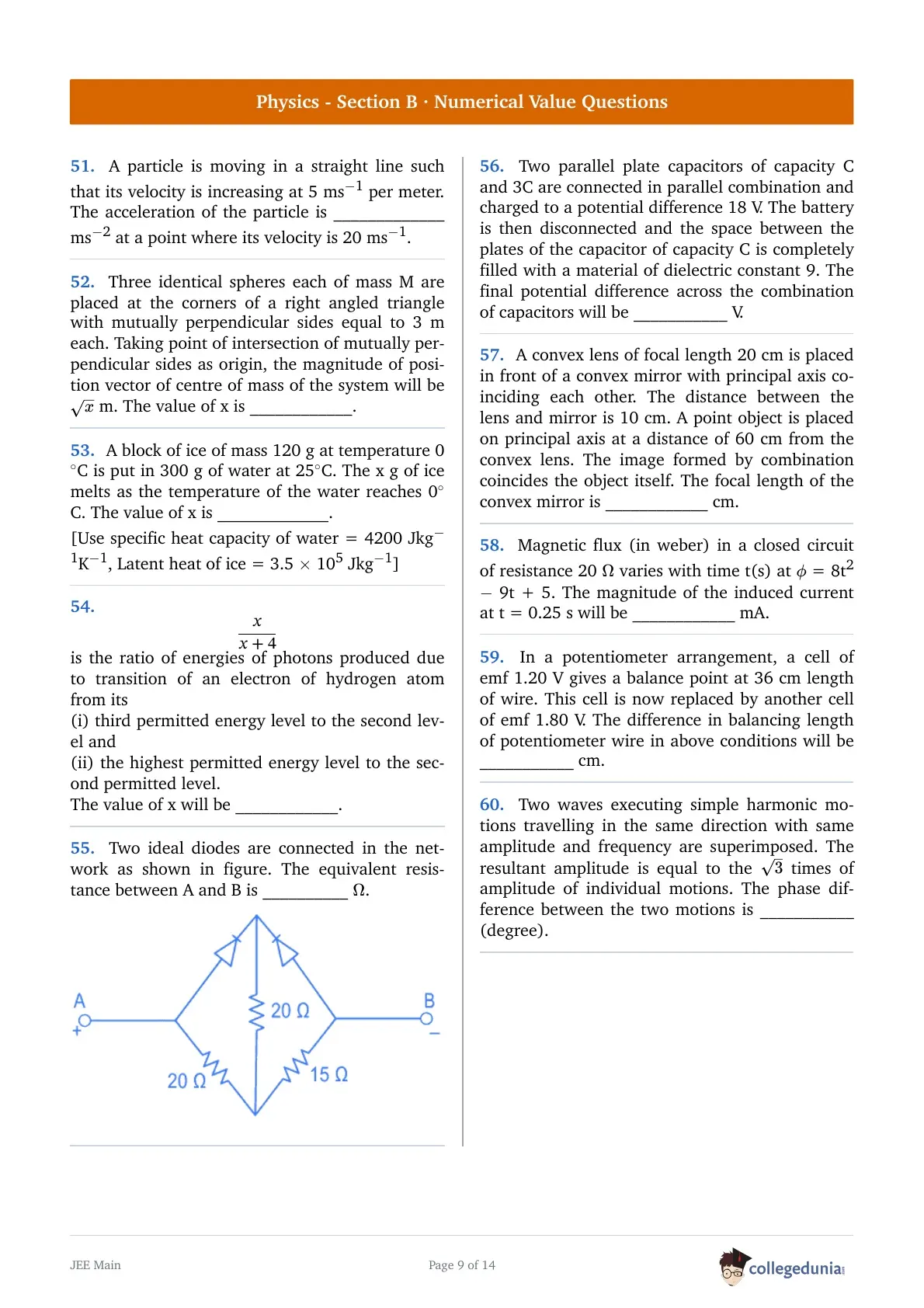
A particle is moving in a straight line such that its velocity is increasing at 5 ms–1 per meter. The acceleration of the particle is _______ms–2 at a point where its velocity is 20 ms–1.
Three identical spheres each of mass \(M\) are placed at the corners of a right angled triangle with mutually perpendicular sides equal to \(3 m\) each Taking point of intersection of mutually perpendicular sides as origin, the magnitude of position vector of centre of mass of the system will be \(\sqrt{ x } m\) The value of \(x\) is
A block of ice of mass \(120\, g\) at temperature \(0^{\circ} C\) is put in \(300\, gm\) of water at \(25^{\circ} C\) The \(xg\) of ice melts as the temperature of the water reaches \(0^{\circ} C\) The value of \(x\) is [Use: Specific heat capacity of water \(=4200\,Jkg ^{-1} K ^{-1}\), Latent heat of ice = 3.5 \(\times\) 105 JKg-1]
\(\frac{x}{x+4}\) is the ratio of energies of photons produced due to transition of an electron of hydrogen atom from its (i) third permitted energy level to the second level and (ii) the highest permitted energy level to the second permitted level The value of \(x\) will be
Two ideal diodes are connected in the network as shown in figure The equivalent resistance between \(A\) and \(B\) is ______\(\Omega\)

Two parallel plate capacitors of capacity \(C\) and \(3 C\) are connected in parallel combination and charged to a potential difference \(18\, V\) The battery is then disconnected and the space between the plates of the capacitor of capacity \(C\) is completely filled with a material of dielectric constant \(9\) The final potential difference across the combination of capacitors will be______ \(V\)
A convex lens of focal length \(20\, cm\) is placed in front of convex mirror with principal axis coinciding each other The distance between the lens and mirror is \(10\, cm\) A point object is placed on principal axis at a distance of \(60 \, cm\) from the convex lens The image formed by combination coincides the object itself The focal length of the convex mirror is ________ \(cm\)
Magnetic flux (in weber) in a closed circuit of resistance \(20 \,\Omega\) varies with time \(t ( s )\) as \(\phi=8 t^2-9 t+5\). The magnitude of the induced current at \(t =0.25\, s\) will be ______\(mA\)
In a potentiometer arrangement, a cell of emf \(1.20\, V\) gives a balance point at \(36 \, cm\) length of wire This cell is now replaced by another cell of emf \(1.80\, V\). The difference in balancing length of potentiometer wire in above conditions will be _______\(cm\)
Two waves executing simple harmonic motion travelling in the same direction with same amplitude and frequency are superimposed The resultant amplitude is equal to the \(\sqrt{3}\) times of amplitude of individual motions The phase difference between the two motions is _______(degree)
Chemistry - Section A (Q61 - Q80)
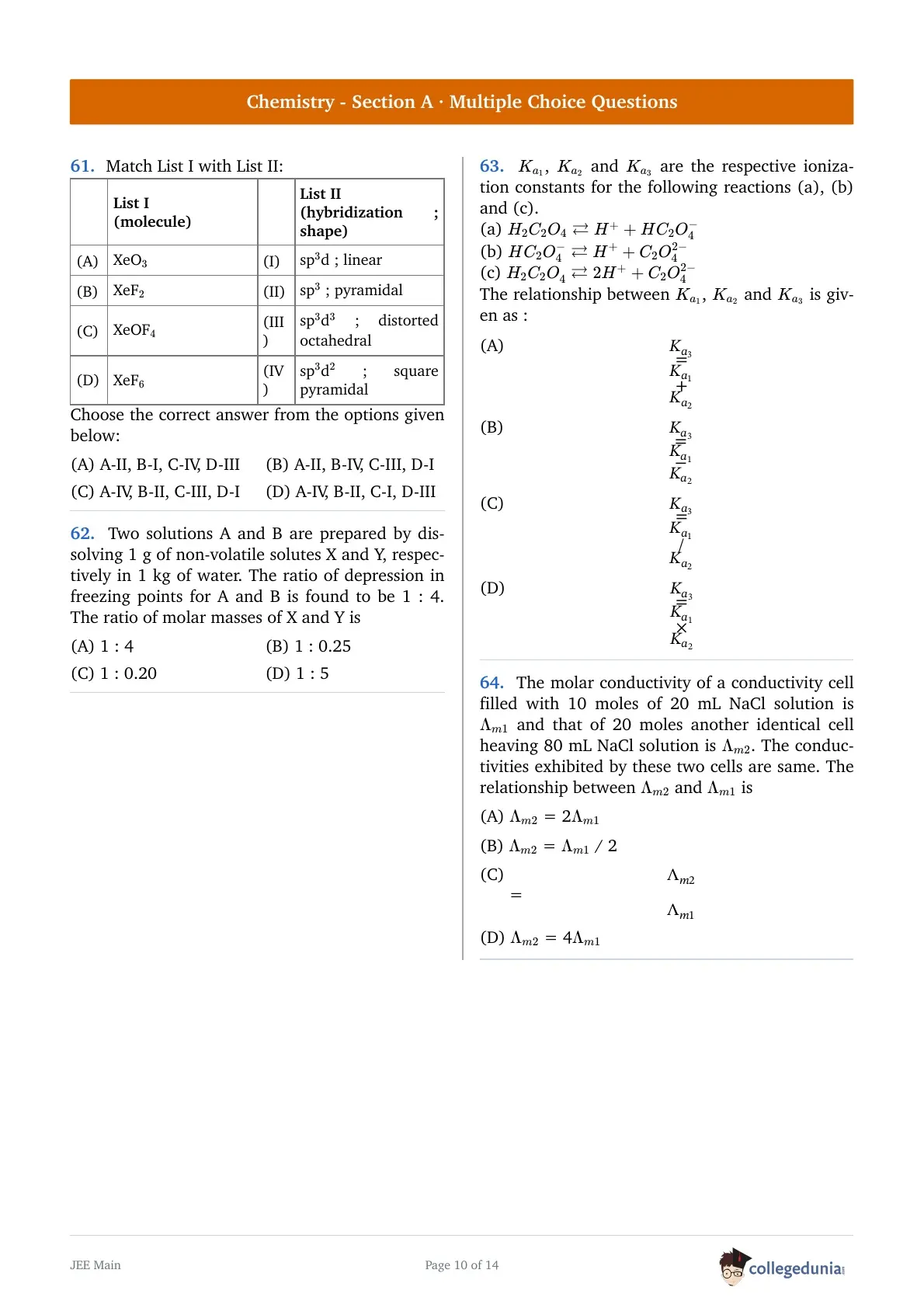
Match List I with List II :
| List-I (molecule) | List-II (hybridization; shape) | ||
|---|---|---|---|
| A | XeO3 | i | sp3d ; linear |
| B | XeF2 | ii | sp3; pyramidal |
| C | XeOF4 | iii | sp3d3; distorted octahedral |
| D | XeF6 | iv | sp3d2 ;square pyramidal |
Choose the correct answer from the options given below:
Two solutions \(A\) and \(B\) are prepared by dissolving \(1 g\) of non-volatile solutes \(X\) and \(Y\) respectively in \(1 \,kg\) of water The ratio of depression in freezing points for \(A\) and \(B\) is found to be \(1: 4\) The ratio of molar masses of \(X\) and \(Y\) is :
Ka1, Ka2 and Ka3 are the respective ionization constants for the following reactions (a),(b), and (c).
(a) H2C2O4⇌H++HC2O4−
(b) HC2O4−⇌H++HC2O42−
(c) H2C2O4⇌2H++C2O42−
The relationship between Ka1,Ka2 and Ka3 is given as
The molar conductivity of a conductivity cell filled with \(10\) moles of \(20\, mL\, NaCl\) solution is \(\Lambda_{ m 1}\) and that of \(20\) moles another identical cell heaving \(80 \, mL \, NaCl\) solution is \(\Lambda_{ m 2}\), The conductivities exhibited by these two cells are same The relationship between \(\Lambda_{ m 2}\) and \(\Lambda_{ m 1}\) is
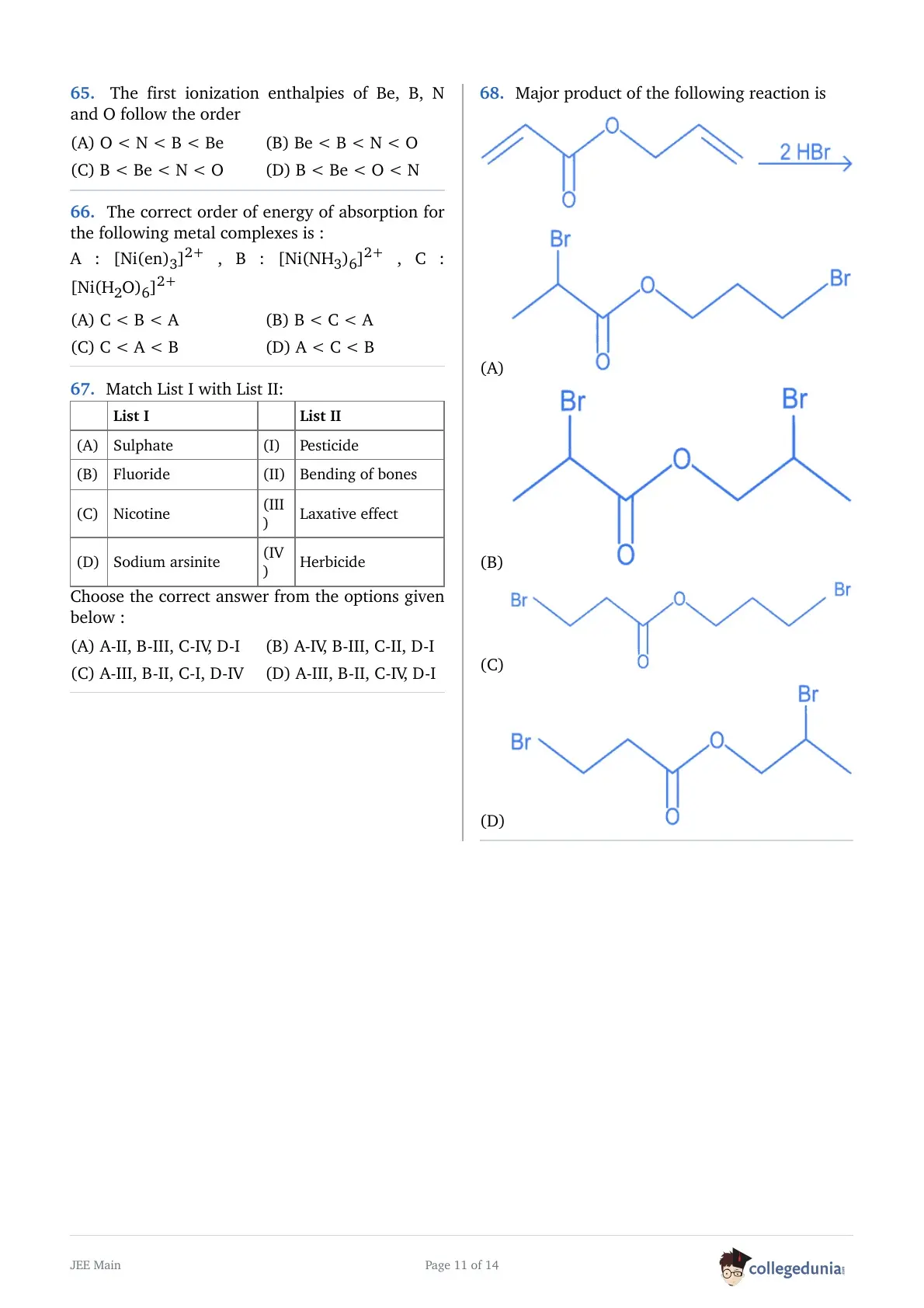
The first ionization enthalpies of \(Be , B , N\) and \(O\) follow the order
The correct order of energy of absorption for the following metal complexes is :
A : \([\mathrm{Ni(en)_3}]^{2+}\), B : \([\mathrm{Ni(NH_3)_6}]^{2+}\), C : \([\mathrm{Ni(H_2O)_6}]^{2+}\)
Match List I with List II.
| List-I | List-II | ||
|---|---|---|---|
| A | Sulphate | I | Pesticide |
| B | Fluoride | II | Bending of bones |
| C | Nicotine | III | Laxative effect |
| D | Sodium arsinite | IV | Herbicide |
Choose the correct answer from the options given below:


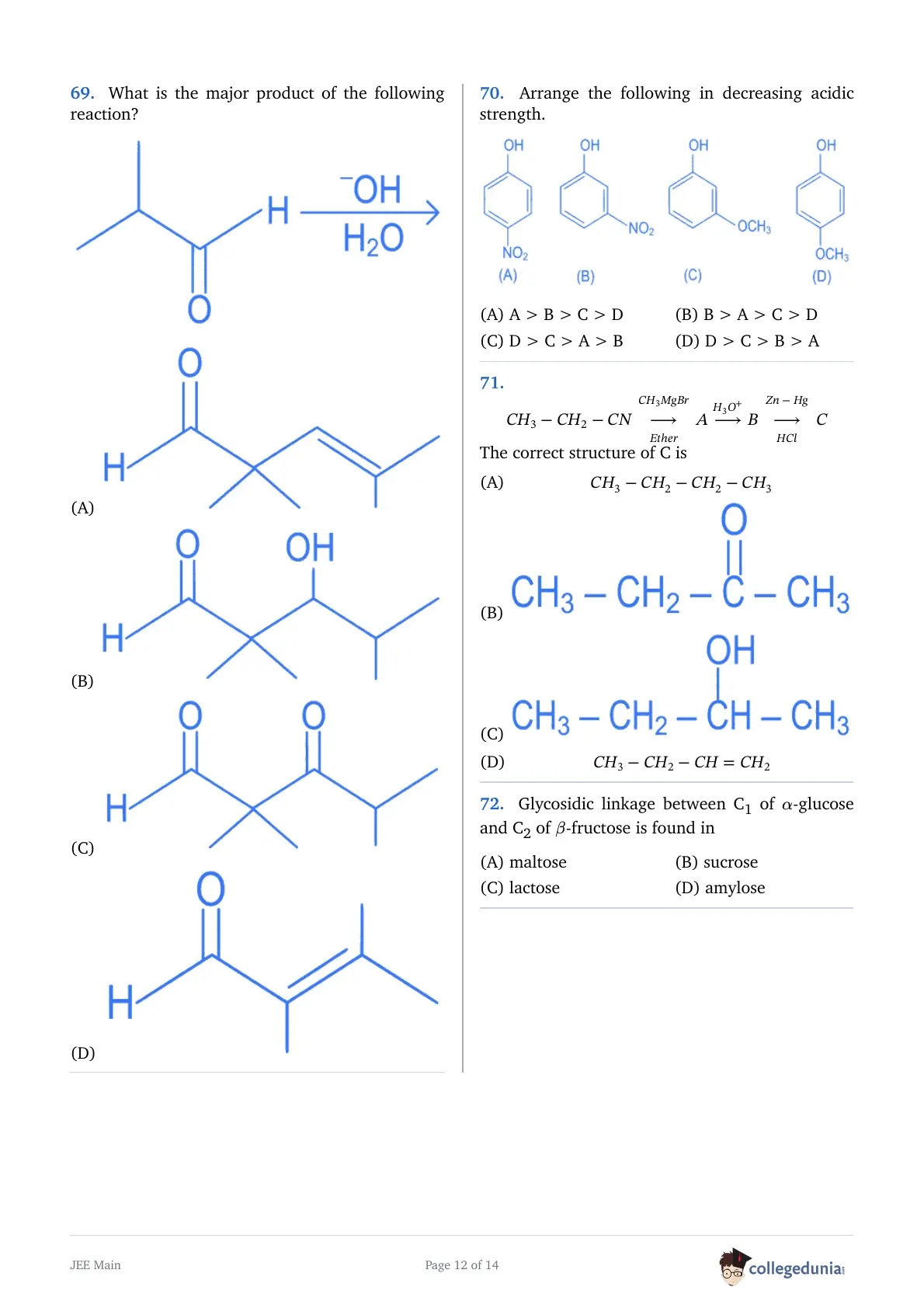
Arrange the following in decreasing acidic strength.


Glycosidic linkage between \(C _1\) of \(\alpha\)-glucose and \(C_2\) of \(\beta\)-fructose is found in
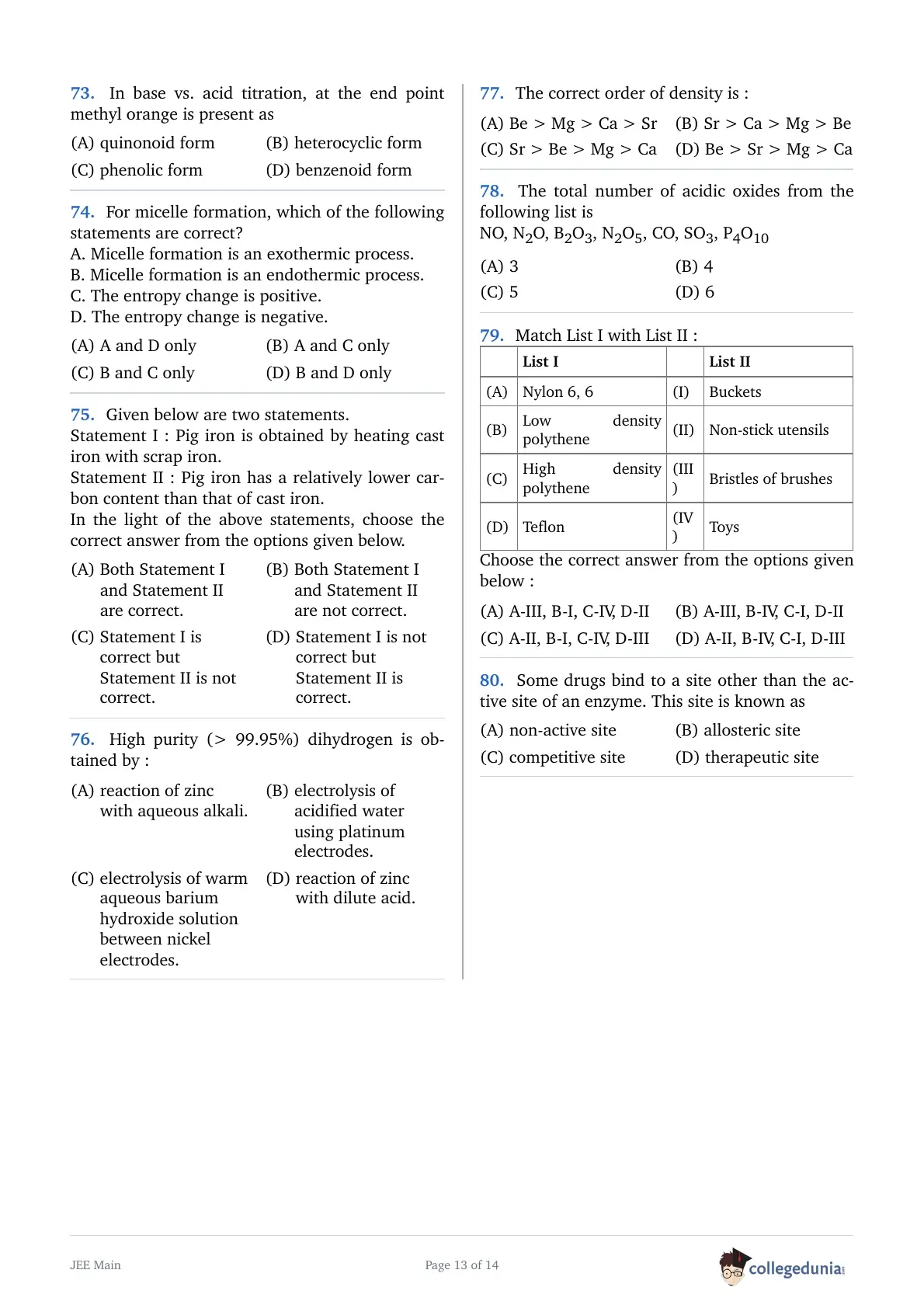
In base vs acid titration, at the endpoint methyl orange is present as
For micelle formation, which of the following statements are correct?
(A) Micelle formation is an exothermic process
(B) Micelle formation is an endothermic process
(C) The entropy change is positive
(D) The entropy change is negative
Given below are two statements Statement I : Pig iron is obtained by heating cast iron with scrap iron Statement II : Pig iron has a relatively lower carbon content than that of cast iron In the light of the above statements, choose the correct answer from the options given below
High purity (>99.95%) dihydrogen is obtained by
The correct order of density is
The total number of acidic oxides from the following list is: \(NO , N _2 O , B _2 O _3, N _2 O _5\), \(CO , SO _3, P _4 O _{10}\)
Match List I with List II :
| List-I Polymer | List-II used for items | ||
|---|---|---|---|
| A | Nylon 6,6 | I | Buckets |
| B | Low density polythene | II | Non-stick utensils |
| C | High density polythene | III | Bristles of brushes |
| D | Teflon | IV | Toys |
Some drugs bind to a site other than the active site of an enzyme. This site is known as
Chemistry - Section B (Q81 - Q90)
\(56.0 \,L\) of nitrogen gas is mixed with excess of hydrogen gas and it is found that \(20\, L\) of ammonia gas is produced The volume of unused nitrogen gas is found to be _______ \(L\)
When the excited electron of a H atom from n = 5 drops to the ground state, the maximum number of emission lines observed are ____.
While performing a thermodynamics experiment, a student made the following observations.
HCl + NaOH \(\rightarrow\) NaCl + H2O; ΔH = – 57.3 kJ mol–1
CH3COOH + NaOH \(\rightarrow\) CH3COONa + H2O; ΔH = –55.3 kJ mol–1
The enthalpy of ionization of CH3COOH, as calculated by the student, is ______ kJ mol–1. [nearest integer]
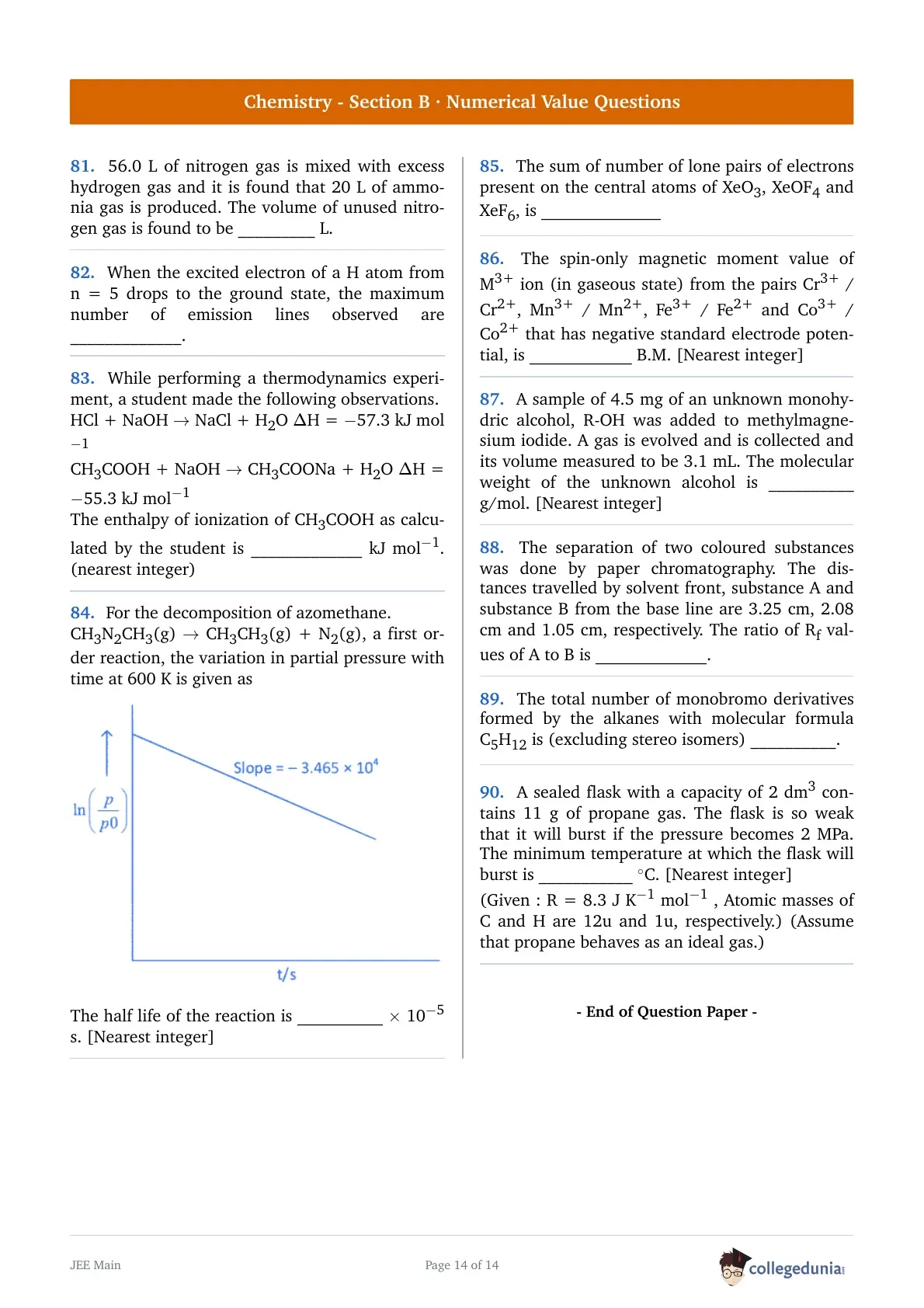
For the decomposition of azomethane, CH3N2CH3(g) → CH3CH3(g) + N2(g), a first-order reaction, the variation in partial pressure with time at 600 K is given as
The half-life of the reaction is ______ × 10–5s. [Nearest integer]
The sum of number of lone pairs of electrons present on the central atoms of \(XeO _3, XeOF _4\) and \(XeF _6\) is_____
The spin-only magnetic moment value of \(M ^{3+}\) ion (in gaseous state) from the pairs \(Cr ^{3+} / Cr ^{2+}, Mn ^{3+} / Mn ^2, \quad Fe ^{3+} / Fe ^{2+}\) and \(Co ^{3+} / Co ^{2+}\) that has negative standard electrode potential, is BM [Nearest integer]
A sample of 4.5 mg of an unknown monohydric alcohol, R–OH was added to methylmagnesium iodide. A gas is evolved and is collected and its volume measured to be 3.1 mL. The molecular weight of the unknown alcohol is___ g/mol. [Nearest integer]
The separation of two coloured substances was done by paper chromatography The distances travelled by solvent front, substance \(A\) and substance \(B\) from the base line are \(3.25\, cm. 2.08 \, cm\) and \(1.05\, cm\) respectively. The ratio of \(R_f\) values of \(A\) to \(B\) is _______
The total number of monobromo derivatives formed by the alkanes with molecular formula \(C _5 H _{12}\) is (excluding stereo isomers) _______
A sealed flask with a capacity of \(2\, dm ^3\) contains \(11 \, g\) of propane gas The flask is so weak that it will burst if the pressure becomes \(2\, MPa\) The minimum temperature at which the flask will burst is ______\({ }^{\circ} C\) [Nearest integer]
(Given: \(R =8.3 \,J \,K ^{-1} mol ^{-1}\) Atomic masses of \(C\) and \(H\) are \(12\, u\) and \(1 \,u\) respectively) (Assume that propane behaves as an ideal gas)
JEE Main 2022 Exam Pattern and Marking Scheme
| Particulars | Details |
|---|---|
| Exam Mode | Online (Computer-Based Test) |
| Paper | B.E./B.Tech (Paper 1) |
| Duration | 3 hours (180 minutes) |
| Type of Questions | Multiple Choice Questions (MCQs) + Numerical Value Questions |
| Subjects | Mathematics, Physics, Chemistry |
| Total Questions | 90 questions (75 to be attempted) |
| Total Marks | 300 marks |
| Marking Scheme | +4 for correct answer & -1 for incorrect MCQ and Numerical Value-based Questions |
JEE Main 2022 July 25 Shift 2 Difficulty Level
As per the initial students’ reaction, JEE Main 2022 July 25 Shift 2 paper has been reported as moderate. The Mathematics section was lengthy but moderate, Physics was easy to moderate and Chemistry was easy.
JEE Main 2022 July 25 Shift 2 Subject-wise Memory-Based Solutions PDF
| Subject | Memory-Based Solutions PDF |
|---|---|
| Physics | Download PDF |
| Chemistry | Download PDF |
| Mathematics | Download PDF |
JEE Main 2022 Phase 2 Question Papers with Solution PDFs
Candidates can also check shift-wise JEE Main 2022 Phase 2 Question Papers with Solution PDFs. These shift-wise question paper PDFs for JEE Main 2022 will help candidates know the overall difficulty, topics with the highest weightage and the type of questions asked in the exam.
JEE Main 2022 Phase 1 Question Papers with Solution PDFs
Shift-wise JEE Main 2022 Phase 1 Question Papers with Solution PDFs are also available. Candidates preparing for Phase 2 of the exam can check and download JEE Main Question Paper PDFs to practice and test their exam prep level.
Also Check:



Comments