




JEE Main 2022 July 26 Shift 1 Question Paper is available here with solutions PDF and detailed solutions for every question. NTA conducted the first shift on July 26, 2022, from 9:00 AM to 12:00 PM. The JEE Main 2022 Paper 1 (B.E./B.Tech) question paper includes the following:
- 90 questions in a 3-hour CBT Mode: 30 each from Mathematics, Physics and Chemistry (75 to be attempted)
- Section A: 20 multiple choice questions (MCQs) per subject, all compulsory, 4 marks each
- Section B: 10 numerical value questions per subject, any 5 to be attempted, 4 marks each
- Marking: +4 for a correct answer, -1 for an incorrect answer, 0 for an unattempted question
- Maximum marks: 300 (100 per subject)
JEE Main 2022 July 26 Shift 1 Question Paper with Solution PDF
| NTA Official PDF | CD PDF | CD PDF with Solutions |
|---|---|---|
| Download official PDF 4.60 MB | Download Collegedunia PDF 1.16 MB | Download solutions PDF 1.61 MB |
Also Check:
JEE Main 2022 July 26 Shift 1 Questions with Solutions
Mathematics - Section A (Q1 - Q20)
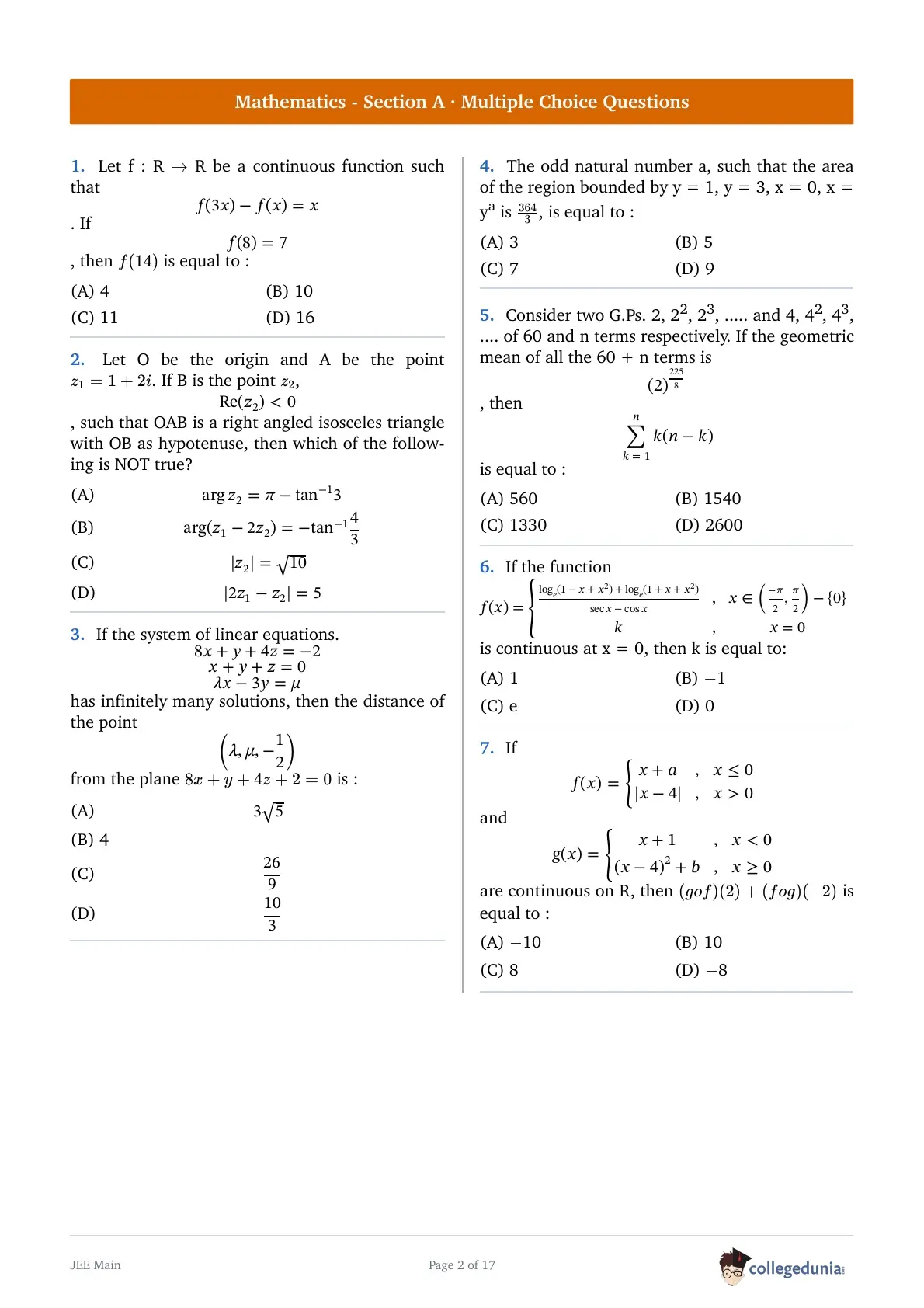
Let \(f : R \rightarrow R\) be a continuous function such that \(f (3x)- f(x)= x\). If \(f(8)=7\), then \(f (14)\) is equal to :
Let O be the origin and A be the point \(z_1 = 1 + 2i\). If B is the point \(z_2, Re(z_2) < 0\), such that OAB is a right angled isosceles triangle with OB as hypotenuse, then which of the following is NOT true?
If the system of linear equations \( 8 x+y+4 z=-2 \), \( x+y+z=0 \), \( \lambda x-3 y=\mu\) has infinitely many solutions, then the distance of the point \(\left(\lambda, \mu,-\frac{1}{2}\right)\) from the plane \(8 x + y +4 z +2=0\) is :
The odd natural number a, such that the area of the region bounded by \(y = 1, y = 3, x = 0, x = y^a\) is \(\frac {364}{3}\), is equal to
Consider two G.Ps. \(2, 2^2, 2^3, ….\) and \(4, 4^2, 4^3, …\) of \(60\) and n terms respectively. If the geometric mean of all the \(60 + n\) terms is \((2)^{\frac {225}{8}}\) then \(\sum_{k=1}^{n}k(n−k)\) is equal to
If the function
\(f(x) = \begin{cases} \frac {log_e(1−x+x^2)+log_e(1+x+x_2)}{sec\ x−cos\ x}, & \quad x∈(−\frac \pi2,\frac \pi2)−{0}\\ k, & \quad x=0 \end{cases}\)
is continuous at \(x = 0\), then k is equal to
If
\(f(x) = \begin{cases} x + a, & x \leq 0 \\ |x - 4|, & x > 0 \end{cases}\) and \(g(x) = \begin{cases} x + 1, & x < 0 \\ (x - 4)^2 + b, & x \geq 0 \end{cases}\)
are continuous on R, then (gof) (2) + (fog) (–2) is equal to
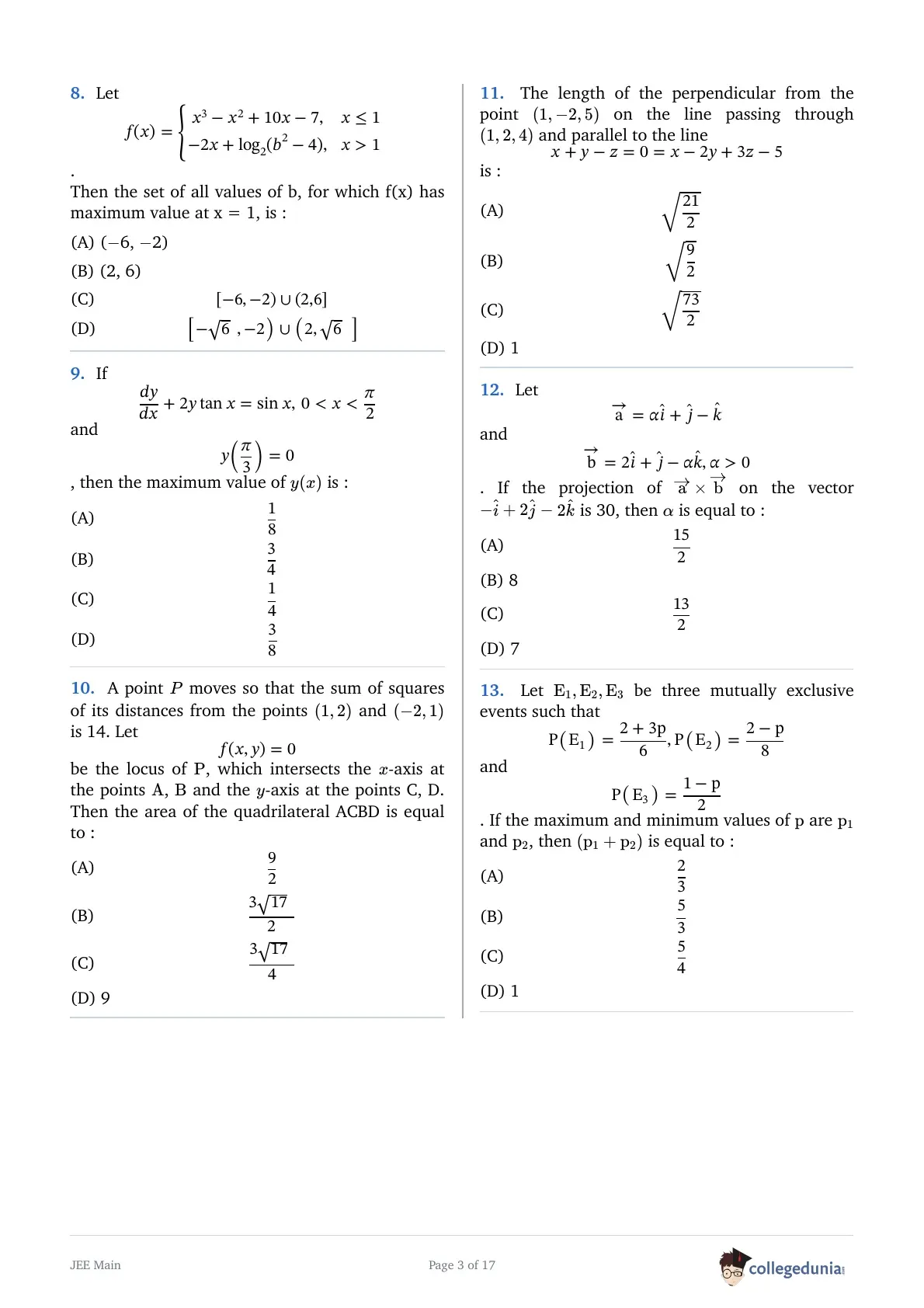
Let
\(f(x) = \begin{cases} x^3 - x^2 + 10x - 7, & x \leq 1 \\ -2x + \log_2(b^2 - 4), & x > 1 \end{cases}\)
Then the set of all values of b, for which f(x) has maximum value at x = 1, is
If
\(\frac{dy}{dx}+2y \tanx=\sinx, 0<x<\frac{π}{2} and\ y(\frac{π}{3})=0 \)
then the maximum value of y(x) is:
A point P moves so that the sum of squares of its distances from the points (1, 2) and (–2, 1) is 14. Let f(x, y) = 0 be the locus of P, which intersects the x-axis at the points A, B and the y-axis at the points C, D. Then the area of the quadrilateral ACBD is equal to
The length of the perpendicular from the point (1, –2, 5) on the line passing through (1, 2, 4) and parallel to the line x + y – z = 0 = x – 2y + 3z – 5 is
Let
\(\vec{a}=α\hat{i}+\hat{j}−\hat{k}\ and\ \vec{b}=2\hat{i}+\hat{j}−α\hat{k},α>0\).
If the projection of \(\vec{a}×\vec{b}\) on the vector \(−\hat{i}+2\hat{j}−2\hat{k}\)
is 30, then α is equal to
Let E1, E2, E3 be three mutually exclusive events such that
\(P(E_1)=\frac{2+3p}{6}, P(E_2)=\frac{2−p}{8} and\ P(E_3)=\frac{1−p}{2}.\)
If the maximum and minimum values of p are p1 and p2, then (p1 + p2) is equal to :
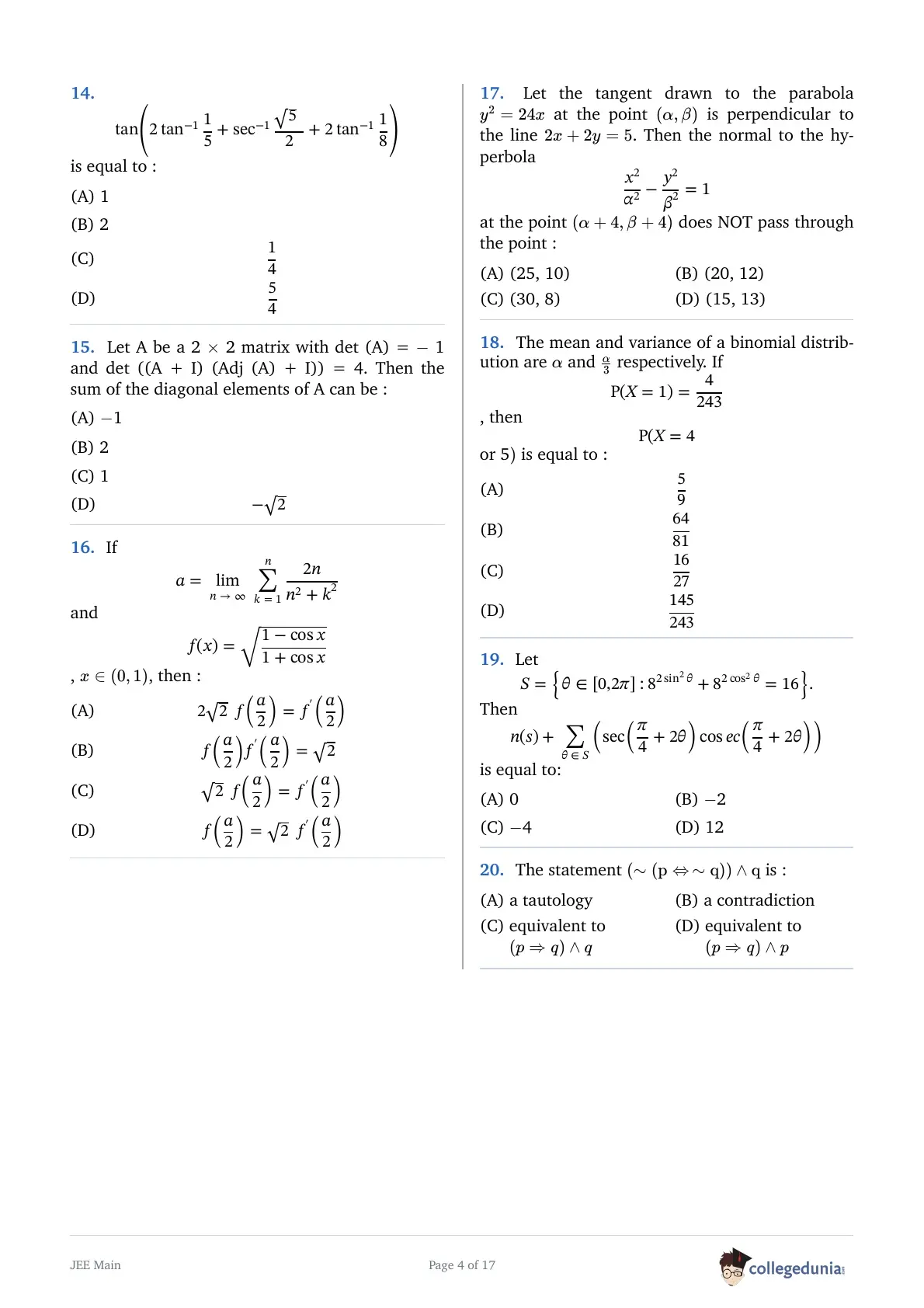
\(\tan(2\tan^{−1}\frac{1}{5}+\sec^{−1}\frac{\sqrt5}{2}+2\tan^{−1}\frac{1}{8})\)
is equal to :
Let A be a \(2×2\) matrix with \(det (A) = –1\) and \(det((A + I) (Adj (A) + I)) = 4\). Then the sum of the diagonal elements of A can be
If \(a = \lim_{{n \to \infty}} \sum_{{k=1}}^{n} \frac{2n}{{n^2 + k^2}}\)and
\(f(x) = \sqrt{\frac{1 - \cos x}{1 + \cos x}}, \quad x \in (0, 1)\) then
Let the tangent drawn to the parabola y2 = 24x at the point (α, β) is perpendicular to the line 2x + 2y = 5. Then the normal to the hyperbola
\(\frac{x^2}{α^2}−\frac{y^2}{β^2}=1\)
at the point (α + 4, β + 4) does NOT pass through the point
The mean and variance of a binomial distribution are α and α/3, respectively.
If P(X = 1) = 4/243 then P(X = 4 or 5) is equal to :
Let \(S=\left\{θ∈[0,2π]:8^{2sin^2θ}+8^{2cos^2θ}=16\right\}\) .
Then\(n(S) + \sum_{\theta \in S}\left( \sec\left(\frac{\pi}{4} + 2\theta\right)\cosec\left(\frac{\pi}{4} + 2\theta\right)\right)\)is equal to :
The statement
\((∼(p ⇔∼q))∧q \)
is :
Mathematics - Section B (Q21 - Q30)
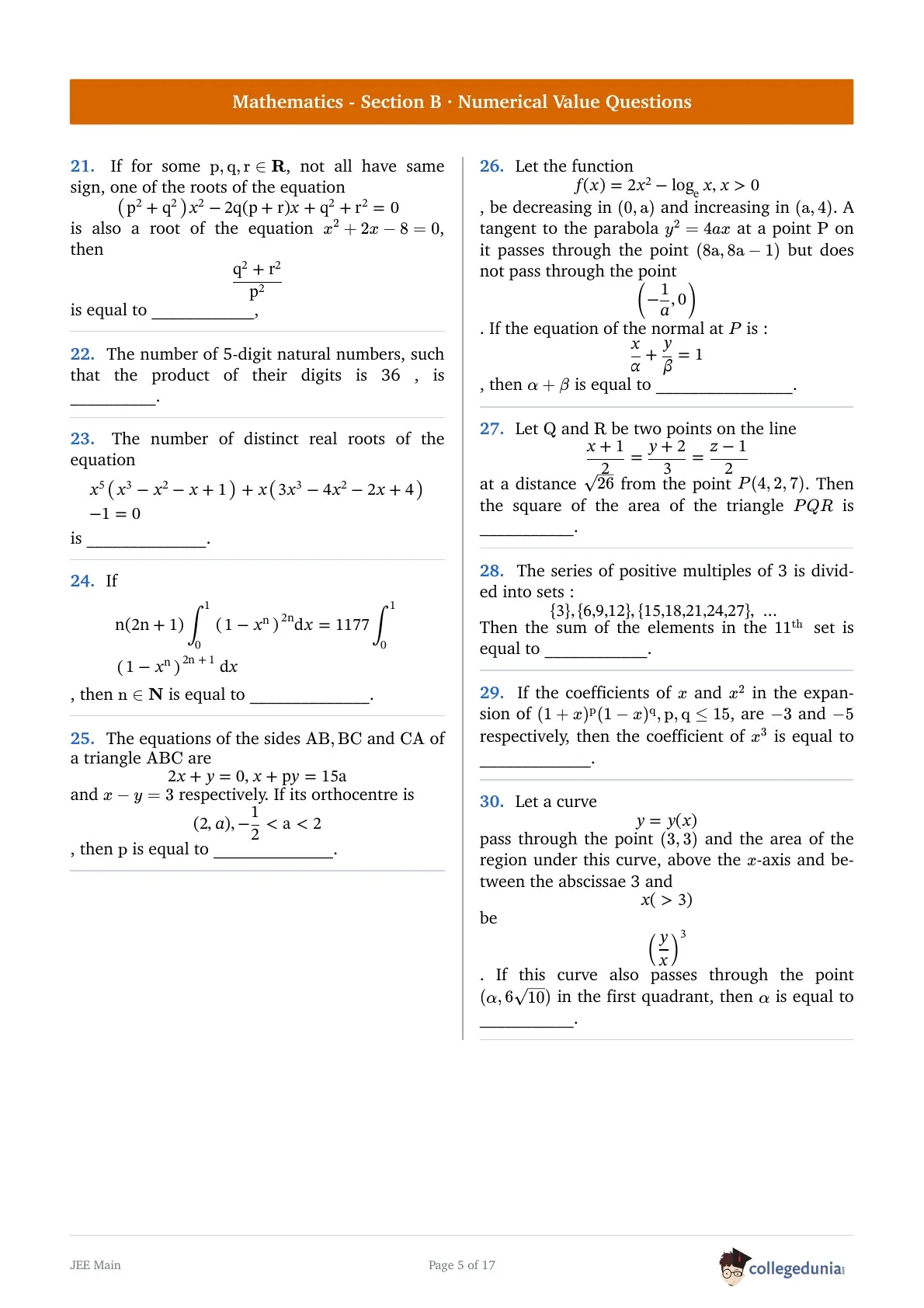
If for some p, q, r ∈ R, not all have same sign, one of the roots of the equation (p2 + q2)x2 – 2q(p + r)x + q2 + r2 = 0 is also a root of the equation x2 + 2x – 8 = 0, then (q2 + r2)/p2 is equal to _______ .
The number of 5-digit natural numbers, such that the product of their digits is 36, is _____ .
The number of distinct real roots of the equation x5(x3 – x2 – x + 1) + x (3x3 – 4x2 – 2x + 4) – 1 = 0 is ______ .
If
\(n(2n+1)\int_{0}^{1}(1−xn)^{2n}dx=1177\int_{0}^{1}(1−x^n)^{2n+1}dx\)
,then n ∈ N is equal to ______.
The equations of the sides AB, BC and CA of a triangle ABC are 2x + y = 0, x + py = 15a and x – y = 3, respectively. If its orthocentre is
\((2, a),−\frac{1}{2}<a<2 \)
then p is equal to _______.
Let the function f(x) = 2x2 – logex, x> 0, be decreasing in (0, a) and increasing in (a, 4). A tangent to the parabola y2 = 4ax at a point P on it passes through the point (8a, 8a –1) but does not pass through the point (-1/a, 0). If the equation of the normal at P is
\(\frac{x}{α}+\frac{y}{β}=1\)
then α + β is equal to _______ .
Let Q and R be two points on the line
\(\frac{x+1}{2}=\frac{y+2}{3}=\frac{z−1}{2}\) at a distance \(\sqrt{26}\)
from the point P(4, 2, 7). Then the square of the area of the triangle PQR is _______ .
The series of positive multiples of 3 is divided into sets: {3}, {6, 9, 12}, {15, 18, 21, 24, 27},…… Then the sum of the elements in the 11th set is equal to ________.
If the coefficients of x and x2 in the expansion of (1 + x)p (1 – x)q, p, q≤15, are – 3 and – 5 respectively, then coefficient of x3 is equal to ______.
Let a curve y = y(x) pass through the point (3, 3) and the area of the region under this curve, above the x-axis and between the abscissae 3 and
\(x(>3)\ be\ (\frac{y}{x})^3\)
. If this curve also passes through the point (α,6√10) in the first quadrant, then α is equal to _______.
Physics - Section A (Q31 - Q50)
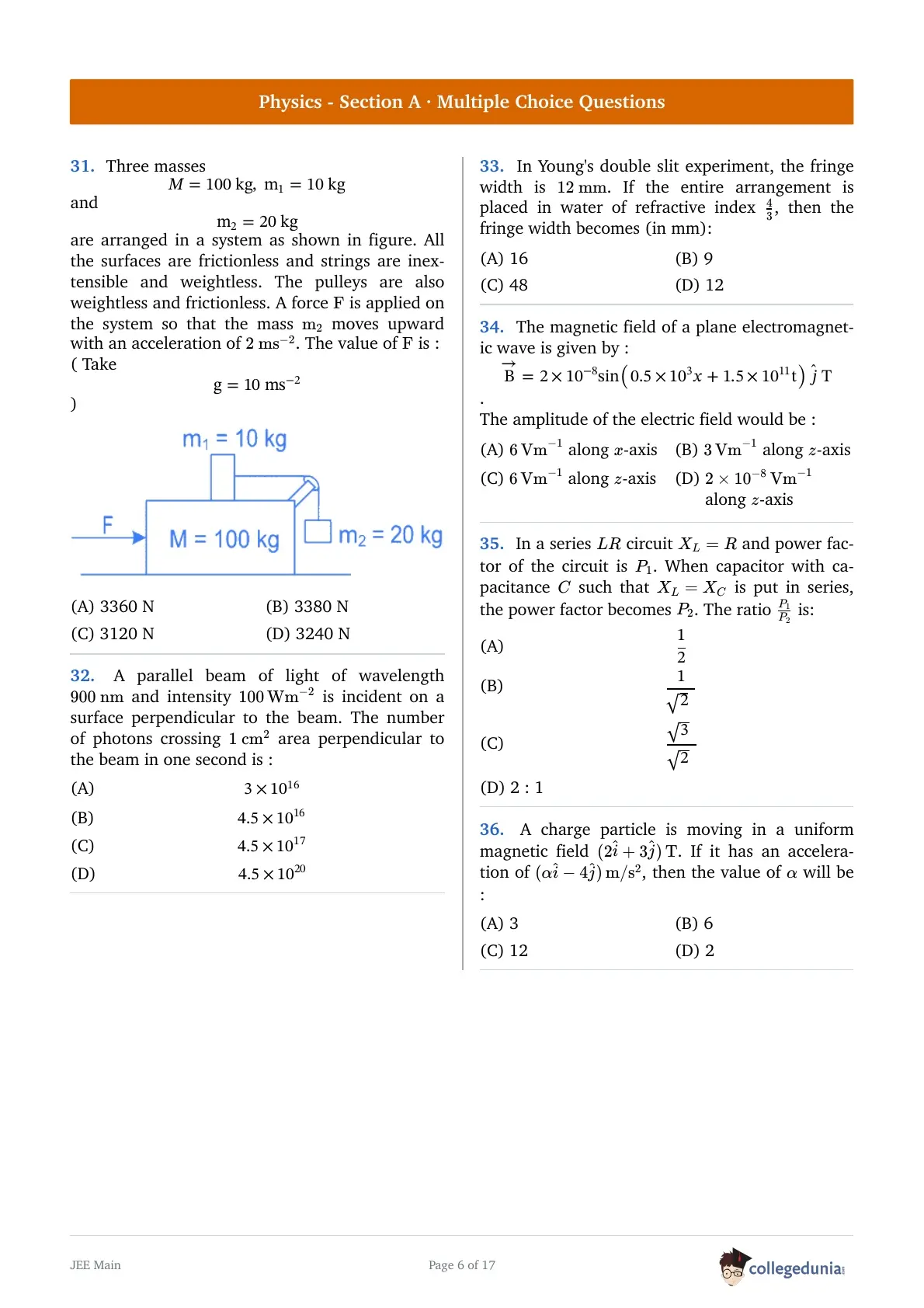
Three masses M = 100 kg, m1 = 10 kg and m2 = 20 kg are arranged in a system as shown in figure. All the surfaces are frictionless and strings are inextensible and weightless. The pulleys are also weightless and frictionless. A force F is applied on the system so that the mass m2 moves upward with an acceleration of 2 ms–2. The value of F is
(Take g = 10 ms–2)
A parallel beam of light of wavelength 900 nm and intensity 100 Wm–2 is incident on a surface perpendicular to the beam. The number of photons crossing 1 cm–2 area perpendicular to the beam in one second is
In young's double slit experiment, the fringe width is \(12\, mm\) If the entire arrangement is placed in water of refractive index \(\frac{4}{3}\), then the fringe width becomes (in \(mm\) )
The magnetic field of a plane electromagnetic wave is given by:
\(\vec B=2×10^{−8}sin(0.5×10^3x+1.5×10^{11}t)\hat jT\).
The amplitude of the electric field would be
In a series LR circuit \(X_L=R\) and power factor of the circuit is \(P _1\) When capacitor with capacitance \(C\) such that \(X _{ L }= X _{ C }\) is put in series, the power factor becomes \(P _2\) The ratio \(\frac{ P _1}{ P _2}\) is
A charge particle is moving in a uniform magnetic field \((2 \hat{ i }+3 \hat{ j }) T\) If it has an acceleration of \((\alpha \hat{i}-4 \hat{j}) m / s ^2\), then the value of \(\alpha\) will be
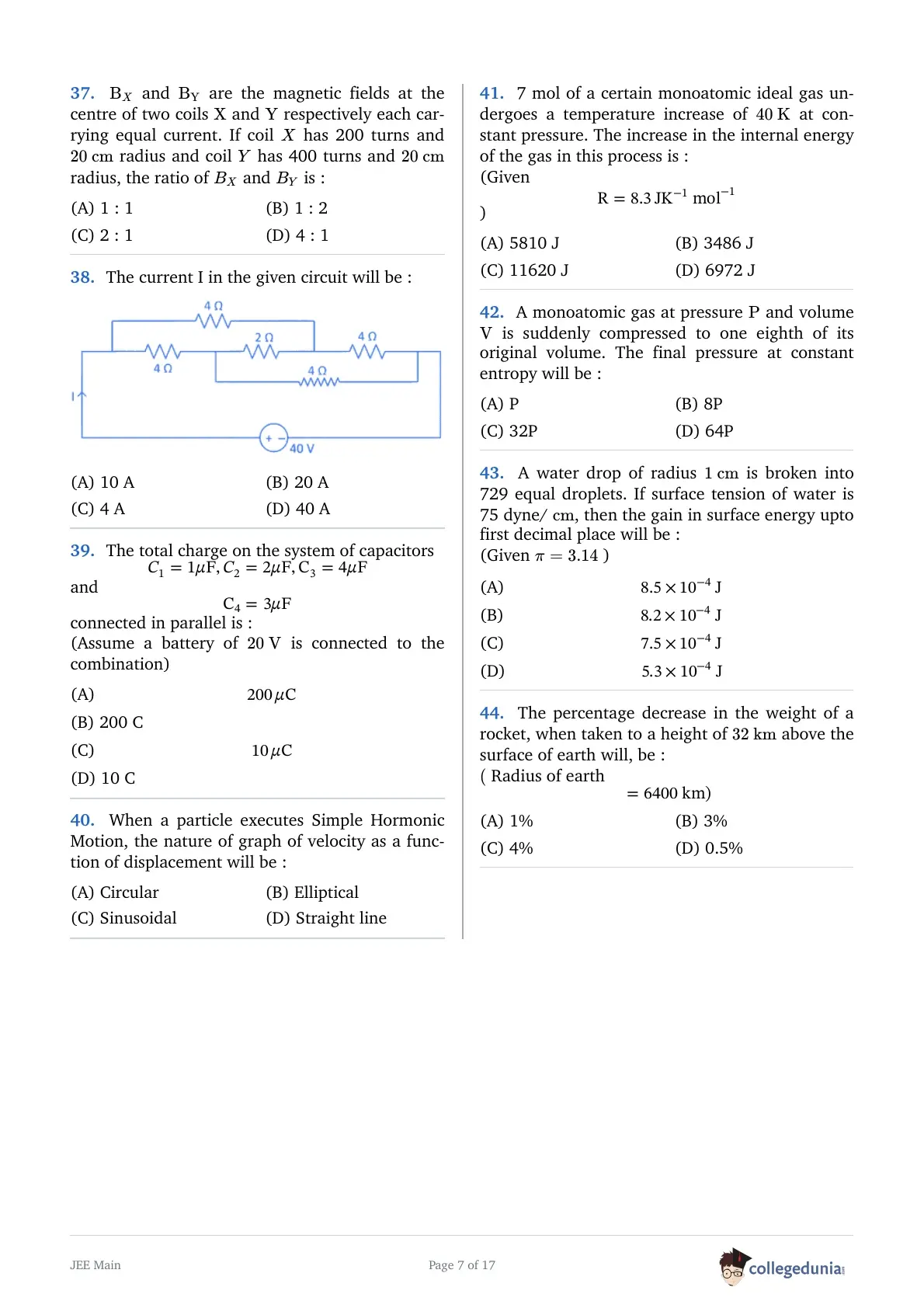
BX and BY are the magnetic field at the centre of two coils X and Y, respectively each carrying equal current. If coil X has 200 turns and 20 cm radius and coil Y has 400 turns and 20 cm radius, the ratio of BX and BY is
The current I in the given circuit will be
The total charge on the system of capacitors C1 = 1 μF, C2 = 2 μF, C3 = 4 μF and C4 = 3 μF, connected in parallel is :
(Assume a battery of 20 V is connected to the combination)
When a particle executes Simple Harmonic Motion, the nature of graph of velocity as a function of displacement will be :
7 mol of a certain monoatomic ideal gas undergoes a temperature increase of 40 K at constant pressure. The increase in the internal energy of the gas in this process is:
(Given R = 8.3 JK–1 mol–1)
A monoatomic gas at pressure P and volume V is suddenly compressed to one eighth of its original volume. The final pressure at constant entropy will be :
A water drop of radius 1 cm is broken into 729 equal droplets. If surface tension of water is 75 dyne/cm, then the gain in surface energy upto first decimal place will be :
(Given \(\pi\) = 3.14)
The percentage decrease in the weight of a rocket, when taken to a height of \(32 \,km\) above the surface of earth will, be : (Radius of earth \(=6400 \,km\) )
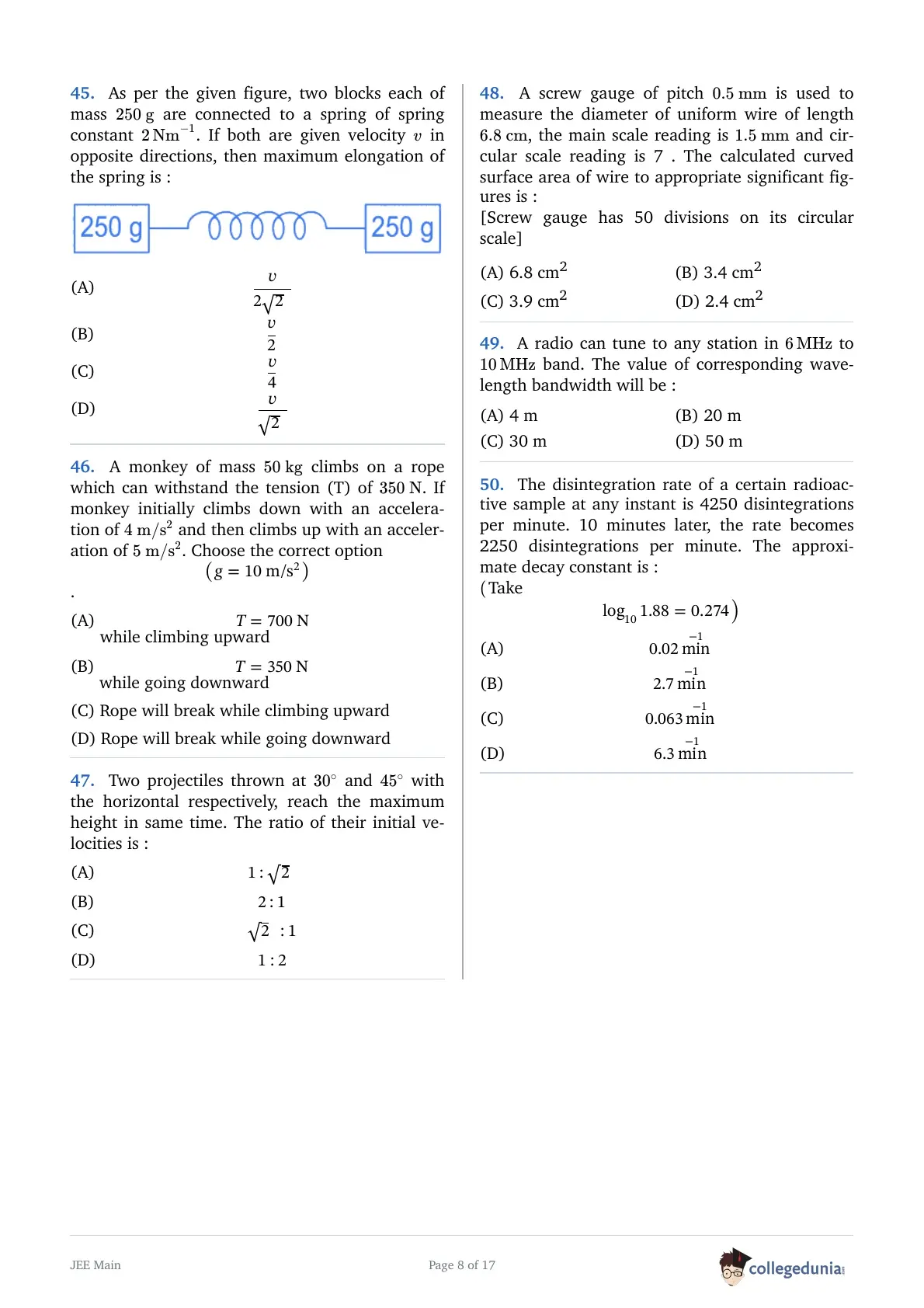
As per the given figure, two blocks each of mass \(250 \,g\) are connected to a spring of spring constant \(2 \,Nm ^{-1}\) If both are given velocity \(v\) in opposite directions, then maximum elongation of the spring is :

A monkey of mass 50 kg climbs on a rope which can withstand the tension (T) of 350 N. If monkey initially climbs down with an acceleration of 4 m/s2 and then climbs up with an acceleration of 5 m/s2. Choose the correct option (g = 10 m/s2).
Two projectiles thrown at 30° and 45° with the horizontal, respectively, reach the maximum height in same time. The ratio of their initial velocities is :
A screw gauge of pitch 0.5 mm is used to measure the diameter of uniform wire of length 6.8 cm, the main scale reading is 1.5 mm and circular scale reading is 7. The calculated curved surface area of wire to appropriate significant figures is :
[Screw gauge has 50 divisions on its circular scale.]
A radio can tune to any station in 6 MHz to 10 MHz band. The value of corresponding wavelength bandwidth will be
The disintegration rate of a certain radioactive sample at any instant is 4250 disintegrations per minute. 10 minutes later, the rate becomes 2250 disintegrations per minute. The approximate decay constant is
(Take log101.88 = 0.274)
Physics - Section B (Q51 - Q60)
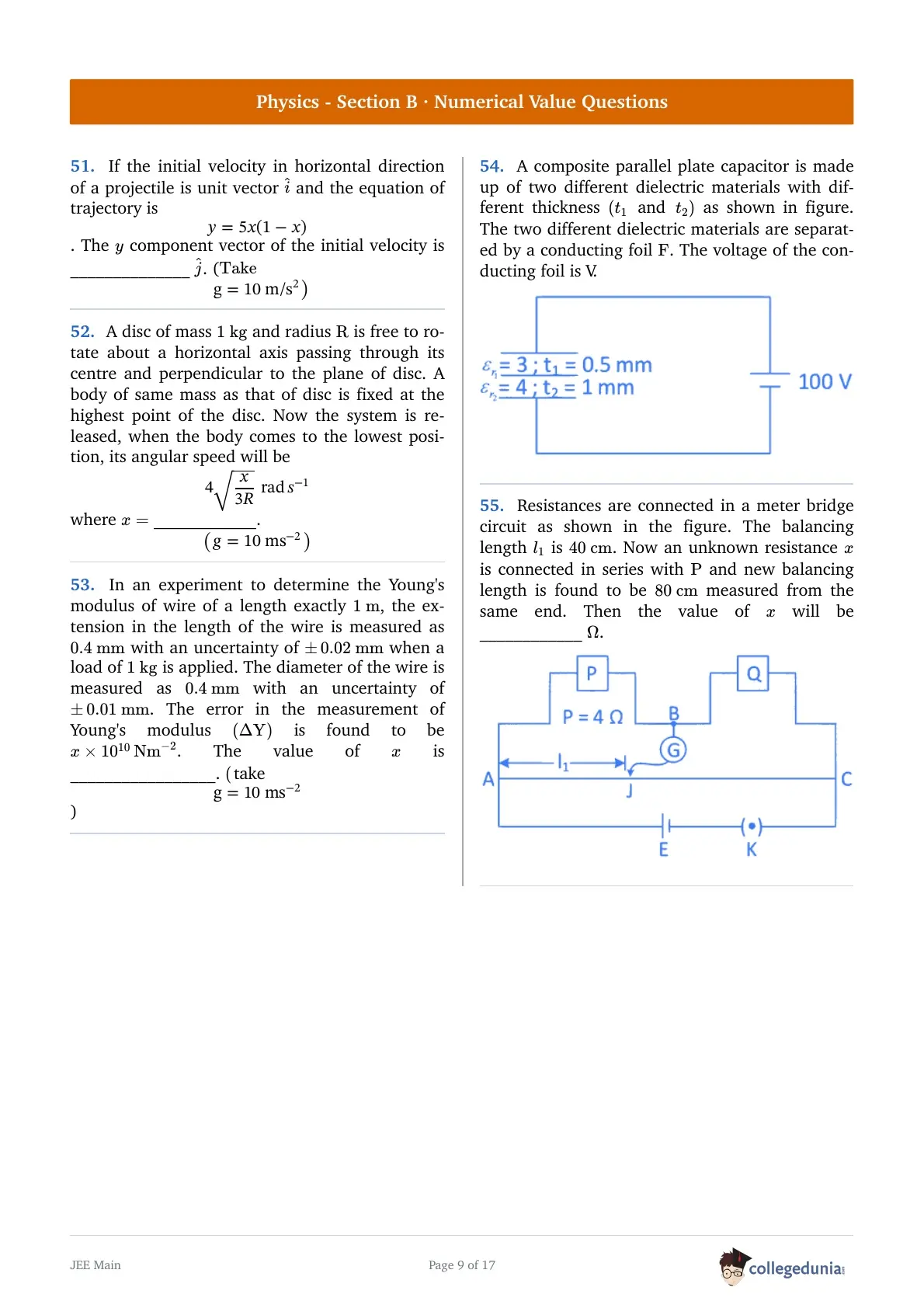
If the initial velocity in horizontal direction of a projectile is unit vector \(\hat i\) and the equation of trajectory is \(y = 5x(1 – x)\). The y component vector of the initial velocity is ______ \(\hat j\).
(Take \(g=10\ m/s^2\))
A disc of mass 1 kg and radius R is free to rotate about a horizontal axis passing through its centre and perpendicular to the plane of disc. A body of same mass as that of disc of fixed at the highest point of the disc. Now the system is released, when the body comes to the lowest position, it angular speed will be \(4\sqrt {\frac {x}{3R}}\) rad s−1 where x = ______ .(g = 10 ms–2)
In an experiment of determine the Young’s modulus of wire of a length exactly 1 m, the extension in the length of the wire is measured as 0.4 mm with an uncertainty of ±0.02 mm when a load of 1 kg is applied. The diameter of the wire is measured as 0.4 mm with an uncertainty of ±0.02 mm when a load of 1 kg is applied. The diameter of the wire is measured as 0.4 mm with an uncertainty of ± 0.01 mm. The error in the measurement of Young’s modulus (ΔY) is found to be x × 1010 Nm–2. The value of x is ___.
(Take g=10 m/s2)
A composite parallel plate capacitor is made up of two different dielectric materials with different thickness (t1 and t2) as shown in figure. The two different dielectric materials are separated by a conducting foil F. The voltage of the conducting foil is _____V.
Resistances are connected in a meter bridge circuit as shown in the figure. The balancing length l1 is 40 cm. Now an unknown resistance x is connected in series with P and new balancing length is found to be 80 cm measured from the same end. Then the value of x will be ________ Ω.
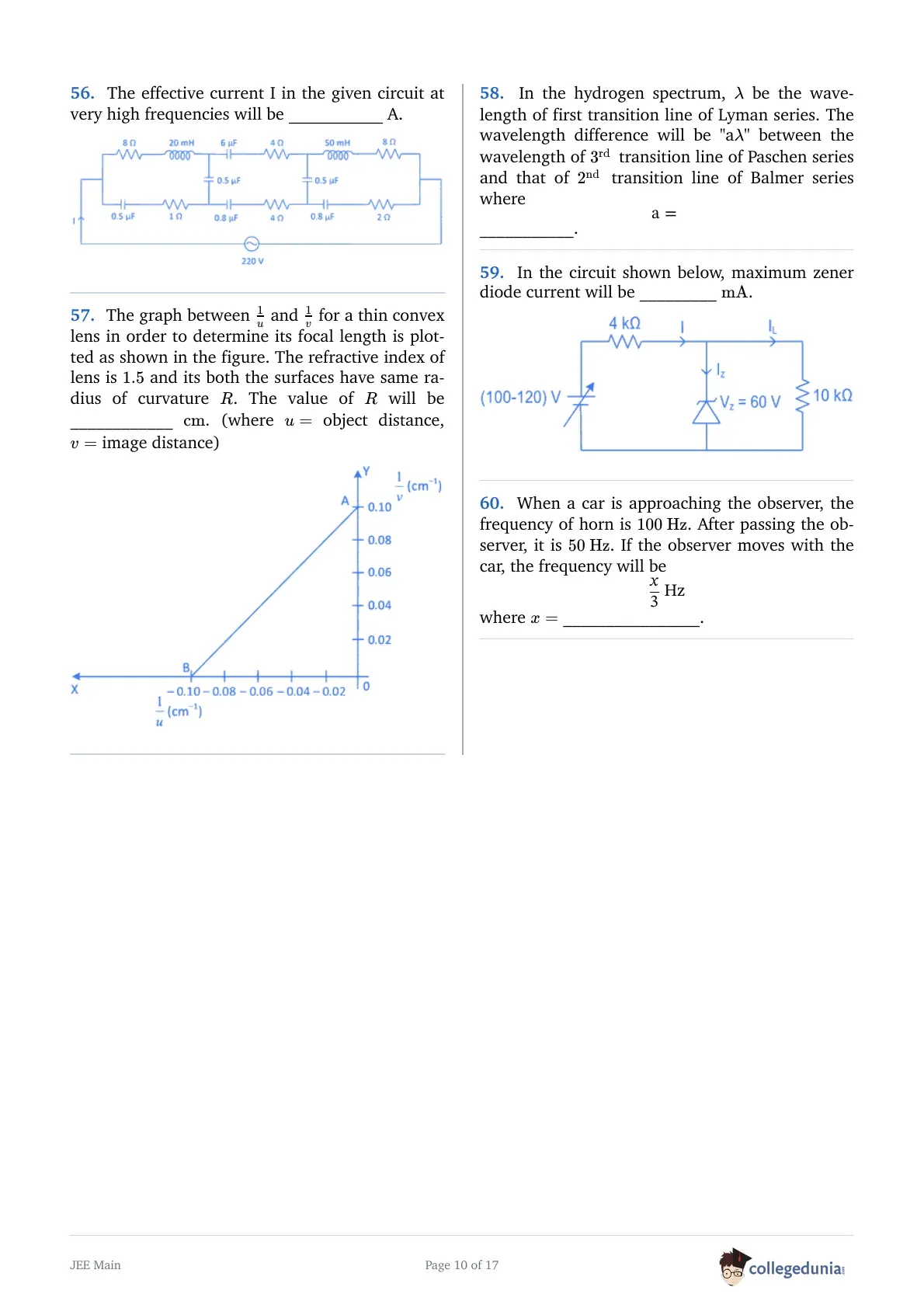
The effective current I in the given circuit at very high frequencies will be ______ A.
The graph between \(\frac 1u\) and \(\frac 1v\) for a thin convex lens in order to determine its focal length is plotted as shown in the figure. The refractive index of lens is 1.5, and its both the surfaces have the same radius of curvature R. The value of R will be______cm.
(where u = object distance, v = image distance)
In the hydrogen spectrum, λ be the wavelength of first transition line of Lyman series. The wavelength difference will be “aλ” between the wavelength of 3rd transition line of the Paschen series and that of 2nd transition line of Balmer series where a = ______.
In the circuit shown below, maximum Zener diode current will be ________ mA.
When a car is approaching the observer, the frequency of horn is 100 Hz. After passing the observer, it is 50 Hz. If the observer moves with the car, the frequency will be \(\frac x3\) Hz, where x = _____ .
Chemistry - Section A (Q61 - Q80)
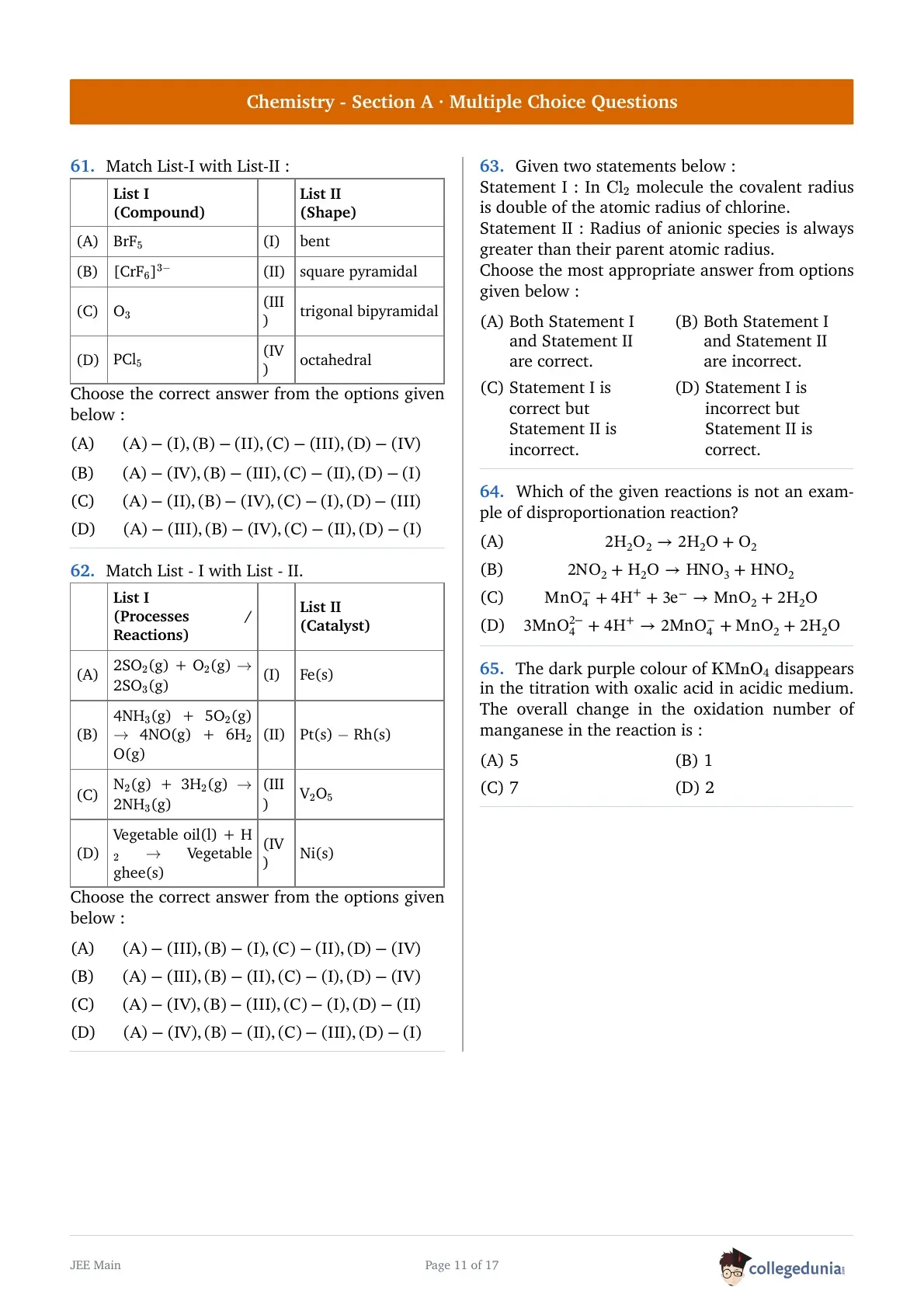
Match List - I with List - II
List-I (Compound) List-II (Shape)
A \(BrF _5\) I bent
B \(\left[ CrF _6\right]^{3-}\) II square pyramidal
C \(O _3\) III trigonal bipyramidal
D \(PCl _5\) IV octahedral
Choose the correct answer from the optionsgiven below :
| List-I (Processes/ Reactions) | List-II (Catalyst) |
|---|---|
| (A) \(2SO_2(g) + O_2(g)\) | (I) \(\underrightarrow {Fe(s)}\ \ 2SO_3(g)\) |
| (B) \(4NH_3(g) + 5O_2(g)\) | (II) \(\underrightarrow {Pt(s) – Rh(s)}\ \ 4NO(g) + 6H_2O(g)\) |
| (C) \(N_2(g) + 3H_2(g)\) | (III) \(\underrightarrow {V_2O_5}\ \ 2NH_3(g)\) |
| (D) Vegetable oil \((l)+ H_2\) | (IV) \(\underrightarrow {Ni(s)}\) Vegetable ghee(s) |
Given two statements below:
Statement I : In \(Cl_2\) molecule the covalent radius is double of the atomic radius of chlorine.
Statement II : Radius of anionic species is always greater than their parent atomic radius.
Choose the most appropriate answer from options given below:
Which of the given reactions is not an example of a disproportionation reaction?
The dark purple colour of \(KMnO_4\) disappears in the titration with oxalic acid in acidic medium. The overall change in the oxidation number of manganese in the reaction is :
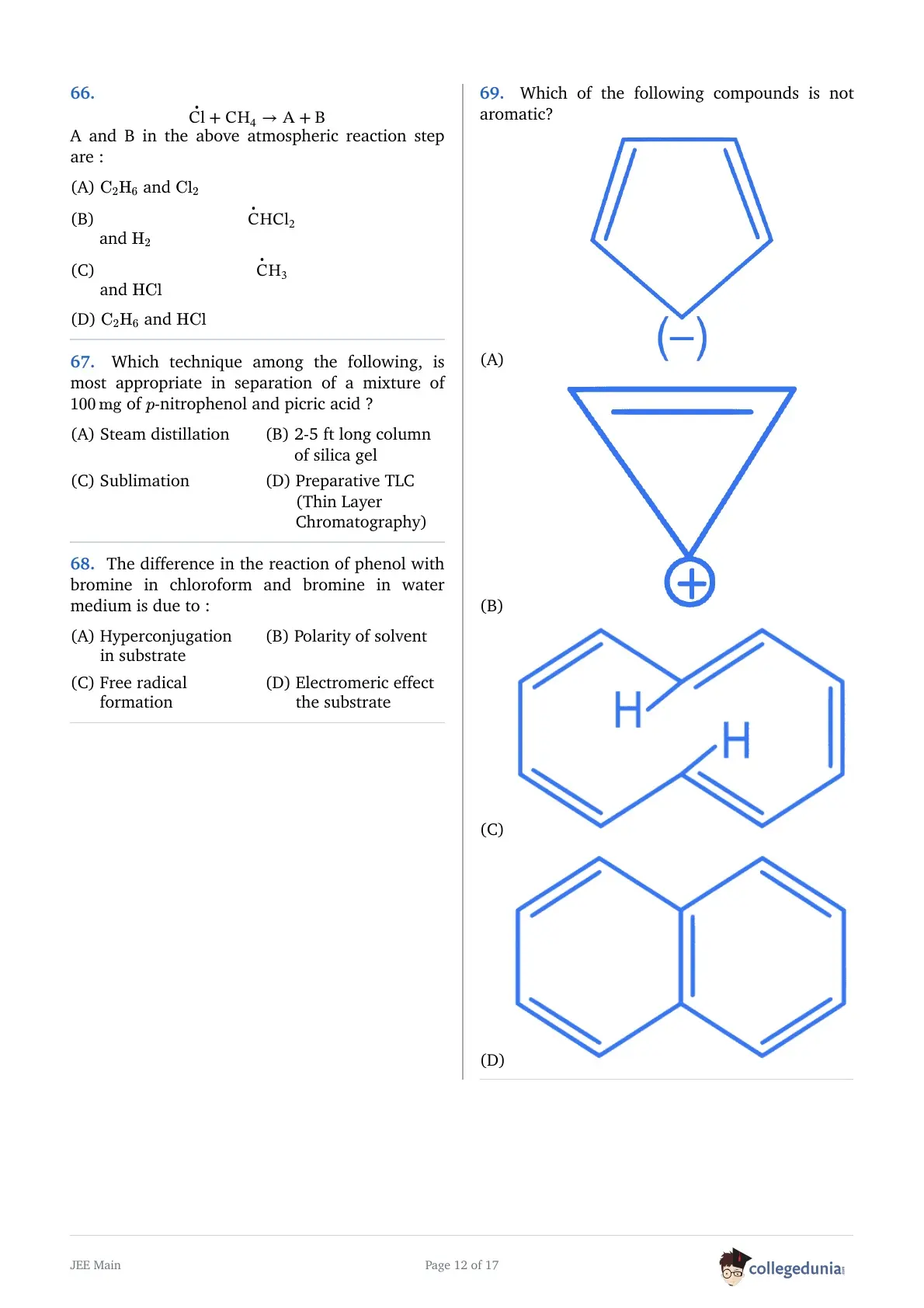
\(\dot Cl + CH_4 → A + B\)
A and B in the above atmospheric reaction step are:
Which technique among the following, is most appropriate in separation of a mixture of 100 mg of p-nitrophenol and picric acid?
The difference in the reaction of phenol with bromine in chloroform and bromine in water medium is due to :


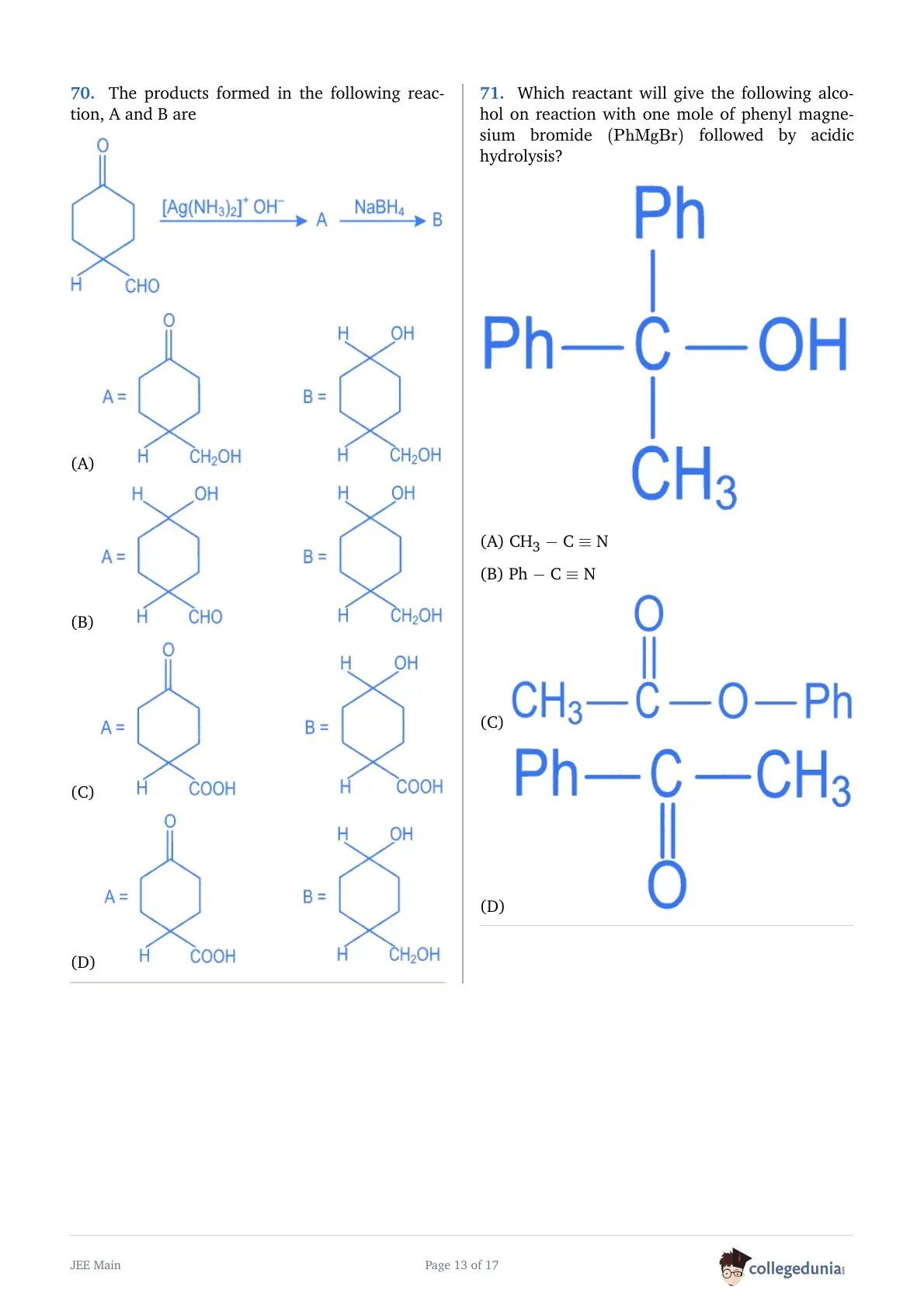
The products formed in the following reaction, A and B are
- (1)
![Hydrocarbon reaction mechanism]()
- (2)
![Hydrocarbon reaction mechanism]()
- (3)
![Hydrocarbon reaction mechanism]()
- (4)
![Hydrocarbon reaction mechanism]()


Which reactant will give the following alcohol on reaction with one mole of phenyl magnesium bromide (PhMgBr) followed by acidic hydrolysis?
- (1) \(CH_3-C≡N\)
- (2) \(Ph-C≡N\)
- (3)
![reaction with one mole of phenyl magnesium bromide (PhMgBr)]()
- (4)
![reaction with one mole of phenyl magnesium bromide (PhMgBr)]()


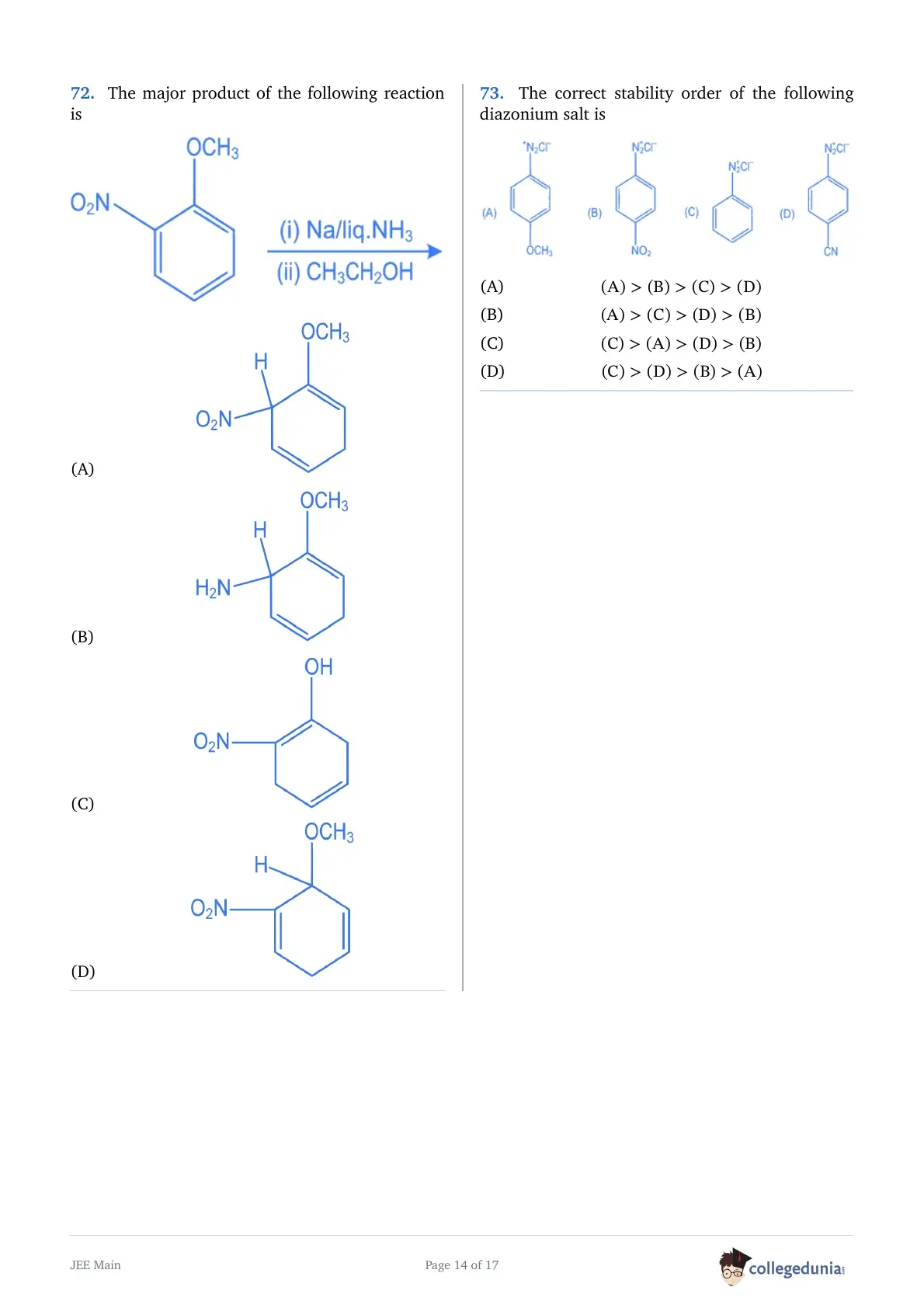
The major product of the following reaction is
(Substrate: 1-methoxy-2-nitrobenzene (2-nitroanisole), \(\mathrm{OCH_3}\) and \(\mathrm{NO_2}\) on adjacent ring carbons.) Reagents: (i) Na/liq. \(\mathrm{NH_3}\); (ii) \(\mathrm{CH_3CH_2OH}\).
- (1)
![]()
- (2)
![]()
- (3)
![]()
- (4)
![]()


The correct stability order of the following diazonium salt is


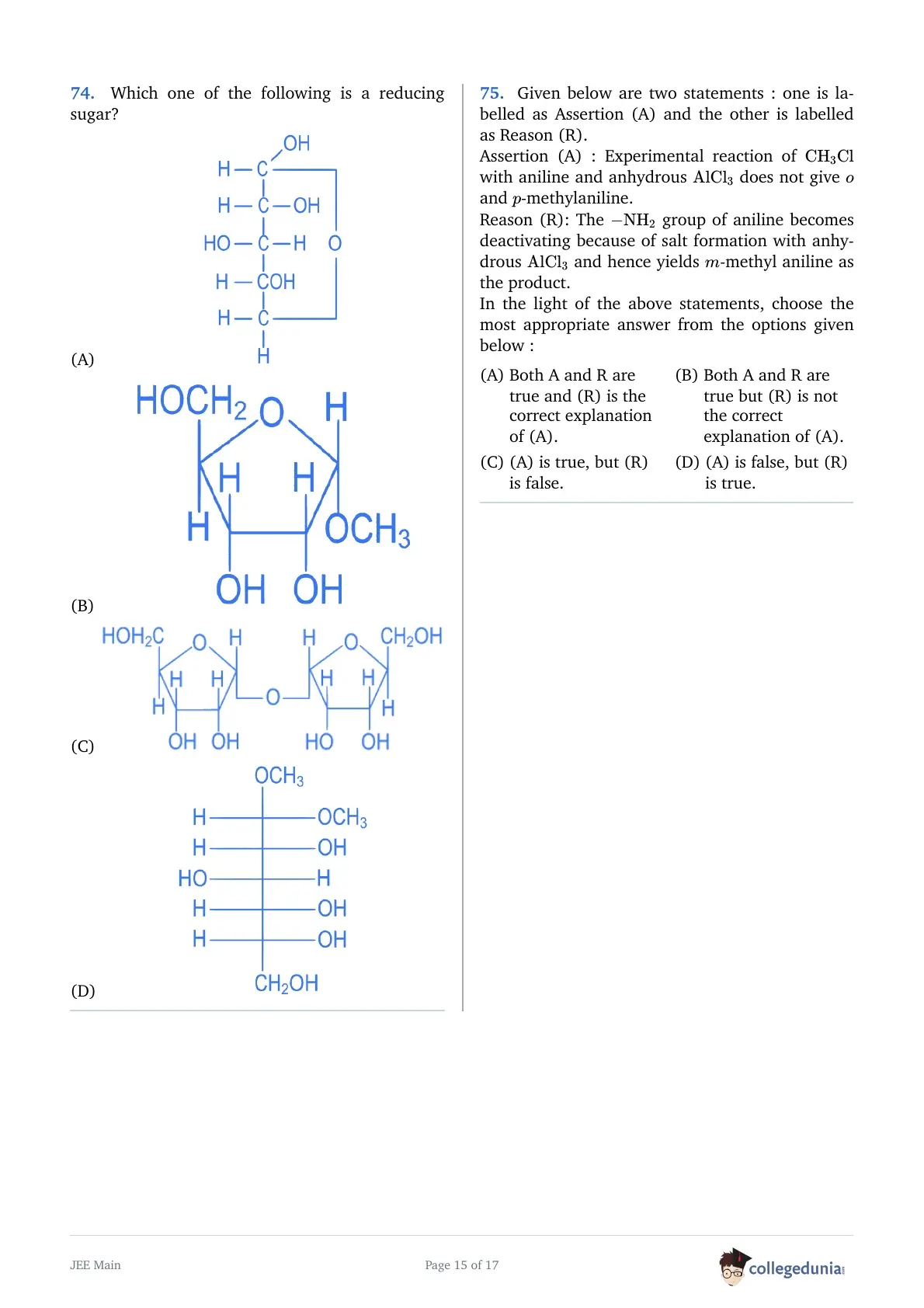
Given below are two statements: one is labelled as Assertion (A) and the other is labelled as Reason (R).
Assertion (A): Experimental reaction of \(CH_3Cl\) with aniline and anhydrous \(AlCl_3\) does not give o and p-methylaniline.
Reason (R): The \(–NH_2\)group of aniline becomes deactivating because of salt formation with anhydrous \(AlCl_3\) and hence yields m-methyl aniline as the product.
In the light of the above statements, choose the most appropriate answer from the options given below :
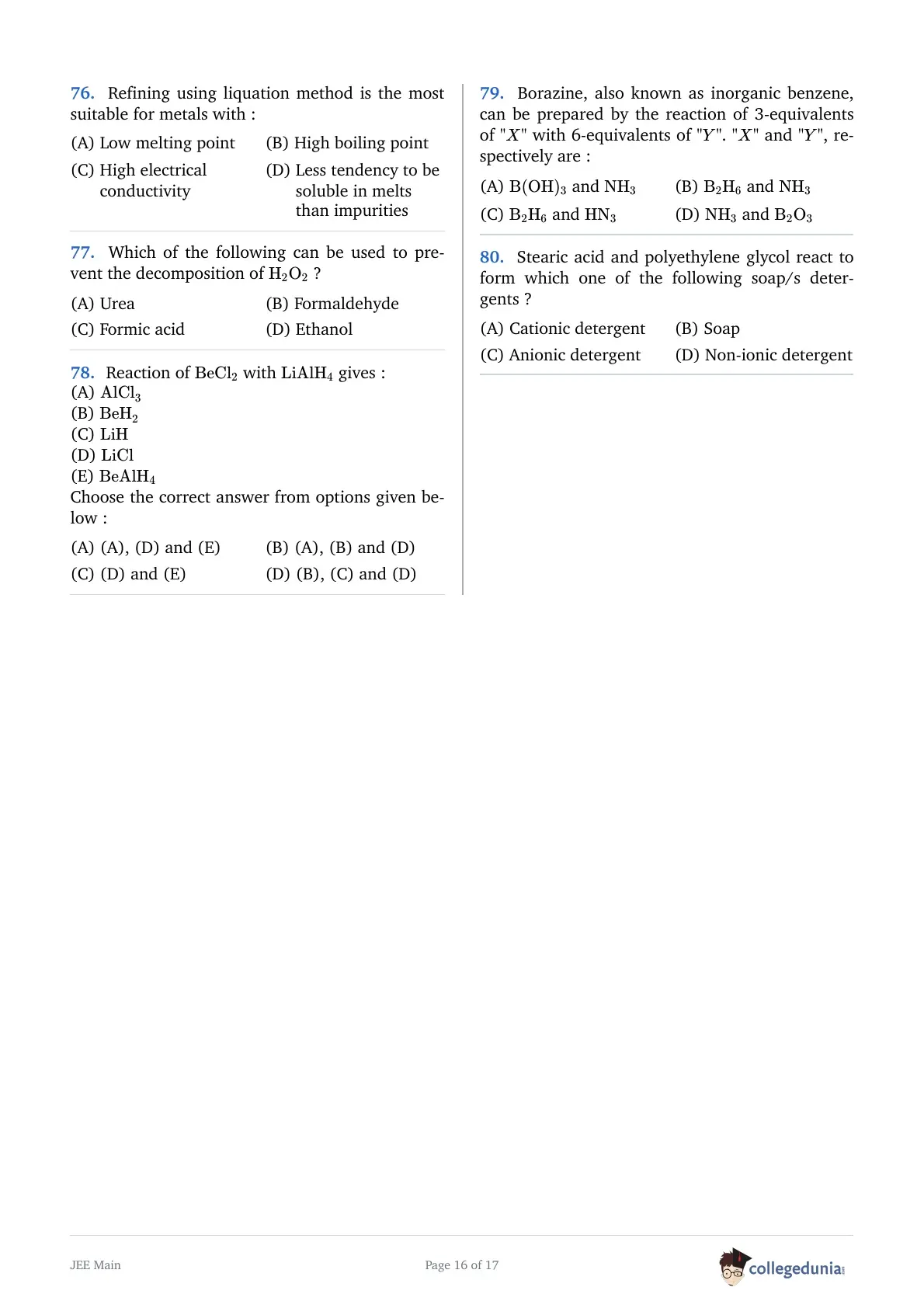
Refining using liquation method is the most suitable for metals with :
Which of the following can be used to prevent the decomposition of \(H_2O_2\)?
- \(AlCl_3\)
- \(BeH_2\)
- \(LiH\)
- \(LiCl\)
- \(BeAlH_4\)
Borazine, also known as inorganic benzene, can be prepared by the reaction of 3-equivalents of “X” with 6-equivalents of “Y”. “X” and “Y”, respectively are:
Stearic acid and polyethylene glycol react to form which one of the following soap/s detergents?
Chemistry - Section B (Q81 - Q90)
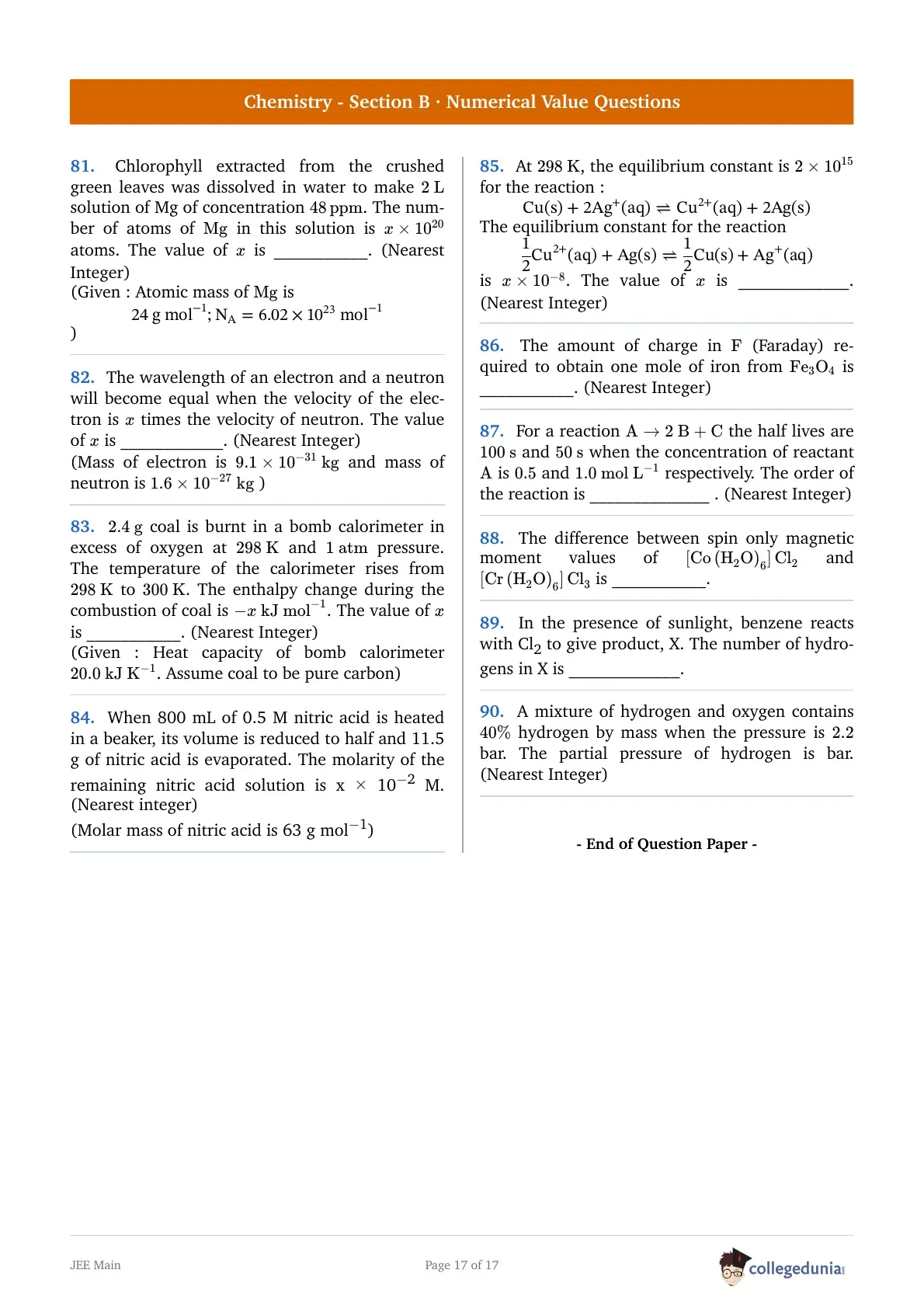
Chlorophyll extracted from the crushed green leaves was dissolved in water to make 2 L solution of Mg of concentration 48 ppm. The number of atoms of Mg in this solution is \(x × 10^{20}\) atoms. The value of \(x\) is ________. (Nearest integer)
(Given : Atomic mass of Mg is 24 g mol–1; NA = 6.02 × 10²³ mol–1)
The wavelength of an electron and a neutron will become equal when the velocity of the electron is x times the velocity of neutron. The value of x is ______. (Nearest integer)
(Mass of electron is 9.1 × 10⁻³¹ kg and mass of neutron is 1.6 × 10⁻²⁷ kg)
2.4 g coal is burnt in a bomb calorimeter in excess of oxygen at 298 K and 1 atm pressure. The temperature of the calorimeter rises from 298 K to 300 K. The enthalpy change during the combustion of coal is –x kJ mol–1. The value of x is ______.(Nearest integer)
(Given : Heat capacity of bomb calorimeter is 20.0 kJ K–1. Assume coal to be pure carbon)
When 800 mL of 0.5 M nitric acid is heated in a beaker, its volume is reduced to half and 11.5 g of nitric acid is evaporated. The molarity of the remaining nitric acid solution is \(x × 10^{–2} M\). (Nearest integer)
(Molar mass of nitric acid is 63 g mol–1)
At \(298\ K\), the equilibrium constant is \(2 × 10^{15}\) for the reaction:
\(Cu(s)+2Ag+(Aq)⇌Cu^{2+}(aq)+2Ag(s)\)
The equilibrium constant for the reaction:
\(\frac 12Cu^{2+}(aq)+Ag(s)+(Aq)⇌\frac 12Cu(s)+Ag^+(aq)\) is \(x \times10^{-8}\).
The value of \(x\) is ______ . (Nearest integer)
The amount of charge in F (Faraday) required to obtain one mole of iron from \(Fe_3O_4\) is ______ . (Nearest integer)
For a reaction \(A → 2B + C\) the half lives are 100 s and 50 s when the concentration of reactant A is 0.5 and 1.0 mol L–1, respectively. The order of the reaction is ______ .(Nearest integer)
The difference between spin only magnetic moment value of \([Co(H_2O)_6]Cl_2\) and \([Cr(H_2O)_6]Cl_3\) is ________ .
In the presence of sunlight, benzene reacts with CI2 to give product X. The number of hydrogens in X is _________.
A mixture of hydrogen and oxygen contains 40% hydrogen by mass when the pressure is 2.2 bar. The partial pressure of hydrogen is _______ bar. (Nearest integer)
JEE Main 2022 Exam Pattern and Marking Scheme
| Particulars | Details |
|---|---|
| Exam Mode | Online (Computer-Based Test) |
| Paper | B.E./B.Tech (Paper 1) |
| Duration | 3 hours (180 minutes) |
| Type of Questions | Multiple Choice Questions (MCQs) + Numerical Value Questions |
| Subjects | Mathematics, Physics, Chemistry |
| Total Questions | 90 questions (75 to be attempted) |
| Total Marks | 300 marks |
| Marking Scheme | +4 for correct answer & -1 for incorrect MCQ and Numerical Value-based Questions |
JEE Main 2022 July 26 Shift 1 Difficulty Level
As per the student reactions, the paper was rated moderate in terms of overall difficulty level. JEE Main 2022 Question Paper for B.Tech comprises of total 90 questions. 30 questions are asked in each section of Physics, Chemistry and Mathematics (20 MCQs and 10 numerical type). Candidates have to answer any 5 numerical questions in JEE Main 2022 July 26 Shift 1 Question Paper.
JEE Main 2022 July 26 Shift 1 Subject-wise Memory-Based Solutions PDF
| Subject | Memory-Based Solutions PDF |
|---|---|
| Physics | Download PDF |
| Chemistry | Download PDF |
| Mathematics | Download PDF |
JEE Main 2022 Phase 2 Question Papers with Solution PDFs
Candidates can also check shift-wise JEE Main 2022 Phase 2 Question Papers with Solution PDFs. These shift-wise question paper PDFs for JEE Main 2022 will help candidates know the overall difficulty, topics with the highest weightage and the type of questions asked in the exam.
JEE Main 2022 Phase 1 Question Papers with Solution PDFs
Shift-wise JEE Main 2022 Phase 1 Question Papers with Solution PDFs are also available. Candidates preparing for Phase 2 of the exam can check and download JEE Main Question Paper PDFs to practice and test their exam prep level.
Also Check:



Comments