




JEE Main 2022 July 26 Shift 2 Question Paper is available here with solutions PDF and detailed solutions for every question. NTA conducted the second shift on July 26, 2022, from 3:00 PM to 6:00 PM. The JEE Main 2022 Paper 1 (B.E./B.Tech) question paper includes the following:
- 90 questions in a 3-hour CBT Mode: 30 each from Mathematics, Physics and Chemistry (75 to be attempted)
- Section A: 20 multiple choice questions (MCQs) per subject, all compulsory, 4 marks each
- Section B: 10 numerical value questions per subject, any 5 to be attempted, 4 marks each
- Marking: +4 for a correct answer, -1 for an incorrect answer, 0 for an unattempted question
- Maximum marks: 300 (100 per subject)
JEE Main 2022 July 26 Shift 2 Question Paper with Solution PDF
| NTA Official PDF | CD PDF | CD PDF with Solutions |
|---|---|---|
| Download official PDF 4.69 MB | Download Collegedunia PDF 1.13 MB | Download solutions PDF 1.38 MB |
Also Check:
JEE Main 2022 July 26 Shift 2 Questions with Solutions
Mathematics - Section A (Q1 - Q20)
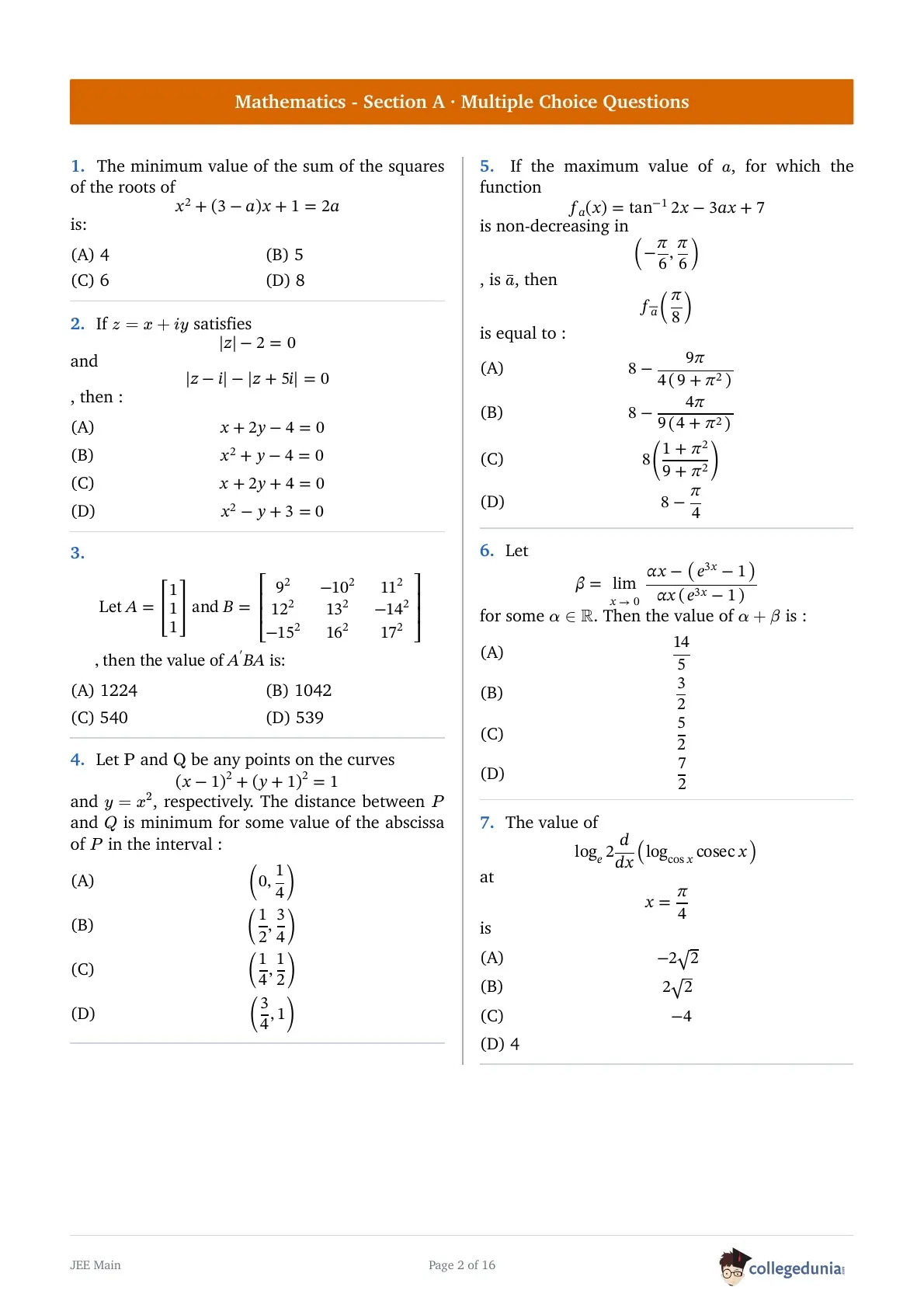
The minimum value of the sum of the squares of the roots of x2 + (3 – a)x + 1 = 2a is
If z = x + iy satisfies | z | – 2 = 0 and |z – i| – | z + 5i| = 0, then
Let
A = \(\begin{bmatrix} 1 \\ 1 \\ 1 \\ \end{bmatrix}\) and B = \(\begin{bmatrix} 9^2 & -10^2 & 11^2 \\ 12^2 & 13^2 & 14^2 \\ -15^2 & 16^2 & 17^2 \\ \end{bmatrix}\)
then the value of A'BA is
Let P and Q be any points on the curves (x – 1)2 + (y + 1)2 = 1 and y = x2, respectively. The distance between P and Q is minimum for some value of the abscissa of P in the interval
f the maximum value of a, for which the function
\(fa(x)=\tan^{−1}\ 2x−3ax+7\)
is non-decreasing in \((−\frac{π}{6},\frac{π}{6})\), is a―, then \(f\overline{a}(\frac{π}{8}) \)
is equal to
Let
\(β = \lim_{x →0} \frac{αx-(e^{3x}-1)}{αx(e^{3x}-1) }\)for some\( α \in R.\)
Then the value of α+β is
The value of \(\log_e2\frac{d}{dx}(\log_{cos x}\cosec x) \) at \(x=\frac{\pi}{4}\) is
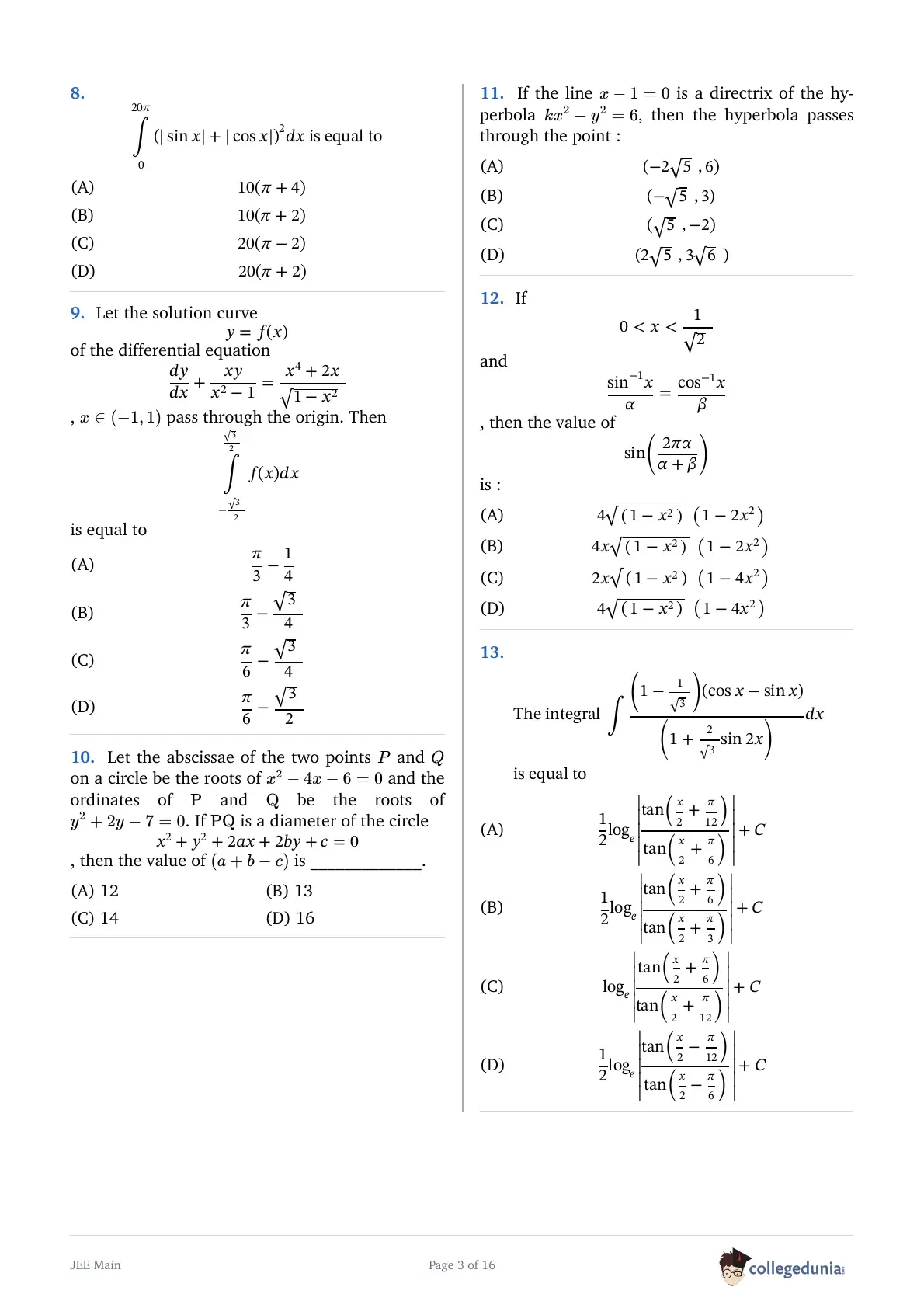
\(\int_{0}^{20\pi} (|\sin x| + |\cos x|)^2 \,dx\)
is equal to
Let the solution curve y = f(x) of the differential equation
\(\frac{dy}{dx} + \frac{xy}{x^2 - 1} = + \frac{ x^4+2x}{\sqrt{1 - x^2}}, \quad x \in (-1, 1)\) pass through the origin. Then
\(\int_{-\frac{\sqrt{3}}{2}}^{\frac{\sqrt{3}}{2}} f(x) \,dx\)is
Let the abscissae of the two points P and Q on a circle be the roots of x2 – 4x – 6 = 0 and the ordinates of P and Q be the roots of y2 + 2y – 7 = 0. If PQ is a diameter of the circle x2 + y2 + 2ax + 2by + c = 0, then the value of (a + b – c) is
If the line x – 1 = 0 is a directrix of the hyperbola kx2 – y2 = 6, then the hyperbola passes through the point
If
\(0 < x< \frac{1}{\sqrt2}\ and\ \frac{\sin^{-1}x}{α} = \frac{\cos^{-1}x}{β} \)
then a value of
\(sin(\frac{2πα}{α+β}) \)
is
The Integral
\(\int \frac{(1 - \frac{1}{\sqrt{3}})(\cos x - \sin x)}{1 + \frac{2}{\sqrt{3}}\sin2 x} \,dx\)
is equal to
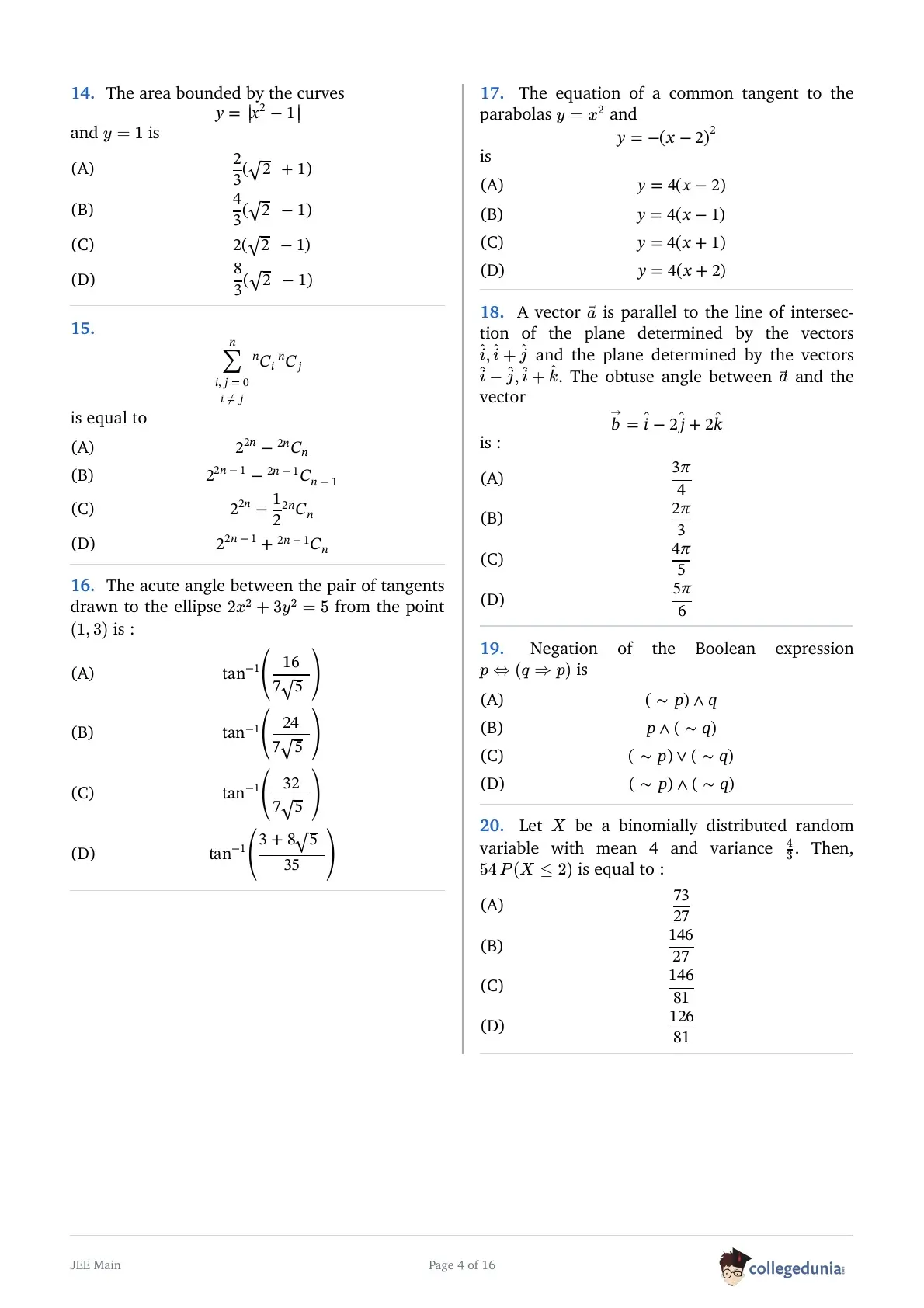
The area bounded by the curves y = |x2 – 1| and y = 1 is
\(\sum_{\substack{i,j=0\)
\(t \neq j}}^n\) \(^nC_i\ ^nC_j \)
is equal to
The acute angle between the pair of tangents drawn to the ellipse 2x2 + 3y2 = 5 from the point (1, 3) is
The equation of a common tangent to the parabolas y = x2 and y = –(x – 2)2 is
A vector \(\vec{a}\)
is parallel to the line of intersection of the plane determined by the vectors
\(\hat{i},\hat{i}+\hat{j} \)and the plane determined by the vectors
\(\hat{i}−\hat{j},\hat{i}+\hat{k}\). The obtuse angle between
\(\vec{a}\) and the vector \(\vec{b}=\hat{i}−2\hat{j}+2\hat{k}\)
is
Negation of the Boolean expression p⇔ (q⇒p) is
Let X be a binomially distributed random variable with mean 4 and variance 4/3. Then, 54 P(X≤ 2) is equal to
Mathematics - Section B (Q21 - Q30)
Let A = {1, 2, 3, 4, 5, 6, 7} and B = {3, 6, 7, 9}. Then the number of elements in the set {C ⊆ A :Cߏ∩B ≠ φ} is _____________.
Numbers are to be formed between 1000 and 3000, which are divisible by 4, using the digits 1, 2, 3, 4, 5 and 6 without repetition of digits. Then the total number of such numbers is ______________.
The mean and standard deviation of 40 observations are 30 and 5 respectively. It was noticed that two of these observations 12 and 10 were wrongly recorded. If σ is the standard deviation of the data after omitting the two wrong observations from the data, then 38σ2 is equal to ______.
Suppose y = y(x) be the solution curve to the differential equation
\(\frac{dy}{dx}−y=2−e^{−x}\) such that \(\lim_{{x \to \infty}}y(x)\)
is finite. If a and bare respectively the x – and y – intercepts of the tangent to the curve at x = 0, then the value of a – 4b is equal to _____.
Different A.P.’s are constructed with the first term 100, the last term 199, and integral common differences. The sum of the common differences of all such A.P.’s having at least 3 terms and at most 33 terms is ______.
The number of matrices
\(A=\begin{pmatrix} a & b \\ c & d \\ \end{pmatrix}\), where a,b,c,d ∈−1,0,1,2,3,…..,10
such that A = A-1, is ______.
The largest value of a, for which the perpendicular distance of the plane containing the lines
\( \vec{r} (\hat{i}+\hat{j})+λ(\hat{i}+a\hat{j}−\hat{k})\ and\ \vec{r}=(\hat{i}+\hat{j})+μ(−\hat{i}+\hat{j}−a\hat{k}) \)
from the point (2, 1, 4) is √3, is _____________.
If
\(\sum_{k=1}^{10} \frac{k}{k^4 + k^2 + 1} = \frac{m}{n}\)
where m and n are co-prime, then m + n is equal to
If the sum of solutions of the system of equations 2sin2θ – cos2θ = 0 and 2cos2θ + 3sinθ = 0 in the interval [0, 2π] is kπ, then k is equal to _______.
The plane passing through the line L :lx – y + 3(1 – l) z = 1, x + 2y – z = 2 and perpendicular to the plane 3x + 2y + z = 6 is 3x – 8y + 7z = 4. If θ is the acute angle between the line L and the y-axis, then 415 cos2θ is equal to ________.
Physics - Section A (Q31 - Q50)
Two projectiles are thrown with same initial velocity making an angle of 45° and 30° with the horizontal, respectively. The ratio of their respective ranges will be
In a Vernier Calipers, 10 divisions of Vernier scale is equal to the 9 divisions of main scale. When both jaws of Vernier calipers touch each other, the zero of the Vernier scale is shifted to the left of zero of the main scale and 4th Vernier scale division exactly coincides with the main scale reading. One main scale division is equal to 1 mm. While measuring diameter of a spherical body, the body is held between two jaws. It is now observed that zero of the Vernier scale lies between 30 and 31 divisions of main scale reading and 6th Vernier scale division exactly coincides with the main scale reading. The diameter of the spherical body will be
A ball of mass \(0.15\) \(kg\) hits the wall with its initial speed of \(12\) \(ms^{–1}\) and bounces back without changing its initial speed. If the force applied by the wall on the ball during the contact is \(100\) \(N\), calculate the time duration of the contact of ball with the wall.
A body of mass 8 kg and another of mass 2 kg are moving with equal kinetic energy. The ratio of their respective momenta will be
Two uniformly charged spherical conductors, A and B of radii 5 mm and 10 mm are separated by a distance of 2 cm. If the spheres are connected by a conducting wire, then in equilibrium condition, the ratio of the magnitude of the electric fields at surface of the spheres A and B will be
The oscillating magnetic field in a plane electromagnetic wave is given by By = \(5 × 10^{–6}\) \(sin\;1000\;π(5x – 4 × 10⁸\;t)T\). The amplitude of electric field will be:
Light travels in two media \(M_1\) and \(M_2\) with speeds \(1.5 × 10^8ms^{–1 }\)and \(2.0 × 10^8ms^{–1}\), respectively. The critical angle between them is:
A body is projected vertically upwards from the surface of earth with a velocity equal to one third of escape velocity. The maximum height attained by the body will be:
A nucleus of mass M at rest splits into two parts having masses \(\frac{M′}{3}\) and \(\frac{2M′}{3}(M′<M).\)
An ice cube of dimensions 60 cm × 50 cm × 20 cm is placed in an insulation box of wall thickness 1 cm. The box keeping the ice cube at 0°C of temperature is brought to a room of temperature 40°C. The rate of melting of ice is approximately. (Latent heat of fusion of ice is \(3.4 × 10^5\) \(J kg^{–1 }\)and thermal conducting of insulation wall is \(0.05\) \(Wm^{–1}\)°\(C^{–1})\)
A gas has n degrees of freedom. The ratio of specific heat of gas at constant volume to the specific heat of gas at constant pressure will be
A transverse wave is represented by \(y = 2sin(ωt – kx)\) \(cm\). The value of wavelength (in cm) for which the wave velocity becomes equal to the maximum particle velocity, will be
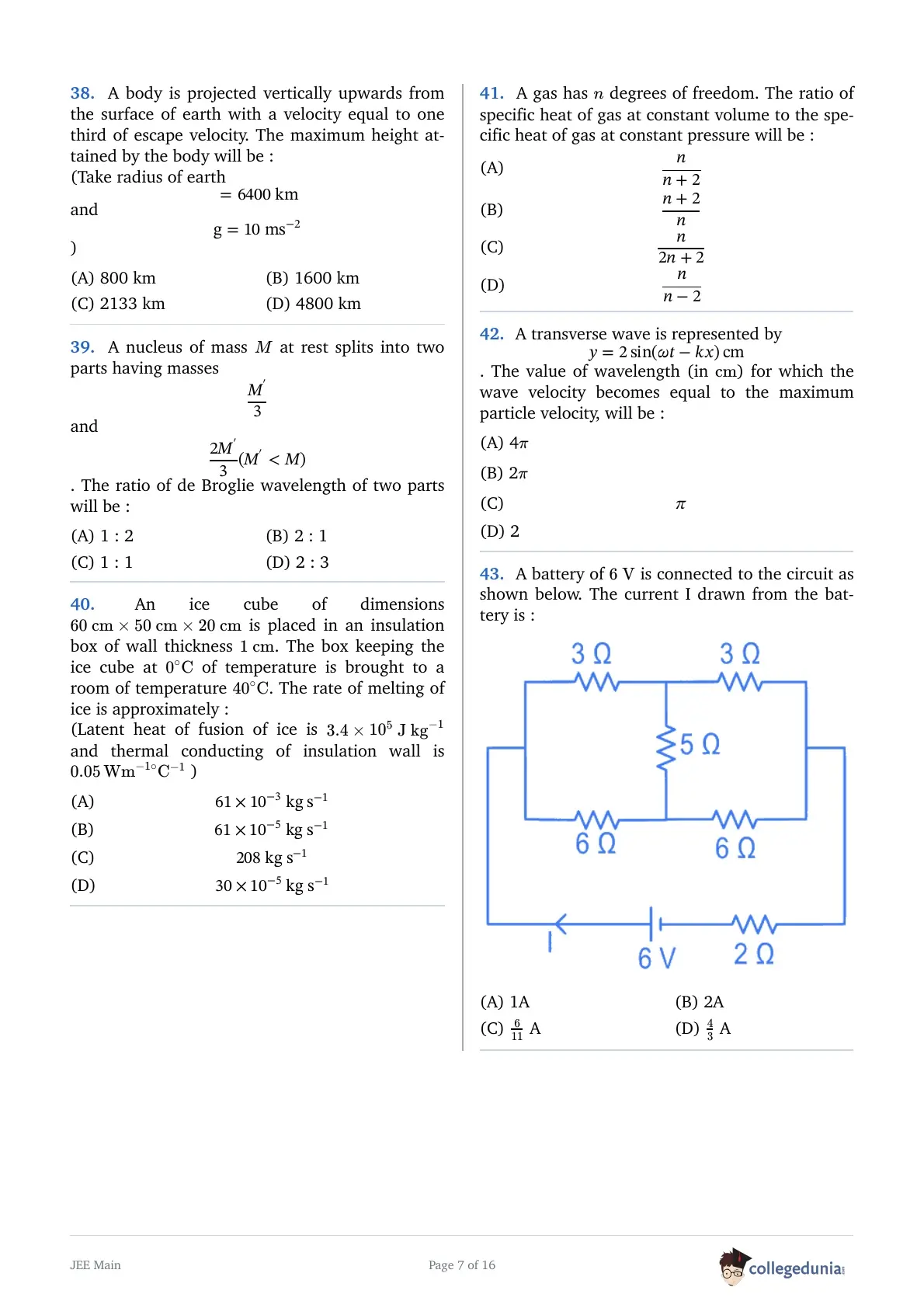
A battery of 6V is connected to the circuit as shown below. The current I drawn from the battery is
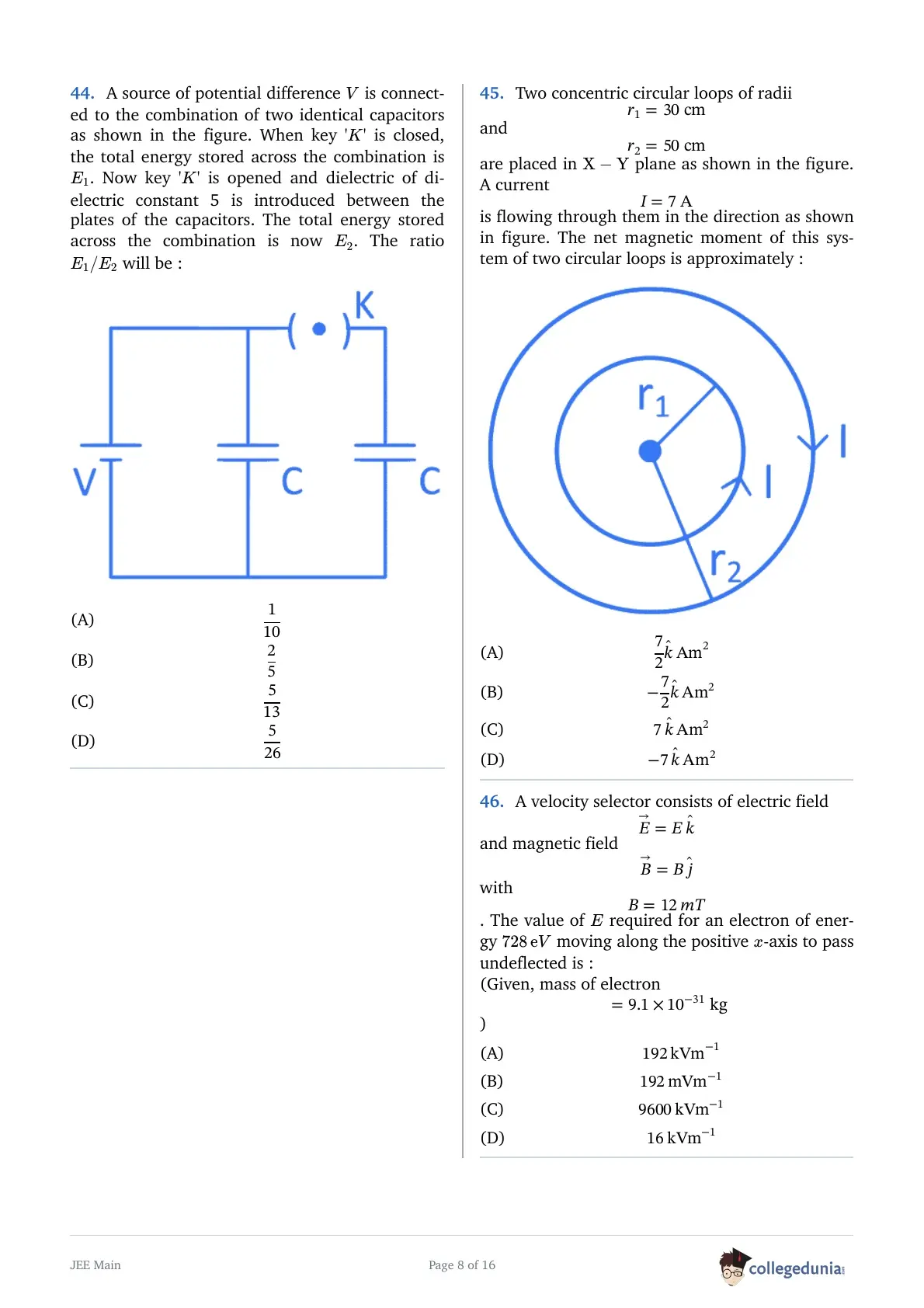
A source of potential difference \(V\) is connected to the combination of two identical capacitors as shown in the figure. When key \(‘K’\) is closed, the total energy stored across the combination is \(E_1\). Now key \(‘K’\) is opened and dielectric of dielectric constant \(5\) is introduced between the plates of the capacitors. The total energy stored across the combination is now \(E_2\). The ratio \(\frac{E_1}{E_2}\) will be
Two concentric circular loops of radii \(r_1 = 30\) cm and \(r_2 = 50\) cm are placed in \(X–Y\) plane as shown in the figure. \(A\) current \(I = 7 \;A\) is flowing through them in the direction as shown in figure. The net magnetic moment of this system of two circular loops is approximately
A velocity selector consists of electric field \(\overrightarrow E=E\hat K\) and magnetic field \(\overrightarrow B=B\hat j\) with \(B = 12 \;mT\). The value of E required for an electron of energy \(728\) \(eV\) moving along the positive x-axis to pass undeflected is (Given, mass of electron = \(9.1 × 10^{–31}\) kg)
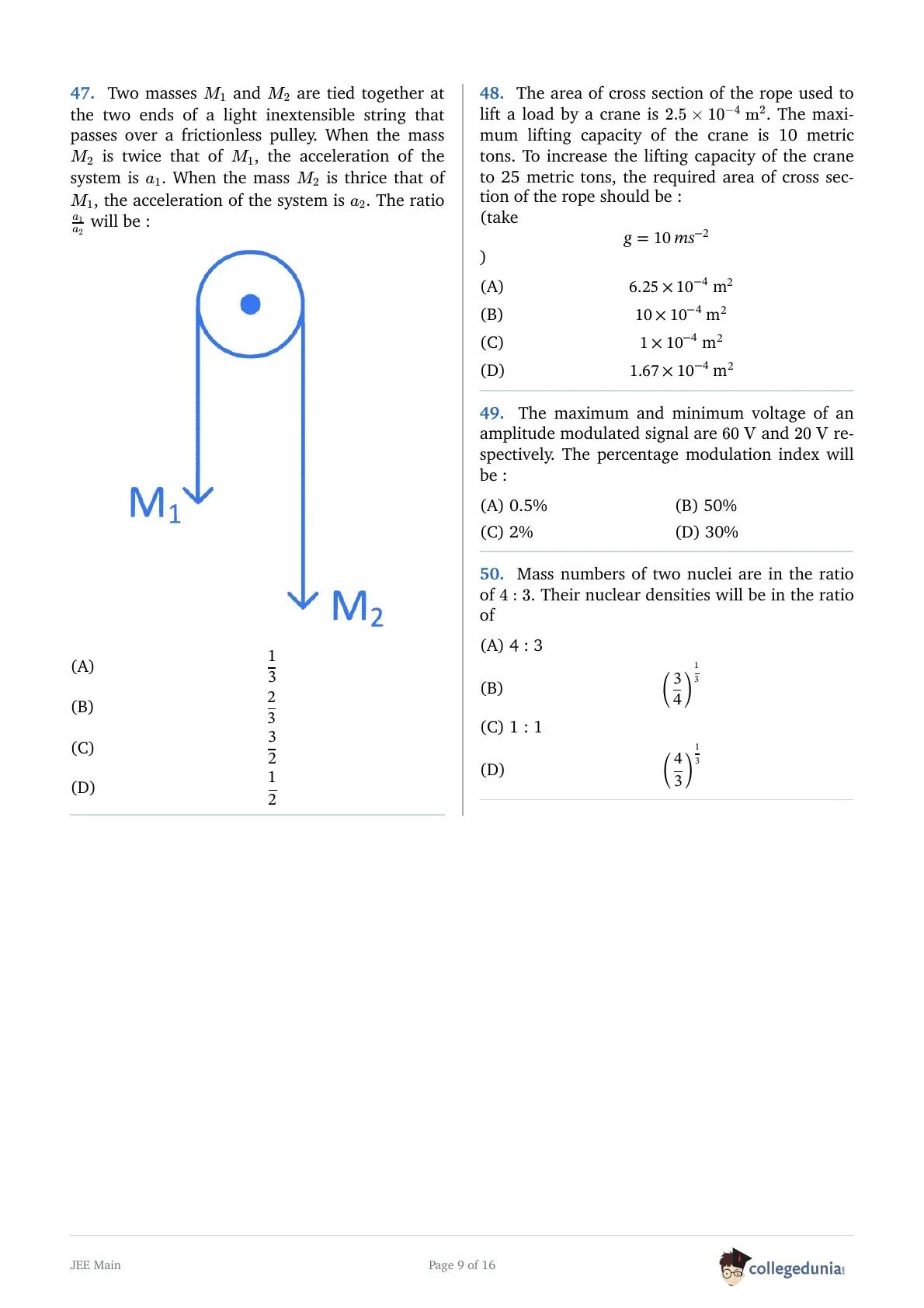
Two masses \(M_1\) and \(M_2\) are tied together at the two ends of a light inextensible string that passes over a frictionless pulley. When the mass \(M_2\) is twice that of \(M_1\), the acceleration of the system is \(a_1\). When the mass \(M_2\) is thrice that of \(M_1\), the acceleration of the system is \(a_2\). The ratio \(\frac{a_1}{a_2}\) will be
The area of cross section of the rope used to lift a load by a crane is \(2.5 × 10^{–4}\) \(m^2\). The maximum lifting capacity of the crane is \(10\) metric tons. To increase the lifting capacity of the crane to \(25\) metric tons, The required area of cross section of the rope should be
The maximum and minimum voltage of an amplitude modulated signal are 60 V and 20 V, respectively. The percentage modulation index will be:
Mass numbers of two nuclei are in the ratio of \(4 : 3\). Their nuclear densities will be in the ratio of
Physics - Section B (Q51 - Q60)
If \(\overrightarrow A=(2\hat i+3\hat j−\hat k)m\) and \(\overrightarrow B=(\hat i+2\hat j+2\hat k)m\). The magnitude of component of vector \(\overrightarrow A\) along vector \(\overrightarrow B\) will be ______\(m\).
The radius of gyration of a cylindrical rod about an axis of rotation perpendicular to its length and passing through the center will be_________m. Given the length of the rod is \(10\sqrt3\; m\).
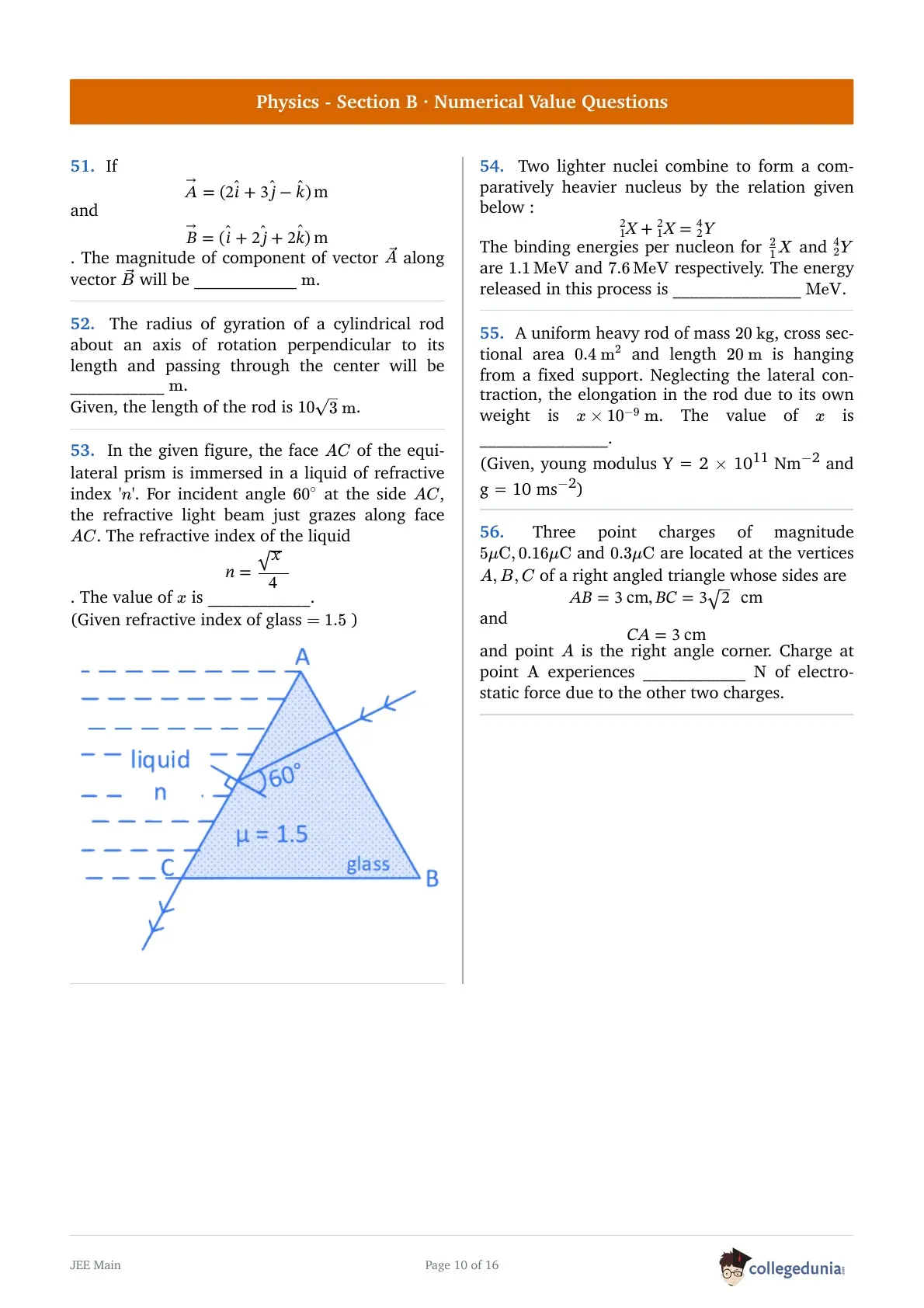
In the given figure, the face AC of the equilateral prism is immersed in a liquid of refractive index ‘n‘. For incident angle 60° at the side AC the refracted light beam just grazes along face AC. The refractive index of the liquid n = \((\sqrt x)/4\). The value of \(x\) is _______.(Given refractive index of glass = \(1.5\))
Two lighter nuclei combine to from a comparatively heavier nucleus by the relation given below: \(^2_1X+^2_1X=^4_2Y\). The binding energies per nucleon for, \(^2_1X\) and \(^4_2Y\) are 1.1 MeV and 7.6 MeV respectively. The energy released in the process is ______ MeV.
A uniform heavy rod of mass \(20\) kg, cross sectional area \(0.4\) \(m^2\) and length \(20\) \(m\) is hanging from a fixed support. Neglecting the lateral contraction, the elongation in the rod due to its own weight is \(x × 10^{–9}\) \(m\). The value of \(x\) is _____(Given Young’s modulus \(Y = 2 × 10^{11} Nm^{–2}\)and g = \(10\; ms^{–2})\)
Three point charges of magnitude \(5\) \(μC\), \(0.16μC\) and \(0.3μC\) are located at the vertices, \(B, C\) of a right angled triangle whose sides are \(AB = 3\) cm, \(BC = 3\sqrt2\) cm and \(CA = 3\) cm and point A is the right angle corner. Charge at point A, experiences ______N of electrostatic force due to the other two charges.
In a coil of resistance \(8Ω\), the magnetic flux due to an external magnetic field varies with time as \(Φ=\frac{2}{3}(9−t^2)\).The value of total heat produced in the coil, till the flux becomes zero, will be _ \(J\).
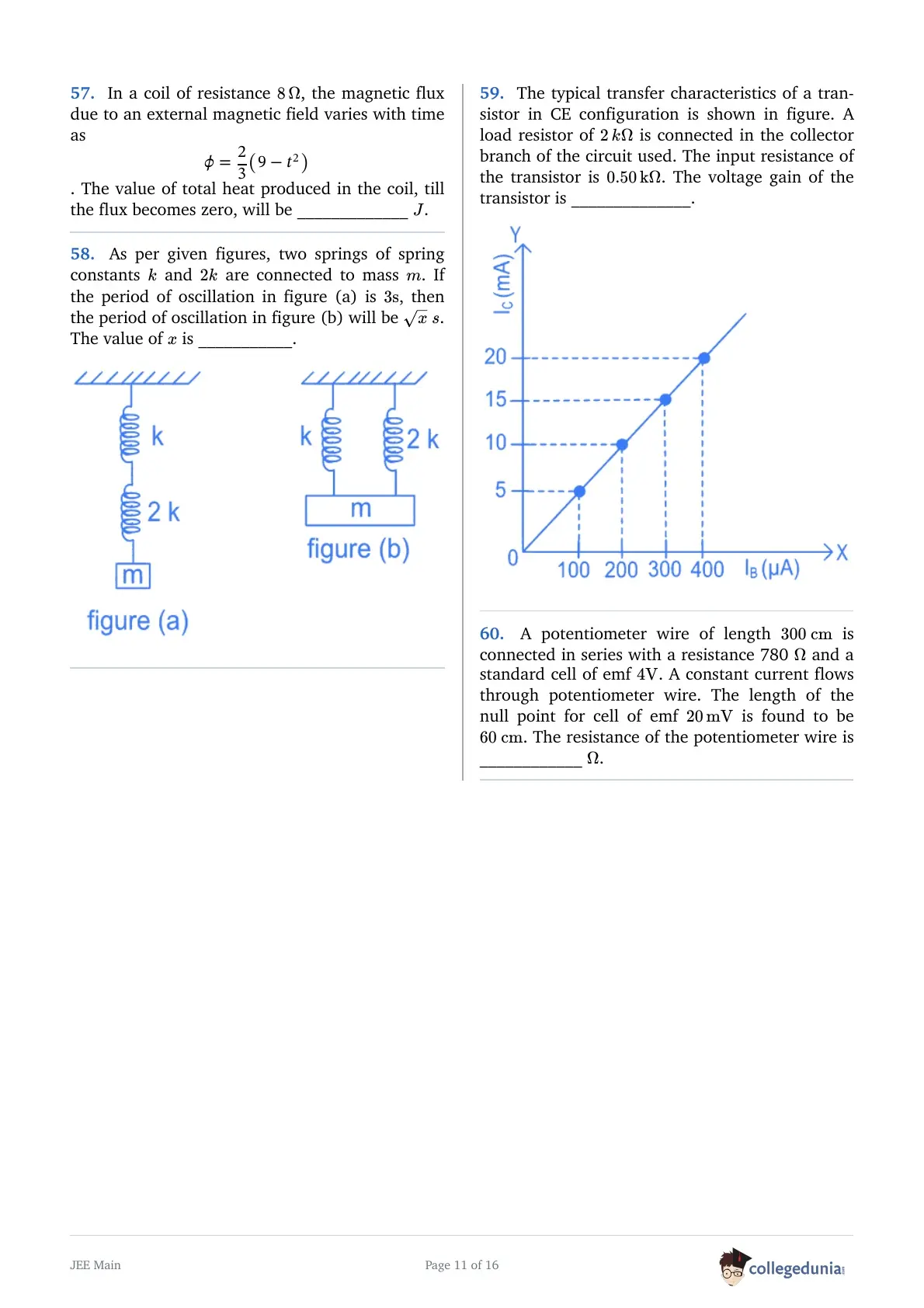
As per given figures, two springs of spring constants k and 2k are connected to mass m. If the period of oscillation in figure (a)is 3s, then the period of oscillation in figure (b) will be \(\sqrt x\) s. The value of \(x\) is _______
The typical transfer characteristics of a transistor in CE configuration is shown in figure. A load resistor of \(2\) \(kΩ\) is connected in the collector branch of the circuit used. The input resistance of the transistor is \(0.50\) \(kΩ\). The voltage gain of the transistor is ________.
A potentiometer wire of length 300 cm is connected in series with a resistance 780 Ω and a standard cell of emf 4V. A constant current flows through potentiometer wire. The length of the null point for cell of emf20 mV is found to be 60 cm. The resistance of the potentiometer wire is _____ Ω.
Chemistry - Section A (Q61 - Q80)
Haemoglobin contains \(0.34\%\) of iron by mass. The number of Fe atoms in \(3.3\) g of haemoglobin is(Given: Atomic mass of Fe is \(56\) u, \(N_A\) = \(6.022 × 10²³\) \(mol^{–1}\))
Arrange the following in increasing order of their covalent character.
A. \(CaF_2\)
B. \(CaCl_2\)
C. \(CaBr_2\)
D. \(Cal_2\)
Class XII students were asked to prepare one litre of buffer solution of pH \(8.26\) by their Chemistry teacher. The amount of ammonium chloride to be dissolved by the student in \(0.2\) M ammonia solution to make one litre of the buffer is (Given : \(pK_b\) \((NH_3)\) = \(4.74\), Molar mass of \(NH_3\) = \(17\) g \(mol^{–1}\), Molar mass of \(NH_4Cl\) = \(53.5\) \(g\) \(mol^{–1}\))
At 30ºC, the half life for the decomposition of \(AB_2\) is 200 s and is independent of the initial concentration of \(AB_2\). The time required for 80% of the \(AB_2\) to decompose is(Given : \(log\; 2 = 0.30,\; log \;3 = 0.48\))
The metal complex that is diamagnetic is (Atomic number : \(Fe, 26; Cu, 29\))
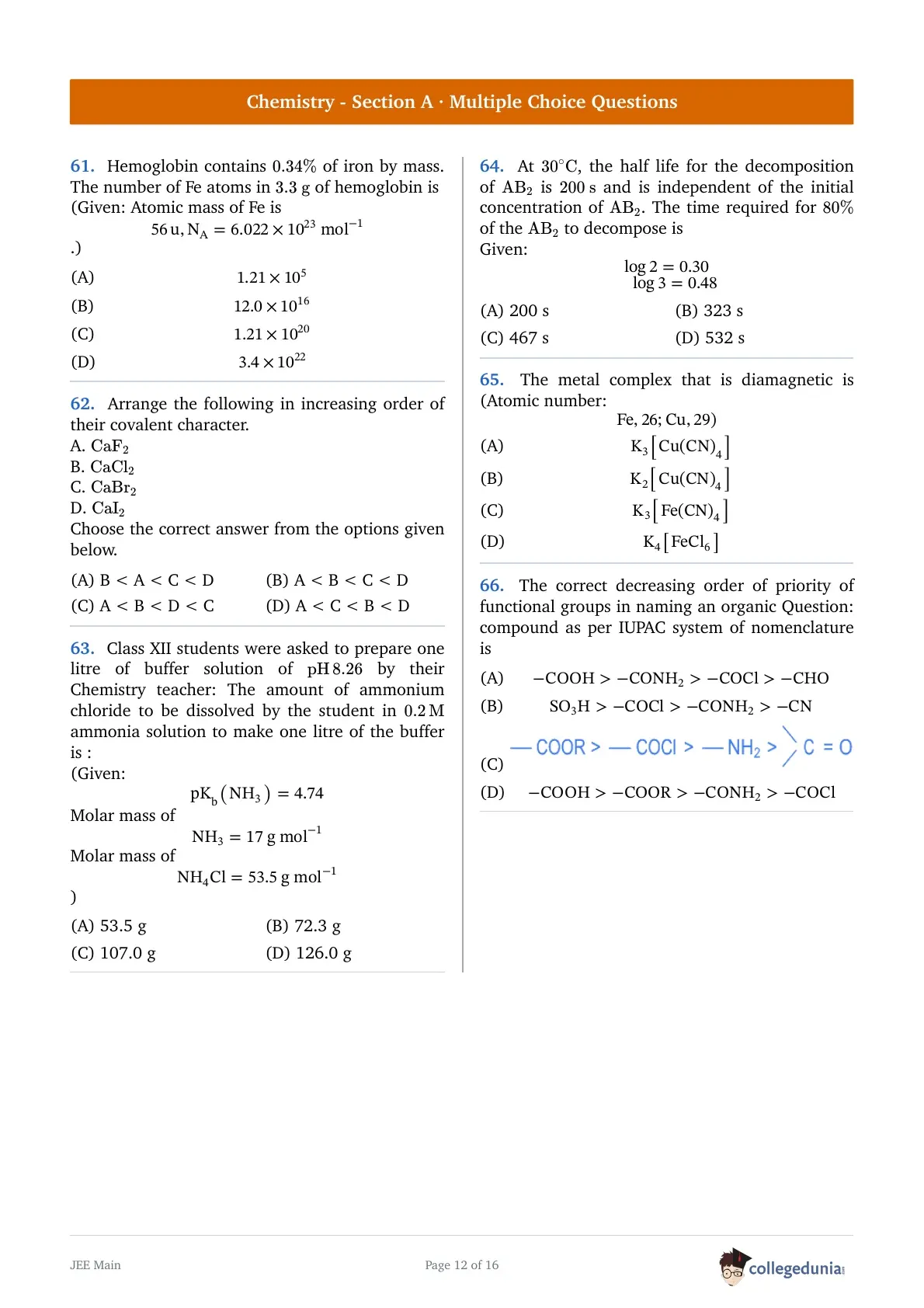
The correct decreasing order of priority of functional groups in naming an organic compound as per IUPAC system of nomenclature is
- (1)
![functional groups in naming an organic compound as per IUPAC system]()
- (2)
![functional groups in naming an organic compound as per IUPAC system]()
- (3)
![functional groups in naming an organic compound as per IUPAC system]()
- (4)
![functional groups in naming an organic compound as per IUPAC system]()


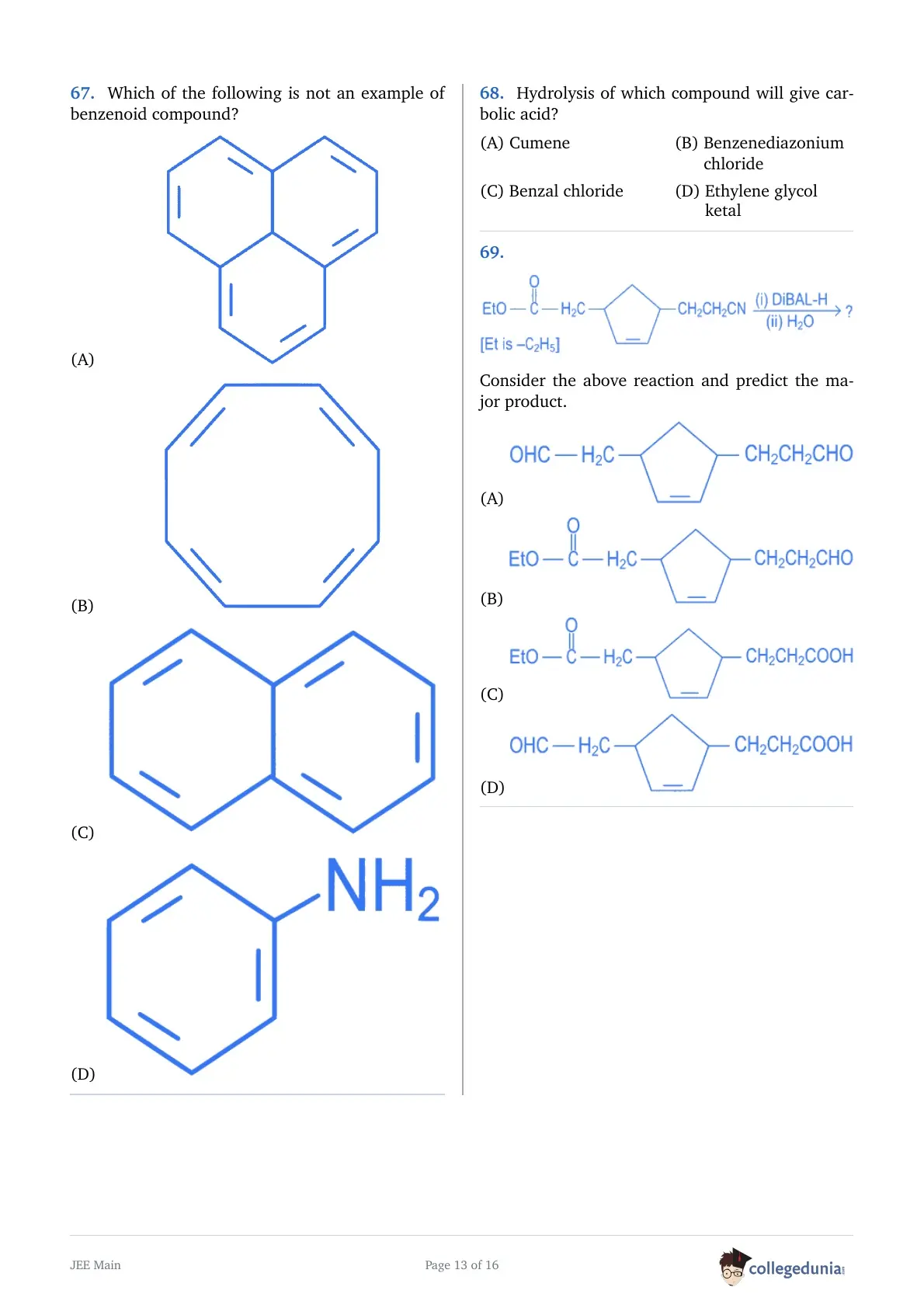
Which of the following is not an example of benzenoid compound?
- (1)
![Which of the following is not an example of benzenoid compound?]()
- (2)
![Which of the following is not an example of benzenoid compound?]()
- (3)
![Which of the following is not an example of benzenoid compound?]()
- (4)
![Which of the following is not an example of benzenoid compound?]()


Hydrolysis of which compound will give carbolic acid?

[Et is \(-\mathrm{C_2H_5}\)]
Reaction: the substrate \(\mathrm{EtO-C(=O)-CH_2-}\)(cyclopentene ring, 1,3-disubstituted, C=C in the ring)\(\mathrm{-CH_2CH_2CN}\) is treated with (i) DIBAL-H, (ii) \(\mathrm{H_2O}\).
Consider the above reaction and predict the major product.
- (1)
![]()
- (2)
![]()
- (3)
![]()
- (4)
![]()


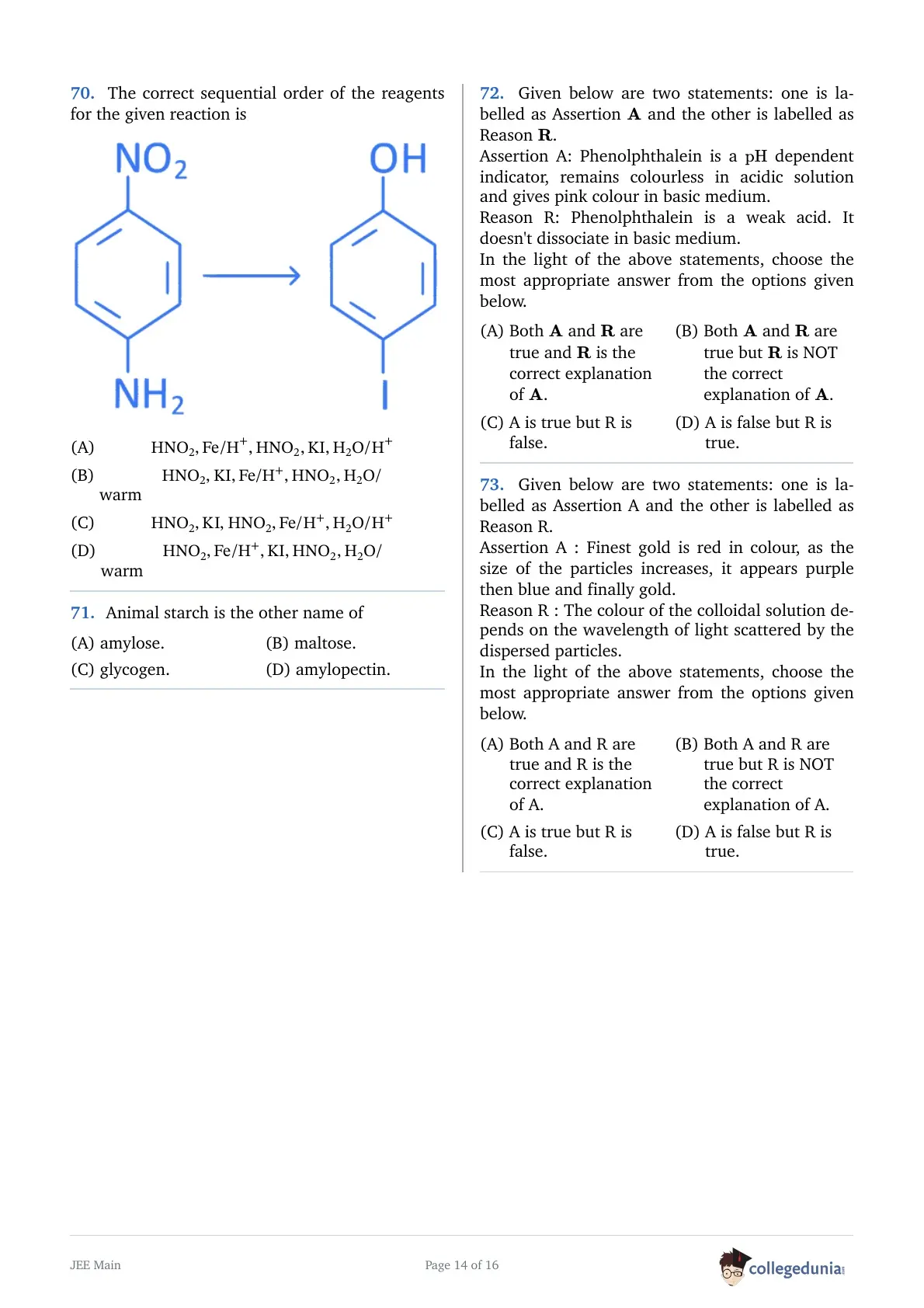
The correct sequential order of the reagents for the given reaction is
Animal starch is the other name of
Given below are two statements: One is labelled as Assertion A and the other is labelled as Reason R.
Assertion A: Phenolphthalein is a pH dependent indicator, remains colourless in acidic solution and gives pink colour in basic medium.
Reason R: Phenolphthalein is a weak acid. It doesn’t dissociate in basic medium.
In the light of the above statements, choose the most appropriate answer from the options given below.
Given below are two statements: one is labelled as Assertion A and other is labelled as Reason R.
Assertion A : Finest gold is red in colour, as the size of the particles increases, it appears purple then blue and finally gold.
Reason R : The colour of the colloidal solution depends on the wavelength of light scattered by the dispersed particles.
In the light of the above statements, choose the most appropriate answer from the options given below.
The metal that has very low melting point and its periodic position is closer to a metalloid is
The metal that is not extracted from its sulfide ore is
The products obtained from a reaction of hydrogen peroxide and acidified potassium permanganate are
Given below are two statements: one is labelled as Assertion A and the other is labelled as Reason R.
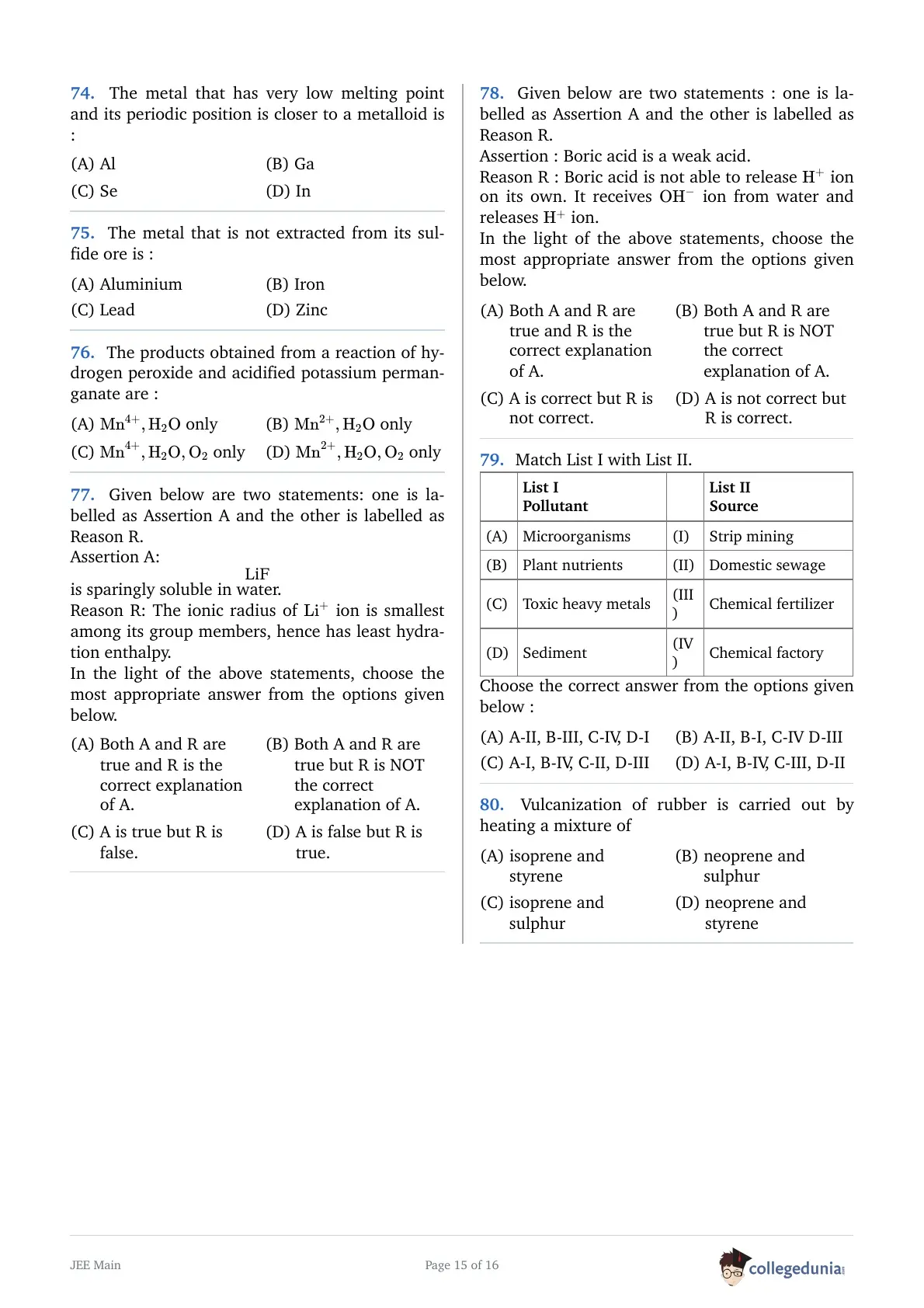
Assertion A : \(LiF\) is sparingly soluble in water.
Reason R : The ionic radius of \(Li^+\) ion is smallest among its group members, hence has least hydration enthalpy.
In the light of the above statements, choose the most appropriate answer from the options given below.
Given below are two statements: one is labelled as Assertion A and the other is labelled as Reason R.
Assertion A: Boric acid is a weak acid
Reason R: Boric acid is not able to release \(H^+\) ion on its own. It receives \(OH^–\) ion from water and releases \(H^+\) ion.
In the light of the above statements, choose the most appropriate answer from the options given below.
| List I Pollutant | List II Source |
|---|---|
| A. Microorganisms | I. Strip mining |
| B. Plant nutrients | II. Domestic sewage |
| C. Toxic heavy metals | III. Chemical fertilizer |
| D. Sediment | IV. Chemical factory |
Choose the correct answer from the options given below:
Vulcanization of rubber is carried out by heating a mixture of
Chemistry - Section B (Q81 - Q90)
Consider an imaginary ion \(_{22}^{48}X^{3−}\).The nucleus contains ‘a’% more neutrons than the number of electrons in the ion. The value of ‘a’ is ________. [nearest integer
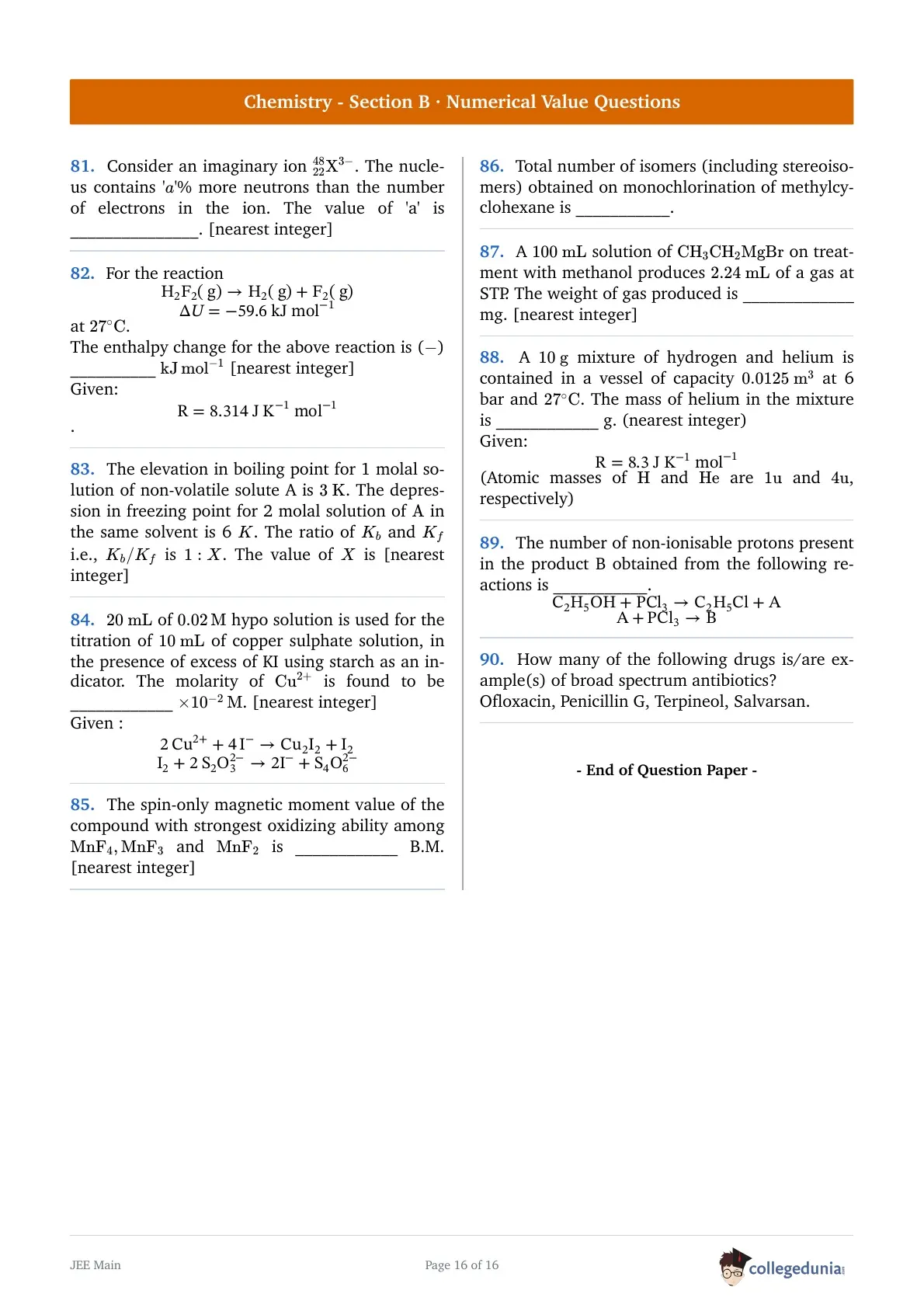
For the reaction H2F2(g) → H2(g) + F2(g), ΔU = –59.6 kJ mol–1 at 27°C. The enthalpy change for the above reaction is (–) _______ kJ mol–1 [nearest integer] Given: R = 8.314 J K–1 mol–1.
The elevation in boiling point for 1 molal solution of non-volatile solute A is 3 K. The depression in freezing point for 2 molal solution of A in the same solvent is 6 K. The ratio of Kb and Kf i.e., \(\frac{K_b}{K_f}\) is 1 : X. The value of X is [nearest integer]
20 mL of 0.02 M hypo solution is used for the titration of 10 mL of copper sulphate solution, in the presence of excess of KI using starch as an indicator. The molarity of \(Cu^{2+}\) is found to be ________ × \(10^{–2} M\). [nearest integer]
The spin-only magnetic moment value of the compound with strongest oxidizing ability among MnF4, MnF3 and MnF2 is____ B.M. [nearest integer]
Total number of isomers (including stereoisomers) obtained on monochlorination of methylcyclohexane is____.
A \(100\) \(mL\) solution of \(CH_3CH_2MgBr\) on treatment with methanol produces \(2.24\) \(mL\) of a gas at STP. The weight of gas produced is_____ mg. [nearest integer]
A 10 g mixture of hydrogen and helium is contained in a vessel of capacity 0.0125 m3 at 6 bar and 27°C. The mass of helium in the mixture is _______ g. (nearest integer)
Given : R = 8.3 J K–1 mol–1
(Atomic masses of H and He are 1 u and 4 u, respectively)
The number of non-ionisable protons present in the product B obtained from the following reactions is__.
C2H5OH+PCl3→C2H5Cl+A
A+PCl3→B
How many of the following drugs is/are examples(s) of broad-spectrum antibiotics?
Ofloxacin, Penicillin G, Terpineol, Salvarsan.
JEE Main 2022 Exam Pattern and Marking Scheme
| Particulars | Details |
|---|---|
| Exam Mode | Online (Computer-Based Test) |
| Paper | B.E./B.Tech (Paper 1) |
| Duration | 3 hours (180 minutes) |
| Type of Questions | Multiple Choice Questions (MCQs) + Numerical Value Questions |
| Subjects | Mathematics, Physics, Chemistry |
| Total Questions | 90 questions (75 to be attempted) |
| Total Marks | 300 marks |
| Marking Scheme | +4 for correct answer & -1 for incorrect MCQ and Numerical Value-based Questions |
JEE Main 2022 July 26 Shift 2 Difficulty Level
As per the initial student reaction, the paper was reported as moderate. Just like the previous sessions, JEE Main 2022 July 26 Shift 2 Mathematics was difficult. Physics was found easy to moderate and Chemistry easy.
JEE Main 2022 July 26 Shift 2 Subject-wise Memory-Based Solutions PDF
| Subject | Memory-Based Solutions PDF |
|---|---|
| Physics | Download PDF |
| Chemistry | Download PDF |
| Mathematics | Download PDF |
JEE Main 2022 Phase 2 Question Papers with Solution PDFs
Candidates can also check shift-wise JEE Main 2022 Phase 2 Question Papers with Solution PDFs. These shift-wise question paper PDFs for JEE Main 2022 will help candidates know the overall difficulty, topics with the highest weightage and the type of questions asked in the exam.
JEE Main 2022 Phase 1 Question Papers with Solution PDFs
Shift-wise JEE Main 2022 Phase 1 Question Papers with Solution PDFs are also available. Candidates preparing for Phase 2 of the exam can check and download JEE Main Question Paper PDFs to practice and test their exam prep level.
Also Check:



Comments