




JEE Main 2022 July 27 Shift 2 Question Paper is available here with solutions PDF and detailed solutions for every question. NTA conducted the second shift on July 27, 2022, from 3:00 PM to 6:00 PM. The JEE Main 2022 Paper 1 (B.E./B.Tech) question paper includes the following:
- 90 questions in a 3-hour CBT Mode: 30 each from Mathematics, Physics and Chemistry (75 to be attempted)
- Section A: 20 multiple choice questions (MCQs) per subject, all compulsory, 4 marks each
- Section B: 10 numerical value questions per subject, any 5 to be attempted, 4 marks each
- Marking: +4 for a correct answer, -1 for an incorrect answer, 0 for an unattempted question
- Maximum marks: 300 (100 per subject)
JEE Main 2022 July 27 Shift 2 Question Paper with Solution PDF
| NTA Official PDF | CD PDF | CD PDF with Solutions |
|---|---|---|
| Download official PDF 5.77 MB | Download Collegedunia PDF 1.34 MB | Download solutions PDF 1.22 MB |
Also Check:
JEE Main 2022 July 27 Shift 2 Questions with Solutions
Mathematics - Section A (Q1 - Q20)
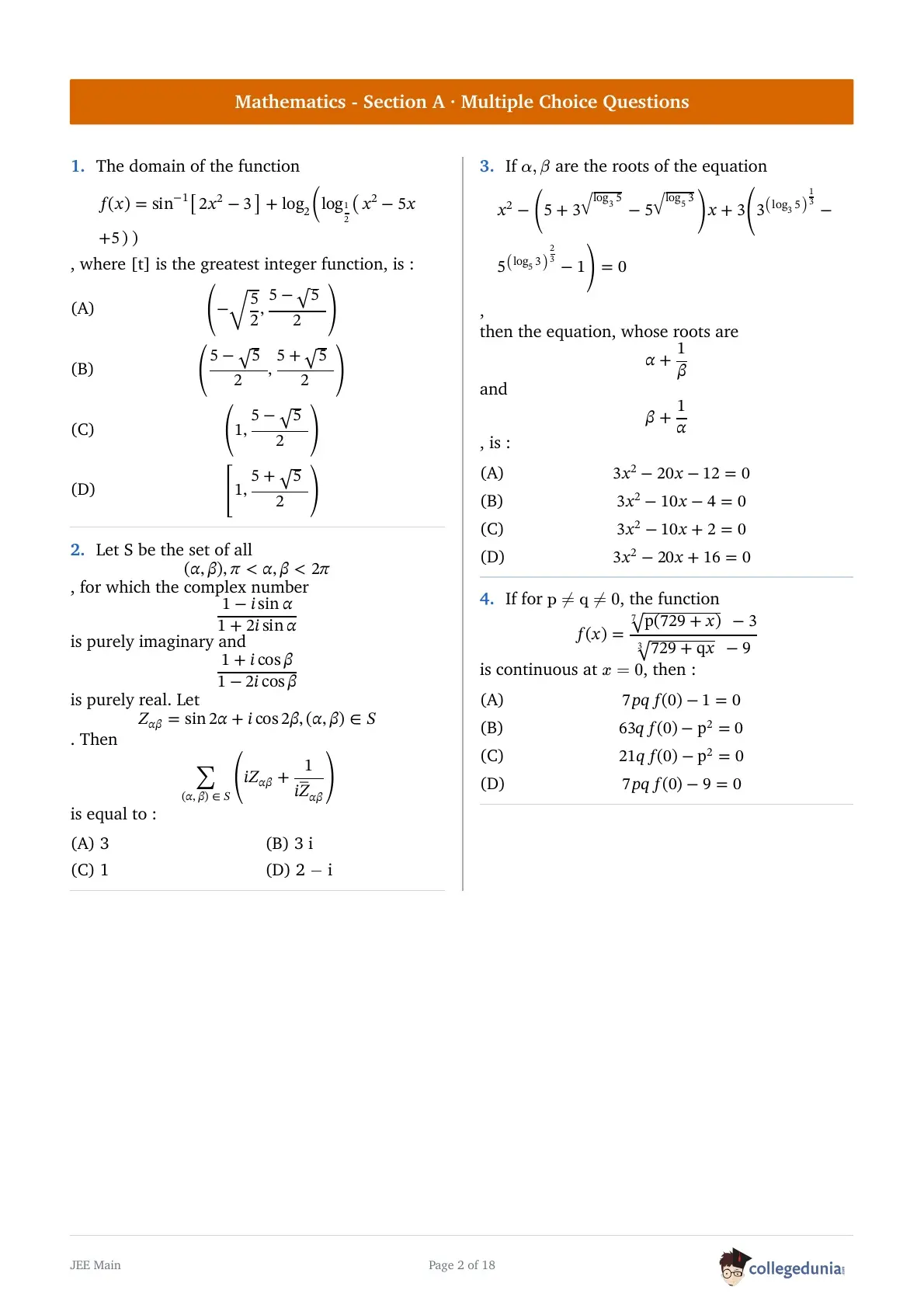
The domain of the function
\(f(x) = sin^-1 [2x^2-3]+log2(log_{\frac{1}{2}}(x^2-5x+5))\)
where [t] is the greatest integer function, is
Let S be the set of (α,β),π<α,β<2π,for which the complex number
\(\frac{1-i\sinα}{1+2i\sinα}\) is purely imaginary and \(\frac{1+i\cosβ}{1-2i\cosβ}\) is purely real,
Let \(Zαβ = \sin2α+i\cos2β, (α,β) ∈ S\). Then
\(\sum_{(\alpha, \beta) \in S} \left(iZ_{\alpha\beta} + \frac{1}{iZ_{\alpha\beta}}\right)\)
is equal to
If α, β are the roots of the equation
\(x^2-(5+3^{\sqrt{log_35}}-5^{\sqrt{log_53}})+3(3^{(log_35)^{\frac{1}{3}}}-5^{(log_53)^{\frac{2}{3}}}-1) = 0\)
then the equation, whose roots are α + 1/β and β + 1/α , is
If for p ≠ q ≠ 0, the function
\(f(x) = \frac{{^{\sqrt[7]{p(729 + x)-3}}}}{{^{\sqrt[3]{729 + qx} - 9}}}\)
is continuous at x = 0, then
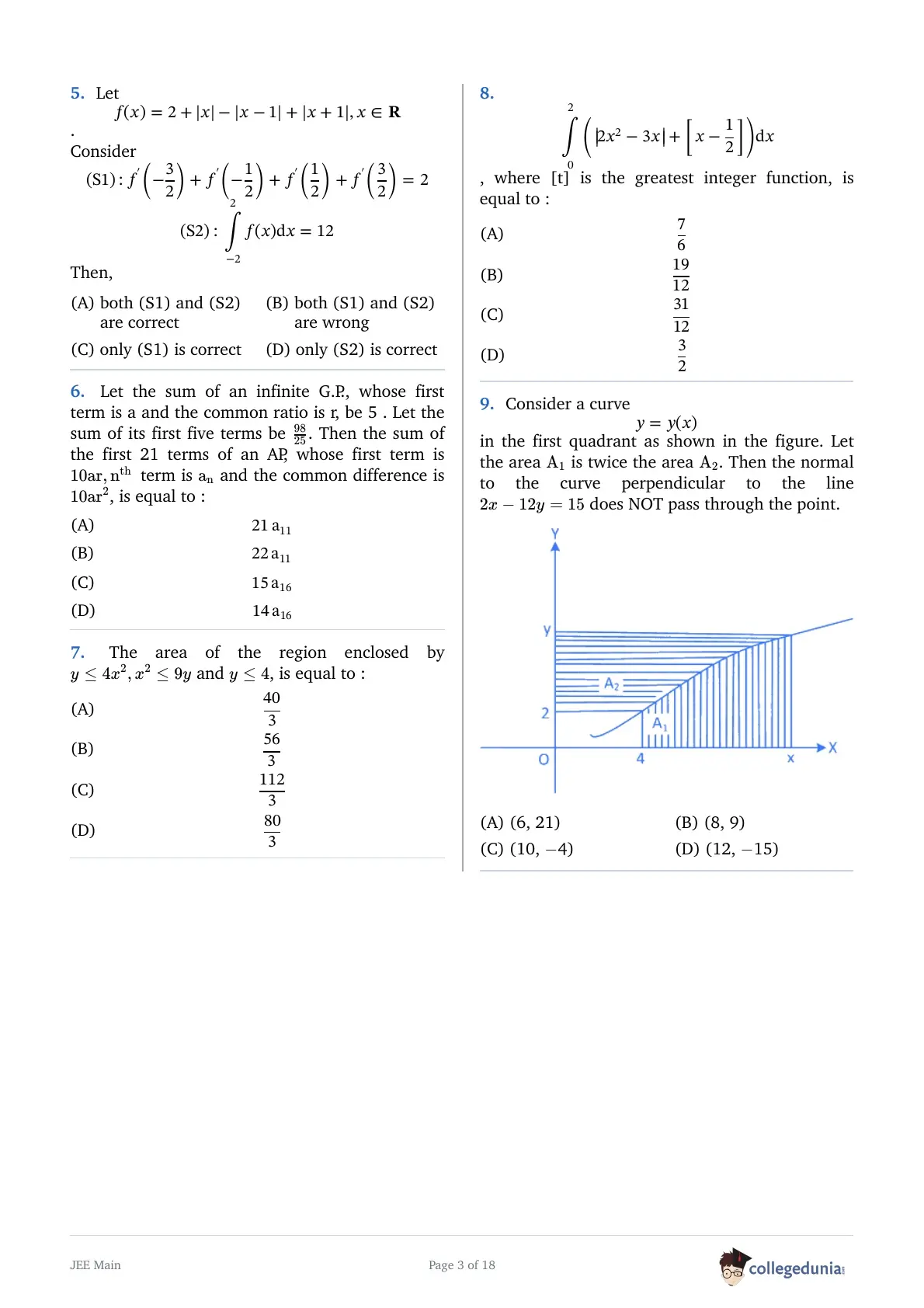
Let
\(f(x) = 2+|x|-|x-1|+|x+1|,x∈R.\)
Consider \(f'\left(-\frac{3}{2}\right) + f'\left(-\frac{1}{2}\right) + f'\left(\frac{1}{2}\right) + f'\left(\frac{3}{2}\right) = 2\)
(\((S2):\int_{-2}^{2} f(x) \,dx = 12\)
Then,
Let the sum of an infinite G.P., whose first term is a and the common ratio is r, be 5. Let the sum of its first five terms be 98/25. Then the sum of the first 21 terms of an AP, whose first term is 10ar, nth term is an and the common difference is 10ar2, is equal to
The area of the region enclosed by
\(y≤4x^2, x2≤9y\ and\ y≤4,\)
is equal to
\(\int_{0}^{2} \left( |2x^2 - 3x| + \left[x - \frac{1}{2}\right] \right) \, dx,\)
where [t] is the greatest integer function, is equal to
Consider a curve y = y(x) in the first quadrant as shown in the figure. Let the area A1 is twice the area A2. Then the normal to the curve perpendicular to the line 2x – 12y = 15 does NOT pass through the point.

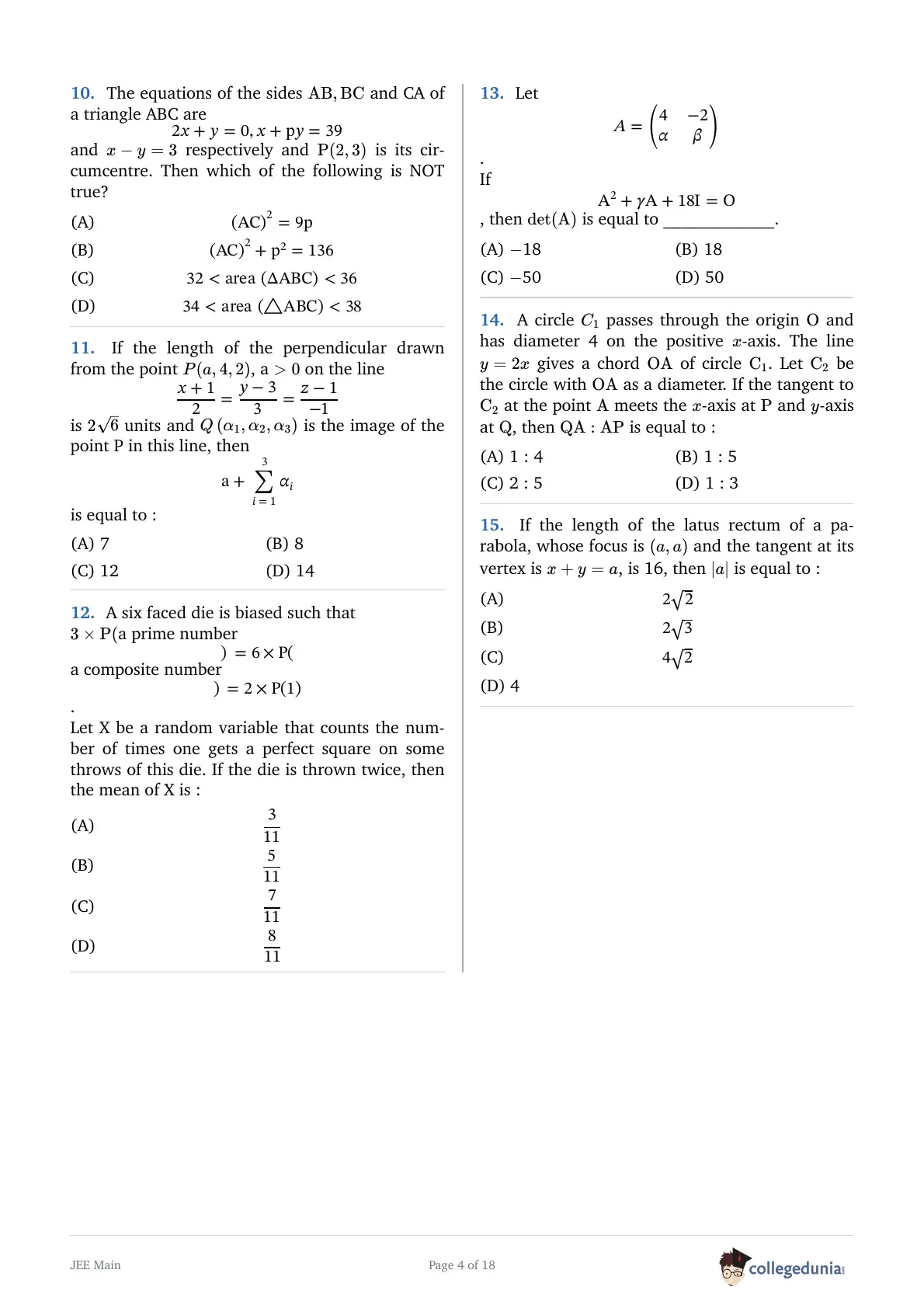
The equations of the sides AB, BC and CA of a triangle ABC are 2x + y = 0, x + py = 39 and x – y = 3, respectively and P(2, 3) is its circumcentre. Then which of the following is NOT true?
If the length of the perpendicular drawn from the point P(a, 4, 2), a> 0 on the line
\(\frac{x+1}{2} = \frac{y-3}{3} = \frac{z-1}{1}\) is \(2\sqrt6\) units and \(Q(α1, α2, α3)\)
is the image of the point P in this line, then
\(\alpha + \sum_{i=1}^{3} \alpha_i\)
is equal to :
A six faced die is biased such that
3 × P (a prime number) = 6 × P (a composite number) = 2 × P (1).
Let X be a random variable that counts the number of times one gets a perfect square on some
throws of this die. If the die is thrown twice, then the mean of X is :
Let
A =\(\begin{pmatrix} 4 & -2 \\ \alpha & \beta \\ \end{pmatrix}\)
If A2 + γA + 18I = 0, then det (A) is equal to ______.
A circle C1 passes through the origin O and has diameter 4 on the positive x-axis. The line y = 2x gives a chord OA of circle C1. Let C2 be the circle with OA as a diameter. If the tangent to C2 at the point A meets the x-axis at P and y-axis at Q, then QA :AP is equal to
If the length of the latus rectum of a parabola, whose focus is (a, a) and the tangent at its vertex is x + y = a, is 16, then |a| is equal to :
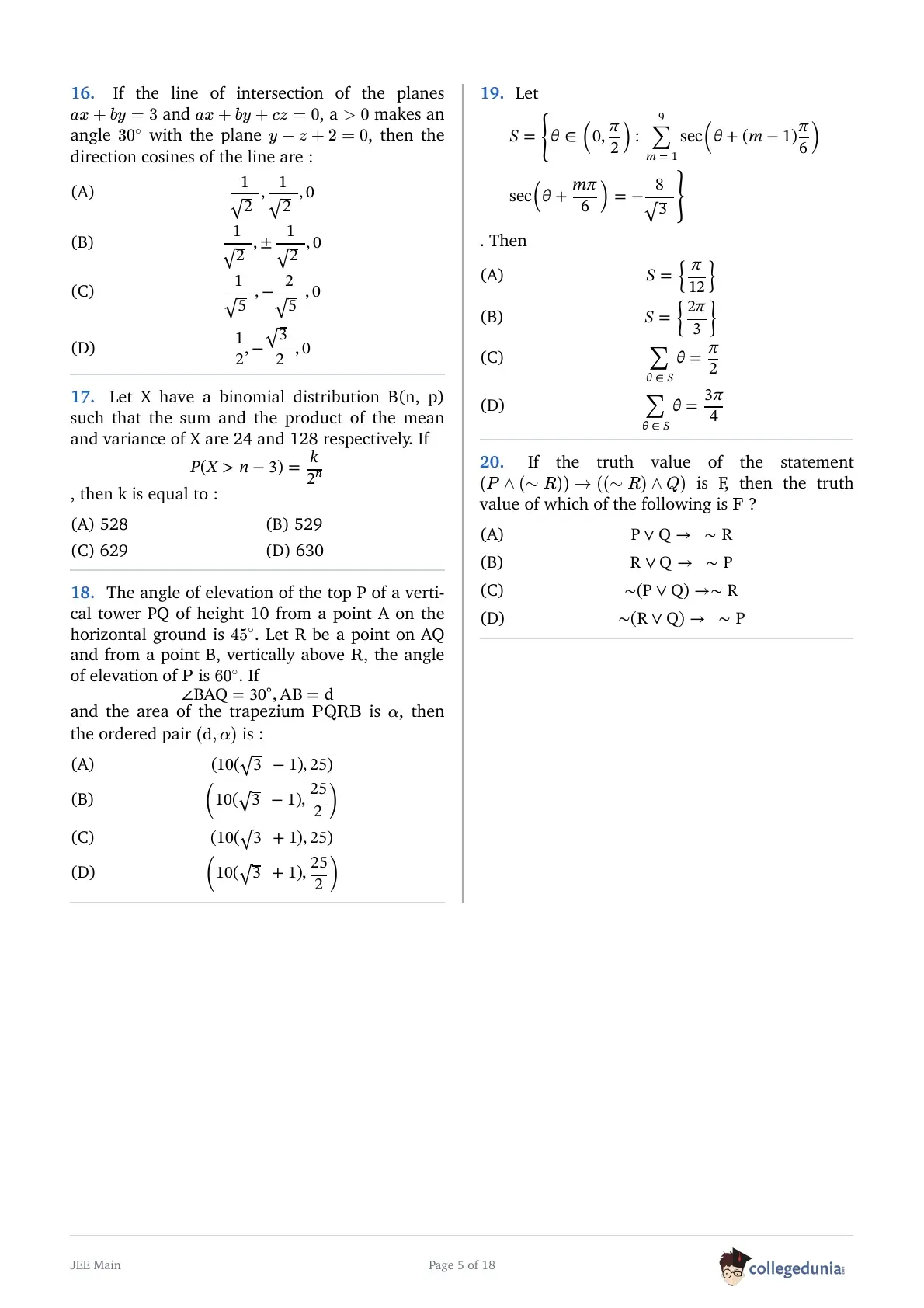
If the line of intersection of the planes ax + by = 3 and ax + by + cz = 0, a> 0 makes an angle 30° with the plane y – z + 2 = 0, then the direction cosines of the line are :
Let X have a binomial distribution B(n, p) such that the sum and the product of the mean and variance of X are 24 and 128 respectively. If
\(P(X>n-3) = \frac{k}{2^n},\)
then k is equal to :
The angle of elevation of the top P of a vertical tower PQ of height 10 from a point A on the horizontal ground is 45°, Let R be a point on AQ and from a point B, vertically above R, the angle of elevation of P is 60°. If
\(∠BAQ = 30°\)
, AB = d and the area of the trapezium PQRB is α, then the ordered pair (d, α) is :
Let \(S=\left\{0∈(0,\frac{π}{2}) : \sum^{9}_{m=1} \sec(θ+(m-1)\frac{π}{6})\sec(θ+\frac{mπ}{6}) = -\frac{8}{\sqrt3}\right\}\)
Then,
If the truth value of the statement
(P∧(∼R))→((∼R)∧Q)
is F, then the truth value of which of the following is F?
Mathematics - Section B (Q21 - Q30)
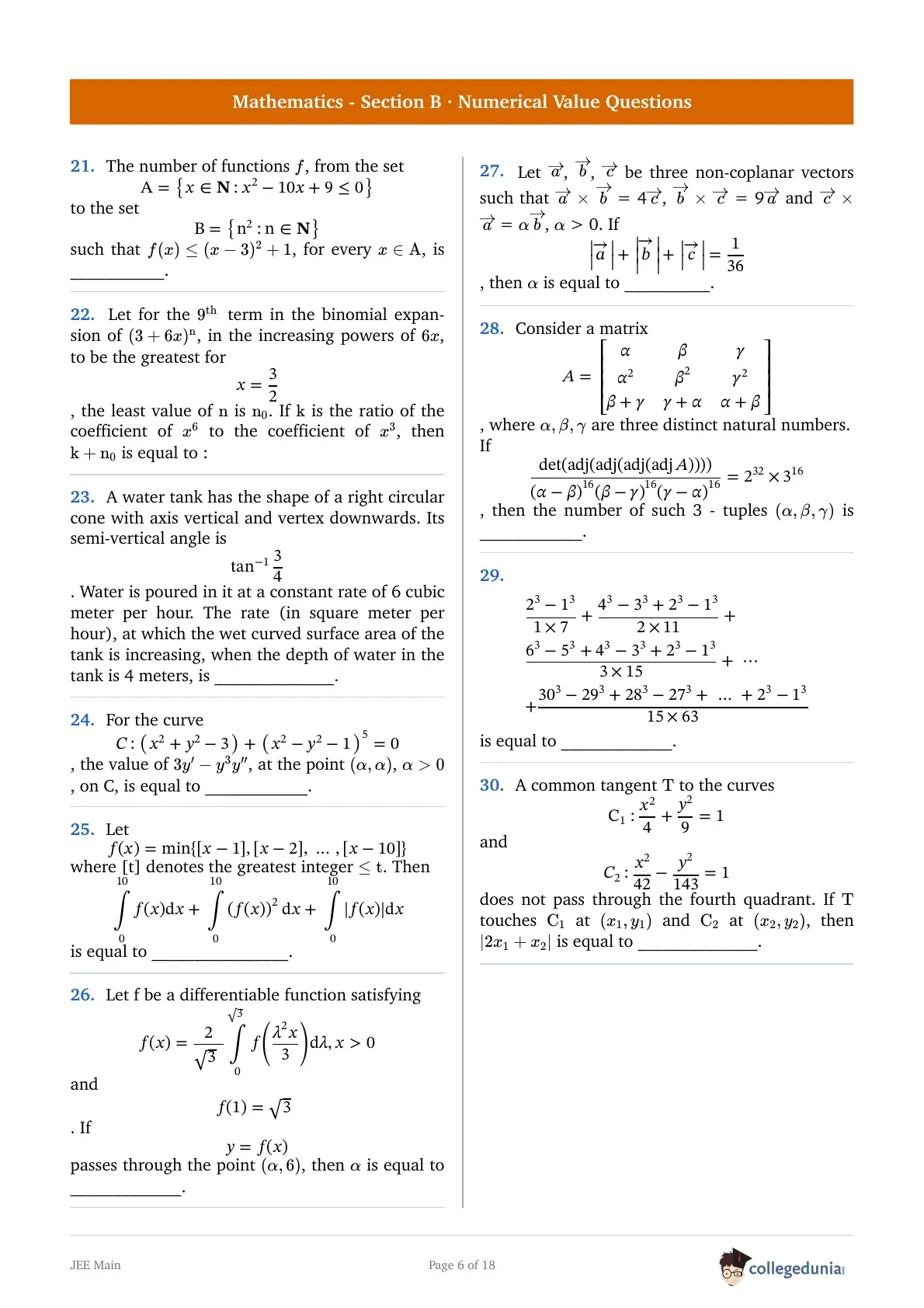
The number of functions f, from the set
\(A = {x∈N: x^2-10x+9≤0} \)to the set \(B = {n62:n∈N}\)
such that
\(f(x)≤(x-3)^2+1\), for every \(x∈A,\)
is ______.
Let for the 9th term in the binomial expansion of (3 + 6x)n, in the increasing powers of 6x, to be the greatest for x = 3/2, the least value of n is n0. If k is the ratio of the coefficient of x6 to the coefficient of x3, then k + n0 is equal to :
A water tank has the shape of a right circular cone with axis vertical and vertex downwards. Its semi-vertical angle is tan-1(3/4). Water is poured in it at a constant rate of 6 cubic meter per hour. The rate (in square meter per hour), at which the wet curved surface area of the tank is increasing, when the depth of water in the tank is 4 meters, is
\(\begin{array}{l}C : \left(x^2 + y^2 – 3\right) + \left(x^2 – y^2 – 1\right)^5 = 0, \end{array}\)
Let
\(\begin{array}{l}f\left(x\right) = min \{\left[x – 1\right], \left[x – 2\right], …., \left[x – 10\right]\}\end{array}\)
where [t] denotes the greatest integer ≤t. Then
\(\begin{array}{l} \displaystyle\int\limits_{0}^{10}f\left(x\right)dx+\displaystyle\int\limits_{0}^{10}\left(f\left(x\right)\right)^2dx+\displaystyle\int\limits_{0}^{10}\left|f\left(x\right)\right|dx\end{array}\)
is equal to ________.
Let f be a differential function satisfying
f(x) =\(\frac{ 2}{√3} \)\(∫^{√30} f(\frac{λ2x}{3})dλ,x>0 and f(1) = √3.\)
If y = f(x) passes through the point (α, 6), then α is equal to _____
\(\begin{array}{l} \vec{a},\vec{b},\vec{c}\ \text{be three non-coplanar vectors such that}\end{array}\)
\(\begin{array}{l} \overrightarrow{a}\times\vec{b}=4\vec{c},\vec{b}\times\vec{c}=9\vec{a}\ \text{and}\ \vec{c}\times\vec{a}=\alpha\vec{b},\alpha>0.\end{array}\)
\(\begin{array}{l} \left|\overrightarrow{a}\right|+\left|\overrightarrow{b}\right|+\left|\overrightarrow{c}\right|=\frac{1}{36}\end{array}, \)
If \(\begin{array}{l}\frac{\text{det(adj(adj(adj(adj A))))}}{\left(\alpha-\beta\right)^{16}\left(\beta-\gamma\right)^{16}\left(\gamma-\alpha\right)^{16}}=2^{32}\times3^{16},\end{array}\)
then the number of such 3-tuples \((α, β, γ)\) is _________.
\(\begin{array}{l} \frac{2^3-1^3}{1\times7}+\frac{4^3-3^3+2^2-1^3}{2\times 11}+\frac{6^3-5^3+4^3-3^3+2^3-1^3}{3\times 15}+\cdots+\frac{30^3-29^3+28^3-27^3+\cdots+2^3-1^3}{15\times63}\end{array}\)
is equal to _______.
A common tangent T to the curves
\(C_1:\frac{x^2}{4}+\frac{y^2}{9} = 1\)
and
\(C_2:\frac{x^2}{4^2}\frac{-y^2}{143} = 1\)
does not pass through the fourth quadrant. If T touches C1 at (x1, y1) and C2 at (x2, y2), then |2x1 + x2| is equal to ______.
Physics - Section A (Q31 - Q50)
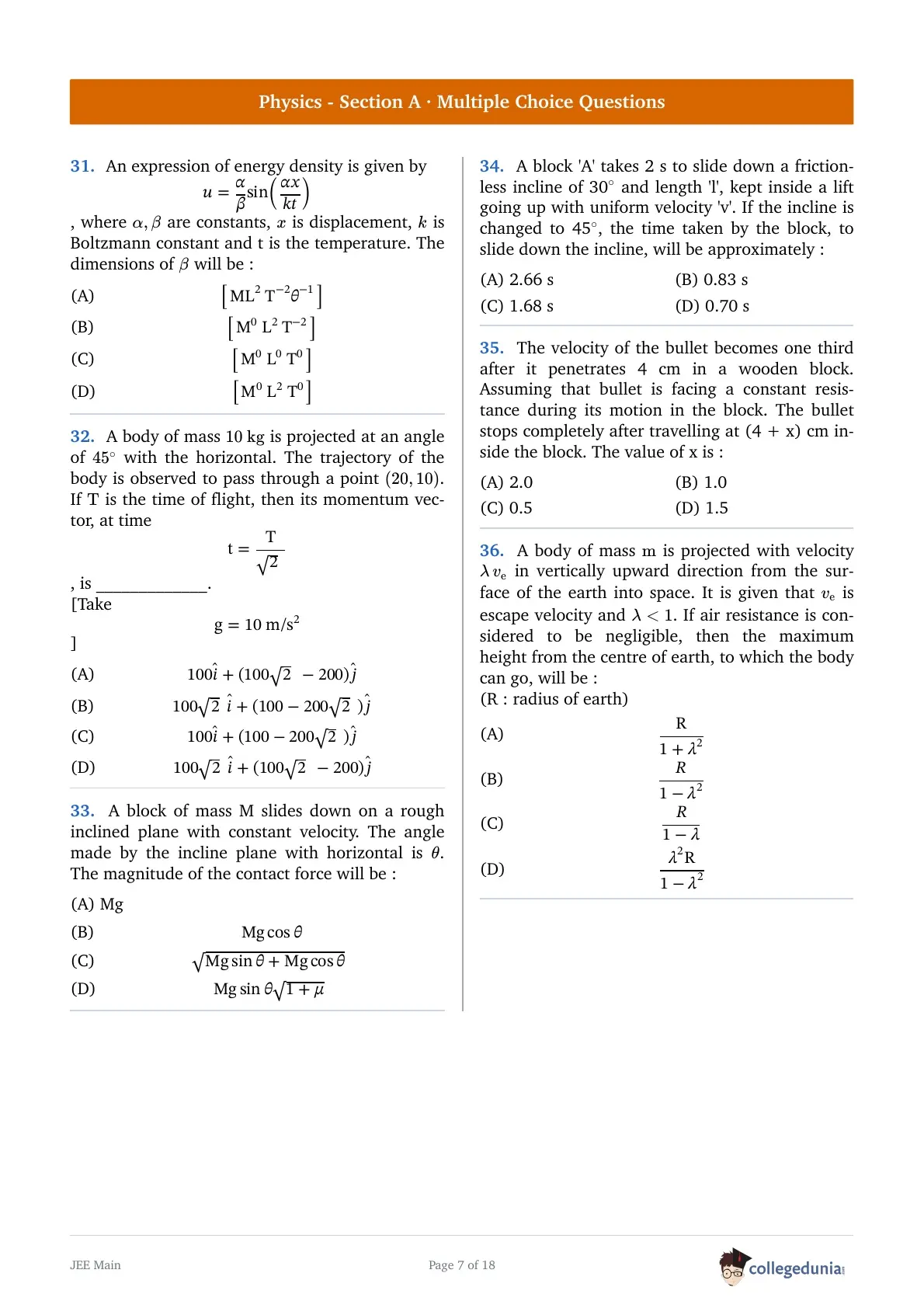
An expression of energy density is given by
\(u = \frac{α}{β} sin (\frac{αx}{kt})\)
, where α, β are constants, x is displacement, k is Boltzmann constant and t is the temperature. The dimensions of β will be
A body of mass 10 kg is projected at an angle of 45° with the horizontal. The trajectory of the body is observed to pass through a point (20, 10). If T is the time of flight, then its momentum vector, at time t = T/√2, is _________.
[Take g = 10m/s2]
A block of mass M slides down on a rough inclined plane with constant velocity. The angle made by the inclined plane with horizontal is θ.The magnitude of the contact force will be
A block ‘A’ takes 2 s to slide down a frictionless incline of 30° and length ‘l’, kept inside a lift going up with uniform velocity ‘v’. If the incline is changed to 45°, the time taken by the block, to slide down the incline, will be approximately
The velocity of the bullet becomes one third after it penetrates 4 cm in a wooden block. Assuming that bullet is facing a constant resistance during its motion in the block. The bullet stops completely after travelling at (4 + x) cm inside the block. The value of x is
A body of mass m is projected with velocity λve in vertically upward direction from the surface of the earth into space. It is given that ve is escape velocity and λ< 1. If air resistance is considered to be negligible, then the maximum height from the centre of earth, to which the body can go, will be:
(R : radius of earth)
A steel wire of length 3.2 m (Ys = 2.0 × 10¹¹ Nm-2) and a copper wire of length 4.4 m (Yc = 1.1 × 10¹¹ Nm-2), both of radius 1.4 mm are connected end to end. When stretched by a load, the net elongation is found to be 1.4 mm. The load applied, in Newton, will be:
\((Given: π = \frac{22}{7})\)
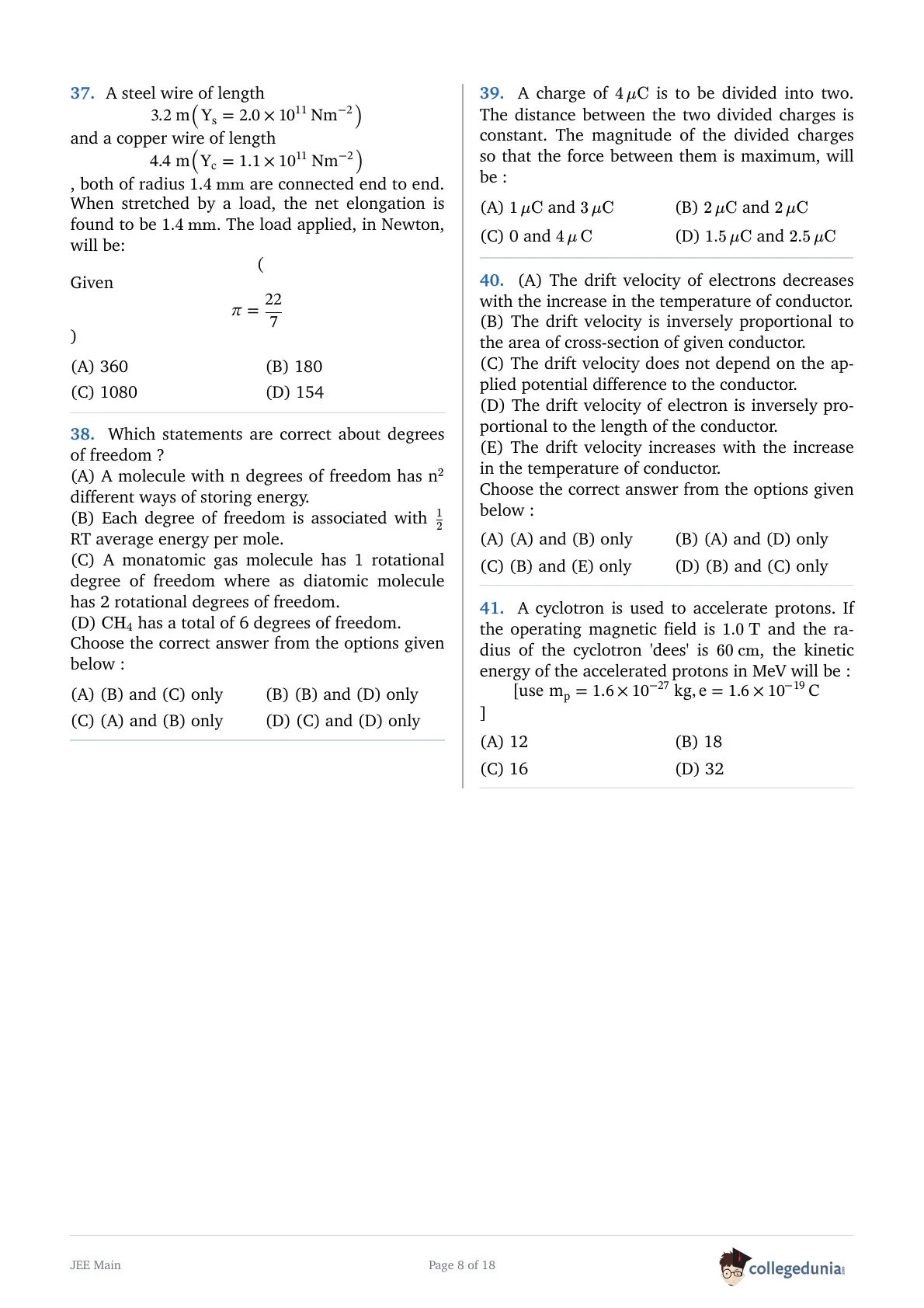
Which statements are correct about degrees of freedom?
(A) A molecule with n degrees of freedom has n2 different ways of storing energy.
(B) Each degree of freedom is associated with (1/2)RT average energy per mole.
(C) A monatomic gas molecule has 1 rotational degree of freedom whereas diatomic molecule has 2 rotational degrees of freedom.
(D) CH4 has a total of 6 degrees of freedom.
Choose the correct answer from the option given below:
A charge of 4 μC is to be divided into two. The distance between the two divided charges is constant. The magnitude of the divided charges so that the force between them is maximum, will be:
(A) The drift velocity of electrons decreases with the increase in the temperature of conductor.
(B) The drift velocity is inversely proportional to the area of cross-section of given conductor.
(C) The drift velocity does not depend on the applied potential difference to the conductor.
(D) The drift velocity of electron is inversely proportional to the length of the conductor.
(E) The drift velocity increases with the increase in the temperature of conductor.
Choose the correct answer from the options given below
A cyclotron is used to accelerate protons.If the operating magnetic field is 1.0 T and the radius of the cyclotron ‘dees’ is 60 cm,the kinetic energy of the accelerated protons in MeV will be
\([Use\ m_p = 1.6×10^{-27}\ kg, e = 1.6×10^{-19}C]\)
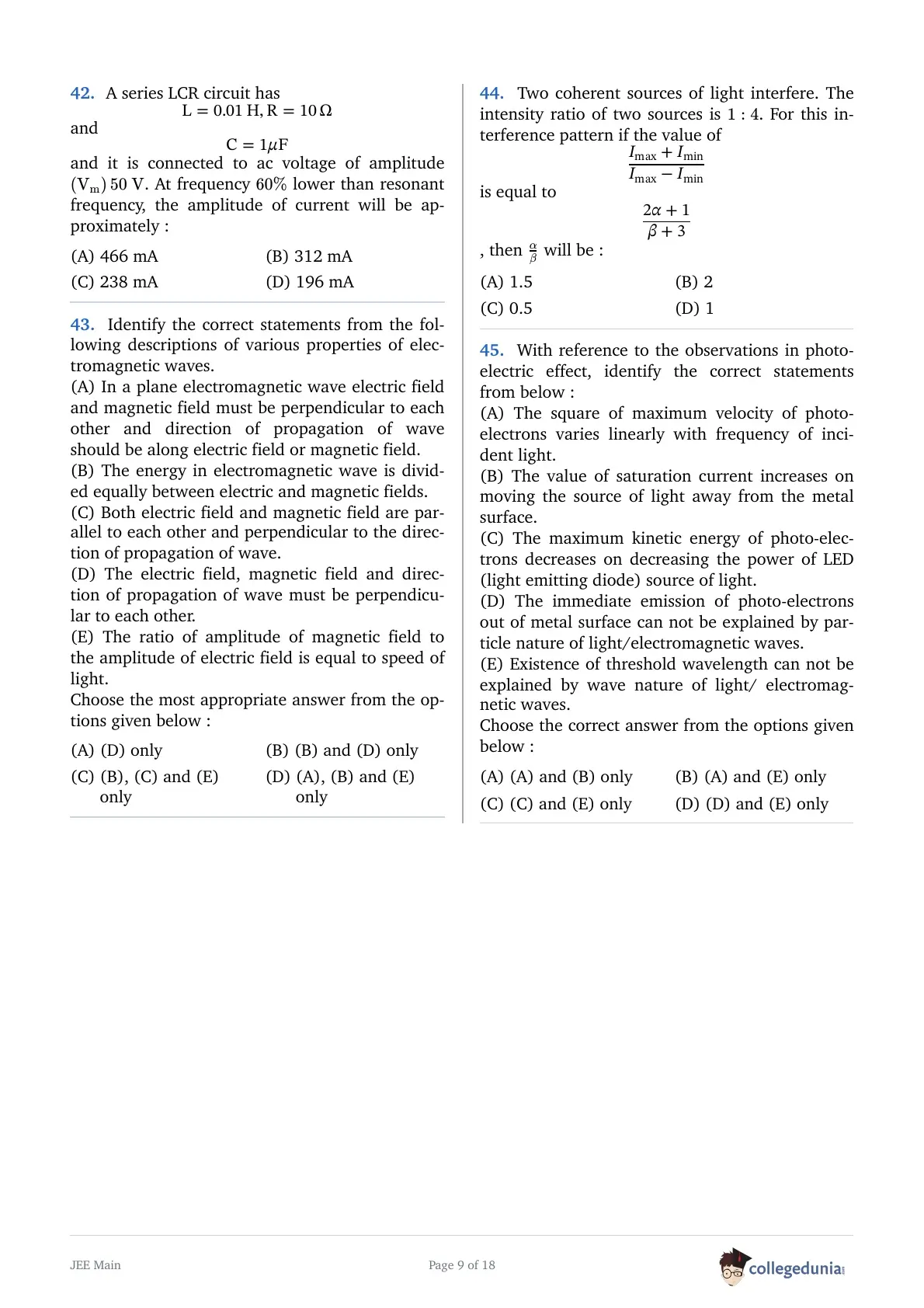
A series LCR circuit has
\(L = 0.01H, R = 10Ω\ and\ C = 1µF\)
and it is connected to ac voltage of amplitude (Vm)50 V. At frequency 60% lower than resonant frequency, the amplitude of current will be approximately
Identify the correct statements from the following descriptions of various properties of electromagnetic waves.
(A) In a plane electromagnetic wave electric field and magnetic field must be perpendicular to each other and direction of propagation of wave should be along electric field or magnetic field.
(B) The energy in electromagnetic wave is divided equally between electric and magnetic fields.
(C) Both electric field and magnetic field are parallel to each other and perpendicular to the direction of propagation of wave.
(D) The electric field, magnetic field and direction of propagation of wave must be perpendicular to each other.
(E) The ratio of amplitude of magnetic field to the amplitude of electric field is equal to speed of light.
Choose the most appropriate answer from the options given below
Two coherent sources of light interfere. The intensity ratio of two sources is 1 : 4. For this interference pattern if the value of
\(\frac{I_{max}+I_{min}}{I_{max}-I_{min}}\)is equal to \(\frac{2α+1}{β+3},\)
then α/β will be
With reference to the observations in photo-electric effect, identify the correct statements from below:
(A) The square of maximum velocity of photoelectrons varies linearly with frequency of incident light.
(B) The value of saturation current increases on moving the source of light away from the metal surface.
(C) The maximum kinetic energy of photo-electrons decreases on decreasing the power of LED (Light emitting diode) source of light.
(D) The immediate emission of photo-electrons out of metal surface can not be explained by particle nature of light/electromagnetic waves.
(E) Existence of threshold wavelength can not be explained by wave nature of light/electromagnetic waves.
Choose the correct answer from the options given below.
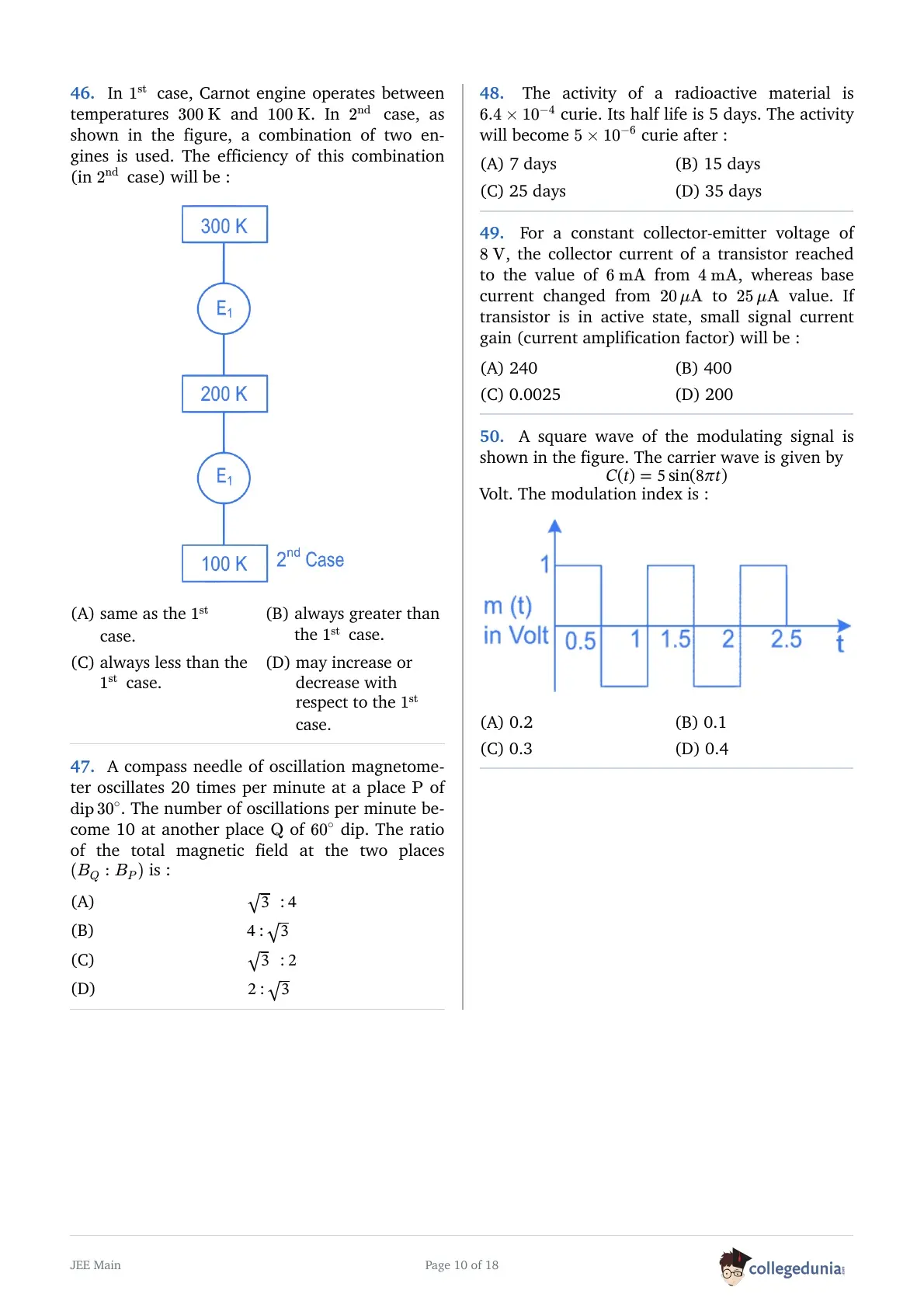
In 1st case, Carnot engine operates between temperatures 300 K and 100 K. In 2nd case, as shown in the figure, a combination of two engines is used. The efficiency of this combination (in 2nd case) will be:

A compass needle of oscillation magnetometer oscillates 20 times per minute at a place P of dip 30°. The number of oscillations per minute become 10 at another place Q of 60° dip. The ratio of the total magnetic field at the two places (BQ: BP) is
The activity of a radioactive material is 6.4 × 10⁻⁴ curie. Its half life is 5 days. The activity will become 5 × 10⁻⁶ curie after
For a constant collector-emitter voltage of 8 V, the collector current of a transistor reached to the value of 6 mA from 4 mA, whereas base current changed from 20 μA to 25 μA value. If transistor is in active state, small signal current gain (current amplification factor) will be
A square wave of the modulating signal is shown in the figure. The carrier wave is given by C(t) = 5 sin(8πt) Volt. The modulation index is

Physics - Section B (Q51 - Q60)
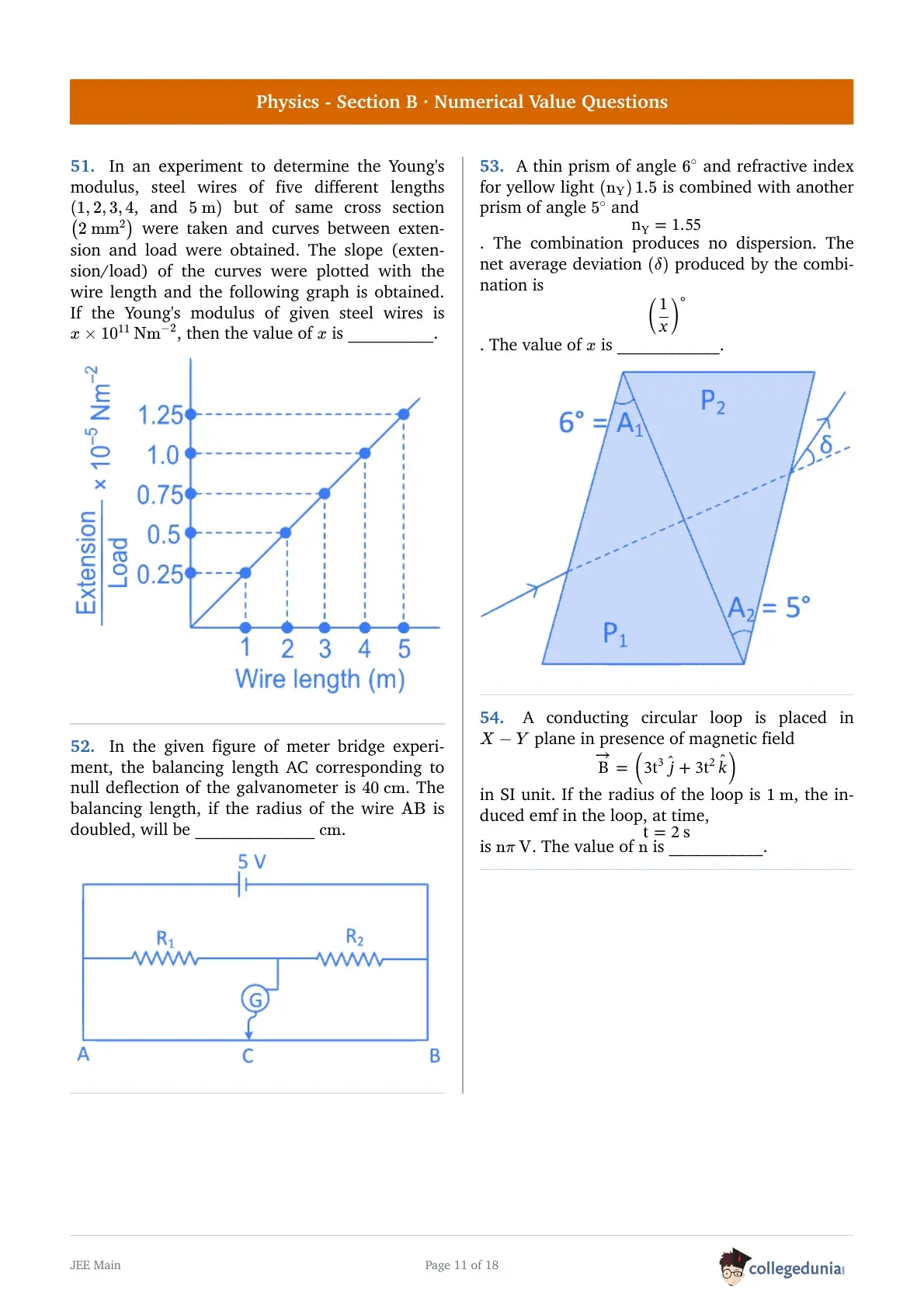
In an experiment to determine the Young’s modulus, steel wires of five different lengths (1, 2, 3, 4 and 5 m) but of same cross section (2 mm2) were taken and curves between extension and load were obtained. The slope (extension/load) of the curves were plotted with the wire length and the following graph is obtained. If the Young’s modulus of given steel wires is x × 1011 Nm–2, then the value of x is ______.

In the given figure of meter of bridge experiment, the balancing length AC corresponding to null deflection of the galvanometer is 40 cm. The balancing length, if the radius of the wire AB is doubled, will be _______ cm.

A thin prism of angle 6° and refractive index for yellow light (nY)1.5 is combined with another prism of angle 5° and nY = 1.55. The combination produces no dispersion. The net average deviation (δ) produced by the combination is (1/x)°. The value of x is __________.

A conducting circular loop is placed in X -Y plane in presence of magnetic field
\(\stackrel{→}{B} = (3t^3\hat{j}+3t^2\hat{k})\) in SI unit. If the radius of the loop is 1 m, the induced emf in the loop at time \(t = 2s\) is \(nπV\). The value of \(n\) is ______.
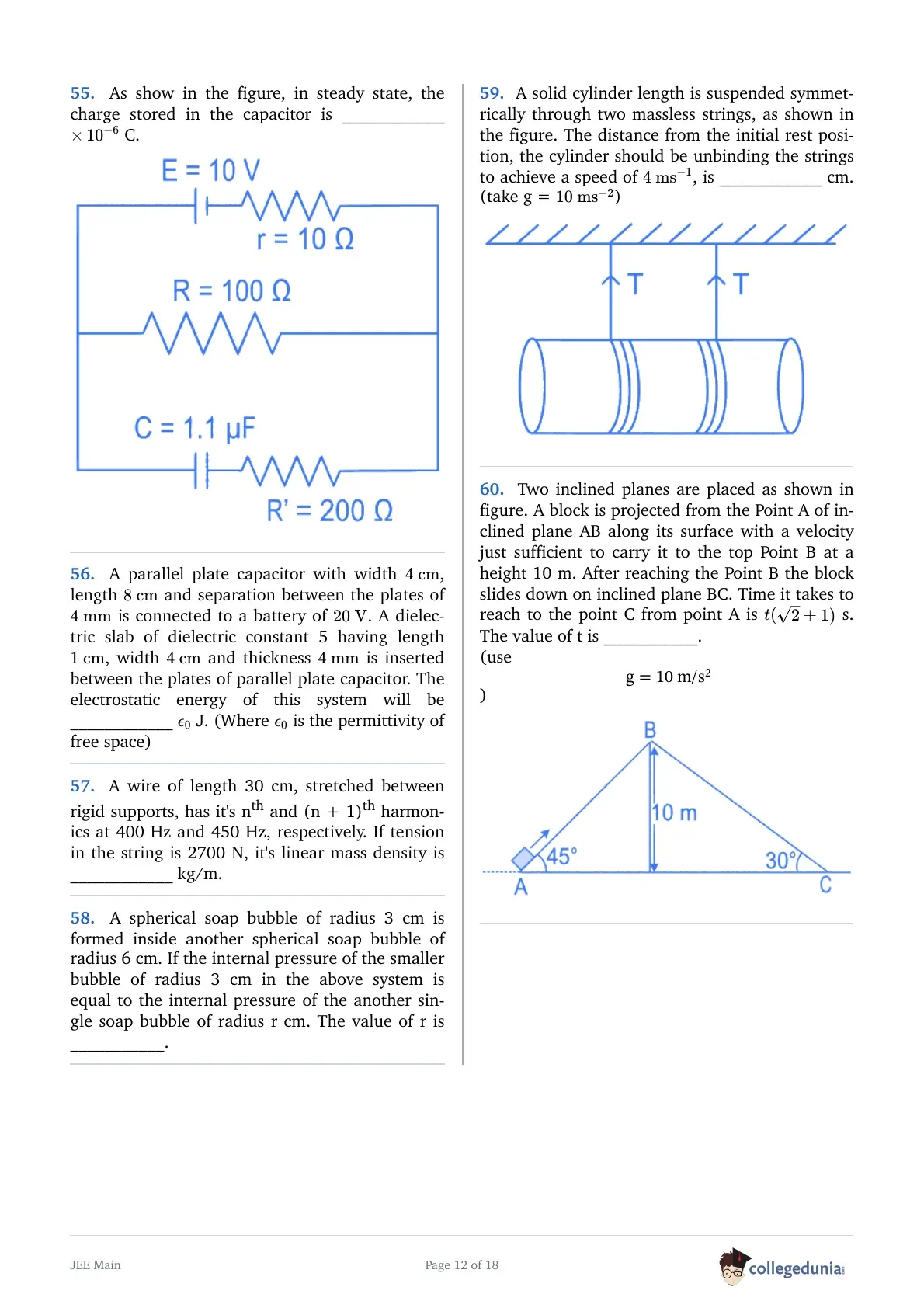
As show in the figure, in the steady state, the charge stored in the capacitor is _________ × 10–6 C.

A parallel plate capacitor with width 4 cm, length 8 cm and separation between the plates of 4 mm is connected to a battery of 20 V. A dielectric slab of dielectric constant 5 having length 1 cm, width 4 cm and thickness 4 mm is inserted between the plates of parallel plate capacitor. The electrostatic energy of this system will be _______ ε0 J. (Where ε0 is the permittivity of free space).
A wire of length 30 cm, stretched between rigid supports, has it’s nth and (n + 1)th harmonics at 400 Hz and 450 Hz, respectively. If tension in the string is 2700 N, its linear mass density is _____ kg/m.
A spherical soap bubble of radius 3 cm is formed inside another spherical soap bubble of radius 6 cm. If the internal pressure of the smaller bubble of radius 3 cm in the above system is equal to the internal pressure of the another single soap bubble of radius r cm. The value of r is ___
A solid cylinder length is suspended symmetrically through two massless strings, as shown in the figure. The distance from the initial rest position, the cylinder should be unbinding the strings to achieve a speed of 4 m/s, is ______ cm. (Take g = 10 m/s2).

Two inclined planes are placed as shown in figure. A block is projected from the point A of inclined plane AB along its surface with a velocity just sufficient to carry it to the top point B at a height 10 m. After reaching the point B the block sides down on inclined plane BC. Time it takes to reach to the point C from point A is t(√2 + 1) s. The value of t is ______.
(Use g = 10 m/s2)

Chemistry - Section A (Q61 - Q80)
The correct decreasing order of energy for the orbitals having, following set of quantum numbers:
(A) n = 3, l = 0, m = 0
(B) n = 4, l = 0, m = 0
(C) n = 3, l = 1, m = 0
(D) n = 3, l = 2, m = 1
| List - I | List - II |
|---|---|
| (A) \(ψ_{MO}=ψ_A-ψ_B\) | (I) Dipole moment |
| (B) \(µ=Q×r \) | (II) Bonding molecular orbital |
| (C) \(\frac{N_b-N_a}2\) | (III) Anti-bonding molecular orbital |
| (D) \(ψ_{MO}=ψ_A+ψ_B\) | (IV) Bond order |
Choose the correct answer from options given below:
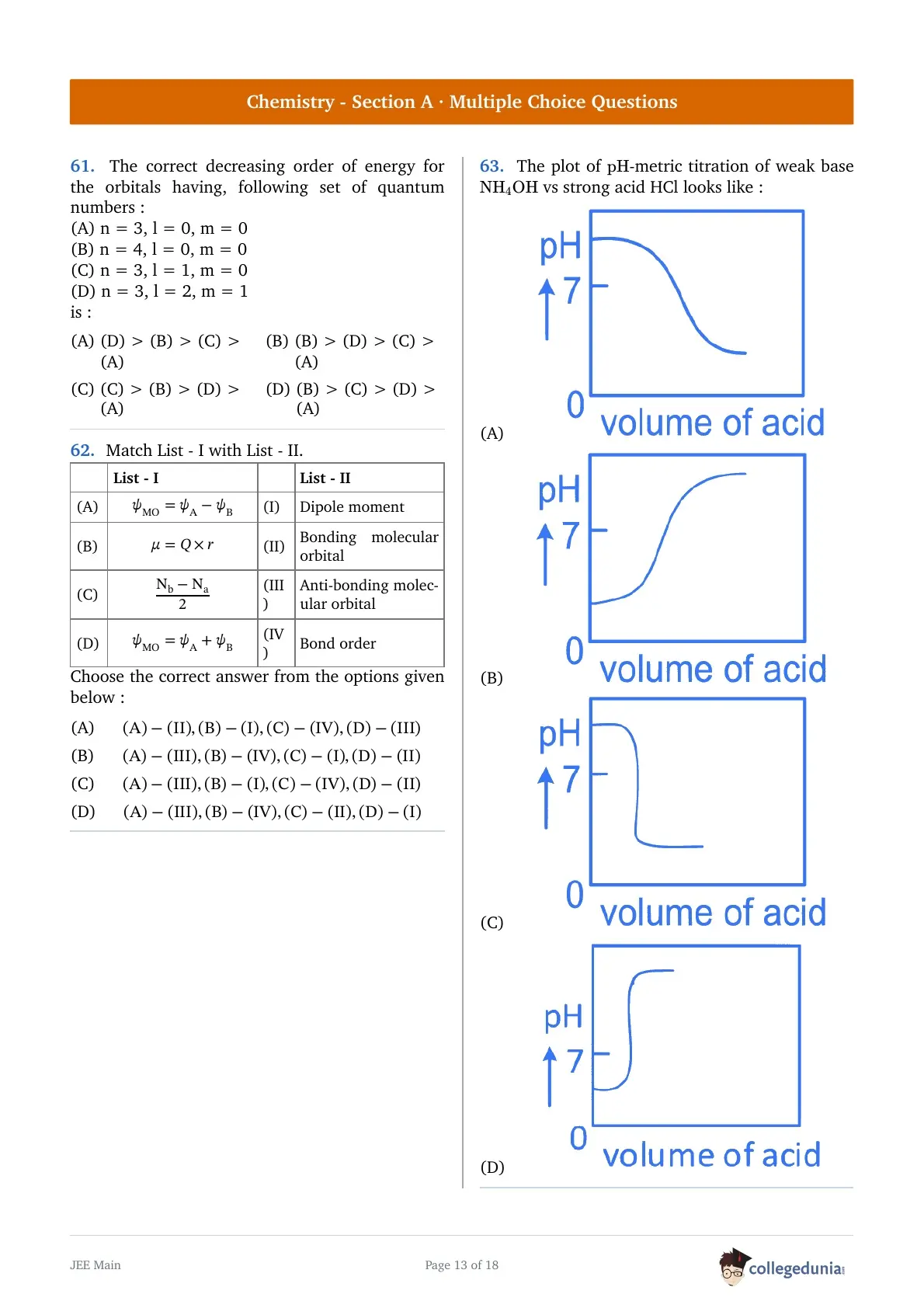
The plot of pH-metric titration of weak base NH4OH vs strong acid HCl looks lie:
- (1)
![]()
- (2)
![]()
- (3)
![]()
- (4)
![]()


Given below are two statements :
Statement-I : For KI, molar conductivity increases steeply with dilution.
Statement-II : For carbonic acid, molar conductivity increases slowly with dilution.
In the light of the above statements, choose the correct answer from the options given below :
Outermost electronic configurations of four elements A,B,C,D are given below:
(A) 3s2 (B) s23p1 (C) 3s23p3 (D) 3s23p4
The correct order of fist ionization enthalpy for them is:
In neutral or alkaline solution, MnO4– oxidises thiosulphateto :
Low oxidation state of metals in their complexes are common when ligands :


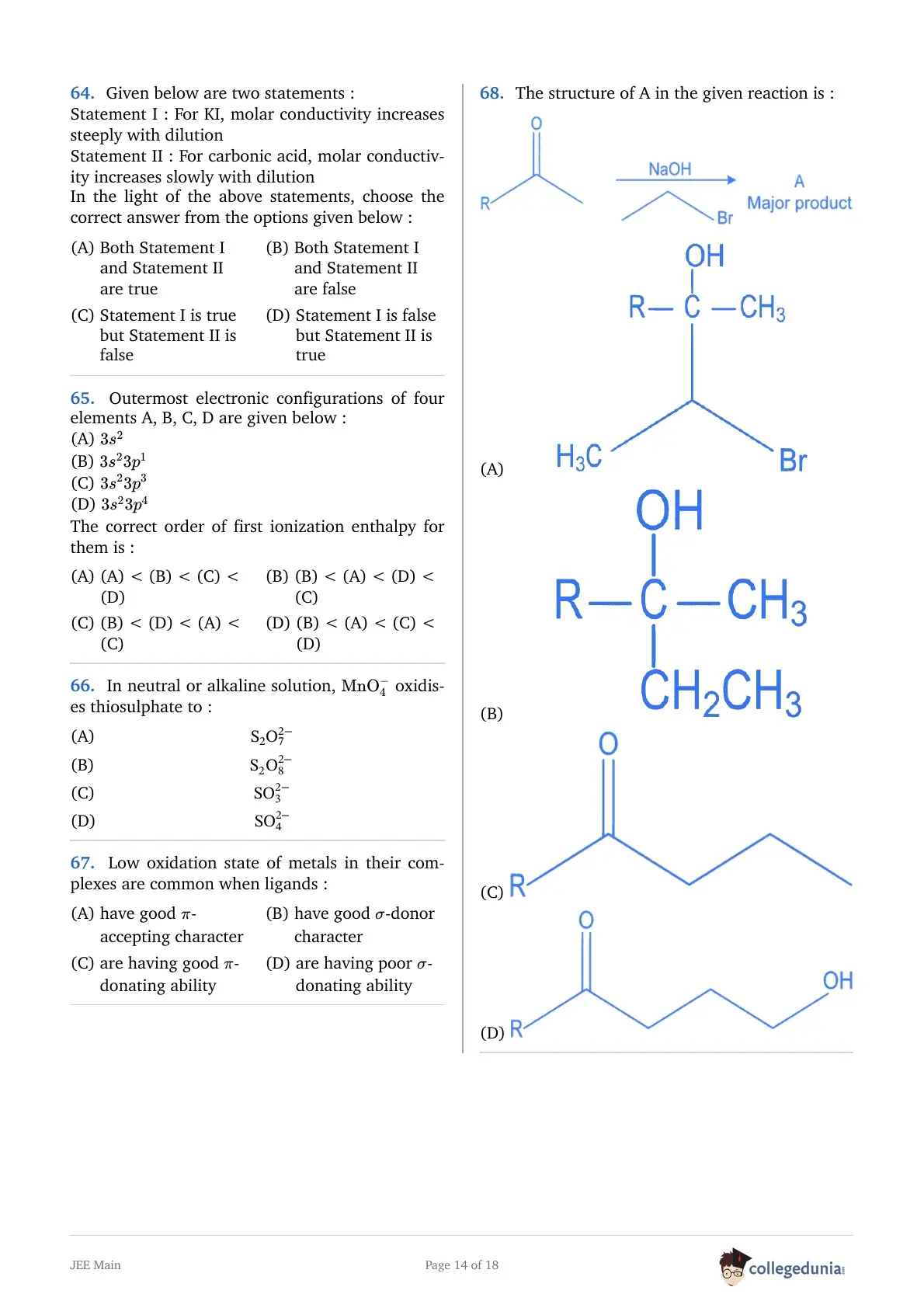
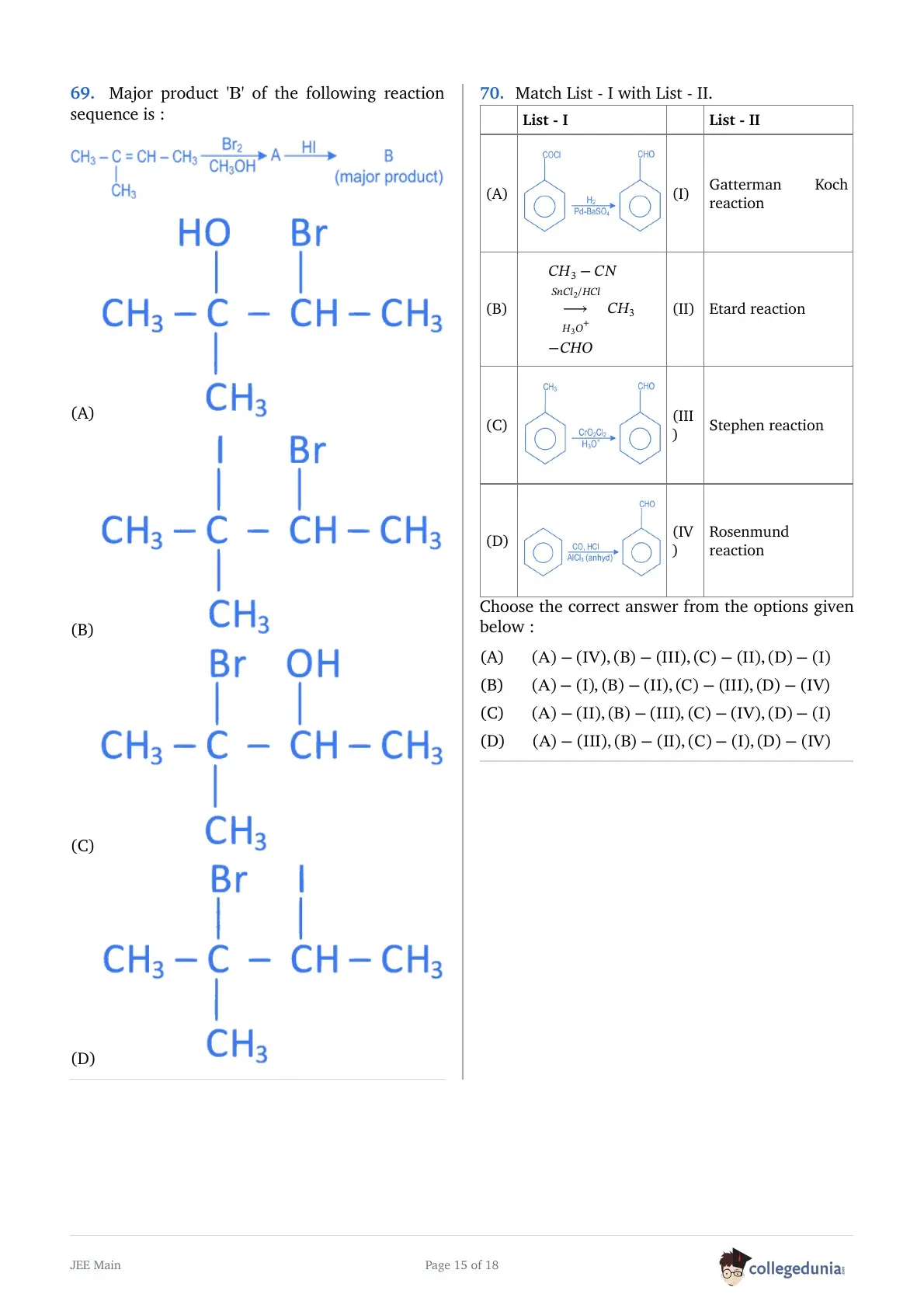
Major product ‘B’ of the following reaction sequence is

- (1)
![]()
- (2)
![]()
- (3)
![]()
- (4)
![]()


| List - I | List - II | ||
| (A) | \(\mathrm{C_6H_5COCl}\ \xrightarrow{\mathrm{H_2,\ Pd\text{-}BaSO_4}}\ \mathrm{C_6H_5CHO}\) [structures drawn in the paper] | (I) | Gatterman Koch reaction |
| (B) | \(\mathrm{CH_3-CN}\ \xrightarrow[\mathrm{H_3O^+}]{\mathrm{SnCl_2/HCl}}\ \mathrm{CH_3-CHO}\) | (II) | Etard reaction |
| (C) | \(\mathrm{C_6H_5CH_3}\ \xrightarrow[\mathrm{H_3O^+}]{\mathrm{CrO_2Cl_2}}\ \mathrm{C_6H_5CHO}\) [structures drawn in the paper] | (III) | Stephen reaction |
| (D) | \(\mathrm{C_6H_6}\ \xrightarrow[\mathrm{AlCl_3\ (anhyd)}]{\mathrm{CO,\ HCl}}\ \mathrm{C_6H_5CHO}\) [structures drawn in the paper] | (IV) | Rosenmund reaction |
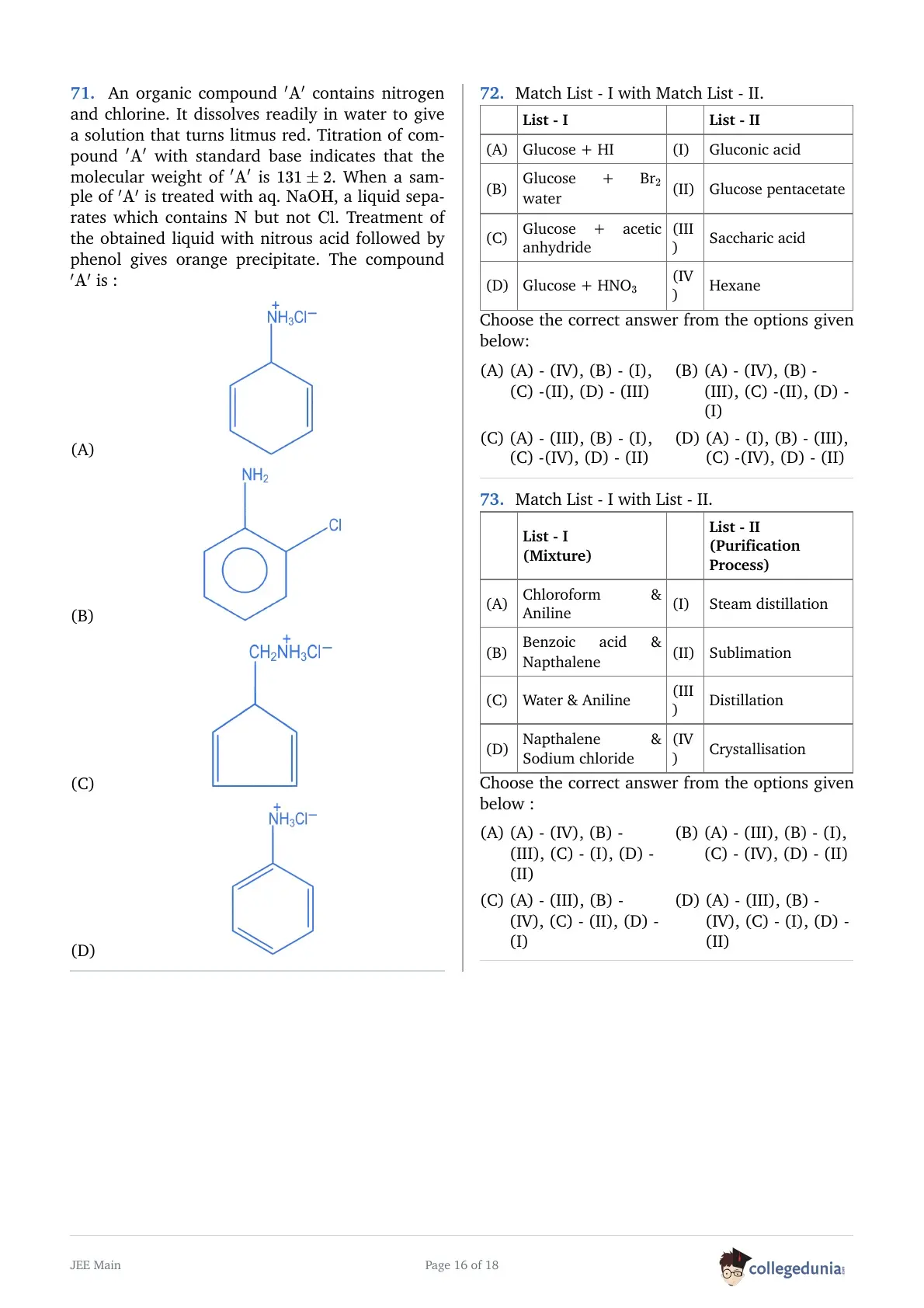
An organic compound ‘A’ contains nitrogen and chlorine. It dissolves readily in water to give a solution that turns litmus red. Titration of compound ‘A’ with standard base indicates that the molecular weight of ‘A’ IS 131±2. When a sample of ‘A’ is treated with aq. NaOH, a liquid separates which contains N but not Cl. Treatment of the obtained liquid with nitrous acid followed by phenol gives orange precipitate. The compound A is :
- (1)
![]()
- (2)
![]()
- (3)
![]()
- (4)
![]()


Match List-I with List-II
| List-I | List-II |
| (A) Glucose + HI | (I) Gluconic acid |
| (B) Glucose + Br2 water | (II) Glucose pentacetate |
| (C) Glucose + acetic anhydride | (III) Saccharic acid |
| (D) Glucose + HNO3 | (IV) Hexane |
| List-I(Mixture) | List-II(Purification Process) |
| (A) Chloroform & Aniline | (I) Steam distillation |
| (B) Benzoic acid & Napthalene | (II) Sublimation |
| (C) Water & Aniline | (III) Distillation |
| (D) Napthalene & Sodium chloride | (IV) Crystallisation |
Fe3+ cation gives a Prussian blue precipitate on addition of potassium ferrocyanide solution due to the formation of:
Given below are two statements : one is labelled as Assertion (A) and the other is labelled as Reason (R) :
Assertion (A) : Dissolved substances can be removed from a colloidal solution by diffusion through a parchment paper.
Reason (R) : Particles in a true solution cannot pass through parchment paper but the colloidal particles can pass through the parchment paper.
In the light of the above statements, choose the correct answer from the options given below
An element A of group1 shows similarity to an element B belonging to group 2. If A has maximum hydration enthalpy in group 1 then B is:
Given below are two statements: one is labelled as Assertion (A) and the other is labelled as Reason (R)
Assertion (A) : Boron is unable to form BF63-
Reason (R) : Size of B is very small
In the light of the above statements, choose the correct answer from the options given below:
Given below are two statements:
Statement I : The non bio-degradable fly ash and slag from steel industry used by cement industry.
Statement II : The fuel obtained from plastic waste is lead free.
In the light of the above statements, choose the most appropriate answer from the options given below:
| List I - (Monomer) | List II - (Polymer) |
| (A) Tetrafluoroethene | (I) Orlon |
| (B) Acrylonitrile | (II) Natural rubber |
| (C) Caprolactam | (III) Teflon |
| (D) Isoprene | (IV) Nylon-6 |
Choose the correct answer from the options given below:
Which of the following enhances the lathering property of soap?
Chemistry - Section B (Q81 - Q90)
The normality of H2SO4 in the solution obtained on mixing 100 mL of 0.1 M H2SO4 with 50 mL of 0.1 M NaOH is ________ × 10–1 N. (Nearest Integer)
A gas (Molar mass = 280 g mol–1) was burnt in excess O2 in a constant volume calorimeter and during combustion the temperature of calorimeter increased from 298.0 K to 298.45 K. If the heat capacity of calorimeter is 2.5 kJ K–1 and enthalpy of combustion of gas is 9 kJ mol–1 then amount of gas burnt is __________g. (Nearest Integer).
When a certain amount of solid A is dissolved in 100 g of water at 25°C to make a dilute solution, the vapour pressure of the solution is reduced to one-half of that of pure water. The vapour pressure of pure water is 23.76 mmHg. The number of moles of solute A added is _________. (Nearest Integer).
[A] → [B]
Reactant Product
If formation of compound [B] follows the first order of kinetics and after 70 minutes the concentration of [A] was found to be half of its initial concentration. Then the rate constant of the reaction is x × 10–6 s–1. The value of x is _________. (Nearest Integer).
The number of molecules(s) or ions(s) from the following having non-planar structure is ____.
\(NO^-_3, H_2O_2, BF_3, PCl_3, XeF_4, SF_4, XeO_3, PH^+_4, SO3,[Al(OH)_4]^-\)
The spin only magnetic moment of the complex present in Fehling’s reagent is_____ B.M. (Nearest integer).
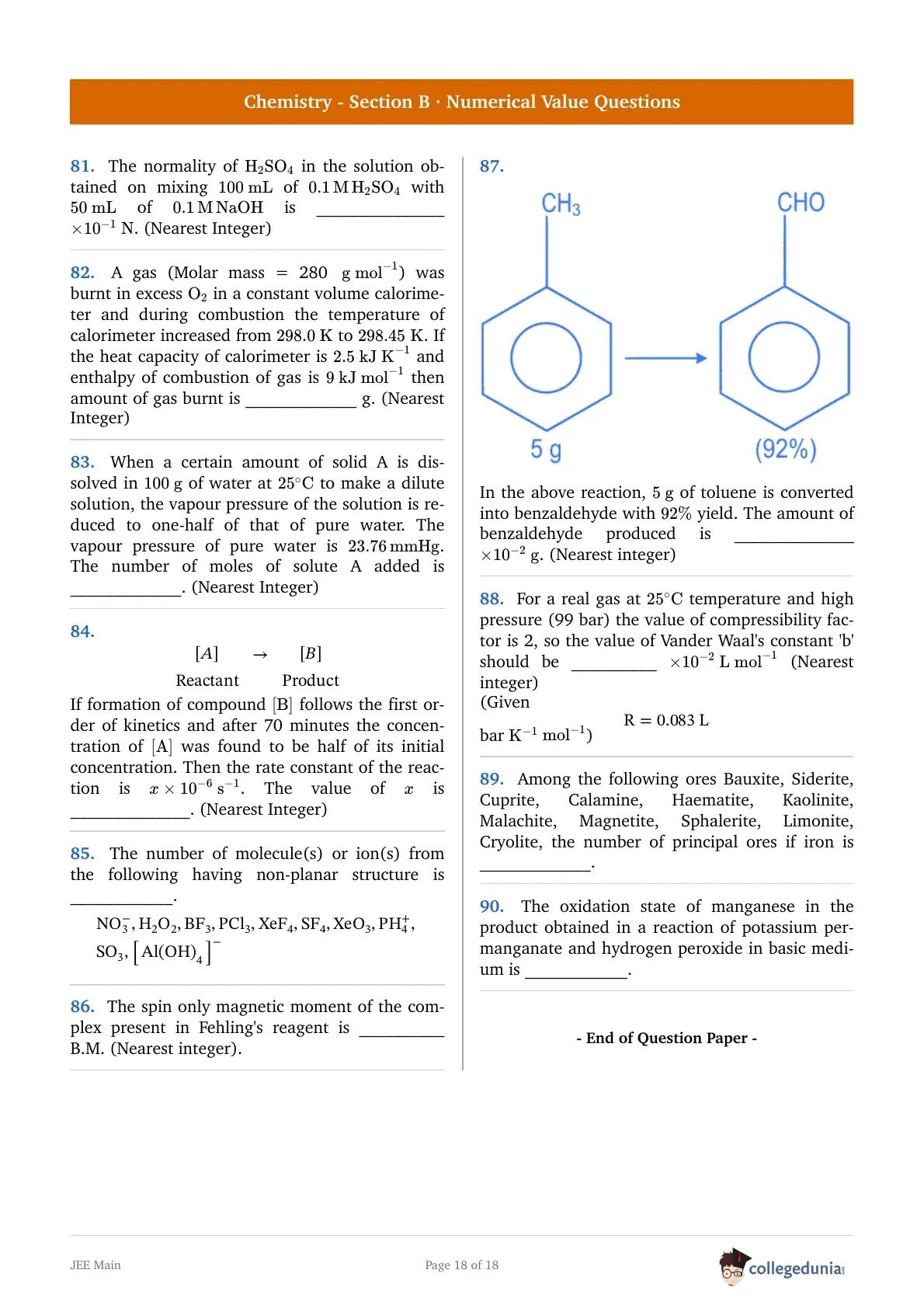
In the above reaction, 5 g of toluene is converted into benzaldehyde with 92% yield. The amount of benzaldehyde produced is______ × 10–2 g. (Nearest integer).
For a real gas at 25°C temperature and high pressure (99 bar) the value of the compressibility factor is 2, so the value of van der Waal’s constant ‘b’ should be ______ × 10–2 L mol–1 (Nearest integer).
(Given R=0.083 L bar K-1 mol-1)
Among the following ores Bauxite, Siderite, Cuprite, Calamine, Haematite, Kaolinite, Malachite, Magnetite, Sphalerite, Limonite, Cryolite, the number of principal ores of iron is____.
The oxidation state of manganese in the product obtained in a reaction of potassium permanganate and hydrogen peroxide in basic medium is____.
JEE Main 2022 Exam Pattern and Marking Scheme
| Particulars | Details |
|---|---|
| Exam Mode | Online (Computer-Based Test) |
| Paper | B.E./B.Tech (Paper 1) |
| Duration | 3 hours (180 minutes) |
| Type of Questions | Multiple Choice Questions (MCQs) + Numerical Value Questions |
| Subjects | Mathematics, Physics, Chemistry |
| Total Questions | 90 questions (75 to be attempted) |
| Total Marks | 300 marks |
| Marking Scheme | +4 for correct answer & -1 for incorrect MCQ and Numerical Value-based Questions |
JEE Main 2022 July 27 Shift 2 Difficulty Level
As per the initial students’ reaction, JEE Main 2022 July 27 Shift 1 paper was on the challenging side. Mathematics was moderate but lengthy. Chemistry was easy for the students to attempt. Check JEE Main 2022 July 27 Shift 2 Question Paper Analysis
JEE Main 2022 July 27 Shift 2 Subject-wise Memory-Based Solutions PDF
| Subject | Memory-Based Solutions PDF |
|---|---|
| Physics | Download PDF |
| Chemistry | Download PDF |
| Mathematics | Download PDF |
JEE Main 2022 Phase 2 Question Papers with Solution PDFs
Candidates can also check shift-wise JEE Main 2022 Phase 2 Question Papers with Solution PDFs. These shift-wise question paper PDFs for JEE Main 2022 will help candidates know the overall difficulty, topics with the highest weightage and the type of questions asked in the exam.
JEE Main 2022 Phase 1 Question Papers with Solution PDFs
Shift-wise JEE Main 2022 Phase 1 Question Papers with Solution PDFs are also available. Candidates preparing for Phase 2 of the exam can check and download JEE Main Question Paper PDFs to practice and test their exam prep level.
Also Check:



Comments