




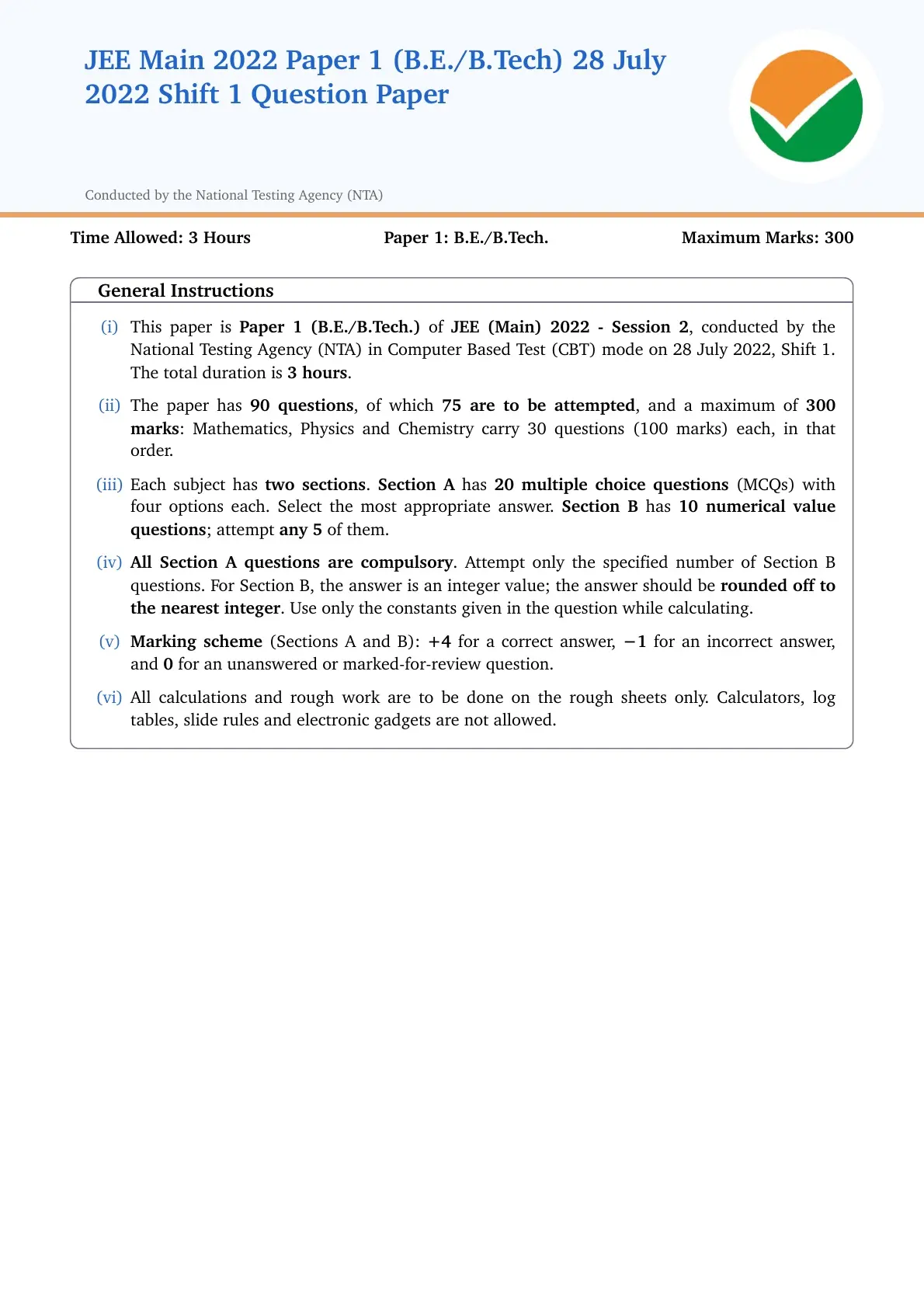
JEE Main 2022 July 28 Shift 1 Question Paper is available here with solutions PDF and detailed solutions for every question. NTA conducted the first shift on July 28, 2022, from 9:00 AM to 12:00 PM. The JEE Main 2022 Paper 1 (B.E./B.Tech) question paper includes the following:
- 90 questions in a 3-hour CBT Mode: 30 each from Mathematics, Physics and Chemistry (75 to be attempted)
- Section A: 20 multiple choice questions (MCQs) per subject, all compulsory, 4 marks each
- Section B: 10 numerical value questions per subject, any 5 to be attempted, 4 marks each
- Marking: +4 for a correct answer, -1 for an incorrect answer, 0 for an unattempted question
- Maximum marks: 300 (100 per subject)
JEE Main 2022 July 28 Shift 1 Question Paper with Solution PDF
| NTA Official PDF | CD PDF | CD PDF with Solutions |
|---|---|---|
| Download official PDF 5.25 MB | Download Collegedunia PDF 1.35 MB | Download solutions PDF 1.49 MB |
Also Check:
JEE Main 2022 July 28 Shift 1 Questions with Solutions
Mathematics - Section A (Q1 - Q20)
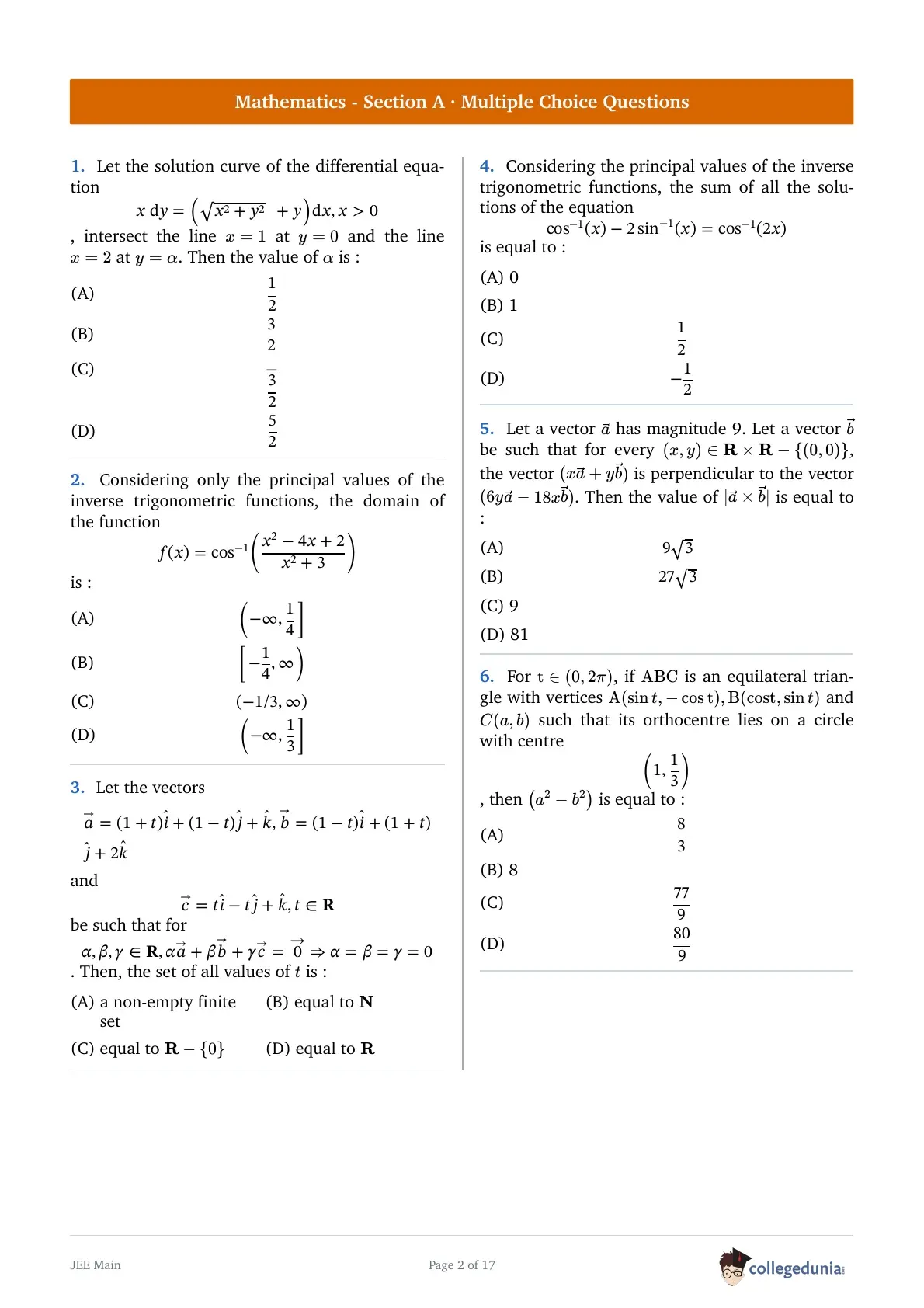
Let the solution curve of the differential equation \(x d y=\left(\sqrt{x^2+y^2}+y\right) d x, x>0\), intersect the line \(x =1\) at \(y =0\) and the line \(x=2\) at \(y=\alpha\). Then the value of \(\alpha\) is :
Considering only the principal values of the inverse trigonometric functions, the domain of the function \(f(x)=\cos ^{-1}\left(\frac{x^2-4 x+2}{x^2+3}\right)\) is :
Let the vectors \(\vec{a}=(1+t) \hat{i}+(1-t) \hat{j}+\hat{k},\)
\(\overrightarrow{ b }=(1-t) \hat{i}+(1+t) \hat{j}+2 \hat{k}\) and
\(\vec{c}=t \hat{i}-t \hat{j}+\hat{k},\)\(t \in R\) be such that for
\(\alpha, \beta, \gamma \in R, \alpha \vec{a}+\beta \vec{b}+\gamma \vec{c}=\overrightarrow{0} \Rightarrow \alpha=\beta=\gamma=0\)
Then, the set of all values of t is :
Considering the principal values of the inverse trigonometric functions, the sum of all the solutions of the equation \(\cos ^{-1}(x)-2 \sin ^{-1}(x)=\cos ^{-1}(2 x)\) is equal to:
Let a vector \(\vec{a}\) has a magnitude 9. Let a vector \(\vec{b}\) be such that for every \((x, y) \in R \times R-\{(0,0)\}\), the vector \((x \vec{a}+y \vec{b})\) is perpendicular to the vector \((6 y \vec{a}-18 x \vec{b})\). Then the value of \(|\vec{a} \times \vec{b}|\) is equal to:
For \(t \in(0,2 \pi)\), if \(ABC\) is an equilateral triangle with vertices\(A ( \sin t, -{\cos t}), B ( \cos t, \sin t )\) and \(C ( a , b )\) such that its orthocentre lies on a circle with centre \(\left(1, \frac{1}{3}\right)\), then \(\left(a^2-b^2\right)\) is equal to :
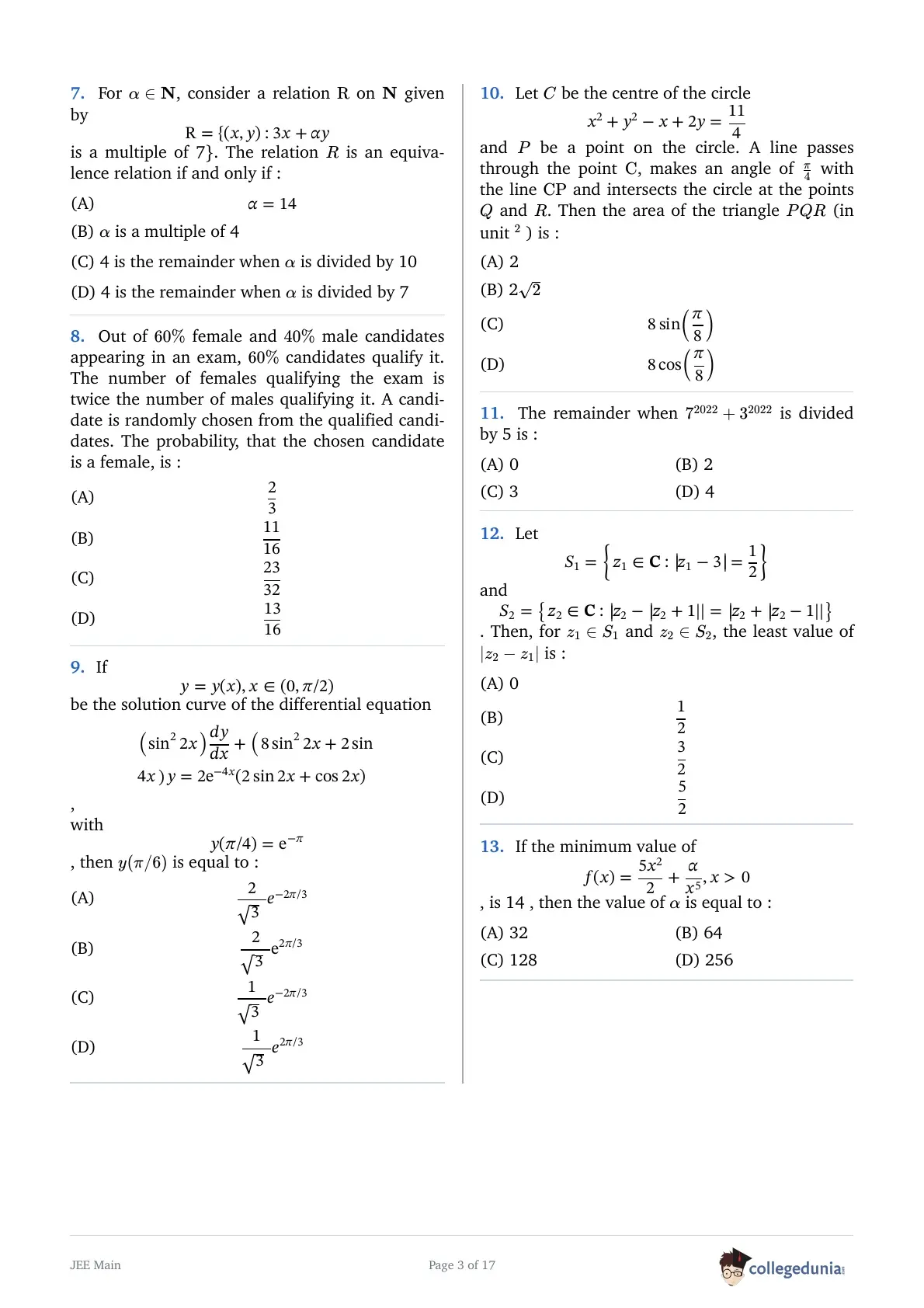
For \(\alpha \in N\), consider a relation \(R\) on \(N\) given by \(R=\{(x, y): 3 x+\alpha y\) is a multiple of 7\(\}\) The relation \(R\) is an equivalence relation if and only if :
Out of \(60 \%\) female and \(40 \%\) male candidates appearing in an exam, \(60 \%\) candidates qualify it The number of females qualifying the exam is twice the number of males qualifying it A candidate is randomly chosen from the qualified candidates The probability, that the chosen candidate is a female, is :
If \(y = y ( x ), x \in\left(0, \frac{\pi}{2}\right)\) be the solution curve of the differential equation\( \left(\sin ^2 2 x\right) \frac{d y}{d x}+\left(8 \sin ^2 2 x+2 \sin 4 x\right) y\) \( =2 e^{-4 x}(2 \sin 2 x+\cos 2 x), \text { with } y\left(\frac{\pi}{4}\right)=e^{-\pi},\) then \(y\left(\frac{\pi}{6}\right)\) is equal to:
Let \(C\) be the centre of the circle \(x^2+y^2-x+2 y=\frac{11}{4}\) and \(P\) be a point on the circle A line passes through the point \(C\), makes an angle of \(\frac{\pi}{4}\) with the line CP and intersects the circle at the points \(Q\) and \(R\) Then the area of the triangle \(PQR\) (in unit \({ }^2\)) is :
The remainder when \(7^{2022}+3^{2022}\) is divided by \(5\) is:
Let \(S_1=\left\{z_1 \in C:\left|z_1-3\right|=\frac{1}{2}\right\}\) and \(S _2=\left\{ z _2 \in C :\left| z _2-\right| z _2+1||=\left| z _2+\right| z _2-1||\right\}\) Then, for \(z_1 \in S_1\) and \(z_2 \in S_2\), the least value of \(\left|z_2-z_1\right|\) is :
If the minimum value of \(f(x)=\frac{5 x^2}{2}+\frac{\alpha}{x^5}, x>0\), is 14 , then the value of \(\alpha\) is equal to:
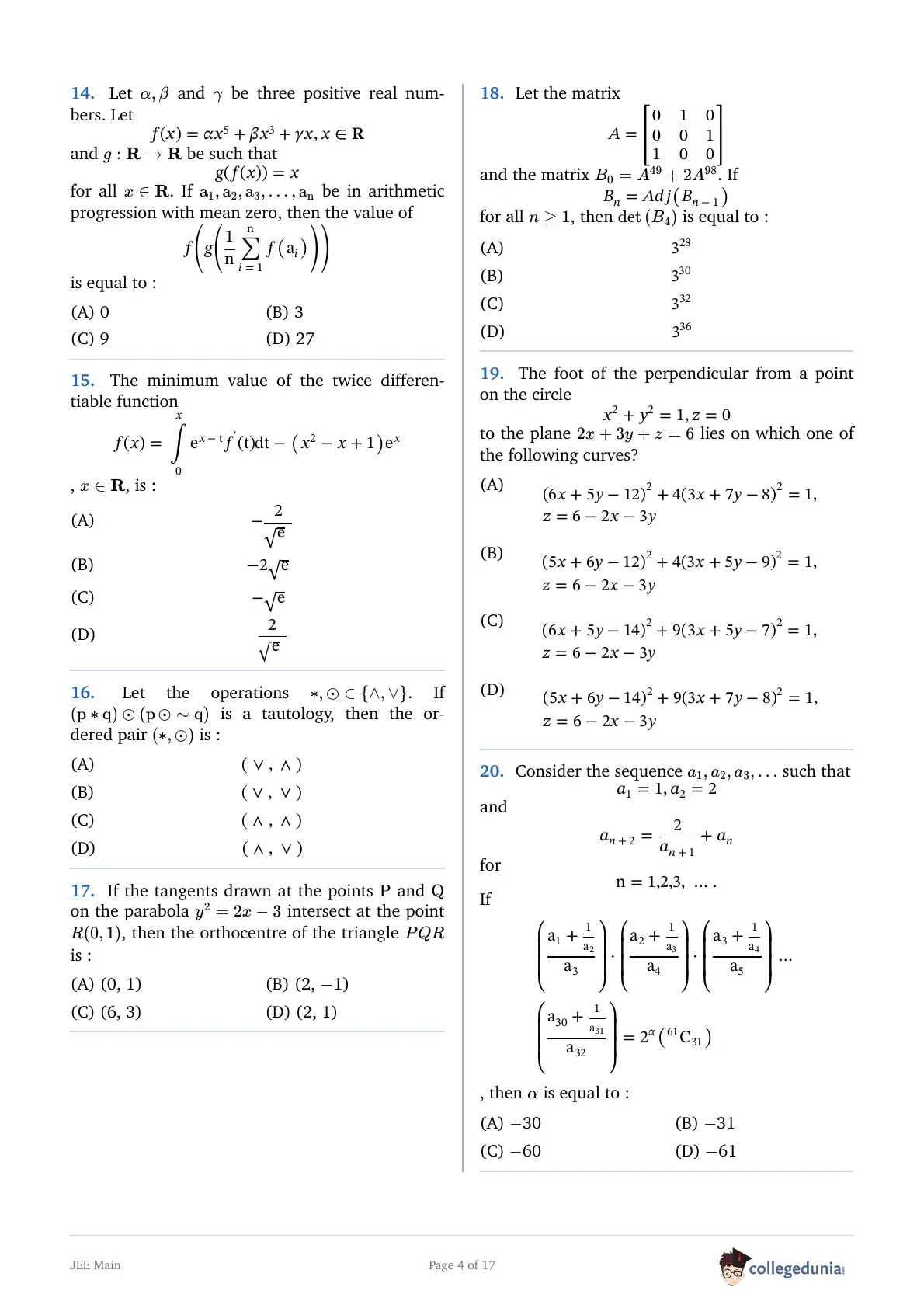
Let \(\alpha, \beta\) and \(\gamma\) be three positive real numbers Let \(f ( x )=\alpha x ^5+\beta x ^3+\gamma x , x \in R\) and \(g: R \rightarrow R\) be such that \(g(f(x))=x\) for all \(x \in R\) If \(a_1, a_2, a_3, \ldots, a_n\) be in arithmetic progression with mean zero, then the value of \(f\left(g\left(\frac{1}{n} \displaystyle\sum_{i=1}^n f\left(a_i\right)\right)\right)\)is equal to :
The minimum value of the twice differentiable function \(f(x)=\int\limits_0^x e^{x-1} f^{\prime}(t) d t-\left(x^2-x+1\right) e^x, x \in R\), is :
Let the operations \(*, \odot \in\{\wedge, \vee\}\). If \((p * q) \odot(p \odot \sim q)\) is a tautology, then the ordered pair \((*, \odot)\) is :
If the tangents drawn at the points \(P\) and \(Q\) on the parabola \(y^2=2 x-3\) intersect at the point \(R (0,1)\), then the orthocentre of the triangle \(PQR\) is :
Let the matrix \(A=\begin{bmatrix}0 & 1 & 0 \\ 0 & 0 & 1 \\ 1 & 0 & 0\end{bmatrix}\) and the matrix \(B_0=A^{49}+2 A^{98}\) If \(B_n=\text{Adj}\left(B_{n-1}\right)\) for all \(n \geq 1\), then \(\text{det}\left( B _4\right)\) is equal to :
The foot of the perpendicular from a point on the circle \(x ^2+ y ^2=1, z =0\) to the plane \(2 x+3 y+z=6\) lies on which one of the following curves ?
Consider the sequence \(a_1, a_2, a_3, \ldots \ldots\) such that \(a_1=1, a_2=2\) and \(a_{n+2}=\frac{2}{a_{n+1}}+a_n\) for \(n =1,2,3, \ldots\) If \(\left(\frac{a_1+\frac{1}{a_2}}{a_3}\right) \cdot\left(\frac{a_2+\frac{1}{a_3}}{a_4}\right) \cdot\left(\frac{a_3+\frac{1}{a_4}}{a_5}\right) ... \left(\frac{a_{30}+\frac{1}{a_{31}}}{a_{32}}\right)=2^a\left({ }^{61} C_{31}\right)\), then \(\alpha\) is equal to :
Mathematics - Section B (Q21 - Q30)
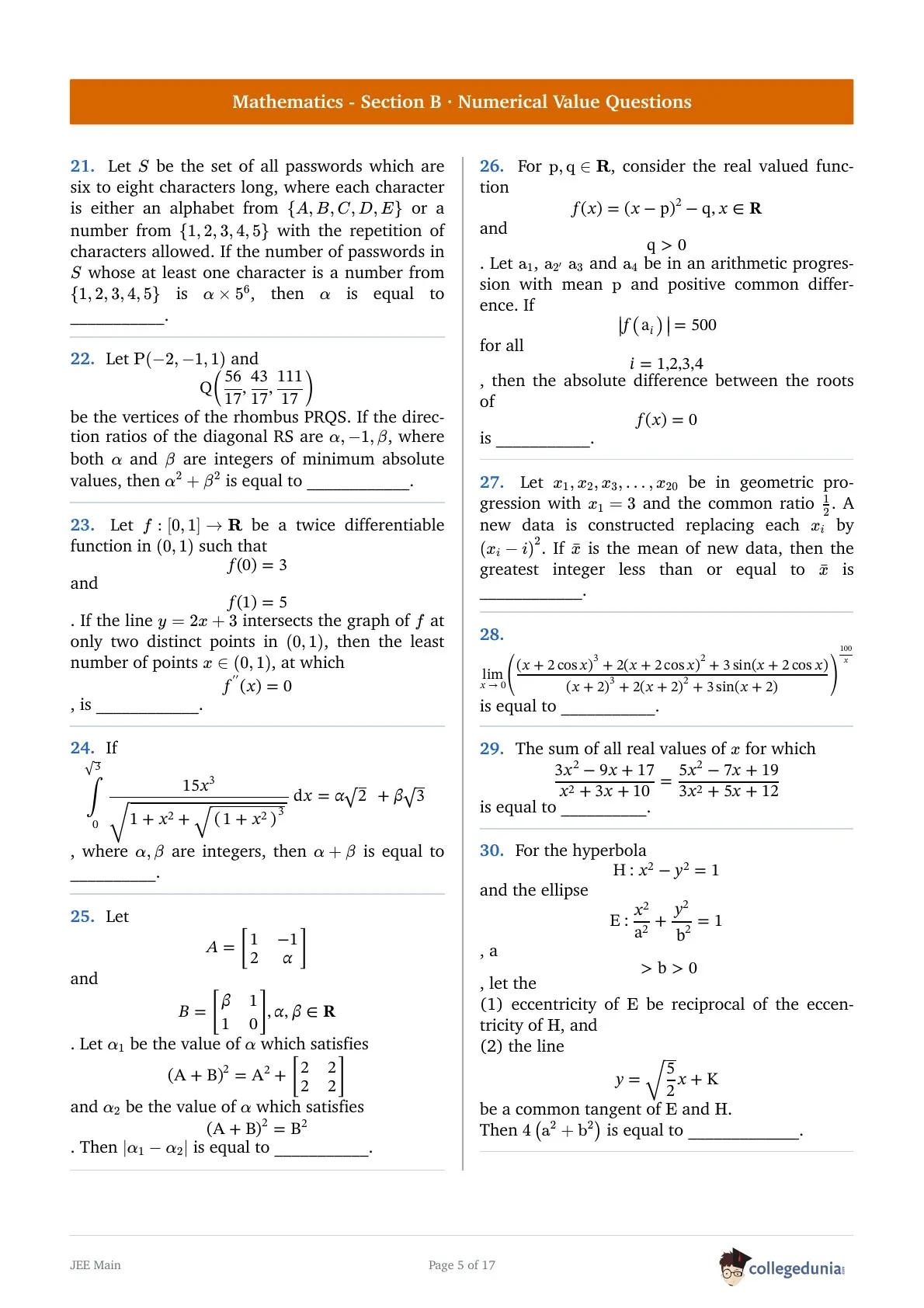
Let S be the set of all passwords which are six to eight characters long, where each character is either an alphabet from {A, B, C, D, E} or a number from {1, 2, 3, 4, 5} with the repetition of characters allowed. If the number of passwords in S whose at least one character is a number from {1, 2, 3, 4, 5} is \(α\) × 56, then \(α\) is equal to _______.
Let P(–2, –1, 1) and Q(56/17, 43/17, 111/17) be the vertices of the rhombus PRQS. If the direction ratios of the diagonal RS are \(α, –1, β,\) where both \(α\) and \(β\) are integers of minimum absolute values, then \(α^2 + β^2\) is equal to ___________.
Let f : [0, 1] → R be a twice differentiable function in (0, 1) such that f(0) = 3 and f(1) = 5.
If the line y = 2x + 3 intersects the graph of f at only two distinct points in (0, 1) then the least number of points x ∈ (0, 1) at which f”(x) = 0, is ___________.
\(\begin{array}{l}(A + B)^2 =A^2 + \begin{bmatrix}2 & 2 \\2 & 2 \\\end{bmatrix}\end{array}\)
For p, q, ∈ R, consider the real valued function \(f(x) = (x – p)^2 – q\), x ∈ R and q > 0, Let \(a_1, a_2, a_3\) and \(a_4\) be in an arithmetic progression with mean p and positive common difference. If |f(ai)| = 500 for all i = 1, 2, 3, 4, then the absolute difference between the roots of f(x) = 0 is
Let \(x_1, x_2, x_3, …, x_{20}\) be in geometric progression with \(x_1 = 3\) and the common ratio 1/2. A new data is constructed replacing each \(x_i \) by \((x_i – i)^2\). If \(x̄\) is the mean of new data, then the greatest integer less than or equal to \(x̄\) is _________
The sum of all real value of \(x\) for which \(\frac{3x^2-9x+17}{x^2+3x+10}=\frac {5x^2-7x+19}{3x^2+5x+12}\) is equal to________.
For the hyperbola \(H: x^2 – y^2 = 1\) and the ellipse \(E:\frac{x^2}{a^2}+\frac{y^2}{b^2}=1,a>b>0\), let the
(1) eccentricity of E be reciprocal of the eccentricity of H, and
(2) the line \(y= \sqrt\frac{5}{2} x+k\) be a common tangent of E and H.
Then \(4(a^2 + b^2)\) is equal to _______.
Physics - Section A (Q31 - Q50)
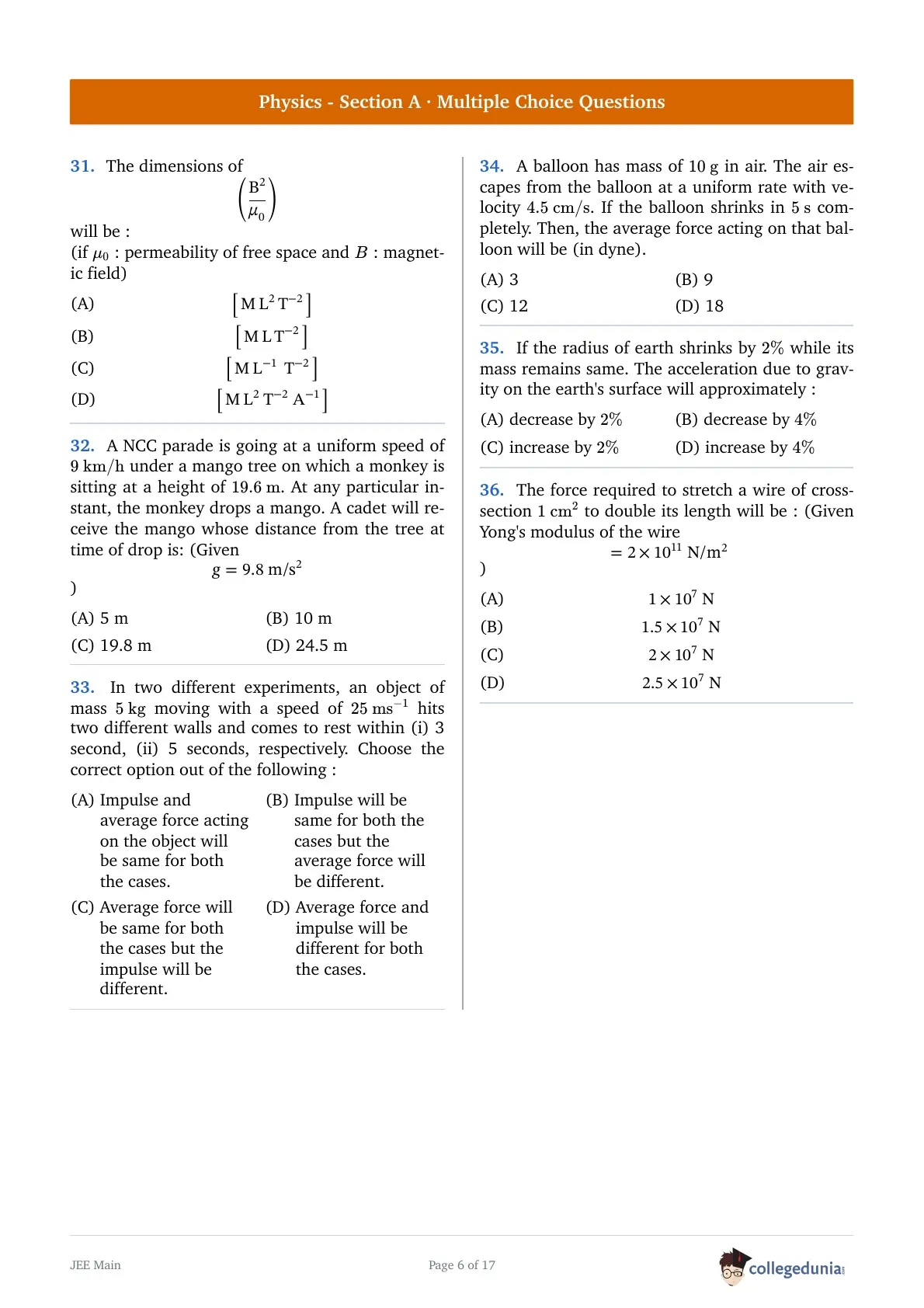
The dimensions of \(\left(\frac{ B ^2}{\mu_0}\right)\) will be :(if \(\mu_0\) : permeability of free space andB : magnetic field)
An NCC parade is going at a uniform speed of 9 km/h under a mango tree on which a monkey is sitting at a height of 19.6 m. At any particular instant, the monkey drops a mango. A cadet will receive the mango whose distance from the tree at time of drop is:
Give g=9.8 m/s2
In two different experiments, an object of mass \(5\, kg\) moving with a speed of \(25 \,ms ^{-1}\) hits two different walls and comes to rest within
(i) 3 second,
(ii) 5 seconds, respectively.
Choose the correct option out of the following :
A balloon has mass of 10 g in air. The air escapes from the balloon at a uniform rate with velocity 4.5 cm/s. If the balloon shrinks in 5 s completely. Then, the average force acting on that balloon will be (in dyne).
If the radius of earth shrinks by \(2 \%\) while its mass remains same The acceleration due to gravity on the earth's surface will approximately :
The force required to stretch a wire of cross-section \(1 cm ^2\) to double its length will be: (Given Yong's modulus of the wire \(=2 \times 10^{11} N / m ^2\) )
Given below are two statements:
Statement I: The average momentum of a molecule in a sample of an ideal gas depends on temperature.
Statement II: The rms speed of oxygen molecules in a gas is \(v\) If the temperature is doubled and the oxygen molecules dissociate into oxygen atoms, the rms speed will become \(2 v\) In the light of the above statements, choose the correct answer from the options given below:
In the wave equation \(y=05 \sin \frac{2 \pi}{\lambda}(400 t-x) m\) the velocity of the wave will be :
Two capacitors, each having capacitance \(40 \mu F\) are connected in series The space between one of the capacitors is filled with dielectric material of dielectric constant \(K\) such that the equivalence capacitance of the system became \(24 \mu F\) The value of \(K\) will be :
A wire of resistance \(R_1\) is drawn out so that its length is increased by twice of its original length The ratio of new resistance to original resistance is:
The current sensitivity of a galvanometer can be increased by:
(A) decreasing the number of turns
(B) increasing the magnetic field
(C) decreasing the area of the coil
(D) decreasing the torsional constant of the spring Choose the most appropriate answer from the options given below:
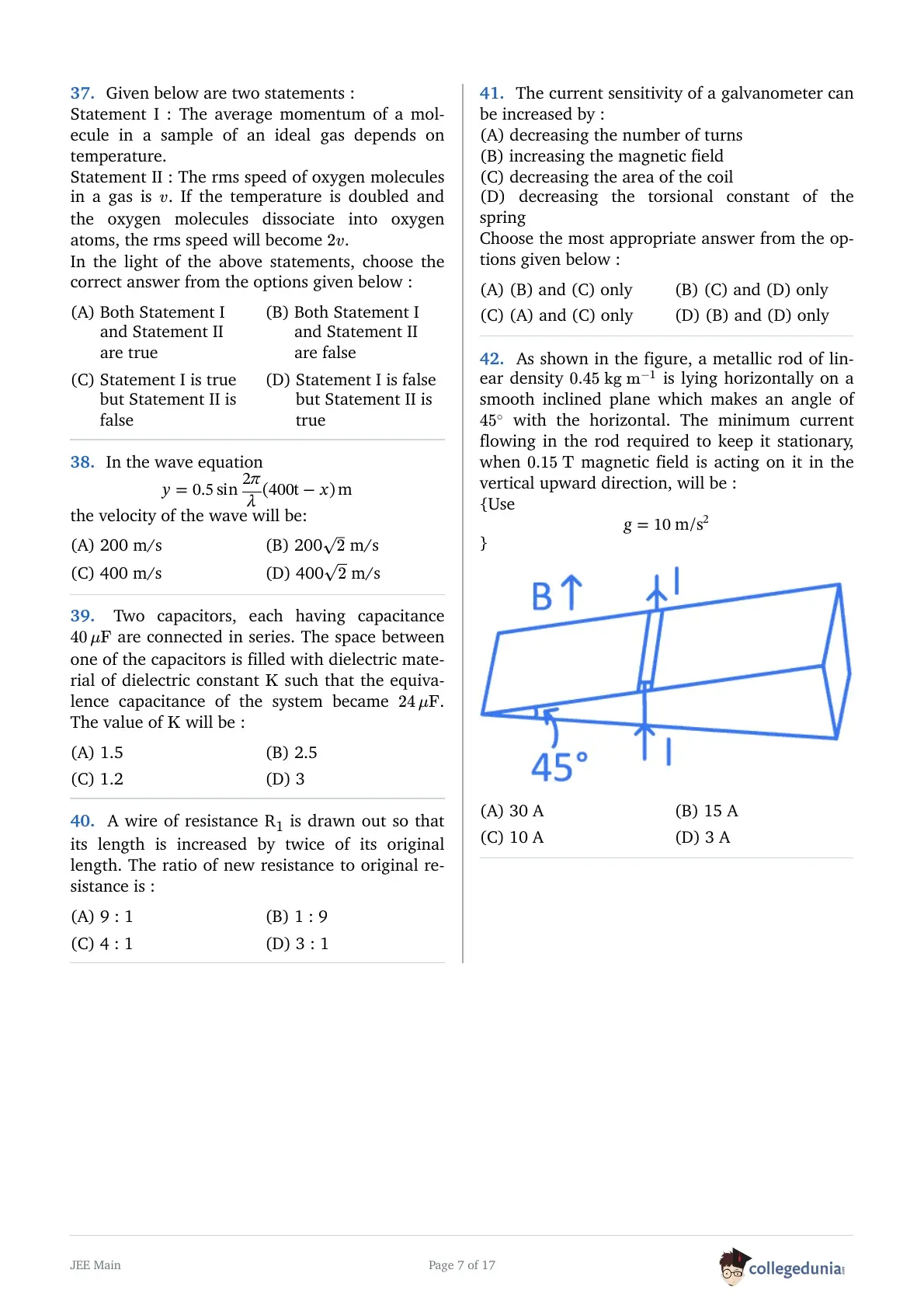
As shown in the figure, a metallic rod of linear density \(0.45\ kg m^{-1}\) is lying horizontally on a smooth incline plane which makes an angle of 45° with the horizontal. The minimum current flowing in the rod required to keep it stationary, when \(0.15 T\) magnetic field is acting on it in the vertical upward direction, will be: {Use \(g = 10 m/s^2\)}
The equation of current in a purely inductive circuit is \(5 \sin \left(49 \pi t -30^{\circ}\right)\) If the inductance is \(30\, mH\) then the equation for the voltage across the inductor, will be: \(\left\{\text { Let } \pi=\frac{22}{7}\right\}\)
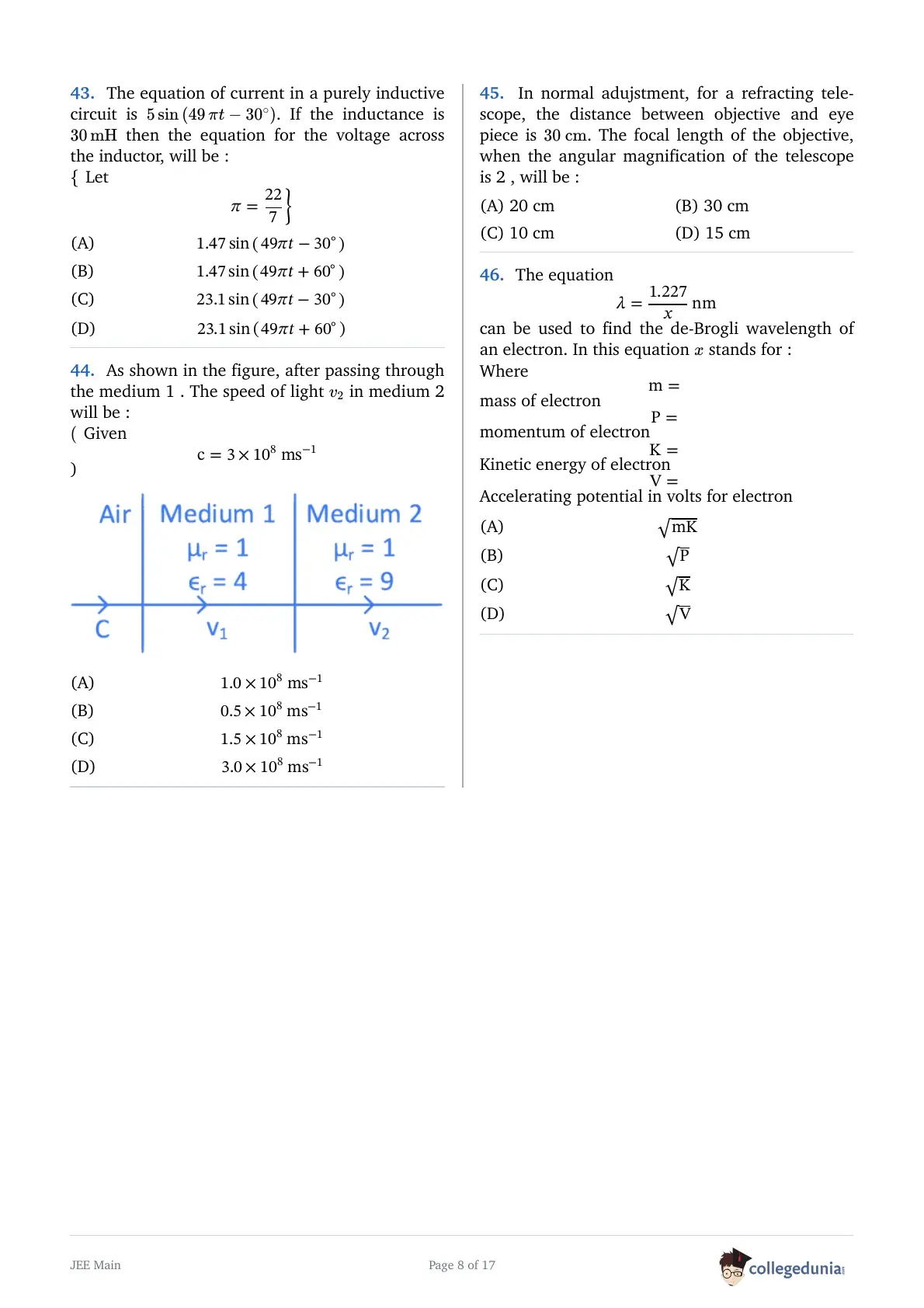
As shown in the figure, after passing through the medium 1. The speed of light v2 in medium 2 will be: (Given \(c = 3 \times 10^8 ms^{-1}\))
In normal adjustment, for a refracting telescope, the distance between objective and eye piece is \(30\,cm\) The focal length of the objective, when the angular magnification of the telescope is 2, will be:
The equation \(\lambda=\frac{1227}{ x } nm\) can be used to find the de-Brogli wavelength of an electron In this equation \(x\) stands for : Where, \(m =\) mass of electron \(P =\) momentum of electron \(K =\) Kinetic energy of electron \(V=\) Accelerating potential in volts for electron
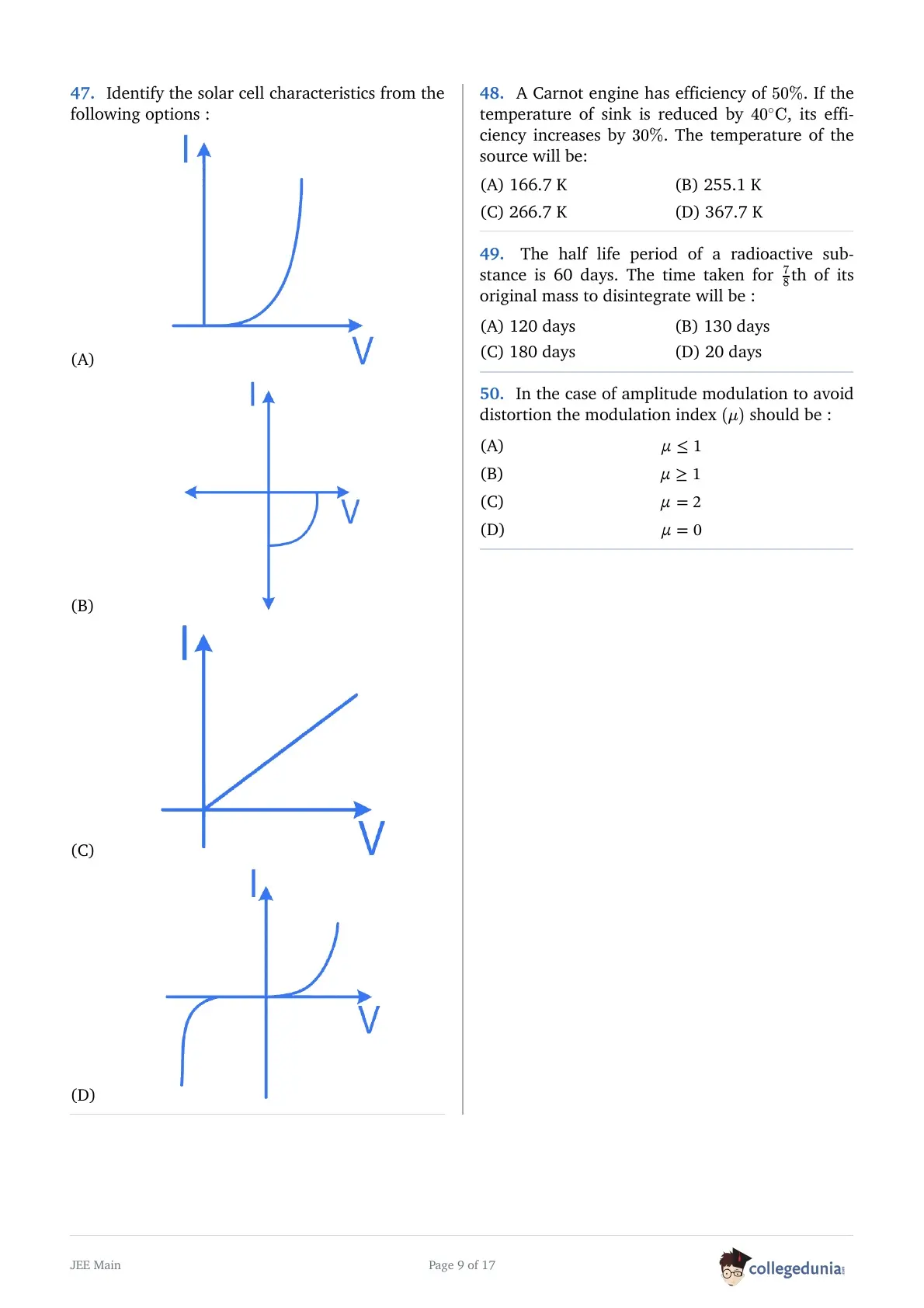
Identify the solar cell characteristics from the following options :
- (1)
![]()
- (2)
![]()
- (3)
![]()
- (4)
![]()


A Carnot engine has efficiency of \(50 \%\) .If the temperature of sink is reduced by \(40^{\circ} C\), its efficiency increases by \(30 \%\) .The temperature of the source will be :
The half life period of a radioactive substance is 60 days The time taken for \(\frac{7}{8}\) th of its original mass to disintegrate will be :
In the case of amplitude modulation to avoid distortion the modulation index \((\mu)\) should be:
Physics - Section B (Q51 - Q60)
Projection of 2\(\hat i\)+4\(\hat j\)−2\(\hat k\) on \(\hat i\)+2\(\hat j\)−α\(\hat k\) is zero. Then, the value of α will be________.
In Young’s double slit experiment, a laser light of 560 nm produces an interference pattern with consecutive bright fringes’ separation of 7.2 mm. Now another light is used to produce an interference pattern with consecutive bright fringes’ separation of 8.1 mm. The wavelength of the second light is ________ nm.
The frequencies at which the current amplitude in an LCR series circuit becomes \(\frac{1}{2}\) times its maximum value, are 212 rad s–1 and 232 rad s–1. The resistance value in the Question: the circuit is R = 5 Ω. The self-inductance in the circuit is _____ mH.
Two electric dipoles of dipole moments 1.2 × 10⁻³⁰ C-m and 2.4 × 10⁻³⁰ C-m are placed in two different uniform electric fields of strength 5 × 10⁴ NC–1 and 15 × 104 NC–1 respectively. The ratio of maximum torque experienced by the electric dipoles will be 1:x. The value of x is _______
The diameter of an air bubble which was initially 2 mm, rises steadily through a solution of density 1750 kg m–3 at the rate of 0.35 cms–1. The coefficient of viscosity of the solution is _______ poise (in nearest integer). (The density of air is negligible).
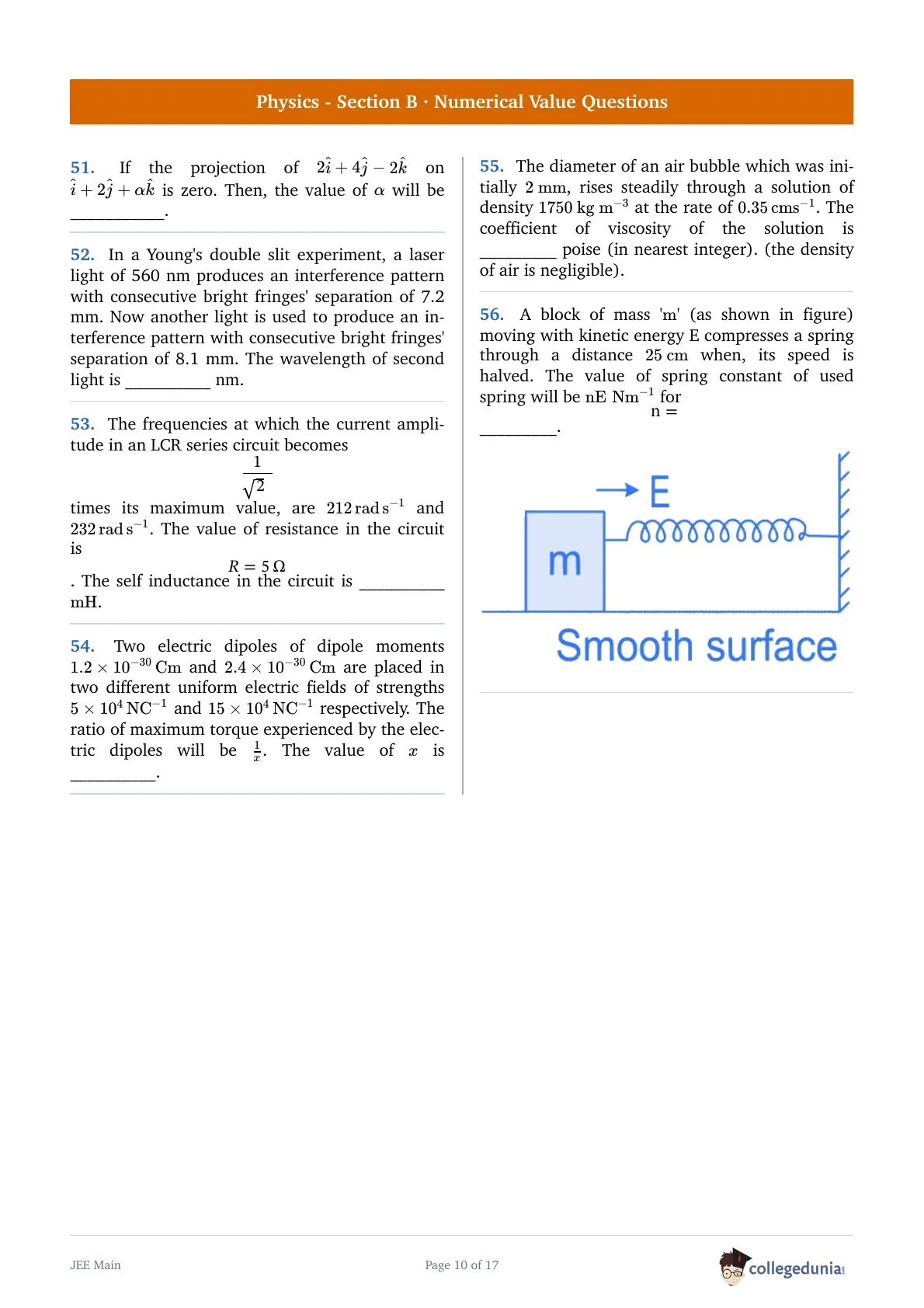
A block of mass ‘m’ (as shown in figure) moving with kinetic energy E compresses a spring through a distance 25 cm when its speed is halved. The value of spring constant of used spring will be nE Nm–1 for n = _______.
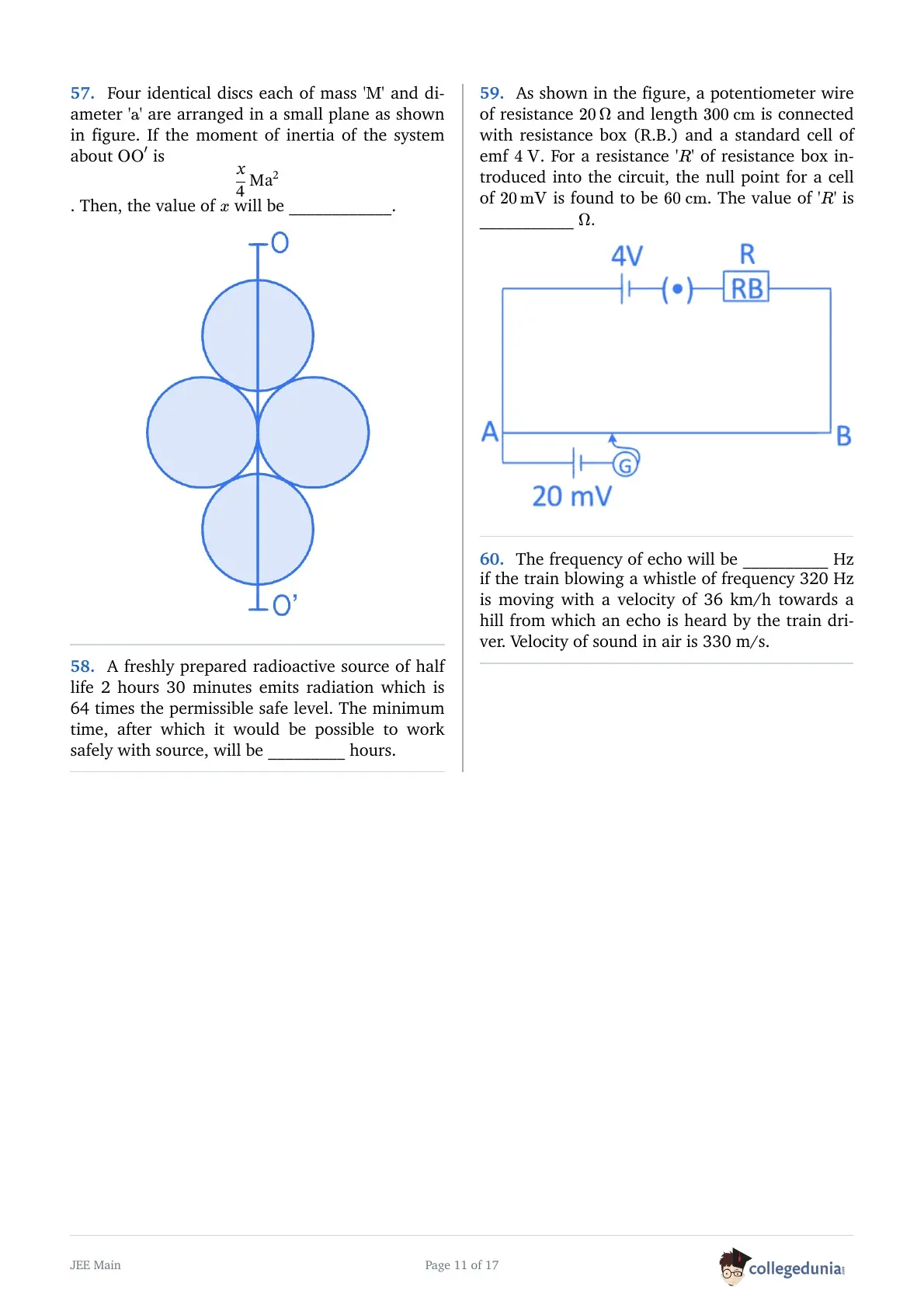
Four identical discs each of mass ‘M’ and diameter ‘a’ are arranged in a small plane as shown in the figure. If the moment of inertia of the system about OO’ is (\(\frac{x}{4}\)) Ma2. Then, the value of x will be _______.
A freshly prepared radioactive source of half life 2 hours 30 minutes emits radiation which is 64 times the permissible safe level. The minimum time, after which it would be possible to work safely with source, will be _______ hours.
As shown in the figure, a potentiometer wire of resistance 20 Ω and length 300 cm is connected with resistance box (R.B.) and a standard cell of emf 4 V. For a resistance ‘R‘ of resistance box introduced into the circuit, the null point for a cell of 20 mV is found to be 60 cm. The value of ‘R ‘ is Ω.
The frequency of echo will be _______ Hz if the train blowing a whistle of frequency 320 Hz is moving with a velocity of 36 km/h towards a hill from which an echo is heard by the train driver. Velocity of sound in air is 330 m/s.
Chemistry - Section A (Q61 - Q80)
Identify the incorrect statement from the following
Which of the following relation is not correct?
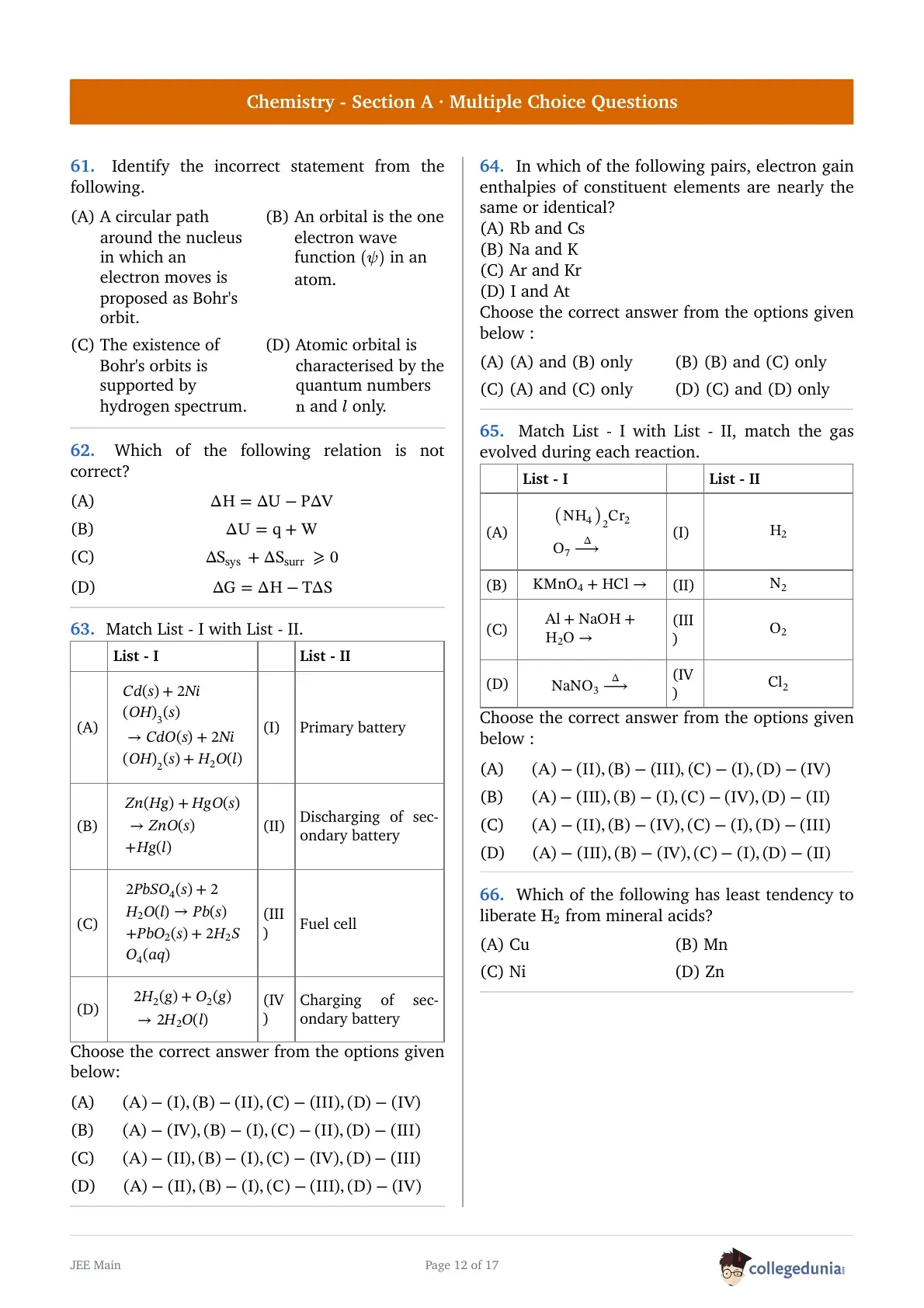
List-I | List-II | ||
|---|---|---|---|
| (A) | Cd(s)+2Ni(OH)3(s)→CdO(s)+2Ni(OH)2(s)+H2O(l) | (I) | Primary battery |
| (B) | Zn(Hg)+HgO(s)→ZnO(s)+Hg(l) | (II) | Discharging of secondary battery |
| (C) | 2PbSO4(s)+2H2O(l)→Pb(s)+PbO2(s)+2H2SO4(aq) | (III) | Fuel cell |
| (D) | 2H2(g)+O2(g)→2H2O(l) | (IV) | Charging of secondary battery |
Choose the correct answer from the options given below:
In which of the following pairs, electron gain enthalpies of constituent elements are nearly the same or identical ?
(A) \(Rb\) and \(Cs\)
(B) \(Na\) and \(K\)
(C) \(Ar\) and \(Kr\)
(D) \(I \) and \(At\)
Choose the correct answer from the options given below :
List-I | List-II | ||
|---|---|---|---|
| (A) | \(\left( NH _4\right)_2 Cr _2 O _7 \xrightarrow{\Delta}\) | (I) | \(H _2\) |
| (B) | \(KMnO _4+ HCl \rightarrow\) | (II) | \(N _2\) |
| (C) | \(Al + NaOH + H _2 O \rightarrow\) | (III) | \(O _2\) |
| (D) | \(NaNO _3 \xrightarrow{\Delta}\) | (IV) | \(Cl _2\) |
Choose the correct answer from the options given below:
Which of the following has least tendency toliberate \(H_2\) from mineral acids?
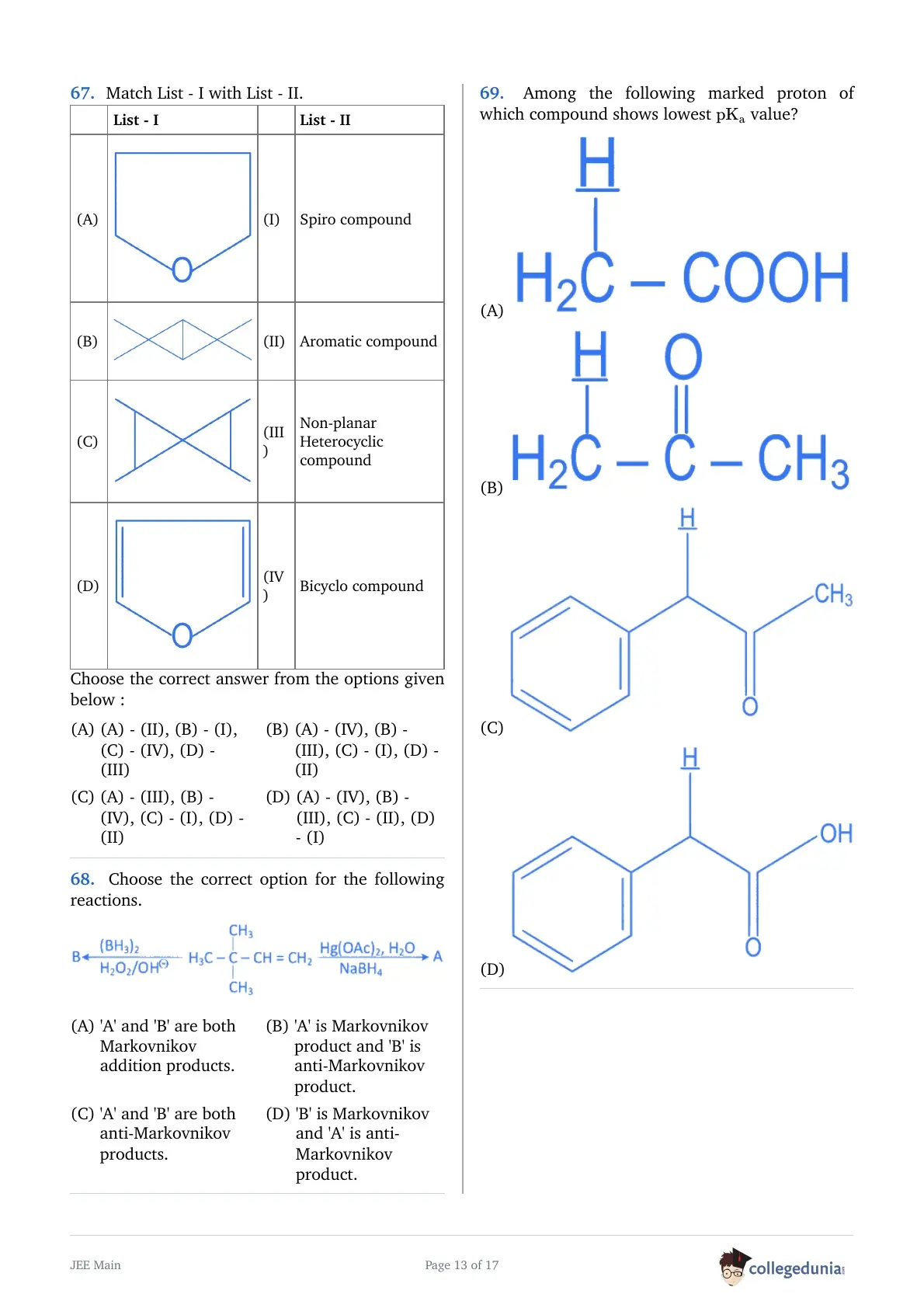
Match List-I with List-II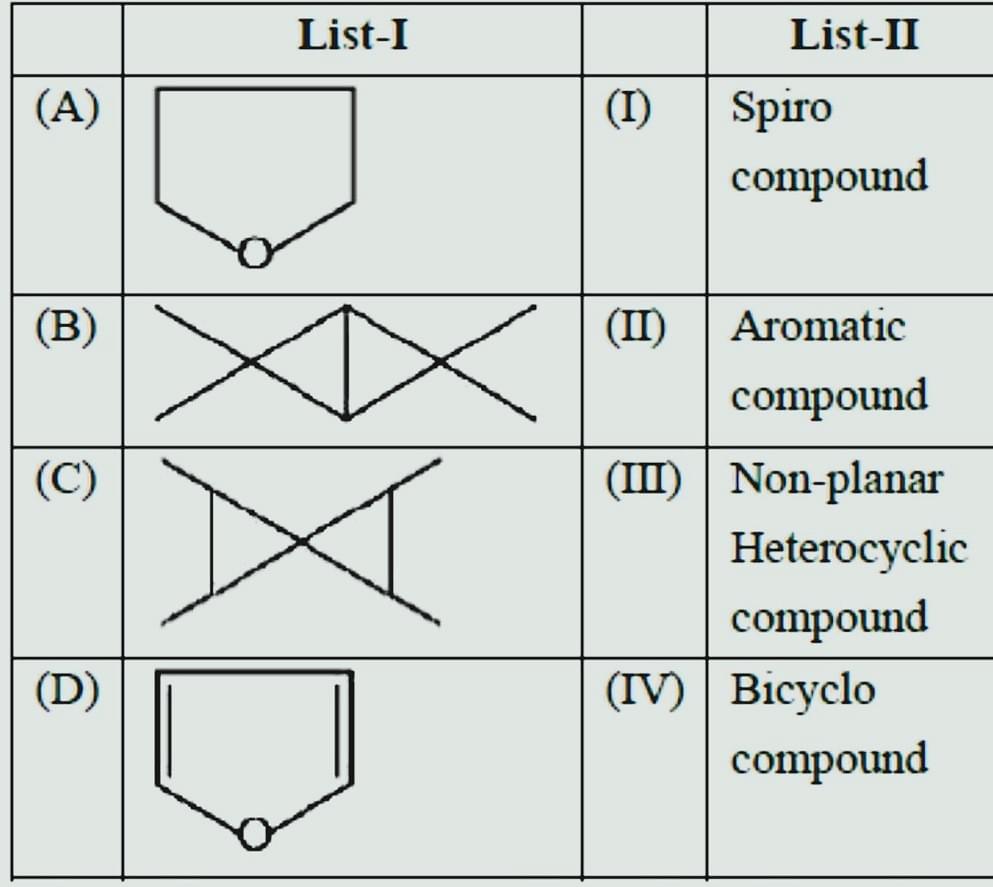
Choose the correct option for the following reactions
Among the following marked proton of which compound shows lowest \(pK_a\) value ?
- (1)
![]()
- (2)
![]()
- (3)
![]()
- (4)
![]()


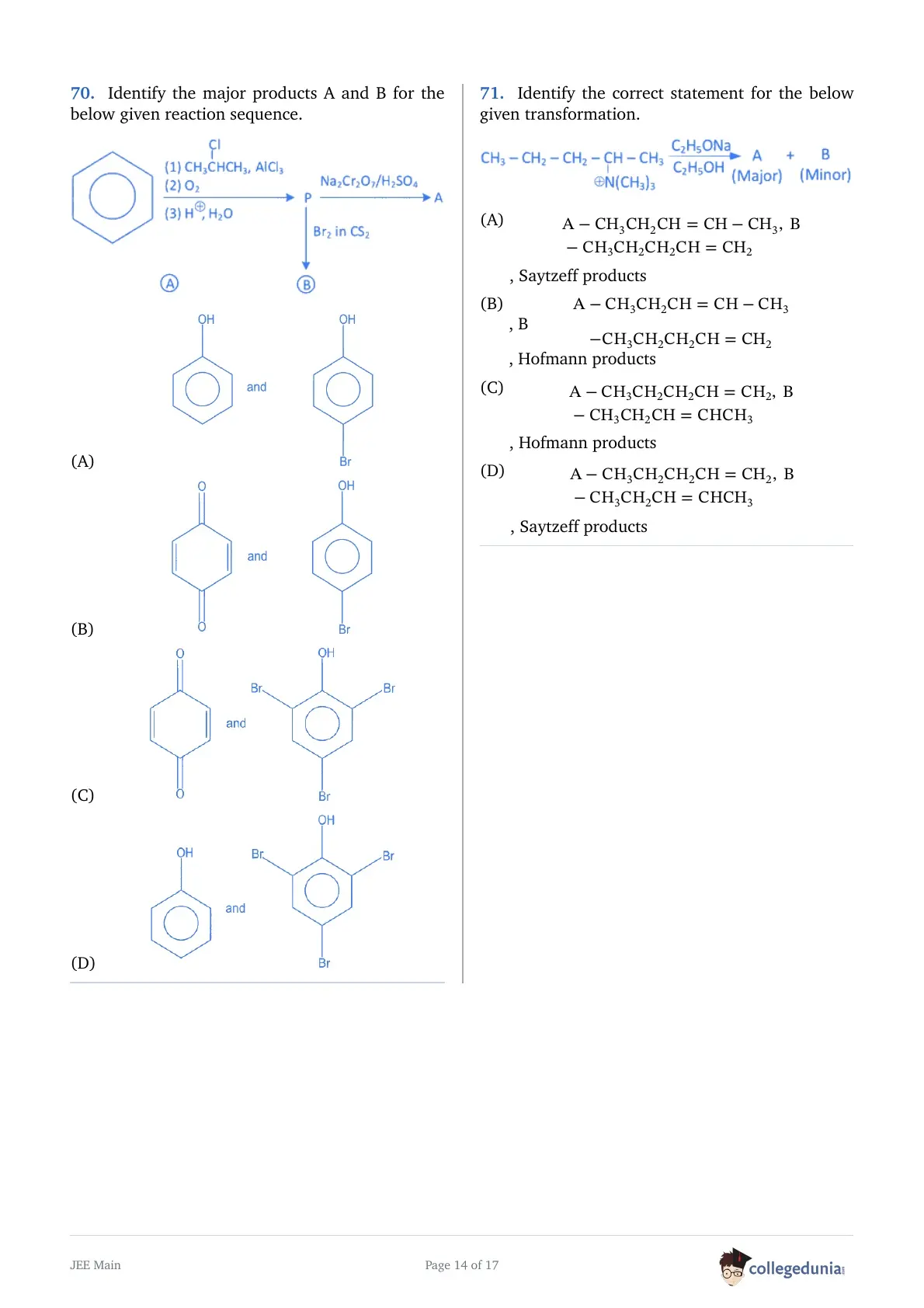
Identify the major products A and B for the below given reaction sequence.
- (1)
![]()
- (2)
![]()
- (3)
![]()
- (4)
![]()


Identify the correct statement for the below given transformation

- (1)
![]()
- (2)
![]()
- (3)
![]()
- (4)
![]()


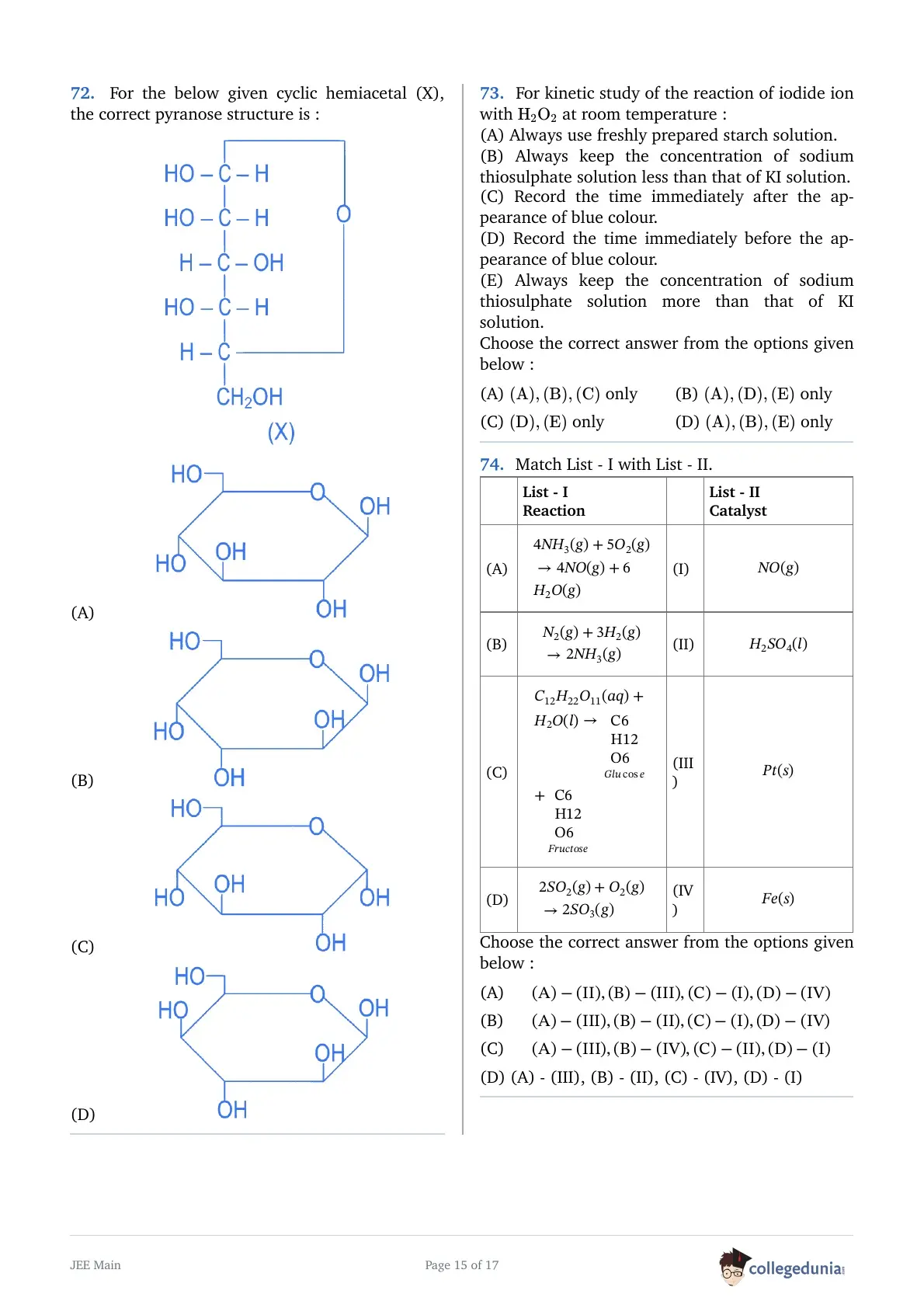
For kinetic study of the reaction of iodide ion with \(H _2 O _2\) at room temperature :
(A) Always use freshly prepared starch solution
(B) Always keep the concentration of sodium thiosulphate solution less than that of \(KI\) solution
(C) Record the time immediately after the appearance of blue colour
(D) Record the time immediately before the appearance of blue colour
(E) Always keep the concentration of sodium thiosulphate solution more than that of \(KI\) solution Choose the correct answer from the options given below :
Match List-I with List-II List-I
| List-I | List-I i |
| Reaction | Catalyst |
| \(4 NH _3( g )+5 O _2( g ) \rightarrow 4 NO ( g )+6 H _2 O ( g )\) | NO(g) |
| \(N _2( g )+3 H _2( g ) \rightarrow 2 NH _3( g )\) | H_2SO_4(l) |
| \(C _{12} H _{22} O _{11}( aq ) H _2 O (l) \rightarrow \text { (Glucose) }+ C _6 H _{12} O _6 C _6 H _{12} O _6\) | Pt(s) |
| \( SO _2( g )+ O _2( g ) \rightarrow 2 SO _3( g )\) | Fe(s) |
Choose the correct answer from the options given below:
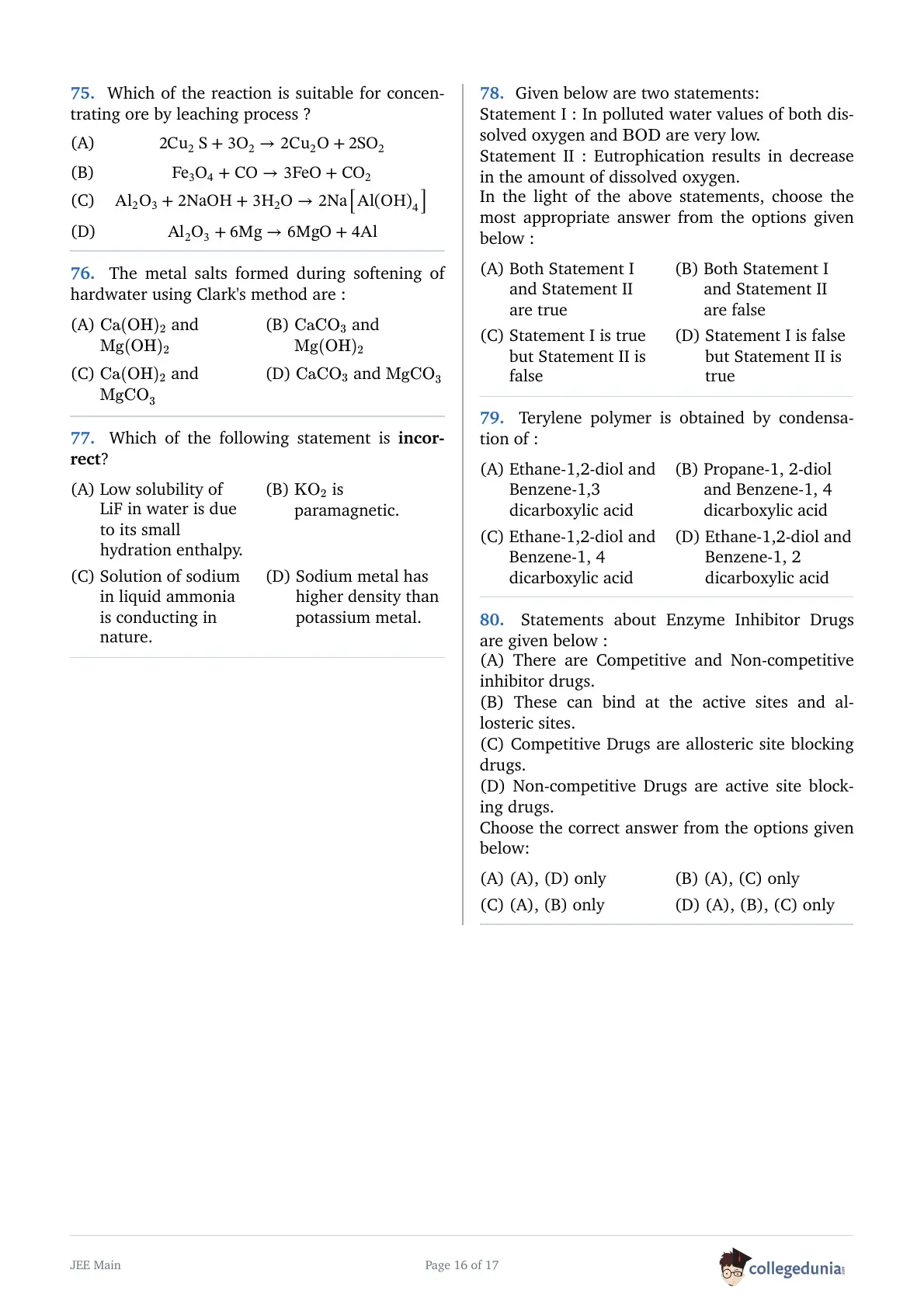
Which of the reaction is suitable for concentrating ore by leaching process?
The metal salts formed during softening of hardwater using Clark's method are :
Which of the following statement is incorrect?
Given below are two statements :
Statement I: In polluted water values of both dissolved oxygen and BOD are very low.
Statement II: Eutrophication results in decrease in the amount of dissolved oxygen.
In the light of the above statements, choose the most appropriate answer from the options given below :
Terylene polymer is obtained by condensation of :
- There are Competitive and Noncompetitive inhibitor drugs
- These can bind at the active sites and allosteric sites
- Competitive Drugs are allosteric site blocking drugs
- Non-competitive Drugs are active site blocking drugs
Chemistry - Section B (Q81 - Q90)
The number of paramagnetic species among the following is ____B2,Li2,C2,C-2, O22--,O2+ and He2+
Ka for butyric acid (C3H7COOH) is 2 × 10⁻⁵. The pH of 0.2 M solution of butyric acid is ______× 10–1. (Nearest integer) (Given log2 = 0.30)
For the given first order reaction A → B, the half-life of the reaction is 0.3010 min. The ratio of the initial concentration of reactant to the concentration of reactant at time 2.0 min will be equal to ______. (Nearest integer)
The number of interhalogens from the following having square pyramidal structure is :CIF3, IF7, BrF5, BrF3, I2CI6, IF5, CIF, CIF5
The disproportionation of MnO42- in acidic medium resulted in the formation of two manganese compounds A and B. If the oxidation state of Mn in B is smaller than that of A, then the spin-only magnetic moment (μ) value of B in BM is _______. (Nearest integer)
Total number of relatively more stable isomer(s) possible for octahedral complex [Cu(en)2(SCN)2] wiil be ______.
On complete combustion of 0.492 g of an organic compound containing C, H and O, 0.7938 g of CO2 and 0.4428 g of H2O was produced. The % composition of oxygen in the compound is _______.
An element M crystallises in a body centred cubic unit cell with a cell edge of 300 pm. The density of the element is 6.0 g cm–3. The number of atoms present in 180 g of the element is ______× 1023. (Nearest integer)
JEE Main 2022 Exam Pattern and Marking Scheme
| Particulars | Details |
|---|---|
| Exam Mode | Online (Computer-Based Test) |
| Paper | B.E./B.Tech (Paper 1) |
| Duration | 3 hours (180 minutes) |
| Type of Questions | Multiple Choice Questions (MCQs) + Numerical Value Questions |
| Subjects | Mathematics, Physics, Chemistry |
| Total Questions | 90 questions (75 to be attempted) |
| Total Marks | 300 marks |
| Marking Scheme | +4 for correct answer & -1 for incorrect MCQ and Numerical Value-based Questions |
JEE Main 2022 July 28 Shift 1 Difficulty Level
As per the initial reaction, candidates reported the paper as moderate with Mathematics as the most difficult section, Physics moderate and Chemistry easy. Check JEE Main 2022 July 28 Shift 1 Paper Analysis
JEE Main 2022 July 28 Shift 1 Subject-wise Memory-Based Solutions PDF
| Subject | Memory-Based Solutions PDF |
|---|---|
| Physics | Download PDF |
| Chemistry | Download PDF |
| Mathematics | Download PDF |
JEE Main 2022 Phase 2 Question Papers with Solution PDFs
Candidates can also check shift-wise JEE Main 2022 Phase 2 Question Papers with Solution PDFs. These shift-wise question paper PDFs for JEE Main 2022 will help candidates know the overall difficulty, topics with the highest weightage and the type of questions asked in the exam.
JEE Main 2022 Phase 1 Question Papers with Solution PDFs
Shift-wise JEE Main 2022 Phase 1 Question Papers with Solution PDFs are also available. Candidates preparing for Phase 2 of the exam can check and download JEE Main Question Paper PDFs to practice and test their exam prep level.
Also Check:



Comments