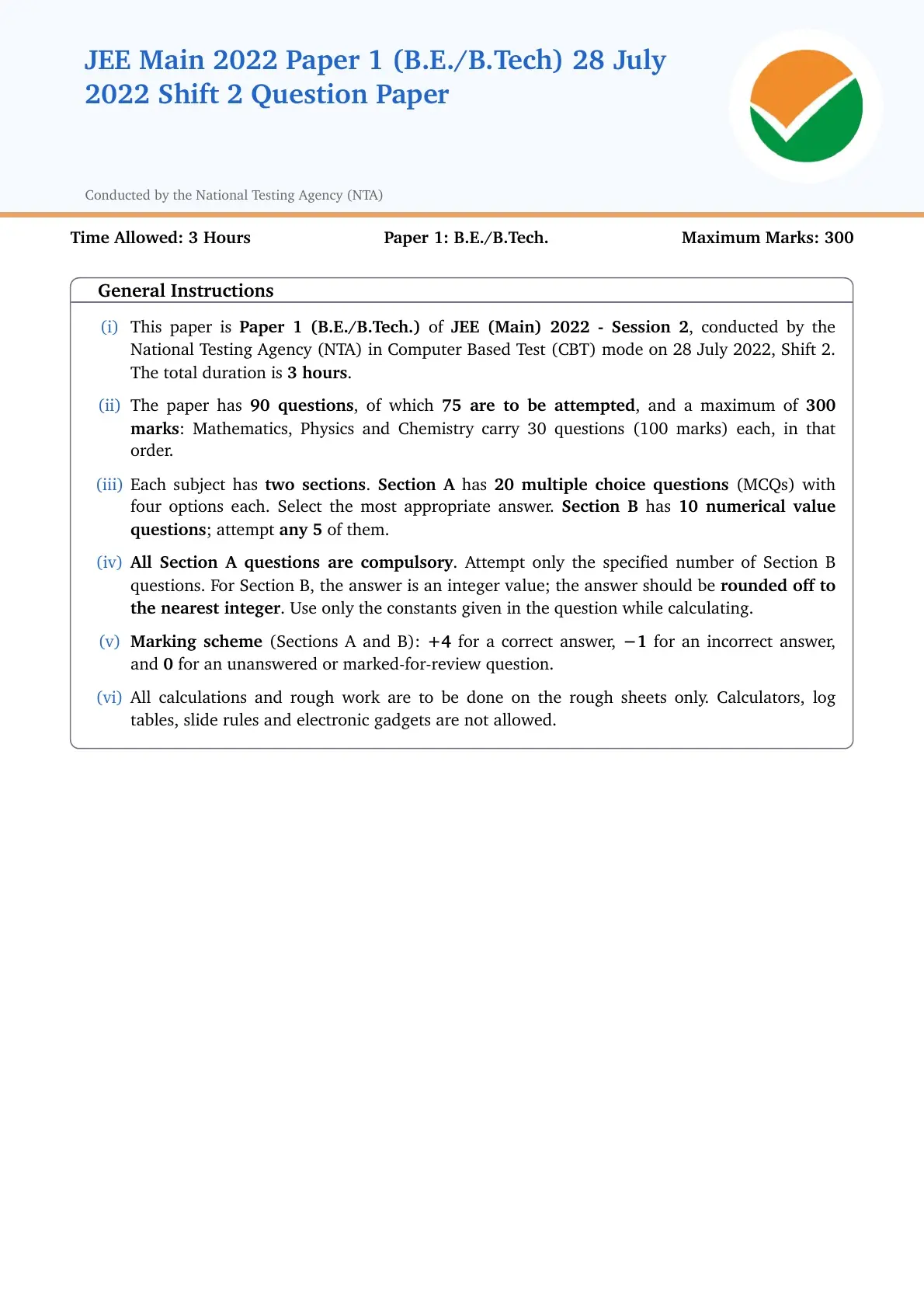
JEE Main 2022 July 28 Shift 2 Question Paper is available here with solutions PDF and detailed solutions for every question. NTA conducted the second shift on July 28, 2022, from 3:00 PM to 6:00 PM. The JEE Main 2022 Paper 1 (B.E./B.Tech) question paper includes the following:

  • 90 questions in a 3-hour CBT Mode: 30 each from Mathematics, Physics and Chemistry (75 to be attempted)
  • Section A: 20 multiple choice questions (MCQs) per subject, all compulsory, 4 marks each
  • Section B: 10 numerical value questions per subject, any 5 to be attempted, 4 marks each
  • Marking: +4 for a correct answer, -1 for an incorrect answer, 0 for an unattempted question
  • Maximum marks: 300 (100 per subject)

JEE Main 2022 July 28 Shift 2 Question Paper with Solution PDF

Also Check:

JEE Main 2022 July 28 Shift 2 Questions with Solutions


Mathematics - Section A (Q1 - Q20)

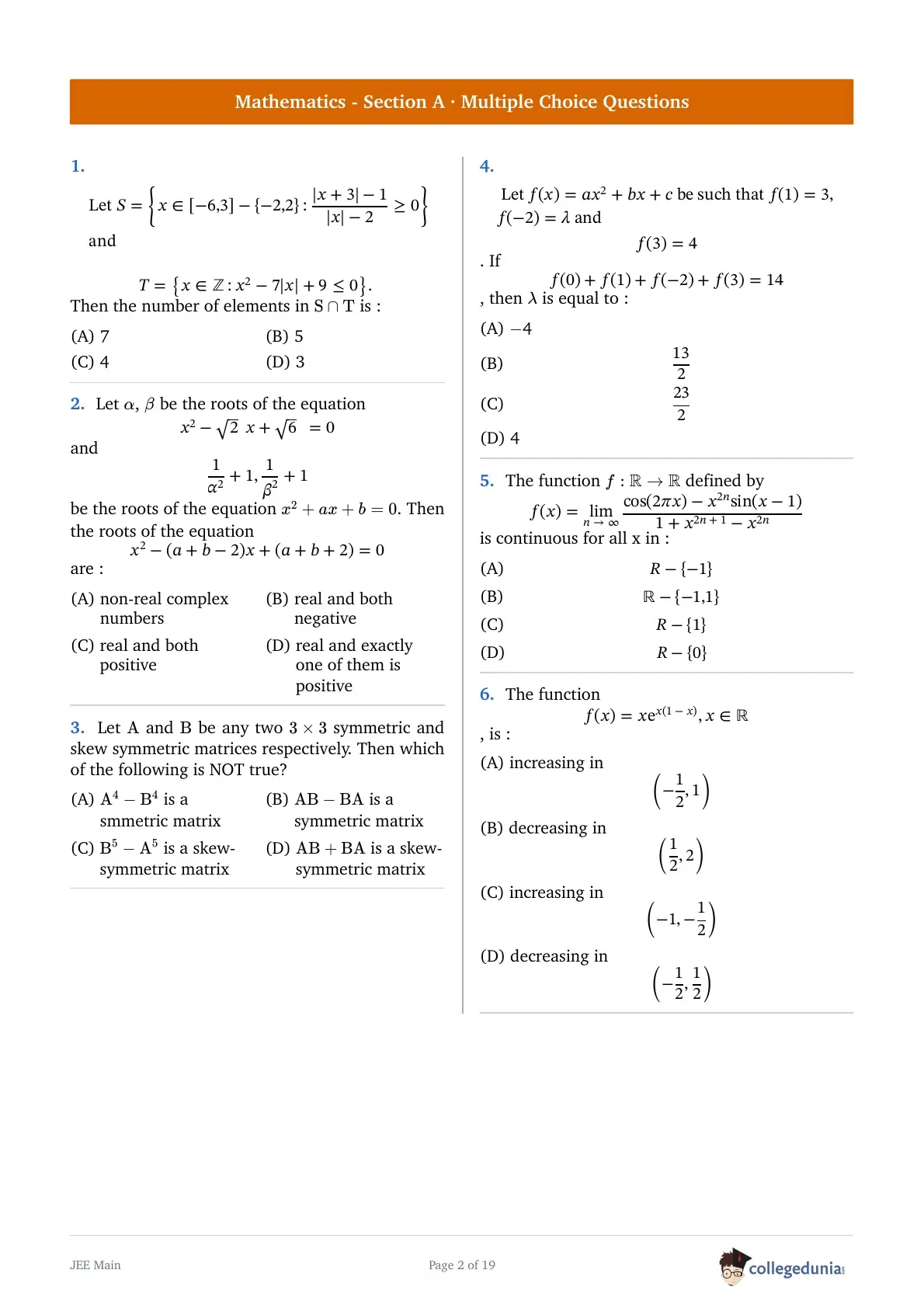
Question 1:
Let 
\(S=\left\{x∈[-6,3]-\left\{-2,2 \right\} :\frac{|x+3|-1}{|x|-2}>=0 \right\} \space and \space \left\{T={x∈Z:x^2-7|x|+9<=0}\right\}\)
Then the number of elements in S ⋂ T is
  • (1) 7
  • (2) 5
  • (3) 4
  • (4) 3

Question 2:

Let \(α, β\) be the roots of the equation \(x^2-\sqrt{2}x+\sqrt{6}=0\) and\( \frac{1}{α^2}+1\),\(\frac {1}{β^2}+1\) be the roots of the equation \(x^2 + ax + b = 0\) . Then the roots of the equation \(x^2 – (a + b – 2)x + (a + b + 2) = 0\) are

  • (1) Non-real complex number
  • (2) Real and both negative
  • (3) Real and both negative
  • (4) Real and exactly one of them is positive

Question 3:

Let A and B be any two 3 × 3 symmetric and skew symmetric matrices, respectively. Then Which of the following is NOT true?

  • (1) A4 – B4 is a symmetric matrix
  • (2) AB – BA is a symmetric matrix
  • (3) B5 – A5 is a skew-symmetric matrix
  • (4) AB + BA is a skew-symmetric matrix

Question 4:

Let \(f(x) = ax^2 + bx + c\) be such that f(1) = 3, f(-2) = λ and f(3) = 4. If f(0) + f(1) + f(-2) + f(3) = 14, then λ is equal to

  • (1) -4
  • (2) \(\frac{13}{2}\)
  • (3) \(\frac{23}{2}\)
  • (4) 4

Question 5:

The function \(f : R→R\) defined by \(f(x)=lim_{n→∞}\frac{cos2πx-x^{2n}sinx-1}{1+x^{2n+1}-x^{2n}}\) is continuous for all x in

  • (1) R-{-1}
  • (2) R-{-1,1}
  • (3) R-{1}
  • (4) R-{0}

Question 6:

The function \(f(x)=xe^{x(1-x)}\),x∈R is

  • (1) increasing in \((-\frac{1}{2} , 1)\)
  • (2) increasing in \((-\frac{1}{2} , 1)\)
  • (3) increasing in  \((-1 , -\frac{1}{2})\)
  • (4) decreasing in \((-\frac{1}{2} , \frac{1}{2})\)

Question 7:

The sum of the absolute maximum and absolute minimum values of the function \(\begin{array}{l} f\left(x\right)=\tan^{-1}\left(\sin x-\cos x\right) \end{array}\)in the interval\( [0, π]\) is

  • (1) 0
  • (2) \(tan^{-1}\frac{1}{\sqrt{2}}-\frac{π}{4}\)
  • (3) \(cos^{-1}\frac{1}{\sqrt{3}}-\frac{π}{4}\)
  • (4) \(-\frac{π}{12}\)

Question 8:
Let \(x(t)=2\sqrt2costsin\sqrt2t \) and \(y(t)=2\sqrt2sintsin\sqrt2t\) ,\(t ∈(0,\frac{π}{2})\)
 Then \(\frac{1+(\frac{dy}{dx})^2}{\frac{d^2y}{dx^2}}\) at \(t=\frac{π}{4}\) is equal to
  • (1) \(\frac{-2\sqrt{2}}{3}\)
  • (2) \(\frac{2}{3}\)
  • (3) \(\frac{1}{3}\)
  • (4) \(\frac{-2}{3}\)

Question 9:

\(\begin{array}{l} I_n\left(x\right)=\int_0^x\frac{1}{\left(t^2+5\right)^n}dt, n=1, 2, 3,\cdots\end{array}\)

Then

  • (1) \(50I_6, - 9I_5 = xI'_5\)
  • (2) \(50I_6, - 11I_5 = xI'_5\)
  • (3) \(50I_6, - 9I_5 = I'_5\)
  • (4) \(50I_6, - 11I_5 = I'_5\)

Question 10:
The area enclosed by the curves 
\(\begin{array}{l} y=\text{log}_e\left(x+e^2\right),\ x=\text{log}_e\left(\frac{2}{y}\right)\text{ and }x=\text{ log }_e\ 2,\end{array}\)
above the line y = 1 is
  • (1) 2 + e - loge 2
  • (2) 1+ e - loge2
  • (3) 2 + e + loge 2
  • (4) 1 - e - loge2

Question 11:
Let y = y(x) be the solution curve of the differential equation 
\(\begin{array}{l} \frac{dy}{dx}+\frac{1}{x^2-1}y=\left(\frac{x-1}{x+1}\right)^{1/2},x>1 \end{array}\)
passing through the point (2, √(1/3)). Then √7 y(8) is
  • (1) \(11+6log_e3\)
  • (2) 19
  • (3) \(12-2log_e3\)
  • (4) \(19-6log_e3\)

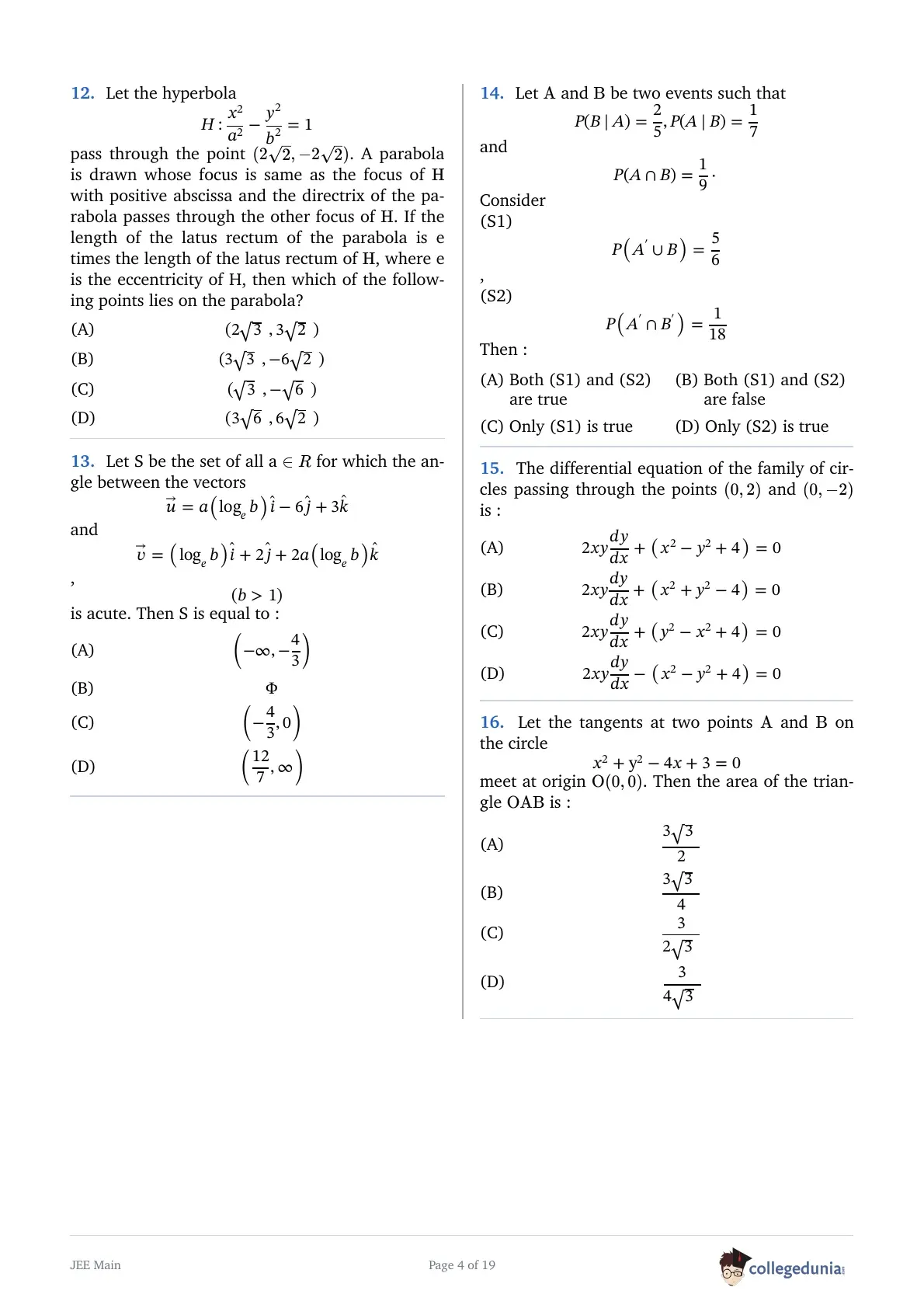
Question 12:

Let the hyperbola \(H: \frac{x^2}{a^2}-\frac{y^2}{b^2}=1\) pass through (\(2\sqrt2,-2\sqrt2\) ). A parabola is drawn whose focus is same as the focus of H with positive abscissa and the directrix of the parabola passes through the other focus of H. If the length of the latus rectum of the parabola is e times the length of the latus rectum of H, where e is the eccentricity of H, then which of the following points lies on the parabola?

  • (1) \(2\sqrt3,3\sqrt2\)
  • (2) \(3\sqrt3,-6\sqrt2\)
  • (3) \(\sqrt3,-\sqrt6\)
  • (4) \(3\sqrt6,6\sqrt2\)

Question 13:

Let S be the set of all a∈ R for which the angle between the vectors\( \begin{array}{l} \overrightarrow{u}=a\left(\text{log}_e b\right)\hat{i}-6\hat{j}+3\hat{k}\end{array}\) and \(\begin{array}{l} \overrightarrow{v}=\left(\text{log}_e b\right)\hat{i}+2\hat{j}+2a\left(\text{log}_e b\right)\hat{k},\left(b>1\right)\end{array}\) is acute. Then S is equal to

  • (1) \((∞, −\frac{4}{3})\)
  • (2) ϕ
  • (3) \((−\frac{4}{3}, 0)\)
  • (4) \((\frac{12}{7}, ∞)\)

Question 14:
Let A and B be two events such that
 \(\begin{array}{l} P\left(B/A\right)\frac{2}{5},\ P\left(A/B\right)=\frac{1}{7}\ \text{and}\ P\left(A\cap B\right)=\frac{1}{9}.\end{array} Consider \begin{array}{l} \left(S1\right)P\left(A’\cup B\right)=\frac{5}{6},\end{array}\)
\(\begin{array}{l} \left(S2\right)P\left(A’\cap B’\right)=\frac{1}{18}.\end{array}\)Then
  • (1) Both (S1) and (S2) are true
  • (2) Both (S1) and (S2) are false
  • (3) Only (S1) is true
  • (4) Only (S2) is true

Question 15:

The differential equation of the family of circles passing through the points (0, 2) and (0, –2) is

  • (1) \(\begin{array}{l}\ 2xy\frac{dy}{dx}+\left(x^2-y^2+4\right)=0 \end{array}\)
  • (2) \(\begin{array}{l} \ 2xy\frac{dy}{dx}+\left(x^2+y^2-4\right)=0\end{array}\)
  • (3) \(\begin{array}{l} \ 2xy\frac{dy}{dx}+\left(y^2-x^2+4\right)=0\end{array}\)
  • (4) \(\begin{array}{l} \ 2xy\frac{dy}{dx}-\left(x^2-y^2+4\right)=0\end{array}\)

Question 16:

Let the tangents at two points A and B on the circle\( x^2 + y^2 – 4x + 3 = 0\) meet at origin O(0, 0). Then the area of the triangle OAB is

  • (1) \(\frac{3\sqrt3}{2}\)
  • (2) \(\frac{3\sqrt3}{4}\)
  • (3) \(\frac{3}{2\sqrt3}\)
  • (4) \(\frac{3}{4\sqrt3}\)

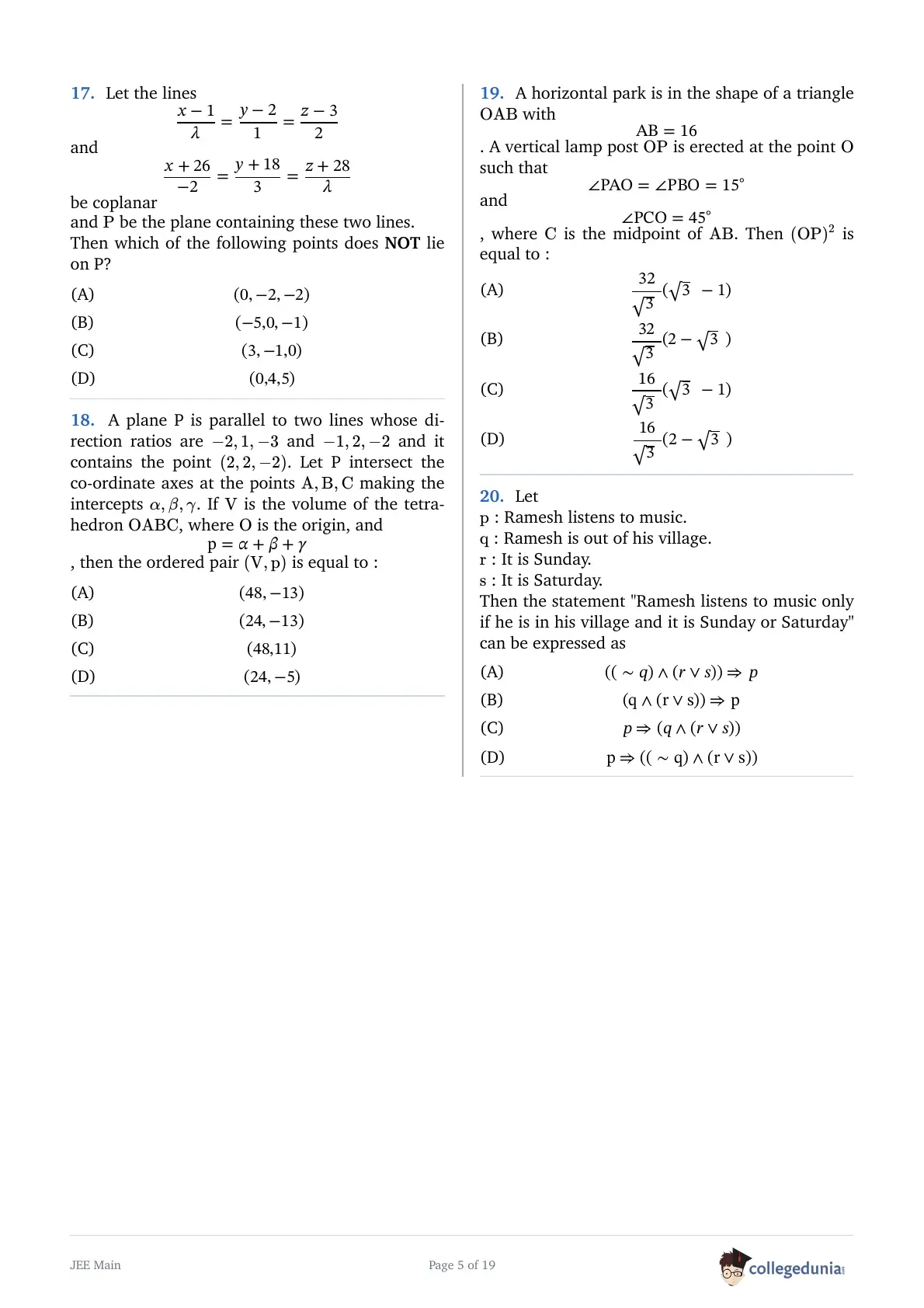
Question 17:

Let the lines\( \begin{array}{l} \frac{x-1}{\lambda}=\frac{y-2}{1}=\frac{z-3}{2}\ \text{and}\ \frac{x+26}{-2}=\frac{y+18}{3}=\frac{z+28}{\lambda}\end{array}\)be coplanar and P be the plane containing these two lines. Then which of the following points does NOT lie on P?

  • (1) (0,-2,-2)
  • (2) (-5,0,-1)
  • (3) (3,-1,0)
  • (4) (0,4,5)

Question 18:

A plane P is parallel to two lines whose direction rations are –2, 1, –3 and –1, 2, –2 and it contains the point (2, 2, –2). Let P intersect the co-ordinate axes at the points A, B, C making the intercepts α, β, γ. If V is the volume of the tetrahedron OABC, where O is the origin and p = α + β + γ, then the ordered pair (V, p) is equal to :

  • (1) (48,-13)
  • (2) (24,-13)
  • (3) (48,11)
  • (4) (24,-5)

Question 19:

A horizontal park is in the shape of a triangle OAB with AB = 16. A vertical lamp post OP is erected at the point O such that\( \begin{array}{l}\angle PAO = \angle PBO = 15^\circ ~\text{and}~ \angle PCO = 45^\circ,\end{array}\)where C is the midpoint of AB. Then (OP)2 is equal to

  • (1) \(\begin{array}{l} \ \frac{32}{\sqrt{3}}\left(\sqrt{3}-1\right) \end{array}\)
  • (2) \(\begin{array}{l}\ \frac{32}{\sqrt{3}}\left(2-\sqrt{3}\right) \end{array}\)
  • (3) \(\begin{array}{l}  \frac{16}{\sqrt{3}}\left(\sqrt{3}-1\right) \end{array}\)
  • (4) \(\begin{array}{l}\frac{16}{\sqrt{3}}\left(2-\sqrt{3}\right) \end{array}\)

Question 20:
Let 
p : Ramesh listens to music. 
q : Ramesh is out of his village. 
r : It is Sunday. 
s : It is Saturday. 
Then the statement “Ramesh listens to music only if he is in his village and it is Sunday or Saturday” can be expressed as
  • (1) \(\begin{array}{l} \left(\left(\sim q\right) \wedge \left(r\vee s\right)\right) \Rightarrow p \end{array}\)
  • (2) \( \left(q\wedge \left(r\vee s \right)\right) \Rightarrow p\)
  • (3) \(p\Rightarrow \left(q\wedge \left(r\vee s\right)\right)\)
  • (4) \(p\Rightarrow \left(\sim q \right) \wedge \left(r\vee s\right)\)

Mathematics - Section B (Q21 - Q30)

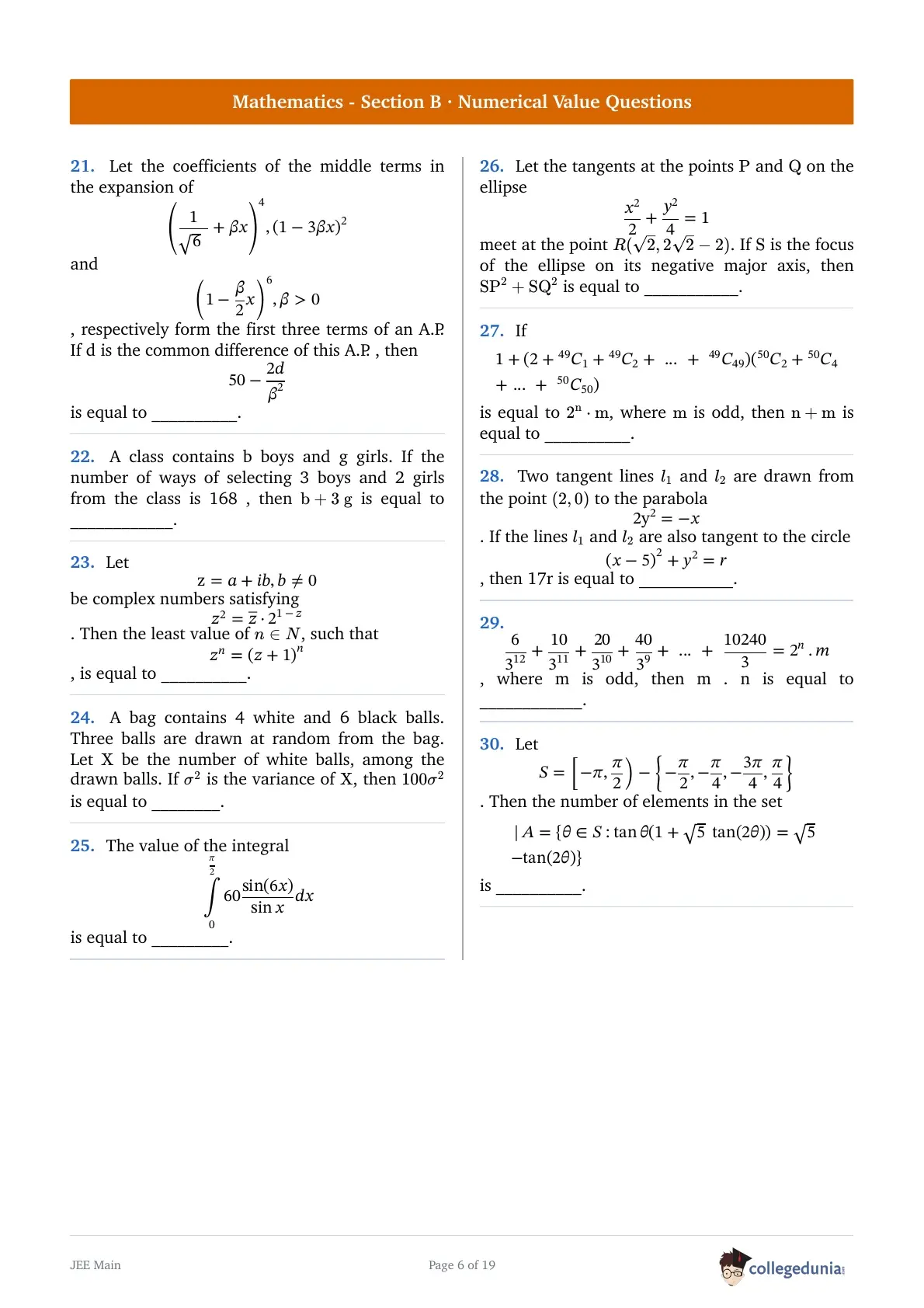
Question 21:

Let the coefficients of the middle terms in the expansion of\(\begin{array}{l} \left(\dfrac{1}{\sqrt 6}+ \beta x\right)^4, \left(1 – 3\beta x\right)^2 \text{and}\left(1 – \dfrac{\beta}{2}x\right )^6, \beta > 0,\end{array}\)respectively form the first three terms of an A.P. If d is the common difference of this A.P., then \(\begin{array}{l} 50-\frac{2d}{\beta^2} \end{array}\)is equal to _______.


Question 22:

A class contains b boys and g girls. If the number of ways of selecting 3 boys and 2 girls from the class is 168, then b + 3g is equal to ______.


Question 23:
Let z = a + ib, b≠ 0 be complex numbers satisfying
\(\begin{array}{l} z^2=\overline{z}\cdot 2^{1-\left|z\right|}.\end{array}\)
Then the least value of n∈ N, such that zn= (z + 1)n, is equal to _____.

Question 24:

A bag contains 4 white and 6 black balls. Three balls are drawn at random from the bag. Let X be the number of white balls, among the drawn balls. If \(σ^2 \) is the variance of X, then 100 σ2 is equal to ____.


Question 25:

The value of the integral \(\begin{array}{l} \displaystyle\int\limits_0^{\frac{\pi}{2}}60\frac{\sin\left(6x\right)}{\sin x}dx \end{array}\) is equal to ______.


Question 26:
Let the tangents at the points P and Q on the ellipse
\(\begin{array}{l} \frac{x^2}{2}+\frac{y^2}{4}=1\ \text{meet at the point}\ R\left(\sqrt{2},2\sqrt{2}-2\right).\end{array}\)
If S is the focus of the ellipse on its negative major axis, then SP2 + SQ2 is equal to ________.

Question 27:

If\(\begin{array}{l}1 + \left(2 + ^{49}C_1 + ^{49}C_2 + … ^{49}C_{49}\right) \left(^{50}C_2 + ^{50}C_4 + … ^{50}C_{50}\right) \end{array}\)is equal to 2n. m, where m is odd, then n + m is equal to ______.


Question 28:

Two tangent lines l1 and l2 are drawn from the point (2, 0) to the parabola 2y2 = – x. If the lines l1 and l2 are also tangent to the circle (x – 5)2 + y2 = r, then 17r is equal to _________.


Question 29:

If \(\begin{array}{l} \frac{6}{3^{12}}+\frac{10}{3^{11}}+\frac{20}{3^{10}}+\frac{40}{3^9}+\cdots +\frac{10240}{3}=2^n\cdot m, \end{array}\)where m is odd, then m⋅n is equal to ________.


Question 30:

Let \(\begin{array}{l} S=\left[-\pi, \frac{\pi}{2}\right)-\left[-\frac{\pi}{2},-\frac{\pi}{4},-\frac{3\pi}{4},\frac{\pi}{4}\right].\end{array}\)Then the number of elements in the set \(\begin{array}{l} A=\left\{\theta\in S:\tan\theta\left(1+\sqrt{5}\tan\left(2\theta\right)\right)=\sqrt{5}-\tan\left(2\theta\right) \right\} \end{array}\)is ________.


Physics - Section A (Q31 - Q50)

Question 31:

Consider the efficiency of Carnot's engine is given by \(η=\frac {αβ}{sinθ}log_e\frac {βx}{kT}\), where \(α\) and \(β\) are constants. If \(T\) is temperature, \(k\) is Boltzman constant, \(θ\) is angular displacement and \(x\) has the dimensions of length. Then, choose the incorrect option.

  • (1) Dimensions of \(β\) is same as that of force.
  • (2) Dimension of \(α^{-1}x\) is same as that of energy.
  • (3) Dimension of \(η^{-1} sinθ\) is same as that of \(αβ\).
  • (4) Dimensions of \(α\) is same as that of \(β\)

Question 32:

At time t = 0 a particle starts travelling from a height \(7\hat z cm\) in a plane keeping \(z\) coordinate constant. At any instant time it's position along the \(x\) and \(y\) directions are defined as \(3t\) and \(5t^3\) respectively. At \(t = 1s\) acceleration of the particle will be

  • (1) \(-30 \hat {y}\)
  • (2) \(30\hat {y}\)
  • (3) \(3 \hat {x}+ 15\hat {y}\)
  • (4) \(3\hat{x}^+15\hat{y}+7\hat{z}\)

Question 33:
A pressure-pump has a horizontal tube of cross sectional area \(10  cm^2 \) for the outflow of water at a speed of \(20 m/s\). The force exerted on the vertical wall just in front of the tube which stops water horizontally flowing out of the tube, is 
[given: density of water = \(1000  kg/m^3\)].
  • (1) 300 N
  • (2) 500 N
  • (3) 250 N
  • (4) 400 N

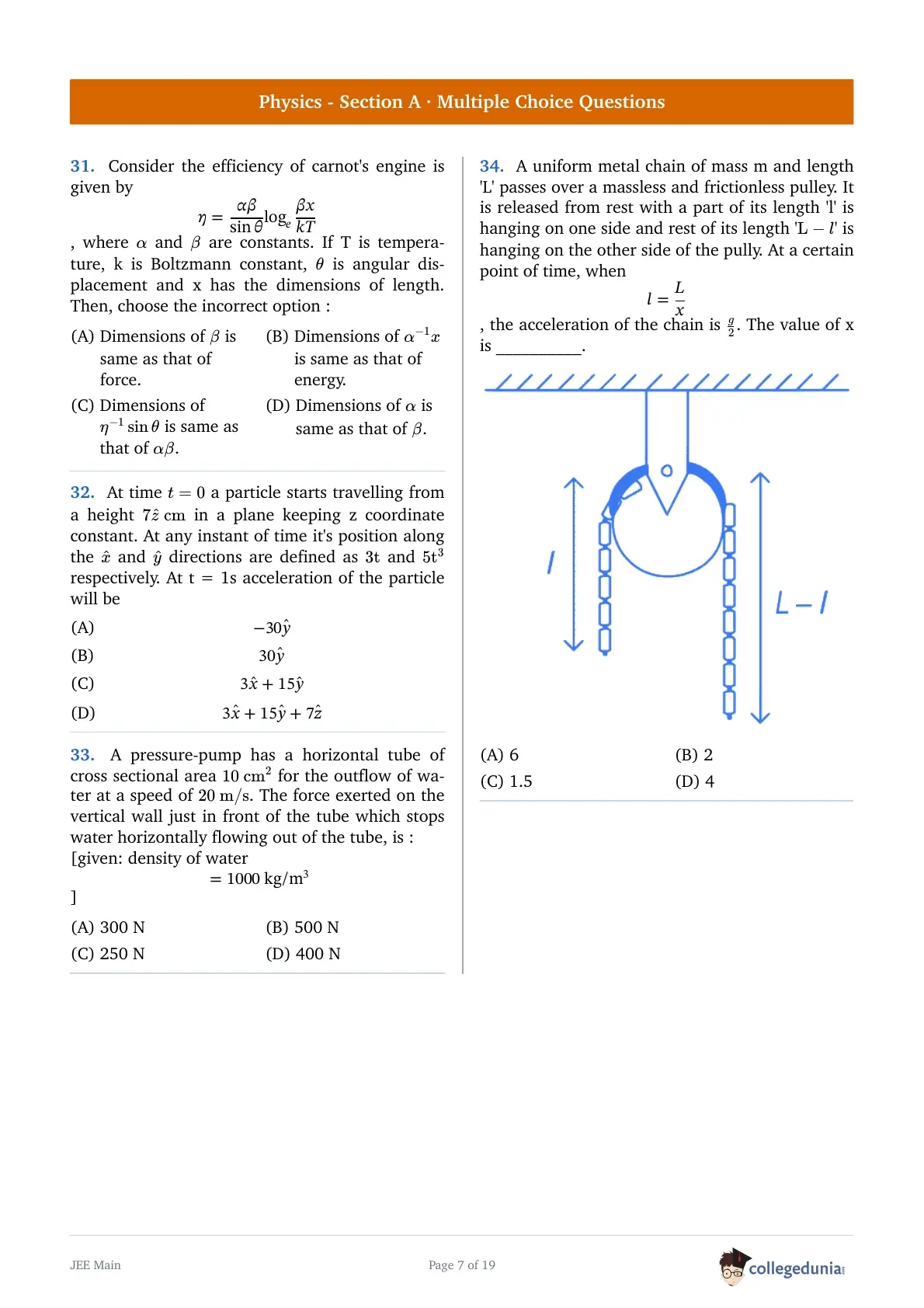
Question 34:
A uniform metal chain of mass m and length ‘\(L\)’ passes over a massless and frictionless pully. It is released from rest with a part of its length ‘\(l\)’ is hanging on one side and rest of its length '\(L – l\)' is hanging on the other side of the pully. At a certain point of time, when \(l = L/x\), the acceleration of the chain is \(g/2\). The value of \(x\) is ______.
  • (1) 6
  • (2) 2
  • (3) 1.5
  • (4) 4

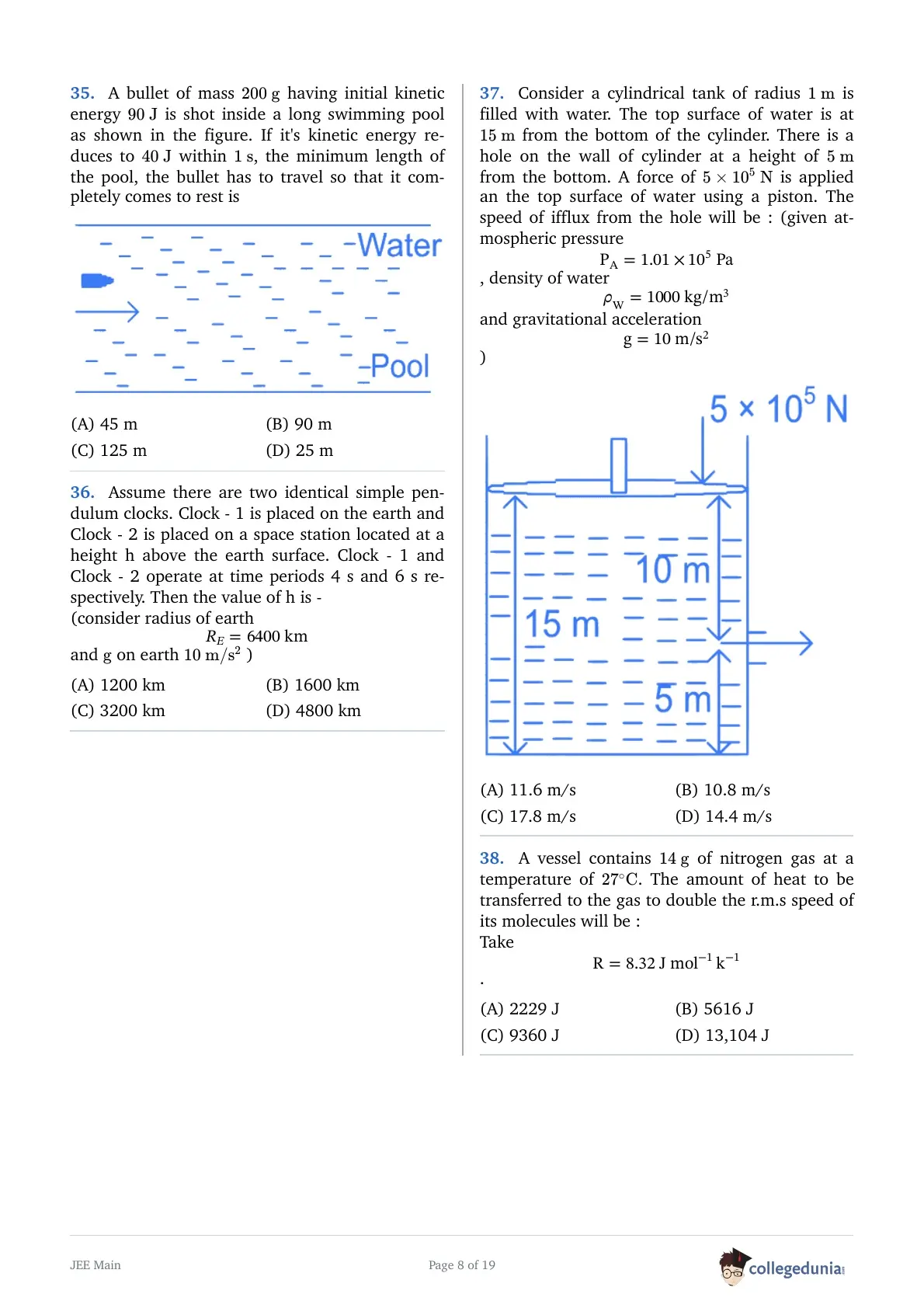
Question 35:
A bullet of mass \(200 g\) having initial kinetic energy \(90 J\) is shot inside a long swimming pool as shown in the figure. If it’s kinetic energy reduces to \(40 J\) within \(1 s\), the minimum length of the pool, the bullet has to travel so that it completely comes to rest is
  • (1) 45 m
  • (2) 90 m
  • (3) 125 m
  • (4) 25 m

Question 36:
Assume there are two identical simple pendulum. Clock -1 is placed on the earth and Clock-2 is placed on a space station located at a height \(h\) above the earth surface. Clock-1 and Clock-2 operate at time periods \(4s\) and \(6s\) respectively. Then the value of \(h\) is -
(consider radius of earth \(R_E = 6400 km\) and \(g\) on earth \(10 m/s^2\) )
  • (1) 1200 km
  • (2) 1600 km
  • (3) 3200 km
  • (4) 4800 km

Question 37:
Consider a cylindrical tank of radius \(1 m\) is filled with water. The top surface of water is at \(15 m\) from the bottom of the cylinder. There is a hole on the wall of cylinder at a height of \(5 m\) from the bottom. A force of  \(5 × 10^5 N\) is applied on the top surface of water using a piston. The speed of efflux from the hole will be: 
(Given atmosphere pressure \(P_A = 1.01 × 10^5 Pa\), density of water \(ρ_w 1000 Kg/m^3\)  and gravitational acceleration \(g = 10 m/s^2\))
 
  • (1) 11.6 m/s
  • (2) 10.8 m/s
  • (3) 17.8 m/s
  • (4) 14.4 m/s

Question 38:
A vessel contains \(14 g\) of nitrogen gas at a temperature of \(27°C\). The amount of heat to be transferred to the gas to double the r.m.s speed of its molecules will be: 
Take \(R=8.32 J-mol^{-1}K^{-1}\)
  • (1) 2229 J
  • (2) 5616 J
  • (3) 9360 J
  • (4) 13,104 J

Question 39:
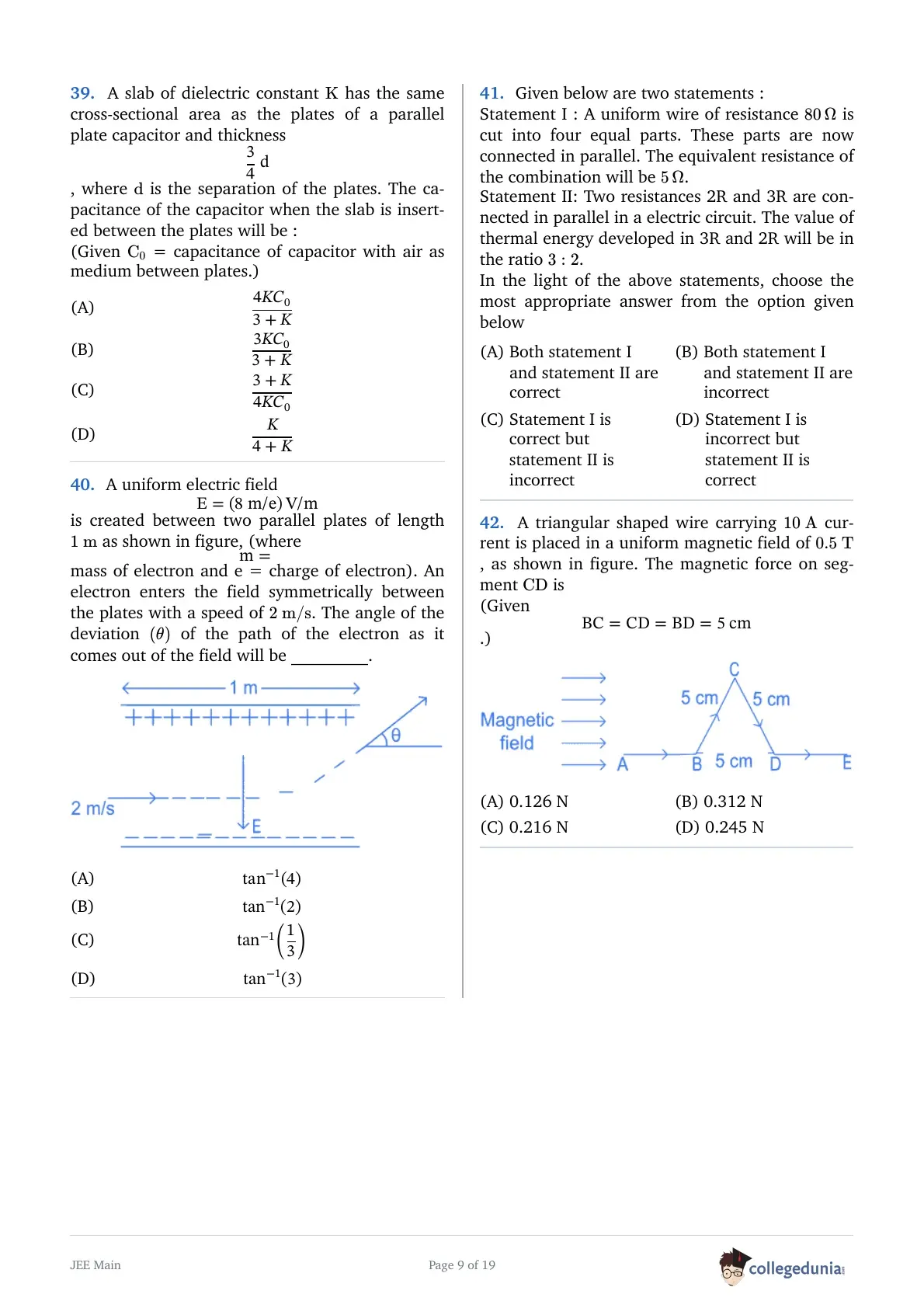
A slab of dielectric constant K has the same cross-sectional area as the plates of a parallel plate capacitor and thickness (3/4)d, where d is the separation of the plates. The capacitance of the capacitor when the slab is inserted between the plates will be: 
(Given \(C_0\) = capacitance of capacitor with air as medium between plates.)
  • (1) \(\frac{4KC_0}{3+K}\)
  • (2) \(\frac{3KC_0}{3+K}\)
  • (3) \(\frac{3+K}{4KC_0}\)
  • (4) \(\frac{K}{4+K}\)

Question 40:
A uniform electric field E = (8m/e) V/m is created between two parallel plates of length 1 m as shown in figure, (where m = mass of electron and e = charge of electron). An electron enters the field symmetrically between the plates with a speed of 2 m/s. The angle of the deviation (θ) of the path of the electron as it comes out of the field will be_______.
  • (1) \(tan^{-1}(4)\)
  • (2) \(tan^{-1}(2)\)
  • (3) \(tan^{-1}(\frac{1}{3})\)
  • (4) \(tan^{-1}(3)\)

Question 41:
Given below are two statements: 
Statement I : A uniform wire of resistance 80 Ω is cut into four equal parts. These parts are now connected in parallel. The equivalent resistance of the combination will be 5 Ω. 
Statement II : Two resistances 2R and 3R are connected in parallel in a electric circuit. The value of thermal energy developed in 3R and 2R will be in the ratio 3 : 2. 
In the light of the above statements, choose the most appropriate answer from the option given below.
  • (1) Both statement I and statement II are correct
  • (2) Both statement I and statement II are incorrect
  • (3) Statement I is correct but statement II is incorrect
  • (4) Statement I is incorrect but statement II is correct

Question 42:
A triangular shaped wire carrying 10 A current is placed in a uniform magnetic field of 0.5 T, as shown in figure. The magnetic force on segment CD is (Given BC = CD = BD = 5 cm).
  • (1) 0.126 N
  • (2) 0.312 N
  • (3) 0.216 N
  • (4) 0.245 N

Question 43:

The magnetic field at the center of current carrying circular loop is \(B_1\). The magnetic field at a distance of √3 times radius of the given circular loop from the center on its axis is \(B_2\). The value of \(B_1/B_2\) will be

  • (1) 9 : 4
  • (2) 12 : √5
  • (3) 8 : 1
  • (4) 5 : √3

Question 44:

A transformer operating at primary voltage 8 kV and secondary voltage 160 V serves a load of 80 kW. Assuming the transformer to be ideal with purely resistive load and working on unity power factor, the loads in the primary and secondary circuit would be

  • (1) 800 Ω and 1.06 Ω
  • (2) 10 Ω and 500 Ω
  • (3) 800 Ω and 0.32 Ω
  • (4) 1.06 Ω and 500 Ω

Question 45:

Sun light falls normally on a surface of area \(36 cm^2\) and exerts an average force of \(7.2 × 10^{–9} N\) within a time period of \(20 minutes\). Considering a case of complete absorption, the energy flux of incident light is

  • (1) \(25.92×10^2 W/cm^2\)
  • (2) \(8.64 × 10^{-6 }W/cm^2\)
  • (3) \(6.0 W/cm^2\)
  • (4) \(0.06 W/cm^2\)

Question 46:

The power of a lens (biconvex) is \(1.25 m^{–1}\) in particular medium. Refractive index of the lens is \(1.5\), and the radii of curvature are \(20 cm\) and \(40 cm\), respectively. The refractive index of surrounding medium

  • (1) 1
  • (2) \(\frac{9}{7}\)
  • (3) \(\frac{3}{2}\)
  • (4) \(\frac{4}{3}\)

Question 47:

Two streams of photons, possessing energies equal to five and ten times the work function of metal are incident on the metal surface successively. The ratio of maximum velocities of the photoelectron emitted, in the two cases respectively, will be

  • (1) 1 : 2
  • (2) 1:3
  • (3) 2 : 3
  • (4) 3 : 2

Question 48:

A radioactive sample decays 7/8 times its original quantity in 15 minutes. The half-life of the sample is

  • (1) 5 min
  • (2) 7.5 min
  • (3) 15 min
  • (4) 30 min

Question 49:
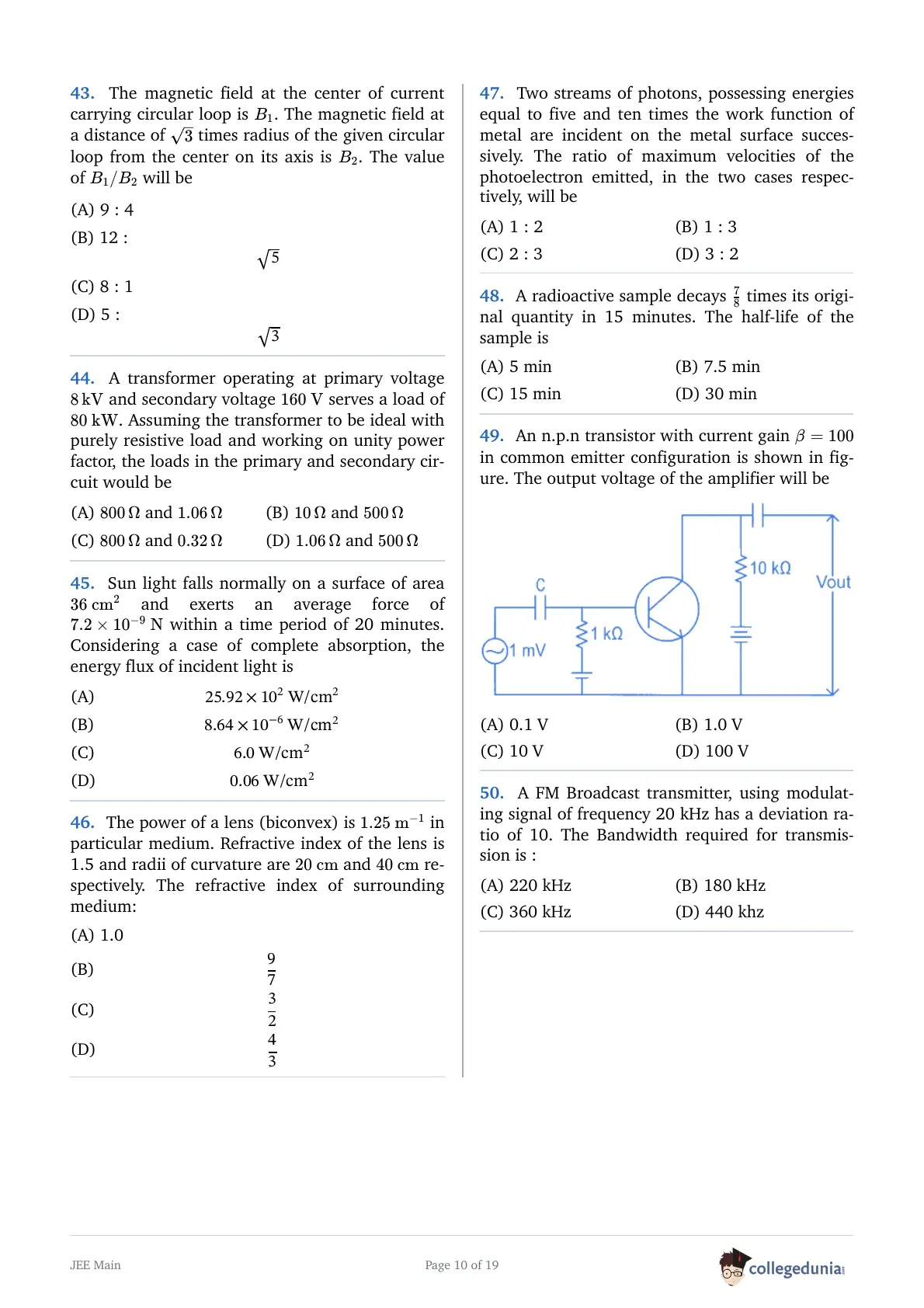
An npn transistor with current gain \(β = 100\) in common emitter configuration is shown in the figure. The output voltage of the amplifier will be
  • (1) 0.1 V
  • (2) 1.0 V
  • (3) 10 V
  • (4) 100 V

Question 50:

A FM Broad cast transmitter, using modulating signal of frequency 20 kHz has a deviation ratio of 10. The Bandwidth required for transmission is

  • (1) 220 kHz
  • (2) 180 kHz
  • (3) 360 kHz
  • (4) 440 kHz

Physics - Section B (Q51 - Q60)

Question 51:

A ball is thrown vertically upwards with a velocity of \(19.6 ms^{–1}\) from the top of a tower. The ball strikes the ground after \(6 s\). The height from the ground up to which the ball can rise will be \((k/5) m\). The value of k is ______ (use \(g = 9.8 m/s^2\))


Question 52:

The distance of centre of mass from end \(A\) of a one dimensional rod (\(AB\)) having mass density \(ρ=ρ_0(1-\frac{x^2}{L^2})kg/m\) and length L. (in meter) is \(\frac{3L}{α} m\). The value of \(α\) is......... (where \(x\) is the distance form end \(A\))


Question 53:
A string of area of cross-section \(4mm^2\) and length \(0.5 m\) is connected with a rigid body of mass \(2 kg\). The body is rotated in a vertical circular path of radius \(0.5 m\). The body acquires a speed of \(5 m/s\) at the bottom of the circular path. Strain produced in the string when the body is at the bottom of the circle is ______\(×10^{–5}\). 
(use young’s modulus \(10^{11} N/m^2\) and \(g = 10 m/s^2\))

Question 54:

At a certain temperature, the degrees of freedom per molecule for gas is 8. The gas performs 150 J of work when it expands under constant pressure. The amount of heat absorbed by the gas will be ______ J.


Question 55:

The potential energy of a particle of mass \(4 kg\) in motion along the x-axis is given by \(U = 4(1- cos 4x) J\). The time period of the particle for small oscillation \((sin θ ≃ θ)\) is \((\frac{π}{K})\) s. The value of \(K\) is ..........


Question 56:

An electrical bulb rated 220 V, 100 W, is connected in series with another bulb rated 220 V, 60 W. If the voltage across combination is 220 V, the power consumed by the 100 W bulb will be about ____ W.


Question 57:
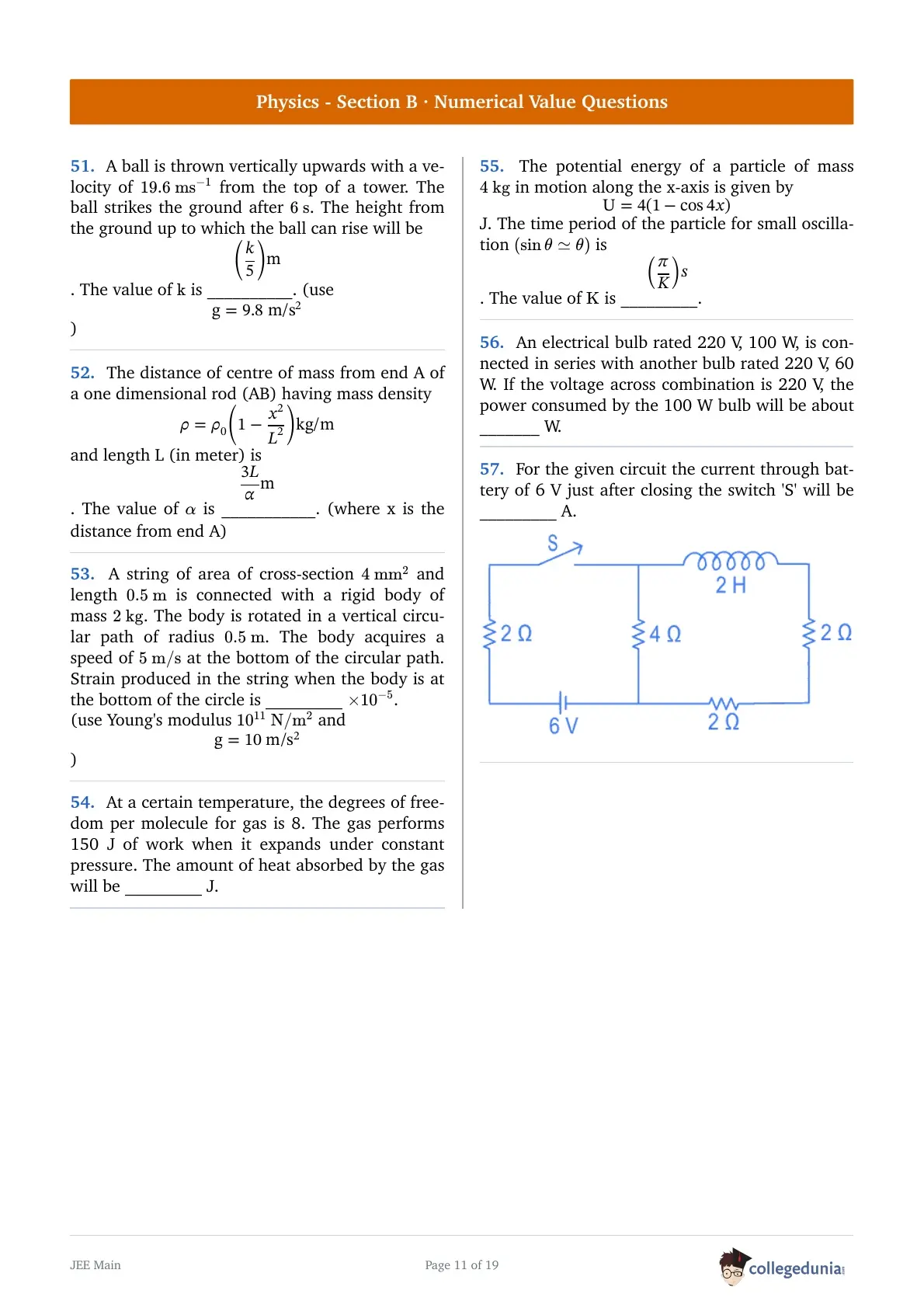
For the given circuit the current through battery of 6 V just after closing the switch S will be _____ A.

Question 58:
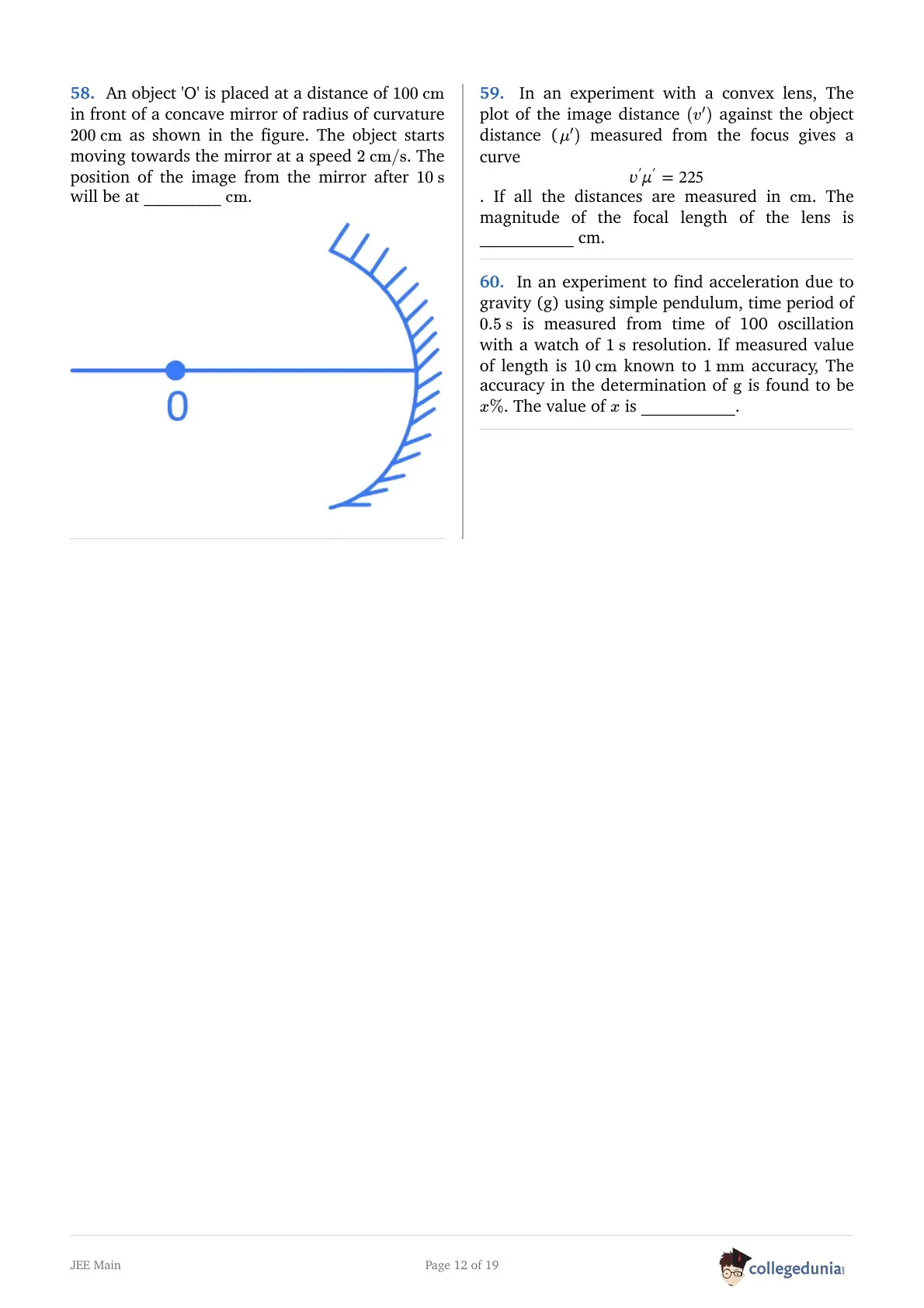
An object O is placed at a distance of 100 cm in front of a concave mirror of radius of curvature 200 cm as shown in the figure. The object starts moving towards the mirror at a speed 2 cm/s. The position of the image from the mirror after 10 s will be at ____ cm.

Question 59:

In an experiment with a convex lens, the plot of the image distance (ν′) against the object distance (μ′) measured from the focus gives a curve ν′μ′ = 225. If all the distances are measured in cm. The magnitude of the focal length of the lens is _______ cm.


Question 60:

In an experiment to find acceleration due to gravity (g) using simple pendulum, time period of 0.5 s is measured from time of 100 oscillations with a watch of 1 s resolution. If measured value of length is 10 cm known to 1 mm accuracy, the accuracy in the determination of g is found to be x %. The value of x is _________ .


Chemistry - Section A (Q61 - Q80)

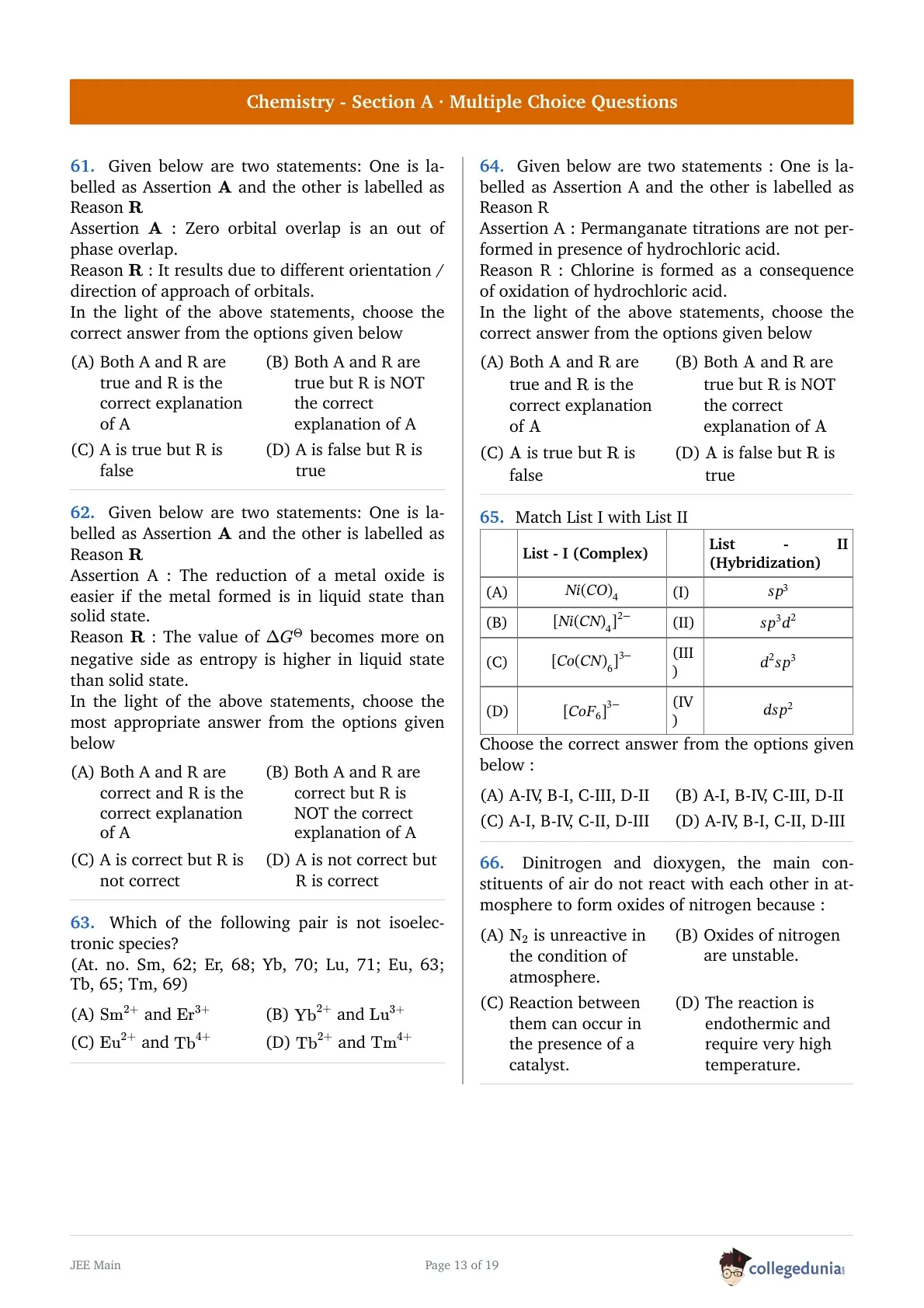
Question 61:
Given below are two statements: One is labelled as Assertion A and the other is labelled as Reason R 
Assertion A: Zero orbital overlap is an out of phase overlap. 
Reason R: It results due to different orientation/direction of approach of orbitals. 
In the light of the above statements, choose the correct answer from the options given below
  • (1) Both A and R are true and R is the correct explanation of A
  • (2) Both A and R are true but R is NOT the correct explanation of A
  • (3) A is true but R is false
  • (4) A is false but R is true

Question 62:
Given below are two statements: One is labelled as Assertion A and the other is labelled as Reason R 
Assertion A: The reduction of a metal oxide is easier if the metal formed is in liquid state than solid state. 
Reason R: The value of ΔG⊖ becomes more on negative side as entropy is higher in liquid state than solid state.
In the light of the above statements, choose the most appropriate answer from the options given below.
  • (1) Both A and R are correct and R is the correct explanation of A
  • (2) Both A and R are correct but R is not the correct explanation of A
  • (3) A is correct but R is not correct
  • (4) A is not correct but R is correct

Question 63:
Which of the following pairs is not isoelectronic species? 
(At. no. Sm, 62; Er, 68; Yb, 70; Lu, 71; Eu, 63; Tb, 65; Tm, 69)
  • (1) \(Sm^{2+} \space and \space Er^{3+}\)
  • (2) \(Yb^{2+} \space and \space Lu^{3+}\)
  • (3) \(Eu^{2+} \space and \space Tb^{4+}\)
  • (4) \(Tb^{2+} \space and \space Tm^{4+}\)

Question 64:
Given below are two statements: One is labelled as Assertion A and the other is labelled as Reason R. 
Assertion A: Permanganate titrations are not performed in presence of hydrochloric acid. 
Reason R: Chlorine is formed as a consequence of oxidation of hydrochloric acid. 
In the light of the above statements, choose the correct answer from the options given below.
  • (1) Both A and R are true and R is the correct explanation of A
  • (2) Both A and R are true but R is NOT the correct explanation of A
  • (3) A is true but R is false
  • (4) A is false but R is true

Question 65:
Match List-I with List-II
 List-I
(Complex)
 List-II
(Hybridization)
A.Ni(CO)4I.sp3
B.[Ni(CN)4]2-II.sp3d2
C.[Co(CN)6]3-III.d2sp3
D.[CoF6]3-IV.dsp2
Choose the correct answer from the options given below:
  • (1) A-IV, B-I, C-III, D-II
  • (2) A-I. B-IV, C-III, D-II
  • (3) A-I. B-IV, C-II, D-III
  • (4) A-IV, B-I, C-II. D-III

Question 66:

Dinitrogen and dioxygen, the main constituents of air do not react with each other in atmosphere to form oxides of nitrogen because

  • (1) N2 is unreactive in the condition of atmosphere
  • (2) Oxides of nitrogen are unstable
  • (3) Reaction between them can occur in the presence of a catalyst
  • (4) The reaction is endothermic and require very high temperature

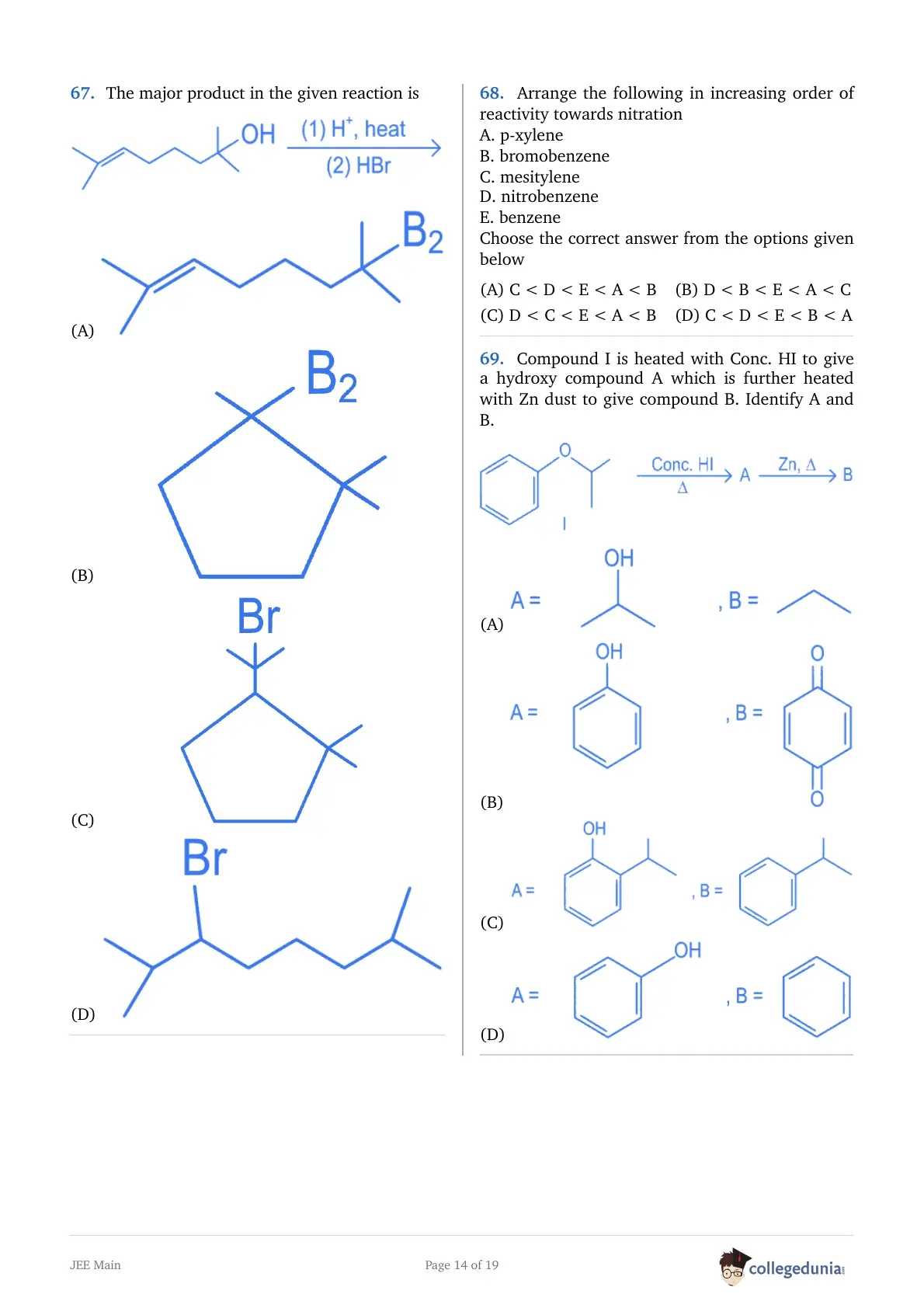
Question 67:
The major product in the given reaction is
  • (1)
  • (2)
  • (3)


  • (4)

Question 68:
Arrange the following in increasing order of reactivity towards nitration 
A. p-xylene 
B. bromobenzene 
C. mesitylene 
D. nitrobenzene 
E. benzene
  • (1) C < D < E < A < B
  • (2) D < B < E < A < C
  • (3) D < C < E < A < B
  • (4) C < D < E < B < A

Question 69:
Compound I is heated with Conc. HI to give a hydroxy compound A which is further heated with Zn dust to give compound B. Identify A and B.
  • (1)
  • (2)
  • (3)
  • (4)

Question 70:
Given below are two statements: one is labelled as Assertion A and the other is labelled as Reason R 
Assertion A : Aniline on nitration yields ortho, meta & para nitro derivatives of aniline. 
Reason R : Nitrating mixture is a strong acidic mixture. 
In the light of the above statements, choose the correct answer from the options given below.
  • (1) Both A and R are true and R is the correct explanation of A
  • (2) Both A and R are true but R is NOT the correct explanation of A
  • (3) A is true but R is false
  • (4) A is false but R is true

Question 71:
Given below are two statements: One is labelled as Assertion A and the other is labelled as Reason R. 
Assertion A: Thin layer chromatography is an adsorption chromatography. 
Reason R: A thin layer of silica gel is spread over a glass plate of suitable size inthin layer chromatography which acts as an adsorbent. 
In the light of the above statements, choose the correct answer from the options given below
  • (1) Both A and R are true and R is the correct explanation of A.
  • (2) Both A and R are true but R is NOT the correct explanation of A
  • (3) A is true but R is false
  • (4) A is false but R is true

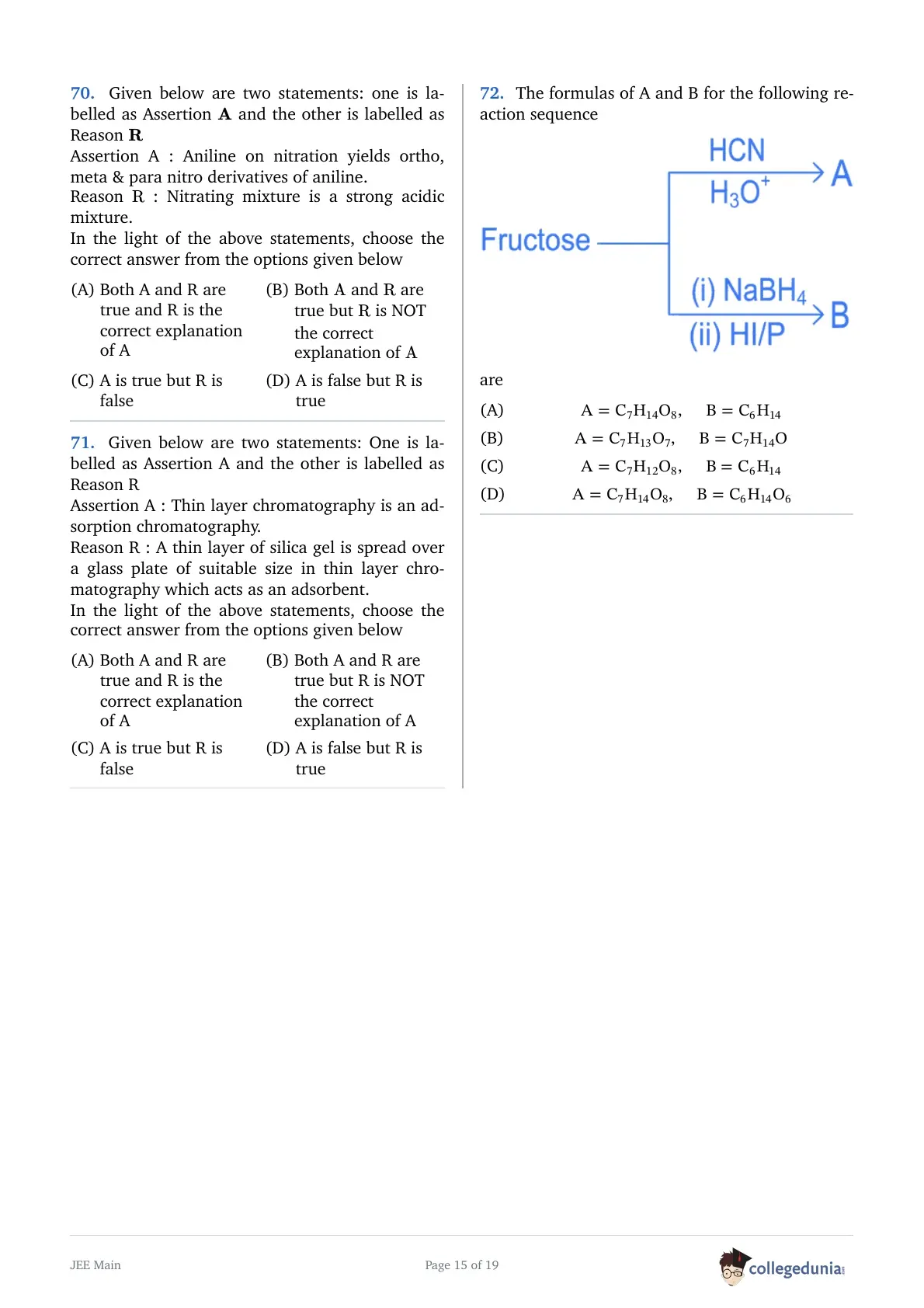
Question 72:
The formulas of A and B for the following reaction sequence are
  • (1) A = C7H14O8, B = C6H14
  • (2) A = C7H13O7, B = C7H14O
  • (3) A = C7H12O8, B = C6H14
  • (4) A = C7H14O8, B = C6H14O6

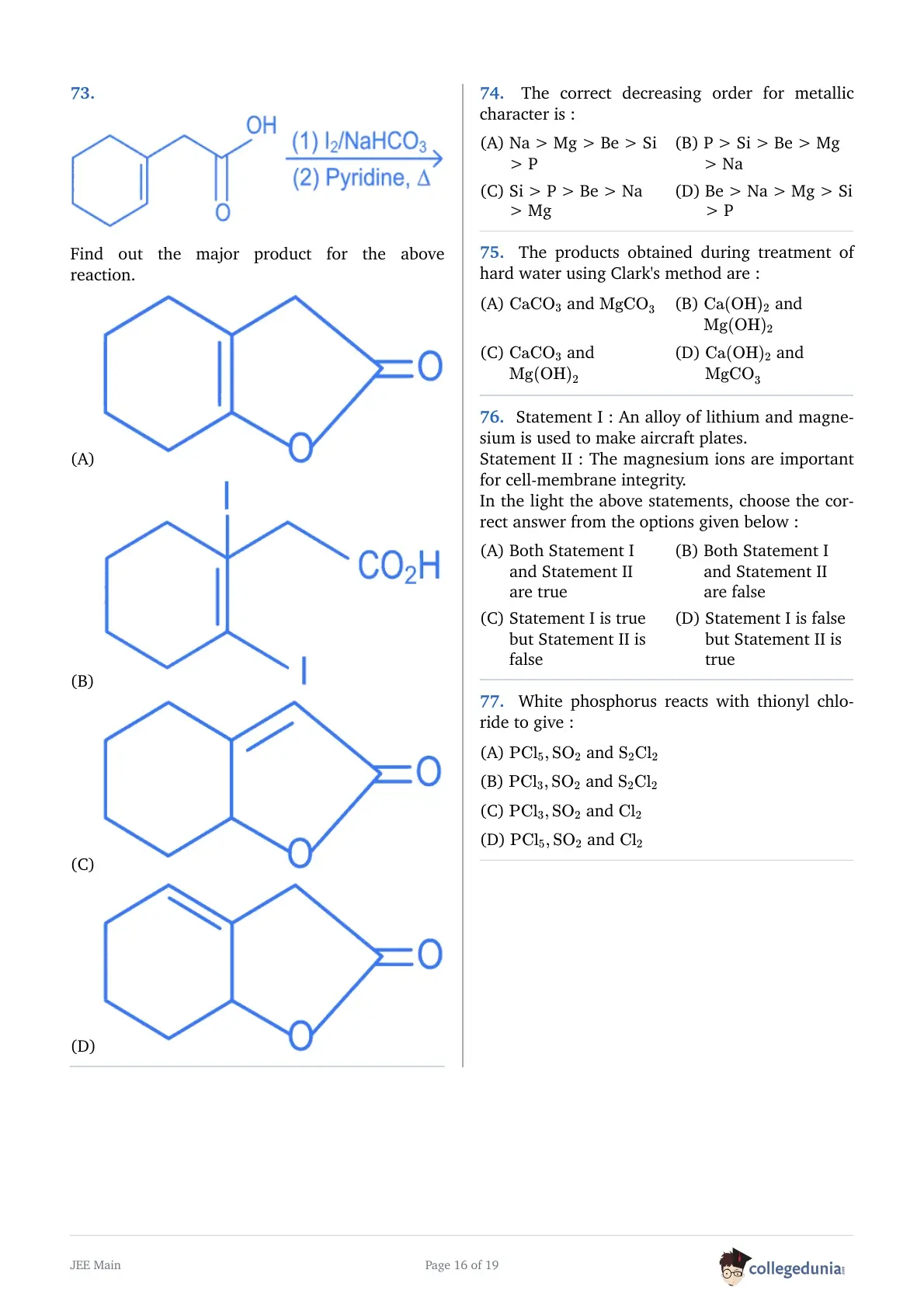
Question 73:
Find out the major product for the above reaction.

 
  • (1)
  • (2)
  • (3)
  • (4)

Question 74:

The correct decreasing order for metallic character is

  • (1) Na > Mg > Be > Si > P
  • (2) P > Si > Be > Mg > Na
  • (3) Si > P > Be > Na > Mg
  • (4) Si > P > Be > Na > Mg

Question 75:

The products obtained during treatment of hard water using Clark’s method are:

  • (1) \(CaCO_3 and MgCO_3\)
  • (2) \(Ca(OH)_2 and Mg(OH)_2\)
  • (3) \(CaCO_3 and Mg(OH)_2\)
  • (4) \(Ca(OH)_2 and MgCO_3\)

Question 76:
Statement-I: An alloy of lithium and magnesium is used to make aircraft plates. 
Statement-II: The magnesium ions are important for cell-membrane integrity. 
In the light of the above statements, choose the correct answer from the options given below:
  • (1) Both Statement-I and Statement-II are true
  • (2) Both Statement-I and Statement-II are false
  • (3) Statement-I is true but Statement-II is false
  • (4) Statement-I is false but Statement-II is true

Question 77:

White phosphorus reacts with thionyl chloride to give

  • (1) \(PCI_5,SO_2 and S_2Cl_2\)
  • (2) \(PCI_3, SO_2 and S_2Cl_2\)
  • (3) \(PCI_3, SO_2 and Cl_2\)
  • (4) \(PCl_5, SO_2 and Cl_2\)

Question 78:

Concentrated \(HNO_3\) reacts with Iodine to give

  • (1) \(HI, NO_2 \space {and} \space H_2O\)
  • (2) \(HIO_2, N_2O \space and \space H_2O\)
  • (3) \(HIO_3, NO_2 \space and \space H_2O\)
  • (4) \(HIO_4, N_2O \space and \space H_2O\)

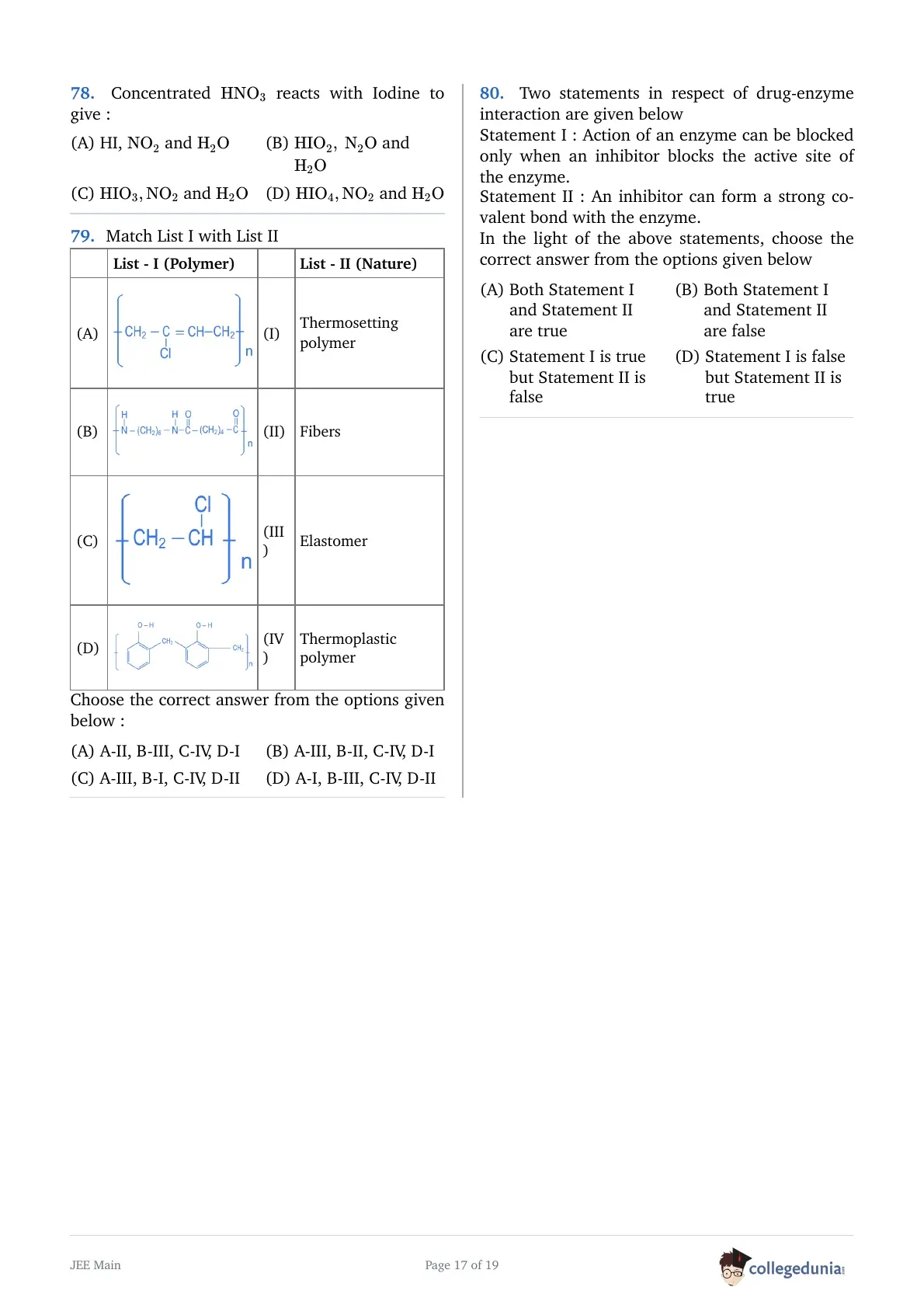
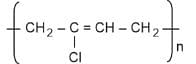
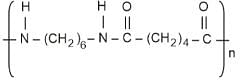
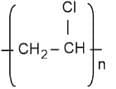
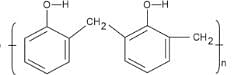
Question 79:
Match List I with List II
 List I (polymer) List-II (Nature)
A.
 
I.
Thermosetting polymer
B.II.
Fibers
C.III.
Elastomer
D.IV.Thermoplastic polymer
Choose the correct answer from the options given below:
  • (1) A-II, B-III, C-IV, D-I
  • (2) A-III, B-II, C-IV, D-I
  • (3) A-III, B-I, C-IV, D-II
  • (4) A-I, B-III, C-IV, D-II

Question 80:
Two statements in respect of drug-enzyme interaction are given below 
Statement I: Action of an enzyme can be blocked only when an inhibitor blocks the active site of the enzyme. 
Statement II: An inhibitor can form a strong covalent bond with the enzyme. 
In the light of the above statements, choose the correct answer from the options given below
  • (1) Both Statement I and Statement II are true
  • (2) Both Statement I and Statement II are false
  • (3) Statement I is true but Statement II is false
  • (4) Statement I is false but Statement II is true

Chemistry - Section B (Q81 - Q90)

Question 81:

2 L of 0.2 M \(H_2SO_4\) is reacted with 2 L of 0.1 M NaOH solution, the molarity of the resulting product \(Na_2SO_4\) in the solution is _______ millimolar. (Nearest integer)


Question 82:
If the wavelength for an electron emitted from H-atom is 3.3 × 10⁻¹⁰ m, then energy absorbed by the electron in its ground state compared to minimum energy required for its escape from the atom, is ______ times. (Nearest integer)
\(\begin{array}{l}\left[\text{Given} : h = 6.626 \times 10^{-34}~ \text{J s}\right]\\ \left[\text{Mass of electron} = 9.1 \times 10^{-31} ~\text{kg}\right]\end{array}\)

Question 83:

A gaseous mixture of two substances A and B, under a total pressure of 0.8 atm is in equilibrium with an ideal liquid solution. The mole fraction of substance A is 0.5 in the vapour phase and 0.2 in the liquid phase. The vapour pressure of pure liquid A is ______ atm. (Nearest integer)


Question 84:
At 600 K, 2 mol of NO are mixed with 1 mol of \(O_2\). 
\(\begin{array}{l}2NO\left(g\right)+O_2\left(g\right)\rightleftharpoons 2NO_2\left(g\right)\end{array} \)
The reaction occurring as above comes to equilibrium under a total pressure of 1 atm. Analysis of the system shows that 0.6 mol of oxygen are present at equilibrium. The equilibrium constant for the reaction is _______. (Nearest integer)

Question 85:
A sample of 0.125 g of an organic compound when analysed by Duma’s method yields 22.78 mL of nitrogen gas collected over KOH solution at 280 K and 759 mm Hg. The percentage of nitrogen in the given organic compound is____.(Nearest integer) 
Given : 1. The vapour pressure of water of 280 K is 14.2 mm Hg. 
            2. R = 0.082 L atm K–1 mol–1

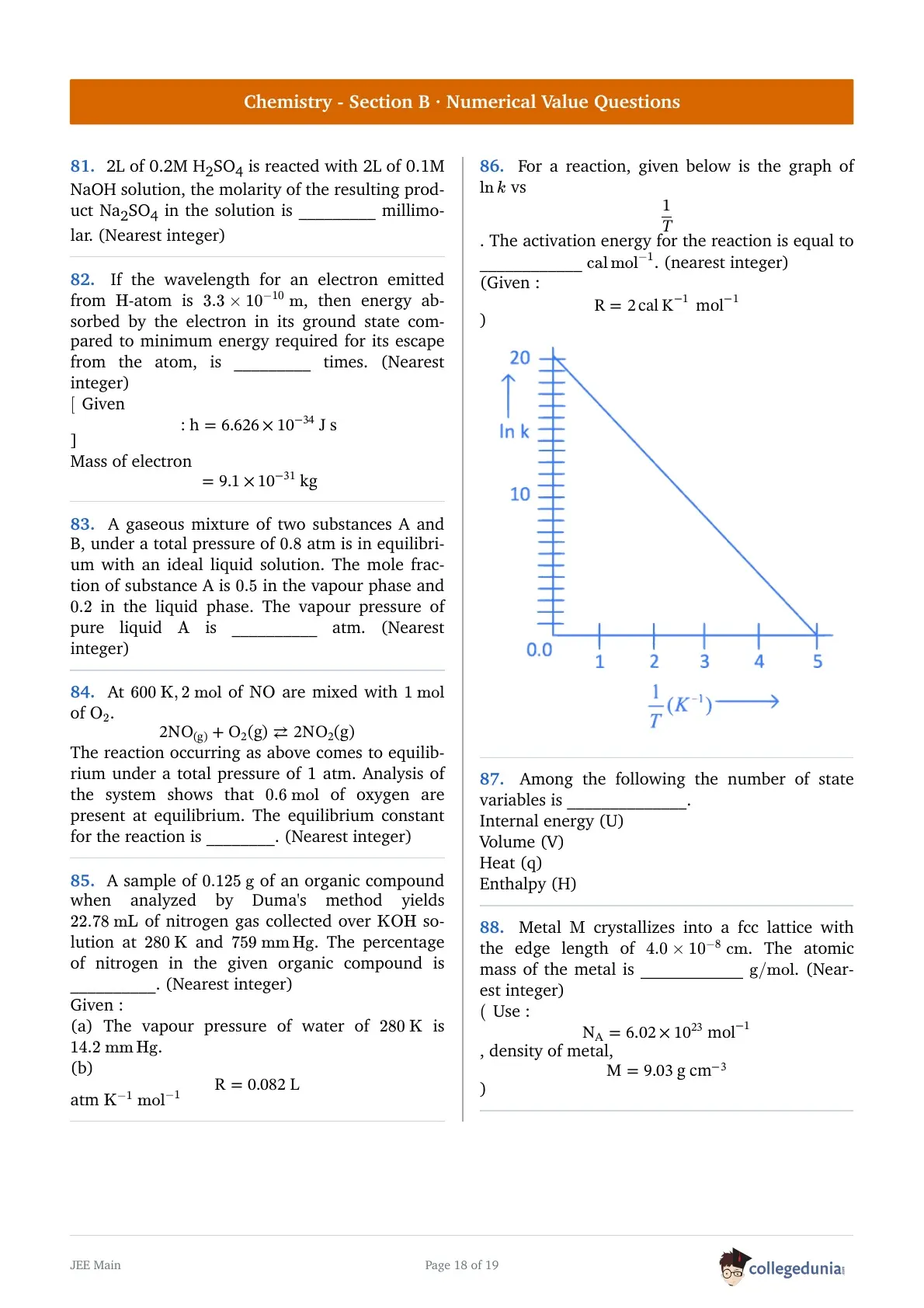
Question 86:

For a reaction, given below is the graph of ln k vs 1/T. The activation energy for the reaction is equal to____ \(cal mol^{–1}\). (Nearest integer) 

(Given: \(R = 2 cal K^{-1} mol^{-1}\))

Graph In k vs T


Question 87:
Among the following the number of state variables is____. 
Internal energy (U) 
Volume (V) 
Heat (q) 
Enthalpy (H)

Question 88:
Metal M crystallizes into a fcc lattice with the edge length of \(4.0 × 10^{–8} cm\). The atomic mass of the metal is _______ g/mol. (Nearest integer) 
(Use :\( N_A=6.02×10^{23} mol^{-1}\),density of metal , \(M = 9.03 g cm^{- 3}\))

Question 89:

On reaction with stronger oxidizing agent like KIO4, hydrogen peroxide oxidizes with the evolution of O2. The oxidation number of I in KIO4 changes to____.


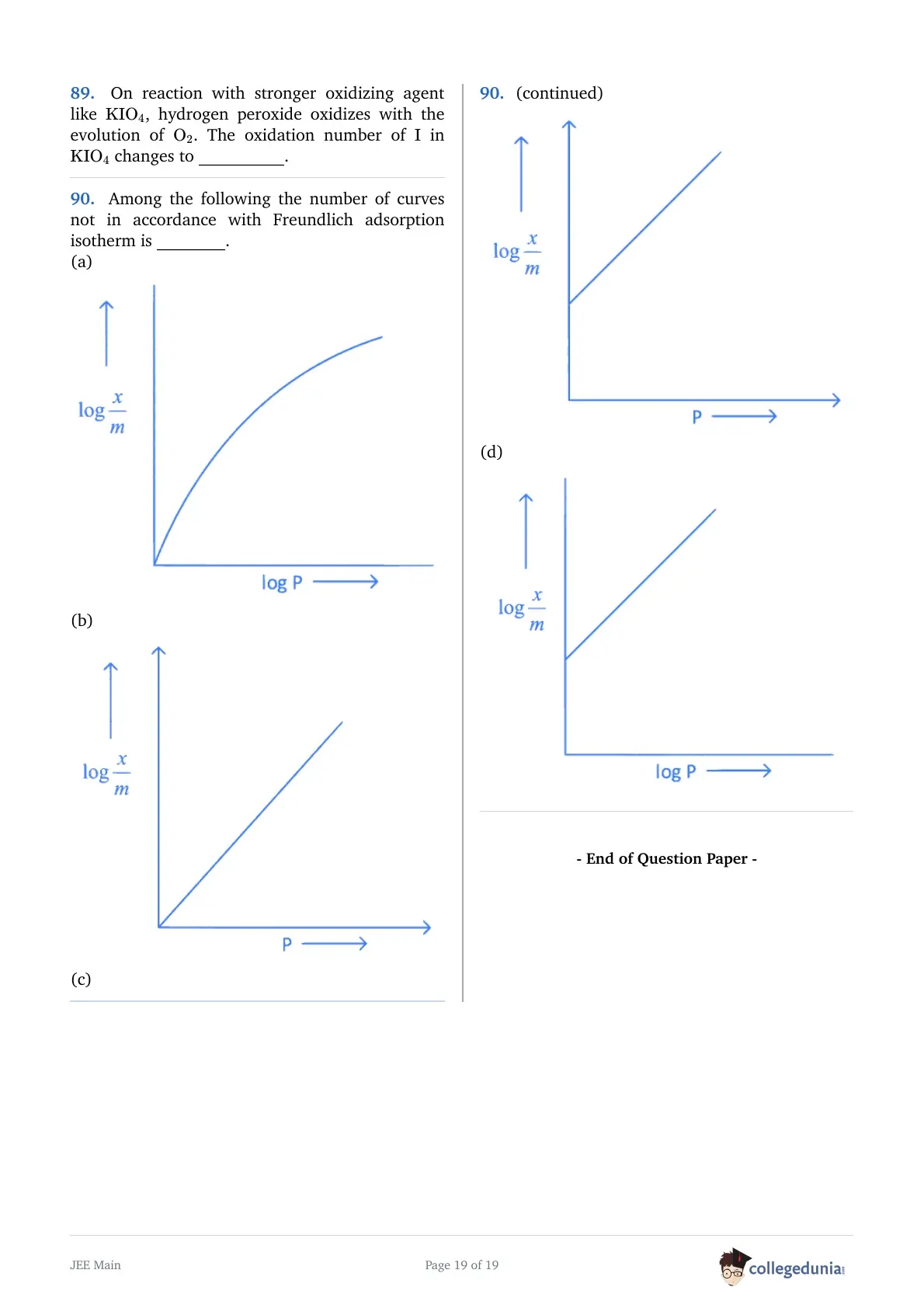
Question 90:
Among the following the number of curves not in accordance with Freundlich adsorption isotherm is____.

JEE Main 2022 Exam Pattern and Marking Scheme

ParticularsDetails
Exam ModeOnline (Computer-Based Test)
PaperB.E./B.Tech (Paper 1)
Duration3 hours (180 minutes)
Type of QuestionsMultiple Choice Questions (MCQs) + Numerical Value Questions
SubjectsMathematics, Physics, Chemistry
Total Questions90 questions (75 to be attempted)
Total Marks300 marks
Marking Scheme+4 for correct answer & -1 for incorrect MCQ and Numerical Value-based Questions

JEE Main 2022 July 28 Shift 2 Difficulty Level

The question paper was reported moderate in difficulty level. Students found Mathematics section as difficulty and lengthy, Physics as moderate and Chemistry easy. Check JEE Main 2022 July 28 Shift 2 Paper Analysis

JEE Main 2022 July 28 Shift 2 Subject-wise Memory-Based Solutions PDF

Subject Memory-Based Solutions PDF
Physics Download PDF
Chemistry Download PDF
Mathematics Download PDF

JEE Main 2022 Phase 2 Question Papers with Solution PDFs

Candidates can also check shift-wise JEE Main 2022 Phase 2 Question Papers with Solution PDFs. These shift-wise question paper PDFs for JEE Main 2022 will help candidates know the overall difficulty, topics with the highest weightage and the type of questions asked in the exam.

JEE Main 2022 Phase 1 Question Papers with Solution PDFs

Shift-wise JEE Main 2022 Phase 1 Question Papers with Solution PDFs are also available. Candidates preparing for Phase 2 of the exam can check and download JEE Main Question Paper PDFs to practice and test their exam prep level.

Also Check: