




JEE Main 2022 July 29 Shift 2 Question Paper is available here with solutions PDF and detailed solutions for every question. NTA conducted the second shift on July 29, 2022, from 3:00 PM to 6:00 PM. The JEE Main 2022 Paper 1 (B.E./B.Tech) question paper includes the following:
- 90 questions in a 3-hour CBT Mode: 30 each from Mathematics, Physics and Chemistry (75 to be attempted)
- Section A: 20 multiple choice questions (MCQs) per subject, all compulsory, 4 marks each
- Section B: 10 numerical value questions per subject, any 5 to be attempted, 4 marks each
- Marking: +4 for a correct answer, -1 for an incorrect answer, 0 for an unattempted question
- Maximum marks: 300 (100 per subject)
JEE Main 2022 July 29 Shift 2 Question Paper with Solution PDF
| NTA Official PDF | CD PDF | CD PDF with Solutions |
|---|---|---|
| Download official PDF 4.55 MB | Download Collegedunia PDF 1.07 MB | Download solutions PDF 1.21 MB |
Also Check:
JEE Main 2022 July 29 Shift 2 Questions with Solutions
Mathematics - Section A (Q1 - Q20)
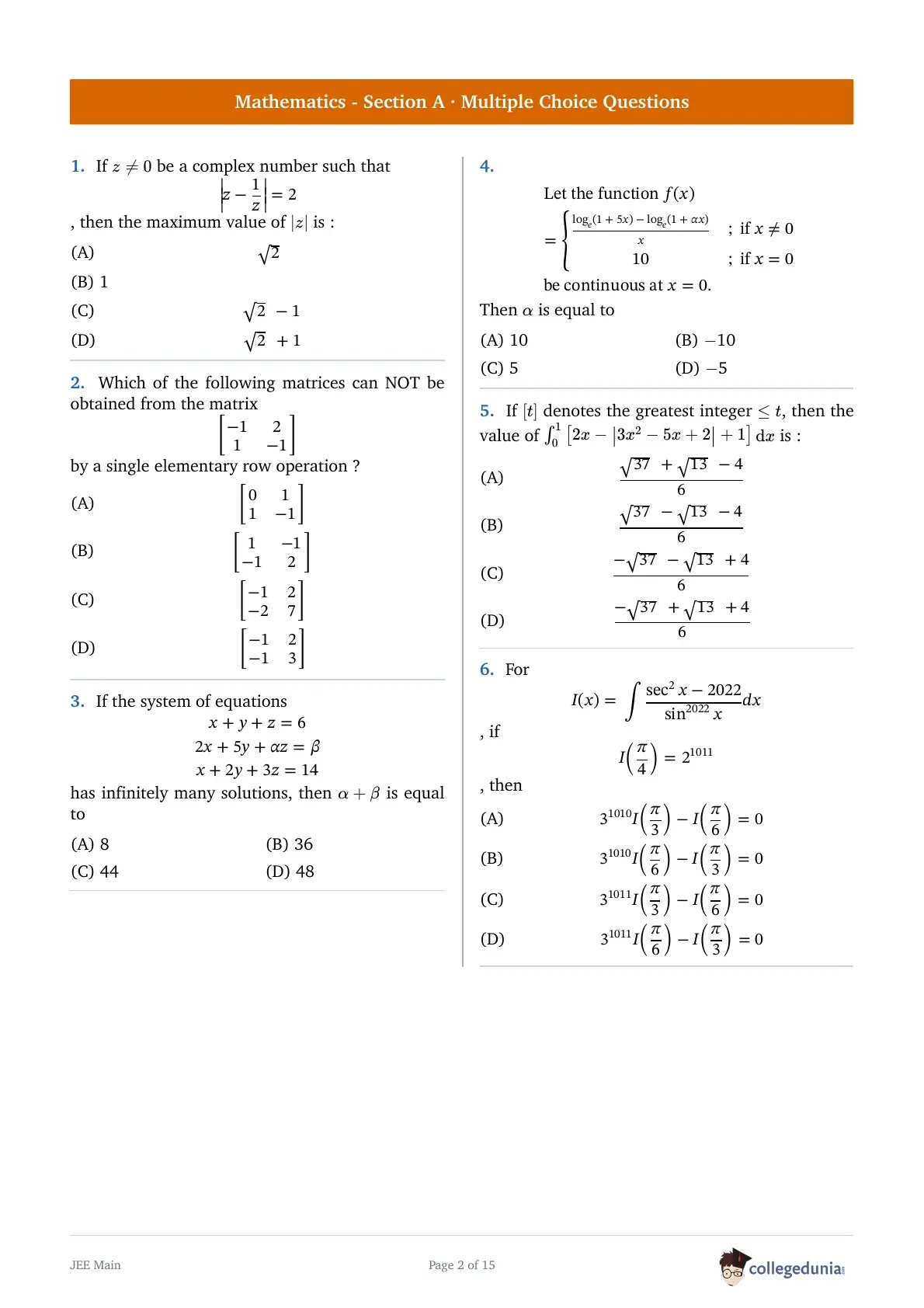
If z ≠ 0 be a complex number such that\(|z-\frac{1}{z}|=2\), then the maximum value of |z| is
Which of the following matrices can NOT be obtained from the matrix \(\begin{bmatrix} -1 &2 \\ 1 & -1 \end{bmatrix}\) by a single elementary row operation?
If the system of equations
\( x + y + z = 6 \),
\( 2x + 5y + \alpha z = \beta \),
\( x + 2y + 3z = 14 \)
has infinitely many solutions, then \( \alpha + \beta \) is equal to:
Let the function
\(f(x)\)=\(\begin{cases} \frac{\log_e(1+5x) - \log_e(1+\alpha x)}{x}, & \text{if } x ∈ 0 \\ \space 10 & \text;{if } x = 0 \\ \end{cases}\)
be continuous at x = 0. Then α is equal to
If [t] denotes the greatest integer ≤ t, then the value of \(\int\limits_{0}^{1}\)[2x−|\(3x^2\)−5x+2|+1]dx is
For \(I(x) = \int \frac{\sec^2 x - 2022}{\sin^{2022} x} \, dx, \quad \text{if } I\left(\frac{\pi}{4}\right) = 2^{1011}\), then
If the solution curve of the differential equation \(\frac{dy}{dx} = \frac{x + y - 2}{x - y}\) passes through the points \((2, 1)\) and (k + 1, 2), k > 0, then
Let \(y = y(x)\) be the solution curve of the differential equation
\(\frac{dy}{dx} + \frac{2x^2 + 11x + 13}{x^3 + 6x^2 + 11x + 6}y = (x+3)(x+1), \quad x > -1.\)
which passes through the point \((0, 1)\). Then \(y(1)\) is equal to
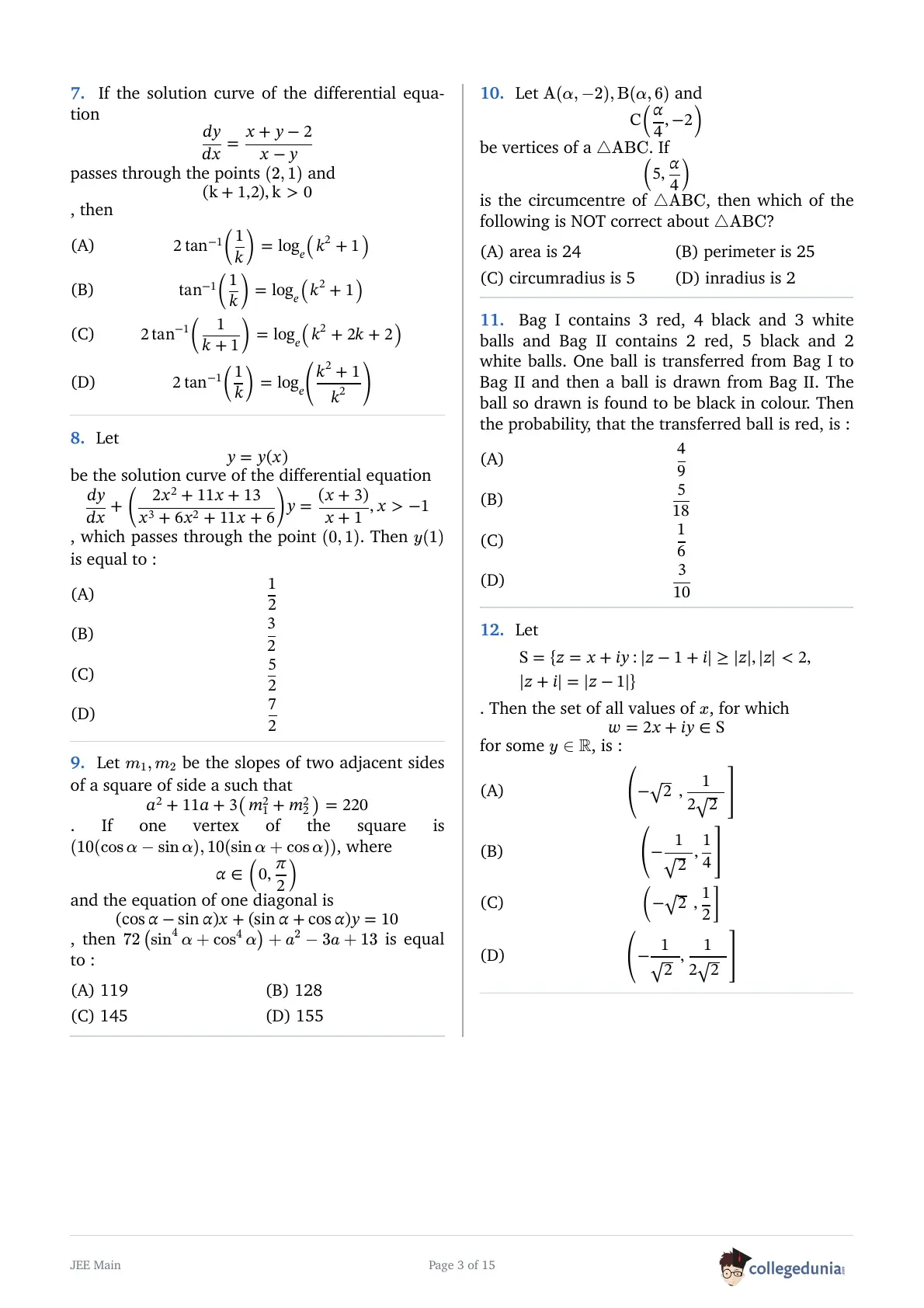
Let m1, m2 be the slopes of two adjacent sides of a square of side a such that \(a^2 + 11a + 3(m_1^2 + m_2^2) = 220\). If one vertex of the square is \((10(\cos \alpha - \sin \alpha), 10(\sin \alpha + \cos \alpha))\), where \(\alpha \in \left(0, \frac{\pi}{2}\right)\)and the equation of one diagonal is \((\cos \alpha - \sin \alpha)x + (\sin \alpha + \cos \alpha)y = 10\), then \(72(\sin^4 \alpha + \cos^4 \alpha) + a^2 - 3a + 13\) is equal to :
Let A(α, -2), B(α, 6) and C(\(\frac{\alpha}{4}\), -2) be vertices of a ΔABC. If (5, \(\frac{\alpha}{4}\)) is the circumcentre of ΔABC, then which of the following is NOT correct about ΔABC?
Bag I contains 3 red, 4 black and 3 white balls and Bag II contains 2 red, 5 black and 2 white balls. One ball is transferred from Bag I to Bag II and then a ball is drawn from Bag II. The ball so drawn is found to be black in colour. Then the probability, that the transferred ball is red, is :
Let S={z=x+iy:|z–1+i|≥|z|,|z|<2,|z+i|=|z–1|}.
Then the set of all values of x, for which w = 2x + iy ∈ S for some y ∈ R is
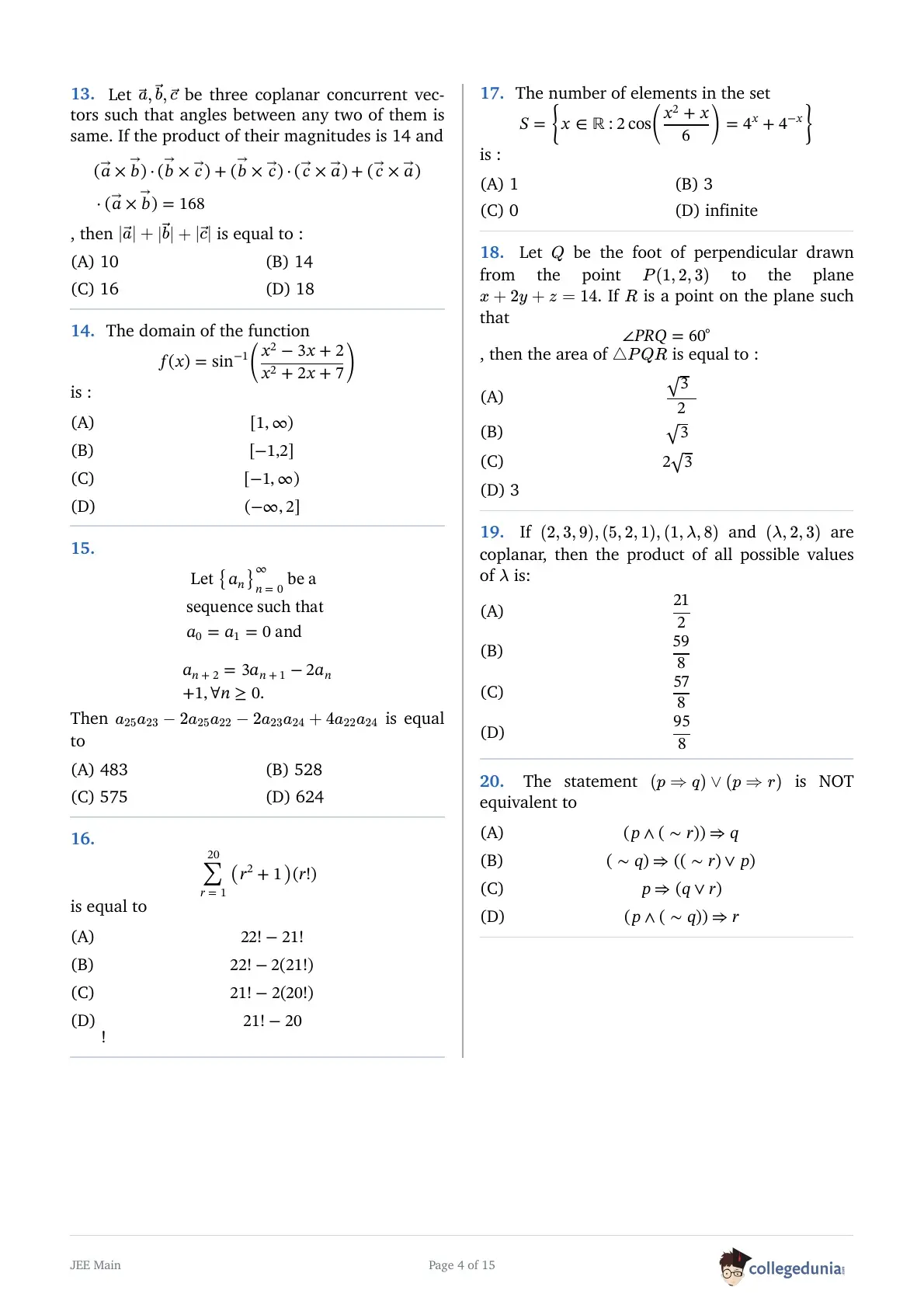
Let \(\vec{a}, \vec{b}, \vec{c}\)
be three coplanar concurrent vectors such that angles between any two of them is same. If the product of their magnitudes is 14 and
\((\vec{a} \times \vec{b}) \cdot (\vec{b} \times \vec{c}) + (\vec{b} \times \vec{c}) \cdot (\vec{c} \times \vec{a}) + (\vec{c} \times \vec{a}) \cdot (\vec{a} \times \vec{b}) = 168\), then \(|\vec{a}| + |\vec{b}| + |\vec{c}|\)| is equal to :
The domain of the function
\(f(x) = \sin^{-1}\left(\frac{x^2 - 3x + 2}{x^2 + 2x + 7}\right)\)
is :
Let {an}n=0∞ be a sequence such that a0=a1=0 and an+2=3an+1−2an+1,∀ n≥0. Then a25a23−2a25a22−2a23a24+4a22a24 is equal to
\(\sum_{r=1}^{20}\)(r2+1)(r!) is equal to
The number of elements in the set S= {x∈R : 2cos\((\frac{x_2+x}{6})\)=\(4^x+4^{-x}\)}
Let Q be the foot of perpendicular drawn from the point P(1, 2, 3) to the plane x + 2y + z = 14. If R is a point on the plane such that ∠PRQ = 60°, then the area of ΔPQR is equal to :
If (2, 3, 9), (5, 2, 1), (1, λ, 8) and (λ, 2, 3) are coplanar, then the product of all possible values of λ is :
The statement
\((p⇒q)∨(p⇒r) \)
is NOT equivalent to
Mathematics - Section B (Q21 - Q30)
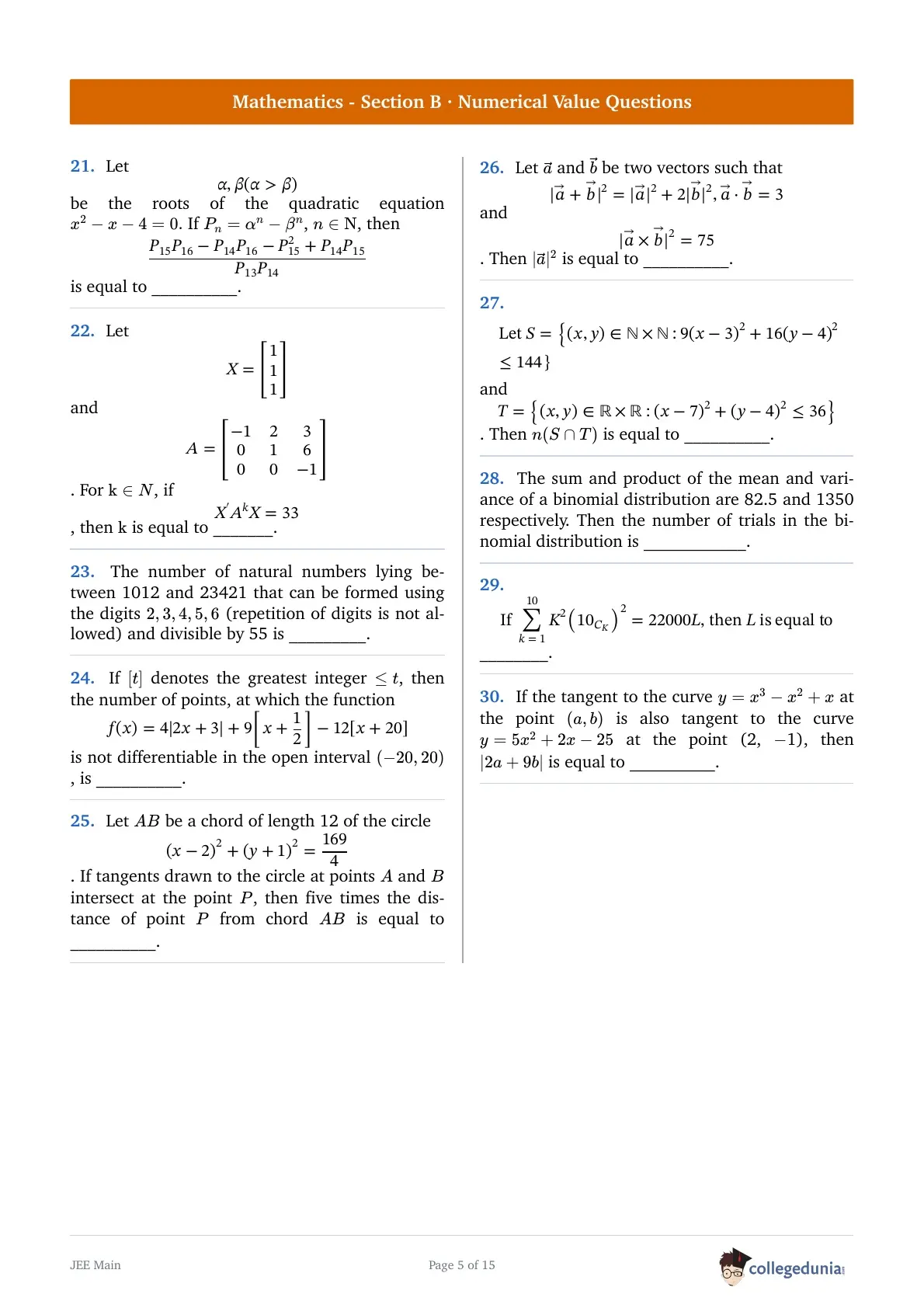
Let α, β(α > β) be the roots of the quadratic equation x2 – x – 4 = 0.
If \(P_n=α^n–β^n, n∈N\) then \(\frac{P_{15}P_{16}–P_{14}P_{16}–P_{15}^2+P_{14}P_{15}}{P_{13}P_{14}}\)
is equal to _______.
Let
\(x = \begin{bmatrix} 1 \\ 1 \\ 1 \end{bmatrix}\) and \(A = \begin{bmatrix} -1 & 2 & 3 \\ 0 & 1 & 6 \\ 0 & 0 & -1 \end{bmatrix}\)
For k ∈ N, if X’AkX = 33, then k is equal to ____ .
The number of natural numbers lying between 1012 and 23421 that can be formed using the digits 2, 3, 4, 5, 6 (repetition of digits is not allowed) and divisible by 55 is ____ .
If [t] denotes the greatest integer ≤ t, then the number of points, at which the function
\(f(x) = 4|2x + 3| + 9\lfloor x + \frac{1}{2} \rfloor - 12\lfloor x + 20 \rfloor\)
is not differentiable in the open interval (–20, 20), is ____ .
Let AB be a chord of length 12 of the circle
\(\begin{array}{l}(x-2)^2 + (y+1)^2=\frac{169}{4}.\end{array}\)
If tangents drawn to the circle at points A and B intersect at the point P, then five times the distance of point P from chord AB is equal to _____ .
Let
\(\vec{a}\) and \(\vec{b}\) be two vectors such that
\(|\vec{a} + \vec{b}|^2 = |\vec{a}|^2 + 2|\vec{b}|^2,\ \vec{a} \cdot \vec{b} = 3\) and \(|\vec{a} \times \vec{b}|^2 = 75\)
Then \(|\vec{a}|^2\) is equal to _____.
Let \(S=\left\{(x,y)∈\N×\N:9(x−3)^2+16(y−4)^2≤144\right\}\)
and \(T=\left\{(x,y)∈\R×\R:(x−7)^2+(y−4)^2≤36\right\}.\)
Then n(S ⋂ T) is equal to ____ .
The sum and product of the mean and variance of a binomial distribution are 82.5 and 1350 respectively. Then the number of trials in the binomial distribution is _______.
If
\(\begin{array}{l}\sum_{K=1}^{10}K^2\left(^{10}C_K\right)^2 = 22000L,\end{array}\)then L is equal to _____.
If the tangent to the curve y = x3 – x2 + x at the point (a, b) is also tangent to the curve y = 5x2 + 2x – 25 at the point (2, –1), then |2a + 9b| is equal to _____ .
Physics - Section A (Q31 - Q50)
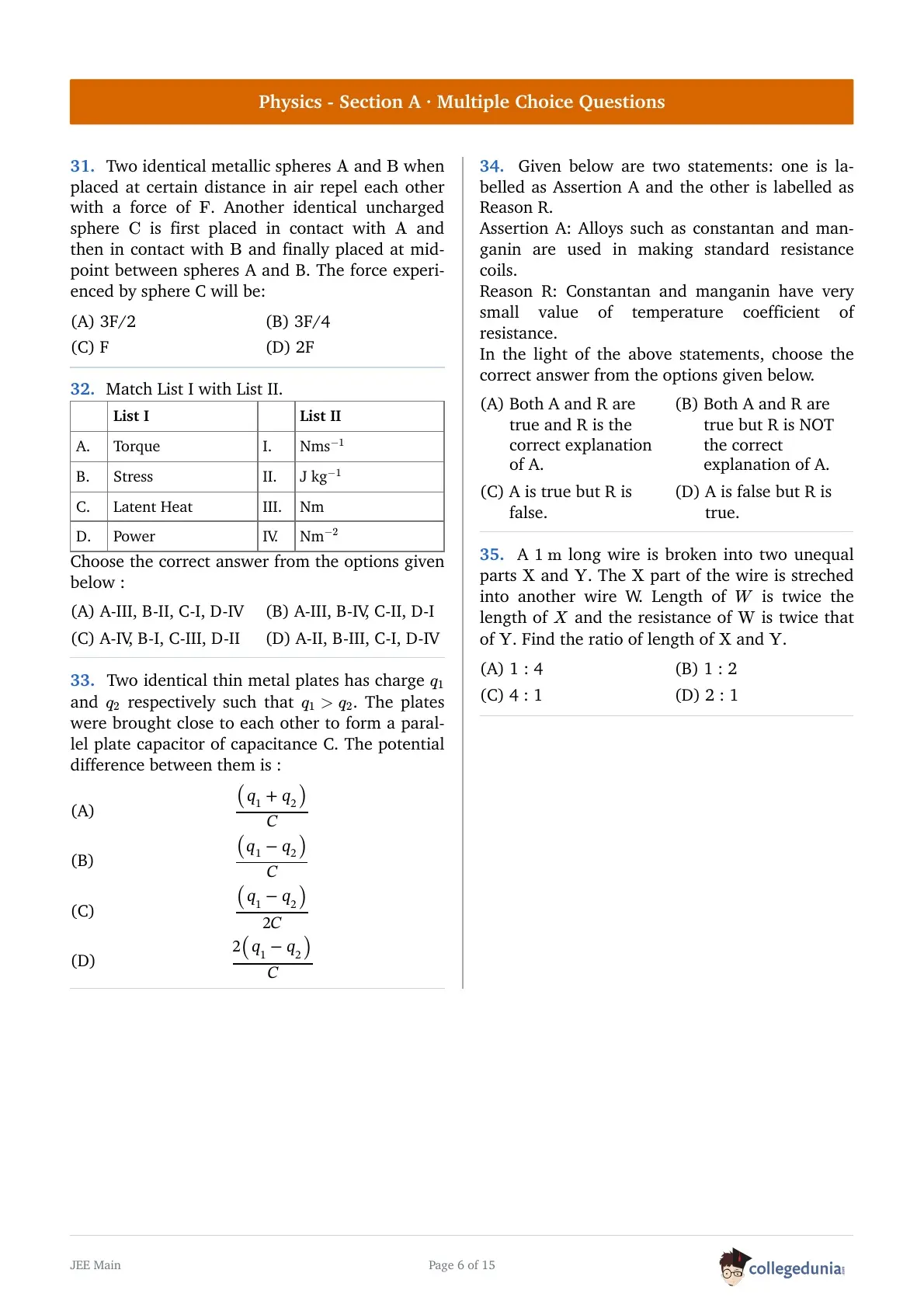
Two identical metallic spheres A and B when placed at certain distance in air repel each other with a force of F. Another identical uncharged sphere C is first placed in contact with A and then in contact with B and finally placed at midpoint between spheres A and B. The force experienced by sphere C will be
Match List I with List II.
| List I | List II | ||
|---|---|---|---|
| A. | Torque | I. | Nms–1 |
| B. | Stress | II. | Jkg–1 |
| C. | Latent Heat | III. | Nm |
| D. | Power | IV | Nm–2 |
Choose the correct answer from the options given below
Two identical thin metal plates has charge q1 and q2 respectively such that q1 > q2. The plates were brought close to each other to form a parallel plate capacitor of capacitance C. The potential difference between them is
Given below are two statements: one is labelled as Assertion A and the other is labelled as Reason R.
Assertion A: Alloys such as constantan and manganin are used in making standard resistance coils.
Reason R: Constantan and manganin have very small value of temperature coefficient of resistance.
In the light of the above statements, choose the correct answer from the options given below.
A 1 m long wire is broken into two unequal parts X and Y. The X part of the wire is stretched into another wire W. Length of W is twice the length of X and the resistance of W is twice that of Y. Find the ratio of length of X and Y.
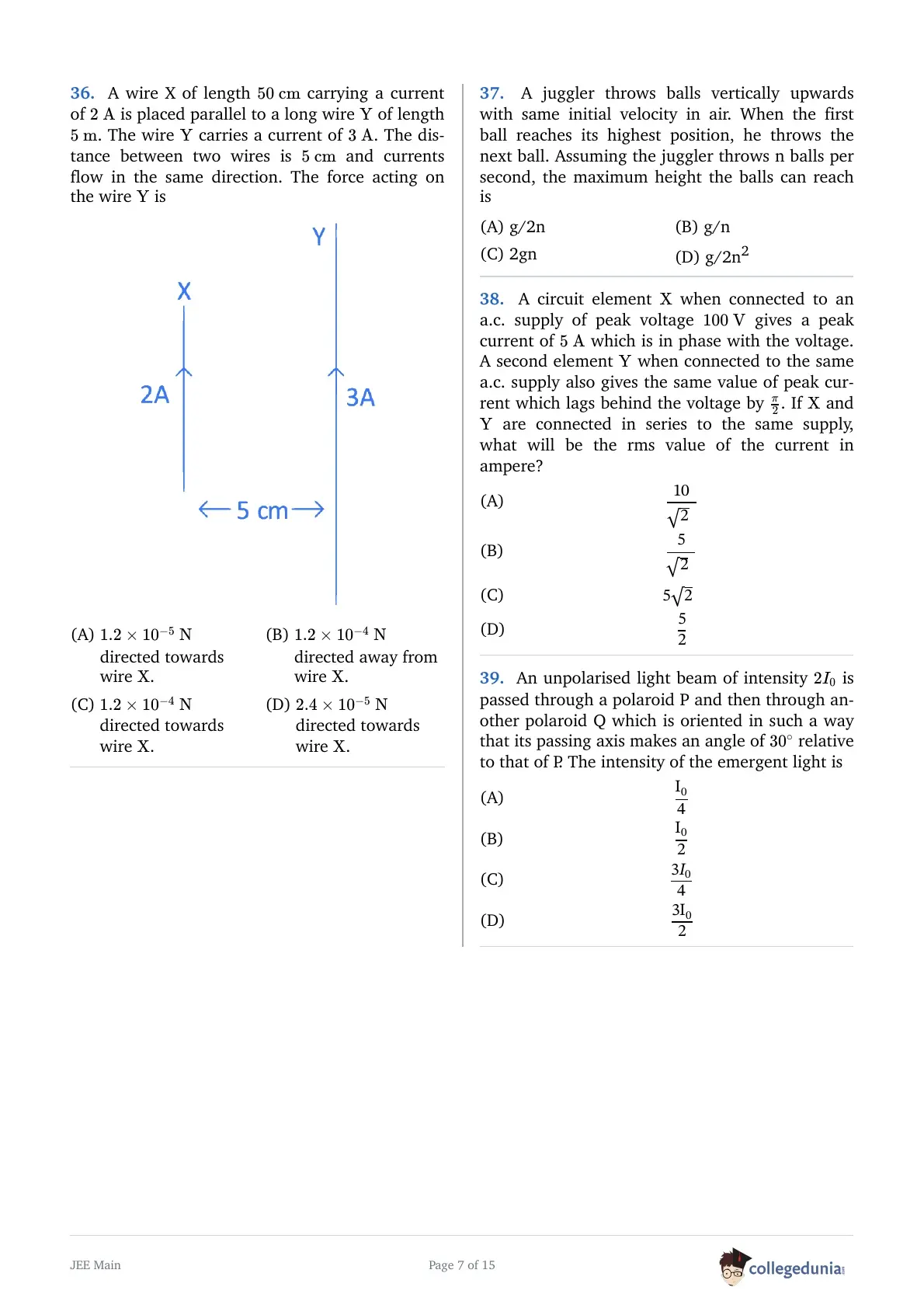
A wire X of length 50 cm carrying a current of 2 A is placed parallel to a long wire Y of length 5 m. The wire Y carries a current of 3 A. The distance between two wires is 5 cm and currents flow in the same direction. The force acting on the wire Y is

A juggler throws balls vertically upwards with same initial velocity in air. When the first ball reaches its highest position, he throws the next ball. Assuming the juggler throws n balls per second, the maximum height the balls can reach is
A circuit element X when connected to an a.c. supply of peak voltage 100 V gives a peak current of 5 A which is in phase with the voltage. A second element Y when connected to the same a.c. supply also gives the same value of peak current which lags behind the voltage by \(\frac{π}{2}\). If X and Y are connected in series to the same supply, what will be the rms value of the current in ampere?
An unpolarised light beam of intensity 2I0 is passed through a polaroid P and then through another polaroid Q which is oriented in such a way that its passing axis makes an angle of 30° relative to that of P. The intensity of the emergent light is
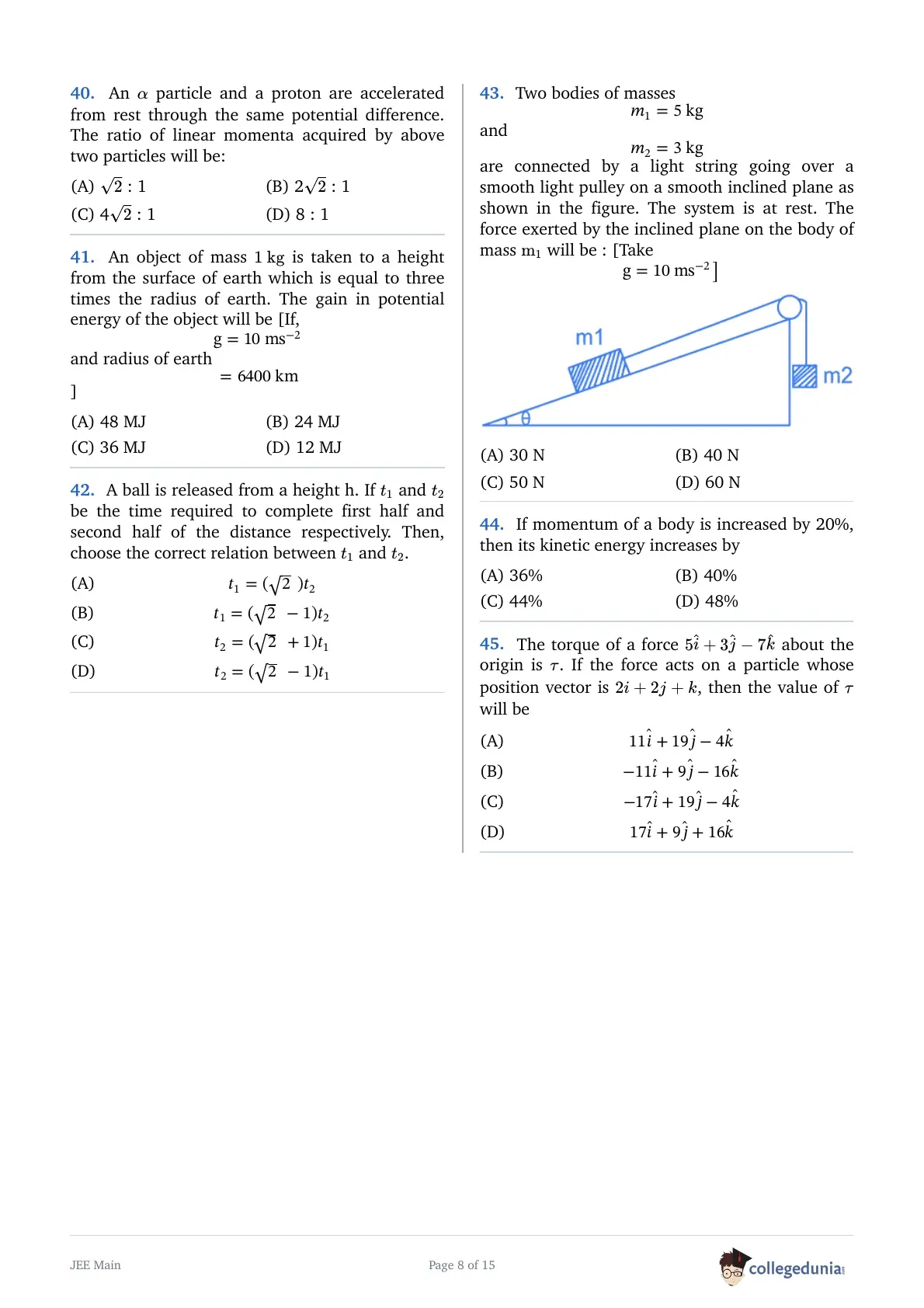
An α particle and a proton are accelerated from rest through the same potential difference. The ratio of linear momenta acquired by above two particles will be:
An object of mass 1 kg is taken to a height from the surface of earth which is equal to three times the radius of earth. The gain in potential energy of the object will be
[If, g = 10 ms–2 and radius of earth = 6400 km]
A ball is released from a height h. If t1 and t2 be the time required to complete first half and second half of the distance respectively. Then, choose the correct relation between t1 and t2..
Two bodies of masses m1 = 5 kg and m2 = 3 kg are connected by a light string going over a smooth light pulley on a smooth inclined plane as shown in the figure. The system is at rest. The force exerted by the inclined plane on the body of mass m1 will be
[Take g = 10 ms–2]

If momentum of a body is increased by 20%, then its kinetic energy increases by
The torque of a force \(5\^{i}+3\^{j}−7\^{k}\) about the origin is τ. If the force acts on a particle whose position vector is\( 2\^{i}+2\^{j}+\^{k}\), then the value of τ will be
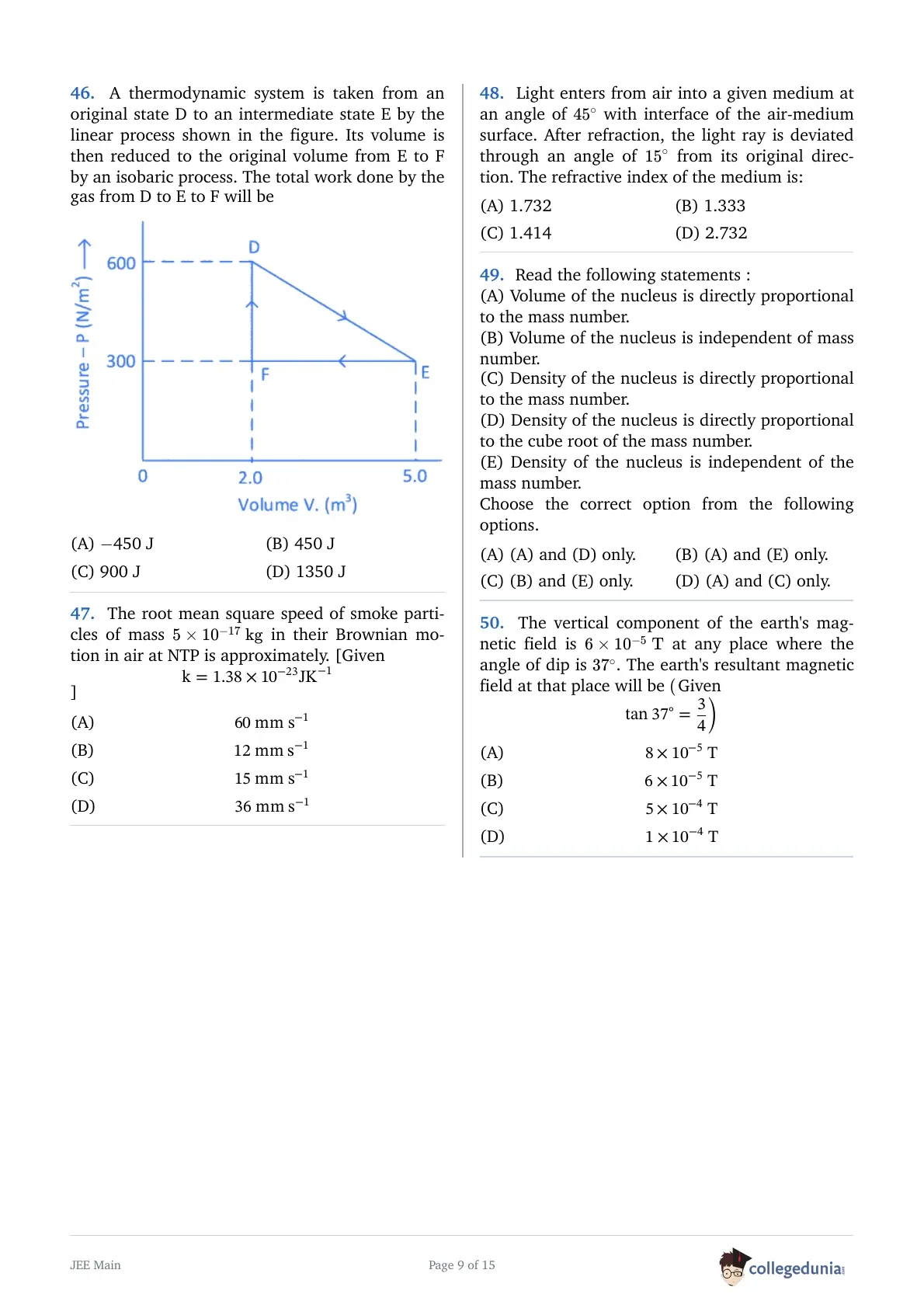
A thermodynamic system is taken from an original state D to an intermediate state E by the linear process shown in the figure. Its volume is then reduced to the original volume from E to F by an isobaric process. The total work done by the gas from D to E to F will be

The root mean square speed of smoke particles of mass 5 × 10-17 in their Brownian motion in air at NTP is approximately. [Given k = 1.38 × 10⁻²³ JK-1]
Light enters from air into a given medium at an angle of 45° with interface of the air-medium surface. After refraction, the light ray is deviated through an angle of 15° from its original direction. The refractive index of the medium is
Read the following statements:
(A) Volume of the nucleus is directly proportional to the mass number.
(B) Volume of the nucleus is independent of mass number.
(C) Density of the nucleus is directly proportional to the mass number.
(D) Density of the nucleus is directly proportional to the cube root of the mass number.
(E) Density of the nucleus is independent of the mass number.
Choose the correct option from the following options
The vertical component of the earth’s magnetic field is 6 × 10⁻⁵ T at any place where the angle of dip is 37°. The earth’s resultant magnetic field at that place will be (Given tan 37° = ¾)
Physics - Section B (Q51 - Q60)
A tube of length 50 cm is filled completely with an incompressible liquid of mass 250 g and closed at both ends. The tube is then rotated in horizontal plane about one of its ends with a uniform angular velocity x√F rad s−1. If F be the force exerted by the liquid at the other end then the value of x will be______.
Nearly 10% of the power of a 110 W light bulb is converted to visible radiation. The change in average intensities of visible radiation, at a distance of 1 m from the bulb to a distance of 5 m is a × 10–2 W.m2. The value of ‘a‘ will be _____.
A metal wire of length 0.5 m and cross-sectional area 10–4 m2 has breaking stress 5 × 10⁸ Nm–2. A block of 10 kg is attached at one end of the string and is rotating in a horizontal circle. The maximum linear velocity of block will be _____ ms–1
The velocity of a small ball of mass 0.3 g and density 8 g/cc when dropped in a container filled with glycerine becomes constant after some time. If the density of glycerine is 1.3 g/cc, then the value of viscous force acting on the ball will be x × 10–4 N. The value of x is _______. [use g = 10 m/s2]
The speed of a transverse wave passing through a string of length 50 cm and mass 10 g is 60 ms–1. The area of cross-section of the wire is 2.0 mm2 and its Young’s modulus is 1.2 × 10¹¹ Nm–2. The extension of the wire over its natural length due to its tension will be x × 10–5 m. The value of x is _____.
The metallic bob of simple pendulum has the relative density 5. The time period of this pendulum is 10 s. If the metallic bob is immersed in water, then the new time period becomes 5√x s. The value of x will be _____.
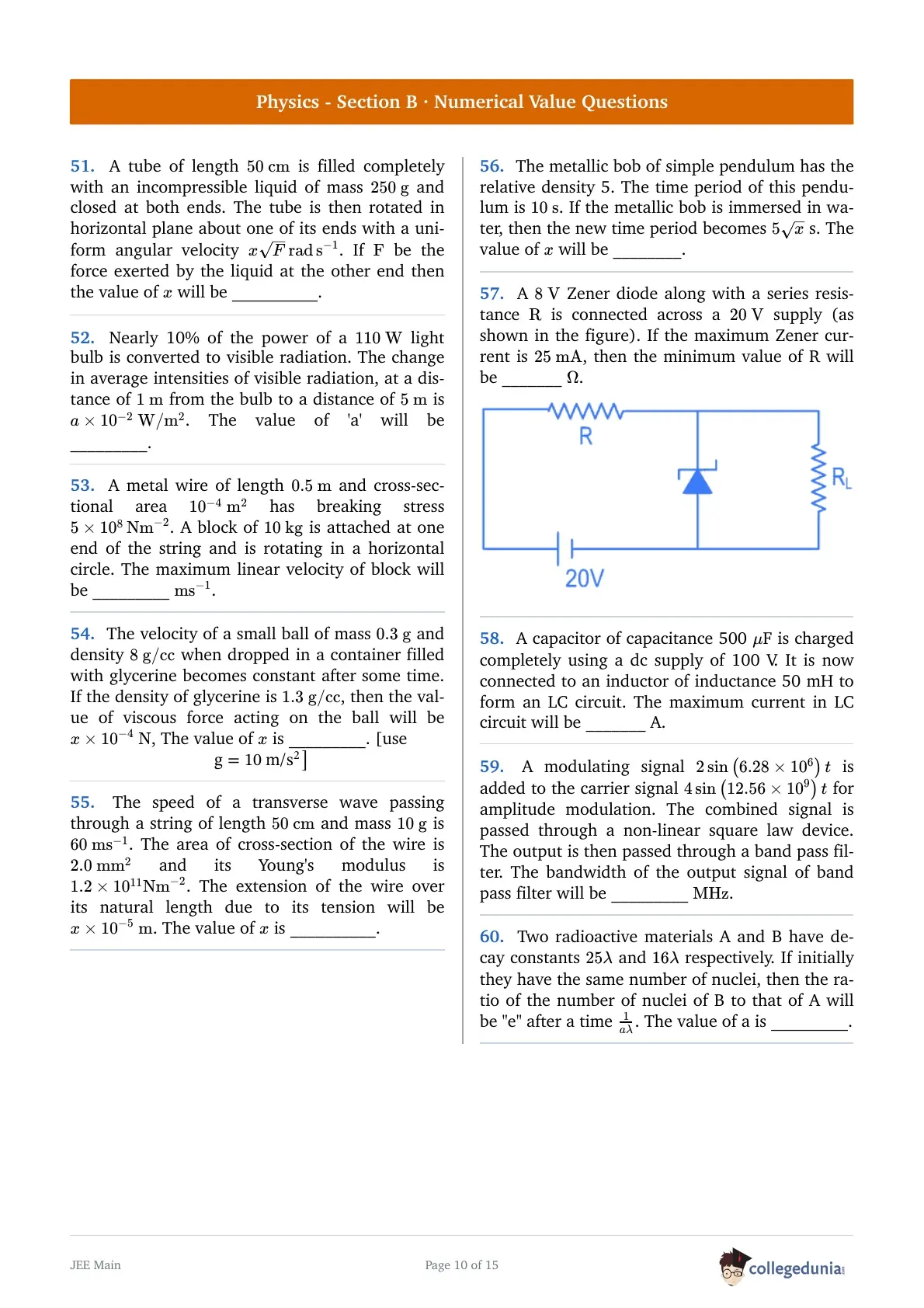
A 8 V Zener diode along with a series resistance R is connected across a 20 V supply (as shown in the figure). If the maximum Zener current is 25 mA, then the minimum value of R will be ____ Ω.

A capacitor of capacitance 500 μF is charged completely using a dc supply of 100 V. It is now connected to an inductor of inductance 50 mH to form an LC circuit. The maximum current in the LC circuit will be ______A.
A modulating signal 2sin (6.28 × 10⁶) t is added to the carrier signal 4sin(12.56 × 10⁹) t for amplitude modulation. The combined signal is passed through a non-linear square law device. The output is then passed through a band pass filter. The bandwidth of the output signal of band pass filter will be ______MHz.
Two radioactive materials A and B have decay constants 25λ and 16λ respectively. If initially they have the same number of nuclei, then the ratio of the number of nuclei of B to that of A will be ‘e’ after a time \(\frac{1}{(aλ)}\). The value of a is _____.
Chemistry - Section A (Q61 - Q80)
Consider the reaction
\(4\text{HNO}_3(\text{l}) + 3\text{KCl}(\text{s}) \rightarrow \text{Cl}_2(\text{g}) + \text{NOCl}(\text{g}) + 2\text{H}_2\text{O}(\text{g}) + 3\text{KNO}_3(\text{s})\)
The amount of HNO3 required to produce 110.0 g of KNO3 is
(Given : Atomic masses of H, O, N and K are 1, 16, 14 and 39 respectively.)
Given below are the quantum numbers for 4 electrons.
A. n=3, l=2, ml=1,ms=+\(\frac{1}{2}\)
B. n=4, l=1, ml=0,ms=+\(\frac{1}{2}\)
C. n=4, l=2, ml=–2,ms=–\(\frac{1}{2}\)
D. n=3, l=1, ml=–1,ms=+\(\frac{1}{2}\)
The correct order of increasing energy is
C(s)+O2(g)→CO2(g)+400 kJ
C(s)+\(\frac{1}{2}\) O2(g)→CO(s)+100 kJ
When coal of purity 60% is allowed to burn in presence of insufficient oxygen, 60% of carbon is converted into ‘CO’ and the remaining is converted into ‘CO2’. The heat generated when 0.6 kg of coal is burnt is _______.
\(200\ \mathrm{mL}\) of \(0.01\ \mathrm{M}\ \mathrm{HCl}\) is mixed with \(400\ \mathrm{mL}\) of \(0.01\ \mathrm{M}\ \mathrm{H_2SO_4}\). The \(\mathrm{pH}\) of the mixture is _________.
Given: \(\log2=0.30,\ \log3=0.48,\ \log5=0.70,\ \log7=0.84,\ \log11=1.04\)
In liquation process used for tin (Sn), the metal
Given below are two statements.
Statement-I: Stannane is an example of a molecular hydride.
Statement-II: Stannane is a planar molecule
In the light of the above statement, choose the most appropriate answer from the options given below.
Which of the following 3d-metal ion will give the lowest enthalpy of hydration (ΔhydH) when dissolved in water?
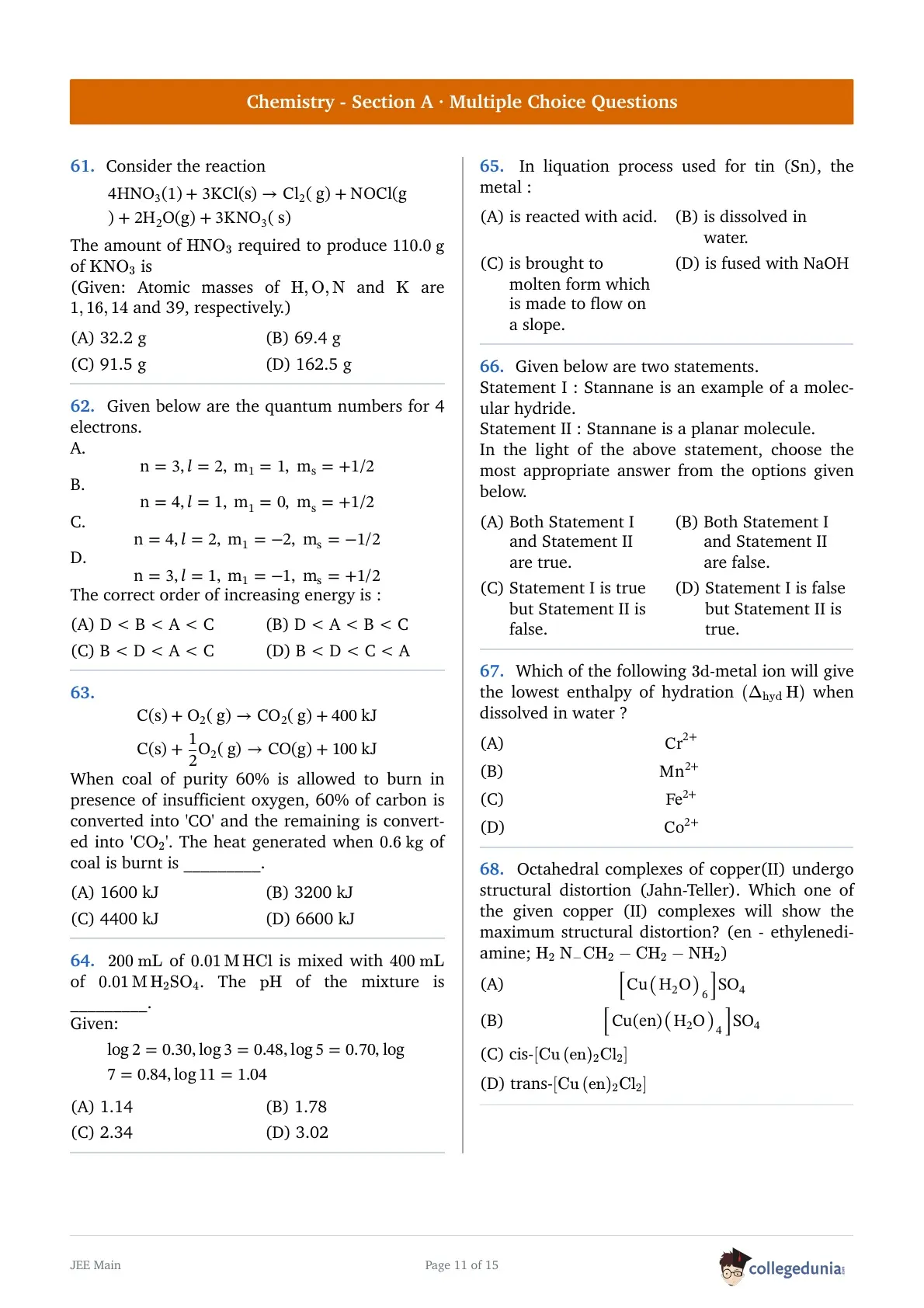
Octahedral complexes of copper(II) undergo structural distortion (Jahn-Teller). Which one of the given copper(II) complexes will show the maximum structural distortion?
(en – ethylenediamine;H2N−CH2−CH2−NH2)
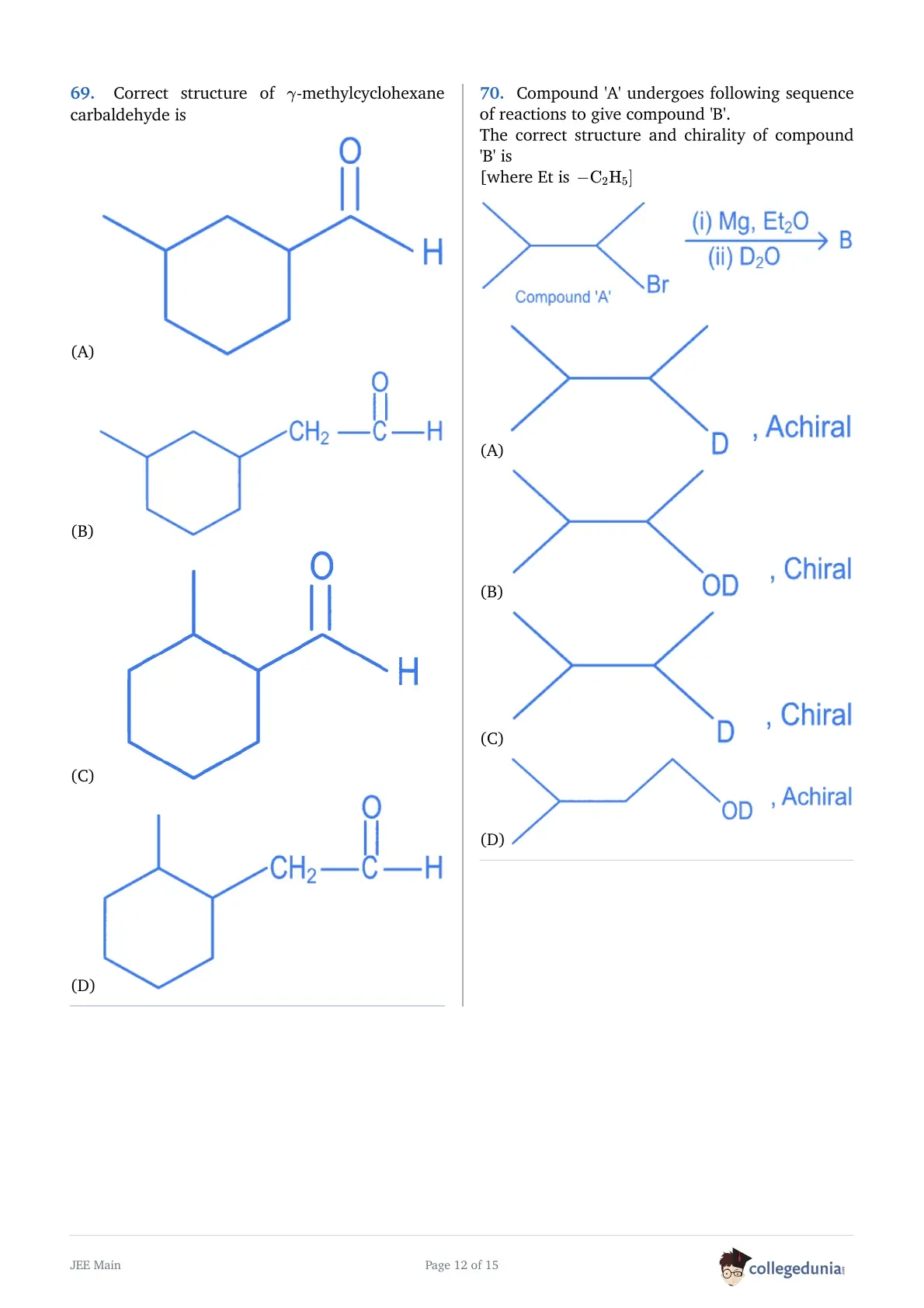
Correct structure of γ-methylcyclohexane carbaldehyde is
- (1)
![]()
- (2)
![]()
- (3)
![]()
- (4)
![]()


Compound ‘A’ undergoes following sequence of reactions to give compound ‘B’. The correct structure and chirality of compound ‘B’ is
[where Et is –C2H5]
- (1)
![]()
- (2)
![]()
- (3)
![]()
- (4)
![]()


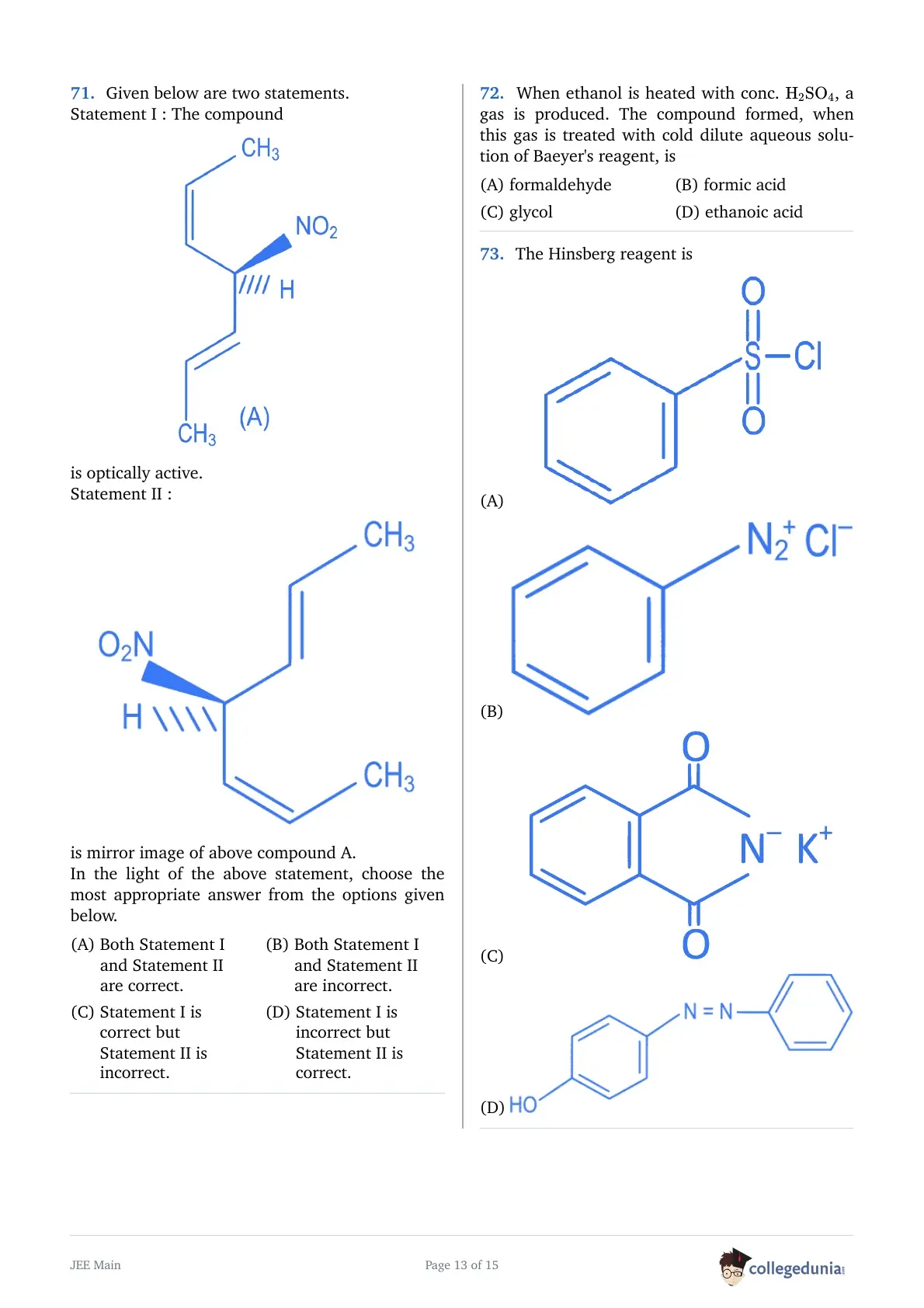
Given below are two statements.
Statement I: The compound
(A) is optically active.
Statement II:
is a mirror image of the above compound A.
In the light of the above statement, choose the most appropriate answer from the options given below.
When ethanol is heated with conc. H2SO4, a gas is produced. The compound formed, when this gas is treated with cold dilute aqueous solution of Baeyer’s reagent, is


Given below are two statements. One is labelled as Assertion A and the other is labelled as Reason R.
Assertion A : Amylose is insoluble in water.
Reason R : Amylose is a long linear molecule with more than 200 glucose units.
In the light of the above statements, choose the correct answer from the options given below.
A compound ‘X’ is a weak acid and it exhibits colour change at pH close to the equivalence point during neutralization of NaOH with CH3COOH. Compound ‘X’ exists in ionized from in basic medium. The compound ‘X’ is
Given below are the critical temperatures of some of the gases :
| Gas | Critical temperature (K) |
|---|---|
| He | 5.2 |
| CH4 | 190.0 |
| CO2 | 304.2 |
| NH3 | 405.5 |
The gas showing least adsorption on a definite amount of charcoal is
Portland cement contains ‘X’ to enhance the setting time. What is ‘X’?
When borax is heated with CoO on a platinum loop, blue coloured bead formed is largely due to
Dinitrogen is a robust compound, but reacts at high altitudes to form oxides. The oxide of nitrogen that can damage plant leaves and retard photosyn-thesis is
Which of the following is not a natural polymer?
Chemistry - Section B (Q81 - Q90)
Consider, \(PF_5,BrF_5,PCl_3,SF_6,[ICl_4]^–,ClF_3 and\ IF_5\).
Amongst the above molecule(s)/ion(s), the number of molecule(s)/ion(s) having \(sp^3d^2\) hybridisation is _____.
1.80 g of solute A was dissolved in 62.5 cm3 of ethanol and freezing point of the solution was found to be 155.1 K. The molar mass of solute A is ____ g mol–1.
[Given : Freezing point of ethanol is 156.0 K, Density of ethanol is 0.80 g cm–3, Freezing point depression constant of ethanol is 2.00 K kg mol–1]
For a cell, \(Cu(s)|Cu^{2+}(0.001M)||Ag^+(0.01M)|Ag(s)\)
the cell potential is found to be \(0.43 V\) at \(298 K\). The magnitude of standard electrode potential for \(Cu^{2+}/{Cu}\) is ____ \(× 10^{–2}\) V.
[Given: \(E_{Ag^+/Ag^⊖}=0.80\) V and \(\frac {2.303RT}{F}=0.06 V\)]
Assuming 1μg of trace radioactive element X with a half life of 30 years is absorbed by a growing tree. The amount of X remaining in the tree after 100 years is ______ × 10–1μg.
[Given : ln 10 = 2.303; log 2 = 0.30]
Sum of oxidation state (magnitude) and coordination number of cobalt in \(Na[Co(bpy)Cl_4]\) is____ .
(Given : bpy = )
A 1.84 mg sample of polyhydric alcoholic compound ‘X’ of molar mass 92.0 g/mol gave 1.344 mL of H2 gas at STP. The number of alcoholic hydrogens present in compound ‘X’ is____.
The number of stereoisomers formed in a reaction of (±) Ph (C = O) C (OH) (CN) Ph with HCN is_____.
[Where, Ph is – C6H5]
‘x’ g of molecular oxygen (O2) is mixed with 200 g of neon (Ne). The total pressure of the non-reactive mixture of O2 and Ne in the cylinder is 25 bar. The partial pressure of Ne is 20 bar at the same temperature and volume. The value of ‘x’ is ___.
[Given : Molar mass of O2 = 32 g mol–1 and Molar mass of Ne = 20 g mol–1]
Consider the following sulphur based oxoacids.
\(H_2SO_3,H_2SO_4,H_2S_2O_8 \)and \(H_2S_2O_7\)
Amongst these oxoacids, the number of those with peroxo (O–O) bonds is_____.
The number of chlorine atoms in bithionol is ______ .
JEE Main 2022 Exam Pattern and Marking Scheme
| Particulars | Details |
|---|---|
| Exam Mode | Online (Computer-Based Test) |
| Paper | B.E./B.Tech (Paper 1) |
| Duration | 3 hours (180 minutes) |
| Type of Questions | Multiple Choice Questions (MCQs) + Numerical Value Questions |
| Subjects | Mathematics, Physics, Chemistry |
| Total Questions | 90 questions (75 to be attempted) |
| Total Marks | 300 marks |
| Marking Scheme | +4 for correct answer & -1 for incorrect MCQ and Numerical Value-based Questions |
JEE Main 2022 July 29 Shift 2 Difficulty Level
As per the students’ reaction, the question paper is rated moderate with Mathematics as the most difficult section of the three. Check JEE Main 2022 July 29 Shift 2 Paper Analysis
JEE Main 2022 July 29 Shift 2 Subject-wise Memory-Based Solutions PDF
| Subject | Memory-Based Solutions PDF |
|---|---|
| Physics | Download PDF |
| Chemistry | Download PDF |
| Mathematics | Download PDF |
JEE Main 2022 Phase 2 Question Papers with Solution PDFs
Candidates can also check shift-wise JEE Main 2022 Phase 2 Question Papers with Solution PDFs. These shift-wise question paper PDFs for JEE Main 2022 will help candidates know the overall difficulty, topics with the highest weightage and the type of questions asked in the exam.
JEE Main 2022 Phase 1 Question Papers with Solution PDFs
Shift-wise JEE Main 2022 Phase 1 Question Papers with Solution PDFs are also available. Candidates preparing for Phase 2 of the exam can check and download JEE Main Question Paper PDFs to practice and test their exam prep level.
Also Check:



Comments