



JEE Main 2022 June 30 Shift 1 Question Paper is available here with solutions PDF and detailed solutions for every question. NTA conducted the first shift on June 30, 2022, from 9:00 AM to 12:00 PM. The JEE Main 2022 Paper 1 (B.E./B.Tech) question paper includes the following:
- 90 questions in a 3-hour CBT Mode: 30 each from Mathematics, Physics and Chemistry (75 to be attempted)
- Section A: 20 multiple choice questions (MCQs) per subject, all compulsory, 4 marks each
- Section B: 10 numerical value questions per subject, any 5 to be attempted, 4 marks each
- Marking: +4 for a correct answer, -1 for an incorrect answer, 0 for an unattempted question
- Maximum marks: 300 (100 per subject)
JEE Main 2022 June 30 Shift 1 Question Paper with Solution PDF
| NTA Official PDF | CD PDF | CD PDF with Solutions |
|---|---|---|
| Download official PDF 4.97 MB | Download Collegedunia PDF 1.10 MB | Download solutions PDF 1.08 MB |
Also Check:
JEE Main 2022 June 30 Shift 1 Questions with Solutions
Mathematics - Section A (Q1 - Q20)
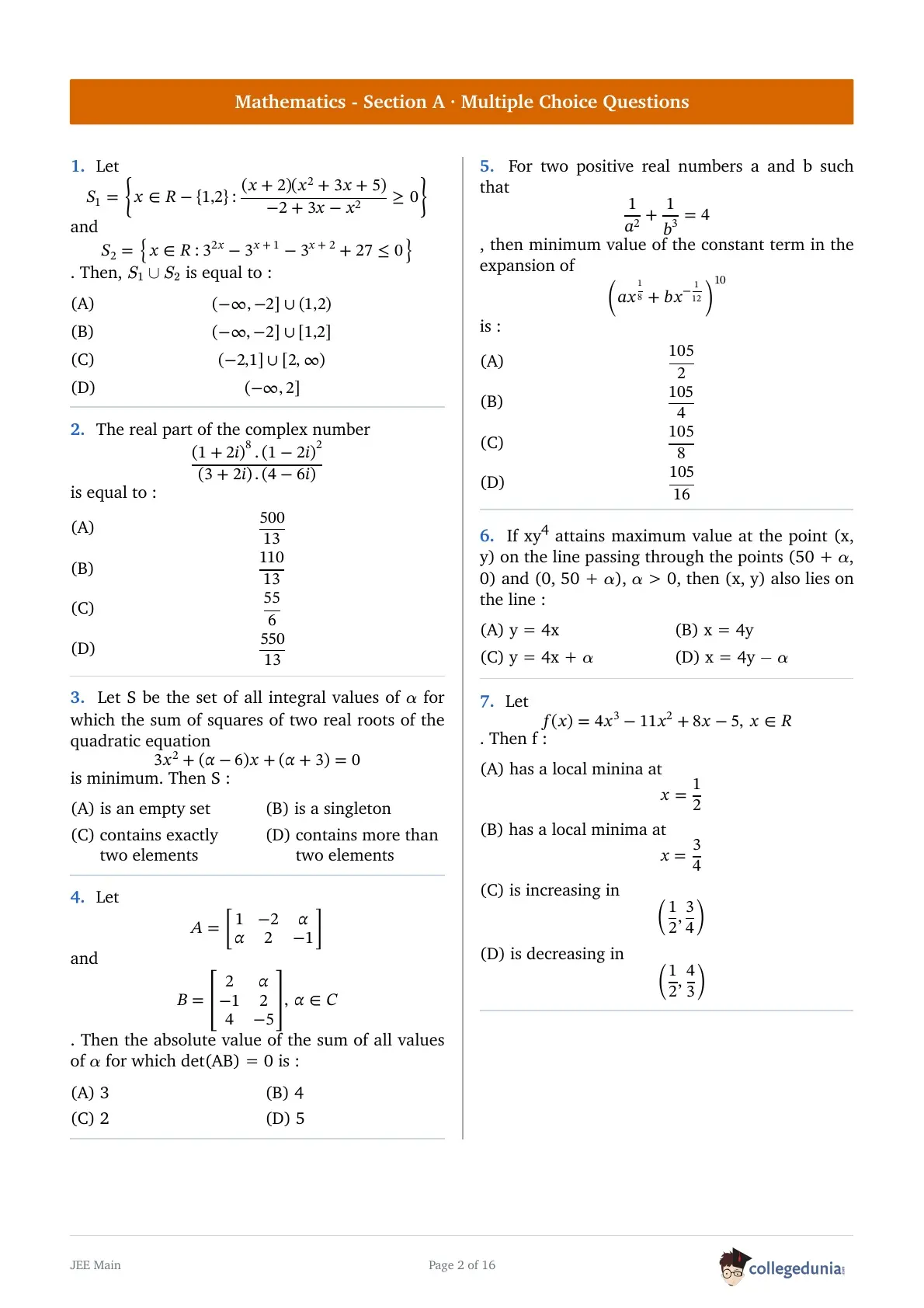
Let \( {S_1} = \left\{ {x \in R - \{ 1,2\} :{{(x + 2)({x^2} + 3x + 5)} \over { - 2 + 3x - {x^2}}} \ge 0} \right\} \) and \( {S_2} = \left\{ {x \in R:{3^{2x}} - {3^{x + 1}} - {3^{x + 2}} + 27 \le 0} \right\} \). Then, \( {S_1} \cup {S_2} \) is equal to :
The real part of the complex number \( {{{{(1 + 2i)}^8}\,.\,{{(1 - 2i)}^2}} \over {(3 + 2i)\,.\,\overline {(4 - 6i)} }} \) is equal to :
Let S be the set of all integral values of \( \alpha \) for which the sum of squares of two real roots of the quadratic equation \( 3{x^2} + (\alpha - 6)x + (\alpha + 3) = 0 \) is minimum. Then S :
Let \( A = \left[ {\matrix{ 1 & { - 2} & \alpha \cr \alpha & 2 & { - 1} \cr } } \right] \) and \( B = \left[ {\matrix{ 2 & \alpha \cr { - 1} & 2 \cr 4 & { - 5} \cr } } \right],\,\alpha \in C \). Then the absolute value of the sum of all values of \( \alpha \) for which det(AB) = 0 is :
For two positive real numbers a and b such that \( {1 \over {{a^2}}} + {1 \over {{b^3}}} = 4 \), then minimum value of the constant term in the expansion of \( {\left( {a{x^{{1 \over 8}}} + b{x^{ - {1 \over {12}}}}} \right)^{10}} \) is :
If xy4 attains maximum value at the point (x, y) on the line passing through the points (50 + \( \alpha \), 0) and (0, 50 + \( \alpha \)), \( \alpha \) > 0, then (x, y) also lies on the line :
Let \( f(x) = 4{x^3} - 11{x^2} + 8x - 5,\,x \in R \). Then f :
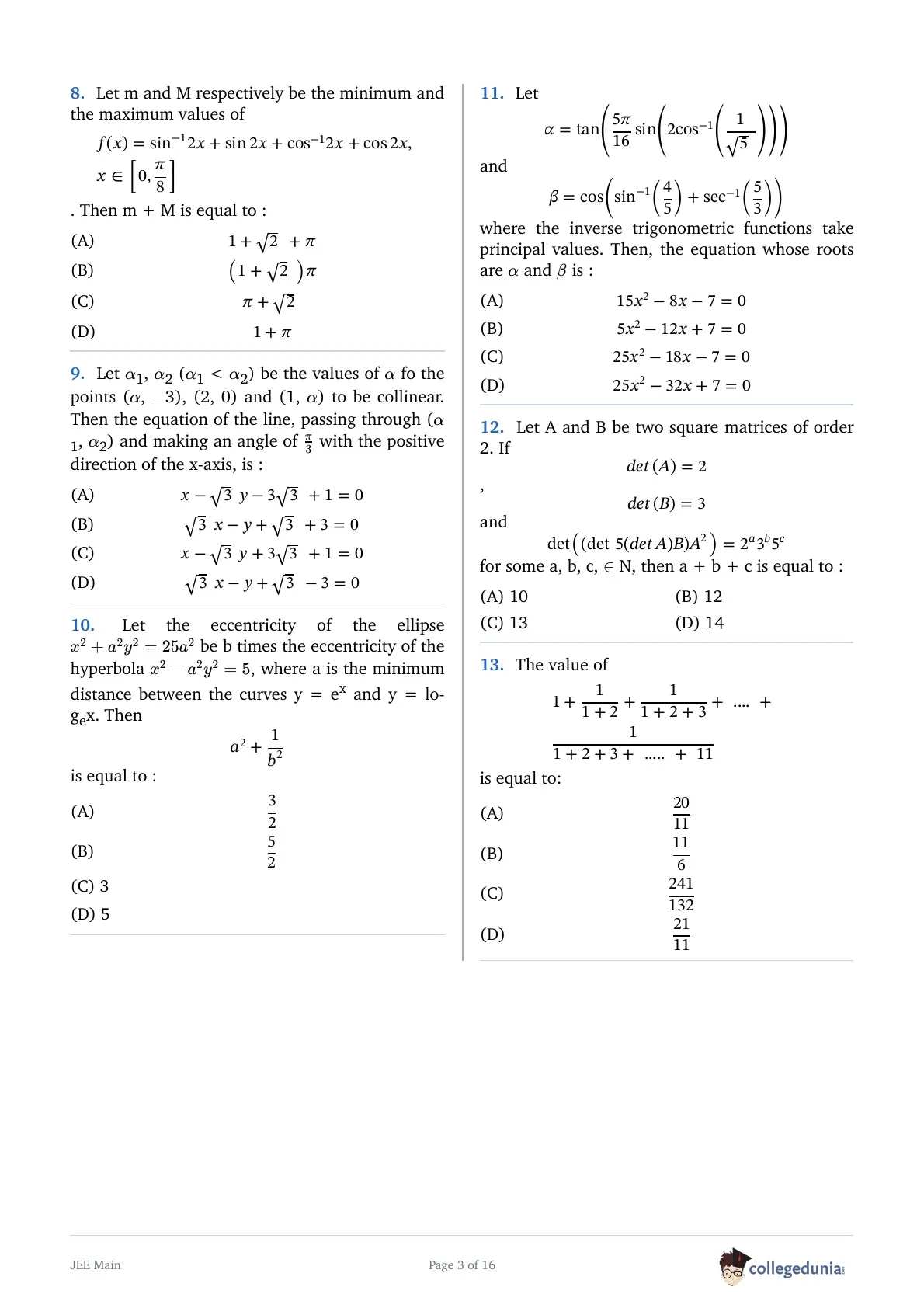
Let m and M respectively be the minimum and the maximum values of \( f(x) = {\sin ^{ - 1}}2x + \sin 2x + {\cos ^{ - 1}}2x + \cos 2x,\,x \in \left[ {0,{\pi \over 8}} \right] \). Then m + M is equal to :
Let \( \alpha \)1, \( \alpha \)2 (\( \alpha \)1 < \( \alpha \)2) be the values of \( \alpha \) fo the points (\( \alpha \), \( - \)3), (2, 0) and (1, \( \alpha \)) to be collinear. Then the equation of the line, passing through (\( \alpha \)1, \( \alpha \)2) and making an angle of \( {\pi \over 3} \) with the positive direction of the x-axis, is :
Let the eccentricity of the ellipse \( {x^2} + {a^2}{y^2} = 25{a^2} \) be b times the eccentricity of the hyperbola \( {x^2} - {a^2}{y^2} = 5 \), where a is the minimum distance between the curves y = ex and y = logex. Then \( {a^2} + {1 \over {{b^2}}} \) is equal to :
Let \( \alpha = \tan \left( {{{5\pi } \over {16}}\sin \left( {2{{\cos }^{ - 1}}\left( {{1 \over {\sqrt 5 }}} \right)} \right)} \right) \) and \( \beta = \cos \left( {{{\sin }^{ - 1}}\left( {{4 \over 5}} \right) + {{\sec }^{ - 1}}\left( {{5 \over 3}} \right)} \right) \) where the inverse trigonometric functions take principal values. Then, the equation whose roots are \( \alpha \) and \( \beta \) is :
Let A and B be two square matrices of order 2. If \( det\,(A) = 2 \), \( det\,(B) = 3 \) and \( \det \left( {(\det \,5(det\,A)B){A^2}} \right) = {2^a}{3^b}{5^c} \) for some a, b, c, \( \in \) N, then a + b + c is equal to :
The value of \( 1 + {1 \over {1 + 2}} + {1 \over {1 + 2 + 3}} + \,\,....\,\, + \,\,{1 \over {1 + 2 + 3 + \,\,.....\,\, + \,\,11}} \) is equal to:
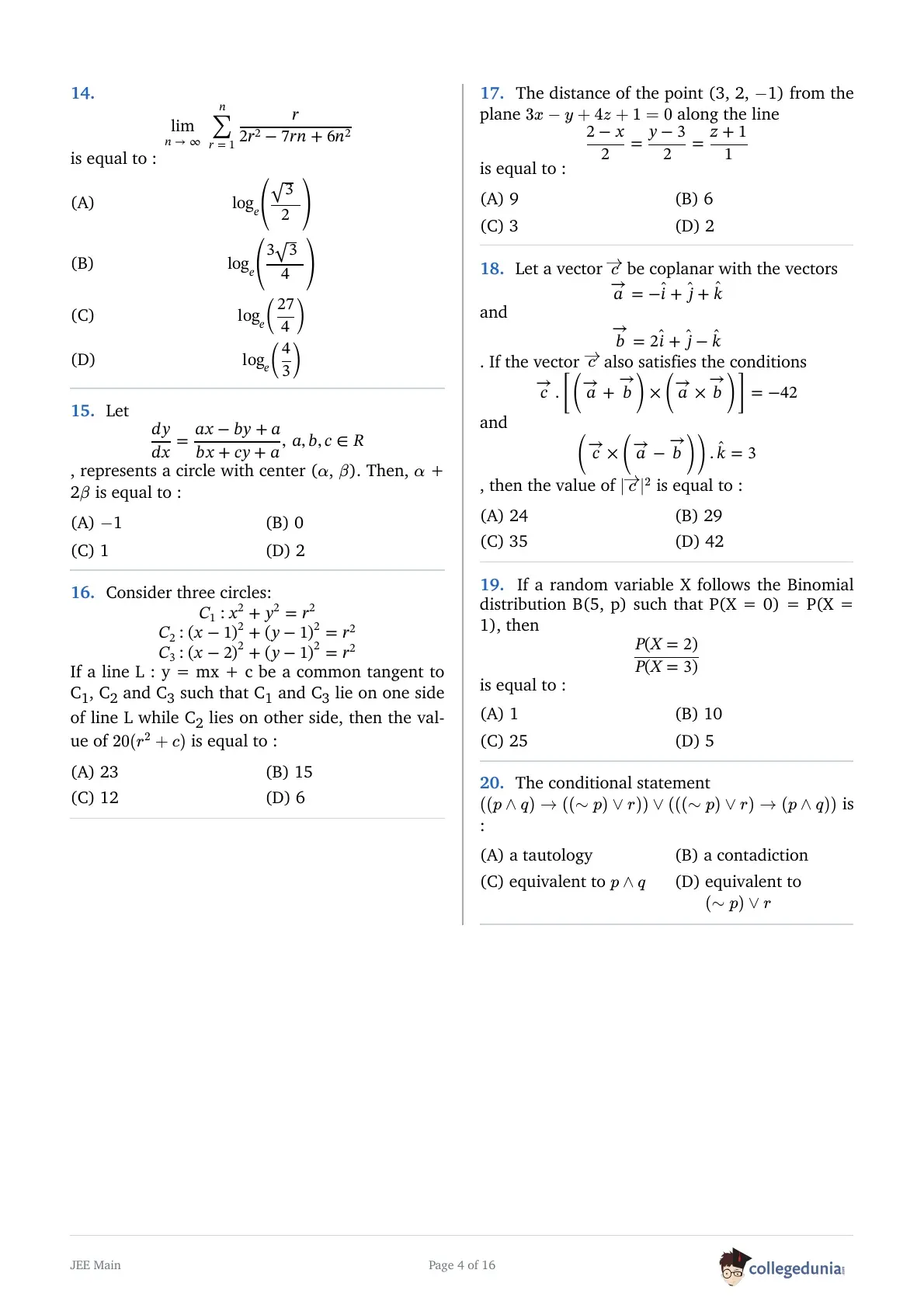
\( \mathop {\lim }\limits_{n \to \infty } \sum\limits_{r = 1}^n {{r \over {2{r^2} - 7rn + 6{n^2}}}} \) is equal to :
Let \( {{dy} \over {dx}} = {{ax - by + a} \over {bx + cy + a}},\,a,b,c \in R \), represents a circle with center (\( \alpha \), \( \beta \)). Then, \( \alpha \) + 2\( \beta \) is equal to :
Consider three circles:
\( {C_1}:{x^2} + {y^2} = {r^2} \)
\( {C_2}:{(x - 1)^2} + {(y - 1)^2} = {r^2} \)
\( {C_3}:{(x - 2)^2} + {(y - 1)^2} = {r^2} \)
If a line L : y = mx + c be a common tangent to C1, C2 and C3 such that C1 and C3 lie on one side of line L while C2 lies on other side, then the value of \( 20({r^2} + c) \) is equal to :
The distance of the point (3, 2, \( - \)1) from the plane \( 3x - y + 4z + 1 = 0 \) along the line \( {{2 - x} \over 2} = {{y - 3} \over 2} = {{z + 1} \over 1} \) is equal to :
Let a vector \( \overrightarrow c \) be coplanar with the vectors \( \overrightarrow a = - \widehat i + \widehat j + \widehat k \) and \( \overrightarrow b = 2\widehat i + \widehat j - \widehat k \). If the vector \( \overrightarrow c \) also satisfies the conditions \( \overrightarrow c \,.\,\left[ {\left( {\overrightarrow a + \overrightarrow b } \right) \times \left( {\overrightarrow a \times \overrightarrow b } \right)} \right] = - 42 \) and \( \left( {\overrightarrow c \times \left( {\overrightarrow a - \overrightarrow b } \right)} \right)\,.\,\widehat k = 3 \), then the value of \( |\overrightarrow c {|^2} \) is equal to :
If a random variable X follows the Binomial distribution B(5, p) such that P(X = 0) = P(X = 1), then \( {{P(X = 2)} \over {P(X = 3)}} \) is equal to :
The conditional statement
\( ((p \wedge q) \to (( \sim p) \vee r)) \vee ((( \sim p) \vee r) \to (p \wedge q)) \) is :
Mathematics - Section B (Q21 - Q30)
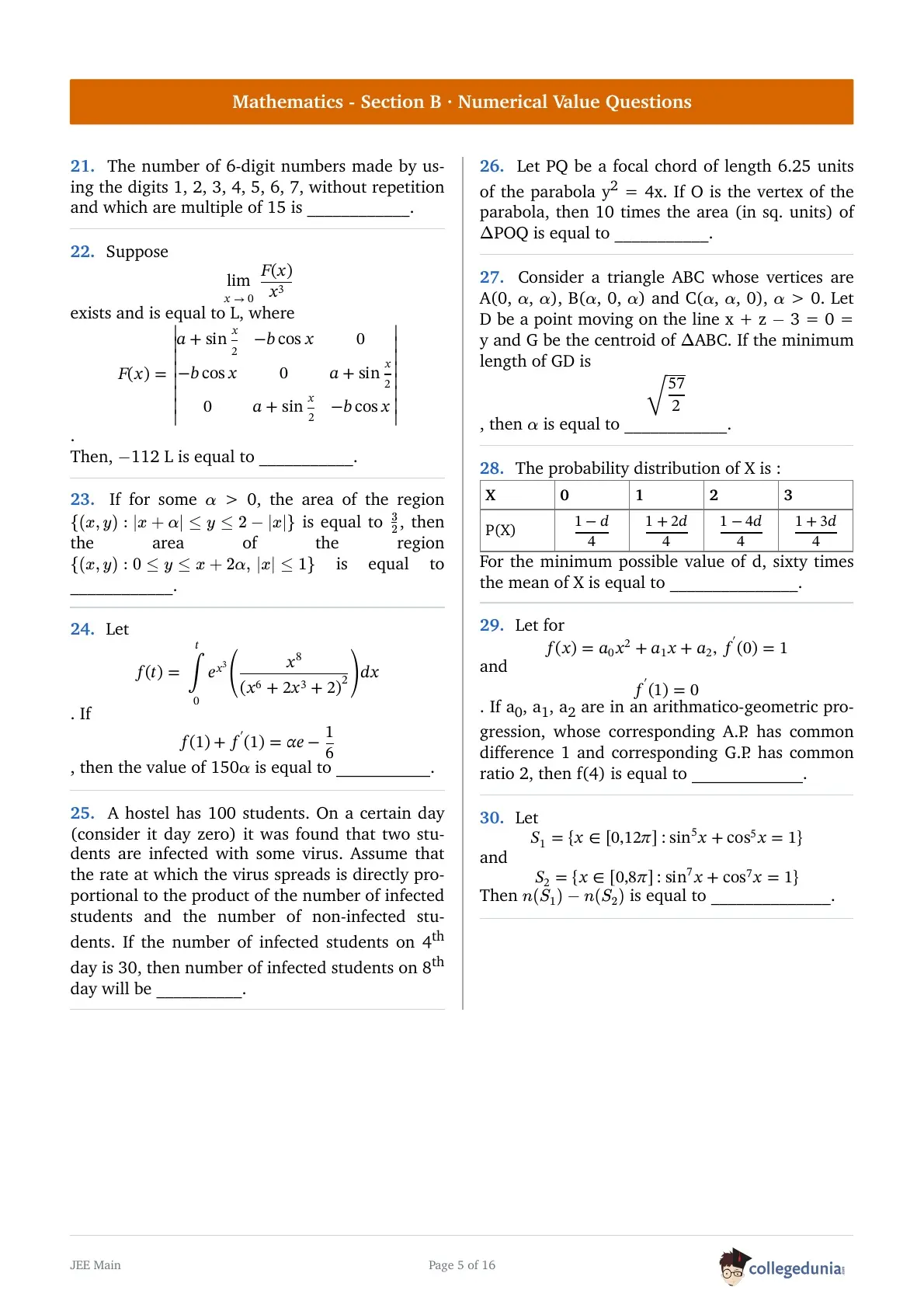
The number of 6-digit numbers made by using the digits 1, 2, 3, 4, 5, 6, 7, without repetition and which are multiple of 15 is ____________.
Suppose \( \mathop {\lim }\limits_{x \to 0} {{F(x)} \over {{x^3}}} \) exists and is equal to L, where
\( F(x) = \left| {\matrix{ {a + \sin {x \over 2}} & { - b\cos x} & 0 \cr { - b\cos x} & 0 & {a + \sin {x \over 2}} \cr 0 & {a + \sin {x \over 2}} & { - b\cos x} \cr } } \right| \).
Then, \( - \)112 L is equal to ___________.
If for some \( \alpha \) > 0, the area of the region \( \{ (x,y):|x + \alpha | \le y \le 2 - |x|\} \) is equal to \( {3 \over 2} \), then the area of the region \( \{ (x,y):0 \le y \le x + 2\alpha ,\,|x| \le 1\} \) is equal to ____________.
Let \( f(t) = \int\limits_0^t {{e^{{x^3}}}\left( {{{{x^8}} \over {{{({x^6} + 2{x^3} + 2)}^2}}}} \right)dx} \). If \( f(1) + f'(1) = \alpha e - {1 \over 6} \), then the value of 150\( \alpha \) is equal to ___________.
A hostel has 100 students. On a certain day (consider it day zero) it was found that two students are infected with some virus. Assume that the rate at which the virus spreads is directly proportional to the product of the number of infected students and the number of non-infected students. If the number of infected students on 4th day is 30, then number of infected students on 8th day will be __________.
Let PQ be a focal chord of length 6.25 units of the parabola y2 = 4x. If O is the vertex of the parabola, then 10 times the area (in sq. units) of \( \Delta \)POQ is equal to ___________.
Consider a triangle ABC whose vertices are A(0, \( \alpha \), \( \alpha \)), B(\( \alpha \), 0, \( \alpha \)) and C(\( \alpha \), \( \alpha \), 0), \( \alpha \) > 0. Let D be a point moving on the line x + z \( - \) 3 = 0 = y and G be the centroid of \( \Delta \)ABC. If the minimum length of GD is \( \sqrt {{{57} \over 2}} \), then \( \alpha \) is equal to ____________.
The probability distribution of X is :
| X | 0 | 1 | 2 | 3 |
|---|---|---|---|---|
| P(X) | \( {{1 - d} \over 4} \) | \( {{1 + 2d} \over 4} \) | \( {{1 - 4d} \over 4} \) | \( {{1 + 3d} \over 4} \) |
For the minimum possible value of d, sixty times the mean of X is equal to _______________.
Let for \( f(x) = {a_0}{x^2} + {a_1}x + {a_2},\,f'(0) = 1 \) and \( f'(1) = 0 \). If a0, a1, a2 are in an arithmatico-geometric progression, whose corresponding A.P. has common difference 1 and corresponding G.P. has common ratio 2, then f(4) is equal to _____________.
Let \( {S_1} = \{ x \in [0,12\pi ]:{\sin ^5}x + {\cos ^5}x = 1\} \)
and \( {S_2} = \{ x \in [0,8\pi ]:{\sin ^7}x + {\cos ^7}x = 1\} \)
Then \( n({S_1}) - n({S_2}) \) is equal to ______________.
Physics - Section A (Q31 - Q50)
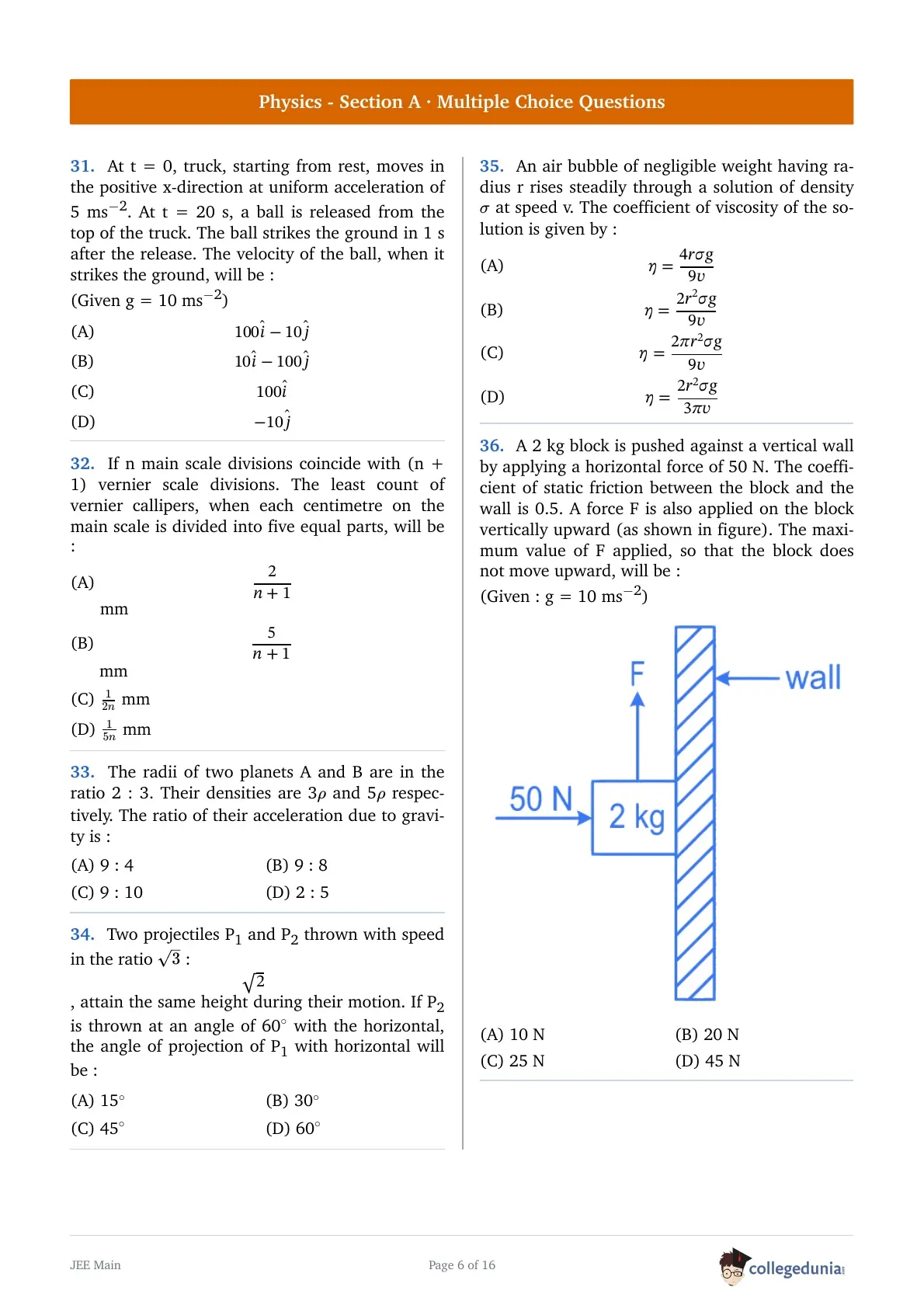
At t = 0, truck, starting from rest, moves in the positive x-direction at uniform acceleration of 5 ms\( - \)2. At t = 20 s, a ball is released from the top of the truck. The ball strikes the ground in 1 s after the release. The velocity of the ball, when it strikes the ground, will be :
(Given g = 10 ms\( - \)2)
If n main scale divisions coincide with (n + 1) vernier scale divisions. The least count of vernier callipers, when each centimetre on the main scale is divided into five equal parts, will be :
The radii of two planets A and B are in the ratio 2 : 3. Their densities are 3\( \rho \) and 5\( \rho \) respectively. The ratio of their acceleration due to gravity is :
Two projectiles P1 and P2 thrown with speed in the ratio \( \sqrt3 \) : \( \sqrt2 \), attain the same height during their motion. If P2 is thrown at an angle of 60\( ^\circ \) with the horizontal, the angle of projection of P1 with horizontal will be :
An air bubble of negligible weight having radius r rises steadily through a solution of density \( \sigma \) at speed v. The coefficient of viscosity of the solution is given by :
A 2 kg block is pushed against a vertical wall by applying a horizontal force of 50 N. The coefficient of static friction between the block and the wall is 0.5. A force F is also applied on the block vertically upward (as shown in figure). The maximum value of F applied, so that the block does not move upward, will be :
(Given : g = 10 ms\( - \)2)

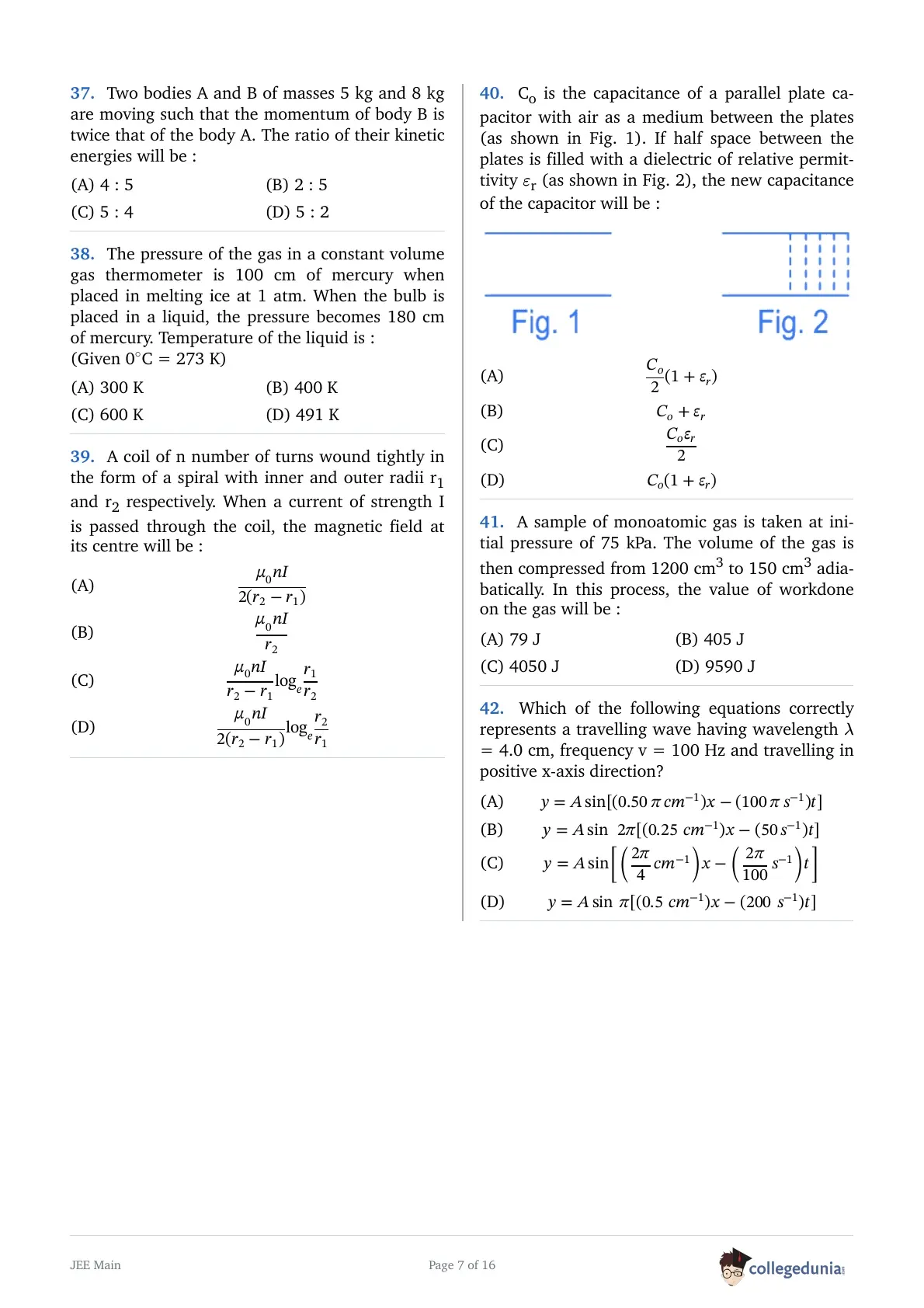
Two bodies A and B of masses 5 kg and 8 kg are moving such that the momentum of body B is twice that of the body A. The ratio of their kinetic energies will be :
The pressure of the gas in a constant volume gas thermometer is 100 cm of mercury when placed in melting ice at 1 atm. When the bulb is placed in a liquid, the pressure becomes 180 cm of mercury. Temperature of the liquid is :
(Given 0\( ^\circ \)C = 273 K)
A coil of n number of turns wound tightly in the form of a spiral with inner and outer radii r1 and r2 respectively. When a current of strength I is passed through the coil, the magnetic field at its centre will be :
Co is the capacitance of a parallel plate capacitor with air as a medium between the plates (as shown in Fig. 1). If half space between the plates is filled with a dielectric of relative permittivity \( \varepsilon \)r (as shown in Fig. 2), the new capacitance of the capacitor will be :

A sample of monoatomic gas is taken at initial pressure of 75 kPa. The volume of the gas is then compressed from 1200 cm3 to 150 cm3 adiabatically. In this process, the value of workdone on the gas will be :
Which of the following equations correctly represents a travelling wave having wavelength \( \lambda \) = 4.0 cm, frequency v = 100 Hz and travelling in positive x-axis direction?
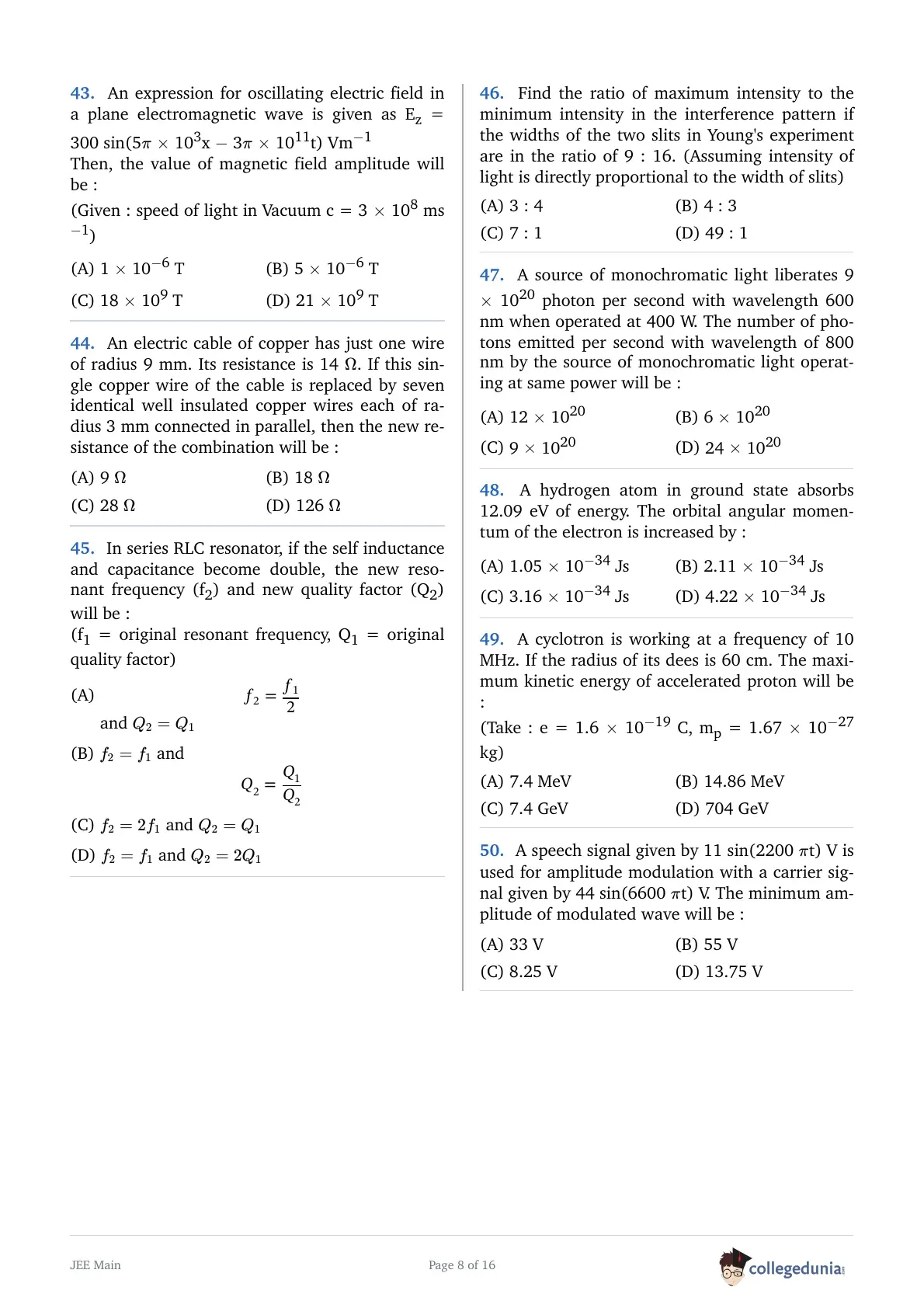
An expression for oscillating electric field in a plane electromagnetic wave is given as Ez = 300 sin(5\( \pi \) \( \times \) 103x \( - \) 3\( \pi \) \( \times \) 1011t) Vm\( - \)1
Then, the value of magnetic field amplitude will be :
(Given : speed of light in Vacuum c = 3 \( \times \) 108 ms\( - \)1)
An electric cable of copper has just one wire of radius 9 mm. Its resistance is 14 \( \Omega \). If this single copper wire of the cable is replaced by seven identical well insulated copper wires each of radius 3 mm connected in parallel, then the new resistance of the combination will be :
In series RLC resonator, if the self inductance and capacitance become double, the new resonant frequency (f2) and new quality factor (Q2) will be :
(f1 = original resonant frequency, Q1 = original quality factor)
Find the ratio of maximum intensity to the minimum intensity in the interference pattern if the widths of the two slits in Young's experiment are in the ratio of 9 : 16. (Assuming intensity of light is directly proportional to the width of slits)
A source of monochromatic light liberates 9 \( \times \) 1020 photon per second with wavelength 600 nm when operated at 400 W. The number of photons emitted per second with wavelength of 800 nm by the source of monochromatic light operating at same power will be :
A hydrogen atom in ground state absorbs 12.09 eV of energy. The orbital angular momentum of the electron is increased by :
A cyclotron is working at a frequency of 10 MHz. If the radius of its dees is 60 cm. The maximum kinetic energy of accelerated proton will be :
(Take : e = 1.6 \( \times \) 10\( - \)19 C, mp = 1.67 \( \times \) 10\( - \)27 kg)
A speech signal given by 11 sin(2200 \( \pi \)t) V is used for amplitude modulation with a carrier signal given by 44 sin(6600 \( \pi \)t) V. The minimum amplitude of modulated wave will be :
Physics - Section B (Q51 - Q60)
A person starts his journey from centre 'O' of the park and comes back to the same position following path OPQO as shown in the figure. The radius of path taken by the person is 200 m and he takes 3 min 58 sec to complete his journey. The average speed of the person is _____________ ms\( - \)1. (take \( \pi \) = 3.14)

Four particles with a mass of 1 kg, 2 kg, 3 kg and 4 kg are situated at the corners of a square with side 1 m (as shown in the figure). The moment of inertia of the system, about an axis passing through the point O and perpendicular to the plane of the square, is ______________ kg m2.

The excess pressure inside a liquid drop is 500 Nm\( - \)2. If the radius of the drop is 2 mm, the surface tension of liquid is x \( \times \) 10\( - \)3 Nm\( - \)1. The value of x is _____________.
Eight similar drops of mercury are maintained at 12 V each. All these spherical drops combine into a single big drop. The potential energy of bigger drop will be ____________ E. Where E is the potential energy of a single smaller drop.
A series LCR circuit with \( R = {{250} \over {11}}\,\Omega \) and \( {X_L} = {{70} \over {11}}\,\Omega \) is connected across a 220 V, 50 Hz supply. The value of capacitance needed to maximize the average power of the circuit will be _________ \( \mu \)F. (Take : \( \pi = {{22} \over 7} \))
The refractive index of an equilateral prism is \( \sqrt 2 \). The angle of emergence under minimum deviation position of prism, in degree, is ___________.
A hydrogen atom in its first excited state absorbs a photon of energy x \( \times \) 10\( - \)2 eV and excited to a higher energy state where the potential energy of electron is \( - \)1.08 eV. The value of x is ______________.
The circuit diagram used to study the characteristic curve of a zener diode is connected to variable power supply (0 \( - \) 15 V) as shown in figure. A zener diode with maximum potential Vz = 10 V and maximum power dissipation of 0.4 W is connected across a potential divider arrangement. The value of resistance RP connected in series with the zener diode to protect it from the damage is ________________ \( \Omega \).

An employee of a factory moving away from his workplace by a car listens to the siren of the factory. He drives the car at the speed of 72 kmh\( - \)1 in the direction of wind which is blowing at 72 kmh\( - \)1 speed. Frequency of siren is 720 Hz. The employee hears an apparent frequency of ____________ Hz.
(Assume speed of sound to be 340 ms\( - \)1)
The circuit diagram of potentiometer used to measure the internal resistance of a cell (E) is shown in figure. The key 'K' is kept closed so as to send constant current through potentiometer wire. When key 'K1' is kept open the null point is found to be at 120 cm on the potentiometer wire. When the key 'K1' is closed the null point is shifted at 80 cm at the potentiometer wire. The internal resistance of the given cell is _____________ \( \Omega \).

Chemistry - Section A (Q61 - Q80)
The number of radial nodes and total number of nodes in 4p orbital respectively are :
For a solution of the gases A, B, C and D in water at 298 K, the values of Henry's law constant (KH) are 30.40, 2.34, 1.56 \( \times \) 10\( - \)5 and 0.513 k bar respectively. In the given graph, the lines marked as 'p' and 's' correspond respectively to :

The equilibrium constant for the reversible reaction
2A(g) \( \rightleftharpoons \) 2B(g) + C(g) is K1
\( {3 \over 2} \)A(g) \( \rightleftharpoons \) \( {3 \over 2} \)B(g) + \( {3 \over 4} \)C(g) is K2.
K1 and K2 are related as :
In which of the following half cells, electrochemical reaction is pH dependent?
The correct order of electron gain enthalpy (\( - \) ve value) is :
\( \Delta \)G\( ^\circ \) vs T plot for the formation of MgO, involving reaction
2Mg + O2 \( \to \) 2MgO, will look like :
- (A)
![]()
- (B)
![]()
- (C)
![]()
- (D)
![]()


A \( \mathrel{\mathop{\kern0pt\longrightarrow} \limits_{}^{573\,K}} \) Red phosphorus \( \mathrel{\mathop{\kern0pt\longrightarrow} \limits_{under\,pressure}^{heat\,;\,803\,K}} \) B
Red phosphorus is obtained by heating "A" at 573 K, and can be converted to "B" by heating at 803 K under pressure.
A and B, respectively, are
Correct formula of the compound which gives a white precipitate with BaCl2 solution, but not with AgNO3 solution, is :
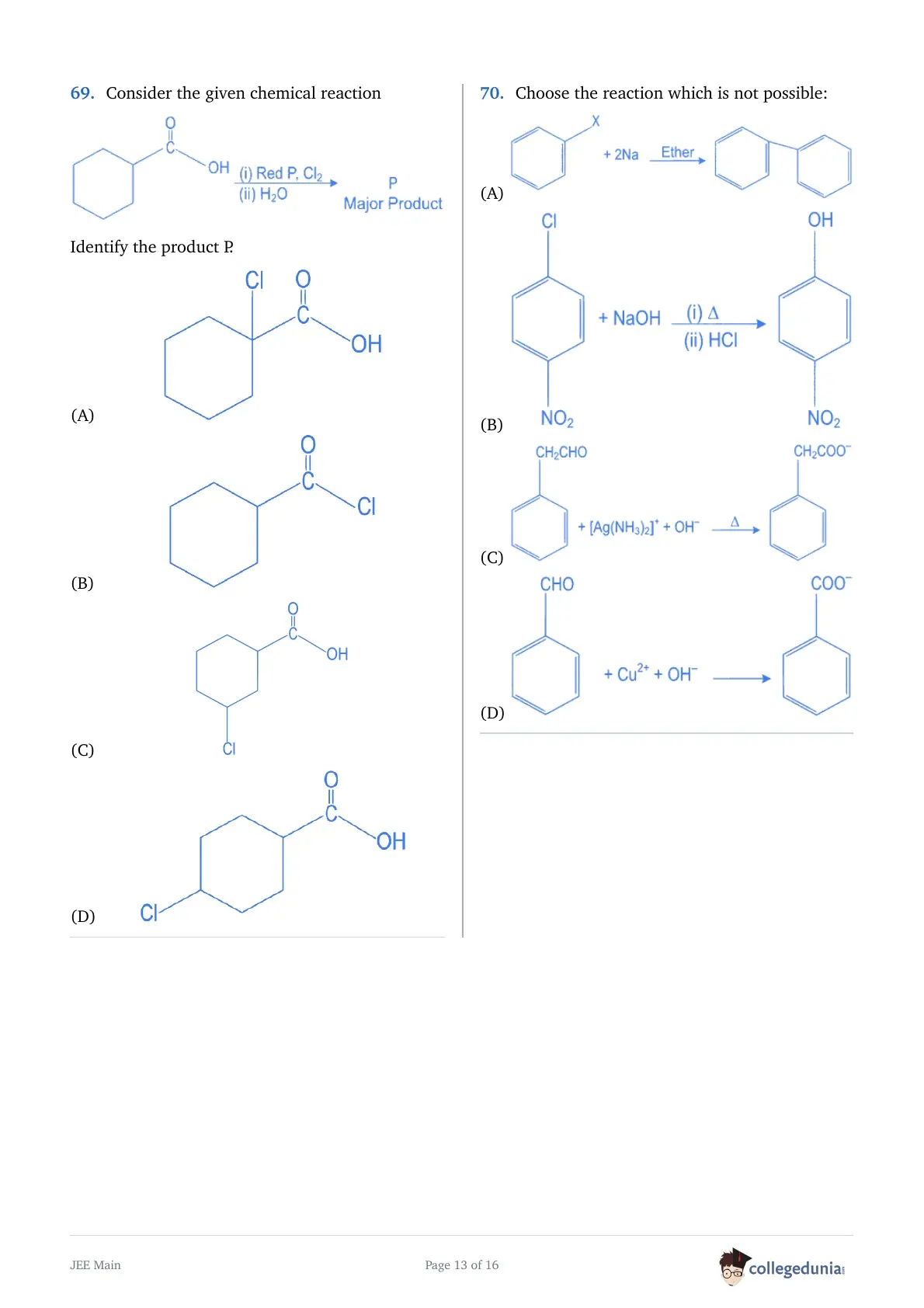
Consider the given chemical reaction

Identify the product P.
- (A)
![]()
- (B)
![]()
- (C)
![]()
- (D)
![]()


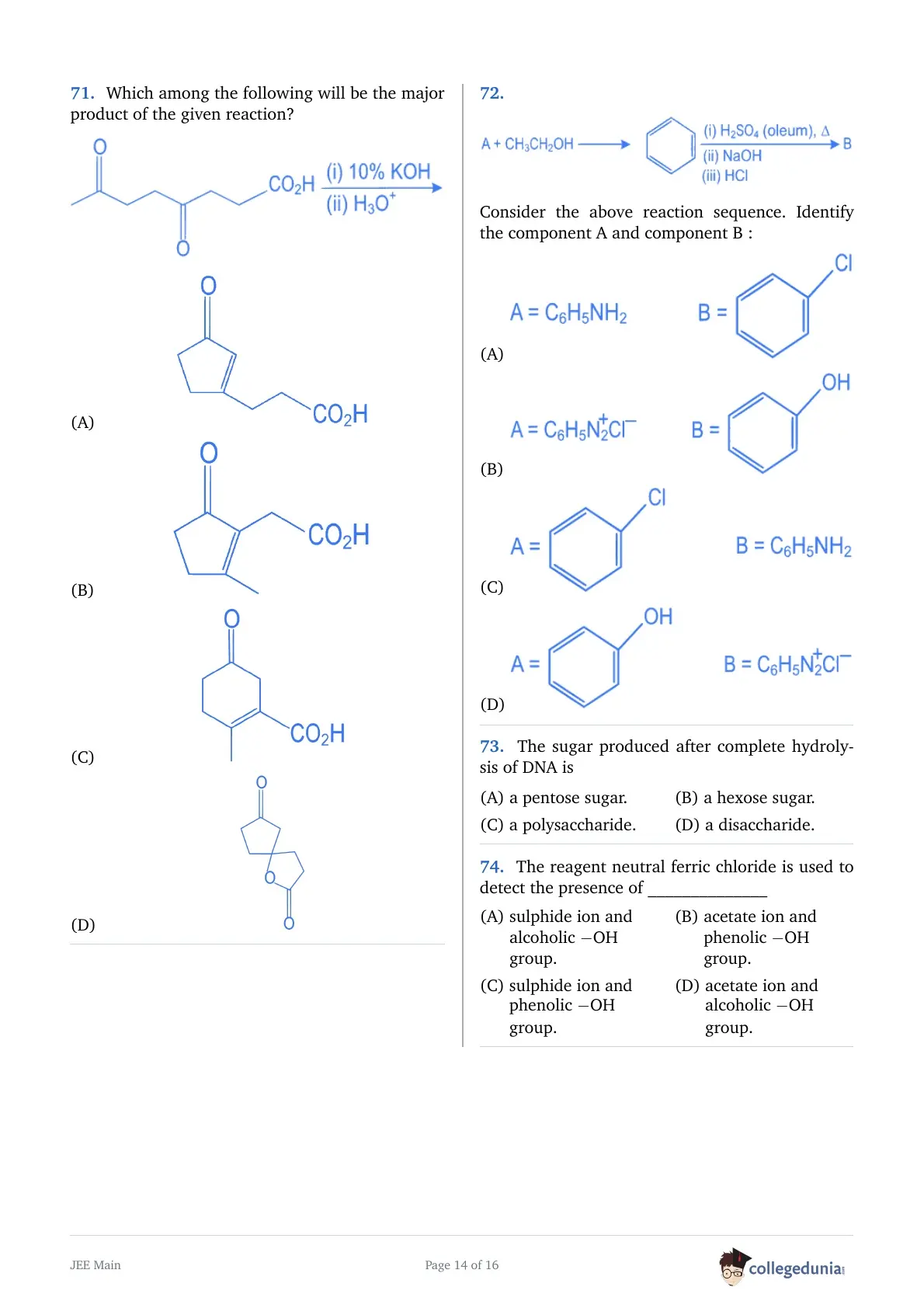
Which among the following will be the major product of the given reaction?

- (A)
![]()
- (B)
![]()
- (C)
![]()
- (D)
![]()


Consider the above reaction sequence. Identify the component A and component B :
- (A)
![]()
- (B)
![]()
- (C)
![]()
- (D)
![]()


The sugar produced after complete hydrolysis of DNA is
The reagent neutral ferric chloride is used to detect the presence of ______________
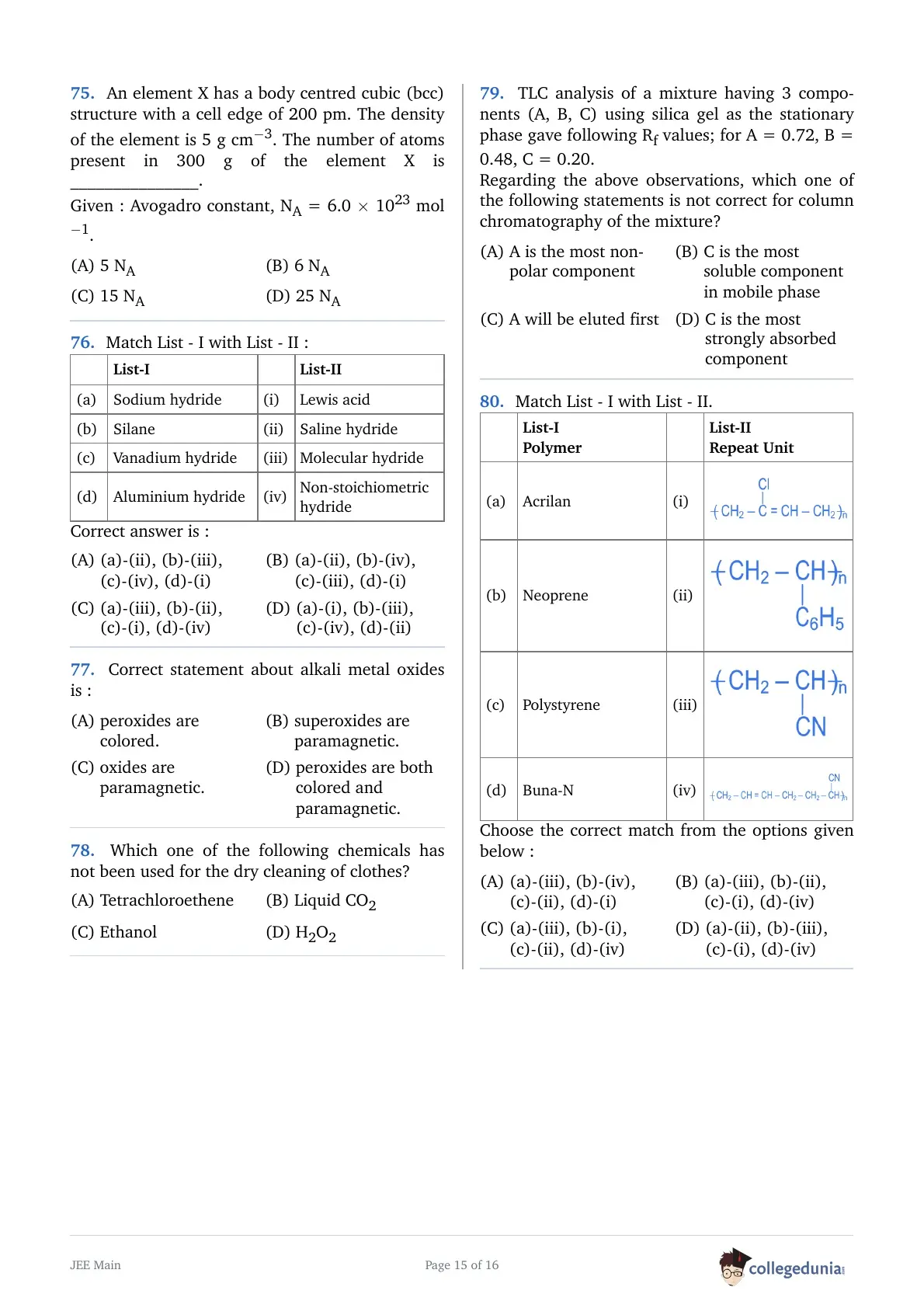
An element X has a body centred cubic (bcc) structure with a cell edge of 200 pm. The density of the element is 5 g cm\( - \)3. The number of atoms present in 300 g of the element X is _______________.
Given : Avogadro constant, NA = 6.0 \( \times \) 1023 mol\( - \)1.
Match List - I with List - II :
| List-I | List-II | ||
|---|---|---|---|
| (a) | Sodium hydride | (i) | Lewis acid |
| (b) | Silane | (ii) | Saline hydride |
| (c) | Vanadium hydride | (iii) | Molecular hydride |
| (d) | Aluminium hydride | (iv) | Non-stoichiometric hydride |
Correct answer is :
Correct statement about alkali metal oxides is :
Which one of the following chemicals has not been used for the dry cleaning of clothes?
TLC analysis of a mixture having 3 components (A, B, C) using silica gel as the stationary phase gave following Rf values; for A = 0.72, B = 0.48, C = 0.20.
Regarding the above observations, which one of the following statements is not correct for column chromatography of the mixture?
Match List - I with List - II.
Choose the correct match from the options given below :

Chemistry - Section B (Q81 - Q90)
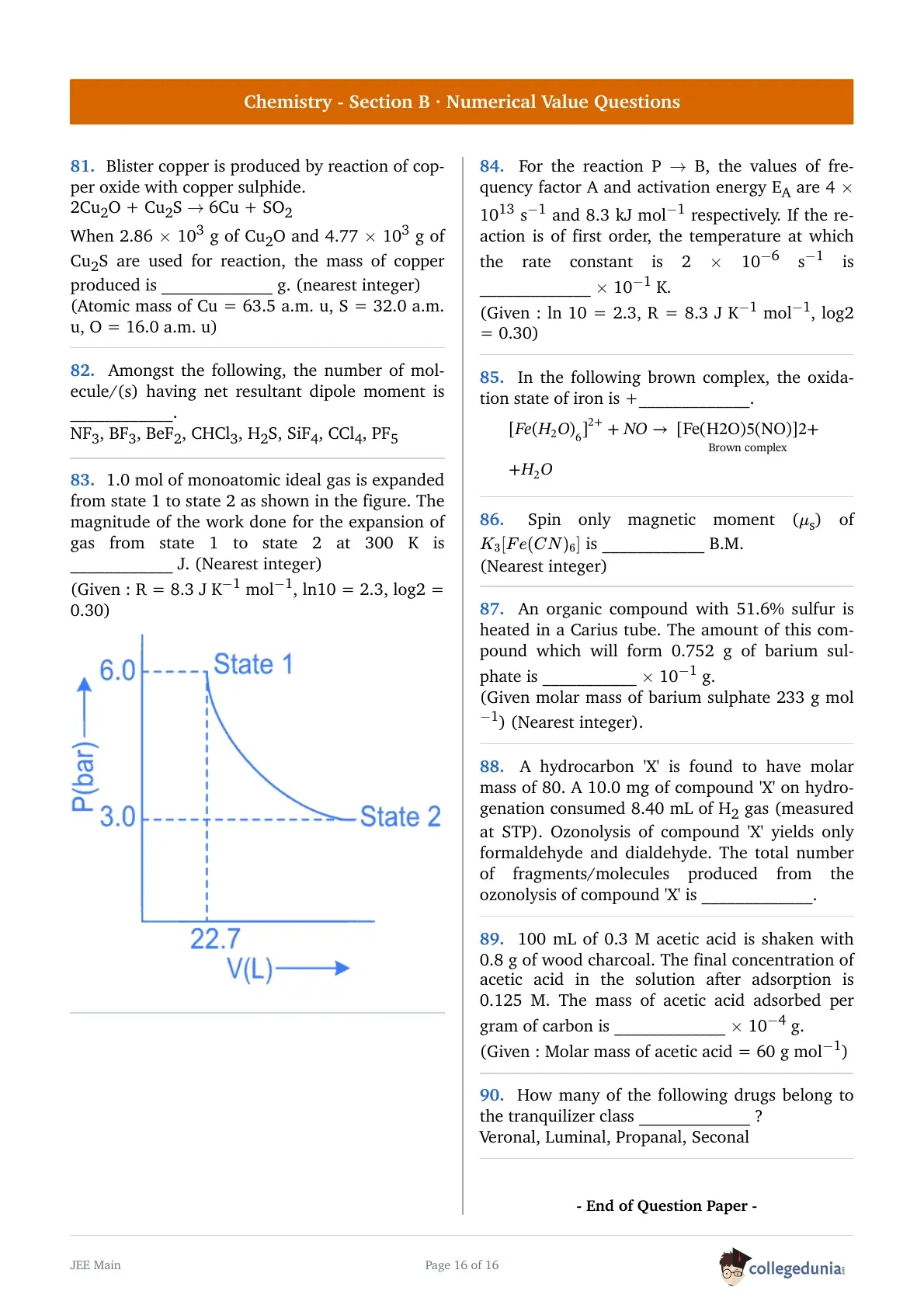
Blister copper is produced by reaction of copper oxide with copper sulphide.
2Cu2O + Cu2S \( \to \) 6Cu + SO2
When 2.86 \( \times \) 103 g of Cu2O and 4.77 \( \times \) 103 g of Cu2S are used for reaction, the mass of copper produced is _____________ g. (nearest integer)
(Atomic mass of Cu = 63.5 a.m. u, S = 32.0 a.m. u, O = 16.0 a.m. u)
Amongst the following, the number of molecule/(s) having net resultant dipole moment is ____________.
NF3, BF3, BeF2, CHCl3, H2S, SiF4, CCl4, PF5
1.0 mol of monoatomic ideal gas is expanded from state 1 to state 2 as shown in the figure. The magnitude of the work done for the expansion of gas from state 1 to state 2 at 300 K is ____________ J. (Nearest integer)
(Given : R = 8.3 J K\( - \)1 mol\( - \)1, ln10 = 2.3, log2 = 0.30)

For the reaction P \( \to \) B, the values of frequency factor A and activation energy EA are 4 \( \times \) 1013 s\( - \)1 and 8.3 kJ mol\( - \)1 respectively. If the reaction is of first order, the temperature at which the rate constant is 2 \( \times \) 10\( - \)6 s\( - \)1 is _____________ \( \times \) 10\( - \)1 K.
(Given : ln 10 = 2.3, R = 8.3 J K\( - \)1 mol\( - \)1, log2 = 0.30)
In the following brown complex, the oxidation state of iron is +_____________.
\( {[Fe{({H_2}O)_6}]^{2 + }} + NO \to \mathop {{{[Fe{{({H_2}O)}_5}(NO)]}^{2 + }}}\limits_{\text{Brown complex}} + {H_2}O \)
Spin only magnetic moment (\( \mu \)s) of \( {K_3}[Fe{(CN)_6}] \) is ____________ B.M.
(Nearest integer)
An organic compound with 51.6% sulfur is heated in a Carius tube. The amount of this compound which will form 0.752 g of barium sulphate is ___________ \( \times \) 10\( - \)1 g.
(Given molar mass of barium sulphate 233 g mol\( - \)1) (Nearest integer).
A hydrocarbon 'X' is found to have molar mass of 80. A 10.0 mg of compound 'X' on hydrogenation consumed 8.40 mL of H2 gas (measured at STP). Ozonolysis of compound 'X' yields only formaldehyde and dialdehyde. The total number of fragments/molecules produced from the ozonolysis of compound 'X' is _____________.
100 mL of 0.3 M acetic acid is shaken with 0.8 g of wood charcoal. The final concentration of acetic acid in the solution after adsorption is 0.125 M. The mass of acetic acid adsorbed per gram of carbon is _____________ \( \times \) 10\( - \)4 g.
(Given : Molar mass of acetic acid = 60 g mol\( - \)1)
How many of the following drugs belong to the tranquilizer class _____________ ?
Veronal, Luminal, Propanal, Seconal
JEE Main 2022 Exam Pattern and Marking Scheme
| Particulars | Details |
|---|---|
| Exam Mode | Online (Computer-Based Test) |
| Paper | B.E./B.Tech (Paper 1) |
| Duration | 3 hours (180 minutes) |
| Type of Questions | Multiple Choice Questions (MCQs) + Numerical Value Questions |
| Subjects | Mathematics, Physics, Chemistry |
| Total Questions | 90 questions (75 to be attempted) |
| Total Marks | 300 marks |
| Marking Scheme | +4 for correct answer & -1 for incorrect MCQ and Numerical Value-based Questions |



Comments