




JEE Main 2023 Chemistry April 11 Shift 2 Question Paper is available here for download. Candidates can download official JEE Main 2023 Chemistry Question Paper PDF with Solution and Answer Key for April 11 Shift 2 using the link below. JEE Main Chemistry Question Paper is divided into two sections, Section A with 20 MCQs and Section B with 10 numerical type questions. Candidates are required to answer all questions from Section A and any 5 questions from section B.
JEE Main 2023 Chemistry Question Paper April 11 Shift 2 PDF
| JEE Main 2023 11th April Shift 2 Chemistry Question Paper with Solution PDF |  Download Download |
Check Solution |
JEE Main 2023 11th April Shift 2 Chemistry Question Paper with Solution
The magnetic moment is measured in Bohr Magneton (BM). Spin only magnetic moment of Fe in \([Fe(H_2O)_6]^{3+}\) and \([Fe(CN)_6]^{3-}\) complexes respectively is:
View Solution
Which one of the following pairs is an example of polar molecular solids?
View Solution
Match List I with List II
List I & & List II
Complex & & Colour
A. & Mg(NH\(_4\))PO\(_4\) & I. & Brown
B. & K\(_3\)[Co(NO\(_2\))\(_6\)] & II. & White
C. & MnO(OH)\(_2\) & III. & Yellow
D. & Fe\(_4\)[Fe(CN)\(_6\)]\(_3\) & IV. & blue
Choose the correct answer from the options Provided that below:
View Solution
A solution is prepared by adding 2 g of "X" to 1 mole of water. Mass percent of "X" in the solution is ____.
View Solution
If Ni\(^{2+}\) is replaced by Pt\(^{2+}\) in the complex \([NiCl_2Br_2]^{2-}\), which of the following properties are expected to get changed?
A. Geometry
B. Geometrical isomerism
C. Optical isomerism
D. Magnetic properties
View Solution
Provided that below are two statements :
Statement I: In the metallurgy process, sulphide ore is converted to oxide before reduction.
Statement II: Oxide ores in general are easier to reduce.
In the light of the above statements, choose the most appropriate answer from the options Provided that below:
View Solution
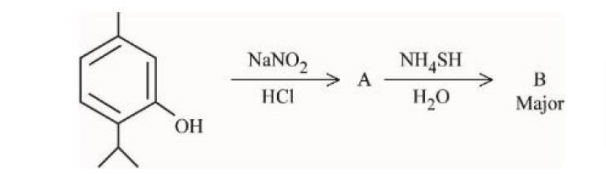
Product [X] formed in the above reaction is:
View Solution
Provided that below are two statements :
Statement I : Ethene at 333 to 343 K and 6-7 atm pressure in the presence of AlEt\(_3\) and TiCl\(_4\) undergoes addition polymerization to give LDP.
Statement II : Caprolactam at 533-543 K in H\(_2\)O through step growth polymerizes to give Nylon 6.
In the light of the above statements, choose the correct answer from the options Provided that below:
View Solution
For a chemical reaction A + B \(\rightarrow\) Product, the order is 1 with respect to A and B.
Rate & [A] & [B]
molL\(^{-1}\)S\(^{-1}\) & molL\(^{-1}\) & molL\(^{-1}\)
0.10 & 20 & 0.5
0.40 & x & 0.5
0.80 & 40 & Y
What is the value of x and y?
View Solution
Which of the following compounds is an example of Freon?
View Solution
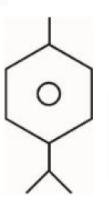
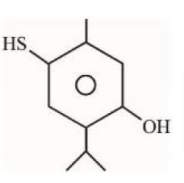
Provided that below are two statements, one is labelled as Assertion A and the other is labelled as Reason R.
Assertion A:
\chemfig{C(=[2]O)-C(-[6]Cl) can be subjected to Wolff-Kishner reduction to give \chemfig{CH_2-C(-[6]Cl)(-H)(-H)
Reason R: Wolff-Kishner reduction is used to convert \chemfig{C(=[2]O) into \chemfig{CH_2}
In the light of the above statements, choose the correct answer from the options Provided that below:
View Solution
Provided that below are two statements, one is labelled as Assertion A and the other is labelled as Reason R.
Assertion A : \([CoCl(NH_3)_5]^{2+}\) absorbs at lower wavelength of light wrt- \([CoCl(NH_3)_5(H_2O)]^{3+}\)
Reason R : It is because the wavelength of the light absorbed depends on the oxidation state of the metal ion.
In the light of the above statements, choose the correct answer from the options Provided that below:
View Solution
Compound from the following that will not produce precipitate on reaction with AgNO\(_3\) is:
- (1)
![]()
- (2)
![]()
- (3)
![]()
- (4)
![]()
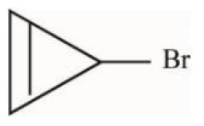
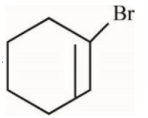
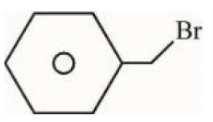
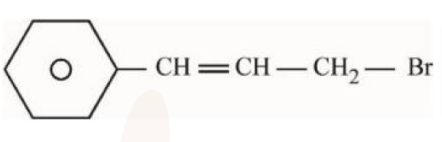
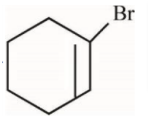
Provided that below are two statements, one is labelled as Assertion A and the other is labelled as Reason R.
Assertion A : A solution of the product obtained by heating a mole of glycine with a mole of chlorine in presence of red phosphorous generates chiral carbon atom.
Reason R : A molecule with 2 chiral carbons is always optically active.
In the light of the above statements, choose the correct answer from the options Provided that below:
View Solution
Alkali metal from the following with least melting point is:
View Solution
Which hydride among the following is less stable?
View Solution
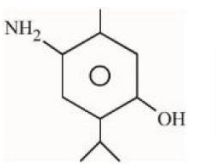
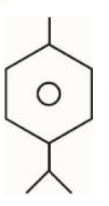
The major product formed in the following reaction is _____.
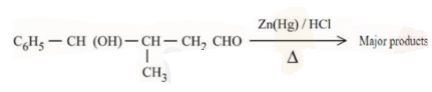
View Solution
One mole of P\(_4\) reacts with 8 moles SOCl\(_2\) to give 4 moles of A, x mole of SO\(_2\) and 2 moles of B. A, B and x respectively are _____.
View Solution
What weight of glucose must be dissolved in 100 g of water to lower the vapour pressure by 0.20 mmHg?
(Assume dilute solution is being formed)
Provided that : Vapour pressure of pure water is 54.2 mmHg at room temperature. Molar mass of glucose is 180g mol\(^{-1}\)
View Solution
The total number of intensive properties from the following is _____.
Mole, Volume, Molar heat capacity, Molarity, E° cell, Gibbs free energy change, Molar mass, Mole
View Solution
The volume of hydrogen liberated at STP by treating 2.4 g of magnesium with excess of hydrochloric acid is _____ \(\times 10^{-2}\) L.
Provided that: Molar volume of gas is 22.4 L at STP. Molar mass of magnesium is 24 g mol\(^{-1}\)
View Solution
The number of correct statements about modern adsorption theory of heterogeneous catalysis from the following is ____.
A. The catalyst is diffused over the surface of reactants.
B. Reactants are adsorbed on the surface of the catalyst.
C. Occurrence of chemical reaction on the catalyst's surface through formation of an intermediate.
D. It is a combination of intermediate compound formation theory and the old adsorption theory.
E. It explains the action of the catalyst as well as those of catalytic promoters and poisons.
View Solution
The number of correct statements from the following is _____.
A. For 1 s orbital, the probability density is maximum at the nucleus
B. For 2 s orbital, the probability density first increases to maximum and then decreases sharply to zero.
C. Boundary surface diagrams of the orbitals encloses a region of 100% probability of finding the electron.
D. p and d-orbitals have 1 and 2 angular nodes respectively
E. probability density of p-orbital is zero at the nucleus
View Solution
The number of correct statements from the following is _____.
A. \(E_{cell}\) is an intensive parameter
B. A negative E° means that the redox couple is a stronger reducing agent than the H\(^+\)/H\(_2\) couple.
C. The amount of electricity required for oxidation or reduction depends on the stoichiometry of the electrode reaction.
D. The amount of chemical reaction which occurs at any electrode during electrolysis by a current is proportional to the quantity of electricity passed through the electrolyte.
View Solution
Mg(NO\(_3\))\(_2\)·XH\(_2\)O and Ba(NO\(_3\))\(_2\)·YH\(_2\)O, represent formula of the crystalline forms of nitrate salts. Sum of X and Y is _____.
View Solution
The number of possible isomeric products formed when 3-chloro-1-butene reacts with HCl through carbocation formation is _____.
View Solution
4.5 moles each of hydrogen and iodine is heated in a sealed ten litre vessel. At equilibrium, 3 moles of HI were found. The equilibrium constant for \(H_2(g)+I_2(g) \rightleftharpoons 2HI(g)\) is _____.
View Solution
Number of compounds from the following which will not produce orange red precipitate with Benedict solution is ______.
Glucose, maltose, sucrose, ribose, 2-deoxyribose, amylose, lactose
View Solution
The maximum number of lone pairs of electrons on the central atom from the following species is _____.
ClO\(_3^-\), XeF\(_4\), SF\(_4\), and I\(_3^-\)
View Solution


JEE Main 2023 Chemistry Paper Analysis April 11 Shift 2
JEE Main 2023 Chemistry Paper Analysis for the exam scheduled on April 11 Shift 2 is available here. Candidates can check subject-wise paper analysis for the exam scheduled on April 11 Shift 2 here along with the topics with the highest weightage.
JEE Main 2023 Chemistry Question Paper Pattern
| Feature | Question Paper Pattern |
|---|---|
| Examination Mode | Computer-based Test |
| Exam Language | 13 languages (English, Hindi, Assamese, Bengali, Gujarati, Kannada, Malayalam, Marathi, Odia, Punjabi, Tamil, Telugu, and Urdu) |
| Exam Duration | 3 hours |
| Sectional Time Limit | None |
| Chemistry Marks | 100 marks |
| Total Number of Questions Asked | 20 MCQs + 10 Numerical Type Questions |
| Total Number of Questions to be Answered | 20 MCQs + 5 Numerical Type Questions |
| Marking Scheme | +4 for each correct answer |
| Negative Marking | -1 for each incorrect answer |
Also Check:
JEE Main Previous Year Question Paper
| JEE Main 2022 Question Paper | JEE Main 2021 Question Paper | JEE Main 2020 Question Paper |
| JEE Main 2019 Question Paper | JEE Main 2018 Question Paper | JEE Main 2017 Question Paper |



Comments