




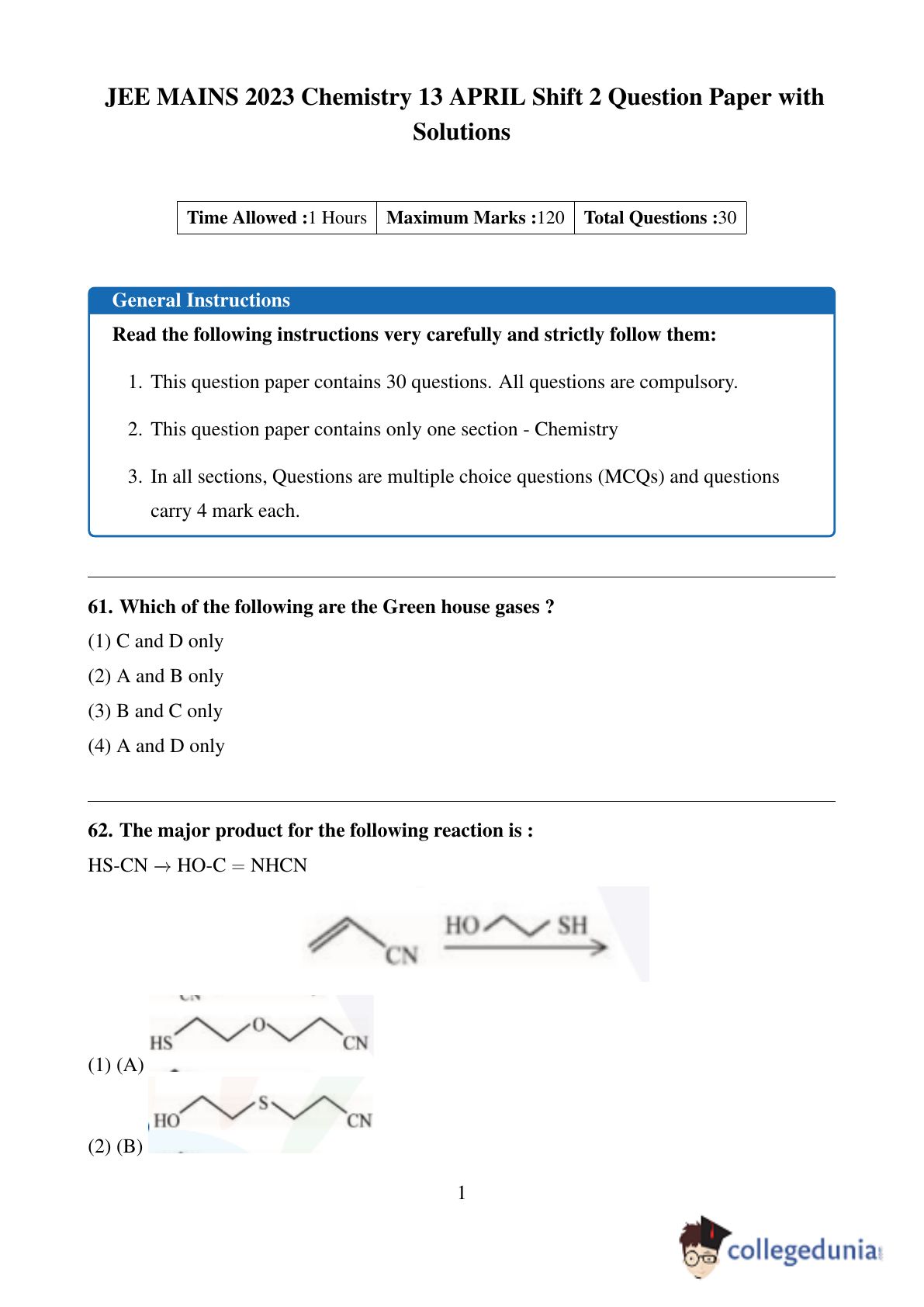
JEE Main 2023 Chemistry April 13 Shift 2 Question Paper is available here for download. Candidates can download official JEE Main 2023 Chemistry Question Paper PDF with Solution and Answer Key for April 13 Shift 2 using the link below. JEE Main Chemistry Question Paper is divided into two sections, Section A with 20 MCQs and Section B with 10 numerical type questions. Candidates are required to answer all questions from Section A and any 5 questions from section B.
JEE Main 2023 Chemistry Question Paper April 13 Shift 2 PDF
| JEE Main 2023 April 13 Shift 2 Question Paper with Solution PDF |  Download Download |
Check Solution |
JEE Main 2023 Chemistry Questions with Solutions
Section – A
Question 1:
Which of the following are the Green house gases ?
(A) Water vapour
(B) Ozone
(C) I2
(D) Molecular hydrogen
Choose the most appropriate answer from the options given below :
View Solution
Green house gases are \( CO_2, CH_4, \) water vapour, nitrous oxide, CFCs, and ozone.
Therefore, the correct answer is A and B only. Quick Tip: Greenhouse gases contribute to the greenhouse effect by trapping heat in the Earth's atmosphere.
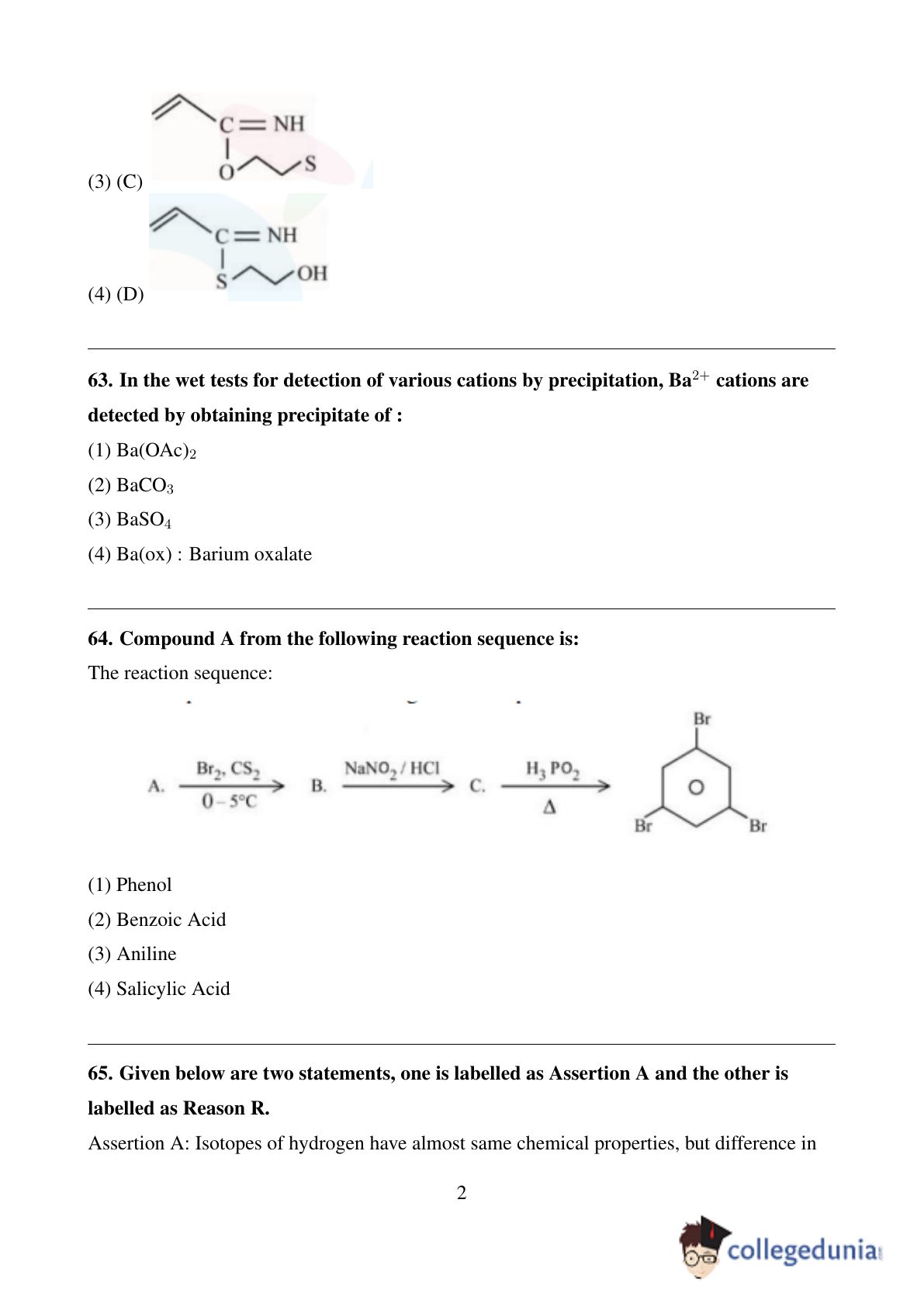
The major product for the following reaction is :
\(HS-CN \xrightarrow{} HO-C = NH CN \)

- (1) (A)
![]()
- (2) (B)
![]()
- (3) (C)
![]()
- (4) (D)
![]()


In the wet tests for detection of various cations by precipitation, Ba\(^{2+}\) cations are detected by obtaining precipitate of :
View Solution
In wet testing, \((NH_4)_2CO_3\) is used as a group reagent for detecting 5th group cations such as \( Ba^{2+}, Ca^{2+}, Sr^{2+} \). The precipitation of barium carbonate, BaCO\(_3\), is used to confirm the presence of \( Ba^{2+} \).
The reaction is: \[ Ba^{2+} + (NH_4)_2CO_3 \rightarrow BaCO_3 \downarrow + NH_4^+ \] Quick Tip: Barium carbonate forms a white precipitate when \( Ba^{2+} \) reacts with \( (NH_4)_2CO_3 \) in water.
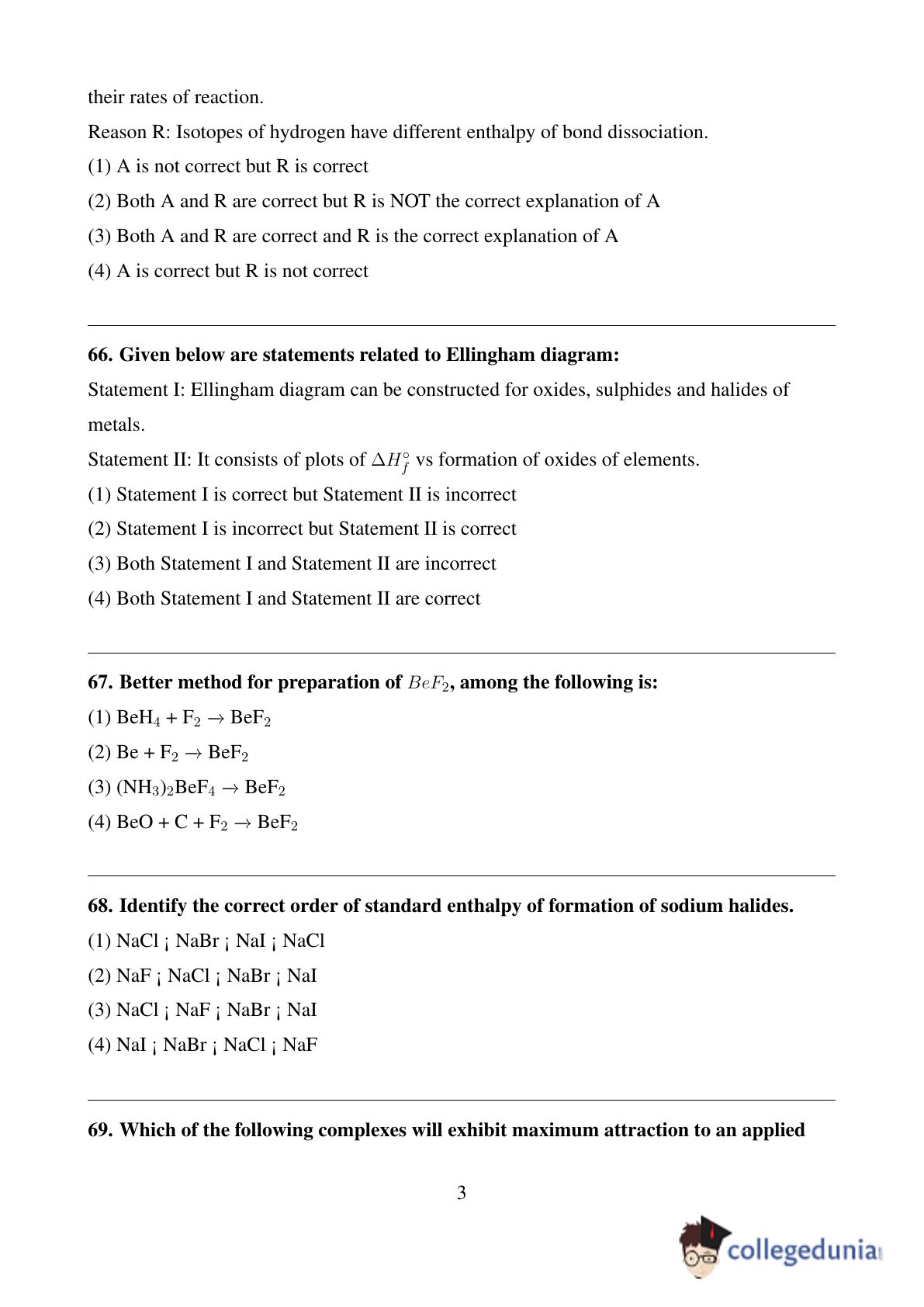
Compound A from the following reaction sequence is:
The reaction sequence:

View Solution
Given below are two statements, one is labelled as Assertion A and the other is labelled as Reason R.
Assertion A: Isotopes of hydrogen have almost same chemical properties, but difference in their rates of reaction.
Reason R: Isotopes of hydrogen have different enthalpy of bond dissociation.
View Solution
Given below are statements related to Ellingham diagram:
Statement I: Ellingham diagram can be constructed for oxides, sulphides and halides of metals.
Statement II: It consists of plots of \( \Delta H_f^\circ \) vs formation of oxides of elements.
View Solution
Better method for preparation of \(BeF_2\), among the following is:
View Solution
Identify the correct order of standard enthalpy of formation of sodium halides.
View Solution
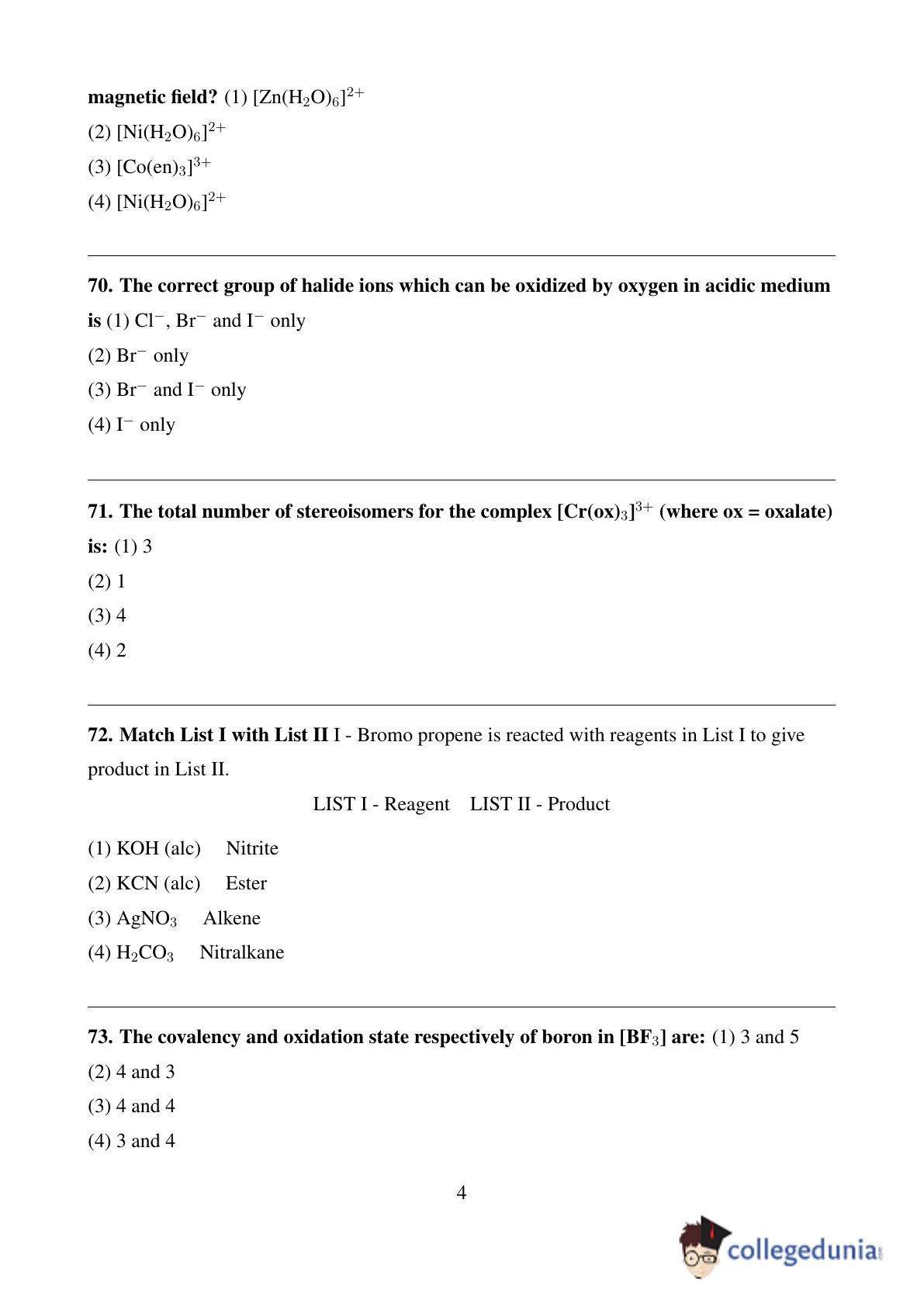
Which of the following complexes will exhibit maximum attraction to an applied magnetic field?
View Solution
The correct group of halide ions which can be oxidized by oxygen in acidic medium is
View Solution
The total number of stereoisomers for the complex [Cr(ox)\(_3\)]\(^{3+}\) (where ox = oxalate) is:
View Solution
Match List I with List II
I - Bromo propene is reacted with reagents in List I to give product in List II.
LIST I LIST II
Reagent Product
View Solution
The covalency and oxidation state respectively of boron in [BF\(_3\)] are:
View Solution
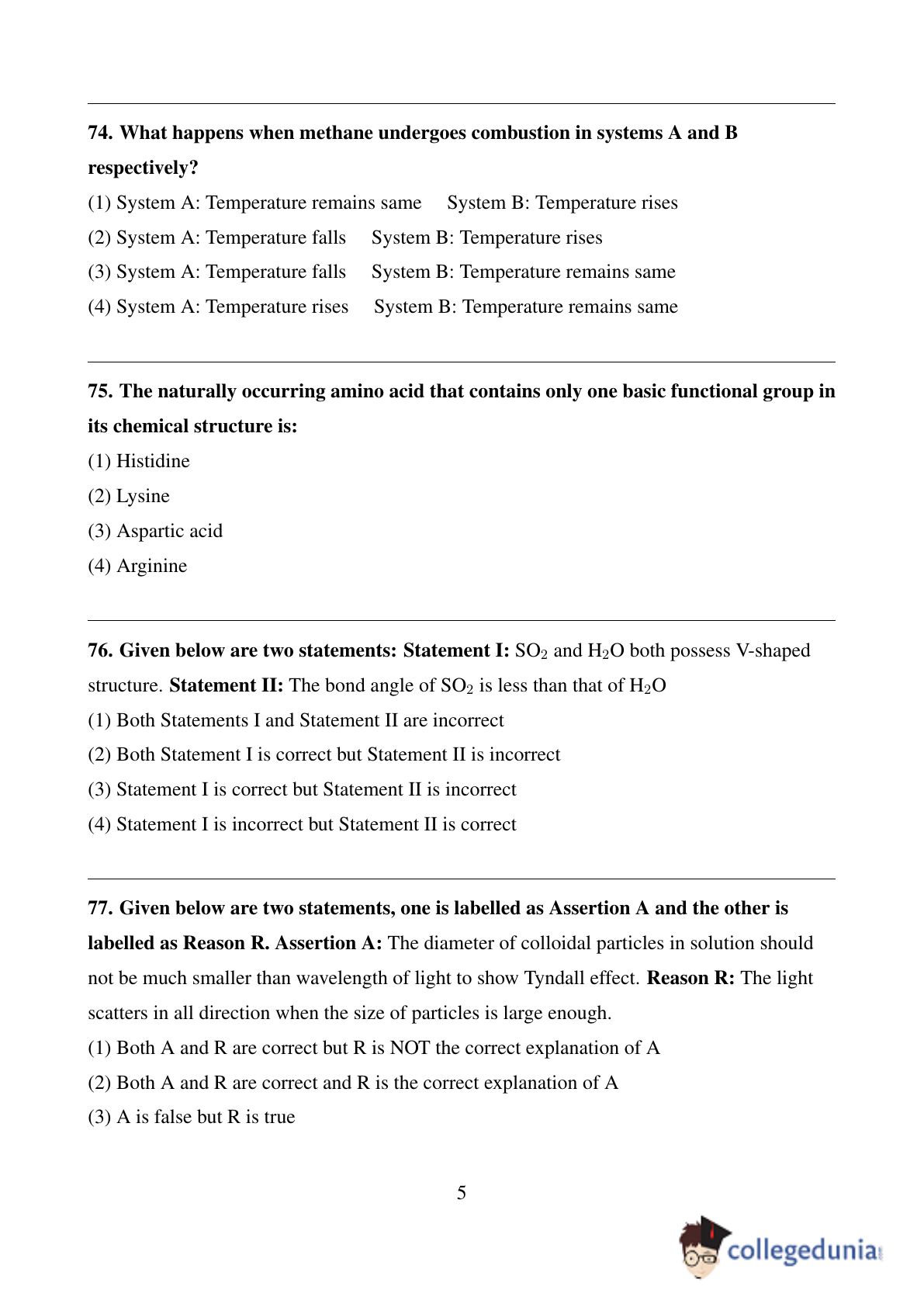
What happens when methane undergoes combustion in systems A and B respectively?
View Solution
The naturally occurring amino acid that contains only one basic functional group in its chemical structure is:
View Solution
Given below are two statements:
Statement I: SO\(_2\) and H\(_2\)O both possess V-shaped structure.
Statement II: The bond angle of SO\(_2\) is less than that of H\(_2\)O
View Solution
Given below are two statements, one is labelled as Assertion A and the other is labelled as Reason R.
Assertion A: The diameter of colloidal particles in solution should not be much smaller than wavelength of light to show Tyndall effect.
Reason R: The light scatters in all direction when the size of particles is large enough.
View Solution
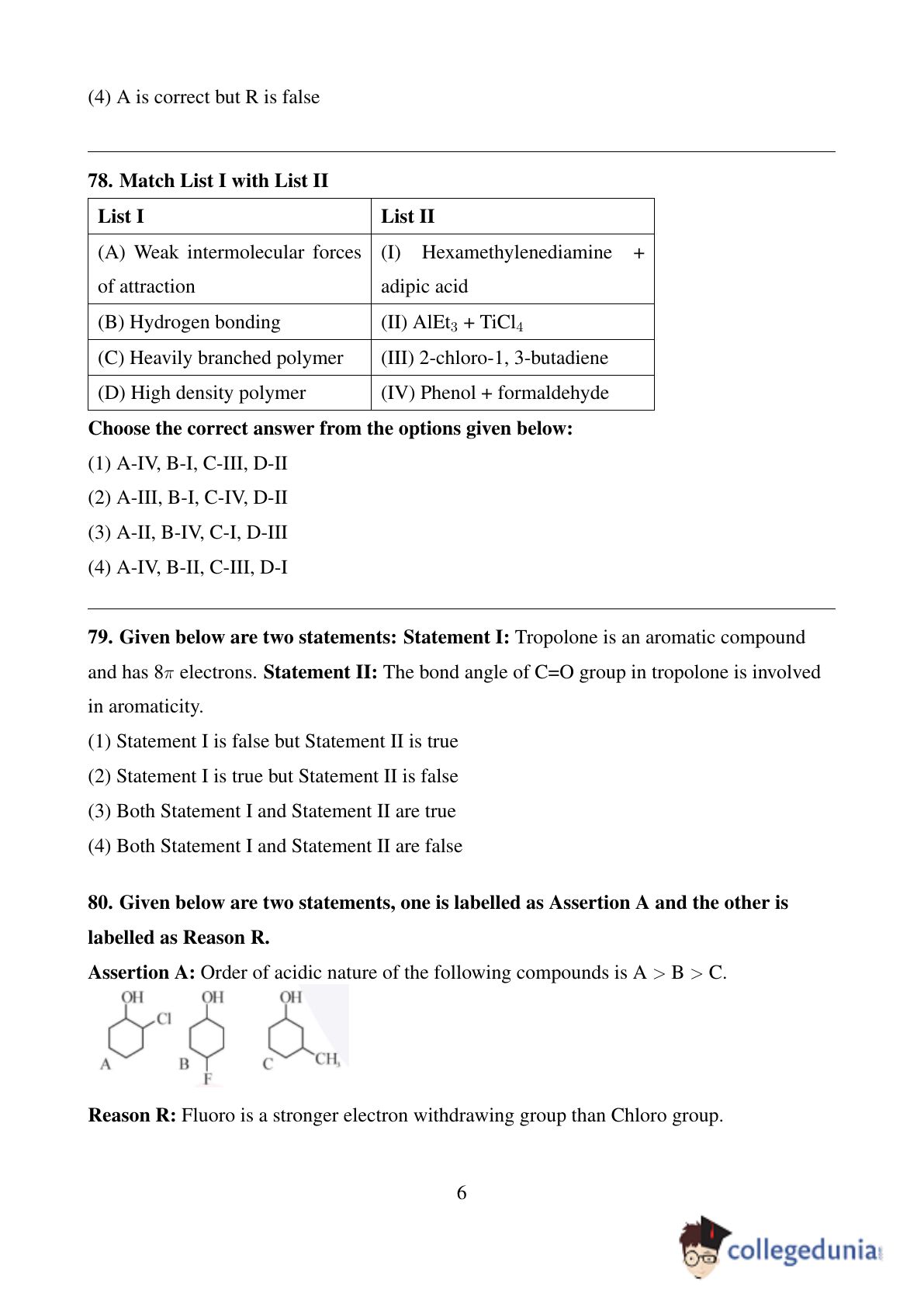
Match List I with List II
List I List II
(A) Weak intermolecular forces of attraction (I) Hexamethylenediamine + adipic acid
(B) Hydrogen bonding (II) AlEt\(_3\) + TiCl\(_4\)
(C) Heavily branched polymer (III) 2-chloro-1, 3-butadiene
(D) High density polymer (IV) Phenol + formaldehyde
Choose the correct answer from the options given below:
View Solution
Given below are two statements:
Statement I: Tropolone is an aromatic compound and has 8\(\pi\) electrons.
Statement II: The bond angle of C=O group in tropolone is involved in aromaticity.
View Solution
Given below are two statements, one is labelled as Assertion A and the other is labelled as Reason R.
Assertion A: Order of acidic nature of the following compounds is A \(>\) B \(>\) C.

Reason R: Fluoro is a stronger electron withdrawing group than Chloro group.
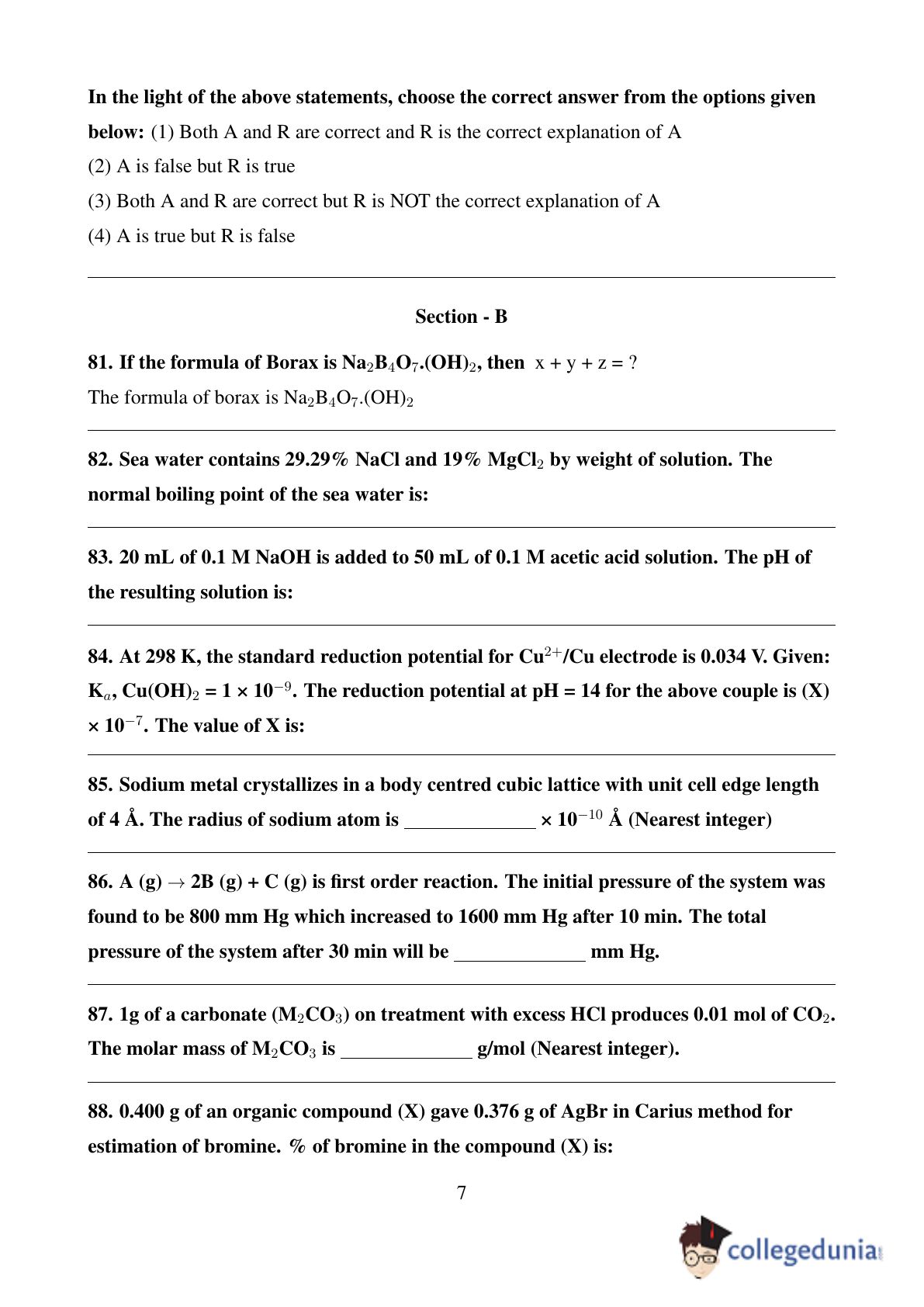
In the light of the above statements, choose the correct answer from the options given below:
View Solution
Section – B
Question 21:
If the formula of Borax is Na\(_2\)B\(_4\)O\(_7\).(OH)\(_2\), then x + y + z = ?
The formula of borax is Na\(_2\)B\(_4\)O\(_7\).(OH)\(_2\)
View Solution
Borax has the following formula: Na\(_2\)B\(_4\)O\(_7\).(OH)\(_2\)
This formula contains:
- 2 sodium atoms (Na)
- 4 boron atoms (B)
- 7 oxygen atoms (O)
- 2 hydroxyl groups (OH).
Thus, adding these values gives: \[ 2 + 4 + 7 + 2 = 17 \]
Therefore, \( x + y + z = 17 \). Quick Tip: Ensure you correctly count all atoms and functional groups in molecular formulas for accurate results.
Question 22:
Sea water contains 29.29% NaCl and 19% MgCl\(_2\) by weight of solution. The normal boiling point of the sea water is:
20 mL of 0.1 M NaOH is added to 50 mL of 0.1 M acetic acid solution. The pH of the resulting solution is:
At 298 K, the standard reduction potential for Cu\(^{2+}\)/Cu electrode is 0.034 V. Given: K\(_a\), Cu(OH)\(_2\) = 1 × 10\(^{-9}\). The reduction potential at pH = 14 for the above couple is (X) × 10\(^{-7}\). The value of X is:
Sodium metal crystallizes in a body centred cubic lattice with unit cell edge length of 4 Å. The radius of sodium atom is \hspace{3cm} × 10\(^{-10}\) Å (Nearest integer)
A (g) \(\rightarrow\) 2B (g) + C (g) is first order reaction. The initial pressure of the system was found to be 800 mm Hg which increased to 1600 mm Hg after 10 min. The total pressure of the system after 30 min will be \underline{\hspace{3cm mm Hg.
1g of a carbonate (M\(_2\)CO\(_3\)) on treatment with excess HCl produces 0.01 mol of CO\(_2\). The molar mass of M\(_2\)CO\(_3\) is \underline{\hspace{3cm g/mol (Nearest integer).
0.400 g of an organic compound (X) gave 0.376 g of AgBr in Carius method for estimation of bromine. % of bromine in the compound (X) is:
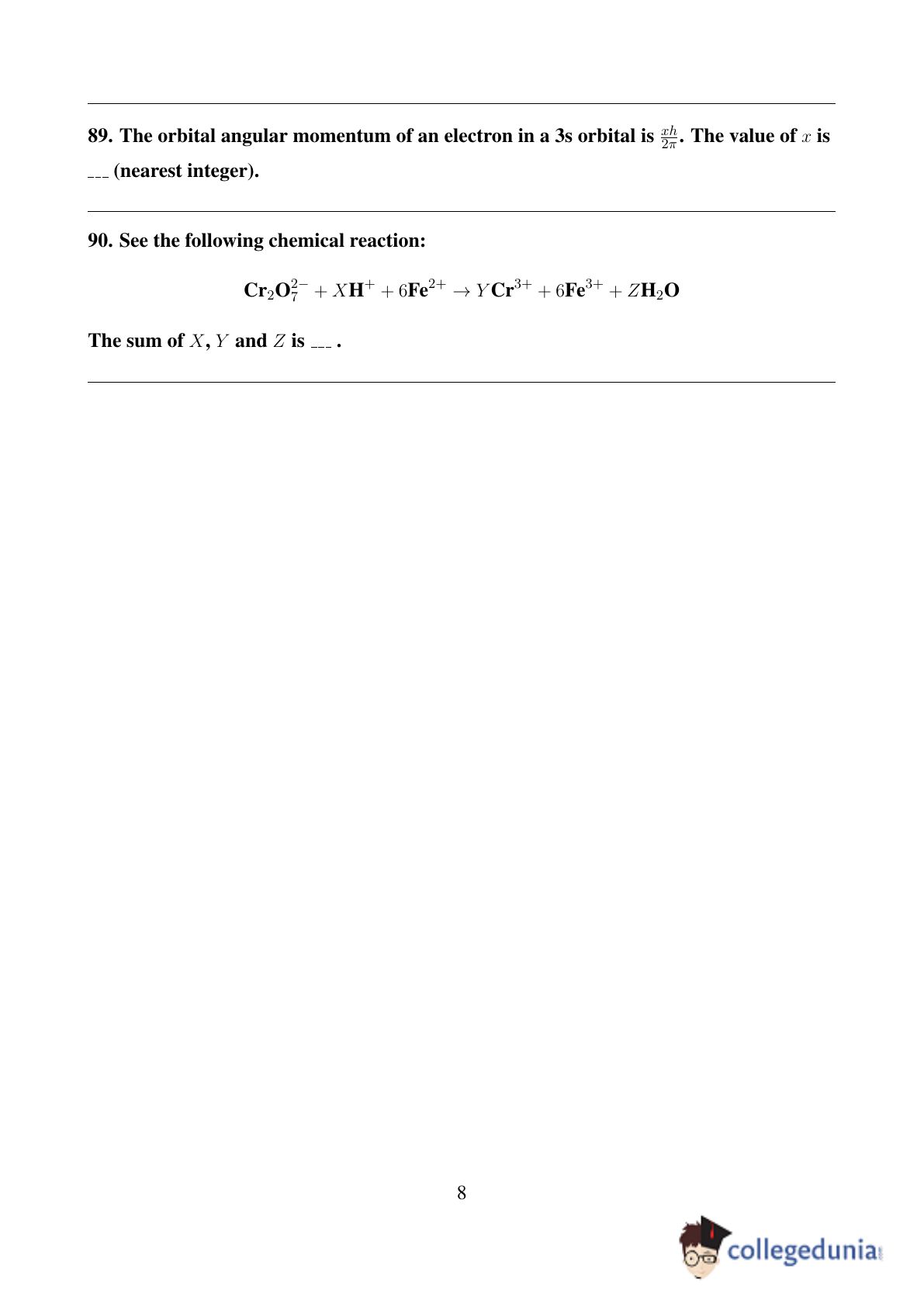
The orbital angular momentum of an electron in a 3s orbital is \( \frac{x h}{2\pi} \). The value of \( x \) is ___ (nearest integer).
View Solution
See the following chemical reaction: \[ Cr_2O_7^{2-} + XH^+ + 6Fe^{2+} \rightarrow YCr^{3+} + 6Fe^{3+} + ZH_2O \]
The sum of \( X \), \( Y \) and \( Z \) is ___ .
View Solution
First, balance the chemical equation: \[ Cr_2O_7^{2-} + 14H^+ + 6Fe^{2+} \rightarrow 2Cr^{3+} + 6Fe^{3+} + 7H_2O \]
From the balanced equation, we can identify the coefficients: \[ X = 14, \quad Y = 2, \quad Z = 7 \]
The sum of \( X \), \( Y \), and \( Z \) is: \[ X + Y + Z = 14 + 2 + 7 = 23 \] Quick Tip: When balancing redox reactions, first balance the elements other than oxygen and hydrogen, then balance oxygen by adding water molecules, and finally balance hydrogen by adding H+ ions. Then, balance the charges by adding electrons.
JEE Main 2023 Chemistry Paper Analysis April 13 Shift 2
JEE Main 2023 Chemistry Paper Analysis for the exam scheduled on April 13 Shift 2 is available here. Candidates can check subject-wise paper analysis for the exam scheduled on April 13 Shift 2 here along with the topics with the highest weightage.
JEE Main 2023 Chemistry Question Paper Pattern
| Feature | Question Paper Pattern |
|---|---|
| Examination Mode | Computer-based Test |
| Exam Language | 13 languages (English, Hindi, Assamese, Bengali, Gujarati, Kannada, Malayalam, Marathi, Odia, Punjabi, Tamil, Telugu, and Urdu) |
| Exam Duration | 3 hours |
| Sectional Time Limit | None |
| Chemistry Marks | 100 marks |
| Total Number of Questions Asked | 20 MCQs + 10 Numerical Type Questions |
| Total Number of Questions to be Answered | 20 MCQs + 5 Numerical Type Questions |
| Marking Scheme | +4 for each correct answer |
| Negative Marking | -1 for each incorrect answer |
Also Check:



Comments