



.png?h=35&w=35&mode=stretch)
JEE Main 2023 Chemistry April 8 Shift 1 Question Paper is available here for download. Candidates can download official JEE Main 2023 Chemistry Question Paper PDF with Solution and Answer Key for April 8 Shift 1 using the link below. JEE Main Chemistry Question Paper is divided into two sections, Section A with 20 MCQs and Section B with 10 numerical type questions. Candidates are required to answer all questions from Section A and any 5 questions from section B.
Related Links:
- Download JEE Main Previous Year Question Papers PDF with Solutions
- Download JEE Main 2025 Question Paper for all Shifts
JEE Main 2023 Chemistry Question Paper April 8 Shift 1 PDF
| JEE Main 2023 8th April Shift 1 Chemistry Question Paper with Solution PDF |  Download Download |
Check Solution |
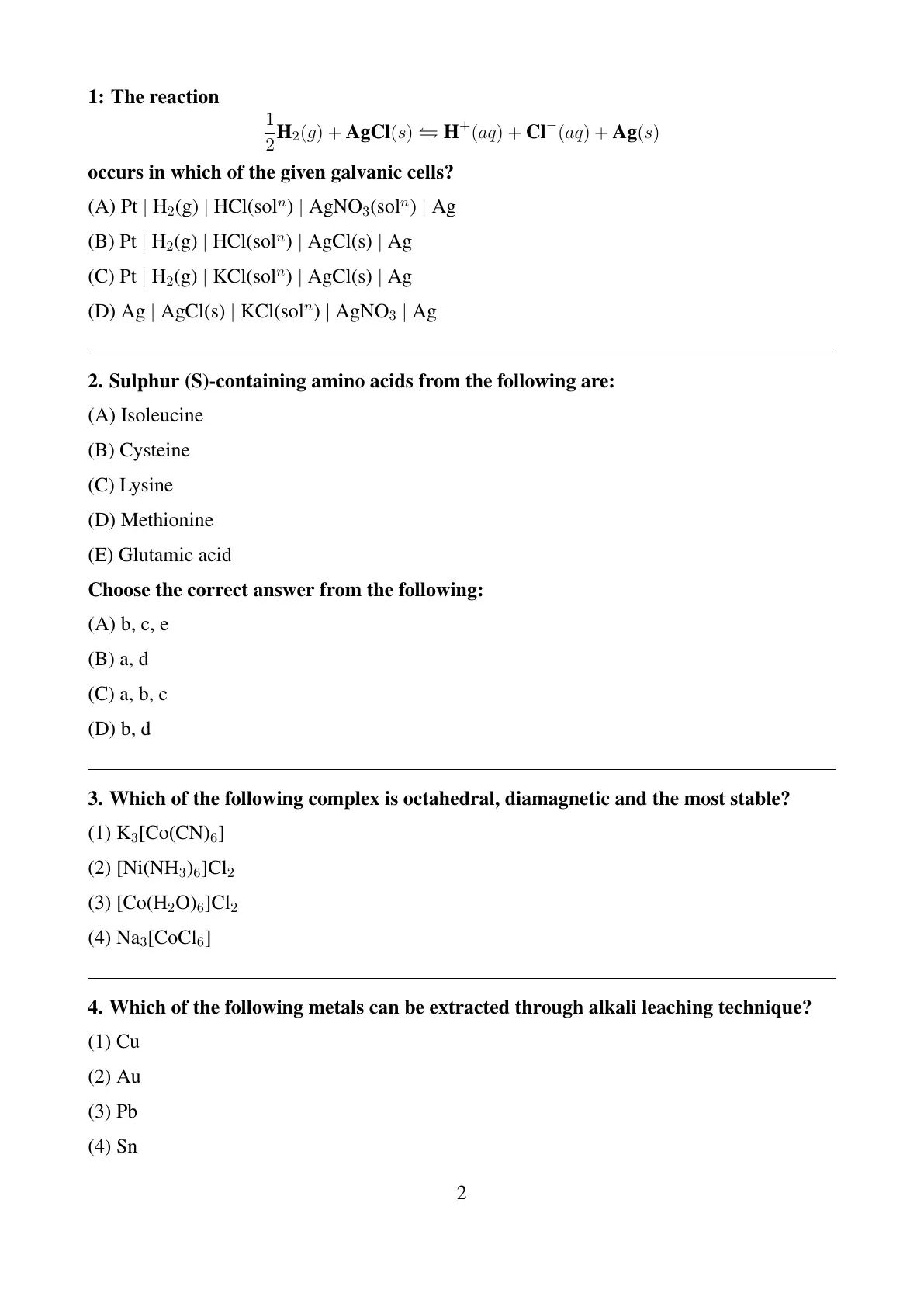
1: The reaction \[ \frac{1}{2} H_2(g) + AgCl(s) \leftrightharpoons H^+(aq) + Cl^-(aq) + Ag(s) \]
occurs in which of the given galvanic cells?
View Solution
Sulphur (S)-containing amino acids from the following are:
View Solution
Sulphur-containing amino acids are those that have a sulphur atom in their side chain. From the given list:
Cysteine: Contains a thiol group (-SH) in its side chain.
Methionine: Contains a thioether (-S-) group in its side chain.
The remaining amino acids (Isoleucine, Lysine, and Glutamic acid) do not contain sulphur in their structures.
Thus, the sulphur-containing amino acids are b (Cysteine) and d (Methionine). Quick Tip: To identify sulphur-containing amino acids, look for functional groups like -SH (thiol) or -S- (thioether) in the side chains.
Which of the following complex is octahedral, diamagnetic and the most stable?
View Solution
Which of the following metals can be extracted through alkali leaching technique?
View Solution
Alkali leaching technique: This technique is used to extract metals that are amphoteric in nature. Amphoteric metals can react with both acids and bases.
Amphoteric nature of Sn: Tin (Sn) is amphoteric, meaning it reacts with alkali solutions (such as NaOH) to form soluble complexes. For example:
\[ SnO + 2NaOH \to Na_2SnO_2 + H_2O \]
Comparison with other metals:
Copper (Cu): Copper is not amphoteric; it does not react with alkalis.
Gold (Au): Gold is a noble metal and does not exhibit amphoteric behavior.
Lead (Pb): While lead exhibits slight amphoteric behavior, it is not commonly extracted through alkali leaching.
Thus, Sn is the only metal from the options that can be extracted via alkali leaching due to its amphoteric nature. Quick Tip: Amphoteric metals like Sn and Al can react with both acids and bases, making them suitable for alkali leaching processes.
The correct order of spin-only magnetic moments for the following complex ions is:
View Solution
The water gas on reacting with cobalt as a catalyst forms:
View Solution
The reaction between water gas (a mixture of CO and H\(_2\)) and a catalyst produces methanol (CH\(_3\)OH). The reaction is as follows: \[ CO + 2H_2 \xrightarrow{ZnO, Cr\(_2\)O\(_3\), 700K} CH_3OH \]
Reactants: CO and H\(_2\) are essential components of water gas.
Catalyst: ZnO and Cr\(_2\)O\(_3\) act as catalysts at a temperature of 700 K to speed up the reaction.
Product: Methanol is formed as the primary product due to the reaction of CO with H\(_2\). Quick Tip: Water gas reactions involve catalysts like ZnO or Cr\(_2\)O\(_3\) for selective synthesis of methanol at high temperatures.
The reaction:
\[ 2IO_3^- + xI^- + 12H^+ \to 6I_2 + 6H_2O \]
What is the value of \(x\)?
What is the purpose of adding gypsum to cement?
View Solution
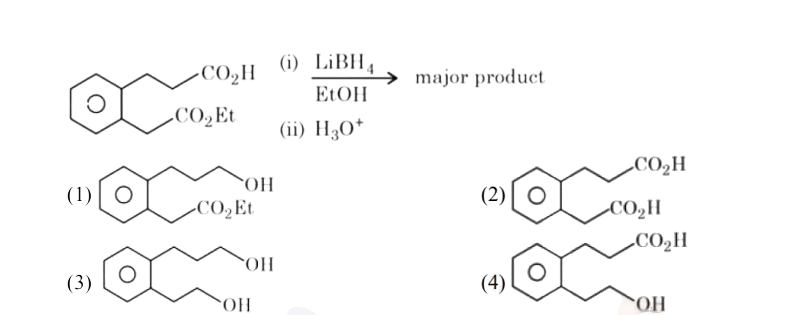
The major product formed in the following reaction is:
View Solution
Match List I with List II:

View Solution
In chromyl chloride, the number of d-electrons present on chromium is the same as in:
(Given atomic numbers: Ti = 22, V = 23, Cr = 24, Mn = 25, Fe = 26)
View Solution
Assertion-Reason:
Assertion (A): Butan-1-ol has a higher boiling point than ethoxyethane.
Reason (R): Extensive hydrogen bonding leads to stronger association of molecules.
View Solution
Match List I with List II:

View Solution
Match List I with List II:

View Solution
Match List I with List II:

View Solution
The correct order of electronegativity for given elements is:
View Solution
Given below are two statements:
Statement I: Lithium and Magnesium do not form superoxide.
Statement II: The ionic radius of Li\(^+\) is larger than the ionic radius of Mg\(^{2+}\).
View Solution
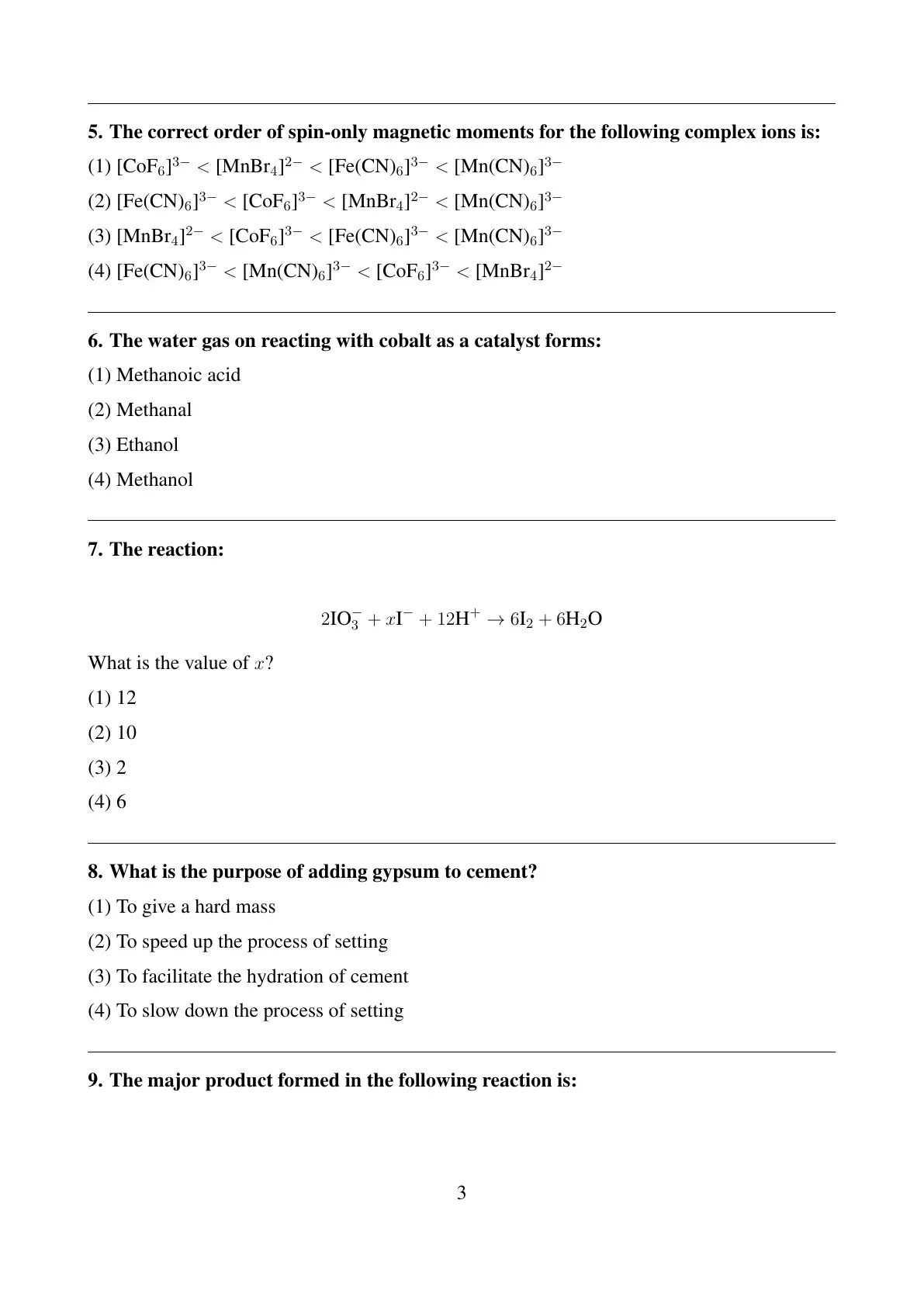
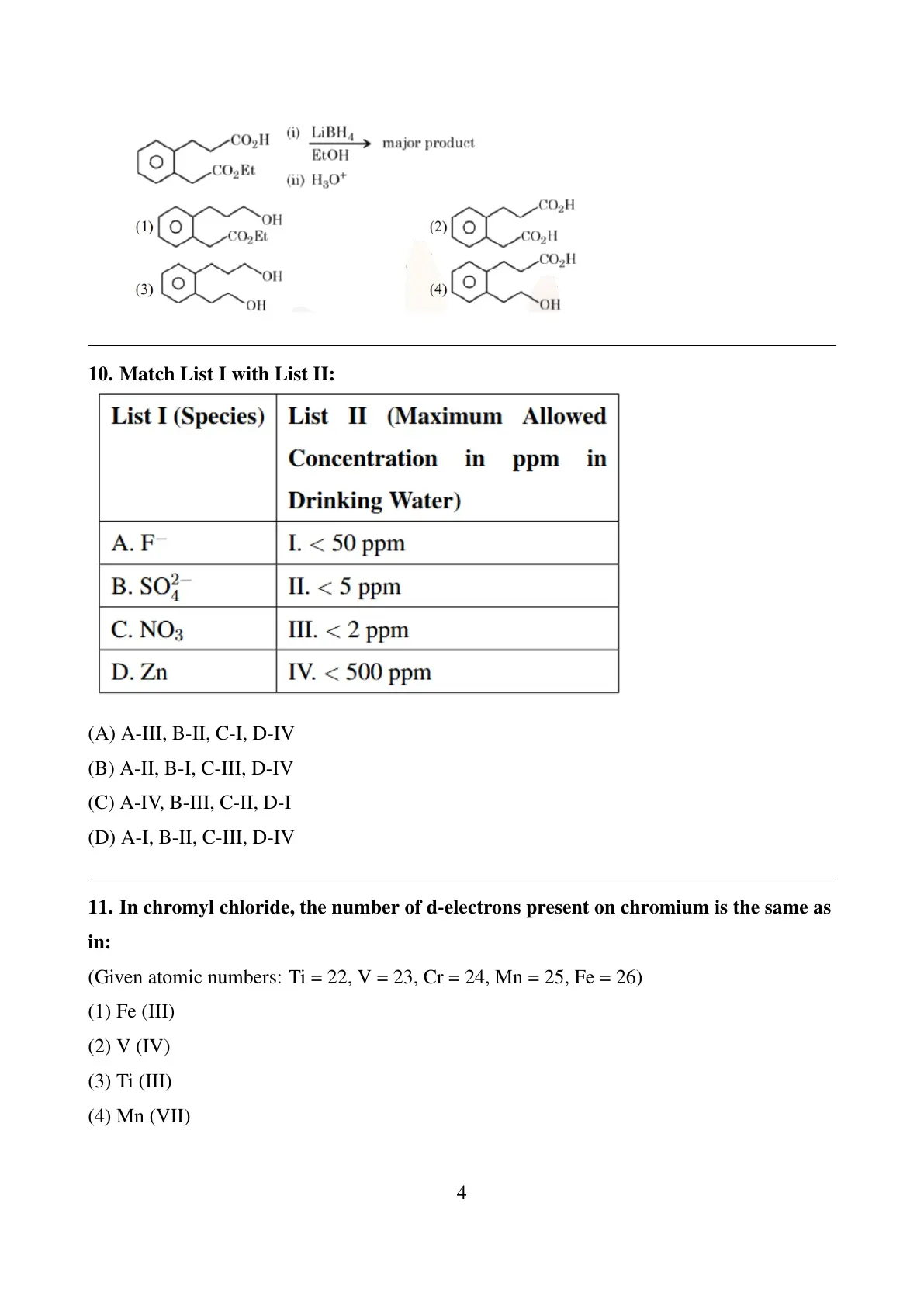
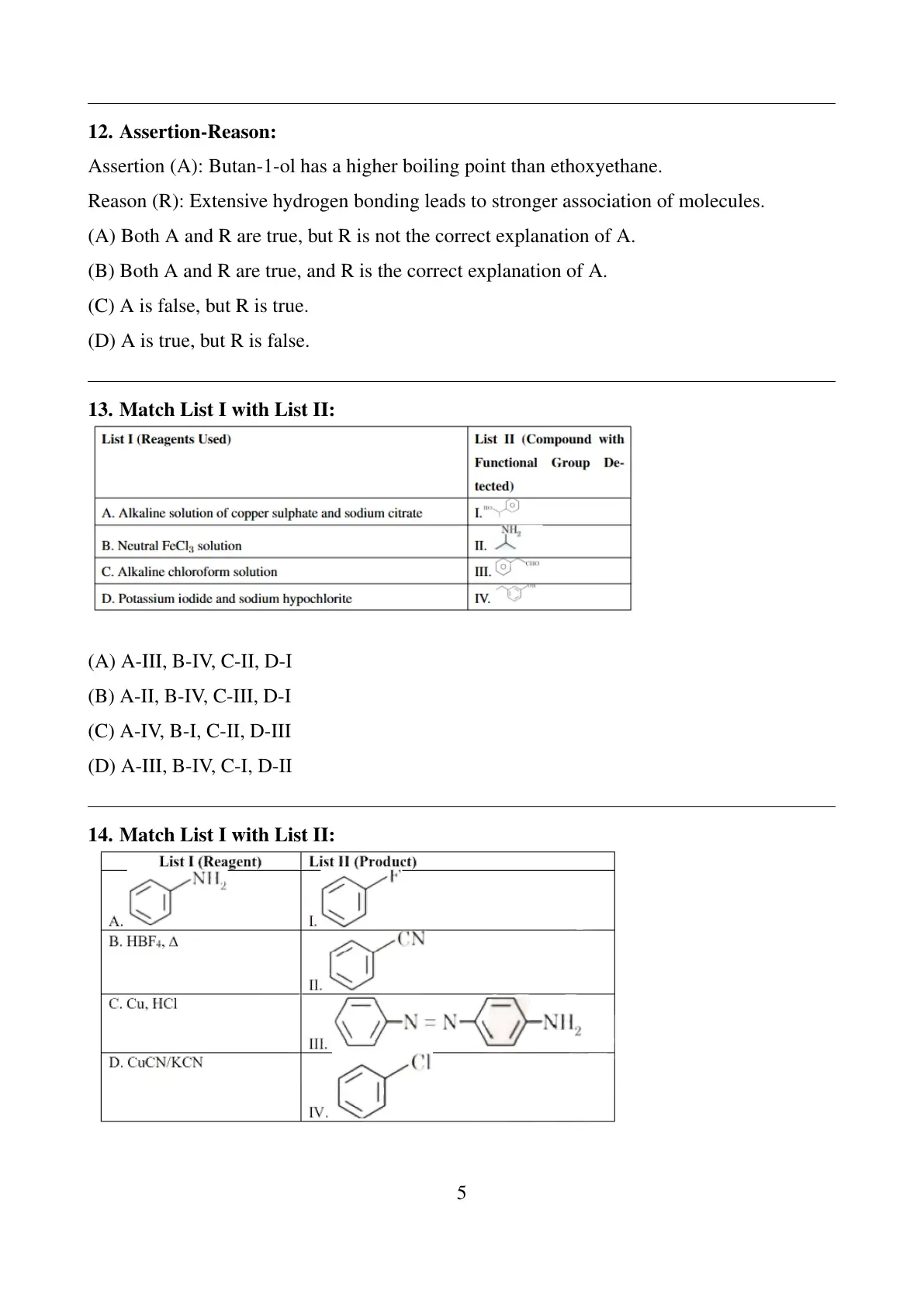
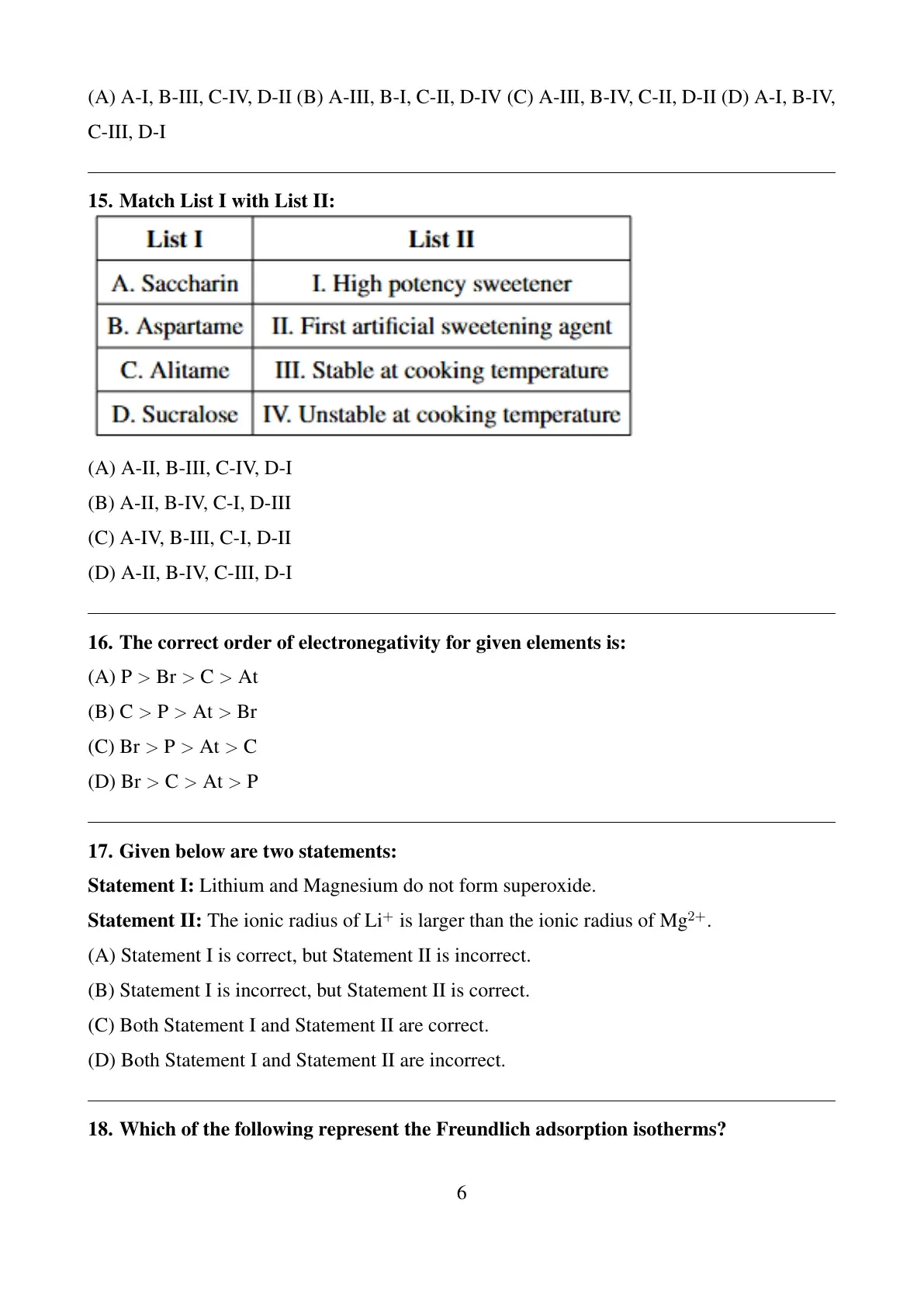
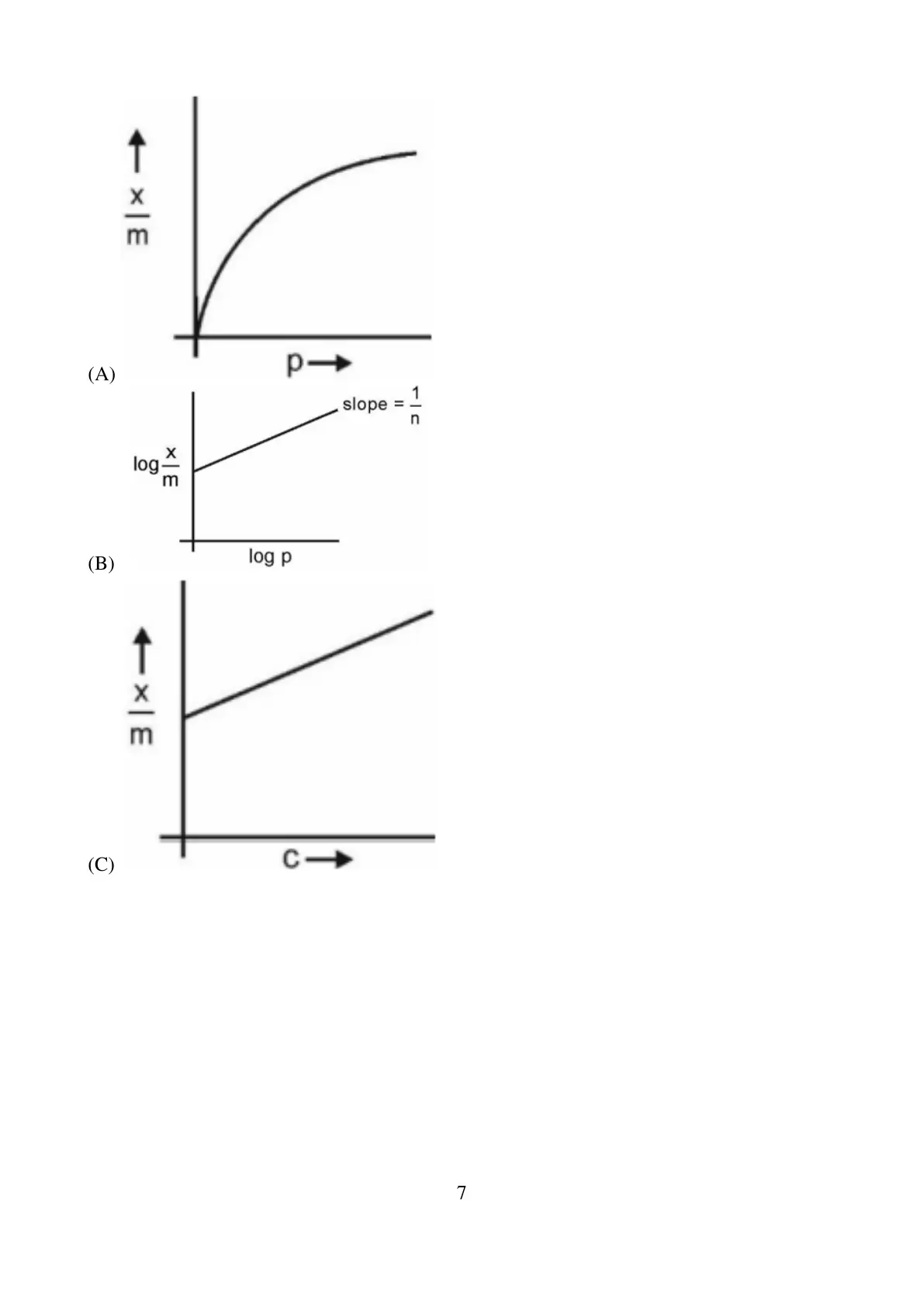
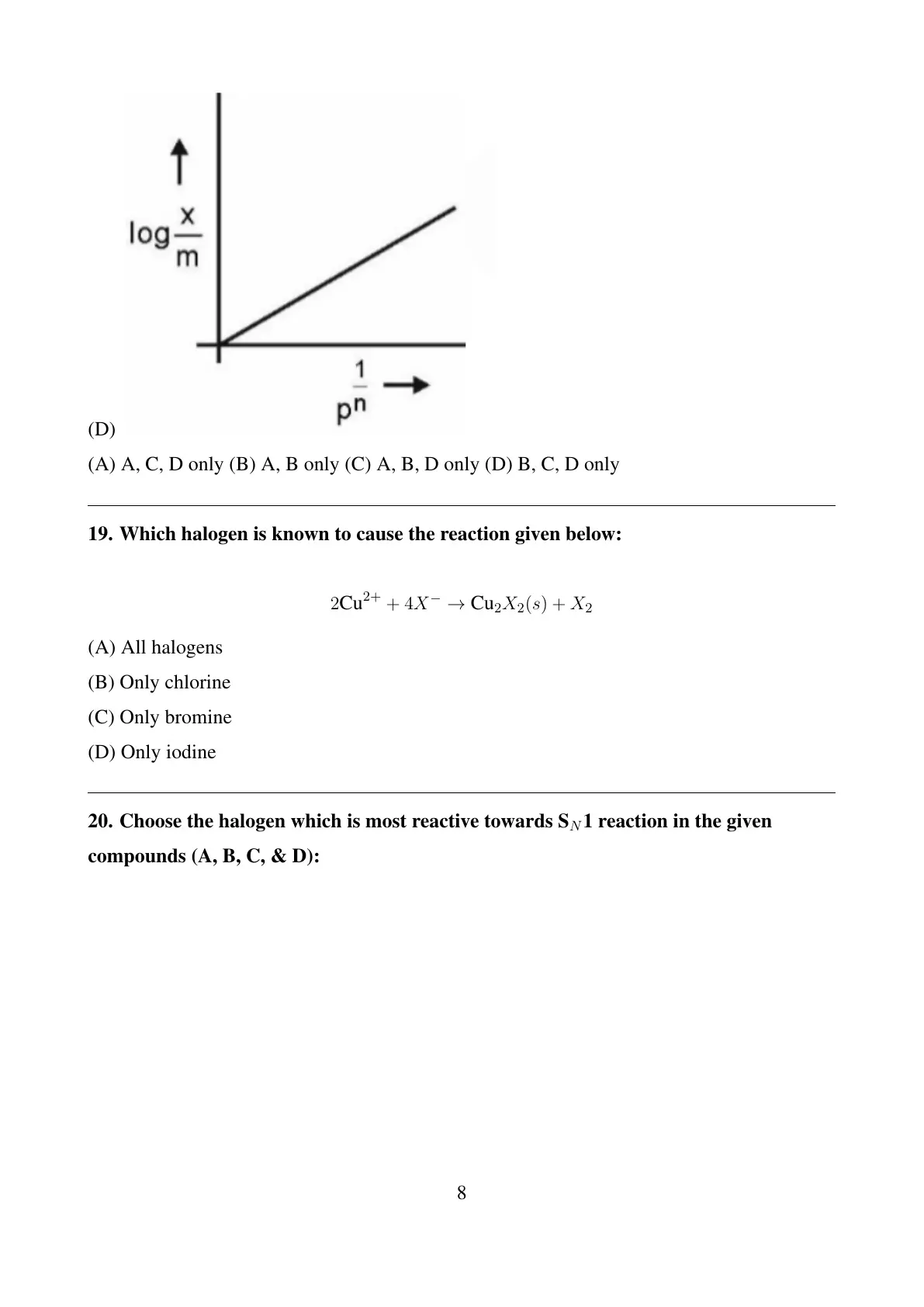
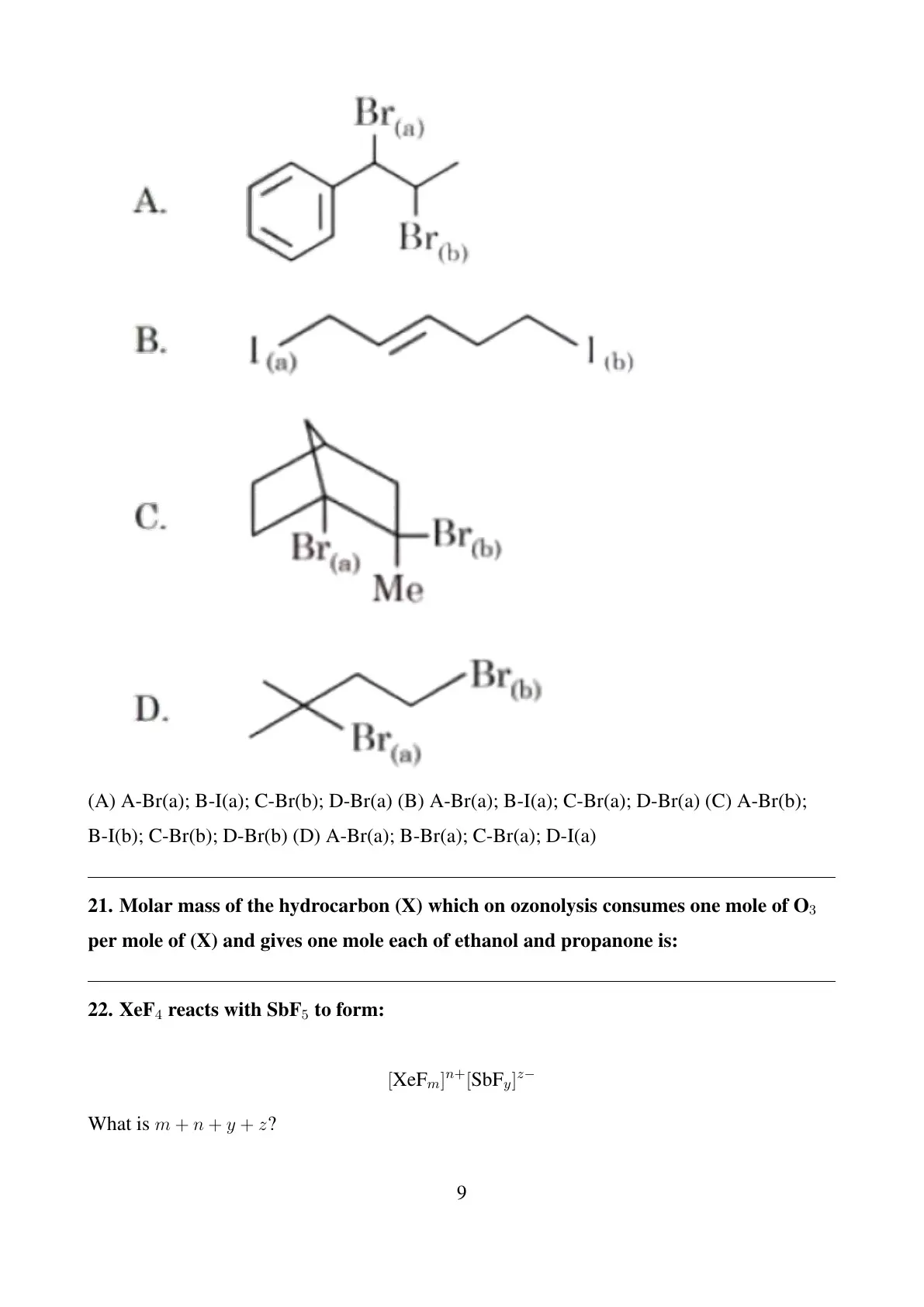
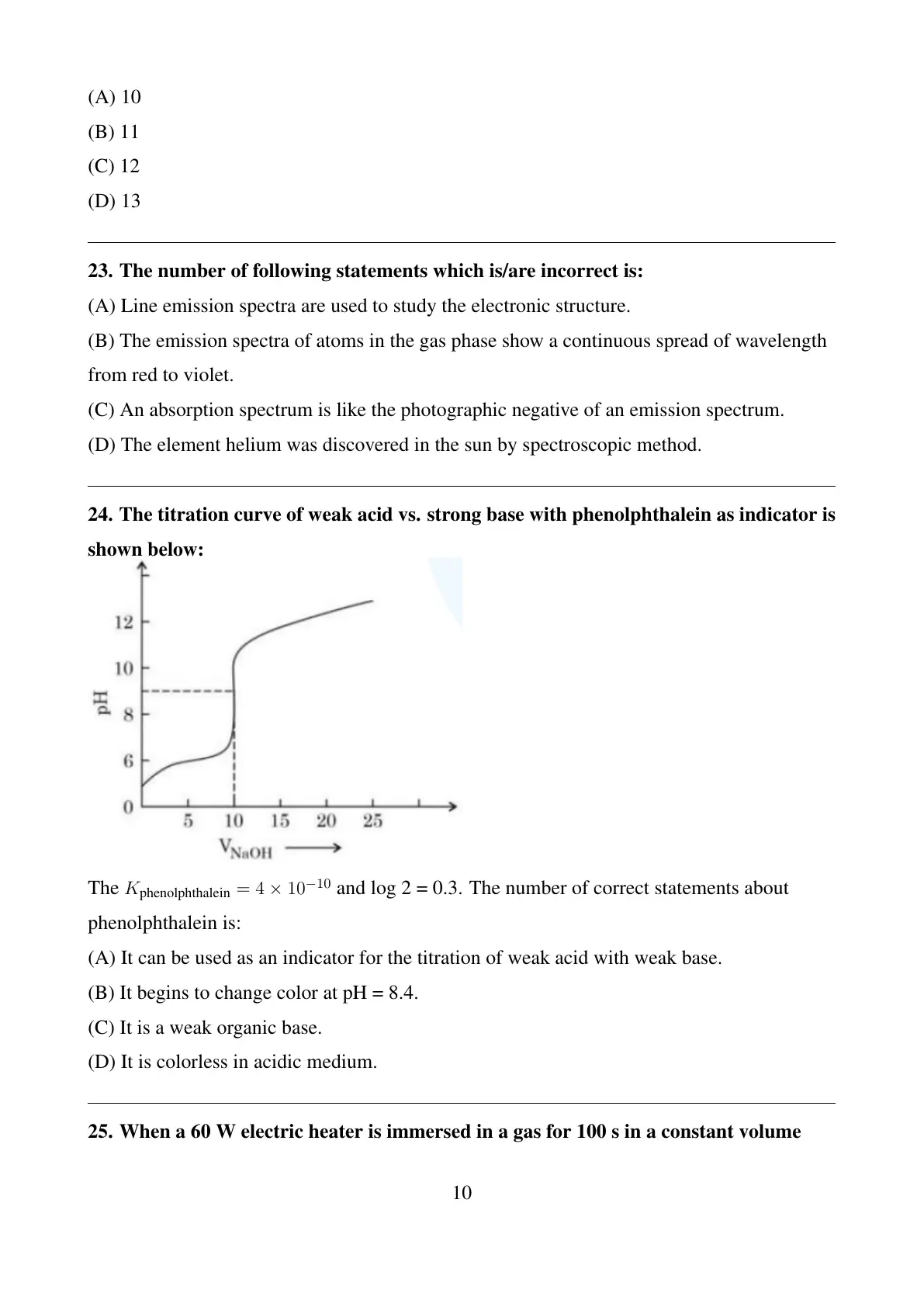
Which of the following represent the Freundlich adsorption isotherms?
- (A)
![]()
- (B)
![]()
- (C)
![]()
- (D)
![]()
- (A) A, C, D only
- (B) A, B only
- (C) A, B, D only
- (D) B, C, D only


View Solution
Which halogen is known to cause the reaction given below:
\[ 2Cu^{2+} + 4X^- \to Cu_2X_2(s) + X_2 \]
View Solution
The reaction given involves the reduction of Cu\(^{2+}\) ions to Cu\(^+\), forming Cu\(_2\)I\(_2\) as a precipitate and iodine gas (I\(_2\)). Among the halogens, only iodine has the required reducing strength to cause this reaction: \[ 2Cu^{2+} + 4I^- \to Cu_2I_2 + I_2 \] Quick Tip: Iodide ions are strong enough to reduce Cu\(^{2+}\) to Cu\(^+\), forming Cu\(_2\)I\(_2\) as a solid precipitate.
Choose the halogen which is most reactive towards S\(_N\)1 reaction in the given compounds (A, B, C, \& D):

View Solution
Molar mass of the hydrocarbon (X) which on ozonolysis consumes one mole of O\(_3\) per mole of (X) and gives one mole each of ethanol and propanone is:
View Solution
XeF\(_4\) reacts with SbF\(_5\) to form:
\[ [XeF_m]^{n+}[SbF_y]^{z-} \]
What is \(m+n+y+z\)?
View Solution
The reaction is: \[ XeF_4 + SbF_5 \to [XeF_3]^+ + (SbF_6)^- \]
From the reaction: \[ m + n + y + z = 3 + 1 + 6 + 1 = 11 \] Quick Tip: In xenon-fluoride reactions, xenon acts as a donor/acceptor with fluoride ions, forming ionic complexes.
The number of following statements which is/are incorrect is:
View Solution
The titration curve of weak acid vs. strong base with phenolphthalein as indicator is shown below:

The \(K_{phenolphthalein} = 4 \times 10^{-10}\) and log 2 = 0.3. The number of correct statements about phenolphthalein is:
View Solution
When a 60 W electric heater is immersed in a gas for 100 s in a constant volume container with adiabatic walls, the temperature of the gas rises by 5°C. The heat capacity of the given gas is:
View Solution
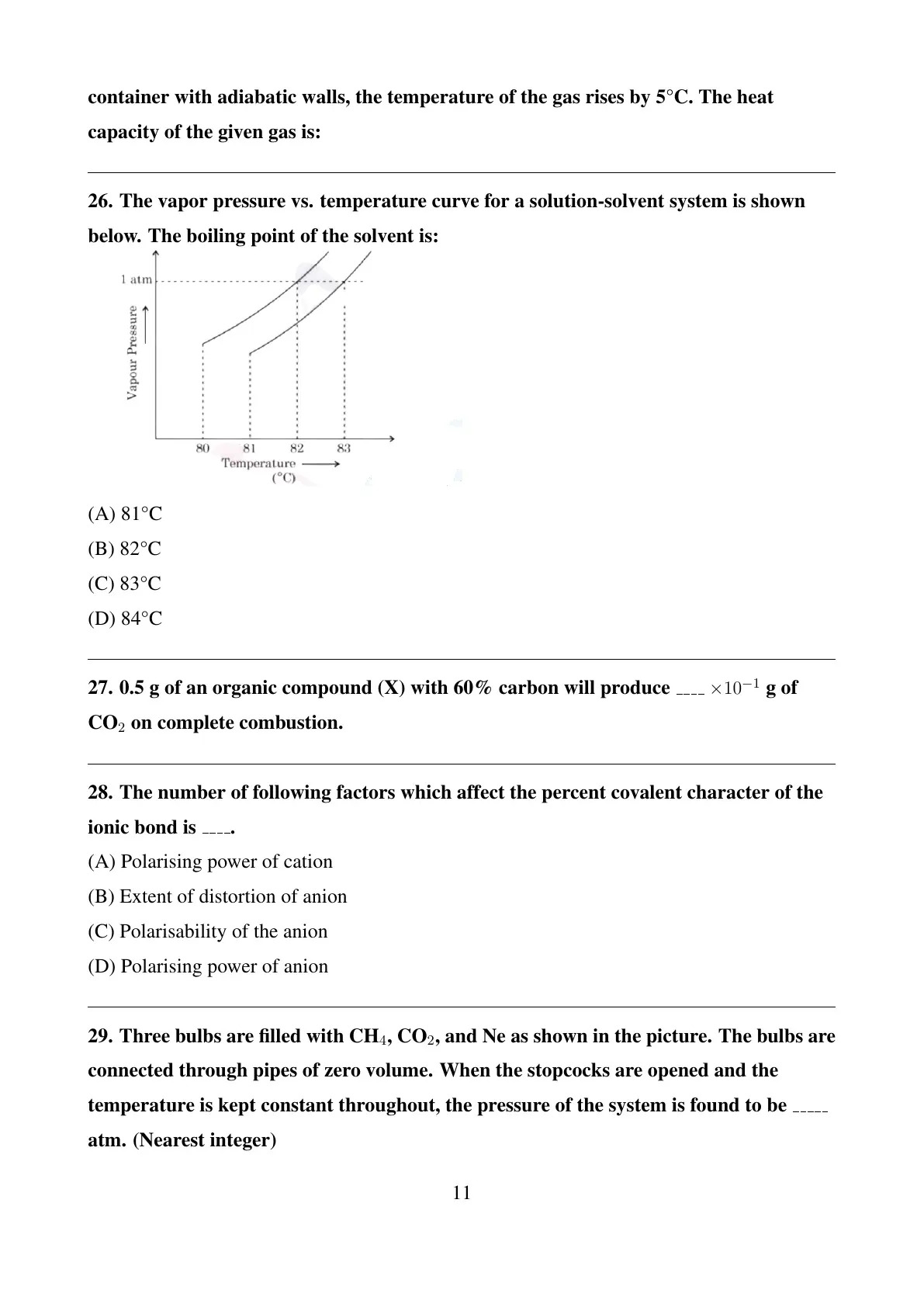
The vapor pressure vs. temperature curve for a solution-solvent system is shown below. The boiling point of the solvent is:

View Solution
0.5 g of an organic compound (X) with 60% carbon will produce ____ \(\times 10^{-1}\) g of CO\(_2\) on complete combustion.
View Solution
The number of following factors which affect the percent covalent character of the ionic bond is ____.
View Solution
The percent covalent character in an ionic bond is influenced by:
(A) Polarising power of the cation: A small, highly charged cation can polarise the anion's electron cloud, increasing covalent character.
% Option
(B) Extent of distortion of the anion: A larger, more easily distortable anion increases covalent character.
% Option
(C) Polarisability of the anion: A more polarisable anion (e.g., I\(^-\)) results in a higher covalent character.
The polarising power of the anion does not contribute to covalent character.
Quick Tip: Fajans' rule explains the percent covalent character of ionic bonds: small, highly charged cations and large, polarisable anions increase covalent character.
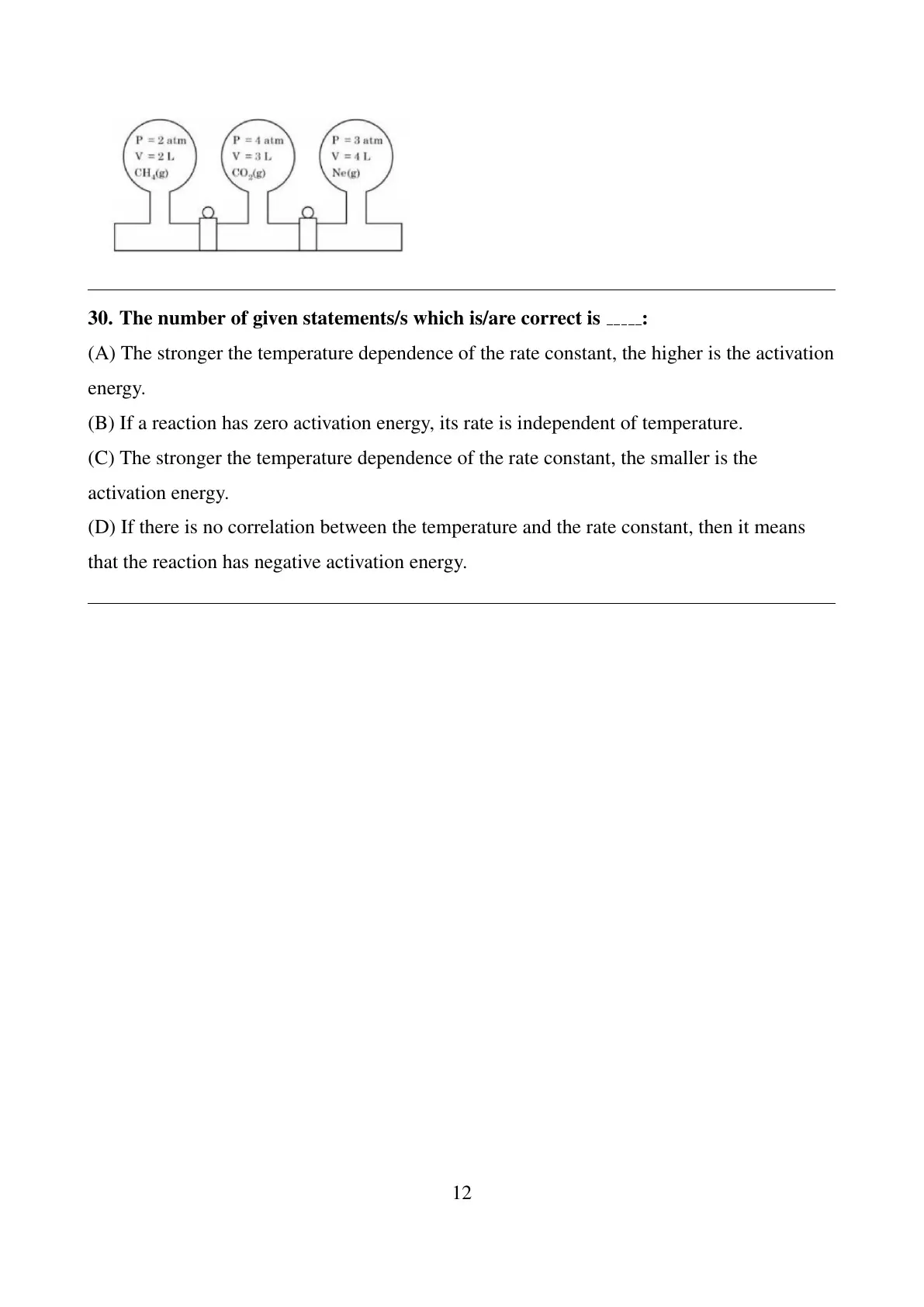
Three bulbs are filled with CH\(_4\), CO\(_2\), and Ne as shown in the picture. The bulbs are connected through pipes of zero volume. When the stopcocks are opened and the temperature is kept constant throughout, the pressure of the system is found to be _____ atm. (Nearest integer)

View Solution
The number of given statements/s which is/are correct is _____:
View Solution
JEE Main 2023 Chemistry Paper Analysis April 8 Shift 1
JEE Main 2023 Chemistry Paper Analysis for the exam scheduled on April 8 Shift 1 is available here. Candidates can check subject-wise paper analysis for the exam scheduled on April 8 Shift 1 here along with the topics with the highest weightage.
JEE Main 2023 Chemistry Question Paper Pattern
| Feature | Question Paper Pattern |
|---|---|
| Examination Mode | Computer-based Test |
| Exam Language | 13 languages (English, Hindi, Assamese, Bengali, Gujarati, Kannada, Malayalam, Marathi, Odia, Punjabi, Tamil, Telugu, and Urdu) |
| Exam Duration | 3 hours |
| Sectional Time Limit | None |
| Chemistry Marks | 100 marks |
| Total Number of Questions Asked | 20 MCQs + 10 Numerical Type Questions |
| Total Number of Questions to be Answered | 20 MCQs + 5 Numerical Type Questions |
| Marking Scheme | +4 for each correct answer |
| Negative Marking | -1 for each incorrect answer |
Also Check:
JEE Main Previous Year Question Paper
| JEE Main 2022 Question Paper | JEE Main 2021 Question Paper | JEE Main 2020 Question Paper |
| JEE Main 2019 Question Paper | JEE Main 2018 Question Paper | JEE Main 2017 Question Paper |



Comments