




JEE Main 2023 Chemistry Question Paper Jan 31 Shift 1 is going to be updated here after the conclusion of the exam. Candidates will be able to download the memory-based JEE Main 2023 Chemistry Question Paper PDF with Solution and Answer Key for Jan 31 Shift 1 using the link below. JEE Main Chemistry Question Paper is divided into two sections, Section A with 20 MCQs and Section B with 10 numerical type questions. Candidates are required to answer all questions from Section A and any 5 questions from section B. (PDF Source: aakash.ac.in)
JEE Main 2023 Chemistry Question Paper Jan 31 Shift 1- Download PDF
| JEE Main 2023 31 Jan Shift 2 Chemistry Question Paper with Solution PDF |  Download Download |
Check Solution |
JEE Main 2023 Chemistry Questions with Solutions
SECTION A
Question 1:
Nd\(^{2+}\) = ..........
View Solution
The electronic configuration of Nd (atomic number 60) is: \[ Nd(60) = [Xe] 4f^4 5d^0 6s^2 \]
For \( Nd^{2+} \), two electrons are removed (typically from the 6s orbital first): \[ Nd^{2+} = [Xe] 4f^4 5d^0 5s^0 \]
Thus, the correct answer is \( 4f^4 \). Quick Tip: The electron configuration for transition metal ions is derived by removing electrons from the highest energy orbitals, typically starting from the outermost \( s \)-orbital.
The methods NOT involved in concentration of ore are
(A) Liquation
(B) Leaching
(C) Electrolysis
(D) Hydraulic washing
(E) Froth flotation
Choose the correct answer from the options given below:
View Solution
Consider the following reaction \[ Propanal + Methanal \xrightarrow{(i) dil. NaOH} \xrightarrow{(ii) A} \xrightarrow{(iii) NaCN} \xrightarrow{(iv) H_2O} Product B \, (C_5H_8O_3) \]
The correct statement for product B is:
View Solution
The reaction proceeds as follows: \[ CH_3CH_2CHO + HCHO \xrightarrow{(i) NaOH, \(\Delta\)} CH_3CH_2CH(OH)CH_2CN \]
Following the steps in the given reaction:
1. Propanal reacts with methanol in the presence of NaOH to give an aldol product.
2. The aldol product undergoes nucleophilic substitution with NaCN.
3. The product forms a carboxylic acid on hydrolysis.
The resulting product undergoes decarboxylation to give a racemic mixture. The carboxylic acid thus formed will give \(CO_2\) gas when reacted with \(NaHCO_3\) solution.
Thus, the correct statement for product B is that it is a racemic mixture and gives a gas with saturated \(NaHCO_3\) solution. Quick Tip: A racemic mixture is a mixture containing equal amounts of enantiomers, and a carboxylic acid can release \(CO_2\) when reacted with \(NaHCO_3\).
The correct order of basicity of oxides of vanadium is:
View Solution
When \( Cu^{2+} \) ion is treated with KI, a white precipitate, X appears in solution. The solution is titrated with sodium thiosulphate, the compound Y is formed. X and Y respectively are:
View Solution


Cobalt chloride when dissolved in water forms pink colored complex X which has octahedral geometry. This solution on treating with cone HCl forms deep blue complex Y which has a Z geometry. X, Y and Z, respectively, are:
View Solution
Identify X, Y, and Z in the following reaction. (Equation not balanced) \[ ClO + NO_2 \rightarrow X \xrightarrow{H_2O} Y + Z \]
View Solution
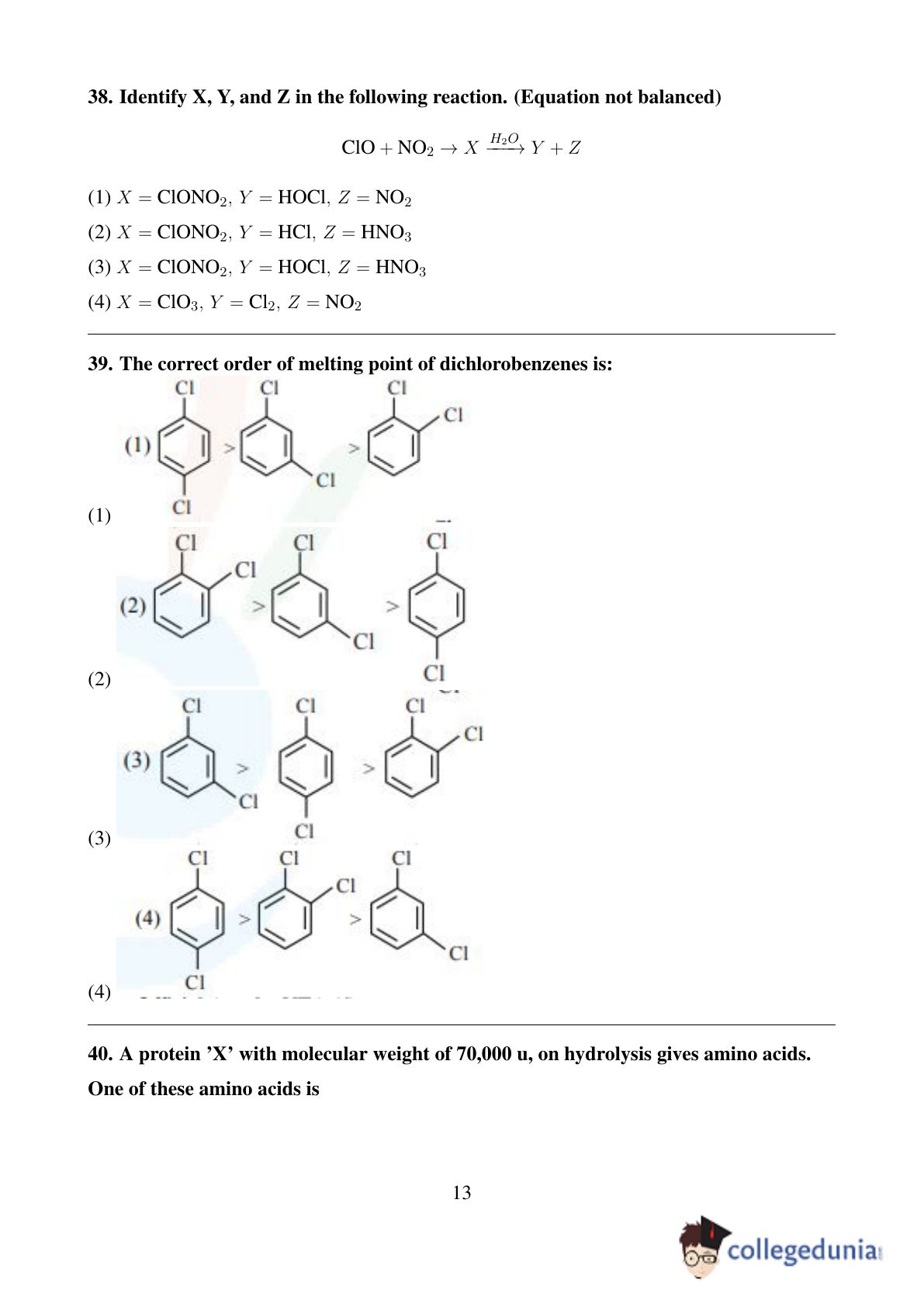
The correct order of melting point of dichlorobenzenes is:
- (1)
![]()
- (2)
![]()
- (3)
![]()
- (4)
![]()


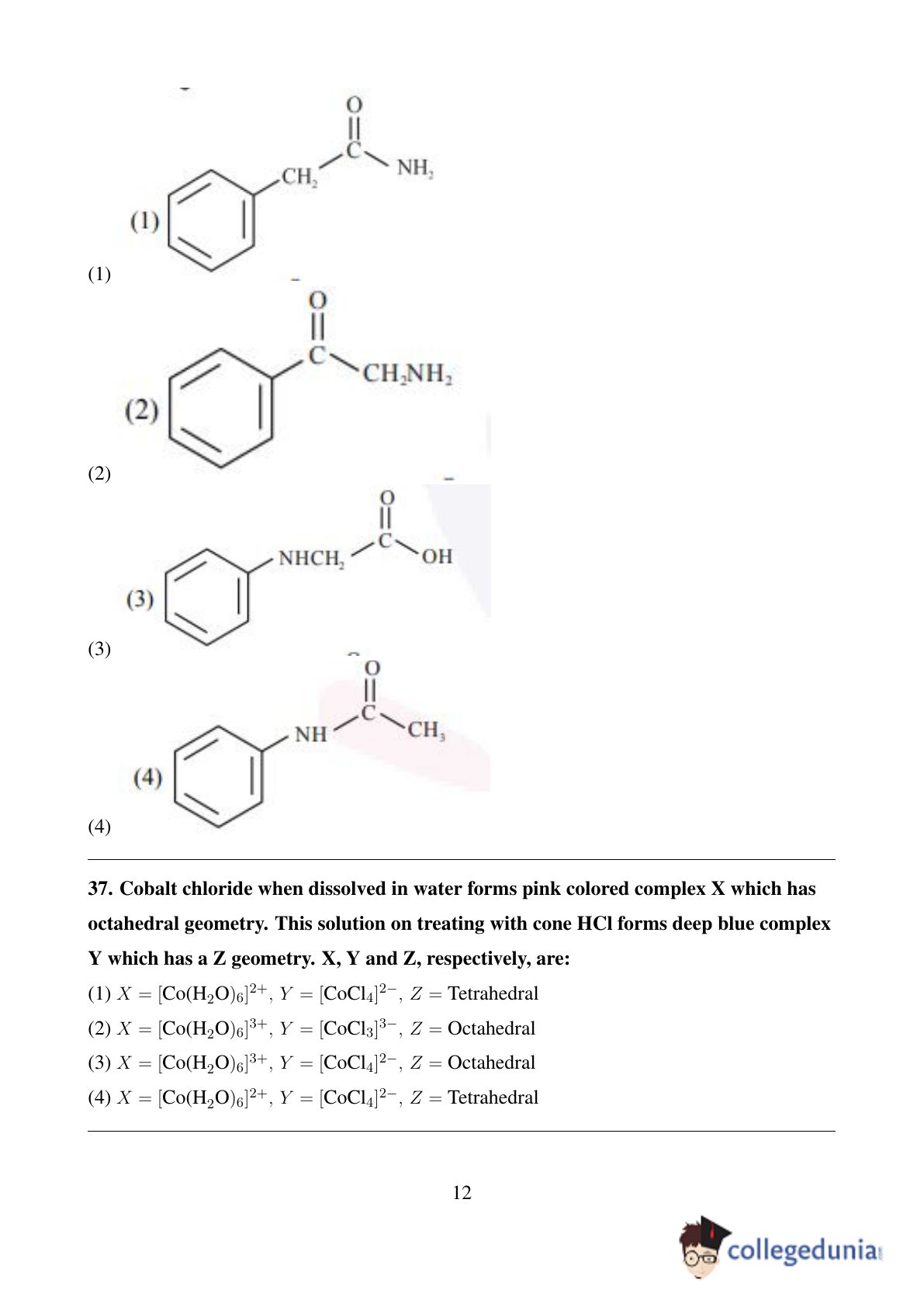
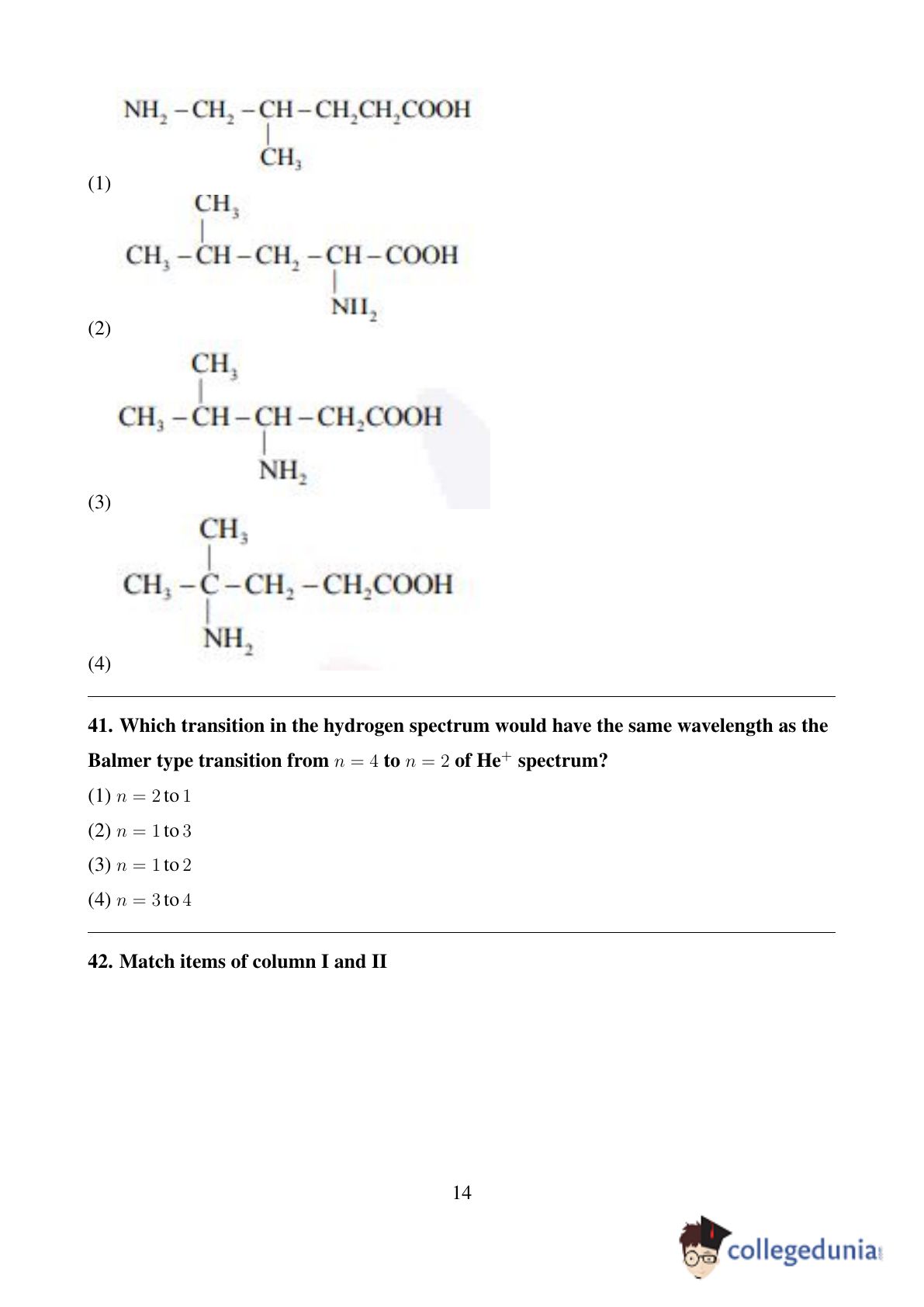
A protein 'X' with molecular weight of 70,000 u, on hydrolysis gives amino acids. One of these amino acids is
- (1)
![]()
- (2)
![]()
- (3)
![]()
- (4)
![]()


Which transition in the hydrogen spectrum would have the same wavelength as the Balmer type transition from \( n = 4 \) to \( n = 2 \) of He\(^{+}\) spectrum?
View Solution
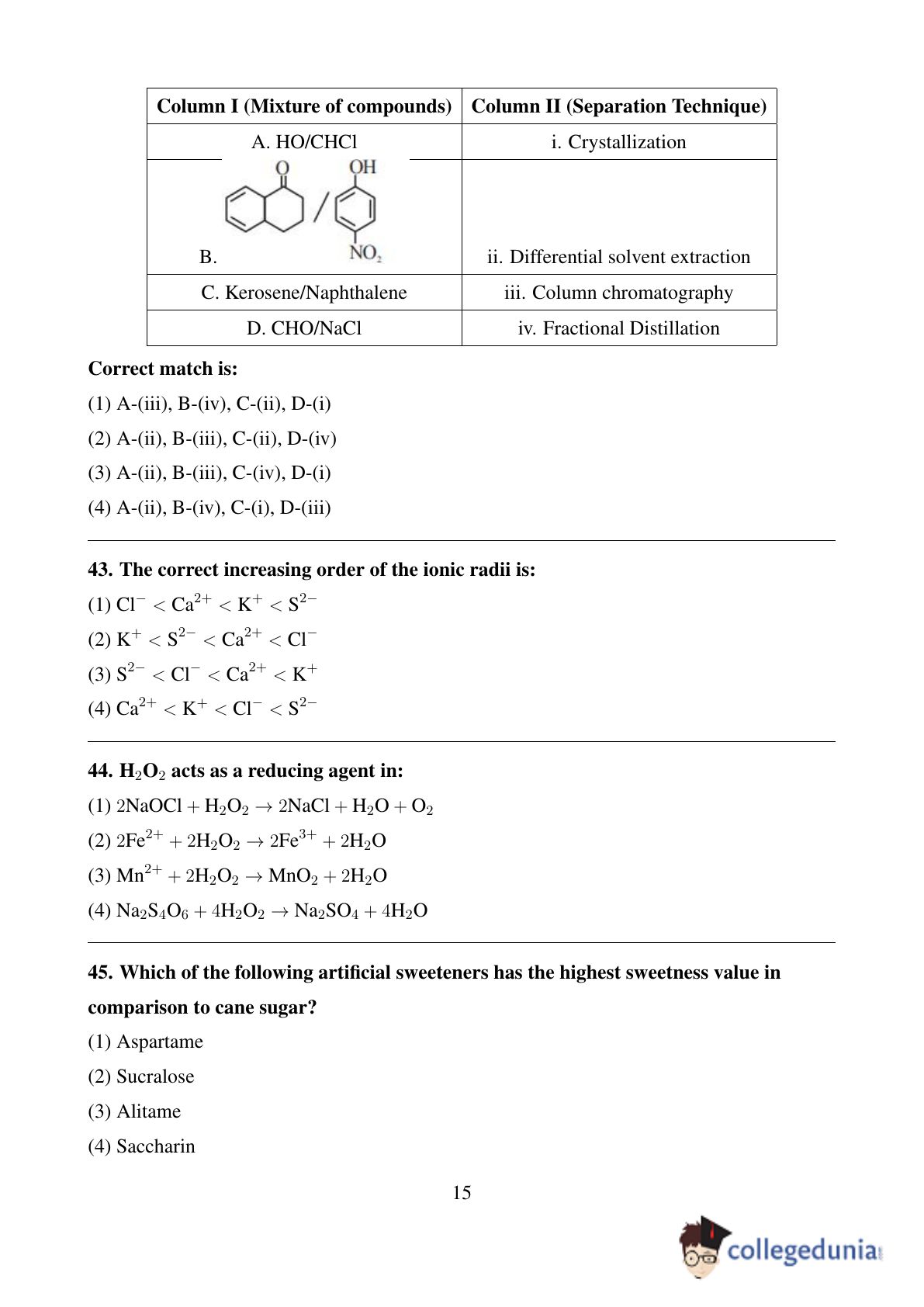
Match items of column I and II
Column I (Mixture of compounds) Column II (Separation Technique)
A. H₂O/CH₃Cl i. Crystallization
B.  ii. Differential solvent extraction
C. Kerosene/Naphthalene iii. Column chromatography
D. C₆H₅O/NaCl iv. Fractional Distillation
Correct match is:
View Solution
The correct increasing order of the ionic radii is:
View Solution
H\(_2\)O\(_2\) acts as a reducing agent in:
View Solution
Which of the following artificial sweeteners has the highest sweetness value in comparison to cane sugar?
View Solution
Match List I with List II
List I List II
A. \(XeF_4\) I. See-saw
B. \(SF_4\) II. Square planar
C. \(NH_4^+\) III. Bent T-shaped
D. \(BrF_3\) IV. Tetrahedral
Choose the correct answer from the options given below:
View Solution
Choose the correct set of reagents for the following conversion \[ trans (Ph-CH=CH-CH_3) \rightarrow cis (Ph-CH=CH-CH_3) \]
View Solution
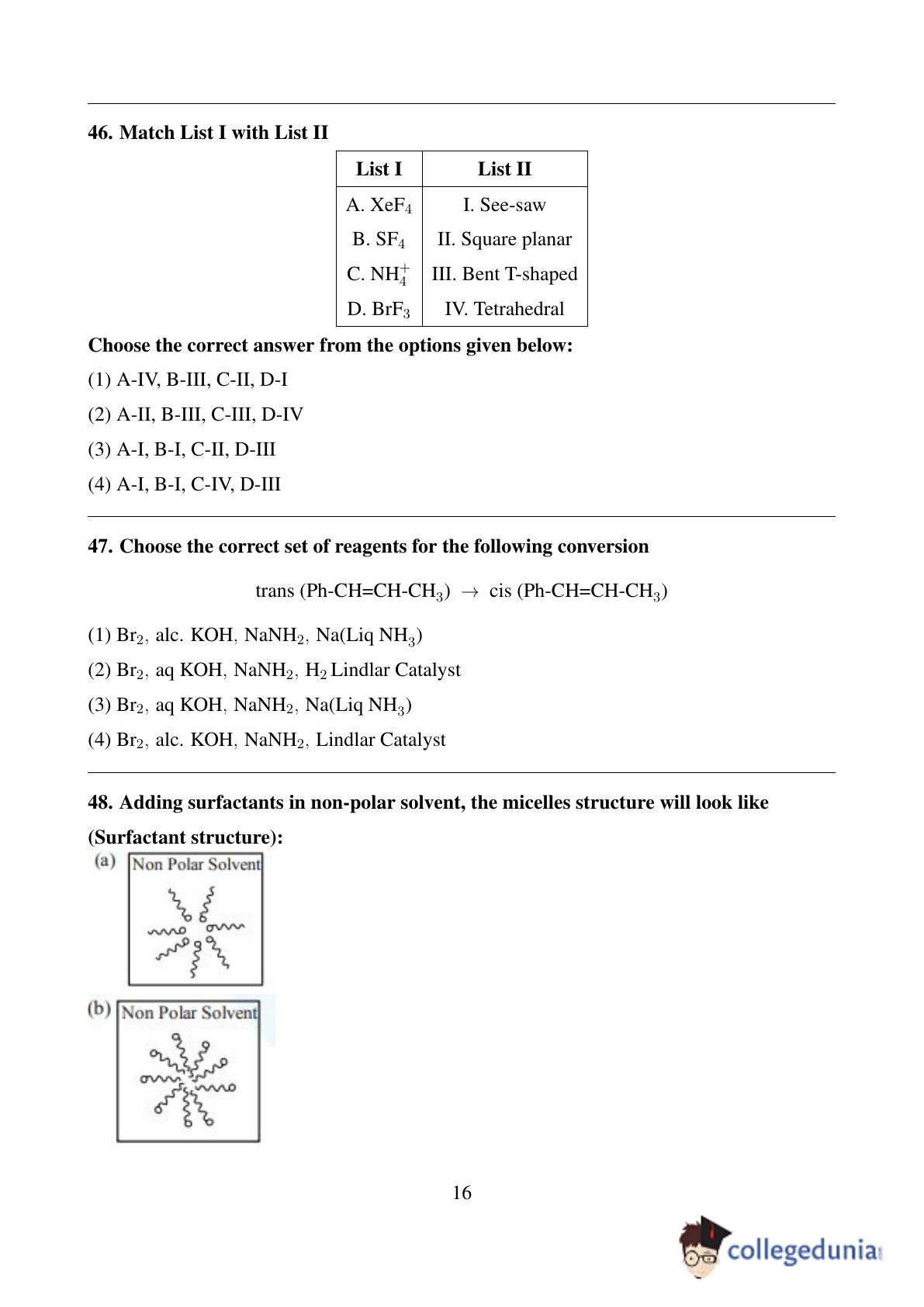
Adding surfactants in non-polar solvent, the micelles structure will look like (Surfactant structure):


View Solution
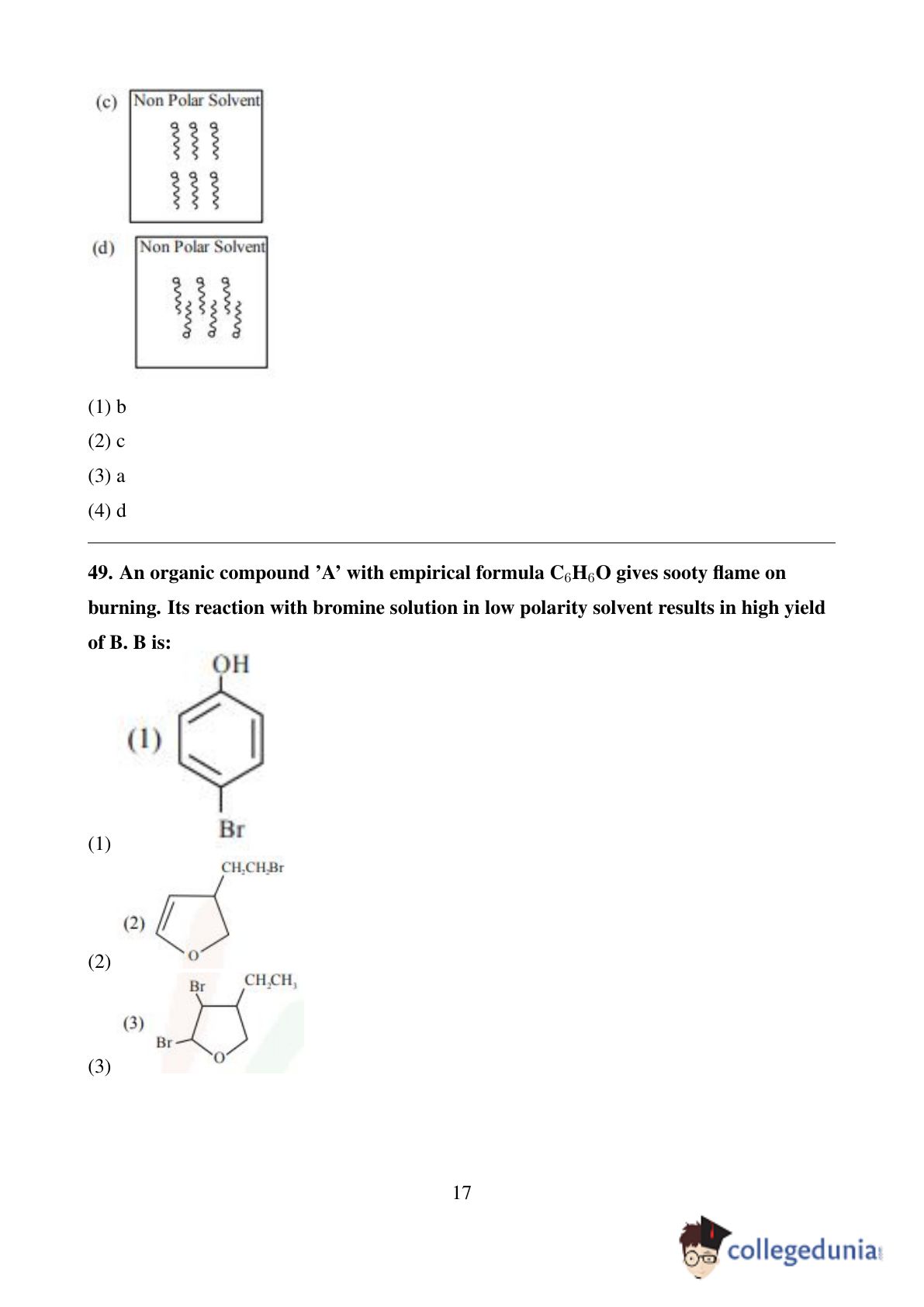
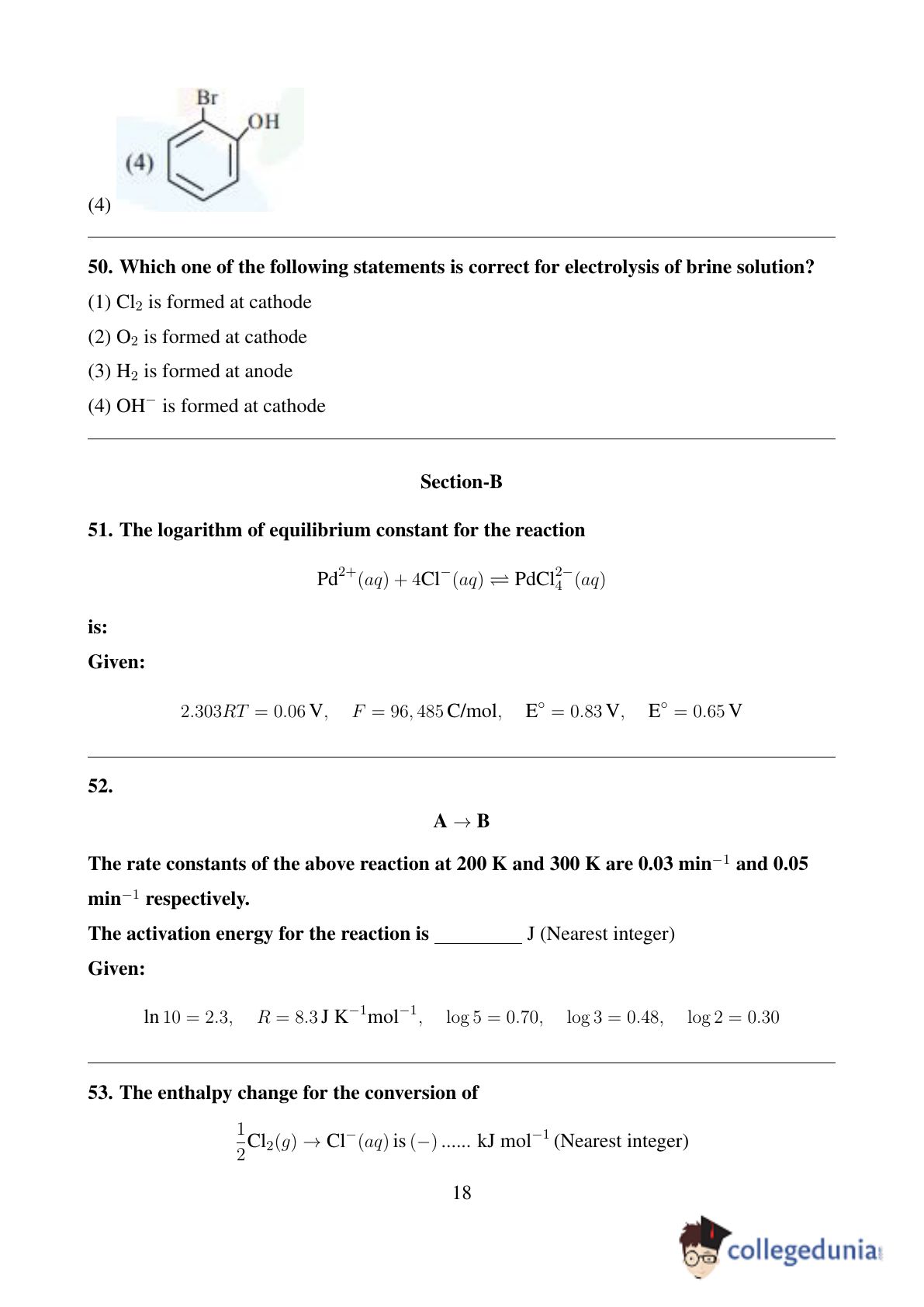
An organic compound 'A' with empirical formula \(C_6H_6\)O gives sooty flame on burning. Its reaction with bromine solution in low polarity solvent results in high yield of B. B is:
- (1)
![]()
- (2)
![]()
- (3)
![]()
- (4)
![]()


Which one of the following statements is correct for electrolysis of brine solution?
View Solution
SECTION B
Question 21:
The logarithm of equilibrium constant for the reaction \[ Pd^{2+} (aq) + 4Cl^- (aq) \rightleftharpoons PdCl_4^{2-} (aq) \]
is:
Given: \[ 2.303RT = 0.06\, V, \quad F = 96,485\, C/mol, \quad E^\circ = 0.83\, V, \quad E^\circ = 0.65\, V \]
View Solution
\[ \textbf{A} \rightarrow \textbf{B} \]
The rate constants of the above reaction at 200 K and 300 K are 0.03 min\(^{-1}\) and 0.05 min\(^{-1}\) respectively.
The activation energy for the reaction is \hspace{2cm} J (Nearest integer)
Given: \[ \text{ln} \, 10 = 2.3, \quad R = 8.3 \, \text{J K}^{-1} \text{mol}^{-1}, \quad \log 5 = 0.70, \quad \log 3 = 0.48, \quad \log 2 = 0.30 \]
View Solution
We can use the Arrhenius equation to solve for the activation energy: \[ \log \left( \frac{K_{300}}{K_{200}} \right) = \frac{E_a}{2.3 \times 8.314} \left( \frac{1}{T_1} - \frac{1}{T_2} \right) \]
Substituting the given values: \[ \log \left( \frac{0.05}{0.03} \right) = \frac{E_a}{2.3 \times 8.314} \left( \frac{1}{200} - \frac{1}{300} \right) \]
Solving for \( E_a \): \[ \log \left( \frac{0.05}{0.03} \right) = \log 5 - \log 3 = 0.70 - 0.48 = 0.22 \] \[ 0.22 = \frac{E_a}{2.3 \times 8.314} \times \left( \frac{1}{200} - \frac{1}{300} \right) \] \[ 0.22 = \frac{E_a}{2.3 \times 8.314} \times \left( \frac{1}{60000} \right) \]
Solving for \( E_a \): \[ E_a = 2519.88 \, J \quad \Rightarrow \quad E_a \approx 2520 \, J \] Quick Tip: The activation energy can be calculated using the Arrhenius equation, where the ratio of rate constants at two different temperatures is related to the exponential factor involving the activation energy.
The enthalpy change for the conversion of \[ \frac{1}{2} Cl_2(g) \rightarrow Cl^-(aq) \, is \, (-) \, ...... kJ mol^{-1} \, (Nearest integer) \]
Given: \[ \Delta_{f}H^\circ(Cl_2(g)) = 240 \, kJ mol^{-1}, \quad \Delta_{g}H^\circ(Cl_2(g)) = -350 \, kJ mol^{-1}, \quad \Delta_{hyd}H^\circ(Cl^-) = -380 \, kJ mol^{-1} \]
View Solution
On complete combustion, 0.492 g of an organic compound gave 0.792 g of \(CO_2\). The % of carbon in the organic compound is \underline{\hspace{2cm}} (Nearest integer).
Given: \[ \text{Weight of carbon in 0.792 g CO}_2 \]
View Solution
At 27°C, a solution containing 2.5 g of solute in 250.0 mL of solution exerts an osmotic pressure of 400 Pa. The molar mass of the solute is \hspace{2cm} g mol\(^{-1}\) (Nearest integer).
Given: \[ R = 0.083 \, \text{L bar K}^{-1} \text{mol}^{-1}, \quad \pi = \text{osmotic pressure}, \quad T = 300 \, \text{K}, \quad \text{osmotic pressure} = 400 \, \text{Pa}, \quad 1 \, \text{bar} = 10^5 \, \text{Pa} \]
View Solution
Zinc reacts with hydrochloric acid to give hydrogen and zinc chloride. The volume of hydrogen gas produced at STP from the reaction of 11.5 g of zinc with excess HCl is \hspace{2cm} L (Nearest integer).
Given: \[ \text{Molar mass of Zn} = 65.4 \, \text{g mol}^{-1}, \quad \text{Molar volume of H}_2 \, \text{at STP} = 22.7 \, \text{L/mol} \]
View Solution
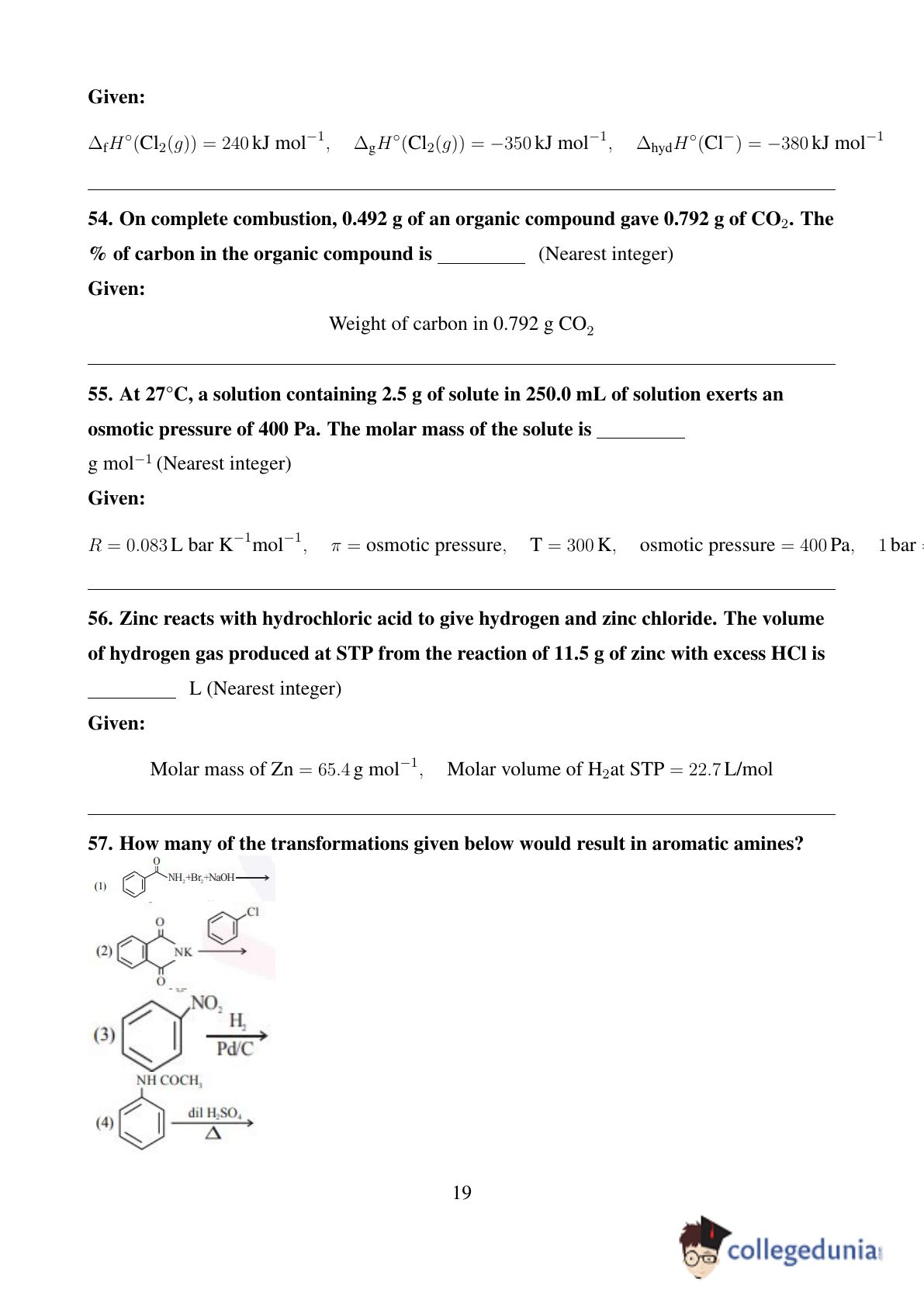
How many of the transformations given below would result in aromatic amines?


View Solution
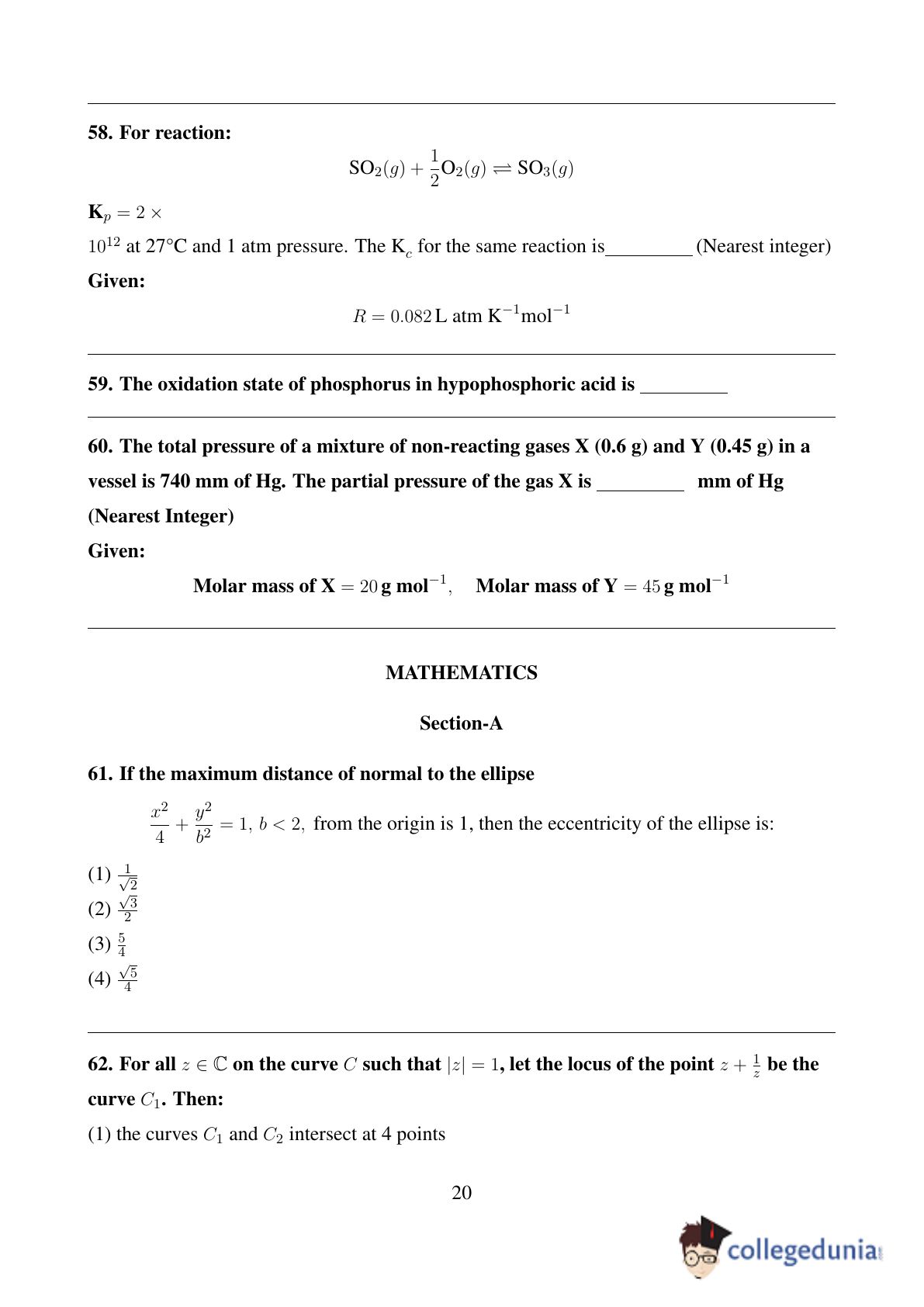
For reaction: \[ \text{SO}_2(g) + \frac{1}{2} \text{O}_2(g) \rightleftharpoons \text{SO}_3(g) \] \( K_p = 2 \times 10^{12} \) at 27°C and 1 atm pressure. The \( K_c \) for the same reaction is \hspace{2cm} (Nearest integer).
Given: \[ R = 0.082 \, \text{L atm K}^{-1} \text{mol}^{-1} \]
View Solution
The oxidation state of phosphorus in hypophosphoric acid is ________________.
View Solution
The total pressure of a mixture of non-reacting gases X (0.6 g) and Y (0.45 g) in a vessel is 740 mm of Hg. The partial pressure of the gas X is \hspace{2cm} mm of Hg (Nearest Integer).
Given: \[ \textbf{Molar mass of X} = 20 \, \textbf{g mol}^{-1}, \quad \textbf{Molar mass of Y} = 45 \, \textbf{g mol}^{-1} \]
View Solution
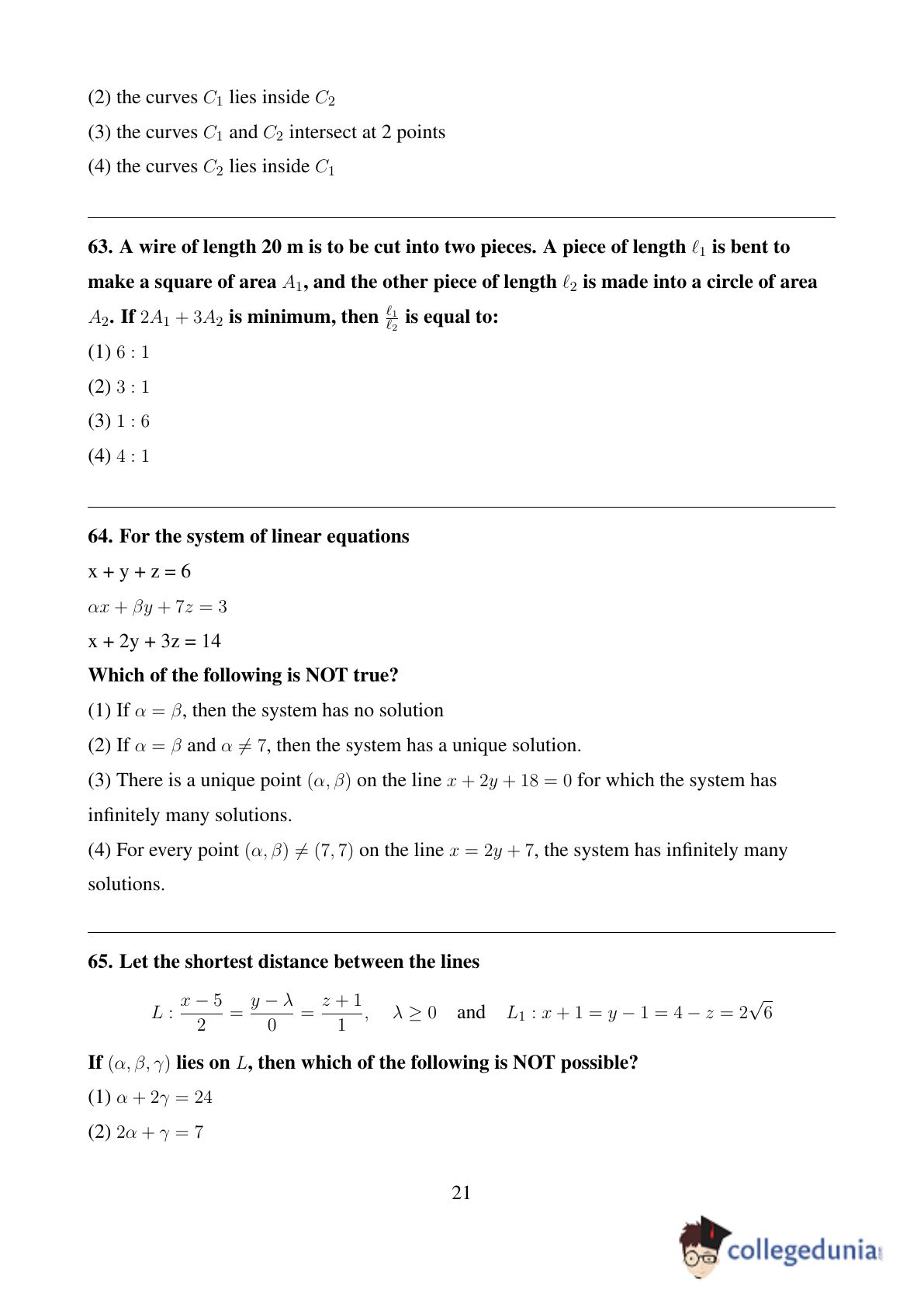
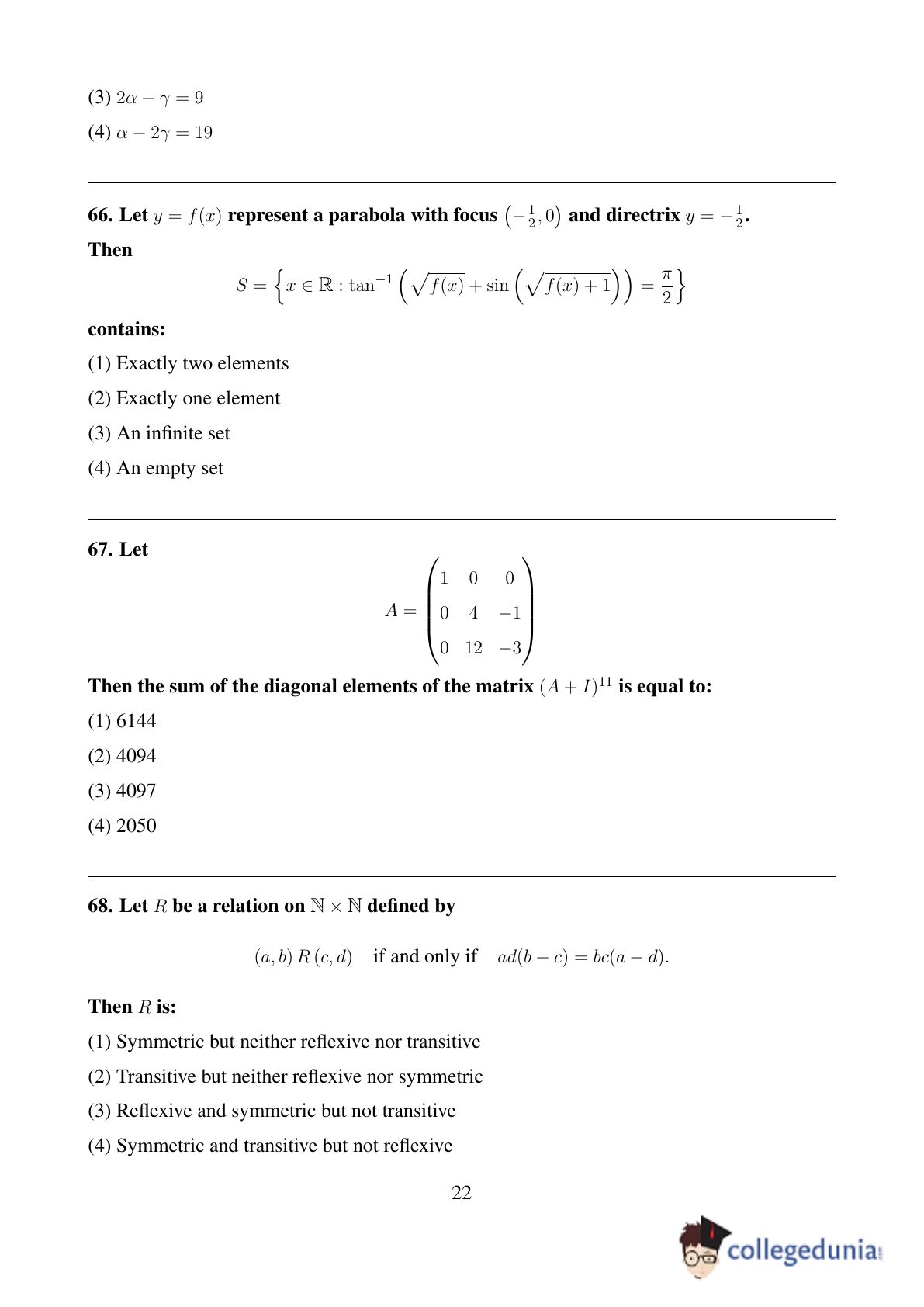
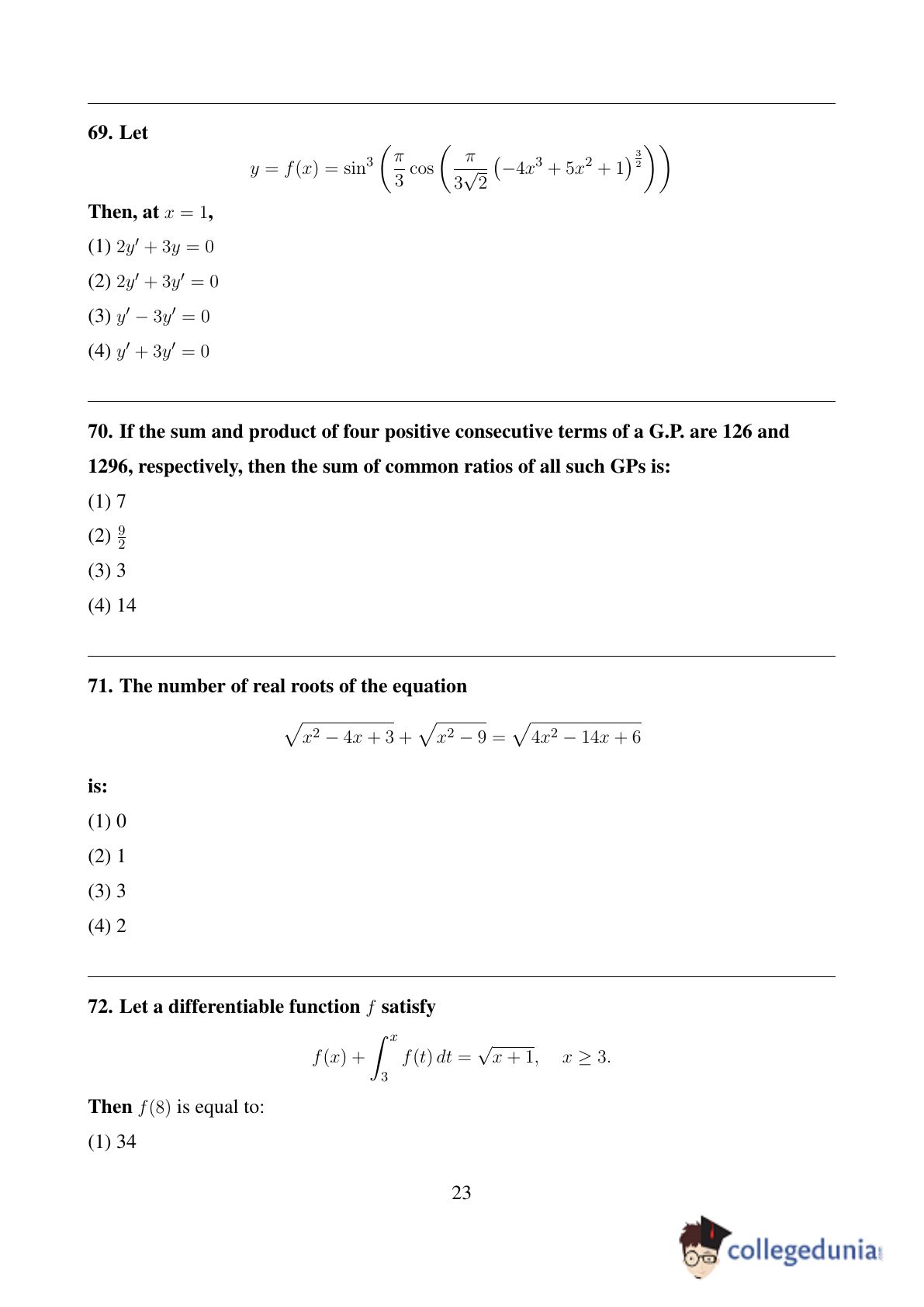
Also Check:
JEE Main 2023 Chemistry Analysis Jan 31 Shift 1
JEE Main 2023 Paper Analysis for Chemistry paper scheduled on January 31 Shift 1 will be updated here after the conclusion of the exam. Candidates will be able to check the topics with the highest weightage, difficulty level and memory-based Chemistry questions.
| JEE Main 2023 Paper Analysis Jan 31 Shift 1 (After Exam) |
JEE Main 2023 Chemistry Question Paper Pattern
| Feature | Question Paper Pattern |
|---|---|
| Examination Mode | Computer-based Test |
| Exam Language | 13 languages (English, Hindi, Assamese, Bengali, Gujarati, Kannada, Malayalam, Marathi, Odia, Punjabi, Tamil, Telugu, and Urdu) |
| Exam Duration | 3 hours |
| Sectional Time Limit | None |
| Chemistry Marks | 100 marks |
| Total Number of Questions Asked | 20 MCQs + 10 Numerical Type Questions |
| Total Number of Questions to be Answered | 20 MCQs + 5 Numerical Type Questions |
| Marking Scheme | +4 for each correct answer |
| Negative Marking | -1 for each incorrect answer |
Also Check:
JEE Main 2022 Question Paper
JEE Main 2023 aspirants can practice and check their exam prep level by attempting the previous year question papers as well. The table below shows JEE Main 2022 Question Paper PDF for B.E./B.Tech to practice.



Comments