




JEE Main 2023 Physics April 11 Shift 2 Question Paper is available here for download. Candidates can download official JEE Main 2023 Physics Question Paper PDF with Solution and Answer Key for April 11 Shift 2 using the link below. JEE Main Physics Question Paper is divided into two sections, Section A with 20 MCQs and Section B with 10 numerical type questions. Candidates are required to answer all questions from Section A and any 5 questions from section B.
JEE Main 2023 Physics Question Paper April 11 Shift 2 PDF
| JEE Main 2023 11th April Shift 2 Physics Question Paper with Solution PDF |  Download Download |
Check Solution |
JEE Main 2023 11th April Shift 2 Physics Question Paper with Solution
Question 1:
Eight equal drops of water are falling through air with a steady speed of 10 cm/s. If the drops collapse, the new velocity is :-
Provided that below are two statements : One is labelled as Assertion A and the other is labelled as Reason R.
Assertion A: A bar magnet dropped through a metallic cylindrical pipe takes more time to come down compared to a non-magnetic bar with same geometry and mass.
Reason R: For the magnetic bar, Eddy currents are produced in the metallic pipe which oppose the motion of the magnetic bar.
In the light of the above statements, choose the correct answer from the options Provided that below:
(1) A is true but R is false
(2) Both A and R are true but R is NOT the correct explanation of A
(3) A is false but R is true
(4) Both A and R are true and R is the correct explanation of A
View Solution
A space ship of mass \(2 \times 10^4\) kg is launched into a circular orbit close to the earth surface. The additional velocity to be imparted to the space ship in the orbit to overcome the gravitational pull will be (if \(g = 10\) m/s\(^2\) and radius of earth = 6400 km):
View Solution
A projectile is projected at \(30^\circ\) from horizontal with initial velocity \(40 ms^{-1}\). The velocity of the projectile at \(t=2\) s from the start will be :
(Provided that \(g = 10 m/s^2\))
View Solution
Step 1: Initial velocity components.
The initial velocity of the projectile is \(u = 40 \, ms^{-1}\), and the angle of projection is \(30^\circ\).
1. Horizontal velocity component (\(U_x\)): \[ U_x = u \cos 30^\circ = 40 \cdot \cos 30^\circ = 40 \cdot \frac{\sqrt{3}}{2} = 20\sqrt{3} \, ms^{-1}. \]
2. Vertical velocity component (\(U_y\)): \[ U_y = u \sin 30^\circ = 40 \cdot \sin 30^\circ = 40 \cdot \frac{1}{2} = 20 \, ms^{-1}. \]
Step 2: Velocity after \(t = 2 \, s\).
1. Horizontal velocity (\(V_x\)) remains constant because there is no horizontal acceleration: \[ V_x = U_x = 20\sqrt{3} \, ms^{-1}. \]
2. Vertical velocity (\(V_y\)) is affected by gravity (\(g = 10 \, ms^{-2}\)): \[ V_y = U_y - gt = 20 - 10 \cdot 2 = 20 - 20 = 0 \, ms^{-1}. \]
Step 3: Resultant velocity (\(V\)).
The resultant velocity is the vector sum of \(V_x\) and \(V_y\): \[ V = \sqrt{V_x^2 + V_y^2}. \]
Substitute the values: \[ V = \sqrt{(20\sqrt{3})^2 + (0)^2} = \sqrt{400 \cdot 3} = \sqrt{1200} = 20\sqrt{3} \, ms^{-1}. \]
Conclusive Answer: The velocity of the projectile after \(t = 2 \, s\) is \(20\sqrt{3} \, ms^{-1}\). Quick Tip: In projectile motion, the horizontal component of velocity remains constant, while the vertical component changes due to gravity.
A plane electromagnetic wave of frequency 20 MHz propagates in free space along x-direction. At a particular space and time, \(\vec{E} = 6.6 \hat{j}\) v/m. What is \(\vec{B}\) at this point?
View Solution
A car P travelling at \(20 ms^{-1}\) sounds its horn at a frequency of 400 Hz. Another car Q is travelling behind the first car in the same direction with a velocity \(40 ms^{-1}\). The frequency heard by the passenger of the car Q is approximately [Take, velocity of sound \(= 360 ms^{-1}\)]
View Solution
A body of mass 500 g moves along x-axis such that its velocity varies with displacement x according to the calculation \(v = 10\sqrt{x}\) m/s the force acting on the body is :-
View Solution
The ratio of the de-Broglie wavelengths of proton and electron having same Kinetic energy:
(\( Assume m_p = m_e \times 1840 \))
View Solution
If force (F), velocity (V) and time (T) are considered as fundamental physical quantity, then dimensional formula of density will be :-
View Solution
An electron is allowed to move with constant velocity along the axis of current carrying straight solenoid.
A. The electron will experience magnetic force along the axis of the solenoid.
B. The electron will not experience magnetic force.
C. The electron will continue to move along the axis of the solenoid.
D. The electron will be accelerated along the axis of the solenoid.
E. The electron will follow parabolic path inside the solenoid.
Choose the correct answer from the options Provided that below:
View Solution
The Thermodynamic process, in which internal energy of the system remains constant is
View Solution
In satellite communication, the uplink frequency band used is:
View Solution
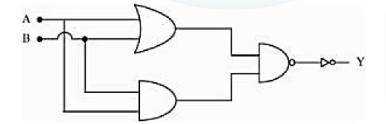
The logic operations performed by the Provided that digital circuit is equivalent to:
View Solution
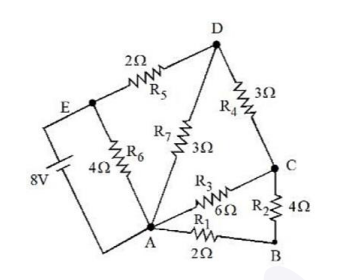
The current flowing through \(R_2\) is:
View Solution
When vector \(\vec{A} = 2\hat{i} + 3\hat{j} + 2\hat{k}\) is subtracted from vector \(\vec{B}\), it gives a vector equal to \(2\hat{j}\). Then the magnitude of vector \(\hat{B}\) will be:
View Solution
If V is the gravitational potential due to sphere of uniform density on it's surface, then it's value at the center of sphere will be:-
View Solution
The root mean square speed of molecules of nitrogen gas at \(27^\circ\)C is approximately : (Provided that mass of a nitrogen molecule \(= 4.6 \times 10^{-26}\) kg and take Boltzmann constant \(k_B = 1.4 \times 10^{-23} JK^{-1}\))
View Solution
The energy of He\(^{+}\) ion in its first excited state is, (The ground state energy for the Hydrogen atom is \(-13.6\) eV):
View Solution
When one light ray is reflected from a plane mirror with \(30^\circ\) angle of reflection, the angle of deviation of the ray after reflection is:
View Solution
A capacitor of capacitance C is charge to a potential V. The flux of the electric field through a closed surface enclosing the positive plate of the capacitor is :
View Solution
A coil has an inductance of 2H and resistance of \(4 \Omega\). A 10 V is applied across the coil. The energy stored in the magnetic field after the current has built up to its equilibrium value will be ____ \(\times 10^{-2}\) J.
View Solution
A metallic cube of side 15 cm moving along y-axis at a uniform velocity of 2 ms\(^{-1}\). In a region of uniform magnetic field of magnitude 0.5T directed along z-axis. In equilibrium the potential difference between the faces of higher and lower potential developed because of the motion through the field will be _____ mV.
View Solution
In the Provided that circuit, \(C_1 = 2\) \(\mu\)F, \(C_2 = 0.2\) \(\mu\)F, \(C_3 = 2\) \(\mu\)F, \(C_4 = 4\) \(\mu\)F, \(C_5 = 2\) \(\mu\)F, \(C_6 = 2\) \(\mu\)F. The charge stored on capacitor \(C_4\) is ____ \(\mu\)C.
View Solution
A nucleus disintegrates into two nuclear parts, in such a way that ratio of their nuclear sizes is \(1 : 2^{1/3}\). Their respective speed have a ratio of n : 1. The value of n is ____.
View Solution
The surface tension of soap solution is \(3.5 \times 10^{-2}\) Nm\(^{-1}\). The amount of work done required to increase the radius of soap bubble from 10 cm to 20 cm is ____ \(\times 10^{-4}\) J. \quad (take \(\pi = 22/7\))
View Solution
A circular plate is rotating horizontal plane, about an axis passing through its center perpendicular to the plate, with an angular velocity \(\omega\). A person sits at the center having two dumbbells in his hands. When he stretches out his hands, the moment of inertia of the system becomes triple. If E be the initial Kinetic energy of the system, then final Kinetic energy will be \(\frac{E}{x}\). The value of x is _____.
View Solution
A block of mass 5 kg starting from rest pulled up on a smooth incline plane making an angle of \(30^\circ\) with horizontal with an affective acceleration of 1 ms\(^{-2}\). The power delivered by the pulling force at \(t = 10\) s from the starts is _____ W. \quad [use \(g = 10\) ms\(^{-2}\)] (Evaluate the nearest integer value)
View Solution
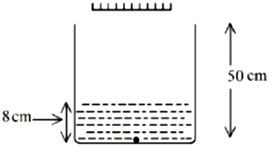
As shown in the figure, a plane mirror is fixed at a height of 50 cm from the bottom of tank containing water \(\left(\mu = \frac{4}{3}\right)\). The height of water in the tank is 8 cm. A small bulb is placed at the bottom of the water tank. The distance of image of the bulb formed by mirror from the bottom of the tank is _____ cm.
View Solution
Two identical cells each of emf 1.5 V are connected in series across a \(10 \ \Omega\) resistance. An ideal voltmeter connected across \(10 \ \Omega\) resistance reads 1.5 V. The internal resistance of each cell is ____ \(\Omega\).
View Solution
A wire of density \(8 \times 10^3\) kg/m\(^3\) is stretched between two clamps 0.5 m apart. The extension developed in the wire is \(3.2 \times 10^{-4}\) m. If \(Y = 8 \times 10^{10}\) N/m\(^2\), the fundamental frequency of vibration in the wire will be _____ Hz.
View Solution


JEE Main 2023 Physics Paper Analysis April 11 Shift 2
JEE Main 2023 Physics Paper Analysis for the exam scheduled on April 11 Shift 2 is available here. Candidates can check subject-wise paper analysis for the exam scheduled on April 11 Shift 2 here along with the topics with the highest weightage.
JEE Main 2023 Physics Question Paper Pattern
| Feature | Question Paper Pattern |
|---|---|
| Examination Mode | Computer-based Test |
| Exam Language | 13 languages (English, Hindi, Assamese, Bengali, Gujarati, Kannada, Malayalam, Marathi, Odia, Punjabi, Tamil, Telugu, and Urdu) |
| Exam Duration | 3 hours |
| Sectional Time Limit | None |
| Physics Marks | 100 marks |
| Total Number of Questions Asked | 20 MCQs + 10 Numerical Type Questions |
| Total Number of Questions to be Answered | 20 MCQs + 5 Numerical Type Questions |
| Marking Scheme | +4 for each correct answer |
| Negative Marking | -1 for each incorrect answer |
Also Check:
JEE Main Previous Year Question Paper
| JEE Main 2022 Question Paper | JEE Main 2021 Question Paper | JEE Main 2020 Question Paper |
| JEE Main 2019 Question Paper | JEE Main 2018 Question Paper | JEE Main 2017 Question Paper |



Comments