




JEE Main 2023 Physics Question Paper Feb 1 Shift 1 is updated here after the conclusion of the exam. Candidates can download JEE Main 2023 Physics Question Paper PDF with Answer Key for Feb 1 Shift 1 using the link below. JEE Main Physics Question Paper is divided into two sections, Section A with 20 MCQs and Section B with 10 numerical type questions. Candidates are required to answer all questions from Section A and any 5 questions from section B.
Related Links:
- Download JEE Main Previous Year Question Papers PDF with Solutions
- Download JEE Main 2025 Question Paper for all Shifts
JEE Main 2023 Physics Question Paper Feb 1 Shift 1- Download PDF
| JEE Main 2023 1 Feb Shift 1 Physics Question Paper with Solution PDF |  Download Download |
Check Solution |

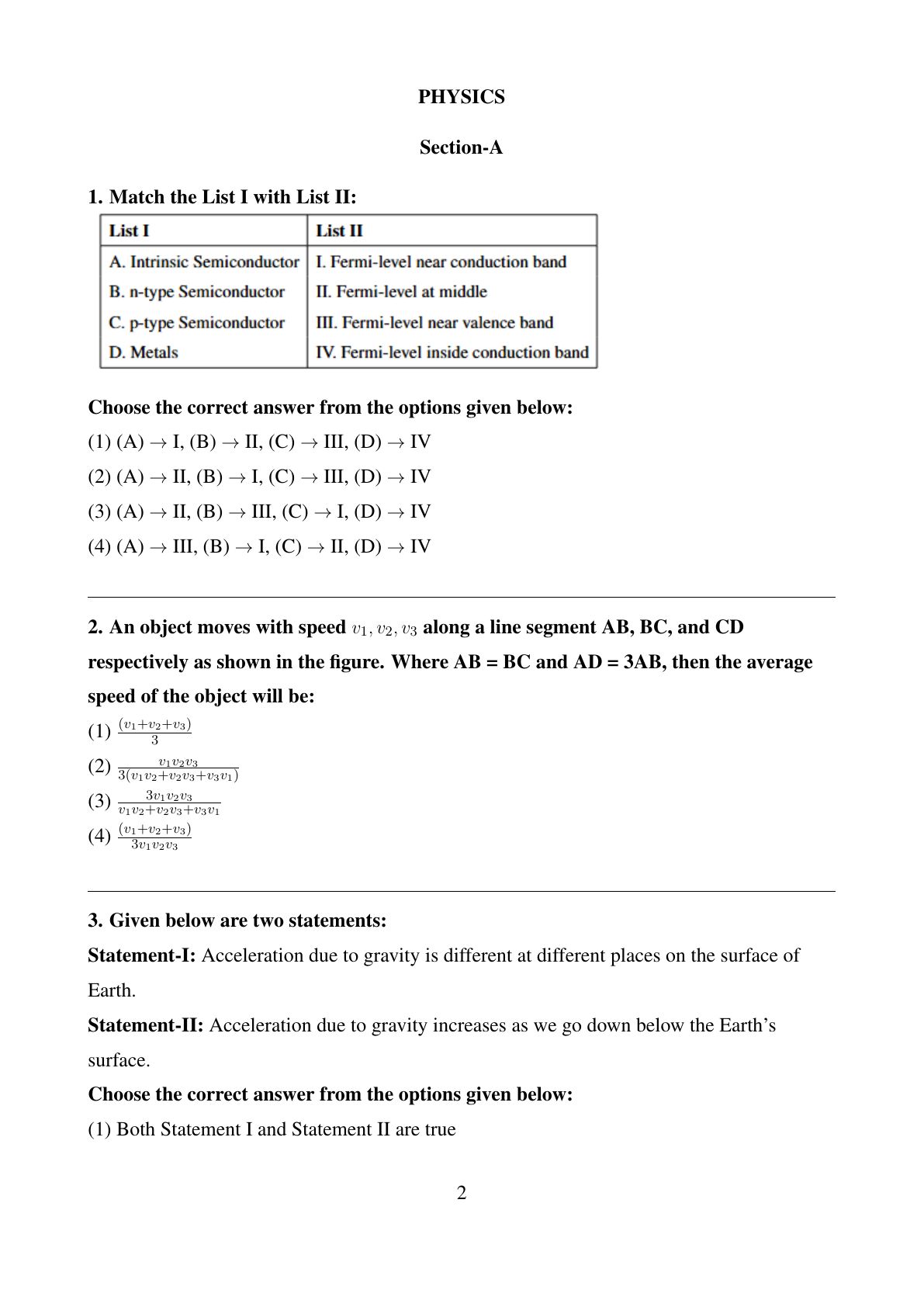
Match the List I with List II:

Choose the correct answer from the options given below:
An object moves with speed \( v_1, v_2, v_3 \) along a line segment AB, BC, and CD respectively as shown in the figure. Where AB = BC and AD = 3AB, then the average speed of the object will be:
View Solution
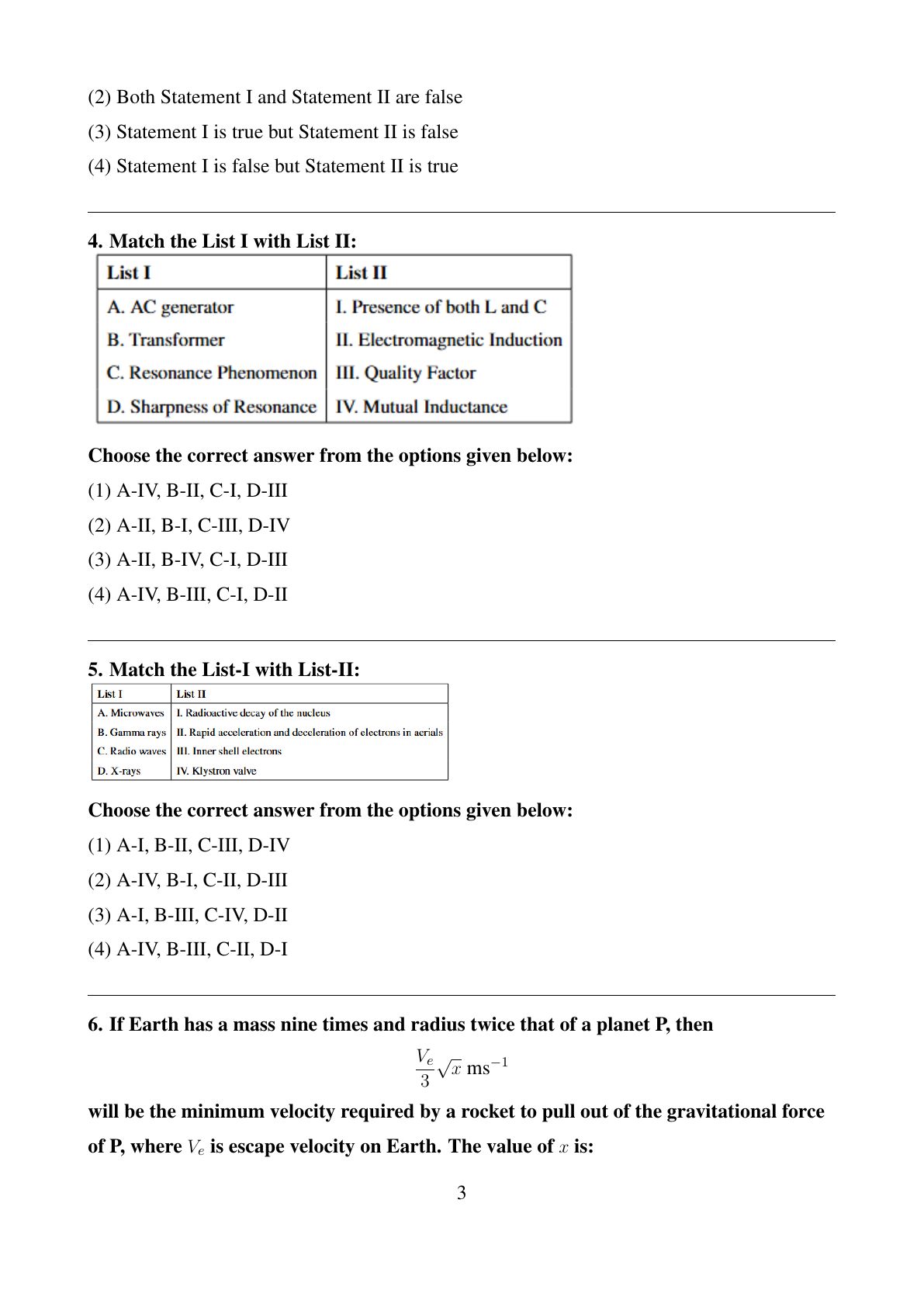
Given below are two statements:
Statement-I: Acceleration due to gravity is different at different places on the surface of Earth.
Statement-II: Acceleration due to gravity increases as we go down below the Earth's surface.
Choose the correct answer from the options given below:
View Solution
Match the List I with List II:

Choose the correct answer from the options given below:
View Solution
Match the List-I with List-II:

Choose the correct answer from the options given below:
View Solution
If Earth has a mass nine times and radius twice that of a planet P, then \[ \frac{V_e}{3} \sqrt{x} ms^{-1} \]
will be the minimum velocity required by a rocket to pull out of the gravitational force of P, where \( V_e \) is escape velocity on Earth. The value of \( x \) is:
View Solution
‘n’ polarizing sheets are arranged such that each makes an angle \( 45^\circ \) with the preceding sheet. An unpolarized light of intensity \( I \) is incident into this arrangement. The output intensity is found to be \[ \frac{I}{64}. \]
The value of \( n \) will be:
View Solution
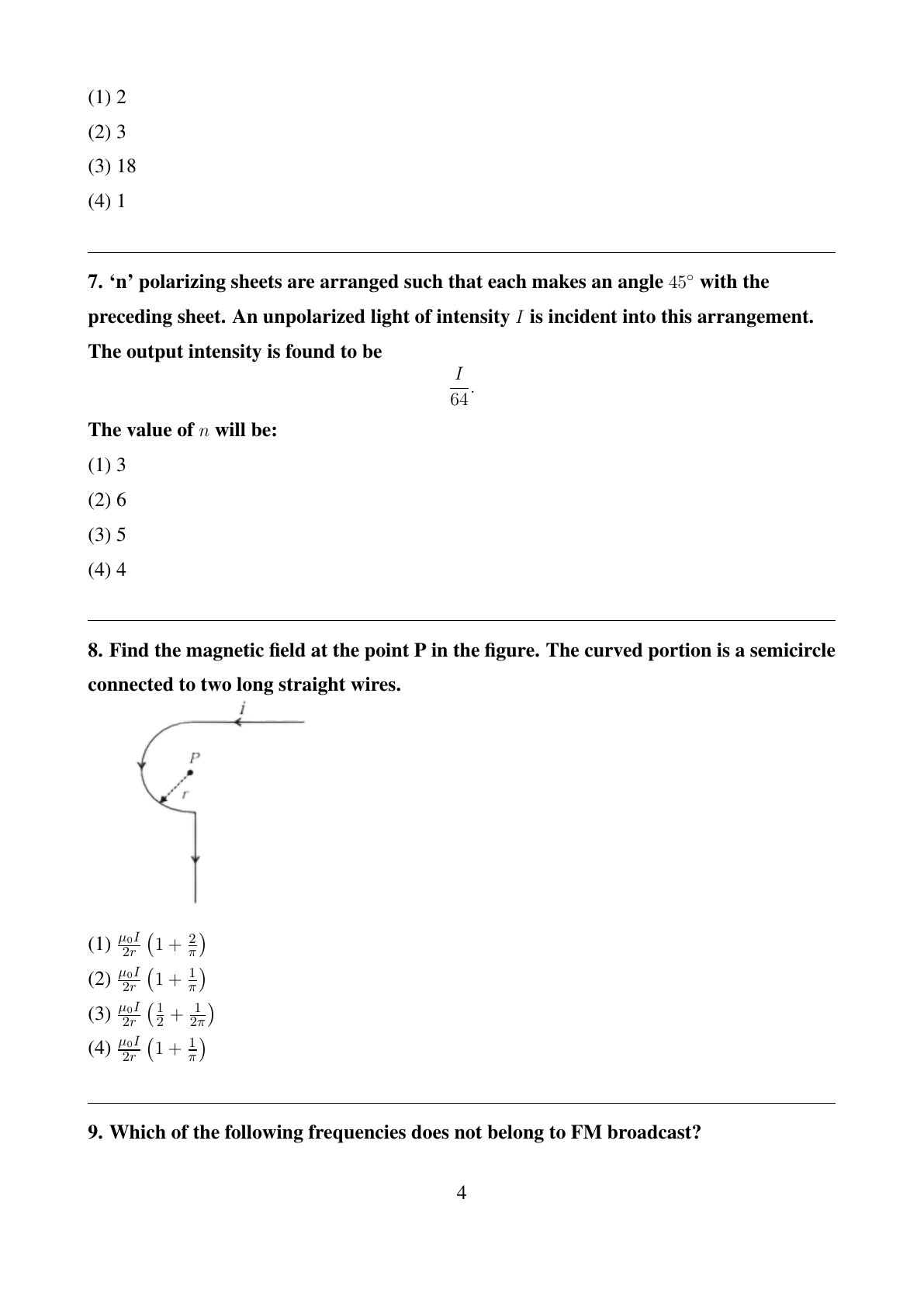
Find the magnetic field at the point P in the figure. The curved portion is a semicircle connected to two long straight wires.

View Solution
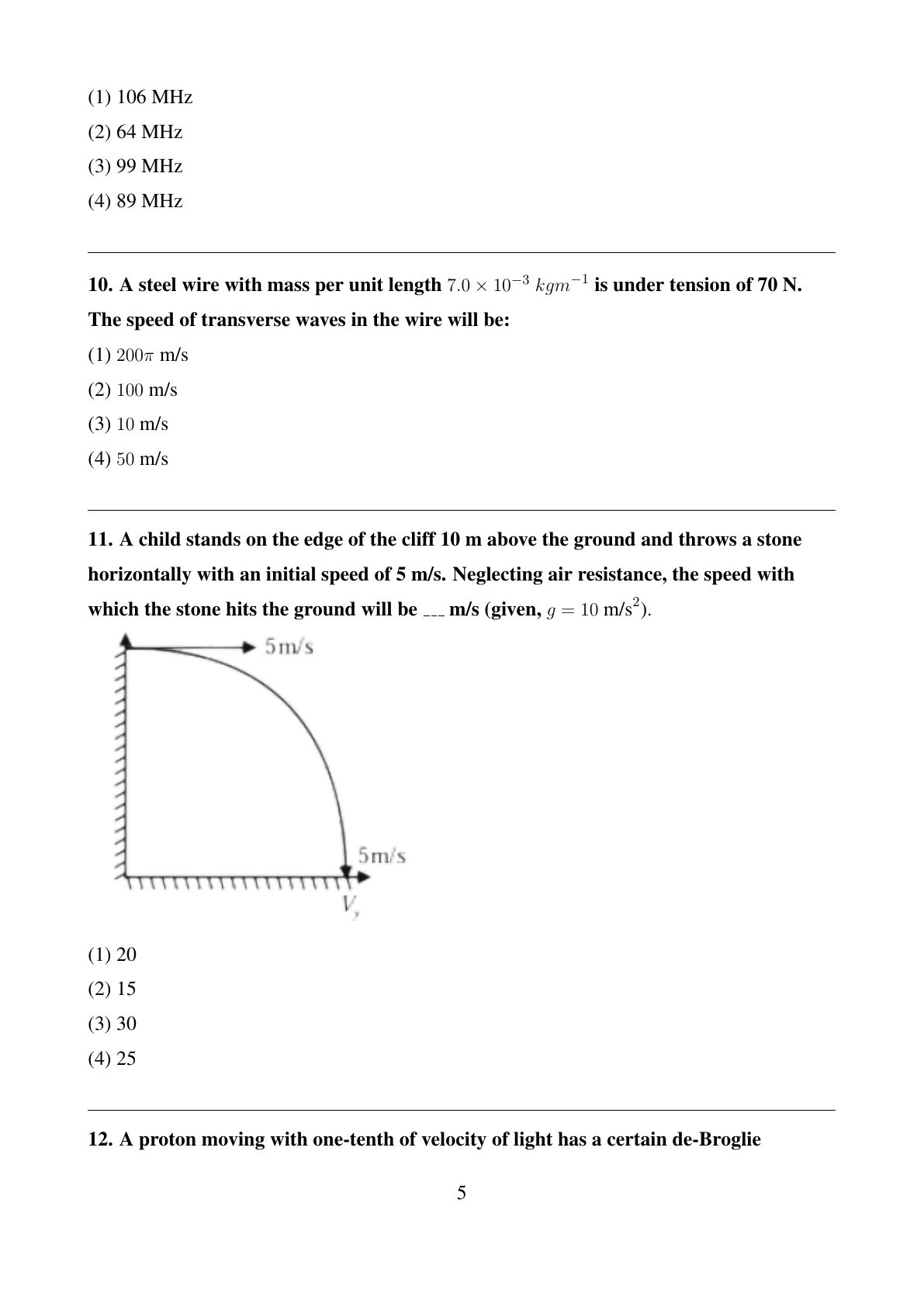
Which of the following frequencies does not belong to FM broadcast?
View Solution
A steel wire with mass per unit length \( 7.0 \times 10^{-3} \) \({kg m}^{-1}\) is under tension of 70 N. The speed of transverse waves in the wire will be:
View Solution
A child stands on the edge of the cliff 10 m above the ground and throws a stone horizontally with an initial speed of 5 m/s. Neglecting air resistance, the speed with which the stone hits the ground will be ___\ m/s (given, \( g = 10 m/s^2 \)).

View Solution
A proton moving with one-tenth of velocity of light has a certain de-Broglie wavelength \( \lambda \). An alpha particle having certain kinetic energy has the same de-Broglie wavelength \( \lambda \). The ratio of kinetic energy of proton and that of alpha particle is:
View Solution
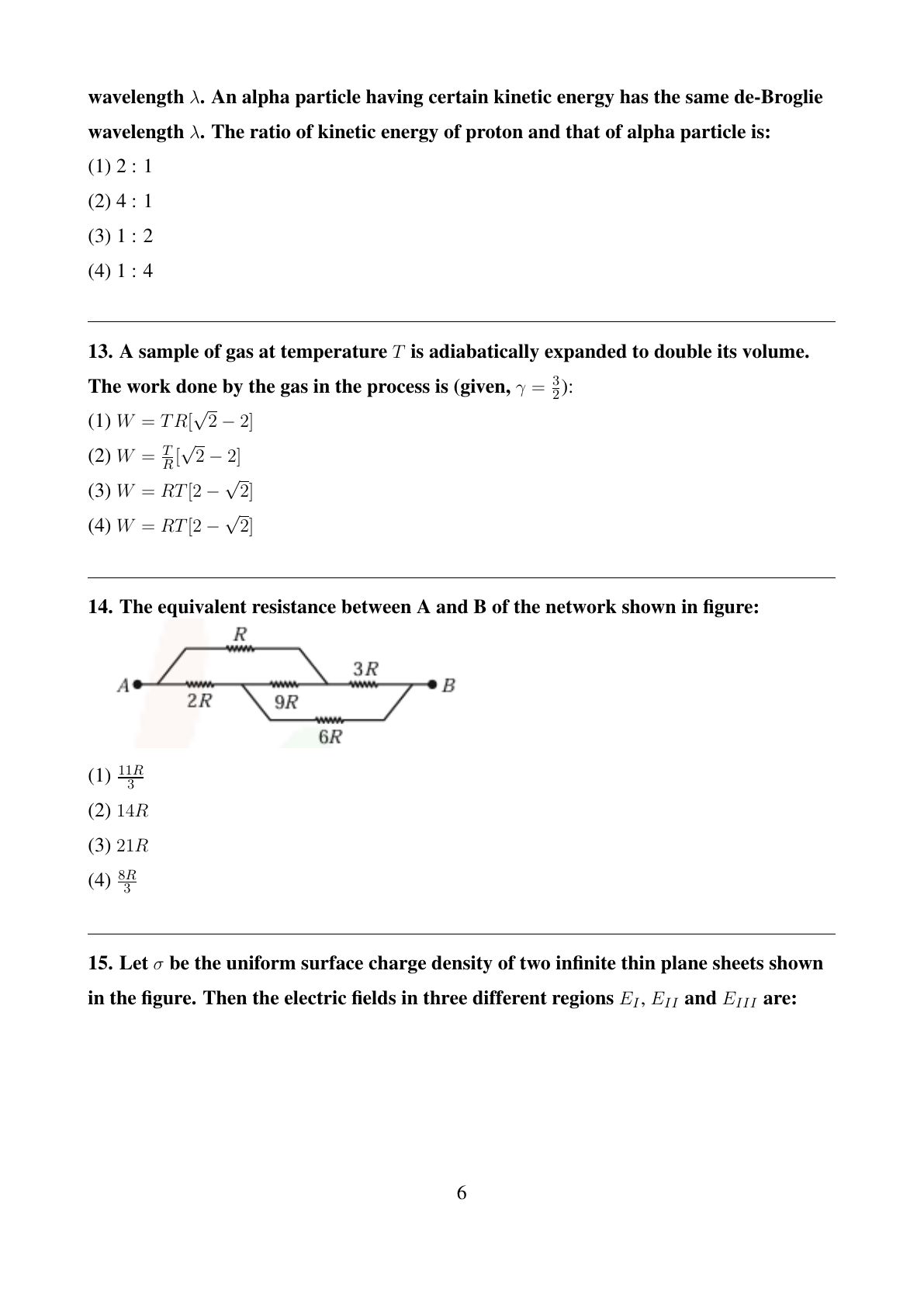
A sample of gas at temperature \( T \) is adiabatically expanded to double its volume. The work done by the gas in the process is (given, \( \gamma = \frac{3}{2} \)):
View Solution
The equivalent resistance between A and B of the network shown in figure:

View Solution
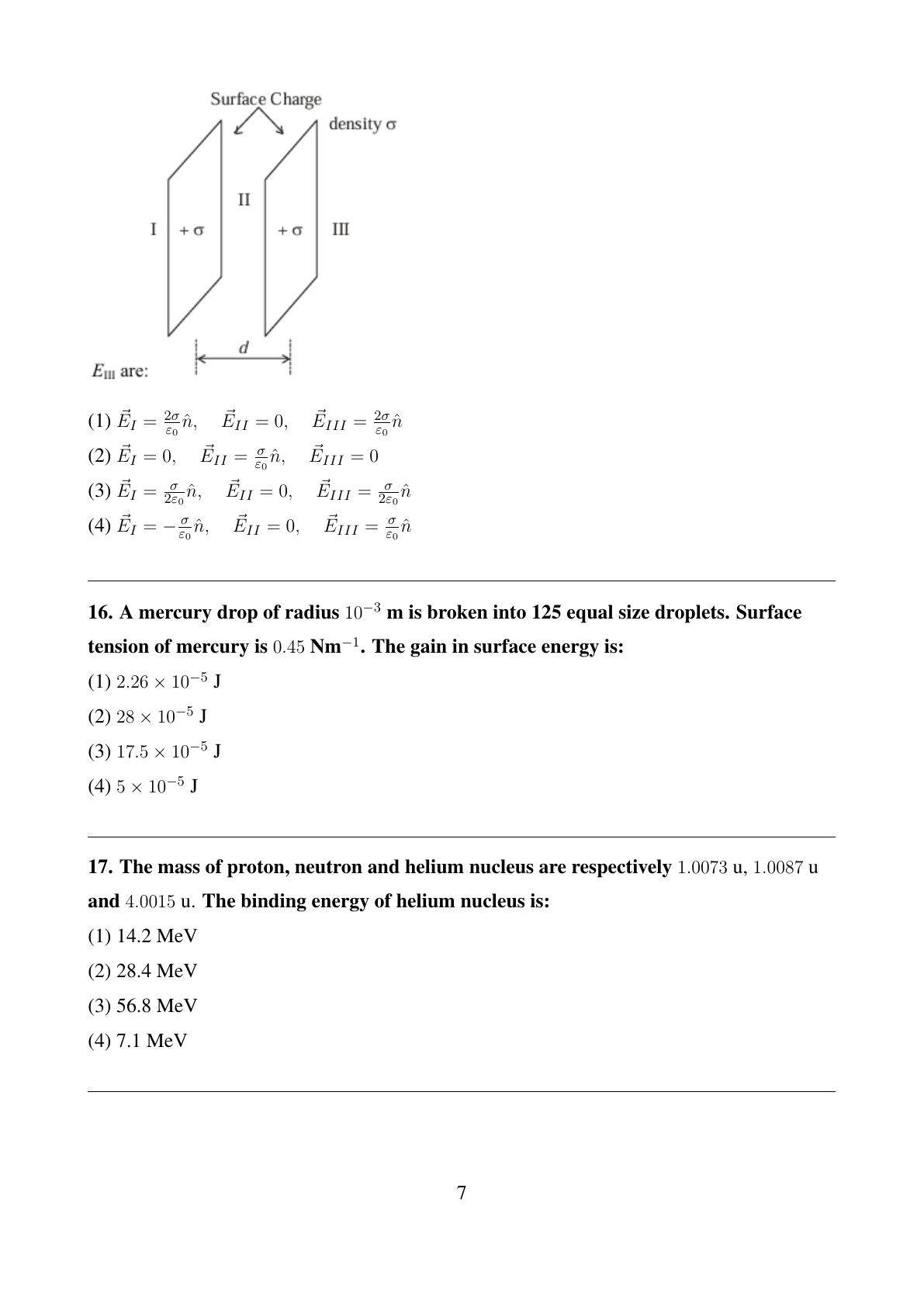
Let \( \sigma \) be the uniform surface charge density of two infinite thin plane sheets shown in the figure. Then the electric fields in three different regions \( E_I \), \( E_{II} \) and \( E_{III} \) are:

View Solution
A mercury drop of radius \( 10^{-3} \) m is broken into 125 equal size droplets. Surface tension of mercury is \( 0.45 \) Nm\(^{-1}\). The gain in surface energy is:
View Solution
The mass of proton, neutron and helium nucleus are respectively \( 1.0073 \) u, \( 1.0087 \) u and \( 4.0015 \) u. The binding energy of helium nucleus is:
View Solution
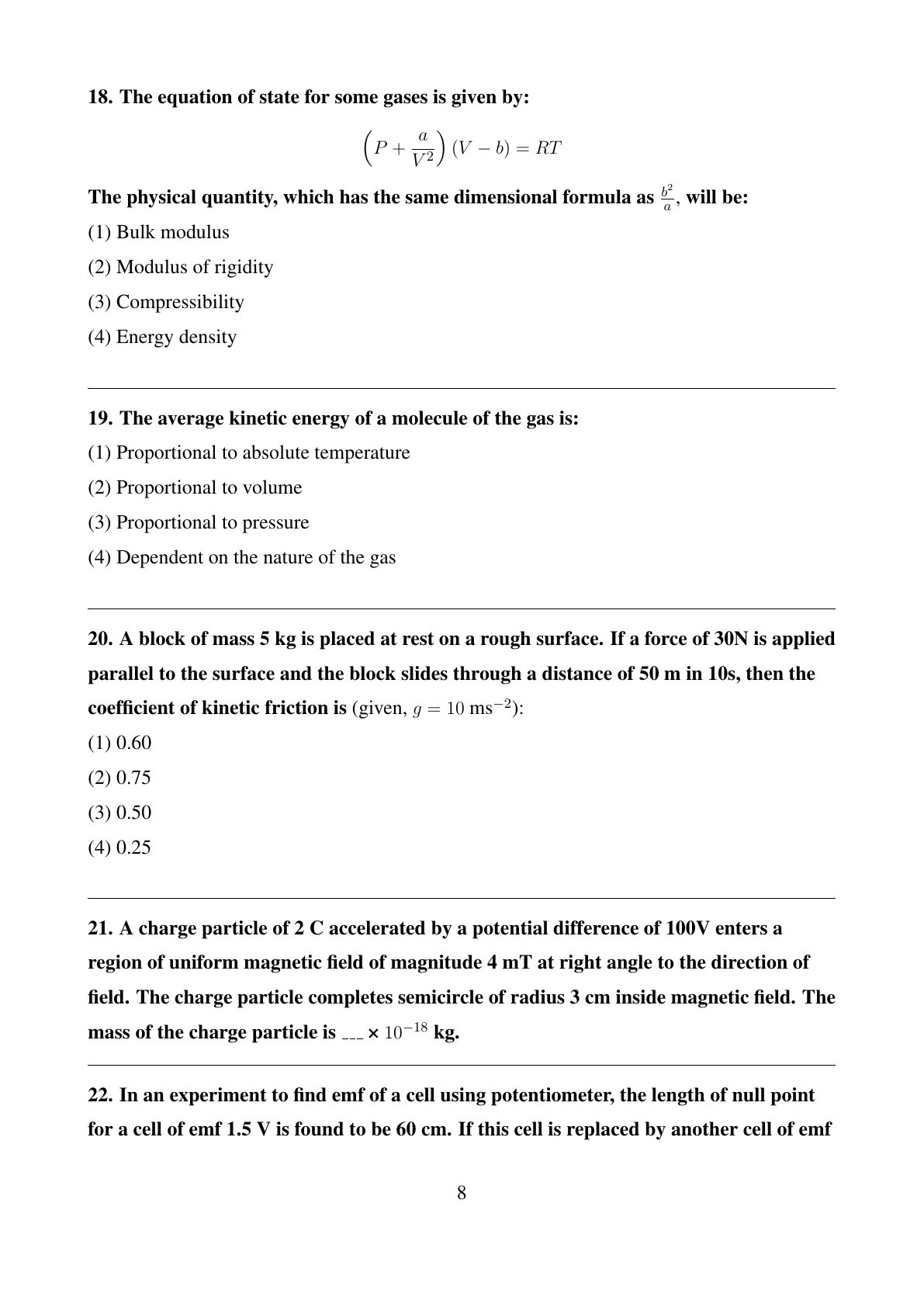
The equation of state for some gases is given by: \[ \left( P + \frac{a}{V^2} \right) (V - b) = RT \]
The physical quantity, which has the same dimensional formula as \( \frac{b^2}{a} \), will be:
View Solution
The average kinetic energy of a molecule of the gas is:
View Solution
A block of mass 5 kg is placed at rest on a rough surface. If a force of 30N is applied parallel to the surface and the block slides through a distance of 50 m in 10s, then the coefficient of kinetic friction is (given, \( g = 10 \) ms\(^{-2}\)):
View Solution
A charge particle of 2 μC accelerated by a potential difference of 100V enters a region of uniform magnetic field of magnitude 4 mT at right angle to the direction of field. The charge particle completes semicircle of radius 3 cm inside magnetic field. The mass of the charge particle is ___\ × \( 10^{-18} \) kg.
View Solution
In an experiment to find emf of a cell using potentiometer, the length of null point for a cell of emf 1.5 V is found to be 60 cm. If this cell is replaced by another cell of emf E, the length-of null point increases by 40 cm. The value of E is \( \frac{x}{10} \) V. The value of x is _________.
View Solution
A small particle moves to position \(5\hat{i} - 2\hat{j} + \hat{k}\) from its initial position \(2\hat{i} + 3\hat{j} - 4\hat{k}\) under the action of force \(5\hat{i} + 2\hat{j} + 7\hat{k}\) N. The value of work done will be ____\ J.
View Solution
A light of energy 12.75 eV is incident on a hydrogen atom in its ground state. The atom absorbs the radiation and reaches to one of its excited states. The angular momentum of the atom in the excited state is \( \frac{x}{\pi} \times 10^{-17} \) eVs. The value of x is __________.
View Solution
A certain pressure \( P \) is applied to 1 litre of water and 2 litre of a liquid separately. Water gets compressed to 0.01% whereas the liquid gets compressed to 0.03%. The ratio of Bulk modulus of water to that of the liquid is \(\frac{3}{x}\). The value of \( x \) is _______.
View Solution
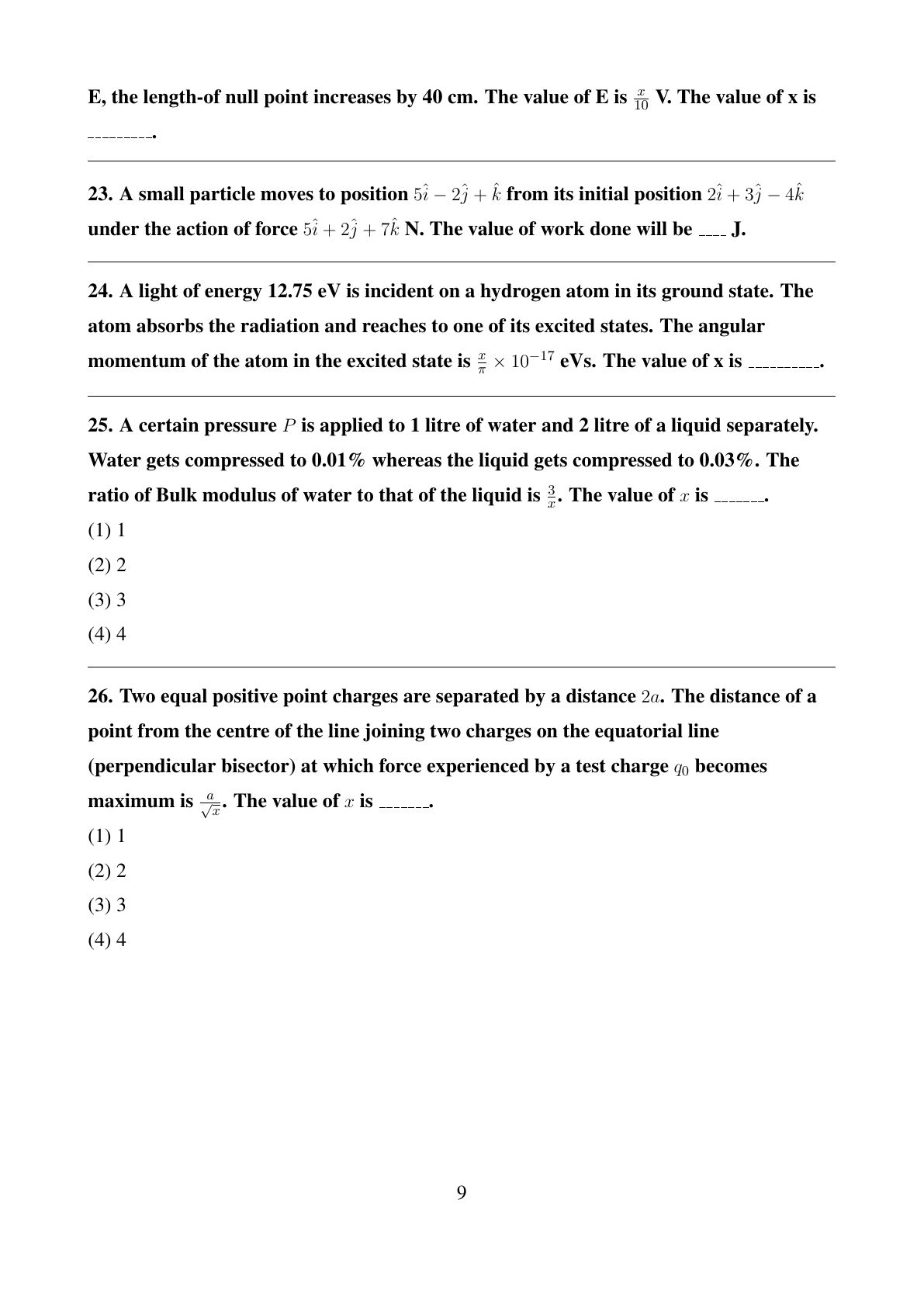
Two equal positive point charges are separated by a distance \( 2a \). The distance of a point from the centre of the line joining two charges on the equatorial line (perpendicular bisector) at which force experienced by a test charge \( q_0 \) becomes maximum is \( \frac{a}{\sqrt{x}} \). The value of \( x \) is _______.
- (1) 1
- (2) 2
- (3) 3
- (4) 4
![]()

View Solution
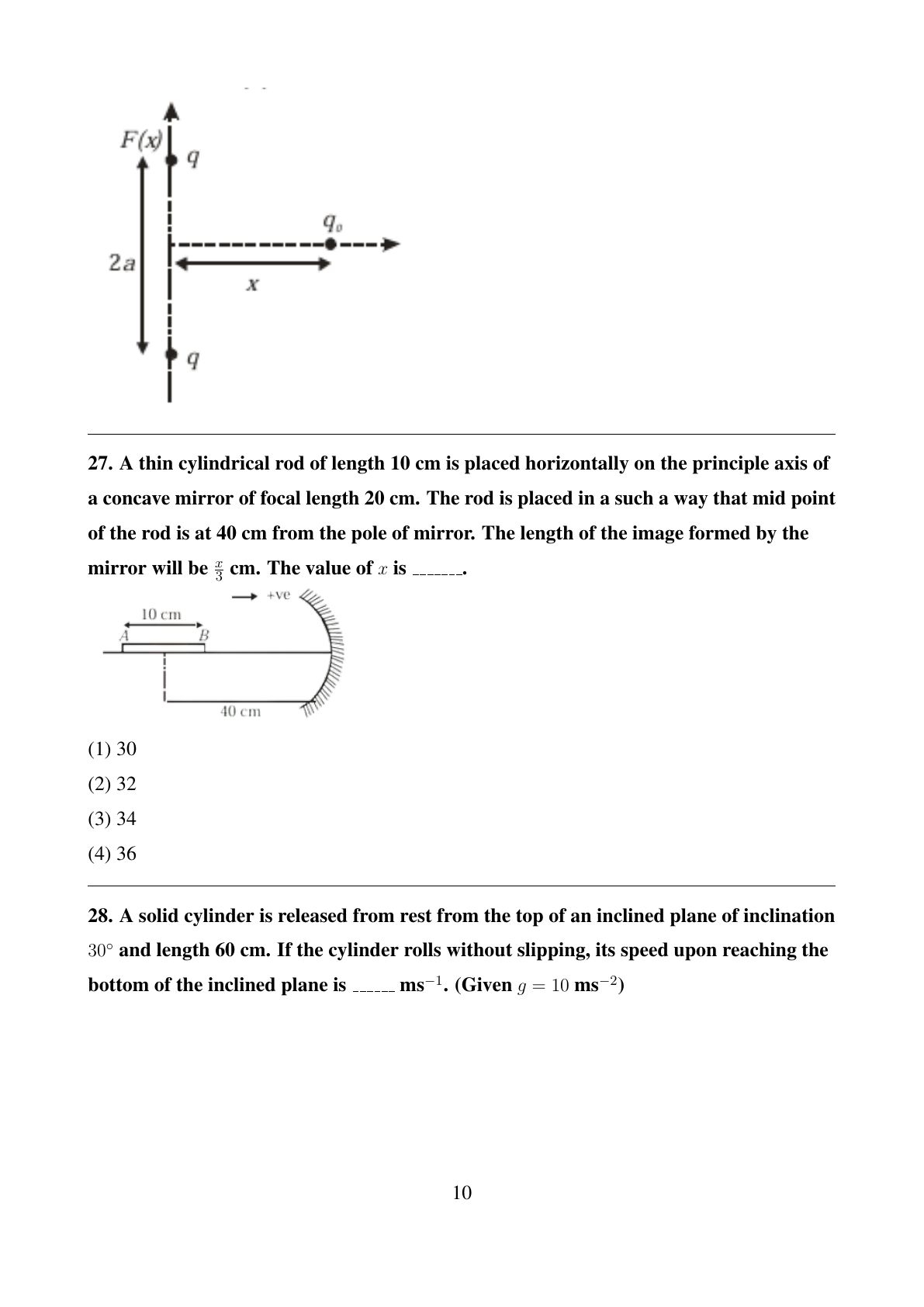
A thin cylindrical rod of length 10 cm is placed horizontally on the principle axis of a concave mirror of focal length 20 cm. The rod is placed in a such a way that mid point of the rod is at 40 cm from the pole of mirror. The length of the image formed by the mirror will be \( \frac{x}{3} \) cm. The value of \( x \) is _______.

View Solution
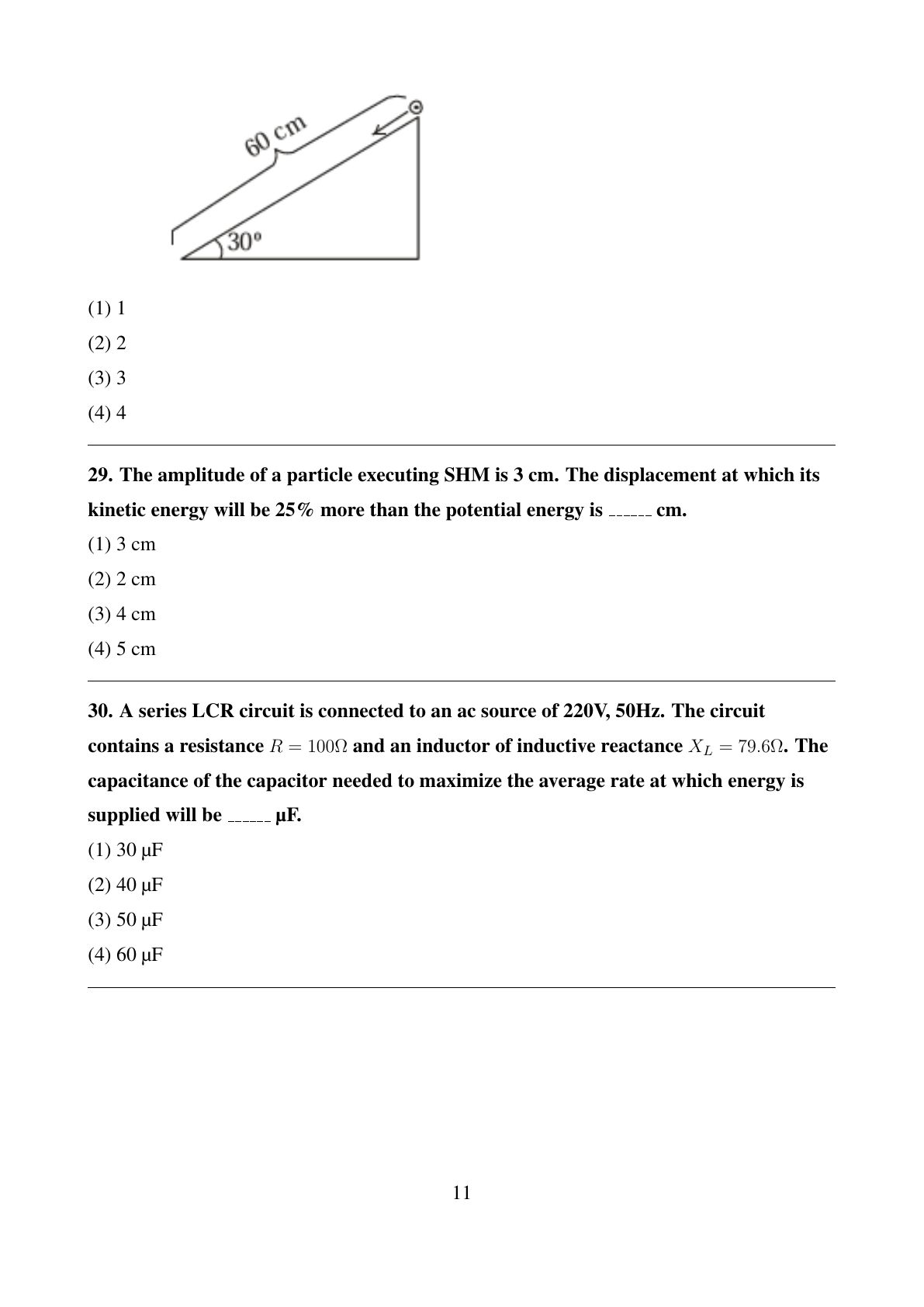
A solid cylinder is released from rest from the top of an inclined plane of inclination \( 30^\circ \) and length 60 cm. If the cylinder rolls without slipping, its speed upon reaching the bottom of the inclined plane is ______ ms\(^{-1}\). (Given \( g = 10 \) ms\(^{-2}\))

View Solution
The amplitude of a particle executing SHM is 3 cm. The displacement at which its kinetic energy will be 25% more than the potential energy is ______ cm.
View Solution
A series LCR circuit is connected to an ac source of 220V, 50Hz. The circuit contains a resistance \( R = 100\Omega \) and an inductor of inductive reactance \( X_L = 79.6 \Omega \). The capacitance of the capacitor needed to maximize the average rate at which energy is supplied will be ______ µF.
View Solution
Also Check:
JEE Main 2023 Physics Analysis Feb 1 Shift 1
JEE Main 2023 Paper Analysis for physics paper scheduled on February 1 Shift 1 will be updated here after the conclusion of the exam. Candidates will be able to check the topics with the highest weightage, difficulty level and memory-based Physics questions.
| JEE Main 2023 Paper Analysis Feb 1 Shift 1 (After Exam) |
JEE Main 2023 Physics Question Paper Pattern
| Feature | Question Paper Pattern |
|---|---|
| Examination Mode | Computer-based Test |
| Exam Language | 13 languages (English, Hindi, Assamese, Bengali, Gujarati, Kannada, Malayalam, Marathi, Odia, Punjabi, Tamil, Telugu, and Urdu) |
| Exam Duration | 3 hours |
| Sectional Time Limit | None |
| Physics Marks | 100 marks |
| Total Number of Questions Asked | 20 MCQs + 10 Numerical Type Questions |
| Total Number of Questions to be Answered | 20 MCQs + 5 Numerical Type Questions |
| Marking Scheme | +4 for each correct answer |
| Negative Marking | -1 for each incorrect answer |
Also Check:
JEE Main 2022 Question Paper
JEE Main 2023 aspirants can practice and check their exam prep level by attempting the previous year question papers as well. The table below shows JEE Main 2022 Question Paper PDF for B.E./B.Tech to practice.



Comments