




JEE Main 2025 January 24 Shift 1 Question Paper is available here with answer key and solution pdf. NTA conducted the first shift on January 24, 2025, from 9:00 AM to 12:00 PM. The JEE Main 2025 Paper 1 (B.E./B.Tech) question paper includes the following:
- 75 questions in a 3-hour CBT Mode: 25 each from Mathematics, Physics and Chemistry
- Section A: 20 multiple choice questions (MCQs) per subject, 4 marks each
- Section B: 5 numerical value questions per subject, 4 marks each (integer answer)
- Marking: +4 for a correct answer, -1 for an incorrect answer, 0 for an unattempted question
JEE Main 2025 January 24 Shift 1 Question Paper with Solution PDF
| NTA Official PDF | CD PDF | CD PDF with Solutions |
|---|---|---|
| Download official PDF 4.10 MB | Download Collegedunia PDF 0.71 MB | Download solutions PDF 0.70 MB |
Also Check:
JEE Main 2025 January 24 Shift 1 Questions with Solutions
Mathematics - Section A (Q1 - Q20)
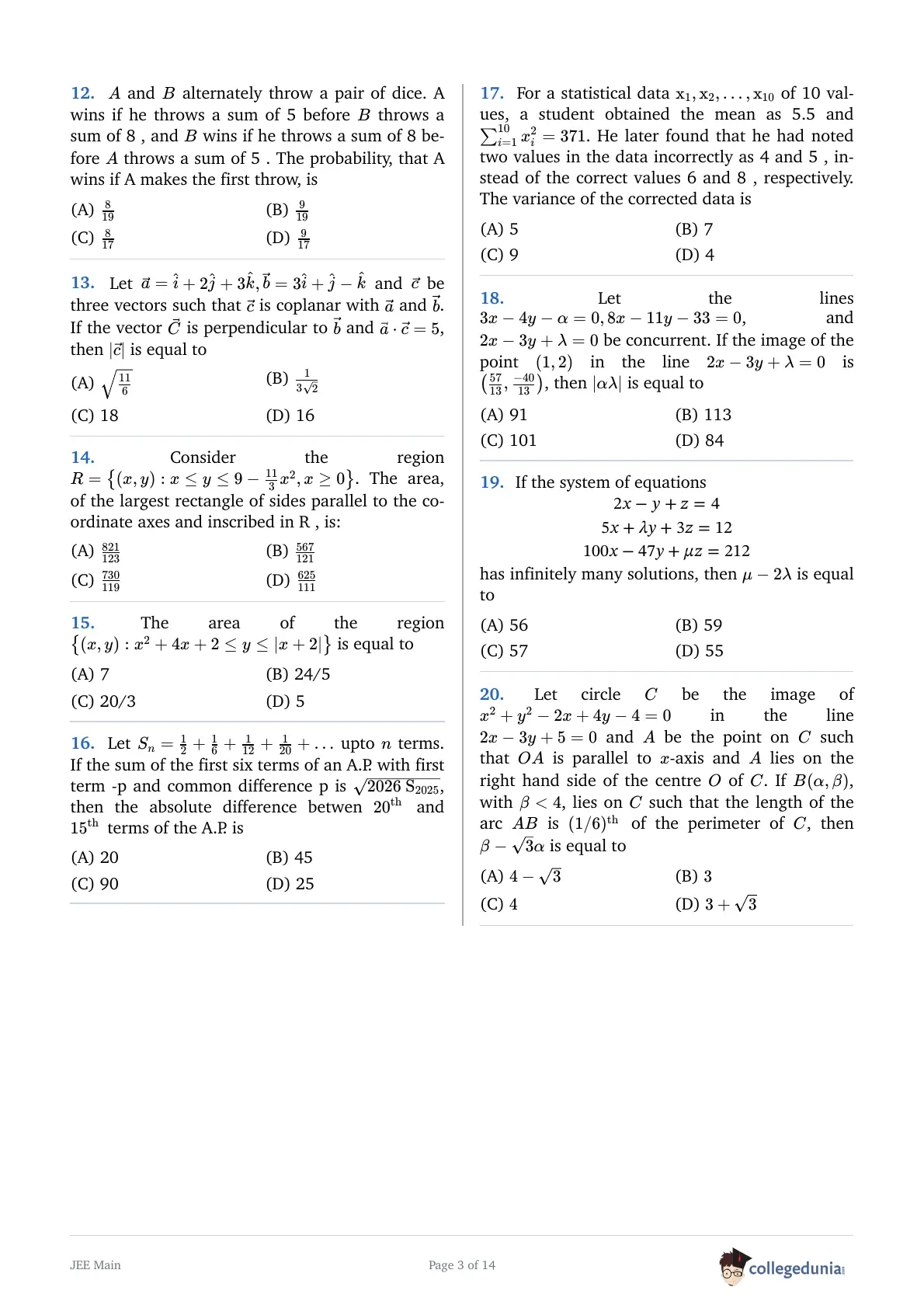
Let \( \vec{a} = \hat{i} + 2\hat{j} + 3\hat{k}, \, \vec{b} = 3\hat{i} + \hat{j} - \hat{k} \) and \( \vec{c} \) be three vectors such that \( \vec{c} \) is coplanar with \( \vec{a} \) and \( \vec{b} \). If the vector \( \vec{c} \) is perpendicular to \( \vec{b} \) and \( \vec{a} \cdot \vec{c} = 5 \), then \( |\vec{c}| \) is equal to:
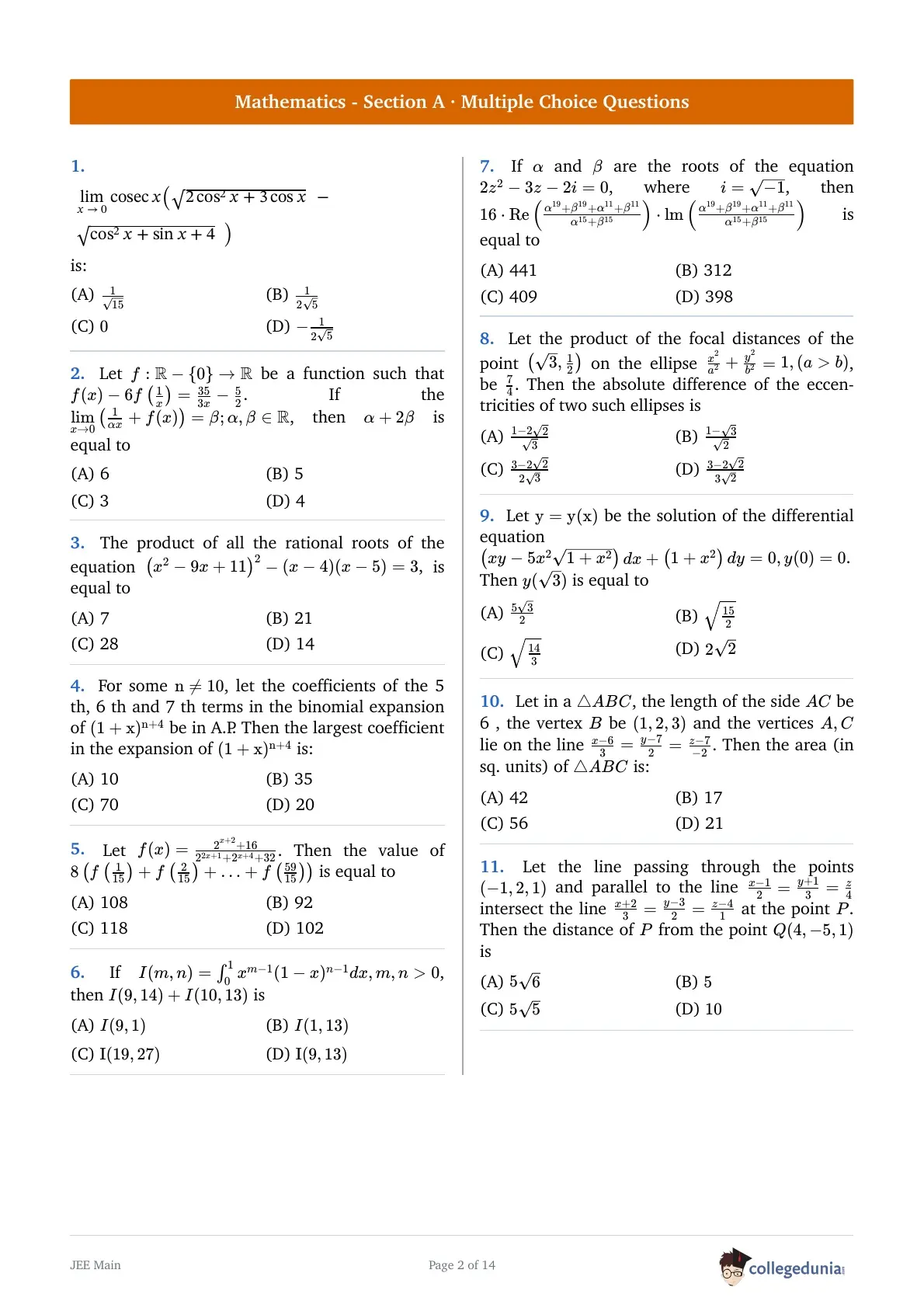
In \( I(m, n) = \int_0^1 x^{m-1} (1-x)^{n-1} \, dx \), where \( m, n > 0 \), then \( I(9, 14) + I(10, 13) \) is:
Let \( f : \mathbb{R} - \{0\} \to \mathbb{R} \) be a function such that \[ f(x) - 6f\left(\frac{1}{x}\right) = \frac{35}{3x} - \frac{5}{2}. \]
If \( \lim_{x \to 0} \left( \frac{1}{\alpha x} + f(x) \right) = \beta \), then \( \alpha, \beta \in \mathbb{R} \), and \( \alpha + 2\beta \) is equal to:
Let \( S_n = \frac{1}{2} + \frac{1}{6} + \frac{1}{12} + \frac{1}{20} + \dots \) up to \( n \) terms. If the sum of the first six terms of an A.P. with first term \( -p \) and common difference \( p \) is \( \sqrt{2026 S_{2025}} \), then the absolute difference between the 20th and 15th terms of the A.P. is:
Let \( f(x) = \frac{2^{x+2} + 16}{2^{2x+1} + 2^{x+4} + 32} \). Then the value of \[ 8 \left( f\left( \frac{1}{15} \right) + f\left( \frac{2}{15} \right) + \dots + f\left( \frac{59}{15} \right) \right) \]
is equal to:
If \( \alpha \) and \( \beta \) are the roots of the equation \( 2z^2 - 3z - 2i = 0 \), where \( i = \sqrt{-1} \), then \[ 16 \cdot Re \left( \frac{\alpha^{19} + \beta^{19} + \alpha^{11} + \beta^{11}}{\alpha^{15} + \beta^{15}} \right) \cdot Im \left( \frac{\alpha^{19} + \beta^{19} + \alpha^{11} + \beta^{11}}{\alpha^{15} + \beta^{15}} \right) \]
is equal to:
Evaluate the limit: \[ \lim_{x \to 0} \csc{x} \left( \sqrt{2 \cos^2{x} + 3 \cos{x}} - \sqrt{\cos^2{x} + \sin{x} + 4} \right) \]
is equal to:
Let in a \( \triangle ABC \), the length of the side AC is 6, the vertex B is \( (1, 2, 3) \) and the vertices A, C lie on the line \[ \frac{x - 6}{3} = \frac{y - 7}{2} = \frac{z - 7}{-2}. \]
Then the area (in sq. units) of \( \triangle ABC \) is:
Let \( y = y(x) \) be the solution of the differential equation \[ \left( xy - 5x^2 \sqrt{1 + x^2} \right) dx + (1 + x^2) dy = 0, \quad y(0) = 0. \]
Then \( y(\sqrt{3}) \) is equal to:
Let the product of the focal distances of the point \[ \left( \sqrt{3}, \frac{1}{2} \right) \]
on the ellipse \[ \frac{x^2}{a^2} + \frac{y^2}{b^2} = 1, \quad (a > b), \]
be \( \frac{7}{4} \).
Then the absolute difference of the eccentricities of two such ellipses is:
A and B alternately throw a pair of dice. A wins if he throws a sum of 5 before B throws a sum of 8, and B wins if he throws a sum of 8 before A throws a sum of 5. The probability that A wins if A makes the first throw is:
Consider the region \[ R = \left\{ (x, y): x \leq y \leq 9 - \frac{11}{3} x^2, x \geq 0 \right\}. \]
The area of the largest rectangle of sides parallel to the coordinate axes and inscribed in \( R \) is:
The area of the region \[ \{ (x, y) : x^2 + 4x + 2 \leq y \leq |x| + 2 \} \]
is equal to:
For a statistical data \( x_1, x_2, \dots, x_{10} \) of 10 values, a student obtained the mean as 5.5 and \[ \sum_{i=1}^{10} x_i^2 = 371. \]
He later found that he had noted two values in the data incorrectly as 4 and 5, instead of the correct values 6 and 8, respectively. The variance of the corrected data is:
Let circle C be the image of \[ x^2 + y^2 - 2x + 4y - 4 = 0 \]
in the line \[ 2x - 3y + 5 = 0 and A be the point on C such that OA is parallel to \] \[the x-axis and A lies on the right-hand side of the centre O of C.\]
For some \( n \neq 10 \), let the coefficients of the 5th, 6th, and 7th terms in the binomial expansion of \( (1 + x)^{n+4} \) be in A.P. Then the largest coefficient in the expansion of \( (1 + x)^{n+4} \) is:
The product of all the rational roots of the equation \[ (x^2 - 9x + 11)^2 - (x - 4)(x - 5) = 3, \]
is equal to:
Let the line passing through the points \( (-1, 2, 1) \) and parallel to the line \[ \frac{x - 1}{2} = \frac{y + 1}{3} = \frac{z}{4} \]
intersect the line \[ \frac{x + 2}{3} = \frac{y - 3}{2} = \frac{z - 4}{1} \]
at the point P. Then the distance of P from the point Q(4, -5, 1) is:
Let the lines \[ 3x - 4y - \alpha = 0, \quad 8x - 11y - 33 = 0, \quad 2x - 3y + \lambda = 0 \]
be concurrent. If the image of the point \( (1, 2) \) in the line \[ 2x - 3y + \lambda = 0 is \left( \frac{57}{13}, \frac{-40}{13} \right), then |\alpha \lambda| is equal to: \]
If the system of equations \[ 2x - y + z = 4, \] \[ 5x + \lambda y + 3z = 12, \] \[ 100x - 47y + \mu z = 212, \]
has infinitely many solutions, then \( \mu - 2\lambda \) is equal to:
Mathematics - Section B (Q21 - Q25)
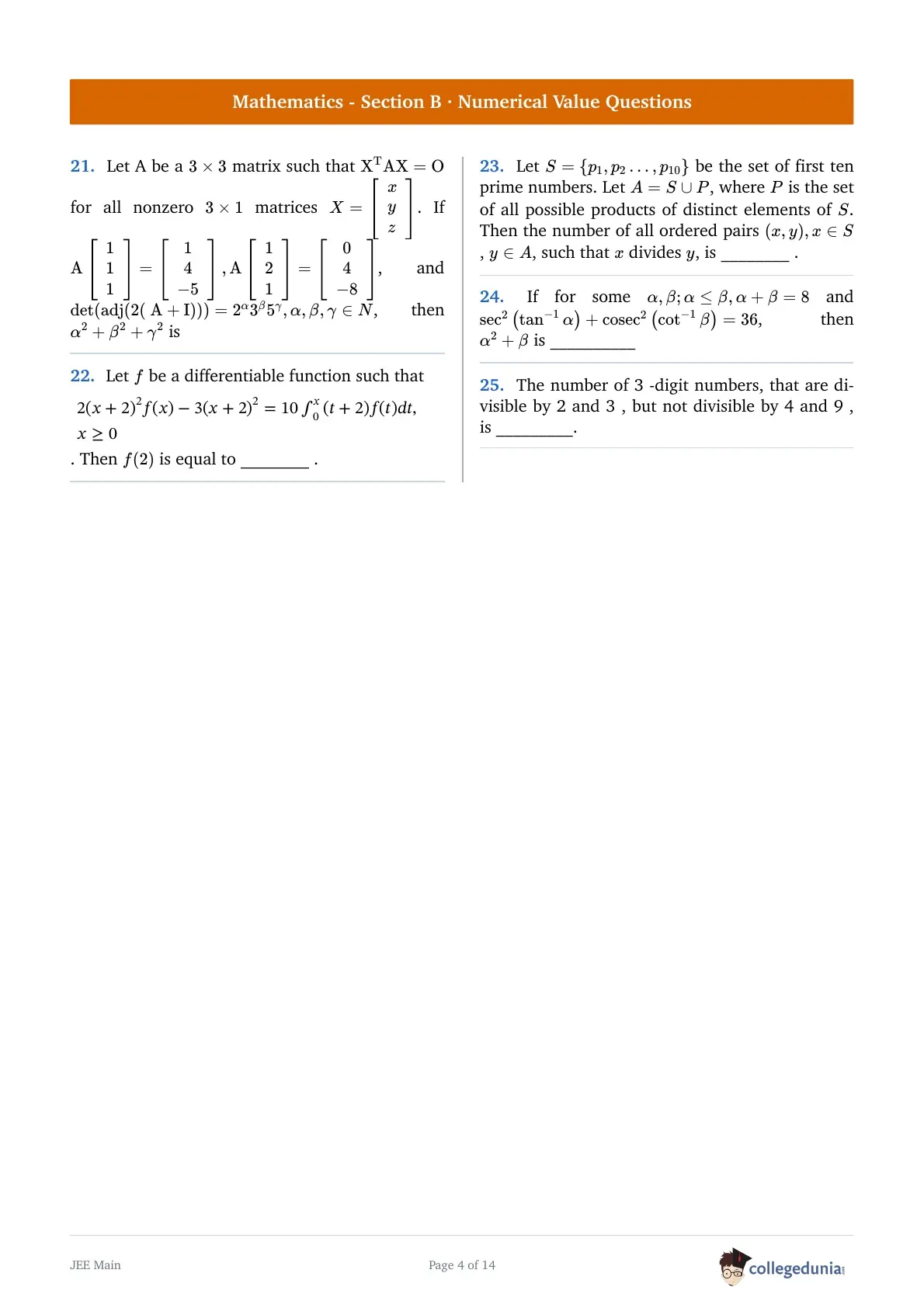
Let \( f \) be a differentiable function such that \[ 2(x + 2)^2 f(x) - 3(x + 2)^2 = 10 \int_0^x (t + 2) f(t) dt, \]
for \( x \geq 0 \). Then \( f(2) \) is equal to:
If for some \( \alpha, \beta \); \( \alpha \leq \beta \), \( \alpha + \beta = 8 \) and \[ \sec^2(\tan^{-1} \alpha) + \csc^2(\cot^{-1} \beta) = 36, \]
then \( \alpha^2 + \beta \) is:
The number of 3-digit numbers, that are divisible by 2 and 3, but not divisible by 4 and 9, is.
Let \( A \) be a \( 3 \times 3 \) matrix such that \( X^T AX = 0 \) for all nonzero \( 3 \times 1 \) matrices

Let \( S = \{p_1, p_2, \dots, p_{10}\} \) be the set of the first ten prime numbers. Let \( A = S \cup P \), where \( P \) is the set of all possible products of distinct elements of \( S \). Then the number of all ordered pairs \( (x, y) \), where \( x \in S \), \( y \in A \), and \( x \) divides \( y \), is ____.
Physics - Section A (Q26 - Q45)
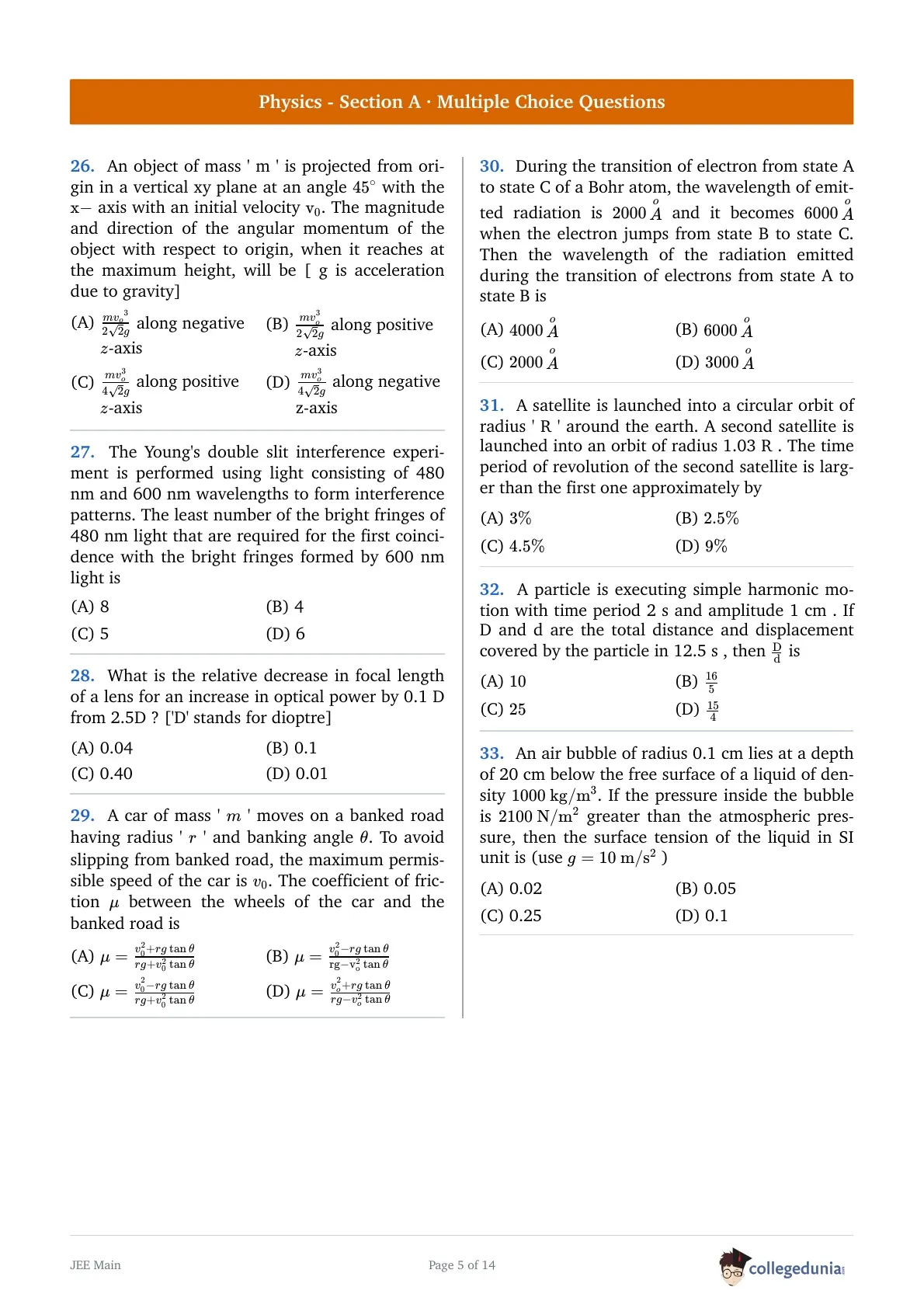
Consider a parallel plate capacitor of area \( A \) (of each plate) and separation \( d \) between the plates. If \( E \) is the electric field and \( \epsilon_0 \) is the permittivity of free space between the plates, then the potential energy stored in the capacitor is:
What is the relative decrease in focal length of a lens for an increase in optical power by 0.1 D from 2.5 D? ('D' stands for dioptre).
An air bubble of radius 0.1 cm lies at a depth of 20 cm below the free surface of a liquid of density 1000 kg/m\(^3\). If the pressure inside the bubble is 2100 N/m\(^2\) greater than the atmospheric pressure, then the surface tension of the liquid in SI units is (use \(g = 10 \, m/s^2\)).
For an experimental expression \( y = \frac{32.3 \times 1125}{27.4} \), where all the digits are significant. Then to report the value of \( y \), we should write:
During the transition of an electron from state A to state C of a Bohr atom, the wavelength of emitted radiation is 2000 Å, and it becomes 6000 Å when the electron jumps from state B to state C. Then the wavelength of the radiation emitted during the transition of electrons from state A to state B is:
Consider the following statements:
A. The junction area of a solar cell is made very narrow compared to a photodiode.
B. Solar cells are not connected with any external bias.
C. LED is made of lightly doped p-n junction.
D. Increase of forward current results in a continuous increase in LED light intensity.
E. LEDs have to be connected in forward bias for emission of light.
The amount of work done to break a big water drop of radius \( R \) into 27 small drops of equal radius is 10 J. The work done required to break the same big drop into 64 small drops of equal radius will be:
An object of mass \( m \) is projected from the origin in a vertical \( xy \)-plane at an angle \( 45^\circ \) with the x-axis with an initial velocity \( v_0 \). The magnitude and direction of the angular momentum of the object with respect to the origin, when it reaches the maximum height, will be:
The Young's double slit interference experiment is performed using light consisting of 480 nm and 600 nm wavelengths to form interference patterns. The least number of the bright fringes of 480 nm light that are required for the first coincidence with the bright fringes formed by 600 nm light is:
A car of mass \( m \) moves on a banked road having radius \( r \) and banking angle \( \theta \). To avoid slipping from the banked road, the maximum permissible speed of the car is \( v_0 \). The coefficient of friction \( \mu \) between the wheels of the car and the banked road is:
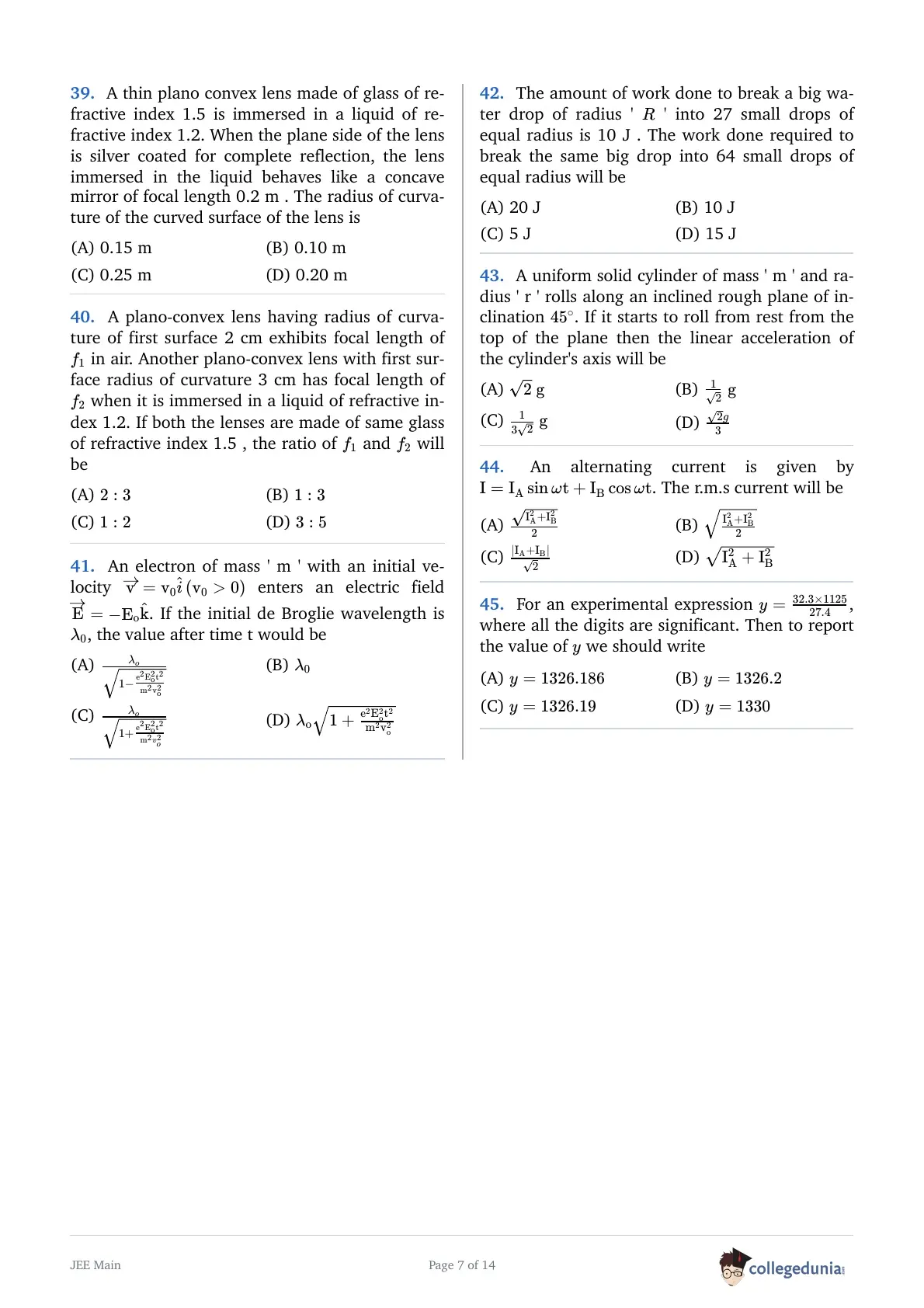
A uniform solid cylinder of mass \( m \) and radius \( r \) rolls along an inclined rough plane of inclination \( 45^\circ \). If it starts to roll from rest from the top of the plane, then the linear acceleration of the cylinder axis will be:
A thin plano-convex lens made of glass of refractive index 1.5 is immersed in a liquid of refractive index 1.2. When the plane side of the lens is silver coated for complete reflection, the lens immersed in the liquid behaves like a concave mirror of focal length 0.2 m. The radius of curvature of the curved surface of the lens is:
A particle is executing simple harmonic motion with a time period of 2 s and amplitude 1 cm. If \( D \) and \( d \) are the total distance and displacement covered by the particle in 12.5 s, then the ratio \( \frac{D}{d} \) is:
A satellite is launched into a circular orbit of radius \( R \) around the earth. A second satellite is launched into an orbit of radius \( 1.03R \). The time period of revolution of the second satellite is larger than the first one approximately by:
A plano-convex lens having radius of curvature of first surface 2 cm exhibits focal length of \( f_1 \) in air. Another plano-convex lens with first surface radius of curvature 3 cm has focal length of \( f_2 \) when it is immersed in a liquid of refractive index 1.2. If both the lenses are made of the same glass of refractive index 1.5, the ratio of \( f_1 \) and \( f_2 \) will be:
An alternating current is given by \[ I = I_A \sin \omega t + I_B \cos \omega t. \]
The r.m.s. current will be:
An electron of mass \( m \) with an initial velocity \( \vec{v} = v_0 \hat{i} (v_0 > 0) \) enters an electric field \( \vec{E} = -E_0 \hat{k} \). If the initial de Broglie wavelength is \( \lambda_0 \), the value after time \( t \) would be:
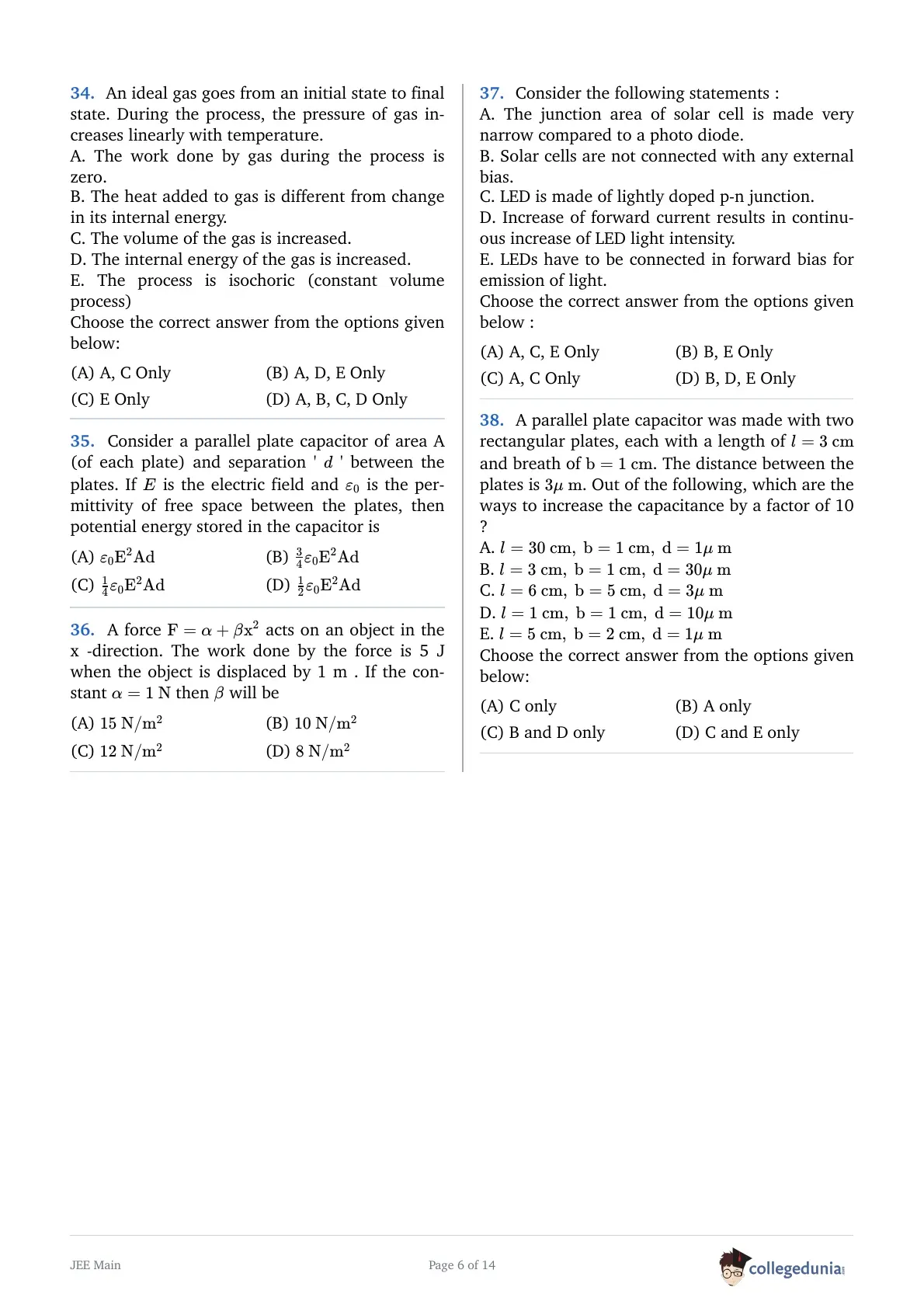
A parallel plate capacitor was made with two rectangular plates, each with a length of \( l = 3 \, cm \) and breadth of \( b = 1 \, cm \). The distance between the plates is \( d = 3 \). Out of the following, which are the ways to increase the capacitance by a factor of 10?
A force \( F = \alpha + \beta x^2 \) acts on an object in the x-direction. The work done by the force is 5 J when the object is displaced by 1 m. If the constant \( \alpha = 1 \, N \), then \( \beta \) will be:
An ideal gas goes from an initial state to final state. During the process, the pressure of the gas increases linearly with temperature.
A. The work done by gas during the process is zero.
B. The heat added to the gas is different from the change in its internal energy.
C. The volume of the gas is increased.
D. The internal energy of the gas is increased.
E. The process is isochoric (constant volume process).
Choose the correct answer from the options given below:
Physics - Section B (Q46 - Q50)
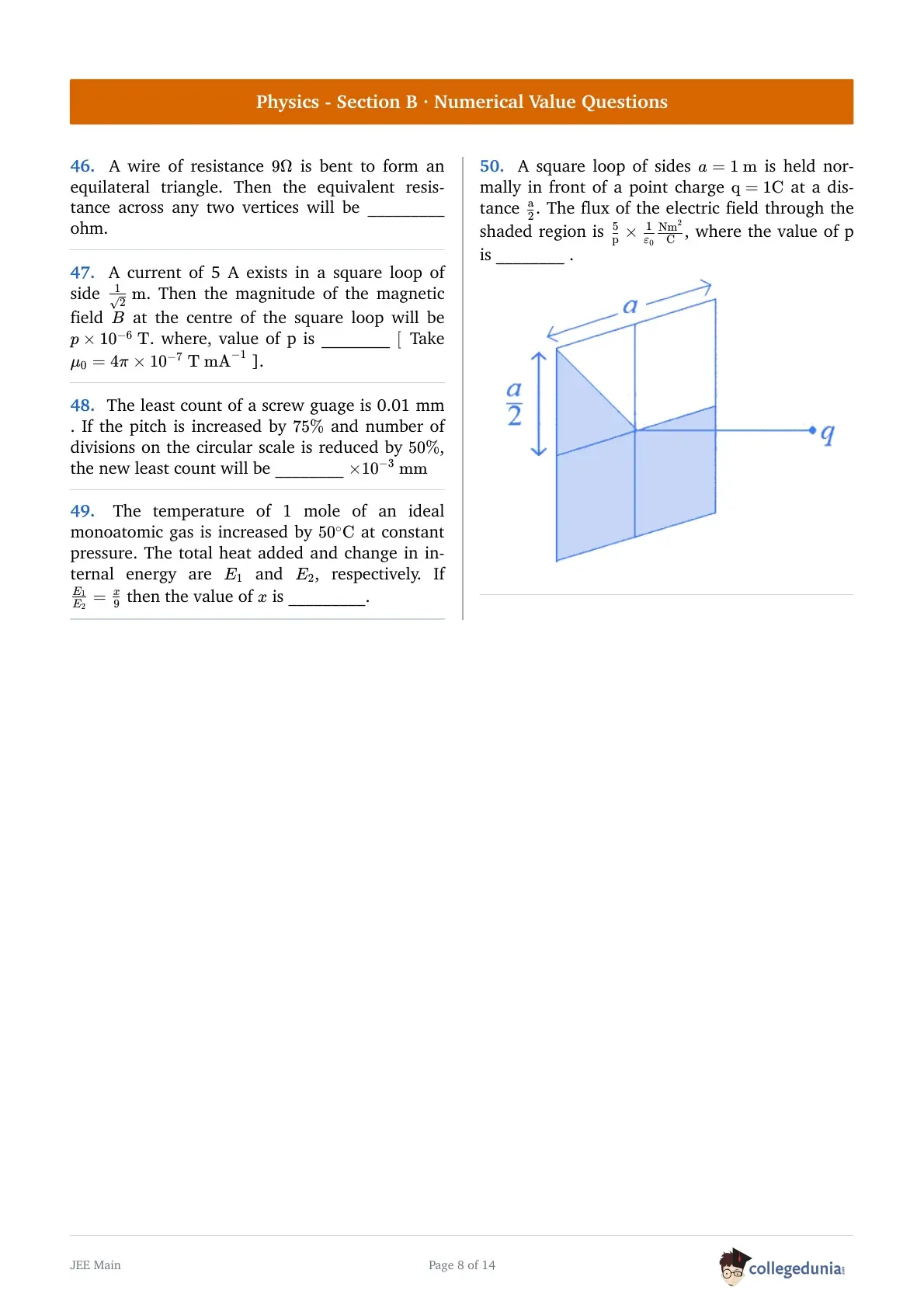
A square loop of sides \( a = 1 \, m \) is held normally in front of a point charge \( q = 1 \, C \). The flux of the electric field through the shaded region is \( \frac{5}{p} \times \frac{1}{\varepsilon_0} \, Nm^2/C \), where the value of \( p \) is:
The least count of a screw gauge is 0.01 mm. If the pitch is increased by 75% and the number of divisions on the circular scale is reduced by 50%, the new least count will be:
A wire of resistance \( 9 \, \Omega \) is bent to form an equilateral triangle. Then the equivalent resistance across any two vertices will be:
A current of 5A exists in a square loop of side \( \frac{1}{\sqrt{2}} \, m \). Then the magnitude of the magnetic field \( B \) at the centre of the square loop will be \( p \times 10^{-6} \, T \). Where, value of \( p \) is:
The temperature of 1 mole of an ideal monoatomic gas is increased by \( 50^\circ C \) at constant pressure. The total heat added and change in internal energy are \( E_1 \) and \( E_2 \), respectively. If \( \frac{E_1}{E_2} = \frac{x}{9} \), then the value of \( x \) is:
Chemistry - Section A (Q51 - Q70)
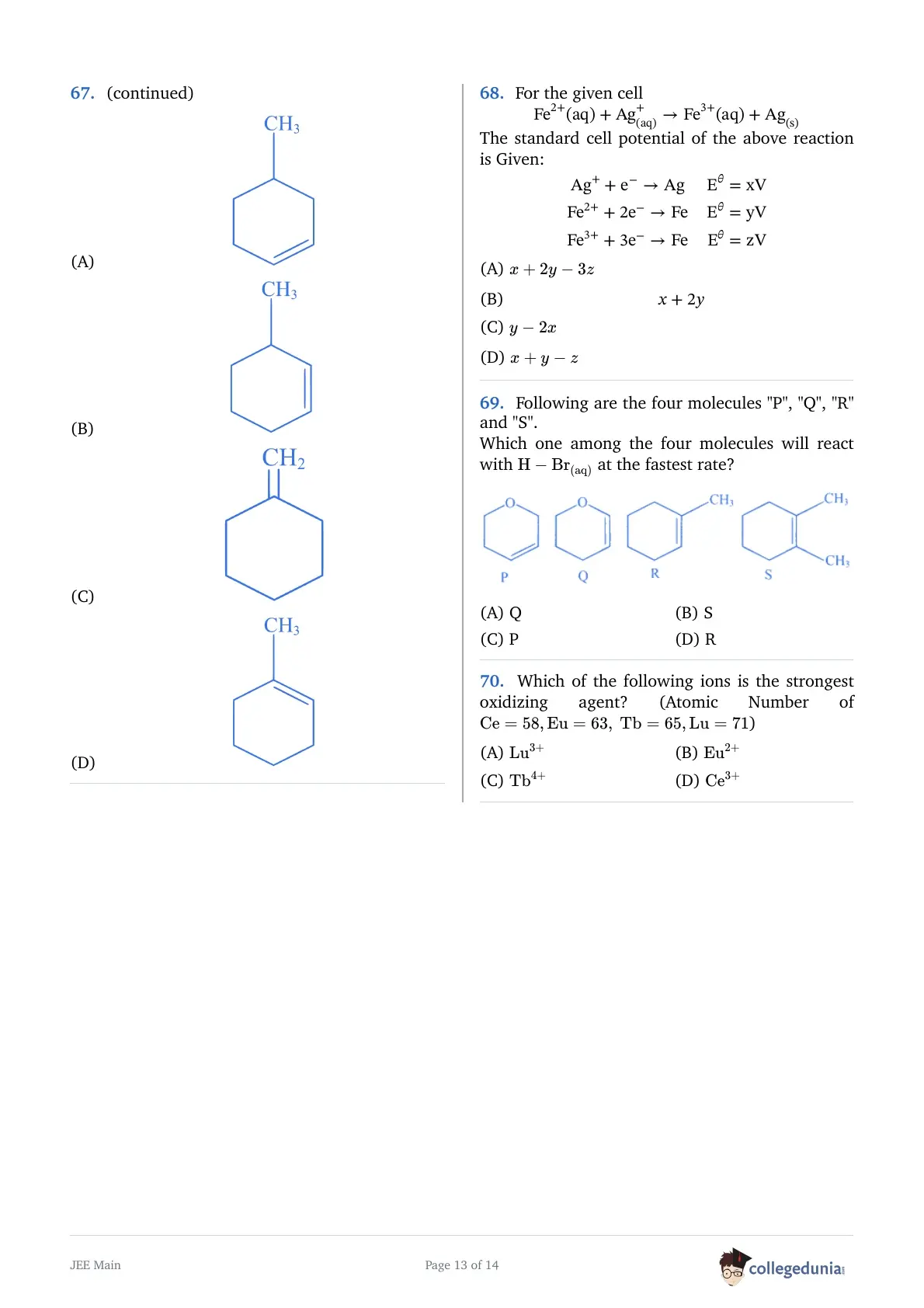
For the given cell: \[ Fe^{2+}(aq) + Ag^+(aq) \to Fe^{3+}(aq) + Ag(s) \]
The standard cell potential of the above reaction is given. The standard reduction potentials are given as: \[ Ag^+ + e^- \to Ag \quad E^\circ = x \, V \] \[ Fe^{2+} + 2e^- \to Fe \quad E^\circ = y \, V \] \[ Fe^{3+} + 3e^- \to Fe \quad E^\circ = z \, V \]
The correct answer is:
Following are the four molecules ``P``, ``Q``, ``R`` and ``S``. Which one among the four molecules will react with H-Br(aq) at the fastest rate? Molecules:

\[ P: \text{Cyclic compound with two O groups attached to the ring.} \] \[ Q: \text{Cyclic compound with one O group and one CH\(_3\) group attached to the ring.} \] \[ R: \text{Cyclic compound with one O group attached to the ring and one CH\(_3\) group attached to the ring.} \] \[ S: \text{Cyclic compound with one CH\(_3\) group attached to the ring.} \]
One mole of the octahedral complex compound \( Co(NH_3)_5Cl_3 \) gives 3 moles of ions on dissolution in water. One mole of the same complex reacts with excess of \( AgNO_3 \) solution to yield two moles of \( AgCl(s) \). The structure of the complex is:
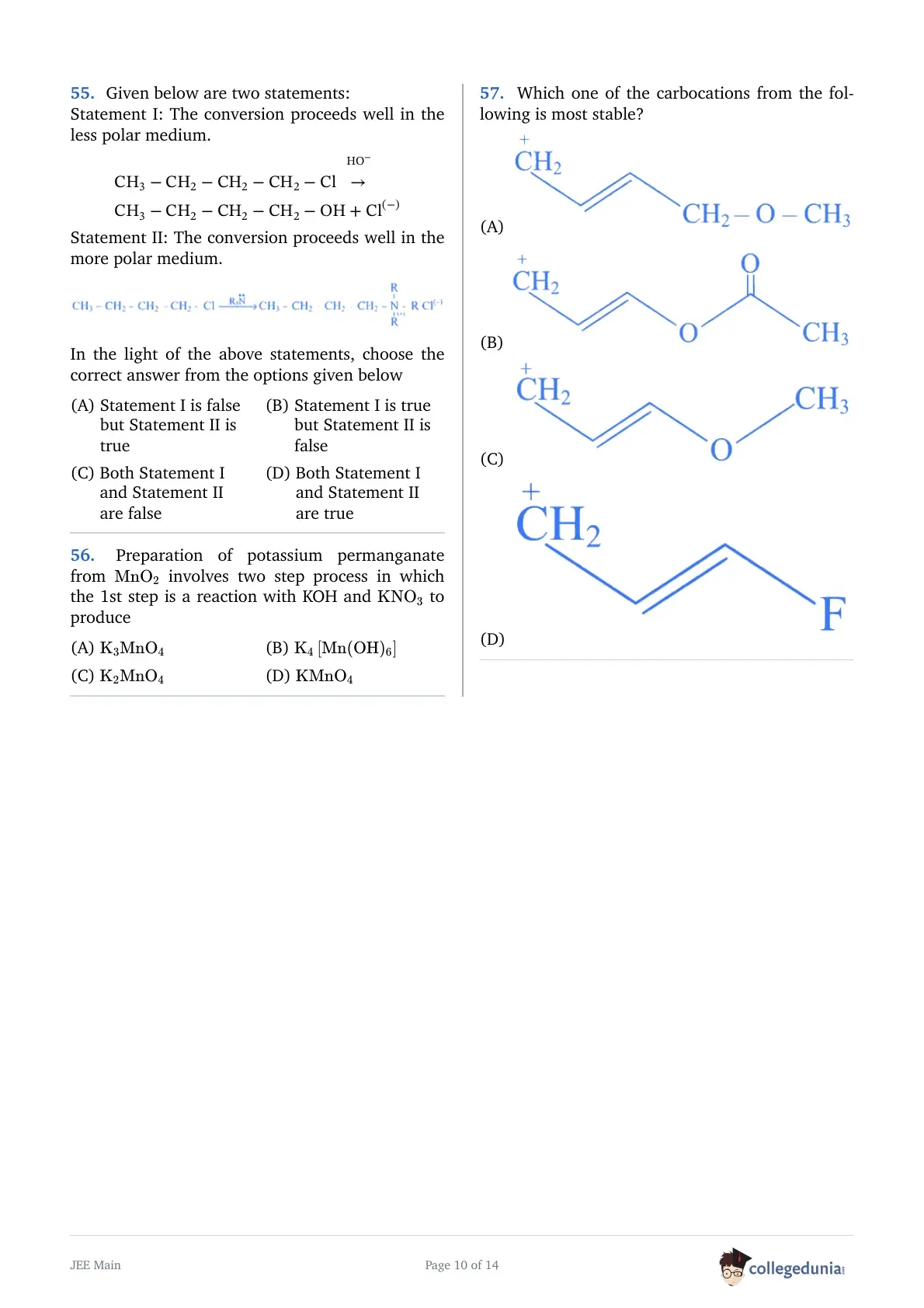
Which one of the carbocations from the following is most stable?
- (1)
![]()
- (2)
![]()
- (3)
![]()
- (4)
![]()


Which of the following linear combinations of atomic orbitals will lead to the formation of molecular orbitals in homonuclear diatomic molecules (internuclear axis in z-direction)?
(1) \( 2p_z \) and \( 2p_x \)
(2) \( 2s \) and \( 2p_x \)
(3) \( 3d_{xy} \) and \( 3d_{x^2-y^2} \)
(4) \( 2s \) and \( 2p_z \)
(5) \( 2p_z \) and \( 3d_{x^2-y^2} \)
Which of the following ions is the strongest oxidizing agent?
(Atomic Number of Ce = 58, Eu = 63, Tb = 65, Lu = 71)
Ksp for \( Cr(OH)_3 \) is \( 1.6 \times 10^{-30} \). What is the molar solubility of this salt in water?
Let us consider an endothermic reaction which is non-spontaneous at the freezing point of water. However, the reaction is spontaneous at the boiling point of water. Choose the correct option.
Given below are two statements I and II.
Statement I: Dumas method is used for estimation of "Nitrogen" in an organic compound.
Statement II: Dumas method involves the formation of ammonium sulfate by heating the organic compound with concentrated H\(_2\)SO\(_4\).
In the light of the above statements, choose the correct answer from the options given below:
Which of the following Statements are NOT true about the periodic table?
A. The properties of elements are a function of atomic weights.
B. The properties of elements are a function of atomic numbers.
C. Elements having similar outer electronic configuration are arranged in the same period.
D. An element's location reflects the quantum numbers of the last filled orbital.
E. The number of elements in a period is the same as the number of atomic orbitals available in the energy level that is being filled.
The carbohydrates “Ribose” present in DNA is
A. A pentose sugar
B. Present in pyranose form
C. In “D” configuration
D. A reducing sugar, when free
E. In \( \alpha \)-anomeric form
Preparation of potassium permanganate from MnO\(_2\) involves two-step process in which the 1st step is a reaction with KOH and KNO\(_3\) to produce:
The large difference between the melting and boiling points of oxygen and sulphur may be explained on the basis of
For a reaction, \[ N_2O_5(g) \rightarrow 2NO_2(g) + \frac{1}{2} O_2(g) \]
in a constant volume container, no products were present initially. The final pressure of the system when 50% of the reaction gets completed is:
Which of the following arrangements with respect to their reactivity in nucleophilic addition reaction is correct?
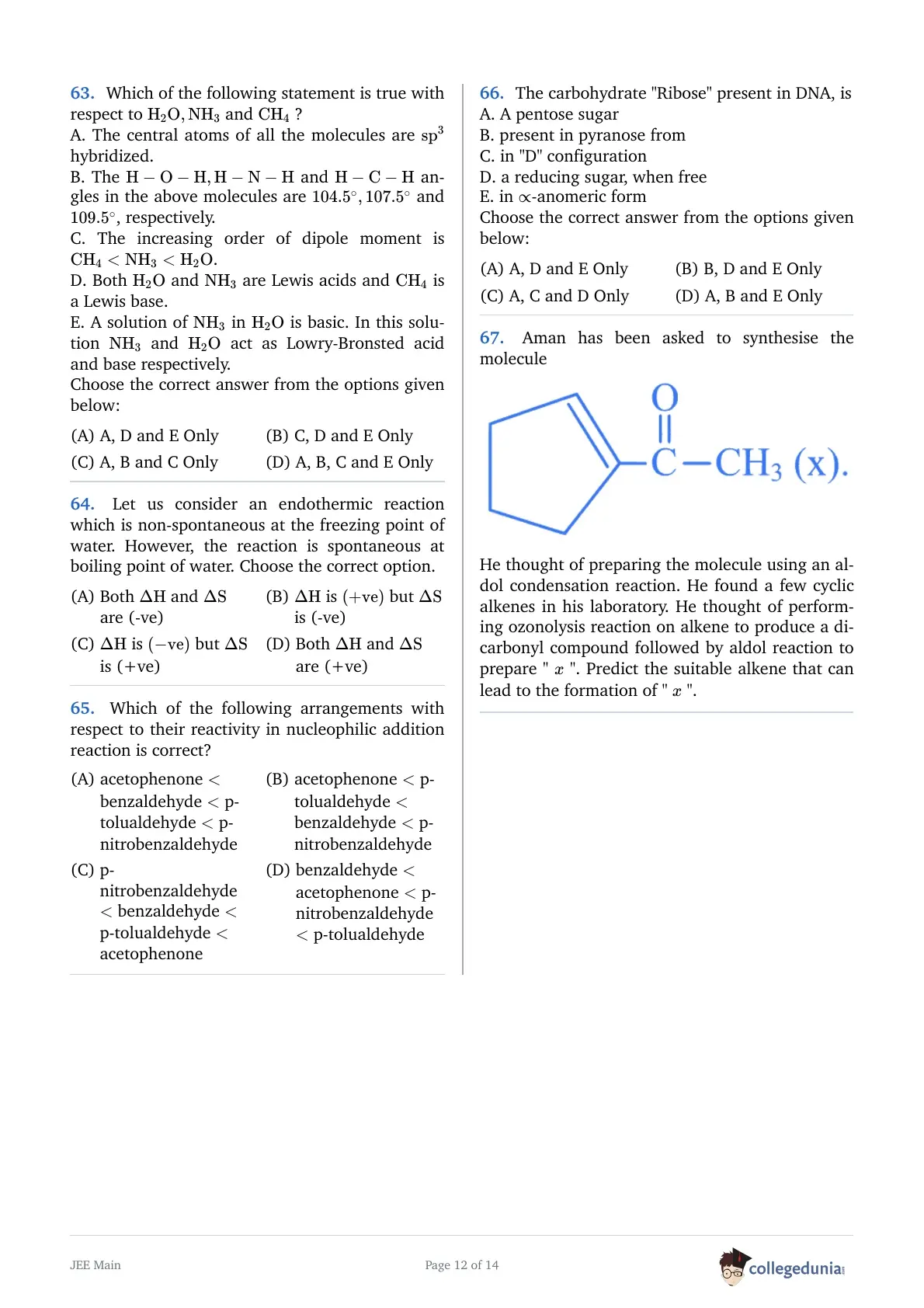
Aman has been asked to synthesise the molecule:

using an aldol condensation reaction. He found a few cyclic alkenes in his laboratory.
He thought of performing ozonolysis reaction on alkene to
produce a dicarbonyl compound followed by aldol reaction to prepare "x".
Predict the suitable alkene that can lead to the formation of "x".
- (1)
![]()
- (2)
![]()
- (3)
![]()
- (4)
![]()


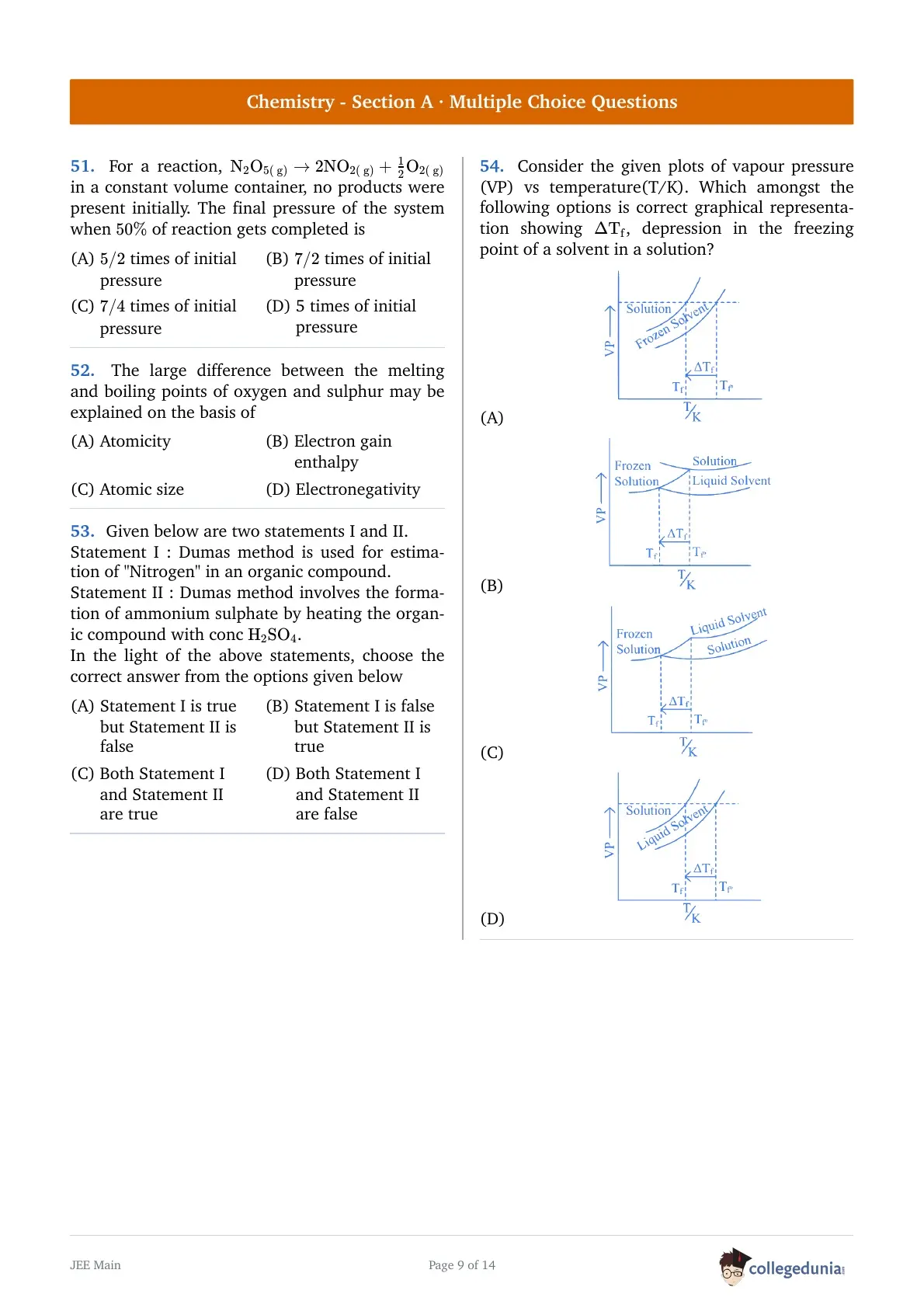
Consider the given plots of vapor pressure (VP) vs temperature (T/K). Which amongst the following options is the correct graphical representation showing \( \Delta T_f \) depression in the freezing point of solvent in a solution?
- (1)
![]()
- (2)
![]()
- (3)
![]()
- (4)
![]()


Which of the following statement is true with respect to H\(_2\)O, NH\(_3\) and CH\(_4\)?
(A) The central atoms of all the molecules are sp\(^3\) hybridized.
(B) The H–O–H, H–N–H and H–C–H angles in the above molecules are 104.5°, 107.5° and 109.5° respectively.
(C) The increasing order of dipole moment is CH\(_4\) < NH\(_3\) < H\(_2\)O.
(D) Both H\(_2\)O and NH\(_3\) are Lewis acids and CH\(_4\) is a Lewis base.
(E) A solution of NH\(_3\) in H\(_2\)O is basic. In this solution NH\(_3\) and H\(_2\)O act as Lowry-Bronsted acid and base respectively.
Given below are two statements:
Statement I: The conversion proceeds well in a less polar medium. \[ CH_3CH_2CH_2CH_2Cl \xrightarrow{HO^-} CH_3CH_2CH_2CH_2OH + Cl^- \]
Statement II: The conversion proceeds well in a more polar medium. \[ CH_3CH_2CH_2CH_2Cl \xrightarrow{R_3N} CH_3CH_2CH_2CH_2NH_2 + Cl^- \]
In the light of the above statements, choose the correct answer from the options given below:
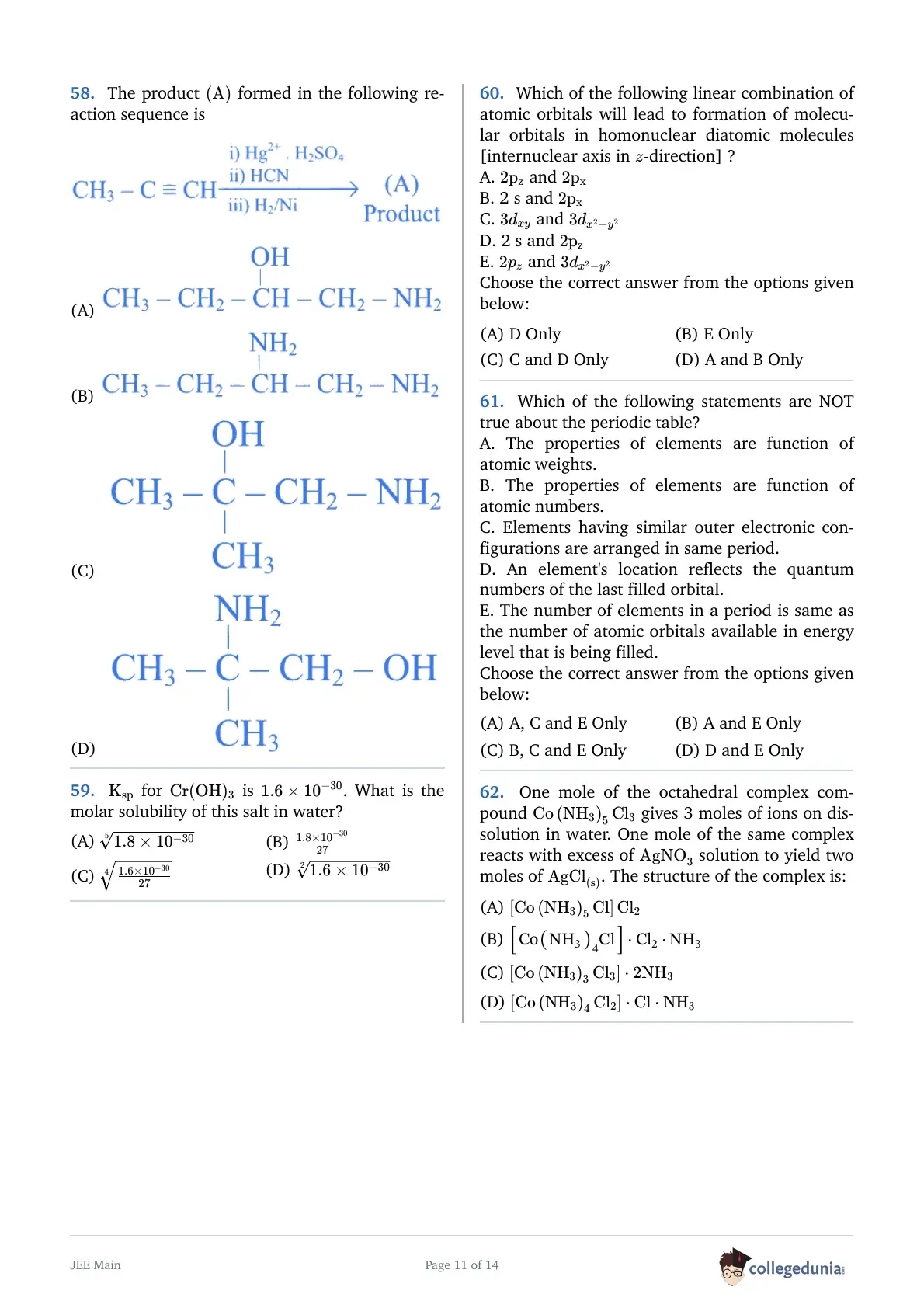
The product (A) formed in the following reaction sequence is:

Chemistry - Section B (Q71 - Q75)
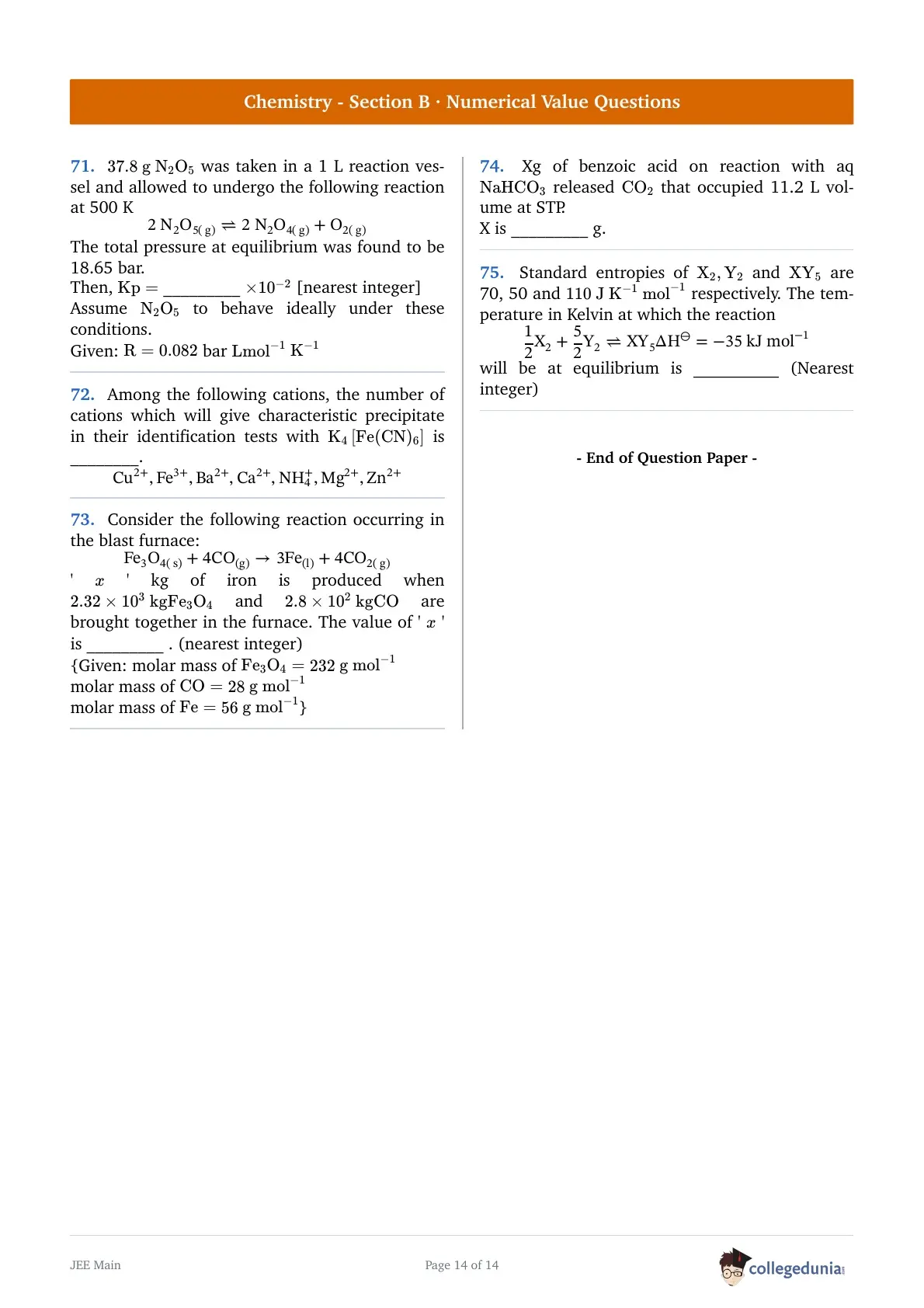
37.8 g \(N_2O_5\)was taken in a 1 L reaction vessel and allowed to undergo the following reaction at 500 K: \[2N_2O_5(g) \rightarrow 2N_2O_4(g) + O_2(g)\]
The total pressure at equilibrium was found to be 18.65 bar. Then, \(K_p\) is:
Given: \[ R = 0.082 \, bar L mol^{-1} K^{-1} \]
Standard entropies of \(X_2\), \(Y_2\) and \(XY_5\) are 70, 50, and 110 J \(K^{-1}\) mol\(^{-1}\) respectively. The temperature in Kelvin at which the reaction \[ rac{1}{2} X_2 + rac{5}{2} Y_2 ightarrow XY_5 \quad \Delta H = -35 \, {kJ mol}^{-1} \] will be at equilibrium is (nearest integer):
X g of benzoic acid on reaction with aqueous \(NaHCO_3\) release \(CO_2\) that occupied 11.2 L volume at STP.
X is ____ g.
Among the following cations, the number of cations which will give characteristic precipitate in their identification tests with \(K_4\)[Fe(CN)\(_6\)] is : \[ Cu^{2+}, \, Fe^{3+}, \, Ba^{2+}, \, Ca^{2+}, \, NH_4^+, \, Mg^{2+}, \, Zn^{2+} \]
Consider the following reaction occurring in the blast furnace. \[ Fe_3O_4(s) + 4CO(g) \rightarrow 3Fe(l) + 4CO_2(g) \]
‘x’ kg of iron is produced when \(2.32 \times 10^3\) kg \(Fe_3O_4\) and \(2.8 \times 10^2 \) kg CO are brought together in the furnace. The value of ‘x’ is ____ (nearest integer).
JEE Main 2025 Exam Pattern and Marking Scheme
| Particulars | Details |
|---|---|
| Exam Mode | Online (Computer-Based Test) |
| Paper | B.E./B.Tech |
| Medium of Exam | 13 languages: English, Hindi, Gujarati, Bengali, Tamil, Telugu, Kannada, Marathi, Malayalam, Odia, Punjabi, Assamese, Urdu |
| Duration | 3 hours (180 minutes) |
| Type of Questions | Multiple Choice Questions (MCQs) + Numerical Value Questions |
| Total Marks | 300 marks |
| Subjects | Mathematics, Physics, Chemistry |
| Marking Scheme | +4 for correct answer & -1 for incorrect MCQ and Numerical Value-based Questions |
| Total Questions | 75 Questions |
| Eligibility | Passed or appearing in Class 12 with Physics, Chemistry, and Mathematics |
Related News:
- JEE Main 23rd Jan Shift 1 Question Paper
- JEE Main 23rd Jan Shift 2 Question Paper
- JEE Main 22nd Jan Shift 1 Question Paper
- JEE Main 22nd Jan Shift 2 Question Paper
JEE Main 24th Jan Shift 1 Paper Analysis- Check Difficulty Level and Good Score
The question paper consists of a total of 75 questions, divided equally across the three subjects:
- The Mathematics section in JEE Main 2025 24th Jan Shift 1 Question Paper was Tough with 9 questions coming majorly from topics like Integration, Co-ordinate Geometry, etc.
- Physics was Moderate with 7 questions coming majorly from topics like Modern Physics, Thermodynamics, etc.
- Chemistry was Easy with 8 questions coming majorly from topics like Organic Chemistry, Physical Chemistry, etc.
Each section included a mix of multiple-choice questions (MCQs) and numerical value-based questions, offering a balanced challenge for students.
Check: JEE Main 24th Jan Shift 2 Question Paper
JEE Main 2025:Shift-Wise Analysis
| Session | Shift | Difficulty Trend (Physics, Chemistry, Mathematics) |
Overall Difficulty |
|---|---|---|---|
| January | 22nd January Shift 1 |
|
Moderate |
| January | 22nd January Shift 2 |
|
Moderate |
| January | 23rd January Shift 1 |
|
Moderate |
| January | 23rd January Shift 2 |
|
Moderate |
| January | 24th January Shift 1 |
|
Moderate |
| January | 24th January Shift 2 |
|
Moderate |
| January | 28th January Shift 1 |
|
Tough |
| January | 28th January Shift 2 |
|
Tough |
| January | 29th January Shift 1 |
|
Moderate to Tough |
| January | 29th January Shift 2 |
|
Moderate to Tough |



Comments