




JEE Main 2025 January 24 Shift 2 Question Paper is available here with answer key and solution pdf. NTA conducted the second shift on January 24, 2025, from 3:00 PM to 6:00 PM. The JEE Main 2025 Paper 1 (B.E./B.Tech) question paper includes the following:
- 75 questions in a 3-hour CBT Mode: 25 each from Mathematics, Physics and Chemistry
- Section A: 20 multiple choice questions (MCQs) per subject, 4 marks each
- Section B: 5 numerical value questions per subject, 4 marks each (integer answer)
- Marking: +4 for a correct answer, -1 for an incorrect answer, 0 for an unattempted question
JEE Main 2025 January 24 Shift 2 Question Paper with Solution PDF
| NTA Official PDF | CD PDF | CD PDF with Solutions |
|---|---|---|
| Download official PDF 4.70 MB | Download Collegedunia PDF 0.91 MB | Download solutions PDF 1.93 MB |
Also Check:
JEE Main 2025 January 24 Shift 2 Questions with Solutions
Mathematics - Section A (Q1 - Q20)
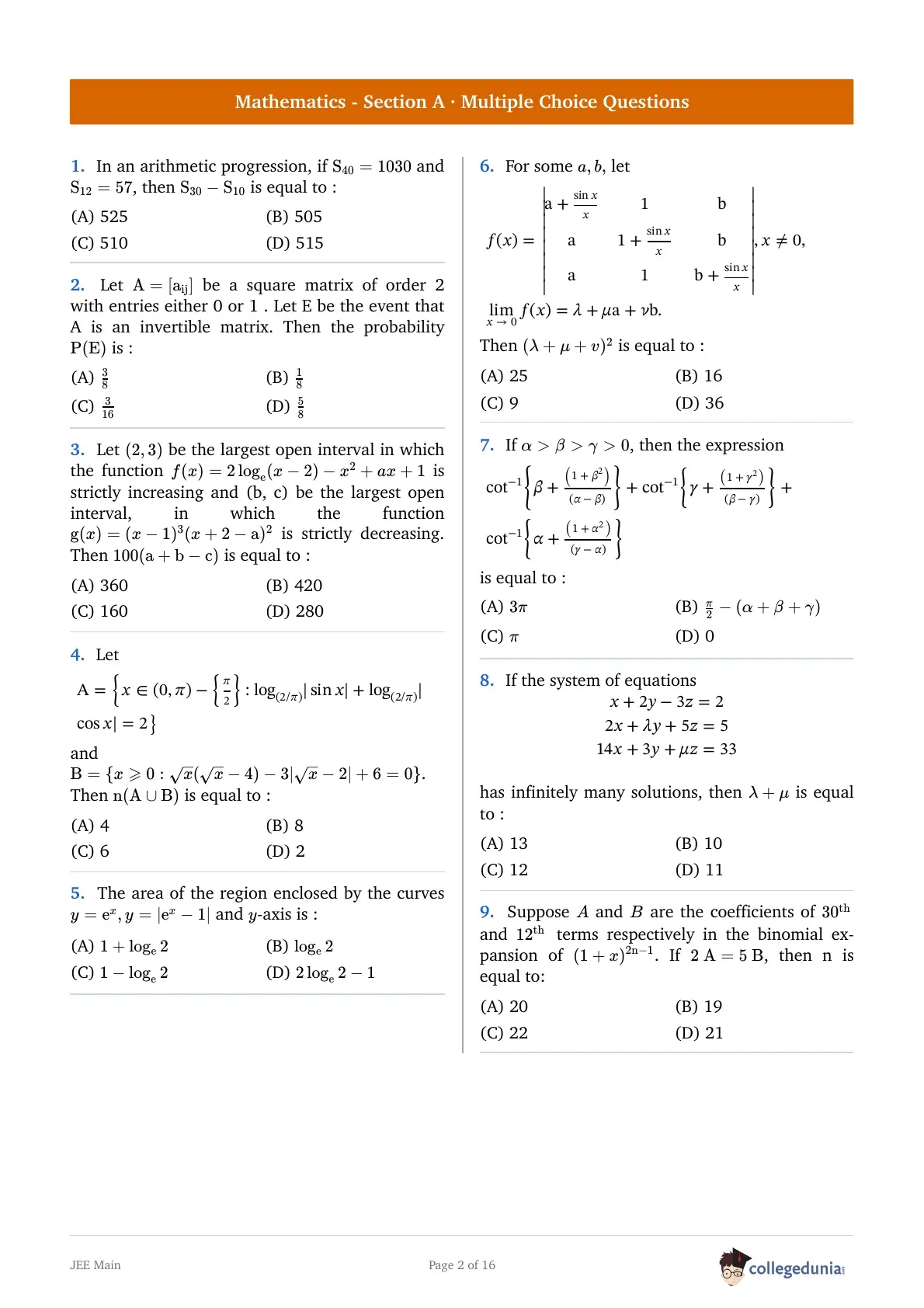
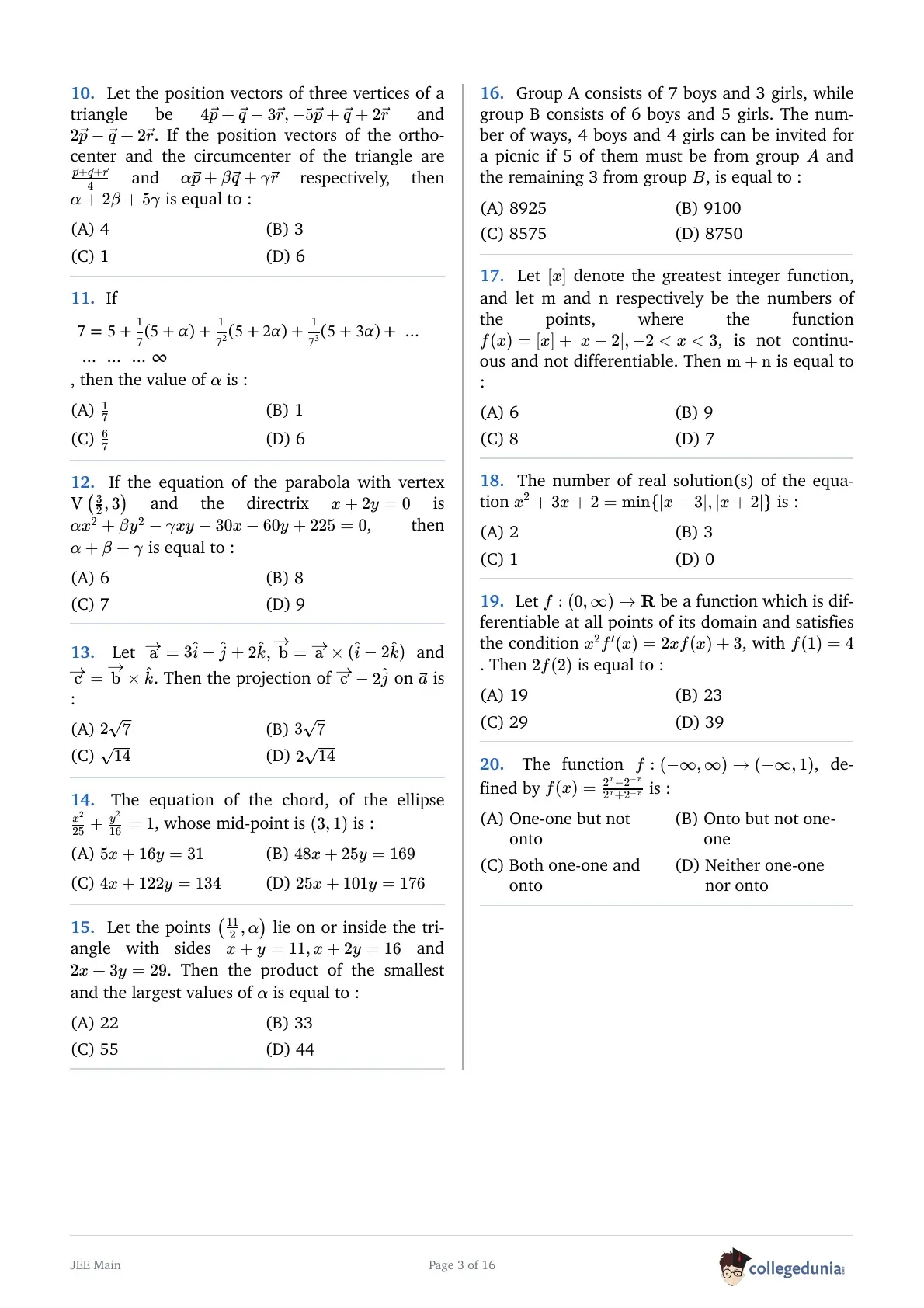
Let \( [x] \) denote the greatest integer function, and let \( m \) and \( n \) respectively be the numbers of the points, where the function \( f(x) = [x] + |x - 2| \), \( -2 < x < 3 \), is not continuous and not differentiable. Then \( m + n \) is equal to:
Let \( (2, 3) \) be the largest open interval in which the function \( f(x) = 2 \log_e (x - 2) - x^2 + ax + 1 \) is strictly increasing, and \( (b, c) \) be the largest open interval, in which the function \( g(x) = (x - 1)^3 (x + 2 - a)^2 \) is strictly decreasing. Then \( 100(a + b - c) \) is equal to:
The area of the region enclosed by the curves \( y = e^x \), \( y = |e^x - 1| \), and the y-axis is:
Let the points \( \left( \frac{11}{2}, \alpha \right) \) lie on or inside the triangle with sides \( x + y = 11 \), \( x + 2y = 16 \), and \( 2x + 3y = 29 \). Then the product of the smallest and the largest values of \( \alpha \) is equal to:
The number of real solution(s) of the equation \( x^2 + 3x + 2 = \min \left( |x - 3|, |x + 2| \right) \) is:
If \( \alpha > \beta > \gamma > 0 \), then the expression \[ \cot^{-1} \beta + \left( \frac{1 + \beta^2}{\alpha - \beta} \right) + \cot^{-1} \gamma + \left( \frac{1 + \gamma^2}{\beta - \gamma} \right) + \cot^{-1} \alpha + \left( \frac{1 + \alpha^2}{\gamma - \alpha} \right) \]
is equal to:
Let \( f: (0, \infty) \to \mathbb{R} \) be a function which is differentiable at all points of its domain and satisfies the condition \( x^2 f'(x) = 2f(x) + 3 \), with \( f(1) = 4 \). Then \( 2f(2) \) is equal to:
Suppose A and B are the coefficients of the 30th and 12th terms respectively in the binomial expansion of \( (1 + x)^{2n - 1} \). If \( 2A = 5B \), then \( n \) is equal to:
Let \( A = \left\{ x \in (0, \pi) \mid - \log\left(\frac{2}{\pi}\right)\sin x + \log\left(\frac{2}{\pi}\right)\cos x = 2 \right\} \) and
\[ B = \left\{ x \geq 0 : \sqrt{x}(\sqrt{x - 4}) - 3\sqrt{x - 2} + 6 = 0 \right\}. \]
Then \( n(A \cup B) \) is equal to:
If the equation of the parabola with vertex \( \left( \frac{3}{2}, 3 \right) \) and the directrix \( x + 2y = 0 \) is \[ ax^2 + b y^2 - cxy - 30x - 60y + 225 = 0, then \alpha + \beta + \gamma is equal to: \]
The function \( f: (-\infty, \infty) \to (-\infty, 1) \), defined by \[ f(x) = \frac{2^x - 2^{-x}}{2^x + 2^{-x}}, \]
is:
Group A consists of 7 boys and 3 girls, while group B consists of 6 boys and 5 girls. The number of ways, 4 boys and 4 girls can be invited for a picnic if 5 of them must be from group A and the remaining 3 from group B, is equal to:
If the system of equations \[ x + 2y - 3z = 2, \quad 2x + \lambda y + 5z = 5, \quad 14x + 3y + \mu z = 33 \]
has infinitely many solutions, then \( \lambda + \mu \) is equal to:
Let \( \mathbf{a} = 3\hat{i} - \hat{j} + 2\hat{k} \), \( \mathbf{b} = \mathbf{a} \times (\hat{i} - 2\hat{k}) \) and \( \mathbf{c} = \mathbf{b} \times \hat{k} \). Then the projection of \( \mathbf{c} - 2\hat{j} \) on \( \mathbf{a} \) is:
The equation of the chord of the ellipse \( \frac{x^2}{25} + \frac{y^2}{16} = 1 \), whose mid-point is \( (3, 1) \) is:
In an arithmetic progression, if \( S_{40} = 1030 \) and \( S_{12} = 57 \), then \( S_{30} - S_{10} \) is equal to:
Let \( A = [a_{ij}] \) be a square matrix of order 2 with entries either 0 or 1. Let \( E \) be the event that \( A \) is an invertible matrix. Then the probability \( P(E) \) is:
If \( 7 = 5 + \frac{1}{7}(5 + \alpha) + \frac{1}{7^2}(5 + 2\alpha) + \frac{1}{7^3}(5 + 3\alpha) + \cdots \), then the value of \( \alpha \) is:
For some \( a, b \), let \( f(x) = \left| \begin{matrix} a + \frac{\sin x}{x} & 1 & b
a & 1 + \frac{\sin x}{x} & b
a & 1 & b + \frac{\sin x}{x} \end{matrix} \right| \), where \( x \neq 0 \), \( \lim_{x \to 0} f(x) = \lambda + \mu a + \nu b \). Then \( (\lambda + \mu + \nu)^2 \) is equal to:
Let the position vectors of three vertices of a triangle be \( \overrightarrow{p} = 4\hat{i} + \hat{j} - 3\hat{k} \), \( \overrightarrow{q} = -5\hat{i} + 2\hat{j} + 3\hat{k} \), and \( \overrightarrow{r} = -5\hat{i} + 3\hat{j} + 2\hat{k} \). Then \( \alpha + 2\beta + 5\gamma \) is equal to:
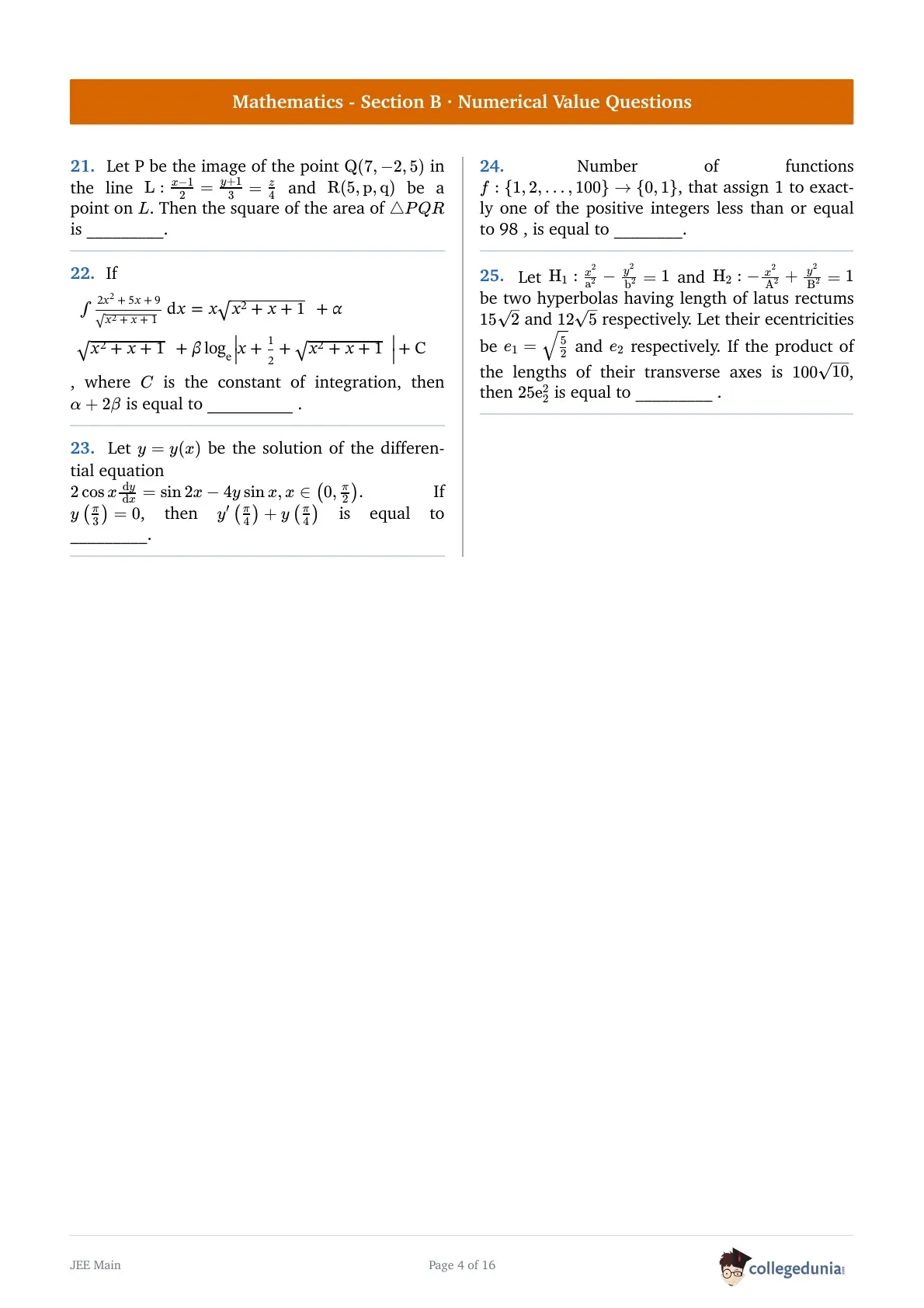
Mathematics - Section B (Q21 - Q25)
Let \( y = y(x) \) be the solution of the differential equation \[ 2\cos x \frac{dy}{dx} = \sin 2x - 4y \sin x, \quad x \in \left( 0, \frac{\pi}{2} \right). \]
If \( y\left( \frac{\pi{3} \right) = 0 \), then \( y\left( \frac{\pi}{4} \right) + y\left( \frac{\pi}{4} \right) \) is equal to ________.
Let \( P \) be the image of the point \( Q(7, -2, 5) \) in the line \( L: \frac{x - 1}{2} = \frac{y + 1}{3} = \frac{z}{4} \), and let \( R(5, p, q) \) be a point on \( L \). Then the square of the area of \( \triangle PQR \) is:
Number of functions \( f: \{1, 2, \dots, 100\} \to \{0, 1\} \), that assign 1 to exactly one of the positive integers less than or equal to 98, is equal to:
If \[ \int \frac{2x^2 + 5x + 9}{\sqrt{x^2 + x + 1}} \, dx = \sqrt{x^2 + x + 1} + \alpha \sqrt{x^2 + x + 1} + \beta \log_e \left( \left| x + \frac{1}{2} + \sqrt{x^2 + x + 1} \right| \right) + C, \]
where \( C \) is the constant of integration, then \( \alpha + 2\beta \) is equal to ____
Let \( H_1: \frac{x^2}{a^2} - \frac{y^2}{b^2} = 1 \) and \( H_2: \frac{x^2}{A^2} - \frac{y^2}{B^2} = 1 \) be two hyperbolas having lengths of latus rectums \( 15\sqrt{2} \) and \( 12\sqrt{5} \) respectively. Let their eccentricities be \( e_1 = \frac{5}{\sqrt{2}} \) and \( e_2 \) respectively. If the product of the lengths of their transverse axes is \( 100\sqrt{10} \), then \( 25e_2^2 \) is equal to:
Physics - Section A (Q26 - Q45)
A solid sphere is rolling without slipping on a horizontal plane. The ratio of the linear kinetic energy of the centre of mass of the sphere and rotational kinetic energy is:
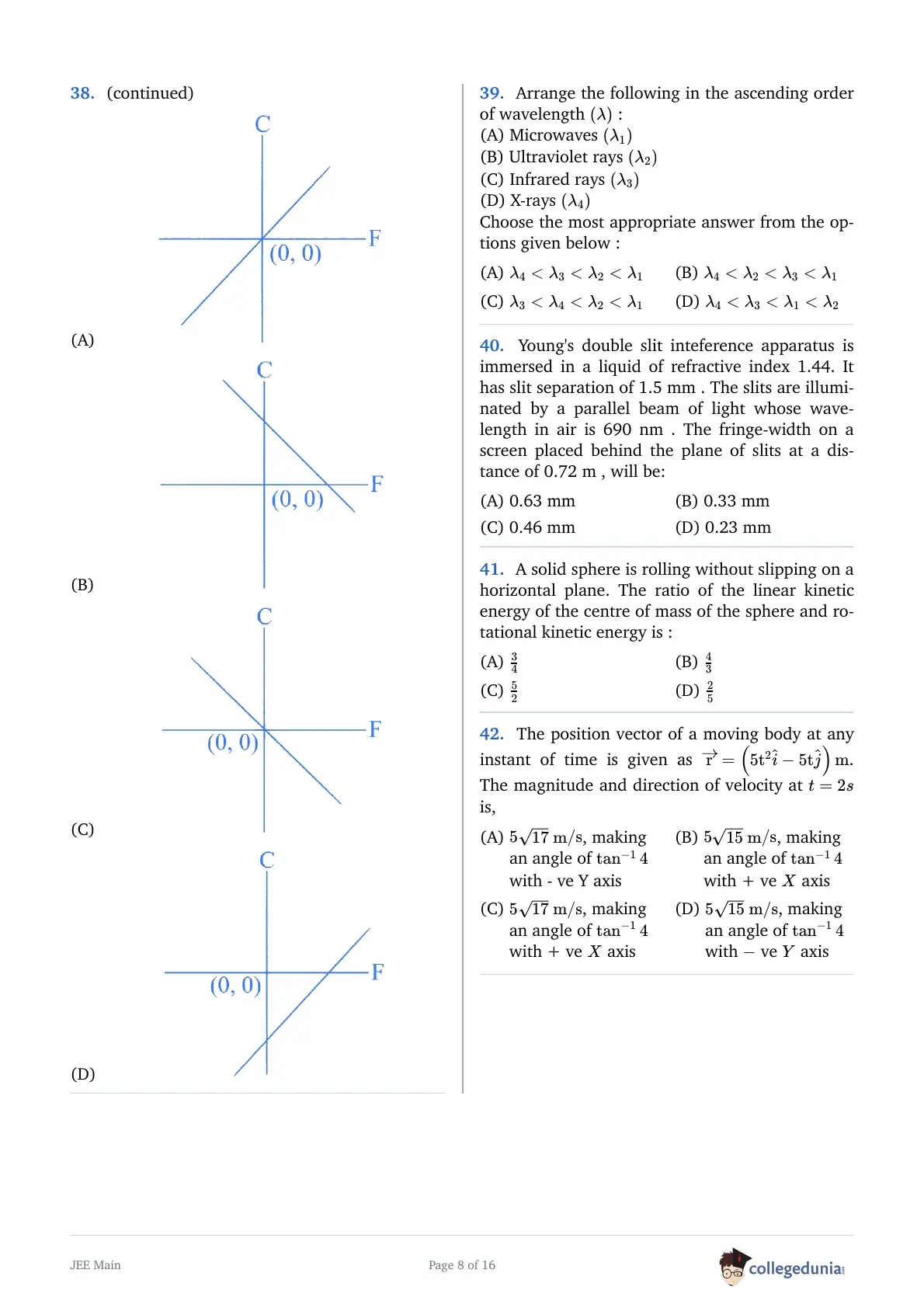
A long straight wire of a circular cross-section with radius \( a \) carries a steady current \( I \). The current is uniformly distributed across this cross-section. The plot of magnitude of magnetic field \( B \) with distance \( r \) from the centre of the wire is given by:
- (A) \[ Plot 1: \]
![]()
- (B) \[ Plot 2: \]
![]()
- (C) \[ Plot 3: \]
![]()
- (D) \[ Plot 4: \]
![]()


Given below are two statements. One is labelled as Assertion (A) and the other is labelled as Reason (R):
Assertion (A): An electron in a certain region of uniform magnetic field is moving with constant velocity in a straight line path.
Reason (R): The magnetic field in that region is along the direction of velocity of the electron.
In the light of the above statements, choose the correct answer from the options given below:
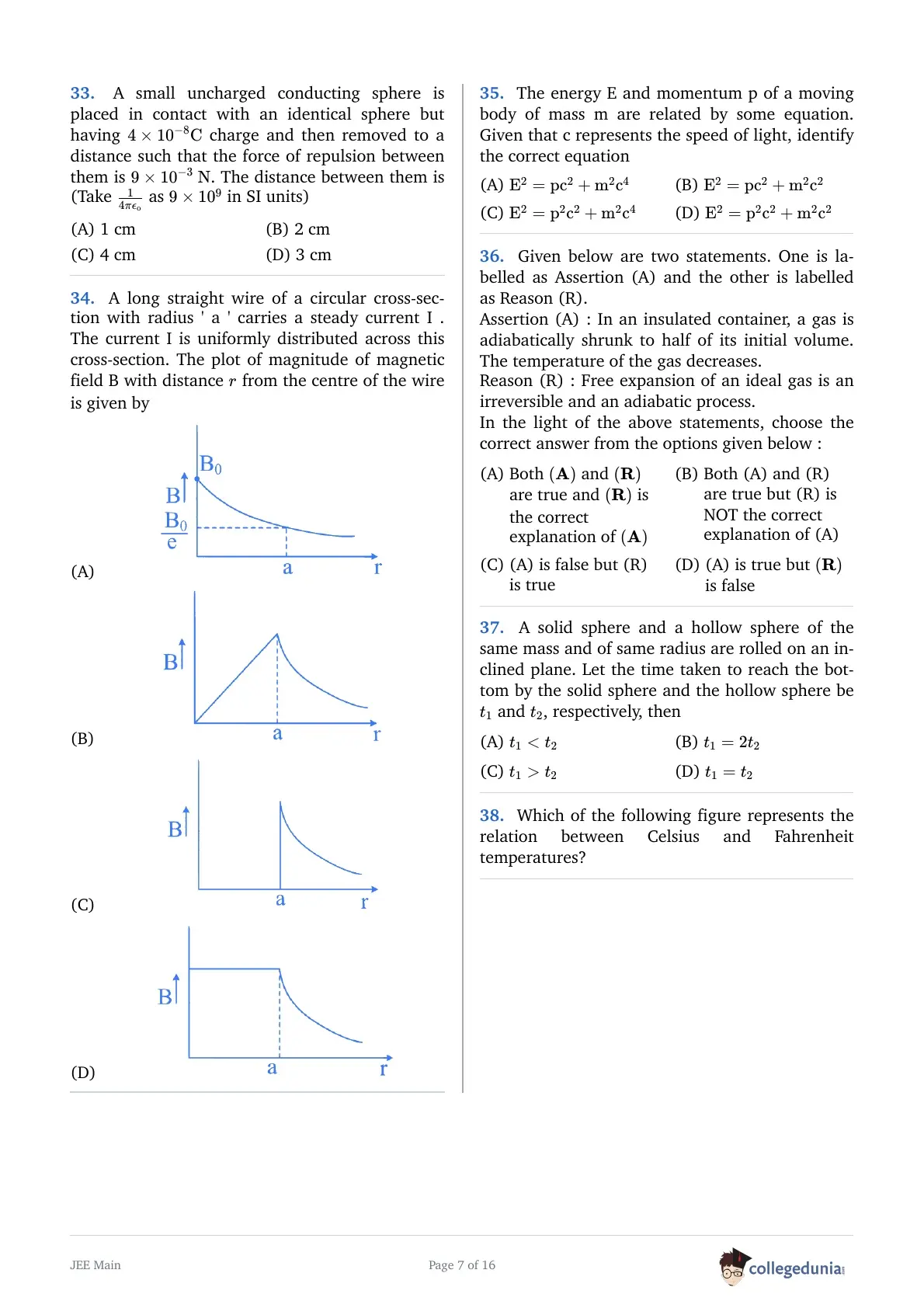
The magnitude of heat exchanged by a system for the given cyclic process ABC (as shown in the figure) is (in SI units):

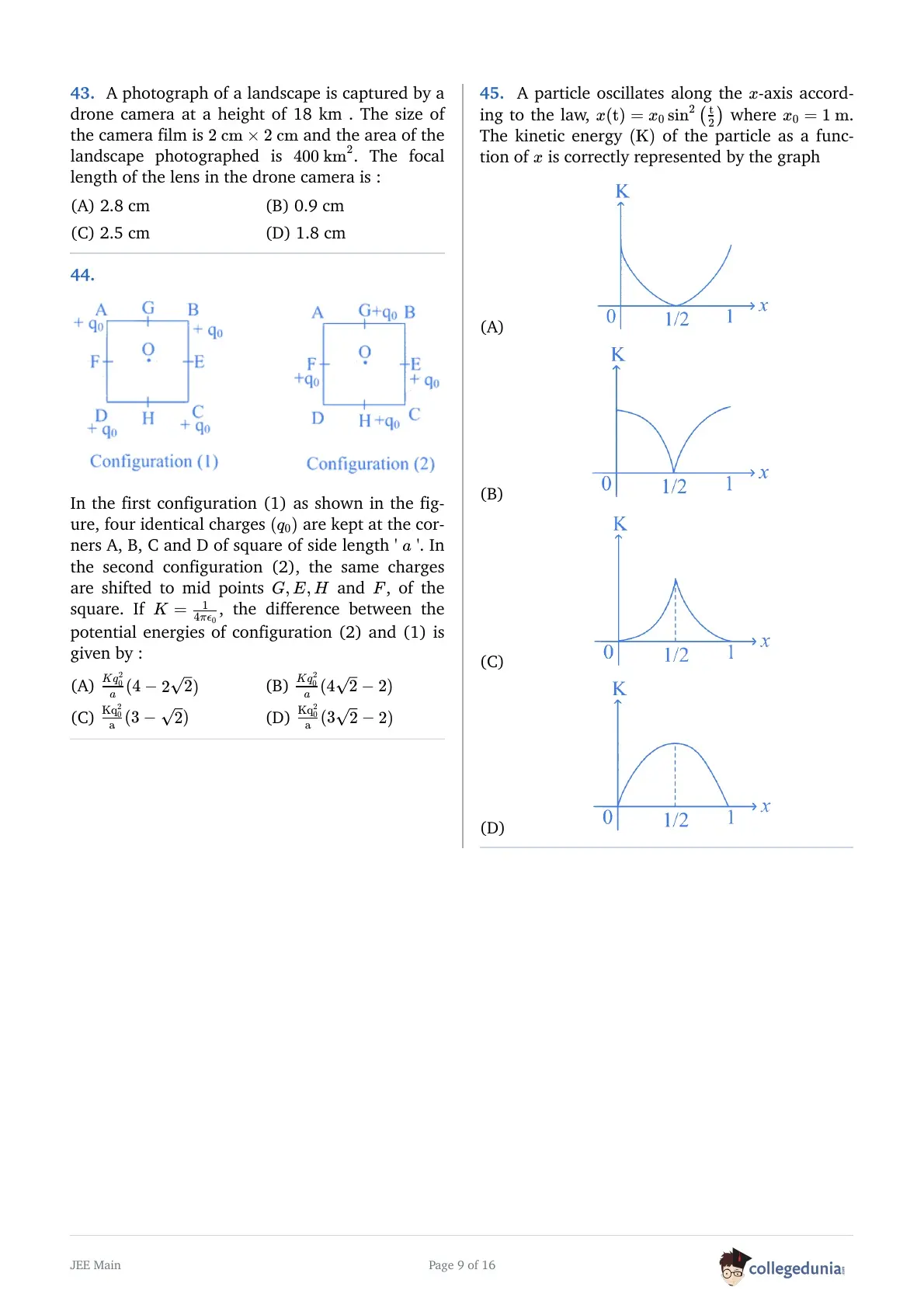
A particle oscillates along the \( x \)-axis according to the law, \( x(t) = x_0 \sin^2 \left( \frac{\pi t}{T} \right) \), where \( x_0 = 1 \, m \) and \( T \) is the time period of oscillation. The kinetic energy (\( K \)) of the particle as a function of \( x \) is correctly represented by the graph:
- (A) \[ Graph 1: \]
![]()
- (B) \[ Graph 2: \]
![]()
- (C) \[ Graph 3: \]
![]()
- (D) \[ Graph 4: \]
![]()


A photograph of a landscape is captured by a drone camera at a height of 18 km. The size of the camera film is 2 cm \( \times \) 2 cm and the area of the landscape photographed is 400 km\(^2\). The focal length of the lens in the drone camera is:
A small uncharged conducting sphere is placed in contact with an identical sphere but having \( 4 \times 10^{-6} \, C \) charge and then removed to a distance such that the force of repulsion between them is \( 9 \times 10^{-3} \, N \). The distance between them is (Take \( \frac{1}{4\pi \epsilon_0} = 9 \times 10^9 \) in SI units):

In the first configuration (1) as shown in the figure, four identical charges \( q_0 \) are kept at the corners A, B, C and D of square of side length \( a \). In the second configuration (2), the same charges are shifted to mid points C, E, H, and F of the square. If \( K = \frac{1}{4\pi \epsilon_0} \), the difference between the potential energies of configuration (2) and (1) is given by:
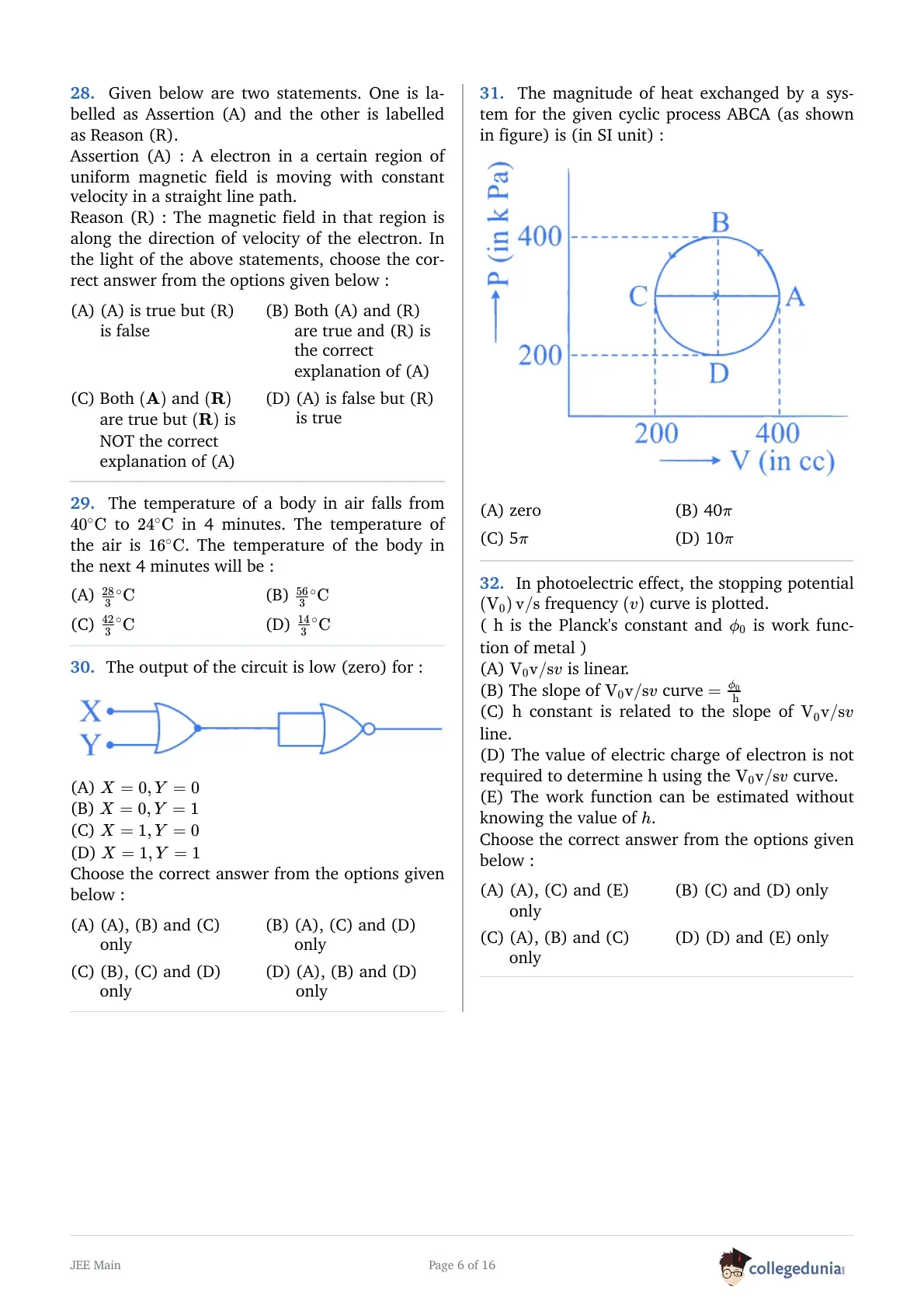
In a Young's double slit experiment, three polarizers are kept as shown in the figure. The transmission axes of \( P_1 \) and \( P_2 \) are orthogonal to each other. The polarizer \( P_3 \) covers both the slits with its transmission axis at \( 45^\circ \) to those of \( P_1 \) and \( P_2 \). An unpolarized light of wavelength \( \lambda \) and intensity \( I_0 \) is incident on \( P_1 \) and \( P_2 \). The intensity at a point after \( P_3 \), where the path difference between the light waves from \( S_1 \) and \( S_2 \) is \( \frac{\lambda}{3} \), is:

The energy \( E \) and momentum \( p \) of a moving body of mass \( m \) are related by some equation. Given that \( c \) represents the speed of light, identify the correct equation:
Given below are two statements. One is labelled as Assertion (A) and the other is labelled as Reason (R):
Assertion (A): In an insulated container, a gas is adiabatically shrunk to half of its initial volume. The temperature of the gas decreases.
Reason (R): Free expansion of an ideal gas is an irreversible and an adiabatic process.
In the light of the above statements, choose the correct answer from the options given below:
A solid sphere and a hollow sphere of the same mass and of the same radius are rolled on an inclined plane. Let the time taken to reach the bottom by the solid sphere and the hollow sphere be \( t_1 \) and \( t_2 \), respectively, then:
Young's double slit interference apparatus is immersed in a liquid of refractive index 1.44. It has slit separation of 1.5 mm. The slits are illuminated by a parallel beam of light whose wavelength in air is 690 nm. The fringe-width on a screen placed behind the plane of slits at a distance of 0.72 m, will be:
The position vector of a moving body at any instant of time is given as \( \mathbf{r} = \left( 5t^2 \hat{i} - 5t \hat{j} \right) \, m. The magnitude and direction of velocity at \( t = 2 \) s is:

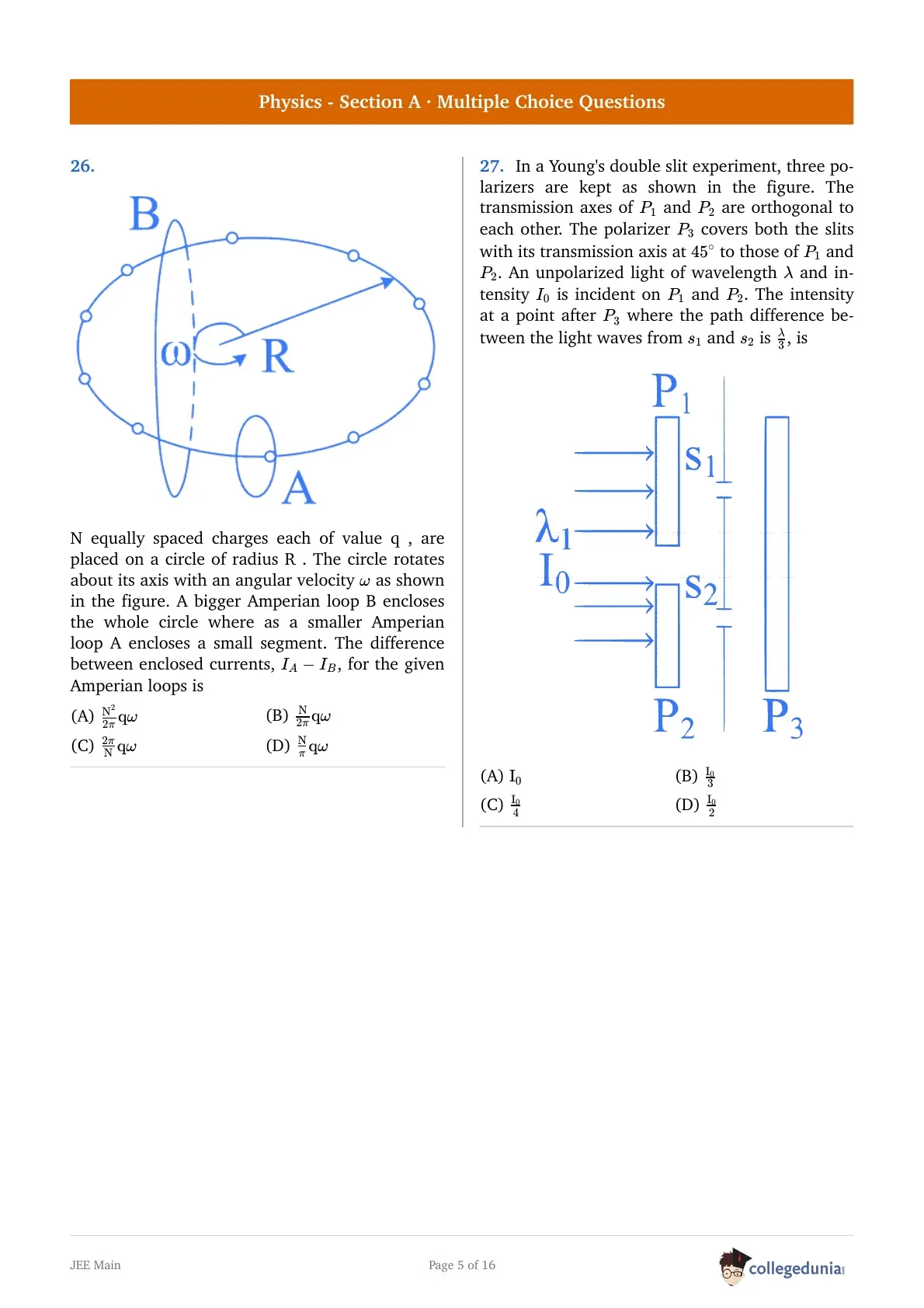
N equally spaced charges each of value \( q \) are placed on a circle of radius \( R \). The circle rotates about its axis with an angular velocity \( \omega \) as shown in the figure. A bigger Amperian loop \( B \) encloses the whole circle, whereas a smaller Amperian loop \( A \) encloses a small segment. The difference between enclosed currents, \( I_B - I_A \) for the given Amperian loops is:
The output of the circuit is low (zero) for:

(A) \( X = 0, Y = 0 \)
(B) \( X = 0, Y = 1 \)
(C) \( X = 1, Y = 0 \)
(D) \( X = 1, Y = 1 \)
Choose the correct answer from the options given below:
Arrange the following in the ascending order of wavelength (\( \lambda \)):
(A) Microwaves (\( \lambda_1 \))
(B) Ultraviolet rays (\( \lambda_2 \))
(C) Infrared rays (\( \lambda_3 \))
(D) X-rays (\( \lambda_4 \))
Choose the most appropriate answer from the options given below:
The temperature of a body in air falls from \( 40^\circ C \) to \( 24^\circ C \) in 4 minutes. The temperature of the air is \( 16^\circ C \). The temperature of the body in the next 4 minutes will be:
Which of the following figure represents the relation between Celsius and Fahrenheit temperatures?
- (1)
![]()
- (2)
![]()
- (3)
![]()
- (4)
![]()


In photoelectric effect, the stopping potential \( V_0 \) vs frequency \( \nu \) curve is plotted. \( h \) is the Planck's constant and \( \phi_0 \) is the work function of metal.
(A) \( V_0 \) vs \( \nu \) is linear.
(B) The slope of \( V_0 \) vs \( \nu \) curve is \( \frac{\phi_0}{h} \).
(C) \( h \) constant is related to the slope of \( V_0 \) vs \( \nu \) line.
(D) The value of electric charge of electron is not required to determine \( h \) using the \( V_0 \) vs \( \nu \) curve.
(E) The work function can be estimated without knowing the value of \( h \).
Choose the correct answer from the options given below:
Physics - Section B (Q46 - Q50)
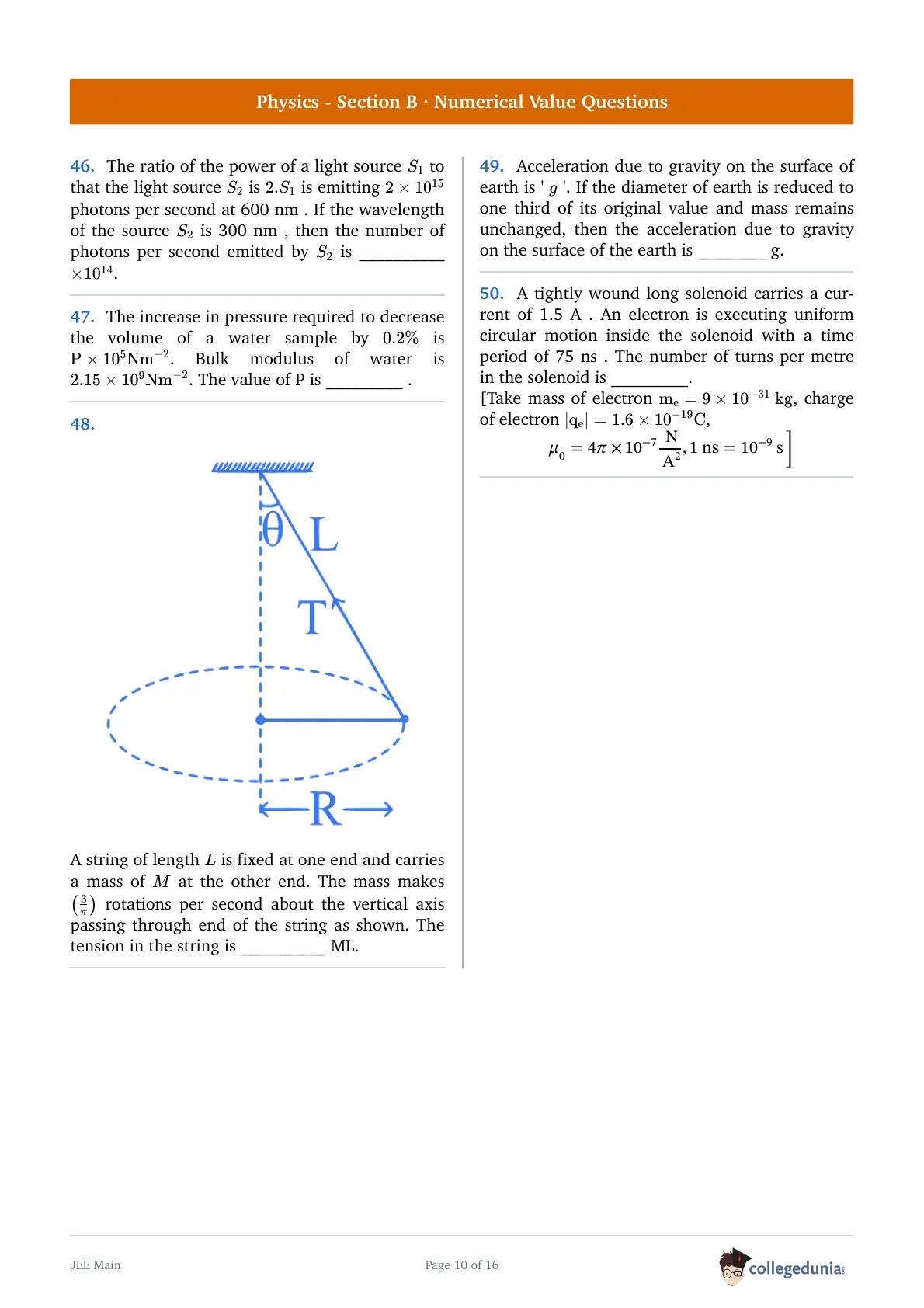
Acceleration due to gravity on the surface of earth is \( g \). If the diameter of earth is reduced to one third of its original value and mass remains unchanged, then the acceleration due to gravity on the surface of the earth is ____ g.
The ratio of the power of a light source \( S_1 \) to that of the light source \( S_2 \) is 2. \( S_1 \) is emitting \( 2 \times 10^{15} \) photons per second at 600 nm. If the wavelength of the source \( S_2 \) is 300 nm, then the number of photons per second emitted by \( S_2 \) is _____ \( \times 10^{14} \).

A string of length \( L \) is fixed at one end and carries a mass of \( M \) at the other end. The mass makes \( \frac{3}{\pi} \) rotations per second about the vertical axis passing through the end of the string as shown. The tension in the string is ____ ML.
The increase in pressure required to decrease the volume of a water sample by 0.2percentage is \( P \times 10^5 \, Nm^{-2} \). Bulk modulus of water is \( 2.15 \times 10^9 \, Nm^{-2} \). The value of \( P \) is ____.
A tightly wound long solenoid carries a current of 1.5 A. An electron is executing uniform circular motion inside the solenoid with a time period of 75 ns. The number of turns per meter in the solenoid is ____.
Chemistry - Section A (Q51 - Q70)
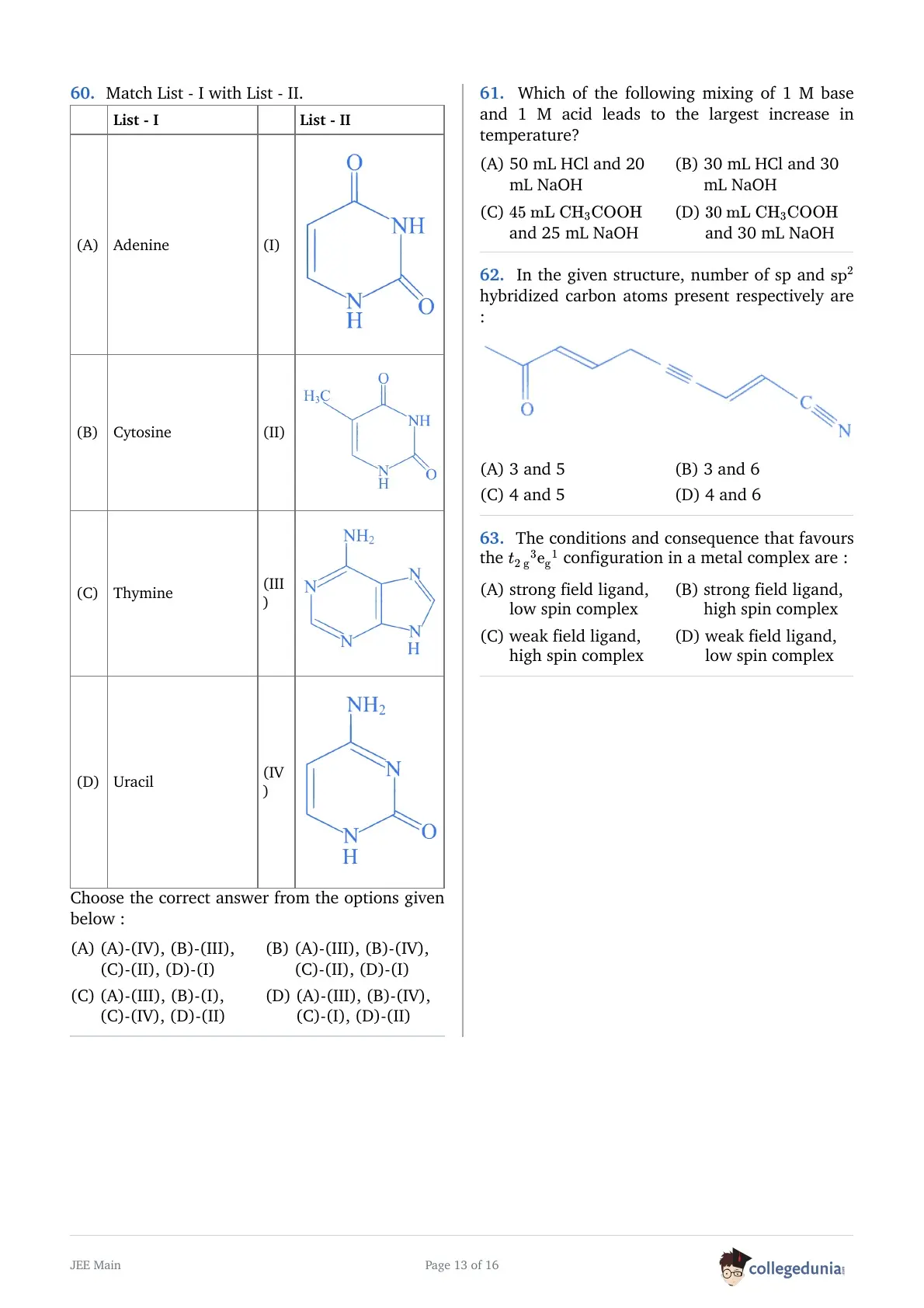
Match List - I with List - II:
List - I List - II
(A) Adenine (I)
(B) Cytosine (II)
(C) Thymine (III) 
(D) Uracil (IV)
Choose the correct answer from the options given below:
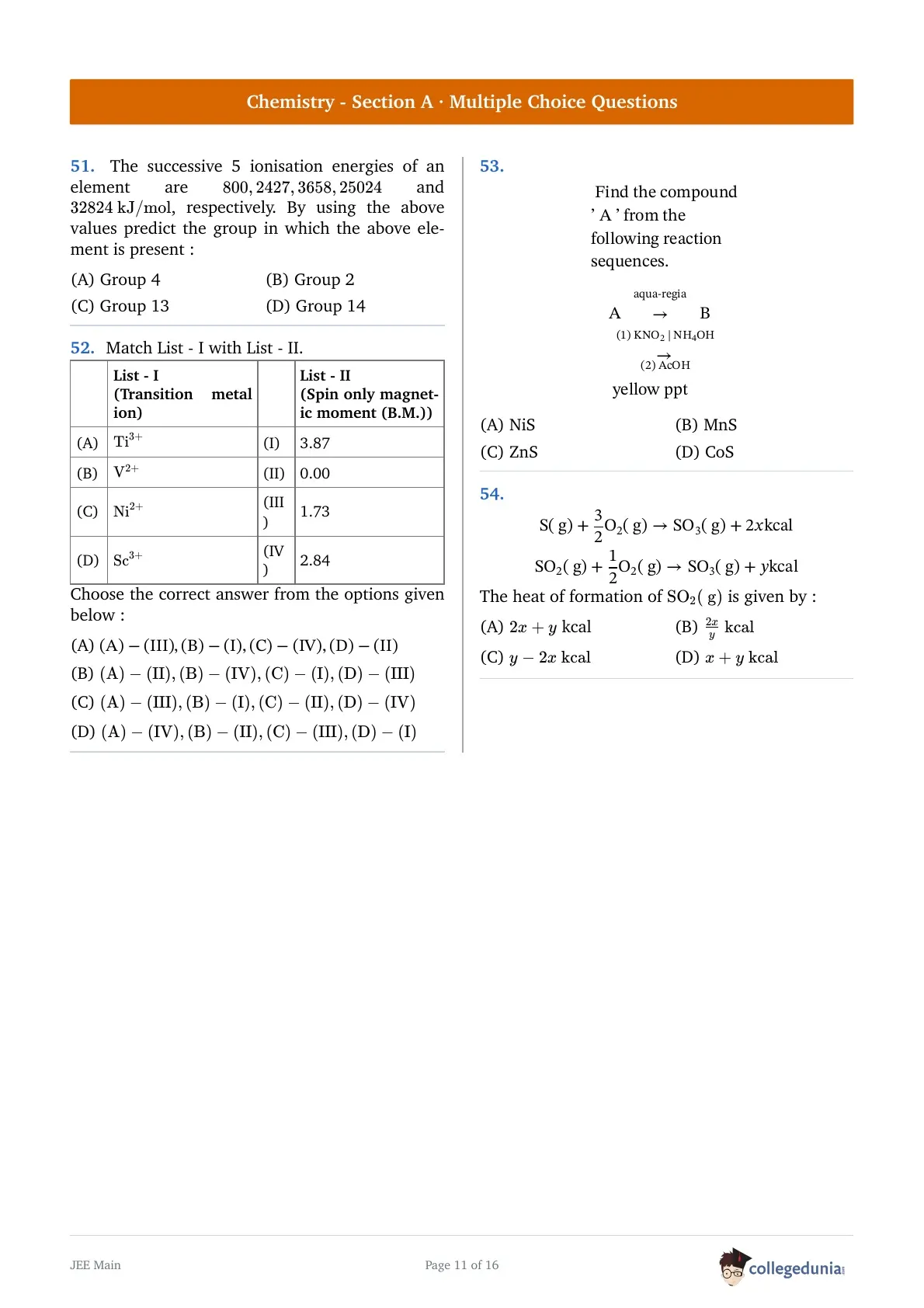
Find the compound \( A \) from the following reaction sequences: \[ A \xrightarrow{aqua regia} B \xrightarrow{(1) \, KNO_3, \, NH_4OH} yellow ppt. \]
Based on the data given below: \[ E^\circ_{Cr_2O_7^{2-}/Cr^{3+}} = 1.33 \, V, \quad E^\circ_{Cl_2/Cl^-} = 1.36 \, V, \quad E^\circ_{MnO_4^-/Mn^{2+}} = 1.51 \, V, \quad E^\circ_{Cr^{3+}/Cr} = -0.74 \, V. \]
The strongest reducing agent is:
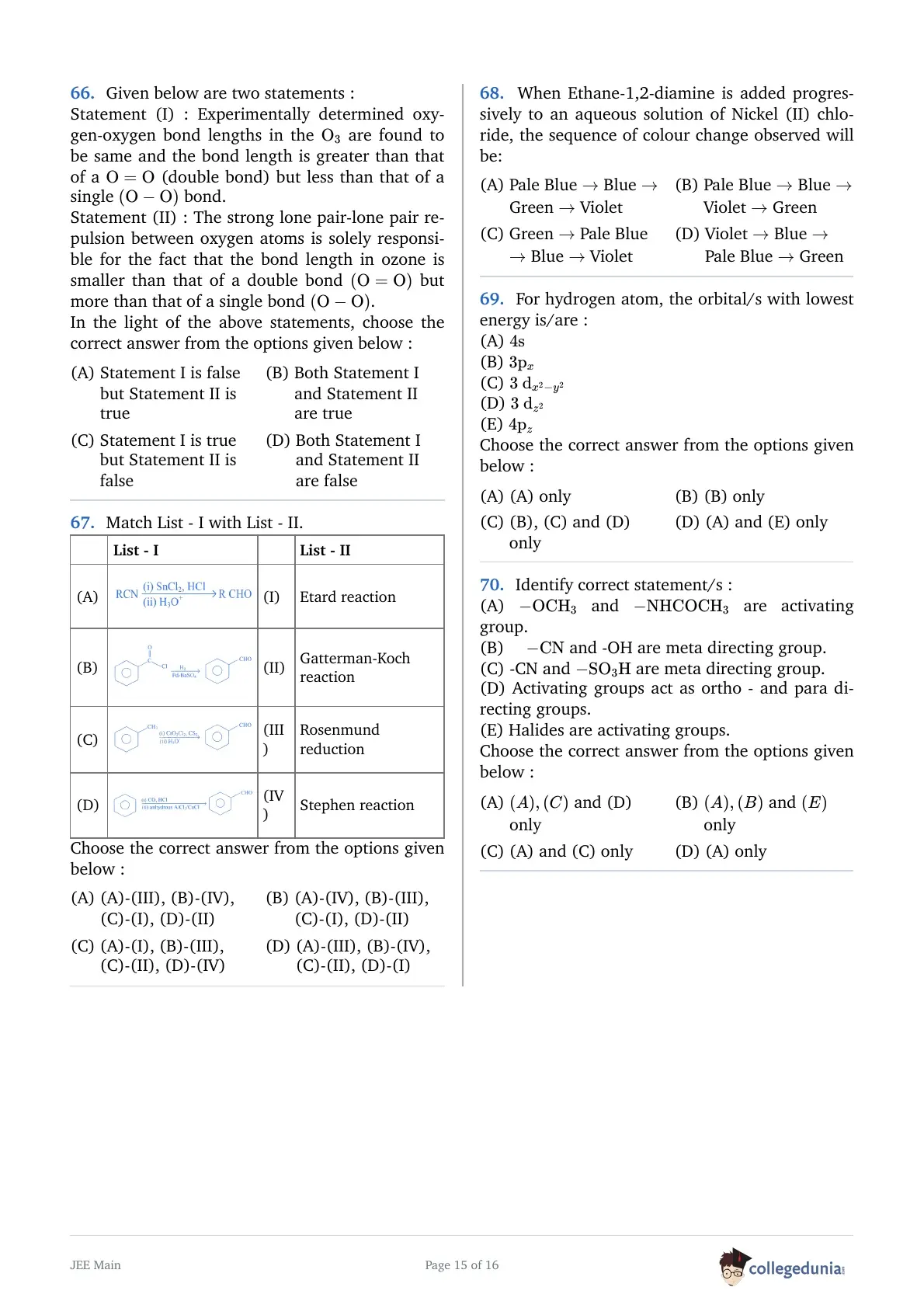
Given below are two statements:
Statement I: Experimentally determined oxygen-oxygen bond lengths in the \( O_2 \) are found to be the same and the bond length is greater than that of a \( O=O \) (double bond) but less than that of a single \( O-O \) bond.
Statement II: The strong lone pair-lone pair repulsion between oxygen atoms is solely responsible for the fact that the bond length in ozone is smaller than that of a double bond \( O=O \) but more than that of a single bond \( O-O \).
In light of the above statements, choose the correct answer from the options given below:
Identify correct statement/s:
(A) \( -\text{OCH}_3 \) and \( -\text{NHCOCH}_3 \) are activating groups.
(B) \( -\text{CN} \) and \( -\text{OH} \) are meta directing groups.
(C) \( -\text{CN} \) and \( -\text{SO}_3\text{H} \) are meta directing groups.
(D) Activating groups act as ortho- and para-directing groups.
(E) Halides are activating groups.
Choose the correct answer from the options given below:
Given below are two statements:
Statement (I): 
Statement (II): 
In light of the above statements, choose the correct answer from the options given below:
The successive 5 ionisation energies of an element are 800, 2427, 3658, 25024 and 32824 kJ/mol, respectively. By using the above values, predict the group in which the above element is present:
The conditions and consequences that favour the \( t_{2g}^3 e_g^1 \) configuration in a metal complex are:
Given below are two statements:
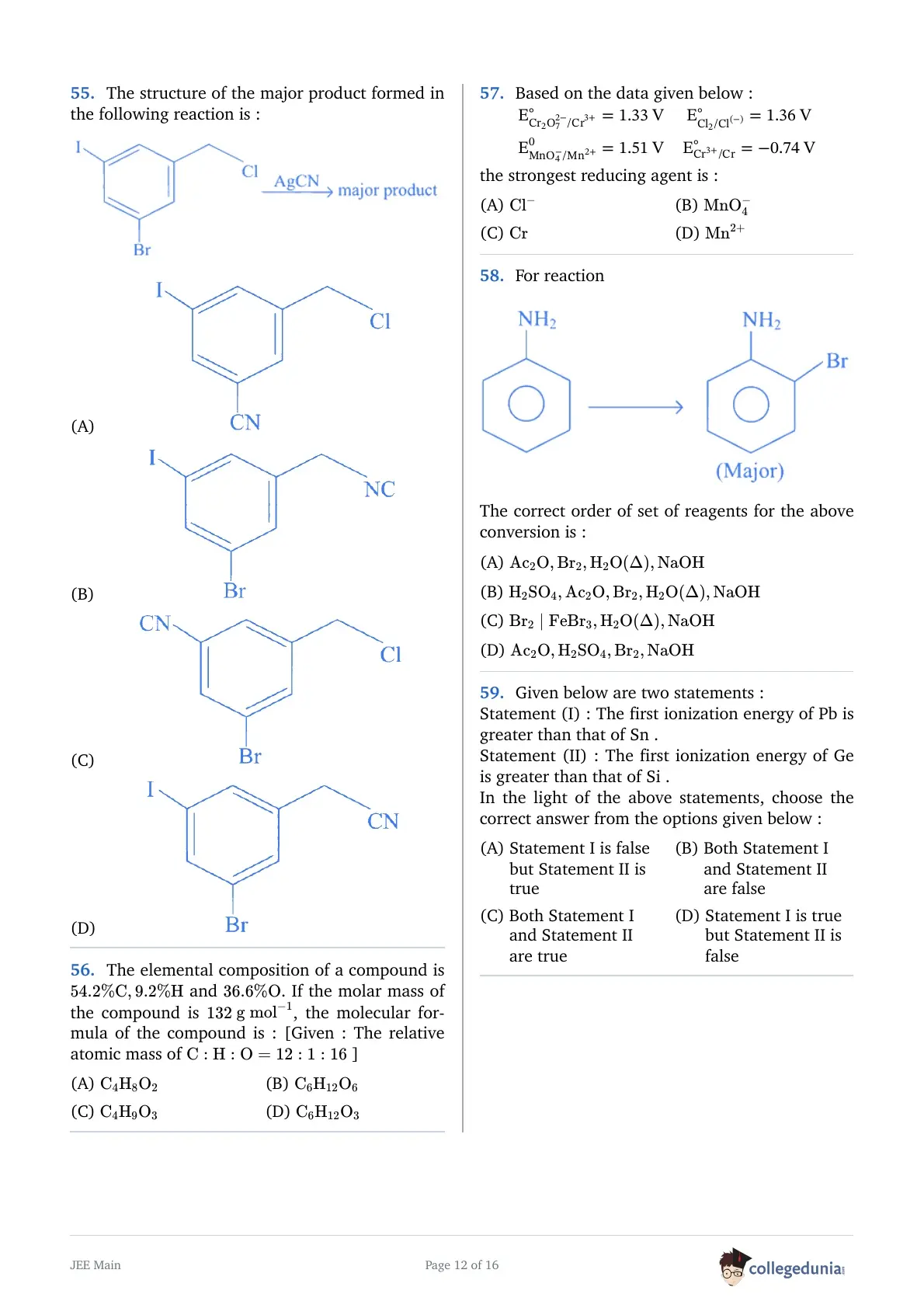
Statement (I): The first ionization energy of Pb is greater than that of Sn.
Statement (II): The first ionization energy of Ge is greater than that of Si.
In light of the above statements, choose the correct answer from the options given below:
The heat of formation of \( SO_2(g) \) is given by: \[ S(g) + \frac{3}{2} O_2(g) \rightarrow SO_3(g) + 2x \, kcal \] \[ SO_2(g) + \frac{1}{2} O_2(g) \rightarrow SO_3(g) + y \, kcal \]
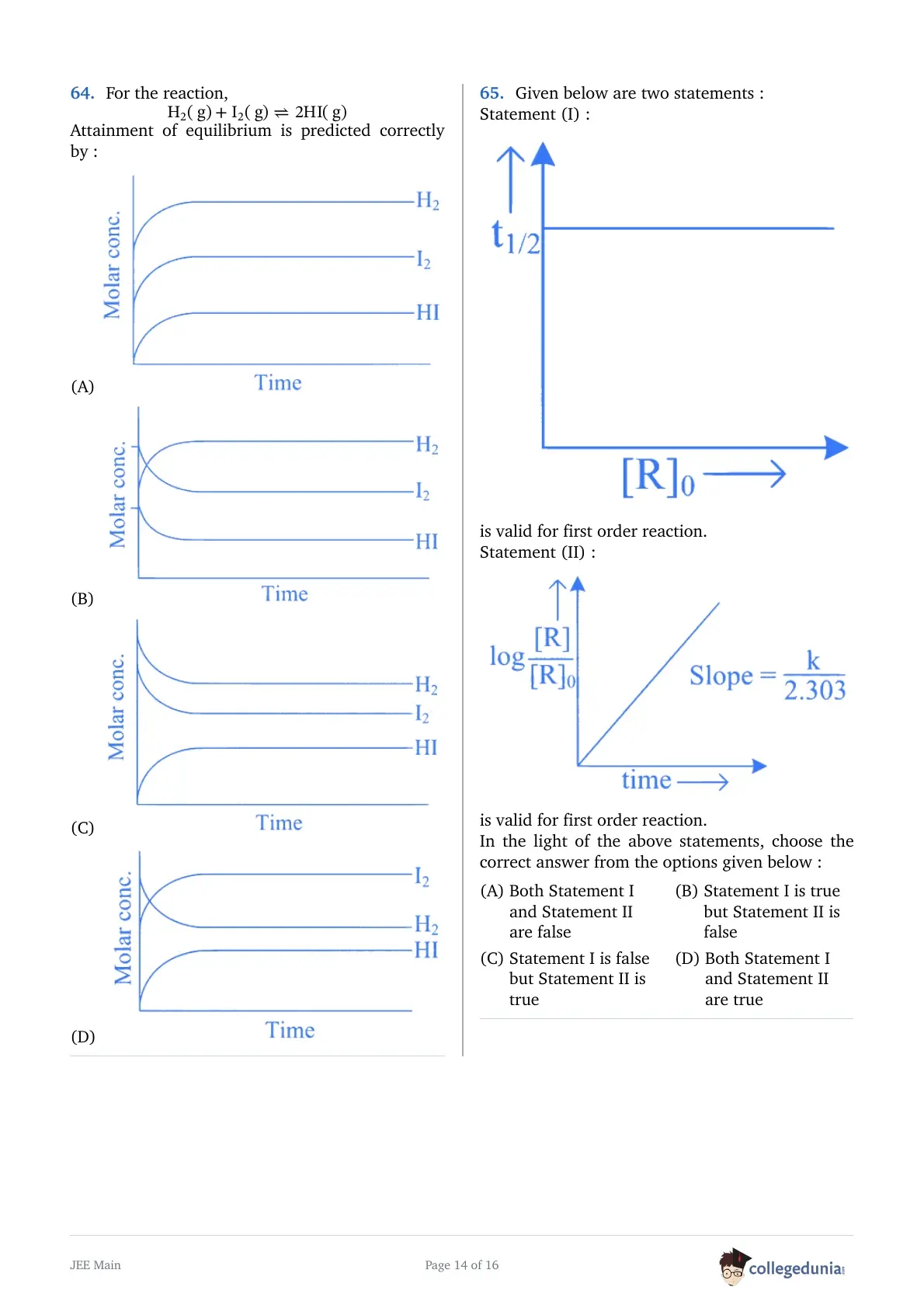
For the reaction, \[ H_2(g) + I_2(g) \rightleftharpoons 2HI(g) \]
Attainment of equilibrium is predicted correctly by:

- (1)
![]()
- (2)
![]()
- (3)
![]()
- (4)
![]()


The structure of the major product formed in the following reaction is:

- (1)
![]()
- (2)
![]()
- (3)
![]()
- (4)
![]()


In the given structure, number of \( sp \) and \( sp^2 \) hybridized carbon atoms present respectively are:

Which of the following mixing of 1M base and 1M acid leads to the largest increase in temperature?
Match List - I with List - II.
List - I List - II
(A) \( Ti^{3+} \) (I) 3.87
(B) \( V^{2+} \) (II) 0.00
(C) \( Ni^{2+} \) (III) 1.73
(D) \( Sc^{3+} \) (IV) 2.84
When Ethane-1,2-diamine is added progressively to an aqueous solution of Nickel (II) chloride, the sequence of colour change observed will be:
The elemental composition of a compound is 54.2% C, 9.2% H, and 36.6% O. If the molar mass of the compound is 132 g/mol, the molecular formula of the compound is:
For hydrogen atom, the orbital/s with lowest energy is/are:
Match List - I with List - II.

For the reaction:

The correct order of set of reagents for the above conversion is :
Chemistry - Section B (Q71 - Q75)
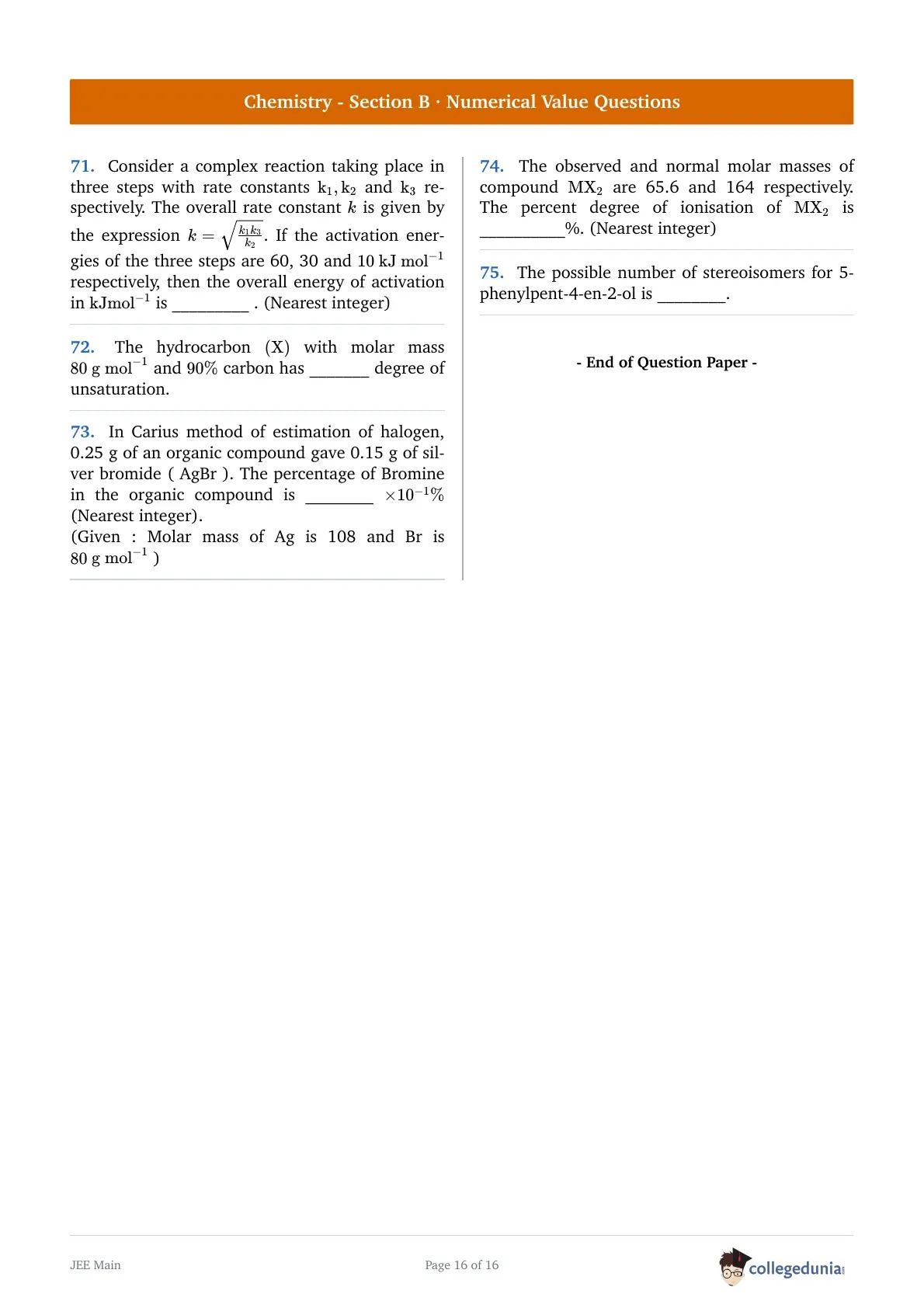
In Carius method of estimation of halogen, 0.25 g of an organic compound gave 0.15 g of silver bromide (AgBr). The percentage of Bromine in the organic compound is ________________ × 10-1% (Nearest integer).
(Given: Molar mass of Ag is 108 and Br is 80 g mol-1)
The observed and normal molar masses of compound MX\(_2\) are 65.6 and 164 respectively. The percent degree of ionisation of MX\(_2\) is ____% (Nearest integer).
The possible number of stereoisomers for 5-phenylpent-4-en-2-ol is:____
The hydrocarbon (X) with molar mass 80 g mol\(^{-1}\) and 90% carbon has ____ degree of unsaturation.
Consider a complex reaction taking place in three steps with rate constants \(k_1\), \(k_2\), and \(k_3\) respectively. The overall rate constant \(k\) is given by the expression \( k = \sqrt{\frac{k_1 k_3}{k_2}} \). If the activation energies of the three steps are 60, 30, and 10 kJ mol\(^{-1}\) respectively, then the overall energy of activation in kJ mol\(^{-1}\) is ____(Nearest integer).
JEE Main 2025 Exam Pattern and Marking Scheme
| Particulars | Details |
|---|---|
| Exam Mode | Online (Computer-Based Test) |
| Paper | B.E./B.Tech |
| Medium of Exam | 13 languages: English, Hindi, Gujarati, Bengali, Tamil, Telugu, Kannada, Marathi, Malayalam, Odia, Punjabi, Assamese, Urdu |
| Duration | 3 hours (180 minutes) |
| Type of Questions | Multiple Choice Questions (MCQs) + Numerical Value Questions |
| Total Marks | 300 marks |
| Subjects | Mathematics, Physics, Chemistry |
| Marking Scheme | +4 for correct answer & -1 for incorrect MCQ and Numerical Value-based Questions |
| Total Questions | 75 Questions |
| Eligibility | Passed or appearing in Class 12 with Physics, Chemistry, and Mathematics |
Related News:
- JEE Main 23rd Jan Shift 1 Question Paper
- JEE Main 23rd Jan Shift 2 Question Paper
- JEE Main 22nd Jan Shift 1 Question Paper
- JEE Main 22nd Jan Shift 2 Question Paper
JEE Main 24th Jan Shift 2 Paper Analysis- Check Difficulty Level and Good Score
The question paper consists of a total of 75 questions, divided equally across the three subjects:
- The Mathematics section in JEE Main 2025 24th Jan Shift 2 Question Paper is expected to be Tough with 9 questions coming majorly from topics like Integration, Co-ordinate Geometry, etc.
- Physics expected to be Moderate with 7 questions coming majorly from topics like Modern Physics, Thermodynamics, etc.
- Chemistry is expected as Easy with 8 questions coming majorly from topics like Organic Chemistry, Physical Chemistry, etc.
Each section included a mix of multiple-choice questions (MCQs) and numerical value-based questions, offering a balanced challenge for students.
Check: JEE Main 24th Jan Shift 1 Question Paper
JEE Main 2025:Shift-Wise Analysis
| Session | Shift | Difficulty Trend (Physics, Chemistry, Mathematics) |
Overall Difficulty |
|---|---|---|---|
| January | 22nd January Shift 1 |
|
Moderate |
| January | 22nd January Shift 2 |
|
Moderate |
| January | 23rd January Shift 1 |
|
Moderate |
| January | 23rd January Shift 2 | To be Updated | To be Updated |
| January | 24th January Shift 1 | To be Updated | To be Updated |
| January | 24th January Shift 2 | To be Updated | To be Updated |
| January | 28th January Shift 1 | To be Updated | To be Updated |
| January | 28th January Shift 2 | To be Updated | To be Updated |
| January | 29th January Shift 1 | To be Updated | To be Updated |
| January | 29th January Shift 2 | To be Updated | To be Updated |



Comments