




JEE Main 2025 January 29 Shift 2 Question Paper is available here with answer key and solution pdf. NTA conducted the second shift on January 29, 2025, from 3:00 PM to 6:00 PM. The JEE Main 2025 Paper 1 (B.E./B.Tech) question paper includes the following:
- 75 questions in a 3-hour CBT Mode: 25 each from Mathematics, Physics and Chemistry
- Section A: 20 multiple choice questions (MCQs) per subject, 4 marks each
- Section B: 5 numerical value questions per subject, 4 marks each (integer answer)
- Marking: +4 for a correct answer, -1 for an incorrect answer, 0 for an unattempted question
JEE Main 2025 January 29 Shift 2 Question Paper with Solution PDF
| NTA Official PDF | CD PDF | CD PDF with Solutions |
|---|---|---|
| Download official PDF 4.46 MB | Download Collegedunia PDF 0.76 MB | Download solutions PDF 0.84 MB |
Also Check:
JEE Main 2025 January 29 Shift 2 Questions with Solutions
Mathematics - Section A (Q1 - Q20)
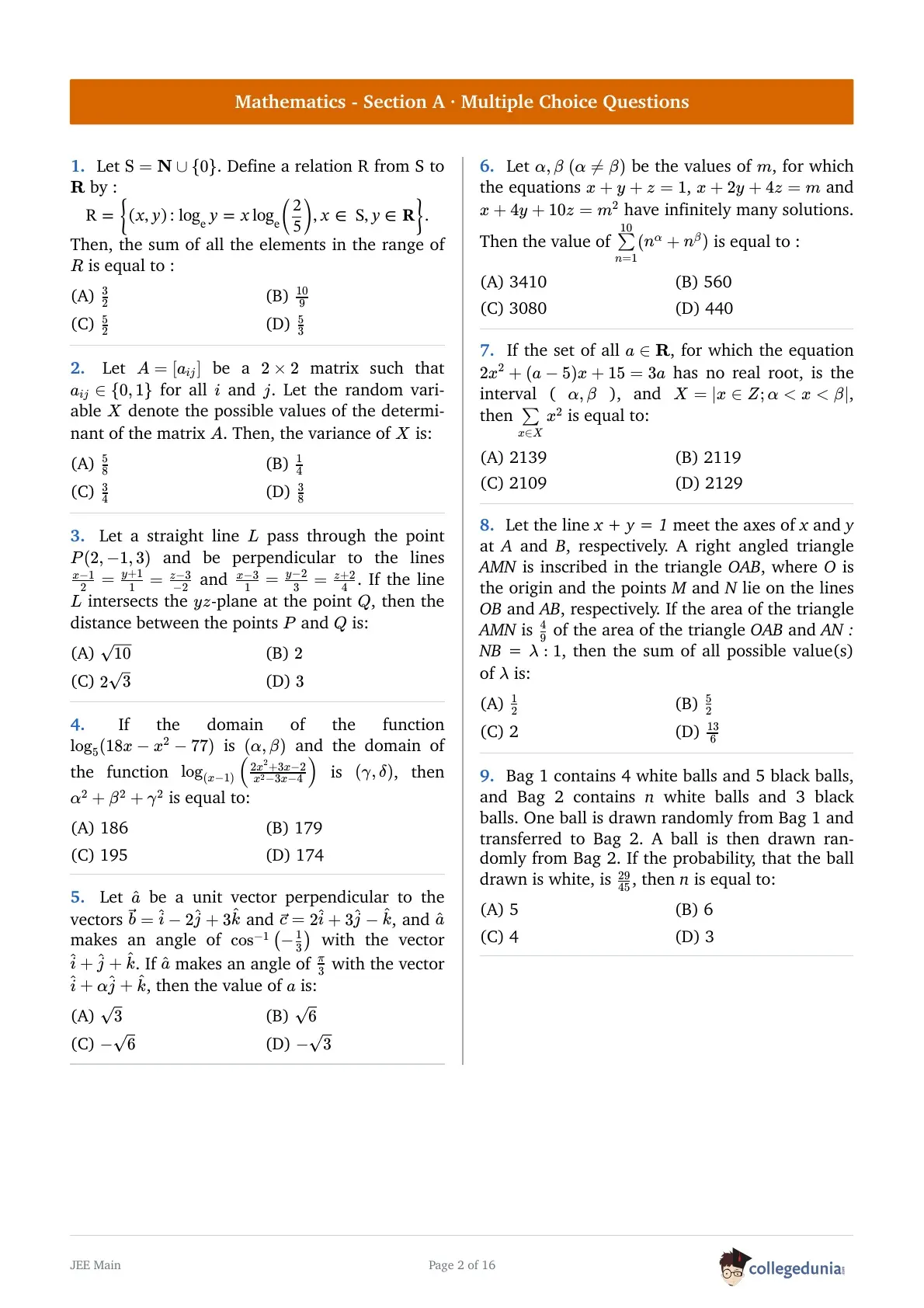
If the set of all \( a \in \mathbb{R} \), for which the equation \( 2x^2 + (a - 5)x + 15 = 3a \) has no real root, is the interval \( (\alpha, \beta) \), and \( X = \{ x \in \mathbb{Z} : \alpha < x < \beta \} \), then \( \sum_{x \in X} x^2 \) is equal to:
If \( \sin x + \sin^2 x = 1 \), \( x \in \left(0, \frac{\pi}{2} \right) \), then the expression
\[ (\cos^2 x + \tan^2 x) + 3(\cos^4 x + \tan^4 x + \cos^4 x + \tan^4 x) + (\cos^6 x + \tan^6 x) \]
is equal to:
Let the area enclosed between the curves \( |y| = 1 - x^2 \) and \( x^2 + y^2 = 1 \) be \( \alpha \). If \( 9\alpha = \beta\pi + \gamma \); \( \beta, \gamma \) are integers, then the value of \( |\beta - \gamma| \) equals:
If the domain of the function \( \log_5 (18x - x^2 - 77) \) is \( (\alpha, \beta) \) and the domain of the function \[ \log_{(x-1)} \left( \frac{2x^2 + 3x - 2}{x^2 - 3x - 4} \right) \]
is \( (\gamma, \delta) \), then \( \alpha^2 + \beta^2 + \gamma^2 \) is equal to:
Let the function \(f(x) = (x^2 - 1)|x^2 - ax + 2| + \cos|x| \) be not differentiable at the two points \( x = \alpha = 2 \) and \( x = \beta \). Then the distance of the point \((\alpha, \beta)\) from the line \(12x + 5y + 10 = 0\) is equal to:
Let a straight line \( L \) pass through the point \(P(2, -1, 3)\) and be perpendicular to the lines \[ \frac{x - 1}{2} = \frac{y + 1}{1} = \frac{z - 3}{-2} \quad and \quad \frac{x - 3}{1} = \frac{y - 2}{3} = \frac{z + 2}{4}. \]
If the line \(L\) intersects the yz-plane at the point Q, then the distance between the points P and Q is:
Let \( S = \mathbb{N} \cup \{0\} \). Define a relation \( R \) from \( S \) to \( \mathbb{R} \) by: \[ R = \left\{ (x, y) : \log_e y = x \log_e \left(\frac{2}{5}\right), x \in S, y \in \mathbb{R} \right\}. \]
Then, the sum of all the elements in the range of \( R \) is equal to:
Let the line \(x + y = 1\) meet the axes of x and y at A and B, respectively. A right-angled triangle AMN is inscribed in the triangle OAB, where O is the origin and the points M and N lie on the lines OB and AB, respectively. If the area of the triangle AMN is \(\frac{4}{9}\) of the area of the triangle OAB and \(AN : NB = \lambda : 1\), then the sum of all possible values of \(\lambda\) is:
If \(\alpha x + \beta y = 109\) is the equation of the chord of the ellipse \[ \frac{x^2}{9} + \frac{y^2}{4} = 1 \]
whose midpoint is \(\left(\frac{5}{2}, \frac{1}{2}\right)\), then \(\alpha + \beta\) is equal to:
If all the words with or without meaning made using all the letters of the word "KANPUR" are arranged as in a dictionary, then the word at 440th position in this arrangement is:
Let \( \alpha, \beta (\alpha \neq \beta) \) be the values of m, for which the equations \(x + y + z = 1\), \(x + 2y + 4z = m\), and \(x + 4y + 10z = m^2\) have infinitely many solutions. Then the value of \(\sum_{n=1}^{10} (n^4 + n^8)\) is equal to:
Let \( A = [a_{ij}] \) be a matrix of order 3 \(\times\) 3, with \(a_{ij} = (\sqrt{2})^{i+j}\). If the sum of all the elements in the third row of \( A^2 \) is \( \alpha + \beta\sqrt{2} \), where \(\alpha, \beta \in \mathbb{Z}\), then \(\alpha + \beta\) is equal to:
Let P be the foot of the perpendicular from the point \( (1, 2, 2) \) on the line \[ \frac{x-1}{1} = \frac{y + 1}{-1} = \frac{z - 2}{2} \]
Let the line \( \mathbf{r} = (-\hat{i} + \hat{j} - 2\hat{k}) + \lambda (\hat{i} - \hat{j} + \hat{k})\), \( \lambda \in \mathbb{R} \), intersect the line \(L\) at \(Q\). Then \( 2(PQ)^2 \) is equal to:
Let a circle C pass through the points (4, 2) and (0, 2), and its centre lie on \(3x + 2y + 2 = 0\). Then the length of the chord of the circle C, whose midpoint is (1, 2), is:
Let \( A = [a_{ij}] \) be a 2 \(\times\) 2 matrix such that \(a_{ij} \in \{0, 1\}\) for all \(i\) and \(j\). Let the random variable X denote the possible values of the determinant of the matrix A. Then, the variance of X is:
Bag 1 contains 4 white balls and 5 black balls, and Bag 2 contains n white balls and 3 black balls. One ball is drawn randomly from Bag 1 and transferred to Bag 2. A ball is then drawn randomly from Bag 2. If the probability that the ball drawn is white is \(\frac{29}{45}\), then n is equal to:
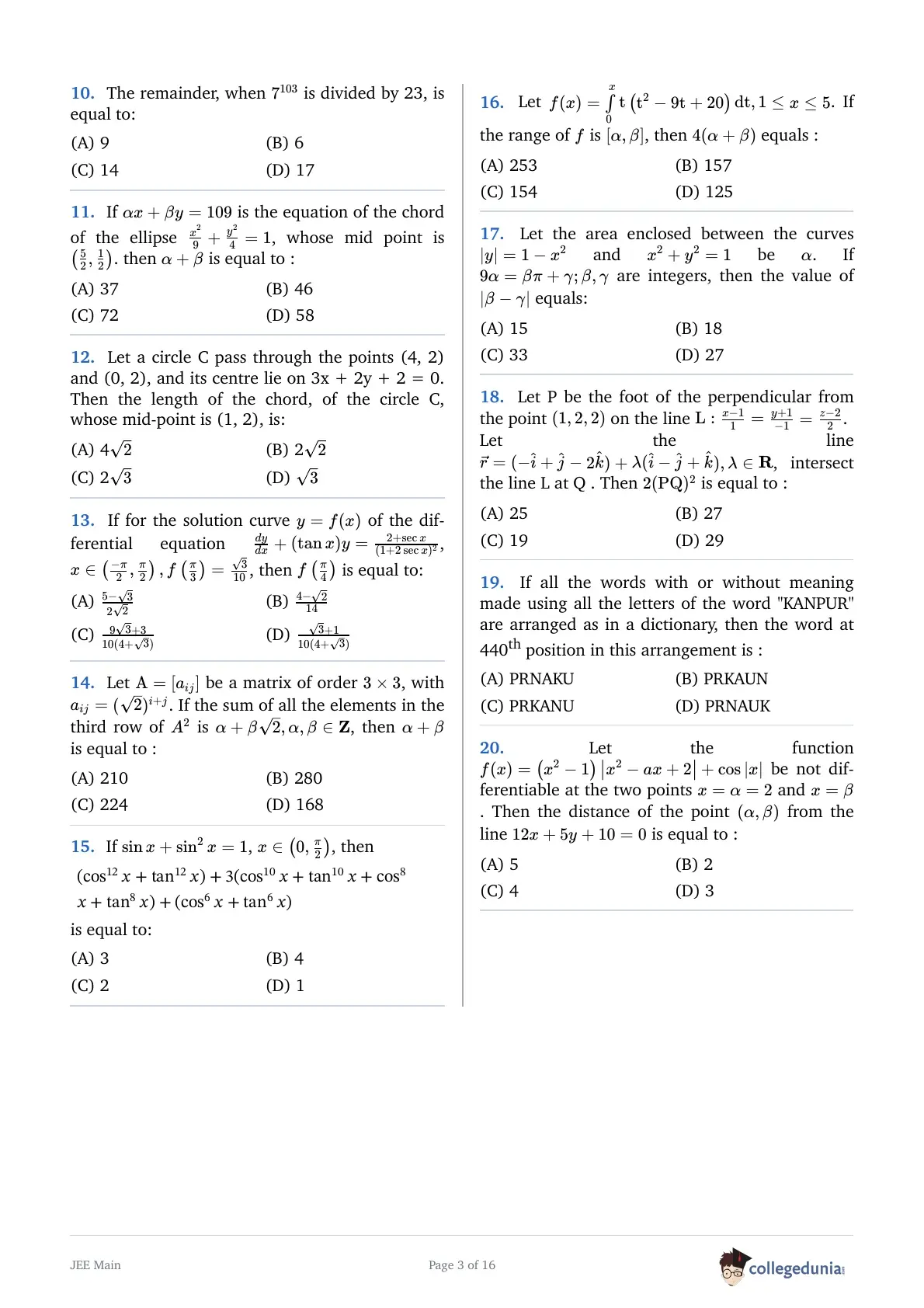
The remainder, when \(7^{98}\) is divided by 23, is equal to:
Let \(f(x) = \int_{1}^{x} (t^2 - 9t + 20) \, dt\), \(1 \leq x \leq 5\). If the range of \(f(x)\) is \( [\alpha, \beta] \), then \(4(\alpha + \beta)\) equals:
Let \( \hat{a} \) be a unit vector perpendicular to the vectors \[ \mathbf{b} = \hat{i} - 2\hat{j} + 3\hat{k} \quad and \quad \mathbf{c} = 2\hat{i} + 3\hat{j} - \hat{k}, \]
and makes an angle of \( \cos\left( -\frac{1}{3} \right) \) with the vector \( \hat{i} + \alpha \hat{j} + \hat{k} \).
If \( \hat{a} \) makes an angle with the vector \( \hat{i} + \alpha \hat{j} + \hat{k} \),
then the value of \( \alpha \) is:
If for the solution curve \( y = f(x) \) of the differential equation \[ \frac{dy}{dx} + (\tan x) y = 2 + \sec^2 x, \quad y(\frac{\pi}{3}) = \sqrt{3}, \]
then \( y(\frac{\pi{4}} \) is equal to:
Mathematics - Section B (Q21 - Q25)
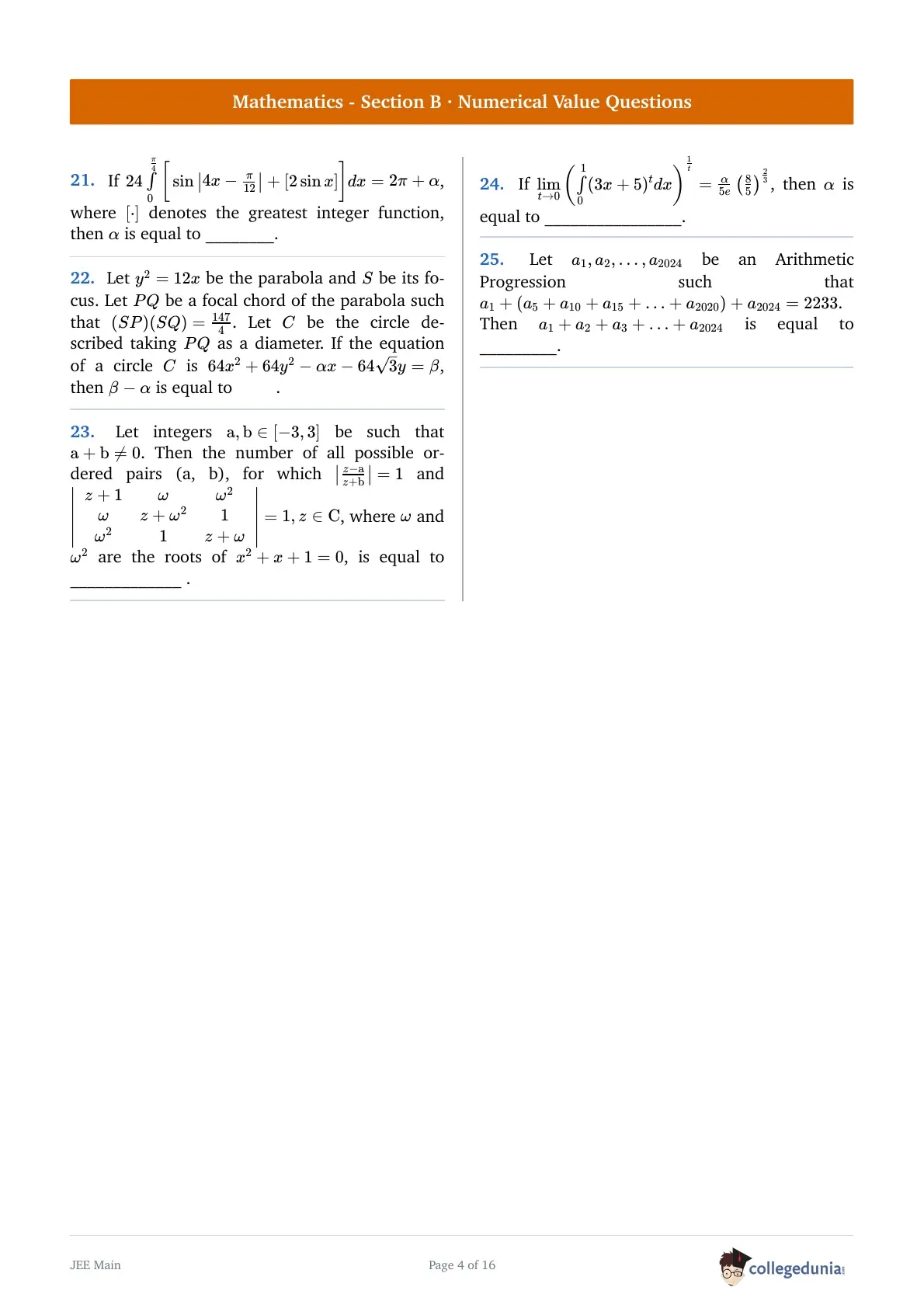
If \[ 24 \left( \int_0^\frac{\pi}{4} \left[ \sin \left( 4x - \frac{\pi}{12} \right) + [2 \sin x] \right] dx \right) = 2n + \alpha, \]
where [.] denotes the greatest integer function, then \( \alpha \) is equal to:
If \( \lim_{t \to \infty} \left( \int_0^{1} \left( 3x + 5 \right)^t dx \right) = \frac{\alpha}{5e} \left( \frac{8}{5} \right)^{\frac{3}{2}}, \) then \( \alpha \) is equal to ____ :
Let \( a_1, a_2, \dots, a_{2024} \) be an Arithmetic Progression such that \[ a_1 + (a_1 + a_0 + a_1 + a_2 + \cdots + a_{2020} + a_{2024}) = 2233. \quad Then \quad a_1 + a_2 + a_3 + \dots + a_{2022} \]
is equal to ____ :
Let integers \( a, b \in [-3,3] \) be such that \( a + b \neq 0 \).
Then the number of all possible ordered pairs \( (a, b) \), for which
\[ \left| \frac{z - a}{z + b} \right| = 1 \]and
\[ \begin{vmatrix} z+1 & \omega & \omega^2 \\ \omega^2 & 1 & z+\omega \\ \omega^2 & 1 & z+\omega \end{vmatrix} = 1, \]is equal to:
Let \( y^2 = 12x \) be the parabola and \( S \) its focus. Let \( PQ \) be a focal chord of the parabola such that \( (SP)(SQ) = \frac{147}{4} \).
Let \( C \) be the circle described taking \( PQ \) as a diameter. If the equation of a circle \( C \) is
\[ 64x^2 + 64y^2 - \alpha x - 64\sqrt{3}y = \beta, \]then \( \beta - \alpha \) is equal to:
Physics - Section A (Q26 - Q45)
The difference of temperature in a material can convert heat energy into electrical energy. To harvest the heat energy, the material should have:
Given below are two statements. One is labelled as Assertion (A) and the other is labelled as Reason (R).
Assertion (A): With the increase in the pressure of an ideal gas, the volume falls off more rapidly in an isothermal process in comparison to the adiabatic process.
Reason (R): In an isothermal process, \( PV = constant \), while in an adiabatic process \( PV^\gamma = constant \). Here, \( \gamma \) is the ratio of specific heats, \( P \) is the pressure and \( V \) is the volume of the ideal gas.
In the light of the above statements, choose the correct answer from the options given below:
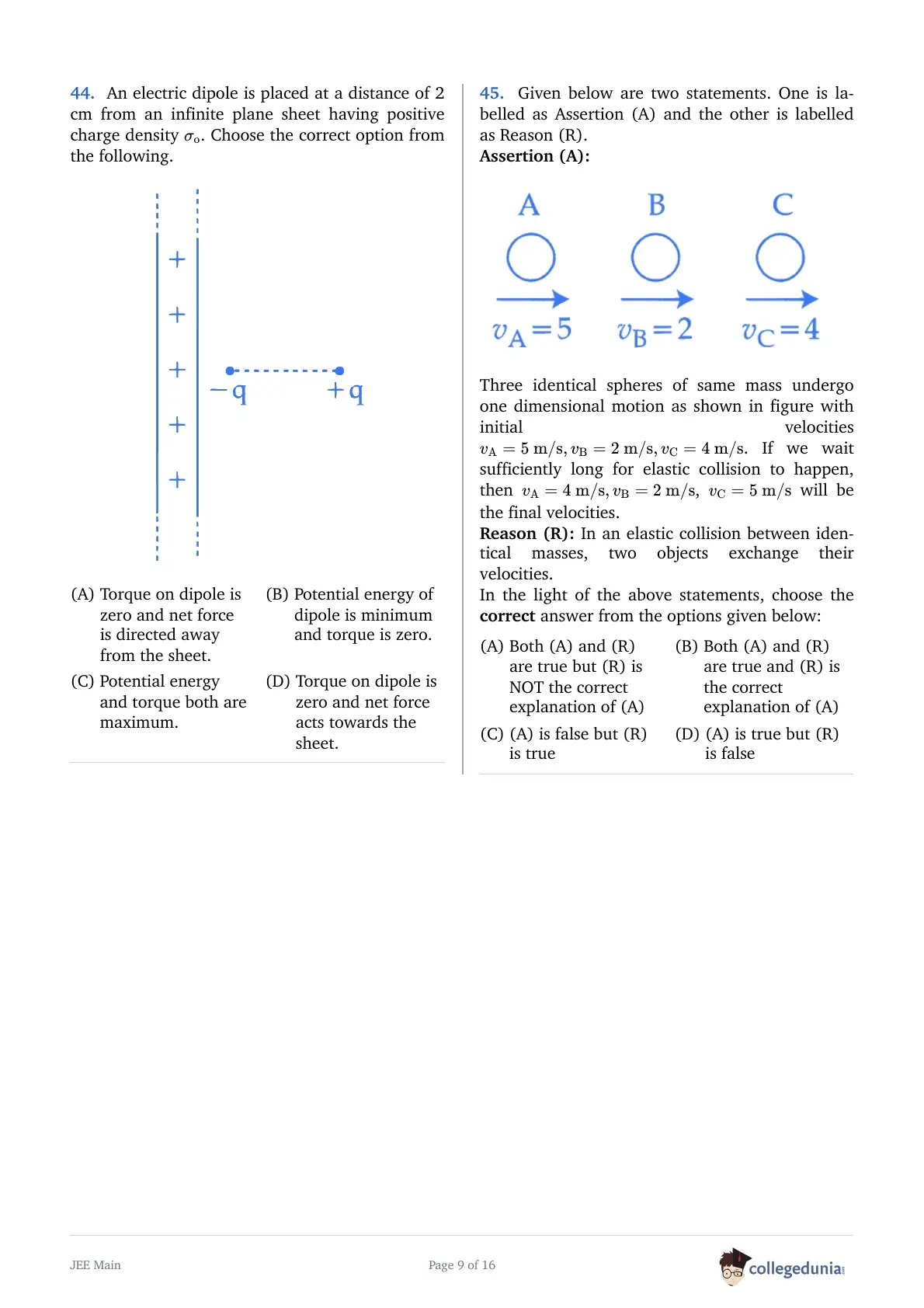
An electric dipole is placed at a distance of 2 cm from an infinite plane sheet having positive charge density \( \sigma \). Choose the correct option from the following.
In an experiment with photoelectric effect, the stopping potential:
A point charge causes an electric flux of \( -2 \times 10^4 \, Nm^2C^{-1} \) to pass through a spherical Gaussian surface of 8.0 cm radius, centered on the charge. The value of the point charge is:
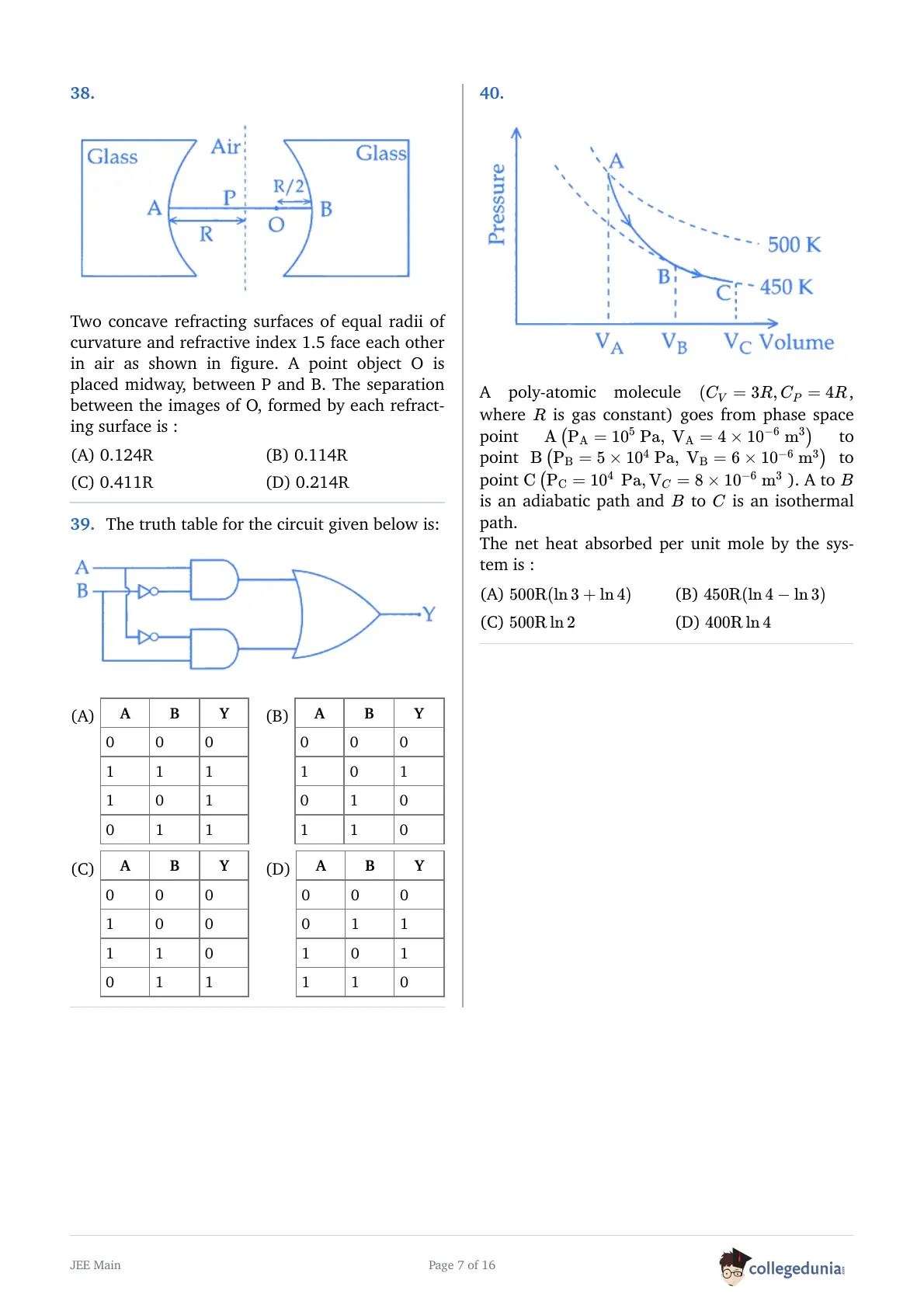
A poly-atomic molecule (C\(_3\)R, \(C_v = 4R\), where \(R\) is gas constant) goes from phase space point A (\(P_A = 10^4 \, Pa, V_A = 4 \times 10^{-3} \, m^3\)) to point B (\(P_B = 5 \times 10^4 \, Pa, V_B = 6 \times 10^{-7} \, m^3\)) to point C (\(P_C = 10^4 \, Pa, V_C = 8 \times 10^{-3} \, m^3\)). A to B is an adiabatic path and B to C is an isothermal path. The net heat absorbed per unit mole by the system is:

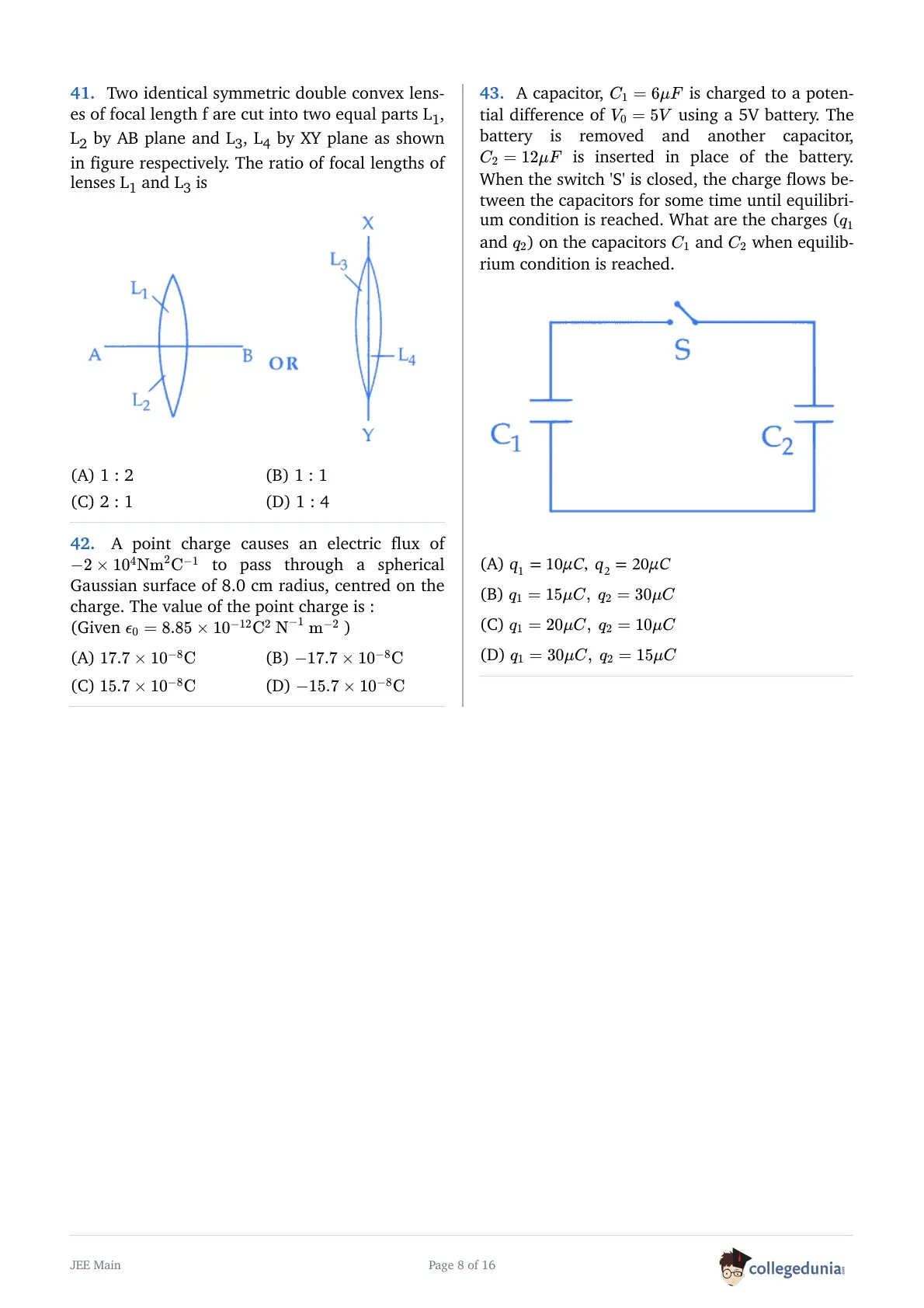
Two identical symmetric double convex lenses of focal length \( f \) are cut into two equal parts \( L_1, L_2 \) by the AB plane and \( L_3, L_4 \) by the XY plane as shown in the figure respectively. The ratio of focal lengths of lenses \( L_1 \) and \( L_3 \) is:

A plane electromagnetic wave propagates along the \( +x \) direction in free space. The components of the electric field \( \vec{E} \) and magnetic field \( \vec{B} \) vectors associated with the wave in Cartesian frame are:
Two concave refracting surfaces of equal radii of curvature and refractive index 1.5 face each other in air as shown in figure. A point object O is placed midway, between P and B. The separation between the images of O, formed by each refracting surface is:

Two bodies A and B of equal mass are suspended from two massless springs of spring constant \( k_1 \) and \( k_2 \), respectively. If the bodies oscillate vertically such that their amplitudes are equal, the ratio of the maximum velocity of A to the maximum velocity of B is:
Given below are two statements, one is labelled as Assertion (A) and the other is labelled as Reason (R).

Three identical spheres of the same mass undergo one-dimensional motion as shown in the figure with initial velocities \( v_A = 5 \, m/s, v_B = 2 \, m/s, v_C = 4 \, m/s \). If we wait sufficiently long for elastic collision to happen, then \( v_A = 4 \, m/s, v_B = 2 \, m/s, v_C = 5 \, m/s \) will be the final velocities.
Reason (R): In an elastic collision between identical masses, two objects exchange their velocities.
In light of the above statements, choose the correct answer from the options given below:
A sand dropper drops sand of mass \( m(t) \) on a conveyor belt at a rate proportional to the square root of the speed \( v \) of the belt, i.e., \( \frac{dm}{dt} \propto \sqrt{v} \). If \( P \) is the power delivered to run the belt at constant speed, then which of the following relationships is true?
A convex lens made of glass (refractive index = 1.5) has a focal length of 24 cm in air. When it is totally immersed in water (refractive index = 1.33), its focal length changes to:
A capacitor, \( C_1 = 6 \, \mu F \), is charged to a potential difference of \( V_1 = 5 \, V \) using a 5V battery. The battery is removed and another capacitor, \( C_2 = 12 \, \mu F \), is inserted in place of the battery. When the switch 'S' is closed, the charge flows between the capacitors for some time until equilibrium condition is reached. What are the charges \( q_1 \) and \( q_2 \) on the capacitors \( C_1 \) and \( C_2 \) when equilibrium condition is reached?

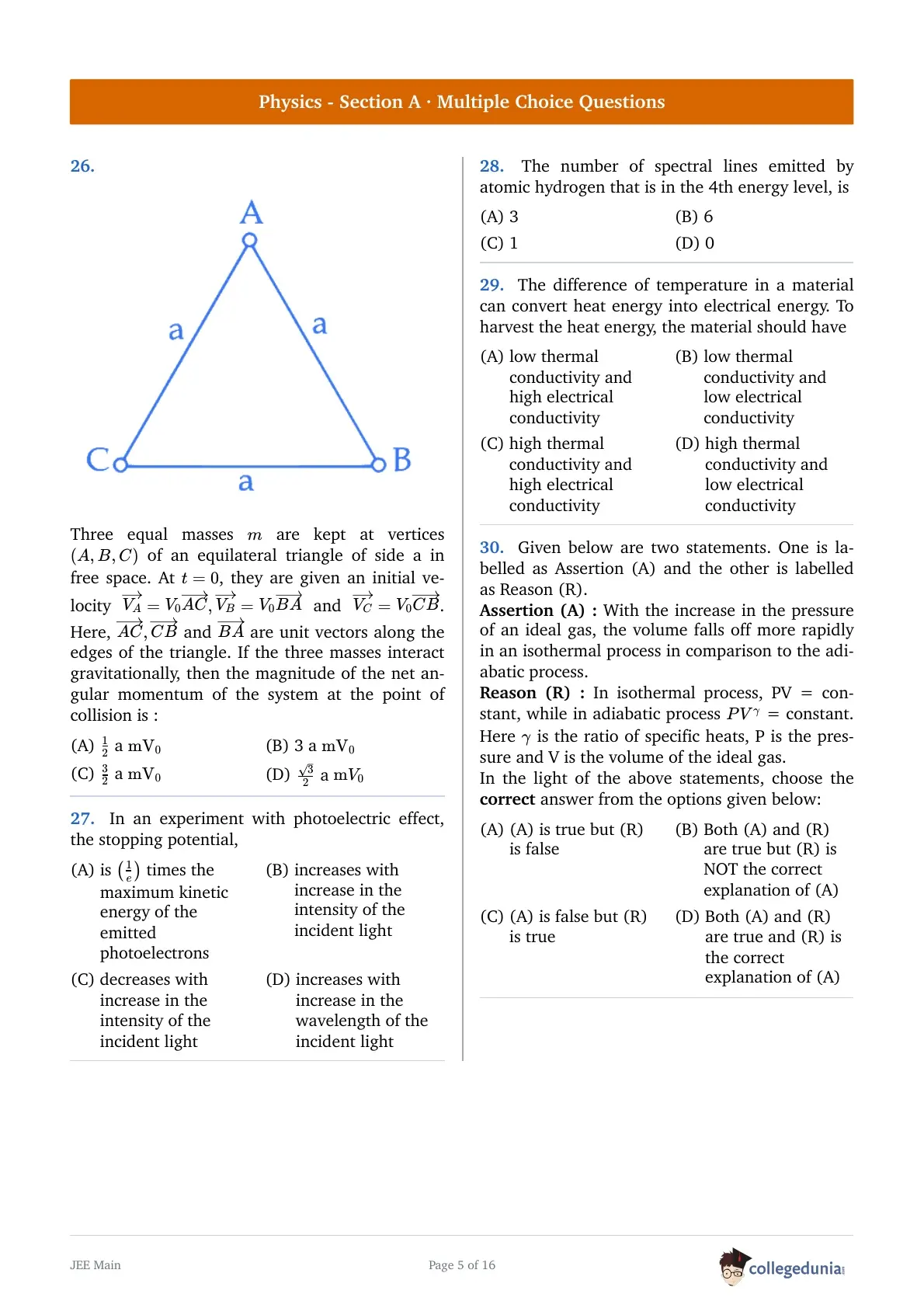
Three equal masses \( m \) are kept at vertices (A, B, C) of an equilateral triangle of side \( a \) in free space. At \( t = 0 \), they are given an initial velocity \( \vec{V_A} = V_0 \hat{AC}, \, \vec{V_B} = V_0 \hat{BA}, \, \vec{V_C} = V_0 \hat{CB} \).

Here, \( \hat{AC}, \hat{CB}, \hat{BA} \) are unit vectors along the edges of the triangle. If the three masses interact gravitationally, then the magnitude of the net angular momentum of the system at the point of collision is:
Match List-I with List-II.

Choose the correct answer from the options given below:
Match List-I with List-II.

Choose the correct answer from the options given below:
The truth table for the circuit given below is:

Choose the correct answer from the options given below:
- (1)
![]()
- (2)
![]()
- (3)
![]()
- (4)
![]()


A cup of coffee cools from 90°C to 80°C in \( t \) minutes when the room temperature is 20°C. The time taken by the similar cup of coffee to cool from 80°C to 60°C at the same room temperature is:
The number of spectral lines emitted by atomic hydrogen that is in the 4th energy level is:
Physics - Section B (Q46 - Q50)
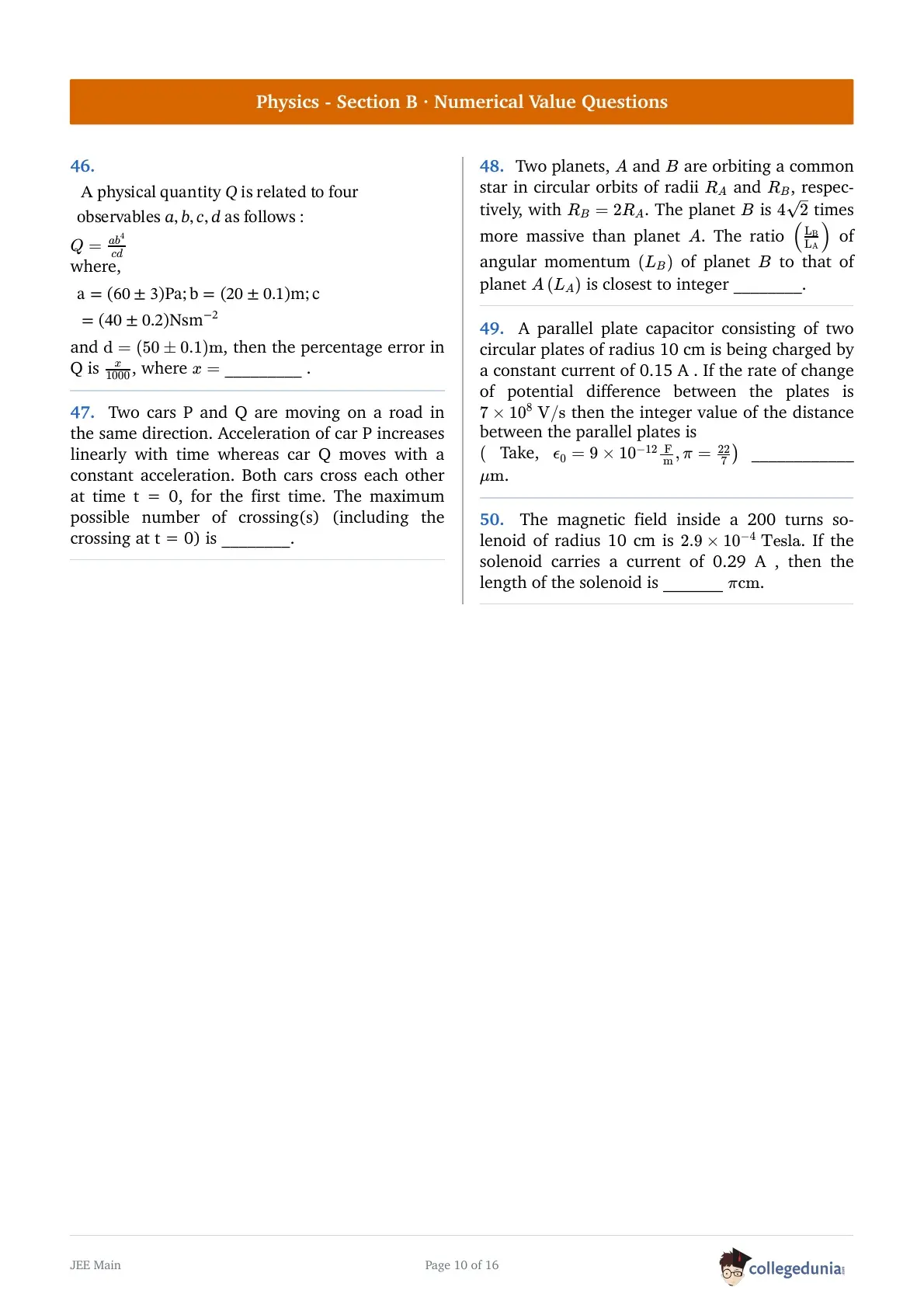
The magnetic field inside a 200 turns solenoid of radius 10 cm is \( 2.9 \times 10^{-4} \) Tesla. If the solenoid carries a current of 0.29 A, then the length of the solenoid is:
A parallel plate capacitor consisting of two circular plates of radius 10 cm is being charged by a constant current of 0.15 A. If the rate of change of potential difference between the plates is \( 7 \times 10^6 \, V/s \), then the integer value of the distance between the parallel plates is:
A physical quantity \( Q \) is related to four observables \( a \), \( b \), \( c \), and \( d \) as follows: \[ Q = \frac{a b^4}{c d^2} \]
Where:
- \( a = (60 \pm 3) \, Pa \),
- \( b = (20 \pm 0.1) \, m \),
- \( c = (40 \pm 0.2) \, N·s/m^2 \),
- \( d = (50 \pm 0.1) \, m \).
Then the percentage error in \( Q \) is:
Two planets, A and B are orbiting a common star in circular orbits of radii \( R_A \) and \( R_B \), respectively, with \( R_B = 2R_A \). The planet B is \( \sqrt{2} \) times more massive than planet A. The ratio \( \frac{L_B}{L_A} \) of angular momentum (\( L \)) of planet B to that of planet A (\( L_A \)) is closest to integer:
Two cars P and Q are moving on a road in the same direction. Acceleration of car P increases linearly with time whereas car Q moves with a constant acceleration. Both cars cross each other at time \( t = 0 \), for the first time. The maximum possible number of crossing(s) (including the crossing at \( t = 0 \)) is:
Chemistry - Section A (Q51 - Q70)
The calculated spin-only magnetic moments of \( K_3[Fe(OH)_6] \) and \( K_4[Fe(OH)_6] \) respectively are:
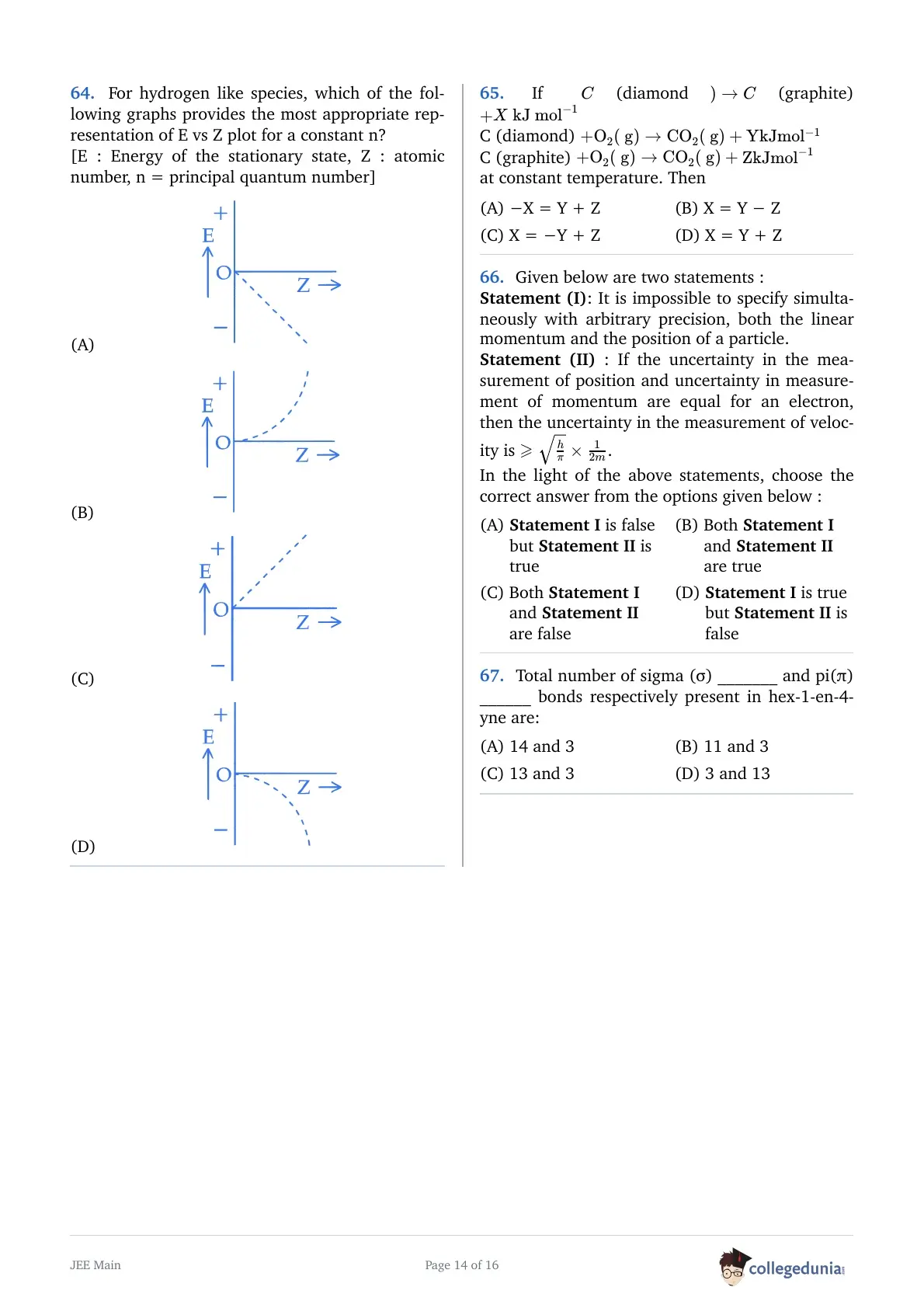
For hydrogen-like species, which of the following graphs provides the most appropriate representation of \( E \) vs \( Z \) plot for a constant \( n \)?
- (1)
![most appropriate representation of E vs Z plot for a constant n]()
- (2)
![most appropriate representation of E vs Z plot for a constant n]()
- (3)
![most appropriate representation of E vs Z plot for a constant n]()
- (4)
![most appropriate representation of E vs Z plot for a constant n]()


Given below are two statements:
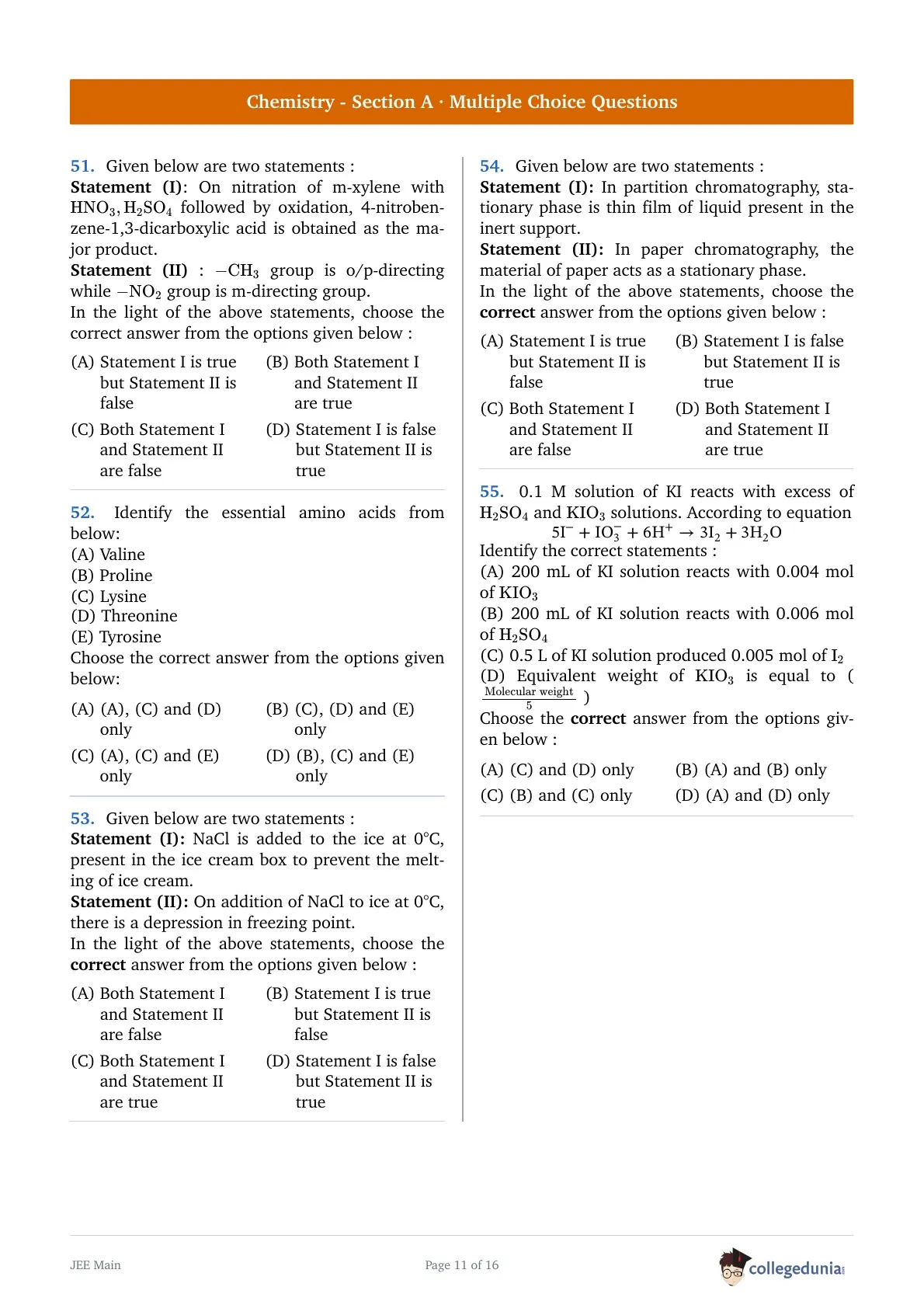
Statement (I): In partition chromatography, the stationary phase is a thin film of liquid present in the inert support.
Statement (II): In paper chromatography, the material of paper acts as a stationary phase.
In light of the above statements, choose the correct answer from the options given below:
Identify the essential amino acids from below:
(A) Valine (B) Proline (C) Lysine (D) Threonine (E) Tyrosine
Choose the correct answer from the options given below:
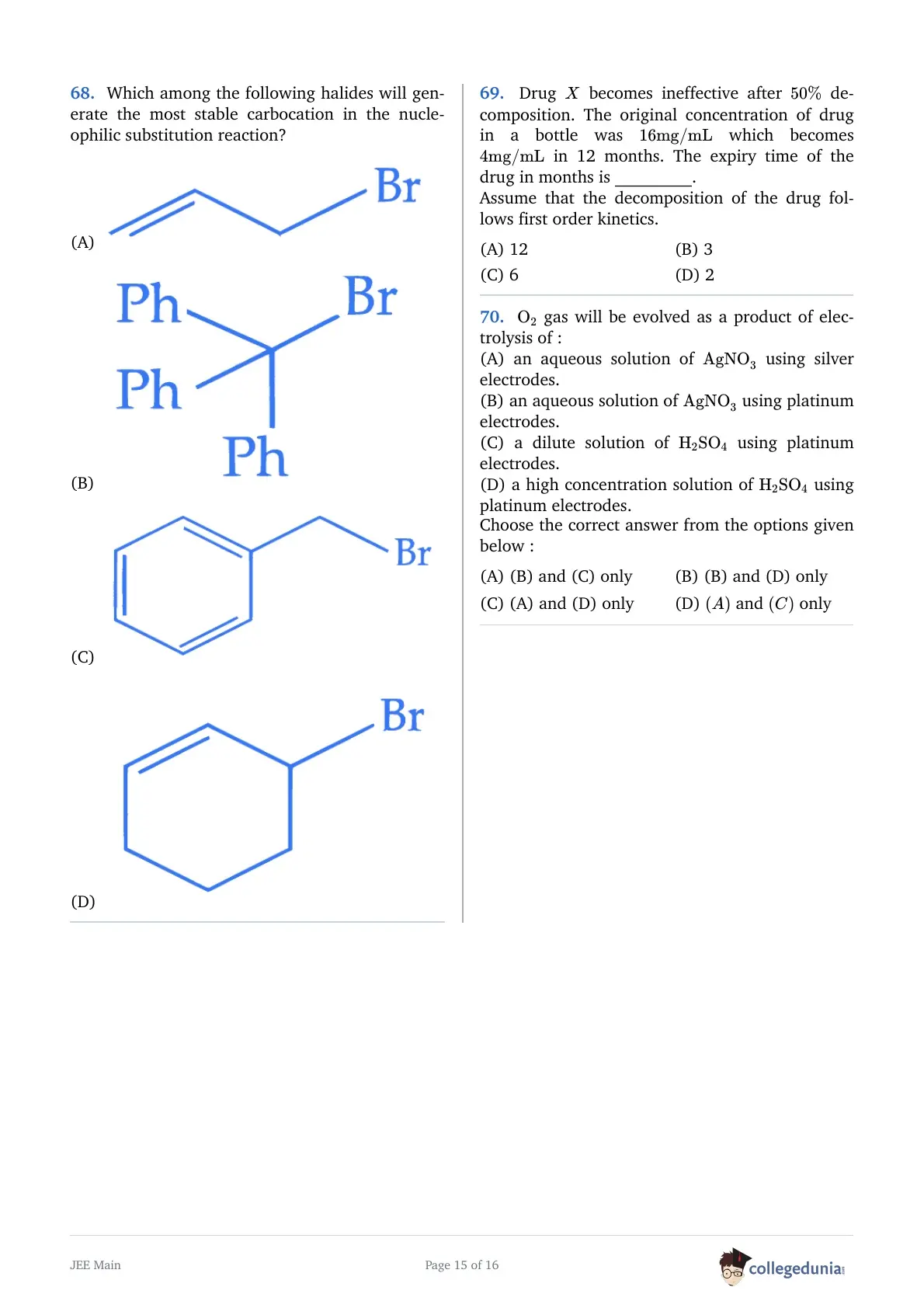
Which among the following halides will generate the most stable carbocation in a nucleophilic substitution reaction?
- (1)
![]()
- (2)
![]()
- (3)
![]()
- (4)
![]()


Consider the equilibrium: \[ CO(g) + 3H_2(g) \rightleftharpoons CH_4(g) + H_2O(g) \]
If the pressure applied over the system increases by two fold at constant temperature then:
Given below are two statements:
Statement (I): NaCl is added to the ice at \( 0^\circ C \), present in the ice cream box to prevent the melting of ice cream.
Statement (II): On addition of NaCl to ice at \( 0^\circ C \), there is a depression in freezing point.
In the light of the above statements, choose the correct answer from the options given below:
Given below are two statements:
Statement (I): On nitration of m-xylene with \( HNO_3 \), \( H_2SO_4 \), followed by oxidation, 4-nitrobenzene-1, 3-dicarboxylic acid is obtained as the major product.
Statement (II): CH\(_3\) group is o/p-directing while NO\(_2\) group is m-directing group.
In the light of the above statements, choose the correct answer from the options given below:
0.1 M solution of KI reacts with excess of \( H_2SO_4 \) and KIO\(_3\), according to the equation: \[ 5I^- + 6H^+ \rightarrow 3I_2 + 3H_2O \]
Identify the correct statements:
(A) 200 mL of KI solution reacts with 0.004 mol of KIO\(_3\)
(B) 200 mL of KI solution reacts with 0.006 mol of H\(_2\)SO\(_4\)
(C) 0.5 L of KI solution produced 0.005 mol of I\(_2\)
(D) Equivalent weight of KIO\(_3\) is equal to:
\[ \frac{Molecular weight}{5} \]
Choose the correct answer from the options given below:
Match List-I with List-II:

Choose the correct answer from the options given below:
O\(_2\) gas will be evolved as a product of electrolysis of:
(A) an aqueous solution of AgNO\(_3\) using silver electrodes.
(B) an aqueous solution of AgNO\(_3\) using platinum electrodes.
(C) a dilute solution of H\(_2\)SO\(_4\) using platinum electrodes.
(D) a high concentration solution of H\(_2\)SO\(_4\) using platinum electrodes.
Choose the correct answer from the options given below:
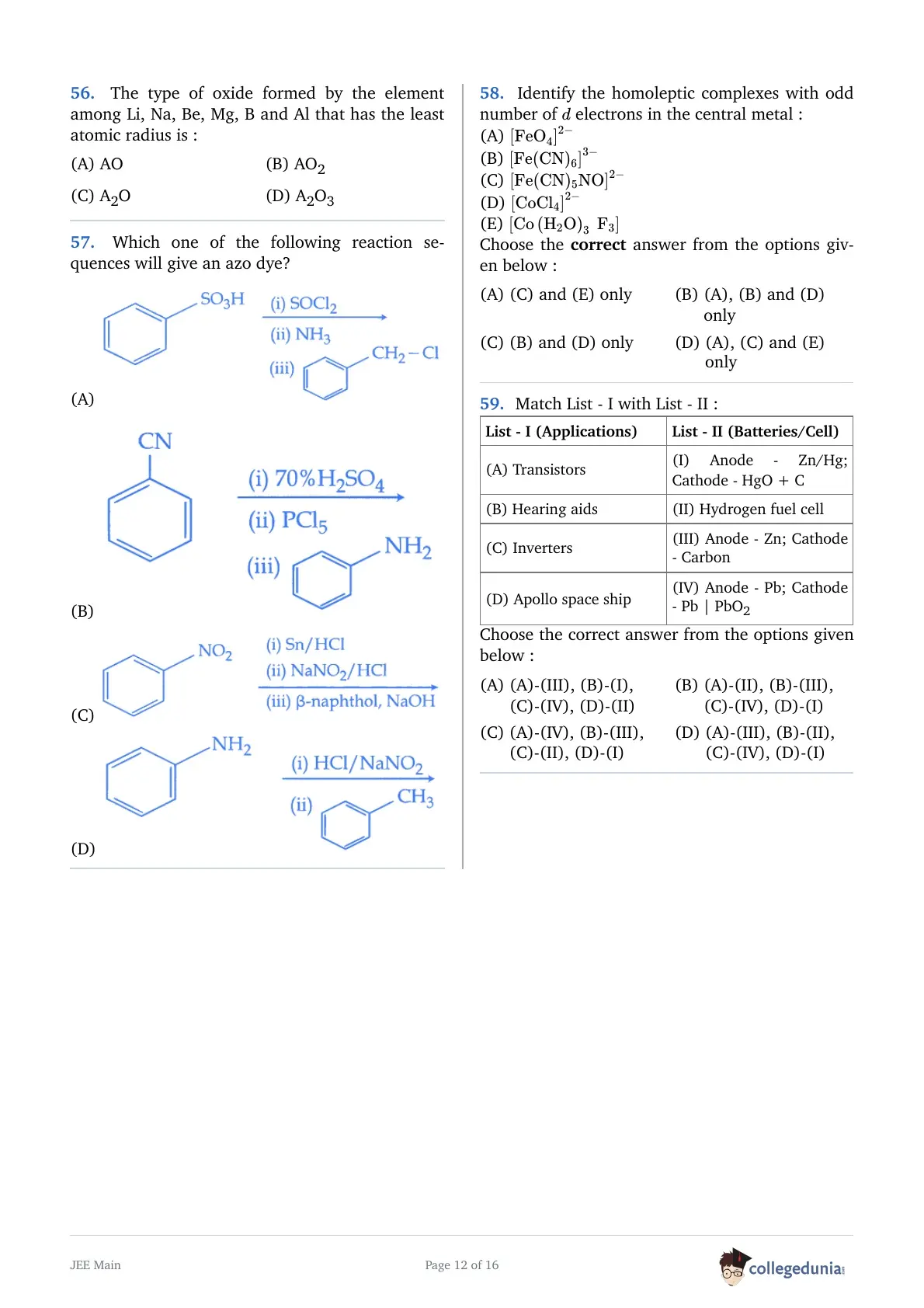
Identify the homoleptic complexes with odd number of d-electrons in the central metal:
(A) \([FeO_4]^{2-}\)
(B) \([Fe(CN)_6]^{3-}\)
(C) \([Fe(CN)_6]^{2-}\)
(D) \([CoCl_4]^{2-}\)
(E) \([Co(H_2O)_6]^{3+}\)
Choose the correct answer from the options given below:
Total number of sigma (\( \sigma \)) and pi (\( \pi \)) bonds respectively present in hex-1-en-4-yne are:
If \[ C(diamond) \rightarrow C(graphite) + X \, kj mol^{-1} \] \[ C(diamond) + O_2(g) \rightarrow CO(g) + Y \, kj mol^{-1} \] \[ C(graphite) + O_2(g) \rightarrow CO(g) + Z \, kj mol^{-1} \]
At constant temperature. Then:
Given below are two statements:
Statement (I): It is impossible to specify simultaneously with arbitrary precision, the linear momentum and the position of a particle.
Statement (II): If the uncertainty in the measurement of position and uncertainty in measurement of momentum are equal for an electron, then the uncertainty in the measurement of velocity is \( \geq \sqrt{\frac{h}{\pi}} \times \frac{1}{2m} \).
In the light of the above statements, choose the correct answer from the options given below:
Which one of the following reaction sequences will give an azo dye?
- (1)
![]()
- (2)
![]()
- (3)
![]()
- (4)
![]()


Drug X becomes ineffective after 50% decomposition. The original concentration of drug in a bottle was 16 mg/mL which becomes 4 mg/mL in 12 months. The expiry time of the drug in months is ____ .
Assume that the decomposition of the drug follows first order kinetics.
The type of oxide formed by the element among Li, Na, Be, Mg, B and Al that has the least atomic radius is:
First ionisation enthalpy values of the first four group 15 elements are given below. Choose the correct value for the element that is a main component of the apatite family:
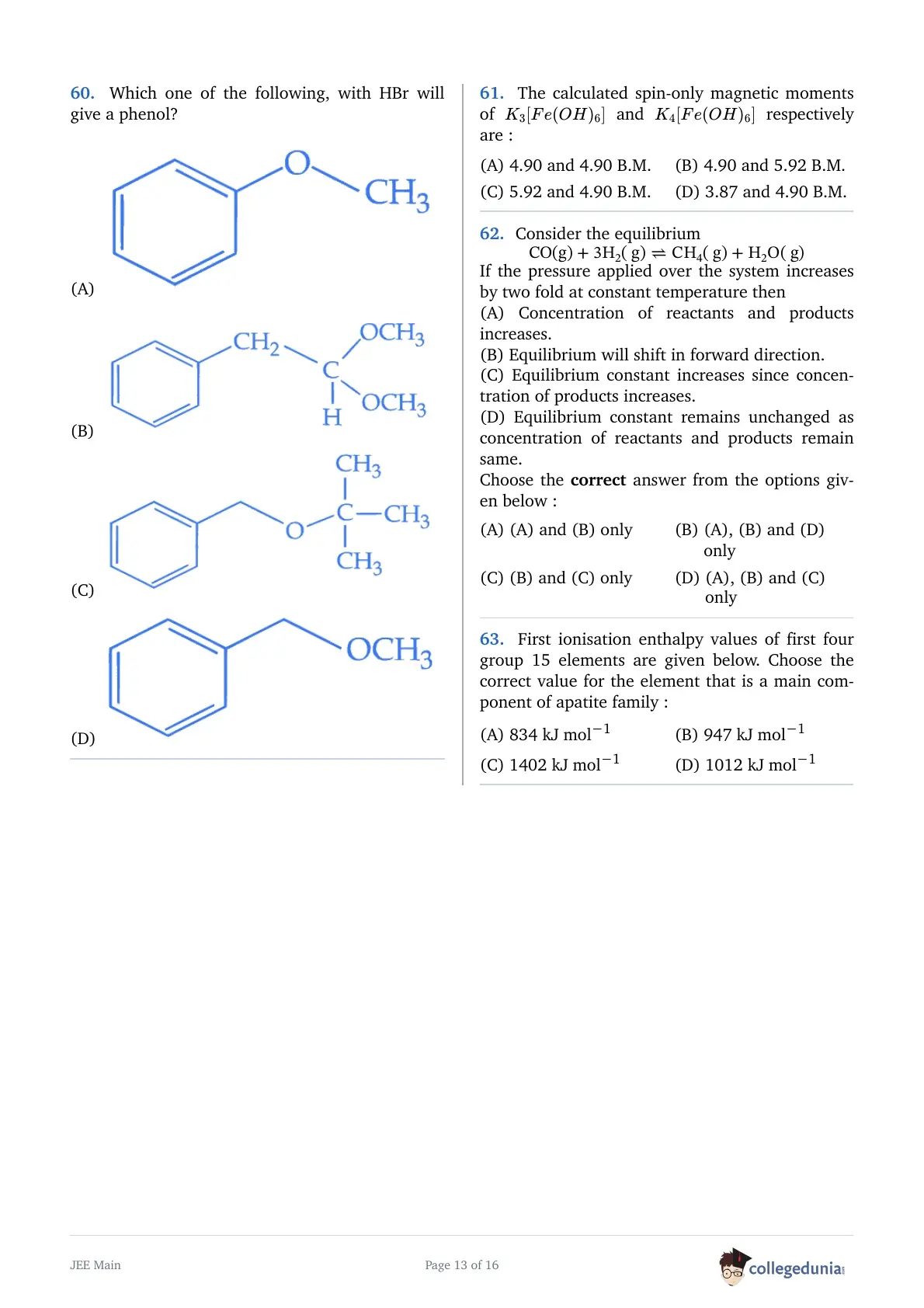
Which one of the following, with HBr, will give a phenol?
- (1)
![aromatic ether with HBr]()
- (2)
![aromatic ether with HBr]()
- (3)
![aromatic ether with HBr]()
- (4)
![aromatic ether with HBr]()


Chemistry - Section B (Q71 - Q75)
Consider the following low-spin complexes \[ K_3[Co(NO_3)_6], \, K_4[Fe(CN)_6], \, K_3[Fe(CN)_6], \, Cu_2[Fe(CN)_6], \, Zn_2[Fe(CN)_6] \]
The sum of the spin-only magnetic moment values of complexes having yellow colour is: \[ B.M. (answer is nearest integer) \]
Isomeric hydrocarbons \( \rightarrow \) negative Baeyer's test (Molecular formula \( C_9H_{12} \)).
The total number of isomers from above with four different non-aliphatic substitution sites is -
In the Claisen-Schmidt reaction to prepare dibenzalacetone from 5.3 g benzaldehyde, a total of 3.51 g of product was obtained. The percentage yield in this reaction was _____.
In the sulphur estimation, 0.20 g of a pure organic compound gave 0.40 g of barium sulphate. The percentage of sulphur in the compound is
Total number of non-bonded electrons present in \( NO_2 \); ion based on Lewis theory is:
JEE Main 2025 Exam Pattern and Marking Scheme
| Particulars | Details |
|---|---|
| Exam Mode | Online (Computer-Based Test) |
| Paper | B.E./B.Tech |
| Medium of Exam | 13 languages: English, Hindi, Gujarati, Bengali, Tamil, Telugu, Kannada, Marathi, Malayalam, Odia, Punjabi, Assamese, Urdu |
| Duration | 3 hours (180 minutes) |
| Type of Questions | Multiple Choice Questions (MCQs) + Numerical Value Questions |
| Total Marks | 300 marks |
| Subjects | Mathematics, Physics, Chemistry |
| Marking Scheme | +4 for correct answer & -1 for incorrect MCQ and Numerical Value-based Questions |
| Total Questions | 75 Questions |
| Eligibility | Passed or appearing in Class 12 with Physics, Chemistry, and Mathematics |
JEE Main 29 Jan Shift 2 Paper Analysis- Check Difficulty Level and Good Score
The question paper consisted of a total of 75 questions, divided equally across the three subjects:
- The Mathematics section in JEE Main 2025 29 Jan Shift 2 Question Paper was Tough with 8 questions coming majorly from topics like Integration, Probability, etc.
- Physics was Moderate with 12 questions coming majorly from topics like Ray Optics, Gravity, Magnetism, etc.
- Chemistry was Moderate with 9 questions coming majorly from topics like Organic Chemistry, Physical Chemistry, etc.
Each section included a mix of multiple-choice questions (MCQs) and numerical value-based questions, offering a balanced challenge for students.
Check: JEE Main 29th Jan Shift 1 Question Paper
JEE Main 2025: Shift-Wise Analysis
| Session | Shift | Difficulty Trend (Physics, Chemistry, Mathematics) |
Overall Difficulty |
|---|---|---|---|
| January | 22nd January Shift 1 |
|
Moderate |
| January | 22nd January Shift 2 |
|
Moderate |
| January | 23rd January Shift 1 |
|
Moderate |
| January | 23rd January Shift 2 |
|
Moderate |
| January | 24th January Shift 1 |
|
Moderate |
| January | 24th January Shift 2 |
|
Moderate |
| January | 28th January Shift 1 |
|
Tough |
| January | 28th January Shift 2 |
|
Tough |
| January | 29th January Shift 1 |
|
Moderate to Tough |
| January | 29th January Shift 2 |
|
Moderate to Tough |



Comments