




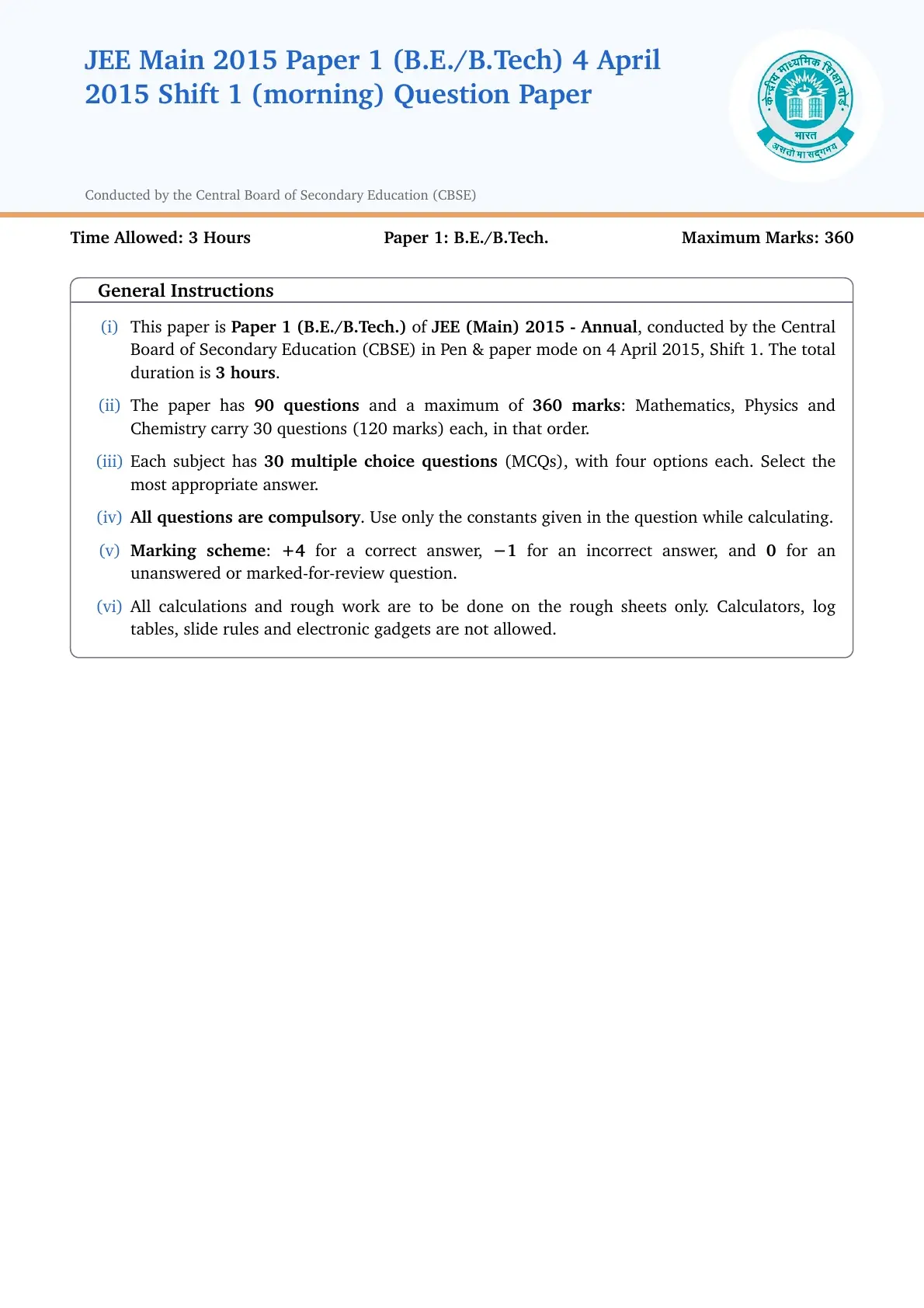
JEE Main 2015 April 4 (Code B) Question Paper is available here with solutions PDF and detailed solutions for every question. CBSE conducted the pen-and-paper (offline) Paper 1 on April 4, 2015, in the morning session from 9:30 AM to 12:30 PM. This page covers Code B of the paper. The JEE Main 2015 Paper 1 (B.E./B.Tech) question paper includes the following:
- 90 questions in a 3-hour pen-and-paper (offline) paper: 30 each from Mathematics, Physics and Chemistry
- Question type: all multiple choice questions (MCQs) with a single correct option, 4 marks each
- Sections: Mathematics (30), Physics (30) and Chemistry (30), all questions compulsory
- Marking: +4 for a correct answer, -1 for an incorrect answer, 0 for an unattempted question
- Maximum marks: 360 (120 per subject)
JEE Main 2015 April 4 (Code B) Question Paper with Solution PDF
| NTA Official PDF | CD PDF | CD PDF with Solutions |
|---|---|---|
| Download official PDF 5.50 MB | Download Collegedunia PDF 1.37 MB | Download solutions PDF 2.46 MB |
Also Check:
JEE Main 2015 April 4 (Code B) Questions with Solutions
Mathematics (Q1 - Q30)
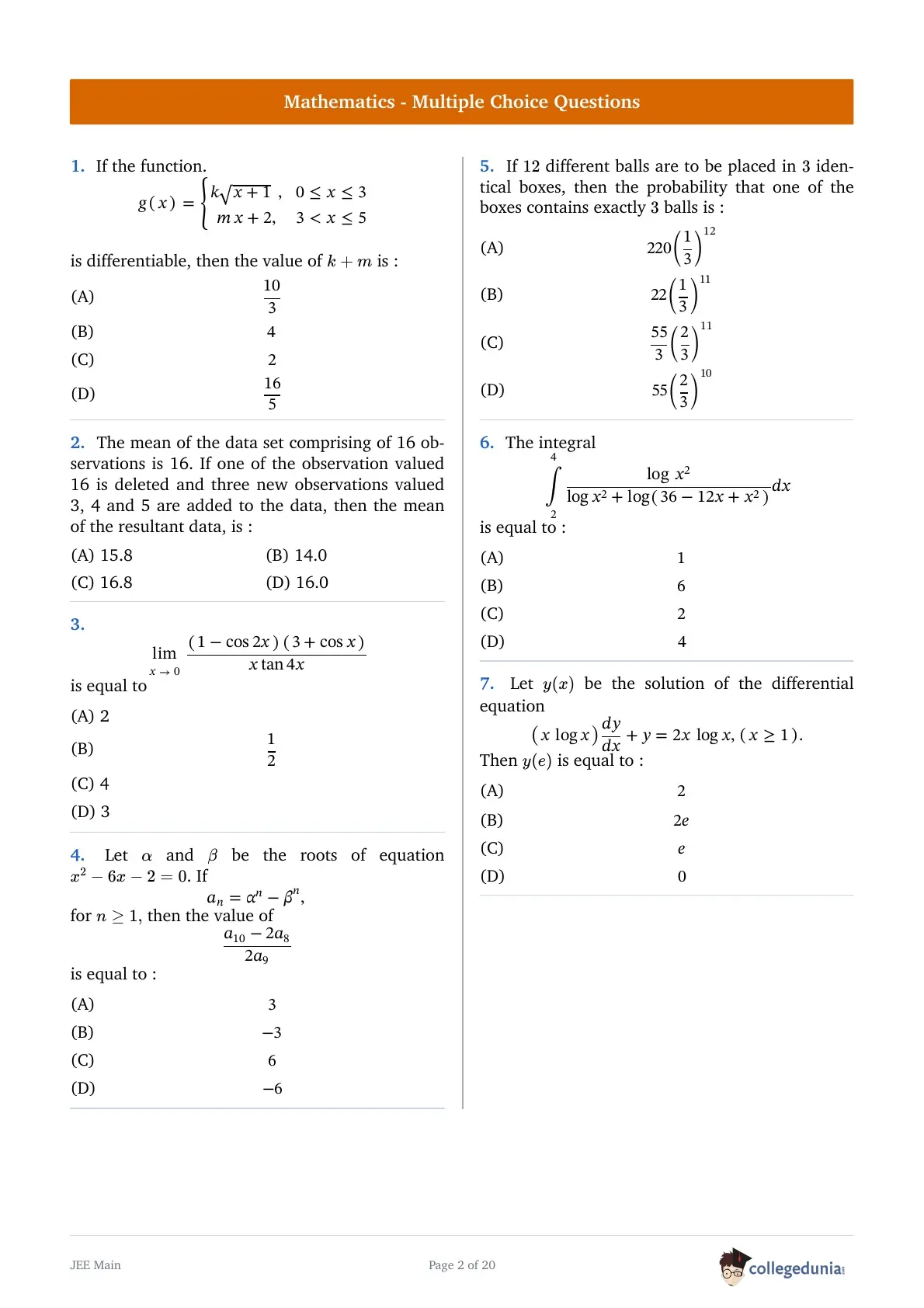
If the function
\( g(x) = \begin{cases} k\sqrt{x+1}, & 0 \le x \le 3 \\ mx + 2, & 3 \lt x \le 5 \end{cases} \)
is differentiable, then the value of \(k + m\) is :
The mean of the data set comprising of \(16\) observations is \(16\). If one of the observatio \(d\) three new observations valued \(3,4\) and \(5\) added to the data, then the mean of the resultant data is
\( \displaystyle \lim_{x \to 0} \frac{(1-\cos 2x)(3+\cos x)}{x \tan 4x} \) is equal to
Let \(\alpha\) and \(\beta\) be the roots of \(x^2 - 6x - 2 = 0\). If \(a_n = \alpha^n - \beta^n\) for \(n \ge 1\), then the value of \(\frac{a_{10} - 2a_8}{3a_9}\) is:
If \(12\) identical balls are to be placed in \(3\) different boxes, then the probability that one of the boxes contains excatly \(3\) balls, is
The integral
\( \displaystyle \int_{2}^{4} \frac{\log x^2}{\log x^2 + \log (36 - 12x + x^2)}\,dx \)
is equal to :
Let \(y(x)\) be the solution of the differential equation
\( (x\log x)\frac{dy}{dx} + y = 2x\log x, \ (x \ge 1) \).
Then \(y(e)\) is equal to :
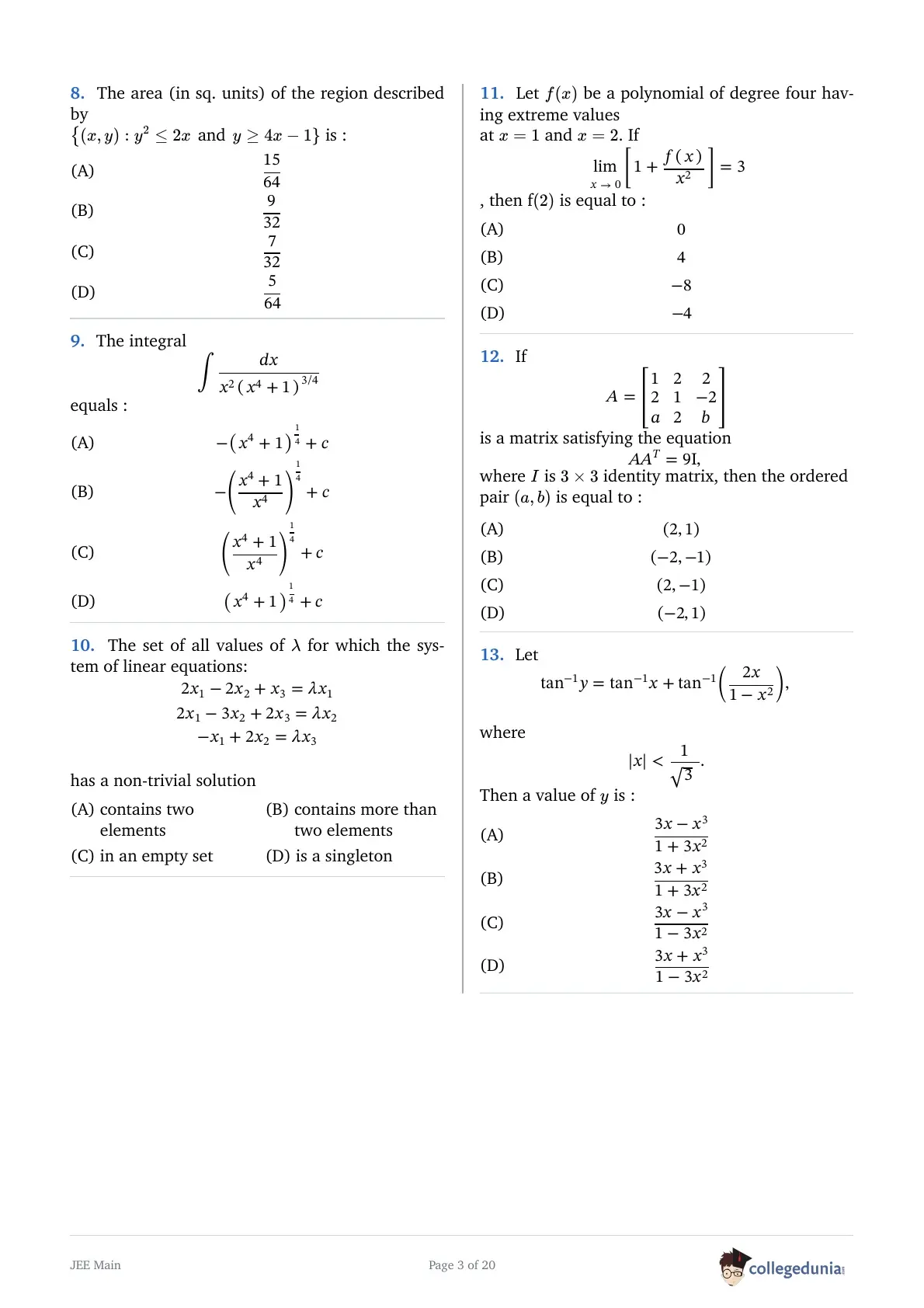
The area (in square units) of the region described by: \[ \{(x, y) : y^2 \leq 2x, \, \text{and} \, y \geq 4x - 1\} \] is:
The integral
\(\int_1^2 e^x \cdot x^x\,(2+\log_e x)\,dx\)
equals :
The set of all values of \(\lambda\) for which the system of linear equations
\(2x_1-2x_2+x_3=\lambda x_1\)
\(2x_1-3x_2+2x_3=\lambda x_2\)
\(-x_1+2x_2=\lambda x_3\) has a non-trivial solution
Let \( f : \mathbb{R} \to \mathbb{R} \) be a polynomial function of degree four having extreme values at \( x = 4 \) and \( x = 5 \). If \lim_{x \to 0} \frac{f(x)}{x^2} = 5, then f(2) is equal to:
If A = \begin {bmatrix} 1 & 2 & 2 \\ 2 & 1 & -2 \\ a & 2 & b \end {bmatrix}\( is a matrix satisfying the equation \)AA^T =9 I,\( where, \)I\( is \)3 \times 3\( identity matrix, then the ordered pair \)(a, b) is equal to
Let \( \tan^{-1} y = \tan^{-1} x + \tan^{-1}\left(\frac{2x}{1-x^2}\right) \), where \( |x| \lt \frac{1}{\sqrt{3}} \). Then a value of \(y\) is :
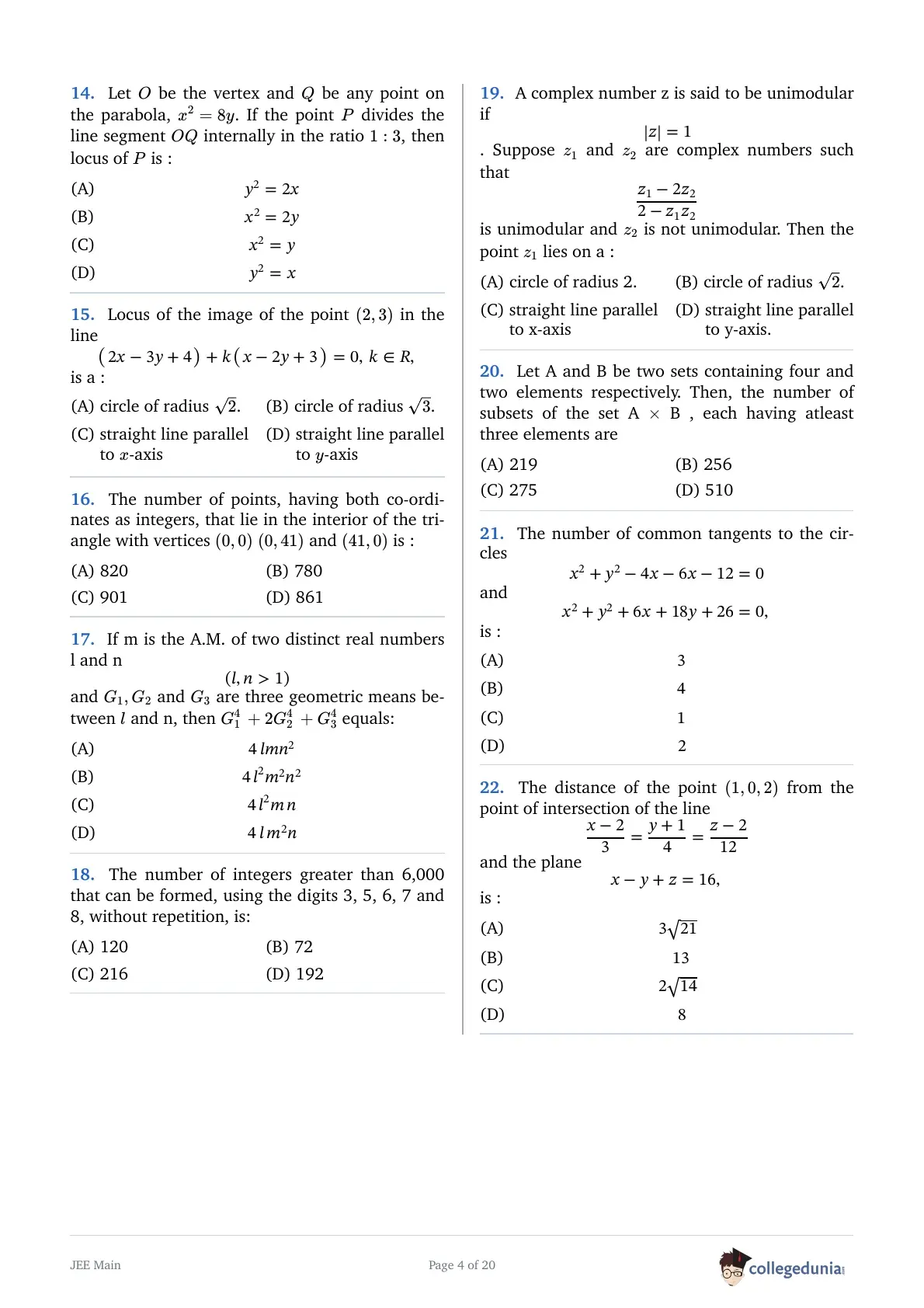
Let \(O\) be the vertex and \(Q\) be any point on the parabola, \(x^2\) = 8y. If the point \(P\) divides the line segment \(OQ\) internally in the ratio \(1 : 3\), then the locus of \(P\) is
Locus of the image of the point \((2, 3)\) in the line \(\left(2x - 3y + 4\right) + k\left(x - 2y + 3\right) = 0, k \in R,\) is a
The number of points, having both co-ordinates as integers, that lie in the interior of the triangle with vertices \((0,0)\), \((0,41)\) and \((41,0)\) is :
Let A₁ and A₂ be two arithmetic means and G1, G2, G3 be three geometric means of two distinct positive numbers. Then \( G_{1}^{4} + G_{2}^{4}+ G_{3}^{4} +G_{1}^{2}G_{3}^{2} \) is equal to
The number of integers greater than \(6,000\) that can be formed using the digits \(3, 5, 6, 7\) and \( 8\) without repetition is
A complex number \(z\) is the said to be unimodular if \(|z|=1 .\) Suppose \(z_{1}\) and \(z_{2}\) are complex number such that \(\frac{z_{1}-2 z_{2}}{2-z_{1} z_{2}}\) is unimodular and \(z _{2}\) is not unimodular. Then the point \(z_{1}\) lies on a :
Let \(A\) and \(B\) be two sets containing four and two elements respectively. Then the number of subsets of the set \(A \times B\), each having at least three elements is :
The number of common tangents to the circles \(x^2+y^2-4x-6y-12=0\) and \(x^2+y^2+6x+18y+26=0\)
The distance of the point \((1,0,2)\) from the point of intersection of the line
\( \frac{x-2}{3} = \frac{y+1}{4} = \frac{z-2}{12} \)
and the plane
\( x - y + z = 16 \),
is :
Let \(\vec{a}, \vec{b}\) and \(\vec{c}\) be three non-zero vectors such that no two of them are collinear and
\( (\vec{a}\times\vec{b})\times\vec{c} = \frac{1}{3}|\vec{b}||\vec{c}|\,\vec{a} \).
If \(\theta\) is the angle between vectors \(\vec{b}\) and \(\vec{c}\), then a value of \(\sin\theta\) is :
The sum of coefficients of integral powers of \(x\) in the binomial expansion \((1-2\sqrt x)^{50}\) is
The area (in s units) of the quadrilateral formed by the tangents at the end points of the latera recta to the ellipse \(\frac{x^{2}}{9}+\frac{y^{2}}{5}=1\), is:
The sum of first 9 terms of the series
\( \frac{1^3}{1} + \frac{1^3+2^3}{1+3} + \frac{1^3+2^3+3^3}{1+3+5} + \dots \)
The normal to the curve, \(x^2+2xy-3y^2=0\), at \((1,1)\)
The equation of the plane containing the lines \(2x - 5y + z = 3, x + y + \, z = 5\) and parallel to the plane \(x + 3 y+ 6 z = 1\) is
If the angles of elevation of the top of a tower from three collinear points \(A , B\) and \(C\) on a line leading to the foot of the tower are \( 30^\circ, \, 45^\circ\) and \( 60^\circ\) respectively, then the ratio \(AB : BC\) is
The negation of \( (p \land (\sim q)) \lor (\sim p) \) is equivalent to:
Physics (Q31 - Q60)
As an electron makes a transition from an excited state to the ground state of a hydrogen- like atom/ion
A red LED emits light at 0.1 watt uniformly around it. The amplitude of the electric field of the light at a distance of 1 m from the diode is :
Monochromatic light is incident on a glass prism of angle \(A\). If the refractive index of the material of the prism is \(u\), a ray incident at an angle \(\theta\), on the face \(AB\) would get transmitted through the face \(AC\) of the prism provided

An \(LCR\) circuit is equivalent to a damped pendulum. In an \(LCR\) circuit the capacitor is charged to \(Q _{0}\) and then connected to the \(L\) and R as shown below :
 R If a student plots graphs of the square of maximum charge \(\left( Q _{\max }^{2}\right)\) on the capacitor with time \((t) \) for two different values \(L_{1}\) and \(L_{2}\) \(\left(L_{1}>L_{2}\right)\) of \(L\) then which of the following represents this graph correctly ?
(Plots are shematic and not drawn to scale)
- (1)
![]()
- (2)
![]()
- (3)
![]()
- (4)
![]()


An inductor (\(L = 0.03\) H) and a resistor (\(R = 0.15\ \mathrm{k\Omega}\)) are connected in series to a battery of 15 V EMF in a circuit shown below. The key \(K_1\) has been kept closed for a long time. Then at \(t=0\), \(K_1\) is opened and key \(K_2\) is closed simultaneously. At \(t = 1\) ms, the current in the circuit will be :
(\(e^5 \cong 150\))
On a hot summer night, the refractive index of air is smallest near the ground and increases with height from the ground. When a light beam is directed horizontally, the Huygens principle leads us to conclude that as it travels, the light beam
Two coaxial solenoids of different radii carry current \(I\) in the same direction. Let \(\vec{F}_1\) be the magnetic force on the inner solenoid due to the outer one and \(\vec{F}_2\) be the magnetic force on the outer solenoid due to the inner one. Then,
Assuming human pupil to have a radius of \(0.25\, cm\) and a comfortable viewing distance of \(25\, cm\), the minimum separation between two objects that human eye can resolve at \(500\, nm\) wavelength is
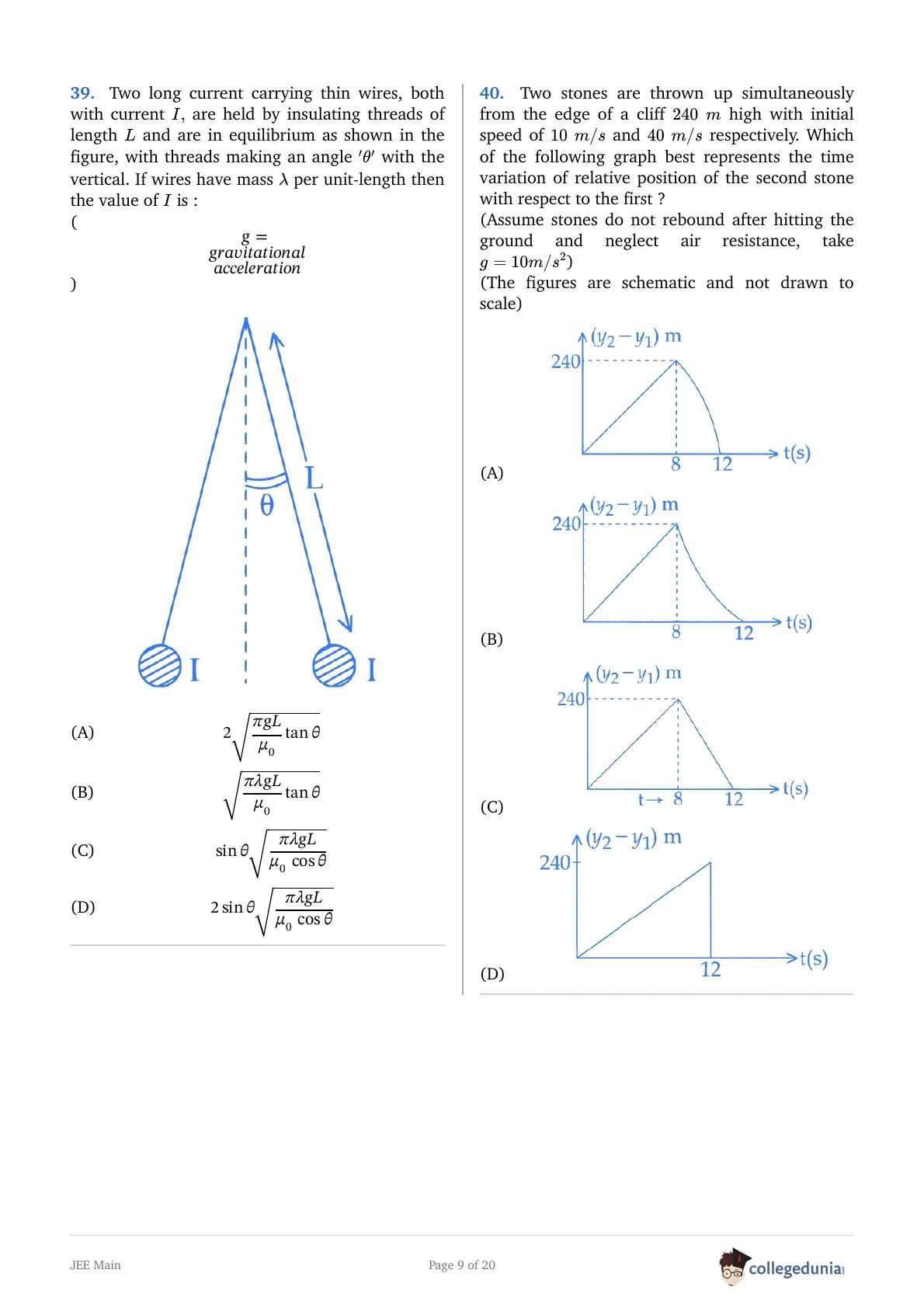
Two long current carrying thin wires, both with current \(I\), are held by insulating threads of length \(L\) and are in equilibrium as shown in the figure, with threads making an angle \('\theta'\) with the vertical. If wires have mass \(\lambda\) per unit length then, the value of \(I\) is : ( \(g =\) gravitational acceleration)
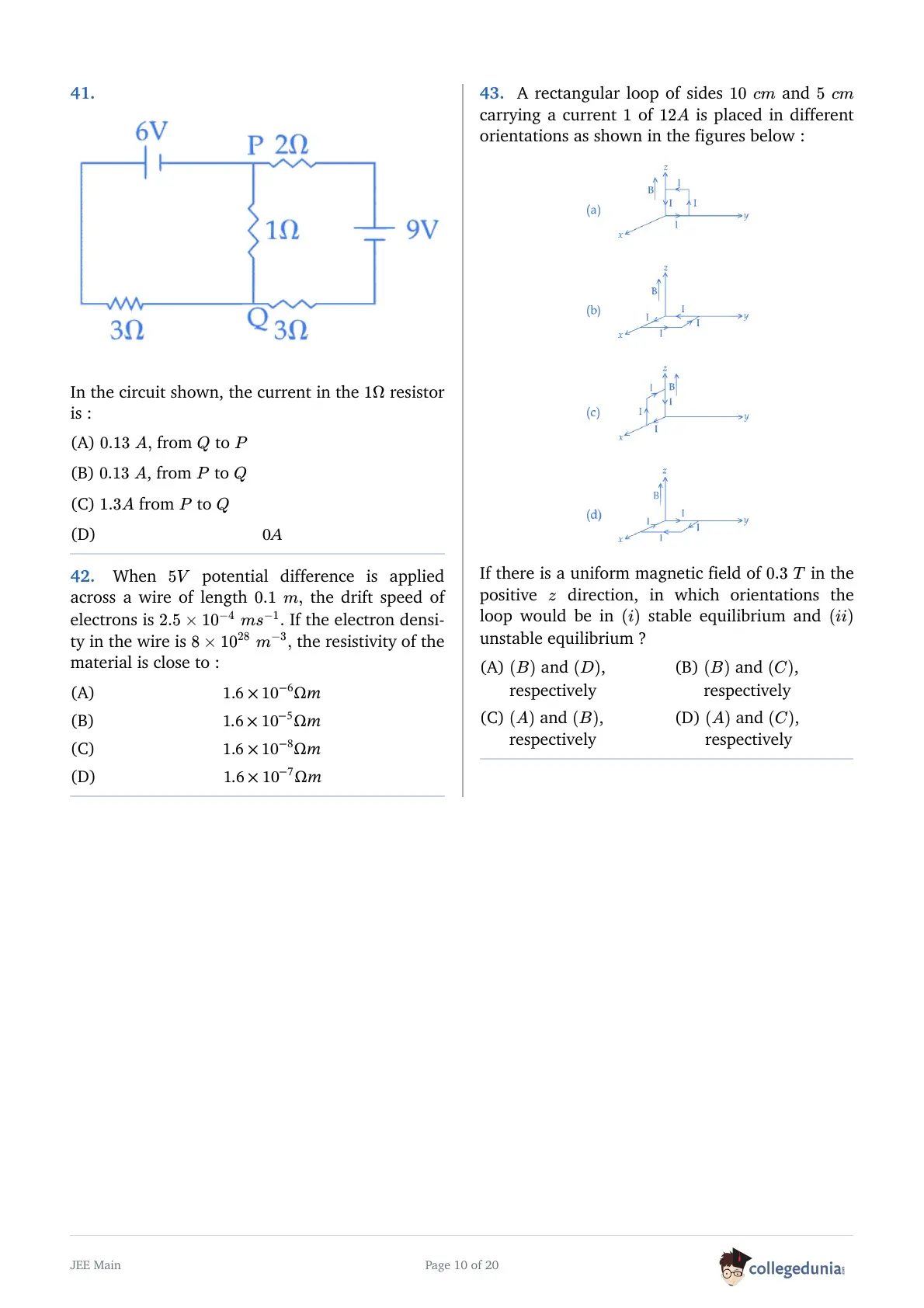
Two stones are thrown up simultaneously from the edge of a cliff \(240\, m\) high with initial speed of \(10\, m/s\) and \(40\, m/s\) respectively. Which of the following graph best represents the time variation of relative position of the second stone with respect to the first? (Assume stones do not rebound after hitting the ground and neglect air resistance, take \(g=10\, m/s^2\))
- (1)
![]()
- (2)
![]()
- (3)
![]()
- (4)
![]()


In the circuit shown, the current in the \(1\,\Omega\) resistor is :
When \(5\,V\) potential difference is applied across a wire of length \(0.1\,m\), the drift speed of electrons is \(2.5\times10^{-4}\) \(ms^{-1}\). If the electron density in the wire is \(8\times10^{28}\, m^{-3}\) the resistivity of the material is close to
A uniform magnetic field B of 0.3 T is along the positive Z-direction. A rectangular loop (abcd) of sides 10 cm \(\times\) 5 cm carries a current I of 12 A. Out of the following different orientations which one corresponds to stable equilibrium ?
- (1)
![]()
- (2)
![]()
- (3)
![]()
- (4)
![]()


A pendulum made of a uniform wire of cross sectional area \(A\) has time period \(T\). When an additional mass \(M\) is added to its bob, the time period changes to \(T_M\). If the Young's modulus of the material of the wire is \(Y\) then \(\frac{1}{Y}\) is equal to ( \(g =\) gravitational acceleration)
A uniformly charged solid sphere of radius \(R\) has potential \(V _{0}\, 9\) measured with respect to \(\infty\) ) on its surface. For this sphere the equipotential surfaces with potentials \(\frac{3 V _{0}}{2}\), \(\frac{5 V _{0}}{4}, \frac{3 V _{0}}{4}\) and \(\frac{ V _{0}}{4}\) have radius \(R _{1}, R _{2}, R _{3}\) and \(R _{4}\) respectively. Then
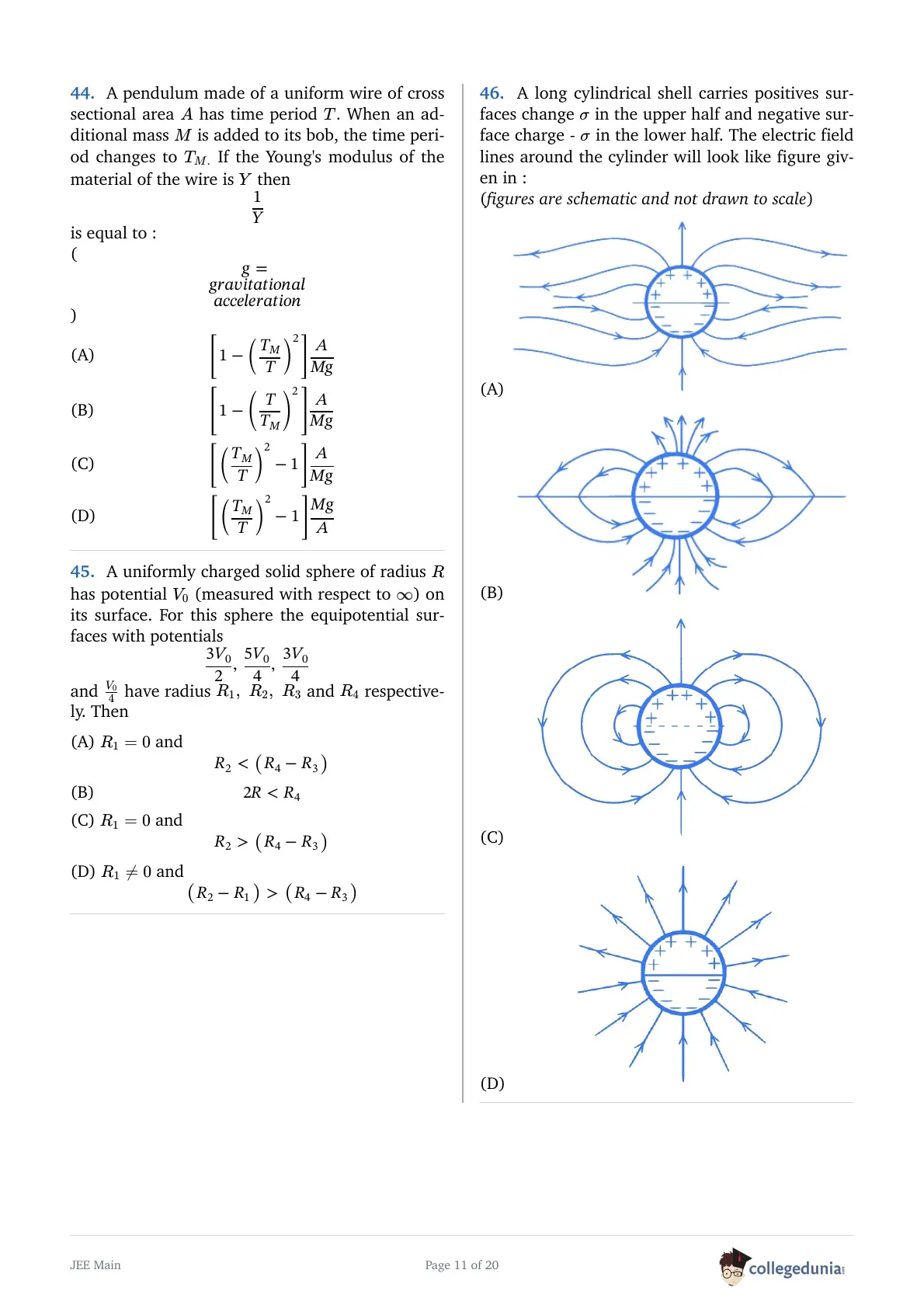
A long cylindrical shell carries positive surface charge \(\sigma\) in the upper half and negative surface charge \(-\sigma\) in the lower half. The electric field lines around the cylinder will look like figure given in: (figures are schematic and not drawn to scale)
- (1)
![]()
- (2)
![]()
- (3)
![]()
- (4)
![]()


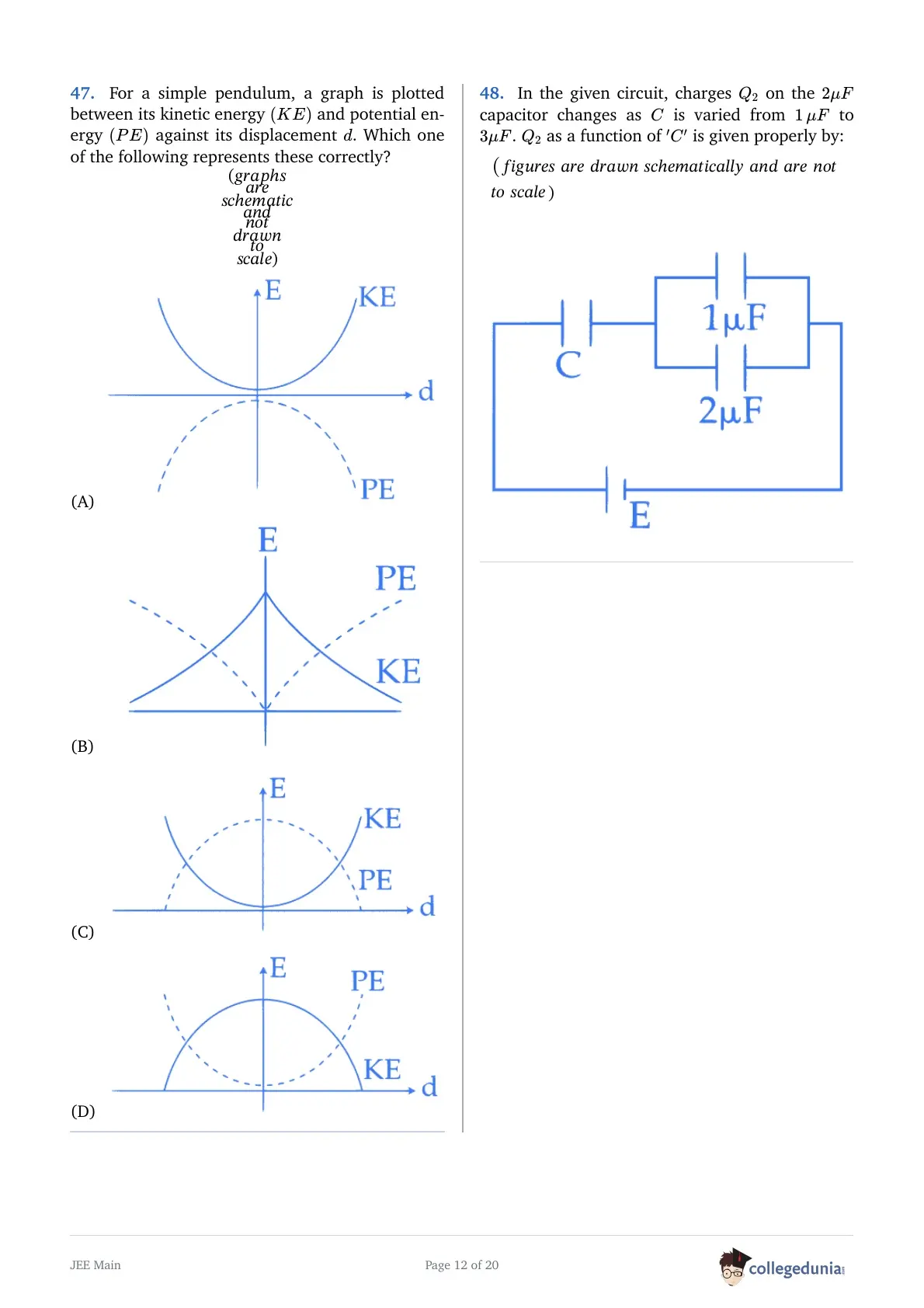
For a simple pendulum, a graph is plotted between its kinetic energy (KE) and potential energy (PE) against its displacement \(d\). Which one of the following represents these correctly?
(graphs are schematic and not drawn to scale)
- (1)
![]()
- (2)
![]()
- (3)
![]()
- (4)
![]()


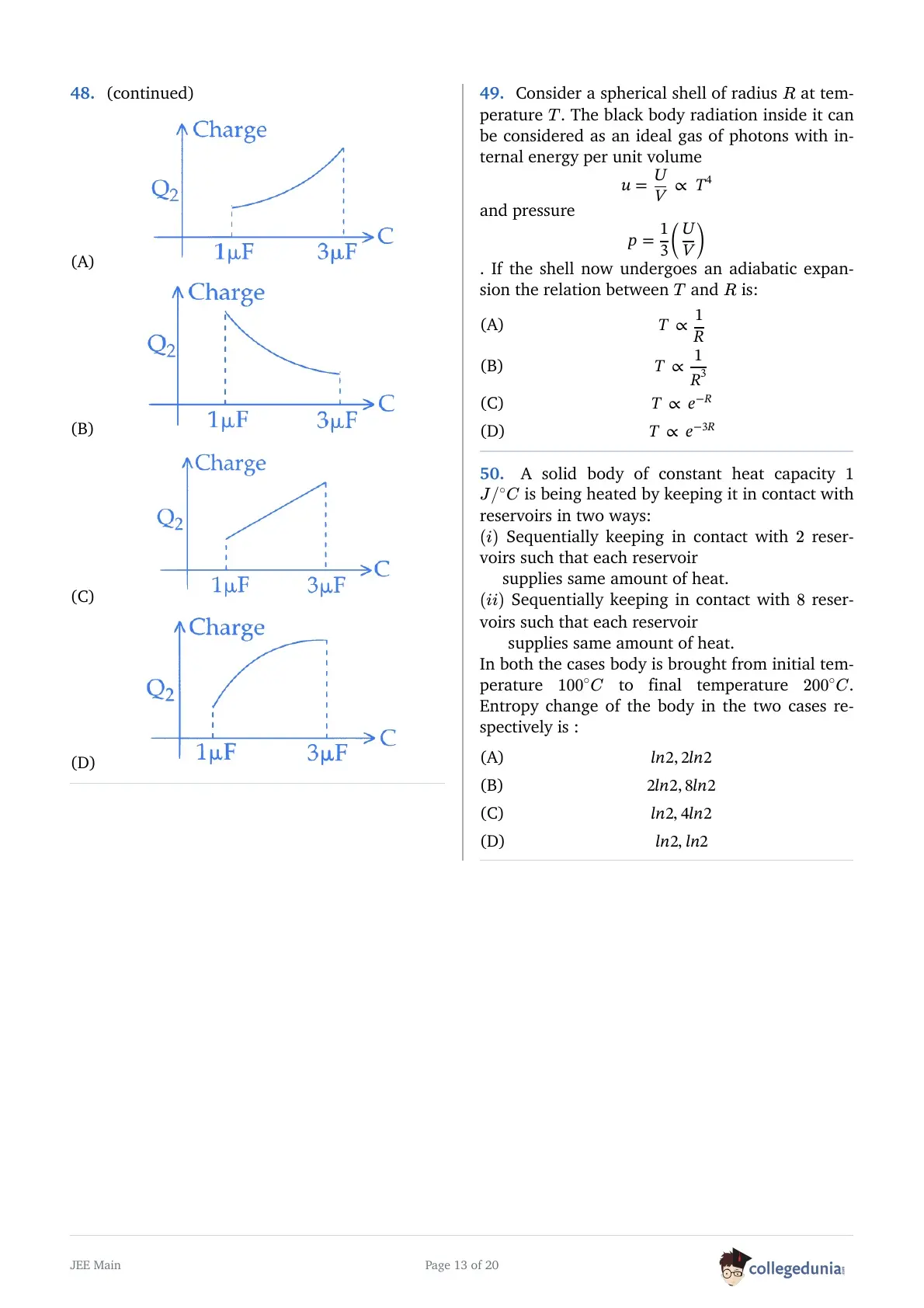
In the given circuit, charge \(Q_2 \) on the \(2 \mu F \) capacitor changes as \(C\) is varied from \(1 \mu F \) to \(3 \mu F. \) \(Q_2 \) as a function of \('C'\) is given properly by (figures are drawn schematically and are not to scale)
- (1)
![]()
- (2)
![]()
- (3)
![]()
- (4)
![]()


Consider a spherical shell of radius \(R\) at temperature \(T\). The black body radiation inside it can be considered as an ideal gas of photons with internal energy per unit volume \(u=\frac{U}{V} ? T^4\) and pressure \(p=\frac{1}{3}\bigg(\frac{U}{V}\bigg)\) If the shell now undergoes an adiabatic expansion, the relation between \(T\) and \(R\) is
A solid body of constant heat capacity \(1 \, J/^{\circ}C\) is being heated by keeping it in contact with reservoirs in two ways (i) Sequentially keeping in contact with \(2\) reservoirs such that each reservoir supplies same amount of heat. (ii) Sequentially keeping in contact with \(8\) reservoirs such that each reservoir supplies same amount of heat. In both the cases, body is brought from initial temperature \(100^{\circ}C\) to final temperature \(200^{\circ}C\). Entropy change of the body in the two cases respectively, is
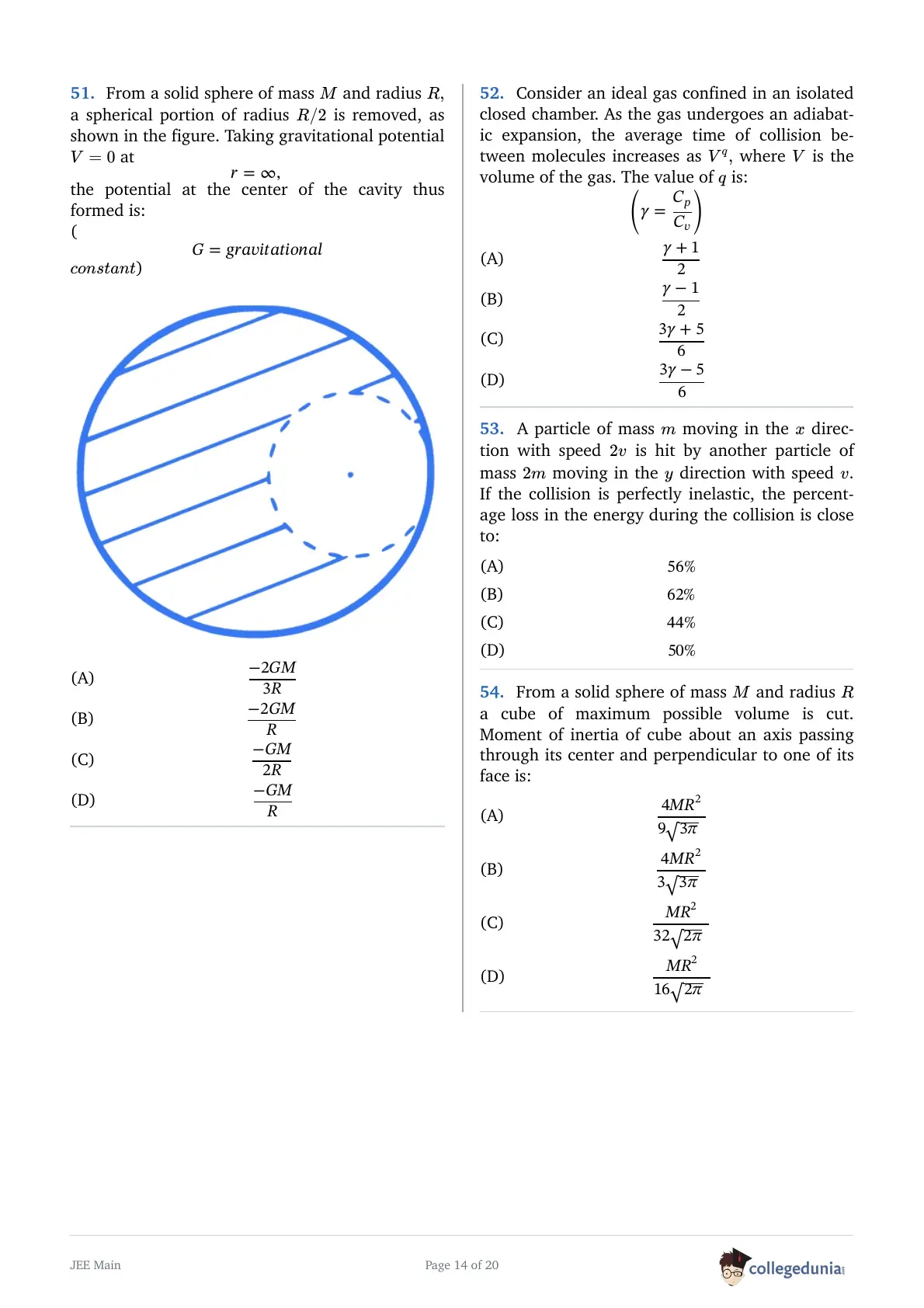
From a solid sphere of mass \(M\) and radius \(R\), a spherical portion of radius \(\frac{R}{2}\) is removed, as shown in the figure. Taking gravitational potential \(V = 0\) at \(r = \infty\), the potential at the centre of the cavity thus formed is (\(G =\) gravitational constant)
Consider an ideal gas confined in an isolated closed chamber. As the gas undergoes an adiabatic expansion, the average time of collision between molecules increases as \(V^q\) , where \(V\) is the volume of the gas. The value of \(q\) is \(\bigg(\gamma =\frac{C_p}{C_v}\bigg)\)
A particle of mass \(m\) moving in the \(x\) direction with speed \(2v\) is hit by another particle of mass \(2m\) moving in the \(y\) direction with speed \(v\). If the collision is perfectly inelastic, the percentage loss in the energy during the collision is close to:
From a solid sphere of mass \(M\) and radius \(R\) a cube of maximum possible volume is cut. Moment of inertia of cube about an axis passing through its center and perpendicular to one of its face is:
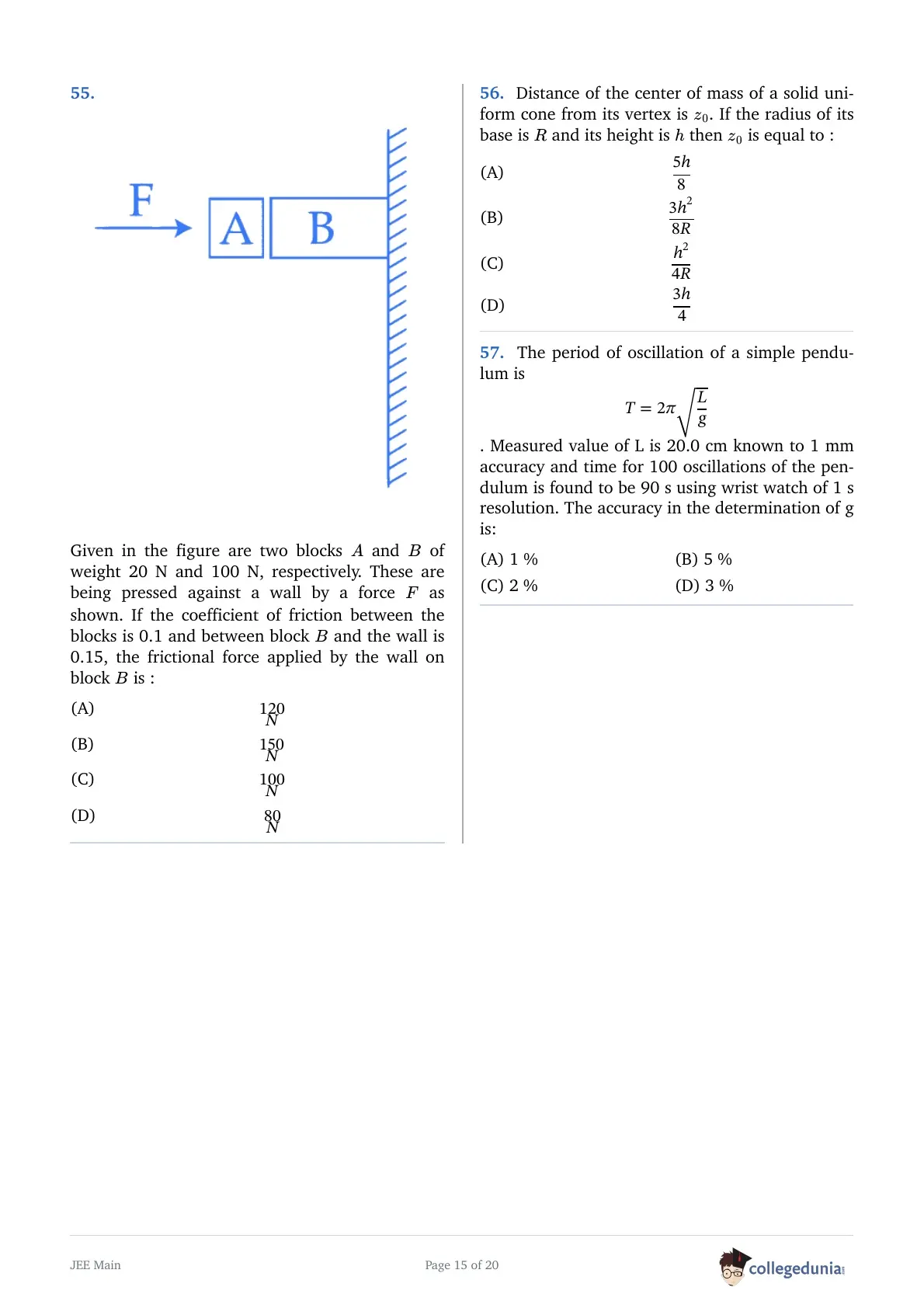
 Given in the figure are two blocks \(A\) and \(B\) of weight \(20\,N\) and \(100\,N\), respectively. These are being pressed against a wall by a force \(F\) as shown in figure. If the coefficient of friction between the blocks is \(0.1\) and between block \(B\) and the wall is \(0.15\), the frictional force applied by the wall in block \(B\) is
Distance of the center of mass of a solid uniform cone from its vertex is \(z_0\). If the radius of its base is \(R\) and its height is \(h\) then \(z_0\) is equal to :
The period of oscillation of a simple pendulum is \(T=2 \pi \sqrt{\frac{L}{g}}\). Measured value of \(L\) is \(20.0\, cm\) known to \(1\, mm\) accuracy and time for \(100\) oscillations of the pendulum is found to be \(90\, s\) using a wrist watch of \(1\, s\) resolution. The accuracy in the determination of \(g\) is
A train is moving on a straight track with speed \(20\, ms^{-1}.\) It is blowing its whistle at the frequency of \(1000\, Hz\). The percentage change in the frequency heard by a person standing near the track as the train passes him is close to (speed of sound \(= 320\,ms^{-1}\))
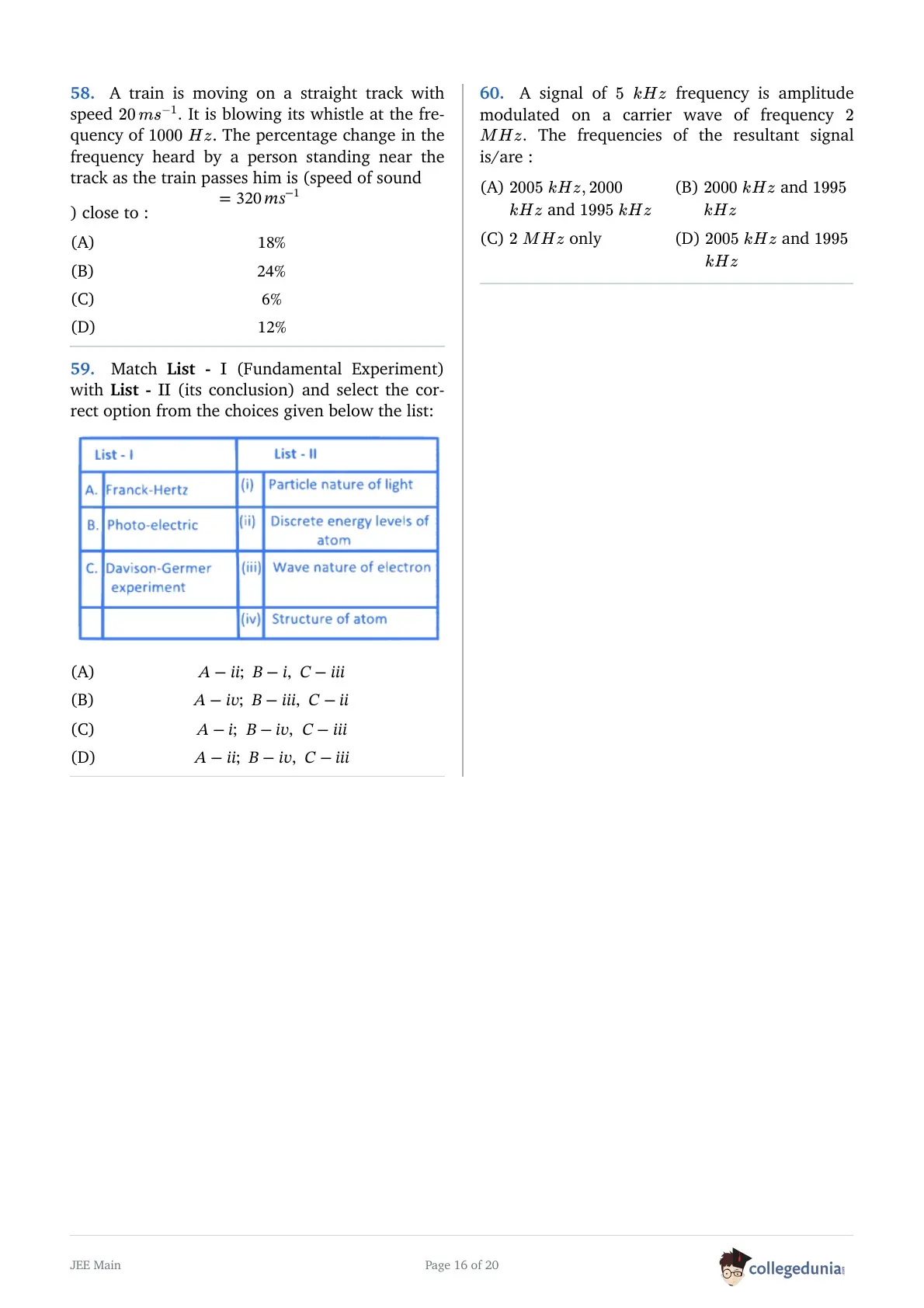
| List - I | List - II |
| A. Franck-Hertz | (i) Particle nature of light |
| B. Photo-electric | (ii) Discrete energy levels of atom |
| C. Davison-Germer experiment | (iii) Wave nature of electron |
| (iv) Structure of atom |
A signal of 5 kHz frequency is amplitude modulated on a carrier wave of frequency 2 MHz. The frequencies of the resultant signal is/are :
Chemistry (Q61 - Q90)
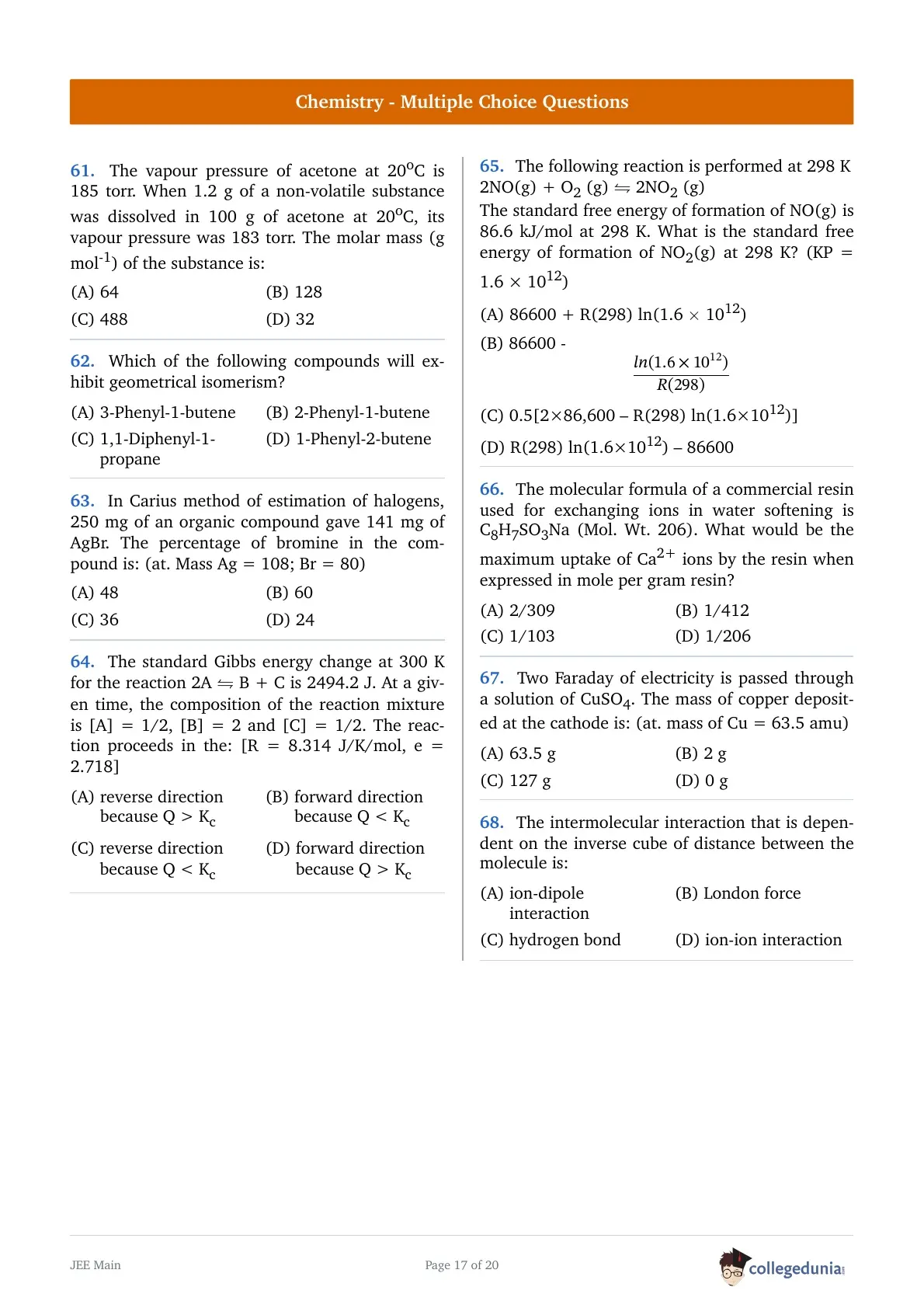
The vapour pressure of acetone at 20\(^\circ\)C is 185 torr. When 1.2 g of a non-volatile substance was dissolved in 100 g of acetone at 20\(^\circ\)C, its vapour pressure was 183 torr. The molar mass (g mol\(^{-1}\)) of the substance is:
Which of the following compounds will exhibit geometrical isomerism?
In Carius method of estimation of halogens \(250\, mg\) of an organic compound gave \(141\, mg\) of \(AgBr\). The percentage of bromine in the compound is (atomic mass \(Ag\, =\, 108, Br \,= \,80\))
The standard Gibbs energy change at \(300 \,K\) for the reaction \(2 A \to B+C\) is \(2494.2]\). At a given time, the composition of the reaction mixture is \([ A ]=\frac{1}{2},[ B ]=2\) and \([ C ] =\frac{1}{2} .\) The reaction proceeds in the : \([ R =8.314\, J / \,K /\, mol , e =2.718]\)
The following reaction is performed at \(298\, K ?\) \(2 NO ( g )+ O _{2}( g ) \rightleftharpoons 2 NO _{2}( g )\) The standard free energy of formation of \(NO ( g )\) is \(86.6 \,kJ /\, mol\) at \(298 \,K .\) What is the standard free energy of formation of \(NO _{2}( g )\) at \(298 \,K ?\left( K _{n}=1.6 \times 10^{12}\right)\)
The molecular formula of a commercial resin used for exchanging ions in water softening is \(C_8H_7SO_3Na\) (molecular weight = \(206\)). What would be the maximum uptake of \(Ca^{2+}\) ions by the resin when expressed in mole per gram resin
Two Faraday of electricity is passed through a solution of \(CuSO_4\). The mass of copper deposited at the cathode is (At. mass of \(Cu\, = \,63.5\, u\))
The intermolecular interaction that is dependent on the inverse cube of distance between the molecules is
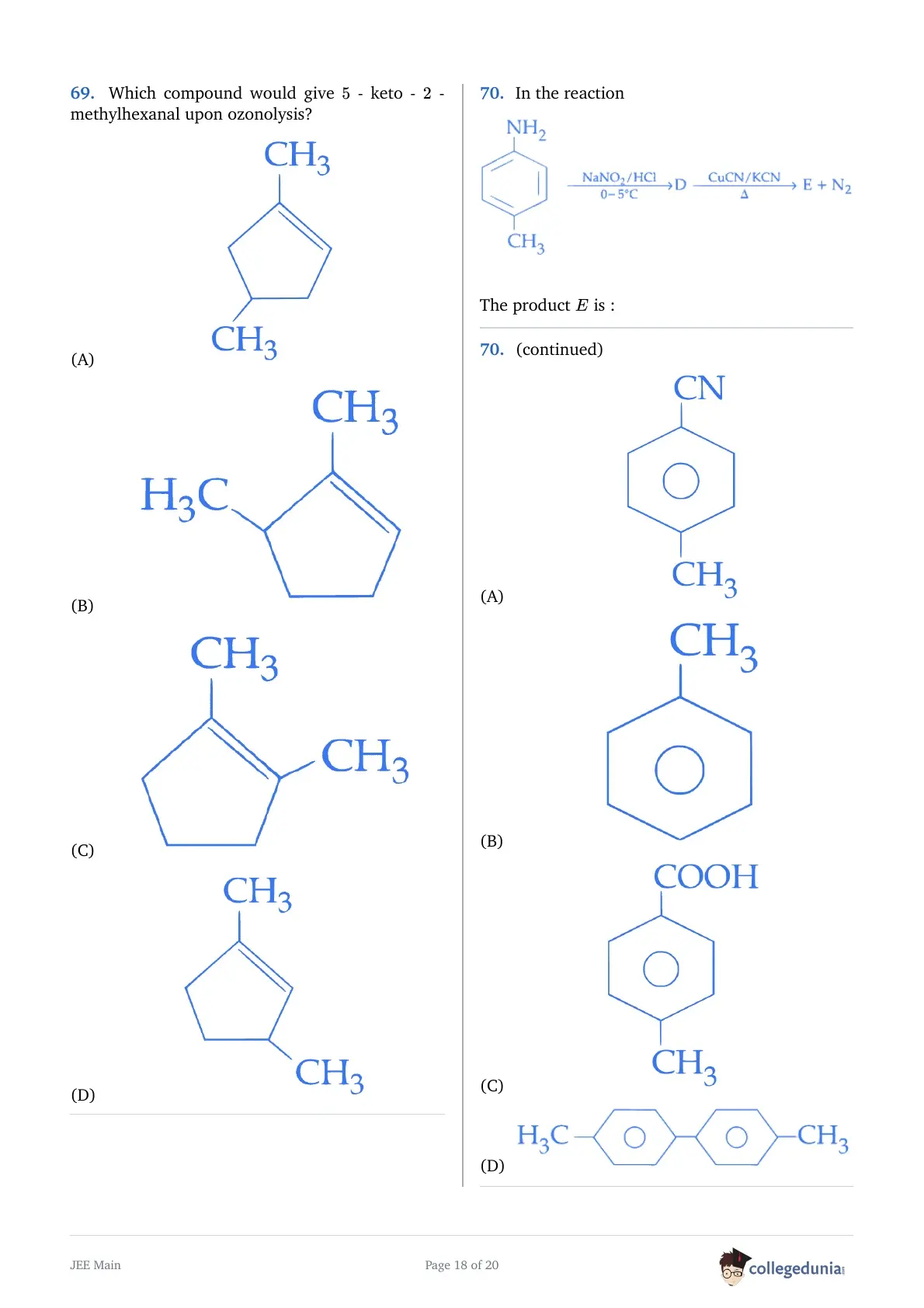
Which compound would give 3-methyl-6-oxoheptanal upon ozonolysis ?
- (1)
![]()
- (2)
![]()
- (3)
![]()
- (4)
![]()


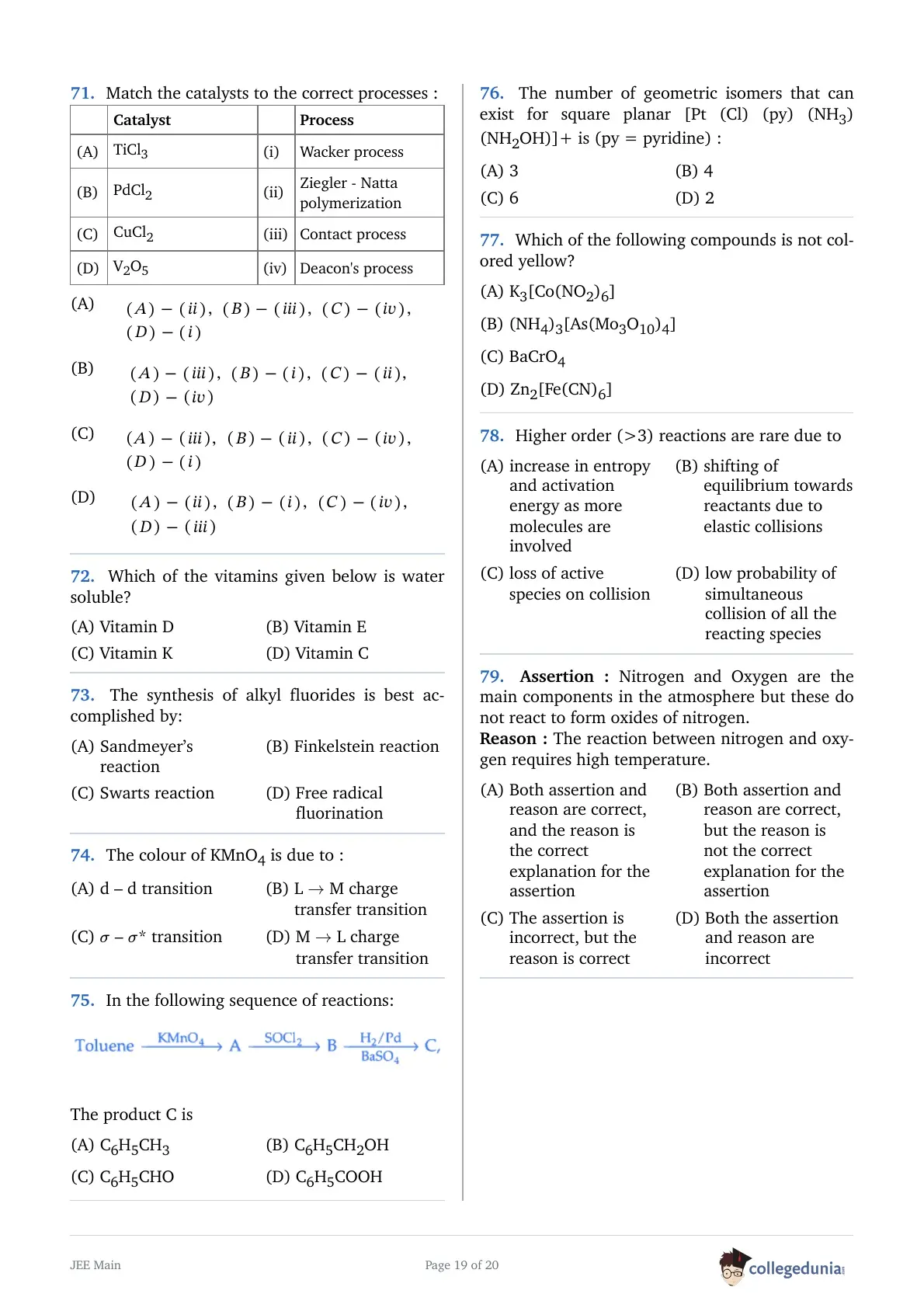
| Catalyst | Process | ||
| (A) | \(\mathrm{TiCl_3}\) | (i) | Wacker process |
| (B) | \(\mathrm{PdCl_2}\) | (ii) | Ziegler - Natta polymerization |
| (C) | \(\mathrm{CuCl_2}\) | (iii) | Contact process |
| (D) | \(\mathrm{V_2O_5}\) | (iv) | Deacon's process |
Which of the vitamins given below is water soluble?
The synthesis of alkyl fluorides is best accomplished by:
The colour of \(\mathrm{KMnO_4}\) is due to :
In the following sequence of reactions:
Toluene \(\xrightarrow{\mathrm{KMnO_4}}\) A \(\xrightarrow{\mathrm{SOCl_2}}\) B \(\xrightarrow{\mathrm{H_2/Pd\text{-}BaSO_4}}\) C,
The product C is
The number of geometric isomers that can exist for square planar \(\left[ Pt ( Cl )( py )\left( NH _{3}\right)\right.\) \(\left.\left( NH _{2} OH \right)\right]^{+}\) is \(( py =\) pyridine \():\)
Which of the following compounds is not colored yellow?
Higher order (>3) reactions are rare due to
Nitrogen and Oxygen are the main components in the atmosphere but these do not react to form oxides of nitrogen. The reaction between nitrogen and oxygen requires high temperature.
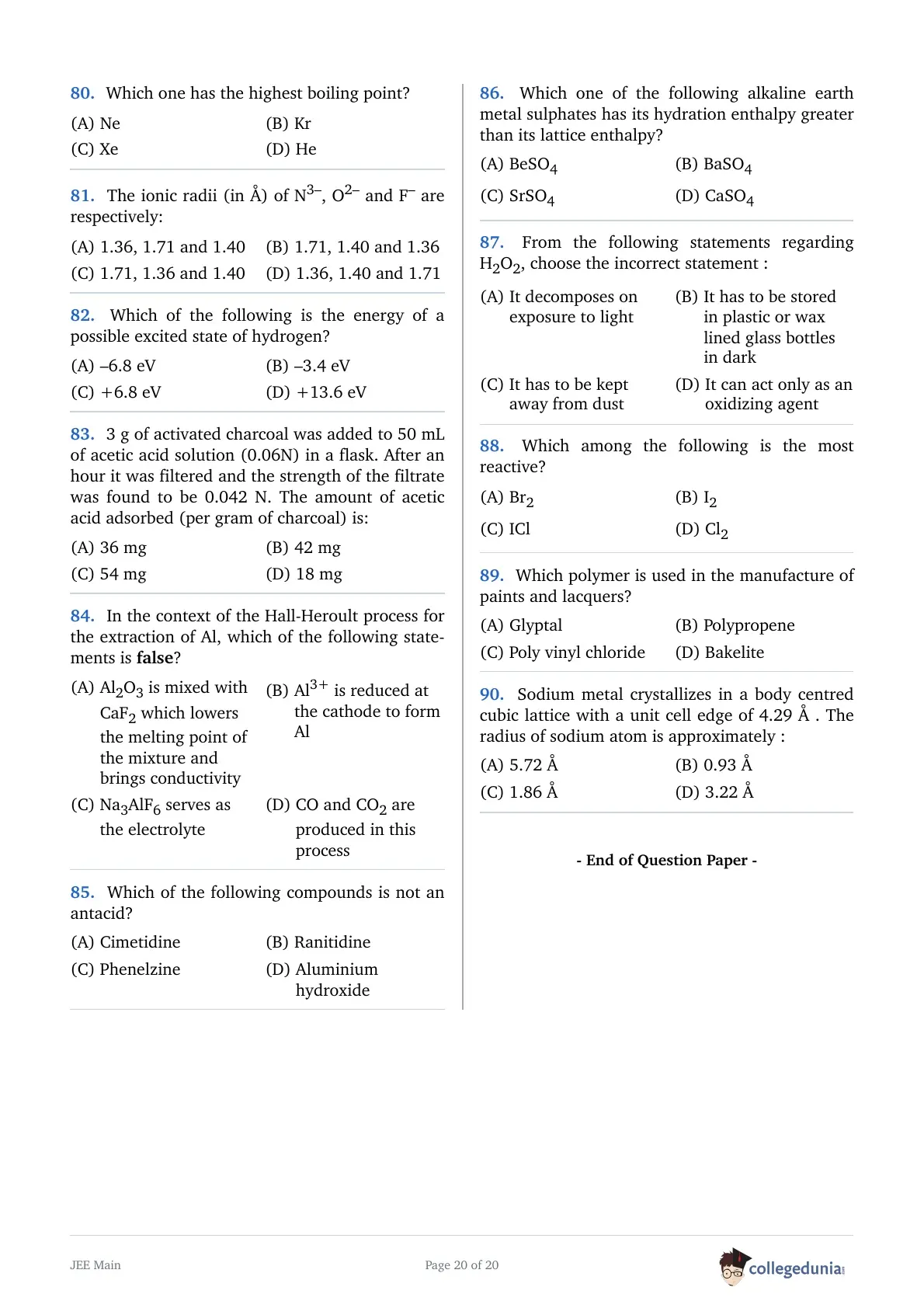
Which one has the highest boiling point?
The ionic radii (in \(?\)) of \(N^{3-},O^{2-} \) and \(F^-\) respectively are
Which of the following is the energy of a possible excited state of hydrogen?
\(3\,g\) of activated charcoal was added to \(50\,mL\) of acetic acid solution (\(0.06\,N\)) in a flask. After an hour it was filtered and the strength of the filtrate was found to be \(0.042\, N\). The amount of acetic acid adsorbed (per gram of charcoal) is
In the context of the Hall-Heroult process for the extraction of \(Al\), which of the following statements is false?
Which of the following compounds is not an antacid?
Which one of the following alkaline earth metal sulphates has its hydration enthalpy greater than its lattice enthalpy?
From the following statements regarding \(\mathrm{H_2O_2}\), choose the incorrect statement :
Which among the following is the most reactive?
Which polymer is used in the manufacture of paints and lacquers?
Sodium metal crystallizes in a body centred cubic lattice with unit cell edge length of 4 Å. The radius of sodium atom is __________ × 10−1 Å (Nearest integer)
JEE Main 2015 Exam Pattern and Marking Scheme
| Particulars | Details |
|---|---|
| Exam Mode | Offline (Pen and Paper) |
| Paper | B.E./B.Tech (Paper 1) |
| Duration | 3 hours (180 minutes) |
| Type of Questions | Multiple Choice Questions (MCQs) |
| Subjects | Mathematics, Physics, Chemistry |
| Total Questions | 90 questions |
| Total Marks | 360 marks |
| Marking Scheme | +4 for correct answer & -1 for incorrect answer; 0 for unattempted |
JEE Main 2015 April 4 (Code B) Difficulty Level
In terms of difficulty level, JEE Main B.E./B.Tech question paper was of moderate level.
JEE Main B.E./B.Tech Code B Question Paper Analysis
- Physics was the toughest section.
- Mathematics was the easiest section among all.
- Chemistry was of Moderate level.
- Each section had 30 questions each.
For every correct answer, the candidate got 4 marks and for each wrong attempt -1 marks were deducted.



Comments