




JEE Main 2016 April 10 Question Paper is available here with solutions PDF and detailed solutions for every question. CBSE conducted the computer-based test (CBT) Paper 1 on April 10, 2016, in the morning session from 9:30 AM to 12:30 PM. The JEE Main 2016 Paper 1 (B.E./B.Tech) question paper includes the following:
- 90 questions in a 3-hour CBT Mode: 30 each from Mathematics, Physics and Chemistry
- Question type: all multiple choice questions (MCQs) with a single correct option, 4 marks each
- Sections: Mathematics (30), Physics (30) and Chemistry (30), all questions compulsory
- Marking: +4 for a correct answer, -1 for an incorrect answer, 0 for an unattempted question
- Maximum marks: 360 (120 per subject)
JEE Main 2016 April 10 Question Paper with Solution PDF
| NTA Official PDF | CD PDF | CD PDF with Solutions |
|---|---|---|
| Download official PDF 4.54 MB | Download Collegedunia PDF 4.97 MB | Download solutions PDF 1.04 MB |
Also Check:
JEE Main 2016 April 10 Questions with Solutions
Mathematics (Q1 - Q30)
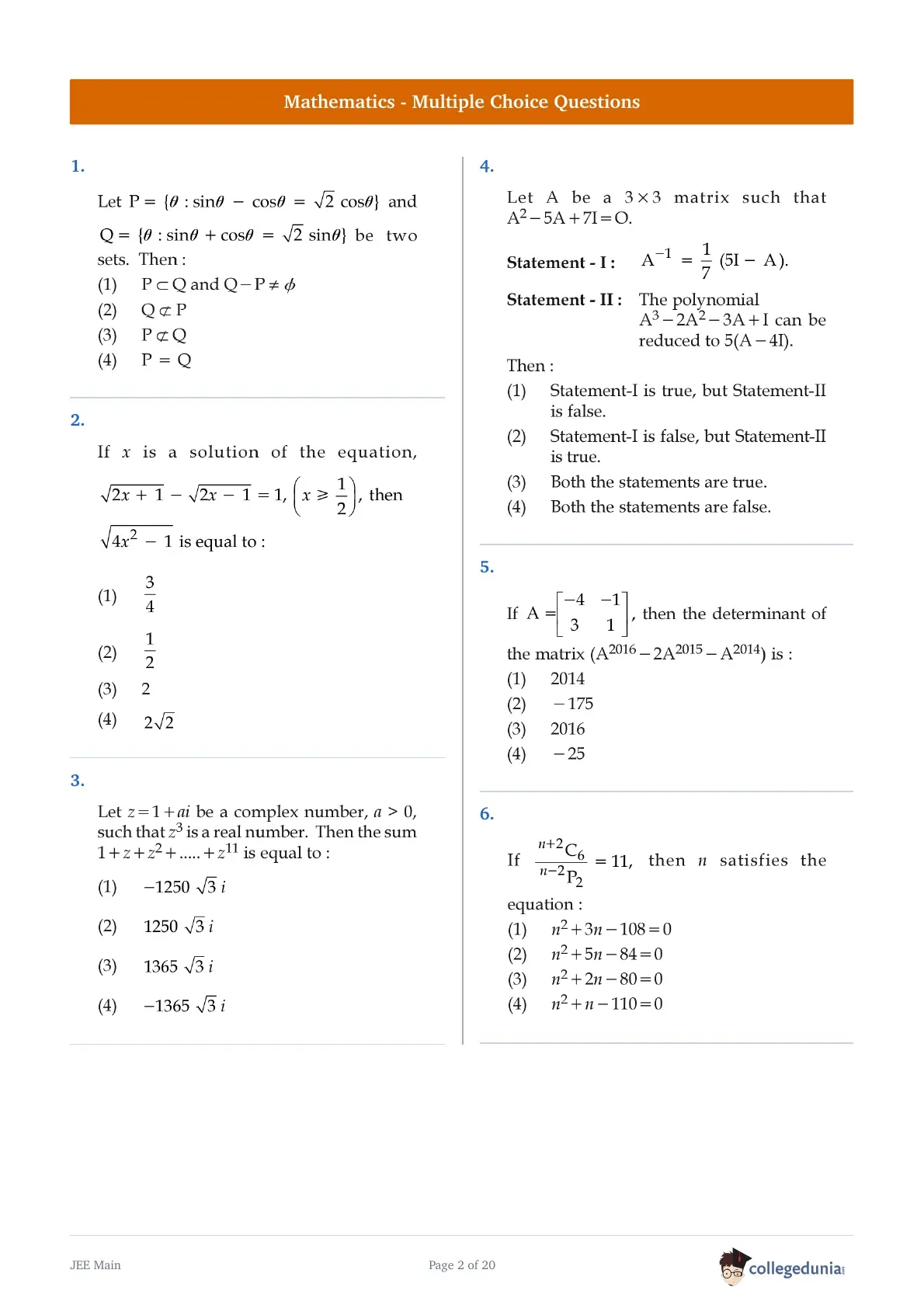
Let \(P = \{ \theta : \sin \theta - \cos \theta = \sqrt{2} \cos \theta \}\) and \(Q = \{\theta : \sin \theta + \cos \theta = \sqrt{2} \sin \theta \}\) be two sets. Then :
If \(x\) is a solution of the equation, \(\sqrt{2x+1}-\sqrt{2x-1}=1\), \(\left(x\geq\frac{1}{2}\right)\), then \(\sqrt{4x^2-1}\) is equal to :
Let \(z = 1 + ai\) be a complex number, \(a > 0\), such that \(z^3\) is a real number. Then the sum \(1 + z + z^2 +..... + z^{11}\) is equal to :
Let A be a \(3\times3\) matrix such that \(A^2-5A+7I=O\).
Statement - I : \(A^{-1}=\frac{1}{7}(5I-A)\).
Statement - II : The polynomial \(A^3-2A^2-3A+I\) can be reduced to \(5(A-4I)\).
Then :
If \(A=\begin{bmatrix}-4&-1\\3&1\end{bmatrix}\), then the determinant of the matrix \((A^{2016}-2A^{2015}-A^{2014})\) is :
If \(\frac{^{n+2}C_6}{^{n-2}P_2} = 11\), then \(n\) satisfies the equation :
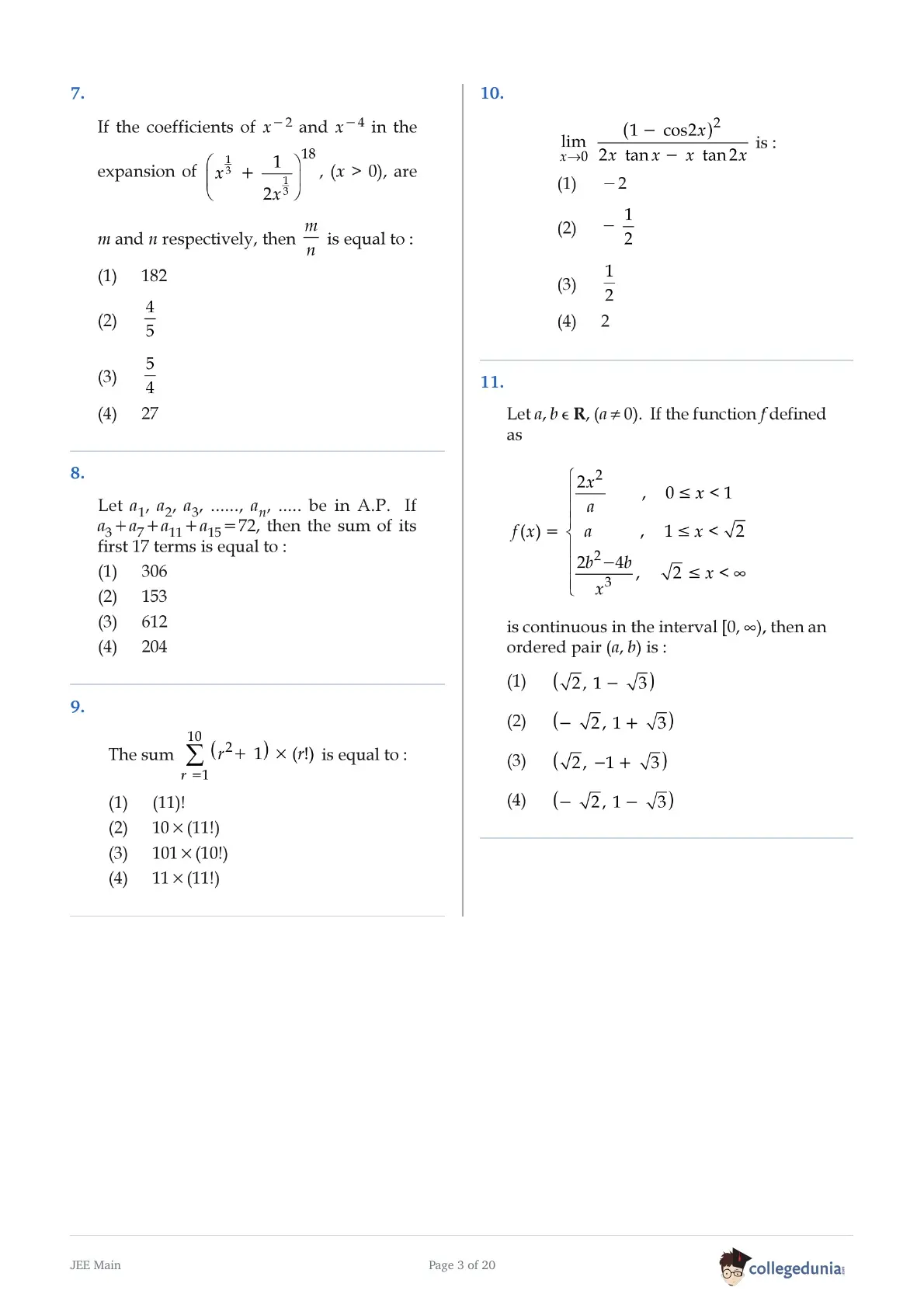
If the coefficients of \(x^{-2}\) and \(x^{-4}\) in the expansion of \(\left(x^{\frac{1}{3}}+\frac{1}{2x^{\frac{1}{3}}}\right)^{18}\), \((x>0)\), are \(m\) and \(n\) respectively, then \(\frac{m}{n}\) is equal to :
Let \(a_1,a_2,a_3,\ldots\ldots,a_n,\ldots\) be in A.P. If \(a_3+a_7+a_{11}+a_{15}=72\), then the sum of its first 17 terms is equal to :
The sum \(\displaystyle\sum^{10}_{r=1}(r^2 + 1) \times (r!)\) is equal to :
\(\displaystyle\lim_{x\to0}\frac{(1-\cos2x)^2}{2x\tan x-x\tan2x}\) is :
Let \(a,b\in\mathbf{R}\), \((a\neq0)\). If the function \(f\) defined as
\(f(x)=\begin{cases}\frac{2x^2}{a}, & 0\leq x<1\\ a, & 1\leq x<\sqrt{2}\\ \frac{2b^2-4b}{x^3}, & \sqrt{2}\leq x<\infty\end{cases}\)
is continuous in the interval \([0,\infty)\), then an ordered pair \((a,b)\) is :
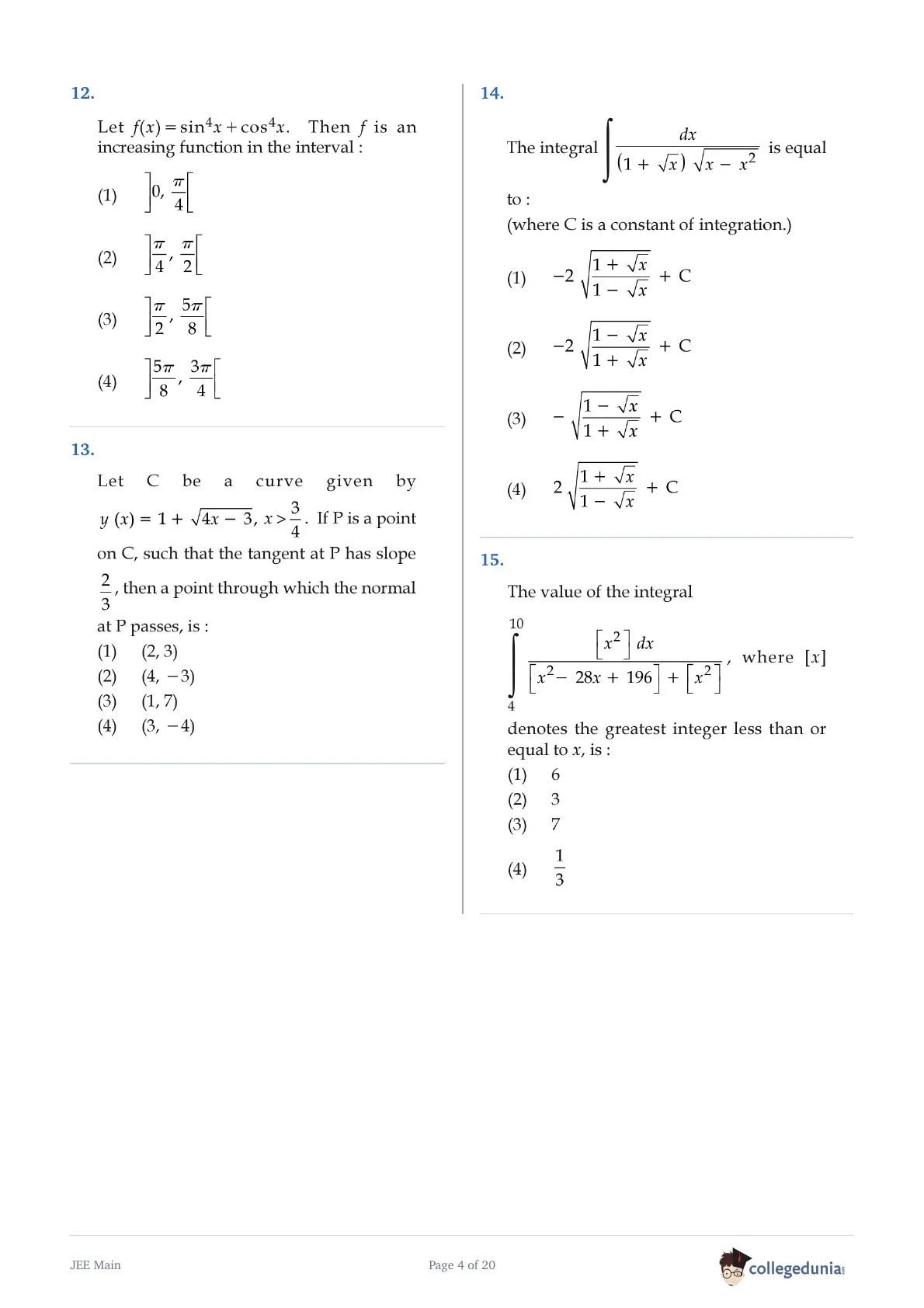
Let \(f(x)=\sin^4x+\cos^4x\). Then \(f\) is an increasing function in the interval :
Let C be a curve given by \(y(x)=1+\sqrt{4x-3}\), \(x>\frac{3}{4}\). If P is a point on C, such that the tangent at P has slope \(\frac{2}{3}\), then a point through which the normal at P passes, is :
The integral \(\displaystyle\int \frac{dx}{(1+ \sqrt{x}) \sqrt{x - x^2}}\) is equal to (where \(C\) is a constant of integration)
The value of the integral \(\displaystyle\int_4^{10}\frac{[x^2]\,dx}{[x^2-28x+196]+[x^2]}\), where \([x]\) denotes the greatest integer less than or equal to \(x\), is :
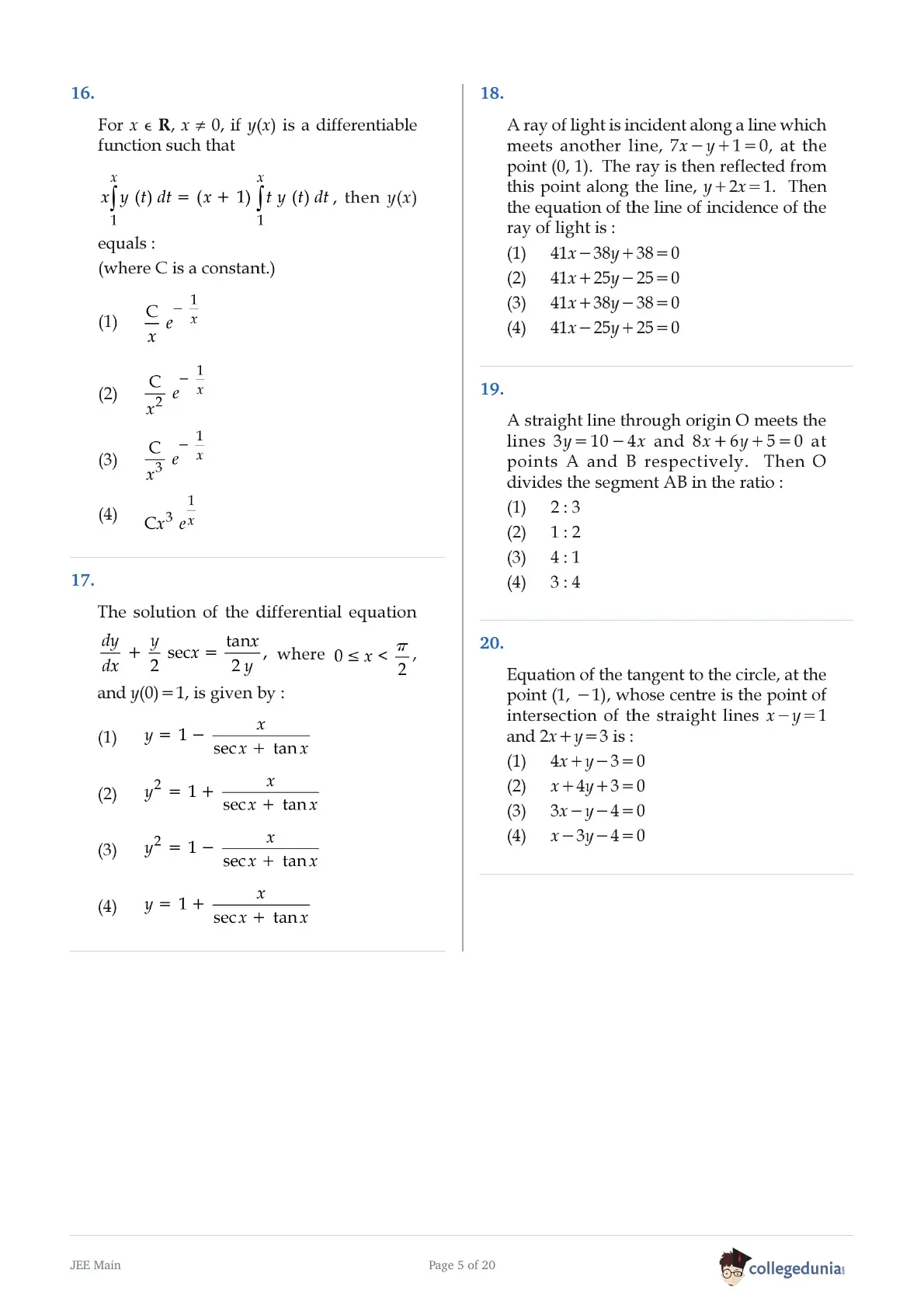
For \(x\in\mathbf{R}\), \(x\neq0\), if \(y(x)\) is a differentiable function such that \(x\displaystyle\int_1^xy(t)\,dt=(x+1)\displaystyle\int_1^xt\,y(t)\,dt\), then \(y(x)\) equals :
(where C is a constant.)
The solution of the differential equation \(\frac{dy}{dx}+\frac{y}{2}\sec x=\frac{\tan x}{2y}\), where \(0\le x\lt\frac{\pi}{2}\), and \(y(0)=1\), is given by :
A ray of light is incident along a line which meets another line, \(7x-y+1=0\), at the point \((0,1)\). The ray is then reflected from this point along the line, \(y+2x=1\). Then the equation of the line of incidence of the ray of light is :
A straight line through origin O meets the lines \(3y=10-4x\) and \(8x+6y+5=0\) at points A and B respectively. Then O divides the segment AB in the ratio :
Equation of the tangent to the circle, at the point \((1, -1)\), whose centre is the point of intersection of the straight lines \(x - y = 1\)and \(+ y = 3\)is :
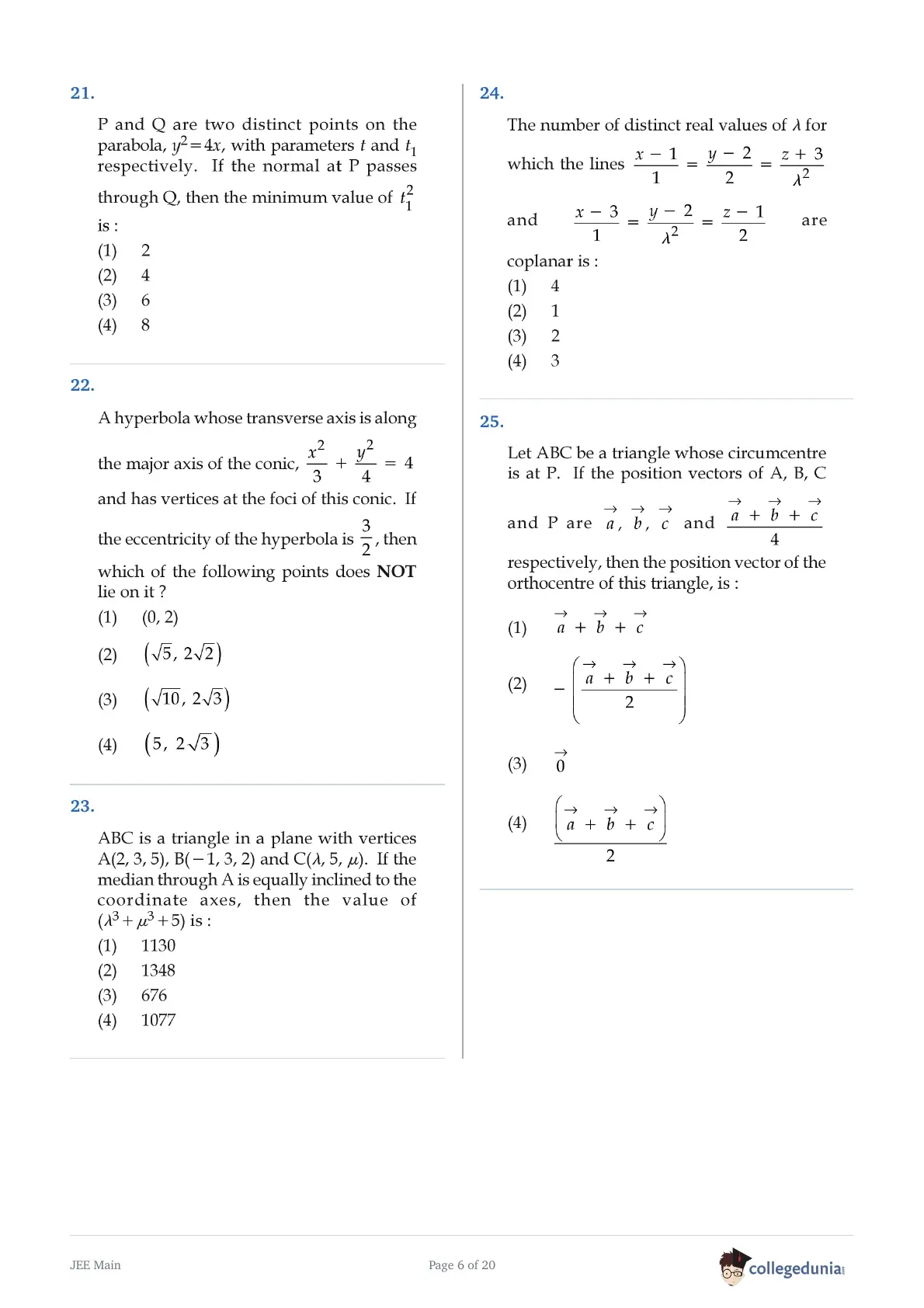
\(P\) and \(Q\) are two distinct points on the parabola, \(y^2 = 4x\), with parameters \(t\) and \(t_1\) respectively. If the normal at \(P\) passes through \(Q\), then the minimum value of \(t^2_1\) is :
A hyperbola whose transverse axis is along the major axis of the conic, \(\frac{x^2}{3} + \frac{y^2}{4} = 4 \) and has vertices at the foci of this conic. If the eccentricity of the hyperbola is \(\frac{3}{2}\), then which of the following points does NOT lie on it ?
\(ABC\) is a triangle in a plane with vertices \(A(2, 3, 5), B(-1, 3, 2)\) and \(C(\lambda , 5, \mu)\). If the median through \(A\) is equally inclined to the coordinate axes, then the value of \((\lambda^3 + \mu^3 + 5)\) is :
The number of distinct real values of \(\lambda\) for which the lines \(\frac{x-1}{1}=\frac{y-2}{2}=\frac{z+3}{\lambda^2}\) and \(\frac{x-3}{1}=\frac{y-2}{\lambda^2}=\frac{z-1}{2}\) are coplanar is :
Let ABC be a triangle whose circumcentre is at P. If the position vectors of A, B, C and P are \(\vec{a},\ \vec{b},\ \vec{c}\) and \(\frac{\vec{a}+\vec{b}+\vec{c}}{4}\) respectively, then the position vector of the orthocentre of this triangle, is :
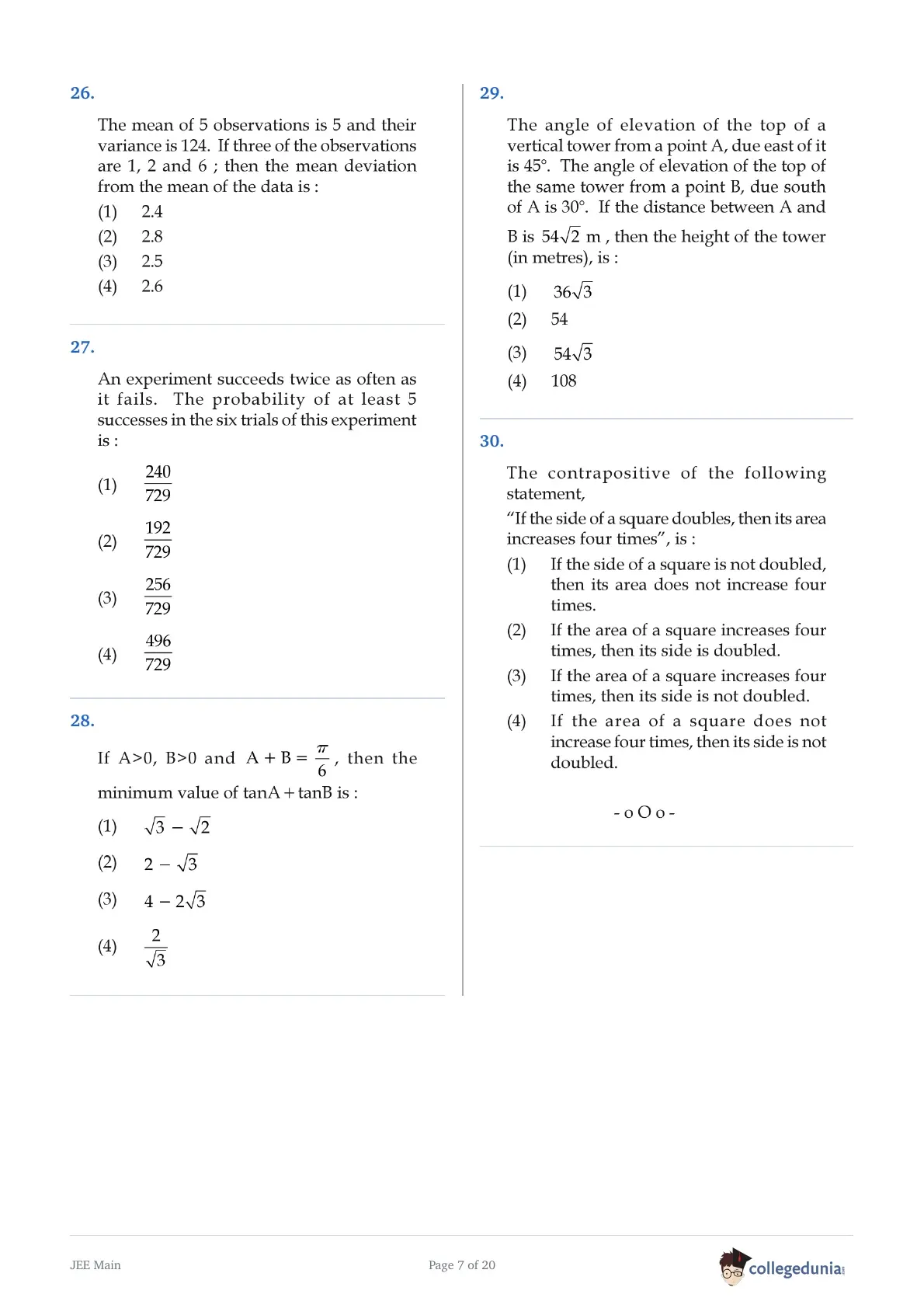
The mean of \(5\) observations is \(5\) and their variance is \(124\). If three of the observations are \(1, 2\) and \(6\) ; then the mean deviation from the mean of the data is :
An experiment succeeds twice as often as it fails. The probability of at least \(5\) successes in the six trials of this experiment is :
If \(A\gt0,\ B\gt0\) and \(A+B=\frac{\pi}{6}\), then the minimum value of \(\tan A+\tan B\) is :
The angle of elevation of the top of a vertical tower from a point A, due east of it is \(45^\circ\). The angle of elevation of the top of the same tower from a point B, due south of A is \(30^\circ\). If the distance between A and B is \(54\sqrt2\) m, then the height of the tower (in metres), is :
The contrapositive of the following statement, "If the side of a square doubles, then its area increases four times", is :
Physics (Q31 - Q60)
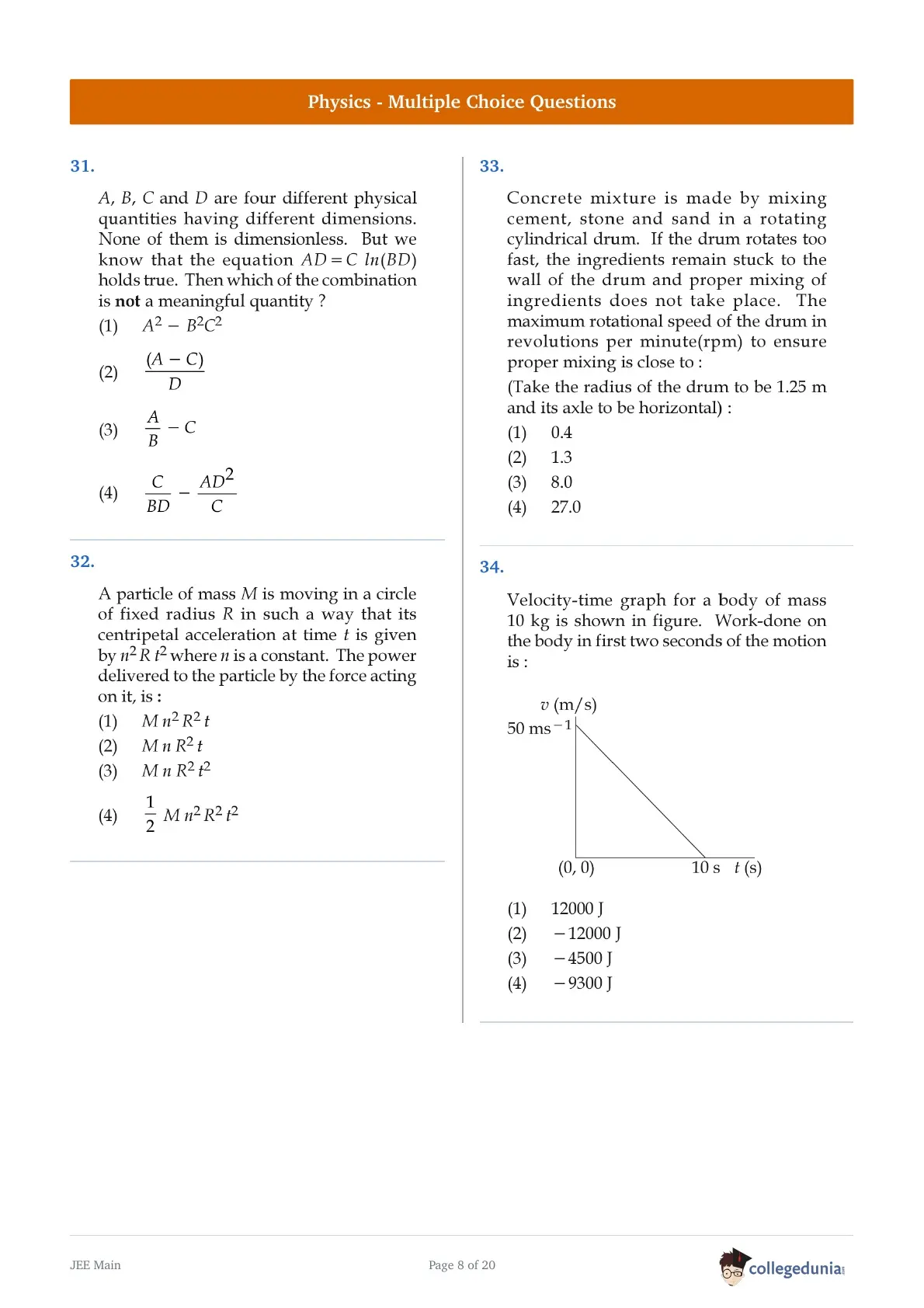
\(A, B, C\) and \(D\) are four different physical quantities having different dimensions. None of them is dimensionless. But we know that the equation \(AD = C\) ln \((BD)\) holds true. Then which of the combination is not a meaningful quantity ?
A particle of mass \(M\) is moving in a circle of fixed radius \(R\) in such a way that its centripetal acceleration at time \(t\) is given by \(n^2 \, R \, t^2\) where \(n\) is a constant. The power delivered to the particle by the force acting on it, is :
Concrete mixture is made by mixing cement, stone and sand in a rotating cylindrical drum. If the drum rotates too fast, the ingredients remain stuck to the wall of the drum and proper mixing of ingredients does not take place. The maximum rotational speed of the drum in revolutions per minute \((rpm)\) to ensure proper mixing is close to : (Take the radius of the drum to be \(1.25\, m\) and its axle to be horizontal) :
Velocity-time graph for a body of mass \(10\, kg\) is shown in figure. Work-done on the body in first two seconds of the motion is :
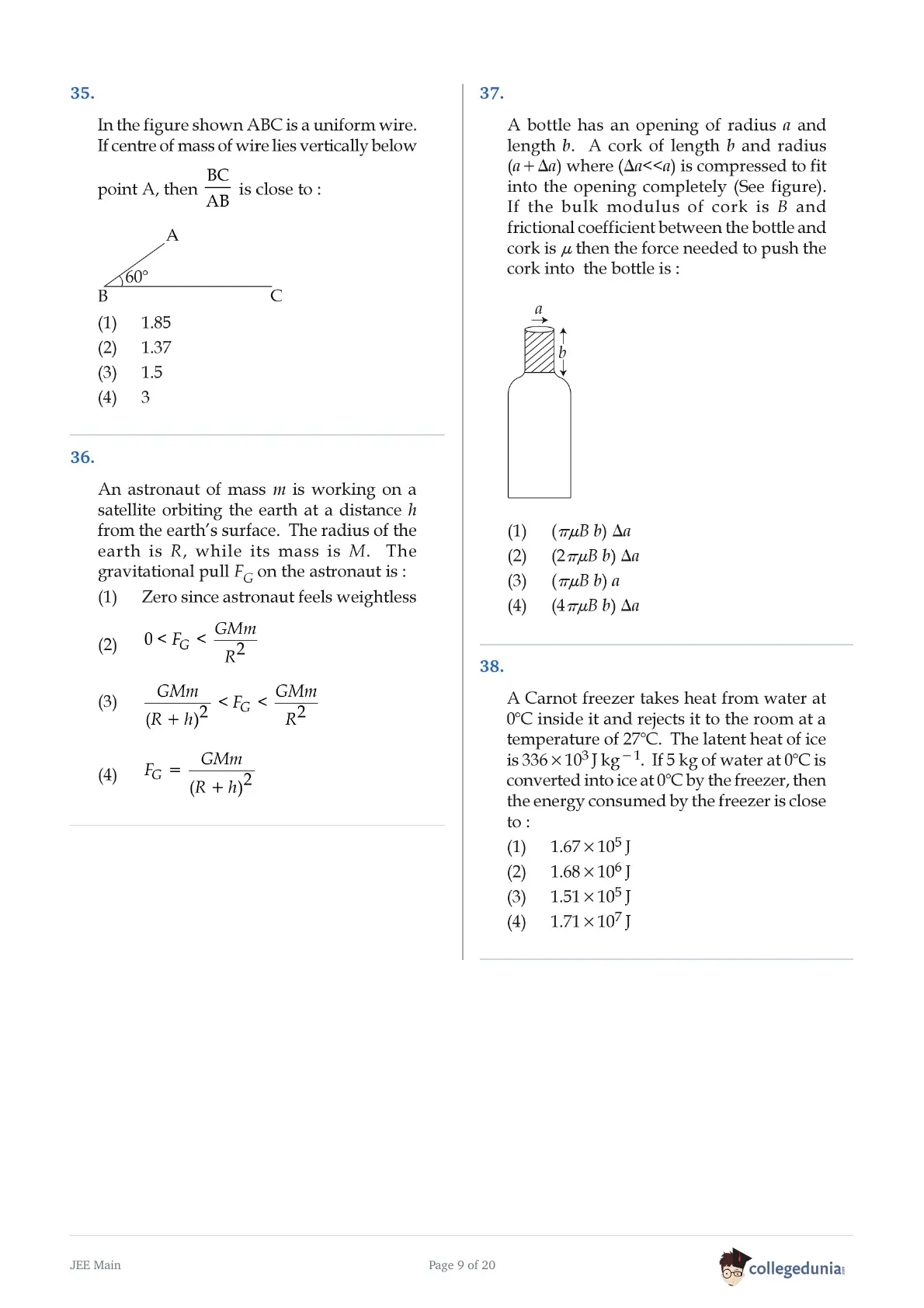
In the figure shown ABC is a uniform wire. If centre of mass of wire lies vertically below point A, then \(\frac{BC}{AB}\) is close to :
An astronaut of mass \(m\) is working on a satellite orbiting the earth at a distance \(h\) from the earth's surface. The radius of the earth is \(R\), while its mass is \(M\). The gravitational pull \(F_G\) on the astronaut is :
A bottle has an opening of radius \(a\) and length \(b\). A cork of length \(b\) and radius \((a+ \Delta a)\) where \((\Delta a < < a)\) is compressed to fit into the opening completely (See figure). If the bulk modulus of cork is \(B\) and frictional coefficient between the bottle and cork is \(\mu\) then the force needed to push the cork into the bottle is :
A Carnot freezer takes heat from water at \(0^{\circ}C\) inside it and rejects it to the room at a temperature of \(27^{\circ}C\). The latent heat of ice is \(336 \times 10^3 J \, kg^{-1}\). If \(5\, kg\) of water at \(0^{\circ}C\) is converted into ice at \(0^{\circ}C\) by the freezer, then the energy consumed by the freezer is close to :
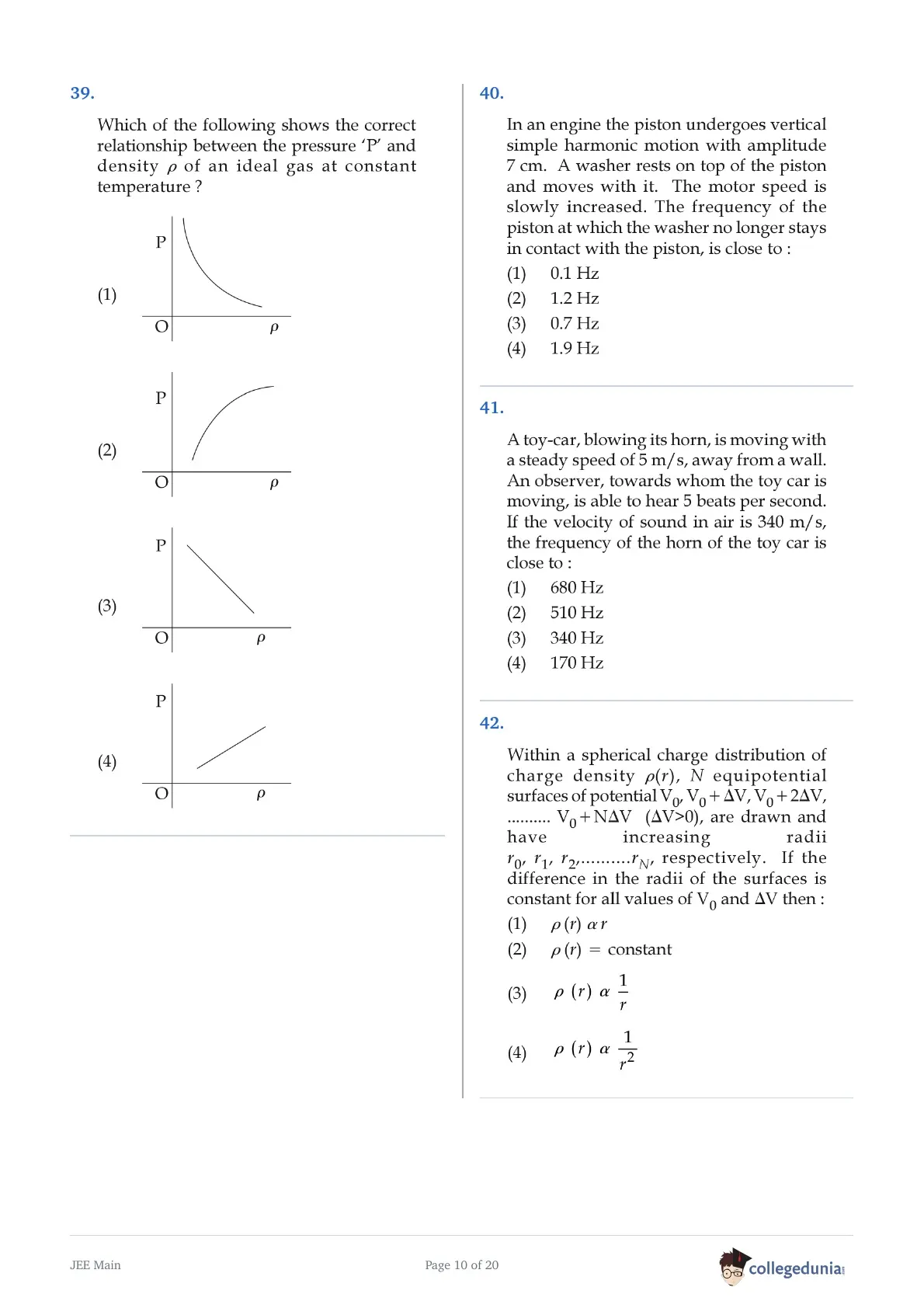
Which of the following shows the correct relationship between the pressure \(\mathrm{P}\) and density \(\rho\) of an ideal gas at constant temperature ?
Options (1) to (4) are P versus \(\rho\) graphs.
- (1)
![]()
- (2)
![]()
- (3)
![]()
- (4)
![]()


In an engine the piston undergoes vertical simple harmonic motion with amplitude 7 cm. A washer rests on top of the piston and moves with it. The motor speed is slowly increased. The frequency of the piston at which the washer no longer stays in contact with the piston, is close to :
A toy-car, blowing its horn, is moving with a steady speed of \(5\, m/s\), away from a wall. An observer, towards whom the toy car is moving, is able to hear \(5\) beats per second. If the velocity of sound in air is \(340 \,m/s\), the frequency of the horn of the toy car is close to :
Within a spherical charge distribution of charge density \(\rho(r)\), \(N\) equipotential surfaces of potential \(V_0,\ V_0+\Delta V,\ V_0+2\Delta V,\ \ldots,\ V_0+N\Delta V\ (\Delta V \gt 0)\), are drawn and have increasing radii \(r_0, r_1, r_2, \ldots, r_N\), respectively. If the difference in the radii of the surfaces is constant for all values of \(V_0\) and \(\Delta V\) then :
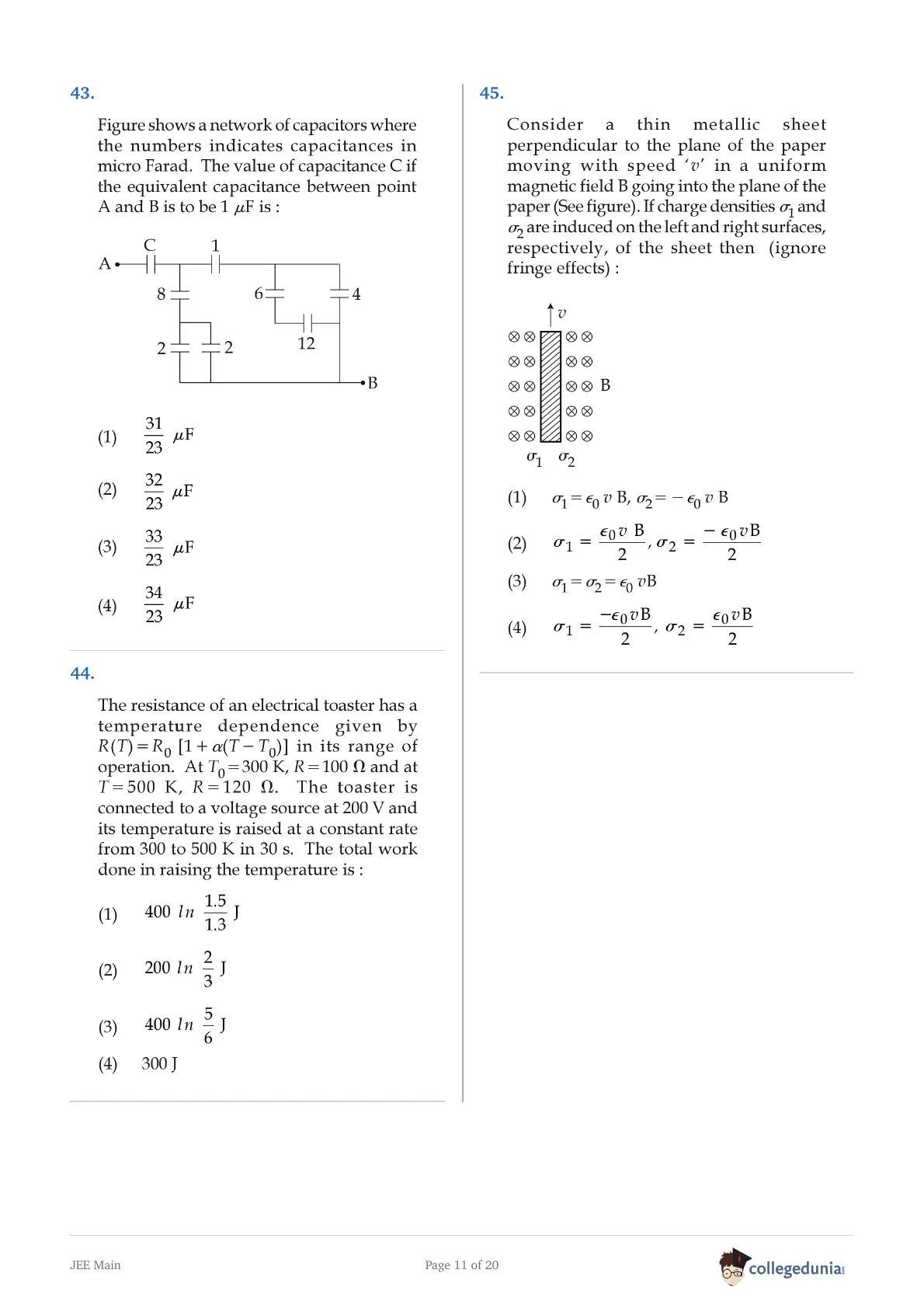
Figure shows a network of capacitors where the numbers indicates capacitances in micro Farad. The value of capacitance \(C\) if the equivalent capacitance between point \(A\) and \(B\) is to be \(1\, \mu F\) is :

The resistance of an electrical toaster has a temperature dependence given by \(R(T) = R_0\,[1 + \alpha(T - T_0)]\) in its range of operation. At \(T_0 = 300\ \mathrm{K}\), \(R = 100\ \Omega\) and at \(T = 500\ \mathrm{K}\), \(R = 120\ \Omega\). The toaster is connected to a voltage source at 200 V and its temperature is raised at a constant rate from 300 to 500 K in 30 s. The total work done in raising the temperature is :
Consider a thin metallic sheet perpendicular to the plane of the paper moving with speed \(v\) in a uniform magnetic field B going into the plane of the paper (See figure). If charge densities \(\sigma_1\) and \(\sigma_2\) are induced on the left and right surfaces, respectively, of the sheet then (ignore fringe effects) :
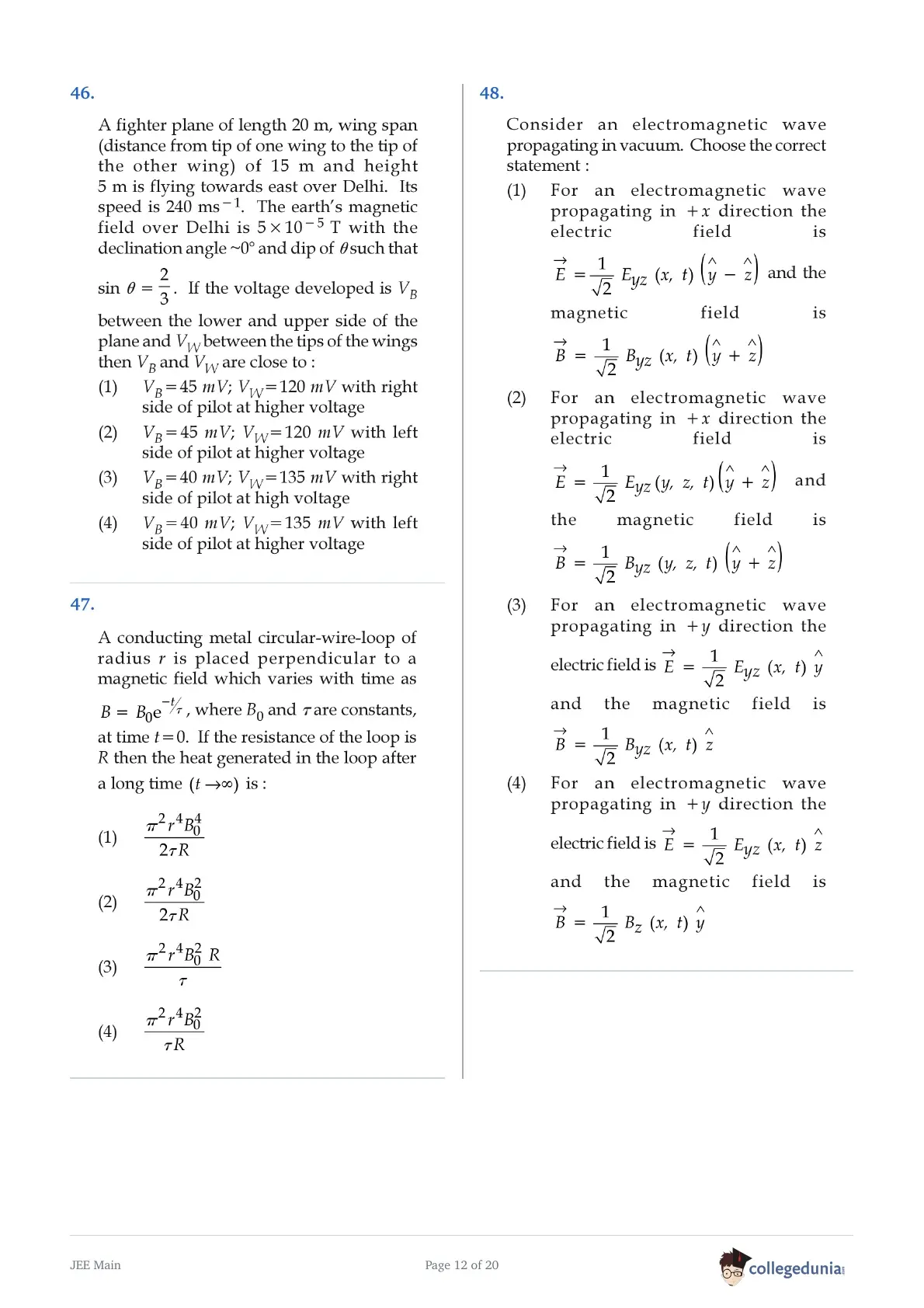
A fighter plane of length 20 m, wing span (distance from tip of one wing to the tip of the other wing) of 15 m and height 5 m is flying towards east over Delhi. Its speed is \(240\ \mathrm{ms^{-1}}\). The earth's magnetic field over Delhi is \(5 \times 10^{-5}\ \mathrm{T}\) with the declination angle \(\sim 0^\circ\) and dip of \(\theta\) such that \(\sin\theta = \frac{2}{3}\). If the voltage developed is \(V_B\) between the lower and upper side of the plane and \(V_W\) between the tips of the wings then \(V_B\) and \(V_W\) are close to :
A conducting metal circular-wire-loop of radius \(r\) is placed perpendicular to a magnetic field which varies with time as \(B = B_0 e^{-t/\tau}\), where \(B_0\) and \(\tau\) are constants, at time \(t = 0\). If the resistance of the loop is \(R\) then the heat generated in the loop after a long time \((t \to \infty)\) is :
Consider an electromagnetic wave propagating in vacuum. Choose the correct statement :
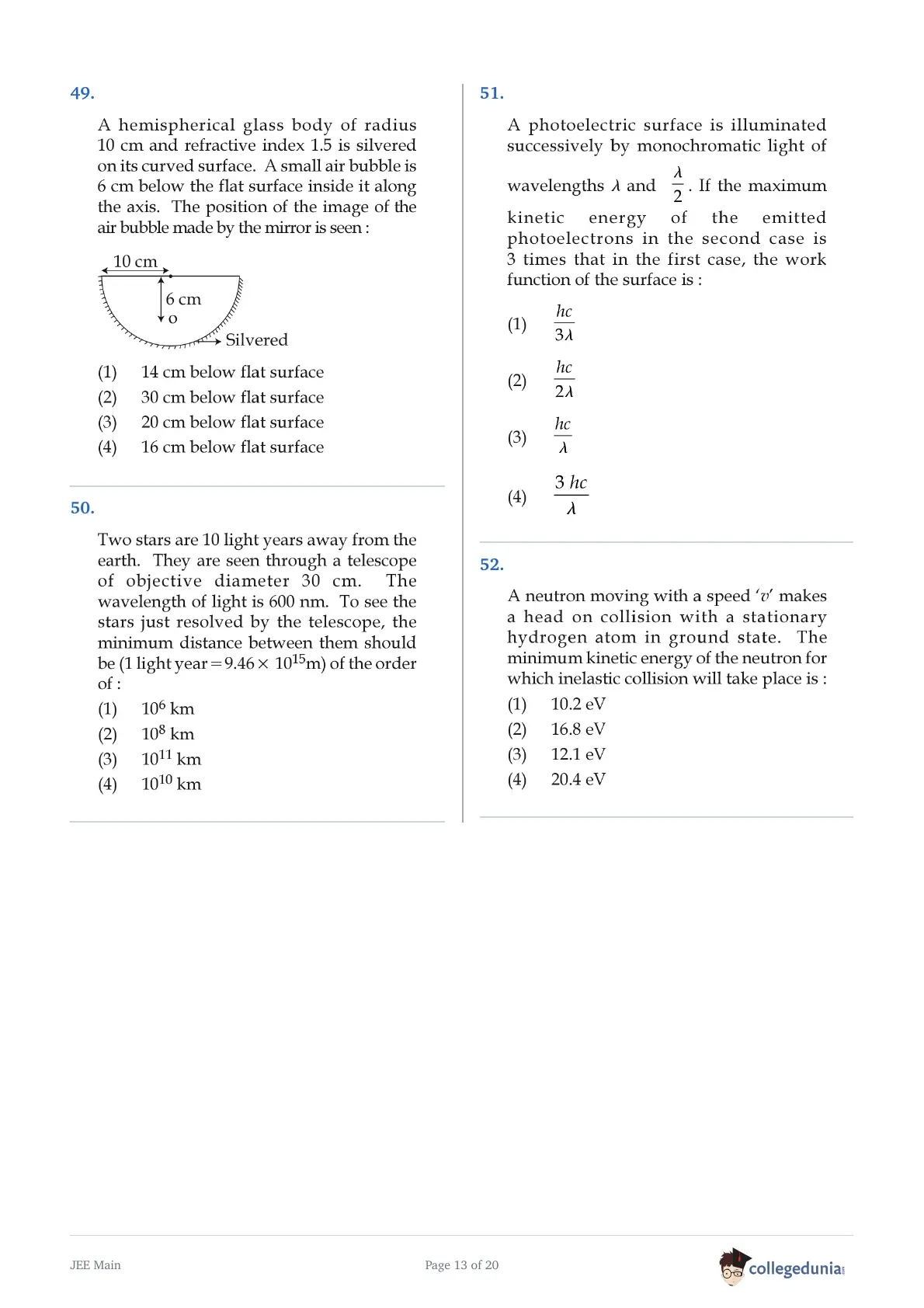
A hemispherical glass body of radius 10 cm and refractive index 1.5 is silvered on its curved surface. A small air bubble is 6 cm below the flat surface inside it along the axis. The position of the image of the air bubble made by the mirror is seen :
Two stars are 10 light years away from the earth. They are seen through a telescope of objective diameter 30 cm. The wavelength of light is 600 nm. To see the stars just resolved by the telescope, the minimum distance between them should be (1 light year \(= 9.46\times10^{15}\ \mathrm{m}\)) of the order of :
A photoelectric surface is illuminated successively by monochromatic light of wavelengths \(\lambda\) and \(\frac{\lambda}{2}\). If the maximum kinetic energy of the emitted photoelectrons in the second case is 3 times that in the first case, the work function of the surface is :
A neutron moving with a speed \(v\) makes a head on collision with a stationary hydrogen atom in ground state. The minimum kinetic energy of the neutron for which inelastic collision will take place is :
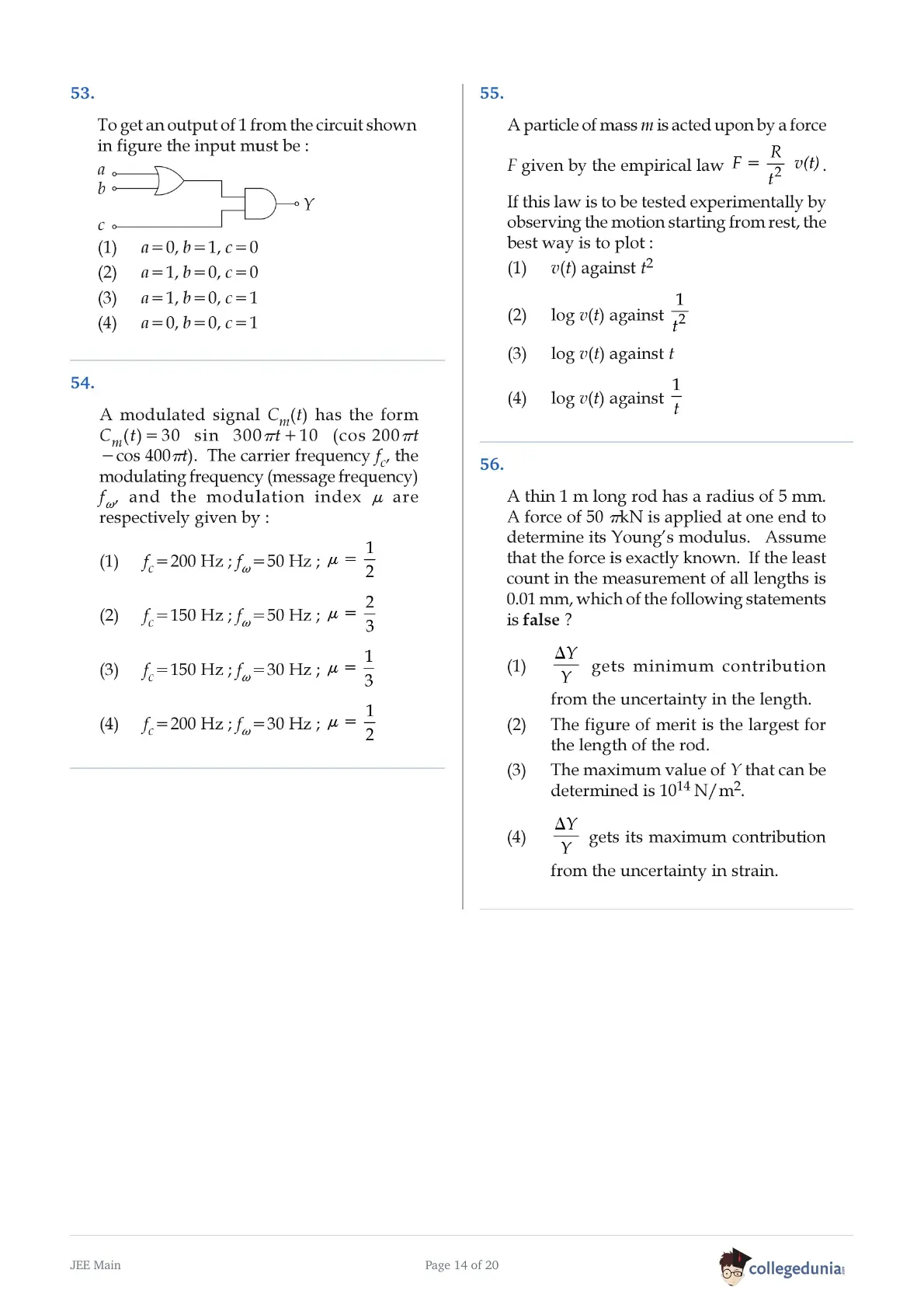
To get an output of 1 from the circuit shown in figure the input must be :
A modulated signal \(C_m(t)\) has the form \(C_m(t)=30\) sin \(300 \pi t + 10\) (cos \(200 \pi t -\) cos \(400 \pi t\)). The carrier frequency \(f_{c}\), the modulating frequency (message frequency) \(f_{\omega}\), and the modulation index \(\mu\) are respectively given by :
A particle of mass \(m\) is acted upon by a force \(F\) given by the empirical law \(F = \frac{R}{t^2}\, v(t)\). If this law is to be tested experimentally by observing the motion starting from rest, the best way is to plot :
A thin 1 m long rod has a radius of 5 mm. A force of \(50\pi\) kN is applied at one end to determine its Young's modulus. Assume that the force is exactly known. If the least count in the measurement of all lengths is 0.01 mm, which of the following statements is false ?
A galvanometer has a 50 division scale. Battery has no internal resistance. It is found that there is deflection of 40 divisions when \(R = 2400\ \Omega\). Deflection becomes 20 divisions when resistance taken from resistance box is 4900 \(\Omega\). Then we can conclude :
To determine refractive index of glass slab using a travelling microscope, minimum number of readings required are :
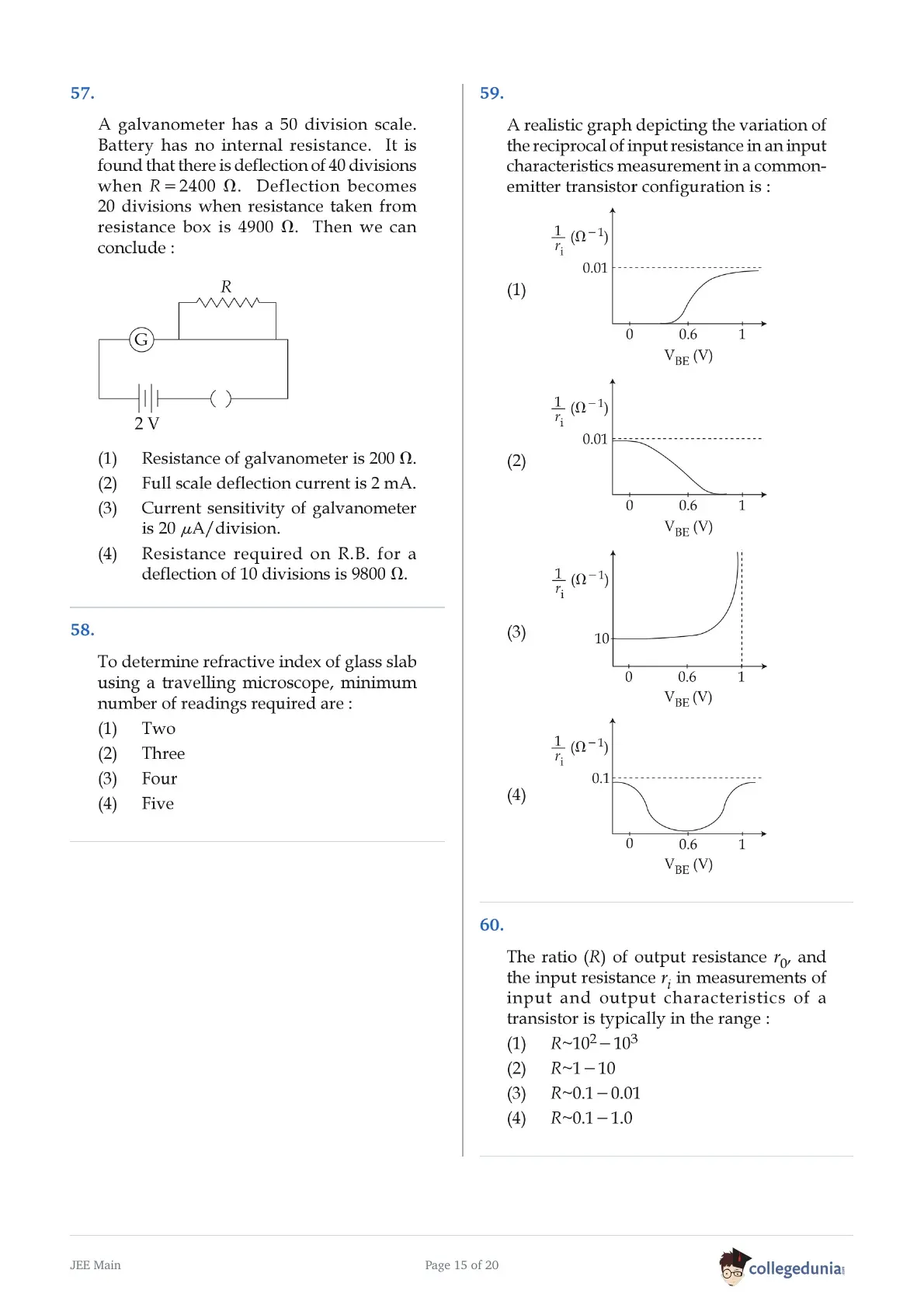
A realistic graph depicting the variation of the reciprocal of input resistance in an input characteristics measurement in a common-emitter transistor configuration is :
- (1)
![]()
- (2)
![]()
- (3)
![]()
- (4)
![]()


The ratio (\(R\)) of output resistance \(r_0\), and the input resistance \(r_i\) in measurements of input and output characteristics of a transistor is typically in the range :
Chemistry (Q61 - Q90)
The volume of 0.1N dibasic acid sufficient to neutralize 1 g of a base that furnishes 0.04 mole of \(OH^{-}\) in aqueous solution is :
Initially, the root mean square (rms) velocity of \(\mathrm{N_2}\) molecules at certain temperature is \(u\). If this temperature is doubled and all the nitrogen molecules dissociate into nitrogen atoms, then the new rms velocity will be :
Aqueous solution of which salt will not contain ions with the electronic configuration \(1s^2 2s^2 2p^6 3s^2 3p^6\) ?
The bond angle H-X-H is the greatest in the compound :
If 100 mole of \(\mathrm{H_2O_2}\) decompose at 1 bar and 300 K, the work done (kJ) by one mole of \(\mathrm{O_2(g)}\) as it expands against 1 bar pressure is :
\(2\mathrm{H_2O_2(l)} \rightleftharpoons 2\mathrm{H_2O(l)} + \mathrm{O_2(g)}\)
(\(R = 8.3\ \mathrm{J\,K^{-1}\,mol^{-1}}\))
An aqueous solution of a salt \(MX_2\) at certain temperature has a van?t Hoff factor of 2. The degree of dissociation for this solution of the salt is :
A solid XY kept in an evacuated sealed container undergoes decomposition to form a mixture of gases X and Y at temperature T. The equilibrium pressure is 10 bar in this vessel. \(K_p\) for this reaction is :
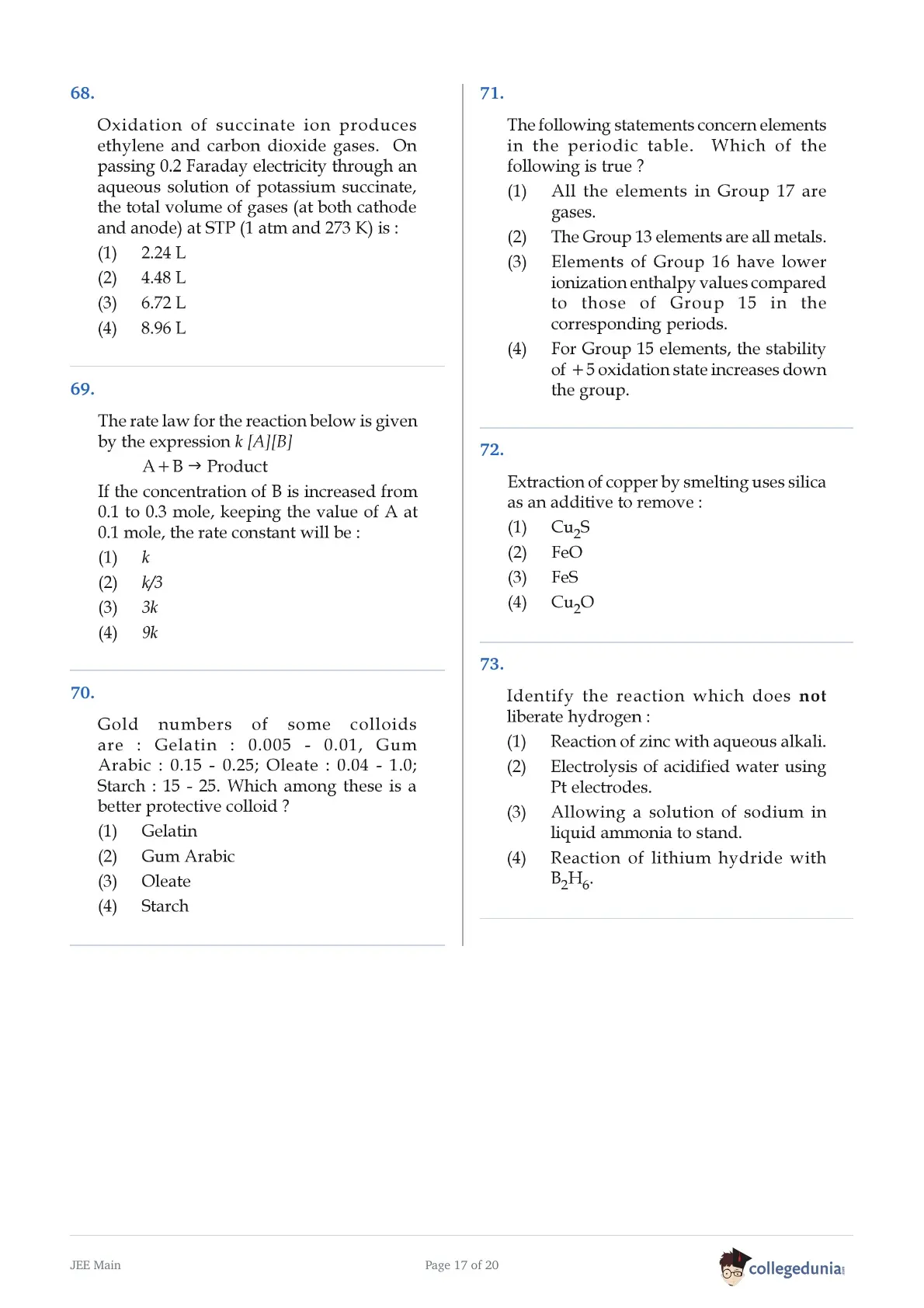
Oxidation of succinate ion produces ethylene and carbon dioxide gases. On passing \(0.2\) Faraday electricity through an aqueous solution of potassium succinate, the total volume of gases (at both cathode and anode) at STP (\(1\, atm\) and \(273\, K\)) is :
The rate law for the reaction below is given by the expression \(k\,[A][B]\)
\(A + B \rightarrow \text{Product}\)
If the concentration of B is increased from 0.1 to 0.3 mole, keeping the value of A at 0.1 mole, the rate constant will be :
Gold numbers of some colloids are : Gelatin : 0.005 - 0.01, Gum Arabic : 0.15 - 0.25; Oleate : 0.04 - 1.0; Starch : 15 - 25. Which among these is a better protective colloid ?
The following statements concern elements in the periodic table. Which of the following is true ?
Extraction of copper by smelting uses silica as an additive to remove :
Identify the reaction which does not liberate hydrogen :
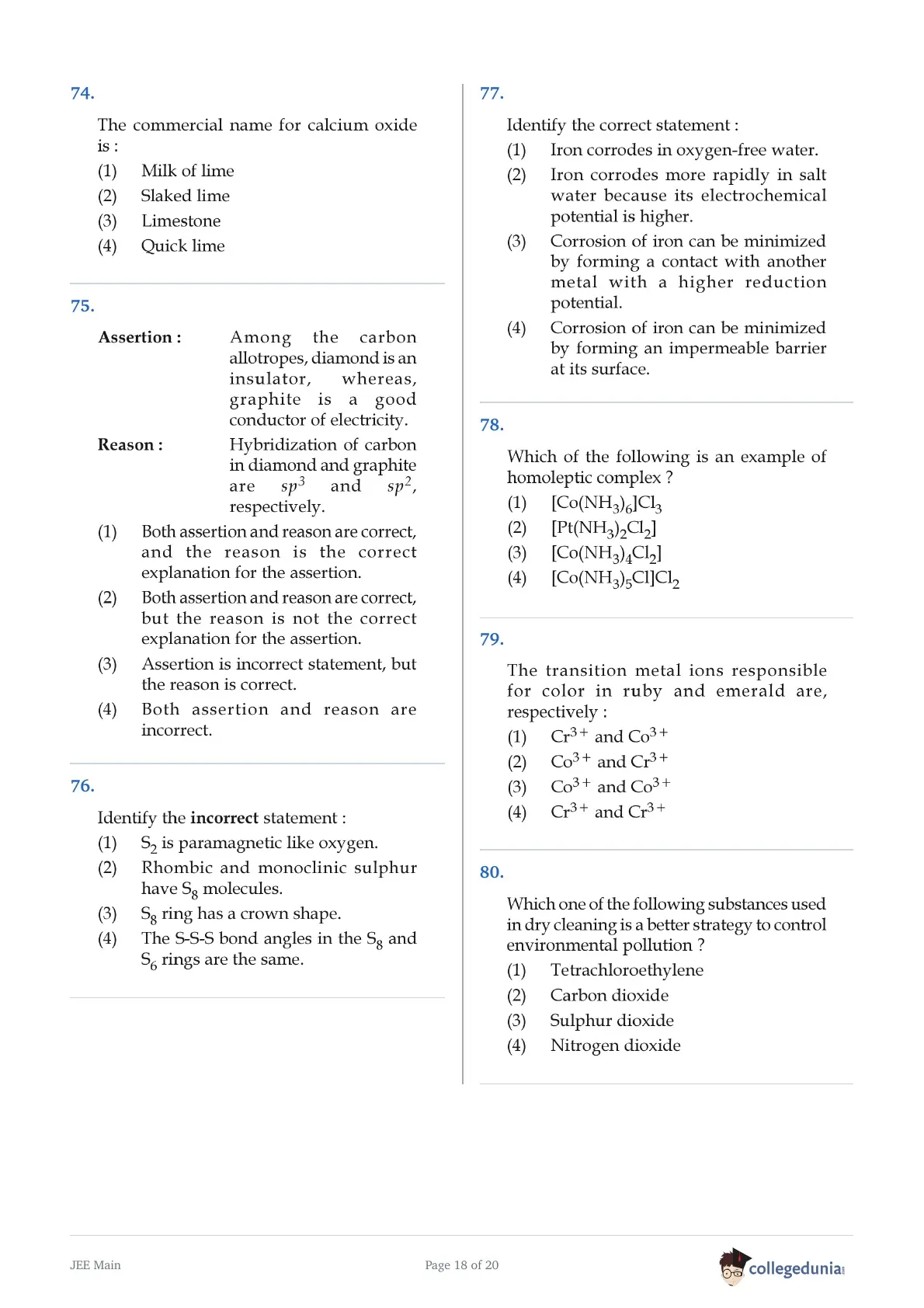
The commercial name for calcium oxide is :
Assertion : Among the carbon allotropes, diamond is an insulator, whereas, graphite is a good conductor of electricity.
Reason : Hybridization of carbon in diamond and graphite are \(sp^3\) and \(sp^2\), respectively.
Identify the incorrect statement :
Identify the correct statement :
Which of the following is an example of homoleptic complex?
The transition metal ions responsible for color in ruby and emerald are, respectively :
Which one of the following substances used in dry cleaning is a better strategy to control environmental pollution ?
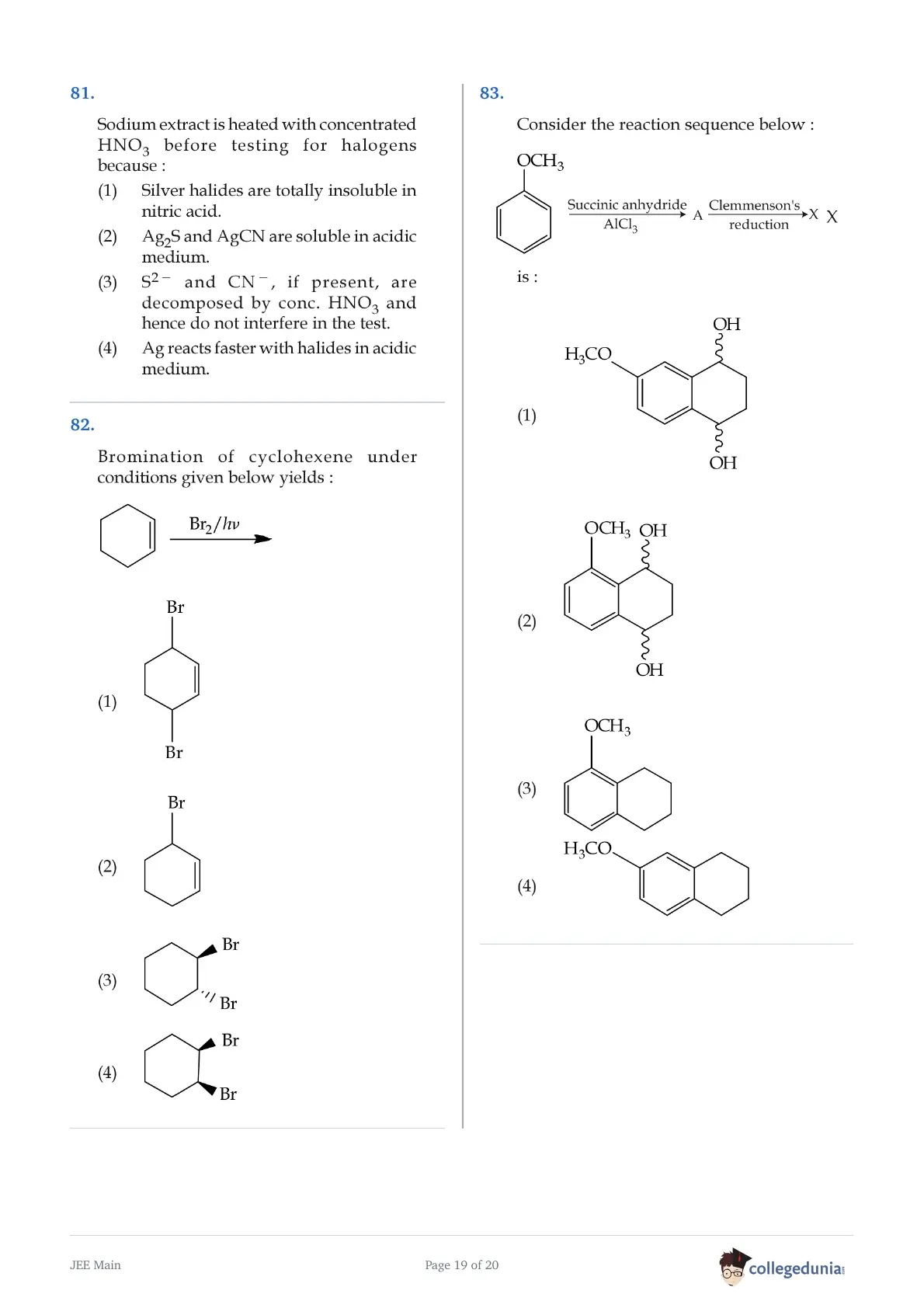
Sodium extract is heated with concentrated \(\mathrm{HNO_3}\) before testing for halogens because :
Bromination of cyclohexene under conditions given below yields :
- (1)
![]()
- (2)
![]()
- (3)
![]()
- (4)
![]()


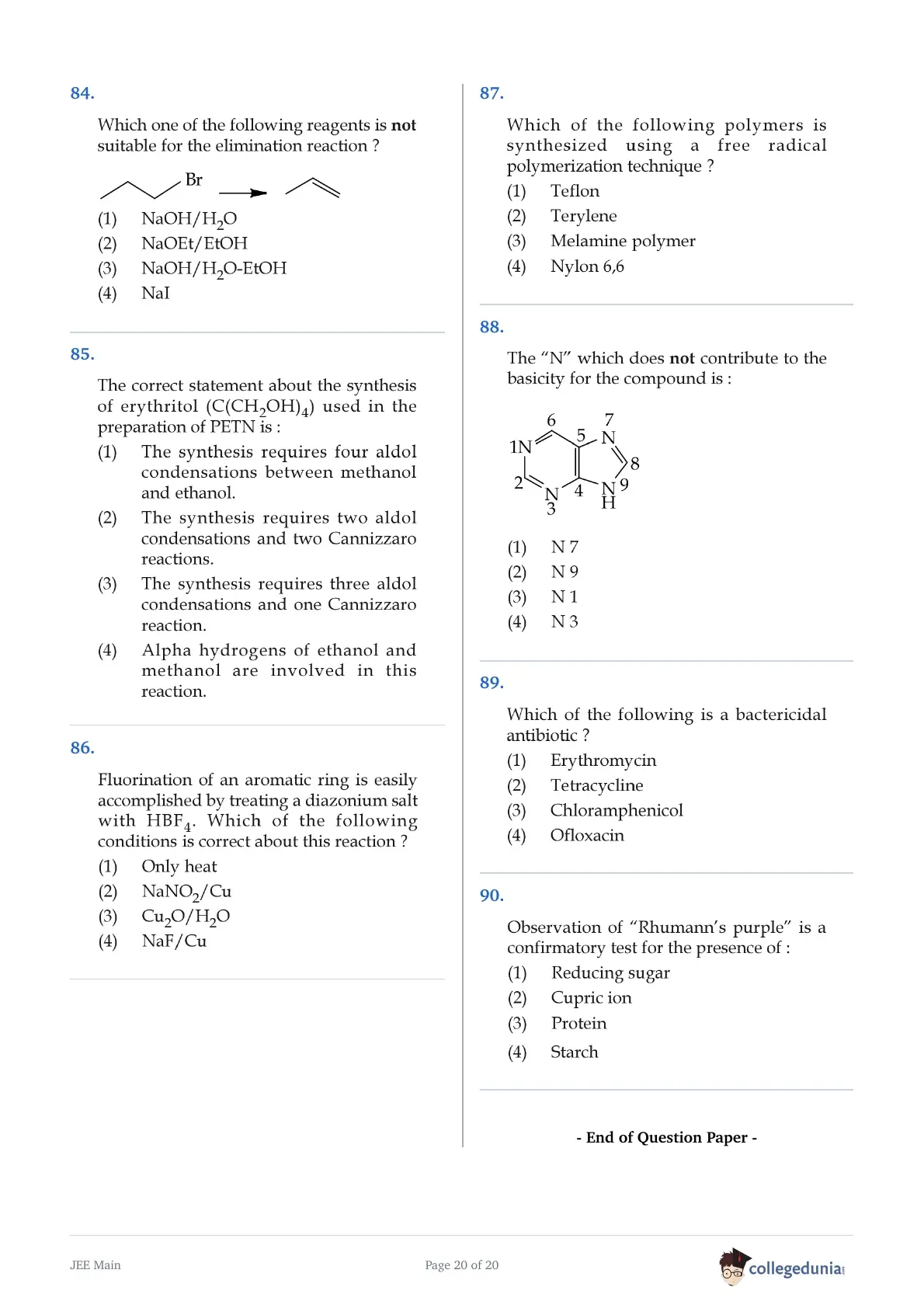
Which one of the following reagents is not suitable for the elimination reaction ?
The correct statement about the synthesis of erythritol \(\mathrm{C(CH_2OH)_4}\) used in the preparation of PETN is :
Fluorination of an aromatic ring is easily accomplished by treating a diazonium salt with \(\mathrm{HBF_4}\). Which of the following conditions is correct about this reaction ?
Which of the following polymers is synthesized using a free radical polymerization technique ?
The "N" which does not contribute to the basicity for the compound is :
Which of the following is a bactericidal antibiotic ?
Observation of “Rhumann’s purple” is a confirmatory test for the presence of :
JEE Main 2016 Exam Pattern and Marking Scheme
| Particulars | Details |
|---|---|
| Exam Mode | Online (Computer-Based Test) |
| Paper | B.E./B.Tech (Paper 1) |
| Duration | 3 hours (180 minutes) |
| Type of Questions | Multiple Choice Questions (MCQs) |
| Subjects | Mathematics, Physics, Chemistry |
| Total Questions | 90 questions |
| Total Marks | 360 marks |
| Marking Scheme | +4 for correct answer & -1 for incorrect answer; 0 for unattempted |
JEE Main 2016 April 10 Difficulty Level
When compared to the offline mode, candidates rated the JEE Main 2016 B.E./B.Tech Question Paper as moderate in terms of overall difficulty.
JEE Main B.E./B.Tech 2016 Paper Analysis
- Physics section was the most difficult of the three, but when compared to JEE Main 2016 offline mode, it was simple.
- The chemistry section was the easiest, with many direct and memory-based questions.
- Math section was simple but lengthy.
For every correct answer, candidates got +4 marks and for each wrong attempt -1 mark was deducted.



Comments