




JEE Main 2019 January 10 Shift 2 Question Paper is available here with solutions PDF and detailed solutions for every question. NTA conducted the second shift on January 10, 2019, from 2:30 PM to 5:30 PM. The JEE Main 2019 Paper 1 (B.E./B.Tech) question paper includes the following:
- 90 questions in a 3-hour CBT Mode: 30 each from Mathematics, Physics and Chemistry
- Question type: all multiple choice questions (MCQs) with a single correct option, 4 marks each
- Sections: Mathematics (30), Physics (30) and Chemistry (30), all questions compulsory
- Marking: +4 for a correct answer, -1 for an incorrect answer, 0 for an unattempted question
- Maximum marks: 360 (120 per subject)
JEE Main 2019 January 10 Shift 2 Question Paper with Solution PDF
| NTA Official PDF | CD PDF | CD PDF with Solutions |
|---|---|---|
| Download official PDF 5.93 MB | Download Collegedunia PDF 1.20 MB | Download solutions PDF 1.79 MB |
Also Check:
JEE Main 2019 January 10 Shift 2 Questions with Solutions
Mathematics (Q1 - Q30)
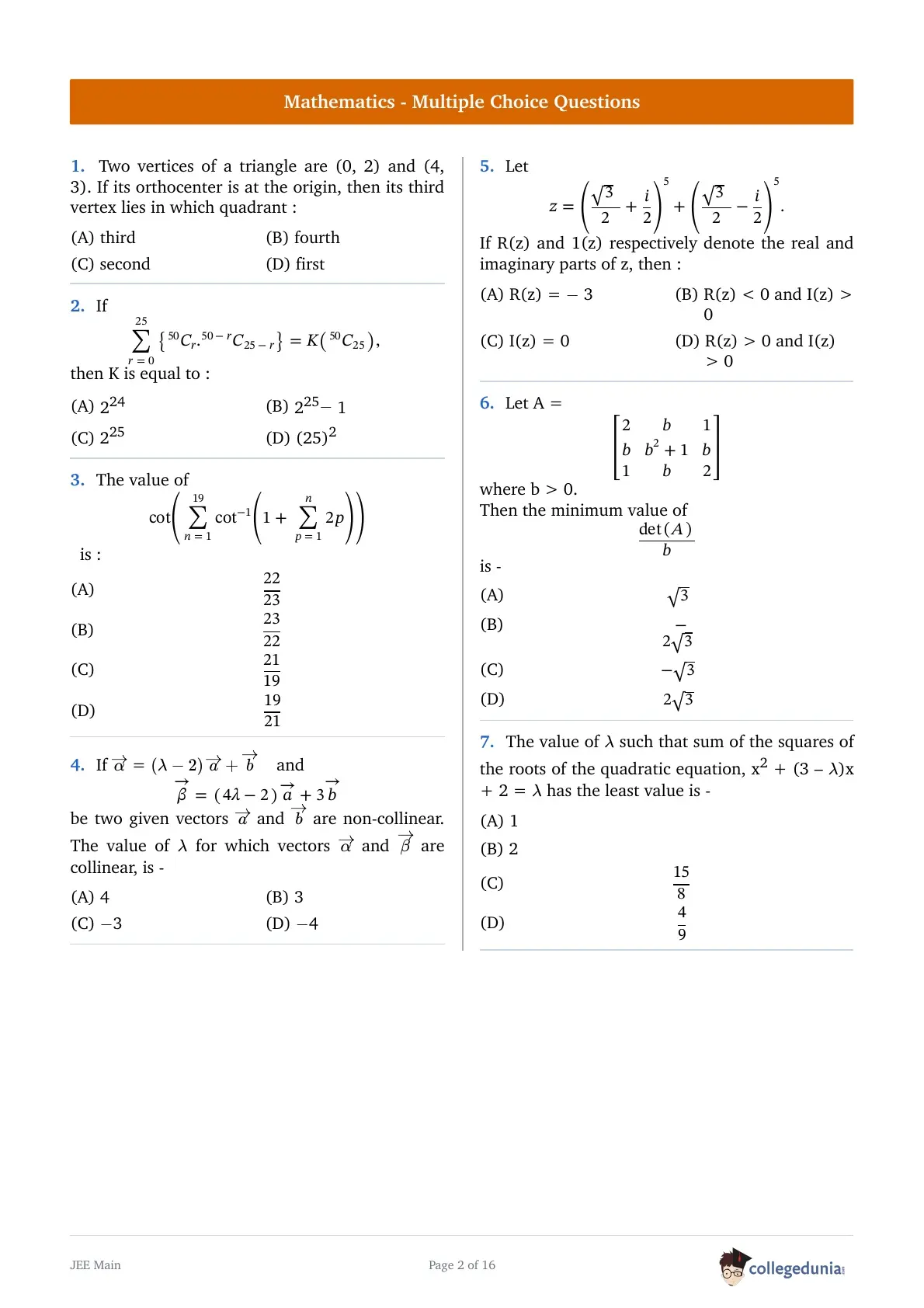
Two vertices of a triangle are \((0,2)\) and \((4,3)\) . If its orthocentre is at the origin, then its third vertex lies in which quadrant ?
If \(\sum^\limits{25}_{r=0} \left\{^{50}C_{r} . ^{50-r}C_{25-r}\right\}=K\left(^{50}C_{25}\right) \) , then \(K\) is equal to :
The value of \(\cot\left(\sum\limits^{19}_{n=1} \cot^{-1} \left(1+ \sum\limits^{n}_{p=1} 2p\right)\right) \) is :
If \(\vec{a}\) and \(\vec{b}\) are non-collinear vectors, then the value of a for which the vectors \(\vec{u}=\left(\alpha-2\right)\vec{a}+\vec{b}\) and \(\vec{v}=\left(2+3\alpha\right)\vec{a}-3\vec{b}\) are collinear is :
Let \(z = \left(\frac{\sqrt{3}}{2} + \frac{i}{2}\right)^5 + \left(\frac{\sqrt{3}}{2} - \frac{i}{2}\right)^5\). If R(z) and I(z) respectively denote the real and imaginary parts of z, then :
Let \(A = \begin{bmatrix} 2 & b & 1 \\ b & b^2+1 & b \\ 1 & b & 2 \end{bmatrix}\) where \(b \gt 0\).
Then the minimum value of \(\frac{\det(A)}{b}\) is -
The value of \(\lambda\) such that sum of the squares of the roots of the quadratic equation, \(x^2 + (3 - \lambda)x + 2 = \lambda\) has the least value is -
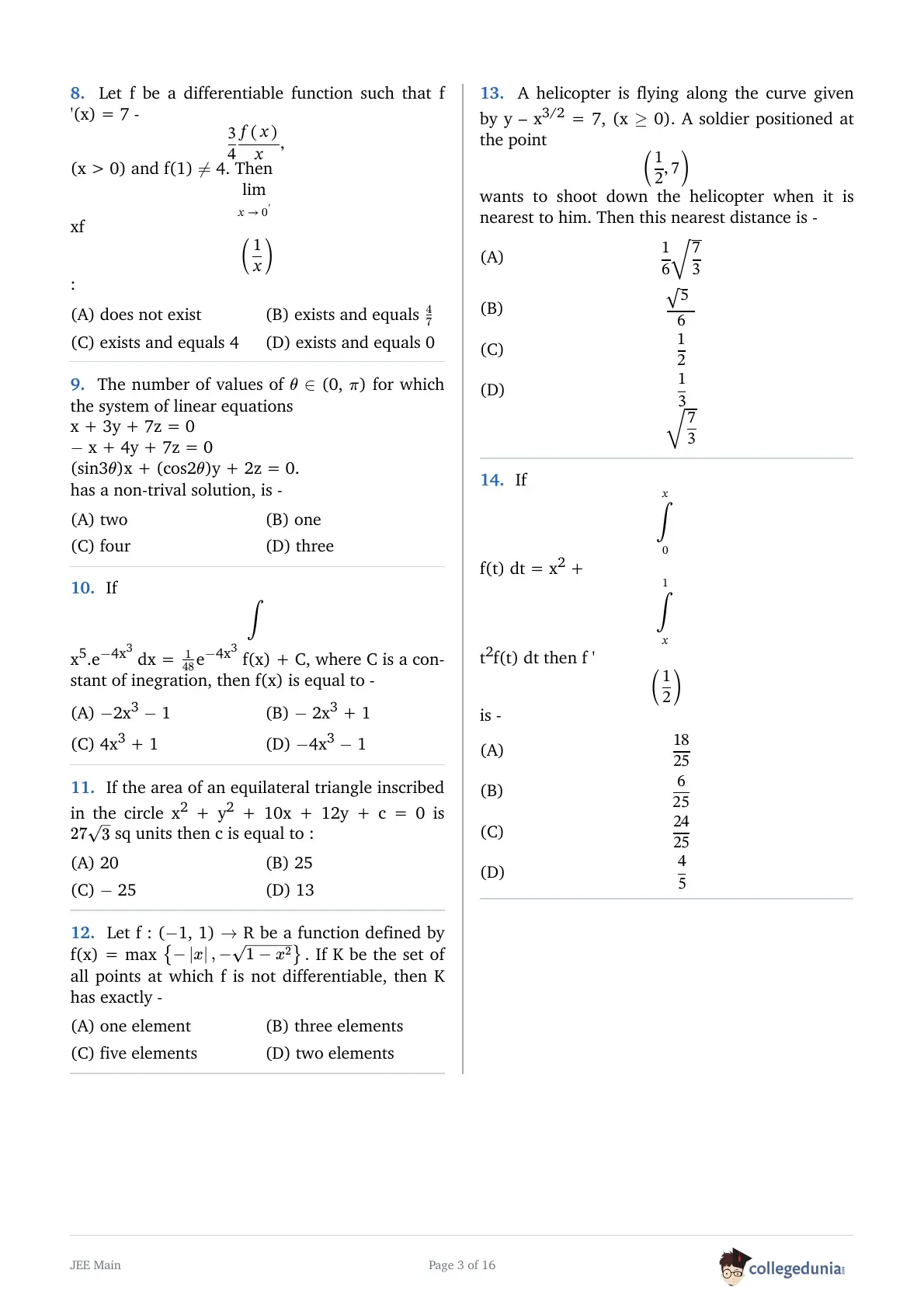
Let f be a differentiable function such that \(f'(x) = 7 - \frac{3}{4}\frac{f(x)}{x}\), \((x \gt 0)\) and \(f(1) \ne 4\). Then \(\lim_{x \to 0^{+}} x\,f\left(\frac{1}{x}\right)\) :
The number of q∈ (0, 4π) for which the system of linear equations
3(sin 3θ) x – y + z = 2
3(cos 2θ) x + 4y + 3z = 3
6x + 7y + 7z = 9
has no solution, is
If \(\int x^5 \cdot e^{-4x^3}\,dx = \frac{1}{48}e^{-4x^3} f(x) + C\), where C is a constant of integration, then f(x) is equal to -
If the area of an equilateral triangle inscribed in the circle \(x^2 + y^2 + 10x + 12y + c = 0\) is \(27\sqrt{3}\) sq units then c is equal to :
Let \(f : (-1,1) \to R\) be a function defined by \(f(x) = max \{- | x |,- \sqrt{ 1- x^2} \}\). If \(K\) be the set of all points at which \(f\) is not differentiable, then \(K\) has exactly :
A helicopter is flying along the curve given by \(y - x^{3/2} = 7, (x \ge 0)\). A soldier positioned at the point \(\left(\frac{1}{2}, 7\right)\) wants to shoot down the helicopter when it is nearest to him. Then this nearest distance is :
If \(\int_0^x f(t)\,dt = x^2 + \int_x^1 t^2 f(t)\,dt\) then \(f'\left(\frac12\right)\) is -
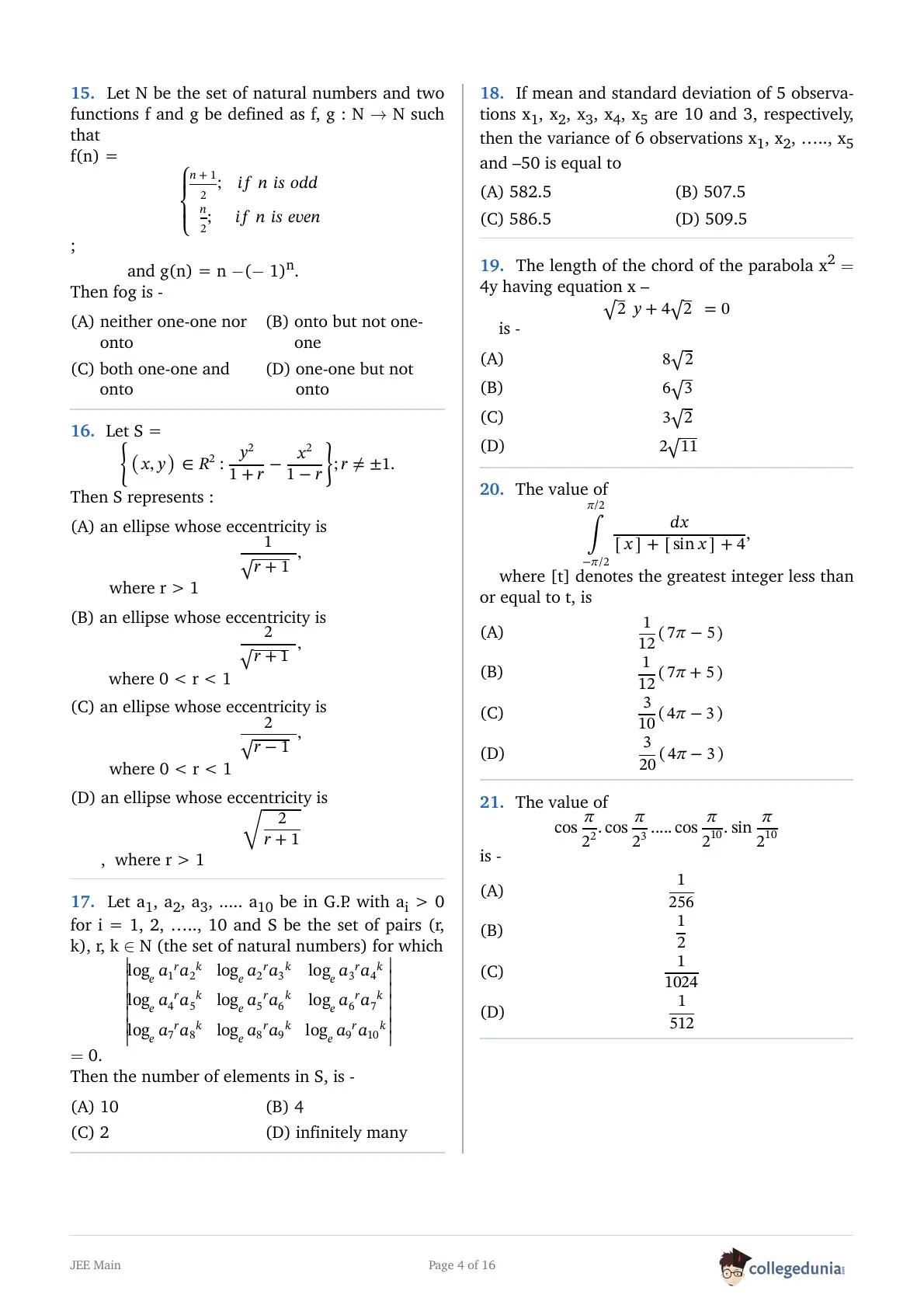
Let \(N\) be the set of natural numbers and two functions \(f\) and \(g\) be defined as \(f,g : N \to N\) such that : f(n) = \begin{cases} \frac{n+1}{2} & if n is odd\\ \frac{n}{2} & if n is even \end{cases} and \(g(n) = n-(-1)^n\). The \(fog\) is :
Let \(S = \left\{(x,y) \in R^2 : \frac{y^2}{1+r} - \frac{x^2}{1-r}\right\}\); \(r \ne \pm 1\).
Then S represents :
Let \(a_1, a_2, a_3, \ldots, a_{10}\) be in G.P. with \(a_i \gt 0\) for \(i = 1, 2, \ldots, 10\) and S be the set of pairs \((r, k)\), \(r, k \in N\) (the set of natural numbers) for which
\(\begin{vmatrix} \log_e a_1^r a_2^k & \log_e a_2^r a_3^k & \log_e a_3^r a_4^k \\ \log_e a_4^r a_5^k & \log_e a_5^r a_6^k & \log_e a_6^r a_7^k \\ \log_e a_7^r a_8^k & \log_e a_8^r a_9^k & \log_e a_9^r a_{10}^k \end{vmatrix} = 0\).
Then the number of elements in S, is -
If mean and standard deviation of 5 observations \(x_1, x_2, x_3, x_4, x_5\) are 10 and 3, respectively, then the variance of 6 observations \(x_1, x_2, \ldots, x_5\) and \(-50\) is equal to
The length of the chord of the parabola \(x^2 = 4y\) having equation \(x - \sqrt{2} y + 4 \sqrt{2} = 0\) is :
The value of \(\int\limits^{\pi/2}_{-\pi/2} \frac{dx}{\left[x\right]+\left[\sin x\right]+4} \) where [t] denotes the greatest integer less than or equal to t, is :
The value of \(\cos \frac{\pi}{2^{2}} .\cos \frac{\pi}{2^{3} } . ...... .\cos \frac{\pi}{2^{10}} .\sin \frac{\pi}{2^{10}} \) is :
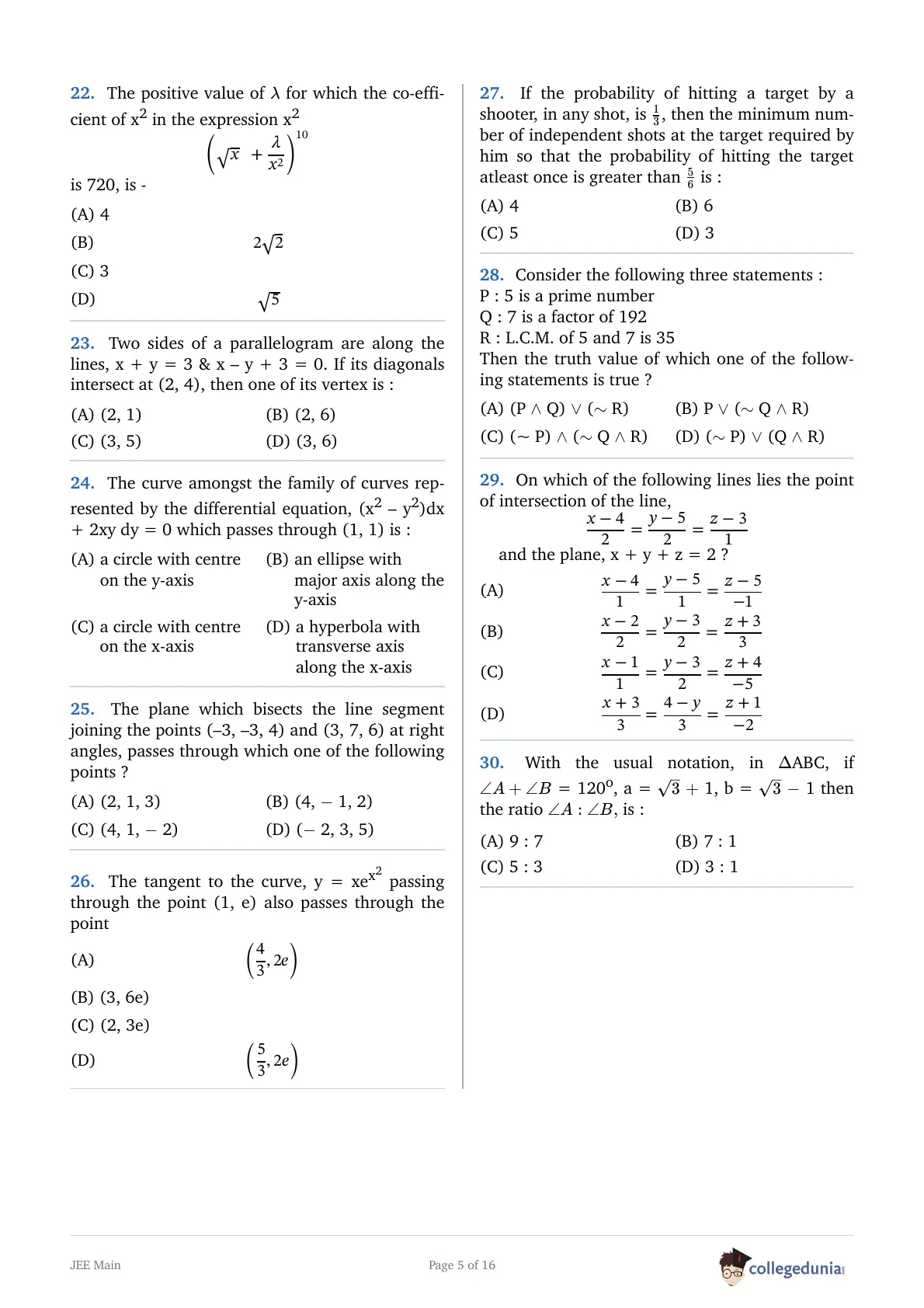
The positive value of \(\lambda\) for which the co-efficient of \(x^2\) in the expression \(x^2\left(\sqrt{x} + \frac{\lambda}{x^2}\right)^{10}\) is 720, is -
Two sides of a parallelogram are along the lines, \(x + y = 3\) & \(x - y + 3 = 0\). If its diagonals intersect at (2, 4), then one of its vertex is :
The curve amongst the family of curves represented by the differential equation, \((x^2 - y^2)dx + 2xy\,dy = 0\) which passes through (1, 1) is :
The plane which bisects the line segment joining the points (-3,-3,4) and (3,7,6) at right angles, passes through which one of the following points ?
If the tangent to the curve y = x3 – x2 + x at the point (a, b) is also tangent to the curve y = 5x2 + 2x – 25 at the point (2, –1), then |2a + 9b| is equal to _____ .
The probability of a man hitting a target is \(\frac{2}{5}\). He fires at the target \(k\) times (\(k\), a given number). Then the minimum \(k\), so that the probability of hitting the target at least once is more than \(\frac{7}{10}\), is :
Consider the following three statements :
P : 5 is a prime number
Q : 7 is a factor of 192
R : L.C.M. of 5 and 7 is 35
Then the truth value of which one of the following statements is true ?
On which of the following lines lies the point of intersection of the line,
\(\frac{x-4}{2}=\frac{y-5}{2}=\frac{z-3}{1}\)
and the plane, \(x+y+z=2\) ?
With the usual notation, in \(\Delta\)ABC, if \(\angle A+\angle B=120^\circ\), \(a=\sqrt3+1\), \(b=\sqrt3-1\) then the ratio \(\angle A:\angle B\), is :
Physics (Q31 - Q60)
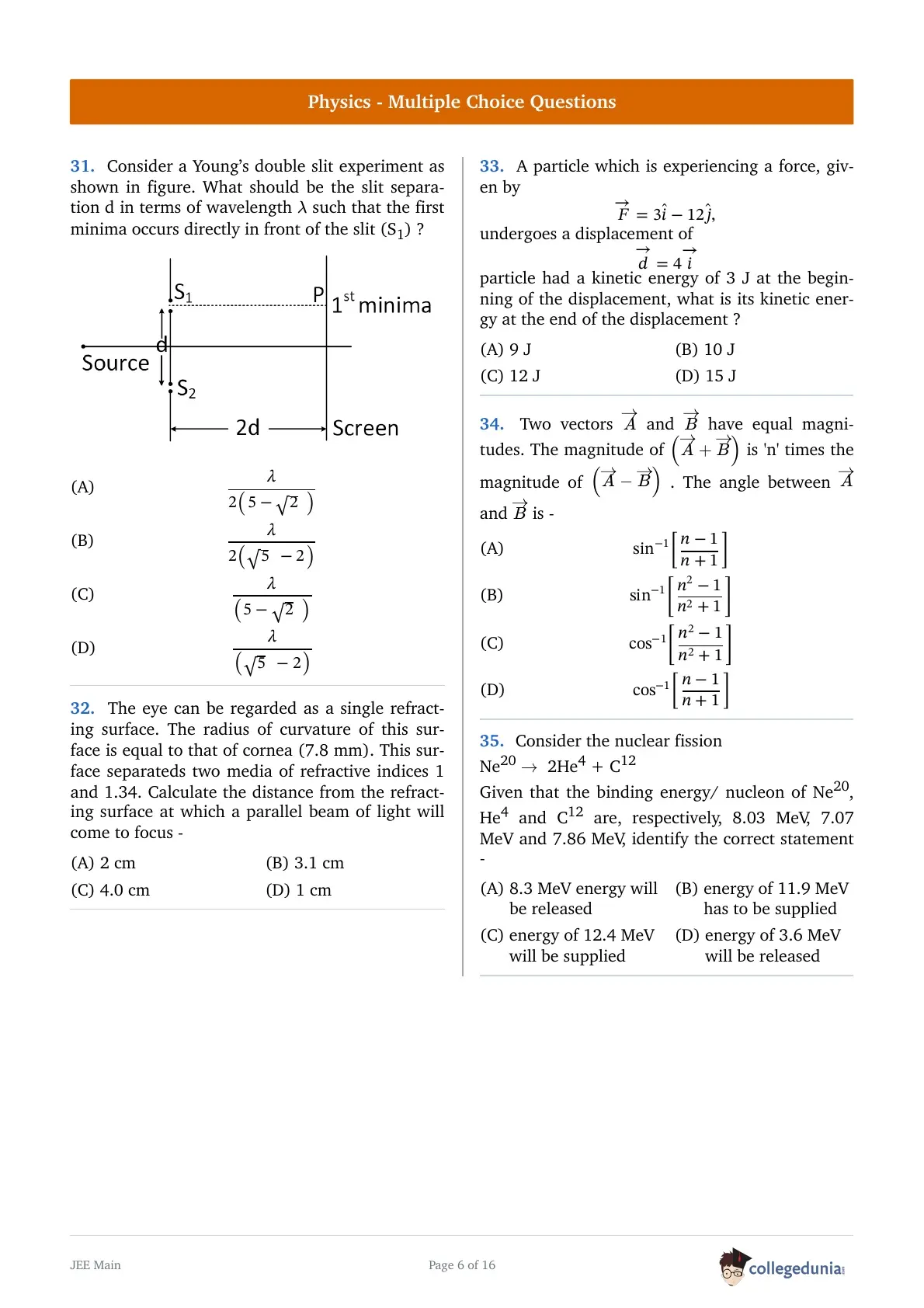
Consider a Young's double slit experiment as shown in figure. What should be the slit separation d in terms of wavelength \(\lambda\) such that the first minima occurs directly in front of the slit (S1) ?
The eye can be regarded as a single refracting surface . The radius of curvature of this surface is equal to that of cornea (\(7.8\, mm\) ). This surface separates two media of refractive indices 1 and \(1.34\). Calculate the distance from the refracting surface at which a parallel beam of light will come to focus.
A particle which is experiencing a force, given by
\(\vec F=3\hat i-12\hat j\),
undergoes a displacement of
\(\vec d=4\vec i\)
particle had a kinetic energy of 3 J at the beginning of the displacement, what is its kinetic energy at the end of the displacement ?
Two vectors \(\vec{A}\) and \(\vec{B}\) have equal magnitudes. The magnitude of \((\vec{A} + \vec{B})\) is 'n' times the magnitude of \((\vec{A} - \vec{B})\) . The angle between \(\vec{A}\) and \(\vec{B}\) is :
Condiser the nuclear fission \({Ne^{20} -> 2 He^{4} + C^{12}} \) Given that the binding energy/nucleon of \({Ne^{20}, He^{4}}\) and \({C^{12}}\) are, respectively, 8.03 MeV, 7.07 MeV and 7.86 MeV, identify the correct statement :
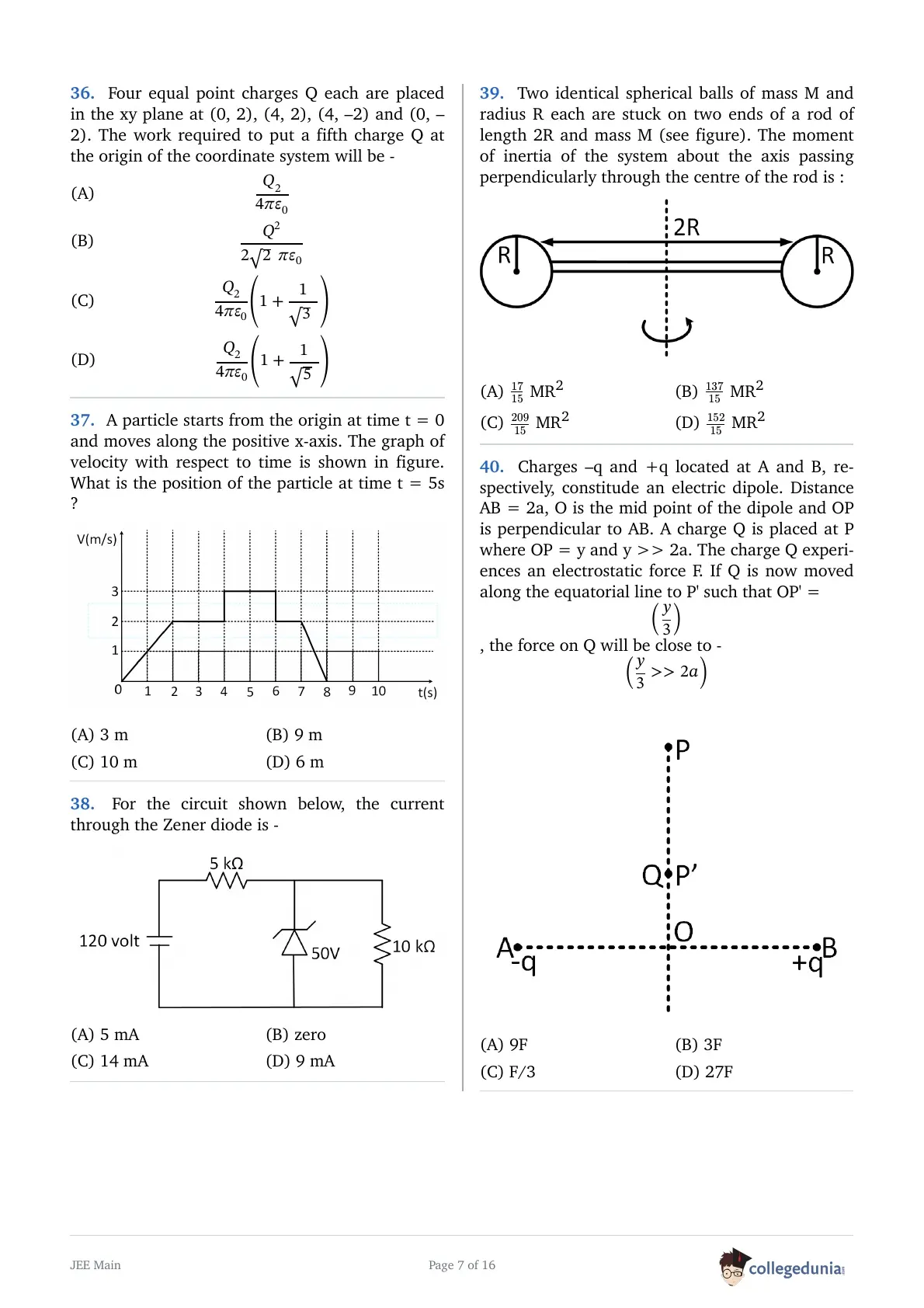
Four equal point charges Q each are placed in the xy plane at (0, 2), (4, 2), (4, -2) and (0, -2). The work required to put a fifth charge Q at the origin of the coordinate system will be -
A particle starts from the origin at time t = 0 and moves along the positive x-axis. The graph of velocity with respect to time is shown in figure. What is the position of the particle at time t = 5s ?
For the circuit shown below, the current through the Zener diode is :
Two identical spherical balls of mass \(M\) and radius \(R\) each are stuck on two ends of a rod of length \(2R\) and mass \(M\) (see figure). The moment of inertia of the system about the axis passing perpendicularly through the centre of the rod is :
Charges -q and +q located at A and B, respectively, constitute an electric dipole. Distance AB = 2a, O is the mid point of the dipole and OP is perpendicular to AB. A charge Q is placed at P where OP = y and y >> 2a. The charge Q experiences an electrostatic force F. If Q is now moved along the equatorial line to P' such that OP' = \(\left(\frac y3\right)\), the force on Q will be close to - \(\left(\frac y3\gg2a\right)\)
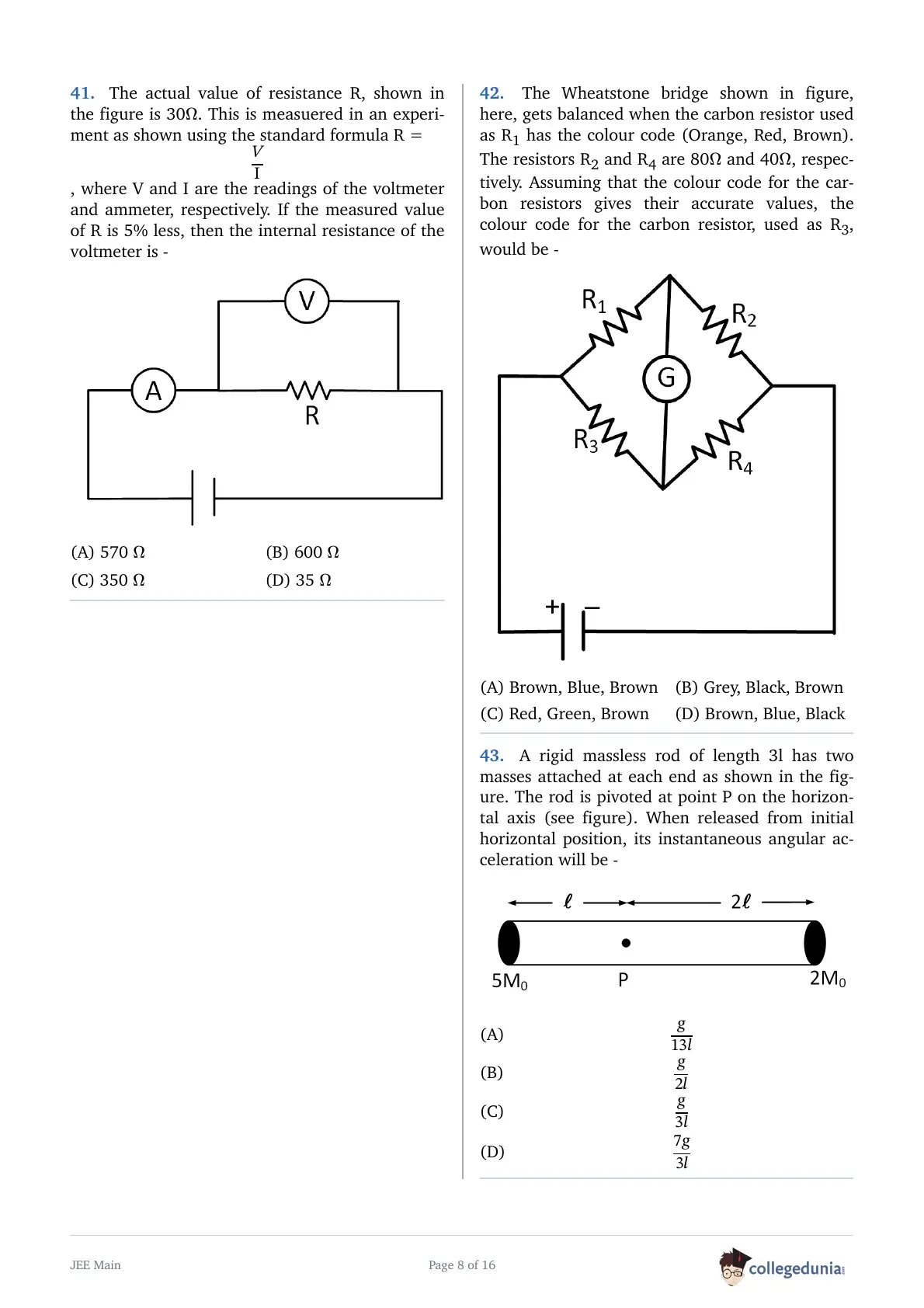
The actual value of resistance \(R\), shown in the figure is \(30 \Omega \). This is measured in an experiment as shown using the standard formula \(R = \frac{V}{I}\) , where \(V\) and \(I\) are the readings of the voltmeter and ammeter, respectively. If the measured value of \(R\) is \(5\%\) less, then the internal resistance of the voltmeter is :
The Wheatstone bridge shown in Fig. here, gets balanced when the carbon resistor used as \(R_1\) has the colour code ( Orange, Red, Brown). The resistors \(R_2\) and \(R_4\) are \(80\Omega \) and \(40 \Omega \) respectively. Assuming that the colour code for the carbon resistors gives their accurate values, the colour code for the carbon resistor, used as \(R_3\), would be :
A rigid massless rod of length \(3l\) has two masses attached at each end as shown in the figure. The rod is pivoted at point \(P\) on the horizontal axis (see figure). When released from initial horizontal position, its instantaneous angular acceleration will be :
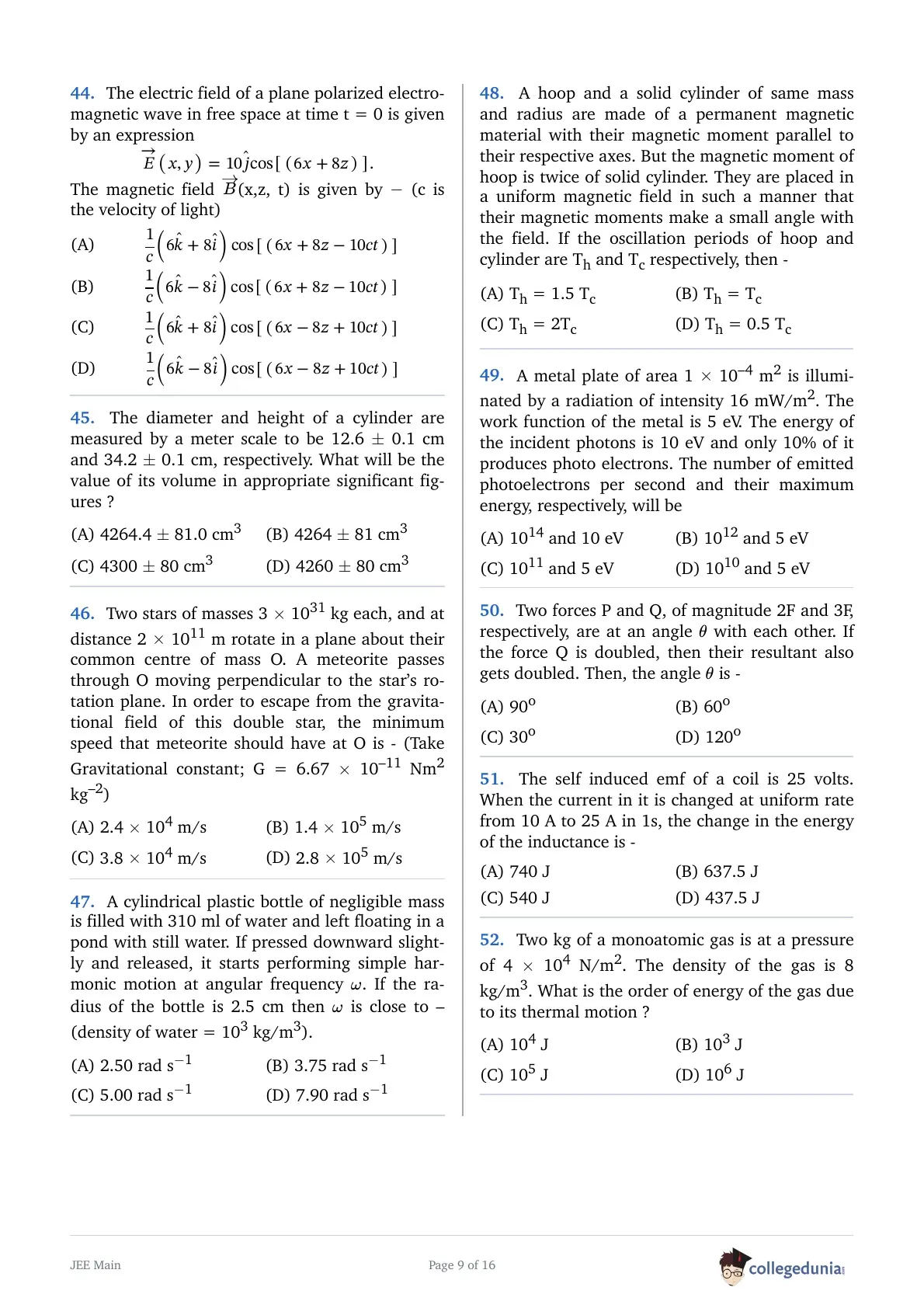
The electric field of a plane polarized electromagnetic wave in free space at time t = 0 is given by an expression
\(\vec E(x,y)=10\hat j\cos[(6x+8z)]\).
The magnetic field \(\vec B(x,z,t)\) is given by - (c is the velocity of light)
The diameter and height of a cylinder are measured by a meter scale to be \(12.6\pm0.1\) cm and \(34.2\pm0.1\) cm, respectively. What will be the value of its volume in appropriate significant figures ?
Two stars of masses \(m\) and \(2m\) at a distance \(d\) rotate about their common centre of mass in free space. The period of revolution is :
A cylindrical plastic bottle of negligible mass is filled with \(310\, ml\) of water and left floating in a pond with still water. If pressed downward slightly and released, it starts performing simple harmonic motion at angular frequency \(\omega\). If the radius of the bottle is \(2.5\, cm\) then \(\omega\) close to : (density of water = \(10^3 \; kg / m^3\))
A hoop and a solid cylinder of same mass and radius are made of a permanent magnetic material with their magnetic moment parallel to their respective axes. But the magnetic moment of hoop is twice of solid cylinder. They are placed in a uniform magnetic field in such a manner that their magnetic moments make a small angle with the field. If the oscillation periods of hoop and cylinder are Th and Tc respectively, then -
A metal plate of area \(1\times10^{-4}\ \mathrm{m^2}\) is illuminated by a radiation of intensity 16 mW/m2. The work function of the metal is 5 eV. The energy of the incident photons is 10 eV and only 10% of it produces photo electrons. The number of emitted photoelectrons per second and their maximum energy, respectively, will be
Two forces \(P\) and \(Q\) of magnitude \(2F\) and \(3F\), respectively, are at an angle \(\theta\) with each other. If the force \(Q\) is doubled, then their resultant also gets doubled. Then, the angle is :
The self induced emf of a coil is \(25\) volts. When the current in it is changed at uniform rate from \(10\, A\) to \(25\, A\) in \(1s\), the change in the energy of the inductance is :
Two kg of a monoatomic gas is at a pressure of \(4\times10^4\ \mathrm{N/m^2}\). The density of the gas is 8 kg/m3. What is the order of energy of the gas due to its thermal motion ?
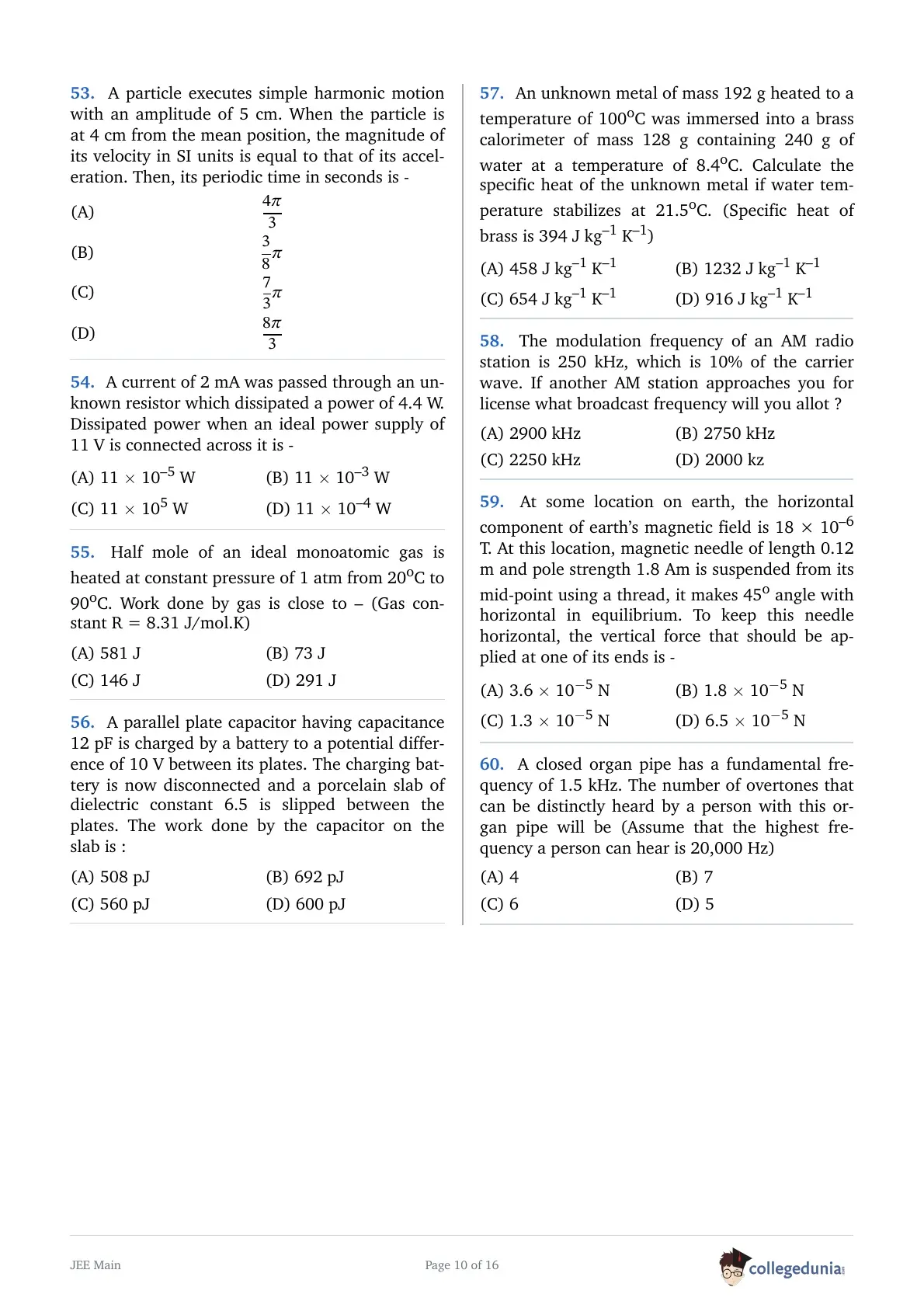
A particle executes simple harmonic motion with an amplitude of 4 cm. At the mean position, the velocity of the particle is 10 cm/s. The distance of the particle from the mean position when its speed becomes 5 cm/s is \( \sqrt{\alpha} \) cm, where \(\alpha\) = ______
A current of 2 mA was passed through an unknown resistor which dissipated a power of 4.4 W. Dissipated power when an ideal power supply of 11 V is connected across it is -
Half mole of an ideal monoatomic gas is heated at constant pressure of 1 atm from \(20{^{\circ}C}\) to \(90^{\circ}C\). Work done by gas is close to : ( Gas constant R = \(8.31\, J\, /mol-K\))
A parallel plate capacitor having capacitance 12 pF is charged by a battery to a potential difference of 10 V between its plates. The charging battery is now disconnected and a porcelain slab of dielectric constant 6.5 is slipped between the plates. The work done by the capacitor on the slab is :
An unknown metal of mass 192 g heated to a temperature of \(100^\circ\mathrm{C}\) was immersed into a brass calorimeter of mass 128 g containing 240 g of water at a temperature of \(8.4^\circ\mathrm{C}\). Calculate the specific heat of the unknown metal if water temperature stabilizes at \(21.5^\circ\mathrm{C}\). (Specific heat of brass is 394 J kg-1 K-1)
The modulation frequency of an AM radio station is 250 kHz, which is 10% of the carrier wave. If another AM station approaches you for license what broadcast frequency will you allot ?
At some location on earth the horizontal component of earth's magnetic field is \(18 \times 10^{-6}\) T. At this location, magnetic needle of length \(0.12\, m\) and pole strength \(1.8\, Am\) is suspended from its mid-point using a thread, it makes \(45^{\circ}\) angle with horizontal in equilibrium. To keep this needle horizontal, the vertical force that should be applied at one of its ends is :
The fundamental frequency of closed organ pipe is equal to the frequency of first overtone of open organ pipe of length 60 cm. The length of closed organ pipe is
Chemistry (Q61 - Q90)
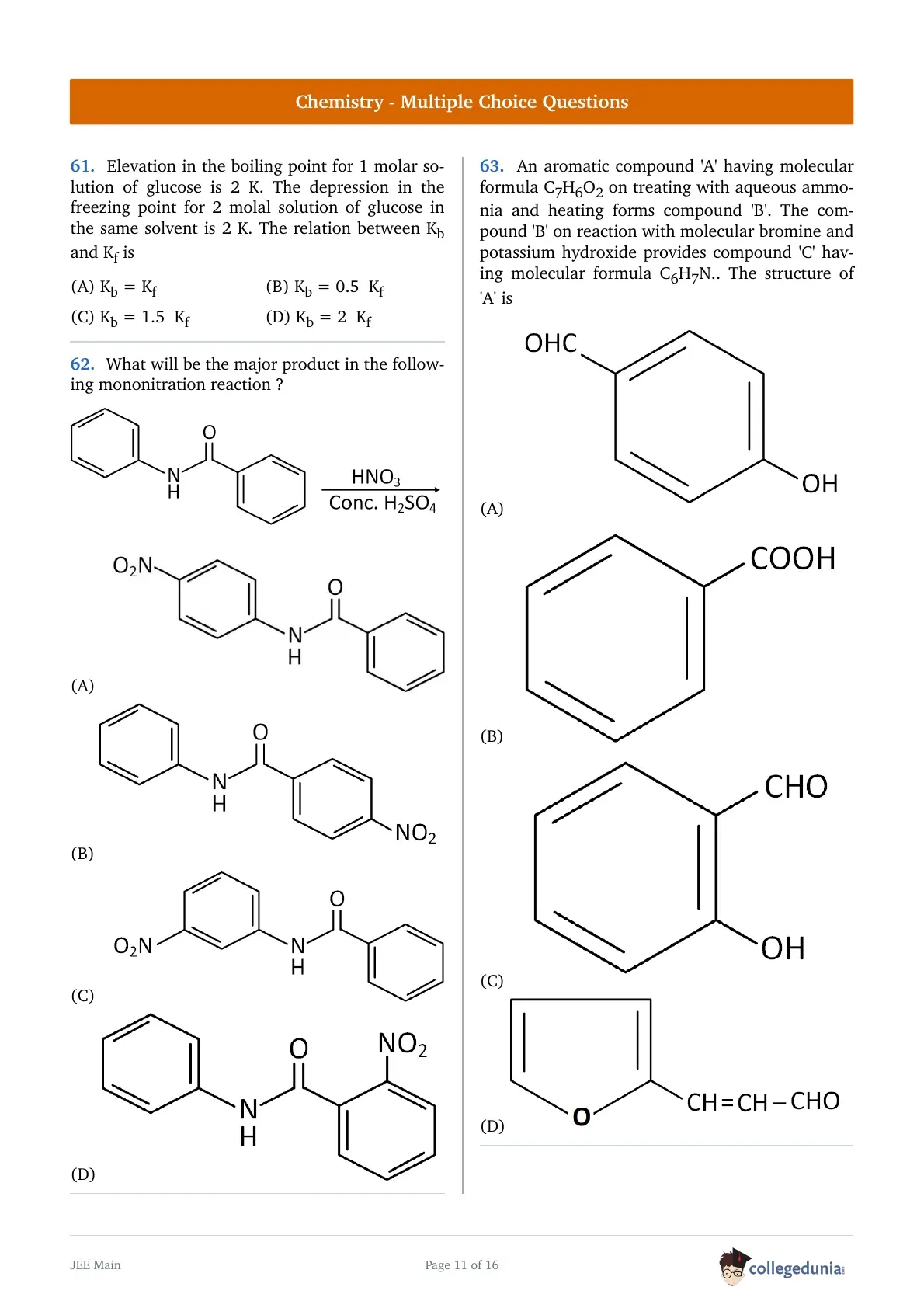
Elevation in the boiling point for 1 molar solution of glucose is 2 K. The depression in the freezing point for 2 molal solution of glucose in the same solvent is 2 K. The relation between \(K_b\) and \(K_f\) is
What will be the major product in the following mononitration reaction ?
- (1)
![]()
- (2)
![]()
- (3)
![]()
- (4)
![]()


An aromatic compound \('A'\) having molecular formula \({C7H6O2}\) on treating with aqueous ammonia and heating forms compound \('B'\). The compound \('B'\) on reaction with molecular bromine and potassium hydroxide provides compound \('C'\) having molecular formula \({C_6H_7N}\). The structure of \('A'\) is :
- (1)
![]()
- (2)
![]()
- (3)
![]()
- (4)
![]()


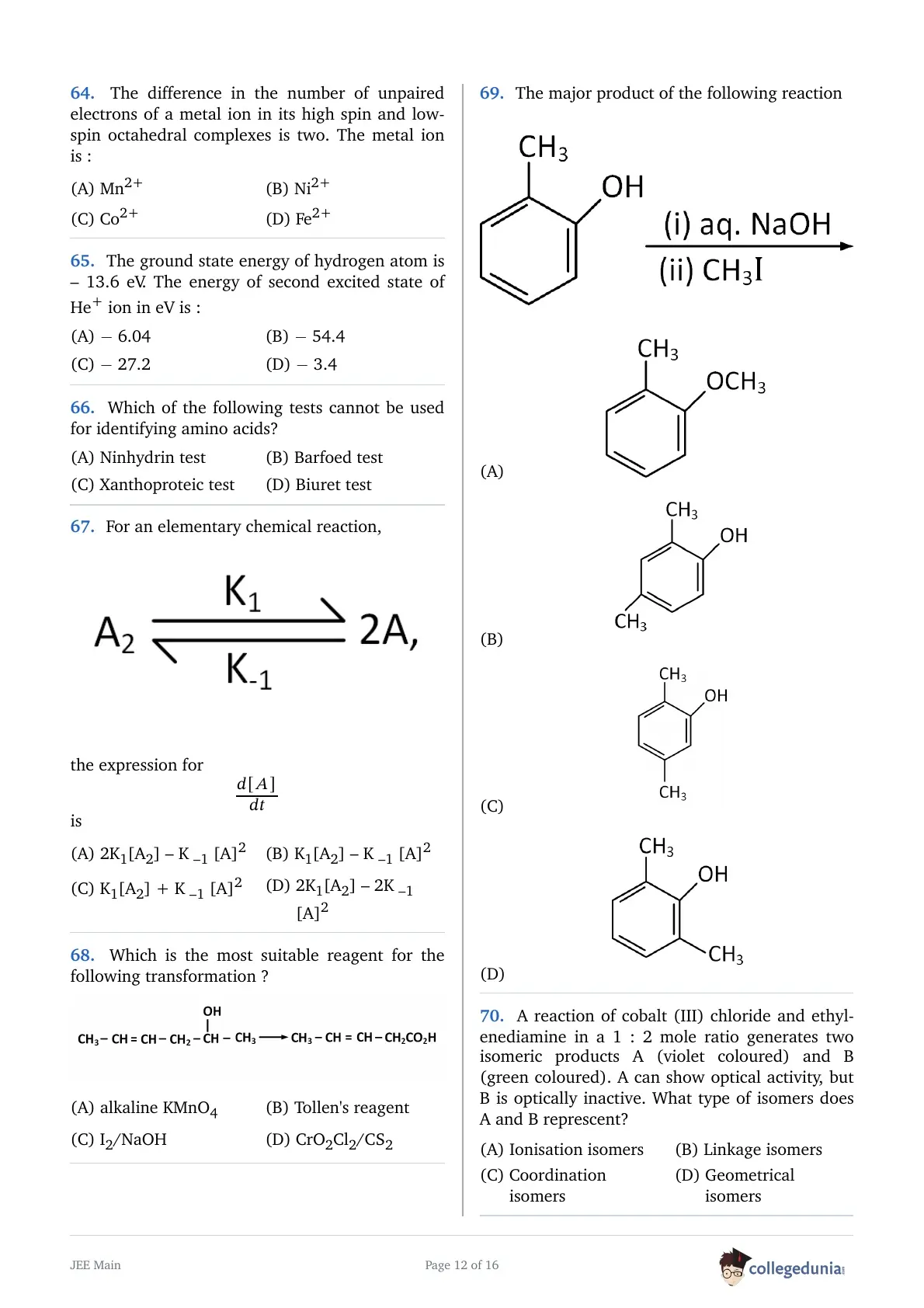
The difference in the number of unpaired electrons of a metal ion in its high spin and low-spin octahedral complexes is two. The metal ion is :
The ground state energy of hydrogen atom is \(-13.6\) eV. The energy of second excited state of \(\mathrm{He^{+}}\) ion in eV is :
Which of the following tests cannot be used for identifying amino acids?
For an elementary chemical reaction, \(\mathrm{A_2} \underset{K_{-1}}{\overset{K_1}{\rightleftharpoons}} 2\mathrm{A}\), the expression for \(\frac{d[A]}{dt}\) is
Which is the most suitable reagent for the following transformation ?


A reaction of cobalt (III) chloride and ethylenediamine in a 1 : 2 mole ratio generates two isomeric products A (violet coloured) and B (green coloured). A can show optical activity, but B is optically inactive. What type of isomers does A and B represcent?
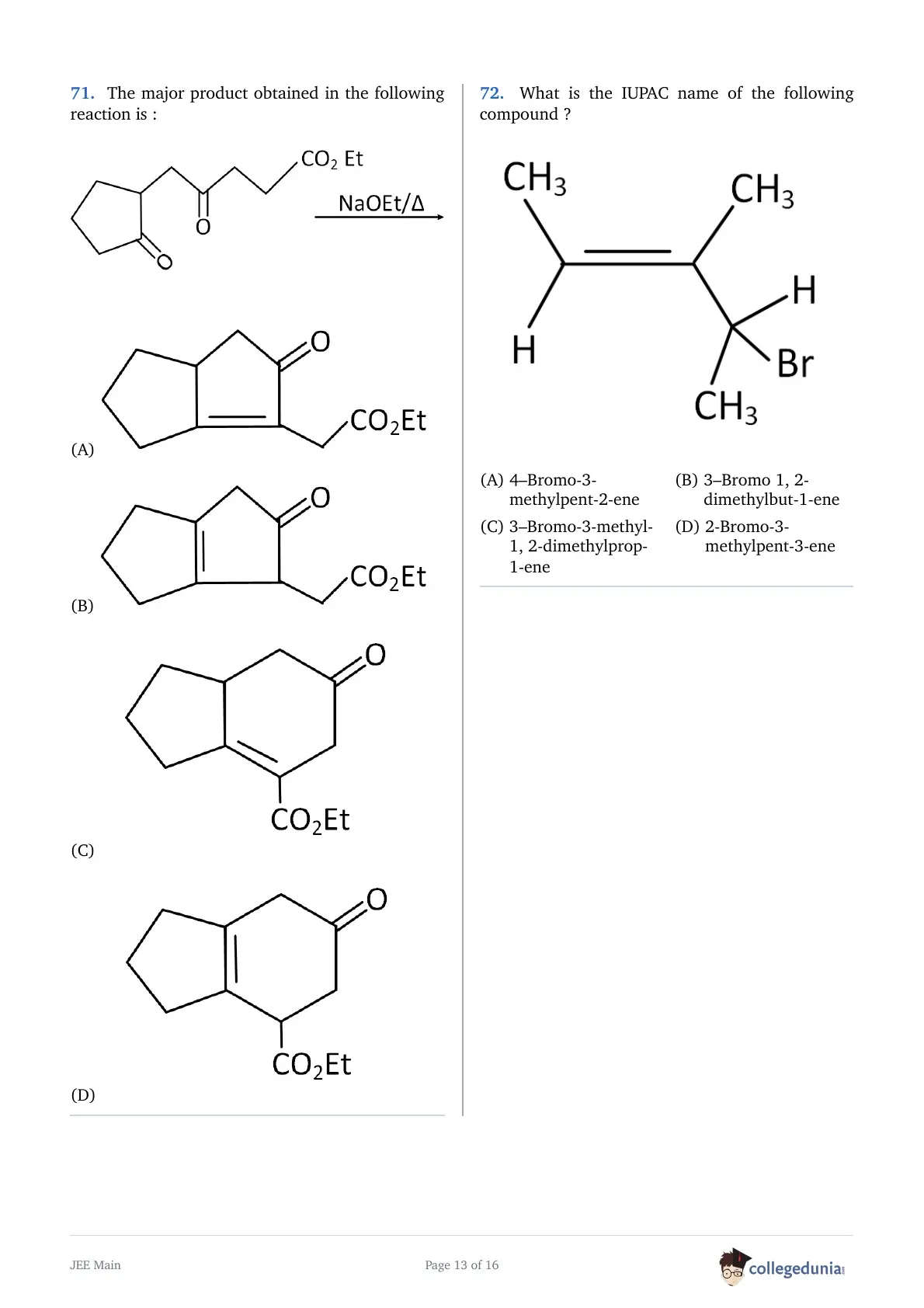
The major product obtained in the following reaction is :
- (1)
![]()
- (2)
![]()
- (3)
![]()
- (4)
![]()


What is the IUPAC name of the following compound ?


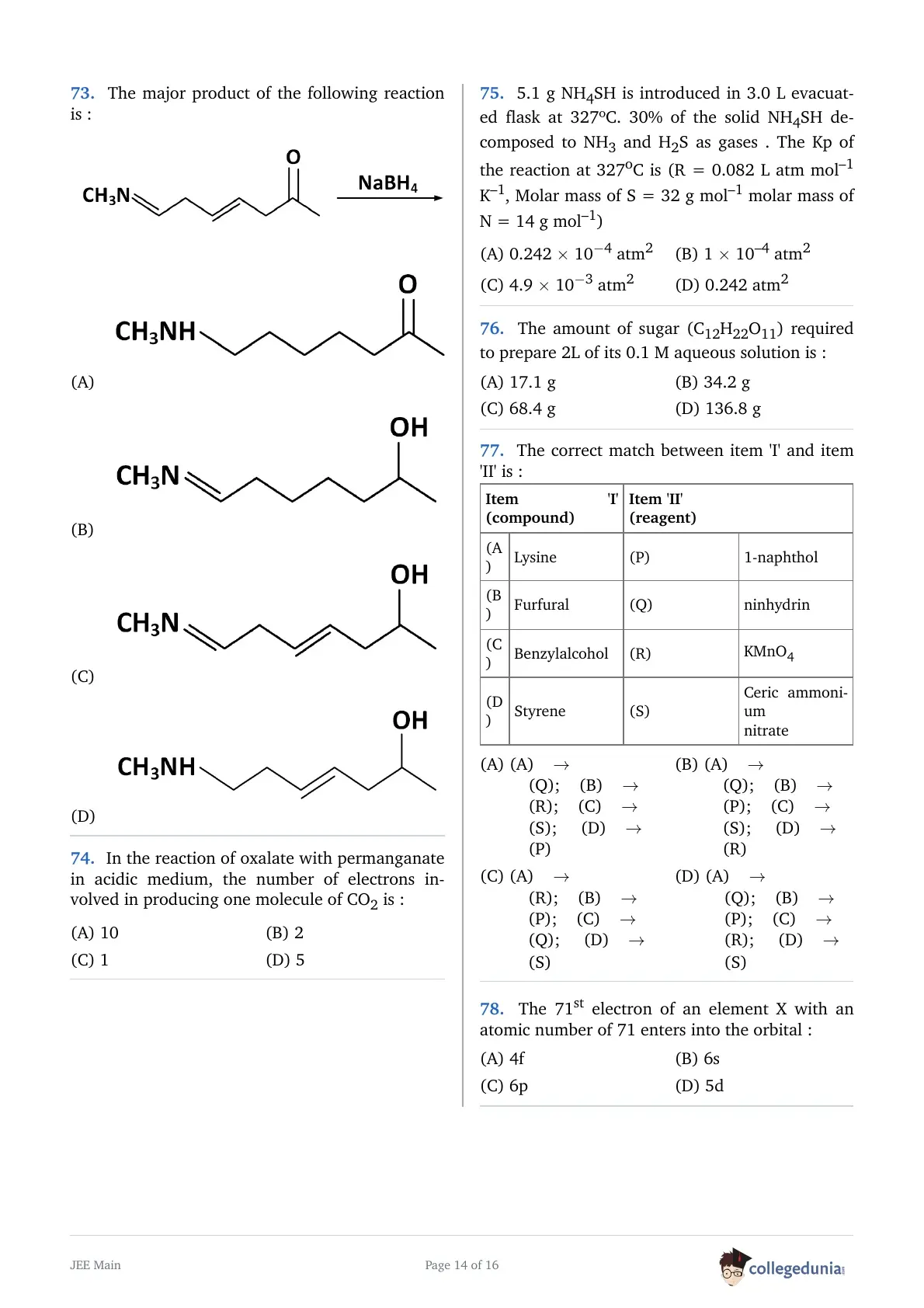
In the reaction of oxalate with permanganate in acidic medium, the number of electrons involved in producing one molecule of \(\mathrm{CO_2}\) is :
\({5.1g \; NH_4SH }\) is introduced in \(3.0\, L\) evacuated flask at \({327^{\circ}C}\). 30% of the solid \({NH4SH}\) decomposed to \({NH_3}\) and \({H2S}\) as gases. The Kp of the reaction at \({327^{\circ}C}\) is \({(R = 0.082 \; L \; atm \; mol^{-1} K^{-1}}}\), Molar mass of \({S = 32 \; g \; mol/^{01}}\), molar mass of \({N = 14g \, mol^{-1}}\))
The amount of sugar \( {(C_{12}H_{22}O_{11})}\) required to prepare \(2\, L\) of its \(0.1\, M\) aqueous solution is :
| Item 'I' (compound) | Item 'II' (reagent) |
| (A) Lysine | (P) 1-naphthol |
| (B) Furfural | (Q) ninhydrin |
| (C) Benzylalcohol | (R) KMnO4 |
| (D) Styrene | (S) Ceric ammonium nitrate |
The \(71^{st}\) electron of an element \(X\) with an atomic number of \(71\) enters into the orbital :
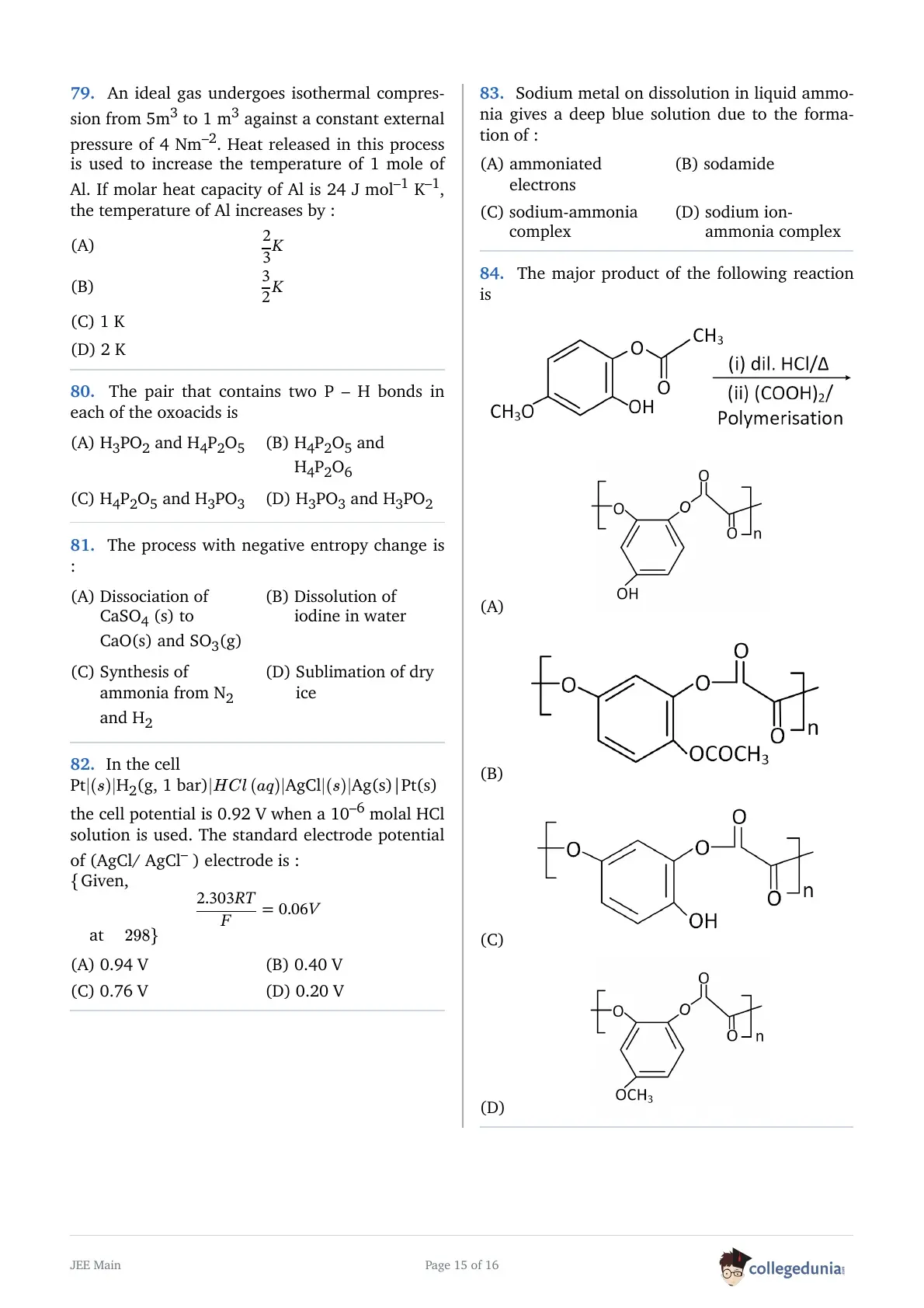
An ideal gas undergoes isothermal compression from 5 \(\mathrm{m^3}\) to 1 \(\mathrm{m^3}\) against a constant external pressure of 4 \(\mathrm{N\,m^{-2}}\). Heat released in this process is used to increase the temperature of 1 mole of Al. If molar heat capacity of Al is 24 \(\mathrm{J\,mol^{-1}\,K^{-1}}\), the temperature of Al increases by :
The pair that contains two P - H bonds in each of the oxoacids is
The process with negative entropy change is :
In the cell \({Pt(s) | H_2(g , 1 bar | HCl(aq) | Ag(s) | Pt(s)} \) the cell potential is 0.92 when a \(10^{-6}\) molal HCl solution is used. THe standard electrode potential of \({(AgCl/Ag,Cl^{-})}\) electrode is : \(\left\{ \text{given} , \frac{2.303RT}{F} = 0.06 V \; at \; 298K\right\}\)
Sodium metal on dissolution in liquid ammonia gives a deep blue solution due to the formation of:


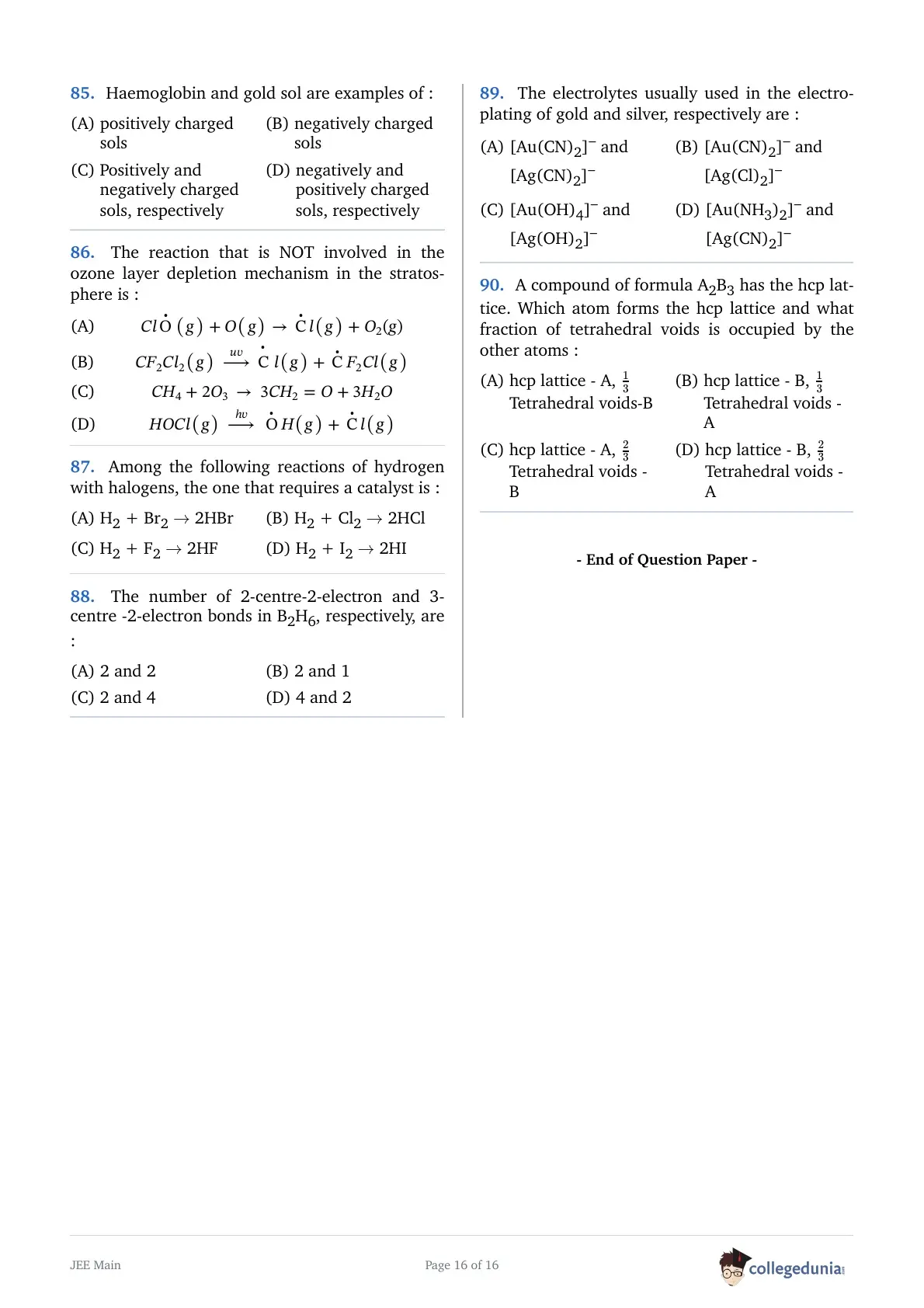
Haemoglobin and gold sol are examples of :
The reaction that is NOT involved in the ozone layer depletion mechanism in the stratosphere is :
Among the following reactions of hydrogen with halogens, the one that requires a catalyst is :
The number of 2 -centre- 2 -electron and 3-centre-2-electron bonds in \(B _{2} H _{6}\), respectively, are :
The electrolytes usually used in the electroplating of gold and silver, respectively are :
A compound of formula \(A_2B_3\) has the hcp lattice. Which atom forms the hcp lattice and what fraction of tetrahedral voids is occupied by the other atoms :
JEE Main 2019 Exam Pattern and Marking Scheme
| Particulars | Details |
|---|---|
| Exam Mode | Online (Computer-Based Test) |
| Paper | B.E./B.Tech (Paper 1) |
| Duration | 3 hours (180 minutes) |
| Type of Questions | Multiple Choice Questions (MCQs) |
| Subjects | Mathematics, Physics, Chemistry |
| Total Questions | 90 questions |
| Total Marks | 360 marks |
| Marking Scheme | +4 for correct answer & -1 for incorrect answer; 0 for unattempted |
JEE Main 2019 January 10 Shift 2 Difficulty Level
JEE Main 2019 B.E./B.Tech was successfully concluded on January 10th (2:30 PM to 5:30 PM) online by NTA (National Testing Agency). There were no modifications in the overall exam pattern as compared to the previous years. The exam comprises 90 questions that were carried by 3 sections (Physics, Chemistry, and Mathematics). Each section holds 30 questions. Each question holds 4 marks.
JEE Main 2019 B.E./B.Tech Question Paper Analysis
Physics has remained the toughest section throughout the session. Following the pattern, NTA decided to set the Physics section on the difficult side of the paper in JEE Main 2019 B.E./B.Tech Afternoon Session. Chemistry was the easiest section among the three sections. Some questions were directly related to NCERT. Mathematics section was moderate and involved questions from Calculations.
JEE Main 2019 B.E./B.Tech Marking Scheme
Students were rewarded with 4 marks for every correct attempt. Students had to pay a penalty of 1 mark everytime they made an incorrect attempt.



Comments