




JEE Main 2020 January 8 Shift 1 Question Paper is available here with solutions PDF and detailed solutions for every question. NTA conducted the first shift on January 8, 2020, from 9:30 AM to 12:30 PM. The JEE Main 2020 Paper 1 (B.E./B.Tech) question paper includes the following:
- 75 questions in a 3-hour CBT Mode: 25 each from Mathematics, Physics and Chemistry
- Section A: 20 multiple choice questions (MCQs) per subject, 4 marks each
- Section B: 5 numerical value questions per subject, all compulsory, 4 marks each
- Marking: +4 for a correct answer, -1 for an incorrect MCQ, 0 for an unattempted question; no negative marking for numerical value questions
- Maximum marks: 300 (100 per subject)
JEE Main 2020 January 8 Shift 1 Question Paper with Solution PDF
| NTA Official PDF | CD PDF | CD PDF with Solutions |
|---|---|---|
| Download official PDF 6.26 MB | Download Collegedunia PDF 1.10 MB | Download solutions PDF 2.49 MB |
Also Check:
JEE Main 2020 January 8 Shift 1 Questions with Solutions
Mathematics - Section A (Q1 - Q20)
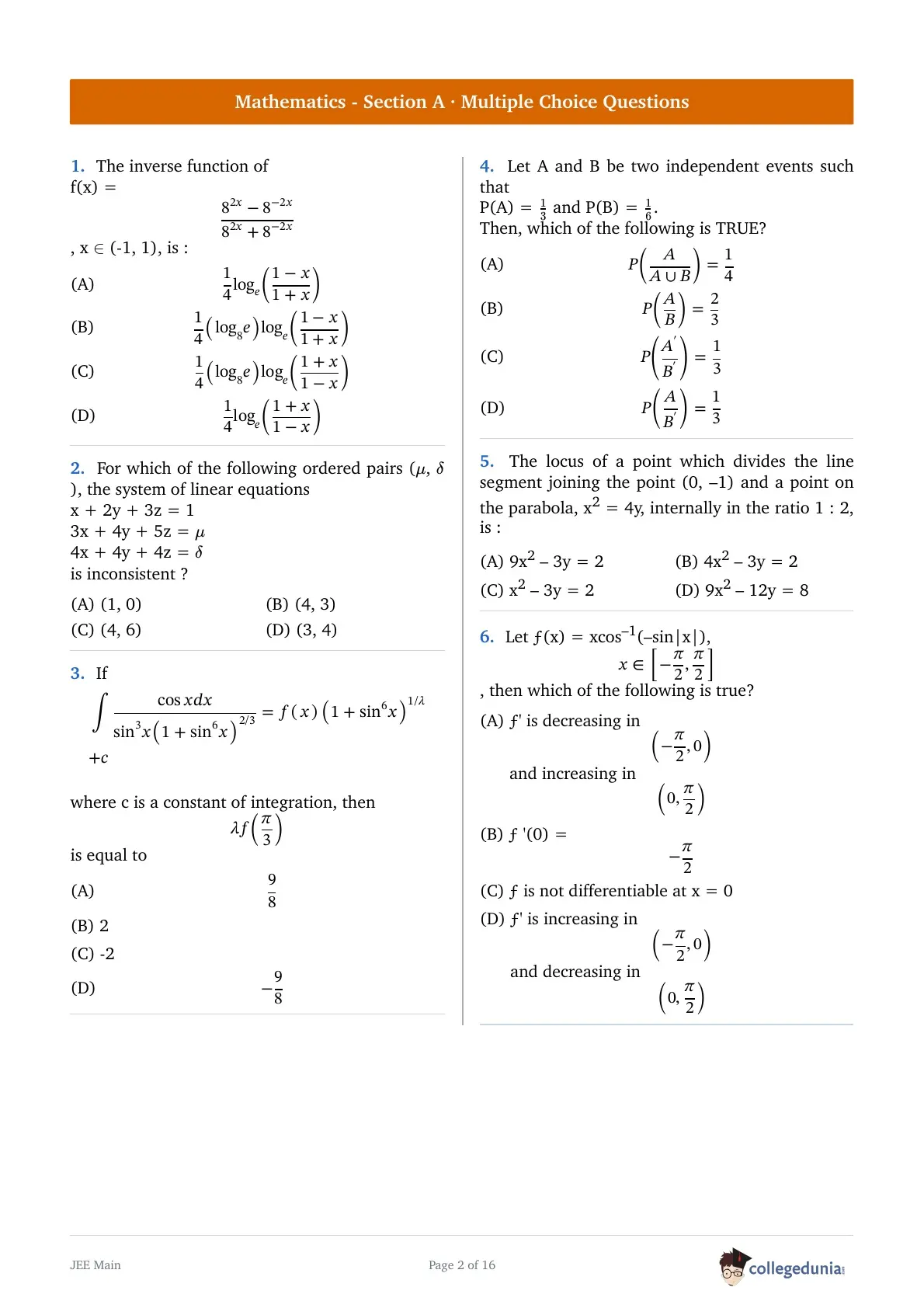
The inverse function of \(f\left(x\right) = \frac{8^{2x}-8^{-2x}}{8^{2x} + 8^{-2x}}, x\epsilon \left(-1, 1\right),\) is __________.
For which of the following ordered pairs \((\mu, \delta)\), the system of linear equations
\(x + 2y + 3z = 1\)
\(3x + 4y + 5z = \mu\)
\(4x + 4y + 4z = \delta\)
is inconsistent ?
If \(\displaystyle\int \frac{\cos x\,dx}{\sin^3 x\,(1+\sin^6 x)^{2/3}} = f(x)\,(1+\sin^6 x)^{1/\lambda} + c\)
where \(c\) is a constant of integration, then \(\lambda f\left(\frac{\pi}{3}\right)\) is equal to
Let A and B be two independent events such that \(P\left(A\right) = \frac{1}{3}\) and \(P\left(B\right) = \frac{1}{6}.\) Then, which of the following is TRUE ?
The locus of a point which divides the line segment joining the point (0, -1) and a point on the parabola, \(x^2 = 4y\), internally in the ratio 1 : 2, is :
Let \(f(x) = x\cos^{-1}(-\sin|x|)\), \(x\in\left[-\frac{\pi}{2},\frac{\pi}{2}\right]\), then which of the following is true?
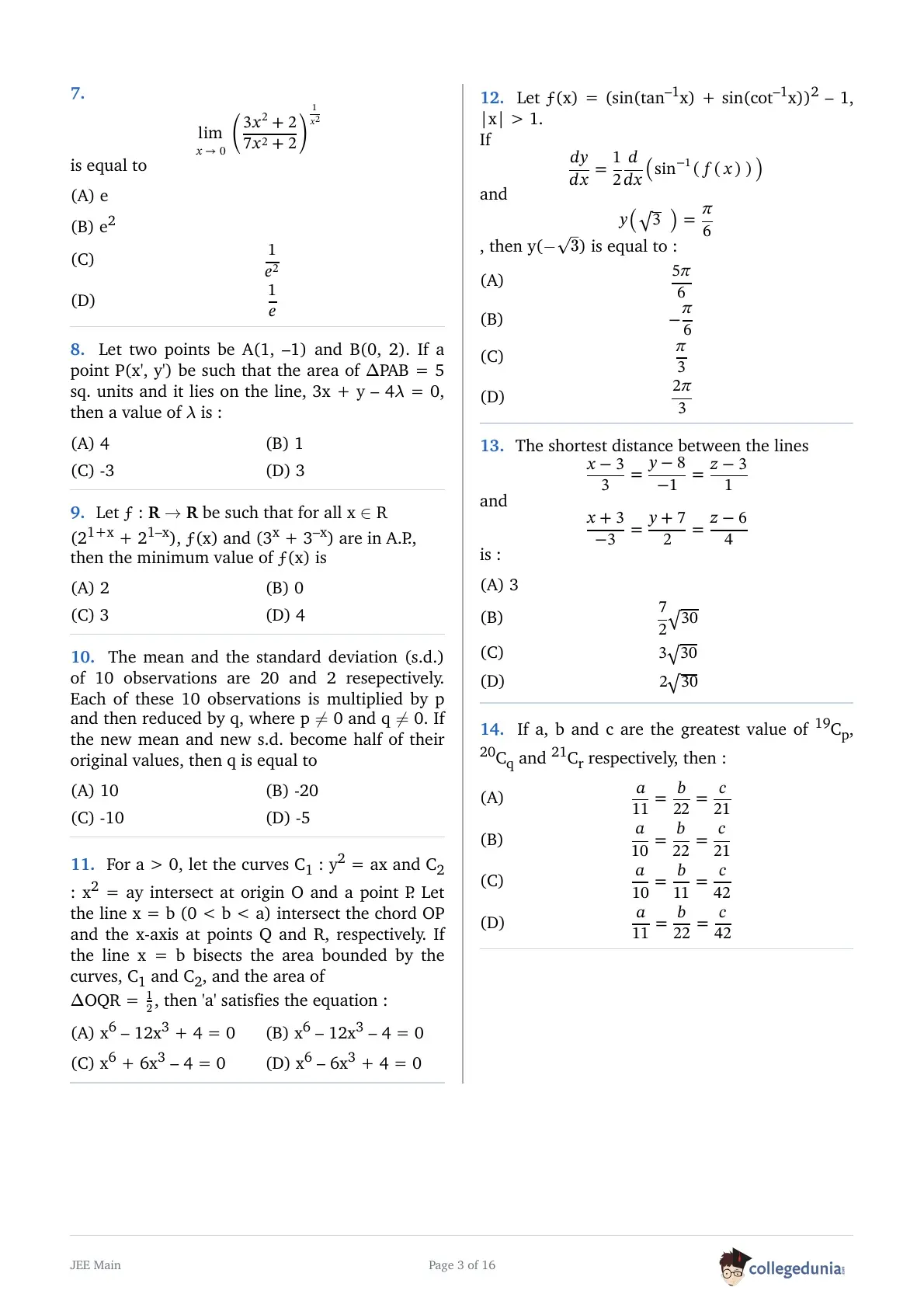
\(\displaystyle\lim_{x \to 0} \left(\frac{3x^{2}+2}{7x^{2}+2}\right)^{\frac {1}{x^2}}\) is equal to :
Let two points be \(A(1,-1)\) and \(B(0,2)\). If a point \(P(x',y')\) be such that the area of \(\Delta PAB = 5\) sq. units and it lies on the line, \(3x+y-4\lambda=0\), then a value of \(\lambda\) is :
Let \(f:\mathbf{R}\to\mathbf{R}\) be such that for all \(x\in\mathbf{R}\)
\((2^{1+x}+2^{1-x})\), \(f(x)\) and \((3^x+3^{-x})\) are in A.P.,
then the minimum value of \(f(x)\) is
The mean and the standard deviation (s.d.) of 10 observations are 20 and 2 resepectively. Each of these 10 observations is multiplied by \(p\) and then reduced by \(q\), where \(p\ne0\) and \(q\ne0\). If the new mean and new s.d. become half of their original values, then \(q\) is equal to
For \(a > 0\), let the curves \(C_1 : y^2 = ax\) and \(C_2 : x^2= ay\) intersect at origin O and a point P. Let the line \(x = b (0 < b < a)\) intersect the chord OP and the x-axis at points Q and R, respectively. If the line x = b bisects the area bounded by the curves, \(C_1\) and \(C_2\), and the area of \(\Delta OQR = \frac{1}{2},\) then 'a' satisfies the equation :
Let \(f(x) = (\sin(\tan^{-1}x)+\sin(\cot^{-1}x))^2-1\), \(|x|>1\).
If \(\frac{dy}{dx}=\frac12\frac{d}{dx}\left(\sin^{-1}(f(x))\right)\) and \(y(\sqrt3)=\frac{\pi}{6}\), then \(y(-\sqrt3)\) is equal to :
The shortest distance between the lines
\(\frac{x-3}{3}=\frac{y-8}{-1}=\frac{z-3}{1}\)
and
\(\frac{x+3}{-3}=\frac{y+7}{2}=\frac{z-6}{4}\)
is :
If a, b and c are the greatest values of \(^{19}C_{p}, \, ^{20}C_{q}\) and \(^{21}C_{r}\) respectively, then :
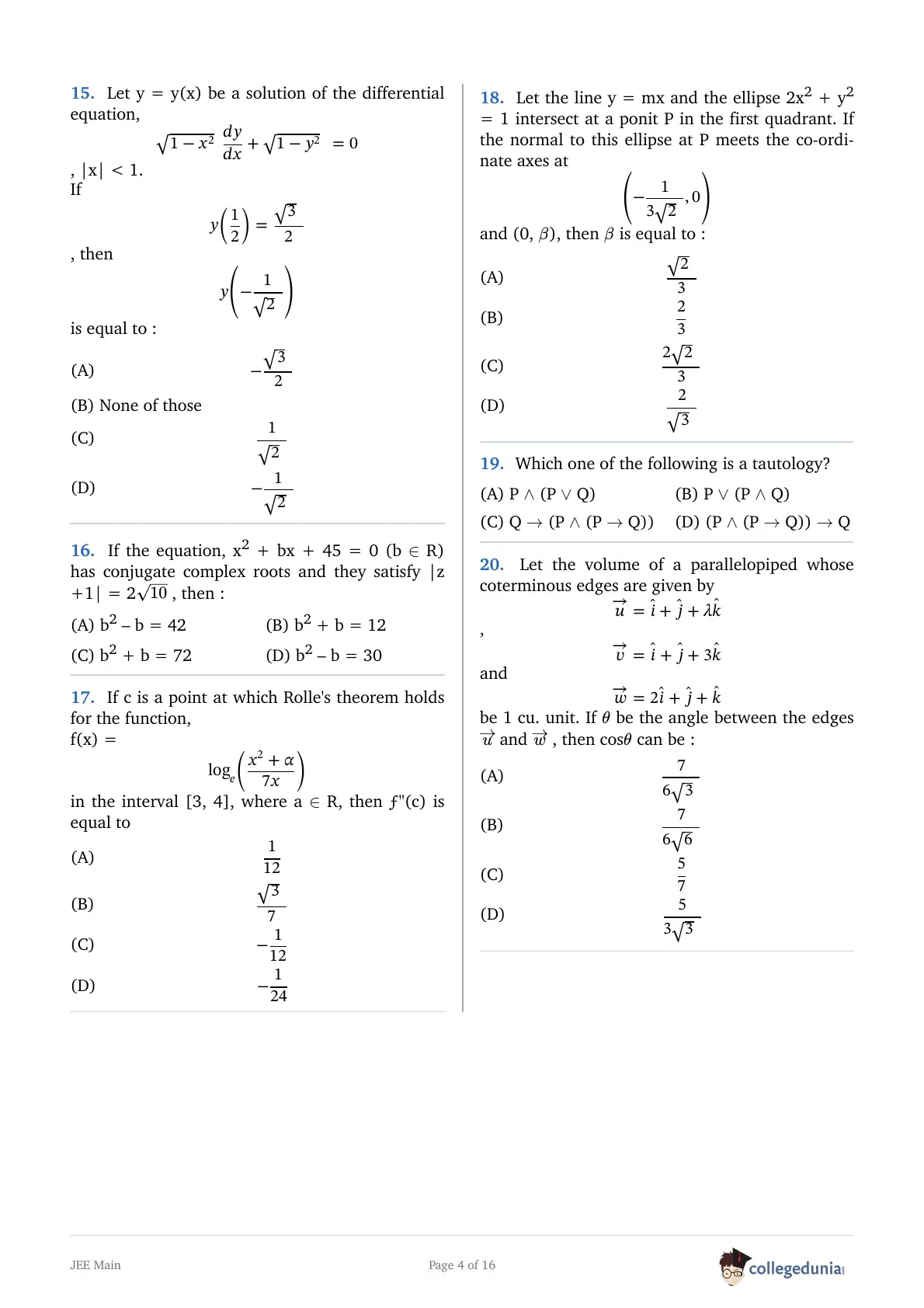
Let \(y=y(x)\) be a solution of the differential equation,
\(\sqrt{1-x^2}\,\frac{dy}{dx}+\sqrt{1-y^2}=0\), \(|x|<1\).
If \(y\left(\frac12\right)=\frac{\sqrt3}{2}\), then \(y\left(-\frac{1}{\sqrt2}\right)\) is equal to :
If the equation, \(x^2+bx+45=0\) (\(b\in R\)) has conjugate complex roots and they satisfy \(|z+1|=2\sqrt{10}\), then :
If \(c\) is a point at which Rolle's theorem holds for the function,
\(f(x)=\log_e\left(\frac{x^2+\alpha}{7x}\right)\)
in the interval \([3,4]\), where \(\alpha\in R\), then \(f''(c)\) is equal to
Let the line \(y=mx\) and the ellipse \(2x^2+y^2=1\) intersect at a ponit \(P\) in the first quadrant. If the normal to this ellipse at \(P\) meets the co-ordinate axes at
\(\left(-\frac{1}{3\sqrt2},0\right)\) and \((0,\beta)\), then \(\beta\) is equal to :
Which one of the following is a tautology ?
Let the vectors \( , , \) represent three coterminous edges of a parallelepiped of volume \( V \). Then the volume of the parallelepiped, whose coterminous edges are represented by \( , + \) and \( + 2 + 3 \) is equal to: \\ \\
Mathematics - Section B (Q21 - Q25)
The least positive value of 'a' for which the equation \(2x^2 + (a - 10)x + \frac{33}{2} = 2a\) has real roots is
The number of all \(3 \times 3\) matrices A, with entries from the set \(\{-1, 0, 1\}\) such that the sum of the diagonal elements of \(AA^T\) is 3, is
An urn contains 5 red marbles, 4 black marbles and 3 white marbles. Then the number of ways in which 4 marbles can be drawn so that at the most three of them are red is ___________.
Let the normal at a point P on the curve \(y^2 - 3x^2 + y + 10 = 0\) intersect the y-axis at \(\left(0, \frac{3}{2}\right)\). If m is the slope of the tangent at P to the curve, then \(|m|\) is equal to
The sum \(\displaystyle\sum_{k=1}^{20} (1 + 2 + 3 + \ldots + k)\) is :
Physics - Section A (Q26 - Q45)
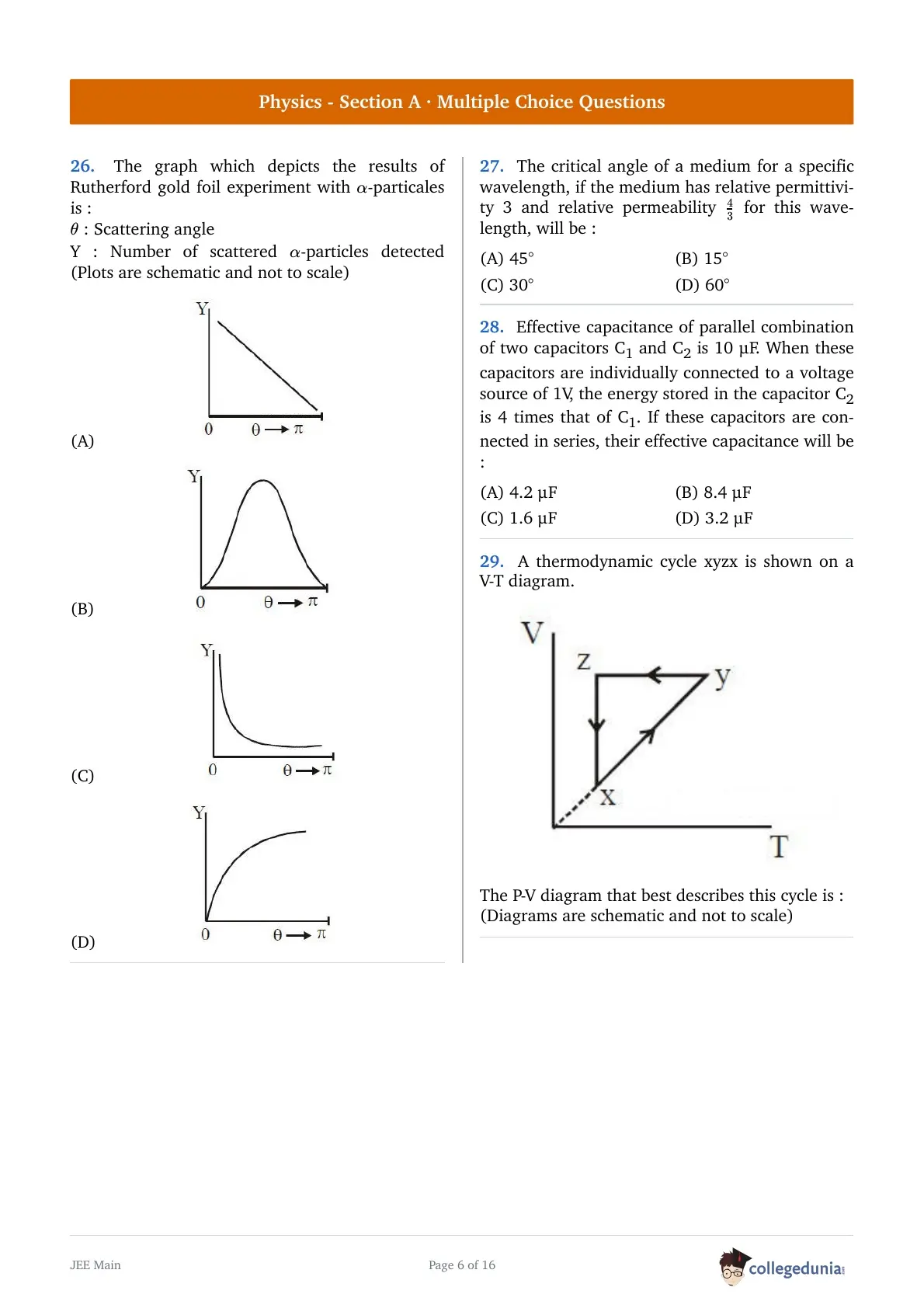
The graph which depicts the results of Rutherford gold foil experiment with \(\alpha\)-particales is :
\(\theta\) : Scattering angle
Y : Number of scattered \(\alpha\)-particles detected (Plots are schematic and not to scale)
- (1)
![]()
- (2)
![]()
- (3)
![]()
- (4)
![]()


An electromagnetic wave of frequency 5 GHz, is travelling in a medium whose relative electric permittivity and relative magnetic permeability both are 2. Its velocity in this medium is ________ × 10⁷ m/s.
Effective capacitance of parallel combination of two capacitors \(C_1\) and \(C_2\) is 10 \(\mu\)F. When these capacitors are individually connected to a voltage source of 1V, the energy stored in the capacitor \(C_2\) is 4 times that of \(C_1\). If these capacitors are connected in series, their effective capacitance will be :
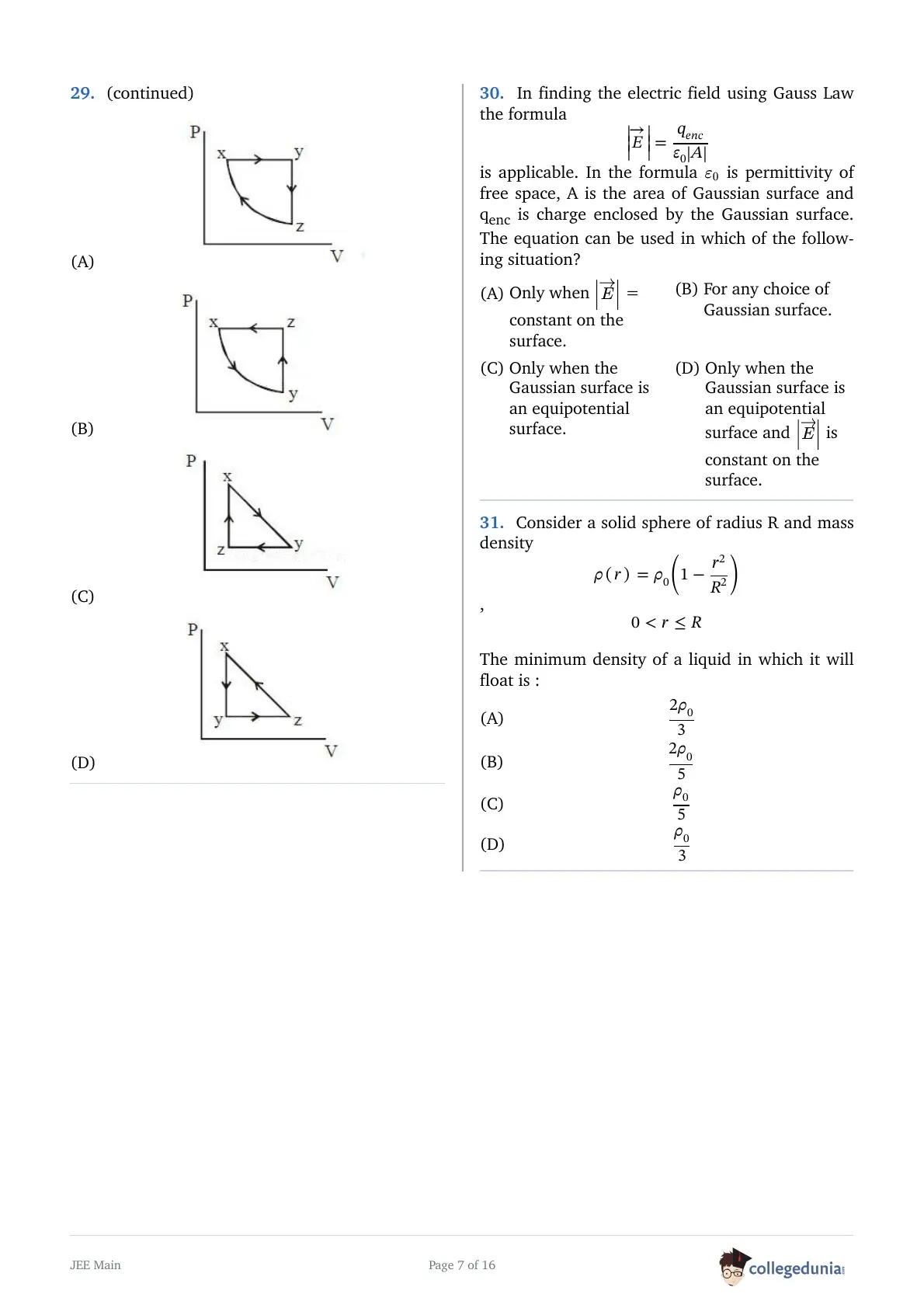
A thermodynamic cycle \(xyzx\) is shown on a \(V-T\) diagram. The \(P-V\) diagram that best describes this cycle is : (Diagrams are schematic and not to scale)
- (1)
![]()
- (2)
![]()
- (3)
![]()
- (4)
![]()


In finding the electric field using Gauss law the formula \(\left|\overrightarrow{E}\right|= \frac{q_{enc}}{\epsilon_{0}\left|A\right|}\) is applicable. In the formula \(\epsilon_{0}\) is permittivity of free space, \(A\) is the area of Gaussian surface and \( q_{enc}\) is charge enclosed by the Gaussian surface. This equation can be used in which of the following situation ?
Consider a solid sphere of radius R and mass density
\(\rho(r) = \rho_0\left(1 - \frac{r^2}{R^2}\right)\), \(0 \lt r \le R\)
The minimum density of a liquid in which it will float is :
The dimension of stopping potential \(V_0\) in photoelectric effect in units of Planck's constant 'h', speed of light 'c' and Gravitational constant 'G' and ampere A is :
Consider a uniform rod of mass M = 4m and length \(\ell\) pivoted about its centre. A mass m moving with velocity v making angle \(\theta = \frac{\pi}{4}\) to the rod's long axis collides with one end of the rod and sticks to it. The angular speed of the rod-mass system just after the collision is :
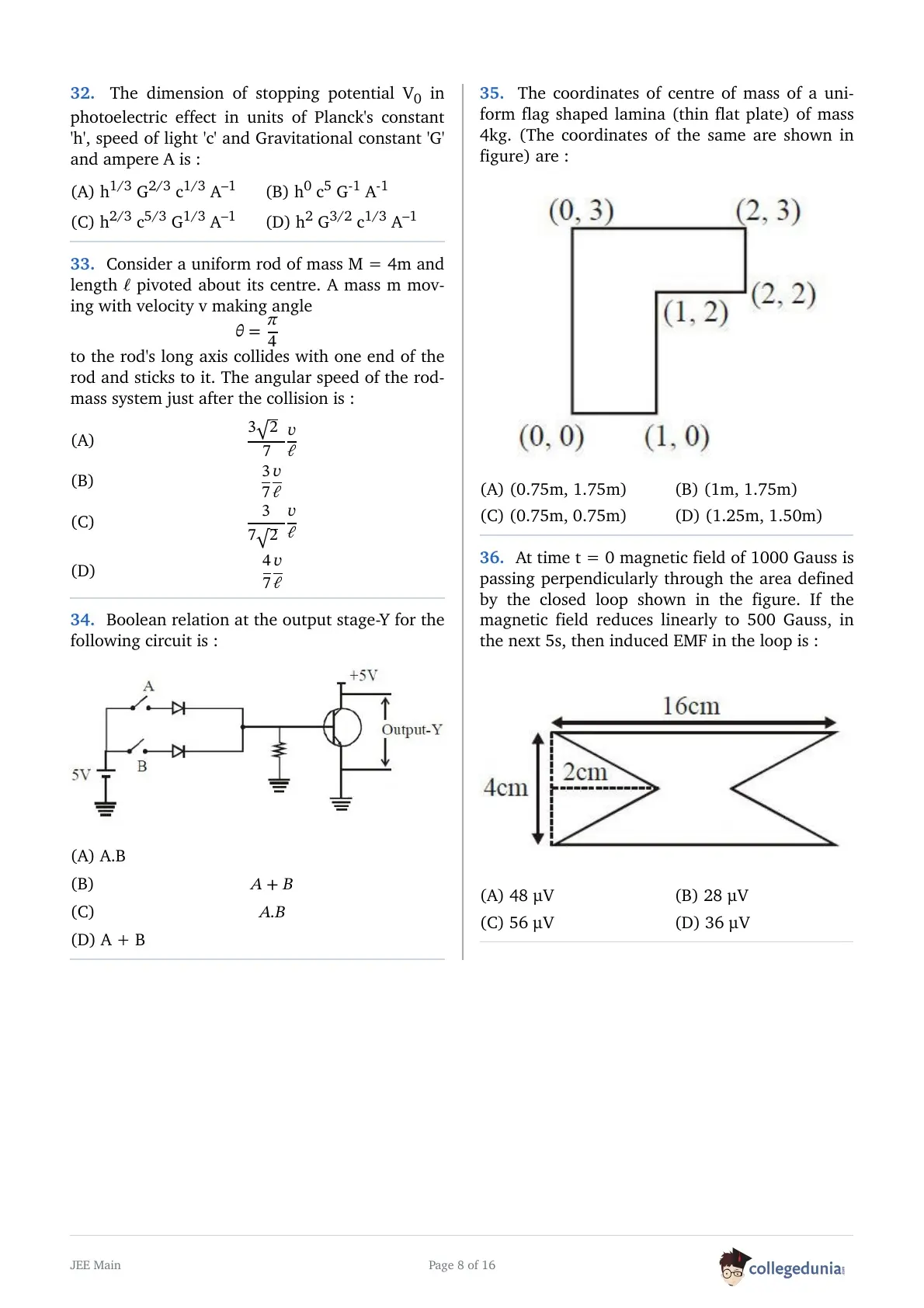
Boolean relation at the output stage-Y for the following circuit is :
The coordinates of centre of mass of a uniform flag shaped lamina (thin flat plate) of mass \(4\, kg\). (The coordinates of the same are shown in figure) are :
At time t = 0 magnetic field of 1000 Gauss is passing perpendicularly through the area defined by the closed loop shown in the figure. If the magnetic field reduces linearly to 500 Gauss, in the next 5s, then induced EMF in the loop is :
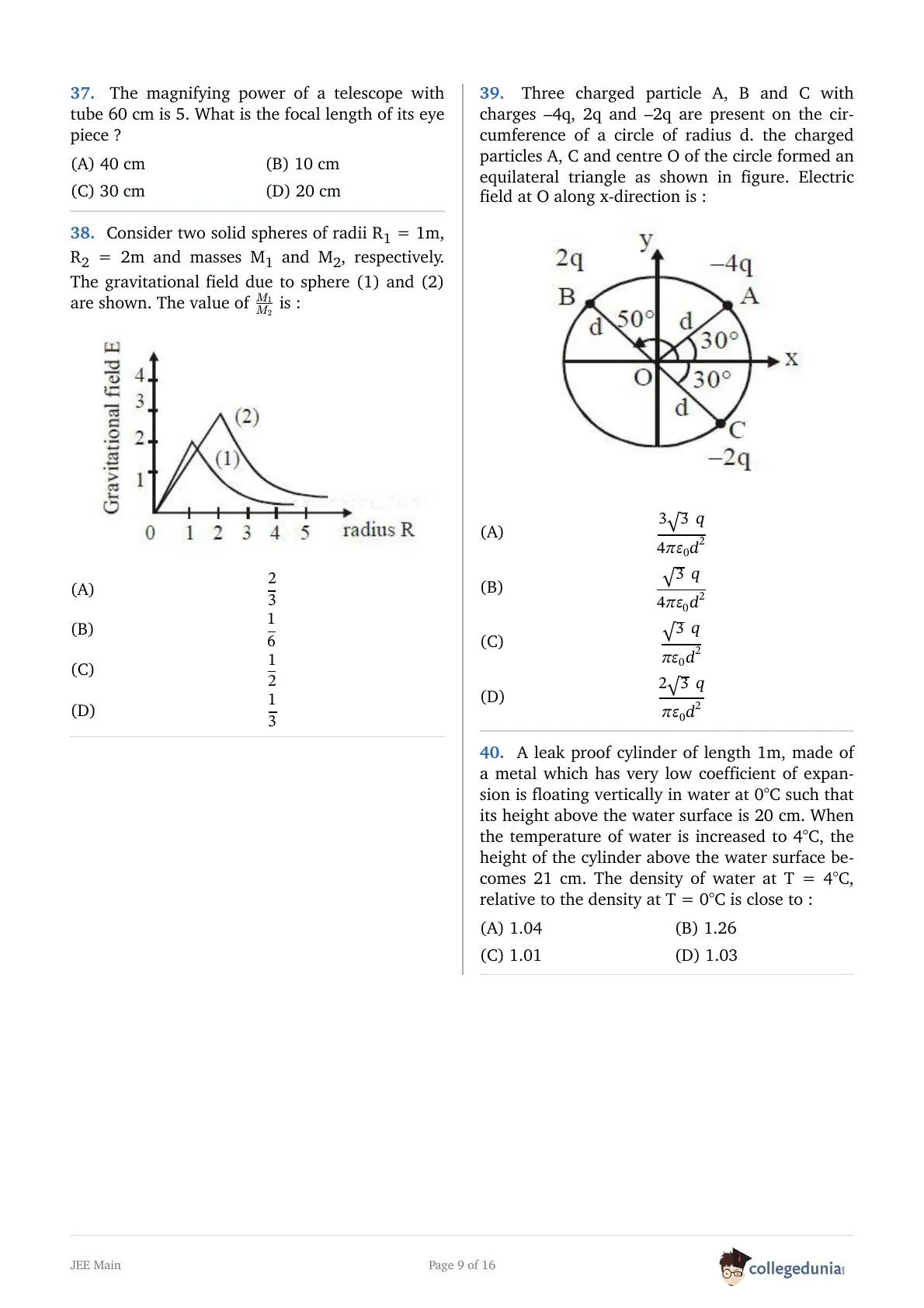
The magnifying power of a telescope with tube 60 cm is 5. What is the focal length of its eye piece ?
Consider two solid spheres of radii \(R, = 1m, \,R_2 = 2m\) and masses \(M_1\) and \(M_2\), respectively. The gravitational field due to sphere (1) and (2) are shown. The value of \(\frac{m_{1}}{m_{2}}\) is :
Three charged particle A, B and C with charges \(-4q\), \(2q\) and \(-2q\) are present on the circumference of a circle of radius \(d\). The charged particles A, C and centre O of the circle formed an equilateral triangle as shown in figure. Electric field at O along x-direction is :
A leak proof cylinder of length 1 m, made of a metal which has very low coefficient of expansion is floating vertically in water at \(0^\circ\mathrm{C}\) such that its height above the water surface is 20 cm. When the temperature of water is increased to \(4^\circ\mathrm{C}\), the height of the cylinder above the water surface becomes 21 cm. The density of water at \(T=4^\circ\mathrm{C}\), relative to the density at \(T=0^\circ\mathrm{C}\) is close to :
A particle of mass \(m\) is fixed to one end of a light spring having force constant \(k\) and unstretched length \(l\). The other end is fixed. The system is given an angular speed \(\omega\) about the fixed end of the spring such that it rotates in a circle in gravity free space. Then the stretch in the spring is :
When photon of energy 4.0 eV strikes the surface of a metal A, the ejected photoelectrons have maximum kinetic energy \(T_A\) eV and de-Broglie wavelength \(\lambda_A\). The maximum kinetic energy of photoelectrons liberated from another metal B by photon of energy 4.50 eV is \(T_B=(T_A-1.5)\) eV. If the de-Broglie wavelength of these photoelectrons \(\lambda_B=2\lambda_A\), then the work function of metal B is :
Proton with kinetic energy of \(1 \,MeV\) moves from south to north It gets an acceleration of \(10^{12} \, m/s^2\) by an applied magnetic field (west to east). The value of magnetic field : (Rest mass of proton is \(1.6 \times 10^{-27}\, kg\))
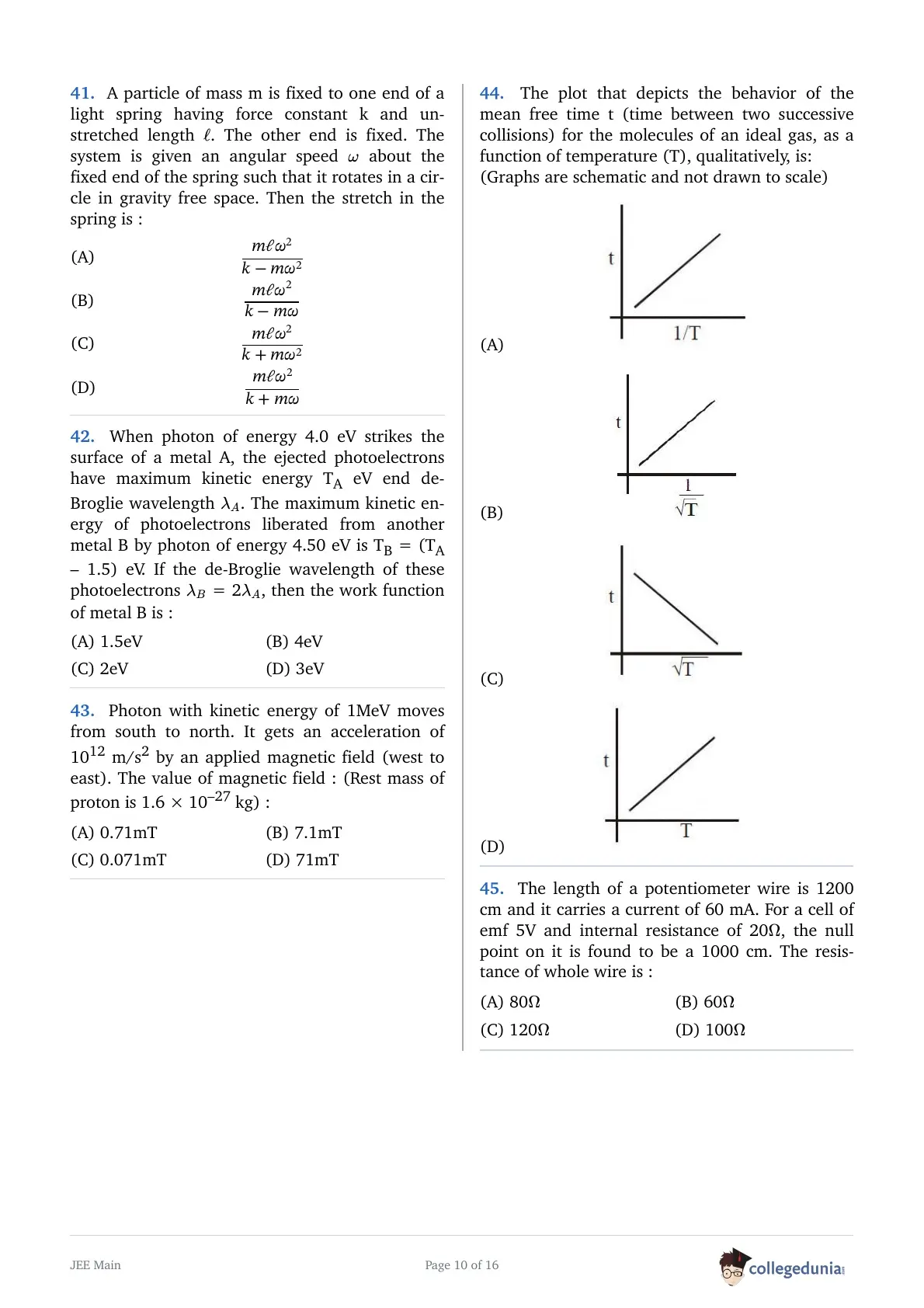
The plot that depicts the behavior of the mean free time \(t\) (time between two successive collisions) for the molecules of an ideal gas, as a function of temperature (\(T\)), qualitatively, is:
(Graphs are schematic and not drawn to scale)
- (1)
![]()
- (2)
![]()
- (3)
![]()
- (4)
![]()


The length of a potentiometer wire is \(1200\, cm\) and it carries a current of \(60\, mA\). For a cell of emf \(5\, V\) and internal resistance of \(20 \, \Omega\), the null point on it is found to be at \(1000\, cm\). The resistance of whole wire is :
Physics - Section B (Q46 - Q50)
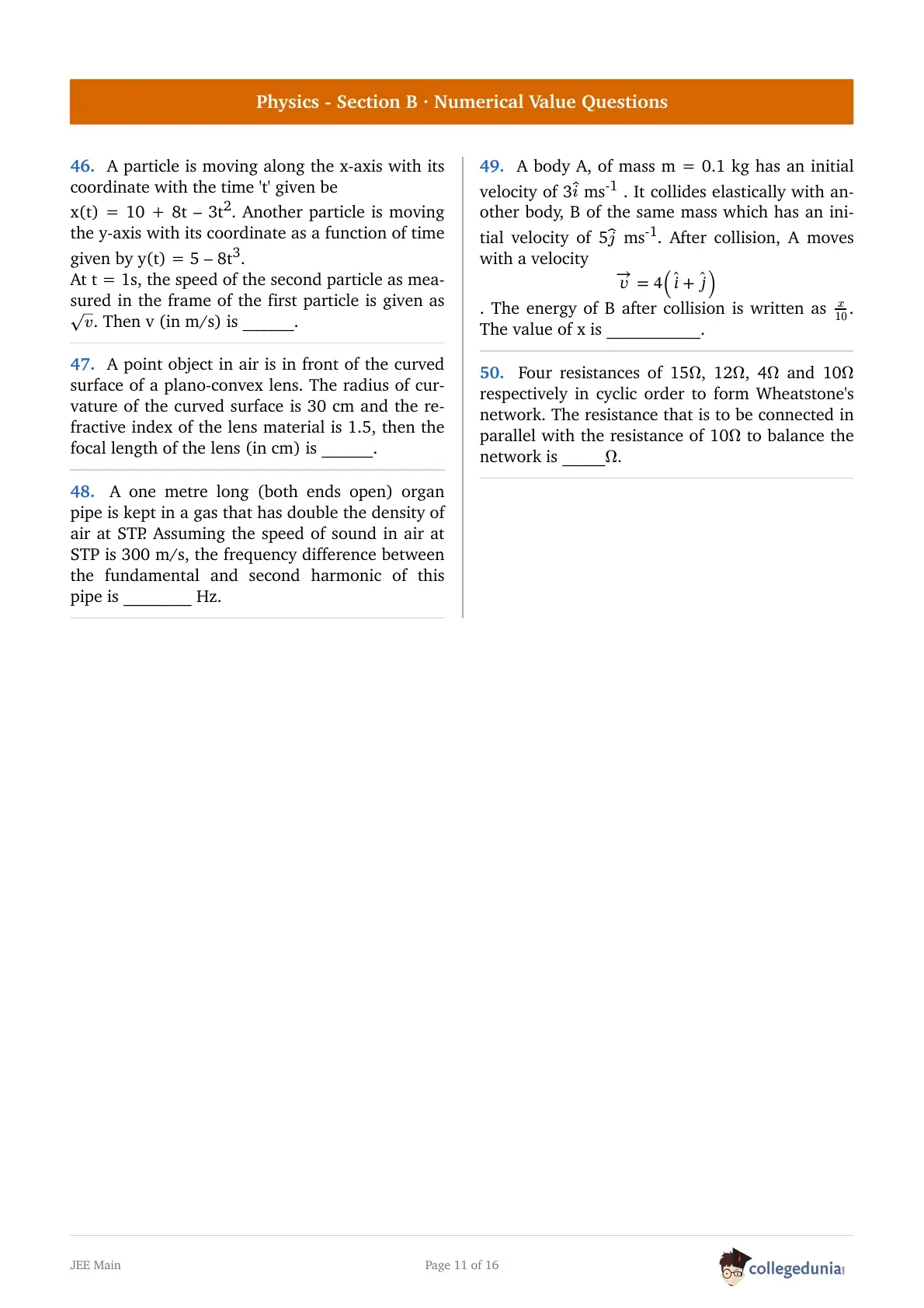
A particle is moving along the x-axis with its coordinate with the time 't' given be \(x(t)=10+8t-3t^2\). Another particle is moving the y-axis with its coordinate as a function of time given by \(y(t)=5-8t^3\).
At \(t=1\) s, the speed of the second particle as measured in the frame of the first particle is given as \(\sqrt{v}\). Then \(v\) (in m/s) is ______.
Curved surfaces of a plano-convex lens of refractive index \(\mu_1\) and a plano-concave lens of refractive index \(\mu_2\) have equal radius of curvature as shown in figure. Find the ratio of radius of curvature to the focal length of the combined lenses. 
An organ pipe 40cm long is open at both ends. The speed of sound in air is 360ms-1 . The frequency of the second harmonic is ____Hz.
A body of mass \(1 kg\) collides head on elastically with a stationary body of mass \(3 kg\) After collision, the smaller body reverses its direction of motion and moves with a speed of \(2 m / s\) The initial speed of the smaller body before collision is ___ \(ms ^{-1}\)
Four resistances of \(15\,\Omega\), \(12\,\Omega\), \(4\,\Omega\) and \(10\,\Omega\) respectively in cyclic order to form Wheatstone's network. The resistance that is to be connected in parallel with the resistance of \(10\,\Omega\) to balance the network is ______ \(\Omega\).
Chemistry - Section A (Q51 - Q70)
Arrange the following compounds in increasing order of C-OH bond length :
methanol, phenol, p-ethoxyphenol
The complex that can show fac- and mer- isomers is :
The rate of a certain biochemical reaction at physiological temperature (T) occurs \(10^6\) times faster with enzyme than without. The change in the activation energy upon adding enzyme is :
The solubility product of BaSO₄ is \(1 \times 10^{-10}\) at 298 K. The solubility of BaSO₄ in 0.1 M K₂SO₄(aq) is \(x \times 10^{-9}\) g L⁻¹. Calculate the value of \(x\).
The third ionization enthalpy is minimum for :
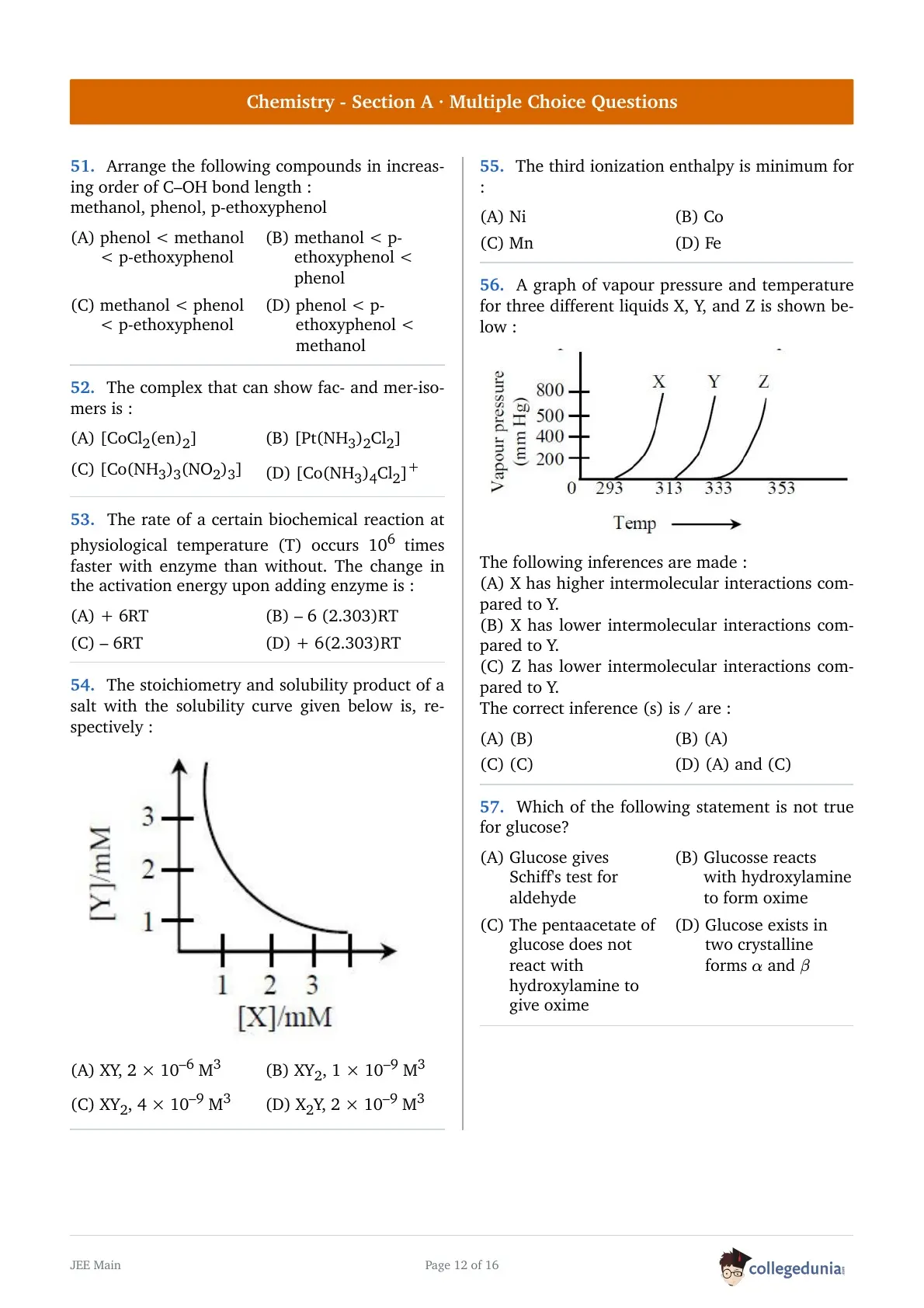
A graph of vap our pressure and temperature for three different liquids X, Y, and Z is shown below : The following inferences are made : (A) X has higher intermolecular interactions compared to Y. (B) X has lower intermolecular interactions compared to Y. (C) Z has lower intermolecular interactions compared to Y. The correct inference(s) is/are :
Which of the following statement is not true for glucose?
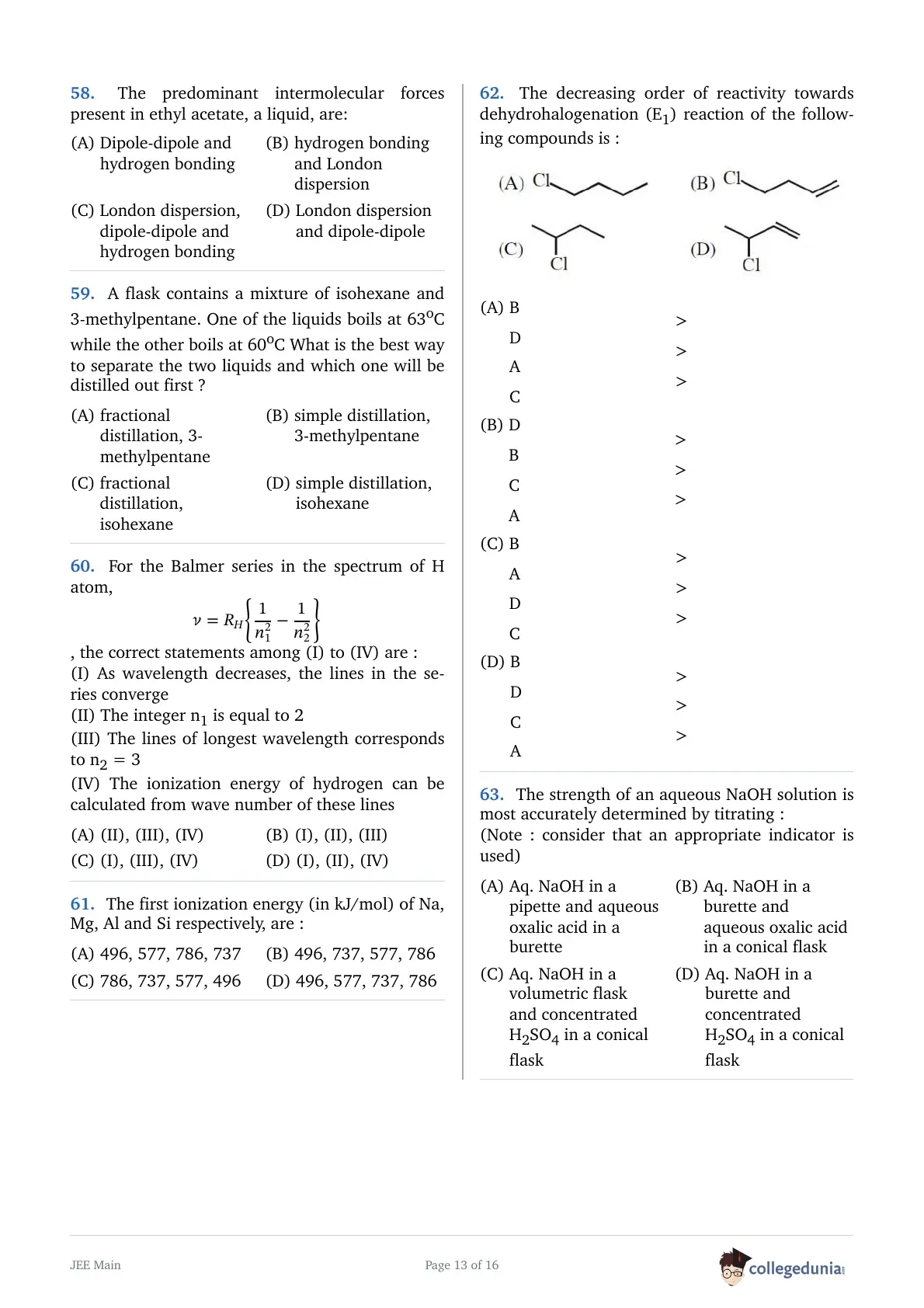
The predominant intermolecular forces present in ethyl acetate, a liquid, are:
A flask contains a mixture of isohexane and 3-methylpentane. One of the liquids boils at \(63^\circ\mathrm{C}\) while the other boils at \(60^\circ\mathrm{C}\). What is the best way to separate the two liquids and which one will be distilled out first ?
For the Balmer series in the spectrum of H atom,
\(\bar{\nu}=R_H\left\{\frac{1}{n_1^2}-\frac{1}{n_2^2}\right\}\),
the correct statements among (I) to (IV) are :
(I) As wavelength decreases, the lines in the series converge
(II) The integer \(n_1\) is equal to 2
(III) The lines of longest wavelength corresponds to \(n_2=3\)
(IV) The ionization energy of hydrogen can be calculated from wave number of these lines
The first ionization energy (in kJ/mol) of Na, Mg, Al and Si respectively, are :
The decreasing order of reactivity towards dehydrohalogenation (E1) reaction of the following compounds is :
(A) 1-chlorobutane, Cl-CH2CH2CH2CH3
(B) 4-chlorobut-1-ene, Cl-CH2CH2CH=CH2
(C) 2-chlorobutane
(D) 3-chlorobut-1-ene
The strength of an aqueous NaOH solution is most accurately determined by titrating :
(Note : consider that an appropriate indicator is used)


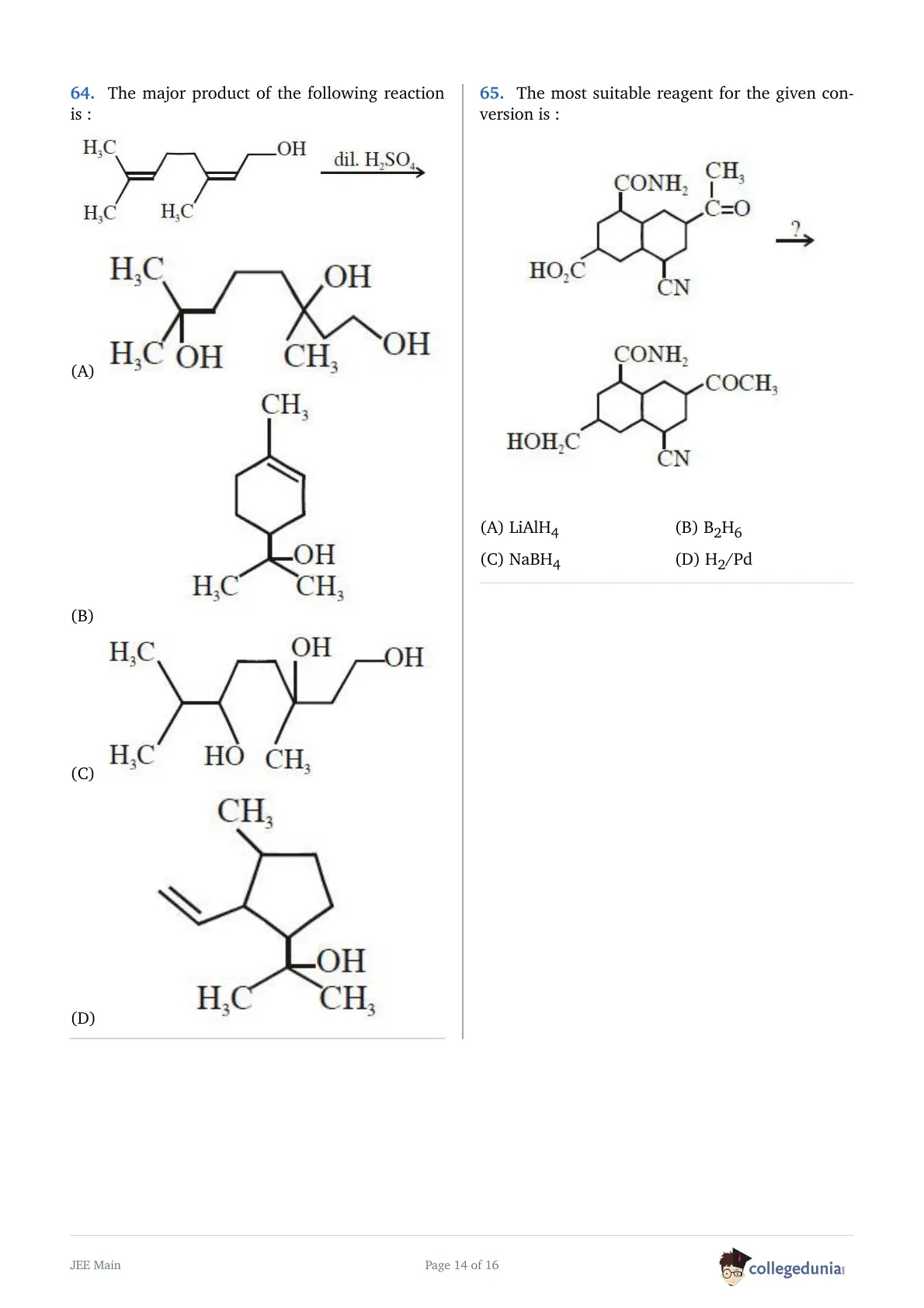
The most suitable reagent for the given conversion is :
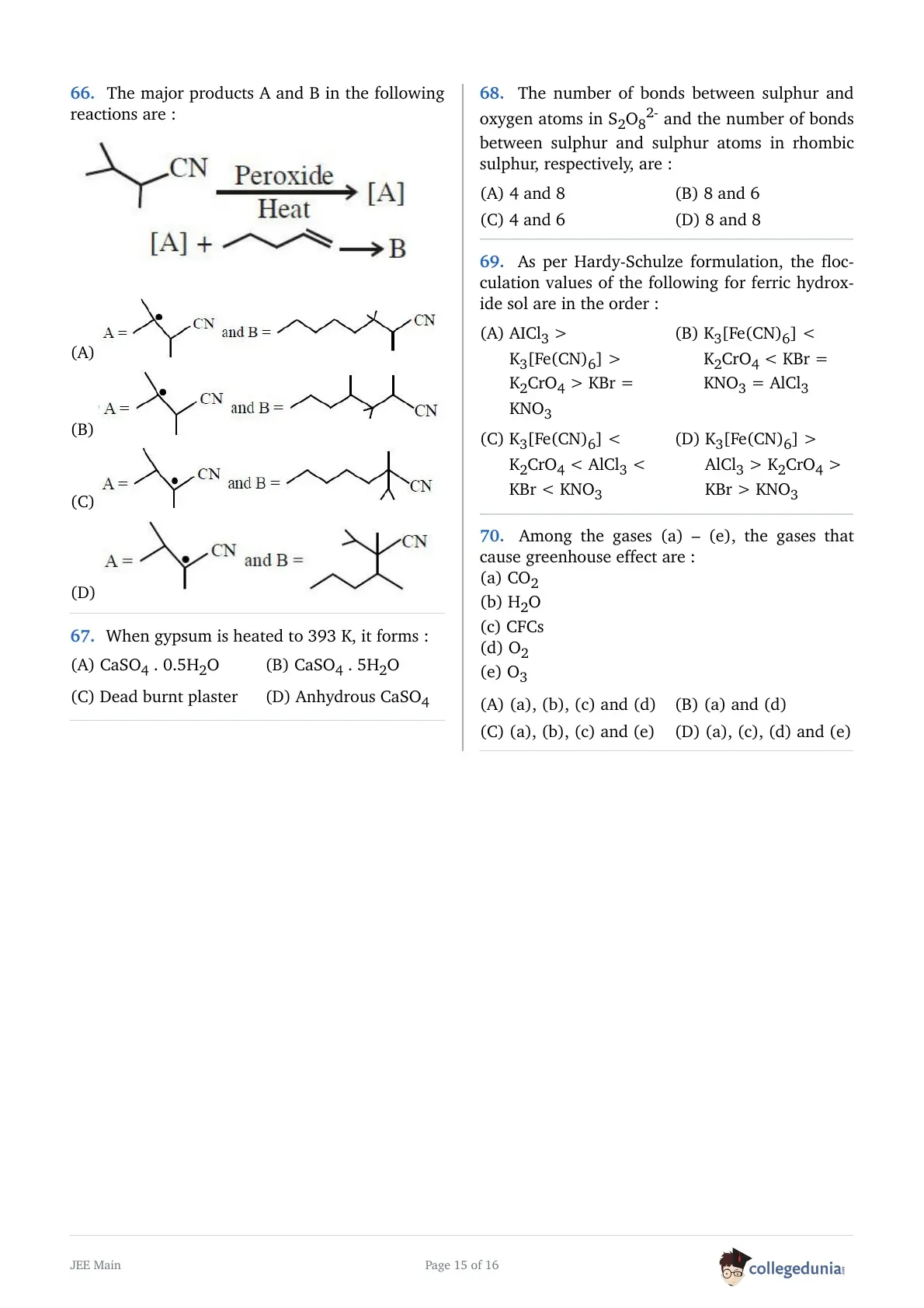
The major products A and B in the following set of reactions are : 
When gypsum is heated to 393 K, it forms :
The number of bonds between sulphur and oxygen atoms in \(S_2O^{2-}_8\) and the number of bonds between sulphur and sulphur atoms in rhombic sulphur, respectively, are:
As per Hardy-Schulze formulation, the flocculation values of the following for ferric hydroxide sol are in the order :
Among the gases (a) – (e), the gases that cause greenhouse effect are :
(a) \(\mathrm{CO_2}\)
(b) \(\mathrm{H_2O}\)
(c) CFCs
(d) \(\mathrm{O_2}\)
(e) \(\mathrm{O_3}\)
Chemistry - Section B (Q71 - Q75)
What would be the electrode potential for the given half cell reaction at pH = 5? ______
\(2\mathrm{H_2O} \to \mathrm{O_2} + 4\mathrm{H}^{+} + 4e^{-}\) ; \(E^0_{red} = 1.23\) V
(R = 8.314 J mol\(^{-1}\) K\(^{-1}\) ; Temp = 298 K ; oxygen under std. atm. pressure of 1 bar)
Fortification of food with iron is done using \(\mathrm{FeSO}_{4} .7 \mathrm{H}_{2} \mathrm{O}\). The mass in grams of the \(\mathrm{FeSO}_{4} .7 \mathrm{H}_{2} \mathrm{O}\) required to achieve 12 ppm of iron in 150 kg of wheat is _______ (Nearest integer). (Given : Molar mass of \(\mathrm{Fe}, \mathrm{S}\) and O respectively are 56,32 and \(16 \mathrm{~g} \mathrm{~mol}^{-1}\) )
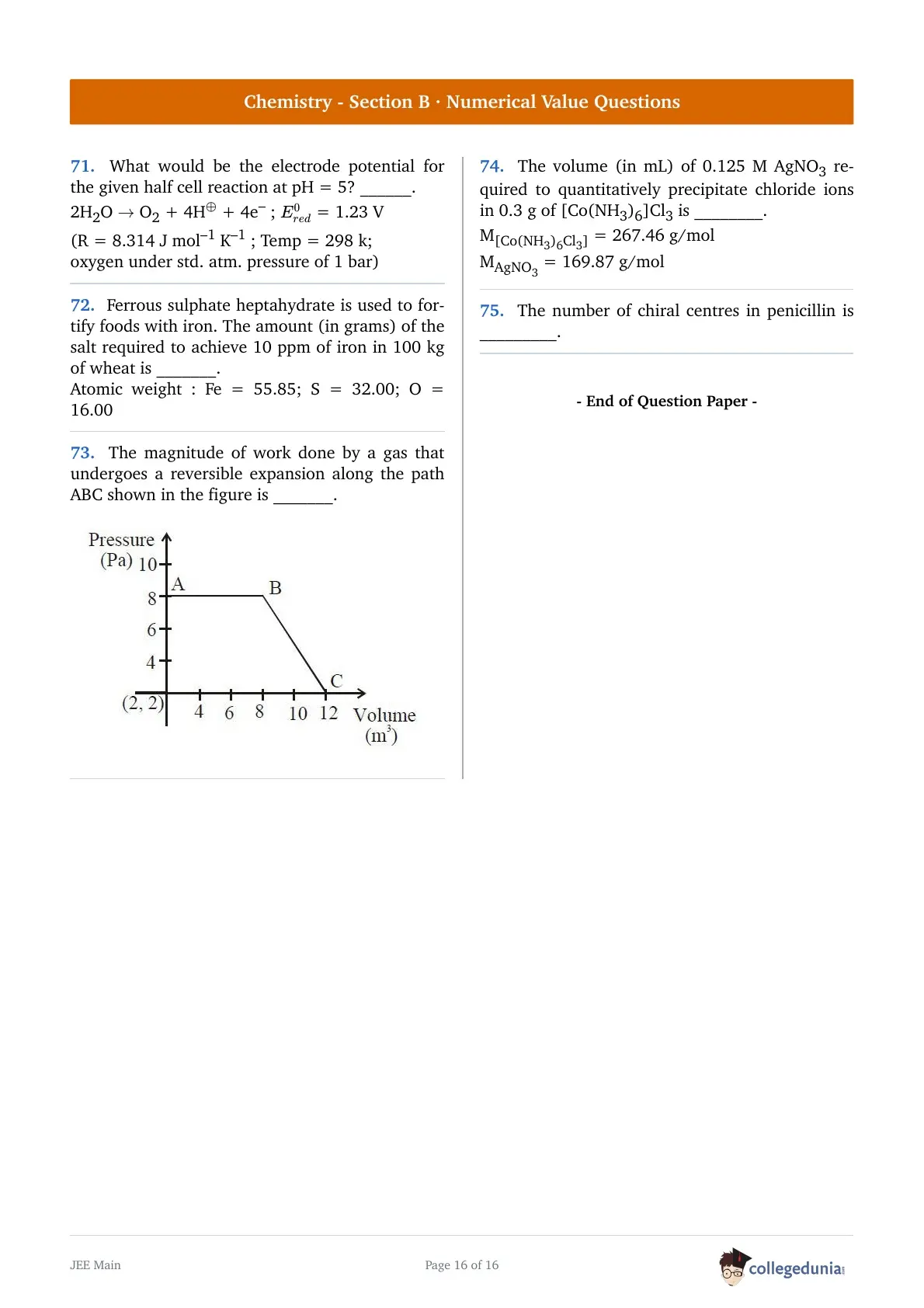
The magnitude of work done by a gas that undergoes a reversible expansion along the path ABC shown in the figure is _______.
(Pressure in Pa versus volume in m3: A is at V = 2, P = 8; B at V = 8, P = 8; C at V = 12, P = 2; the axes meet at (2, 2).)
The volume (in mL) of 0.1 M AgNO3 required for complete precipitation of chloride ions present in 20 mL of 0.01 M solution of [Cr(H2O)5CI]Cl2 as silver chloride is___
The number of chiral centres in penicillin is _________.
JEE Main 2020 Exam Pattern and Marking Scheme
| Particulars | Details |
|---|---|
| Exam Mode | Online (Computer-Based Test) |
| Paper | B.E./B.Tech (Paper 1) |
| Duration | 3 hours (180 minutes) |
| Type of Questions | Multiple Choice Questions (MCQs) + Numerical Value Questions |
| Subjects | Mathematics, Physics, Chemistry |
| Total Questions | 75 questions |
| Total Marks | 300 marks |
| Marking Scheme | +4 for correct answer & -1 for incorrect MCQ; no negative marking for Numerical Value Questions |
JEE Main 2020 January 8 Shift 1 Difficulty Level
JEE Main 2020 B.E./B.Tech Question Paper for January 8, 2020, was rated to be average on the difficulty level by the experts. Following the trends set by the previous year’s JEE Main Paper Analysis, the Mathematics section of the paper was the toughest section. Calculus (8 Questions), and Coordinate Geometry (3 Questions) were the dominant units in Mathematics. Contrary to Mathematics, Physics was the easiest section of the paper with Mechanics (9 Questions) and Electrodynamics (7 Questions) being the dominant units. The remaining section, Chemistry, was moderate in terms of difficulty, with questions based on Physical Chemistry and Inorganic Chemistry being in majority.
JEE Main B.E./B.Tech Question Paper January 8, 2020 (Shift 1): Weightage of Class XI and Class XII Topics
JEE Main B.Tech/ B.E exam features topics from both Class XI and Class XII. The distribution of topics from Class XI and Class XII in the paper is as follows. See JEE Main Syllabus
| Subject | Class 11 Topics Weightage | Class 12 Topics Weightage |
|---|---|---|
| Maths | 45% | 55% |
| Physics | 47% | 54% |
| Chemistry | 46% | 52% |
| Overall | 44.65% | 55.35% |



Comments