




JEE Main 2020 September 3 Shift 2 Question Paper is available here with solutions PDF and detailed solutions for every question. NTA conducted the second shift on September 3, 2020, from 3:00 PM to 6:00 PM. The JEE Main 2020 Paper 1 (B.E./B.Tech) question paper includes the following:
- 75 questions in a 3-hour CBT Mode: 25 each from Mathematics, Physics and Chemistry
- Section A: 20 multiple choice questions (MCQs) per subject, 4 marks each
- Section B: 5 numerical value questions per subject, all compulsory, 4 marks each
- Marking: +4 for a correct answer, -1 for an incorrect MCQ, 0 for an unattempted question; no negative marking for numerical value questions
- Maximum marks: 300 (100 per subject)
JEE Main 2020 September 3 Shift 2 Question Paper with Solution PDF
| NTA Official PDF | CD PDF | CD PDF with Solutions |
|---|---|---|
| Download official PDF 5.15 MB | Download Collegedunia PDF 1.01 MB | Download solutions PDF 1.14 MB |
Also Check:
JEE Main 2020 September 3 Shift 2 Questions with Solutions
Mathematics - Section A (Q1 - Q20)
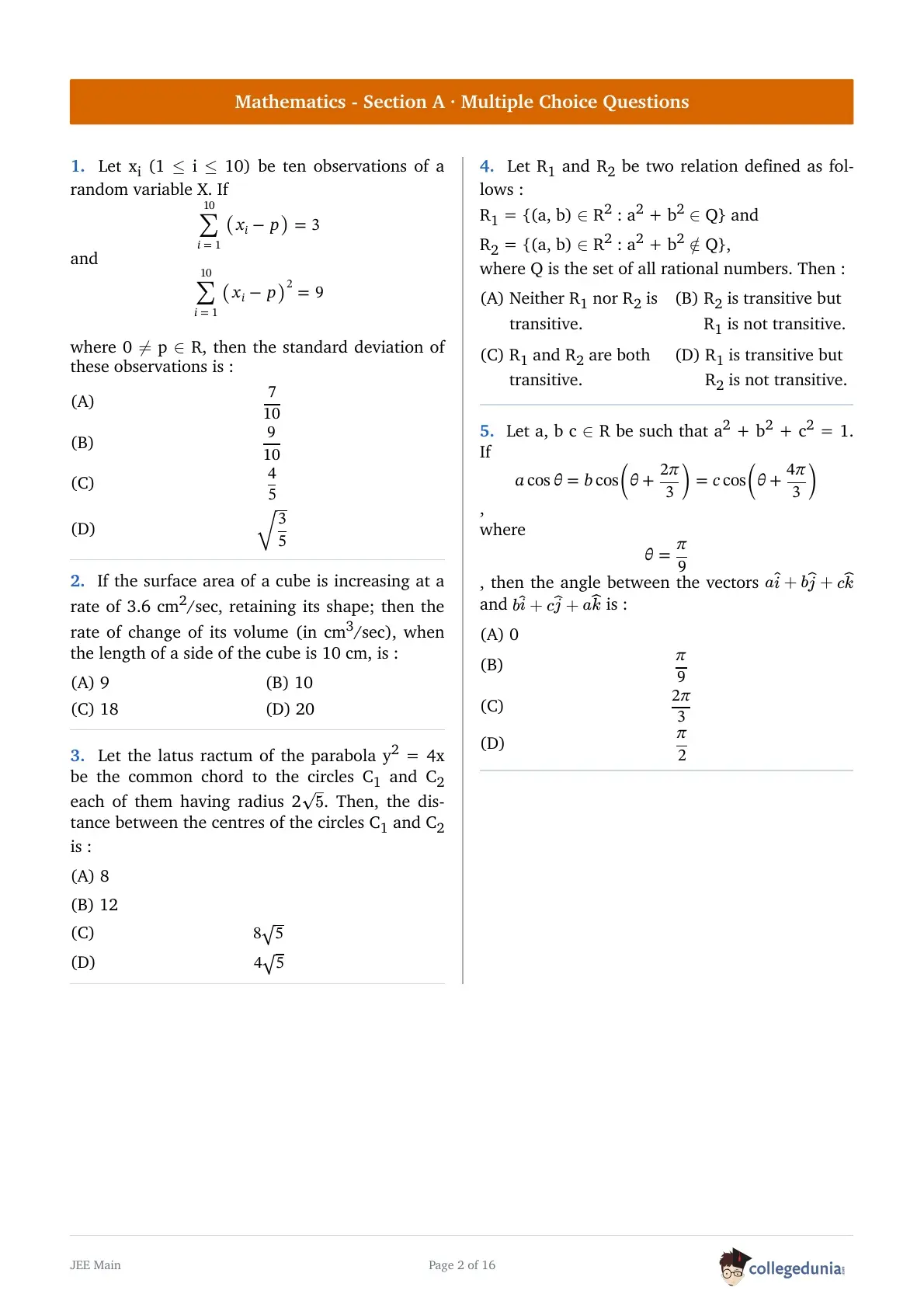
Let \(x_i\ (1 \le i \le 10)\) be ten observations of a random variable \(X\). If
\(\sum_{i=1}^{10}(x_i-p)=3\)
and
\(\sum_{i=1}^{10}(x_i-p)^2=9\)
where \(0 \ne p \in \mathbb{R}\), then the standard deviation of these observations is :
If the surface area of a cube is increasing at a rate of \(3.6\ \mathrm{cm^2/sec}\), retaining its shape; then the rate of change of its volume (in \(\mathrm{cm^3/sec}\)), when the length of a side of the cube is \(10\ \mathrm{cm}\), is :
Let the latus ractum of the parabola \(y^{2}=4x\) be the common chord to the circles \(C _{1}\) and \(C _{2}\) each of them having radius \(2 \sqrt{5}\). Then, the distance between the centres of the circles \(C _{1}\) and \(C _{2}\) is:
Let \(R_1\) and \(R_2\) be two relation defined as follows :
\(R_1=\{(a,b)\in\mathbb{R}^2 : a^2+b^2\in\mathbb{Q}\}\) and
\(R_2=\{(a,b)\in\mathbb{R}^2 : a^2+b^2\notin\mathbb{Q}\}\),
where \(\mathbb{Q}\) is the set of all rational numbers. Then :
Let \(a, b, c\in\mathbb{R}\) be such that \(a^2+b^2+c^2=1\). If
\(a\cos\theta=b\cos\left(\theta+\frac{2\pi}{3}\right)=c\cos\left(\theta+\frac{4\pi}{3}\right)\),
where \(\theta=\frac{\pi}{9}\), then the angle between the vectors \(a\hat{i}+b\hat{j}+c\hat{k}\) and \(b\hat{i}+c\hat{j}+a\hat{k}\) is :
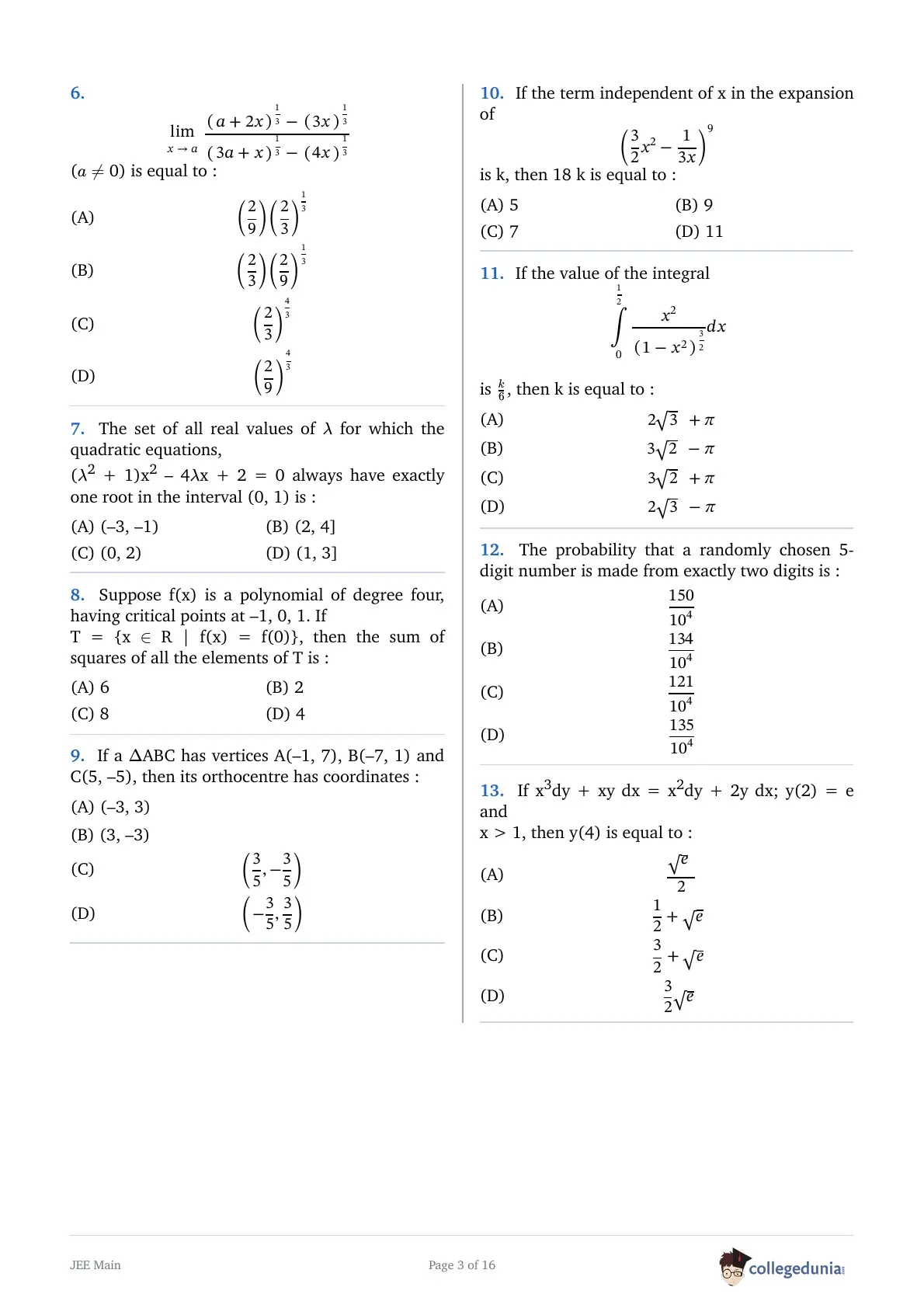
\(\displaystyle\lim_{x\to a}\frac{(a+2x)^{1/3}-(3x)^{1/3}}{(3a+x)^{1/3}-(4x)^{1/3}}\ (a\ne0)\) is equal to :
The set of all a∈ R for which the equation x|x-1|+|x-2|+a=0 has exactly one real root is
Suppose \(f(x)\) is a polynomial of degree four, having critical points at \(-1, 0, 1\). If \(T=\{x\in\mathbb{R}\mid f(x)=f(0)\}\), then the sum of squares of all the elements of \(T\) is :
If a \(\Delta ABC\) has vertices \(A(-1,7)\), \(B(-7,1)\) and \(C(5,-5)\), then its orthocentre has coordinates :
If the term independent of \(x\) in the expansion of
\(\left(\frac32x^2-\frac{1}{3x}\right)^9\)
is \(k\), then \(18k\) is equal to :
The value of the integral \[ \int_{-1}^{1}\left(\frac{x^3+|x|+1}{x^2+2|x|+1}\right)dx \] is equal to :
The probability that a randomly chosen 5 -digit number is made from exactly two digits is :
If \(x^3\,dy+xy\,dx=x^2\,dy+2y\,dx\); \(y(2)=e\) and \(x\gt1\), then \(y(4)\) is equal to :
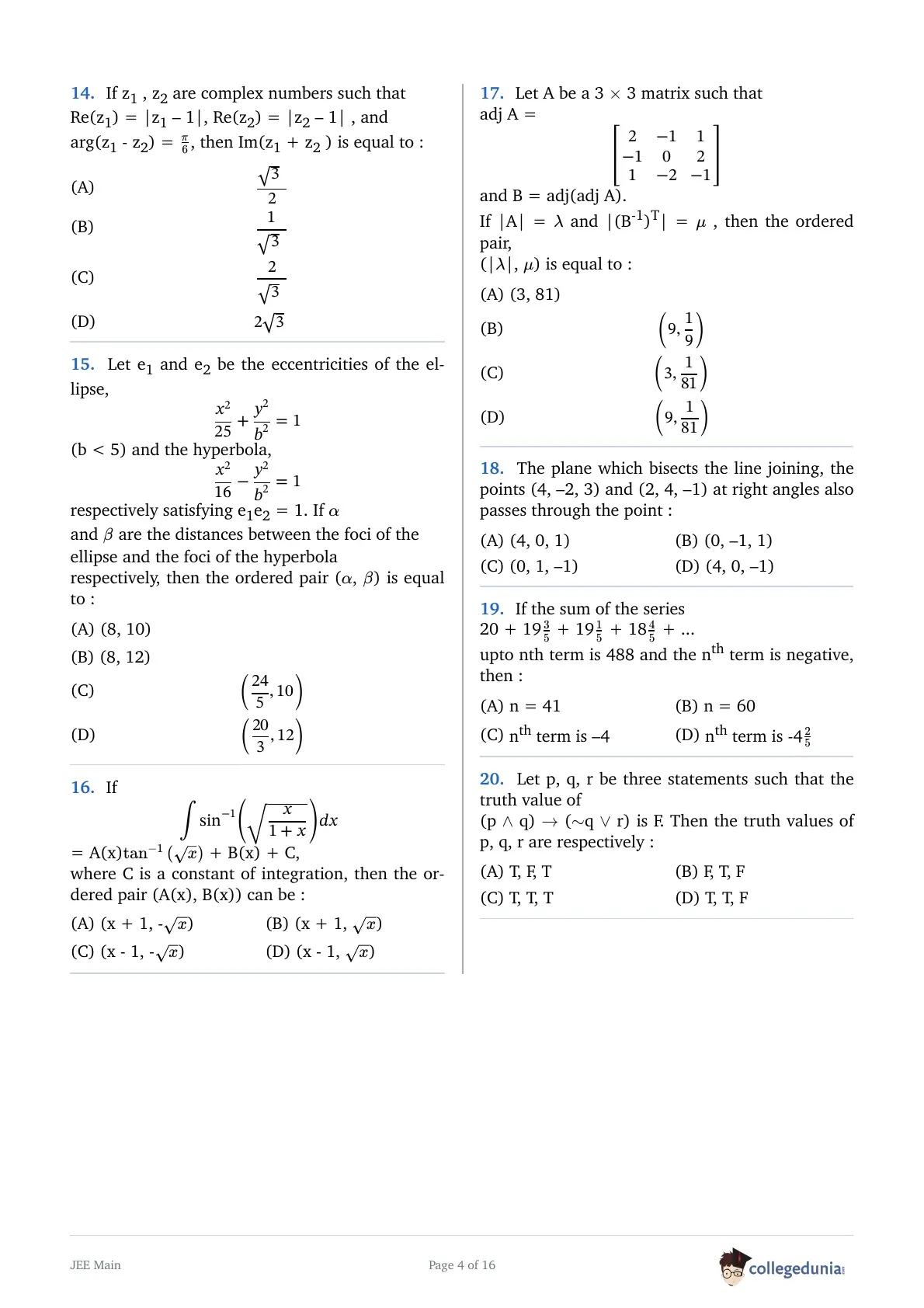
If \(z_1,\ z_2\) are complex numbers such that
\(\mathrm{Re}(z_1)=|z_1-1|\), \(\mathrm{Re}(z_2)=|z_2-1|\), and
\(\arg(z_1-z_2)=\frac{\pi}{6}\), then \(\mathrm{Im}(z_1+z_2)\) is equal to :
Let \(e_1\) and \(e_2\) be the eccentricities of the ellipse,
\(\frac{x^2}{25}+\frac{y^2}{b^2}=1\)
(\(b\lt5\)) and the hyperbola,
\(\frac{x^2}{16}-\frac{y^2}{b^2}=1\)
respectively satisfying \(e_1e_2=1\). If \(\alpha\) and \(\beta\) are the distances between the foci of the ellipse and the foci of the hyperbola respectively, then the ordered pair \((\alpha,\beta)\) is equal to :
If \(\int \frac{\cos x - \sin x}{\sqrt{8 - \sin 2x}}\,dx = a\sin^{-1}\left(\frac{\sin x + \cos x}{b}\right) + c\), where c is a constant of integration, then the ordered pair (a, b) is equal to :
Let \(A\) be a \(3\times3\) matrix such that
\(\mathrm{adj}\,A=\begin{bmatrix}2&-1&1\\-1&0&2\\1&-2&-1\end{bmatrix}\)
and \(B=\mathrm{adj}(\mathrm{adj}\,A)\).
If \(|A|=\lambda\) and \(|(B^{-1})^T|=\mu\), then the ordered pair \((|\lambda|,\mu)\) is equal to :
The plane which bisects the line segment joining the points (-3,-3,4) and (3,7,6) at right angles, passes through which one of the following points ?
If the sum of the series \(20+19 \frac{3}{5}+19 \frac{1}{5}+18 \frac{4}{5}+\ldots \) upto \(n^ {th }\) term is \(488\) and the \(n ^ {th }\) term is negative, then :
Let p, q, r be three statements such that the truth value of
\((p \wedge q) \rightarrow (\sim q \vee r)\) is F. Then the truth values of p, q, r are respectively :
Mathematics - Section B (Q21 - Q25)
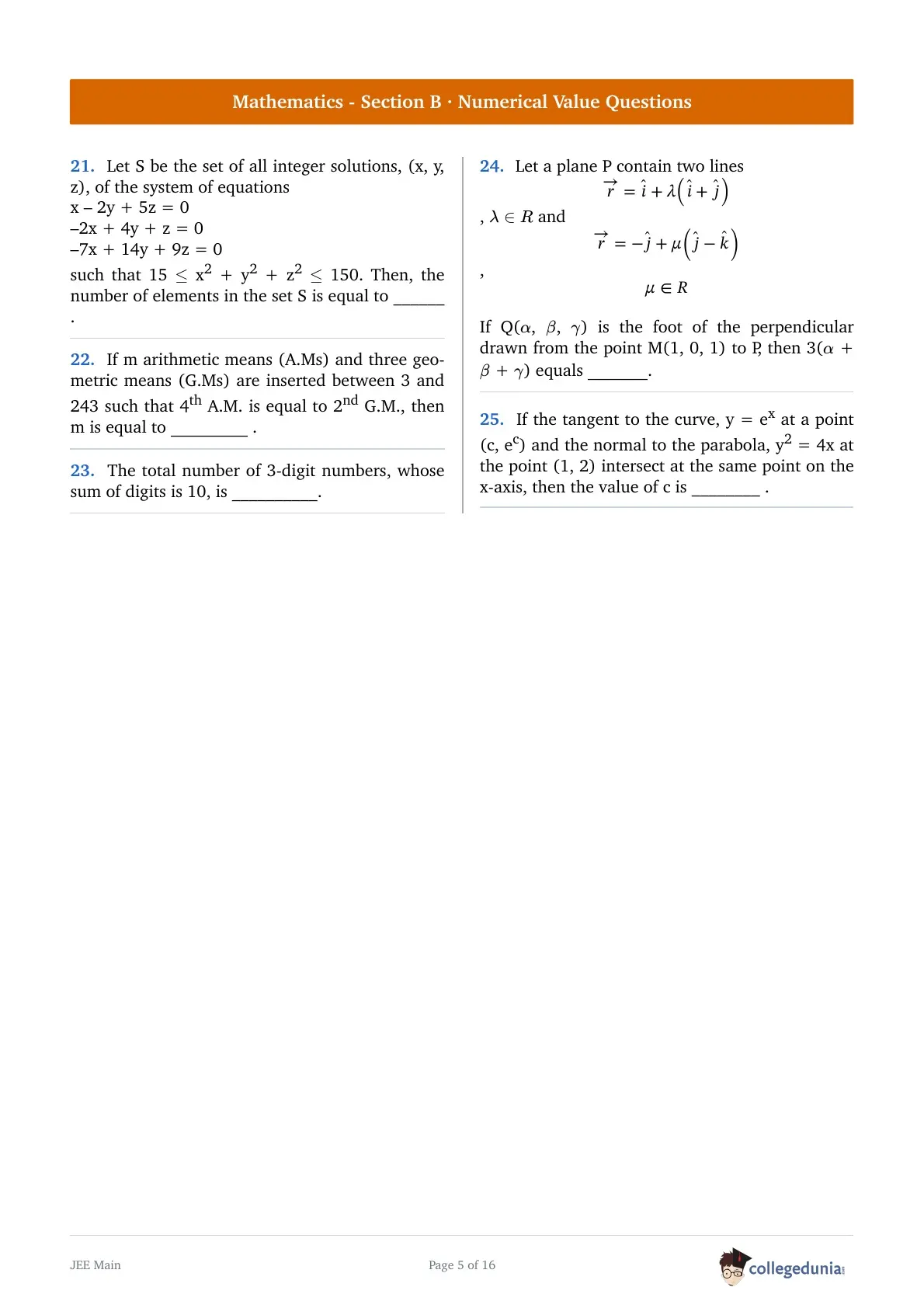
Let S be the set of all integer solutions, (x, y, z), of the system of equations
\(x - 2y + 5z = 0\)
\(-2x + 4y + z = 0\)
\(-7x + 14y + 9z = 0\)
such that \(15 \le x^2 + y^2 + z^2 \le 150\). Then, the number of elements in the set S is equal to ______ .
If m arithmetic means (A.Ms) and three geometric means (G.Ms) are inserted between 3 and 243 such that 4th A.M. is equal to 2nd G.M., then m is equal to ______ .
The number of 3-digit odd numbers, whose sum of digits is a multiple of 7, is ________.
Let a plane P contain two lines
\(\vec{r} = \hat{i} + \lambda(\hat{i} + \hat{j})\), \(\lambda \in R\) and
\(\vec{r} = -\hat{j} + \mu(\hat{j} - \hat{k})\), \(\mu \in R\).
If \(Q(\alpha, \beta, \gamma)\) is the foot of the perpendicular drawn from the point M(1, 0, 1) to P, then \(3(\alpha + \beta + \gamma)\) equals ______ .
If the tangent to the curve, \(y = e^x\) at a point \((c, e^c)\) and the normal to the parabola, \(y^2 = 4x\) at the point (1, 2) intersect at the same point on the x-axis, then the value of c is ______ .
Physics - Section A (Q26 - Q45)
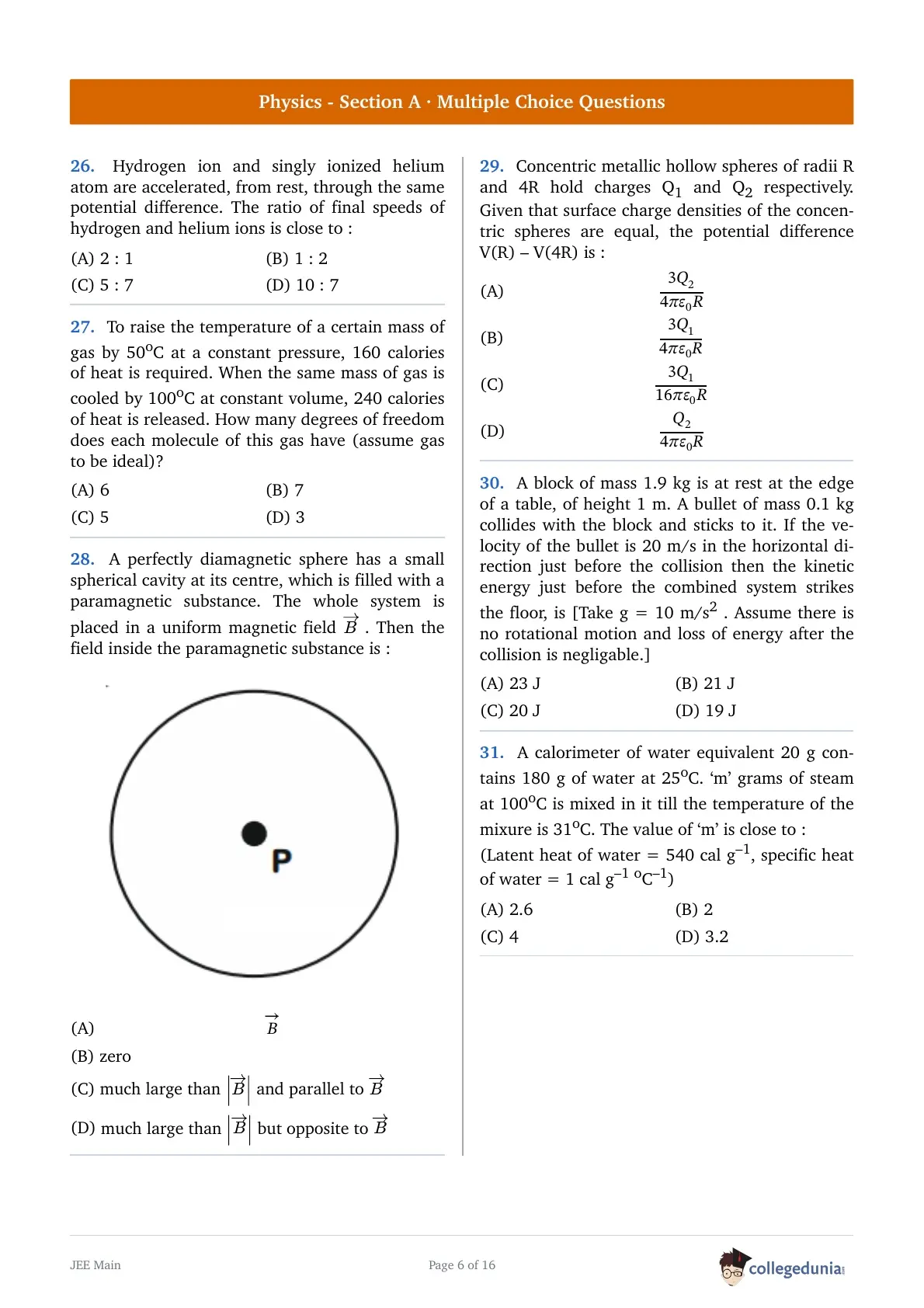
Hydrogen ion and singly ionized helium atom are accelerated, from rest, through the same potential difference. The ratio of final speeds of hydrogen and helium ions is close to :
To raise the temperature of a certain mass of gas by 50\(^\circ\)C at a constant pressure, 160 calories of heat is required. When the same mass of gas is cooled by 100\(^\circ\)C at constant volume, 240 calories of heat is released. How many degrees of freedom does each molecule of this gas have (assume gas to be ideal)?
A perfectly diamagnetic sphere has a small spherical cavity at its centre, which is filled with a paramagnetic substance. The whole system is placed in a uniform magnetic field \(\vec{B}\). Then the field inside the paramagnetic substance is :
There are three co-centric conducting spherical shells \(A\), \(B\) and \(C\) of radii \(a\), \(b\) and \(c\) respectively \((c>b>a)\) and they are charged with charges \(q_1\), \(q_2\) and \(q_3\) respectively. The potentials of the spheres \(A\), \(B\) and \(C\) respectively are:
A block of mass 1.9 kg is at rest at the edge of a table, of height 1 m. A bullet of mass 0.1 kg collides with the block and sticks to it. If the velocity of the bullet is 20 m/s in the horizontal direction just before the collision then the kinetic energy just before the combined system strikes the floor, is [Take g = 10 m/s2. Assume there is no rotational motion and loss of energy after the collision is negligible.]
\(500 \,g\) of water and \(100\, g\) of ice at \(0^{\circ}C\) are in a calorimeter whose water equivalent is \(40\, g\). \(10\, g\) of steam at \(100^\circ C\) is added to it. Then water in the calorimeter is : (Latent heat of ice \(= 80\, cal/g\), Latent heat of steam \(=540\, cal/g\))
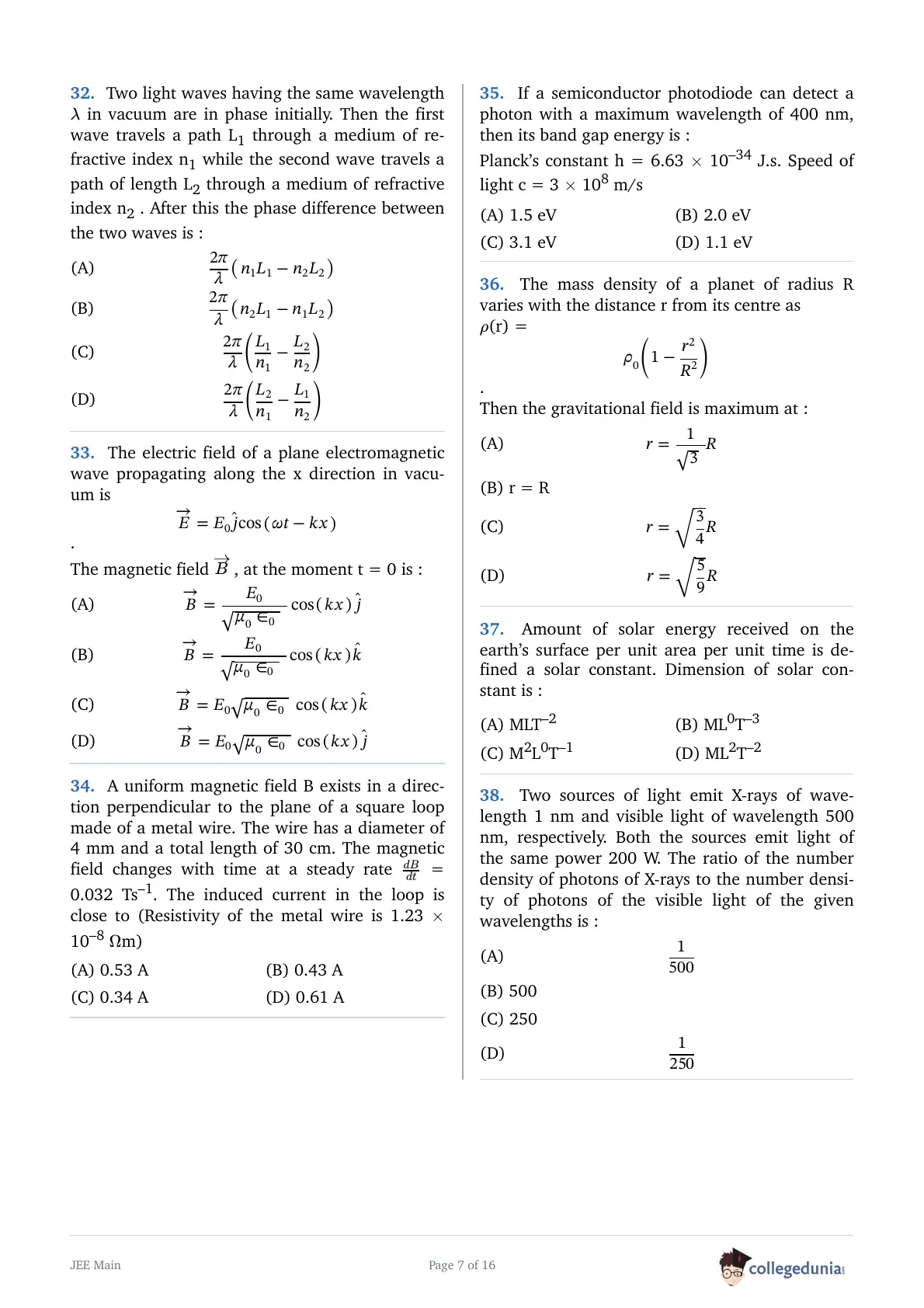
Two light waves having the same wavelength \(\lambda\) in vacuum are in phase initially. Then the first wave travels a path L1 through a medium of refractive index n1 while the second wave travels a path of length L2 through a medium of refractive index n2. After this the phase difference between the two waves is :
The electric field of a plane electromagnetic wave propagating along the x direction in vacuum is \(\vec{E} = E_0\hat{j}\cos(\omega t - kx)\).
The magnetic field \(\vec{B}\), at the moment t = 0 is :
A uniform magnetic field B exists in a direction perpendicular to the plane of a square loop made of a metal wire. The wire has a diameter of 4 mm and a total length of 30 cm. The magnetic field changes with time at a steady rate \(\frac{dB}{dt} = 0.032\ \mathrm{T\,s^{-1}}\). The induced current in the loop is close to (Resistivity of the metal wire is \(1.23 \times 10^{-8}\ \Omega\,\mathrm{m}\))
If a semiconductor photodiode can detect a photon with a maximum wavelength of 400 nm, then its band gap energy is :
Planck's constant \(h = 6.63\times10^{-34}\) J.s. Speed of light \(c = 3\times10^{8}\) m/s
The mass density of a planet of radius R varies with the distance r from its centre as \(\rho(r) = \rho_0\left(1 - \dfrac{r^2}{R^2}\right)\). Then the gravitational field is maximum at :
Amount of solar energy received on the earth's surface per unit area per unit time is defined a solar constant. Dimension of solar constant is:
Two sources of light emit X-rays of wavelength 1 nm and visible light of wavelength 500 nm, respectively. Both the sources emit light of the same power 200 W. The ratio of the number density of photons of X-rays to the number density of photons of the visible light of the given wavelengths is :
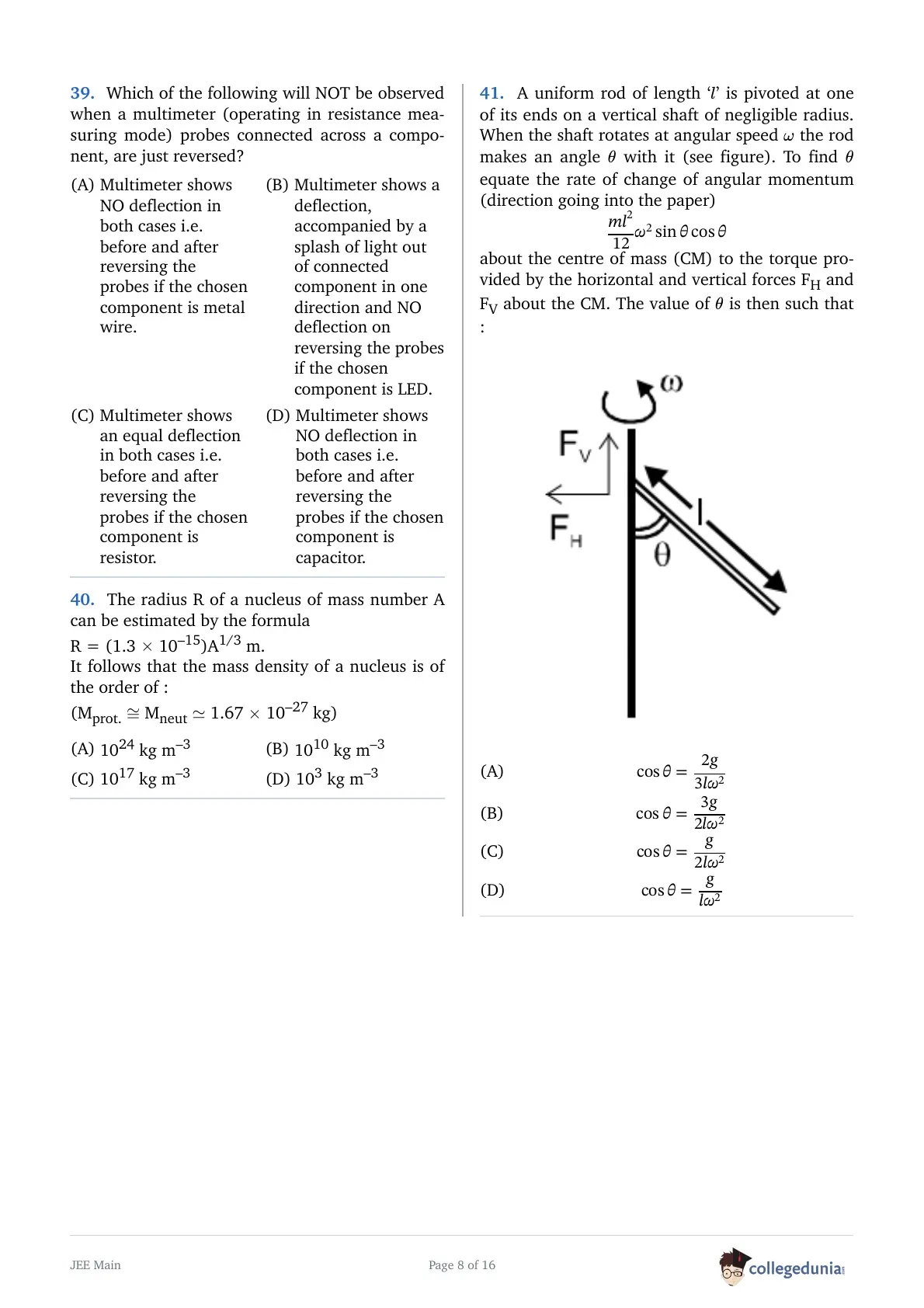
Which of the following will NOT be observed when a multimeter (operating in resistance measuring mode) probes connected across a component, are just reversed?
The radius R of a nucleus of mass number A can be estimated by the formula
\(R = (1.3\times10^{-15})A^{1/3}\) m.
It follows that the mass density of a nucleus is of the order of :
\((M_{prot.} \cong M_{neut} \simeq 1.67\times10^{-27}\ \mathrm{kg})\)
A uniform rod of length '\(l\)' is pivoted at one of its ends on a vertical shaft of negligible radius. When the shaft rotates at angular speed \(\omega\) the rod makes an angle \(\theta\) with it (see figure). To find \(\theta\) equate the rate of change of angular momentum (direction going into the paper)
\(\dfrac{ml^2}{12}\omega^2\sin\theta\cos\theta\)
about the centre of mass (CM) to the torque provided by the horizontal and vertical forces \(F_H\) and \(F_V\) about the CM. The value of \(\theta\) is then such that :
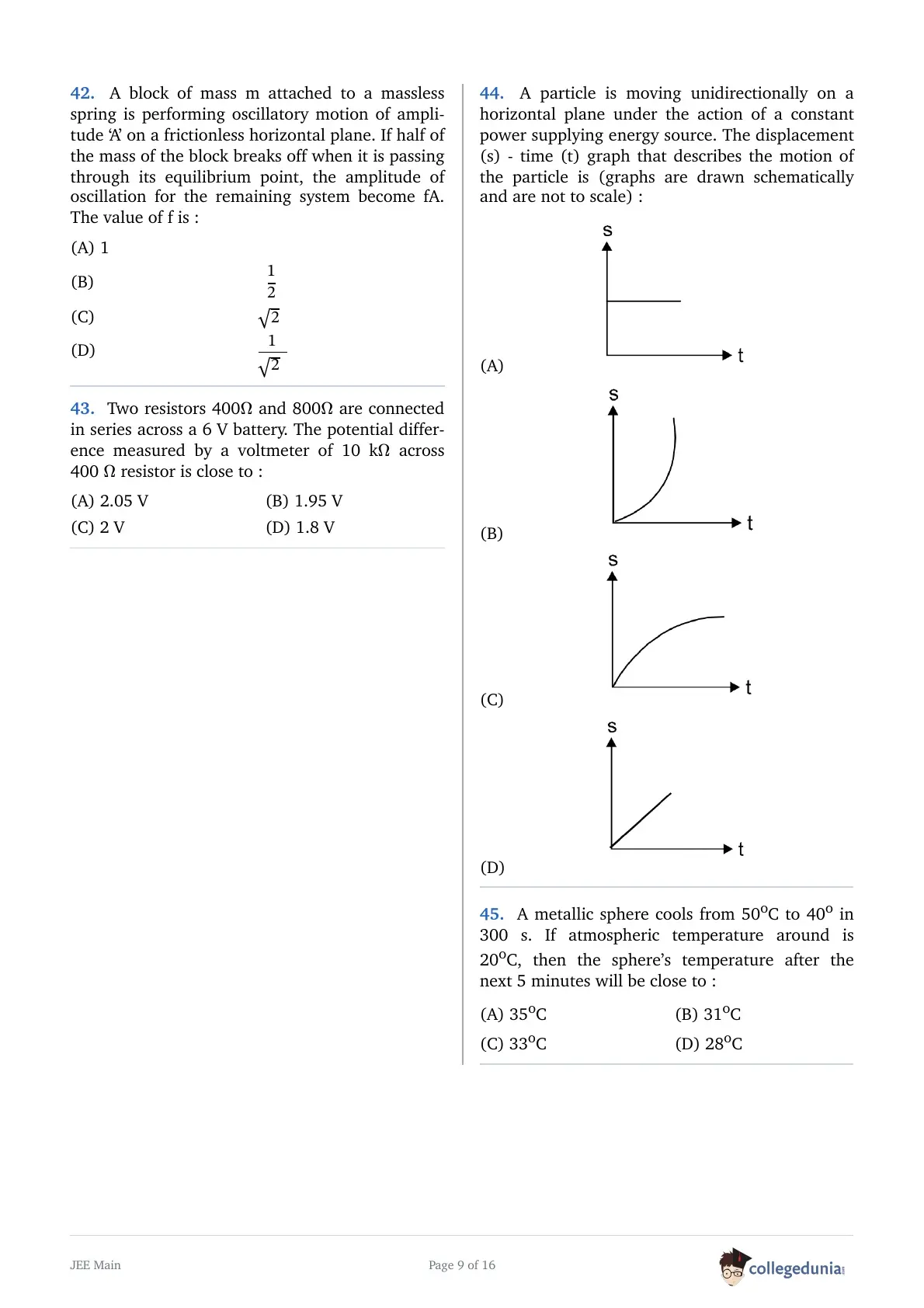
A block of mass m attached to a massless spring is performing oscillatory motion of amplitude 'A' on a frictionless horizontal plane. If half of the mass of the block breaks off when it is passing through its equilibrium point, the amplitude of oscillation for the remaining system become fA. The value of f is :
Two resistors are connected in series across a battery as shown in figure. If a voltmeter of resistance 2000 Ω is used to measure the potential difference across 500 Ω resistor, the reading of the voltmeter will be _____ V.

A particle is moving unidirectionally on a horizontal plane under the action of a constant power supplying energy source. The displacement (s) - time (t) graph that describes the motion of the particle is (graphs are drawn schematically and are not to scale) :
- (1)
![]()
- (2)
![]()
- (3)
![]()
- (4)
![]()


A metallic sphere cools from 50\(^\circ\)C to 40\(^\circ\)C in 300 s. If atmospheric temperature around is 20\(^\circ\)C, then the sphere's temperature after the next 5 minutes will be close to :
Physics - Section B (Q46 - Q50)
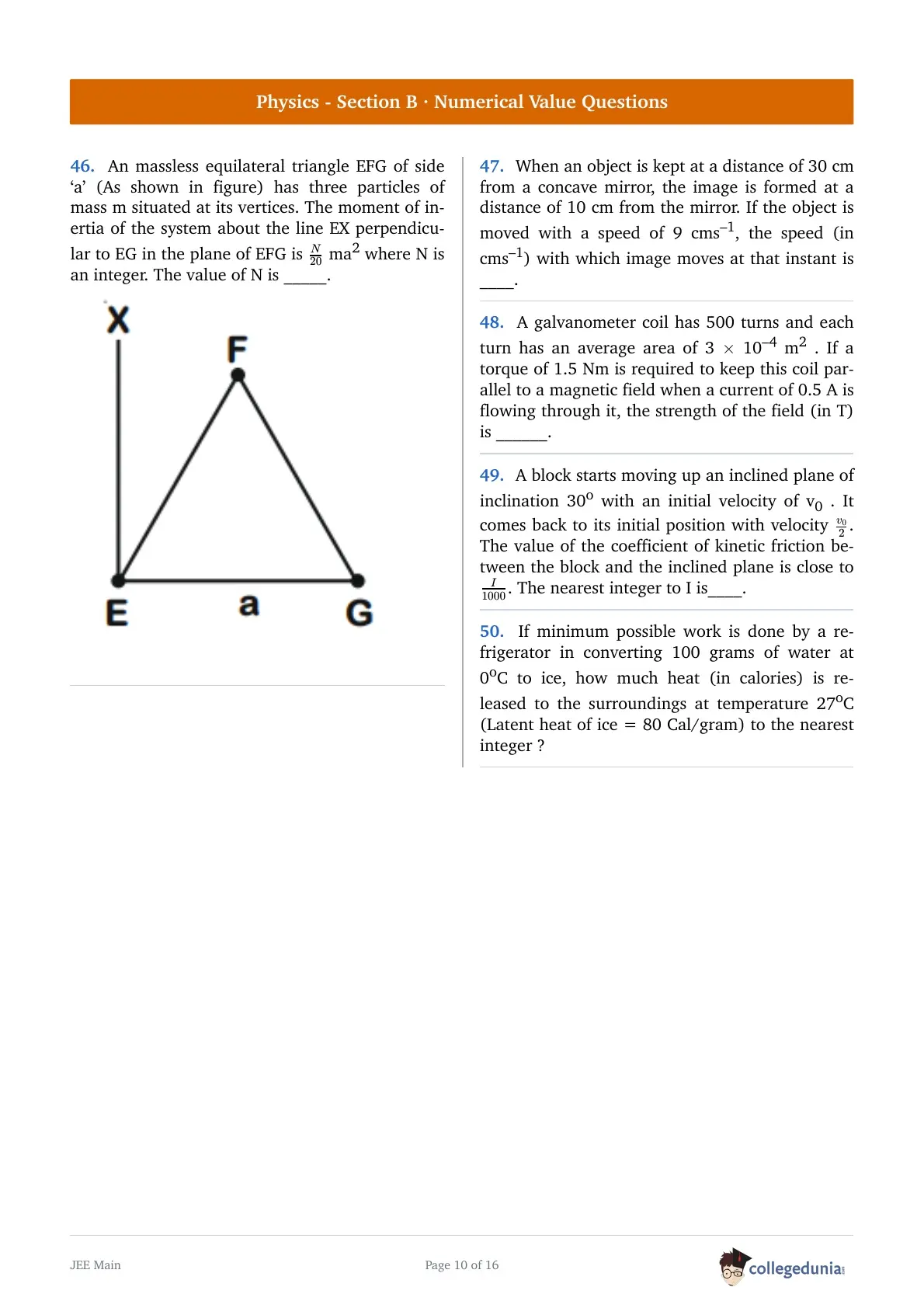
An massless equilateral triangle EFG of side 'a' (As shown in figure) has three particles of mass m situated at its vertices. The moment of inertia of the system about the line EX perpendicular to EG in the plane of EFG is \(\dfrac{N}{20}ma^2\) where N is an integer. The value of N is _____.
When an object is kept at a distance of 30 cm from a concave mirror, the image is formed at a distance of 10 cm from the mirror. If the object is moved with a speed of 9 cms\(^{-1}\), the speed (in cms\(^{-1}\)) with which image moves at that instant is ____.
A galvanometer coil has 500 turns and each turn has an average area of \(3\times10^{-4}\ \mathrm{m^2}\). If a torque of 1.5 Nm is required to keep this coil parallel to a magnetic field when a current of 0.5 A is flowing through it, the strength of the field (in T) is ______.
A block starts moving up an inclined plane of inclination \(30^\circ\) with an initial velocity of \(v_0\). It comes back to its initial position with velocity \(\dfrac{v_0}{2}\). The value of the coefficient of kinetic friction between the block and the inclined plane is close to \(\dfrac{I}{1000}\). The nearest integer to I is____.
If minimum possible work is done by a refrigerator in converting 100 grams of water at \(0^\circ\mathrm{C}\) to ice, how much heat (in calories) is released to the surroundings at temperature \(27^\circ\mathrm{C}\) (Latent heat of ice = 80 Cal/gram) to the nearest integer ?
Chemistry - Section A (Q51 - Q70)
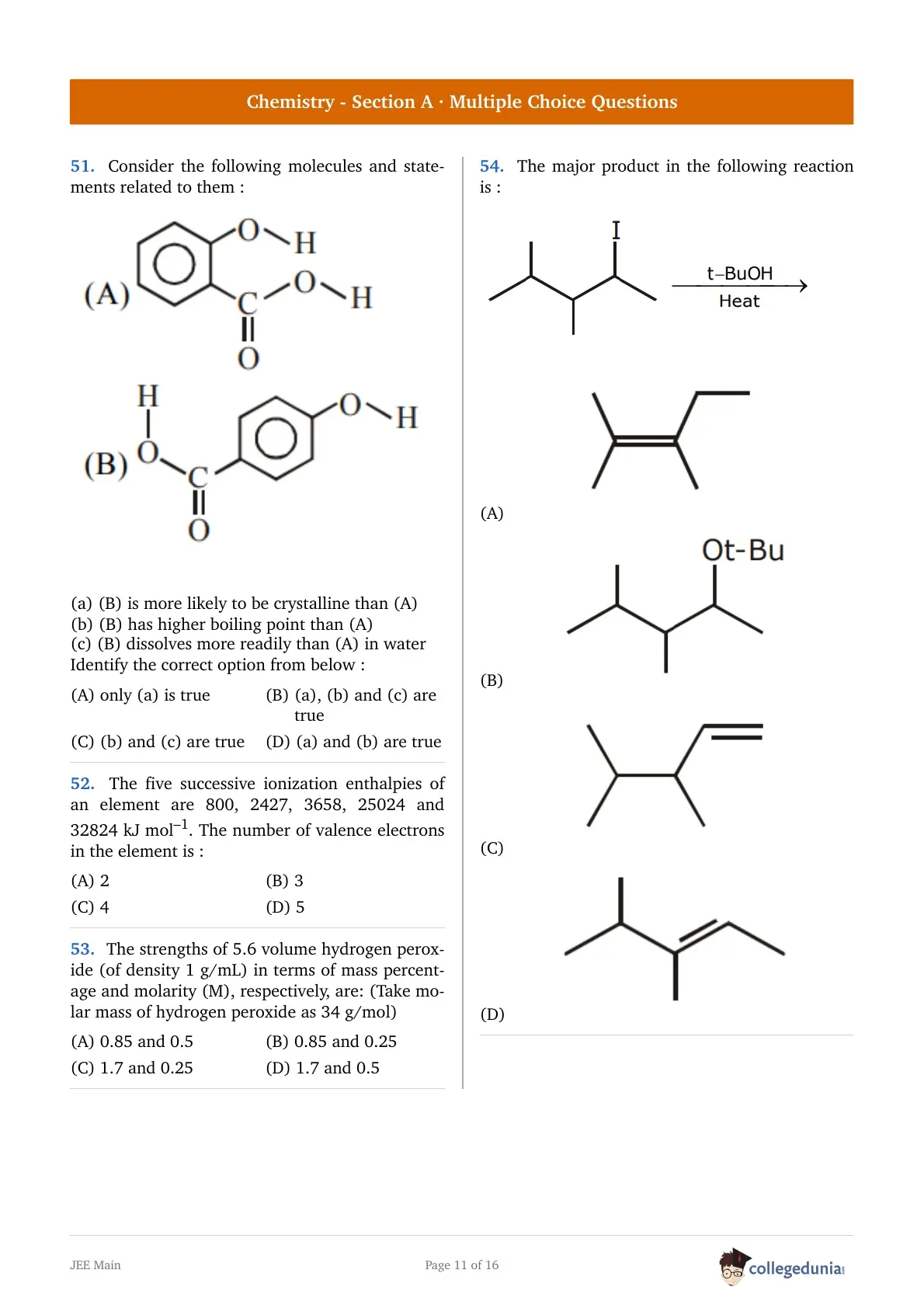
Consider the following molecules and statements related to them :
(a) (B) is more likely to be crystalline than (A)
(b) (B) has higher boiling point than (A)
(c) (B) dissolves more readily than (A) in water
Identify the correct option from below :
The five successive ionization enthalpies of an element are 800, 2427, 3658, 25024 and 32824 kJ mol-1. The number of valence electrons in the element is :
The strengths of 5.6 volume hydrogen peroxide (of density 1 g/mL) in terms of mass percentage and molarity (M), respectively, are: (Take molar mass of hydrogen peroxide as 34 g/mol)


Among the statements (I - IV), the correct ones are:
(I) Be has smaller atomic radius compared to Mg.
(II) Be has higher ionization enthalpy than Al.
(III) Charge/radius ratio of Be is greater than that of Al.
(IV) Both Be and Al form mainly covalent compounds.
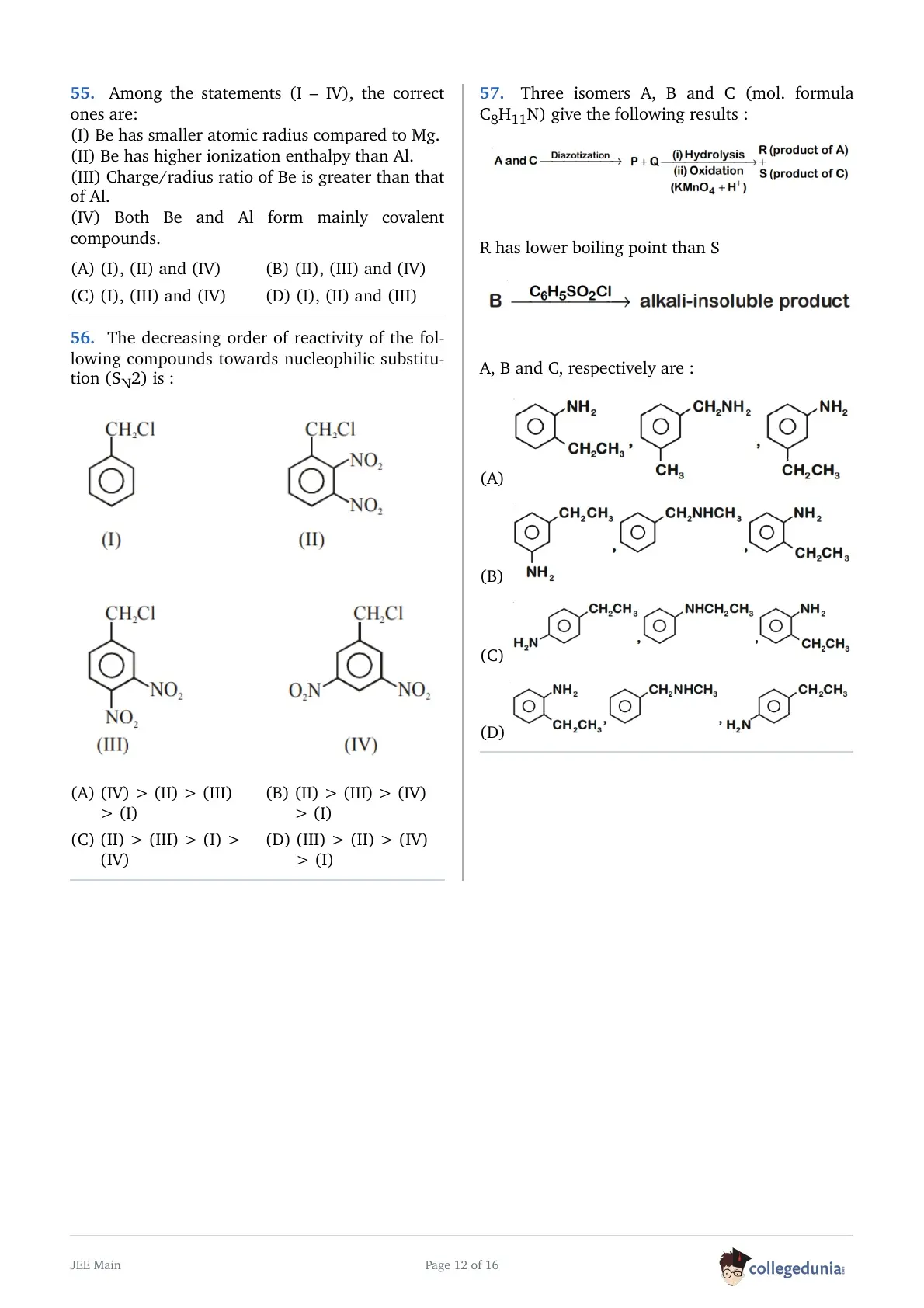
The decreasing order of reactivity of the following compounds towards nucleophilic substitution (SN2) is :
Three isomers A, B and C (mol. formula \(\mathrm{C_8H_{11}N}\)) give the following results :
R has lower boiling point than S
A, B and C, respectively are :
- (1)
![]()
- (2)
![]()
- (3)
![]()
- (4)
![]()


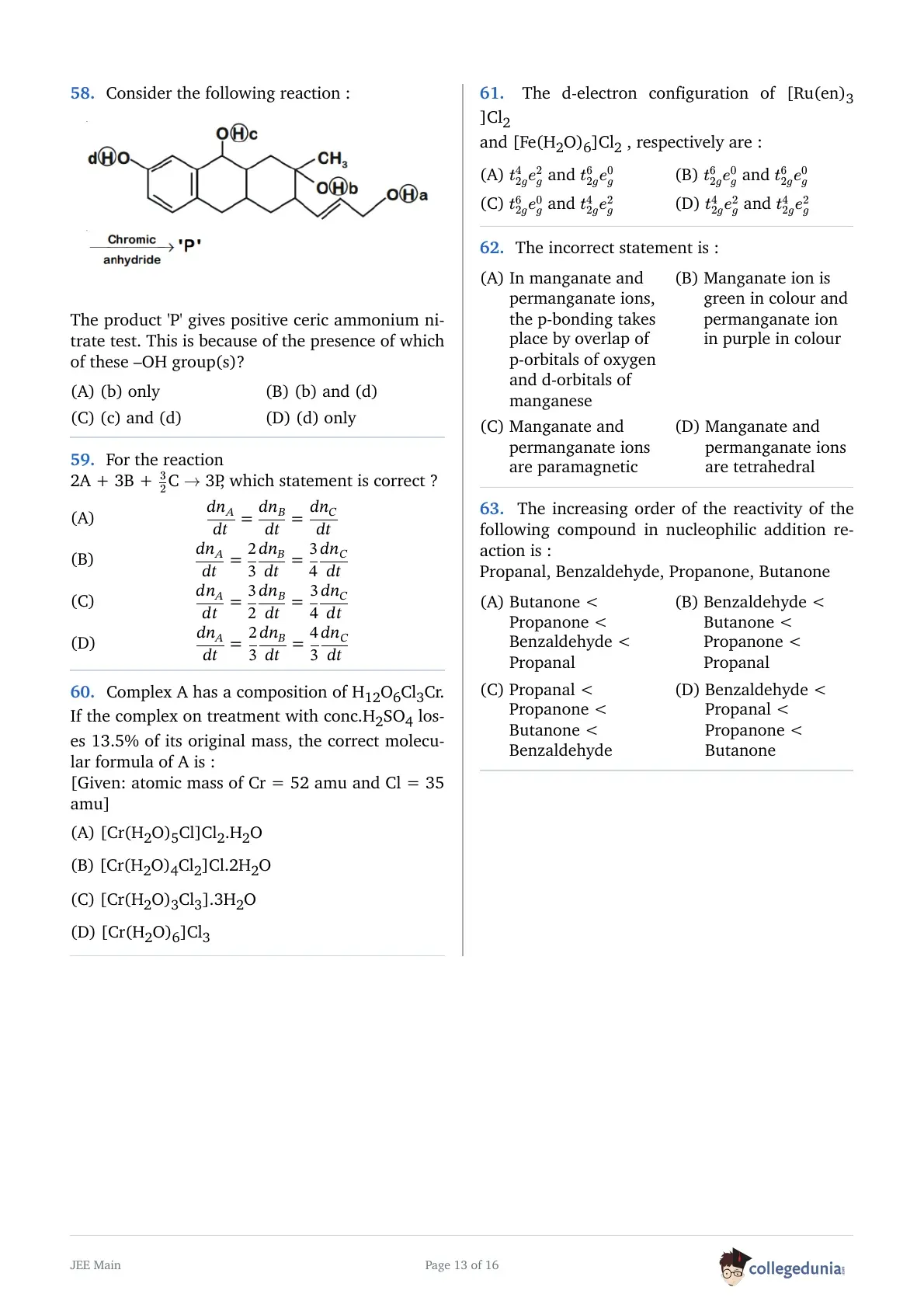
Consider the following reaction :
The product 'P' gives positive ceric ammonium nitrate test. This is because of the presence of which of these -OH group(s)?
For the reaction
\(2A + 3B + \frac{3}{2}C \to 3P\), which statement is correct ?
Complex A has a composition of \(\mathrm{H_{12}O_6Cl_3Cr}\). If the complex on treatment with conc.\(\mathrm{H_2SO_4}\) loses 13.5% of its original mass, the correct molecular formula of A is :
[Given: atomic mass of Cr = 52 amu and Cl = 35 amu]
The d-electron configuration of \(\mathrm{[Ru(en)_3]Cl_2}\) and \(\mathrm{[Fe(H_2O)_6]Cl_2}\), respectively are :
The incorrect statement is :
The increasing order of the reactivity of the following compound in nucleophilic addition reaction is :
Propanal, Benzaldehyde, Propanone, Butanone
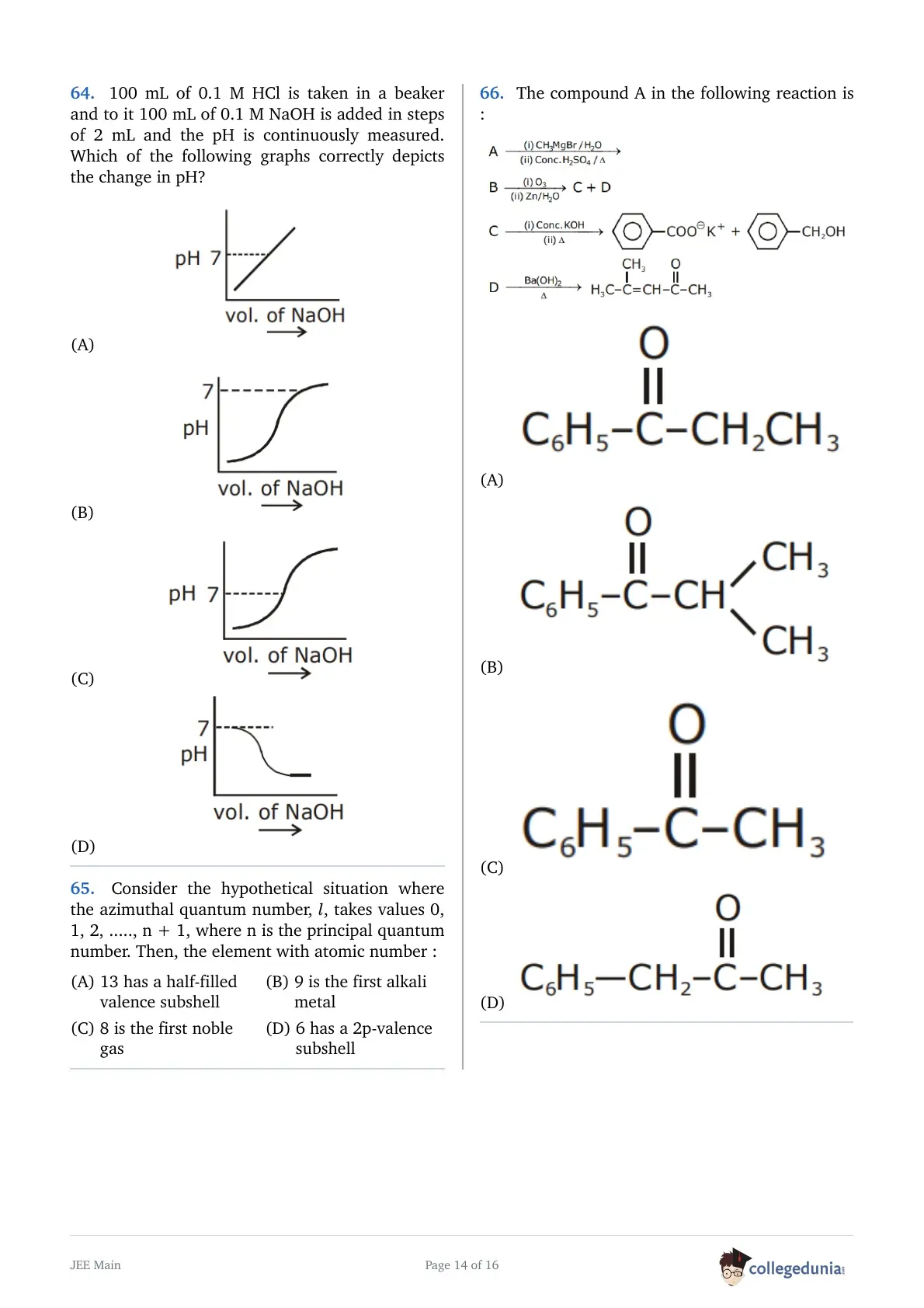
100 mL of 0.1 M HCl is taken in a beaker and to it 100 mL of 0.1 M NaOH is added in steps of 2 mL and the pH is continuously measured. Which of the following graphs correctly depicts the change in pH?
- (1)
![]()
- (2)
![]()
- (3)
![]()
- (4)
![]()


Consider the hypothetical situation where the azimuthal quantum number, \(l\), takes values 0, 1, 2, ....., n + 1, where n is the principal quantum number. Then, the element with atomic number :


A mixture of one mole each of H2 , He and O2 each are enclosed in a cylinder of volume V at temperature T. If the partial pressure of H2 is 2 atm, the total pressure of the gases in the cylinder is :
The incorrect statement(s) among (a) – (d) regarding acid rain is (are) :
(a) It can corrode water pipes.
(b) It can damage structures made up of stone.
(c) It cannot cause respiratory ailments in animals.
(d) It is not harmful for trees
| (i) Ranitidine | (a) Antidepressant |
| (ii) Nardil (Phenelzine) | (b) Antibiotic |
| (iii) Chloramphenicol | (c) Antihistamine |
| (iv) Dimetane (Brompheniramine) | (d) Antacid |
| (e) Analgesic |
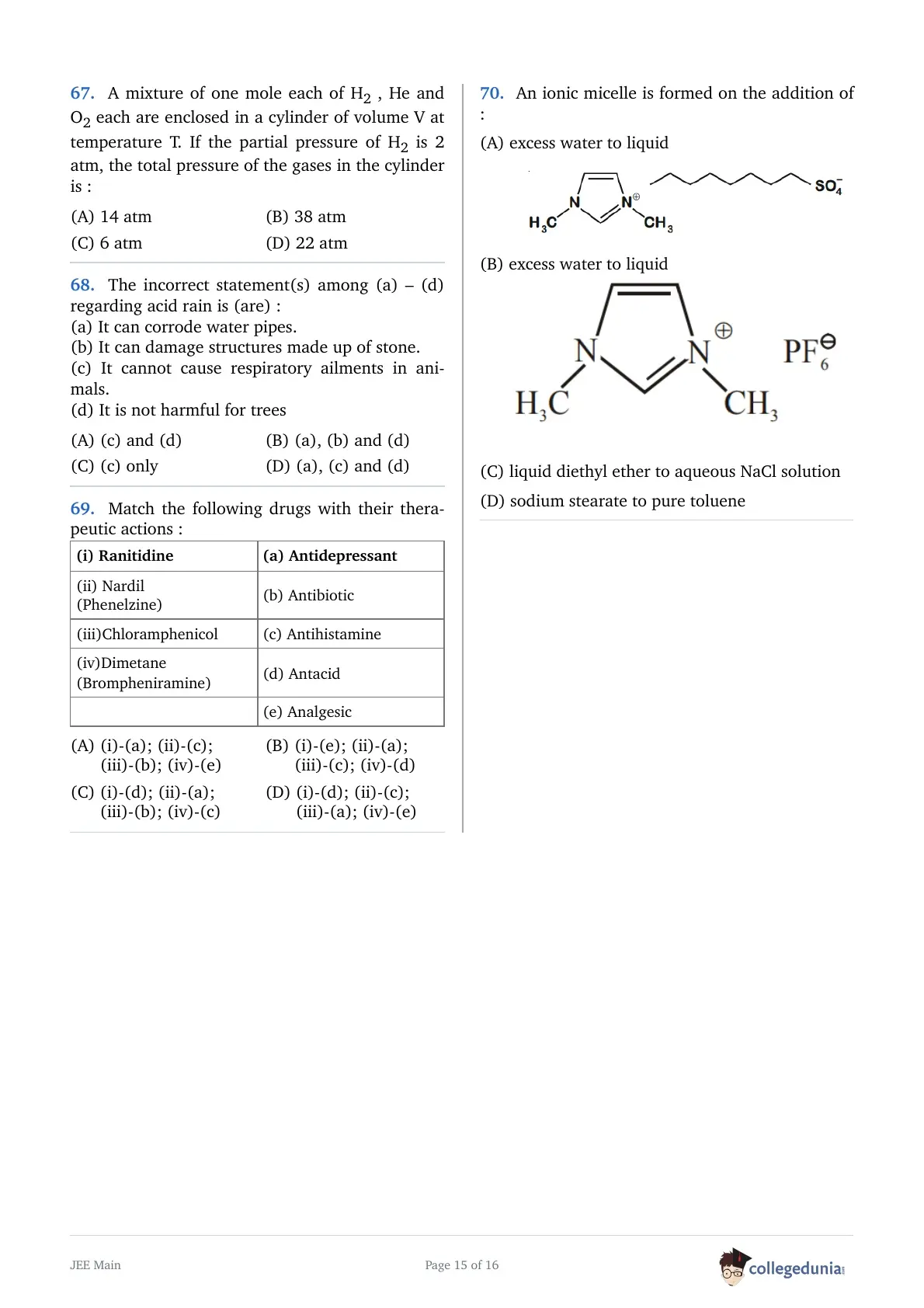
An ionic micelle is formed on the addition of :
- (1)
![]()
- (2)
![]()
- (3) liquid diethyl ether to aqueous NaCl solution
- (4) sodium stearate to pure toluene


Chemistry - Section B (Q71 - Q75)
\(6.023 \times 10^{22}\) molecules are present in 10 g of a substance 'x'. The molarity of a solution containing 5 g of substance 'x' in 2 L solution is _____ \(\times 10^{-3}\)
If 250 cm3 of an aqueous solution containing 0.73 g of a protein A is isotonic with one litre of another aqueous solution containing 1.65 g of a protein B, at 298 K, the ratio of the molecular masses of A and B is ______ \(\times 10^{-2}\) (to the nearest integer).
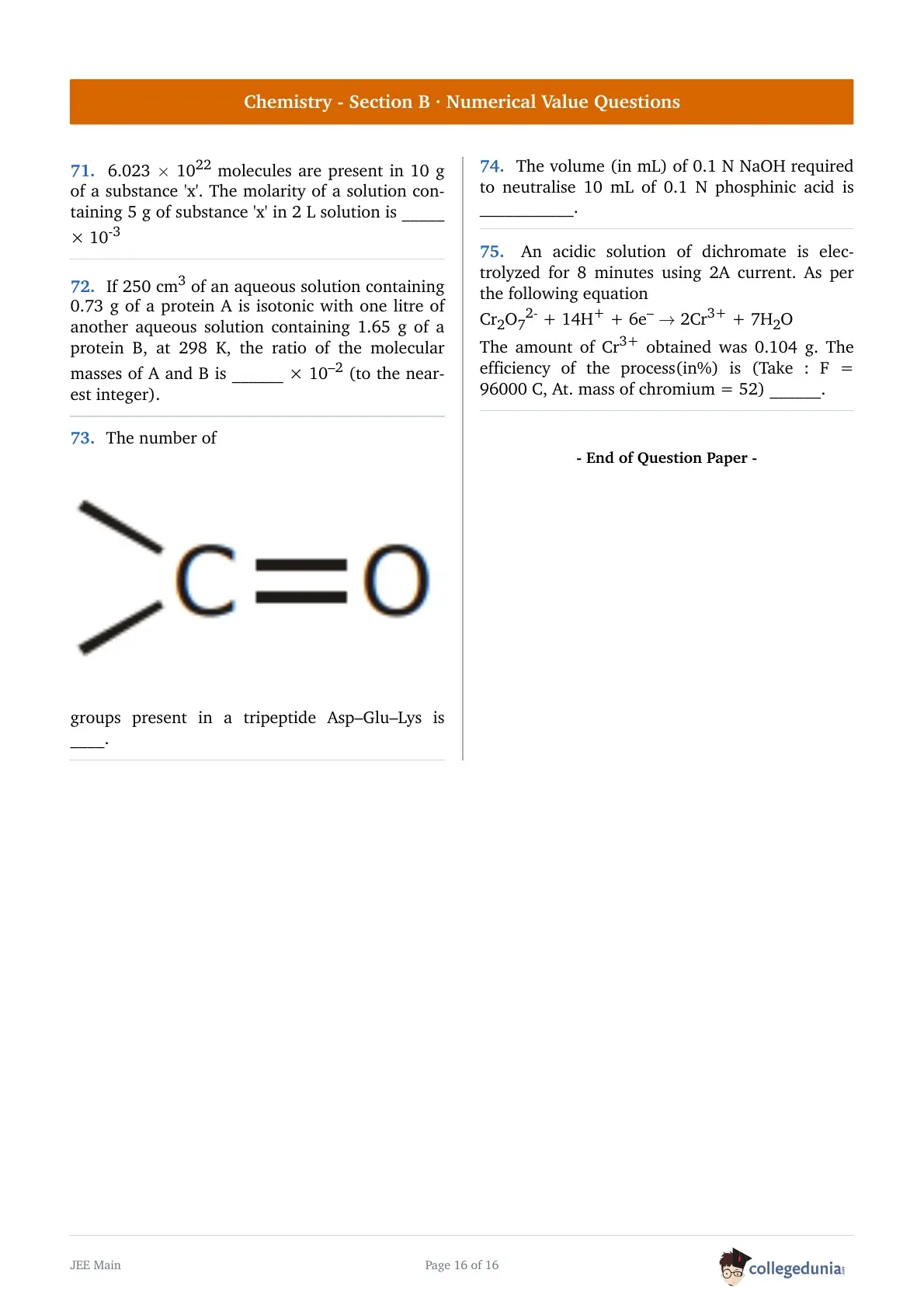
The number of  groups present in a tripeptide Asp–Glu–Lys is ____.
The volume (in mL) of 0.1 N NaOH required to neutralise 10 mL of 0.1 N phosphinic acid is ___________.
An acidic solution of dichromate is electrolyzed for 8 minutes using 2A current. As per the following equation
\(\mathrm{Cr_2O_7^{2-} + 14H^+ + 6e^- \to 2Cr^{3+} + 7H_2O}\)
The amount of \(\mathrm{Cr^{3+}}\) obtained was 0.104 g. The efficiency of the process (in %) is (Take : F = 96000 C, At. mass of chromium = 52) ______.
JEE Main 2020 Exam Pattern and Marking Scheme
| Particulars | Details |
|---|---|
| Exam Mode | Online (Computer-Based Test) |
| Paper | B.E./B.Tech (Paper 1) |
| Duration | 3 hours (180 minutes) |
| Type of Questions | Multiple Choice Questions (MCQs) + Numerical Value Questions |
| Subjects | Mathematics, Physics, Chemistry |
| Total Questions | 75 questions |
| Total Marks | 300 marks |
| Marking Scheme | +4 for correct answer & -1 for incorrect MCQ; no negative marking for Numerical Value Questions |
JEE Main 2020 September 3 Shift 2 Difficulty Level
JEE Main B.E/ B. Tech Papers 2020 for the September session were conducted from September 2- 6, 2020. When it comes to the difficulty level of JEE Main B.E/ B. Tech 2020 of September 3, Afternoon session, the question paper for Maths was considered as very difficult whereas other two papers like Physics and Chemistry were moderate to high.
JEE Main 2020 B.E./B.Tech Question Paper September 3 (AN): Weightage of Topics
The subject-wise weightage of topics in JEE Main B.E/B.Tech Question Paper for September 3, 2020, is as follows:
| Subjects | Topics with the Highest Weightage | Related Links |
|---|---|---|
| Mathematics |
|
JEE Main Mathematics Syllabus |
| Physics |
|
JEE Main Physics Syllabus |
| Chemistry |
|
JEE Main Chemistry Syllabus |



Comments