




JEE Main 2020 September 5 Shift 1 Question Paper is available here with solutions PDF and detailed solutions for every question. NTA conducted the first shift on September 5, 2020, from 9:00 AM to 12:00 PM. The JEE Main 2020 Paper 1 (B.E./B.Tech) question paper includes the following:
- 75 questions in a 3-hour CBT Mode: 25 each from Mathematics, Physics and Chemistry
- Section A: 20 multiple choice questions (MCQs) per subject, 4 marks each
- Section B: 5 numerical value questions per subject, all compulsory, 4 marks each
- Marking: +4 for a correct answer, -1 for an incorrect MCQ, 0 for an unattempted question; no negative marking for numerical value questions
- Maximum marks: 300 (100 per subject)
JEE Main 2020 September 5 Shift 1 Question Paper with Solution PDF
| NTA Official PDF | CD PDF | CD PDF with Solutions |
|---|---|---|
| Download official PDF 4.91 MB | Download Collegedunia PDF 0.97 MB | Download solutions PDF 1.77 MB |
Also Check:
JEE Main 2020 September 5 Shift 1 Questions with Solutions
Mathematics - Section A (Q1 - Q20)
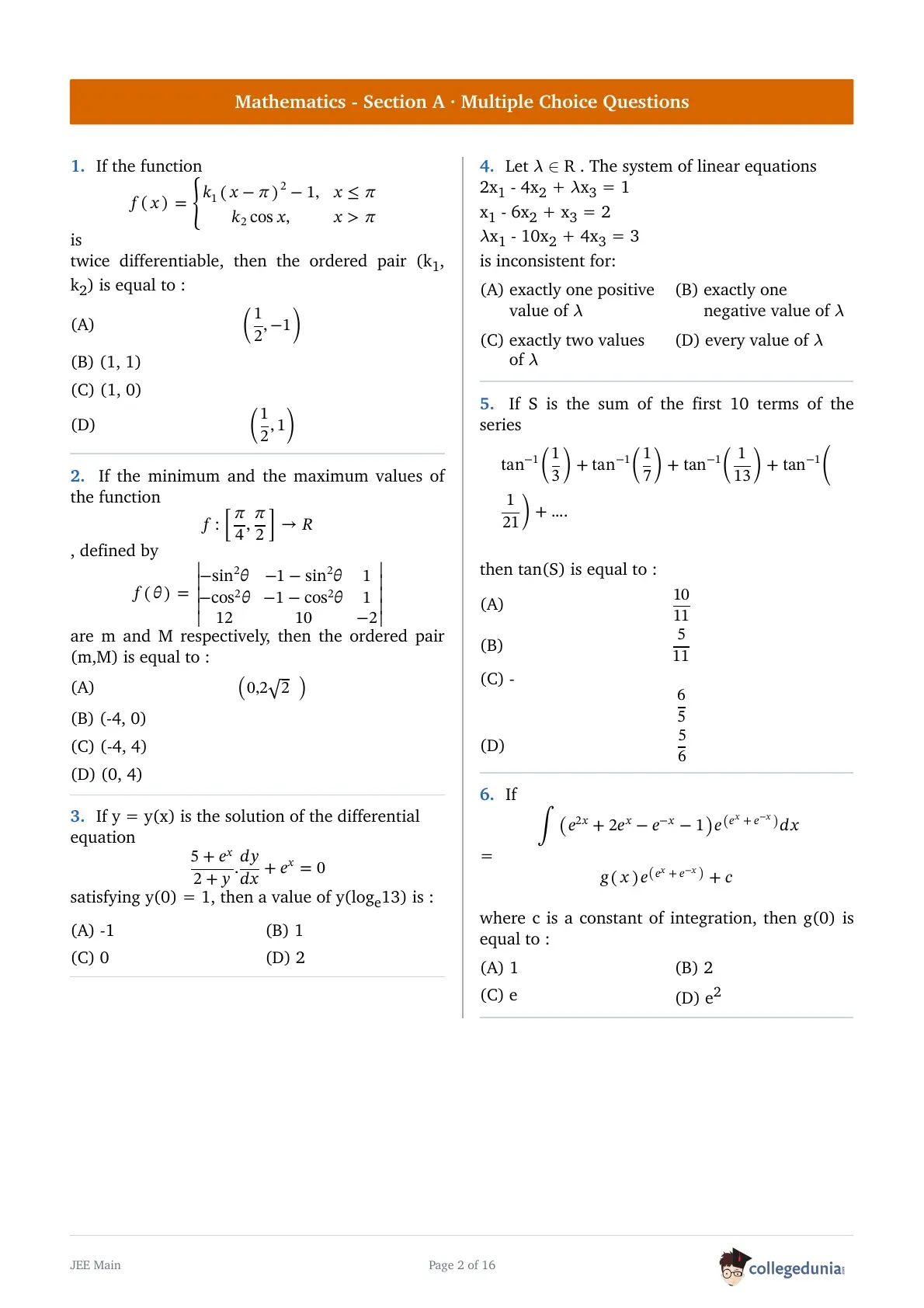
If the function
\( f(x)=\begin{cases} k_1(x-\pi)^2-1, & x \le \pi \\ k_2\cos x, & x \gt \pi \end{cases} \)
is twice differentiable, then the ordered pair \((k_1, k_2)\) is equal to :
If the minimum and the maximum values of the function \( f:\left[\frac{\pi}{4},\frac{\pi}{2}\right]\to R \), defined by
\( f(\theta)=\begin{vmatrix} -\sin^2\theta & -1-\sin^2\theta & 1 \\ -\cos^2\theta & -1-\cos^2\theta & 1 \\ 12 & 10 & -2 \end{vmatrix} \)
are \(m\) and \(M\) respectively, then the ordered pair \((m, M)\) is equal to :
If \(y=y(x)\) is the solution of the differential equation
\( \frac{5+e^x}{2+y}\cdot\frac{dy}{dx}+e^x=0 \)
satisfying \(y(0)=1\), then a value of \(y(\log_e 13)\) is :
Let \(\lambda\in R\). The system of linear equations
\(2x_1-4x_2+\lambda x_3=1\)
\(x_1-6x_2+x_3=2\)
\(\lambda x_1-10x_2+4x_3=3\)
is inconsistent for:
If \(S\) is the sum of the first 10 terms of the series
\( \tan^{-1}\left(\frac{1}{3}\right)+\tan^{-1}\left(\frac{1}{7}\right)+\tan^{-1}\left(\frac{1}{13}\right)+\tan^{-1}\left(\frac{1}{21}\right)+\dots \)
then \(\tan(S)\) is equal to :
If
\( \int\left(e^{2x}+2e^x-e^{-x}-1\right)e^{\left(e^x+e^{-x}\right)}dx = g(x)\,e^{\left(e^x+e^{-x}\right)}+c \)
where \(c\) is a constant of integration, then \(g(0)\) is equal to :
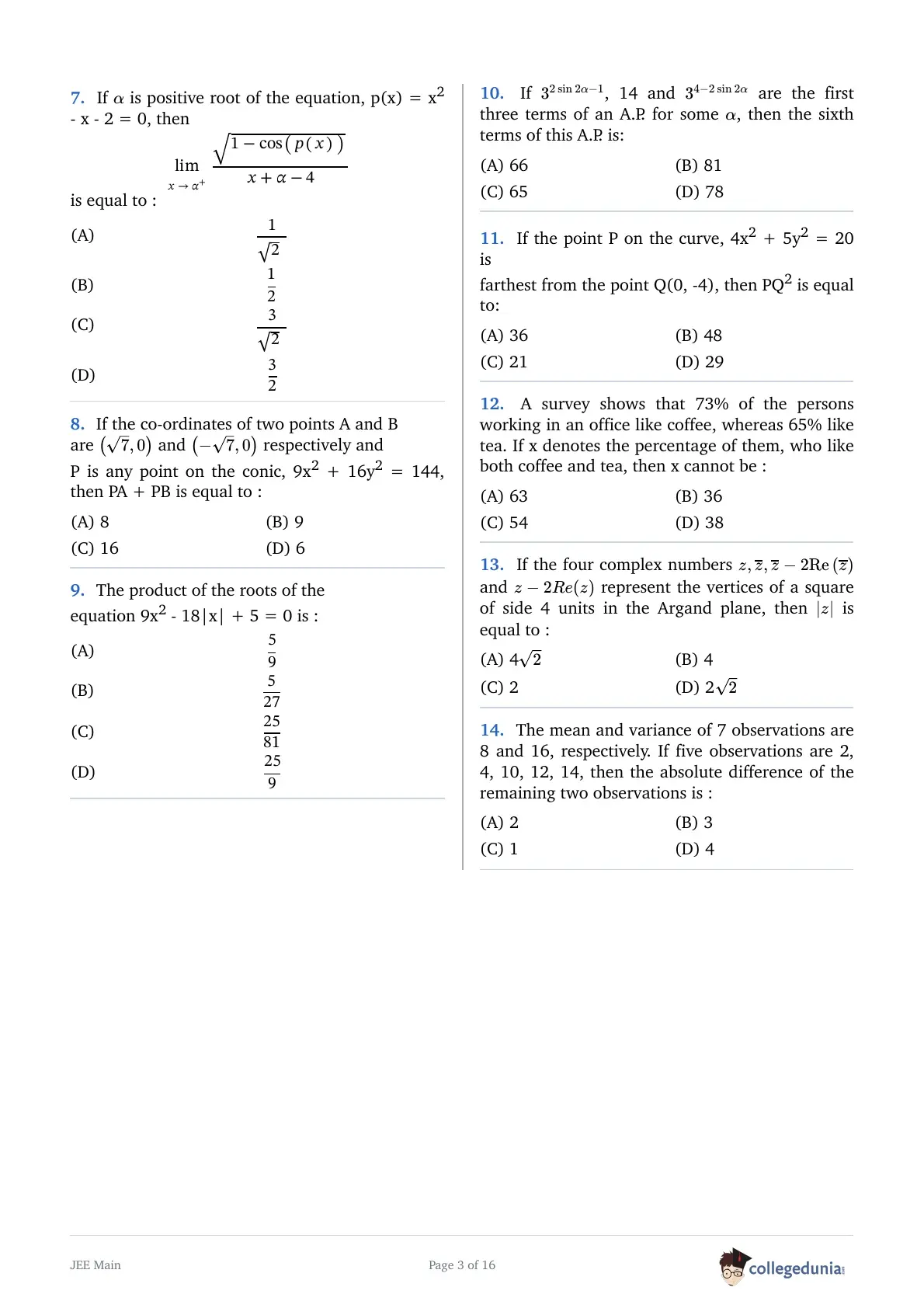
If \(\alpha\) is positive root of the equation, \(p(x)=x^2-x-2=0\), then
\( \lim_{x\to\alpha^+}\frac{\sqrt{1-\cos\left(p(x)\right)}}{x+\alpha-4} \)
is equal to :
If the co-ordinates of two points \(A\) and \(B\) are \(\left(\sqrt7,0\right)\) and \(\left(-\sqrt7,0\right)\) respectively and \(P\) is any point on the conic, \(9x^2+16y^2=144\), then \(PA+PB\) is equal to :
The product of the roots of the equation \(9x^2-18|x|+5=0\) is :
If \(3^{2\sin2\alpha-1}\), \(14\) and \(3^{4-2\sin2\alpha}\) are the first three terms of an A.P. for some \(\alpha\), then the sixth term of this A.P. is:
If the point \(P\) on the curve, \(4x^2+5y^2=20\) is farthest from the point \(Q(0,-4)\), then \(PQ^2\) is equal to:
A survey shows that \(73\%\) of the persons working in an office like coffee, whereas \(65\%\) like tea. If \(x\) denotes the percentage of them, who like both coffee and tea, then \(x\) cannot be :
If the four complex numbers \(z,\ \overline{z},\ \overline{z}-2\,\mathrm{Re}(z)\) and \(z-2\,\mathrm{Re}(z)\) represent the vertices of a square of side 4 units in the Argand plane, then \(|z|\) is equal to :
The mean and variance of 7 observations are 8 and \(16,\) respectively. If five observations are \(2,4,10,12,14,\) then the absolute difference of the remaining two observations is :
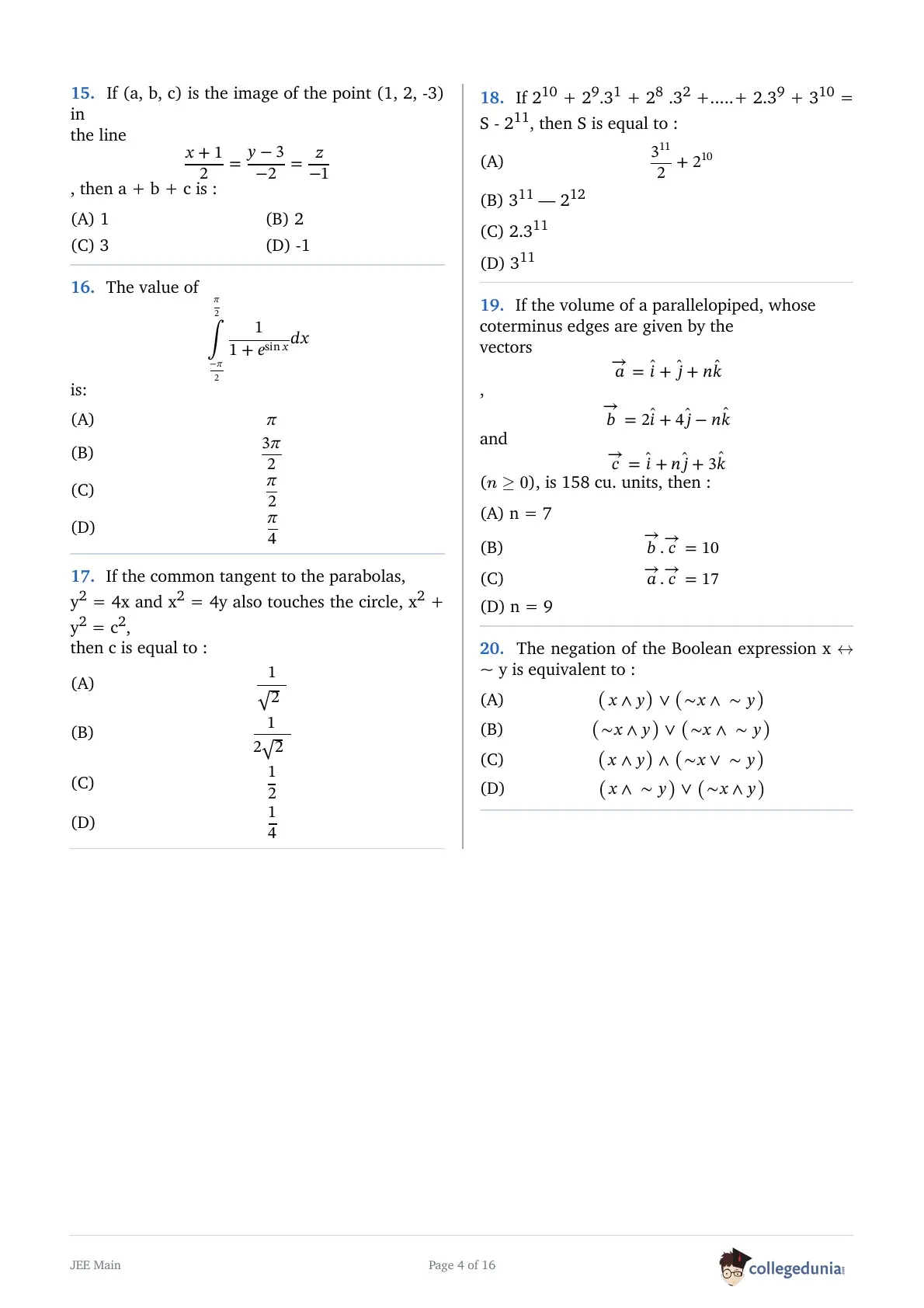
If \((a,\ b,\ c)\) is the image of the point \((1,\ 2,\ -3)\) in the line \(\frac{x+1}{2}=\frac{y-3}{-2}=\frac{z}{-1}\), then \(a+b+c\) is :
The value of \(\displaystyle\int_{-\pi/2}^{\pi/2}\frac{1}{1+e^{\sin x}}\,dx\) is:
If the common tangent to the parabolas, \(y^2=4x\) and \(x^2=4y\) also touches the circle, \(x^2+y^2=c^2\), then \(c\) is equal to :
If \(2^{10}+2^{9}\cdot 3^{1}+2^{8}\cdot 3^{2}+\ldots+2\cdot 3^{9}+3^{10}=S-2^{11}\), then \(S\) is equal to :
If the volume of a parallelopiped, whose coterminus edges are given by the vectors \(\vec{a}=\hat{i}+\hat{j}+n\hat{k}\), \(\vec{b}=2\hat{i}+4\hat{j}-n\hat{k}\) and \(\vec{c}=\hat{i}+n\hat{j}+3\hat{k}\) \((n\ge 0)\), is 158 cu. units, then :
The negation of the Boolean expression \(x\leftrightarrow\ \sim y\) is equivalent to :
Mathematics - Section B (Q21 - Q25)
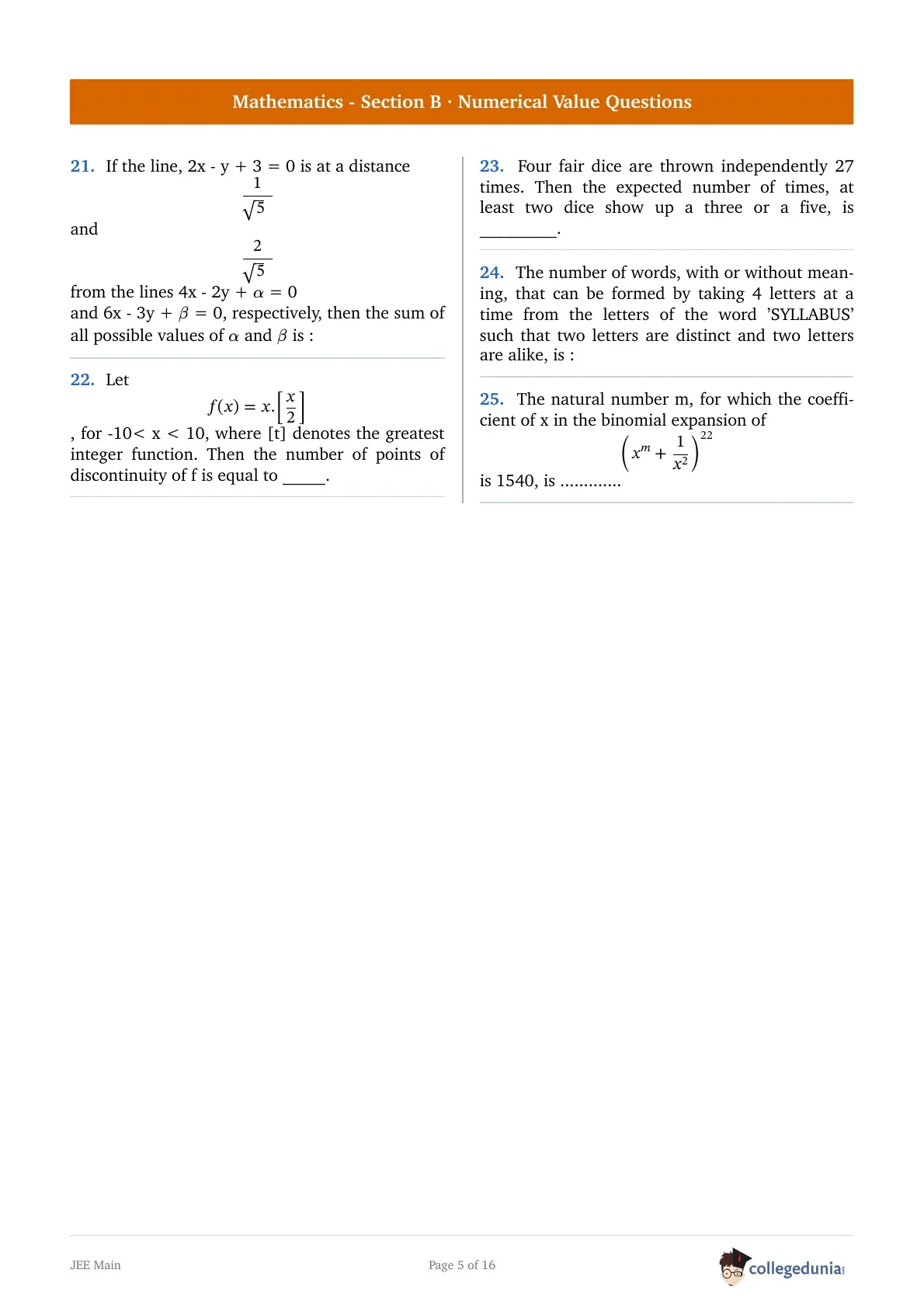
If the line, \(2x-y+3=0\) is at a distance \(\frac{1}{\sqrt{5}}\) and \(\frac{2}{\sqrt{5}}\) from the lines \(4x-2y+\alpha=0\) and \(6x-3y+\beta=0\), respectively, then the sum of all possible values of \(\alpha\) and \(\beta\) is :
Let \(f(x)=x\cdot\left[\frac{x}{2}\right]\), for \(-10\lt x\lt 10\), where \([t]\) denotes the greatest integer function. Then the number of points of discontinuity of \(f\) is equal to ______.
Four fair dice are thrown independently 27 times. Then the expected number of times, at least two dice show up a three or a five, is _________.
The number of words, with or without meaning, that can be formed by taking 4 letters at a time from the letters of the word 'SYLLABUS' such that two letters are distinct and two letters are alike, is :
The natural number \(m\), for which the coefficient of \(x\) in the binomial expansion of \(\left(x^{m}+\frac{1}{x^{2}}\right)^{22}\) is 1540, is ............. .
Physics - Section A (Q26 - Q45)
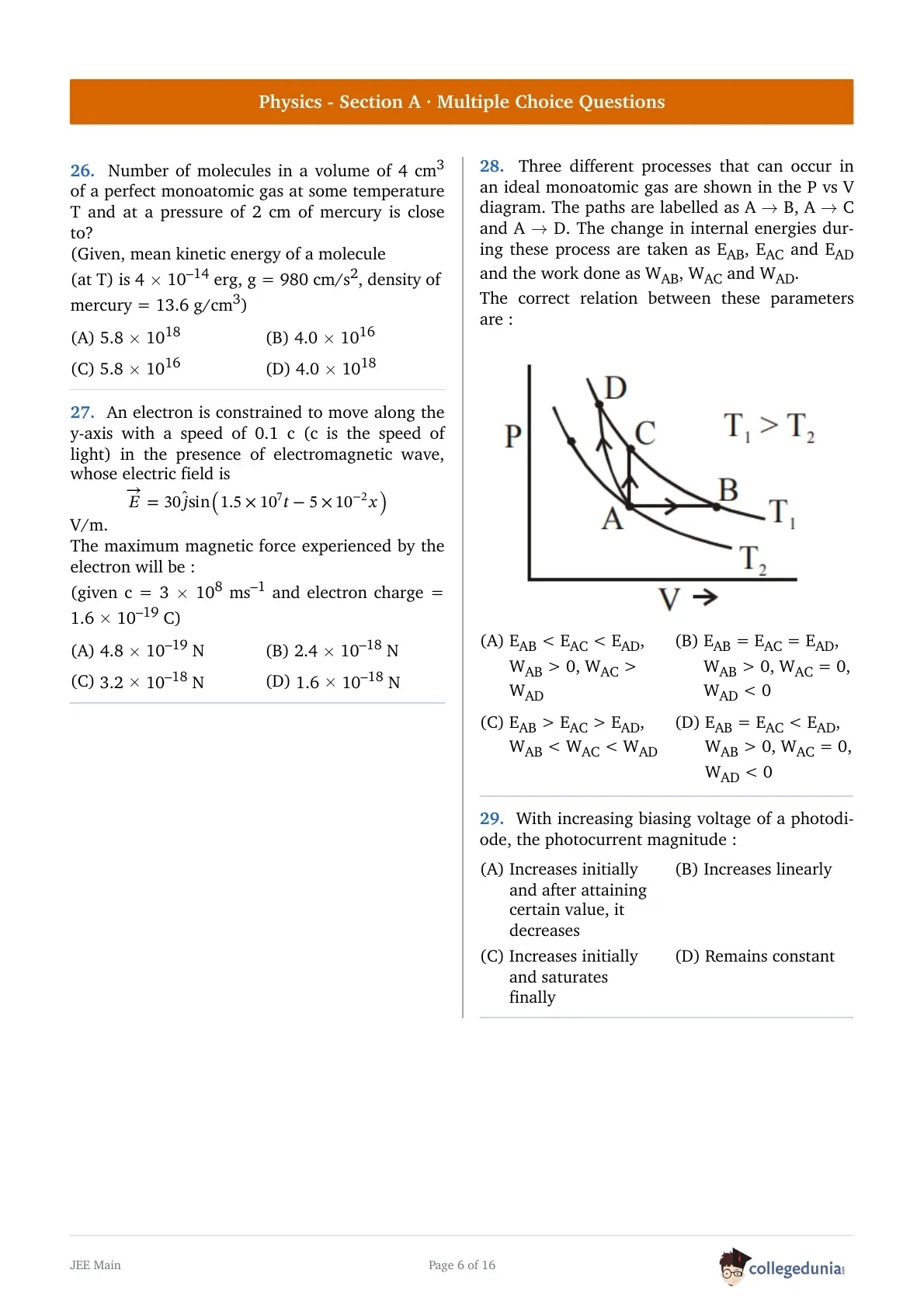
Number of molecules in a volume of \(4\ \mathrm{cm^3}\) of a perfect monoatomic gas at some temperature \(T\) and at a pressure of \(2\ \mathrm{cm}\) of mercury is close to?
(Given, mean kinetic energy of a molecule (at \(T\)) is \(4\times10^{-14}\) erg, \(g = 980\ \mathrm{cm/s^2}\), density of mercury \(= 13.6\ \mathrm{g/cm^3}\))
An electron is constrained to move along the \(y\)-axis with a speed of \(0.1\,c\) (\(c\) is the speed of light) in the presence of electromagnetic wave, whose electric field is
\(\vec{E}=30\,\hat{j}\,\sin\left(1.5\times10^{7}t-5\times10^{-2}x\right)\) V/m.
The maximum magnetic force experienced by the electron will be :
(given \(c=3\times10^{8}\ \mathrm{ms^{-1}}\) and electron charge \(=1.6\times10^{-19}\) C)
Three different processes that can occur in an ideal monoatomic gas are shown in the \(P\) vs \(V\) diagram. The paths are labelled as \(A\rightarrow B\), \(A\rightarrow C\) and \(A\rightarrow D\). The change in internal energies during these process are taken as \(E_{AB}\), \(E_{AC}\) and \(E_{AD}\) and the work done as \(W_{AB}\), \(W_{AC}\) and \(W_{AD}\).
The correct relation between these parameters are :
With increasing biasing voltage of a photodiode, the photocurrent magnitude :
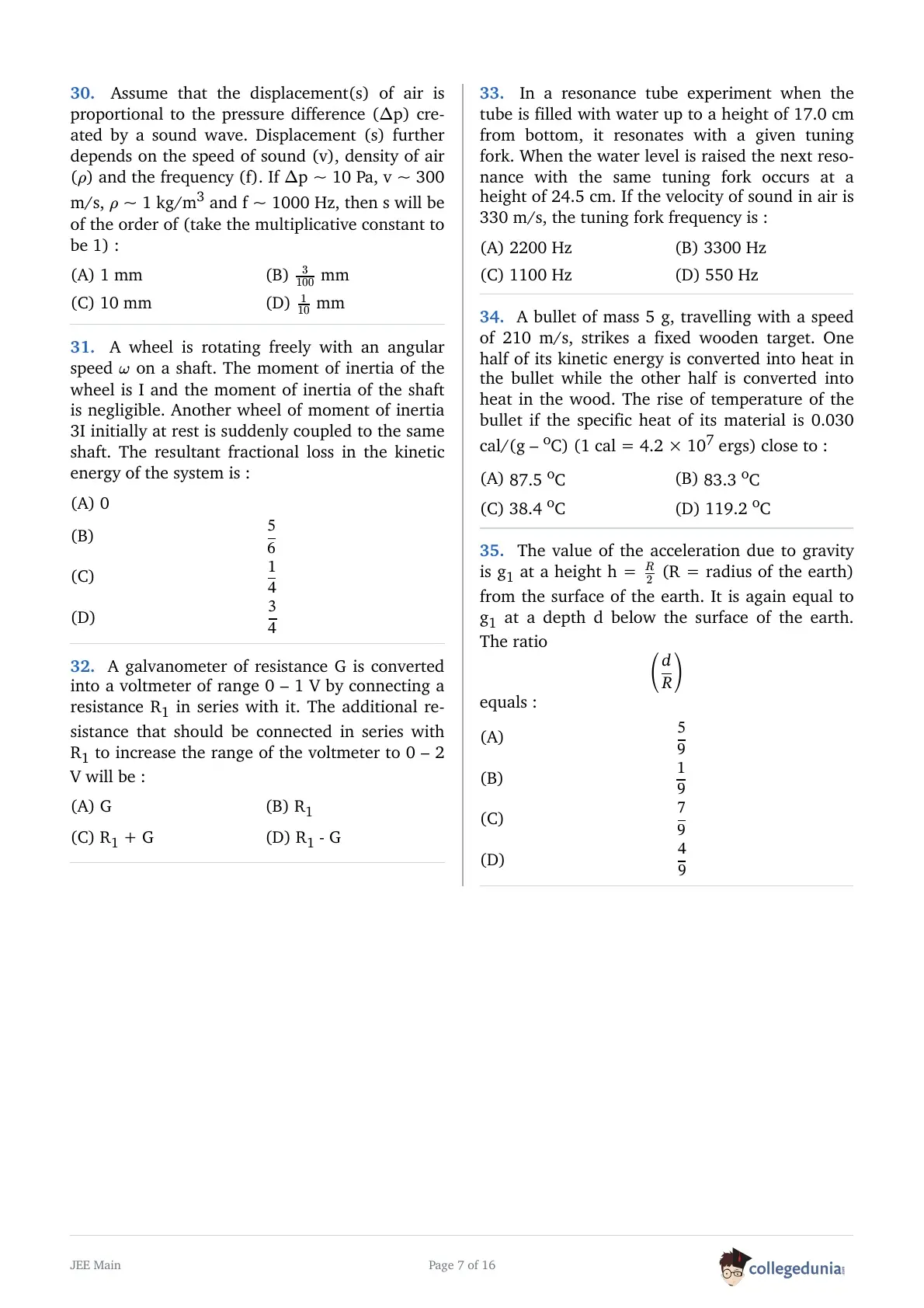
Assume that the displacement(\(s\)) of air is proportional to the pressure difference (\(\Delta p\)) created by a sound wave. Displacement (\(s\)) further depends on the speed of sound (\(v\)), density of air (\(\rho\)) and the frequency (\(f\)). If \(\Delta p\sim 10\) Pa, \(v\sim 300\) m/s, \(\rho\sim 1\ \mathrm{kg/m^3}\) and \(f\sim 1000\) Hz, then \(s\) will be of the order of (take the multiplicative constant to be 1) :
A wheel is rotating freely with an angular speed \(\omega\) on a shaft. The moment of inertia of the wheel is \(I\) and the moment of inertia of the shaft is negligible. Another wheel of moment of inertia \(3I\) initially at rest is suddenly coupled to the same shaft. The resultant fractional loss in the kinetic energy of the system is :
A galvanometer of resistance \(G\) is converted into a voltmeter of range \(0-1 V\) by connecting a resistance \(R _{1}\) in series with it. The additional resistance that should be connected in series with \(R _{1}\) to increase the range of the voltmeter to \(-2 V\) will be :
A tuning fork resonates with a sonometer wire of length 1 m stretched with a tension of 6 N. When the tension in the wire is changed to 54 N, the same tuning fork produces 12 beats per second with it. The frequency of the tuning fork is _______ Hz.
A bullet of mass \(5\) g, travelling with a speed of \(210\) m/s, strikes a fixed wooden target. One half of its kinetic energy is converted into heat in the bullet while the other half is converted into heat in the wood. The rise of temperature of the bullet if the specific heat of its material is \(0.030\) cal/(g - \(^{\circ}\)C) (\(1\) cal \(=4.2\times10^{7}\) ergs) close to :
The value of the acceleration due to gravity is \(g_1\) at a height \(h=\frac{R}{2}\) (\(R\) = radius of the earth) from the surface of the earth. It is again equal to \(g_1\) at a depth \(d\) below the surface of the earth. The ratio \(\left(\frac{d}{R}\right)\) equals :
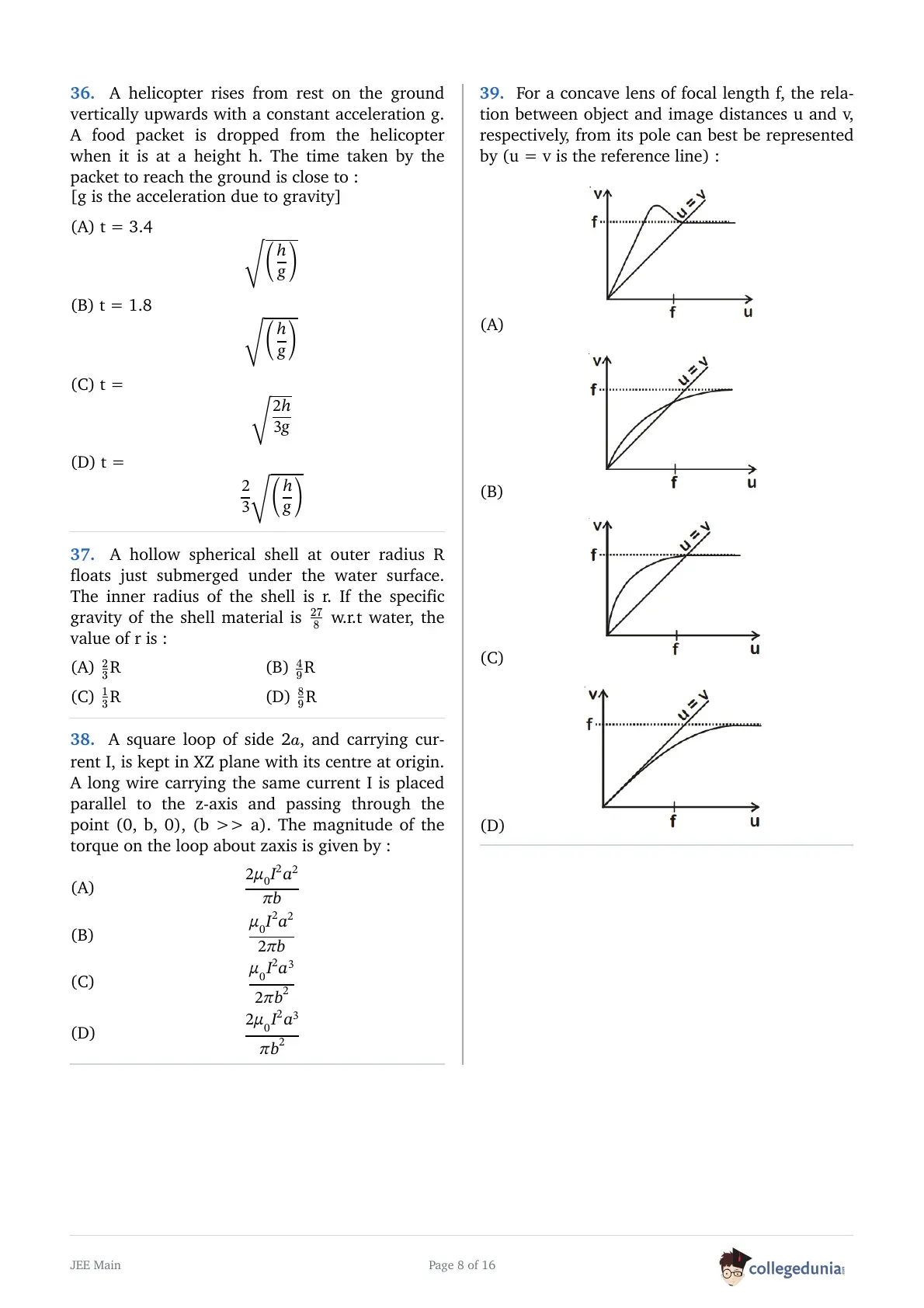
A helicopter rises from rest on the ground vertically upwards with a constant acceleration \(g\). A food packet is dropped from the helicopter when it is at a height \(h\). The time taken by the packet to reach the ground is close to :
[\(g\) is the acceleration due to gravity]
A hollow spherical shell at outer radius \(R\) floats just submerged under the water surface. The inner radius of the shell is \(r\). If the specific gravity of the shell material is \(\frac{27}{8}\) w.r.t water, the value of \(r\) is :
A square loop of side \(2a\), and carrying current \(I\), is kept in \(XZ\) plane with its centre at origin. A long wire carrying the same current \(I\) is placed parallel to the \(z\)-axis and passing through the point \((0,b,0)\), (\(b\gg a\)). The magnitude of the torque on the loop about \(z\)-axis is given by :
For a concave lens of focal length \(f\), the relation between object and image distances \(u\) and \(v\), respectively, from its pole can best be represented by (\(u=v\) is the reference line) :
- (1)
![]()
- (2)
![]()
- (3)
![]()
- (4)
![]()


A physical quantity P is given as
\( P = \frac{a^2b^2 }{ c\sqrt{d}} .\)
The percentage error in the measurement of a,b, c and d are1%, 2%, 3% and 4% respectively. The percentage error in the measurement of quantity P will be
An electrical power line, having a total resistance of \(2\Omega,\) delivers \(1\, kW\) at \(220\, V\). The efficiency of the transmission line is approximately:
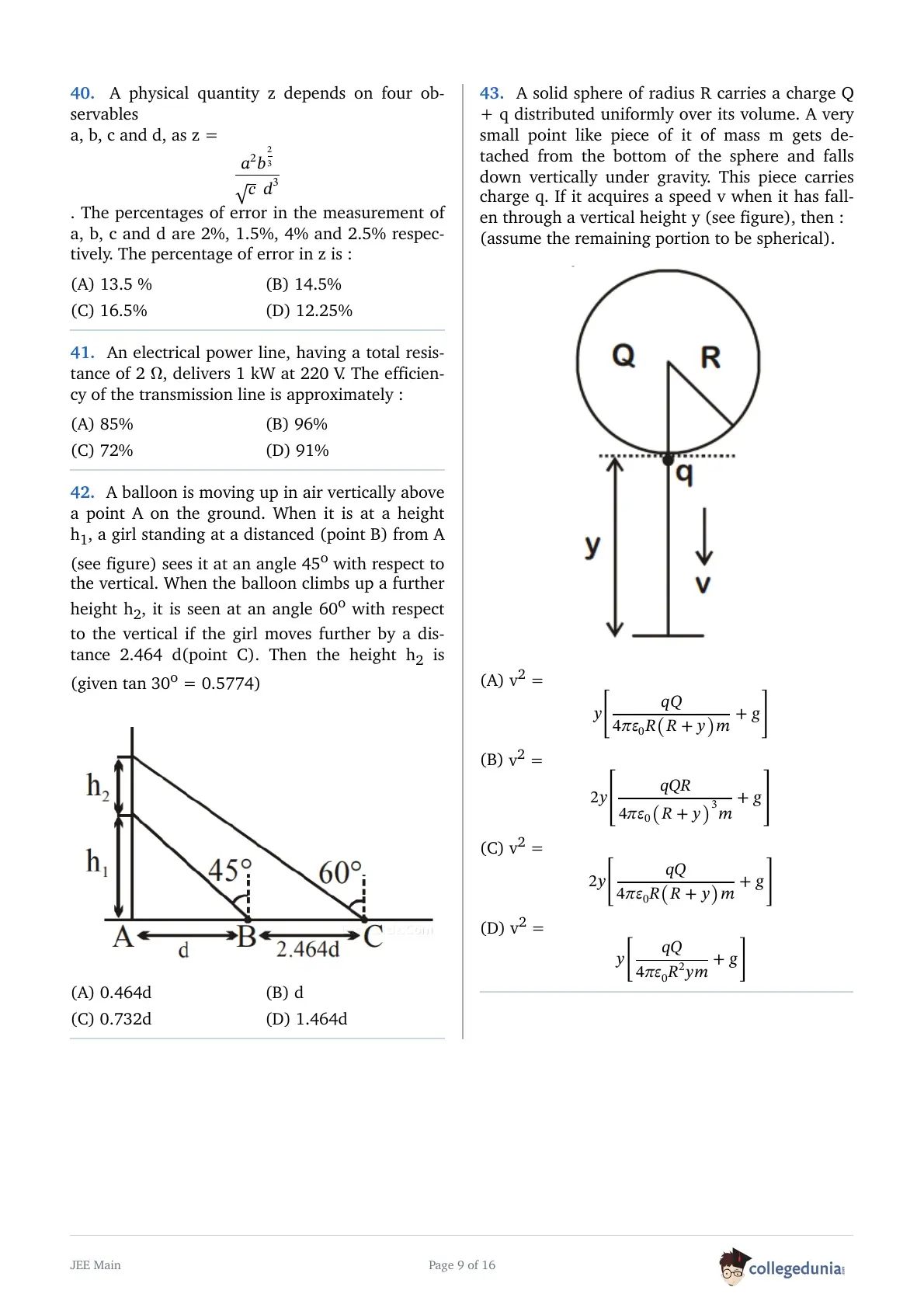
A balloon is moving up in air vertically above a point A on the ground. When it is at a height \(h_1\), a girl standing at a distance \(d\) (point B) from A (see figure) sees it at an angle \(45^\circ\) with respect to the vertical. When the balloon climbs up a further height \(h_2\), it is seen at an angle \(60^\circ\) with respect to the vertical if the girl moves further by a distance \(2.464\,d\) (point C). Then the height \(h_2\) is (given \(\tan 30^\circ = 0.5774\))
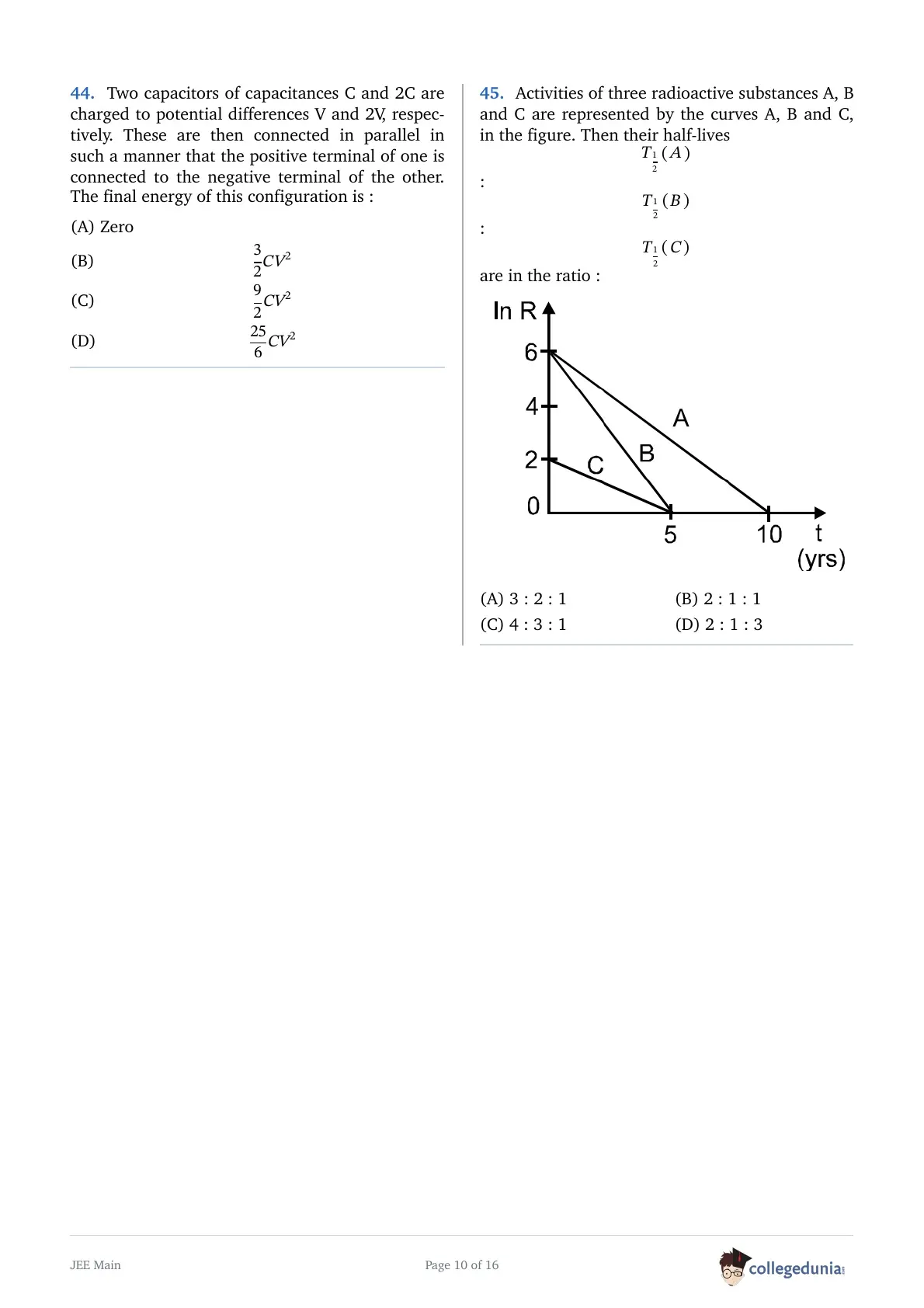
A solid sphere of radius \(R\) carries a charge \(Q + q\) distributed uniformly over its volume. A very small point like piece of it of mass \(m\) gets detached from the bottom of the sphere and falls down vertically under gravity. This piece carries charge \(q\). If it acquires a speed \(v\) when it has fallen through a vertical height \(y\) (see figure), then :
(assume the remaining portion to be spherical).
Two capacitors of capacitances \(C\) and \(2C\) are charged to potential differences \(V\) and \(2V\), respectively. These are then connected in parallel in such a manner that the positive terminal of one is connected to the negative terminal of the other. The final energy of this configuration is :
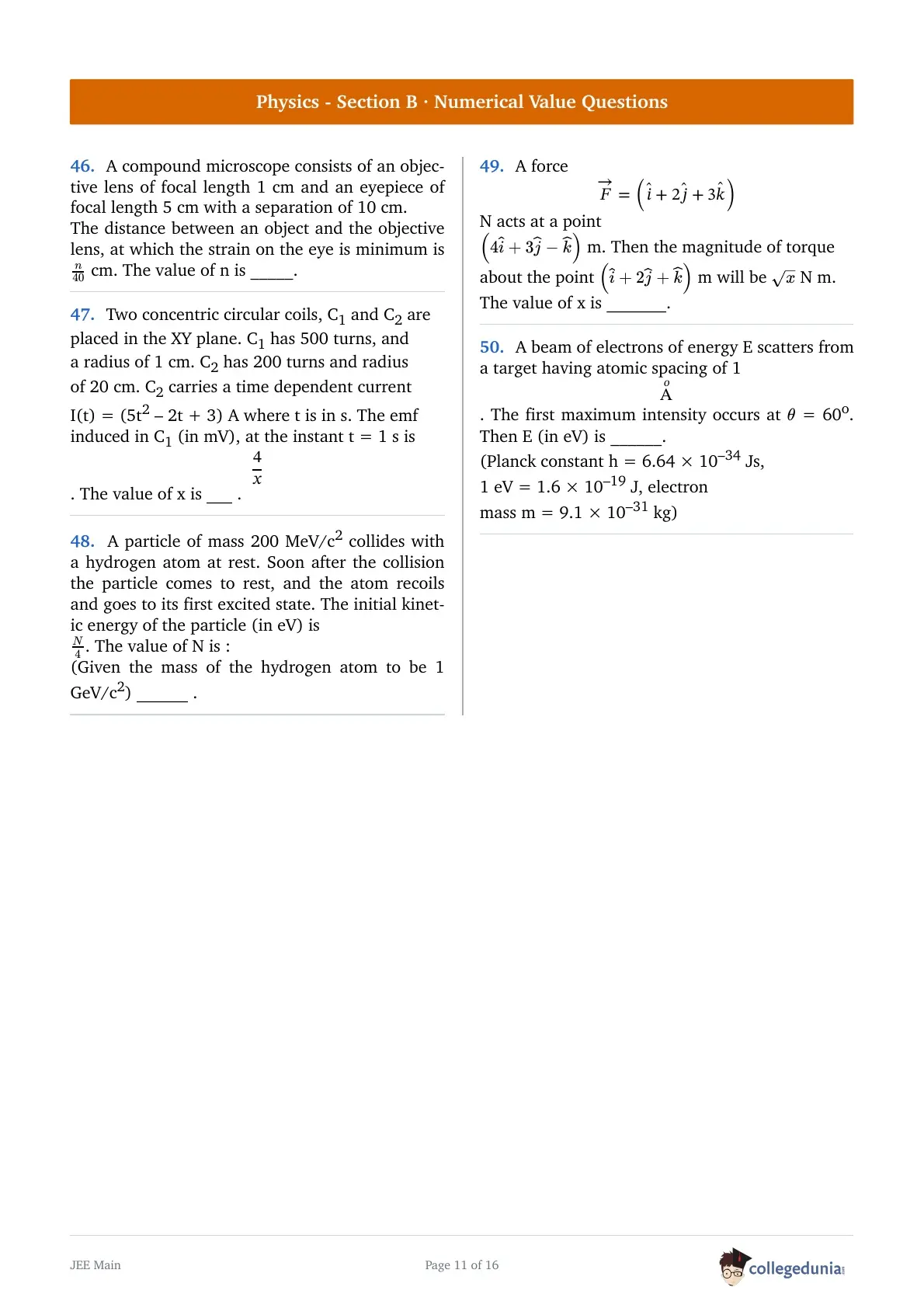
Activities of three radioactive substances A, B and C are represented by the curves A, B and C, in the figure. Then their half-lives \(T_{1/2}(A)\ :\ T_{1/2}(B)\ :\ T_{1/2}(C)\) are in the ratio :
Physics - Section B (Q46 - Q50)
A compound microscope consists of an objective lens of focal length 1 cm and an eyepiece of focal length 5 cm with a separation of 10 cm.
The distance between an object and the objective lens, at which the strain on the eye is minimum is \(\dfrac{n}{40}\) cm. The value of \(n\) is _____.
Two concentric circular coils, \(C_1\) and \(C_2\) are placed in the XY plane. \(C_1\) has 500 turns, and a radius of 1 cm. \(C_2\) has 200 turns and radius of 20 cm. \(C_2\) carries a time dependent current \(I(t) = (5t^2 - 2t + 3)\) A where \(t\) is in s. The emf induced in \(C_1\) (in mV), at the instant \(t = 1\) s is \(\dfrac{4}{x}\). The value of \(x\) is ___ .
A particle of mass \(200\ \mathrm{MeV/c^2}\) collides with a hydrogen atom at rest. Soon after the collision the particle comes to rest, and the atom recoils and goes to its first excited state. The initial kinetic energy of the particle (in eV) is \(\dfrac{N}{4}\). The value of \(N\) is :
(Given the mass of the hydrogen atom to be \(1\ \mathrm{GeV/c^2}\)) ______ .
A force of \(-P\hat k \) acts on the origin of the coordinate system. The torque about the point \((2, -3)\) is \(P(a\hat i+b\hat j)\), The ratio of \(\frac ab\) is \(\frac x2\). The value of x is -
A beam of electrons of energy \(E\) scatters from a target having atomic spacing of \(1\ \mathring{\mathrm{A}}\). The first maximum intensity occurs at \(\theta = 60^\circ\). Then \(E\) (in eV) is ______.
(Planck constant \(h = 6.64\times10^{-34}\) Js, \(1\ \mathrm{eV} = 1.6\times10^{-19}\) J, electron mass \(m = 9.1\times10^{-31}\) kg)
Chemistry - Section A (Q51 - Q70)
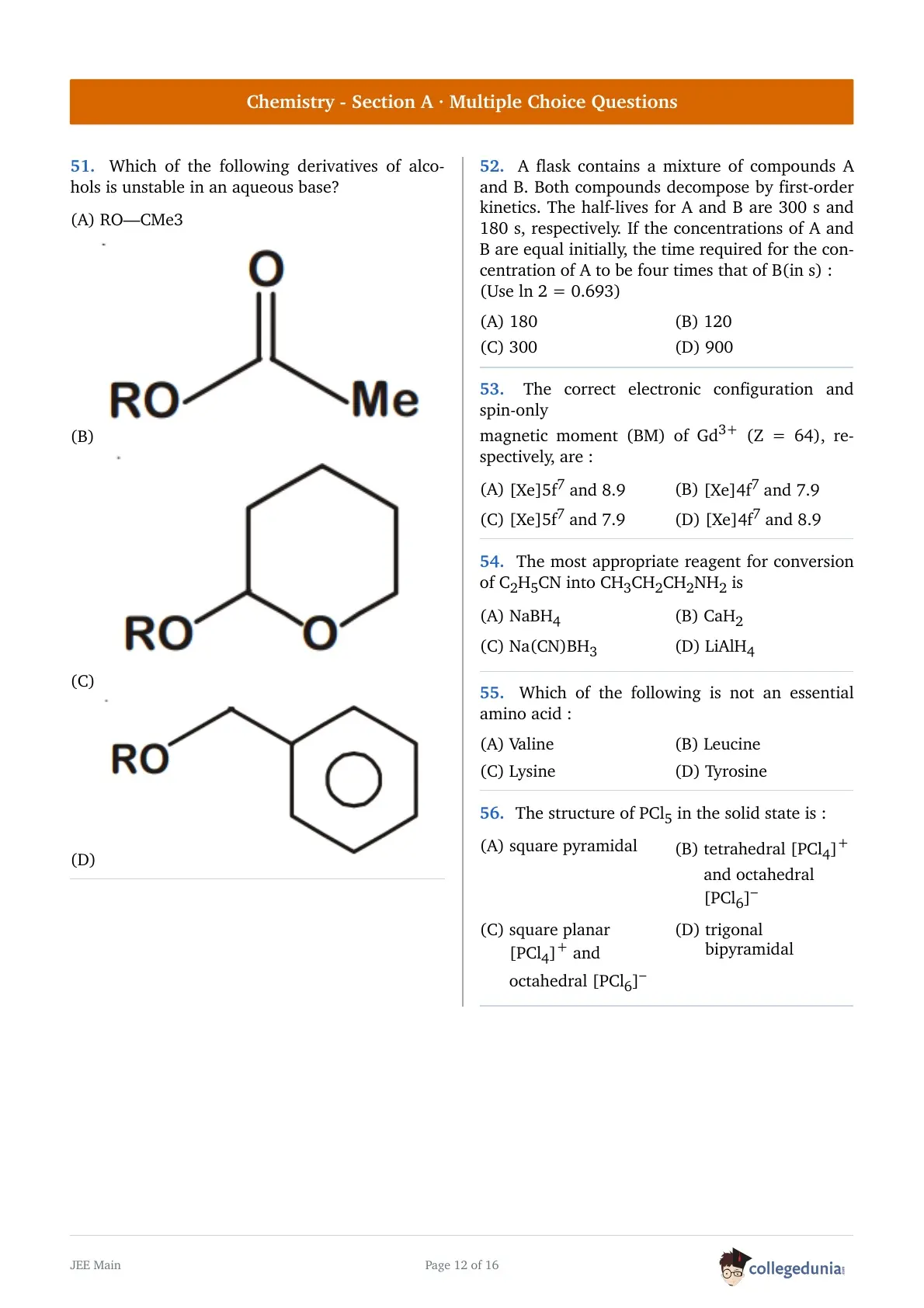
Which of the following derivatives of alcohols is unstable in an aqueous base?
- (1) \(\mathrm{RO{-}CMe_3}\)
- (2)
![]()
- (3)
![]()
- (4)
![]()


A flask is filled with equal moles of A and B. The half lives of A and B are 100 s and 50 s respectively and are independent of the initial concentration. The time required for the concentration of A to be four times that of B is ________s.
(Given : In 2 = 0.693)
The correct electronic configuration and spin-only magnetic moment (BM) of \(\mathrm{Gd^{3+}}\) (\(Z = 64\)), respectively, are :
The most appropriate reagent for conversion of \(\mathrm{C_2H_5CN}\) into \(\mathrm{CH_3CH_2CH_2NH_2}\) is
Which of the following is not an essential amino acid:
The structure of \(\mathrm{PCl_5}\) in the solid state is :
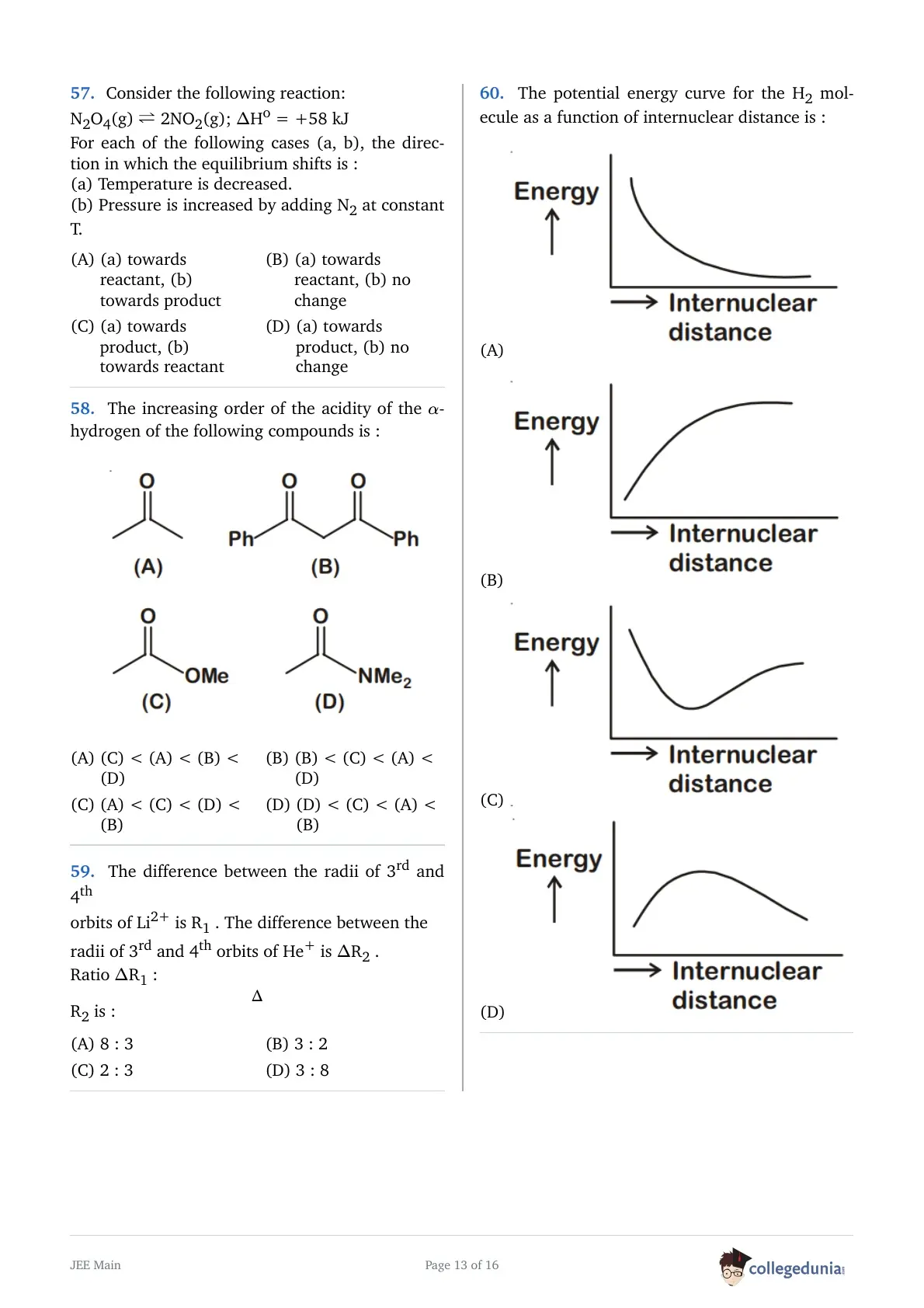
Consider the following reaction:
\(\mathrm{N_2O_4(g) \rightleftharpoons 2NO_2(g)}\); \(\Delta H^\circ = +58\) kJ
For each of the following cases (a, b), the direction in which the equilibrium shifts is :
(a) Temperature is decreased.
(b) Pressure is increased by adding \(\mathrm{N_2}\) at constant T.
The increasing order of the acidity of the \(\alpha\)-hydrogen of the following compounds is :
The difference between the radii of \(3^{rd}\) and \(4^{th}\) orbits of \(\mathrm{Li^{2+}}\) is \(\Delta R_1\). The difference between the radii of \(3^{rd}\) and \(4^{th}\) orbits of \(\mathrm{He^{+}}\) is \(\Delta R_2\). Ratio \(\Delta R_1 : \Delta R_2\) is :
The potential energy curve for the \(\mathrm{H_2}\) molecule as a function of internuclear distance is :
- (1)
![]()
- (2)
![]()
- (3)
![]()
- (4)
![]()


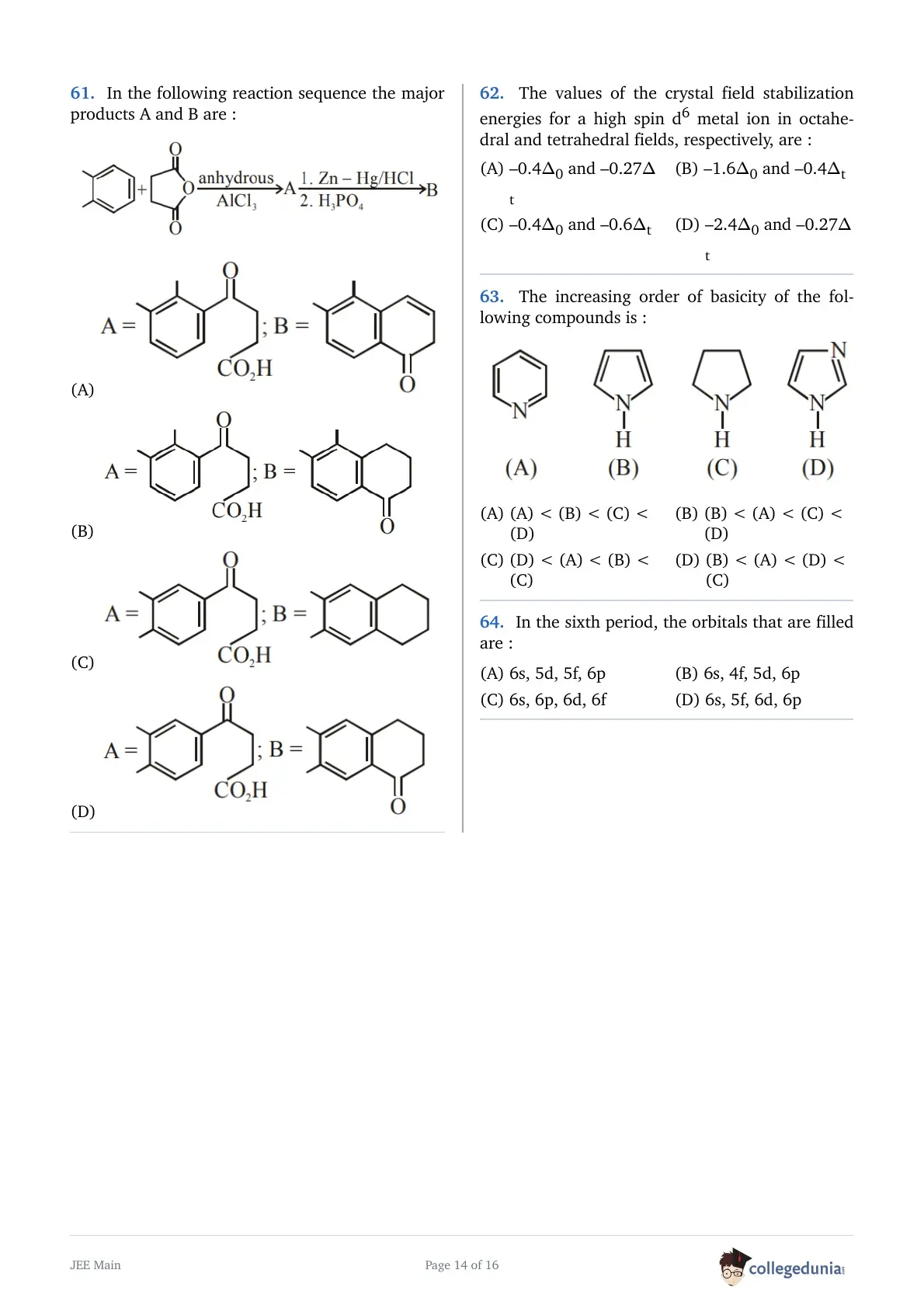
In the following reaction sequence the major products A and B are :
- (1)
![]()
- (2)
![]()
- (3)
![]()
- (4)
![]()


The values of the crystal field stabilization energies for a high spin \(d^6\) metal ion in octahedral and tetrahedral fields, respectively, are :
The increasing order of basicity of the following compounds is :
In the sixth period, the orbitals that are filled are :
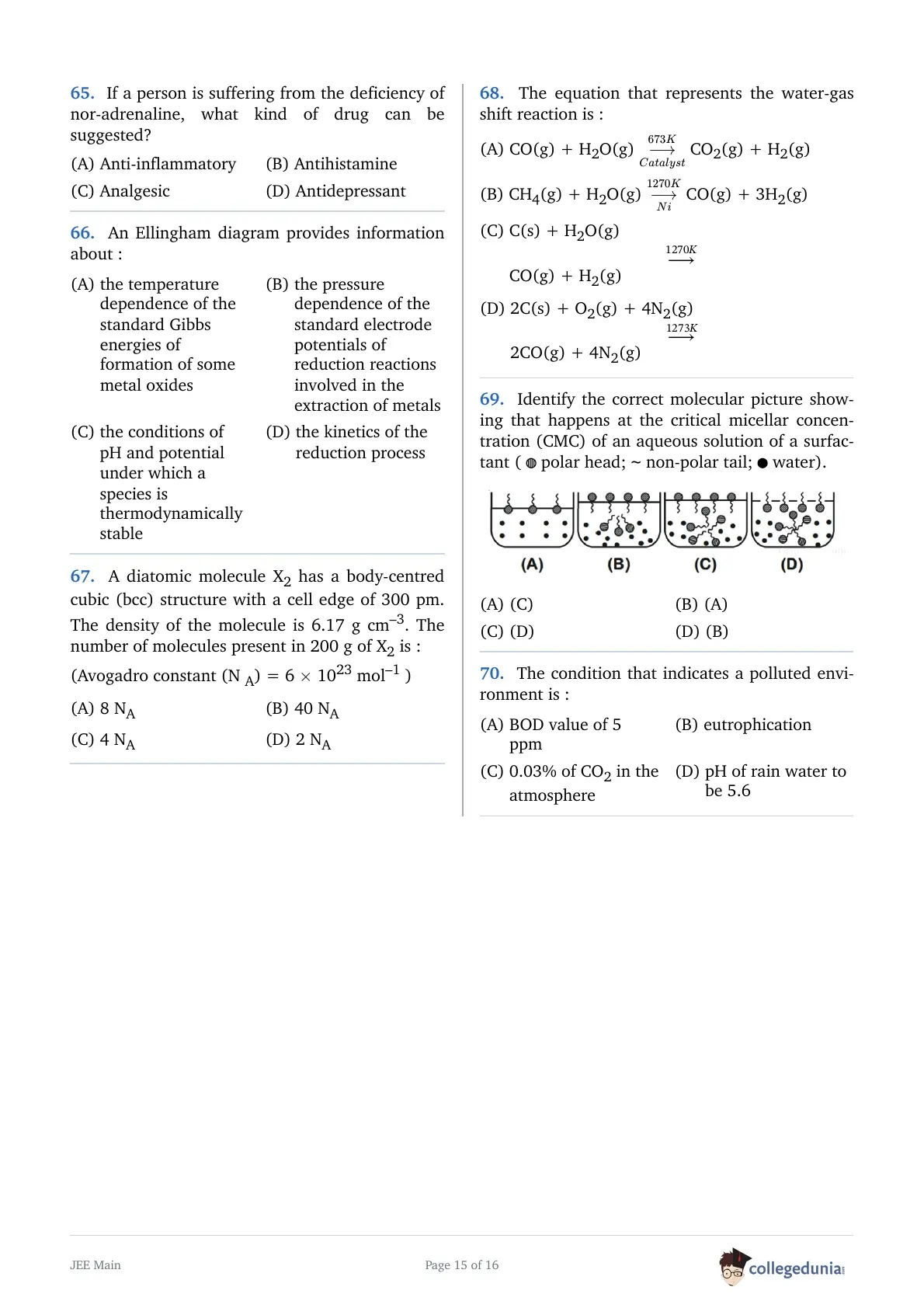
If a person is suffering from the deficiency of nor-adrenaline, what kind of drug can be suggested?
An Ellingham diagram provides information about :
A diatomic molecule \(X_{2}\) has a body-centred cubic (bcc) structure with a cell edge of \(300\, pm\). The density of the molecule is \(6.17 \,g \,cm ^{-3}\). The number of molecules present in \(200\, g\) of \(X _{2}\) is (Avogadro constant \(\left.\left( N _{ A }\right)=6 \times 10^{23} \,mol ^{-1}\right)\)
The equation that represents the water-gas shift reaction is :
Identify the correct molecular picture showing that happens at the critical micellar concentration (CMC) of an aqueous solution of a surfactant (polar head: shaded circle; non-polar tail: wavy line; water: black dot).
The condition that indicates a polluted environment is :
Chemistry - Section B (Q71 - Q75)
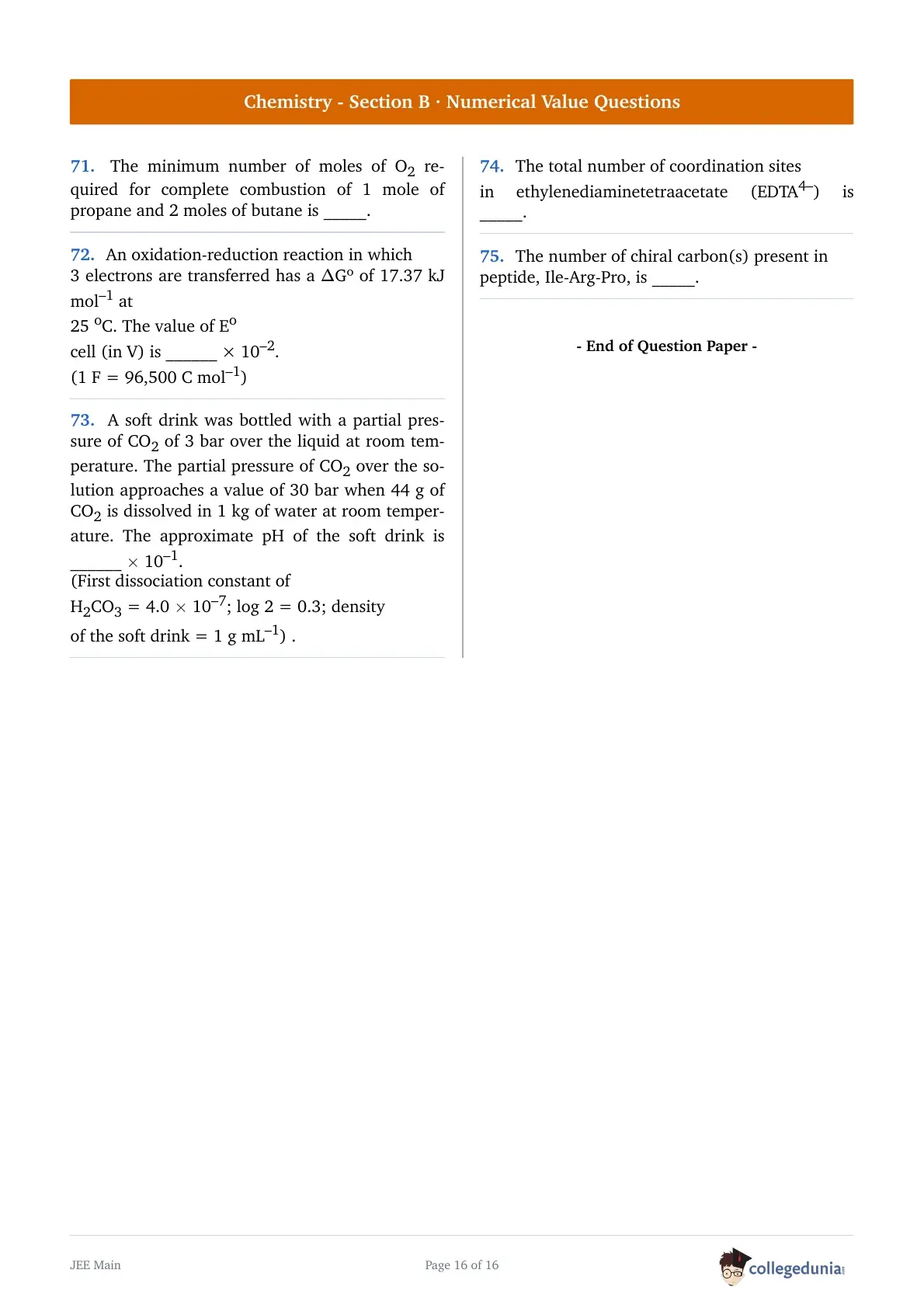
The minimum number of moles of \(\mathrm{O_2}\) required for complete combustion of 1 mole of propane and 2 moles of butane is _____.
An oxidation-reduction reaction in which 3 electrons are transferred has a \(\Delta G^\circ\) of 17.37 kJ \(\mathrm{mol^{-1}}\) at 25 \(^\circ\)C. The value of \(E^\circ_{\mathrm{cell}}\) (in V) is ______ \(\times\) \(10^{-2}\).
(1 F = 96,500 C \(\mathrm{mol^{-1}}\))
A soft drink was bottled with a partial pressure of \(\mathrm{CO_2}\) of 3 bar over the liquid at room temperature. The partial pressure of \(\mathrm{CO_2}\) over the solution approaches a value of 30 bar when 44 g of \(\mathrm{CO_2}\) is dissolved in 1 kg of water at room temperature. The approximate pH of the soft drink is ______ \(\times\) \(10^{-1}\).
(First dissociation constant of \(\mathrm{H_2CO_3}\) = \(4.0\times 10^{-7}\); \(\log 2 = 0.3\); density of the soft drink = 1 g \(\mathrm{mL^{-1}}\)) .
The total number of coordination sites in ethylenediaminetetraacetate (\(\mathrm{EDTA^{4-}}\)) is _____.
The number of chiral carbon(s) present in peptide, Ile-Arg-Pro, is _____.
JEE Main 2020 Exam Pattern and Marking Scheme
| Particulars | Details |
|---|---|
| Exam Mode | Online (Computer-Based Test) |
| Paper | B.E./B.Tech (Paper 1) |
| Duration | 3 hours (180 minutes) |
| Type of Questions | Multiple Choice Questions (MCQs) + Numerical Value Questions |
| Subjects | Mathematics, Physics, Chemistry |
| Total Questions | 75 questions |
| Total Marks | 300 marks |
| Marking Scheme | +4 for correct answer & -1 for incorrect MCQ; no negative marking for Numerical Value Questions |
JEE Main 2020 September 5 Shift 1 Difficulty Level
JEE Main B.E/ B. Tech September 5, 2020, Morning Question paper was rated to be difficult than the previous session. The test takers reported the overall difficulty of the question paper as being high, especially that of the Mathematics section, which had complex problems on Calculus, Trigonometry, and Coordinate Geometry. For the other two sections i.e Physics and Chemistry, the level of difficulty ranged from moderate to high.
JEE Main 2020 B.E./B.Tech Question Paper September 5 (Morning): Paper Analysis
JEE Main September 5,2020 Morning (Shift 1) was conducted from 9.00 AM to 12.00 Noon. The sectional analysis of the paper is as follows:
Mathematics
- Differential Calculus (15%), Integral Calculus (12%), Coordinate Geometry (12%), and Trigonometry (10%) were the major contributing units in the paper
- Class XII topics had higher weightage in the syllabus. Around 14 questions were asked from class XII topics and 11 Questions were asked from class XI topics. View JEE Main Mathematics Syllabus
Physics
- Mechanics (32%), Electrodynamics(24%), and Modern Physics (20%) were the major contributors to the section.
- 15 questions were asked from class XII topics and 10 Questions were asked from class XI topics. View JEE Main Physics syllabus
Chemistry
- Organic Chemistry II (32%), Inorganic Chemistry I (24%), and Physical Chemistry I (24%), were the dominant units in the paper.
- 12 Questions were framed from Class XI Chemistry Syllabus, and 13 Questions were framed from Class XII Chemistry Syllabus. View JEE Main Chemistry Syllabus



Comments