




JEE Main 2021 August 27 Shift 2 Question Paper is available here with solutions PDF and detailed solutions for every question. NTA conducted the second shift on August 27, 2021, from 3:00 PM to 6:00 PM. The JEE Main 2021 Paper 1 (B.E./B.Tech) question paper includes the following:
- 90 questions in a 3-hour CBT Mode: 30 each from Mathematics, Physics and Chemistry (75 to be attempted)
- Section A: 20 multiple choice questions (MCQs) per subject, all compulsory, 4 marks each
- Section B: 10 numerical value questions per subject, any 5 to be attempted, 4 marks each
- Marking: +4 for a correct answer, -1 for an incorrect MCQ, 0 for an unattempted question; no negative marking for numerical value questions
- Maximum marks: 300 (100 per subject)
JEE Main 2021 August 27 Shift 2 Question Paper with Solution PDF
| NTA Official PDF | CD PDF | CD PDF with Solutions |
|---|---|---|
| Download official PDF 6.98 MB | Download Collegedunia PDF 1.08 MB | Download solutions PDF 1.77 MB |
Also Check:
JEE Main 2021 August 27 Shift 2 Questions with Solutions
Mathematics - Section A (Q1 - Q20)
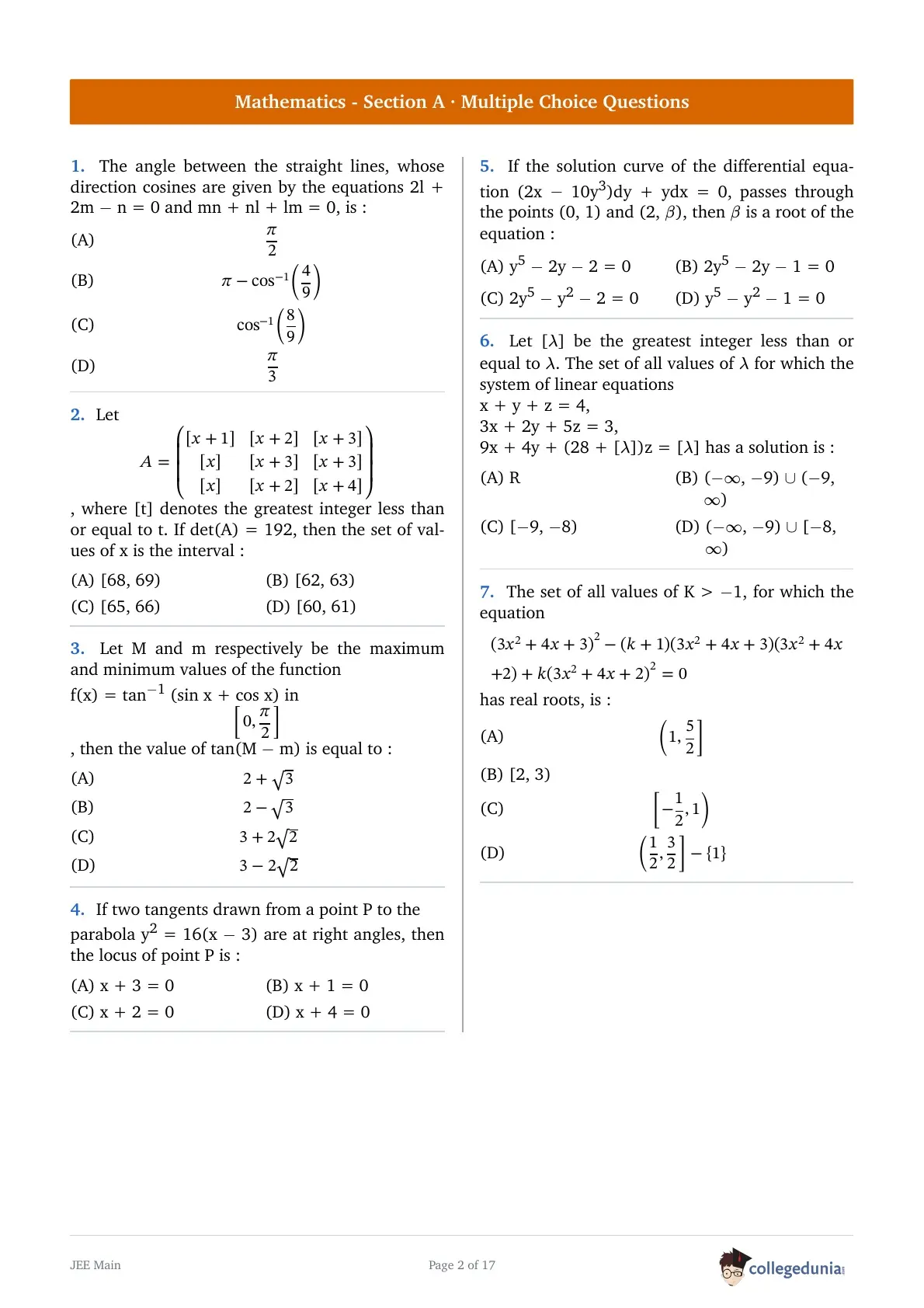
The angle between the straight lines, whose direction cosines are given by the equations 2l + 2m - n = 0 and mn + nl + lm = 0, is :
Let \( A = \begin{pmatrix} \lfloor x+1 \rfloor & \lfloor x+2 \rfloor & \lfloor x+3 \rfloor \\ \lfloor x \rfloor & \lfloor x+3 \rfloor & \lfloor x+3 \rfloor \\ \lfloor x \rfloor & \lfloor x+2 \rfloor & \lfloor x+4 \rfloor \end{pmatrix} \), where \( \lfloor t \rfloor \) denotes the greatest integer less than or equal to \( t \). If \( \det(A) = 192 \), then the set of values of \( x \) is the interval:
Let M and m respectively be the maximum and minimum values of the function \(f(x) = \tan^{-1}(\sin x + \cos x)\) in \([0, \pi/2]\). Then the value of \(\tan(M-m)\) is equal to :
If two tangents drawn from a point P to the parabola \(y^2 = 16(x-3)\) are at right angles, then the locus of point P is :
If the solution curve of the differential equation \((2x - 10y^3)dy + y dx = 0\), passes through the points (0, 1) and (2, \(\beta\)), then \(\beta\) is a root of the equation :
Let [\(\lambda\)] be the greatest integer less than or equal to \(\lambda\). The set of all values of \(\lambda\) for which the system of linear equations x+y+z=4, 3x+2y+5z=3, 9x + 4y + (28 + [\(\lambda\)])z = [\(\lambda\)] has a solution is :
The set of all values of k \(>\) -1, for which the equation
(3x\(^2\)+4x+3)\(^2\) - (k+1)(3x\(^2\)+4x+3)(3x\(^2\)+4x+2) + k(3x\(^2\)+4x+2)\(^2\) = 0 has real roots, is :
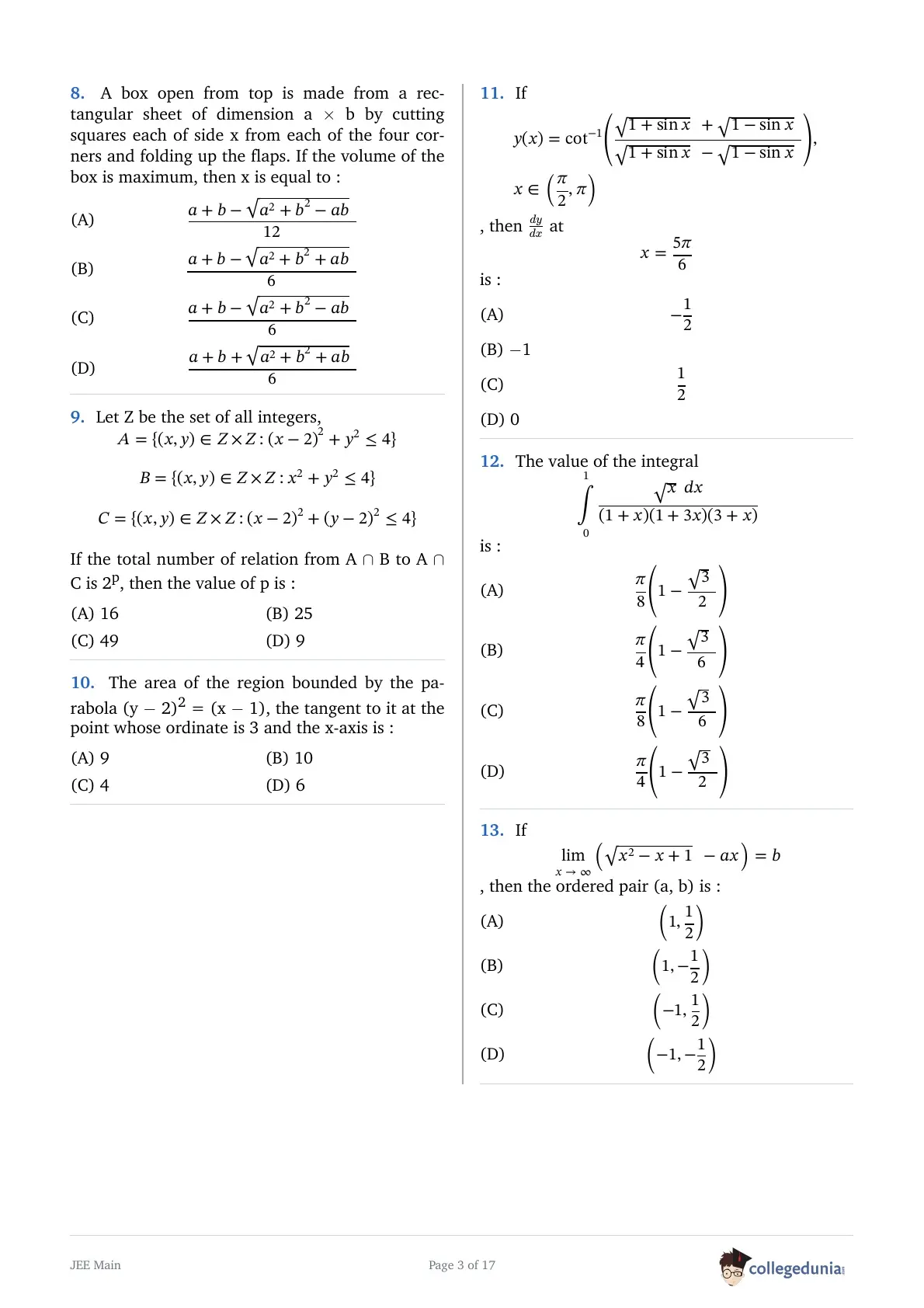
A box open from top is made from a rectangular sheet of dimension a \(\times\) b by cutting squares each of side x from each of the four corners and folding up the flaps. If the volume of the box is maximum, then x is equal to:
Let \( Z \) be the set of all integers,
\( A = \{(x, y) \in Z \times Z : (x - 2)^2 + y^2 \leq 4\} \),
\( B = \{(x, y) \in Z \times Z : x^2 + y^2 \leq 4\} \) and
\( C = \{(x, y) \in Z \times Z : (x - 2)^2 + (y - 2)^2 \leq 4\} \)
If the total number of relations from \( A \cap B \) to \( A \cap C \) is \( 2^p \), then the value of \( p \) is :
The area of the region bounded by the parabola \((y-2)^2 = (x-1)\), the tangent to it at the point whose ordinate is 3 and the x-axis is :
If \(y(x) = \cot^{-1}\left(\frac{\sqrt{1 + \sin x} + \sqrt{1 - \sin x}}{\sqrt{1 + \sin x} - \sqrt{1 - \sin x}}\right), x \in \left(\frac{\pi}{2}, \pi\right)\), then \(\frac{dy}{dx}\) at \(x = \frac{5\pi}{6}\) is :
The value of the integral \( \int_{0}^{1} \frac{\sqrt{x} dx}{(1+x)(1+3x)(3+x)} \) is :
If \( \lim_{x \to \infty} (\sqrt{x^2 - x + 1} - ax) = b \), then the ordered pair (a, b) is :
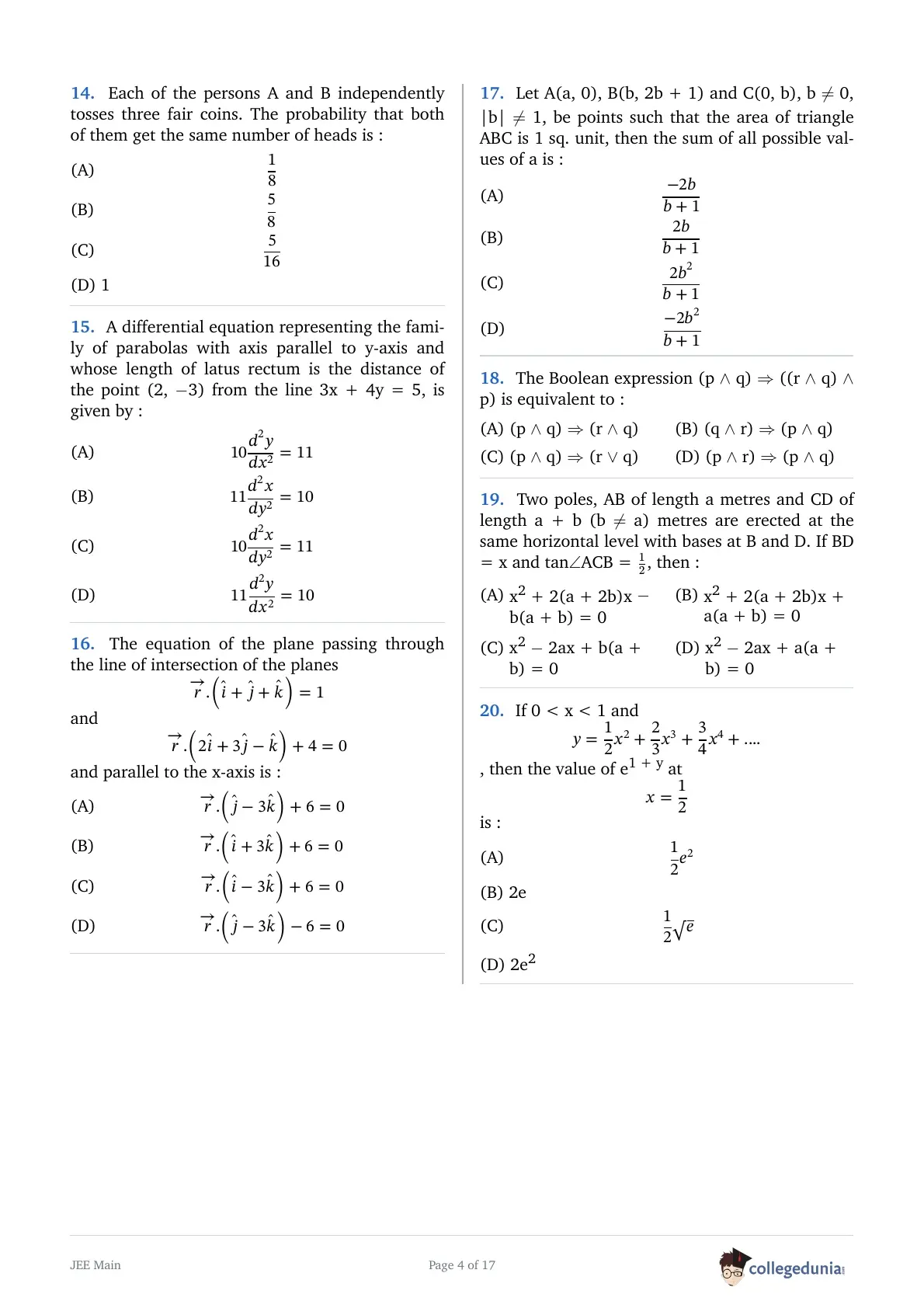
Each of the persons A and B independently tosses three fair coins. The probability that both of them get the same number of heads is :
A differential equation representing the family of parabolas with axis parallel to y-axis and whose length of latus rectum is the distance of the point (2, -3) form the line 3x + 4y = 5, is given by :
The equation of the plane passing through the line of intersection of the planes \( \vec{r} \cdot (\hat{i} + \hat{j} + \hat{k}) = 1 \) and \( \vec{r} \cdot (2\hat{i} + 3\hat{j} - \hat{k}) + 4 = 0 \) and parallel to the x-axis is :
Let A(a, 0), B(b, 2b + 1) and C(0, b), b \(\neq\) 0, |b| \(\neq\) 1, be points such that the area of triangle ABC is 1 sq. unit, then the sum of all possible values of a is :
The Boolean expression \((p \land q) \Rightarrow ((r \land q) \land p)\) is equivalent to :
Two poles, AB of length a metres and CD of length a + b (b \(\neq\) a) metres are erected at the same horizontal level with bases at B and D. If BD = x and \(\tan(\angle ACB) = \frac{1}{2}\), then :
If 0 \(<\) x \(<\) 1 and y = \(\frac{1}{2}x^2 + \frac{2}{3}x^3 + \frac{3}{4}x^4 + ...\), then the value of e\(^{1+y}\) at x = \(\frac{1}{2}\) is :
Mathematics - Section B (Q21 - Q30)
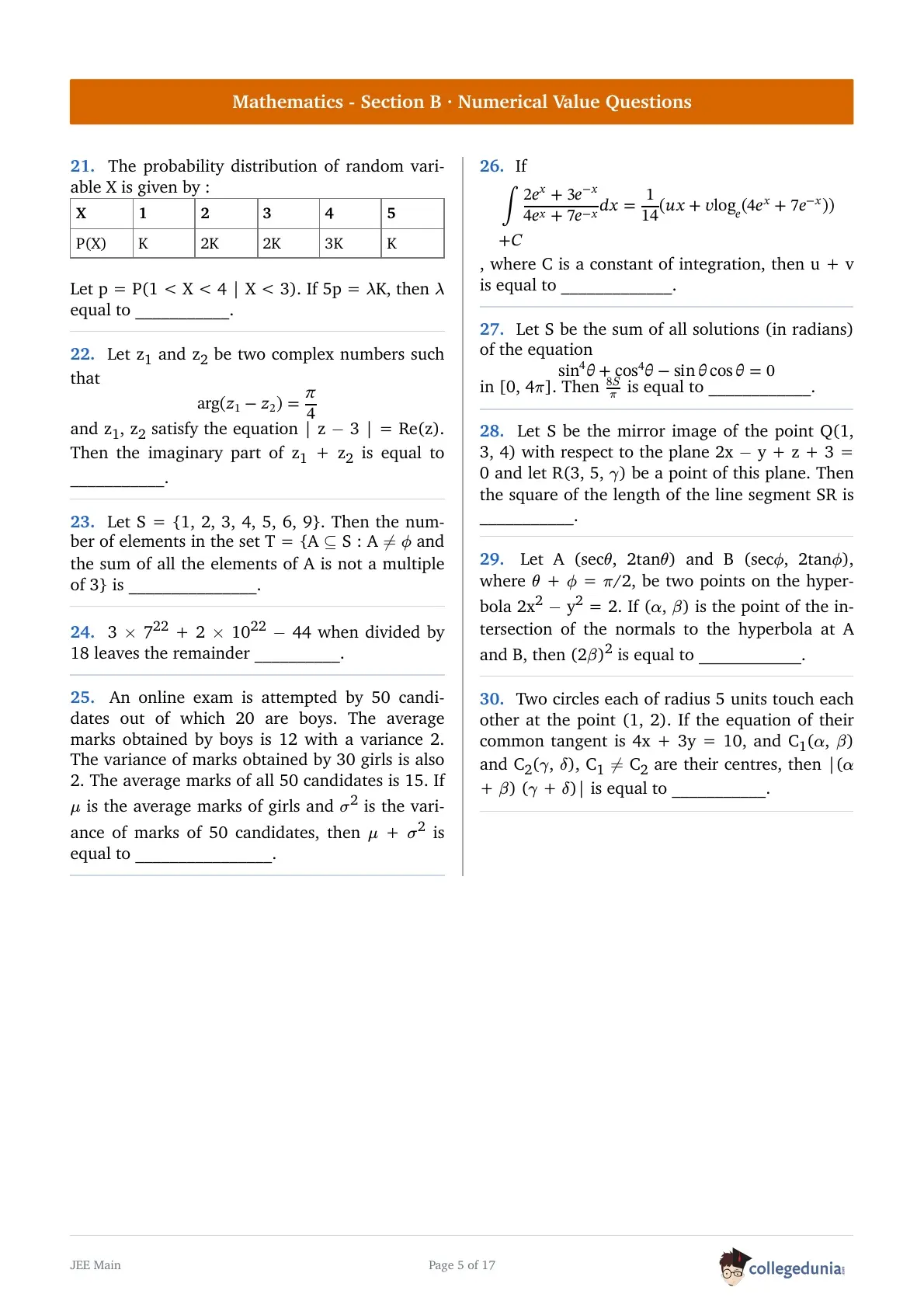
The probability distribution of random variable X is given by : 
Let \(p = P(1<X<4 | X<3)\). If \(5p = \lambda K\), then \(\lambda\) is equal to _________.
Let \(z_1\) and \(z_2\) be two complex numbers such that \( \arg(z_1 - z_2) = \frac{\pi}{4} \) and \(z_1, z_2\) satisfy the equation \(|z-3| = \text{Re}(z)\). Then the imaginary part of \(z_1+z_2\) is equal to _________.
Let S = 1, 2, 3, 4, 5, 6, 9. Then the number of elements in the set T={A \(\subseteq\) S: A \(\neq \emptyset\) and the sum of all the elements of A is not a multiple of 3} is _________.
\(3 \times 7^{22} + 2 \times 10^{22} - 44\) when divided by 18 leaves the remainder _________.
An online exam is attempted by 50 candidates out of which 20 are boys. The average marks obtained by boys is 12 with a variance 2. The variance of marks obtained by 30 girls is also 2. The average marks of all 50 candidates is 15. If \(\mu\) is the average marks of girls and \(\sigma^2\) is the variance of marks of 50 candidates, then \(\mu + \sigma^2\) is equal to _________.
If \( \int \frac{2e^x + 3e^{-x}}{4e^x + 7e^{-x}} dx = \frac{1}{14}(ux + v \log_e(4e^x + 7e^{-x})) + C \), where C is a constant of integration, then u + v is equal to _________.
Let S be the sum of all solutions (in radians) of the equation \(\sin^4\theta + \cos^4\theta - \sin\theta \cos\theta = 0\) in [0, 4\(\pi\)]. Then \(\frac{8S}{\pi}\) is equal to _________.
Let S be the mirror image of the point Q(1, 3, 4) with respect to the plane 2x - y + z + 3 = 0 and let R(3, 5, \(\gamma\)) be a point of this plane. Then the square of the length of the line segment SR is _________.
Let A(sec\(\theta\), 2tan\(\theta\)) and B(sec\(\phi\), 2tan\(\phi\)), where \(\theta+\phi=\pi/2\), be two points on the hyperbola \(2x^2-y^2=2\). If (\(\alpha\), \(\beta\)) is the point of the intersection of the normals to the hyperbola at A and B, then \((2\beta)^2\) is equal to _________.
Two circles each of radius 5 units touch each other at the point (1, 2). If the equation of their common tangent is 4x + 3y = 10, and C\(_1\)(\(\alpha\), \(\beta\)) and C\(_2\)(\(\gamma\), \(\delta\)), C\(_1\) \(\neq\) C\(_2\) are their centres, then \(|(\alpha+\beta)(\gamma+\delta)|\) is equal to _________.
Physics - Section A (Q31 - Q50)
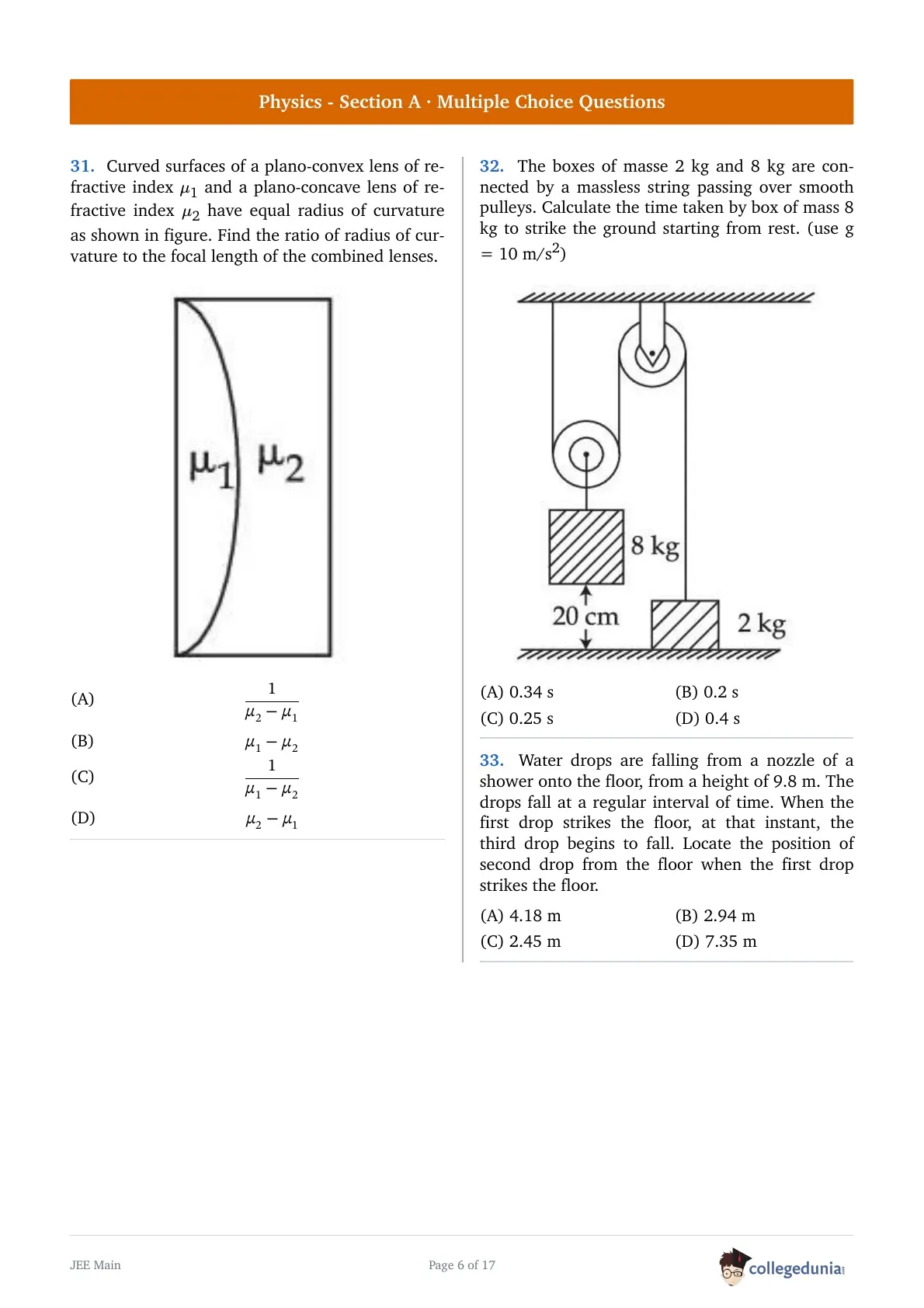
Curved surfaces of a plano-convex lens of refractive index \(\mu_1\) and a plano-concave lens of refractive index \(\mu_2\) have equal radius of curvature as shown in figure. Find the ratio of radius of curvature to the focal length of the combined lenses. 
The boxes of masses 2 kg and 8 kg are connected by a massless string passing over smooth pulleys. Calculate the time taken by box of mass 8 kg to strike the ground starting from rest. (use g = 10 m/s\(^2\)): 
Water drops are falling from a nozzle of a shower onto the floor, from a height of 9.8 m. The drops fall at a regular interval of time. When the first drop strikes the floor, at that instant, the third drop begins to fall. Locate the position of second drop from the floor when the first drop strikes the floor.
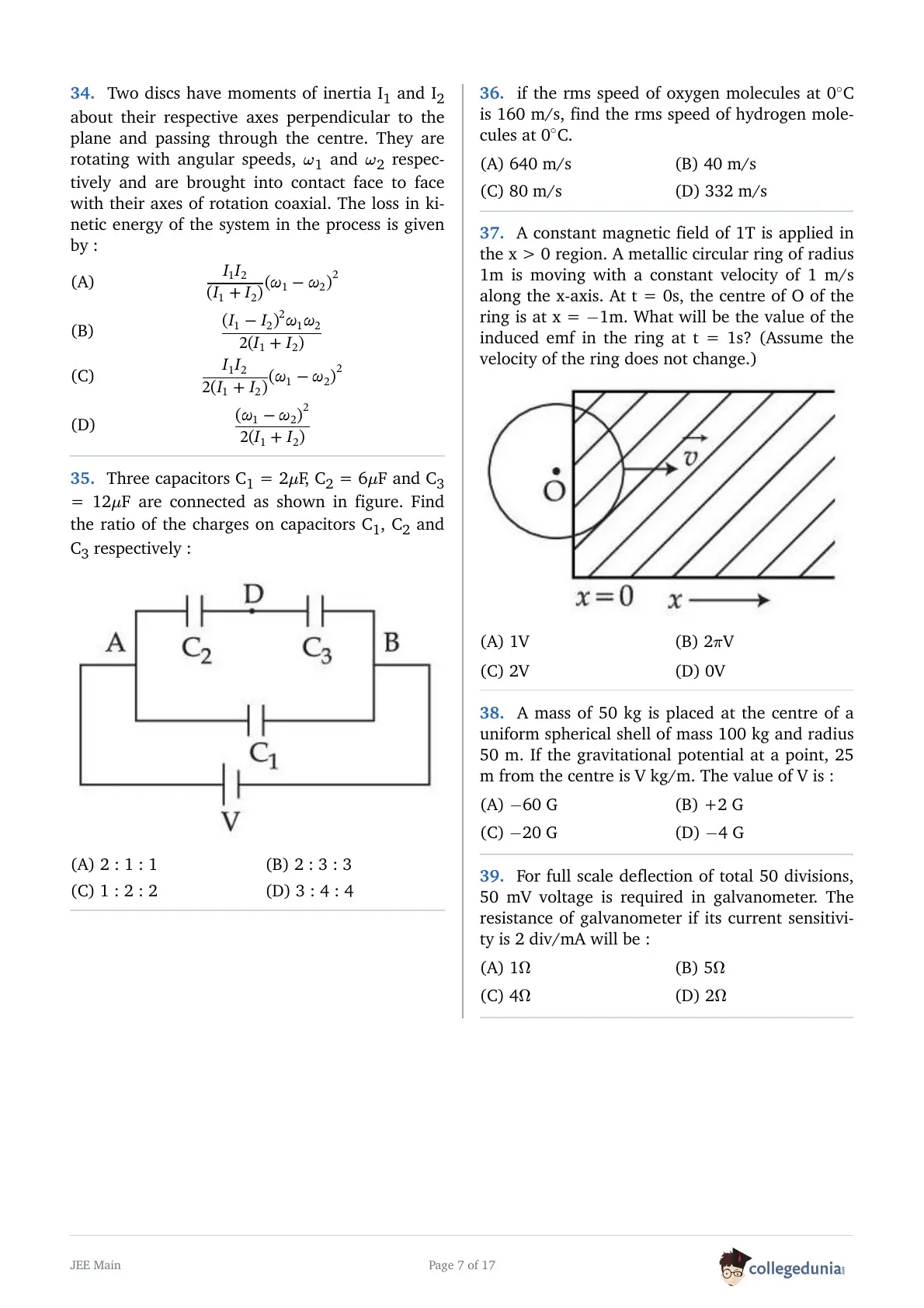
Two discs have moments of inertia I\(_1\) and I\(_2\) about their respective axes perpendicular to the plane and passing through the centre. They are rotating with angular speeds, \(\omega_1\) and \(\omega_2\) respectively and are brought into contact face to face with their axes of rotation coaxial. The loss in kinetic energy of the system in the process is given by:
Three capacitors C\(_1\) = 2 \(\mu\)F, C\(_2\) = 6 \(\mu\)F and C\(_3\) = 12 \(\mu\)F are connected as shown in figure. Find the ratio of the charges on capacitors C\(_1\), C\(_2\) and C\(_3\) respectively: 
If the rms speed of oxygen molecules at 0\(^{\circ}\)C is 160 m/s, find the rms speed of hydrogen molecules at 0\(^{\circ}\)C.
A constant magnetic field of 1 T is applied in the x \(>\) 0 region. A metallic circular ring of radius 1 m is moving with a constant velocity of 1 m/s along the x-axis. At t=0 s, the centre O of the ring is at x = -1 m. What will be the value of the induced emf in the ring at t=1s? (Assume the velocity of the ring does not change.) 
A mass of 50 kg is placed at the centre of a uniform spherical shell of mass 100 kg and radius 50 m. If the gravitational potential at a point, 25 m from the centre is V. The value of V is:
For full scale deflection of total 50 divisions, 50 mV voltage is required in galvanometer. The resistance of galvanometer if its current sensitivity is 2 div/mA will be :
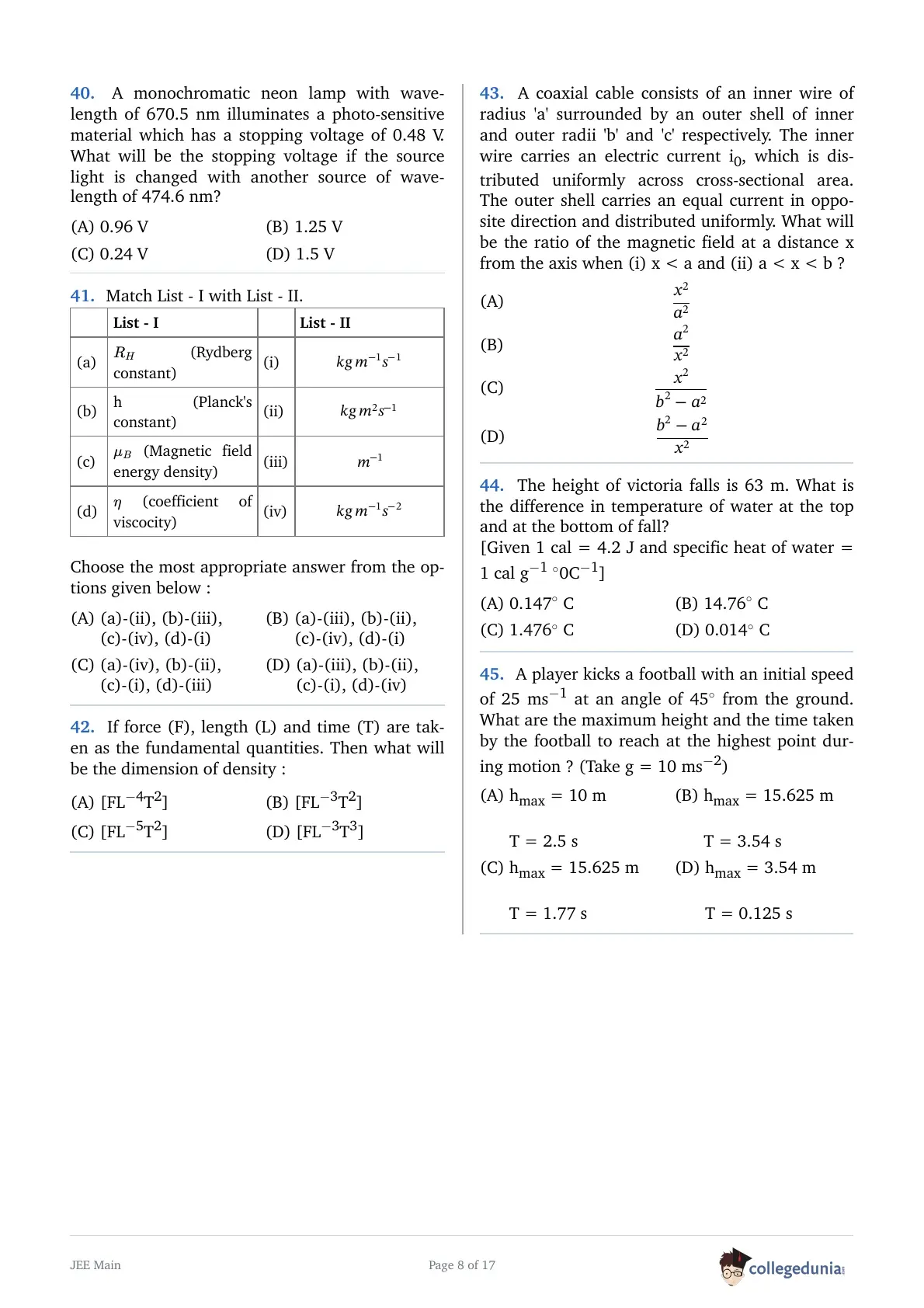
A monochromatic neon lamp with wavelength of 670.5 nm illuminates a photo-sensitive material which has a stopping voltage of 0.48 V. What will be the stopping voltage if the source light is changed with another source of wavelength of 474.6 nm ?
| List - I | List - II | ||
| (a) | \(R_H\) (Rydberg constant) | (i) | \(kg\,m^{-1}s^{-1}\) |
| (b) | h (Planck's constant) | (ii) | \(kg\,m^2s^{-1}\) |
| (c) | \(\mu_B\) (Magnetic field energy density) | (iii) | \(m^{-1}\) |
| (d) | \(\eta\) (coefficient of viscocity) | (iv) | \(kg\,m^{-1}s^{-2}\) |
If force (F), length (L) and time (T) are taken as the fundamental quantities. Then what will be the dimension of density:
A coaxial cable consists of an inner wire of radius 'a' surrounded by an outer shell of inner and outer radii 'b' and 'c' respectively. The inner wire carries an electric current \(i_0\), which is distributed uniformly across cross-sectional area. The outer shell carries an equal current in opposite direction and distributed uniformly. What will be the ratio of the magnetic field at a distance x from the axis when (i) x \(<\) a and (ii) a \(<\) x \(<\) b?
The height of victoria falls is 63 m. What is the difference in temperature of water at the top and at the bottom of fall?
[Given 1 cal = 4.2 J and specific heat of water = 1 cal g\(^{-1}\) \(^{\circ}\)C\(^{-1}\)]
A player kicks a football with an initial speed of 25 ms\(^{-1}\) at an angle of 45\(^{\circ}\) from the ground. What are the maximum height and the time taken by the football to reach at the highest point during motion? (Take g = 10 ms\(^{-2}\))
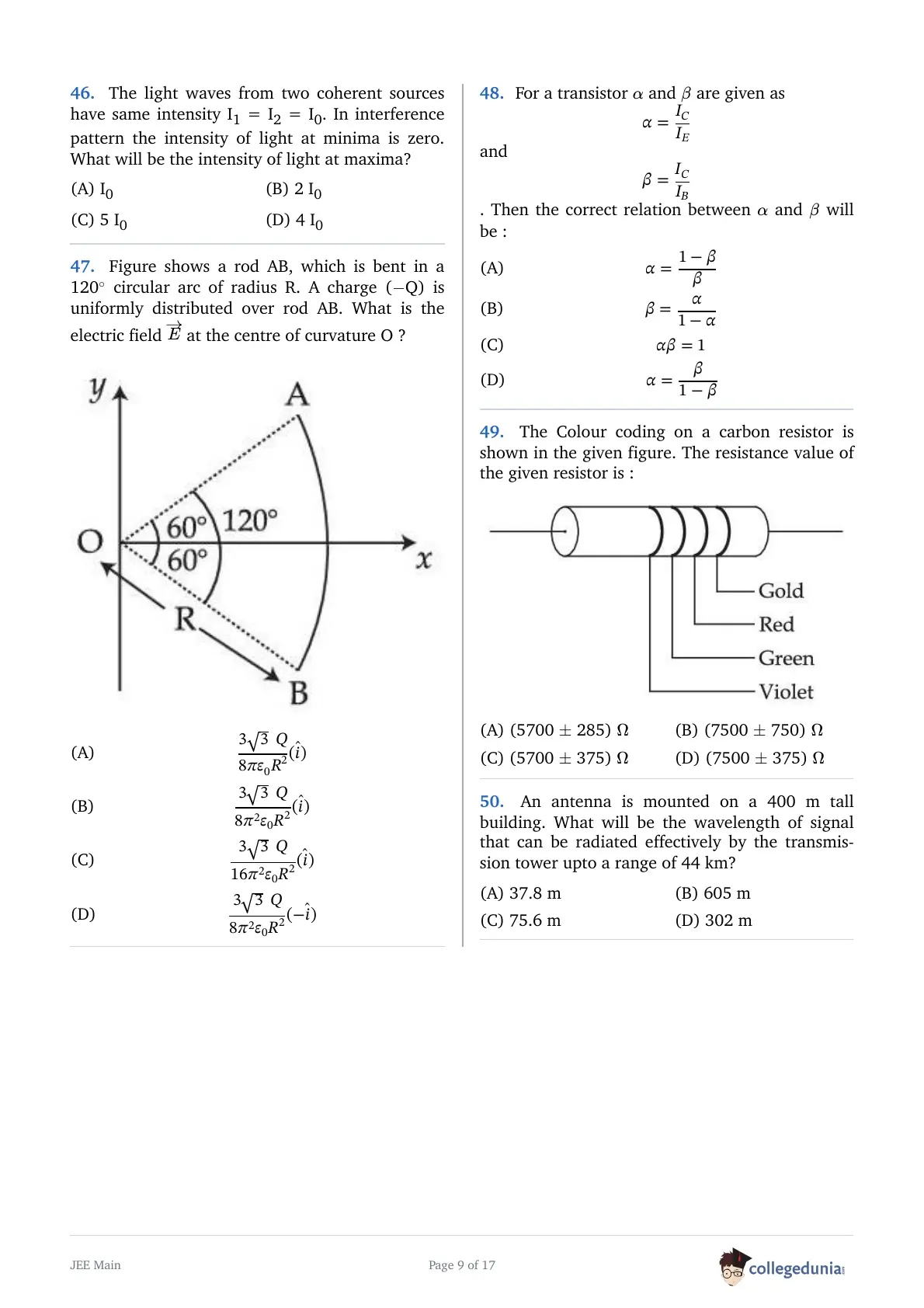
The light waves from two coherent sources have same intensity \(I_1 = I_2 = I_0\). In interference pattern the intensity of light at minima is zero. What will be the intensity of light at maxima ?
Figure shows a rod AB, which is bent in a 120\(^{\circ}\) circular arc of radius R. A charge (\(-Q\)) is uniformly distributed over rod AB. What is the electric field \(\vec{E}\) at the centre of curvature O? 
For a transistor \(\alpha\) and \(\beta\) are given as \(\alpha = \frac{I_C}{I_E}\) and \(\beta = \frac{I_C}{I_B}\). Then the correct relation between \(\alpha\) and \(\beta\) will be :
The colour coding on a carbon resistor is shown in the given figure. The resistance value of the given resistor is : 
An antenna is mounted on a 400 m tall building. What will be the wavelength of signal that can be radiated effectively by the transmission tower upto a range of 44 km ?
Physics - Section B (Q51 - Q60)
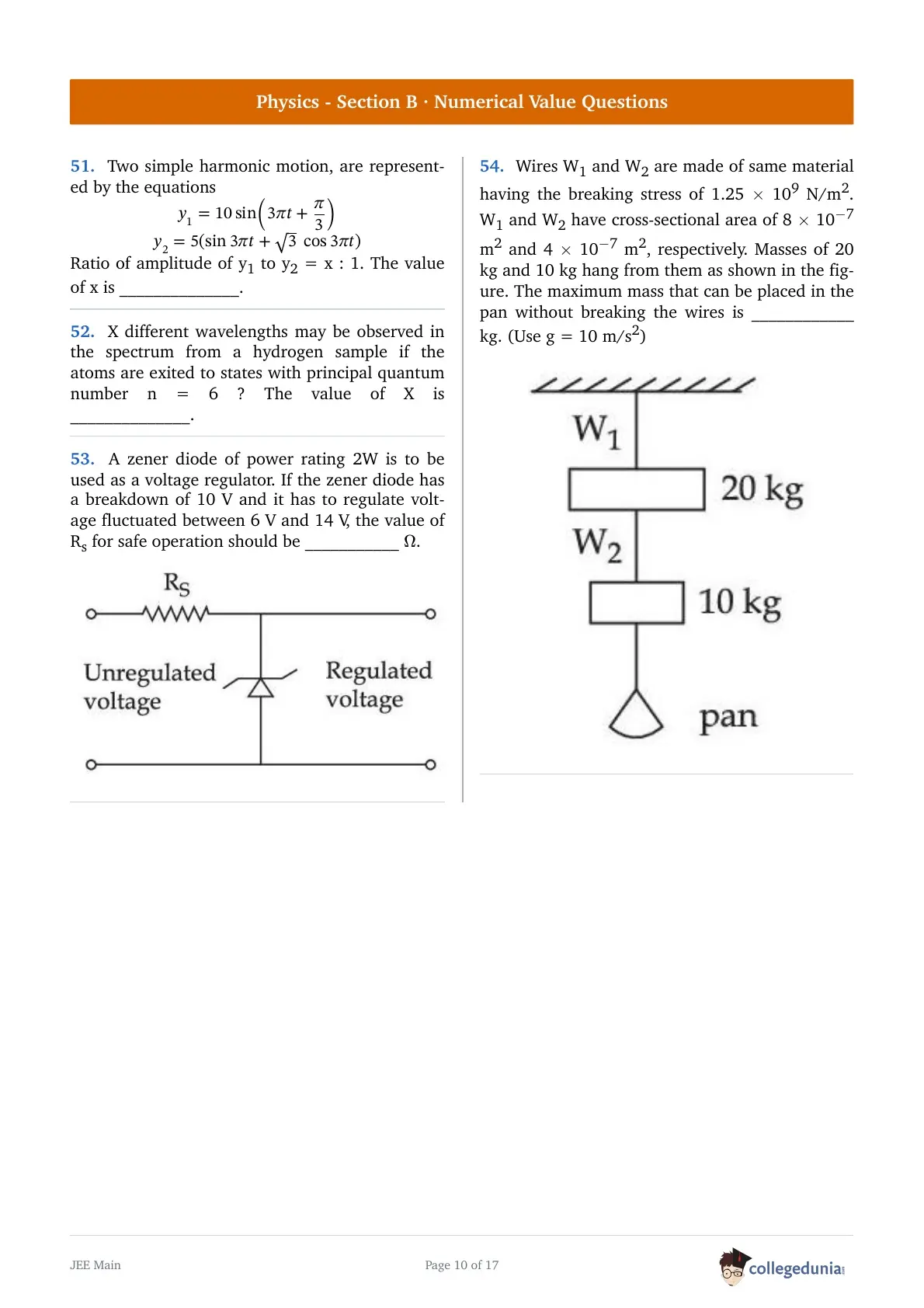
Two simple harmonic motion, are represented by the equations
\(y_1 = 10 \sin\left(3\pi t + \frac{\pi}{3}\right)\)
\(y_2 = 5 (\sin(3\pi t) + \sqrt{3} \cos(3\pi t))\)
Ratio of amplitude of \(y_1\) to \(y_2=x: 1\). The value of x is _________.
X different wavelengths may be observed in the spectrum from a hydrogen sample if the atoms are exited to states with principal quantum number n=6? The value of X is _________.
A zener diode of power rating 2 W is to be used as a voltage regulator. If the zener diode has a breakdown of 10 V and it has to regulate voltage fluctuated between 6 V and 14 V, the value of R\(_S\) for safe operation should be _________ \(\Omega\). 
Wires W\(_1\) and W\(_2\) are made of same material having the breaking stress of 1.25\(\times\)10\(^9\) N/m\(^2\). W\(_1\) and W\(_2\) have cross-sectional area of 8\(\times\)10\(^{-7}\) m\(^2\) and 4\(\times\)10\(^{-7}\) m\(^2\), respectively. Masses of 20 kg and 10 kg hang from them as shown in the figure. The maximum mass that can be placed in the pan without breaking the wires is _________ kg. (Use g = 10 m/s\(^2\)) 
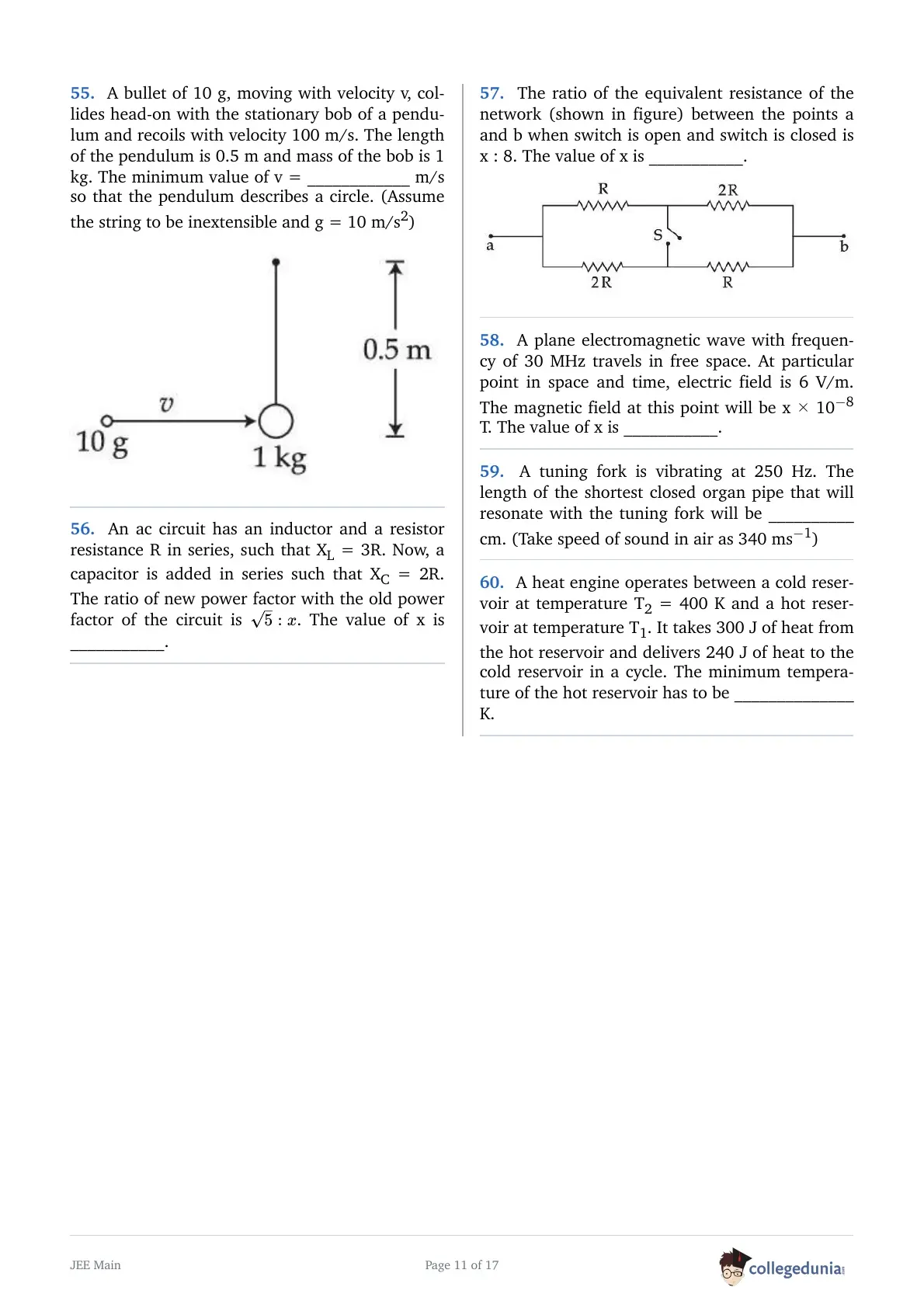
A bullet of 10 g, moving with velocity v, collides head-on with the stationary bob of a pendulum and recoils with velocity 100 m/s. The length of the pendulum is 0.5 m and mass of the bob is 1 kg. The minimum value of v = _________ m/s so that the pendulum describes a circle. (Assume the string to be inextensible and g = 10 m/s\(^2\))
An ac circuit has an inductor and a resistor of resistance R in series, such that \(X_L = 3R\). Now, a capacitor is added in series such that \(X_C = 2R\). The ratio of new power factor with the old power factor of the circuit is \(\sqrt{5}:x\). The value of x is _________.
The ratio of the equivalent resistance of the network (shown in figure) between the points a and b when switch is open and switch is closed is x : 8. The value of x is _________. 
A plane electromagnetic wave with frequency of 30 MHz travels in free space. At particular point in space and time, electric field is 6 V/m. The magnetic field at this point will be \(x \times 10^{-8}\) T. The value of x is _________.
A tuning fork is vibrating at 250 Hz. The length of the shortest closed organ pipe that will resonate with the tuning fork will be _________ cm. (Take speed of sound in air as 340 ms\(^{-1}\))
A heat engine operates between a cold reservoir at temperature T\(_2\) = 400 K and a hot reservoir at temperature T\(_1\). It takes 300 J of heat from the hot reservoir and delivers 240 J of heat to the cold reservoir in a cycle. The minimum temperature of the hot reservoir has to be _________ K.
Chemistry - Section A (Q61 - Q80)
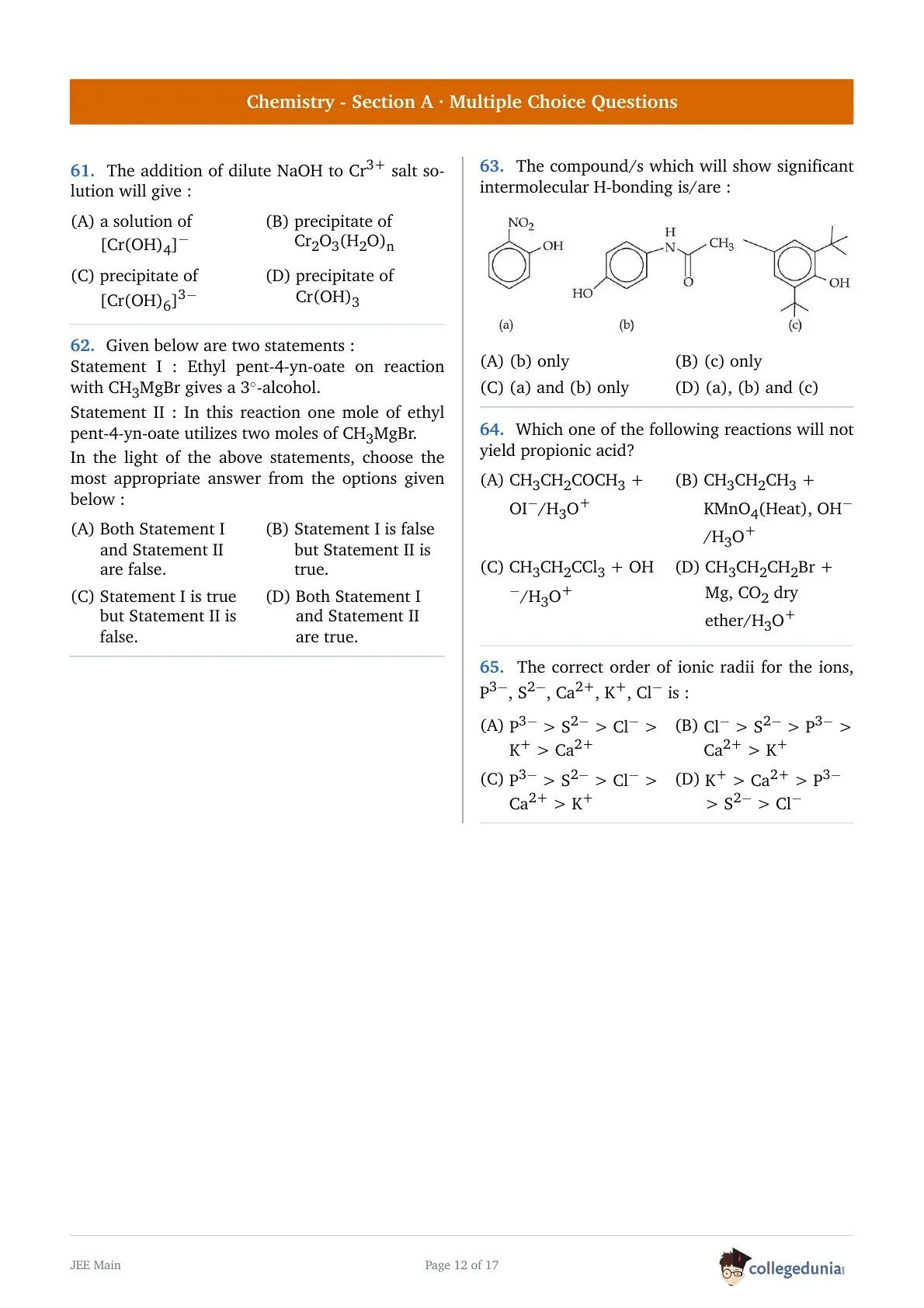
The addition of dilute NaOH to Cr\(^{3+}\) salt solution will give :
Given below are two statements:
Statement I : Ethyl pent-4-yn-oate on reaction with CH\(_3\)MgBr gives a 3\(^\circ\)-alcohol.
Statement II : In this reaction one mole of ethyl pent-4-yn-oate utilizes two moles of CH\(_3\)MgBr.
In the light of the above statements, choose the most appropriate answer from the options given below :
The compound/s which will show significant intermolecular H-bonding is/are : 
Which one of the following reactions will not yield propionic acid ?
The correct order of ionic radii for the ions, P\(^{3-}\), S\(^{2-}\), Ca\(^{2+}\), K\(^{+}\), Cl\(^{-}\) is:
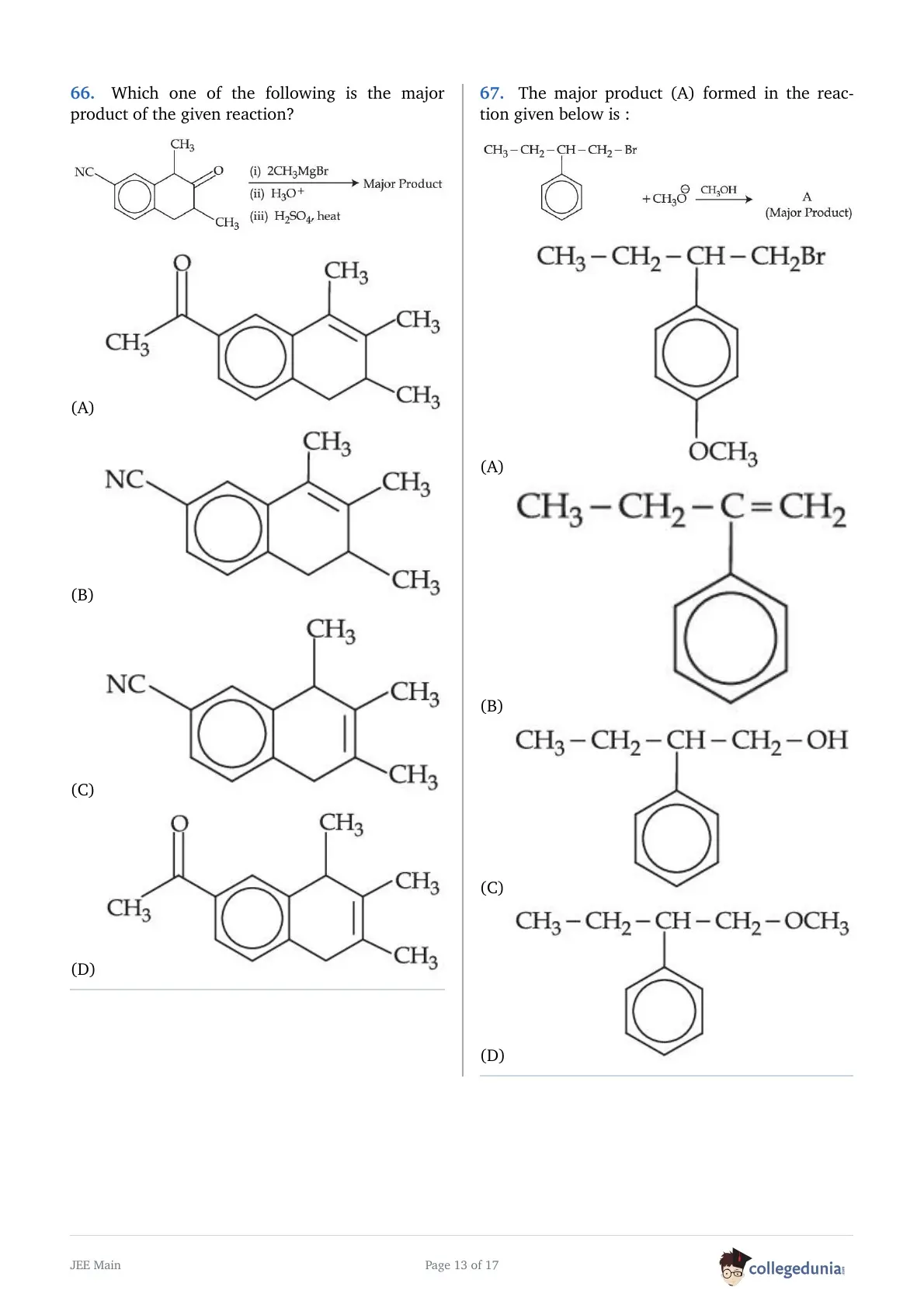
Which one of the following is the major product of the given reaction ? 
The major product (A) formed in the reaction given below is :
\includegraphics[width=0.6\linewidth]{image43.png}
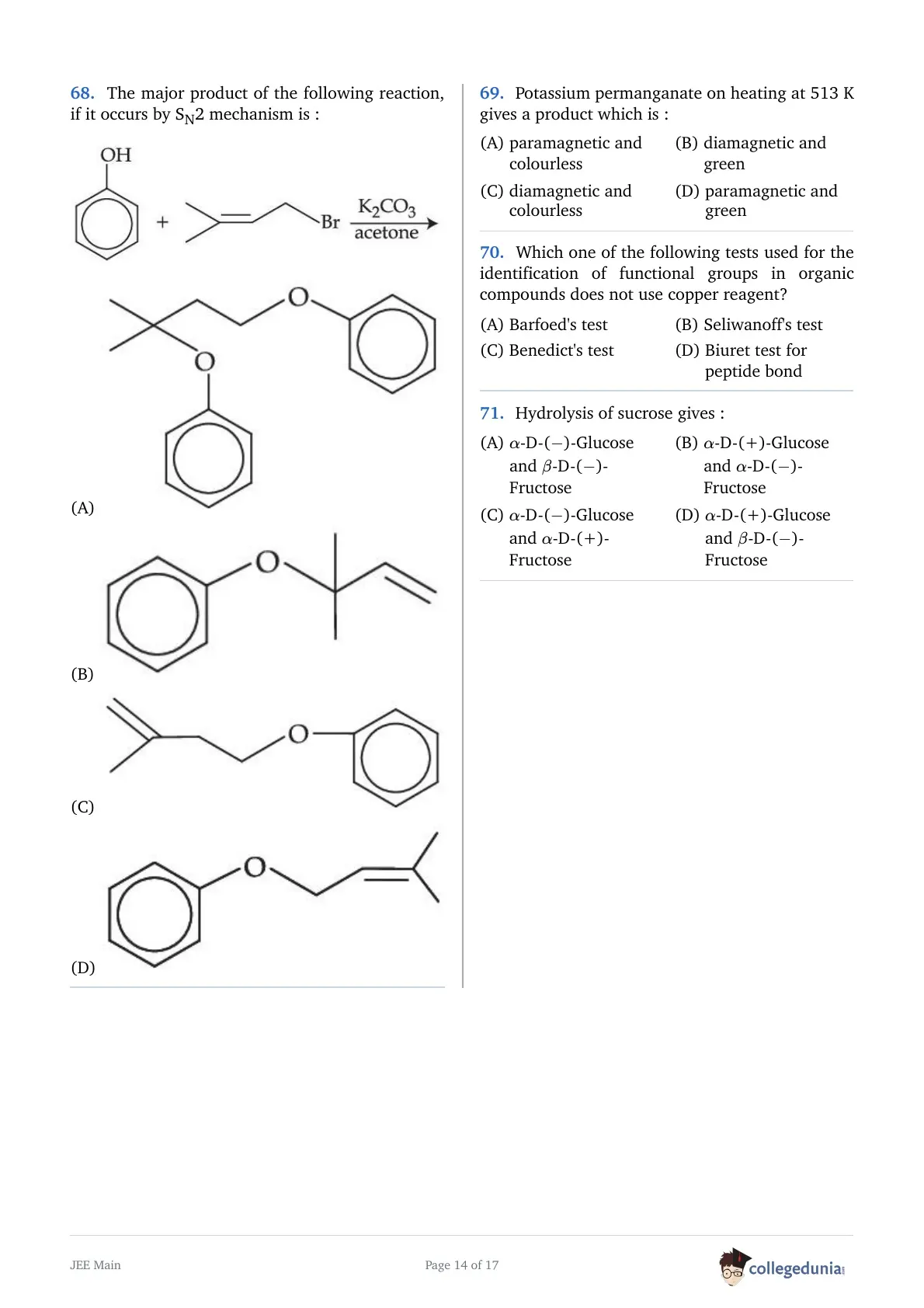
The major product of the following reaction, if it occurs by S\(_N\)2 mechanism is : 
Potassium permanganate on heating at 513 K gives a product which is :
Which one of the following tests used for the identification of functional groups in organic compounds does not use copper reagent ?
Hydrolysis of sucrose gives :
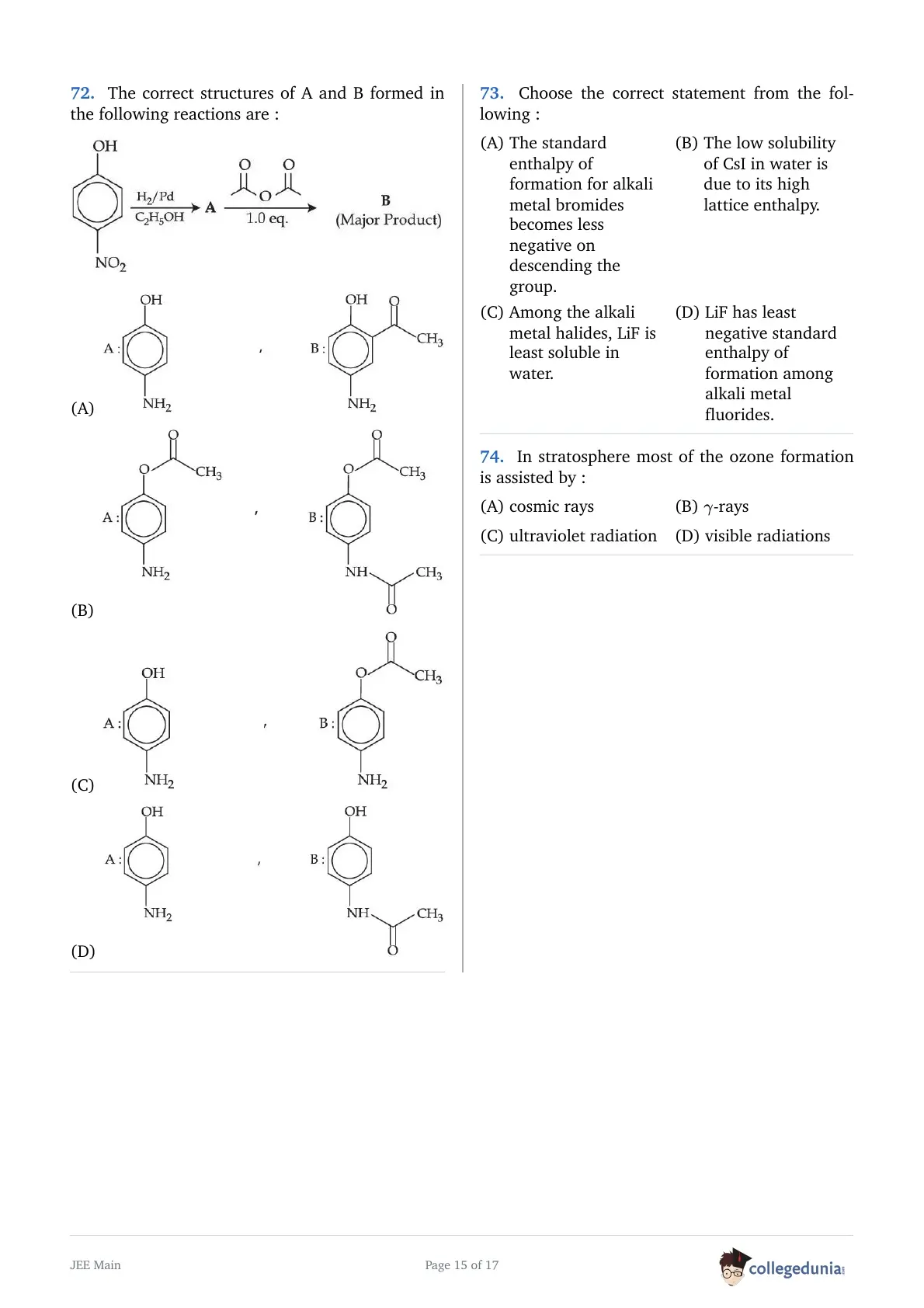
The correct structures of A and B formed in the following reactions are : 
Choose the correct statement from the following:
In stratosphere most of the ozone formation is assisted by :
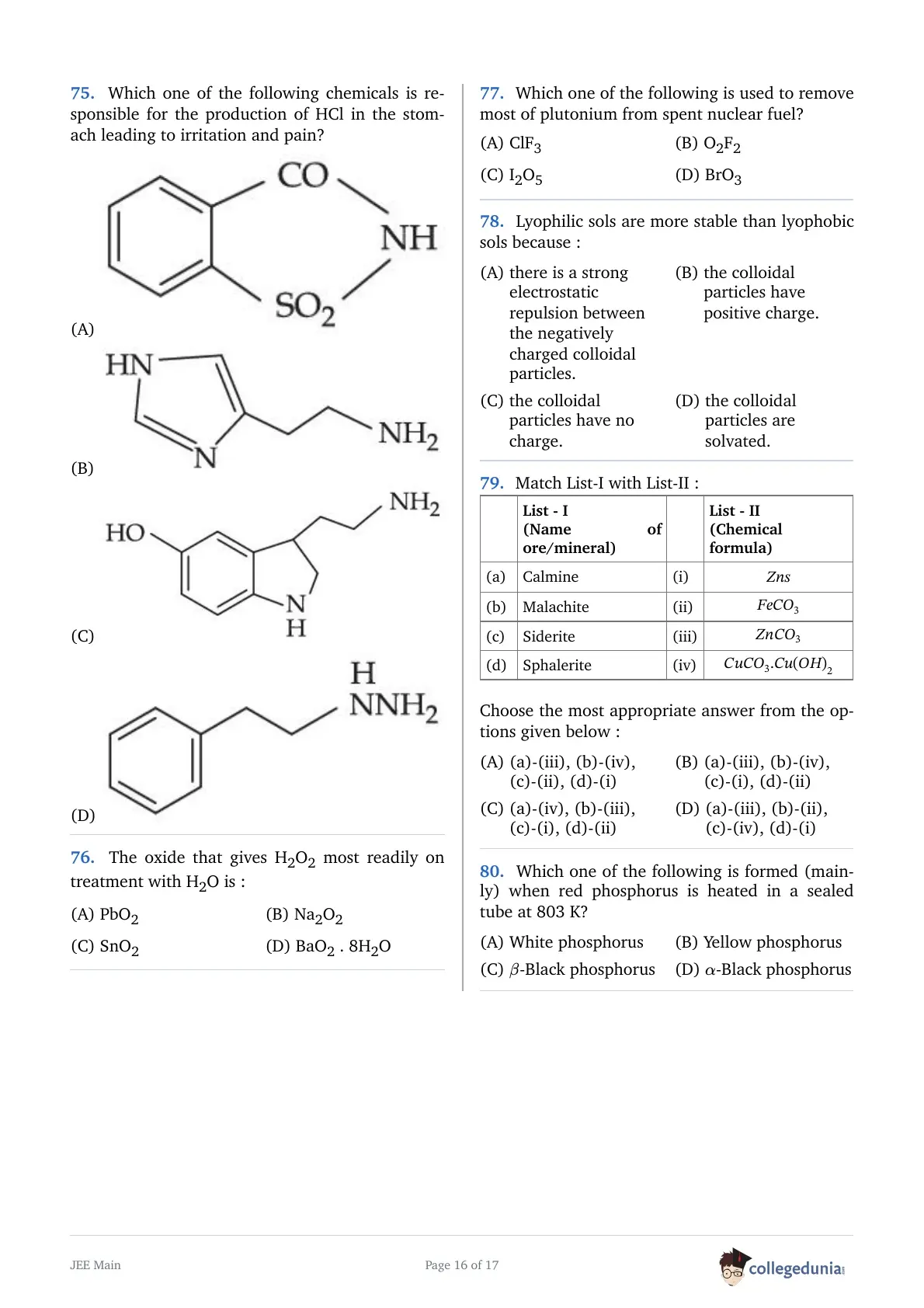
Which one of the following chemicals is responsible for the production of HCl in the stomach leading to irritation and pain ? 
The oxide that gives H\(_2\)O\(_2\) most readily on treatment with H\(_2\)O is :
Which one of the following is used to remove most of plutonium from spent nuclear fuel ?
Lyophilic sols are more stable than lyophobic sols because,
| List - I (Name of ore/mineral) | List - II (Chemical formula) | ||
| (a) | Calmine | (i) | \(\mathrm{ZnS}\) |
| (b) | Malachite | (ii) | \(\mathrm{FeCO_3}\) |
| (c) | Siderite | (iii) | \(\mathrm{ZnCO_3}\) |
| (d) | Sphalerite | (iv) | \(\mathrm{CuCO_3\cdot Cu(OH)_2}\) |
Which one of the following is formed (mainly) when red phosphorus is heated in a sealed tube at 803 K ?
Chemistry - Section B (Q81 - Q90)
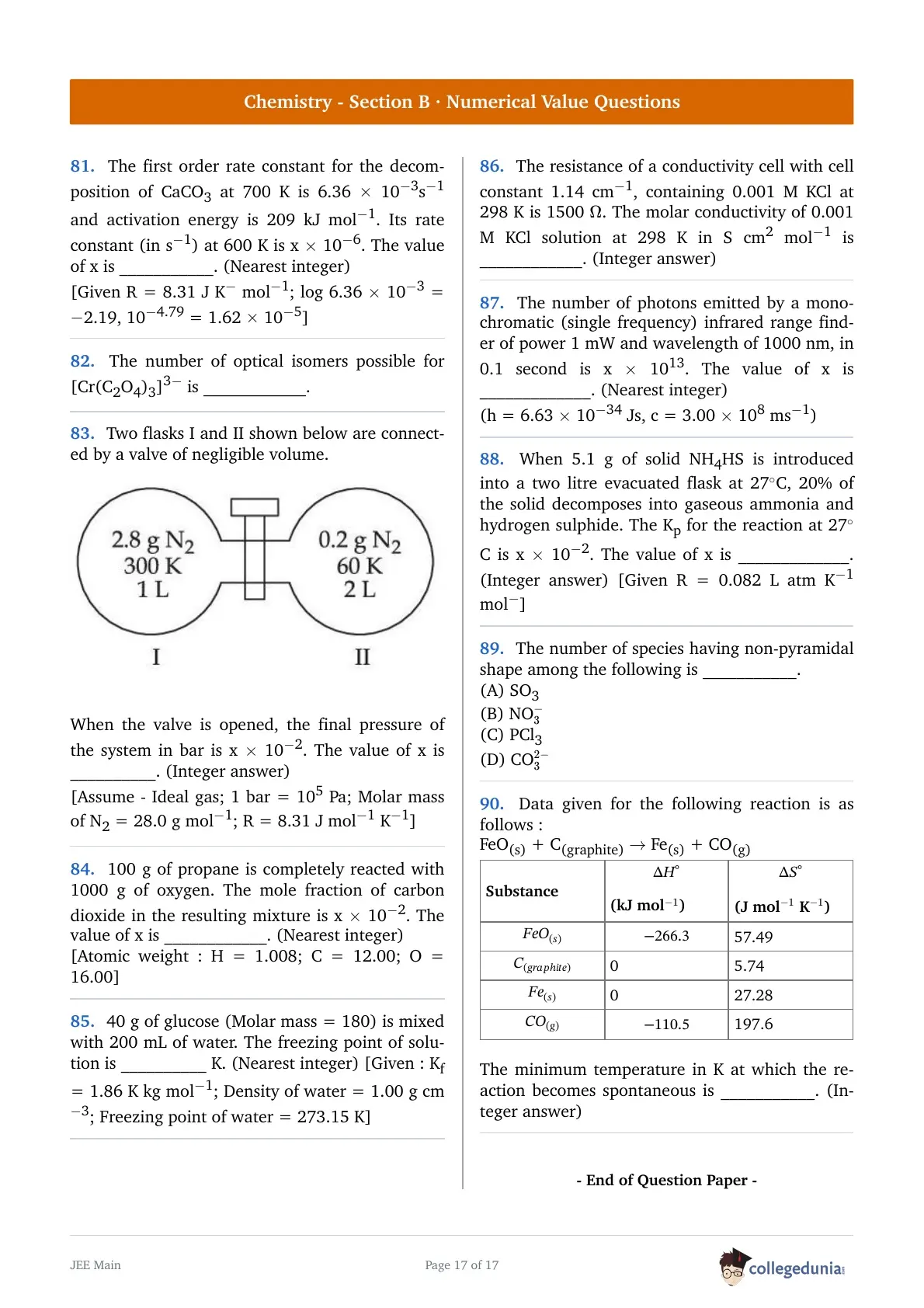
The first order rate constant for the decomposition of CaCO\(_3\) at 700 K is 6.36 \(\times\) 10\(^{-3}\) s\(^{-1}\) and activation energy is 209 kJ mol\(^{-1}\). Its rate constant (in s\(^{-1}\)) at 600 K is \(x \times 10^{-6}\). The value of x is _________. (Nearest integer)
[Given R = 8.31 J K\(^{-1}\) mol\(^{-1}\); log 6.36\(\times\)10\(^{-3}\)=\(-2.19\), 10\(^{-4.79}\)=1.62\(\times\)10\(^{-5}\)]
The number of optical isomers possible for [Cr(C\(_2\)O\(_4\))\(_3\)]\(^{3-}\) is _________.
Two flasks I and II shown below are connected by a valve of negligible volume. When the valve is opened, the final pressure of the system in bar is \(x \times 10^{-2}\). The value of x is _________. (Integer answer)
[Assume - Ideal gas; 1 bar = 10\(^5\) Pa; Molar mass of N\(_2\) = 28.0 g mol\(^{-1}\); R=8.31 J mol\(^{-1}\) K\(^{-1}\)] 
100 g of propane is completely reacted with 1000 g of oxygen. The mole fraction of carbon dioxide in the resulting mixture is \(x \times 10^{-2}\). The value of x is _________. (Nearest integer)
[Atomic weight : H=1.008; C=12.00; O=16.00]
40 g of glucose (Molar mass = 180) is mixed with 200 mL of water. The freezing point of solution is _________ K. (Nearest integer)
[Given: K\(_f\)= 1.86 K kg mol\(^{-1}\); Density of water=1.00 g cm\(^{-3}\); Freezing point of water = 273.15 K]
The resistance of a conductivity cell with cell constant 1.14 cm\(^{-1}\), containing 0.001 M KCl at 298 K is 1500 \(\Omega\). The molar conductivity of 0.001 M KCl solution at 298 K in S cm\(^2\) mol\(^{-1}\) is _________. (Integer answer)
The number of photons emitted by a monochromatic (single frequency) infrared range finder of power 1 mW and wavelength of 1000 nm, in 0.1 second is \(x \times 10^{13}\). The value of x is _________. (Nearest integer)
(h = 6.63 \(\times\) 10\(^{-34}\) Js, c=3.00 \(\times\) 10\(^8\) ms\(^{-1}\))
When 5.1 g of solid NH\(_4\)HS is introduced into a two litre evacuated flask at 27\(^\circ\)C, 20% of the solid decomposes into gaseous ammonia and hydrogen sulphide. The K\(_p\) for the reaction at 27\(^\circ\)C is \(x \times 10^{-2}\). The value of x is _________. (Integer answer)
[Given R = 0.082 L atm K\(^{-1}\) mol\(^{-1}\)]
The number of species having non-pyramidal shape among the following is _________.
(A) SO\(_3\)
(B) NO\(_3^-\)
(C) PCl\(_3\)
(D) CO\(_3^{2-}\)
Data given for the following reaction is as follows:
FeO(s) + C(graphite) \(\rightarrow\) Fe(s) + CO(g)
The minimum temperature in K at which the reaction becomes spontaneous is _________. (Integer answer) 
JEE Main 2021 Exam Pattern and Marking Scheme
| Particulars | Details |
|---|---|
| Exam Mode | Online (Computer-Based Test) |
| Paper | B.E./B.Tech (Paper 1) |
| Duration | 3 hours (180 minutes) |
| Type of Questions | Multiple Choice Questions (MCQs) + Numerical Value Questions |
| Subjects | Mathematics, Physics, Chemistry |
| Total Questions | 90 questions (75 to be attempted) |
| Total Marks | 300 marks |
| Marking Scheme | +4 for correct answer & -1 for incorrect MCQ; no negative marking for Numerical Value Questions |
JEE Main 2021 August 27 Shift 2 Difficulty Level
JEE Main 2021 B.E./B.Tech Question Paper for August 27, 2021 Afternoon session, was declared to be of moderate difficulty by expert educational instructors. The paper was relatively easier than that of the forenoon session. Mathematics was the toughest section of the paper, followed by Chemistry and then the Physics section.
JEE Main 2021 B.E./B.Tech Question Paper August 27 (AN): Weightage of Topics
JEE Main 2021 B.E./B.Tech August 27 Afternoon Session was conducted between 3.00 PM to 6.00 PM. In accordance with JEE Main Paper Analysis, the units with the highest weightage in the August 27, 2021 Shift 2 (afternoon) Question Paper are tabulated below:
| Subject | Units | Marks (including NATs) |
|---|---|---|
| Physics | Electrodynamics | 32 |
| Mechanics | 32 | |
| Modern Physics | 20 | |
| SHM and Waves | 12 | |
| Thermodynamics | 12 | |
| Chemistry | Organic Chemistry II | 32 |
| Inorganic Chemistry II | 28 | |
| Physical Chemistry | 20 | |
| Mathematics | Coordinate Geometry | 8 |
| Trigonometry | 16 | |
| Differential Calculus | 24 | |
| Integral Calculus | 20 | |
| Vectors and 3D | 8 | |
| Quadratic Equations | 8 |



Comments