




JEE Main 2021 July 22 Shift 2 Question Paper is available here with solutions PDF and detailed solutions for every question. NTA conducted the second shift on July 22, 2021, from 3:00 PM to 6:00 PM. The JEE Main 2021 Paper 1 (B.E./B.Tech) question paper includes the following:
- 90 questions in a 3-hour CBT Mode: 30 each from Mathematics, Physics and Chemistry (75 to be attempted)
- Section A: 20 multiple choice questions (MCQs) per subject, all compulsory, 4 marks each
- Section B: 10 numerical value questions per subject, any 5 to be attempted, 4 marks each
- Marking: +4 for a correct answer, -1 for an incorrect MCQ, 0 for an unattempted question; no negative marking for numerical value questions
- Maximum marks: 300 (100 per subject)
JEE Main 2021 July 22 Shift 2 Question Paper with Solution PDF
| NTA Official PDF | CD PDF | CD PDF with Solutions |
|---|---|---|
| Download official PDF 5.92 MB | Download Collegedunia PDF 1.05 MB | Download solutions PDF 1.35 MB |
Also Check:
JEE Main 2021 July 22 Shift 2 Questions with Solutions
Mathematics - Section A (Q1 - Q20)
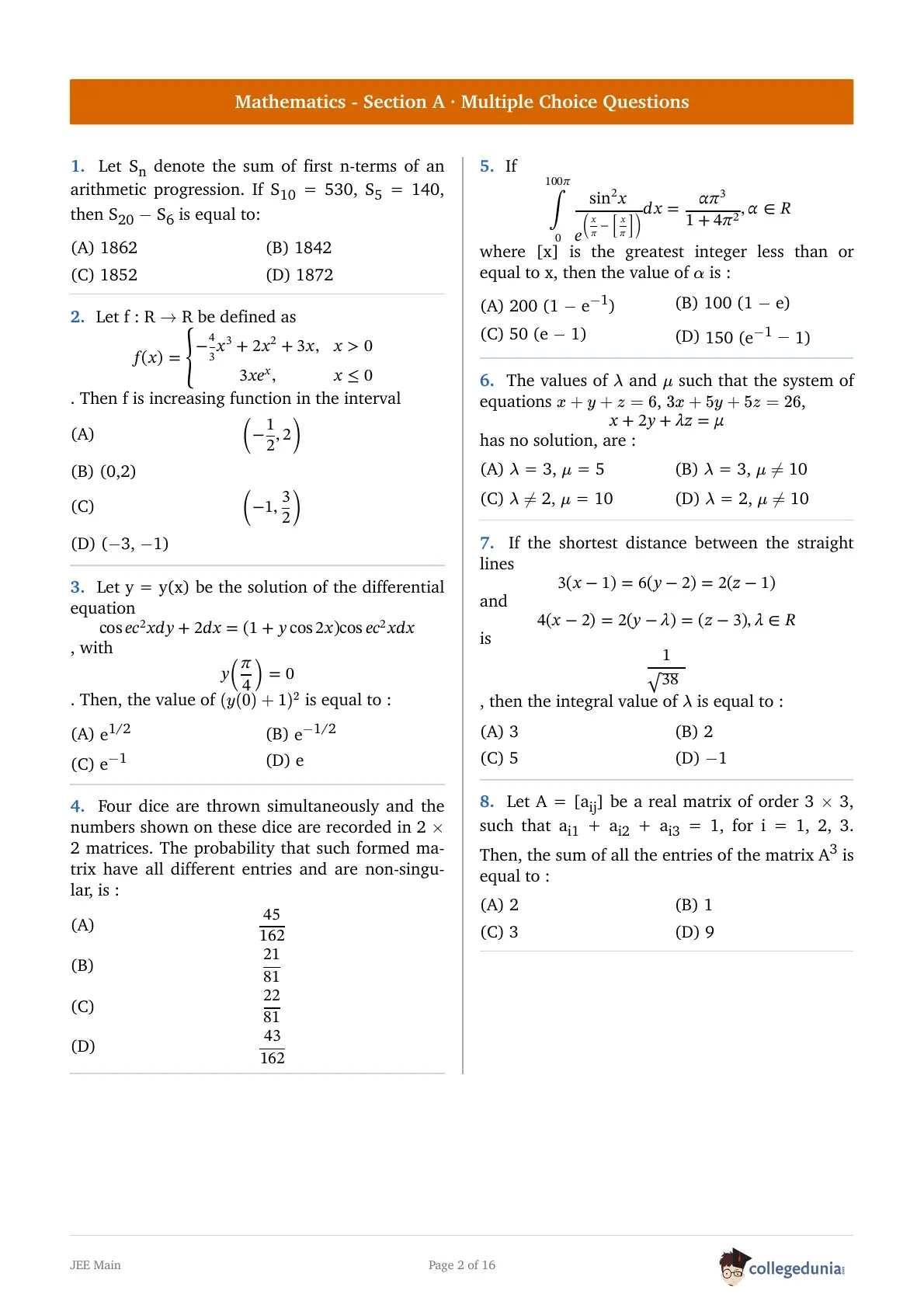
Let \(S_n\) denote the sum of first n-terms of an arithmetic progression. If \(S_{10} = 530\), \(S_5 = 140\), then \(S_{20} - S_6\) is equal to:
Let \(f : R \to R\) be defined as
\(f(x) = \begin{cases} -\frac{4}{3}x^3 + 2x^2 + 3x, & x \gt 0 \\ 3xe^x, & x \le 0 \end{cases}\)
Then f is increasing function in the interval
Let \(y = y(x)\) be the solution of the differential equation \(\operatorname{cosec}^2 x\, dy + 2\, dx = (1 + y\cos 2x)\operatorname{cosec}^2 x\, dx\), with \(y\left(\frac{\pi}{4}\right) = 0\). Then, the value of \((y(0)+1)^2\) is equal to :
Four dice are thrown simultaneously and the numbers shown on these dice are recorded in \(2 \times 2\) matrices. The probability that such formed matrix have all different entries and are non-singular, is :
If \(\int_0^{100\pi} \frac{\sin^2 x}{e^{\left(\frac{x}{\pi} - \left[\frac{x}{\pi}\right]\right)}}dx = \frac{\alpha\pi^3}{1 + 4\pi^2},\ \alpha \in R\) where \([x]\) is the greatest integer less than or equal to x, then the value of \(\alpha\) is :
The values of \(\lambda\) and \(\mu\) such that the system of equations \(x + y + z = 6\), \(3x + 5y + 5z = 26\), \(x + 2y + \lambda z = \mu\) has no solution, are :
If the shortest distance between the straight lines \(3(x - 1) = 6(y - 2) = 2(z - 1)\) and \(4(x - 2) = 2(y - \lambda) = (z - 3),\ \lambda \in R\) is \(\frac{1}{\sqrt{38}}\), then the integral value of \(\lambda\) is equal to :
Let \(A = [a_{ij}]\) be a real matrix of order \(3 \times 3\), such that \(a_{i1} + a_{i2} + a_{i3} = 1\), for \(i = 1, 2, 3\). Then, the sum of all the entries of the matrix \(A^3\) is equal to :
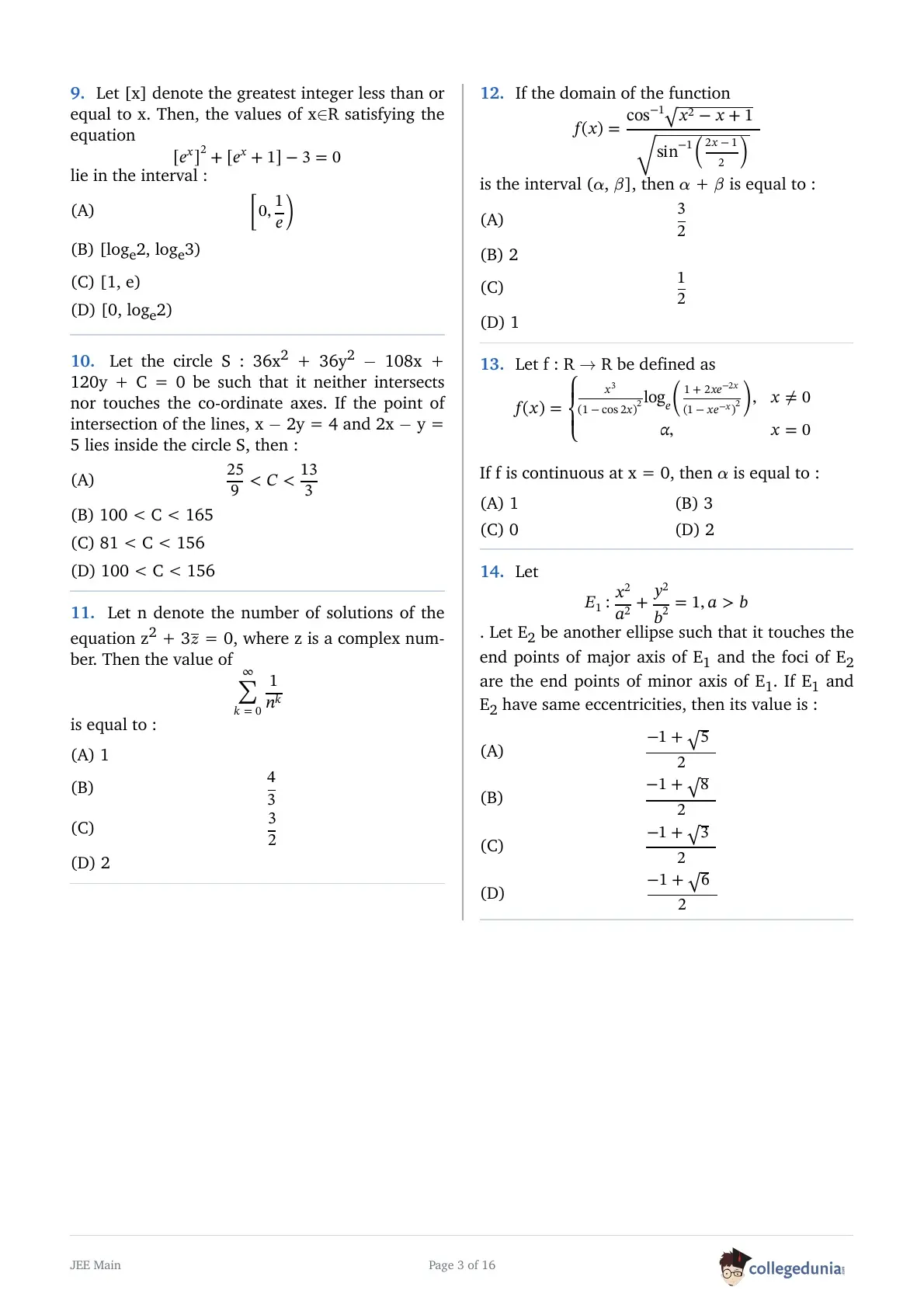
Let \([x]\) denote the greatest integer less than or equal to x. Then, the values of \(x \in R\) satisfying the equation \([e^x]^2 + [e^x + 1] - 3 = 0\) lie in the interval :
Let the circle \(S : 36x^2 + 36y^2 - 108x + 120y + C = 0\) be such that it neither intersects nor touches the co-ordinate axes. If the point of intersection of the lines, \(x - 2y = 4\) and \(2x - y = 5\) lies inside the circle S, then :
Let n denote the number of solutions of the equation \(z^2 + 3\overline{z} = 0\), where z is a complex number. Then the value of \(\sum_{k=0}^{\infty}\frac{1}{n^k}\) is equal to :
If the domain of the function \(f(x) = \cos^{-1}\left(\frac{2x-5}{11-3x}\right) + \sin^{-1}(2x^2-3x+1)\) is the interval \([\alpha, \beta]\), then \(\alpha + 2\beta\) is equal to:}
Let \(f : R \to R\) be defined as \(f(x) = \begin{cases} \frac{x^3}{(1 - \cos 2x)^2}\log_e\left(\frac{1 + 2xe^{-2x}}{(1 - xe^{-x})^2}\right), & x \ne 0 \\ \alpha, & x = 0 \end{cases}\)
If f is continuous at \(x = 0\), then \(\alpha\) is equal to :
Let \(E_1 : \frac{x^2}{a^2} + \frac{y^2}{b^2} = 1,\ a \gt b\). Let \(E_2\) be another ellipse such that it touches the end points of major axis of \(E_1\) and the foci of \(E_2\) are the end points of minor axis of \(E_1\). If \(E_1\) and \(E_2\) have same eccentricities, then its value is :
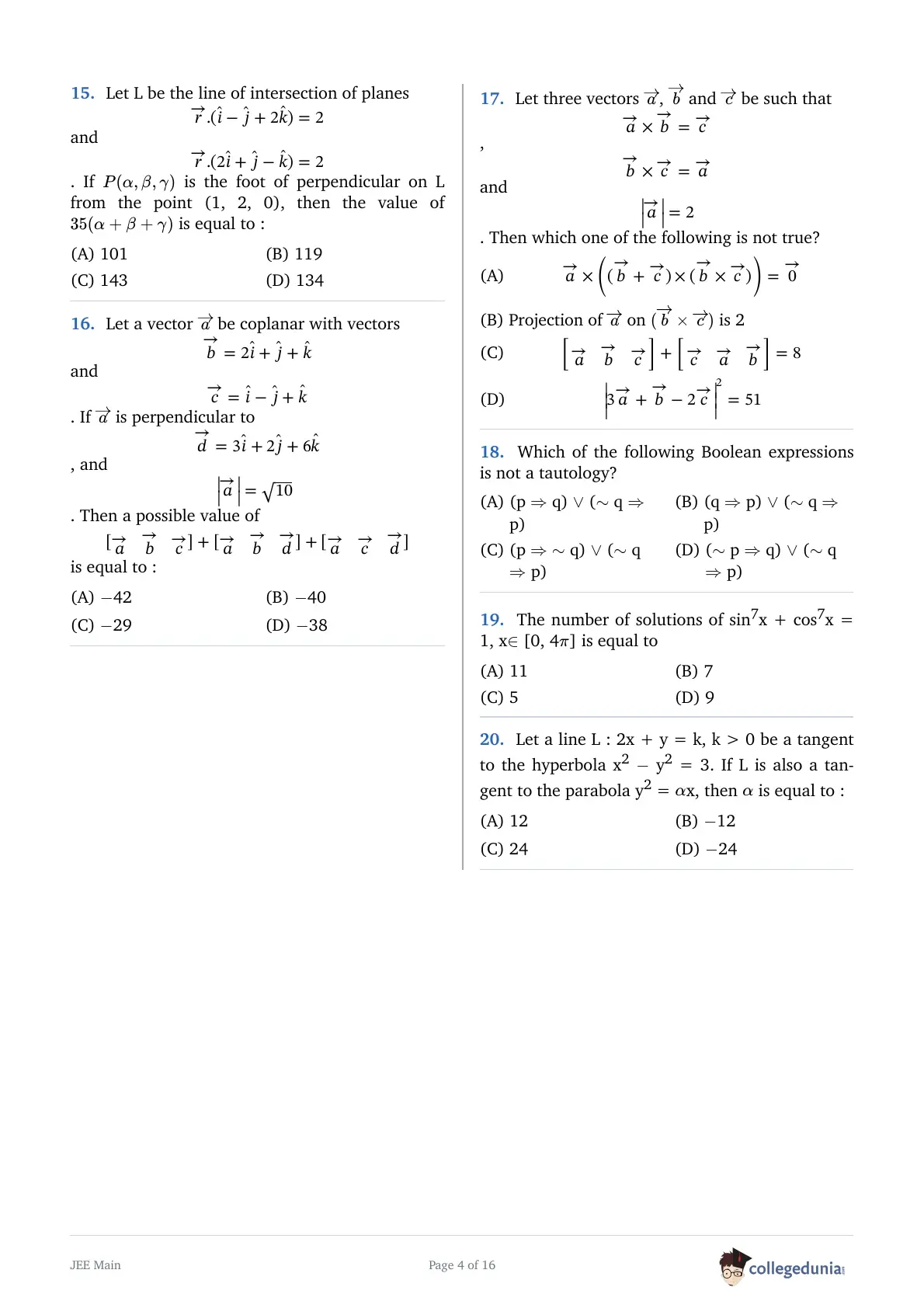
Let L be the line of intersection of planes \(\vec{r}\cdot(\hat{i} - \hat{j} + 2\hat{k}) = 2\) and \(\vec{r}\cdot(2\hat{i} + \hat{j} - \hat{k}) = 2\). If \(P(\alpha, \beta, \gamma)\) is the foot of perpendicular on L from the point \((1, 2, 0)\), then the value of \(35(\alpha + \beta + \gamma)\) is equal to :
Let a vector \( \overrightarrow c \) be coplanar with the vectors \( \overrightarrow a = - \widehat i + \widehat j + \widehat k \) and \( \overrightarrow b = 2\widehat i + \widehat j - \widehat k \). If the vector \( \overrightarrow c \) also satisfies the conditions \( \overrightarrow c \,.\,\left[ {\left( {\overrightarrow a + \overrightarrow b } \right) \times \left( {\overrightarrow a \times \overrightarrow b } \right)} \right] = - 42 \) and \( \left( {\overrightarrow c \times \left( {\overrightarrow a - \overrightarrow b } \right)} \right)\,.\,\widehat k = 3 \), then the value of \( |\overrightarrow c {|^2} \) is equal to :
Let three vectors \(\vec{a}\), \(\vec{b}\) and \(\vec{c}\) be such that \(\vec{a}\times\vec{b} = \vec{c}\), \(\vec{b}\times\vec{c} = \vec{a}\) and \(|\vec{a}| = 2\). Then which one of the following is not true?
Which of the following Boolean expressions is not a tautology?
The number of solutions of \(\sin^7 x + \cos^7 x = 1\), \(x \in [0, 4\pi]\) is equal to
Let a line \(L : 2x + y = k,\ k \gt 0\) be a tangent to the hyperbola \(x^2 - y^2 = 3\). If \(L\) is also a tangent to the parabola \(y^2 = \alpha x\), then \(\alpha\) is equal to :
Mathematics - Section B (Q21 - Q30)
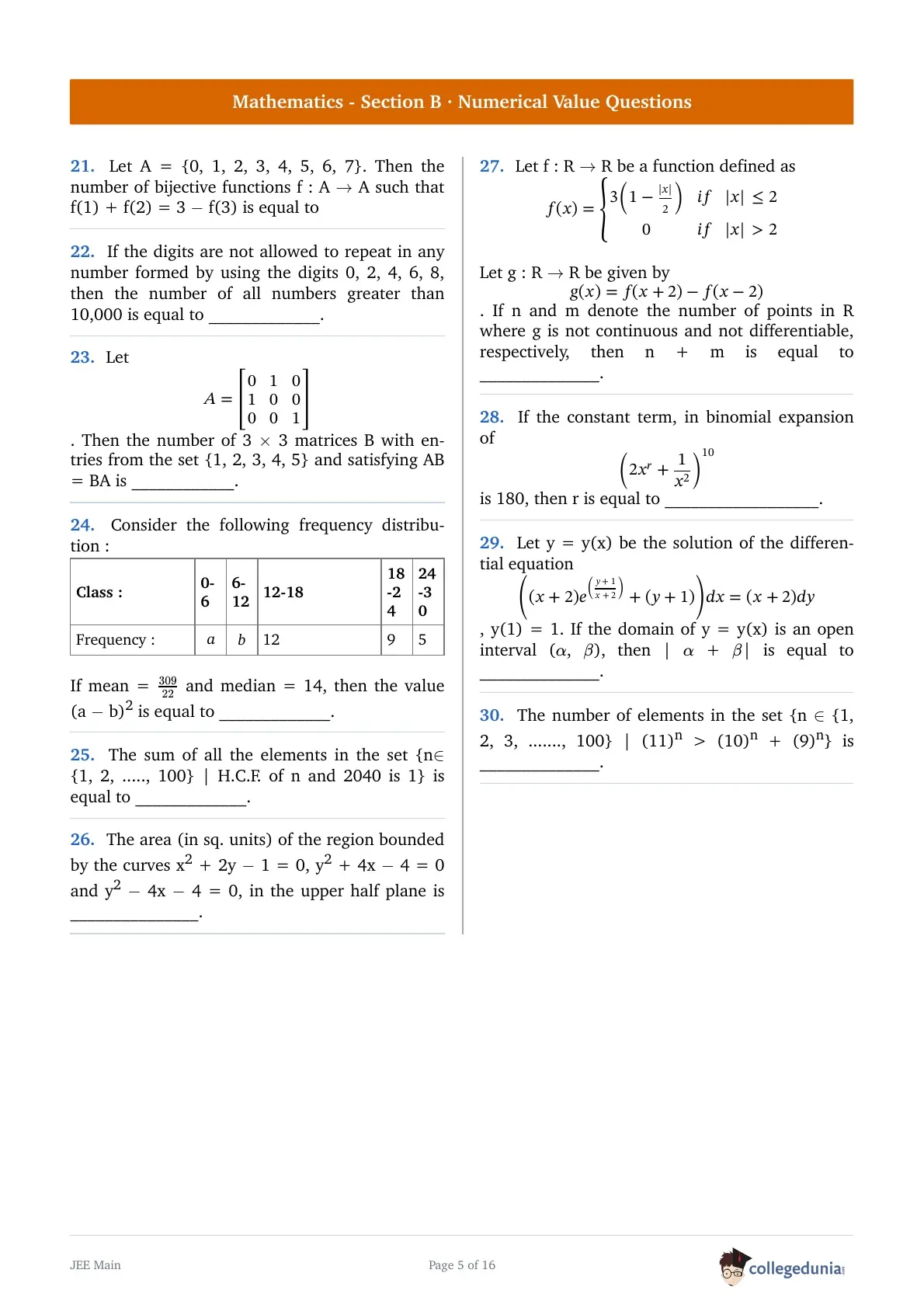
Let \(A = \{0, 1, 2, 3, 4, 5, 6, 7\}\). Then the number of bijective functions \(f : A \to A\) such that \(f(1) + f(2) = 3 - f(3)\) is equal to
If the digits are not allowed to repeat in any number formed by using the digits 0, 2, 4, 6, 8, then the number of all numbers greater than 10,000 is equal to _____________.
Let \(A = \begin{bmatrix} 0 & 1 & 0 \\ 1 & 0 & 0 \\ 0 & 0 & 1 \end{bmatrix}\). Then the number of \(3 \times 3\) matrices \(B\) with entries from the set \(\{1, 2, 3, 4, 5\}\) and satisfying \(AB = BA\) is ____________.
| Class : | 0-6 | 6-12 | 12-18 | 18-24 | 24-30 |
| Frequency : | \(a\) | \(b\) | 12 | 9 | 5 |
The sum of all the elements of the set {α ∈ {1, 2, …, 100} : HCF(α, 24) = 1} is
The area (in sq. units) of the region bounded by the curves \(x^2 + 2y - 1 = 0\), \(y^2 + 4x - 4 = 0\) and \(y^2 - 4x - 4 = 0\), in the upper half plane is _______________.
Let \(f : \mathbb{R} \to \mathbb{R}\) be a function defined as
\(f(x) = \begin{cases} 3\left(1 - \frac{|x|}{2}\right) & \text{if } |x| \le 2 \\ 0 & \text{if } |x| \gt 2 \end{cases}\)
Let \(g : \mathbb{R} \to \mathbb{R}\) be given by
\(g(x) = f(x + 2) - f(x - 2)\).
If \(n\) and \(m\) denote the number of points in \(\mathbb{R}\) where \(g\) is not continuous and not differentiable, respectively, then \(n + m\) is equal to ______________.
If the constant term, in binomial expansion of \(\left(2x^r + \frac{1}{x^2}\right)^{10}\) is 180, then \(r\) is equal to __________________.
Let \(y = y(x)\) be the solution of the differential equation
\(\left((x + 2)e^{\left(\frac{y + 1}{x + 2}\right)} + (y + 1)\right)dx = (x + 2)\,dy\), \(y(1) = 1\).
If the domain of \(y = y(x)\) is an open interval \((\alpha, \beta)\), then \(|\alpha + \beta|\) is equal to _____________.
The number of elements in the set \(\{n \in \{1, 2, 3, \ldots\ldots, 100\} \mid (11)^n \gt (10)^n + (9)^n\}\) is ______________.
Physics - Section A (Q31 - Q50)
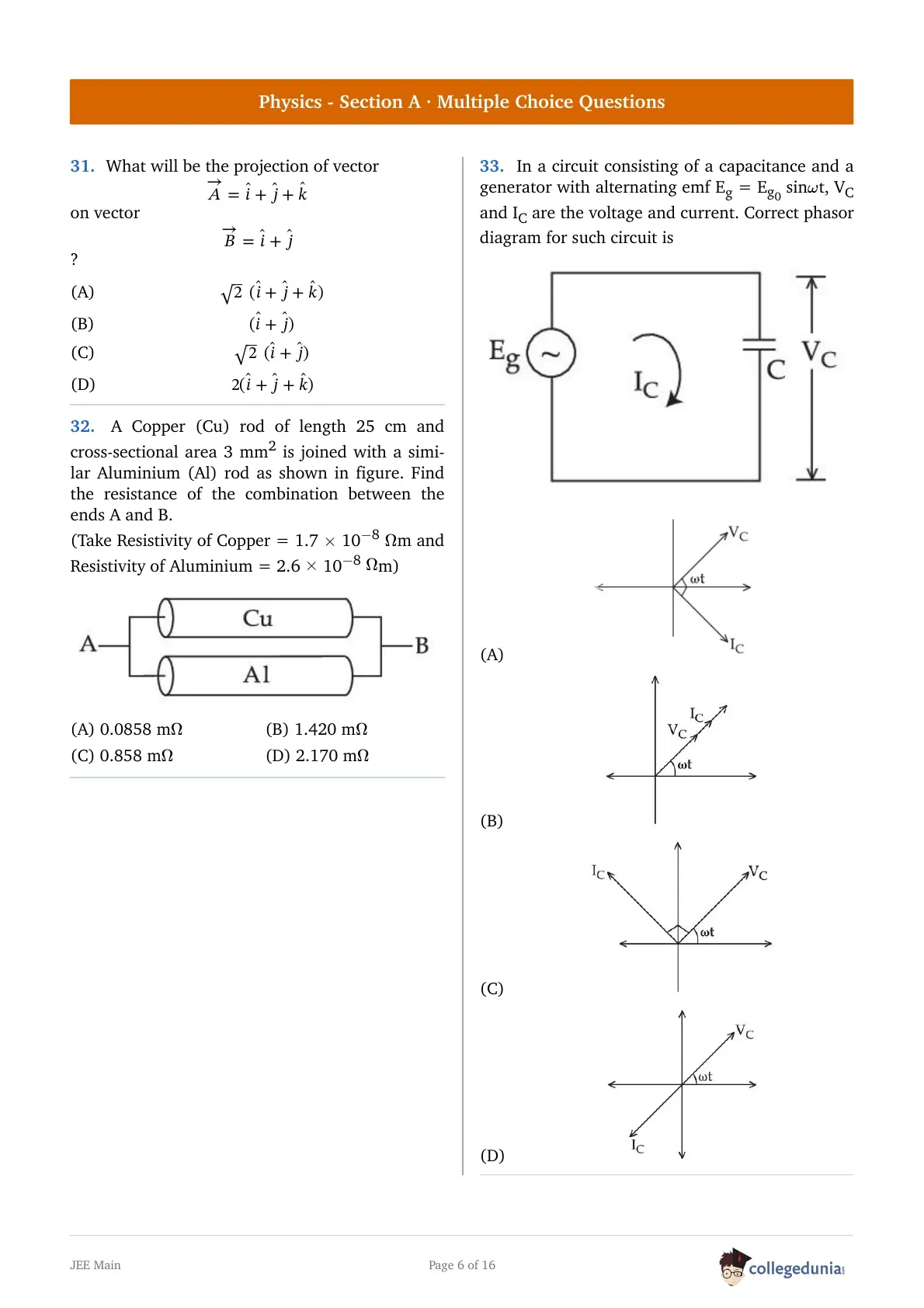
What will be the projection of vector
\(\vec{A} = \hat{i} + \hat{j} + \hat{k}\)
on vector
\(\vec{B} = \hat{i} + \hat{j}\) ?
A Copper (Cu) rod of length 25 cm and cross-sectional area 3 mm\(^2\) is joined with a similar Aluminium (Al) rod as shown in figure. Find the resistance of the combination between the ends A and B.
(Take Resistivity of Copper \(= 1.7 \times 10^{-8}\ \Omega\)m and Resistivity of Aluminium \(= 2.6 \times 10^{-8}\ \Omega\)m)
In a circuit consisting of a capacitance and a generator with alternating emf \(E_g = E_{g_0}\sin\omega t\), \(V_C\) and \(I_C\) are the voltage and current. Correct phasor diagram for such circuit is
- (1)
![]()
- (2)
![]()
- (3)
![]()
- (4)
![]()


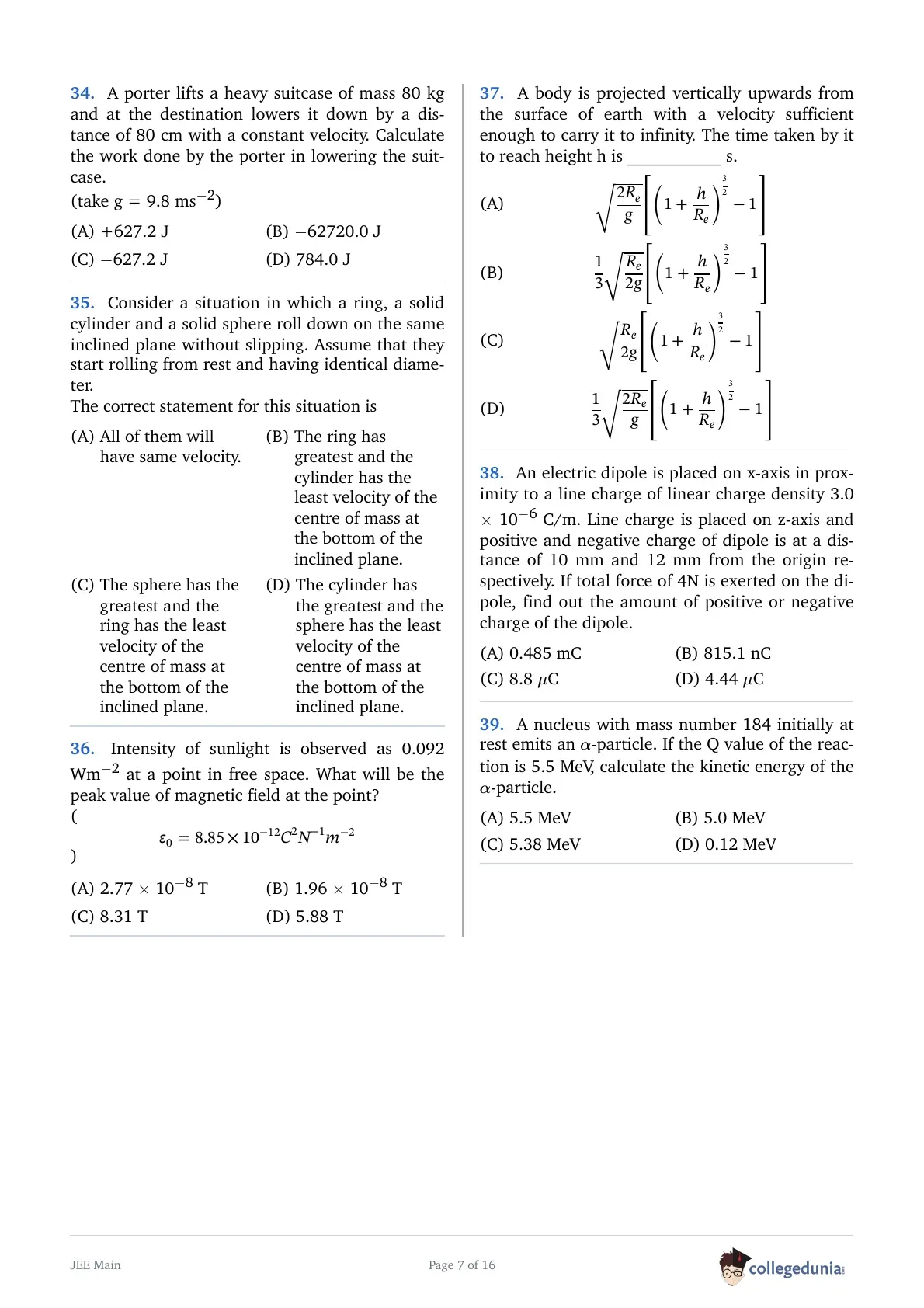
A porter lifts a heavy suitcase of mass 80 kg and at the destination lowers it down by a distance of 80 cm with a constant velocity. Calculate the work done by the porter in lowering the suitcase.
(take \(g = 9.8\ \mathrm{ms^{-2}}\))
Consider a situation in which a ring, a solid cylinder and a solid sphere roll down on the same inclined plane without slipping. Assume that they start rolling from rest and having identical diameter.
The correct statement for this situation is
Intensity of sunlight is observed as \(0.092\ \mathrm{Wm^{-2}}\) at a point in free space. What will be the peak value of magnetic field at the point?
(\(\varepsilon_0 = 8.85 \times 10^{-12}\ \mathrm{C^2N^{-1}m^{-2}}\))
A body is projected vertically upwards from the surface of earth with a velocity sufficient enough to carry it to infinity. The time taken by it to reach height \(h\) is ___________ s.
An electric dipole is placed on x-axis in proximity to a line charge of linear charge density \(3.0 \times 10^{-6}\ \mathrm{C/m}\). Line charge is placed on z-axis and positive and negative charge of dipole is at a distance of 10 mm and 12 mm from the origin respectively. If total force of 4N is exerted on the dipole, find out the amount of positive or negative charge of the dipole.
A nucleus with mass number 184 initially at rest emits an \(\alpha\)-particle. If the Q value of the reaction is 5.5 MeV, calculate the kinetic energy of the \(\alpha\)-particle.
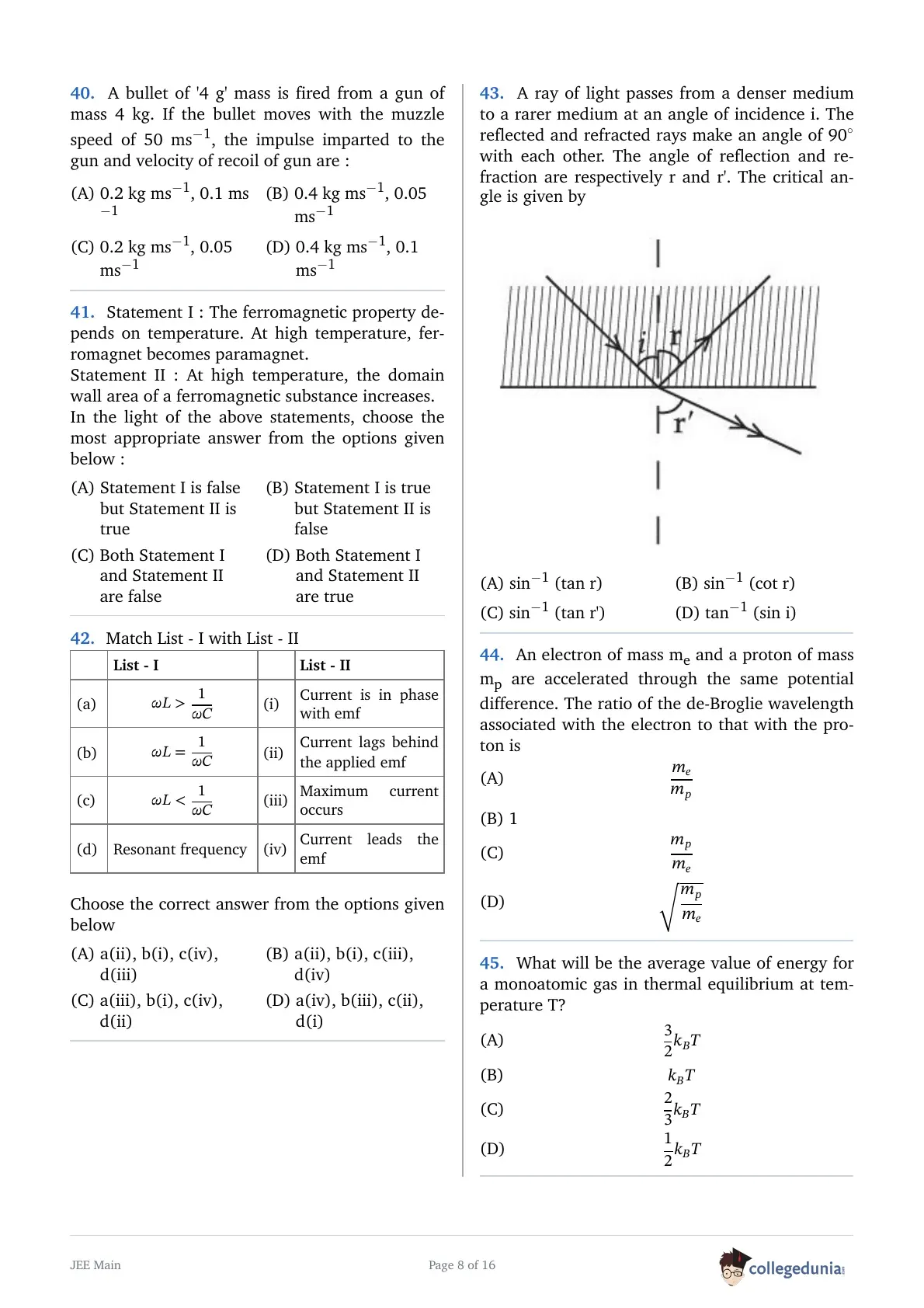
A bullet of '4 g' mass is fired from a gun of mass 4 kg. If the bullet moves with the muzzle speed of \(50\ \mathrm{ms^{-1}}\), the impulse imparted to the gun and velocity of recoil of gun are :
Statement I : The ferromagnetic property depends on temperature. At high temperature, ferromagnet becomes paramagnet.
Statement II : At high temperature, the domain wall area of a ferromagnetic substance increases.
In the light of the above statements, choose the most appropriate answer from the options given below :
| List - I | List - II | ||
| (a) | \(\omega L \gt \dfrac{1}{\omega C}\) | (i) | Current is in phase with emf |
| (b) | \(\omega L = \dfrac{1}{\omega C}\) | (ii) | Current lags behind the applied emf |
| (c) | \(\omega L \lt \dfrac{1}{\omega C}\) | (iii) | Maximum current occurs |
| (d) | Resonant frequency | (iv) | Current leads the emf |
Choose the correct answer from the options given below
A ray of light passes from a denser medium to a rarer medium at an angle of incidence \(i\). The reflected and refracted rays make an angle of \(90^\circ\) with each other. The angle of reflection and refraction are respectively \(r\) and \(r'\). The critical angle is given by
An electron of mass \(m_e\) and a proton of mass \(m_p\) are accelerated through the same potential difference. The ratio of the de-Broglie wavelength associated with the electron to that with the proton is
What will be the average value of energy for a monoatomic gas in thermal equilibrium at temperature \(T\)?
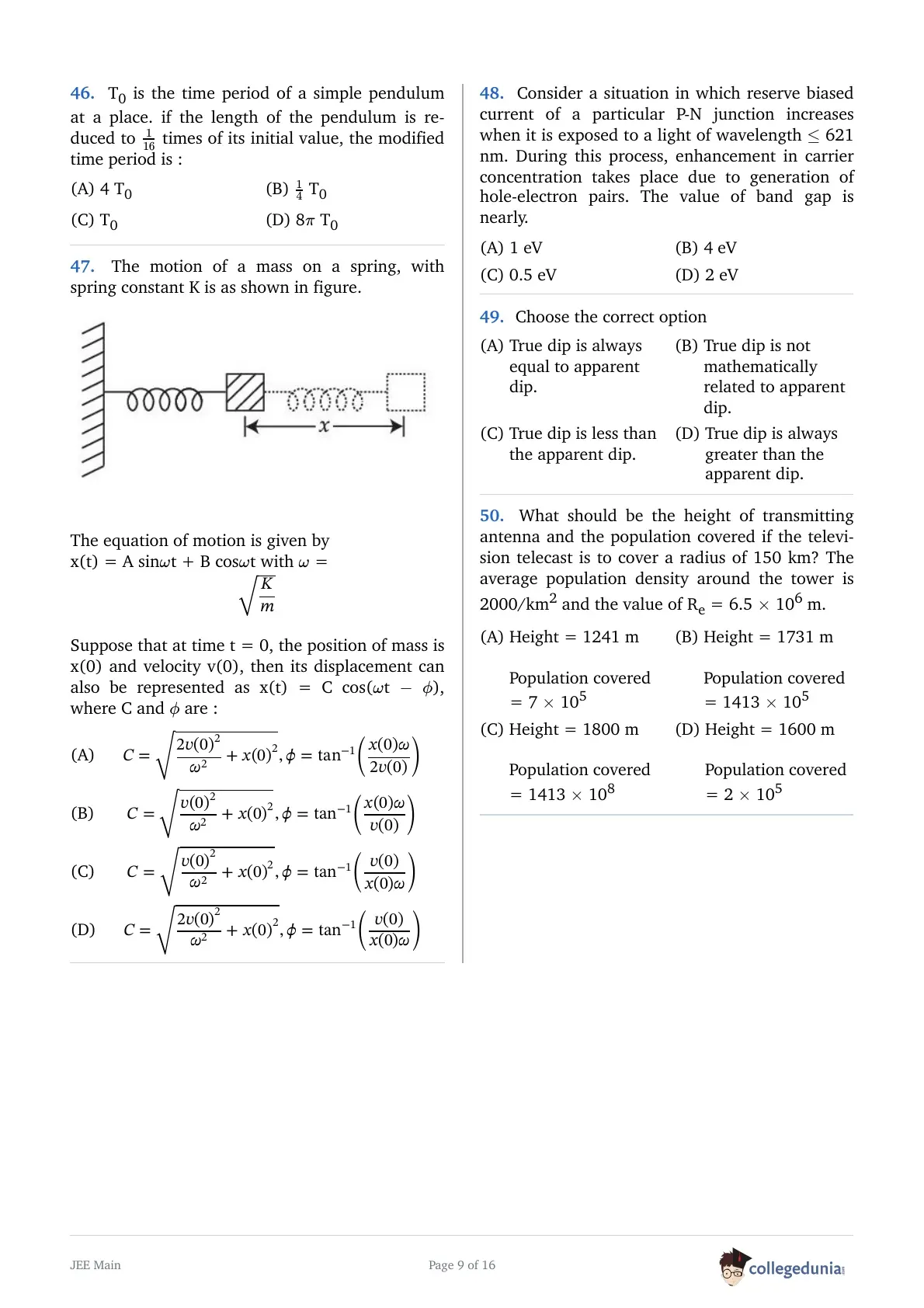
\(T_0\) is the time period of a simple pendulum at a place. if the length of the pendulum is reduced to \(\dfrac{1}{16}\) times of its initial value, the modified time period is :
The motion of a mass on a spring, with spring constant \(K\) is as shown in figure.
The equation of motion is given by
\(x(t) = A\sin\omega t + B\cos\omega t\) with \(\omega = \sqrt{\dfrac{K}{m}}\)
Suppose that at time \(t = 0\), the position of mass is \(x(0)\) and velocity \(v(0)\), then its displacement can also be represented as \(x(t) = C\cos(\omega t - \phi)\), where \(C\) and \(\phi\) are :
Consider a situation in which reserve biased current of a particular P-N junction increases when it is exposed to a light of wavelength \(\le 621\) nm. During this process, enhancement in carrier concentration takes place due to generation of hole-electron pairs. The value of band gap is nearly.
Choose the correct option
The required height of a TV tower which can cover the population of \(603\) lakh is \(h\) If the average population density is \(100\) per square \(km\) and the radius of earth is \(6400\, km\), then the value of \(h\) will be ______\(m\)
Physics - Section B (Q51 - Q60)
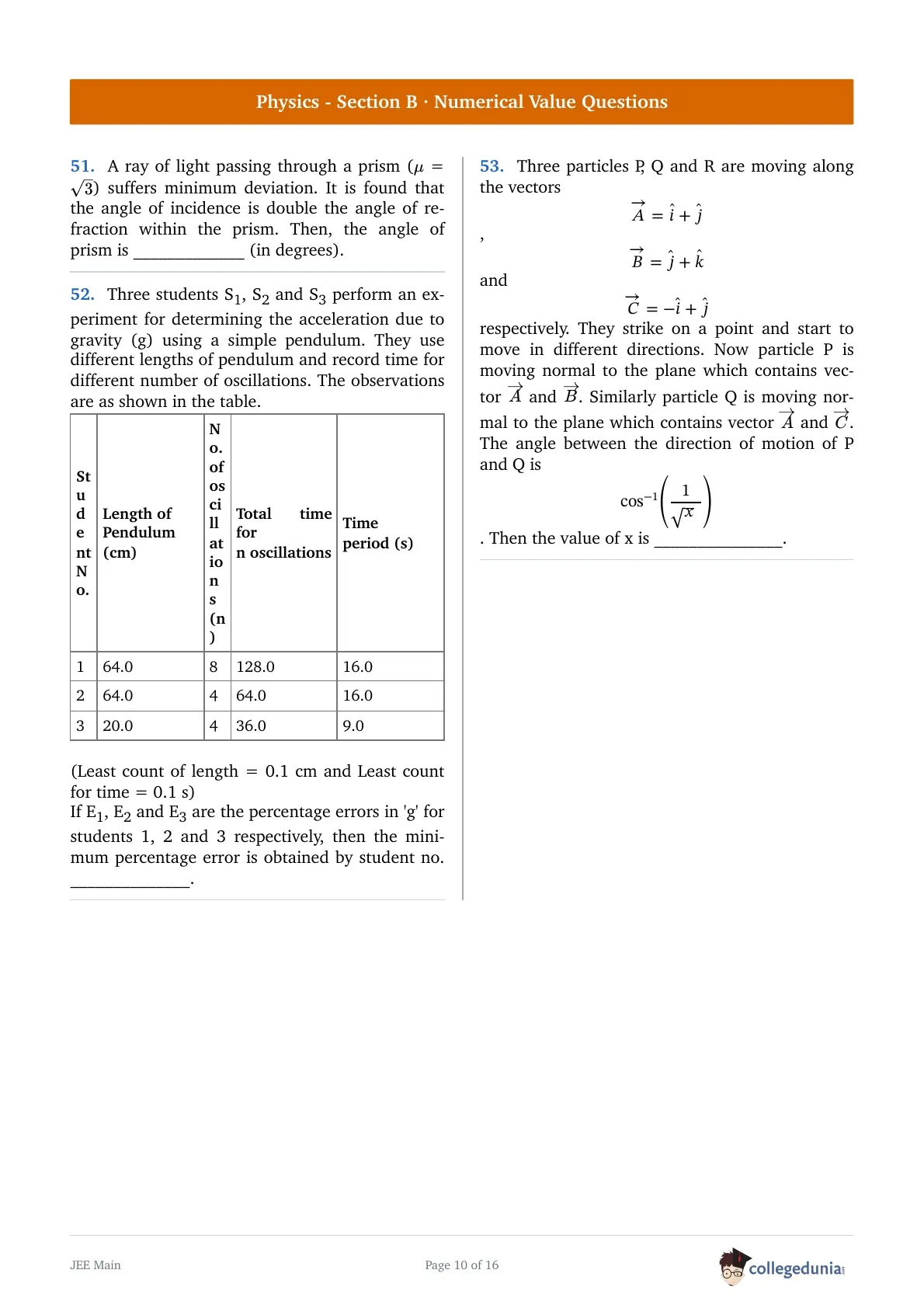
A ray of light passing through a prism (\(\mu = \sqrt{3}\)) suffers minimum deviation. It is found that the angle of incidence is double the angle of refraction within the prism. Then, the angle of prism is ________ (in degrees).
| Student No. | Length of Pendulum (cm) | No. of oscillations (n) | Total time for n oscillations | Time period (s) |
| 1 | 64.0 | 8 | 128.0 | 16.0 |
| 2 | 64.0 | 4 | 64.0 | 16.0 |
| 3 | 20.0 | 4 | 36.0 | 9.0 |
(Least count of length = 0.1 cm and Least count for time = 0.1 s)
If \(E_1\), \(E_2\) and \(E_3\) are the percentage errors in 'g' for students 1, 2 and 3 respectively, then the minimum percentage error is obtained by student no. ________.
Three particles P, Q and R are moving along the vectors \(\vec{A} = \hat{i} + \hat{j}\), \(\vec{B} = \hat{j} + \hat{k}\) and \(\vec{C} = -\hat{i} + \hat{j}\) respectively. They strike on a point and start to move in different directions. Now particle P is moving normal to the plane which contains vector \(\vec{A}\) and \(\vec{B}\). Similarly particle Q is moving normal to the plane which contains vector \(\vec{A}\) and \(\vec{C}\). The angle between the direction of motion of P and Q is \(\cos^{-1}\left(\dfrac{1}{\sqrt{x}}\right)\). Then the value of x is ________.
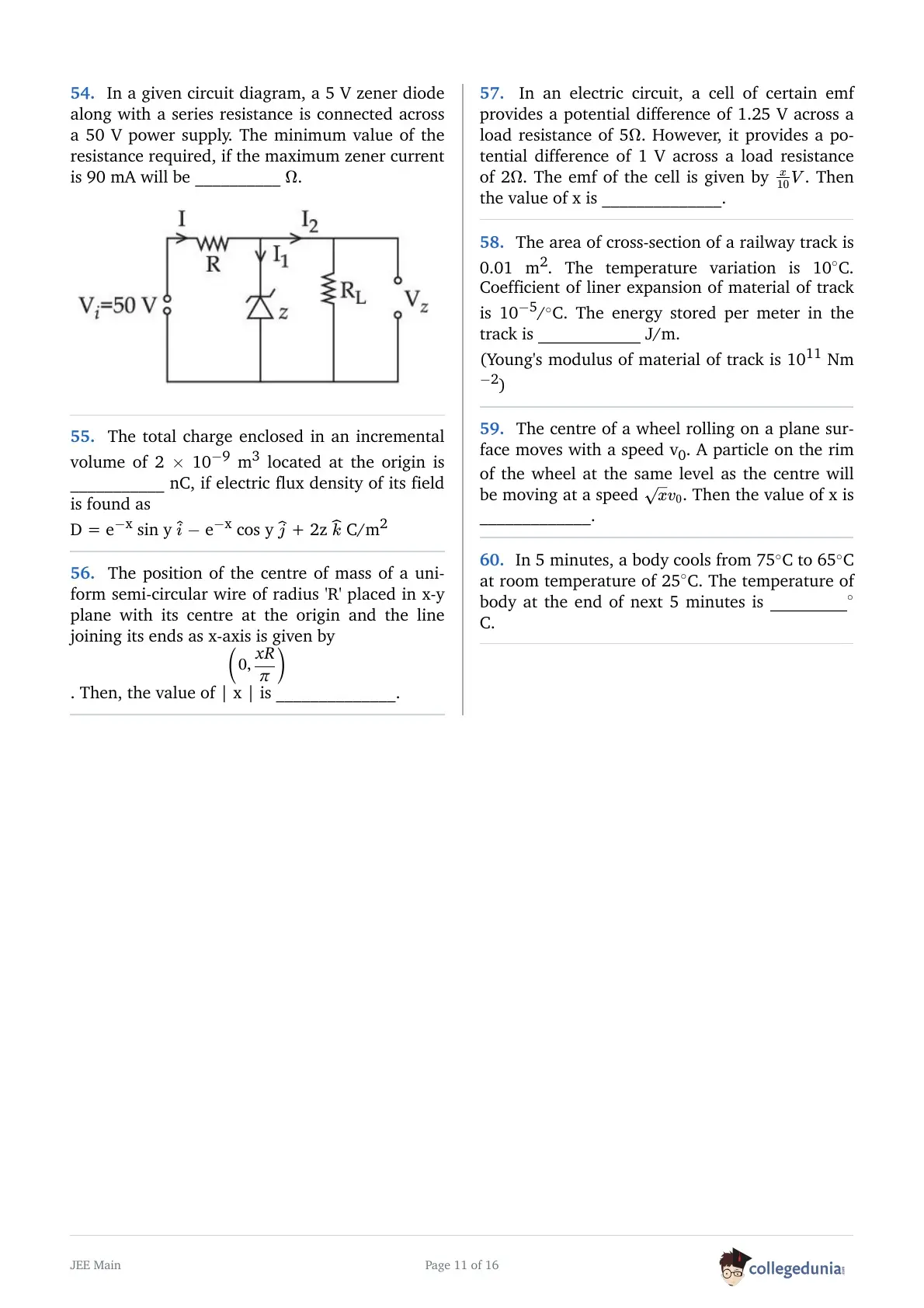
A 8 V Zener diode along with a series resistance R is connected across a 20 V supply (as shown in the figure). If the maximum Zener current is 25 mA, then the minimum value of R will be ____ Ω.

The total charge enclosed in an incremental volume of \(2\times10^{-9}\ \mathrm{m^3}\) located at the origin is ________ nC, if electric flux density of its field is found as
\(\vec{D} = e^{-x}\sin y\,\hat{i} - e^{-x}\cos y\,\hat{j} + 2z\,\hat{k}\ \ \mathrm{C/m^2}\)
The position of the centre of mass of a uniform semi-circular wire of radius 'R' placed in x-y plane with its centre at the origin and the line joining its ends as x-axis is given by \(\left(0, \dfrac{xR}{\pi}\right)\). Then, the value of \(|x|\) is ________.
In an electric circuit, a cell of certain emf provides a potential difference of 1.25 V across a load resistance of \(5\ \Omega\). However, it provides a potential difference of 1 V across a load resistance of \(2\ \Omega\). The emf of the cell is given by \(\dfrac{x}{10}\) V. Then the value of x is ________.
The area of cross-section of a railway track is \(0.01\ \mathrm{m^2}\). The temperature variation is \(10^\circ\mathrm{C}\). Coefficient of liner expansion of material of track is \(10^{-5}/^\circ\mathrm{C}\). The energy stored per meter in the track is ________ J/m.
(Young's modulus of material of track is \(10^{11}\ \mathrm{Nm^{-2}}\))
A wheel is rolling on a plane surface. The speed of a particle on the highest point of the rim is 8 m/s. The speed of the particle on the rim of the wheel at the same level as the center of the wheel, will be:
In 5 minutes, a body cools from \(75^\circ\mathrm{C}\) to \(65^\circ\mathrm{C}\) at room temperature of \(25^\circ\mathrm{C}\). The temperature of body at the end of next 5 minutes is ________ \(^\circ\mathrm{C}\).
Chemistry - Section A (Q61 - Q80)
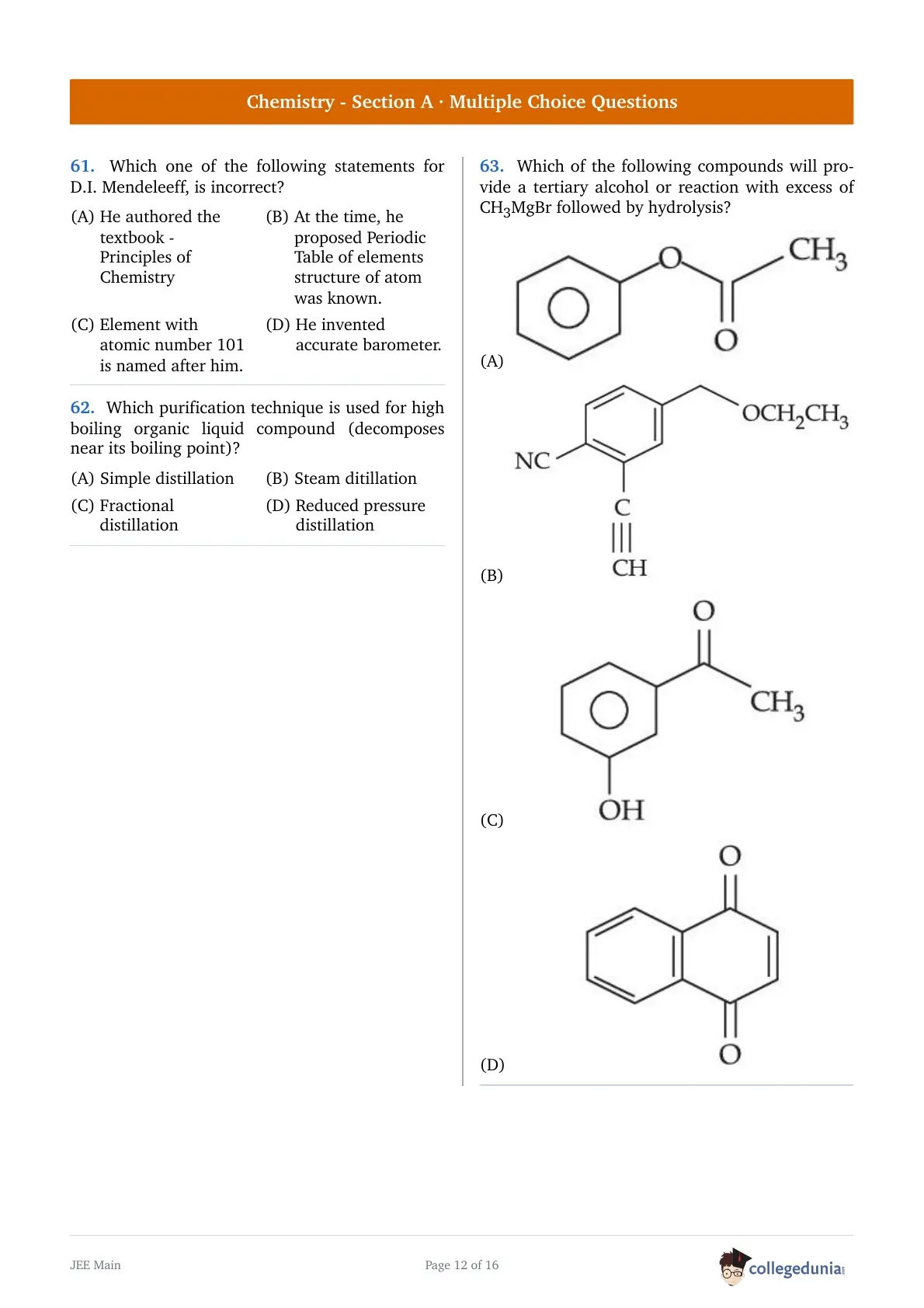
Which one of the following statements for D.I. Mendeleeff, is incorrect?
Which purification technique is used for high boiling organic liquid compound (decomposes near its boiling point)?
Which of the following compounds will provide a tertiary alcohol on reaction with excess of \(\mathrm{CH_3MgBr}\) followed by hydrolysis?
- (1)
![]()
- (2)
![]()
- (3)
![]()
- (4)
![]()


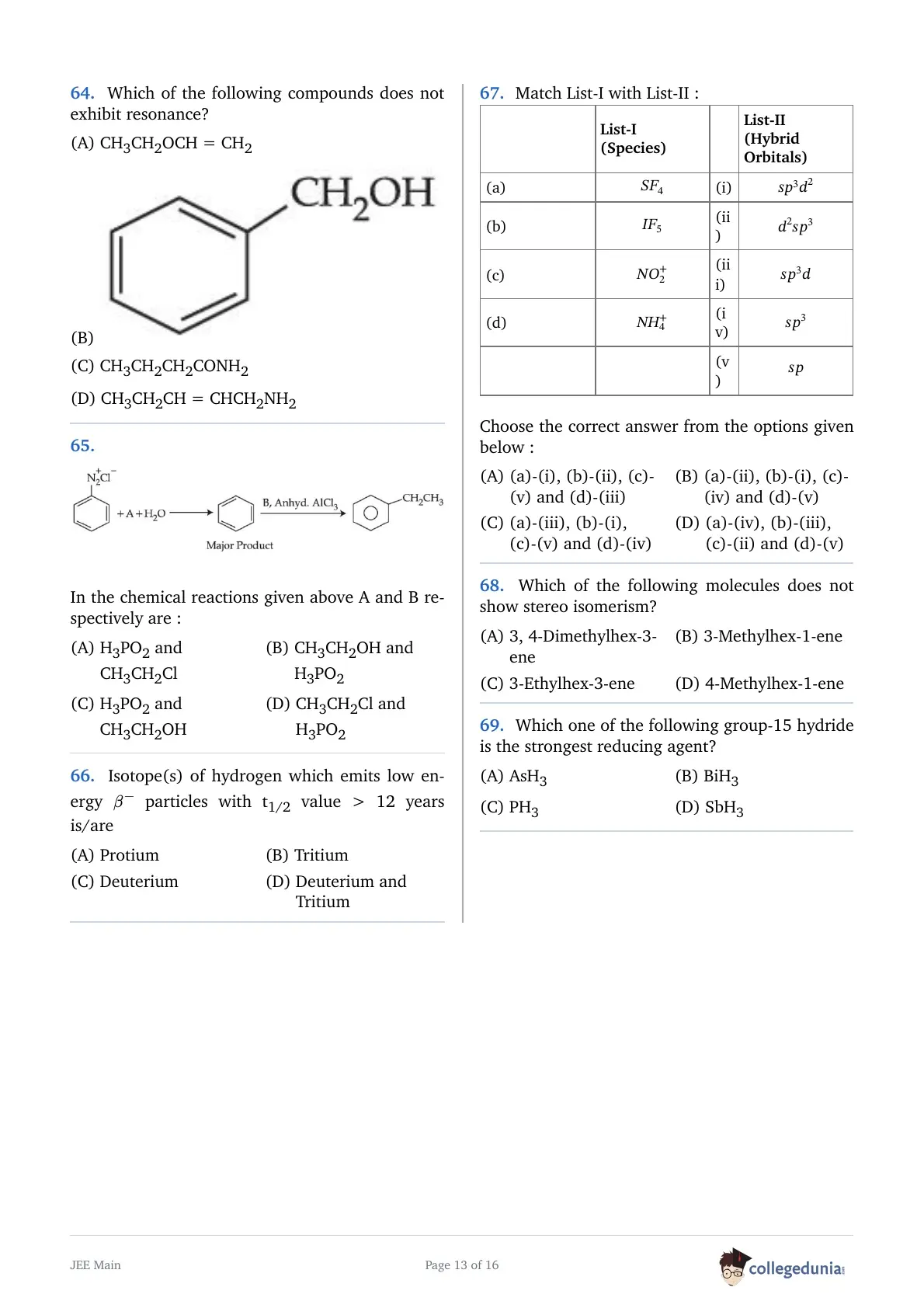
Which of the following compounds does not exhibit resonance?
- (1) \(\mathrm{CH_3CH_2OCH=CH_2}\)
- (2)
![]()
- (3) \(\mathrm{CH_3CH_2CH_2CONH_2}\)
- (4) \(\mathrm{CH_3CH_2CH=CHCH_2NH_2}\)


In the chemical reactions given above A and B respectively are :
Isotope(s) of hydrogen which emits low energy \(\beta^-\) particles with \(t_{1/2}\) value \(\gt\) 12 years is/are
| List-I (Species) | List-II (Hybrid Orbitals) |
| (a) \(SF_4\) | (i) \(sp^3d^2\) |
| (b) \(IF_5\) | (ii) \(d^2sp^3\) |
| (c) \(NO_2^+\) | (iii) \(sp^3d\) |
| (d) \(NH_4^+\) | (iv) \(sp^3\) |
| (v) \(sp\) |
Choose the correct answer from the options given below :
Which of the following molecules does not show stereo isomerism?
Which one of the following group-15 hydride is the strongest reducing agent?
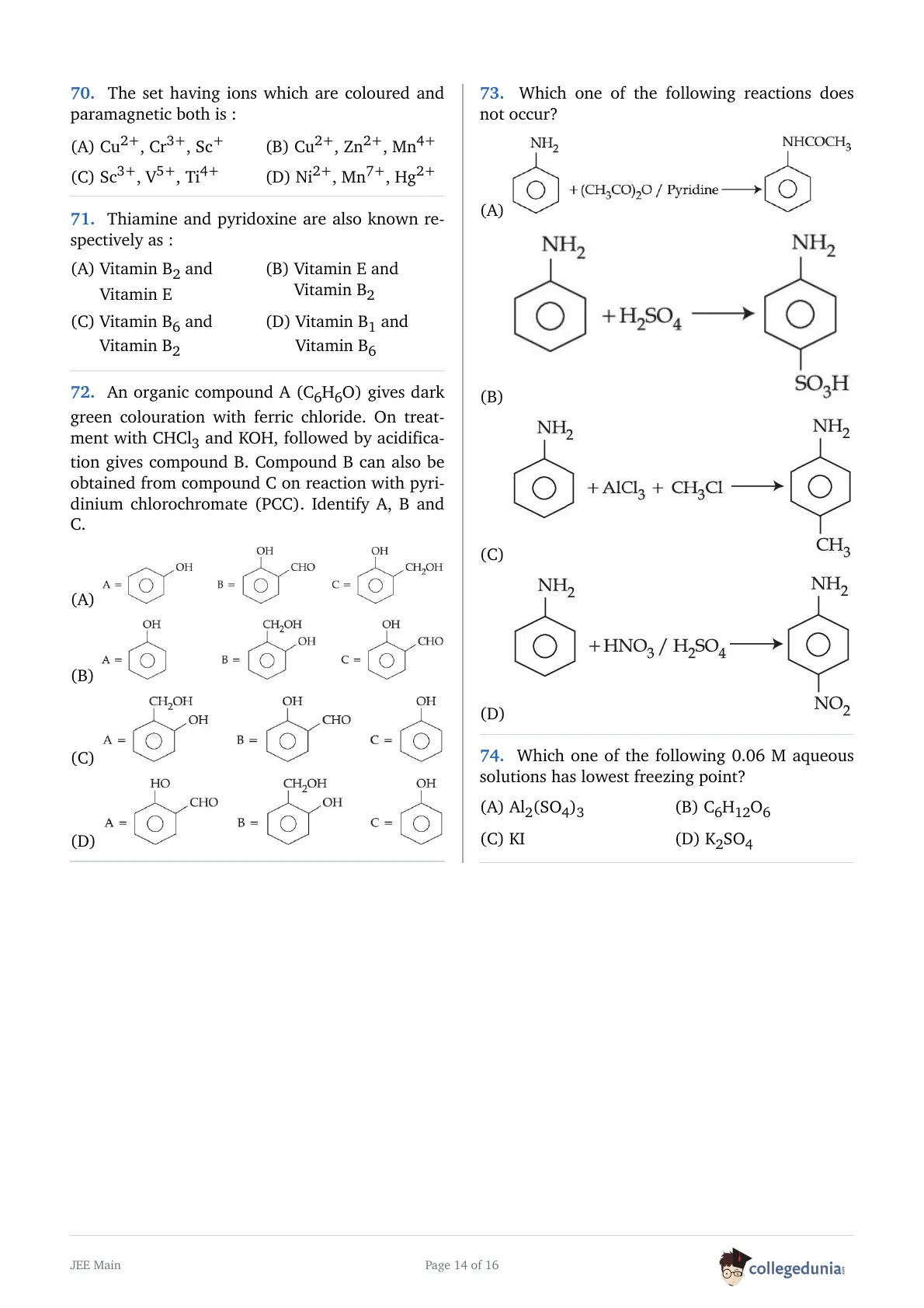
The set having ions which are coloured and paramagnetic both is :
Thiamine and pyridoxine are also known respectively as :
An organic compound A (\(\mathrm{C_6H_6O}\)) gives dark green colouration with ferric chloride. On treatment with \(\mathrm{CHCl_3}\) and KOH, followed by acidification gives compound B. Compound B can also be obtained from compound C on reaction with pyridinium chlorochromate (PCC). Identify A, B and C.
- (1)
![]()
- (2)
![]()
- (3)
![]()
- (4)
![]()


Which one of the following 0.06 M aqueous solutions has lowest freezing point?
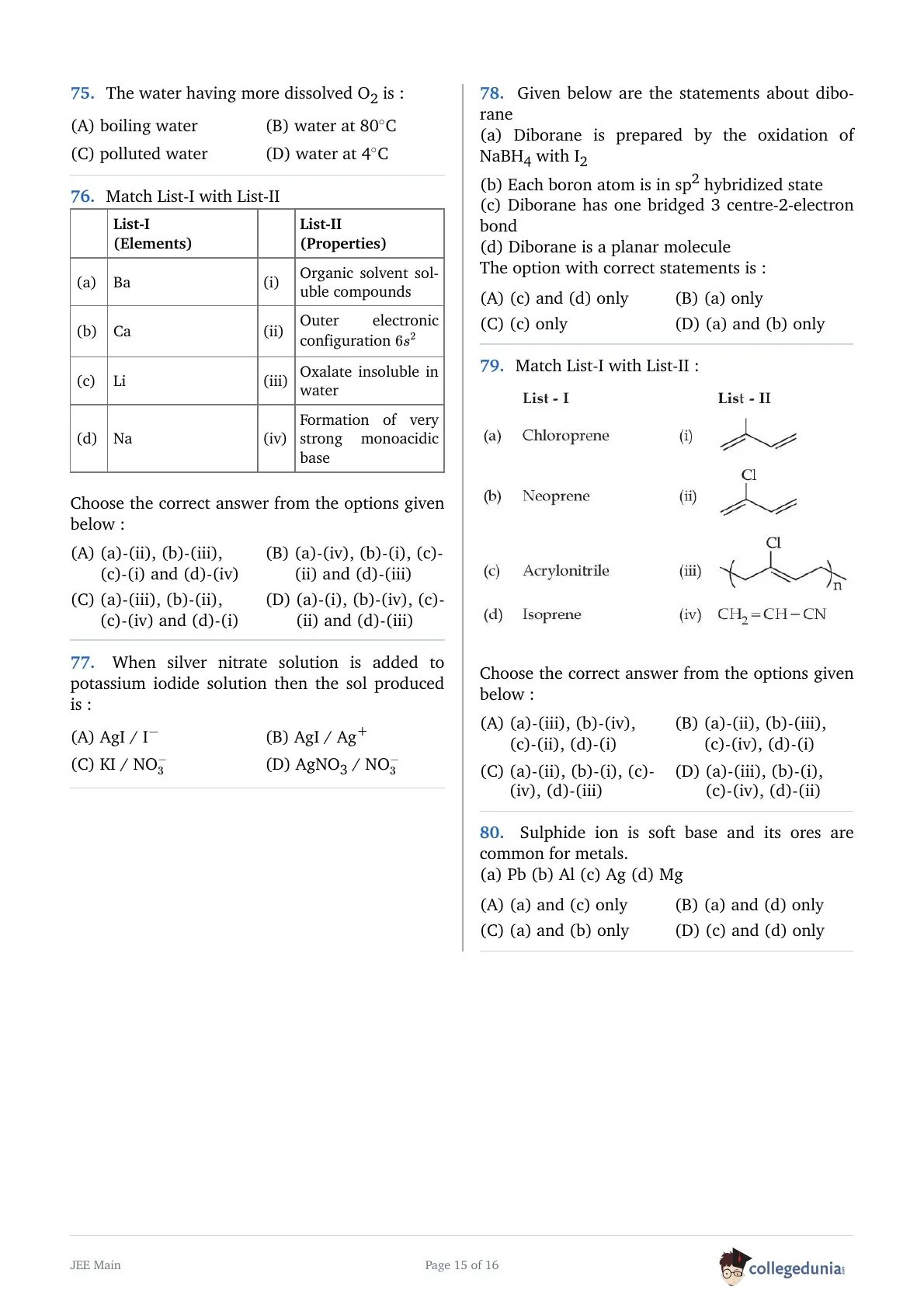
The water having more dissolved \(\mathrm{O_2}\) is :
| List-I (Elements) | List-II (Properties) |
| (a) Ba | (i) Organic solvent soluble compounds |
| (b) Ca | (ii) Outer electronic configuration \(6s^2\) |
| (c) Li | (iii) Oxalate insoluble in water |
| (d) Na | (iv) Formation of very strong monoacidic base |
Choose the correct answer from the options given below :
25 mL of silver nitrate solution (1M) is added dropwise to 25 mL of potassium iodide (1.05 M) solution. The ions(s) present in very small quantity in the solution is/are:
Given below are the statements about diborane
(a) Diborane is prepared by the oxidation of \(\mathrm{NaBH_4}\) with \(\mathrm{I_2}\)
(b) Each boron atom is in \(sp^2\) hybridized state
(c) Diborane has one bridged 3 centre-2-electron bond
(d) Diborane is a planar molecule
The option with correct statements is :
| List-I | List-II |
| (a) Chloroprene | (i), (ii), (iii): structures as shown in the figure |
| (b) Neoprene | |
| (c) Acrylonitrile | (iv) \(\mathrm{CH_2=CH-CN}\) |
| (d) Isoprene |

Choose the correct answer from the options given below :
Sulphide ion is soft base and its ores are common for metals.
(a) Pb (b) Al (c) Ag (d) Mg
Chemistry - Section B (Q81 - Q90)
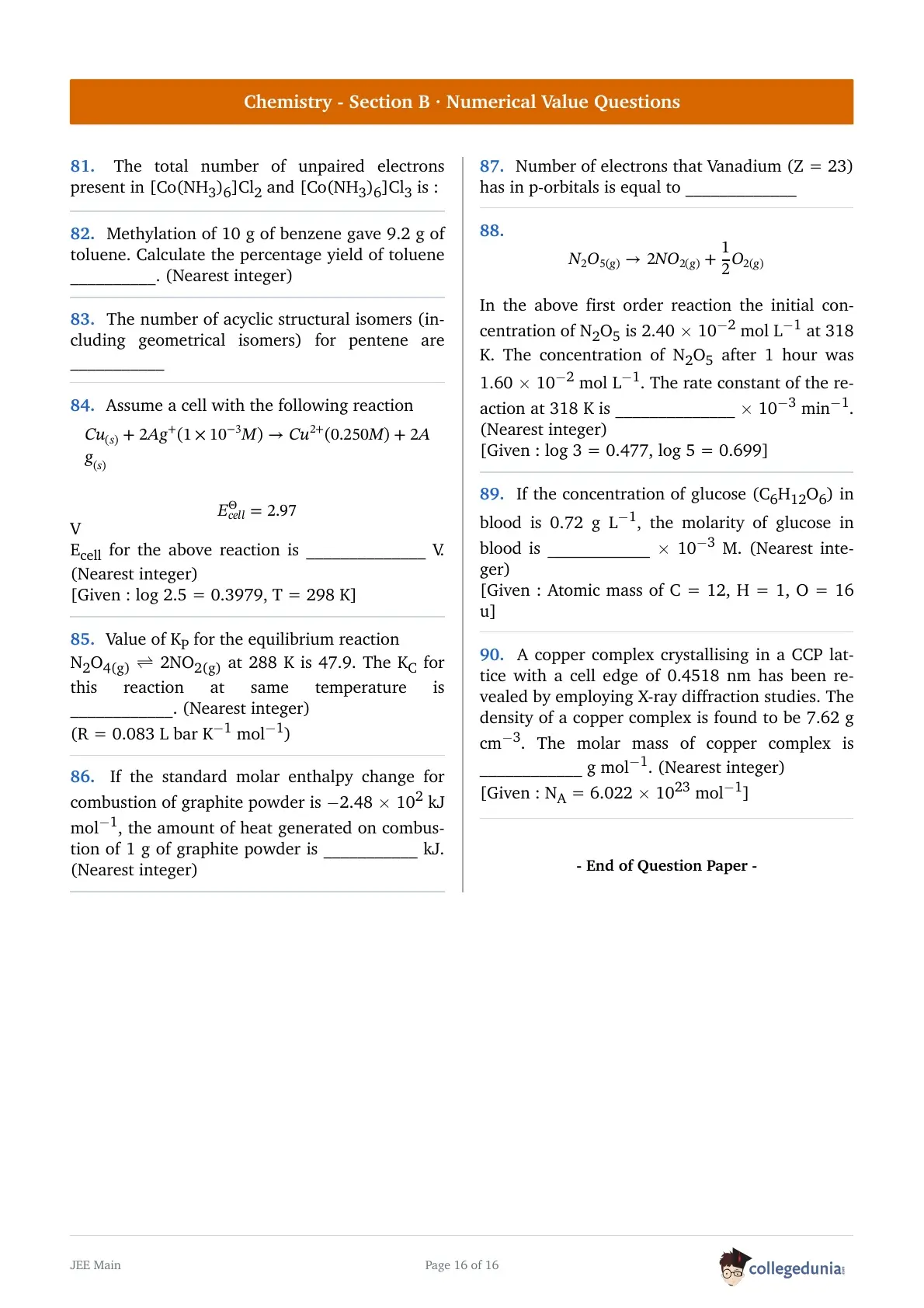
The total number of unpaired electrons present in \(\mathrm{[Co(NH_3)_6]Cl_2}\) and \(\mathrm{[Co(NH_3)_6]Cl_3}\) is :
Methylation of 10 g of benzene gave 9.2 g of toluene. Calculate the percentage yield of toluene ________. (Nearest integer)
The number of acyclic structural isomers (including geometrical isomers) for pentene are ___________
Assume a cell with the following reaction
\(\mathrm{Cu_{(s)} + 2Ag^{+}(1\times 10^{-3}\,M) \rightarrow Cu^{2+}(0.250\,M) + 2Ag_{(s)}}\)
\(E^{\Theta}_{cell} = 2.97\) V
\(E_{cell}\) for the above reaction is ______________ V. (Nearest integer)
[Given : log 2.5 = 0.3979, T = 298 K]
Value of \(K_P\) for the equilibrium reaction
\(\mathrm{N_2O_{4(g)} \rightleftharpoons 2NO_{2(g)}}\) at 288 K is 47.9. The \(K_C\) for this reaction at same temperature is ____________. (Nearest integer)
(R = 0.083 L bar \(\mathrm{K^{-1}\,mol^{-1}}\))
If the standard molar enthalpy change for combustion of graphite powder is \(-2.48\times 10^{2}\) kJ \(\mathrm{mol^{-1}}\), the amount of heat generated on combustion of 1 g of graphite powder is ___________ kJ. (Nearest integer)
Number of electrons that Vanadium (Z = 23) has in p-orbitals is equal to _____________
\(\mathrm{N_2O_{5(g)} \rightarrow 2NO_{2(g)} + \frac{1}{2}O_{2(g)}}\)
In the above first order reaction the initial concentration of \(\mathrm{N_2O_5}\) is \(2.40\times 10^{-2}\) mol \(\mathrm{L^{-1}}\) at 318 K. The concentration of \(\mathrm{N_2O_5}\) after 1 hour was \(1.60\times 10^{-2}\) mol \(\mathrm{L^{-1}}\). The rate constant of the reaction at 318 K is ______________ \(\times 10^{-3}\) \(\mathrm{min^{-1}}\). (Nearest integer)
[Given : log 3 = 0.477, log 5 = 0.699]
The osmotic pressure of blood is 7.47 bar at 300 K. To inject glucose to a patient intravenously, it has to be isotonic with blood. The concentration of glucose solution in \(\mathrm{gL^{-1}}\) is ____________. (Molar mass of glucose = 180 g \(\mathrm{mol^{-1}}\), R = 0.083 L bar \(\mathrm{K^{-1}\,mol^{-1}}\)) (Nearest integer)
A copper complex crystallising in a CCP lattice with a cell edge of 0.4518 nm has been revealed by employing X-ray diffraction studies. The density of a copper complex is found to be 7.62 g \(\mathrm{cm^{-3}}\). The molar mass of copper complex is ____________ g \(\mathrm{mol^{-1}}\). (Nearest integer)
[Given : \(N_A = 6.022\times 10^{23}\ \mathrm{mol^{-1}}\)]
JEE Main 2021 Exam Pattern and Marking Scheme
| Particulars | Details |
|---|---|
| Exam Mode | Online (Computer-Based Test) |
| Paper | B.E./B.Tech (Paper 1) |
| Duration | 3 hours (180 minutes) |
| Type of Questions | Multiple Choice Questions (MCQs) + Numerical Value Questions |
| Subjects | Mathematics, Physics, Chemistry |
| Total Questions | 90 questions (75 to be attempted) |
| Total Marks | 300 marks |
| Marking Scheme | +4 for correct answer & -1 for incorrect MCQ; no negative marking for Numerical Value Questions |
JEE Main 2021 July 22 Shift 2 Difficulty Level
JEE Main 2021 B.E./B.Tech Question Paper- July 22, 2021- Afternoon exam was rated to be of moderate difficulty by the experts. Conducted on the second day of the JEE Main 3rd Session, JEE Main July 22, 2021 exam was not preceded by a morning shift; meaning that only one exam was held on July 22 (afternoon session). The Physics section was the most difficult section of the exam, featuring a significantly high number of complex calculation-based questions, especially from Mechanics, Electrodynamics, and Modern Physics units. Mathematics was the second section in terms of the difficulty level, featuring a few tricky questions from the Binomial Theorem and Probability. Chemistry was the easiest of the three, heavily featuring questions from Organic Chemistry (II), and Inorganic Chemistry (II).
JEE Main 2021 B.E./B.Tech Question Paper July 22 (Afternoon Session): Paper Analysis
JEE Main 2021 B.E./B.Tech Paper on July 22 Forenoon Session conducted between 3.00 PM to 6.00 PM, the analysis of the paper is as follows:
| Subject | Topic (Number of Questions) |
|---|---|
| Physics | Electrodynamics (7) |
| Heat and Thermodynamics (3) | |
| Mechanics (8) | |
| Modern Physics (6) | |
| Optics (2) | |
| SHM and Waves (2) | |
| Chemistry | Inorganics Chemistry I (5) |
| Inorganics Chemistry II (7) | |
| Organic Chemistry I (1) | |
| Organic Chemistry II (8) | |
| Physical Chemistry I (4) | |
| Physical Chemistry II (5) | |
| Mathematics | Binomial Theorem (2) |
| Complex Numbers (2) | |
| Coordinate Geometry (3) | |
| Differential Calculus (5) | |
| Integral Calculus (4) | |
| Permutation and Combination (3) | |
| Probability (1) | |
| Sequence and Series (2) | |
| Statistics (1) | |
| Quadratic Equations (2) | |
| Trigonometry (2) | |
| Matrix and Determinants (2) | |
| Fundamentals of Mathematics (1) |
Note: For detailed JEE Main Question Paper Analysis, visit- JEE Main Question Paper Analysis



Comments