




JEE Main 2021 February 24 Shift 2 Question Paper is available here with solutions PDF and detailed solutions for every question. NTA conducted the second shift on February 24, 2021, from 3:00 PM to 6:00 PM. The JEE Main 2021 Paper 1 (B.E./B.Tech) question paper includes the following:
- 90 questions in a 3-hour CBT Mode: 30 each from Mathematics, Physics and Chemistry (75 to be attempted)
- Section A: 20 multiple choice questions (MCQs) per subject, all compulsory, 4 marks each
- Section B: 10 numerical value questions per subject, any 5 to be attempted, 4 marks each
- Marking: +4 for a correct answer, -1 for an incorrect MCQ, 0 for an unattempted question; no negative marking for numerical value questions
- Maximum marks: 300 (100 per subject)
JEE Main 2021 February 24 Shift 2 Question Paper with Solution PDF
| NTA Official PDF | CD PDF | CD PDF with Solutions |
|---|---|---|
| Download official PDF 4.93 MB | Download Collegedunia PDF 1.01 MB | Download solutions PDF 1.63 MB |
Also Check:
JEE Main 2021 February 24 Shift 2 Questions with Solutions
Mathematics - Section A (Q1 - Q20)
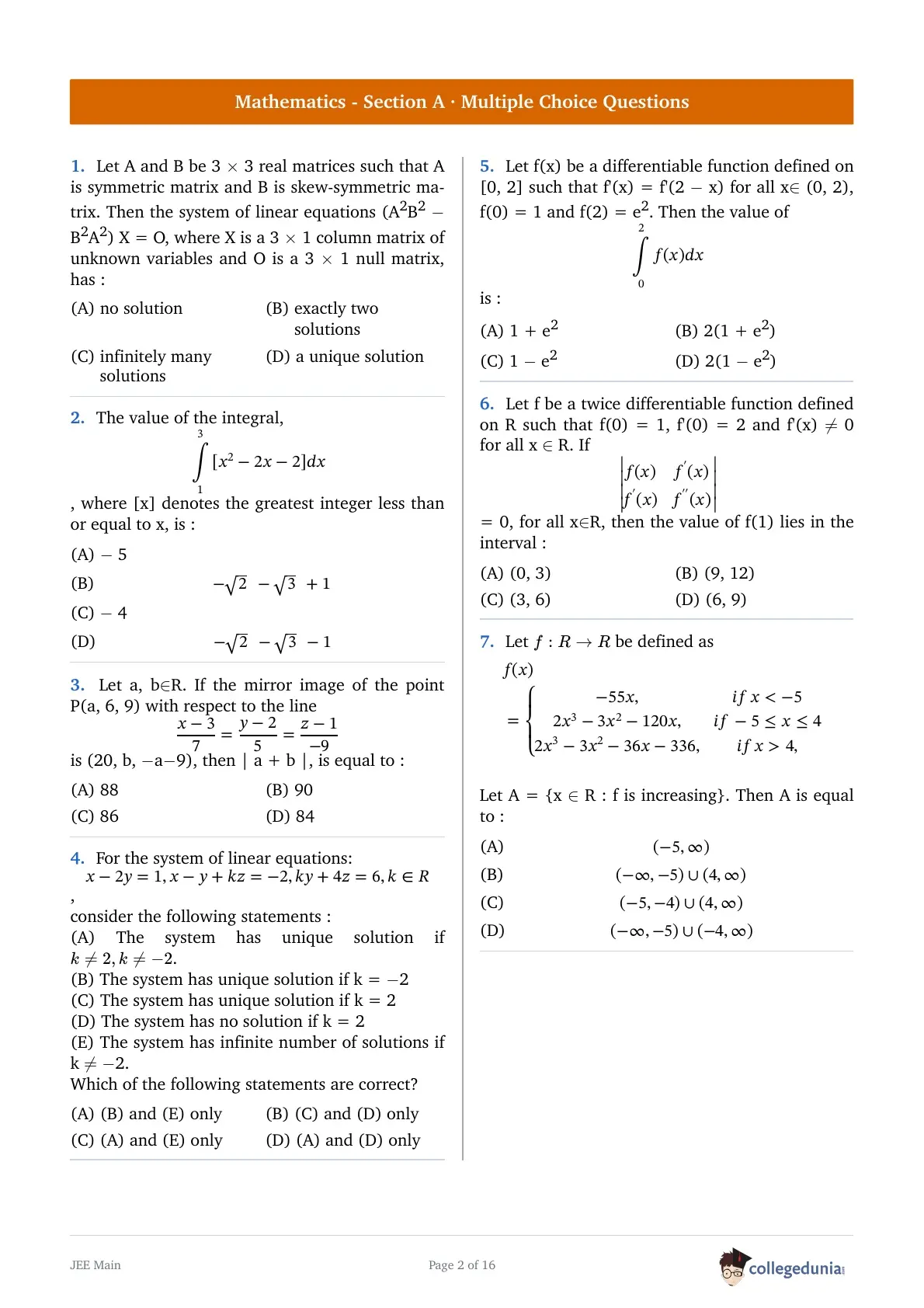
Let A and B be 3 × 3 real matrices such that A is symmetric matrix and B is skew-symmetric matrix. Then the system of linear equations (A²B² - B²A²) X = O, where X is a 3 × 1 column matrix of unknown variables and O is a 3 × 1 null matrix, has :
The value of the integral, \[ \int_{1}^{3} \left[ x^{2} - 2x - 2 \right] \, dx, \] where \( [x] \) denotes the greatest integer less than or equal to \( x \), is:
Let a, b ∈ R. If the mirror image of the point P(a, 6, 9) with respect to the line (x-3)/7 = (y-2)/5 = (z-1)/(-9) is (20, b, -a - 9), then |a + b| is equal to :
For the system of linear equations : x - 2y = 1, x - y + kz = -2, ky + 4z = 6, k ∈ ℝ, consider the following statements : (A) Unique solution if k ≠ 2, k ≠ -2. (B) Unique solution if k = -2. (C) Unique solution if k = 2. (D) No-solution if k = 2. (E) Infinite solutions if k ≠ -2. Which of the following statements are correct ?
Let f(x) be a differentiable function defined on [0, 2] such that f'(x) = f'(2-x) for all x ∈ (0, 2), f(0) = 1 and f(2) = e². Then the value of ∫ from 0 to 2 f(x) dx is :
Let f be a twice differentiable function defined on ℝ such that f(0) = 1, f'(0) = 2 and f'(x) ≠ 0 for all x ∈ ℝ. If \(| f(x) \ f'(x) | \ | f'(x) \ f''(x) | = 0\), then the value of f(1) lies in the interval :
Let f(x) = -55x (x<-5), 2x³ - 3x² - 120x (-5 ≤ x ≤ 4), 2x³ - 3x² - 36x - 336 (x>4). Let A = {x ∈ ℝ : f is increasing}. Then A is equal to :
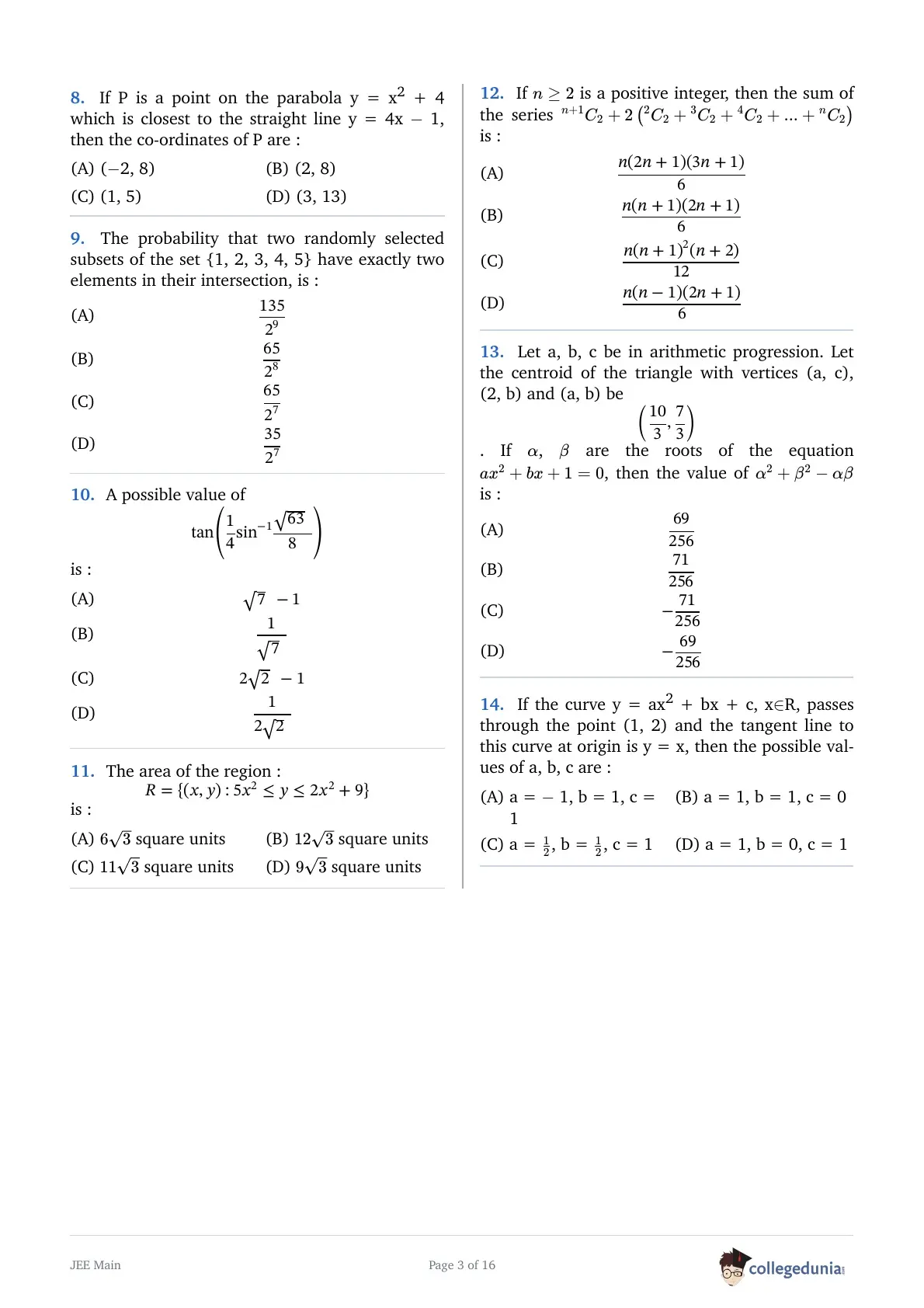
If \(P\) is a point on the parabola \(y=x^{2}+4\) which is closest to the straight line \(y =4 x -1\), then the co-ordinates of \(P\) are
The probability that two randomly selected subsets of the set {1, 2, 3, 4, 5} have exactly two elements in their intersection, is :
A possible value of \( \tan\!\left(\frac{1}{4}\sin^{-1}\!\left(\frac{\sqrt{63}}{8}\right)\right) \) is :
The area of the region : R = {(x, y) : 5x² ≤ y ≤ 2x² + 9} is :
If n ≥ 2 is a positive integer, then the sum of the series \(^{n+1}C_2 + 2( ^2C_2 + ^3C_2 + ^4C_2 + ....... + ^nC_2 )\) is :
Let a, b, c be in arithmetic progression. Let the centroid of the triangle with vertices (a, c), (2, b) and (a, b) be (10/3, 7/3). If α, β are the roots of the equation ax² + bx + 1 = 0, then the value of α² + β² - αβ is :
If the curve \(y=a x^{2}+b x+c, x \in R,\) passes through the point (1,2) and the tangent line to this curve at origin is \(y = x ,\) then the possible values of \(a , b , c\) are :
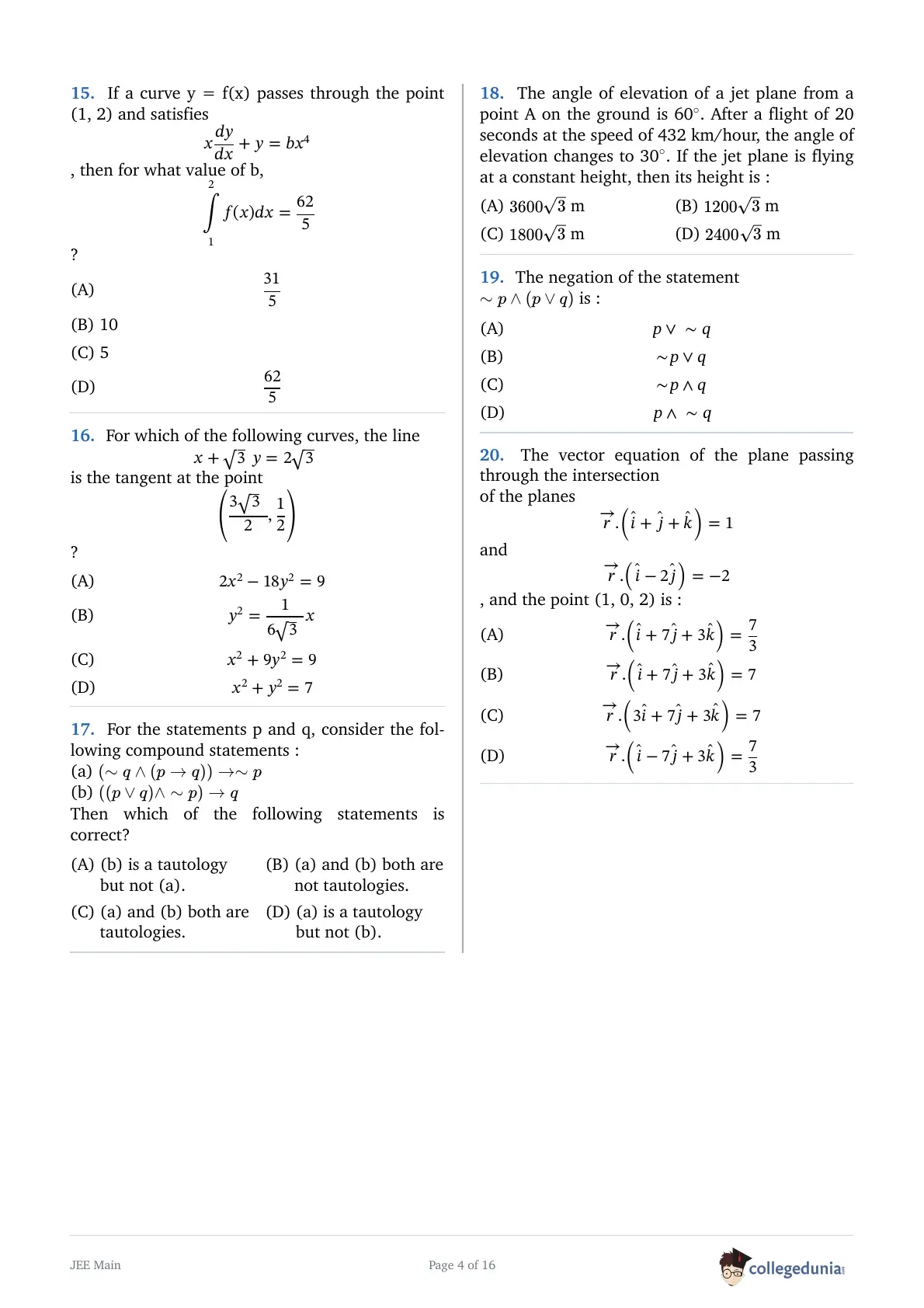
If \( y = f(x) \) passes through \( (1, 2) \) and \( x \frac{dy}{dx} + y = b x^4 \), then for what value of \( b \), \( \displaystyle \int_{1}^{2} f(x)\,dx = \frac{62}{5} \) ?
For which of the following curves, the line x + √3 y = 2√3 is the tangent at the point (3√3 / 2, 1/2) ?
For p and q, consider: (a) (~ q ∧ (p → q)) → ~ p, (b) ((p ∨ q) ∧ ~ p) → q. Which is correct ?
The angle of elevation of a jet plane from a point A on the ground is \(60^{\circ}\). After a flight of 20 seconds at the speed of \(432 km /\) hour, the angle of elevation changes to \(30^{\circ} .\) If the jet plane is flying at a constant height, then its height is :
The negation of the statement ~p ∧ (p ∨ q) is :
The vector equation of the plane passing through the intersection of the planes \(\vec{ r } .(\hat{ i }+\hat{ j }+\hat{ k })=1\) and \(\vec{ r } .(\hat{ i }-2 \hat{ j })=-2,\) and the point (1,0,2) is :
Mathematics - Section B (Q21 - Q30)
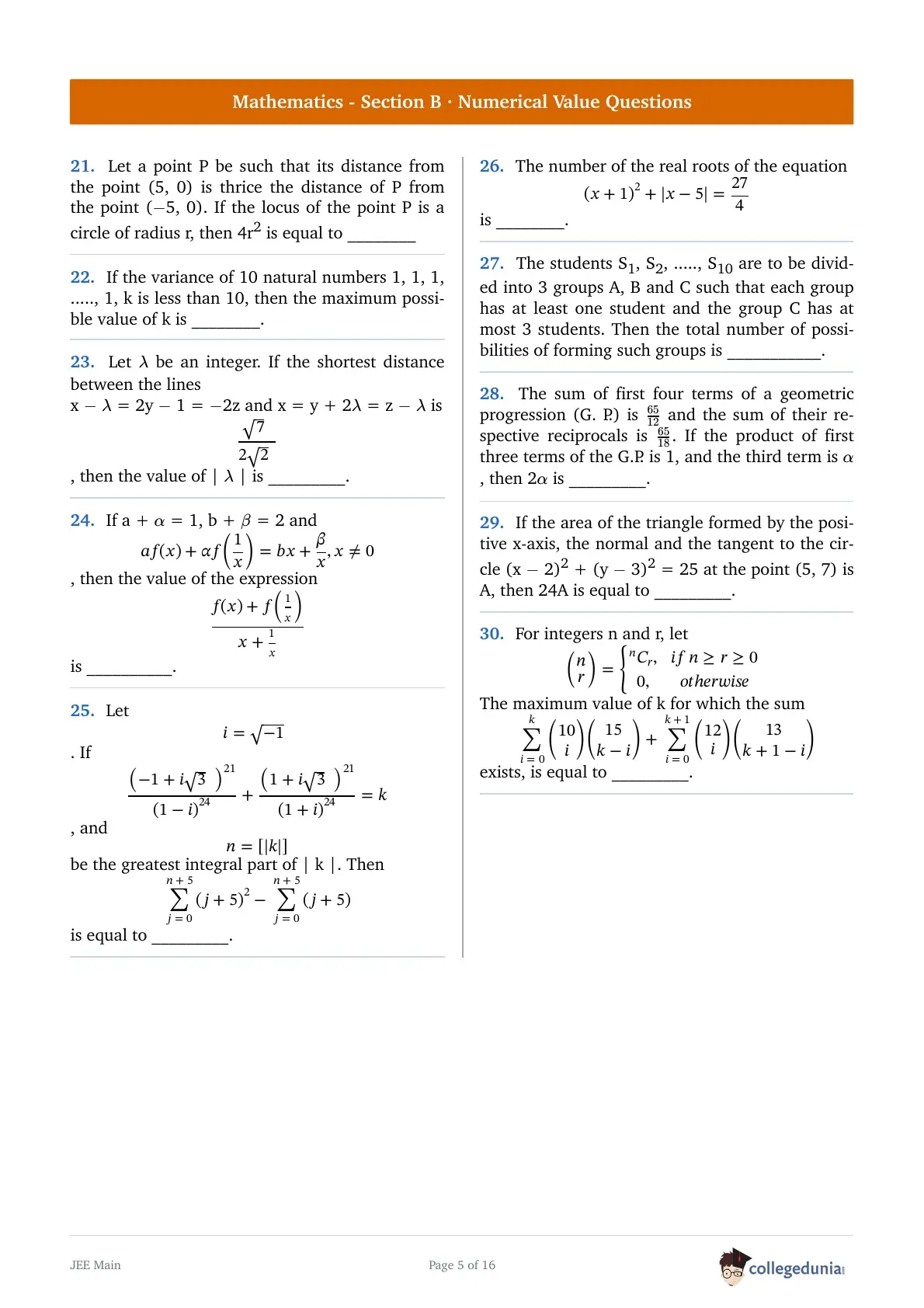
Let a point P be such that its distance from the point (5, 0) is thrice the distance of P from the point (-5, 0). If the locus of the point P is a circle of radius r, then 4r² is equal to ________
If the variance of 10 natural numbers 1, 1, 1, ......., 1, k is less than 10, then the maximum possible value of k is ______
If the shortest distance between x - λ = 2y - 1 = -2z and x = y + 2λ = z - λ is √7 / 2√2, then |λ| is _______
If a + α = 1, b + β = 2 and a f(x) + α f(1/x) = b x + β / x, then [f(x) + f(1/x)] / [x + 1/x] is ________
Let i = √-1. If \(\frac{(-1 + i\sqrt{3})^{21}}{(1 - i)^{24}} + \frac{(1 + i\sqrt{3})^{21}}{(1 + i)^{24}} = k\), and \(n = \lfloor |k| \rfloor\). Then \(\sum_{j=0}^{n+5} (j + 5)^2 - \sum_{j=0}^{n+5} (j + 5)\) is equal to __________.
The number of the real roots of the equation \( (x+1)^2 + |x-5| = \dfrac{27}{4} \) is _______
The students S1, S2, ......., S10 are to be divided into 3 groups A, B and C such that each group has at least one student and the group C has at most 3 students. Then the total number of possibilities of forming such groups is _________
The sum of first 4 terms of a G.P. is 65/12 and sum of their reciprocals is 65/18. If product of first 3 terms is 1 and the 3rd term is α, then 2α is _________
If the area of the triangle formed by the positive x-axis, the normal and the tangent to the circle \( (x-2)^2 + (y-3)^2 = 25 \) at the point \( (5, 7) \) is \( A \), then \( 24A \) is equal to _______
The maximum value of k for which the sum \(\sum_{i=0}^k \binom{10}{i} \binom{15}{k-i} + \sum_{i=0}^{k+1} \binom{12}{i} \binom{13}{k+1-i}\) exists, is equal to __________.
Physics - Section A (Q31 - Q50)
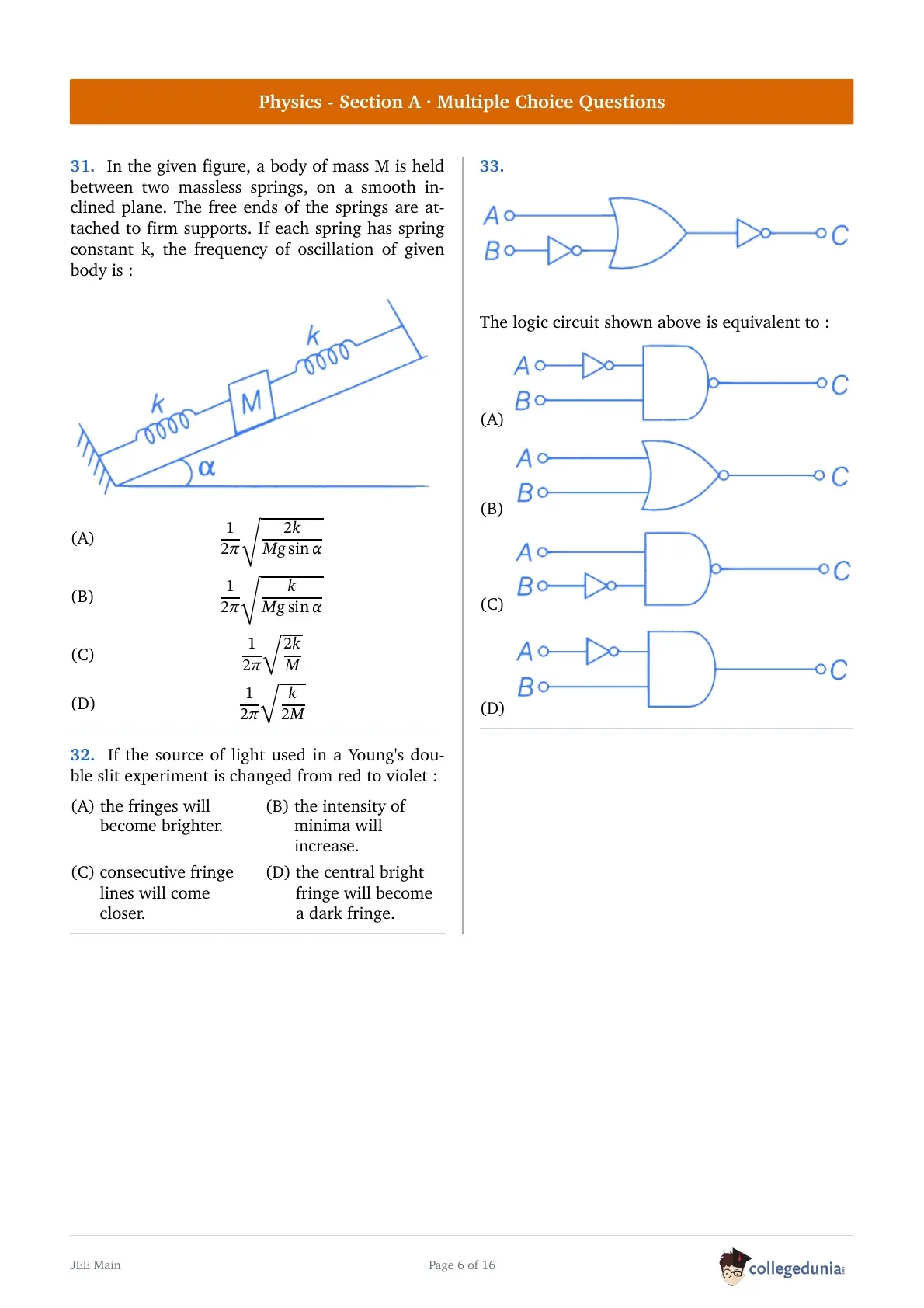
In the given figure, a body of mass M is held between two massless springs, on a smooth inclined plane. If each spring has spring constant k, the frequency of oscillation of given body is : 
If the source of light used in a Young's double slit experiment is changed from red to violet :
The logic circuit shown above is equivalent to : 
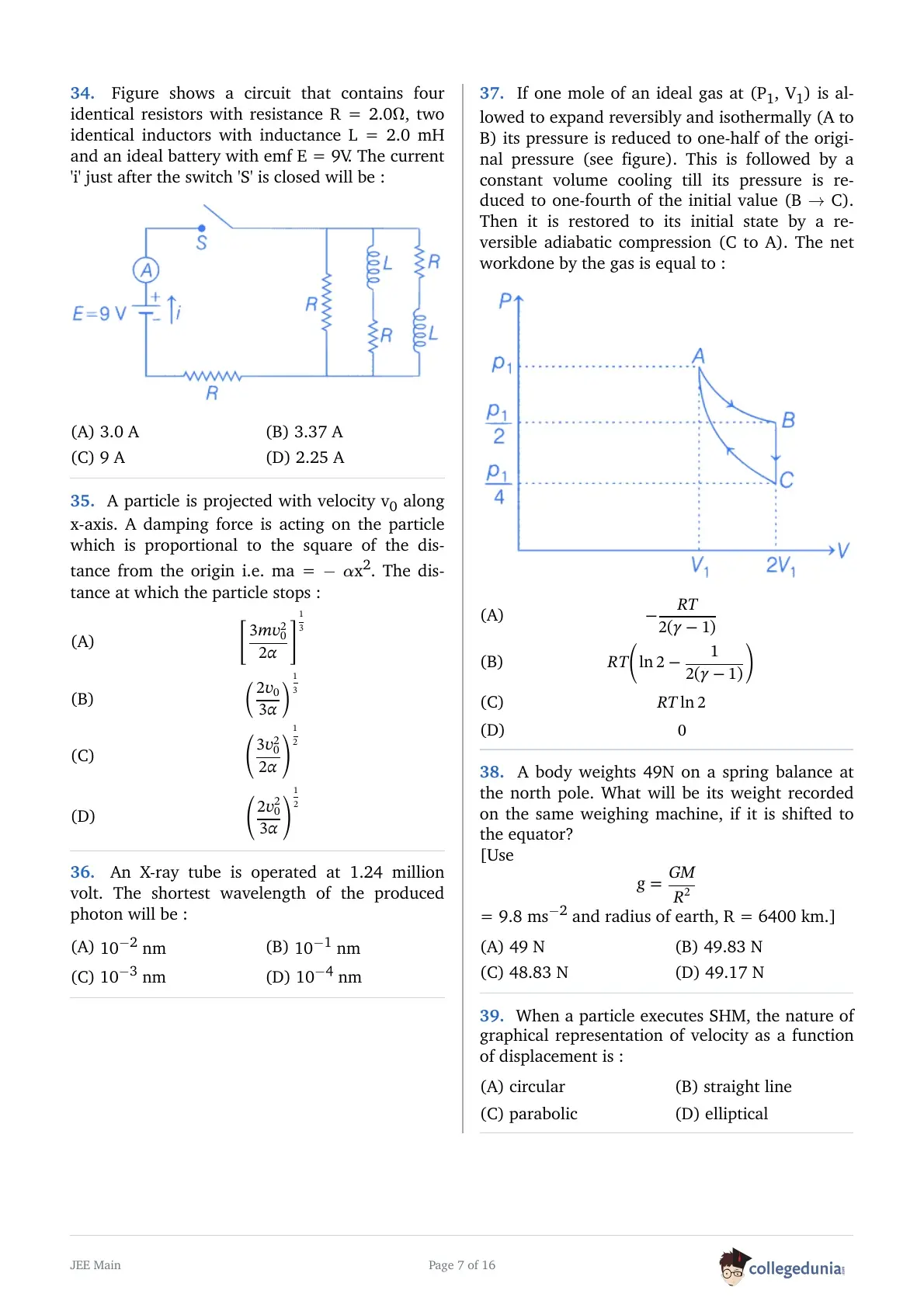
Figure shows a circuit that contains four identical resistors with resistance R=2.0 Ω, two identical inductors with inductance L=2.0 mH and an ideal battery with emf E=9 V. The current 'i' just after the switch 'S' is closed will be : 
A particle is projected with velocity \(v_0\) along x-axis. A damping force is acting on the particle which is proportional to the square of the distance from the origin i.e. \(ma = -ax^2\). The distance at which the particle stops :
An X-ray tube is operated at 1.24 million volt. The shortest wavelength of the produced photon will be :
If one mole of an ideal gas at \((P_1, V_1)\) is allowed to expand reversibly and isothermally (A to B) its pressure is reduced to one-half of the original pressure. This is followed by a constant volume cooling till its pressure is reduced to one-fourth of the initial value (B → C). Then it is restored to its initial state by a reversible adiabatic compression (C to A). The net work done by the gas is equal to : 
A body weighs 49 N on a spring balance at the north pole. What will be its weight recorded on the same weighing machine, if it is shifted to the equator? [Use \(g = \frac{GM}{R^2} = 9.8 \text{ ms}^{-2}\) and radius of earth, \(R = 6400 \text{ km}\).]
When a particle executes SHM, the nature of graphical representation of velocity as a function of displacement is :
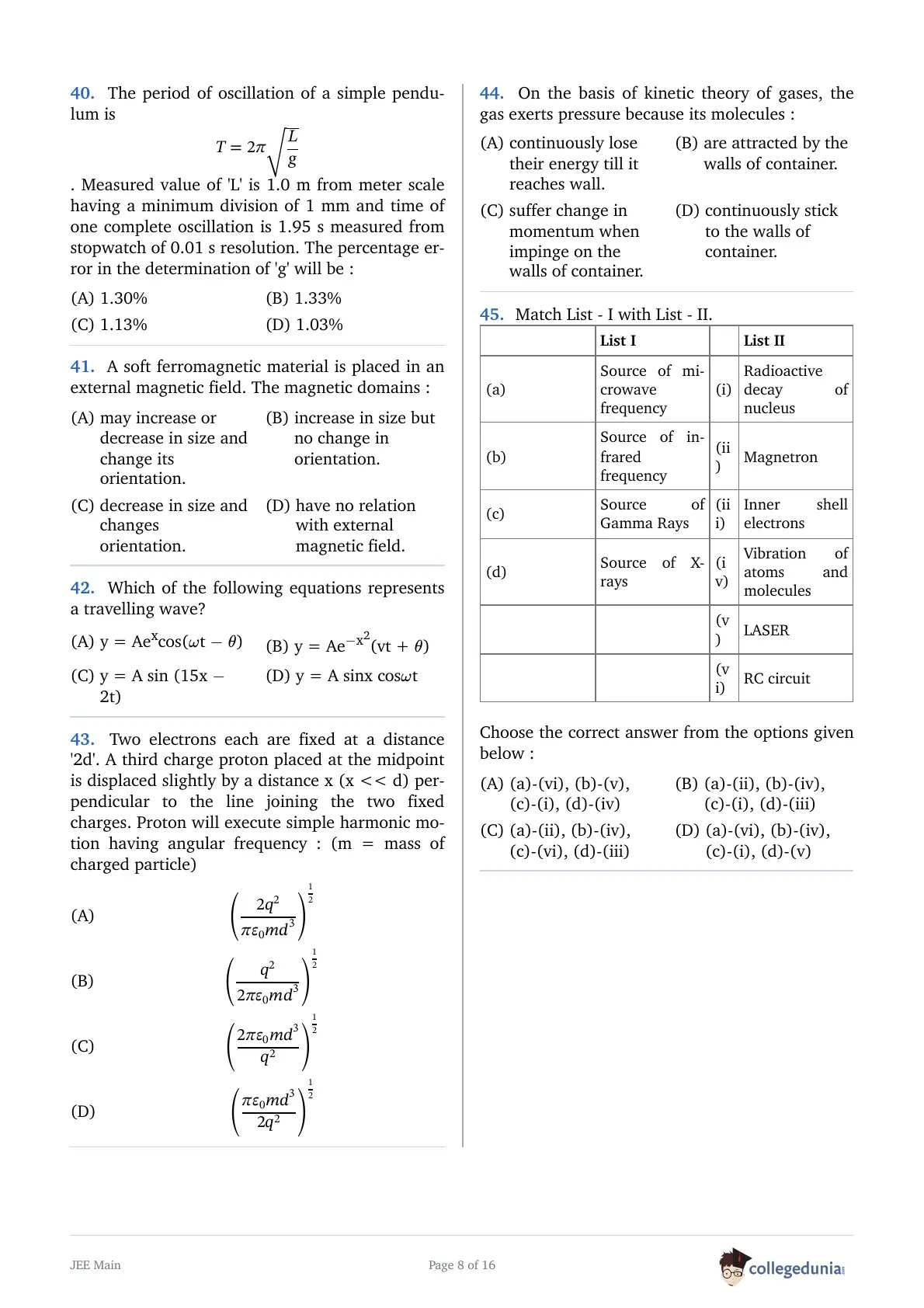
The period of oscillation of a simple pendulum is \(T = 2\pi \sqrt{\frac{L}{g}}\). Measured value of 'L' is 1.0 m from meter scale having a minimum division of 1 mm and time of one complete oscillation is 1.95 s measured from stopwatch of 0.01 s resolution. The percentage error in the determination of 'g' will be :
A soft ferromagnetic material is placed in an external magnetic field. The magnetic domains :
Which of the following equations represents a travelling wave ?
Two electrons each are fixed at a distance '2d'. A third charge proton placed at the midpoint is displaced slightly by a distance x (x << d) perpendicular to the line joining the two fixed charges. Proton will execute simple harmonic motion having angular frequency : (m = mass of charged particle)
On the basis of kinetic theory of gases, the gas exerts pressure because its molecules :
| List I | List II | ||
| (a) | Source of microwave frequency | (i) | Radioactive decay of nucleus |
| (b) | Source of infrared frequency | (ii) | Magnetron |
| (c) | Source of Gamma Rays | (iii) | Inner shell electrons |
| (d) | Source of X-rays | (iv) | Vibration of atoms and molecules |
| (v) | LASER | ||
| (vi) | RC circuit |
Choose the correct answer from the options given below :
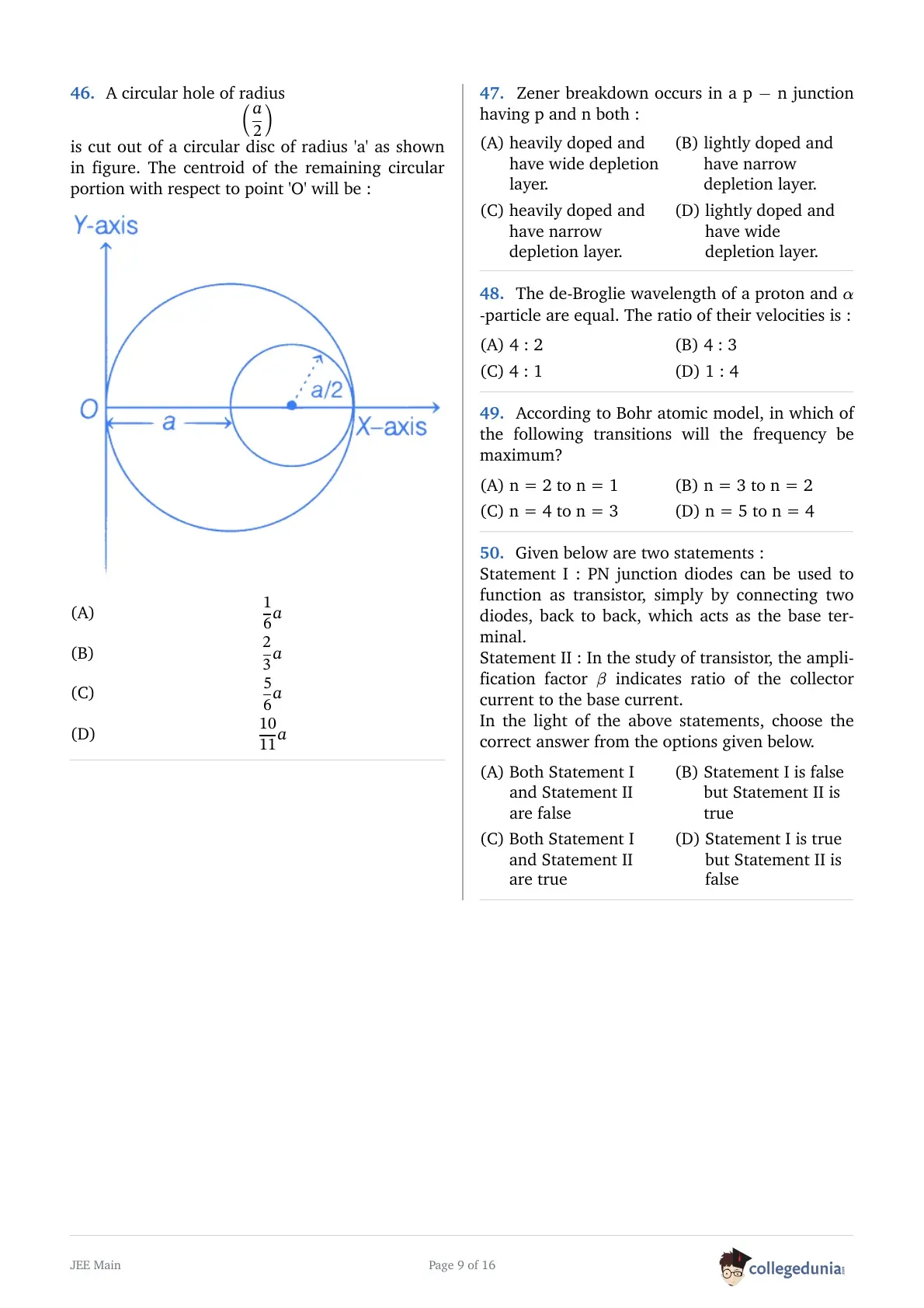
A circular hole of radius \(\left(\frac{a}{2}\right)\) is cut out of a circular disc of radius 'a' as shown in figure. The centroid of the remaining circular portion with respect to point 'O' will be : 
Zener breakdown occurs in a p-n junction having p and n both :
The de Broglie wavelength of a proton and α-particle are equal. The ratio of their velocities is :
According to Bohr atom model, in which of the following transitions will the frequency be maximum ?
Given below are two statements : Statement I : PN junction diodes can be used to function as transistor, simply by connecting two diodes, back to back, which acts as the base terminal. Statement II : In the study of transistor, the amplification factor β indicates ratio of the collector current to the base current. In the light of the above statements, choose the correct answer.
Physics - Section B (Q51 - Q60)
A uniform metallic wire is elongated by 0.04 m when subjected to a linear force F. The elongation, if its length and diameter is doubled and subjected to the same force will be ________ cm.
An electromagnetic wave of frequency 3 GHz enters a dielectric medium of relative electric permittivity 2.25 from vacuum. The wavelength of this wave in that medium will be ________ × 10−2 cm.
A cylindrical wire of radius 0.5 mm and conductivity \(5 \times 10^7\) S/m is subjected to an electric field of 10 mV/m. The expected value of current in the wire will be \(x^3 \pi\) mA. The value of \(x\) is ______.
Two solids A and B of mass 1 kg and 2 kg respectively are moving with equal linear momentum. The ratio of their kinetic energies (K.E.)A : (K.E.)B will be A/1, so the value of A will be ______
The root mean square speed of molecules of a given mass of a gas at 27°C and 1 atmosphere pressure is 200 m s−1. The root mean square speed of molecules of the gas at 127°C and 2 atmosphere pressure is \( \dfrac{x}{\sqrt{3}} \) m s−1. The value of \( x \) will be __________.
A series LCR circuit is designed to resonate at an angular frequency \( \omega_0 = 10^5 \) rad/s. The circuit draws 16 W power from a 120 V source at resonance. The value of resistance \( R \) in the circuit is _____ Ω.
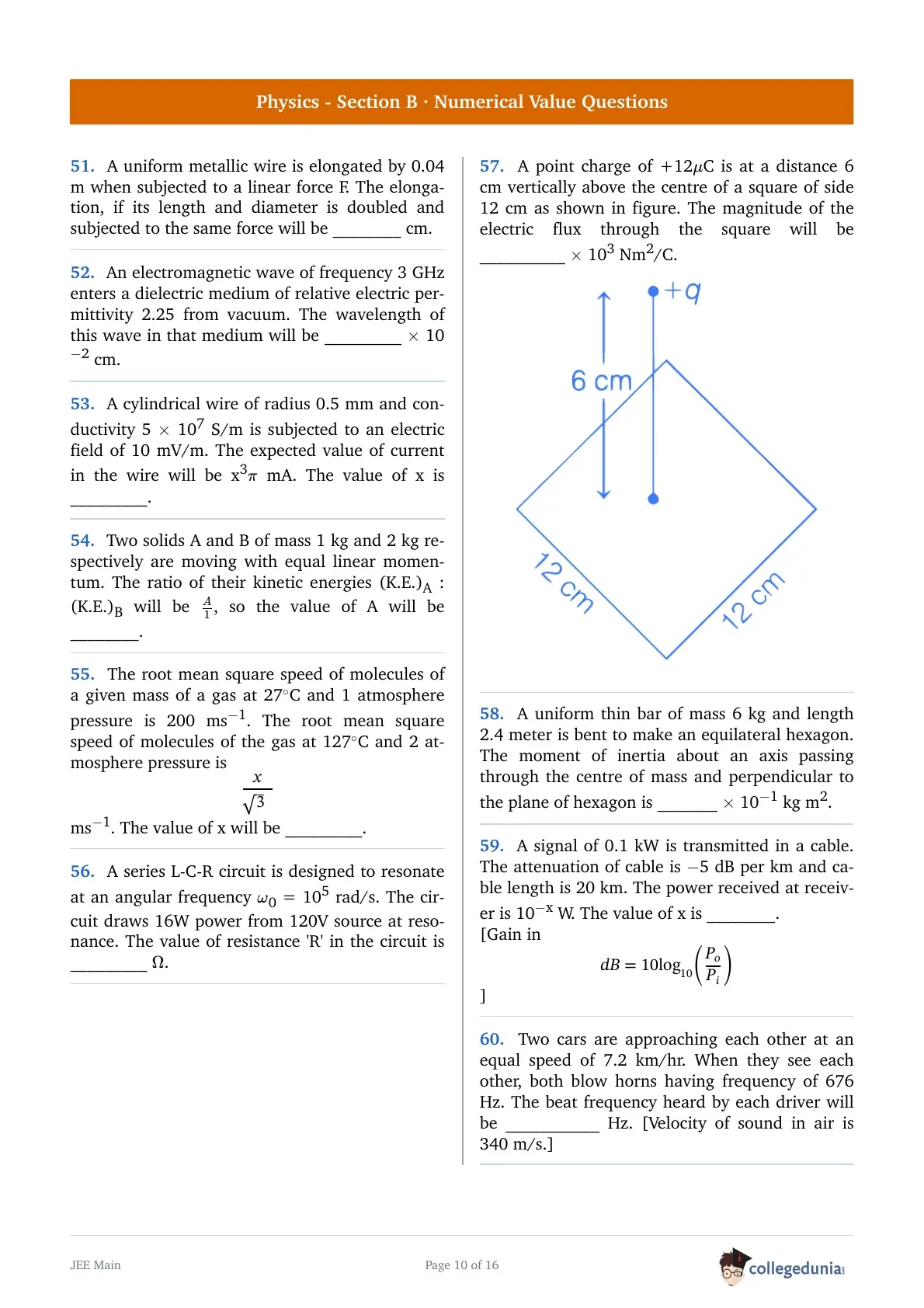
A point charge of +12 µC is at a distance 6 cm vertically above the centre of a square of side 12 cm. The magnitude of the electric flux through the square will be ________ × 10³ Nm²/C. 
A uniform thin bar of mass 6 kg and length 2.4 meter is bent to make an equilateral hexagon. The moment of inertia about an axis passing through the centre of mass and perpendicular to the plane of hexagon is __________ x 10\^{-1} kg m².
A signal of 0.1 kW is transmitted in a cable. The attenuation of the cable is −5 dB per km and the cable length is 20 km. The power received at the receiver is \(10^{-x}\) W. The value of \(x\) is __________.
Two cars are approaching each other at an equal speed of 7.2 km/hr. When they see each other, both blow horns having frequency of 676 Hz. The beat frequency heard by each driver will be ______ Hz. [Velocity of sound in air is 340 m/s.]
Chemistry - Section A (Q61 - Q80)
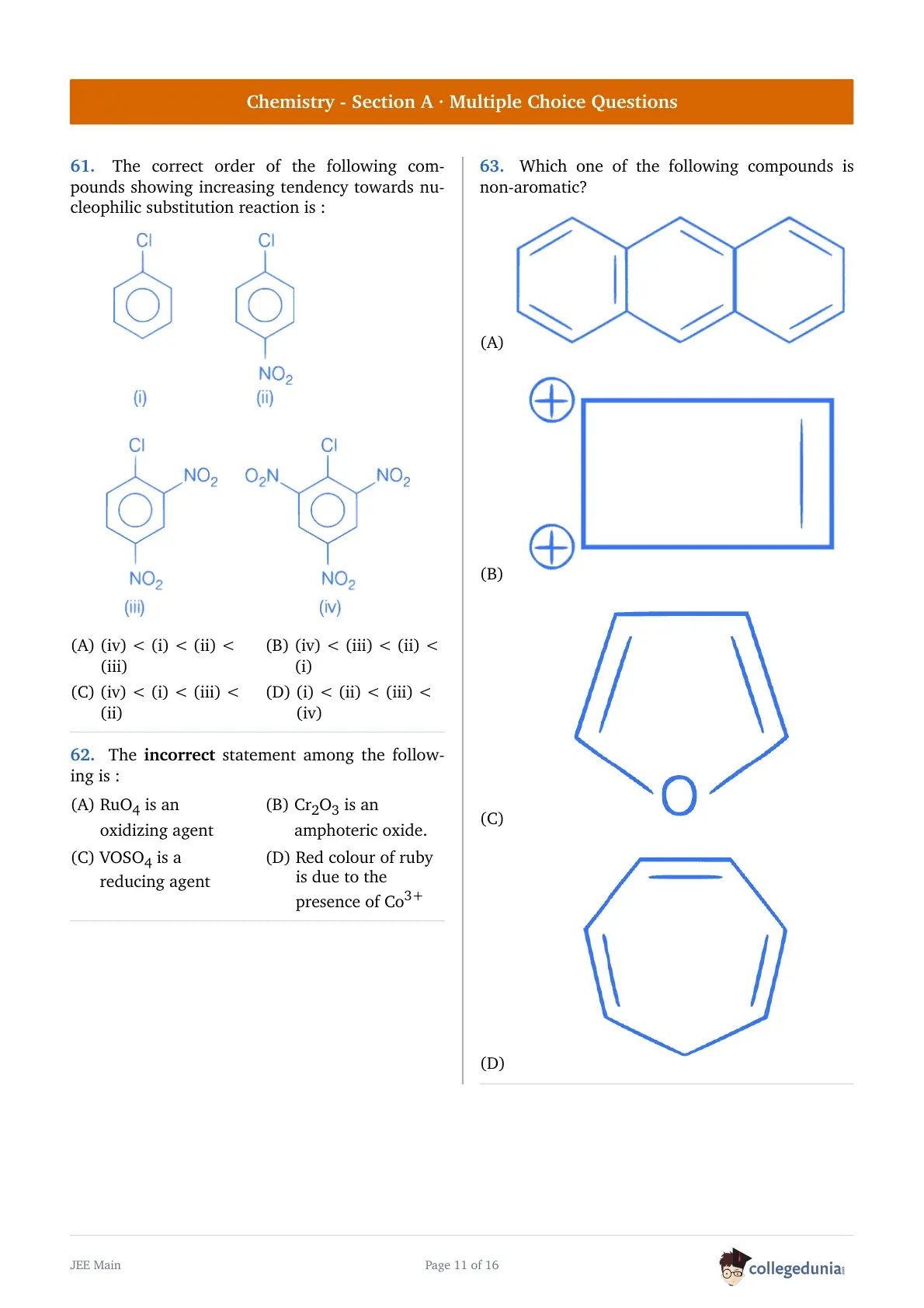
The correct order of the following compounds showing increasing tendency towards nucleophilic substitution reaction is : (Note: The compounds are chloro benzene with different nitro positions: (i) Chlorobenzene, (ii) 4-nitrochlorobenzene, (iii) 2,4-dinitrochlorobenzene, (iv) 2,4,6-trinitrochlorobenzene)
The incorrect statement among the following is :
Which one of the following compounds is non-aromatic ? 

According to Bohr's atomic theory :- (A) Kinetic energy of electron is \(\propto \frac{ Z ^{2}}{ n ^{2}}\). (B) The product of velocity (v) of electron and principal quantum number (n), 'vn' \(\propto Z ^{2}\). (C) Frequency of revolution of electron in an orbit is \(\propto \frac{ Z ^{3}}{ n ^{3}}\). (D) Coulombic force of attraction on the electron is \(\propto \frac{ Z ^{3}}{ n ^{4}}\). Choose the most appropriate answer from the options given below:
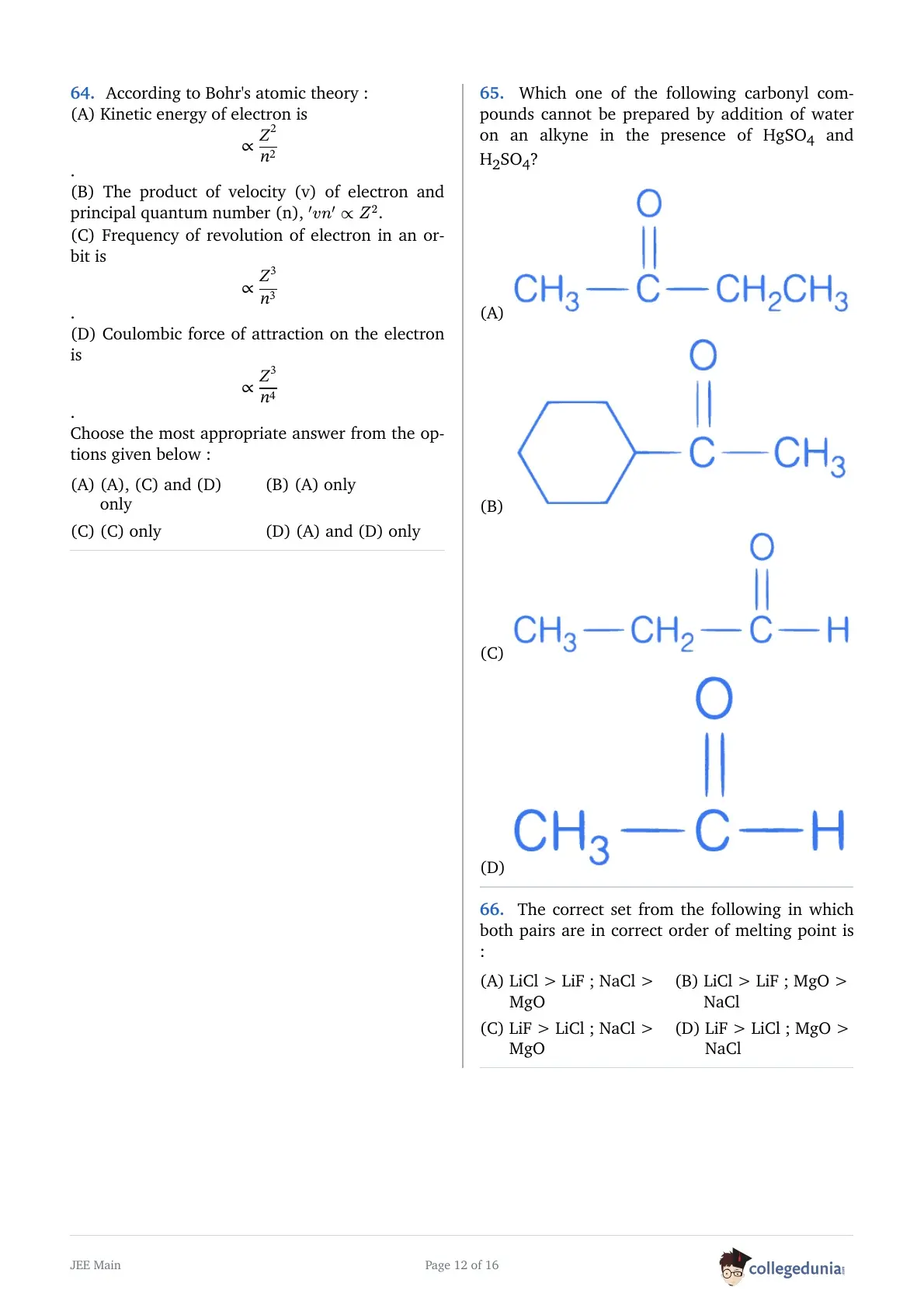
Which one of the following carbonyl compounds cannot be prepared by addition of water on an alkyne in the presence of HgSO₄ and H₂SO₄ ?
The correct set from the following in which both pairs are in correct order of melting point is :
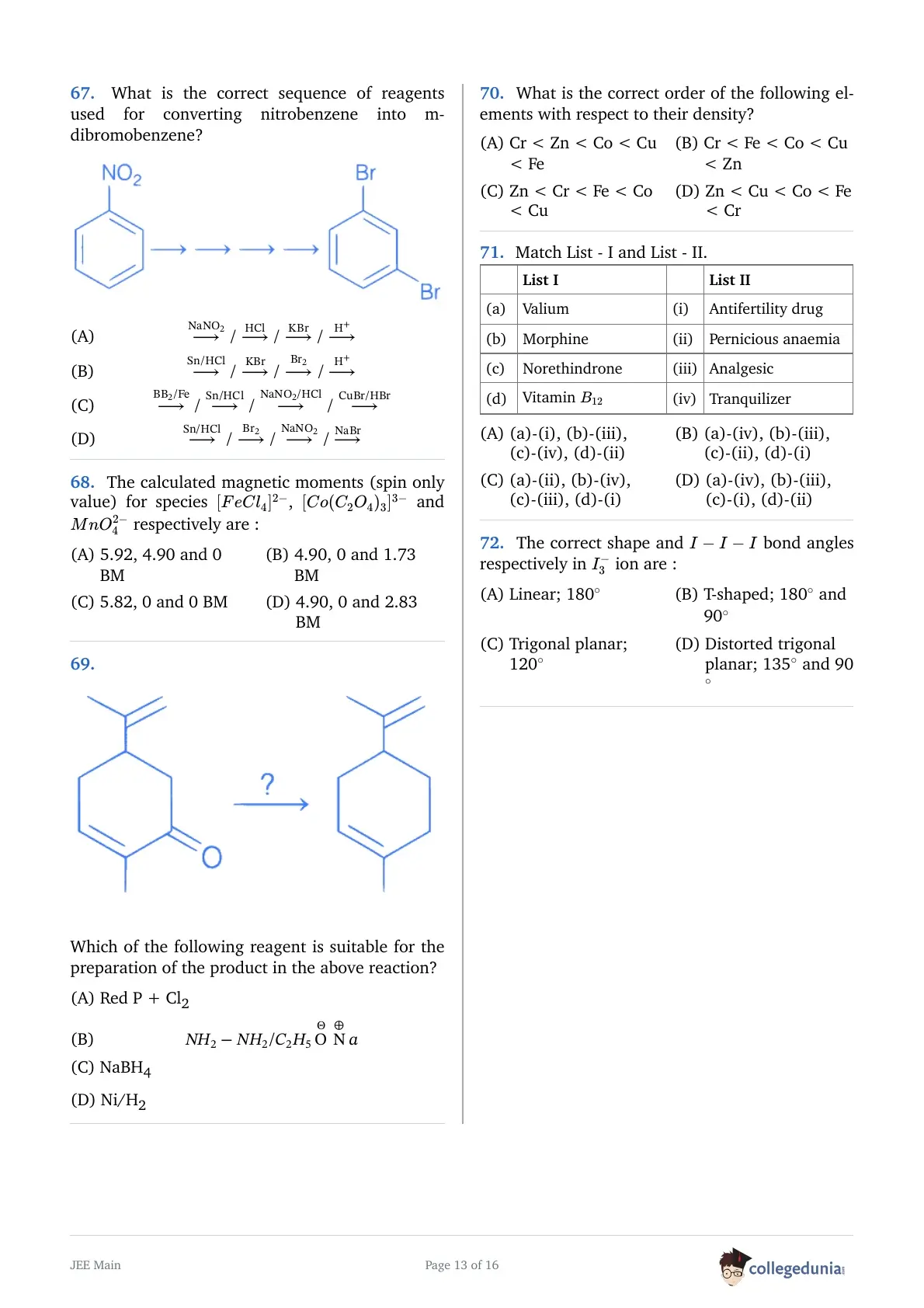
What is the correct sequence of reagents used for converting nitrobenzene into m-dibromobenzene ? 
The calculated magnetic moments (spin only value) for species \([FeCl_4]^{2-}\), \([Co(C_2O_4)_3]^{3-}\) and \(MnO_4^{2-}\) respectively are :
Which of the following reagent is suitable for the preparation of the product in the above reaction ? (reaction of ketone to alkane) 
What is the correct order of the following elements with respect to their density ?
Match List - I and List - II. List - I: (a) Valium, (b) Morphine, (c) Norethindrone, (d) Vitamin B12 List - II: (i) Antifertility drug, (ii) Pernicious anaemia, (iii) Analgesic, (iv) Tranquilizer
The correct shape and I-I-I bond angles respectively in \(I_3^-\) ion are :
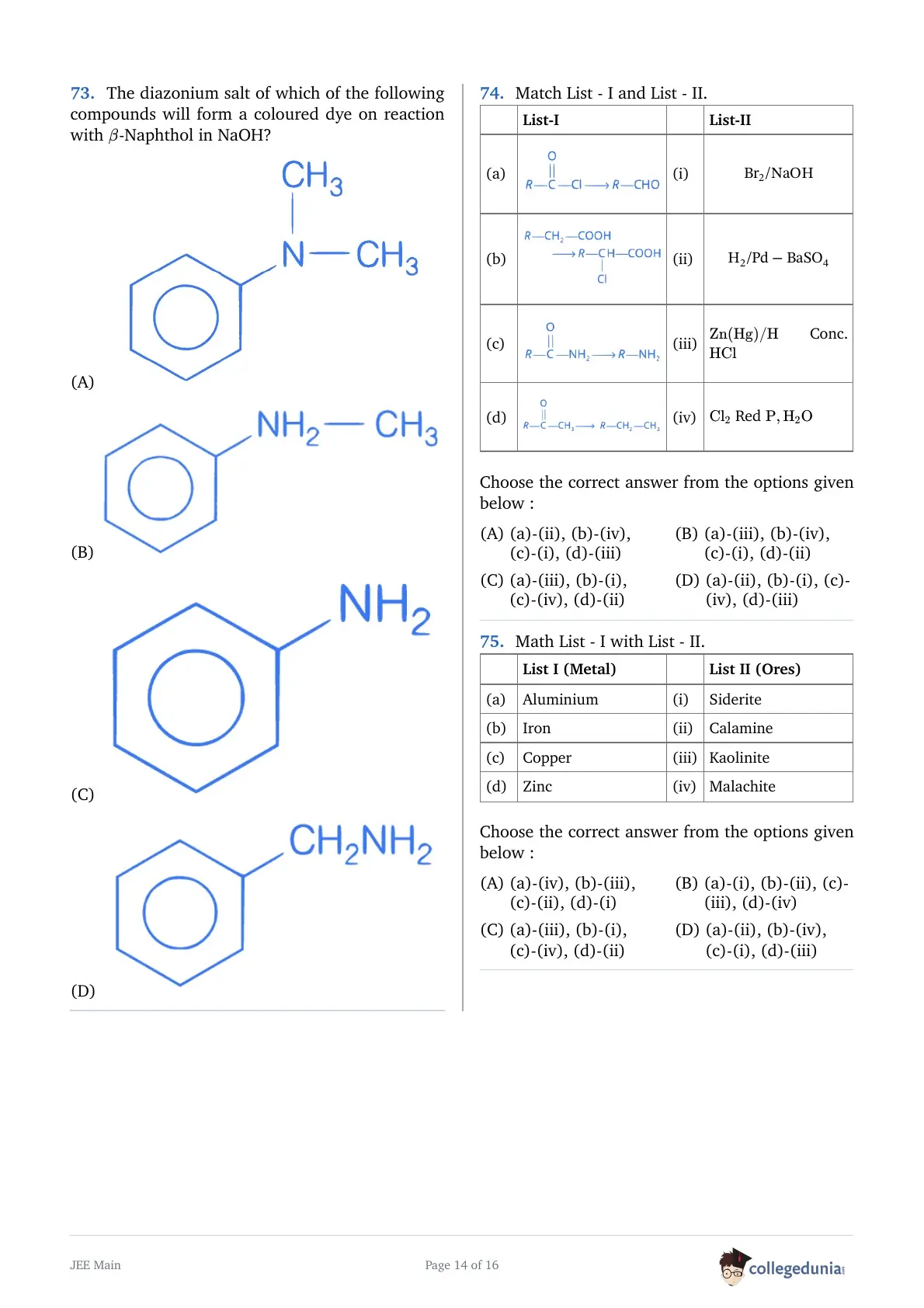
The diazonium salt of which of the following compounds will form a coloured dye on reaction with β-Naphthol in NaOH ? 
| List-I | List-II | ||
| (a) | \(\mathrm{R-CO-Cl \rightarrow R-CHO}\) | (i) | \(\mathrm{Br_2/NaOH}\) |
| (b) | \(\mathrm{R-CH_2-COOH \rightarrow R-CHCl-COOH}\) | (ii) | \(\mathrm{H_2/Pd-BaSO_4}\) |
| (c) | \(\mathrm{R-CO-NH_2 \rightarrow R-NH_2}\) | (iii) | \(\mathrm{Zn(Hg)/conc.\ HCl}\) |
| (d) | \(\mathrm{R-CO-CH_3 \rightarrow R-CH_2-CH_3}\) | (iv) | \(\mathrm{Cl_2,\ Red\ P,\ H_2O}\) |
Choose the correct answer from the options given below :
| List I (Metal) | List II (Ores) | ||
| (a) | Aluminium | (i) | Siderite |
| (b) | Iron | (ii) | Calamine |
| (c) | Copper | (iii) | Kaolinite |
| (d) | Zinc | (iv) | Malachite |
Choose the correct answer from the options given below :
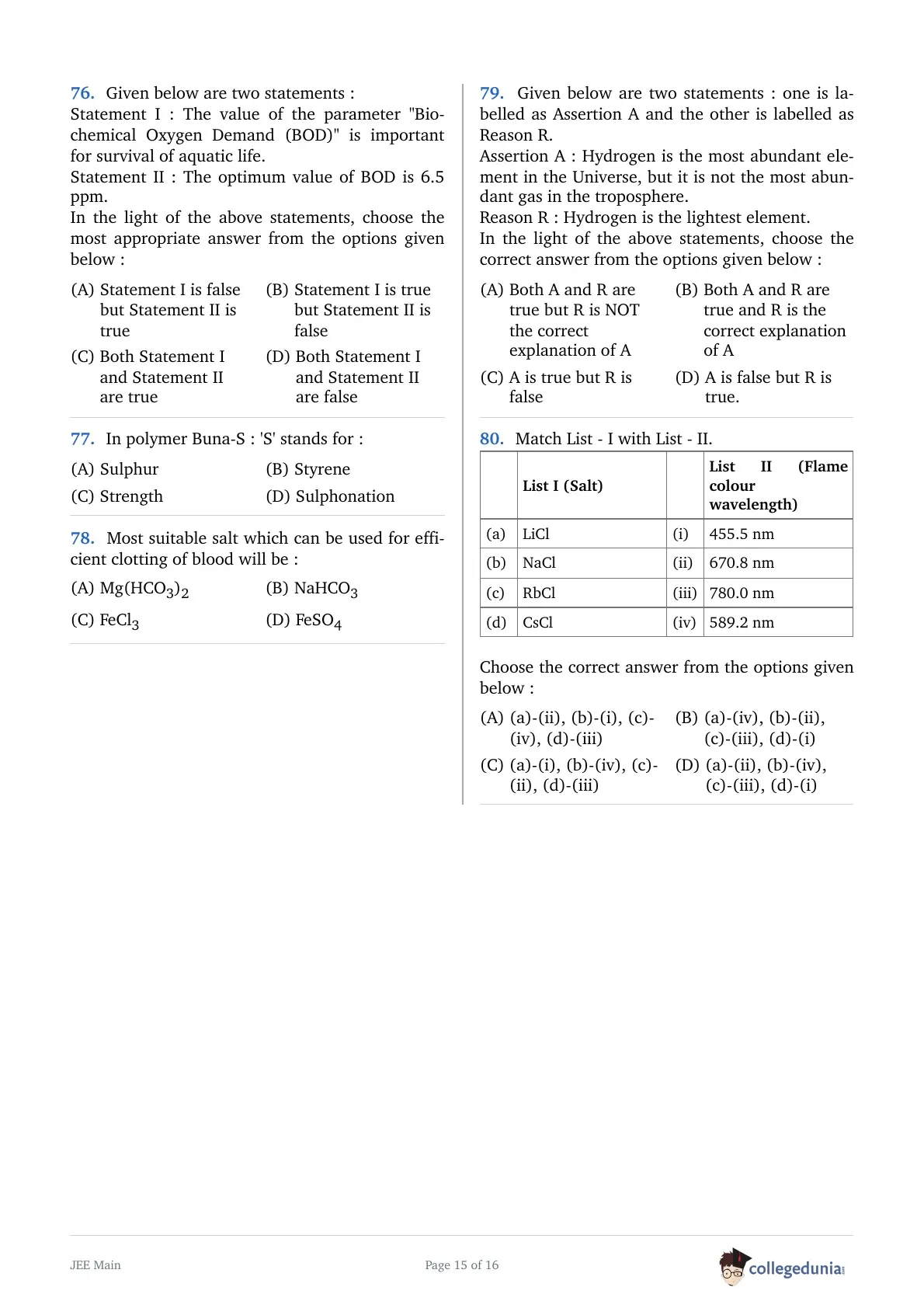
Given below are two statements : Statement I : The value of the parameter “Biochemical Oxygen Demand (BOD)” is important for survival of aquatic life. Statement II : The optimum value of BOD is 6.5 ppm. In the light of the above statements, choose the most appropriate answer from the options given below :
In polymer Buna-S : 'S' stands for :
Most suitable salt which can be used for efficient clotting of blood will be :
Assertion A : Hydrogen is the most abundant element in the Universe, but it is not the most abundant gas in the troposphere. Reason R : Hydrogen is the lightest element.
| List-I Alkali Metal | List-II Emission Wavelength in nm |
|---|---|
| (A) Li | (I) 589.2 |
| (B) Na | (II) 455.5 |
| (C) Rb | (III) 670.8 |
| (D) Cs | (IV) 780.0 |
Chemistry - Section B (Q81 - Q90)
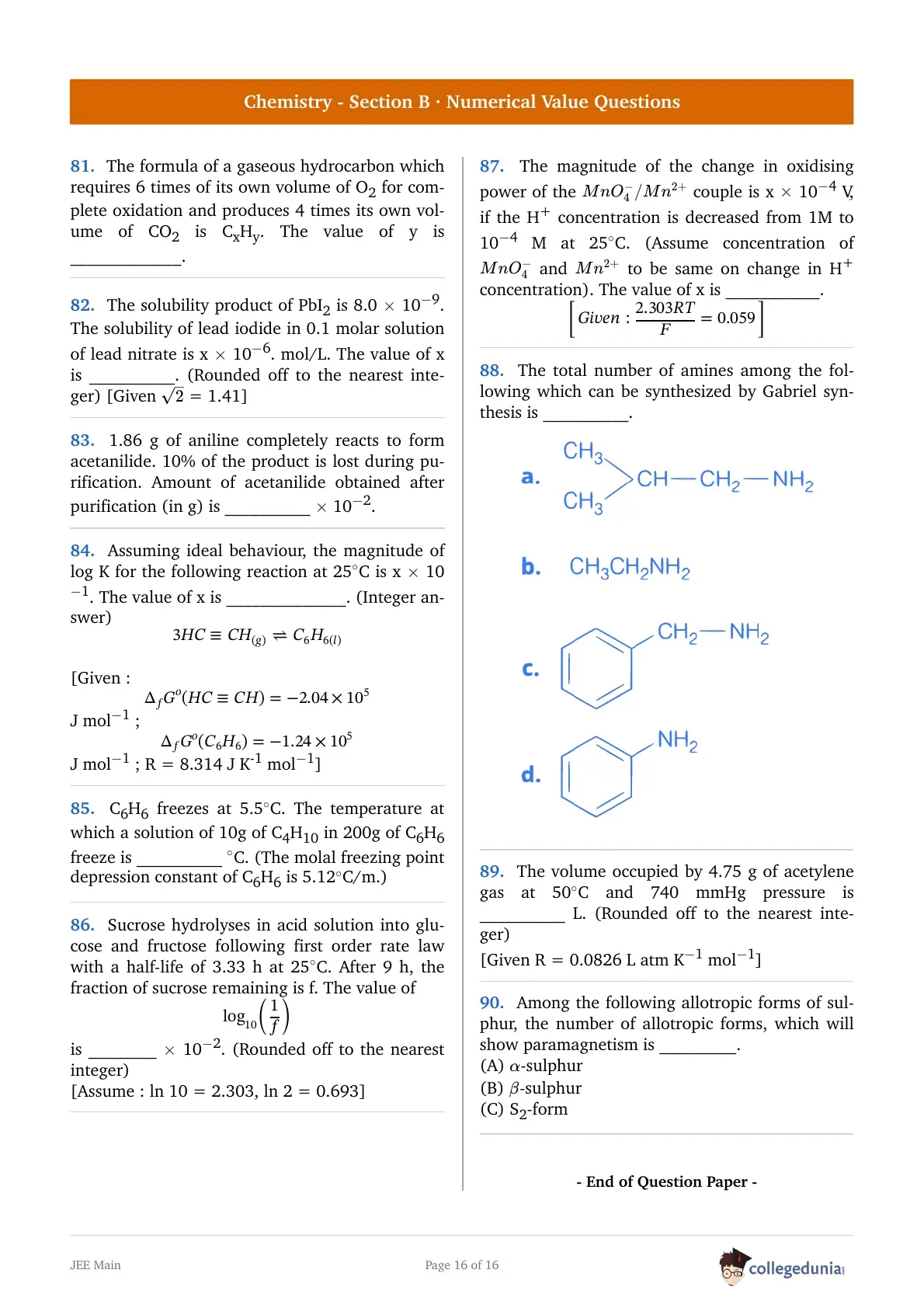
The formula of a gaseous hydrocarbon which requires 6 times of its own volume of O2 for complete oxidation and produces 4 times its own volume of CO2 is CxHy. The value of y is _________
The solubility product of PbI2 is \( 8.0 \times 10^{-9} \). The solubility of lead iodide in 0.1 molar solution of lead nitrate is \( x \times 10^{-6} \) mol/L. The value of \( x \) is __________. (Rounded off to the nearest integer) [Given \( \sqrt{2} = 1.41 \)]
1.86 g of aniline completely reacts to form acetanilide. 10% of the product is lost during purification. Amount of acetanilide obtained after purification (in g) is _________ × 10−2.
Assuming ideal behaviour, the magnitude of log K for the following reaction at 25 °C is \( x \times 10^{-1} \). The value of \( x \) is __________ . (Integer answer) \( 3\,\text{HC}\equiv\text{CH (g)} \rightleftharpoons \text{C}_6\text{H}_6 \text{ (l)} \) [Given : \( \Delta_f G^\circ (\text{HC}\equiv\text{CH}) = -2.04 \times 10^5 \,\text{J mol}^{-1} \); \( \Delta_f G^\circ (\text{C}_6\text{H}_6) = -1.24 \times 10^5 \,\text{J mol}^{-1} \); \( R = 8.314 \,\text{J K}^{-1} \text{ mol}^{-1} \)]
C6H6 freezes at 5.5°C. The temperature at which a solution of 10 g of C4H10 in 200 g of C6H6 freeze is ________ °C. (The molal freezing point depression constant of C6H6 is 5.12°C/m.)
Sucrose hydrolyses in acid solution into glucose and fructose following first order rate law with a half-life of 3.33 h at 25 °C. After 9 h, the fraction of sucrose remaining is \( f \). The value of \( \log_{10}(1/f) \) is _______ × 10−2. (Rounded off to the nearest integer)
The magnitude of the change in oxidising power of the MnO4− / Mn2+ couple is \( x \times 10^{-4} \) V, if the H+ concentration is decreased from 1 M to \( 10^{-4} \) M at 25 °C. (Assume concentration of MnO4− and Mn2+ to be same on change in H+ concentration). The value of \( x \) is __________ .
The total number of amines among the following which can be synthesized by Gabriel synthesis is _________. (A) ethylamine, (B) n-propylamine, (C) benzylamine, (D) aniline
The volume occupied by 4.75 g of acetylene gas at 50 °C and 740 mmHg pressure is _______ L. (Rounded off to the nearest integer) [Given \( R = 0.0826 \, \text{L atm K}^{-1} \text{ mol}^{-1} \)]
Among the following allotropic forms of sulphur, the number of allotropic forms, which will show paramagnetism is __________
JEE Main 2021 Exam Pattern and Marking Scheme
| Particulars | Details |
|---|---|
| Exam Mode | Online (Computer-Based Test) |
| Paper | B.E./B.Tech (Paper 1) |
| Duration | 3 hours (180 minutes) |
| Type of Questions | Multiple Choice Questions (MCQs) + Numerical Value Questions |
| Subjects | Mathematics, Physics, Chemistry |
| Total Questions | 90 questions (75 to be attempted) |
| Total Marks | 300 marks |
| Marking Scheme | +4 for correct answer & -1 for incorrect MCQ; no negative marking for Numerical Value Questions |
JEE Main 2021 February 24 Shift 2 Difficulty Level
JEE Main 2021 B.E./B.Tech Question Paper - February 24, 2021- Afternoon Session was considered to be of moderate difficulty level. Following the new JEE Main Exam Pattern for the year 2021, the paper had 90 questions in total, out of which candidates had to attempt 75 questions. Choices of attempting any 5 out of the 10 numerical answer type questions were given to the candidate in each section. Mathematics was the toughest section in the paper, followed by Physics. Chemistry was the easiest section of the paper consisting of direct formula and equation-based questions.
JEE Main 2021 B.E./B.Tech Question Paper February 24 (AN): Paper Analysis
JEE Main 2021 B.E./B.Tech Paper February 24 Afternoon Session was conducted from 3.00 PM to 6.00 PM.
- Each section had 10 Integer type Numerical Answer Questions, out of which the candidate needed to attempt any 5.
- Mathematics had maximum questions on Integral Calculus, Differential Calculation, Coordination, and Algebra. Check JEE Main Mathematics Syllabus
- For Physics, the dominant topics were Electrostatics, Mechanics, Optics & Modern Physics. Check JEE Main Physics Syllabus
- Chemistry featured major questions from Chemical Thermodynamics, Chemical Kinetics, Coordination Compounds, and Polymers. Check JEE Main Chemistry Syllabus
Check: Detailed Paper Analysis of February 24 Afternoon Session at – JEE Main Question Paper Analysis



Comments