




JEE Main 2021 February 26 Shift 2 Question Paper is available here with solutions PDF and detailed solutions for every question. NTA conducted the second shift on February 26, 2021, from 3:00 PM to 6:00 PM. The JEE Main 2021 Paper 1 (B.E./B.Tech) question paper includes the following:
- 90 questions in a 3-hour CBT Mode: 30 each from Mathematics, Physics and Chemistry (75 to be attempted)
- Section A: 20 multiple choice questions (MCQs) per subject, all compulsory, 4 marks each
- Section B: 10 numerical value questions per subject, any 5 to be attempted, 4 marks each
- Marking: +4 for a correct answer, -1 for an incorrect MCQ, 0 for an unattempted question; no negative marking for numerical value questions
- Maximum marks: 300 (100 per subject)
JEE Main 2021 February 26 Shift 2 Question Paper with Solution PDF
| NTA Official PDF | CD PDF | CD PDF with Solutions |
|---|---|---|
| Download official PDF 5.42 MB | Download Collegedunia PDF 0.98 MB | Download solutions PDF 1.33 MB |
Also Check:
JEE Main 2021 February 26 Shift 2 Questions with Solutions
Mathematics - Section A (Q1 - Q20)
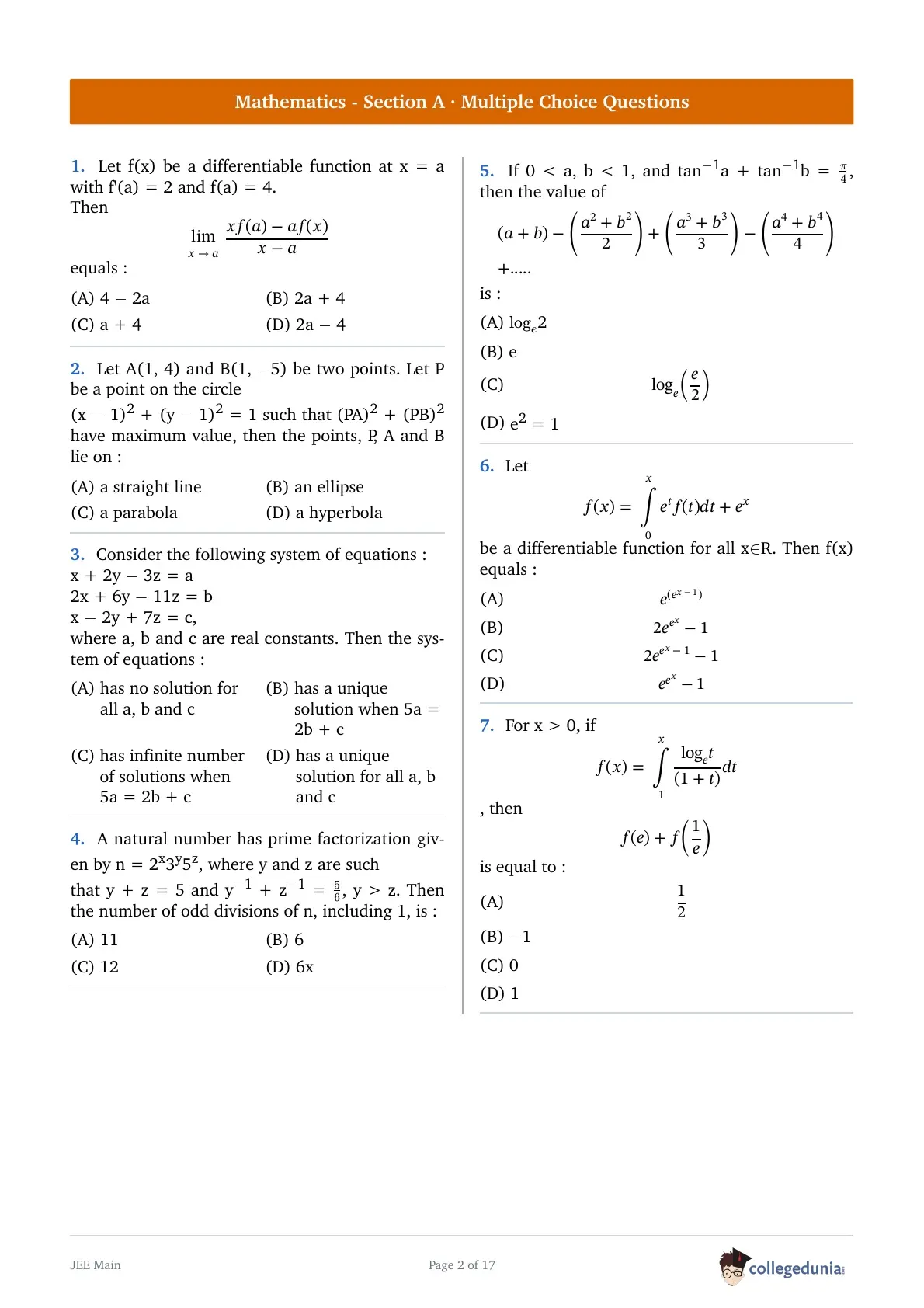
Let \(f(x)\) be a differentiable function at \(x = a\) with \(f'(a) = 2\) and \(f(a) = 4\).
Then \(\displaystyle\lim_{x \to a} \frac{x f(a) - a f(x)}{x - a}\) equals :
Let \(A(1, 4)\) and \(B(1, -5)\) be two points. Let \(P\) be a point on the circle \((x - 1)^2 + (y - 1)^2 = 1\) such that \((PA)^2 + (PB)^2\) have maximum value, then the points, \(P\), \(A\) and \(B\) lie on :
Consider the following system of equations :
\(x + 2y - 3z = a\)
\(2x + 6y - 11z = b\)
\(x - 2y + 7z = c\),
where \(a\), \(b\) and \(c\) are real constants. Then the system of equations :
A natural number has prime factorization given by \(n = 2^x 3^y 5^z\), where \(y\) and \(z\) are such that \(y + z = 5\) and \(y^{-1} + z^{-1} = \frac{5}{6}\), \(y \gt z\). Then the number of odd divisions of \(n\), including 1, is :
If \(0 \lt a, b \lt 1\), and \(\tan^{-1}a + \tan^{-1}b = \frac{\pi}{4}\), then the value of
\((a + b) - \left(\frac{a^2 + b^2}{2}\right) + \left(\frac{a^3 + b^3}{3}\right) - \left(\frac{a^4 + b^4}{4}\right) + \dots\)
is :
Let \(f(x) = \displaystyle\int_0^x e^t f(t)\,dt + e^x\) be a differentiable function for all \(x \in R\). Then \(f(x)\) equals :
For \(x \gt 0\), if \(f(x) = \displaystyle\int_1^x \frac{\log_e t}{(1 + t)}\,dt\), then \(f(e) + f\left(\frac{1}{e}\right)\) is equal to :
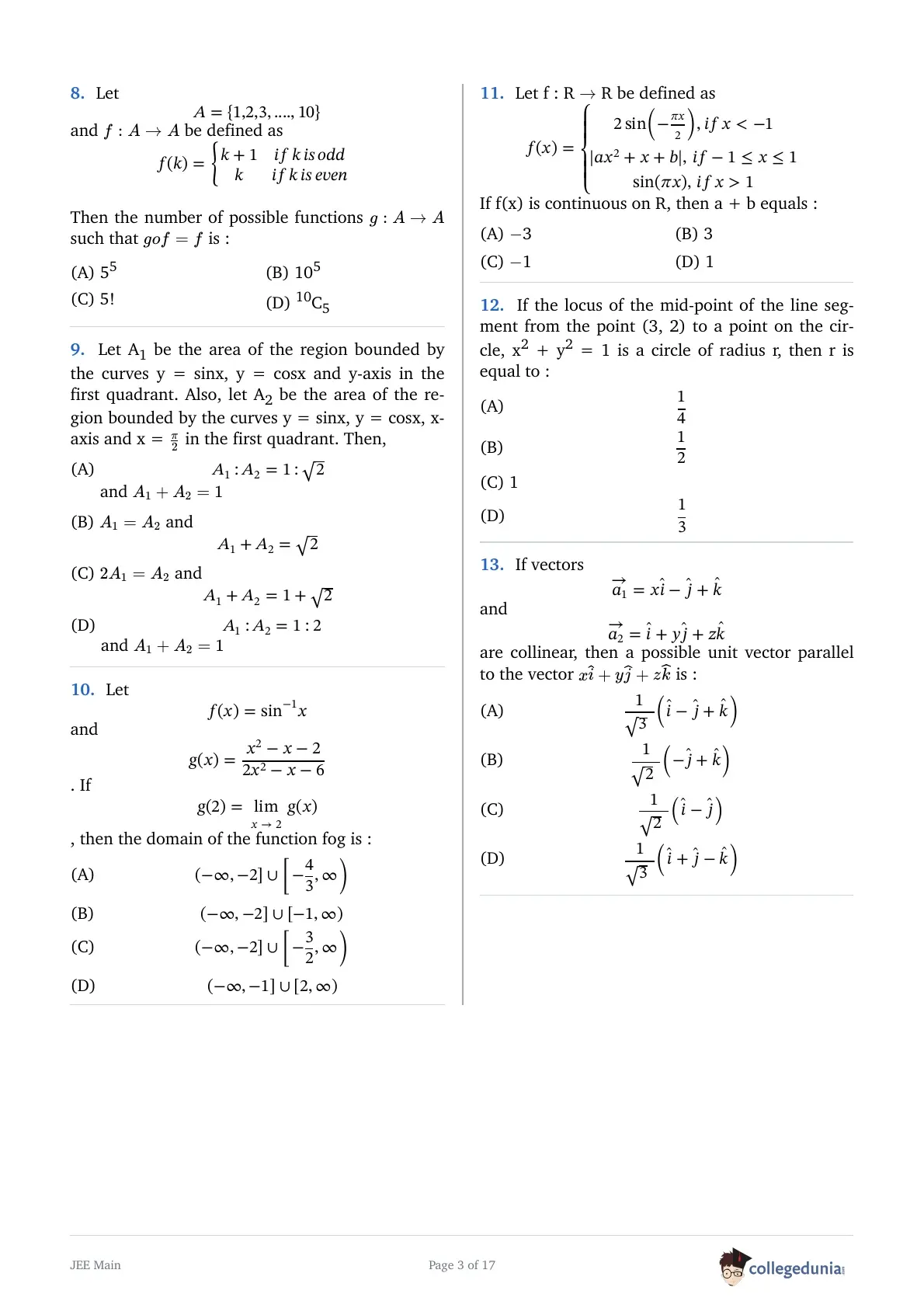
Let \(A = \{1, 2, 3, \dots, 10\}\) and \(f : A \to A\) be defined as
\(f(k) = \begin{cases} k + 1 & \text{if } k \text{ is odd} \\ k & \text{if } k \text{ is even} \end{cases}\)
Then the number of possible functions \(g : A \to A\) such that \(g \circ f = f\) is :
Let \(A_1\) be the bounded area enclosed by the curves \(y=x^2+2\), \(x+y=8\) and \(y\)-axis that lies in the first quadrant.
Let \(A_2\) be the bounded area enclosed by the curves \(y=x^2+2\), \(y^2=x\), \(x=2\) and \(y\)-axis that lies in the first quadrant.
Then \(A_1-A_2\) is equal to
Let \(f(x) = \sin^{-1}x\) and \(g(x) = \frac{x^2 - x - 2}{2x^2 - x - 6}\). If \(g(2) = \displaystyle\lim_{x \to 2} g(x)\), then the domain of the function \(f \circ g\) is :
Let \(f : R \to R\) be defined as
\(f(x) = \begin{cases} 2\sin\left(-\frac{\pi x}{2}\right), & \text{if } x \lt -1 \\ |ax^2 + x + b|, & \text{if } -1 \le x \le 1 \\ \sin(\pi x), & \text{if } x \gt 1 \end{cases}\)
If \(f(x)\) is continuous on \(R\), then \(a + b\) equals :
If the locus of the mid-point of the line segment from the point \((3, 2)\) to a point on the circle, \(x^2 + y^2 = 1\) is a circle of radius \(r\), then \(r\) is equal to :
If vectors \(\vec{a_1} = x\hat{i} - \hat{j} + \hat{k}\) and \(\vec{a_2} = \hat{i} + y\hat{j} + z\hat{k}\) are collinear, then a possible unit vector parallel to the vector \(x\hat{i} + y\hat{j} + z\hat{k}\) is :
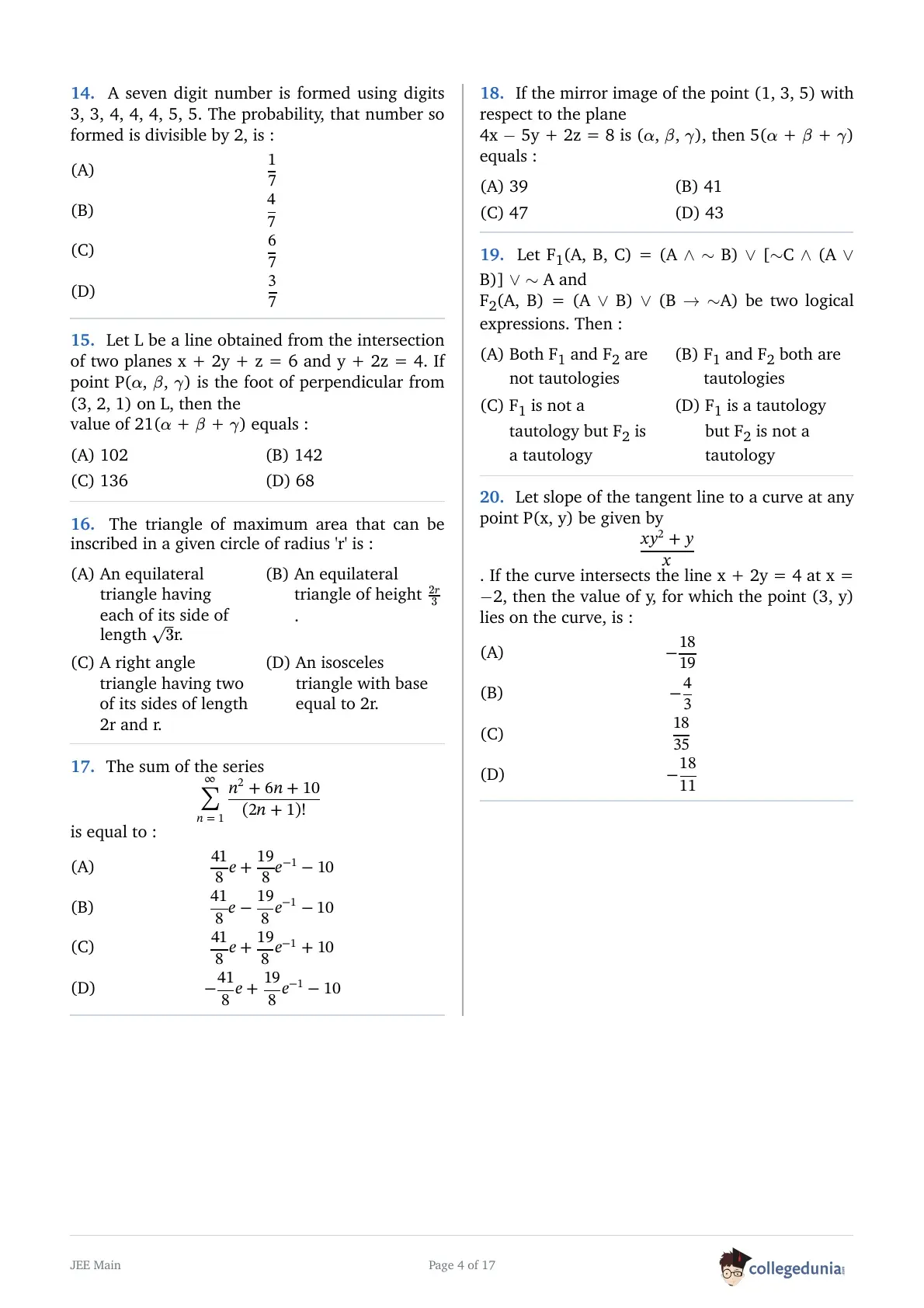
A seven digit number is formed using digits \(3, 3, 4, 4, 4, 5, 5\). The probability, that number so formed is divisible by 2, is :
Let \(L\) be a line obtained from the intersection of two planes \(x + 2y + z = 6\) and \(y + 2z = 4\). If point \(P(\alpha, \beta, \gamma)\) is the foot of perpendicular from \((3, 2, 1)\) on \(L\), then the value of \(21(\alpha + \beta + \gamma)\) equals :
The triangle of maximum area that can be inscribed in a given circle of radius 'r' is :
The sum of the series
\(\displaystyle\sum_{n=1}^{\infty}\frac{n^2+6n+10}{(2n+1)!}\)
is equal to :
If the mirror image of the point \((1,3,5)\) with respect to the plane \(4x-5y+2z=8\) is \((\alpha,\beta,\gamma)\), then \(5(\alpha+\beta+\gamma)\) equals :
Let \(F_1(A,B,C)=(A\wedge\sim B)\vee[\sim C\wedge(A\vee B)]\vee\sim A\) and
\(F_2(A,B)=(A\vee B)\vee(B\to\sim A)\) be two logical expressions. Then :
Let slope of the tangent line to a curve at any point \(P(x,y)\) be given by \(\frac{xy^2+y}{x}\). If the curve intersects the line \(x+2y=4\) at \(x=-2\), then the value of \(y\), for which the point \((3,y)\) lies on the curve, is :
Mathematics - Section B (Q21 - Q30)
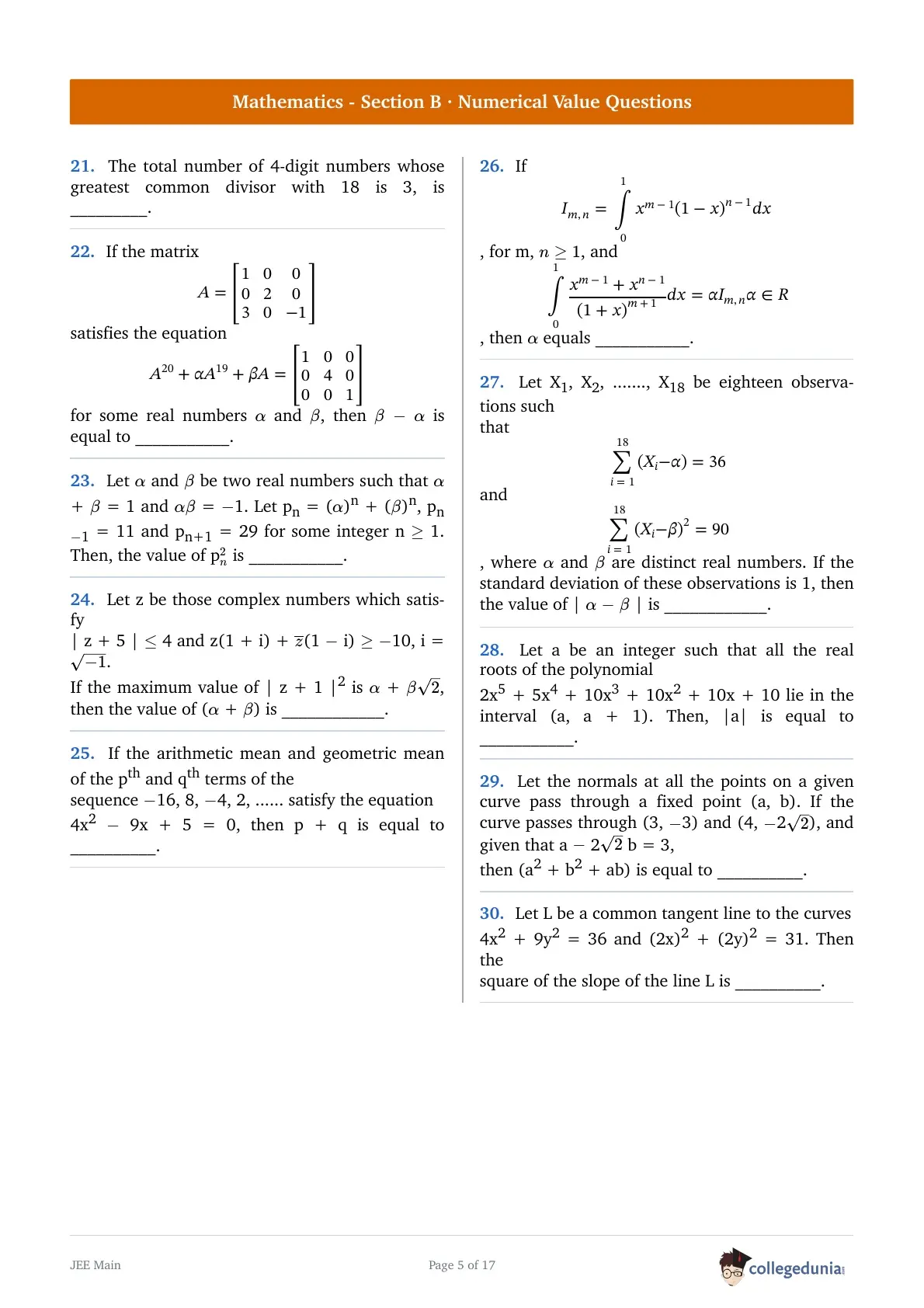
The total number of 4-digit numbers whose greatest common divisor with 18 is 3, is _________.
If the matrix \(A=\begin{bmatrix}1&0&0\\0&2&0\\3&0&-1\end{bmatrix}\) satisfies the equation
\(A^{20}+\alpha A^{19}+\beta A=\begin{bmatrix}1&0&0\\0&4&0\\0&0&1\end{bmatrix}\)
for some real numbers \(\alpha\) and \(\beta\), then \(\beta-\alpha\) is equal to ___________.
Let \(\alpha\) and \(\beta\) be two real numbers such that \(\alpha+\beta=1\) and \(\alpha\beta=-1\). Let \(p_n=(\alpha)^n+(\beta)^n\), \(p_{n-1}=11\) and \(p_{n+1}=29\) for some integer \(n\ge1\). Then, the value of \(p_n^2\) is ___________.
Let \(z\) be those complex numbers which satisfy
\(|z+5|\le4\) and \(z(1+i)+\overline{z}(1-i)\ge-10\), \(i=\sqrt{-1}\).
If the maximum value of \(|z+1|^2\) is \(\alpha+\beta\sqrt2\), then the value of \((\alpha+\beta)\) is ____________.
If the arithmetic mean and geometric mean of the \(p^{th}\) and \(q^{th}\) terms of the sequence \(-16,8,-4,2,\dots\) satisfy the equation \(4x^2-9x+5=0\), then \(p+q\) is equal to __________.
If \(I_{m,n}=\int_0^1x^{m-1}(1-x)^{n-1}dx\), for \(m,n\ge1\), and
\(\int_0^1\frac{x^{m-1}+x^{n-1}}{(1+x)^{m+1}}dx=\alpha I_{m,n}\), \(\alpha\in R\), then \(\alpha\) equals ___________.
Let \(X_1,X_2,\dots,X_{18}\) be eighteen observations such that
\(\sum_{i=1}^{18}(X_i-\alpha)=36\)
and
\(\sum_{i=1}^{18}(X_i-\beta)^2=90\)
, where \(\alpha\) and \(\beta\) are distinct real numbers. If the standard deviation of these observations is 1, then the value of \(|\alpha-\beta|\) is ____________.
Let \(a\) be an integer such that all the real roots of the polynomial \(2x^5+5x^4+10x^3+10x^2+10x+10\) lie in the interval \((a,a+1)\). Then, \(|a|\) is equal to ___________.
Let the normals at all the points on a given curve pass through a fixed point \((a,b)\). If the curve passes through \((3,-3)\) and \((4,-2\sqrt2)\), and given that \(a-2\sqrt2\,b=3\), then \((a^2+b^2+ab)\) is equal to __________.
Let \(L\) be a common tangent line to the curves
\(4x^2+9y^2=36\) and \((2x)^2+(2y)^2=31\). Then the square of the slope of the line \(L\) is __________.
Physics - Section A (Q31 - Q50)
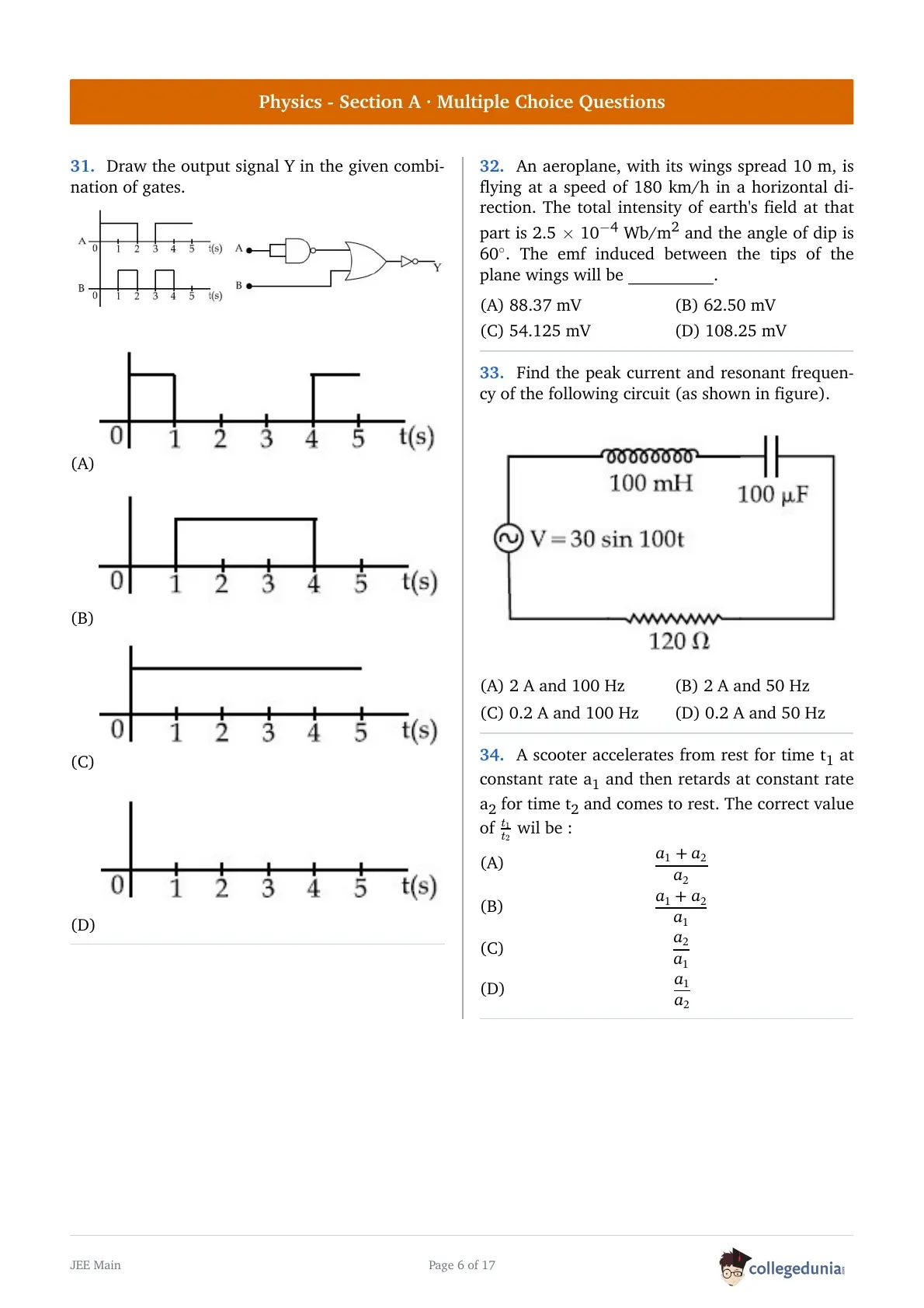
Draw the output signal Y in the given combination of gates.
- (1)
![]()
- (2)
![]()
- (3)
![]()
- (4)
![]()


An aeroplane, with its wings spread 10 m, is flying at a speed of 180 km/h in a horizontal direction. The total intensity of earth's field at that part is \(2.5 \times 10^{-4}\) Wb/m\(^2\) and the angle of dip is \(60^\circ\). The emf induced between the tips of the plane wings will be __________.
Find the peak current and resonant frequency of the following circuit (as shown in figure).
A scooter accelerates from rest for time \(t_1\) at constant rate \(a_1\) and then retards at constant rate \(a_2\) for time \(t_2\) and comes to rest. The correct value of \(\frac{t_1}{t_2}\) wil be :
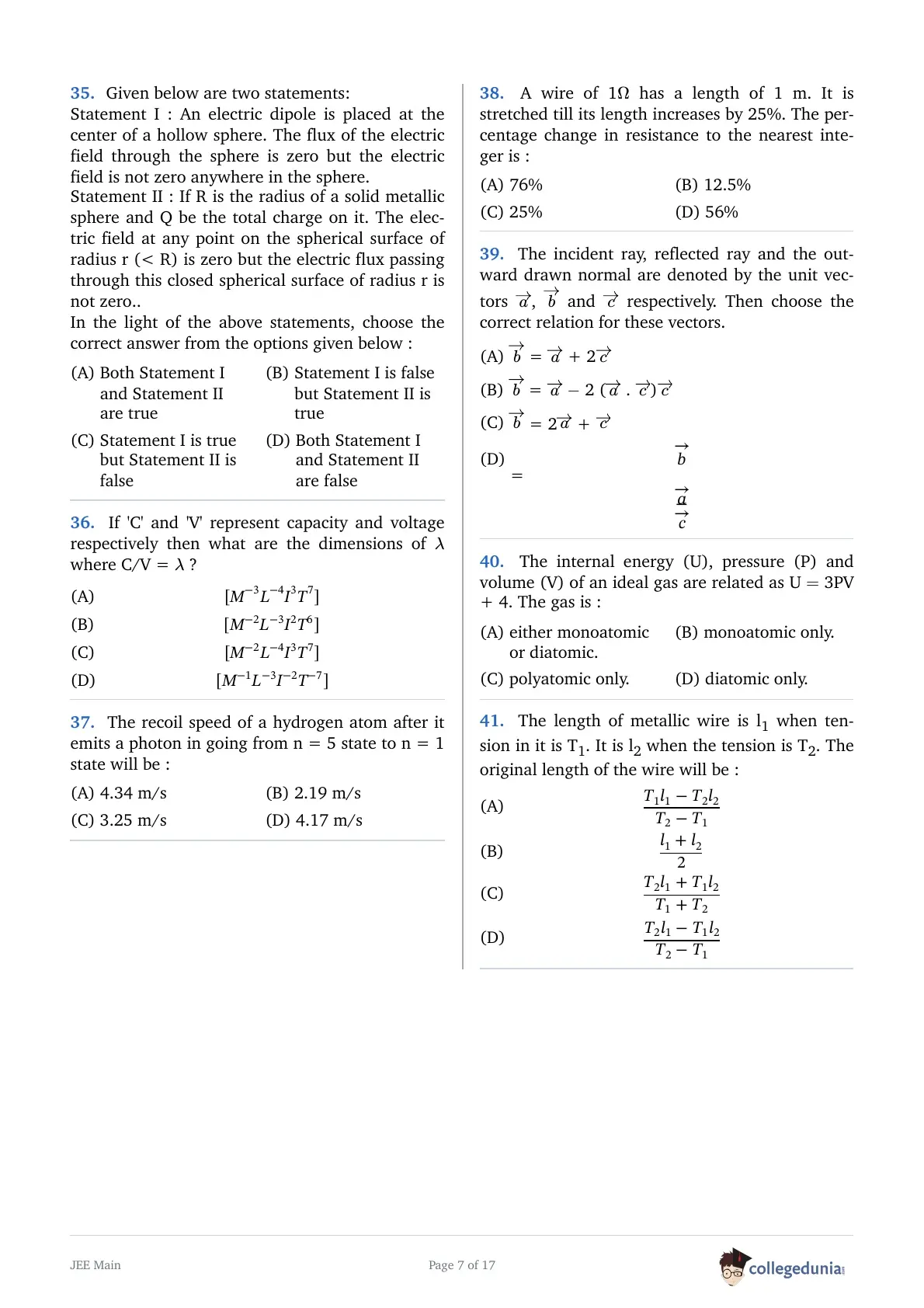
Given below are two statements:
Statement I : An electric dipole is placed at the center of a hollow sphere. The flux of the electric field through the sphere is zero but the electric field is not zero anywhere in the sphere.
Statement II : If R is the radius of a solid metallic sphere and Q be the total charge on it. The electric field at any point on the spherical surface of radius r (< R) is zero but the electric flux passing through this closed spherical surface of radius r is not zero..
In the light of the above statements, choose the correct answer from the options given below :
If 'C' and 'V' represent capacity and voltage respectively then what are the dimensions of \(\lambda\) where C/V = \(\lambda\) ?
The recoil speed of a hydrogen atom after it emits a photon in going from n = 5 state to n = 1 state will be :
A wire of 1\(\Omega\) has a length of 1 m. It is stretched till its length increases by 25%. The percentage change in resistance to the nearest integer is :
The incident ray, reflected ray and the outward drawn normal are denoted by the unit vectors \(\vec{a}\), \(\vec{b}\) and \(\vec{c}\) respectively. Then choose the correct relation for these vectors.
The internal energy (U), pressure (P) and volume (V) of an ideal gas are related as U = 3PV + 4. The gas is :
The length of metallic wire is \(l_1\) when tension in it is \(T_1\). It is \(l_2\) when the tension is \(T_2\). The original length of the wire will be :
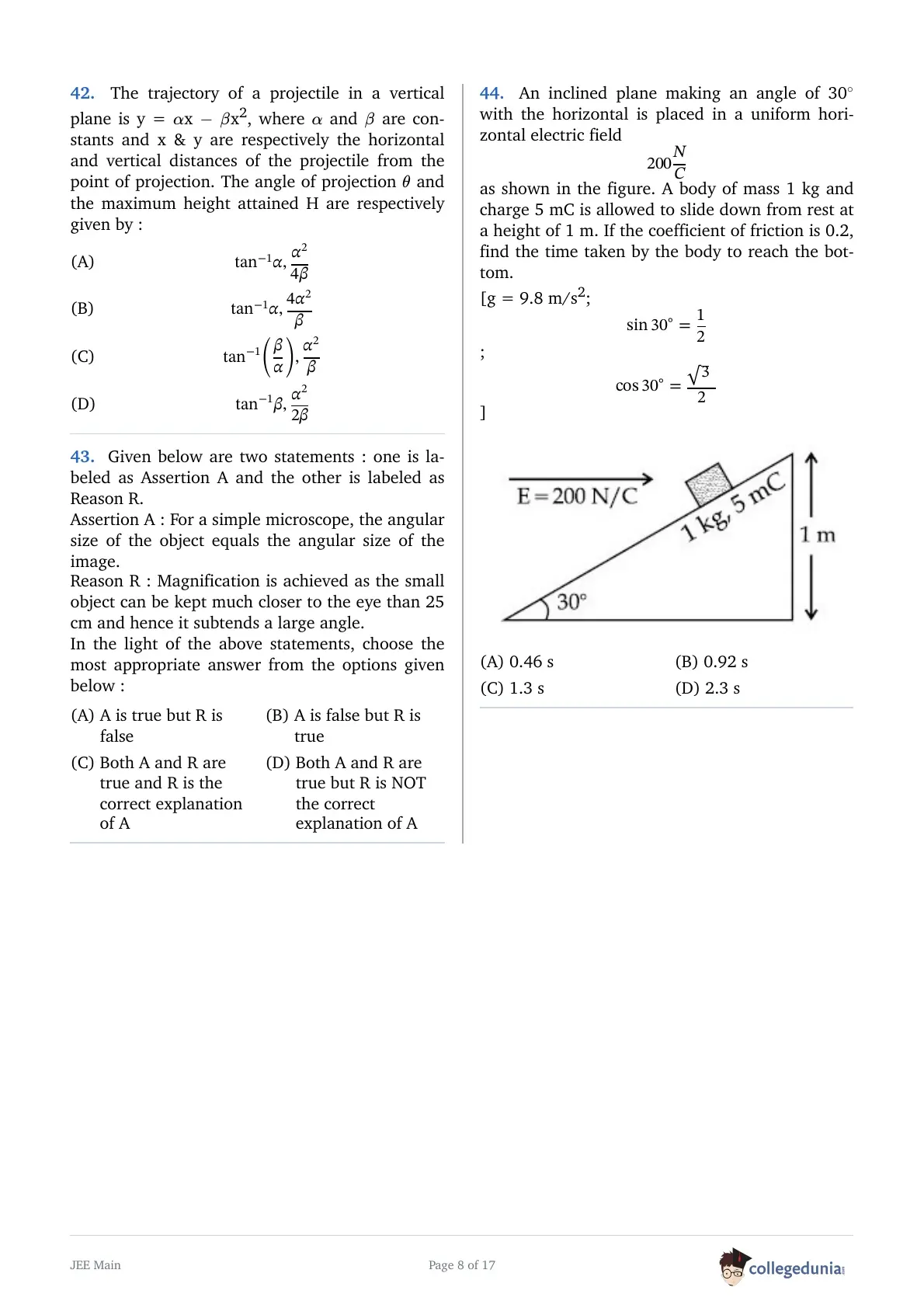
The trajectory of a projectile in a vertical plane is \(y = \alpha x - \beta x^2\), where \(\alpha\) and \(\beta\) are constants and x & y are respectively the horizontal and vertical distances of the projectile from the point of projection. The angle of projection \(\theta\) and the maximum height attained H are respectively given by :
Given below are two statements: one is labelled as Assertion (A) and the other is labelled as Reason (R).
Assertion (A): Electromagnetic waves carry energy but not momentum.
Reason (R): Mass of a photon is zero. In the light of the above statements.
choose the most appropriate answer from the options given below:
A body starts from rest on a long inclined plane of slope \(45^\circ\). The coefficient of friction between the body and the plane varies as \(\mu=0.3x\), where \(x\) is distance travelled down the plane. The body will have maximum speed (for \(g=10\ \mathrm{m/s^2}\)) when \(x=\)
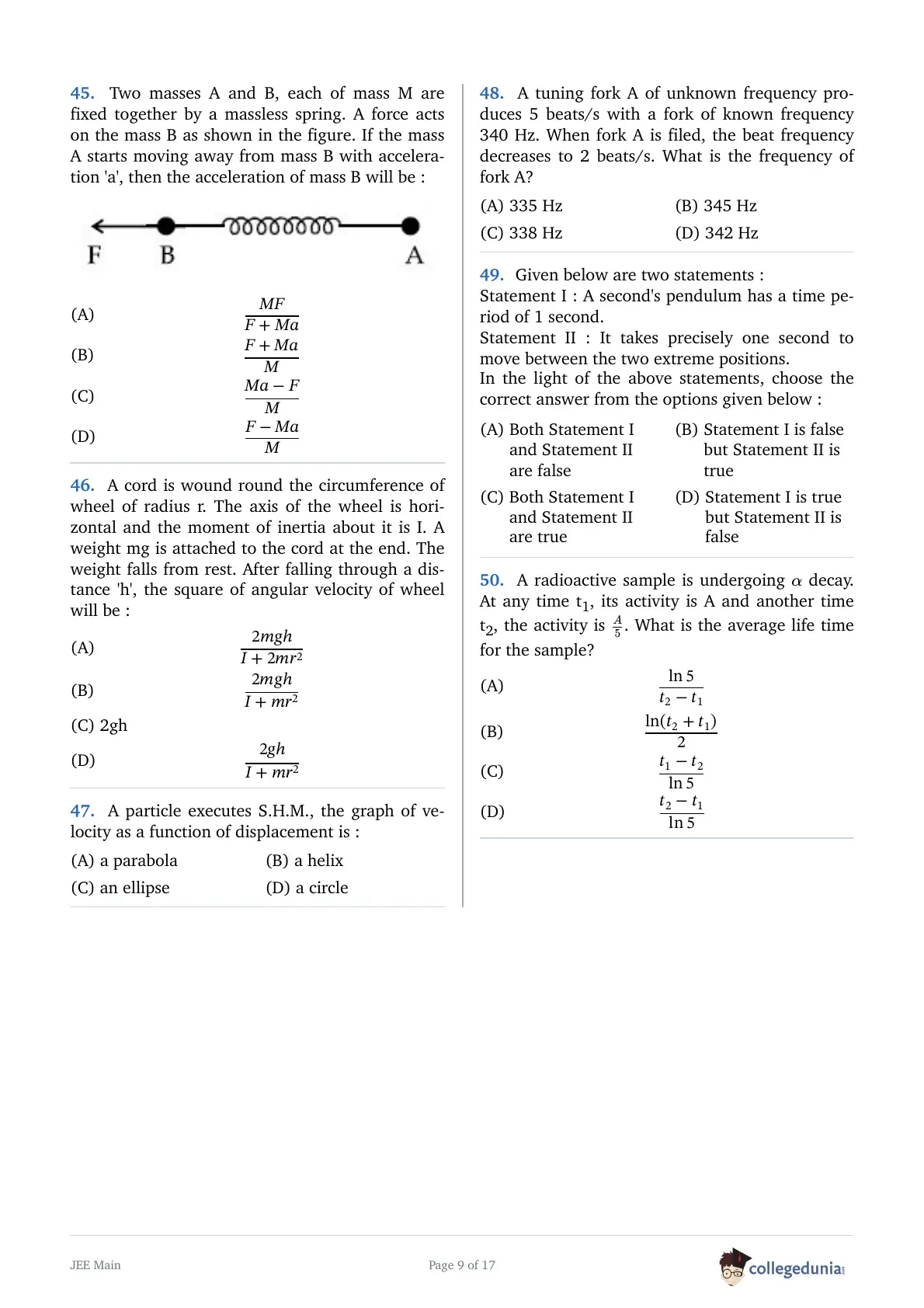
Two masses A and B, each of mass M are fixed together by a massless spring. A force acts on the mass B as shown in the figure. If the mass A starts moving away from mass B with acceleration 'a', then the acceleration of mass B will be :
A cord is wound round the circumference of wheel of radius r. The axis of the wheel is horizontal and the moment of inertia about it is I. A weight mg is attached to the cord at the end. The weight falls from rest. After falling through a distance 'h', the square of angular velocity of wheel will be :
A particle executes S.H.M., the graph of velocity as a function of displacement is :
A tuning fork A of unknown frequency produces 5 beats/s with a fork of known frequency 340 Hz. When fork A is filed, the beat frequency decreases to 2 beats/s. What is the frequency of fork A?
Given below are two statements :
Statement I : A second's pendulum has a time period of 1 second.
Statement II : It takes precisely one second to move between the two extreme positions.
In the light of the above statements, choose the correct answer from the options given below :
A radioactive sample is undergoing \(\alpha\) decay. At any time \(t_1\), its activity is \(A\) and another time \(t_2\), the activity is \(\frac{A}{5}\). What is the average life time for the sample?
Physics - Section B (Q51 - Q60)
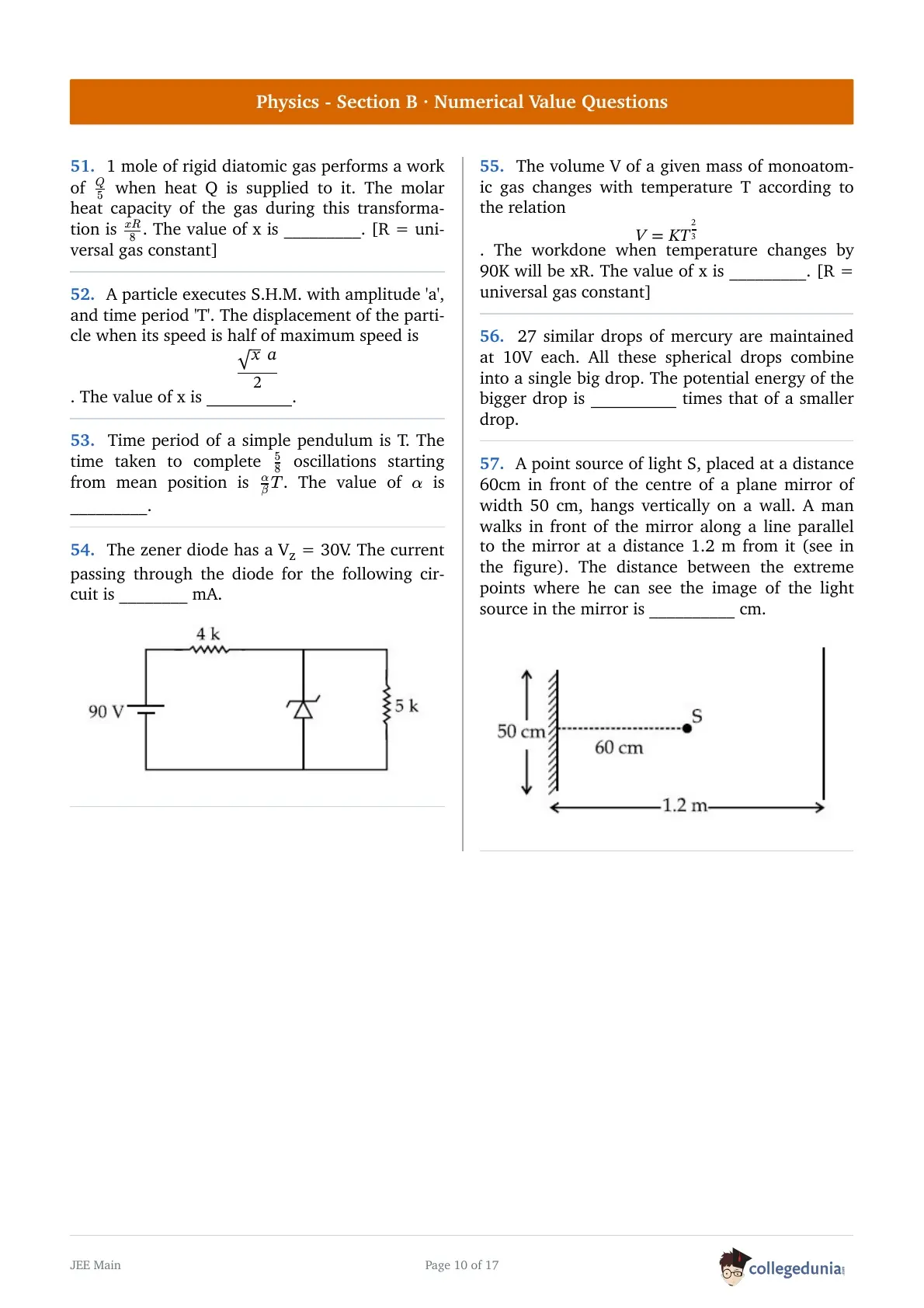
A monoatomic gas performs a work of \(\frac Q4\) where \(Q\) is the heat supplied to it. The molar heat capacity of the gas will be ____ \(R\) during this transformation. Where \(R\) is the gas constant.
A particle executes S.H.M. with amplitude 'a', and time period 'T'. The displacement of the particle when its speed is half of maximum speed is \(\frac{\sqrt{x}\,a}{2}\). The value of \(x\) is __________.
Time period of a simple pendulum is \(T\). The time taken to complete \(\frac{5}{8}\) oscillations starting from mean position is \(\frac{\alpha}{\beta}T\). The value of \(\alpha\) is _________.
The zener diode has a \(V_z = 30\ \mathrm{V}\). The current passing through the diode for the following circuit is ________ mA.
The volume \(V\) of a given mass of monoatomic gas changes with temperature \(T\) according to the relation \(V = KT^{\frac{2}{3}}\). The workdone when temperature changes by 90K will be \(xR\). The value of \(x\) is _________. [R = universal gas constant]
Eight similar drops of mercury are maintained at 12 V each. All these spherical drops combine into a single big drop. The potential energy of bigger drop will be ____________ E. Where E is the potential energy of a single smaller drop.
A point source of light S, placed at a distance 60cm in front of the centre of a plane mirror of width 50 cm, hangs vertically on a wall. A man walks in front of the mirror along a line parallel to the mirror at a distance 1.2 m from it (see in the figure). The distance between the extreme points where he can see the image of the light source in the mirror is __________ cm.
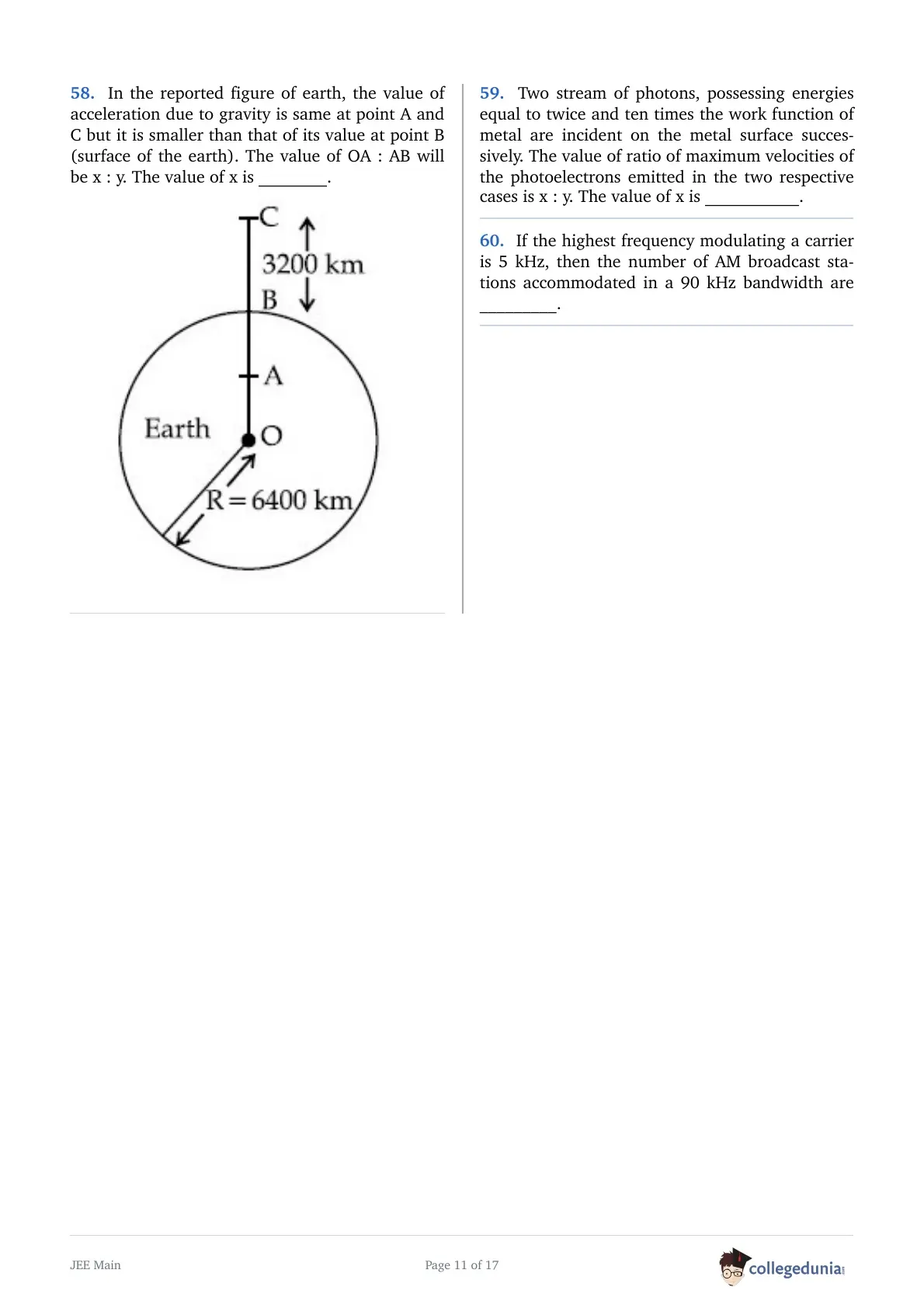
In the reported figure of earth, the value of acceleration due to gravity is same at point A and C but it is smaller than that of its value at point B (surface of the earth). The value of OA : AB will be x : y. The value of x is ________.
Two streams of photons, possessing energies equal to five and ten times the work function of metal are incident on the metal surface successively. The ratio of maximum velocities of the photoelectron emitted, in the two cases respectively, will be
If the highest frequency modulating a carrier is 5 kHz, then the number of AM broadcast stations accommodated in a 90 kHz bandwidth are _________.
Chemistry - Section A (Q61 - Q80)
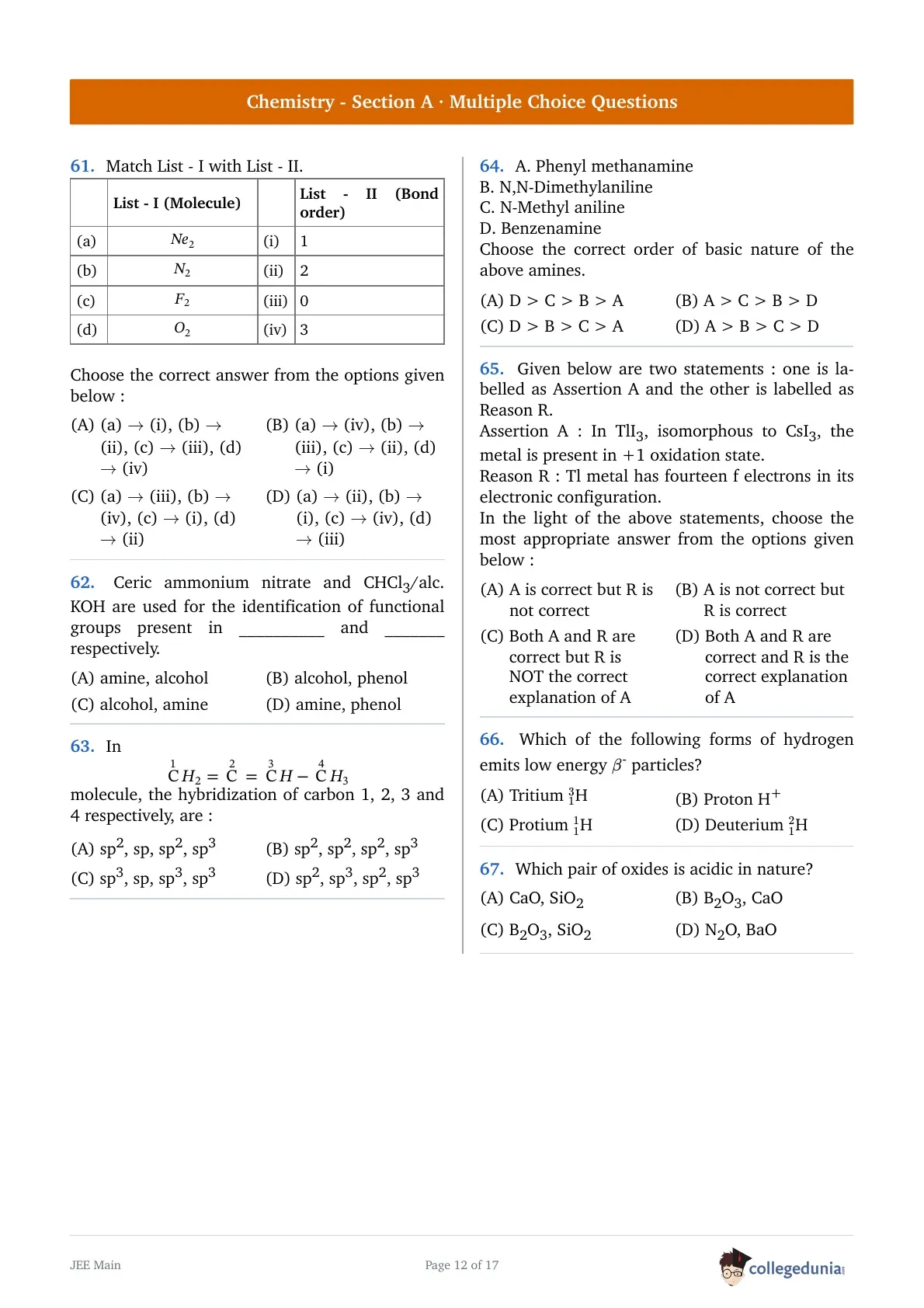
| List - I (Molecule) | List - II (Bond order) | ||
| (a) | \(\mathrm{Ne_2}\) | (i) | 1 |
| (b) | \(\mathrm{N_2}\) | (ii) | 2 |
| (c) | \(\mathrm{F_2}\) | (iii) | 0 |
| (d) | \(\mathrm{O_2}\) | (iv) | 3 |
Choose the correct answer from the options given below :
Ceric ammonium nitrate and \(\mathrm{CHCl_3}\)/alc. KOH are used for the identification of functional groups present in __________ and _______ respectively.
In \(\overset{1}{\mathrm{C}}\mathrm{H_2} = \overset{2}{\mathrm{C}} = \overset{3}{\mathrm{C}}\mathrm{H} - \overset{4}{\mathrm{C}}\mathrm{H_3}\) molecule, the hybridization of carbon 1, 2, 3 and 4 respectively, are :
A. Phenyl methanamine
B. N,N-Dimethylaniline
C. N-Methyl aniline
D. Benzenamine
Choose the correct order of basic nature of the above amines.
Given below are two statements : one is labelled as Assertion A and the other is labelled as Reason R.
Assertion A : In \(\mathrm{TlI_3}\), isomorphous to \(\mathrm{CsI_3}\), the metal is present in +1 oxidation state.
Reason R : Tl metal has fourteen f electrons in its electronic configuration.
In the light of the above statements, choose the most appropriate answer from the options given below :
Which of the following forms of hydrogen emits low energy \(\beta^-\) particles?
Which pair of oxides is acidic in nature?


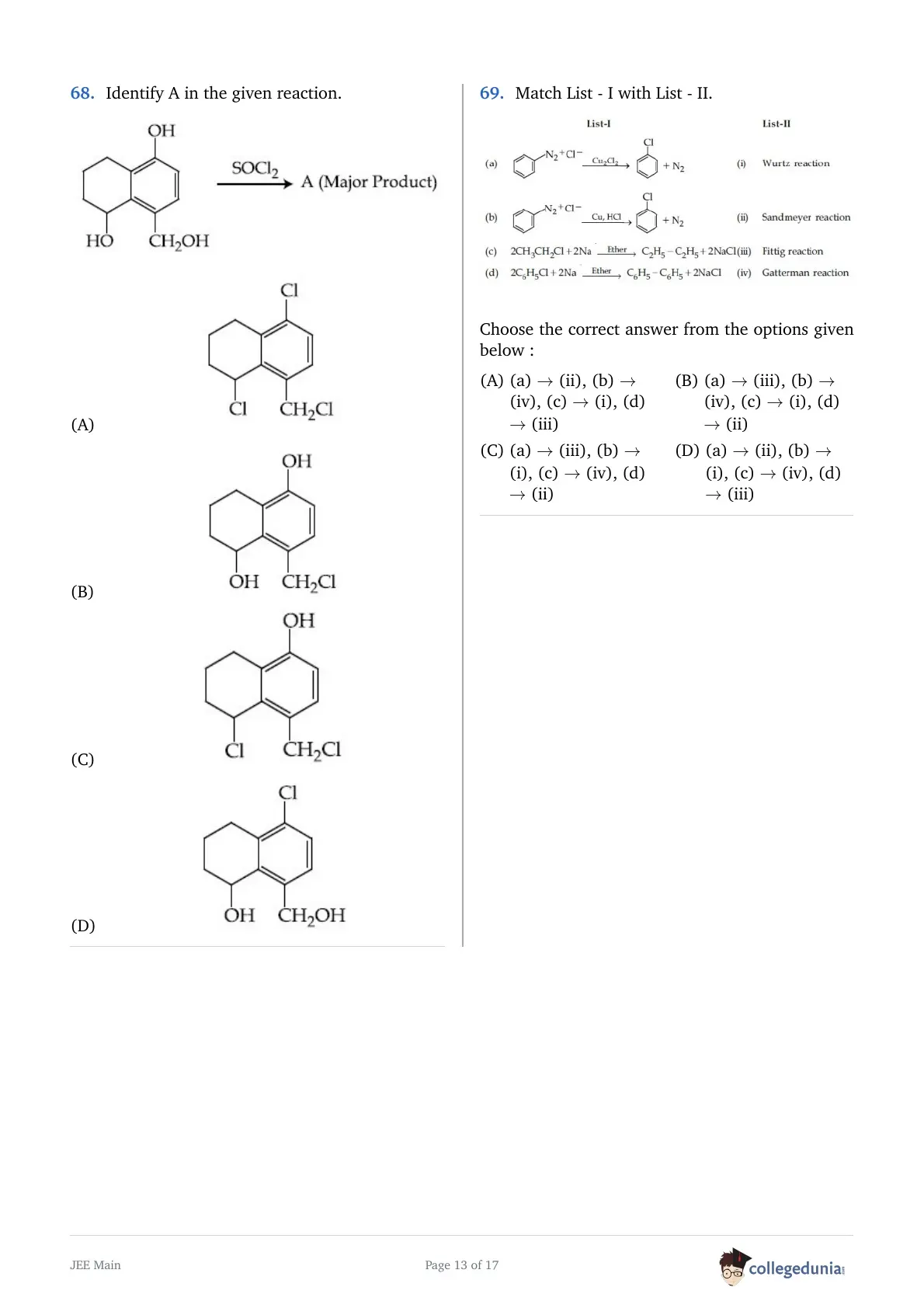
Match List - I with List - II.
Choose the correct answer from the options given below :


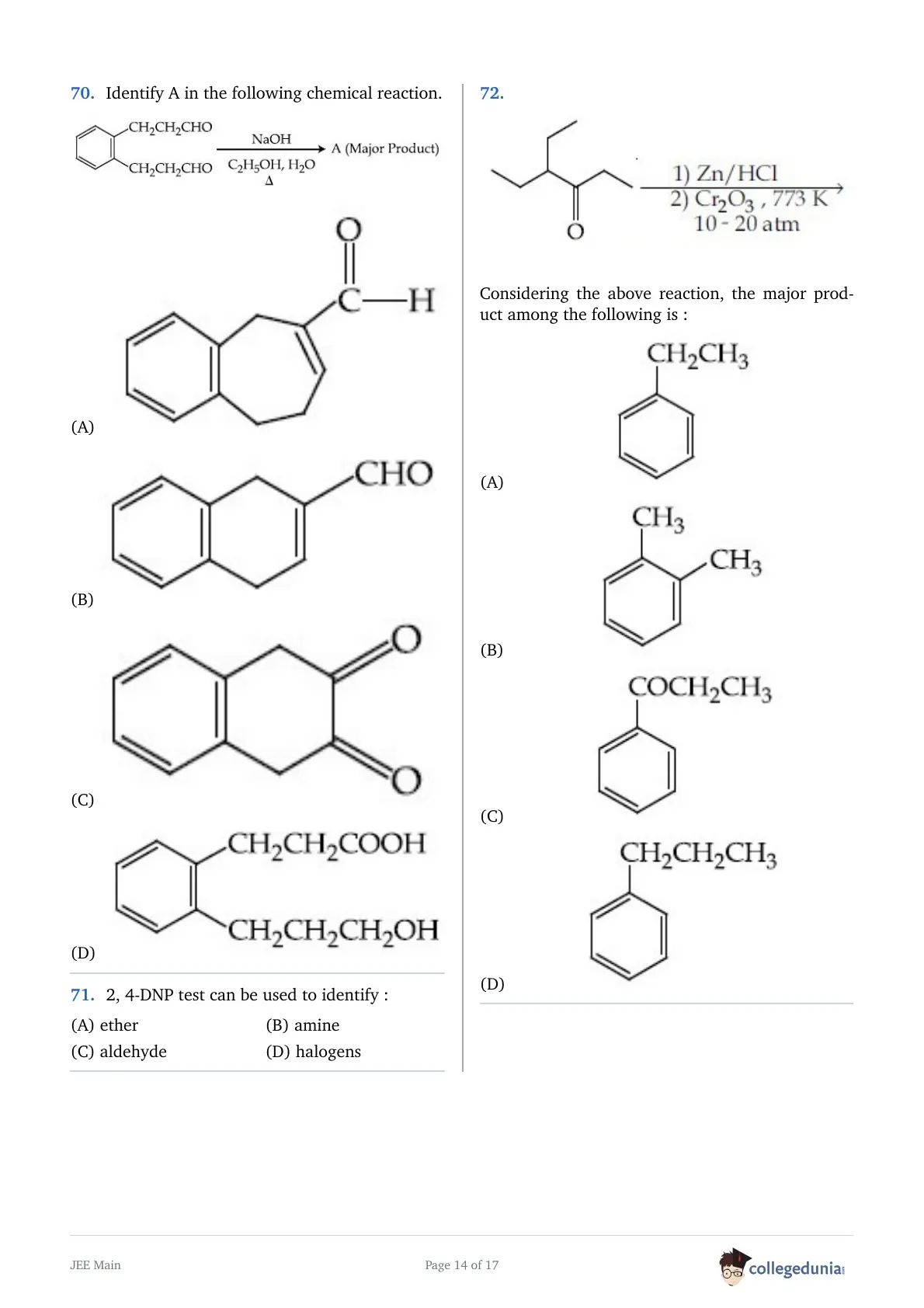
2, 4-DNP test can be used to identify :

Considering the above reaction, the major product among the following is :
- (1)
![]()
- (2)
![]()
- (3)
![]()
- (4)
![]()


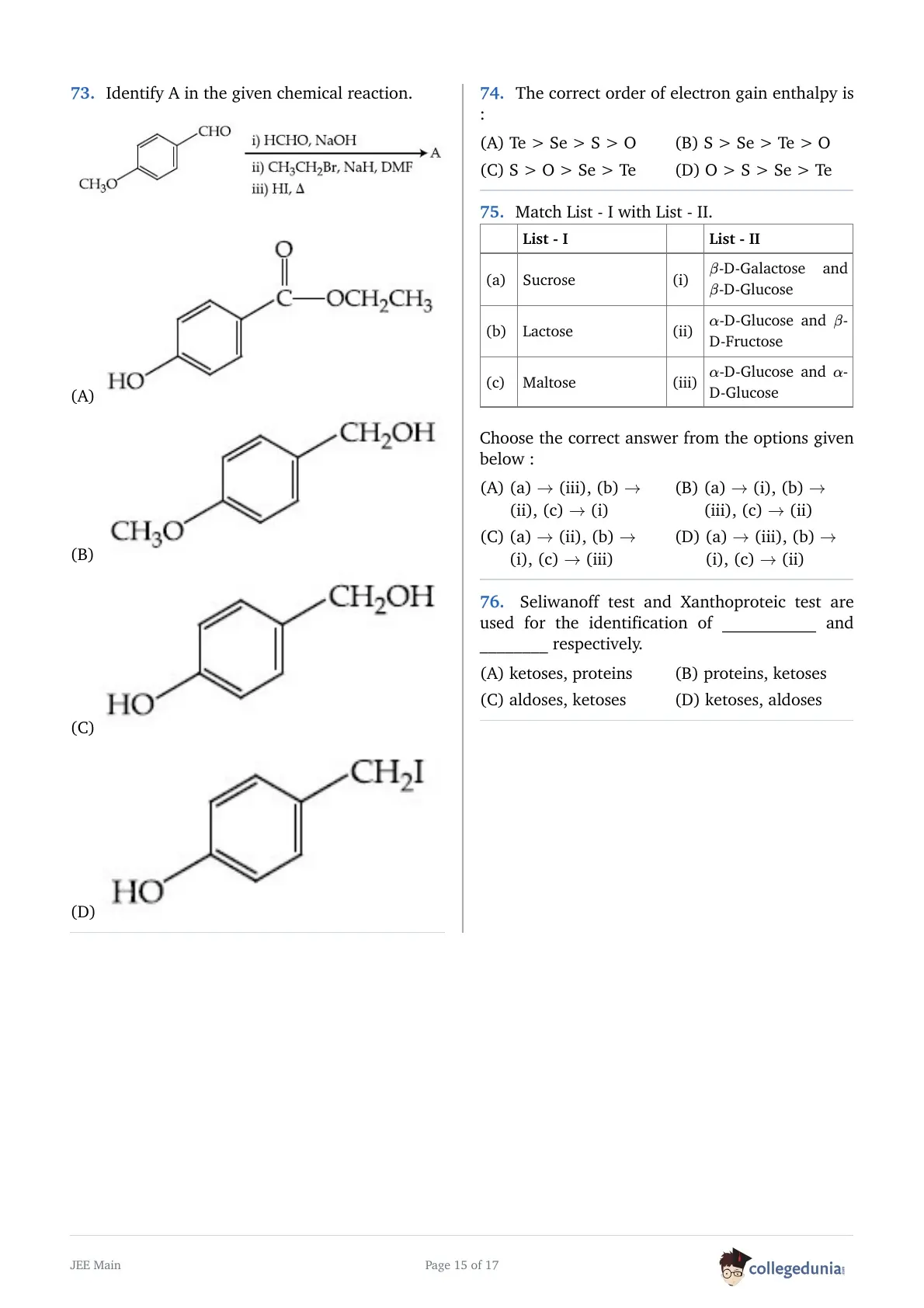
The correct order of electron gain enthalpy (\( - \) ve value) is :
| List - I | List - II | ||
| (a) | Sucrose | (i) | \(\beta\)-D-Galactose and \(\beta\)-D-Glucose |
| (b) | Lactose | (ii) | \(\alpha\)-D-Glucose and \(\beta\)-D-Fructose |
| (c) | Maltose | (iii) | \(\alpha\)-D-Glucose and \(\alpha\)-D-Glucose |
Seliwanoff test and Xanthoproteic test are used for the identification of ___________ and ________ respectively.
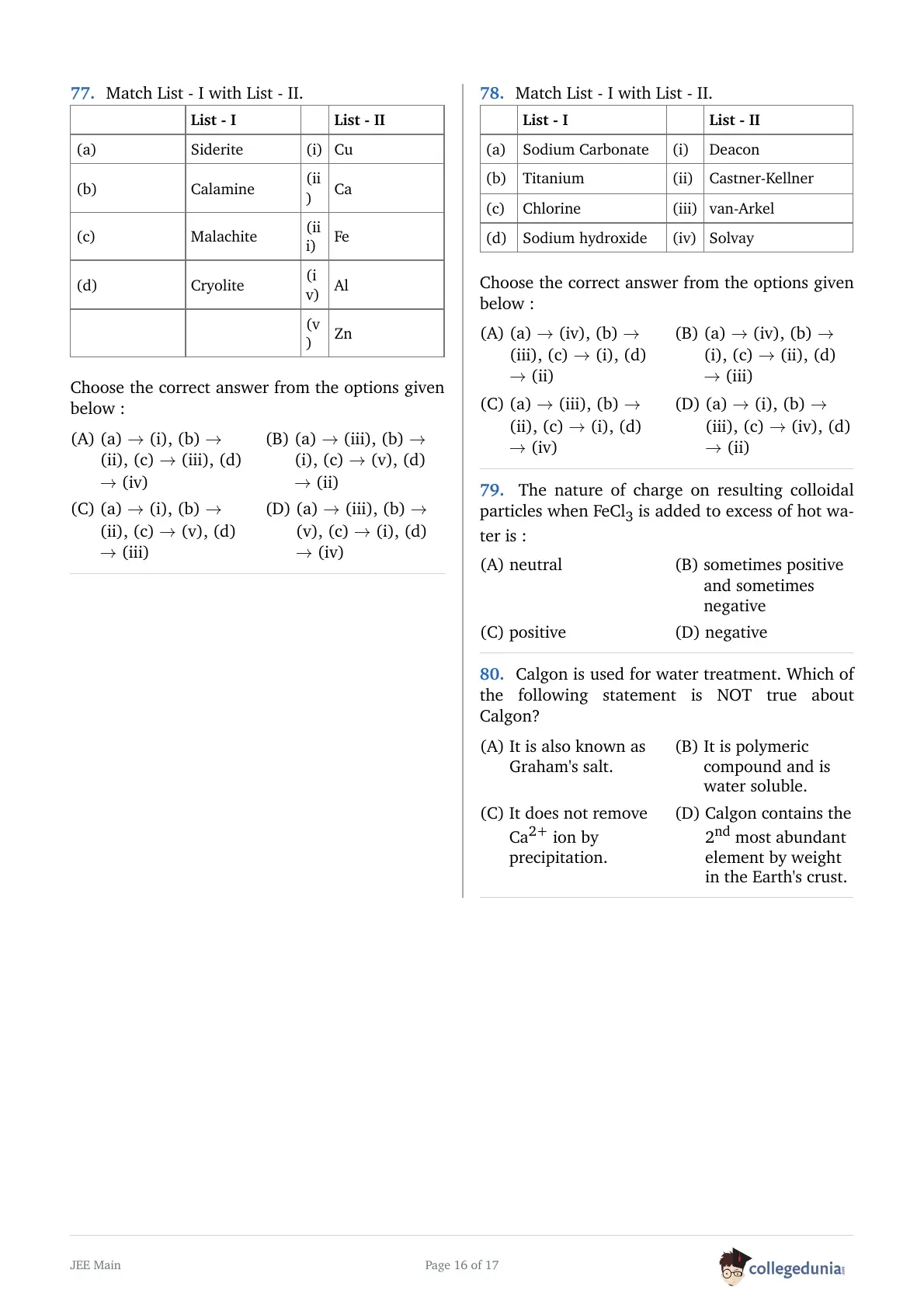
| List - I | List - II | ||
| (a) | Siderite | (i) | Cu |
| (b) | Calamine | (ii) | Ca |
| (c) | Malachite | (iii) | Fe |
| (d) | Cryolite | (iv) | Al |
| (v) | Zn |
| List - I | List - II | ||
| (a) | Sodium Carbonate | (i) | Deacon |
| (b) | Titanium | (ii) | Castner-Kellner |
| (c) | Chlorine | (iii) | van-Arkel |
| (d) | Sodium hydroxide | (iv) | Solvay |
The nature of charge on resulting colloidal particles when \(\mathrm{FeCl_3}\) is added to excess of hot water is :
Calgon is used for water treatment. Which of the following statement is \(NOT\) true about Calgon?
Chemistry - Section B (Q81 - Q90)
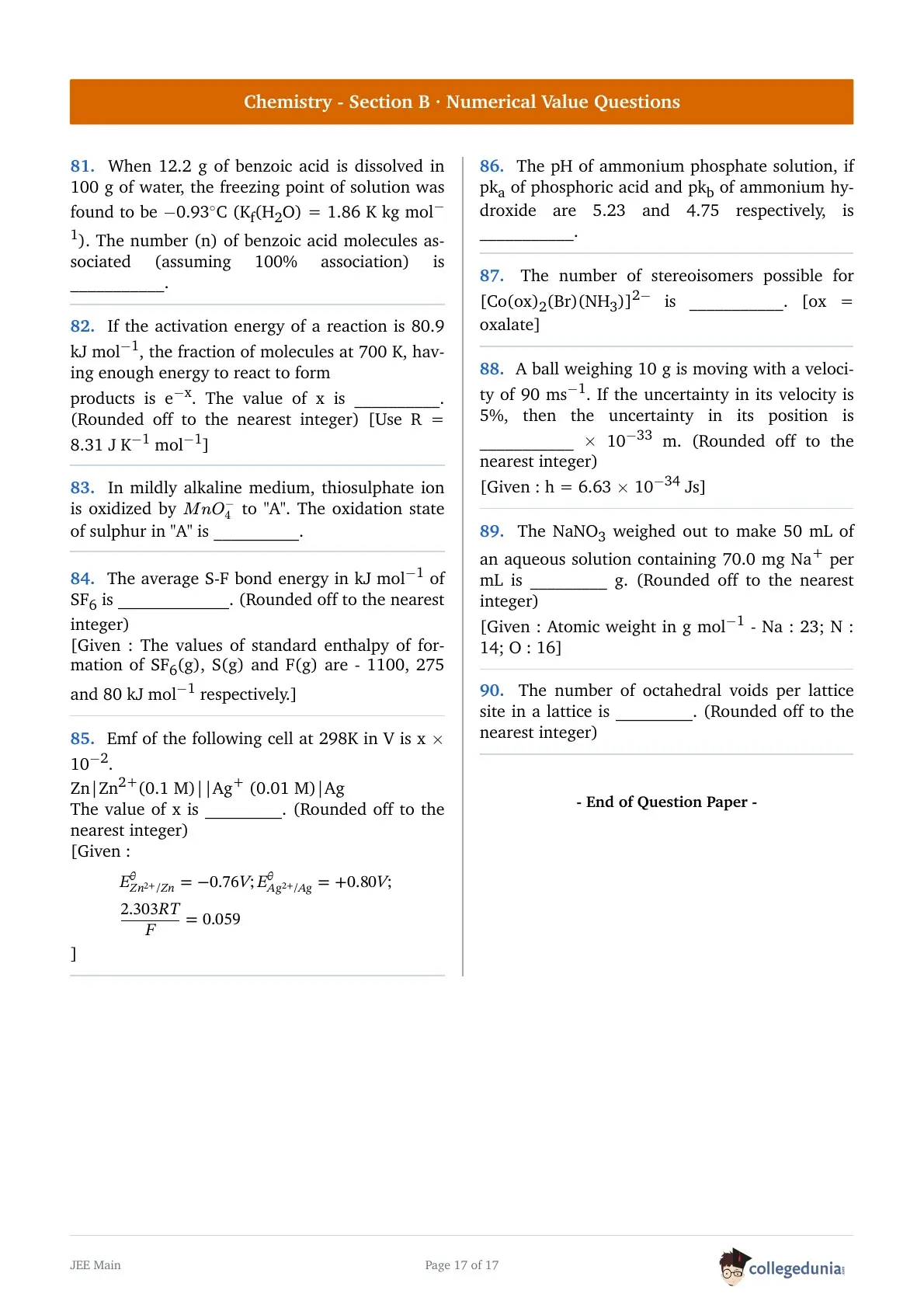
When 12.2 g of benzoic acid is dissolved in 100 g of water, the freezing point of solution was found to be \(-0.93^\circ\mathrm{C}\) (\(K_f(\mathrm{H_2O}) = 1.86\ \mathrm{K\ kg\ mol^{-1}}\)). The number (n) of benzoic acid molecules associated (assuming 100% association) is ___________.
If the activation energy of a reaction is 80.9 kJ mol-1, the fraction of molecules at 700 K, having enough energy to react to form products is \(e^{-x}\). The value of x is __________. (Rounded off to the nearest integer) [Use \(R = 8.31\ \mathrm{J\ K^{-1}\ mol^{-1}}\)]
In mildly alkaline medium, thiosulphate ion is oxidized by \(\mathrm{MnO_4^-}\) to "A". The oxidation state of sulphur in "A" is __________.
The average S-F bond energy in kJ mol−1 of \(\mathrm{SF_6}\) is _____________. (Rounded off to the nearest integer)
[Given : The values of standard enthalpy of formation of \(\mathrm{SF_6(g)}\), \(\mathrm{S(g)}\) and \(\mathrm{F(g)}\) are - 1100, 275 and 80 kJ mol−1 respectively.]
Emf of the following cell at 298K in V is x \(\times\) 10−2.
\(\mathrm{Zn|Zn^{2+}(0.1\ M)||Ag^{+}(0.01\ M)|Ag}\)
The value of x is _________. (Rounded off to the nearest integer)
[Given : \(E^{\theta}_{Zn^{2+}/Zn} = -0.76\,V;\ E^{\theta}_{Ag^{2+}/Ag} = +0.80\,V;\ \frac{2.303RT}{F} = 0.059\)]
The pH of ammonium phosphate solution, if pka of phosphoric acid and pkb of ammonium hydroxide are 5.23 and 4.75 respectively, is ___________.
The number of stereoisomers possible for \(\mathrm{[Co(ox)_2(Br)(NH_3)]^{2-}}\) is ___________. [ox = oxalate]
If the uncertainty in velocity and position of a minute particle in space are, \(2.4 × 10^{–26}\) \((m s^{–1)}\) and \(10^{–7} (m)\), respectively. The mass of the particle in g is _____ . (Nearest integer)
(Given : \(h = 6.626 × 10^{–34} Js\))
The \(\mathrm{NaNO_3}\) weighed out to make 50 mL of an aqueous solution containing 70.0 mg \(\mathrm{Na^+}\) per mL is _________ g. (Rounded off to the nearest integer)
[Given : Atomic weight in g mol−1 - Na : 23; N : 14; O : 16]
The number of octahedral voids per lattice site in a lattice is _________. (Rounded off to the nearest integer)
JEE Main 2021 Exam Pattern and Marking Scheme
| Particulars | Details |
|---|---|
| Exam Mode | Online (Computer-Based Test) |
| Paper | B.E./B.Tech (Paper 1) |
| Duration | 3 hours (180 minutes) |
| Type of Questions | Multiple Choice Questions (MCQs) + Numerical Value Questions |
| Subjects | Mathematics, Physics, Chemistry |
| Total Questions | 90 questions (75 to be attempted) |
| Total Marks | 300 marks |
| Marking Scheme | +4 for correct answer & -1 for incorrect MCQ; no negative marking for Numerical Value Questions |
JEE Main 2021 February 26 Shift 2 Difficulty Level
JEE Main 2021 B.E./B.Tech Question Paper- February 26, 2021- Afternoon Session was rated by the applicants and coachings institutes to be of moderate difficulty. Most of the questions were more or less directly based on questions in the CBSE textbooks with an equal allocation to class XI and class XII subjects in the paper.
JEE Main 2021 B.E./B.Tech Question Paper February 26 (Afternoon Session): Paper Analysis
JEE Main 2021 B.E./B.Tech Question Paper February 26 (Afternoon Session) was conducted between 3.00 PM to 6.00 PM. The paper was reported to be moderate in terms of difficulty by the test takers.
- The Mathematics section had lengthy questions to solve, but their difficulty level remained moderate.
- The difficulty level of the Physics section was also termed moderate.
- As per the usual JEE Main Question Paper Analysis, the Chemistry section was the easiest of the three sections.
- In Physics, Mechanics (30%), Electrodynamics (27%), and Modern Physics (20%) had the highest weightage. Check JEE Main Physics Syllabus
- In Chemistry, Inorganic Chemistry I (30%), Organic Chemistry II (27%), and Inorganic Chemistry II (17%) had the highest weightage. Check JEE Main Chemistry Syllabus
- In Mathematics, high weightage was given to – Differential Calculus (17%), Integral Calculus (15%), Coordinate Chemistry (15%), and Trignometry (12%). Check JEE Main Mathematics Syllabus
Check: Detailed Paper Analysis of February 26 Afternoon Session at – JEE Main Question Paper Analysis



Comments