




JEE Main 2023 Chemistry Question Paper Jan 30 Shift 2 is going to be updated here after the conclusion of the exam. Candidates will be able to download the memory-based JEE Main 2023 Chemistry Question Paper PDF with Solution and Answer Key for Jan 30 Shift 2 using the link below. JEE Main Chemistry Question Paper is divided into two sections, Section A with 20 MCQs and Section B with 10 numerical type questions. Candidates are required to answer all questions from Section A and any 5 questions from section B. (PDF Source: aakash.ac.in)
JEE Main 2023 Chemistry Question Paper Jan 30 Shift 2- Download PDF
| JEE Main 2023 30 Jan Shift 2 Chemistry Question Paper with Solution PDF |  Download Download |
Check Solution |
Chemistry
Section-A
Question 31:
Which of the following reactions is correct?
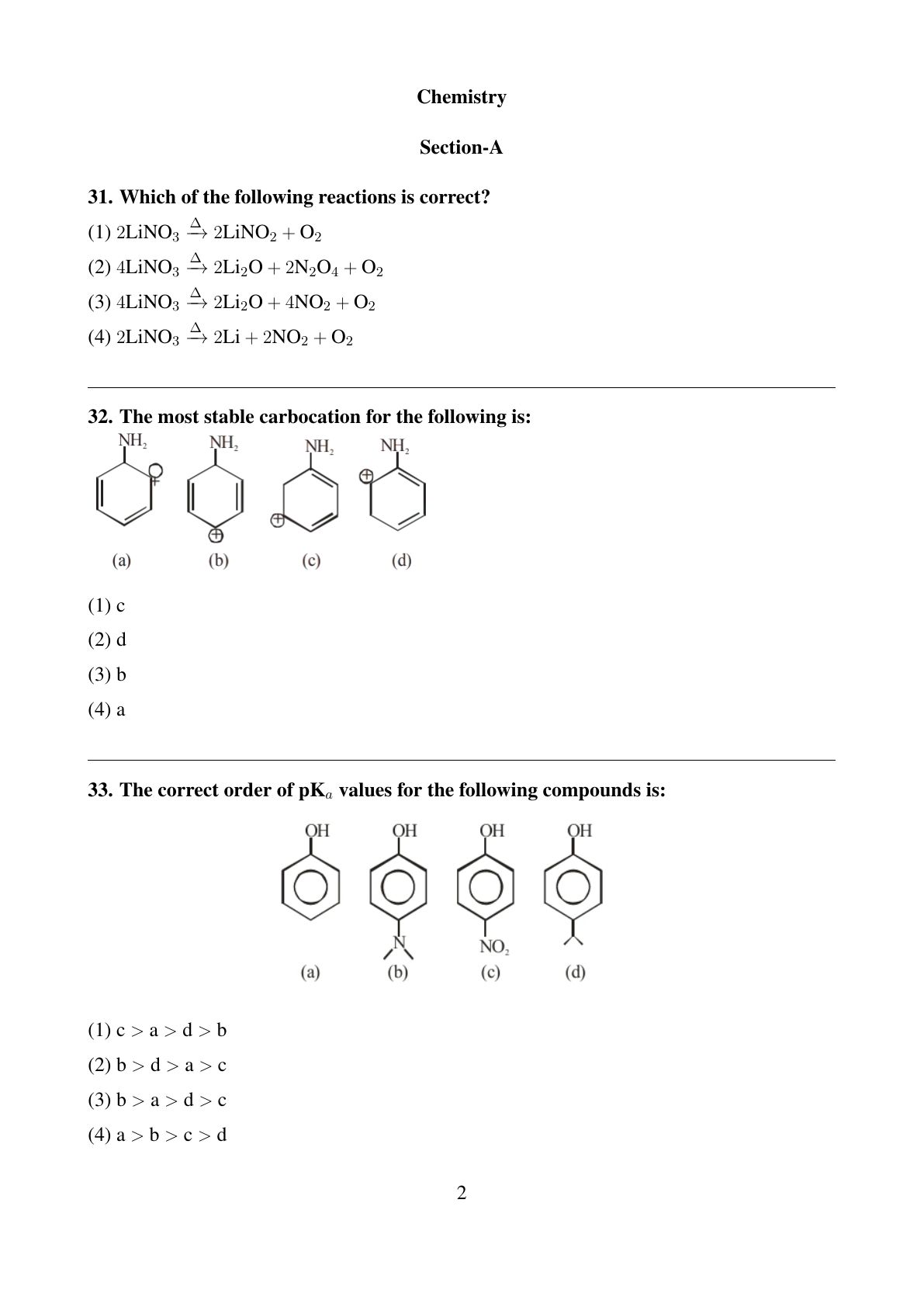
The most stable carbocation for the following is:

View Solution
The correct order of pK\(_a\) values for the following compounds is:

View Solution
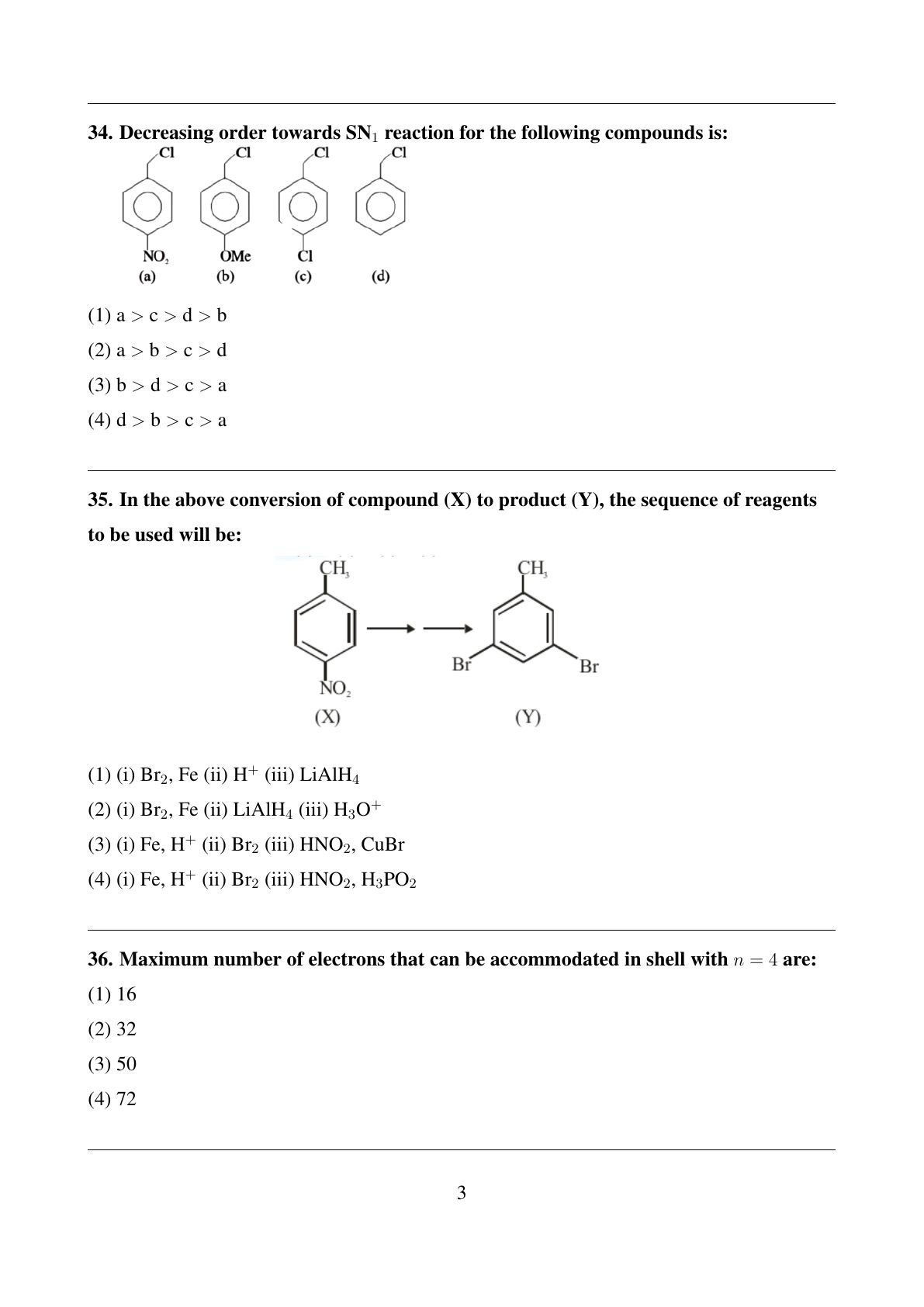
Decreasing order towards SN\(_1\) reaction for the following compounds is:

View Solution
In the above conversion of compound (X) to product (Y), the sequence of reagents to be used will be:

View Solution
Maximum number of electrons that can be accommodated in shell with \( n = 4 \) are:
View Solution
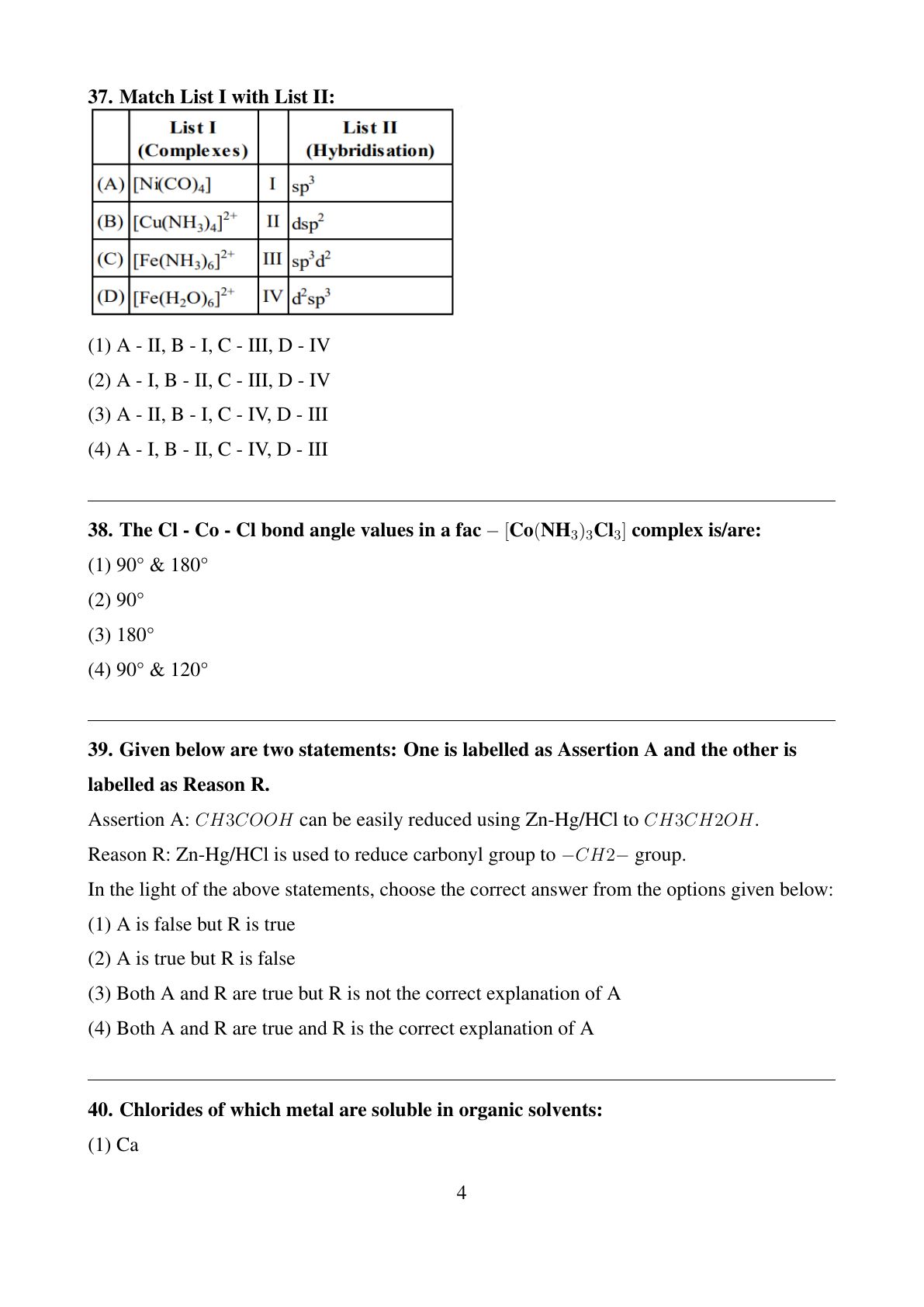
Match List I with List II:

View Solution
The Cl - Co - Cl bond angle values in a \(fac-\left[Co(NH_3)_3Cl_3\right]\) complex is/are:
View Solution
Given below are two statements: One is labelled as Assertion A and the other is labelled as Reason R.
Assertion A: \(\ce{CH3COOH}\) can be easily reduced using Zn-Hg/HCl to \(\ce{CH3CH2OH}\).
Reason R: Zn-Hg/HCl is used to reduce carbonyl group to \(\ce{-CH2-}\) group.
In the light of the above statements, choose the correct answer from the options given below:
View Solution
Chlorides of which metal are soluble in organic solvents:
View Solution
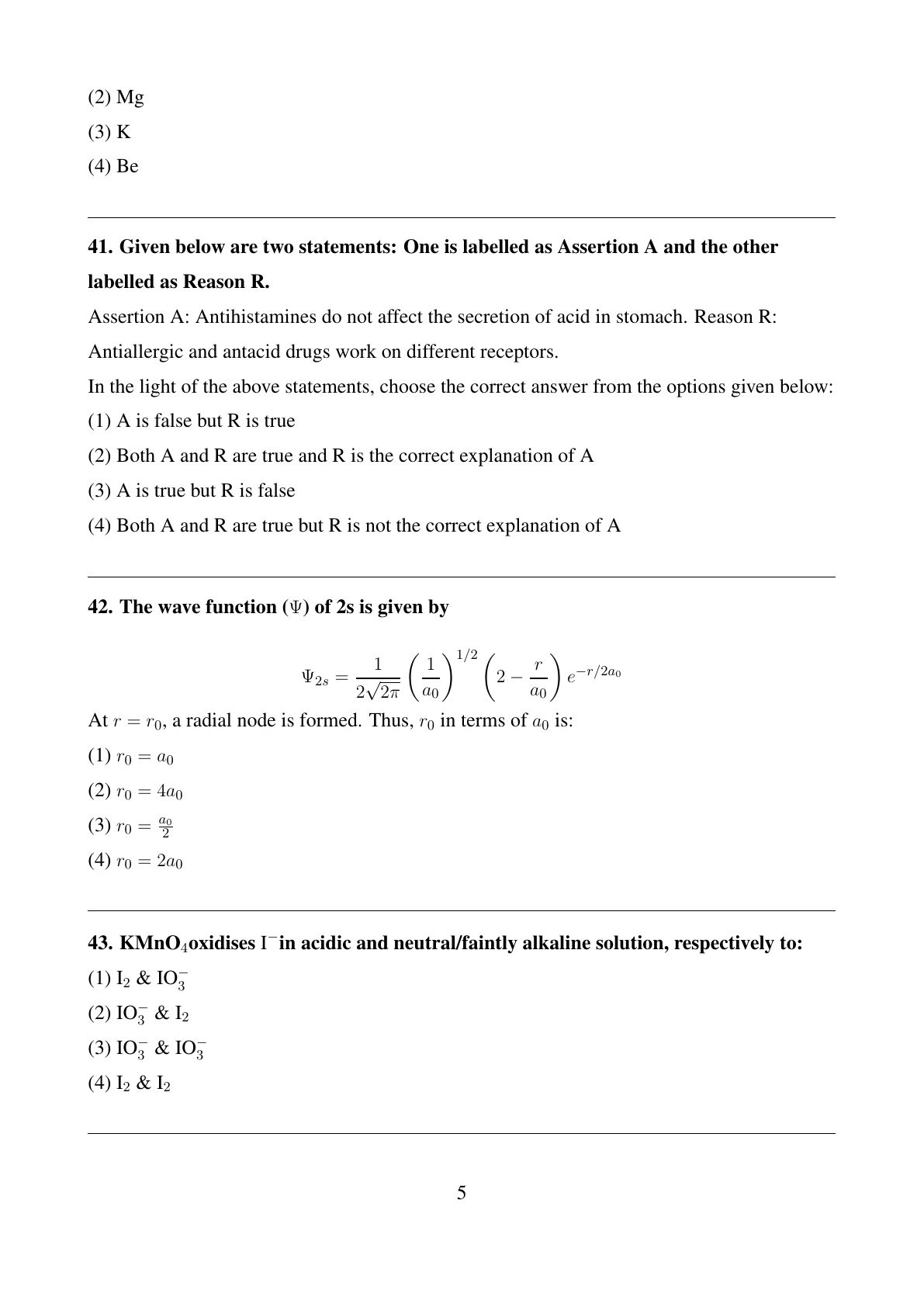
Given below are two statements: One is labelled as Assertion A and the other labelled as Reason R.
Assertion A: Antihistamines do not affect the secretion of acid in stomach.
Reason R: Antiallergic and antacid drugs work on different receptors.
In the light of the above statements, choose the correct answer from the options given below:
View Solution
The wave function (\(\Psi\)) of 2s is given by
\[ \Psi_{2s} = \frac{1}{2\sqrt{2\pi}} \left( \frac{1}{a_0} \right)^{1/2} \left( 2 - \frac{r}{a_0} \right) e^{-r/2a_0} \]
At \(r = r_0\), a radial node is formed. Thus, \(r_0\) in terms of \(a_0\) is:
View Solution
KMnO_4 oxidises I- in acidic and neutral/faintly alkaline solution, respectively to:
View Solution
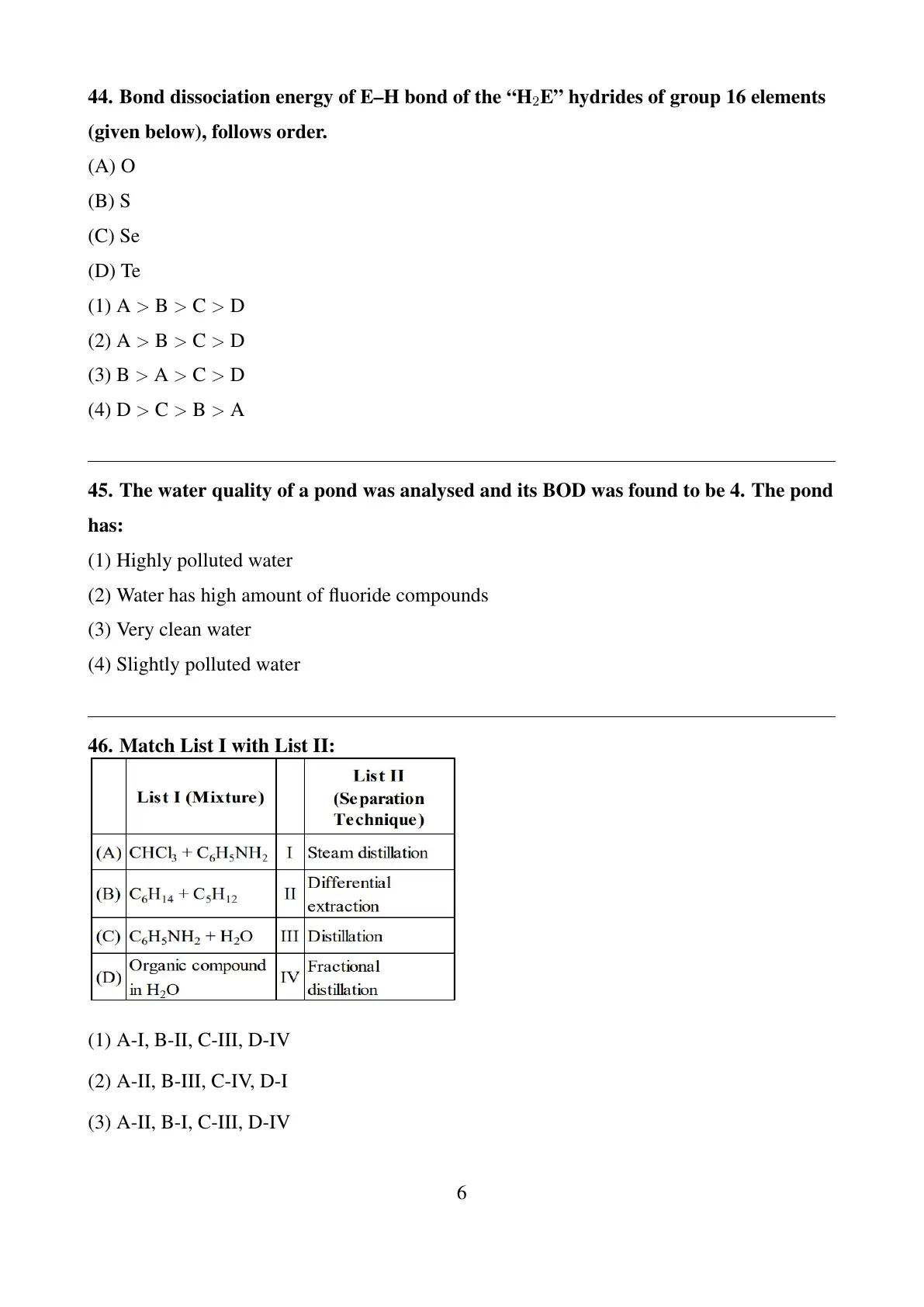
Bond dissociation energy of E–H bond of the “H\(_2\)E” hydrides of group 16 elements (given below), follows order.
(A) O
(B) S
(C) Se
(D) Te
View Solution
The water quality of a pond was analysed and its BOD was found to be 4. The pond has:
View Solution
Match List I with List II:

View Solution
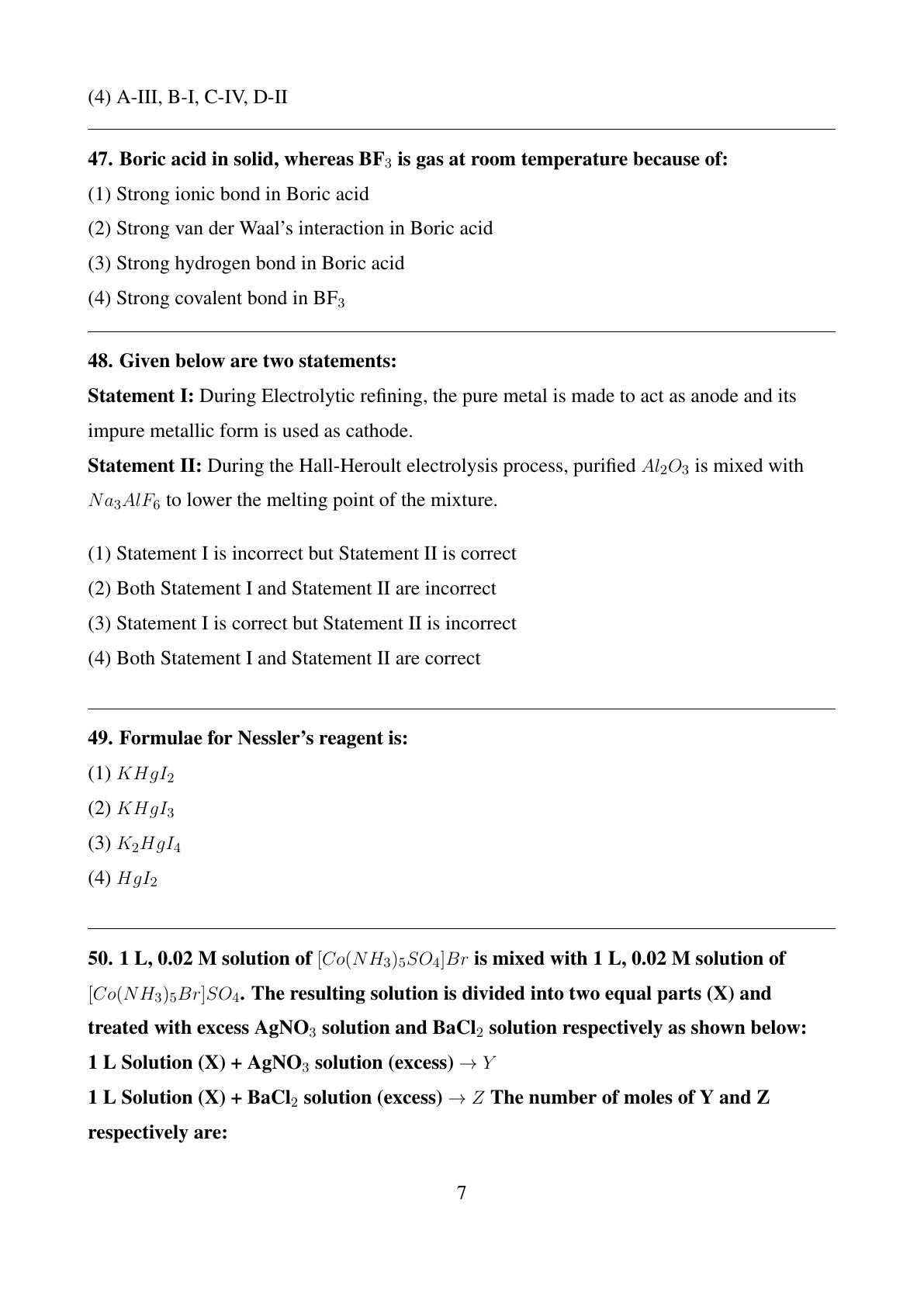
Boric acid in solid, whereas BF\(_3\) is gas at room temperature because of:
View Solution
Given below are two statements:
Statement I: During Electrolytic refining, the pure metal is made to act as anode and its impure metallic form is used as cathode.
Statement II: During the Hall-Heroult electrolysis process, purified \(Al_2O_3\) is mixed with \(Na_3AlF_6\) to lower the melting point of the mixture.
View Solution
Formulae for Nessler’s reagent is:
View Solution
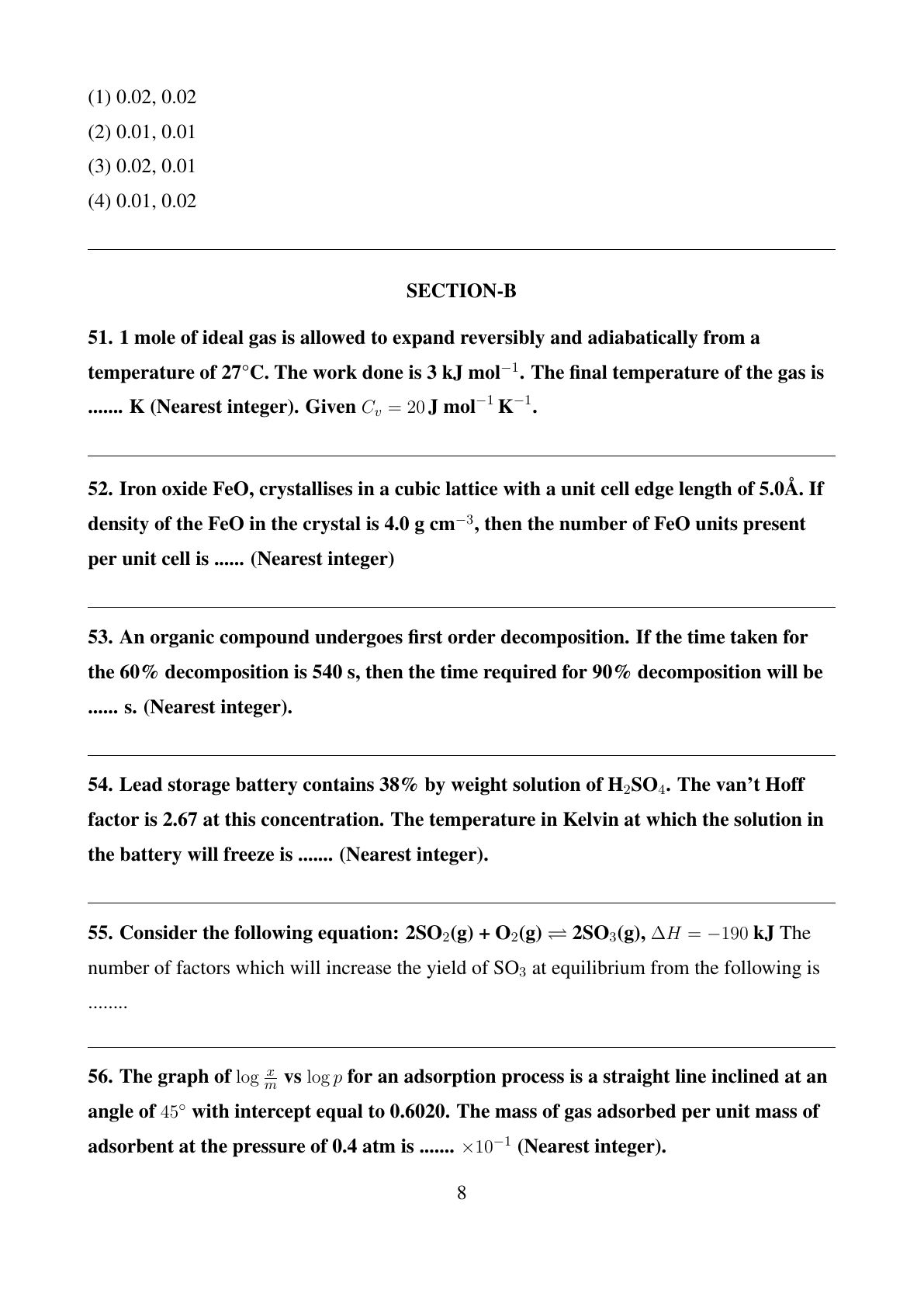
1 L, 0.02 M solution of \([Co(NH_3)_5SO_4]Br\) is mixed with 1 L, 0.02 M solution of \([Co(NH_3)_5Br]SO_4\). The resulting solution is divided into two equal parts (X) and treated with excess AgNO\(_3\) solution and BaCl\(_2\) solution respectively as shown below:
1 L Solution (X) + AgNO\(_3\) solution (excess) \(\rightarrow Y\)
1 L Solution (X) + BaCl\(_2\) solution (excess) \(\rightarrow Z\)
The number of moles of Y and Z respectively are:
View Solution
Section-B
Question 51:
1 mole of ideal gas is allowed to expand reversibly and adiabatically from a temperature of 27°C. The work done is 3 kJ mol\(^{-1}\). The final temperature of the gas is ....... K (Nearest integer). Given \(C_v = 20 \, J mol^{-1} \, K^{-1}\).
View Solution
Iron oxide FeO, crystallises in a cubic lattice with a unit cell edge length of 5.0Å. If density of the FeO in the crystal is 4.0 g cm\(^{-3}\), then the number of FeO units present per unit cell is ...... (Nearest integer)
View Solution
An organic compound undergoes first order decomposition. If the time taken for the 60% decomposition is 540 s, then the time required for 90% decomposition will be ...... s. (Nearest integer).
View Solution
Lead storage battery contains 38% by weight solution of H\(_2\)SO\(_4\). The van’t Hoff factor is 2.67 at this concentration. The temperature in Kelvin at which the solution in the battery will freeze is ....... (Nearest integer).
View Solution
Consider the following equation:
2SO\(_2\)(g) + O\(_2\)(g) \(\rightleftharpoons\) 2SO\(_3\)(g), \(\Delta H = -190\) kJ
The number of factors which will increase the yield of SO\(_3\) at equilibrium from the following is ........
View Solution
The graph of \(\log \frac{x}{m}\) vs \(\log p\) for an adsorption process is a straight line inclined at an angle of \(45^\circ\) with intercept equal to 0.6020. The mass of gas adsorbed per unit mass of adsorbent at the pressure of 0.4 atm is ....... \(\times 10^{-1}\) (Nearest integer).
View Solution
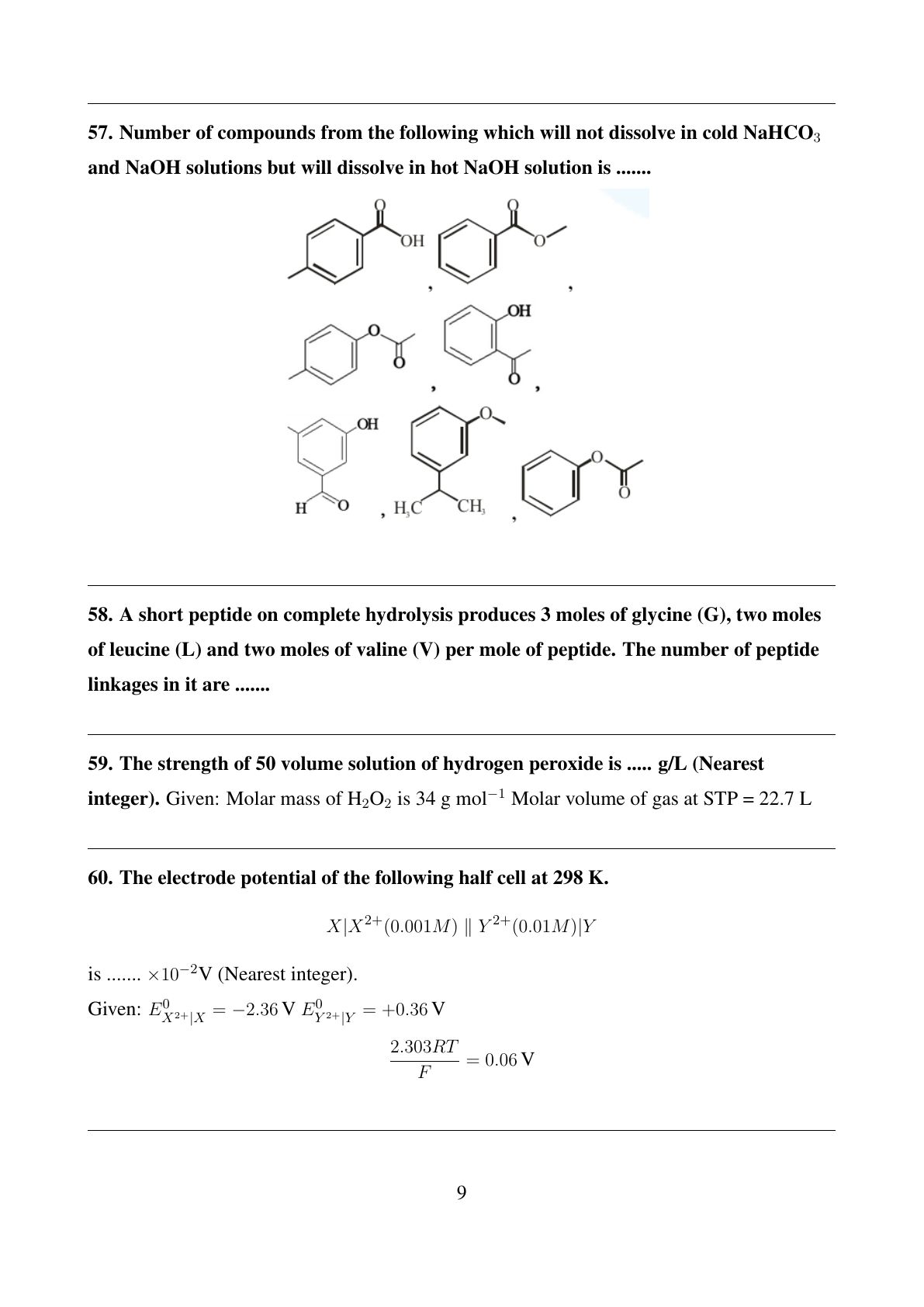
Number of compounds from the following which will not dissolve in cold NaHCO\(_3\) and NaOH solutions but will dissolve in hot NaOH solution is .......

View Solution
A short peptide on complete hydrolysis produces 3 moles of glycine (G), two moles of leucine (L) and two moles of valine (V) per mole of peptide. The number of peptide linkages in it are .......
View Solution
The strength of 50 volume solution of hydrogen peroxide is ..... g/L (Nearest integer).
Given:
Molar mass of H\(_2\)O\(_2\) is 34 g mol\(^{-1}\)
Molar volume of gas at STP = 22.7 L
View Solution
The electrode potential of the following half cell at 298 K. \[ X | X^{2+} (0.001 M) \parallel Y^{2+} (0.01 M) | Y \]
is ....... \times 10^{-2 \text{V (Nearest integer).
Given: \( E^{0_{X^{2+} | X} = -2.36 \, V \) \( E^{0}_{Y^{2+} | Y} = +0.36 \, V \) \[ \frac{2.303RT}{F} = 0.06 \, V \]
View Solution
Also Check:
JEE Main 2023 Chemistry Analysis Jan 30 Shift 2
JEE Main 2023 Paper Analysis for Chemistry paper scheduled on January 30 Shift 2 will be updated here after the conclusion of the exam. Candidates will be able to check the topics with the highest weightage, difficulty level and memory-based Chemistry questions.
| JEE Main 2023 Paper Analysis Jan 30 Shift 2 (After Exam) |
JEE Main 2023 Chemistry Question Paper Pattern
| Feature | Question Paper Pattern |
|---|---|
| Examination Mode | Computer-based Test |
| Exam Language | 13 languages (English, Hindi, Assamese, Bengali, Gujarati, Kannada, Malayalam, Marathi, Odia, Punjabi, Tamil, Telugu, and Urdu) |
| Exam Duration | 3 hours |
| Sectional Time Limit | None |
| Chemistry Marks | 100 marks |
| Total Number of Questions Asked | 20 MCQs + 10 Numerical Type Questions |
| Total Number of Questions to be Answered | 20 MCQs + 5 Numerical Type Questions |
| Marking Scheme | +4 for each correct answer |
| Negative Marking | -1 for each incorrect answer |
Also Check:
JEE Main 2022 Question Paper
JEE Main 2023 aspirants can practice and check their exam prep level by attempting the previous year question papers as well. The table below shows JEE Main 2022 Question Paper PDF for B.E./B.Tech to practice.



Comments