




JEE Main 2014 April 11 Question Paper is available here with solutions PDF and detailed solutions for every question. CBSE conducted the computer-based test (CBT) Paper 1 on April 11, 2014. The JEE Main 2014 Paper 1 (B.E./B.Tech) question paper includes the following:
- 90 questions in a 3-hour CBT Mode: 30 each from Mathematics, Physics and Chemistry
- Question type: all multiple choice questions (MCQs) with a single correct option, 4 marks each
- Sections: Mathematics (30), Physics (30) and Chemistry (30), all questions compulsory
- Marking: +4 for a correct answer, -1 for an incorrect answer, 0 for an unattempted question
- Maximum marks: 360 (120 per subject)
JEE Main 2014 April 11 Question Paper with Solution PDF
| NTA Official PDF | CD PDF | CD PDF with Solutions |
|---|---|---|
| Download official PDF 3.03 MB | Download Collegedunia PDF 4.87 MB | Download solutions PDF 1.16 MB |
Also Check:
JEE Main 2014 April 11 Questions with Solutions
Mathematics (Q1 - Q30)
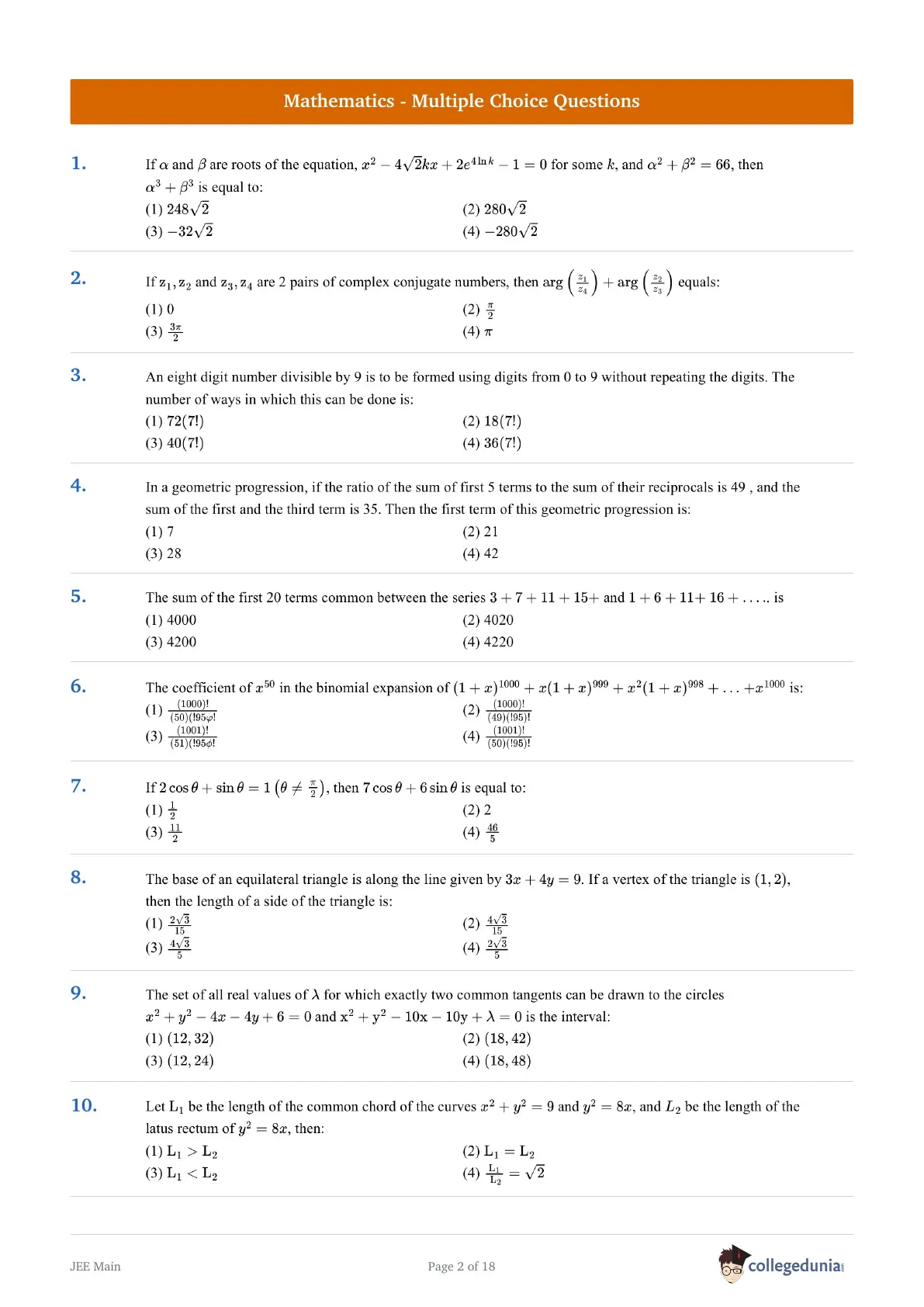
If \(\alpha\) and \(\beta\) are roots of the equation, \(x^2 - 4\sqrt{2}kx + 2e^{4\ln k} - 1 = 0\) for some \(k\), and \(\alpha^2 + \beta^2 = 66\), then \(\alpha^3 + \beta^3\) is equal to:
If \(z_1, z_2\) and \(z_3, z_4\) are 2 pairs of complex conjugate numbers, then \(\arg\left(\frac{z_1}{z_4}\right) + \arg\left(\frac{z_2}{z_3}\right)\) equals:
An eight digit number divisible by 9 is to be formed using digits from 0 to 9 without repeating the digits. The number of ways in which this can be done is :
In a geometric progression, if the ratio of the sum of first 5 terms to the sum of their reciprocals is 49, and the sum of the first and the third term is 35. Then the first term of this geometric progression is:
The sum of the first 20 terms common between the series \(3 + 7 + 11 + 15 + \ldots\) and \(1 + 6 + 11 + 16 + \ldots\) is:
The coefficient of \(x^{50}\) in the binomial expansion of \((1 + x)^{1000} + x (1 + x)^{999} + x^2(1 + x)^{998} + .... + x^{1000}\) is:
If \(2\cos\theta + \sin\theta = 1\) \(\left(\theta \ne \frac{\pi}{2}\right)\), then \(7\cos\theta + 6\sin\theta\) is equal to:
The base of an equilateral triangle is along the line given by \(3x + 4y = 9\). If a vertex of the triangle is \((1, 2)\), then the length of a side of the triangle is:
The set of all real values of \(\lambda\) for which exactly two common tangents can be drawn to the circles \(x^2 + y^2 - 4x - 4y + 6 = 0\) and \(x^2 + y^2 - 10x - 10y + \lambda = 0\) is the interval:
Let \(L_1\) be the length of the common chord of the curves \(x^2+y^2 = 9\) and \(y^2 = 8x,\) and \(L_2\) be the length of the latus rectum of \(y^2 = 8x,\) then :
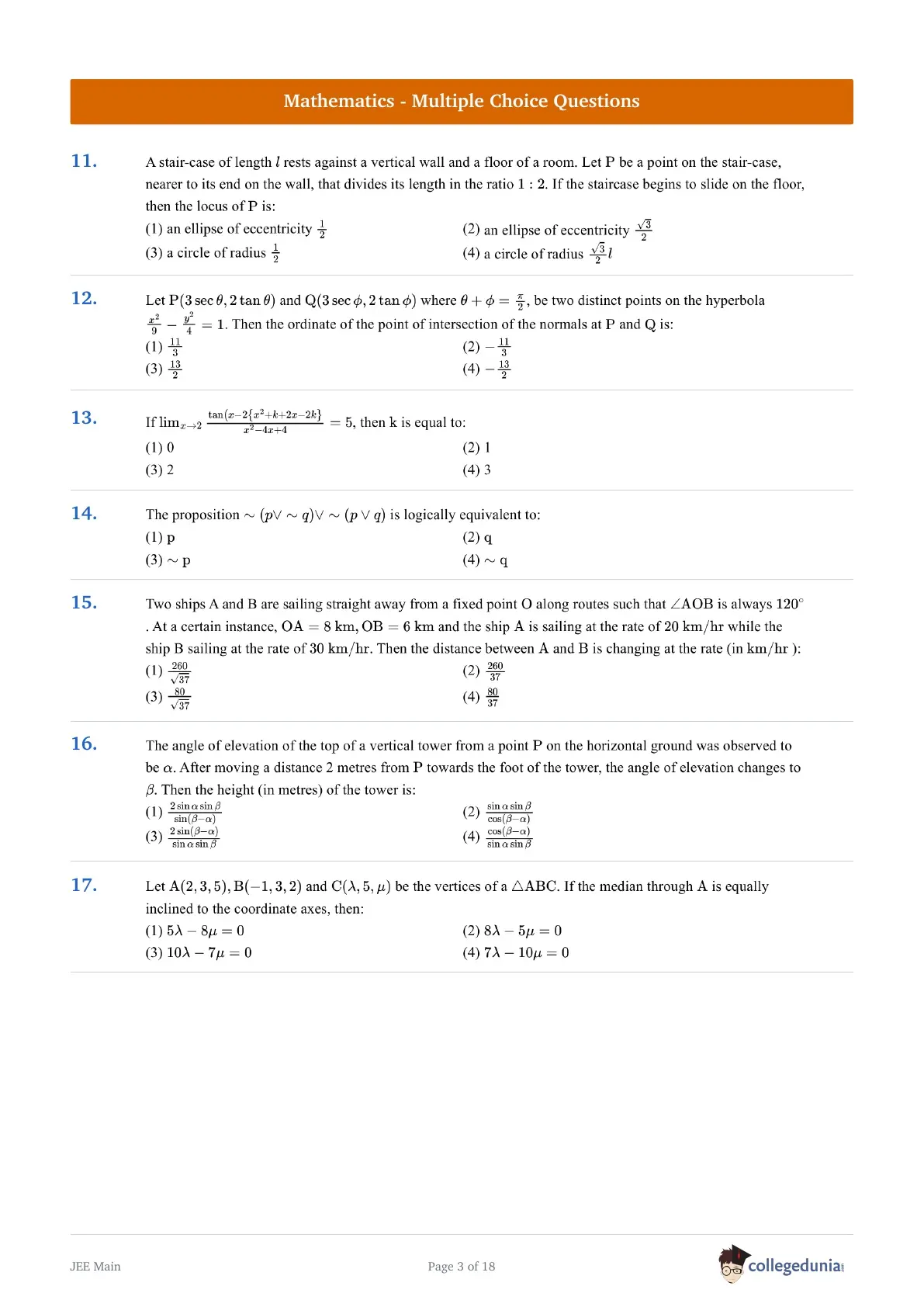
A stair-case of length \(l\) rests against a vertical wall and a floor of a room. Let P be a point on the stair-case, nearer to its end on the wall, that divides its length in the ratio \(1 : 2\). If the staircase begins to slide on the floor, then the locus of P is:
Let P \(\left(3\, sec \,\theta, \,2 \,tan \,\theta\right)\) and Q \(\left(3\, sec\, \phi, \,2 \,tan \,\phi\right)\) where \(\theta + \phi = \frac{\pi}{2},\) be two distinct points on the hyperbola \(\frac{x^{2}}{9} - \frac{y^{2}}{4} = 1.\) Then the ordinate of the point of intersection of the normals at P and Q is :
If \(\lim_{x \to 2} \frac{\tan\left((x-2)\left\{x^2 + (k-2)x - 2k\right\}\right)}{x^2 - 4x + 4} = 5\), then \(k\) is equal to:
The proposition \(\sim(p \vee \sim q) \vee \sim(p \vee q)\) is logically equivalent to:
Two ships A and B are sailing straight away from a fixed point O along routes such that \(\angle AOB\) is always \(120^\circ\). At a certain instance, \(OA = 8\) km, \(OB = 6\) km and the ship A is sailing at the rate of 20 km/hr while the ship B sailing at the rate of 30 km/hr. Then the distance between A and B is changing at the rate (in km/hr):
The angle of elevation of the top of a vertical tower from a point P on the horizontal ground was observed to be \(\alpha\). After moving a distance 2 metres from P towards the foot of the tower, the angle of elevation changes to \(\beta\). Then the height (in metres) of the tower is:
Let \(A(2,3,5)\), \(B(-1,3,2)\) and \(C(\lambda,5,\mu)\) be the vertices of a \(\triangle ABC\). If the median through A is equally inclined to the coordinate axes, then:
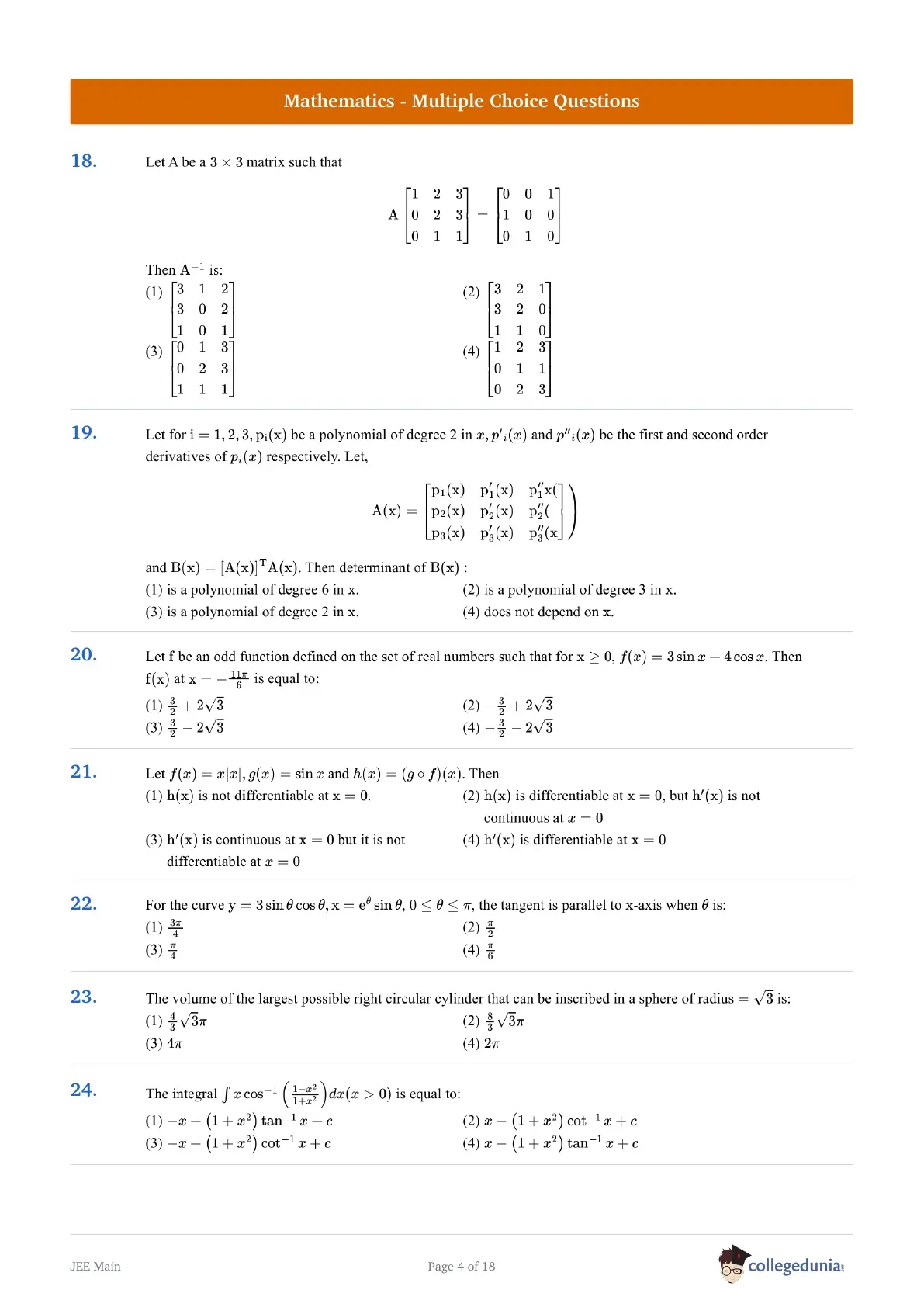
Let A be a \(3\times3\) matrix such that \(A\begin{bmatrix}1&2&3\\0&2&3\\0&1&1\end{bmatrix}=\begin{bmatrix}0&0&1\\1&0&0\\0&1&0\end{bmatrix}\). Then \(A^{-1}\) is:
Let for \(i = 1,2,3\), \(p_i(x)\) be a polynomial of degree 2 in x, \(p_i'(x)\) and \(p_i''(x)\) be the first and second order derivatives of \(p_i(x)\) respectively. Let, \(A(x) = \begin{bmatrix}p_1(x)&p_1'(x)&p_1''(x)\\p_2(x)&p_2'(x)&p_2''(x)\\p_3(x)&p_3'(x)&p_3''(x)\end{bmatrix}\) and \(B(x) = [A(x)]^{T}A(x)\). Then determinant of B(x):
Let f be an odd function defined on the set of real numbers such that for \(x \ge 0\), \(f(x) = 3\sin x + 4\cos x\). Then f(x) at \(x = -\frac{11\pi}{6}\) is equal to:
Let \(f(x) = x|x|\), \(g(x) = \sin x\) and \(h(x) = (g\circ f)(x)\). Then
For the curve \(y = 3\sin\theta\cos\theta\), \(x = e^{\theta}\sin\theta\), \(0 \le \theta \le \pi\), the tangent is parallel to x-axis when \(\theta\) is:
The volume of the largest possible right circular cylinder that can be inscribed in a sphere of radius \(= \sqrt{3}\) is:
The integral \(\int x \,cos^{-1}\left(\frac{1-x^{2}}{1+x^{2}}\right) \,dx\, \left(x > 0\right)\) is equal to :
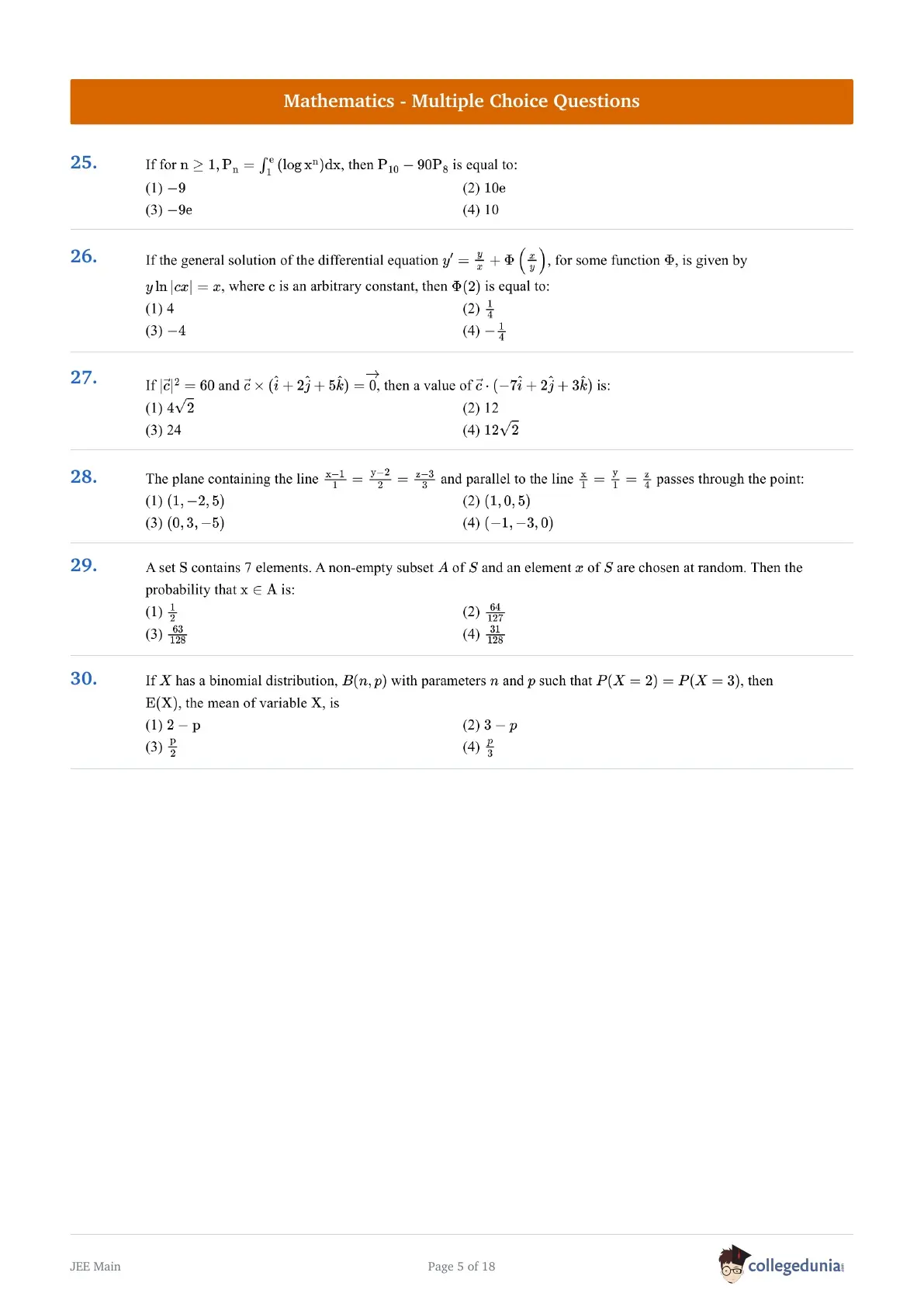
If \(n \ge 1\), \(P_n = \int_1^e (\log x)^n\,dx\), then \(P_{10} - 90P_8\) is equal to:
If the general solution of the differential equation \(y' = \frac{y}{x} + \Phi\left(\frac{x}{y}\right)\), for some function \(\Phi\), is given by \(y\ln|cx| = x\), where c is an arbitrary constant, then \(\Phi(2)\) is equal to:
If \(|\vec{c}|^2 = 60\) and \(\vec{c}\times(\hat{i}+2\hat{j}+5\hat{k}) = \vec{0}\), then a value of \(\vec{c}\cdot(-7\hat{i}+2\hat{j}+3\hat{k})\) is:
The plane containing the line \(\frac{x-1}{1} = \frac{y-2}{2} = \frac{z-3}{3}\) and parallel to the line \(\frac{x}{1} = \frac{y}{1} = \frac{z}{4}\) passes through the point:
A set S contains 7 elements. A non-empty subset A of S and an element x of S are chosen at random. Then the probability that \(x \in A\) is:
If \(X\) has a binomial distribution, \(B(n,p)\) with parameters \(n\) and \(p\) such that \(P(X=2)=P(X=3)\), then \(E(X)\), the mean of variable \(X\), is
Physics (Q31 - Q60)
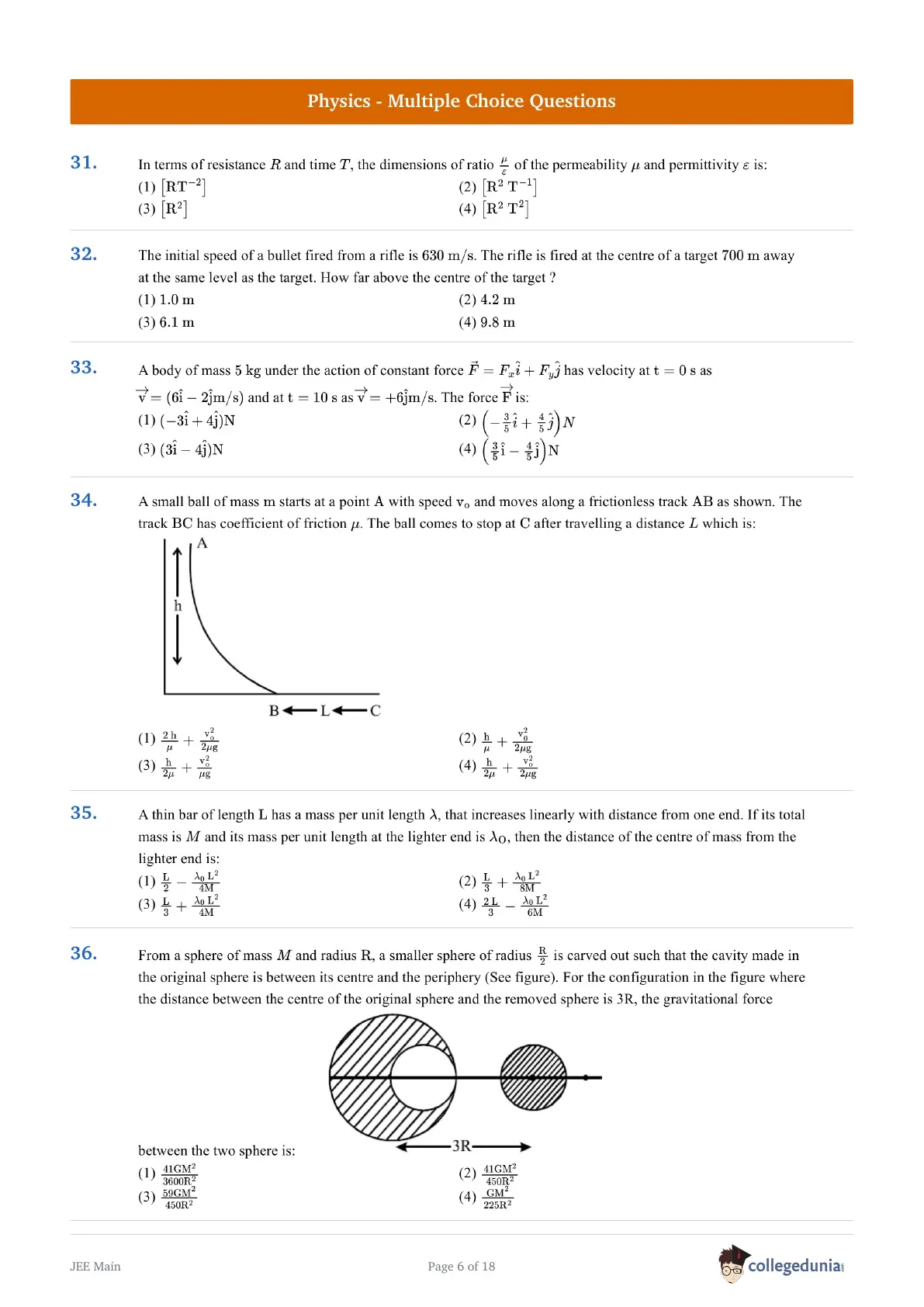
In terms of resistance \(R\) and time \(T\), the dimensions of ratio \(\frac{\mu}{\epsilon}\) of the permeability \({\mu}\) and permittivity \({\epsilon}\) is :
The initial speed of a bullet fired from a rifle is \(630\, m/ s\). The rifle is fired at the centre of a target \(700\, m\) away at the same level as the target. How far above the centre of the target the rifle must be aimed in order to hit the target ?
A body of mass \(5\, kg\) under the action of constant force \(\vec{F}=F_{x} \hat{i} +F_{y} \hat{j}\) has velocity at \(t = 0\,s\) as \(\vec{\upsilon} = \left(6\hat{i} - 2\hat{j}\right)\) m/s and at \(t = 10 s\) as \(\vec{\upsilon}=+6 \hat{j}\) m/s. The force \(\vec{F}\) is :
A small ball of mass m starts at a point A with speed \(v_o\) and moves along a frictionless track AB as shown. The track BC has coefficient of friction \(\mu\). The ball comes to stop at C after travelling a distance \(L\) which is:
A thin bar of length \(L\) has a mass per unit length \(\lambda\), that increases linearly with distance from one end. If its total mass is \(M\) and its mass per unit length at the lighter end is \(\lambda_{0}\), then the distance of the centre of mass from the lighter end is :
From a sphere of mass \(M\) and radius R, a smaller sphere of radius \(\frac{R}{2}\) is carved out such that the cavity made in the original sphere is between its centre and the periphery (See figure). For the configuration in the figure where the distance between the centre of the original sphere and the removed sphere is 3R, the gravitational force between the two sphere is:
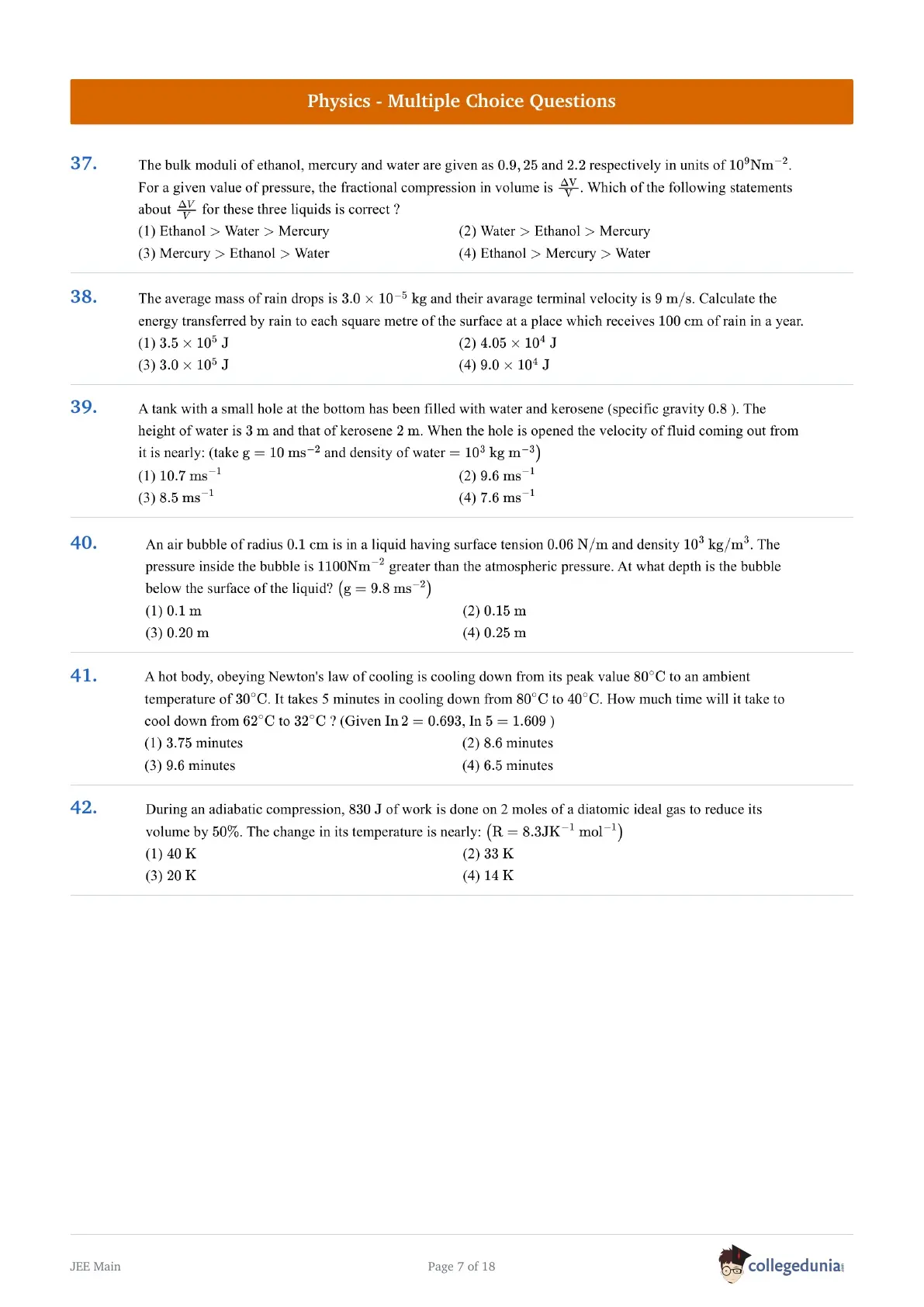
The bulk moduli of ethanol, mercury and water are given as \(0.9,\ 25\) and \(2.2\) respectively in units of \(10^9\,\mathrm{Nm^{-2}}\). For a given value of pressure, the fractional compression in volume is \(\frac{\Delta V}{V}\). Which of the following statements about \(\frac{\Delta V}{V}\) for these three liquids is correct ?
The average mass of rain drops is \(3.0 \times 10^{-5}\) kg and their average terminal velocity is \(9\, m/s.\) Calculate the energy transferred by rain to each square metre of the surface at a place which receives \(100\, cm\) of rain in a year.
A tank with a small hole at the bottom has been filled with water and kerosene (specific gravity 0.8 ). The height of water is 3 m and that of kerosene 2 m. When the hole is opened the velocity of fluid coming out from it is nearly: (take \(g=10\ \mathrm{ms^{-2}}\) and density of water \(=10^3\ \mathrm{kg\,m^{-3}}\))
An air bubble of radius \(0.1\, cm\) is in a liquid having surface tension \(0.06\, N/m\) and density \(10^3\, kg/m^3\). The pressure inside the bubble is 1100 \(Nm^{-2}\) greater than the atmospheric pressure. At what depth is the bubble below the surface of the liquid ? \((g = 9.8 \,ms^{-2})\)
A hot body, obeying Newton's law of cooling is cooling down from its peak value \(80^\circ\mathrm{C}\) to an ambient temperature of \(30^\circ\mathrm{C}\). It takes 5 minutes in cooling down from \(80^\circ\mathrm{C}\) to \(40^\circ\mathrm{C}\). How much time will it take to cool down from \(62^\circ\mathrm{C}\) to \(32^\circ\mathrm{C}\) ? (Given \(\ln 2=0.693,\ \ln 5=1.609\) )
During an adiabatic compression, \(830\, J\) of work is done on \(2\) moles of a diatomic ideal gas to reduce its volume by \(50\%\). The change in its temperature is nearly : \((R = 8.3 JK^{-1}\, mol^{-1})\)
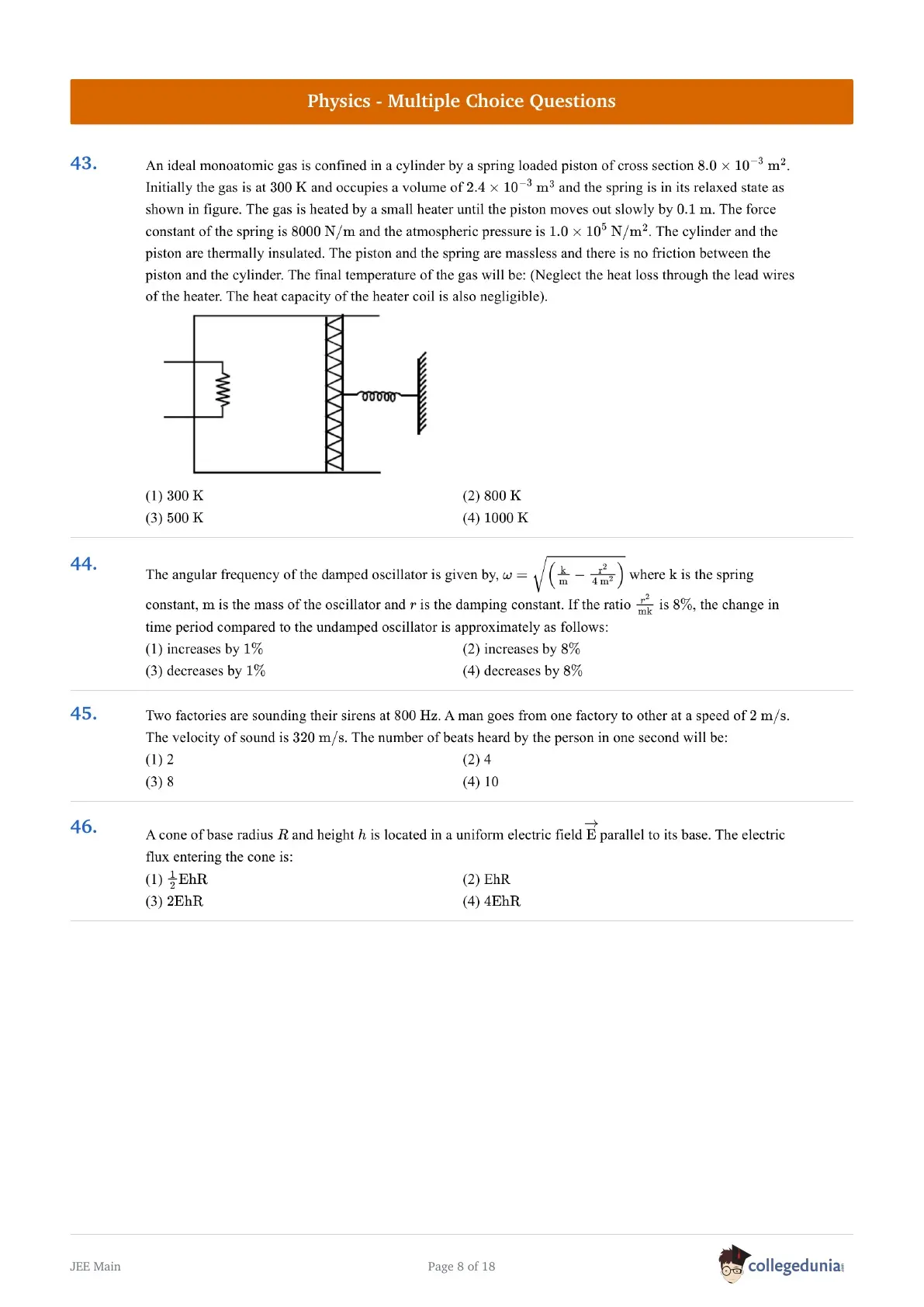
An ideal monoatomic gas is confined in a cylinder by a spring loaded piston of cros section \(8.0 \times 10^{-3} \, m^2\). Initially the gas is at 300K and occupies a volume of \(2.4 \times 10^{-3} \, m^3\) and the spring is in its relaxed state as shown in figure. The gas is heated by a small heater until the piston moves out slowly by \(0.1\, m\). The force constant of the spring is \(8000\, N/m\) and the atmospheric pressure is \(1.0 \times 10^5 \, N/m^2\). The cylinder and the piston are thermally insulated. The piston and the spring are massless and there is no friction between the piston and the cylinder. The final temperature of the gas will be : (Neglect the heat loss through the lead wires of the heater. The heat capacity of the heater coil is also negligible)
The angular frequency of the damped oscillator is given by, \(\omega = \sqrt{\left(\frac{k}{m} - \frac{r^{2}}{4m^{2}}\right)}\) where \(k\) is the spring constant, \(m\) is the mass of the oscillator and \(r\) is the damping constant. If the ratio \(\frac{r^{2}}{mk}\) is \(8\%\), the change in time period compared to the undamped oscillator is approximately as follows :
Two factories are sounding their sirens at \(800\, Hz\). A man goes from one factory to other at a speed of \(2\, m/s\). The velocity of sound is \(320\, m/s\). The number of beats heard by the person in one second will be :
A cone of base radius R and height h is located in a uniform electric field \(\overrightarrow{E}\) parallel to its base. The electric flux entering the cone is :
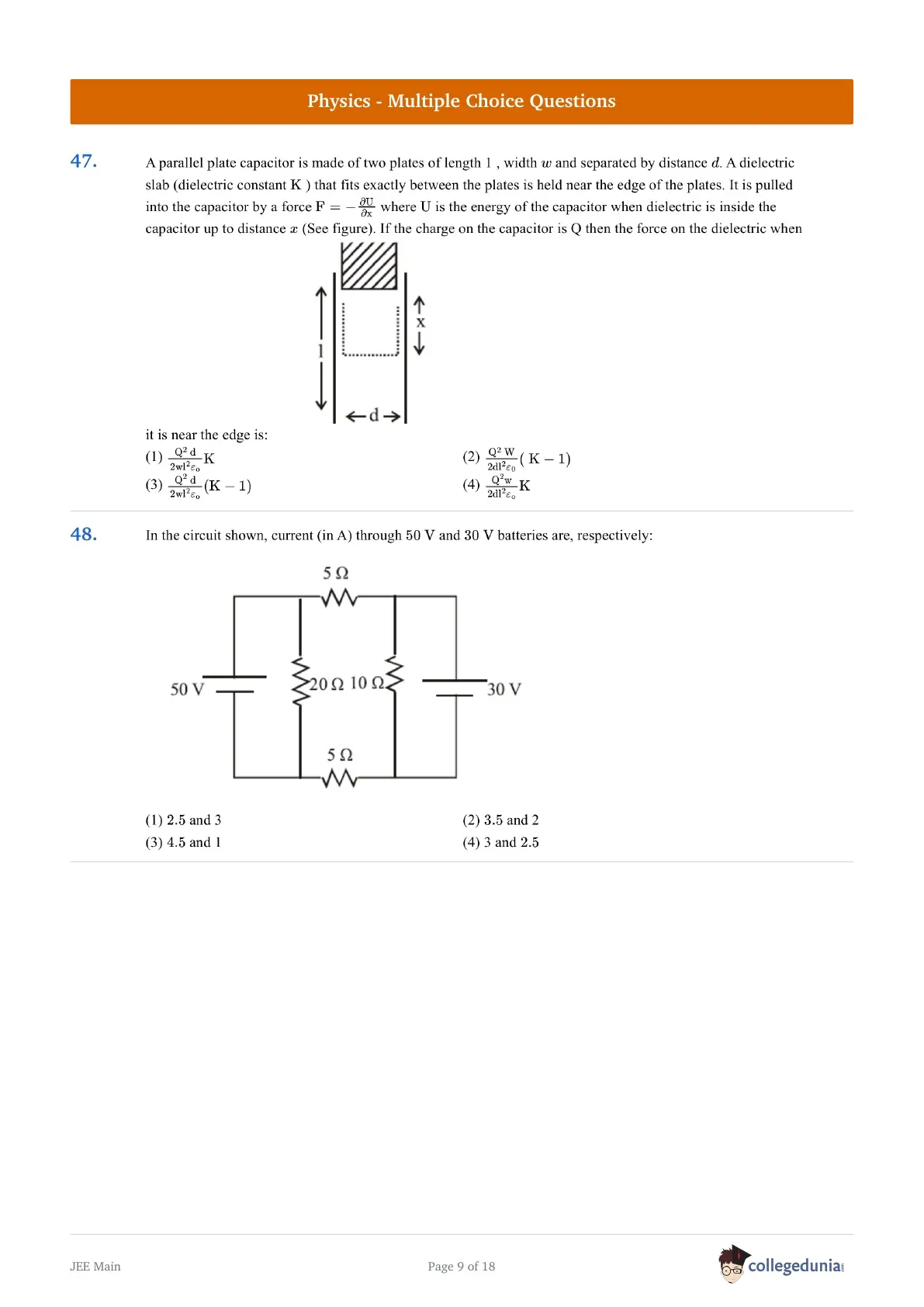
A parallel plate capacitor is made of two plates of length \(l\), width \(w\) and separated by distance \(d\). A dielectric slab (dielectric constant K ) that fits exactly between the plates is held near the edge of the plates. It is pulled into the capacitor by a force \(F=-\frac{\partial U}{\partial x}\) where \(U\) is the energy of the capacitor when dielectric is inside the capacitor up to distance \(x\) (See figure). If the charge on the capacitor is Q then the force on the dielectric when it is near the edge is:
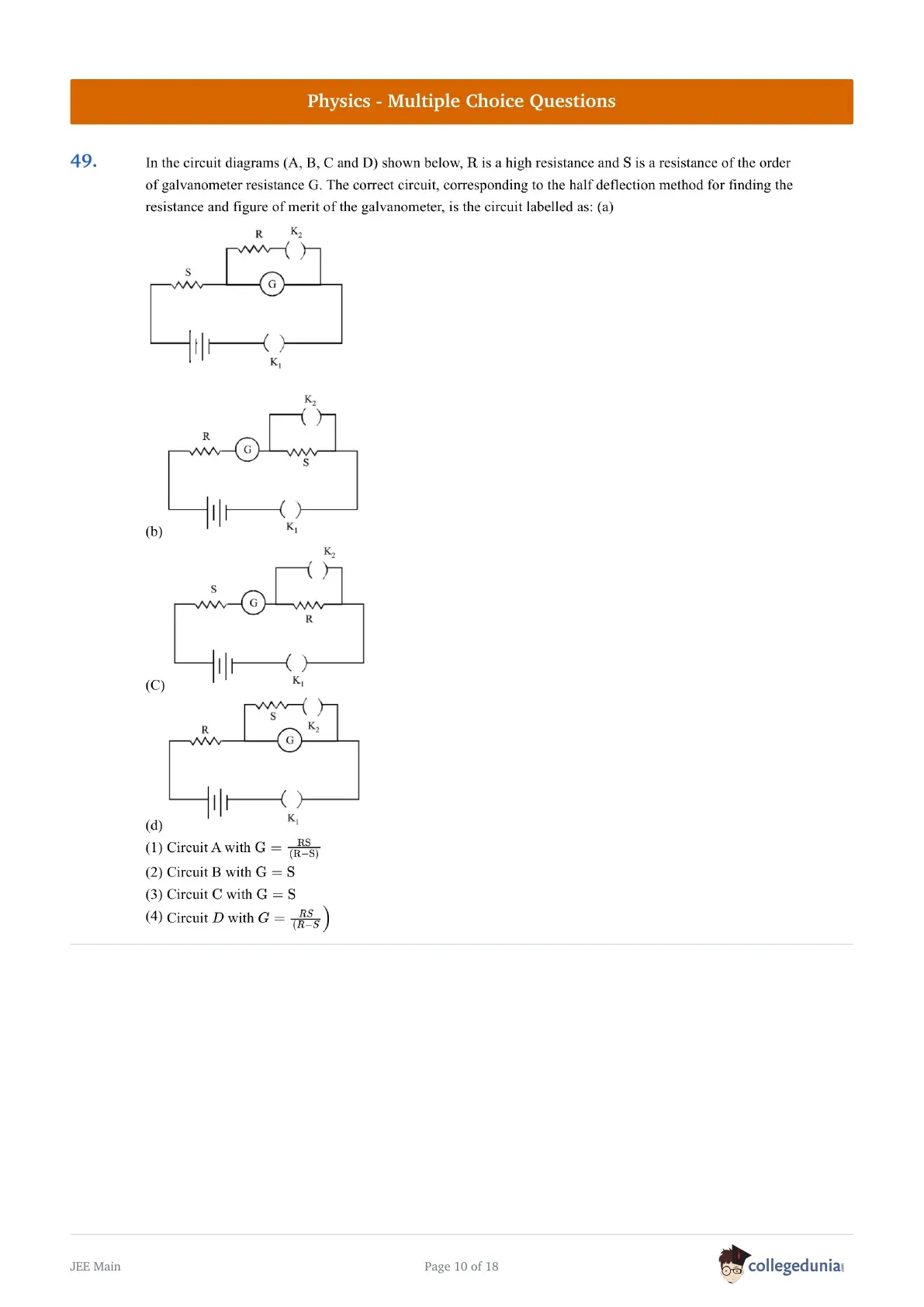
In the circuit shown, current (in A) through the 50 V and 30 V batteries are, respectively :
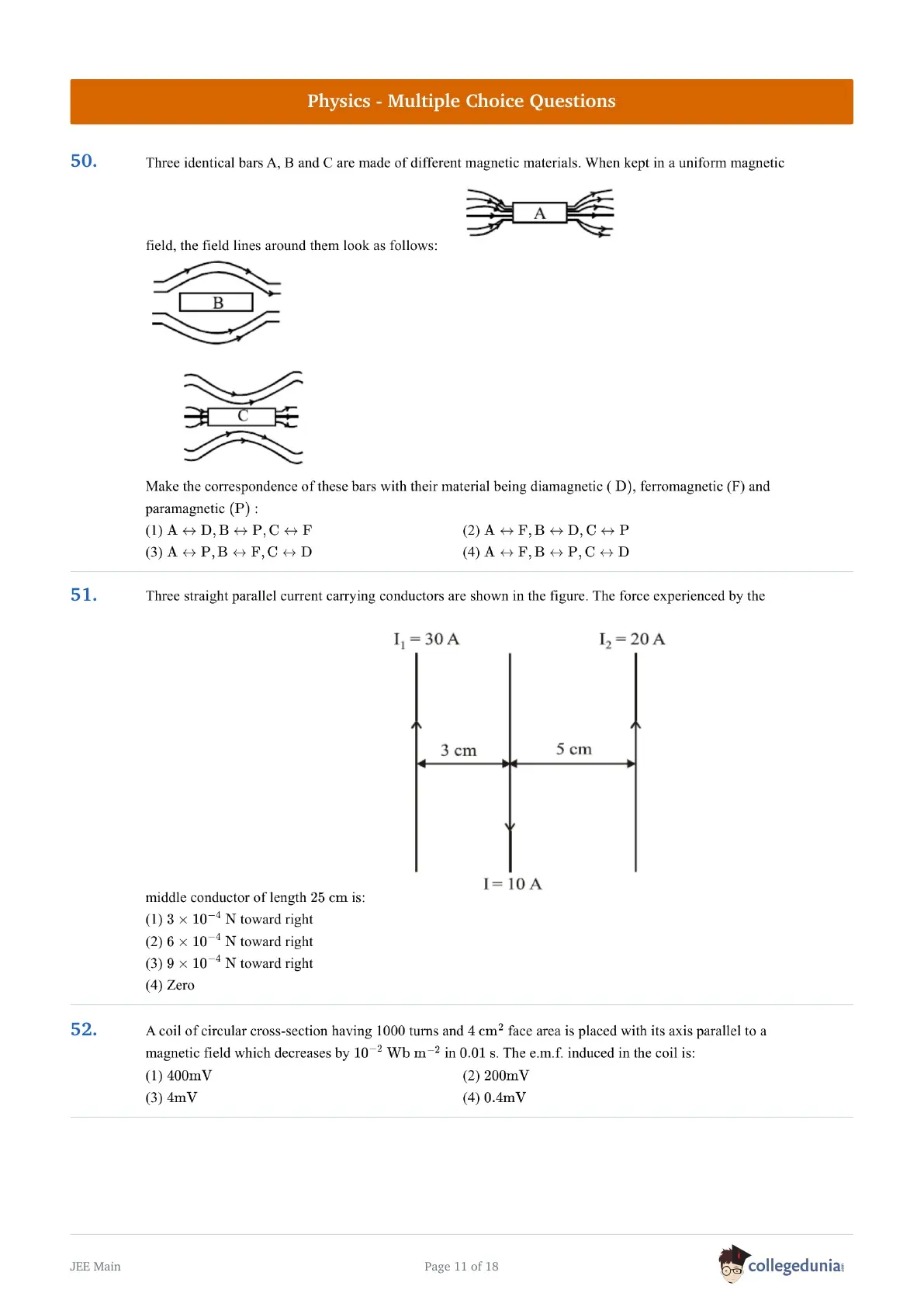
In the circuit diagrams (A, B, C and D) shown below, R is a high resistance and S is a resistance of the order of galvanometer resistance G. The correct circuit, corresponding to the half deflection method for finding the resistance and figure of merit of the galvanometer, is the circuit labelled as:
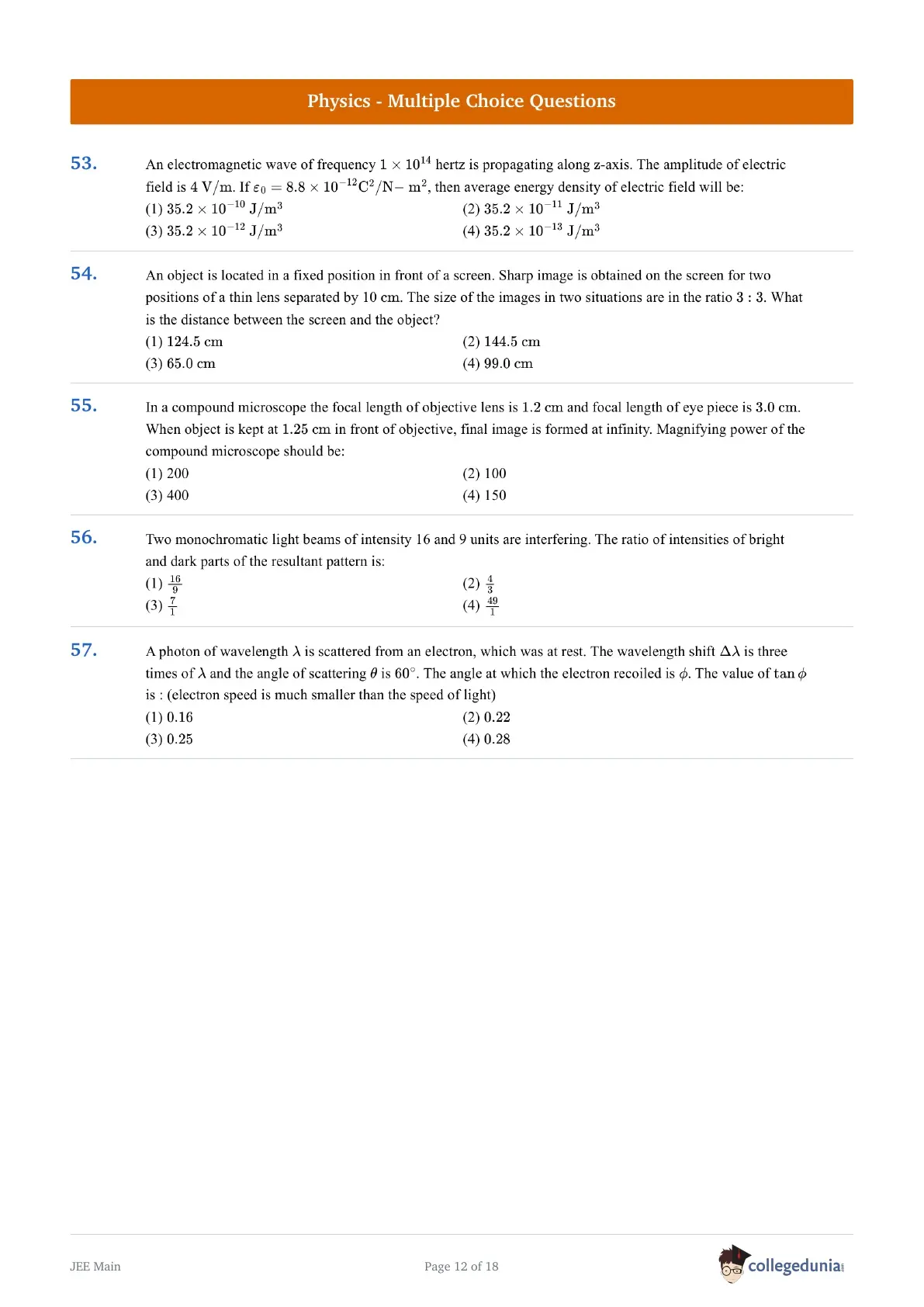
Three identical bars A, B and C are made of different magnetic materials. When kept in a uniform magnetic field, the field lines around them look as follows:
Make the correspondence of these bars with their material being diamagnetic ( D), ferromagnetic (F) and paramagnetic (P) :
Three straight parallel current carrying conductors are shown in the figure. The force experienced by the middle conductor of length 25 cm is:
A coil of circular cross-section having 1000 turns and \(4\ \mathrm{cm^2}\) face area is placed with its axis parallel to a magnetic field which decreases by \(10^{-2}\ \mathrm{Wb\,m^{-2}}\) in 0.01 s. The e.m.f. induced in the coil is:
An electromagnetic wave of frequency \(1\times10^{14}\) hertz is propagating along z-axis. The amplitude of electric field is 4 V/m. If \(\varepsilon_0=8.8\times10^{-12}\ \mathrm{C^2/N\text{-}m^2}\), then average energy density of electric field will be:
An object is located in a fixed position in front of a screen. Sharp image is obtained on the screen for two positions of a thin lens separated by \(10\, cm\). The size of the images in two situations are in the ratio 3 : 2. What is the distance between the screen and the object ?
In a compound microscope the focal length of objective lens is \(1.2\ \mathrm{cm}\) and focal length of eye piece is \(3.0\ \mathrm{cm}\). When object is kept at \(1.25\ \mathrm{cm}\) in front of objective, final image is formed at infinity. Magnifying power of the compound microscope should be:
Two monochromatic light beams of intensity 16 and 9 units are interfering. The ratio of intensities of bright and dark parts of the resultant pattern is:
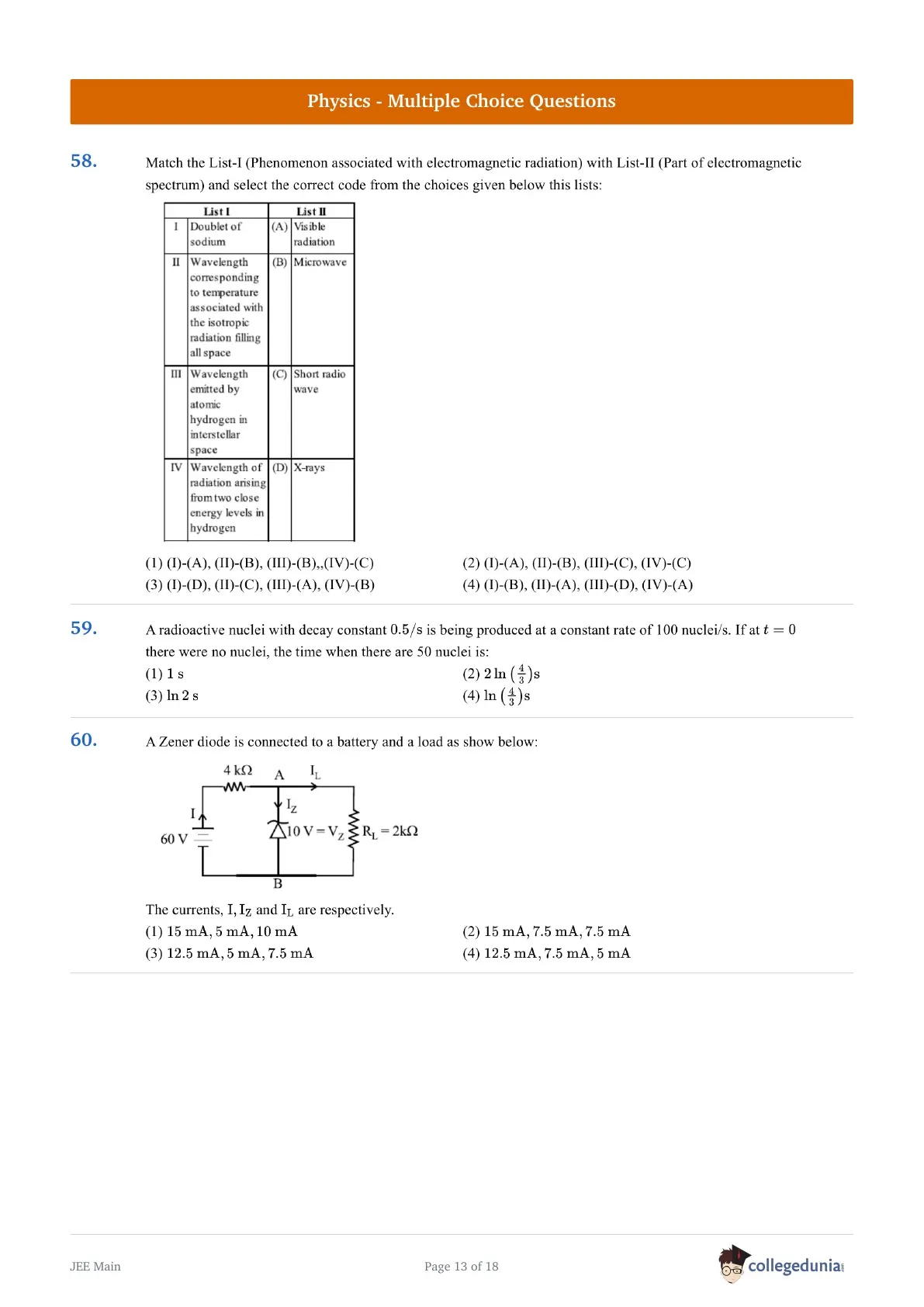
A photon of wavelength \(\lambda\) is scattered from an electron, which was at rest. The wavelength shift \(\Delta\lambda\) is three times of \(\lambda\) and the angle of scattering \(\theta\) is \(60^\circ\). The angle at which the electron recoiled is \(\phi\). The value of \(\tan\phi\) is : (electron speed is much smaller than the speed of light)
| List I | List II | ||
| I | Doublet of sodium | (A) | Visible radiation |
| II | Wavelength corresponding to temperature associated with the isotropic radiation filling all space | (B) | Microwave |
| III | Wavelength emitted by atomic hydrogen in interstellar space | (C) | Short radio wave |
| IV | Wavelength of radiation arising from two close energy levels in hydrogen | (D) | X-rays |
A radioactive nuclei with decay constant \(0.5/\mathrm{s}\) is being produced at a constant rate of 100 nuclei/s. If at \(t=0\) there were no nuclei, the time when there are 50 nuclei is:
A Zener diode is connected to a battery and a load as shown below : The currents \(I, I_z\) and \(I_L\) are respectively
Chemistry (Q61 - Q90)
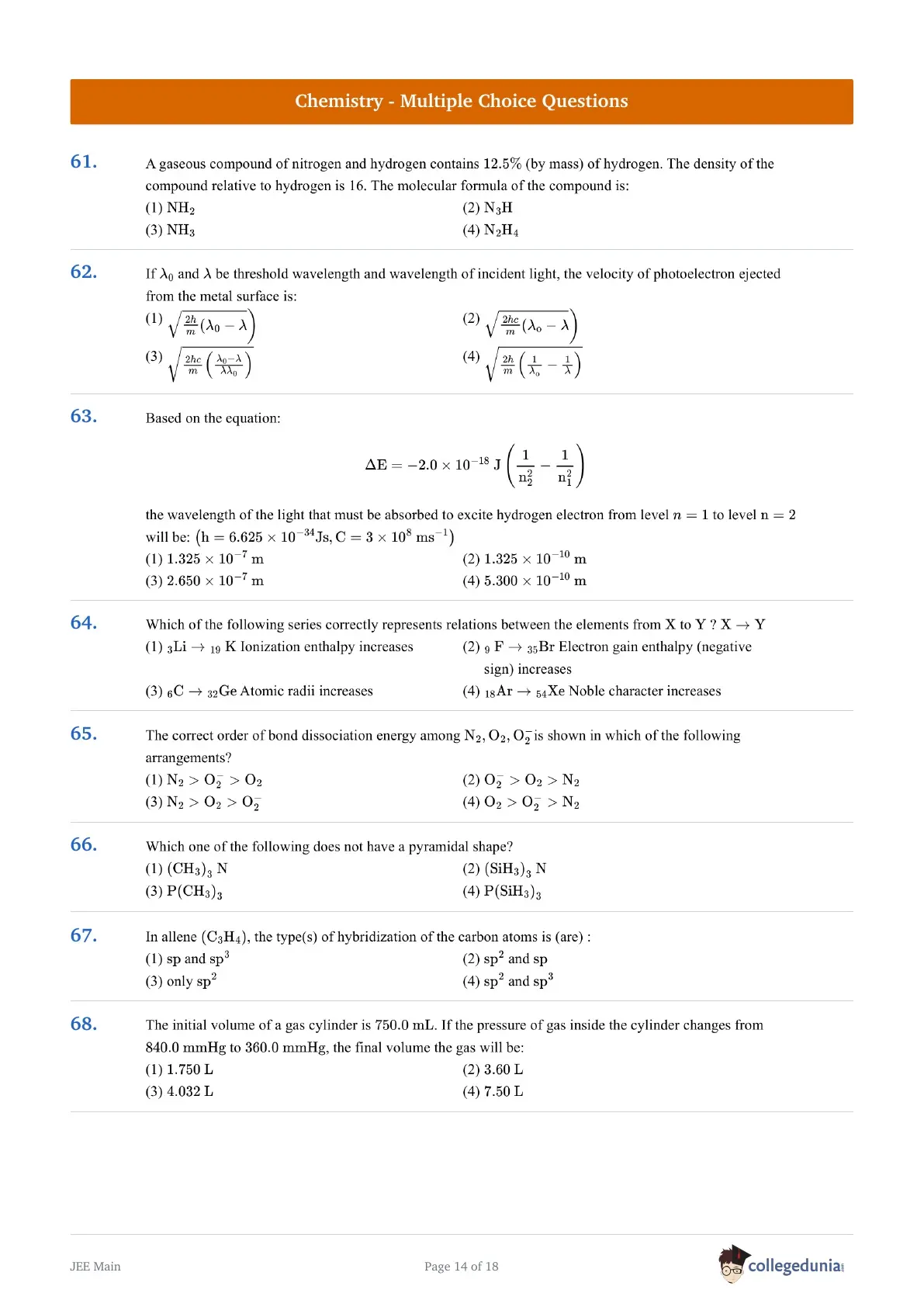
A gaseous compound of nitrogen and hydrogen contains 12.5% (by mass) of hydrogen. The density of the compound relative to hydrogen is 16. The molecular formula of the compound is:
If \(\lambda_{0}\) and \(\lambda\) be the threshold wavelength and wavelength of incident light, the velocity of photoelectron ejected from the metal surface is :
Based on the equation : \(\Delta E = -2.0 \times 10^{-18} J \left(\frac{1}{n^{2}_{2}}-\frac{1}{n^{2}_{1}}\right)\) the wavelength of the light that must be absorbed to excite hydrogen electron from level n=l to level n=2 will be : \(\left(h = 6.625 \times 10^{-34} \,Js, C= 3\times10^{8} \,ms^{-1}\right)\)
Which of the following series correctly represents relations between the elements from X to Y?
\(X\to Y\)
The correct order of bond dissociation energy among \(N_2, O_2, O_2^-\) is shown in which of the following arrangements ?
Which one of the following does not have a pyramidal shape?
In allene (\(\mathrm{C_3H_4}\)), the type(s) of hybridization of the carbon atoms is (are) :
The initial volume of a gas cylinder is 750.0 \,mL. If the pressure of gas inside the cylinder changes from \(840.0 \,mm\) Hg to 360.0 mm Hg, the final volume the gas will be :
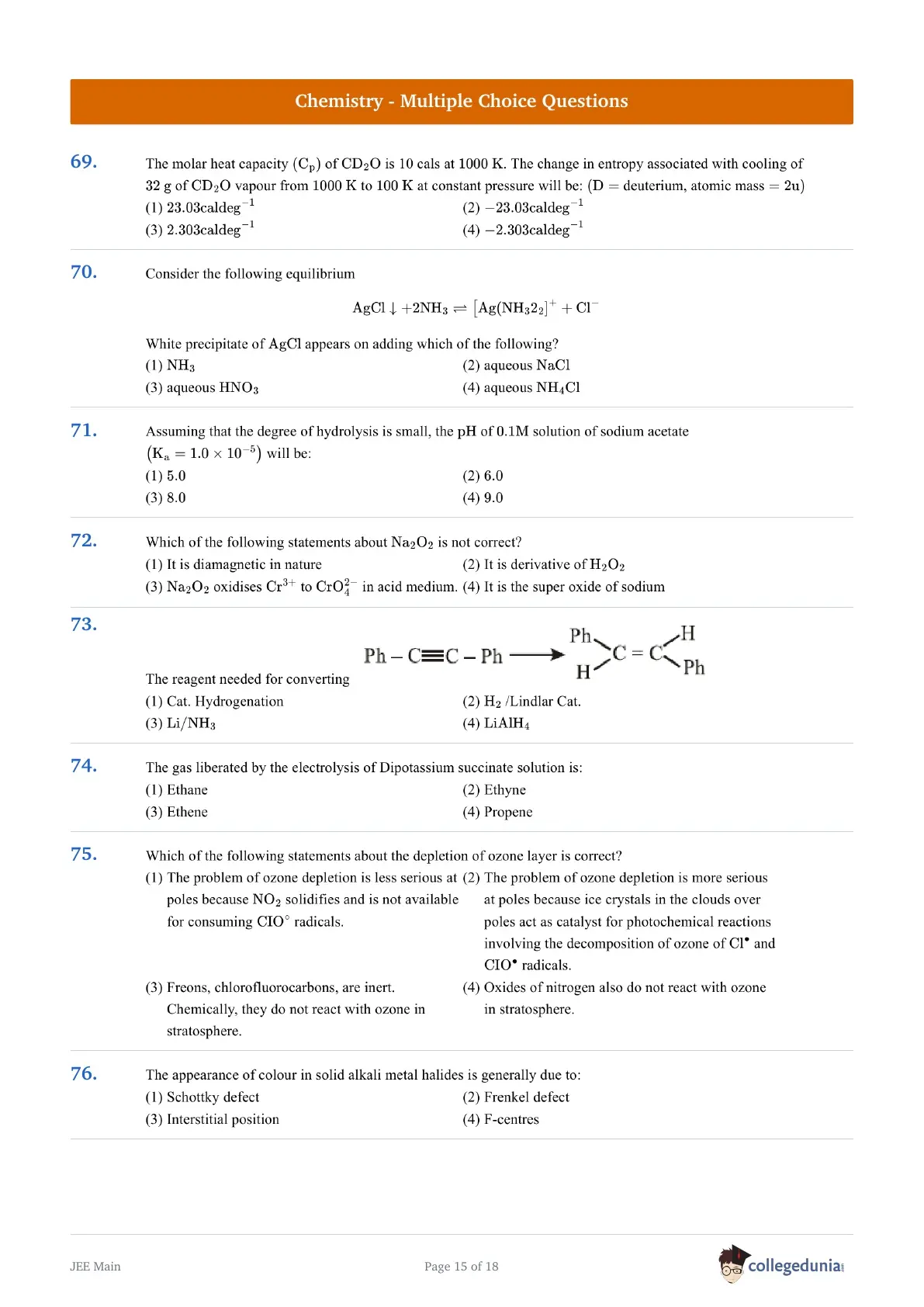
The molar heat capacity (\(\mathrm{C_p}\)) of \(\mathrm{CD_2O}\) is 10 cals at 1000 K. The change in entropy associated with cooling 32 g of \(\mathrm{CD_2O}\) vapour from 1000 K to 100 K at constant pressure will be: (D = deuterium, atomic mass = 2u)
Consider the following equilibrium
\(\mathrm{AgCl}\downarrow + 2\mathrm{NH_3} \rightleftharpoons [\mathrm{Ag(NH_3)_2}]^+ + \mathrm{Cl^-}\)
White precipitate of AgCl appears on adding which of the following?
Assuming that the degree of hydrolysis is small, the pH of 0.1 M solution of sodium acetate \((K_a = 1.0 \times 10^{-5})\) will be :
Which of the following statements about \(Na_2O_2\) is not correct?
The reagent needed for converting
The gas liberated by the electrolysis of Dipotassium succinate solution is:
Which of the following statements about the depletion of ozone layer is correct?
The appearance of colour in solid alkali metal halides is generally due to :
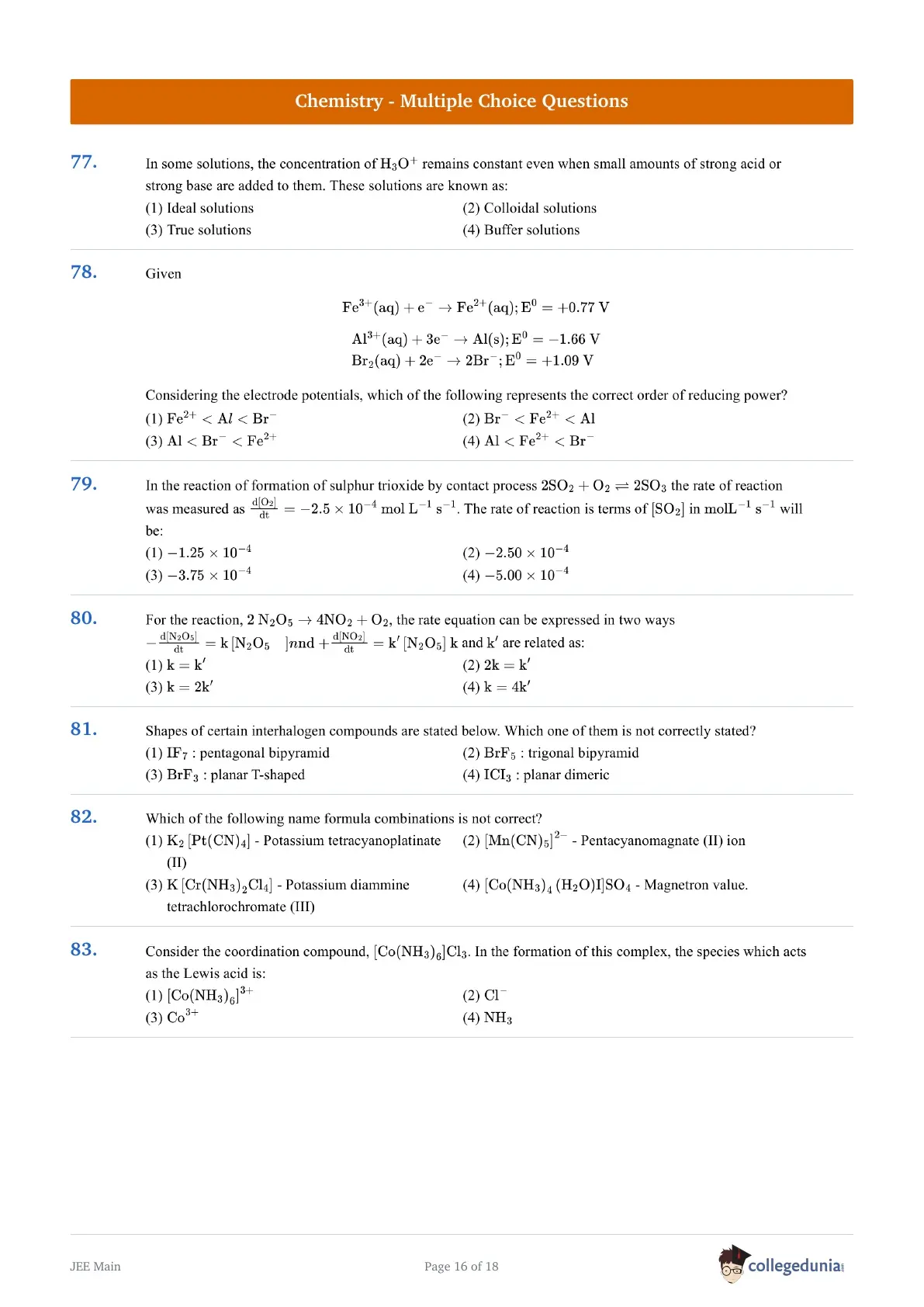
In some solutions, the concentration of \(\mathrm{H_3O^+}\) remains constant even when small amounts of strong acid or strong base are added to them. These solutions are known as:
Given
\(\mathrm{Fe^{3+}(aq)} + e^- \rightarrow \mathrm{Fe^{2+}(aq)};\ E^0 = +0.77\ \mathrm{V}\)
\(\mathrm{Al^{3+}(aq)} + 3e^- \rightarrow \mathrm{Al(s)};\ E^0 = -1.66\ \mathrm{V}\)
\(\mathrm{Br_2(aq)} + 2e^- \rightarrow 2\mathrm{Br^-};\ E^0 = +1.09\ \mathrm{V}\)
Considering the electrode potentials, which of the following represents the correct order of reducing power?
In the reaction of formation of sulphur trioxide by contact process \(2\mathrm{SO_2} + \mathrm{O_2} \rightleftharpoons 2\mathrm{SO_3}\) the rate of reaction was measured as \(\frac{d[\mathrm{O_2}]}{dt} = -2.5\times10^{-4}\ \mathrm{mol\,L^{-1}\,s^{-1}}\). The rate of reaction in terms of \([\mathrm{SO_2}]\) in \(\mathrm{mol\,L^{-1}\,s^{-1}}\) will be:
For the reaction, \(2\mathrm{N_2O_5} \rightarrow 4\mathrm{NO_2} + \mathrm{O_2}\), the rate equation can be expressed in two ways \(-\frac{d[\mathrm{N_2O_5}]}{dt} = k[\mathrm{N_2O_5}]^n\) and \(+\frac{d[\mathrm{NO_2}]}{dt} = k'[\mathrm{N_2O_5}]^n\). \(k\) and \(k'\) are related as:
Shapes of certain interhalogen compounds are stated below. Which one of them is not correctly stated?
Which of the following name formula combinations is not correct?
Consider the coordination compound, \([\mathrm{Co(NH_3)_6}]\mathrm{Cl_3}\). In the formation of this complex, the species which acts as the Lewis acid is:
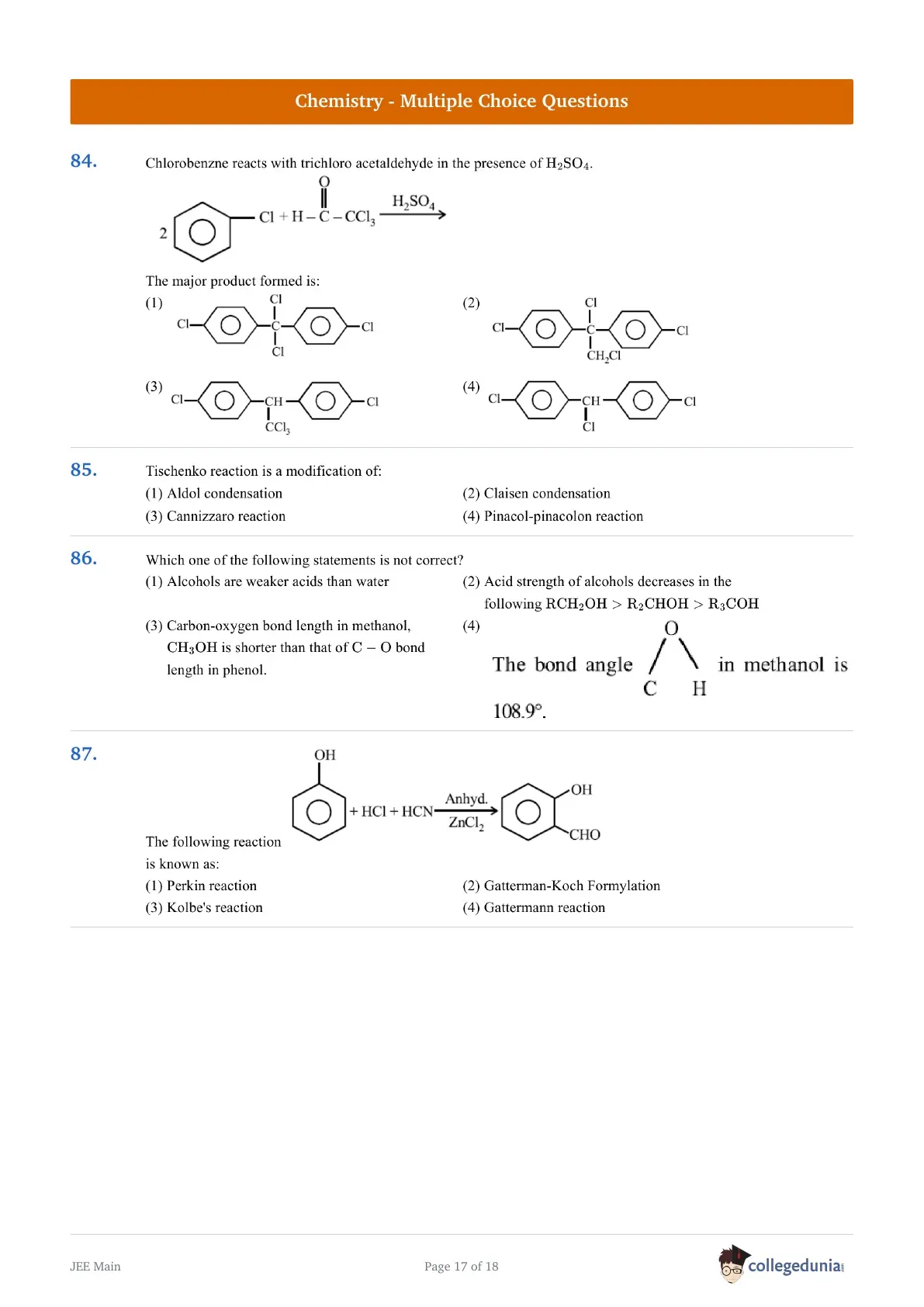
Chlorobenzene reacts with trichloroacetaldehyde (chloral) in the presence of \(\mathrm{H_2SO_4}\).  The major product formed is:
- (1)
![]()
- (2)
![]()
- (3)
![]()
- (4)
![]()


Tischenko reaction is a modification of :
Which one of the following statements is not correct?
The following reaction is known as: 
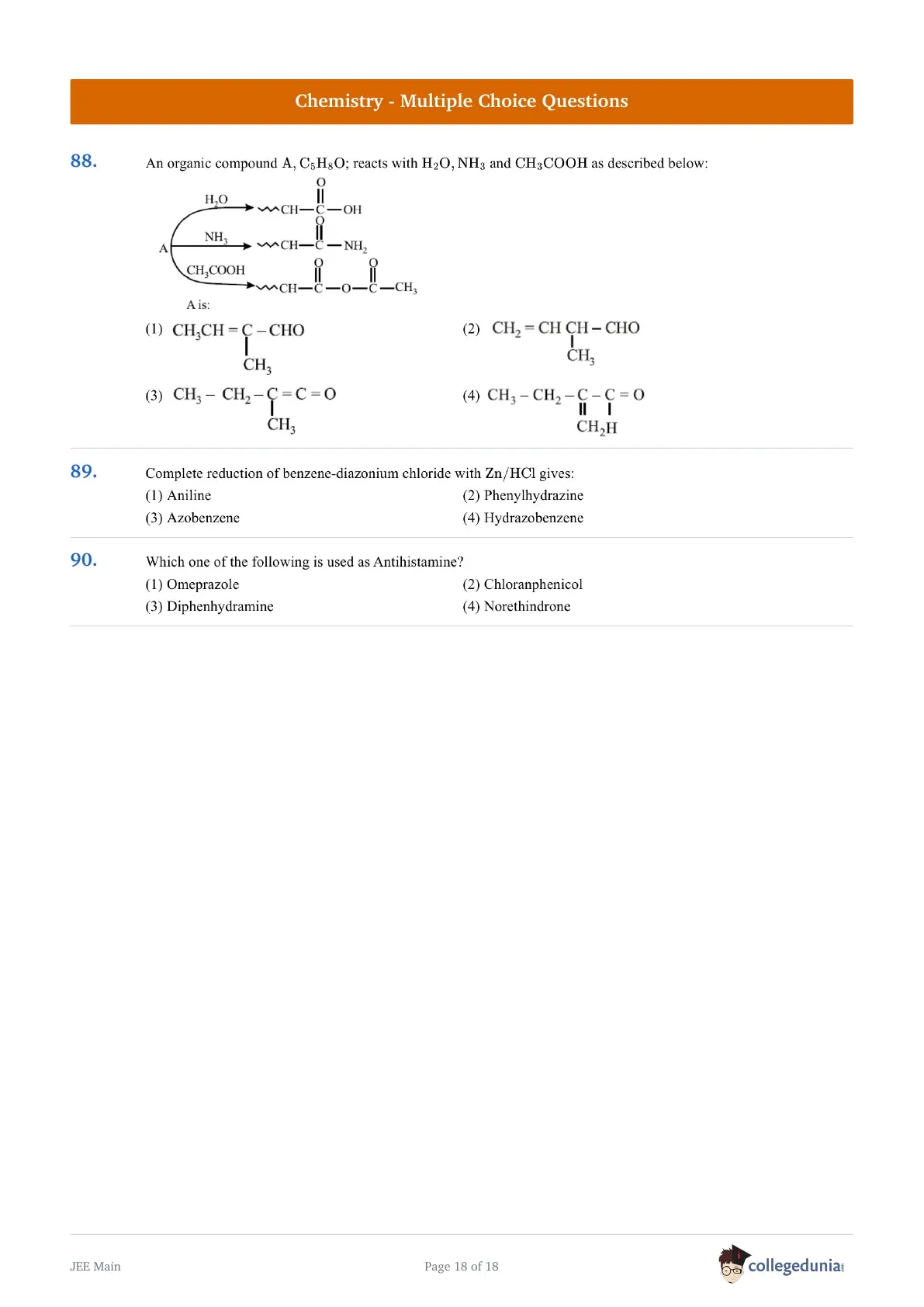
An organic compound A, \(\mathrm{C_5H_8O}\), reacts with \(\mathrm{H_2O}\), \(\mathrm{NH_3}\) and \(\mathrm{CH_3COOH}\) as described below:  A is:
- (1)
![]()
- (2)
![]()
- (3)
![]()
- (4)
![]()


Complete reduction of benzene-diazonium chloride with \(\mathrm{Zn/HCl}\) gives:
Which one of the following is used as Antihistamine?
JEE Main 2014 Exam Pattern and Marking Scheme
| Particulars | Details |
|---|---|
| Exam Mode | Online (Computer-Based Test) |
| Paper | B.E./B.Tech (Paper 1) |
| Duration | 3 hours (180 minutes) |
| Type of Questions | Multiple Choice Questions (MCQs) |
| Subjects | Mathematics, Physics, Chemistry |
| Total Questions | 90 questions |
| Total Marks | 360 marks |
| Marking Scheme | +4 for correct answer & -1 for incorrect answer; 0 for unattempted |
JEE Main 2014 April 11 Difficulty Level
In terms of difficulty level, B.E/B.Tech was of Moderate to difficult level.
JEE Main 2014 Question Paper Analysis
- The question paper comprised a total of 90 questions divided among 3 sections i.e, Physics, Chemistry and Maths. Each section consists of 30 questions
- Physics Paper was moderate to difficult level
- Chemistry Paper was easy
- Maths Paper was Lengthy but not tough
For every correct answer, candidates got 4 and for each wrong attempt -1 marks were deducted.



Comments