




JEE Main 2017 April 8 Question Paper is available here with solutions PDF and detailed solutions for every question. CBSE conducted the computer-based test (CBT) Paper 1 on April 8, 2017, in the morning session from 9:30 AM to 12:30 PM. The JEE Main 2017 Paper 1 (B.E./B.Tech) question paper includes the following:
- 90 questions in a 3-hour CBT Mode: 30 each from Mathematics, Physics and Chemistry
- Question type: all multiple choice questions (MCQs) with a single correct option, 4 marks each
- Sections: Mathematics (30), Physics (30) and Chemistry (30), all questions compulsory
- Marking: +4 for a correct answer, -1 for an incorrect answer, 0 for an unattempted question
- Maximum marks: 360 (120 per subject)
JEE Main 2017 April 8 Question Paper with Solution PDF
| NTA Official PDF | CD PDF | CD PDF with Solutions |
|---|---|---|
| Download official PDF 4.52 MB | Download Collegedunia PDF 4.92 MB | Download solutions PDF 1.09 MB |
Also Check:
JEE Main 2017 April 8 Questions with Solutions
Mathematics (Q1 - Q30)
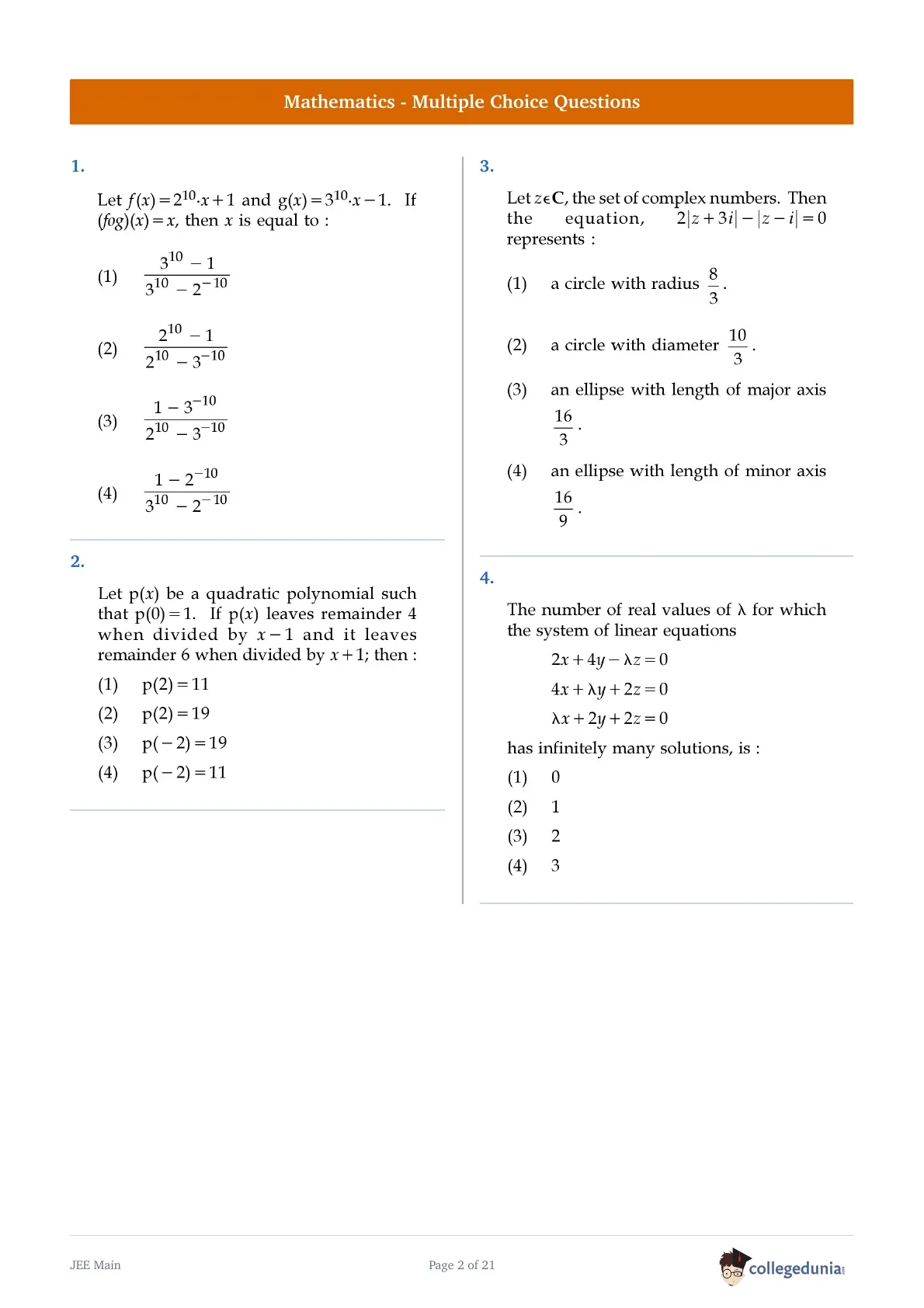
Let \(f(x) = 2^{10}\cdot x + 1\) and \(g(x) = 3^{10}\cdot x - 1\). If \((f\circ g)(x) = x\), then \(x\) is equal to :
Let \(p(x)\) be a quadratic polynomial such that \(p(0) = 1\). If \(p(x)\) leaves remainder 4 when divided by \(x - 1\) and it leaves remainder 6 when divided by \(x + 1\); then :
Let \(z \in C\), the set of complex numbers. Then the equation, \(2 | z + 3i| - | z - i| = 0 \) represents :
The number of real values of \(\lambda\) for which the system of linear equations
\(2x + 4y - \lambda z = 0\)
\(4x + \lambda y + 2z = 0\)
\(\lambda x + 2y + 2z = 0\)
has infinitely many solutions, is :
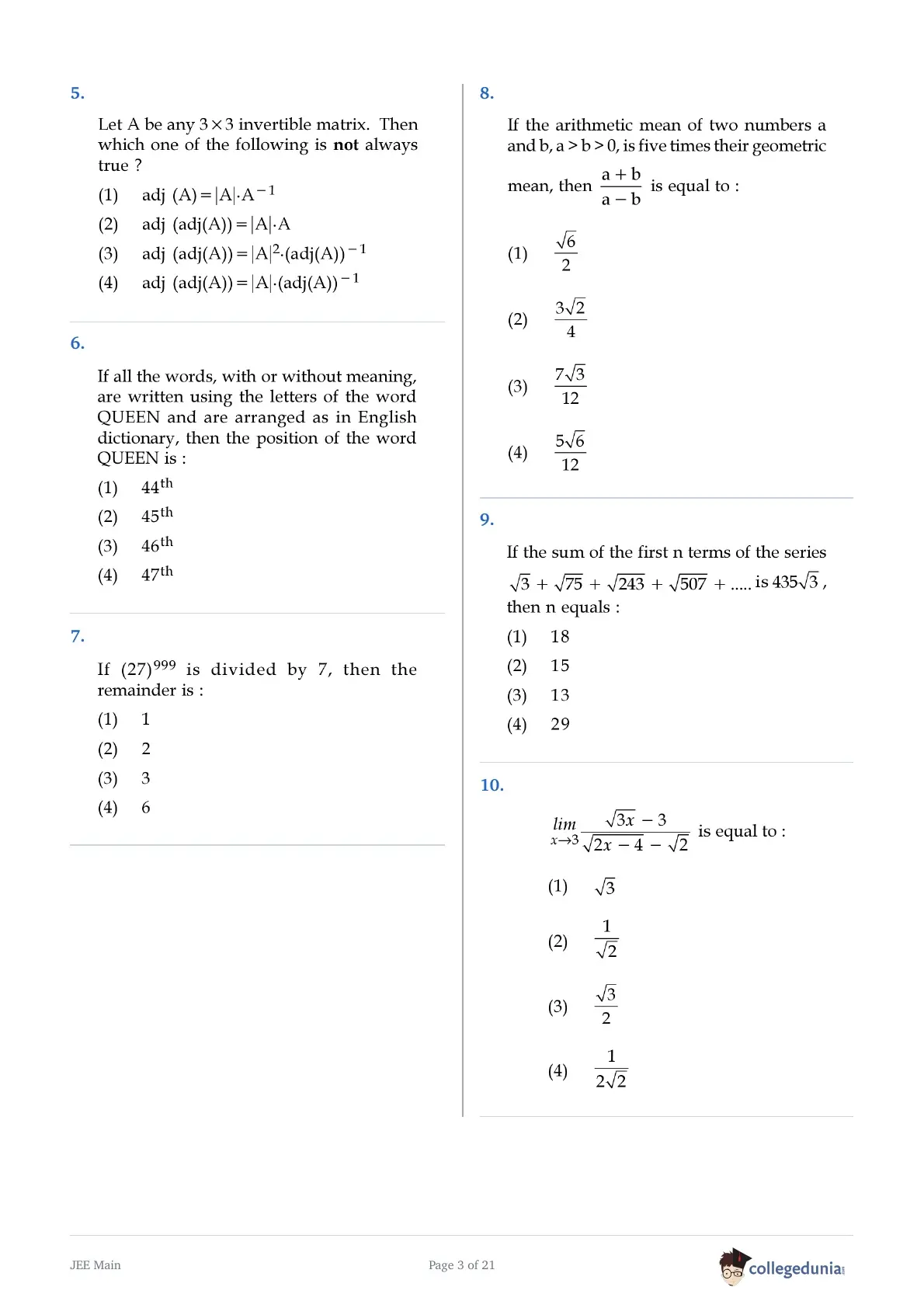
Let \(A\) be any \(3 \times 3\) invertible matrix. Then which one of the following is not always true ?
If all the words, with or without meaning, are written using the letters of the word QUEEN and are arranged as in English dictionary, then the position of the word QUEEN is :
If \((27)^{999}\) is divided by \(7\), then the remainder is :
If the arithmetic mean of two numbers \(a\) and \(b\), \(a \gt b \gt 0\), is five times their geometric mean, then \(\frac{a+b}{a-b}\) is equal to :
If the sum of the first \(n\) terms of the series \(\sqrt{3} + \sqrt{75} + \sqrt{243} + \sqrt{507} + \ldots\) is \(435\sqrt{3}\), then \(n\) equals :
\(\displaystyle\lim_{x \to 3} \frac{\sqrt{3x} - 3}{\sqrt{2x - 4} - \sqrt{2}}\) is equal to :
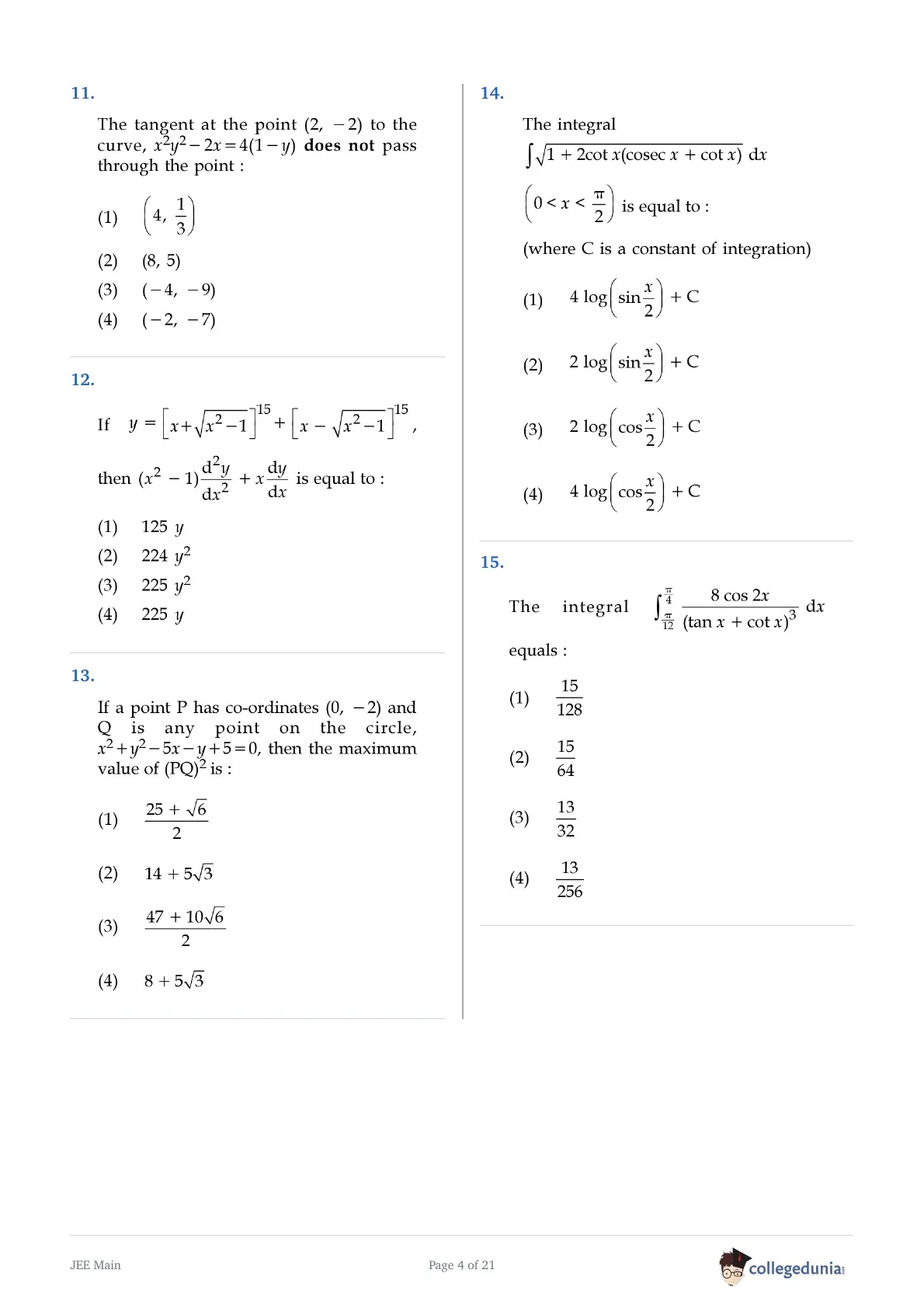
The tangent at the point \((2, -2)\) to the curve, \(x^2y^2 - 2x = 4(1 - y)\) does not pass through the point :
If \(y = \left[x + \sqrt{x^2 - 1}\right]^{15} + \left[x - \sqrt{x^2 - 1}\right]^{15}\), then \((x^2 - 1)\dfrac{d^2y}{dx^2} + x\dfrac{dy}{dx}\) is equal to :
If a point \(P\) has co-ordinates \((0, -2)\) and \(Q\) is any point on the circle, \(x^2 + y^2 - 5x - y + 5 = 0\), then the maximum value of \((PQ)^2\) is :
The integral \(\int \sqrt{ 1 + 2 \cot \, x (cosec \, x + \cot \, x) } dx \, \left( 0 < x < \frac{\pi}{2} \right)\) is equal to : (where \(C\) is a constant of integration)
The integral \(\displaystyle\int_{\pi/12}^{\pi/4} \frac{8\cos 2x}{(\tan x + \cot x)^3}\,dx\) equals :
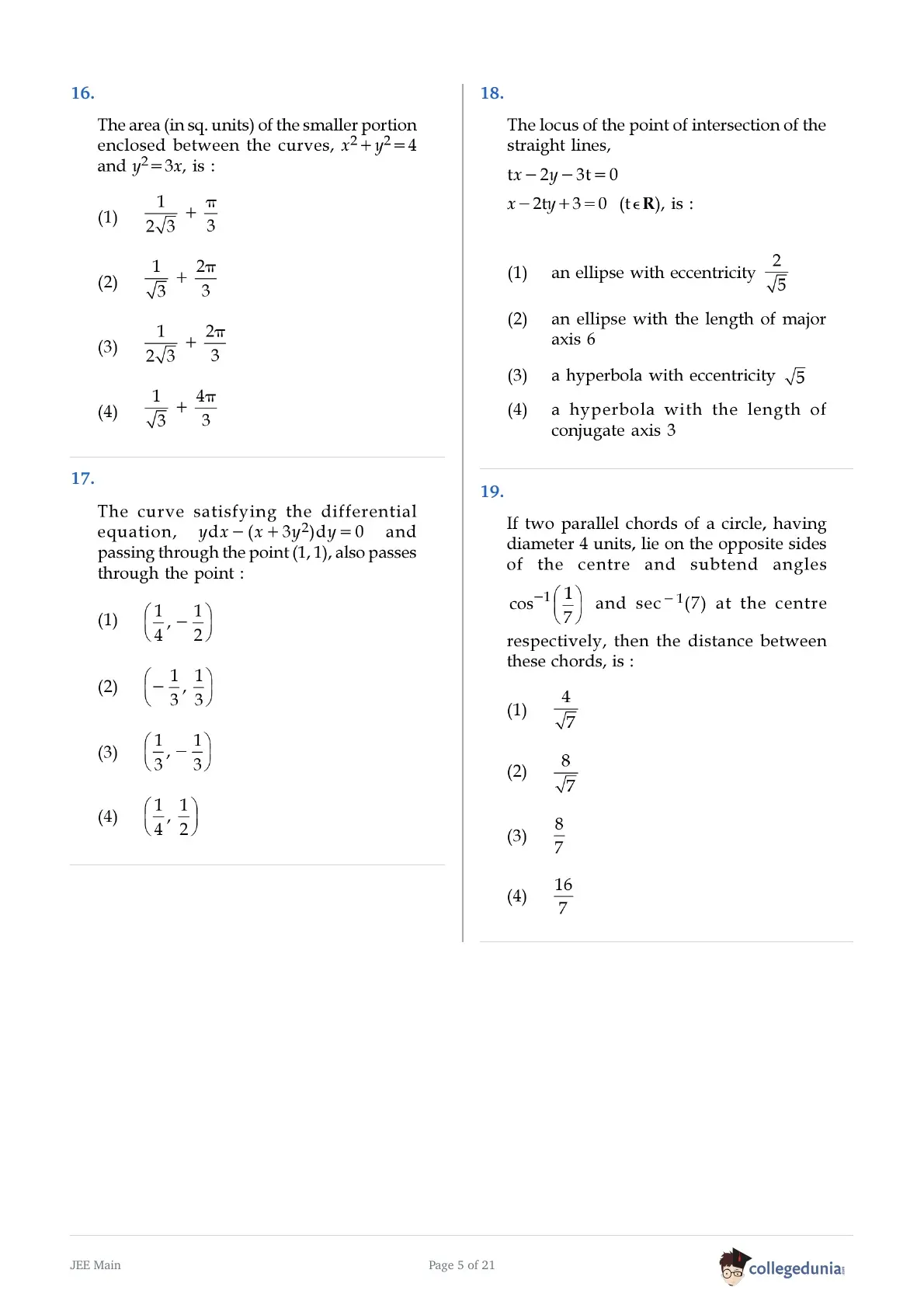
The area (in sq. units) of the smaller portion enclosed between the curves, \(x^2 + y^2 = 4\) and \(y^2 = 3x\), is :
The curve satisfying the differential equation, \(y\,dx - (x + 3y^2)\,dy = 0\) and passing through the point \((1, 1)\), also passes through the point :
The locus of the point of intersection of the straight lines,
\(tx - 2y - 3t = 0\)
\(x - 2ty + 3 = 0\) \((t \in \mathbf{R})\), is :
If two parallel chords of a circle, having diameter 4 units, lie on the opposite sides of the centre and subtend angles \(\cos^{-1}\left(\frac{1}{7}\right)\) and \(\sec^{-1}(7)\) at the centre respectively, then the distance between these chords, is :
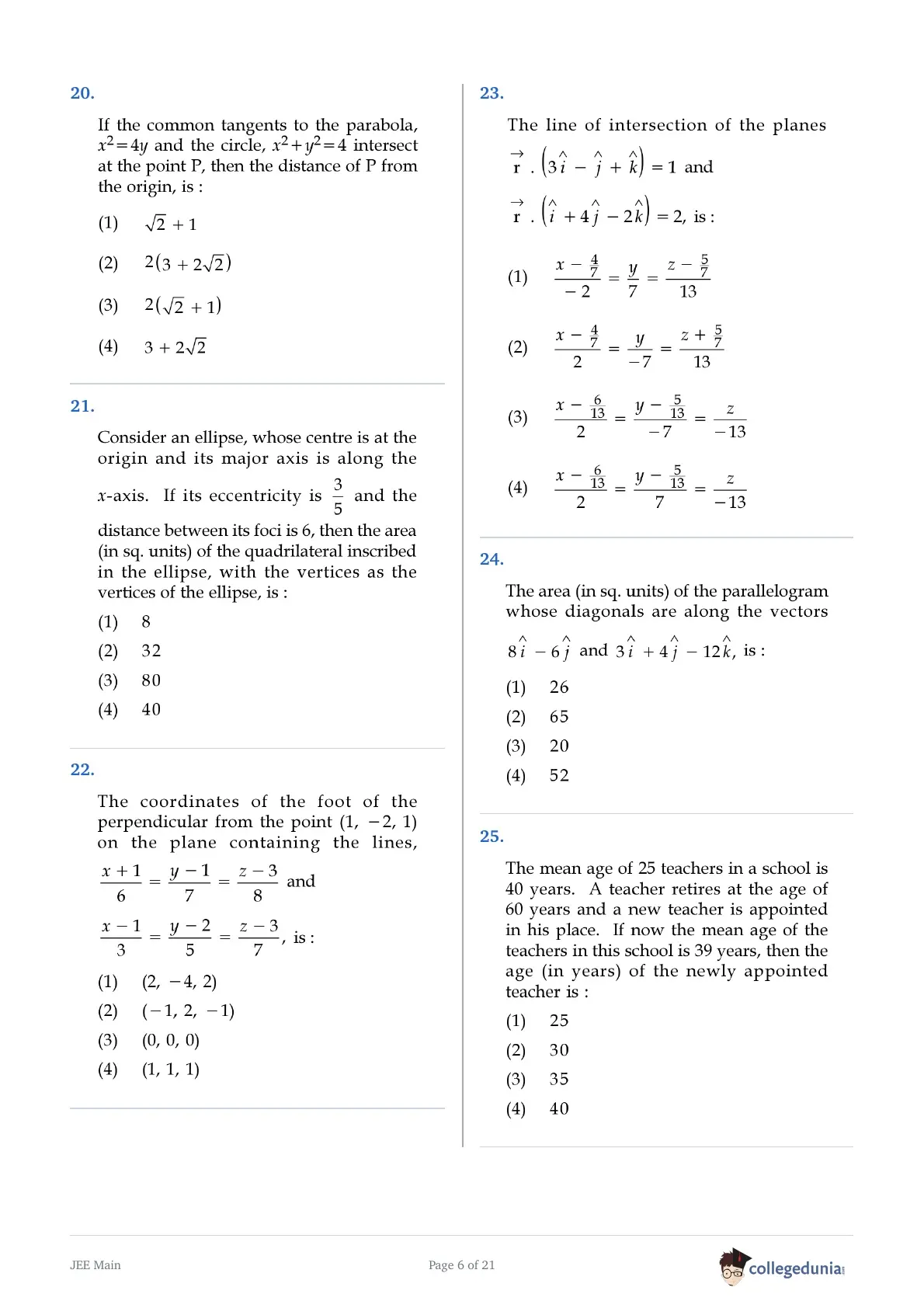
If the common tangents to the parabola, \(x^2 = 4y\) and the circle, \(x^2 + y^2 = 4\) intersect at the point P, then the distance of P from the origin, is :
Consider an ellipse, whose centre is at the origin and its major axis is along the x-axis. If its eccentricity is \(\frac{3}{5}\) and the distance between its foci is 6, then the area (in sq. units) of the quadrilateral inscribed in the ellipse, with the vertices as the vertices of the ellipse, is :
The coordinates of the foot of the perpendicular from the point \((1, -2, 1)\) on the plane containing the lines, \(\frac{x+1}{6} = \frac{y-1}{7} = \frac{z-3}{8}\) and \(\frac{x-1}{3} = \frac{y-2}{5} = \frac{z-3}{7}\), is :
The line of intersection of the planes \(\vec{r} \cdot (3\hat{i} - \hat{j} + \hat{k}) = 1\) and \(\vec{r} \cdot (\hat{i} + 4\hat{j} - 2\hat{k}) = 2\), is :
The area (in sq. units) of the parallelogram whose diagonals are along the vectors \(8\hat{i} - 6\hat{j}\) and \(3\hat{i} + 4\hat{j} - 12\hat{k}\), is :
The mean age of 25 teachers in a school is 40 years. A teacher retires at the age of 60 years and a new teacher is appointed in his place. If now the mean age of the teachers in this school is 39 years, then the age (in years) of the newly appointed teacher is :
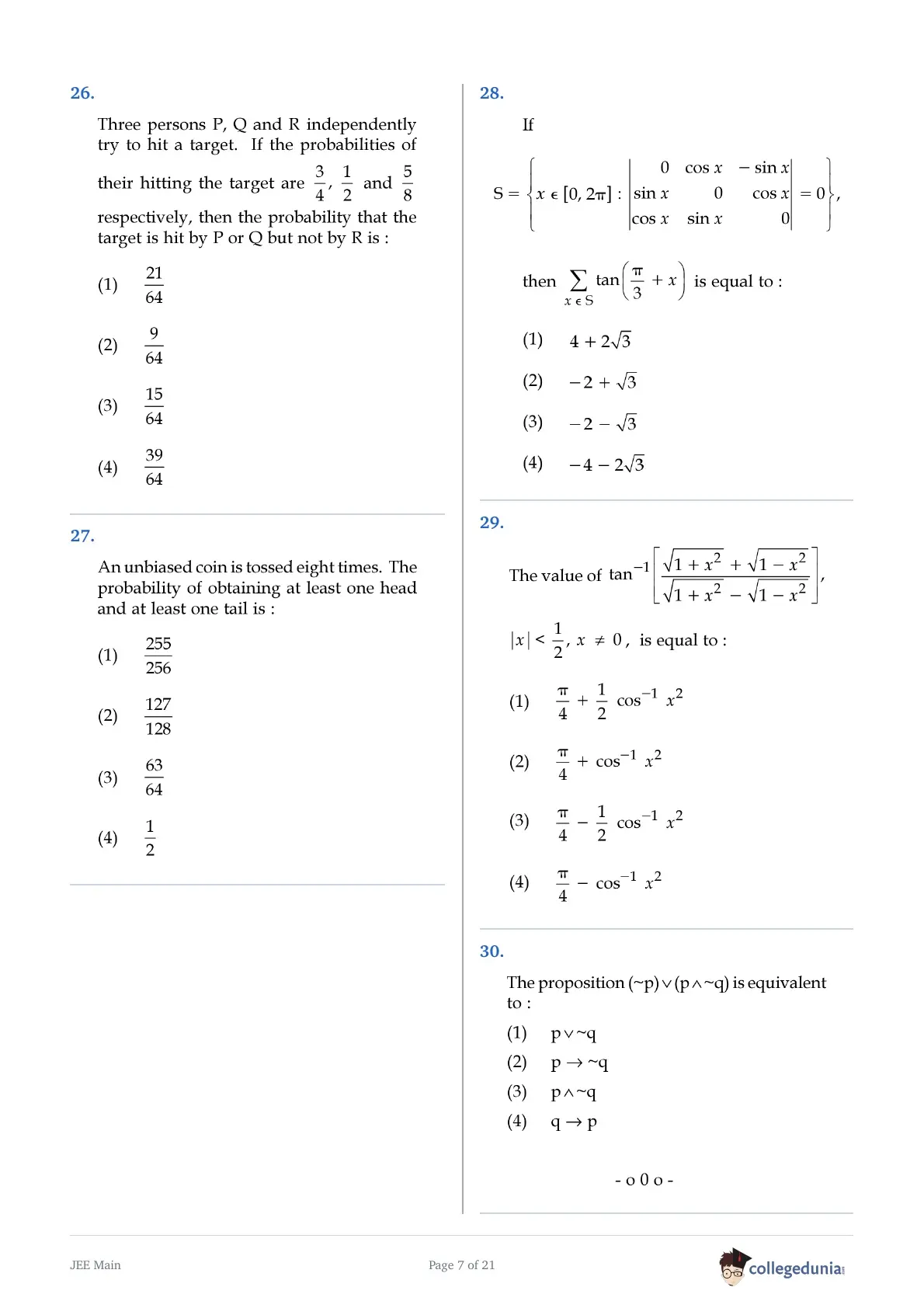
Three persons P, Q and R independently try to hit a target. If the probabilities of their hitting the target are \(\frac{3}{4}\), \(\frac{1}{2}\) and \(\frac{5}{8}\) respectively, then the probability that the target is hit by P or Q but not by R is :
An unbiased coin is tossed eight times. The probability of obtaining at least one head and at least one tail is :
If
\(S = \left\{x \in [0, 2\pi] : \begin{vmatrix} 0 \& \cos x \& -\sin x \\ \sin x \& 0 \& \cos x \\ \cos x \& \sin x \& 0 \end{vmatrix} = 0\right\}\),
then \(\sum_{x \in S} \tan\left(\frac{\pi}{3} + x\right)\) is equal to :
The value of \(\tan^{-1} \left[\frac{\sqrt{1+x^{2}} + \sqrt{1-x^{2}}}{\sqrt{1+x^{2}} - \sqrt{1-x^{2}}}\right] , \left|x\right| < \frac{1}{2}, x \ne0, \) is equal to :
The proposition \((\sim p) \vee (p \wedge \sim q)\) is equivalent to :
Physics (Q31 - Q60)
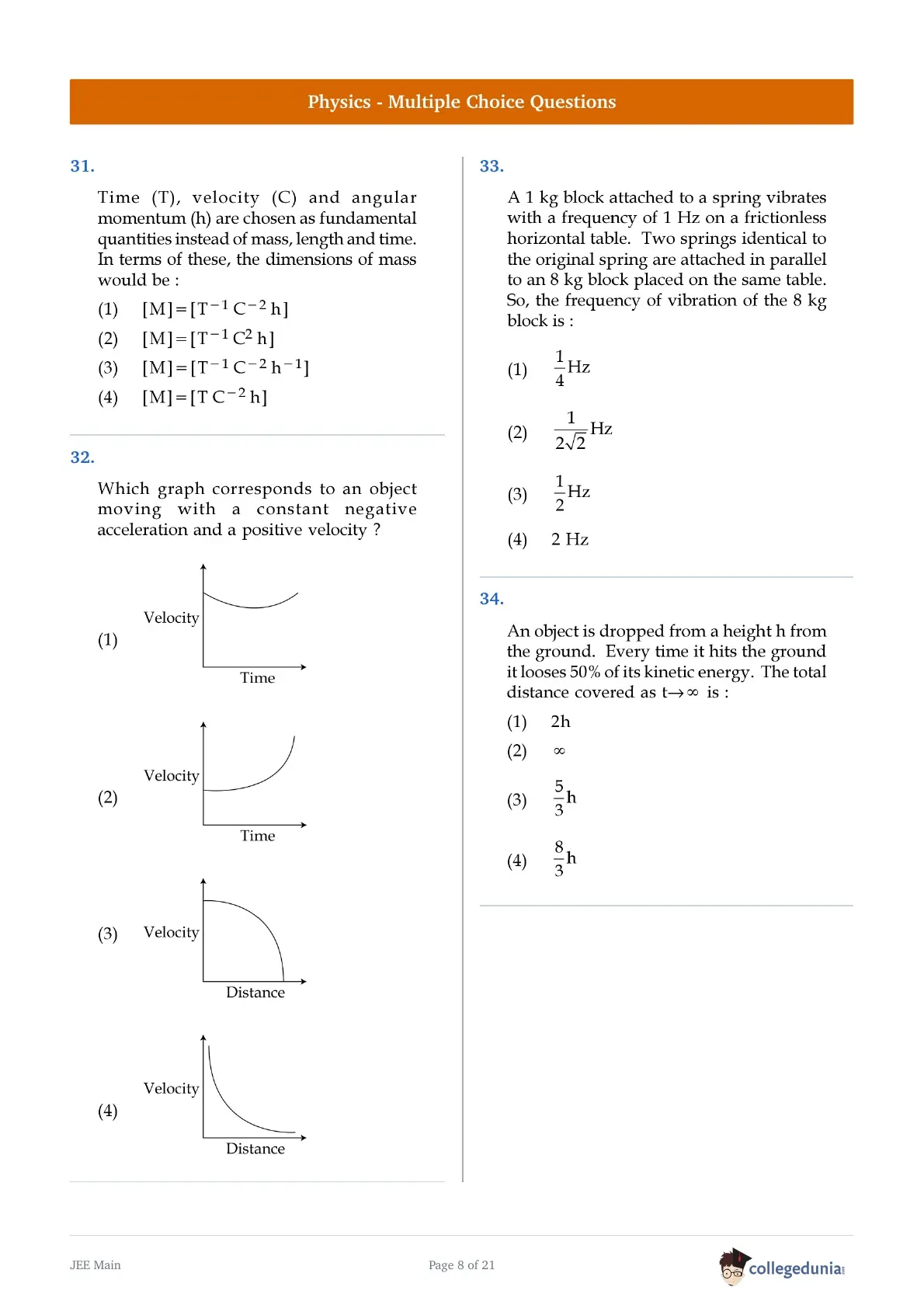
Time (T), velocity (C) and angular momentum (h) are chosen as fundamental quantities instead of mass, length and time. In terms of these, the dimensions of mass would be :
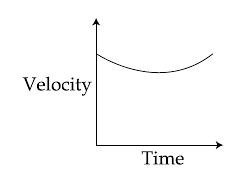
Which graph corresponds to an object moving with a constant negative acceleration and a positive velocity ?
- (1)
![velocity-time graph]()
- (2)
![velocity-time graph]()
- (3)
![velocity-time graph]()
- (4)
![velocity-time graph]()


A 1 kg block attached to a spring vibrates with a frequency of 1 Hz on a frictionless horizontal table. Two springs identical to the original spring are attached in parallel to an 8 kg block placed on the same table. So, the frequency of vibration of the 8 kg block is :
An object is dropped from a height \(h\) from the ground. Every time it hits the ground it looses \(50\%\) of its kinetic energy. The total distance covered as \(t\to\infty\) is :
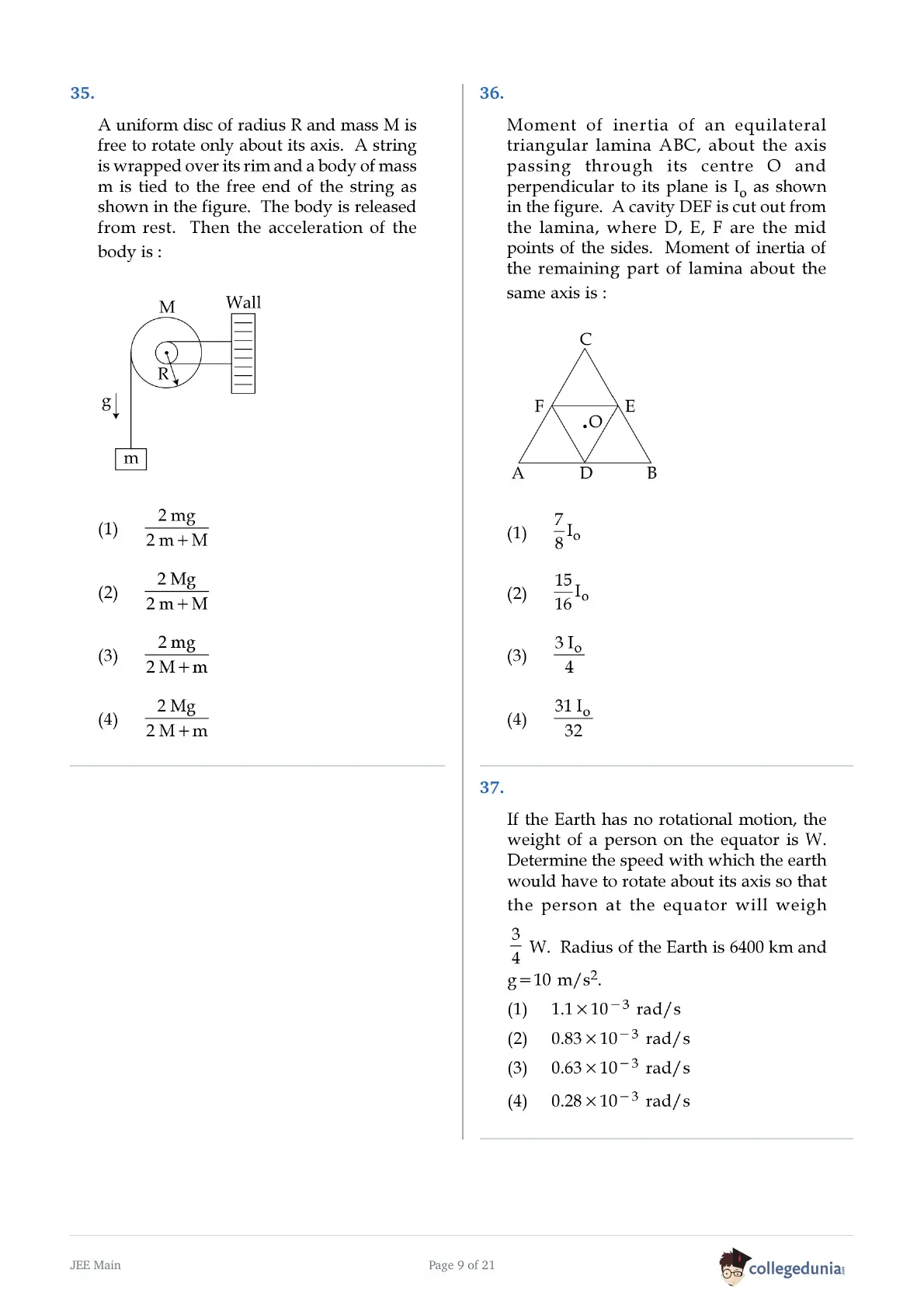
A uniform disc of radius R and mass M is free to rotate only about its axis. A string is wrapped over its rim and a body of mass m is tied to the free end of the string as shown in the figure. The body is released from rest. Then the acceleration of the body is :
Moment of inertia of an equilateral triangular lamina \(ABC\), about the axis passing through its centre \(O\) and perpendicular to its plane is \(I_o\) as shown in the figure. A cavity \(DEF\) is cut out from the lamina, where \(D, E, F\) are the mid points of the sides. Moment of inertia of the remaining part of lamina about the same axis is :
If the Earth has no rotational motion, the weight of a person on the equator is \(W\). Determine the speed with which the earth would have to rotate about its axis so that the person at the equator will weigh \(\frac{3}{4}W\). Radius of the Earth is \(6400\ \mathrm{km}\) and \(g = 10\ \mathrm{m/s^2}\).
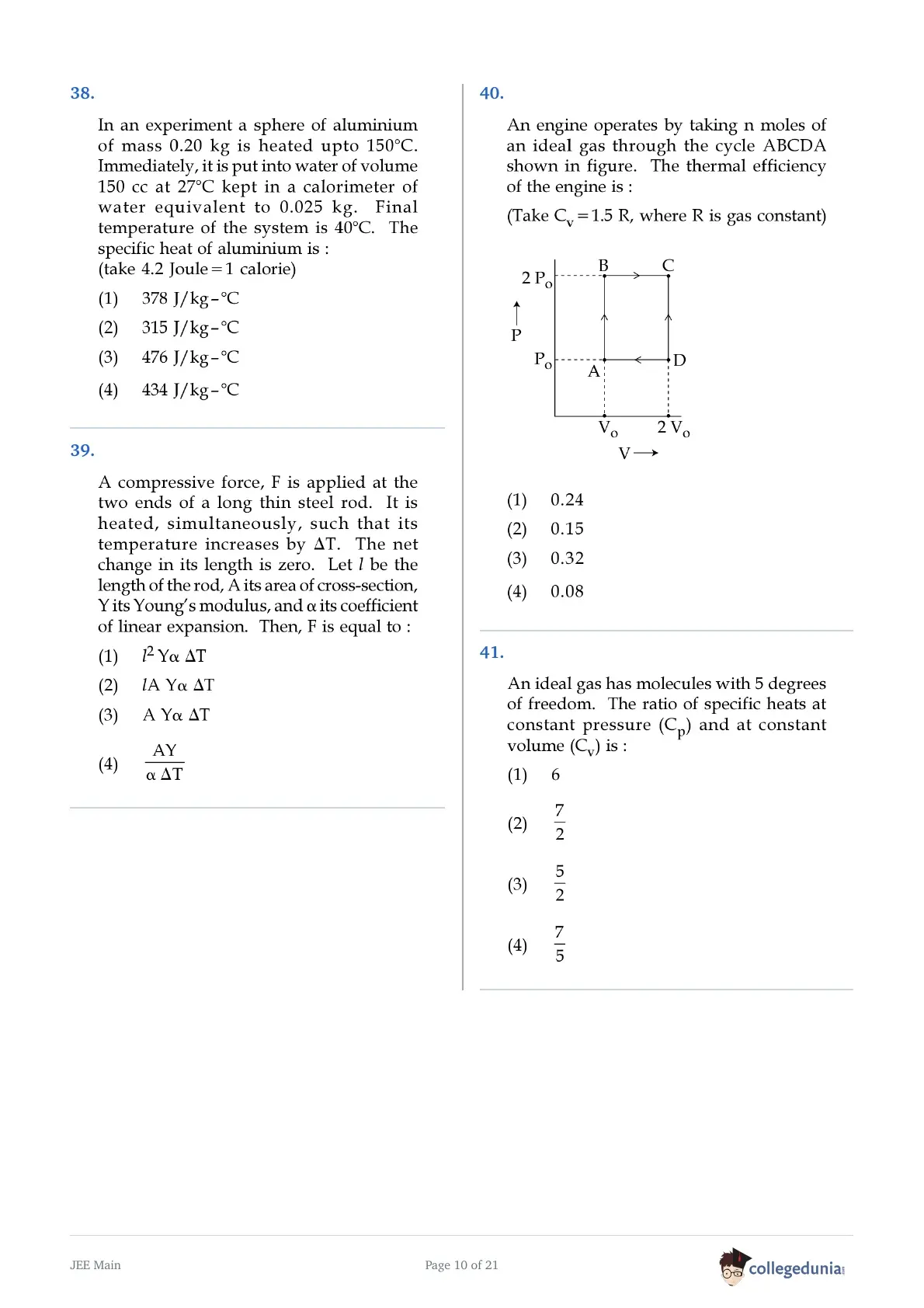
In an experiment a sphere of aluminium of mass 0.20 kg is heated upto \(150^{\circ}C\). Immediately, it is put into water of volume 150 cc at \(27^{\circ}C\) kept in a calorimeter of water equivalent to 0.025 kg. Final temperature of the system is \(40^{\circ}C\). The specific heat of aluminium is : (take 4.2 Joule=1 calorie)
A compressive force, F is applied at the two ends of a long thin steel rod. It is heated, simultaneously, such that its temperature increases by ΔT. The net change in its length is zero. Let L be the length of the rod, A is its area of cross-section. Y is Young’s modulus, and α is its coefficient of linear expansion. Then, F is equal to
An engine operates by taking \(n\) moles of an ideal gas through the cycle \(ABCDA\) shown in figure. The thermal efficiency of the engine is : (Take \(C_v = 1.5 \, R,\) where \(R\) is gas constant)
An ideal gas has molecules with 5 degrees of freedom. The ratio of specific heats at constant pressure \((C_p)\) and at constant volume \((C_v)\) is :
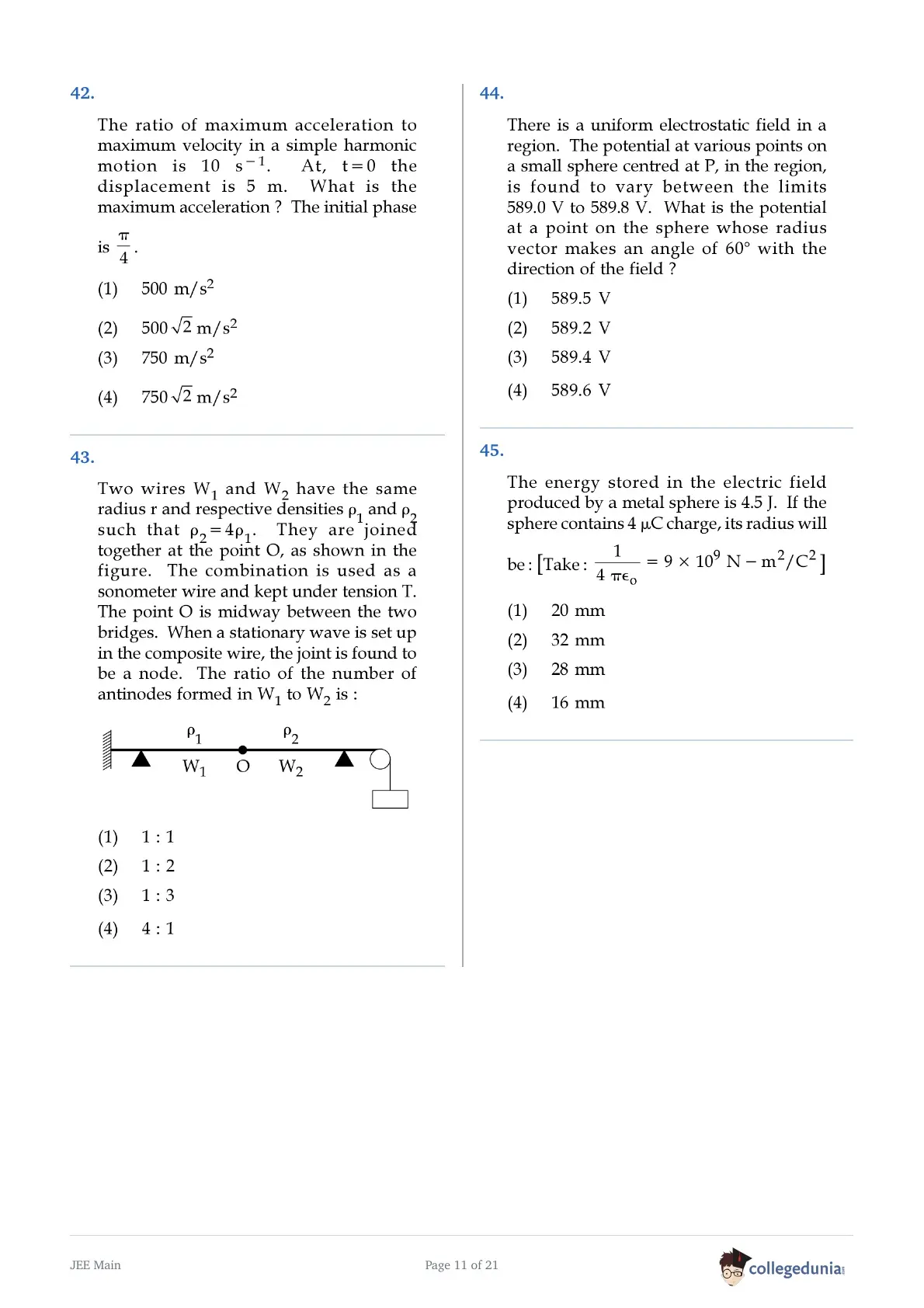
The ratio of maximum acceleration to maximum velocity in a simple harmonic motion is \(10\ \mathrm{s^{-1}}\). At \(t=0\) the displacement is \(5\ \mathrm{m}\). What is the maximum acceleration ? The initial phase is \(\frac{\pi}{4}\).
Two wires \(W_1\) and \(W_2\) have the same radius \(r\) and respective densities \(\rho_1\) and \(\rho_2\) such that \(\rho_2=4\rho_1\). They are joined together at the point O, as shown in the figure. The combination is used as a sonometer wire and kept under tension \(T\). The point O is midway between the two bridges. When a stationary wave is set up in the composite wire, the joint is found to be a node. The ratio of the number of antinodes formed in \(W_1\) to \(W_2\) is : 
There is a uniform electrostatic field in a region. The potential at various points on a small sphere centred at \(P\), in the region, is found to vary between the limits \(589.0\, V\) to \(589.8\, V\). What is the potential at a point on the sphere whose radius vector makes an angle of \(60^{\circ}\) with the direction of the field ?
The energy stored in the electric field produced by a metal sphere is \(4.5\, J\). If the sphere contains \( 4 \, \mu C\) charge, its radius will be : [Take : \(\frac{1}{4 \pi \epsilon_o } = 9 \times 10^{9} \, N - m^2 / C^2\) ]
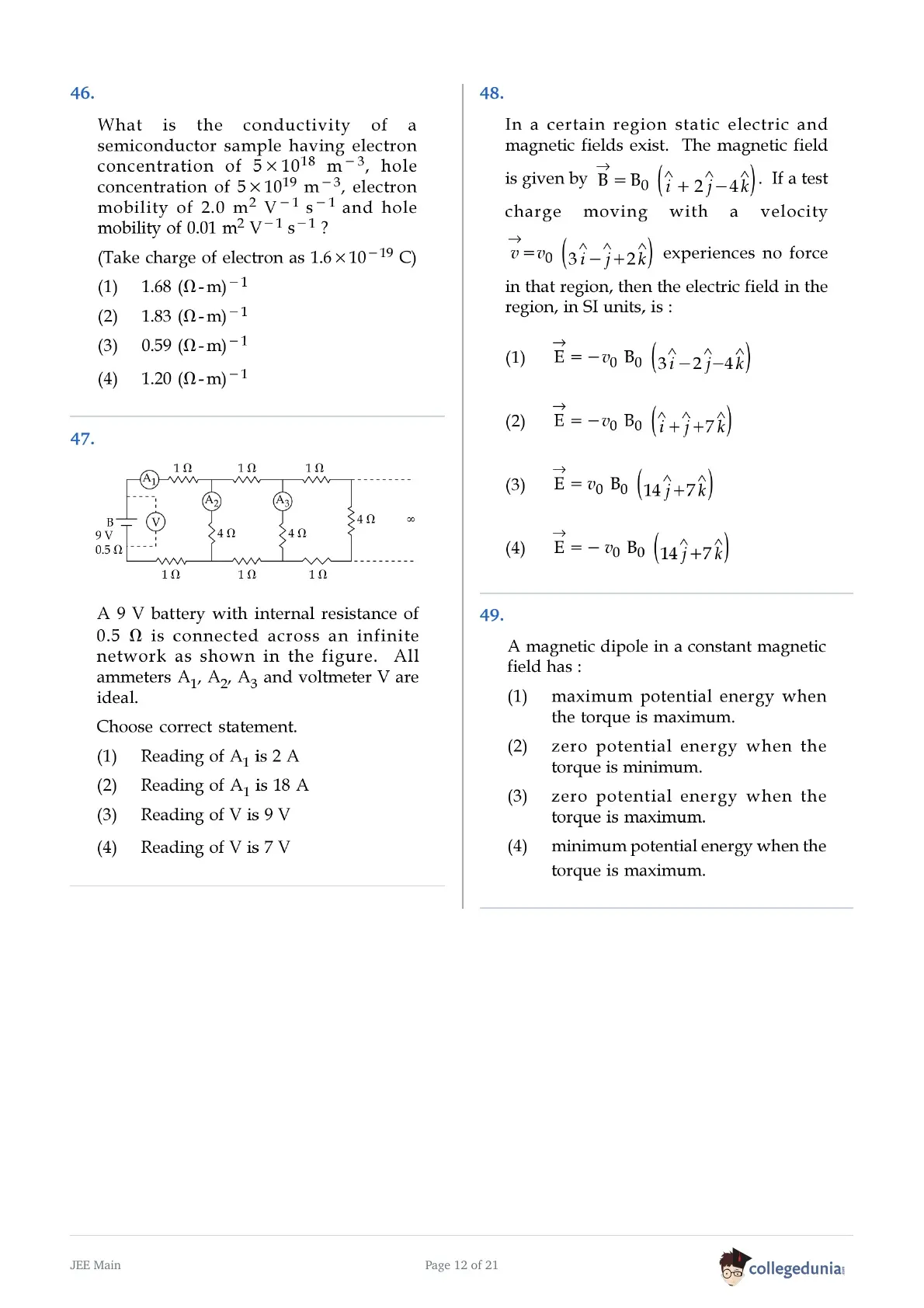
What is the conductivity of a semiconductor sample having electron concentration of \(5 \times 10^{18} \, m^{-3}\), hole concentration of \(5 \times 10^{19} \, m^{-3} \) , electron mobility of \(2.0 \, m^2 \, V^{-1} \, s^{-1}\) and hole mobility of \(0.01 \, m^2 \, V^{-1} \, s^{-1}\) ? (Take charge of electron as \(1.6 \times 10^{-19} C\))

A \(9\ \mathrm{V}\) battery with internal resistance of \(0.5\ \Omega\) is connected across an infinite network as shown in the figure. All ammeters \(A_1, A_2, A_3\) and voltmeter \(V\) are ideal.
Choose correct statement.
In a certain region static electric and magnetic fields exist. The magnetic field is given by \(\vec B=B_0\left(\hat i+2\hat j-4\hat k\right)\). If a test charge moving with a velocity \(\vec v=v_0\left(3\hat i-\hat j+2\hat k\right)\) experiences no force in that region, then the electric field in the region, in SI units, is :
A magnetic dipole in a constant magnetic field has :
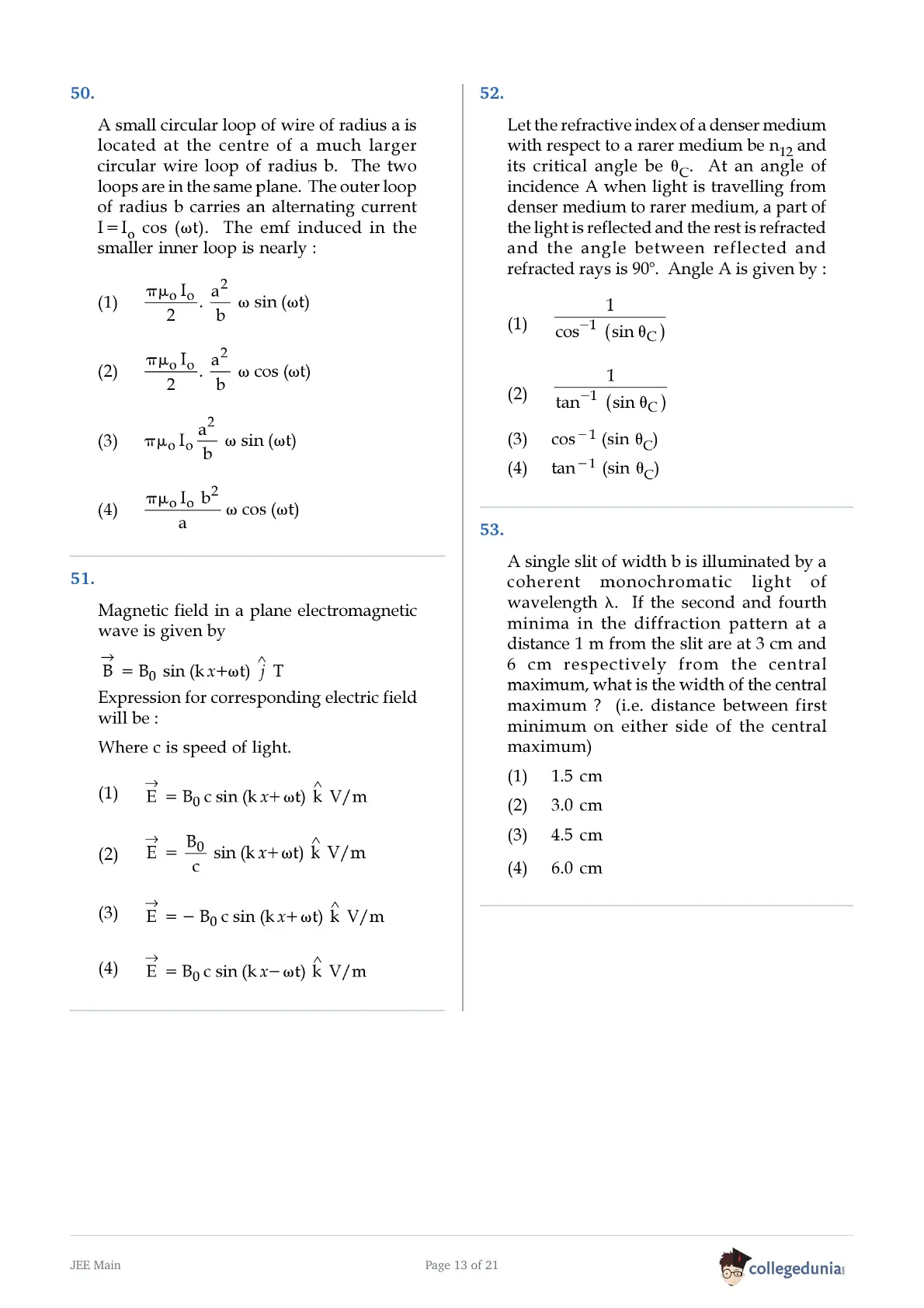
A small circular loop of wire of radius \(a\) is located at the centre of a much larger circular wire loop of radius \(b\). The two loops are in the same plane. The outer loop of radius \(b\) carries an alternating current \(I=I_o\cos(\omega t)\). The emf induced in the smaller inner loop is nearly :
Magnetic field in a plane electromagnetic wave is given by \(\vec B=B_0\sin(kx+\omega t)\,\hat j\ \mathrm{T}\). Expression for corresponding electric field will be : Where \(c\) is speed of light.
Let the refractive index of a denser medium with respect to a rarer medium be \(n_{12}\) and its critical angle be \(\theta_C\). At an angle of incidence \(A\) when light is travelling from denser medium to rarer medium, a part of the light is reflected and the rest is refracted and the angle between reflected and refracted rays is \(90^\circ\). Angle \(A\) is given by :
A single slit of width b is illuminated by a coherent monochromatic light of wavelength \(\lambda\). If the second and fourth minima in the diffraction pattern at a distance 1 m from the slit are at 3 cm and 6 cm respectively from the central maximum, what is the width of the central maximum ? (i.e. distance between first minimum on either side of the central maximum)
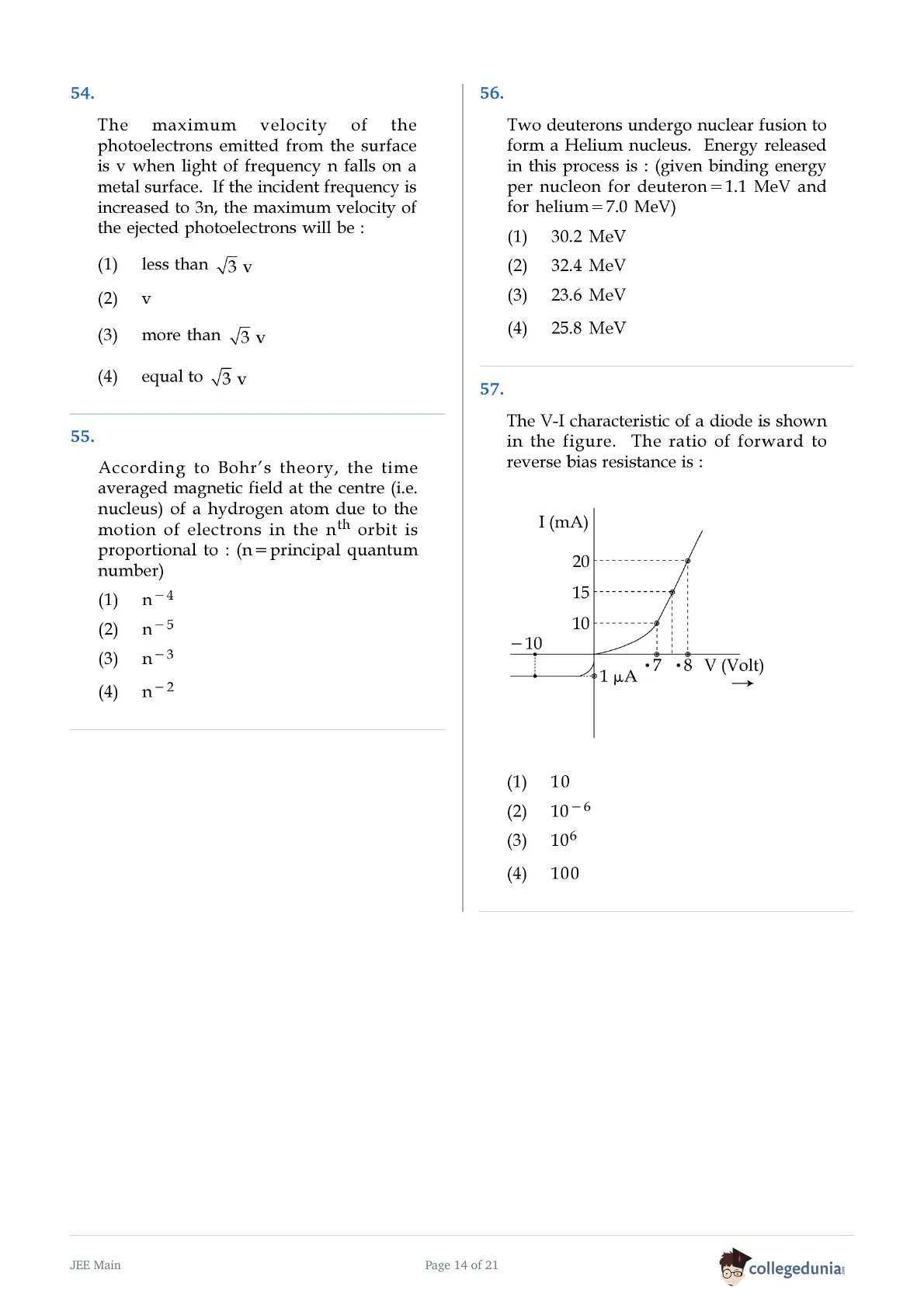
The maximum velocity of the photoelectrons emitted from the surface is v when light of frequency n falls on a metal surface. If the incident frequency is increased to 3n, the maximum velocity of the ejected photoelectrons will be :
According to Bohr's theory, the time averaged magnetic field at the centre (i.e. nucleus) of a hydrogen atom due to the motion of electrons in the nth orbit is proportional to : (n = principal quantum number)
Two deuterons undergo nuclear fusion to form a Helium nucleus. Energy released in this process is : (given binding energy per nucleon for deuteron = 1.1 MeV and for helium = 7.0 MeV)
The V-I characteristic of a diode is shown in the figure. The ratio of forward to reverse bias resistance is :
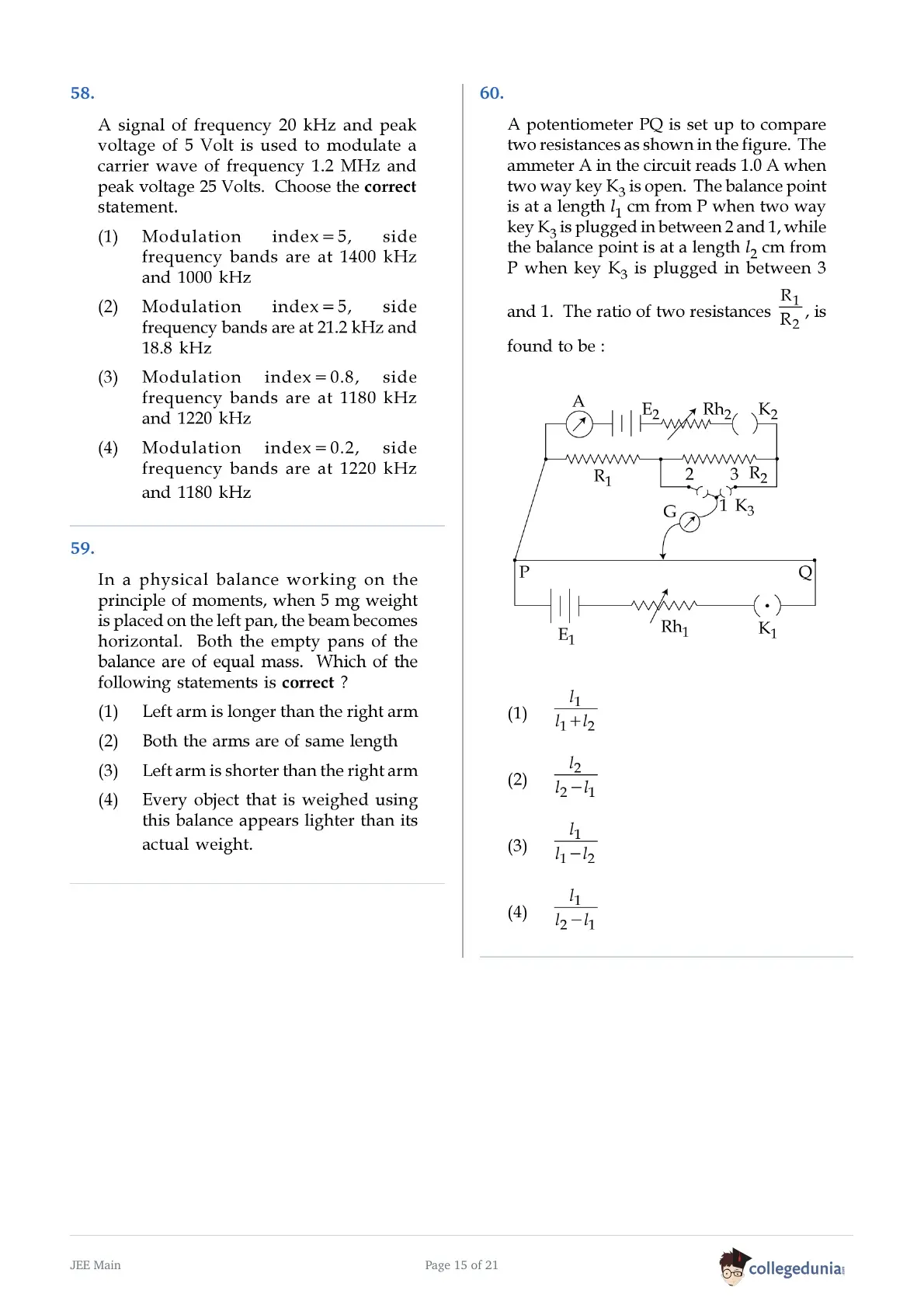
A signal of frequency 20 kHz and peak voltage of 5 Volt is used to modulate a carrier wave of frequency 1.2 MHz and peak voltage 25 Volts. Choose the correct statement.
In a physical balance working on the principle of moments, when \(5\,mg\) weight is placed on the left pan, the beam becomes horizontal. Both the empty pans of the balance are of equal mass. Which of the following statements is correct ?
A potentiometer PQ is set up to compare two resistances as shown in the figure. The ammeter A in the circuit reads 1.0 A when two way key K3 is open. The balance point is at a length \(l_1\) cm from P when two way key K3 is plugged in between 2 and 1, while the balance point is at a length \(l_2\) cm from P when key K3 is plugged in between 3 and 1. The ratio of two resistances \(\dfrac{R_1}{R_2}\), is found to be :
Chemistry (Q61 - Q90)
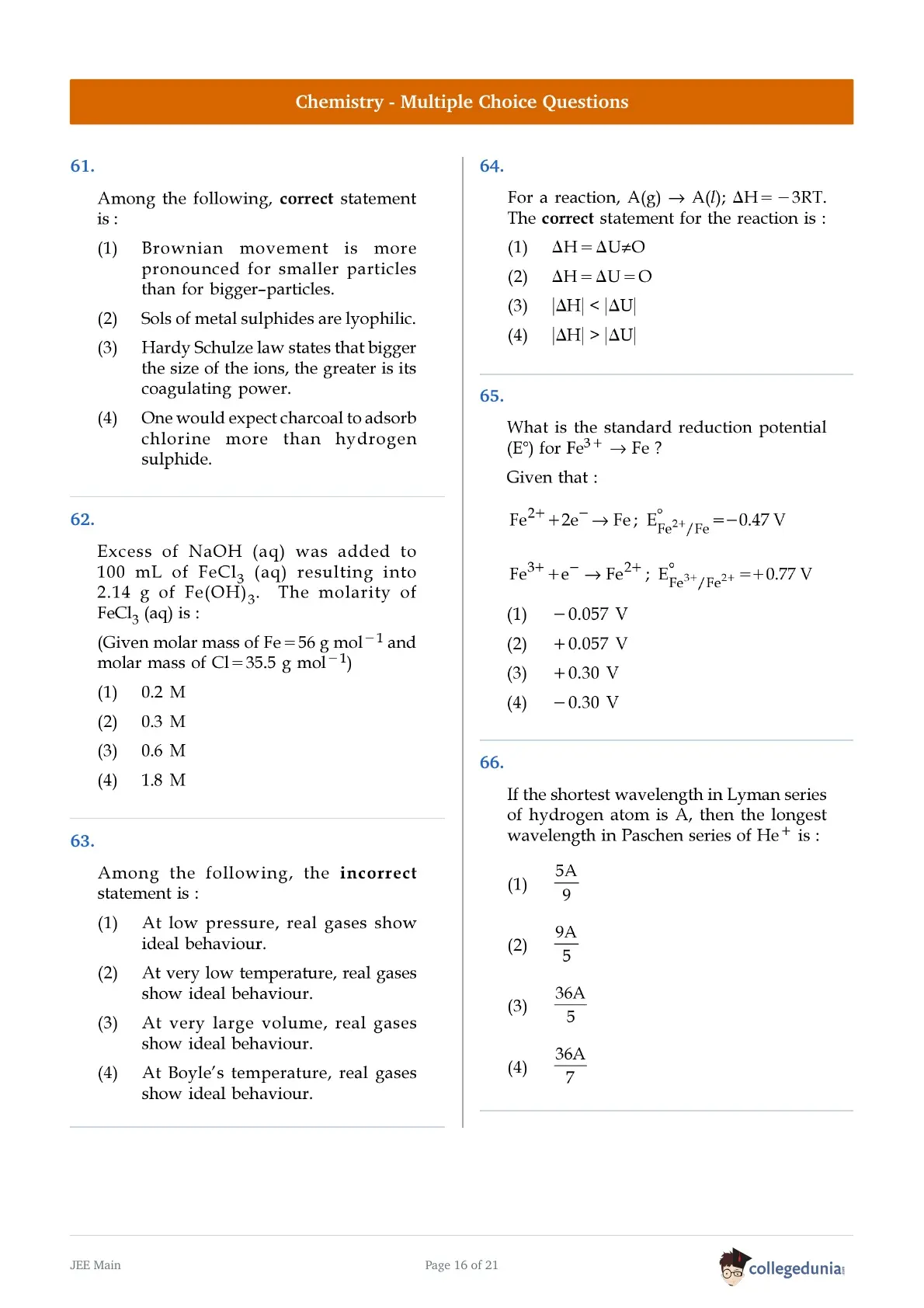
Among the following, correct statement is :
Excess of \(NaOH_{(aq)}\) was added to \(100\, mL\) of \({ FeCl_3}\) (aq) resulting into \(2.14\, g\) of \({Fe(OH)_3}\). The molarity of \({FeCl_3}\) (aq) is : (Given molar mass of \({Fe = 56 \, g \, mol^{-1}}\) and molar mass of \({Cl = 35.5 \, g \, mol^{-1}}\))
Among the following, the incorrect statement is :
For a reaction, \( {A_(g) \to A_(l); \Delta H = - 3RT}\). The correct statement for the reaction is :
What is the standard reduction potential \((E^{\circ}) \) for \({Fe^{3+} \to Fe}\) ? Given that : \({Fe^{2+} + 2e^{-} -> Fe ; E^{\circ}_{Fe^{2+} / Fe} = - 0.47 V }\) \({Fe^{3+} + e^{-} -> Fe^{2+} ; E^{\circ}_{Fe^{3+} / Fe^{2+}} = + 0.77 V }\)
If the shortest wavelength in Lyman series of hydrogen atom is \(A\), then the longest wavelength in Paschen series of \(He^{+}\) is :
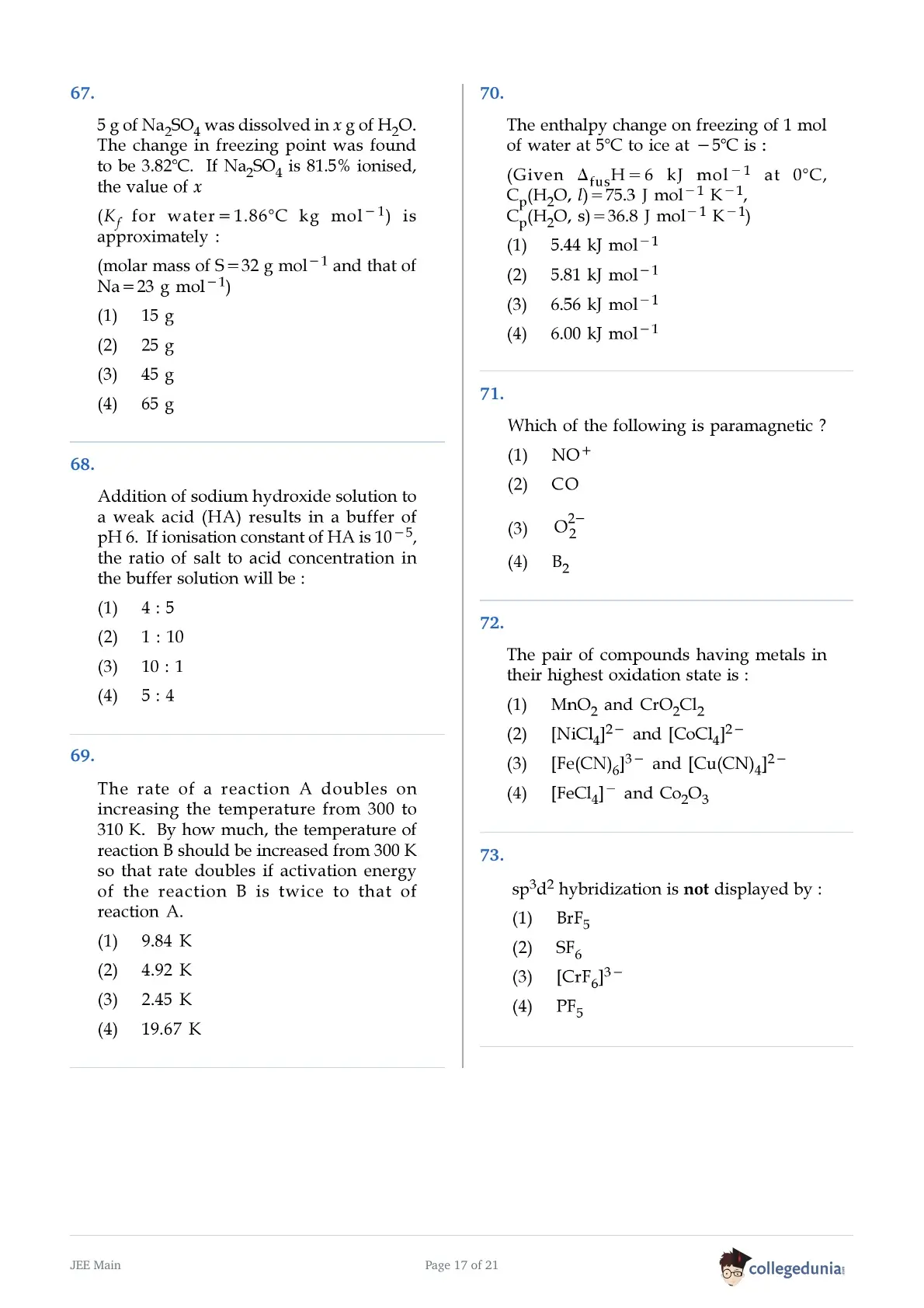
5 g of \(\mathrm{Na_2SO_4}\) was dissolved in x g of \(\mathrm{H_2O}\). The change in freezing point was found to be 3.82\(^\circ\)C. If \(\mathrm{Na_2SO_4}\) is 81.5% ionised, the value of x (\(K_f\) for water = 1.86\(^\circ\)C kg mol-1) is approximately :
(molar mass of S = 32 g mol-1 and that of Na = 23 g mol-1)
Addition of sodium hydroxide solution to a weak acid (HA) results in a buffer of pH 6. If ionisation constant of HA is \(10^{-5}\), the ratio of salt to acid concentration in the buffer solution will be :
The rate of a reaction A doubles on increasing the temperature from 300 to 310 K. By how much, the temperature of reaction B should be increased from 300 K so that rate doubles if activation energy of the reaction B is twice to that of reaction A.
The enthalpy change on freezing of 1 mol of water at 5\(^\circ\)C to ice at \(-5^\circ\)C is :
(Given \(\Delta_{fus}H = 6\) kJ mol-1 at 0\(^\circ\)C, \(C_p(\mathrm{H_2O}, l) = 75.3\) J mol-1 K-1, \(C_p(\mathrm{H_2O}, s) = 36.8\) J mol-1 K-1)
Which of the following is paramagnetic ?
The pair of compounds having metals in their highest oxidation state is :
\(sp^3d^2\) hybridization is not displayed by :
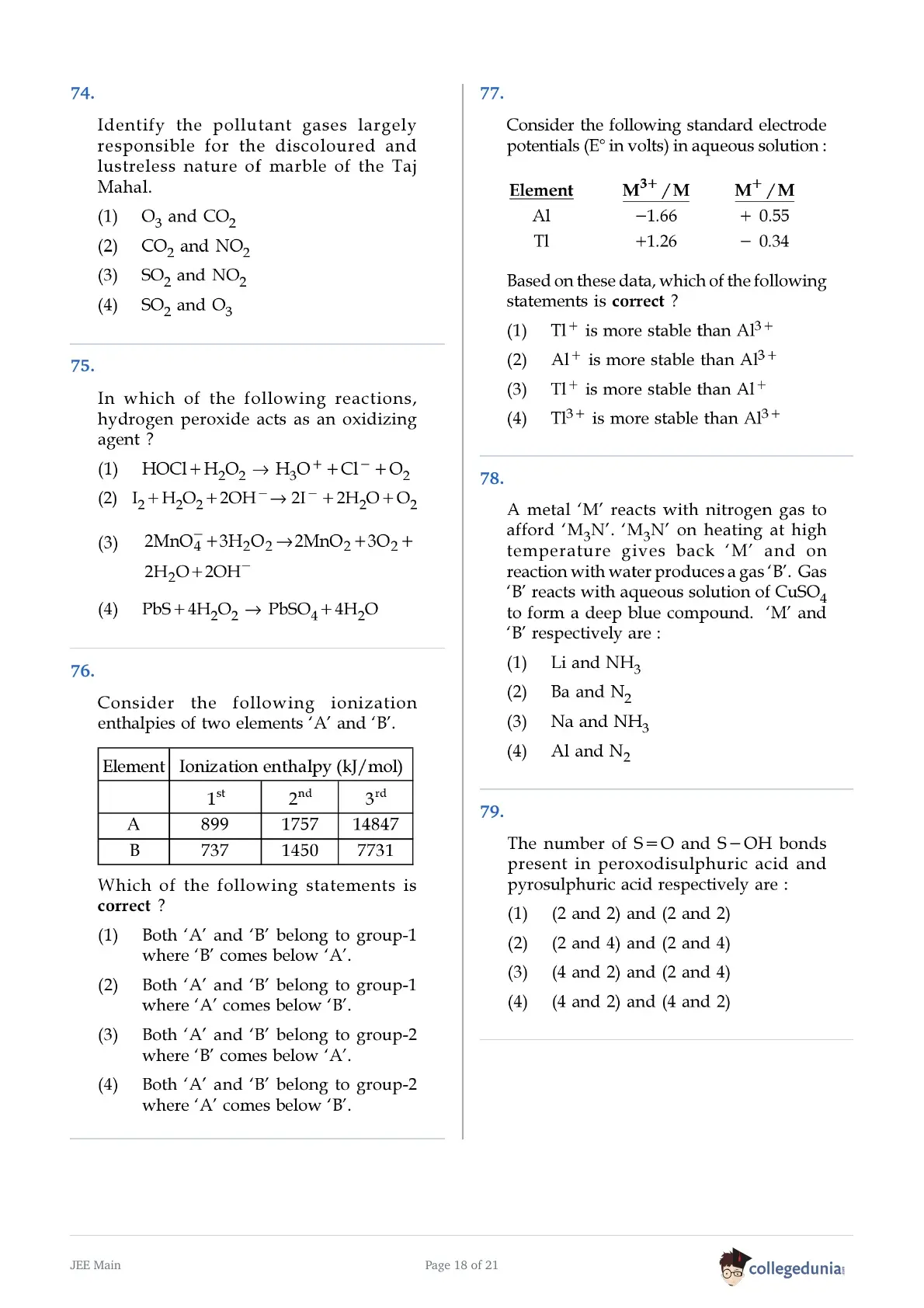
Identify the pollutant gases largely responsible for the discoloured and lustreless nature of marble of the Taj Mahal.
In which of the following reactions, hydrogen peroxide acts as an oxidizing agent ?
| Element | Ionization enthalpy (kJ/mol) | ||
| 1st | 2nd | 3rd | |
| A | 899 | 1757 | 14847 |
| B | 737 | 1450 | 7731 |
| Element | M3+ / M | M+ / M |
| Al | −1.66 | +0.55 |
| Tl | +1.26 | −0.34 |
A metal ‘M’ reacts with nitrogen gas to afford ‘M3N’. ‘M3N’ on heating at high temperature gives back ‘M’ and on reaction with water produces a gas ‘B’. Gas ‘B’ reacts with aqueous solution of \(\mathrm{CuSO_4}\) to form a deep blue compound. ‘M’ and ‘B’ respectively are :
The number of \(S=O\) and \(S-OH\) bonds present in peroxodisulphuric acid and pyrosulphuric acid respectively are :
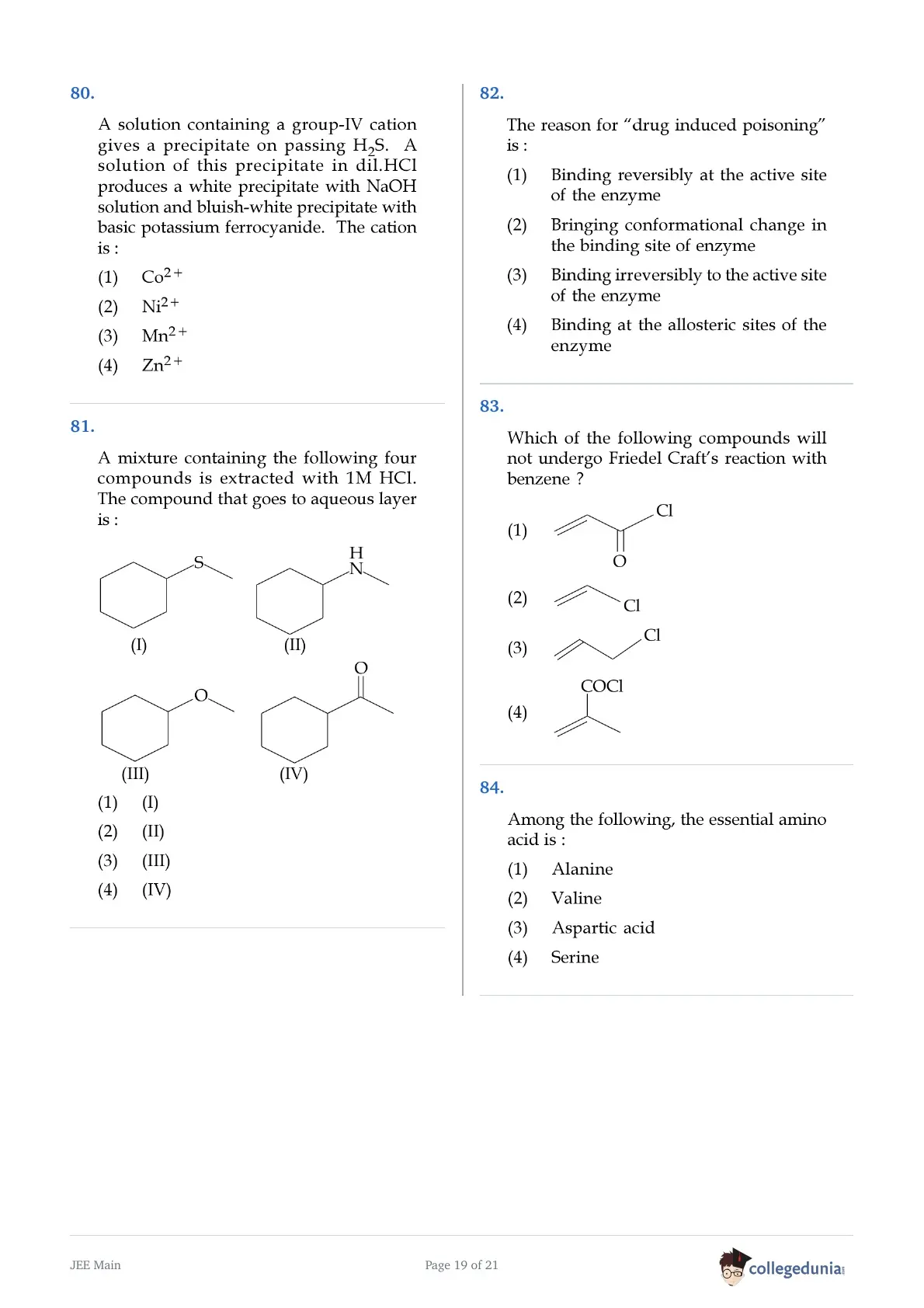
A solution containing a group-IV cation gives a precipitate on passing \(\mathrm{H_2S}\). A solution of this precipitate in dil.HCl produces a white precipitate with NaOH solution and bluish-white precipitate with basic potassium ferrocyanide. The cation is :
A mixture containing the following four compounds is extracted with 1M HCl. The compound that goes to aqueous layer is :
The reason for “drug induced poisoning” is :
Which of the following compounds will not undergo Friedel Craft’s reaction with benzene ?
- (1)
![]()
- (2)
![]()
- (3)
![]()
- (4)
![]()


Among the following, the essential amino acid is :
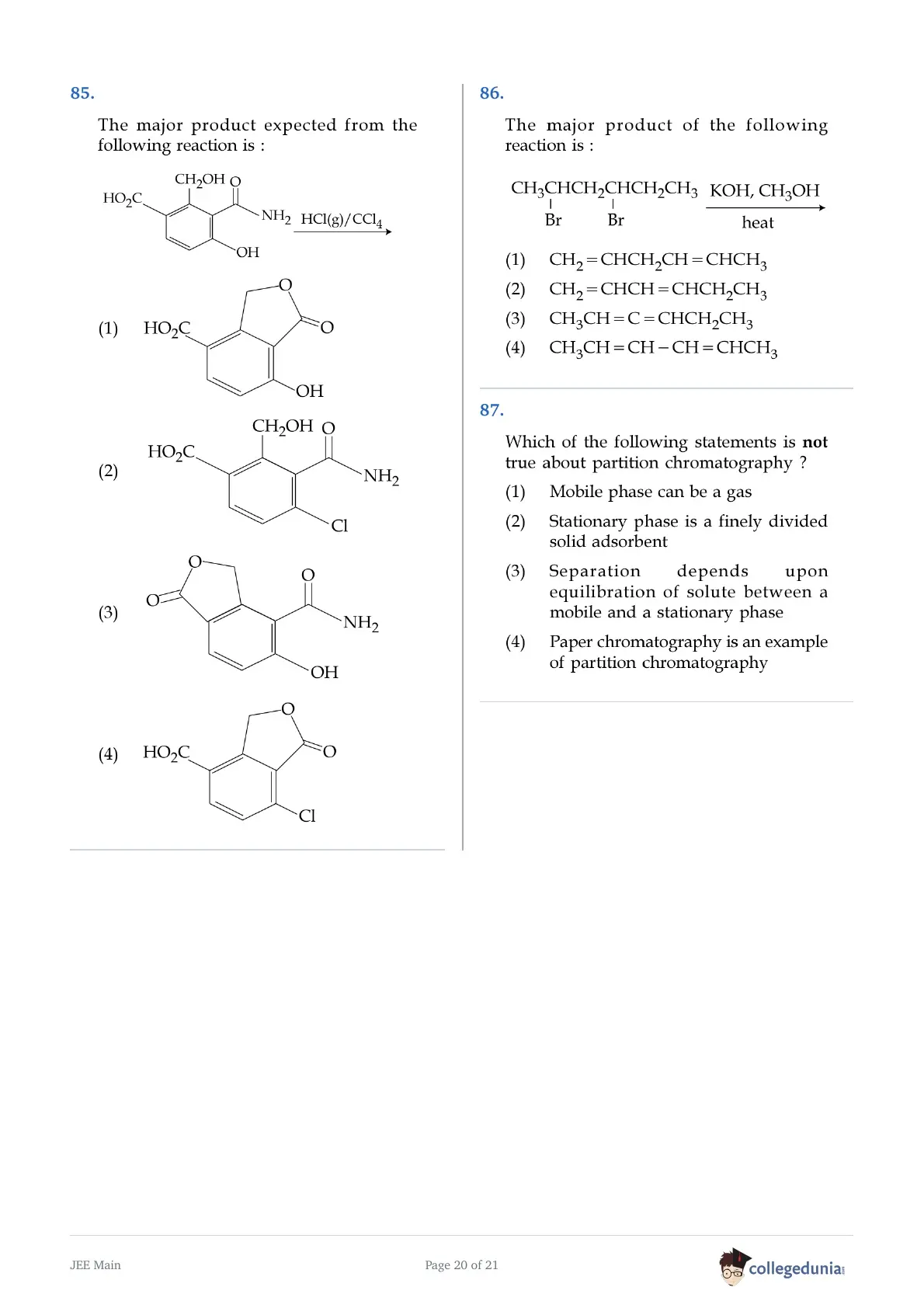
The major product expected from the following reaction is :
- (1)
![]()
- (2)
![]()
- (3)
![]()
- (4)
![]()


The major product of the following reaction is :
\(\mathrm{CH_3\underset{Br}{CH}CH_2\underset{Br}{CH}CH_2CH_3} \xrightarrow[\text{heat}]{\mathrm{KOH,\ CH_3OH}}\)
Which of the following statements is not true about partition chromatography ?
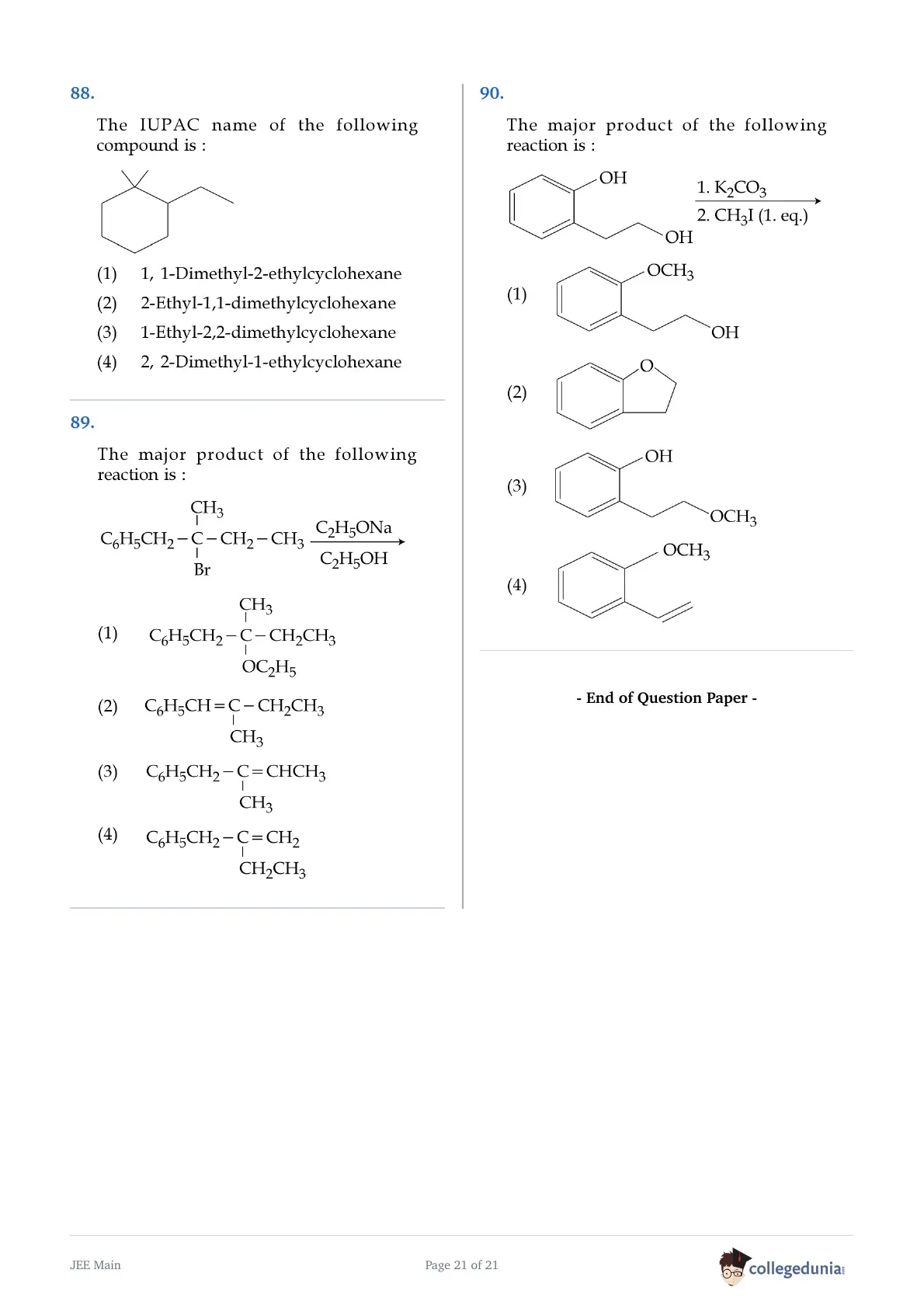
The IUPAC name of the following compound is :
The major product of the following reaction is :
\(\mathrm{C_6H_5CH_2-\underset{Br}{\overset{CH_3}{C}}-CH_2-CH_3}\) \(\xrightarrow[\mathrm{C_2H_5OH}]{\mathrm{C_2H_5ONa}}\)
The major product of the following reaction is :
1. K2CO3
2. CH3I (1 eq.)
- (1)
![]()
- (2)
![]()
- (3)
![]()
- (4)
![]()


JEE Main 2017 Exam Pattern and Marking Scheme
| Particulars | Details |
|---|---|
| Exam Mode | Online (Computer-Based Test) |
| Paper | B.E./B.Tech (Paper 1) |
| Duration | 3 hours (180 minutes) |
| Type of Questions | Multiple Choice Questions (MCQs) |
| Subjects | Mathematics, Physics, Chemistry |
| Total Questions | 90 questions |
| Total Marks | 360 marks |
| Marking Scheme | +4 for correct answer & -1 for incorrect answer; 0 for unattempted |
JEE Main 2017 April 8 Difficulty Level
In terms of difficulty level, B.E/B.Tech was of moderate to difficult level.
JEE Main 2017 Question Paper Analysis
- The question paper comprised a total of 90 questions divided among 3 sections i.e, Physics, Chemistry and Maths. Each section consists of 30 questions
- Physics Paper the questions were more calculative and formula based than theoretical. In terms of difficulty, the paper was moderate for students having good conceptual knowledge along with its applications.
- Chemistry Paper had more theoretical questions than calculative, making it the quickest subject to solve
- Maths Paper had Lengthy and application based questions several students rated as the most difficult section.
For every correct answer, candidates got 4 and for each wrong attempt -1 marks were deducted.



Comments