




JEE Main 2023 Chemistry April 6 Shift 2 Question Paper is available here for download. Candidates can download official JEE Main 2023 Chemistry Question Paper PDF with Solution and Answer Key for April 6 Shift 2 using the link below. JEE Main Chemistry Question Paper is divided into two sections, Section A with 20 MCQs and Section B with 10 numerical type questions. Candidates are required to answer all questions from Section A and any 5 questions from section B.
JEE Main 2023 Chemistry Question Paper April 6 Shift 2 PDF
| JEE Main 2023 April 6 Shift 2 Question Paper with Solution PDF |  Download Download |
Check Solution |
JEE Main 2023 Chemistry Questions with Solutions
Section – A
Question 1:
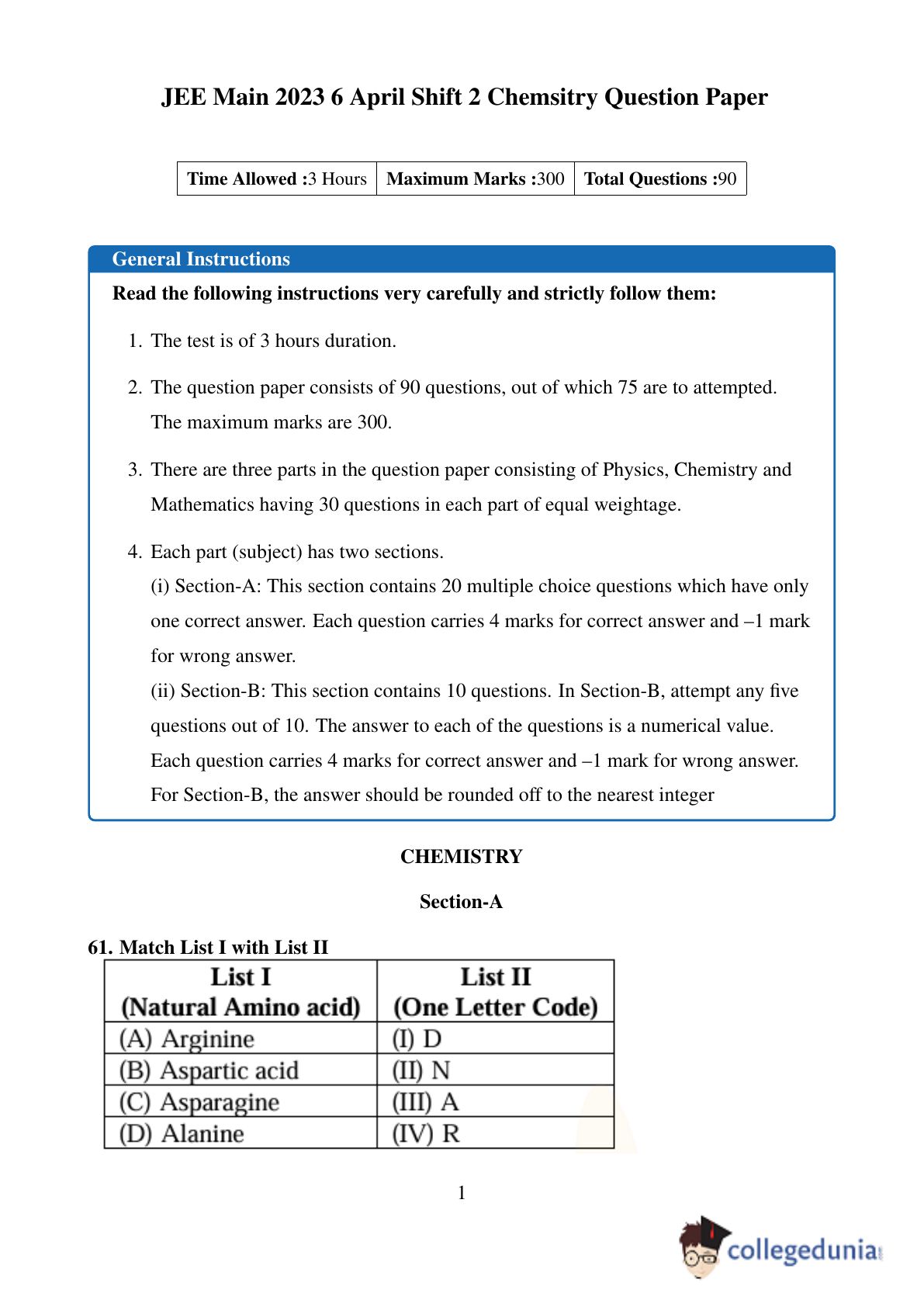
Match List I with List II

Choose the correct answer from the options given below:
(1) (A) – III, (B) – I, (C) – II (D) – IV
(2) (A) – IV, (B) – I, (C) – II (D) – III
(3) (A) – IV, (B) – I, (C) – III (D) – II
(4) (A) – I, (B) – III, (C) – IV (D) – II
View Solution
 Quick Tip: Amino acids can be represented by their one-letter codes, which are used in protein sequences. This matching question tests your knowledge of such representations.
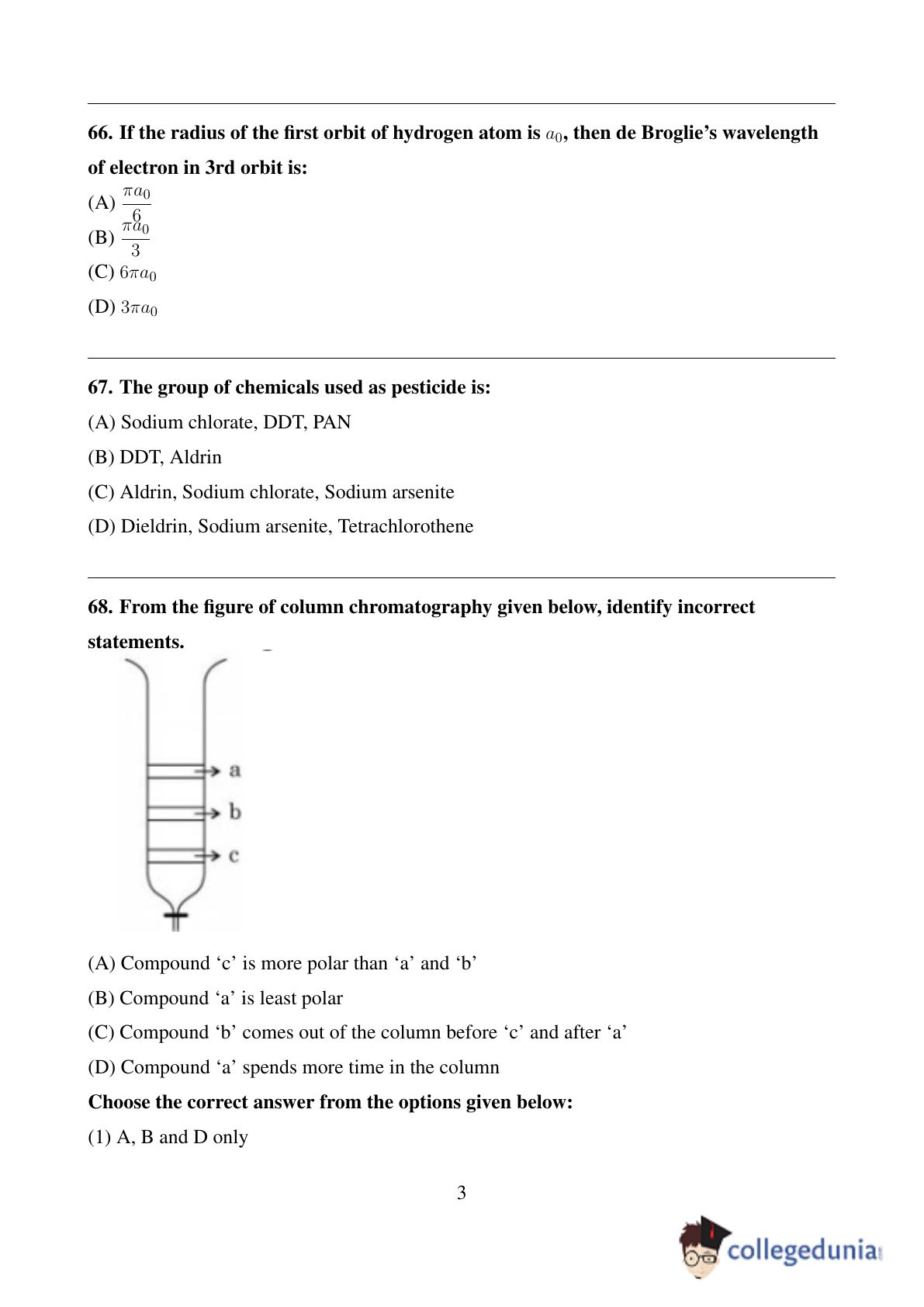
Formation of which complex, among the following, is not a confirmatory test of \( Pb^{2+} \) ions
(1) lead sulphate
(2) lead nitrate
(3) lead chromate
(4) lead iodide
View Solution
\( Pb(NO_3)_2 \) is a soluble colourless compound so it cannot be used in confirmatory test of \( Pb^{2+} \) ion.
Correct Answer: (2) lead nitrate
Quick Tip: For confirmatory tests of ions, it is crucial to recognize soluble and insoluble compounds. Lead nitrate is soluble and does not form a visible precipitate with \( Pb^{2+} \) ions.
The volume of 0.02 M aqueous HBr required to neutralize 10.0 mL of 0.01 M aqueous Ba(OH)\(_2\) is (Assume complete neutralization)
(1) 5.0 mL
(2) 10.0 mL
(3) 2.5 mL
(4) 7.5 mL
View Solution
\[ m.e.q of HBr = m.e.q of Ba(OH)_2 \] \[ M_1 \times n_1 \times V_1 = M_2 \times n_2 \times V_2 \] \[ 0.02 \times 1 \times V_1 = 0.01 \times 2 \times 10 \] \[ V_1 = \frac{0.01 \times 10}{0.02} = 10 \, mL \]
Correct Answer: (2) 10.0 mL
Quick Tip: In titration problems, always apply the principle of equivalence where moles of acid and base are equal. Use the relation \( M_1 \times V_1 = M_2 \times V_2 \) for calculations.
Group–13 elements react with \( O_2 \) in amorphous form to form oxides of type \( M_2O_3 \) (M = element). Which among the following is the most basic oxide?
(1) Al\(_2\)O\(_3\)
(2) Tl\(_2\)O\(_3\)
(3) Ga\(_2\)O\(_3\)
(4) B\(_2\)O\(_3\)
View Solution
As electropositive character increases, basic character of oxide increases: \[ B_2O_3 < Al_2O_3 < Ga_2O_3 < In_2O_3 < Tl_2O_3 \]
Correct Answer: (4) B\(_2\)O\(_3\)
Quick Tip: When comparing the basicity of oxides, the trend follows the electropositivity of the elements. Oxides of more electropositive elements tend to be more basic.
The IUPAC name of \( K_3[Co(C_2O_4)_3] \) is
(1) Potassium tris(oxalate) cobalte(III)
(2) Potassium trioxalatocobalt(III)
(3) Potassium tris(oxalate)cobalt(III)
(4) Potassium trioxalatocobaltate(III)
View Solution
The IUPAC name of \( K_3[Co(C_2O_4)_3] \) is Potassium trioxalatocobaltate(III).
Correct Answer: (4) Potassium trioxalatocobaltate(III)
Quick Tip: When naming coordination compounds, the ligands are named first followed by the metal center. The oxidation state of the metal is included in parentheses in Roman numerals.
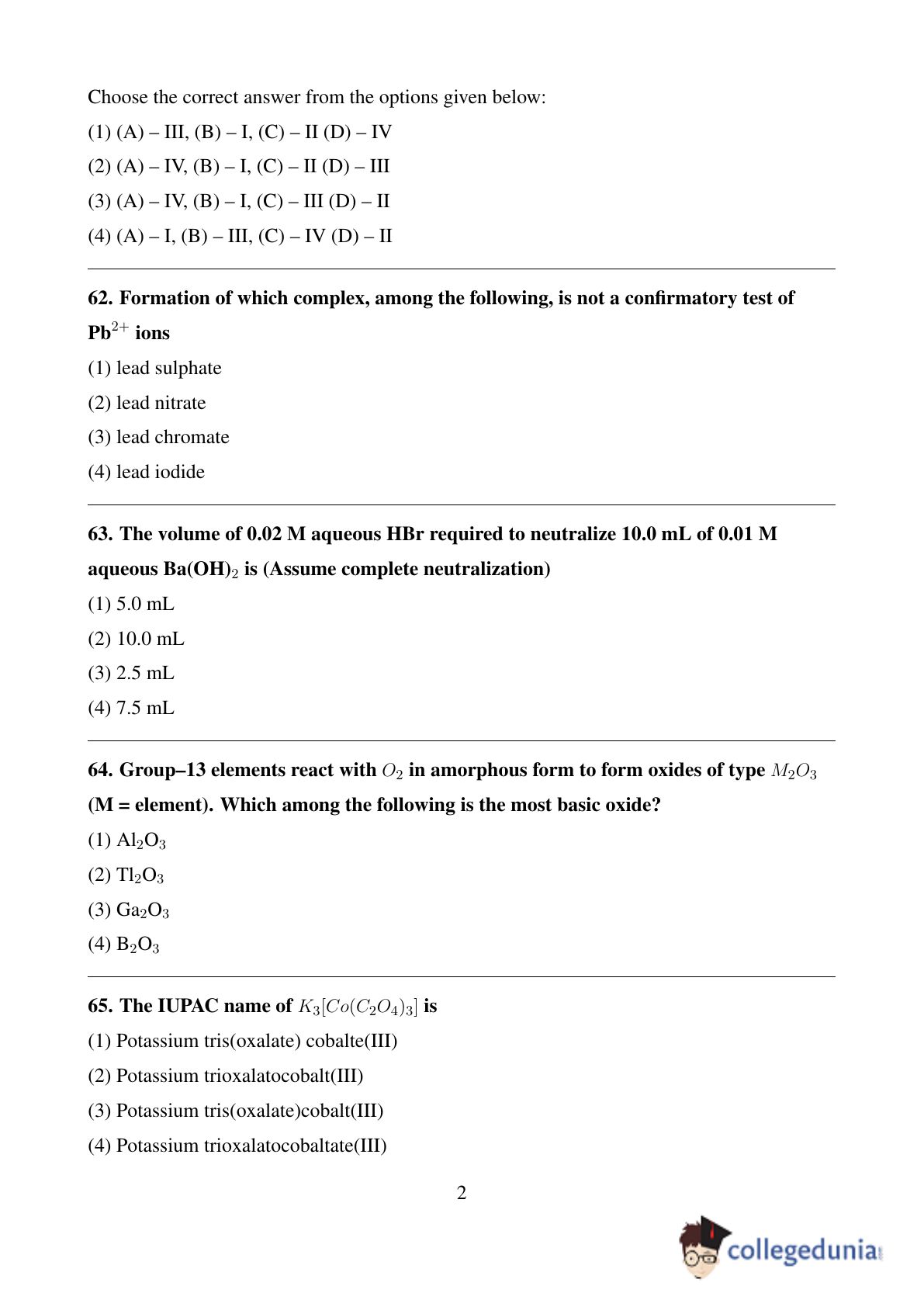
If the radius of the first orbit of hydrogen atom is \(a_0\), then de Broglie’s wavelength of electron in 3rd orbit is:
View Solution
N/A Quick Tip: Use the De-Broglie relation \(2\pi r = n\lambda\) to find the wavelength of an electron in any orbit.
The group of chemicals used as pesticide is:
View Solution
N/A Quick Tip: Remember that DDT and Aldrin are both chlorinated organic compounds used in pest control.
From the figure of column chromatography given below, identify incorrect statements.

View Solution
N/A Quick Tip: In chromatography, polar compounds interact more strongly with the stationary phase and take longer to elute.
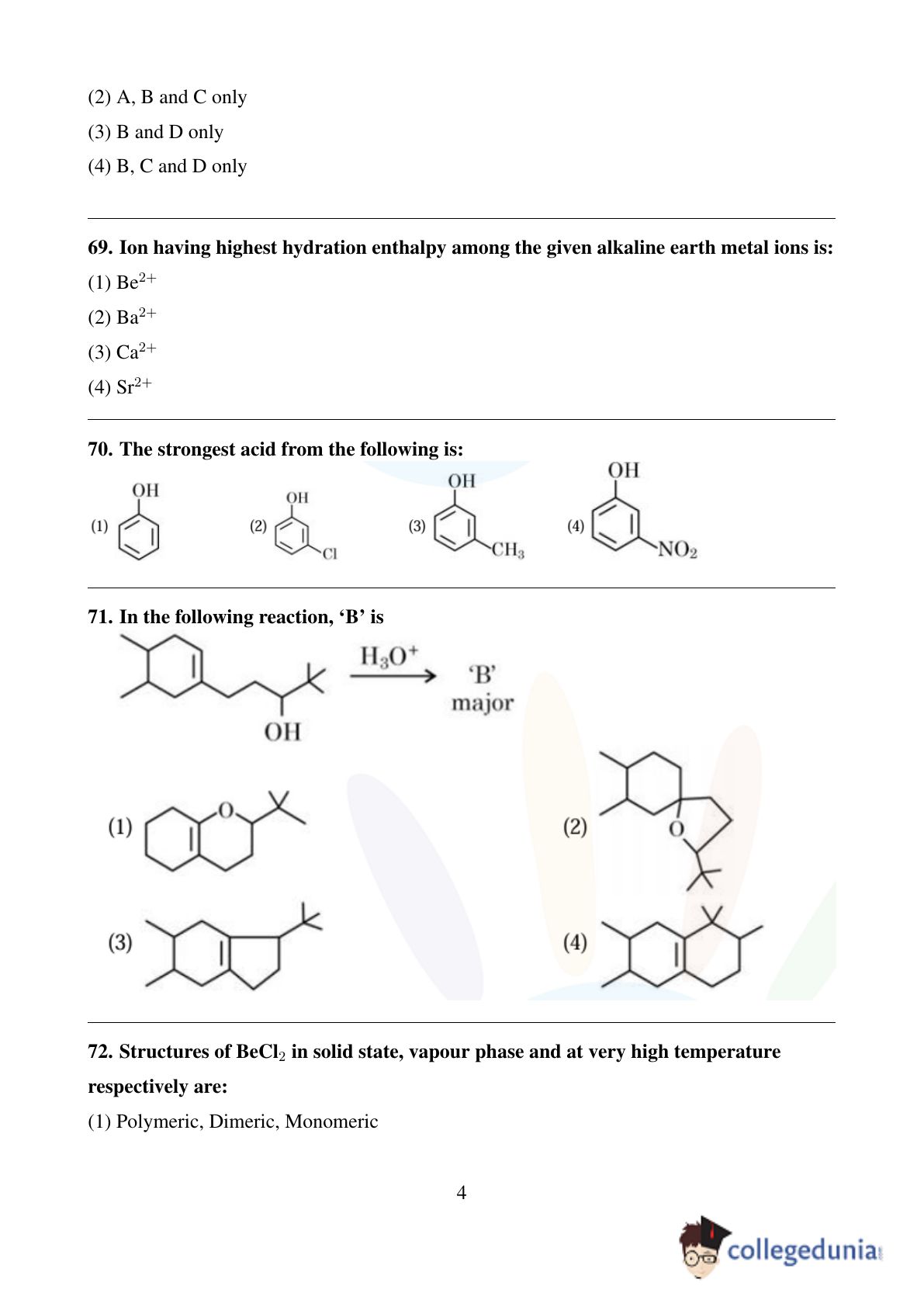
Ion having highest hydration enthalpy among the given alkaline earth metal ions is:
View Solution
Hydration enthalpy is inversely proportional to the size of the ion, i.e., \[ Hydration enthalpy \propto \frac{1}{size}. \]
As the size of the ion increases down the group, hydration enthalpy decreases. Therefore, the order of hydration enthalpy is: \[ Be^{2+} > Mg^{2+} > Ca^{2+} > Sr^{2+} > Ba^{2+}. \]
Thus, Be\(^{2+}\) has the highest hydration enthalpy.
Quick Tip: Hydration enthalpy is a key concept for understanding the solvation process. Smaller ions have higher hydration enthalpies due to their higher charge density.
The strongest acid from the following is:

View Solution

The acid strength of a phenolic compound depends on the electron-withdrawing or electron-donating groups attached to the benzene ring. The electron-withdrawing group increases the acidity of the compound. Among the options, the nitro group (-NO\(_2\)) is a strong electron-withdrawing group through the inductive effect (-I), making the compound with -NO\(_2\) attached to the ring the most acidic.
Quick Tip: When determining the acidity of substituted phenols, remember that electron-withdrawing groups (-I) increase acidity by stabilizing the negative charge on the conjugate base.
In the following reaction, ‘B’ is

View Solution

The reaction shows a typical mechanism where the protonation of the alcohol leads to a carbocation formation, followed by a shift of the CH\(_3\) group. The major product corresponds to the compound shown in option (4).
Quick Tip: In elimination and rearrangement reactions, the carbocation intermediate plays a crucial role in determining the product.
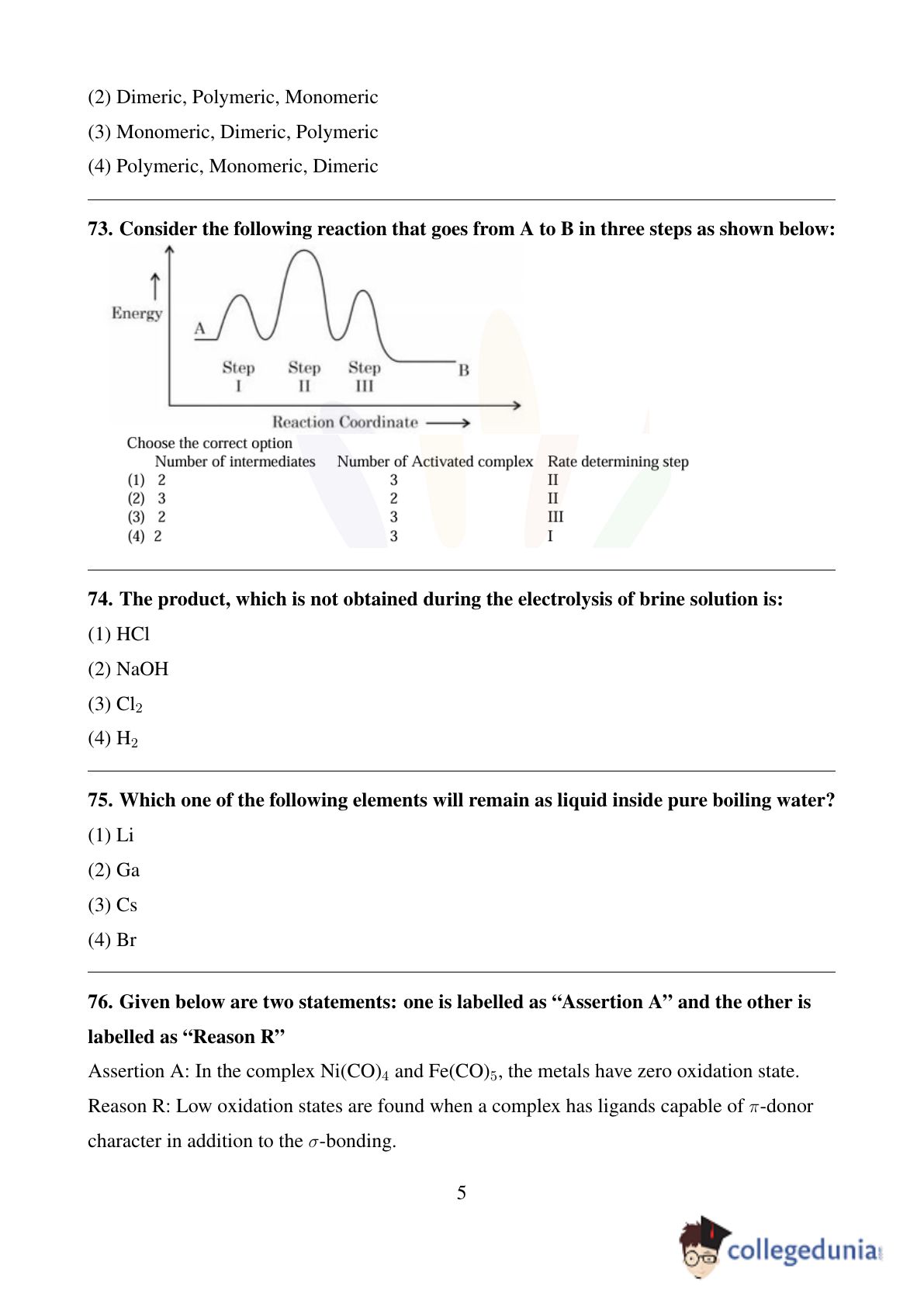
Structures of BeCl\(_2\) in solid state, vapour phase and at very high temperature respectively are:
View Solution
In the solid state, BeCl\(_2\) exists as a polymer. In the vapour phase, it forms a chloro-bridged dimer. At very high temperatures (above 1200K), it exists as a monomer.
Quick Tip: BeCl\(_2\) is an example of a molecule whose structure changes depending on temperature, showcasing the effect of temperature on molecular structure.
Consider the following reaction that goes from A to B in three steps as shown below:


View Solution

From the diagram, we see that there are two intermediates and three activated complexes. The rate determining step is the second step (II), where the highest energy barrier occurs.
Quick Tip: In reaction mechanisms, the rate determining step is the one with the highest activation energy, which slows down the overall reaction.
The product, which is not obtained during the electrolysis of brine solution is:
View Solution
During electrolysis of brine solution (NaCl + H\(_2\)O), at the cathode, hydrogen gas (H\(_2\)) is released, and at the anode, chlorine gas (Cl\(_2\)) is produced. Na\(^+\) and OH\(^-\) combine to form NaOH. HCl is not formed during this process.
Quick Tip: The electrolysis of brine is used to produce chlorine gas, hydrogen gas, and sodium hydroxide.
Which one of the following elements will remain as liquid inside pure boiling water?
View Solution
Li and Cs react vigorously with water. Br is a non-metal that does not react in this manner. Ga, however, remains liquid at the boiling point of water, which is 100°C (boiling point of Ga = 2400°C).
Quick Tip: Remember that elements with high melting points, such as Gallium, can remain liquid even at temperatures above the boiling point of water.
Given below are two statements: one is labelled as “Assertion A” and the other is labelled as “Reason R”
Assertion A: In the complex Ni(CO)\(_4\) and Fe(CO)\(_5\), the metals have zero oxidation state.
Reason R: Low oxidation states are found when a complex has ligands capable of \(\pi\)-donor character in addition to the \(\sigma\)-bonding.
In the light of the above statement, choose the most appropriate answer from the options given below.
View Solution
The oxidation states of Ni and Fe in Ni(CO)\(_4\) and Fe(CO)\(_5\) are indeed zero. However, while low oxidation states can be stabilized by \(\pi\)-acceptor ligands, this is not the reason why Ni and Fe exhibit zero oxidation states in these complexes.
Quick Tip: Zero oxidation states in metal carbonyls are due to the ligand’s ability to donate electron density through \(\sigma\)-donation and accept electron density through \(\pi\)-back donation.
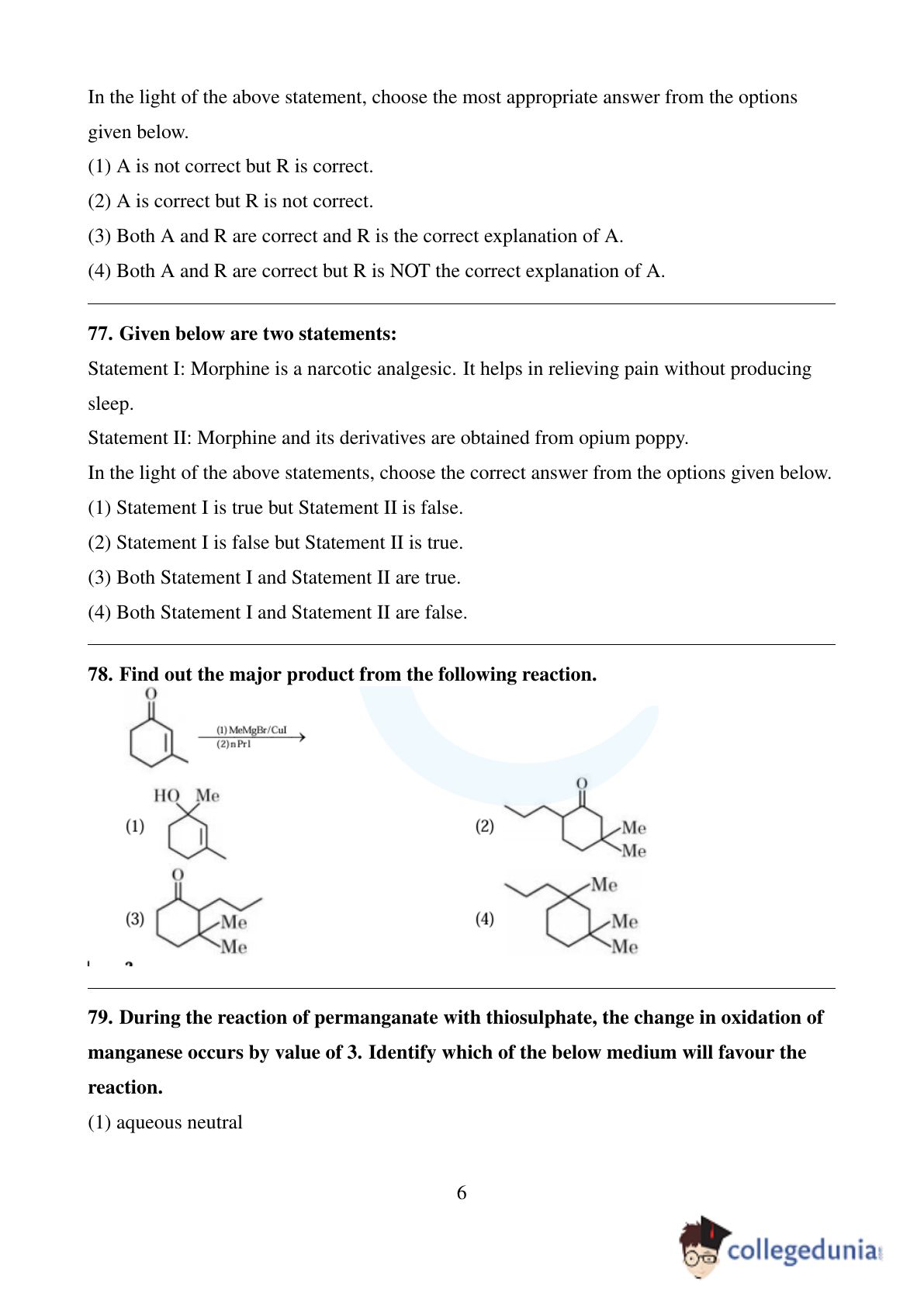
Given below are two statements:
Statement I: Morphine is a narcotic analgesic. It helps in relieving pain without producing sleep.
Statement II: Morphine and its derivatives are obtained from opium poppy.
In the light of the above statements, choose the correct answer from the options given below.
View Solution
Morphine is indeed a narcotic analgesic and helps in relieving pain. However, it also causes drowsiness, so Statement I is false. Statement II is true as morphine and its derivatives are obtained from the opium poppy.
Quick Tip: Morphine and its derivatives have medicinal properties but also cause drowsiness, which makes Statement I incorrect.
Find out the major product from the following reaction.

View Solution

The reaction is a Grignard reagent reaction with the carbonyl group, followed by reaction with n-PrI. The major product is the one shown in option (3), as a new carbon-carbon bond is formed.
Quick Tip: In Grignard reactions, a nucleophilic attack on the carbonyl group leads to the formation of an alcohol after the addition of a halide.
During the reaction of permanganate with thiosulphate, the change in oxidation of manganese occurs by value of 3. Identify which of the below medium will favour the reaction.
View Solution
In neutral or weakly alkaline solution, the oxidation state of Mn changes by 3 units: MnO\(_4^{-}\) \(\rightarrow\) MnO\(_2\). Therefore, the reaction favours the neutral medium.
Quick Tip: The oxidation state change of Mn in reactions involving permanganate depends on the solution's pH. Neutral or slightly alkaline solutions are best for this reaction.
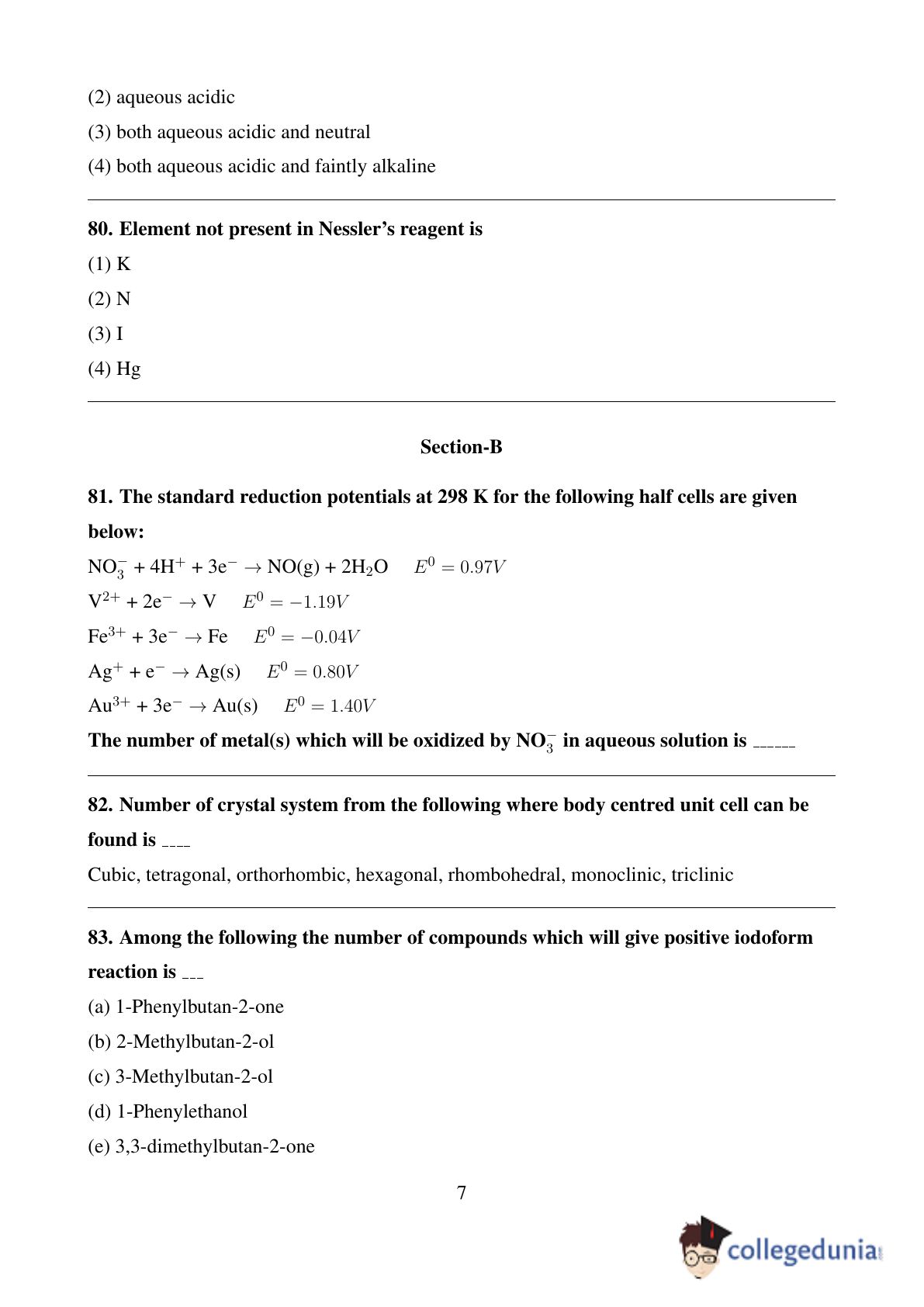
Element not present in Nessler’s reagent is
View Solution
Nessler reagent is \( K_2[HgI_4] \), which contains K, Hg, and I. Nitrogen (N) is not present in the reagent.
Quick Tip: Nessler's reagent is used for the detection of ammonia and is made of mercury and iodine, but does not contain nitrogen.
Section – B
Question 21:
The standard reduction potentials at 298 K for the following half cells are given below:
NO\(_3^-\) + 4H\(^+\) + 3e\(^-\) \(\rightarrow\) NO(g) + 2H\(_2\)O \quad \(E^0 = 0.97 V\)
V\(^{2+}\) + 2e\(^-\) \(\rightarrow\) V \quad \(E^0 = -1.19 V\)
Fe\(^{3+}\) + 3e\(^-\) \(\rightarrow\) Fe \quad \(E^0 = -0.04 V\)
Ag\(^+\) + e\(^-\) \(\rightarrow\) Ag(s) \quad \(E^0 = 0.80 V\)
Au\(^{3+}\) + 3e\(^-\) \(\rightarrow\) Au(s) \quad \(E^0 = 1.40 V\)
The number of metal(s) which will be oxidized by NO\(_3^-\) in aqueous solution is __________
View Solution
In the given half reactions, metals V, Fe, and Ag will be oxidized by NO\(_3^-\) because their reduction potentials are less than 0.97 V. Thus, three metals will be oxidized by NO\(_3^-\).
Quick Tip: When comparing reduction potentials, metals with lower reduction potentials are more easily oxidized.
Number of crystal system from the following where body centred unit cell can be found is ____\
Cubic, tetragonal, orthorhombic, hexagonal, rhombohedral, monoclinic, triclinic
View Solution
Body-centered cubic (BCC) crystal structure is found in cubic, tetragonal, and orthorhombic systems. Thus, the number of crystal systems where BCC can be found is 3.
Quick Tip: BCC structure is commonly found in metals like iron and chromium.
Among the following the number of compounds which will give positive iodoform reaction is ___\
(a) 1-Phenylbutan-2-one
(b) 2-Methylbutan-2-ol
(c) 3-Methylbutan-2-ol
(d) 1-Phenylethanol
(e) 3,3-dimethylbutan-2-one
(f) 1-Phenylpropan-2-ol
View Solution

The iodoform test is positive for compounds that contain a methyl group (\(-CH_3\)) adjacent to a carbonyl group (\(C=O\)) or for alcohols that can be oxidized to acetone. Based on the structure and functional groups, compounds (c), (d), (e), and (f) will give a positive iodoform test. Thus, the answer is 4 compounds.
Quick Tip: For iodoform test to be positive, the structure must have either a \(-COCH_3\) group or a secondary alcohol adjacent to a methyl group.
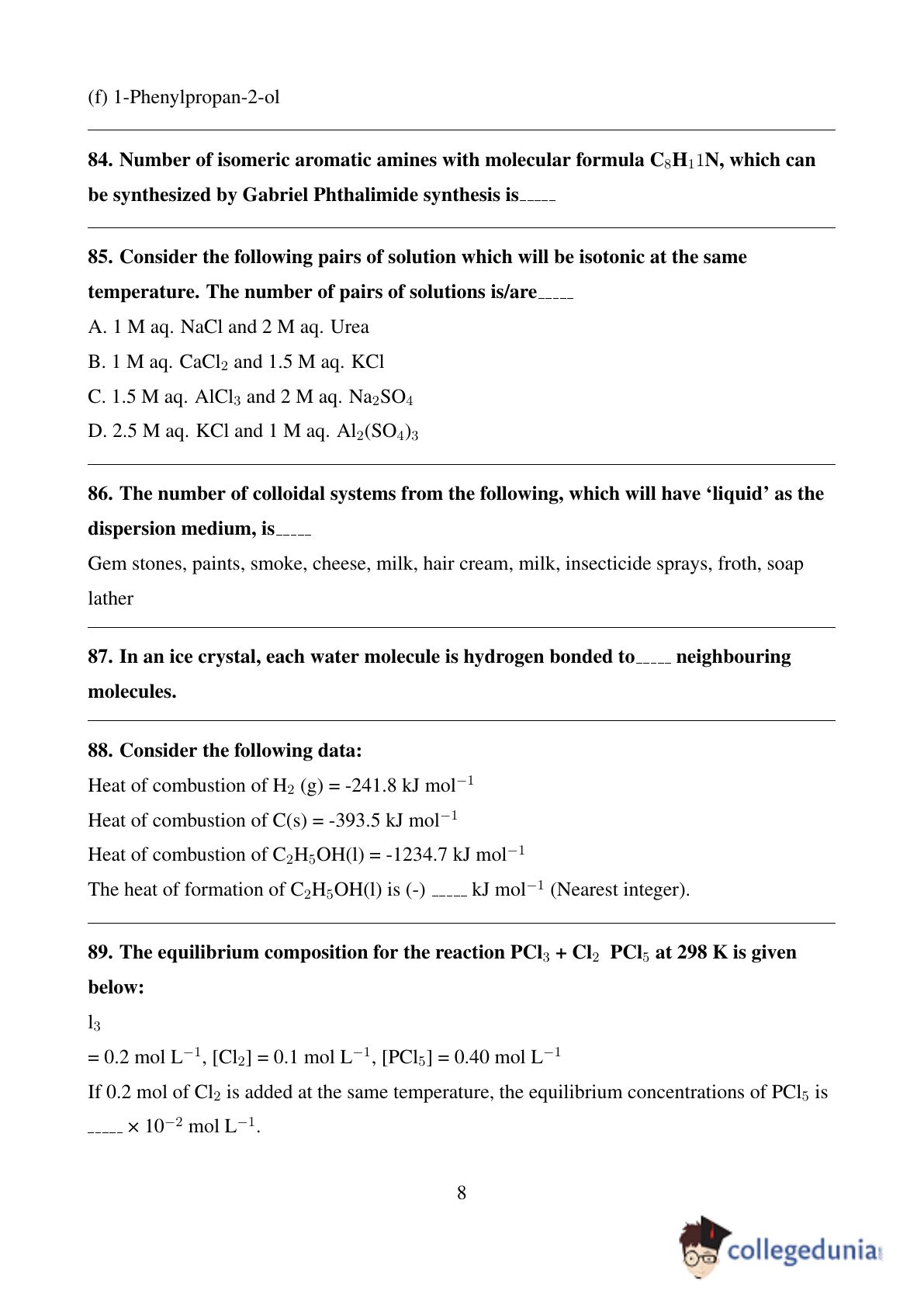
Number of isomeric aromatic amines with molecular formula C\(_8\)H\(_11\)N, which can be synthesized by Gabriel Phthalimide synthesis is_____
View Solution
By Gabriel phthalimide synthesis, i-amine is prepared, which should be aromatic and a-amine. The degree of unsaturation (Du) helps in determining the number of possible isomers.
Du = C + 1 - H - N/2, which equals 4, indicating the presence of a benzene ring. Thus, the number of isomeric aromatic amines that can be synthesized is 5.
Quick Tip: Gabriel Phthalimide synthesis is a key reaction for preparing aromatic amines from halides, especially when the structure is aromatic.
Consider the following pairs of solution which will be isotonic at the same temperature. The number of pairs of solutions is/are_____
A. 1 M aq. NaCl and 2 M aq. Urea
B. 1 M aq. CaCl\(_2\) and 1.5 M aq. KCl
C. 1.5 M aq. AlCl\(_3\) and 2 M aq. Na\(_2\)SO\(_4\)
D. 2.5 M aq. KCl and 1 M aq. Al\(_2\)(SO\(_4\))\(_3\)
View Solution
For two solutions to be isotonic, the total number of ions should be the same. Checking the pairs for ion concentration:
- A: 1 M NaCl gives 2 ions, and 2 M Urea gives 2 ions — isotonic.
- B: 1 M CaCl\(_2\) gives 3 ions, and 1.5 M KCl gives 3 ions — isotonic.
- C: 1.5 M AlCl\(_3\) gives 6 ions, and 2 M Na\(_2\)SO\(_4\) gives 6 ions — isotonic.
- D: 2.5 M KCl gives 5 ions, and 1 M Al\(_2\)(SO\(_4\))\(_3\) gives 5 ions — isotonic.
Thus, all 4 pairs are isotonic.
Quick Tip: Isotonic solutions have the same osmotic pressure, which is determined by the concentration of dissolved particles.
The number of colloidal systems from the following, which will have ‘liquid’ as the dispersion medium, is_____
Gem stones, paints, smoke, cheese, milk, hair cream, milk, insecticide sprays, froth, soap lather
View Solution
Liquid dispersion medium colloidal systems include paints, milk, hair cream, froth, soap lather. Thus, there are 5 such systems.
Quick Tip: Liquid colloidal systems are common in everyday life, especially in products like paints and creams where the dispersion medium is liquid.
In an ice crystal, each water molecule is hydrogen bonded to_____ neighbouring molecules.
View Solution

In an ice crystal, each water molecule is hydrogen bonded to four neighbouring molecules, forming a tetrahedral arrangement.
Quick Tip: Hydrogen bonding in ice leads to the characteristic structure that makes ice less dense than liquid water.
Consider the following data:
Heat of combustion of H\(_2\) (g) = -241.8 kJ mol\(^{-1}\)
Heat of combustion of C(s) = -393.5 kJ mol\(^{-1}\)
Heat of combustion of C\(_2\)H\(_5\)OH(l) = -1234.7 kJ mol\(^{-1}\)
The heat of formation of C\(_2\)H\(_5\)OH(l) is (-) _____ kJ mol\(^{-1}\) (Nearest integer).
View Solution
We can use Hess's Law and combine the equations to calculate the heat of formation of C\(_2\)H\(_5\)OH(l):
\( \Delta H_{f} \) = \( -393.5 \times 2 \) - \( 241.5 \times 8 \times 3 \) + 1234.7 = -277.7 kJ mol\(^{-1}\)
Quick Tip: Hess's Law states that the heat of a reaction is the sum of the heats of the reactions into which it can be divided.
The equilibrium composition for the reaction PCl\(_3\) + Cl\(_2\) ⇌ PCl\(_5\) at 298 K is given below:
[PCl\(_3\)] = 0.2 mol L\(^{-1}\), [Cl\(_2\)] = 0.1 mol L\(^{-1}\), [PCl\(_5\)] = 0.40 mol L\(^{-1}\)
If 0.2 mol of Cl\(_2\) is added at the same temperature, the equilibrium concentrations of PCl\(_5\) is _____ × 10\(^{-2}\) mol L\(^{-1}\).
View Solution
We are given the equilibrium constant Kc for the reaction at 298 K as 20.
K\(_c = \frac{[PCl_5]}{[PCl_3][Cl_2]} = \frac{0.40}{0.20 \times 0.10} = 20
After adding 0.2 mol of Cl\(_2\), the new concentrations become:
PCl\(_3\) = 0.2 - x, Cl\(_2\) = 0.2 + x, PCl\(_5\) = 0.4 + x.
Solving for x, we find that x = 0.084. Thus, the equilibrium concentration of PCl\(_5\) is 0.484 mol L\(^{-1}\).
Quick Tip: For equilibrium reactions, the change in concentrations due to shifting of equilibrium can be calculated using the reaction's equilibrium constant.
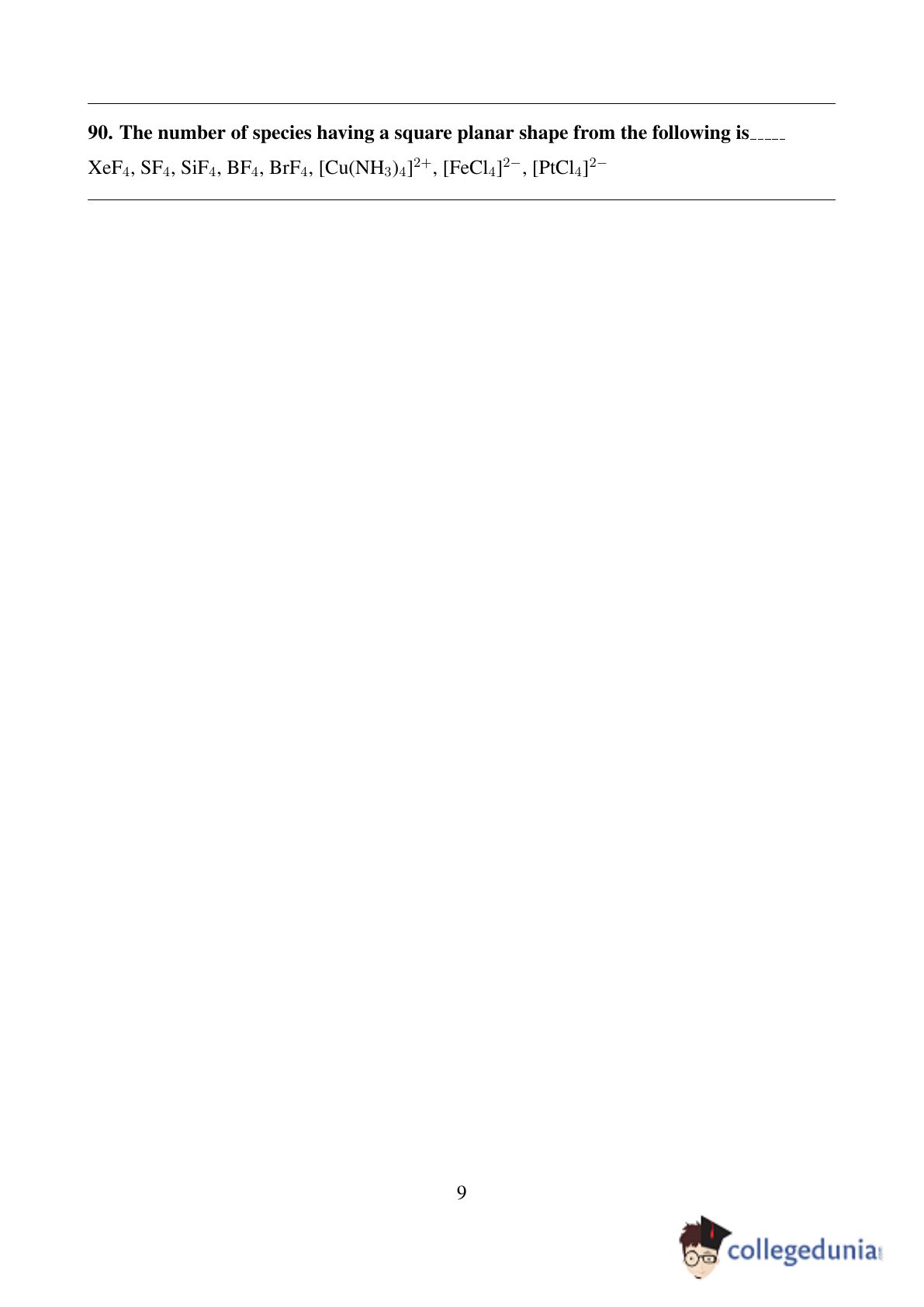
The number of species having a square planar shape from the following is_____
XeF\(_4\), SF\(_4\), SiF\(_4\), BF\(_4\), BrF\(_4\), [Cu(NH\(_3\))\(_4\)]\(^{2+}\), [FeCl\(_4\)]\(^{2-}\), [PtCl\(_4\)]\(^{2-}\)
View Solution
The species with square planar geometry include XeF\(_4\), [Cu(NH\(_3\))\(_4\)]\(^{2+}\), [PtCl\(_4\)]\(^{2-}\). Thus, there are 4 species with a square planar shape.
Quick Tip: Square planar geometry is common in transition metal complexes, especially for \(d^8\) configuration metals.
JEE Main 2023 Chemistry Paper Analysis April 6 Shift 2
JEE Main 2023 Chemistry Paper Analysis for the exam scheduled on April 6 Shift 2 is available here. Candidates can check subject-wise paper analysis for the exam scheduled on April 6 Shift 2 here along with the topics with the highest weightage.
JEE Main 2023 Chemistry Question Paper Pattern
| Feature | Question Paper Pattern |
|---|---|
| Examination Mode | Computer-based Test |
| Exam Language | 13 languages (English, Hindi, Assamese, Bengali, Gujarati, Kannada, Malayalam, Marathi, Odia, Punjabi, Tamil, Telugu, and Urdu) |
| Exam Duration | 3 hours |
| Sectional Time Limit | None |
| Chemistry Marks | 100 marks |
| Total Number of Questions Asked | 20 MCQs + 10 Numerical Type Questions |
| Total Number of Questions to be Answered | 20 MCQs + 5 Numerical Type Questions |
| Marking Scheme | +4 for each correct answer |
| Negative Marking | -1 for each incorrect answer |
Also Check:
JEE Main Previous Year Question Paper
| JEE Main 2022 Question Paper | JEE Main 2021 Question Paper | JEE Main 2020 Question Paper |
| JEE Main 2019 Question Paper | JEE Main 2018 Question Paper | JEE Main 2017 Question Paper |



Comments