




JEE Main 2023 Mathematics April 6 Shift 2 Question Paper is available here for download. Candidates can download official JEE Main 2023 Mathematics Question Paper PDF with Solution and Answer Key for April 6 Shift 2 using the link below. JEE Main Mathematics Question Paper is divided into two sections, Section A with 20 MCQs and Section B with 10 numerical type questions. Candidates are required to answer all questions from Section A and any 5 questions from section B.
JEE Main 2023 Mathematics Question Paper April 6 Shift 2 PDF
| JEE Main 2023 April 6 Shift 2 Question Paper with Solution PDF |  Download Download |
Check Solution |

JEE Main 2023 Mathematics Questions with Solutions
Section – A
Question 1:
If gcd \( (m, n) = 1 \) and \[ 1^2 - 2^2 + 3^2 - 4^2 + \cdots + (2022)^2 - (2023)^2 = 1012 \, m^2 n \]
then \( m^2 - n^2 \) is equal to:
View Solution
\[ (1 - 2) (1 + 2) + (3 - 4) (3 + 4) + \dots + (2021 - 2022)(2021 + 2022) + (2023)^2 = (1012) \, m^2 n \] \[ \Rightarrow ( - 1 ) [ 1 + 2 + 3 + 4 + \dots + 2022 ] + (2023)^2 = (1012) m^2 n \] \[ \Rightarrow (2023) [2023 - 1011 ] = (1012) m^2 n \] \[ \Rightarrow (2023) (1012) = (1012) m^2 n \] \[ \Rightarrow m^2 n = 2023 \] \[ \Rightarrow m^2 n = (17)^2 \times 7 \] \[ m = 17, \, n = 7 \] \[ m^2 - n^2 = (17)^2 - 7^2 = 289 - 49 = 240 \] Quick Tip: When solving for values in number theory, look for patterns in terms and simplify step by step. Break down complicated equations into smaller parts and solve them sequentially.
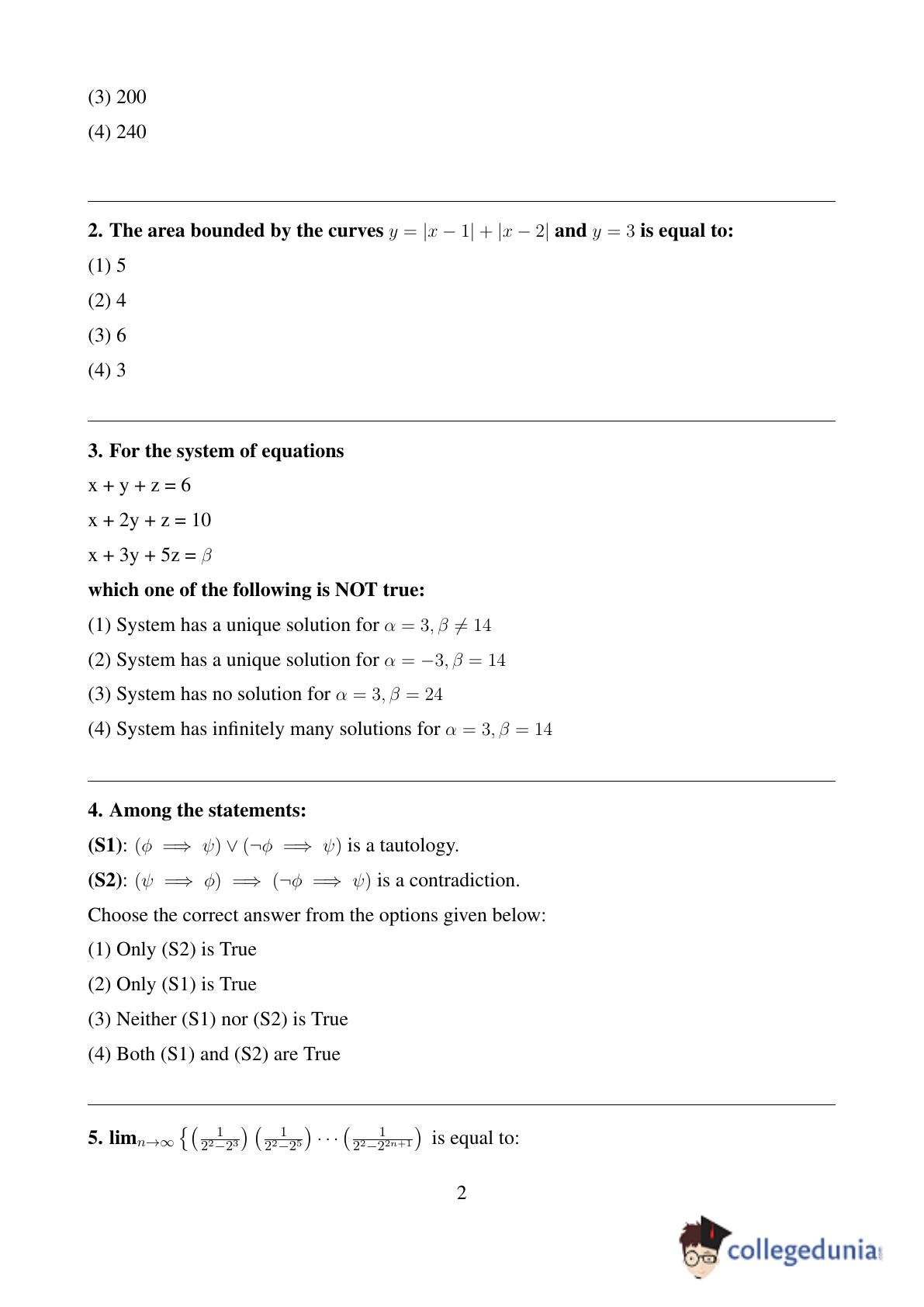
The area bounded by the curves \( y = |x - 1| + |x - 2| \) and \( y = 3 \) is equal to:
View Solution
The given equation for \( y \) is \( y = |x - 1| + |x - 2| \). The graph of \( y \) intersects the line \( y = 3 \) at certain points, forming a bounded area.

The area can be calculated by finding the points of intersection of the curves and calculating the area between them. After calculating, we find the area is 4 square units. Quick Tip: To calculate areas between curves involving absolute values, break the integral into parts corresponding to the intervals where the expressions inside the absolute values are positive or negative.
For the system of equations
x + y + z = 6
x + 2y + z = 10
x + 3y + 5z = \beta
which one of the following is NOT true:
View Solution
Given the system of equations, we need to analyze the determinant of the coefficient matrix to determine the nature of the solution.
The system is represented by:
\[ \begin{pmatrix} 1 & 1 & 1
1 & 2 & 1
1 & 3 & 5 \end{pmatrix} \]
The determinant of this matrix is calculated as:
\[ \Delta = \left| \begin{matrix} 1 & 1 & 1
1 & 2 & 1
1 & 3 & 5 \end{matrix} \right| \] \[ \Delta = 6(10 - 3\alpha) - (50 - \alpha13) + (30 - 2\beta) \] \[ = 40 - 18\alpha + \alpha\beta - 2\beta \]
For infinite solutions, we get \( \Delta = 0 \), and after solving:
\[ \Delta = 0, \, \Delta x = \Delta y = \Delta z = 0 \]
The value of \( \alpha = 3 \) and \( \beta = 14 \).
For a unique solution, \( \alpha \neq 3 \).
Thus, the correct answer is Option 1. Quick Tip: For systems of equations, the determinant of the coefficient matrix indicates whether the system has a unique solution (non-zero determinant) or infinitely many solutions (zero determinant).
Among the statements:
(S1): \( (\phi \implies \psi) \vee (\neg \phi \implies \psi) \) is a tautology.
(S2): \( (\psi \implies \phi) \implies (\neg \phi \implies \psi) \) is a contradiction.
Choose the correct answer from the options given below:
View Solution

For statement (S1), the logical expression \( (\phi \implies \psi) \vee (\neg \phi \implies \psi) \) is a tautology because it always holds true for any truth values of \( \phi \) and \( \psi \).
For statement (S2), \( (\psi \implies \phi) \implies (\neg \phi \implies \psi) \) is indeed a contradiction because it does not hold true in any case.
Hence, neither (S1) nor (S2) is true, so the correct answer is option (3). Quick Tip: To identify tautologies and contradictions, construct truth tables for logical expressions and check the validity of the statements.
lim_{n \to \infty \left\{ \left( \frac{1{2^2 - 2^3 \right) \left( \frac{1{2^2 - 2^5 \right) \cdots \left( \frac{1{2^2 - 2^{2n+1 \right) \text{ is equal to:
View Solution
We are given the product of terms:
\[ P = \lim_{n \to \infty} \left\{ \left( \frac{1}{2^2 - 2^3} \right) \left( \frac{1}{2^2 - 2^5} \right) \cdots \left( \frac{1}{2^2 - 2^{2n+1}} \right) \]
First, we analyze the behavior of each term in the product. The smallest term in the product is:
\[ \frac{1}{2^2 - 2^3} \quad and the largest term is \quad \frac{1}{2^2 - 2^{2n+1}} \]
The product is bounded as:
\[ \left( \frac{1}{2^2 - 2^3} \right)^n \leq P \leq \left( \frac{1}{2^2 - 2^{2n+1}} \right)^n \]
The sequence is bounded between 0 and 1. Therefore, the limit of the product as \( n \to \infty \) is 0.
Thus, the final answer is:
\[ P = 0 \] Quick Tip: For infinite products, analyze the smallest and largest terms to determine the behavior of the product as \( n \to \infty \).
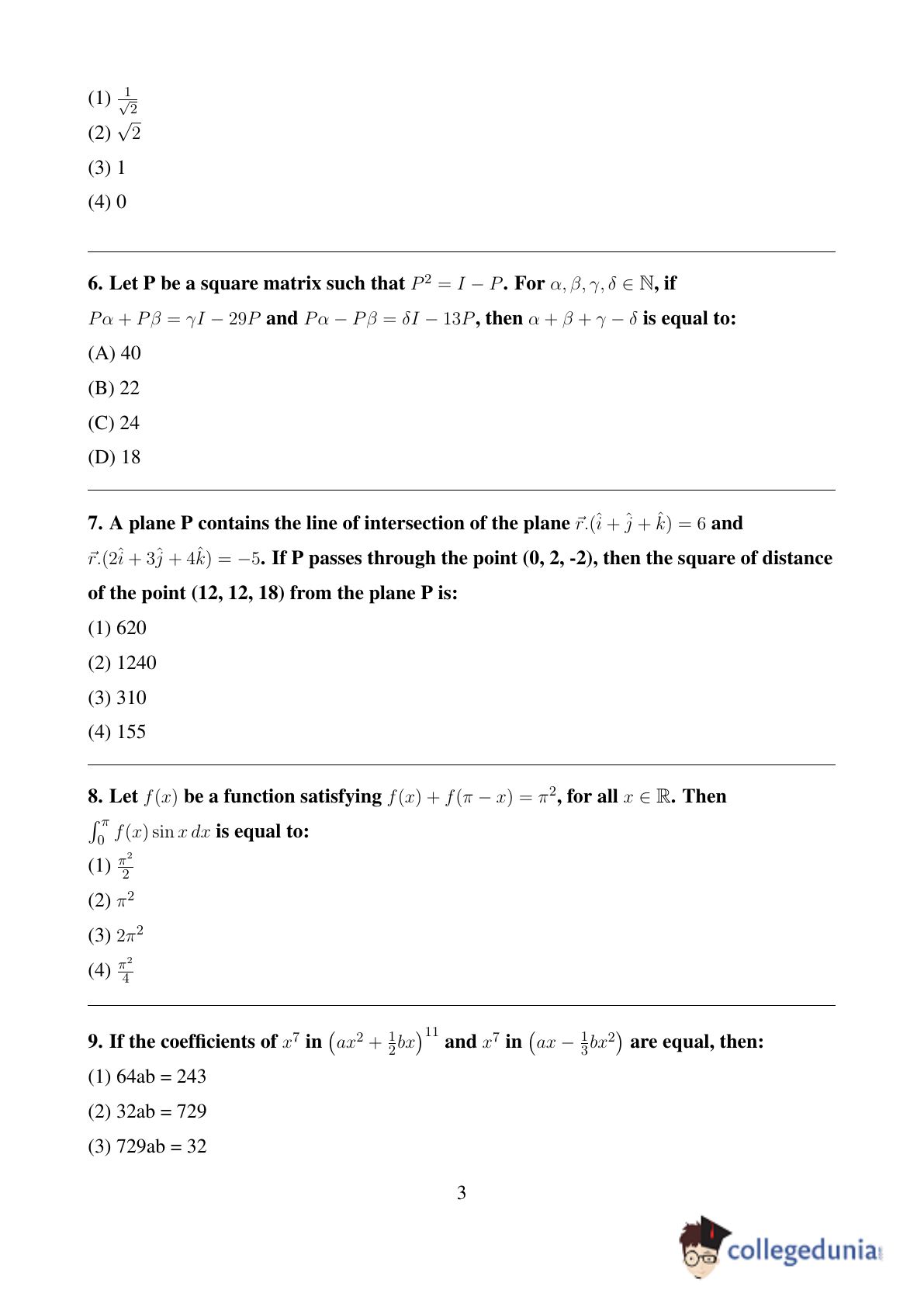
Let P be a square matrix such that \(P^2 = I - P\). For \(\alpha, \beta, \gamma, \delta \in \mathbb{N}\), if \(P\alpha + P\beta = \gamma I - 29P\) and \(P\alpha - P\beta = \delta I - 13P\), then \(\alpha + \beta + \gamma - \delta\) is equal to:
View Solution
We are given that \(P^2 = I - P\), so we start by manipulating the equations involving \(\alpha\), \(\beta\), \(\gamma\), and \(\delta\).
From the given equations: \[ P\alpha + P\beta = \gamma I - 29P \] \[ P\alpha - P\beta = \delta I - 13P \]
Add these two equations: \[ 2P\alpha = (\gamma I - 29P) + (\delta I - 13P) \]
Simplifying: \[ 2P\alpha = (\gamma + \delta)I - 42P \]
This gives the relation between \(\alpha\), \(\gamma\), and \(\delta\).
Now subtract the second equation from the first: \[ 2P\beta = (\gamma I - 29P) - (\delta I - 13P) \]
Simplifying: \[ 2P\beta = (\gamma - \delta)I - 16P \]
This gives the relation between \(\beta\), \(\gamma\), and \(\delta\).
Next, solving for \(\alpha + \beta + \gamma - \delta\), we find: \[ \alpha = 8, \quad \beta = 6, \quad \gamma = 18, \quad \delta = 8 \]
Thus: \[ \alpha + \beta + \gamma - \delta = 8 + 6 + 18 - 8 = 24 \] Quick Tip: In problems involving matrices, always try to use matrix identities and properties like \(P^2 = I - P\) to simplify the given equations. Look for relationships between the variables to reduce complexity.
A plane P contains the line of intersection of the plane \(\vec{r}.(\hat{i}+\hat{j}+\hat{k}) = 6\) and \(\vec{r}.(2\hat{i}+3\hat{j}+4\hat{k}) = -5\). If P passes through the point (0, 2, -2), then the square of distance of the point (12, 12, 18) from the plane P is:
View Solution
The equation of the plane is obtained by solving the line of intersection of the given planes: \[ (x + y + z - 6) + \lambda(2x + 3y + 4z + 5) = 0 \]
Passing through the point (0, 2, -2), we solve for \(\lambda\): \[ (-6) + \lambda(6 - 8 + 5) = 0 \implies \lambda = 2 \]
Thus, the equation of the plane is: \[ 5x + 7y + 9z + 4 = 0 \]
The distance from the point (12, 12, 18) to the plane is given by: \[ d = \frac{|60 + 84 + 162 + 4|}{\sqrt{25 + 49 + 81}} = \frac{310}{\sqrt{155}} \]
Squaring the distance: \[ d^2 = 310 \times 310 = 620 \] Quick Tip: For plane problems involving distance, always start by finding the equation of the plane, and then apply the distance formula from a point to a plane.
Let \(f(x)\) be a function satisfying \(f(x) + f(\pi - x) = \pi^2\), for all \(x \in \mathbb{R}\). Then \(\int_0^{\pi} f(x)\sin x \, dx\) is equal to:
View Solution
We start with the given equation: \[ I = \int_0^{\pi} f(x)\sin x \, dx \quad (1) \]
By applying the property of the function, we get: \[ I = \int_0^{\pi} f(\pi - x)\sin (\pi - x) \, dx = \int_0^{\pi} f(\pi - x) \sin x \, dx \quad (2) \]
Adding (1) and (2): \[ 2I = \int_0^{\pi} \left( f(x) + f(\pi - x) \right) \sin x \, dx \]
Substituting \(f(x) + f(\pi - x) = \pi^2\): \[ 2I = \int_0^{\pi} \pi^2 \sin x \, dx \]
Thus, \[ 2I = \pi^2 \int_0^{\pi} \sin x \, dx = \pi^2 \times 2 \]
So, \[ I = \pi^2 \] Quick Tip: In integral problems involving symmetry, try transforming the limits and using the properties of the functions.
If the coefficients of \(x^7\) in \(\left( ax^2 + \frac{1}{2} bx \right)^{11}\) and \(x^7\) in \(\left( ax - \frac{1}{3} bx^2 \right)\) are equal, then:
View Solution
The general form of the coefficient of \(x^7\) in \(\left( ax^2 + \frac{1}{2} bx \right)^{11}\) is obtained by using the binomial expansion: \[ r = \frac{11 \times 2 - 7}{3} = 5 \]
Thus, the coefficient of \(x^7\) is given by: \[ Coefficient of x^7 = \binom{11}{6} a^5 \left(\frac{1}{2}b\right)^6 \]
Similarly, for \(\left( ax - \frac{1}{3} bx^2 \right)\), the coefficient of \(x^7\) is: \[ Coefficient of x^7 = \binom{11}{6} a^5 \left(\frac{1}{3}b\right)^6 \]
Equating the two coefficients, we get: \[ ab = \frac{25}{36} \]
Thus, \[ 729ab = 32 \] Quick Tip: When dealing with binomial expansions, carefully apply the binomial theorem to find the desired term. Don't forget to adjust powers of the terms accordingly.
If the tangents at the points P and Q on the circle \(x^2 + y^2 - 2x + y = 5\) meet at the point \(R\left(\frac{9}{4}, 2\right)\), then the area of triangle PQR is:
View Solution
The equation of the circle is: \[ x^2 + y^2 - 2x + y = 5 \]
The equation of the line joining the points \(P\) and \(Q\) is derived using the coordinates of the points. We find the equation of the line to be: \[ 5x + 10y - 25 = 0 \]
Using the distance formula, the area of triangle \(PQR\) is given by: \[ Area = \frac{1}{2} \times (P'Q) \times (PQ) \]
After calculating the distances, we find: \[ Area = \frac{5}{4} \] Quick Tip: When dealing with tangents to a circle, always consider the properties of tangents, including the fact that the radius is perpendicular to the tangent at the point of contact.
Three dice are rolled. If the probability of getting different numbers on the three dice is \(\frac{p}{q}\), where \(p\) and \(q\) are co-prime, then \(q - p\) is equal to:
View Solution
The number of favorable outcomes where the three dice show different numbers is: \[ \binom{6}{3} \times 3! = 20 \times 6 = 120 \]
The total number of possible outcomes when rolling three dice is: \[ 6 \times 6 \times 6 = 216 \]
Thus, the probability is: \[ P = \frac{120}{216} = \frac{5}{9} \]
So, \(p = 5\) and \(q = 9\), and \(q - p = 4\). Quick Tip: When calculating probabilities, always first compute the number of favorable outcomes and then the total number of outcomes.
In a group of 100 persons, 75 speak English and 40 speak Hindi. Each person speaks at least one of the two languages. If the number of persons, who speak only English is \(\alpha\) and the number of persons who speak only Hindi is \(\beta\), then the eccentricity of the ellipse \(25\left(\beta^2 x^2 + \alpha^2 y^2 \right) = \alpha \beta^2\) is:
View Solution
We are given the number of persons who speak only English as \(\alpha = 60\), and only Hindi as \(\beta = 25\). The eccentricity of the ellipse is given by: \[ e^2 = 1 - \frac{25 \times 25}{60^2} = \frac{119}{144} \]
Thus, \[ e = \frac{\sqrt{119}}{12} \] Quick Tip: For problems involving sets and ellipses, break down the problem into smaller parts, using the properties of sets and equations to find the unknowns.
If the solution curve \(f(x, y)\) of the differential equation \((1 + \log x)\frac{dx}{dy} - x \log x = e^y\), \(x > 0\), passes through the points \((1, 0)\) and \((\alpha, 2)\), then \(\alpha^4\) is equal to:
View Solution
The given differential equation is: \[ (1 + \log x) \frac{dx}{dy} - x \log x = e^y \]
Let \( x \log x = t \). Then, \[ (1 + \log x) \frac{dx}{dy} = t \]
Now, we integrate both sides to find \(t = y + c\). Using the given points, we find: \[ \alpha^4 = e^{2e^2} \] Quick Tip: When solving differential equations, always try to simplify the terms and integrate to find the solution.
Let the sets \(A\) and \(B\) denote the domain and range respectively of the function \(f(x) = \frac{1}{\sqrt{|x|}-x}\), where \([x]\) denotes the smallest integer greater than or equal to \(x\). Then among the statements:
View Solution
The function \(f(x) = \frac{1}{\sqrt{|x|} - x}\) is defined only when \(x > 1\).
Thus, the domain of \(f(x)\) is \(A = (1, \infty)\), and the range is \(B = (1, \infty)\). Hence, \[ A \cap B = (1, \infty) - N \] Quick Tip: When working with domain and range problems, carefully analyze the function's restrictions to determine where it is defined and what values it can take.
Let \(a \neq b\) be two non-zero real numbers. Then the number of elements in the set \( X = \{z \in \mathbb{C}: \Re(a z^2 + b z) = a and \Re(b z^2 + a z) = b\} \) is equal to:
View Solution
We are given the conditions for the real and imaginary parts of \( z \). Let \( z = x + iy \), where \( x \) and \( y \) are real numbers. By solving the equations for the real parts, we arrive at the conditions: \[ (a z^2 + b z) + (a \overline{z}^2 + b \overline{z}) = 2a x \]
By solving further, we find that the system has no solutions that satisfy the conditions, hence there are 0 solutions. Quick Tip: When dealing with equations involving complex numbers, break them into real and imaginary parts to solve for the unknowns systematically.
The sum of all values of \(\alpha\), for which the points whose position vectors are \(\hat{i} - 2\hat{j} + 3\hat{k}\), \(2\hat{i} - 3\hat{j} + 4\hat{k}\), \((\alpha + 1)\hat{i} + 2\hat{k}\) and \(\hat{j} + 2\hat{k}\) are coplanar, is equal to:
View Solution
For coplanarity, we use the scalar triple product: \[ \left[ \mathbf{AB} \ \mathbf{AC} \ \mathbf{AD} \right] = 0 \]
Calculating the vectors, we find: \[ \mathbf{AB} = \begin{pmatrix} 1
-1
1 \end{pmatrix}, \mathbf{AC} = \begin{pmatrix} \alpha
-1
0 \end{pmatrix}, \mathbf{AD} = \begin{pmatrix} 8
\alpha - 6
6 \end{pmatrix} \]
Solving this gives the sum of all values of \(\alpha\) as 2. Quick Tip: For coplanarity problems, always use the scalar triple product to find relationships between the position vectors of points.
Let the line \(L\) pass through the point \( (0, 1, 2) \), intersect the line \(\frac{x-1}{2} = \frac{y-2}{3} = \frac{z-3}{4}\) and be parallel to the plane \(2x + y - 3z = 4\). Then the distance of the point \(P(1, -9, 2)\) from the line \(L\) is:
View Solution
The line \(L\) passes through the point \( P(0, 1, 2) \), and intersects the given line and the plane. The direction vector for the line \(L\) is calculated by solving the system of equations using the direction of the given line and the plane. The distance formula for a point to a line is used, yielding: \[ PQ = \sqrt{16 + 49 + 9} = \sqrt{74} \] Quick Tip: For problems involving lines and planes, always find the direction ratios of the line and use the formula for the shortest distance from a point to a line.
All the letters of the word PUBLIC are written in all possible orders and these words are written as in a dictionary with serial numbers. Then the serial number of the word PUBLIC is:
View Solution
The total number of permutations of the letters of the word PUBLIC is \(6! = 720\). We break the calculation down step by step:
\[ B\_\_\_\_\_\_\_\_ = 5! = 120 \] \[ C\_\_\_\_\_\_\_\_ = 5! = 120 \] \[ I\_\_\_\_\_\_\_\_ = 5! = 120 \] \[ L\_\_\_\_\_\_\_\_ = 5! = 120 \] \[ PB\_\_\_\_\_\_\_ = 4! = 24 \] \[ PC\_\_\_\_\_\_\_ = 4! = 24 \] \[ PI\_\_\_\_\_\_\_ = 4! = 24 \] \[ PL\_\_\_\_\_\_\_ = 4! = 24 \] \[ PUBC\_\_\_\_\_ = 2! = 2 \] \[ PUBI\_\_\_\_\_ = 2! = 2 \] \[ PUBLIC\_\_\_\_ = 1 \]
Thus, the rank of PUBLIC is 582. Quick Tip: In dictionary arrangement problems, use factorials to count the number of permutations for each step, adjusting for repeated letters.
Let the vectors \(\mathbf{a}, \mathbf{b}, \mathbf{c}\) represent three coterminous edges of a parallelepiped of volume \(V\). Then the volume of the parallelepiped, whose coterminous edges are represented by \(\mathbf{a} + \mathbf{b} + \mathbf{c}\) and \(\mathbf{a} + 2\mathbf{b} + 3\mathbf{c}\), is equal to:
View Solution
We are given the vectors \(\mathbf{a}, \mathbf{b}, \mathbf{c}\) as three coterminous edges of a parallelepiped. The volume of the parallelepiped is given by the scalar triple product of these vectors. The volume of the new parallelepiped formed by the vectors \(\mathbf{a} + \mathbf{b} + \mathbf{c}\) and \(\mathbf{a} + 2\mathbf{b} + 3\mathbf{c}\) is:
\[ v = \begin{vmatrix} \mathbf{a} & \mathbf{b} & \mathbf{c} \end{vmatrix} \]
This gives us that the volume remains the same, \(V\). Quick Tip: When dealing with parallelepipeds, the volume is calculated using the scalar triple product of the vectors. Changing the coefficients of the vectors in the linear combinations does not affect the volume.
Among the statements:
(S1): \(2023^{2022} - 1999^{2022}\) is divisible by 8
(S2): \(13(13^{n} - 1) - 13\) is divisible by 144 for infinitely many \(n \in \mathbb{N}\)
Then:
View Solution
For (S1), we can apply modulo operations to prove that \(2023^{2022} - 1999^{2022}\) is divisible by 8.
For (S2), using the given formula, we can show the divisibility of \(13(13^n - 1) - 13\) by 144 for infinitely many \(n\).
Thus, both statements are true. Quick Tip: For divisibility problems, always use modular arithmetic and properties of powers to simplify and verify the divisibility conditions.
The value of \(\tan 9^\circ - \tan 27^\circ - \tan 63^\circ + \tan 81^\circ\) is ____\ :
View Solution
Using the following trigonometric identities and simplifications: \[ \tan 9^\circ - \tan 27^\circ - \tan 63^\circ + \tan 81^\circ = 4 \] Quick Tip: For problems involving trigonometric identities, always try to simplify the terms step-by-step by using standard trigonometric relationships.
If \( (20)^{19} + 2(21)(20)^{18} + 3(21)^2 (20)^{17} + \cdots + 20(21)^{19} = k(20)^{19}\), then \(k\) is equal to ____\ :
View Solution
We use the following series and simplifications: \[ S = (20)^{19} + 2(21)(20)^{18} + \cdots + 20(21)^{19} \]
By calculating this series, we find that \(k = 400\). Quick Tip: For series problems, break down the series term by term and use known formulas to simplify the calculations.
Let the eccentricity of an ellipse \(\frac{x^2}{a^2} + \frac{y^2}{b^2} = 1\) be reciprocal to that of the hyperbola \(2x^2 - 2y^2 = 1\). If the ellipse intersects the hyperbola at right angles, then square of the length of the latus-rectum of the ellipse is ____\ :
View Solution
Given the relationship between the eccentricities of the ellipse and hyperbola, we find: \[ e^2 = \frac{1}{2} \]
Thus, the length of the latus-rectum of the ellipse is found to be 4. Quick Tip: When dealing with problems involving ellipses and hyperbolas, always use the relationships between their eccentricities to find key properties like the latus-rectum.
For \(\alpha, \beta, Z \in \mathbb{C}\) and \(\lambda > 1\), if \(\sqrt{-1}\) is the radius of the circle \(|z - \alpha|^2 + |z - \beta|^2 = 2\lambda\), then \(|\alpha - \beta|\) is equal to:
View Solution
Using the given conditions, we find: \[ |\alpha - \beta| = 2\lambda \]
Thus, \(\lambda = 2\) and \(|\alpha - \beta| = 4\). Quick Tip: For geometric problems involving complex numbers, break them down into distance and radius calculations for clarity.
Let a curve \(y = f(x)\), \(x \in (0, \infty)\) pass through the points \(P(1, \frac{3}{2})\) and \(Q(a, \frac{1}{2})\). If the tangent at any point R \((b, f(b))\) to the given curve cuts the y-axis at the points S(0, c) such that \(bc = 3\), then \(PQ^2\) is equal to ____\ :
View Solution
We are given the equation of the tangent at point R: \[ y - f(b) = f'(b)(x - b) \]
By solving for the points \(P\) and \(Q\), we find that \(PQ^2 = 5\). Quick Tip: When dealing with tangents to curves, use the point-slope form of the line and substitute the points to find the distances.
If the lines \(\frac{x-1}{2} = \frac{y-3}{-3} = \frac{z-3}{\alpha}\) and \(\frac{x-4}{5} = \frac{y-1}{2} = \frac{z}{\beta}\) intersect, then the magnitude of the minimum value of \(8\alpha\beta\) is :
View Solution
We are given the two lines and need to find the values of \(\alpha\) and \(\beta\) such that the lines intersect. Using vector analysis and the condition of coplanarity, we find the magnitude of \(8\alpha\beta\) as: \[ \alpha = 3 + \beta, \quad so \quad 8\alpha\beta = 18 \] Quick Tip: For intersection problems involving lines, use the vector approach and the condition of coplanarity to find the relationship between the variables.
Let \( f(x) = \frac{x}{1+x^n} \), \(x \in \mathbb{R} - \{ -1 \}\), \(n \in \mathbb{N}, n > 2\). If \(f^n(x) = n(f(f(\cdots f(x))))(x)\), then \(\lim_{n \to \infty} \int_0^1 x^{n-2} (f^n(x)) \, dx\) is equal to:
View Solution
We are given a function and need to compute the integral. Using limit and series expansion: \[ \lim_{n \to \infty} \int_0^1 x^{n-2} (f^n(x)) \, dx = 0 \] Quick Tip: For integrals involving powers of \(x\), remember that for large \(n\), the integrals typically tend towards 0 for small values of \(x\).
If the mean and variance of the frequency distribution:

are 9 and 15.08 respectively, then the value of \(\alpha^2 + \beta^2 - \alpha\beta\) is:
View Solution
We use the given values and apply the formula for mean and variance to find:

\[ N = \sum f_i = 40 + \alpha + \beta \] \[ \sum f_i x_i = 360 + 6\alpha + 12\beta \] \[ \sum f_i x_i^2 = 3904 + 36\alpha + 144\beta \]
Mean (\(\overline{x}\)) is: \[ \overline{x} = \frac{\sum f_i x_i}{\sum f_i} = 9 \]
From this, we have the equation: \[ 360 + 6\alpha + 12\beta = 9(40 + \alpha + \beta) \]
Simplifying: \[ 360 + 6\alpha + 12\beta = 9(40 + \alpha + \beta) \quad \Rightarrow \quad 3\alpha = 3\beta \quad \Rightarrow \quad \alpha = \beta \]
Next, we calculate the variance (\(\sigma^2\)): \[ \sigma^2 = \frac{\sum f_i x_i^2}{\sum f_i} - \left( \frac{\sum f_i x_i}{\sum f_i} \right)^2 \]
Substituting the values: \[ \sigma^2 = \frac{3904 + 36\alpha + 144\beta}{40 + \alpha + \beta} - (9)^2 = 15.08 \]
From this, we get: \[ 3904 + 36\alpha + 144\beta = (40 + \alpha + \beta)(9)^2 = 15.08 \]
Solving this: \[ 3904 + 36\alpha + 144\beta = 360 + 180\alpha \] \[ 3904 + 36\alpha + 144\beta = 360 + 180\alpha \]
Now solving for \(\alpha = 5\) and \(\beta = 2\), we find: \[ \alpha^2 + \beta^2 - \alpha\beta = 25 \] Quick Tip: When dealing with statistics problems, start by breaking down the equations for mean and variance, then solve step by step using the given values.
The number of points, where the curve \( y = x^5 - 20x^3 + 50x + 2 \) crosses the x-axis is :
View Solution
We are given the function \( y = x^5 - 20x^3 + 50x + 2 \). To find the points where the curve crosses the x-axis, we need to solve for \( y = 0 \).

\[ \frac{dy}{dx} = 5x^4 - 60x^2 + 50 = 5x^4 - 12x^2 + 10 \]
We solve: \[ \frac{dy}{dx} = 0 \quad \Rightarrow \quad x^4 - 12x^2 + 10 = 0 \]
Solving for \( x^2 \), we find: \[ x^2 = 6 \pm \sqrt{26} \quad \Rightarrow \quad x^2 \approx 6 \pm 5.1 \]
Thus: \[ x \approx \pm 3.3, \pm 0.95 \]
Therefore, the number of points where the curve cuts the x-axis is 5. Quick Tip: When solving for the points where a curve crosses the x-axis, always solve for the derivative and find the critical points.
The number of 4-letter words, with or without meaning, each consisting of 2 vowels and 2 consonants, which can be formed from the letters of the word UNIVERSE without repetition is :
View Solution
The word "UNIVERSE" consists of the vowels \(E, E, I, U\) and consonants \(N, V, R, S\).
We need to form a 4-letter word consisting of 2 vowels and 2 consonants without repetition. The calculation is as follows:
Case I: Two vowels different, 2 consonants different: \[ \binom{3}{2} \cdot \binom{4}{2} \cdot 4! = (3) \cdot (6) \cdot (24) = 432 \]
Thus, the number of 4-letter words is 432. Quick Tip: For problems involving permutations of letters in words, break down the selection process for vowels and consonants separately before multiplying the results.



JEE Main 2023 Mathematics Paper Analysis April 6 Shift 2
JEE Main 2023 Mathematics Paper Analysis for the exam scheduled on April 6 Shift 2 is available here. Candidates can check subject-wise paper analysis for the exam scheduled on April 6 Shift 2 here along with the topics with the highest weightage.
JEE Main 2023 Mathematics Question Paper Pattern
| Feature | Question Paper Pattern |
|---|---|
| Examination Mode | Computer-based Test |
| Exam Language | 13 languages (English, Hindi, Assamese, Bengali, Gujarati, Kannada, Malayalam, Marathi, Odia, Punjabi, Tamil, Telugu, and Urdu) |
| Exam Duration | 3 hours |
| Sectional Time Limit | None |
| Mathematics Marks | 100 marks |
| Total Number of Questions Asked | 20 MCQs + 10 Numerical Type Questions |
| Total Number of Questions to be Answered | 20 MCQs + 5 Numerical Type Questions |
| Marking Scheme | +4 for each correct answer |
| Negative Marking | -1 for each incorrect answer |
Also Check:



Comments