




JEE Main 2023 Mathematics Question Paper Jan 24 Shift 2 is updated here. Candidates can download JEE Main 2023 Mathematics Question Paper PDF with Answer Key for Jan 24 Shift 2 using the link below. JEE Main Mathematics Question Paper is divided into two sections, Section A with 20 MCQs and Section B with 10 numerical type questions. Candidates are required to answer all questions from Section A and any 5 questions from section B.
Related Links:
- Download JEE Main Previous Year Question Papers PDF with Solutions
- Download JEE Main 2025 Question Paper for all Shifts
JEE Main 2023 Question Paper Jan 24 Shift 2- Download PDF
| JEE Main 2023 Jan 24 Shift 2 Question Paper with Solution PDF |  Download Download |
Check Solution |

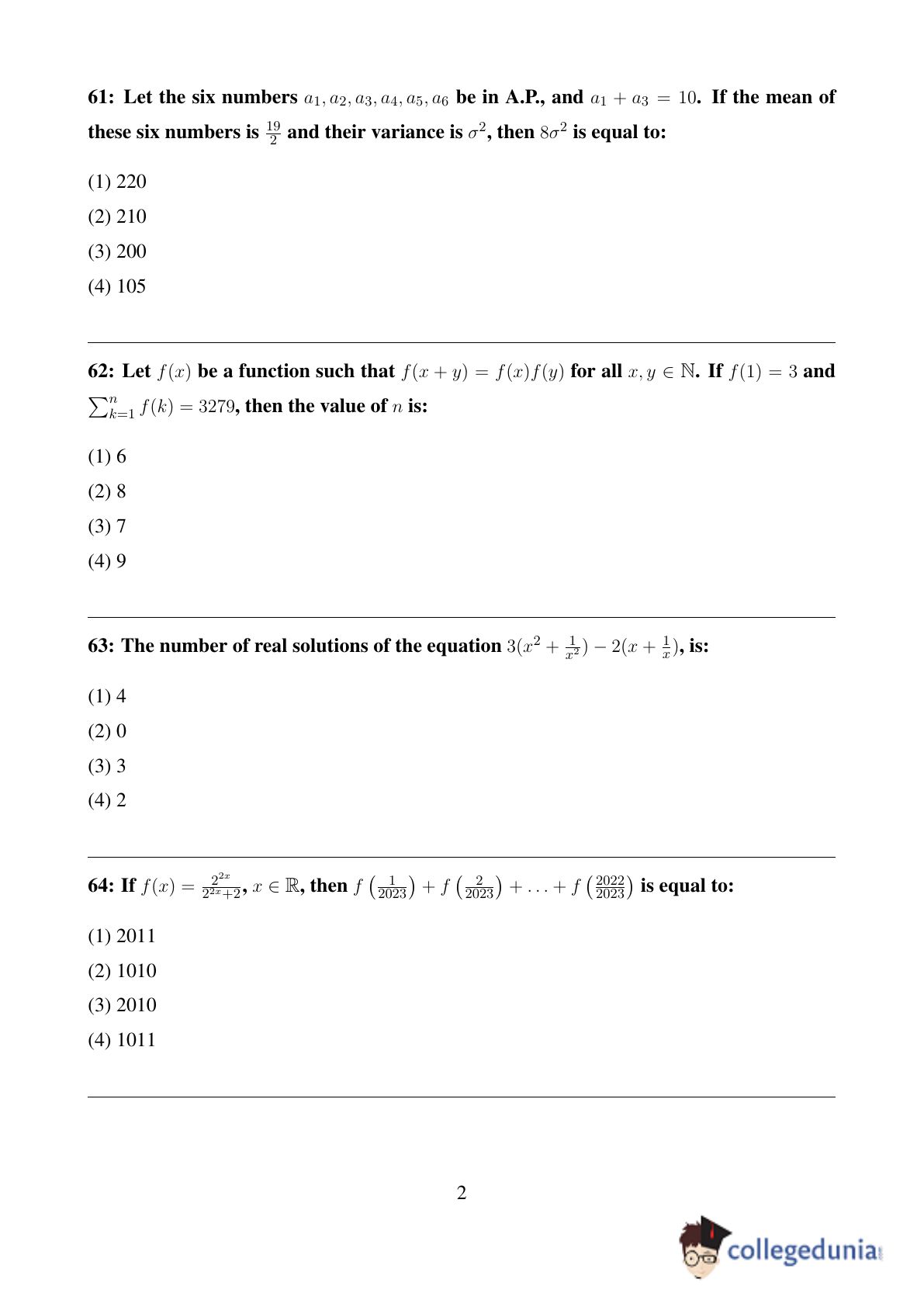
Let the six numbers \( a_1, a_2, a_3, a_4, a_5, a_6 \) be in A.P., and \( a_1 + a_3 = 10 \). If the mean of these six numbers is \( \frac{19}{2} \) and their variance is \( \sigma^2 \), then \( 8\sigma^2 \) is equal to:
\begin{flushleft
View Solution
Let \( f(x) \) be a function such that \( f(x + y) = f(x)f(y) \) for all \( x, y \in \mathbb{N} \). If \( f(1) = 3 \) and \( \sum_{k=1}^{n} f(k) = 3279 \), then the value of \( n \) is:
\begin{flushleft
View Solution
The number of real solutions of the equation \( 3(x^2 + \frac{1}{x^2}) - 2(x+\frac{1}{x}) \), is:
\begin{flushleft
View Solution
If \( f(x) = \frac{2^{2x}}{2^{2x} + 2} \), \( x \in \mathbb{R} \), then \( f\left(\frac{1}{2023}\right) + f\left(\frac{2}{2023}\right) + \ldots + f\left(\frac{2022}{2023}\right) \) is equal to:
\begin{flushleft
View Solution
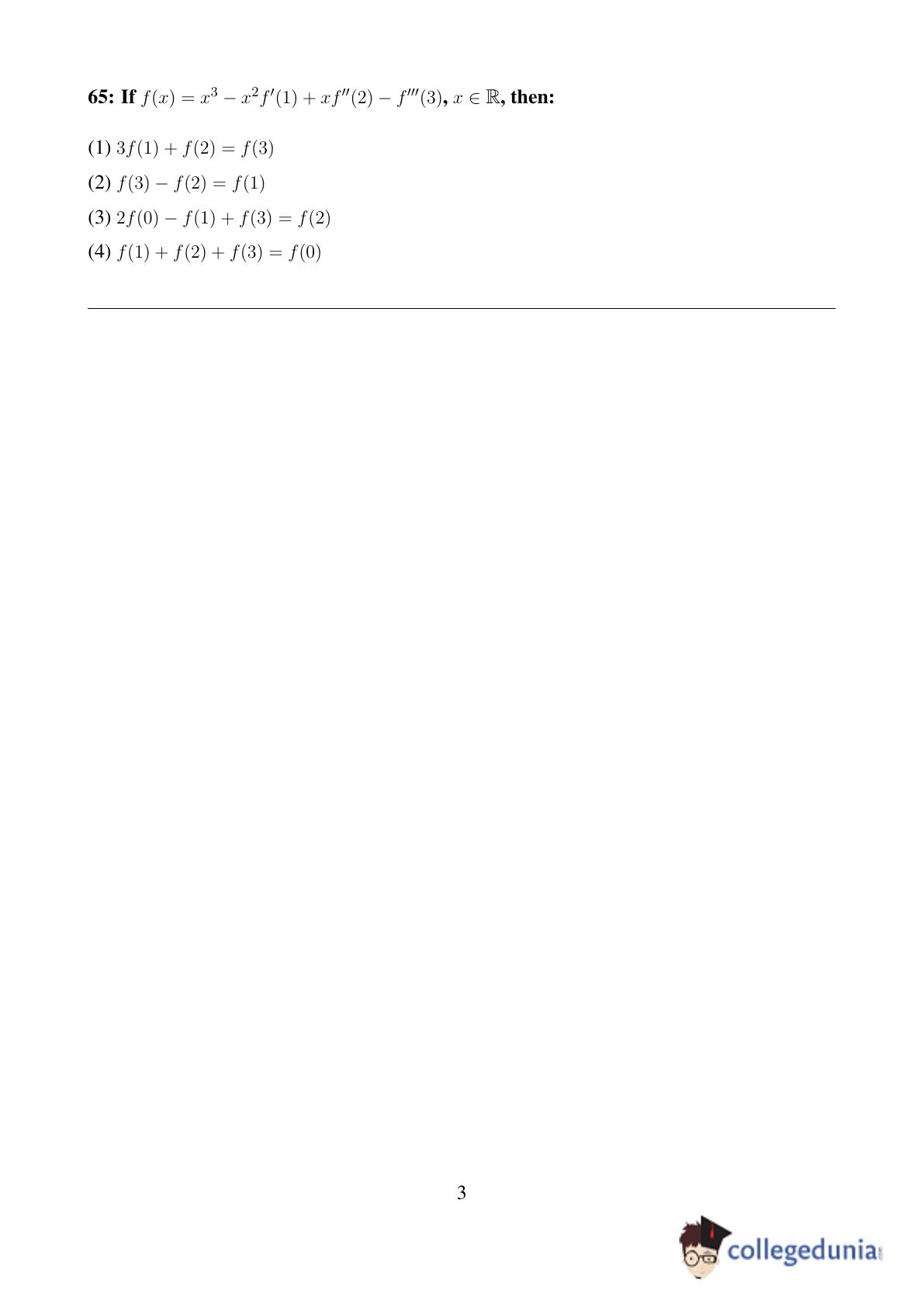
If \( f(x) = x^3 - x^2 f'(1) + x f''(2) - f'''(3) \), \( x \in \mathbb{R} \), then:
\begin{flushleft
View Solution
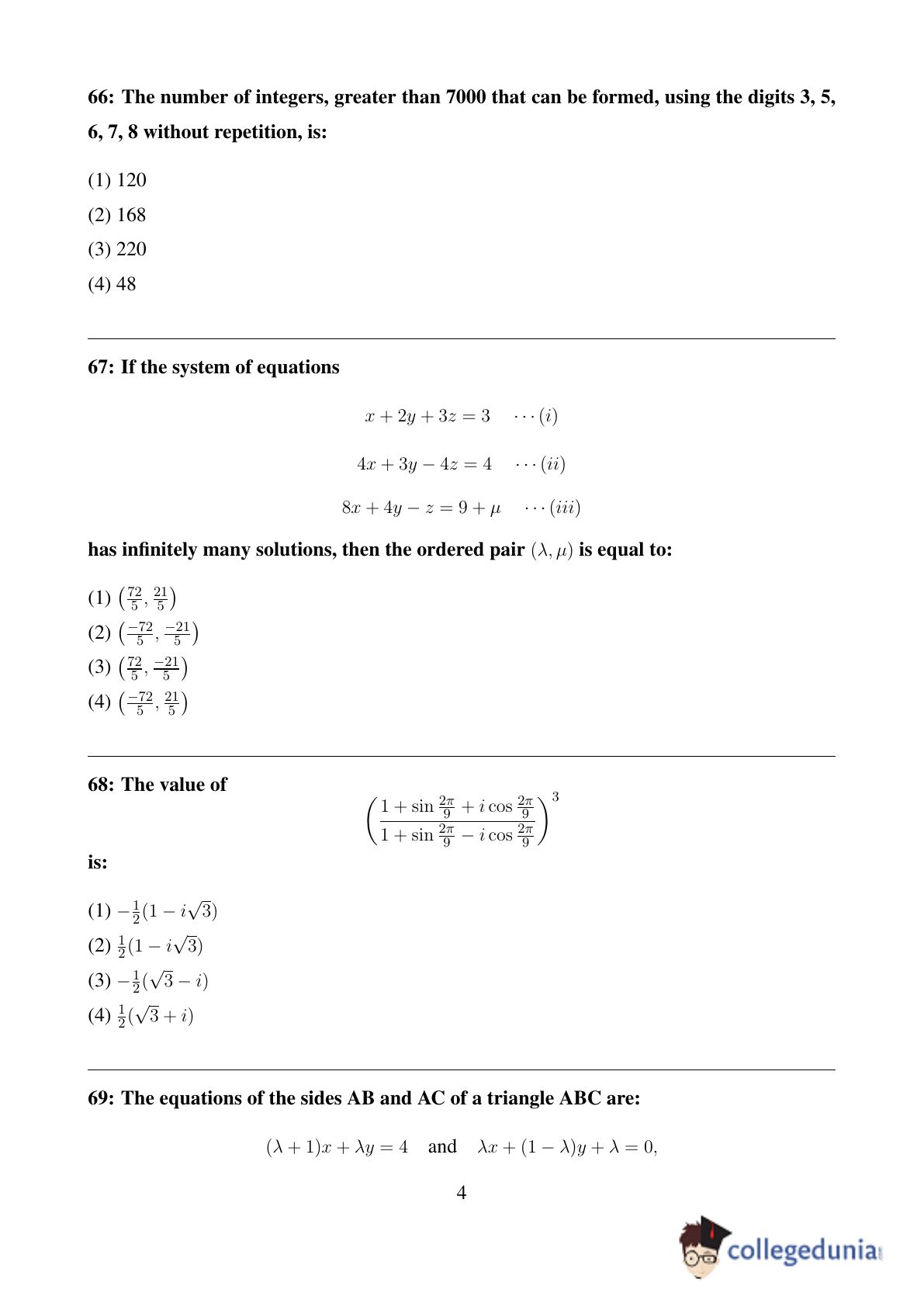
The number of integers, greater than 7000 that can be formed, using the digits 3, 5, 6, 7, 8 without repetition, is:
\begin{flushleft
View Solution
If the system of equations \[ x + 2y + 3z = 3 \quad \cdots (i) \] \[ 4x + 3y - 4z = 4 \quad \cdots (ii) \] \[ 8x + 4y - z = 9 + \mu \quad \cdots (iii) \]
has infinitely many solutions, then the ordered pair \( (\lambda, \mu) \) is equal to:
\begin{flushleft
View Solution
The value of \[ \left( \frac{1 + \sin \frac{2\pi}{9} + i \cos \frac{2\pi}{9}}{1 + \sin \frac{2\pi}{9} - i \cos \frac{2\pi}{9}} \right)^3 \]
is:
\begin{flushleft
View Solution
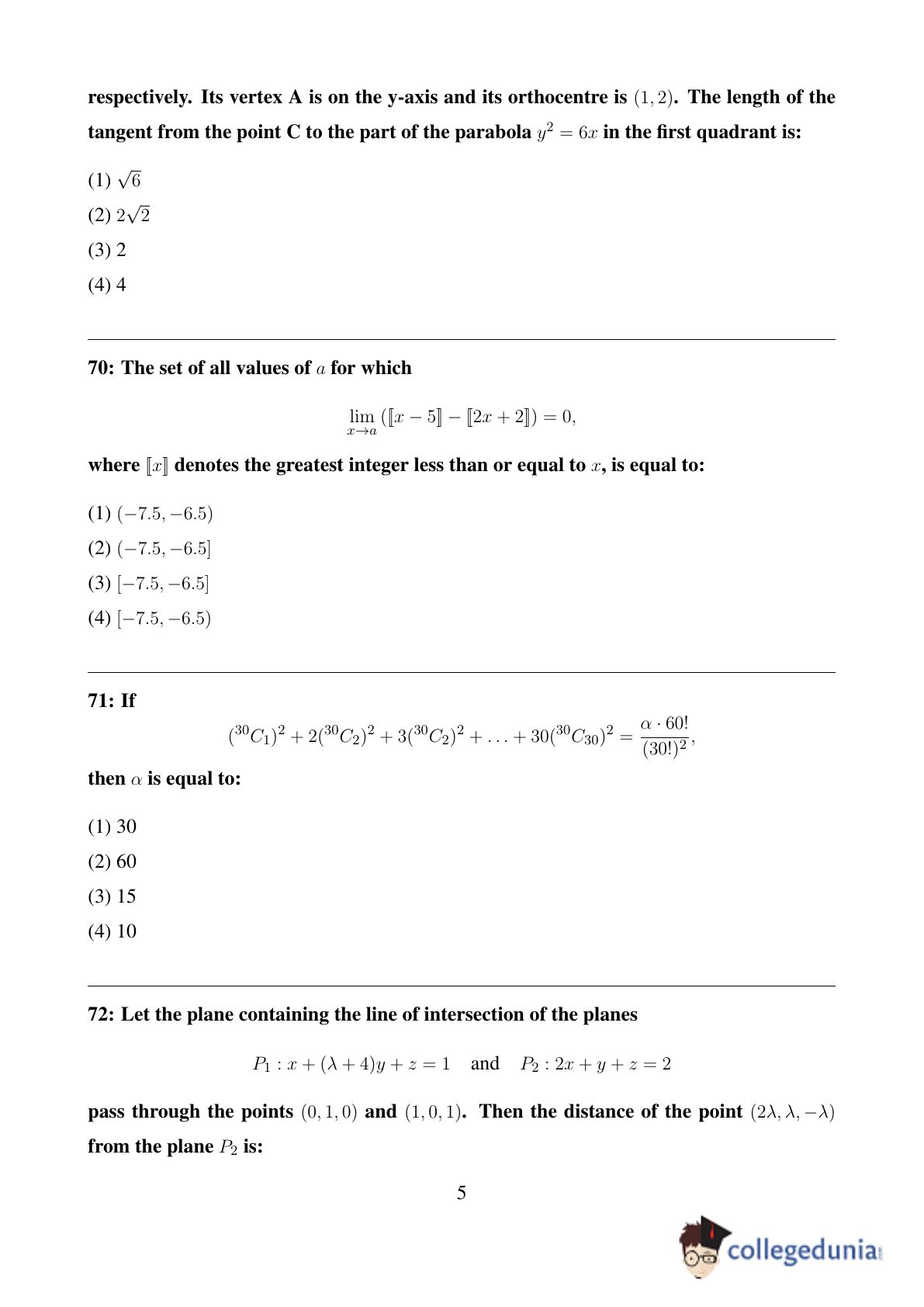
The equations of the sides AB and AC of a triangle ABC are: \[ (\lambda + 1)x + \lambda y = 4 \quad and \quad \lambda x + (1 - \lambda)y + \lambda = 0, \]
respectively. Its vertex A is on the y-axis and its orthocentre is \( (1, 2) \). The length of the tangent from the point C to the part of the parabola \( y^2 = 6x \) in the first quadrant is:
\begin{flushleft
View Solution
The set of all values of \( a \) for which \[ \lim_{x \to a} \left([\![x - 5]\!] - [\![2x + 2]\!]\right) = 0, \]
where \( [\![x]\!] \) denotes the greatest integer less than or equal to \( x \), is equal to:
\begin{flushleft
View Solution
If \[ {}({}^{30}C_1)^2+ 2({}^{30}C_2)^2 + 3({}^{30}C_2)^2 + \ldots + 30({}^{30}C_{30})^2 = \frac{\alpha \cdot 60!}{(30!)^2}, \]
then \( \alpha \) is equal to:
\begin{flushleft
View Solution
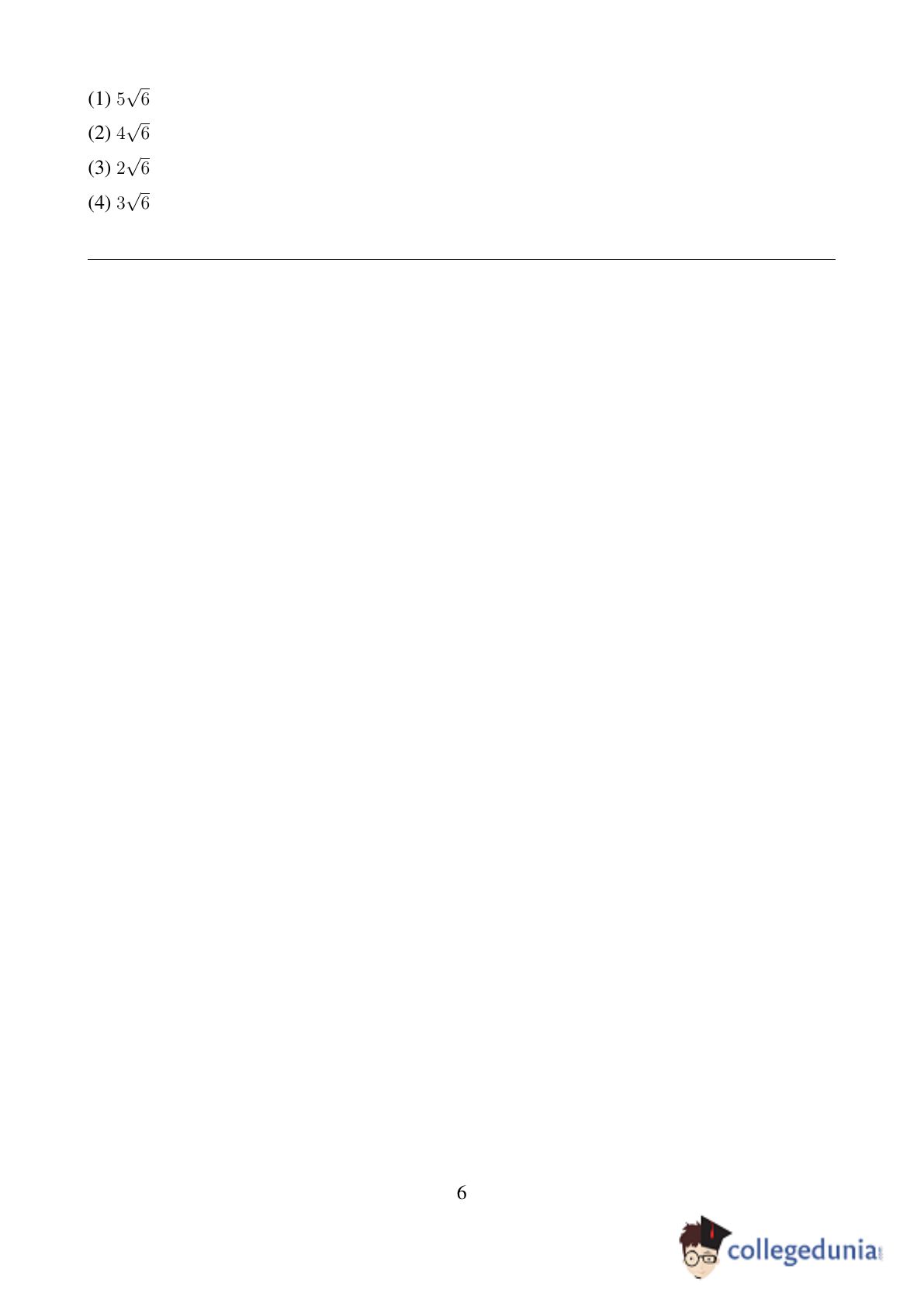
Let the plane containing the line of intersection of the planes \[ P_1: x + (\lambda + 4)y + z = 1 \quad and \quad P_2: 2x + y + z = 2 \]
pass through the points \( (0, 1, 0) \) and \( (1, 0, 1) \). Then the distance of the point \( (2\lambda, \lambda, -\lambda) \) from the plane \( P_2 \) is:
\begin{flushleft
View Solution
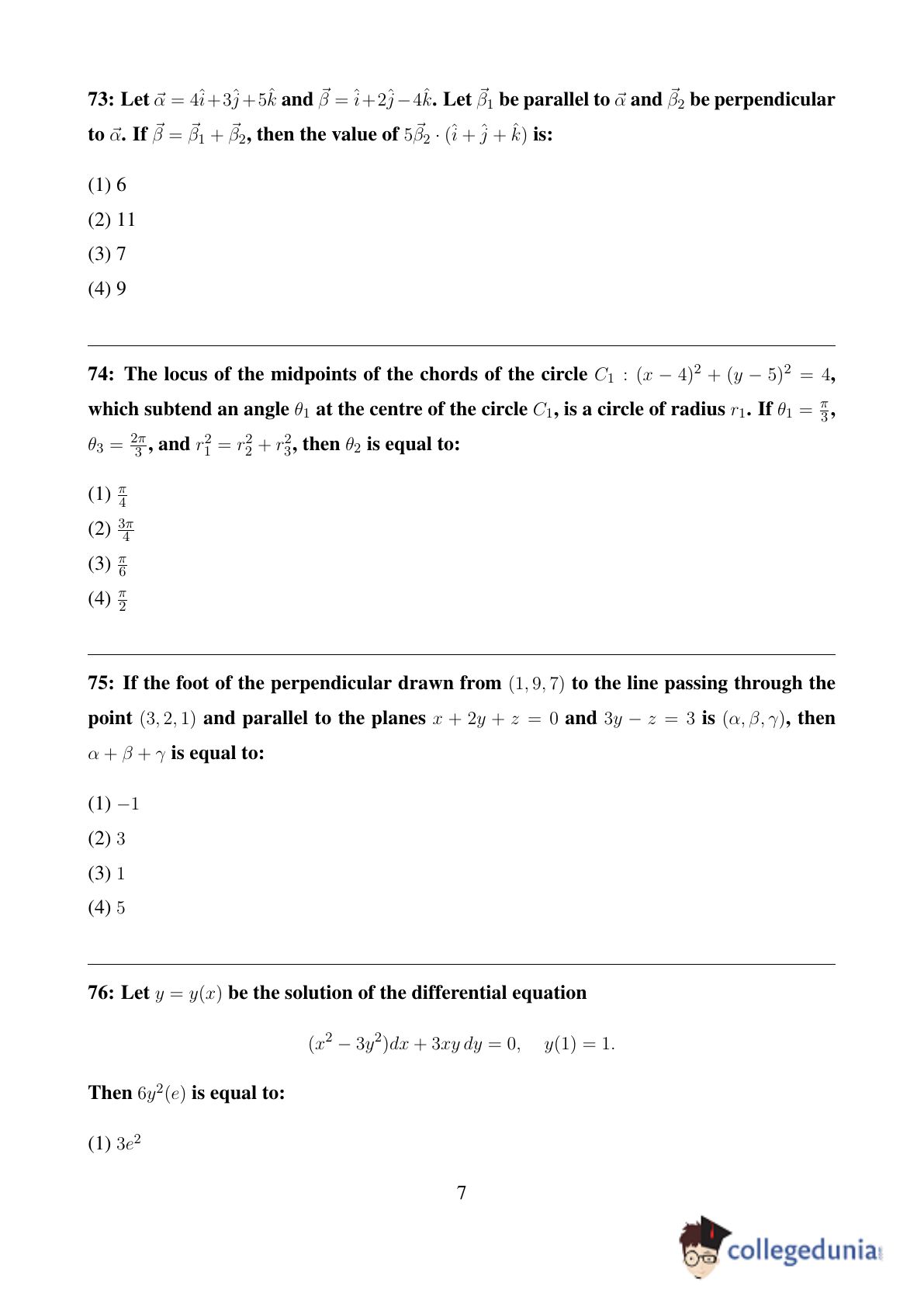
Let \( \vec{\alpha} = 4\hat{i} + 3\hat{j} + 5\hat{k} \) and \( \vec{\beta} = \hat{i} + 2\hat{j} - 4\hat{k} \). Let \( \vec{\beta}_1 \) be parallel to \( \vec{\alpha} \) and \( \vec{\beta}_2 \) be perpendicular to \( \vec{\alpha} \). If \( \vec{\beta} = \vec{\beta}_1 + \vec{\beta}_2 \), then the value of \( 5\vec{\beta}_2 \cdot (\hat{i} + \hat{j} + \hat{k}) \) is:
\begin{flushleft
View Solution
The locus of the midpoints of the chords of the circle \( C_1: (x - 4)^2 + (y - 5)^2 = 4 \), which subtend an angle \( \theta_1 \) at the centre of the circle \( C_1 \), is a circle of radius \( r_1 \). If \( \theta_1 = \frac{\pi}{3} \), \( \theta_3 = \frac{2\pi}{3} \), and \( r_1^2 = r_2^2 + r_3^2 \), then \( \theta_2 \) is equal to:
\begin{flushleft
View Solution
If the foot of the perpendicular drawn from \( (1, 9, 7) \) to the line passing through the point \( (3, 2, 1) \) and parallel to the planes \( x + 2y + z = 0 \) and \( 3y - z = 3 \) is \( (\alpha, \beta, \gamma) \), then \( \alpha + \beta + \gamma \) is equal to:
\begin{flushleft
View Solution
Let \( y = y(x) \) be the solution of the differential equation \[ (x^2 - 3y^2)dx + 3xy \, dy = 0, \quad y(1) = 1. \]
Then \( 6y^2(e) \) is equal to:
\begin{flushleft
View Solution
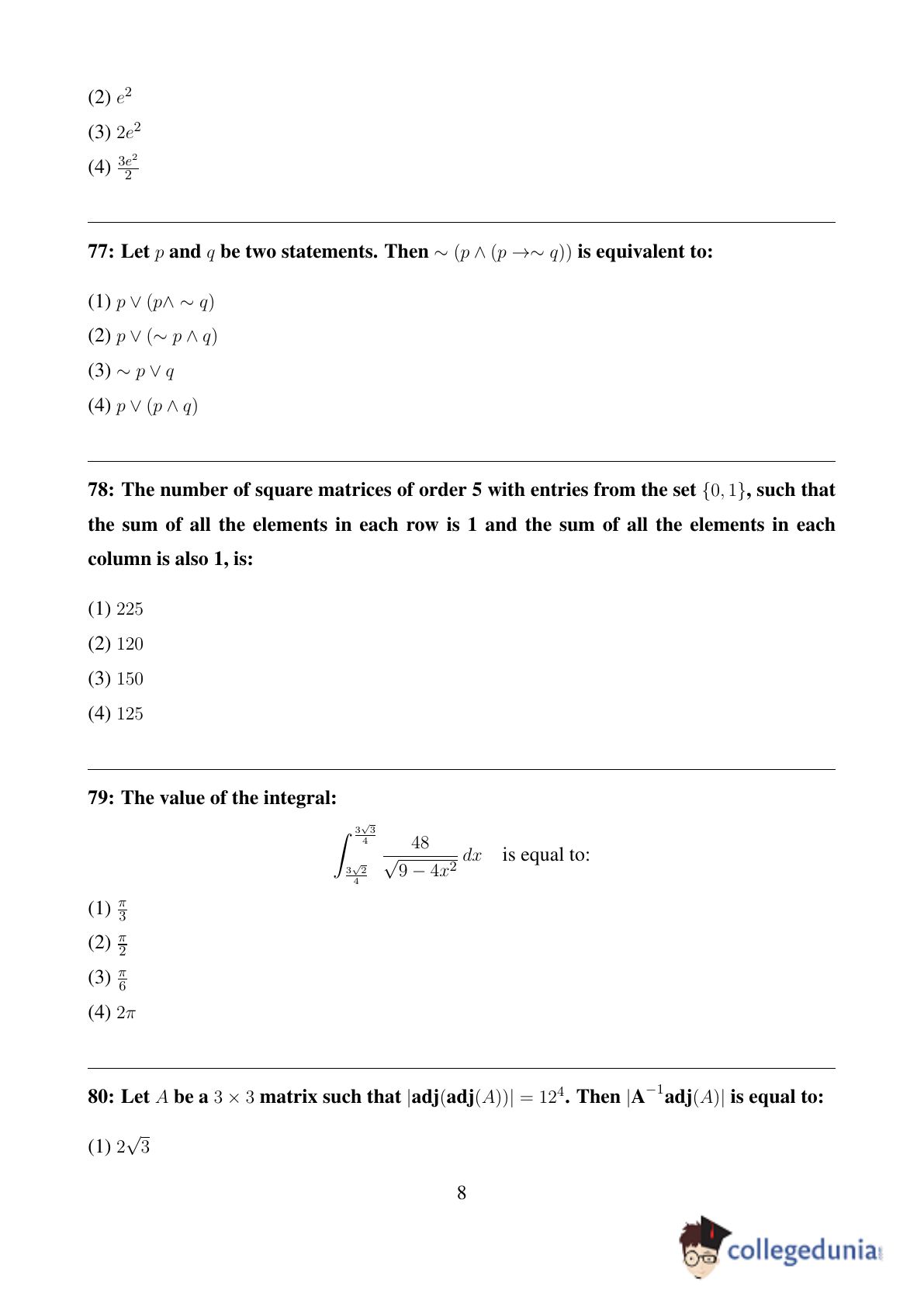
Let \( p \) and \( q \) be two statements. Then \( \sim(p \land (p \to \sim q)) \) is equivalent to:
\begin{flushleft
View Solution
The number of square matrices of order 5 with entries from the set \( \{0, 1\} \), such that the sum of all the elements in each row is 1 and the sum of all the elements in each column is also 1, is:
\begin{flushleft
View Solution
The value of the integral: \[ \int_{\frac{3\sqrt{2}}{4}}^{\frac{3\sqrt{3}}{4}} \frac{48}{\sqrt{9 - 4x^2}} \, dx \quad is equal to: \]
\begin{flushleft
View Solution
Let \( A \) be a \( 3 \times 3 \) matrix such that \( |adj(adj(A))| = 12^4 \). Then \( |A^{-1}adj(A)| \) is equal to:
\begin{flushleft
View Solution
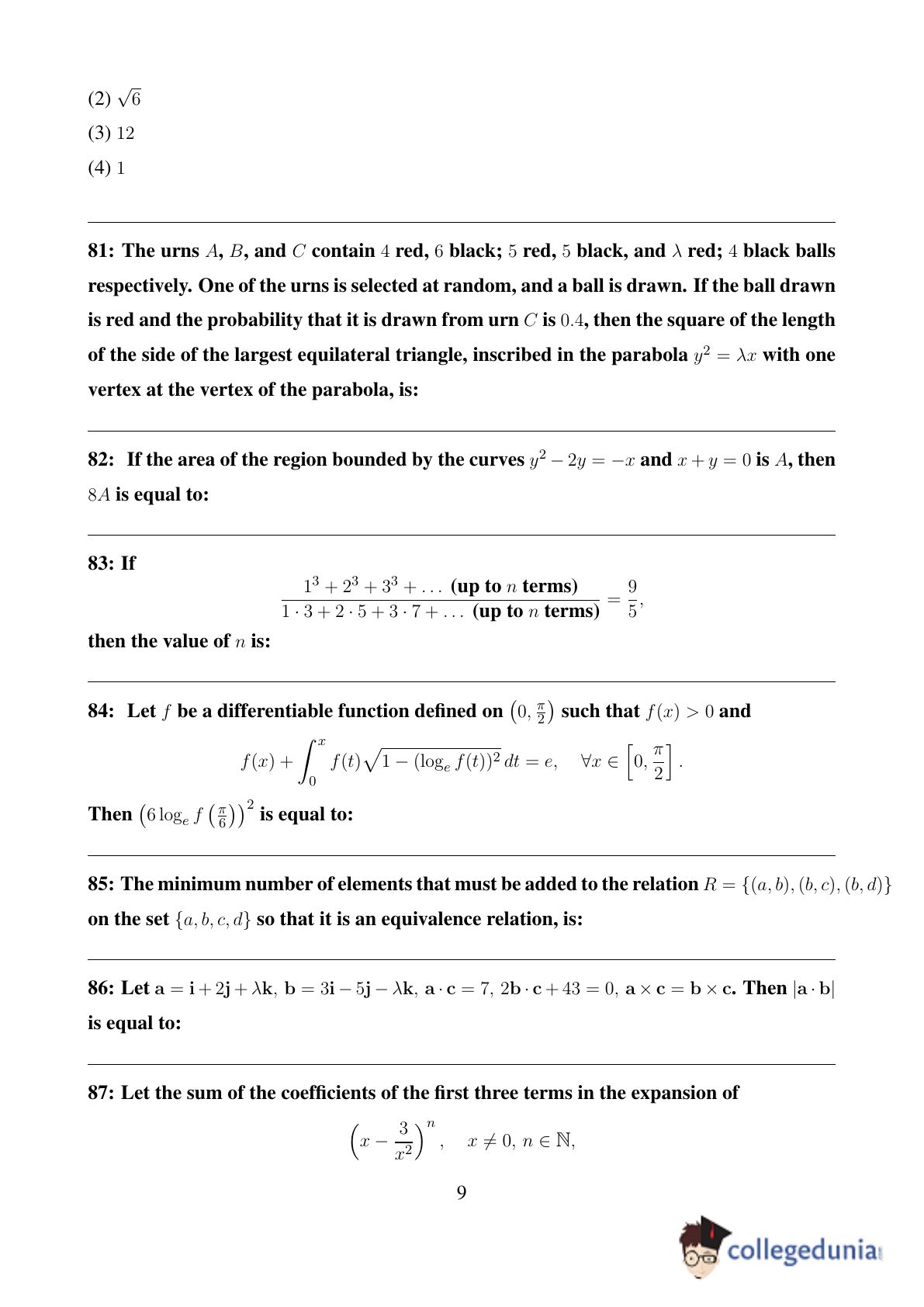
The urns \( A \), \( B \), and \( C \) contain \( 4 \) red, \( 6 \) black; \( 5 \) red, \( 5 \) black, and \( \lambda \) red; \( 4 \) black balls respectively. One of the urns is selected at random, and a ball is drawn. If the ball drawn is red and the probability that it is drawn from urn \( C \) is \( 0.4 \), then the square of the length of the side of the largest equilateral triangle, inscribed in the parabola \( y^2 = \lambda x \) with one vertex at the vertex of the parabola, is:
View Solution
If the area of the region bounded by the curves \( y^2 - 2y = -x \) and \( x + y = 0 \) is \( A \), then \( 8A \) is equal to:
View Solution
If \[ \frac{1^3 + 2^3 + 3^3 + \ldots (up to \( n \) terms)}{1 \cdot 3 + 2 \cdot 5 + 3 \cdot 7 + \ldots (up to \( n \) terms)} = \frac{9}{5}, \]
then the value of \( n \) is:
View Solution
Let \( f \) be a differentiable function defined on \( \left(0, \frac{\pi}{2}\right) \) such that \( f(x) > 0 \) and \[ f(x) + \int_0^x f(t)\sqrt{1 - (\log_e f(t))^2} \, dt = e, \quad \forall x \in \left[0, \frac{\pi}{2}\right]. \]
Then \( \left(6 \log_e f\left(\frac{\pi}{6}\right)\right)^2 \) is equal to:
View Solution
The minimum number of elements that must be added to the relation \( R = \{(a, b), (b, c), (b, d)\} \) on the set \( \{a, b, c, d\} \) so that it is an equivalence relation, is:
View Solution
Let \( \mathbf{a} = \mathbf{i} + 2\mathbf{j} + \lambda \mathbf{k}, \, \mathbf{b} = 3\mathbf{i} - 5\mathbf{j} - \lambda \mathbf{k}, \, \mathbf{a} \cdot \mathbf{c} = 7, \, 2\mathbf{b} \cdot \mathbf{c} + 43 = 0, \, \mathbf{a} \times \mathbf{c} = \mathbf{b} \times \mathbf{c} \). Then \( |\mathbf{a} \cdot \mathbf{b}| \) is equal to:
View Solution
Let the sum of the coefficients of the first three terms in the expansion of \[ \left(x - \frac{3}{x^2}\right)^n, \quad x \neq 0, \, n \in \mathbb{N}, \]
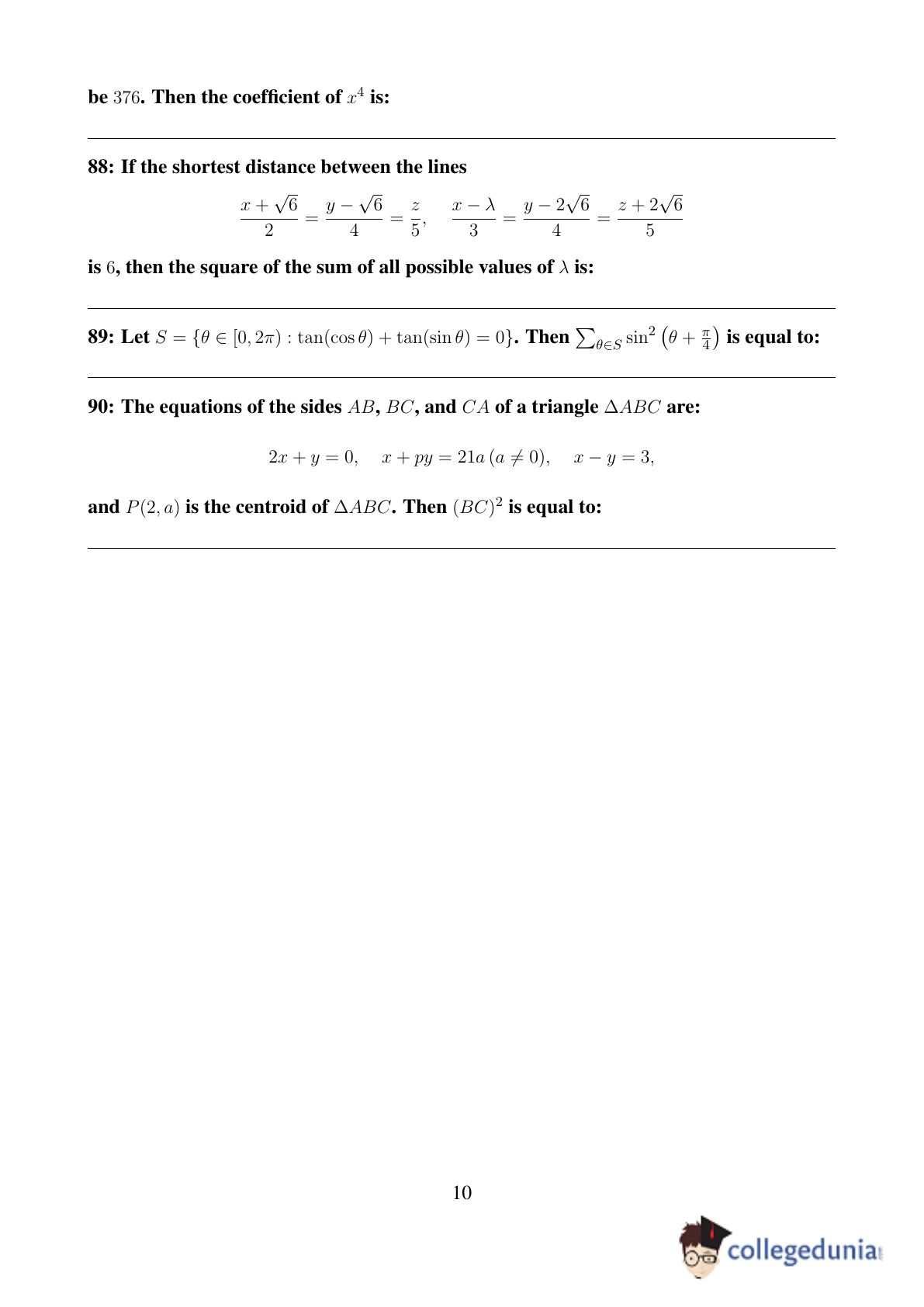
be \( 376 \). Then the coefficient of \( x^4 \) is:
View Solution
If the shortest distance between the lines \[ \frac{x + \sqrt{6}}{2} = \frac{y - \sqrt{6}}{4} = \frac{z}{5}, \quad \frac{x - \lambda}{3} = \frac{y - 2\sqrt{6}}{4} = \frac{z + 2\sqrt{6}}{5} \]
is \( 6 \), then the square of the sum of all possible values of \( \lambda \) is:
View Solution
Let \( S = \{ \theta \in [0, 2\pi) : \tan(\cos \theta) + \tan(\sin \theta) = 0 \} \). Then \( \sum_{\theta \in S} \sin^2 \left(\theta + \frac{\pi}{4}\right) \) is equal to:
View Solution
The equations of the sides \( AB \), \( BC \), and \( CA \) of a triangle \( \Delta ABC \) are: \[ 2x + y = 0, \quad x + py = 21a \, (a \neq 0), \quad x - y = 3, \]
and \( P(2, a) \) is the centroid of \( \Delta ABC \). Then \( (BC)^2 \) is equal to:
View Solution
Also Check:
JEE Main 2023 Mathematics Analysis Jan 24 Shift 2
JEE Main 2023 Paper Analysis for Mathematics paper scheduled on January 24 Shift 2 is updated here. Jan 24 shift 2 candidates can check the topics with the highest weightage, difficulty level and memory-based Mathematics questions using the link provided below.
JEE Main 2023 Mathematics Question Paper Pattern
| Feature | Question Paper Pattern |
|---|---|
| Examination Mode | Computer-based Test |
| Exam Language | 13 languages (English, Hindi, Assamese, Bengali, Gujarati, Kannada, Malayalam, Marathi, Odia, Punjabi, Tamil, Telugu, and Urdu) |
| Exam Duration | 3 hours |
| Sectional Time Limit | None |
| Mathematics Marks | 100 marks |
| Total Number of Questions Asked | 20 MCQs + 10 Numerical Type Questions |
| Total Number of Questions to be Answered | 20 MCQs + 5 Numerical Type Questions |
| Marking Scheme | +4 for each correct answer |
| Negative Marking | -1 for each incorrect answer |
Also Check:
JEE Main 2022 Question Paper
JEE Main 2023 aspirants can practice and check their exam prep level by attempting the previous year question papers as well. The table below shows JEE Main 2022 Question Paper PDF for B.E./B.Tech to practice.



Comments