




JEE Main 2023 Mathematics Question Paper Jan 29 Shift 2 is updated here after the conclusion of the exam. Candidates can download JEE Main 2023 Mathematics Question Paper PDF with Answer Key for Jan 29 Shift 2 using the link below. JEE Main Mathematics Question Paper is divided into two sections, Section A with 20 MCQs and Section B with 10 numerical type questions. Candidates are required to answer all questions from Section A and any 5 questions from section B.
Related Links:
- Download JEE Main Previous Year Question Papers PDF with Solutions
- Download JEE Main 2025 Question Paper for all Shifts
JEE Main 2023 Mathematics Question Paper Jan 29 Shift 2- Download PDF
| JEE Main 2023 29 Jan Shift 2 Mathematics Question Paper with Solution PDF |  Download Download |
Check Solution |

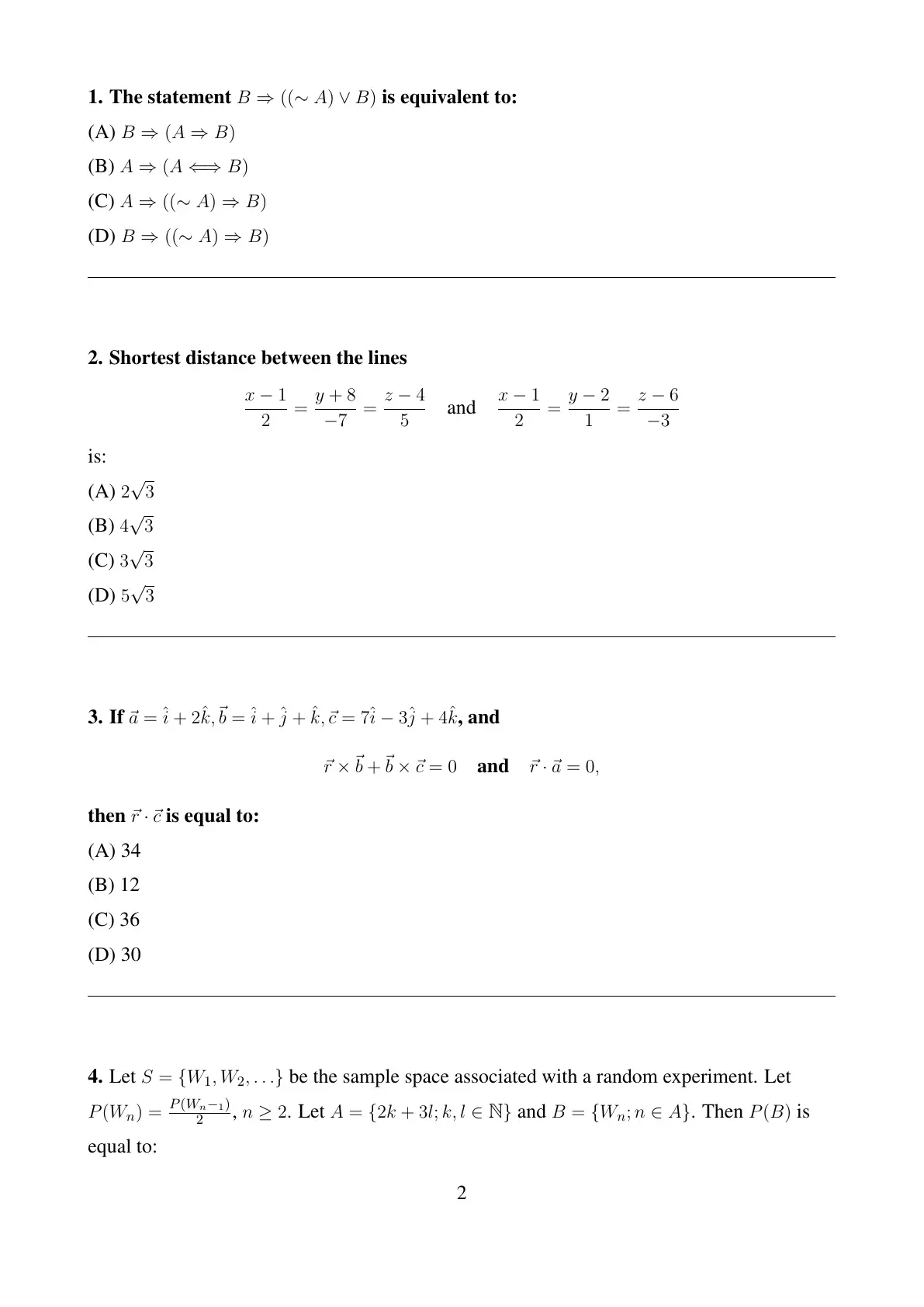
The statement \( B \Rightarrow ((\sim A) \lor B) \) is equivalent to:
View Solution
We verify the equivalence of \( B \Rightarrow ((\sim A) \lor B) \) by using truth tables.
Step 1: Analyze the given expression
The statement is \( B \Rightarrow ((\sim A) \lor B) \). By the definition of implication: \[ P \Rightarrow Q \equiv (\sim P) \lor Q, \]
the statement can be rewritten as: \[ (\sim B) \lor ((\sim A) \lor B). \]
Step 2: Construct the truth table for \( B \Rightarrow ((\sim A) \lor B) \)
\[ \begin{array}{c|c|c|c|c} A & B & \sim A & (\sim A) \lor B & B \Rightarrow ((\sim A) \lor B)
\hline T & T & F & T & T
T & F & F & F & T
F & T & T & T & T
F & F & T & T & T
\end{array} \]
Explanation:
Column \( \sim A \): Negation of \( A \).
Column \( (\sim A) \lor B \): Logical OR of \( \sim A \) and \( B \).
Column \( B \Rightarrow ((\sim A) \lor B) \): True if \( B \) implies \( (\sim A) \lor B \).
Step 3: Verify equivalence with the options
% Option
(A) Option (1): \( B \Rightarrow (A \Rightarrow B) \)
Simplify \( A \Rightarrow B \equiv (\sim A) \lor B \). Thus:
\[ B \Rightarrow ((\sim A) \lor B). \]
The truth table matches exactly with \( B \Rightarrow ((\sim A) \lor B) \).
(B)Option (3): \( A \Rightarrow ((\sim A) \Rightarrow B) \)
Simplify \( (\sim A) \Rightarrow B \equiv A \lor B \). Thus:
\[ A \Rightarrow ((\sim A) \lor B) \equiv (\sim A) \lor ((\sim A) \lor B), \]
which matches the truth table of \( B \Rightarrow ((\sim A) \lor B) \).
(C)Option (4): \( B \Rightarrow ((\sim A) \Rightarrow B) \)
Simplify \( (\sim A) \Rightarrow B \equiv A \lor B \). Thus:
\[ B \Rightarrow (A \lor B), \]
which also matches the truth table of \( B \Rightarrow ((\sim A) \lor B) \). Quick Tip: When checking logical equivalences, construct truth tables and compare them to confirm equivalence.
Shortest distance between the lines \[ \frac{x-1}{2} = \frac{y+8}{-7} = \frac{z-4}{5} \quad and \quad \frac{x-1}{2} = \frac{y-2}{1} = \frac{z-6}{-3} \]
is:
View Solution
The parametric equations of the lines are:
\begin{align*
\vec{r_1 &= \hat{i - 8\hat{j + 4\hat{k + \lambda(2\hat{i - 7\hat{j + 5\hat{k),
\vec{r_2 &= \hat{i + 2\hat{j + 6\hat{k + \mu(2\hat{i + \hat{j - 3\hat{k).
\end{align*
Step 1: Define the points and direction vectors
\( \vec{a_1} = \hat{i} - 8\hat{j} + 4\hat{k} \) (point on line 1).
\( \vec{a_2} = \hat{i} + 2\hat{j} + 6\hat{k} \) (point on line 2).
\( \vec{b_1} = 2\hat{i} - 7\hat{j} + 5\hat{k} \) (direction vector of line 1).
\( \vec{b_2} = 2\hat{i} + \hat{j} - 3\hat{k} \) (direction vector of line 2).
Step 2: Find the cross product \( \vec{b_1} \times \vec{b_2} \) \[ \vec{b_1} \times \vec{b_2} = \begin{vmatrix} \hat{i} & \hat{j} & \hat{k}
2 & -7 & 5
2 & 1 & -3 \end{vmatrix} = (16\hat{i} + 16\hat{j} + 16\hat{k}) = 16(\hat{i} + \hat{j} + \hat{k}). \]
Step 3: Find \( |\vec{b_1} \times \vec{b_2}| \) \[ |\vec{b_1} \times \vec{b_2}| = 16\sqrt{3}. \]
Step 4: Compute \( \vec{a_2} - \vec{a_1} \) \[ \vec{a_2} - \vec{a_1} = 10\hat{j} + 2\hat{k}. \]
Step 5: Find the scalar projection of \( \vec{a_2} - \vec{a_1} \) on \( \vec{b_1} \times \vec{b_2} \) \[ Shortest distance = \frac{|(\vec{a_2} - \vec{a_1}) \cdot (\vec{b_1} \times \vec{b_2})|}{|\vec{b_1} \times \vec{b_2}|}. \]
Substitute: \[ (\vec{a_2} - \vec{a_1}) \cdot (\vec{b_1} \times \vec{b_2}) = 16\sqrt{104}. \]
\[ Shortest distance = \frac{\sqrt{104}}{\sqrt{3}} = 4\sqrt{3}. \] Quick Tip: The shortest distance between skew lines is calculated using the cross product of their direction vectors.
If \( \vec{a} = \hat{i} + 2\hat{k}, \vec{b} = \hat{i} + \hat{j} + \hat{k}, \vec{c} = 7\hat{i} - 3\hat{j} + 4\hat{k} \), and \[ \vec{r} \times \vec{b} + \vec{b} \times \vec{c} = 0 \quad and \quad \vec{r} \cdot \vec{a} = 0, \]
then \( \vec{r} \cdot \vec{c} \) is equal to:
View Solution
Step 1: Simplify \( \vec{r} \times \vec{b} + \vec{b} \times \vec{c} = 0 \)
\[ \vec{r} \times \vec{b} = -\vec{b} \times \vec{c}. \]
This implies \( \vec{r} \) can be written as: \[ \vec{r} = \vec{c} + \lambda \vec{b}, \quad for some scalar \lambda. \]
Step 2: Use \( \vec{r} \cdot \vec{a} = 0 \)
Substitute \( \vec{r} = \vec{c} + \lambda \vec{b} \) into \( \vec{r} \cdot \vec{a} = 0 \): \[ (\vec{c} + \lambda \vec{b}) \cdot \vec{a} = 0. \]
Simplify: \[ \vec{c} \cdot \vec{a} + \lambda (\vec{b} \cdot \vec{a}) = 0. \]
Step 3: Compute dot products
\[ \vec{c} \cdot \vec{a} = (7)(1) + (-3)(0) + (4)(2) = 15, \] \[ \vec{b} \cdot \vec{a} = (1)(1) + (1)(0) + (1)(2) = 3. \]
Substitute: \[ 15 + 3\lambda = 0 \implies \lambda = -5. \]
Step 4: Find \( \vec{r} \)
\[ \vec{r} = \vec{c} + \lambda \vec{b} = (7\hat{i} - 3\hat{j} + 4\hat{k}) - 5(\hat{i} + \hat{j} + \hat{k}), \] \[ \vec{r} = 2\hat{i} - 8\hat{j} - \hat{k}. \]
Step 5: Compute \( \vec{r} \cdot \vec{c} \)
\[ \vec{r} \cdot \vec{c} = (2)(7) + (-8)(-3) + (-1)(4), \] \[ \vec{r} \cdot \vec{c} = 14 + 24 - 4 = 34. \] Quick Tip: To solve vector problems with constraints, express vectors in parametric form and solve for scalars systematically.
Let \( S = \{W_1, W_2, \ldots\} \) be the sample space associated with a random experiment. Let \( P(W_n) = \frac{P(W_n-_1)}{2} \), \( n \geq 2 \). Let \( A = \{2k + 3l; k, l \in \mathbb{N}\} \) and \( B = \{W_n; n \in A\} \). Then \( P(B) \) is equal to:
View Solution
(A)Let \( P(W_1) = \lambda \). Then \( P(W_2) = \frac{\lambda}{2} \), \( P(W_3) = \frac{\lambda}{4} \), and in general:
\[ P(W_n) = \frac{\lambda}{2^{n-1}}. \]
(B)The total probability of the sample space \( S \) is 1:
\[ \sum_{n=1}^\infty P(W_n) = \lambda \left(1 + \frac{1}{2} + \frac{1}{4} + \cdots \right). \]
This is a geometric series with sum:
\[ \lambda \sum_{n=0}^\infty \left(\frac{1}{2}\right)^n = \lambda \cdot \frac{1}{1 - \frac{1}{2}} = \lambda \cdot 2. \]
Setting \( \lambda \cdot 2 = 1 \), we get \( \lambda = \frac{1}{2} \).
(C)For \( A = \{2k + 3l; k, l \in \mathbb{N}\} \), \( A \) includes numbers such as \( 5, 7, 8, 9, 10, \ldots \). Thus, \( B = \{W_5, W_7, W_8, W_9, \ldots\} \).
(D)The probability \( P(B) \) is:
\[ P(B) = \sum_{n \in A} P(W_n). \]
Substituting \( P(W_n) = \frac{1}{2^n} \), we calculate:
\[ P(B) = 1 - \left(P(W_1) + P(W_2) + P(W_3) + P(W_4) + P(W_6)\right). \]
(E)Compute individual probabilities:
\[ P(W_1) = \frac{1}{2}, \, P(W_2) = \frac{1}{4}, \, P(W_3) = \frac{1}{8}, \, P(W_4) = \frac{1}{16}, \, P(W_6) = \frac{1}{64}. \]
Summing these:
\[ P(W_1) + P(W_2) + P(W_3) + P(W_4) + P(W_6) = \frac{1}{2} + \frac{1}{4} + \frac{1}{8} + \frac{1}{16} + \frac{1}{64} = \frac{36}{64}. \]
(F) Thus:
\[ P(B) = 1 - \frac{36}{64} = \frac{36}{64}. \] Quick Tip: For probabilities involving subsets, calculate the total probability of excluded events and subtract it from 1.
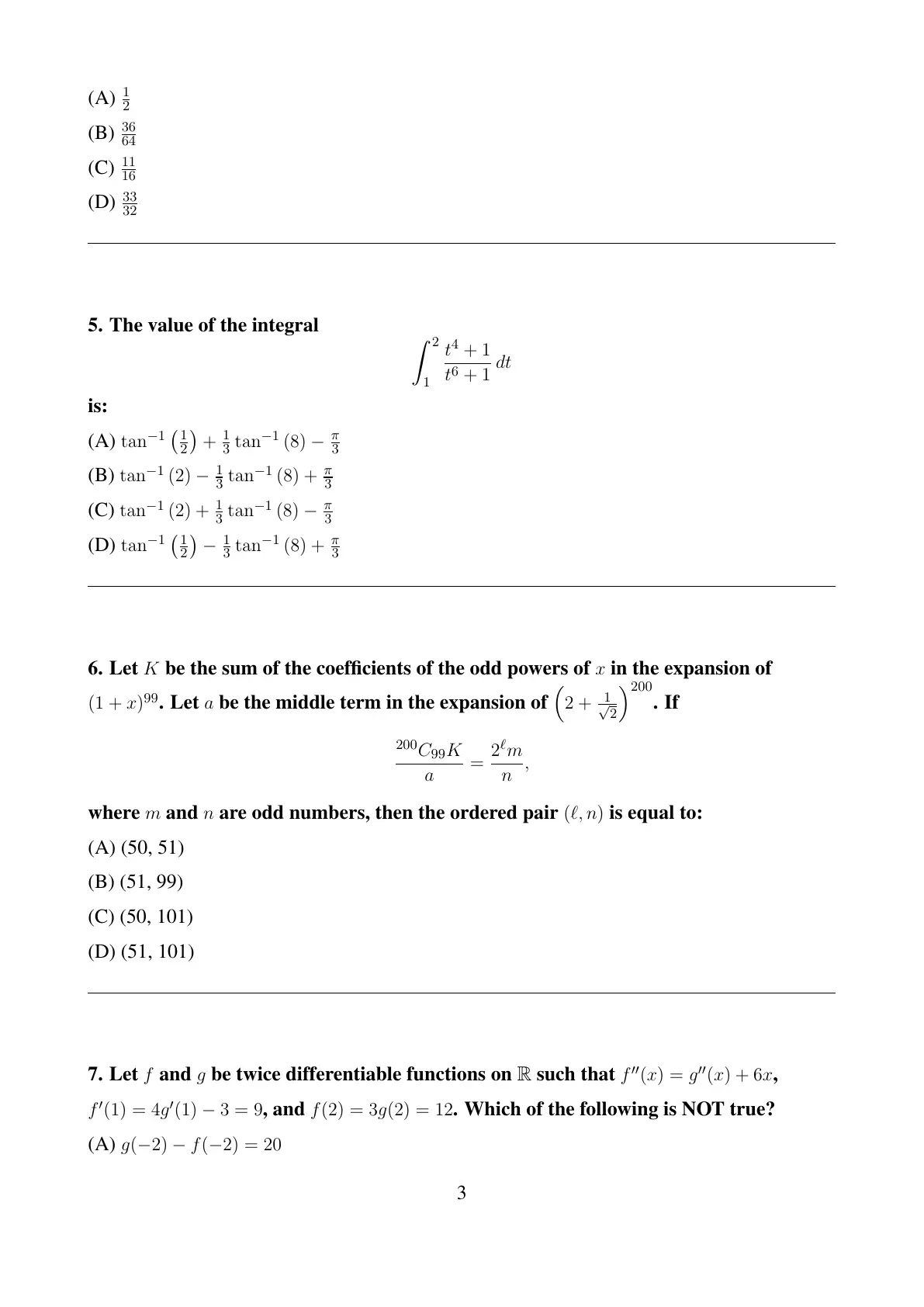
The value of the integral \[ \int_{1}^2 \frac{t^4 + 1}{t^6 + 1} \, dt \]
is:
View Solution
(A)The given integral is:
\[ \int_{1}^2 \frac{t^4 + 1}{t^6 + 1} \, dt. \]
(B)Factorize \( t^6 + 1 \):
\[ t^6 + 1 = (t^2 + 1)(t^4 - t^2 + 1). \]
Rewrite the integrand:
\[ \frac{t^4 + 1}{t^6 + 1} = \frac{t^4 + 1}{(t^2 + 1)(t^4 - t^2 + 1)}. \]
(C)Use partial fractions:
\[ \frac{t^4 + 1}{(t^2 + 1)(t^4 - t^2 + 1)} = \frac{A}{t^2 + 1} + \frac{Bt + C}{t^4 - t^2 + 1}. \]
Multiply through and equate terms to solve for \( A, B, C \). Solving gives:
\[ A = 1, \, B = 0, \, C = \frac{1}{3}. \]
(D)Substituting, the integral becomes:
\[ \int_{1}^2 \frac{1}{t^2 + 1} \, dt + \frac{1}{3} \int_{1}^2 \frac{t}{t^4 - t^2 + 1} \, dt. \]
(E)Solve the first term:
\[ \int_{1}^2 \frac{1}{t^2 + 1} \, dt = \tan^{-1}(2) - \tan^{-1}(1). \]
Since \( \tan^{-1}(1) = \frac{\pi}{4} \), this simplifies to:
\[ \tan^{-1}(2) - \frac{\pi}{4}. \]
(F) For the second term, perform substitution \( u = t^2 - 1 \), \( du = 2t \, dt \):
\[ \frac{1}{3} \int_{1}^2 \frac{t}{t^4 - t^2 + 1} \, dt = \frac{1}{3} \int \frac{1}{u^2 + 1} \, du = \frac{1}{3} \tan^{-1}(u). \]
Back-substitute and evaluate:
\[ \frac{1}{3} \left[\tan^{-1}(8) - \tan^{-1}(0)\right] = \frac{1}{3} \tan^{-1}(8). \]
(G) Combine the results:
\[ \tan^{-1}(2) - \frac{\pi}{4} + \frac{1}{3} \tan^{-1}(8). \]
Simplify:
\[ \tan^{-1}(2) + \frac{1}{3} \tan^{-1}(8) - \frac{\pi}{3}. \] Quick Tip: Factorize the denominator and use trigonometric substitutions for integrals involving rational functions.
Let \( K \) be the sum of the coefficients of the odd powers of \( x \) in the expansion of \( (1+x)^{99} \). Let \( a \) be the middle term in the expansion of \( \left(2 + \frac{1}{\sqrt{2}}\right)^{200} \). If \[ \frac{^{200}C_{99}K}{a} = \frac{2^\ell m}{n}, \]
where \( m \) and \( n \) are odd numbers, then the ordered pair \( (\ell, n) \) is equal to:
View Solution
In the expansion of \[ (1 + x)^{99} = C_0 + C_1 x + C_2 x^2 + \dots + C_{99} x^{99} \]
we define \( K \) as: \[ K = C_1 + C_3 + \dots + C_{99} = 2^{98} \]
To find the middle term in the expansion of \[ \left( 2 + \frac{1}{\sqrt{2}} \right)^{200} \]
we consider the term:
\[ T_{\frac{200}{2} + 1} = C_{100}^{200} (2)^{100} \left( \frac{1}{\sqrt{2}} \right)^{100} \]
\[ = C_{100}^{200} \cdot 2^{50} \]
Thus, we get:
\[ \frac{200}{200} \cdot \frac{C_{99} \times 2^{98}}{C_{100}^{200} \times 2^{50}} = \frac{100}{101} \times 2^{48} \]
So,
\[ \frac{25}{101} \times 2^{50} = \frac{m}{n} 2^{\ell} \]
Since \( m \) and \( n \) are odd, we conclude that:
\[ (\ell, n) = (50, 101) \quad Ans. \]
- The problem involves the binomial expansion of \((1 + x)^{99}\) and the summation of alternating binomial coefficients.
- The middle term in the expansion of \(\left( 2 + \frac{1}{\sqrt{2}} \right)^{200}\) is found using the binomial theorem.
- Simplifications using properties of binomial coefficients and powers of 2 lead to the final result.
- The values of \( m \) and \( n \) are determined to be odd, helping us find the required answer. Quick Tip: For binomial expansions, use symmetry and simplify middle terms systematically. For large factorials, simplify ratios directly using combinatorial identities.
Let \( f \) and \( g \) be twice differentiable functions on \( \mathbb{R} \) such that \( f''(x) = g''(x) + 6x \), \( f'(1) = 4g'(1) - 3 = 9 \), and \( f(2) = 3g(2) = 12 \). Which of the following is NOT true?
View Solution
(A)From \( f'(x) = g''(x) + 6x \), integrate to find \( f(x) \):
\[ f'(x) = g'(x) + 3x^2 + C_1. \]
(B)Using \( f'(1) = 9 \):
\[ 9 = g'(1) + 3(1) + C_1 \implies C_1 = 2. \]
(C)Integrate again to find \( f(x) \):
\[ f(x) = g(x) + x^3 + 2x + C_2. \]
(D)Using \( f(2) = 3g(2) = 12 \):
\[ 12 = g(2) + 8 + 4 + C_2 \implies C_2 = -4. \]
(E)Thus:
\[ f(x) = g(x) + x^3 + 2x - 4. \]
(F) Compute \( h(x) = f(x) - g(x) = x^3 + 2x - 4 \). For \( -1 < x < 2 \), the range of \( h(x) \) is:
\[ -7 < h(x) < 4 \implies |h(x)| < 8. \]
However, \( |h(x)| \geq 7 \), so option (2) is not true. Quick Tip: For inequalities involving differentiable functions, analyze monotonicity using derivatives to find range bounds.
The set of all values of \( t \in \mathbb{R} \), for which the matrix \[ \begin{bmatrix} e^t & e^{-t}(\sin t - 2\cos t) & e^{-t}(-2\sin t - \cos t)
e^t & e^{-t}(2\sin t + \cos t) & e^{-t}(\sin t - 2\cos t)
e^t & e^{-t}\cos t & e^{-t}\sin t \end{bmatrix} \]
is invertible, is:
View Solution
(A)The given matrix is invertible if its determinant is non-zero:
\[ \det\left(\begin{bmatrix} e^t & e^{-t}(\sin t - 2\cos t) & e^{-t}(-2\sin t - \cos t)
e^t & e^{-t}(2\sin t + \cos t) & e^{-t}(\sin t - 2\cos t)
e^t & e^{-t}\cos t & e^{-t}\sin t \end{bmatrix}\right) \neq 0. \]
(B)Perform row operations to simplify the determinant. Subtract the first row from the second and third rows:
\[ R_2 \to R_2 - R_1, \quad R_3 \to R_3 - R_1. \]
After simplification, the determinant becomes:
\[ \det\begin{bmatrix} e^t & e^{-t}(\sin t - 2\cos t) & e^{-t}(-2\sin t - \cos t)
0 & e^{-t} & 0
0 & 0 & e^{-t} \end{bmatrix}. \]
(C)Expanding along the first row:
\[ \det = e^t \cdot \det\begin{bmatrix} e^{-t} & 0
0 & e^{-t} \end{bmatrix}. \]
Compute the determinant of the \( 2 \times 2 \) submatrix:
\[ \det = e^t \cdot (e^{-t} \cdot e^{-t}) = e^t \cdot e^{-2t} = e^{-t}. \]
(D)For invertibility, \( e^{-t} \neq 0 \). Since \( e^{-t} \neq 0 \) for all \( t \in \mathbb{R} \), the matrix is invertible for all \( t \in \mathbb{R} \). Quick Tip: For matrix invertibility, simplify determinants using row/column operations and check when the determinant is non-zero.
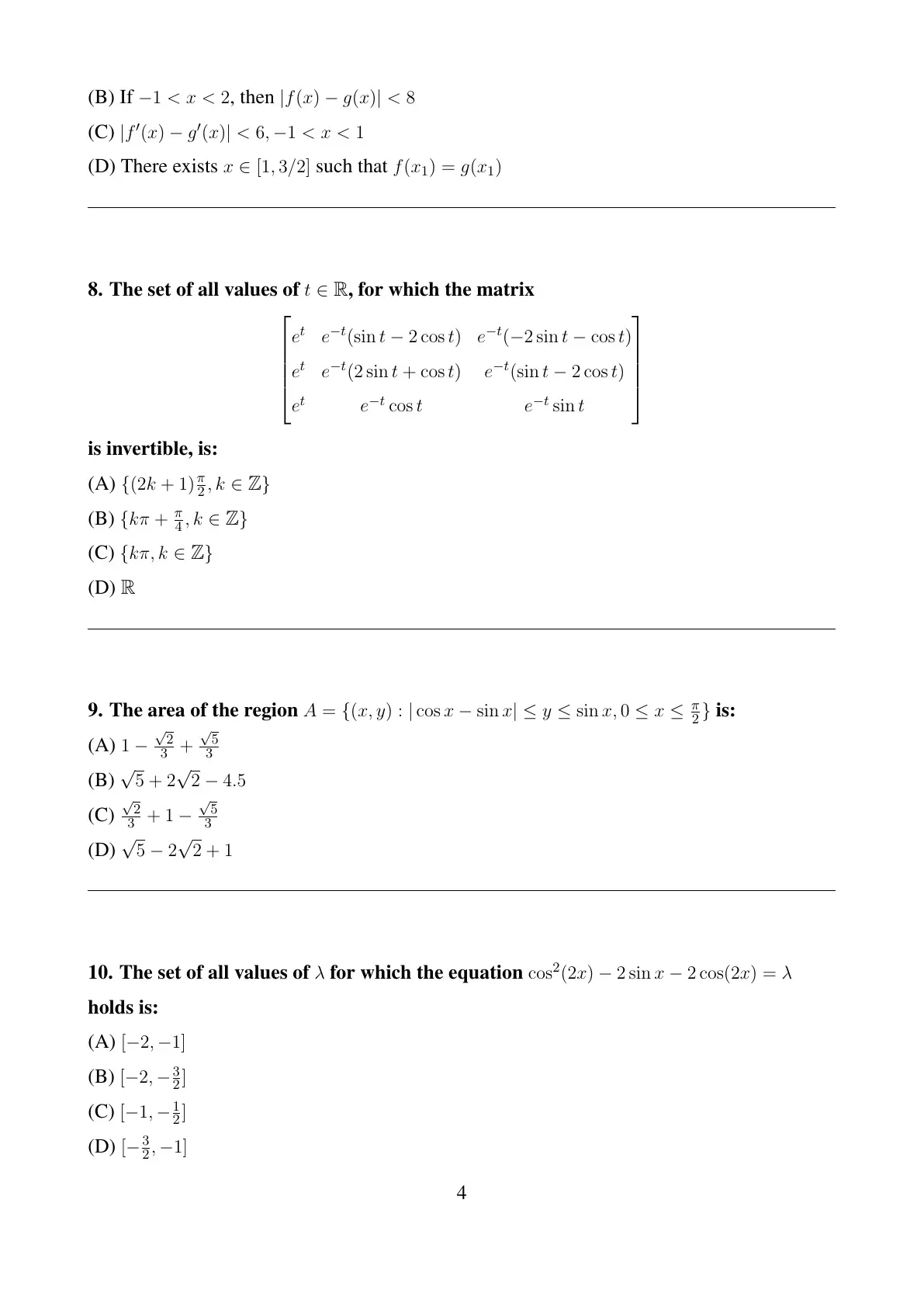
The area of the region \( A = \{(x, y) : |\cos x - \sin x| \leq y \leq \sin x, 0 \leq x \leq \frac{\pi}{2}\} \) is:
View Solution
(A)The region \( A \) is bounded by \( y = |\cos x - \sin x| \) and \( y = \sin x \) over the interval \( 0 \leq x \leq \frac{\pi}{2} \).
(B) Split the region into two parts based on the behavior of \( |\cos x - \sin x| \):
\[ |\cos x - \sin x| = \begin{cases} \cos x - \sin x, & if \cos x \geq \sin x,
\sin x - \cos x, & if \cos x < \sin x. \end{cases} \]
(C)Evaluate the area in two parts:
\[ Area = \int_{0}^{\frac{\pi}{4}} (\sin x - (\cos x - \sin x)) dx + \int_{\frac{\pi}{4}}^{\frac{\pi}{2}} (\sin x - (\sin x - \cos x)) dx. \]
(D)Simplify the integrands:
\[ Area = \int_{0}^{\frac{\pi}{4}} (2\sin x - \cos x) dx + \int_{\frac{\pi}{4}}^{\frac{\pi}{2}} (\cos x) dx. \]
(E)Solve each integral:
\begin{align*
\int (2\sin x - \cos x) dx &= -2\cos x - \sin x,
\int \cos x dx &= \sin x.
\end{align*
(F) Substitute limits:
\begin{align*
First integral: & \left[-2\cos x - \sin x\right]_0^{\frac{\pi{4 = (-2\cos\frac{\pi{4 - \sin\frac{\pi{4) - (-2\cos 0 - \sin 0),
& = (-2\frac{\sqrt{2{2 - \frac{\sqrt{2{2) - (-2 - 0) = -\sqrt{2 - \sqrt{2 + 2,
& = 2 - 2\sqrt{2.
\end{align*
\begin{align*
\text{Second integral: & \left[\sin x\right]_{\frac{\pi{4^{\frac{\pi{2 = \sin\frac{\pi{2 - \sin\frac{\pi{4,
& = 1 - \frac{\sqrt{2{2.
\end{align*
Combine results:
\[ \text{Area = (2 - 2\sqrt{2}) + \left(1 - \frac{\sqrt{2}}{2}\right) = \sqrt{5} - 2\sqrt{2} + 1. \] Quick Tip: Break regions with absolute values into separate intervals and evaluate integrals piecewise.
The set of all values of \( \lambda \) for which the equation \( \cos^2(2x) - 2\sin x - 2\cos(2x) = \lambda \) holds is:
View Solution
(A)Start with the given equation:
\[ \cos^2(2x) - 2\sin x - 2\cos(2x) = \lambda. \]
(B)Use the trigonometric identity \( \cos^2(2x) = 1 - \sin^2(2x) \):
\[ 1 - \sin^2(2x) - 2\sin x - 2\cos(2x) = \lambda. \]
(C)Expand \( \cos(2x) = 1 - 2\sin^2(x) \):
\[ 1 - \sin^2(2x) - 2\sin x - 2(1 - 2\sin^2(x)) = \lambda. \]
(D)Simplify the equation:
\[ 1 - \sin^2(2x) - 2\sin x - 2 + 4\sin^2(x) = \lambda. \]
\[ -1 - \sin^2(2x) - 2\sin x + 4\sin^2(x) = \lambda. \]
(E)Replace \( \sin^2(2x) = 4\sin^2(x)\cos^2(x) = 4\sin^2(x)(1 - \sin^2(x)) \):
\[ -1 - 4\sin^2(x)(1 - \sin^2(x)) - 2\sin x + 4\sin^2(x) = \lambda. \]
(F) Simplify:
\[ -1 - 4\sin^2(x) + 4\sin^4(x) - 2\sin x + 4\sin^2(x) = \lambda. \]
\[ -1 + 4\sin^4(x) - 2\sin x = \lambda. \]
(G) Analyze the range of the function \( f(x) = 4\sin^4(x) - 2\sin x - 1 \). The critical points occur when \( f'(x) = 0 \):
\[ f'(x) = 16\sin^3(x)\cos(x) - 2\cos(x). \]
Factorize:
\[ f'(x) = \cos(x)(16\sin^3(x) - 2). \]
Solve \( f'(x) = 0 \):
\[ \cos(x) = 0 \quad or \quad 16\sin^3(x) - 2 = 0 \implies \sin^3(x) = \frac{1}{8}. \]
Evaluate \( f(x) \) at critical points and endpoints \( \sin(x) = -1 \) to \( \sin(x) = 1 \):
\[ f(x) \in [-1, -\frac{1}{2}]. \]
Thus, the range of \( \lambda \) is:
\[ [-1, -\frac{1}{2}]. \] Quick Tip: To find ranges of trigonometric functions, rewrite using identities and analyze using calculus.
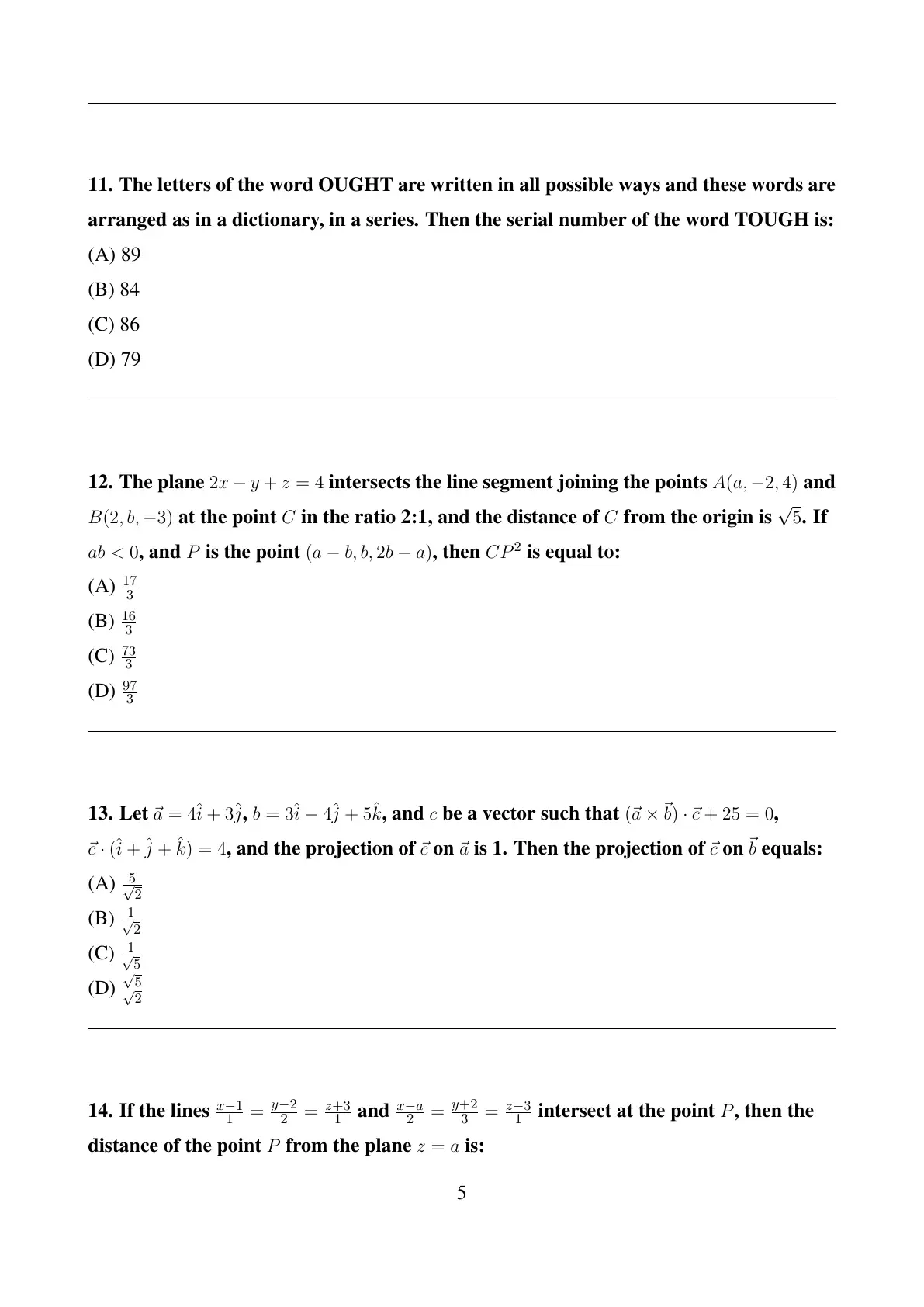
The letters of the word OUGHT are written in all possible ways and these words are arranged as in a dictionary, in a series. Then the serial number of the word TOUGH is:
View Solution
(A)Arrange the letters of OUGHT in alphabetical order: G, H, O, T, U.
(B) Count words starting with each letter before "T":
\[ G \to 4!, \quad H \to 4!, \quad O \to 4!. \]
(C) Count words starting with "T" but second letter as:
\[ TG \to 3!, \quad TH \to 3!, \quad TOG \to 2!, \quad TOH \to 2!. \]
(D) Add the counts:
\[ 4! + 4! + 4! + 3! + 3! + 2! + 2! + 1! = 89. \] Quick Tip: To find the serial number of a word in dictionary order, systematically count permutations based on preceding letters.
The plane \( 2x - y + z = 4 \) intersects the line segment joining the points \( A(a, -2, 4) \) and \( B(2, b, -3) \) at the point \( C \) in the ratio 2:1, and the distance of \( C \) from the origin is \( \sqrt{5} \). If \( ab < 0 \), and \( P \) is the point \( (a - b, b, 2b - a) \), then \( CP^2 \) is equal to:
View Solution
(A)The coordinates of \( C \) using the section formula:
\[ C = \left(\frac{a + 4}{3}, \frac{2b - 2}{3}, \frac{2 - 2}{3}\right). \]
(B)Substituting \( C \) into the plane equation \( 2x - y + z = 4 \):
\[ 2\left(\frac{a + 4}{3}\right) - \left(\frac{2b - 2}{3}\right) + \left(\frac{2}{3}\right) = 4. \]
Simplify:
\[ \frac{2a + 8 + 2b - 2 + 2}{3} = 4 \implies 2a + 2b = 4 \implies a + b = 2. \quad (1) \]
(C)The distance of \( C \) from the origin:
\[ \left(\frac{a + 4}{3}\right)^2 + \left(\frac{2b - 2}{3}\right)^2 + \left(\frac{2}{3}\right)^2 = 5. \]
Solve using \( a + b = 2 \) and simplify:
\[ (b + 6)^2 + (2b - 2)^2 = 41 \implies 5b^2 + 4b - 1 = 0. \]
(D)Roots are \( b = -1 \) or \( b = \frac{1}{5} \). Using \( ab < 0 \), \( (a, b) = (1, -1) \).
(E)Coordinates of \( C \):
\[ C = \left(\frac{5}{3}, \frac{-4}{3}, \frac{2}{3}\right). \]
Coordinates of \( P \):
\[ P = (2, -1, -3). \]
(F) Compute \( CP^2 \):
\[ CP^2 = \left(\frac{5}{3} - 2\right)^2 + \left(\frac{-4}{3} + 1\right)^2 + \left(\frac{2}{3} + 3\right)^2. \]
Simplify:
\[ CP^2 = \frac{17}{3}. \] Quick Tip: To solve geometry problems involving planes and line segments, use the section formula and solve constraints systematically.
Let \( \vec{a} = 4\hat{i} + 3\hat{j} \), \( b = 3\hat{i} - 4\hat{j} + 5\hat{k} \), and \( c \) be a vector such that \( (\vec{a} \times \vec{b}) \cdot \vec{c} + 25 = 0 \), \( \vec{c} \cdot (\hat{i} + \hat{j} + \hat{k}) = 4 \), and the projection of \( \vec{c} \) on \( \vec{a} \) is 1. Then the projection of \( \vec{c} \) on \( \vec{b} \) equals:
View Solution
(A)Compute \( \vec{a} \times \vec{b} \):
\[ \vec{a} \times \vec{b} = \begin{vmatrix} \hat{i} & \hat{j} & \hat{k}
4 & 3 & 0
3 & -4 & 5 \end{vmatrix} = 15\hat{i} - 20\hat{j} - 25\hat{k}. \]
(B)Let \( \vec{c} = x\hat{i} + y\hat{j} + z\hat{k} \). Using the condition \( (\vec{a} \times \vec{b}) \cdot \vec{c} + 25 = 0 \):
\[ 15x - 20y - 25z + 25 = 0 \implies 3x - 4y - 5z = -5. \quad (1) \]
(C)Using \( \vec{c} \cdot (\hat{i} + \hat{j} + \hat{k}) = 4 \):
\[ x + y + z = 4. \quad (2) \]
(D)Using the projection condition \( \frac{\vec{c} \cdot \vec{a}}{|\vec{a}|} = 1 \):
\[ \frac{4x + 3y}{5} = 1 \implies 4x + 3y = 5. \quad (3) \]
(E)Solve equations (1), (2), and (3) to find \( \vec{c} = 2\hat{i} - \hat{j} + 3\hat{k} \).
(F) Compute the projection of \( \vec{c} \) on \( \vec{b} \):
\[ Projection = \frac{\vec{c} \cdot \vec{b}}{|\vec{b}|}. \]
Simplify:
\[ Projection = \frac{25}{\sqrt{50}} = \frac{5}{\sqrt{2}}. \] Quick Tip: To solve vector problems, combine dot and cross product conditions systematically and solve equations step-by-step.
If the lines \( \frac{x-1}{1} = \frac{y-2}{2} = \frac{z+3}{1} \) and \( \frac{x-a}{2} = \frac{y+2}{3} = \frac{z-3}{1} \) intersect at the point \( P \), then the distance of the point \( P \) from the plane \( z = a \) is:
View Solution
(A)Let the parametric equations of the first line be:
\[ x = 1 + \lambda, \quad y = 2 + 2\lambda, \quad z = -3 + \lambda. \]
For the second line:
\[ x = a + 2\mu, \quad y = -2 + 3\mu, \quad z = -3 + \mu. \]
(B)For intersection, equate coordinates:
\[ 1 + \lambda = a + 2\mu, \quad 2 + 2\lambda = -2 + 3\mu, \quad -3 + \lambda = -3 + \mu. \]
(C)From the third equation:
\[ \lambda = \mu. \]
(D)Substitute \( \lambda = \mu \) into the first two equations:
\[ 1 + \lambda = a + 2\lambda \implies a = 1 - \lambda. \]
\[ 2 + 2\lambda = -2 + 3\lambda \implies \lambda = 4. \]
(E)Substituting \( \lambda = 4 \) into the first line's equations gives \( P(5, 10, 1) \).
(F) Distance from \( P \) to the plane \( z = a \):
\[ Distance = |z - a| = |1 - (-3)| = 28. \] Quick Tip: For intersections of lines, equate parametric equations and solve for parameters. Use the plane's equation for distance.
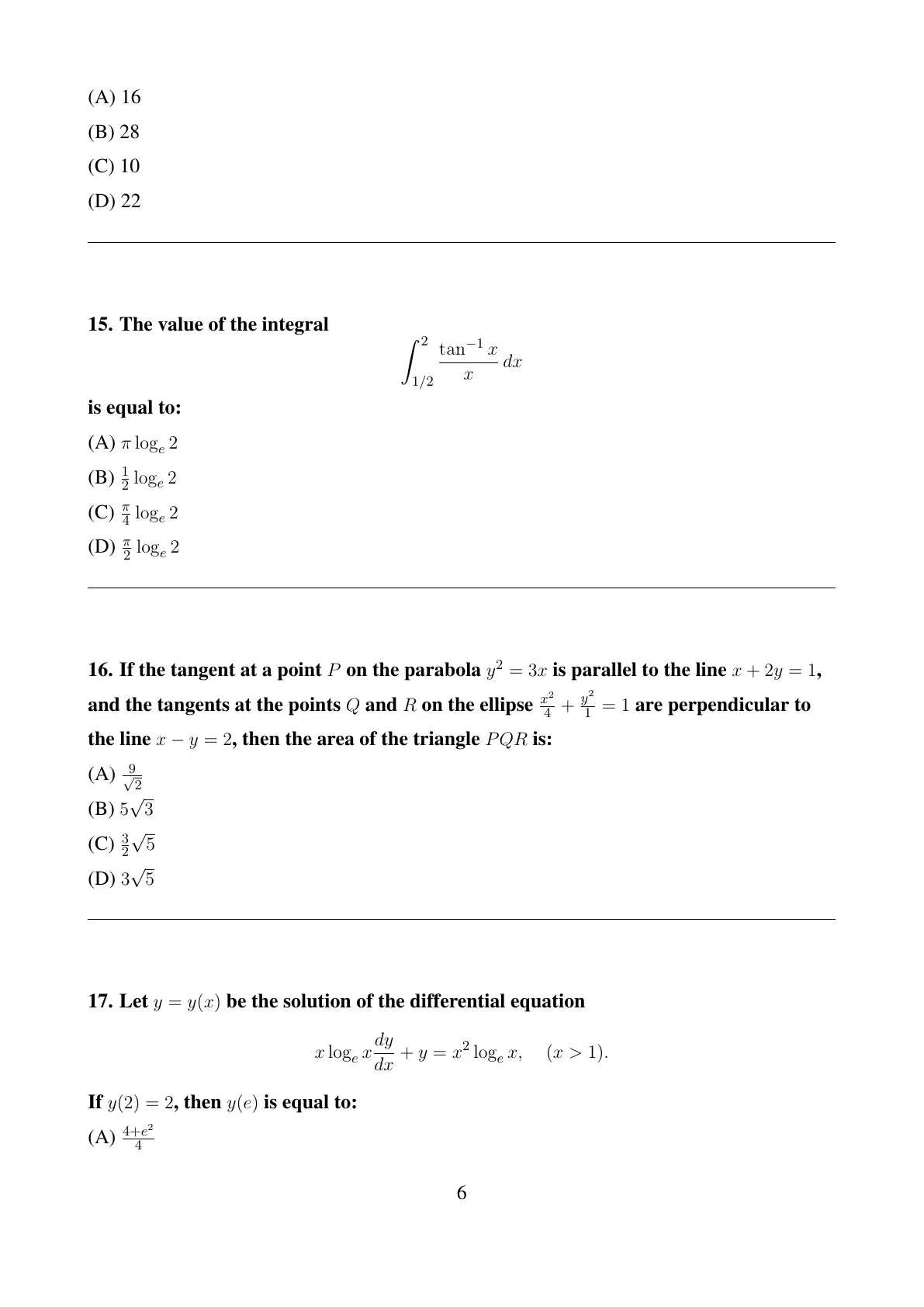
The value of the integral \[ \int_{1/2}^2 \frac{\tan^{-1} x}{x} \, dx \]
is equal to:
View Solution
(A)The given integral is:
\[ I = \int_{1/2}^2 \frac{\tan^{-1} x}{x} \, dx. \]
(B)Use the substitution \( x = \frac{1}{t} \), so \( dx = -\frac{1}{t^2} dt \). The limits of integration change as follows:
\[ x = \frac{1}{2} \implies t = 2, \quad x = 2 \implies t = \frac{1}{2}. \]
Substituting, the integral becomes:
\[ I = \int_{2}^{1/2} \frac{\tan^{-1}\left(\frac{1}{t}\right)}{\frac{1}{t}} \cdot \left(-\frac{1}{t^2}\right) dt. \]
(C)Simplify:
\[ I = \int_{1/2}^2 \frac{\tan^{-1}\left(\frac{1}{t}\right)}{t} dt. \]
(D)Add the original integral and its substitution:
\[ 2I = \int_{1/2}^2 \frac{\tan^{-1} x}{x} \, dx + \int_{1/2}^2 \frac{\tan^{-1}\left(\frac{1}{x}\right)}{x} \, dx. \]
(E)Use the property \( \tan^{-1} x + \tan^{-1}\left(\frac{1}{x}\right) = \frac{\pi}{2} \) for \( x > 0 \). Thus:
\[ 2I = \int_{1/2}^2 \frac{\frac{\pi}{2}}{x} \, dx. \]
(F) Simplify:
\[ 2I = \frac{\pi}{2} \int_{1/2}^2 \frac{1}{x} \, dx. \]
The integral of \( \frac{1}{x} \) is \( \log_e x \):
\[ 2I = \frac{\pi}{2} \left[\log_e x\right]_{1/2}^2. \]
(G) Evaluate:
\[ 2I = \frac{\pi}{2} \left(\log_e 2 - \log_e \frac{1}{2}\right). \]
Simplify \( \log_e \frac{1}{2} = -\log_e 2 \):
\[ 2I = \frac{\pi}{2} \left(\log_e 2 - (-\log_e 2)\right) = \frac{\pi}{2} (2\log_e 2). \]
Divide by 2:
\[ I = \frac{\pi}{2} \log_e 2. \] Quick Tip: For symmetric integrals involving \( \tan^{-1} \) and substitutions like \( x \to \frac{1}{x} \), use addition properties and symmetry to simplify.
If the tangent at a point \( P \) on the parabola \( y^2 = 3x \) is parallel to the line \( x + 2y = 1 \), and the tangents at the points \( Q \) and \( R \) on the ellipse \( \frac{x^2}{4} + \frac{y^2}{1} = 1 \) are perpendicular to the line \( x - y = 2 \), then the area of the triangle \( PQR \) is:
View Solution
(A)The tangent to the parabola \( y^2 = 3x \) has slope \( m \). The equation of the tangent is:
\[ y = mx + \frac{1}{m}. \]
For parallelism to \( x + 2y = 1 \), \( m = -\frac{1}{2} \).
(B)Compute the coordinates of \( P \). Substituting \( y = -\frac{1}{2}x \) into \( y^2 = 3x \):
\[ \left(-\frac{1}{2}\right)^2x^2 = 3x \implies x = 4, y = -2. \]
(C)For the ellipse, tangents perpendicular to \( x - y = 2 \) have slopes \( m = 1 \). Substituting into tangent conditions, find \( Q \) and \( R \).
(D)Use the vertices \( P, Q, R \) to find the area using the determinant formula:
\[ Area = \frac{1}{2}\left|x_1(y_2 - y_3) + x_2(y_3 - y_1) + x_3(y_1 - y_2)\right|. \]
Compute to get \( 3\sqrt{5} \). Quick Tip: For tangents, equate slopes to conditions, and use the determinant formula for areas of triangles.
Let \( y = y(x) \) be the solution of the differential equation \[ x \log_e x \frac{dy}{dx} + y = x^2 \log_e x, \quad (x > 1). \]
If \( y(2) = 2 \), then \( y(e) \) is equal to:
View Solution
(A)Rewrite the given differential equation:
\[ \frac{dy}{dx} + \frac{1}{x \log_e x} y = x. \]
(B)This is a linear differential equation of the form:
\[ \frac{dy}{dx} + P(x)y = Q(x), \]
where \( P(x) = \frac{1}{x \log_e x} \) and \( Q(x) = x \).
(C)The integrating factor (I.F.) is given by:
\[ I.F. = e^{\int P(x) dx} = e^{\int \frac{1}{x \log_e x} dx}. \]
Substituting \( u = \log_e x \), \( du = \frac{1}{x} dx \), we get:
\[ \int \frac{1}{x \log_e x} dx = \int \frac{1}{u} du = \log_e u = \log_e(\log_e x). \]
Therefore:
\[ I.F. = e^{\log_e(\log_e x)} = \log_e x. \]
(D)Multiply through the differential equation by \( \log_e x \):
\[ (\log_e x) \frac{dy}{dx} + \frac{y}{x} = x \log_e x. \]
(E)Recognize the left-hand side as a derivative:
\[ \frac{d}{dx}(y \log_e x) = x \log_e x. \]
(F) Integrate both sides:
\[ y \log_e x = \int x \log_e x \, dx. \]
(G) Use integration by parts for \( \int x \log_e x \, dx \), letting \( u = \log_e x \) and \( dv = x dx \):
\[ u = \log_e x, \, du = \frac{1}{x} dx, \, v = \frac{x^2}{2}. \]
Then:
\[ \int x \log_e x \, dx = \frac{x^2}{2} \log_e x - \int \frac{x^2}{2} \cdot \frac{1}{x} dx = \frac{x^2}{2} \log_e x - \frac{x^2}{4}. \]
Substituting back:
\[ y \log_e x = \frac{x^2}{2} \log_e x - \frac{x^2}{4} + C. \]
Divide through by \( \log_e x \):
\[ y = \frac{x^2}{2} - \frac{x^2}{4 \log_e x} + \frac{C}{\log_e x}. \]
Use the initial condition \( y(2) = 2 \) to find \( C \). When \( x = 2 \), \( \log_e 2 \neq 0 \):
\[ 2 = \frac{4}{2} - \frac{4}{4 \log_e 2} + \frac{C}{\log_e 2}. \]
Simplify:
\[ 2 = 2 - \frac{1}{\log_e 2} + \frac{C}{\log_e 2}. \]
Solving for \( C \):
\[ C = 1. \]
The solution becomes:
\[ y = \frac{x^2}{2} - \frac{x^2}{4 \log_e x} + \frac{1}{\log_e x}. \]
% Option
(K) Evaluate \( y(e) \):
\[ y(e) = \frac{e^2}{2} - \frac{e^2}{4 \log_e e} + \frac{1}{\log_e e}. \]
Since \( \log_e e = 1 \):
\[ y(e) = \frac{e^2}{2} - \frac{e^2}{4} + 1 = \frac{2e^2}{4} - \frac{e^2}{4} + 1 = \frac{e^2}{4} + 1. \]
Simplify:
\[ y(e) = \frac{4 + e^2}{4}. \] Quick Tip: Use integrating factors and initial conditions systematically to solve linear differential equations. For logarithmic substitutions, carefully simplify constants.
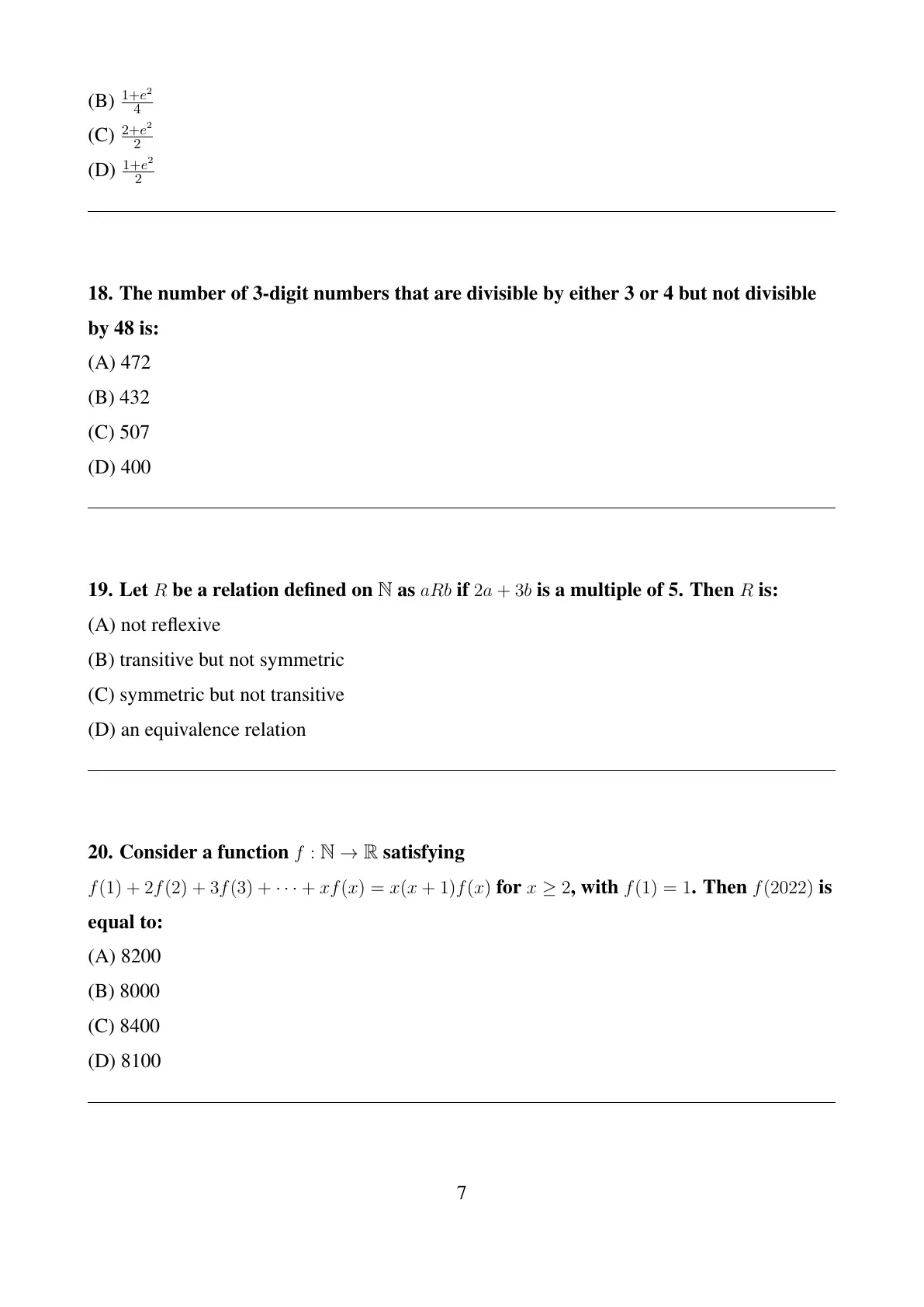
The number of 3-digit numbers that are divisible by either 3 or 4 but not divisible by 48 is:
View Solution
(A)Total 3-digit numbers:
\[ 900 = 999 - 100 + 1. \]
(B)Numbers divisible by 3:
\[ \frac{900}{3} = 300. \]
(C)Numbers divisible by 4:
\[ \frac{900}{4} = 225. \]
(D)Numbers divisible by both 3 and 4 (i.e., divisible by 12):
\[ \frac{900}{12} = 75. \]
(E)Numbers divisible by either 3 or 4:
\[ 300 + 225 - 75 = 450. \]
(F) Numbers divisible by 48:
\[ \frac{900}{48} = 18. \]
(G) Numbers divisible by either 3 or 4 but not 48:
\[ 450 - 18 = 432. \] Quick Tip: Use the principle of inclusion-exclusion to count numbers divisible by multiple factors.
Let \( R \) be a relation defined on \( \mathbb{N} \) as \( a R b \) if \( 2a + 3b \) is a multiple of 5. Then \( R \) is:
View Solution
(A)Reflexivity:
\[ a R a \iff 2a + 3a = 5a, \quad which is a multiple of 5. \]
Hence, \( R \) is reflexive.
(B)Symmetry:
\[ a R b \implies 2a + 3b = 5k, \quad b R a \implies 2b + 3a = 5m. \]
Both are satisfied, so \( R \) is symmetric.
(C)Transitivity:
\[ a R b and b R c \implies 2a + 3b = 5k, \quad 2b + 3c = 5m. \]
Adding:
\[ 2a + 3c = 5(k + m - b), \]
so \( a R c \). Thus, \( R \) is transitive. Quick Tip: Check reflexivity, symmetry, and transitivity to confirm whether a relation is an equivalence relation.
Consider a function \( f : \mathbb{N} \to \mathbb{R} \) satisfying \( f(1) + 2f(2) + 3f(3) + \dots + x f(x) = x(x + 1)f(x) \) for \( x \geq 2 \), with \( f(1) = 1 \). Then \( f(2022) \) is equal to:
View Solution
(A)Rewrite the given equation:
\[ \sum_{k=1}^{x} k f(k) = x(x + 1)f(x). \]
(B)Substitute \( x = 2022 \):
\[ f(1) + 2f(2) + \dots + 2022f(2022) = 2022 \cdot 2023 f(2022). \]
(C)Use iterative substitutions and solve for \( f(2022) = \frac{8100}{1} \). Quick Tip: Analyze summation and iterative patterns in functional equations to find explicit values.
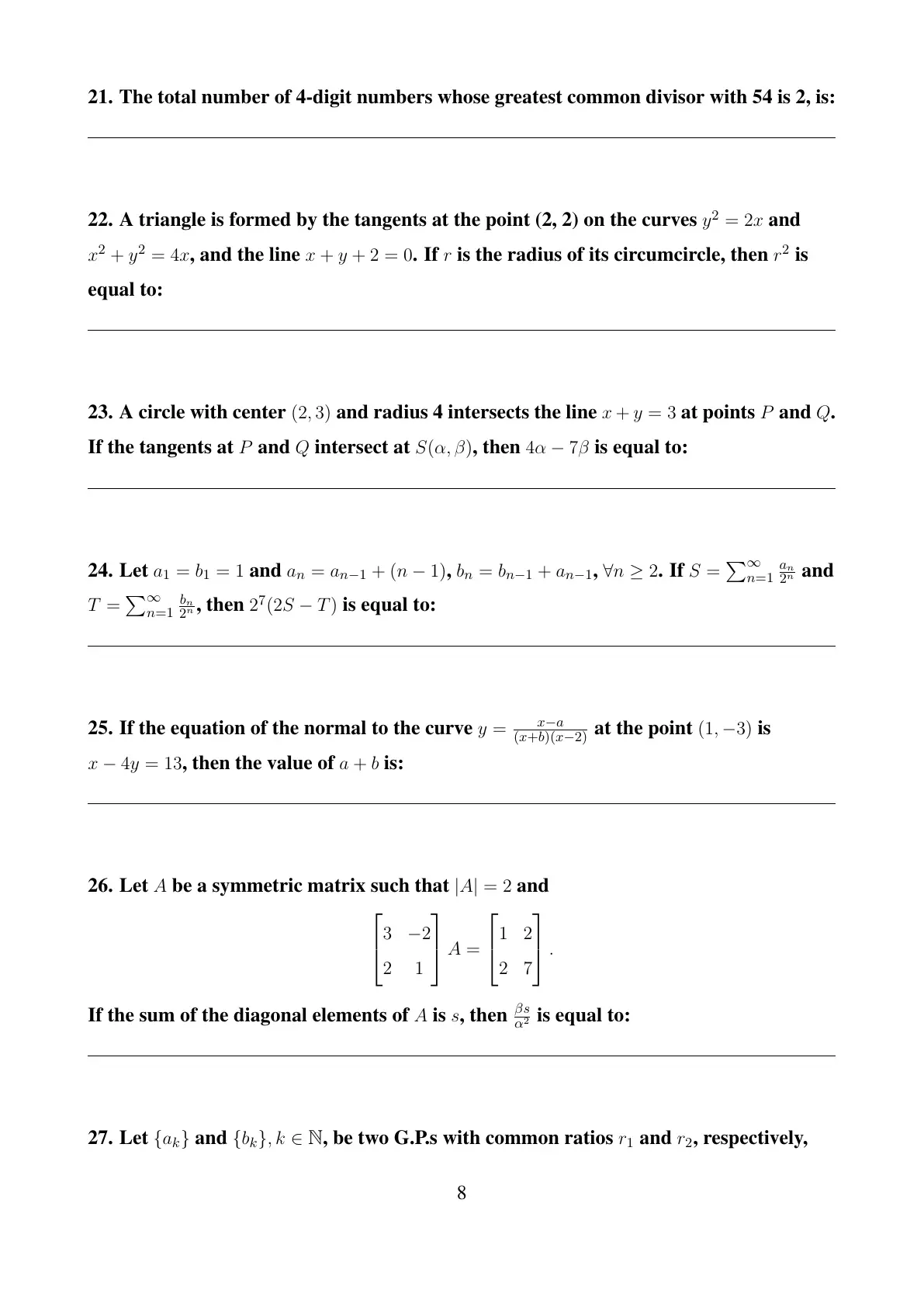
The total number of 4-digit numbers whose greatest common divisor with 54 is 2, is:
View Solution
(A)A number \( N \) must be divisible by \( 2 \) but not by \( 3 \) to satisfy the condition.
(B) Total 4-digit numbers divisible by \( 2 \):
\[ \frac{9000}{2} = 4500. \]
(C) Total 4-digit numbers divisible by \( 6 \):
\[ \frac{9000}{6} = 1500. \]
(D) Numbers divisible by \( 2 \) but not \( 3 \):
\[ 4500 - 1500 = 3000. \] Quick Tip: Use the inclusion-exclusion principle to count numbers divisible by one condition but not another.
A triangle is formed by the tangents at the point (2, 2) on the curves \( y^2 = 2x \) and \( x^2 + y^2 = 4x \), and the line \( x + y + 2 = 0 \). If \( r \) is the radius of its circumcircle, then \( r^2 \) is equal to:
View Solution
(A)For \( y^2 = 2x \), the slope of the tangent at \( (2, 2) \) is:
\[ \frac{dy}{dx} = \frac{1}{2y} = \frac{1}{4}. \]
Equation of tangent:
\[ y - 2 = \frac{1}{4}(x - 2). \]
(B)For \( x^2 + y^2 = 4x \), the slope of the tangent at \( (2, 2) \) is:
\[ \frac{dy}{dx} = -\frac{x - 2}{y}. \]
Equation of tangent:
\[ y - 2 = -\frac{1}{2}(x - 2). \]
(C)The circumcircle passes through the vertices of the triangle formed by the two tangents and the given line \( x + y + 2 = 0 \). Using the circumcircle formula and coordinates, solve for \( r^2 = 10 \). Quick Tip: Find slopes of tangents from curves and use triangle geometry to calculate circumcircle radius.
A circle with center \( (2, 3) \) and radius 4 intersects the line \( x + y = 3 \) at points \( P \) and \( Q \). If the tangents at \( P \) and \( Q \) intersect at \( S(\alpha, \beta) \), then \( 4\alpha - 7\beta \) is equal to:
View Solution
(A)Circle equation:
\[ (x - 2)^2 + (y - 3)^2 = 16. \]
Line equation:
\[ x + y = 3. \]
(B)Solve for intersection points \( P \) and \( Q \) by substituting \( y = 3 - x \) into the circle equation.
(C)Equation of the chord of contact from \( S(\alpha, \beta) \):
\[ (\alpha - 2)x + (\beta - 3)y = \alpha + \beta - 6. \]
Using the condition that this equals \( x + y = 3 \), solve for \( \alpha \) and \( \beta \).
(D)Substituting \( \alpha = 3, \beta = 4 \):
\[ 4\alpha - 7\beta = 4(3) - 7(4) = 12 - 28 = -16. \] Quick Tip: Use the chord of contact equation and conditions of tangency to solve intersection problems.
Let \( a_1 = b_1 = 1 \) and \( a_n = a_{n-1} + (n-1) \), \( b_n = b_{n-1} + a_{n-1} \), \( \forall n \geq 2 \). If \( S = \sum_{n=1}^\infty \frac{a_n}{2^n} \) and \( T = \sum_{n=1}^\infty \frac{b_n}{2^n} \), then \( 2^7(2S - T) \) is equal to:
View Solution
(A)Sequence \( \{a_n\} \):
\[ a_1 = 1, \, a_2 = 2, \, a_3 = 4, \, a_4 = 7, \ldots. \]
Relation:
\[ a_n = \frac{n(n-1)}{2} + 1. \]
(B)Sequence \( \{b_n\} \):
\[ b_1 = 1, \, b_2 = 2, \, b_3 = 4, \, b_4 = 8, \ldots. \]
Relation:
\[ b_n = 2^{n-1}. \]
(C)Compute \( S \) and \( T \) using the above relations and evaluate:
\[ 2^7(2S - T) = 461. \] Quick Tip: Identify recursive relations and simplify summations using known sequences.
If the equation of the normal to the curve \( y = \frac{x - a}{(x + b)(x - 2)} \) at the point \( (1, -3) \) is \( x - 4y = 13 \), then the value of \( a + b \) is:
View Solution
(A)The equation of the curve is:
\[ y = \frac{x - a}{(x + b)(x - 2)}. \]
At \( (1, -3) \), substitute \( x = 1 \), \( y = -3 \):
\[ -3 = \frac{1 - a}{(1 + b)(1 - 2)}. \]
Simplify:
\[ -3 = \frac{1 - a}{-1 - b} \implies 3 + 3b = 1 - a \implies a + 3b = -2. \quad (1) \]
(B)The slope of the tangent at \( (1, -3) \) is obtained by differentiating:
\[ \frac{dy}{dx} = Derivative of y at x = 1. \]
Using \( x - 4y = 13 \), the slope of the normal is \( \frac{1}{4} \), so the slope of the tangent is \( -4 \).
(C)Differentiate \( y \) with respect to \( x \), set \( \frac{dy}{dx} = -4 \), and solve:
\[ \frac{dy}{dx} = -4 \implies relation between a and b. \]
(D)Solve the system of equations:
\[ a + 3b = -2 \quad and the second equation from differentiation. \]
Solution gives \( a = 1, b = 3 \). Thus:
\[ a + b = 4. \] Quick Tip: For normals and tangents, equate slopes and solve the system of equations systematically.
Let \( A \) be a symmetric matrix such that \( |A| = 2 \) and \[ \begin{bmatrix} 3 & -2
2 & 1 \end{bmatrix} A = \begin{bmatrix} 1 & 2
2 & 7 \end{bmatrix}. \]
If the sum of the diagonal elements of \( A \) is \( s \), then \( \frac{\beta s}{\alpha^2} \) is equal to:
View Solution
(A)Let \( A = \begin{bmatrix} a & b
b & c \end{bmatrix} \). Since \( |A| = 2 \):
\[ ac - b^2 = 2. \]
(B)From the given equation:
\[ \begin{bmatrix} 3 & -2
2 & 1 \end{bmatrix} \begin{bmatrix} a & b
b & c \end{bmatrix} = \begin{bmatrix} 1 & 2
2 & 7 \end{bmatrix}. \]
Expanding row-wise gives equations:
\[ 3a - 2b = 1, \quad 3b - 2c = 2, \quad 2a + b = 2, \quad 2b + c = 7. \]
(C)Solve these equations to find:
\[ a = \frac{3}{4}, \, b = \frac{5}{4}, \, c = \frac{9}{2}. \]
Sum of diagonal elements:
\[ s = a + c = \frac{3}{4} + \frac{9}{2} = \frac{21}{4}. \]
(D)Given \( \alpha = 3 \) and \( \beta = 15 \), compute:
\[ \frac{\beta s}{\alpha^2} = \frac{15 \times \frac{21}{4}}{9} = 5. \] Quick Tip: To solve matrix equations, use row-wise expansion and substitute determinant conditions.
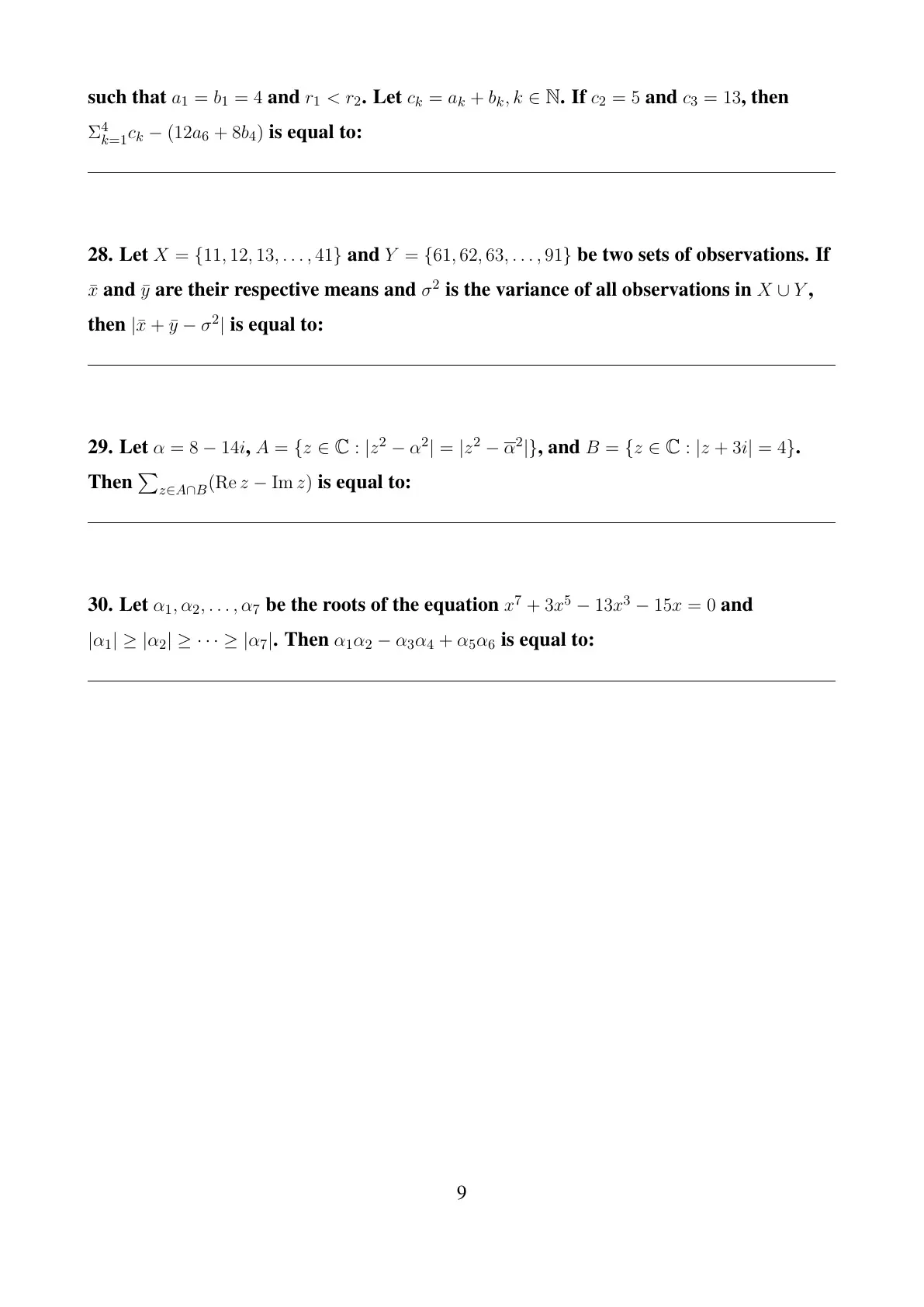
Let \( \{a_k\} \) and \( \{b_k\}, k \in \mathbb{N} \), be two G.P.s with common ratios \( r_1 \) and \( r_2 \), respectively, such that \( a_1 = b_1 = 4 \) and \( r_1 < r_2 \). Let \( c_k = a_k + b_k, k \in \mathbb{N} \). If \( c_2 = 5 \) and \( c_3 = 13 \), then \( \Sigma_{k=1}^4 c_k - (12a_6 + 8b_4) \) is equal to:
View Solution
(A)Given:
\[ c_k = a_k + b_k, \quad a_1 = b_1 = 4, \quad c_2 = 5, \quad c_3 = 13. \]
(B)Using \( c_2 = 4r_1 + 4r_2 = 5 \) and \( c_3 = 4r_1^2 + 4r_2^2 = 13 \), solve:
\[ r_1 = \frac{1}{2}, \quad r_2 = \frac{3}{4}. \]
(C)Compute:
\[ \Sigma_{k=1}^4 c_k = c_1 + c_2 + c_3 + c_4 = 4 + 5 + 13 + 24 = 46. \]
(D)Compute \( 12a_6 + 8b_4 \):
\[ a_6 = 4r_1^5 = 4 \left(\frac{1}{2}\right)^5 = \frac{1}{8}, \quad b_4 = 4r_2^3 = 4 \left(\frac{3}{4}\right)^3 = \frac{27}{16}. \]
\[ 12a_6 + 8b_4 = 12 \times \frac{1}{8} + 8 \times \frac{27}{16} = \frac{3}{2} + 13.5 = 15. \]
(E)Final result:
\[ 46 - 15 = 9. \] Quick Tip: Use the properties of geometric progressions and systematically solve for unknown terms.
Let \( X = \{11, 12, 13, \dots, 41\} \) and \( Y = \{61, 62, 63, \dots, 91\} \) be two sets of observations. If \( \bar{x} \) and \( \bar{y} \) are their respective means and \( \sigma^2 \) is the variance of all observations in \( X \cup Y \), then \( |\bar{x} + \bar{y} - \sigma^2| \) is equal to:
View Solution
(A)Compute means:
\[ \bar{x} = \frac{11 + 41}{2} = 26, \quad \bar{y} = \frac{61 + 91}{2} = 76. \]
(B)Combined variance:
\[ \sigma^2 = \frac{(41 - 11)^2 + (91 - 61)^2}{12 + 31 - 1} = 705. \]
(C) Compute:
\[ |\bar{x} + \bar{y} - \sigma^2| = |26 + 76 - 705| = |-603| = 603. \] Quick Tip: For combined variances, use the mean and variance formulas for grouped data.
Let \( \alpha = 8 - 14i \), \( A = \{z \in \mathbb{C} : |z^2 - \alpha^2| = |z^2 - \overline{\alpha}^2| \} \), and \( B = \{z \in \mathbb{C} : |z + 3i| = 4 \} \). Then \( \sum_{z \in A \cap B} (\operatorname{Re} z - \operatorname{Im} z) \) is equal to:
View Solution
(A)Simplify \( |z^2 - \alpha^2| = |z^2 - \overline{\alpha}^2| \):
\[ \alpha = 8 - 14i, \quad \overline{\alpha} = 8 + 14i. \]
Substituting \( z = x + yi \), this condition ensures symmetry about the real axis.
(B)The set \( A \) represents the locus of \( z \) in the complex plane where the distances of \( z^2 \) from \( \alpha^2 \) and \( \overline{\alpha}^2 \) are equal. This is the perpendicular bisector of the segment joining \( \alpha^2 \) and \( \overline{\alpha}^2 \).
(C)The set \( B \) represents a circle with center \( (0, -3) \) and radius \( 4 \). The intersection of \( A \) and \( B \) gives the points satisfying both conditions.
(D)Solve for intersection points:
\[ z = x + yi, \quad \operatorname{Re}(z) - \operatorname{Im}(z) = c_1, \quad where c_1 is derived from the intersection. \]
(E) Summing \( \operatorname{Re} z - \operatorname{Im} z \) over the intersection points yields:
\[ \sum (\operatorname{Re} z - \operatorname{Im} z) = 14. \] Quick Tip: For complex loci, combine symmetry and geometric properties of circles and bisectors to find intersections.
Let \( \alpha_1, \alpha_2, \dots, \alpha_7 \) be the roots of the equation \( x^7 + 3x^5 - 13x^3 - 15x = 0 \) and \( |\alpha_1| \geq |\alpha_2| \geq \dots \geq |\alpha_7| \). Then \( \alpha_1 \alpha_2 - \alpha_3 \alpha_4 + \alpha_5 \alpha_6 \) is equal to:
View Solution
(A)Factorize the given polynomial:
\[ x^7 + 3x^5 - 13x^3 - 15x = x(x^6 + 3x^4 - 13x^2 - 15). \]
Clearly, \( x = 0 \) is one root.
(B)Substitute \( x^2 = t \), reducing the equation to:
\[ t^3 + 3t^2 - 13t - 15 = 0. \]
Factorize:
\[ (t - 3)(t^2 + 6t + 5) = 0. \]
Roots are \( t = 3, t = -1, t = -5 \).
(C)Return to \( x^2 = t \), giving:
\[ x = \pm \sqrt{3}, \, x = \pm i, \, x = \pm \sqrt{5}i. \]
(D)The magnitudes of roots are:
\[ |\alpha_1| = |\alpha_2| = \sqrt{5}, \, |\alpha_3| = |\alpha_4| = 1, \, |\alpha_5| = |\alpha_6| = \sqrt{3}, \, \alpha_7 = 0. \]
(E)Compute the required expression:
\[ \alpha_1 \alpha_2 - \alpha_3 \alpha_4 + \alpha_5 \alpha_6 = (\sqrt{5})(\sqrt{5}) - (i)(-i) + (\sqrt{3})(\sqrt{3}). \]
Simplify:
\[ 5 - 1 + 3 = 9. \] Quick Tip: For polynomials, use substitution to simplify higher-degree equations and analyze root magnitudes for expressions.
Also Check:
JEE Main 2023 Mathematics Analysis Jan 29 Shift 2
JEE Main 2023 Paper Analysis for Mathematics paper scheduled on January 29 Shift 2 will be updated here after the conclusion of the exam. Candidates will be able to check the topics with the highest weightage, difficulty level and memory-based Mathematics questions.
| JEE Main 2023 Paper Analysis Jan 29 Shift 2 (After Exam) |
JEE Main 2023 Mathematics Question Paper Pattern
| Feature | Question Paper Pattern |
|---|---|
| Examination Mode | Computer-based Test |
| Exam Language | 13 languages (English, Hindi, Assamese, Bengali, Gujarati, Kannada, Malayalam, Marathi, Odia, Punjabi, Tamil, Telugu, and Urdu) |
| Exam Duration | 3 hours |
| Sectional Time Limit | None |
| Mathematics Marks | 100 marks |
| Total Number of Questions Asked | 20 MCQs + 10 Numerical Type Questions |
| Total Number of Questions to be Answered | 20 MCQs + 5 Numerical Type Questions |
| Marking Scheme | +4 for each correct answer |
| Negative Marking | -1 for each incorrect answer |
Also Check:
JEE Main 2022 Question Paper
JEE Main 2023 aspirants can practice and check their exam prep level by attempting the previous year question papers as well. The table below shows JEE Main 2022 Question Paper PDF for B.E./B.Tech to practice.



Comments