




JEE Main 2023 Mathematics Question Paper Feb 1 Shift 1 is updated here after the conclusion of the exam. Candidates can download JEE Main 2023 Mathematics Question Paper PDF with Answer Key for Feb 1 Shift 1 using the link below. JEE Main Mathematics Question Paper is divided into two sections, Section A with 20 MCQs and Section B with 10 numerical type questions. Candidates are required to answer all questions from Section A and any 5 questions from section B.
Related Links:
- Download JEE Main Previous Year Question Papers PDF with Solutions
- Download JEE Main 2025 Question Paper for all Shifts
JEE Main 2023 Mathematics Question Paper Feb 1 Shift 1- Download PDF
| JEE Main 2023 1 Feb Shift 1 Mathematics Question Paper with Solution PDF |  Download Download |
Check Solution |
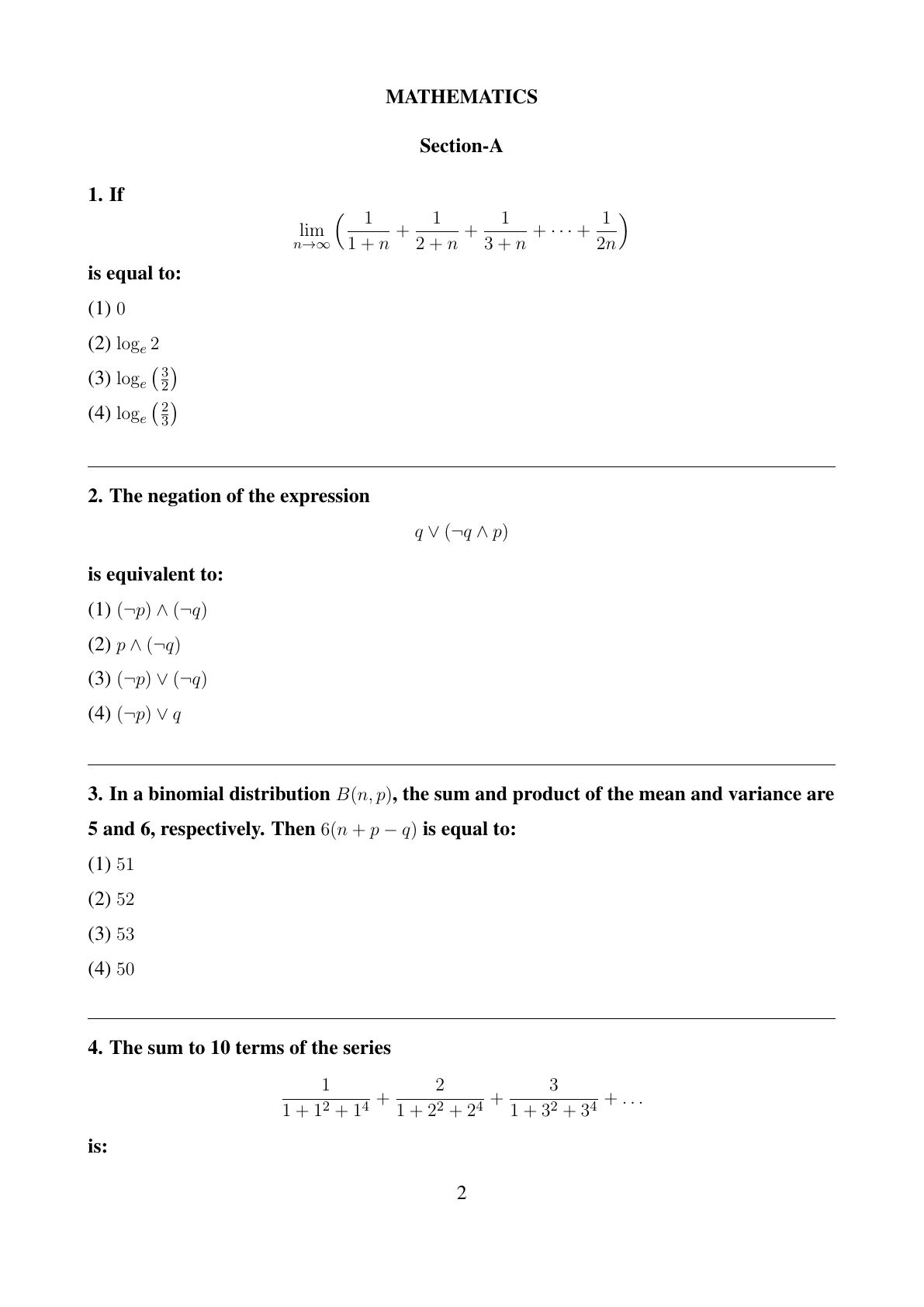
If \[ \lim_{n \to \infty} \left( \frac{1}{1+n} + \frac{1}{2+n} + \frac{1}{3+n} + \dots + \frac{1}{2n} \right) \]
is equal to:
View Solution
The negation of the expression \[ q \vee (\neg q \wedge p) \]
is equivalent to:
View Solution
In a binomial distribution \( B(n, p) \), the sum and product of the mean and variance are 5 and 6, respectively. Then \( 6(n + p - q) \) is equal to:
View Solution
The sum to 10 terms of the series \[ \frac{1}{1+1^2+1^4} + \frac{2}{1+2^2+2^4} + \frac{3}{1+3^2+3^4} + \dots \]
is:
View Solution
The value of \[ \frac{1}{1!50!} + \frac{1}{3!48!} + \frac{1}{5!46!} + \dots + \frac{1}{49!2!} + \frac{1}{51!1!} \]
is:
View Solution
If the orthocentre of a triangle, whose vertices are \( (1,2) \), \( (2,3) \), and \( (3,1) \) is \( (\alpha, \beta) \),
then the quadratic equation whose roots are \( \alpha + 4\beta \)
and \( 4\alpha + \beta \) is:
View Solution
For a triangle ABC, the value of \[ \cos 2A + \cos 2B + \cos 2C \]
is least. If its inradius is 3 and incentre is M, then which of the following is NOT correct?
View Solution
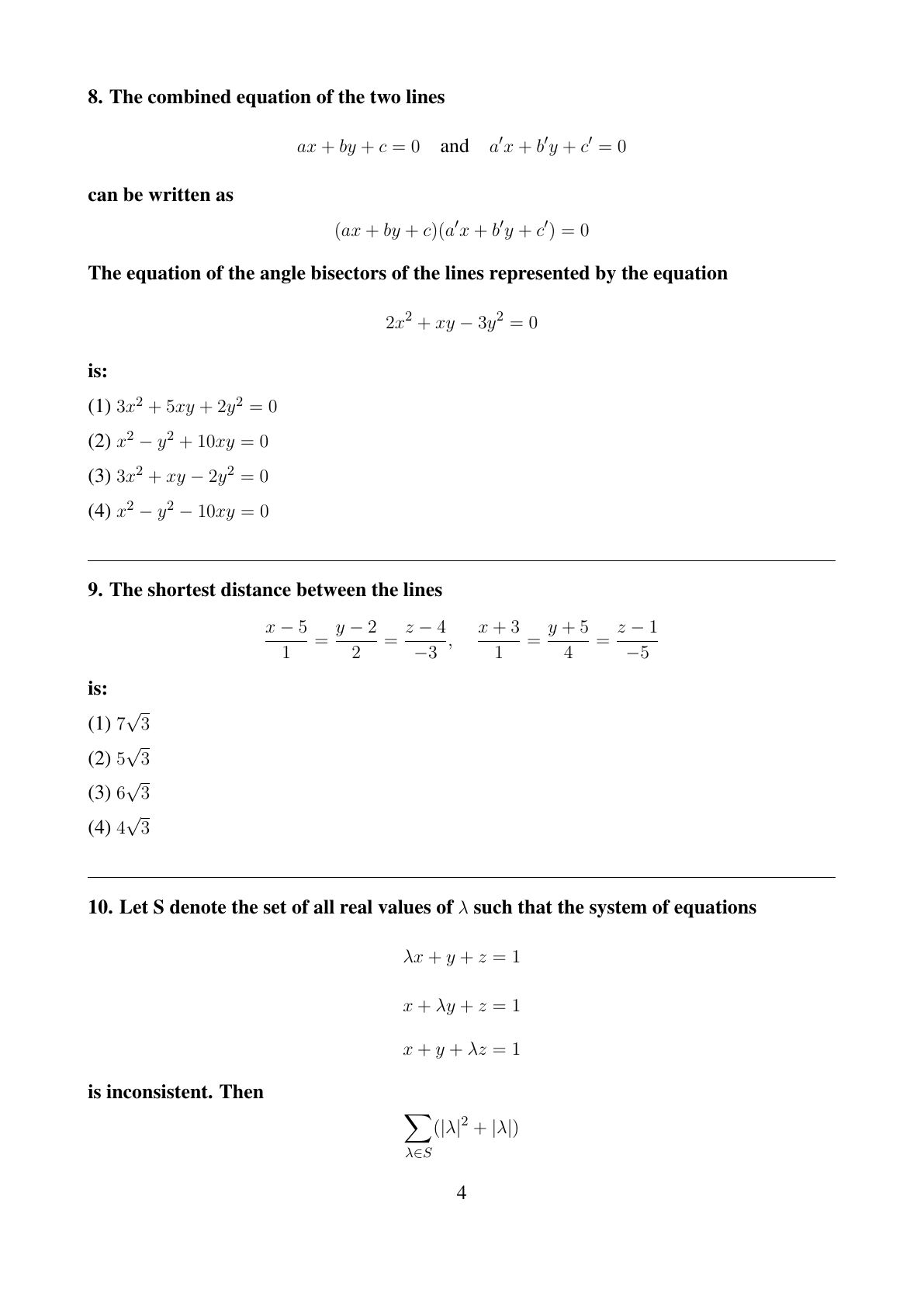
The combined equation of the two lines \[ ax + by + c = 0 \quad and \quad a'x + b'y + c' = 0 \]
can be written as \[ (ax + by + c)(a'x + b'y + c') = 0 \]
The equation of the angle bisectors of the lines represented by the equation \[ 2x^2 + xy - 3y^2 = 0 \]
is:
View Solution
The shortest distance between the lines \[ \frac{x-5}{1} = \frac{y-2}{2} = \frac{z-4}{-3}, \quad \frac{x+3}{1} = \frac{y+5}{4} = \frac{z-1}{-5} \]
is:
View Solution
Let S denote the set of all real values of \( \lambda \) such that the system of equations \[ \lambda x + y + z = 1 \] \[ x + \lambda y + z = 1 \] \[ x + y + \lambda z = 1 \]
is inconsistent. Then \[ \sum_{\lambda \in S} (|\lambda|^2 + |\lambda|) \]
is equal to:
View Solution
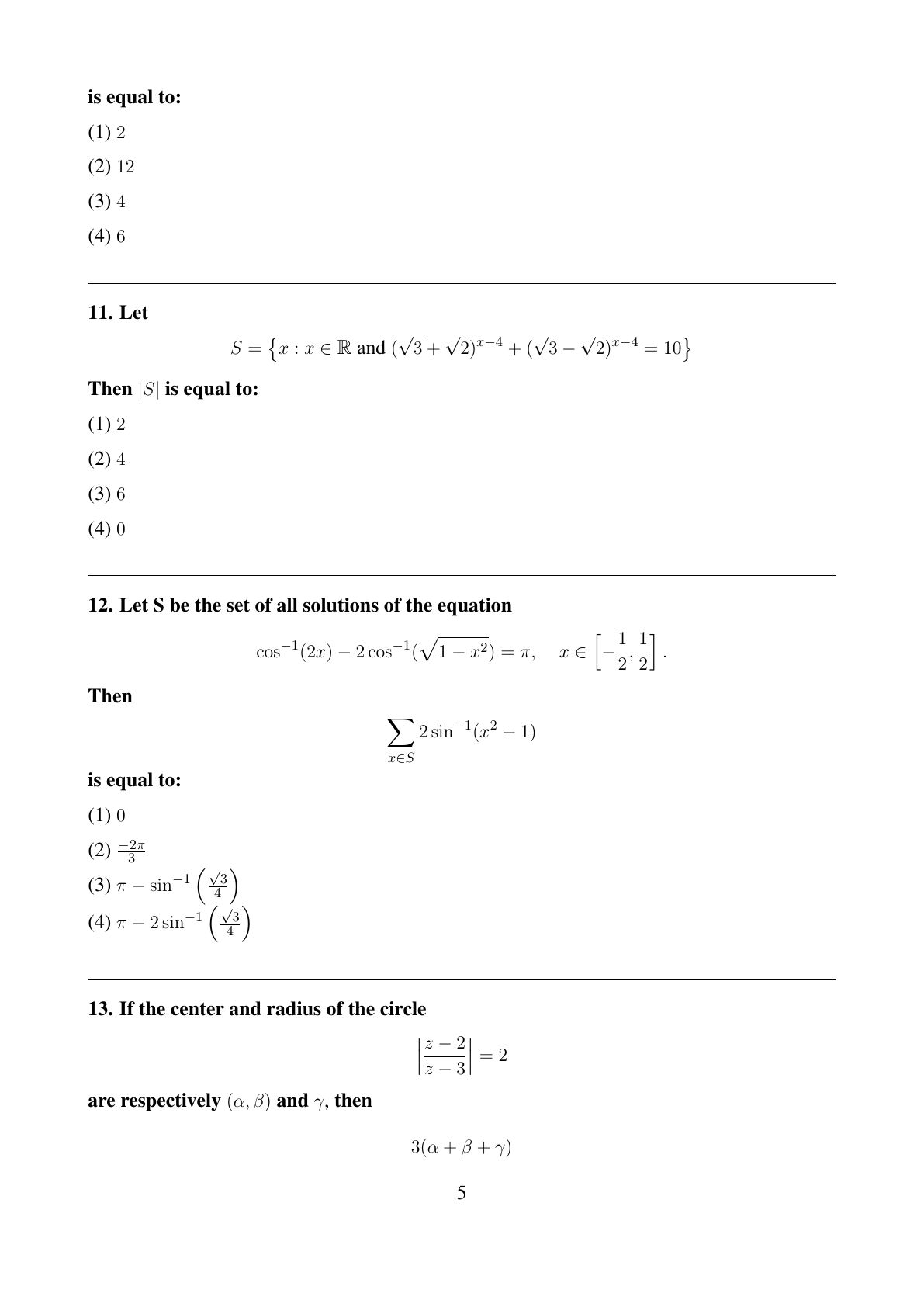
Let \[ S = \left\{ x : x \in \mathbb{R} and (\sqrt{3} + \sqrt{2})^{x-4} + (\sqrt{3} - \sqrt{2})^{x-4} = 10 \right\} \]
Then \( |S| \) is equal to:
View Solution
Let S be the set of all solutions of the equation \[ \cos^{-1} (2x) - 2\cos^{-1} (\sqrt{1 - x^2}) = \pi, \quad x \in \left[ -\frac{1}{2}, \frac{1}{2} \right]. \]
Then \[ \sum_{x \in S} 2 \sin^{-1} (x^2 - 1) \]
is equal to:
View Solution
If the center and radius of the circle \[ \left| \frac{z - 2}{z - 3} \right| = 2 \]
are respectively \( (\alpha, \beta) \) and \( \gamma \), then \[ 3(\alpha + \beta + \gamma) \]
is equal to:
View Solution
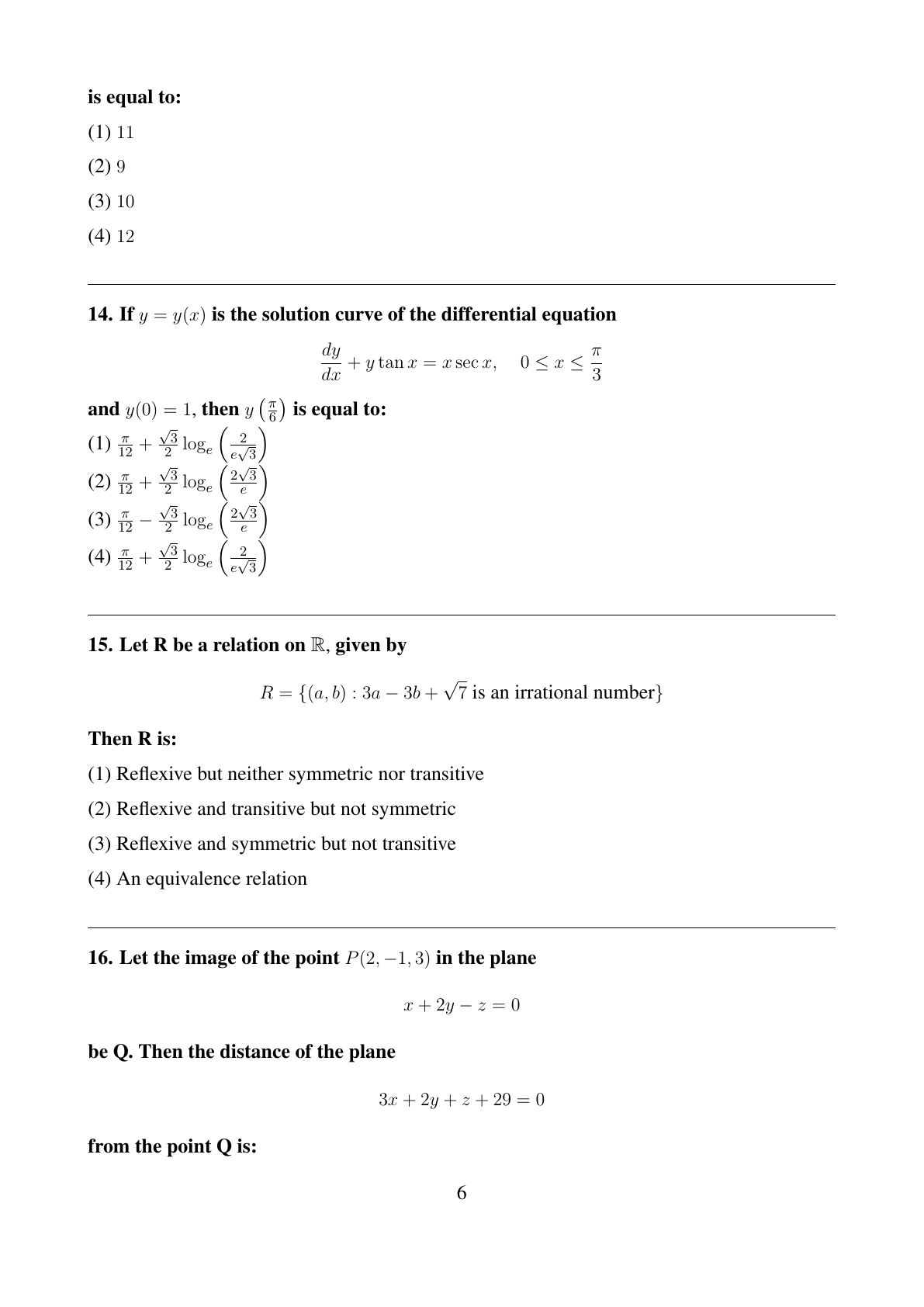
If \( y = y(x) \) is the solution curve of the differential equation \[ \frac{dy}{dx} + y \tan x = x \sec x, \quad 0 \leq x \leq \frac{\pi}{3} \]
and \( y(0) = 1 \), then \( y \left( \frac{\pi}{6} \right) \) is equal to:
View Solution
Let R be a relation on \( \mathbb{R} \), given by \[ R = \{ (a, b) : 3a - 3b + \sqrt{7} is an irrational number \} \]
Then R is:
View Solution
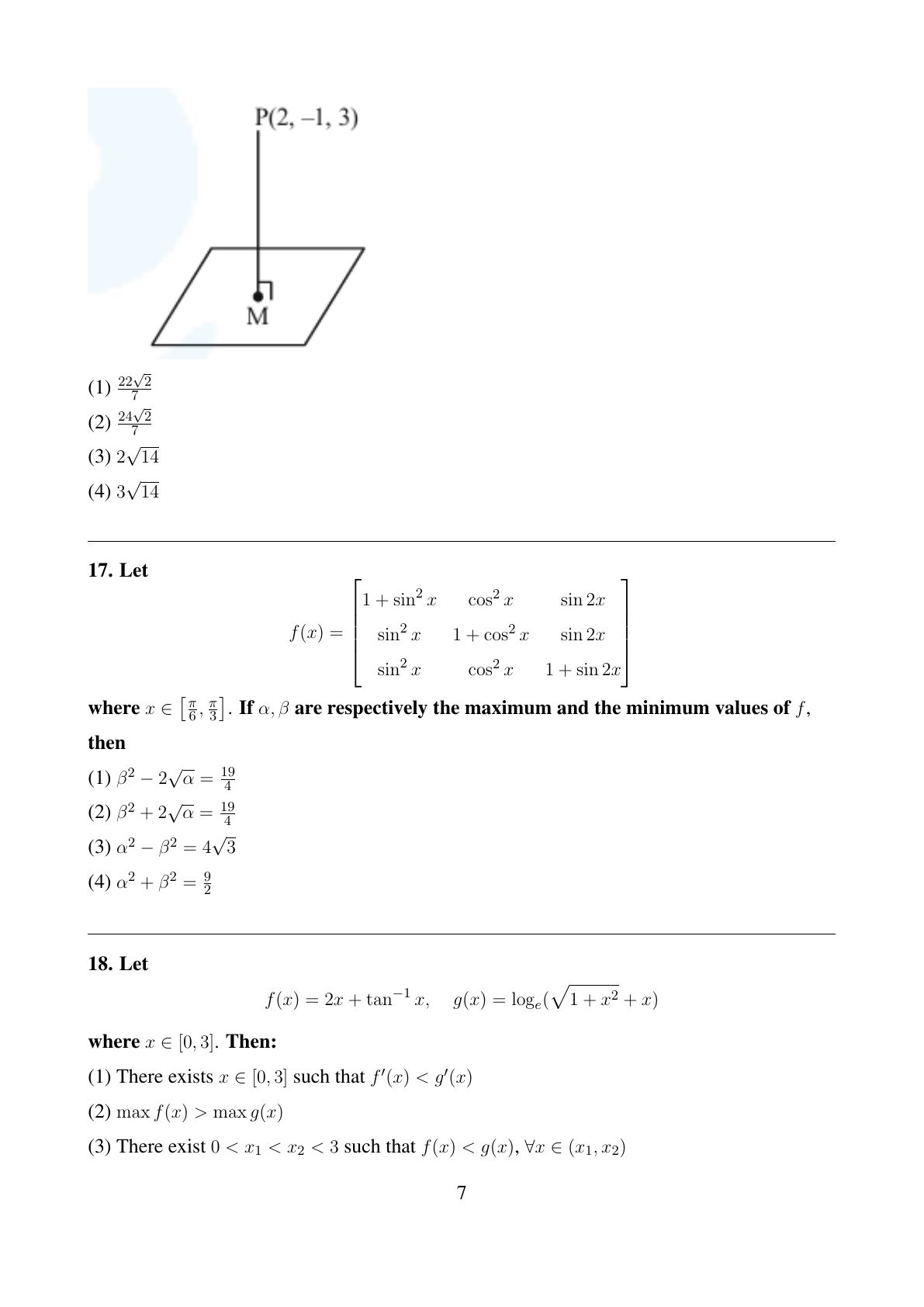
Let the image of the point \( P(2, -1, 3) \) in the plane \[ x + 2y - z = 0 \]
be Q. Then the distance of the plane \[ 3x + 2y + z + 29 = 0 \]
from the point Q is:

View Solution
Let \[ f(x) = \begin{bmatrix} 1 + \sin^2 x & \cos^2 x & \sin 2x
\sin^2 x & 1 + \cos^2 x & \sin 2x
\sin^2 x & \cos^2 x & 1 + \sin 2x \end{bmatrix} \]
where \( x \in \left[ \frac{\pi}{6}, \frac{\pi}{3} \right] \).
If \( \alpha, \beta \) are respectively the maximum and the minimum values of \( f \), then
View Solution
Let \[ f(x) = 2x + \tan^{-1} x, \quad g(x) = \log_e (\sqrt{1 + x^2} + x) \]
where \( x \in [0, 3] \). Then:
View Solution
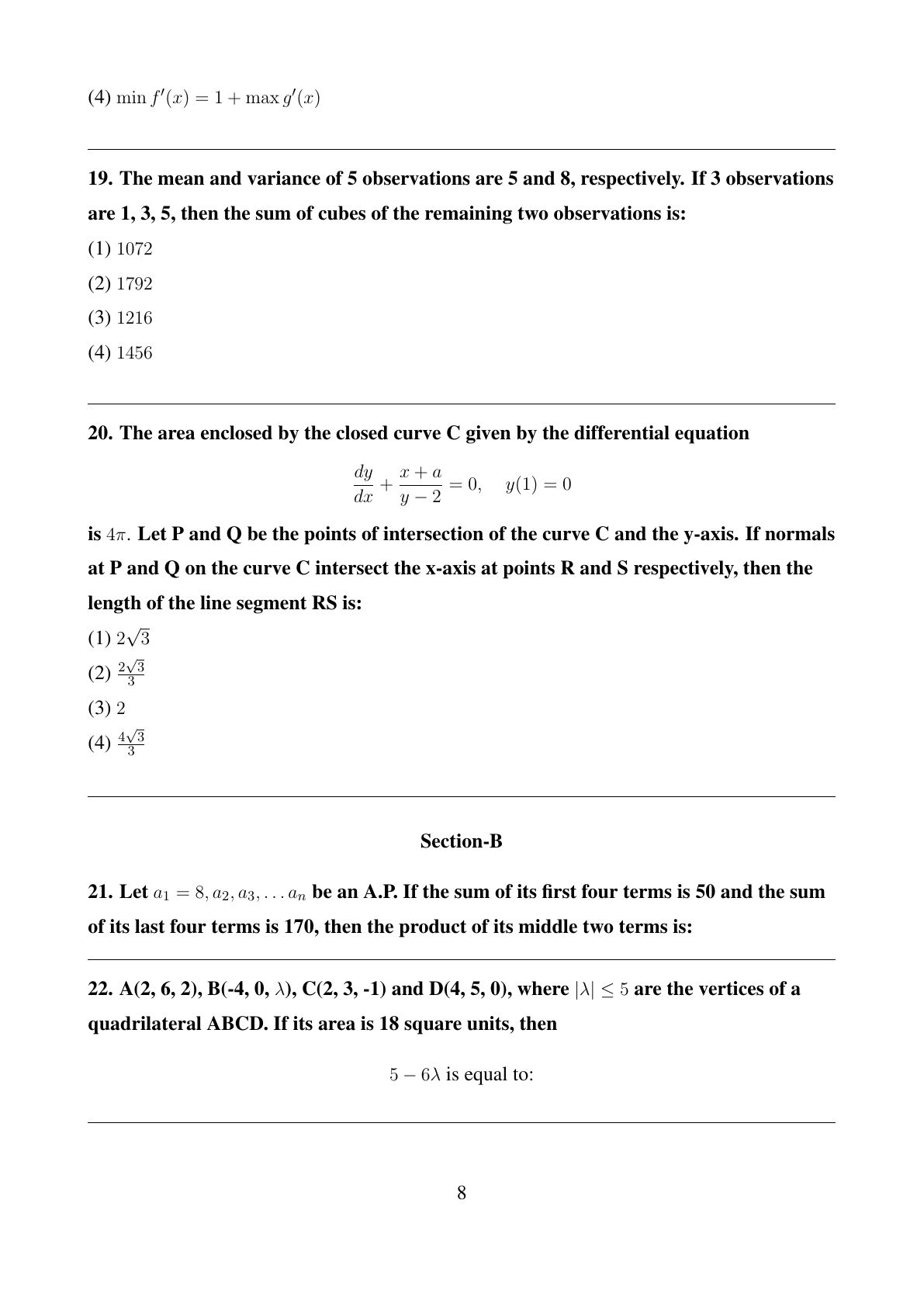
The mean and variance of 5 observations are 5 and 8, respectively. If 3 observations are 1, 3, 5, then the sum of cubes of the remaining two observations is:
View Solution
The area enclosed by the closed curve C given by the differential equation \[ \frac{dy}{dx} + \frac{x + a}{y - 2} = 0, \quad y(1) = 0 \]
is \( 4\pi \).
Let P and Q be the points of intersection of the curve C and the y-axis. If normals at P and Q on the curve C intersect the x-axis at points R and S respectively, then the length of the line segment RS is:
View Solution
Let \( a_1 = 8, a_2, a_3, \dots a_n \) be an A.P. If the sum of its first four terms is 50 and the sum of its last four terms is 170, then the product of its middle two terms is:
A(2, 6, 2), B(-4, 0, \( \lambda \)), C(2, 3, -1) and D(4, 5, 0), where \( |\lambda| \leq 5 \)
are the vertices of a quadrilateral ABCD. If its area is 18 square units, then \[ 5 - 6\lambda is equal to: \]
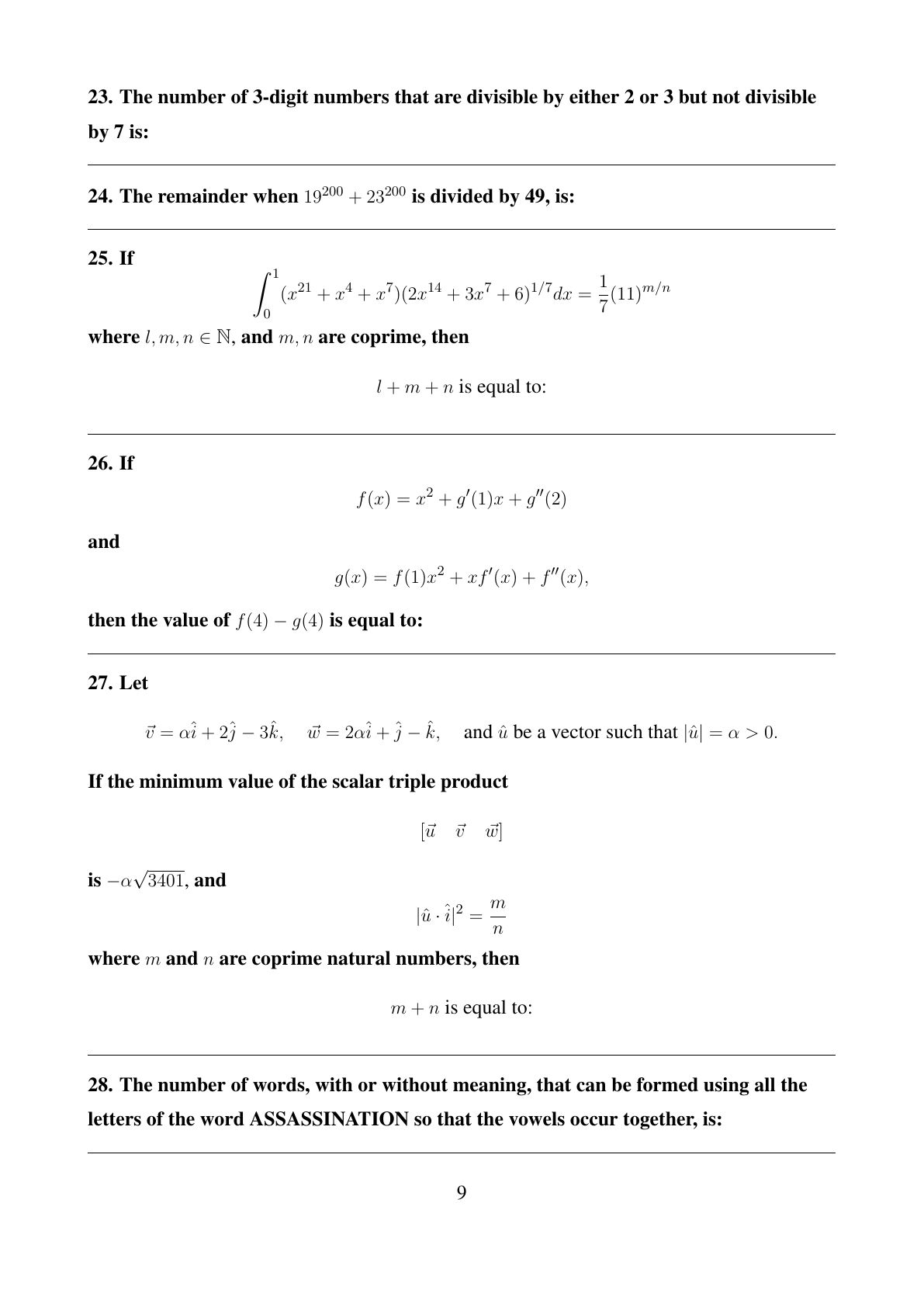
The number of 3-digit numbers that are divisible by either 2 or 3 but not divisible by 7 is:
The remainder when \( 19^{200} + 23^{200} \) is divided by 49, is:
If \[ \int_{0}^{1} (x^{21} + x^4 + x^7)(2x^{14} + 3x^7 + 6)^{1/7} dx = \frac{1}{7} (11)^{m/n} \]
where \( l, m, n \in \mathbb{N} \), and \( m, n \) are coprime, then \[ l + m + n is equal to: \]
If \[ f(x) = x^2 + g'(1)x + g''(2) \]
and \[ g(x) = f(1)x^2 + xf'(x) + f''(x), \]
then the value of \( f(4) - g(4) \) is equal to:
Let \[ \vec{v} = \alpha \hat{i} + 2 \hat{j} - 3 \hat{k}, \quad \vec{w} = 2\alpha \hat{i} + \hat{j} - \hat{k}, \quad and \hat{u} be a vector such that |\hat{u}| = \alpha > 0. \]
If the minimum value of the scalar triple product \[ [\vec{u} \quad \vec{v} \quad \vec{w}] \]
is \( -\alpha \sqrt{3401} \),
and \[ |\hat{u} \cdot \hat{i}|^2 = \frac{m}{n} \]
where \( m \) and \( n \) are coprime natural numbers, then \[ m + n is equal to: \]
The number of words, with or without meaning, that can be formed using all the letters of the word ASSASSINATION so that the vowels occur together, is:
Let A be the area bounded by the curve \[ y = x |x - 3| \]
the x-axis, and the ordinates \( x = -1 \) and \( x = 2 \).
Then \( 12A \) is equal to:
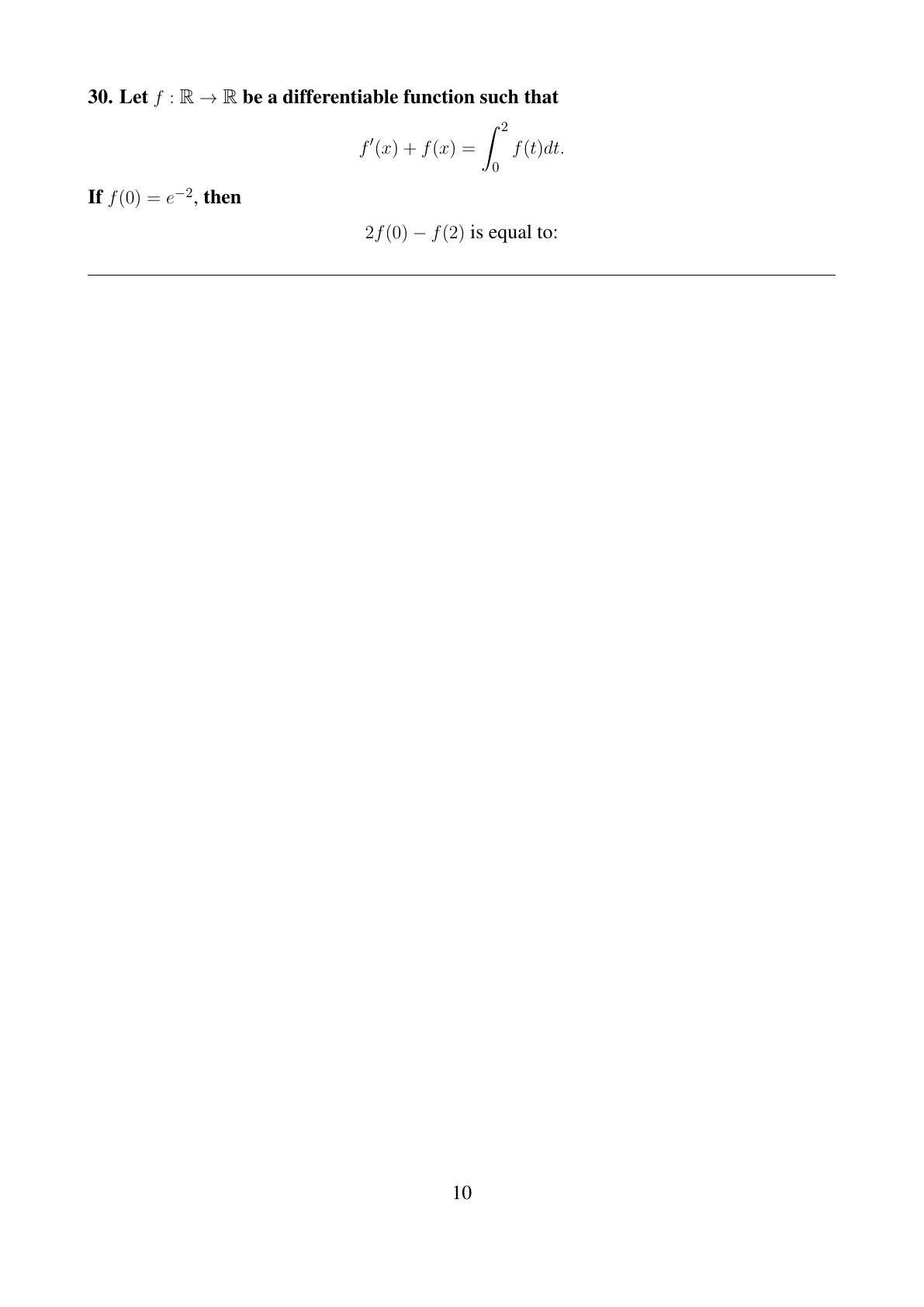
Let \( f: \mathbb{R} \to \mathbb{R} \) be a differentiable function such that \[ f'(x) + f(x) = \int_{0}^{2} f(t) dt. \]
If \( f(0) = e^{-2} \), then \[ 2f(0) - f(2) is equal to: \]
Also Check:
JEE Main 2023 Mathematics Analysis Feb 1 Shift 1
JEE Main 2023 Paper Analysis for Mathematics paper scheduled on February 1 Shift 1 will be updated here after the conclusion of the exam. Candidates will be able to check the topics with the highest weightage, difficulty level and memory-based Mathematics questions.
| JEE Main 2023 Paper Analysis Feb 1 Shift 1 (After Exam) |
JEE Main 2023 Mathematics Question Paper Pattern
| Feature | Question Paper Pattern |
|---|---|
| Examination Mode | Computer-based Test |
| Exam Language | 13 languages (English, Hindi, Assamese, Bengali, Gujarati, Kannada, Malayalam, Marathi, Odia, Punjabi, Tamil, Telugu, and Urdu) |
| Exam Duration | 3 hours |
| Sectional Time Limit | None |
| Mathematics Marks | 100 marks |
| Total Number of Questions Asked | 20 MCQs + 10 Numerical Type Questions |
| Total Number of Questions to be Answered | 20 MCQs + 5 Numerical Type Questions |
| Marking Scheme | +4 for each correct answer |
| Negative Marking | -1 for each incorrect answer |
Also Check:
JEE Main 2022 Question Paper
JEE Main 2023 aspirants can practice and check their exam prep level by attempting the previous year question papers as well. The table below shows JEE Main 2022 Question Paper PDF for B.E./B.Tech to practice.



Comments