




JEE Main 2022 July 29 Shift 1 Question Paper is available here with solutions PDF and detailed solutions for every question. NTA conducted the first shift on July 29, 2022, from 9:00 AM to 12:00 PM. The JEE Main 2022 Paper 1 (B.E./B.Tech) question paper includes the following:
- 90 questions in a 3-hour CBT Mode: 30 each from Mathematics, Physics and Chemistry (75 to be attempted)
- Section A: 20 multiple choice questions (MCQs) per subject, all compulsory, 4 marks each
- Section B: 10 numerical value questions per subject, any 5 to be attempted, 4 marks each
- Marking: +4 for a correct answer, -1 for an incorrect answer, 0 for an unattempted question
- Maximum marks: 300 (100 per subject)
JEE Main 2022 July 29 Shift 1 Question Paper with Solution PDF
| NTA Official PDF | CD PDF | CD PDF with Solutions |
|---|---|---|
| Download official PDF 4.94 MB | Download Collegedunia PDF 1.20 MB | Download solutions PDF 1.39 MB |
Also Check:
JEE Main 2022 July 29 Shift 1 Questions with Solutions
Mathematics - Section A (Q1 - Q20)
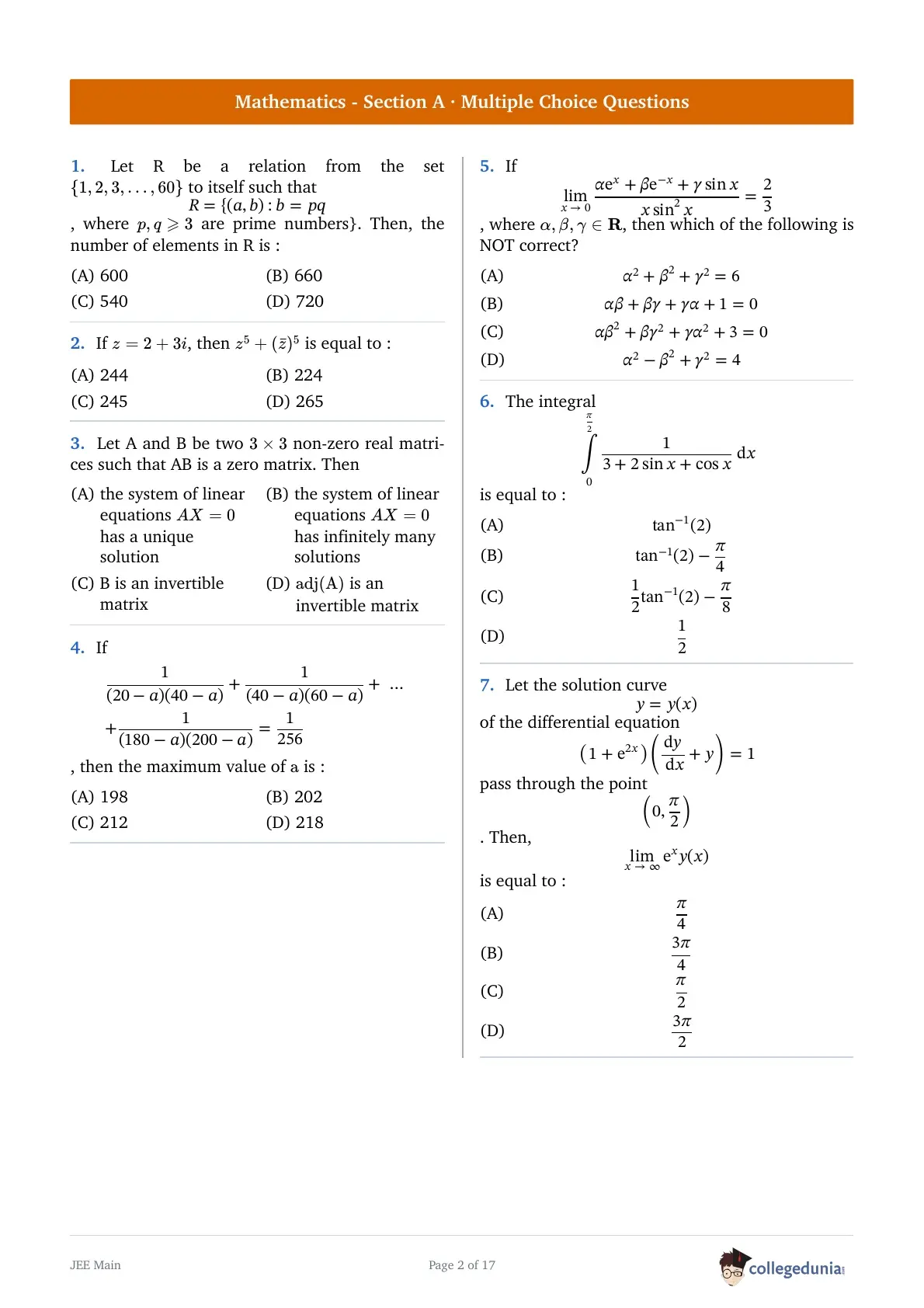
Let R be a relation from the set \(\{1, 2, 3, ….., 60\}\) to itself such that \(R = \{(a, b) : b = pq,\) where \(p, q≥ 3\) are prime numbers\(\}\). Then, the number of elements in R is :
If \(z = 2 + 3i\), then \(z^5 + (\overline{z})^5\) is equal to:
Let A and B be two \(3 × 3\) non-zero real matrices such that AB is a zero matrix. Then
If \(\frac{1}{(20-a)(40-a)} + \frac{1}{(40-a)(60-a)} + \ldots + \frac{1}{(180-a)(200-a)} = \frac{1}{256}\), then the maximum value of a is :
If \(\lim_{{x \to 0}} \frac{\alpha e^x + \beta e^{-x} + \gamma \sin x}{x \sin^2 x} = \frac{2}{3}\), where \(\alpha, \beta, \gamma \in \mathbb{R}\) then which of the following is NOT correct?
The integral \(\int_0^{\frac{\pi}{2}} \frac{1}{3 + 2\sin x + \cos x} \, dx\) is equal to
Let the solution curve \(y = y(x)\) of the differential equation \((1 + e^{2x})\left(\frac{dy}{dx} + y\right) = 1\) pass through the point \((0, \frac{\pi}{2})\). Then, \(\lim_{{x \to \infty}} e^x y(x)\) is equal to
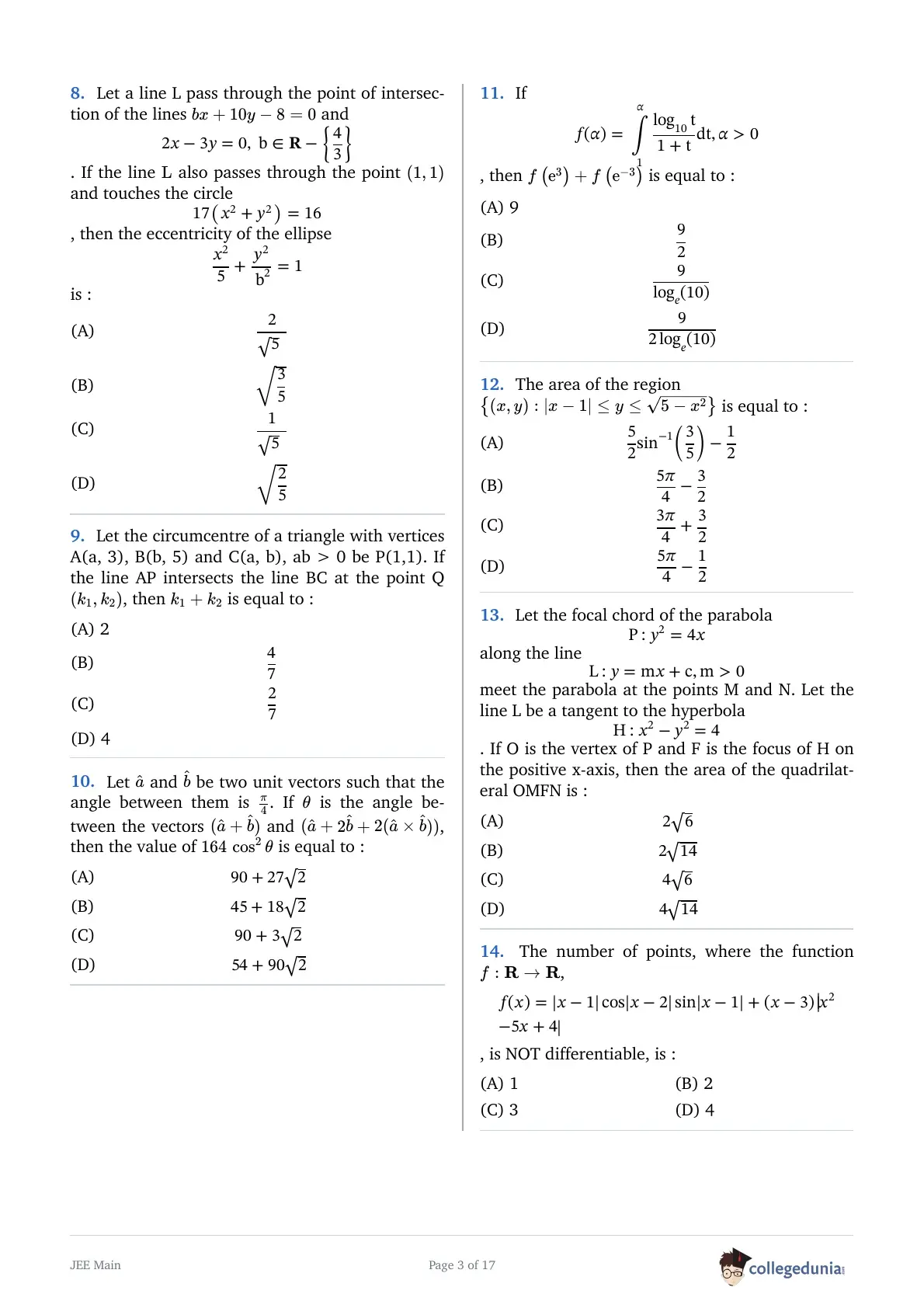
Let a line L pass through the point intersection of the lines \(bx + 10y – 8 = 0\) and \(2x - 3y = 0, \quad b \in \mathbb{R} - \left\{\frac{4}{3}\right\}\). If the line L also passes through the point \((1, 1)\) and touches the circle \(17(x^2 + y^2) = 16\), then the eccentricity of the ellipse \(\frac{x^2}{5} + \frac{y^2}{5} = 1\) is
Let the circumcentre of a triangle with vertices A(a, 3), B(b, 5) and C(a, b), ab > 0 be P(1, 1). If the line AP intersects the line BC at the point Q(k1, k2), then k1 + k2 is equal to :
Let \(\hat a\) and \(\hat b\) be two unit vectors such that the angle between them is \(\frac{\pi}{4}\). If θ is the angle between the vectors (\(\hat a\)+\(\hat b\)) and (\(\hat a\)+2\(\hat b\)+2(\(\hat a\)×\(\hat b\))), then the value of 164 cos2θ is equal to :
If \(f(\alpha)\) =\(\int_{1}^{\alpha}\frac{log_{10}t}{1+t}dt\) , \(\alpha>0\), then f(e3) + f(e–3) is equal to :
The area of the region
\(\begin{array}{l} \left\{\left(x,y\right);\left|x-1\right|\leq y \leq \sqrt{5-x^2} \right\}\end{array}\)
is equal to
Let the focal chord of the parabola P :y2 = 4x along the line L : y = mx + c, m> 0 meet the parabola at the points M and N. Let the line L be a tangent to the hyperbola H :x2 – y2 = 4. If O is the vertex of P and F is the focus of H on the positive x-axis, then the area of the quadrilateral OMFN is
The number of points, where the function \(f: \mathbb{R} \to \mathbb{R}\), \[ f(x) = |x - 1|\cos|x - 2|\sin|x - 1| + (x - 3)|x^2 - 5x + 4|, \] is NOT differentiable, is
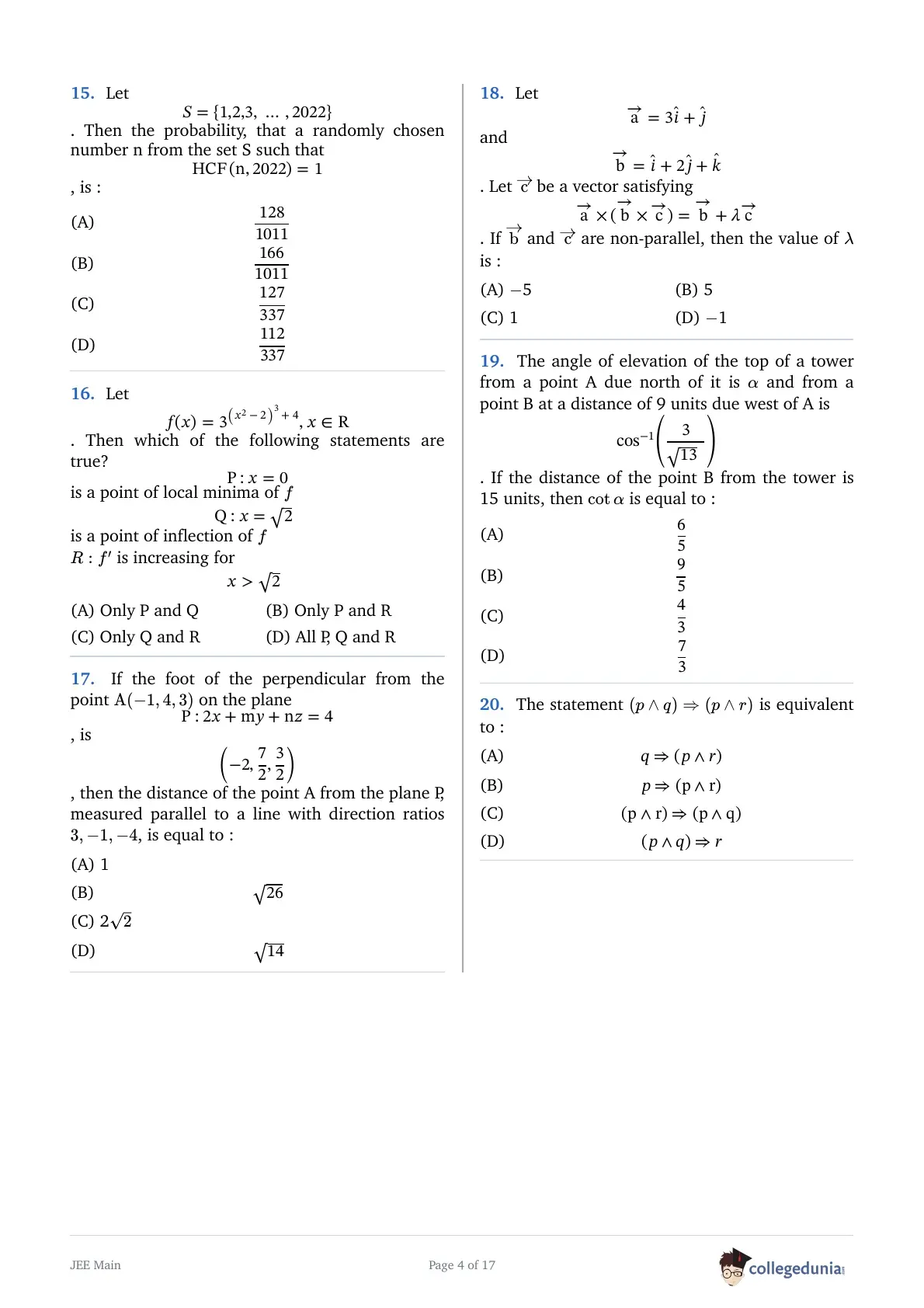
Let S = {1, 2, 3, …, 2022}. Then the probability that a randomly chosen number n from the set S such that HCF (n, 2022) = 1, is
Let
\(\begin{array}{l} f\left(x\right)=3^{\left(x^2-2\right)^3+4},x\in \mathbb{R}.\end{array}\)
Then which of the following statements are true?
P : x = 0 is a point of local minima of f
Q : x = √2 is a point of inflection of f
R : f ′ is increasing for x > √2
If the foot of the perpendicular from the point \(A(–1, 4, 3)\) on the plane \(P : 2x + my + nz = 4\), is \(\left(-2, \frac{7}{2}, \frac{3}{2}\right)\), then the distance of the point A from the plane P, measured parallel to a line with direction ratios \(3, –1, –4\), is equal to
Let \(\vec{a} = 3\hat{i} + \hat{j}\) and \(\vec{b} = \hat{i} + 2\hat{j} + \hat{k}\).
Let \(\vec{c}\) be a vector satisfying \(\vec{a} \times (\vec{b} \times \vec{c}) = \vec{b} + \lambda \vec{c}\)
If \(\vec{b}\) and \(\vec{c}\) are non-parallel, then the value of \(λ\) is
The angle of elevation of the top of a tower from a point A due north of it is α and from a point B at a distance of 9 units due west of A is \(\cos^{-1}\left(\frac{3}{\sqrt{13}}\right)\)
If the distance of the point B from the tower is 15 units, then cot α is equal to :
The statement (p∧q) ⇒ (p∧r) is equivalent to :
Mathematics - Section B (Q21 - Q30)
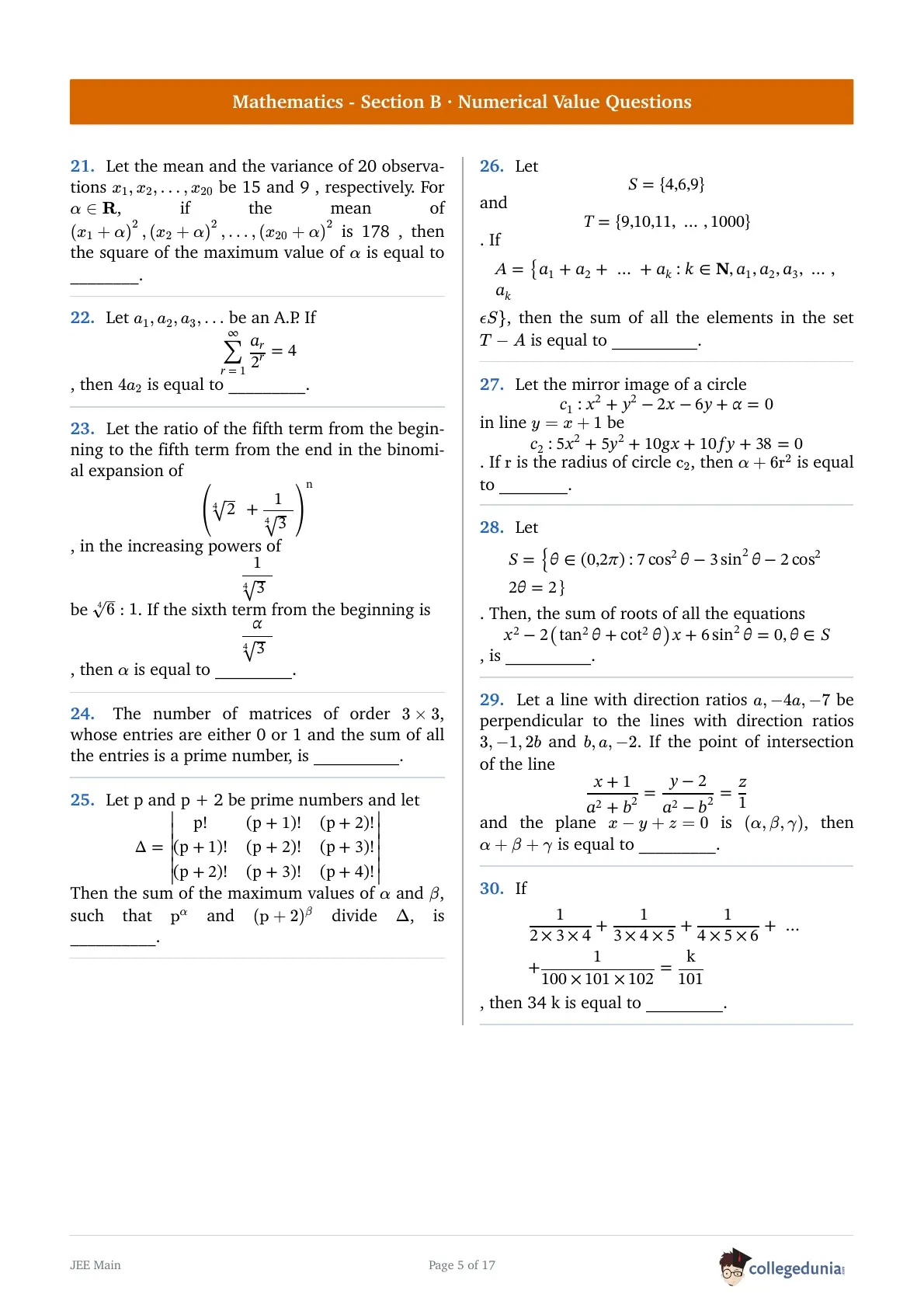
Let the mean and the variance of 20 observations \(x_1, x_2,…., x_{20}\) be 15 and 9, respectively. For a ∈ R, if the mean of \((x_1 + α)^2, (x_2 + α)^2,….,(x_{20} + α)^2\) is 178, then the square of the maximum value of \(α\) is equal to ___________.
Let a1, a2, a3,…. be an A.P. If
\(\begin{array}{l} \displaystyle\sum\limits_{r=1}^\infty\frac{a_r}{2^r}=4,\end{array}\)
then 4a2 is equal to ________.
Let the ratio of the fifth term from the beginning to the fifth term from the end in the binomial expansion of (\(\frac{\sqrt{24}+1}{\sqrt{34}}\))n, in the increasing powers of 134 be 64:1.If the sixth term from the beginning is \(\frac{\alpha}{\sqrt{34}}\), then α is equal to ___________.
The number of matrices of order 3 × 3, whose entries are either 0 or 1 and the sum of all the entries is a prime number, is _________.
Let p and p + 2 be prime numbers and let
\(Δ=\begin{vmatrix} p! & (p+1)! & (p+2)! \\ (p+1)! & (p+2)! & (p+3)! \\ (p+2)! & (p+3)! & (p+4)! \\ \end{vmatrix}\)
Then the sum of the maximum values of α and β, such that pα and (p + 2)β divide Δ, is _______.
Let S = {4, 6, 9} and T = {9, 10, 11, …,1000}. If A = {a1 + a2 + … +ak :k∈N, a1, a2, a3, …, ak∈S}, then the sum of all the elements in the set T – A is equal to ____________.
Let the mirror image of a circle c1 :x2 + y2 – 2x – 6y + α = 0 in line y = x + 1 be c2 : 5x2 + 5y2 + 10gx + 10fy + 38 = 0. If r is the radius of circle c2, then α + 6r2 is equal to _________.
Let \(S = \{θ ∈ (0, 2π) : 7 cos^2θ – 3 sin^2θ – 2 cos^22θ = 2\}\).
Then, the sum of roots of all the equations \(x^2 – 2 (tan^2θ + cot^2θ) x + 6 sin^2θ = 0, θ ∈ S\), is _______.
Let a line with direction ratios a, – 4a, –7 be perpendicular to the lines with direction ratios 3, – 1, 2b and b, a, – 2. If the point of intersection of the line
\(\begin{array}{l} \frac{x+1}{a^2+b^2}=\frac{y-2}{a^2-b^2}=\frac{z}{1} \end{array}\)
and the plane x – y + z = 0 is (\(α, β, γ\)), then \(α + β + γ\) is equal to ______.
If
\(\frac{1}{2\times 3 \times 4} + \frac{1}{3\times 4 \times 5 } + \frac{1}{4 \times 5 \times 6 }+ \dots + \frac{1}{100 \times 101 \times 102} = \frac{k}{101}\)
then 34 k is equal to ____________.
Physics - Section A (Q31 - Q50)
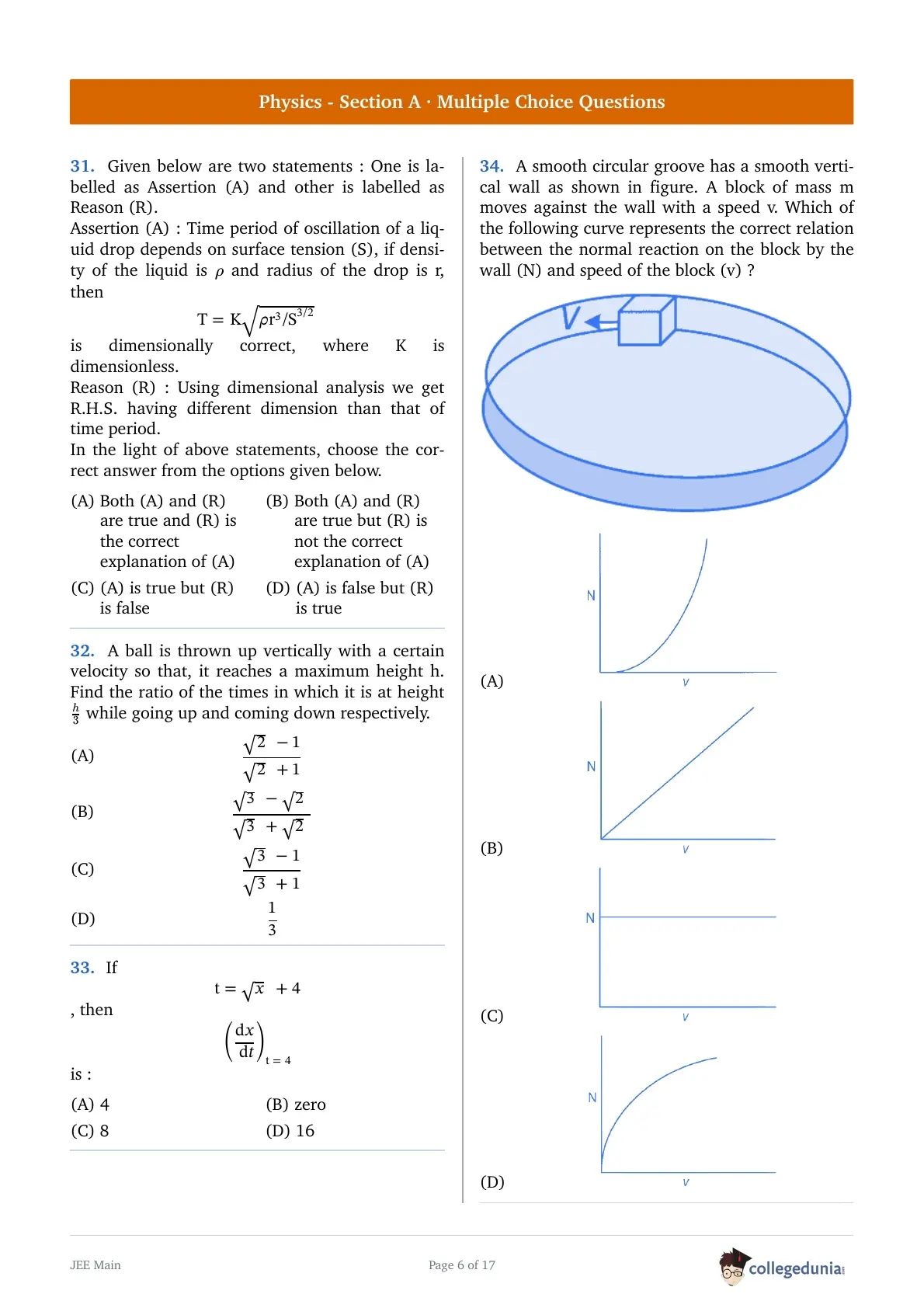
Given below are two statements: One is labelled as Assertion (A) and other is labelled as Reason (R).
Assertion (A) : Time period of oscillation of a liquid drop depends on surf ace tension (S), if density of the liquid is ρ and radius of the drop is r, then \(T=K\sqrt {\frac {ρr^3}{S^{\frac 32}}}\) is dimensionally correct, where K is dimensionless.
Reason (R) : Using dimensional analysis we get R.H.S. having different dimension than that of time period.
In the light of above statements, choose the correct answer from the options given below.
A ball is thrown up vertically with a certain velocity so that, it reaches a maximum height h. Find the ratio of the times in which it is at height \(\frac h3\) while going up and coming down respectively.
If \(t = \sqrt{x} + 4\), then \(\left.\frac{dx}{dt}\right|_{t=4}\) is
A smooth circular groove has a smooth vertical wall as shown in figure. A block of mass m moves against the wall with a speed v. Which of the following curve represents the correct relation between the normal reaction on the block by the wall (N) and speed of the block (v)?
- (1)
![Graph between the normal reaction on the block by the wall (N) and speed of the block (v)]()
- (2)
![Graph between the normal reaction on the block by the wall (N) and speed of the block (v)]()
- (3)
![Graph between the normal reaction on the block by the wall (N) and speed of the block (v)]()
- (4)
![Graph between the normal reaction on the block by the wall (N) and speed of the block (v)]()


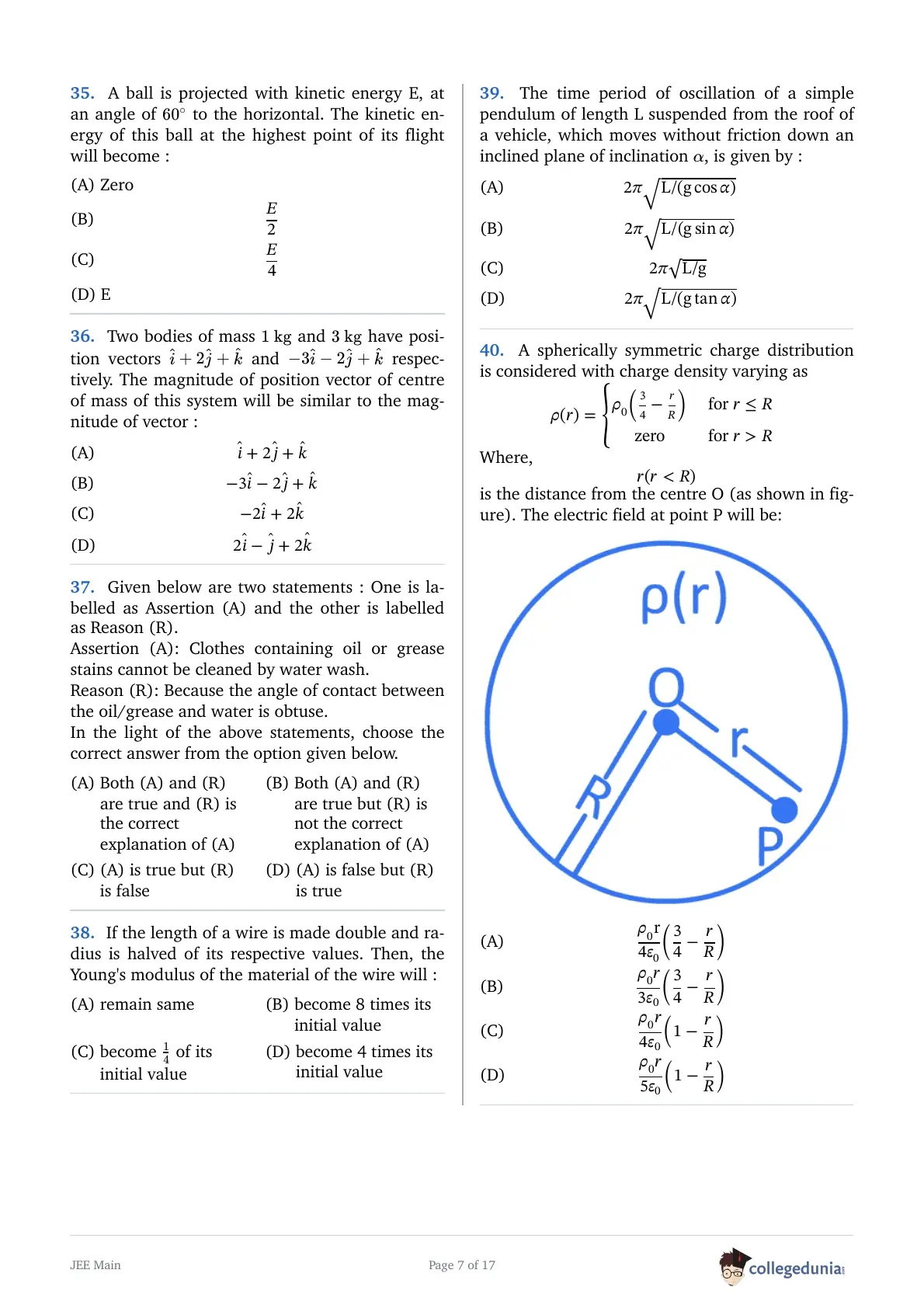
A ball is projected with kinetic energy E, at an angle of 60° to the horizontal. The kinetic energy of this hall at the highest point of its flight will become
Two bodies of mass \(1\) kg and \(3\) kg have position vectors \(\hat i+2\hat j+\hat k\) and \(−3\hat i−2 \hat j+\hat k\), respectively. The magnitude of position vector of centre of mass of this system will be similar to the magnitude of vector.
Given below are two statements: One is labelled as Assertion (A) and the other· is labelled as Reason (R).
Assertion (A) : Clothes containing oil or grease stains cannot be cleaned by water wash.
Reason (R) : Because the angle of contact between the oil/grease and water is obtuse.
In the light of the above statements, choose the correct answer from the option given below.
If the length of a wire is made double and radius is halved of its respective values. Then, the Young’s modulus of the material of the wire will :
The time period of oscillation of a simple pendulum of length L suspended from the roof of a vehicle, which moves without friction down an inclined plane of inclination α, is given by:
A spherically symmetric charge distribution is considered with charge density varying as
\(ρ(r) = \begin{cases} ρ_0(\frac 34−\frac rR) &; \text{for} \ r≤R\\ Zero &; \text{for}\ r>R \end{cases}\)
Where, r(r<R) is the distance from the centre O (as shown in figure) The electric field at point P will be :
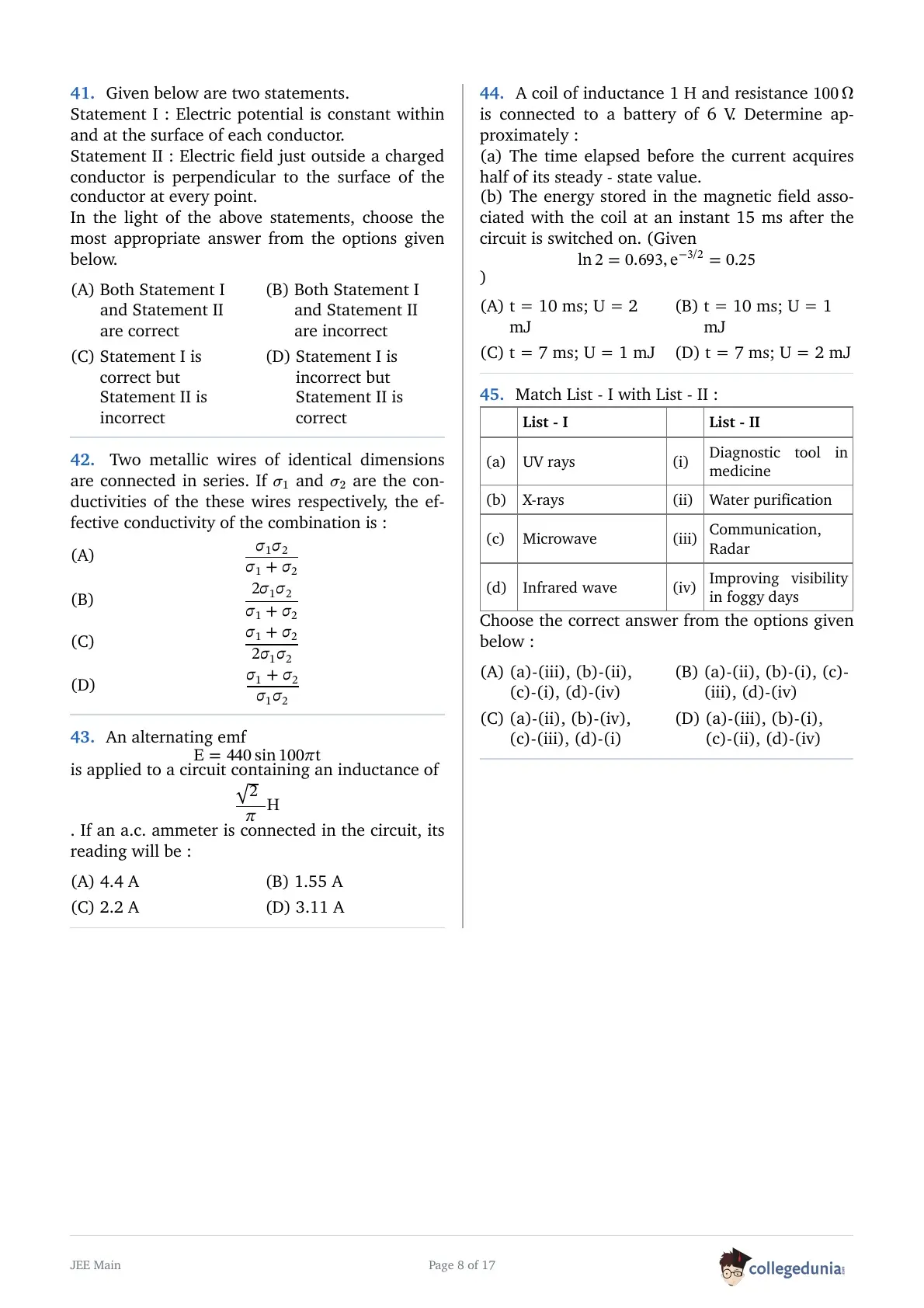
Given below are two statements.
Statement I : Electric potential is constant within and at the surface of each conductor.
Statement II : Electric field just outside a charged conductor is perpendicular to the surface of the conductor at every point.
In the light of the above statements, choose the most appropriate answer from the options given below.
Two metallic wires of identical dimensions are connected in series. If σ1 and σ2 are the conductivities of these wires, respectively, the effective conductivity of the combination is :
An alternating emf \(E = 440 \sin(100\pi t)\) is applied to a circuit containing an inductance of \(\frac{\sqrt{2}}{\pi}\) H. If an a.c. ammeter is connected in the circuit, its reading will be:
A coil of inductance 1 H and resistance 100 Ω is connected to a battery of 6 V. Determine approximately :
(a) The time elapsed before the current acquires half of its steady – state value.
(b) The energy stored in the magnetic field associated with the coil at an instant 15 ms after the circuit is switched on.
(Given \(ln2=0.693\), e–3/2 = 0.25)
Match List-I with List-II:
| List-I | List-II |
|---|---|
| (a) UV rays | (i) Diagnostic tool in medicine |
| (b) X-rays | (ii) Water purification |
| (c) Microwave | (iii) Communication, Radar |
| (d) Infrared wave | (iv) Improving visibility in foggy days |
Choose the correct answer from the options given below :
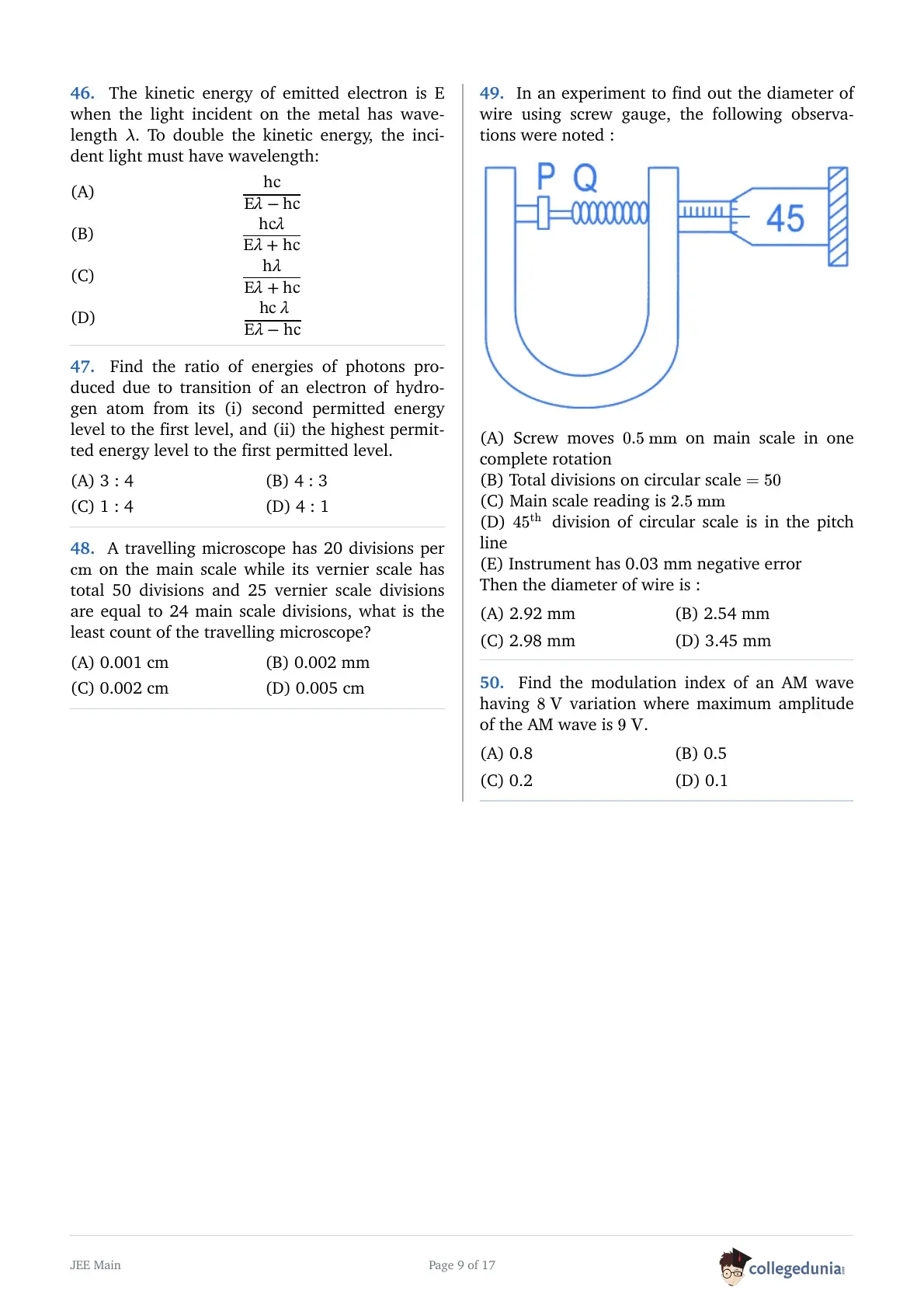
The kinetic energy of emitted electron is E when the light incident on the metal has wavelength λ. To double the kinetic energy, the incident light must have wavelength :
Find the ratio of energies of photons produced due to transition of an electron of hydrogen atom from its (i) second permitted energy level to the first level, and (ii) the highest permitted energy level to the first permitted level.
A travelling microscope has 20 divisions per cm on the main scale while its vernier scale has total 50 divisions and 25 vernier scale divisions are equal to 24 main scale divisions, what is the least count of the travelling microscope?
In an experiment to find out the diameter of the wire using a screw gauge, the following observations were noted:
(A) Screw moves 0.5 mm on main scale in one complete rotation
(B) Total divisions on circular scale = 50
(C) Main scale reading is 2.5 mm
(D) 45th division of circular scale is in the pitch line
(E) Instrument has 0.03 mm negative error
Then the diameter of wire is :
Find the modulation index of an AM wave having 8 V variation where maximum amplitude of the AM wave is 9 V.
Physics - Section B (Q51 - Q60)
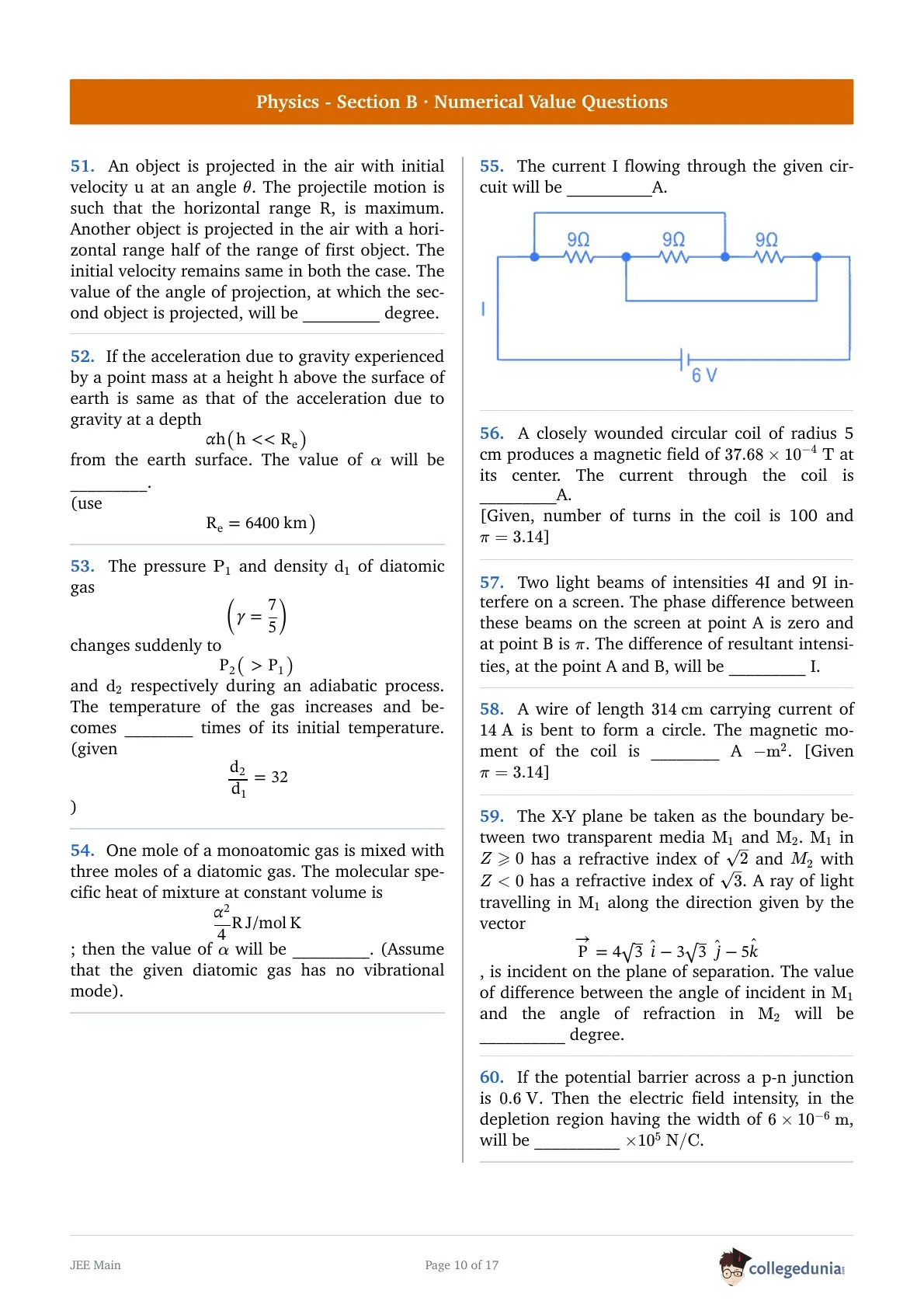
An object is projected in the air with initial velocity u at an angle θ. The projectile motion is such that the horizontal range R, is maximum. Another object is projected in the air with a horizontal range half of the range of first object. The initial velocity remains same in both the case. The value of the angle of projection, at which the second object is projected, will be ______ degree.
If the acceleration due to gravity experienced by a point mass at a height h above the surface of earth is same as that of the acceleration due to gravity at a depth \(\alpha h \ (h \ll Re)\) from the earth surface. The value of α will be ________.
(Use Re=6400 km)
The pressure P1 and density d1 of diatomic gas \(\gamma = \frac{7}{5}\) changes suddenly to \(P_2 > P_1\) and d2 respectively during an adiabatic process. The temperature of the gas increases and becomes _____ times of its initial temperature.
(Given \(\frac{d_2}{d_1} = 32\))
One mole of a monoatomic gas is mixed with three moles of a diatomic gas. The molecular specific heat of mixture at constant volume is \(\frac{\alpha^2}{4}\) RJ/mol k; then the value of α will be _______.
(Assume that the given diatomic gas has no vibrational mode).
The current \(I\) flowing through the given circuit will be ________A.
A closely wounded circular coil of radius 5 cm produces a magnetic field of 37.68×10⁻⁴ T at its center. The current through the coil is _______ A.
[Given, number of turns in the coil is 100 and \(\pi = 3.14\)]
Two light beams of intensities 4I and 9I interfere on a screen. The phase difference between these beams on the screen at point A is zero and at point B is π. The difference of resultant intensities, at the point A and B, will be_______I.
A wire of length 314 cm carrying current of 14 A is bent to form a circle. The magnetic moment of the coil is _______ A–m2. [Given \(\pi = 3.14\)]
The X–Y plane be taken as the boundary between two transparent media M1 and M2.M1 in Z 0 has a refractive index of \(\sqrt2\) and M2 with \(Z<0\) has a refractive index of \(\sqrt3\). A ray of light travelling in M1 along the direction given by the vector \(\mathbf{\overrightarrow{P}} = 4\sqrt{3}\mathbf{\hat{i}} - 3\sqrt{3}\mathbf{\hat{j}} - 5\hat{k}\), is incident on the plane of separation. The value of difference between the angle of incident in M1 and the angle of refraction in M2 will be ______ degree.
If the potential barrier across a p–n junction is 0.6 V. Then the electric field intensity, in the depletion region having the width of 6×10⁻⁶ m, will be ______× 105 N/C.
Chemistry - Section A (Q61 - Q80)
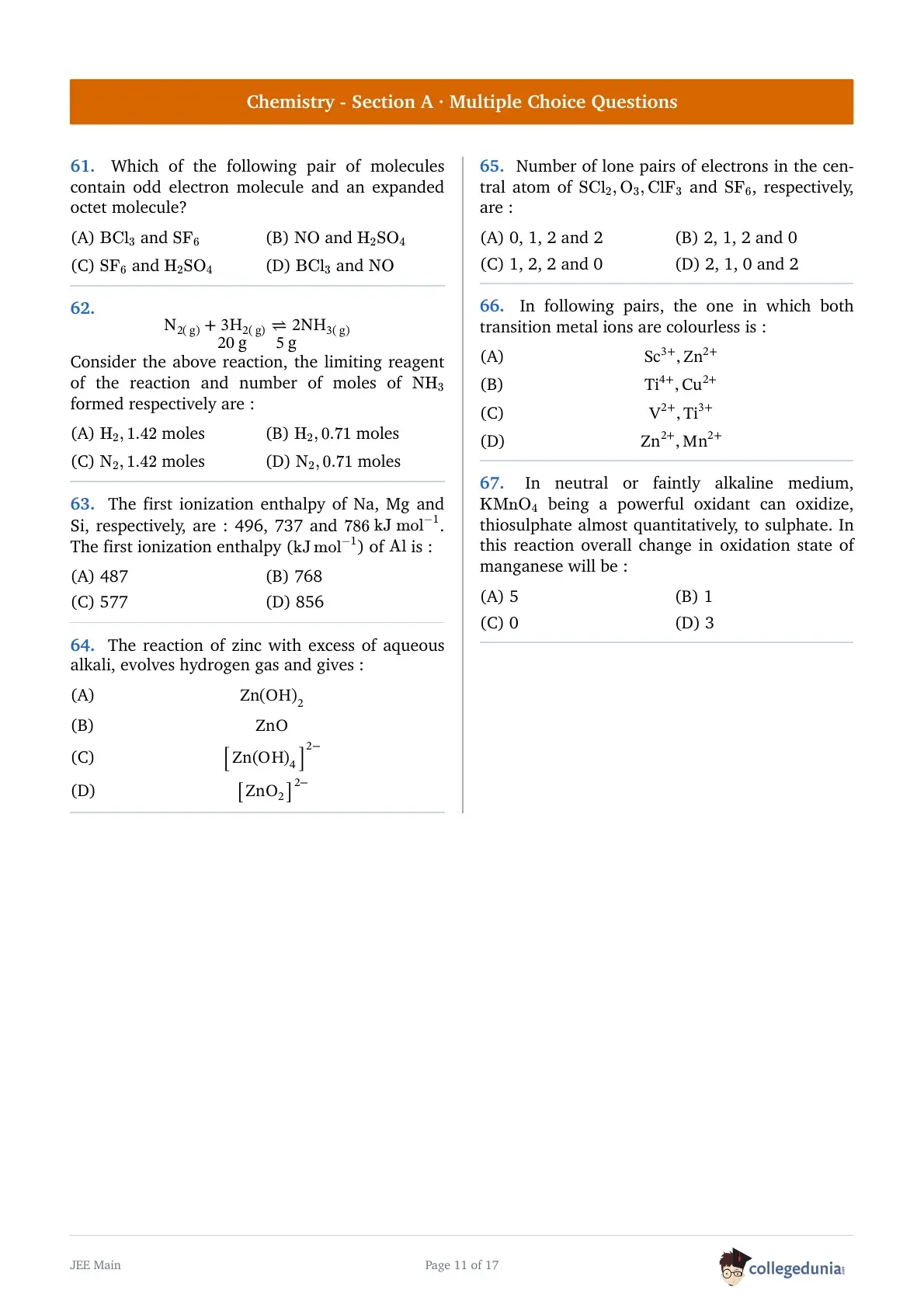
Which of the following pair of molecules contain odd electron molecule and an expanded octet molecule?
\(N_2(g) + 3H_2(g) \rightleftharpoons 2NH_3(g)\)
Consider the above reaction, the limiting reagent of the reaction and number of moles of NH3 formed, respectively are :
The first ionization enthalpy of Na, Mg and Si, respectively, are : 496, 737 and 786 kJ mol–1. The first ionization enthalpy (kJ mol–1) of Al is:
The reaction of zinc with excess of aqueous alkali, evolves hydrogen gas and gives:
Number of lone pairs of electrons in the central atom of SCl2, O3, CIF3 and SF6, respectively, are:
In following pairs, the one in which both transition metal ions are colourless is :
In neutral or faintly alkaline medium, KMnO4 being a powerful oxidant can oxidize, thiosulphate almost quantitatively, to sulphate. In this reaction overall change in oxidation state of manganese will be
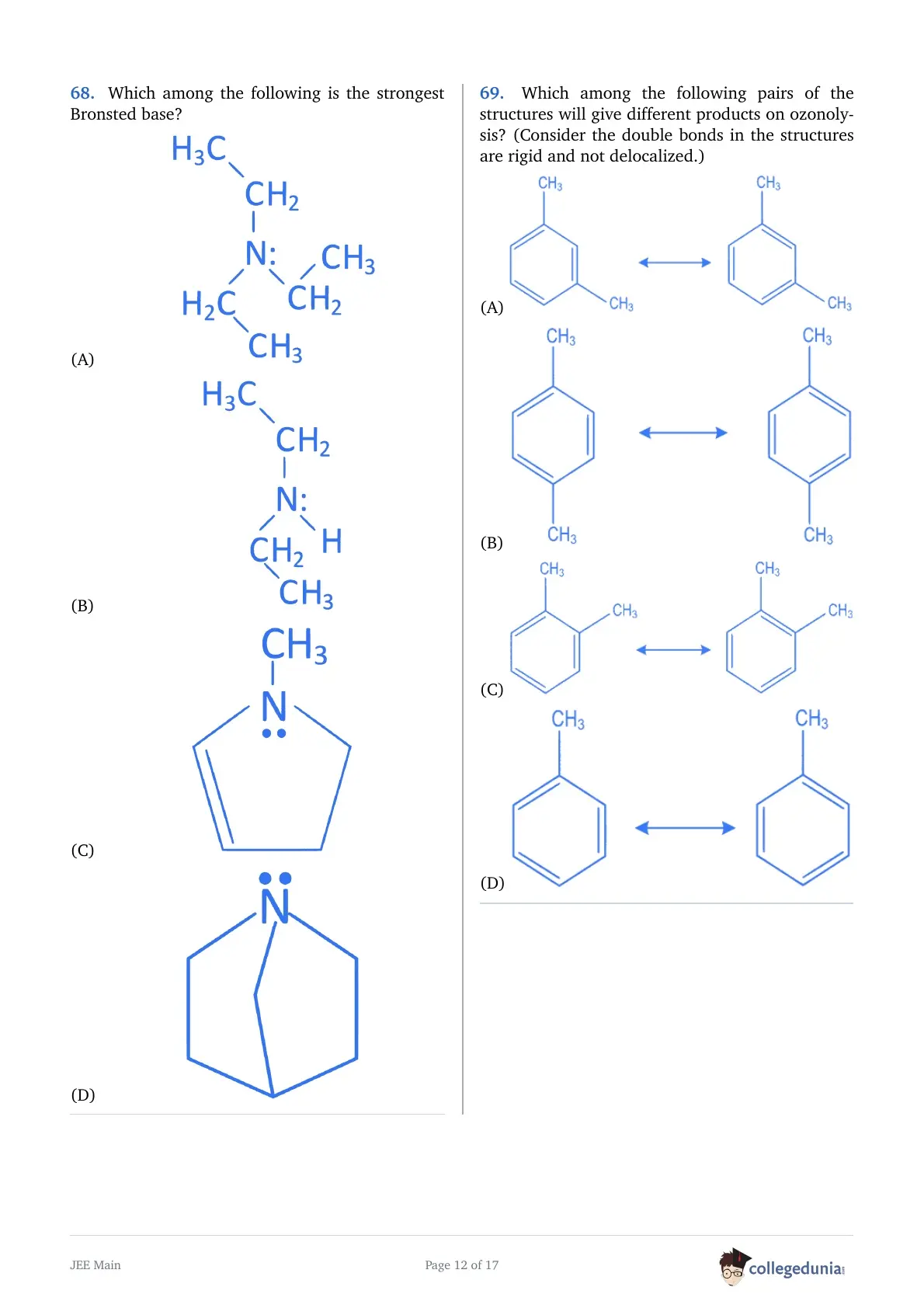
Which among the following is the strongest Bronsted base?
- (1)
![]()
- (2)
![]()
- (3)
![]()
- (4)
![]()


Which among the following pairs of the structures will give different products onozonolysis? (Consider the double bonds in the structures are rigid and not delocalized)
- (1)
![]()
- (2)
![]()
- (3)
![]()
- (4)
![]()


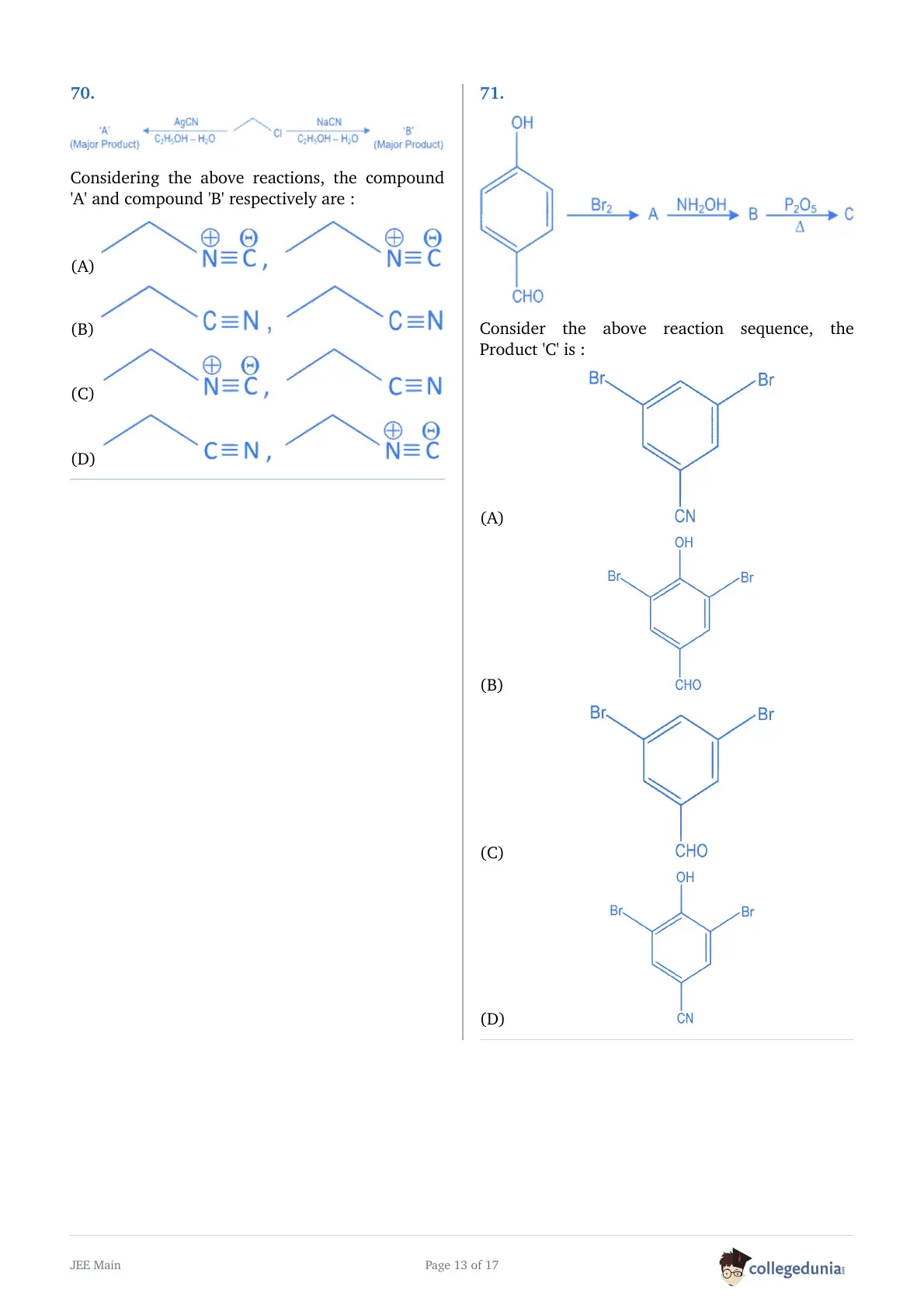
Considering the above reactions, the compound ‘A’ and compound ‘B’ respectively are :
- (1)
![]()
- (2)
![]()
- (3)
![]()
- (4)
![]()


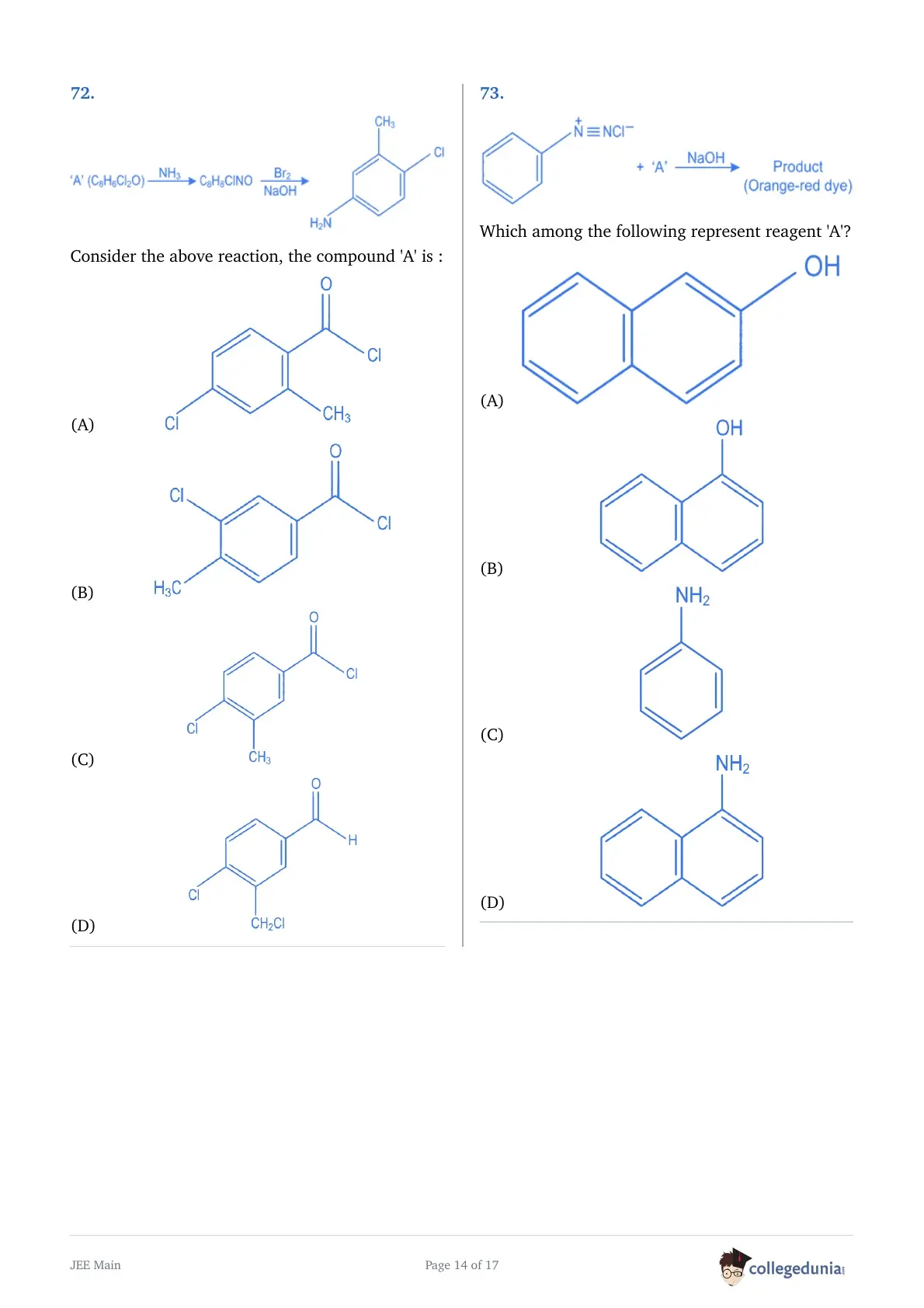
Consider the above reaction sequence, the product ‘C’ is
- (1)
![]()
- (2)
![]()
- (3)
![]()
- (4)
![]()


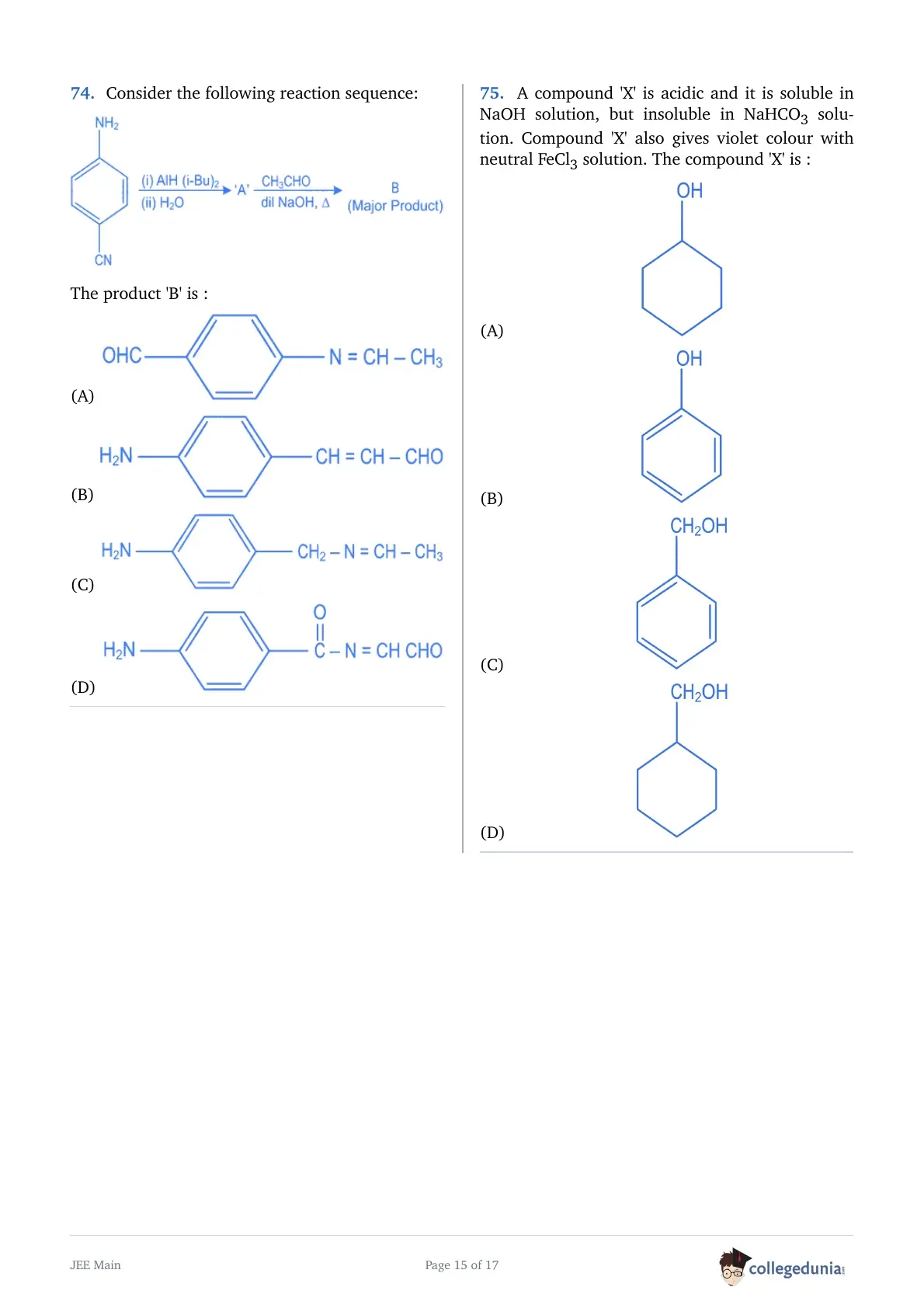
Consider the above reaction, the compound ‘A’ is :

- (1)
![]()
- (2)
![]()
- (3)
![]()
- (4)
![]()


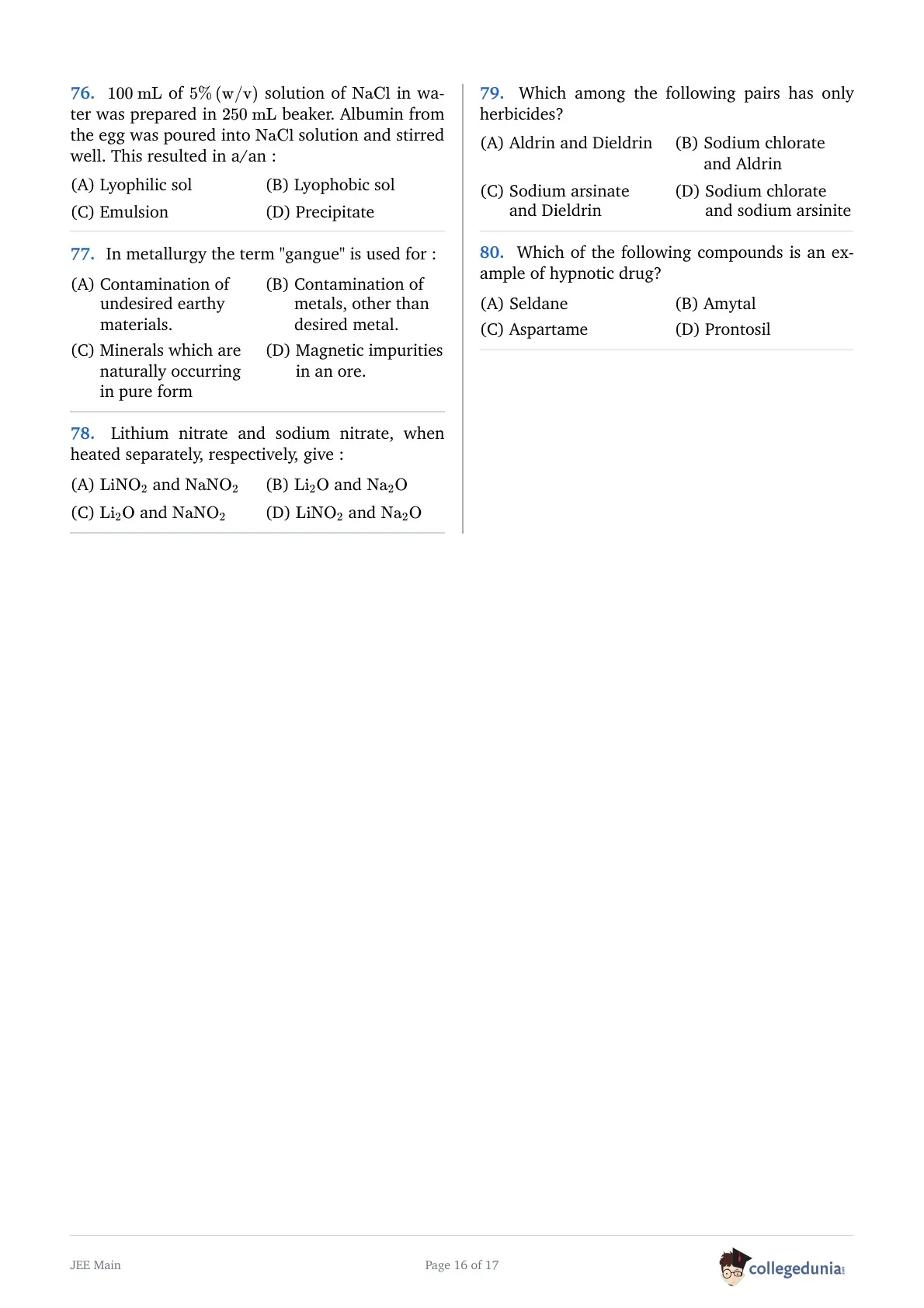
Consider the following reaction sequence:
The product ‘B’ is:
- (1)
![]()
- (2)
![]()
- (3)
![]()
- (4)
![]()


A compound ‘X’ is acidic and it is soluble in NaOH solution, but insoluble in NaHCO3 solution. Compound ‘X’ also gives violet colour with neutral FeCl3 solution. The compound ‘X’ is :
- (1)
![]()
- (2)
![]()
- (3)
![]()
- (4)
![]()


100 mL of 5% (w/v) solution of NaCl in water was prepared in 250 mL beaker. Albumin from the egg was poured into NaCl solution and stirred well. This resulted in a/an :
In metallurgy the term “gangue” is used for :
Lithium nitrate and sodium nitrate, when heated separately, respectively, give :
Which among the following pairs has only herbicides?
Which of the following compounds is an example of hypnotic drug?
Chemistry - Section B (Q81 - Q90)
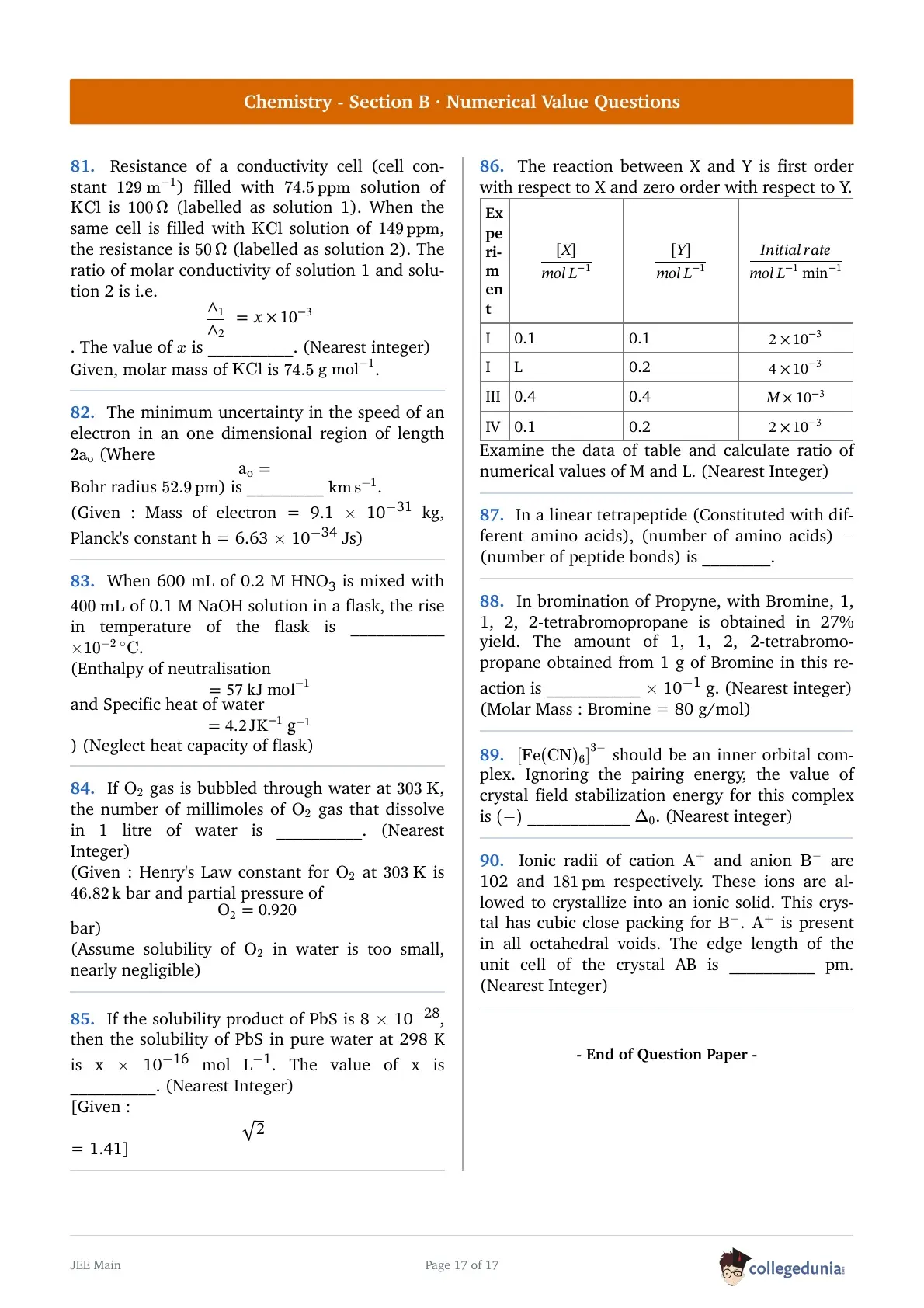
Resistance of a conductivity cell (cell constant 129 m–1) filled with 74.5 ppm solution of KCI is 100 Ω (labelled as solution 1). When the same cell is filled with KCl solution of 149 ppm, the resistance is 50 Ω (labelled as solution 2). The ratio of molar conductivity of solution 1 and solution 2 is \(\frac{\Lambda_1}{\Lambda_2} = x \times 10^{-3}\). The value of x is _________. (Nearest integer)
(Given : molar mass of KCl is 74.5 g mol–1).
The minimum uncertainty in the speed of an electron in an one dimensional region of length 2a0 (Where a0 = Bohr radius 52.9 pm) is _____ km s–1.
(Given : Mass of electron = 9.1 × 10⁻³¹ kg, Planck’s constant h = 6.63 × 10⁻³⁴Js)
When 600 mL of 0.2 M HNO3 is mixed with 400 mL of 0.1 M NaOH solution in a flask, the rise in temperature of the flask is ________ × 10–2 °C.
(Enthalpy of neutralisation = 57 kJ mol–1 and Specific heat of water = 4.2 JK–1 g–1)
(Neglect heat capacity of flask)
If O2 gas is bubbled through water at 303 K, the number of millimoles of O2 gas that dissolve in 1 litre of water is_______. (Nearest integer)
(Given : Henry’s Law constant for O2 at 303 K is 46.82 k bar and partial pressure of O2 = 0.920 bar)
(Assume solubility of O2 in water is too small, nearly negligible)
If the solubility product of PbS is 8 × 10–28, then the solubility of PbS in pure water at 298 K is x × 10–16 mol L–1. The value of x is ________. (Nearest integer)
[given : \(\sqrt2=1.41\)]
The reaction between X and Y is first order with respect to X and zero order with respect to Y.
Examine the data of table and calculate ratio of numerical values of M and L. (Nearest integer)
In a linear tetrapeptide (constituted with different amino acids) – (number of peptide bonds) is _____.
In bromination of Propyne, with Bromine 1,1,2,2-tetrabromopropane is obtained in 27% yield. The amount of 1,1,2,2-tetrabromopropane obtained from 1 g of Bromine in this reaction is _______ × 10–1 g. (Nearest integer)
(Molar Mass : Bromine = 80 g/mol)
[Fe(CN)6]3– should be an inner orbital complex. Ignoring the pairing energy, the value of crystal field stabilization energy for this complex is (–) _____ Δ0. (Nearest integer)
Ionic radii of cation A+ and anion B– are 102 and 181 pm, respectively. These ions are allowed to crystallize into an ionic solid. This crystal has cubic close packing for B–. A+ is present in all octahedral voids. The edge length of the unit cell of the crystal AB is _____pm. (Nearest integer)
JEE Main 2022 Exam Pattern and Marking Scheme
| Particulars | Details |
|---|---|
| Exam Mode | Online (Computer-Based Test) |
| Paper | B.E./B.Tech (Paper 1) |
| Duration | 3 hours (180 minutes) |
| Type of Questions | Multiple Choice Questions (MCQs) + Numerical Value Questions |
| Subjects | Mathematics, Physics, Chemistry |
| Total Questions | 90 questions (75 to be attempted) |
| Total Marks | 300 marks |
| Marking Scheme | +4 for correct answer & -1 for incorrect MCQ and Numerical Value-based Questions |
JEE Main 2022 July 29 Shift 1 Difficulty Level
The question paper was reported as moderate in terms of overall difficulty. Students found Mathematics tough. Physics and Chemistry were on a similar difficulty level, moderate, with Chemistry on an easier side.
JEE Main 2022 July 29 Shift 1 Subject-wise Memory-Based Solutions PDF
| Subject | Memory-Based Solutions PDF |
|---|---|
| Physics | Download PDF |
| Chemistry | Download PDF |
| Mathematics | Download PDF |
JEE Main 2022 Phase 2 Question Papers with Solution PDFs
Candidates can also check shift-wise JEE Main 2022 Phase 2 Question Papers with Solution PDFs. These shift-wise question paper PDFs for JEE Main 2022 will help candidates know the overall difficulty, topics with the highest weightage and the type of questions asked in the exam.
JEE Main 2022 Phase 1 Question Papers with Solution PDFs
Shift-wise JEE Main 2022 Phase 1 Question Papers with Solution PDFs are also available. Candidates preparing for Phase 2 of the exam can check and download JEE Main Question Paper PDFs to practice and test their exam prep level.
Also Check:



Comments