




JEE Main 2023 Physics April 13 Shift 1 Question Paper is available here for download. Candidates can download official JEE Main 2023 Physics Question Paper PDF with Solution and Answer Key for April 13 Shift 1 using the link below. JEE Main Physics Question Paper is divided into two sections, Section A with 20 MCQs and Section B with 10 numerical type questions. Candidates are required to answer all questions from Section A and any 5 questions from section B.
Related Links:
- JEE Main 2025 Question Paper pdf with solutions
- JEE Main Previous Years Question Paper with Solution PDF
JEE Main 2023 Physics Question Paper April 13 Shift 1 PDF
| JEE Main 2023 April 13 Shift 1 Physics Question Paper with Solution PDF |  Download Download |
Check Solution |

JEE Main 2023 Physics Questions with Solutions
Section – A
Question 1:
Different combination of 3 resistors of equal resistance \( R \) are shown in the figures. The increasing order for power dissipation is:

View Solution
Step 1: Understanding the power dissipation formula.
The power dissipated in a resistor is given by the formula: \[ P = I^2 R. \]
Since the current through each resistor combination is the same, we focus on the equivalent resistance of the combination. The more the equivalent resistance, the more the power dissipation.
Step 2: Analyzing the given combinations.
- Combination A: This is a series combination of two resistors, so the equivalent resistance \( R_A \) is: \[ R_A = 2R. \]
- Combination B: This is a parallel combination of two resistors, so the equivalent resistance \( R_B \) is: \[ R_B = \frac{R}{2}. \]
- Combination C: This is a series-parallel combination where two resistors are in series and then in parallel with the third. The equivalent resistance \( R_C \) is: \[ R_C = \frac{3R}{2}. \]
- Combination D: This is a series combination of all three resistors, so the equivalent resistance \( R_D \) is: \[ R_D = 3R. \]
Step 3: Power dissipation analysis.
Now, we compare the power dissipation based on the equivalent resistances:
- For combination A: \( P_A \propto \frac{1}{2R} \)
- For combination B: \( P_B \propto \frac{1}{\frac{R}{2}} = \frac{2}{R} \)
- For combination C: \( P_C \propto \frac{1}{\frac{3R}{2}} = \frac{2}{3R} \)
- For combination D: \( P_D \propto \frac{1}{3R} \)
Step 4: Conclusion.
The increasing order of power dissipation is: \[ P_C < P_B < P_A < P_D. \] Quick Tip: - In a series combination, the equivalent resistance is higher, resulting in lower power dissipation.
- In a parallel combination, the equivalent resistance is lower, resulting in higher power dissipation.
- A higher equivalent resistance results in more power dissipation.
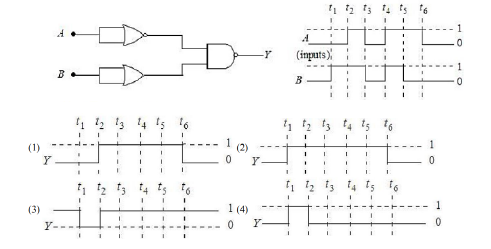
For the following circuit and given inputs A and B, choose the correct option for output Y.
View Solution
A bullet of 10 g leaves the barrel of the gun with a velocity of 600 m/s. If the barrel of the gun is 50 cm long and the mass of the gun is 3 kg, then the value of the impulse supplied to the gun will be:
View Solution
Which of the following Maxwell's equation is valid for time varying conditions but not valid for static conditions:
View Solution
Match List – I with List – II
List - I (Layer of atmosphere) List - II (Approximate height over Earth's surface)
View Solution
The rms speed of oxygen molecule in a vessel at particular temperature is \( \left( 1 + \frac{5}{x} \right)^{\frac{1}{2}} \nu \), where \( \nu \) is the average speed of the molecule. The value of \( x \) will be: (Take \( \pi = \frac{22}{7} \))
View Solution
The ratio of powers of two motors is \[ \frac{3\sqrt{x}}{\sqrt{x + 1}}, \]
that are capable of raising 300 kg of water in 5 minutes and 50 kg of water in 2 minutes respectively from a well 100 m deep. The value of \( x \) will be:
View Solution
Two trains 'A' and 'B' of length \( l \) and \( l \) are travelling into a tunnel of length \( L \) in parallel tracks from opposite directions with velocities 108 km/h and 72 km/h, respectively. If train 'A' takes 35 s less time than train 'B' to cross the tunnel, then length \( L \) of the tunnel is:
(Given \( l = 60 \, m \))
View Solution
Two bodies are having kinetic energies in the ratio 16 : 9. If they have the same linear momentum, the ratio of their masses respectively is:
View Solution
The figure shows a liquid of given density flowing steadily in a horizontal tube of varying cross-section. Cross-sectional areas at A is 1.5 cm\(^2\), and at B is 25 mm\(^2\), if the speed of liquid at B is 60 cm/s then \( (P_A - P_B) \) is:
(Given \( P_A \) and \( P_B \) are liquid pressures at A and B points, and density \( \rho = 1000 \, kg/m^3 \). A and B are on the axis of the tube.)

View Solution
^{238_{92 A \rightarrow ^{234_{90 B + \, ^{4_{2 D + Q
In the given nuclear reaction, the approximate amount of energy released will be:
[Given, mass of \( ^{238}_{92} A = 238.05079 \times 931.5 \, MeV/c^2 \), \[ mass of ^{234}_{90} B = 234.04363 \times 931.5 \, MeV/c^2, \] \[ mass of ^{4}_{2} D = 4.00260 \times 931.5 \, MeV/c^2] \]
View Solution
To calculate the energy released in a nuclear reaction, we use the equation: \[ Q = \left( Mass of reactants - Mass of products \right) \times 931.5 \, MeV/c^2. \]
Here, the reactant is \( ^{238}_{92} A \), and the products are \( ^{234}_{90} B \) and \( ^{4}_{2} D \).
Step 1: Calculate the mass of reactants.
The mass of the reactant is the mass of \( ^{238}_{92} A \): \[ Mass of reactant = 238.05079 \times 931.5 \, MeV/c^2. \]
Step 2: Calculate the mass of products.
The mass of the products is the sum of the masses of \( ^{234}_{90} B \) and \( ^{4}_{2} D \): \[ Mass of products = 234.04363 \times 931.5 + 4.00260 \times 931.5 \, MeV/c^2. \]
Step 3: Calculate the energy released.
Now, we calculate \( Q \) (energy released) by taking the difference of the masses: \[ Q = \left[ 238.05079 \times 931.5 - \left( 234.04363 \times 931.5 + 4.00260 \times 931.5 \right) \right]. \]
Simplifying the expression: \[ Q = \left[ 238.05079 - \left( 234.04363 + 4.00260 \right) \right] \times 931.5 \, MeV/c^2, \] \[ Q = \left[ 238.05079 - 238.04623 \right] \times 931.5 \, MeV/c^2, \] \[ Q = 0.00456 \times 931.5 \, MeV/c^2, \] \[ Q \approx 4.25 \, MeV. \]
Thus, the energy released is approximately 4.25 MeV. Quick Tip: The energy released in a nuclear reaction can be calculated using the mass defect and the Einstein's equation \( E = \Delta m c^2 \). Here, we use the mass difference and multiply it by \( 931.5 \, MeV/c^2 \) to get the energy in MeV.
A disc is rolling without slipping on a surface. The radius of the disc is \( R \). At \( t = 0 \), the top most point on the disc is A as shown in the figure. When the disc completes half of its rotation, the displacement of point A from its initial position is:

View Solution
Which graph represents the difference between total energy and potential energy of a particle executing SHM vs its distance from the mean position?

View Solution
Two charges each of magnitude 0.01 C and separated by a distance of 0.4 mm constitute an electric dipole. If the dipole is placed in an uniform electric field \( \vec{E} \) of 10 dyne/C making 30° angle with \( \vec{E} \), the magnitude of torque acting on dipole is:
View Solution
Under isothermal condition, the pressure of a gas is given by \( P = aV^{-3} \), where \( a \) is a constant and \( V \) is the volume of the gas. The bulk modulus at constant temperature is equal to:
View Solution
A planet having mass \( 9 M_e \) and radius \( 4 R_e \), where \( M_e \) and \( R_e \) are mass and radius of Earth respectively, has escape velocity in km/s given by:
(Given escape velocity on earth \( V_e = 11.2 \times 10^3 \, m/s \))
View Solution
A body of mass \( (5 \pm 0.5) \, kg \) is moving with a velocity of \( (20 \pm 0.4) \, m/s \). Its kinetic energy will be:
View Solution
The difference between threshold wavelengths for two metal surfaces A and B having work functions \( \phi_A = 9 \, eV \) and \( \phi_B = 4.5 \, eV \) in nm is:
{Given, hc = 1242 eV nm}
View Solution
The source of time varying magnetic field may be:
View Solution
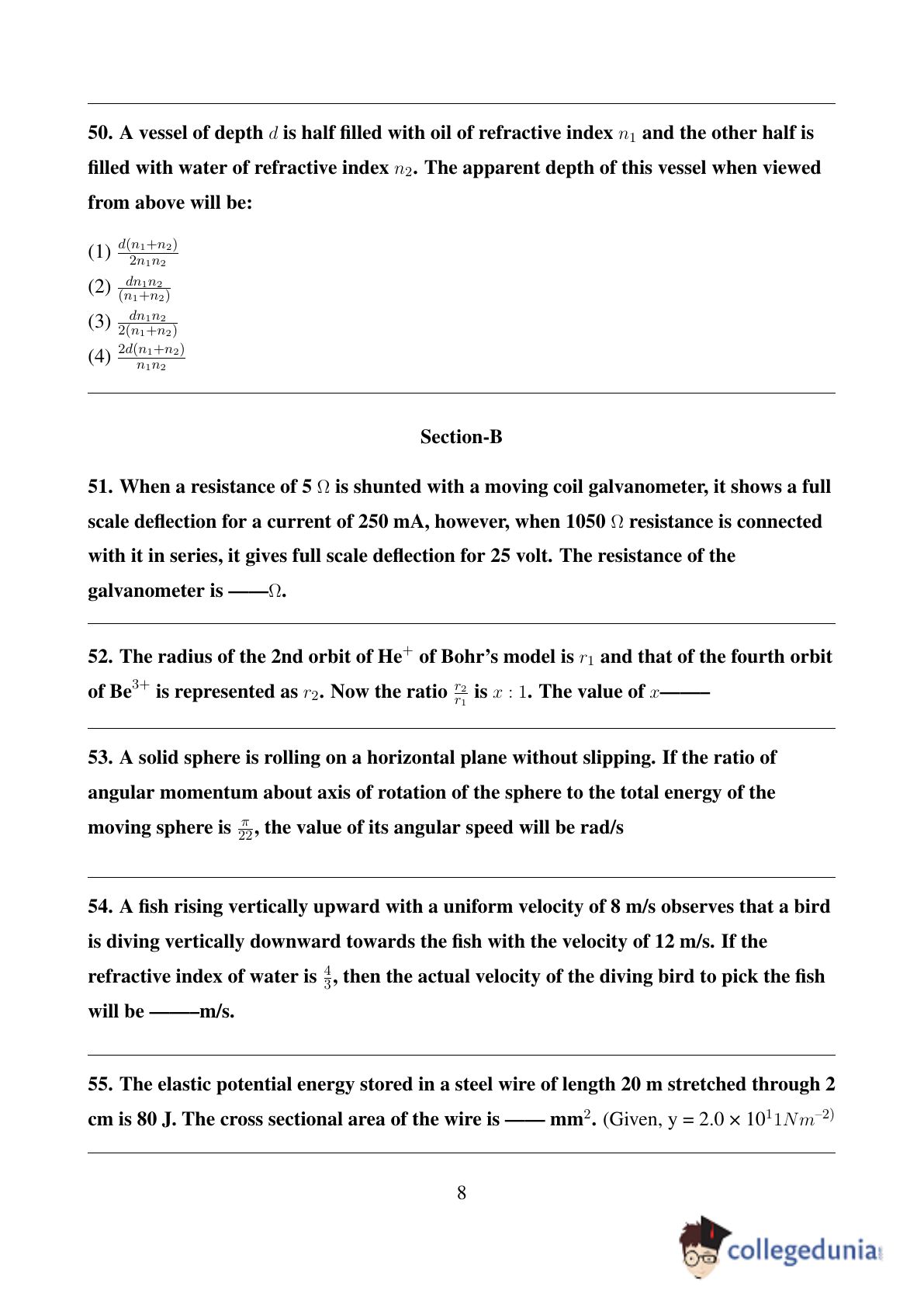
A vessel of depth \( d \) is half filled with oil of refractive index \( n_1 \) and the other half is filled with water of refractive index \( n_2 \). The apparent depth of this vessel when viewed from above will be:
View Solution
Section – B
Question 21:
When a resistance of 5 \( \Omega \) is shunted with a moving coil galvanometer, it shows a full scale deflection for a current of 250 mA, however, when 1050 \( \Omega \) resistance is connected with it in series, it gives full scale deflection for 25 volt. The resistance of the galvanometer is ------\( \Omega \).
Correct Answer:
50 \( \Omega \)
View Solution
\begin{flushleft
Let the resistance of the galvanometer be \( G \).
Step 1: Condition when shunted with 5 \( \Omega \):
When a resistance of 5 \( \Omega \) is shunted across the galvanometer, the total resistance is \( R_{total} = G \parallel 5 \). The current required for full scale deflection is 250 mA, hence: \[ I = 250 \, mA = 0.25 \, A. \]
Using Ohm's law, the voltage across the galvanometer (shunted) will be: \[ V = I \times R_{total} = 0.25 \times (G \parallel 5). \]
The equivalent resistance \( R_{total} = \frac{G \times 5}{G + 5} \), so: \[ V = 0.25 \times \frac{G \times 5}{G + 5}. \]
Step 2: Condition when 1050 \( \Omega \) is connected in series:
When 1050 \( \Omega \) is connected in series, the full scale deflection occurs for 25 V. The total resistance is now \( G + 1050 \). Using Ohm's law: \[ V = I \times (G + 1050), \]
where \( I = 0.25 \, A \). Thus: \[ 25 = 0.25 \times (G + 1050). \]
Solving for \( G \): \[ 25 = 0.25 G + 262.5, \] \[ 25 - 262.5 = 0.25 G, \] \[ -237.5 = 0.25 G, \] \[ G = \frac{-237.5}{0.25} = 950 \, \Omega. \]
Thus, the resistance of the galvanometer is 50 \( \Omega \). Quick Tip: When dealing with galvanometer resistance and shunting, use Ohm’s law and the concept of parallel and series resistances to relate the given information and find the unknown resistance.
The radius of the 2nd orbit of \( He^+ \) of Bohr's model is \( r_1 \) and that of the fourth orbit of \( Be^{3+} \) is represented as \( r_2 \). Now the ratio \( \frac{r_2}{r_1} \) is \( x : 1 \). The value of \( x \)--------
A solid sphere is rolling on a horizontal plane without slipping. If the ratio of angular momentum about axis of rotation of the sphere to the total energy of the moving sphere is \( \frac{\pi}{22} \), the value of its angular speed will be rad/s
View Solution
A fish rising vertically upward with a uniform velocity of 8 m/s observes that a bird is diving vertically downward towards the fish with the velocity of 12 m/s. If the refractive index of water is \( \frac{4}{3} \), then the actual velocity of the diving bird to pick the fish will be --------m/s.
View Solution
The elastic potential energy stored in a steel wire of length 20 m stretched through 2 cm is 80 J. The cross sectional area of the wire is ------ mm\(^2\). (Given, y = 2.0 × 10^11 Nm^–2)
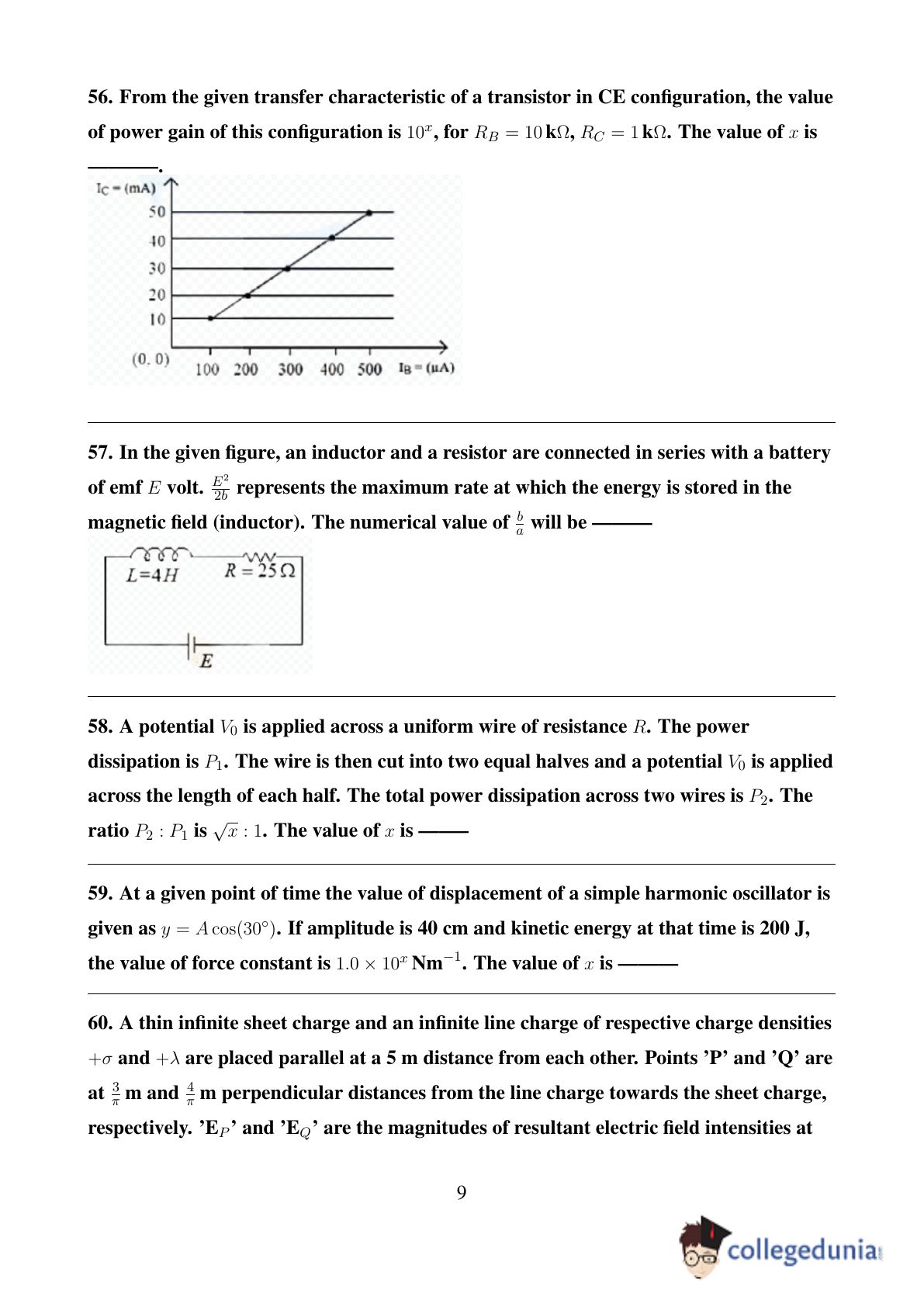
From the given transfer characteristic of a transistor in CE configuration, the value of power gain of this configuration is \( 10^x \), for \( R_B = 10 \, k\Omega \), \( R_C = 1 \, k\Omega \). The value of \( x \) is -----------.

View Solution
In the given figure, an inductor and a resistor are connected in series with a battery of emf \( E \) volt. \( \frac{E^2}{2b} \) represents the maximum rate at which the energy is stored in the magnetic field (inductor). The numerical value of \( \frac{b}{a} \) will be ---------

View Solution
A potential \( V_0 \) is applied across a uniform wire of resistance \( R \). The power dissipation is \( P_1 \). The wire is then cut into two equal halves and a potential \( V_0 \) is applied across the length of each half. The total power dissipation across two wires is \( P_2 \). The ratio \( P_2 : P_1 \) is \( \sqrt{x} : 1 \). The value of \( x \) is --------
View Solution
At a given point of time the value of displacement of a simple harmonic oscillator is given as \( y = A \cos (30^\circ) \). If amplitude is 40 cm and kinetic energy at that time is 200 J, the value of force constant is \( 1.0 \times 10^x \, Nm^{-1} \). The value of \( x \) is ---------
View Solution
\begin{flushleft
The equation for the displacement in simple harmonic motion is given by: \[ y = A \cos \theta \]
where \( A \) is the amplitude and \( \theta \) is the angle at the given point in time. Here, \( \theta = 30^\circ \), so the displacement at this time is: \[ y = A \cos 30^\circ \]
The amplitude is given as \( A = 40 \, cm = 0.4 \, m \), and \( \cos 30^\circ = \frac{\sqrt{3}}{2} \). Therefore: \[ y = 0.4 \times \frac{\sqrt{3}}{2} = 0.4 \times 0.866 = 0.3464 \, m \]
Now, the total mechanical energy in simple harmonic motion is given by: \[ E = \frac{1}{2} k A^2 \]
where \( k \) is the force constant. The kinetic energy at a given point in time is given by: \[ KE = \frac{1}{2} k (A^2 - y^2) \]
We are given that \( KE = 200 \, J \). Substituting the values: \[ 200 = \frac{1}{2} k \left( 0.4^2 - 0.3464^2 \right) \]
Now, simplifying: \[ 0.4^2 = 0.16, \quad 0.3464^2 = 0.119 \] \[ 200 = \frac{1}{2} k (0.16 - 0.119) \] \[ 200 = \frac{1}{2} k \times 0.041 \] \[ k = \frac{200 \times 2}{0.041} = \frac{400}{0.041} \approx 9756.1 \, Nm^{-1} \]
Thus, \( k \approx 1.0 \times 10^4 \, Nm^{-1} \), so the value of \( x \) is 4. Quick Tip: In problems involving SHM, use the energy conservation principles and relate kinetic energy, potential energy, and force constant for accurate calculations.
A thin infinite sheet charge and an infinite line charge of respective charge densities \( + \sigma \) and \( + \lambda \) are placed parallel at a 5 m distance from each other. Points 'P' and 'Q' are at \( \frac{3}{\pi} \, m \) and \( \frac{4}{\pi} \, m \) perpendicular distances from the line charge towards the sheet charge, respectively. 'E\(_P\)' and 'E\(_Q\)' are the magnitudes of resultant electric field intensities at point 'P' and 'Q' respectively. If \( \frac{E_P}{E_Q} = \frac{4}{a} \) for \( 2 | \sigma | = |\lambda| \), then the value of \( a \) is ---------
View Solution
JEE Main 2023 Physics Paper Analysis April 13 Shift 1
JEE Main 2023 Physics Paper Analysis for the exam scheduled on April 13 Shift 1 is available here. Candidates can check subject-wise paper analysis for the exam scheduled on April 13 Shift 1 here along with the topics with the highest weightage.
JEE Main 2023 Physics Question Paper Pattern
| Feature | Question Paper Pattern |
|---|---|
| Examination Mode | Computer-based Test |
| Exam Language | 13 languages (English, Hindi, Assamese, Bengali, Gujarati, Kannada, Malayalam, Marathi, Odia, Punjabi, Tamil, Telugu, and Urdu) |
| Exam Duration | 3 hours |
| Sectional Time Limit | None |
| Physics Marks | 100 marks |
| Total Number of Questions Asked | 20 MCQs + 10 Numerical Type Questions |
| Total Number of Questions to be Answered | 20 MCQs + 5 Numerical Type Questions |
| Marking Scheme | +4 for each correct answer |
| Negative Marking | -1 for each incorrect answer |
Also Check:



Comments